Privacy impact assessment register

The ATSB conducts a Privacy Impact Assessment (PIA) for all high privacy risk projects. A project may be a high privacy risk if it has a significant impact on the privacy of individuals.

The Privacy Impact Assessment Register records details of PIAs conducted by ATSB since the Privacy (Australian Government Agencies – Governance) APP Code 2017(Opens in a new tab/window) (Privacy Code) came into effect on 1 July 2018.

PIA Ref No.Title of PIADate of Completion
This table will be updated as privacy impact assessments are released.  
ATSB – PIA001Privacy Impact Assessment – ATSB Electronic Document Record Management System30/09/2021
ATSB – PIA002Privacy Impact Assessment – ATSB Investigation Case Management System30/09/2021
ATSB – PIA003Privacy Impact Assessment – Transport Safety Investigation Regulations 202130/09/2021
ATSB – PIA004Privacy Impact Assessment - Aviation Safety Data Sharing Platform31/07/2023

For further information, please contact:

Privacy Officer
Australian Transport Safety Bureau
GPO Box 321
Canberra, ACT 2601

Email:  privacy@atsb.gov.au
Telephone:  +61 (02) 6122 1601

Aircraft preparation and foreign object damage event involving Saab 340B, VH-VEQ, at Canberra Airport, Australian Capital Territory, on 10 November 2022

Final report

Executive summary

What happened

On 10 November 2022, a Link Airways (Link) Saab 340B, registered VH-VEQ, was being prepared for a commercial air transport flight. The aircraft was operating as VA633, scheduled from Canberra, Australian Capital Territory, to Sydney, New South Wales. 

During the aircraft preparation process, the first officer (FO) did not attach the strap extension between the stairway and the left propeller. The strap extension was used by some operators to guide passengers onto the aircraft and would prevent the cabin door being closed without its removal. Once passengers had boarded and during the final inspection, the FO did not remove the propeller strap—used to prevent propeller windmilling—from the left engine.

The dispatch coordinator (dispatcher), who was employed and trained by the ground handling company Swissport, did not conduct another walk-around or follow the FO. Prior to engine startup the propeller strap was not noticed by the captain or the dispatcher. During the startup sequence there was a delay between the commencement of engine start and the propeller spinning due to the pins securing the strap to the engine cowling. Once these failed, the propeller began turning normally and the aircraft was cleared to depart with the strap still attached to the left propeller but not visible due to the propeller’s rotation.

At about the time the aircraft became airborne, the propeller strap was thrown free of the blade and into the fuselage. Passengers recalled hearing an extremely loud bang, and could see that an object had penetrated the cabin. The strap itself became embedded in the fuselage, but the failed cowling pins broke free of the strap and entered the cabin. One fragment struck the leg of a passenger, resulting in a minor injury (bruising).

From the flight deck, the flight crew did not see or hear the propeller strap penetrate the fuselage. The cabin manager (CM) realised what had happened, but waited until the aircraft was no longer in a critical phase of flight before contacting the flight crew. The CM stated that there was an emergency in the cabin, and that someone was hit, but did not elaborate beyond expressing a need to return to Canberra and that an ambulance would be required. The flight crew, believing the emergency to be only passenger-related, did not seek any additional information. The aircraft landed safely in Canberra and emergency services assessed the injured passenger.

What the ATSB found

The ATSB found several factors that may have contributed to the propeller strap not being noticed or removed by the FO, captain or dispatcher. Most importantly:

  • The strap extension was not fitted. Because the cabin door could not be closed with the strap extension in place, its correct fitment would almost certainly have prevented the flight from proceeding with the propeller strap attached. A review of other departures out of Canberra found that some other flights were boarded without the strap extension being attached.
  • The propeller strap did not have a visibility aid (streamer) fitted in accordance with the manufacturer’s design. Link conducted an inspection of its Saab 340B fleet and found the condition of propeller straps to be significantly variable.
  • Guidance provided by Link Airways for training of Swissport dispatchers did not explain the appearance, function and importance of the propeller straps.

In addition, while not found to have contributed to this occurrence, Swissport did not ensure that the implemented dispatcher training and audits for operations involving the Link Airways Saab 340B dispatches incorporated all of the elements required for pre-departure walk-arounds in its own ground handling manual. This increased the overall risk to the flight.

Similarly, risk was increased by the flight crew not being informed of the fuselage penetration, although this did not contribute to the outcome of the occurrence. 

What has been done as a result

Link advised that it had updated the flight crew and cabin crew operating manuals to include additional preflight checks for the presence of the propeller strap and strap extension. Additional clarity was provided to cabin crew regarding contacting the flight deck during emergencies. Propeller strap discrepancies were rectified within Link’s Saab 340B fleet, and regular inspections and maintenance were added to procedures. 

Link amended training guidance to Swissport, including more details on the use of propeller straps and strap extensions, as well as the dispatcher’s role in checking for the strap. Link has planned audits of Swissport dispatches to ensure the procedures are correctly implemented. 

Swissport informed all ramp staff (including dispatchers and trainers) that walk-arounds were required on Saab aircraft. It consulted with Link to better define dispatcher responsibilities and expectations, and planned refresher training on the walk-around described in Swissport’s procedures.

Safety message

For those directly involved in aircraft operations, this occurrence highlights the importance of vigilance. When there are multiple risk controls in place and multiple responsible parties, it is easy to become complacent from an expectation that earlier checks have been done correctly and that future checks elsewhere in the system will likely catch anything missed.

From an organisational perspective, the occurrence illustrates the importance of strong communication and harmonised procedures. The use of external ground handling services has become increasingly common in aviation. The relationship between carrier and ground handler can add complexity to ground handling operations. In this instance, differences in expectations and understanding of ground handler responsibilities led to a dispatch procedure that was not effective in confirming that the aircraft was clear for engine start-up. It is critical that all involved parties have a complete understanding of their roles and responsibilities, and how they fit together to create a safe and functional operating environment.

Summary video


The occurrence

On the morning of 10 November 2022, a Saab 340B, registered VH-VEQ, was being prepared for a scheduled air transport flight from Canberra Airport, Australian Capital Territory to Sydney Airport, New South Wales. The flight was being operated by Link Airways (Link), with flight number VA633. The flight was to be conducted with 2 flight crew, a cabin manager (CM), and 29 passengers.

It was the first flight of the day for the aircraft and both members of the flight crew. Both propellers had been restrained overnight to prevent windmilling using propeller straps that secured a propeller blade to the engine cowling. At 0718, as part of the aircraft preparation process, the first officer (FO) began the external portion of the daily aircraft inspection[1] (see Use and stowage). As part of this inspection, the FO removed the right propeller strap and inspected the right engine in accordance with Link’s Flight crew operating manual (FCOM). The FO then ‘dressed’ the propeller, rotating it 45° from its restrained ‘T’ position to an ‘X’ position, as an indication that the propeller was free to spin. 

After continuing the walk-around, the FO removed the left propeller strap to inspect the engine, then reattached the strap so that passengers could safely board without the propeller windmilling. The procedures required the attachment of a strap extension[2] from the left propeller strap to the airstairs[3] (see Propeller straps). The strap extension was designed to prevent passengers from walking under the aircraft, and its presence also prevented the cabin door from being closed without first removing it. The strap extension was in its normal stowage location in the flight deck behind the door but the FO did not remove the strap extension from the flight deck. 

At 0754, after the passengers had boarded, the FO commenced a final external check of the aircraft, which involved a walk-around starting at the nose and moving clockwise around the aircraft confirming that the aircraft was generally prepared for flight, including that hatches were closed and ground service equipment had been removed. The FO closed the cargo bay door, and proceeded to board the aircraft via the airstairs, instructing the CM to close the cabin door. Prior to boarding the aircraft, the FO inadvertently did not remove the left propeller strap. 

The dispatch coordinator (dispatcher)[4] tasked with dispatching the aircraft later reported that they observed the FO closing the cargo bay door and entering the aircraft, and this was supported by available closed-circuit television (CCTV) footage, which showed the dispatcher near the cargo bay door at the time. However, the dispatcher did not follow the FO during the entire walk-around (see Dispatcher training and procedures).

The dispatcher moved to the nose of the aircraft in accordance with procedures, so that the captain could be signalled when engines were clear to start. The dispatcher reported that they did not look for, or notice, the strap fitted to the left propeller. However, from the dispatcher’s perspective, the sun was behind and just above the aircraft, which reportedly reduced the aircraft’s visibility. 

The captain signalled that the right engine would be started, and the dispatcher signalled all clear. The captain started the right engine, and then signalled that the left engine would be started. The dispatcher once again signalled all clear. 

The captain commenced starting the engine, and CCTV showed the left propeller move slightly, then stop. Neither the captain or dispatcher noticed this brief movement, and neither noticed the propeller failing to rotate as it normally would.[5] Seated on the right side, the FO could not observe the left propeller. 

The engine continued to build torque with the propeller restrained, and 33 seconds after the initial movement the propeller began to turn. Subsequent investigation established that the propeller torque caused the pins securing the strap to the engine cowling to fail with the strap remaining secured to one of the blades. 

In a subsequent interview, the dispatcher reported that while the delay between the signal for ‘all clear’ and the propeller’s rotation was unusual, sometimes pilots would complete other tasks between signalling an engine start and commencing it. The dispatcher therefore did not believe it needed to be brought to the attention of the captain.

The rest of the aircraft dispatch process was completed without incident. At 0803 the flight crew taxied the aircraft to the runway and took off. 

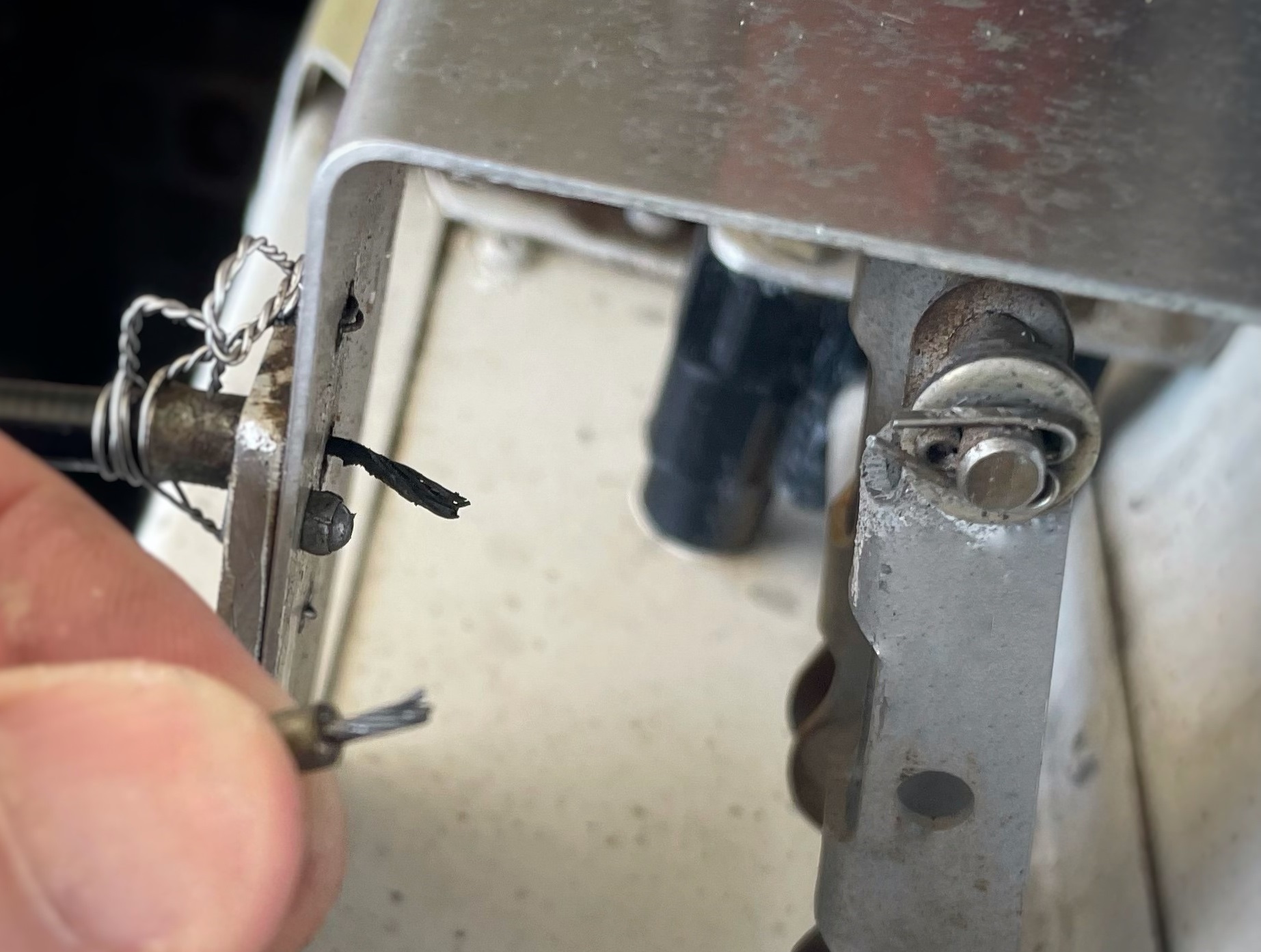
During the take-off, about the time the aircraft became airborne (according to the CM’s recollection), the propeller strap was thrown free of the blade and into the fuselage (Figure 1). The strap itself became embedded in the fuselage, but the two failed cowling pins that were attached to the strap broke free and entered the cabin. One fragment struck the leg of the passenger in seat 2A, resulting in a minor injury (bruising).

Figure 1: Part of the left propeller strap that entered the fuselage adjacent to seat 2A

Figure 1: Part of the left propeller strap that entered the fuselage adjacent to seat 2A

Source: ATSB

Passengers recalled hearing an extremely loud bang, and were able to see immediately that an object had penetrated the cabin. From the flight deck, the flight crew did not see or hear the strap penetrate the fuselage. The CM recalled that they recognised the propeller strap and realised what had occurred, but did not immediately contact the flight crew. In a subsequent interview, the CM stated that this was due to sterile cockpit procedures (see Cabin procedures).[6] 

Approximately 25 seconds after take-off, the CM signalled to the flight crew using the emergency call button, which activated an aural and visual indication on the flight deck. When the flight crew contacted the CM, the response that was recorded was the CM stating ‘Emergency. Somebody… we need to get back to the airport.’ The flight crew then informed Canberra tower and prepared to return the aircraft to Canberra. 

After 2.5 minutes, the flight crew contacted the CM again to ask if emergency services were required. The CM replied ‘Yes… a passenger was hit.’ Further communication between the CM and flight crew related to taxi procedures and provision of emergency services. There was no further communication about the nature of the emergency. The flight crew continued the flight under the impression that the emergency was only related to a medical condition of a passenger. 

The aircraft landed at 0816 without further incident and the passengers were disembarked. The injured passenger was assessed by the emergency services in attendance. 

The aircraft was quarantined in Canberra pending the ATSB’s attendance. A remnant of the propeller strap was recovered from the fuselage (Figure 1) where it had caught on a stringer.[7] The cowling pins were no longer attached to the strap. Sections of both cowling pins were still secured in the engine cowling following the occurrence (Figure 2). Other parts breached the fuselage and were recovered from the cabin floor (Figure 3). A small section of one cowling pin was not located. The strap extension was still stowed on the flight deck.

Figure 2: Cowling pin sections that remained secured in the engine cowling, and the damaged propeller strap shown in the normal fitment location after being recovered from the fuselage

Figure 2: Cowling pin sections that remained secured in the engine cowling, and the damaged propeller strap shown in the normal fitment location after being recovered from the fuselage

Source: ATSB

Figure 3: Parts of the cowling pins recovered from the cabin floor and the engine cowling

Figure 3: Parts of the cowling pins recovered from the cabin floor and the engine cowling

Source: ATSB

Context

Personnel information

The captain held an Air Transport Pilot Licence (Aeroplane) and a multi-engine command instrument rating. The captain held a Class 1 aviation medical certificate and had a total flying time of 4,836.2 flying hours with 1,423.3 hours on the Saab 340.

The first officer (FO) held an Air Transport Pilot Licence (Aeroplane) and a multi-engine command instrument rating. The FO held a Class 1 aviation medical certificate and had a total flying time of 834 flying hours with 436 hours on the Saab 340.

Both flight crew members were within duty limits as prescribed by Civil Aviation Order 48.1 Appendix 3. In a subsequent interview, the FO noted feeling fatigued on the morning of the occurrence due to flight duties and home life.

The cabin manager (CM) had 18 years of cabin crew experience and began working on Saab 340B aircraft in early 2022.

Propeller straps

Function and design

The propeller strap assembly, also referred to as the ‘propeller restraining bridle’ by Saab, was intended for use in preventing propeller movement when the aircraft was parked. The strap assembly provided by Saab consisted of a loop to slide over the propeller blade, two cables with pip pins for securing to the engine cowling, and a streamer to aid visibility (Figure 4).

Figure 4: Propeller strap assembly as issued by Saab

Figure 4: Propeller strap assembly as issued by Saab

Source: Saab, annotated by the ATSB

The propeller strap could only be fitted with the propeller in the ‘T’ position, with 2 blades vertical and 2 horizontal. Without the strap, the propeller can be rotated.[8]

The propeller strap involved in the occurrence had bright orange webbing. Closed-circuit television (CCTV) footage showed that there was no ‘remove before flight’ streamer attached to it. 

Following the occurrence, Link Airways (Link) conducted a fleet-wide review of its propeller straps and found significant variation in serviceability. Link found that: 

…several prop straps fitted to the fleet did not have a hi vis [high visibility] streamer attached, or if they were attached were discoloured with age and not effective. 

Link also found that the orange webbing of the propeller straps was dull or faded with age in some instances. 

Link also used a strap extension, made with fluorescent webbing and connecting between the handrail on the airstairs and the left propeller strap. The strap extension was not designed or supplied by the aircraft manufacturer, but a similar product was used by other Saab 340B operators. According to the Link Flight crew operating manual (FCOM), it was intended to ‘provide a visual indication of a restricted area around the propeller’ and a ‘safety mechanism restricting the passenger door stairs from being closed without removing the extension and prop strap.’ An example of the fitment of a strap extension in accordance with the FCOM is shown in Figure 5.

Figure 5: Exemplar strap extension fitted between airstairs and propeller strap

Figure 5: Exemplar strap extension fitted between airstairs and propeller strap

Source: ATSB

Use and stowage

During aircraft departures, procedures for the propeller straps and strap extension differed slightly depending on whether the aircraft was being prepared for the first flight of the day, or if it was following a previous flight.

Prior to a first flight, Link’s FCOM required a line check, known as a ‘Line Check 1’ or ‘LC1’, to be performed by one of the pilots. Both propeller straps would already be fitted (from the night before), with the strap extension stowed in the flight deck. As part of the line check, FCOM procedures required the pilot to remove the propeller straps in order to properly inspect both engines. The responsible pilot was then required to replace the left propeller strap and fit the strap extension. Prior to the occurrence flight, which was the first flight of the day, the FO removed both straps and replaced the left propeller strap during the inspection, but did not fit the strap extension.

For aircraft preparations following a previous flight, the right propeller strap was not to be fitted. The left propeller strap and strap extension should already be in place, because prior to passenger disembarkation, procedures required the flight crew to fit the connected propeller strap and strap extension to the propeller blade and airstairs, respectively. 

For all departures, once passengers boarded, the FCOM required a ‘final external check’ by the flight crew. This list included the following items:

• Remove right Prop Strap and dress the propeller to 45°.

• Remove left Prop Strap and extension and dress the propeller to 45°.

Pilots did not generally separate the strap extension from the propeller strap when they were removed from the engine. They would remove the cowling pins and slide the propeller strap, along with the strap extension, off the blade. The other end of the extension would then be disconnected from the airstairs.

Prior to the occurrence flight during the final external check, the FO did not remove the left propeller strap, and therefore could not ‘dress’ the propeller (moving it from the ‘T’ to the ‘X’ position). The right propeller strap had been removed and the right propeller was dressed as part of the previous inspection. In a subsequent interview, the FO did not recall seeing the propeller strap, their actions after closing the cargo bay door, nor whether any distractions might have affected the walk-around. Available CCTV footage did not reveal any observable distractions, although the FO might have spoken with the CM waiting at the top of the airstairs at the point when the propeller strap would normally be removed. 

At the end of the final external check, upon entering the flight deck, the pilot was required to stow the propeller strap and strap extension behind the flight deck door, and confirm with the other pilot using the following phrase as an example:

Pogo[9] stowed, Cargo Door closed, Prop Strap stowed, waiting for confirmation of 22 PAX

A review of cockpit voice recordings found that the FO did not advise the captain of door closure and equipment stowage.

Start-up procedures

Following the final external check, the Link FCOM required the flight crew to complete the engine start checklist and stated:

• Before starting any engine, the LP [left seat pilot, usually the captain] shall check propeller area is clear, the prop tie has been removed and fuel cap is on, then call ‘Clear left’. 

• The RP [right seat pilot, usually the first officer] shall check propeller area is clear, the prop tie has been removed, the fuel cap is on and the fuel door is closed, then call ‘Clear right’.

Once the checklist was completed, the start procedure could be commenced. The captain was to signal to the dispatch coordinator (dispatcher) which engine was to be started using hand signals. After receiving the dispatcher’s signal that the specified engine was clear of obstructions and safe to be started, the pilot could start the engine. The FCOM required the captain to monitor the engine instruments, including checking for propeller rotation, during the start process. Although the propeller begins to rotate within a few seconds of the start, the rotation speed is not shown on the instruments until the captain cuts the starter, about 40 seconds after the start is commenced.

In a subsequent interview, the captain recalled checking the left engine area for obstructions before start-up. Seeing that nobody was near the propellers, the captain determined the engine was safe to start, but did not notice the propeller strap or the position of the propeller in the ‘T’ position rather than the ‘X’ position (see Use and stowage).

Ground handling

Ground handling arrangements

The occurrence flight was being operated by Link on behalf of Virgin Australia (Virgin); part of an arrangement that commenced in January 2022. Ground handling services for all Virgin flights at Canberra Airport, including those operated by Link, were handled by Swissport through a Standard ground handling agreement (SGHA). These services included ramp support, equipment, towing/pushback of aircraft, and coordinating dispatches. 

The use of third-party ground handling services has become increasingly common in Australia as well as globally. Many of these arrangements, as with the one between Virgin and Swissport, implement a variation on the SGHA that is controlled and distributed by the International Air Transport Association. 

Article 5 of the SGHA applying to this arrangement outlined the standard of work to be performed by the handling company (Swissport). It stated:

The Handling Company shall carry out all technical and flight operations services as well as other services having a safety aspect, for example, load control, loading of aircraft and handling of dangerous goods, in accordance with the Carrier’s instructions…

Among the services agreed to be provided was the following ‘safety measure’:

Perform visual external safety/ground damage inspection of
(a) doors and panels and immediate surroundings
(b) other inspection items as specified in Carrier's Manuals
…immediately prior departure

This SGHA subsequently stated:

In the case of absence of instructions by the Carrier, the Handling Company shall apply its own standard practices and procedures…

Dispatcher training and procedures

Information provided by Link to Swissport

Prior to Swissport commencing ground handling duties for Link flights, Link provided Swissport with various documents including its Scheduled air transport ground handling manual (SATGHM), so that Swissport trainers could train its own employees on dispatching Link’s Saab 340B aircraft. The SATGHM included a basic familiarisation of the aircraft and associated hazards, procedures for loading baggage into the aircraft, and procedures for aircraft marshalling. 

Within the aircraft familiarisation information, the propeller strap was noted as an item that the flight crew fitted prior to passenger disembarkation. No further information was provided to Swissport about propeller straps. There was also no information about the dressing of propellers. A Swissport trainer reported that they were told by Link staff that walk-arounds were the duty of the flight crew and not dispatchers.

However, Link also provided a practical training checklist for aircraft ramping and dispatch duties. This included a list item requiring the trainee to ‘complete [a] visual check of aircraft in final walk around’. The associated procedure stated:

Confirm by visual and/or touch that all doors and other opening are closed flush with the fuselage

Link provided no additional information to Swissport regarding dispatcher walkaround procedures for Saab 340B dispatches.

Swissport procedures

Swissport’s Ground operations manual (GOM) provided all dispatchers and ground crew with general instructions for tasks such as aircraft dispatches. These were designed to cover a wide variety of aircraft types and did not contain information specific to Saab 340B dispatches or any specific operators. The manual stated:

The purpose of this manual is to provide clear direction to all airport staff and staff contracted to Swissport Pacific on their responsibilities and work procedures relating to airport activities, wherever a client does not have specific procedures relating to the tasks being carried out.

This manual included a requirement for a walk-around for ‘all dispatches’, stating (original emphasis):

SAFETY NON-NEGOTIABLE: The walk-around is extremely important, it is the last physical and visual check of the aircraft prior to departure and is critical to ensuring the safety of passengers and crew. It must always be completed in full, with all due care and attention and without deviation. This is a safety non-negotiable.

This walk-around was to be performed by the dispatcher once all other dispatch preparation had been completed, such as loading and boarding. The GOM instructed dispatchers to walk clockwise from the nose around the aircraft’s perimeter, and provided a 10-point list of check items such as: 

  • open or protruding doors and panels
  • signs of leaks and damage
  • ‘remove before flight’ streamers on the landing gear or flight data sensors
  • remaining ground support equipment or foreign object debris on the apron.

There was no specific instruction to look for a propeller strap or objects secured to the propellers/engine cowling. 

The manual included a second, 15-point list of specific items to check during the dispatcher walk‑around. Dispatchers were to confirm ‘no signs of visible damage or fluid leaks on the tarmac’ around the engine area, and ‘no signs of “remove before flight” streamers … around the door and panel areas on the fuselage.’ None of the list items related to the propellers or propeller straps.

Following the occurrence, a Swissport internal investigation report stated that because Link had not provided a standard operating procedure for a dispatcher walk-around, it was the flight crew’s responsibility to complete a final walk-around, not the dispatcher. 

Swissport training

All dispatchers and other ground crew completed training modules provided by Swissport for general employment procedures, such as work health and safety. The specific training provided by Swissport for Link’s Saab 340B dispatches used a combination of information provided by Link and Swissport’s procedures. This took the form of in-person presentations by the trainer, as well as practical training and assessment. The training did not refer to Swissport’s GOM, or instruct dispatchers to refer to it. Dispatchers seeking additional information were instead directed to Link’s SATGHM. 

The ATSB sought interviews with several trainers and dispatchers of Saab 340B aircraft. Both a trainer and a dispatcher confirmed that dispatchers were taught that the final walk-around was the flight crew’s responsibility. Dispatchers were not trained to complete a full walk-around, but were trained to follow the pilot from the cargo bay door to the airstairs during the final external check. Dispatchers were trained to ensure that doors and hatches were flush with the fuselage, and that the pogo stick was stowed. Once the pilot conducting the final walk-around was aboard and the cabin door closed, dispatchers were trained to move to the nose of the aircraft to assist the captain with the engine start procedure (see Start-up procedures).

One dispatcher stated that previous Swissport training for other operators had also not required a walk-around. It was reported that, at the time of the occurrence, some dispatchers were not aware of the requirement in Swissport’s GOM that walk-arounds were be conducted for all dispatches.

It was reported by a trainer and a dispatcher that the training did not provide any information on the use of propeller straps, and did not require dispatchers to look for propeller straps or strap extensions during the aircraft dispatch. Similarly, the training did not discuss the significance of a propeller in the ‘T’ position or the ‘X’ position.

One trainer reported that while they knew that the Saab 340B had some form of propeller restraint, the trainer assumed that the propeller strap and strap extension were inseparable, and therefore that the cabin door could not be closed while the propeller strap was in place. The trainer therefore did not consider the strap an item that should be checked by dispatchers. 

Audits on aircraft dispatches

Swissport conducted routine audits of some aircraft dispatches across all of its associated carriers. In March 2022, Swissport agreed to dispatch Link’s Saab 340B aircraft as part of an existing arrangement between Swissport and Virgin. Between March and the occurrence in November 2022, 4 audits on dispatches of Link aircraft were conducted. These audits were conducted by the same people who trained staff on Saab 340B dispatches. There were no adverse findings for 3 of the 4 audits, while the other audit had one finding relating to correct operation of the ground power unit. 

Cabin procedures

Link’s Cabin crew operating manual (CCOM) provided cabin crew with a list of tasks to be completed prior to departure. At the time of the occurrence, the cabin crew had no responsibilities relating to the propeller strap or strap extension.

The CCOM contained procedures for various potential emergency scenarios, but there was no guidance specific to an object penetrating the fuselage. The CCOM section describing cabin crew responsibilities in the event of an emergency stated the following:

Reporting of any event or circumstance which may affect the safety or security of passengers, crew members or aircraft to the PIC [pilot in command] must be considered an immediate priority and shall be accomplished through the most expedient means available, even if to do so requires the interruption of the PIC in his duties.

The manual also described sterile flight deck procedures, stating that a sterile flight deck was in place during take-off until the seatbelt sign was turned off. Sterile flight deck (also known as sterile cockpit) procedures are a requirement of the Civil Aviation Safety Regulations and, among other things, limit the timing and reasons for cabin crew communications with the flight crew during certain critical periods of flight, including take-off. Regarding emergencies during the sterile flight deck phase, the CCOM stated:

For an emergency or abnormal situation during the sterile flight deck phase, and no contact period, Cabin Crew may make a call to Flight Crew by pressing EMERG CALL button at any time. Flight Crew will receive aural and visual indications on the Flight Deck.

The manual subsequently stated that ‘Cabin Crew must, as soon as practical, ensure Flight Crew are made aware of what emergency or abnormal situation is happening in the cabin.’

Review of previous flights

CCTV footage was retrieved from Canberra Airport, capturing 8 separate flight preparations and dispatches involving Link Saab 340B aircraft from the day of the occurrence and the days prior. The propeller strap was used on all 8 occasions. Due to the position and quality of the footage, the condition of the individual propeller straps could not be determined. The strap extension was not attached between the propeller strap and airstairs during boarding for 2 out of the 8 observed departures, both of which were the first flight of the day.

Various Swissport staff were observed dispatching aircraft in the recordings. In each recorded departure, the duty dispatcher did not conduct a walk-around around the aircraft’s entire perimeter as prescribed in Swissport’s GOM. While the pilots walked from the cargo bay door to the airstairs, the actions of the dispatchers varied between departures. Some dispatchers were already at the nose of the aircraft, or walking towards it at the time. Others were driving the tug away from the aircraft after loading luggage. One dispatcher out of the 8 appeared to be walking around to the front of the aircraft, observing the pilot between cargo bay door and airstairs, but the dispatcher did not follow the pilot directly. 

Safety analysis

Introduction

The aircraft was released for flight with the propeller strap still attached to the left propeller. Rotational torque during the engine start broke the 2 pins securing the strap to the engine cowling, leaving the strap webbing (with broken fragments of the pins still connected) attached to the propeller blade. The partial strap assembly was flung off the propeller during the take-off, penetrating the fuselage and injuring one passenger.

There were several opportunities for the first officer (FO), captain and dispatch coordinator (dispatcher) to recognise that the propeller strap was still attached prior to departure, but the strap’s presence on the left engine was not noticed. In the following sections, this analysis discusses the various factors associated with:

  • pre-flight and engine start procedures
  • ground handling and aircraft dispatching
  • the use of strap extensions
  • fleetwide propeller strap serviceability
  • dispatcher training facilitated by Link Airways (Link) and Swissport
  • interactions between the flight crew and cabin manager.

Pre-flight procedures

The Link Flight crew operating manual (FCOM) required the right seat pilot—the FO in this case—to conduct a final external check (walk-around) of the aircraft before departure. As part of the check, the FCOM required the FO to ‘remove left prop strap and extension and dress the propeller to 45° (the ‘X’ position). In this occurrence, the FO did not see and remove the propeller strap during the final external check, and did not notice that the strap extension was not present at the time. It is likely that the absence of the strap extension contributed to the FO not seeing and removing the propeller strap, since this larger and more obvious strap would serve as a reminder that the propeller strap was still present. Further, the propeller strap streamer was missing, which is specifically designed to attract attention and therefore reduce the chance that someone could miss the presence of the propeller strap (with or without the extension). There was insufficient evidence to determine whether distraction contributed to the FO not seeing or removing the strap. 

There was also an opportunity for the flight crew to notice the fact that the propeller strap had not been brought into the flight deck. The FCOM specified that the FO should tell the captain that the propeller strap had been stowed, but it was not done in this instance. If the FO had remembered to confirm strap stowage with the captain, one of the crew members might have noticed its absence. While the FO noted feeling fatigued on the morning of the occurrence, there was insufficient evidence to establish if the pilot was likely experiencing a level of fatigue known to affect performance at the time of the occurrence.

Engine start

During the engine start sequence, there was an opportunity for the captain to notice the propeller strap was still attached prior to start-up. The FCOM required the captain to check the propeller was clear and that the ‘prop tie’ (propeller strap) had been removed. In an interview, the captain recalled checking the left engine area prior to start, but did not notice the strap. 

The captain would not have been expecting the strap to still be present, and was probably focusing on ensuring that no people or obstructions were near the propeller rather than the condition of the propeller itself. As discussed in Propeller strap condition, if the propeller strap streamer was present, it would have increased the chance of the captain noticing the strap was still in place. 

The captain was not required to check (and did not notice) whether the propeller was in the ‘X’ position or the ‘T’ position, which was used to indicate the presence of the propeller strap. However, sufficiently high winds can rotate an unrestrained propeller to a different orientation prior to engine start, so the propeller orientation would not necessarily alert a pilot to a potential issue. 

As part of the engine start, the FCOM required pilots to monitor the instruments for propeller rotation along with other engine instruments. In this occurrence, there was 33 seconds between the propeller moving slightly (indicating engine start) and the cowling pins failing, allowing the propeller to rotate freely. By the time the propeller rotation could be monitored using the instruments (approximately 40 seconds after the start had commenced), the propeller would have been rotating normally. Given that the captain’s attention would have been on the instruments, it is likely that this aspect of the start sequence was not noticeably unusual to the flight crew. 

Once the engine start was complete the propeller was likely spinning too fast to see that the propeller strap was still attached to the propeller.

Ground handling and dispatch

The dispatcher did not notice that the propeller strap was still attached to the aircraft during the FO’s final walk-around. The dispatcher was positioned near the cargo bay door during the walkaround, and reported observing the FO moving from the cargo bay door to the airstairs. The dispatcher did not follow the FO during this process, despite it being part of the practical training. Following the FO or performing a full walk-around in accordance with Swissport procedures (see Swissport dispatcher procedures and training) would have provided a better opportunity for the dispatcher to look for the kind of hazards described in the Ground operations manual (GOM), such as open panels, ‘remove before flight’ streamers and ground service equipment. It should be noted that dispatchers were not trained to look for propeller straps (seeDispatchers not familiar with propeller straps or propeller dressing).

While at the nose of the aircraft for the engine start procedure, the dispatcher did not see the strap when checking the engine was clear. The dispatcher also did not notice the slight movement of the propeller at the beginning of the engine start sequence. In addition to the strap visibility and lack of instruction regarding the strap, the position of the sun behind the aircraft could have limited the dispatcher’s view.

Use of strap extensions

The strap extension was to be fitted between the propeller strap and airstairs, and served to indicate the restricted area around the propeller during boarding. Since it was much larger than the propeller strap, it also served as an additional visual indication that the propeller strap was still fitted. Most critically, the strap extension prevented the cabin door being closed without first removing it from the airstairs.

In this occurrence, being the first flight of the day, the strap extension was not already attached from a previous flight. When leaving the flight deck to begin the line check, the FO did not take the strap extension from behind the flight deck door and attach it between the propeller strap and airstairs following the left engine inspection, as required by the FCOM. If the strap extension had been fitted, the cabin manager (CM) would have been unable to close the cabin door after boarding and the flight would have almost certainly not proceeded without removal of the propeller strap.

An examination of closed-circuit television (CCTV) footage at Canberra Airport showed other Link flights where the strap extension was not fitted prior to departure. Out of 8 observed departures, in addition to the occurrence flight, the strap extension was not fitted twice, including one that was the first flight of the day. It is likely that the differences in aircraft preparation for a first flight of the day compared to a turnaround increased the likelihood of the strap extension not being fitted for departure. As 3 of the 9 Link departures (occurrence flight and 8 previous departures) showed the extension strap not being used during boarding, it is evident that its non-use for the occurrence flight was not an isolated event by a single pilot.

Propeller strap condition

The propeller straps designed and supplied by the aircraft manufacturer included a streamer to aid visibility. However, the propeller strap that was provided for the occurrence aircraft did not have a streamer attached. The presence of a ‘remove before flight’ streamer would have increased the likelihood of the FO, captain and dispatcher noticing the propeller strap prior to departure.

Link’s subsequent investigation found variations in the condition of propeller straps within the Saab 340B fleet. The missing, discoloured or damaged streamers that were still in service would have reduced the likelihood of flight crew and dispatchers seeing and removing these propeller straps. Similarly, the straps with faded or discoloured webbing would have been more difficult to see against black propeller blades. This evidence indicates that the condition of propeller straps within Link’s Saab 340B fleet was not effectively managed, increasing the risk to associated flights.

Dispatchers not familiar with propeller straps or propeller dressing

The training material that Link provided to Swissport for dispatcher training did not include any specific requirements for dispatchers to check for propeller straps or the strap extension. Link’s ground handling manual only noted ‘prop straps’ as an item the flight crew fitted to the cabin door prior to disembarkation. The material did not include any further description of the propeller strap or its function and usage by Link. There was also no information regarding Link’s use of a strap extension, which was used by some operators for Saab 340B aircraft. Consequently, the Swissport trainers (and therefore the dispatchers that were trained) would not necessarily have been familiar with flight crew procedures regarding the propeller strap and strap extension. This would have reduced the effectiveness of dispatchers to notice departures from procedure such as a propeller strap not being removed, or a strap extension not being fitted before boarding.

A trainer thought that the strap extension was permanently connected to the propeller strap. Since the cabin door would not be closeable while the strap extension was connected, it would be reasonable for dispatchers to believe that there was no need for them to look for a propeller strap, since the attached strap extension would prevent the flight from proceeding. Beyond guidance on looking for broad problems like ‘remove before flight’ streamers on the landing gear or flight data sensors, dispatchers would not know to look for attached propeller straps during the dispatch process.

Training material from Link did not mention propeller dressing, or the significance of a propeller in the ‘T’ position (indicating the strap was attached) versus one in the ‘X’ position (free to spin). Training dispatchers to ensure propellers were in the correct orientation would provide an additional, albeit indirect, method of checking for the presence of a propeller strap.

Swissport dispatcher procedures and training

Under the ground handling agreement in place between Swissport and Virgin, and by extension between Swissport and Link, dispatches of Link aircraft were to be carried out in accordance with Link’s instructions. In the absence of such instructions, the agreement stated that Swissport was to ‘apply its own standard practices and procedures.’ Similarly, Swissport’s GOM stated that it applied ‘wherever a client does not have specific procedures relating to the tasks being carried out.’

Link provided Swissport with information for the training of dispatchers to provide ground handling services for Link Saab 340B aircraft. Regarding walk-arounds, there was no detailed procedure provided for dispatchers, although a training checklist provided by Link included the need for a ‘final walk-around’ to ‘confirm … that all doors and other opening[s] are closed flush.’ A Swissport trainer reported they were told by Link staff that walk-arounds were the duty of the flight crew, not the dispatcher. However, the training material provided by Link was for aircraft ramping and dispatch duties, not flight crew duties. The training information provided by Link did not provide any detail relating to propeller straps or their use.

In its investigation report into the occurrence, Swissport stated that a dispatcher walk-around was not required since no standard operating procedure for a dispatcher walk-around had been provided by Link. However, both the Standard ground handling agreement (SGHA) and Swissport’s GOM stated that Swissport’s procedures should be applied in the absence of ‘instructions’ or a ‘specific procedure’ from Link. 

If this were to be the case, Swissport’s GOM stated that a walk-around was required for all aircraft dispatches, which was to be a check around the entire aircraft perimeter immediately prior to departure. On the other hand, if Link’s instructions had clearly specified that Swissport staff were not to conduct a walkaround, then complying with this would be consistent with the GOM.

Regardless of obligations under the SGHA, Swissport’s GOM strongly emphasised the need for a dispatcher walk-around, and the walk-around prescribed had more detail than in the training material Link provided. In contrast to Swissport GOM procedures, the training actually given to Swissport ground staff did not require a full-perimeter walkaround, and only required them to observe flight crew moving from the cargo bay door into the cabin, to ensure that doors and hatches were flush with the fuselage, and to ensure that the pogo stick was stowed. CCTV footage from Canberra Airport confirmed that a full-perimeter walk-around was not generally done. Including a complete dispatcher walk-around in the dispatch process would provide a second check that nothing critical has been missed before departure.

It is important to note that in this occurrence, since the GOM did not mention propeller straps, it is not certain that the dispatcher would have noticed the strap if Swissport’s full-walkaround had been implemented.

Audits can be an effective method to detect non-compliance with standard procedures and training. In this case, dispatch audits were conducted by the same Swissport personnel that conducted the dispatcher training. These audits might have been sufficient to prevent dispatchers deviating from the training, but it is not likely that they would detect when the training (and dispatcher actions) deviated from Swissport’s GOM or, more importantly, from the operator’s specific requirements.

Flight crew not informed of fuselage penetration

After realising that an object had penetrated the fuselage, the CM did not inform the flight crew immediately, because this would disrupt the sterile flight deck. Link’s Cabin crew operating manual (CCOM) required cabin crew members to inform flight crew of cabin emergencies as an immediate priority, even with sterile flight deck procedures in place. However, the time between the occurrence (at around the time the aircraft became airborne) and the CM contacting the flight deck (25 seconds after take-off) was not unreasonable, given the unexpected nature of the occurrence, and there being no apparent critical danger requiring an immediate response. 

After this, however, the CM spoke to the flight crew several times but did not communicate the nature of the emergency (primarily being an object that had penetrated the fuselage) and this type of information was not sought by the flight crew. This left the flight crew under the impression that the emergency related only to the medical condition of a passenger, rather than the state of the aircraft. In accordance with the CCOM, cabin crew were required to ensure flight crew were made aware of the nature of an emergency or abnormal situation as soon as was practical.

Based on the understanding that a passenger was injured, the flight crew responded quickly and appropriately, returning the aircraft to Canberra Airport. In this case, the flight crew would likely not have done anything differently if they had known more about the nature of the emergency. However, the CM had no way of knowing whether there was unidentified damage to the propeller or engine, which could be anticipated if the debris is recognised as being from a propeller strap. The CM also would not have been able to identify damage to other systems, which is a reasonable possibility when any object penetrates the fuselage. If unidentified damage had occurred, the flight crew’s response to any consequential events would have been affected by their assumption that the emergency was not related to the aircraft itself. 

Findings

ATSB investigation report findings focus on safety factors (that is, events and conditions that increase risk). Safety factors include ‘contributing factors’ and ‘other factors that increased risk’ (that is, factors that did not meet the definition of a contributing factor for this occurrence but were still considered important to include in the report for the purpose of increasing awareness and enhancing safety). In addition ‘other findings’ may be included to provide important information about topics other than safety factors. 

Safety issues are highlighted in bold to emphasise their importance. A safety issue is a safety factor that (a) can reasonably be regarded as having the potential to adversely affect the safety of future operations, and (b) is a characteristic of an organisation or a system, rather than a characteristic of a specific individual, or characteristic of an operating environment at a specific point in time.

These findings should not be read as apportioning blame or liability to any particular organisation or individual.

From the evidence available, the following findings are made with respect to the aircraft preparation and foreign object damage event involving Saab 340B VH-VEQ at Canberra Airport, Australian Capital Territory, on 10 November 2022.

Contributing factors

  • The aircraft was released for flight with the propeller strap still attached to the left propeller. Parts of the strap assembly subsequently penetrated the fuselage during take-off, injuring one passenger.
  • The first officer did not remove the propeller strap as part of the final external check (walk‑around) of the aircraft.
  • The captain did not notice the propeller strap or the incorrect propeller position prior to engine start.
  • The dispatch coordinator did not notice the propeller strap or, during the engine start, the unusual propeller motion.
  • On one-third of the Link Airways Saab 340B flights for which video surveillance was examined, including the occurrence flight, the flight crews did not fit the strap extension between the propeller strap and the airstairs. As the cabin door could not be closed with the strap extension in place, its correct fitment would almost certainly prevent a flight from proceeding with a propeller strap fitted. (Safety issue)
  • The propeller strap did not have a high-visibility streamer attached, and Link Airways did not effectively manage the condition of propeller straps for its Saab 340B fleet. This affected the visibility of the straps during ground operations. (Safety issue)
  • Guidance provided by Link Airways for training of Swissport dispatch coordinators did not explain the appearance, function and importance of the propeller straps. (Safety issue)

Other factors that increased risk

  • Swissport did not ensure that the implemented training and audits for Link Airways Saab 340B dispatches incorporated all of the elements required in its Ground operations manual for pre-departure walk-arounds. (Safety issue)
  • The cabin manager did not tell the flight crew that an object had penetrated the fuselage. While this had no bearing on the outcome, it limited the information available to the flight crew if aircraft systems had been damaged.

Safety issues and actions

Central to the ATSB’s investigation of transport safety matters is the early identification of safety issues. The ATSB expects relevant organisations will address all safety issues an investigation identifies. 

Depending on the level of risk of a safety issue, the extent of corrective action taken by the relevant organisation(s), or the desirability of directing a broad safety message to the aviation industry, the ATSB may issue a formal safety recommendation or safety advisory notice as part of the final report.

All of the directly involved parties were provided with a draft report and invited to provide submissions. As part of that process, each organisation was asked to communicate what safety actions, if any, they had carried out or were planning to carry out in relation to each safety issue relevant to their organisation. 

Descriptions of each safety issue, and any associated safety recommendations, are detailed below. Click the link to read the full safety issue description, including the issue status and any safety action/s taken. Safety issues and actions are updated on this website when safety issue owners provide further information concerning the implementation of safety action.

Strap extension not always fitted

Safety issue number: AO-2022-055-SI-01

Safety issue description: On one-third of the Link Airways Saab 340B flights for which video surveillance was examined, including the occurrence flight, the flight crews did not fit the strap extension between the propeller strap and the airstairs. As the cabin door could not be closed with the strap extension in place, its correct fitment would almost certainly prevent a flight from proceeding with a propeller strap fitted.

Propeller strap deterioration

Safety issue number: AO-2022-055-SI-02

Safety issue description: The propeller strap did not have a high-visibility streamer attached, and Link Airways did not effectively manage the condition of propeller straps for its Saab 340B fleet. This affected the visibility of the straps during ground operations.

Link training guidance lacked details regarding propeller straps

Safety issue number: AO-2022-055-SI-03

Safety issue description: Guidance provided by Link Airways for training of Swissport dispatch coordinators did not explain the appearance, function and importance of the propeller straps.

Swissport training and audits

Safety issue number: AO-2022-055-SI-04

Safety issue description: Swissport did not ensure that the implemented training and audits for Link Airways Saab 340B dispatches incorporated all of the elements required in its Ground operations manual for pre‑departure walk-arounds.

Safety action not associated with an identified safety issue

Whether or not the ATSB identifies safety issues in the course of an investigation, relevant organisations may proactively initiate safety action in order to reduce their safety risk. All of the directly involved parties are invited to provide submissions to this draft report. As part of that process, each organisation is asked to communicate what safety actions, if any, they have carried out to reduce the risk associated with this type of occurrences in the future. 
Additional safety action by Link Airways

In addition to the safety action described above, Link Airways took the following safety action:

  • The Cabin crew operating manual was amended to provide additional clarity regarding the need for the cabin manager to contact the flight crew in the event of an emergency.
  • A risk assessment was conducted for the potential adoption of an intercom system between pilot and dispatcher, in order to improve communication (on the basis of this risk assessment, such a system was not implemented).
Additional safety action by Swissport

In addition to the safety action described above, Swissport planned to review its Ground operations manual regarding positioning of the dispatcher. 

Glossary

CCTVClosed-circuit television
CCOMCabin crew operating manual
CMCabin manager
FCOMFlight crew operating manual
FOFirst officer
GOMGround operations manual
SATGHMScheduled air transport ground handling manual
SGHAStandard ground handling agreement

Sources and submissions

Sources of information

The sources of information during the investigation included:

  • the flight crew, cabin manager, dispatcher, and dispatch trainers
  • Link Airways
  • Virgin Australia
  • Swissport
  • Saab
  • Canberra Airport
  • the Civil Aviation Safety Authority
  • aircraft cockpit voice recorder and flight data recorder.

Submissions

Under section 26 of the Transport Safety Investigation Act 2003, the ATSB may provide a draft report, on a confidential basis, to any person whom the ATSB considers appropriate. That section allows a person receiving a draft report to make submissions to the ATSB about the draft report. 

A draft of this report was provided to the following directly involved parties:

  • captain, first officer, cabin manager, and dispatcher
  • dispatch trainers
  • Link Airways
  • Virgin Australia
  • Swissport
  • Civil Aviation Safety Authority
  • Saab
  • Swedish Accident Investigation Authority.

Submissions were received from Link Airways and Swissport. 

The submissions were reviewed and, where considered appropriate, the text of the report was amended accordingly.

Purpose of safety investigations

The objective of a safety investigation is to enhance transport safety. This is done through: 

  • identifying safety issues and facilitating safety action to address those issues
  • providing information about occurrences and their associated safety factors to facilitate learning within the transport industry.

It is not a function of the ATSB to apportion blame or provide a means for determining liability. At the same time, an investigation report must include factual material of sufficient weight to support the analysis and findings. At all times the ATSB endeavours to balance the use of material that could imply adverse comment with the need to properly explain what happened, and why, in a fair and unbiased manner. The ATSB does not investigate for the purpose of taking administrative, regulatory or criminal action.

Terminology

An explanation of terminology used in ATSB investigation reports is available here. This includes terms such as occurrence, contributing factor, other factor that increased risk, and safety issue.

Publishing information

Released in accordance with section 25 of the Transport Safety Investigation Act 2003

Published by: Australian Transport Safety Bureau

© Commonwealth of Australia 2024

image_5.png

Ownership of intellectual property rights in this publication

Unless otherwise noted, copyright (and any other intellectual property rights, if any) in this report publication is owned by the Commonwealth of Australia.

Creative Commons licence

With the exception of the Coat of Arms, ATSB logo, and photos and graphics in which a third party holds copyright, this publication is licensed under a Creative Commons Attribution 3.0 Australia licence.

Creative Commons Attribution 3.0 Australia Licence is a standard form licence agreement that allows you to copy, distribute, transmit and adapt this publication provided that you attribute the work.

The ATSB’s preference is that you attribute this publication (and any material sourced from it) using the following wording: Source: Australian Transport Safety Bureau

Copyright in material obtained from other agencies, private individuals or organisations, belongs to those agencies, individuals or organisations. Where you wish to use their material, you will need to contact them directly.

[1]     This inspection was a ‘Line Check 1’ (or LC1) daily inspection.

[2]     Also referred to as a prop (propeller) strap extension.

[3]     Airstairs are a passenger and crew stairway that form an integral part of the aircraft and, after use, are hinged up and stowed on board.

[4]     A ground handling person who coordinates and performs various activities during dispatch. In this case, the role did not have any direct regulatory or airworthiness responsibilities.

[5]     The core engine speed can differ from the propeller speed, as the two are not mechanically linked. When the engine is running, the exhaust flow exerts a rotational force on the propeller via a turbine.

[6]     Sterile cockpit procedures are part of the Civil Aviation Safety Regulations and require pilots to only perform duties essential to the aircraft’s safety during certain critical phases of flight, including take-off.

[7]     Stringers are structural components that run the length of an aircraft fuselage.

[8]     After the prop straps are removed, the propeller is to be moved to the ‘X’ position with the blades at a 45° angle. See Use and stowage.

[9]     The tail strut, or ‘pogo stick’ supports the tail of the aircraft during loading/unloading and refuelling. It is stowed in the cargo bay of Saab 340B aircraft.

Occurrence summary

Investigation number AO-2022-055
Occurrence date 10/11/2022
Location Canberra Airport
State Australian Capital Territory
Report release date 09/05/2024
Report status Final
Investigation level Defined
Investigation type Occurrence Investigation
Investigation status Completed
Mode of transport Aviation
Aviation occurrence category Aircraft preparation
Occurrence class Serious Incident
Highest injury level Minor

Aircraft details

Manufacturer Saab Aircraft Co.
Model Saab 340B
Registration VH-VEQ
Serial number 340B-424
Aircraft operator VEE H AVIATION PTY LTD (operating as Link Airways)
Sector Turboprop
Operation type Part 121 Air transport operations - larger aeroplanes
Departure point Canberra Airport, Australian Capital Territory
Destination Sydney Airport, New South Wales
Damage Minor

Air traffic control error involving Boeing 737, VH-YFT, near Armidale, New South Wales, on 19 October 2022

Final report

Executive summary

What happened

On 19 October 2022, a Boeing 737-8FE aircraft, registered VH-YFT and operated by Virgin Australia, departed Brisbane, Queensland on a scheduled passenger flight to Sydney, New South Wales. After the aircraft reached top of descent, the crew contacted air traffic control (ATC) and were issued a clearance for a standard arrival to land on runway 34L in Sydney. However, runway 16L was operational at the time. When the crew transferred to Sydney Approach, they were instructed to expect runway 16L. While this initially led to some confusion between the crew and ATC, the correct runway was established, and the crew performed an independent visual approach to runway 16L.

What the ATSB found

The ATSB found that an incorrect clearance was verbally communicated to VA942, which was not identified by the enroute air traffic controller or the crew during the read-back or hear-back. This error likely occurred due to momentary interference of related, coinciding information about the assigned flight level (FL 340) and the runway (34L).

However, the information entered into the air traffic management system was correct. Consequently, the approach controller identified and rectified the error with the crew of VA942, well before an undesirable state for landing had the opportunity to develop.

Safety message

Slips in verbal communication can happen at any time. They can pose a threat to safe operations if the content of the message is inaccurate, and then not identified during the read-back or hear‑back process.

Pilots and air traffic controllers are reminded to seek verification when there is confusion or a misunderstanding on any information in a clearance that conflicts with other information they have previously received and understood.

The investigation

Decisions regarding the scope of an investigation are based on many factors, including the level of safety benefit likely to be obtained from an investigation and the associated resources required. For this occurrence, a limited-scope investigation was conducted in order to produce a short investigation report, and allow for greater industry awareness of findings that affect safety and potential learning opportunities.

The occurrence

On 19 October 2022, at 0148 Coordinated Universal Time (UTC), a Boeing 737-8FE aircraft, registered VH-YFT and operated by Virgin Australia as flight number VA942, departed Brisbane Airport, Queensland, on a domestic scheduled passenger flight to Sydney, New South Wales (Figure 1).

At about 0220, the flight crew contacted air traffic control and advised they were maintaining FL 340.[1] The enroute controller issued the flight crew a BOREE 3 ALPHA standard instrument arrival (STAR)[2] for runway 34L.[3] The flight crew read this clearance back to the controller, including runway 34L.

The enroute controller later advised the flight crew that the Sydney Airport automatic terminal information service (ATIS)[4] had been amended. However, both the original and amended ATIS indicated that runways 16L and 16R were in operation for arrivals and departures.

During the descent, the crew contacted Sydney Approach, informing them they were on descent to 10,000 ft and acknowledged receipt of the current ATIS. At this point, the aircraft was at about 17,275 ft and 6 NM from waypoint[5] BOREE. The approach controller replied, confirming runway 16L and to expect an independent visual approach[6] via the STAR to 6,000 ft.

Immediately, the crew questioned the runway assignment informing the approach controller they had been assigned 34L, rather than 16L. The approach controller confirmed that runways 16L and 16R were in operation, and that 16L had been assigned. The flight crew accepted runway 16L, and the approach controller advised the crew that ‘…if you do need some extra track miles to get down to let me know [to] give you some vectors.’ The aircraft continued as cleared and joined the approach as normal.

At about 0245, the approach controller contacted the enroute controller and notified them that VA942 had been incorrectly issued runway 34L. The enroute controller then checked their recorded radio transmissions. They then verified with another aircraft, also recently issued the BOREE 3A Arrival, that they had been assigned 16L, as intended.

Figure 1: Flight path of VA942 with respect to when the runway was assigned.

Figure 1: Flight path of VA942 with respect to when the runway was assigned.

Source: FlightAware and Google Earth, annotated by ATSB.

Context

Enroute controller

The enroute controller had about 24 years’ experience and was rated, endorsed, and fulfilled all recency requirements. They were responsible for 2 adjacent sectors during their shift.

Work schedule

The enroute controller reported fit for duty for their planned 8-hour shift at 0530 local time, with a scheduled shift end time of 1330. In the previous 3 weeks, the enroute controller had accepted some additional overtime shifts and extended shifts. They reported obtaining good quality 6‑7 hours sleep the night before, and their usual sleep in the previous 72 hours.

The error occurred approximately 10 minutes prior to their scheduled shift end time, and the controller reported feeling ‘fully alert’ at the time. After the occurrence, the work scheduling software indicated that the shift had a predicted fatigue level of high.[7] However, fatigue was not considered to be a contributing factor.

Workload

It was reported that the sector was fully staffed that day, with provision for in-shift relief breaks. The controller advised they were ‘relatively busy’ and were communicating with 10 other aircraft around the time of the occurrence. They estimated that they were operating at a capacity of about ‘six out of ten’. Overall, the workload across the 2 sectors was manageable at the time of the occurrence, and not considered to be a contributing factor.

Issuing of clearance

The enroute controller for this sector provided initial sequencing, STAR clearances, and initial descent instructions for aircraft bound for Sydney Airport from the MAESTRO system. MAESTRO is a tactical traffic sequencing software used for aircraft arrivals at Sydney Airport, and other domestic airports across Australia. It uses actual position and speed information of aircraft to determine the landing order and displays this information to air traffic controllers. This information can then be used to inform decisions about aircraft speed control, vectoring or holding to maintain an orderly traffic flow.

When the enroute controller issues a clearance to aircraft, they check the runway allocation in MAESTRO, then select the aircraft designator on the air situation display (ASD), which opens a drop-down list of runways. The controller then selects the issued runway on the ASD and during the hear-back process, checks that all the information is correct. The aircraft designator also displays other information, including the aircraft's flight level.

At the time of the occurrence, the ASD and MAESTRO displayed flight VA942 assigned for runway 16L and maintaining FL 340. The enroute controller issued the clearance using the standard phraseology, and reported they were looking at the flight level in the aircraft designator when they did this.

Standard Terminal Arrival Route (STAR) clearance

The BOREE 3A arrival positioned aircraft to receive radar vectors to final for all Sydney Airport runways, including 16L and 34L. Waypoint BOREE is the initial approach fix, and the track then later branches for the different runways at waypoint OVILS (Figure 2). The crew reached waypoint BOREE about one minute after the correct runway was confirmed, which required that the approach be re-briefed by the crew. In this case, the change to the approach required that the aircraft fly the procedure as briefed to OVILS where radar vectors would then be provided by ATC.

Figure 2: BOREE 3A Arrival STAR Chart


Figure 2: BOREE 3A Arrival STAR Chart

Source Airservices Australia, annotated by ATSB.

Virgin Australia procedures

Virgin Australia’s flight procedures for the verification of weather and terminal information included a requirement for flight crew to independently review information from the ATIS during arrival preparations.

Virgin Australia did not specifically mandate flight crews to conduct a cross check between the clearance and ATIS. They reported that this would be difficult to implement due to several factors:

  • STARs can be issued at various distances depending on the destination
  • STARs can be received before the ATIS information is received
  • ATIS can’t be specified at set distances, due to the operational mix of aircraft communication addressing and reporting system (ACARS)[8] and non-ACARS aircraft
  • dynamic runway changes can occur without notice, or without it highlighted in the ATIS information (e.g., ’from time XXX expect RWY xx’)

During the enroute phase of the flight, the enroute controller notified the crew of the ATIS update from ‘X‑ray’ to ‘Yankee’. Both transmissions listed ‘RWY: 16L AND R FOR ARRS AND DEPS’.  

The enroute controller later advised they were ‘surprised’ that the crew did not question the runway assignment during the read-back process, because the assigned runway was different to that stated in the ATIS.

Safety analysis

The enroute controller reported that when the crew of VA942 initially made contact and the STAR was provided, runway 16L was selected from the available runways as intended. However, they were looking at the flight level (FL 340) on the ASD, when they issued the clearance for 34L. This skill-based error most likely occurred because of the interference of information between FL 340 and 34L. Verbal slips of this nature are more likely to occur when there is a high degree of similarity between the presentation of simultaneous, related information, while performing a familiar and repetitive action.

The read-back and hear-back procedure was the opportunity for both parties to detect the error before it propagated further. However, on this occasion the error went undetected. The radio recordings confirmed that the standard phraseology was used during the communication, and the flight crew correctly read-back the assigned runway 34L, and this was acknowledged by the enroute controller.

There was information available to the crew in the ATIS indicating that runway 34L was not in operation. This provided an opportunity to identify and question the conflicting clearance and ATIS information between themselves, but the evidence obtained by ATSB showed that they did not enquire further with ATC until they were in contact with the approach controller, who correctly assigned 16L.

Findings

ATSB investigation report findings focus on safety factors (that is, events and conditions that increase risk). Safety factors include ‘contributing factors’ and ‘other factors that increased risk’ (that is, factors that did not meet the definition of a contributing factor for this occurrence but were still considered important to include in the report for the purpose of increasing awareness and enhancing safety). In addition ‘other findings’ may be included to provide important information about topics other than safety factors. 

These findings should not be read as apportioning blame or liability to any particular organisation or individual.

From the evidence available, the following findings are made with respect to the air traffic control error involving Boeing 737, VH-YFT, near Sydney Airport, New South Wales on 19 October 2022.

Contributing factors

  • The enroute controller verbally issued the clearance to the flight crew to land on runway 34L instead of 16L, which was not identified during readback. This slip was likely due to the similarity between the flight level (FL 340) and runway 34L.

Other findings

  • The flight crew did not enquire further with ATC about the runway assignment of 34L until the approach controller provided runway 16L.

Sources and submissions

Sources of information

The sources of information during the investigation included:

References

Safety behaviours: human factors for pilots 2nd edition. Resource booklet 4 Communication. Civil Aviation Safety Authority

Air Traffic Flow Management: Harmony for ANSPs. Briefing Paper for Pilots. Version 5. Air Services Australia 2016.

Submissions

Under section 26 of the Transport Safety Investigation Act 2003, the ATSB may provide a draft report, on a confidential basis, to any person whom the ATSB considers appropriate. That section allows a person receiving a draft report to make submissions to the ATSB about the draft report.

A draft of this report was provided to the following directly involved parties:

  • the involved air traffic controllers
  • Airservices Australia
  • Virgin Australia Airlines Pty Ltd

No submissions were received.

Purpose of safety investigations

The objective of a safety investigation is to enhance transport safety. This is done through:

  • identifying safety issues and facilitating safety action to address those issues
  • providing information about occurrences and their associated safety factors to facilitate learning within the transport industry.

It is not a function of the ATSB to apportion blame or provide a means for determining liability. At the same time, an investigation report must include factual material of sufficient weight to support the analysis and findings. At all times the ATSB endeavours to balance the use of material that could imply adverse comment with the need to properly explain what happened, and why, in a fair and unbiased manner. The ATSB does not investigate for the purpose of taking administrative, regulatory or criminal action.

Terminology

An explanation of terminology used in ATSB investigation reports is available here. This includes terms such as occurrence, contributing factor, other factor that increased risk, and safety issue.

Publishing information 

Released in accordance with section 25 of the Transport Safety Investigation Act 2003

Published by: Australian Transport Safety Bureau

© Commonwealth of Australia 2023

image_5.png

Ownership of intellectual property rights in this publication

Unless otherwise noted, copyright (and any other intellectual property rights, if any) in this report publication is owned by the Commonwealth of Australia.

Creative Commons licence

With the exception of the Coat of Arms, ATSB logo, and photos and graphics in which a third party holds copyright, this publication is licensed under a Creative Commons Attribution 3.0 Australia licence.

Creative Commons Attribution 3.0 Australia Licence is a standard form licence agreement that allows you to copy, distribute, transmit and adapt this publication provided that you attribute the work.

The ATSB’s preference is that you attribute this publication (and any material sourced from it) using the following wording: Source: Australian Transport Safety Bureau

Copyright in material obtained from other agencies, private individuals or organisations, belongs to those agencies, individuals or organisations. Where you wish to use their material, you will need to contact them directly.


[1]     Flight level: At altitudes above 10,000 ft in Australia, an aircraft’s height above mean sea level is referred to as a flight level (FL). FL 340 equates to 34,000 ft.

[2]     Standard instrument arrival (STAR): A designated IFR arrival route linking a significant point, normally on a ATS route, with a point from which a published instrument approach procedure can be commenced.

[3]     Runway number: the number represents the magnetic heading of the runway. The runway identification may include L, R or C as required for left, right or centre.

[4]     Automatic Terminal Information Service (ATIS): A continued and repetitive voice frequency broadcast, which contains standard operational information such as the type of approaches to expect, the runways in use, and weather conditions. Updated ATIS information is labelled in terms of ascending phonetic code letters and pilots confirm with ATC that they have received and understood the most up to date information.

[5]     Waypoint: A defined position of latitude and longitude coordinates, primarily used for navigation.

[6]     Independent visual approach (IVA): A procedure to parallel or near-parallel runways which allows a visual approach to one runway independently of approaches occurring on an adjacent parallel or near parallel runway.

[7] ‘Predicted Fatigue Level’ is defined in the Air Traffic Services (ATS) Fatigue Risk Management Procedure, and includes current and future predicted fatigue level, based upon tactical roster management principals.

[8]     Aircraft Communications Addressing and Reporting System (ACARS): digital data link system for the transmission of messages between aircraft and ground stations.

Occurrence summary

Investigation number AO-2022-052
Occurrence date 19/10/2022
Location near Armidale
State New South Wales
Report release date 06/06/2023
Report status Final
Investigation level Short
Investigation type Occurrence Investigation
Investigation status Completed
Mode of transport Aviation
Occurrence class Incident
Highest injury level None

Aircraft details

Manufacturer The Boeing Company
Model 737-8FE
Registration VH-YFT
Serial number 41028
Sector Jet
Departure point Brisbane Airport, Queensland
Destination Sydney Airport, New South Wales
Damage Nil

Rejected take-off involving SAAB 340, VH-ZRC, Flinders Island Airport, Tasmania, 4 November 2022

Final report

What happened

On 4 November 2022, a Saab Aircraft Co 340B, registered VH-ZRC and operated by Pel-Air Aviation Pty Limited, was preparing to take-off from Flinders Island, Tasmania. During the take-off roll, the aircraft veered to the left of the runway centreline and the crew detected a decrease in acceleration before rejecting the take-off. After the aircraft came to a stop, the pilots noted significant tyre marks on the runway, a flat spotted tyre, and all main landing gear tyres were deflated.

What the ATSB found

The ATSB found the parking brake handle had likely not been completely seated in the panel when released by the pilot resulting in residual pressure remaining in the brake system. During the taxi to the runway, the residual pressure in the brake system provided a partial application of the brakes allowing heat to generate within the brake system. This resulted in a continual increase in brake application. During the take-off roll, heat generation increased significantly resulting in further application of the brakes and the crew rejecting the take-off. All main landing gear wheel fusible plugs activated deflating the main landing gear wheels.

What has been done as a result

The operator reported a number of safety actions that have been taken as a result of this occurrence. These include the dissemination of a Notice to Aircrew to all company pilots with detailed information on the operation of the parking brake. A review of the ground school information specific to the function and operation of the parking brake. The inclusion of a parking brake function and operation as a check item in the upcoming flight crew cyclic.

The operator also advised an intention to disseminate an occurrence briefing to all flight crew that will include engineering information related to the design and function of the parking brake system and the importance of completely seating the parking brake handle in the panel.

Safety message

This occurrence demonstrates the importance of completing routine tasks in accordance with manufacturer’s instructions. The outcome of this event, no passenger injuries and minimal aircraft damage, was a result of the flight crew’s effective monitoring of the aircraft’s performance and prompt action to reject the take-off when the expected performance was not achieved.

The investigation

Decisions regarding the scope of an investigation are based on many factors, including the level of safety benefit likely to be obtained from an investigation and the associated resources required. For this occurrence, a limited-scope investigation was conducted in order to produce a short investigation report and allow for greater industry awareness of findings that affect safety and potential learning opportunities.

The occurrence

At 0912 local time on 4 November 2022, a Saab Aircraft Co 340B, registered VH-ZRC and operated by Pel-Air Aviation Pty Limited, departed Melbourne Airport, Victoria for a multi-day, multi-stop charter flight with 25 passengers and 3 crew. The crew consisted of a captain, first officer and a cabin attendant. The first officer was undergoing command training experience and was flying from the left seat, with the captain seated in the right seat. After an uneventful flight the aircraft landed at Flinders Island, Tasmania at approximately 1012 and taxied to the terminal. The passengers disembarked and, along with the cabin attendant, departed the airport for a sightseeing tour of Flinders Island. Both the captain and the first officer remained at the airport to conduct post flight duties and to prepare for the next leg of the charter to Wynyard, Tasmania, scheduled for 1430.

After the cabin attendant and the passengers returned to the aircraft and were boarded, the first officer started the aircraft’s engines and conducted the appropriate checklists. Due to the short taxi required at Flinders Island, the flight crew decided to delay commencement of the taxi until they heard the flight attendant commence the safety briefing.

The first officer released the parking brake and conducted an immediate 180° left turn out of the parking bay (Figure 1). They then proceeded to taxi the aircraft to the threshold of runway 32 via runway 23.[1] The first officer commented that there was no abnormal handling or unusual power settings required to taxi the aircraft. They decided to taxi slowly so the cabin attendant had sufficient time to prepare the cabin for take-off. The first officer also recalled slowing the aircraft with the brakes prior to entering the runways. The aircraft entered runway 32, back tracked and lined up on the runway centreline in preparation for take-off.

The first officer commenced the take-off roll, noting that a crosswind was present from the left. The first officer glanced down after setting power to check the torque gauges. When the first officer looked up again, they noted that they had drifted over to the left of the runway centreline, with the airspeed indicating 46 KIAS.[2] In response, the first officer applied right rudder and brought the aircraft back onto the centreline of the runway. The aircraft continued to accelerate to around 80 knots when the flight crew noted a reduction in the aircraft’s acceleration rate. The first officer called failure, the captain called stop and the take-off was rejected. The aircraft reached a maximum airspeed of 96 knots.

Figure 1: Flinders Island Airport
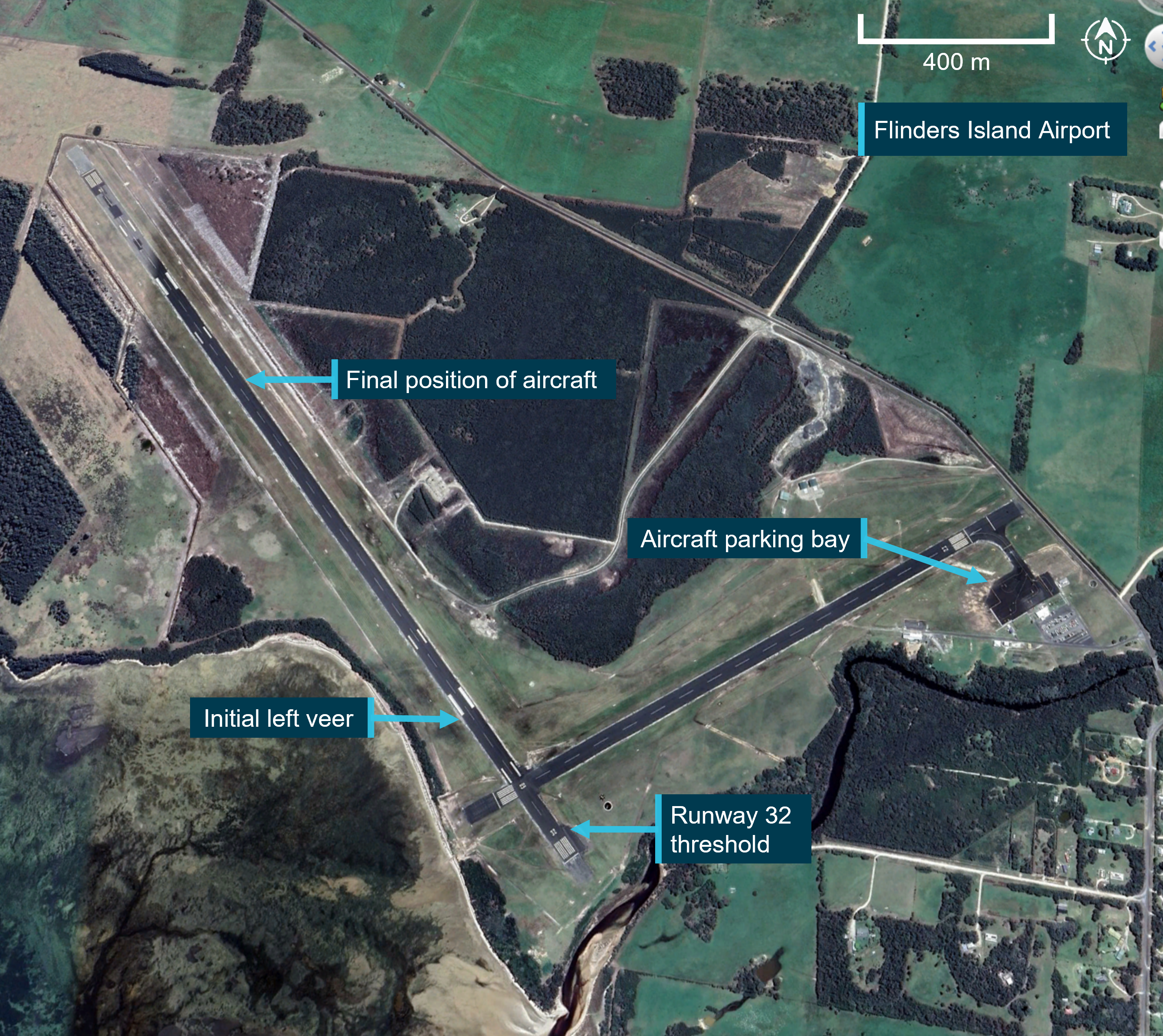
Figure 1: Flinders Island Airport

Source: Google Earth, annotated by the ATSB

When the first officer retarded the power levers the aircraft began to veer to the right of the runway centreline. They then used the nose wheel steering tiller in an attempt to keep the aircraft on the centreline. The first officer also recalled the aircraft felt like it was braking by itself, and that pressure was felt in the brake pedals under their feet.

Just prior to the aircraft coming to a complete stop the Flinders Island Airport Operations Officer (ARO) radioed the flight crew on the Flinders Island Common Traffic Advisory Frequency to advise them of smoke coming from the aircraft’s wheels. The flight crew acknowledged the radio transmission.

The first officer advised the cabin attendant and passengers to remain seated. Melbourne air traffic control was contacted and informed that VH-ZRC was disabled on runway 32 at Flinders Island. The ARO further advised the crew that the smoke had dissipated. The pilots shut down the aircraft and the passengers were disembarked.

The aircraft was inspected by the pilots after the occurrence, with the following observed:

  • all 4 main landing gear wheels on both the left and right main landing gear had deflated
  • the outboard wheel on the left main landing gear had a flat spot (Figure 2).

Figure 2: Left main landing gear after occurrence
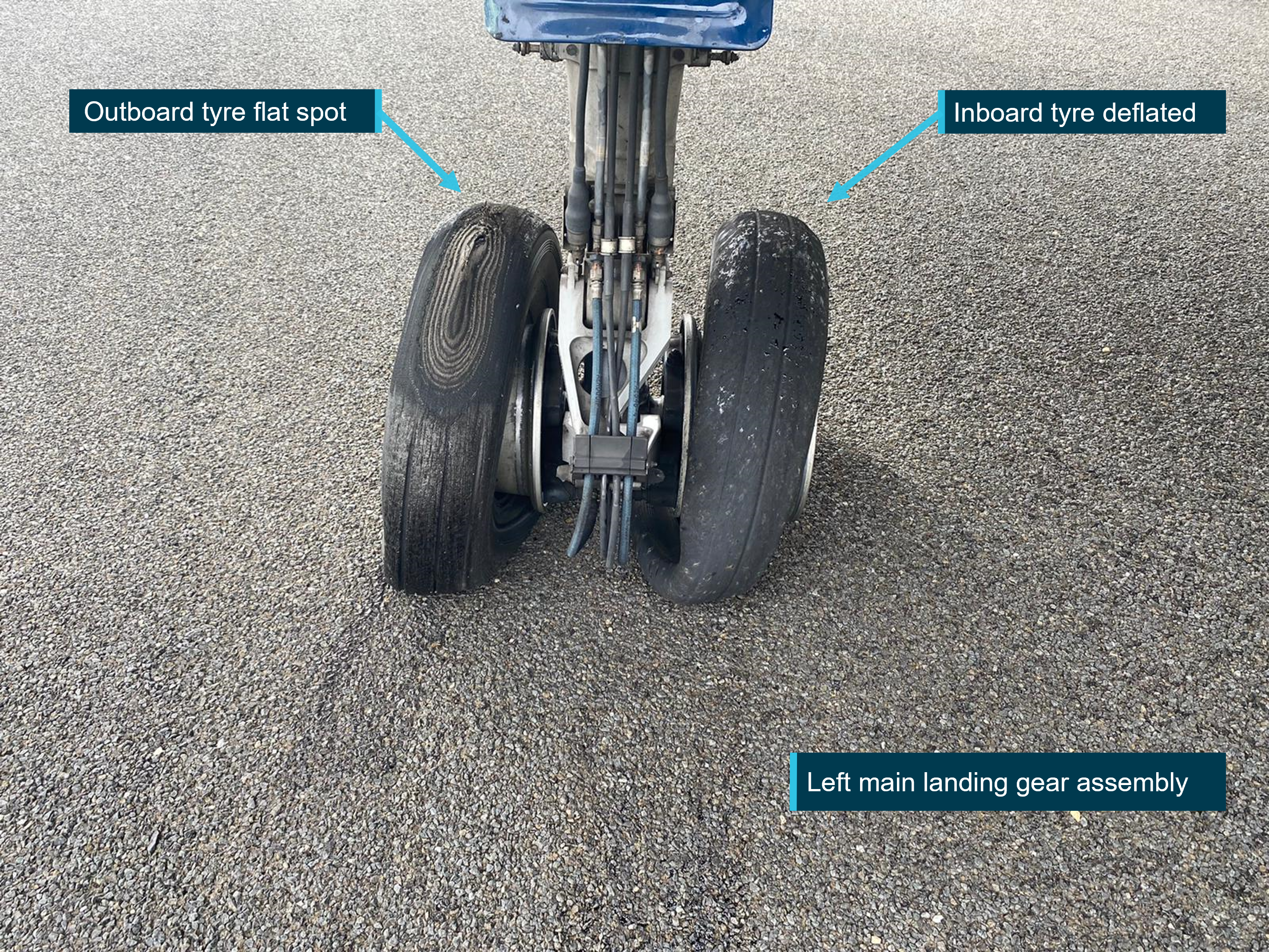
Figure 2: Left main landing gear after occurrence

Source: Supplied, annotated by the ATSB

The runway was also inspected by the pilots and the ARO, with the following observed:

  • tyre marks were evident commencing 300 m from the runway threshold until the aircraft came to a stop approximately 1,150 m from the runway threshold (Figures 3 and 4)
  • initial tyre marks showed a veering to the left of centreline 
  • final tyre marks displayed a significant veer to the right with a change in tyre markings from a locked tyre to a deflated tyre prior to the aircraft coming to a stop (Figure 5).

Figure 3: Tyre marks on runway
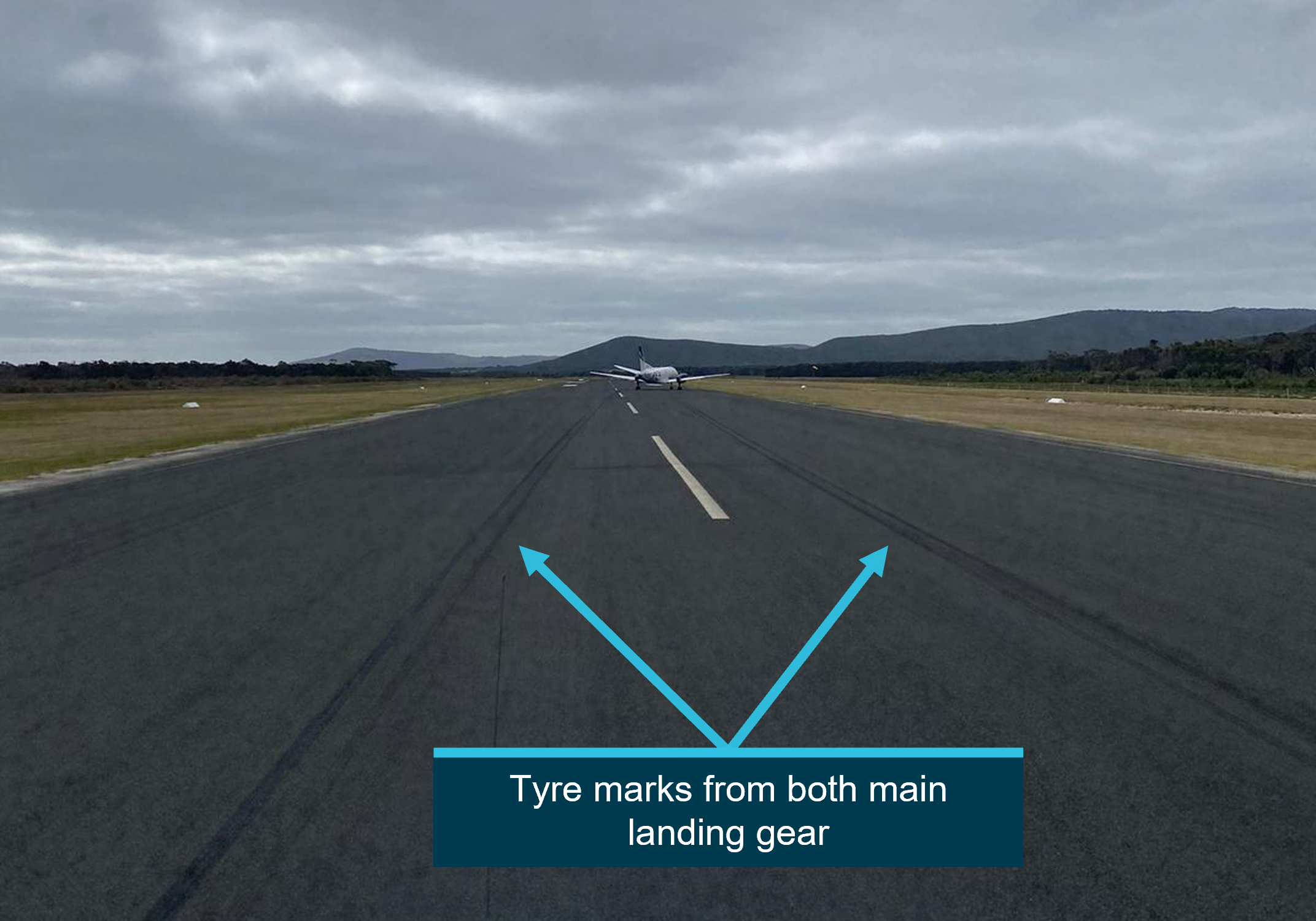
Figure 3: Tyre marks on runway

Source: Supplied, annotated by the ATSB

Figure 4: Initial tyre marks from VH-ZRC on runway 32
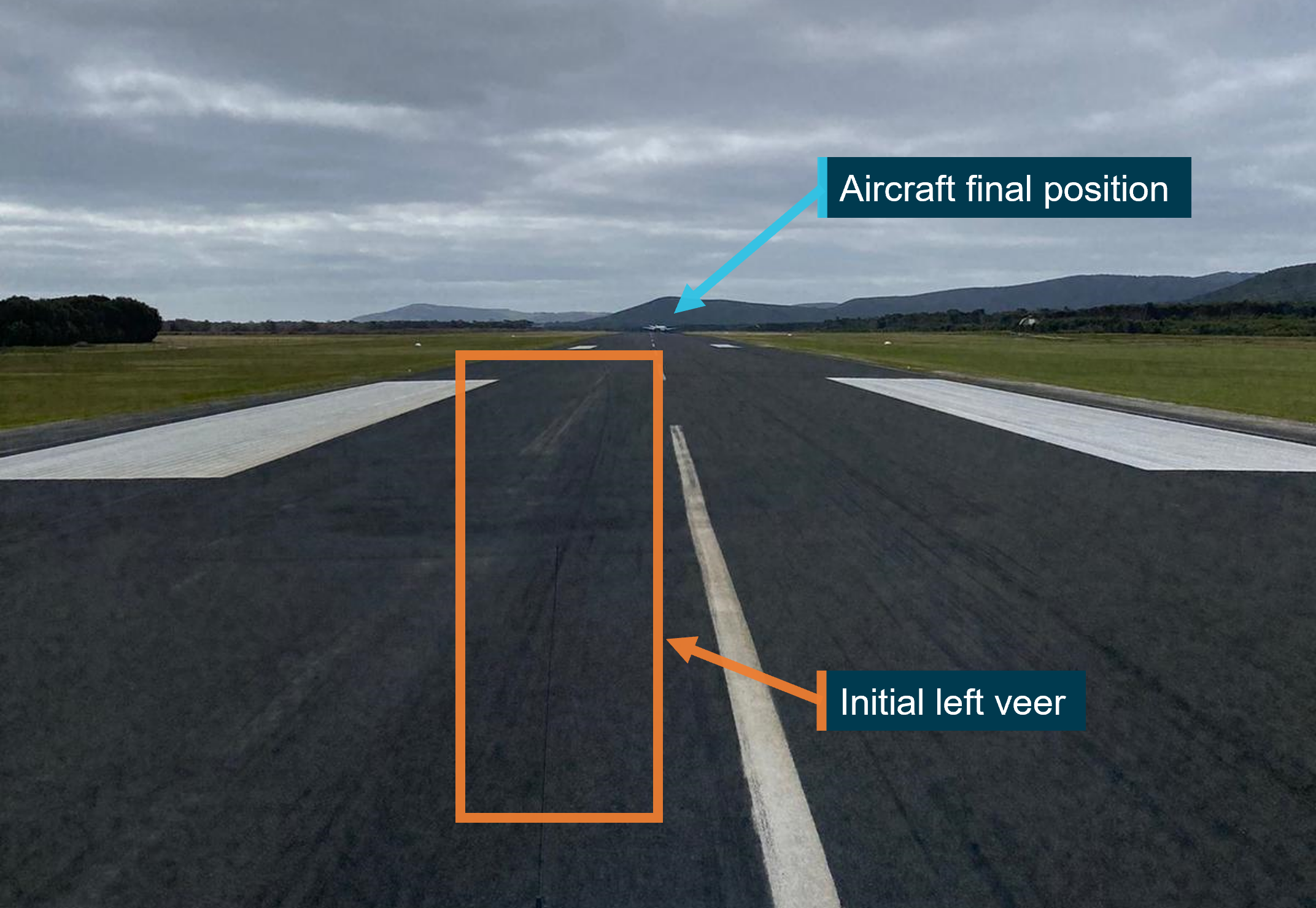
Figure 4: Initial tyre marks from VH-ZRC on runway 32

Source: Supplied, annotated by the ATSB

Figure 5: Left main landing gear tyre marks  
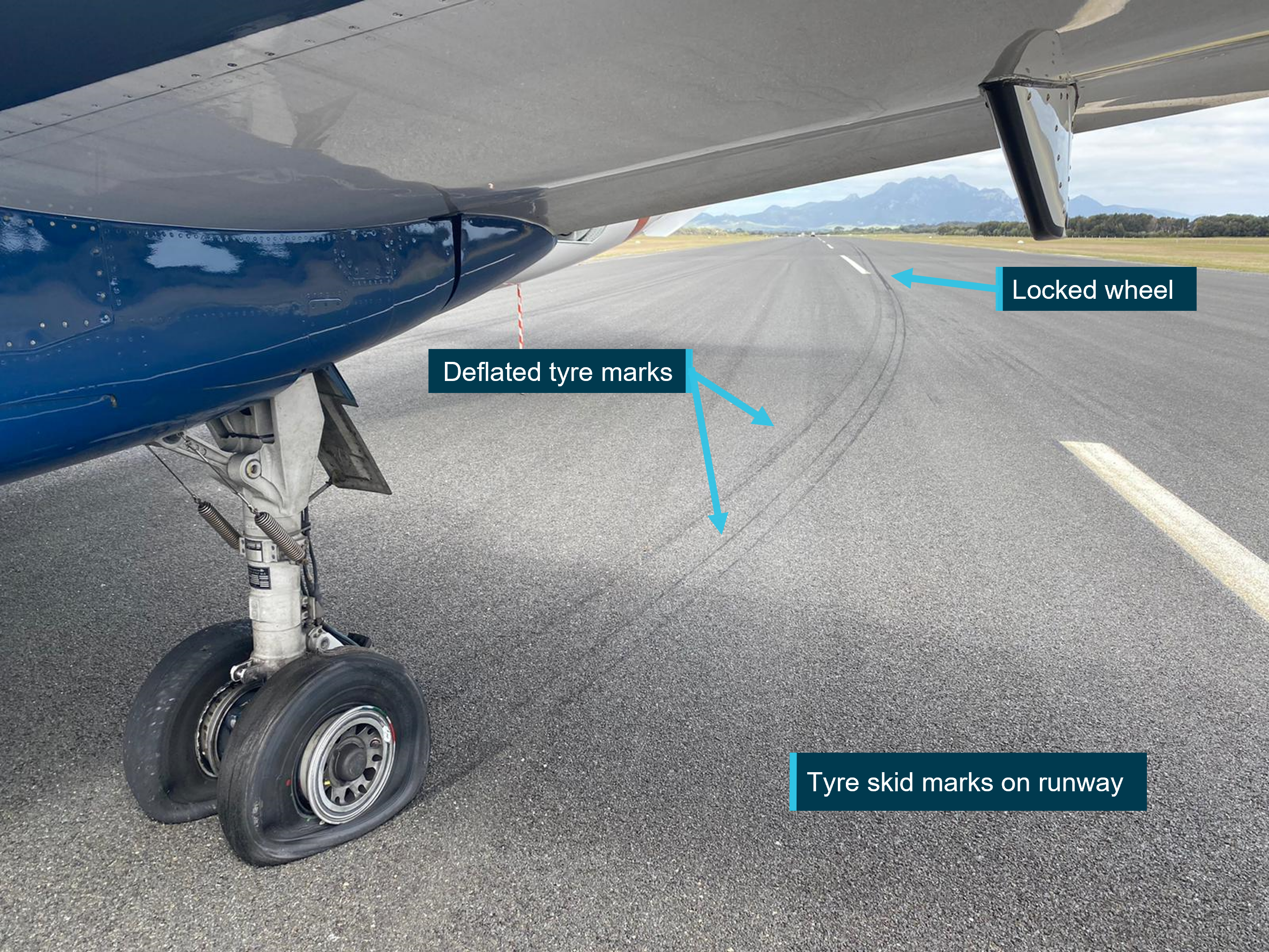
Figure 5: Left main landing gear tyre marks  

Source: Supplied, annotated by the ATSB

A Rex Airlines engineering crew was flown in to inspect the aircraft. The engineers identified that the main landing gear wheels had deflated due to their fusible plugs activating. All the main landing gear wheels and brakes were replaced. Brake and parking brake testing was carried out with no faults evident, and the aircraft was returned to service.

Context

Pilot information

The captain held an Air Transport Pilot Licence (Aeroplane) and a multi-engine command instrument rating. The captain held a Class 1 aviation medical certificate. The captain had a total flying time of 4,660 flying hours with 4,461 hours on the SAAB-340.

The first officer held a Commercial Pilot Licence (Aeroplane) and a multi-engine command instrument rating. The first officer held a Class 1 aviation medical certificate. The first officer had a total flying time of 2,449.5 flying hours with 2,219 hours on the SAAB-340.

Flinders Island weather

The pilots and ARO reported that the wind during the take‑off roll was from 280° at 16 knots with broken cloud at 3,000 ft above the airport. Visibility was greater than 10 km.

Brake system

The main landing gear wheels are fitted with hydraulic disc brakes. Each landing gear has an inboard and outboard brake assembly which are powered by separate hydraulic circuits, an inboard brake circuit and an outboard brake circuit. Each circuit has its own accumulator that is pressurised, when required, by a demand electrical hydraulic pump. The brake circuits share a common hydraulic return line to the aircraft hydraulic system main reservoir. Independent wheel braking is controlled by toe pedals at the top of the rudder pedals. Each pedal is connected via a cable to its corresponding brake valves.

Figure 6: Brake system schematic
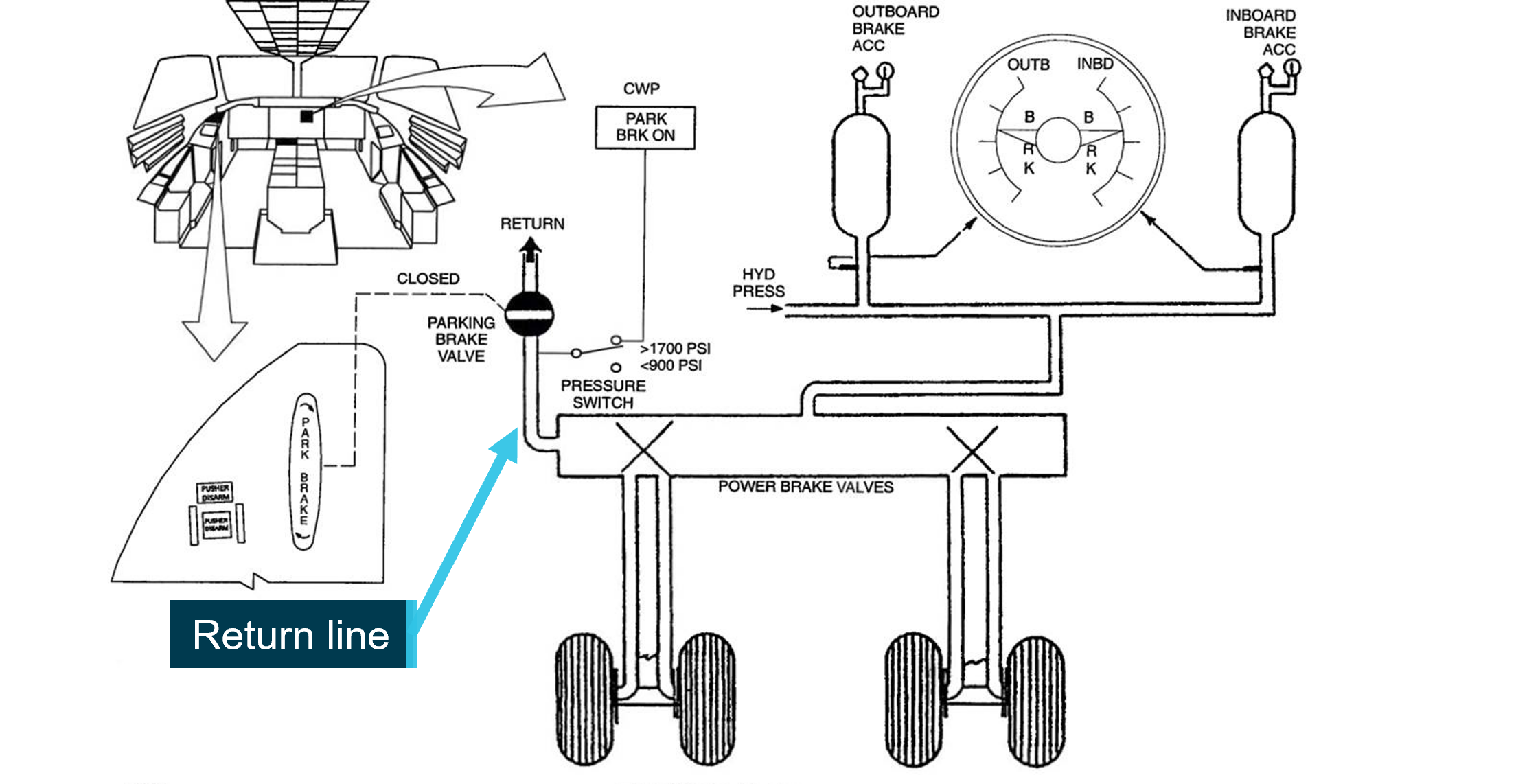
Figure 6: Brake system schematic

Source: Supplied, annotated by the ATSB

Parking brake

The parking brake is controlled by a handle on the left pilot’s side panel (Figure 6). The handle is attached via a push-pull cable to a parking brake valve located in the brake hydraulic circuit common return line. The parking brake is set by pulling up on the handle whilst depressing the brake pedals. This action closes an internal valve against spring pressure inside the parking brake valve, retaining hydraulic pressure in both brake circuits and maintaining brake application. The handle is then locked in the UP position by rotating the handle 30° clockwise. When the parking brake is set, the pilots reported that it is usual for there to be a firmness felt in the toe brakes on the pedals.

Figure 7: Parking brake valve internal
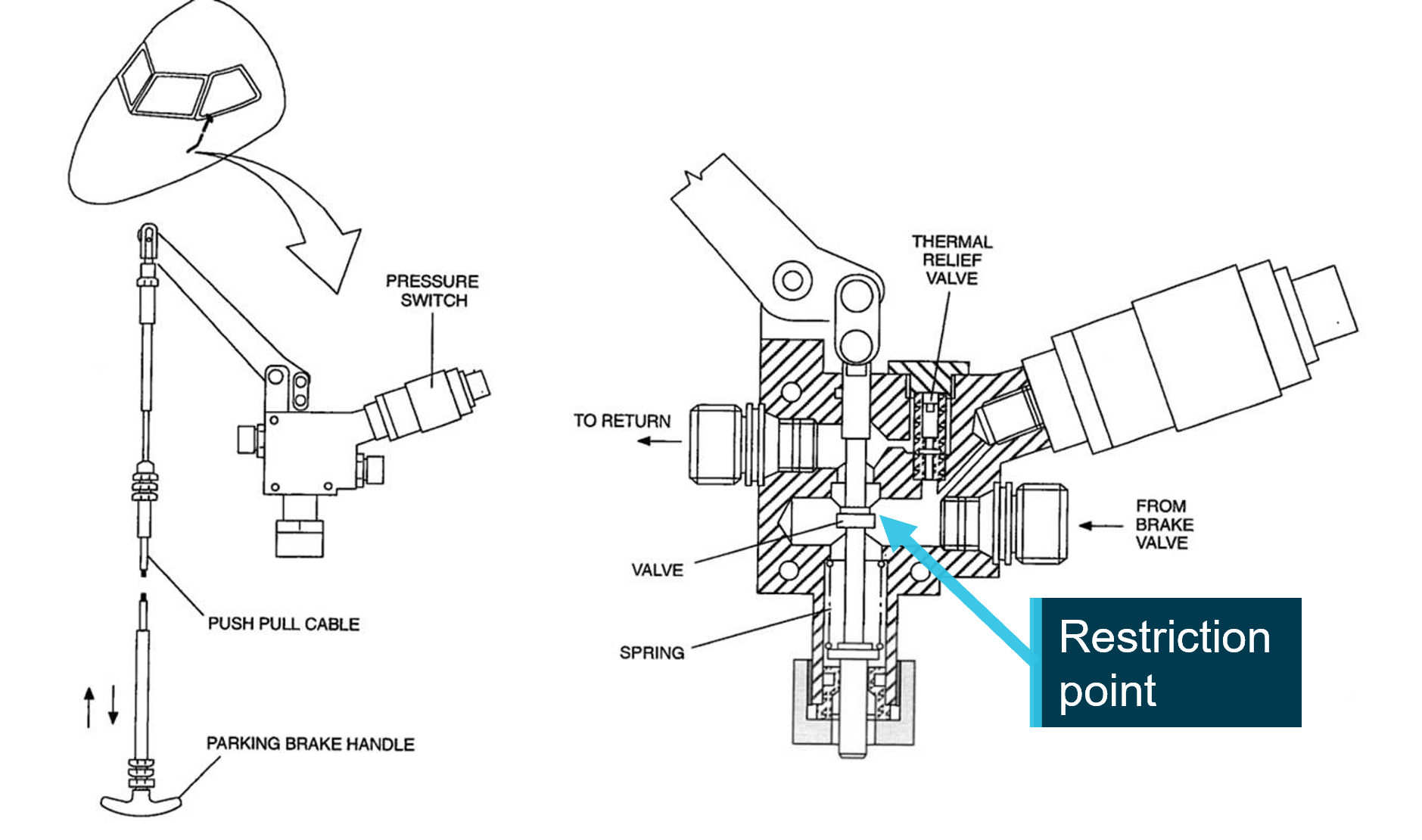
Figure 7: Parking brake valve internal

Source: Supplied, annotated by the ATSB

The parking brake is released by turning the handle 30° anticlockwise and pushing the handle down into the panel. This mechanically opens the return line, relieving pressure from the brake circuit, allowing the brakes to release.

The brake system requires an unrestricted hydraulic fluid flow through a single return line within the parking brake valve for normal operation (Figure 7). Any restriction of this return line will increase the time required for brake pressure to be relieved, resulting in a partially applied or dragging of the brakes. A dragging brake will generate heat within the wheel and brake assemblies. This will cause all brake components, including the hydraulic fluid, to expand, further increasing the pressure in the brake circuits. In the event of a restriction, this increase in pressure will transfer directly to an increase in brake application.

Parking brake annunciator

An amber PARK BRK ON annunciator light on the pilot’s Central Warning Panel, located in the centre of the dashboard, illuminates when parking brake hydraulic pressure exceeds 1700 psi (Figure 6). The light goes off when the parking brake handle is pushed down and/or the pressure reduces below 900 psi. The pilots recalled that there were no warnings or cautions on the Central Warning Panel prior to take-off.

Anti-skid system

The Saab 340B is fitted with an anti-skid brake system that maximises braking efficiency by monitoring wheel speed signals across all 4 main wheels. The system modulates brake pressure in the brake hydraulic circuits to prevent a wheel locking. The anti-skid valves are located within the brake circuits, upstream of the parking brake valve, and have no influence on parking brake application.

Fusible plugs

The main landing gear wheels are fitted with 3 fusible plugs each. Should a critical temperature be reached in the wheel assembly, the core of the fusible plug will melt and provide a relief mechanism allowing the tyre to deflate.

Flight data

The flight data recorder was downloaded by the operator and data from the occurrence event and the 2 previous days of flying was provided to the ATSB. ATSB examination of the recorded flight data did not identify any anomalies in relation to engine operation which could have contributed to a loss of acceleration during the event. There were no brake system parameters recorded on the flight data recorder.

Manufacturers response

The manufacturer, Saab Aircraft Co, were contacted for further information about brake system design and operation. Saab stated that due to the mechanical nature of the brake system, with cables between the pedals and the brake valves, and considering that the brake system was inspected with no faults after the occurrence, they could not identify any other system reason that could contribute to brake application other than the parking brake. They further advised that if the parking brake is released properly and the parking brake valve is serviceable, there is no possibility of both brake systems remaining on.

Saab were also asked if they were aware of any similar examples of occurrences with the Saab 340 aircraft, Saab responded that, after a search of their database, they did not find any comparable occurrences.

Post occurrence rectifications

After the occurrence, the following rectifications were carried out prior to the aircraft returning to service:

  • all 4 brake assemblies were replaced
  • all 4 main landing gear wheel assemblies were replaced
  • all 4 main landing gear wheel axles were visually inspected with no defects identified
  • the input cables to the brake control valves were visually inspected with no binding or defects evident
  • a parking brake control system test was carried out with no defects identified
  • a high-speed taxi and brake test was carried out with no faults.

The brake and wheel assemblies were transported to the REX engineering workshops for further examination. The examinations found:

  • all 4 brake assemblies were within wear limits and the brake pistons were serviceable. All 4 brake assemblies showed signs of overheating and were removed from service
  • all 4 main landing gear wheel assemblies displayed signs of overheating evident with all fusible plugs blown. The wheel assemblies were removed from service for disposal.

Safety analysis

On 4 November 2022, a Saab Aircraft Co 340B operated by Pel-Air Aviation Pty Limited, taxied for runway 32 at Flinders Island Airport. During the take-off roll, the aircraft veered to the left and did not accelerate as expected. The crew rejected the take-off and subsequent inspection identified that one tyre was flat spotted and all the main landing gear tyres were deflated.

Subsequent post occurrence rectification and system testing was carried out. No defects or unusual wear was identified on the replaced components other than signs of overheating. The brake system and parking brake system, including handle operation, was tested with no faults identified. The aircraft was released for service with no further brake related faults reported.

Significant tyre marks, from all 4 main landing gear wheels, were observed on the runway after the occurrence. These tyre marks commenced early in the take-off roll and continued to the disabled aircraft. This evidence, as well as a review of the engine parameters from the flight data recorder and reports from the flight crew, identified that the occurrence was brake‑related and not an issue with aircraft propulsion. The brake system, consisting of 2 separate hydraulic circuits, an inboard and an outboard circuit, share a common return line. For all 4 brakes to be applied and overheat the wheel assemblies, a fault would have had to occur in both systems simultaneously or in the single hydraulic return line.

The pilot conducted an immediate 180° left turn from the hardstand as the taxi commenced. This is evidence that the parking brake was released to the extent necessary for pressure to reduce below 900 psi and the PARK BRK ON annunciator to extinguish. The pilots observed that there were no cautions present prior to the take-off roll. The pilot also noted that the aircraft was able to be taxied with no abnormal handling or any extra engine power required however the pilot also reported taxiing slower than usual, to allow cabin crew to prepare the cabin, which may have masked any brake application.

If the parking brake handle is not completely seated by the pilot, the common return line from both brake hydraulic circuits will be partially obstructed within the parking brake valve. This will restrict hydraulic fluid from flowing out of the brake system, slowing down the rate at which pressure is relieved, resulting in a partial application or dragging of the brakes. During the taxi out, the partially applied brakes created heat due to friction resulting in further brake application to the restricted system as the temperature increased.

As the aircraft commenced the take-off roll, heat from the dragging brakes increased rapidly due to the acceleration of the wheel assemblies. At 46 knots the aircraft veered to the left, likely as a result of the left tyre locking and skidding. The pilot corrected towards the runway centreline and continued with the take-off. At approximately 80 knots the pilots observed that the aircraft’s acceleration rate had reduced and the take-off was rejected.

The pilot commented that, when they reduced power, and prior to manually applying the brakes, the aircraft slowed as though the brakes were applied. This was likely a combination of an application of the brakes and the tyres deflating as identified by the change in runway tyre marks. The tyre marks had changed from a solid tyre mark for the left outboard wheel to a set of parallel lines for each individual wheel. These parallel lines are a result of the weight of the aircraft acting only on the edges of the wheel rim through the tyre to the runway, indicative of a deflated tyre. This is evidence that that the core of the fusible plugs had melted due to a build-up of heat in the wheel assemblies, resulting in the tyres deflating during the latter stage of the take-off roll. The pilot commented that when they then applied the brakes, they felt pressure in the pedals and likened it to the parking brake being set.

Consideration of all the available evidence supports a conclusion that the push-pull parking brake handle was likely not completely seated in the console resulting in the parking brake valve partially restricting the hydraulic return line. This residual pressure allowed a partial application of the brakes, or an incomplete release of the brakes, at the commencement of the taxi, resulting in the brakes dragging. This resulted in the generation of heat in the brake system, a continual increase in brake application and the rejected take-off.

Findings

ATSB investigation report findings focus on safety factors (that is, events and conditions that increase risk). Safety factors include ‘contributing factors’ and ‘other factors that increased risk’ (that is, factors that did not meet the definition of a contributing factor for this occurrence but were still considered important to include in the report for the purpose of increasing awareness and enhancing safety). In addition ‘other findings’ may be included to provide important information about topics other than safety factors. 

These findings should not be read as apportioning blame or liability to any particular organisation or individual.

From the evidence available, the following findings are made with respect to the rejected take-off involving SAAB 340B, VH-ZRC, at Flinders Island Airport, Tasmania on 4 November 2022

Contributing factors

  • The parking brake handle was likely not completely reset (seated in the panel) by the pilot, resulting in residual pressure remaining in the brake system.
  • Residual pressure in the brake system resulted in a partial application of the brakes during taxi. This allowed heat to generate within the brake system resulting in a gradual increase in brake application.
  • The significant and increasing drag associated with the partially applied brakes resulted in a flat spotted tyre and all of the main landing gear wheel fusible plugs activating during the take‑off roll.

Safety actions

Whether or not the ATSB identifies safety issues in the course of an investigation, relevant organisations may proactively initiate safety action in order to reduce their safety risk. The ATSB has been advised of the following proactive safety action in response to this occurrence.

Safety action by Pel-Air

Pel-Air advised that they have taken the following safety actions:

  • disseminated a Notice to Aircrew to all company pilots with detailed information on the operation of the parking brake
  • reviewed the Flight Operations Training and Checking ground school information specific to the function and operation of the parking brake
  • included parking brake function and operation as a focus item in the upcoming flight crew check cycle
  • provided ancillary training to the occurrence flight crew.

Pel-Air also advised an intention to disseminate an occurrence briefing to all flight crew that will include engineering information related to the design and function of the parking brake system and the importance of completely seating the parking brake handle in the panel.

Sources and submissions

Sources of information

The sources of information during the investigation included:

  • the flight crew of VH-ZRC
  • the Flinders Island Airport Operations Officer
  • Pel-Air Aviation Pty Limited
  • Saab Aircraft Company
  • Airservices Australia

Submissions

Under section 26 of the Transport Safety Investigation Act 2003, the ATSB may provide a draft report, on a confidential basis, to any person whom the ATSB considers appropriate. That section allows a person receiving a draft report to make submissions to the ATSB about the draft report.

A draft of this report was provided to the following directly involved parties:

  • the flight crew of VH-ZRC
  • the Flinders Island Airport Operations Officer
  • Pel-Air Aviation Pty Limited
  • Saab Aircraft Company

Submissions were received from:

  • the captain of VH-ZRC
  • Pel-Air Aviation Pty Limited

The submissions were reviewed and, where considered appropriate, the text of the report was amended accordingly.

Purpose of safety investigations

The objective of a safety investigation is to enhance transport safety. This is done through:

  • identifying safety issues and facilitating safety action to address those issues
  • providing information about occurrences and their associated safety factors to facilitate learning within the transport industry.

It is not a function of the ATSB to apportion blame or provide a means for determining liability. At the same time, an investigation report must include factual material of sufficient weight to support the analysis and findings. At all times the ATSB endeavours to balance the use of material that could imply adverse comment with the need to properly explain what happened, and why, in a fair and unbiased manner. The ATSB does not investigate for the purpose of taking administrative, regulatory or criminal action.

Terminology

An explanation of terminology used in ATSB investigation reports is available here. This includes terms such as occurrence, contributing factor, other factor that increased risk, and safety issue.

Publishing information 

Released in accordance with section 25 of the Transport Safety Investigation Act 2003

Published by: Australian Transport Safety Bureau

© Commonwealth of Australia 2023

image_5.png

Ownership of intellectual property rights in this publication

Unless otherwise noted, copyright (and any other intellectual property rights, if any) in this report publication is owned by the Commonwealth of Australia.

Creative Commons licence

With the exception of the Coat of Arms, ATSB logo, and photos and graphics in which a third party holds copyright, this publication is licensed under a Creative Commons Attribution 3.0 Australia licence.

Creative Commons Attribution 3.0 Australia Licence is a standard form licence agreement that allows you to copy, distribute, transmit and adapt this publication provided that you attribute the work.

The ATSB’s preference is that you attribute this publication (and any material sourced from it) using the following wording: Source: Australian Transport Safety Bureau

Copyright in material obtained from other agencies, private individuals or organisations, belongs to those agencies, individuals or organisations. Where you wish to use their material, you will need to contact them directly.

[1]     Runway number: the number represents the magnetic heading of the runway

[2]     KIAS: indicated airspeed expressed in knots, used by pilots as a reference for all aircraft manoeuvres

Occurrence summary

Investigation number AO-2022-054
Occurrence date 04/11/2022
Location Flinders Island Airport
State Tasmania
Report release date 17/05/2023
Report status Final
Investigation level Short
Investigation type Occurrence Investigation
Investigation status Completed
Mode of transport Aviation
Aviation occurrence category Rejected take-off
Occurrence class Serious Incident
Highest injury level None

Aircraft details

Manufacturer Saab Aircraft Co.
Model 340B
Registration VH-ZRC
Serial number 340B-390
Aircraft operator REGIONAL EXPRESS PTY LIMITED
Sector Turboprop
Operation type Part 121 Air transport operations - larger aeroplanes
Departure point Flinders Island, Tasmania
Destination Wynyard, Tasmania
Damage Minor

Collision with terrain, Cessna 172N, Warnervale, New South Wales, on 22 August 2022

Brief

Occurrence Briefs are concise reports that detail the facts surrounding a transport safety occurrence, as received in the initial notification and any follow-up enquiries. They provide an opportunity to share safety messages in the absence of an investigation.

What happened

On 22 August 2022, at 1030 local time, a Cessna 172 was on approach to runway 02 at Warnervale, New South Wales. The wind was reported by the pilot as 10 kt from the north-west, gusting to 15 kt with light turbulence in the area. During the landing phase, the aircraft encountered turbulence and the pilot elected to conduct a missed approach from approximately 50 ft above ground level. After applying full throttle, the aircraft began veering left of the runway centreline and the pilot reported using right rudder and aileron to correct the aircraft’s flight path but was unable to maintain directional control. The aircraft pitched down and collided with terrain, coming to rest inverted (Figure 1). The aircraft sustained substantial damage and the pilot remained uninjured.

Missed approach

The pilot reported experiencing low level turbulence which upset the aircraft, prompting the decision to conduct a missed approach. The turbulence and crosswind component would have increased the difficulty to successfully conduct the manoeuvre as turbulence can quickly and unpredictably change the aircraft’s direction, and performance. The addition of a crosswind component increases the workload and difficulty to maintain runway centreline. The Federal Aviation Administration (FAA) airplane flying handbook discusses the common errors made when conducting a low-level missed approach (

(p.8-14).

Figure 1 Accident site

Accident site

Source: Provided by the operator

Safety action

The operator has implemented revised training practices to further expose trainees to missed approaches, unusual attitude recovery and identifying/recognising undesired aircraft states during flight training. Furthermore, the operator introduced new requirements for 90-day recency checks, requiring pilots to not only conduct circuits but also perform emergency and missed approach procedures.

Safety message

Pilots should ensure they are familiar with the aircraft’s or operator’s missed approach procedure and are confident conducting the manoeuvre. Commanding the Go-Around | Flight Safety Australia breaks down the missed approach procedure and discusses common errors and aircraft behaviour.

About this report

Decisions regarding whether to conduct an investigation, and the scope of an investigation, are based on many factors, including the level of safety benefit likely to be obtained from an investigation. For this occurrence, no investigation has been conducted and the ATSB did not verify the accuracy of the information. A brief description has been written using information supplied in the notification and any follow-up information in order to produce a short summary report and allow for greater industry awareness of potential safety issues and possible safety actions.

Occurrence summary

Mode of transport Aviation
Occurrence ID AB-2022-010
Occurrence date 22/08/2022
Location Warnervale
State New South Wales
Occurrence class Accident
Aviation occurrence category Collision with terrain
Highest injury level None
Brief release date 21/11/2022

Aircraft details

Manufacturer Cessna Aircraft Company
Model 172N
Sector Piston
Operation type Part 91 General operating and flight rules
Departure point Warnervale, New South Wales
Destination Warnervale, New South Wales
Damage Substantial

Flight below minimum altitude occurrences, 40 km south of Cairns Airport, Queensland, on 24 and 26 October 2022

Interim report

Interim report released 28 February 2023

This interim report details factual information established in the investigation’s evidence collection phase and has been prepared to provide timely information to the industry and public. Interim reports contain no analysis or findings, which will be detailed in the investigation’s final report. The information contained in this interim report is released in accordance with section 25 of the Transport Safety Investigation Act 2003.

The occurrences

24 October 2022

On the evening of 24 October 2022, a Virgin Australia Airlines Boeing 737-800 registered VH-VUT operated a flight from Brisbane to Cairns, Queensland. The captain was acting as pilot flying from the right flight crew seat, the first officer was undertaking command training and operating as pilot monitoring in the left flight crew seat.[1]

At 1945 local time, the aircraft was cruising in darkness at flight level (FL)[2] 380 about 215 NM to the south of Cairns. At that time, air traffic control (ATC) provided the crew with clearance to conduct the Cairns HENDO 8Y standard arrival (STAR) via the BARIA waypoint[3] transition (Figure 1).

Figure 1: Jeppesen HENDO 8Y standard arrival – VH-VUT

Figure 1: Jeppesen HENDO 8Y standard arrival – VH-VUT

Note: Both Virgin Australia and Qantas (see 26 October occurrence) were using procedure charts provided by Jeppesen.
Source: Virgin Australia, annotated by ATSB

The flight crew entered the HENDO 8Y STAR into the flight management computer (FMC) and selected the BARIA transition. The HENDO 8Y STAR progressed into the required navigation performance (RNP) Y instrument approach for runway 33 at Cairns. While clearance for the approach had not been provided at that time, the crew anticipated the clearance and loaded the approach into the FMC. From HENDO, the minimum altitude for commencing the RNP Y approach was 6,800 ft above mean sea level (AMSL). The HENDO waypoint was located within the 6,500 ft minimum sector altitude (MSA)[4] segment to the south of Cairns.

The approach procedure had two different initial approach fixes (IAF) (Figure 2) with associated paths to a common intermediate fix (IF) at waypoint CS540. From the BASIL IAF, the approach proceeded via CS520, CS521 and CS523, and from the HENDO IAF via CS522 and CS523. In order to load either path into the FMC, the flight crew needed to select one of the two approach transitions (see the section titled Flight management computer).

Figure 2: Jeppesen Cairns RNP Y runway 33 approach chart

Figure 2: Jeppesen Cairns RNP Y runway 33 approach chart

Source: Virgin Australia, annotated by ATSB

The flight crew did not recognise that an approach transition selection was required and consequently did not select one. As a transition had not been selected, the FMC presented a discontinuity in the entered flight path at the HENDO waypoint (see the section titled Flight management computer). The flight crew misidentified the approach IF, CS540, as the IAF and resolved the FMC discontinuity by connecting HENDO to CS540. This selection removed the 6,800 ft descent altitude constraint associated with HENDO in the RNP approach programming.

At 1954, when the aircraft was 136 nm south of HENDO, ATC cleared the flight to track direct to the HENDO waypoint and 6 minutes later the crew commenced descending the aircraft. At 2010:51, when the aircraft was about 11 NM southeast of HENDO, ATC provided the crew with clearance to conduct the RNP Y runway 33 approach.

One minute later, the aircraft approached HENDO descending through about 7,300 ft with the autopilot engaged and an altitude of 6,800 ft selected in the autopilot mode control panel. At about that time, the captain selected the approach’s minimum descent altitude of 800 ft, but sensed that this selection was incorrect and therefore reselected an altitude of 6,800 ft. The captain then reviewed the approach briefing, confirmed that the aircraft was tracking as intended and the vertical navigation autopilot mode was active and again selected 800 ft.

At 2011:38, about 7 NM prior to crossing HENDO, the aircraft descended below 6,800 ft (Figure 3) and 9 seconds later descended below the 6,500 ft MSA. Six seconds later, at 2011:53, ATC observed that the aircraft had descended below 6,800 ft and contacted the crew to confirm the aircraft’s altitude. The captain then reselected 6,800 ft and manually arrested the descent.  ATC then issued a low altitude alert to the crew and advised them to climb immediately. Three seconds later, at 2012:07, the aircraft stopped descending at about 5,920 ft and then commenced a climb. At 2012:28, the aircraft climbed back above 6,800 ft. No ground proximity warning system alerts were generated during the incident.

A missed approach was then commenced, and the crew conducted a second approach without further incident.

Figure 3: Flight path of VH-VUT

Figure 3: Flight path of VH-VUT

Source: Virgin Australia, Airservices and Google Earth, annotated by ATSB

26 October 2022

On the morning of 26 October 2022, a Qantas Airways Boeing 737-800 registered VH-VZA operated a flight from Brisbane to Cairns. The captain was acting as pilot flying, and the first officer was acting as pilot monitoring.

At 0739, in daylight, while the aircraft was in cruise at FL 380 about 225 NM to the south of Cairns, ATC provided the crew with clearance to conduct the Cairns HENDO 8Y STAR via the BARIA waypoint transition (Figure 4).

Figure 4: Jeppesen HENDO 8Y standard arrival – VH-VZA

Figure 4: Jeppesen HENDO 8Y standard arrival – VH-VZA

Source: Virgin Australia, annotated by ATSB

The flight crew entered the HENDO 8Y STAR into the FMC and selected the BARIA transition. While clearance for the RNP Y runway 33 approach had not been provided at that time, the crew anticipated the clearance and loaded the approach. The crew believed that they had only been cleared for the BARIA STAR transition and had not yet received clearance for the HENDO approach transition, and therefore did not select that transition. As the selection had not been made, the FMC did not load the instrument approach segment from the IAF to the IF and presented a discontinuity between HENDO and the IAF waypoint CS540 (see the section titled Flight management computer).

The crew noted that the waypoints CS522 and CS523 were missing from the track presented on the navigation display and contacted ATC to request confirmation of the STAR clearance. ATC then provided a clearance for the HENDO 8Y STAR with a FISHY transition. The crew reviewed the STAR chart and assessed that they could not achieve the required descent profile to proceed via FISHY and requested confirmation of the STAR transition. ATC then confirmed the STAR transition was via BARIA.

The flight crew noted that the track from HENDO to CS540 passed over the locations of CS522 and CS523. As there was no cloud along the flight path and terrain was visible, the crew were not reliant on FMC programming for terrain clearance. As such, the crew decided to join the discontinuity at HENDO to CS540 to proceed with the approach. The captain also selected an altitude 6,800 ft in the autopilot mode control panel.

At 0808:20, when the aircraft was 18 NM east of HENDO with the autopilot engaged and descending through about FL110, ATC provided the crew with clearance to conduct the RNP Y runway 33 approach.

At 0810:42, when the aircraft was about 7 NM east of HENDO, the captain selected 5,500 ft in the autopilot mode control panel and the aircraft descended below 6,800 ft, and 34 seconds later below the 6,500 ft MSA.

The aircraft passed HENDO at 0811:56 at an altitude of about 6,125 ft (Figure 5). Eleven seconds later, ATC contacted the crew to confirm that the aircraft had passed HENDO at the correct altitude. ATC then confirmed with the crew that the flight was operating in visual conditions and provided clearance for a visual approach. The aircraft landed at Cairns without further incident.

Figure 5: Flight path of VH-VZA

Figure 5: Flight path of VH-VZA

Source: Qantas, Airservices and Google Earth, annotated ATSB

Flight management computer

The approach procedure (Figure 2) had two different IAFs with associated paths to a common IF (CS540), from BASIL through waypoints CS520, CS521 and CS523, or from the HENDO through CS522 and CS523. Therefore, the flight crew needed to select one of the two approach transitions (Figure 6). If a transition was not selected, the segment of the approach from the IAF to the IF would not be loaded (the component of the instrument approach from the common IF onwards was automatically loaded).

Figure 6: Flight management computer approach transitions

Figure 6: Flight management computer approach transitions

Source: Virgin Australia, annotated by ATSB

As the crews did not select an approach transition, a discontinuity (Figure 7) was created at the HENDO waypoint associated with the HENDO 8Y STAR. Both crews resolved this discontinuity by connecting HENDO to CS540. This selection removed the 6,800 ft descent altitude constraint associated with HENDO in the RNP approach programming. The segment minimum safe altitudes associated with waypoints CS522 (6,000 ft) and CS523 (4,900 ft) were also removed.

Figure 7: Flight management computer (left) and navigation display (right) showing the discontinuity

Figure 7: Flight management computer (left) and navigation display (right) showing the discontinuity

Source: Virgin Australia, annotated by ATSB

Safety action

The ATSB has been advised of the following proactive safety action in response to these occurrences.

Virgin Australia

Virgin Australia updated flight crew operation notice information for Cairns with detailed guidance for the conduct of the HENDO 8Y arrival and RNP Y runway 33 approach. Virgin Australia also provided guidance to all Boeing 737 flight crew for the conduct of arrivals and approaches where the selection of an approach transition was required.

Qantas

Qantas issued an internal notice to flight crew providing guidance for the conduct of arrivals and approaches where the selection of an approach transition was required.

Further investigation

To date, the ATSB has:

  • interviewed the involved flight crews
  • examined recorded flight data
  • reviewed recorded air traffic control audio and surveillance data
  • reviewed operator and air traffic control procedures

The investigation is continuing and will include further review and examination of:

  • flight crew actions and recency
  • recorded flight data
  • operator and air traffic control procedures
  • instrument procedure and waypoint naming processes and standards
  • arrival and approach chart information and presentation

Should a critical safety issue be identified during the course of the investigation, the ATSB will immediately notify relevant parties so that appropriate and timely safety action can be taken.

A final report will be released at the conclusion of the investigation.

Purpose of safety investigations

The objective of a safety investigation is to enhance transport safety. This is done through:

  • identifying safety issues and facilitating safety action to address those issues
  • providing information about occurrences and their associated safety factors to facilitate learning within the transport industry.

It is not a function of the ATSB to apportion blame or provide a means for determining liability. At the same time, an investigation report must include factual material of sufficient weight to support the analysis and findings. At all times the ATSB endeavours to balance the use of material that could imply adverse comment with the need to properly explain what happened, and why, in a fair and unbiased manner. The ATSB does not investigate for the purpose of taking administrative, regulatory or criminal action.

Terminology

An explanation of terminology used in ATSB investigation reports is available here. This includes terms such as occurrence, contributing factor, other factor that increased risk, and safety issue.

Publishing information 

Released in accordance with section 25 of the Transport Safety Investigation Act 2003

Published by: Australian Transport Safety Bureau

© Commonwealth of Australia 2023

image_5.png

Ownership of intellectual property rights in this publication

Unless otherwise noted, copyright (and any other intellectual property rights, if any) in this report publication is owned by the Commonwealth of Australia.

Creative Commons licence

With the exception of the Coat of Arms, ATSB logo, and photos and graphics in which a third party holds copyright, this publication is licensed under a Creative Commons Attribution 3.0 Australia licence.

Creative Commons Attribution 3.0 Australia Licence is a standard form licence agreement that allows you to copy, distribute, transmit and adapt this publication provided that you attribute the work.

The ATSB’s preference is that you attribute this publication (and any material sourced from it) using the following wording: Source: Australian Transport Safety Bureau

Copyright in material obtained from other agencies, private individuals or organisations, belongs to those agencies, individuals or organisations. Where you wish to use their material, you will need to contact them directly.


[1]     Pilot Flying (PF) and Pilot Monitoring (PM): procedurally assigned roles with specifically assigned duties at specific stages of a flight. The PF does most of the flying, except in defined circumstances; such as planning for descent, approach and landing. The PM carries out support duties and monitors the PF’s actions and the aircraft’s flight path.

[2]     Flight level: at altitudes above 10,000 ft in Australia, an aircraft’s height above mean sea level is referred to as a flight level (FL). FL 380 equates to 38,000 ft.

[3]     Waypoint: A defined position of latitude and longitude coordinates, primarily used for navigation.

[4]     Minimum sector altitude (MSA) and lowest safe altitude (LSALT) are calculated to provide 1,000 ft obstacle clearance for instrument flight rules flights and are published on aeronautical charts and in the Aeronautical Information Publication (AIP) for pilot and controller reference.

Final report

Executive summary

What happened

24 October 2022

On the evening of 24 October 2022, a Virgin Australia Airlines Boeing 737-800, registered VH‑VUT, operated a passenger transport flight from Brisbane to Cairns, Queensland.

At 1945 local time, as the aircraft was cruising in darkness, air traffic control (ATC) provided a clearance for the HENDO 8Y arrival via the BARIA transition. The flight crew entered this arrival, transition and the following required navigation performance (RNP) Y instrument approach for runway 33 at Cairns Airport into the flight management computer (FMC). However, an approach transition was not selected resulting in a discontinuity being presented in the FMC’s programmed flight path between the HENDO arrival waypoint and the approach intermediate fix (IF) waypoint CS540. The flight crew resolved the FMC discontinuity by linking the 2 waypoints resulting in the 6,800 ft descent altitude constraint associated with HENDO in the RNP approach programming not being loaded into the programmed flight path.

As the aircraft approached HENDO, the captain selected the approach’s minimum descent altitude of 800 ft in the autopilot mode control panel and soon after, the aircraft descended below 6,800 ft and then below the minimum sector altitude of 6,500 ft. ATC alerted the crew and issued instructions to climb. The crew climbed the aircraft above 6,800 ft and commenced a missed approach before conducting a second approach and landing without further incident.

26 October 2022

On the morning of 26 October 2022, a Qantas Airways Boeing 737-800, registered VH-VZA operated a passenger transport flight from Brisbane to Cairns.

At 0739, in daylight, while the aircraft was in cruise to the south of Cairns, ATC provided the crew with clearance to conduct the Cairns HENDO 8Y arrival via the BARIA waypoint transition. The flight crew entered this arrival, transition and the following Cairns RNP Y runway 33 approach into the FMC.

The crew did not select an approach transition as they believed they had not yet received clearance for the HENDO approach transition. Consequently, the FMC presented a discontinuity between the HENDO arrival waypoint and the approach IF waypoint, CS540. The crew noted that required waypoints CS522 and CS523 were missing from the track presented on the navigation display, but as the track from HENDO to CS540 passed over those waypoints, the crew linked HENDO to CS540 and proceeded with the approach. This resulted in the 6,800 ft descent altitude constraint associated with HENDO in the RNP approach programming (as well as those associated with CS522 and CS523) not being loaded into the FMC.

As the aircraft approached HENDO, the captain selected 5,500 ft in the autopilot mode control panel and the aircraft subsequently descended below 6,800 ft, and shortly after, below 6,500 ft. Air traffic control contacted the crew and subsequently provided clearance for a visual approach. The aircraft landed at Cairns without further incident.

What the ATSB found

The ATSB found that on both occasions the flight crews did not recognise that an approach transition selection was required in the aircraft’s FMC. Consequently, no approach transition selection was made, and both crews resolved the resulting programmed flight path discontinuity by manually linking the HENDO waypoint associated with the arrival programming to waypoint CS540. This resulted in the removal of descent altitude protections associated with the HENDO waypoint in the approach programming and the resulting programmed flightpaths led to both aircraft descending below the minimum safe altitude.

The ATSB also identified that the Jeppesen RNP Y runway 33 approach chart used by both crews did not include the waypoints HENDO, CS522 and CS523 in the chart’s vertical profile depiction. Furthermore, the map presented the information associated with those waypoints over dense topographical information which limited the ability of both crews to identify the omitted descent restrictions associated with those waypoints. Additionally, the briefing conducted by the flight crews did not identify that data entry errors had removed some altitude protections.

Finally, the ATSB found that on each occasion, air traffic control quickly identified the incidents and took appropriate resolving actions.

What has been done as a result

Two days after the incident, Virgin Australia published a safety update for all flight crew providing contextual information of the occurrence and highlighting the missing waypoints in the vertical profile depiction on the Jeppesen Cairns RNP Y runway 33 chart. The safety update emphasised the requirement for an approach transition selection and was supported by an operational notice to Boeing 737 flight crews for operations into Cairns. The notice highlighted the complex nature of the HENDO 8Y arrival and Cairns RNP Y runway 33 procedure pairing and provided instruction for correct FMC data entry.

The day after the incident, Qantas Airways issued an internal notice to flight crew highlighting that many arrival and approach pairings require the selection of both an arrival transition and approach transition. The notice also described the effects of a non-selection of an approach transition with the information in the notice later incorporated into the Cairns Airport Route Manual Supplement. The details of the incident were also disseminated to all flight crew in a fleet newsletter and incorporated into Qantas’ evidence based training program.

Safety message

These occurrences highlight the risks associated with data entry errors that result in incomplete or incorrect information being entered in flight management systems. While no-one is immune from these errors, the risk can be significantly reduced through thorough and independent cross-checks between pilots and effective:

  • communication
  • operating procedures, and
  • aircraft automation systems and software design.

The occurrences

24 October 2022

On the evening of 24 October 2022 a Virgin Australia Airlines Boeing 737-800, registered VH‑VUT, operated a passenger transport[1] flight from Brisbane to Cairns, Queensland. The captain was acting as pilot flying from the right control seat while the first officer was undertaking command training and operating as pilot monitoring in the left control seat.[2]

At 1945 local time, the aircraft was cruising in darkness at flight level (FL)[3] 380 about 215 NM to the south of Cairns. At that time, air traffic control (ATC) provided the crew with clearance to conduct the Cairns HENDO 8Y standard arrival via the BARIA waypoint[4] transition (Figure 1).

Figure 1: Jeppesen HENDO 8Y standard arrival – VH-VUT

Figure 1: Jeppesen HENDO 8Y standard arrival – VH-VUT

Note: Both Virgin Australia and Qantas Airways (see 26 October occurrence) were using procedure charts provided by Jeppesen.

Source: Virgin Australia, annotated by ATSB

The flight crew entered the HENDO 8Y arrival into the flight management computer (FMC) and selected the BARIA transition. The HENDO 8Y arrival progressed into the required navigation performance (RNP) Y instrument approach for runway 33 at Cairns Airport. While clearance for the approach had not been provided at that time, the crew anticipated the clearance and loaded the approach into the FMC. The HENDO waypoint was located within the 6,500 ft minimum sector altitude (MSA)[5] segment to the south of Cairns and from HENDO, the minimum altitude for commencing the RNP Y approach was 6,800 ft above mean sea level (AMSL).

The approach procedure had 2 different initial approach fixes (IAF) (Figure 2) with associated paths to a common intermediate fix (IF) at waypoint CS540. From the BASIL IAF, the approach proceeded via CS520, CS521 and CS523, and from the HENDO IAF via CS522 and CS523. In order to load either path into the FMC, the flight crew needed to select one of the 2 approach transitions, BASIL or HENDO (see the section titled Flight management computer).

Figure 2: Jeppesen Cairns RNP Y runway 33 approach chart

Figure 2: Jeppesen Cairns RNP Y runway 33 approach chart

Source: Virgin Australia, annotated by ATSB

The flight crew did not recognise that an approach transition selection was required and consequently did not select one. As a transition had not been selected, the FMC presented a discontinuity in the entered flight path from the HENDO waypoint (see the section titled Flight management computer). The flight crew misidentified the approach IF, CS540, as the IAF and resolved the FMC discontinuity by connecting the HENDO arrival waypoint to CS540. This selection meant that the 6,800 ft descent altitude constraint associated with HENDO in the RNP approach programming was not loaded in the FMC.

At 1954, when the aircraft was 136 NM south of HENDO, ATC cleared the flight to track direct to the HENDO waypoint and 6 minutes later the crew commenced descending the aircraft. At 2010:51, when the aircraft was about 11 NM south‑east of HENDO, ATC provided the crew with clearance to conduct the RNP Y runway 33 approach.

As the aircraft approached HENDO, it descended through about 7,300 ft with the autopilot engaged and the HENDO minimum safe altitude of 6,800 ft selected in the autopilot mode control panel. The captain then selected the approach’s minimum descent altitude of 800 ft on the autopilot mode control panel, but sensed that this selection was incorrect and therefore re‑selected an altitude of 6,800 ft. The captain then reviewed the approach briefing, confirmed that the aircraft was tracking as intended, that the vertical navigation autopilot mode[6] was active and then re-selected 800 ft.

At 2011:38, about 7 NM prior to crossing HENDO, the aircraft descended below 6,800 ft (Figure 3) and 9 seconds later descended below the 6,500 ft MSA. Six seconds later, at 2011:53, ATC observed that the aircraft had descended below 6,800 ft and contacted the crew to confirm the aircraft’s altitude. The captain then reselected 6,800 ft and manually arrested the descent. ATC then issued a low altitude alert to the crew and advised them to climb immediately. Three seconds later, at 2012:07, the aircraft stopped descending at about 6,048 ft and then commenced a climb. At 2012:28, the aircraft climbed back above 6,800 ft. No ground proximity warning system alerts were generated during the incident.

A missed approach was then commenced. During preparations for the second approach, the crew recognised that an approach transition selection was required and correctly loaded the RNP Y runway 33 approach using the BASIL transition. The crew then conducted the approach and landed without further incident.

Figure 3: Flight path of VH-VUT

Figure 3: Flight path of VH-VUT

Source: Virgin Australia, Airservices Australia and Google Earth, annotated by ATSB

26 October 2022

On the morning of 26 October 2022 a Qantas Airways Boeing 737-800, registered VH-VZA, operated a passenger transport flight[7] from Brisbane to Cairns. The captain was acting as pilot flying, and the first officer was acting as pilot monitoring.

At 0739, in daylight, while the aircraft was in cruise at FL 380 about 225 NM to the south of Cairns, ATC provided the crew with clearance to conduct the Cairns HENDO 8Y arrival via the BARIA waypoint transition (Figure 4).

Figure 4: Jeppesen HENDO 8Y standard arrival – VH-VZA

Figure 4: Jeppesen HENDO 8Y standard arrival – VH-VZA

Source: Virgin Australia, annotated by ATSB

The flight crew entered the HENDO 8Y arrival into the FMC and selected the BARIA transition. While clearance for the RNP Y runway 33 approach had not been provided at that time, the crew anticipated the clearance and loaded the approach. The crew believed that they had only been cleared for the BARIA arrival transition and had not yet received clearance for the HENDO approach transition, and therefore did not select that transition. As the selection had not been made, the FMC did not load the instrument approach segment from the IAF to the IF and presented a discontinuity between the waypoint HENDO and the IF waypoint CS540 (see the section titled Flight management computer).

The crew noted that the waypoints CS522 and CS523 were missing from the track presented on the navigation display and contacted ATC to request confirmation of the arrival clearance. ATC then provided a clearance for the HENDO 8Y arrival with a FISHY transition. The crew reviewed the arrival chart and assessed that they could not achieve the required descent profile to proceed via FISHY and requested clarification of the arrival transition. ATC then confirmed the arrival transition was via BARIA.

The flight crew noted that the track from HENDO to CS540 passed over the locations of CS522 and CS523. As there was no cloud along the flight path and terrain was visible, the crew were not reliant on FMC programming for terrain clearance. As such, the crew decided to join the discontinuity at HENDO to CS540 and proceed with the approach. The captain also selected the HENDO minimum safe altitude of 6,800 ft in the autopilot mode control panel.

At 0808:20, when the aircraft was 18 NM east of HENDO with the autopilot engaged and descending through about FL110, ATC provided the crew with clearance to conduct the RNP Y runway 33 approach.

At 0810:42, when the aircraft was about 7 NM east of HENDO, the crew noted that the approach vertical profile presented on the primary flight display showed the aircraft to be above the programmed descent path. During the crew’s investigation into the profile deviation, the captain selected 5,500 ft in the autopilot mode control panel. Without the 6,800 ft  HENDO descent altitude programmed into the FMC, the aircraft commenced descending below 6,800 ft, and 34 seconds later below the 6,500 ft MSA.

The aircraft passed HENDO at 0811:56 at an altitude of 6,129 ft (Figure 5). The crew recognised that the aircraft had descended early and selected the altitude hold (ALT HLD) autopilot function to stop further descent. Eleven seconds after the aircraft crossed HENDO, ATC contacted the crew to verify that the aircraft had passed HENDO at the correct altitude. ATC then confirmed with the crew that the flight was operating in visual conditions and provided clearance for a visual approach.

The aircraft landed at Cairns without further incident. After landing, the flight crew discussed the incident and recognised that an approach transition selection was required. The crew then reloaded the approach using the HENDO transition and observed that all waypoints and altitude constraints were correctly programmed.

Figure 5: Flight path of VH-VZA

Figure 5: Flight path of VH-VZA

Source: Qantas, Airservices Australia and Google Earth, annotated ATSB

Context

Crew details

VH-VUT

The captain operated the flight as a training captain from the right control seat. The captain held an air transport pilot licence (aeroplane) and class 1 aviation medical certificate and had over 8,000 hours of flying experience, of which over 3,100 were on the Boeing 737.

The first officer was undergoing command upgrade training and operating the flight from the left control seat. The first officer held an air transport pilot licence (aeroplane) and class 1 aviation medical certificate and had over 8,600 hours of flying experience, of which over 5,200 were on the Boeing 737.

VH-VZA

The captain held an air transport pilot licence (aeroplane) and class 1 aviation medical certificate. The captain had over 13,800 hours of flying experience, of which over 7,400 were on the Boeing 737.

The first officer held an air transport pilot licence (aeroplane) and class 1 aviation medical certificate. The first officer had over 8,700 hours of flying experience, of which over 1,000 were on the Boeing 737.

Fatigue

The ATSB found no indicators that any of the flight crewmembers on either flight were experiencing a level of fatigue known to affect performance.

Meteorology

24 October 2022

The approach was conducted at night and terrain was not visible to the flight crew.

At 2010, 1 minute before VH-VUT descended below the HENDO altitude constraint, the Bureau of Meteorology (BoM) automatic weather station at Cairns Airport recorded the wind as 7 kt from 333° magnetic. Two cloud layers were also present: scattered[8] at 1,710 ft and broken at 2,110 ft above mean sea level (AMSL).

26 October 2022

The approach was conducted during daytime with no cloud and excellent visibility.

At 0800, 10 minutes before VH-VZA descended below the HENDO altitude constraint, the BoM automatic weather station at Cairns Airport recorded the wind as 2 kt from 213° magnetic. No cloud was recorded.

Arrival and approach procedures

Arrival naming

The HENDO 8Y standard arrival procedure included 7 individual transitions which led to a common waypoint, HENDO. The procedure was named after HENDO as the first (and only) common waypoint. The HENDO waypoint was also 1 of 2 initial approach fixes (IAF) for the Cairns RNP Y runway 33 approach. The other IAF, BASIL, was used for a different arrival procedure or following a missed approach.

The HENDO 8Y arrival led to the HENDO IAF and the arrival charts included the wording ‘from HENDO track via RNP Y RWY 33 (AR)’.

Approach transition selection

The two different IAFs of the RNP Y runway 33 approach procedure had associated paths to a common intermediate fix (IF) (CS540): from BASIL through waypoints CS520, CS521 and CS523, or from HENDO through CS522 and CS523. As there were 2 available options, the flight crew needed to select the required approach transition.

Selecting the RNP Y approach procedure in the flight management computer (FMC) provided the final approach procedure path, from CS540 through the final approach fix CS541, toward the runway and, if required, the missed approach procedure. The loaded data also included any associated altitude and speed limitations. To load the approach procedure from the IAF to the IF, the flight crew were required to select an approach transition. Selecting the HENDO transition would have loaded the track from HENDO to CS540, via CS522 and CS523, as well as any associated altitude constraints and speed limitations.

Cairns RNP Y runway 33 procedure chart

Airservices Australia and Jeppesen (an approved data service provider) published charts for the Cairns RNP Y runway 33 procedure. The charts produced by both organisations were designed and published in accordance with International Civil Aviation Organisation (ICAO) guidance.[9] Both of the aircraft involved in these occurrences used arrival and approach charts provided by Jeppesen.

The Airservices Australia chart vertical profile presentation included the full approach including the waypoints CS521, CS522 and HENDO (Figure 6).

Figure 6: Airservices Cairns RNP Y runway 33 approach chart

Figure 6: Airservices Cairns RNP Y runway 33 approach chart

Source: Airservices Australia, annotated by ATSB

The Jeppesen chart (Figure 7) vertical profile did not include the waypoints CS521, CS522, CS523 and HENDO. The chart's vertical profile commenced at waypoint CS540 and approach track information on the map was emphasised with a broader line from this waypoint. The information (including altitude constraint information) relating to waypoints CS521, CS522, CS523, HENDO and their associated segments was presented on the map over shaded topographical information and with an arrow to the associated item.

Figure 7: Jeppesen Cairns RNP Y runway 33 approach chart

Figure 7: Jeppesen Cairns RNP Y runway 33 approach chart

Source: Virgin Australia, annotated by ATSB

To provide a standardised presentation of aeronautical data for Jeppesen charts worldwide, Jeppesen chart design specifications directed that the vertical profile commence at the IF when an approach has multiple transitions. Jeppesen noted that this was the most common worldwide depiction of profile information. As the Cairns RNP Y approach had multiple transitions leading to the CS540 IF, the vertical profile commenced at that waypoint.

Flight management computer

The arrival and approach transitions were both presented on the same FMC Arrivals page (Figure 8). In the case of the HENDO 8Y arrival, the number of available selection lines on the screen was limited to only display 4 of the 7 available transitions. The remaining 3 available arrival transitions were displayed on a second arrivals page. This second page was indicated by a ‘1 / 2’ (page 1 of 2) at the top right of the screen.

The 2 approach transitions were presented on the right side of the arrivals screen. The crews of both aircraft did not recognise that the right column were approach transition selections.

Figure 8: Flight management computer transitions

Figure 8: Flight management computer transitions

Source: Virgin Australia, annotated by ATSB

If an approach transition was not selected, the segment of the approach from the IAF to the IF, and the associated altitude constraints, would not be loaded in the FMC.

As the crews did not select an approach transition, a discontinuity was created at the HENDO waypoint associated with the HENDO 8Y arrival (Figure 9). Both crews resolved this discontinuity by connecting the waypoint HENDO from the arrival procedure to the waypoint CS540 in the approach procedure. As waypoint HENDO in the FMC arrival procedure did not have the 6,800 ft descent altitude constraint (the constraint was only associated with the HENDO approach waypoint), this altitude constraint was not loaded into the FMC. Similarly, the segment minimum safe altitudes associated with waypoints CS522 (6,000 ft) and CS523 (4,900 ft) were not loaded.

Figure 9: Flight management computer (left) and navigation display (right) showing the discontinuity

Figure 9: Flight management computer (left) and navigation display (right) showing the discontinuity

Source: Virgin Australia, annotated by ATSB

Approach briefings

The objective of an approach briefing is to ensure all flight crew understand and share a common mental model for the proposed plan of action. This briefing was normally performed by the pilot flying with the pilot monitoring checking the data entered into the FMC. Both operators provided requirements across training and operation manuals for crews to ensure effective cross checking of data entered into the FMC.

VH-VUT

The Virgin Operating Policies and Procedures Manual provided the following relevant guidance for approach briefings:

10.30.3 Flight management computer Departure and Arrival Confirmation and Crosscheck procedures.
Crews must always confirm reference to the same charts during briefing by crosschecking the identification number, effective date and procedure name.
Flight management computer tracking information (tracks, altitude or speed limits) for departure and arrival must be crosschecked against charted information.

The captain of VH-VUT advised that, when conducting the approach briefing, they normally prioritised the vertical profile. The captain later reported that the absent waypoints in that profile, along with the thicker map line from CS540, may have contributed to their misidentification of CS540 as the IAF.

The captain did not announce the absent waypoints during the briefing. When confirming the data entered into the FMC, the first officer did not independently review the chart and therefore similarly did not identify the missing waypoints and altitude constraints.

During the briefing and check of the entered data, the pilot monitoring (first officer) became confused as to where in the sequence of the data being read the pilot flying (captain) had progressed to. The pilot monitoring sought clarification from the pilot flying, who advised that the brief had moved to the missed approach, a number of waypoints ahead of the pilot monitoring’s anticipated location. The crew did not further investigate the misunderstanding and continued the brief from the missed approach.

VH-VZA

The Qantas Flight Administration Manual provided the following relevant guidance for approach briefings in Boeing aircraft:

21.2.6.4 Arrival and Approach – brief chart page number, together with relevant charted requirements… Nominate planned approach procedures.
Navigation and Altimetry – brief the relevant navigation and altimetry requirements.
• Automation – brief the planned level of automation to be used and the transition to manual flight.
• Landing – brief landing flap configuration, level of reverse thrust and auto-brake setting for planned runway exit.
21.6…Briefing items should be cross-checked to ensure that the parameter has been set on the control panels or programmed in the flight management system correctly.
21.10.1 …ATC clearances received must be confirmed and crosschecked by both pilots.

During the approach briefing the flight crew identified the 2 missing waypoints between HENDO and CS540. However, the captain did not note the altitude restrictions at CS522, CS523 and HENDO and did not announce them during the briefing. Furthermore, the first officer did not independently review the chart, removing an opportunity to identify the missing altitude constraints.

Airways clearances

Both crews were provided with the same approach clearance from air traffic control:

‘descend 6,800, cleared RNP Y runway 33 approach’

This clearance required the crews to adhere to all approach tracking and associated altitude constraints.

The clearance phraseology was consistent with Aeronautical Information Publication[10] guidance in not including reference to the HENDO approach transition. However, for VH-VUT, because a clearance had previously been provided direct to HENDO, the approach clearance should have been prefixed with ‘when established’. As the approach clearance was provided after the FMC data error had already been made and was unlikely to highlight any error, the incorrect phraseology did not contribute to the occurrence.

The air traffic control provider, Airservices Australia, advised that both aircraft had a route clearance to Cairns Airport. This was included in the arrival instruction ‘from HENDO track via the RNP Y runway 33’. For the RNP Y runway 33 approach, the IAFs HENDO and BASIL are subject to the same concept as other RNP approaches with multiple IAFs (for example EA, EB or EC). Therefore, the IAF did not need to be specified with the approach clearance.

Similar occurrences

The HENDO 8Y arrival and RNP Y runway 33 approach were introduced in August 2017, 5 years prior to the occurrences. At the time of the release of this report, the only recorded occurrences involving a descent below minimum altitude in the vicinity of HENDO are the 2 occurrences in this report.

A previous ATSB investigation involving a similar occurrence is summarised below:

ATSB investigation AO-2017-026

On the morning of 22 February 2017, a Singapore Airlines Boeing 777-212, registered 9V-SRP, operated scheduled flight SQ291 from Singapore to Canberra, Australian Capital Territory. Prior to descent, the flight crew prepared to conduct the POLLI FOUR PAPA arrival and associated RNAV-Z approach. As the aircraft descended, ATC instructed the flight crew to conduct the POLLI FOUR BRAVO arrival. As the 2 arrivals were very similar, the flight crew elected to reprogram the POLLI FOUR BRAVO arrival into the FMC while keeping the RNAV-Z approach, creating a discontinuity in the programmed FMC flight path. The captain resolved this discontinuity by manually connecting the arrival waypoint MENZI to the approach at waypoint SCBSI. In doing so, the approach waypoint SCBSG was erased from the programmed FMC approach. The captain manually re-entered SCBSG into the FMC without detecting that an associated 7,500 ft altitude constraint was now missing.

As the aircraft continued the approach it twice descended below minimum safe altitudes before being provided with clearance to complete a visual approach.

Safety analysis

Introduction

On the evening of 24 October 2022, a Boeing 737-800 operated by Virgin Australia Airlines operated a night air transport flight from Brisbane to Cairns, Queensland. On the morning of 26 October 2022, a Boeing 737-800 operated by Qantas Airways operated the same route in daylight. During both flights, the crews did not recognise that an approach transition had to be selected when entering approach data into the flight management computer (FMC) and no selection was made.

This analysis focuses on the reasons for the crews not making the approach transition selection or identifying the data entry error prior to it resulting in both aircraft descending below the minimum safe altitude.

Transition selection

The Cairns HENDO 8Y arrival procedure had 7 arrival transitions and was named after the last waypoint in the procedure (the first common waypoint for the transitions), which was relatively uncommon. The HENDO waypoint was also one of 2 initial approach fixes (IAF) and was therefore also the name of a transition for the approach. The 2 approach transition options were presented on the right-hand side of the same FMC page as the arrival transitions, with 4 arrival transitions on the left-hand side of the same page and the remaining 3 on the next page. The crews of both aircraft did not recognise that the transitions on the right related to the approach and consequently, the requirement to select an approach transition was not immediately apparent to them.

For the crew of VH-VUT, this perception was compounded by the misidentification of the waypoint CS540 as the IAF (see the section below titled Approach chart). Separately, the crew of VH-VZA were influenced by an expectation that the wording of the approach clearance would include the nomination of a transition. However, as an airways clearance to Cairns via the HENDO 8Y arrival and RNP Y approach had been provided, no separate nomination of the approach transition was required or provided.

Ultimately, these factors resulted in both flight crews not recognising that an approach transition selection was required and consequently, none was selected. Not selecting the approach transition resulted in a discontinuity between the waypoints HENDO and CS540 in the programmed flight path.

Discontinuity resolution

Having misidentified CS540 as the IAF, the captain of VH-VUT resolved the discontinuity by manually linking HENDO from the arrival to CS540 in the approach. This presented an approach track that closely aligned with the crew’s expectations, but with the omission of the altitude constraints associated with the approach waypoints HENDO, CS522 and CS523.

On board VH-VZA, after entering the approach without selecting a transition, the crew identified that waypoints were missing from the approach. As the programmed flight path continued along the same track, the crew elected to continue the approach without the entering the waypoints into the FMC and linked the waypoint HENDO from the arrival to CS540 in the approach. This decision was possibly influenced by the fact that the aircraft was operating in visual conditions and the crew were not reliant on the FMC programming for terrain clearance. However, the crew did not identify that altitude constraints associated with the unprogrammed waypoints were omitted from the programmed flight path.

In each case, this led to the approaches continuing with the altitude constraints removed and when an altitude below the minimum safe altitude was selected, the aircraft commenced automatically descending to that altitude. This resulted in both aircraft descending below the approach altitude constraints and then the minimum sector altitude. This was contrary to air traffic control clearances and, for VH-VUT, also reduced obstacle clearance assurance as the flight was conducted in darkness.

Approach chart

The HENDO 8Y arrival and Cairns RNP Y runway 33 approach were a complex procedure pairing with similarly complex charts.

In addition, the Jeppesen approach chart used by both crews was designed and published in accordance with ICAO guidance, but did not include the waypoints HENDO, CS522 and CS523 on the vertical profile depiction. This information was included on a comparable chart produced by Airservices Australia. Had those waypoints been included on the vertical profile of the Jeppesen chart, the likelihood of the descent restrictions being identified would have been increased.

The missing waypoints on the vertical profile and thicker track line from CS540 on the approach chart likely contributed to the captain of VH-VUT misidentifying that waypoint as the IAF. These missing waypoints were also the waypoints omitted from the FMC programming if an approach transition was not selected. Therefore, their omission was not an immediate indicator of a data entry error.

Furthermore, the Jeppesen chart presented the information (including the altitude constraints) associated with the missing waypoints and segments over topographical information on the map and separated from the relevant waypoints and segments. This reduced the readability of the information and may have contributed to the crews not associating the relevant information with their respective waypoints and segments thereby further reducing the crews’ ability to identify the associated altitude constraints.

Approach Briefing

Both operators required the approach briefing to ensure that the data entered into the flight management computer included all relevant waypoints and altitude constraints from the procedure chart.

In each case, the pilot flying read from the procedure chart while the pilot monitoring reviewed the data in the FMC. This method was not fully independent and relied on the pilot flying to identify all applicable details. The missed altitude constraints (and waypoints in the case of VH-VUT) were not read out by the pilot flying and therefore, their omission was not identified by the pilot monitoring’s check. The pilot monitoring’s assessments of the correct data input was also supported by the navigation display map view tracks closely aligning with expectations.

During the approach briefing conducted by the crew of VH-VUT an opportunity was presented to pause the brief and identify the data entry error. This occurred when the pilot monitoring became confused as to the sequence of the data being read by the pilot flying. The pilot monitoring sought clarification from the pilot flying. This likely occurred as the data entered was not complete and should have acted as a trigger for reassessment of that data.

In the case of VH-VZA, the crew did identify the missing waypoints but did not fully consider the altitude constraint implication associated with these waypoints. A comprehensive brief would probably have identified these missing constraints. While the terrain was visible to the crew and they were not reliant on FMC programming for terrain protection, the airways clearance did require adherence to the limiting altitudes.

In summary, the approach briefs conducted by the crews did not ensure that the charts, and the programmed approach flight path, were fully and independently assessed. Therefore, the data entry errors leading to the removal of the altitude protections were not detected.

Air traffic control intervention

On each occasion, air traffic control quickly identified the aircraft descending below the 6,800 ft altitude constraint and immediately contacted the crews. As the VH-VUT incident was at night and not in visual conditions, the controller issued a low altitude alert to the crew and advised them to climb immediately.

The conditions were clear and during daylight for the crew of VH-VZA and therefore air traffic control was able to provide a clearance for a visual approach.

Air traffic control acts to coordinate the flow of aircraft arriving at an airport, but also plays an important role in identifying risks to aircraft. On these occasions, air traffic control intervened quickly and appropriately to resolve the risks of each descent below the minimum safe altitude.

Findings

ATSB investigation report findings focus on safety factors (that is, events and conditions that increase risk). Safety factors include ‘contributing factors’ and ‘other factors that increased risk’ (that is, factors that did not meet the definition of a contributing factor for this occurrence but were still considered important to include in the report for the purpose of increasing awareness and enhancing safety). In addition ‘other findings’ may be included to provide important information about topics other than safety factors. 

These findings should not be read as apportioning blame or liability to any particular organisation or individual.

From the evidence available, the following findings are made with respect to the flight below minimum altitude occurrences, 40 km south of Cairns Airport, Queensland on 24 and 26 October 2022.

Contributing factors

  • Both flight crews did not recognise that an approach transition selection was required in the aircraft’s flight management computer. Not selecting the approach transition resulted in a programmed flight path discontinuity between the waypoints HENDO and CS540.
  • The flight crews of both aircraft resolved the discontinuity by manually linking the HENDO waypoint associated with the arrival programming to waypoint CS540. This selection removed the 6,800 ft descent altitude constraint associated with the HENDO waypoint in the approach programming. With the altitude constraint removed, the programmed flightpaths led to both aircraft descending below the minimum safe altitude.
  • The vertical profile depiction on the Jeppesen RNP Y runway 33 approach chart did not include the waypoints HENDO, CS522 and CS523 and the map presented the information associated with those waypoints over dense topographical information. This likely limited the ability of both crews to identify the descent restrictions associated with those waypoints.
  • Both operator’s instrument approach briefing procedure included a requirement to ensure all necessary waypoints and operational constraints were included in the procedures loaded into the flight management computer. However, the briefing conducted by the flight crews did not identify that data entry errors had removed some altitude protections.

Other findings

  • On each occasion, air traffic control intervened quickly and appropriately to resolve the risks of each descent below the minimum safe altitude.

Safety actions

Whether or not the ATSB identifies safety issues in the course of an investigation, relevant organisations may proactively initiate safety action in order to reduce their safety risk. The ATSB has been advised of the following proactive safety actions in response to this occurrence.

Safety action not associated with an identified safety issue

Proactive safety action by Virgin Australia Airlines
Action number:AO-2022-051-PSA-01
Action organisation:Virgin Australia Airlines

Two days after the incident, Virgin Australia published a safety update for all flight crew regarding the occurrence on 24 October 2022. This update provided contextual information on the occurrence and highlighted the missing waypoints in the vertical profile depiction on the Jeppesen Cairns RNP Y runway 33 chart. The update also emphasised the requirement for an approach transition selection.

Virgin Australia also supported the safety update with a flight crew operational notice to 737 flight crew for operations into Cairns. The notice highlights the complex nature of the HENDO 8Y arrival and Cairns RNP Y runway 33 procedure pairing and provides instruction for correct FMC data entry.

Proactive safety action by Qantas Airways
Action number:AO-2022-051-PSA-02
Action organisation:Qantas Airways

The day after the incident, Qantas Airways issued an internal notice to flight crew highlighting that many arrival and approach pairings require the selection of both an arrival transition and approach transition. This notice also described the effects of a non-selection of an approach transition with the information in the notice later incorporated into the Cairns Airport Route Manual Supplement. The details of the incident were also disseminated to all flight crew in a fleet newsletter and incorporated into Qantas’ evidence based training program.

Proactive safety action by Airservices Australia
Action number:AO-2022-051-PSA-03
Action organisation:Airservices Australia

To ensure that consistent and correct phraseology is used when providing approach clearances at Cairns, Airservices Australia has issued a standardisation directive to the air traffic control unit.

Glossary

AIP                  Aviation information publication

AMSL              Above Mean Sea Level

ATC                 Air traffic control

CASA              Civil Aviation Safety Authority

CASR              Civil Aviation Safety Regulations

FMC                Flight Management Computer

IAF                   Initial Approach Fix

IF                     Intermediate Fix

MSA                 Minimum sector altitude

RNP                 Required navigation performance

Sources and submissions

Sources of information

The sources of information during the investigation included:

  • Airservices Australia
  • Virgin Australia Airlines
  • Qantas Airways
  • Jeppesen
  • the flight crews of both aircraft
  • Civil Aviation Safety Authority
  • recorded aircraft data from VH-VUT and VH-VZA.

Submissions

Under section 26 of the Transport Safety Investigation Act 2003, the ATSB may provide a draft report, on a confidential basis, to any person whom the ATSB considers appropriate. That section allows a person receiving a draft report to make submissions to the ATSB about the draft report.

A draft of this report was provided to the following directly involved parties:

  • Civil Aviation Safety Authority
  • Airservices Australia
  • The United States National Transportation Safety Board
  • Virgin Australia Airlines
  • Qantas Airways
  • Jeppesen
  • the flight crews of both flights.

Submissions were received from:

  • Airservices Australia
  • Qantas Airways
  • the flight crew of VH-VZA.

The submissions were reviewed and, where considered appropriate, the text of the report was amended accordingly.

Purpose of safety investigations

The objective of a safety investigation is to enhance transport safety. This is done through:

  • identifying safety issues and facilitating safety action to address those issues
  • providing information about occurrences and their associated safety factors to facilitate learning within the transport industry.

It is not a function of the ATSB to apportion blame or provide a means for determining liability. At the same time, an investigation report must include factual material of sufficient weight to support the analysis and findings. At all times the ATSB endeavours to balance the use of material that could imply adverse comment with the need to properly explain what happened, and why, in a fair and unbiased manner. The ATSB does not investigate for the purpose of taking administrative, regulatory or criminal action.

Terminology

An explanation of terminology used in ATSB investigation reports is available here. This includes terms such as occurrence, contributing factor, other factor that increased risk, and safety issue.

Publishing information 

Released in accordance with section 25 of the Transport Safety Investigation Act 2003

Published by: Australian Transport Safety Bureau

© Commonwealth of Australia 2023

image_5.png

Ownership of intellectual property rights in this publication

Unless otherwise noted, copyright (and any other intellectual property rights, if any) in this report publication is owned by the Commonwealth of Australia.

Creative Commons licence

With the exception of the Coat of Arms, ATSB logo, and photos and graphics in which a third party holds copyright, this publication is licensed under a Creative Commons Attribution 3.0 Australia licence.

Creative Commons Attribution 3.0 Australia Licence is a standard form licence agreement that allows you to copy, distribute, transmit and adapt this publication provided that you attribute the work.

The ATSB’s preference is that you attribute this publication (and any material sourced from it) using the following wording: Source: Australian Transport Safety Bureau

Copyright in material obtained from other agencies, private individuals or organisations, belongs to those agencies, individuals or organisations. Where you wish to use their material, you will need to contact them directly.


[1]     The flight was operated under Civil Aviation Safety Regulations Part 121 (Air transport operations - larger aeroplanes).

[2]     Pilot Flying (PF) and Pilot Monitoring (PM): procedurally assigned roles with specifically assigned duties at specific stages of a flight. The PF does most of the flying, except in defined circumstances; such as planning for descent, approach and landing. The PM carries out support duties and monitors the PF’s actions and the aircraft’s flight path.

[3]     Flight level: at altitudes above 10,000 ft in Australia, an aircraft’s height above mean sea level is referred to as a flight level (FL). FL 380 equates to 38,000 ft.

[4]     Waypoint: A defined position of latitude and longitude coordinates, primarily used for navigation.

[5]     Minimum sector altitude (MSA) and lowest safe altitude (LSALT) are calculated to provide 1,000 ft obstacle clearance for instrument flight rules flights and are published on aeronautical charts and in the Aeronautical Information Publication (AIP) for pilot and controller reference.

[6]     Vertical navigation (VNAV): This autopilot mode commands the auto flight system to follow the flight management system generated vertical navigation flight path including altitude constraints.

[7]     The flight was operated under Civil Aviation Safety Regulations Part 121 (Air transport operations - larger aeroplanes).

[8]     Cloud cover: in aviation, cloud cover is reported using words that denote the extent of the cover – ‘scattered’ indicates that cloud is covering between a quarter and a half of the sky, ‘broken’ indicates that more than half to almost all the sky is covered.

[9]     International Civil Aviation Organization 2016, Aeronautical Chart Manual third edition, document 8697.

[10]    Aeronautical Information Publication General section 3.4 paragraph 6.14 – Approach and Area Control Services

Occurrence summary

Investigation number AO-2022-051
Occurrence date 24/10/2022
Location 40 km south of Cairns Airport
State Queensland
Report release date 08/08/2023
Report status Final
Investigation level Defined
Investigation type Occurrence Investigation
Investigation status Completed
Mode of transport Aviation
Aviation occurrence category Flight below minimum altitude
Occurrence class Incident
Highest injury level None

Aircraft details

Manufacturer The Boeing Company
Model 737-8FE
Registration VH-VUT
Serial number 36608
Aircraft operator VIRGIN AUSTRALIA AIRLINES PTY LTD
Sector Jet
Operation type Air Transport High Capacity
Departure point Brisbane Airport, Queensland
Destination Cairns Airport, Queensland
Damage Nil

Aircraft details

Manufacturer The Boeing Company
Model 737-838
Registration VH-VZA
Serial number 34195
Aircraft operator QANTAS AIRWAYS LIMITED
Sector Jet
Operation type Air Transport High Capacity
Departure point Brisbane Airport, Queensland
Destination Cairns Airport, Queensland
Damage Nil

In-flight break-up accident highlights dangers of VFR pilots encountering IMC

In-flight break-up accident highlights dangers of VFR pilots encountering IMC

Key points

  • Pilot likely entered instrument meteorological conditions before becoming spatially disorientated, resulting in loss of aircraft control;
  • Aircraft broke-up in-flight after airspeed limitations were exceeded;
  • During the 11 years from January 2011 to December 2021, the ATSB investigated 14 fatal accidents involving VFR into IMC.

A Van’s RV-7A light aircraft broke up in-flight after entering instrument meteorological conditions and its pilot became spatially disorientated, resulting in the loss of control of the aircraft, an ATSB investigation report details.  

The amateur-built RV-7A two-seater, with the pilot the sole occupant and owner of the aircraft, was conducting a private flight under the visual flight rules (VFR) from Winton to Bowen, Queensland, on 23 April 2021. The pilot had been on a multi-day tour in company with three other pilots, each operating their own aircraft.

About 100 km into the flight, overhead Catumnal Station, the pilot most likely entered instrument meteorological conditions (IMC) and lost control of the aircraft several times, recovering control within 50 ft of the ground, before turning back towards Winton, recorded data shows.

However, about 11 km into the return leg, the pilot then resumed tracking to Bowen, climbing to above 10,000 ft and then operating at multiple altitudes between 10,000 ft and 500 ft above the ground, most likely to avoid weather along the track.

At about 90 km south of Charters Towers, the pilot again likely entered instrument weather conditions before becoming spatially disorientated, resulting in a loss of control of the aircraft. This led to exceeding the aircraft’s airspeed limitations, leading to the catastrophic failure of the airframe and the in-flight break-up.

“The ATSB found that the pilot departed Winton with a high risk of encountering adverse weather conditions along the planned route,” said ATSB Director Transport Safety Dr Mike Walker.

“There were no operational reasons for the pilot to continue the flight to Bowen, and the pilot probably had a self-imposed motivation or pressure to continue the flight.”

For a non-instrument rated pilot, even with basic attitude instrument flying proficiency, maintaining control of an aircraft in IMC by reference to the primary flight instruments alone entails a very high workload that can result in a narrowing of attention and the loss of situational awareness.

“The ATSB urges VFR pilots to avoid flying into deteriorating weather by conducting thorough pre-flight planning to ensure you have alternate plans in case of an unexpected deterioration in the weather, and to pro-actively decide to turn back, divert or hold in areas of good weather.”

Entering poor weather without the training and experience to do so can rapidly lead to spatial disorientation when the pilot cannot see the horizon.

“The brain receives conflicting or ambiguous information from the sensory systems, resulting in a state of confusion that can rapidly lead to incorrect control inputs and a resultant loss of control of the aircraft,” Dr Walker said.

Weather often does not act as the forecast predicts. Pilots must have alternatives available and be prepared to use them—even if it means returning to the departure point.

“Developing a ‘personal minimums’ checklist is an effective defence against what pilots often term as ‘push-on-itis’ or ‘get-home-itis’,” Dr Walker noted.

“A personal minimums checklist aids identifying and managing flight risks such as marginal weather conditions. It is an individual pilot’s own set of rules and criteria for deciding if and under what conditions to fly or to continue flying based on your knowledge, skills and experience.”

The ATSB’s Avoidable Accidents publication Accidents involving Visual Flight Rules pilots in Instrument Meteorological Conditions discusses a range of VFR into IMC accidents and details advice to pilots regarding how to the risk of being involved in such accidents.

Additionally, the Civil Aviation Safety Authority (CASA) has produced a number of educational resources including Weather to fly(Opens in a new tab/window), an education program which focused on topics such as the importance of pre-flight preparation, making decisions early, and talking to ATC, and ‘178 seconds to live(Opens in a new tab/window)’, a campaign on highlighting the dangers of VFR flight into IMC.

Read the final report: VFR into IMC and in-flight break-up involving Van's Aircraft RV-7A, VH-XWI, 90 km south of Charters Towers, Queensland, on 23 April 2021

TSI Act - Questions and Answers

What is the purpose of the Transport Safety Investigation Act?

ANSWER:

The Transport Safety Investigation Act 2003 (TSI Act) originally commenced operation on 1 July 2003. It underwent significant amendment on 1 July 2009.

The TSI Act establishes the Australian Transport Safety Bureau (ATSB) as an independent Commonwealth Statutory agency. The TSI Act consolidates best practice powers of investigation in the aviation and marine modes of transport and under this new legislation also applies them to rail.

Prior to the commencement of the TSI Act in 2003 the ATSB's powers of investigation in aviation were contained in Part 2A of the Air Navigation Act 1920 (AN Act). For marine the investigation powers were contained in the Navigation (Marine Casualty) Regulations 1990 (Marine Casualty Regulations) under the Navigation Act 1912. With the enactment of the TSI Act in 2003 the powers under the AN Act and the Marine Casualty Regulations were repealed. However, investigations that have been completed or were started before the enactment of the TSI Act are still covered by the former legislation.

Similarly following the amendments in 2009 investigations completed or were started before those amendments came into force are covered either by the former legislation or the TSI Act as in force from 1 July 2003 to 1 July 2009.

The ATSB's function is to improve safety and public confidence in the aviation, marine and rail modes of transport through excellence in:

  • independent investigation of transport accidents and other safety occurrences;
  • safety data recording, analysis and research; and
  • fostering safety awareness, knowledge and action.

An investigation conducted by the ATSB under the TSI Act is independent of other interests, such as commercial and regulatory ones. The investigation is no-blame in conduct and outcome, encouraging cooperation and reporting on safety. A very important feature of the TSI Act is the protection of sensitive safety information. There is also a requirement for open reporting of investigation findings under the Act which ensures those findings are disseminated widely with the aim of improving transport safety.

Will an ATSB investigation result in a person or company being found liable for an accident?

ANSWER:

Section 12AA (3) of the TSI Act clearly states that it is not the function of the ATSB to:

  • apportion blame for transport accidents or incidents;
  • provide the means to determine the liability of any person in respect of a transport accident or incident;
  • assist in court proceedings between parties (except as expressly provided for in the Act); or
  • allow any adverse inference to be drawn from the fact that a person is subject to an investigation under this Act;

An ATSB investigation is purely aimed at determining the factors which led to an accident or safety incident so that lessons can be learned and transport safety improved in the future. The ATSB's ability to conduct an investigation with this objective would be compromised if it sought to lay blame, as the future free-flow of safety information could not be guaranteed. ATSB investigation reports cannot be used in criminal or civil proceedings. Release of sensitive safety information obtained by the ATSB is strictly regulated.

Liability may arise in relation to an ATSB investigation if a responsible person does not report an immediately reportable matter (IRM) or routine reportable matter (RRM), or if a person deliberately hampers an investigation, or releases sensitive safety information without authorisation.

What is a transport safety matter?

ANSWER:

Section 23 of the TSI Act provides a list of Transport Safety Matters. These are the matters that the ATSB may investigate in the aviation, marine and rail modes of transport under Section 21. Transport Safety Matters are:

  • the transport vehicle being destroyed or damaged;
  • the transport vehicle being abandoned, disabled, stranded or missing in operation;
  • a person dying as a result of an occurrence associated with the operation of a transport vehicle;
  • a person injured or incapacitated as a result of an occurrence associated with the operation of the transport vehicle;
  • the transport vehicle being involved in a near-accident;
  • any property damaged as a result of an occurrence associated with the operation of the transport vehicle;
  • the transport vehicle being involved in an occurrence that affected, or could have affected, the safety of the operation of the transport vehicle; and
  • something occurring that affected, is affecting, or might affect transport safety.

The list of transport safety matters must be read with the other sections of the Act that limit ATSB's jurisdiction to investigate. Section 22 sets out the restrictions on the investigation of transport safety matters requiring, for example, a connection with Australia. Section 11 establishes the constitutional limitations for when the Act can apply.

The investigation of a transport safety matter must be linked to a constitutional head of power or be incidental to the execution of any power in the constitution. For example: where the transport operation is conducted in the course of trade and commerce with other countries or among the States.

When will the ATSB investigate?

ANSWER:

The ATSB will not investigate every transport safety matter reported to it. The ATSB follows a policy of selective investigation which is similar to that of many equivalent organisations overseas. Selective investigation concentrates the ATSB's resources on investigations most likely to enhance transport safety. Further, not all transport safety matters are required to be reported to the ATSB. The Transport Safety Investigation Regulations 2003 (TSI Regulations) set out the occurrences that need to be reported for each mode of transport.

What is the role of the Chief Commissioner?

ANSWER:

Section 12A of the TSI Act provides that the ATSB consists of a Chief Commissioner and 2 or more Commissioners. Section 15 of the TSI Act also requires there to be a Chief Executive Officer (CEO) of the ATSB. The positon of CEO of the ATSB is held by the Chief Commissioner. Under the TSI Act the powers of investigation are vested in the Chief Commissioner.

Section 21 gives the Chief Commissioner the discretion to investigate any transport safety matter. The Minister may also direct the Chief Commissioner to conduct an investigation. However, the Minister cannot prevent the Chief Commissioner from conducting an investigation. Once the investigation is begun it is solely the prerogative of the ATSB.

The TSI Act permits the ATSB and the Chief Commissioner to delegate powers under the Act. That has some limitations. In general, to be delegated powers under the Act, a person must meet certain requirements such as having safety investigation experience or qualifications in the relevant mode of transport or relevant to the matter being investigated. These requirements are set out in the TSI Regulations. Some of the Chief Commissioner powers cannot be delegated such as the publication of reports under section 25.

Who is a responsible person?

ANSWER:

A responsible person is a person listed in the TSI Regulations who is required to report a transport safety matter. The TSI Regulations provide a list of persons who, by the nature of their qualifications, experience or professional association with a particular transport vehicle, or number of transport vehicles, would be likely to have knowledge of an immediately or routine reportable matter for their associated mode of transport, should one occur.

Under section 18 a responsible person who has knowledge of an immediately reportable matter is required to report it to a nominated official as soon as is reasonably practicable. The responsible person must also provide a written report of an immediately reportable matter or routine reportable matter within 72 hours of a transport safety matter occurring. A responsible person is excused from the reporting requirements if they believe on reasonable grounds that another responsible person has already reported the matter to a nominated official.

A member of the public is not precluded from making a report, however, they are not 'responsible persons' and are not subject to penalties under sections 18 and 19 of the Act for not making a report.

Who is a nominated official?

ANSWER:

A nominated official is a person listed in the TSI Regulations for receiving reports of transport safety matters from responsible persons. Because the ATSB has comprehensive responsibilities for the investigation of aviation transport safety matters the primary nominated official in this mode of transport is the ATSB itself. The Australian Maritime Safety Authority (AMSA) is also listed as a nominated official because it periodically receives reports through its Australian Search and Rescue Coordination Centre.

In marine and rail the primary nominated officials are AMSA and the State and Northern Territory rail safety regulators, respectively. However, the ATSB is also listed as a nominated official.

Nominated officials other than the ATSB are included so that responsible persons can continue to report occurrences to the organisations that they have in the past. To ensure that the ATSB does receive notification of the occurrences the TSI Regulations require AMSA and the State/Territory rail safety regulators to pass on the reports they receive to the ATSB. AMSA and the State and Northern Territory rail safety regulators are not required to do this if they believe on reasonable grounds that a responsible person has already reported to the ATSB.

What is an immediately reportable matter?

ANSWER:

An immediately reportable matter is a serious transport safety matter that covers occurrences such as accidents involving death, serious injury, destruction of, or serious damage to vehicles or property or when an accident nearly occurred. Under section 18 of the TSI Act, immediately reportable matters must be reported to a nominated official by a responsible person as soon as is reasonably practical. The reason for such a requirement is the need for ATSB investigators to act as quickly as possible is often paramount in order to preserve valuable evidence and thus to determine the proximal and underlying factors that led to a serious occurrence.

The list of immediately reportable matters for each mode of transport is contained in the TSI Regulations. Immediately reportable matters are the only transport safety matters that need to be reported for the marine mode of transport. In aviation and rail where the Commonwealth, and hence the ATSB, has more comprehensive responsibilities for the investigation of transport safety matters there is also a list of routine reportable matters.

What is a routine reportable matter?

ANSWER:

A routine reportable matter is a transport safety matter that has not had a serious outcome and does not require an immediate report but transport safety was affected or could have been affected. Under section 19 of the TSI Act a responsible person who has knowledge of a routine reportable matter must report it within 72 hours with a written report to a nominated official.

The list of routine reportable matters are contained in the TSI Regulations. Routine reportable matters only exist for aviation and rail and would include a non-serious injury or the aviation or rail vehicle suffering minor damage or structural failure that does not significantly affect the structural integrity, performance characteristics of the vehicle and does not require major repair or replacement of the affected components.

Routine reportable matters exist only for aviation and rail as the Commonwealth has wide ranging responsibilities for aviation matters because of the nature of the industry in which all aircraft are subject to the same control. In the marine transport mode the ATSB concentrates on serious safety matters in relation to international and/or interstate transport only as the Commonwealth does not have sole responsibility for these modes.

What information will the ATSB release to the public about an investigation?

ANSWER:

Section 25 of the TSI Act requires that the Chief Commissioner must publish a report as soon as practicable after an investigation has been completed. The Chief Commissioner may also publish a report prior to an investigation being completed if it is necessary or desirable for the purposes of transport safety.

Some categories of sensitive safety information have confidentiality provisions applying to them under the TSI Act. The categories of information are on-board recording (OBR) information (which includes cockpit voice recorders) and restricted information (which includes witness interviews). Confidentiality provisions apply to OBR information and restricted information because the free-flow of safety information to the ATSB may be compromised in the future if the disclosure and use of sensitive safety information is not strictly controlled.

What is an OBR?

ANSWER:

An OBR is an on-board recording and is the term used in the TSI Act to describe a recording that consists of sounds and/or images of persons in the control area of a transport vehicle. The other requirements include:

  • The recording was made in order to comply with a law in force in any country (Presently the OBRs that are made to comply with a law in Australia are Cockpit Voice Recordings (CVRs) in aviation and in marine Voyage Data Recorders are required on some Ships).
  • Any part of the recording was made at the time of the occurrence of an immediately reportable matter that involved the transport vehicle.

OBRs are primarily installed on transport vehicles for safety purposes and it is acknowledged that they constitute an invasion of privacy for the operating crew that most other employees in workplaces are not subject to. The confidentiality provisions in the TSI Act regarding OBRs recognise the context in which OBRs are installed, which is to provide valuable safety information to assist in determining the factors that relate to a serious occurrence.

The TSI Act strictly controls the use of OBR information to ensure it is not used for inappropriate purposes. Unless it is otherwise permitted by the Act, section 53 makes it an offence for any person to copy or disclose OBR information. The Act also prevents the use of OBR information against crew members in criminal proceedings and it cannot be used against employees for disciplinary action. The use of OBR information is also heavily restricted in civil proceedings. Before OBR information can be disclosed or admitted in civil proceedings the Chief Commissioner must issue a certificate stating the disclosure is not likely to interfere with any investigation. This broad test means that it will be unlikely that OBR information will be disclosed in civil proceedings. In the unlikely event of a certificate being issued, the court must conduct a public interest test under section 56 of the TSI Act.

The only exception to the foregoing is a coronial inquest where an OBR must be divulged to a coroner where the coroner requests it and the Chief Commissioner believes the OBR will not have an adverse impact on the investigation to which the OBR relates.

Under section 51 the Chief Commissioner has the power to disclose OBR information in the interests of transport safety. Normally this will only involve OBR information that is necessary to properly describe the circumstances of the transport safety matter in the final investigation report including conclusions and safety recommendations drawn from the analysis of the OBR information. Because of the extremely sensitive nature of OBR information it will only be in exceptionally rare circumstances that such information is disclosed other than as part of an ATSB investigation report.

A recording only becomes an OBR on the occurrence of an immediately reportable matter and the Chief Commissioner must issue a declaration that the OBR is not to be treated as an OBR if the ATSB does not investigate the immediately reportable matter. If the Chief Commissioner does decide to investigate the immediately reportable matter to which the OBR relates and the Chief Commissioner is satisfied that any part of the OBR is not relevant to an investigation then the Chief Commissioner must declare that part not to be an OBR.

If an OBR ceases to be an OBR then, as a CVR, it will receive the confidentiality protections of Part IIIB of the Civil Aviation Act 1988 (CA Act): Part IIIB of the CA Act covers all CVRs that are not OBRs under the TSI Act.

What is restricted information?

ANSWER:

Restricted information, defined in section 3 of the TSI Act, covers various types of information acquired by a staff member under or in connection with the TSI Act, not including OBR information. Restricted information is a subset of evidential material and is sensitive information that may have an adverse impact on the free-flow of safety information in the future if it was made freely available by the ATSB for purposes other than transport safety, such as inquiries that lead to prosecution or disciplinary action.

Examples of restricted information include:

  • statements obtained from a person in the course of an investigation (eg. witness interviews);
  • medical or private information regarding persons involved in an accident or incident being investigated;
  • communications with a person involved in the operation of a transport vehicle that is or was the subject of an investigation (eg. air traffic control recordings);
  • information recorded for the purpose of monitoring or directing the transport vehicle that is the subject of an investigation (eg. radar information, flight data recorders and voyage data recorders);
  • records of analysis of information or evidential material acquired in the course of investigation (eg. human factors analysis);
  • Documents produced by requirement under the TSI Act.

Confidentiality provisions limit the circumstances in which restricted information may be disclosed and used. Restricted information cannot be used in criminal proceedings unless it is for an offence against the TSI Act. It may only be used in civil proceedings if the ATSB has issued a certificate stating that the disclosure is not likely to interfere with any investigation and the court is satisfied that the adverse domestic and international impact that disclosure might have on current or future investigations is outweighed by the public interest in the administration of justice. This broad test means that it is unlikely that restricted information will be disclosed in civil proceedings other than coronial proceedings. Then, only information that might assist the court better understand the ATSB's published material, such as technical or other analysis, is generally released. The ATSB would not generally release statements or medical or personal information, for example.

Under section 61 the ATSB has the power to disclose restricted information if he or she considers that it is necessary or desirable for transport safety. An example of when the ATSB may disclose restricted information in the interests of transport safety would be when its inclusion in an investigation report is necessary to properly describe the circumstances, conclusions and safety recommendations of the transport safety matter. However, restricted information that is or contains personal information cannot be publicly disclosed by the ATSB.

Can the ATSB disclose restricted information to a coroners court or for civil proceedings?

ANSWER:

Before the ATSB may disclose restricted information to a court (including a coroners court) the ATSB must first issue a certificate under subsection 60(5) of the TSI Act. The court must then make an order under subsection 60(6) of the TSI Act, which may include restrictions on secondary use or publication of the restricted information.

The ATSB does not automatically issue section 60(5) certificates. The test that the ATSB has to apply, with respect to providing the certificate issues a under subsection 60(5), is whether the ATSB can state the disclosure of the certificate information is not likely to interfere with any investigation. The ATSB’s position is that this test includes potential prejudice to the ATSB’s future investigations and reputational risk, particularly as the ATSB accesses sensitive information soon after transport safety incidents (including from the next of kin of deceased).

Before issuing a section 60(5) certificate the ATSB’s delegate may consider whether the disclosure of the restricted information:

  • is consistent with the objects of the TSI Act;
  • would interfere with the free-flow of information to any investigation under the TSI Act; or
  • would otherwise prejudice any investigation.

Relevant to each of these considerations will be:

  • the nature of the restricted information;
  • the manner in which the restricted information was obtained;
  • the purpose for which it may be used in the civil proceedings; and
  • whether persons connected with the aviation, marine and rail transport industries that the ATSB investigates may be less cooperative in investigations if the disclosure was made for the purpose it was sought in the civil proceeding.
  • the ATSB’s no-blame transport safety investigation functions (particularly as civil proceedings are typically concerned with apportioning and quantifying liability).

Why is there a penalty for disclosure of draft investigation reports?

ANSWER:

Section 26 of the TSI Act imposes a maximum penalty of 2 years imprisonment for a person who discloses the contents of a draft report to any other person or to a court. There is a maximum penalty of 20 penalty units for unauthorised copying of the whole or any part of a draft report. However, the penalty does not apply where copying or disclosure is necessary for the purpose of preparing a submission to the ATSB on a draft report or for taking steps to remedy safety deficiencies that are identified in the draft report. In practice a person who receives a copy of the draft report may wish to copy it and disclose its contents to technical experts, legal representatives etc for input into that persons submission to the ATSB on the draft report. It should be noted though, that anyone who receives a copy of the draft report is subject to the confidentiality requirements of the TSI Act.

The reason for the heavy penalties for unauthorised copying and disclosure of a draft report is that it may contain information that is subject to change as a result of internal and external review and consideration of further evidence. In its draft form, copying or disclosing the report may unjustly affect businesses and reputations. This in turn could potentially impede and discourage the crucial, future free-flow of safety information to the ATSB.

What is an accident site?

ANSWER:

The term accident site is defined in section 3 of the TSI Act and means any of the following sites associated with an accident:

  • a site containing the transport vehicle or any of its wreckage;
  • a site where there is an impact point associated with the accident;
  • if the accident involved destruction or serious damage to property (other than the transport vehicle) - a site containing that property or any of its wreckage;
  • together with such area around the site as the Chief Commissioner determines to be reasonably necessary to facilitate the investigation of the accident and securing the site.

However, to be an accident site, as stated, it must be a site associated with an accident. Not all occurrences amount to the definition of an accident under the TSI Act. Section 3 defines an accident as an investigable matter involving a transport vehicle where:

  • a person dies or suffers serious injury as a result of an occurrence associated with the operation of the vehicle;
  • the vehicle is destroyed or seriously damaged as a result of an occurrence associated with a transport vehicle; or
  • any property is destroyed or seriously damaged as a result of an occurrence associated with the operation of the vehicle.

When will the ATSB allow access to accident sites?

ANSWER:

Section 44 of the TSI Act states that the Chief Commissioner may secure the accident site by whatever means the Chief Commissioner considers appropriate. Once the accident site is secured a person who enters the accident site or remains on the accident site without the permission of the Chief Commissioner is guilty of an offence. However, exceptions allow access to the accident site for rescue and other first response activities. First response activities include firefighting, removal of deceased persons or animals from the accident site and protection of the environment from significant damage or pollution.

Along with the listed exceptions the Chief Commissioner must not unreasonably withhold his or her permission for a person to enter the accident site. The Chief Commissioner may, for example provide his or her permission to allow the next of kin, police and insurance agents to enter the site. However, such entry will need to be under the supervision of the ATSB to ensure all critical evidence is preserved. The provision ensures agencies who are conducting separate investigations to the ATSB are nonetheless able to work cooperatively.

When can the ATSB exercise special premises powers?

ANSWER:

Section 33 of the TSI Act allows the ATSB to enter what is defined as special premises an accident site or a vehicle without consent or a warrant. Once on the premises the Chief Commissioner may exercise powers under section 36 for obtaining evidence. However, before exercising any of the 'premises powers', section 30 of the TSI Act requires the Chief Commissioner to take reasonable steps to notify the occupier of the purpose entry as well as produce an identity card. For special premises, the Chief Commissioner must also take reasonable steps to provide the occupier with a written notice setting out the occupier's rights and obligations.

The 'special premises power' is limited to use for investigations into immediately reportable matters and where there are reasonable grounds for exercising these powers. The following list of 'reasonable grounds' justifies the need to have the 'special premises powers'. Reasonable grounds would include:

  • when access to the accident site or vehicle is regarded as vital and time critical to the preservation and collection of evidence relevant to an investigation and it is impracticable to obtain a warrant or consent in sufficient time;
  • when a vehicle needs to be quickly accessed before it is removed to a less accessible location where relevant evidence may be removed or destroyed;
  • In a major transport accident involving large-scale loss of life or damage, subsequent litigation can include criminal proceedings and/or civil claims for billions of dollars. There may therefore be strong incentives to tamper with evidence and immediate powers of entry could be needed.

With regard to the seizure of evidential material under the 'special premises powers', section 36 requires that the material seized must be directly relevant to the investigation concerned and the Chief Commissioner must believe on reasonable grounds that it is necessary to seize the material in order to prevent it being interfered with or to prevent its concealment, loss, deterioration or destruction.

What is a protection order?

ANSWER:

Section 43 of the TSI Act allows the Chief Commissioner to issue a protection order to prevent evidence from being removed or interfered with. Its issuance is intended to ensure that all evidence that is necessary to effectively conduct a proper investigation into a transport safety matter is fully preserved. Where there is a serious occurrence involving a transport vehicle a protection order may be issued to cover the whole transport vehicle The protection order will prevent removal or interference with evidence before the transport safety investigation team has had an opportunity to assess what is relevant.

Section 12AC of the TSI Act requires that the Chief Commissioner, in exercising powers under the Act, must have regard to the desirability of minimising any resulting disruption to transport by means of transport vehicles. Having regard to this requirement, a protection order will be lifted as soon as is reasonably practicable to allow the transport vehicle to continue its operation and thus minimise any adverse commercial implications.

Where the Chief Commissioner is satisfied that a protection order only needs to be issued to cover specified things on the transport vehicle or in relation to a transport safety investigation generally, section 43 will be used in this manner. The protection order may apply, for example, to a specific piece of equipment on board a ship, the flight data recorder on an aircraft or the maintenance documentation relating to a rail vehicle. However, a protection order can only be used where the transport vehicle has been involved in a transport safety matter that the ATSB investigates.

Although it is an offence to breach the protection order, as with section 44 site securing powers exceptions to the enforcement of the protection order include 'first response' activities necessary for such things as safety of persons, firefighting, removal of deceased persons or animals from the accident site and protection of the environment from significant damage or pollution. Also, the Chief Commissioner may provide permission for a person to remove or interfere with evidence while the protection order is in place. The Chief Commissioner must not unreasonably withhold the permission.

Collision with terrain involving Robinson R44, VH-OCL, 8.1 km north-north-west of Kumarina Roadhouse Airport, Western Australia, on 3 November 2022

Final report

Executive summary

What happened

On 3 November 2022, a Robinson Helicopter Company R44 Raven I helicopter, registered VH‑OCL was departing a cultural heritage site in the Collier Ranges, Western Australia, with 1‑pilot and 3 passengers on board. During the take-off, just above treetop height and at a speed of about 27 kt, the pilot experienced a severe drop in the helicopter’s performance and the low rotor RPM warning horn sounded. 

The pilot conducted the low rotor RPM recovery actions but was unable to arrest the descent. The helicopter collided with terrain and rolled onto its left side about 150–200 m from its take-off point. The pilot and 2 passengers received minor injuries. One passenger received serious injuries and the helicopter was substantially damaged.

What the ATSB found

The helicopter was operating at a high density altitude and although the pilot had expected to be near to, but below, the maximum gross weight, the helicopter was likely to have exceeded the maximum gross weight. This was a result of the pilot not obtaining actual passenger weights, instead using estimated figures. These figures were not provided directly by the passengers. 

The pilot had completed performance calculations prior to commencing the day’s flying, but they did not review or recalculate the helicopter’s performance using the actual conditions at the time of the accident flight.

Density altitude and weight are known factors which affect helicopter performance. In addition, the helicopter was operating from a relatively confined area which did not allow the pilot to maintain the recommended take-off profile. As there were no indications of an engine failure or malfunction, it is likely that the power required was more than the power available for the gross weight and conditions at the time. This was coincident with the pilot commencing the climb and transitioning out of ground effect. This likely led to rotor overpitching, where the rotor blade angle of attack is too high, creating so much drag that the available engine power is not sufficient to maintain the required rotor RPM.

The ATSB also identified that the flight should have been operated under the Part 133 air transport operations as it was a passenger carrying flight and not an aerial work operation. The operator was only authorised for aerial work operations.

What has been done as a result

The operator immediately paused all operations to undertake debriefing and discussions on the incident with all company pilots. They also engaged an independent auditor to review their operations.

Prior to commencing their following year’s operations, the operator conducted induction and familiarisation training, which included an independent examiner to conduct proficiency checks and flight reviews for all pilots to ensure competency on all operations and emergency procedures. Further, the operator reported that passenger carrying operations would require Head of operations clearance to proceed.

Safety message

Helicopter pilots should remain cognisant of the importance of accurate figures when calculating weight and balance and expected performance, especially when operating at full capacity and near the maximum gross weight. This, combined with local conditions including high density altitudes, affects helicopter performance and can result in reduced safety margins. This is critical for confined area operations where the physical characteristics of the landing site may limit the options available to the pilot in the event of an unanticipated loss of performance during critical phases of flight, such as the subsequent take-off. 

Pilots should review their plans often and when necessary, amend those plans, including by reducing passenger numbers, to ensure that their proposed operations can be conducted safely.

The investigation

Decisions regarding the scope of an investigation are based on many factors, including the level of safety benefit likely to be obtained from an investigation and the associated resources required. For this occurrence, a limited-scope investigation was conducted in order to produce a short investigation report, and allow for greater industry awareness of findings that affect safety and potential learning opportunities.

The occurrence

On 3 November 2022, a Robinson Helicopter Company R44 Raven I helicopter, registered VH‑OCL was operated by C.A. Helicopters from an airfield at Abra mine camp (Abra) to transport a survey team of 7 people to a cultural heritage site in the Collier Ranges, Western Australia (Figure 1). Commencing at about 0730 local time, the pilot transported 3 passengers at a time to a small clearing near the cultural site, which was about a 40 minute flight. The last flight with the final team member arrived at about 1300, after which the whole group remained at the site for lunch. 

Figure 1: Accident site location

Figure 1: Accident site location

Source: Google Earth, annotated by the ATSB

At about 1340 the helicopter lifted from the site with the pilot and 3 passengers on board for the first return flight to Abra. After lift-off, the pilot was satisfied with the helicopter’s performance in the hover and continued the take-off in a north-easterly direction, towards a nearby gap in the tree line that was about 10 ft high and at least one helicopter’s length away from the take-off point. The pilot reported there was a short level segment before the climb commenced, and that just above the treetop height, at a speed of about 27 kt, the pilot experienced a ‘severe’ drop in the helicopter’s performance and the low rotor RPM warning horn sounded. The pilot did not recall any abnormal indications prior to the warning horn.

The pilot reported lowering the collective[1] and attempting to increase airspeed and rotor RPM, which initially extinguished the low rotor RPM horn for a brief time before the horn reactivated. They continued the recovery actions but realised that the rotor RPM had decayed beyond recovery. At that point, the helicopter was over rough, rocky ground in a gorge and the pilot flew the helicopter towards some trees in an attempt to cushion the emergency landing.

The pilot was not able to arrest the descent and the helicopter collided with terrain and rolled onto its left side (Figure 2) about 150–200 m from its take-off point. The pilot received minor injuries but was able to exit the helicopter and assist the 2 rear seat passengers’ exit. The 2 rear seat passengers received minor injuries. The passenger in the front left seat was seriously injured and not able to exit the helicopter unassisted. The remaining 4 survey team members arrived at the helicopter and assisted the pilot to retrieve the trapped passenger. The helicopter was substantially damaged.

Figure 2: VH-OCL

Figure 2: VH-OCL

The helicopter approached the gorge from the left of the picture prior to the collision with terrain. Source: Operator, annotated by the ATSB

Context

Pilot information

The pilot held a Commercial Pilot Licence (Helicopter) and a Class 1 Aviation Medical Certificate, valid until February 2023 with a requirement to wear distance vision correction while flying. Their last flight review was in an R44 in February 2021, and they had completed a proficiency check with the operator in an R22 in April 2022. 

At the time of the accident the pilot had accumulated 1,824 hours aeronautical experience, of which 66.7 hours were on the R44 type helicopter, the remaining hours were on the R22. With the exception of the positioning flight the day prior and the flights on the morning of the accident, the pilot had not flown an R44 since March 2022 (about 8 months prior).

The pilot reported they had 3 days off duty in the previous 4 days and felt well rested on the day of the accident. The pilot started work at 0700 and had flown 7 flights (approximately 3 hours 30 minutes in total) to transport the survey team and refuelling. The pilot reported that after completion of the 7 flights they were not feeling any effects of fatigue.

Aircraft information

VH-OCL was a 4-seat Robinson Helicopter Company R44 Raven I helicopter, serial number 2027, powered by a Textron Lycoming O-540-F1B5 6-cylinder piston engine. It was manufactured in 2009 and registered in Australia the same year. The helicopter was maintained in accordance with the manufacturer’s maintenance schedule, which required a periodic inspection every 100 hours or 12 months, whichever came first. The last periodic inspection had been completed on 23 October 2022 with the current maintenance release issued at that time. The helicopter had accrued about 5 hours since the periodic inspection and about 2,860 hours total time in service at the time of the accident. There were no outstanding defects noted in the maintenance release. 

The helicopter was being operated with both forward doors removed at the time of the accident, as permitted by the R44 pilot’s operating handbook.

Meteorological conditions

The accident site and take-off point elevation was about 2,170 ft above mean sea level. Bureau of Meteorology (BOM) analysis concluded that winds in the area were likely to have been light, possibly moderate, and south-east to north-easterly. There were no significant weather phenomena forecasted or reported. However, the BOM analysis concluded that it was possible for moderate turbulence with thermals or dust devils to develop. At around the time of the accident, Newman Airport (approximately 145 km NNE of the accident site) recorded a temperature of 30 °C and south easterly winds at 8 kt. Degrussa Airport (approximately 105 km SSE of the accident site) recorded 29 °C with easterly winds at 5 kt.

The pilot said they had reviewed the weather via the BOM website prior to commencing the day’s flying and did not have any concerns with the forecasted weather. They recalled that temperatures were cooler during their first two departures from the survey site that morning, which they estimated were in the mid-twenties. At the time of the accident, the pilot recalled that the winds were easterly with a temperature of about 29 °C. 

Using the forecast area QNH[2] of 1017 hPa, the ATSB determined the helicopter was operating at a pressure altitude of 2,050 ft and a density altitude of 4,210 ft.

Weight and balance

Prior to the accident flight, the pilot determined that their heaviest take-off weight would be 2,378 lb (1,078.6 kg), which was 22 lb (10 kg) under the maximum take-off weight for the R44 of 2,400 lb (1,088.6 kg). This included the pilot, 3 passengers and a maximum of 90 L of fuel which the pilot calculated was sufficient to fly one way with the required reserve fuel.[3] 

The company operations manual required actual weights to be used in determining weight and balance. By weighing all occupants, equipment and baggage accurate weights could be used to determine performance. On the day of the accident, estimated weights of all the passengers provided by one of the survey team members was used by the pilot, with an additional total allowance of 22 lb (10 kg), per person for any personal items. These estimates were not directly obtained from each of the passengers, but rather derived by a description of each passenger by a survey team member and then conservatively adjusted by the pilot. The pilot recalled that their worst case weight and balance scenario would allow any combination of passengers that would be carried that day to remain within weight and balance limits. 

While not able to recall the exact combination of passengers for the flights to the site, the pilot was certain that they had flown a combination of passengers that represented their planned worst case scenario. ATSB interview with the survey team member who provided the weights identified that the passengers on the accident flight had not flown together on the earlier flights.

The pilot believed that the survey team was required to be at the site as soon as possible and therefore maximised the passenger loads to reduce the number of flights to the site. For the flights returning the passengers, the pilot considered reducing the passenger load was not necessary believing that their initial plan was still valid. The pilot stated that for the accident flight, they had less than their planned maximum 90 L of fuel and also removed unnecessary baggage from the helicopter just prior to departure (see Helicopter performance below).  

Table 1 shows the calculations for the pilot’s estimated take-off weight of 2,378 lb (1,078.6 kg) in column 2. This calculation used 3 of the estimated passenger weights assessed by the pilot as the worst-case scenario. The ATSB obtained passenger weight estimates directly from each of the passengers, and calculated the gross weight for the accident flight, which are in column 3 of Table 1. Noting the possible inaccuracies from the passengers estimating their own weights, the ATSB calculated that the helicopter’s take-off weight was likely about 2,467.2 lb (1,119 kg), which was about 67.2 lb (30 kg) above the helicopter’s maximum take-off weight. 

Table 1: Comparative take-off weight figures (lb) 

ItemPilot’s calculated take-off weight for the dayATSB calculated take-off weight on the accident flight
Basic empty weight

1,471.4

1,471.4

Remove forward right door

-7.5

-7.5

Remove forward left door

-7.5

-7.5

Remove aft right door

-

-

Remove aft left door

-

-

Remove cyclic

-0.6

-0.6

Remove collective

-0.8

-0.8

Remove pedals (both)

-0.8

-0.8

Pilot (forward right seat)

231.4

231.4

Left forward passenger

143.3

160.6

Aft right passenger

165.3

264.0

Aft left passenger

220.4

215.6

Baggage under forward right seat

5.5

-

Baggage under forward left seat

5.5

-

Baggage under aft right seat

-

-

Baggage under aft left seat

11

-

Zero usable fuel weight

2,236.6

2,325.8

Usable main fuel

91.0

91.0

Usable aux fuel

50.4

50.4

Take-off gross weight

(1,078.6 kg) 2,378.0

(1,119.1 kg) 2,467.2

Maximum gross weight

2,400.0

2,400.0

Margin at take-off

(+10.0 kg) +22.0

(-30.5 kg) -67.2

The Civil Aviation Safety Regulations (CASR) Part 91[4] plain English guide explains loading of aircraft required in subpart 91.805:

At all times you must ensure that the aircraft is loaded and operated within its weight and balance limits.

The probability of overloading in small aircraft with less than 7 seats is high if standard passenger weights[5] are used. Therefore, it is recommended to use actual passenger weights.

Helicopter performance

Prior to the first flight of the day, the pilot checked the helicopter’s expected performance utilising the charts in the R44 Pilot’s operating handbook (POH). The charts indicated that they had sufficient performance for a hover in ground effect (IGE) but not for a hover out of ground effect (OGE).[6] The pilot reported that they did not consider this to be an issue because they did not plan to use OGE hover performance. Although the pilot did not have an exact location for the landing area at the heritage site, they recalled using either Abra or Kumarina airfields to determine performance, however the pilot could not recall which. 

The pilot did not believe the lack of OGE performance would prevent the day’s flying from going ahead. They understood that they would not be able to conduct any ‘high power high performance’ techniques, and therefore OGE vertical manoeuvres would not be possible.

The ATSB calculated that the helicopter could hover IGE up to its maximum take-off weight at a temperature of 29 °C and a pressure altitude of 2,050 ft. However, the performance charts indicated that the helicopter would not be able to hover OGE (Figure 3). At the take‑off weight estimated by the pilot of 2,378 lb (1,079 kg), the maximum temperature for an OGE hover was calculated at 17 °C. At 29 °C, the maximum hover weight to conduct an OGE hover was 2,315 lb (1,052 kg). 

The POH included a caution about performance data as follows:

Performance data presented in this section was obtained under ideal conditions. Performance under other conditions may be substantially less.

Figure 3: R44 out of ground effect hover ceiling

Figure 3: R44 out of ground effect hover ceiling

The OGE hover ceiling vs. gross weight chart is overlayed with red lines representing the pressure altitude of 2,050 ft and planned worst case gross weight of 2,378 lb, intersecting at a temperature of approximately 17 °C. Note: as the ATSB estimated weight of the accident flight was above the maximum gross take-off weight, it is not represented on the chart. Source: Robinson Helicopter Company, annotated by the ATSB

The pilot reported that on the first arrival at the survey site that morning, they flew a couple of circuits of the area to locate a suitable landing site. The landing site selected was based on the need to be close to the survey site for the passengers and suitability due to surrounding trees. The pilot reported conducting a power check before landing at the site and recalled that the helicopter achieved the maximum power for the temperature (25 °C) and altitude conditions. They landed in the clearing on each occasion without experiencing any performance issues.

The POH provided the recommended take-off profile for the R44 helicopter, which starts with the helicopter accelerating forward from an IGE hover (2 ft skid height) to achieve an exit gate of 50 kt at 25 ft above ground level. While this profile was achievable at the Abra mine camp, it was not achievable at the landing site due to trees about 10 ft high and 1 helicopter’s length from the lift-off point. This required a steeper take-off profile but was considered by the pilot to be the most ideal direction, as it was into wind and there were higher trees and rising terrain in the other directions. The pilot also reported that the terrain was downhill in the take-off direction and descended into a gorge after the tree line, which may have increased the height above ground after the helicopter passed the tree line.

While the morning flights departed from the landing site without passengers, the afternoon return flights were planned to depart with a full load of passengers. However, no performance calculations were conducted for the afternoon return flights. Prior to the accident flight departure, 2 of the passengers recalled the pilot discussing that it would be harder for the helicopter with the increased temperature at the time of departure. 

The pilot reported that they believed they would be within the weight limit but realised the take-off would require more power than the previous departures from the site in the morning and consequently they removed excess items from the helicopter to minimise the take-off weight.

The pilot reported that after engine start, they performed the ignition check and operational check of the governor with no observed faults. After lift-off, the pilot noted the hover power margin IGE was about 3–4 inches manifold pressure below the published maximum power for the temperature (29 °C) but could not recall the actual setting. There was no indication that the take-off could not continue. Prior to the low rotor RPM warning, the pilot did not recall any abnormal engine indications.

FAA Helicopter flying handbook

The US Federal Aviation Administration (FAA) Helicopter flying handbook explains: 

A pilot’s ability to predict the performance of a helicopter is extremely important. It helps to determine how much weight the helicopter can carry before takeoff, if the helicopter can safely hover at a specific altitude and temperature, the distance required to climb above obstacles, and what the maximum climb rate will be.

A helicopter’s performance is dependent on the power output of the engine and the lift produced by the rotors, whether it is the main rotor(s) or tail rotor. Any factor that affects engine and rotor efficiency affects performance. The three major factors that affect performance are density altitude, weight, and wind.

As the air temperature increases, the density altitude increases, which reduces the power produced by the engine. As the helicopter weight increases, more rotor thrust is required, which demands more power from the engine to maintain rotor speed. Wind affects the aerodynamic performance of the main and tail rotors, and depending on the direction and strength it can either reduce or increase the power required for take-off (flying into wind reduces power required).

Civil Aviation Safety Authority advisory circular

Civil Aviation Safety Authority (CASA) initially released advisory circular 91-29 (AC 91-29): Guidelines for helicopters – suitable places to take-off and land, in October 2021. While the AC 91-29 definitions did not include ‘confined area’, section 11.1.1 provided the following description:

An unprepared landing site that has obstructions that require a steeper than normal approach, where the manoeuvring space in the ground cushion is limited, or whenever obstructions force a steeper than normal climb-out angle is often defined as ‘Confined Area’.

Section 8.1.3 and 8.1.4 provided the following information about take-off and landing from a confined area:

Before committing to a take-off or landing, particularly in a confined area, a power check to determine excess power should be conducted. This can be achieved by noting the power required to hover IGE. Confirm the maximum allowable power to be used for the ambient conditions from the placard or AFM [aircraft flight manual]. Slowly start a vertical climb until the maximum power is achieved. Note the corresponding MAP [manifold pressure] or torque reading. The difference represents the power margin available and indicates what type of take-off will be possible, i.e., cushion-creep or towering.

…a pilot should always plan an OGE hover when landing in an area that is uncertain or unverified.

Operations manual

The company operations manual did not include a definition for a confined area or prescribe when OGE should be planned and what engine performance margins were required for confined area operations. However, the manual did provide pilot responsibilities for the use of helicopter landing sites under section 2.4.4:

Before electing to use an area as a landing site, the pilot in command shall take all reasonable steps to ensure that:

1. For the intended operation, having regard to all the circumstances of the proposed landing or take-off including the prevailing weather conditions, the helicopter can land or take-off in safety;

2. The characteristics of the helicopter and the operating technique employed will permit safe operations under the ambient meteorological conditions;

Further information was under section 6.4.8.3 Landing sites detailed:

Power Available - pilots to ensure that there is sufficient power available at all times to safely approach and exit any chosen landing site. Temperature of the day and altitude will degrade the performance of the helicopter. Approach and departure paths, vertical and horizontal obstacle clearance must be carefully evaluated with regard to power available.

Robinson Helicopter Company Flight training guide

The Robinson Helicopter Company provided a 2019 Flight training guide on their website, which provided a training syllabus for R22, R44 and R66 helicopters. It included a section entitled R44 Maneuver guide that provided the techniques for the various manoeuvres flown in the training syllabus, which included Hover out-of-ground Effect (OGE), and Maximum performance takeoff and climb

In the hover OGE section, the minimum power margin required from an IGE hover before attempting the manoeuvre was given as 2 inches manifold pressure below the maximum take-off power or full throttle position. The hover OGE section also recommended the ‘minimum OGE hover altitude for training is 50 feet.’ 

The maximum performance take-off and climb technique, which is used to simulate clearing an obstruction during take-off, was described as follows:

While on the ground at a reduced RPM, check the manifold pressure limit chart to determine the maximum takeoff power. Clear the aircraft left, right and overhead, then complete a before takeoff check (RPM 102%, Warning Lights, Instruments, and Carb Heat). Select a reference point(s) along the takeoff path to maintain ground track.

Begin the takeoff slowly by getting the helicopter light on the skids. Pause and neutralize all aircraft movement. Slowly increase the collective and position the cyclic so as to break ground and maintain a 40 KT attitude (approximately the same attitude as when the helicopter is light on the skids). Continue to slowly increase the collective until the maximum takeoff power is reached. This large collective movement will require a substantial increase in left pedal to maintain heading. The governor will maintain the RPM.

At 50 feet of altitude, slowly lower the nose to a normal 60 KT climb attitude. As the airspeed passes 55 KTS, reduce the collective to normal climb power.

Low rotor RPM recovery

Overpitching can occur when the rotor blade angle of attack[7] is too high, creating so much drag that the available engine power cannot maintain the required rotor RPM. According to the FAA Helicopter flying handbook, overpitching is where the pilot demands more power than the engine is able to provide, normally as a result of pulling up too much on the collective. This can occur at higher density altitudes where the engine is already producing its maximum power and the pilot raises the collective. The increased angle of attack of the rotor blades will require more engine power, but as the engine is already producing its maximum, the rotor RPM will decrease. 

The operational range of rotor RPM for the R44 is 90–108% with the rotor RPM normally operating at 101–102%. An aural (warning horn) and visual alert will be triggered once the rotor RPM drops below 97%. The pilot could not recall any RPM figures during the accident.

The R44 POH procedure for restoring RPM after a low rotor RPM warning states:

To restore RPM, lower collective, roll on throttle and, in forward flight, apply aft cyclic. 

Robinson Helicopter Company issued safety notice SN-10 reinforced this procedure, stating:

No matter what causes the low rotor RPM, the pilot must first roll on throttle and lower the collective simultaneously to recover RPM before investigating the problem. It must be a conditioned reflex. In forward flight, applying aft cyclic to bleed off airspeed will also help recover lost RPM.

During the first interview, the pilot described immediately lowering the collective and then attempting to increase airspeed to fly out of the situation. Later in that interview they added that they did roll on throttle while lowering the collective. The pilot reported that the low RPM horn stopped for a brief time then came on again. 

In a follow up interview, the pilot explained that they did perform the standard recovery of lowering the collective and rolling on throttle and that the horn stopped. The pilot reported that they then applied forward cyclic to increase airspeed and the low RPM horn sounded again. The pilot then repeated the recovery actions until realising that recovery was not possible. 

In response to the draft report, the pilot clarified that when conducting the low rotor RPM recovery technique, the actions of lowering the collective and rolling on throttle were taught and drilled as simultaneous actions, and that while they only stated lowering the collective, they would have carried out both actions together. The pilot also reported that aft cyclic was not applied in an attempt to maintain speed and retain translational lift.

Passenger carriage under CASR Part 138

The operator held a Civil Aviation Safety Regulation 1998 (CASR) Part 138 (aerial work operations) Air Operator’s Certificate (AOC). The company operations manual indicated that they were not authorised for air transport operations and that when carrying out aerial work operations, only aerial work passengers[8] and task specialists[9] may be carried. 

Part 138 aerial work operations generally undertake higher risk activities such as dispensing operations (dropping or releasing any substance or object from the aircraft), external load operations (carrying or towing an object outside the aircraft) or task specialist operations (such as low-level aerial survey, inspection or stock mustering). As such, only aerial work passengers or task specialists may be carried as they are exposed to and accept a higher level of risk during an operational task.

In this case, passengers were being transported from the mine camp to the cultural site, and no aerial work activities as defined in CASR Part 138 were being undertaken. Surveillance undertaken by CASA following the accident determined that the operator had mistakenly believed the transport of the passengers to conduct a survey of the cultural site after deboarding the helicopter to fall within their Part 138 authorisation. CASA stated that the passengers should have been classified as air transport passengers and that the flight should have been conducted under a CASR Part 133 (Australian air transport operations rotorcraft) AOC. CASA issued a safety finding to the operator.

CASR Part 133 governs passenger air transport operations in rotorcraft and provides a higher standard of safety for the carriage of passengers. As the operator did not hold a CASR Part 133 AOC, it was not subject to the standards of CASR Part 133, nor had they been assessed for suitability to conduct Part 133 air transport operations by CASA. 

Safety analysis

Weight and balance

The pilot used estimated passenger weights based on their physical description rather than weighing them or asking the passengers to each provide their own weight. This approach was very likely to produce an incorrect gross weight calculation of the helicopter. The ATSB analysis found that the take-off weight for the accident flight was likely about 30 kg more than the pilot had calculated. This was above the out of ground effect (OGE) hover performance weight and the maximum gross weight for the helicopter.

Due to the helicopter having exceeded its maximum gross weight, there was no assurance that it could achieve the required take-off performance in accordance with the R44 Pilot operating handbook. Operations above maximum gross weight will negate the safety margins that are available to minimise the risk of performance-limited conditions during critical phases of flight. 

Helicopter performance

The pilot believed that not having OGE performance would prevent them from attempting high power, high performance take-offs and landings. As the landing site was not previously known to the pilot, they could not be sure if the helicopter would require OGE performance at the site. CASA AC 91-29 advised pilots to always plan to hover OGE for unverified or uncertain landing areas.

The landing area selected was confined, with a tree line of about 10 ft high obstructing the most into wind take-off direction. The pilot successfully departed twice from the site that morning with lower temperatures and at significantly reduced weights (no passengers). The accident flight was the first departure from the site with a full passenger load and occurred later in the day with a higher outside air temperature. The pilot was aware that the helicopter was heavy, and that the helicopter’s performance may be limited as a result. Although removing unnecessary items from helicopter, this did not significantly reduce weight and therefore was not sufficient to markedly improve helicopter performance. 

The pilot did not follow the Robinson Helicopter Company (RHC) guidance for clearing an obstruction during take-off. The pilot assessed the negligible OGE performance and did not want to conduct high power/high performance manoeuvres. The RHC maximum performance take-off procedure calls for applying maximum power, climbing vertically and achieving obstacle clearance height prior to commencing forward flight. This would have given the pilot an accurate assessment of the power available at the treetop height. If maximum power could not be achieved at a height sufficient to clear the trees, the pilot would then be able to land immediately and reassess their planned departure. 

The pilot commenced a normal take-off, but with a significantly reduced time IGE prior to commencing a climb above the treetops. The pilot did not report any abnormal engine indications and the ATSB did not consider that an engine failure or malfunction had occurred. However, due to the heavy weight and high density altitude, it is likely that the power required was in excess of the power available and helicopter blade overpitching developed.

The pilot initially did not mention increasing the throttle when attempting to recover from the low rotor RPM, later clarifying that they had simultaneously lowered the collective and rolled on throttle. They reported they had attempted to increase airspeed (which requires forward cyclic) and that aft cyclic would slow the aircraft, causing a loss of translational lift. This was not in accordance with the POH which states ‘lower collective, roll throttle on and, in forward flight, apply aft cyclic.’ 

The ATSB found that there was insufficient evidence to ascertain the effect of the emergency technique, however not applying the correct recovery technique for low rotor RPM, may have inhibited the recovery. 

Given the low height, low airspeed and low rotor rpm, the helicopter did not have sufficient energy for the pilot to arrest the descent to avoid a collision with terrain.

Reviewing and amending the helicopter weight and balance and the required performance was especially important given the confined area that the helicopter had landed in. However, the pilot did not review or recalculate the weight and balance, nor did they review predicted helicopter performance for the actual conditions at the time of the accident flight to confirm if their initial plan remained valid.

The overweight helicopter condition, combined with the confined take-off area and high density altitude, required more power than was available to safely conduct the take-off. The pilot’s assumptions about helicopter performance could not be expected to be correct. 

Passenger carriage under CASR Part 138

The Civil Aviation Safety Regulations 1998 (CASR) specify the requirements which an operator must be assessed against by the Civil Aviation Safety Authority (CASA) in order to conduct their approved operations. Given the wide variety of aviation activities, there are numerous CASR parts to govern particular operations and compliance; compliance with one part does not ensure compliance with others.

CASR Part 133 regulations are generally accepted as providing higher levels of assurance that the risks to passengers have been reduced to a reasonably acceptable level. This is in contrast to CASR Part 138 operations which may involve higher risk operations and acceptance of that risk by the crew and aerial work passengers or task specialists engaged in the aerial work task.

As there was no aerial work operation being conducted the passengers should have been classed as CASR Part 133 air transport passengers. CASA viewed this as a genuine mistake by the operator, who believed the tasking they were undertaking to be a survey operations flight. 

The operator was not authorised under CASR Part 133 and had not been assessed against the higher regulatory requirements. This resulted in reduced safety assurance that the risks to the passengers had been reduced to an acceptable level of safety under Part 133.

While CASR Part 133 included more prescriptive requirements for the calculation of weight and balance and take-off performance, CASR Part 138 required similar outcomes relating to helicopter operations within the manufacturer’s weight and balance limits and performance calculations to ensure sufficient safety for the proposed take-off considering the ambient conditions. Elements of these were reflected in the company operations manual, however non-compliance with these procedures under CASR Part 138 suggests the same outcome could have occurred under Part 133. Therefore, the ATSB considered that the operations under CASR Part 138 instead of Part 133 did not contribute to the accident outcome.

Findings

ATSB investigation report findings focus on safety factors (that is, events and conditions that increase risk). Safety factors include ‘contributing factors’ and ‘other factors that increased risk’ (that is, factors that did not meet the definition of a contributing factor for this occurrence but were still considered important to include in the report for the purpose of increasing awareness and enhancing safety). In addition ‘other findings’ may be included to provide important information about topics other than safety factors. 

These findings should not be read as apportioning blame or liability to any particular organisation or individual.

From the evidence available, the following findings are made with respect to the collision with terrain involving Robinson R44, registered VH-OCL, 8.1 km north-north-west of Kumarina Roadhouse Airport, Western Australia on 3 November 2022. 

Contributing factors

  • The pilot did not calculate the weight and balance for the accident flight, instead relying upon a worst case, heaviest load scenario which used estimated rather than actual passenger weights. As a result, it was likely that the helicopter was in excess of its maximum gross weight at take-off.
  • Prior to take-off, the helicopter performance was not re-evaluated using the actual conditions. The manufacturer's recommended normal take-off profile was not able to be flown due to obstacles and the manufacturer's guidance for a maximum performance take-off and climb was not followed. This increased the risk of insufficient performance for take-off.
  • During take-off, the helicopter rotor RPM began to decay, triggering the low RPM warning. The pilot was not able to recover the rotor RPM and attempted an emergency landing.
  • The low rotor RPM during take-off was likely to be the result of an overpitching situation, where the power required was more than the power available. This was due to the heavy take-off weight, high density altitude, and steep take-off profile.
  • While attempting an emergency landing, the pilot was not able to arrest the rate of descent resulting in a collision with terrain, injuring all 4 people on board.

Other factors that increased risk

  • The operator believed that the passengers were aerial work passengers in accordance with their Part 138 Air Operator's Certificate. However, the passengers were not involved with any aerial work purpose, nor was an aerial work purpose being conducted. The passengers should have been classified as air transport passengers under Part 133, for which the operator was not authorised. This resulted in a lower level of safety assurance for the flights.

Safety actions

Whether or not the ATSB identifies safety issues in the course of an investigation, relevant organisations may proactively initiate safety action in order to reduce their safety risk. The ATSB has been advised of the following proactive safety action in response to this occurrence.

Safety action by C.A. Helicopters

The operator immediately paused all operations to undertake debriefing and discussions on the incident with all company pilots. They also engaged an independent auditor to review their operations.

Prior to commencing their following year’s operations, the operator conducted induction and familiarisation training, which included an independent examiner to conduct proficiency checks and flight reviews for all pilots to ensure competency on all operations and emergency procedures. Further, the operator reported that passenger carrying operations would require Head of operations clearance to proceed.

Sources and submissions

Sources of information

The sources of information during the investigation included the:

  • pilot of the accident flight
  • operator and the chief pilot of C.A. Helicopters
  • Civil Aviation Safety Authority
  • Bureau of Meteorology
  • accident witnesses and passengers.

References

Civil Aviation Safety Authority. (2019). Civil Aviation Safety Regulations 1998 – Part 91 (General operating and flight rules). Commonwealth of Australia

Civil Aviation Safety Authority. (2023). CASR Part 91 Plain English guide.

Civil Aviation Safety Authority. CASA multi-part advisory circular AC 121-05, AC 133-04 and AC 135-08 Version 1.1 Passenger, crew and baggage weights

Federal Aviation Administration. (2019). Helicopter flying handbook. U.S Department of Transportation.

Robinson Helicopter Company. (2021). R44 Pilot’s Operating Handbook. Robinson Helicopter Company.

Robinson Helicopter Company. (2020). Flight Training Guide.

Submissions

Under section 26 of the Transport Safety Investigation Act 2003, the ATSB may provide a draft report, on a confidential basis, to any person whom the ATSB considers appropriate. That section allows a person receiving a draft report to make submissions to the ATSB about the draft report. 

A draft of this report was provided to the following directly involved parties:

  • pilot of the accident flight
  • operator and the chief pilot of C.A. Helicopters
  • Civil Aviation Safety Authority

Submissions were received from the:

  • pilot of the accident flight
  • operator and the chief pilot of C.A. Helicopters
  • Civil Aviation Safety Authority. 

The submissions were reviewed and, where considered appropriate, the text of the report was amended accordingly.

Purpose of safety investigations

The objective of a safety investigation is to enhance transport safety. This is done through: 

  • identifying safety issues and facilitating safety action to address those issues
  • providing information about occurrences and their associated safety factors to facilitate learning within the transport industry.

It is not a function of the ATSB to apportion blame or provide a means for determining liability. At the same time, an investigation report must include factual material of sufficient weight to support the analysis and findings. At all times the ATSB endeavours to balance the use of material that could imply adverse comment with the need to properly explain what happened, and why, in a fair and unbiased manner. The ATSB does not investigate for the purpose of taking administrative, regulatory or criminal action.

Terminology

An explanation of terminology used in ATSB investigation reports is available here. This includes terms such as occurrence, contributing factor, other factor that increased risk, and safety issue.

Publishing information

Released in accordance with section 25 of the Transport Safety Investigation Act 2003

Published by: Australian Transport Safety Bureau

© Commonwealth of Australia 2024

Title: Creative Commons BY - Description: Creative Commons BY

Ownership of intellectual property rights in this publication

Unless otherwise noted, copyright (and any other intellectual property rights, if any) in this report publication is owned by the Commonwealth of Australia.

Creative Commons licence

With the exception of the Coat of Arms, ATSB logo, and photos and graphics in which a third party holds copyright, this publication is licensed under a Creative Commons Attribution 3.0 Australia licence.

Creative Commons Attribution 3.0 Australia Licence is a standard form licence agreement that allows you to copy, distribute, transmit and adapt this publication provided that you attribute the work.

The ATSB’s preference is that you attribute this publication (and any material sourced from it) using the following wording: Source: Australian Transport Safety Bureau

Copyright in material obtained from other agencies, private individuals or organisations, belongs to those agencies, individuals or organisations. Where you wish to use their material, you will need to contact them directly.

[1]     Collective: a primary helicopter flight control that simultaneously affects the pitch of all blades of a lifting rotor. Collective input is the main control for vertical velocity.

[2]     QNH: the altimeter barometric pressure subscale setting used to indicate the height above mean seal level.

[3]     The pilot had arranged for fuel drums to be prepositioned at both Abra mine camp and Kumarina Roadhouse Airport, allowing them to refuel when necessary.

[4]     CASR Part 91 General operating and Flight Rules Subpart 91.J Weight and Balance

[5]     Part 121 Manual of Standards sets out the standard passenger weights for use in Australian Air Transport Operations—Larger Aeroplanes. The weights are based on gender and age of each passenger carried on an aircraft with a seat capacity of 7 seats or more.

[6]     When hovering within about one rotor diameter of the ground, the performance of the main rotor is affected by ground effect. A helicopter hovering in-ground-effect (IGE) requires less engine power to hover than a helicopter hovering out‑of-ground-effect (OGE). That is, when hovering close to the ground, the air being drawn down through the rotor collects under the helicopter and provides a ‘cushion’ of air, requiring slightly less power than would otherwise be required.

[7]     Angle of attack (AoA) is the angle the rotor blade and the resultant relative wind as the rotor blade rotates.

[8]     An aerial work passenger is a person who is closely associated with the aerial work operation and not present in the aircraft for convenience or enjoyment.

[9]     A task specialist is a crew member (but not a flight crew or air crew member) who undertakes a specialist function for the flight relating to the aerial work operation.

Occurrence summary

Investigation number AO-2022-053
Occurrence date 03/11/2022
Location 8.1 km north-north-west of Kumarina Roadhouse Airport
State Western Australia
Report release date 21/08/2024
Report status Final
Investigation level Short
Investigation type Occurrence Investigation
Investigation status Completed
Mode of transport Aviation
Aviation occurrence category Collision with terrain
Occurrence class Accident
Highest injury level Serious

Aircraft details

Manufacturer Robinson Helicopter Co
Model R44
Registration VH-OCL
Serial number 2027
Aircraft operator C.A. HELICOPTERS PTY LTD
Sector Helicopter
Departure point Heritage survey site 4.2 NM NW of Kumarina Roadhouse
Destination ABRA mine, WA
Damage Substantial

Technical assistance to the Ministry of Transport, Thailand – Aircraft Accident and Incident Investigation Commission investigation of a runway excursion involving a Hawker 850XP aircraft, registered HS-WTH, Pattani Airport, Thailand, on 5 October 2020

Summary

On 5 October 2020, a Hawker 850XP conducted a passenger flight from Bangkok Don Muang International Airport to Pattani Airport. On landing the aircraft had a runway excursion and sustained damage, the 3 crew and 4 passengers were uninjured.

The Ministry of Transport, Thailand – Aircraft Accident and Incident Investigation Commission requested assistance from the Australian Transport Safety Bureau (ATSB) to download the aircraft’s cockpit voice recorder (CVR) and flight data recorder (FDR) to assist their investigation.

To facilitate this support and to provide the appropriate protections for the information, the ATSB appointed an accredited representative in accordance with paragraph 5.23 of ICAO Annex 13 and commenced an investigation under the Australian Transport Safety Investigation Act 2003. The CVR and FDR were couriered to the ATSB technical facilities arriving on 29 September 2022. The ATSB has completed its work downloading the CVR and FDR.

Preliminary data was provided to The Ministry of Transport, Thailand – Aircraft Accident and Incident Investigation Commission on 19 December 2022, with a copy of the data, animation of the occurrence and a report detailing the work undertaken by the ATSB provided on 24 April 2023.

Any enquiries relating to the accident investigation should be directed to Office of the Aircraft Accident and Incident Investigation Commission, Office of the Permanent Secretary of Transport, Ministry of Transport, Thailand.

Occurrence summary

Investigation number AE-2022-004
Occurrence date 05/10/2020
Location Pattani Airport, Thailand
State International
Report release date 24/04/2023
Report status Final
Investigation type External Investigation
Investigation status Completed
Mode of transport Aviation
Aviation occurrence category Runway excursion
Occurrence class Accident

Aircraft details

Manufacturer Hawker Beechcraft Corporation
Model 850XP
Registration HS-WTH
Departure point Bangkok Don Muang International Airport,Thailand
Destination Pattani Airport, Thailand