Occurrence Briefs are concise reports that detail the facts surrounding a transport safety occurrence, as received in the initial notification and any follow-up enquiries. They provide an opportunity to share safety messages in the absence of an investigation.
What happened
On 22 June 2022, the pilot of a Robinson R44 helicopter was conducting gravity survey work[1] north of Alice Springs, Northern Territory. On board were the pilot and a geophysical field technician. The survey consisted of landing at 1 km intervals to collect data. At about 1000 local time, the pilot landed in an area of spinifex grass and the field technician disembarked the helicopter to carry out their survey tasks. The technician reported that, after setting up the equipment, they looked up and noticed flames under the helicopter.
It was reported that the helicopter’s engine bay was positioned close to an area of dry spinifex and the heat from the engine’s exhaust ignited the grass. The ensuing fire spread very quickly, engulfing the helicopter. The pilot vacated the aircraft and sustained minor burns to their leg while attempting to retrieve a satellite phone on board. The helicopter was destroyed in the fire (Figure 1).
Figure 1: Fire damage to the helicopter and surrounding bushland
Source: NT Police
Grass fire risk
The ATSB has been notified of 5 occurrences since 2012 where a Robinson helicopter has been destroyed by grass fire, with many reports highlighting the speed with which the grass ignited and the fire spread beyond control.
The Pilot’s Operating Handbook for both the Robinson R22 and R44 helicopter types has a note in Section 10, Safety Tips stating:
Do not land in tall dry grass. The exhaust is low to the ground and very hot; a grass fire may be ignited.
The ground to muffler height on a new R44 is about 49 cm.
Safety action
The operator undertook a review of their operating procedures following this event.
Safety message
Long dry grass is a known hazard when landing at an off-airport helicopter landing site. The design of the Robinson R22 and R44 helicopters increases the risk of a grass fire given the proximity of the exhaust pipe to the ground. Despite the operator having procedures in place and the manufacturer providing warnings in the Pilot’s Operating Handbook, the nature of survey work may require a pilot to land in an area where the risk of grass fire is present. Pre-flight briefings highlighting the dangers of landing on grass, especially in areas of high temperatures and low humidity, can reinforce the importance of carefully choosing a landing site.
Previous exemptions under AD/GENERAL/65 Amdt 5 are now incorporated in CASR Part 133 and the associated Part 133 MOS. This requires portable fire extinguishers of an approved type to be carried in the cabin of an R44. While this may not have been capable of extinguishing a rapidly spreading grass fire, it may be sufficient to extinguish small spot fires before they spread.
About this report
Decisions regarding whether to conduct an investigation, and the scope of an investigation, are based on many factors, including the level of safety benefit likely to be obtained from an investigation. For this occurrence, no investigation has been conducted and the ATSB did not verify the accuracy of the information. A brief description has been written using information supplied in the notification and any follow-up information in order to produce a short summary report, and allow for greater industry awareness of potential safety issues and possible safety actions.
[1] Gravity surveying measures small differences in gravity due to the variation in density of rocks across the earth’s surface. The data is used for many purposes including minerals exploration, mapping and to underpin the Global Positioning System
Occurrence summary
Mode of transport
Aviation
Occurrence ID
AB-2022-004
Occurrence date
22/06/2022
Location
188 km north-north-east of Alice Springs Aerodrome
Occurrence Briefs are concise reports that detail the facts surrounding a transport safety occurrence, as received in the initial notification and any follow-up enquiries. They provide an opportunity to share safety messages in the absence of an investigation.
What happened
On 17 June 2022, at about 1030 local time, a Robinson Helicopter Company R22 was being used in agricultural mustering operations on a private property south-west of Winton, Queensland.
The helicopter was being used to move cattle out of a river and towards the larger herd with assistance from station staff on motorbikes. As the cattle moved out of the trees and across a clearing, the pilot of the helicopter remained in the hover above the trees and noticed that a second motorbike had joined the first. Both bikes were observed to be stationary along the tree line. It was reported that the pilot of a second helicopter involved in the muster instructed the rider of one of the bikes to follow these cattle back to the herd.
The cattle were moving in a northerly direction when they suddenly turned right. The pilot moved to cut them off, positioning the helicopter in front of cattle about 3 ft above the ground. This put the cattle out the left side of the helicopter on the opposite side of the cabin to where the pilot was seated. While manoeuvring in the hover and remaining focussed on the cattle, the pilot reported hearing a loud bang and feeling large vibrations. The helicopter began to spin, and the pilot immediately suspected a tail-rotor failure. After approximately 3 spins, the pilot was able to regain partial control, reduce the rate of rotation and conducted a controlled crash. After exiting the helicopter, the pilot reported seeing a motorbike on its side and a helmet on the ground nearby Figure 1.
The helicopter was destroyed in the crash landing, but the pilot was uninjured. The rider of the motorbike sustained serious injuries and was taken to hospital before being released. Their helmet was found to have been split by the impact with the tail rotor.
Situational awareness
The motorcyclist reported following a single cow back to the herd. As they approached the rest of the cattle, the helicopter came across in front of them and they only saw the helicopter at the last second. The pilot advised their attention was focussed on the cattle to their left, and that they were not aware of the motorbike.
The motorcyclist was in 2-way communication with another helicopter engaged in the muster but did not recall talking with the pilot of the accident helicopter. While the pilot would have been able to hear the radio communication between the motorcyclist and the other helicopters, they had not communicated directly with each other.
Safety action
The property owner advised the ATSB that the following safety action has been taken:
A ground crew safety briefing was conducted to re-iterate the importance of following the established procedures when assisting with aerial mustering.
In a situation like this, it was emphasised that the best course of action for the ground crew would be to remain under the trees or away from the helicopters area of operations until the cattle were under control. If in doubt, give way to the helicopter.
Managers of other properties run by the company were advised of the accident and instructed to hold similar briefings with their staff as soon as possible.
The operator of the helicopters held a meeting with all mustering pilots to re-iterate the importance of maintaining awareness of people on the ground.
Safety message
The nature of aerial mustering requires frequent changes of direction and height. Different landscapes require different techniques and in the case of moving cattle through wooded areas or out of rivers, very low-level operations are often required. All participants assisting with the muster need to be especially vigilant.
As part of their BARS[1] programme, the Flight Safety Foundation has produced a BAR Standard for animal management to complement traditional animal management techniques using vehicles, horses and motorcycles. It included a set of controls and defences for identified risks and is designed to supplement national regulations pertaining to aviation operations. The animal management BAR Standard recommended that as part of the daily pre-operational brief for ground crew, pilots should conduct the safety brief to ensure the ground crew have an understanding of the required conduct when operating in the vicinity of aircraft and adhering to the expected helicopter safety practices when involved in mustering operations.
About this report
Decisions regarding whether to conduct an investigation, and the scope of an investigation, are based on many factors, including the level of safety benefit likely to be obtained from an investigation. For this occurrence, no investigation has been conducted and the ATSB did not verify the accuracy of the information. A brief description has been written using information supplied in the notification and any follow-up information in order to produce a short summary report, and allow for greater industry awareness of potential safety issues and possible safety actions.
[1] BARS – Basic Aviation Risk Standard. The BARS Program is made up of a suite of risk-based aviation industry standards with supporting implementation guidelines. The Standards are developed by the industry and contracting companies and are based around the specific risk these operations face in their day to day aviation activities.
Aircraft was being flown 1,000 ft below the recommended descent profile, and had probably entered areas of significantly reduced visibility, including heavy rain;
The pilot was probably experiencing a very high workload, and it is evident they did not effectively monitor the aircraft’s altitude and descent rate for an extended period;
A TAWS (terrain avoidance and warning system) would have provided the pilot with both visual and aural alerts of the approaching terrain for an extended period.
A Cessna 404 with a pilot and four passengers on board was being flown 1,000 ft below the recommended descent profile before it collided with sand dunes about 6.4 km (3.5 NM) short of the runway at Lockhart River, an ATSB investigation report details.
The twin piston-engined Cessna was operating a charter flight under the instrument flight rules from Cairns to Lockhart River on the morning of 11 March 2020. Consistent with the weather forecast, at Lockhart River there were areas of cloud and rain that significantly reduced visibility. Recorded data showed that the pilot commenced a go-around while conducting an area navigation (RNAV) GNSS instrument approach, using the aircraft’s instruments and two GPS units, to runway 30.
The pilot then commenced a second approach to land at Lockhart River, during which the aircraft probably entered areas of significantly reduced visibility, including heavy rain.
“The aircraft appeared to have been in controlled flight up until the time of the impact, and there was no evidence of any medical problems or incapacitation for the pilot, nor pre-existing mechanical problems with the aircraft or its systems,” said ATSB Chief Commissioner Angus Mitchell.
The pilot and passengers were fatally injured in the accident, and the aircraft was destroyed.
From the available evidence – the aircraft was not fitted with a cockpit voice recorder or a flight data recorder, but nor was it required to be – the ATSB could not conclusively determine the most likely scenario to explain the descent below the recommended profile on the second approach.
The ATSB considered three main scenarios as to why the aircraft was operated 1,000 ft below the recommended descent profile: that the pilot thought they were one segment further along the approach; that the pilot believed they were 1,000 ft higher than they actually were during most of the descent; and that the pilot intentionally descended below the recommended descent profile and segment minimum safe altitude in order to maximise the chances of becoming visual before reaching the missed approach point.
“Overall, mis-reading the altimeter by 1,000 ft appears to be the most likely scenario, although there was insufficient evidence to provide a definitive conclusion,” Mr Mitchell noted.
“Regardless, it is evident from the continued descent that the pilot did not effectively monitor the aircraft’s altitude and descent rate for an extended period, and that they were probably experiencing a very high workload.”
Mr Mitchell noted that conducting instrument approaches in poor visibility and hand flying an aircraft in single-pilot operations is particularly demanding.
“In addition to the normal high workload associated with a single-pilot hand flying an instrument approach in poor visibility, the pilot’s workload was elevated due to conducting an immediate entry into the second approach, conducting the approach in a different manner to their normal method, the need to correct lateral tracking deviations throughout the approach, and higher than appropriate speeds in the final approach segment.”
The accident aircraft was equipped with two Garmin GNS 430W GPS navigation and radio units, which have an advisory-only terrain awareness function capable of providing visual pop-up terrain alerts. However, it was unclear if the pilot had selected this function during the accident flight. While the operator did not provide procedures or guidance for its pilots on the function’s use, it was not common for operators of aircraft with such units to do so.
Mr Mitchell said the ATSB’s investigation highlighted the importance of a terrain avoidance and warning system (TAWS) in preventing controlled flight into terrain (CFIT) accidents, and urged operators of smaller aircraft conducting passenger operations to consider their fitment.
“Given the aircraft’s descent profile on the second approach, a TAWS would have provided the pilot with both visual and aural alerts of the approaching terrain for an extended period.”
There was no requirement for the accident aircraft to be fitted with a TAWS. As part of the long-planned introduction of new Civil Aviation Safety Regulations on 2 December 2021 (Parts 121 and 135), the Civil Aviation Safety Authority mandated the fitment of a TAWS to piston-engined aeroplanes used for air transport with a passenger seating capacity of 10 or more. However, even if the changes to the TAWS requirements had been introduced in Australia earlier, they probably would not have resulted in an aircraft such as that used during the accident flight being fitted with a TAWS.
“The ATSB urges all operators conducting air transport operations to evaluate the risk of CFIT in your operations and to actively seek to install TAWS in your aircraft to maximise the safety of your operations,” Mr Mitchell said.
“And if a TAWS is not currently viable, but your aircraft has a GPS/navigation unit that provides a terrain awareness function, fully understand the nature and limitations of this function and develop procedures and guidance for your pilots about its operation.
“Further, seek to fit your aircraft with a GPS/navigation system that provides vertical guidance on non-precision approaches; develop or review flight profiles for instrument approaches; develop or review your stabilised approach criteria to ensure it is suitable for instrument meteorological conditions; and review the content and frequency of your flight crew proficiency checks to ensure they provide sufficient opportunities to monitor the way instrument approaches are being conducted during line operations.”
The Australian Transport Safety Bureau (ATSB) has commenced a transport safety investigation into a serious incident involving a Saab 340 turboprop passenger aircraft during take-off from Canberra Airport on Thursday morning.
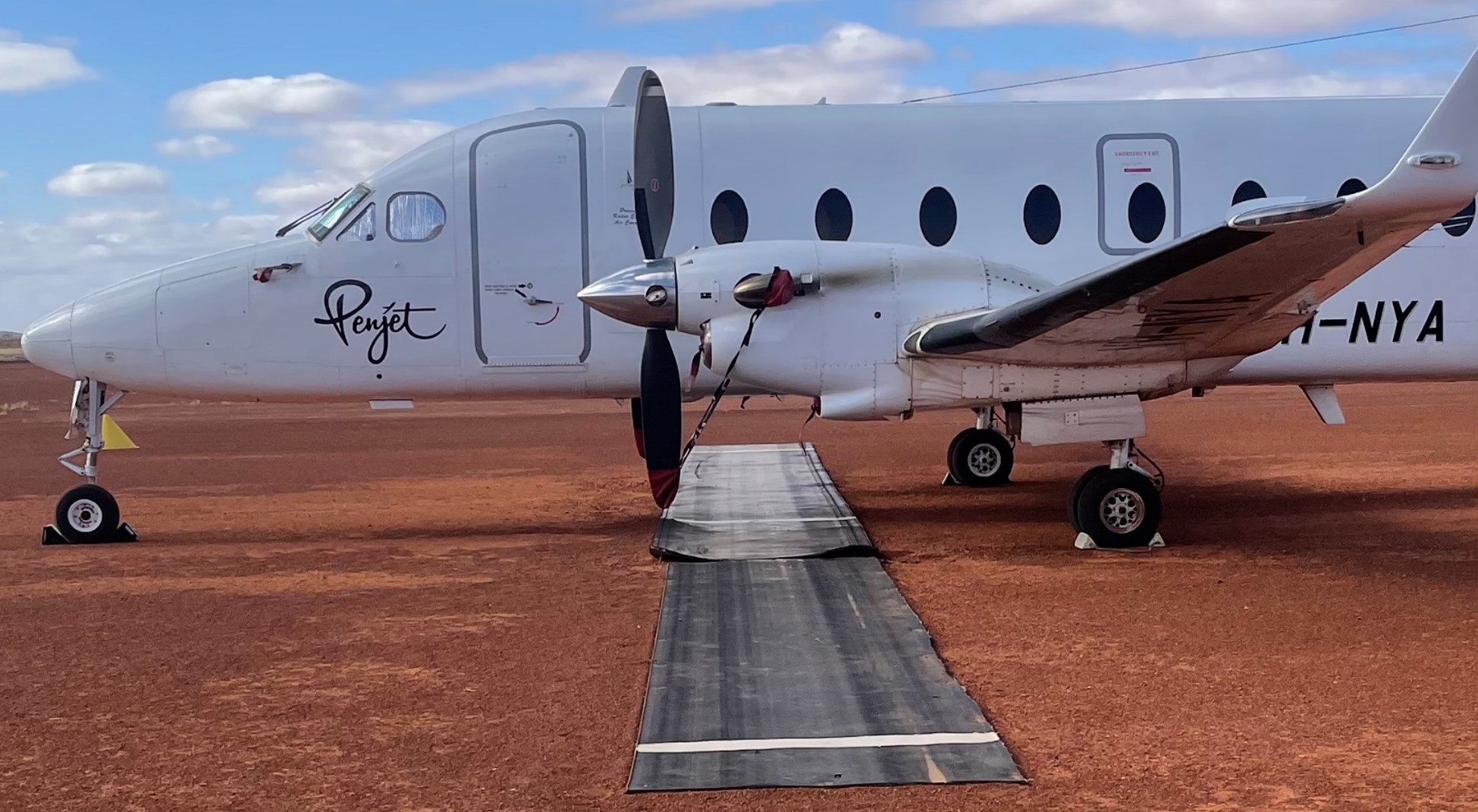
As reported to the ATSB, during take-off a ratchet strap that was not removed from one of the aircraft’s propellers struck the aircraft’s fuselage. The aircraft returned to Canberra Airport.
Transport safety investigators from the ATSB’s Canberra office have deployed to Canberra Airport to inspect the aircraft, to begin the process of interviewing the flight crew and passengers, and to gather other relevant information for the investigation.
The ATSB will publish a final report, detailing contributing factors and any identified safety issues, at the conclusion of the investigation.
However, should any critical safety issues be identified at any stage during the course of the investigation, the ATSB will immediately notify relevant parties so appropriate safety action can be taken.
The ATSB conducts ‘no blame’ transport safety investigations into aviation, marine and rail accidents and incidents for the greatest public benefit, and prioritises its resources on occurrences that are most likely to identify broader, systemic safety issues
Preliminary report details factual information established in the investigation’s early evidence collection phase;
About 5 minutes into the flight, the helicopter descended rapidly;
Engine examination did not identify any pre-existing defects that may have prevented the engine from operating normally [or providing power]
The Australian Transport Safety Bureau (ATSB) has released a preliminary report from its on-going investigation into a fatal helicopter accident near Koorda, Western Australia in early October.
On 2 October 2022, the two-seat Robinson R22 Beta helicopter, registered VH-RAS, was returning to Jandakot Airport from an airstrip at Koorda, in Western Australia's Wheatbelt region, with a pilot and passenger on board.
When the helicopter did not arrive as expected, a search was coordinated by the Australian Maritime Safety Authority and the wreckage was located later that afternoon on a dry salt flat, about 13 km south-west of Koorda. The helicopter was destroyed and both occupants were fatally injured.
“Today’s preliminary report details factual information established in the investigation’s early evidence collection phase,” ATSB Director Transport Safety Stuart Macleod said.
“It has been prepared to provide timely information to the industry and public, and contains no analysis or findings, which will be detailed in the final report.”
The ATSB has so far examined the accident site and wreckage, interviewed witnesses, collected meteorological data, aircraft maintenance and pilot records, and obtained flight tracking data.
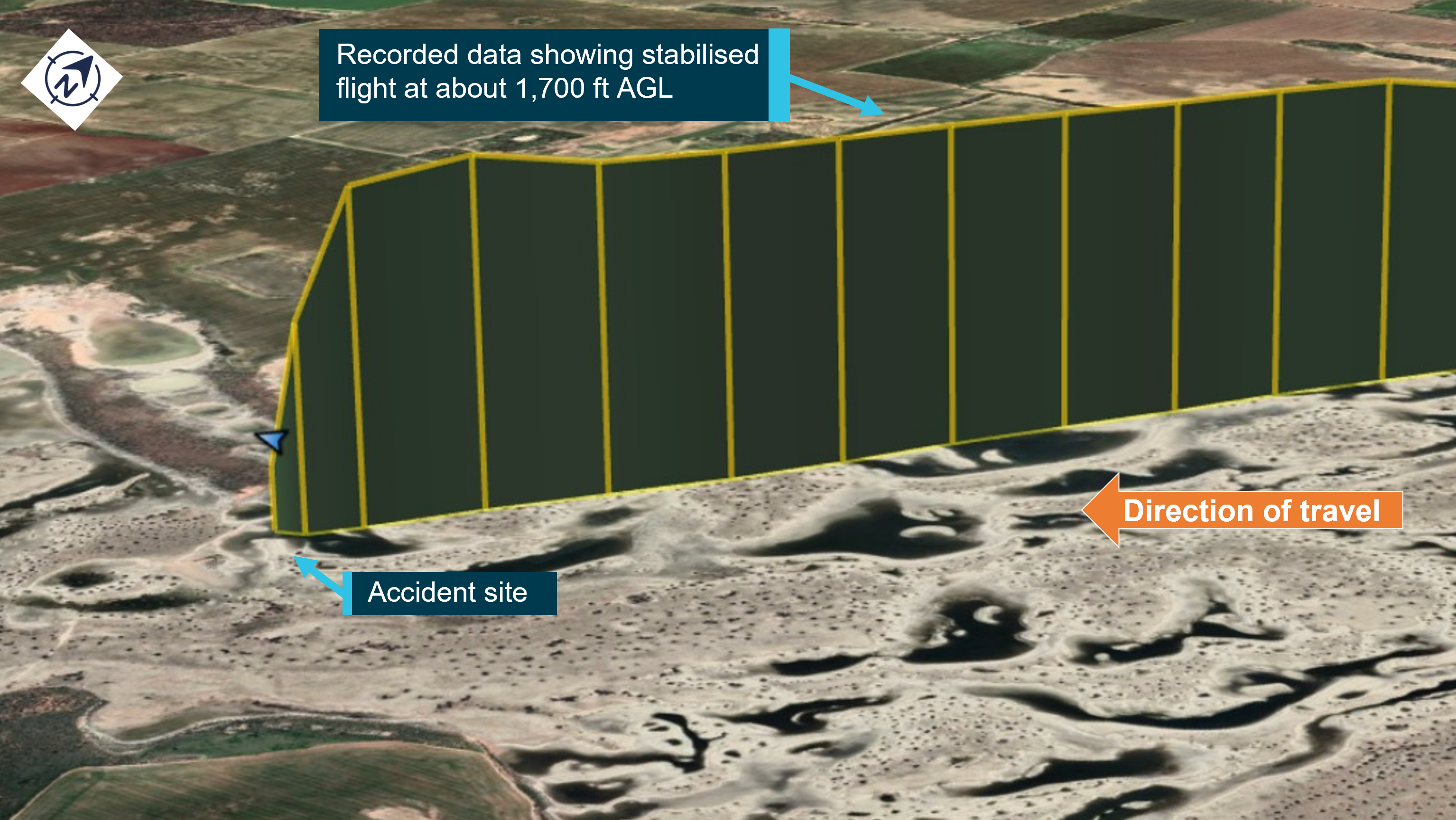
Flight tracking data showed the helicopter initially tracking in a stable south-westerly direction at about 1,700 ft above ground level. About 5 minutes into the flight, the altitude increased by about 100 ft, followed almost immediately by a rapid descent. The data stopped in the vicinity of the accident location, about 10 to 15 seconds after the commencement of the descent.
During the on-site phase of the investigation, transport safety investigators found the helicopter had collided with terrain inverted on a dry salt flat, on an easterly heading. The main rotor head, with blades attached, and the top portion of the mast, were located alongside the fuselage. One main rotor blade had fractured, with the outboard section located about 3 m from the main rotor assembly.
While the tail cone and tail rotor assembly were attached to the fuselage, the stabiliser assembly had separated and was located about 6 m from the tail cone. The auxiliary fuel bladder was intact, however the main bladder had ruptured due impact forces. There was no fire.
Mr Macleod said the helicopter’s engine was examined at a CASA-approved engine overhaul facility under the supervision of the ATSB, and did not identify any internal or external damage that prevented the engine from operating normally prior to the accident.
“As it progresses, the investigation will include further review and examination of pilot records and medical information, aircraft maintenance and flight records, recovered components and meteorological data.
“However, should a critical safety issue be identified during the course of the investigation, the ATSB will immediately notify relevant parties so appropriate and timely safety action can be taken.”
R44’s clutch shaft failed due to an undetected fatigue crack
Manufacturer has since developed new maintenance inspection requirements for the clutch shaft forward yoke.
When conducting inspections, pilots and maintenance engineers should be prepared for the unexpected, and remain vigilant for defects in parts with an established history of reliability
The failure of a Robinson R44 helicopter’s clutch shaft due to an undetected fatigue crack led to a loss of control before the helicopter collided with a vehicle, an ATSB investigation report details.
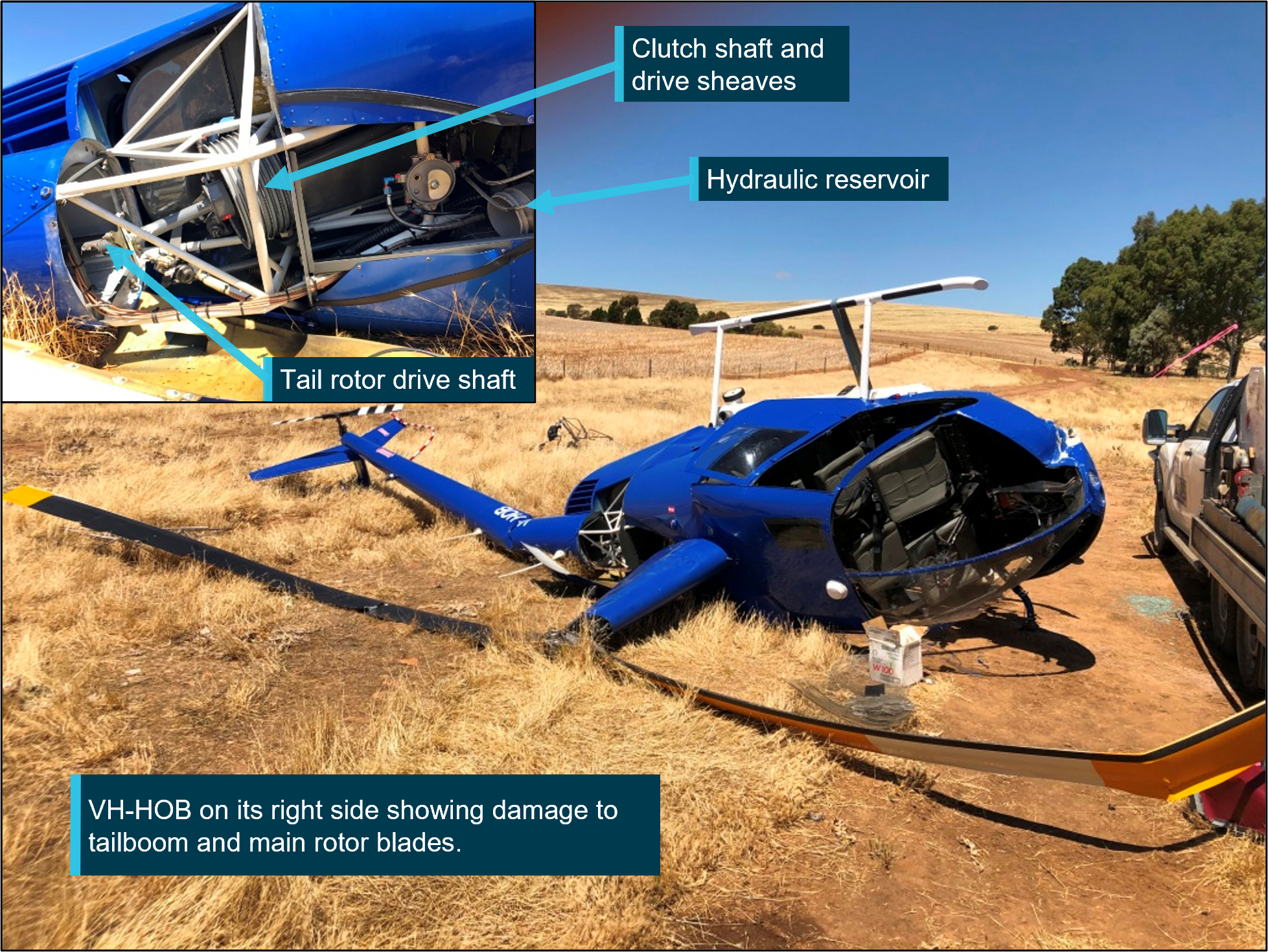
The R44 had been conducting aerial spraying operations at a property near Clare, South Australia on 22 December 2020. As the pilot was descending the helicopter to the landing site to reload the chemical hopper, a loud bang emanated from the rear of the helicopter, and the flight controls appeared to be jammed.
The helicopter collided heavily with the loading vehicle, coming to rest on its side. The pilot and ground crewman were uninjured, however the helicopter was substantially damaged.
“Our investigation determined that the forward yoke of the clutch shaft had failed due to an undetected fatigue crack that originated from an indent in one of the arms of the yoke,” said ATSB Director Transport Safety Dr Stuart Godley.
“This resulted in loss of drive to the main and tail rotor systems, and the loss of hydraulic fluid, which removed hydraulic power assistance to the flight control servos.
“The pilot experienced difficulties in controlling the helicopter and executed an emergency descent from a low height without hydraulic power assistance and no tail rotor control.”
The investigation found that the helicopter manufacturer’s maintenance instructions requiring verification that no cracks, corrosion or fretting were present on the yoke, lacked specific instructions on the method to be employed. The visual inspection that was employed increased the risk that a crack in the yoke arm may not be detected
The manufacturer has since developed new maintenance inspection requirements for the clutch shaft forward yoke, which were included in the R44 maintenance manual in August 2022.
Earlier, in June 2021, the ATSB released a Safety Advisory Notice to R44 operators that based on the investigation’s preliminary finding of fatigue cracking, to look for the presence of corrosion, fretting or cracking, which may not be visually obvious during all inspections of the clutch shaft yoke.
The Civil Aviation Safety Authority also issued an Airworthiness Bulletin, (AWB 63-010) advising industry of the failure of the yoke based on the ATSB investigation preliminary finding.
“This occurrence highlights how non-life limited components such as a drive train yoke may still develop defects and fail in-flight,” said Dr Godley.
“When conducting inspections, pilots and maintenance engineers should be prepared for the unexpected, and remain vigilant for defects in parts with an established history of reliability.”
On 30 November 2022, a Boeing 737, registered VH‑YFH and operated by Virgin Australia, commenced its take-off roll from the A3 intersection of Brisbane Airport’s runway 19L. During the take‑off the aircraft briefly entered, and became airborne in, the section of the runway that was closed due to the runway works. The aircraft completed the departure and continued onto its destination where a maintenance inspection subsequently cleared the aircraft of any damage.
What the ATSB found
The ATSB found that the briefing package for the aircraft’s previous sector from Melbourne to Brisbane included:
a dispatcher’s note which stated that Brisbane RWY 01R had a displaced threshold, but without any resultant landing weight performance limitation
a notice to airmen (NOTAM) with the headline RWY 01R THR DISPLACED, which identified reduced runway distances for take-off and landing on Brisbane’s runways (RWY) 01R/19L
critical performance data appended to the displaced threshold NOTAM.
The captain misinterpreted the dispatcher’s note to mean that there were no performance requirements for operations on RWY 19L. The captain reviewed the NOTAMs and, based on this misunderstanding, dismissed the NOTAM as not being relevant for their operation. There was uncertainty about whether the first officer reviewed the dispatcher’s note and NOTAMs in Melbourne, but if they were, the relevance of the note and this NOTAM was probably missed. As such, neither crew member identified the critical performance data appended to this NOTAM.
The NOTAMs were not reviewed en route or as part of the approach briefing prior to descent into Brisbane, as required by the operations manual. Additionally, the automatic terminal information service (ATIS) advice of the reduced landing distance for RWY 19L was not identified and accounted for in the performance calculations for the landing (or subsequent departure) on that runway. Fortunately, this did not affect the landing as the landing’s stopping solution was based on the aircraft exiting the runway well before the closed section. The flight crew’s misunderstanding was reinforced by the absence of any visible runway works or other indications of restrictions on the runway during the landing.
Due to the now‑established belief that there were no performance requirements for operations on RWY 19L, together with time pressures and distractions from prioritising training needs, the flight crew used the full runway length in the performance data calculation for departure, instead of the reduced length identified in the ATIS and NOTAM. This resulted in a departure with insufficient runway available due to the aircraft being overweight for that reduced runway length.
Finally, contrary to the requirements of Part 139 Manual of Standards, the A3/19L intersection departure point take-off run available Movement Area Guidance Sign presented a take-off distance that was more than that available, creating the potential to mislead flight crews about the status of the runway when conducting a departure from that point.
What has been done as a result
Virgin Australia implemented a number of safety management, procedural and information‑based changes designed to improve flight crew awareness of changes to runway configuration and related aircraft performance criteria.
Brisbane Airport Corporation implemented several safety actions to reduce the risk associated with this type of occurrence. These included:
changes to departure and arrival procedures associated with runway works
redrafting of the NOTAM to clarify the operational changes to both runways 01R and 19L, and the procedures to ensure correct runway distance was displayed on movement area guidance signs
publication of an aeronautical information circular supplement for the works.
Safety message
Flight crews must ensure they consider possible variations to take-off and/or landing dimensions when determining runway performance data. While this operator’s procedures accounted for such changes through notification of performance requirements within their NOTAM system, due to a combination of distraction and incorrect assumption, they were not identified.
When presented with many NOTAMs, flight crews need to be aware that dismissing them based on the headline alone increases the risk that safety relevant data may be overlooked. As an additional defence, flight crews should ensure that the data input into that calculation is in conformance with other relevant information, such as the ATIS.
The occurrence
Overview
On 30 November 2022 a Boeing 737-8FE (B737), registered VH‑YFH and operated by Virgin Australia as flight number VA324, commenced its take-off roll from the A3 intersection of Brisbane Airport’s runway 19L. The take-off thrust and speeds set by the flight crew for the take‑off from A3 were based on the full runway length from that intersection being available. However, unrecognised by the crew, the take-off distance available for runway 19L had been reduced at the upwind (01R threshold) end by 871 m due to runway works. As a result, the thrust set for the take‑off was insufficient for the actual runway length available and the aircraft briefly entered, and became airborne in, the section of the runway that was closed due to the runway works. The aircraft completed the departure and continued on to its destination where a maintenance inspection subsequently cleared the aircraft of any damage.
The sequence of events that resulted in the runway excursion commenced earlier the same day, during flight planning for the previous sector from Melbourne to Brisbane.
Melbourne
Arrival
VH-YFH arrived in Melbourne as flight number VA254 from Canberra at 0846 EDT,[1] about 10 minutes behind schedule. The aircraft was scheduled to depart Melbourne for Brisbane as flight number VA319 at 0910 EDT. The flight crew consisted of a training captain (captain) and a first officer (FO). The captain had been assigned a number of ‘line flying under supervision’[2] sectors with the FO over the previous 2 days as part of the FO’s conversion onto the B737.
Pre‑flight
Flight planning package
Shortly after arriving, the flight crew received the flight planning package[3] (see the section titled Flight planning) for the flight from Melbourne to Brisbane. This package included the operational flight plan (OFP),[4] NOTAMs[5] for the sector and flight operations engineering (FOE) data appended to the relevant NOTAMs. The captain recalled that the package was initially missing a part of the NOTAMs section, although a full reprint was subsequently received prior to departure.
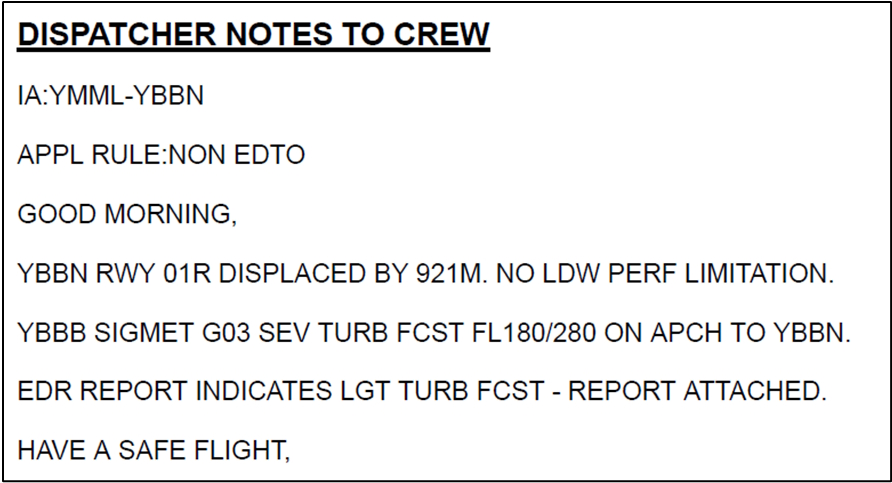
The OFP commenced with a section titled ‘Dispatcher Notes to Crew’ (Figure 1), which included a note from the dispatcher that stated:
YBBN RWY 01R DISPLACED BY 921M. NO LDW PERF LIMITATION.
The flight crew expected the approach and landing into Brisbane would be on runway (RWY) 19L. The captain incorrectly interpreted the dispatcher’s note to mean that the displaced threshold of RWY 01R did not have associated performance requirements for runway 19L (see the section titled Flight dispatch). The captain then reviewed the Brisbane NOTAMs, which included a NOTAM (NOTAM YBBNC1174/22) with the headline ‘RWY 01R THR DISPLACED’. This NOTAM was dismissed as it referred to the displaced runway threshold in the dispatcher note, and because the headline did not include any reference to RWY 19L (which was the expected landing runway).
Figure 1: Dispatcher notes for VA319 (Melbourne to Brisbane)
Source: Virgin Australia
FOE requirements for RWY 19L
The NOTAM section of the flight planning package also included a company notice, titled ‘VOZ FOE COMPANY REMARK’, appended to the displaced threshold NOTAM YBBNC1174/22 (see the section titled VA319 (Melbourne to Brisbane) flight planning package). This notice included specific data required to be used for both landing and take‑off performance data calculations when using Brisbane RWY 01R and RWY 19L. The captain did not identify the company notice associated with NOTAM YBBNC1174/22. There was uncertainty about whether the FO read the dispatcher notes and NOTAMs prior to departure from Melbourne, but if they did, the relevance of the dispatcher’s displaced threshold note and NOTAM was probably missed. As a result, both flight crew were unaware of the performance data calculation requirements for operations at Brisbane’s RWY 01R and RWY 19L.
En route to Brisbane
The aircraft departed Melbourne at 0940 EDT with the flight to Brisbane expected to take about 2 hours. The FO conducted the pilot flying (PF)[6] duties for the sector, while the captain was the pilot monitoring (PM). The intention was to reverse these roles for the later return flight to Melbourne. Available spare time during the cruise portion of the flight was used to cover training‑related matters.
As the aircraft approached Brisbane, the crew completed arrival preparations, which included recording the Brisbane automatic terminal information service (ATIS),[7] calculating the landing performance data, and briefing for the approach and landing. The ATIS stated that arrivals were being conducted onto RWY 19L and RWY 19R, and that RWY 19L had a reduced length with the landing distance available being 2,689 m.[8]
The flight crew did not review the Brisbane NOTAMs inflight or as part of arrival preparations.
While the crew completed the landing performance data calculations based on the full length of RWY 19L being available, and not the reduced length as stated on the ATIS, the stopping solution (see the section titled Enroute landing performance calculator) was based on the aircraft exiting the runway at the A6 taxiway.
Brisbane
Arrival
VH-YFH landed on Brisbane’s RWY 19L at 1050 EST[9] and exited the runway using the A6 rapid exit taxiway located about 850 m from the displaced threshold at the end of RWY 19L.[10] The flight crew stated that they did not observe any runway works activity or markers indicating works on the runway during the landing roll and exit from the runway.
Post-flight
VH-YFH was scheduled to arrive at the gate in Brisbane at 1020 and depart for Melbourne as VA324 at 1055. The aircraft arrived at the gate 34 minutes behind schedule, at 1054.
Following completion of post-flight duties, the flight crew did not immediately commence preparation for VA324. The captain’s observations of the FO’s performance as PF for the landing into Brisbane identified a need to alter the intended flight crew duties for the VA324 sector and assign the FO the PF role once again. To support this decision, the captain allocated time to debrief the FO on their performance during the completed sector and to provide training support for the return flight. During those training discussions the crew received the flight planning package for the return flight to Melbourne.
Pre-flight
The training discussions were put on hold while the flight crew reviewed the OFP and dispatcher notes and determined the fuel order for the VA324 sector. The OFP included a dispatcher’s note that stated:
YBBN RWY 01R THR DISPLACED 29/2100-30/0630Z
The flight crew understood that this note was in reference to the same runway matter identified by the dispatcher in the previous sector’s OFP and was dismissed.
The captain then finalised the training discussion and, at its completion, the FO exited the flight deck to conduct an exterior inspection of the aircraft while the captain commenced pre‑flight duties. The captain later estimated that around 5 minutes of the turnaround was spent in the training discussion.
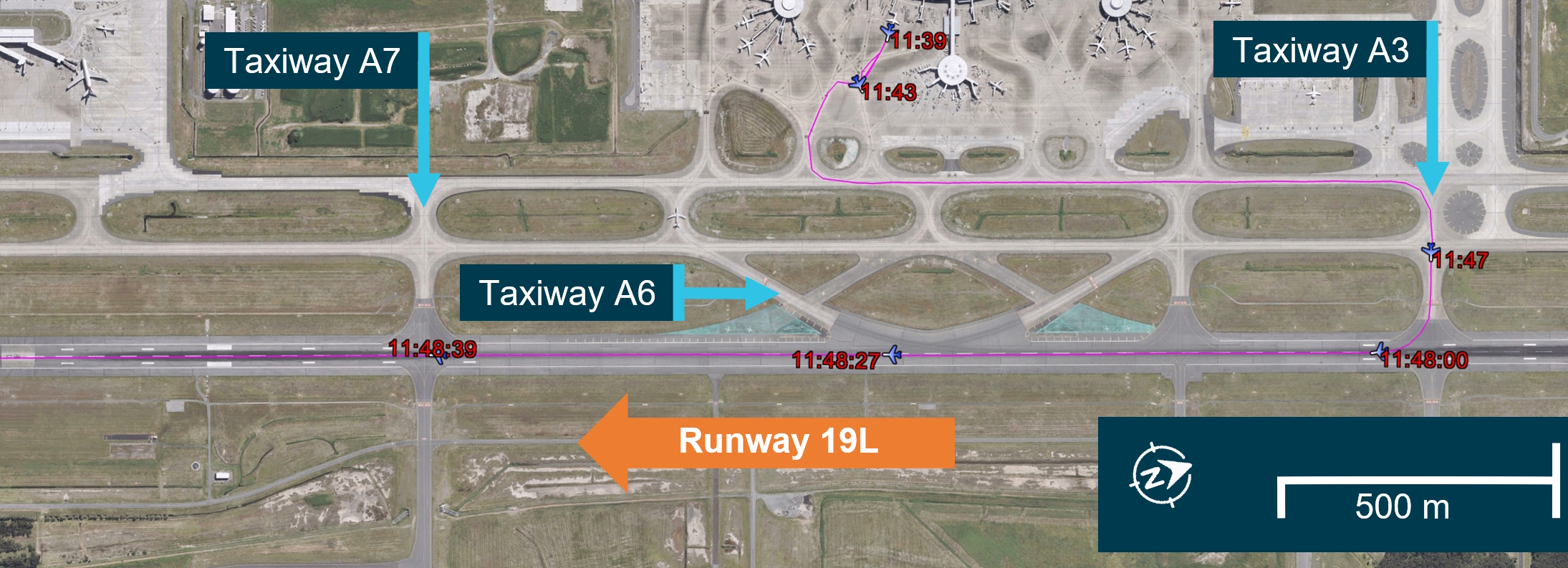
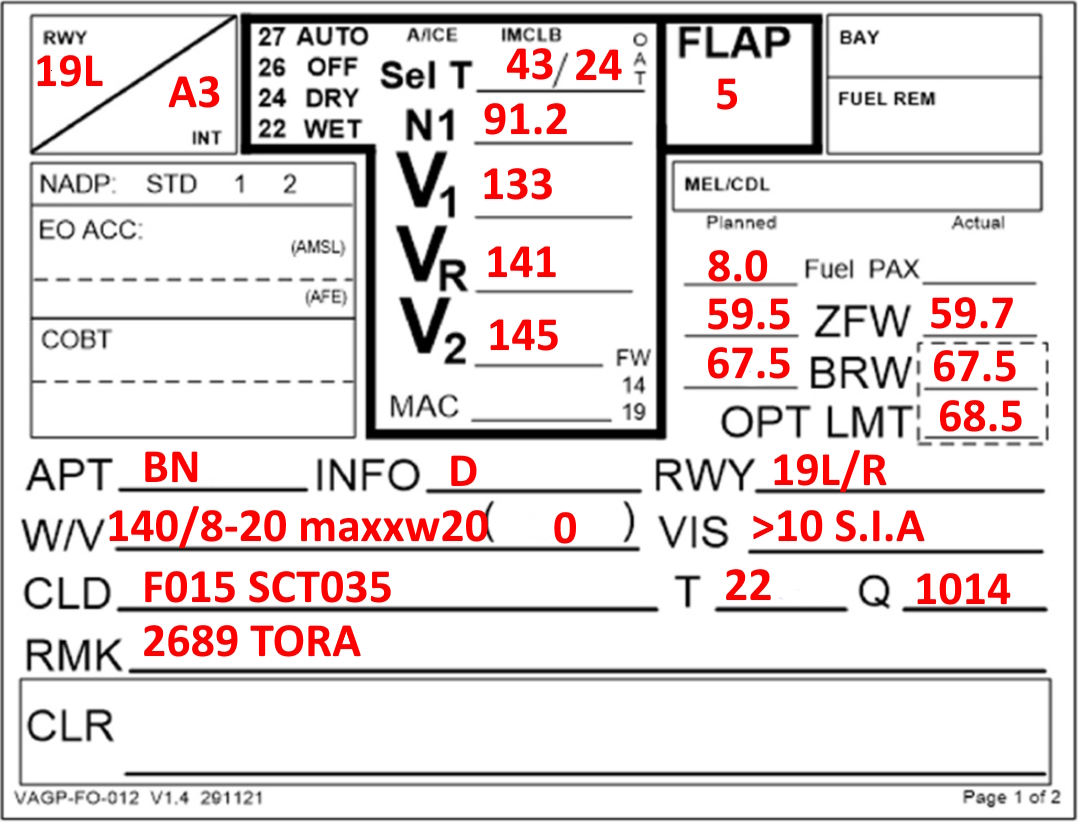
As part of the pre‑flight duties, the captain obtained a hard copy of the ATIS from the ACARS,[11] and used that data to fill out the relevant fields of the take-off data card (TODC). The captain made a handwritten entry ‘2689 TORA’ in the remarks section at the bottom of the card (see the section titled Pre‑flight procedures and the performance data calculation). The take-off performance data was then determined using the onboard performance tool (OPT).[12] The captain decided to use the taxiway A3 intersection with RWY 19L as the take-off commencement point (Figure 2). The power setting, take-off speeds and other data relevant to this take-off commencement point were then calculated using the OPT’s runway selection that related to the normal runway length from A3 rather than the reduced available length. The resultant calculated data was then transcribed onto the TODC.
Figure 2: VA324 departure
A Google Earth image of Brisbane Airport with the departure track of VA324 overlaid. The image shows location and timestamps for specific points of the departure. Source: Google Earth, modified by ATSB
After completing the exterior inspection, the FO returned to the flight deck and commenced their pre‑flight checks. This included a required independent calculation of the take-off performance data using the OPT. The FO conducted the calculation using data from the TODC (previously filled out by the captain). The FO stated that they did not see the captain’s annotation of ‘2689 TORA’ in the remarks section.
On completion of the performance calculation, both flight crew cross-checked and confirmed agreement on the calculated data using the OPT cross-check function. The subsequent pre‑flight procedures and checklists then confirmed that the data entered into the flight management computer was in agreement with that on the TODC. The FO then conducted a departure briefing, which included stating that the take-off was planned to commence from the A3 intersection for RWY 19L. The aircraft was then prepared for push back from the gate.
It is likely that the NOTAMs were not reviewed by either pilot during the turnaround and that while the specific reasons could not be determined, it may have been due to a combination of distraction, time pressure and a previously‑formed view of the NOTAM content.
Departure
The flight crew commenced push-back at 1139 and, at 1143, requested a taxi clearance from air traffic control (ATC), advising that ATIS information D had been copied, and that an A3 departure could be accepted. ATC cleared the aircraft to taxi to the A3 runway holding point. As the aircraft approached the holding point, ATC cleared the aircraft for take-off from RWY 19L. On passing the runway distance signs (see the section titled Movement area guidance signs) at the A3 holding point at about 1147, the flight crew completed the take-off performance check (see the section titled Runway entry performance check) and, with all checks completed, the aircraft entered the runway. Both flight crew later recalled that the runway looked clear with no markers or obstructions visible from their take-off commencement point.
The crew performed a rolling take-off, with take-off power being applied at 1148. The captain later recalled that, following the power application, their attention was mostly inside the aircraft performing PM duties and that they did not observe any obstructions or cones on the runway during the take-off.
The FO recalled that:
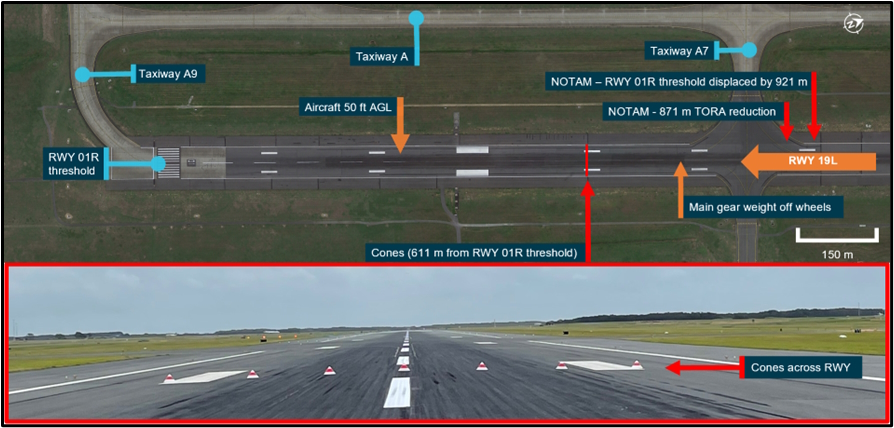
at an airspeed of about 100 kt, they observed cones positioned in a line across the runway
while they considered the cones an immediate threat, they estimated that the aircraft would become airborne before the cones and, as the aircraft’s airspeed had exceeded 80 kt, they continued the take-off
they did not verbally notify the captain of sighting the cones as it was assessed that the aircraft would clear them
they commenced the take-off rotation before the cones and as the aircraft climbed through about 50 to 70 ft above the runway, the cones were observed to pass underneath.
Recorded audio[13] from the ATC tower identified that, during the aircraft’s take-off run, when it was about midway between the runway intersections of taxiways A6 and A7, the tower controller commented on whether the aircraft was going to rotate. As the aircraft passed over the cones, the tower controller remarked that the aircraft had passed very close over the cones. ATC immediately called a ground vehicle on the tower frequency to inspect the cones. The aircraft’s flight crew heard this exchange before transferring to the departure frequency. Shortly after, the ground vehicle reported that, while the cones did not appear to have been struck, 3 cones had been blown from their original position.
About midway through the climb out of Brisbane, ATC informed the flight crew of the cones being blown over during their departure. The flight crew discussed the departure, noted that the aircraft was handling normally and continued to monitor the aircraft’s instruments for abnormal indications. Shortly after, the captain contacted Virgin maintenance to report that they may have struck cones during departure and organised an inspection on arrival. The aircraft proceeded on to Melbourne without further incident and landed safely at 1441 EDT. The aircraft was subsequently cleared of any damage by a maintenance inspection in Melbourne.
Context
Pilot information
Both the captain and the first officer held Air Transport Pilot Licences (Aeroplane) with Class 1 aviation medical certificates and were appropriately qualified for the flight. The ATSB found no indicators that increased the risk of the flight crew experiencing a level of fatigue known to affect performance.
The captain had accumulated about 9,000 hours of flight experience, of which about 5,500 hours were on the Boeing 737 (B737). In the previous 90 days, the captain had flown 73 hours on B737 type aircraft. The first officer had accumulated about 13,000 hours of flight experience, of which about 9,200 hours were on the B737, with 77 hours flown in the previous 90 days.
Flight planning
Flight plan manager
Flight crews were provided with all required pre‑flight briefing material in a single document – the flight planning package (FPP).The FPP was generated by flight dispatch using the Flight Plan Manager (FPM), a flight planning software package used by Virgin Australia to automate the collation of flight planning data and the production of briefing material for flight crews. The FPP comprised the operational flight plan (OFP),[14] weather data, route plots and NOTAMs for the sector.
NOTAMs were automatically received and imported into the FPM database. For a particular FPP, the FPM software would filter the NOTAMs, presenting only those relevant to that sector, format that NOTAM data into a form usable in a pre-flight information bulletin (see the section titled Notice to Airmen), and attach any company remarks applicable to that NOTAM.
Flight dispatch
Virgin flight dispatch was responsible for the maintenance of the FPM database and the production of the FPP, including the acquisition, collation and evaluation of NOTAM, meteorological and other operational information in support of flight planning activities. Flight dispatch was also responsible for the distribution of NOTAM data to relevant specialist functions within Virgin, such as flight operations engineering (FOE).
As part of the flight planning process, flight dispatchers were required to establish whether the runway, environmental and aircraft performance conditions required a reduction in the normal aircraft limit weights—that is, whether there was any performance limitation to the aircraft’s weight, such as for take-off and/or landing. This was done through calculations using the onboard performance tool (OPT) (see the section titled Performance calculators).
In determining whether there was a limiting weight to be applied, dispatch used weather conditions sourced from TAF[15] data, and were required to ensure consistency of that weather data with other data sources such as METAR[16] and automatic terminal information service (ATIS). Flight dispatch was also required to apply any FOE-determined performance requirement in the limiting weight calculation. When the calculation determined that a weight restriction was to be applied, that limiting weight (or performance limitation) was to be input into the FPM and applied to the overall plan. Any performance limitation was to be noted in the FPP, and the parameters used for the calculation provided in the OFP. The dispatcher was also required to ensure that flight crew were aware of the performance restriction.
Flight operations engineering
On receipt of a NOTAM from flight dispatch, FOE were required to determine whether the NOTAM had a performance impact on operations. For NOTAMs impacting performance, FOE would input the required performance response into the FPM as a company remark, as well as amend the OPT database with the relevant input options applicable to that NOTAM. Where FOE determined that there was no performance impact associated with a received NOTAM, an FOE company remark with a statement such as ‘NO PERFORMANCE IMPACT’ would be input into the FPM.
The flight planning package
Operational flight plan
The FPP’s operational flight plan (OFP) component contained a synopsis of data critical to the conduct of the planned flight. It included information such as the dispatch message, fuel and weight data,[17] the navigation log[18] and any applicable performance restrictions.[19] The dispatch message comprised dispatcher notes to the crew, aircraft discrepancy items and the filed air traffic services[20] flight plan.
Dispatcher notes were required for every flight, and were used by dispatchers to notify flight crew of all decisions pertaining to the preparation of the briefing package and any other information that could assist in the safe conduct of the flight. The notes could also be used to provide flight crew with an overview of the flight planning requirements or any special considerations.
NOTAMs
The FPP was the primary source of NOTAM information for flight crews, and the only source of information for FOE performance requirements. NOTAMs provided as part of the FPP by flight dispatch were stated to be the latest available for departure and arrival ports and, as a general rule, were valid for 30 minutes prior to the estimated time of departure and for 4 hours after the estimated time of arrival.
The National Aeronautical Information Processing System (NAIPS)[21] was an alternative source of NOTAM information available to flight crew and was accessible through the flight crew’s electronic flight bag (EFB).[22] Unlike the FPP NOTAM data, NAIPS NOTAMs were unfiltered and did not have FOE company remarks data attached.
VA319 (Melbourne to Brisbane) flight planning package
The VA319 flight dispatcher determined that there was no landing weight performance limitation for the Melbourne to Brisbane sector resultant from the displaced threshold for Brisbane’s RWY 01R. This was notified to the flight crew through a remark in the ‘Dispatcher notes to crew’ section of the FPP (see Figure 1) as follows:
YBBN RWY 01R DISPLACED BY 921M. NO LDW PERF LIMITATION
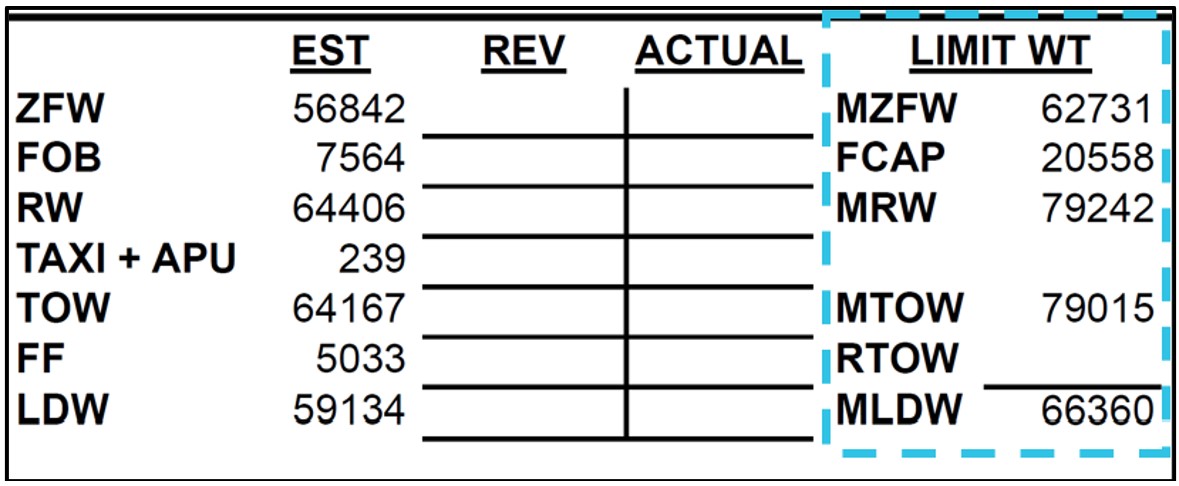
The absence of any performance weight limitation was also identifiable from the aircraft limit weights section of the OFP (Figure 3), where the limit weights listed were maximum weights for those conditions in the aircraft’s flight manual. While the dispatcher’s note identified that there were no performance weight limitations, the OFP did not present the specific parameters used in the limit weight calculations (see the section titled Flight dispatch). However, flight crew could ascertain the parameters from various parts of the FPP.
Figure 3: VA319 limit weights
An image of the limit weight section of VA319 OFP. Source: Virgin Australia, annotated by ATSB
VA319 NOTAMs
The VA319 FPP consisted of 33 pages, of which 18 contained the sector’s NOTAMs. There were about 120 individual NOTAMs within the package.
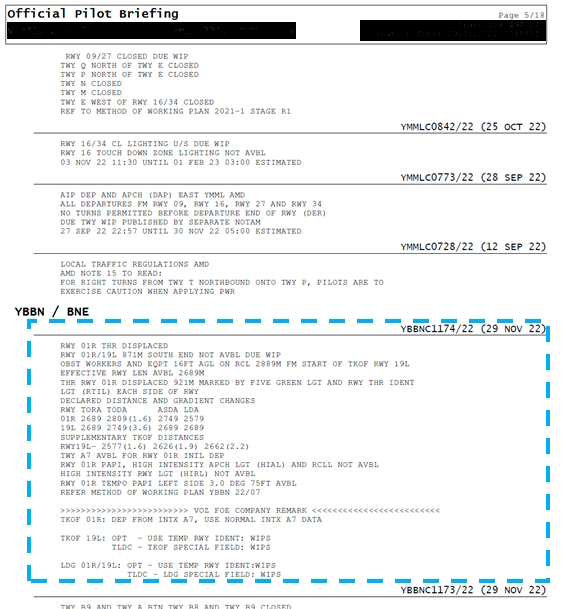
The first of the Brisbane NOTAMs listed was NOTAM YBBNC1174/22 with the headline ‘RWY 01R THR DISPLACED’ (Figure 4 – broken blue box highlighting added by the ATSB). This NOTAM appeared on page 5 of the NOTAMs section and detailed the reduction in length for runways 01R (RWY 01R) and 19L (RWY 19L) due to aerodrome works being conducted around the RWY 01R threshold. Appended to the end of this NOTAM was a company remark titled ‘…>>> VOZ FOE COMPANY REMARK <<<…’. This remark was to notify the flight crew of FOE-required modifications to the take-off and landing performance data calculations for Brisbane RWY 01R and RWY 19L as a consequence of NOTAM YBBNC1174/22.
Figure 4: Page 5 of the NOTAM package, highlighting NOTAM YBBNC1174/22 and its associated FOE performance requirement
An image of page 5 of the VA319 NOTAMs, with YBBN NOTAM 1174/22 highlighted. Source: Virgin Australia, annotated by ATSB
VA324 (Brisbane to Melbourne) flight planning package
Similar to VA319, the VA324 flight dispatcher determined that there were no performance weight limitations for the return sector to Melbourne as a result of the displaced threshold, and while the OFP did not include a direct statement of the parameters used in that determination, those parameters could be ascertained from data within the FPP.
The VA324 flight dispatcher stated that one of the roles of the Dispatcher Notes was to highlight to flight crew any information considered critical by the dispatcher, such as NOTAM YBBNC1174/22. Further, given the short turnarounds often associated with multi-sector flights, the dispatcher intended to direct the flight crew’s attention to this NOTAM through inclusion of the following statement in the dispatcher notes:
YBBN RWY 01R THR DISPLACED 29/2100-30/0630Z.
VA324 NOTAMs
The VA324 FPP consisted of 30 pages, 13 of which contained the sector’s NOTAMs. There were about 80 individual NOTAMs within the package.
The YBBNC1174/22 NOTAM was the first of the NOTAMs included within the VA324 NOTAM package and included an attached FOE company remark. The presentation of the NOTAM and its FOE remark directly reflected the VA319 presentation (Figure 4), but was split over 2 pages, with the FOE remarks appearing on the second page.
FOE conspicuity
The operator’s internal investigation into the event noted that performance critical NOTAMs with associated FOE data were presented in the FPP in the same typeface as less critical NOTAMs, and that there was ‘little to draw the reader’s attention’ to something that was critical to safety of flight. The investigation noted that, in a high workload environment with many distractions, it was ‘…not difficult to miss text that looks the same’.
The VA319 FPP contained 8 NOTAMs with FOE remarks attached, while the VA324 FPP contained 5 NOTAMs with FOE remarks attached. For both FPPs, only 2 of the FOE notices contained performance requirements, while the rest were notifications that the NOTAM had no performance effect. The ATSB also noted that FOE remarks were highlighted via a unique banner (Figure 4) intended to increase their conspicuity to flight crew.
Notice to Airmen
Notification of aerodrome facilities
Airport operators were required to report detailed information about their various aerodrome facilities to Airservices. This information was then published in the Aeronautical Information Publication (AIP). Short-term changes to these facilities were also required to be notified to Airservices. Users of those facilities were then advised of these short-term changes through the NOTAM system.
NOTAM standards
CASR Part 175 prescribed standards covering when NOTAMs were to be issued and how they were to be structured and formatted. A detailed examination of those standards, and the documents in which they are found, is at Appendix – NOTAM standards and related guidance materials.
A NOTAM issued by Airservices was required to meet a prescribed format and contain specific information about the matter being reported. That format comprised multiple fields that not only provided a description of the matter(s) being reported—referred to as the free text section—but also contained coding that enabled both the automatic classification and filtering of that NOTAM, The NOTAM content presented to the flight crew in the FPP was limited to the free text section.
As well as meeting the format and content requirements, a NOTAM was also to adhere to various rules. These are covered in detail at Appendix – NOTAM standards and related guidance materials, but can be summarised under the following 4 basic principles:
A NOTAM shall deal with only one subject and one condition of that subject. It shall be as brief as possible and compiled such that the meaning is clear, and without the need to refer to another document.
The subject matter and related condition shall be determined in accordance with specific coding procedures and tables found in the International Civil Aviation Organization (ICAO) Document 8400.[23]
The code identifying the subject or denoting its status of operation is, whenever possible, self‑evident. Where more than one subject could be identified by the same self-evident code, the most important subject is chosen.
The content of the free-text section of the NOTAM shall be based on the selected code, be clear and concise and if possible limited to 300 characters—to facilitate use in a Pre‑flight Information Bulletin (PIB).[24]
Of the various standards-defining documents identified in CASR Part 175, only ICAO Document 8126[25] included material on circumstances where multiple NOTAMs could be combined and reported in a single NOTAM. The document stated:
The NOTAM Code selected describes the most important status or condition to be promulgated.
Although not included in CASR Part 175 as a standards document, EUROCONTORL[26] guidance material on NOTAMs included the following caution on combining NOTAMs:
The negative impact on end-users caused by NOTAM proliferation is not to be solved by including more information in a single NOTAM, but that this fact further increases the difficulty for end-users. More information in one NOTAM makes the message less readable and essential information more difficult to detect.
Assessment of NOTAM YBBNC1174/22
The ATSB sought advice from both ICAO and the Civil Aviation Safety Authority (CASA) regarding NOTAM YBBNC1174/22 and its adherence to the applicable standards. ICAO and CASA acknowledged the guidance with regard to NOTAM content being limited to one subject matter and one condition of that subject matter, but differed in the application of this limitation with respect to related content.
CASA advised that the most important status or condition being reported in this NOTAM was the displaced threshold, and that the matters being reported within the free text section were the result of the changed condition of that subject matter. Further, the additional matters being reported were information necessary for the safe conduct of flight. As an overall assessment, CASA stated that the NOTAM met the standards as required under CASR Part 175. On whether the NOTAM’s headline should have contained reference to ‘RWY 19L’, CASA stated that this could not be the case as there was no displacement of that runway’s threshold.
ICAO stated that, as per PANS-AIM, matters not directly related to the subject matter and related conditions should not be included within the free text section, but that there also needed to be a balance between usability and convenience while adhering to the guidance principles. ICAO nevertheless advised that the free text section of the NOTAM held critical information interspersed with less critical information, and that the critical information should have preceded the less critical information. While ICAO indicated that the NOTAM complied with ICAO guidance principles, the information concerning the runway lighting, and probably the taxiway information, should have been published as separate NOTAMs.
Brisbane Airport
Runway works
The Brisbane NOTAM YBBNC1174/22 was published as notification of scheduled works around the threshold of RWY 01R. Those scheduled works were part of a larger programme of works documented in a Method of Working Plan (MOWP) YBBN 22/07,[27] published by Brisbane Airport Corporation (BAC) in August 2022. The works were to be staged over about a year to minimise disruption to operations at the airport. In accordance with the Civil Aviation Safety Regulations (CASR) Part 139, the MOWP detailed the timing, scope of the works and specific aerodrome facilities that would be affected. The MOWP also identified how the individual work stages affected aircraft operations, and listed any NOTAM to be issued, where required, for each stage.
The works around the threshold of RWY 01R were scheduled to commence on 30 November 2022. After being notified of these works by BAC, on 23 November Airservices issued the predecessor of YBBNC1174/22. As a result of some minor changes, that original NOTAM was modified, and on 30 November YBBNC1174/22 was published by Airservices.
Runway distance information
NOTAM C1174/22 included runway distance data under the title DECLARED DISTANCE AND GRADIENT CHANGES. The information immediately below this line provided runway distance measurements used in the calculation of aircraft runway performance data.
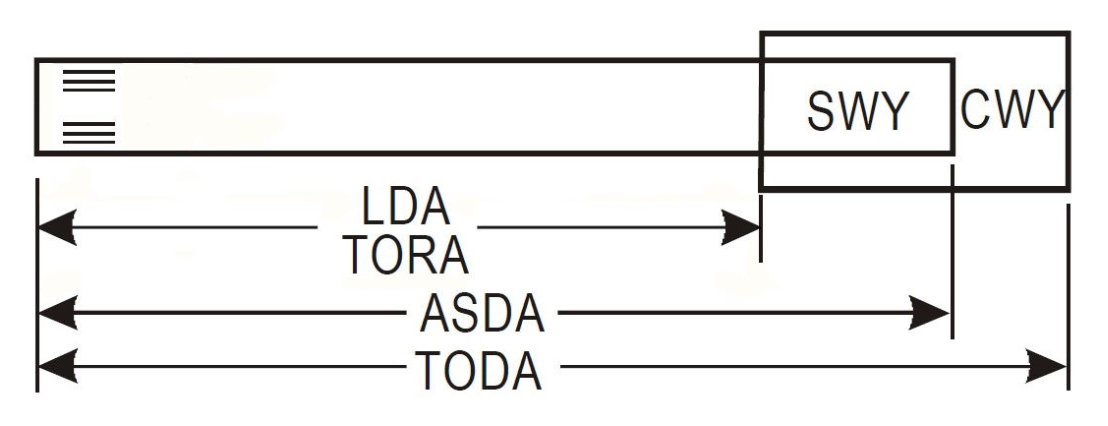
Part 139 Manual of Standards (Part 139 MOS) required aerodrome operators to report various runway distances for publication in the AIP. The following ‘declared distances’, as defined in Part 139 MOS, were to be notified by aerodrome operators (Figure 5):
Take-off run available (TORA). The length of runway declared available and suitable for the ground run of an aeroplane taking off. The take-off run available may include additional length available from a starter extension if provided, but neither stopway (SWY)[28] nor clearway (CWY)[29] were included in the take-off run available.
Take-off distance available (TODA). The length of the take-off run available plus the length of the clearway, if provided.
Accelerate-stop distance available (ASDA). The length of the take-off run available plus the length of the stopway, if provided.
Landing distance available (LDA). The length of runway which is declared available and suitable for the ground run of an aeroplane landing.
Figure 5: Runway declared distances
A diagram identifying the various components of a runway’s declared distances, and their relationships to the physical dimensions of the runway. Source: ICAO Annex 14, modified by ATSB
The various take-off and landing distances applicable to RWY 19L[30] and the A3 intersection with RWY 19L, while in unrestricted use and when the displaced threshold was in effect (as notified by NOTAM C1174/22), are stated in Table 1.
Table 1: Runway 19L distances
Departure designation
TORA
TODA
ASDA
LDA
19L
3560
3620
3560
3560
19L/A3
2781
2841
2781
-
19L-WIPS
2689
2749
2689
2689
19L/A3-WIPS
1910
1970
1910
-
Movement area guidance signs
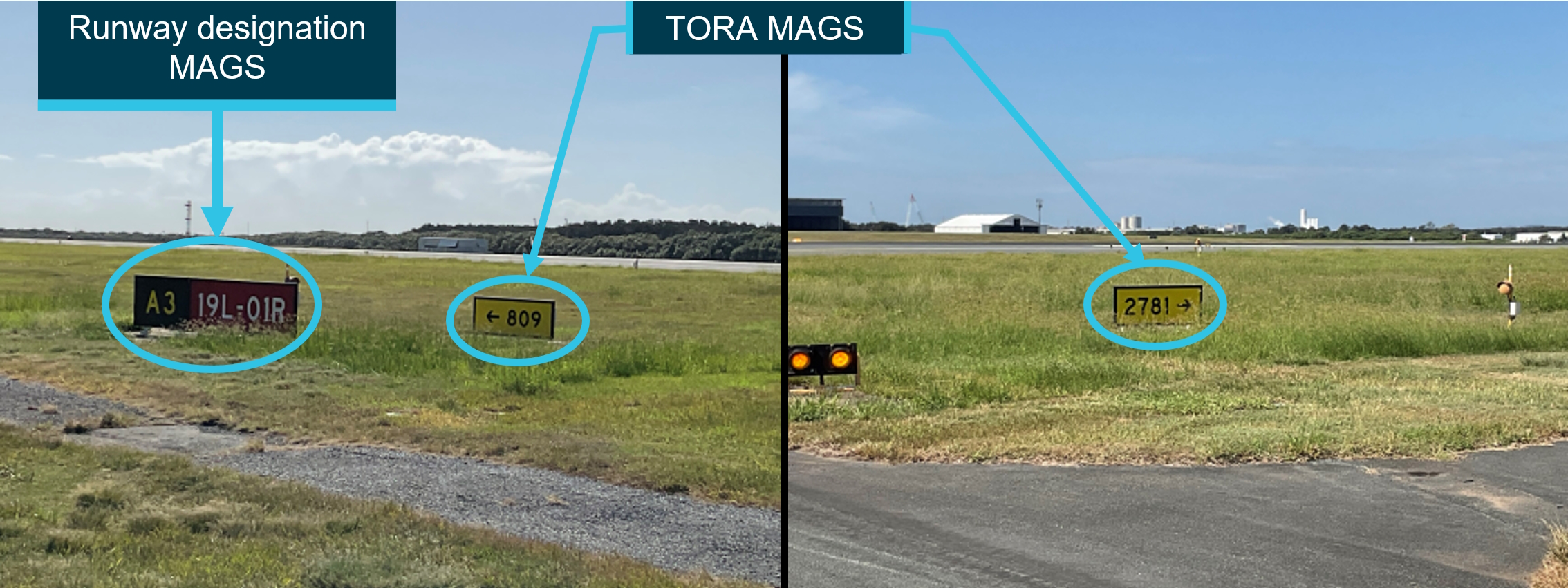
Movement area guidance signs (MAGS) were installed at the taxiway A3 holding point for entry to RWY 01R/19L. MAGS may be either mandatory instruction signs or information signs. Instruction signs used white lettering on a red background, while information signs used black lettering on yellow background. There were 2 types of MAGS installed abeam that runway holding point (Figure 6):
a runway designation sign that identified the taxiway and runway, located to the left of the taxiway and adjacent to the holding point
2 take-off run available (TORA) signs located either side of the taxiway that stated the TORA distances available in the identified direction from that runway entry point.
The flight crew stated that these signs were not obscured at the time of VA324’s departure. Brisbane Airport personnel advised that the TORA MAGS would not normally be covered or obscured when there was variation in the runway length due to works.
Figure 6: MAGS situated at the A3 holding point for 01R/19L
An image showing the movement area guidance signs at the A3 intersection to runway 01R/19L. Source: BAC
Part 139 MOS paragraph 8.27(4) stated:
If:
(a) a movement area guidance sign (MAGS) displays declared distance information; and
(b) because of a period of temporary threshold displacement the MAGS information is incorrect for the period;
the MAGS must be obscured until the permanent threshold is reinstated.
The MOWP did not include any instruction for obscuring the TORA MAGS located at the A3 holding point.
OPT calculated runway performance data
Introduction
The Onboard Performance Tool (OPT) was developed by Boeing as the application to be used by flight crew for calculating take-off and landing performance. While the primary source of B737 aircraft performance data was the Airplane Flight Manual (AFM),[31] the OPT provided data equivalent to the AFM and met all take-off and landing regulatory requirements. It was accessed through the Electronic Flight Bag (EFB).
OPT database
The OPT used a database of airports and runways available for use by the operator’s flight crew. That database was maintained by flight operations engineering (FOE). Changes to an airport’s runway data, such as a reduction in runway length notified through NOTAM, required FOE to determine how aircraft performance was affected and what additional runway data was to be included within the OPT database. As part of their response, FOE would amend the database to include a temporary runway identifier with the modified runway data relevant to this change. The requirement to use this temporary identifier would be notified to flight crews through the VOZ FOE COMPANY REMARK notice attached to the relevant NOTAM in the FPP. Updates to the OPT database were automatically sent to the EFB. Prior to the first use of the day, the user was required to ensure that the OPT database version was the latest, as listed within the company NOTAMs. Virgin stated that quality control procedures established within FOE ensured that flight crew were not required to independently verify runway data used by the OPT.
Performance calculators
Introduction
In setting up the OPT for performance calculation, the user was required to select the relevant airframe registration and airport from the database. There were 3 types of performance calculators available:
take-off performance
landing performance
en route landing performance.
Take-off and landing performance calculators
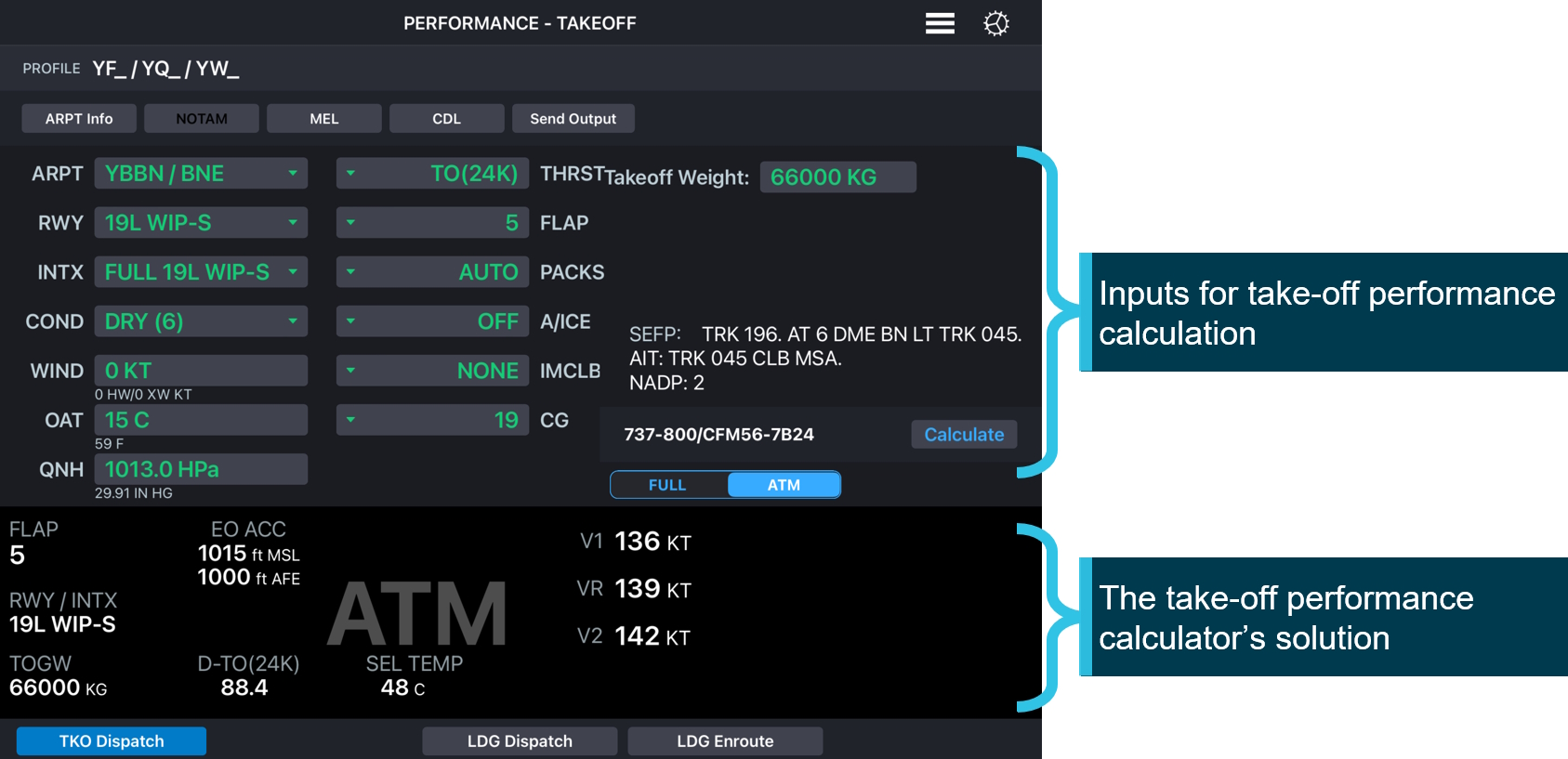
The take-off and landing performance calculators enabled determination of take-off and landing performance data as well as the performance limited weights for take-off and landing. The performance limited weight feature of both the take-off and landing performance calculators were primarily used by flight dispatch during flight planning to determine whether the sector had limiting weight considerations. The take-off performance calculator was used by flight crew for calculating take-off performance data as part of the preliminary pre‑flight procedure (Figure 7).
An exemplar image of the OPT take-off performance calculator, with the data inputs in green and, in the lower third, the calculator’s take‑off performance data. Source: Virgin Australia
When used by flight crew for take-off or landing performance data calculation, the user was required to input data into the various fields, and if a valid performance solution was possible, the application would provide performance data for those parameters. For a take‑off calculation, a valid performance solution would provide data that included the relevant take-off speeds and any available thrust derate.[32] An invalid performance solution would clearly advise the flight crew that a take-off using those parameters was not permitted. With respect to the landing calculator, the performance results included the landing limit weight and relevant landing speed for the selected flap setting at that weight.
En route landing performance calculator
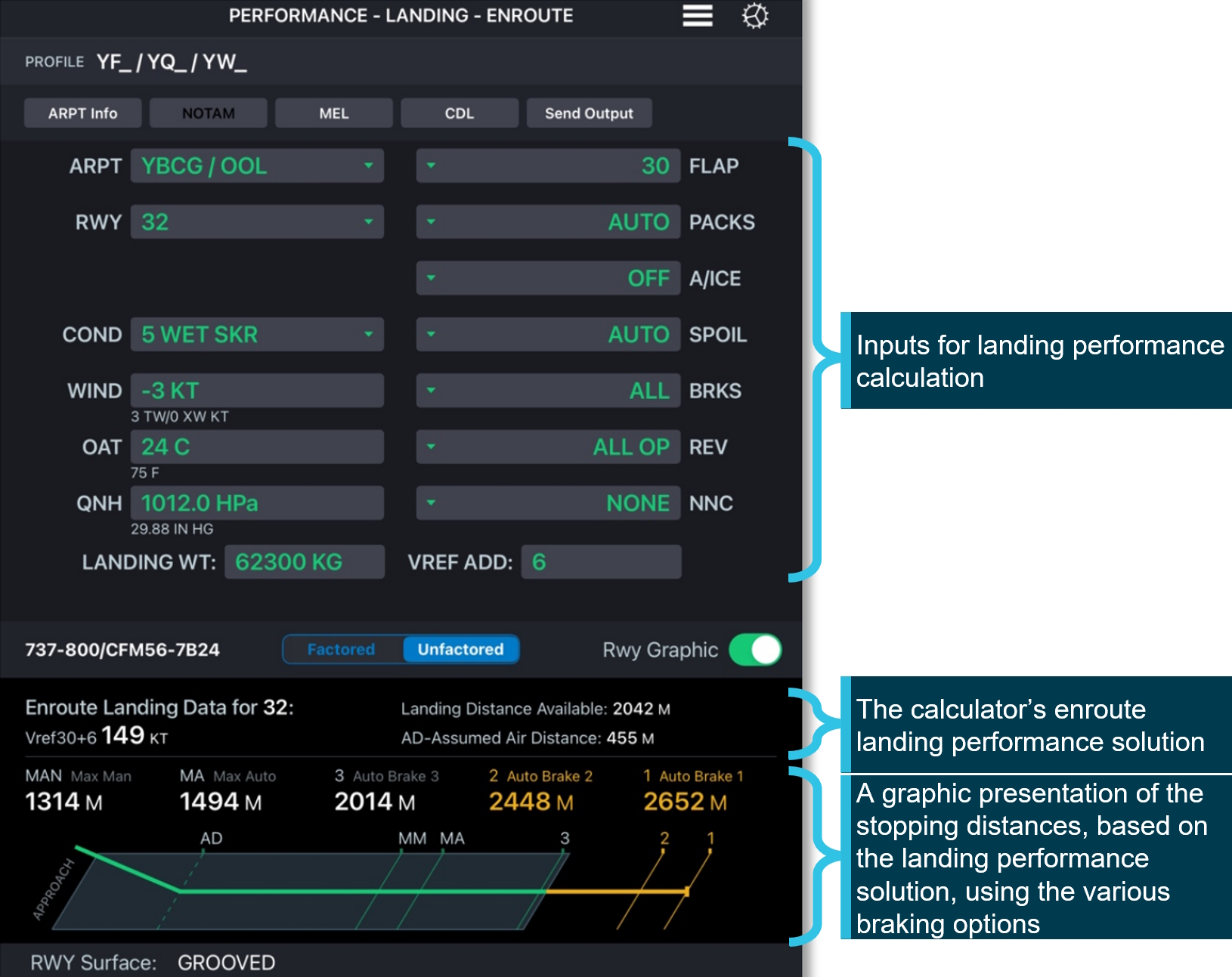
The en route landing performance calculator was the primary landing data calculator used by flight crew (Figure 8). It provided data based on an input landing weight and selected environmental and aircraft configuration inputs. If a valid landing performance solution was possible, the calculator would provide landing performance data that included the landing speed and stopping distances for the various braking selections available. That stopping data could be displayed in both tabular and graphic form. The selected runway’s landing distance available (LDA) was displayed as a product of the landing data solution.
Figure 8: Exemplar OPT en route landing performance calculator
An image of the OPT en route landing performance calculator, extracted from the Virgin manual. The calculations are for Coolangatta, with the data inputs in green and, in the lower third, the calculated landing performance data. The image also shows the calculated stopping solution in graphic form. Source: Virgin Australia
Runway distance data
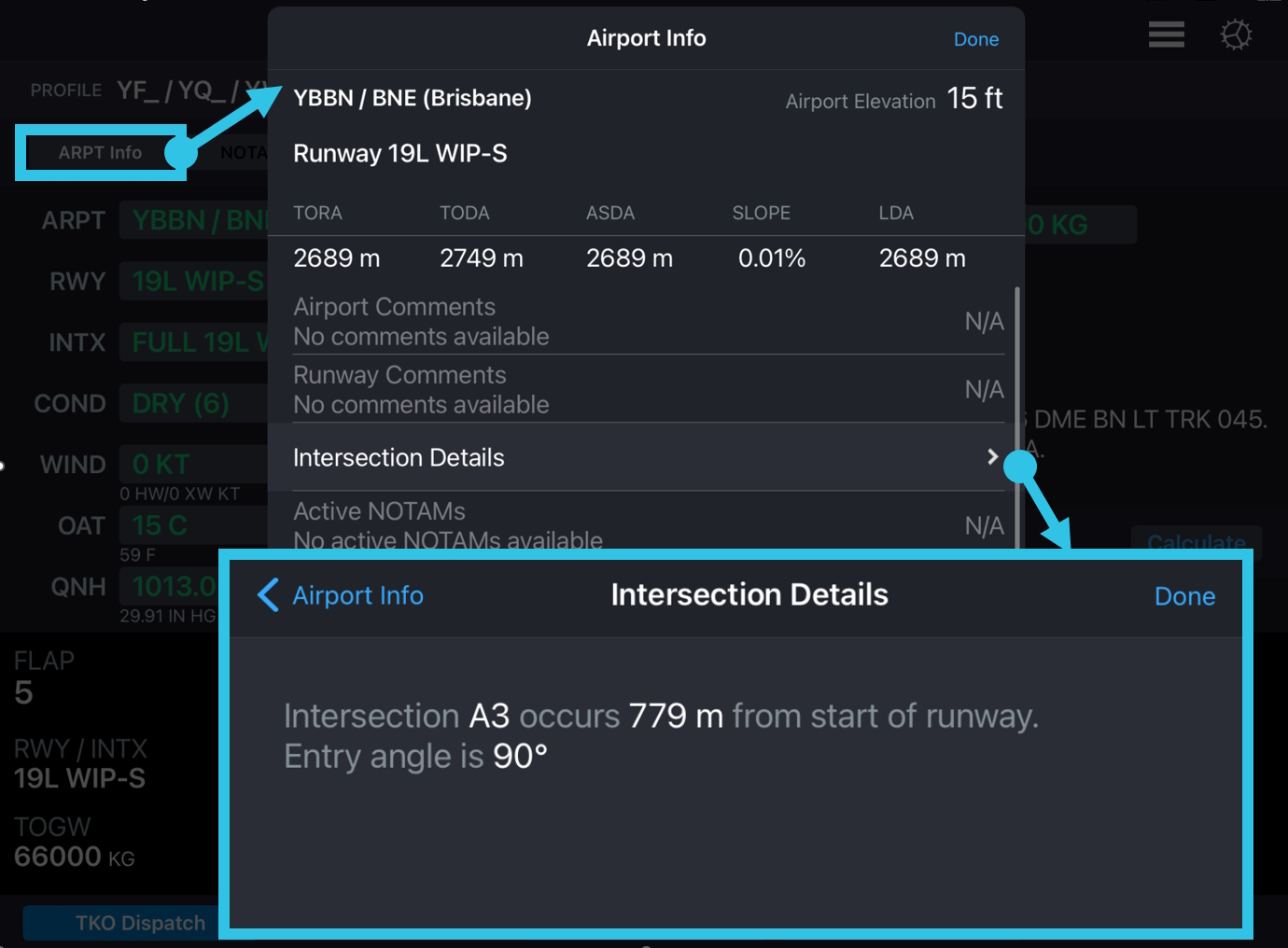
While runway distance data was displayed in the calculation results for the en route landing performance calculator (displayed as the Landing Distance Available), it was not displayed as part of the calculated take-off performance data. However, runway data was available in all OPT calculators through the ARPT Info tab (see Figure 7 and Figure 8). Selecting the ARPT Info tab (Figure 9) provided database details for the airport and runway that were selected as inputs. Intersection details relevant to that runway data was then available through a further selectable option. However, to determine the TORA for an intersection departure, the flight crew needed to manually calculate it using the displayed information.
Figure 9: OPT airport information
An image showing access to runway data through the Airport Info tab in the various OPT calculators. Source: Virgin Australia modified by ATSB
VA319 landing performance data
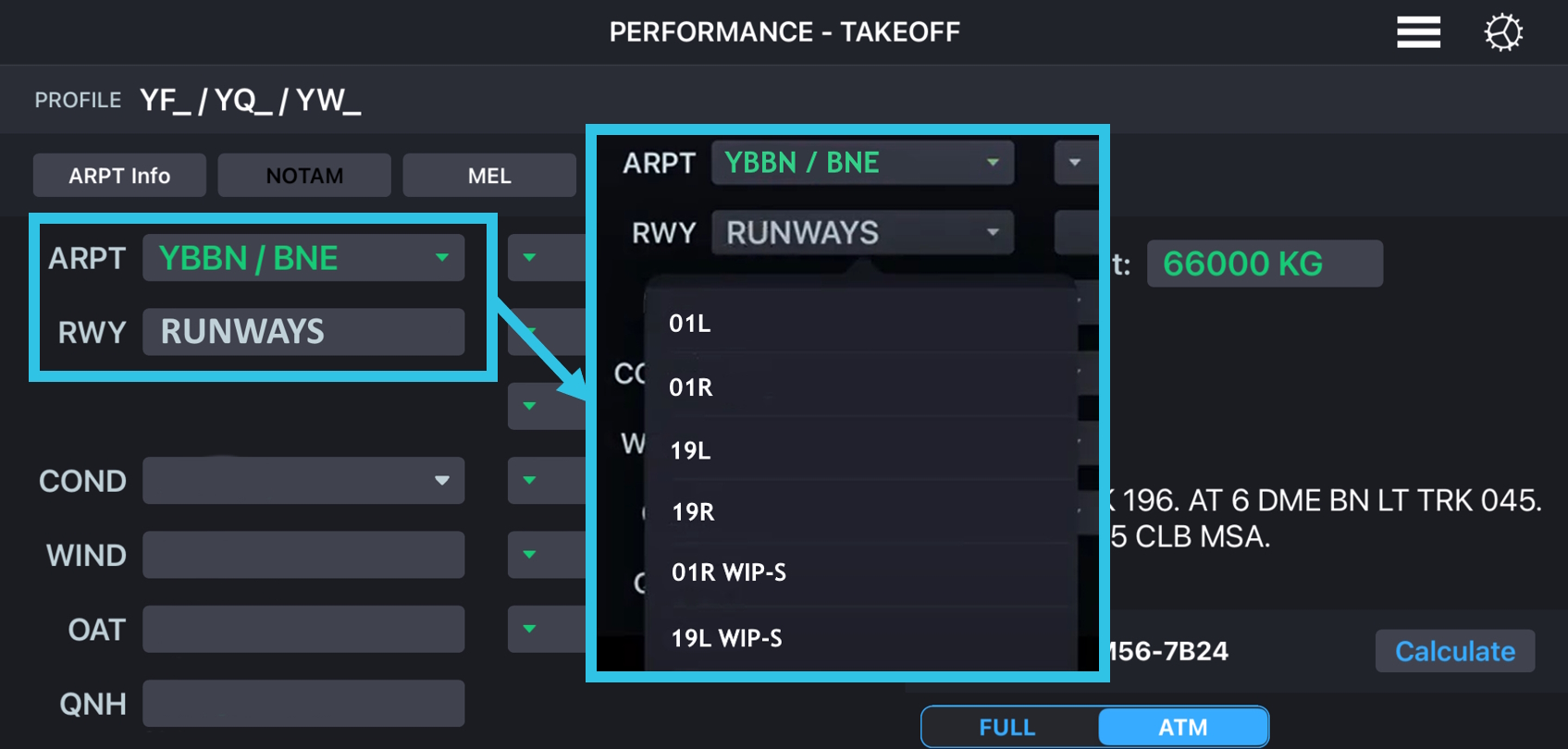
For the VA319 landing, the runway (RWY) input for Brisbane Airport (YBBN/BNE) had several selectable options available through a drop-down box. These were, in order, 01L, 01R, 19L, 19R, 01R WIP-S and 19L WIP-S (Figure 10). The 2 WIP-S runway options were the required selections for those runways based on the FOE remark in the VA319 FPP while NOTAM 1174/22 and the RWY 01R threshold displacement was in effect.
As part of their landing performance calculations for arrival into Brisbane, the flight crew selected the 19L option. The calculator provided a stopping solution based on the full runway length, and the other selectable variables input by the flight crew. The displayed landing solution included the LDA for RWY 19L, which was 3,560 m, while the available stopping solutions were based on this full runway length.
While the stopping solution for the landing in Brisbane was based on an incorrect runway length, the landing was not affected by this error. The aircraft was able to exit the runway using the using the A6 rapid exit taxiway, which was about 850 m short of the displaced threshold.
Figure 10: Runway input selection
An image of the OPT take-off performance calculator with the runway options displayed for the VA324 departure. Source: Virgin Australia modified by ATSB
VA324 take-off performance data
For the VA324 departure, the selectable YBBN/BNE runway inputs were those as stated for the VA319 arrival. However, on selecting the runway, the user was then also able to select various intersection (INTX) departure points available for that runway. While the normal RWY 19L configuration had the FULL and A3 INTX (intersection) options available, FOE had removed the A3 INTX option for RWY 19L WIP-S, and therefore the A3 intersection departure was not an available input.
For the VA324 take-off performance calculation, the flight crew selected the 19L option as the departure runway and A3 as the intersection departure. The OPT provided take-off performance and thrust derate based on the TORA of 2,781 m.
As part of its internal investigation, Virgin calculated the VA324 take-off performance data using the same inputs as the flight crew, but with the 19L WIP-S runway option and an A3 INTX selection (an A3 intersection departure). The OPT displayed an invalid take-off performance solution, with the following message being displayed:
No takeoff allowed. Planned weight exceeds max allowable weight of 67350 KG.
This result indicated that, even with maximum take-off thrust, the aircraft was overweight for a departure from A3 on runway 19L with the reduced runway length due to the displaced RWY 01R threshold.
Operator’s policies and flight procedures
Operations manual requirements
The operations manual detailed the operator’s general policies and specific procedures that governed the conduct of safe flying operations. With respect to the approach and pre‑flight phases of operations, it contained both common and specific requirements relevant to both. While the aircraft captain was accountable for the aircraft’s safety, and to obtain and check all available relevant information, the first officer was also required to be able to assume pilot in command duties should the aircraft captain become incapacitated. To meet this requirement, the first officer was to actively participate in the preparation and conduct of the flight, and in particular regarding flight preparation, to be familiar with all relevant operational information, including NOTAMs.
The operations manual also required both flight crew to independently review the weather information to be used in the departure and arrival preparations, such as that sourced from the ATIS. This independent review required each pilot to listen to the source information, or, if the source was a printed readout, independently read that data. That review was required to include verification of the information recorded on the take-off data card (TODC).
Flight crews were also required to be alert for NOTAMs that may have performance effect, but which did not have an FOE remark attached. The absence of the FOE remark identified that the NOTAM had not been assessed by FOE, and in such cases flight crews were required to contact flight dispatch and initiate an assessment of the NOTAM.
The manual also included a requirement for departure and arrival briefings. These briefings, which were normally conducted by the PF, had explicit content requirements, but both specifically included applicable NOTAMs. There was also a general threat and error management component to be addressed in these briefings.
Departure specific requirements
The pilot-in-command was responsible for ensuring that the aircraft’s gross weight was such that the flight could be conducted in compliance with the AFM, and similarly that the aircraft did not exceed take-off performance limitations. For take-off performance calculations, the operations manual required compliance with procedures that ensured an adequate independent cross-check be conducted with respect to several factors, including the input data used for the calculation. These independent cross-check procedures were detailed in the FCOM and the Performance and Loading Manual. Finally, the operations manual required specific items to be included within the departure briefing, when applicable. These items included any NOTAMs that were relevant to the departure.
Approach specific requirements
Before landing, the pilot in command was required to determine that the landing distance available (LDA) was sufficient and with an adequate safety margin. The operations manual provided 3 methods through which this determination could be made.
The first 2 methods were based on the dispatcher’s pre‑flight calculation of the landing weight limit for the sector. This limit was stated as the maximum landing weight (MLDW) in the limit weight (LIMIT WT) section of the OFP (Figure 3). If the aircraft’s landing weight was less than this MLDW:
and there had been no adverse changes to the environmental conditions, aircraft configuration or runway of intended use, or
having considered any changes to the environmental conditions, aircraft configuration and/or runway of intended use and found them to have no adverse effect,
then the landing distance requirement was met. Both MLDW methods were reliant on the flight crew knowing the variable parameters of environmental conditions, aircraft configuration and runway of intended use, that the dispatcher used in the MLDW calculation. Generally, dispatchers did not declare the parameters used in the MLDW determination within the OFP (see the section titled Flight planning). However, the dispatcher’s manual stated how these variable parameters were to be determined and flight crew could ascertain them from various parts of the FPP.
The third method required the flight crew to calculate an operational landing distance using maximum manual braking and factored by 1.15, and then ensuring that this landing distance was less than or equal to the LDA. The operations manual also required a stopping solution be determined when the LDA was sufficient. An operational landing distance calculation was made as part of the OPT’s en route landing performance solution (see the section titled En route landing performancecalculator). Therefore, the sufficient LDA determination was met as part of the stopping solution calculation.
Training manual requirements
As the occurrence flight was also being used to support a training function (line flying under supervision), it was necessary to examine relevant training policy and guidance to determine any likely effect on the conduct of normal operations. The operator’s training manual stated that safety remained the primary objective of all training events, and that:
The safe conduct of our flying operations and all supporting activities relies on our systems, our operating procedures, and most importantly in the way we think and act.
The manual further stated that:
All flight crew and Training and Checking personnel engaged in … training and assessment activities are required to ensure that safety remains at the forefront of all actions and decisions. This is especially important for training conducted in the aircraft, where Trainers … must always ensure that the safety of the aircraft and its occupants is never compromised.
The training manual also stressed that training pilots should conclude all training events with some degree of debrief.
Flight procedures
Introduction
The procedures required of the flight crew for the various phases of flight were contained in the operator’s Flight Crew Operating Manual (FCOM). These procedures were to be performed by memory and ensured that operational systems were correctly configured for the relevant phase of flight, and data for the flight management systems was entered and correct. Pre and post‑flight duties were divided between the captain and first officer, while phase of flight duties were divided between the PF and PM.
The procedures required of the flight crew as part of the approach preparation for VA319, and those required as part of the departure preparation for VA324, are addressed separately. The FCOM procedures for both the approach and departure preparation required calculation of performance data. Those calculations, which were made using the OPT, were to be completed using procedures and guidance found in the aircraft Performance and Loading Manual.
Pre‑flight procedures and the performance data calculation
Take-off performance data calculations were part of the FCOM flight management computer’s (FMC) data entry procedure that was conducted in parallel with the captain and FO pre‑flight procedure. This procedure required the determination of input data for the performance calculation, recording of that data on the TODC, and entry of that data into the OPT. These procedures and method of calculation using the OPT were prescribed by the Performance and Loading Manual.
The pilot not performing the exterior inspection was required to complete the TODC. The weather conditions for the departure, such as that reported by the ATIS, and the input variables for the OPT calculation were to be determined and recorded onto the TODC. These included items such as:
the relative wind (headwind or tailwind component)
adjusted ambient temperature
runway data to be used
aircraft configuration data, such as the relevant weights, fuel on board, engine thrust rating, and the intended take-off flap setting.
These variables were then entered into the OPT and if a valid take‑off performance solution was calculated, the various take-off speeds, any take-off thrust derate (if applicable), and other performance data provided by the OPT calculation were to be recorded on the TODC (Figure 11).
Figure 11: A partial replication of the VA324 TODC
A partial replication of the VA324 TODC archived record, showing the recorded ATIS, aircraft weights, departure point and take-off performance data. Source: Virgin Australia modified by ATSB
The take-off performance data was entered into the FMC as part of the data entry component of the pre‑flight procedure. The other pilot was then required to independently calculate the take-off performance data as part of their pre‑flight procedures.
Validating performance data calculations
The OPT had a ‘compare calculation’ function to compare the performance calculations made by 2 EFB devices connected through wi-fi. This ‘compare calculation’ function operated as the independent cross-check of input data required by the operations manual for all take-off performance calculations. The ‘compare calculation’ function displayed a comparison of the performance results and checked for any differences in the user inputs. Any discrepancies were notified to the user. Where no differences existed, both devices displayed a ‘check complete’ and ‘no mismatches found’ message.
Runway entry performance check
The FCOM’s before take-off procedures required the flight crew to verify that the runway about to be used for the take-off and the runway take-off position were correct. This was triggered when the aircraft was approaching the take-off position. It required, among other things, that the flight crew confirm that the runway location used for the performance calculation was coincident with the aircraft’s actual location.
Landing performance calculations
The OPT’s Landing En route Performance calculation, using the actual landing weight and the relevant weather components drawn from the ATIS, provided the operational landing distance for the various braking options (see the section titled En route landing performance calculator).
The landing distance available was also displayed, however, flight crews were not required to confirm that a changed landing distance available notified on the ATIS matched the landing distance available displayed on the OPT. This assurance was met through flight crew awareness and selection of the appropriate runway selection from the runway drop-down options in the OPT, which in turn was dependent on timely FOE updates to both the OPT database and notification to flight crew through the FPP.
Pre‑flight tasks and turnaround schedules
The operator provided a synopsis of the normal turnaround tasks and timings for a B737 flight crew. A turnaround was allocated 40 minutes from arrival to departure from the gate. The tasks required to be performed during the turnaround were estimated to take about 30 minutes, of which 4 minutes was assigned to planning the next sector. The operator noted that sector patterns were arranged such that ports were revisited, thereby enabling a significant part of the briefing process to be covered during an earlier cycle.
Air traffic control information
VA324 departure
Airservices Australia stated that several aircraft departed via the A3 intersection prior to the VA324 departure, and that there were no restrictions on doing so. The airport operator had installed several cones across the runway about 200 m south of the A7 taxiway intersection with the runway (Figure 12). VA324’s nose wheel was observed by the tower controller to lift at about taxiway A7 and the main wheels were observed to have passed extremely close to the displaced threshold cones. Several of the cones were blown over, and the airport operator advised that one cone was damaged.
In its internal investigation report, Virgin identified that some tower controllers were heard on the day, advising other flights that the runway was operating with a reduced length. Further, while acknowledging this was a non-standard radio call, the internal report also stated that consideration should be given to enhancing this radio call.
The ATSB determined that absence of such an alert for the VA324 departure was not contributory to the overrun occurrence. The shortened runway was included within the ATIS, which the flight crew acknowledged receipt of. Nevertheless, the inclusion of limiting runway conditions such as a shortened runway within the take-off clearance would enhance flight crew awareness of those conditions.
ATIS information
The ATIS information for both the arrival of VA319 and the departure of VA324 was ‘D’, which stated:
EXPECT INSTRUMENT APPROACH RWY 19L AND R FOR ARRIVAL AND DEPARTURES INDEPENDENT PARALLEL DEPARTURES IN PROGRESS REDUCED RUNWAY LENGTH IN OPERATION RWY 19L, LANDING DISTANCE AVAILABLE 2689 M, TAKE OFF RUN AVAILABLE 2689 M WIND 140 DEG, MIN 8 KT MAX 20 KT, CROSSWIND MAX 20 KT VISIBILITY GREATER THAN 10 KM SHOWERS IN AREA CLOUD FEW 1500 SCT 3500 TEMPERATURE 22 QNH 1014
Recorded data
Recorded data from the aircraft’s flight data recorder, Automatic Dependent Surveillance Broadcast (ADS-B) data from Airservices Australia, and video from various aircraft gates around the airport, enabled the ATSB to determine where VA324 became airborne. The relationship between the point where the aircraft’s main wheels left the runway and the cones, as well as the declared distances stated in NOTAM YBBNC1174/22 are identified in Figure 12.
Figure 12: Runway 19L configuration for VA324 take-off
An image showing the location of the cones on runway 01R/19L, and also displaying the various distances notified through NOTAM YBBN 1174/22. Specific locations of VA324’s take-off are also displayed.
Source: ATSB
The Global Action Plan for the Prevention of Runway Excursions
In May 2021, EUROCONTROL, with the support of the Flight Safety Foundation, published the Global Action Plan for the Prevention of Runway Excursions (GAPPRE). This publication was the result of contributions from multiple international public and private organisations with the goal of enhancing the safety of runway operations. The GAPPRE recommendations represent industry best practice which extend beyond regulatory compliance.
As part of its examination of take-off performance data calculations, the GAPPRE made the following observations:
Many runway safety events stem from erroneous or inadequate take-off performance calculations.
While the independent take-off performance calculations by all active crew members, which are subsequently cross-checked, can be time consuming, it is highly recommended.
EFB solutions incorporating navigational charts and applications for flight planning such as take-off and landing performance calculation programs not only save costs but also can simplify processes for flight crews. However, if threats such as runway shortening are not incorporated in time into the database used for performance calculations, the probability of the flight crew failing to detect such errors is high, especially as current NOTAM format and presentation in aviation in combination with fatigue, time pressure or complacency may lead to flight crews sometimes not reading or checking NOTAM information properly.
Visualisation in particular is a great tool to enable flight crews to easily build a correct risk picture for their take‑off in terms of runway excursion prevention. Being aware of the additional stop margin resulting from their calculation and being able to easily cross‑check that the take‑off position and line-up procedure used for the calculation matches the one expected or used is key for flight crews’ safety-relevant decision-making (e.g. deciding on a re-calculation or accepting or rejecting line-up clearances). If technically feasible, visualisation of this information should therefore combine results of performance calculations and airport layouts.
These, and other observations with respect to the calculation of performance data, led to several recommendations, including that aircraft operators develop policies or standard operating procedures that require flight crews to perform independent performance calculations. This should include an independent cross-check of actual TORA/TODA from the AIS with the TORA/TODA used to calculate the take-off performance.
The implementation of this recommendation included a strategy that the actual TORA/TODA, especially if being altered by NOTAM, should be checked against the value used in the take-off performance program individually and independently by each flight crew member. If it is not technically feasible to combine the results of take-off performance calculations and airport/runway layout in one visualisation, at least the EFB solution should make it possible to visualise the available stop margin in relation to the TORA.
Operator processes
Virgin’s procedures did not require flight crew to confirm that the runway distance used in the performance calculation matched that stated on the aerodrome ATIS. The operator advised that the OPT and gross error checking systems currently used were satisfactory for runway performance calculations.
While the operator’s dispatch NOTAM update service and FOE review provided the latest information available for flight crew for use in runway performance calculations, it did not mitigate inadvertent flight crew error where FOE performance requirements were not identified as part of the briefing process. Further, while extremely remote, there is also the likelihood of late changes in runway configuration being reported on ATIS but being outside of any update to the NOTAM package being provided to flight crew. Both could lead to miscalculation of runway performance data, which could be mitigated through procedure requiring confirmation of an ATIS reported change in runway data being confirmed and matched to the data used in the performance calculation.
Similarly, tools that enable the visualisation of the relevant performance distances, and in particular the stopping margins available for the take-off, are of great value in enabling flight crews to easily build a correct risk picture for their take-off in terms of runway excursion prevention. While these visual tools were available for the OPT’s en route landing calculator, there was not an equivalent visual tool available for use in the take-off calculator.
The first part of this 2-part ATSB research and analysis report presented a worldwide perspective of accidents and incidents involving take-off performance parameter errors. The report noted that, despite advanced aircraft systems and robust operating procedures, accidents continued to occur during the take-off phase of flight. The report documented accidents and incidents that resulted from take-off performance parameter data being incorrectly calculated or entered into aircraft systems.
It was found that calculation and entry of erroneous take-off performance parameters had many different origins, and that many factors were identified at all levels of influence. Due to the immense variation in the mechanisms involved in making take-off parameter calculation and entry errors, the report stated that there was no single solution to ensure that such errors were always prevented or captured. The report did, however, discuss several error capture systems that airlines and aircraft manufacturers can explore.
On 14 October 2013, a B737 aircraft departed from runway 11 intersection B2 at Darwin Airport using take-off performance data for the full runway length. The flight crew had prepared performance data for both a B2 intersection departure and a full-length departure and entered data for the full‑length departure into the flight management computer. As the aircraft taxied for a full-length departure, ATC advised of delays for a full-length departure due to arriving aircraft, but that an immediate departure was available from B2. The flight crew elected to use the B2 departure and reprogrammed the flight management computer. After a normal take-off, the flight crew identified that they had used the full-length data to reprogram the flight management computer, and that the aircraft had taken off with incorrect performance data.
During the month of September 2021, a NOTAM advised flight crew that Darwin Airport runway 29 had a displaced threshold due to runway works. Two flight crews, the first on 3 September and the second on 19 September, misinterpreted the NOTAM to mean that runway 11 threshold was displaced. Both flight crews planned for a displaced threshold landing on runway 11, and both crews subsequently landed long with reduced runway available for the landing roll. Further, both flight crews misinterpreted the aerodrome ATIS, which stated the active runway as being 11 and that the runway had reduced length.
On 7 July 2017, an Airbus A320 was cleared to land at San Francisco airport runway 28R. The aircraft, which was conducting a visual approach to the runway, was lined up with the parallel taxiway C and not the runway. There were 4 air carrier aircraft waiting clearance to take off that were occupying taxiway C. The A320 descended to an altitude of 100 ft AGL before initiating a go‑around, during which the aircraft descended to 60 ft and overflew a number of the waiting aircraft, narrowly missing one of the waiting aircraft.
The flight crew aligned the aircraft with the taxiway on an incorrect understanding that the lights to their left were for the parallel runway 28L. That runway, however, was closed and not lit. A NOTAM stating the closure of runway 28L was included within the flight crew’s briefing package. The NTSB found several contributing factors to the runway misalignment, including that the flight operations information provided to the flight crew needed more effective presentation of information to optimise pilot review and retention of relevant information, particularly given the large volume of data presented to flight crew.
Safety analysis
Introduction
At 1148 on 30 November 2022, a Boeing 737-800 flight from Brisbane to Melbourne, operating as VA324, commenced its take-off run from the A3 intersection of runway 19L (RWY 19L) at Brisbane Airport (BNE). While the aircraft’s flight crew were aware of the upwind threshold being displaced, they were not aware that the take-off distance available for runway 19L had also been significantly reduced due to that displacement and that there were cones across the runway to mark the closed end of the runway.
Consequently, the performance data used for the take-off was incorrectly based on a normal length runway being available. This resulted in insufficient power being applied at the commencement of the take-off for the aircraft to complete the take-off in the declared distance available. This analysis will examine the factors that led to this serious incident and the opportunities to have corrected the misunderstanding of the runway status.
Flight planning in Melbourne
Incorrect mental model for runway 19L
Before the departure from BNE RWY 19L, the flight crew operated a sector from Melbourne (MEL) to BNE as VA319. The VA319 operational flight plan (OFP) component of the flight planning package (FPP) included a dispatcher’s note that identified that the threshold for BNE RWY 01R was displaced, but also contained the statement ‘NO LDW PERF LIMITATION’. This was intended to inform the flight crew that the displaced threshold had not led to any change to the aircraft’s maximum landing weight limitation for the landing into BNE.
The captain, however, misinterpreted this to mean that the displaced threshold had no performance effect for operations on runway 19L, that is, that flight operations engineering (FOE) had determined that there were no specific requirements with respect to the onboard performance tool (OPT) data input due to the threshold displacement. This misunderstanding led to a mental model that the displaced threshold for RWY 01R had no effect on performance requirements for RWY 19L.
Dismissing NOTAM YBBNC1174/22
The operator’s turnaround time between flights was generally scheduled at 40 minutes, of which about 5 was allocated to planning for the next sector. During this short period, there was typically a large volume of NOTAM data to be reviewed and flight critical data identified and actioned. While the grouping of sectors, revisiting of ports, and the use of a dispatcher to provide support, enabled efficiencies related to briefing, the aircraft captain retained overall responsibility for being aware of all relevant data.
To achieve this in the limited time available, the occurrence captain used NOTAM headlines as a guide to the content when assessing the relevance of a NOTAM. The scanning of NOTAMs using their heading is a practice often used by flight crew to enable large volumes of NOTAMs to be reviewed quickly. While the one subject matter and one condition standard for NOTAM construction generally supports this practice, there may be instances where a NOTAM’s headline does not fully reflect data contained within the free text section. NOTAM YBBNC1174/22 was one such NOTAM.
The 33-page VA319 FPP, which was presented to the flight crew in Melbourne, contained 120 NOTAMs over 18 pages. The NOTAMs for BNE included NOTAM YBBNC1174/22 with the headline RWY 01R THR DISPLACED. That NOTAM detailed the reduction in the runway length for operations on 01R/19L, data that was critical for the arrival into Brisbane. During review of the sector’s NOTAMs, the captain sighted the NOTAM headline and identified the NOTAM as being the matter to which the dispatcher had referred to in the note. However, the captain incorrectly dismissed this NOTAM as not being relevant to the flight because they:
had previously incorrectly interpreted the dispatcher note on the performance effect of the displaced threshold, and therefore this NOTAM, as having no impact on their operations
expected a landing on RWY 19L in Brisbane and the NOTAM headline made no reference to RWY 19L.
The ATSB was unable to conclusively determine whether the first officer reviewed the dispatcher’s notes and sector NOTAMs prior to departure from Melbourne, however, if they did, they missed the relevance of the note, the NOTAM and its attached FOE data.
FOE data not identified
The FPP was the only source available to the flight crew for notification of FOE data changes. Any performance calculation made without the use of the applicable FOE data had an elevated potential to be incorrectly applied. The FOE remark attached to YBBNC1174/22 contained the data necessary to select the correct OPT inputs and correctly calculate aircraft performance data when using the reduced length of runway 01R and 19L in Brisbane.
During the VA319 pre‑flight at MEL, the flight crew did not identify the FOE data applicable to operations on Brisbane’s RWY 19L during the review of the NOTAMs. The FOE data appended to NOTAM YBBNC1174/22 was either missed or dismissed due to an expectation that there was no performance effect.
The operator found that performance critical NOTAMs were presented in the same typeface as less critical NOTAMs and that this was contributory to the flight crew not identifying the FOE remark. While this is possible, it was also noted that the remarks were distinguished by a unique heading banner. The ATSB assessed that the incorrect mental model established by the captain was probably the overriding factor which influenced the dismissal of the NOTAM and its associated FOE remark.
Finally, the ATSB considered the possibility that the delayed issue of the complete FPP to the flight crew in Melbourne impacted the crew’s ability to effectively review NOTAMs and associated FOE. However, a full reprint of the FPP’s NOTAMs was available to the crew before departure and the preparations for arrival into Brisbane including the arrival briefing offered another opportunity to review the NOTAMs and identify applicable FOE data.
The Brisbane arrival
Readdressing the NOTAM
The operations manual requirements for an arrival briefing specified runway conditions and applicable NOTAMs for the arrival as items to be addressed in the briefing. It also included a general threat and error assessment for the arrival and landing. NOTAM YBBNC1174/22 contained critical information that merited review under both the briefing and the threat and error assessment.
However, contrary to these requirements, NOTAMs were not reviewed before arrival, nor were they reviewed when the time and opportunity was present during the en route phase of flight between MEL and BNE. While this time was likely allocated to training, the flight crew’s primary responsibility for safety of flight necessitated that, at a minimum, this NOTAM be reviewed. As a result, another opportunity to correct the captain’s (crew’s) mental model of BNE RWY 19 was missed.
ATIS and incorrect landing performance
While the BNE ATIS stated that the runway length of RWY 19L was reduced and specified the reduced landing distance available (LDA), the flight crew did not consider this notification to be relevant to the approach preparations. This was probably a result of the continuation of the misunderstanding of the dispatcher’s note regarding the performance requirements for RWY 19L. This resulted in the flight crew selection in the OPT of the full runway length for the runway input criteria, instead of the reduced length option. While the OPT landing performance data was based on an incorrect runway landing distance available, the calculated stopping solution was based on exiting the runway well before the closed section. Therefore, the landing was not affected by the incorrect runway data input. Further, the aircraft performed in accordance with the calculated data, exiting the runway normally using the planned rapid exit taxiway. The flight crew also did not see any visible restrictions or obstructions either on or around the runway which further supported their incorrect mental model.
While the LDA used in the landing performance calculation was displayed as part of the OPT en route landing performance calculation, the operator’s procedures did not require flight crews to crosscheck the LDA presented by the OPT with any notification of LDA change, such as that stated on the ATIS. Such a check, as recommended by the GAPPRE, could have provided an additional defence to capture the flight crew’s incorrect mental model and landing performance error.
The Brisbane departure
The pre‑flight
The flight crew commenced the pre‑flight preparations for VA324 with an understanding that YBBNC1174/22 did not impose any limitation on RWY 19L operations. Due to a combination of time pressures and distractions, particularly the delayed arrival into Brisbane and the initial prioritisation of training requirements during departure preparations, the flight crew had reduced time for their review of the VA324 FPP. As a result, the captain dismissed the dispatcher's note alerting the flight crew to the displaced threshold and, while the flight crew reviewed the OFP component of the briefing package prior to departure, they likely did not review the NOTAM package.
Take-off data error
Despite reviewing the ATIS content, due to an enduring belief there were no runway restrictions, the captain used an incorrect normal runway length input to determine the take-off performance figures for the BNE departure. This error was not identified as the first officer used the captain’s input data from the take-off data card (TODC), contrary to the independent take-off performance calculation procedures, resulting in the same incorrect figures.
Due to the use of the full runway length option as the basic runway configuration, the OPT calculator enabled a departure from the A3 intersection with a power derate. However, had the actual reduced runway length option (19L-WIPS) been used, the OPT would have excluded an A3 departure as the aircraft was overweight for such a departure, even with full take-off power. Further, had the A3 intersection departure selection been available for the 19L-WIPS option, the OPT would have notified the flight crew that a take-off from that point on the runway was not permitted.
Due to the incorrect take-off performance calculation, the aircraft did not meet the required performance for its departure from the A3 intersection of RWY 19L. The effect of this meant that the aircraft may have been unable to stop within the declared TORA if the take-off had to be rejected at high speed, and a runway excursion would have occurred. In addition, in the event of engine failure at high speed, the aircraft would probably have been unable to achieve its required performance.
Misleading MAGS
The Part 139 Manual of Standards required that movement area guidance signs (MAGS) located at runway intersection holding points be obscured when a temporarily displaced runway threshold altered the distance displayed by the MAGS. This did not occur while NOTAM YBBNC1174/22 was in effect. The signs presented a take-off distance that was in excess of that available, creating the potential to mislead flight crews about the status of the runway and the distance available when conducting a departure from that point.
While the operator’s procedures required the conduct of a performance data check at the holding point, they did not require consideration of the MAGS data in relation to that check. However, as MAGS were not required by Part 139 at all departure holding points, the mandating of a MAGS check as standard procedure would not have been possible. Nevertheless, obscuring the signs or including an indication of works in progress on the signs, had the potential to alert flight crews to changed conditions and trigger crews to confirm that correct runway data was being used for the take-off performance calculation.
Findings
ATSB investigation report findings focus on safety factors (that is, events and conditions that increase risk). Safety factors include ‘contributing factors’ and ‘other factors that increased risk’ (that is, factors that did not meet the definition of a contributing factor for this occurrence but were still considered important to include in the report for the purpose of increasing awareness and enhancing safety). In addition ‘other findings’ may be included to provide important information about topics other than safety factors.
Safety issues are highlighted in bold to emphasise their importance. A safety issue is a safety factor that (a) can reasonably be regarded as having the potential to adversely affect the safety of future operations, and (b) is a characteristic of an organisation or a system, rather than a characteristic of a specific individual, or characteristic of an operating environment at a specific point in time.
These findings should not be read as apportioning blame or liability to any particular organisation or individual.
From the evidence available, the following findings are made with respect to the incorrect calculation of take-off performance data by the flight crew of VH-YFH on 30 November 2022 that led to a runway excursion on Brisbane Airport runway 19L.
Contributing factors
For the Melbourne to Brisbane sector, the dispatcher notes in the operational flight plan stated that Brisbane runway 01R displaced threshold had no landing weight performance limitation. The captain misinterpreted that note to mean that there were no performance requirements limits for operations on runway 19L.
While the Brisbane NOTAM with the headline RWY 01R THR DISPLACED contained data concerning a significant reduction in the length of runways 01R/19L, the previously established misunderstanding of this NOTAM and the absence of any reference to 19L in the heading resulted in the captain incorrectly dismissing this NOTAM, which was also probably missed by the first officer.
The flight crew did not identify the critical performance data that was appended to the Brisbane NOTAM that stated the runway length reduction for 01R/19L prior to the departure from Melbourne.
The ATIS notification of the reduced length of runway 19L was not recognised or accounted for in the performance calculations for operations on that runway, likely due to the captain’s established belief that there were no performance requirements for runway 19L and the absence of the required independent check by the first officer.
Due to time pressures and distractions from prioritising training requirements during the preparation for departure from Brisbane's runway 19L, and a previous assessment that it was not relevant, the flight crew dismissed a dispatcher's note alerting the crew to the RWY 01R THR DISPLACED NOTAM. Also, while the crew reviewed the operational flight plan component of the briefing package prior to departure, they probably did not review the NOTAM package.
Unaware of the reduced available length of the departure runway, which was reinforced by the absence of any visible runway works or restrictions during the previous landing on 19L, the flight crew miscalculated the aircraft's take-off performance data. That resulted in a departure with insufficient available runway due to the aircraft being overweight for that reduced runway length.
Other factors that increased risk
Having not reviewed the NOTAMs as part of the approach briefing prior to descent into Brisbane, contrary to the requirements of the operations manual, or on an opportunity basis en route, the flight crew missed an opportunity to correct the incorrect mental model developed for Brisbane's RWY 19L during the turnaround in Melbourne.
Contrary to the requirements of Part 139 Manual of Standards, the A3/19L intersection departure point take-off run available Movement Area Guidance Sign (MAGS) presented a take-off distance that was more than that available, creating the potential to mislead flight crews about the status of the runway when conducting a departure from that point.
Safety actions
All of the directly involved parties were provided with a draft report and invited to provide submissions. As part of that process, each organisation was asked to communicate what safety actions, if any, they had carried out or were planning to carry out in relation to each safety issue relevant to their organisation.
The initial public version of these safety issues and actions are provided separately on the ATSB website, to facilitate monitoring by interested parties. Where relevant, the safety issues and actions will be updated on the ATSB website as further information about safety action comes to hand.
Safety action not associated with an identified safety issue
Whether or not the ATSB identifies safety issues in the course of an investigation, relevant organisations may proactively initiate safety action in order to reduce their safety risk. The ATSB has been advised of the following proactive safety action in response to this occurrence.
Additional safety action by Virgin Australia
Virgin Australia (VA) advised the ATSB of several changes and improvements made as a result of learnings from an examination of the occurrence. These included:
The introduction of threat-based standard dispatcher notes, with enhanced engagement between VA fight dispatch and flight operations in identifying impactful NOTAMs, while also constructing standard dispatcher notes that focus on the threat presented to flight crew.
An operational performance tool (OPT) update to bring runway options with a WIP designator ahead of the normal runway selection options.
A focus on standard operating procedure changes to limit pilot distraction at the runway entry point and to remove scan items requiring action below the glareshield.
Enhanced engagement between Brisbane Airport and VA on safety initiatives.
The risk assessment methodology for runway displacements has been adapted from a general risk model to an airport‑specific risk analysis, as well as a monthly runway works risks review meeting being established by Flight Operations Quality Assurance.
A flight operations STOP PRESS Safety Update relating to the occurrence event was issued by the chief pilot on 5 December 2022.
Flight operations now provide enhanced guidance for flight crew for runways with displacements through easy to read and digest marked-up runway diagrams.
In response to a holistic review of communication to flight crew regarding significant events, flight operations introduced a monthly Safety Town Hall to better communicate current issues, trends, and events. These have been in place and running every calendar month since February 2023.
In response to a number of events that had contributing factors of distraction/situational awareness, VA conducted an independent human factors review through a specialist third party. A number of findings and actions were issued as a result and are now being tracked through safety governance.
Additional safety action by Brisbane Airport Corporation
Brisbane Airport Corporation implemented several changes to reduce the risk associated with this type of occurrence. The changes included:
adjustments to departure and arrival procedures associated with runway works
redrafting of the NOTAM to clarify the operational changes to both runways 01R and 19L, and procedures to ensure correct runway distance was displayed on take-off run available movement area guidance signs
publication of an aeronautical information circular supplement for the works.
Glossary
ACARS
Aircraft Communications, Addressing and Reporting System
ADS-B
Automatic dependent surveillance - broadcast
AFM
Airplane Flight Manual
AIC
Aeronautical information circular
AIP
Aeronautical information publication
AIS
Aeronautical information service
ASDA
Accelerate stop distance available
ATC
Air traffic control
ATS
Air traffic services
ATIS
Automatic terminal information service
B737
Boeing 737
BAC
Brisbane Airport Corporation
BNE
Brisbane
CASA
Civil Aviation Safety Authority
CASR
Civil Aviation Safety Regulations
EDT
Eastern daylight-saving time.
EFB
Electronic flight bag
EST
Eastern Standard Time
FCOM
Flight crew operations manual
FMC
Flight management computer
FO
First officer
FOE
Flight Operations Engineering
FPP
Flight planning package
FPM
Flight plan manager
GAPPRE
Global Action Plan for the Prevention of Runway Excursions
GM-AIS
Guidance Manual for Aeronautical Information Services
ICAO
International Civil Aviation Organization
LDA
Landing distance available
MAGS
Movement area guidance signs
METAR
Aviation routine weather report
MOS
Manual of standards
MLDW
Maximum landing weight
MOWP
Method of working plan
NAIPS
National aeronautical information processing system
NOTAM
Notice to airman
OFP
Operational flight plan
OPADD
Operating Procedures AIS Dynamic Data
OPT
Onboard performance tool
PANS-ABC
Procedures for Air Navigation Services – Abbreviations and Codes
PANS-AIM
Procedures for Air Navigation Services – Aeronautical Information Management
PIB
Pre-flight information bulletin
PF
Pilot flying
PM
Pilot monitoring
SARP
Standard and Recommended Practice
TAF
Aerodrome forecast
TODA
Take-off distance available
TODC
Take-off data card
TORA
Take-off run available
UTC
Coordinated Universal Time
YBBN
Brisbane Airport
YMML
Melbourne Airport
Sources and submissions
Sources of information
The sources of information during the investigation included:
the flight crew and dispatchers
Virgin Australia Airlines
Civil Aviation Safety Authority
International Civil Aviation Organization
Airservices Australia
Boeing
Brisbane Airport Corporation
recorded data from the aircraft and Airservices Australia.
References
Civil Aviation Safety Authority. (2020). Manual of Standards Part 139 - Aerodromes. Canberra: Civil Aviation Safety Authority.
EUROCONTROL and Flight Safety Foundation. (2021). Global Action Plan for the Prevention of Runway Excursions. Brussels, Belgium: EUROCONTROL.
International Civil Aviation Organization. (1951). Annex 15 (Aeronautical Information Services) to the Convention on International Civil Aviation (16th ed.). Montreal, Canada: International Civil Aviation Organization.
International Civil Aviation Organization. (2018). Doc 10066, Procedures for Air Navigation Services — Aeronautical Information Management (1st ed.). Montreal, Canada: International Civil Aviation Organization.
International Civil Aviation Organization. (2021). Doc 8126, Aeronautical Information Services Manual (7th ed.). Montreal, Canada: International Civil Aviation Organization.
International Civil Aviation Organization. (2016). Doc 8400, Procedures for Air Navigation Services (PANS) - ICAO Abbreviations and Codes (9th ed.). Montreal, Canada: International Civil Aviation Organization.
International Civil Aviation Organization. (2002). Guidance manual for Aeronautical Information Services (AIS) in the Asia/Pacific Region (1st ed.). Bangkok, Thailand: International Civil Aviation Organization Asia and Pacific Office.
Under section 26 of the Transport Safety Investigation Act 2003, the ATSB may provide a draft report, on a confidential basis, to any person whom the ATSB considers appropriate. That section allows a person receiving a draft report to make submissions to the ATSB about the draft report.
A draft of this report was provided to the following directly involved parties:
the flight crew
Virgin Australia
Brisbane Airport Corporation
Airservices Australia
United States National Transportation Safety Board, and Boeing
Civil Aviation Safety Authority
International Civil Aviation Organization.
Submissions were received from:
Civil Aviation Safety Authority
Virgin Australia
Brisbane Airport Corporation
the flight crew.
The submissions were reviewed and, where considered appropriate, the text of the report was amended accordingly.
Appendices
Appendix – NOTAM standards and related guidance materials
Introduction
The following sections discuss the various types of aeronautical information and the role of NOTAM within this scheme. The sources of NOTAM standards are identified, and each of these examined for their contribution. Other authoritative source material that provided guidance on NOTAM structure and content is also examined. In examining these standards and guidance materials, NOTAM C1174/22 will be used as an example of their application. To provide some background into the reasons for issuing C1174/22, the origins of that NOTAM will also be examined.
Types of aeronautical information
CASR Part 139 required airport operators to provide detailed information about various aerodrome facilities, such as movement areas, lighting systems and other facilities that were available for use by aircraft at that airport. That aeronautical information was to be sent to relevant aeronautical information service (AIS) providers for publication. Airport operators were also required to notify users of any changes or limitations to that published information, such as that caused by aerodrome works.
The AIS provider, Airservices Australia, collated aeronautical data concerning airspace, navigation aids and other facilities provided by airport operators and other sources. That information was published in:
the aeronautical information publication (AIP) and supplements
notices to airmen (NOTAM)
aeronautical information circulars (AIC).
The AIP was the primary aeronautical information document, containing current information of a lasting character that was essential for air navigation. AIP supplements provided a means to publish information of a temporary nature but of a long duration. The NOTAM system was designed to provide immediate distribution of information of direct operational significance that was of short duration. Information that did not qualify for publication within the AIP or as a NOTAM, but which related to flight safety or other aviation activities, was published as an AIC.
The RWY 01R displaced threshold NOTAM
The Brisbane Airport MOWP YBBN 22/07 included scheduled work segments for the replacement of various runway and approach lighting power cables. This required working near the RWY01R threshold and the consequent need to displace that runway’s threshold. The works also resulted in the temporary disabling of various runway lighting systems.
After submission to Airservices of data detailing facilities that would be affected by these works, NOTAM C1139/22 was issued. Due to minor changes in the taxiway availability and the relocation of the displaced threshold markers, C1139/22 was amended and reissued as C1174/22. The full published version of NOTAM C1174/22 stated:
C1174/22 NOTAMR C1139/22 Q) YBBB/QMTCM/IV/NBO/A/000/999/2723S15307E005 A) YBBN B) 2211292100 C) 2211300630 E) RWY 01R THR DISPLACED RWY 01R/19L 871M SOUTH END NOT AVBL DUE WIP OBST WORKERS AND EQPT 16FT AGL ON RCL 2889M FM START OF TKOF RWY 19L EFFECTIVE RWY LEN AVBL 2689M THR RWY 01R DISPLACED 921M MARKED BY FIVE GREEN LGT AND RWY THR IDENT LGT (RTIL) EACH SIDE OF RWY DECLARED DISTANCE AND GRADIENT CHANGES RWY TORA TODA ASDA LDA 01R 2689 2809(1.6) 2749 2579 19L 2689 2749(3.6) 2689 2689 SUPPLEMENTARY TKOF DISTANCES RWY19L- 2577(1.6) 2626(1.9) 2662(2.2) TWY A7 AVBL FOR RWY 01R INTL DEP RWY 01R PAPI, HIGH INTENSITY APCH LGT (HIAL) AND RCLL NOT AVBL HIGH INTENSITY RWY LGT (HIRL) NOT AVBL RWY 01R TEMPO PAPI LEFT SIDE 3.0 DEG 75FT AVBL REFER METHOD OF WORKING PLAN YBBN 22/07
Aeronautical information standards
CASR Part 175 (Regulation.175.105) required aeronautical information published through the AIP, NOTAM and AIC to meet standards established under specific publications as follows:
Part 175 Manual of Standards (MOS)
Annex 15 to the Chicago Convention – Aeronautical Information Services
International Civil Aviation Organization (ICAO) Document 10066 Procedures for Air Navigation Services – Aeronautical Information Management (PANS-AIM)
ICAO Document 8126 Aeronautical Information Services Manual (Doc 8126)
other AIS-applicable ICAO documents.
The CASR dictionary included a definition for ‘other AIS applicable ICAO documents’. That definition identified those documents, which included ICAO Doc 8400 ICAO Procedures for Air Navigation Services – Abbreviations and Codes (PANS-ABC).
Regulation 175.105 also stated that, when standards established under one document contradicted those stated in another, then the standards in the first listed document were to apply.
At the time of the occurrence, Part 175 MOS had not been published. Annex 15 did not contain any standards relevant to the structure and required content of NOTAM. The principal document for those standards was PANS-AIM, which also made direct reference to PANS-ABC on matters relating to a specific but critical component of the NOTAM. Doc 8126 provided guidance material on the requisite components of the NOTAM Format.
PANS-AIM
PANS-AIM contained the following basic principles governing NOTAMs:
A NOTAM shall contain information in the order stated in the NOTAM Format, a template that set out communications handling instructions and the required content for a NOTAM. That required content was structured around various fields labelled as Item ‘Q)’ and Items ‘A)’ through ‘G)’. Each field had a specific structure and required content, as designated by the NOTAM Format.
ATSB Observation
These fields can be identified in the following extract from C1174/22:
Q) YBBB/QMTCM/IV/NBO/A/000/999/2723S15307E005 A) YBBN B) 2211292100 C) 2211300630 E) RWY 01R THR DISPLACED
Each field had a specific structure and required content, as designated by the NOTAM Format.
A NOTAM shall deal with one subject and one condition of that subject only. It should be as brief as possible and compiled such that the meaning is clear.
ATSB Observation
NOTAMs advise flight crews of information that has direct operational significance. In the case of C1174/22, this was the displacement of RWY 01R threshold. For this NOTAM, the runway threshold was the subject matter, while its displacement the condition.
The subject matter and related condition shall be reported through coding contained within Item Q). The components of that coding are to be selected from NOTAM Code tables published in PANS-ABC.
ATSB Observation
For C1174/22, the Q-Code was stated in the 5 letters QMTCM, the second field in the Q) line. The first letter, Q, identified that the field is the Q-Code field, the second and third letters MT stated the subject matter, which was decoded as Threshold (specify runway). The fourth and fifth letters CM stated the condition of that subject matter, which was decoded as Displaced.
The content of the free-text section of the NOTAM, Item E), shall be based on the decoded NOTAM code, also called the code’s signification, supplemented where necessary by ICAO abbreviations and other identifiers and designators. The content of Item E) is to be sufficiently clear and concise so as to facilitate its use in a Pre-flight Information Bulletin (PIB).
ATSB Observation
The NOTAM content for C1174/22 printed in the VA319 FPP (Figure 4) was an example of a PIB version of a NOTAM. Similarly, NOTAMs published by NAIPS use the PIB version of the NOTAM. Essentially, for a PIB, the NOTAM is stripped of all detail except the free text Item E) content.
PANS-ABC
PANS-ABC is the principal document for the NOTAM code, which is reported in the Item Q) line as the NOTAM’s Q-code. The NOTAM’s Q-code is a comprehensive description of the information contained in the NOTAM. In combination with the other information presented in the Item Q) line, it provides a means of determining the operational significance of the information and a method for storage and retrieval of information. Further, the Q-Code is a method for standardisation of information presented in item E).
PANS-ABC details procedures used to select the code reported in item Q). The code’s subject matter and status/condition components are derived from separate tables within PANS-ABC. With respect to selection of the code letters, PANS-ABC stated:
The code identifying the subject or denoting its status of operation is, whenever possible, self-evident. Where more than one subject could be identified by the same self-evident code, the most important subject is chosen.
The code components listed in these tables have an associated standardised plain language text, referred to as the code’s signification, or decode, which forms the basis for the NOTAM’s free text section, Item E.
With respect to C1174/22, and the PIB content of that NOTAM found in the VA319 and VA324 FPPs, the free text section contained items of information that were reportable under various subject matter codes listed in the PANS-ABC tables. These subject matter codes were:
Movement and landing area subject matters
MD, Declared distances for RWY 01R and RWY 19L
MT, Threshold for RWY 01R
MX, Taxiway A9 and A7
Lighting facilities subject matters
LC, Runway centre line lights
LH, Runway high intensity lights
LI, Runway end identifier lights
LP, Precision approach path indicator lights.
ICAO Doc 8126
While this document re-affirmed that a NOTAM was to be limited to one subject matter and one condition related to that subject matter, it also included the statement that:
The NOTAM Code selected describes the most important status or condition to be promulgated.
This indicated that more than one status or condition of a specific subject matter could be reported in a NOTAM. There was nothing further in Doc 8126 to support how, or under what circumstances, such combinations of status or conditions were to be made.
With respect to Item E), the free text section of the NOTAM, Doc 8126 stated that the information was to be kept as short as possible, preferably not exceeding 300 characters, containing all the essential information and ready for inclusion in PIB.
ICAO APAC GM-AIS
The Asia and Pacific office of ICAO had produced a guidance material document that provided States with a single source manual, the Guidance Manual for Aeronautical Information Services (AIS) in the Asia/Pacific Region (GM AIS).[33] The GM-AIS repeated much of what was provided in the above source documents. It also contained a significant amount of data extracted from the EUROCONTROL Operating Procedures AIS Dynamic Data (OPADD), which was stated to contain best practice material for AIS support.
The GM-AIS contained more specific guidance on how and when to combine multiple NOTAMs into a single NOTAM. It stated that combining NOTAMs may be appropriate when they are directly related to each other; however, the choice of subject matter was critical, in that the selected subject matter must enable all elements to be reported to be included within Item E) of the NOTAM. Further, the GM-AIS stated:
While selecting the most precise code enables quick information identification, in some cases a more general approach provides the end-user with sufficient relevant information in a single NOTAM with no negative impact on briefing. For example, if a displaced threshold results in a change in declared distances, it may be more appropriate to use the code QMDCH (rather than QMTCM) and include in Item E) the information on the displaced threshold and declared distances.
This guidance had direct relevance to the codes chosen for C1174/22 as it indicated a preference for coding using QMDCH (decoded to Declared distances (specify runway) and Changed) over QMTCM for a displaced threshold.
The GM-AIS also cited other situations that enabled the combining of NOTAMs into a single NOTAM, including when:
there was more than one occurrence of one subject matter
a facility consisting of several elements had all elements unserviceable then a single NOTAM covering the combined facility could be used.
EUROCONTROL OPADD
The OPADD was specifically designed to document and harmonise operating procedures for AIS dynamic data (primarily NOTAMs). It was designed as supporting guidance for NOTAM operations, but also contained enhanced explanations to take into account identified deficiencies reported by users of PIB content.
The following statement from the OPADD was relevant to combining NOTAMs:
To avoid excessive publication of NOTAM, the listed events in ICAO SARPs for which a NOTAM shall be issued must be strictly adhered to. Issuance of unnecessary or irrelevant NOTAM contributes to a greater pressure on the end-user and NOTAM providers during the filtering stage, generating a growing risk of missing vital information that could have a flight safety impact.
Note: The negative impact on end-users caused by NOTAM proliferation is not to be solved by including more information in a single NOTAM, but that this fact further increases the difficulty for end-users. More information in one NOTAM makes the message less readable and essential information more difficult to detect.
Automated NOTAM systems
PANS-ABC described the code in the NOTAM’s item Q) field as a means of enabling storage and retrieval of information and being designed for easy adaptation to automated systems to enable filtering of NOTAMs. The Virgin Australia operations manual identified the adoption of automated NOTAM filtering, through the use of the Flight Plan Manager (FPM) software which automatically imported the NOTAMS and displayed or supressed them based on their code—that is the coding presented in Item Q).
Purpose of safety investigations
The objective of a safety investigation is to enhance transport safety. This is done through:
identifying safety issues and facilitating safety action to address those issues
providing information about occurrences and their associated safety factors to facilitate learning within the transport industry.
It is not a function of the ATSB to apportion blame or provide a means for determining liability. At the same time, an investigation report must include factual material of sufficient weight to support the analysis and findings. At all times the ATSB endeavours to balance the use of material that could imply adverse comment with the need to properly explain what happened, and why, in a fair and unbiased manner. The ATSB does not investigate for the purpose of taking administrative, regulatory or criminal action.
Terminology
An explanation of terminology used in ATSB investigation reports is available here. This includes terms such as occurrence, contributing factor, other factor that increased risk, and safety issue.
Publishing information
Released in accordance with section 25 of the Transport Safety Investigation Act 2003
Ownership of intellectual property rights in this publication
Unless otherwise noted, copyright (and any other intellectual property rights, if any) in this report publication is owned by the Commonwealth of Australia.
Creative Commons licence
With the exception of the Commonwealth Coat of Arms, ATSB logo, and photos and graphics in which a third party holds copyright, this report is licensed under a Creative Commons Attribution 4.0 International licence.
The CC BY 4.0 licence enables you to distribute, remix, adapt, and build upon our material in any medium or format, so long as attribution is given to the Australian Transport Safety Bureau.
Copyright in material obtained from other agencies, private individuals or organisations, belongs to those agencies, individuals or organisations. Where you wish to use their material, you will need to contact them directly.
[1]Eastern Daylight-saving Time (EDT): Coordinated Universal Time (UTC) + 11 hours.
[2]Following the completion of the flight training and checking part of the operator’s conversion course, supervised line flying exposes flight crew to the operator’s line operations, while also attaining the experience requirements required under the Civil Aviation Safety Regulations. A pilot is considered to be inexperienced until they have achieved a certain number of hours and/or sectors under the supervision of a flight crew member nominated by the operator.
[3]The flight planning package was a paper-based briefing document.
[4]The Virgin OFP provided fuel, weight and route data necessary for pre‑flight planning purposes.
[5]Notice to Airmen (NOTAM): A notice distributed by means of telecommunication containing information concerning the establishment, condition or change in any aeronautical facility, service, procedure or hazard, the timely knowledge of which is essential to personnel concerned with flight operations.
[6]Pilot flying (PF) and Pilot monitoring (PM): procedurally assigned roles with specifically assigned duties at specific stages of a flight. The PF does most of the flying, except in defined circumstances such as planning for descent, approach and landing. The PM carries out support duties and monitors the PF’s actions and the aircraft’s flight path.
[7]Automatic terminal information service: The provision of current, routine information to arriving and departing aircraft by means of continuous and repetitive broadcasts. ATIS information is prefixed with a unique letter identifier and is updated either routinely or when there is a significant change to weather and/or operations.
[8]See the section titled Air traffic control informationfor the full ATIS data.
[9]Eastern Standard Time (EST): Coordinated Universal Time (UTC) + 10 hours. Unless otherwise indicated, all times in this report are EST.
[10]A rapid exit taxiway is a taxiway connected to a runway at an acute angle, designed to allow landing aircraft to turn off the runway at higher speeds than are achieved on exit taxiways, thereby minimising runway occupancy times.
[11]Aircraft Communications, Addressing and Reporting System, a datalink system for message exchange connecting aircraft and ground services.
[12]See the section titled OPT calculated runway performance data.
[13]In accordance with international standards, ATC units, including tower operations, are equipped with devices that record radio and background communications as well as the aural environment at ATC workstations.
[14]The Virgin OFP included the fuel and weight plan, wind data, alternate summary, critical fuel summaries and the navigation log.
[15]Aerodrome Forecast (TAF): a statement of meteorological conditions expected for a specific period of time in the airspace within a radius of 5 NM (9 km) of the aerodrome reference point.
[16]METAR: a routine aerodrome weather report issued at routine times, hourly or half-hourly.
[17]The fuel and weight plan was primarily used during pre‑flight to determine various aircraft and payload weights and fuel uplift.
[18]The navigation log was used during flight for route segment information and to monitor the flight’s progress and fuel usage.
[19]The post-flight copy of the OFP was retained as the formal record of the flight.
[20]Air Traffic Service: a generic term meaning variously, flight information service, alerting service, air traffic advisory service, air traffic control service (area control service, approach control service or aerodrome control service).
[21]NAIPS is a computerised, aeronautical information system. It processes and stores meteorological and NOTAM information as well as enables the provision of briefing products and services to pilots. It is accessed through the Airservices Australia website.
[22]Electronic flight bag (EFB): an electronic device or set of devices containing applications used for flight planning, such as take-off performance calculations.
[23]Procedures for Air Navigation Services – ICAO Abbreviations and Codes (PANS-ABC).
[24]The PIB is a cutdown version of the original NOTAM, where the content is limited to the free text section of the NOTAM.
[25]Titled the Aeronautical Information Services Manual, 7th Edition, 2022.
[26]EUROCONTROL is a pan-European, civil-military organisation, governed by an international convention that supports European aviation and is mostly comprised of ATS providers.
[27]Method of Working Plan YBBN 22/07, Brisbane Airport: AGL Cable Upgrade Phase 2 – Pillars 1, 2, 3C, 4, 5, and 7.
[28]A defined rectangular area on the ground at the end of the take-off run available prepared as a suitable area in which an aircraft can be stopped in the case of an abandoned take-off.
[29]A defined area at the end of the take-off run available, under the control of the aerodrome operator, that is selected or prepared as a suitable area over which an aeroplane may make a portion of its initial climb to a specified height.
[30]The Departure designation column uses the OPT nomenclature to identify the various RWY 19L conditions and departure points. 19L identifies the full length of RWY 19L, while 19L-WIPS identifies the reduced runway length due to NOTAM C1174/22. 19L/A3 is the A3 intersection of RWY 19L take-off commencement point.
[31]The AFM is part of the certification documentation for the aircraft type. It contains the operating data, limitations and procedures necessary for safe flight and operation of the aircraft.
[32]A derated thrust, or reduced thrust, take-off is a take-off that is accomplished utilising less thrust than the engines can produce under the existing conditions of temperature and pressure altitude. Designed to reduce engine wear and maintenance costs, the amount of thrust reduction is dependent on regulatory requirements and variables such as the runway length and weather conditions.
[33]The GM-AIS was designed to assist states in the development and implementation of AIS systems.
Occurrence summary
Investigation number
AO-2022-064
Occurrence date
30/11/2022
Location
Brisbane Airport
State
Queensland
Report release date
05/11/2024
Report status
Final
Investigation level
Defined
Investigation type
Occurrence Investigation
Investigation status
Completed
Mode of transport
Aviation
Aviation occurrence category
Runway excursion
Occurrence class
Serious Incident
Highest injury level
None
Aircraft details
Manufacturer
The Boeing Company
Model
737-8FE
Registration
VH-YFH
Serial number
40996
Aircraft operator
Virgin Australia Airlines Pty Ltd
Sector
Jet
Operation type
Part 121 Air transport operations - larger aeroplanes
On 30 November 2022, at 1315 Pacific Standard Time (2115 Coordinated Universal Time), an Arion Lightning aircraft, registered N60MY, departed controlled flight on approach to Zamperini Field (California, United States), and collided with terrain short of the runway. The two occupants were fatally injured.
The United States National Transportation Safety Board (NTSB) investigated this occurrence. As Australia was the State of Manufacture of the aircraft's engine (Jabiru 3300), the NTSB requested appointment of an Accredited Representative from the ATSB. To facilitate this request, the ATSB as the Accredited Representative initiated an external investigation under the provisions of the Transport Safety Investigation Act 2003.
On 5 December 2024, the NTSB released the final investigation report into this accident. Accordingly, the ATSB has concluded its involvement in the investigation. A copy of the report can be requested from the NTSB at https://www.ntsb.gov. Any enquiries relating to the investigation should be directed to the NTSB.
Occurrence summary
Investigation number
AA-2022-002
Occurrence date
30/11/2022
Location
near Zamperini Field Airport, California, United States
On 17 November 2022, the flight crew of a Beech 1900D aircraft, registered VH-NYA, refuelled then boarded passengers at Fortnum Aerodrome for a flight to Perth, Western Australia. On the gravel-surface apron, there were pieces of conveyor-belt matting fixed to the ground to allow engines to be operated with minimal propeller damage.
The crew started both engines and taxied the aircraft to an adjacent parking area to allow another aircraft to access the refuelling truck. The crew positioned the aircraft propellers over the matting to complete pre-flight checklists. On completion of the checklists, the crew applied engine power to taxi to the runway.
Immediately there was a loud bang and severe vibration. The captain observed that the left propeller was damaged and shutdown the engines. The passengers were disembarked and escorted of the apron. There were no injuries.
What the ATSB found
As the flight crew was conducting pre-take-off checks, the end of conveyer belt matting under the left propeller was drawn into the propeller arc, resulting in a sheared propeller blade and vibration damage to the aircraft.
The conveyer belt matting installed on the aerodrome apron was a non-standard method to prevent propeller damage and was not subject to any installation specifications or inspection requirements.
What has been done as a result
The aircraft operator requested that the aerodrome operator remove the conveyor belt strips from the aerodrome apron, which was carried out.
Safety message
As this occurrence demonstrates, the consequences of a propeller strike can be serious, and operators of aircraft and aerodromes are advised to review the use of any non-standard surfaces for aircraft movement areas.
The investigation
Decisions regarding the scope of an investigation are based on many factors, including the level of safety benefit likely to be obtained from an investigation and the associated resources required. For this occurrence, a limited-scope investigation was conducted in order to produce a short investigation report and allow for greater industry awareness of findings that affect safety and potential learning opportunities.
The occurrence
On 17 November 2022, Penjet was operating 2 Beech 1900 aircraft on mine personnel transfer flights from Perth, Western Australia to Fortnum Aerodrome and return.
Fortnum Aerodrome has a gravel runway, taxiways, and parking area. In the parking area, there were designated parking areas with pieces of conveyor-belt matting fixed to the ground to allow engines to be operated with minimal propeller damage from loose gravel.
VH-NYA was the first to arrive at Fortnum and the flight crew parked the aircraft near the fuel truck to allow refuelling. After refuelling and boarding the passengers, the crew started both engines and taxied the aircraft to one of the designated parking areas to allow a following aircraft to access the fuel truck.
The crew positioned the aircraft propellers over the matting to complete pre-flight checklists. This was in accordance with operator instructions to prevent stone damage to the propeller blades. On completion of the checklists, the crew applied engine power to taxi to the runway.
Immediately there was a loud bang and severe vibration. The captain observed that the left propeller was damaged and shutdown the engines. The passengers were disembarked and escorted off the apron. There were no injuries.
The aerodrome manager, who witnessed the event, advised that the propeller picked up a corner of the matting and one propeller blade was ejected about 50-100 m in the air. The blade landed on the apron about 10 m in front of the other aircraft parked near the fuel truck.
Figure 1: Damaged aircraft and dislodged matting
Source: Westgold Resources Ltd (cropped by the ATSB)
Figure 2: Dislodged inner matting
Source: Penjet (cropped by the ATSB)
Context
Aerodrome information
Fortnum Aerodrome was operated by Westgold Resources Limited in support of their nearby gold mining operation. The aerodrome had been renovated in 2019 under the supervision of an aerodrome consultant. Although the aerodrome was uncertified, the operator had processes for daily and weekly aerodrome inspections by trained aerodrome reporting officers (AROs).
On the morning of 17 November 2022, the ARO conducted a daily inspection of the aerodrome and completed the associated checklist form. All of the apron (parking and movement area) items were annotated as meeting the standard.
The daily apron assessment items included, ‘no loose material or debris on apron or flanks’ but did not include reference to the mats. There was also no reference to the mats in the weekly inspection checklist.
The mats had been installed by the aerodrome operator about 3 years previously in response to a request from the aircraft operator. There was no record of any technical consideration of mat security. The matting involved in this occurrence was in 3 sections and held down by large nails between 200–250 mm length. The outer belt was newer than the inner belt and its end was nailed down at the corners and the middle (Figure 2). The end of the inner belt had been nailed only at the corners. A white line had been applied to the centre of the matting, which was used by the crew to position to the aircraft.
According to the aerodrome operator, there was no record of any communication between the aircraft operator and the aerodrome operator about the condition of the mats. The aerodrome manager recalled that on one occasion a mat was dislodged by twisting associated with aircraft wheel movement. The captain of VH-NYA advised that previously mats had been reported coming loose and these had been resecured.
The aerodrome operator engaged the aerodrome consultant to conduct annual aerodrome audits. In the audit prior to the occurrence, on 11 February 2022, the consultant found that the aerodrome was in a safe and serviceable condition, and the apron was in good condition. There was no reference to the presence of the mats or their condition.
The consultant advised that conveyer belts had been used in a similar way on the movement areas of other aerodromes of comparative size to Fortnum Aerodrome and some certified aerodromes where larger aircraft had been operated. Although the consultant had heard that incidents had occurred, no record of a similar occurrence was found and the mat coming loose to strike the propeller was a surprise.
In the Fortnum aerodrome risk assessment compiled by the aerodrome operator, foreign object damage was identified as a hazard that was controlled through the daily/weekly inspections, restricted airside access, and monitoring during aircraft movements.
For reference, the regulatory guidance for inspection of certified aerodromes (AC 139.C-03v1.0) specified that serviceability inspection of the apron should check the surfaces, including the aircraft parking positions for surface break up and foreign object debris (FOD).
Aircraft damage
In addition to the detached propeller blade (Figure 3), other damage included:
another propeller blade snapped approximately 250 mm from the blade tip
left engine propeller governor control arm fracture, with associated damage to top forward cowling
buckling to the left engine firewall
cracking to the nacelle structure adjacent to the left engine mount.
Figure 3: Propeller hub and detached propeller
Source: Westgold Group
Aircraft operator information
The aircraft operator advised they had been operating 6 weekly flights into Fortnum Aerodrome for about 3 years and pilots had been instructed to park with the propellers over the matting to prevent foreign object damage to the propellers. There was no record provided of any communications between the aircraft operator and the aerodrome operator related to the condition of the matting. The apron matting had not been identified as a risk in the operator’s safety management system.
Other occurrences
A search of the ATSB database was conducted for events between 2012 and 2022 involving mats or conveyor belt used on aircraft movement areas. This identified 3 other occurrences involving a helicopter that resulted in contact between matting and the main rotor blades and 2 aeroplanes that resulted in propeller strikes.
Safety analysis
The operator had been conducting flights into Fortnum aerodrome for about 3 years without any adverse consequences related to the conveyer belt matting on the apron. The flight crew of VH‑NYA were following the operator’s guidance to park over the matting to reduce stone damage to the propellers.
By aligning the centreline of the aircraft with the central white line, the aircraft was positioned with the left propeller disc located above the intersection of two conveyor belts. It is evident that the airflow produced at the propeller tips produced a lifting force on the matting and the corner nails of the inner belt were not sufficiently secured to hold it. As a result, the corner of the belt was drawn into the propeller arc and one propeller blade was sheared off near the hub and another blade was damaged. With one blade detached the propeller was severely unbalanced and generated significant engine vibration that damaged the aircraft.
Although it is not possible to establish the condition of the inner belt before the accident, the aerodrome reporting officer and flight crews did not notice anything amiss. If other crews were also using the central white line to position aircraft over this matting, on those occasions one propeller would generally be placed over the intersection of the belts and there might have been progressive degradation of mat security. The crew did not have the opportunity to look at the matting as they might have done before an engine start in the same position.
Additionally, the aerodrome operator’s risk assessment did not identify the matting as a potential propeller strike hazard, nor did the previous audit by the aerodrome consultant. This was probably related to the absence of specifications and specific inspection requirements for the non-standard apron surface. It is also possible that the matting security had deteriorated since the risk assessment and audit were carried out.
As this occurrence demonstrates, the consequences of a propeller strike can be serious, and operators of aircraft and aerodromes are advised to review the use of any non-standard surfaces for aircraft movement areas.
Findings
ATSB investigation report findings focus on safety factors (that is, events and conditions that increase risk). Safety factors include ‘contributing factors’ and ‘other factors that increased risk’ (that is, factors that did not meet the definition of a contributing factor for this occurrence but were still considered important to include in the report for the purpose of increasing awareness and enhancing safety). In addition, ‘other findings’ may be included to provide important information about topics other than safety factors.
These findings should not be read as apportioning blame or liability to any particular organisation or individual.
From the evidence available, the following findings are made with respect to the foreign object damage involving Beech 1900D, VH-NYA on 17 November 2022.
Contributing factors
As the flight crew was conducting pre-take-off checks, the end of conveyer belt matting under the left propeller was drawn into the propeller arc, resulting in a sheared propeller blade and vibration damage to the aircraft.
Other factors that increased risk
The conveyer belt matting installed on the aerodrome apron was a non-standard method to prevent propeller damage and was not subject to any material specifications, installation instructions, or maintenance requirements.
Safety actions
Whether or not the ATSB identifies safety issues in the course of an investigation, relevant organisations may proactively initiate safety action in order to reduce their safety risk. All of the directly involved parties are invited to provide submissions to this draft report. As part of that process, each organisation is asked to communicate what safety actions, if any, they have carried out to reduce the risk associated with this type of occurrences in the future. The ATSB has so far been advised of the following proactive safety action in response to this occurrence.
Safety action by Penjet
Penjet requested that the aerodrome operator remove the conveyor belt strips from the aerodrome apron.
Safety action by Westgold Resources Limited
Westgold Resources Limited advised that the conveyer belt strips, and fixing nails were removed from the Fortnum Aerodrome apron.
Sources and submissions
Sources of information
The sources of information during the investigation included the:
aircraft captain
Fortnum Aerodrome manager
aerodrome operator – Westgold Resources Ltd
aircraft operator – Penjet Pty Ltd
aerodrome consultant
Submissions
Under section 26 of the Transport Safety Investigation Act 2003, the ATSB may provide a draft report, on a confidential basis, to any person whom the ATSB considers appropriate. That section allows a person receiving a draft report to make submissions to the ATSB about the draft report.
A draft of this report was provided to the following directly involved parties:
aircraft captain
Westgold Resources Ltd
Penjet Pty Ltd
aerodrome consultant
Submissions were received from:
aircraft captain
aerodrome consultant
The submissions were reviewed and, where considered appropriate, the text of the report was amended accordingly.
Purpose of safety investigations
The objective of a safety investigation is to enhance transport safety. This is done through:
identifying safety issues and facilitating safety action to address those issues
providing information about occurrences and their associated safety factors to facilitate learning within the transport industry.
It is not a function of the ATSB to apportion blame or provide a means for determining liability. At the same time, an investigation report must include factual material of sufficient weight to support the analysis and findings. At all times the ATSB endeavours to balance the use of material that could imply adverse comment with the need to properly explain what happened, and why, in a fair and unbiased manner. The ATSB does not investigate for the purpose of taking administrative, regulatory or criminal action.
Terminology
An explanation of terminology used in ATSB investigation reports is available here. This includes terms such as occurrence, contributing factor, other factor that increased risk, and safety issue.
Publishing information
Released in accordance with section 25 of the Transport Safety Investigation Act 2003
Ownership of intellectual property rights in this publication
Unless otherwise noted, copyright (and any other intellectual property rights, if any) in this report publication is owned by the Commonwealth of Australia.
Creative Commons licence
With the exception of the Coat of Arms, ATSB logo, and photos and graphics in which a third party holds copyright, this publication is licensed under a Creative Commons Attribution 3.0 Australia licence.
Creative Commons Attribution 3.0 Australia Licence is a standard form licence agreement that allows you to copy, distribute, transmit and adapt this publication provided that you attribute the work.
The ATSB’s preference is that you attribute this publication (and any material sourced from it) using the following wording: Source: Australian Transport Safety Bureau
Copyright in material obtained from other agencies, private individuals or organisations, belongs to those agencies, individuals or organisations. Where you wish to use their material, you will need to contact them directly.
Occurrence summary
Investigation number
AO-2022-059
Occurrence date
17/11/2022
Location
Fortnum Aerodrome
State
Western Australia
Report release date
30/05/2023
Report status
Final
Investigation level
Short
Investigation type
Occurrence Investigation
Investigation status
Completed
Mode of transport
Aviation
Aviation occurrence category
Foreign object damage / debris
Occurrence class
Accident
Aircraft details
Manufacturer
Beech Aircraft Corp
Model
1900D
Registration
VH-NYA
Serial number
UE4
Aircraft operator
Penjet Pty Ltd
Sector
Turboprop
Operation type
Part 121 Air transport operations - larger aeroplanes