Occurrence Briefs are concise reports that detail the facts surrounding a transport safety occurrence, as received in the initial notification and any follow-up enquiries. They provide an opportunity to share safety messages in the absence of an investigation. Because occurrence briefs are not investigations under the Transport Safety Investigation Act 2003, the information in them is de-identified.
What happened
On 3 July 2025 at 1147 local time, a student pilot, the sole occupant of a Cessna 172S, was conducting circuit operations at Parafield Airport, South Australia.
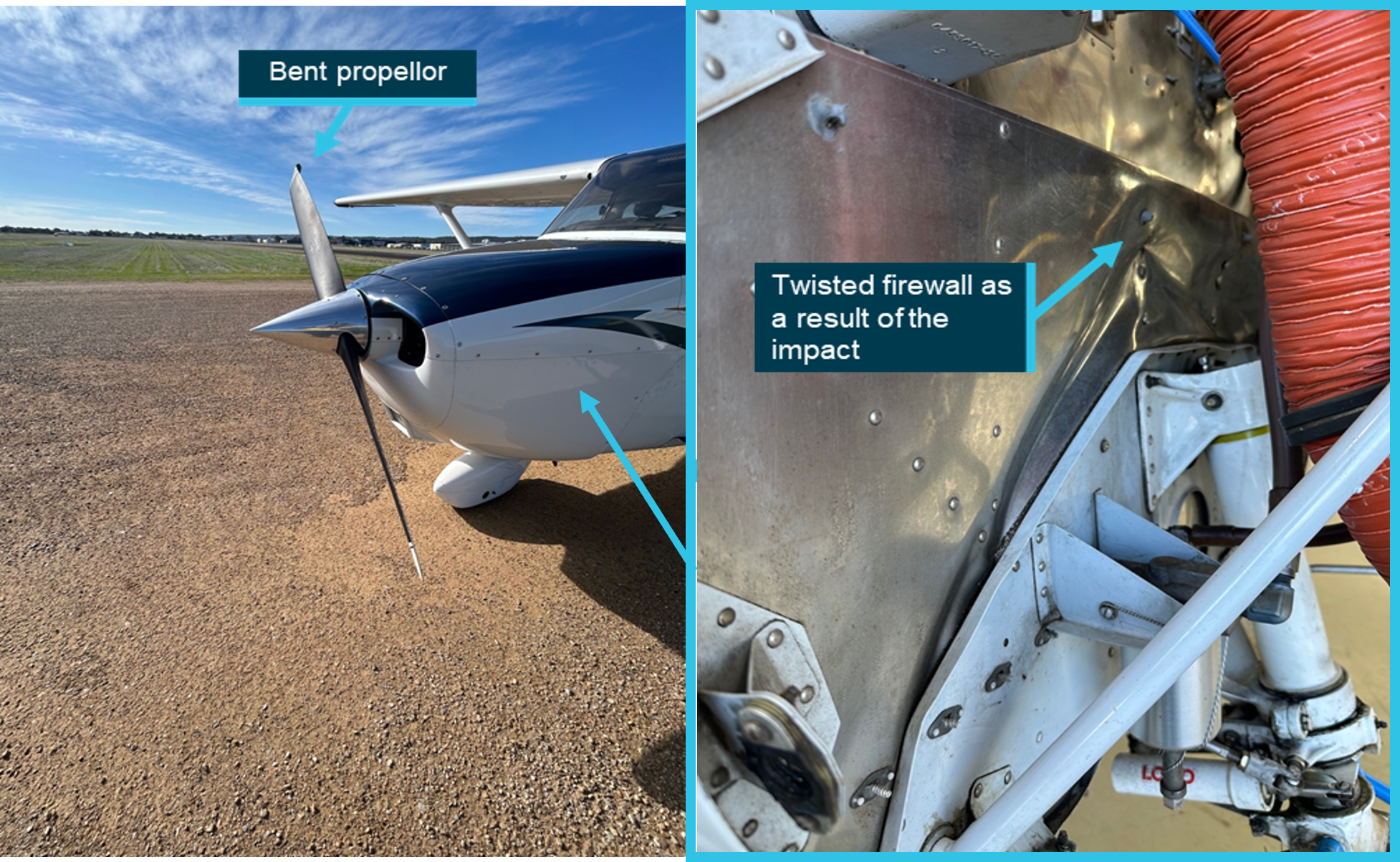
During the seventh touch-and-go of the circuit training, the aircraft encountered a gust of wind as it crossed the runway threshold, resulting in a yaw to the right. In response, the pilot advised that they pushed forward on the control column and overcorrected, resulting in the aircraft landing hard, ballooning[1] and striking the runway a second time. A propellor strike occurred during the second impact with the runway. The aircraft sustained substantial damage to the fuselage and landing gear.
Figure 1: Damage to Aircraft
Source: Operator
Safety message
Wind gusts can be unpredictable. Gusty wind conditions present a challenge for all pilots, but in particular, less experienced student pilots. Maintaining a calm mindset is important in order to adjust the aircraft’s profile and airspeed accordingly and determine that a go‑around is necessary.
The ATSB reminds pilots that as soon as landing conditions become unfavourable, or the approach unstable, initiating a go-around will allow time to reconfigure the aircraft and conduct a safe landing.
About this report
Decisions regarding whether to conduct an investigation, and the scope of an investigation, are based on many factors, including the level of safety benefit likely to be obtained from an investigation. For this occurrence, no investigation has been conducted and the ATSB did not verify the accuracy of the information. A brief description has been written using information supplied in the notification and any follow-up information in order to produce a short summary report, and allow for greater industry awareness of potential safety issues and possible safety actions.
[1]Ballooning occurs when the pilot flares and the aircraft climbs instead of descending onto the runway.
Occurrence summary
Mode of transport
Aviation
Occurrence ID
AB-2025-050
Occurrence date
03/07/2025
Location
Parafield Airport
State
South Australia
Occurrence class
Accident
Aviation occurrence category
Control issues, Hard landing
Highest injury level
None
Brief release date
30/10/2025
Aircraft details
Manufacturer
Cessna Aircraft Company
Model
172S
Sector
Piston
Operation type
Part 141 Recreational, private and commercial pilot flight training
On 20 September 2025, the pilot of a Cessna 208 aircraft, registered VH-DVS, was conducting parachute operations for Far North Freefall Club at Tully Airport, Queensland. After successfully completing 2 parachute drops that morning, at 0950 local time the aircraft took off for the third load of the day with 17 parachutists on board. The plan was for the parachutists to conduct a 16-way formation filmed by a parachuting camera operator.
After the aircraft climbed to about 15,000 ft, the pilot signalled to the parachutists to exit. The camera operator stepped out onto a small step and held on to the fuselage outside and aft of the cabin door. As the first parachutist (P1) stepped out the door to assume the most forward (front float) position, their reserve parachute inadvertently deployed, dragging P1 backwards and dislodging the camera operator into freefall, causing them a minor injury. P1’s legs were injured as they struck and damaged the aircraft’s horizontal stabiliser. The parachute wrapped around the horizontal stabiliser and the elevator, suspending P1 beneath it.
Thirteen parachutists exited the aircraft and 2 remained in the doorway, watching as P1 used a knife to cut sufficient reserve parachute lines to enable the parachute to tear free. P1 then deployed their main parachute, which tangled with the remnants of the reserve parachute. P1 was able to untangle the lines and regain sufficient control of the main parachute to land without further incident.
Despite control difficulties due to substantial damage to the horizontal stabiliser and part of the reserve parachute wrapped around the tail, the pilot safely landed the aircraft at Tully Airport.
What the ATSB found
The ATSB found that as the first parachutist climbed out of the aircraft and into the front float position, their reserve handle snagged on the aircraft's flap, resulting in deployment of the reserve parachute. The parachute wrapped around the now-damaged tailplane, resulting in aircraft control difficulties.
The ATSB also found that, although it did not contribute to the accident, the pilot and aircraft operator did not ensure the aircraft was loaded within its weight and balance envelope.
Furthermore, the ATSB found that the parachutists opened the roller door and clipped it open before exiting the aircraft. As a result, the roller door remained open during the descent, increasing the ease with which the pilot could have exited the aircraft if needed. Although not mandatory at the time of the accident, the parachutist had a hook knife attached to their chest strap, enabling them to cut enough reserve parachute lines for the parachute to tear free of the tailplane. Finally, in difficult circumstances, the pilot managed to control the aircraft and return to land safely.
What has been done as a result
To ensure aircraft are loaded within their weight and balance envelope, and this is documented on a load sheet, Far North Freefall Club (FNFF) has:
engaged with the current software distributor about including balance in the manifest system
commenced investigation of alternative software
implemented a proprietary interim system that calculates and graphically displays the centre of gravity position on the aircraft’s weight and balance envelope, indicating whether it is within or outside limits.
Additionally, FNFF distributed a circular to all company pilots reminding them of the requirement to use supplemental oxygen when the aircraft is at or above flight level 140, and of the risks of hypoxia. FNFF also mandated parachutists carry a hook knife.
Furthermore, FNFF updated the loadmaster checklist within its safety management system. The checklist is displayed around the drop zone to raise awareness of loadmaster roles and procedures in the event of an emergency. A circular has also been sent to all current company loadmasters to reinforce familiarity with in-aircraft emergency procedures.
In addition, the FNFF safety team is reviewing its standard operating procedures manual to ensure all procedures, including those relating to loadmaster training and emergency response, are clearly documented and up to date. FNFF is also preparing a training slideshow incorporating footage from the incident. This presentation will be shared across the wider skydiving community for educational purposes.
Finally, at the time of writing, the Australian Parachute Federation was in the process of developing a guide for loadmasters. The guide will detail the role and responsibilities, including during an emergency. It will take into consideration the range of complexity of various operations, and aircraft type and size. Training and assessment material will also be developed.
Safety message
This accident highlights the importance of parachutists being mindful of their handles particularly when exiting the aircraft. Additionally, this accident demonstrates that carrying a hook knife secured to the parachute container could be lifesaving in the event of a premature reserve parachute deployment. It is also a reminder for pilots conducting parachute operations of the importance of wearing an emergency parachute and knowing how to deploy it. Parachute aircraft operators should also ensure, where possible, that there is a suitable open door for the pilot to exit in the event of an irretrievable loss of aircraft control.
Furthermore, as fatal parachuting accidents have occurred due to aircraft being loaded outside the centre of gravity limits, this is a reminder for pilots and aircraft operators conducting parachute operations to ensure aircraft weight and balance calculations are conducted prior to each load.
Finally, altitude hypoxia is an insidious and potentially deadly hazard associated with operations at high altitude. Although there is limited research into hypoxia for parachuting operations, effects of mild hypoxia can impair performance and judgement, critical for safe operations. Pilots conducting parachute operations are required to use supplemental oxygen at or above 14,000 ft, and should also do so during holding or delays above 10,000 ft, or when experiencing mild hypoxia symptoms.
Summary video
The investigation
The ATSB scopes its investigations based on many factors, including the level of safety benefit likely to be obtained from an investigation and the associated resources required. For this occurrence, the ATSB conducted a limited-scope investigation in order to produce a short investigation report, and allow for greater industry awareness of findings that affect safety and potential learning opportunities.
The occurrence
On 20 September 2025, the pilot of a Cessna 208 aircraft, registered VH-DVS, was conducting parachute operations at Tully Airport, Queensland. The aircraft and pilot had been hired by Far North Freefall (FNFF) skydive club based in Tully. In accordance with company policy, the pilot was wearing an emergency parachute.
After successfully completing 2 parachute drop loads earlier that morning, at 0950 local time, the aircraft took off for the third load of the day with 17 parachutists on board. The plan was for the parachutists to conduct a 16-way formation filmed by a parachuting camera operator. The parachute jump was part of the annual ‘Big Ways at the Beach’ multi-day event, hosted by FNFF, in which experienced parachutists completed large group formations in belly-to-earth[1] freefall.
At 0954 local time, the pilot requested and received a clearance from Brisbane Centre air traffic control (ATC), to conduct parachute operations within 5 NM (10 km) of Tully Airport, up to flight level (FL) 150.[2]
At 0959, the pilot advised ATC they were ‘3 minutes to drop’ and requested clearance to drop and then descend, which they received 14 seconds later. About 3 NM (5.6 km) prior to the drop point, the pilot illuminated a red light on the rear wall of the aircraft cabin to alert the parachutists.
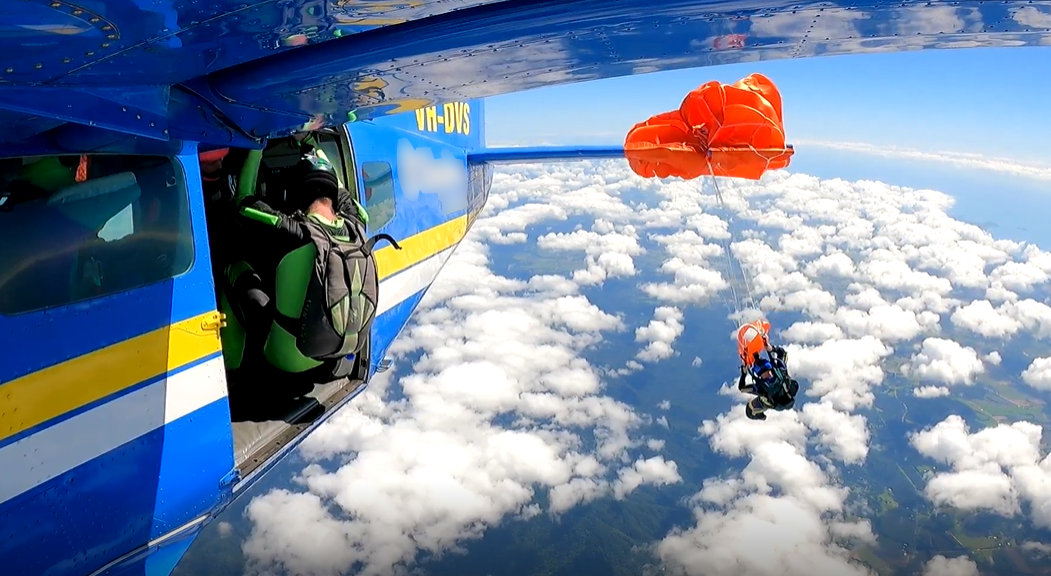
At 1001, the pilot illuminated an orange light, indicating there was about 1 NM (1.9 km) to the drop. The camera operator and the first parachutist exiting (P1) then moved to the doorway and opened the roller door. The roller door was clipped open and remained open until after the aircraft landed. On reaching about FL 150, the pilot slowed the aircraft to 85 kt indicated airspeed and extended 10° of flap, before illuminating a green light at 1002. On seeing the green light, P1 tapped the camera operator on the shoulder. The camera operator then stepped outside the doorway, with their right foot on the camera step, their right hand on the handle above and aft of the door and their left hand on the bar at the top of the door frame.
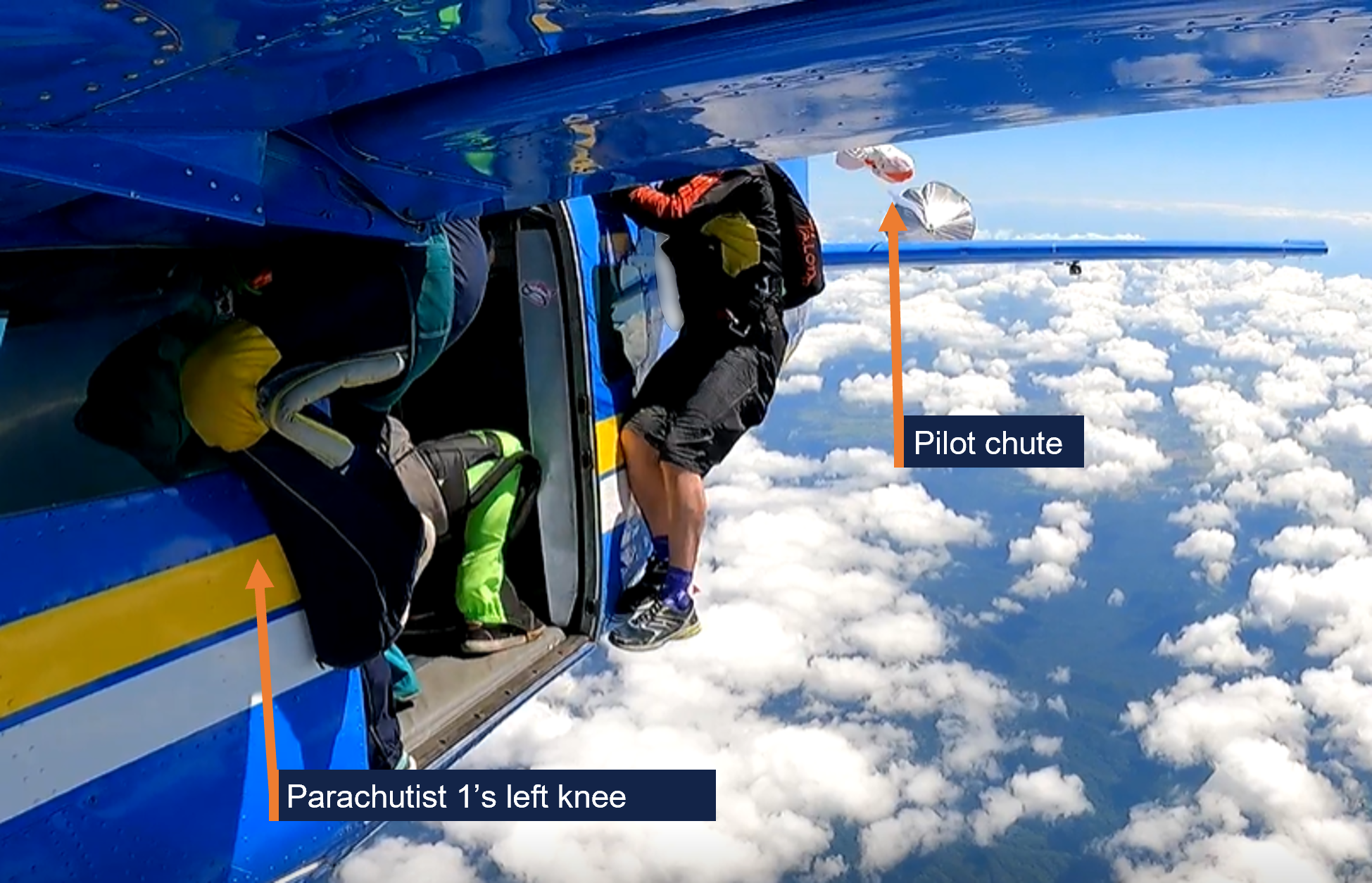
Parachutist 1 then crouched down and stepped out at the front of the doorway facing forwards, into the ‘front float’ position, with their right foot in the front corner of the door frame and their left knee under the wing (Figure 1).
Figure 1: Parachutist 1 stepping out the door
Source: Jarrad Nolan, annotated by the ATSB
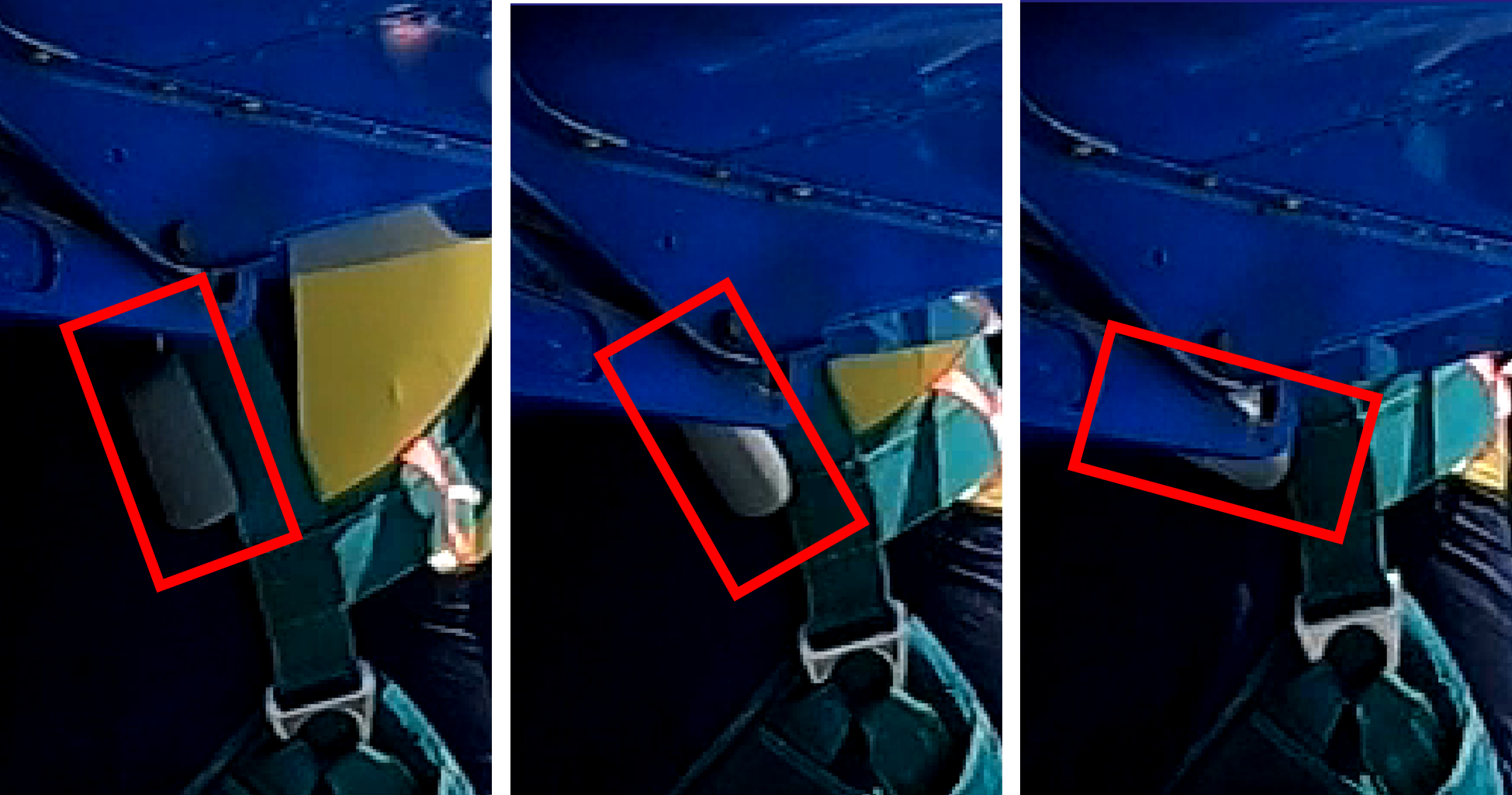
Parachutist 1 then stood up outside the door, reaching for a small post on top of the fuselage with their left hand and lifting their left knee under the wing and flap. During this manoeuvre, P1’s left handle (pud[3]) snagged on the wing flap and rotated (Figure 2).
Figure 2: Left pud (outlined in red) snagging on the flap and rotating
Source: Jarrad Nolan, annotated by the ATSB
That movement dislodged the pud from the parachute container, deploying its reserve pilot chute (Figure 3).
Figure 3: Pilot chute deployment
Source: Jarrad Nolan, annotated by the ATSB
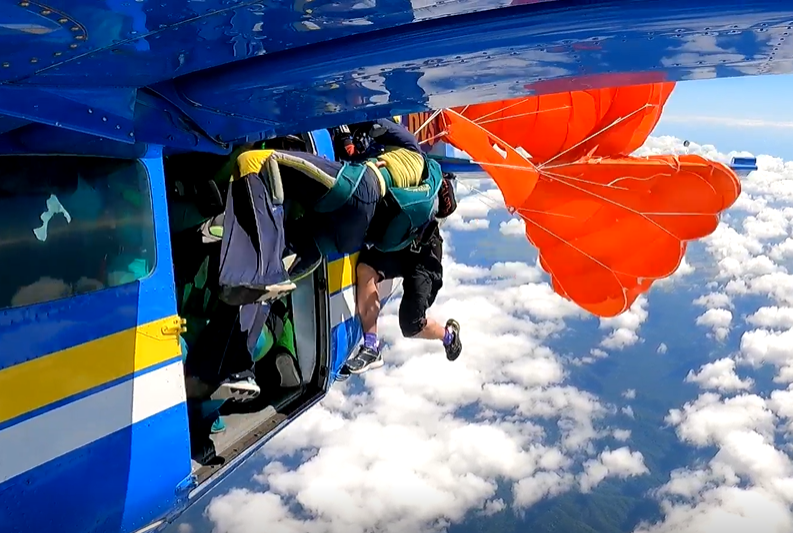
The pilot chute then pulled the reserve parachute and lines out of the container. As the reserve parachute inflated and the lines became taut, P1 was pulled off the side of the aircraft towards the tail, dislodging the camera operator into freefall (Figure 4 and 5).
Figure 4: Reserve parachute inflating and dragging the parachutist rearwards
Source: Jarrad Nolan
The reserve parachute wrapped around the left horizontal stabiliser and elevator and deflated as P1’s lower legs struck the stabiliser (Figure 5). P1 was then suspended beneath the tailplane (Figure 6).
Figure 5: Parachutist 1 striking horizontal stabiliser as camera operator falls free
Source: Jarrad Nolan
Figure 6: Reserve parachute wrapped around horizontal stabiliser with Parachutist 1 suspended beneath it
Source: Jarrad Nolan
Initially unaware of what had occurred, the pilot recalled feeling the aircraft suddenly pitch up and observed the airspeed rapidly decreasing. Assessing that the aircraft had stalled, the pilot pushed forward on the control column and applied some power. At that time, a parachutist called out that there was a canopy[4] wrapped around the tail. The FNFF senior pilot (on board as a parachutist), who was seated beside the pilot but facing rearwards, felt the aircraft shudder, and relayed to the pilot that there was a skydiver hung up on the tailplane.
The pilot then reduced power and felt the controls vibrating. The pilot reported having to use significant forward pressure on the controls and right aileron input to maintain straight and level flight. To reduce some of the control pressure, the pilot applied full forward trim, which then jammed in that position for the remainder of the flight.
After an initial hesitation, the loadmaster directed the other parachutists to exit. Over the next 15 seconds, 13 parachutists left the aircraft. The last 2 parachutists (the FNFF senior pilot and the loadmaster) remained in the doorway watching as P1 began to cut themselves free using a hook knife, retrieved from a pouch secured by a lanyard to the left side of their chest strap.
P1 reported that they found the lines harder to cut than expected but managed to cut 11 lines in 50 seconds. The reserve parachute then tore, releasing P1 from the aircraft with part of the reserve remaining on the aircraft’s tail. The last 2 parachutists then exited the aircraft.
Figure 7: Reserve canopy torn and parachutist detached from aircraft
Source: Jarrad Nolan
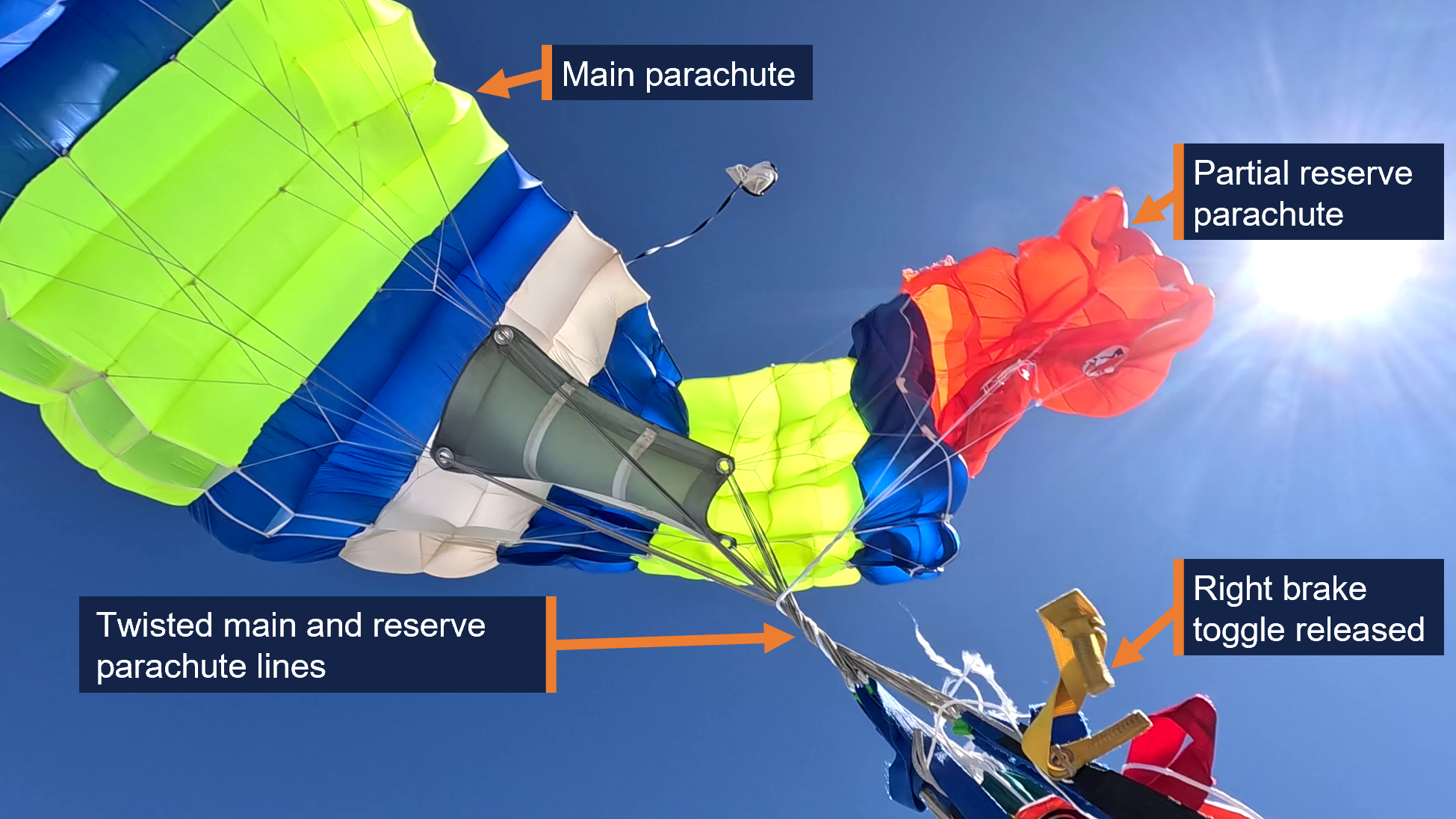
At 1003 while in freefall, P1 used their main pilot chute handle to release the pilot chute out into the airflow, deploying their main parachute. However, during the main parachute deployment, the remaining reserve parachute lines twisted around the main parachute lines. Additionally, during the opening sequence, the right brake toggle[5] of the main parachute released (Figure 8).
The main parachute fully inflated with line twists, and after initially turning right, commenced a rapid left turn. After several rotations, P1 grabbed and pulled on the right brake line above the line twists to arrest the turn. The parachute stopped turning, and P1 was able to unwind the line twists and release the left brake toggle. Passing about 8,000 ft, the main parachute lines fully unwound from the reserve parachute lines and functioned normally for the remainder of the descent.
Figure 8: Main parachute opening, left brake stowed and right brake toggle released, twisted main and reserve lines
Source: Adrian Ferguson
The pilot assessed they had limited pitch[6] control and with forward pressure could achieve a gradual descent. The pilot retracted the flap, which then allowed slightly more rudder, aileron and elevator control. The pilot reported maintaining about 120 kt airspeed during the descent and assessed that with the limited elevator movement available, they would be able to conduct a gentle flare for landing. The pilot also looked over their shoulder and saw the parachute remnant wrapped over the tail and the damage to the leading edge of the horizontal stabiliser. The pilot radioed the FNFF ground control assistant and advised them of the situation.
At 1005, the pilot declared MAYDAY[7] to Brisbane Centre ATC, advising they had a canopy wrapped around the elevator ‘with minimal control input’. The pilot then advised ATC that their plan was to assess the aircraft’s controllability and try to land it, but if ‘the tail fell off’, they would attempt to advise ATC and ‘bail out’.
The controller clarified details with the pilot and directed another aircraft in the area to remain clear. The controller then declared a distress phase,[8] alerted emergency services, and transferred other aircraft to a different Brisbane Centre frequency.
Descending through about 2,500 ft, the pilot assessed that they would land the aircraft rather than exit and parachute to the ground. The pilot elected to conduct a straight-in approach with a slight tailwind to runway 36,[9] to minimise manoeuvring the aircraft clear of high terrain either side of Tully Airport. The pilot also assessed there was insufficient elevator control to be able to safely extend landing flap.
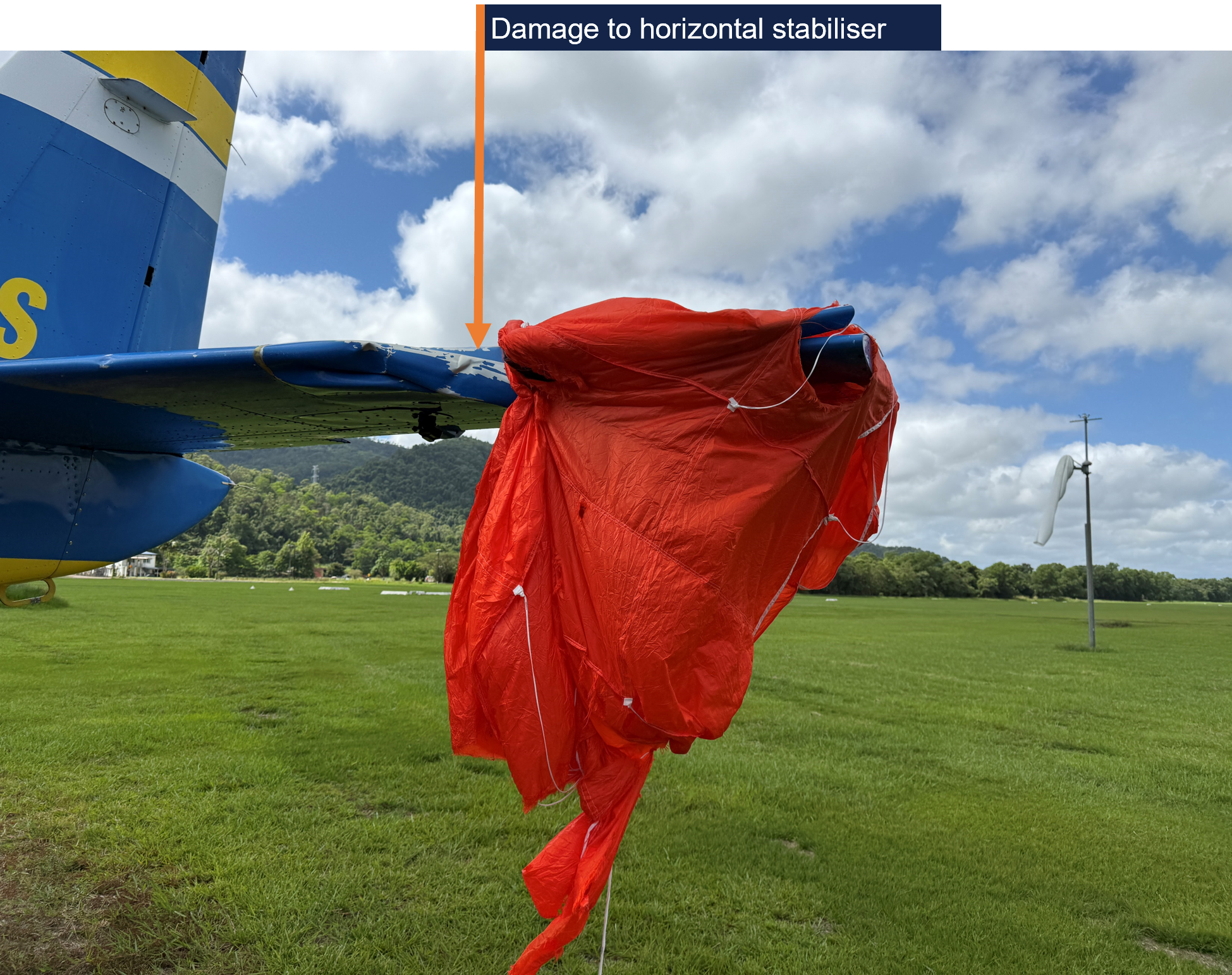
As the aircraft crossed the threshold, the pilot initially reduced power, but this led the aircraft nose to drop significantly. The pilot then reintroduced power and flew level with the runway before reducing the throttle to idle and using both hands to apply full backpressure on the controls. The aircraft landed at 1010, having sustained substantial damage to the horizontal stabiliser (Figure 9). P1 landed 9 seconds later with minor lacerations and bruising to their left lower leg and a deep gash to their right lower leg. After receiving phone confirmation that the aircraft had landed safely, at 1018 ATC cancelled the distress phase.
Figure 9: VH-DVS after landing, showing damage to the horizontal stabiliser
Source: Jarrad Nolan
Context
Personnel information
Pilot
The pilot held a commercial pilot licence (aeroplane), a class 2 aviation medical certificate and an instrument rating. They completed their most recent single engine aeroplane flight review and gas turbine engine design feature endorsement, as part of their jump pilot[10] authorisation in a Cessna 208 aircraft, on 21 June 2024.
The pilot had accrued 800 flight hours, 410 of which were operating Cessna 208 aircraft. They had been conducting parachute operations at Tully Airport for about 11 months and last conducted emergency procedures training for parachute operations in April 2025.
Parachutist 1
The accident jump was the parachutist’s (P1’s) 2,013th over a 21-year period. P1 held an Australian Parachute Federation (APF)[11] Certificate E, and achieved the Australian Star Crest in 2011, required for participation in skydive formations of more than 10 people.[12]
The parachutist’s equipment included:
Sunpath Javelin Odyssey harness and container, SN 25429, manufactured December 2003.
Airtec CYPRES 2 Expert automatic activation device, SN 96270 manufactured July 2014.
Icarus Safire 2 139 main parachute, which was royal blue, fluoro yellow with a white centre cell.
Bottom of container throwaway main deployment type.
Performance Designs Optimum 143 reserve parachute, SN 25632, manufactured in October 2021. The reserve was repacked on 13 August 2025 by Freefall Support and valid for 12 months.
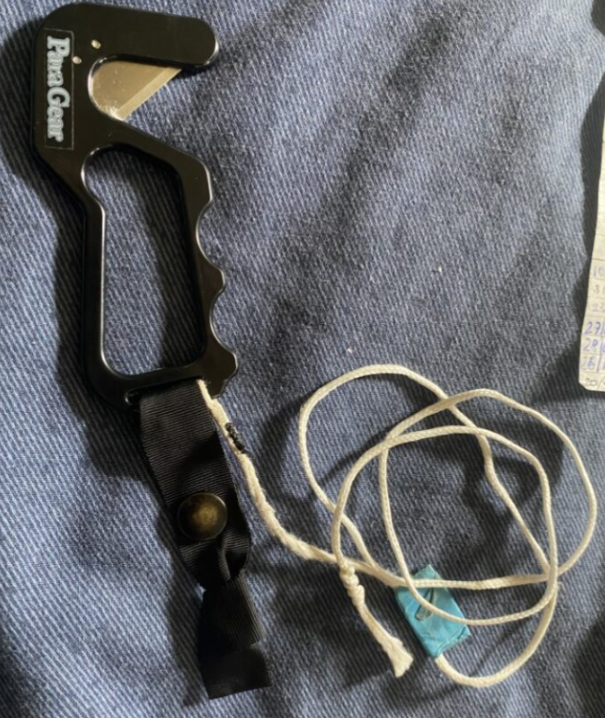
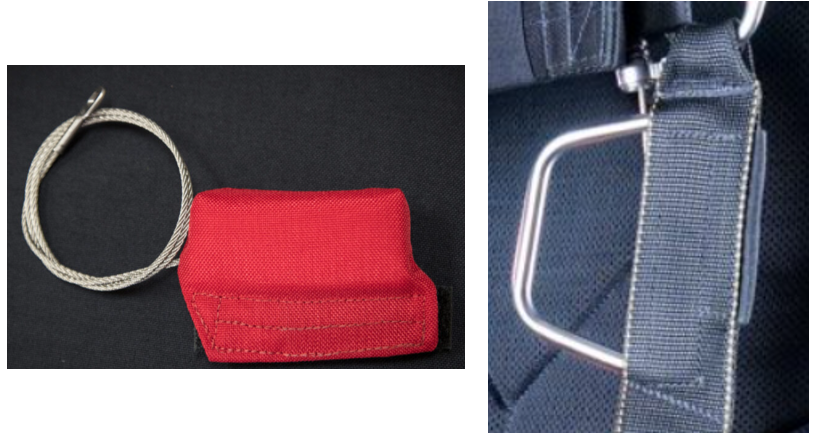
A hook knife in a pouch attached to their chest strap and secured with a lanyard (Figure 10).
Figure 10: Parachutist’s hook knife and lanyard
Source: Supplied
P1 used puds – soft handles held in place with Velcro – for their reserve deployment and main cutaway handles, in preference to ‘D’ handles, which they reported had previously been snag points (Figure 11). The reserve handle was a ‘Phat Daddy Tube Style’, described as ‘a soft handle with the bulk required to get a good grip in an emergency’. The APF assessed that the bulky handle design ‘may have increased the risk of snagging if not adequately protected’.
Figure 11: Pud ‘Phat Daddy’ soft reserve handle (left) and D handle (right)
P1 commented that having a bright orange reserve parachute that was visually distinct from their main parachute meant that it was immediately obvious that it was their reserve that deployed prematurely. The APF reported that this type of deployment occurred far less frequently than premature deployment of a main parachute.
P1 conducted their normal gear check when the red light illuminated, which comprised checking:
3 handles (main pilot chute, cutaway of main chute and reserve handle)
3 straps (leg and chest straps properly routed and tucked away)
3 rings properly assembled on shoulders
3 things: altimeter on the back of left hand, altimeter inside of right wrist and helmet done up.
The accident jump was the parachutist’s first jump that day. P1 had an altimeter with a recording function, which showed that the reserve parachute tore free of the tailplane at 13,720 ft. After a freefall time of 26 seconds, the main parachute deployed at 10,780 ft.
The front float position is the most forward person in line and whose ‘exit’ is from outside the aircraft. P1 preferred the front float position. This was their third jump in that position out of the 6 jumps they had done at Tully that week. P1 also reported that out of the 20–22 jumps they did the previous year at the Big Ways at the Beach event, they had been in the front float position for about 8 of them.
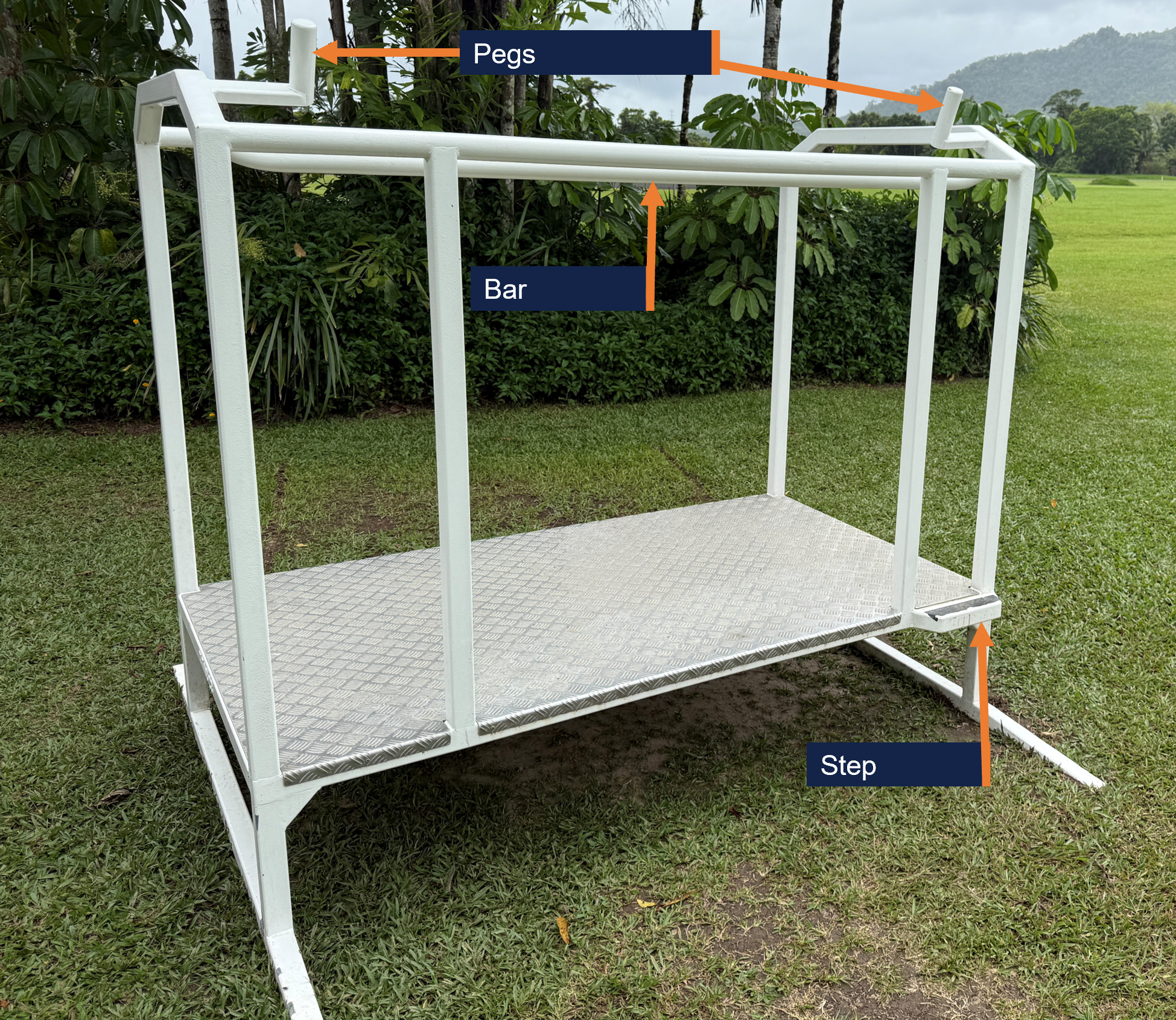
All the event jumps were practised first on the ground as a ‘dirt dive’ using a mock-up aircraft at the airport. The mock-up had outer pegs and inner bars, but not a wing or flap to simulate their position (Figure 12).
Figure 12: Tully mock-up aircraft for practising ‘dirt dives’
Source: Far North Freefall, annotated by the ATSB
Senior pilot
The FNFF senior pilot was approved by the APF. According to the APF Jump Pilot Manual (JPM), senior pilot responsibilities included:
oversight of all aircraft related aspects of FNFF
ensuring the safe and legal operation of aircraft.
Drop zone safety officer
The Far North Freefall (FNFF) chief instructor (parachuting) was the drop zone safety officer (DZSO) for the day’s operations at Tully. Due to wet weather earlier in the week, participants in the event had attended safety seminars. One seminar included reinforcing to parachutists to always be mindful of their handles. The DZSO reported that the front float position had specifically been mentioned in the seminar, because it required being as far forward as possible, with an associated risk of snagging equipment on the aircraft while reaching to stand up. It was regarded as a relatively difficult position to hold.
The DZSO was in the ground control assistant role (with a handheld radio) during the accident flight, when the pilot radioed and said there was a parachutist on the tail. The DZSO then started counting the parachutes they could see in the air. Another jump pilot on the ground came to help and asked the pilot whether they had declared MAYDAY, and the pilot replied that the jumper had got free of the aircraft’s tail. The camera operator was the first parachutist to land and pointed out to the DZSO that P1 was under their main parachute, with the reserve trailing.
After P1 landed, the DZSO handed the radio to the FNFF senior pilot, sent a car to pick up P1 and arranged for a doctor (who was also a parachutist), to provide first aid. P1 was then driven to hospital.
Loadmaster
The APF JPM detailed the loadmaster (LM) role as follows.
(a) Each parachute operation must have a nominated Loadmaster for each load.
(b) As per APF Operational Regulations (Part 6), the Loadmaster is responsible for:
(i) conducting a pre-jump briefing before any parachute descents are made, which covers all relevant aspects of the descent, and which includes all persons on-board the aircraft including pilot and parachutists;
(ii) ensuring the airspace and [drop zone] DZ below is clear of conflicting air traffic and any necessary drop clearances have been obtained; and
(iii) confirming the integrity of the exit point.
The LM on the accident flight reported being unaware they were the appointed LM for that load until after landing. There were 3 parachuting instructors on the load who were also approved and experienced LMs. About 5 minutes before departure, all parachutists on the load met at the mock-up, where they revised the exit and checked each other’s equipment (buddy checks). The load was displayed nearby on the manifest screen, showing who was the appointed LM for that load. The LM had not checked the screen. However, they reported that the LM role on the accident load was minimal, as it:
only contained experienced parachutists
was not the first load of the day (requiring confirmation of the spot position)
only required one exit as all the parachutists were in the single formation.
Normally, communications between the pilot and parachutists were via the LM. On this load, the FNFF senior pilot (also the most experienced parachutist) was seated next to the pilot and therefore more readily able to communicate.
The LM’s role in an emergency was not included in the APF Operational Regulations or Training Operations Manual. However, the JPM Section 9.6 Emergency exit, stated:
In an airborne emergency such as a structural failure or fire, the pilot may decide that the chances of surviving a landing in the aircraft are non existent, and decide to order the evacuation of the aircraft. Each load must have a loadmaster who will start the aircraft evacuation once the pilot gives the command.
At lower levels, the parachutists will open their reserve parachutes as soon as they are clear of the aircraft. These parachutes are designed and packed to deploy quickly and only require a couple of hundred feet.
Note: Emergency procedures for structural failure are not discussed in manuals or safety publications because there are to [sic] many variables and little that can be effectively done. It is mentioned here because, with parachutes on-board, there is a chance that lives can be saved by exiting the aircraft. This applies equally to you as a pilot if you are wearing a parachute.
Additionally, the APF Safety management system continuous improvement package 4 2019, Aircraft emergency and evacuation procedures, was provided to APF member organisations to discuss in safety meetings. Regarding the LM role in an emergency, it included the section ‘Communication’:
The Pilot is in command. Wait for the Pilot’s instructions. You can make the situation worse for the Pilot, i.e. if you move closer to the door and cause a shift in the centre of gravity or asymmetric drag, by opening the door or everyone yelling and asking what to do.
Load Master to be ready to make the call if the Pilot does not respond (the Pilot may not be prepared for the emergency or may not provide instructions). The Load Master needs to be ready to give instructions. However, do not rush this decision (unless a catastrophic emergency) as the Pilot may be assessing the situation, e.g. if there is a small electrical fire the Pilot may try to put out this fire with the extinguisher before having a forced landing with a full plane load or instructing everyone to exit.
The APF and FNFF did not specify an emergency exit command.
The LM reported calling ‘get out, get out, get out’ but that ‘exit, exit, exit’ was the command they should have used. The FNFF senior pilot recalled shouting ‘go, go, go’. Another parachutist nearer the door also yelled and pointed parachutists to exit when they had briefly paused in the doorway. That parachutist reported that in hindsight it was the LM’s role, not theirs, to give the command, but the chief instructor advised that in this case, it facilitated a quick exit, which was correct action at the time.
The LM and FNFF senior pilot remained in the doorway until P1 was free of the tailplane, before exiting the aircraft. However, both later reported that, in hindsight, they should have gone back to the front of the aircraft and relayed the situation to the pilot, although they reported the pilot was probably aware that the parachutist was clear, as the aircraft ‘bucked’ when the parachutist tore free.
During their discussions with the parachutists after the incident, the FNFF chief instructor (parachuting) identified that there had not been a plan as to what the parachutists would do in the event of an emergency to ensure they assisted and remained clear of each other’s parachute after exiting. Further, that there was no documented training for the LM role and the requirements in the event of an emergency were not well understood.
Aircraft
VH-DVS was a Cessna Aircraft Company 208, manufactured in 1988, serial number 20800131, modified under a Texas Turbines Conversions supplemental type certificate with a Honeywell TPE331-12JR-704TT engine and a Hartzell Propellers 4-blade HC‑E4N-5KL propeller. At the time of the accident, the airframe total time in service was 10,270.60 hours. The aircraft’s tail assembly (empennage) consisted of a vertical stabiliser, rudder, horizontal stabiliser and elevator. VH-DVS was unpressurised and equipped with supplemental oxygen for the pilot’s use.
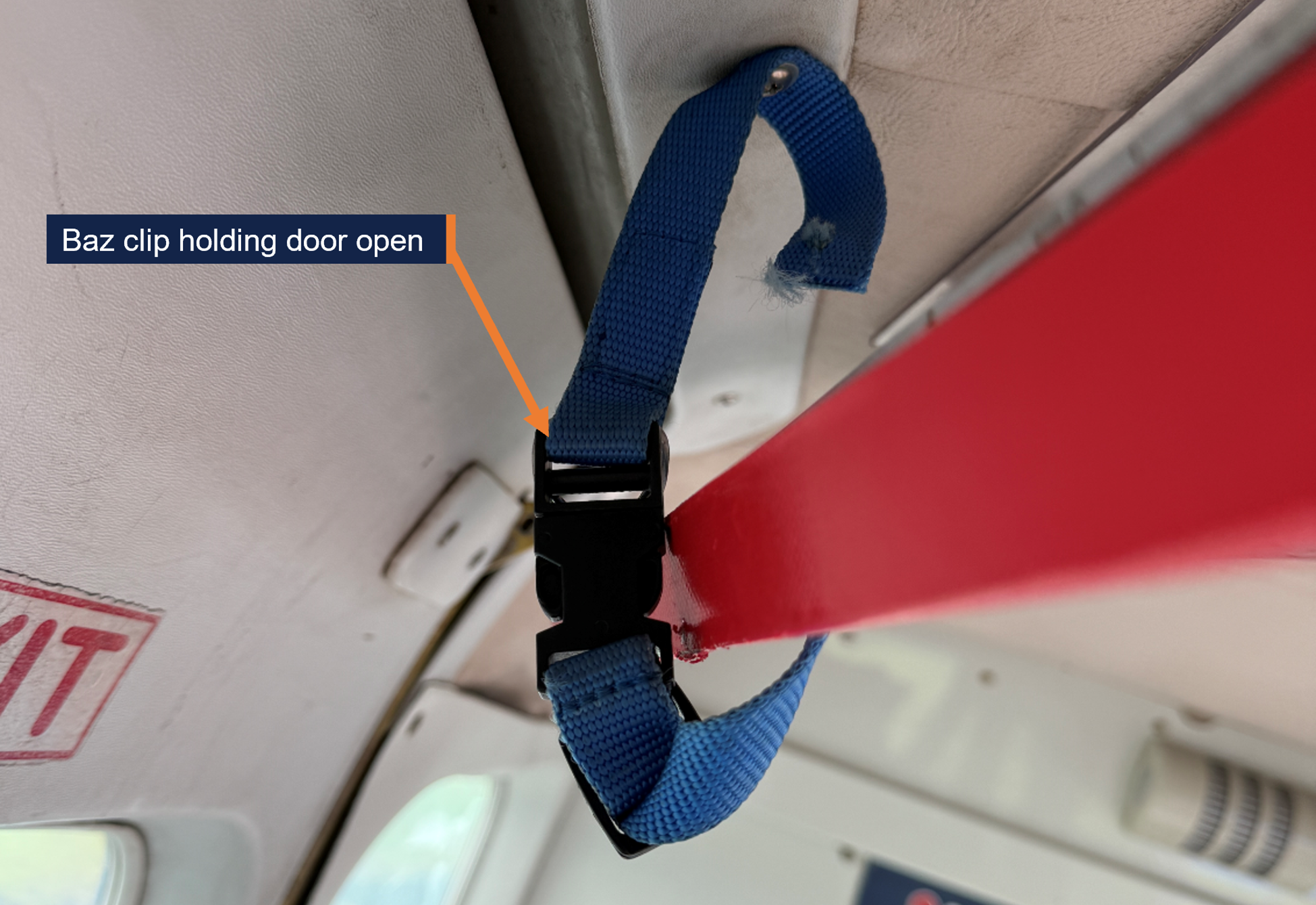
VH-DVS was modified for parachuting with bench seats and single point restraints. Handrails, posts, a step and a roller door were also fitted to facilitate parachutists to exit the aircraft, along with a ‘Baz clip’ to secure the door open (Figure 13).
Figure 13: Baz clip securing the roller door open
Source: Far North Freefall, annotated by the ATSB
Following an accident involving another Cessna 208 in 2001 (see the section titled Previous similar occurrences), in which the pilot’s emergency egress was delayed by the roller door (blind) closing, the designer of the blind amended the design to include:
a device to lock the door in the open position
a placard warning that the blind must be locked open during parachuting.
The aircraft was also fitted with a light system controlled by the pilot. In accordance with FNFF procedures, the pilot was to illuminate the:
red light 3 NM from the drop position
orange light 1 NM from the drop position, at which time door could be opened
green light to indicate pilot approval to commence exit.
Following the accident, the following maintenance was conducted:
inspection of the fuselage to horizontal stabiliser attach fittings; no defects found
inspection of the elevator control cable assembly; no defects found
left and right elevator control surfaces replaced
horizontal stabiliser assembly replaced.
Weight and balance
The Civil Aviation Safety Authority (CASA) legislative instrument EX105/23 – Part 105 (Parachute Operators and Pilots) Instrument 2023, as amended and in force on 1 July 2025, exempted compliance with paragraph 91.095(2)(a) of the Civil Aviation Safety Regulations (CASR) regarding the maximum number of passengers that may be carried, the seating configuration and restraints stated in the airplane flight manual. For the exemption to apply, the instrument included in Section 9, among other requirements:
1) If the aeroplane has been modified in a manner that affects any of the following:
(a) the maximum number of passengers that may be carried on the aeroplane in accordance with the [airplane flight manual] AFM; or
(b) the passenger seating, or method of passenger restraint, in accordance with the AFM;
then the modification must have been approved:
(c) by an authorised person or an approved design organisation under regulation 21.437 of CASR; or
(d) otherwise in accordance with a Part 21 approval; or
(e) by an approval continued in force, according to its terms, under regulation 202.054 of CASR.
(2) The pilot in command must follow the procedures designed to ensure that the aeroplane:
(a) remains within its MTOW; and
(b) remains within its centre of gravity limits and requirements at all stages of the operation; and
(c) complies with all limits, restrictions and conditions imposed by the approval mentioned in subsection (1).
Additionally, Section 10 of the instrument required the pilot to comply with the conditions of the exemption and for the operator, in this case FNFF, to ensure the pilot did so.
Regulation 91.805 of CASR also required the pilot to ensure at all times that an aircraft was loaded and operating within its weight and balance limits.
The CASR Part 105 Manual of standards (MOS), Chapter 7 – Weight and balance required both the aircraft operator and the pilot to ensure a load sheet was completed before flight, unless the aircraft was carrying the same load for multiple parachute drops. The load sheet was required to be carried in the aircraft and a copy given to the chief parachuting instructor or drop zone safety officer (and retained for 3 months). Among other things, the load sheet was required to include:
(g) the weights and moment arms of:
(i) the occupants of the aircraft; and
(ii) any cargo carried on the aircraft; and
(iii) any removable equipment carried on the aircraft; and
(iv) fuel and consumables carried on the aircraft (for example, water or ethanol);
(h) the calculated load weight, and total moment, that demonstrates that the centre of gravity is within the approved limits;
(i) the maximum allowable weight for the flight, having regard to the prevailing environmental conditions;
(j) a statement by the person who is responsible for planning the loading of the aircraft, that the load and its distribution are in accordance with the aircraft loading system;
FNFF used BURBLE manifest software. Parachutists were required to use an app to check in each morning, and their weight was included in their personal details. BURBLE then verified that APF members had signed the required waiver, the reserve parachute was within the repack date, and the parachutist intended to do an appropriate jump for their certificate/licence.
A manifest person then re-checked the information in BURBLE. After check-in, parachutists could be manifested on a load, along with a coach and/or camera operator as needed. A DZSO, ground control assistance (GCA) and loadmaster would be assigned for each load.
As parachutists were allocated to a load, their weights were added to the aircraft weight. The manifest person would then update the quantity of fuel on board. The chief instructor (parachuting) advised that their normal process was to use a standard fuel weight based on sufficient fuel to conduct 3 parachute drop loads (and required reserves). If BURBLE flagged that the aircraft was overweight with that fuel quantity, the manifest person would then use a more precise fuel figure.
The aircraft had an iPad as an electronic flight bag (EFB), which included a load sheet based on the BURBLE manifest. The pilot reported that they would review the load sheet on the iPad and ensure the aircraft was below the maximum take-off weight.
Although BURBLE performed a weight calculation, it did not calculate the aircraft centre of gravity or balance, or have any means to allocate parachutists to a particular (loading) zone of the aircraft. Several other Australian drop zones used IBIS software, which could perform weight and balance calculations. Under a Memorandum of Understanding, FNFF was required to operate the aircraft in accordance with Section 5 – Aircraft operational procedures of the Skydive Australia operations manual. This section of the Skydive Australia operations manual provided procedures for calculating weight and balance with IBIS or OzRunways.[13] VH-DVS’s OzRunways EFB included the aircraft’s skydive configuration, allowing pilots to enter fuel and passenger weights in order to determine the aircraft’s take-off weight and centre of gravity position for each flight.
Emergency procedures
Knife
Part 105 – Parachuting from aircraft – MOS 5.40 Emergency equipment carried on jump aircraft, required a knife suitable for emergency situations be carried on board the aircraft and to be readily available to the pilot or parachute instructor. This was also required in the APF Operational regulations, section 5.2 – Aircraft:
5.2.5 Knife in Aircraft
A knife, capable of cutting parachute harness webbing, must be readily available and appropriately stored in the aircraft.
There was at least one knife on board VH-DVS as required by the APF JPM. However, in this occurrence, there was no practical means of getting the onboard knife to the parachutist hung up on the tail.
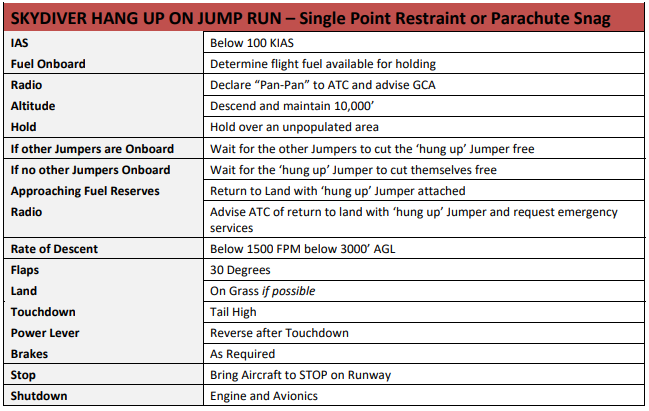
Skydive Australia’s emergency procedures checklist, a copy of which was in VH-DVS, included actions in the event of a parachutist being hung up by their restraint, or their parachute snagging on exiting the aircraft (Figure 14).
Figure 14: Skydiver hang up checklist
Source: Skydive Australia Operations Manual
Emergency parachute
The APF’s Operational regulations, section 5.2 – Aircraft, also required an emergency parachute be made available to pilots:
5.2.6 Pilot’s Emergency Parachute Availability
A parachute that complies with APF Equipment Standards and training in the proper use of that parachute must be made available to pilots of aircraft used in making descents.
The Skydive Australia operations manual required the pilot to wear an emergency parachute when conducting skydiving operations. There was no requirement for a pilot to have conducted a parachute jump; they were trained in its use verbally and by demonstration. Emergency parachutes had one parachute, which was large and designed to open very quickly. The pilot was wearing an emergency parachute, had been trained in its use, and reported that they would only exit if they had no control of the aeroplane.
The APF JPM section 9.7 Emergency pilot rig use stated:
In the event that you decide to use the pilot emergency parachute, you must be prepared to follow the procedures you’ve been briefed on by the DZSO for the particular rig in use. Pilot rigs normally contain a round canopy, which achieve minimal air speed (~5 to 8 knots) and glide ratios of up to 1:1. The general procedure for use is as follows:
(a) prior to leaving the aircraft, grasp the ripcord handle. It is easier to locate it prior to exit as it may move once in freefall, and the associated disorientation may make it more difficult to find.
(b) once clear of the aircraft, pull the ripcord to full arms length,
(c) once the parachute is open, reach up and grasp the two small steering toggles (handles), or the coloured lines, on the risers above your shoulders.
(d) to steer, pull down one side to turn in that direction.
(e) fly towards a cleared area and try to land into the wind to minimise landing speed.
(f) for landing, it is highly recommended that you perform a Parachute Landing Roll (PLR).
Premature parachute deployment
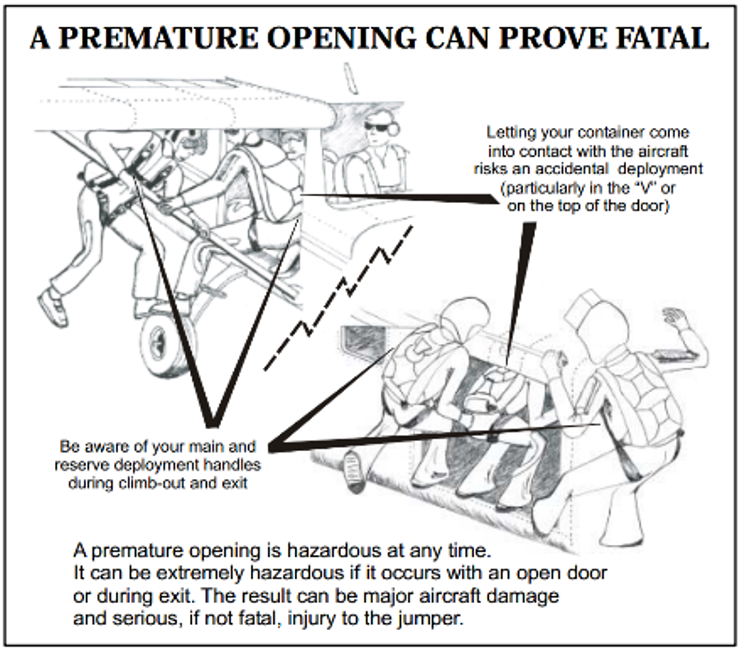
The APF JPM Part 9 Emergency procedures, included 9.3 In-aircraft parachute deployment:
There are a number of situations where a ripcord may be accidentally pulled or a pin dislodged resulting in a container opening in the aircraft, on climb‐out, or on the step. An extremely hazardous situation exists when the door has been opened and a pilot chute is suddenly deployed finding its way outside.
Further, it stated that parachutists ‘are taught to protect their handles and equipment while inside the aircraft and during climb-out’ (Figure 15).
Figure 15: Jump pilot manual extract
Source: Australian Parachute Federation
The emergency procedures continued:
An accidental opening in the aircraft with the door open is potentially disastrous. If a pilot chute escapes while the door is open, it can be out and into the slip stream before reaction is possible. The jumpers will do their best to ensure the person attached is able to be expedited out the door as quickly as possible. In the past, this has resulted in the parachutist attached to the parachute being pulled through the side of the aircraft!
Keep a close watch for any premature openings and if one occurs, immediately apply maximum rudder to swing the tail clear of the deploying parachute and the person attached.
The APF produced a safety poster, which was on the wall at FNFF. The poster stated that premature deployments can be prevented by:
- Proper equipment maintenance
- Using compatible equipment
- Buddy checks
- Minimising excessive movement in aircraft
- Checking handles, pins, etc before emplaning and before exit
- Taking care and being conscious of equipment during climb-out.
Tully Airport
Tully Airport was an aircraft landing area with one sealed runway 18/36, 936 m long. The airport elevation was 47 ft, with terrain about 2,200 ft above mean sea level to the east and west. The drop zone was adjacent to the northern end of the runway.
The drop position for the day was heading south (180°), running centrally overhead Tully Airport, with the pilot illuminating the green light at 0.8 NM (1.5 km) before (north of) the aerodrome reference point.
The weather at Tully Airport on the morning of the accident included 6–10 kt south‑easterly winds, cloud covering about half the sky, and an ambient temperature of 21°C. The nearest Bureau of Meterology weather station was at Innisfail, about 42 km north.
At 1000, the Innisfail METAR[14] stated that the wind was from 170° at 3 kt, visibility greater than 10 km, QNH 1,014 hPa,[15] temperature 25°C. At 1010 (the time the aircraft landed), the 1‑minute weather data at Innisfail included: temperature 27°C, wind (which had been variable for the past 5 minutes) from 245° at 1 kt and QNH 1,014.6 hPa.
Supplemental oxygen
CASR Part 105 MOS required unpressurised aircraft operating a parachute descent to have supplemental oxygen in accordance with the Part 91 MOS Division 26.11 – Oxygen equipment and oxygen supplies. The aircraft was required to be fitted with, or carry, supplemental oxygen, which was required to be used by:
flight crew for any period exceeding 30 minutes when the cabin pressure altitude was continuously at least flight level (FL)[16] 125 but less than FL 140
flight crew for any period when the cabin pressure altitude was at or above FL 140
passengers for any period when the cabin pressure altitude was at or above FL 150.
CASA advised that this was incorporated in Part 91 between 2003 and 2011 to align with the United States Federal Aviation Regulations. The European Union Aviation Safety Agency required crew members to use supplemental oxygen when between 10,000 ft and 13,000 ft for more than 30 minutes, and at all times when above 13,000 ft.
Aircraft conducting parachute drops from FL 150 were usually between FL 140 and FL 150 for about 2 minutes. In the occurrence flight, due to the premature parachute deployment, the aircraft was between FL 140 and FL 150 for closer to 3 minutes. For jump pilots, that is a high workload period, involving slowing and configuring the aircraft for the drop, confirming the drop position, and communicating with parachutists, air traffic control, the ground control assistant and on the common traffic advisory frequency.
The APF operational regulations required adherence to the Part 91 MOS oxygen requirements. However, the pilot did not use oxygen on the accident flight.
Hypoxia
Hypoxia is the absence of an adequate supply of oxygen to the tissues. Hypobaric hypoxia is the most common form in aviation and is associated with breathing air at low barometric pressure. A deficiency in alveolar oxygen exchange due to low oxygen tension (partial pressure) of inspired air leads to inadequate oxygen supply to the blood and reduced oxygen available to the tissues. In an aviation context, acute hypobaric hypoxia is the ‘most serious single physiological hazard during flight at altitude’ (Gradwell and Rainford, 2006).
The risk of hypoxia increases with altitude and time at altitude. Additionally, multiple ascents to altitude may have a compounding effect on hypoxia. There is considerable variation between individuals in the effects of hypoxia. Hypoxia can occur in susceptible individuals below 10,000 ft. Between 10,000 ft and 15,000 ft, brain function is mildly impaired and hypoxic symptoms are common. Above 15,000 ft, brain function exponentially deteriorates (Shaw, Cabre and Gant, 2021).
Physical activity, cold, illness and certain drugs increase the onset speed and severity of hypoxia. Additionally, jump pilots require a class 2 aviation medical certificate, which is less stringent than class 1 medical certification, and may allow underlying cardio‑respiratory conditions that increase hypoxia risks to go undetected.
Those experiencing hypoxia may have no signs or symptoms and may be unaware of any cognitive impairment. In unpressurised aircraft, hypoxia can be prevented by breathing supplemental oxygen.
Limited research has been conducted into the effects of ascents to FL 140 and FL 150 for jump pilots or parachutists. An article in the United States Parachute Association’s publication Parachutist, described a small study of parachutists using pulse oximeters. They found that in ascents to 14,500–15,000 ft above mean sea level, blood oxygen saturation levels, normally 95–100%, dropped into the 80s (%) during ascent, and, into the 70s on one flight in which air traffic control holding resulted in an additional 10 minutes at altitude (Galdamez, 2024). Although individual responses vary to reduced oxygen saturation levels, a finger‑mounted pulse oximeter can alert pilots and parachutists to reduced blood oxygen saturation levels, prompting the use of supplemental oxygen.
Previous similar occurrences
Premature parachute deployment
The ATSB investigated a parachuting accident involving Cessna 208 VH-MMV at Nagambie, Victoria, on 29 April 2001 (AAIR200101903). The aircraft climbed to FL 140 with 11 parachutists and the pilot on board. As the first 4 parachutists exited the aircraft, the middle parachutist’s reserve pin dislodged on the top of the door frame and the pilot chute deployed. The pilot chute pulled the reserve parachute over the horizontal stabiliser. The reserve parachute risers and lines tangled around the left elevator and horizontal stabiliser, with the parachutist hanging below them. Eleven seconds later, the empennage separated from the aircraft and the left elevator and parachutist separated from the empennage. The parachutist fell to the ground and was fatally injured.
The remaining parachutists exited the aircraft before it descended through 9,000 ft. The pilot transmitted a MAYDAY call, shut down the engine and left their seat. However, the rear roller door (blind) had closed. After several attempts, the pilot raised the blind sufficiently to exit the aircraft at about 1,000 ft above ground level and deploy their parachute before landing safely. The aircraft impacted the ground and was destroyed by impact forces and post-impact fire.
Parachutists striking aircraft
The Nagambie report referenced 3 previous premature parachute deployments and 2 occurrences in which a parachutist struck the aircraft. Table 1 details occurrences since 2001 in which a parachutist struck and damaged the aircraft.
Table 1: ATSB occurrences since 2001 in which a parachutist struck the aircraft
Date Time
Aircraft type
Occurrence
Summary
12/3/2003 1500
Cessna 208
OA2003-00849
On exit, the parachutist struck the tailplane of the aircraft and was rendered unconscious. The altitude release mechanism on the reserve parachute opened allowing the parachutist to land. The parachutist later died in hospital from their injuries. The aircraft sustained minor damage to the tailplane and trim tab.
18/7/2004 1200
GippsAero GA-8
OA2004-02741
While carrying out parachute operations, a jumper was observed to strike the tailplane on exiting the aircraft. The aircraft suffered minor damage to the leading edge of the left tailplane however landed safely a short time later.
2/2/2005 1615
Piper PA-31
OA2005-00602
As the parachutist exited the aircraft, their leg struck the tailplane resulting in a fractured ankle. The aircraft incurred a minor dent in the left leading edge of the tailplane.
29/7/2007 1231
Piper PA-31
OA2007-04921
The pilot reported that the last exiting parachutist had struck the aircraft, impacting the horizontal stabilizer and denting the fuselage. The aircraft and the parachutist landed safely with local emergency services in attendance. The parachutist was not injured.
18/12/2010 1700
Pacific Aerospace 750XL
OA2010-08869
After exiting the aircraft, the parachutist collided with the left flap and sustained a minor injury.
24/2/2013 1630
GippsAero GA-8
OA2013-01896
During parachute drop, a parachutist struck the tail of the aircraft. The parachutist sustained minor injuries, and the aircraft sustained minor damage.
25/3/2015 1600
Cessna 208
OA2015-02582
While exiting the aircraft, the parachutist struck the horizontal stabiliser resulting in minor damage and a minor injury to the parachutist.
1/4/2017 1300
Embraer EMB-110P1
OA2017-01515
During parachute operations, a parachutist prematurely exited the aircraft and struck the elevator.
27/8/2020 1330
Cessna 208
OA2020-04239
During parachuting operations, the aircraft commenced descent with a parachutist still on board. Passing FL 100 on descent, the parachutist exited the aircraft and struck the left horizontal stabiliser resulting in minor damage to the aircraft and minor injuries to the parachutist. The pilot diverted the aircraft to Bankstown.
20/9/2024 1225
Cessna 182L
OA2024-04119
During parachute dropping operations, the pilot detected airframe vibrations with associated uncommanded pitch oscillations and encountered control issues. The engineering inspection revealed multiple elevator parts to be missing. The ATSB could not determine whether a parachutist had struck the tail.
Weight and balance
There were 2 accidents in Sweden investigated by the Statens Haverikommission (SHK) involving aircraft conducting parachuting operations, in which the aircraft’s weight and balance was not calculated.
On 14 July 2019, 8 parachutists and the pilot were fatally injured in an accident in Sweden involving a GippsAero GA8 aircraft. The SHK investigation found that the parachutists moved to the back of the aircraft in preparation for the jump, which altered the weight distribution, resulting in the aircraft stalling, before breaking up in flight. The aircraft was found to have been overloaded. The SHK also found that as the load sheet did not contain the weights of the parachutists or the total mass of the load, the pilot was unable to complete weight and balance calculations.
On 8 July 2021, the pilot and 8 parachutists were fatally injured when a de Havilland DHC-2 aircraft collided with terrain shortly after take-off. The SHK found that:
Control of the aircraft was likely lost in connection with the wing flaps being retracted in a situation where the stick forces were high due to an abnormal elevator trim position, while the aircraft was unstable due to being tail-heavy and abnormally trimmed. Due to the low altitude, it was not possible to regain control of the aircraft.
The investigation also found that the pilot had no ability to perform a weight and balance calculation with the available information.
Safety analysis
As the parachutist climbed out of the aircraft and into the front float position, their reserve handle snagged on the aircraft's flap, resulting in deployment of the reserve pilot chute and parachute. The parachutist was highly experienced, had performed their gear checks before exiting the aircraft, and attended safety seminars in the days prior to the accident, which included being mindful of their handles.
The parachutist was also experienced in the front float position and had practised getting into that position several times in the mock-up on the ground before the jump. However, the mock-up did not have a flap to simulate its position, reducing the likelihood that the snagging potential would be recognised.
As the parachutist was pulled rearwards, they struck the camera operator, who was dislodged from the aircraft sustaining a minor shoulder injury. The parachutist’s lower legs struck and damaged the leading edge of the horizontal stabiliser, which, combined with the parachute wrapped around the horizontal stabiliser and elevator, resulted in the pilot experiencing difficulties controlling the aircraft. Although not required to be carried, the parachutist had a hook knife, which enabled them to cut themselves free of the aircraft. Without access to the knife, separation from the aircraft may not have been possible. Additionally, although the pilot was wearing an emergency parachute and the roller door was clipped open to aid exiting if control was lost, the pilot was able to maintain sufficient control to land the aircraft without further incident.
The parachuting club at Tully was using manifest software that calculated the aircraft’s weight including the parachutists. However, it did not perform balance calculations to ensure the aircraft was loaded within its centre of gravity envelope. Additionally, the pilot was not using the available electronic flight bag tool to calculate weight and balance for each flight, and the senior pilot was not ensuring this was done. There was no evidence that the aircraft was out of balance or that this contributed to the occurrence. However, fatal accidents have occurred involving aircraft conducting parachute operations, in which the aircraft were operated outside the aircraft’s balance limits.
Hypoxia poses a risk to both pilots and parachutists when operating above about 10,000 ft, noting that its specific effects are highly variable between individuals. There is limited research into the effects of short, repeated exposure to altitude associated with parachuting operations, or of the magnitude of additional risk in operating for 2–3 minutes between 14,000 and 15,000 ft. However, given individual responses to altitude exposure, use of supplemental oxygen at and above 14,000 ft as required by legislation, reduces hypoxia risks and any compounding effects of multiple ascents associated with parachute operations.
Findings
ATSB investigation report findings focus on safety factors (that is, events and conditions that increase risk). Safety factors include ‘contributing factors’ and ‘other factors that increased risk’ (that is, factors that did not meet the definition of a contributing factor for this occurrence but were still considered important to include in the report for the purpose of increasing awareness and enhancing safety). In addition, ‘other findings’ may be included to provide important information about topics other than safety factors.
These findings should not be read as apportioning blame or liability to any particular organisation or individual.
From the evidence available, the following findings are made with respect to the premature parachute deployment involving Cessna 208, VH-DVS, over Tully Airport, Queensland, on 20 September 2025.
Contributing factors
As the parachutist climbed out of the aircraft and into the front float position, their reserve handle snagged on the aircraft's wing flap, resulting in deployment of the reserve parachute and entanglement with the empennage. The parachute wrapping around the horizontal stabiliser, combined with damage from impact with the parachutist's legs, resulted in aircraft control difficulties.
Other factors that increased risk
The pilot and aircraft operator did not ensure the aircraft was loaded within the weight and balance envelope.
The pilot did not use oxygen when the aircraft was at or above flight level 140 as required by regulations to reduce the risks of hypoxia.
Other findings
The parachutists opened the roller door and clipped it open before exiting the aircraft. As a result, the roller door remained open during the descent, increasing the ease with which the pilot could have exited the aircraft if needed.
Although not mandatory at the time of the accident, the parachutist had a hook knife attached to their chest strap, enabling them to cut enough reserve parachute lines for the parachute to detach from the tailplane.
In difficult circumstances, the pilot managed to control the aircraft and return to land safely.
Safety actions
Whether or not the ATSB identifies safety issues in the course of an investigation, relevant organisations may proactively initiate safety action in order to reduce their safety risk. All directly involved parties are invited to provide submissions to this draft report. As part of that process, each organisation is asked to communicate what safety actions, if any, they have carried out to reduce the risk associated with this type of occurrences in the future. The ATSB has so far been advised of the following proactive safety action in response to this occurrence.
Safety action taken by Far North Freefall
To ensure aircraft are loaded within their weight and balance envelope and this is documented on a load sheet, Far North Freefall Club (FNFF) has:
engaged with the current software distributor about including balance in the manifest system
commenced investigation of alternative software
implemented a proprietary interim system that calculates and graphically displays the centre of gravity position on the aircraft’s weight and balance envelope indicating whether it is within or outside the limits.
Additionally, FNFF distributed a circular to pilots reminding them of the requirement to use supplemental oxygen when the aircraft is at or above flight level 140, and of the risks of hypoxia. FNFF also mandated parachutists to carry a hook knife.
Furthermore, FNFF updated the loadmaster checklist within its safety management system. Copies of the checklist are displayed around the drop zone to raise awareness of loadmaster roles and procedures in the event of an emergency. A circular has also been sent to all current FNFF loadmasters to reinforce familiarity with in-aircraft emergency procedures.
In addition, the FNFF safety team is reviewing its standard operating procedures manual to ensure all procedures – including those relating to loadmaster training and emergency response – are clearly documented and up to date.
FNFF is also preparing a training slideshow incorporating footage from the incident. This presentation will be shared across the wider skydiving community for educational purposes.
Safety action taken by the Australian Parachute Federation
At the time of writing, the Australian Parachute Federation was in the process of developing a guide for loadmasters. The guide will detail the role and responsibilities, including during an emergency. It will take into consideration the range of complexity of various operations, and aircraft type and size. Training and assessment material will also be developed.
Sources and submissions
Sources of information
The sources of information during the investigation included:
the pilot and parachutists
the aircraft operator
Australian Parachute Federation
Civil Aviation Safety Authority
Airservices Australia
witnesses
video footage of the accident flight and other photographs and videos taken on the day of the accident
recorded data.
References
Galdamez L (2024, December) Studying hypoxia in skydivers, Parachutist, Volume 65, Number 12, Issue 782, 58–59
Gradwell DP, Rainford DJ (2006), Ernsting’s aviation medicine, Edward Arnold (Publishers) Ltd London, Chapter 3.
Shaw DM, Cabre G and Gant N (2021) Hypoxic Hypoxia and Brain Function in Military Aviation: Basic Physiology and Applied Perspectives. Front. Physiol. 12:665821. doi: 10.3389/fphys.2021.665821
Submissions
Under section 26 of the Transport Safety Investigation Act 2003, the ATSB may provide a draft report, on a confidential basis, to any person whom the ATSB considers appropriate. That section allows a person receiving a draft report to make submissions to the ATSB about the draft report.
A draft of this report was provided to the following directly involved parties:
the aircraft operator
the aircraft owner
the pilot and parachutists
Australian Parachute Federation
Civil Aviation Safety Authority.
Submissions were received from:
the aircraft owner
the aircraft operator
a parachutist
Civil Aviation Safety Authority
Australian Parachute Federation.
The submissions were reviewed and, where considered appropriate, the text of the report was amended accordingly.
Purpose of safety investigations
The objective of a safety investigation is to enhance transport safety. This is done through:
identifying safety issues and facilitating safety action to address those issues
providing information about occurrences and their associated safety factors to facilitate learning within the transport industry.
It is not a function of the ATSB to apportion blame or provide a means for determining liability. At the same time, an investigation report must include factual material of sufficient weight to support the analysis and findings. At all times the ATSB endeavours to balance the use of material that could imply adverse comment with the need to properly explain what happened, and why, in a fair and unbiased manner. The ATSB does not investigate for the purpose of taking administrative, regulatory or criminal action.
About ATSB reports
ATSB investigation reports are organised with regard to international standards or instruments, as applicable, and with ATSB procedures and guidelines.
Reports must include factual material of sufficient weight to support the analysis and findings. At all times the ATSB endeavours to balance the use of material that could imply adverse comment with the need to properly explain what happened, and why, in a fair and unbiased manner.
An explanation of terminology used in ATSB investigation reports is available here. This includes terms such as occurrence, contributing factor, other factor that increased risk, and safety issue.
Publishing information
Released in accordance with section 25 of the Transport Safety Investigation Act 2003
Ownership of intellectual property rights in this publication
Unless otherwise noted, copyright (and any other intellectual property rights, if any) in this report publication is owned by the Commonwealth of Australia.
Creative Commons licence
With the exception of the Commonwealth Coat of Arms, ATSB logo, and photos and graphics in which a third party holds copyright, this report is licensed under a Creative Commons Attribution 4.0 International licence.
The CC BY 4.0 licence enables you to distribute, remix, adapt, and build upon our material in any medium or format, so long as attribution is given to the Australian Transport Safety Bureau.
Copyright in material obtained from other agencies, private individuals or organisations, belongs to those agencies, individuals or organisations. Where you wish to use their material, you will need to contact them directly.
[1]Belly-to-earth position: horizontal, front of the body facing down, with a slightly arched back. It is the most stable position with the slowest terminal velocity.
[2]Flight level: at altitudes above 10,000 ft in Australia, an aircraft’s height above mean sea level is referred to as a flight level (FL). FL 150 equates to 15,000 ft pressure altitude.
[3]Pud: an aerodynamically low-profile, soft handle that is ergonomically designed to fit into a clenched fist. Used for various parachute operation handles. The left pud is typically used to deploy the reserve parachute.
[5]The toggles attach to the brake line. Pulling the toggles to apply the brakes ‘flares’ the parachute, to slow the descent rate for landing. Asymmetric brake application slows one side of the parachute, resulting in rotation.
[6]Pitching: the motion of an aircraft about its lateral (wingtip-to-wingtip) axis.
[7]MAYDAY: an internationally recognised radio call announcing a distress condition where an aircraft or its occupants are being threatened by serious and/or imminent danger and the flight crew require immediate assistance.
[8]Distress phase (DETRESFA): an emergency phase declared by the air traffic services when there is reasonable certainty that an aircraft and its occupants are threatened by grave and imminent danger or require immediate assistance.
[9]Runway number: the runway number represents the magnetic heading of the runway. Runway 36 heads about 360°.
[10]A jump pilot operates an aircraft to facilitate a parachute descent.
[11]The Australian Parachute Federation (APF) is the peak body for the administration and regulation of civilian parachuting operations in Australia.
[12]The Australian Star Crest recipient must dock fifth or later, on 3 separate, successful 8,9, or 10‑ways (formations). They must be ‘flatfly’ (belly to earth) jumps.
[13]OzRunways is an electronic flight bag application that provides navigation, weather, area briefings and other flight
information. It provides the option for live flight tracking by transmitting the device’s position and altitude.
[14]METAR: a routine report of meteorological conditions at an aerodrome. METAR are normally issued on the hour and half hour.
[15]QNH: the altimeter barometric pressure subscale setting used to indicate the height above mean seal level.
[16]Flight level: at altitudes above 10,000 ft in Australia, an aircraft’s height above mean sea level is referred to as a flight level (FL). FL 125 equates to 12,500 ft.
Occurrence summary
Investigation number
AO-2025-057
Occurrence date
20/09/2025
Location
Overhead Tully Airport
State
Queensland
Report release date
11/12/2025
Report status
Final
Investigation level
Short
Investigation type
Occurrence Investigation
Investigation status
Completed
Mode of transport
Aviation
Aviation occurrence category
Cabin Safety, Control issues, Emergency/precautionary descent
On 25 June 2025, the flight crew of a Jetstar Airways Airbus A321-251, VH-OYF, were conducting a scheduled passenger transport flight, JQ38, from Denpasar International Airport, Bali, Indonesia, to Sydney, New South Wales. The first officer was the pilot flying and the captain was the pilot monitoring.
During the landing at Sydney Airport, the aircraft floated for a prolonged period along the runway, was subject to a right crosswind and drifted left of the runway centreline. The captain responded by commanding a go-round which the first officer executed.
The crew proceeded to continue with the published missed approach procedure and subsequently landed without further incident.
What the ATSB found
The ATSB found that after the first officer initiated the flare manoeuvre, their control inputs resulted in a lateral deviation from the runway centreline when the aircraft floated for a prolonged period in crosswind conditions.
After the captain commanded a go-around, they inadvertently manipulated their sidestick control, which resulted in a brief period where simultaneous control inputs occurred. The crew were alerted by a ‘dual input’ generated voice message and the captain took control. There was a moment of preoccupation which resulted in the first stage of flap being retracted out of sequence, however, there were no associated flight envelope exceedances or negative effects on aircraft performance.
Safety message
Sound go-around decision-making is an effective defence against the hazards associated with low-level manoeuvring during the landing phase of flight, such as lateral runway excursions. If adequate safety margins cannot be maintained during an approach and landing, the correct and expected response is to go around.
Being go-around minded improves crew readiness and supports timely, coordinated actions during a period of high workload. This should involve crew members reviewing potential go‑around scenarios, procedures and responses prior to conducting an approach.
When flight crews are faced with the unexpected need to execute a go-around even at the final stages of landing, effective crew resource management, with clear communication between flight crew, is essential. This promotes effective teamwork when responding to disruptions and increased workload under stress, ensuring that the aircraft remains on a safe flight path and is correctly configured for the relevant phase of flight.
The investigation
The ATSB scopes its investigations based on many factors, including the level of safety benefit likely to be obtained from an investigation and the associated resources required. For this occurrence, the ATSB conducted a limited-scope investigation in order to produce a short investigation report, and allow for greater industry awareness of findings that affect safety and potential learning opportunities.
The occurrence
On the evening of 25 June 2025, a Jetstar Airways Pty Limited Airbus A321-251 registered VH‑OYF was operating on a schedule passenger transport Jetstar flight, JQ38, from Denpasar International Airport, Bali, Indonesia, to Sydney, New South Wales. The flight was scheduled to arrive at Sydney Airport the following morning at 0630 AEST.[1] The operating crew included the captain, first officer, 6 cabin crew and 234 passengers. For the flight to Sydney, the first officer was the pilot flying (PF) and the captain was the pilot monitoring (PM).[2]
After departing Denpasar, the aircraft climbed to flight level (FL) 330[3] and later descended to FL310 after reaching Australian airspace due to turbulence en route. Due to the turbulence en route, the captain elected not to take any controlled rest on the nearly 6‑hour flight, while the first officer stated they would not usually take controlled rest in flight.
Prior to descent, the flight crew briefed for the arrival at Sydney, recalling that the turbulent conditions and the crosswind for the approach and landing were the main considerations.
At 0554, the flight crew commenced their descent to the west-south-west of Sydney Airport and was cleared for the approach for runway 16R[4] which was conducted in day visual meteorological conditions[5] using the autopilot. The flight crew recalled there was a 30 kt crosswind down to about 500 ft above mean sea level (AMSL) and the approach up to that point was ‘pretty normal.’ Air traffic control (ATC) advised the crew to expect an 8 kt right crosswind for landing and the first officer chose to land in the flap 3 configuration,[6] which was consistent with guidance for landing in ‘rough’ conditions. (The first officer was procedurally restricted to a maximum crosswind landing component of 20 kt).
The aircraft reached 500 ft at 0621:14 and the captain called ‘stable’ (see Stabilised approach criteria). The first officer disengaged the autopilot 5 seconds later as the aircraft approached 400 ft and recalled encountering turbulence which placed the aircraft ‘a little higher’ on the approach. At 0621:45 at 90 ft, the first officer pitched forward, which they observed resulted in a 900 ft per minute rate of descent.
At 0621:51, the first officer initiated the flare at 50 ft and reduced the thrust levers to idle at around the final approach speed (VAPP)[7] of 150 kt, which included a wind correction of 5 kt. At this point the first officer recalled they ‘over flared’. The captain also observed that the first officer applied the flare technique that was consistent with the technique for landing in the flap full configuration. The aircraft subsequently floated for a prolonged period along the runway after the first officer’s flare manoeuvre.
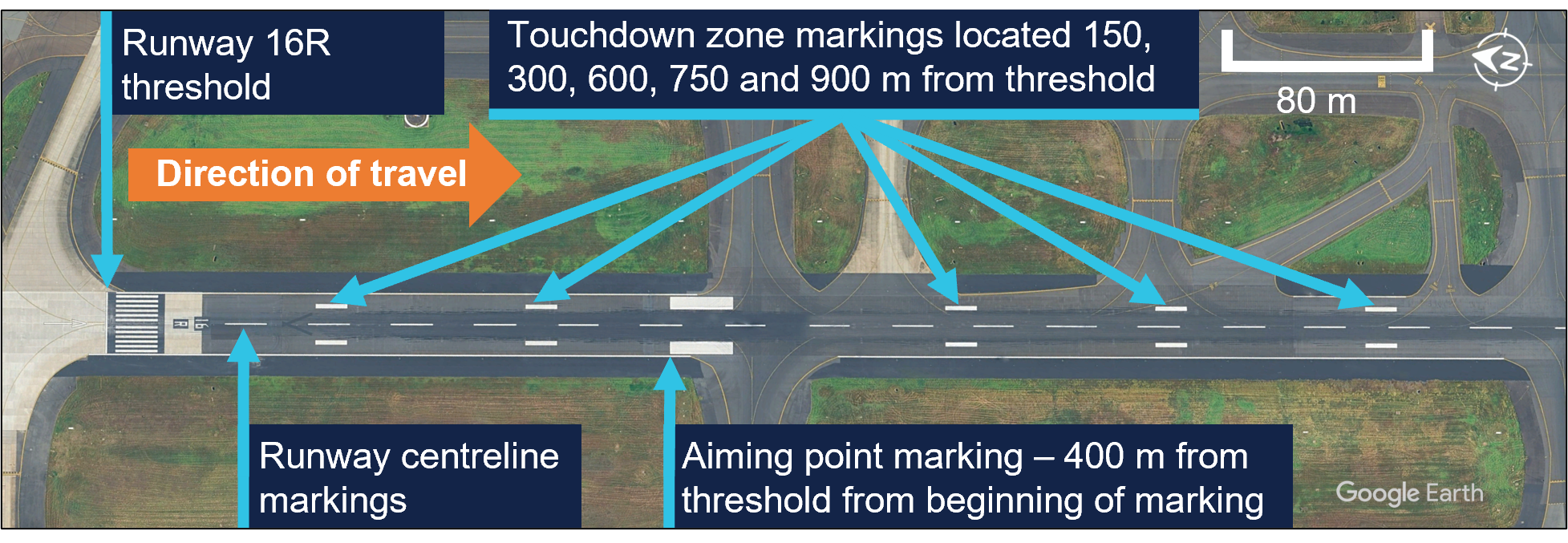
During the prolonged float, the aircraft was subjected to the crosswind conditions for a greater length of time. After observing the centreline deviation, the captain commanded a go-around approximately 600 m past the runway threshold, just prior to touchdown. The captain recalled they were ‘startled by the need to go around’ as the approach seemed ‘benign’ aside from the crosswind. They also reported a sudden stress response at this time as they had to rapidly transition from landing to commencing the go-around.
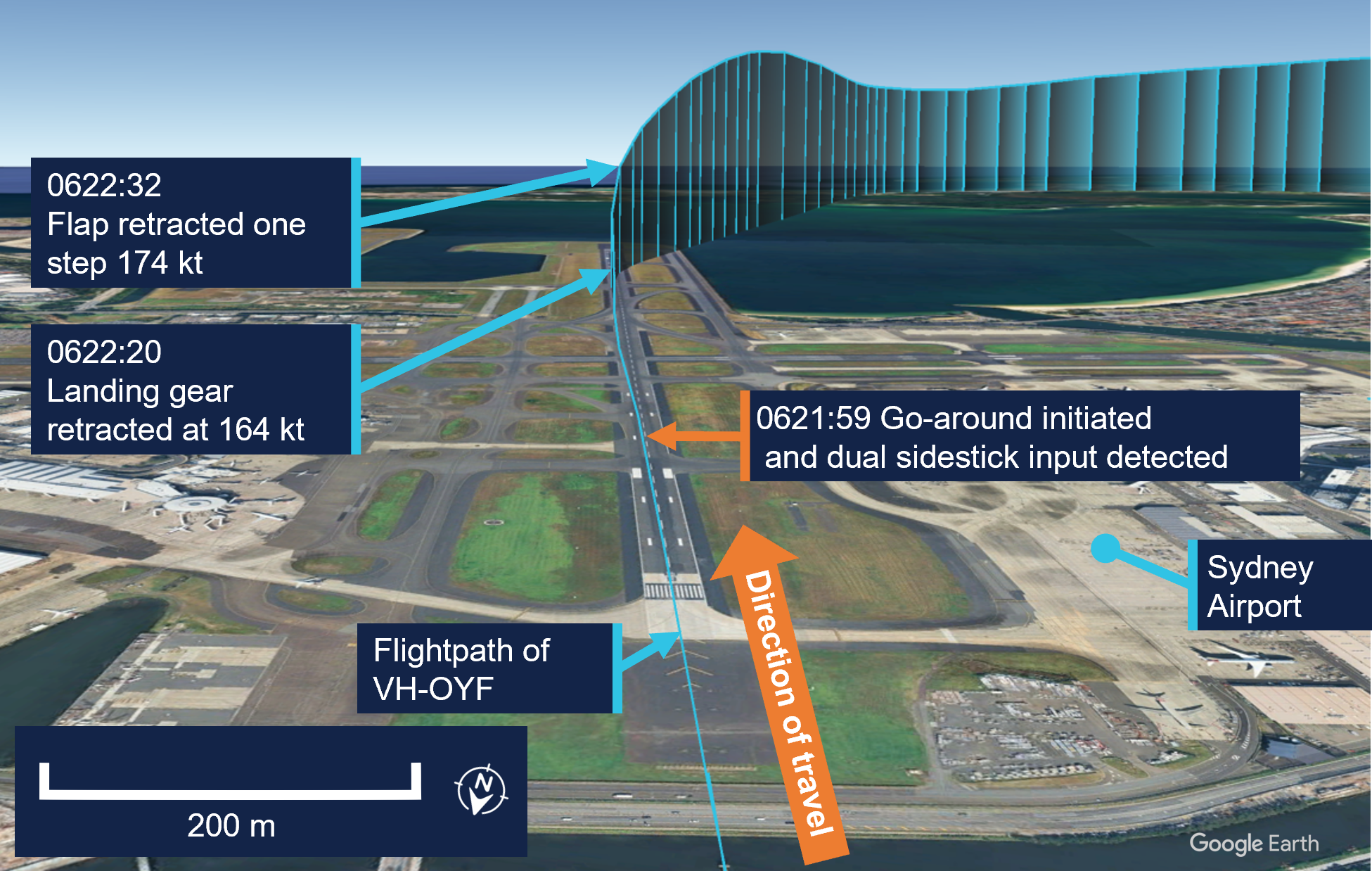
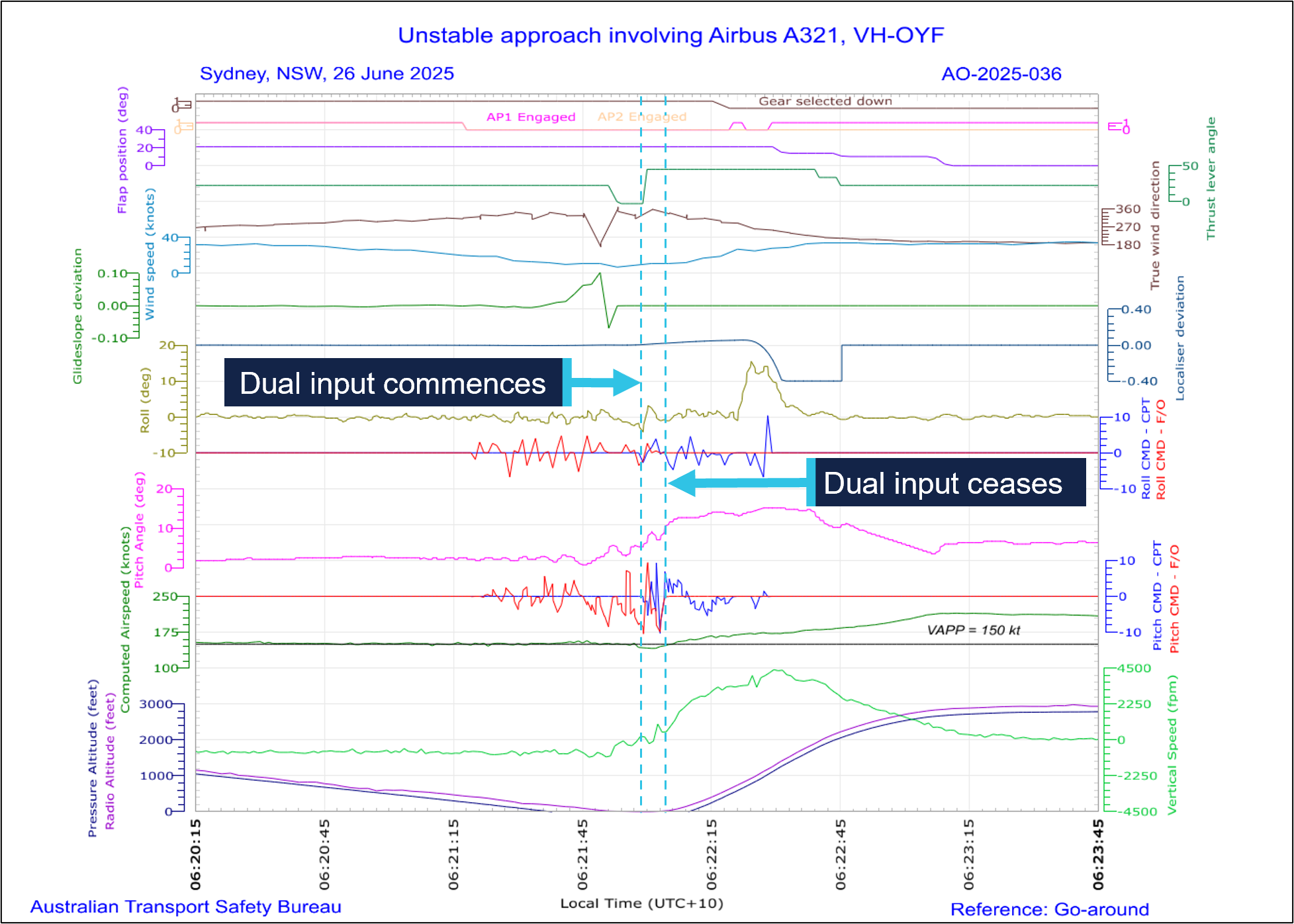
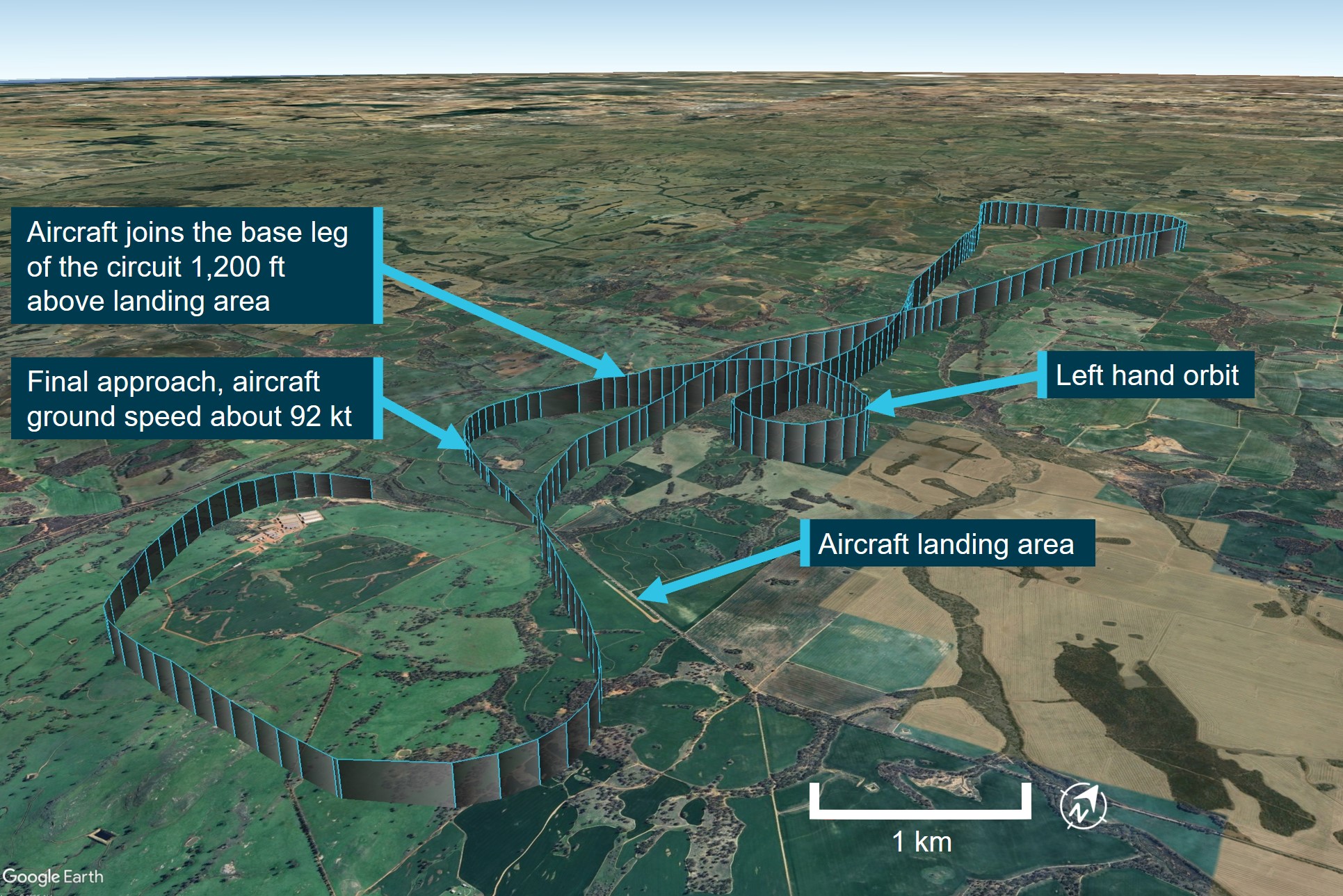
In response to the captain’s command, the first officer set take-off/go-around thrust at 0621:59 (Figure 1), which initiated the published missed approach procedure for the 16R GBAS landing system (GLS)[8] approach in the aircraft flight management system. The first officer also referenced their primary flight display (PFD) to command a target pitch attitude of 15° nose up.
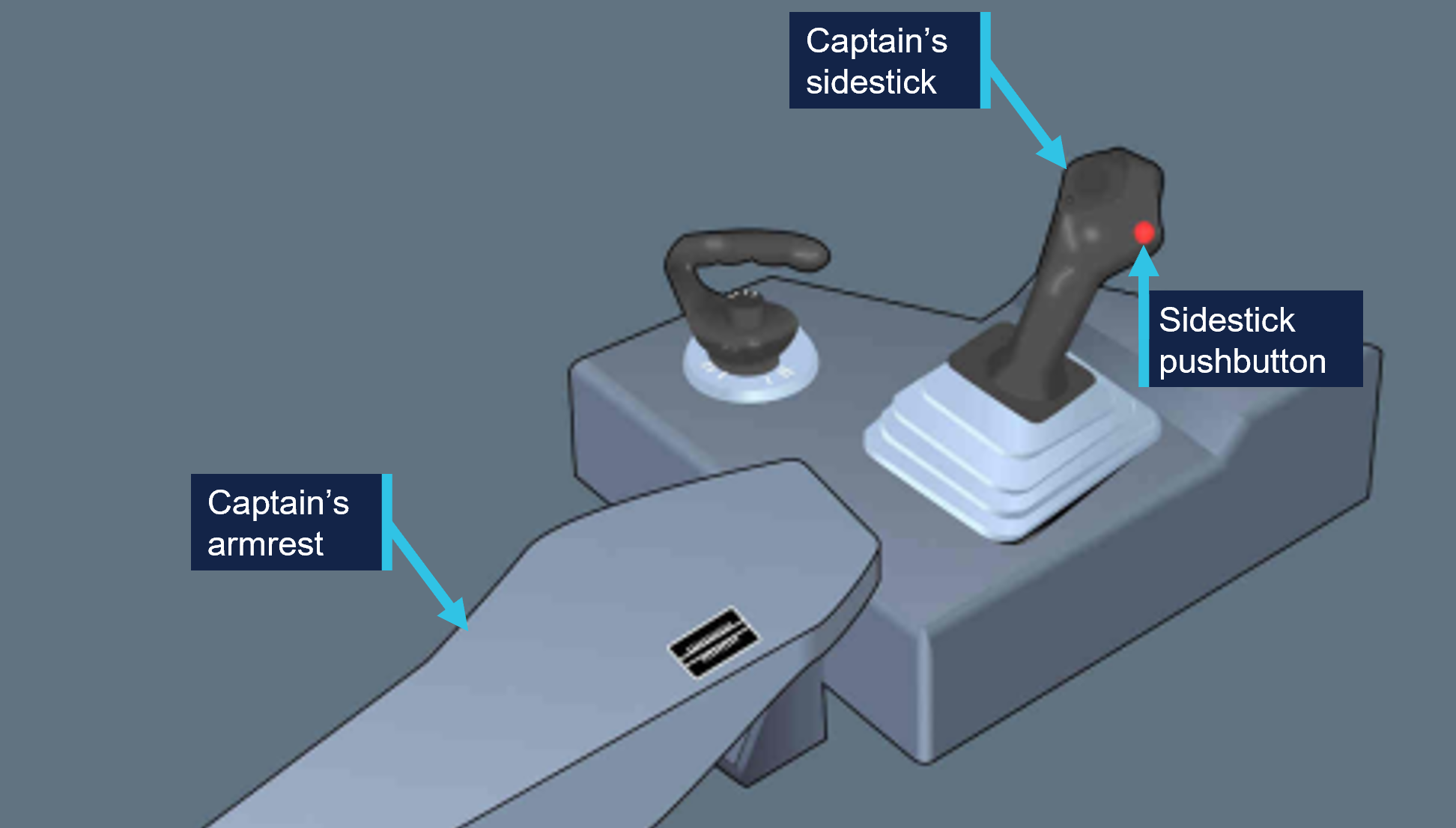
At this point, the captain recalled they instinctively applied control inputs via their sidestick while the aircraft was just above the runway, and the crew were alerted to this by the aircraft’s ‘dual input’ voice message (see Sidestick priority logic).
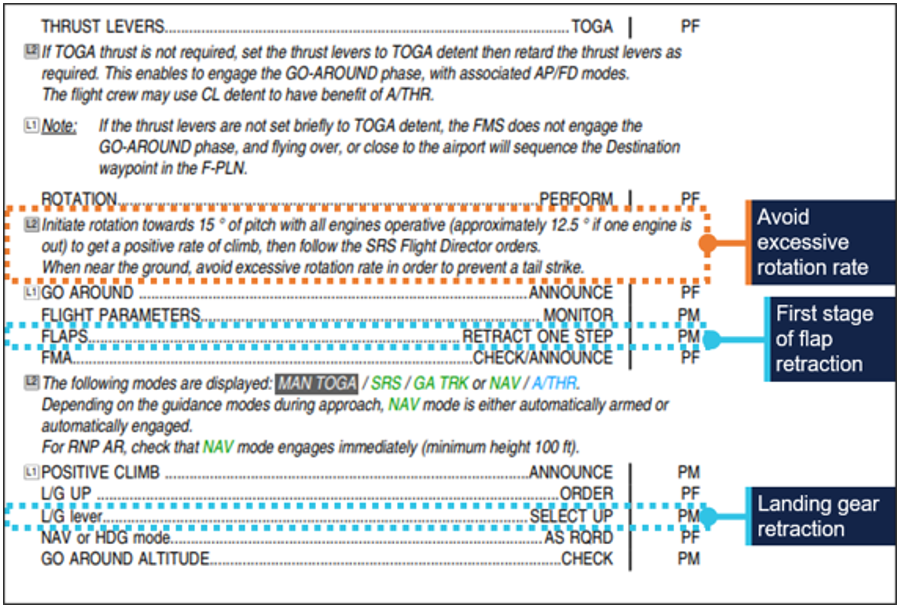
The captain then engaged their sidestick pushbutton, and the first officer recalled hearing the ‘priority left’ voice message and the captain announce, ‘I have control.’ The captain subsequently took control of the thrust levers and the first officer relinquished control and became PM after the aircraft achieved a positive rate of climb. It was the role of the PM to retract the flap ‘one step’ at this point (see Go-around procedure).
Figure 1: Overview of go-around
Source: Google Earth, annotated by the ATSB
The captain announced the active flight modes on their PFD, which prompted the first officer to call ‘positive climb.’ The captain subsequently instructed the first officer to retract the landing gear, which was accomplished 42 ft above the runway at 0622:20.
At this time, the captain looked up to the flight control unit located on the cockpit glareshield to engage the autopilot. After this was actioned, they looked back to their PFD and was ‘startled’ when they noticed that the aircraft suddenly banked right and responded by disengaging the autopilot at 0622:22. They subsequently realised that the aircraft flight director was providing commands for the published missed approach procedure and subsequently re-engaged the autopilot at 0622:29.
The captain then requested flap 1, but the first officer noticed they were still configured with Flap 3 and retracted the flap by one step and announced, ‘flap 2.’ This occurred at 0622:32 when the airspeed reached 174 kt, which was below the maximum flap 3 speed of 195 kt.
They continued to follow the missed approach procedure, and the first officer advised ATC they were going around. The crew were given instructions to track for a right downwind for runway 16R at 4,000 ft. The captain recalled conducting a welfare check on the first officer, briefed the cabin manager via the interphone and made an announcement to the passengers through the public address system.
The captain elected to remain as PF for the remainder of the flight, with the first officer acting as PM. The crew then conducted a second GLS approach for runway 16R, landing at 0638 without further incident.
Context
Flight crew information
The captain held an Air Transport Pilot Licence (Aeroplane), class 1 aviation medical certificate, and had accrued 5,921 hours total flying time, 1,480 of which were in the Airbus A320 and A321 aircraft types.
The first officer held a Commercial Pilot Licence (Aeroplane), class 1 aviation medical certificate, and had 2,212 hours total flying time, 551 of which were on the Airbus A320 and A321 aircraft types.
Fatigue
The captain reported that they felt 'moderately tired' during the go-around, likely due to the back-of-the clock[9] flight, which departed Denpasar at 0057 local time in Sydney. They also stated there was limited opportunity for controlled rest during the flight and their nap prior to the flight was disrupted due to noise at the hotel. The first officer reported feeling 'ok, somewhat fresh.’
The flight crew also reported they had an adequate rest opportunity the evening prior to the flight and obtained around 6 hours sleep in the previous 24 hours and around 13–14 hours in the previous 48 hours. Their sleep during the rest opportunity was reported to be good quality and the conditions at the hotel where they spent the night were suitable and therefore conducive to obtaining restful sleep. Biomathematical modelling[10] of the flight crew’s roster for the 2 weeks leading up to the flight indicated a low likelihood of fatigue.
The ATSB considered that fatigue was unlikely to have affected the flight crew’s performance at the time of the occurrence.
Aircraft information
General
The Airbus A321-251NX is a modern, fly-by-wire aircraft, powered by 2 CFM International LEAP-1A32 turbofan engines and had seating for 232 passengers in a single-class layout.
All the flight controls are electronically actuated with the pilots using sidesticks to fly the aircraft in pitch and roll during manual flight. The 2 sidestick controllers are not coupled mechanically, and they send separate sets of signals to the flight control computers.
Sidestick priority logic
Jetstar Airways A320-A321 Flight crew operating manual (FCOM) contains the following description of the aircraft sidestick priority logic:
At all times, only one flight crewmember should fly the aircraft. However, if both flight crewmembers use their sidesticks simultaneously, their orders are algebraically added.
The flight control laws limit the combined order to the equivalent of the full deflection of one sidestick.
In this case the two green SIDE STICK PRIORITY lights on the glareshield come on and "DUAL INPUT" voice message is activated.
A flight crewmember can deactivate the other sidestick and take full control, by pressing and keeping pressed the sidestick pb (Figure 2).
A “PRIORITY LEFT” or “PRIORITY RIGHT” audio voice message is given each time priority is taken.
Figure 2: Airbus A320/A321 captain's side sidestick and sidestick pushbutton
Source: Operator, annotated by the ATSB
Post-flight maintenance
The operator reported that there were no corrective maintenance actions that were required to be carried out in relation to the occurrence. The aircraft subsequently operated a scheduled passenger service the following day.
Meteorological information
The pre‑flight briefing package provided to the flight crew from the operator’s flight dispatcher included the aerodrome forecast[11] for Sydney Airport. The forecasted weather conditions for the scheduled time of arrival 0630 local time on 26 June indicated:
wind direction of 240° at 15 kt with gusts up to 25 kt
One-minute weather data for Sydney Airport from the Bureau of Meteorology indicated a wind direction of 255° at 17 kt with gusts up 20 kt at the time of the occurrence.
Airport information
Runway 16R at Sydney Airport is oriented on a magnetic heading of 155° and has a declared length of 3,962 metres with a width of 45 metres. A precision approach path indicator system is installed and set to 3° with a threshold crossing height of 64 ft.
For daytime operations, the runway centreline, aiming point and touchdown zone markings provide visual references to assist pilots with approach and landing (Figure 3).
Figure 3: Sydney Airport runway 16R markings
Source: Google Earth, annotated by the ATSB
Recorded information
The aircraft’s quick access recorder data which captured the incident approach indicated that, as the aircraft descended below 1,000 ft, it maintained an appropriate speed and flightpath with no sustained exceedances of the stable approach criteria throughout the approach.
At 0621:59, the recorded data captured the captain’s control inputs commencing concurrently with the initiation of the go-around, while the first officer was actively manipulating their sidestick control. Simultaneous control inputs lasted for a duration of 6 seconds (Figure 4), while the aircraft’s pitch attitude remained below the aircraft’s pitch limit of 11.5° until the aircraft had climbed through about 50 ft.
The recorded data further indicated that the wind direction and speed varied following the flare manoeuvre, however the crosswind component remained well below the first officer’s operational limitation. The wind direction and speed was 315° at 13 kt with a crosswind component of 5 kt when the go-around was initiated.
Figure 4: Graphical representation of the recorded quick access data
Source: Quick access recorder from VH-OYF, annotated by the ATSB
Following the initiation of the go-around, the landing gear was retracted at 06:22:20 and 12 seconds later, the flap was retracted to the flap 2 configuration[14] at 174 kt.
Operational information
Stabilised approach criteria
Jetstar Airways A320-A321 Flight crew operating manual (FCOM) defined a stabilised approach criteria as being established on the correct lateral and vertical flight path by 1,000 ft height above airport (HAA), configured for landing, and within the stated tolerances with the required checklists completed by 500 ft HAA. The FCOM also stated that if these criteria could not be met, or if the approach became unstable below 1,000 ft HAA, a missed approach was required.
The crew reported the approach was stabilised against these criteria, which was consistent with the available recorded data.
Touchdown zone
The FCOM provided the following operational information regarding the touchdown zone:
The touchdown zone commences at 300 m (1000 ft) beyond the threshold and will not normally extend further than 600 m (2000 ft) beyond the threshold.
It is a requirement that the touchdown is planned to occur within the touchdown zone. Should it become apparent that the aircraft will touch down further than 600 m (2,000 ft) beyond the threshold, and the PIC believes that the landing is safe to continue, the PF must apply maximum reverse thrust and sufficient braking to ensure the aircraft stops within the landing distance available. If the PIC decides that a go-around is required, they will without delay, call “Go-Around”. In all cases this must be completed before the PF initiates reverse thrust.
The captain stated that runway 16R in Sydney was long enough to stop the aircraft on the runway if they had continued with the landing during the occurrence. This would have involved requesting maximum reverse and manual braking as necessary after the aircraft touched down.
The FCOM did not specifically reference runway centreline tracking during a visual approach, however the captain stated that it was their personal expectation that a deviation from the runway centreline would lead them to calling for a go-around.
Transfer of control
The operator described procedures for transfer of control within the FCOM as follows:
The pilot relinquishing control of the aircraft shall say “You have control”. The pilot assuming control shall ensure that they have clear and unobstructed access to the flight controls and, when ready, say “I have control”. Only then is the pilot relinquishing control permitted to remove their hands and feet from the flight controls.
In critical phases of flight the PIC must be alert and positioned such that they can assume immediate control of the aircraft.
Following the occurrence, the captain stated the preferable method to conduct a go‑around at low level would have been to announce ‘I have control’ and initiate the go‑around themselves. They stated that their primary consideration when conducting a go‑around at low level was to avoid the risk of tail strike.
Go-around procedure
The FCOM defined the go-around procedure for the A320/A321, which specified the task sequence, memory-based crew actions and applicable guidance relating to techniques and navigation (Figure 5).
Following the occurrence, the captain stated that although they could have taken over and landed, they believed that going around was considered the safest option. The first officer also stated, at about that time, that they were in the mindset of preparing to initiate a go-around themselves.
Related occurrences
The following ATSB investigation highlights the importance of pilots maintaining their readiness for a go-around on every approach as it is typically a period of high workload requiring effective crew coordination.
On the morning of 18 May 2018, an Airbus A320 aircraft, registered VH-VQK, was being operated on a regular public transport flight by Jetstar Airways. The flight departed from Sydney for Ballina/Byron Gateway Airport, New South Wales.
The flight crew conducted a go-around on the first approach at Ballina because the aircraft’s flight path did not meet the operator’s stabilised approach criteria. On the second approach, at about 700 ft radio altitude, a master warning was triggered because the landing gear had not been selected DOWN. The flight crew conducted a second go‑around and landed without further incident on the third approach.
The flight crew did not follow the operator’s standard procedures during the first go‑around and subsequent visual circuit at 1,500 ft. In particular, the flaps remained at flaps 3 rather than flaps 1 during the visual circuit. This created a series of distractions leading to a non‑standard aircraft configuration for a visual circuit. Limited use of available aircraft automation added to the flight crew’s workload.
Safety analysis
During the approach to Sydney airport, with the first officer acting as the pilot flying (PF), the flight crew reported experiencing a crosswind of up to 30 kt until descending through about 500 ft above mean sea level. The crew were advised by air traffic control to expect a right crosswind component of 8 kt for landing, which was within the first officer’s operational crosswind limit of 20 kt. The captain confirmed the approach was ‘stable’ at 500 ft and the first officer continued the approach as PF.
At 50 ft, the first officer initiated the flare manoeuvre prior to landing. They recalled they ‘over flared,’ and the aircraft subsequently floated for an extended period along the runway. During this time, the first officer’s control inputs did not counteract the effect of the crosswind, and the aircraft drifted left of the centreline. After observing the lateral deviation from the centreline, the captain commanded the first officer to conduct a go‑around.
This occurred just prior to the aircraft touching down when the flight crew would normally be focused on landing. The flight crew did not expect a go-around at the time and had to rapidly shift their focus to conducting the missed approach procedure. The captain recalled being ‘startled’ by the unexpected need to discontinue the landing, however they were more likely experiencing ‘surprise.’ Surprise is a cognitive-emotional response to something unexpected, which results from a mismatch between one’s mental expectations and perceptions (Rivera, Talone, Boesser, Jentsch, & Yeh, 2014). But their decision was consistent with the expectation that an approach be discontinued if the aircraft departed from the correct lateral flight path.
The unexpected change from landing to conducting a go-around close to the ground also resulted in the captain experiencing a sudden stress response at this time. When experiencing acute stress, people can respond quickly to a situation, but without conscious decision‑making (Wickens, Helton, Hollands, & Banbury, 2022). After the go‑around was commanded, there was a rapid increase in pitch attitude, engine thrust and airspeed, and in response the captain instinctively and inadvertently manipulated their sidestick while the first officer was flying, resulting in a dual-input alert.
The captain reported they only realised they had manipulated their sidestick when they heard the dual input alert. Their primary consideration during the go-around was to avoid an excessive rotation rate to avoid a tail strike, which did not occur. Additionally, operator procedures directed captains to be alert and be positioned to ‘assume immediate control of the aircraft’ during critical phases of flight.
Following the dual input alert, the captain took full control by engaging their sidestick push‑button and announced ‘I have control’, and the first officer assumed the role of pilot monitoring. A consequence of the control handover during the initial stages of the go‑around was the momentary interruption of sequential crew actions during the go‑around procedures. Interruptions typically disrupt the chain of procedure execution so abruptly that pilots turn immediately to the source of the interruption without noting the point where the procedure was suspended (Loukopoulos, Dismukes, & Barshi, 2009).
Additionally, there was a further disruption (rapid task switching) associated with the first officer and captain exchanging pilot flying and pilot monitoring roles. As a result, some of the procedural items were completed out of sequence (flap 3 retraction occurred after gear retraction).
Pilots are highly vulnerable to errors of omission when they must attend to multiple tasks. If one task becomes demanding, their attention is absorbed by these tasks demands and they can forget to switch their attention to other tasks (Loukopoulos, Dismukes, & Barshi, 2009). Although the flap retraction occurred out of sequence during the go-around, there were no associated flight envelope exceedances or negative effects on aircraft performance.
Findings
ATSB investigation report findings focus on safety factors (that is, events and conditions that increase risk). Safety factors include ‘contributing factors’ and ‘other factors that increased risk’ (that is, factors that did not meet the definition of a contributing factor for this occurrence but were still considered important to include in the report for the purpose of increasing awareness and enhancing safety). In addition ‘other findings’ may be included to provide important information about topics other than safety factors.
These findings should not be read as apportioning blame or liability to any particular organisation or individual.
From the evidence available, the following findings are made with respect to the control issues during landing and go-around involving Airbus A321, VH-OYF, at Sydney Airport, New South Wales, on 26 June 2025.
Contributing factors
During the landing after crossing the threshold, the first officer’s control inputs resulted in a lateral deviation from the runway centreline during a prolonged float.
After calling for a go-around, the captain inadvertently manipulated their sidestick while the first officer was the pilot flying, which resulted in a simultaneous control input and the go-around procedure being completed out of sequence.
Sources and submissions
Sources of information
The sources of information during the investigation included:
Jetstar Airways Pty Limited
Bureau of Meteorology
the flight crew
recorded data from the quick access recorder from VH-OYF.
References
Loukopoulos, L., Dismukes, R., & Barshi, I. (2009). The perils of multitasking. AeroSafety World, 4(8), 18-23.
Rivera, J., Talone, A., Boesser, C., Jentsch, F., & Yeh, M. (2014). Startle and surprise on the flight deck: Similarities, differences, and prevalence. In Proceedings of the human factors and ergonomics society annual meeting (Vol. 58, No. 1, pp. 1047-1051). Sage CA: Los Angeles, CA: SAGE Publications.
Wickens, C. D., Helton, W. S., Hollands, J. G., & Banbury, S. (2022). Engineering psychology and human performance, 5th edn. Routledge, doi: 10.4324/9781003177616.
Submissions
Under section 26 of the Transport Safety Investigation Act 2003, the ATSB may provide a draft report, on a confidential basis, to any person whom the ATSB considers appropriate. That section allows a person receiving a draft report to make submissions to the ATSB about the draft report.
A draft of this report was provided to the following directly involved parties:
Civil Aviation Safety Authority
the flight crew
Jetstar Airways Pty Limited
Bureau of Meteorology.
Submissions were received from:
the flight crew
Jetstar Airways Pty Limited.
The submissions were reviewed and, where considered appropriate, the text of the report was amended accordingly.
Purpose of safety investigations
The objective of a safety investigation is to enhance transport safety. This is done through:
identifying safety issues and facilitating safety action to address those issues
providing information about occurrences and their associated safety factors to facilitate learning within the transport industry.
It is not a function of the ATSB to apportion blame or provide a means for determining liability. At the same time, an investigation report must include factual material of sufficient weight to support the analysis and findings. At all times the ATSB endeavours to balance the use of material that could imply adverse comment with the need to properly explain what happened, and why, in a fair and unbiased manner. The ATSB does not investigate for the purpose of taking administrative, regulatory or criminal action.
About ATSB reports
ATSB investigation reports are organised with regard to international standards or instruments, as applicable, and with ATSB procedures and guidelines.
Reports must include factual material of sufficient weight to support the analysis and findings. At all times the ATSB endeavours to balance the use of material that could imply adverse comment with the need to properly explain what happened, and why, in a fair and unbiased manner.
An explanation of terminology used in ATSB investigation reports is available here. This includes terms such as occurrence, contributing factor, other factor that increased risk, and safety issue.
Publishing information
Released in accordance with section 25 of the Transport Safety Investigation Act 2003
Ownership of intellectual property rights in this publication
Unless otherwise noted, copyright (and any other intellectual property rights, if any) in this report publication is owned by the Commonwealth of Australia.
Creative Commons licence
With the exception of the Commonwealth Coat of Arms, ATSB logo, and photos and graphics in which a third party holds copyright, this report is licensed under a Creative Commons Attribution 4.0 International licence.
The CC BY 4.0 licence enables you to distribute, remix, adapt, and build upon our material in any medium or format, so long as attribution is given to the Australian Transport Safety Bureau.
Copyright in material obtained from other agencies, private individuals or organisations, belongs to those agencies, individuals or organisations. Where you wish to use their material, you will need to contact them directly.
[1]Local time in Sydney was Australian Eastern Standard Time (AEST), which is Coordinated Universal Time (UTC) +10 hours. Times in this report are AEST unless otherwise noted.
[2]Pilot flying (PF) and pilot monitoring (PM): procedurally assigned roles with specifically assigned duties at specific stages of a flight. The PF does most of the flying, except in defined circumstances, such as planning for descent, approach and landing. The PM carries out support duties and monitors the PF’s actions and the aircraft’s flight path.
[3]Flight level: at altitudes above 10,000 ft in Australia, an aircraft’s height above mean sea level is referred to as a flight level (FL). FL 330 equates to 33,000 ft.
[4]Runway numbering: the number represents the magnetic heading closest to the runway (runway 16 at Sydney Airport is oriented 155° magnetic) and R indicates the right most of 2 parallel runways.
[5]Visual meteorological conditions (VMC): an aviation flight category in which visual flight rules (VFR) flight is permitted – that is, conditions in which pilots have sufficient visibility to fly the aircraft while maintaining visual separation from terrain and other aircraft.
[6]Flap 3 on the A321-251 is 21° of flap and 22° of slat extension.
[7]Final approach speed (VAPP): the VAPP is the target airspeed for the aircraft when crossing the runway threshold with the aircraft configured for landing. VAPP is equal to the lowest selectable speed with the addition of wind correction. The wind correction is limited to a minimum of 5 kt and a maximum of 15 kt.
[8]GBAS landing system (GLS): a GLS consists of a GBAS ground station located on or in the vicinity of one or more aerodromes and an aircraft subsystem. The GBAS provides data and corrections for the GNSS ranging signals over a digital VHF data broadcast to the aircraft subsystem. The aircraft subsystem translates the position signal into flight guidance similar to that provided for an ILS.
[9]Back of the clock: Work schedules that involve extended periods of night-work between midnight and dawn.
[10]A biomathematical model of fatigue predicts the effect of different patterns of work on measures such as subjective fatigue, sleep, or the effectiveness of performing work, using mathematical algorithms. Each model uses different types of inputs and assumptions and produces different types of outputs, each having limitations. The ATSB used the biomathematical modelling software SAFTE-FAST and FAID Quantum for the analysis.
[11]Aerodrome forecast (TAF): a TAF is a coded statement of meteorological conditions expected at an aerodrome and within a radius of 5 nautical miles of the aerodrome reference point.
[12]Ceiling and visibility okay (CAVOK): visibility, cloud and present weather are better than prescribed conditions. For an aerodrome weather report, those conditions are visibility 10 km or more, no significant cloud below 5,000 ft, no cumulonimbus cloud and no other significant weather.
[13]Moderate turbulence: changes to accelerometer readings of between 0.5 g and 1.0 g at the aircraft’s centre of gravity. Moderate change to aircraft attitude and/or altitude may occur but aircraft remains under positive control. Usually small changes in airspeed. Difficulty in walking. Lose objects move about.
[14]Flap 2 on the A321-251 is 14° of flap and 22° of slat extension.
Occurrence summary
Investigation number
AO-2025-036
Occurrence date
26/06/2025
Location
Sydney Airport
State
New South Wales
Report release date
27/01/2026
Report status
Final
Investigation level
Short
Investigation type
Occurrence Investigation
Investigation status
Completed
Mode of transport
Aviation
Aviation occurrence category
Control issues, Missed approach, Warning devices
Occurrence class
Incident
Highest injury level
None
Aircraft details
Manufacturer
Airbus
Model
A321-251NX
Registration
VH-OYF
Serial number
11529
Aircraft operator
Jetstar Airways Pty Limited
Sector
Jet
Operation type
Part 121 Air transport operations - larger aeroplanes
On 8 February 2025, the pilot of a Bell Helicopter 206B was conducting a scenic flight from Cairns Airport, Queensland (Figure 1). The passengers comprised 2 adults and 2 children, with 1 child placed in the front left seat and the remaining passengers in the rear of the helicopter.
Figure 1: Bell Helicopter 206B with incident location (inset)
Source: Operator and Google Earth, annotated by the ATSB
Approximately 12 minutes into the flight, the pilot contacted the operator over the company radio and expressed concern about the operation of the flight controls. The control issues were similar to a previously reported occurrence from approximately a month earlier, where the pilot had experienced an aft ‘kick’ in the flight controls, followed by stiffening of both the cyclic and the collective controls. On this occasion, the pilot also experienced the cyclic control moving to the right.
Following the previous occurrence, the operator conducted a technical assessment of the aircraft’s hydraulic system, but no abnormalities were detected, and the precise cause of the issue was not identified.
On this occasion, on being notified of the issue by the pilot during flight, the operator immediately advised the pilot to check the front seat passenger’s feet position. The pilot observed that the passenger’s feet were interfering with the copilot cyclic[1] control stub. The stub was a small moveable part that remained on the floor of the helicopter under the seat, after the copilot cyclic control stick had been removed (Figure 2).
Shortly after, the pilot reported to the operator that they had moved the passenger’s feet, resulting in normal operation of the controls. The operator provided the pilot with the option to return to the airport at their discretion, but the pilot elected to continue the flight.
On arrival back at Cairns Airport, the operator and pilot discussed the occurrence in further detail. During the debrief, the operator deliberately manipulated the copilot cyclic stub to allow the pilot to feel the corresponding effect on the flight controls. The pilot confirmed that the stiffening of the controls was similar to that experienced in flight.
In the absence of any fault with the hydraulic system and the near-identical symptoms experienced in both occurrences, the operator determined that the likely cause of the previous month-old occurrence was also due to the same reason.
The ATSB was advised that the operator purchased the helicopter around late-November 2024 and thereafter installed the left side copilot controls for pilot training flights.
Bell Helicopter Textron Inc. Service Instruction BHT-206-SI-67 Service instruction for dual controls, quick disconnect provided procedures to install left side controls. In reference to this incident, the Service Instruction required the installation of a cyclic cover following the removal of a copilot cyclic control stick.
The ATSB identified that the operator had not installed a cover on the left side copilot cyclic control stub following the removal of the cyclic control stick. Similarly, it was identified that a protective cover for the collective control stub had not been installed by the operator, which increased the risk of accidental flight control interference.
Safety action
Following the incident, the operator advised of the following safety action:
metal cover has been installed on the left side copilot cyclic control stub
a cover has been ordered for the left side copilot collective control stub and will be installed as soon as it is received
they will inform all pilots of the risk of inadvertent passenger interference of the flight controls
remind all pilots of the requirement to adhere to aircraft flight manual procedures in the event of an abnormal situation being encountered
review relevant Safety Instructions and Safety Bulletins issued by the aircraft manufacturer.
Safety message
Where removable flight controls are utilised, aircraft operators must ensure the personnel installing/removing the flight controls are appropriately trained to do so. Installation/removal should also be conducted in accordance with the manufacturer’s instructions, including any associated safety precautions.
In addition, the pilot’s pre-flight safety briefing to passengers must clearly emphasise the importance of avoiding contact with any flight controls.
About this report
Decisions regarding whether to conduct an investigation, and the scope of an investigation, are based on many factors, including the level of safety benefit likely to be obtained from an investigation. For this occurrence, no investigation has been conducted and the ATSB did not verify the accuracy of the information. A brief description has been written using information supplied in the notification and any follow-up information in order to produce a short summary report, and allow for greater industry awareness of potential safety issues and possible safety actions.
[1]Cyclic: a primary helicopter flight control that is similar to an aircraft control column. Cyclic input tilts the main rotor disc, varying the attitude of the helicopter and hence the lateral direction.
At 1021 on 7 April 2025, a Bankstown Helicopters Robinson R44 helicopter, registered VH‑EWM (EWM), with a pilot and 2 passengers on board, departed from Bankstown Airport, New South Wales, for a local scenic flight around Sydney Harbour. Shortly after 1028, as EWM was entering the Parramatta River helicopter lane behind an EC120 helicopter, the occupants of EWM experienced a sudden onset of turbulence followed by an uncontrolled descent.
In response, the pilot applied full collective, which resulted in a low rotor speed condition as the helicopter descended towards the water. The pilot was able to manoeuvre the helicopter and complete a forced landing on the river shoreline.
What the ATSB found
The ATSB found that it is likely that EWM entered the rotor wake from a preceding heavier EC120 helicopter, which resulted in the control difficulties, an uncontrolled descent, low rotor speed warning and the forced landing.
What has been done as a result
Following review of the draft report, the Civil Aviation Safety Authority undertook proactive safety action to improve existing guidance about helicopter wake vortices in Advisory Circular 91-16. The updated advisory circular was released on 17 July 2025 and can be found at the link: AC 91-16 v1.2 - Wake turbulence.
Safety message
Flight tests have demonstrated that helicopter wake turbulence is comparatively larger and less predictable in its behaviour than for aeroplanes of the same weight. Helicopter rotor vortices can descend, remain level or climb, and the duration of their persistence can increase significantly in conducive weather conditions. The United States Helicopter Safety Team website recommends remaining 3 rotor disks clear of a hovering or taxiing helicopter and allowing 3 NM and/or 2 minutes for the rotor wake from a preceding helicopter to dissipate.
The investigation
The ATSB scopes its investigations based on many factors, including the level of safety benefit likely to be obtained from an investigation and the associated resources required. For this occurrence, the ATSB conducted a limited-scope investigation in order to produce a short investigation report, and allow for greater industry awareness of findings that affect safety and potential learning opportunities.
The occurrence
At 1021 local time on 7 April 2025, a Bankstown Helicopters Robinson R44 Raven 1 helicopter, registered VH‑EWM (EWM), with a pilot and 2 passengers on board, departed from Bankstown Airport, New South Wales for a local scenic flight around Sydney Harbour. Bankstown Tower air traffic control (TWR) cleared EWM to depart via ‘Choppers West’, which was a standard procedure for helicopters departing to the north when runway 29 was active at Bankstown.
The pilot reported that they climbed to about 1,000 ft above mean sea level.[1] The pilot’s plan was to join the Parramatta River on the west side of the Ryde Bridge and descend to 500 ft to follow the helicopter lane[2] along the south side of the river to Sydney Harbour (Figure 1).
Figure 1: Key locations
Source: Google Earth, annotated by the ATSB
About 1 minute after EWM departed, an Airbus EC120B helicopter departed Bankstown, also following the Choppers West departure. Shortly after the EC120 departed, TWR advised the EC120 pilot that there was ‘R44 traffic 1 NM ahead’, to which the EC120 pilot reported that they had the traffic sighted. Bankstown TWR then advised the pilot of EWM that they were not receiving their transponder data, which the pilot acknowledged. The pilot of EWM then turned their transponder off and on in an attempt to transmit transponder information, but no data was received from it throughout the incident flight.
As the 2 helicopters tracked north towards the Parramatta River, the EC120 flew to the west of EWM and passed it before reaching the river. The EC120 then turned right to join the Parramatta River helicopter lane, tracking towards the Ryde Bridge and Sydney Harbour, and passed over the Ryde Bridge at a recorded radar altitude of 600 ft.
The pilot of EWM reported that they descended the helicopter to 500 ft as they approached the river. Just before the pilot turned EWM right to join the helicopter lane, another larger helicopter (the EC120) suddenly appeared in front of them (Figure 2). The pilot of EWM estimated the EC120 was about 500–600 ft (150–180 m) in front of them and about 100 ft above them. While there was no recorded altitude for EWM, primary radar data indicated that EWM entered the lane about 9 seconds behind the EC120.[3] Primary radar data for EWM was lost about 10 seconds later, just after 1028, indicating it had descended below radar coverage.
Figure 2: Primary radar return (left) and loss of primary radar return (right) for VH‑EWM
Source: Airservices Australia, annotated by the ATSB
The pilot of EWM made a radio broadcast that they were entering the helicopter lane as they crossed the Ryde Bridge behind the EC120. They then experienced what they described as very strong turbulence from a vertical motion in the atmosphere. A passenger later described it as ‘like heavy turbulence … rolling left and right’ followed by ‘diving towards the water’.
The pilot noted that the helicopter was descending through 400 ft and responded by raising the collective lever.[4] However, the helicopter continued descending towards the water as it tracked behind and below the EC120. A passenger recalled the pilot announced ‘brace for impact’ as the helicopter approached the water. The pilot applied full collective to avoid the water, which caused the rotor speed to decay sufficiently for the low rotor speed warning horn to activate. They also reported feeling that they could not escape what they believed to be the rotor wake from the EC120. The pilot then sighted a suitable forced landing area at Cabarita Park and, using the helicopter’s remaining airspeed and rotor speed, manoeuvred the helicopter to the shoreline for a landing.
Following the landing, the pilot rolled the engine throttle back to idle and proceeded through their after‑start checks and confirmed normal operations on the ground. The pilot then conducted a hover check and again confirmed normal operations. The pilot attempted radio contact with their operations base but received no reply. They then conducted a return flight to Bankstown without further incident.
Context
Pilot information
The pilot held a commercial helicopter pilot licence, issued on 26 November 2024, with a single‑engine helicopter class rating and low‑level rating. The pilot held a class 1 aviation medical certificate with no restrictions and expiration date of 30 May 2025. The pilot had accumulated about 112 hours flying experience and the incident flight was the pilot’s first commercial flight.
Helicopter information
The incident helicopter, EWM, was a piston‑engine 2‑bladed Robinson Helicopter Company R44 Raven 1 with a maximum take‑off weight of 1,089 kg. The weight and balance data provided by the operator indicated it was within limits for the flight.
The Airbus EC120B was a turbine-engine 3‑bladed helicopter with a maximum take‑off weight of 1,715 kg. Therefore, the EC120 was about 57% heavier than EWM at their respective maximum take‑off weights.
The maintenance release for EWM indicated the helicopter was operated by Bankstown Helicopters in the operational category of Part 133 Air Transport. The maintenance release current at the time of the incident was issued on 3 April 2025 at 4,349 hours total time in service with an expiry date of 3 April 2026 or 4,400 hours. A maintenance test flight was certified on the maintenance release as conducted on 3 April with ‘nil defects evident.’
After the incident, the operator’s maintenance organisation inspected the helicopter and found no defects. As the flight hours remaining on the helicopter were close to the next overhaul, the operator elected to remove the helicopter from service and have the maintenance organisation complete the overhaul.
Meteorological information
The METAR[5] recordings for Bankstown Airport at 1000 and 1030 indicated that the wind was westerly at a speed of 9 kt at 1000 and 7 kt at 1030. No cloud was detected. These conditions were consistent with the Bankstown Airport forecast for 8 kt westerly winds. The pilot reported their assessment of the weather was 5 kt of variable wind and CAVOK[6] conditions, but when they encountered the turbulence over the Ryde Bridge it felt like 40 kt of wind.
Rotor wake turbulence
In 1996, the United States Federal Aviation Administration (FAA) produced a report on the subject of Flight test investigation of rotorcraft wake vortices in forward flight. They used a laser doppler velocimeter to measure the vortices and small probe aircraft to test the actual flying conditions. Smoke generation was used to visualise the wake vortices for the probe aircraft. Their investigation concluded that:
The measured vortex circulation diminished with decreasing airspeed for helicopter airspeeds below 40 knots. At these lower speeds, the wake vortex structure begins to break down and changes to a distinct downwash.
Vortex duration depends strongly on ambient weather conditions and a variance of 300% was observed on those days most conducive[7] to vortex persistence and duration compared with those observed on typical days.
Typically, helicopters with higher gross weight, larger rotor diameters, and larger numbers of rotor blades generated vortices of larger core diameters.
Probe tests revealed that helicopter vortices did not descend in the same predictable manner as for fixed‑wing aircraft. Some vortices descended; some remained level; and some initially descended, levelled off, and then ascended above the altitude of the generating helicopter.
Figure 3: Rotor wake vortices visualised with smoke generators
Visualisation of the wake vortices behind an S‑76A helicopter in forward flight with smoke generators from the FAA (1996) flight tests. Source: Reddit
Meiris (n.d.) provided an article for the United States Helicopter Safety Team website, on the subject of Avoiding helicopter wake turbulence. The article referenced the FAA 1996 flight test report and provided the following recommendations:
As a result of these findings and the studies conducted regarding helicopter downwash in a hover, a few guidelines have been developed to increase awareness around helicopter wake turbulence:
• For hovering flight or a hover taxi, stay three rotor diameters away.
• For forward flight, a minimum of 3 nm [NM] separation is recommended, especially from larger helicopters. The investigation we discussed previously discovered that even at 3nm [NM], the planes encountered uncommanded pitch and roll oscillations.
• Leave 2 minutes for the rotor vortices to dissipate behind a helicopter in forward flight.
Related occurrences
The French Bureau of Enquiry and Analysis for Civil Aviation Safety investigation BEA2019-0234, Accident to a paraglider involving the Airbus - EC135 - T2 PLUS registered F-HTIN, examined a fatal paraglider accident in 2019. The paraglider’s wing collapsed after encountering the rotor wake from an Airbus EC135 helicopter, which drifted with the wind from the helicopter’s flightpath onto the paraglider (Figure 4).
Figure 4: Simulation of rotor wake drifting onto the paraglider
Source: YouTube – Bureau of Enquiry and Analysis for Civil Aviation Safety, annotated by ATSB
The 2022 United States National Transportation Safety Board investigation WPR22LA072 found that the pilot of a Cessna 120 attempted a go‑around about 20 seconds behind the passage of a Bell UH‑1H helicopter. During the go‑around the Cessna encountered wake turbulence, resulting in a loss of control and collision with terrain (Figure 5). The report indicated light wind conditions of 4 kt at the airport.
Figure 5: Loss of control accident from rotor wake
Source: YouTube – Aviation Safety Network, annotated by ATSB
Safety analysis
Primary radar data and the pilot’s report indicated that EWM entered the Parramatta River helicopter lane and passed over the Ryde Bridge about 9 seconds behind and slightly below the EC120 helicopter. At this point, EWM encountered heavy turbulence, an uncontrolled descent and a low rotor speed when the pilot applied full collective to avoid a collision with the water.
The uncontrolled descent and low rotor speed condition resulted in the pilot conducting a forced landing on the shoreline of the Parramatta River.
The incident occurred under relatively calm wind conditions and EWM operated in a serviceable condition for the return flight. Subsequent maintenance inspections of the helicopter found no fault. Furthermore, EWM passed overhead the Ryde Bridge in sufficient proximity to a preceding heavier 3‑bladed helicopter to be subject to a rotor wake induced upset. Therefore, the ATSB concluded that the sudden onset of turbulence and uncontrolled descent were likely the result of EWM encountering rotor wake turbulence from a preceding EC120 helicopter.
Findings
ATSB investigation report findings focus on safety factors (that is, events and conditions that increase risk). Safety factors include ‘contributing factors’ and ‘other factors that increased risk’ (that is, factors that did not meet the definition of a contributing factor for this occurrence but were still considered important to include in the report for the purpose of increasing awareness and enhancing safety). In addition, ‘other findings’ may be included to provide important information about topics other than safety factors.
These findings should not be read as apportioning blame or liability to any particular organisation or individual.
From the evidence available, the following findings are made with respect to the wake turbulence encounter and forced landing involving Robinson R44, VH-EWM, about 15 km north‑east of Bankstown Airport, New South Wales, on 7 April 2025.
Contributing factors
It is likely that the incident helicopter entered the rotor wake from a preceding heavier helicopter, which resulted in control difficulties, an uncontrolled descent, low rotor speed warning and a forced landing.
Safety actions
Whether or not the ATSB identifies safety issues in the course of an investigation, relevant organisations may proactively initiate safety action in order to reduce their safety risk. The ATSB has been advised of the following proactive safety action in response to this occurrence.
Safety action by the Civil Aviation Safety Authority
Following review of the draft report, the Civil Aviation Safety Authority undertook proactive safety action to improve existing guidance about helicopter wake vortices in Advisory Circular 91-16. The updated version of the advisory circular was released on 17 July 2025 and can be found at the link: AC 91-16 v1.2 - Wake turbulence.
Sources and submissions
Sources of information
The sources of information during the investigation included:
Airservices Australia
Civil Aviation Safety Authority
the operator and maintenance organisation for VH-EWM
the pilot and passengers of the incident flight
References
Bureau of Enquiry and Analysis for Civil Aviation Safety. (2021). Accident to a paraglider involving the Airbus - EC135 - T2 PLUS registered F-HTIN on 11 May 2019 at Le Conquet (Finistère).https://bea.aero/fileadmin/user_upload/BEA2019-0234.en.pdf
Federal Aviation Administration. (1996). Flight test investigation of wake vortices generated by rotorcraft in forward flight (DOT/FAA/CT-94/117). https://apps.dtic.mil/sti/tr/pdf/ADA318103.pdf
Under section 26 of the Transport Safety Investigation Act 2003, the ATSB may provide a draft report, on a confidential basis, to any person whom the ATSB considers appropriate. That section allows a person receiving a draft report to make submissions to the ATSB about the draft report.
A draft of this report was provided to the following directly involved parties:
Civil Aviation Safety Authority
the maintenance organisation for VH-EWM
the operator and pilot of the incident flight.
No submissions were received.
Purpose of safety investigations
The objective of a safety investigation is to enhance transport safety. This is done through:
identifying safety issues and facilitating safety action to address those issues
providing information about occurrences and their associated safety factors to facilitate learning within the transport industry.
It is not a function of the ATSB to apportion blame or provide a means for determining liability. At the same time, an investigation report must include factual material of sufficient weight to support the analysis and findings. At all times the ATSB endeavours to balance the use of material that could imply adverse comment with the need to properly explain what happened, and why, in a fair and unbiased manner. The ATSB does not investigate for the purpose of taking administrative, regulatory or criminal action.
Terminology
An explanation of terminology used in ATSB investigation reports is available here. This includes terms such as occurrence, contributing factor, other factor that increased risk, and safety issue.
Publishing information
Released in accordance with section 25 of the Transport Safety Investigation Act 2003
Ownership of intellectual property rights in this publication
Unless otherwise noted, copyright (and any other intellectual property rights, if any) in this report publication is owned by the Commonwealth of Australia.
Creative Commons licence
With the exception of the Commonwealth Coat of Arms, ATSB logo, and photos and graphics in which a third party holds copyright, this report is licensed under a Creative Commons Attribution 4.0 International licence.
The CC BY 4.0 licence enables you to distribute, remix, adapt, and build upon our material in any medium or format, so long as attribution is given to the Australian Transport Safety Bureau.
Copyright in material obtained from other agencies, private individuals or organisations, belongs to those agencies, individuals or organisations. Where you wish to use their material, you will need to contact them directly.
[1]All heights in the report are altitudes unless stated otherwise.
[2]The helicopter lane from Ryde Bridge to Sydney Harbour Bridge was contained within Restricted Area R405A.
[3]Radar data did not display speed for the helicopters, but this would correspond to a separation of 556 m at 120 kt.
[4]Collective: a primary helicopter flight control that simultaneously affects the pitch of all blades of a lifting rotor and engine power. Collective input is the main control for vertical velocity.
[5]METAR: a routine report of meteorological conditions at an aerodrome. METAR are normally issued on the hour and half hour.
[6]Ceiling and visibility okay (CAVOK): Visibility 10 km or more, no significant cloud below 5,000 ft, no cumulonimbus cloud and no other significant weather.
[7]Studies have shown that atmospheric turbulence hastens wake breakup, while other atmospheric conditions can transport wake horizontally and vertically (FAA, 2023).
Occurrence summary
Investigation number
AO-2025-018
Occurrence date
07/04/2025
Location
About 15 km north-east of Bankstown Airport
State
New South Wales
Report release date
18/07/2025
Report status
Final
Investigation level
Short
Investigation type
Occurrence Investigation
Investigation status
Completed
Mode of transport
Aviation
Aviation occurrence category
Control issues, Forced/precautionary landing, Turbulence/windshear/microburst, Warning devices
On 10 March 2025, a Bell 412EP helicopter, registered VH-VJF and operated by Coulson Aviation Australia, was conducting aerial firefighting operations at the Canning Peak fire, about 57 km north-east of Strahan Airport, Tasmania. The helicopter was tasked with firebombing using a longline and bucket in support of ground crews.
At about 1525, while filling the third bucket load, the pilot reported the helicopter was in a hover about 150 ft above the water when it unexpectedly sank 50 ft.
During the recovery, the pilot was unable to jettison the 150-ft longline (attributed to pressing the ring guard of the electrical release button rather than the centre). The longline became taut, causing the helicopter to come to an abrupt stop accompanied by a loud clunking noise. The pilot then recovered the helicopter to a stable hover above the water, before initiating rearward flight to release the water and retrieve the bucket. Once the bucket and longline were recovered, the pilot climbed to clear the surrounding trees.
After clearing the trees, the pilot conducted controllability and engine performance checks and noted that the tail rotor control pedals felt stiff, although they still provided adequate control. The pilot reported a bucket issue and a flight control issue to the interagency air attack supervisor (AAS) via the fire common traffic advisory frequency.
The helicopter was then flown back to the Zeehan refuelling base at 65–70 kt. During the return flight, the AAS reported they observed the helicopter yawing from side to side and flying at an unusually low height. The pilot reported that there were no control difficulties apart from the stiff tail rotor control pedals. Upon landing at Zeehan, significant structural damage was discovered to the aft fuselage adjacent to and aft of the external cargo hook, consistent with contact from the longline and bucket system.
What the ATSB found
The ATSB found that while approaching the dip site, the helicopter entered a steep descent at low forward airspeed and with power applied. These conditions were conducive to the development of an incipient vortex ring state (VRS) and/or settling with power, resulting in an uncommanded descent.
During the recovery, the bucket was submerged and the longline remained attached to the helicopter. The resulting loading of the longline led to contact with the helicopter, causing damage to the airframe and flight control systems.
The ATSB also found that externally‑mounted cameras and elongated flight steps fitted to the NSW Rural Fire Service (RFS) helicopters reduced pilots’ visibility of the suspended load during bucketing operations. Pilots reported adopting steeper approach profiles to compensate, increasing the helicopter’s susceptibility to aerodynamic conditions associated with settling with power and vortex ring state.
In addition, Coulson Aviation Australia’s flight risk analysis tool (FRAT) did not adequately account for mission-specific and aircraft-specific risks associated with aerial firefighting operations. The ATSB identified problems in the design, application and oversight of the FRAT, and found the operator had limited effective mechanisms for improvement of the FRAT. These factors reduced the FRAT’s effectiveness in identifying and managing operational risk.
The investigation also identified several factors that increased risk, associated with occurrence reporting processes and the management of pilot recency for specialised aerial firefighting tasks.
What has been done as a result
Coulson Aviation Australia
Coulson Aviation Australia, in collaboration with the NSW RFS, has enhanced its pilot recency and competency program by providing dedicated Thursday morning recency flight opportunities. The training and checking system has also been revised to require a minimum one-hour external load (bucket operations) recency flight within each 90-day period, supported by enhanced ground-based training incorporating greater technical content on aircraft systems.
In addition, Coulson Aviation Australia’s operational risk profile for external load operations has been revised to specifically incorporate VRS and settling with power and degradation of pilot skills as hazards associated with aerial firefighting operations. This ensures these risks are formally identified, assessed and managed through the organisation’s operational risk management framework.
Coulson Aviation Australia has commenced a FRAT improvement reform and is progressing to strengthen flight risk management through:
enhanced assurance
a closed-loop risk management process
redesign of the FRAT template to better capture the operational environment and associated operational risks.
Coulson Aviation Australia and NSW Rural Fire Service
Coulson Aviation Australia and the NSW RFS have also:
Completed a fleet standardisation review and associated risk assessment for the modification and shortening of all extended left-hand forward flight steps across the Bell 412 fleet.
Started a progressive implementation of a Bell 412 fleet standardisation program to improve commonality of aircraft systems, cockpit layouts, avionics and pilot operating interfaces across the fleet.
Incorporated standardisation modifications into scheduled major maintenance and 5‑year inspection programs. At the time of the response, 2 of the 6 aircraft have completed the full suite of standardisation modifications with a third aircraft currently undergoing modifications. The remaining aircraft will be progressively modified through planned maintenance cycles, with fleetwide implementation scheduled for completion by 2028.
Developed a fortnightly safety meeting aimed at creating greater communication, coordination and accountability over safety between 2 two organisations.
Both organisations are also currently:
investigating options for alternative FLIR camera mounting arrangements to determine whether visibility outcomes can be improved while maintaining operational capability requirements
planning to undertake a broader risk assessment examining the relative risks and benefits associated with fixed FLIR installations across the Bell 412 fleet.
Tasmania Fire Service
The Tasmania Fire Service has updated its standard operating procedures to include the immediate reporting of incidents and accidents. In addition, it is currently in the process of implementing reporting workflows for any member within a fireground who witnesses or is a part of an occurrence.
Safety message
Pilots conducting firefighting operations should remain alert to the operational conditions associated with VRS and settling with power, particularly during approaches to water sources in confined areas where obstacles, reduced recovery options, low airspeeds, and elevated power settings can increase susceptibility to these conditions. Early recognition of developing conditions and timely recovery actions are important, as the cues associated with these phenomena may be subtle or develop rapidly.
Operators should ensure that appropriate risk assessment and operational decision‑making tools are available to assist pilots in identifying conditions that may increase exposure to VRS or settling with power during firefighting operations. Risk assessments that consider factors such as confined terrain, aircraft performance, aircraft configuration, environmental conditions, and escape options can assist in maintaining an adequate safety margin throughout the operation.
The occurrence
Operations from Tullah
On 10 March 2025, a Bell 412EP, registered VH-VJF and operated by Coulson Aviation Australia as HT204, was tasked with ground crew support operations on the Canning Peak fire, a sub‑fire of the West Coast fire complex in Tasmania.
On the day of the accident Coulson Aviation Australia had 2 Bell 412 helicopters operating on the fireground. The first, HT201, was the designated winching helicopter, while HT204 was one of a mixed fleet of firebombing1 helicopters. There were 6 helicopters (3 x AS350, 1 x Bell 412 (HT204), 1 x Bell 212, 1 x BK 117) firebombing with buckets (bucketing)2 within a 2-km proximity of each other intermittently. The helicopters were distributed across 4 separate circuits, with 5 separate dip points, separate individual and shared targets and some shared ground crew.
In addition, the air attack helicopter, an AS350 designated as Firebird732 (FB732) was on scene overhead. The air attack supervisor (AAS),3 who was in FB732, reported that HT201 was tasked with the insertion of crews into the fireground, return to Tullah and await further instructions. HT204 was tasked to firebomb in support of the crews HT201 had inserted with a 150-ft longline and 910 L bucket.
At about 0830, the Tasmanian Fire Service briefed pilots on the weather and taskings for the day while at Strahan Airport. Prior to departure, the pilot completed a flight risk analysis tool (FRAT) to assess and record operational risk for the flight to Tullah.
At about 0900, both helicopters departed Strahan Airport for Tullah, which was the designated staging area4 for the activities. Approximately 25 minutes later both helicopters arrived at Tullah. The pilot of HT204 reported shutting down the helicopter and waiting until they were required for firebombing operations.
At about 1215, HT204 was tasked with firebombing operations in direct support of ground crew who were undertaking hot and cold trailing.5 The pilot reported they did not complete an additional, or update their original, FRAT to reflect this change in task.
At 1226 local time the pilot departed Tullah for hotspots located west of the Murchison River on the south‑east end of the fire. The pilot was the only person on board. The pilot reported that the weather conditions on departure were calm, with a temperature of 22°C and light, variable winds.
When reaching the designated dip site6 area, the pilot completed one fuel cycle, approximately 10 bucket loads, under relatively stable conditions. The pilot described the specific dip site they chose as a narrow section of the Murchison River, approximately 50–60 m wide, with tall trees lining the bank (see Dip site). The drop zone for these was located approximately 1 km west of the dip site.
The pilot then returned to Tullah to pick up an air crew officer (ACO) at 1400 and continued onto the designated air base in Zeehan, which had a sports oval being used as a refuel base (Figure 1).
Figure 1: First fuel cycle and return to Tullah
White line: flight path of the first fuel cycle and return to Tullah. Purple line: flight path from Tullah to Zeehan. Orange: fireground. Source: Google Earth, annotated by the ATSB
Operations from Zeehan and occurrence
During the approach to Zeehan, the pilot noted a significant weather change, with winds shifting to a westerly direction at approximately 30 knots. The pilot reported they did not complete an additional, or update their original, FRAT to reflect this change in condition (see Flight risk analysis tool (FRAT)).
While on the ground, the ACO was dropped off and the helicopter was refuelled for the next cycle. At about 1440 the pilot departed Zeehan and returned to the Canning Peak fireground.
The pilot recalled that various dip sites along the river looked similar. As indicated by the flight data (Figure 2), the pilot initially conducted a descent into a different dip site, which they were not intending to use and had not used on the days prior, located further south along the river (see Dip site). The pilot recognised this and undertook reconnaissance to find the intended dip area. Once reaching the dip site, the pilot resumed bucketing operations, and 2 bucket loads and drops were conducted.
Figure 2: Second fuel cycle flight path
Source: Google Earth, annotated by the ATSB
The pilot reported that, at about 1525, while filling the third bucket load, the helicopter was in a stable hover at about 150 ft above the dip site with the bucket submerged, when the helicopter unexpectedly sank. The pilot recalled it sinking approximately 50 ft. The pilot reported initially raising the collective before quickly realising the power available would not arrest the descent, then lowering the collective and applying forward cyclic to transition to forward flight and stabilise the helicopter, while aiming to avoid an over‑torque event.
During this manoeuvre, the pilot reported that they were unable to jettison the longline, which they attributed to pressing on the button’s ring guard instead of its centre, and the longline subsequently became taut. The helicopter came to an abrupt stop and the pilot heard a ‘loud clunking noise’. The pilot reported they recovered the helicopter to a stable hover at about 30 ft (initially reported to Coulson Aviation Australia as 10 ft) above the water when discussing the event with the ATSB. They recalled they initiated rearward flight to release the water and retrieve the bucket from the river. The pilot observed an engine torque split7 and once the bucket and longline were recovered they initiated a climb to clear the surrounding trees.
The pilot reported that once they had cleared the trees, the torque split then returned to even. They conducted a range of tests to assess controllability and engine performance, including minor adjustments to engine torque. The pilot noted that the tail rotor control pedals felt stiff, however they continued to provide adequate input for sufficient helicopter control.
The pilot contacted the AAS on the fire common traffic advisory frequency (FCTAF) stating they had a bucket issue and a flight control issue.
The pilot of FB732 (with the AAS on board) oriented the helicopter to view HT204. The AAS recalled HT204 gaining altitude and tracking away from the Murchison River, over the fire, heading on a bearing south‑west uphill and back to Zeehan. They noted the helicopter was ‘climbing slowly and appeared to be flying irregularly’ during this period. They reported they had not seen the occurrence as the dip site HT204 was using was beneath and behind the air attack helicopter.
The AAS contacted the pilot on the FCTAF. The pilot of HT204 reported issues with the helicopter pedals and when asked what their intention was, the pilot reported they were heading back to Zeehan. The AAS acknowledged this and reported they would follow HT204 back.
The pilot of HT204 reported they had assessed available landing options but elected to continue toward Zeehan rather than commit to an off-field landing. This decision was influenced by a previous experience where a potential landing site, assessed from approximately 500 ft, had appeared suitable but proved unsuitable upon reaching around 30 ft. The pilot considered that committing to a landing carried the risk of being unable to complete it safely.
The AAS and pilot of FB732 discussed possible landing options nearby. However, given the impaired controllability of HT204 and the smaller prepared landing areas on the fireground, they agreed the best action would be to return to Zeehan.
The pilot did not jettison the longline and bucket following the recovery, and the load remained attached to the helicopter for the remainder of the flight. The pilot reported that, at the time, they did not consider they needed to release the bucket as the helicopter remained controllable. The AAS also observed that the bucket remained attached as the helicopter departed the area and during the return flight toward Zeehan.
Return flight
The pilot reported continuing the flight toward Zeehan with a plan that, should the situation deteriorate further, they could divert to Strahan Airport as an alternative. During the return flight to Zeehan, the recorded groundspeed was between 65 and 70 kt8. This would reduce strain on the tail rotor by operating the helicopter at a lower power setting. Apart from the tail rotor control pedal stiffness, the pilot reported that there were no control difficulties. Pedal inputs were minimised to avoid exacerbating the condition.
The AAS described the helicopter’s flight en route to Zeehan as appearing abnormal. In addition to the notably reduced speed, the AAS stated, HT204 appeared to be yawing from side to side and maintained a lower height than would normally be expected. They reported that due to the pilot sounding stressed they did not contact the pilot further. The HT204 pilot reported the helicopter was in stable flight with no yawing en route to Zeehan.
The AAS recalled contacting the air base manager at Strahan and the air operations manager and advised them of an unknown mechanical malfunction with HT204. They reported that the pilot was still in control, and that they were following HT204 back to Zeehan.
The pilot of HT204 reported that about halfway back to Zeehan, they considered diverting to Strahan if the pedal stiffness worsened. However, as the situation remained unchanged, they continued towards Zeehan.
Landing at Zeehan
The pilot of FB732 made in inbound call for both helicopters on the Zeehan FCTAF. At about 1548, the pilot of HT204 conducted a shallow approach to set up a vertical descent to the oval in Zeehan with the bucket and longline attached. During the landing sequence, the ACO secured the bucket and longline and moved it away and forward of the landing zone.The pilot then released the line and allowed the helicopter to sink, using available power,9 which resulted in what they stated ‘appeared to be a satisfactory landing with minimal pedal input required’.
The AAS reported they thought it was strange the pilot had not jettisoned the bucket and longline on approach given the apparent control issues. They described the landing as slow and awkward noting ‘it looked obvious there were control issues.’
After landing, during the shutdown procedure, the pilot was unable to roll the engine throttles back to idle. While disconnecting the longline from the hook, the ACO observed significant damage to the helicopter’s fuselage structure aft of the external hook.
The AAS directed HT201 to fly to Zeehan, so its crew could debrief and support the pilot of HT204. The pilot of HT201 recalled that they landed and shut down their helicopter in Zeehan. They observed HT204 still running and the pilot underneath the helicopter assessing damage. They discussed the issue of not being able to roll the engines back and the pilot of HT201 suggested pulling the helicopter’s T-handles.10 The T-handles were then pulled to shut down the engines.
Examination of the helicopter identified damage to the engine control system, external cargo hook system, fuselage structure, and associated systems. The substantial damage identified is discussed in the Helicopter damage section.
Context
Pilot information
Qualifications and experience
The pilot held a Commercial Pilot Licence (Helicopter), with a single engine class rating for helicopters. They held type ratings for the Bell 212, 412 and 427. The pilot’s total aeronautical experience was over 3,000 hours of which 120.6 hours were on the Bell 412. In the previous 90 days the pilot had flown 50.3 hours, all on the Bell 412.
The pilot was qualified to conduct helicopter firefighting operations and had low‑level and sling operation ratings.
The pilot last completed an aerial application proficiency check, which included a low‑level helicopter flight review, on 11 November 2024, which was valid for 12 months.
Training
The pilot commenced employment with Coulson Aviation Australia in October 2024. As part of their initial training, the pilot completed a 2-week flight training course on the Bell 412 in the United States with FlightSafety International, which included approximately 18 hours of simulator training.
Following their return to Australia, the pilot completed camera training11 on 9 November and subsequently had an aerial application rating proficiency check (APC) conducted on 11 November. The APC was conducted in accordance with the requirements of the Civil Aviation Safety Regulations (CASR) Part 61 and was required to be completed every 12 months. The check was conducted in the context of company firefighting operations and included a type rating flight review, a low-level flight review, and a sling load line check applicable to firefighting bucket operations. The APC also satisfied the requirements of a flight crew operator proficiency check (OPC) for Coulson Aviation Australia.
The pilot reported that the sling load line check was conducted at Kemps Creek and involved completing approximately 4–5 bucket runs, including operations requiring avoidance of a powerline in the area. The pilot stated that the training did not include any scenario-based elements. They also reported that, following completion of the APC, they did not conduct any further bucketing operations until deployment to the fireground in March 2025, having only conducted surveillance and winching operations while working at Coulson Aviation Australia.
Medical information
The pilot held a valid Class 1 aviation medical certificate, valid to July 2025. The certificate specified that the pilot was to wear distance vision correction while flying, which was being worn on the occurrence flight.
Fatigue
The pilot arrived at the fireground on 5 March and commencing flying duties on 6 March. Between 6 and 9 March, the pilot recorded duty periods of approximately 12 hours per day, during which they flew between 5 and 7 hours daily. These duty and flight times were within the operator’s prescribed limits.
On the day of the accident, the pilot stated they awoke at about 0600 and began flight duties at approximately 0800. The pilot reported going to bed at around 2200 the previous evening and described it as a typical night’s sleep. The pilot reported feeling well rested when they woke the following morning. They indicated that the accommodation and meals provided were of a good standard.
The pilot reported taking a break at about 1400, during which they consumed food, and stated that they remained well hydrated throughout the day, with a drink available in the cockpit. While the pilot did not consider themselves fatigued, they noted they did not feel as fresh as they would immediately after waking. The pilot also reported that they did not feel the need to take an additional break, and described their level of mental fatigue as ‘very lively, responsive but not at peak’ on the Samn-Perelli 7 level fatigue scale.
Helicopter information
General information
The Bell Helicopter Company 412EP is a medium‑lift12 utility helicopter commonly used for firefighting, search and rescue and transport operations. The helicopter had a 4-blade main rotor and 2‑blade tail rotor and was powered by 2 Pratt & Whitney PT6T-3DF turboshaft engines. The helicopter was manufactured in Canada in 2004 and first registered in Australia in 2020. The helicopter was owned by NSW Rural Fire Service (RFS) and operated by Coulson Aviation Australia.
VH-VJF had accumulated about 4,819 flight hours total time in service and had a current certificate of airworthiness and registration. The helicopter’s technical log indicated no outstanding defects at the time of the accident.
The helicopter’s multi-role configuration enabled it to be utilised in a range of aerial firefighting tasks, including intelligence, surveillance, and reconnaissance (ISR), winching operations and firebombing using either a belly tank or external bucket system (Figure 3).
Figure 3: NSW RFS Bell 412EP VH-VJF
Source: Lesley de Robillard, annotated by the ATSB
On the day of the accident, the helicopter was configured for firebombing operations and was fitted with an external load system, a vertical reference door, and a 150‑ft longline attached to a collapsible Bambi bucket (see Bucket and longline). In addition to these items, the helicopter also had a forward looking infrared (FLIR) camera mounted on the left side of the helicopter above the skids.
External load system
VH-VJF was equipped with an Onboard Systems International cargo hook suspension system (Figure 4). The system attached to an existing Bell hard point and hung below the centre of gravity. The hook extended through an opening in the lower fuselage. A protective rubber ring was fitted around the edge of this opening to reduce the risk of damage if the hook contacted the opening during operation.
Figure 4: Onboard Systems International cargo hook suspension system for the Bell 412
Source: Onboard Systems International, annotated by the ATSB
The release of the hook could be initiated electrically or mechanically. Normal release was completed by pilot actuation of a push button on the side of the cyclic (Figure 5, left). The button was recessed and guarded by a small ring to prevent inadvertent activation. When this button is pressed the latch of the cargo hook is opened.
In addition to the electrical release, in an emergency a mechanical release could be completed by pushing a small pedal located between the 2 tail rotor pedals at the pilot’s feet (Figure 5, right). This activated a manual release cable attached to the cargo hook.
Figure 5: Electrical and mechanical external load release systems
Left: the electrical release found on the cyclic grip. Right: mechanical release between the 2 pedals. Source: Coulson Aviation Australia, annotated by the ATSB
The cargo hook suspension system was required to be inspected annually or after 100 hours of external load operations, whichever came first. The system was last inspected on 20 February 2025 and was deemed to be a serviceable condition.
The cargo hook manual required pilots to test the electrical and manual release system prior to conducting flights for the day. The pilot recalled testing both the electrical and mechanical release the morning of the accident, and both systems were in working order.
The pilot recalled that when landing at Zeehan after the accident, the electrical release was used to drop the longline and bucket without issue. Coulson Aviation Australia reported that both the electrical and mechanical releases of the hook were tested following the accident. Both were reported as serviceable.
Vertical reference door
The Bell 412EP helicopters were usually flown from the right‑hand seat. This configuration is used when pilots are conducting either winching or ISR operations. During bucketing operations, pilots operated the helicopter from the left‑hand seat. VH‑VJF was modified with a vertical reference door in accordance with a Transwest vertical reference door supplemental type certificate. This included a bubble window, viewing slot, and instruments and warning lights installed in the door to provide visibility and instrumentation for operations from the left‑hand seat (Figure 6).
Figure 6: Instruments and warning lights installed in the vertical reference door
Source: Coulson Aviation Australia, annotated by the ATSB
In addition to the instruments and warning lights, the type certificate required the installation of several systems to be placed on the left side of the helicopter. This included:
a force trim switch, cargo release switch and automatic flight control system (AFCS) release switch mounted on the left cyclic
the torque meter and tachometer from the left instrument panel moved to the vertical reference door
an additional mechanical cargo release pedal between the left side pedals.
During the occurrence flight and other firebombing operations, the pilot was operating the helicopter from the left‑hand seat, utilising the left cyclic and referencing the flight instruments through the vertical reference door. While conducting the water collection, the torque indicator was visible through the bubble window and could be monitored during the lift.
Bucket and longline
The bucket was a Bambi Max bucket with a nominal capacity of 240 US gallons (910 L). The empty weight of the bucket was 137 lb (62 kg) and the maximum gross weight was 2,140 lbs (970 kg).
The bucket spoke system consisted of a series of radial support lines (spokes) that connected the upper attachment point of the bucket to the bucket body. The spoke system provided structural support, maintained the bucket shape during flight, and distributed the loads associated with lifting and manoeuvring the bucket. The spoke assembly was connected to the helicopter via the longline, which attaches to the bucket’s upper fitting (Figure 7).
Figure 7: Bambi bucket spoke assembly and longline attachment
Source: SEI Industries, annotated by the ATSB
The bucket and longline were attached to the external load system via a bow shackle (Figure 8, left). The collapsable bucket was equipped with multiple drop valves to allow pilots to split water loads into multiple drops (Figure 8, right), and the bucket also had the capability to shed the load rapidly.
Figure 8: Longline attachment and Bambi Max bucket split release system
Source: Left, Coulson Aviation Australia, annotated by the ATSB. Right, AH Helicopter Services Ltd, annotated by the ATSB.
The longline was constructed from high-strength synthetic fibre rope selected for its high tensile strength, low stretch characteristics, light weight, and resistance to heat and abrasion. The line incorporated an electrical cable along the line to control bucket release.
Forward looking infrared (FLIR) camera
FLIR cameras are used on aerial firefighting aircraft to provide thermal imaging of firegrounds, enabling crews to detect heat sources through smoke, darkness, or challenging terrain. This capability allows operators to identify fire hotspots, monitor fire spread, and support decision-making for resource deployment and suppression strategies.
On VH-VJF, the FLIR camera was mounted on the left side, just above the skids. Coulson Aviation Australia stated that although the cameras could be removed, they would generally be kept on the helicopters throughout all operations, enabling crews to be quickly re-tasked for ISR missions. As described in the next section, some pilots indicated to the ATSB that the camera could partially obscure visibility during bucketing.
Visibility
The ATSB interviewed 7 pilots with experience conducting longline bucketing operations on the Bell 412s at Coulson Aviation Australia, including the occurrence pilot. Five of those pilots reported that the field of view from the cockpit during these operations was poor, with visibility of the suspended load restricted at times. When leaning out of the cockpit to look down along the longline, their view was impeded by both the flight step and, where fitted, the FLIR camera. This visibility issue was noted as recently relevant by one pilot who had operated on the Canning Peak fireground in the week prior to the occurrence, who reported taking a steeper approach into the dip site on that occasion.
Coulson Aviation Australia’s internal investigation also recorded that multiple flight crew identified the presence of the flight step and FLIR camera during external load operations as a safety concern, as these features could obstruct the pilot’s line of sight to the bucket. Coulson Aviation Australia advised that these concerns had not been previously reported by pilots through the occurrence reporting system or otherwise formally raised through the internal SMS. Similarly, impeded visibility had not been identified or elevated by pilots through the FRAT.
The flight step protruded into the downward field of view, while the FLIR camera extended externally by approximately 50 cm, obstructing the pilot’s downward line of sight from the left seat (Figure 9). This was most pronounced during the approach, when the bucket trailed behind the aircraft and moved underneath as speed reduced, limiting the ability to visually acquire the load. Pilots described the need to adopt modified seating or head positions to maintain sight of the bucket. In addition, pilots reported that flight step length varied based on which aircraft was being flown (see Bell 412Fleet).
Figure 9: Field of view with both the long flight step (left) and short flight step (right), looking down from the left seat from inside the bubble window
Source: Coulson Aviation Australia, annotated by the ATSB
Pilots emphasised that visual contact with the load was important for assessing height, position, and obstacle clearance. They reported that while radar altitude and altimeter indications were used as supplementary references, they did not provide the same level of situational awareness as direct visual observation of the load. Consequently, any degradation or loss of visual cues increased the difficulty of accurately judging the load’s position and clearance from obstacles.
The flight step and FLIR camera configurations were approved and certified through regulatory mechanisms. Coulson Aviation Australia advised there was no limitation or restriction contained within the applicable aircraft flight manual supplement that prohibited or restricted external load operations as a consequence of the downward visibility obstruction associated with these approved configurations.
Helicopter damage
The ATSB did not examine the helicopter or equipment. Coulson Aviation Australia conducted an examination of the helicopter the morning after the occurrence. The following damage was identified:
The #1 (left) engine control tube had sheared at the lower tube end bell crank, resulting in a complete loss of pilot input to the engine.
The #2 (right) engine control tube bell crank attachment bracket had detached from the helicopter structure’s securing rib, restricting pilot control of the engine.
The tail rotor control rod on the right side of the external hook’s bell crank airframe attachment had broken away, with the primary structure also separated.
The main transmission oil cooler pressure line exhibited significant contact damage, however, no splits or leaks were identified.
The fuel tank interconnect braided hoses sustained minor contact damage.
Multiple aft fuselage drain lines were damaged.
Images of the helicopter indicated that the structural fuselage honeycomb aluminium skin, adjacent to and aft of the external hook, was deformed and had separated from the primary structure (Figure 10).
Figure 10: Helicopter aluminium skin damage
Source: Coulson Aviation Australia, annotated by the ATSB
Images revealed indications consistent with contact between the longline and the rear cross tubes of the helicopter. In addition, inspection of the cargo hook and associated bumper stop components identified signs of impact damage (Figure 11).
Figure 11: External load system damage
Source: Coulson Aviation Australia, annotated by the ATSB
In addition, the ring in the middle of the Bambi bucket spoke assembly was fractured in 4 places (Figure 12).
Figure 12: Damage to bucket spoke assembly
Source: Coulson Aviation Australia, annotated by the ATSB
Multiple instances of what was reported as cable ‘bruising’ and stretching were reported to have been observed on the bucket cable wiring and attachment eye ends.
Weather information
At the time of the helicopter’s departure from Strahan Airport, the meteorological aerodrome report (METAR)13 reported wind west‑north-west at 6 kt, visibility greater than 10 km and no cloud cover.
The Tasmania Fire Service (TFS) incident action plan indicated that weather on the Canning Peak fire would change from north-westerly to west-south‑westerly by mid‑afternoon with winds reaching 10 kt by the afternoon (Table 1).
Table 1: Canning Peak fire forecast
Local time
Temperature (C⁰)
Dew point (C⁰)
Wind direction
Wind Speed (kt)
Wind gust (kt)
0800
14
12
N
5
8
0900
17
13
NNW
8
10
1000
19
14
NW
8
14
1100
22
14
WNW
8
14
1200
23
14
W
10
16
1300
25
14
W
10
16
1400
26
13
WSW
10
16
1500
26
13
WSW
8
14
1600
26
13
WSW
8
10
The air attack supervisor (AAS) reported that on the day of the accident the wind was calm, there was no turbulence and ‘great’ visibility. A change in wind direction was noted from mid-morning, changing from northerly to south-westerly, however this was expected based on the forecast. They recalled the area in which the aircraft were working in was protected from south‑westerly winds due to the topography. They reported no feedback from pilots regarding the weather or any other environmental conditions on the day.
The pilot of HT201 reported there were blue skies and fairly light winds on the day of the accident. They recalled that although they were not bucketing on this day, during previous bucketing operations in the same valley, the wind conditions were variable and the wind would shift ‘back and forth’.
The Canning Peak fire weather station atop Mt Inglis, approximately 15 km north of the operating area (Figure 13), recorded south‑south-westerly winds at 5.7 kt gusting to 11.4 kt at the time of the accident.
Figure 13: Canning Peak fire weather station location to dip site
Orange area indicates the Canning Peak Fireground. Source: Google Earth, annotated by the ATSB
Fireground information
The West Coast fire complex originated from 24 individual ignitions sparked by dry lightning strikes on 3 February 2025, across Tasmania’s remote western and north‑western regions. These separate fires were grouped into a single complex for coordinated management due to their proximity, shared weather influences, and overlapping spread patterns.
There were 4 primary firegrounds that accounted for the majority of the burnt area, including the Canning Peak fireground. Each represented a distinct sector with unique terrain, vegetation types, and behavioural characteristics. These firegrounds collectively contributed to the complex’s total footprint of nearly 95,000 hectares.
The Canning Peak fireground was located in an elevated and vegetated zone close to the Cradle Mountain area. This sector featured rugged alpine-influenced terrain that complicated direct ground access, leading to heavy reliance on aerial suppression tactics.
Dip site
The AAS, who was part of the interagency operation (see Tasmania Fire Service), selected and allocated dip areas based on the area of the fireground being worked on the day. Where practicable, more open or isolated dip and drop sites were selected by the AAS to provide pilots with greater circuit flexibility and to reduce operational complexity.
The pilot reported that while the general location for a dip site was provided by TFS prior to commencing operations on the fireground, the selection of the specific section of river within that area was at their discretion.The pilot advised that they chose their dip site location on the river as it was relatively wider than other areas and they had used this section as a dip site on the days preceding the accident.
HT204’s dip site was approximately 700 m from the next nearest dip area being used by other helicopters.14 The dip site was approximately 1 km south‑east of the drop zone, along the Murchison River. Google Earth images indicate the river width at the dip site was approximately 20 m (Figure 14).
Figure 14: HT204 dip site location and allocated dip area on Murchison River
Yellow line indicates the stretch of river available to the pilot as a dip area. Source: Google Earth, annotated by the ATSB
The pilot described the dip site as a narrow section of river, with tall trees lining the bank and estimated the available operating area to be approximately 50–60m wide. They reported that there were limited locations deep enough to operate the bucket, which constrained where they could dip.
The river contained very little water at the time, allowing clear visibility to the riverbed. The pilot stated that they could not recall whether any tree branches or rocks were present in the riverbed during the operation. Despite the presence of tall trees, the pilot indicated that the area was accessible to the helicopter and considered it one of the better dip sites along the river. They also noted that the turnaround time from the dip site to the fireground was approximately one minute.
The AAS described the dip site used by HT204 as a section of river with trees approximately 30–60 m tall on either side. They recalled that the pilot was the only one using the dip area and the only helicopter in the circuit. In previous weeks, when different crews had flown the same helicopter on similar missions, no pilots had reported any problems with the dip area. Based on the dips that the AAS pilot observed, the occurrence pilot appeared to be performing them safely and adequately.
Recorded data
Data sources
Multiple independent data sources, including TracPlus satellite-based tracking logs, FlightAware Automatic Dependent Surveillance – Broadcast (ADS-B) derived positions, and OzRunways electronic flight bag recordings, were cross‑referenced and correlated to reconstruct the helicopter’s flights throughout the day and to approximate the entry and exit angles into and out of the bucketing site.
The helicopter was fitted with a TracPlus surveillance system, which provided real-time tracking through a satellite or mobile phone network. It reported position, altitude, and speed at set time periods, in this case every 15 seconds.
The OzRunways application recorded the helicopter’s position at regular intervals of approximately 5 seconds throughout the day, capturing parameters including latitude, longitude, groundspeed, track, and truncated altitude (in 100 ft increments) where connectivity permitted. However, no position data was recorded during the bucketing operations. This absence of recorded data was likely attributable to the helicopter operating at very low levels, down to around 150 ft above ground level, while conducting repeated drops in mountainous terrain.
The FlightAware flight tracking data captured the helicopter’s en route flight to the bucketing site, as well as the subsequent low-level manoeuvres involving repeated water dips and drops. Position reports were recorded at irregular intervals ranging between approximately 8–40 seconds15 during these operations.
In addition to the TracPlus data, FlightAware was incorporated into the data analysis. The differing sampling rates and coverage characteristics of the 2 systems together produced a more complete reconstruction of the helicopter’s flight circuit during the second fuel cycle (Figure 15).
Figure 15: Second fuel cycle data from TracPlus and FlightAware
Pink line: TracPlus data. Blue line: FlightAware data. Source: Google Earth, annotated by the ATSB
Dip data analysis
A comparison was conducted between the first and second fuel cycles to examine how the aircraft was flown during approaches to the dip site. Data from the first fuel cycle indicated that, on all approaches, the pilot maintained a descent profile not exceeding a rate of 200 ft/min when entering the dip site.
In contrast, data from the second fuel cycle showed variation between individual dips. During the first 2 dips of that cycle, the aircraft descended at rates between approximately 210 and 290 ft/min. However, on the third dip (the accident dip), the recorded descent rate exceeded 400 ft/min and at about 4 kt forward airspeed.
The third dip also exhibited a shallow run-in to the dip site, followed by a steep approach into the site itself. The pilot reported that the shallow run‑in was the result of a longer approach, following a previous drop conducted to the west on an upslope, which necessitated a wider circuit to lose altitude prior to the subsequent approach. The pilot stated that they came in on a shallower approach on this occasion and did not believe the entry into the dip site was any steeper than on the previous dips during that cycle.
Based on the analysis of the flight data, the ATSB estimated that approximately 8–10 seconds elapsed between the onset of the uncommanded descent and the pilot’s corrective input being applied. This period likely included the time taken to detect the uncommanded descent, interpret the helicopter’s state, determine an appropriate recovery action, physically input the control response, and the helicopter to respond.
Vortex ring state and settling with power
In helicopter operations, the terms vortex ring state (VRS) and settling with power (SWP, also known as settling with insufficient power) are sometimes used interchangeably. While the 2 conditions can produce superficially similar symptoms to the pilot, they represent fundamentally different physical scenarios. VRS is an aerodynamic condition in which the rotor system operates within its own recirculating wake. Settling with power, by contrast, is a performance limitation in which the power required to reverse the rate of descent exceeds the power available from the engine(s).
Vortex ring state (VRS)
VRS is an aerodynamic phenomenon that occurs when a helicopter is descending at low forward airspeed (typically less than 30 kt) while simultaneously experiencing a high rate of descent (typically more than 300–500 ft/min) with power applied. As the helicopter descends into its own downwash, tip vortices grow into a circulating pattern around the rotor (Figure 16) (Wagtendonk 1996). This leads to a loss of lift and an increasing, uncommand rate of descent.
Figure 16: Established vortex ring state
Source: Wagtendonk (1996)
The susceptibility to VRS is commonly represented using an airspeed–rate of descent diagram, which depicts a region of low forward airspeed and increasing descent rate where entry into VRS becomes more likely. This region, often referred to as the VRS avoidance region, illustrates that the condition is governed by the combined effects of low translational airflow16 and increasing induced flow through the rotor disc.
The boundaries of this region vary with helicopter type, rotor system design, gross weight, and atmospheric conditions. Manufacturer flight manuals and training guidance emphasise that maintaining either adequate forward airspeed or limiting the rate of descent reduces the likelihood of entering this condition.
The recovery from VRS as described in the US Federal Aviation Administration (FAA) Helicopter Flying Handbook (2019) involves increasing airspeed and/or reducing collective to fly out of the disturbed airflow. An alternative recovery technique, commonly referred to as the Vuichard recovery, uses lateral cyclic input combined with increased power and lateral anti-torque thrust to arrest the rate of descent and translate the helicopter laterally out of VRS (FAA, 2019) Unlike the traditional method, the Vuichard recovery focuses on rapidly stopping the rate of descent rather than exiting the vortex.
Settling with power
Settling with power (SWP) is a performance condition, not an airflow recirculation issue. It occurs when the power required to arrest a descent or maintain altitude/hover exceeds the power available from the helicopter’s engine(s). Prevention centres on strict adherence to performance charts, conservative weight and altitude planning, and maintaining a margin above hover power requirements.
The power margin available to a pilot is influenced by factors including density altitude, aircraft weight, and engine performance relative to its rated output. A reduction in available power, whether due to environmental conditions, aircraft loading, or a shortfall in engine performance, reduces the margin available before the power required exceeds the power available, increasing susceptibility to SWP.
Assuming the helicopter's engines were performing in accordance with published data, ATSB analysis indicated that the helicopter was operating significantly below its published hover out of ground effect (HOGE) ceiling of 8,200 ft under otherwise similar conditions. This indicates an additional power margin would likely have been available before reaching the torque limit. However, this analysis could not account for variables that were not recorded, including engine power setting, rotor RPM, and the actual rate of descent and airspeed at the point of onset. As such, it was not possible to estimate the helicopter's effective thrust margin, and therefore its proximity to a settling with power condition, at the time of the occurrence.
Recovering from settling with power is aided by using forward cyclic to accelerate to a best rate of climb speed17 which improves the efficiency of the rotor system and reduces the total power required to fly. If there is sufficient available height above terrain, the rate of descent can be arrested or reversed.
Reporting of the occurrence
After the HT204 pilot returned to base, the AAS sought further clarification from the pilot regarding the occurrence and the condition of the aircraft. The pilot and the crew of HT201 advised that the helicopter had sustained minor damage and that an engineer would attend to inspect the helicopter. Based on this information, the AAS formed the view that the damage was not substantial and that the helicopter would likely be unavailable for a short period while repairs were undertaken.
The AAS also reported being unaware of the circumstances surrounding the occurrence, including the drop in altitude while attempting to collect water, beyond this initial advice. Subsequently, the AAS did not report the incident.
On the day of the accident, Coulson Aviation Australia advised the NSW RFS of the occurrence, and the NSW RFS in turn advised the TFS District Officer for Air Operations (DOAO), indicating that representatives from the NSW RFS and Coulson Aviation Australia would attend the helicopter the following day to assess the damage and determine whether repairs could be conducted at the airbase. As Coulson Aviation Australia had not advised the DOAO of the extent of the damage, they assumed the helicopter would be unavailable for a few days while repairs were undertaken.
On 10 March, Coulson Aviation Australia provided an initial notification to the ATSBwith further details of the occurrence being provided on 14 March.
Following notification that the ATSB would be investigating the accident, TFS made multiple attempts to obtain a report from Coulson Aviation Australia regarding the status and condition of the aircraft, having not previously been advised by Coulson Aviation Australia around the damage and the full extent of the occurrence. The DOAO reported that, in response to those requests, Coulson Aviation Australia advised on multiple occasions that a report would be provided. Coulson Aviation Australia submitted a written report to the TFS detailing the damage to the helicopter approximately 5 weeks after the accident.
Coulson Aviation Australia reported that, immediately following the occurrence, they notified the AAS and the airbase manager that the aircraft had been removed from service. At the time of the initial notification, the full extent and nature of the damage had not been established. Accordingly, they considered that any further information regarding the damage would have been speculative until a detailed maintenance assessment had been completed. Coulson Aviation Australia therefore advised that its approach was to communicate the information confirmed at the time and provide additional information as it became available.
In addition, Coulson Aviation Australia advised that it provided the NSW RFS with a preliminary occurrence report within 3 days of the incident, documenting the information available following the initial assessment. The same report was subsequently provided to the TFS following NSW RFS review and approval, which was completed approximately 5 weeks after the occurrence.
The TFS DOAO reported to the ATSB that, had the extent of damage and the full circumstances of the occurrence been known at the time, TFS would have initiated an internal investigation to determine the contributing factors and whether any changes were required to the conduct of operations on that fireground, as well as to provide insight to inform future operations on other firegrounds.
Tasmania Fire Service
The response to the 2025 Canning Peak fire was led by the Tasmania Fire Service (TFS) in partnership with the Tasmania Parks and Wildlife Service (PWS). The TFS, as the state’s primary combat agency for bushfires, was responsible for incident control, fire suppression, and coordination of resources across the emergency response. The PWS provided specialist support in managing fires within reserved land, contributing detailed knowledge of terrain, environmental values, and remote-area firefighting capability, including the provision of air attack supervisors.
Use of interstate assets
On 13 February 2025, the TFS requested the deployment of 2 helicopters equipped with winch capability to support remote area firefighting team (RAFT) operations from the NSW Rural Fire Service (RFS). The request formed part of broader aerial support arrangements during the ongoing fire response.
The TFS advised that, under normal arrangements, requests for interstate firefighting aircraft are coordinated through the National Aerial Firefighting Centre (NAFC). However, when sourcing aircraft from New South Wales, requests were communicated directly to air operations personnel.
In addition to the initial tasking for RAFT operations, the TFS reported that there were verbal communications indicating that the 2 helicopters may also be utilised for water‑bucketing activities.
The air attack supervisor reported that during the course of the fire suppression operations, one of the NSW RFS Bell 412 helicopters was routinely retained in a winch configuration and maintained on standby, and the other in a bucketing configuration. This arrangement reduced the need for reconfiguration between operational roles during active fireground operations.
Incident reporting procedures (Tasmanian Fire Service)
The TFS standard operating procedures (SOPs) described the process for communicating operational information from personnel on the fireground to the incident management team. The processes for incident reporting are summarised in Figure 17. The SOPs indicated that information relevant to an incident would be initially communicated to the AAS operating over the fireground and then relayed by the AAS to either the air operations manager (AOM) or operations officer, and subsequently to the incident controller (IC). However, there was no documented guidance specifying how information was to be communicated from the pilot to the AAS, including whether it was to be provided verbally or supported by written reporting.
Figure 17: Summary of Tasmanian Fire Service incident reporting requirements
Red boxes indicate personnel from Coulson Aviation Australia, green boxes indicate personnel from Tasmania Parks and Wildlife Service, and blue boxes indicate personnel from Tasmania Fire Service. Source: ATSB
The TFS SOPs for the reporting of incidents required that any member involved in, or becoming aware of, such an event, report it to the IC as soon as practicable. The IC was then required to notify the state air desk officer (SADO). The SOPs also required ICs and aircraft operators to submit written reports to the SADO, and outlined the minimum information to be included. The SOPs did not specify a timeframe for the submission of written reports.
Coulson Aviation Australia
Coulson Aviation is a Canadian-based aerial firefighting operator with an Australian arm known as Coulson Aviation Australia, which held a long-term contract with the NSW RFS to support bushfire response across New South Wales. In 2024, the company was awarded a 10-year contract to continue its role after already managing much of the RFS aviation fleet for the previous 5 years. Under this agreement, Coulson Aviation Australia was responsible for the management, operation, and maintenance of the entire RFS aerial firefighting fleet, including large air tankers, helicopters, and intelligence aircraft.
Bell 412 fleet
The Bell 412EP fleet consisted of 6 helicopters which had been individually acquired by NSW RFS from multiple providers globally and were each configured differently. The Coulson Aviation Australia rotary wing head of operations (RW HOO) advised that, as Coulson Aviation Australia did not own the helicopters, any configuration changes required NSW RFS approval. While a standardised fleet was preferred, a formal standardisation proposal had not been presented to NSW RFS prior to the occurrence. The RW HOO stated that they considered budgetary constraints would limit the extent to which fleet standardisation could be achieved.
General helicopter configuration
Differences across the fleet, included:
4 of the 6 aircraft being fitted with a longer flight step
cockpit layouts
non-standardised GPS units (Coulson Aviation Australia advised that efforts were underway to align these systems)
external load system release mechanisms
location of the water release button, which varied between the cyclic, collective, or both, depending on the aircraft.
Coulson Aviation Australia advised that these differences introduced operational risk, however mitigation strategies had been implemented including discussions with NSW RFS to identify aircraft specific differences and assess their operational implications. It further reported that, following other incidents, it was in the process of developing formal differences training for pilots and compiling a detailed differences list for NSW RFS to support increased standardisation.
Asset allocation and configuration for missions
Coulson Aviation Australia stated that all 6 helicopters were considered multi-role aircraft.These aircraft could be configured to undertake ISR, winching, and aerial firefighting operations, including both belly tank and external bucket configurations. They stated that when tasked, aircraft were expected to be capable of performing all available mission types, reflecting their multi-role design and intended operational flexibility.
The allocation of helicopters to tasking locations was determined by NSW RFS and was primarily influenced by proximity to the fireground. Coulson Aviation Australia responds to the tasking issued by the NSW RFS and provides the aircraft assigned to that task in accordance with the operational request. This included the responsibility of the configuration of the aircraft at the time, including whether the FLIR camera system was fitted when ISR capability was required. Coulson Aviation Australia reported that not all aircraft were consistently equipped with cameras, with at least one camera typically undergoing maintenance. As a result, one aircraft was generally unavailable for ISR tasking at any given time.
All 7 pilots interviewed indicated that they were not assigned to a single, fixed task when deployed. Instead, they understood there was a high likelihood of being re-tasked depending on operational requirements. Coulson Aviation Australia further noted that aircraft could be reassigned between taskings without returning to base, reinforcing the expectation that aircraft should remain capable of performing multiple roles throughout a deployment.
Within New South Wales
Within New South Wales, all helicopter taskings were coordinated through the NSW RFS State Air Desk. As the aircraft were owned by the NSW RFS, the State Air Desk was able to allocate them rapidly to firegrounds as required.
The NSW RFS advised that taskings were issued to Coulson Aviation Australia via a dispatch form, which included details of the location and the operational capabilities required. This was supported by verbal coordination between the NSW RFS and Coulson Aviation Australia to ensure that an appropriately configured aircraft, along with a suitable crew, was assigned to meet the operational requirements.
Interstate
When aircraft were requested by other jurisdictions, the requesting state engaged directly with the NSW RFS State Air Desk. The NSW RFS reported that requesting agencies provided detailed tasking information, including:
required aircraft capabilities (such as winch capability)
a point of contact
intended area of operations
expected deployment duration
task specialist personnel requirements
logistical support arrangements such as accommodation and fuel.
Using this information, the NSW RFS generated a booking with dispatch information provided to Coulson Aviation Australia including:
movement authority
aircraft registration and call sign
required configuration
assigned task specialists
deployment period
operational location
jurisdictional point of contact
expected operational tasks
logistical arrangements.
The NSW RFS noted that detailed operational briefings for aircrew were typically provided by the requesting agency upon arrival at the deployment location.
The RW HOO stated that, consistent with operations within New South Wales, aircraft deployed interstate were expected to retain full multi-role capability, even where the requesting jurisdiction had specified only particular mission types. They further advised that they generally contacted the requesting jurisdiction to obtain additional information about the tasking. During these discussions, the requesting jurisdiction would sometimes request additional aircraft capability to support the operation.
When asked about the removal of the FLIR camera system prior to interstate deployment if ISR wasn’t required, the RW HOO indicated that it was not preferred, as the understanding was that contractually the aircraft were required to remain fully capable of multi-role operations. For removal during interstate deployments, an engineer18 was required to carry out the task. They also noted that the cameras were fragile and that repeated removal and installation could increase the risk of damage. In addition, the associated transport cases were large and would need to be transported interstate.
Coulson Aviation Australia advised that prior to the occurrence, there was an understanding within the organisation that the NSW RFS contractual requirement for full multi-role capability meant that role equipment, such as the FLIR system, was required to remain fitted to the helicopter for all operations. However, the contract required role‑specific equipment to be readily available and capable of being fitted when required, rather than continuously installed.
Tasmania Fire Service request
The TFS originally made a capability request for 2 winch-equipped aircraft for the Tasmanian fire situation from the NSW RFS State Air Desk. This requirement was specified on the booking form provided by the NSW RFS to Coulson Aviation Australia and recorded within the NAFC booking system. The RW HOO reported that Coulson Aviation Australia was aware of the TFS requirement for both winching and bucketing capability, based on prior discussions with TFS personnel.
Pilot training
Overview
Coulson Aviation Australia introduced a cohort of new pilots to the Bell 412 through initial type training conducted at FlightSafety International facilities in the United States. This training was delivered entirely in a full-flight simulator and included pre-flight procedures, take-off and departure profiles, flight manoeuvres, approaches and landings, as well as normal, abnormal and emergency procedures. Emergency procedure training included VRS recognition and recovery techniques.
Following completion of simulator-based training, pilots returned to Australia to undertake further training with Coulson Aviation Australia. On return, pilots were required to complete an aerial application proficiency check (APC), which encompassed company firefighting operations and satisfied the requirements for an operator proficiency check (OPC) for Coulson Aviation Australia. It also satisfied the requirements for both a low‑level flight review and a type rating flight review. The APC was required to be completed at 12‑month intervals. While the APC could include a sling load line check, the sling check was only conducted when a firefighting bucket was being used.
In addition to the APC, Coulson Aviation Australia conducted an OPC. The rotary wing training and checking manual stated:
This OPC is used to assess a pilot conducting a typical company operation that is not covered by a proficiency check and may also be used for the purposes of remedial training.
The OPC was both type‑ and operation‑specific and was intended to ensure competency across the operator’s range of specialised tasks.
Coulson Aviation Australia maintained 8 operation-specific OPC profiles comprising:
winching (water and land)
sling operations
belly tank operations
intelligence, surveillance and reconnaissance (ISR)
aerial ignition
night vision imaging system (NVIS) firebombing
NVIS aerial ignition
NVIS winching.
The training and checking manual listed 3 different intervals for the OPC:
The check is type and operation specific and conducted every 24 months where needed for each operation type…
On induction and 12 monthly thereafter or 6 months after APC where required.
A diagram provided the intervals in Figure 18.
Figure 18: OPC intervals
Source: Coulson Aviation Australia
The recurrent proficiency check requirements of the Part 138 MOS and the Part 61 of CASR APC currency requirements required operators conduct an OPC on induction, and at 6‑monthly intervals thereafter. It allowed the initial and recurrent OPC to be conducted on the same flight as the APC or as a stand-alone check.
During the Coulson Aviation Australia’s internal investigation, it was identified that while feedback on the overall structure and quality of the training system was positive, there were deficiencies in onboarding and transitional training processes. In particular, although the accident pilot had completed an APC that included a bucketing proficiency component, they had not received formal internal ground or practical training specific to external sling bucket operations. Additionally, pilots had not been assessed in a simulated operational fire suppression environment, instead conducting basic exercises such as water collection from an unobstructed source.
Maintenance of proficiency
Coulson Aviation Australia reported that bucketing was a perishable skill requiring regular practice to maintain proficiency. It reported that pilots had limited exposure to these activities, as the majority of conducted operations were ISR missions. The operator assessed that the reduced frequency of hands-on tasking was likely to degrade pilot proficiency in these roles and increase operational risk.
Several pilots individually interviewed by the ATSB reported that the location used for initial bucketing training did not adequately replicate the operational environments typically encountered during firefighting operations. Of the 7 pilots interviewed, 5 indicated that they had limited exposure to bucketing following their initial training, with some reporting between 10 and 30 hours of bucket operations across at least 2 years of employment. These pilots attributed this to a greater proportion of ISR and winching tasks being allocated internally, while bucketing operations were more commonly conducted by other operators. As a result, pilots noted that significant time gaps between initial training and operational deployment in firefighting environments reduced their familiarity with bucketing operations in the Bell 412 and required a period of re‑adaptation when deployed to conduct that task.
Flight risk analysis tool (FRAT)
Regulatory requirements
The Civil Aviation Safety Authority (CASA) Part 138 Manual of Standards (MOS) specified that a risk assessment must consider, at a minimum:
the nature of the operation and its specific characteristics
the location and its particular characteristics
the aircraft to be used, including its characteristics and performance
the qualifications and experience of crew members
and any external hazards likely to be encountered during the operation.
Coulson Aviation Australia requirements
Coulson Aviation Australia utilised a flight risk analysis tool (FRAT) to document and track operational risk exposure associated with individual flights and events. These assessments were completed by flight crew and captured within the safety management system (SMS).
In a response to the draft ATSB report, Coulson Aviation Australia reported that the FRAT was expected to be used as a structured pre-flight risk assessment and that it is the pilot’s responsibility for continuous dynamic risk assessment throughout a flight. A change in wind conditions, for example, would require a pilot to reassess the suitability of continuing the operation against aircraft limitations, operational requirements and their individual safety thresholds, rather than completing a new FRAT in‑flight. Where conditions exceed an acceptable threshold for continued operations, Coulson Aviation Australia stated that the expected response is to reject, discontinue or modify the task, with a task rejection recorded where further operations cannot be safely conducted.
Coulson Aviation Australia SMS required pilots to complete a FRAT prior to the first flight of the day. The SMS further required the FRAT to be re-evaluated if a maintenance or weather-related event resulted in the stoppage of operations. If the assessment was no longer considered relevant, a new assessment or an update to the existing assessment was to be completed prior to resuming operations.
The FRATs were completed online and stored in a database. The SMS also stated that the safety manager and head of flying operations (HOFO) would regularly review the risk assessment program through the safety committee.
To support implementation, Coulson Aviation Australia provided induction training to flight crew, maintenance personnel, and safety staff. This training introduced the FRAT program, including its purpose, intended outcomes, and practical application.
Coulson Aviation Australia had a FRAT which was specific to the Bell 412. The FRAT comprised multiple sections, including:
mission type
mission planning
flight crew
weather
aircraft airworthiness and equipment
operating environment
airspace.
Each section contained a series of predefined risk factors which contributed to the overall risk score.
Selectable options within the FRAT
Coulson Aviation Australia’s FRATs covered the broad categories required by regulation, as described above.
The mission type section listed a range of operational activities that flight crew could conduct, including:
night visual flight rules (NVFR)
remote area firefighting team (RAFT)
fire mission/external load
intelligence, surveillance, and reconnaissance (ISR)
search and rescue (SAR)
state emergency service (SES) flood operations
winch operations
maintenance
NSW RFS training
Coulson Aviation Australia training.
Pilots were able to select multiple mission types within a single FRAT. However, the FRAT did not provide a breakdown of the specific hazards or risk components associated with each individual mission type. Instead, each mission type was assigned a predefined risk score.
Pilots could select certain hazards such as low-level operations and limited landing options, and were prompted to evaluate aircraft serviceability. The FRAT did not incorporate detailed consideration of aircraft configuration or other specific aircraft characteristics relevant to different mission types, and did not contain specific assessment items relating to rotor clearance from obstacles or hazards associated with water sources used during aerial firefighting operations.
Pilot’s FRAT on the day of the occurrence
The pilot completed a FRAT prior to the first flight of the day, resulting in a score of 16. The pilot did not include relevant operating environment risk factors associated with low‑level operations, mountainous terrain, or limited landing options.
The pilot reported that the assessment was based on the initial flight to Tullah, which involved operations over relatively flat terrain. The pilot also indicated there was a possibility that tasking may occur at a different fireground closer to the coast. They noted that the FRAT should have been updated once it became clear that operations would occur at the Canning Peak fireground and later when they had observed changes in the weather conditions at Zeehan.
In relation to the omitted factors, the pilot reported there was no clear guidance on when to select categories such as mountainous terrain or limited landing options, and that these were considered subjective. The pilot stated that low-level operations would normally be selected for activities such as winching or bucketing and acknowledged this omission was an oversight given the potential for those operations. The pilot also considered that, due to the helicopter’s capability, landing was generally possible in most areas, influencing the decision not to select limited landing options.
Inclusion of the omitted operating environment factors would have increased the risk score to 22 (see Scoring below).
FRAT usage by pilots
ATSB interviews with 7 Coulson Aviation Australia pilots indicated variability in how risk assessments were completed and applied. All pilots reported completing a FRAT prior to the first flight of the day. However, they differed in how the FRATs were used during operations, including:
whether to complete separate FRATs for different mission types, or combining all anticipated missions into a single FRAT
whether to complete additional FRATs when tasking changes during the day, or when tasked to a different fireground
when to select low-level operations
when to select mountainous terrain
when to select limited landing options.
For example, some pilots reported selecting the low-level operations option only for specific tasks such as aerial firefighting (including bucketing) or winching activities, where operations were routinely conducted close to the ground. In contrast, other pilots indicated that they selected the low-level option for all flights, irrespective of the planned altitude profile. These pilots reported that they used this approach to account for the possibility of tasking changes during a flight, which may require operations to be conducted at low level, and therefore ensured they were already covered within the risk assessment. Some pilots also reported uncertainty regarding when the low-level category should be applied, noting that there was no clearly defined height threshold or operational criteria to distinguish low-level flight from other operations.
Coulson Aviation Australia reported being unaware of pilots experiencing uncertainty or inconsistency in interpreting elements of the FRAT. It further stated that, as the FRAT had been developed based on prior operational experience, it was expected that pilots would have a common understanding of the terminology and intent, and that the elements would not be subject to misinterpretation.
Scoring
The FRAT allowed the assessment of risk elements through a scoring system. Two thresholds were established: a warning threshold and a critical threshold.
The warning threshold was defined on the FRAT as a score above 22. In these cases, pilots had the opportunity to apply mitigations to individual risk elements in order to reduce the overall score. Following the introduction of a mitigation, pilots were able to determine and assign a revised score for the affected element. The SMS indicated that, in circumstances where elevated risk existed above the warning threshold, the safety manager was to be informed, and approval required for the flight to proceed without additional mitigation controls.
The critical threshold was defined on the FRAT as a score above 30. The form stated that flights exceeding this threshold were not authorised to proceed and required the pilot to contact the HOFO for further advice. In contrast, the SMS indicated that for high-risk scenarios, the safety manager and the relevant Director of Flight Operations (fixed or rotary wing) were to be notified, and approval required for the flight to proceed.
The rotary-wing Director of Flight Operations advised that when a FRAT exceeded this threshold, they would generally be notified and would discuss the assessment with the pilot. These discussions typically focused on identifying the elements contributing to the elevated risk score, whether the level of risk was acceptable, and whether additional mitigations could be applied to reduce the risk.
The FRAT assigned predefined risk scores to a number of operational elements, including mission types. Several pilots reported that the relative risk ratings assigned to certain mission types appeared inconsistent. In particular, some activities were perceived as having comparatively low risk scores despite their inherent operational complexity.
Four of the 7 pilots interviewed by the ATSB reported having recorded risk scores above 22, most commonly associated with NVFR operations. While most reported applying mitigations in these cases, one pilot indicated a preference to treat elevated scores as a ‘no-go’ decision point. Pilots reported that they had received minimal training regarding appropriate mitigation strategies for specific risk elements. Two of the 4 pilots advised that their selection of mitigations was primarily based on their prior operational experience and their judgement of what could reasonably be mitigated in the circumstances.
Coulson Aviation Australia reported that, through ongoing monitoring of FRAT submissions, relatively few risk assessments were noted as exceeding the threshold score of 22, and this number was lower than expected given the nature of the operations being conducted.
Monitoring of FRATs
Coulson Aviation Australia reported that risk assessment data was captured within a centralised system, which provided visibility of submissions from both Australian and United States based pilots.19 This data was reviewed during monthly safety committee meetings, where the operator tracked the number of completed assessments, as well as those assessed as elevated or requiring mitigation. It advised that, in practice, many pilots appeared to use the risk assessment as a ‘go/no-go’ checklist.
The occurrence pilot had not completed a risk assessment for the 3 days prior to the occurrence. Coulson Aviation Australia stated that, although it expected all pilots to complete a FRAT, there was no mechanism in place to reliably determine whether a pilot had not completed a FRAT prior to commencing operations. It further advised that it was not practicable to review every individual risk assessment for accuracy due to the large volume of FRATs being completed daily.
FRAT development and design
Coulson Aviation Australia’s SMS described a structured approach to risk management based on the development and use of both operational core risk profiles and mission‑specific risk profiles. These profiles were intended to be developed and applied across all departments, including maintenance, fixed-wing, rotary-wing, and business management. The SMS stated that these core and mission risk profiles for flight and maintenance operations would provide the primary inputs into FRATs.
The SMS further outlined that safety information obtained through audits, reports, and inspections was to be captured, assessed and reviewed to determine whether it identified a new hazard, a change in the existing risk context, or a degradation in the effectiveness of existing safety controls. Where applicable, this process was to result in updates to the relevant risk assessments.
Coulson Aviation Australia advised that, while the FRAT was intended to be based on mission-specific risk profiles, these mission risk profiles had not been developed. As such, the existing FRAT was developed based on operational experience.
Review and update of FRATs
The SMS described a structured approach to the continuous improvement of risk assessments through a 4-step feedback loop. Initially, core risk profiles were developed to capture baseline operational hazards. These were then supplemented by mission‑specific risk profiles, tailored to the particular characteristics of individual taskings. Together, these profiles informed the development of operational FRATs completed by flight crews.
Completed FRATs were reviewed monthly by the safety team to identify trends and recurring hazards, which would then inform updates to the process and tools.
At the time of the accident, the operator had not yet developed core risk profiles or mission-specific risk profiles as described within the SMS. The safety manager reported that updates to the risk assessment forms had been made based on insights derived from the monthly reviews. The ATSB pilot interviews indicated that changes to risk assessments did occur, however these updates were not routinely communicated to flight crew. Instead, pilots reported becoming aware of modifications only when completing a new assessment.
Incident reporting procedures (Coulson)
Coulson Aviation Australia’s occurrence reporting framework was documented within both the operations manual and the SMS, which together outlined the requirements for reporting incidents and accidents during operations.
The rotary-wing operations manual specified that the pilot in command was required to verbally report an incident to the operator within 48 hours. In addition, pilots were required to submit a report through the Coulson Aviation Australia’s internal reporting system (PRISM), which was linked to the SMS. The manual also detailed the minimum information required to be included in these reports, supporting a standardised approach to internal occurrence documentation.
Once an occurrence was reported, the HOFO was responsible for assessing the severity and operational implications. Where necessary, the HOFO was to notify relevant management personnel within Coulson Aviation Australia and coordinate the collation and dissemination of relevant information.
The SMS further outlined requirements for external and statutory reporting, including notifications to the ATSB and CASA. It also stated that, where required, reports would be provided to a ‘client’ by the relevant contract manager. However, the SMS did not define the term ‘client’, nor clarify the circumstances under which such reporting would be required. Under the arrangements for this operation with TFS, no contract manager was appointed.
Neither the operations manual nor the SMS provided guidance on the process or timeframe for disseminating occurrence information to authorities responsible for fireground operations or air attack coordination.
Consistent with the documented procedures, all pilots interviewed by the ATSB indicated that they would report occurrences to Coulson Aviation Australia. However, 2 pilots expressed uncertainty regarding the formal reporting process for fireground incidents, with one indicating that a verbal report to Coulson Aviation Australia may be considered sufficient. All pilots reported that, in the event of an incident on a fireground, they would also advise the AAS.
Pilots consistently indicated an understanding that, once an occurrence had been reported to Coulson Aviation Australia, responsibility for further dissemination rested with Coulson Aviation Australia. This included the assumption that Coulson Aviation Australia would notify any relevant authorities overseeing fireground operations. As a result, pilots did not consider that any additional direct reporting to those authorities was required.
Related occurrences
Collision with water involving a Sikorsky S-64E Skycrane helicopter, N173AC Near Jericho, Victoria, on 28 January 2019 (AO-2019-008)
On 28 January 2019, the crew of a Sikorsky S-64E Skycrane helicopter was conducting firebombing activities when it collided with water at Woods Creek Dam, Victoria. The collision occurred following an approach to the dam to fill an external tank with water. The helicopter was crewed by 2 pilots, and a maintenance crew chief was also on board. Following the collision, all the occupants were able to exit the helicopter and swim to shore. One crewmember was seriously injured and 2 were uninjured. The helicopter was substantially damaged.
The ATSB found that the helicopter was placed in a steep flare, which contributed to the helicopter entering vortex ring state when on approach to the dam.
Loss of control in flight involving Leonardo Helicopters AW139 helicopter, VH-YHF, near Adelaide River mouth, 38 km ENE of Darwin, NT, on 13 May 2018 (AO-2018-039)
At 2000 Central Standard Time on 13 May 2018, the crew of a Leonardo Helicopters AW139, registered VH-YHF, departed Darwin, Northern Territory, to search for an active emergency position-indicating radio beacon (EPIRB). The crew flew under night visual flight rules with support of a night vision imaging system.
During an approach to a potential EPIRB target, smoke from nearby bushfires affected visibility and the helicopter developed an uncommanded high rate of descent. During the recovery procedure, the power demand exceeded airframe limitations. This exceedance went undetected, and the helicopter was flown on a second sortie that same evening.
Safety analysis
Introduction
While conducting longline bucketing operations at a dip site on the Murchison River, the helicopter experienced an uncommanded descent from a hover with the bucket submerged. During the pilot's attempted recovery, the longline contacted the airframe, resulting in substantial damage to the fuselage and flight control systems. The pilot subsequently returned the helicopter to Zeehan and landed without further incident.
This analysis firstly considers the aerodynamic conditions that led to the uncommanded descent, the influence of aircraft configuration on the pilot's approach technique and visibility of the external load, and the resulting damage to the helicopter during the recovery. It also discusses the pilot's decision-making during the return to Zeehan.
The analysis then discusses several other safety factors identified during the investigation related to pilot recency, Coulson Aviation Australia’s flight risk analysis tool, and the reporting of the occurrence. These factors either contributed to the accident, or increased aviation safety risk more generally.
Uncommanded descent
Potential for downdraft
The recorded and forecast weather conditions were mild with winds that were not consistent with those typically associated with strong, localised downdrafts. While the pilot reported stronger winds at Zeehan, there was no evidence to indicate that these conditions extended to the dip area, and the local wind variability observed on previous days was also mild. A downdraft was therefore unlikely to have contributed to the uncommanded descent.
Vortex ring state and settling with power
Aside from a downdraft and in the absence of evidence of an engine or powertrain malfunction, an uncommanded descent could only be attributable to either vortex ring state (VRS) or settling with power (SWP).
During the accident dip, the helicopter was flown with a lower forward airspeed and higher rate of descent than on previous approaches during the second fuel cycle, approaching the dip site with about 4 kt forward airspeed with a rate of descent exceeding 400 ft/min. This combination of low forward airspeed and high rate of descent in a confined operating environment is consistent with a reduction in rotor efficiency associated with either VRS or SWP. Both conditions require the helicopter to be maintaining a descent, not a stable hover, with low forward airspeed and power applied.
This is inconsistent with the pilot's recollection of the helicopter being in a stable hover at about 150 ft before the uncommanded descent began. Although the pilot did not believe the entry into the dip site was any steeper than on the previous dips that cycle, the flight data indicated the third dip involved a steeper approach profile and a descent rate exceeding 400 ft/min, compared with 210–290 ft/min on the 2 preceding dips. This data indicated the helicopter had not been fully established in a hover while entering the dip site, rather continuing to descend. The data was considered sufficiently reliable to inform an understanding of the occurrence, although some details could not be determined with certainty.
It is likely that the pilot's attention was directed toward the bucket during this period. Additionally, the pilot recalled sinking approximately 50 ft before recovering to a stable hover at about 30 ft above the water, having initially reported the recovery height to Coulson Aviation Australia as 10 ft. Measured against the pilot’s reported hover height of 150 ft, this would instead indicate an altitude loss of approximately 120 ft.
While the pilot did not report airframe vibration typically associated with developed VRS, this does not rule out entry into an incipient VRS condition, and SWP can present with a high rate of descent and reduced climb performance without significant vibration cues. Additionally, it was not possible to determine the helicopter’s position within the VRS envelope at the time, as the available data did not allow reconstruction of the combined descent rate, airspeed, and rotor flow conditions required to establish whether the helicopter was within, approaching, or outside the VRS region. The ATSB’s analysis of the likely power available, which was well above that needed to hover out of ground effect (HOGE) or arrest a descent at the occurrence location, suggests that SWP alone may not fully account for the descent. However, as this calculation did not account for several relevant unrecorded variables, including engine power setting, rotor RPM, and the actual rate of descent and airspeed at the point of onset, it was not possible to rule out SWP as a factor.
Overall, the recorded environmental conditions did not support the presence of a downdraft of sufficient strength to account for the descent. Instead, the combination of low forward airspeed, high rate of descent and a confined operating environment could have resulted in a reduction in rotor efficiency and the subsequent uncommanded descent. While available information suggests a power margin may have existed at the time, the absence of recorded engine and rotor parameters means this cannot be confirmed. It is therefore likely the helicopter was operating in conditions conducive to either incipient VRS or settling with power, or a combination of both, at the time of the occurrence.
Contributing factor
The pilot conducted a steep approach at a low forward airspeed and high rate of descent, which likely resulted in the helicopter entering an incipient vortex ring state (VRS) and/or settling with power and entering an uncommanded descent.
Aircraft configuration and its influence on external load operations
VH-VJF was fitted with a FLIR camera and an extended flight step during the occurrence flight, and pilot reports indicated that visibility of the suspended load during external load operations, including bucketing, was often degraded by this type of configuration. In particular, the extended flight step was reported to impede the pilot's downward line of sight, most pronounced during the approach to a dip site as the bucket trailed beneath and behind the helicopter at reduced airspeed, making visual acquisition more difficult. The FLIR camera, which extended approximately 50 cm externally from the helicopter, could similarly obstruct the pilot's view of the bucket as well as their peripheral view of the surrounding area.
Coulson Aviation Australia’s internal investigation had also identified the presence of the extended flight step as a safety concern during external load operations due to its potential to obstruct the pilot’s line of sight. Consistent with this, some pilots reported modifying their approach profiles into dip sites, including adopting steeper approaches, to maintain visual contact with the bucket for longer.
A steeper approach profile reduces translational lift and can result in the helicopter operating at low airspeed with high power applied. If accompanied by a high descent rate, these conditions are conducive to the development of settling with power or VRS as previously mentioned. In the context of this occurrence, it is likely that the pilot’s ability to effectively monitor the bucket was degraded by the restricted field of view from the longer flight step increasing workload.
Research has shown that increased workload can alter helicopter pilots’ visual scanning behaviour and attention allocation (Cheng and others, 2024), while sustained visual tracking tasks can result in attentional tunnelling, whereby attention becomes concentrated on the tracked object at the expense of other information sources (Van der Burg and others, 2024). In this occurrence, the restricted view of the bucket caused by the flight step and camera likely required the pilot to concentrate visual attention on tracking the bucket, at the expense of other cues. Peripheral vision is used to sense self‑motion and rate of change, including a helicopter's rate of descent. With the FLIR camera obstructing the pilot's peripheral view, this cue would have been further degraded. Collectively, these factors would have reduced the pilot's capacity to detect an excessive or uncommanded descent in a timely manner.
Accordingly, the configuration of the helicopter, specifically the routine fitment of external cameras and, in some cases, extended flight steps, adversely affected pilot visibility during bucketing operations. These modifications not only impeded direct observation of the external load but also influenced pilot technique, including the adoption of steeper approaches into dip sites. It could not be established whether the pilot’s (likely unintentional) steeper approach was made for this reason. In combination, the reduced visibility, increased cognitive workload, and attentional demands associated with visually tracking the bucket likely created conditions that were more conducive to the development of settling with power or VRS and reduced the pilot’s ability to recognise and respond to an increasing rate of descent.
This visibility limitation was not isolated to the occurrence helicopter. The NSW Rural Fire Service (RFS) B412 fleet had been sourced from multiple providers globally and there was variability in aircraft configuration across the fleet, including differences in cockpit layouts, avionics fitment, and external load systems. These included 4 of the 6 helicopters being fitted with an extended flight step, and some aircraft fitted with a FLIR camera. The visibility issue identified in this occurrence therefore reflected a condition present across several helicopters in the fleet.
Further, as the helicopters were not owned by Coulson Aviation Australia, any configuration changes required NSW RFS approval, limiting the extent to which standardisation could be achieved.
Contributing factor
NSW Rural Fire Service helicopters operated by Coulson Aviation Australia were routinely configured with external cameras and some had an elongated flight step. During bucketing operations, this impeded the pilot's view and resulted in pilots adopting a steeper approach into a dip site, which increased the helicopter’s susceptibility to settling with power or vortex ring state. (Safety issue)
Damage to helicopter
The uncommanded descent gave the pilot a very limited window, likely around 8–10 seconds based on the recorded flight data, to recognise the developing situation and initiate corrective action, increasing time pressure and workload.
Recovery techniques for both settling with power and VRS generally differ in emphasis, with settling with power recovery typically involving a reduction in collective to reduce induced flow through the rotor system, followed by the establishment of forward airspeed, while VRS recovery similarly relies on breaking the vortex ring by reducing collective and regaining translational airflow through forward cyclic input before re‑establishing climb power.
In this occurrence, the pilot lowered the collective and forward cyclic in an attempt to accelerate and reduce the power required by the helicopter to regain control. This is consistent with the constraints the pilot was operating under. The rapidly developing nature of the event, the low height above ground level, and the confined dip site of approximately 20 m width (about 1.4 rotor widths) meant the pilot had little margin to respond to the emergency.
When the pilot attempted to activate the electrical cargo release, the load did not jettison, consistent with degraded fine motor control under time pressure (CASA, 2021) resulting in contact with the button's ring guard rather than the button itself. Use of the mechanical release was not a reasonable alternative, as it would have required removing a foot from the tail rotor pedals at low height and in proximity to terrain and obstacles. The requirement to maintain directional control, removing feet from the pedals would have increased the risk of further loss of control.
As the descent continued, the drag associated with the submerged bucket with the continuing forward airspeed would have increased rapidly, acting as an anchor and resisting further forward or upward vertical movement of the helicopter, consistent with the abrupt deceleration reported by the pilot.As the helicopter attempted to move forward while the bucket remained restrained by the water, the longline would have been displaced aft relative to the helicopter.
Under these conditions, the longline contacted the underside and aft fuselage structure of the helicopter, resulting in contact marks on the rear cross tubes and impact damage on the cargo hook and associated bumper stop components. Continued loading of the longline against the airframe may also have resulted in the deformation and separation of the honeycomb aluminium fuselage skin adjacent to and aft of the external cargo hook installation.
Following this, the pilot was able to arrest the descent and stabilise the helicopter in a low hover approximately 10–30 ft above the water. The pilot then released the water from the bucket and subsequently conducted a climb-out. While this sequence does not reflect a textbook application of VRS or SWP recovery profiles (which is to maintain forward speed), it is consistent with an adaptive recovery strategy in a highly constrained low-altitude external load environment. In such conditions, full execution of ideal recovery steps is often not achievable due to limited height, restricted airspace, and rapidly changing aircraft energy state.
Contributing factor
While focused on the recovery, in the compressed time available, the pilot attempted to, but did not successfully, jettison the bucket and longline. The resulting load on the longline led to contact with the helicopter and damage to the airframe and flight control systems.
Return to base
Following the recovery from the uncommanded descent, the pilot climbed the helicopter clear of the surrounding terrain. At that stage, the pilot was faced with a torque split and abnormal primary flight control responses (stiffness in the tail rotor pedals), and advised the air attack supervisor (AAS) of a flight control issue. The longline and bucket remained attached but would have lifted clear of the water and emptied.
Having regained control of the helicopter, the pilot assessed that retaining the external load did not present an immediate hazard. The extent of the damage sustained during the longline contact would not have been immediately apparent to the pilot, and the decision not to jettison the load was made in the context of the information available to the pilot at the time. Given the confined terrain and limited suitable landing areas nearby, the pilot decided to return to base rather than conduct a forced landing.
However, the subsequent abnormal primary flight control responses suggested the helicopter had sustained potentially significant mechanical or structural damage, and the pilot could not reasonably have known the nature, extent, or implications of that damage. In these circumstances, removing the longline and bucket would have reduced aircraft loading and operational complexity while flying over terrain unsuitable for a forced landing, thereby improving overall safety margins for the return flight. While the pilot’s decision aligned with their assessment of the situation at the time, continuing the flight with the external load increased exposure to the possibility of any further deterioration of the existing structural damage or flight control system, which could have resulted in a further loss of control or another occurrence.
Other factor that increased risk
Following the recovery, the pilot did not jettison the longline and bucket prior to returning to base, increasing the risk of further degradation to the helicopter’s controllability.
Recency training
The pilot had completed Coulson Aviation Australia’s initial training in November 2024 and did not conduct any further bucketing operations until deployed to the fireground in March 2025. Skills associated with external load operations, such as bucketing, are perishable and can degrade when not regularly practiced.
Coulson Aviation Australia’s training and checking system included initial qualification and periodic proficiency checks intended to assess competency across a range of operational tasks. However, these checks did not ensure ongoing exposure to all specialised activities.
Coulson Aviation Australia’s pilots could complete required checks, including an aerial application proficiency check, without receiving targeted training in sling load or bucketing operations in operationally representative conditions. Training activities were generally conducted in controlled environments and did not replicate the complexity of fireground operations, such as confined dip sites and variable terrain.
Pilot tasking was predominantly focused on other activities, resulting in limited exposure to bucketing operations. Pilot reports to the ATSB indicated that opportunities to conduct bucketing operations were infrequent, with extended periods often elapsing between operations. As a result, pilots reported they required to re-familiarise themselves when returning to bucketing tasks.
Coulson Aviation Australia recognised that bucketing was a perishable skill requiring regular practice to maintain recency, however, as there were no requirements to ensure regular exposure in bucketing operations, there was limited assurance that pilots would maintain recency in high skill degradation tasks.
Other factor that increased risk
Coulson Aviation Australia did not have a process to ensure pilots had adequate recency in high skill degradation tasks such as aerial firefighting bucketing operations. (Safety issue)
Flight risk analysis tool
Pilot use and understanding of FRATs
The pilot's FRAT for the day, completed prior to the flight to Tullah, returned a score of 16, and did not include relevant operating environment risk factors associated with low‑level operations, mountainous terrain, or limited landing options. The FRAT was not updated once the pilot reached the Canning Peak fireground, or when the pilot later observed the changing weather at Zeehan. Had these factors been included, the score would have been 22 and at the warning threshold, above which required a notification to the head of flying operations and approval for the flight to proceed without additional mitigation.
The pilot reported there was no clear guidance on when to select categories such as mountainous terrain or limited landing options, and that these were considered subjective. The pilot would normally select low-level operations for activities such as winching or bucketing, and acknowledged the omission of this factor was an oversight given the potential for those operations. The pilot also considered that, due to the helicopter's capability, landing was generally possible in most areas, which influenced the decision not to select limited landing options. Although there was a requirement for daily completion, the pilot had also not completed a FRAT for the 3 days prior to the occurrence.
ATSB interviews with the wider pilot group indicated that this variability was not isolated to the occurrence pilot. All 7 pilots interviewed reported completing a FRAT prior to the first flight of the day, however, they differed in whether to complete separate FRATs for different mission types or combine all anticipated missions into a single FRAT, and in whether re-tasking during the day warranted a new FRAT. Interpretation of the low-level, mountainous terrain, and limited landing options categories also varied between pilots, from applying them broadly and conservatively across all flights, to applying them only when certain they were warranted, with one pilot indicating that helicopters could land almost anywhere.
This variability in interpretation made the FRAT less reliable as a mechanism for identifying hazards, increasing the likelihood that operational risks were either not identified or not appropriately considered. This inconsistency extended beyond interpretation of individual categories.
Other factor that increased risk
Coulson Aviation Australia pilots were completing the flight risk analysis tool (FRAT) in an inconsistent manner which increased the potential of missions being flown with unidentified and/or unmitigated risk.
FRAT design
The FRAT provided a structured method for pilots to identify and manage operational risk. The ATSB's review of the FRAT and its application identified limitations in its design that reduced its effectiveness in capturing the risks present during the occurrence.
The CASA Part 138 Manual of Standards (MOS) required operators to ensure that risk assessments considered both the specific mission being conducted and the performance characteristics of the aircraft used. The FRAT did not incorporate aircraft-specific characteristics, including the extended flight step and FLIR camera fitted to VH-VJF. As established earlier in this analysis, these features degraded the pilot's ability to visually track the bucket and to sense the helicopter's rate of descent. Had the FRAT prompted consideration of the aircraft configuration, including known visibility limitations associated with its configuration, the pilot would have been prompted to identify and assess this risk prior to the flight.
A pilot who had operated on the Canning Peak fireground the previous week reported flying a steeper approach into a dip site as a result of similar visibility limitations. A FRAT that incorporated aircraft-specific configuration and its known effect on visibility would have provided a means of formally identifying and managing this risk, regardless of whether it had been shared informally between pilots beforehand. This occurrence illustrates how, without such a mechanism, a known risk may not be fully captured and considered by a pilot.
The FRAT's operating environment prompts, including low-level operations, mountainous terrain, and limited landing options, were applied inconsistently between pilots, reflecting an absence of clear guidance on the interpretation of these categories. In this occurrence, the pilot did not select limited landing options, having assessed that the helicopter's capability meant landing was generally possible in most areas. This assessment did not hold during the occurrence flight. Having sustained damage and assessed available landing options, the pilot elected to continue to Zeehan rather than commit to an off-field landing, reflecting uncertainty as to whether a safe landing site was achievable in the terrain being operated in. As such, the FRAT's landing options prompt did not adequately capture the risk it was intended to address.
The FRAT similarly did not include a prompt for the characteristics of the allocated dip area, such as whether the intended water source was located in a confined area. The pilot described the dip site used during the occurrence as a narrow section of river, with tall trees lining the bank, which constrained the locations available for bucketing. Without a prompt directing pilots to consider this factor, the FRAT did not enable pilots to capture the risk associated with conducting external load operations in a confined water source, despite this being a characteristic of the operating environment directly relevant to the operation.
Had the FRAT incorporated aircraft-specific characteristics, provided clearer guidance on the interpretation of operating environment factors, and captured the risk associated with specific missions (including aircraft and environmental factors that have differing effects depending on the mission type, such as the confined nature of the dip site), it is likely the pilot's risk score would have more accurately reflected the risk present on the day. More significantly, this should have prompted the pilot to consider the helicopter’s known visibility limitations and apply mitigations specific to that risk, including finding another water source, or to enter the flight with greater awareness of how the aircraft’s configuration could affect the approach to the dip site.
Contributing factor
Coulson Aviation Australia's flight risk analysis tool (FRAT) did not:
incorporate specific mission risk and aircraft-specific characteristics and performance
fully reflect the operational environment
include clear guidance on the interpretation of certain items. (Safety issue)
Oversight and assurance of FRAT use
Coulson Aviation Australia reported that, as the FRAT had been developed based on prior operational experience, it was assumed that the interpretation of these elements would be generally understood by pilots and would not be subject to misinterpretation. However, this assumption had not been tested. While FRAT data was captured within a centralised system that provided visibility of submissions across operations in both Australia and the United States, and completed FRATs were reviewed monthly by the safety team to identify trends and recurring hazards, this review process was not structured to identify variability in how individual pilots were interpreting specific elements of the tool. As a result, Coulson Aviation Australia did not identify that, because pilots did not have a shared understanding of what individual FRAT elements meant, they were interpreting and applying those elements differently, resulting in inconsistent completion of the FRAT across the pilot group.
There was also no ongoing verification that individual pilots were completing a FRAT before commencing operations. While the occurrence pilot's non-completion is the only specific instance identified during the investigation, Coulson Aviation Australia's acknowledgement that it had no means of detecting this indicates the underlying gap in oversight was not limited to this instance, and that similar non-completion by other pilots could have occurred without being identified.
The available monitoring data also included an indication that FRAT scores may not have been accurately reflecting operational risk. Coulson Aviation Australia reported that relatively few risk assessments exceeded the warning threshold of 22, and noted that this number was lower than expected given the nature of the operations being conducted. This is consistent with the occurrence pilot's own FRAT, which returned a score of 16 due to omitting operating environment factors that, had they been included, would have raised the score to the warning threshold. Had Coulson Aviation Australia investigated why elevated scores were occurring less often than expected, this pattern of omitted risk factors resulting in artificially low scores may have been identified. No such review was undertaken.
Collectively, these gaps in oversight limited Coulson Aviation Australia's ability to identify deficiencies in the FRAT's design and use. There was no reliable mechanism to verify completion of the FRAT, to identify inconsistency in its interpretation, or to act on and communicate signals of reduced effectiveness once observed. As a result, opportunities to identify and address deficiencies in the FRAT's design and use, and to implement improvements accordingly, were reduced.In this occurrence, these gaps meant that neither the pilot's non-completion of FRATs in the days prior, nor the omission of relevant risk factors from the FRAT completed on the day, was identified or addressed before the flight, reducing the opportunity for the pilot to receive feedback that may have prompted more complete consideration of the risks present during the occurrence flight.
Contributing factor
Coulson Aviation Australia had limited assurance that the flight risk analysis tool (FRAT) was being used consistently and correctly, and had limited effective mechanisms for improvement of the FRAT and, subsequently, operations. (Safety issue)
Reporting of incidents and accidents
Pilot incident reporting to the air attack supervisor
Following the occurrence, the occurrence pilot advised the interagency air attack supervisor (AAS) of the flight control issue and their intention to return to base.
However, the account from the pilot did not include the unexpected loss of altitude during the dip. In other words, the information initially provided did not fully convey the nature and severity of the event. Without knowledge of the loss of altitude during the dip, there was reduced opportunity for the AAS to consider whether the dip area or the conditions at that location may have presented a risk to ongoing operations of other aircraft.
Other factor that increased risk
Following the occurrence, the pilot did not report the full extent of the event to the air attack supervisor (AAS), resulting in reduced awareness of the circumstances and limiting the opportunity to assess whether the dip area was safe for continued operations.
Coulson Aviation Australia reporting to the TFS
Following the occurrence, Coulson Aviation Australia notified the AAS, before becoming aware that the helicopter had been taken out of service. Coulson Aviation Australia advised the ATSB that this reflected a deliberate approach of communicating confirmed information as it became available, rather than providing details of the cause of extent of damage before these have been established through a detailed maintenance assessment, which it considered would have otherwise been speculative.
This initial notification did not include the circumstances of the occurrence, including the helicopter’s loss of altitude during the dip. The TFS was separately advised of the accident by the NSW RFS, and detailed information regarding the event and the condition of the helicopter was not provided by Coulson Aviation Australia until about 5 weeks later, after the TFS sought further information to understand the circumstances and extent of damage.
While Coulson Aviation Australia’s rationale for withholding unconfirmed details of the damage is reasonable, this does not account for the absence of any report to the TFS regarding the circumstances on the occurrence itself, including the loss of altitude during the dip. This information was known by Coulson Aviation Australia at the time and did not depend on the outcome of a maintenance assessment. Its absence limited TFS’s ability to consider whether the occurrence had any implications for the safety of other aircraft operating in the same environment, independent of the helicopter’s own airworthiness.
Due to the reporting delay after the damage had been assessed, TFS was also unaware that the helicopter had sustained significant damage and would be unavailable for an extended period of time. This reduced its ability to accurately assess the implications for ongoing fireground activities, including whether any immediate changes to operations or risk controls were required.
Other factor that increased risk
Coulson Aviation Australia did not immediately submit an incident report directly to the Tasmania Fire Service (TFS), which limited TFS’s ability to assess the safety of the fireground.
Coulson Aviation Australia reporting procedures
Coulson Aviation Australia’s occurrence reporting framework, as documented in the operations manual and safety management system (SMS), established processes for internal reporting and assessment of incidents and accidents. These procedures supported the collection of occurrence data and internal evaluation by management personnel. However, the procedures did not include clear requirements for the timely dissemination of occurrence information to external operational authorities involved in the activity (in this case, the TFS). This gap in procedures was reflected in this occurrence, where TFS was not provided with detailed information regarding the extent of the damage until approximately 5 weeks later. In addition, the procedures did not clearly identify who was responsible for providing occurrence information to external organisations involved in the operation.
The SMS assigned responsibility for notifying the ‘client’ to the contract manager. However, it did not define the term ‘client’ or specify when such notification was required. As a result, it was not clear whether the client referred to TFS, as the agency overseeing the aerial firefighting operation, or NSW RFS, as the aircraft owner. In addition, under the arrangements for this operation, no contract manager had been appointed. Consequently, the procedures did not clearly identify who was responsible for notifying TFS of an occurrence.
Other factor that increased risk
Coulson Aviation Australia's procedures for the reporting of incidents and accidents did not require immediate reporting to the authority overseeing the current operation, limiting information available to support effective safety management.
Tasmanian Fire Service reporting requirements for operators
As the agency responsible for coordinating aerial firefighting operations, TFS established the operational framework under which contracted aircraft operators conducted fireground activities. To support the consistent management of safety occurrences across multiple operators, TFS procedures included a general requirement for accidents and incidents to be reported. However, the procedures did not clearly define how or when detailed occurrence information was to be provided to TFS by pilots or aircraft operators. In particular, there was no defined timeframe for the submission of written accident and incident reports to TFS.
In the absence of clearly defined reporting requirements and timeframes, TFS relied on individual aircraft operators’ procedures to determine how and when occurrence information would be communicated. This increased the potential for delays and inconsistencies in reporting. This would reduce TFS’s ability to promptly assess occurrences, determine whether immediate safety or operational actions were warranted, and identify any broader risks that may affected ongoing aerial firefighting operations.
Other factor that increased risk
The Tasmania Fire Service’s standard operating procedures did not stipulate the immediate reporting of incidents and accidents by pilots or aircraft operators. (Safety issue)
Findings
ATSB investigation report findings focus on safety factors (that is, events and conditions that increase risk). Safety factors include ‘contributing factors’ and ‘other factors that increased risk’ (that is, factors that did not meet the definition of a contributing factor for this occurrence but were still considered important to include in the report for the purpose of increasing awareness and enhancing safety). In addition ‘other findings’ may be included to provide important information about topics other than safety factors.
Safety issues are highlighted in bold to emphasise their importance. A safety issue is a safety factor that (a) can reasonably be regarded as having the potential to adversely affect the safety of future operations, and (b) is a characteristic of an organisation or a system, rather than a characteristic of a specific individual, or characteristic of an operating environment at a specific point in time.
These findings should not be read as apportioning blame or liability to any particular organisation or individual.
From the evidence available, the following findings are made with respect to the loss of control and equipment contact with water involving a Bell 412EP, VH-VJF, 57 km north‑east of Strahan Airport, Tasmania, on 10 March 2025.
Contributing factors
The pilot conducted a steep approach at a low forward airspeed and high rate of descent, which likely resulted in the helicopter entering an incipient vortex ring state (VRS) and/or settling with power and entering an uncommanded descent.
While focused on the recovery, in the compressed time available, the pilot attempted to, but did not successfully, jettison the bucket and longline. The resulting load on the longline led to contact with the helicopter and damage to the airframe and flight control systems.
Coulson Aviation Australia's flight risk analysis tool (FRAT) did not:
- incorporate specific mission risk and aircraft-specific characteristics and performance - fully reflect the operational environment - include clear guidance on the interpretation of certain items. (Safety issue)
Coulson Aviation Australia had limited assurance that the flight risk analysis tool (FRAT) was being used consistently and correctly, and had limited effective mechanisms for improvement of the FRAT and, subsequently, operations. (Safety issue)
NSW Rural Fire Service helicopters operated by Coulson Aviation Australia were routinely configured with external cameras and some had an elongated flight step. During bucketing operations, this impeded the pilot's view and resulted in pilots adopting a steeper approach into a dip site, which increased the helicopter’s susceptibility to settling with power or vortex ring state. (Safety issue)
Other factors that increased risk
Following the recovery, the pilot did not jettison the longline and bucket prior to returning to base, increasing the risk of further degradation to the helicopter’s controllability.
Following the occurrence, the pilot did not report the full extent of the event to the air attack supervisor (AAS), resulting in reduced awareness of the circumstances and limiting the opportunity to assess whether the dip area was safe for continued operations.
Coulson Aviation Australia did not immediately submit an incident report directly to the Tasmania Fire Service (TFS), which limited TFS’s ability to assess the safety of the fireground.
Coulson Aviation Australia's procedures for the reporting of incidents and accidents did not require immediate reporting to the authority overseeing the current operation, limiting information available to support effective safety management.
Coulson Aviation Australia pilots were completing the flight risk analysis tool (FRAT) in an inconsistent manner which increased the potential of missions being flown with unidentified and/or unmitigated risk.
The Tasmania Fire Service’s standard operating procedures did not stipulate the immediate reporting of incidents and accidents by pilots or aircraft operators. (Safety issue)
Coulson Aviation Australia did not have requirements to ensure pilots had adequate recency in high skill degradation tasks such as aerial firefighting bucketing operations. (Safety issue)
Safety issues and actions
Central to the ATSB’s investigation of transport safety matters is the early identification of safety issues. The ATSB expects relevant organisations will address all safety issues an investigation identifies.
Depending on the level of risk of a safety issue, the extent of corrective action taken by the relevant organisation(s), or the desirability of directing a broad safety message to the aviation industry, the ATSB may issue a formal safety recommendation or safety advisory notice as part of the final report.
All of the directly involved parties were provided with a draft report and invited to provide submissions. As part of that process, each organisation was asked to communicate what safety actions, if any, they had carried out or were planning to carry out in relation to each safety issue relevant to their organisation.
Descriptions of each safety issue, and any associated safety recommendations, are detailed below. Click the link to read the full safety issue description, including the issue status and any safety action/s taken. Safety issues and actions are updated on this website when safety issue owners provide further information concerning the implementation of safety action.
Safety issue description: Coulson Aviation Australia did not have requirements to ensure pilots had adequate recency in high skill degradation tasks such as aerial firefighting bucketing operations.
Safety issue description: Coulson Aviation Australia's flight risk analysis tool (FRAT) did not: - incorporate specific mission risk and aircraft-specific characteristics and performance - fully reflect the operational environment - include clear guidance on the interpretation of certain items.
Safety issue description: NSW Rural Fire Service (RFS) helicopters operated by Coulson Aviation Australia were routinely configured with external cameras and some had an elongated flight step. During bucketing operations, this impeded the pilot's view and pilots reported adopting a steeper approach into a dip site, which increased the helicopter’s susceptibility to settling with power or vortex ring state (VRS).
Safety issue description: Coulson Aviation Australia had limited assurance that the flight risk analysis tool (FRAT) was being used consistently and correctly, and had limited effective mechanisms for improvement of the FRAT and, subsequently, operations.
Safety issue description: The Tasmania Fire Service’s standard operating procedures did not stipulate the immediate reporting of incidents and accidents by pilots or aircraft operators.
Safety action not associated with an identified safety issue
Whether or not the ATSB identifies safety issues in the course of an investigation, relevant organisations may proactively initiate safety action in order to reduce their safety risk. The ATSB has been advised of the following proactive safety action in response to this occurrence.
Additional safety action by Coulson Aviation
Coulson Aviation Australia’s safety management system (SMS) manual has been updated to strengthen procedural requirements for customer and agency occurrence reporting, including clearer reporting responsibilities, communication pathways and escalation requirements. These enhancements are intended to establish stronger feedback loops between Coulson Aviation Australia and other agencies.
Glossary
AAS
Air attack supervisor
ACO
Air crew officer
ADS-B
Automatic dependent surveillance broadcast
AFCS
Automatic flight control system
AGL
Above ground level
AOM
Air operations manager
APC
Aerial application rating proficiency check
CASA
Civil Aviation Safety Authority
CASR
Civil Aviation Safety Regulations
DOAO
District Officer for Air Operations
FAA
Federal Aviation Administration
FCTAF
Fire common traffic advisory frequency
FLIR
Forward looking infrared
FRAT
Flight risk analysis tool
HOFO
Head of flying operations
HOGE
Hover out of ground effect
IC
Incident controller
ISR
Intelligence, surveillance, and reconnaissance
METAR
Meteorological aerodrome report
MOS
Manual of Standards
NAFC
National Aerial Firefighting Centre
NVFR
Night visual flight rules
NVIS
Night vision imaging system
OPC
Operator proficiency check
PWS
Parks and Wildlife Service
RAFT
Remote Area Firefighting Team
RFS
Rural Fire Service
RW HOO
Rotary wing head of operations
SADO
State Air Desk Officer
SAR
Search and rescue
SES
State emergency service
SMS
Safety management system. A systematic approach to organisational safety encompassing safety policy and objectives, risk management, safety assurance, safety promotion, third party interfaces, internal investigation and SMS implementation.
SOPs
Standard operating procedures
SWP
Settling with power
TFS
Tasmania Fire Service
VRS
Vortex ring state
Sources and submissions
Sources of information
The sources of information during the investigation included:
the pilot of the accident flight and other pilots who conducted flights for the operator
the air attack supervisor of the fireground
Coulson Aviation Australia
Civil Aviation Safety Authority
NSW Rural Fire Service
Tasmania Fire Service
Tasmania Parks and Wildlife Service
recorded data from the TracPlus unit on the aircraft
Cheng, L, Shen, Y-C, He, Q & Zhang, M-J (2024). Spying with a pilot’s eye: Using eye tracking to investigate pilots’ attention allocation and workload during helicopter autorotative gliding. Heliyon, vol. 10, Elsevier, no. 16, p. e35872.
FAA. (2019). Helicopter Flying Handbook (FAA-H-8083-21B). U.S. Department of Transportation, Federal Aviation Administration, Oklahoma City, OK, USA.
Van, E, Ledegang, WD, Kooi, FL, Mark & Groen, EL (2024). Attentional Tunneling in Pilots During a Visual Tracking Task With a Head Mounted Display. The Journal of the Human Factors and Ergonomics Society, vol. 67, SAGE Publishing, no. 1, pp. 63–78.
Wagtendonk, W. J. (1996). Principles of Helicopter Flight. Washington: Aviation Supplies & Academics, Inc.
Submissions
Under section 26 of the Transport Safety Investigation Act 2003, the ATSB may provide a draft report, on a confidential basis, to any person whom the ATSB considers appropriate. That section allows a person receiving a draft report to make submissions to the ATSB about the draft report.
A draft of this report was provided to the following directly involved parties:
the pilot of the accident flight
the air attack supervisor
Coulson Aviation Australia
NSW Rural Fire Service
Tasmania Fire Service
Civil Aviation Safety Authority.
Submissions were received from:
the pilot of the accident flight
Coulson Aviation Australia
NSW Rural Fire Service
Tasmania Fire Service
Civil Aviation Safety Authority.
The submissions were reviewed and, where considered appropriate, the text of the report was amended accordingly.
Purpose of safety investigations
The objective of an ATSB safety investigation is to improve transport safety through:
identifying safety issues for action by organisations with the responsibility for managing that safety risk
influencing safety action through engaging with stakeholders, communicating findings, and fostering awareness of safety issues and concerns.
In accordance with the TSI Act, the ATSB does not investigate for the purpose of taking administrative, regulatory or criminal action, and cannot apportion blame, assist in determining liability, or, as a general rule, assist in court proceedings.
About ATSB reports
ATSB safety investigation reports are developed in accordance with ATSB procedures and guidelines, and with regard to applicable international standards and instruments.
Reports must include factual material of sufficient weight to support the investigation’s analysis and findings. At all times the ATSB endeavours to balance the use of material that could imply adverse comment with the need to properly explain what happened, and why, in a fair and unbiased manner.
An explanation of terminology used in ATSB investigation reports is available here.
Publishing information
Released in accordance with section 25 of the Transport Safety Investigation Act 2003
Ownership of intellectual property rights in this publication
Unless otherwise noted, copyright (and any other intellectual property rights, if any) in this report publication is owned by the Commonwealth of Australia.
Creative Commons licence
With the exception of the Commonwealth Coat of Arms, ATSB logo, and photos and graphics in which a third party holds copyright, this report is licensed under a Creative Commons Attribution 4.0 International licence.
The CC BY 4.0 licence enables you to distribute, remix, adapt, and build upon our material in any medium or format, so long as attribution is given to the Australian Transport Safety Bureau.
Copyright in material obtained from other agencies, private individuals or organisations, belongs to those agencies, individuals or organisations. Where you wish to use their material, you will need to contact them directly.
^Firebombing: the National Aerial Firefighting Centre states that firebombing is the dropping of fire suppressant or fire retardant from an aircraft to assist with the control or suppression of a fire.
^Firebombing with a bucket, often known as ‘bucketing’, requires filling the bucket by lowering it into a water source, and emptying it as required at the flame front.
^The air attack supervisor was a tactical command position, controlling the overall firefighting strategy for aircraft at a fireground. They ensured that aerial operations were consistent with procedures and the incident action plan. This included maintaining communications and providing intelligence about the fires to relevant incident management team personnel and organising aircraft at the fireground.
^A staging area is a designated location where aircraft and crews temporarily assemble and wait for tasking to active fires.
^Hot and cold trailing is a task requiring identification of hotspots along the fire perimeter, opening these areas/smouldering ground fire up with hand tools and directing pilots to drop buckets atop the burning material to prevent further fire spread.
^A dip site is a designated water source where helicopters equipped with buckets can collect water for aerial firefighting. These sites can be natural bodies of water, such as lakes, rivers, or ponds, or artificial sources like reservoirs and water tanks. Their key requirements are sufficient water depth, accessibility, and proximity to the fire to maximise efficiency.
^Engine torque split in a multi-engine helicopter is where there is an unequal proportion of total main rotor torque shared between each engine through the gearbox.
^The Bell 412EP cruise speed is 122 kt. The Vne (never-exceed speed) for carrying a bucket is 80 kt.
^A pedal jam may limit the pilot’s ability to increase power, as additional torque requires corresponding pedal input to maintain directional control.
^The T-handles are red handles which pilots pull in an emergency to shut off fuel, hydraulics, and other systems to an engine while arming the fire extinguishing bottles.
^Each Bell 412 aircraft was capable of being fitted with a forward looking infrared (FLIR) camera. Pilots were required to complete FLIR camera training before conducting camera operators for Coulson Aviation.
^A medium-lift helicopter is one capable of carrying moderate loads, typically between 2,000 kg and 5,000 kg.
^METAR (Meteorological Aerodrome Report) is a routine aerodrome weather report issued at half‑hourly intervals. The report ordinarily covers an area of 8 km radius from the aerodrome reference point.
^The other dip site was further along the river, which was located closer to another fire area where aerial firefighting operations were being conducted.
^ This update rate arises from the way FlightAware processes ADS-B data: although equipped aircraft transmit position messages nominally every second, the displayed track depends on signals received by a network of ground stations. In remote hilly terrain, at low altitudes down to around 150 ft above ground level (AGL), terrain shadowing, ridges, valleys, and line of sight limitations can prevent some transmissions from being captured reliably. As a result, FlightAware relies on the most consistent available reports, leading to longer effective intervals of 25–40 seconds or more during intermittent low-level reception.
^Translational airflow is the horizontal movement of air across a rotor disc which occurs when the helicopter transitions from a stationary hover into forward flight, or when it experiences a significant headwind. This horizontal airflow sweeps the turbulent vortices behind the aircraft, replacing them with clean, undisturbed air.
^Best rate of climb is the airspeed at which a helicopter achieves maximum rate of altitude gain in the shortest time.
^For operations involving larger firegrounds, Coulson Aviation advised that an engineer may be deployed with the aircraft to provide maintenance support and assist with configuration changes as required.
^This visibility reflected the shared nature of the platform used to record FRATs across the operator’s global operations, rather than a specific operational requirement for the Australian business to monitor United States based flights.
Interim report
Report release date: 17/03/2026
This interim report details factual information established in the investigation’s early evidence collection phase, and has been prepared to provide timely information to the industry and public. Interim reports contain no analysis or findings, which will be detailed in the investigation’s final report. The information contained in this interim report is released in accordance with section 25 of the Transport Safety Investigation Act 2003.
The occurrence
Prior to the occurrence flight
On 10 March 2025, a Bell 421EP, registered VH-VJF and operated by Coulson Aviation as HT204, was tasked with ground crew support operations on the Canning Peak fire, a sub‑fire of the West Coast fire complex in Tasmania.
At about 0830, the Tasmanian Fire Service briefed pilots on the weather and taskings for the day while at Strahan Airport. The Air Attack Supervisor (AAS) reported that the 2 Bell 412 helicopters were tasked with the insertion of crews into the fireground (HT201) and then firebombing[1] in support of those crews with a 150-ft longline and bucket[2] (HT204).
At about 0900, both helicopters departed Strahan Airport for Tullah, which was the designated staging area[3] for the activities. Approximately 25 minutes later both helicopters arrived at Tullah. The pilot of HT204 reported shutting down the helicopter and waiting until they were required for firebombing operations. The pilot of HT201 reported picking up a crew and completing an insertion into the fireground before returning to Tullah and remaining on standby in case an extraction was required.
First fuel cycle
At about 1215, HT204 was tasked with firebombing operations in direct support of ground crew who were undertaking hot and cold trailing.[4]
At 1226 local time the pilot departed Tullah for hotspots located west of the Murchison River on the south‑east end of the fire. The pilot was the only person on board. The pilot reported that the weather conditions on departure were calm, with a temperature of 22°C and light, variable winds.
When reaching the dip site[5] the pilot completed one fuel cycle, approximately 10 bucket loads, under relatively stable conditions. The pilot described the dip site as a narrow section of river, approximately 50–60 m wide, with tall trees lining the bank (see also Dip site). The drop zone was located approximately 1 km west of the dip site.
The pilot then returned to Tullah to pick up an air crew officer (ACO) at 1400 and continued onto the designated air base in Zeehan, which had a sports oval being used as a refuel base (Figure 1).
Figure 1: First fuel cycle and return to Tullah
White line: flight path of the first fuel cycle and return to Tullah. Purple line: flight path from Tullah to Zeehan. Source: Google Earth, annotated by the ATSB
Zeehan air base
During the approach to Zeehan, the pilot noted a significant weather change, with winds shifting to a westerly direction at approximately 30 knots.
While on the ground, the helicopter was refuelled for the next cycle. At about 1440 the pilot departed Zeehan and returned to the Canning Peak fireground.
Second fuel cycle and occurrence
The pilot recalled that various dip sites along the river looked similar. Flight data (Figure 2) indicated the pilot initially conducted a descent into an incorrect dip site. The pilot recognised this and undertook reconnaissance to find the intended dip site. Once reaching the dip site, the pilot resumed bucketing operations.
Figure 2: Second fuel cycle flight path
Source: Google Earth, annotated by the ATSB
The pilot reported that, at about 1525, while filling the third bucket load of water, the helicopter had been in a stable hover at about 150 ft above the water, when it unexpectedly sank. The pilot recalled the helicopter sinking approximately 50 ft. To recover control, the pilot applied forward cyclic and upward collective inputs to transition to forward flight and stabilise the helicopter, while aiming to avoid an over-torque event.
Prior to this manoeuvre, the pilot reported they were unable to jettison the longline, which they attributed to pressing on the button’s ring guard instead of its centre, and the longline subsequently became taut. The helicopter then came to an abrupt stop and the pilot heard a ‘loud clunking noise’. The pilot then recovered the helicopter to a stable hover approximately 30 ft above the water and initiated rearward flight to release the water and retrieve the bucket from the river. The pilot observed an engine torque split[6] and once the bucket and longline were recovered they initiated a climb to clear the surrounding trees.
The pilot reported that once they had cleared the trees, the torque split levelled back out. They conducted a range of tests to assess controllability and engine performance, including minor adjustments to engine torque. The pilot noted that the tail rotor control pedals felt stiff, however they continued to provide adequate input for sufficient helicopter control.
The pilot contacted the AAS on the fire common traffic advisory frequency (FCTAF) stating they had a bucket issue and a flight control issue.
The air attack pilot (who flew the helicopter with the AAS on board) oriented the helicopter to view HT204. The AAS recalled HT204 gaining altitude and tracking away from the Murchison River, over the fire, heading on a bearing south‑west uphill and back to Zeehan. They noted the helicopter was climbing slowly and appeared to be flying irregularly during this period. They reported they had not seen the occurrence as the dip site HT204 was using was beneath and behind the air attack helicopter.
The AAS contacted the pilot on the FCTAF. The pilot of HT204 reported issues with the helicopter pedals and when asked what their intention was, the pilot reported they were heading back to Zeehan. The AAS acknowledged this and reported they would follow HT204 back.
The pilot of HT204 assessed available landing options but elected to continue toward Zeehan rather than commit to an off-field landing. This decision was influenced by a previous experience where a potential landing site, assessed from approximately 500 ft, had appeared suitable but proved unsuitable upon reaching around 30 ft. The pilot considered that committing to a landing carried the risk of being unable to complete it safely.
The AAS and air attack pilot discussed possible landing options nearby. However, given the impaired controllability of HT204 and the smaller prepared landing areas on the fireground, they agreed the best action would be to return to Zeehan.
Return flight
The pilot of HT204 reported that, during the return flight to Zeehan, airspeed was maintained between 65 and 70 kt[7] due to the tail rotor pedals feeling stiff. This would reduce strain on the tail rotor by operating the helicopter at a lower power setting.
The pilot reported continuing the flight toward Zeehan with a plan that, should the situation deteriorate further, the flight would be changed to Strahan Airport as an alternative. Throughout the remainder of the flight, pedal inputs were minimised in an effort to avoid exacerbating the condition.
The AAS described the helicopter’s flight en route to Zeehan as appearing abnormal. In addition to the notably reduced speed, HT204 appeared to be yawing from side to side and maintained an unusually low height above ground. They reported that due to the pilot sounding stressed they did not contact the pilot further.
The AAS recalled contacting the air base manager at Strahan and the air operations manager and advised them of an unknown mechanical malfunction with HT204. They reported that the pilot was still in control, and that they were following HT204 back to Zeehan.
Landing at Zeehan
At about 1548, the pilot conducted a shallow approach to set up a vertical descent to the oval in Zeehan with the bucket and longline attached. During the landing sequence, the ACO secured the bucket and longline and moved it away and forward of the landing zone.The pilot then released the line and allowed the helicopter to sink, utilising available power, which resulted in what they stated ‘appeared to be a satisfactory landing with minimal pedal input required’.
After landing, during the shutdown procedure, the pilot was unable to roll the engine throttles back to idle. While disconnecting the longline from the hook, the ACO observed significant damage to the helicopter’s fuselage structure aft of the external hook.
The pilot of HT201 recalled that they landed and shut down their helicopter in Zeehan. They observed HT204 still running and the pilot underneath the helicopter assessing damage. They discussed the issue of not being able to roll the engines back and the pilot of HT201 suggested pulling the helicopter’s T-handles.[8] The T-handles were pulled to shut down the engines.
Context
Pilot information
The pilot held a Commercial Pilot (Helicopter) Licence, with a single engine class rating for helicopters. They held type ratings for the Bell 212, 412 and 427. The pilot’s total aeronautical experience was over 3,000 hours of which 120.6 hours were on the Bell 412. In the previous 90 days the pilot had flown 50.3 hours, all on the Bell 412.
The pilot was qualified to conduct helicopter firefighting operations and had low‑level and sling operation ratings.
The pilot last completed an aerial application proficiency check on 11 November 2024, which was valid for 12 months, and a low-level helicopter flight review on 4 December 2023.
The pilot held a valid Class 1 aviation medical certificate, valid to July 2025. The certificate specified that the pilot was to wear distance vision correction while flying, which was being worn on this occasion.
Helicopter information
General information
The Bell Helicopter Company 412EP is a medium‑lift[9] utility helicopter commonly used for firefighting, search and rescue and transport operations. The helicopter had a 4-blade main rotor and 2‑blade tail rotor and was powered by 2 Pratt & Whitney PT6T-3DF turboshaft engines. The helicopter was manufactured in Canada in 2004 and first registered in Australia in 2020. The helicopter was owned by NSW Rural Fire Service (RFS) and operated by Coulson Aviation Australia.
VH-VJF had accumulated about 4,819 flight hours total time in service and had a current certificate of airworthiness and registration. The helicopter’s technical log indicated no outstanding defects at the time of the accident.
The helicopter’s multi-role configuration enabled it to be utilised in a range of aerial firefighting tasks, including reconnaissance, winching operations and firebombing using either a belly tank or external bucket system (Figure 3).
Figure 3: NSW RFS Bell 412 EP VH-VJF
Source: Lesley de Robllard, annotated by the ATSB
On the day of the accident, the helicopter was configured for firebombing operations and was fitted with an external load system, a vertical reference door, and a 150‑ft longline attached to a Bambi bucket[10] (see Bucket and longline information). In addition to these items, the helicopter also had a forward looking infrared (FLIR) camera mounted on the left‑hand side of the helicopter above the skids.
External load system
VH-VJF was equipped with an Onboard Systems International cargo hook suspension system. The system attached to an existing Bell hard point and hung at approximately the centre of gravity. It extended through an opening in the lower fuselage, which was fitted with a protective rubber ring around the edge (Figure 4). This protective ring was used to reduce the risk of damage if the hook hit the edge of the opening.
Figure 4: Onboard Systems International cargo hook suspension system on the Bell 412
Source: Onboard Systems International, annotated by the ATSB
The release of the hook could be initiated electrically or mechanically. Normal release was completed by pilot actuation of a push button on the side of the cyclic (Figure 5, left). The button is guarded by a small ring to prevent inadvertent pilot activation. When this button is pressed the latch of the cargo hook is opened.
In addition to the electrical release, in an emergency a mechanical release can be completed by pushing a small pedal located between the 2 tail rotor pedals at the pilot’s feet (Figure 5, right). This activated a manual release cable attached to the cargo hook.
The cargo hook suspension system was required to be inspected annually or after 100 hours of external load operations, whichever came first. The system was last inspected on 20 February 2025.
Figure 5: Electrical and mechanical external load release systems
Left: the electrical release found on the cyclic grip. Right: mechanical release between the 2 pedals. Source: Coulson Aviation, annotated by the ATSB
Coulson Aviation required pilots to test the electrical and manual release system prior to conducting flights for the day. The pilot recalled testing both the electrical and mechanical release the morning of the accident. They stated that both systems were in working order. In addition to the tests, the pilot recalled that when landing at Zeehan after the accident, the electrical release was used to drop the longline and bucket without issue.
Coulson Aviation reported that both the electrical and mechanical releases of the hook were tested following the accident. Both were reported as serviceable.
Vertical reference door
The Bell 412EP helicopters are usually flown from the right-hand seat. This configuration is used when pilots are conducting either winching or reconnaissance operations. The helicopters can be modified to include a vertical reference door, which is designed to provide the pilot with a side bubble window and instruments for longline operations from the left-hand seat.
VH-VJF was modified with a vertical reference door in accordance with the Transwest vertical reference door supplement type certificate. This included a bubble window, viewing slot, and instruments and warning lights installed in the door (Figure 6).
Figure 6: Instruments and warning lights installed in the vertical reference door
Source: Coulson Aviation, annotated by the ATSB
In addition to the instruments and warning lights, the type certificate required the installation of several systems to be placed on the left side of the helicopter. This included:
a force trim switch, cargo release switch and automatic flight control system (AFCS) release switch mounted on the left cyclic
the torque meter and tachometer from the left-hand instrument panel moved to the vertical reference door
an additional mechanical cargo release pedal between the left side pedals.
During the occurrence flight and other firebombing operations, the pilot was operating the helicopter from the left-hand seat, utilising the left cyclic and referencing the flight instruments through the vertical reference door. While conducting the water collection, the torque indicator was visible through the bubble window and could be monitored during the lift.
Bucket and longline information
The bucket and longline were attached to the external load system via a bow shackle (Figure 7, left).
The bucket was a Bambi Max bucket with a nominal capacity of 240 US gallons (910 L). The empty weight of the bucket was 137 lb (62 kg) and the maximum gross weight was 2,140 lbs (970 kg).
The collapsable bucket was equipped with multiple selectable drop valves. Pilots were able to use the bucket to split water loads into multiple drops (Figure 7, right) and had the capability to shed the load rapidly.
Figure 7: Longline attachment and Bambi Max bucket
Source: Coulson Aviation, annotated by the ATSB
The longline was constructed from high-strength synthetic fibre rope selected for its high tensile strength, low stretch characteristics, light weight, and resistance to heat and abrasion. The line incorporated an electrical cable along the line to control bucket release. The 150-ft length provided vertical separation between the helicopter and the load to reduce rotor downwash disturbance during water pick‑up.
Forward looking infrared (FLIR) camera
FLIR cameras are used on aerial firefighting aircraft to provide thermal imaging of fire grounds, enabling crews to detect heat sources through smoke, darkness, or challenging terrain. This capability allows operators to identify fire hotspots, monitor fire spread, and support decision-making for resource deployment and suppression strategies.
On the Bell 412s, the FLIR camera was mounted on the left side, just above the skids. Coulson Aviation stated that although the cameras could be removed, they would generally be kept on the helicopters throughout all operations, allowing the ability for the crews to be re-tasked for reconnaissance missions. Some pilots indicated to the ATSB that the camera could partially obscure visibility during bucketing.
Helicopter damage
The ATSB did not examine the helicopter or equipment. Coulson Aviation conducted an examination of the helicopter the morning after the occurrence. The following damage was identified:
The #1 engine control tube had sheared at the lower tube end bell crank, resulting in a complete loss of pilot input to the engine.
The #2 engine control tube bell crank attachment bracket had detached from the helicopter structure’s securing rib, restricting pilot control of the engine.
The tail rotor control rod on the right-hand side of the external hook’s bell crank airframe attachment had broken away, with the primary structure also separated.
The main transmission oil cooler pressure line exhibited significant contact damage, however, no splits or leaks were identified.
The fuel tank interconnect braided hoses sustained minor contact damage.
Multiple aft fuselage drain lines were damaged.
Images of the helicopter indicated that the structural fuselage honeycomb aluminium skin, adjacent to and aft of the external hook, was deformed and had separated from the primary structure (Figure 8).
Figure 8: Helicopter aluminium skin damage
Source: Coulson Aviation, annotated by the ATSB
Images revealed indications consistent with contact between the longline and the rear cross tubes of the helicopter. In addition, inspection of the cargo hook and associated bumper stop components identified visible signs of impact damage (Figure 9).
Figure 9: External load system damage
Source: Coulson Aviation, annotated by the ATSB
In addition, the ring in the middle of the Bambi bucket spoke assembly was fractured in 4 places (Figure 10).
Figure 10: Bambi Max damage to spoke assembly
Source: Coulson Aviation, annotated by the ATSB
Multiple instances of cable bruising and stretching were reported to have been observed on the bucket cable wiring and attachment eye ends. The ATSB was unable to substantiate the presence of cable bruising and stretching based on the images provided of the cables.
Weather data
On departure from Strahan Airport, the meteorological aerodrome report (METAR)[11] reported wind west‑north-west at 6 kt, visibility greater than 10 km and no cloud cover.
The Tasmania Fire Service (TFS) incident action plan indicated that weather on the Canning Peak fire would change from north-westerly to west-south‑westerly by mid‑morning with winds reaching 10 kt by the afternoon (Table 1).
Table 1: Canning Peak fire forecast
Local time
Temperature (°C)
Dew point (°C)
Wind direction
Wind speed (kt)
Wind gust (kt)
0800
14
12
N
5
8
0900
17
13
NNW
8
10
1000
19
14
NW
8
14
1100
22
14
WNW
8
14
1200
23
14
W
10
16
1300
25
14
W
10
16
1400
26
13
WSW
10
16
1500
26
13
WSW
8
14
1600
26
13
WSW
8
10
The AAS reported that on the day of the accident the wind was calm, there was no turbulence and ‘great’ visibility. A change in wind direction was noted from mid-morning changing from northerly to south-westerly, however this was expected based on the forecast. They recalled the area in which the aircraft were working in was protected from south‑westerly winds due to the topography. They reported no feedback from pilots regarding the weather or any other environmental conditions on the day.
The pilot of HT201 reported there were blue skies and fairly light winds on the day of the accident. They recalled that although they were not bucketing on this day, during previous bucketing operations in the same valley, the wind conditions were variable and the wind would shift ‘back and forth’.
A weather station atop Mt Inglis, approximately 15 km north of the operating area (Figure 11), recorded south‑south-westerly winds at 5.7 kt gusting to 11.4 kt at the time of the accident.
Figure 11: Canning Peak weather station location to dip site
Source: Google Earth, annotated by the ATSB
Fireground information
The West Coast fire complex originated from 24 individual ignitions sparked by dry lightning strikes on 3 February 2025, across Tasmania’s remote western and north‑western regions. These separate fires were grouped into a single complex for coordinated management due to their proximity, shared weather influences, and overlapping spread patterns.
There were 4 primary firegrounds that accounted for the majority of the burnt area: the Canning Peak fireground, the Yellowband Plain fireground, the Mount Donaldson fireground, and the Corinna Road fireground. Each represented a distinct sector with unique terrain, vegetation types, and behavioural characteristics. These firegrounds collectively contributed to the complex’s total footprint of nearly 95,000 hectares.
Canning Peak fireground
The Canning Peak fireground was located in a more elevated and vegetated zone close to the Cradle Mountain area and in proximity to sections of the Overland Track. This sector featured rugged alpine-influenced terrain that complicated direct ground access, leading to heavy reliance on aerial suppression tactics.
Figure 12: Canning Peak fireground
Black outline indicates area which has been burnt by fire. Source: Tasmania Parks and Wildlife Service, annotated by the ATSB
Day of accident
On the day of the accident HT201 was the designated winching helicopter and HT204 was part of the bucketing helicopters on the fireground. There were 6 helicopters (3 x AS350, 1 x Bell 412 (HT204), 1 x Bell 212, 1 x BK 117) bucketing within a 2 km proximity of each other intermittently. In addition, the air attack helicopter was on scene overhead.
The helicopters were distributed across 4 separate circuits, with 5 separate dip points, seperate individual and shared targets and some shared ground crew.
Dip site
The pilot reported that the general location for a dip site was provided prior to commencing operations on the fireground, with selection of the specific section of river within that area being at their discretion.The pilot advised that they chose this dip site location on the river as it was relatively wider than other areas and they had used this section as a dip site on the days preceding the accident.
HT204’s dip site was approximately 700 m from the next nearest dip site with working helicopters. The dip site was approximately 1 km south‑east of the drop zone, along the Murchison River. Google Earth images indicate the river width at the dip point was approximately 20 m (Figure 13).
Figure 13: Dip site location on Murchison River
Source: Google Earth, annotated by the ATSB
The pilot described the dip site as a narrow section of river, approximately 50–60 m wide, with tall trees lining the bank. They reported that there were limited locations deep enough to operate the bucket, which constrained where they could dip and they stated they had used the same dip point on the days prior.
In addition, the river contained very little water at the time, allowing clear visibility to the riverbed. They stated that they could not recall whether any tree branches or rocks were present in the riverbed during the operation. Despite the presence of tall trees, the pilot indicated that the area was accessible to the aircraft and considered it one of the better dip sites along the river. They also noted that the turnaround time from the dip point to the fireground was approximately one minute.
The AAS described the dip site as a section of river with trees approximately 30–60 m tall on either side. They recalled that the pilot was the only one using the dip point and the only helicopter in the circuit. In previous weeks, when different crews had flown the same helicopter on similar missions, no pilots had reported any problems with the dip point. Based on the dips that were observed, the occurrence pilot appeared to be performing them safely and adequately.
Recorded data
Multiple independent data sources, including TracPlus satellite-based tracking logs, FlightAware ADS-B derived positions, and OzRunways electronic flight bag recordings, were cross‑referenced and correlated to reconstruct the helicopter’s flights throughout the day and to approximate the entry and exit angles into and out of the bucketing site.
TracPlus
The helicopter was fitted with a TracPlus surveillance system, which provided real-time tracking through a satellite or mobile phone network. It reported position, altitude, and speed at set time periods, in this case every 15 seconds.
OzRunways
The OzRunways application recorded the helicopter’s position at regular intervals of approximately 5 seconds throughout the day, capturing parameters including latitude, longitude, groundspeed, track, and truncated altitude (in 100 ft increments) where connectivity permitted. However, no position data was recorded during the bucketing operations (Figure 14). This absence of recorded data was likely attributable to the helicopter operating at very low levels, down to around 150 ft above ground level, while conducting repeated drops in mountainous terrain.
Figure 14: OzRunways flight data
Source: Google Earth, annotated by the ATSB
FlightAware
The FlightAware flight tracking data captured the helicopter’s en route flight to the bucketing site, as well as the subsequent low-level manoeuvres involving repeated water dips and drops. Position reports were recorded at irregular intervals ranging between approximately 8 seconds and 40 seconds[12] during these operations.
In addition to the TracPlus data, FlightAware was incorporated into the data analysis. The differing sampling rates and coverage characteristics of the 2 systems together produced a more complete reconstruction of the helicopter’s flight circuit during the second fuel cycle (Figure 15).
Figure 15: Second fuel cycle data from TracPlus and FlightAware
Pink line: TracPlus data. Blue line: FlightAware data. Source: Google Earth, annotated by the ATSB
Further investigation
To date, the ATSB has conducted the following activities:
interviewed the pilot and other Coulson Aviation personnel
interviewed the air attack supervisor from Tasmania Parks and Wildlife Service
reviewed recorded aircraft information
reviewed the forecast and observed weather conditions
reviewed maintenance documentation for VH-VJF
analysed recorded helicopter information
reviewed pilot training delivered by Coulson Aviation.
The investigation is continuing and includes:
review of Coulson Aviation’s risk controls for bucketing operations in the Bell 412
review of Coulson Aviation’s operational and reporting procedures
review of Tasmanian Fire Service operational and reporting procedures.
A final report will be released at the conclusion of the investigation. Should a critical safety issue be identified during the course of the investigation, the ATSB will immediately notify relevant parties so appropriate and timely safety action can be taken.
Purpose of safety investigations
The objective of a safety investigation is to enhance transport safety. This is done through:
identifying safety issues and facilitating safety action to address those issues
providing information about occurrences and their associated safety factors to facilitate learning within the transport industry.
It is not a function of the ATSB to apportion blame or provide a means for determining liability. At the same time, an investigation report must include factual material of sufficient weight to support the analysis and findings. At all times the ATSB endeavours to balance the use of material that could imply adverse comment with the need to properly explain what happened, and why, in a fair and unbiased manner. The ATSB does not investigate for the purpose of taking administrative, regulatory or criminal action.
About ATSB reports
ATSB investigation reports are organised with regard to international standards or instruments, as applicable, and with ATSB procedures and guidelines.
Reports must include factual material of sufficient weight to support the analysis and findings. At all times the ATSB endeavours to balance the use of material that could imply adverse comment with the need to properly explain what happened, and why, in a fair and unbiased manner.
An explanation of terminology used in ATSB investigation reports is available here. This includes terms such as occurrence, contributing factor, other factor that increased risk, and safety issue.
Publishing information
Released in accordance with section 25 of the Transport Safety Investigation Act 2003
Ownership of intellectual property rights in this publication
Unless otherwise noted, copyright (and any other intellectual property rights, if any) in this report publication is owned by the Commonwealth of Australia.
Creative Commons licence
With the exception of the Commonwealth Coat of Arms, ATSB logo, and photos and graphics in which a third party holds copyright, this report is licensed under a Creative Commons Attribution 4.0 International licence.
The CC BY 4.0 licence enables you to distribute, remix, adapt, and build upon our material in any medium or format, so long as attribution is given to the Australian Transport Safety Bureau.
Copyright in material obtained from other agencies, private individuals or organisations, belongs to those agencies, individuals or organisations. Where you wish to use their material, you will need to contact them directly.
[1]Firebombing: The National Aerial Firefighting Centre states that firebombing is the dropping of fire suppressant or fire retardant from an aircraft to assist with the control or suppression of a fire.
[2]Firebombing with a bucket, often known as ‘bucketing’, requires filling the bucket by lowering it into a water source, and emptying it as required at the flame front.
[3]A staging area is a designated location where aircraft and crews temporarily assemble and wait for tasking to active fires.
[4]Hot and cold trailing is a task requiring identification of hotspots along the fire perimeter, opening these areas/smouldering ground fire up with hand tools and directing pilots to drop buckets atop the burning material to prevent further fire spread.
[5]A dip site is a designated water source where helicopters equipped with buckets can collect water for aerial firefighting. These sites can be natural bodies of water, such as lakes, rivers, or ponds, or artificial sources like reservoirs and water tanks. Their key requirements are sufficient water depth, accessibility, and proximity to the fire to maximise efficiency.
[6]Engine torque split in a multi-engine helicopter is where there is an unequal proportion of total main rotor torque shared between each engine through the gearbox.
[8]The T-handles are a red handle which pilots pull in an emergency to shut off fuel, hydraulics, and other systems to an engine while arming the fire extinguishing bottles.
[9]A medium-lift helicopter is one capable of carrying moderate loads, typically between 2,000 kg and 5,000 kg.
[10]A Bambi bucket is a collapsible water bucket suspended beneath a helicopter, used to collect and drop water during aerial firefighting operations.
[11]METAR (Meteorological Aerodrome Report) is a routine aerodrome weather report issued at half‑hourly intervals. The report ordinarily covers an area of 8 km radius from the aerodrome reference point.
[12] This update rate arises from the way FlightAware processes ADS-B data: although equipped aircraft transmit position messages nominally every second, the displayed track depends on signals received by a network of ground stations. In remote hilly terrain, at low altitudes down to around 150 ft AGL, terrain shadowing, ridges, valleys, and line-of-sight limitations can prevent some transmissions from being captured reliably. As a result, FlightAware relies on the most consistent available reports, leading to longer effective intervals of 25–40 seconds or more during intermittent low-level reception.
Occurrence summary
Investigation number
AO-2025-013
Occurrence date
10/03/2025
Occurrence time and timezone
1500 Australian Eastern Daylight Time
Location
57 km north-east of Strahan Airport
State
Tasmania
Report release date
06/10/2026
Report status
Final
Investigation level
Systemic
Investigation type
Occurrence Investigation
Investigation phase
Final report: Dissemination
Investigation status
Completed
Mode of transport
Aviation
Aviation occurrence category
Collision with terrain, Control issues, Loss of control, Miscellaneous - Other
Occurrence class
Accident
Highest injury level
None
Aircraft details
Manufacturer
Bell Helicopter Co
Model
412EP
Registration
VH-VJF
Serial number
36329
Aircraft operator
Coulson Aviation (Australia) Pty Ltd
Sector
Helicopter
Operation type
Part 138 Aerial work operations
Activity
General aviation / Recreational-Aerial work-Firefighting
On the morning of 1 September 2024, the pilot of a Cessna U206F, registered VH-TDQ and operated by Fly Esperance, departed a private aircraft landing area 21 NM (39 km) southeast of Moora, Western Australia (WA) with 5 passengers onboard for a 15-minute local area flight. On return to the landing area, the aircraft bounced twice on landing before the pilot attempted a go‑around. During the go-around, the pilot incorrectly set the flap, and the aircraft lost height impacting its right wing with terrain, resulting in minor damage. The aircraft then touched down on the landing gear in a field adjacent to the runway.
The pilot then evacuated the passengers. The front seat and middle row passengers egressed through the pilot’s forward left cabin door. The pilot then proceeded to assist the egress of 2 passengers seated in the rear seat row of the aircraft through the right-side cargo door emergency exit. The aircraft’s flaps remained extended in the 10° position which blocked the forward half of the cargo door emergency exit. The pilot was unable to retract the flaps and the passengers, an older person and child, were then forced to climb over the middle row of seats and egress through the pilot’s forward left cabin door. None of the occupants reported injuries.
What the ATSB found
On return to the aircraft landing area, the pilot conducted a non-standard approach to join the circuit. This reduced the time available for the pilot to configure the aircraft, manage the airspeed and prepare for a short field landing.
As a result of excess speed on approach for a full flap, short field landing, the aircraft landed long and bounced twice, at which point the pilot elected to conduct a go-around. As the aircraft began to climb away, the pilot retracted the flap further than intended and as a result, the aircraft could not achieve adequate climb performance.
The rear emergency exit was the double cargo doors, which required the forward half of the door to be opened before the rear door could be opened. With the flaps extended in the 10° position when the aircraft came to rest, the full opening of the forward cargo door was not possible. The forward door could still be made ajar with the flaps extended, enough to reach and operate the rear door handle. However, the rear seat passengers were not fully aware how to do this and were unable to open the rear cargo door to enable an emergency exit.
The pilot attempted to assist the rear seat passengers’ egress from outside the aircraft, however they were unaware that the rear cargo door on the Cessna 206 could be opened from the outside when the front cargo door was blocked by the extended flaps. After the pilot unsuccessfully attempted to retract the flaps, they instructed the passengers to climb over the middle row seats to egress via the pilot’s forward left cabin door.
The ATSB found that the operator’s pre-flight passenger briefing did not include the demonstration of, and pilots were not trained how to operate, the emergency exit via the cargo door with the flaps extended.
Similar to previous ATSB and international investigations involving Cessna 206 accidents requiring emergency egress, it was found that without the installation of optional cargo door modifications or a reduction in passenger seats, the emergency egress of rear seat passengers was impeded when the flaps are extended. The difficulty in egressing via the cargo door emergency exit (when flaps were extended) increases risk to passenger survivability in the event of a post-accident fire or water ditching. This has been formally recognised in Canada where cargo door modifications are compulsory unless middle row passenger seating is reduced. However, this is not the case in the United States, where the Cessna 206 was certified, nor in Australia.
What has been done as a result
To advise Cessna 206 pilots and operators of the difficulties occupants have encountered egressing the rear cargo door as identified in several transport safety investigations, the ATSB issued safety advisory notice (AO-2024-049-SAN-001). The safety advisory notice encourages pilots and operators to ensure a thorough pre-flight passenger demonstration is conducted of the rear cargo emergency exit egress when the wing flap remains extended.
Fly Esperance Pty Ltd also advised that a staff training exercise had been conducted to demonstrate the process for operating the rear door in the event of post-landing flap extension and has advised that this procedure is to be emphasised on all pre-departure passenger briefings. The ATSB will monitor this safety action until the adoption of procedural changes to staff training and operational pre-flight safety briefings.
Furthermore, a second safety advisory notice was issued to strongly encourage operators and owners to review Transport Canada Airworthiness DirectiveCF-2020-10, and consider either the removal of a middle row seat to improve rear seat occupants’ access to the pilot’s forward left cabin door or the fitment of approved Cessna 206 emergency exit modifications to reduce the risk created by the extended flap preventing the immediate and unobstructed use of the rear cargo doors during an emergency exit.
Fly Esperance Pty Ltd advised it is in the process of investigating the various STCs mentioned in the report, to see which will be best suited to VH-TDQ in order to improve egress from the aircraft in the event of flaps being deployed.
After the occurrence, the operator conducted an internal review and has made the following amendments to the company operations manual:
Added pictorial for non-controlled aerodrome circuit procedure to clarify the joining procedure at non-controlled aerodromes.
To assist pilots to identify a stable approach an aircraft landing weight table has been added, indicating the recommended speeds for landing with aircraft flaps retracted and extended.
Company aircraft will now have portable GPS tracking devices improving the visibility of the aircraft when away from base.
The operator also reported that a greater emphasis will be placed on pilots-in-command under supervision training prior to a company line check, highlighting what can happen when standard procedures are not followed.
The operator advised that its updated operations manual had been provided to CASA for approval.
Safety message
This occurrence further demonstrates the difficulty occupants of the Cessna 206 face during an emergency egress via the cargo door, when the wing flaps remain extended. This highlights the importance of Cessna 206 pre-flight passenger briefings incorporating a demonstration of the limitations of the cargo door as an emergency exit with the flaps extended.
Furthermore, owners and operators of Cessna 206 aircraft are encouraged to review and assess changes to the aircraft passenger configuration implemented by Transport Canada with Airworthiness Directive CF-2020-10. As an alternative, several acceptable means of compliance for the Airworthiness Directive exist, providing modifications to the emergency exits of the aircraft and thereby improving the survivability in the event of an incident or accident.
Summary video
The occurrence
The day before the accident
On 31 August 2024, the pilot of a Cessna U206F, registered VH-TDQ and operated by Fly Esperance, departed Esperance Airport, Western Australia (WA). The aircraft was ferried to a private aircraft landing area (ALA), 50 NM (93 km) north‑west of Esperance to conduct a non‑scheduled air transport flight to a private ALA about 21 NM (39 km) south‑east of Moora. The 3 passengers and pilot would spend the night at the property with the intention of returning the following day.
On the first arrival at the destination ALA, the pilot made an approach to the westerly runway and configured the aircraft with 20° flap[1] for landing. During the first landing attempt, the aircraft bounced and the pilot conducted a go-around.[2] On the second landing attempt, the pilot configured the aircraft in a 40° full-flap configuration and landed without incident.
Accident flight
On the morning of 1 September 2024, the customers requested two 15-minute local flights for the family members they had been visiting. The pilot consulted the operator’s chief pilot by phone who approved the flights. The pilot then collected the passenger’s weights and assigned them to each flight.
The pilot gathered the passengers of both flights together and conducted a group safety briefing before the passengers on the first flight boarded the aircraft. With 5 passengers on board, the pilot took off on the western runway and departed about 1050 local time, tracked to the north before returning to the ALA a short time later (Figure 1). About 2 NM (3.7 km) north and within sight of the ALA, the pilot assessed that the aircraft was too high and conducted a left orbit to reduce height.
The pilot reported they were advised the previous day by the local agricultural pilots to utilise the uphill slope for landing using the easterly runway and recalled, as there were no other aircraft in the vicinity, directly joining the base leg of the circuit for the easterly runway. They observed a 75 kt airspeed on final approach before configuring the aircraft for a full flap final approach for landing.
Figure 1: VH-TDQ flight track
Source: Google Earth, annotated by the ATSB
The pilot landed the aircraft about 80 m (Figure 2) past the end of the easterly runway and bounced twice before they applied full power and commenced a go-around. The pilot was unable to recall their airspeed at the time of the flap reduction, however reported that the aircraft had probably dissipated a considerable amount of speed during the bounces prior to initiating a go‑around. As the aircraft began the initial climb the pilot reduced the flap setting, unknowingly mis-selecting the 10° setting.
Figure 2: Aircraft landing area
Source: Google Earth, annotated by the ATSB
As the flap retracted, the aircraft lost height and the pilot was unable to maintain control. The aircraft dropped the right wing and the right wingtip grazed the ground in the adjacent field.
The right wingtip then raised above the crop height, however the propeller and landing gear remained partially in the crop (Figure 3) increasing drag and reducing speed. Shortly after, the aircraft touched down on its landing gear with the propeller making full contact with the crop and stopping the engine. The aircraft came to a stop upright, about 250 m from the runway, with the flaps extended in the 10° position. The pilot recalled at this point they switched off the aircraft’s fuel and electrics.
Figure 3: Aircraft landing gear marks in field adjacent to the runway
Source: Fly WA Group, annotated by the ATSB
The pilot then checked on the welfare of the passengers and as a precaution, instructed them to evacuate the aircraft.
The pilot successfully egressed the front seat and middle-row passengers through the forward left cabin door. They then proceeded to the right side of the aircraft to assist the 2 passengers in the rear seats egress through the right-side cargo doors.
On approaching the rear of the aircraft, the pilot observed that the extended flap had blocked the forward half of the cargo door and therefore believed they would not be able to open the rear half of the cargo emergency exit. After an unsuccessful attempt to retract the flaps, the pilot reported they were no longer operational. They did not attempt to open the rear cargo door further and instructed the rear seat passengers, an older person and young child, to egress over the middle row seat and then through the pilot’s forward left cabin door.
The aircraft received minor damage to the right fibreglass wingtip and aileron. No injuries were reported, and all passengers successfully evacuated the aircraft.
Context
Pilot information
The pilot held a commercial pilot licence (aeroplane), issued in August 2016. At the time of the accident, the pilot had about 390 hours of total flying experience, with 134.4 hours as pilot in command and about 30 hours on the Cessna 206. The pilot had operated for 49.4 hours in the last 90 days and held a current class 1 medical certificate that was valid until 29 July 2025.
The pilot was employed by the operator in June 2024 and had flown scenic flights from Jandakot, Western Australia (WA), before gaining full time employment with the same operator to conduct flights from the operator’s Esperance base, where the pilot had been located since August 2024.
During their initial employment with the operator, the pilot received about 13 hours of line training. The training included:
emergency procedures
remote airfields
short fields
maximum all-up weight flight.
The pilot’s logbook indicated a check flight was conducted by the operator’s chief pilot on 19 July 2024. They then began commercial flights for the operator about 1 week later.
Although they had held a commercial licence since 2016, this was the pilot’s first aviation employment, having completed training and private flying before gaining employment with the operator. The logbook also indicated that prior to the pilot’s employment with the operator, limited flying was conducted, with a total of 4.2 hours flown in the 12 months before commencing with the operator.
Aircraft information
General information
The Cessna U206F is a single piston engine, high winged, 6-seat, unpressurised aircraft with fixed landing gear. The aircraft was powered by a Teledyne Continental IO-520 engine.
VH-TDQ was manufactured in the United States in 1975 and first registered in Australia in August 1975. Fly Esperance became the registration holder on 29 April 2023.
Cessna 206 variants
The Cessna 206 was produced between 1963 and 1986. In 1998, Cessna restarted production of the Cessna 206 and the aircraft remains in production.
The original model, named the Cessna 206 Super Skywagon, was produced between 1963 and 1965 and featured the rear right side double cargo doors. Subsequent models (Table 1)were also manufactured with the double cargo doors and included numerous different models between 1963 and 1986. Cessna aircraft company halted production of 206 aircraft between 1987 and 1997. Production resumed in 1998 with the current model 206H.
Table 1: Cessna 206 models manufactured with the double cargo doors
Year
Cessna 206 model name
1963/65
206 Super Skywagon
1966*
U206A 206 Super Skywagon
1967*
U206B Super Skywagon
1968*
U206C Super Skywagon
1969*
U206D Super Skywagon
1970/71*
U206E Skywagon 206/Stationair
1972-76*
U206F Stationair
1977-86*
U206G Stationair
1998-current*
206H Stationair
* Indicates model was also manufactured with a turbo variation
Aircraft flaps
The Cessna 206 has an electrically‑controlled flap system. This requires the battery master[3] to be on and also requires the cargo doors to be completely closed. Closed cargo doors trigger a micro‑switch, located in the doorframe, which completes the electrical circuit and then allows flap movement. As the Cessna 206 flaps extend across the closed forward cargo door (see Cabin layout and exits), this provides a protection so the flaps cannot be inadvertantly extended into an open cargo door and damage the aircraft.
The flap control lever in the Cessna U206F is located on the pilot’s right side (Figure 4) and is clearly visible from the pilot’s seat. The lever allows the flaps to be set in any position between 0° (flaps fully retracted) and 40° (full-flap extension) with an adjacent placard marking the flap position.
The pilot described on numerous occasions during an interview with the ATSB ‘hitting or flicking’ the flap selector lever, identifying that the flap selection was sometimes made without the time taken to confirm the flap selection was in the correct position.
The operator’s chief pilot reported they had not observed the pilot manipulating the lever like this during the 13 hours of in command under supervision (ICUS) flying they completed with the pilot.
Figure 4: Cessna U206F cockpit
Source: Pilot, annotated by the ATSB
Cabin layout and exits
VH-TDQ was operated in a 6-person configuration with 2 front row (pilot) seats, 2 middle row seats and 2 rear seats (Figure 5).
Figure 5: Cessna 206 standard cabin seating configuration
Source: TSB investigation report A18W0129,adapted by ATSB to match occurrence aircraft
VH-TDQ included 2 emergency exits, the pilot’s forward left cabin door and a double ‘clam shell’ style cargo door located at the rear right of the aircraft cabin. Passengers seated in the middle row seats are able to access the pilot’s forward left door when the pilot’s seat is moved into a forward position. The forward part of the cargo door overlaps the rear cargo door as a preventative measure to stop the rear door (rear hinged) from opening in flight and damaging the aircraft. The rear cargo door cannot be opened independently of the front cargo door.
Wing flap extension greater than 10° results in the flap blocking the forward part of the cargo door (Figure 6) and restricts the opening to about 8 cm. When the aircraft wing flaps remain extended, the forward cargo door must be opened as far as possible to then allow the rear door to be opened. Further detail is discussed below in Cessna 206 rear passenger emergencyegress.
The pilot reported that they assessed the local weather conditions via their NAIPS[4] account on the morning of the occurrence flight and recalled that the predicted wind at the aircraft landing area (ALA) was calm.
Bureau of Meteorology data from the nearest recorded locations at the time of the occurrence indicated local winds between 12–14 kt in a south-westerly direction (Figure 7).
Figure 7: Weather reporting locations in relation to the private aircraft landing area
Source: Google Earth, annotated by the ATSB
Aeroplane landing area information
The ALA was on privately‑owned farming land and was regularly used by agricultural pilots to conduct spraying of crops in the local area. The elevation of the ALA was about 800 ft above mean sea level (AMSL) and the runway orientation was about 120/300°[5] and had a gradual slope that increased towards the east, rising about 40 ft over the length of the runway. It was surrounded by waist-high crops, had a gravel surface and a useable length of about 570 m. The ALA did not have a windsock, nor was there a wind indicating device located nearby.
Prior to operating at the ALA, the operator spoke with the landowners to gain understanding of the recent landing area conditions, as they had not flown to the location previously. They were put in contact with the agricultural pilots who had been recently operating from the field and received a landing area condition report. The operator assessed that the area was suitable for the Cessna 206.
Standard circuit pattern
A circuit is the specified path to be flown by aircraft operating in the vicinity of an aerodrome (Figure 8). It comprises of upwind, crosswind, downwind, base and final approach legs.
Figure 8: Standard left-hand circuit pattern
Source: SKYbrary, modified by the ATSB
The Civil Aviation Safety Authority (CASA) Advisory Circular AC 91-10v1.3 advised pilots that joining a base leg of a circuit is not a standard procedure. Stating:
CASA recommends that pilots join the circuit on either the crosswind (midfield) or downwind leg. However, pilots who choose to join on base leg should only do so if they have familiarised themselves with the weather conditions to be expected and aerodrome serviceability.
The AC advised that pilots who join the base leg of the circuit increase the risk of a downwind landing and may conflict with other traffic using the into-wind runway. It also stated that late go‑around decisions and landings on a closed runway were more common.
Recorded data
Flight Radar 24 data[6] indicated that when the pilot commenced the left-hand orbit approaching the ALA, that the aircraft was about 2,000 ft AMSL and at the conclusion of the orbit, as the aircraft joined the base leg, it remained at about 2,000 ft AMSL, about 1,200 ft above the ALA. As the aircraft became established on final approach for the easterly runway, the aircraft height was recorded as 1,500 ft AMSL, 700 ft above the ALA and 1.6 NM from the runway threshold.
Flight Radar 24 showed that the aircraft’s ground speed had slowed to around 75 kt on the base leg of the approach to landing. As the aircraft turned onto final approach the ground speed increased, reaching 92 kt and indicated about 85 kt ground speed at the last data recording on short final for the easterly runway.
Video footage from a passenger seated in the rear left seat was obtained by the ATSB. Video footage showed that the initial touchdown point (Figure 2) was about 80 m past the runway threshold, reducing the remaining runway length to about 490 m. The footage also showed that during the go-round, the aircraft began to lose height shortly after the flaps were retracted and that this was followed by a roll to the right.
Operator’s internal review
On the day of the accident, the operator’s chief pilot attended the accident site, gathered images, reviewed the aircraft damage and debriefed with the pilot.
The chief pilot advised that post‑accident aircraft testing was carried out later that day and the flaps were tested and found to be operational.
From the pilot’s report, flight data and images gathered, the operator completed a detailed internal review of the accident. A summary of the findings included:
• the aircraft’s approach became unstable due to the excess speed
• the speed was more appropriate for a 20° flap setting
• the excess speed likely resulted in the aircraft ‘floating’ and landing long on the runway
• after an initial bounce on landing the pilot continued the approach to land before a second bounce
• inadvertent incorrect flap setting reduced the aircraft climb performance.
Cessna 206 procedures
Unstable approach procedure
The Cessna 206F aircraft flight manual (AFM) advised pilots that the approach speed for a full‑flap, short field landing should be 75 mph (65 kt).
The operator’s exposition stated that the airspeed for the stabilised approach criteria below 1,000 ft is not more than VREF[7] (65 kt) + 5 kt.
Data from Flight Radar 24 showed the aircraft ground speed had slowed to 75 kt on the base leg of the circuit, before increasing to 92 kt ground speed on final approach. The pilot reported the airspeed on final was 75 kt prior to selecting full flap for the landing.
Go-around procedure
The Cessna 206F AFM emergency section provided the balked landing (go-around) procedure:
Power – Full throttle and 2850 RPM
Wing Flaps – Retract to 20°
Airspeed 90 MPH (78 kt)
Wing flaps – Retract slowly
Cowl flaps – Open.
Additionally, the AFM provided further detail when conducting a go-around:
In a go-around climb, the wing flap setting should be reduced to 20° immediately after full power is applied. After all obstacles are cleared and once a safe altitude and airspeed are obtained, the wing flaps should only then be retracted further.
On initiating the go-around the pilot inadvertently reduced flap to the 10° setting resulting in a reduction of lift produced by the wing.
Ditching and forced landing procedure
The Cessna 206 ditching and forced landing procedure described in the AFM instructed pilots to configure the aircraft to the full-flap position so as to impact with water or terrain at the slowest possible speed. This procedure did not mention the retraction of the flaps on completion of the ditching or forced landing
Operator’s passenger safety briefing
The operator’s exposition stated that pilots shall brief passengers about the following matters and confirm they have an understanding:
• the pilot in command is responsible for passenger safety
• safety instructions and directions from the pilot in command must be followed
• smoking tobacco, electronic cigarettes or any other substance on the aircraft is prohibited
• when seatbelts are to be worn, and how to use them
• seat backs are to be upright during take-off and landing
• how and when to adopt the brace position
• how to approach and move away from the aircraft
• entry and egress from the aircraft, including in emergency situations
• where and how to stow baggage and personal effects
• use of survival equipment / ELT as appropriate
• use of life jackets and life rafts (if carried for the operation) and that life jackets must not be inflated inside the aircraft
• restriction on the use of PEDs (personal electronic devices) and when they can be used
• communications and headset use
• if the passenger is in a flight crew seat, the requirement to ensure controls are not manipulated or interfered with
• the location of the Safety Briefing Card located at each seat.
The pilot recalled that they conducted a group briefing of the passengers prior to the first planned local area flight, with the intention of providing the passengers for the second flight an additional briefing before they boarded.
The pilot reported they briefed the passengers on the aircraft’s seatbelts, location of the fire extinguisher, life jackets, first-aid kit and provided instruction to the front seat passenger regarding remaining clear of the flight controls. They also explained the use of both the forward left cabin door and the double cargo emergency exit doors, highlighting the red handle to open the rear cargo door. The pilot did not indicate that the passengers were briefed on actions in the event of the emergency exit being obstructed.
The adult passenger seated in the rear seat recalled seeing the handle for the forward cargo door, however they were unsure if the rear cargo door had a handle. As discussed (see Cessna 206 rear passenger emergency egress), the emergency handle is not readily visible from the rear seats in older Cessna 206 aircraft when the cargo doors are closed.
Regulatory information on emergency egress
The Cessna 206 was first certified in 1963 by the United States (US) Federal Aviation Administration (FAA). FAA regulation 14 CFR 23.2315 stated that an aeroplane is designed to:
(a)(2) Have means of egress (openings, exits, or emergency exits), that can be readily located and opened from the inside and outside. The means of opening must be simple and obvious and marked inside and outside the airplane.
There have been a number of revisions made to this FAA design standard over the years. However, once an aircraft has been certified, the design standard under which it was certified continues to apply.
Part 90 of Civil Aviation Safety Regulations (CASR) 1998 - Additional airworthiness requirements Subpart 90.005 sets out the airworthiness requirements for an aircraft that are in addition to the type certification basis for the aircraft.
Under regulation 90.020 of CASR 1998, the Manual of Standards (MOS) sets out the additional airworthinessstandards required for CASR Part 90 including, access to emergency exits.
Part 90 of the MOS stated that the minimum opening of an emergency exit must be unobstructed at all times.
CASR 90.135 stated that each passenger must have access to at least one exit that meets the requirements prescribed by Part 90 of the MOS.
Cessna 206 rear passenger emergency egress
Background
When configured as a 6 seat-passenger aircraft, the cargo door provided the closest emergency exit for passengers seated in the rear seats and an alternate exit if the pilot’s left front cabin door became obstructed.
As discussed above in Aircraft information, when the flaps are extended, they physically block the forward cargo door from being opened beyond about 8 cm, not enabling egress.
The internal forward cargo door handle has 3 positions:
when the lever is horizontal (with the lever facing forward), the door is locked
turned clockwise 90° to the vertical position, the door is closed
turned clockwise another 30°, the door is opened.
With the forward door handle in the locked position the door is unable to be opened from the outside. The pilot reported that the rear seat passengers attempted to open the forward cargo door, however due to the extended flap were unable to push the door open. As the passengers were unaware of the location of the rear door handle (see Operator’s passenger safety briefing), no attempt was made to open the rear cargo door.
For the earlier models (pre-H model), including VH-TDQ, the rear door handle is a red lever (Figure 9) located in the leading edge of the rear door, which is rotated forward (to horizontal position) to open. When the forward cargo door is blocked by the flaps and the rear door handle is in the horizontal position, the rear door can only be partly opened as the horizontal handle cannot pass the forward door. The handle must then be re-stowed in the vertical position to allow the rear cargo door to pass the obstructed forward cargo door. In an emergency situation, this can and has delayed or prevented egress from the aircraft. Once the forward cargo door is slightly opened, it is possible to access the rear door handle from outside the aircraft and open the door using this process.
The pilot advised the ATSB they were aware that the forward cargo door became blocked with the flaps in an extended position. They also advised that they were aware of the requirement to open the forward cargo door before the rear door could be opened and understood the operation of both the cargo door handles. However, the pilot believed that when the flaps remained extended and blocked the forward cargo door, that the rear cargo door was unable to be opened.
The operator’s chief pilot also reported that if the forward cargo door was blocked by the flap that passengers would be forced to egress the aircraft via the pilot’s forward left cabin door, which would be difficult for passengers seated in the rear seats.
Figure 9: Cessna U206G Cargo door
Source: TSB investigation report A18W0129, annotated by the ATSB
Cessna 206F aircraft flight manual
The emergency section of the aircraft’s flight manual contained instructions for the operation of the cargo door emergency exit which stated:
If it is necessary to use the cargo door as an emergency exit and the wing flaps are not extended, open the forward door and exit. If the wing flaps are extended, open the door in accordance with the instructions on the placard [see Figure 10] which is located on the forward cargo door.
Cessna cargo door latch service bulletin
In 1991, to assist in operating the rear cargo door from inside the aeroplane during night operations, Cessna issued Service Bulletin SEB 91-4 Cargo door latch improvement. The service bulletin recommended the installation of a return spring in the rear cargo door handle, automatically returning the handle to the closed position after opening. This assisted the rear cargo door to move freely past the blocked forward cargo door.
The service bulletin was not mandatory and was not installed on VH-TDQ.
Placard alternative
Prior to the service bulletin, due to demonstrated difficulties opening the cargo doors when the aircraft flaps remained extended during emergency situations in both Australia and overseas, the Civil Aviation Authority (CAA)[8] issued Airworthiness Directive 206/47 in 1988 that required the improvement of existing emergency exit placards for Cessna 206 aircraft in Australia (Figure 10). The placard drew attention via bold letters to step 3, to ensure the rear door handle was returned to the original position (vertical) before attempting to open the rear door (step 4).
In 1991, when Cessna issued Service Bulletin SEB 91-4, the CAA issued Airworthiness Directive Cessna 206/47 amendment 2, which allowed SEB 91-4 to be an alternate means of compliance to the CAA emergency exit placarding.
In 2011, CASA subsequently issued Airworthiness Directive Cessna 206/47 amendment 3, which clarified which Cessna 206 models the airworthiness directive applied to. This was due to SEB 91‑4 being incorporated by the manufacturer in some newer models, and because other models did not have the cargo door. SEB 91-4 remained as an alternate means of compliance.
The placard was installed on VH-TDQ.
Figure 10: Forward cargo door placard
Source: CASA Airworthiness Directive 206/47 Amendment 3
Canadian type certificate and airworthiness directive
In 1998, Cessna resumed manufacturing the 206 model aircraft with the 206H. The H model featured larger and more visible cargo door handles and incorporated SEB 91-4 for the return spring in the rear cargo door handle into the design. The forward cargo door remained blocked with flaps extended on this variant.
The 206H was certified under the US Federal Aviation Regulations 23.807. Transport Canada (TC) disagreed with the certification, stating that:
The design of the doors did not satisfy the (FAA) certification requirements that the method of opening the doors be simple and obvious and the door be readily opened, even in darkness.
As a result, in 2000 TC issued a type certificate reducing the Cessna 206H occupancy to 5 passengers.
In 2019, the Transport Safety Board of Canada issued safety advisory A18W0129-D1-A1 that stated that between 1999 and 2003, TC, the FAA and Cessna, had worked together in an effort to come up with a design change that could be applied to the Cessna 206H, which could also be used to retrofit older models of the Cessna 206 fleet. However, the matter remained unresolved and no acceptable solution was found.
In 2020 TC issued Airworthiness Directive CF-2020-10, applicable to Cessna 206 models that featured the double cargo door, stating that:
Earlier versions of the model 206 registered in Canada that feature the cargo doors have not been subject to occupancy limits, other limitations or corrective action requirements related to the cargo doors. These earlier versions of the model 206 have continued to operate in Canada without corrective or mitigating action despite the fact that the method of opening the cargo doors is essentially the same as the method for the 206H and T206H models. There is objective evidence that difficulty opening the cargo doors has contributed to fatalities during accidents in Canada involving the model 206.
The AD CF-2020-10 limited earlier model Cessna 206 to 5 occupants and required the removal of one of the middle row seats if either rear seat was to be occupied. The removal of a middle row seat provided access for passengers seated in the rear seats to the pilot’s forward left cabin door (Figure 11) for evacuation in the event the rear cargo door could not be opened quickly enough for egress. The AD also clearly stated that the vacant space left by the removal of a middle row seat must not be used for storage of cargo or baggage.
Figure 11: Seating configuration for Canadian Cessna 206
Source: TSB investigation report A18W0129, adapted to indicate seat removal, annotated by the ATSB
The AD also provided an alternative means of compliance through a supplemental type certificate (STC),[9]STC SA1470GL, for the installation of an additional door, on the forward right side of the cabin and was applicable to all models of the Cessna 206. This commercially available alternative means of compliance allowed Canadian registered aircraft to remain in the original 6‑seat configuration. If installed, the additional door provided immediate egress option for the passenger in the front right seat and an additional emergency egress for passengers seated in the middle row.
Australian acceptance of type certificate and supplemental type certificates
Since 1990 CASA has provided for the automatic acceptance of foreign aircraft type certificates and STC’s issued by a national aviation authority of recognised countries[10] including European Union Aviation Safety Agency (EASA).
CASA has accepted the type certificate of the national aviation authority issuing state (United States), for the following models of the Cessna 206: 206, P206, P206A, P206B, P206C, P206E, U206, U206A, 206H, U206B, U206C, U206D, U206E, U206F, U206G, T206H, TU206A, TU206C and TU206G (P206 models are not manufactured with the double cargo door).
ATSB safety recommendation
In 2020, after ATSB investigation (AO-2020-010), into an accident involving a Cessna U206G on Fraser Island, Queensland, the ATSB issued CASA with safety recommendation AO-2020-010-SR-018 recommending that CASA take safety action to address the certification basis for the design of the cabin doors in the Cessna 206, as wing extension beyond 10° will block the forward portion of the rear double cargo door, significantly hampering emergency egress.
In response CASA issued Airworthiness Bulletin 52‑006 in 2021, with a subsequent reissue in 2025. The bulletin advised pilots and operators of the impeded access from the cargo door emergency exit with the flaps extended and made recommendations that:
• Pilots should be aware that lowering the flaps may obstruct this exit and significantly increase the difficulty of opening the forward door section of the rear cargo door. All passenger pre-flight briefings should include a practical demonstration of how to open and egress the aircraft through a flap obstructed cargo door. This will require a demonstration with flaps lowered to at least 20 degrees to demonstrate the condition. Care should be taken to not damage the flap or door during this demonstration.
• Additionally, in the event that an emergency landing or water ditching is required, pilots should consider retracting the flaps if possible after the emergency landing or if operationally feasible, limit the amount of flap extension to a maximum of 10 degrees. This would of course be a judgement made by the pilot in command based on operational factors, severity of the emergency/damage to aircraft and if there are occupants seated in the rear of the aircraft.
• It is strongly recommended that registered operators and operators of affected Cessna 206, T206, TU206 and U206 aircraft series, review TC AD CF-2020-10 and give due consideration to compliance with the intent of this document, however compliance is not mandatory under CASR Part 39, because the AD is not from the state of design.
The ATSB investigation also issued Cessna a safety recommendation AO-2020-010-SR-017. The safety recommendation was to address the concern that although the Cessna 206 AFM ditching procedure required pilots to extend the flaps to the full-flap position, which resulted in a slower landing speed, this significantly impeded the emergency egress via the cargo door emergency exit and there was no warning in the AFM of the additional risk. In response, Cessna provided a temporary revision to only the Cessna 206H model AFM, providing a warning stating:
FLAP POSITIONS OF 10 DEGREES OR GREATER MAY IMPEDE EVACUATION FROM THE CARGO DOOR. FAILURE TO ADHERE TO ALL SAFETY INSTRUCTIONS CAN RESULT IN BODILY INJURY OR DEATH.
Cessna advised the warning would be incorporated into the next revision of the Cessna 206H AFM and a placard, with the same warning would be produced for older Cessna 206 models that featured the double cargo doors. In November 2024, mandatory service bulletin SEB-11-05 was released for all Cessna 206, and U206 models prior to the 206H, for the installation of the placard on the cockpit instrument panel or another location directly visible to the pilot. The service bulletin had not been released at the time of the occurrence.
Cessna 206 modifications to allow cargo door to open with flaps extended
Since the release of AD CF-2020-10, in 2020 TC also approved STC SA20-34 which allows the forward cargo door corner to be hinged (Figure 12). This allows the door to fold on a hinge and fully open with flap extended in any position and therefore creating no restriction to the rear cargo door.
Figure 12: Cessna split cargo door
Source: Coast Dog Aviation, annotated by the ATSB
Additionally, on 2 May 2023, TC approved STC SA23-21 to provide an additional handle that is installed internally on the forward cargo door. The handle is accessible to the rear seat passengers, which, when activated jettisons the front cargo door from the aircraft. The removal of the door provided egress to the middle row occupants when flaps remained extended. The release of the door from the aircraft also improved visibility of the rear cargo door handle and simplified opening the rear cargo door for occupants seated in the rear seats.
Both STC SA20-34 and STC SA23-21 are approved as alternative means of compliance to TC CF-2020-10 and allowed Canadian registered aircraft to retain the 6 seat configuration.
VH-TDQ was not modified with the approved STC’s for the cargo door and a second forward right side door was not fitted (STC SA1470GL) and the aircraft remained in the original 6 seat configuration.
Related occurrences
ATSB conducted a search of aviation investigation databases and other sources to identify accidents involving Cessna 206 aircraft (Appendix 1 – Cessna 206 occurrences). This search specifically looked at accidents where the impact was considered likely survivable, however where difficulties opening the cargo door resulted in significant delays during the emergency egress, or the cargo door had not been opened.
The ATSB identified 10 occurrences that included 23 fatalities between 1985 and 2020 globally. Highlighted during the search were multiple occurrences of Cessna 206 accidents that involved fatalities when Cessna 206 aircraft were equipped with floats and operated on water.
In March 1999, near Pitt Island, New Zealand, a Cessna 206 had an engine failure and ditched in the sea. The pilot was aware of the issue with the extended flap blocking the cargo doors and ditched the aircraft with the flaps retracted. Consequently, all the occupants escaped from the aircraft and swam to shore (New Zealand Transport Accident Investigation Commission, investigation report 99‑001) .
In January 2020, during a landing at a beach landing area on Fraser Island, Queensland, the Cessna U206G aircraft veered significantly to the left. Once airborne it was identified that the rudder was jammed in the full‑left position and the pilot had to apply full opposite aileron to maintain control. Shortly after, possibly due to fuel starvation the aircraft collided with water. Unable to open the pilot’s door the trainee pilot kicked the cargo door to force it open past the extended flap (ATSB investigation AO-2020-010).
Safety analysis
Introduction
On the morning of 1 September 2024, the pilot of a Cessna U206F, registered VH-TDQ, departed a private aircraft landing area (ALA), 21 NM (39 km) southeast of Moora, Western Australia (WA) with 5 passengers on board for a 15-minute local area flight. On return to the ALA the pilot conducted a full flap landing on the easterly runway and bounced twice. The pilot then commenced a go-around, however as the aircraft began the initial climb, the pilot inadvertently reduced the flap setting 10°. The aircraft lost height and the right wing dropped, making contact with terrain, removing the right wing tip and damaging the right aileron. The aircraft then lost speed and landed upright in a field adjacent to the runway.
Unstable approach
As the pilot approached the ALA and was about 2 NM (3.7 km) north, they assessed that the aircraft was too high and elected to conduct a left orbit with the intention of reducing the aircraft’s height. However, no reduction in height was recorded during the orbit.
The pilot conducted a non-standard approach to the easterly runway by joining the circuit on a base leg. This resulted in a reduction of available time for the pilot to assess the vertical descent profile effectively and likely contributed to the pilot mis-managing the short field landing with additional speed and height on the final approach.
Contributing factor
The pilot conducted a non-standard base leg join to the circuit for landing. This reduced the time available for the pilot to configure the aircraft, reduce the airspeed and prepare for a short field landing.
A combination of additional speed on final approach, the effects of a tailwind and the aircraft in the full-flap landing configuration, likely extended the aircraft’s flare. This resulted in the aircraft landing past the intended touchdown point. This also contributed to the aircraft bouncing on landing and further reduced the runway available to safely stop and likely resulted in the pilot‘s decision to go-around.
Contributing factor
Due to excessive speed on approach for a full flap, short field landing, the aircraft landed long and bounced twice.
Go-around
After the aircraft bounced a second time, the pilot commenced a go-around and applied full power to climb away. As the aircraft increased speed and began the climb out, the pilot intended to reduce the flap setting to 20° to reduce drag, but inadvertently reduced the flap setting to 10°. This resulted in a flap configuration below the prescribed setting for the aircraft’s balked landing (go‑around) procedure.
The aircraft had not achieved the required airspeed for the lower than intended flap setting and this developed into a lack of sufficient lift and a loss of climb performance. This resulted in the aircraft losing height and directional control which caused right wingtip contact with the ground.
Contributing factor
The pilot mis-selected the flap setting during the attempted go-around. As a result, the aircraft could not achieve adequate climb performance.
Passenger evacuation
After the aircraft came to a stop, the pilot instructed the passengers to evacuate. The front seat passenger and middle row passengers were able to egress through the pilot’s forward left cabin door. However, due to the flaps remaining extended in the 10° position, the forward half of the right-side cargo door (emergency exit) could not be fully opened. While the rear cargo door could have been opened (either from the inside or the outside), the blocking of the forward door increased the difficulty of opening the rear cargo door and caused confusion about how to evacuate the rear seat passengers.
From the inside, the rear door handle was not easily visible to passengers in the rear seats due to its obscured position and location relative to the middle row seats and the forward cargo door only able to be partially opened. Although the pilot reported providing a safety briefing to the passengers, and an aircraft placard provided instructions for the operation of the cargo door emergency exit when the flaps remained in an extended position, the adult rear seat passenger was not fully aware of the location of the rear cargo door handle.
Due to the forward cargo door being blocked by the extended wing flaps, and a rear door handle that was not easily accessible to the pilot outside the aircraft and not easily visible to passengers in the rear seats, the 2 rear seat passengers could not enact the opening of the rear emergency exit, and ultimately were required to climb over the middle row seats and egressed via the pilot’s forward left cabin door.
While this delayed a timely evacuation, in this case the rear passengers were an older adult and a young child but both capable of climbing over seats, and the pilot was able to assist from outside the aircraft. However, in emergency situations where the passengers may be less able-bodied or the pilot is incapacitated or unable to assist, the functioning of aircraft emergency exit systems must be quickly apparent and passengers must have enough awareness of their operation to ensure timely and unassisted evacuation.
Other factor that increased risk
With the flaps extended in the 10° position when the aircraft came to rest blocking the full opening of the forward cargo door, the rear seat passengers were unable to open the rear cargo door to enable an emergency exit.
In this case, there was an additional chance to evacuate via the rear emergency exit as the pilot could walk around to the outside of that exit.
As pilots of small passenger aircraft are responsible for the emergency egress of passengers, it is essential that the pilot has a full understanding of the operation of the emergency exits. Instructions for the operation of cargo door emergency exit when the flaps remained in an extended position were available on an aircraft placard.
The pilot understood that the operation of the rear cargo door was reliant on the forward door being open, and was also aware that extended flaps may block the forward cargo door. However, the pilot was unaware the rear cargo door could be opened after the forward cargo door had been made ajar (blocked by flaps). As a result, the pilot first tried (unsuccessfully) to retract the flaps, even though this was not required to open the rear cargo door. When that failed, likely due to the door remaining ajar preventing the micro‑switch activation of power to the flap system as designed, the pilot instructed the occupants to egress via the forward cargo doors over the middle row seats.
In this case, as the aircraft was not on fire nor floating on water, this lack of knowledge did not result in a worse consequence. However, in other circumstances, the inability to egress rear seat passengers from the rear emergency exit could have serious consequences.
Other factor that increased risk
The pilot was unaware that the rear cargo door on the Cessna 206 could be opened from the outside when the front cargo door was blocked by the extended flaps.
Previous ATSB and international investigations have highlighted the difficulty occupants of the Cessna 206 face egressing via the cargo door emergency exit when the aircraft flaps remain extended. While it is possible to open the rear cargo door from outside the aircraft when the forward door is blocked by the extended flaps, without training or demonstration the process is not simple or obvious. The pilot had limited experience on the aircraft type and was unaware of the process.
Although CASA Airworthiness Bulletin 52-006 advised operators to brief passengers on emergency egress with flaps blocking the forward cargo emergency exit, the chief pilot also was unaware it was possible to open the rear cargo door when the forward cargo door was blocked by the flaps. This meant that they were unable to educate company pilots on the additional complexity operating the rear cargo door with flaps extended.
Although the company operations manual stated that pilots were required to brief passengers entry and egress from the aircraft, including in emergency situations, the operator did not provide further documentation to pilots that the passenger briefing should also demonstrate the cargo door operation with the flaps extended as recommended by CASA Airworthiness Bulletin 52-006.
The knowledge involved to demonstrate this would have provided the pilot with the correct understanding of the operation of those doors as was needed in this case. Further, had such a demonstration been conducted, it is likely that passengers seated in the rear of the aircraft would have also been aware of the location of the rear cargo door handle and process when the flaps remained extended.
Passenger briefings therefore lacked in this regard, and in an emergency event where passengers were required to open the rear cargo/emergency doors quickly with the flaps extended, this increased the risk that the rear seat passengers would not be able to egress at all or quickly enough to escape injury.
Other factor that increased risk
The operator’s pre-flight passenger briefing did not include the demonstration of, and pilots were not trained how to operate, the emergency exit via the cargo door with the flaps extended. (Safety Issue)
Safety advisory notice
The Australian Transport Safety Bureau advises Cessna 206 pilots and operators that due to the difficulties occupants have encountered egressing the rear cargo door as identified in several transport safety investigations, to ensure they are familiar with CASA‑issued Airworthiness Bulletin 52‑006, and ensure passengers are provided with a thorough safety briefing demonstrating the cargo door emergency egress when the wing flaps remain in the extended position.
Cessna 206 emergency egress
The Cessna 206 cargo door emergency exit has featured in numerous transport safety investigations across the world. To date, Transport Canada remains the only regulatory body that has made significant changes that improve the ease of use during an emergency.
Transport Canada’s decision to issue an amended type certificate for the Cessna 206H when production was restarted, limited the aircraft to 5 occupants, with the required removal of a middle row seat if either rear seat was to be occupied. The subsequent release of the airworthiness directive CF-2020-10 mandated the same limitations and meant that occupants of older model Cessna 206 aircraft, particularly those seated in the rear seats, had improved access to the pilot’s forward left cabin door emergency exit. The removal of the middle row seat also improved the visibility and access to both cargo door handles for middle and rear seat occupants.
The Civil Aviation Safety Authority (CASA) required that the aircraft emergency exits remain unobstructed at all times. Passengers seated in the rear seats of the Cessna 206 with the double cargo door are obstructed by either:
the middle row seats, when attempting to access the pilots forward left cabin door
the flap blocking the forward cargo door when the flaps remain extended.
The majority of aircraft accidents happen during take-off or approach and landing phases of flight. During normal operation, these phases of flight usually require an amount of flap extension, therefore it becomes likely that, in the event of an accident or incident, the flaps would remain extended and hinder the use of the cargo door emergency exit.
Previous investigations into the Cessna 206 that included fatalities of pilots who had a required knowledge of the use of an emergency exit, have found that the extended flaps blocking the cargo door contributed to the occupant’s inability to exit the aircraft during emergency egress.
The successful ditching of a Cessna 206 in New Zealand in 1999 indicated the increased occupant survivability potential when both emergency exits are clear of any obstruction.
Transport Canada has approved several modifications that provided an exemption to the occupancy limitations set out by the type certificate and airworthiness directive. This allowed the aircraft to maintain its intended 6 passenger configuration. The modifications are commercially available and improve the functionality of the emergency exits and provide access to an alternative or unobstructed emergency exit with the flaps extended.
The extended flap blocking the forward cargo door has contributed to fatalities in previous accidents. The Cessna 206 ditching and forced landing procedure both prescribe a full-flap landing. However, unless the pilot is able to retract the flaps after the ditching or landing, the flaps would remain extended blocking the forward cargo door.
Transport Canada’s required restriction of the Cessna 206 occupancy, or the approved emergency exit modifications, reduces the risk created by the extended flaps preventing the immediate and unobstructed use of the rear cargo door emergency exit. This significantly improves the occupant’s likelihood of successful egress, during an emergency.
In Australia, CASA has provided warnings regarding the obstruction of the emergency exit and strongly recommended operators to comply with the changes that Transport Canada made. However, the aircraft’s certifying state (United States) has not mandated these changes.
The ATSB and international transport safety investigations have highlighted the increased difficulty faced by occupants attempting to egress the Cessna 206 when the flaps remain extended. Existing approved emergency exit modifications are available to reduce the risk created by the extended flap preventing the immediate and unobstructed use of the rear cargo emergency exit.
The approved modifications for the cargo door emergency exit would likely have resulted in occupants of the rear seats successfully opening the forward cargo door and therefore improving the ease of operation of the rear cargo door handle for the occupants or pilot. Alternatively, with a middle row seat removed, rear seat occupants’ path to the forward left cabin door would have been unobstructed.
Other factor that increased risk
The aircraft did not have the modifications detailed by CASA for Cessna 206 emergency exits, increasing the likelihood of impeded egress during emergency situations. (Safety Issue)
Safety advisory notice
The Australian Transport Safety Bureau strongly encourages operators and owners review Transport Canada Airworthiness DirectiveCF-2020-10, and consider either the removal of a middle row seat to improve rear seat occupants’ access to the pilot’s forward left cabin door or the fitment of approved Cessna 206 emergency exit modifications to reduce the risk created by the extended flap preventing the immediate and unobstructed use of the rear cargo doors during an emergency exit.
Findings
ATSB investigation report findings focus on safety factors (that is, events and conditions that increase risk). Safety factors include ‘contributing factors’ and ‘other factors that increased risk’ (that is, factors that did not meet the definition of a contributing factor for this occurrence but were still considered important to include in the report for the purpose of increasing awareness and enhancing safety). In addition ‘other findings’ may be included to provide important information about topics other than safety factors.
Safety issues are highlighted in bold to emphasise their importance. A safety issue is a safety factor that (a) can reasonably be regarded as having the potential to adversely affect the safety of future operations, and (b) is a characteristic of an organisation or a system, rather than a characteristic of a specific individual, or characteristic of an operating environment at a specific point in time.
These findings should not be read as apportioning blame or liability to any particular organisation or individual.
From the evidence available, the following findings are made with respect to the collision with terrain during go‑around involving Cessna U206F, VH-TDQ, 39 km south-east of Moora, Western Australia, on 1 September 2024.
Contributing factors
Due to excessive speed on approach for a full flap, short field landing, with a tail wind component, the aircraft landed long and bounced twice.
The pilot conducted a non-standard approach to the landing area by conducting a base leg join to the easterly runway which had a gradual upslope. This reduced the time available for the pilot to configure the aircraft, reduce airspeed and prepare for a short field landing.
The pilot mis-selected the flap setting during the attempted go-around. However, the aircraft could not achieve adequate climb performance.
Other factors that increased risk
The aircraft did not have the modifications recommended by CASA for Cessna 206 emergency exits, increasing the likelihood of impeded egress during emergency situations. (Safety issue)
The operator’s pre-flight passenger briefing did not include the demonstration of, and pilots were not trained how to operate, the emergency exit via the cargo door with the flaps extended. (Safety issue)
The pilot was unaware that the rear cargo door on the Cessna 206 could be opened from the outside when the front cargo door was blocked by the extended flaps.
With the flaps extended in the 10° position when the aircraft came to rest blocking the full opening of the forward cargo door, the rear seat passengers were unable to open the rear cargo door to enable an emergency exit.
Safety issues and actions
Central to the ATSB’s investigation of transport safety matters is the early identification of safety issues. The ATSB expects relevant organisations will address all safety issues an investigation identifies.
Depending on the level of risk of a safety issue, the extent of corrective action taken by the relevant organisation(s), or the desirability of directing a broad safety message to the Aviation industry, the ATSB may issue a formal safety recommendation or safety advisory notice as part of the final report.
All of the directly involved parties are invited to provide submissions to this draft report. As part of that process, each organisation is asked to communicate what safety actions, if any, they have carried out or are planning to carry out in relation to each safety issue relevant to their organisation.
Descriptions of each safety issue, and any associated safety recommendations, are detailed below. Click the link to read the full safety issue description, including the issue status and any safety action/s taken. Safety issues and actions are updated on this website when safety issue owners provide further information concerning the implementation of safety action.
Safety issue description: The operator’s pre-flight passenger briefing did not include the demonstration of, and pilots were not trained how to operate, the emergency exit via the cargo door with the flaps extended.
Safety advisory notice to operators and pilots of Cessna 206
SAN number:
AO-2024-049-SAN-001
The Australian Transport Safety Bureau advises Cessna 206 pilots and operators that due to the difficulties occupants have encountered egressing the rear cargo door as identified in several transport safety investigations, to ensure they are familiar with CASA issued Airworthiness Bulletin 52‑006, and ensure passengers are provided with a thorough safety briefing demonstrating the cargo door emergency egress when the wing flaps remain in the extended position.
Safety issue description: The aircraft did not have the modifications recommended by CASA for Cessna 206 emergency exits, increasing the likelihood of impeded egress during emergency situations
Safety advisory notice to operators and pilots of Cessna 206
SAN number:
AO-2024-049-SAN-002
The Australian Transport Safety Bureau strongly encourages operators and owners review Transport Canada Airworthiness DirectiveCF-2020-10, and consider either the removal of a middle row seat to improve rear seat occupants access to the pilots forward left cabin door or the fitment of approved Cessna 206 emergency exit modifications to reduce the risk created by the extended flap preventing the immediate and unobstructed use of the rear cargo doors during an emergency exit.
Safety action not associated with an identified safety issue
Whether or not the ATSB identifies safety issues in the course of an investigation, relevant organisations may proactively initiate safety action in order to reduce their safety risk. The ATSB has been advised of the following proactive safety action in response to this occurrence.
Safety action by Fly Esperance Pty Ltd
Following the occurrence Fly Esperance has made the following amendments to its operations manual:
Added CASA pictorial publication ‘non-controlled aerodrome circuit procedures’ to its Circuit and landing procedures and uncontrolled aerodromes section to better clarify the process.
Added a table to show the recommended aircraft speed and landing weight with the flaps retracted and extended.
Pilots will now carry portable GPS aircraft tracking devices to improve aircraft tracking when outside ADSB coverage.
Greater emphasis on training including ICUS training, highlighting what can happen when standard procedures are not followed.
The changes to the company operations manual are part of a larger amendment that will be under review by CASA in due course.
Glossary
AD
Airworthiness Directive
AFM
Aircraft flight manual
ALA
Aircraft landing area
AMSL
Above mean seal level
ATSB
Australian Transport Safety Bureau
AWB
Airworthiness Bulletin
CAA
Civil Aviation Authority (Australia)
CASA
Civil Aviation Safety Authority
CASR
Civil Aviation Safety Regulations
FAA
Federal Aviation Association
ft
Feet
kt
Knots
MOS
Manual of Standards
NAIPS
National Aeronautical Information Processing System
NM
Nautical miles
SEB
Service Bulletin
STC
Supplemental type certificate
VREF
Landing reference speed
Sources and submissions
Sources of information
The sources of information during the investigation included:
the pilot of the accident flight
Fly WA Group
the chief pilot of Fly WA Group
Civil Aviation Safety Authority
passengers of the accident flight
Textron Aviation
Bureau of Meterology
Flight Radar 24
accident witnesses
video footage of the accident flight and other photographs and videos taken on the day of the accident
United States Federal Aviation Administration
Transport Canada
Transport Safety Board of Canada
References
Australian Transport Safety Bureau. (2021). Collision with water involving Textron Aviation Inc. (Cessna) 206, VH-AEE, near Happy Valley, Fraser Island, Queensland, on 29 January 2020. Retrieved from /publications/investigation_reports/2020/aair/ao-2020-010#safetysummary0
Under section 26 of the Transport Safety Investigation Act 2003, the ATSB may provide a draft report, on a confidential basis, to any person whom the ATSB considers appropriate. That section allows a person receiving a draft report to make submissions to the ATSB about the draft report.
A draft of this report was provided to the following directly involved parties:
the pilot of the accident flight
Fly Esperance chief pilot
Textron Aviation
Civil Aviation Safety Authority.
Submissions were received from:
the pilot of the accident flight
Fly Esperance chief pilot
Civil Aviation Safety Authority.
The submissions were reviewed and, where considered appropriate, the text of the report was amended accordingly.
Appendices
Appendix 1 – Cessna 206 occurrences
Year
Injuries
Summary
Link
Country of Occurrence
2020
2 Persons on board
(pob)
2 minor injuries
During a landing at a beach landing area on Fraser Island, Queensland, the Cessna U206G aircraft veered significantly to the left. Once airborne it was identified that the rudder was jammed in the full‑left position and the pilot had to apply full opposite aileron to maintain control. The engine subsequently stopped, possibly due to fuel starvation and the aircraft collided with water. Unable to open the pilots door the trainee pilot kicked the cargo door to force it open past the extended flap.AO-2020-010
During a landing on water, a float equipped U206G nosed over. The pilot and one passenger survived. The three remaining passengers, who received no injuries during the accident, were unable to escape the fuselage and drowned. The passengers were found with their seatbelts unfastened but had not opened the cargo door, which was blocked by 20˚ flap.
During a landing on water, the float equipped 206 nosed over. The flaps were extended blocking the cargo door. The pilot and three passengers escaped by bending the cargo door. The fourth passenger, found in her seat with the seatbelt on, likely died through injuries caused by the accident.
During cruise, the engine failed, and the pilot conducted a ditching into Lake Michigan. The pilot did not lower the flap; however, the cargo door had not been opened. The pilot survived. Two passengers were found outside the aircraft however, their life jackets had failed. Of the two passengers found inside the cabin, one had removed their seatbelt.
During the landing on water, the float equipped 206 flipped over. Contrary to instructions provided by the pilot, the passenger made their way to the rear of the aircraft, was unable to exit, and drowned.
TSB aviation occurrence A03Q0083
Canada
2001
5 pob
1 fatality
During the landing, the aircraft collided with a hole in the runway, nosed over and slid into a river. The pilot and three passengers escaped with minor injuries, however, one of the passengers drowned trying to escape the aircraft.
During an aerial surveillance air transport flight around Pitt Island, New Zealand the aircraft had a sudden engine failure and ditched in the sea. The pilot and four passengers escaped from the aircraft and swam to shore without the aid of life-jackets. Aircraft flaps were not extended during the ditching.
Transport Accident Investigation Commission, New Zealand 99-001
New Zealand
1997
3 pob
2 fatalities
During the landing on water, the float‑equipped aircraft flipped as the landing gear had not been retracted. Two passengers were unable to exit the aircraft and drowned. The door handle was found in the upright closed position.
TSB Aviation investigation report A97C0090
Canada
1996
6 pob
4 fatalities
During the take-off on water, the aircraft capsized. The pilot and three passengers drowned in the rear of the aircraft, when the pilot could not open the cargo door. Two passengers escaped through the pilot door. There was evidence that an adult had attempted to open the cargo door.
During the landing on a dam, the float‑equipped 206 nosed over as the landing gear had not been retracted. The pilot and one passenger survived, but three passengers were fatally injured.
During the landing on a dam, the float‑equipped 206 nosed over as the landing gear had not been retracted. The pilot and one passenger survived, but three passengers were fatally injured.
The objective of a safety investigation is to enhance transport safety. This is done through:
identifying safety issues and facilitating safety action to address those issues
providing information about occurrences and their associated safety factors to facilitate learning within the transport industry.
It is not a function of the ATSB to apportion blame or provide a means for determining liability. At the same time, an investigation report must include factual material of sufficient weight to support the analysis and findings. At all times the ATSB endeavours to balance the use of material that could imply adverse comment with the need to properly explain what happened, and why, in a fair and unbiased manner. The ATSB does not investigate for the purpose of taking administrative, regulatory or criminal action.
Terminology
An explanation of terminology used in ATSB investigation reports is available here. This includes terms such as occurrence, contributing factor, other factor that increased risk, and safety issue.
Publishing information
Released in accordance with section 25 of the Transport Safety Investigation Act 2003
Ownership of intellectual property rights in this publication
Unless otherwise noted, copyright (and any other intellectual property rights, if any) in this report publication is owned by the Commonwealth of Australia.
Creative Commons licence
With the exception of the Commonwealth Coat of Arms, ATSB logo, and photos and graphics in which a third party holds copyright, this report is licensed under a Creative Commons Attribution 4.0 International licence.
The CC BY 4.0 licence enables you to distribute, remix, adapt, and build upon our material in any medium or format, so long as attribution is given to the Australian Transport Safety Bureau.
Copyright in material obtained from other agencies, private individuals or organisations, belongs to those agencies, individuals or organisations. Where you wish to use their material, you will need to contact them directly.
[1]Flap: lift devices mounted on the wing trailing edge.
[2]Go-around: a flight path taken by an aircraft after an aborted approach to landing.
[3]Battery master: provides electrical power from the battery to the aircraft systems.
[4]NAIPS: National Aeronautical Information Processing System
[5]Runway direction indicating a magnetic heading.
[6]Flight Radar 24 height data is accurate to within 100 ft.
[9]A supplementary type certificate (STC) is a form of regulatory approval of the design of a major modification, or collection of changes, to a type certificated aircraft, aircraft engine or propeller.
[10]Recognised countries include Canada, Federal Republic of Germany, New Zealand, The French Republic, Kingdom of the Netherlands, The United Kingdom and The United States of America.
Occurrence summary
Investigation number
AO-2024-049
Occurrence date
01/09/2024
Location
39 km south-east of Moora
State
Western Australia
Report release date
30/06/2025
Report status
Final
Investigation level
Defined
Investigation type
Occurrence Investigation
Investigation status
Completed
Mode of transport
Aviation
Aviation occurrence category
Collision with terrain, Control issues, Incorrect configuration, Missed approach
Occurrence class
Serious Incident
Highest injury level
None
Aircraft details
Manufacturer
Cessna Aircraft Company
Model
U206F
Registration
VH-TDQ
Serial number
U20602807
Aircraft operator
Fly Esperance Pty Ltd
Sector
Piston
Operation type
Part 135 Air transport operations - smaller aeroplanes
On 2 August 2024, a Leonardo Helicopters AW139, registered VH‑EXK, departed Longford Heliport, Victoria, for a hoist training exercise conducted under visual flight rules near Golden Beach, Victoria. During the training, the crew faced difficulties retrieving a waterborne training aid, but due to encroaching fog the instructor (Pilot Flying) elected to depart for Longford. They initiated a climb with the aid of the radar height hold function before ensuring the helicopter was correctly configured for departure. The helicopter then inadvertently entered instrument meteorological conditions (IMC) and the altitude and airspeed began to fluctuate. The enhanced ground proximity warning system then triggered as a result of increased airspeed and the helicopter’s flight path descending below 150 ft above sea level. The captain (Pilot Monitoring) took control and initiated a climb, allowing for a safe return to Longford Heliport without further incident.
What the ATSB found
Due to encountering fog the instructor conducted a hastened departure from the training area before securing the hoist, the cabin door and occupants. At the time, the captain, who was acting as pilot monitoring, was still occupied with recording the training aid position. During the initial climb, the helicopter inadvertently entered the encroaching fog, and the instructor, who was the pilot flying, lost visual references and became spatially disoriented.
The disoriented instructor attempted to exit instrument meteorological conditions but applied control inputs that resulted in the helicopter entering an unstable state. This triggered a terrain alert, and airspeed exceedances with the main rotor RPM at 102% and operations with the door open and the hoist extended.
Following the terrain warning, the captain took control of the helicopter prior to gaining situational awareness or conducting an appropriate control handover, increasing the risk of control conflict between the 2 crew members. Additionally, the operator had no defined procedures for inadvertent instrument meteorological conditions recovery during hoist operations or for responding to enhanced ground proximity warning system alerts and advisories.
Despite not gaining situational awareness and bypassing handover protocols, the captain’s control inputs immediately arrested vertical descent and initiated a climb, reducing the risk of collision with terrain.
What has been done as a result
Following this incident, Esso Australia conducted an internal investigation and has identified several actions to be taken.
A standardised procedure has been developed to ensure a controlled entry into instrument meteorological conditions from a low hover, including scenarios where aircrew may be connected to the hoist beneath the aircraft.
Flight crews will undergo further training during low-level operations in the helicopter and simulator to reinforce techniques for handling degraded visual environments.
Briefings for search and rescue and hoisting training operations will emphasise the importance of maintaining a safe distance from visibility-reducing conditions.
Crew resource management courses will also be updated to focus on upset training scenarios and flight crew responses.
Safety message
The ATSB encourages pilots to take proactive measures to manage the risks associated with inadvertent entry into instrument meteorological conditions. Loss of visual references can lead to spatial disorientation, reduced situational awareness and loss of control, particularly for pilots operating under visual flight rules. Pilots rated for instrument flight rules should prioritise the use of rehearsed recovery procedures, referencing flight instruments to safely regain visual meteorological conditions.
This incident shows the importance of establishing and monitoring operational safety margins, adherence to documented procedures, maintaining situational awareness and fostering effective crew resource management during high-workload scenarios like hoisting and search and rescue operations. The challenges presented by degraded visual environments, such as inadvertent entry to instrument meteorological conditions, increase the likelihood of spatial disorientation and loss of control in flight.
These proactive steps can significantly enhance safety and improve outcomes during low‑level operations in demanding conditions.
The occurrence
On 2 August 2024, a Leonardo Helicopters AW139, registered VH-EXK and operated by Esso Australia, departed Longford Heliport, Victoria at 0816 local time for a hoisting training exercise. The crew consisted of the captain, a flight instructor, a check aircrewman, and a hoist operator. The captain was initially the pilot flying (PF)[1] and was under the supervision of the instructor who was acting as pilot monitoring (PM).[2] The hoisting exercise took place near Golden Beach, Victoria (Figure 1) and was conducted under visual flight rules (VFR).[3] The crew crossed the coastline at 0821 and selected a training area approximately 2 km offshore. The exercise involved retrieving a training aid amidst large swells, sea spray and encroaching fog from the north-west. The training aid was deployed, and the exercise commenced at about 0825.
Figure 1: EXK track and key locations
Source: Google Earth, annotated by the ATSB
As the training progressed, the helicopter's proximity to the fog on the left side, where the instructor was seated, was observed to be decreasing. The flight crew noted that the skies were clear to the north and northeast of their position on the instructor’s side of the helicopter.
After conducting training for approximately 40 minutes, the instructor assumed control as PF and the check aircrewman assumed the role of hoist operator to retrieve the training aid. This involved hovering in a stationary position approximately 40 ft above the water's surface to retrieve a training aid, which was a wooden cross with ropes attached, designed to simulate a search and rescue scenario.
However, the attempt was unsuccessful, and due to the encroaching fog, the instructor immediately elected to depart and announced they would climb to avoid fog.
At 0908, the instructor manoeuvred the helicopter onto a north-westerly heading (Figure 2) and engaged the radar height hold (RHT) system while climbing using a combination of the collective[4] beep trim and force trim release (FTR).[5] At this time, the captain, acting as the PM, was focused on marking the GPS position of the training aid. This facilitated its retrieval in a subsequent training exercise later that day, as the large swells and fog disrupted the current exercise. During the departure climb, the right cabin door was open and approximately 40 ft of the hoist cable was extended.
Figure 2: EXK flight track and enhanced ground proximity warning system alert
Source: Google Earth, annotated by the ATSB
At about this time, the helicopter inadvertently entered instrument meteorological conditions (IMC),[6] and the instructor announced their intention to move forward to depart. The check aircrewman objected via the intercom to departing with the hoist still extended, as the post‑hoist procedures requiring the aircrew to secure the hoist cable and cabin had not yet been completed. Despite their objection, the instructor proceeded with the departure to regain visual meteorological conditions (VMC).
The instructor accelerated and continued to climb, reaching an altitude of 185 ft and an airspeed of 72 kt before beginning a shallow descent. The instructor who was PF noticed the increasing airspeed but took no actions to arrest this trend. As the helicopter continued accelerating, the captain observed on the primary flight display (PFD) a nose-down attitude and airspeed increasing through 80 kt, which exceeded the operational speed for the hoist operation. The captain announced ‘80 kt’ to draw the attention of the instructor to the increasing airspeed. The airspeed continued to increase above 90 kt, which resulted in an airspeed exceedance with the RPM (NR) at 102%, despite the captain’s attempt to set the RPM switch[7] to 100% to avoid this exceedance. As the helicopter accelerated through 100 kt it exceeded the maximum airspeed for the right main cabin door in the open and locked position.
At 0909, the helicopter had descended to 147 ft above sea level with an airspeed of 101 kt, triggering caution and warning alerts from the enhanced ground proximity warning system (EGPWS). In the 10-second period preceding the EGPWS warning, the collective FTR was active for 5 seconds while it was engaged and disengaged 3 times. The instructor recalled climbing and using the collective beep trim and collective FTR. However, they did not recall engaging the collective FTR after the negative vertical speed developed. The captain later noted that the collective FTR could be activated instinctively while manipulating the collective due to the switch's position, requiring discipline to avoid unintentional activation.
Responding to the increasing speed and ground proximity alert on the PFD, the captain reactively assumed control, reduced the helicopter’s speed, and initiated a climb by pulling back on the cyclic.[8] The check aircrewman suggested cutting the hoist cable for safety and indicated that the cable was trailing behind the aircraft. This was not actioned after consultation with the instructor, who stated they were satisfied that the cable did not pose a danger, and they lacked visual reference to the ground. The instructor decided not to cut the cable because they were unsure of what was underneath the helicopter at the time.
During the recovery, the captain climbed on a north‑westerly heading and reduced the helicopter’s airspeed and the instructor resumed control after a brief exchange with the captain. The flight crew regained VMC shortly after the recovery was initiated, recovered the cable and the helicopter was flown in an easterly direction away from the shoreline. The crew configured the helicopter for departure from the training area and returned to Longford Heliport. The helicopter landed without further incident at 0936 local time.
Context
Pilot information
Instructor
The instructor held an Airline Transport Pilot Licence (helicopter) with an instrument rating and a Class 1 aviation medical certificate. They had 11,129 flight hours, including 3,695 hours on the AW139, they had also logged 114 hours on the AW139 in the last 90 days. They were approved for training and checking duties with the operator, Esso Australia, including hoisting operational proficiency checks.
The instructor reported sleeping 7 hours the night before the occurrence. They were awake for 4 hours and were on duty for 2 and a half hours at the time of the occurrence, they stated they felt ‘alert but not at peak performance’.
Captain
The captain held an Airline Transport Pilot Licence (helicopter) with an instrument rating and a Class 1 aviation medical certificate. They had 15,402 flight hours, including 2,603 hours on the AW139 and had logged 81.9 hours on the AW139 in the last 90 days. They were approved as a line supervisory pilot with the operator.
The captain reported sleeping 7 and a half hours the night before the occurrence. They were awake for 4 hours and were on duty for 2 and a half hours at the time of the occurrence. They reported feeling ‘somewhat fresh’.
Helicopter information
The Leonardo Helicopters AW139, serial number 31886, was registered as VH-EXK in Australia to the operator, Esso Australia, on 8 January 2020. The helicopter was certified for day and night VFR, IFR,[9] offshore/elevated helideck[10] operations, and external load[11] operations.
Powerplant
The AW139 is equipped with two Pratt & Whitney PT6C‑67C engines. The main rotor power can be set to 100% or 102% using the RPM selector switch (Figure 3) on the pilot’s (right seat) collective grip.
For Category A[12] operations below 80 kt, rotor RPM (NR) is set to 102%, enabling optimal performance in the event of an engine failure, allowing for either continued safe flight or a controlled landing. Real‑time rotor RPM is monitored on the multi‑function display with the maximum airspeed set to 90 kt at 102% NR to protect the rotor system from excessive stress.
Crew alerting system (CAS) messages are not triggered during RPM adjustments, allowing for changes without distracting alerts.
Figure 3: Pilot RPM selector switch
Source: Leonardo Helicopter file photo, annotated by the ATSB
Autopilot and radar height hold
The AW139 is fitted with a 4‑axis autopilot system coupled with a 3‑cue flight director (FD), which controls the helicopter’s pitch, roll, yaw, and vertical axis. The radar height hold (RHT) mode maintains the helicopter at the radar height at the time of engagement. The RHT reference height is presented on a magenta bug (Figure 4) on the radar altimeter tape with a digital readout.
The helicopter flight manual stated that during hoist operations, that pilots should consider the effect of the use of the RHT function in flight and to monitor the helicopter performance closely when used.
Figure 4: RHT reference height
Source: Operator, annotated by the ATSB
The RHT reference height is adjustable using the following methods:
Collective force trim release (FTR): the ‘push and hold’ collective lever trim release button (Figure 5 left insert) is depressed to disengage the spring feel mechanism which enables the collective to be moved freely. When the button is released, the spring feel[13] is reset to zero force and the reference height is reset.
Collective beep trim switch: crews make incremental height adjustments using the collective beep trim switch, moving it aft to increase height and forward to decrease it (Figure 5 right insert). Adjustments occur at a rate of ±50 ft/second down or up, with audio tones (beep) signalling changes.
While RHT is designed to assist in stable altitude hold, crews are required to actively monitor and control the flight path.
Source: Leonardo Helicopters file photos, annotated by the ATSB
Cabin doors and hoist system
The sliding cabin doors fitted to VH‑EXK allowed for in‑flight hoisting operations, with speed limitations in place to prevent damage from slipstream pressure. The door could be locked open during hoist use. The operator required that the airspeed not exceed 80 kt when opening or closing the cabin sliding door and 100 kt when the door was locked open. The helicopter’s hoist system, located on the right side of the cabin, was equipped with an electric hoist motor, winch, and safety features including the primary quick release system, accessible to both flight crew and the hoist operator.
Enhanced ground proximity warning system
The helicopter was equipped with a Honeywell MK XXII‑30 enhanced ground proximity warning system (EGPWS), which displays terrain and obstacles. It is designed to provide alerts about nearby terrain or obstacles approximately 30 seconds ahead of the aircraft, giving warning of potential conflicts.
The functionality of the terrain awareness display and the ‘look ahead’ alerting and warning function was detailed in the AW139 rotor flight manual as:
This function uses information from the GPS and other sources on the aircraft to calculate horizontal position and vertical altitude. This data provides a three-dimensional position for the aircraft. This position is then compared to the terrain database and if a conflict with terrain or a known obstacle is imminent the system provides an alert.
Offshore mode
The EGPWS system fitted to the operator’s AW139 fleet included a dedicated offshore mode, which could be activated by the flight crew. Offshore mode is recommended for operations over water, as it adjusts terrain awareness boundaries to minimise nuisance alerts. This mode inhibits certain alerts and warnings in specific flight conditions. However, offshore mode is unsuitable for conventional IFR procedures, as it modifies terrain alerting parameters essential for standard instrument approaches and departures.
Operator information
Esso Australia operated from its headquarters in Longford, Victoria, supporting gas platform operations in Bass Strait. On 11 June 2024, the operator was issued with an air operator’s certificate (AOC), authorising Australian air transport operations and a Part 138 aerial work certificate, authorising aerial work operations.
Esso Australia operated a single helicopter type, the Leonardo AW139 helicopter, primarily for passenger transport, cargo transport and specialist aerial work operations, including external load and dispensing tasks. Its personnel were authorised to conduct both VFR and IFR flights.
Meteorological information
On the morning of 2 August 2024, the flight crew stated they conducted a weather briefing at the Esso Australia heliport base in Longford, Victoria. They recalled the presence of fog which delayed the departure by about an hour. While the crew prepared for departure, they received a report from another Esso Australia helicopter crew that the fog had sufficiently dissipated in the aera. Following a routine job safety analysis (JSA)[14] and final weather review, the crew assessed that the remaining fog posed no significant concern and proceeded with the flight.
Graphical area forecast
The flight to the training area and back was within the graphical area forecast for Victoria (GAF VIC), covering subdivisions A and A1. For the duration of the flight, the forecast conditions indicated:
visibility greater than 10 km, with broken stratus clouds between 100 and 1,000 ft above mean sea level (AMSL) in A1.
isolated freezing fog over land, with scattered fog south‑east of Mangalore and Wangaratta airports, reducing visibility to as low as 300 m.
Terminal forecast and special weather report East Sale (YMES)
The terminal forecast for East Sale predicted calm winds from 320° at 3 kt, with visibility reduced to 200 m in freezing fog, early in the morning.
By 0930 local time, conditions were expected to improve to greater than 10 km visibility with light winds. A 30% chance of mist, reducing visibility to 1,000 m was also forecast between 0900 and 1000. A special report (SPECI) at 0800 recorded calm conditions, with freezing fog reducing visibility to 200 m with scattered clouds at 100 ft.
Figure 6: Weather reporting locations
Source: Google Earth, annotated by the ATSB
Inflight weather observations
After a routine departure, the crew recalled observing a bank of fog along the coastline as the helicopter approached the training area. The instructor estimated that the fog bank was less than one kilometre from shore at the time. As the exercise began the flight crew reported that the fog began to obscure the shoreline near Golden Beach. However, clear skies were visible to the north and north‑east, while a large easterly swell created rough sea conditions below.
During the exercise, the flight crew reported that the helicopter was manoeuvred closer to the fog, which was situated on the left side of the helicopter, where the instructor was seated.
Operator procedures
Hoisting
Hoisting operations require coordination between all crew members and adherence to procedures and safety protocols. The hoist system, equipped with a cable and hook, facilitates the controlled retrieval of individuals or equipment, sometimes in challenging environments, such as water or rugged terrain.
Esso Australia hoisting crew compliment
Esso Australia hoist operations required a minimum crew of two flight crew, a hoist operator, and a wireman, each with defined roles (Table 1).
Table 1: Crew member location and roles
Crew member
Location
Role
Captain
Right side pilot seat
Oversees all aspects of the flight, especially during rescue operations, and briefs all crew members prior to departure.
Copilot
Left side pilot seat
Manages flight planning, navigates, monitors radios and helicopter systems, and assists with hoist operations as necessary.
Hoist operator (HO)
Cabin
Prepares rescue equipment, conducts pre-hoist checks, ensures cabin security, operates the hoist, and guides the pilot during hoisting.
Wireman
Cabin
Assists the HO, manages personal safety, and is prepared to descend on the hoist cable if needed.
The flight crew reported that the instructor and check aircrewman acted as copilot and wireman during the occurrence.
Hoist patterns and limitations
When conducting hoist exercises, helicopters typically follow a structured racetrack pattern approach, initially at 60 kt about 200–500 ft above obstacles. After approaching the site, the crew hover at a height below 100 ft over the target area to facilitate a stable hoisting environment.
The AW139 rotorcraft flight manual outlined the following operational limitations for hoist operations:
maximum 80 kt maximum forward flight speed during hoist operations
maximum 80 kt for opening/closing cabin door or 100 kt when door is locked open
fly manually or attentively when RHT mode is engaged.
The flight data from the occurrence revealed that the helicopter exceeded airspeed limitations for hoisting and the main door in the locked open position (See section titled Recorded information).
Post hoist procedures
Following a hoisting task, the hoist operator (HO) would secure the cabin and equipment, complete a post‑hoist checklist with the pilot monitoring (PM) using the challenge and response methodology,[15] and confirm the completion of the checklist items. The PM then completes the post‑hoist checks with the HO using the same checklist methodology (Table 2).
Table 2: Post hoist procedure and checks
Procedure
Actions
Post-hoist procedure
HO stows the equipment and closes the right main cabin door
HO announces, ‘cabin secure, post-hoist checks’
at this point the PF can climb.
Post-hoist check
PF safely establishes helicopter in the climb out
PM powers off the hoist and confirms circuit breakers are out
HO announces, ‘post hoist checks complete, clear to rotate’
PM initiates after take-off check.
After take-off check
PM checks NR set to 100% >80 kt
PM checks landing gear up >200 ft.
The crew recalled that before they departed the exercise site, the post‑hoist procedures and checks had not been performed.
Automation use
The use of automation for day VFR offshore flights, was detailed in the operator’s exposition stated as follows:
The advanced avionics suite in the AW139 promotes a high level of safety and crew situational awareness when used correctly. When not used correctly or understood, the opposite can occur allowing dangerous deviations and loss of situational awareness to quickly manifest.
ESSO Australia policy is for the flight management systems, multi-function control display units and avionics to be operated at a level that provides optimum navigation, communication and traffic awareness to the crews without drawing too much attention ‘inside the cockpit’. At all times, it is the responsibility of the PF to maintain effective control of the helicopter and its flight path/situation.
Handover and takeover procedures
Handover procedures in the operator exposition detailed the protocols flight crews must follow when transferring control to another pilot. The relinquishing pilot is required to state, ‘handing over,’ and the receiving pilot confirm by stating ‘taking over’ while placing their hands and feet on the controls. The first pilot then removes their inputs, ensuring clear role delineation. Handover drills must incorporate an active flight director, with no alternative transfer methods allowed.
The flight crew recalled that there was no verbalisation of the transfer of control during the recovery following the EGPWS alert.
The handover procedure was intended to ensure clear communication and role clarity by requiring the relinquishing pilot to state, 'handing over,' with the flying pilot to respond 'taking over' while actively taking control. These structured procedures are critical for maintaining operational safety and minimising risks during complex or dynamic situations. Neither pilot recalled referencing any rehearsed procedures in response to the inadvertent entry to IMC during the recovery. Additionally, they did not recall specific training in the helicopter or the simulator for EGPWS recovery.
Enhanced ground proximity warning procedures
As part of the pre‑flight checks, flight crews were required to test the EGPWS to confirm the serviceability of the system. The operator exposition also required that flight crews must respond to EGPWS cautions and warnings in marginal weather.
Neither pilot recalled any prescribed operator procedures that were referenced during the recovery following the EGPWS warnings during the occurrence.
Offshore operations
Standard procedures required crew to activate offshore mode once established beyond the coastline and to deactivate once established onshore. This selection of the offshore mode is verified by the PM and PF using the ‘coast check’ contained in the AW139 normal checklist.
Both flight crew recalled that offshore mode was activated on the EGPWS for the duration of the hoisting exercise.
Operator training
The operator’s exposition described the training and checking policies and procedures, and the regulatory requirements of the applicable Civil Aviation Safety Regulations (CASR). The operator maintained a training and checking organisation authorised by an instrument issued by the Civil Aviation Safety Authority (CASA). This training was conducted by nominated personnel put forward by the operator.
Upon completion of induction training, crews were required to complete recurrent training which included an operational proficiency check (OPC) for each type of operation.
Crew hoisting training
Crew hoisting training was provided by the operator as part of the combined search and rescue (SAR)/hoisting OPC. Additionally, a standalone hoisting OPC was conducted at 6‑monthly intervals. While the check events alternated every 6 months, they remained valid for 12 months from the date of completion.
The hoisting OPC assessed theoretical and practical aspects of hoisting, encompassing all phases of flight, with technical and non‑technical skills being assessed by approved personnel.
The instructor and captain conducted their hoisting OPC on 4 December 2023 and 23 October 2023 respectively. The instructor also conducted the captain’s combined SAR/hoist OPC on 16 May 2024, which included the same hoisting elements of the training that took place during the occurrence.
Scenarios involving a recovery from the hover with a prescribed low‑level inadvertent instrument meteorological conditions (IIMC) operating procedure were not included in the biannual SAR/hoist syllabus at the time of the occurrence.
Recurrent simulator training
Esso Australia conducted emergency OPC check every 6 months, in accordance with CASR 61 requirements in an AW139 full flight simulator. The emergency OPC satisfies the requirements for the type rating and low-level flight reviews.
All sequences flown were in a reduced visual cueing environment to mimic weather conditions that are regularly encountered when conducting flight operations in the Bass Strait.
Flight crews would encounter a simulated technical failure in reducing visibility at ‘low‑level’ below 500 ft leading to IIMC. This scenario would lead to either a ditching, or recovery in IIMC. In the case of the latter, this scenario required the flight crew to recover to a safe altitude, which the instructor and captain completed as a crew pairing on 18 September 2023.
Flight crew also received briefings on the 4 ‘Cs’ (Control, Climb, Course and Communicate) IIMC recovery technique (International Helicopter Safety Team).
Scenarios involving a recovery from the hover in IIMC conditions with a prescribed operating low‑level IIMC procedure were not included in the biannual simulator training syllabus at the time of the occurrence.
Esso Australia crew resource management training
Esso Australia conducted annual crew resource management (CRM) training every 12 months, in accordance with CASR 119 and CASR 133 requirements. The training modules covered:
human performance and limitations
situational awareness
decision-making
teamwork and communication
threat and error management
workload management and automation.
EGPWS training
The operator training requirements required that crew completed training specific to the Honeywell MK XXII‑30 EGPWS system installed on its AW139 fleet. The EGPWS training was incorporated into the AW139 differences training, which all flight crew had to complete during their initial entry into the Esso Australia check and training system. This included both theoretical knowledge and practical exercises to ensure proficiency in managing system operations. The training covered:
general overview of the system
normal procedures including setup for flight operations, functionality, general actions during an alert, and a demonstration of the self-test
limitations of the system
emergency and malfunction procedures.
The operator stated that EGPWS training events in the simulator had ceased in 2021 due to inaccuracies of the simulator‑generated warnings and alerts. As a result, Esso Australia flight crew underwent technical refresher ground training, which included a module dedicated to EGPWS. The instructor and captain conducted their EGPWS refresher training on 19 September 2023.
Recorded information
The AW139 helicopter is equipped with a multipurpose flight data recorder (MPFDR). The MPFDR combines both a flight data recorder (FDR) and a cockpit voice recorder (CVR), capturing helicopter data and audio.
Personnel from Esso Australia secured a copy of the FDR data for analysis and provided a copy of that data to the ATSB. The files were downloaded and confirmed to have contained flight data recorded during the EGPWS occurrence on 19 August 2024 from the MPFDR fitted to AW139 VH‑EXK. Although FDR data was available, no CVR data was retrieved for this occurrence due to the helicopter operating multiple flights in the days following the occurrence.
The recorded flight data captured parameters such as altitude, airspeed, control inputs and the activation of systems such as the RHT, FTR and EGPWS alerts. This data enabled a detailed reconstruction of the flight, providing insights into the helicopter’s performance and crew actions leading up to the event.
Recorded data
Just prior to the EGPWS event, an airspeed exceedance was identified, with the NR at 102% when the airspeed was above 90 kt. This persisted for a period of 3 seconds and occurred 2 seconds prior to the activation of the EGPWS system.
The EGPWS event trigger was identified as a combination of the radar altitude reducing below 150 ft as the airspeed exceeded 100 kt. The minimum radar altitude reached was 140 ft.
The MPFDR data revealed multiple key events during the event (Table 3).
Key events
Table 3: VH-EXK flight data
Local time
Event
Radio Height feet AGL
Pitch
+/- °
Groundspeed
knots
Computed airspeed
knots
Vertical speed
+/- fpm
0908:08
Collective beep AFT active; collective FTR active
72
5.976
0
0
-32
0908:18
Groundspeed begins increasing collective beep AFT active collective FTR active
85
5.625
2
0
128
0908:38
Computed airspeed above 0, helicopter climbing
Collective FTR active; over the next ten second period, the collective FTR is active for 8 seconds
154
0.176
28
38.5
192
0908:50
Rad alt peak 185, airspeed increasing through 75 kt collective FTR active
185
-5.976
66
75.5
-64
0908:51
Collective trim engaged
negative vertical speed begins developing
183
-6.855
70
79.5
-128
0908:55
Collective trim disengaged NR exceedance - >90 kt at 102% for 3 second duration
173
-2.109
82
93.75
-224
0908:59
Collective trim engaged; negative vertical speed is reducing
153
-1.406
90
99.5
-224
0909:00
Collective FTR active; EGPWS alert is activated for one second, followed by the EGPWS warning for 5 seconds
147
-0.879
90
101.5
-64
0909:03
Collective FTR active; minimum altitude reached
140
10.019
88
99.5
832
0909:07
Collective FTR active; following this, the collective FTR is active for 41 seconds of the following 54 seconds, as the helicopter climbs through 680 ft.
215
13.007
76
89.75
2048
Source: Operator supplied flight data recorder, tabulated by the ATSB
The recorded pitch changes during 60 seconds of flight data, showing a pitch range of up to 19°, coupled with fluctuating airspeed above limitations and unstable vertical speed, demonstrate an unstable aircraft profile during departure.
Operator internal investigation
Following the occurrence, Esso Australia conducted an internal investigation, concluding that inadequate procedures and work standards were the primary factors contributing to the incident. The internal investigation identified the root cause as:
Deficiencies in procedures regarding Search and Rescue (SAR) Training in the vicinity of fog.
Related occurrences
The following 2 ATSB investigations highlight the risks of inadvertent IMC encounters at close proximity to the ground and demonstrate the importance of rehearsed recovery drills in these situations. In both instances, the flight crew were IFR rated, and the helicopters were also IFR equipped.
These occurrences emphasise the effects of spatial disorientation[16] due to powerful and misleading orientation sensations during times of reduced visual cues, which can affect any pilot, no matter what their level of experience.
On 21 October 2016, the crew of a BK 117‑C2 were returning to their home base from Crookwell, New South Wales, after carrying out an emergency medical service mission. The flight was conducted under night visual flight rules with the aid of a night vision imaging system.
Conditions were marginal and, on departure, the helicopter entered low cloud. The aircrew officer declared loss of visibility on take‑off. The pilot had poor visibility ahead yet could see well to the right. The pilot thought visibility would improve as they passed ground lighting that was reflecting in raindrops on the canopy.
The visibility did not improve, and the pilot slowed the aircraft to maintain visual meteorological conditions. The low‑speed manoeuvre resulted in an undesired aircraft state and an EGPWS warning activated. The pilot conducted an inadvertent IMC drill, restabilised control, and continued the flight before landing safely.
On 13 May 2018, the crew of a Leonardo Helicopters AW139 departed Darwin, Northern Territory, to search for an active emergency position‑indicating radio beacon. The crew flew under night visual flight rules with support of a night vision imaging system.
During an approach to a potential target, smoke from nearby bushfires affected visibility and the helicopter developed an uncommanded high rate of descent. The aircrew officer, in the rear of the helicopter, called ‘Climb! Climb! Climb!’, and the pilot regained control with a rehearsed recovery drill.
During the recovery procedure, the power demand exceeded airframe limitations. This exceedance went undetected, and the helicopter was flown on a second sortie that same evening.
Safety analysis
Introduction and background
After concluding hoist training exercises near Golden Beach, Victoria, a Leonardo Helicopters AW139, registered VH‑EXK and operated by Esso Australia, inadvertently entered instrument meteorological conditions (IMC), which resulted in an enhanced ground proximity warning system (EGPWS) alert.
This analysis will examine factors contributing to the occurrence, including:
crew decision‑making
the transition from visual meteorological conditions (VMC) to IMC
the effects of spatial disorientation
control inputs during the event
operator procedures
crew response to the EGPWS alert.
Departure
During the hoisting exercise, both flight crews observed clear skies on the captain’s side of the helicopter to the north and north‑east of their position. Meanwhile fog approached from the north‑west on the instructor’s side and the instructor elected to depart and announced their intention to climb. Climbing immediately in the vicinity of fog may not have been necessary, as manoeuvring to the north or north‑east would have increased the distance from the fog. However, as the helicopter climbed, it encountered fog and the instructor immediately elected to depart, attempting to climb above the fog while tracking north‑west toward the shoreline.
As the instructor departed the training area for Longford at the conclusion of the exercise, the helicopter remained in a hoisting configuration. This meant the hoist was extended approximately 40 ft below the helicopter, the main cabin door was locked open and the helicopter’s main rotor RPM was set to 102%.
After hoisting exercises, the post‑hoist procedure required the hoist operator (HO) to stow the hoist, secure the cabin and advise the pilot monitoring (PM) prior to climbing. The PM would assist the HO in completing the post‑hoist check, confirming the crew actioned the appropriate items. However, due to the encroaching fog, the instructor elected to climb, lost visual references and reactively began to accelerate and climb the helicopter before completing the post‑hoist check.
These procedures ensure the helicopter is properly configured for departure, including securing the cabin, stowing the hoist and adjusting the main rotor RPM to 100%, once the helicopter accelerates through 80 kt.
As the helicopter accelerated the check aircrewman voiced their concern about departing, likely due to the present configuration not being suitable for forward flight.
Completing the post‑hoist procedure before departing would have removed the risk associated with potential interference from the extended hoist cable and exceeding the flight envelope limitations with the helicopter in the hoisting configuration. Additionally, by completing these procedures in a stationary position, the captain could have more effectively monitored the flight path during departure.
At the time of departure, the captain, who was the PM, was focused on marking the GPS position of the training aid in the flight management system (FMS) to facilitate retrieval during the next exercise. While this task had operational value, it distracted the captain from monitoring the helicopter’s dynamic state and assisting the instructor with flight path management, navigation and maintaining situational awareness. However, the captain was unaware of the instructor’s intention to depart, likely due to the expectation that the completion of the post‑hoist procedure had not been completed as a prerequisite to climb away.
Contributing factor
The instructor hastily departed the training area, due to encountering fog, before the hoist was secured with the door open, and while the captain as pilot monitoring was still occupied recording the training aid position.
Spatial disorientation
The instructor departed the training area on a north‑westerly heading, toward the shoreline and the previously observed fog. The instructor achieved a relatively stable climb, albeit with a steadily increasing forward airspeed. The helicopter's altitude peaked at 185 ft at 72 kt; however, as the climb progressed, the helicopter inadvertently entered IMC, depriving the crew of external visual references.
Both flight crew recall being in VMC when the climb commenced with the instructor verbalising their intention to climb above the fog toward an area of VMC. According to the instructor the helicopter entered fog as the helicopter began to climb while the captain was looking down and didn’t observe the transition to IMC.
The flight data recorder (FDR) captured altitude and airspeed fluctuations, consistent with flight control inputs from the pilot flying being uncertain of the flight path, including a nose‑down attitude and airspeed increasing through 80 kt. Therefore, without visual cues, the instructor likely became subject to the effects of spatial disorientation. This condition significantly impairs a pilot's ability to accurately interpret attitude, altitude and airspeed.
Contributing factor
After inadvertently entering instrument meteorological conditions, the instructor (pilot flying) became spatially disorientated.
Operating in degrading visibility creates ambiguity, stalling decision‑making as flight crew face conflicting situational cues (Orasanu, Martin, & Davidson, 2001). Continued reliance on visual cues in these scenarios can draw attention away from critical instrument readings (Summerfield & Enger, 2009). Coupled with the inherent instability of medium‑sized helicopters, these cognitive tendencies further increase the risks associated with spatial disorientation in degraded visibility environments.
Unstable flight
Frequent engagement and disengagement of the collective force trim release (FTR) when the radar height hold (RHT) was active further destabilised the helicopter, causing altitude and airspeed fluctuations. The operator exposition highlighted the potential risks by stating that the incorrect use of the AW139's automation systems can lead to dangerous deviations and loss of situational awareness. Additionally, the AW139's rotorcraft flight manual (RFM) stated that the helicopter must be attentively flown during hoisting operations using the RHT function. The FTR switch demands disciplined use, as its unintentional instinctual engagement can lead to unintended control inputs. As a result, crews must carefully monitor their inputs and selections when using the RHT and FTR functions. Pilots tend to overestimate their ability to continue to control the aircraft when visual references are lost (Wiggins, Hunter, O'Hare, & Martinussen, 2012). During the periods of high crew workload, the interactions of these systems added to the difficulties in sustaining stability in the degraded visual environment.
The combination of spatial disorientation, intermittent collective FTR use, flight control inputs and an overall impaired situational awareness of the crew, culminated in the helicopter being still in the hoisting configuration, whilst descending below 150 ft above sea level and exceeding 100 kt.
This resulted in flight envelope exceedances of:
operation with the hoist cable extended
the right cabin door in the open position
operation with the main rotor RPM at 102%.
This posed additional risks, including potential aircraft damage as a result of the hoist cable interfering with the tail rotor, damage to the aircraft due to slipstream pressure on the door. The situation reached a critical point when the EGPWS issued a terrain alert, signalling the imminent risk of collision with terrain.
Contributing factor
The instructor's attempt to leave IMC, while being spatially disorientated, resulted in control inputs that led to the helicopter entering an unstable state while still in IMC, triggering a terrain alert below 150 ft, and airspeed exceedances for operations with the main rotor RPM at 102%, the door open and hoist extended.
Recovery
Immediately following the EGPWS alert, the captain took control of the helicopter without a formal handover from the instructor by reactively pulling back on the cyclic. Prior to assuming control, the captain was occupied with entering GPS coordinates into the flight management system (FMS), which diverted their attention from monitoring the helicopter's flight path. This meant they were not able to actively observe changes to the dynamic state of the helicopter and missed the early indications of loss of spatial orientation by the PF due to the degrading visibility.
Due to a lack of visual cues, the captain was unsure of their altitude and reactively pulled back on the cyclic to arrest the helicopter's forward momentum and gain altitude. After the helicopter was established in a climb and following a brief exchange, control of the helicopter was transferred back to the instructor.
The captain bypassed handover protocols, likely due to the receipt of the EGPWS warning and perceived rapidly escalating events. Operator procedures also mandate that flight crews respond promptly to EGPWS warnings.
Reactive assumption of control by the non‑flying pilot had the potential to introduce further distractions, conflicting control inputs or further inappropriate control inputs in an already dynamic and demanding environment. Although the captain bypassed standard handover procedures, the absence of a structured handover also highlights the difficulties of managing dynamic situations under pressure and balancing conflicting demands.
Other factor that increased risk
Prior to gaining situational awareness and without an appropriate control handover, the captain reactively assumed control of the helicopter after the terrain warning, increasing the risk of control conflict between the 2 crew.
Operator procedures
Esso Australia did not provide crew with structured procedures for managing inadvertent entry into IMC and EGPWS alerts during hoist operations. Although the Esso Australia exposition required a pilot response to EGPWS alerts, this did not include specific guidance for managing such alerts. While training covered general EGPWS functionality, it did not include scenario‑based drills for complex situations involving degraded visibility or low-level operations.
Consequently, responses to alerts were reactive, with the crew relying on instinct rather than following a predefined recovery procedure. The absence of predefined inadvertent IMC‑specific recovery actions also exposed the crew to the cognitive effects and demands of operating in degraded visual environments.
The related occurrences further demonstrate the effectiveness of structured recovery protocols and crew resource management (CRM) in stabilising helicopters during degraded visual conditions. The absence of similar predefined procedures that the crew could have utilised, underscores the need for enhanced training and clear protocols to manage scenarios involving inadvertent IMC and EGPWS alerts.
Other factor that increased risk
Esso Australia did not have a procedure for a helicopter recovery from inadvertent IMC during hoist operations or recovery procedures for EGPWS alerts or advisories. (Safety issue)
Captain’s decision‑making
In a matter of seconds following the initial EGPWS caution, the captain arrested the rate of descent and transitioned into a climb while reducing the forward airspeed of the helicopter. The captain’s intervention immediately reduced the risk of a collision with terrain.
Before assuming control, the captain was able to identify and vocalise the increasing airspeed in an attempt to illicit corrective action from the instructor. A progressive intervention strategy is initiated by communicating a flightpath deviation (alert), then suggesting a course of action (advocacy and assertion) and then directly intervening, if necessary (Civil Aviation Safety Authority 2020). Despite bypassing Esso Australia handover protocols, the captain effectively recognised and responded to the EGPWS alerts and the reduced proximity to terrain.
Although the captain’s initial degraded situational awareness and lack of visual cues limited their initial understanding of the situation, their decision to establish control of the aircraft during a critical situation was sound.
Their decision to prioritise scanning the instruments to regain situational awareness during the event contributed to a successful recovery. The decisive nature of their intervention further underscores the importance of training and rehearsed recovery actions to mitigate the risks of spatial disorientation in degraded visual environments.
Other finding
The captain's control inputs stopped the vertical descent and established the helicopter in a climb, which reduced the risk of collision with terrain.
Findings
ATSB investigation report findings focus on safety factors (that is, events and conditions that increase risk). Safety factors include ‘contributing factors’ and ‘other factors that increased risk’ (that is, factors that did not meet the definition of a contributing factor for this occurrence but were still considered important to include in the report for the purpose of increasing awareness and enhancing safety). In addition ‘other findings’ may be included to provide important information about topics other than safety factors.
Safety issues are highlighted in bold to emphasise their importance. A safety issue is a safety factor that (a) can reasonably be regarded as having the potential to adversely affect the safety of future operations, and (b) is a characteristic of an organisation or a system, rather than a characteristic of a specific individual, or characteristic of an operating environment at a specific point in time.
These findings should not be read as apportioning blame or liability to any particular organisation or individual.
From the evidence available, the following findings are made with respect to the loss of control in flight involving Leonardo Helicopters AW139, VH‑EXK, 19 km east of Longford Heliport, Victoria, on 2 August 2024.
Contributing factors
The instructor hastily departed the training area, due to encountering fog, before the hoist was secured with the door open, and while the captain as pilot monitoring was still occupied recording the training aid position.
After inadvertently entering instrument meteorological conditions, the instructor (pilot flying) became spatially disorientated.
The instructor's attempt to leave IMC, while being spatially disorientated, resulted in control inputs that led to the helicopter entering an unstable state while still in IMC, triggering a terrain alert below 150 ft, and maximum airspeed exceedances for operations with the main rotor RPM at 102%, the door open and hoist extended.
Other factors that increased risk
Prior to gaining situational awareness, and without an appropriate control handover, the captain reactively assumed control of the helicopter after the terrain warning, increasing the risk of control conflict between the 2 crew.
Esso Australia did not have a procedure for a helicopter recovery from inadvertent IMC during hoist operations or recovery procedures for EGPWS alerts or advisories. (Safety issue)
Other findings
The captain's control inputs stopped the vertical descent and established the helicopter in a climb, which reduced the risk of collision with terrain.
Safety issues and actions
Central to the ATSB’s investigation of transport safety matters is the early identification of safety issues. The ATSB expects relevant organisations will address all safety issues an investigation identifies.
Depending on the level of risk of a safety issue, the extent of corrective action taken by the relevant organisation(s), or the desirability of directing a broad safety message to the Aviation industry, the ATSB may issue a formal safety recommendation or safety advisory notice as part of the final report.
All of the directly involved parties are invited to provide submissions to this draft report. As part of that process, each organisation is asked to communicate what safety actions, if any, they have carried out or are planning to carry out in relation to each safety issue relevant to their organisation.
Descriptions of each safety issue, and any associated safety recommendations, are detailed below. Click the link to read the full safety issue description, including the issue status and any safety action/s taken. Safety issues and actions are updated on this website when safety issue owners provide further information concerning the implementation of safety action.
Safety issue description: Esso Australia did not have a procedure for a helicopter recovery from inadvertent IMC during hoist operations or recovery procedures for EGPWS alerts or advisories.
Safety action not associated with an identified safety issue
Whether or not the ATSB identifies safety issues in the course of an investigation, relevant organisations may proactively initiate safety action in order to reduce their safety risk. The ATSB has been advised of the following proactive safety action in response to this occurrence.
Additional safety action by Esso Australia
In addition to developing training and procedures for inadvertent IMC recovery from a search and rescue and hoisting scenario, the operator identified several actions to be taken which included:
discussing the weather phenomena and the possibility for sudden loss of visibility with crews
updating pre-flight training brief to highlight the need to maintain a safe distance to fog or cloud
developing training focusing on the radar height hold function of the AW139
including upset recovery training in CRM.
Glossary
CASA
Civil Aviation Safety Authority
CASR
Civil Aviation Safety Regulations
CRM
Crew resource management
CVR
Cockpit voice recorder
EGPWS
Enhanced ground proximity system
FDR
Flight data recorder
FTR
Force trim release
FMS
Flight management system
HO
Hoist operator
IIMC
Inadvertent IMC
IMC
Instrument meteorological conditions
JSA
Job safety analysis
MPFDR
Multi-purpose flight data recorder
NR
Rotor speed
OPC
Operational proficiency check
PF
Pilot flying
PFD
Primary flight display
PM
Pilot monitoring
RFM
Rotor flight manual
RHT
Radar height hold
SAR
Search and rescue
SPECI
A special report of meteorological conditions, issued when one or more elements meet specified criteria significant to aviation
VMC
Visual meteorological conditions
VFR
Visual flight rules
Sources and submissions
Sources of information
The sources of information during the investigation included:
Airservices Australia
Bureau of Meteorology
captain and instructor of VH-EXK
Civil Aviation Safety Authority
flight data from VH-EXK.
References
Australian Transport Safety Bureau. (2007). An overview of spatial disorientation as a factor in aviation accidents and incidents. ATSB Aviation Research and Analysis Report B2007/0063. Retrieved from/publications/2007/b20070063
Hoh, R. (1990). The effects of degraded visual cueing and divided attention on obstruction avoidance in rotorcraft, Report prepared for the United States Federal Aviation Administration (DOT/FAA/RD-90/40). Retrieved fromhttps://apps.dtic.mil/sti/citations/ADA380260
International Helicopter Safety Team. (n.d.). Training Fact Sheet – Inadvertent Entry Into Instrument Meteorological Conditions (IIMC). Retrieved from https://ushst.org/IIMC/Bulletin%20IIMC.doc
L, O. J. (1998). Errors in aviation decision making: A factor in accidents and incidents. In Proceedings of the Workshop on Human Error, Safety, and Systems Development. 100-107.
Orasanu J., Martin, L., & Davidson, J., (2001). Cognitive and contextual factors in aviation accidents, Linking expertise and naturalistic decision making, 209–226.
Summerfield C & Enger T. (2009). Expectation (and attention) in visual cognition, Trends in Trends in Cognitive Sciences. 13(9). 403-409.
United Kingdom Civil Aviation Authority. (2007). Helicopter flight in degraded visual conditions (Paper 2007/03). Retrieved fromwww.caa.co.uk.
Wiggins, M. W., Hunter, D. R., O’Hare, D., & Martinussen, M. (2012). Characteristics of pilots who report deliberate versus inadvertent visual flight into instrument meteorological conditions’, Safety Science. 50(3). 472-477.
Submissions
Under section 26 of the Transport Safety Investigation Act 2003, the ATSB may provide a draft report, on a confidential basis, to any person whom the ATSB considers appropriate. That section allows a person receiving a draft report to make submissions to the ATSB about the draft report.
A draft of this report was provided to the following directly involved parties:
captain and instructor of VH-EXK
Esso Australia
Bureau of Meteorology
Civil Aviation Safety Authority
Submissions were received from:
Esso Australia
Bureau of Meteorology
Civil Aviation Safety Authority
The submissions were reviewed and, where considered appropriate, the text of the report was amended accordingly.
Purpose of safety investigations
The objective of a safety investigation is to enhance transport safety. This is done through:
identifying safety issues and facilitating safety action to address those issues
providing information about occurrences and their associated safety factors to facilitate learning within the transport industry.
It is not a function of the ATSB to apportion blame or provide a means for determining liability. At the same time, an investigation report must include factual material of sufficient weight to support the analysis and findings. At all times the ATSB endeavours to balance the use of material that could imply adverse comment with the need to properly explain what happened, and why, in a fair and unbiased manner. The ATSB does not investigate for the purpose of taking administrative, regulatory or criminal action.
Terminology
An explanation of terminology used in ATSB investigation reports is available here. This includes terms such as occurrence, contributing factor, other factor that increased risk, and safety issue.
Publishing information
Released in accordance with section 25 of the Transport Safety Investigation Act 2003
Ownership of intellectual property rights in this publication
Unless otherwise noted, copyright (and any other intellectual property rights, if any) in this report publication is owned by the Commonwealth of Australia.
Creative Commons licence
With the exception of the Commonwealth Coat of Arms, ATSB logo, and photos and graphics in which a third party holds copyright, this report is licensed under a Creative Commons Attribution 4.0 International licence.
The CC BY 4.0 licence enables you to distribute, remix, adapt, and build upon our material in any medium or format, so long as attribution is given to the Australian Transport Safety Bureau.
Copyright in material obtained from other agencies, private individuals or organisations, belongs to those agencies, individuals or organisations. Where you wish to use their material, you will need to contact them directly.
[1]Pilot flying (PF): focuses on handling the helicopter during hoisting operations.
[2]Pilot monitoring (PM): manages non-hoist communications, logs positions, monitors performance, and completes in‑flight checks, especially for height and potential obstructions.
[3]Visual flight rules (VFR): a set of regulations that permit a pilot to operate an aircraft only in weather conditions generally clear enough to allow the pilot to see where the aircraft is going.
[4]Collective: a primary helicopter flight control that simultaneously affects the pitch of all blades of a lifting rotor. Collective input is the main control for vertical velocity.
[5]See Helicopter information, Autopilot and radar height hold
[6]Instrument meteorological conditions (IMC): weather conditions that require crews to fly primarily by reference to instruments, and therefore under instrument flight rules (IFR), rather than by outside visual reference.
[8]Cyclic: helicopter control mechanism for periodically varying the blade angle of each rotor blade, producing a tilt in the tip-path plane and effecting motion in a desired direction
[9]Instrument flight rules (IFR): rules which allow properly equipped aircraft to be flown under instrument meteorological conditions (IMC)
[10]Helideck: A heliport located on a fixed or floating offshore facility such as an exploration and/or production unit used for the exploitation of oil or gas.
[11]External load: carrying or towing a load outside an aircraft in flight and includes training for such an operation.
[12]Category A: In relation to rotorcraft, means a multi-engine rotorcraft that is capable of operation using take-off and landing data scheduled under a critical engine failure concept, which assures adequate designated ground or water area and adequate performance capability for continued safe flight, or safe rejected take-off in the event of engine failure, as mentioned in the rotorcraft’s flight manual.
[13]A dual action spring permits force‑feel hands on flying while the force trim is engaged. A pilot moving the flight controls without releasing the force trim results in full hands‑on controllability with control force feedback to the pilot. As the pilot releases the control to resume hands‑off flying, the spring returns the collective to its neutral position against the force trim.
[14]JSA: job safety analysis – crew briefing review of operational data, tech log details and rotor flight manual aircraft performance.
[15]Challenge and response procedures apply to multi‑crew operations, where checklist items are called by one crew member and either checked or completed by another.
Section 21 (2) of the Transport Safety Investigation Act 2003 (TSI Act) empowers the ATSB to discontinue an investigation into a transport safety matter at any time. Section 21 (3) of the TSI Act requires the ATSB to publish a statement setting out the reasons for discontinuing an investigation. The statement is published as a report in accordance with section 25 of the TSI Act, capturing information from the investigation up to the time of discontinuance.
Overview of the investigation
The ATSB commenced an investigation into a flight control issue involving a Virgin Australia Boeing 737-8FE aircraft, registered VH-VIE, which occurred near Perth Airport, Western Australia (WA) on the afternoon of 31 July 2021. The flight was a scheduled passenger service from Perth WA to Brisbane, Queensland.
During initial climb, the crew detected that the aircraft had commenced an uncommanded descent. The Captain disconnected the autopilot, leaving the autothrottle engaged while descending through 1,536 ft and manually trimmed the aircraft using the electrical stabiliser trim. Shortly afterwards, the crew received an enhanced ground proximity warning system (EGPWS) ‘DON’T SINK’ alert. The aircraft was re-established in a climb configuration.
At 2,144 feet, the Captain re-engaged the autopilot. Six minutes later, at 17,888 feet, the autopilot automatically disengaged. The autothrottle then also disengaged for reasons undetermined. To test if there was a problem with the A system autopilot, the crew engaged the B system autopilot and re-engaged the autothrottle. Shortly afterwards, air traffic control (ATC) queried the crew if their operations were normal. While responding to ATC, the crew detected the ‘STAB OUT OFF TRIM’ light illuminated and advised ATC to standby for further details. The crew then began the associated Quick Reference Handbook Non-Normal Checklist and while doing so, the B system autopilot automatically disengaged. The crew followed the checklist by not re-engaging the autopilots and autothrottle, and continued to manually fly the aircraft.
Once in cruise, the crew contacted ATC advising that they were unable to fly at reduced vertical separation minima (RVSM)[1] and requested a block level [2] clearance of flight level (FL) 380 to FL400 due to stable atmospheric conditions. The crew then discussed the risks of continuing the flight to Brisbane. After liaising with company engineers, referring to company documentation and examining the weather at the departure, alternate and arrival airports, the crew decided to continue to Brisbane. The crew also assessed their fitness to fly, and distributed different phases of flight to each other to manage workload and fatigue. They communicated with their Chief Pilot and requested an off-duty company pilot, who was flying to Brisbane as a passenger, to join them in the cockpit to provide additional support if required.
A post-flight engineering inspection found that the circuit breaker for the automatic flight control system (AFCS) stabiliser trim was in the tripped position and the STAB OUT OF TRIM light was faulty. Engineers reset the circuit breaker, but were unable to replicate the fault during testing. The faulty light was replaced, but was considered unrelated to the tripped circuit breaker. The reason for the tripped circuit breaker was not established. A verification flight ensured that the AFCS was commanding the stabiliser without any issues. No further faults were detected.
As part of the investigation the ATSB:
interviewed the flight crew
examined the recorded flight data and the operator’s and aircraft manufacturer’s procedures
examined the crew’s in-flight decision making.
The ATSB found that at all stages of the flight, the flight crew acted in accordance with operator’s and aircraft manufacturer’s procedures, and had considered and managed the risks associated with continuing the flight.
Reasons for the discontinuation
Based on a review of the available evidence, the ATSB considered it was unlikely that further investigation would identify any systemic safety issues or important safety lessons. Consequently, the ATSB has discontinued this investigation.
The evidence collected during this investigation remains available to be used in future investigations or safety studies. The ATSB will also monitor for any similar occurrences that may indicate a need to undertake a further safety investigation.
During the night of 25 March 2021, the pilot of a Leonardo Helicopters (formerly Finmeccanica) AW139 helicopter, registered VH-TJH, was performing aerial work near Katoomba, New South Wales, approximately 80 km west-north-west of Sydney. The task, conducted with the aid of night vision goggles (NVG), involved finding an injured bushwalker and winching in a paramedic and doctor.
While established in the hover at about 85 ft and facing cliffs near the Three Sisters, the aircrew officer started winching the paramedic down. The aircraft then stared drifting to the right towards rising terrain. The drift continued and a bank angle warning sounded as the aircraft rolled about 30° to the right. As the pilot corrected the drift the nose of the aircraft pitched up to about 51°. During the recovery manoeuvre an engine over torque occurred. After control of the aircraft was regained, the paramedic was retrieved, and the aircraft returned to Bankstown. None of the crew sustained injuries during the occurrence and a subsequent engineering inspection did not reveal any fault or damage to the aircraft.
What the ATSB found
The ATSB found that the external white lighting on the aircraft provided insufficient illumination for the pilot to maintain adequate visual references. It was also found that the lighting requirements specified by regulations provided no guidance or minimum requirements regarding the specifications or power output of the external white lights.
The ATSB also found that the operator provided insufficient guidance for the in-flight risk assessment specific to night vision imaging system (NVIS) winch operations. This led to the crew not evaluating or discussing components of the winch site that may have identified elements that made this winch site highly challenging.
It was also found that the operator’s currency requirements for NVIS winch operations did not provide the currency necessary to maintain competency in complex NVIS winch scenarios. The lack of recency in complex NVIS winch environments likely contributed to the pilot experiencing a high workload during the hover phase. This, in combination with the lack of visual cues probably led to the pilot becoming spatially disorientated and temporarily losing control of the aircraft.
It was also found that, despite being requested by the ATSB, the audio recording from the solid‑state multi-purpose flight recorder was not quarantined by the operator. This reduced the information available to the investigation team.
What has been done as a result
The operator advised the ATSB that they have updated their entire fleet with high powered Trakka searchlights, thus ensuring adequate lighting is available to illuminate the terrain at the required operating height during NVIS winching. Additionally, the operator has updated their NVIS winching recency requirements, with the addition of six-monthly recency requirement for NVIS winching in complex terrain, one of which is supervised by a Training and Checking pilot.
Furthermore, the operator has made significant changes to their winching procedures. The changes include additional guidance regarding risk management, pre-mission and pre‑winch risk assessment, as well as specific guidance to confirm and maintain adequate visual references during winch operations.
The Civil Aviation Safety Authority (CASA) have also advised that they will review the NVIS recency requirements. Consideration will be given to aligning with instrument flight recency (3 iterations in 90 days) and look at operational recency for winching and overwater SAR which will most likely require 3 iterations in 90 days. CASA have also made substantive changes to version 1.2 of the NVIS Multi-Part AC 91-13. These changes include guidance on the type of searchlight fitted and quantitative guidance regarding their capabilities.
Safety message
Inflight decision making, particularly involving pilots flying with reduced visual reference remains an ongoing safety concern. While flying visually at night it is crucial that pilots have sufficient visual reference to see and avoid obstacles. Visual cues are also required to maintain orientation so pilots know which way is up and can maintain control of their aircraft.
NVG provide a useful tool to supplement visibility for flying in low light conditions, however it is important to understand their limitations. Pressing on into conditions of reduced visual reference carries a significant risk of severe spatial disorientation due to powerful and misleading orientation sensations with reduced visual cues. Disorientation can affect any pilot, no matter what their level of experience.
Operators are reminded that regulations only set out the minimum requirements. As such, they are encouraged to assess the risks of their operations and modify their procedures, manuals, and risk assessments accordingly. Operators are also reminded that it is a requirement under the Transport Safety Investigation Act 2003 to quarantine evidence, including flight data recorders and cockpit voice recorders, when requested by the ATSB. Flight data and audio recorded during an occurrence can often be some of the most useful and compelling evidence in an investigation and can assist in finding safety factors and ultimately benefitting safety.
The occurrence
On 25 March 2021 the crew of a Leonardo Helicopters (formerly Finmeccanica S.p.A) AW139 helicopter, registered VH-TJH (TJH) were performing aerial work near Katoomba, New South Wales (NSW), approximately 80 km west-north-west of Sydney (Figure 1).
Figure 1: Occurrence location
Source: Google Earth, annotated by the ATSB.
The helicopter operator had been tasked to locate and extract an injured bushwalker from the Blue Mountains National Park. The bushwalker had reportedly fallen near the base of the Giant Stairway near the Three Sisters rock formation (Figure 2).
Figure 2: Location of bushwalker at the base of the Giant Stairway near Katoomba, NSW
Source: Google Earth, annotated by the ATSB.
The task involved flying TJH from its base at Bankstown Airport, NSW, to the vicinity of Katoomba, NSW (about 65 km) to locate the injured bushwalker. The flight was conducted under the night visual flight rules, with the assistance of night vision goggles (NVG). On board was the pilot, an aircrew officer (ACO), a paramedic and a doctor. Once located, the paramedic, doctor and an equipment bag were to be lowered to the bushwalker in 3 individual winch insertions. The paramedic and doctor would then assess the patient and devise an appropriate extraction plan.
The crew shift started at 1930 on the evening on 25 March. The shift began routinely with a debrief and hand-over with the crew from the previous shift. This was followed by a check of the aircraft and equipment, including the NVG system and a review of weather conditions. Later in the shift, shortly before 2200, the pilot was notified of a possible task in the Blue Mountains, and they began some initial preparations. At 2241 the formal tasking for the job was received and preparations continued, including a pre-departure risk assessment. The helicopter departed from Bankstown Airport at 2329 and transited to Katoomba (Figure 3).
Figure 3: Flight data for VH-TJH on 26 March 2021
Source: Google Earth, annotated by the ATSB.
Approaching Katoomba at about 2355, the pilot identified the location of the bushwalker via a first responders’ strobe light. They then overflew the pre-determined staging point, a car park at Echo Point at the top of the mountain that could be used as a landing site if required (Figure 4).
Figure 4: Flight data showing VH-TJH overflying the bushwalker and staging point before approaching the winch location
Source: Google Earth, annotated by the ATSB.
The pilot then manoeuvred the aircraft into the winch position, initially placing the aircraft in a high hover at about 400 ft above ground level, abeam the strobe light with the nose of the aircraft pointing out towards the valley to aid emergency egress if necessary.
Prior to establishing the helicopter into the final winch position the pilot and ACO conducted a brief on-site risk assessment in accordance with the operator’s standard practice. It was identified that the pilot would have better visual hover references if the aircraft was placed with the nose towards the cliff. It was recognised that this orientation came at the cost of an emergency flyaway option down the valley, but it was assessed that improved hover reference was more desirable. After this conversation the pilot moved the aircraft to the right, towards the winch site, and descended to about 85 ft. The nose of the aircraft was also repositioned to face directly towards the cliff.
Concurrently, the ACO opened the rear right sliding door and the paramedic removed their NVG in preparation for winching. With the aid of a downward facing winch light and a handheld search light, the ACO sighted the bushwalker and gave voice commands to the pilot to guide them into position.
With the helicopter facing the cliff, the pilot positioned the 2 moveable landing lights to aid visibility. The right light was placed in the one o’clock position, and the left one was angled in the 11 o’clock position. They then used NVG to identify a large dead tree on the slope of the cliff directly in front of the aircraft to use as a hover reference point. Additionally, looking down underneath the NVG, the pilot identified a bush on the slope in the lower 2 o-clock position which was illuminated with the white light of the landing light. Using these 2 points as reference, the pilot scanned their eyes between the dead tree in the 12 o’ clock position (though NVG), the bush on the ground in the 2 o’clock low position (underneath the NVG) and then to the flight instruments (also underneath the NVG). These visual references were used to maintain the hover while the ACO provided verbal feedback and commands to the pilot to assist maintaining position.
Once established in the winch position, and after a final scan for obstacles, the ACO started winching the paramedic down. With about 12 ft of cable payed out, the paramedic’s head was just past the level of the flight step, underneath the rear sliding door. At this point, during one of their scans while checking the engine torque, the pilot detected movement of the helicopter and looked up. About the same time, the ACO also noticed the aircraft had moved out of position and called to the pilot ‘you’re drifting right, you’re drifting right’, ‘hold’, hold’. Despite this command, the helicopter continued moving to the right and forwards towards rising terrain. The ACO then called ‘You’re going to crash, you’re going to crash, move back and up’, and a ‘bank angle’ warning sounded.
The pilot recovered control of the aircraft and climbed away from the cliff as the paramedic held onto the flight step. During the recovery, an over‑torque warning illuminated. A subsequent review of recorded flight data (Figure 5) identified that during the initial drift out of position the aircraft was banked right up to approximately 30° and during the recovery manoeuvre it was pitched nose-up to about 51°.
Figure 5: Flight data for VH-TJH showing the hover, drift and recovery
Source: Google Earth, annotated by the ATSB.
Once clear of the cliff face and in stable flight, the ACO winched the paramedic back on board and closed the rear door. The aircraft then returned to Bankstown Airport for an uneventful landing. None of the crew sustained injuries during the occurrence and a subsequent engineering inspection did not reveal any fault or damage to the aircraft. The bushwalker was winched out by another helicopter crew the next morning.
Context
Personnel information
Pilot
The pilot had over 15 years of helicopter flying experience, including military and emergency medical services (EMS) operations. They also held an Air Transport Pilot Licence (Helicopter) that was issued on 16 January 2019.
The pilot’s logbook showed a total flying experience of 3,484.1 hours to the last recorded flight on 25 March 2021. This included over 600 hours using night vision goggles (NVG). The pilot’s total flying experience on the AW139 was 338.9 hours. In the previous 90 days, the pilot had flown 70.7 hours on type, and in the previous 30 days the pilot had flown 28.4 hours on type. The pilot’s licence indicated that they had completed an AW139 flight review on 21 October 2020.
The pilot also held a Class 1 aviation medical certificate valid to 21 December 2021.
Aircrew officer
The Aircrew Officer (ACO) had over 13 years’ experience crewing helicopters. In that time, they had accumulated nearly 3,000 total hours of which about 700 involved the use of NVG.
Paramedic and doctor
The paramedic’s role included rescue crew officer duties, down‑the‑wire duties and inter-hospital operations. Given the condition of the bushwalker and their medical history, a doctor was also tasked to provide additional medical treatment. Neither the paramedic nor doctor were expected to be directly involved in the operation of the aircraft.
Aircraft information
General
The Leonardo Helicopters AW139 is a medium-sized, twin-engine helicopter powered by two Pratt & Whitney PT6C-67C engines. The combined maximum power output of both engines is greater than the main gearbox’s allowable power limit. Therefore, over torque of the transmission can occur when a pilot demands excessive engine power with both engines operative. VH-TJH was certified and maintained for both Instrument flight rules (IFR) and night vision imaging system (NVIS) operations.
Flight crew configuration
Civil Aviation Order 82.6 was in force at the time of this incident and stated that the minimum crew for NVIS operations must not be less than the highest requirement for NVFR, or IFR, specified in either:
the aircraft’s flight manual
the operator’s operations manual acceptable to CASA
Australian civil aviation legislation, including this Order, that applied to the aircraft.
Flight crew configuration for EMS helicopter operations was in accordance with the approved rotorcraft manual.
Supplement 24 of the AW139 rotorcraft manual detailed the minimum flight crew required for night visual flight rules operations as one pilot, unless otherwise required by operating rules.
Supplement 60 of the AW139 rotorcraft flight manual detailed the minimum flight crew required for night vision goggle operations and was to be read in addition to supplement 24 for EMS operations. This supplement allowed for the minimum flight crew to be a single pilot and an additional NVG‑equipped crew member during take-off and landing on unimproved sites to assist with obstacle identification and clearance.
Night vision imaging system
To improve vision during night operations, the helicopter crew utilised a night vision imaging system (NVIS). The operator was experienced in the application of this technology and trained their own crews and offered NVIS training to other operators.
The operator’s NVIS comprised:
AN/AVS-9 green phosphor NVG
NVG-compatible cockpit and cabin lighting
ACO‑controlled steerable winch and handheld light
Two pilot‑steerable white landing lights on the underside of the aircraft
Additional airworthiness requirements and NVIS specific procedures and training.
Despite the advantages provided by NVG, their application has inherent limitations including:
Optimal performance requires accurate set-up, including inter-ocular adjustment, tilt, vertical, horizontal (eye-relief), focus and dioptre.
The image generated by NVG is monochromatic[1] (green), resulting in a degradation in the ability to recognise objects and perceive depth (RTCA 2001b). This can result in a lack of contrast, and therefore degradation of visual acuity.[2]
The field of view (FOV)[3] in NVG is limited to 40° horizontally and vertically (ITT Industries 2003). This compares to the FOV for normal unaided vision of about 200° horizontally and 120° vertically (Miller and Tredici 1992).
The quality of the NVG image can be limited by environmental conditions, such as celestial illumination,[4] and weather conditions (e.g. humidity, fog, mist, cloud, precipitation) (RTCA 2001b).
Unlike military application, the use of white light was fundamental to the operator’s NVIS usage strategy. VH-TJO was fitted with the standard external AW139 lighting detailed above. The winch light pointed directly downward from the aircraft to illuminate the winch site, with illumination supplemented by the ACO’s handheld light. Low level operations (search and rescue/hover/winching) were conducted by the operator using a combination of references viewed both with and without NVG.
The pilot reported that the helicopter’s white lighting was ineffective in illuminating an area sufficient to maintain adequate visual references. The landing lights (which were also being used as search lights) were also described as being significantly less effective in comparison to the handheld light used by the ACO and also in comparison to other (purpose built) search lights used previously by the pilot with other helicopter emergency medical services (HEMS) operators.
Several other operators conducting similar night search and rescue, hover and winching operations, had modified their aircraft to include high‑powered search lights and additional external aircraft white lighting.
With regards to aircraft lighting, Civil Aviation Order (CAO) 29.11 – Air service operations – helicopter winching and rappelling operations, mandated that any helicopter engaged in winching over land by night was to be equipped with:
2 white lights, controllable by the ACO
2 white lights operable by the pilot and trainable in azimuth and elevation without removing their hands from the flying controls
an approved inter-communication system permitting continuous communication between the pilot and ACO
Additionally, CAO 82.6 - Night vision imaging system — helicopters required that:
The operator and the pilot in command of an NVIS operation must ensure that the helicopter has a serviceable pilot-steerable searchlight, adjustable in both pitch and azimuth from the flight controls.
Finally, Appendix V of CAO 20.18 - Aircraft equipment — basic operational requirements required:
2 landing lights except that, in accordance with the provisions of regulation 308 of CAR 1988, aircraft engaged in private and aerial work operations and charter operations not carrying passengers for hire and reward are exempted from this requirement provided that 1 landing light is fitted. Note A single lamp having 2 separately energised filaments may be approved as meeting the requirement for 2 landing lights.
None of the three CAOs contained guidance or stipulation regarding the minimum intensity/performance capabilities required of the 2 white lights operated by the pilot.
The aircraft was fitted with two pilot‑steerable white landing lights on the underside of the aircraft (also being used as searchlights), as well as an ACO‑controlled steerable winch light and handheld light.
Meteorological information
Bureau of Meteorology forecasts
The flight from Bankstown Airport to the Katoomba area and return occurred in the Graphical Area Forecast NSW-E (GAF NSW-E). Within the GAF NSW-E there were 2 subdivisions affecting the flight. The departure and landing site was located in subdivision A1, and the occurrence location was in subdivision A. The GAF NSW-E was valid from 2200 local time on 25 March 2021 to 0400 on 26 March 2021, with forecast conditions including:
average conditions of greater than 10 km visibility
broken[5] stratocumulus[6] cloud 2,000 to 6,000 ft above mean sea level (AMSL) in A1
scattered[7] stratocumulus cloud 2,000 to 3,000 ft AMSL
moderate turbulence was implied in cumulous, stratocumulus and altocumulus cloud.
Automatic weather station observations
The Bureau of Meteorology’s routine report of the weather conditions at Bankstown Airport at 2330 local time (1 minute after take-off) showed a westerly wind at 4 knots, with an air temperature of 19°C and a dew point temperature[8] of 12°C. Visibility was observed to be greater than 10 km with nil clouds detected. It also showed that no rainfall had been recorded in the preceding 10 minutes and only 0.2 mm had been recorded since 0900 that morning. The QNH[9] was 1010 hPa.
Environmental observations
The pilot and ACO stated that before departure from Bankstown they had examined weather conditions en route and in the Katoomba area. No weather-related restrictions were identified. The clear skies and light variable winds were noted during the pre-flight risk assessment, as was the good visibility afforded by the roughly 80% moon phase.
Once on-site, conditions were initially observed to be good with very good visibility. However, once the aircraft was lowered into the winch position it was now positioned behind the cliff in the moon’s shadow. Additionally, the pilot reported that, with the aircraft’s nose pointed towards the cliff, they had no visual reference to the horizon. The pilot later estimated approximately a 60% reduction in overall visibility once they were in the winch position as compared to the conditions en route and at higher altitudes.
Additional information
Recorded data
VH-TJH was fitted with a Penny & Giles Aerospace Limited solid-state Multi-Purpose Flight Recorder (MPFR)[10]. The MPFR recorded over 900 flight data parameters and 2 hours of audio recordings on 4 channels.
The aircraft was also fitted with an additional video and audio recording system specifically introduced by the operator as part of the aeromedical fit out for the AW139. It consisted of 3 cameras, 2 of which were in the cabin and one fitted to the right-side fuselage below floor level and focused downward on the winch site. The rest of the system consisted of a power control module, an audio mixer and interfaces with the existing aircraft audio panels. Video and audio files were recovered from this system. Audio was recorded from several inputs, however the separate inputs were combined and recorded into one audio file.
As part of this investigation the ATSB requested both the flight data and audio recordings from the MPFR under the provisions of the Transport Safety Investigation Act 2003. Although the operator provided the flight data, the audio recordings had been overwritten. Additionally, while the operator provided video and audio from the incident from the onboard system, the operator isolated only a portion of the recordings, then reinstalled the memory card and the remaining data was overwritten. Although the audio data was not recovered from the MPFR, the recorded flight data information and time stamps from the MPFR have been used for analysis and throughout the report. Additionally, an animation was created using the flight data recorded by the MPFR.
Video 1: Animation derived from flight data from the MPFR.
Source: Cesium, annotated by the ATSB.
Operational information – Operator flight manual
The operator’s manual included a volume relating specifically to winch operations (Vol 6L, Rev 7.1). The manual included guidance on the conduct of a pre-winch brief, to be conducted with the pilot before conducting any winch task. The brief was to include:
Emergency procedures and intended actions for loss of power / control in the hover. The crew will be informed whether the aircraft is Safe Single Engine, Flyaway or Committed
Helicopter performance
Relevant mission information
Safety considerations.
The manual also included a volume relating specifically to NVIS operations (Vol 6C Rev 7.1). The NVIS operations manual provided guidance regarding pre-flight Briefing and checklist. The NVIS flight planning was to include the establishment of a range of decision points for each NVIS flight that define go / no-go criteria. The decision points included to:
statement of deteriorating conditions criteria for initiating an IMC recovery (visibility, cloud base)
the NVIS Recovery Plan.
Neither of these volumes of the operations manual contained specific guidance pertaining to hazards associated with the combined operation of winching with NVIS in the form of an on-site risk assessment. However, overarching these volumes, the operators Volume 2 Rotary wing aircraft operations manual required the maintenance of visual references during a hover, stating:
Hovering is a visual manoeuvre that requires adequate references to maintain position. Where precision hovering is required, such as during live winching, hover exit/entry, fast roping, external load operations, etc, the operation is not to commence unless adequate visual references are available and can be maintained throughout the manoeuvre. If upon termination of an approach adequate hover references are not available, a go around is to be conducted as described in section 2D1.17.
Operational information - NVIS Recency
Operator requirements
At the time of the occurrence the operator’s recency requirements for a pilot to conduct NVIS operations included:
For a pilot with more than 50 hours of NVIS flight time:
3 hours incorporating at least 3 take-offs, circuits and landings within the last 6 months; or an NVIS operational proficiency check (OPC) in the last 6 months.
NVIS proficiency check (NPC): Annually after the first NPC, subsequent NPCs could be conducted within the 90 days before recency would otherwise expire.
NVIS winch: Conducted an NVIS winch in the preceding 6 months.
CASA requirements
Civil Aviation Order (CAO) 82.6 was in force at the time of this incident and established operational and airworthiness standards and approval requirements for the use of NVG in specialised helicopter aerial work operations.[11] CAO 82.6 and regulations 61.1010 and 61.1015 of Part 61 of the Civil Aviation Safety Regulations (CASR) 1998 stated that the minimum NVIS recency check requirements for a pilot with greater than 50 hours NVIS flight time included:
completed at least 3 hours flight time at night under the VFR using NVG within the previous 6 months; and
conducted at least 3 take-offs and at least 3 landings at night using NVG within the previous 6 months, or
become authorised to pilot any type of helicopter using NVG within the previous 6 months, or
by successfully participating in an operator's training and checking system for an operation at night using NVG, and the operator holds an approval under regulation 61.040.
International requirements
The United States (US) Federal Aviation Administration (FAA) stipulated 2-month currency requirements for NVIS Helicopter emergency service (HEMS) with passengers and 4 month currency without passengers. Additionally, within the previous 2 months for operations with passengers onboard the following were required:
3 take-offs and landings, with each take-off and landing including a climb out, cruise, descent, and approach phase of flight.
3 hovering tasks.
3 area departures and area arrivals.
3 tasks transitioning from aided night flight to unaided night flight and back to aided.
6 night vision goggle operations for helicopter operation.
The Transportation Safety Board of Canada, stipulated 3-month recency requirements, as did the European Aviation Safety Authority. The Civil Aviation Authority of New Zealand stipulated the minimum currency requirement for a NVIS crew member of 4 months.
Pilot recency
The pilot had over 600 hours NVIS flight time experience and satisfied both their operator’s and CASA’s recency requirements. However, their last NVIS winch was conducted on 2 February 2021 as part currency training, and it was noted that this was a very benign winch environment conducted in a local area. The last complex winch the pilot had conducted was on 3 February 2020, approximately 13 months before this incident.
During interview, the pilot reported that once on-site and in the hover, they felt a sense of unfamiliarity. They reported feeling rusty and cognisant that it was over a year since they had been in a similar situation. As a result, they felt they were ‘working really hard in an environment that used to be their bread and butter’. Having done one winch in the past 6 months, they felt ‘current but not competent’.
Workload
There are 4 general factors that can directly affect workload (Jarvis 2010).
difficulty of the task
number of tasks running in parallel (concurrently)
number of tasks in a series (switching from task to task)
the time available for the task (speed of task).
Other indirect factors such as durations of task, fatigue and level of arousal can also contribute to workload (CAA, 2016). Factors affecting workload for pilots may additionally include stress, recency, and the use of NVIS.
Flying a helicopter is a cognitively complex task requiring developed psychomotor skills.[12] When manually hovering, the pilot needs to coordinate simultaneous control inputs of both hands and feet precisely, requiring constant attention. This is because helicopters are inherently unstable in the hover.
During interview, the pilot reported that they were experiencing a higher than normal workload in the lead up to the occurrence, stating that the ‘workload is high’ and they were ‘working really hard’.
Spatial disorientation
Spatial disorientation is a type of loss of situation awareness, and is different to geographical disorientation, or incorrectly perceiving the aircraft’s distance or bearing from a fixed location. Spatial disorientation occurs when pilots do not correctly sense their aircraft’s attitude, airspeed or altitude in relation to the earth’s surface. In terms of an aircraft’s attitude, spatial disorientation is often described simply as the inability to determine ‘which way is up’, although the effects can often be more subtle than implied by that description.
Spatial disorientation occurs when the brain receives conflicting or ambiguous information from the sensory systems. It is likely to happen in conditions in which visual cues are poor or absent, such as in adverse weather or at night.[13] Spatial disorientation presents a danger to pilots, as the resulting confusion can often lead to incorrect control inputs and resultant loss of aircraft control. The misperceptions can be so compelling that spatial disorientation accidents have had fatality rates of 90–91% (Gibb, Gray and Scharff 2010).
During interview the pilot reported that, while they were scanning their eyes from the 2‑o’clock low position to the engine instruments, they felt movement in the aircraft and brought their eyes up the 12 o’clock position. They then observed that the tree being used as a visual reference was no longer visible. In response, the pilot reported being both startled and confused. Additionally, they had no recollection of applying control inputs so the voice commands from the ACO announcing that they were drifting right, as well as the bank angle warning, were completely unexpected.
The pilot reported not comprehending why they were receiving the feedback from the ACO that they were drifting, nor the bank angle warning. They reported ‘the worst sense for the leans’, and a ‘horrible tumbling feeling’. Despite this, the pilot was still aware of their proximity to the cliff and the inherent danger that posed, but not their actual position in space. When the pilot pitched the aircraft up to avoid the cliffs, they caught a glimpse of a tree through the NVG on the right-hand side. At this point the pilot regained their orientation, enabling them to recover control of the aircraft.
Related occurrences
A review of Australia’s national aviation occurrence database for the 20 years leading up to this incident revealed 4 similar investigated occurrences involving the loss of control of a helicopter at night while using NVIS. Summaries of the 4 investigations are as follows.
Terrain awareness warning system alert involving Eurocopter BK 117C-2, VH-SYB, near Crookwell, New South Wales on 21 October 2016 (AO-2016-160)
On the evening of 21 October 2016, a Eurocopter BK 117 C-2 helicopter, registered VH-SYB, departed from the Crookwell medical helicopter landing site, New South Wales. The crew were returning to their home base at Orange, New South Wales, after conducting an emergency medical service task. The flight was conducted as a night visual imaging system operation under night visual flight rules, with the pilot and aircrew member both wearing night vision goggles.
Shortly after take-off, the helicopter unexpectedly encountered low cloud, and the pilot initiated the operator’s inadvertent entry into instrument meteorological conditions (IMC) procedure. While conducting the procedure, the momentum of the helicopter’s climb reduced. In response, the pilot lowered the helicopter’s nose to regain airspeed, but inadvertently overcorrected the pitch angle to 15° nose-down, as well as allowing a slight roll to the left. The resulting unusual attitude triggered a caution alert from the helicopter’s enhanced ground proximity warning system.
Loss of control in flight involving Leonardo Helicopters AW139 helicopter, VH-YHF, near Adelaide River mouth, 38 km east‑north‑east of Darwin, Northern Territory on 13 May 2018 (AO-2018-039)
At 2000 Central Standard Time on 13 May 2018, the crew of a Leonardo Helicopters AW139, registered VH-YHF, departed Darwin, Northern Territory, to search for an active emergency position-indicating radio beacon (EPIRB). The crew flew under night visual flight rules with support of a night vision imaging system.
During an approach to a potential EPIRB target, smoke from nearby bushfires affected visibility and the helicopter developed an uncommanded high rate of descent. The Aircrew Officer, in the rear of the helicopter, called ‘Climb! Climb! Climb!’, and the pilot regained control with a rehearsed recovery drill. During the recovery procedure, the power demand exceeded airframe limitations. This exceedance went undetected, and the helicopter was flown on a second sortie that same evening.
Main rotor blade strike involving Leonardo Helicopters AW139, VH-EGK, 21 km west‑south‑west of Caboolture Airport, Queensland on 20 June 2020 (AO-2020-031)
During night winching operations, the helicopter's main rotor blades struck a tree. The crew conducted a return to Archerfield. The post-flight inspection revealed the majority of the main rotor blades had sustained damage. One blade tip was substantially damaged. At the time of writing, this investigation was ongoing.
Loss of control and near collision with terrain, Leonardo Helicopters AW139, VH-TJO (AO-2020-038)
On 24 July 2020, the crew of a Leonardo Helicopters AW139, registered VH-TJO, departed Shellharbour Airport, near Wollongong, New South Wales, with 4 crew onboard (including a single pilot and aircrew officer). The flight was conducted under the night visual flight rules, with the assistance of night vision goggles, to recover 2 bushwalkers from the Bungonia National Park, New South Wales.
On arrival at the search and rescue location the helicopter was descended to approximately 240 ft above ground level and the airspeed was reduced. The aircraft was then tracked over high ground past the edge of an escarpment, where the terrain dropped away to the valley floor. During this time an uncommanded, and increasing, rate of descent and lateral drift developed. This was identified by the aircrew officer, with corrective instructions provided to the pilot. During the recovery, the engine power output exceeded airframe limitations, rendering the helicopter temporarily unserviceable.
Safety analysis
Introduction
While conducting aerial work near Katoomba, about 65 km west of Bankstown Airport, New South Wales, a Leonardo Helicopters AW139 registered VH-TJH, was hovered above an injured bushwalker near the base of the Three Sisters walking trail. The aircraft was lowered to about 85 ft AGL (above ground level), about 20 ft above the treetops with its nose facing the cliff in preparation for winching. As the Aircrew Officer (ACO) started lowering the paramedic on the winch line, the aircraft started drifting to the right and towards the cliff. The ACO alerted the pilot to the drift and a bank angle warning sounded as the aircraft banked to about 30° to the right. Aware of the nearby cliffs, the pilot pitched the aircraft up and away from the cliffs, pitching the aircraft to about 51° nose up. During this manoeuvre an engine over‑torque occurred. After control of the aircraft was regained, the paramedic was retrieved, and the aircraft returned to Bankstown.
Post flight engineering inspections by the operator did not identify any damage to the aircraft. Nor were any defects identified that could have contributed to the occurrence. Additionally, no evidence was found to suggest any medical, fatigue‑related or physiological issues that would have affected the pilot’s performance on the day of the flight. Therefore, this analysis will focus on the operational and environmental factors that led to an experienced helicopter pilot temporarily losing control of their aircraft during a complex NVIS winching operation.
External aircraft white lighting
Although Civil Aviation Orders (CAO) 29.11, 82.6 and 20.18 required the aircraft to be fitted with 2 white lights operable by the pilot, there was no guidance or minimum intensity/performance capabilities specified for these lights. As a result, the operator believed they were complying with the CAO requirements by using the 2 moveable landing lights as search lights. These landing lights were described by the pilot as being ineffective in illuminating an area sufficient to maintain visual references. It was also noted that they were significantly less effective when compared to the handheld light used by the ACO and to other search lights used previously by the pilot with other HEMS operators.
The limited illumination provided by the available lights likely influenced the crew’s decision to face the aircraft relatively close, and directly towards, the cliff in order to maximise the available hover references. However, even when operating close to the cliff, the lights were still ineffective at illuminating the search area sufficiently to provide adequate visual reference for the pilot. This significantly increased the pilot’s workload during the hover phase.
Inadequate external lighting has previously been found to be a safety issue on another ATSB investigation (AO-2020-038). This occurrence also involved a loss of control and near collision during NVIS HEMS operations. It also involved the same operator, aircraft type and lighting system. That investigation found:
The external aircraft white lighting was inadequate to illuminate the terrain below and to the side of the aircraft at the required operating height. This delayed the identification and recovery from the unsafe aircraft state resulting in the pilot not identifying the developing rate of descent during the incident, delaying the recovery from the descent.
In‑flight risk assessment
During the initial positioning of the aircraft, the pilot hovered the helicopter abeam the bushwalker at about 400 ft above the ground and positioned the nose of the aircraft out towards the valley to aid egress if necessary. Before manoeuvring the aircraft into the final winch position, the pilot and ACO conducted a brief in-flight pre-winch risk assessment. It was decided to reposition the aircraft towards the cliff as they descended to about 80 ft. This decision aided visual references for the pilot at the expense of ease of egress. It also resulted in the aircraft being in the moon’s shadow behind the cliff and the pilot not having any visible horizon. Both the pilot and ACO identified the significant degradation in available illumination at the site compared to what was briefed during pre-flight risk assessment however, the implication of this was not discussed. Egress actions in the event of a goggle failure were also not discussed, nor the aircraft external lighting limitations. As the pilot became aware that their workload was unusually high, there was also no communication about this to the ACO, however that may have been influenced by the focussed attention required to control the helicopter.
Had a more effective in‑flight risk assessment been conducted, it would likely have identified the elements that made this winch site a highly challenging one, such as the low illumination and absent visible horizon. This could have allowed the pilot to more accurately assess the likely workload associated with maintaining a steady hover in those conditions. This, in turn, may have led to a conclusion that the site was unsuitable for NVIS winching.
Although operator guidance was provided for both winching and NVIS operations, as well as pre‑flight and pre-winch briefings, there was limited guidance pertaining to the risk assessment of the combined activity once on site. The inclusion of a structured on-site risk assessment process/checklist specific to NVIS winching would have emphasised the requirement to identify and assess site‑specific hazards, such as the adequacy of visual references and a safe method of recovery in the event of NVG failure.
Recency
The pilot and ACO both met the company recency requirements, as well as CASA’s, for NVIS winch currency. Despite this, the pilot found themselves in a challenging operational situation that they had not been in for over a year. This resulted in the pilot feeling a sense on unfamiliarity when they found themselves in a complex NVIS winch environment. Specifically, they reported feeling rusty and felt ‘current but not competent’. As a result, they felt they were ‘working really hard in an environment that used to be their bread and butter’.
Workload – spatial disorientation and loss of control
The pilot reported a higher‑than‑expected workload from the moment they got into the hover, combined with a feeling of unfamiliarity. In the past, the pilot had regularly flown in similar environments during military, search and rescue and HEMS operations however, at the time of the occurrence it had been over a year since their last complex NVIS winch. This likely contributed to the increased workload experienced by the pilot.
It is also likely that the lack of visual cues due to the moon’s shadow, the lack of visible horizon and the illumination provided by the external white lights as well as the pilot’s recency with complex NVIS winching, all contributed to the increased workload. These factors likely combined resulting in the pilot losing visual references during one of their instrument scans leading to the pilot becoming spatially disorientated and temporarily losing control of the aircraft. The engine over‑torque then occurred during the subsequent recovery manoeuvre.
Recovery of flight recorder audio
The ATSB requested that the multi-purpose flight recorder be quarantined for use in the investigation. Although flight data from the incident was recovered, the portion of the 2-hour audio recording that contained the incident was overwritten because power to the device was not removed while the aircraft was in transit.
Findings
ATSB investigation report findings focus on safety factors (that is, events and conditions that increase risk). Safety factors include ‘contributing factors’ and ‘other factors that increased risk’ (that is, factors that did not meet the definition of a contributing factor for this occurrence but were still considered important to include in the report for the purpose of increasing awareness and enhancing safety). In addition, ‘other findings’ may be included to provide important information about topics other than safety factors.
Safety issues are highlighted in bold to emphasise their importance. A safety issue is a safety factor that (a) can reasonably be regarded as having the potential to adversely affect the safety of future operations, and (b) is a characteristic of an organisation or a system, rather than a characteristic of a specific individual, or characteristic of an operating environment at a specific point in time.
These findings should not be read as apportioning blame or liability to any particular organisation or individual.
From the evidence available, the following findings are made with respect to the loss of control and near collision with terrain, involving Augusta AW139, VH-TJH, near Katoomba, New South Wales on 26 March 2021.
Contributing factors
The external aircraft white lighting was inadequate to illuminate the terrain below and to the side of the aircraft at the required operating height. [Safety issue]
The pilot likely experienced a sustained higher than normal workload while operating in a reduced visual cue environment, causing a misidentification of hover references and disorientation, leading to a subsequent loss of control.
Regulatory requirements did not ensure that aircraft lighting was adequate to conduct night vision imaging system winching operations safely. [Safety issue]
Toll recency for night vision imaging system (NVIS) winching was insufficient to ensure that complex NVIS winching operations, such as in this occurrence, could be conducted safely. [Safety issue]
Other factors that increased risk
Although the flight crew identified the degradation in available illumination at the winch site compared to what was briefed prior to departure, the risk posed by this hazard was not fully assessed on‑site.
Although the operator’s procedures for winching and night vision imaging system operations included the need to have adequate hover references and a method of recovery in the event of a night vision goggle failure, there was limited guidance to ensure these requirements were confirmed by the flight crew on‑site before commencing precision hover operations. [Safety issue]
Other findings
CVR was not recovered for this flight, however the company installed camera and audio were obtained for the period of the incident. This limited the ability of the investigation to ascertain specific information regarding the on‑site risk assessment conducted by the crew, which occurred outside the duration of the provided company footage.
Safety issues and actions
Central to the ATSB’s investigation of transport safety matters is the early identification of safety issues. The ATSB expects relevant organisations will address all safety issues an investigation identifies.
Depending on the level of risk of a safety issue, the extent of corrective action taken by the relevant organisation(s), or the desirability of directing a broad safety message to the aviation industry, the ATSB may issue a formal safety recommendation or safety advisory notice as part of the final report.
All of the directly involved parties were provided with a draft report and invited to provide submissions. As part of that process, each organisation was asked to communicate what safety actions, if any, they had carried out or were planning to carry out in relation to each safety issue relevant to their organisation.
Descriptions of each safety issue, and any associated safety recommendations, are detailed below. Click the link to read the full safety issue description, including the issue status and any safety action/s taken. Safety issues and actions are updated on this website when safety issue owners provide further information concerning the implementation of safety action.
Safety issue description: Regulatory requirements did not ensure that aircraft lighting was adequate to conduct night vision imaging system winching operations safely.
Safety issue description: The external aircraft white lighting was inadequate to illuminate the terrain below and to the side of the aircraft at the required operating height.
Safety issue description: Toll recency for night vision imaging system (NVIS) winching was insufficient to ensure that complex NVIS winching operations, such as in this occurrence, could be conducted safely.
Safety issue description: Although the operator’s procedures for winching and night vision imaging system operations included the need to have adequate hover references and a method of recovery in the event of a night vision goggle failure, there was limited guidance to ensure these requirements were confirmed by the flight crew on‑site before commencing precision hover operations.
Glossary
ACM
Air crew member
ACO
Aircrew officer
AGL
Above ground level
CAO
Civil Aviation Order
CASA
Civil Aviation Safety Authority
CASR
Civil Aviation Safety Regulations
CCTV
Closed-circuit television
CVR
Cockpit voice recorder
DAR
Digital aircraft recorder
EASA
European Aviation Safety Authority
EMS
Emergency Medical Services
EPIRB
Emergency Position Indicating Radio Beacon
FAA
Federal Aviation Administration
FDR
Flight data recorder
FOV
Field of view
GAF
Graphical area forecast
HEMS
Helicopter Emergency Medical Services
IAS
Indicated airspeed
ICAO
International Civil Aviation Organization
IFR
Instrument flight rules
NPC
NVIS proficiency check
NVFR
Night visual flight rules
NVG
Night vision goggles
NVIS
Night vision imaging system
OPC
Operational proficiency check
SMS
Safety management system.
US
United States
VFR
Visual flight rules
Sources and submissions
Sources of information
The sources of information during the investigation included the:
pilot of the occurrence flight
the aircrew officer of the occurrence flight
TOLL helicopters
Civil Aviation Safety Authority
Leonardo S.p.A Helicopters
Bureau of Meteorology
video footage taken from onboard the aircraft
recorded flight data from the MPFR.
References
RTCA 2001b, Concept of operations: Night vision imaging system for civil
Miller, R. E. and Tredci, T. J. 1992, Night vision manual for the flight surgeon, USAF Special Report No. AL-SR-1992-0002, Armstrong Laboratory, Brooks Air Force Base.
Part 61 of the Civil Aviation Safety Regulations (CASR) 1998
Jarvis S (2010). Workload. Proceedings of CAA RETRE Seminar, 2010. Flight-crew human factors handbook (CAA, 2016).
Gibb, R., Gray, R. & Sharff, L. Aviation Visual Perception: Research, Misperception and Mishaps.Ashgate, 2010
Submissions
Under section 26 of the Transport Safety Investigation Act 2003, the ATSB may provide a draft report, on a confidential basis, to any person whom the ATSB considers appropriate. That section allows a person receiving a draft report to make submissions to the ATSB about the draft report.
A draft of this report was provided to the following directly involved parties:
pilot of the occurrence flight
the aircrew officer of the occurrence flight
TOLL helicopters
Civil Aviation Safety Authority
Leonardo S.p.A Helicopters
Submissions were received from the Civil Aviation Safety Authority, TOLL helicopter and the aircrew officer. The submissions were reviewed and were considered appropriate, the text of the report was amended accordingly.
Purpose of safety investigations
The objective of a safety investigation is to enhance transport safety. This is done through:
identifying safety issues and facilitating safety action to address those issues
providing information about occurrences and their associated safety factors to facilitate learning within the transport industry.
It is not a function of the ATSB to apportion blame or provide a means for determining liability. At the same time, an investigation report must include factual material of sufficient weight to support the analysis and findings. At all times the ATSB endeavours to balance the use of material that could imply adverse comment with the need to properly explain what happened, and why, in a fair and unbiased manner. The ATSB does not investigate for the purpose of taking administrative, regulatory or criminal action.
Terminology
An explanation of terminology used in ATSB investigation reports is available here. This includes terms such as occurrence, contributing factor, other factor that increased risk, and safety issue.
Publishing information
Released in accordance with section 25 of the Transport Safety Investigation Act 2003
Ownership of intellectual property rights in this publication
Unless otherwise noted, copyright (and any other intellectual property rights, if any) in this report publication is owned by the Commonwealth of Australia.
Creative Commons licence
With the exception of the Coat of Arms, ATSB logo, and photos and graphics in which a third party holds copyright, this publication is licensed under a Creative Commons Attribution 3.0 Australia licence.
Creative Commons Attribution 3.0 Australia Licence is a standard form licence agreement that allows you to copy, distribute, transmit and adapt this publication provided that you attribute the work.
The ATSB’s preference is that you attribute this publication (and any material sourced from it) using the following wording: Source: Australian Transport Safety Bureau
Copyright in material obtained from other agencies, private individuals or organisations, belongs to those agencies, individuals or organisations. Where you wish to use their material, you will need to contact them directly.
[1] Monochromatic: (of light or other radiation) of a single wavelength or frequency.
[2] Visual acuity: the relative ability of the human eye to resolve spatial detail and interpret an image. Any atmospheric condition, which absorbs, scatters, or refracts illumination may reduce the useable energy available to NVG.
[3] Field of View (FOV) is the maximum area that can be seen without any movement of the head or eyes. It is expressed in terms of degrees.
[4] Celestial Illumination: natural lighting from the moon, planets and stars.
[5] Broken is used to describe an amount of cloud covering the sky of between five and seven oktas (eighths). In aviation forecasts and reports it is coded as BKN
[6] Stratocumulus: A principal cloud type, forming in the low levels of the troposphere and existing in a relatively flat layer but having individual elements, from which drizzle can fall. It can form from cumulus clouds becoming more stratified when they push up into a stable atmospheric layer. In aviation forecasts and reports it is coded as SC.
[7] Scattered is used to describe an amount of cloud covering the sky of three or four oktas (eighths). In aviation forecasts and reports it is coded as SCT.
[8] Dewpoint: the temperature at which water vapour in the air starts to condense as the air cools. It is used, among other things, to monitor the risk of aircraft carburettor icing or the likelihood of fog.
[9] QNH: the altimeter barometric pressure subscale setting used to indicate the height above mean seal level.
[10] The MPFR integrates the functions of both the Flight Data Recorder and Cockpit Voice Recorder into one unit.
[11] Specialised helicopter aerial work operations and includes search and rescue, refer to CAO 82.6 (definitions)
[12] Psychomotor skills: psychological processes associated with muscular movement towards voluntary movements.