

Final report
Report release date: 06/10/2026
Investigation summary
What happened
On 10 March 2025, a Bell 412EP helicopter, registered VH-VJF and operated by Coulson Aviation Australia, was conducting aerial firefighting operations at the Canning Peak fire, about 57 km north-east of Strahan Airport, Tasmania. The helicopter was tasked with firebombing using a longline and bucket in support of ground crews.
At about 1525, while filling the third bucket load, the pilot reported the helicopter was in a hover about 150 ft above the water when it unexpectedly sank 50 ft.
During the recovery, the pilot was unable to jettison the 150-ft longline (attributed to pressing the ring guard of the electrical release button rather than the centre). The longline became taut, causing the helicopter to come to an abrupt stop accompanied by a loud clunking noise. The pilot then recovered the helicopter to a stable hover above the water, before initiating rearward flight to release the water and retrieve the bucket. Once the bucket and longline were recovered, the pilot climbed to clear the surrounding trees.
After clearing the trees, the pilot conducted controllability and engine performance checks and noted that the tail rotor control pedals felt stiff, although they still provided adequate control. The pilot reported a bucket issue and a flight control issue to the interagency air attack supervisor (AAS) via the fire common traffic advisory frequency.
The helicopter was then flown back to the Zeehan refuelling base at 65–70 kt. During the return flight, the AAS reported they observed the helicopter yawing from side to side and flying at an unusually low height. The pilot reported that there were no control difficulties apart from the stiff tail rotor control pedals. Upon landing at Zeehan, significant structural damage was discovered to the aft fuselage adjacent to and aft of the external cargo hook, consistent with contact from the longline and bucket system.
What the ATSB found
The ATSB found that while approaching the dip site, the helicopter entered a steep descent at low forward airspeed and with power applied. These conditions were conducive to the development of an incipient vortex ring state (VRS) and/or settling with power, resulting in an uncommanded descent.
During the recovery, the bucket was submerged and the longline remained attached to the helicopter. The resulting loading of the longline led to contact with the helicopter, causing damage to the airframe and flight control systems.
The ATSB also found that externally‑mounted cameras and elongated flight steps fitted to the NSW Rural Fire Service (RFS) helicopters reduced pilots’ visibility of the suspended load during bucketing operations. Pilots reported adopting steeper approach profiles to compensate, increasing the helicopter’s susceptibility to aerodynamic conditions associated with settling with power and vortex ring state.
In addition, Coulson Aviation Australia’s flight risk analysis tool (FRAT) did not adequately account for mission-specific and aircraft-specific risks associated with aerial firefighting operations. The ATSB identified problems in the design, application and oversight of the FRAT, and found the operator had limited effective mechanisms for improvement of the FRAT. These factors reduced the FRAT’s effectiveness in identifying and managing operational risk.
The investigation also identified several factors that increased risk, associated with occurrence reporting processes and the management of pilot recency for specialised aerial firefighting tasks.
What has been done as a result
Coulson Aviation Australia
Coulson Aviation Australia, in collaboration with the NSW RFS, has enhanced its pilot recency and competency program by providing dedicated Thursday morning recency flight opportunities. The training and checking system has also been revised to require a minimum one-hour external load (bucket operations) recency flight within each 90-day period, supported by enhanced ground-based training incorporating greater technical content on aircraft systems.
In addition, Coulson Aviation Australia’s operational risk profile for external load operations has been revised to specifically incorporate VRS and settling with power and degradation of pilot skills as hazards associated with aerial firefighting operations. This ensures these risks are formally identified, assessed and managed through the organisation’s operational risk management framework.
Coulson Aviation Australia has commenced a FRAT improvement reform and is progressing to strengthen flight risk management through:
- enhanced assurance
- a closed-loop risk management process
- redesign of the FRAT template to better capture the operational environment and associated operational risks.
Coulson Aviation Australia and NSW Rural Fire Service
Coulson Aviation Australia and the NSW RFS have also:
- Completed a fleet standardisation review and associated risk assessment for the modification and shortening of all extended left-hand forward flight steps across the Bell 412 fleet.
- Started a progressive implementation of a Bell 412 fleet standardisation program to improve commonality of aircraft systems, cockpit layouts, avionics and pilot operating interfaces across the fleet.
- Incorporated standardisation modifications into scheduled major maintenance and 5‑year inspection programs. At the time of the response, 2 of the 6 aircraft have completed the full suite of standardisation modifications with a third aircraft currently undergoing modifications. The remaining aircraft will be progressively modified through planned maintenance cycles, with fleetwide implementation scheduled for completion by 2028.
- Developed a fortnightly safety meeting aimed at creating greater communication, coordination and accountability over safety between 2 two organisations.
Both organisations are also currently:
- investigating options for alternative FLIR camera mounting arrangements to determine whether visibility outcomes can be improved while maintaining operational capability requirements
- planning to undertake a broader risk assessment examining the relative risks and benefits associated with fixed FLIR installations across the Bell 412 fleet.
Tasmania Fire Service
The Tasmania Fire Service has updated its standard operating procedures to include the immediate reporting of incidents and accidents. In addition, it is currently in the process of implementing reporting workflows for any member within a fireground who witnesses or is a part of an occurrence.
Safety message
Pilots conducting firefighting operations should remain alert to the operational conditions associated with VRS and settling with power, particularly during approaches to water sources in confined areas where obstacles, reduced recovery options, low airspeeds, and elevated power settings can increase susceptibility to these conditions. Early recognition of developing conditions and timely recovery actions are important, as the cues associated with these phenomena may be subtle or develop rapidly.
Operators should ensure that appropriate risk assessment and operational decision‑making tools are available to assist pilots in identifying conditions that may increase exposure to VRS or settling with power during firefighting operations. Risk assessments that consider factors such as confined terrain, aircraft performance, aircraft configuration, environmental conditions, and escape options can assist in maintaining an adequate safety margin throughout the operation.
The occurrence
Operations from Tullah
On 10 March 2025, a Bell 412EP, registered VH-VJF and operated by Coulson Aviation Australia as HT204, was tasked with ground crew support operations on the Canning Peak fire, a sub‑fire of the West Coast fire complex in Tasmania.
On the day of the accident Coulson Aviation Australia had 2 Bell 412 helicopters operating on the fireground. The first, HT201, was the designated winching helicopter, while HT204 was one of a mixed fleet of firebombing1 helicopters. There were 6 helicopters (3 x AS350, 1 x Bell 412 (HT204), 1 x Bell 212, 1 x BK 117) firebombing with buckets (bucketing)2 within a 2-km proximity of each other intermittently. The helicopters were distributed across 4 separate circuits, with 5 separate dip points, separate individual and shared targets and some shared ground crew.
In addition, the air attack helicopter, an AS350 designated as Firebird732 (FB732) was on scene overhead. The air attack supervisor (AAS),3 who was in FB732, reported that HT201 was tasked with the insertion of crews into the fireground, return to Tullah and await further instructions. HT204 was tasked to firebomb in support of the crews HT201 had inserted with a 150-ft longline and 910 L bucket.
At about 0830, the Tasmanian Fire Service briefed pilots on the weather and taskings for the day while at Strahan Airport. Prior to departure, the pilot completed a flight risk analysis tool (FRAT) to assess and record operational risk for the flight to Tullah.
At about 0900, both helicopters departed Strahan Airport for Tullah, which was the designated staging area4 for the activities. Approximately 25 minutes later both helicopters arrived at Tullah. The pilot of HT204 reported shutting down the helicopter and waiting until they were required for firebombing operations.
At about 1215, HT204 was tasked with firebombing operations in direct support of ground crew who were undertaking hot and cold trailing.5 The pilot reported they did not complete an additional, or update their original, FRAT to reflect this change in task.
At 1226 local time the pilot departed Tullah for hotspots located west of the Murchison River on the south‑east end of the fire. The pilot was the only person on board. The pilot reported that the weather conditions on departure were calm, with a temperature of 22°C and light, variable winds.
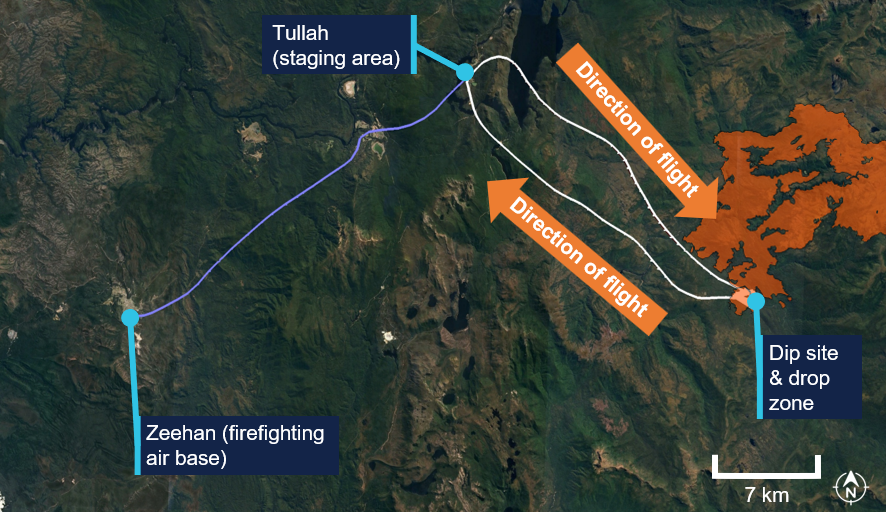
When reaching the designated dip site6 area, the pilot completed one fuel cycle, approximately 10 bucket loads, under relatively stable conditions. The pilot described the specific dip site they chose as a narrow section of the Murchison River, approximately 50–60 m wide, with tall trees lining the bank (see Dip site). The drop zone for these was located approximately 1 km west of the dip site.
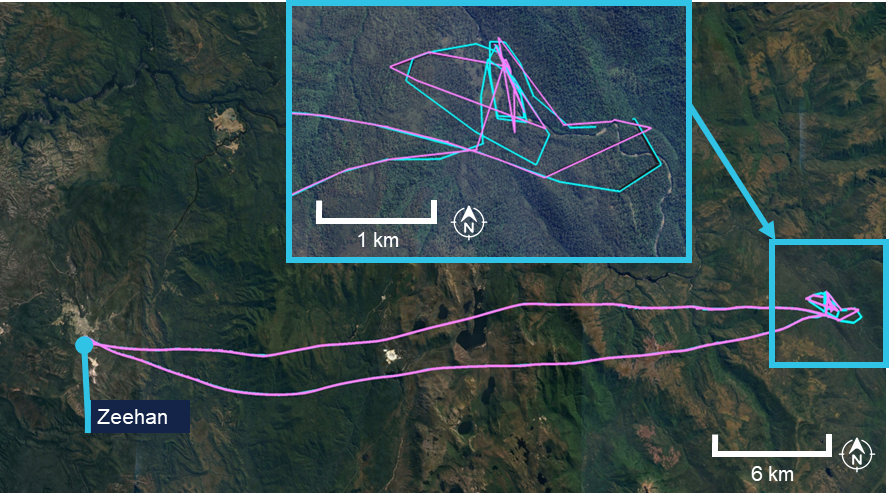
The pilot then returned to Tullah to pick up an air crew officer (ACO) at 1400 and continued onto the designated air base in Zeehan, which had a sports oval being used as a refuel base (Figure 1).
Figure 1: First fuel cycle and return to Tullah
Operations from Zeehan and occurrence
During the approach to Zeehan, the pilot noted a significant weather change, with winds shifting to a westerly direction at approximately 30 knots. The pilot reported they did not complete an additional, or update their original, FRAT to reflect this change in condition (see Flight risk analysis tool (FRAT)).
While on the ground, the ACO was dropped off and the helicopter was refuelled for the next cycle. At about 1440 the pilot departed Zeehan and returned to the Canning Peak fireground.
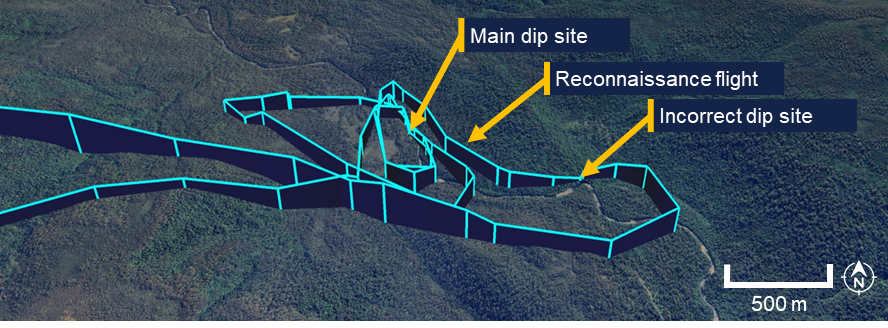
The pilot recalled that various dip sites along the river looked similar. As indicated by the flight data (Figure 2), the pilot initially conducted a descent into a different dip site, which they were not intending to use and had not used on the days prior, located further south along the river (see Dip site). The pilot recognised this and undertook reconnaissance to find the intended dip area. Once reaching the dip site, the pilot resumed bucketing operations, and 2 bucket loads and drops were conducted.
Figure 2: Second fuel cycle flight path
The pilot reported that, at about 1525, while filling the third bucket load, the helicopter was in a stable hover at about 150 ft above the dip site with the bucket submerged, when the helicopter unexpectedly sank. The pilot recalled it sinking approximately 50 ft. The pilot reported initially raising the collective before quickly realising the power available would not arrest the descent, then lowering the collective and applying forward cyclic to transition to forward flight and stabilise the helicopter, while aiming to avoid an over‑torque event.
During this manoeuvre, the pilot reported that they were unable to jettison the longline, which they attributed to pressing on the button’s ring guard instead of its centre, and the longline subsequently became taut. The helicopter came to an abrupt stop and the pilot heard a ‘loud clunking noise’. The pilot reported they recovered the helicopter to a stable hover at about 30 ft (initially reported to Coulson Aviation Australia as 10 ft) above the water when discussing the event with the ATSB. They recalled they initiated rearward flight to release the water and retrieve the bucket from the river. The pilot observed an engine torque split7 and once the bucket and longline were recovered they initiated a climb to clear the surrounding trees.
The pilot reported that once they had cleared the trees, the torque split then returned to even. They conducted a range of tests to assess controllability and engine performance, including minor adjustments to engine torque. The pilot noted that the tail rotor control pedals felt stiff, however they continued to provide adequate input for sufficient helicopter control.
The pilot contacted the AAS on the fire common traffic advisory frequency (FCTAF) stating they had a bucket issue and a flight control issue.
The pilot of FB732 (with the AAS on board) oriented the helicopter to view HT204. The AAS recalled HT204 gaining altitude and tracking away from the Murchison River, over the fire, heading on a bearing south‑west uphill and back to Zeehan. They noted the helicopter was ‘climbing slowly and appeared to be flying irregularly’ during this period. They reported they had not seen the occurrence as the dip site HT204 was using was beneath and behind the air attack helicopter.
The AAS contacted the pilot on the FCTAF. The pilot of HT204 reported issues with the helicopter pedals and when asked what their intention was, the pilot reported they were heading back to Zeehan. The AAS acknowledged this and reported they would follow HT204 back.
The pilot of HT204 reported they had assessed available landing options but elected to continue toward Zeehan rather than commit to an off-field landing. This decision was influenced by a previous experience where a potential landing site, assessed from approximately 500 ft, had appeared suitable but proved unsuitable upon reaching around 30 ft. The pilot considered that committing to a landing carried the risk of being unable to complete it safely.
The AAS and pilot of FB732 discussed possible landing options nearby. However, given the impaired controllability of HT204 and the smaller prepared landing areas on the fireground, they agreed the best action would be to return to Zeehan.
The pilot did not jettison the longline and bucket following the recovery, and the load remained attached to the helicopter for the remainder of the flight. The pilot reported that, at the time, they did not consider they needed to release the bucket as the helicopter remained controllable. The AAS also observed that the bucket remained attached as the helicopter departed the area and during the return flight toward Zeehan.
Return flight
The pilot reported continuing the flight toward Zeehan with a plan that, should the situation deteriorate further, they could divert to Strahan Airport as an alternative. During the return flight to Zeehan, the recorded groundspeed was between 65 and 70 kt8. This would reduce strain on the tail rotor by operating the helicopter at a lower power setting. Apart from the tail rotor control pedal stiffness, the pilot reported that there were no control difficulties. Pedal inputs were minimised to avoid exacerbating the condition.
The AAS described the helicopter’s flight en route to Zeehan as appearing abnormal. In addition to the notably reduced speed, the AAS stated, HT204 appeared to be yawing from side to side and maintained a lower height than would normally be expected. They reported that due to the pilot sounding stressed they did not contact the pilot further. The HT204 pilot reported the helicopter was in stable flight with no yawing en route to Zeehan.
The AAS recalled contacting the air base manager at Strahan and the air operations manager and advised them of an unknown mechanical malfunction with HT204. They reported that the pilot was still in control, and that they were following HT204 back to Zeehan.
The pilot of HT204 reported that about halfway back to Zeehan, they considered diverting to Strahan if the pedal stiffness worsened. However, as the situation remained unchanged, they continued towards Zeehan.
Landing at Zeehan
The pilot of FB732 made in inbound call for both helicopters on the Zeehan FCTAF. At about 1548, the pilot of HT204 conducted a shallow approach to set up a vertical descent to the oval in Zeehan with the bucket and longline attached. During the landing sequence, the ACO secured the bucket and longline and moved it away and forward of the landing zone. The pilot then released the line and allowed the helicopter to sink, using available power,9 which resulted in what they stated ‘appeared to be a satisfactory landing with minimal pedal input required’.
The AAS reported they thought it was strange the pilot had not jettisoned the bucket and longline on approach given the apparent control issues. They described the landing as slow and awkward noting ‘it looked obvious there were control issues.’
After landing, during the shutdown procedure, the pilot was unable to roll the engine throttles back to idle. While disconnecting the longline from the hook, the ACO observed significant damage to the helicopter’s fuselage structure aft of the external hook.
The AAS directed HT201 to fly to Zeehan, so its crew could debrief and support the pilot of HT204. The pilot of HT201 recalled that they landed and shut down their helicopter in Zeehan. They observed HT204 still running and the pilot underneath the helicopter assessing damage. They discussed the issue of not being able to roll the engines back and the pilot of HT201 suggested pulling the helicopter’s T-handles.10 The T-handles were then pulled to shut down the engines.
Examination of the helicopter identified damage to the engine control system, external cargo hook system, fuselage structure, and associated systems. The substantial damage identified is discussed in the Helicopter damage section.
Context
Pilot information
Qualifications and experience
The pilot held a Commercial Pilot Licence (Helicopter), with a single engine class rating for helicopters. They held type ratings for the Bell 212, 412 and 427. The pilot’s total aeronautical experience was over 3,000 hours of which 120.6 hours were on the Bell 412. In the previous 90 days the pilot had flown 50.3 hours, all on the Bell 412.
The pilot was qualified to conduct helicopter firefighting operations and had low‑level and sling operation ratings.
The pilot last completed an aerial application proficiency check, which included a low‑level helicopter flight review, on 11 November 2024, which was valid for 12 months.
Training
The pilot commenced employment with Coulson Aviation Australia in October 2024. As part of their initial training, the pilot completed a 2-week flight training course on the Bell 412 in the United States with FlightSafety International, which included approximately 18 hours of simulator training.
Following their return to Australia, the pilot completed camera training11 on 9 November and subsequently had an aerial application rating proficiency check (APC) conducted on 11 November. The APC was conducted in accordance with the requirements of the Civil Aviation Safety Regulations (CASR) Part 61 and was required to be completed every 12 months. The check was conducted in the context of company firefighting operations and included a type rating flight review, a low-level flight review, and a sling load line check applicable to firefighting bucket operations. The APC also satisfied the requirements of a flight crew operator proficiency check (OPC) for Coulson Aviation Australia.
The pilot reported that the sling load line check was conducted at Kemps Creek and involved completing approximately 4–5 bucket runs, including operations requiring avoidance of a powerline in the area. The pilot stated that the training did not include any scenario-based elements. They also reported that, following completion of the APC, they did not conduct any further bucketing operations until deployment to the fireground in March 2025, having only conducted surveillance and winching operations while working at Coulson Aviation Australia.
Medical information
The pilot held a valid Class 1 aviation medical certificate, valid to July 2025. The certificate specified that the pilot was to wear distance vision correction while flying, which was being worn on the occurrence flight.
Fatigue
The pilot arrived at the fireground on 5 March and commencing flying duties on 6 March. Between 6 and 9 March, the pilot recorded duty periods of approximately 12 hours per day, during which they flew between 5 and 7 hours daily. These duty and flight times were within the operator’s prescribed limits.
On the day of the accident, the pilot stated they awoke at about 0600 and began flight duties at approximately 0800. The pilot reported going to bed at around 2200 the previous evening and described it as a typical night’s sleep. The pilot reported feeling well rested when they woke the following morning. They indicated that the accommodation and meals provided were of a good standard.
The pilot reported taking a break at about 1400, during which they consumed food, and stated that they remained well hydrated throughout the day, with a drink available in the cockpit. While the pilot did not consider themselves fatigued, they noted they did not feel as fresh as they would immediately after waking. The pilot also reported that they did not feel the need to take an additional break, and described their level of mental fatigue as ‘very lively, responsive but not at peak’ on the Samn-Perelli 7 level fatigue scale.
Helicopter information
General information
The Bell Helicopter Company 412EP is a medium‑lift12 utility helicopter commonly used for firefighting, search and rescue and transport operations. The helicopter had a 4-blade main rotor and 2‑blade tail rotor and was powered by 2 Pratt & Whitney PT6T-3DF turboshaft engines. The helicopter was manufactured in Canada in 2004 and first registered in Australia in 2020. The helicopter was owned by NSW Rural Fire Service (RFS) and operated by Coulson Aviation Australia.
VH-VJF had accumulated about 4,819 flight hours total time in service and had a current certificate of airworthiness and registration. The helicopter’s technical log indicated no outstanding defects at the time of the accident.
The helicopter’s multi-role configuration enabled it to be utilised in a range of aerial firefighting tasks, including intelligence, surveillance, and reconnaissance (ISR), winching operations and firebombing using either a belly tank or external bucket system (Figure 3).
Figure 3: NSW RFS Bell 412EP VH-VJF
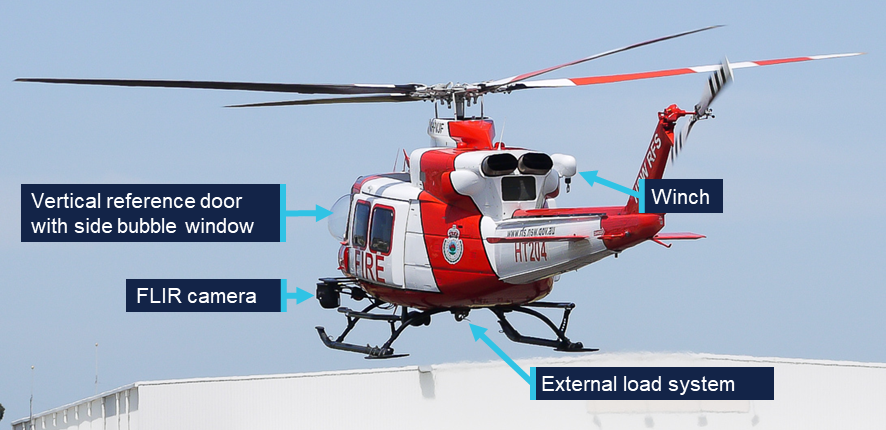
On the day of the accident, the helicopter was configured for firebombing operations and was fitted with an external load system, a vertical reference door, and a 150‑ft longline attached to a collapsible Bambi bucket (see Bucket and longline). In addition to these items, the helicopter also had a forward looking infrared (FLIR) camera mounted on the left side of the helicopter above the skids.
External load system
VH-VJF was equipped with an Onboard Systems International cargo hook suspension system (Figure 4). The system attached to an existing Bell hard point and hung below the centre of gravity. The hook extended through an opening in the lower fuselage. A protective rubber ring was fitted around the edge of this opening to reduce the risk of damage if the hook contacted the opening during operation.
Figure 4: Onboard Systems International cargo hook suspension system for the Bell 412
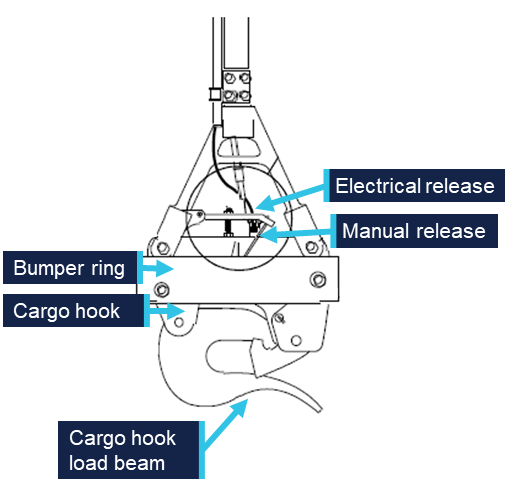
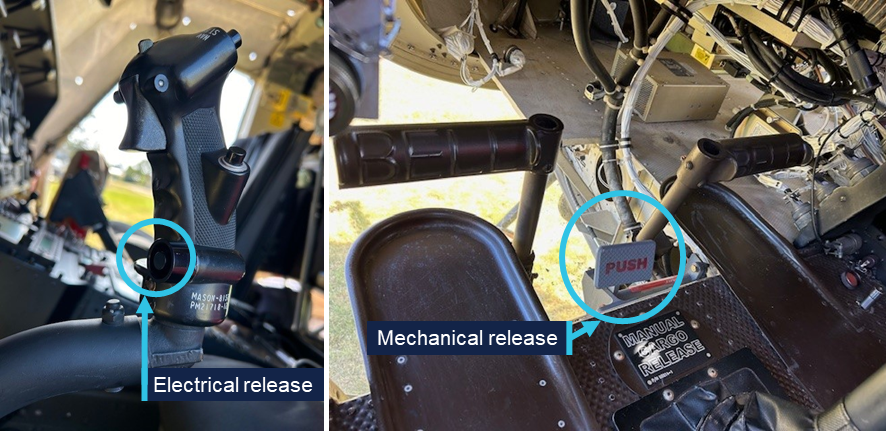
The release of the hook could be initiated electrically or mechanically. Normal release was completed by pilot actuation of a push button on the side of the cyclic (Figure 5, left). The button was recessed and guarded by a small ring to prevent inadvertent activation. When this button is pressed the latch of the cargo hook is opened.
In addition to the electrical release, in an emergency a mechanical release could be completed by pushing a small pedal located between the 2 tail rotor pedals at the pilot’s feet (Figure 5, right). This activated a manual release cable attached to the cargo hook.
Figure 5: Electrical and mechanical external load release systems
The cargo hook suspension system was required to be inspected annually or after 100 hours of external load operations, whichever came first. The system was last inspected on 20 February 2025 and was deemed to be a serviceable condition.
The cargo hook manual required pilots to test the electrical and manual release system prior to conducting flights for the day. The pilot recalled testing both the electrical and mechanical release the morning of the accident, and both systems were in working order.
The pilot recalled that when landing at Zeehan after the accident, the electrical release was used to drop the longline and bucket without issue. Coulson Aviation Australia reported that both the electrical and mechanical releases of the hook were tested following the accident. Both were reported as serviceable.
Vertical reference door
The Bell 412EP helicopters were usually flown from the right‑hand seat. This configuration is used when pilots are conducting either winching or ISR operations. During bucketing operations, pilots operated the helicopter from the left‑hand seat. VH‑VJF was modified with a vertical reference door in accordance with a Transwest vertical reference door supplemental type certificate. This included a bubble window, viewing slot, and instruments and warning lights installed in the door to provide visibility and instrumentation for operations from the left‑hand seat (Figure 6).
Figure 6: Instruments and warning lights installed in the vertical reference door
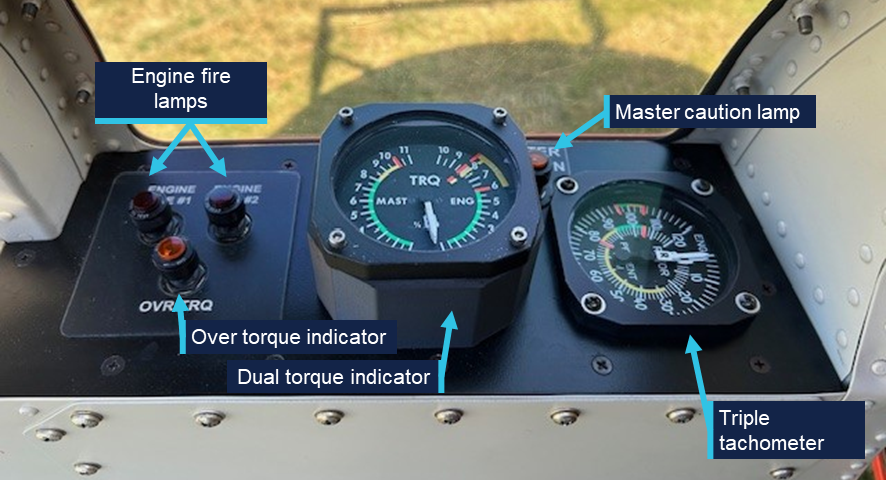
In addition to the instruments and warning lights, the type certificate required the installation of several systems to be placed on the left side of the helicopter. This included:
- a force trim switch, cargo release switch and automatic flight control system (AFCS) release switch mounted on the left cyclic
- the torque meter and tachometer from the left instrument panel moved to the vertical reference door
- an additional mechanical cargo release pedal between the left side pedals.
During the occurrence flight and other firebombing operations, the pilot was operating the helicopter from the left‑hand seat, utilising the left cyclic and referencing the flight instruments through the vertical reference door. While conducting the water collection, the torque indicator was visible through the bubble window and could be monitored during the lift.
Bucket and longline
The bucket was a Bambi Max bucket with a nominal capacity of 240 US gallons (910 L). The empty weight of the bucket was 137 lb (62 kg) and the maximum gross weight was 2,140 lbs (970 kg).
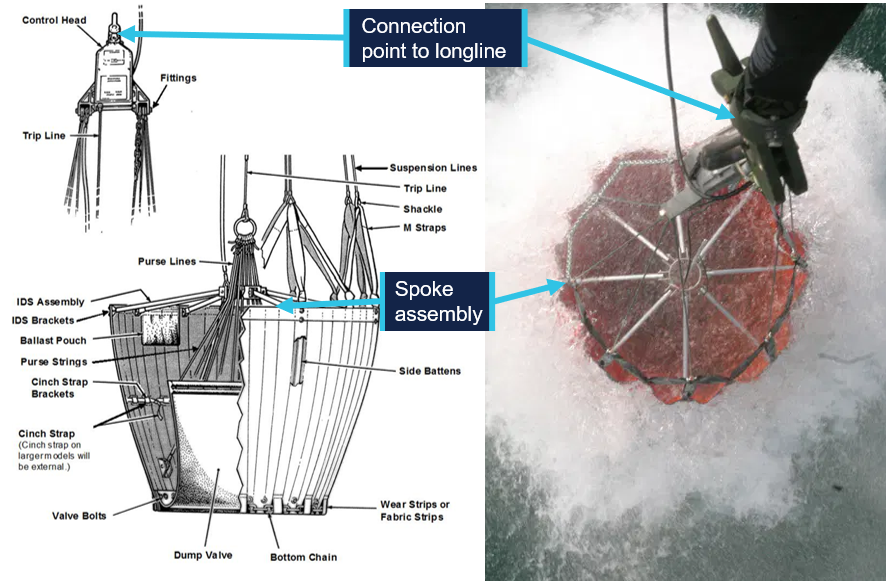
The bucket spoke system consisted of a series of radial support lines (spokes) that connected the upper attachment point of the bucket to the bucket body. The spoke system provided structural support, maintained the bucket shape during flight, and distributed the loads associated with lifting and manoeuvring the bucket. The spoke assembly was connected to the helicopter via the longline, which attaches to the bucket’s upper fitting (Figure 7).
Figure 7: Bambi bucket spoke assembly and longline attachment
The bucket and longline were attached to the external load system via a bow shackle (Figure 8, left). The collapsable bucket was equipped with multiple drop valves to allow pilots to split water loads into multiple drops (Figure 8, right), and the bucket also had the capability to shed the load rapidly.
Figure 8: Longline attachment and Bambi Max bucket split release system
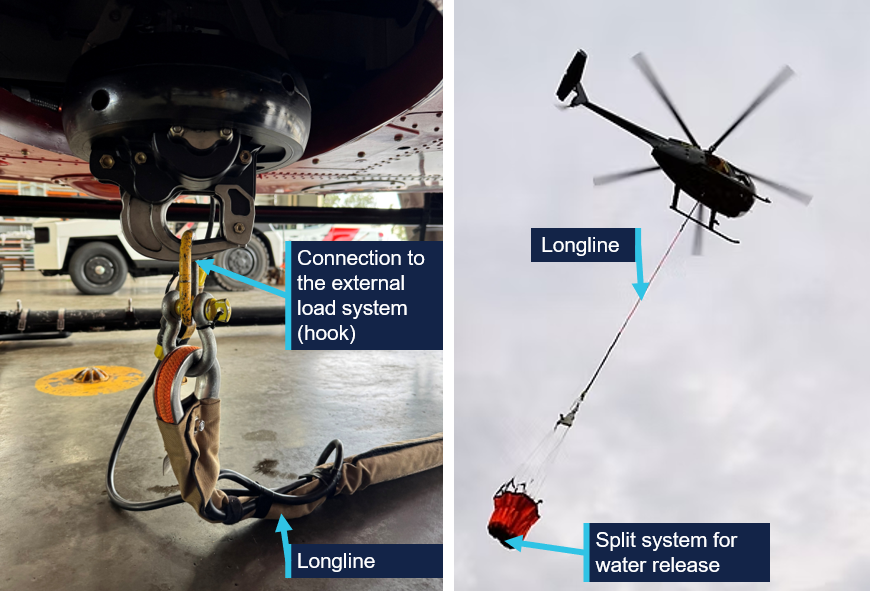
The longline was constructed from high-strength synthetic fibre rope selected for its high tensile strength, low stretch characteristics, light weight, and resistance to heat and abrasion. The line incorporated an electrical cable along the line to control bucket release.
Forward looking infrared (FLIR) camera
FLIR cameras are used on aerial firefighting aircraft to provide thermal imaging of firegrounds, enabling crews to detect heat sources through smoke, darkness, or challenging terrain. This capability allows operators to identify fire hotspots, monitor fire spread, and support decision-making for resource deployment and suppression strategies.
On VH-VJF, the FLIR camera was mounted on the left side, just above the skids. Coulson Aviation Australia stated that although the cameras could be removed, they would generally be kept on the helicopters throughout all operations, enabling crews to be quickly re-tasked for ISR missions. As described in the next section, some pilots indicated to the ATSB that the camera could partially obscure visibility during bucketing.
Visibility
The ATSB interviewed 7 pilots with experience conducting longline bucketing operations on the Bell 412s at Coulson Aviation Australia, including the occurrence pilot. Five of those pilots reported that the field of view from the cockpit during these operations was poor, with visibility of the suspended load restricted at times. When leaning out of the cockpit to look down along the longline, their view was impeded by both the flight step and, where fitted, the FLIR camera. This visibility issue was noted as recently relevant by one pilot who had operated on the Canning Peak fireground in the week prior to the occurrence, who reported taking a steeper approach into the dip site on that occasion.
Coulson Aviation Australia’s internal investigation also recorded that multiple flight crew identified the presence of the flight step and FLIR camera during external load operations as a safety concern, as these features could obstruct the pilot’s line of sight to the bucket. Coulson Aviation Australia advised that these concerns had not been previously reported by pilots through the occurrence reporting system or otherwise formally raised through the internal SMS. Similarly, impeded visibility had not been identified or elevated by pilots through the FRAT.
The flight step protruded into the downward field of view, while the FLIR camera extended externally by approximately 50 cm, obstructing the pilot’s downward line of sight from the left seat (Figure 9). This was most pronounced during the approach, when the bucket trailed behind the aircraft and moved underneath as speed reduced, limiting the ability to visually acquire the load. Pilots described the need to adopt modified seating or head positions to maintain sight of the bucket. In addition, pilots reported that flight step length varied based on which aircraft was being flown (see Bell 412 Fleet).
Figure 9: Field of view with both the long flight step (left) and short flight step (right), looking down from the left seat from inside the bubble window
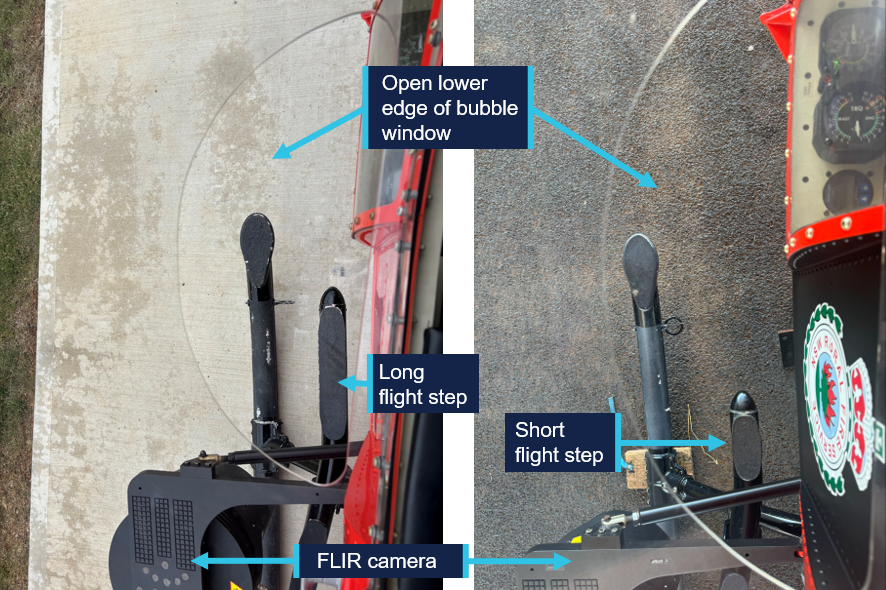
Pilots emphasised that visual contact with the load was important for assessing height, position, and obstacle clearance. They reported that while radar altitude and altimeter indications were used as supplementary references, they did not provide the same level of situational awareness as direct visual observation of the load. Consequently, any degradation or loss of visual cues increased the difficulty of accurately judging the load’s position and clearance from obstacles.
The flight step and FLIR camera configurations were approved and certified through regulatory mechanisms. Coulson Aviation Australia advised there was no limitation or restriction contained within the applicable aircraft flight manual supplement that prohibited or restricted external load operations as a consequence of the downward visibility obstruction associated with these approved configurations.
Helicopter damage
The ATSB did not examine the helicopter or equipment. Coulson Aviation Australia conducted an examination of the helicopter the morning after the occurrence. The following damage was identified:
- The #1 (left) engine control tube had sheared at the lower tube end bell crank, resulting in a complete loss of pilot input to the engine.
- The #2 (right) engine control tube bell crank attachment bracket had detached from the helicopter structure’s securing rib, restricting pilot control of the engine.
- The tail rotor control rod on the right side of the external hook’s bell crank airframe attachment had broken away, with the primary structure also separated.
- The main transmission oil cooler pressure line exhibited significant contact damage, however, no splits or leaks were identified.
- The fuel tank interconnect braided hoses sustained minor contact damage.
- Multiple aft fuselage drain lines were damaged.
Images of the helicopter indicated that the structural fuselage honeycomb aluminium skin, adjacent to and aft of the external hook, was deformed and had separated from the primary structure (Figure 10).
Figure 10: Helicopter aluminium skin damage
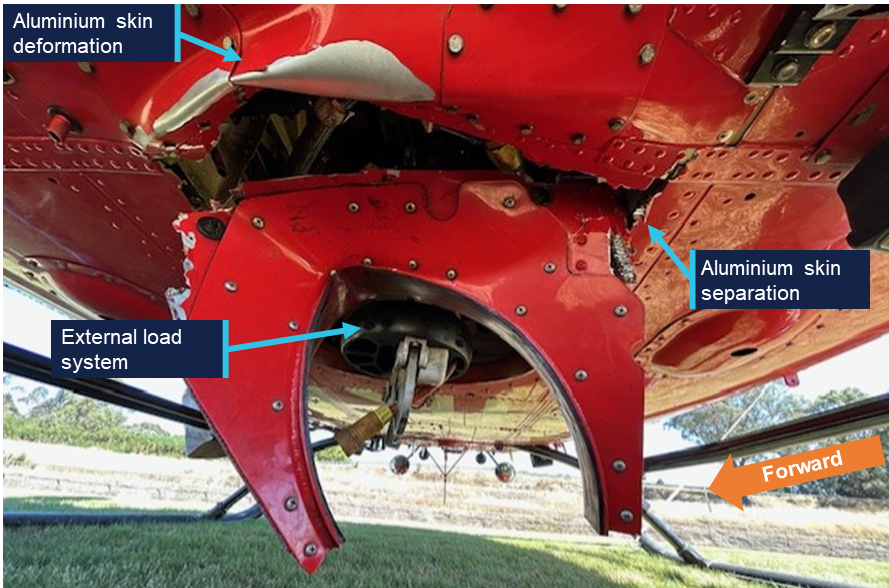
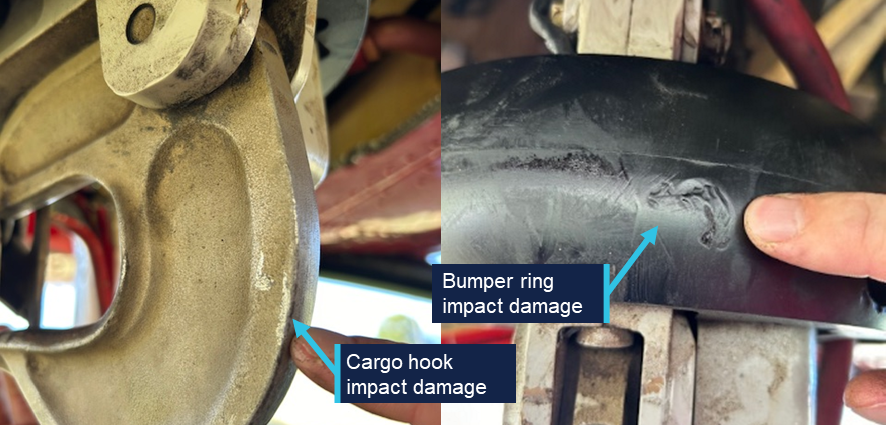
Images revealed indications consistent with contact between the longline and the rear cross tubes of the helicopter. In addition, inspection of the cargo hook and associated bumper stop components identified signs of impact damage (Figure 11).
Figure 11: External load system damage
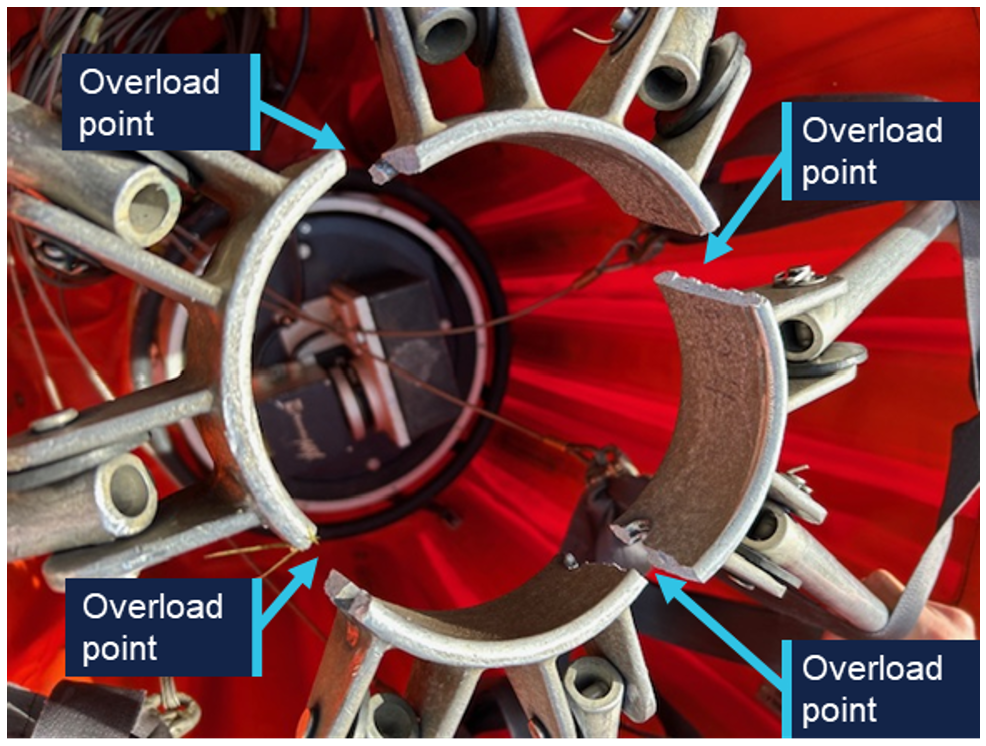
In addition, the ring in the middle of the Bambi bucket spoke assembly was fractured in 4 places (Figure 12).
Figure 12: Damage to bucket spoke assembly
Multiple instances of what was reported as cable ‘bruising’ and stretching were reported to have been observed on the bucket cable wiring and attachment eye ends.
Weather information
At the time of the helicopter’s departure from Strahan Airport, the meteorological aerodrome report (METAR)13 reported wind west‑north-west at 6 kt, visibility greater than 10 km and no cloud cover.
The Tasmania Fire Service (TFS) incident action plan indicated that weather on the Canning Peak fire would change from north-westerly to west-south‑westerly by mid‑afternoon with winds reaching 10 kt by the afternoon (Table 1).
Table 1: Canning Peak fire forecast
| Local time | Temperature (C⁰) | Dew point (C⁰) | Wind direction | Wind Speed (kt) | Wind gust (kt) |
| 0800 | 14 | 12 | N | 5 | 8 |
| 0900 | 17 | 13 | NNW | 8 | 10 |
| 1000 | 19 | 14 | NW | 8 | 14 |
| 1100 | 22 | 14 | WNW | 8 | 14 |
| 1200 | 23 | 14 | W | 10 | 16 |
| 1300 | 25 | 14 | W | 10 | 16 |
| 1400 | 26 | 13 | WSW | 10 | 16 |
| 1500 | 26 | 13 | WSW | 8 | 14 |
| 1600 | 26 | 13 | WSW | 8 | 10 |
The air attack supervisor (AAS) reported that on the day of the accident the wind was calm, there was no turbulence and ‘great’ visibility. A change in wind direction was noted from mid-morning, changing from northerly to south-westerly, however this was expected based on the forecast. They recalled the area in which the aircraft were working in was protected from south‑westerly winds due to the topography. They reported no feedback from pilots regarding the weather or any other environmental conditions on the day.
The pilot of HT201 reported there were blue skies and fairly light winds on the day of the accident. They recalled that although they were not bucketing on this day, during previous bucketing operations in the same valley, the wind conditions were variable and the wind would shift ‘back and forth’.
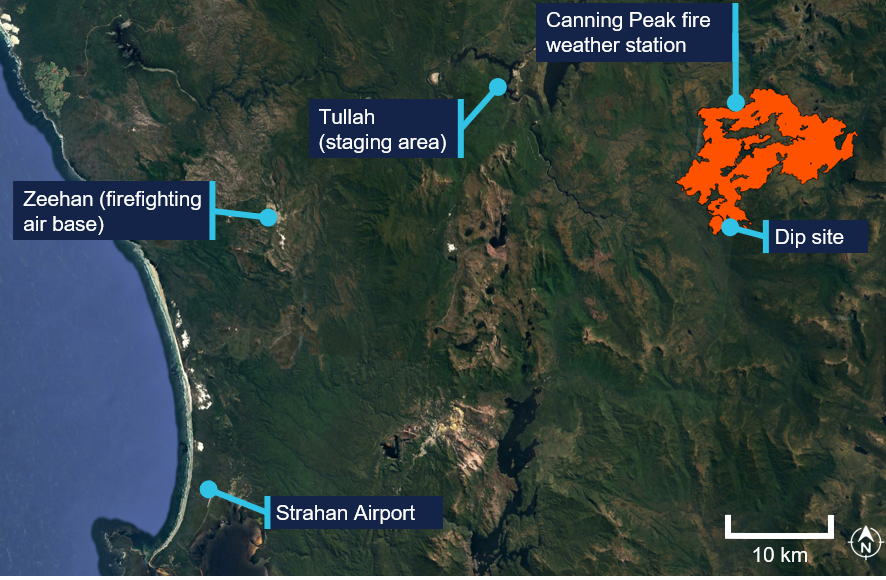
The Canning Peak fire weather station atop Mt Inglis, approximately 15 km north of the operating area (Figure 13), recorded south‑south-westerly winds at 5.7 kt gusting to 11.4 kt at the time of the accident.
Figure 13: Canning Peak fire weather station location to dip site
Fireground information
The West Coast fire complex originated from 24 individual ignitions sparked by dry lightning strikes on 3 February 2025, across Tasmania’s remote western and north‑western regions. These separate fires were grouped into a single complex for coordinated management due to their proximity, shared weather influences, and overlapping spread patterns.
There were 4 primary firegrounds that accounted for the majority of the burnt area, including the Canning Peak fireground. Each represented a distinct sector with unique terrain, vegetation types, and behavioural characteristics. These firegrounds collectively contributed to the complex’s total footprint of nearly 95,000 hectares.
The Canning Peak fireground was located in an elevated and vegetated zone close to the Cradle Mountain area. This sector featured rugged alpine-influenced terrain that complicated direct ground access, leading to heavy reliance on aerial suppression tactics.
Dip site
The AAS, who was part of the interagency operation (see Tasmania Fire Service), selected and allocated dip areas based on the area of the fireground being worked on the day. Where practicable, more open or isolated dip and drop sites were selected by the AAS to provide pilots with greater circuit flexibility and to reduce operational complexity.
The pilot reported that while the general location for a dip site was provided by TFS prior to commencing operations on the fireground, the selection of the specific section of river within that area was at their discretion. The pilot advised that they chose their dip site location on the river as it was relatively wider than other areas and they had used this section as a dip site on the days preceding the accident.
HT204’s dip site was approximately 700 m from the next nearest dip area being used by other helicopters.14 The dip site was approximately 1 km south‑east of the drop zone, along the Murchison River. Google Earth images indicate the river width at the dip site was approximately 20 m (Figure 14).
Figure 14: HT204 dip site location and allocated dip area on Murchison River
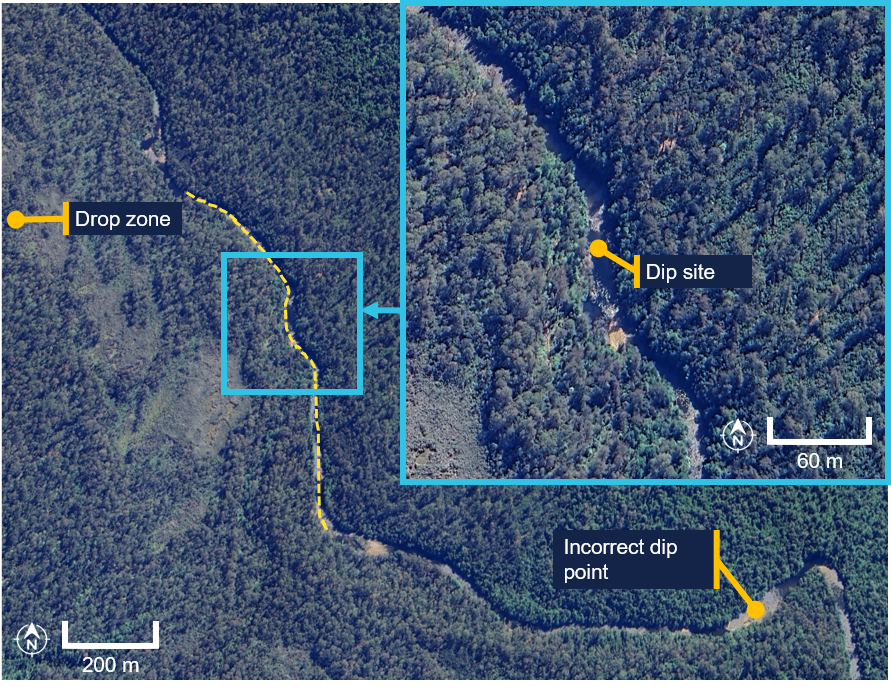
The pilot described the dip site as a narrow section of river, with tall trees lining the bank and estimated the available operating area to be approximately 50–60m wide. They reported that there were limited locations deep enough to operate the bucket, which constrained where they could dip.
The river contained very little water at the time, allowing clear visibility to the riverbed. The pilot stated that they could not recall whether any tree branches or rocks were present in the riverbed during the operation. Despite the presence of tall trees, the pilot indicated that the area was accessible to the helicopter and considered it one of the better dip sites along the river. They also noted that the turnaround time from the dip site to the fireground was approximately one minute.
The AAS described the dip site used by HT204 as a section of river with trees approximately 30–60 m tall on either side. They recalled that the pilot was the only one using the dip area and the only helicopter in the circuit. In previous weeks, when different crews had flown the same helicopter on similar missions, no pilots had reported any problems with the dip area. Based on the dips that the AAS pilot observed, the occurrence pilot appeared to be performing them safely and adequately.
Recorded data
Data sources
Multiple independent data sources, including TracPlus satellite-based tracking logs, FlightAware Automatic Dependent Surveillance – Broadcast (ADS-B) derived positions, and OzRunways electronic flight bag recordings, were cross‑referenced and correlated to reconstruct the helicopter’s flights throughout the day and to approximate the entry and exit angles into and out of the bucketing site.
The helicopter was fitted with a TracPlus surveillance system, which provided real-time tracking through a satellite or mobile phone network. It reported position, altitude, and speed at set time periods, in this case every 15 seconds.
The OzRunways application recorded the helicopter’s position at regular intervals of approximately 5 seconds throughout the day, capturing parameters including latitude, longitude, groundspeed, track, and truncated altitude (in 100 ft increments) where connectivity permitted. However, no position data was recorded during the bucketing operations. This absence of recorded data was likely attributable to the helicopter operating at very low levels, down to around 150 ft above ground level, while conducting repeated drops in mountainous terrain.
The FlightAware flight tracking data captured the helicopter’s en route flight to the bucketing site, as well as the subsequent low-level manoeuvres involving repeated water dips and drops. Position reports were recorded at irregular intervals ranging between approximately 8–40 seconds15 during these operations.
In addition to the TracPlus data, FlightAware was incorporated into the data analysis. The differing sampling rates and coverage characteristics of the 2 systems together produced a more complete reconstruction of the helicopter’s flight circuit during the second fuel cycle (Figure 15).
Figure 15: Second fuel cycle data from TracPlus and FlightAware
Dip data analysis
A comparison was conducted between the first and second fuel cycles to examine how the aircraft was flown during approaches to the dip site. Data from the first fuel cycle indicated that, on all approaches, the pilot maintained a descent profile not exceeding a rate of 200 ft/min when entering the dip site.
In contrast, data from the second fuel cycle showed variation between individual dips. During the first 2 dips of that cycle, the aircraft descended at rates between approximately 210 and 290 ft/min. However, on the third dip (the accident dip), the recorded descent rate exceeded 400 ft/min and at about 4 kt forward airspeed.
The third dip also exhibited a shallow run-in to the dip site, followed by a steep approach into the site itself. The pilot reported that the shallow run‑in was the result of a longer approach, following a previous drop conducted to the west on an upslope, which necessitated a wider circuit to lose altitude prior to the subsequent approach. The pilot stated that they came in on a shallower approach on this occasion and did not believe the entry into the dip site was any steeper than on the previous dips during that cycle.
Based on the analysis of the flight data, the ATSB estimated that approximately 8–10 seconds elapsed between the onset of the uncommanded descent and the pilot’s corrective input being applied. This period likely included the time taken to detect the uncommanded descent, interpret the helicopter’s state, determine an appropriate recovery action, physically input the control response, and the helicopter to respond.
Vortex ring state and settling with power
In helicopter operations, the terms vortex ring state (VRS) and settling with power (SWP, also known as settling with insufficient power) are sometimes used interchangeably. While the 2 conditions can produce superficially similar symptoms to the pilot, they represent fundamentally different physical scenarios. VRS is an aerodynamic condition in which the rotor system operates within its own recirculating wake. Settling with power, by contrast, is a performance limitation in which the power required to reverse the rate of descent exceeds the power available from the engine(s).
Vortex ring state (VRS)
VRS is an aerodynamic phenomenon that occurs when a helicopter is descending at low forward airspeed (typically less than 30 kt) while simultaneously experiencing a high rate of descent (typically more than 300–500 ft/min) with power applied. As the helicopter descends into its own downwash, tip vortices grow into a circulating pattern around the rotor (Figure 16) (Wagtendonk 1996). This leads to a loss of lift and an increasing, uncommand rate of descent.
Figure 16: Established vortex ring state
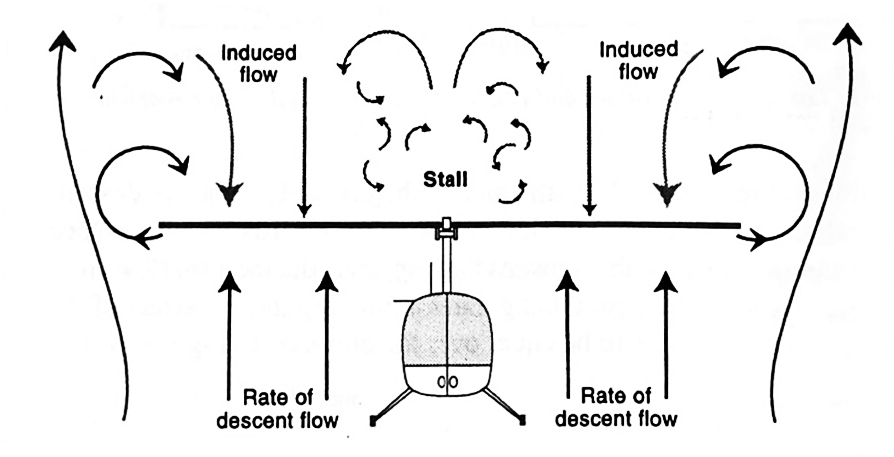
The susceptibility to VRS is commonly represented using an airspeed–rate of descent diagram, which depicts a region of low forward airspeed and increasing descent rate where entry into VRS becomes more likely. This region, often referred to as the VRS avoidance region, illustrates that the condition is governed by the combined effects of low translational airflow16 and increasing induced flow through the rotor disc.
The boundaries of this region vary with helicopter type, rotor system design, gross weight, and atmospheric conditions. Manufacturer flight manuals and training guidance emphasise that maintaining either adequate forward airspeed or limiting the rate of descent reduces the likelihood of entering this condition.
The recovery from VRS as described in the US Federal Aviation Administration (FAA) Helicopter Flying Handbook (2019) involves increasing airspeed and/or reducing collective to fly out of the disturbed airflow. An alternative recovery technique, commonly referred to as the Vuichard recovery, uses lateral cyclic input combined with increased power and lateral anti-torque thrust to arrest the rate of descent and translate the helicopter laterally out of VRS (FAA, 2019) Unlike the traditional method, the Vuichard recovery focuses on rapidly stopping the rate of descent rather than exiting the vortex.
Settling with power
Settling with power (SWP) is a performance condition, not an airflow recirculation issue. It occurs when the power required to arrest a descent or maintain altitude/hover exceeds the power available from the helicopter’s engine(s). Prevention centres on strict adherence to performance charts, conservative weight and altitude planning, and maintaining a margin above hover power requirements.
The power margin available to a pilot is influenced by factors including density altitude, aircraft weight, and engine performance relative to its rated output. A reduction in available power, whether due to environmental conditions, aircraft loading, or a shortfall in engine performance, reduces the margin available before the power required exceeds the power available, increasing susceptibility to SWP.
Assuming the helicopter's engines were performing in accordance with published data, ATSB analysis indicated that the helicopter was operating significantly below its published hover out of ground effect (HOGE) ceiling of 8,200 ft under otherwise similar conditions. This indicates an additional power margin would likely have been available before reaching the torque limit. However, this analysis could not account for variables that were not recorded, including engine power setting, rotor RPM, and the actual rate of descent and airspeed at the point of onset. As such, it was not possible to estimate the helicopter's effective thrust margin, and therefore its proximity to a settling with power condition, at the time of the occurrence.
Recovering from settling with power is aided by using forward cyclic to accelerate to a best rate of climb speed17 which improves the efficiency of the rotor system and reduces the total power required to fly. If there is sufficient available height above terrain, the rate of descent can be arrested or reversed.
Reporting of the occurrence
After the HT204 pilot returned to base, the AAS sought further clarification from the pilot regarding the occurrence and the condition of the aircraft. The pilot and the crew of HT201 advised that the helicopter had sustained minor damage and that an engineer would attend to inspect the helicopter. Based on this information, the AAS formed the view that the damage was not substantial and that the helicopter would likely be unavailable for a short period while repairs were undertaken.
The AAS also reported being unaware of the circumstances surrounding the occurrence, including the drop in altitude while attempting to collect water, beyond this initial advice. Subsequently, the AAS did not report the incident.
On the day of the accident, Coulson Aviation Australia advised the NSW RFS of the occurrence, and the NSW RFS in turn advised the TFS District Officer for Air Operations (DOAO), indicating that representatives from the NSW RFS and Coulson Aviation Australia would attend the helicopter the following day to assess the damage and determine whether repairs could be conducted at the airbase. As Coulson Aviation Australia had not advised the DOAO of the extent of the damage, they assumed the helicopter would be unavailable for a few days while repairs were undertaken.
On 10 March, Coulson Aviation Australia provided an initial notification to the ATSB with further details of the occurrence being provided on 14 March.
Following notification that the ATSB would be investigating the accident, TFS made multiple attempts to obtain a report from Coulson Aviation Australia regarding the status and condition of the aircraft, having not previously been advised by Coulson Aviation Australia around the damage and the full extent of the occurrence. The DOAO reported that, in response to those requests, Coulson Aviation Australia advised on multiple occasions that a report would be provided. Coulson Aviation Australia submitted a written report to the TFS detailing the damage to the helicopter approximately 5 weeks after the accident.
Coulson Aviation Australia reported that, immediately following the occurrence, they notified the AAS and the airbase manager that the aircraft had been removed from service. At the time of the initial notification, the full extent and nature of the damage had not been established. Accordingly, they considered that any further information regarding the damage would have been speculative until a detailed maintenance assessment had been completed. Coulson Aviation Australia therefore advised that its approach was to communicate the information confirmed at the time and provide additional information as it became available.
In addition, Coulson Aviation Australia advised that it provided the NSW RFS with a preliminary occurrence report within 3 days of the incident, documenting the information available following the initial assessment. The same report was subsequently provided to the TFS following NSW RFS review and approval, which was completed approximately 5 weeks after the occurrence.
The TFS DOAO reported to the ATSB that, had the extent of damage and the full circumstances of the occurrence been known at the time, TFS would have initiated an internal investigation to determine the contributing factors and whether any changes were required to the conduct of operations on that fireground, as well as to provide insight to inform future operations on other firegrounds.
Tasmania Fire Service
The response to the 2025 Canning Peak fire was led by the Tasmania Fire Service (TFS) in partnership with the Tasmania Parks and Wildlife Service (PWS). The TFS, as the state’s primary combat agency for bushfires, was responsible for incident control, fire suppression, and coordination of resources across the emergency response. The PWS provided specialist support in managing fires within reserved land, contributing detailed knowledge of terrain, environmental values, and remote-area firefighting capability, including the provision of air attack supervisors.
Use of interstate assets
On 13 February 2025, the TFS requested the deployment of 2 helicopters equipped with winch capability to support remote area firefighting team (RAFT) operations from the NSW Rural Fire Service (RFS). The request formed part of broader aerial support arrangements during the ongoing fire response.
The TFS advised that, under normal arrangements, requests for interstate firefighting aircraft are coordinated through the National Aerial Firefighting Centre (NAFC). However, when sourcing aircraft from New South Wales, requests were communicated directly to air operations personnel.
In addition to the initial tasking for RAFT operations, the TFS reported that there were verbal communications indicating that the 2 helicopters may also be utilised for water‑bucketing activities.
The air attack supervisor reported that during the course of the fire suppression operations, one of the NSW RFS Bell 412 helicopters was routinely retained in a winch configuration and maintained on standby, and the other in a bucketing configuration. This arrangement reduced the need for reconfiguration between operational roles during active fireground operations.
Incident reporting procedures (Tasmanian Fire Service)
The TFS standard operating procedures (SOPs) described the process for communicating operational information from personnel on the fireground to the incident management team. The processes for incident reporting are summarised in Figure 17. The SOPs indicated that information relevant to an incident would be initially communicated to the AAS operating over the fireground and then relayed by the AAS to either the air operations manager (AOM) or operations officer, and subsequently to the incident controller (IC). However, there was no documented guidance specifying how information was to be communicated from the pilot to the AAS, including whether it was to be provided verbally or supported by written reporting.
Figure 17: Summary of Tasmanian Fire Service incident reporting requirements
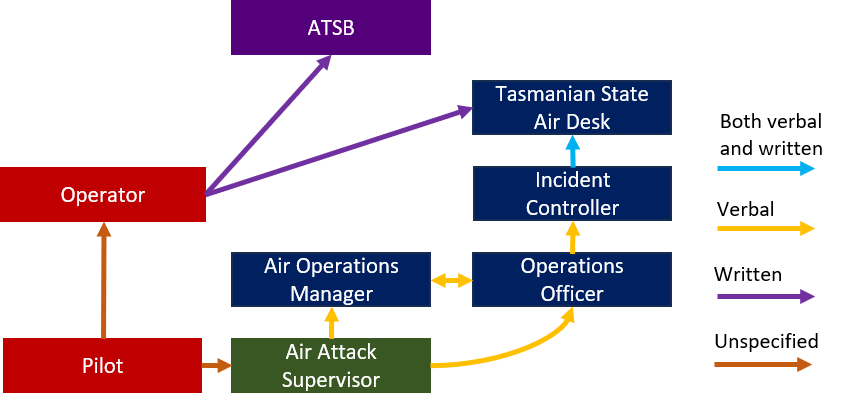
The TFS SOPs for the reporting of incidents required that any member involved in, or becoming aware of, such an event, report it to the IC as soon as practicable. The IC was then required to notify the state air desk officer (SADO). The SOPs also required ICs and aircraft operators to submit written reports to the SADO, and outlined the minimum information to be included. The SOPs did not specify a timeframe for the submission of written reports.
Coulson Aviation Australia
Coulson Aviation is a Canadian-based aerial firefighting operator with an Australian arm known as Coulson Aviation Australia, which held a long-term contract with the NSW RFS to support bushfire response across New South Wales. In 2024, the company was awarded a 10-year contract to continue its role after already managing much of the RFS aviation fleet for the previous 5 years. Under this agreement, Coulson Aviation Australia was responsible for the management, operation, and maintenance of the entire RFS aerial firefighting fleet, including large air tankers, helicopters, and intelligence aircraft.
Bell 412 fleet
The Bell 412EP fleet consisted of 6 helicopters which had been individually acquired by NSW RFS from multiple providers globally and were each configured differently. The Coulson Aviation Australia rotary wing head of operations (RW HOO) advised that, as Coulson Aviation Australia did not own the helicopters, any configuration changes required NSW RFS approval. While a standardised fleet was preferred, a formal standardisation proposal had not been presented to NSW RFS prior to the occurrence. The RW HOO stated that they considered budgetary constraints would limit the extent to which fleet standardisation could be achieved.
General helicopter configuration
Differences across the fleet, included:
- 4 of the 6 aircraft being fitted with a longer flight step
- cockpit layouts
- non-standardised GPS units (Coulson Aviation Australia advised that efforts were underway to align these systems)
- external load system release mechanisms
- location of the water release button, which varied between the cyclic, collective, or both, depending on the aircraft.
Coulson Aviation Australia advised that these differences introduced operational risk, however mitigation strategies had been implemented including discussions with NSW RFS to identify aircraft specific differences and assess their operational implications. It further reported that, following other incidents, it was in the process of developing formal differences training for pilots and compiling a detailed differences list for NSW RFS to support increased standardisation.
Asset allocation and configuration for missions
Coulson Aviation Australia stated that all 6 helicopters were considered multi-role aircraft. These aircraft could be configured to undertake ISR, winching, and aerial firefighting operations, including both belly tank and external bucket configurations. They stated that when tasked, aircraft were expected to be capable of performing all available mission types, reflecting their multi-role design and intended operational flexibility.
The allocation of helicopters to tasking locations was determined by NSW RFS and was primarily influenced by proximity to the fireground. Coulson Aviation Australia responds to the tasking issued by the NSW RFS and provides the aircraft assigned to that task in accordance with the operational request. This included the responsibility of the configuration of the aircraft at the time, including whether the FLIR camera system was fitted when ISR capability was required. Coulson Aviation Australia reported that not all aircraft were consistently equipped with cameras, with at least one camera typically undergoing maintenance. As a result, one aircraft was generally unavailable for ISR tasking at any given time.
All 7 pilots interviewed indicated that they were not assigned to a single, fixed task when deployed. Instead, they understood there was a high likelihood of being re-tasked depending on operational requirements. Coulson Aviation Australia further noted that aircraft could be reassigned between taskings without returning to base, reinforcing the expectation that aircraft should remain capable of performing multiple roles throughout a deployment.
Within New South Wales
Within New South Wales, all helicopter taskings were coordinated through the NSW RFS State Air Desk. As the aircraft were owned by the NSW RFS, the State Air Desk was able to allocate them rapidly to firegrounds as required.
The NSW RFS advised that taskings were issued to Coulson Aviation Australia via a dispatch form, which included details of the location and the operational capabilities required. This was supported by verbal coordination between the NSW RFS and Coulson Aviation Australia to ensure that an appropriately configured aircraft, along with a suitable crew, was assigned to meet the operational requirements.
Interstate
When aircraft were requested by other jurisdictions, the requesting state engaged directly with the NSW RFS State Air Desk. The NSW RFS reported that requesting agencies provided detailed tasking information, including:
- required aircraft capabilities (such as winch capability)
- a point of contact
- intended area of operations
- expected deployment duration
- task specialist personnel requirements
- logistical support arrangements such as accommodation and fuel.
Using this information, the NSW RFS generated a booking with dispatch information provided to Coulson Aviation Australia including:
- movement authority
- aircraft registration and call sign
- required configuration
- assigned task specialists
- deployment period
- operational location
- jurisdictional point of contact
- expected operational tasks
- logistical arrangements.
The NSW RFS noted that detailed operational briefings for aircrew were typically provided by the requesting agency upon arrival at the deployment location.
The RW HOO stated that, consistent with operations within New South Wales, aircraft deployed interstate were expected to retain full multi-role capability, even where the requesting jurisdiction had specified only particular mission types. They further advised that they generally contacted the requesting jurisdiction to obtain additional information about the tasking. During these discussions, the requesting jurisdiction would sometimes request additional aircraft capability to support the operation.
When asked about the removal of the FLIR camera system prior to interstate deployment if ISR wasn’t required, the RW HOO indicated that it was not preferred, as the understanding was that contractually the aircraft were required to remain fully capable of multi-role operations. For removal during interstate deployments, an engineer18 was required to carry out the task. They also noted that the cameras were fragile and that repeated removal and installation could increase the risk of damage. In addition, the associated transport cases were large and would need to be transported interstate.
Coulson Aviation Australia advised that prior to the occurrence, there was an understanding within the organisation that the NSW RFS contractual requirement for full multi-role capability meant that role equipment, such as the FLIR system, was required to remain fitted to the helicopter for all operations. However, the contract required role‑specific equipment to be readily available and capable of being fitted when required, rather than continuously installed.
Tasmania Fire Service request
The TFS originally made a capability request for 2 winch-equipped aircraft for the Tasmanian fire situation from the NSW RFS State Air Desk. This requirement was specified on the booking form provided by the NSW RFS to Coulson Aviation Australia and recorded within the NAFC booking system. The RW HOO reported that Coulson Aviation Australia was aware of the TFS requirement for both winching and bucketing capability, based on prior discussions with TFS personnel.
Pilot training
Overview
Coulson Aviation Australia introduced a cohort of new pilots to the Bell 412 through initial type training conducted at FlightSafety International facilities in the United States. This training was delivered entirely in a full-flight simulator and included pre-flight procedures, take-off and departure profiles, flight manoeuvres, approaches and landings, as well as normal, abnormal and emergency procedures. Emergency procedure training included VRS recognition and recovery techniques.
Following completion of simulator-based training, pilots returned to Australia to undertake further training with Coulson Aviation Australia. On return, pilots were required to complete an aerial application proficiency check (APC), which encompassed company firefighting operations and satisfied the requirements for an operator proficiency check (OPC) for Coulson Aviation Australia. It also satisfied the requirements for both a low‑level flight review and a type rating flight review. The APC was required to be completed at 12‑month intervals. While the APC could include a sling load line check, the sling check was only conducted when a firefighting bucket was being used.
In addition to the APC, Coulson Aviation Australia conducted an OPC. The rotary wing training and checking manual stated:
This OPC is used to assess a pilot conducting a typical company operation that is not covered by a proficiency check and may also be used for the purposes of remedial training.
The OPC was both type‑ and operation‑specific and was intended to ensure competency across the operator’s range of specialised tasks.
Coulson Aviation Australia maintained 8 operation-specific OPC profiles comprising:
- winching (water and land)
- sling operations
- belly tank operations
- intelligence, surveillance and reconnaissance (ISR)
- aerial ignition
- night vision imaging system (NVIS) firebombing
- NVIS aerial ignition
- NVIS winching.
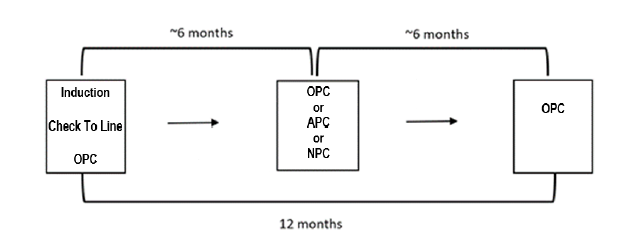
The training and checking manual listed 3 different intervals for the OPC:
The check is type and operation specific and conducted every 24 months where needed for each operation type…
On induction and 12 monthly thereafter or 6 months after APC where required.
A diagram provided the intervals in Figure 18.
Figure 18: OPC intervals
Source: Coulson Aviation Australia
The recurrent proficiency check requirements of the Part 138 MOS and the Part 61 of CASR APC currency requirements required operators conduct an OPC on induction, and at 6‑monthly intervals thereafter. It allowed the initial and recurrent OPC to be conducted on the same flight as the APC or as a stand-alone check.
During the Coulson Aviation Australia’s internal investigation, it was identified that while feedback on the overall structure and quality of the training system was positive, there were deficiencies in onboarding and transitional training processes. In particular, although the accident pilot had completed an APC that included a bucketing proficiency component, they had not received formal internal ground or practical training specific to external sling bucket operations. Additionally, pilots had not been assessed in a simulated operational fire suppression environment, instead conducting basic exercises such as water collection from an unobstructed source.
Maintenance of proficiency
Coulson Aviation Australia reported that bucketing was a perishable skill requiring regular practice to maintain proficiency. It reported that pilots had limited exposure to these activities, as the majority of conducted operations were ISR missions. The operator assessed that the reduced frequency of hands-on tasking was likely to degrade pilot proficiency in these roles and increase operational risk.
Several pilots individually interviewed by the ATSB reported that the location used for initial bucketing training did not adequately replicate the operational environments typically encountered during firefighting operations. Of the 7 pilots interviewed, 5 indicated that they had limited exposure to bucketing following their initial training, with some reporting between 10 and 30 hours of bucket operations across at least 2 years of employment. These pilots attributed this to a greater proportion of ISR and winching tasks being allocated internally, while bucketing operations were more commonly conducted by other operators. As a result, pilots noted that significant time gaps between initial training and operational deployment in firefighting environments reduced their familiarity with bucketing operations in the Bell 412 and required a period of re‑adaptation when deployed to conduct that task.
Flight risk analysis tool (FRAT)
Regulatory requirements
The Civil Aviation Safety Authority (CASA) Part 138 Manual of Standards (MOS) specified that a risk assessment must consider, at a minimum:
- the nature of the operation and its specific characteristics
- the location and its particular characteristics
- the aircraft to be used, including its characteristics and performance
- the qualifications and experience of crew members
- and any external hazards likely to be encountered during the operation.
Coulson Aviation Australia requirements
Coulson Aviation Australia utilised a flight risk analysis tool (FRAT) to document and track operational risk exposure associated with individual flights and events. These assessments were completed by flight crew and captured within the safety management system (SMS).
In a response to the draft ATSB report, Coulson Aviation Australia reported that the FRAT was expected to be used as a structured pre-flight risk assessment and that it is the pilot’s responsibility for continuous dynamic risk assessment throughout a flight. A change in wind conditions, for example, would require a pilot to reassess the suitability of continuing the operation against aircraft limitations, operational requirements and their individual safety thresholds, rather than completing a new FRAT in‑flight. Where conditions exceed an acceptable threshold for continued operations, Coulson Aviation Australia stated that the expected response is to reject, discontinue or modify the task, with a task rejection recorded where further operations cannot be safely conducted.
Coulson Aviation Australia SMS required pilots to complete a FRAT prior to the first flight of the day. The SMS further required the FRAT to be re-evaluated if a maintenance or weather-related event resulted in the stoppage of operations. If the assessment was no longer considered relevant, a new assessment or an update to the existing assessment was to be completed prior to resuming operations.
The FRATs were completed online and stored in a database. The SMS also stated that the safety manager and head of flying operations (HOFO) would regularly review the risk assessment program through the safety committee.
To support implementation, Coulson Aviation Australia provided induction training to flight crew, maintenance personnel, and safety staff. This training introduced the FRAT program, including its purpose, intended outcomes, and practical application.
Coulson Aviation Australia had a FRAT which was specific to the Bell 412. The FRAT comprised multiple sections, including:
- mission type
- mission planning
- flight crew
- weather
- aircraft airworthiness and equipment
- operating environment
- airspace.
Each section contained a series of predefined risk factors which contributed to the overall risk score.
Selectable options within the FRAT
Coulson Aviation Australia’s FRATs covered the broad categories required by regulation, as described above.
The mission type section listed a range of operational activities that flight crew could conduct, including:
- night visual flight rules (NVFR)
- remote area firefighting team (RAFT)
- fire mission/external load
- intelligence, surveillance, and reconnaissance (ISR)
- search and rescue (SAR)
- state emergency service (SES) flood operations
- winch operations
- maintenance
- NSW RFS training
- Coulson Aviation Australia training.
Pilots were able to select multiple mission types within a single FRAT. However, the FRAT did not provide a breakdown of the specific hazards or risk components associated with each individual mission type. Instead, each mission type was assigned a predefined risk score.
Pilots could select certain hazards such as low-level operations and limited landing options, and were prompted to evaluate aircraft serviceability. The FRAT did not incorporate detailed consideration of aircraft configuration or other specific aircraft characteristics relevant to different mission types, and did not contain specific assessment items relating to rotor clearance from obstacles or hazards associated with water sources used during aerial firefighting operations.
Pilot’s FRAT on the day of the occurrence
The pilot completed a FRAT prior to the first flight of the day, resulting in a score of 16. The pilot did not include relevant operating environment risk factors associated with low‑level operations, mountainous terrain, or limited landing options.
The pilot reported that the assessment was based on the initial flight to Tullah, which involved operations over relatively flat terrain. The pilot also indicated there was a possibility that tasking may occur at a different fireground closer to the coast. They noted that the FRAT should have been updated once it became clear that operations would occur at the Canning Peak fireground and later when they had observed changes in the weather conditions at Zeehan.
In relation to the omitted factors, the pilot reported there was no clear guidance on when to select categories such as mountainous terrain or limited landing options, and that these were considered subjective. The pilot stated that low-level operations would normally be selected for activities such as winching or bucketing and acknowledged this omission was an oversight given the potential for those operations. The pilot also considered that, due to the helicopter’s capability, landing was generally possible in most areas, influencing the decision not to select limited landing options.
Inclusion of the omitted operating environment factors would have increased the risk score to 22 (see Scoring below).
FRAT usage by pilots
ATSB interviews with 7 Coulson Aviation Australia pilots indicated variability in how risk assessments were completed and applied. All pilots reported completing a FRAT prior to the first flight of the day. However, they differed in how the FRATs were used during operations, including:
- whether to complete separate FRATs for different mission types, or combining all anticipated missions into a single FRAT
- whether to complete additional FRATs when tasking changes during the day, or when tasked to a different fireground
- when to select low-level operations
- when to select mountainous terrain
- when to select limited landing options.
For example, some pilots reported selecting the low-level operations option only for specific tasks such as aerial firefighting (including bucketing) or winching activities, where operations were routinely conducted close to the ground. In contrast, other pilots indicated that they selected the low-level option for all flights, irrespective of the planned altitude profile. These pilots reported that they used this approach to account for the possibility of tasking changes during a flight, which may require operations to be conducted at low level, and therefore ensured they were already covered within the risk assessment. Some pilots also reported uncertainty regarding when the low-level category should be applied, noting that there was no clearly defined height threshold or operational criteria to distinguish low-level flight from other operations.
Coulson Aviation Australia reported being unaware of pilots experiencing uncertainty or inconsistency in interpreting elements of the FRAT. It further stated that, as the FRAT had been developed based on prior operational experience, it was expected that pilots would have a common understanding of the terminology and intent, and that the elements would not be subject to misinterpretation.
Scoring
The FRAT allowed the assessment of risk elements through a scoring system. Two thresholds were established: a warning threshold and a critical threshold.
The warning threshold was defined on the FRAT as a score above 22. In these cases, pilots had the opportunity to apply mitigations to individual risk elements in order to reduce the overall score. Following the introduction of a mitigation, pilots were able to determine and assign a revised score for the affected element. The SMS indicated that, in circumstances where elevated risk existed above the warning threshold, the safety manager was to be informed, and approval required for the flight to proceed without additional mitigation controls.
The critical threshold was defined on the FRAT as a score above 30. The form stated that flights exceeding this threshold were not authorised to proceed and required the pilot to contact the HOFO for further advice. In contrast, the SMS indicated that for high-risk scenarios, the safety manager and the relevant Director of Flight Operations (fixed or rotary wing) were to be notified, and approval required for the flight to proceed.
The rotary-wing Director of Flight Operations advised that when a FRAT exceeded this threshold, they would generally be notified and would discuss the assessment with the pilot. These discussions typically focused on identifying the elements contributing to the elevated risk score, whether the level of risk was acceptable, and whether additional mitigations could be applied to reduce the risk.
The FRAT assigned predefined risk scores to a number of operational elements, including mission types. Several pilots reported that the relative risk ratings assigned to certain mission types appeared inconsistent. In particular, some activities were perceived as having comparatively low risk scores despite their inherent operational complexity.
Four of the 7 pilots interviewed by the ATSB reported having recorded risk scores above 22, most commonly associated with NVFR operations. While most reported applying mitigations in these cases, one pilot indicated a preference to treat elevated scores as a ‘no-go’ decision point. Pilots reported that they had received minimal training regarding appropriate mitigation strategies for specific risk elements. Two of the 4 pilots advised that their selection of mitigations was primarily based on their prior operational experience and their judgement of what could reasonably be mitigated in the circumstances.
Coulson Aviation Australia reported that, through ongoing monitoring of FRAT submissions, relatively few risk assessments were noted as exceeding the threshold score of 22, and this number was lower than expected given the nature of the operations being conducted.
Monitoring of FRATs
Coulson Aviation Australia reported that risk assessment data was captured within a centralised system, which provided visibility of submissions from both Australian and United States based pilots.19 This data was reviewed during monthly safety committee meetings, where the operator tracked the number of completed assessments, as well as those assessed as elevated or requiring mitigation. It advised that, in practice, many pilots appeared to use the risk assessment as a ‘go/no-go’ checklist.
The occurrence pilot had not completed a risk assessment for the 3 days prior to the occurrence. Coulson Aviation Australia stated that, although it expected all pilots to complete a FRAT, there was no mechanism in place to reliably determine whether a pilot had not completed a FRAT prior to commencing operations. It further advised that it was not practicable to review every individual risk assessment for accuracy due to the large volume of FRATs being completed daily.
FRAT development and design
Coulson Aviation Australia’s SMS described a structured approach to risk management based on the development and use of both operational core risk profiles and mission‑specific risk profiles. These profiles were intended to be developed and applied across all departments, including maintenance, fixed-wing, rotary-wing, and business management. The SMS stated that these core and mission risk profiles for flight and maintenance operations would provide the primary inputs into FRATs.
The SMS further outlined that safety information obtained through audits, reports, and inspections was to be captured, assessed and reviewed to determine whether it identified a new hazard, a change in the existing risk context, or a degradation in the effectiveness of existing safety controls. Where applicable, this process was to result in updates to the relevant risk assessments.
Coulson Aviation Australia advised that, while the FRAT was intended to be based on mission-specific risk profiles, these mission risk profiles had not been developed. As such, the existing FRAT was developed based on operational experience.
Review and update of FRATs
The SMS described a structured approach to the continuous improvement of risk assessments through a 4-step feedback loop. Initially, core risk profiles were developed to capture baseline operational hazards. These were then supplemented by mission‑specific risk profiles, tailored to the particular characteristics of individual taskings. Together, these profiles informed the development of operational FRATs completed by flight crews.
Completed FRATs were reviewed monthly by the safety team to identify trends and recurring hazards, which would then inform updates to the process and tools.
At the time of the accident, the operator had not yet developed core risk profiles or mission-specific risk profiles as described within the SMS. The safety manager reported that updates to the risk assessment forms had been made based on insights derived from the monthly reviews. The ATSB pilot interviews indicated that changes to risk assessments did occur, however these updates were not routinely communicated to flight crew. Instead, pilots reported becoming aware of modifications only when completing a new assessment.
Incident reporting procedures (Coulson)
Coulson Aviation Australia’s occurrence reporting framework was documented within both the operations manual and the SMS, which together outlined the requirements for reporting incidents and accidents during operations.
The rotary-wing operations manual specified that the pilot in command was required to verbally report an incident to the operator within 48 hours. In addition, pilots were required to submit a report through the Coulson Aviation Australia’s internal reporting system (PRISM), which was linked to the SMS. The manual also detailed the minimum information required to be included in these reports, supporting a standardised approach to internal occurrence documentation.
Once an occurrence was reported, the HOFO was responsible for assessing the severity and operational implications. Where necessary, the HOFO was to notify relevant management personnel within Coulson Aviation Australia and coordinate the collation and dissemination of relevant information.
The SMS further outlined requirements for external and statutory reporting, including notifications to the ATSB and CASA. It also stated that, where required, reports would be provided to a ‘client’ by the relevant contract manager. However, the SMS did not define the term ‘client’, nor clarify the circumstances under which such reporting would be required. Under the arrangements for this operation with TFS, no contract manager was appointed.
Neither the operations manual nor the SMS provided guidance on the process or timeframe for disseminating occurrence information to authorities responsible for fireground operations or air attack coordination.
Consistent with the documented procedures, all pilots interviewed by the ATSB indicated that they would report occurrences to Coulson Aviation Australia. However, 2 pilots expressed uncertainty regarding the formal reporting process for fireground incidents, with one indicating that a verbal report to Coulson Aviation Australia may be considered sufficient. All pilots reported that, in the event of an incident on a fireground, they would also advise the AAS.
Pilots consistently indicated an understanding that, once an occurrence had been reported to Coulson Aviation Australia, responsibility for further dissemination rested with Coulson Aviation Australia. This included the assumption that Coulson Aviation Australia would notify any relevant authorities overseeing fireground operations. As a result, pilots did not consider that any additional direct reporting to those authorities was required.
Related occurrences
Collision with water involving a Sikorsky S-64E Skycrane helicopter, N173AC Near Jericho, Victoria, on 28 January 2019 (AO-2019-008)
On 28 January 2019, the crew of a Sikorsky S-64E Skycrane helicopter was conducting firebombing activities when it collided with water at Woods Creek Dam, Victoria. The collision occurred following an approach to the dam to fill an external tank with water. The helicopter was crewed by 2 pilots, and a maintenance crew chief was also on board. Following the collision, all the occupants were able to exit the helicopter and swim to shore. One crewmember was seriously injured and 2 were uninjured. The helicopter was substantially damaged.
The ATSB found that the helicopter was placed in a steep flare, which contributed to the helicopter entering vortex ring state when on approach to the dam.
Loss of control in flight involving Leonardo Helicopters AW139 helicopter, VH-YHF, near Adelaide River mouth, 38 km ENE of Darwin, NT, on 13 May 2018 (AO-2018-039)
At 2000 Central Standard Time on 13 May 2018, the crew of a Leonardo Helicopters AW139, registered VH-YHF, departed Darwin, Northern Territory, to search for an active emergency position-indicating radio beacon (EPIRB). The crew flew under night visual flight rules with support of a night vision imaging system.
During an approach to a potential EPIRB target, smoke from nearby bushfires affected visibility and the helicopter developed an uncommanded high rate of descent. During the recovery procedure, the power demand exceeded airframe limitations. This exceedance went undetected, and the helicopter was flown on a second sortie that same evening.
Safety analysis
Introduction
While conducting longline bucketing operations at a dip site on the Murchison River, the helicopter experienced an uncommanded descent from a hover with the bucket submerged. During the pilot's attempted recovery, the longline contacted the airframe, resulting in substantial damage to the fuselage and flight control systems. The pilot subsequently returned the helicopter to Zeehan and landed without further incident.
This analysis firstly considers the aerodynamic conditions that led to the uncommanded descent, the influence of aircraft configuration on the pilot's approach technique and visibility of the external load, and the resulting damage to the helicopter during the recovery. It also discusses the pilot's decision-making during the return to Zeehan.
The analysis then discusses several other safety factors identified during the investigation related to pilot recency, Coulson Aviation Australia’s flight risk analysis tool, and the reporting of the occurrence. These factors either contributed to the accident, or increased aviation safety risk more generally.
Uncommanded descent
Potential for downdraft
The recorded and forecast weather conditions were mild with winds that were not consistent with those typically associated with strong, localised downdrafts. While the pilot reported stronger winds at Zeehan, there was no evidence to indicate that these conditions extended to the dip area, and the local wind variability observed on previous days was also mild. A downdraft was therefore unlikely to have contributed to the uncommanded descent.
Vortex ring state and settling with power
Aside from a downdraft and in the absence of evidence of an engine or powertrain malfunction, an uncommanded descent could only be attributable to either vortex ring state (VRS) or settling with power (SWP).
During the accident dip, the helicopter was flown with a lower forward airspeed and higher rate of descent than on previous approaches during the second fuel cycle, approaching the dip site with about 4 kt forward airspeed with a rate of descent exceeding 400 ft/min. This combination of low forward airspeed and high rate of descent in a confined operating environment is consistent with a reduction in rotor efficiency associated with either VRS or SWP. Both conditions require the helicopter to be maintaining a descent, not a stable hover, with low forward airspeed and power applied.
This is inconsistent with the pilot's recollection of the helicopter being in a stable hover at about 150 ft before the uncommanded descent began. Although the pilot did not believe the entry into the dip site was any steeper than on the previous dips that cycle, the flight data indicated the third dip involved a steeper approach profile and a descent rate exceeding 400 ft/min, compared with 210–290 ft/min on the 2 preceding dips. This data indicated the helicopter had not been fully established in a hover while entering the dip site, rather continuing to descend. The data was considered sufficiently reliable to inform an understanding of the occurrence, although some details could not be determined with certainty.
It is likely that the pilot's attention was directed toward the bucket during this period. Additionally, the pilot recalled sinking approximately 50 ft before recovering to a stable hover at about 30 ft above the water, having initially reported the recovery height to Coulson Aviation Australia as 10 ft. Measured against the pilot’s reported hover height of 150 ft, this would instead indicate an altitude loss of approximately 120 ft.
While the pilot did not report airframe vibration typically associated with developed VRS, this does not rule out entry into an incipient VRS condition, and SWP can present with a high rate of descent and reduced climb performance without significant vibration cues. Additionally, it was not possible to determine the helicopter’s position within the VRS envelope at the time, as the available data did not allow reconstruction of the combined descent rate, airspeed, and rotor flow conditions required to establish whether the helicopter was within, approaching, or outside the VRS region. The ATSB’s analysis of the likely power available, which was well above that needed to hover out of ground effect (HOGE) or arrest a descent at the occurrence location, suggests that SWP alone may not fully account for the descent. However, as this calculation did not account for several relevant unrecorded variables, including engine power setting, rotor RPM, and the actual rate of descent and airspeed at the point of onset, it was not possible to rule out SWP as a factor.
Overall, the recorded environmental conditions did not support the presence of a downdraft of sufficient strength to account for the descent. Instead, the combination of low forward airspeed, high rate of descent and a confined operating environment could have resulted in a reduction in rotor efficiency and the subsequent uncommanded descent. While available information suggests a power margin may have existed at the time, the absence of recorded engine and rotor parameters means this cannot be confirmed. It is therefore likely the helicopter was operating in conditions conducive to either incipient VRS or settling with power, or a combination of both, at the time of the occurrence.
Contributing factor The pilot conducted a steep approach at a low forward airspeed and high rate of descent, which likely resulted in the helicopter entering an incipient vortex ring state (VRS) and/or settling with power and entering an uncommanded descent. |
Aircraft configuration and its influence on external load operations
VH-VJF was fitted with a FLIR camera and an extended flight step during the occurrence flight, and pilot reports indicated that visibility of the suspended load during external load operations, including bucketing, was often degraded by this type of configuration. In particular, the extended flight step was reported to impede the pilot's downward line of sight, most pronounced during the approach to a dip site as the bucket trailed beneath and behind the helicopter at reduced airspeed, making visual acquisition more difficult. The FLIR camera, which extended approximately 50 cm externally from the helicopter, could similarly obstruct the pilot's view of the bucket as well as their peripheral view of the surrounding area.
Coulson Aviation Australia’s internal investigation had also identified the presence of the extended flight step as a safety concern during external load operations due to its potential to obstruct the pilot’s line of sight. Consistent with this, some pilots reported modifying their approach profiles into dip sites, including adopting steeper approaches, to maintain visual contact with the bucket for longer.
A steeper approach profile reduces translational lift and can result in the helicopter operating at low airspeed with high power applied. If accompanied by a high descent rate, these conditions are conducive to the development of settling with power or VRS as previously mentioned. In the context of this occurrence, it is likely that the pilot’s ability to effectively monitor the bucket was degraded by the restricted field of view from the longer flight step increasing workload.
Research has shown that increased workload can alter helicopter pilots’ visual scanning behaviour and attention allocation (Cheng and others, 2024), while sustained visual tracking tasks can result in attentional tunnelling, whereby attention becomes concentrated on the tracked object at the expense of other information sources (Van der Burg and others, 2024). In this occurrence, the restricted view of the bucket caused by the flight step and camera likely required the pilot to concentrate visual attention on tracking the bucket, at the expense of other cues. Peripheral vision is used to sense self‑motion and rate of change, including a helicopter's rate of descent. With the FLIR camera obstructing the pilot's peripheral view, this cue would have been further degraded. Collectively, these factors would have reduced the pilot's capacity to detect an excessive or uncommanded descent in a timely manner.
Accordingly, the configuration of the helicopter, specifically the routine fitment of external cameras and, in some cases, extended flight steps, adversely affected pilot visibility during bucketing operations. These modifications not only impeded direct observation of the external load but also influenced pilot technique, including the adoption of steeper approaches into dip sites. It could not be established whether the pilot’s (likely unintentional) steeper approach was made for this reason. In combination, the reduced visibility, increased cognitive workload, and attentional demands associated with visually tracking the bucket likely created conditions that were more conducive to the development of settling with power or VRS and reduced the pilot’s ability to recognise and respond to an increasing rate of descent.
This visibility limitation was not isolated to the occurrence helicopter. The NSW Rural Fire Service (RFS) B412 fleet had been sourced from multiple providers globally and there was variability in aircraft configuration across the fleet, including differences in cockpit layouts, avionics fitment, and external load systems. These included 4 of the 6 helicopters being fitted with an extended flight step, and some aircraft fitted with a FLIR camera. The visibility issue identified in this occurrence therefore reflected a condition present across several helicopters in the fleet.
Further, as the helicopters were not owned by Coulson Aviation Australia, any configuration changes required NSW RFS approval, limiting the extent to which standardisation could be achieved.
Contributing factor NSW Rural Fire Service helicopters operated by Coulson Aviation Australia were routinely configured with external cameras and some had an elongated flight step. During bucketing operations, this impeded the pilot's view and resulted in pilots adopting a steeper approach into a dip site, which increased the helicopter’s susceptibility to settling with power or vortex ring state. (Safety issue) |
Damage to helicopter
The uncommanded descent gave the pilot a very limited window, likely around 8–10 seconds based on the recorded flight data, to recognise the developing situation and initiate corrective action, increasing time pressure and workload.
Recovery techniques for both settling with power and VRS generally differ in emphasis, with settling with power recovery typically involving a reduction in collective to reduce induced flow through the rotor system, followed by the establishment of forward airspeed, while VRS recovery similarly relies on breaking the vortex ring by reducing collective and regaining translational airflow through forward cyclic input before re‑establishing climb power.
In this occurrence, the pilot lowered the collective and forward cyclic in an attempt to accelerate and reduce the power required by the helicopter to regain control. This is consistent with the constraints the pilot was operating under. The rapidly developing nature of the event, the low height above ground level, and the confined dip site of approximately 20 m width (about 1.4 rotor widths) meant the pilot had little margin to respond to the emergency.
When the pilot attempted to activate the electrical cargo release, the load did not jettison, consistent with degraded fine motor control under time pressure (CASA, 2021) resulting in contact with the button's ring guard rather than the button itself. Use of the mechanical release was not a reasonable alternative, as it would have required removing a foot from the tail rotor pedals at low height and in proximity to terrain and obstacles. The requirement to maintain directional control, removing feet from the pedals would have increased the risk of further loss of control.
As the descent continued, the drag associated with the submerged bucket with the continuing forward airspeed would have increased rapidly, acting as an anchor and resisting further forward or upward vertical movement of the helicopter, consistent with the abrupt deceleration reported by the pilot.As the helicopter attempted to move forward while the bucket remained restrained by the water, the longline would have been displaced aft relative to the helicopter.
Under these conditions, the longline contacted the underside and aft fuselage structure of the helicopter, resulting in contact marks on the rear cross tubes and impact damage on the cargo hook and associated bumper stop components. Continued loading of the longline against the airframe may also have resulted in the deformation and separation of the honeycomb aluminium fuselage skin adjacent to and aft of the external cargo hook installation.
Following this, the pilot was able to arrest the descent and stabilise the helicopter in a low hover approximately 10–30 ft above the water. The pilot then released the water from the bucket and subsequently conducted a climb-out. While this sequence does not reflect a textbook application of VRS or SWP recovery profiles (which is to maintain forward speed), it is consistent with an adaptive recovery strategy in a highly constrained low-altitude external load environment. In such conditions, full execution of ideal recovery steps is often not achievable due to limited height, restricted airspace, and rapidly changing aircraft energy state.
Contributing factor While focused on the recovery, in the compressed time available, the pilot attempted to, but did not successfully, jettison the bucket and longline. The resulting load on the longline led to contact with the helicopter and damage to the airframe and flight control systems. |
Return to base
Following the recovery from the uncommanded descent, the pilot climbed the helicopter clear of the surrounding terrain. At that stage, the pilot was faced with a torque split and abnormal primary flight control responses (stiffness in the tail rotor pedals), and advised the air attack supervisor (AAS) of a flight control issue. The longline and bucket remained attached but would have lifted clear of the water and emptied.
Having regained control of the helicopter, the pilot assessed that retaining the external load did not present an immediate hazard. The extent of the damage sustained during the longline contact would not have been immediately apparent to the pilot, and the decision not to jettison the load was made in the context of the information available to the pilot at the time. Given the confined terrain and limited suitable landing areas nearby, the pilot decided to return to base rather than conduct a forced landing.
However, the subsequent abnormal primary flight control responses suggested the helicopter had sustained potentially significant mechanical or structural damage, and the pilot could not reasonably have known the nature, extent, or implications of that damage. In these circumstances, removing the longline and bucket would have reduced aircraft loading and operational complexity while flying over terrain unsuitable for a forced landing, thereby improving overall safety margins for the return flight. While the pilot’s decision aligned with their assessment of the situation at the time, continuing the flight with the external load increased exposure to the possibility of any further deterioration of the existing structural damage or flight control system, which could have resulted in a further loss of control or another occurrence.
Other factor that increased risk Following the recovery, the pilot did not jettison the longline and bucket prior to returning to base, increasing the risk of further degradation to the helicopter’s controllability. |
Recency training
The pilot had completed Coulson Aviation Australia’s initial training in November 2024 and did not conduct any further bucketing operations until deployed to the fireground in March 2025. Skills associated with external load operations, such as bucketing, are perishable and can degrade when not regularly practiced.
Coulson Aviation Australia’s training and checking system included initial qualification and periodic proficiency checks intended to assess competency across a range of operational tasks. However, these checks did not ensure ongoing exposure to all specialised activities.
Coulson Aviation Australia’s pilots could complete required checks, including an aerial application proficiency check, without receiving targeted training in sling load or bucketing operations in operationally representative conditions. Training activities were generally conducted in controlled environments and did not replicate the complexity of fireground operations, such as confined dip sites and variable terrain.
Pilot tasking was predominantly focused on other activities, resulting in limited exposure to bucketing operations. Pilot reports to the ATSB indicated that opportunities to conduct bucketing operations were infrequent, with extended periods often elapsing between operations. As a result, pilots reported they required to re-familiarise themselves when returning to bucketing tasks.
Coulson Aviation Australia recognised that bucketing was a perishable skill requiring regular practice to maintain recency, however, as there were no requirements to ensure regular exposure in bucketing operations, there was limited assurance that pilots would maintain recency in high skill degradation tasks.
Other factor that increased risk Coulson Aviation Australia did not have a process to ensure pilots had adequate recency in high skill degradation tasks such as aerial firefighting bucketing operations. (Safety issue) |
Flight risk analysis tool
Pilot use and understanding of FRATs
The pilot's FRAT for the day, completed prior to the flight to Tullah, returned a score of 16, and did not include relevant operating environment risk factors associated with low‑level operations, mountainous terrain, or limited landing options. The FRAT was not updated once the pilot reached the Canning Peak fireground, or when the pilot later observed the changing weather at Zeehan. Had these factors been included, the score would have been 22 and at the warning threshold, above which required a notification to the head of flying operations and approval for the flight to proceed without additional mitigation.
The pilot reported there was no clear guidance on when to select categories such as mountainous terrain or limited landing options, and that these were considered subjective. The pilot would normally select low-level operations for activities such as winching or bucketing, and acknowledged the omission of this factor was an oversight given the potential for those operations. The pilot also considered that, due to the helicopter's capability, landing was generally possible in most areas, which influenced the decision not to select limited landing options. Although there was a requirement for daily completion, the pilot had also not completed a FRAT for the 3 days prior to the occurrence.
ATSB interviews with the wider pilot group indicated that this variability was not isolated to the occurrence pilot. All 7 pilots interviewed reported completing a FRAT prior to the first flight of the day, however, they differed in whether to complete separate FRATs for different mission types or combine all anticipated missions into a single FRAT, and in whether re-tasking during the day warranted a new FRAT. Interpretation of the low-level, mountainous terrain, and limited landing options categories also varied between pilots, from applying them broadly and conservatively across all flights, to applying them only when certain they were warranted, with one pilot indicating that helicopters could land almost anywhere.
This variability in interpretation made the FRAT less reliable as a mechanism for identifying hazards, increasing the likelihood that operational risks were either not identified or not appropriately considered. This inconsistency extended beyond interpretation of individual categories.
Other factor that increased risk Coulson Aviation Australia pilots were completing the flight risk analysis tool (FRAT) in an inconsistent manner which increased the potential of missions being flown with unidentified and/or unmitigated risk. |
FRAT design
The FRAT provided a structured method for pilots to identify and manage operational risk. The ATSB's review of the FRAT and its application identified limitations in its design that reduced its effectiveness in capturing the risks present during the occurrence.
The CASA Part 138 Manual of Standards (MOS) required operators to ensure that risk assessments considered both the specific mission being conducted and the performance characteristics of the aircraft used. The FRAT did not incorporate aircraft-specific characteristics, including the extended flight step and FLIR camera fitted to VH-VJF. As established earlier in this analysis, these features degraded the pilot's ability to visually track the bucket and to sense the helicopter's rate of descent. Had the FRAT prompted consideration of the aircraft configuration, including known visibility limitations associated with its configuration, the pilot would have been prompted to identify and assess this risk prior to the flight.
A pilot who had operated on the Canning Peak fireground the previous week reported flying a steeper approach into a dip site as a result of similar visibility limitations. A FRAT that incorporated aircraft-specific configuration and its known effect on visibility would have provided a means of formally identifying and managing this risk, regardless of whether it had been shared informally between pilots beforehand. This occurrence illustrates how, without such a mechanism, a known risk may not be fully captured and considered by a pilot.
The FRAT's operating environment prompts, including low-level operations, mountainous terrain, and limited landing options, were applied inconsistently between pilots, reflecting an absence of clear guidance on the interpretation of these categories. In this occurrence, the pilot did not select limited landing options, having assessed that the helicopter's capability meant landing was generally possible in most areas. This assessment did not hold during the occurrence flight. Having sustained damage and assessed available landing options, the pilot elected to continue to Zeehan rather than commit to an off-field landing, reflecting uncertainty as to whether a safe landing site was achievable in the terrain being operated in. As such, the FRAT's landing options prompt did not adequately capture the risk it was intended to address.
The FRAT similarly did not include a prompt for the characteristics of the allocated dip area, such as whether the intended water source was located in a confined area. The pilot described the dip site used during the occurrence as a narrow section of river, with tall trees lining the bank, which constrained the locations available for bucketing. Without a prompt directing pilots to consider this factor, the FRAT did not enable pilots to capture the risk associated with conducting external load operations in a confined water source, despite this being a characteristic of the operating environment directly relevant to the operation.
Had the FRAT incorporated aircraft-specific characteristics, provided clearer guidance on the interpretation of operating environment factors, and captured the risk associated with specific missions (including aircraft and environmental factors that have differing effects depending on the mission type, such as the confined nature of the dip site), it is likely the pilot's risk score would have more accurately reflected the risk present on the day. More significantly, this should have prompted the pilot to consider the helicopter’s known visibility limitations and apply mitigations specific to that risk, including finding another water source, or to enter the flight with greater awareness of how the aircraft’s configuration could affect the approach to the dip site.
Contributing factor Coulson Aviation Australia's flight risk analysis tool (FRAT) did not:
|
Oversight and assurance of FRAT use
Coulson Aviation Australia reported that, as the FRAT had been developed based on prior operational experience, it was assumed that the interpretation of these elements would be generally understood by pilots and would not be subject to misinterpretation. However, this assumption had not been tested. While FRAT data was captured within a centralised system that provided visibility of submissions across operations in both Australia and the United States, and completed FRATs were reviewed monthly by the safety team to identify trends and recurring hazards, this review process was not structured to identify variability in how individual pilots were interpreting specific elements of the tool. As a result, Coulson Aviation Australia did not identify that, because pilots did not have a shared understanding of what individual FRAT elements meant, they were interpreting and applying those elements differently, resulting in inconsistent completion of the FRAT across the pilot group.
There was also no ongoing verification that individual pilots were completing a FRAT before commencing operations. While the occurrence pilot's non-completion is the only specific instance identified during the investigation, Coulson Aviation Australia's acknowledgement that it had no means of detecting this indicates the underlying gap in oversight was not limited to this instance, and that similar non-completion by other pilots could have occurred without being identified.
The available monitoring data also included an indication that FRAT scores may not have been accurately reflecting operational risk. Coulson Aviation Australia reported that relatively few risk assessments exceeded the warning threshold of 22, and noted that this number was lower than expected given the nature of the operations being conducted. This is consistent with the occurrence pilot's own FRAT, which returned a score of 16 due to omitting operating environment factors that, had they been included, would have raised the score to the warning threshold. Had Coulson Aviation Australia investigated why elevated scores were occurring less often than expected, this pattern of omitted risk factors resulting in artificially low scores may have been identified. No such review was undertaken.
Collectively, these gaps in oversight limited Coulson Aviation Australia's ability to identify deficiencies in the FRAT's design and use. There was no reliable mechanism to verify completion of the FRAT, to identify inconsistency in its interpretation, or to act on and communicate signals of reduced effectiveness once observed. As a result, opportunities to identify and address deficiencies in the FRAT's design and use, and to implement improvements accordingly, were reduced. In this occurrence, these gaps meant that neither the pilot's non-completion of FRATs in the days prior, nor the omission of relevant risk factors from the FRAT completed on the day, was identified or addressed before the flight, reducing the opportunity for the pilot to receive feedback that may have prompted more complete consideration of the risks present during the occurrence flight.
Contributing factor Coulson Aviation Australia had limited assurance that the flight risk analysis tool (FRAT) was being used consistently and correctly, and had limited effective mechanisms for improvement of the FRAT and, subsequently, operations. (Safety issue) |
Reporting of incidents and accidents
Pilot incident reporting to the air attack supervisor
Following the occurrence, the occurrence pilot advised the interagency air attack supervisor (AAS) of the flight control issue and their intention to return to base.
However, the account from the pilot did not include the unexpected loss of altitude during the dip. In other words, the information initially provided did not fully convey the nature and severity of the event. Without knowledge of the loss of altitude during the dip, there was reduced opportunity for the AAS to consider whether the dip area or the conditions at that location may have presented a risk to ongoing operations of other aircraft.
Other factor that increased risk Following the occurrence, the pilot did not report the full extent of the event to the air attack supervisor (AAS), resulting in reduced awareness of the circumstances and limiting the opportunity to assess whether the dip area was safe for continued operations. |
Coulson Aviation Australia reporting to the TFS
Following the occurrence, Coulson Aviation Australia notified the AAS, before becoming aware that the helicopter had been taken out of service. Coulson Aviation Australia advised the ATSB that this reflected a deliberate approach of communicating confirmed information as it became available, rather than providing details of the cause of extent of damage before these have been established through a detailed maintenance assessment, which it considered would have otherwise been speculative.
This initial notification did not include the circumstances of the occurrence, including the helicopter’s loss of altitude during the dip. The TFS was separately advised of the accident by the NSW RFS, and detailed information regarding the event and the condition of the helicopter was not provided by Coulson Aviation Australia until about 5 weeks later, after the TFS sought further information to understand the circumstances and extent of damage.
While Coulson Aviation Australia’s rationale for withholding unconfirmed details of the damage is reasonable, this does not account for the absence of any report to the TFS regarding the circumstances on the occurrence itself, including the loss of altitude during the dip. This information was known by Coulson Aviation Australia at the time and did not depend on the outcome of a maintenance assessment. Its absence limited TFS’s ability to consider whether the occurrence had any implications for the safety of other aircraft operating in the same environment, independent of the helicopter’s own airworthiness.
Due to the reporting delay after the damage had been assessed, TFS was also unaware that the helicopter had sustained significant damage and would be unavailable for an extended period of time. This reduced its ability to accurately assess the implications for ongoing fireground activities, including whether any immediate changes to operations or risk controls were required.
Other factor that increased risk Coulson Aviation Australia did not immediately submit an incident report directly to the Tasmania Fire Service (TFS), which limited TFS’s ability to assess the safety of the fireground. |
Coulson Aviation Australia reporting procedures
Coulson Aviation Australia’s occurrence reporting framework, as documented in the operations manual and safety management system (SMS), established processes for internal reporting and assessment of incidents and accidents. These procedures supported the collection of occurrence data and internal evaluation by management personnel. However, the procedures did not include clear requirements for the timely dissemination of occurrence information to external operational authorities involved in the activity (in this case, the TFS). This gap in procedures was reflected in this occurrence, where TFS was not provided with detailed information regarding the extent of the damage until approximately 5 weeks later. In addition, the procedures did not clearly identify who was responsible for providing occurrence information to external organisations involved in the operation.
The SMS assigned responsibility for notifying the ‘client’ to the contract manager. However, it did not define the term ‘client’ or specify when such notification was required. As a result, it was not clear whether the client referred to TFS, as the agency overseeing the aerial firefighting operation, or NSW RFS, as the aircraft owner. In addition, under the arrangements for this operation, no contract manager had been appointed. Consequently, the procedures did not clearly identify who was responsible for notifying TFS of an occurrence.
Other factor that increased risk Coulson Aviation Australia's procedures for the reporting of incidents and accidents did not require immediate reporting to the authority overseeing the current operation, limiting information available to support effective safety management. |
Tasmanian Fire Service reporting requirements for operators
As the agency responsible for coordinating aerial firefighting operations, TFS established the operational framework under which contracted aircraft operators conducted fireground activities. To support the consistent management of safety occurrences across multiple operators, TFS procedures included a general requirement for accidents and incidents to be reported. However, the procedures did not clearly define how or when detailed occurrence information was to be provided to TFS by pilots or aircraft operators. In particular, there was no defined timeframe for the submission of written accident and incident reports to TFS.
In the absence of clearly defined reporting requirements and timeframes, TFS relied on individual aircraft operators’ procedures to determine how and when occurrence information would be communicated. This increased the potential for delays and inconsistencies in reporting. This would reduce TFS’s ability to promptly assess occurrences, determine whether immediate safety or operational actions were warranted, and identify any broader risks that may affected ongoing aerial firefighting operations.
Other factor that increased risk The Tasmania Fire Service’s standard operating procedures did not stipulate the immediate reporting of incidents and accidents by pilots or aircraft operators. (Safety issue) |
Findings
ATSB investigation report findings focus on safety factors (that is, events and conditions that increase risk). Safety factors include ‘contributing factors’ and ‘other factors that increased risk’ (that is, factors that did not meet the definition of a contributing factor for this occurrence but were still considered important to include in the report for the purpose of increasing awareness and enhancing safety). In addition ‘other findings’ may be included to provide important information about topics other than safety factors. Safety issues are highlighted in bold to emphasise their importance. A safety issue is a safety factor that (a) can reasonably be regarded as having the potential to adversely affect the safety of future operations, and (b) is a characteristic of an organisation or a system, rather than a characteristic of a specific individual, or characteristic of an operating environment at a specific point in time. These findings should not be read as apportioning blame or liability to any particular organisation or individual. |
From the evidence available, the following findings are made with respect to the loss of control and equipment contact with water involving a Bell 412EP, VH-VJF, 57 km north‑east of Strahan Airport, Tasmania, on 10 March 2025.
Contributing factors
- The pilot conducted a steep approach at a low forward airspeed and high rate of descent, which likely resulted in the helicopter entering an incipient vortex ring state (VRS) and/or settling with power and entering an uncommanded descent.
- While focused on the recovery, in the compressed time available, the pilot attempted to, but did not successfully, jettison the bucket and longline. The resulting load on the longline led to contact with the helicopter and damage to the airframe and flight control systems.
- Coulson Aviation Australia's flight risk analysis tool (FRAT) did not:
- incorporate specific mission risk and aircraft-specific characteristics and performance
- fully reflect the operational environment
- include clear guidance on the interpretation of certain items. (Safety issue)
- Coulson Aviation Australia had limited assurance that the flight risk analysis tool (FRAT) was being used consistently and correctly, and had limited effective mechanisms for improvement of the FRAT and, subsequently, operations. (Safety issue)
- NSW Rural Fire Service helicopters operated by Coulson Aviation Australia were routinely configured with external cameras and some had an elongated flight step. During bucketing operations, this impeded the pilot's view and resulted in pilots adopting a steeper approach into a dip site, which increased the helicopter’s susceptibility to settling with power or vortex ring state. (Safety issue)
Other factors that increased risk
- Following the recovery, the pilot did not jettison the longline and bucket prior to returning to base, increasing the risk of further degradation to the helicopter’s controllability.
- Following the occurrence, the pilot did not report the full extent of the event to the air attack supervisor (AAS), resulting in reduced awareness of the circumstances and limiting the opportunity to assess whether the dip area was safe for continued operations.
- Coulson Aviation Australia did not immediately submit an incident report directly to the Tasmania Fire Service (TFS), which limited TFS’s ability to assess the safety of the fireground.
- Coulson Aviation Australia's procedures for the reporting of incidents and accidents did not require immediate reporting to the authority overseeing the current operation, limiting information available to support effective safety management.
- Coulson Aviation Australia pilots were completing the flight risk analysis tool (FRAT) in an inconsistent manner which increased the potential of missions being flown with unidentified and/or unmitigated risk.
- The Tasmania Fire Service’s standard operating procedures did not stipulate the immediate reporting of incidents and accidents by pilots or aircraft operators. (Safety issue)
- Coulson Aviation Australia did not have requirements to ensure pilots had adequate recency in high skill degradation tasks such as aerial firefighting bucketing operations. (Safety issue)
Safety issues and actions
Central to the ATSB’s investigation of transport safety matters is the early identification of safety issues. The ATSB expects relevant organisations will address all safety issues an investigation identifies. Depending on the level of risk of a safety issue, the extent of corrective action taken by the relevant organisation(s), or the desirability of directing a broad safety message to the aviation industry, the ATSB may issue a formal safety recommendation or safety advisory notice as part of the final report. All of the directly involved parties were provided with a draft report and invited to provide submissions. As part of that process, each organisation was asked to communicate what safety actions, if any, they had carried out or were planning to carry out in relation to each safety issue relevant to their organisation. Descriptions of each safety issue, and any associated safety recommendations, are detailed below. Click the link to read the full safety issue description, including the issue status and any safety action/s taken. Safety issues and actions are updated on this website when safety issue owners provide further information concerning the implementation of safety action. |
Pilot currency training
Safety issue number: AO-2025-013-SI-01
Safety issue description: Coulson Aviation Australia did not have requirements to ensure pilots had adequate recency in high skill degradation tasks such as aerial firefighting bucketing operations.
Flight risk analysis tool (FRAT) design
Safety issue number: AO-2025-013-SI-02
Safety issue description: Coulson Aviation Australia's flight risk analysis tool (FRAT) did not:
- incorporate specific mission risk and aircraft-specific characteristics and performance
- fully reflect the operational environment
- include clear guidance on the interpretation of certain items.
Helicopter configuration
Safety issue number: AO-2025-013-SI-03
Safety issue description: NSW Rural Fire Service (RFS) helicopters operated by Coulson Aviation Australia were routinely configured with external cameras and some had an elongated flight step. During bucketing operations, this impeded the pilot's view and pilots reported adopting a steeper approach into a dip site, which increased the helicopter’s susceptibility to settling with power or vortex ring state (VRS).
Managing mission risk
Safety issue number: AO-2025-013-SI-04
Safety issue description: Coulson Aviation Australia had limited assurance that the flight risk analysis tool (FRAT) was being used consistently and correctly, and had limited effective mechanisms for improvement of the FRAT and, subsequently, operations.
Reporting procedures to Tasmania Fire Service
Safety issue number: AO-2025-013-SI-05
Safety issue description: The Tasmania Fire Service’s standard operating procedures did not stipulate the immediate reporting of incidents and accidents by pilots or aircraft operators.
Safety action not associated with an identified safety issue
| Whether or not the ATSB identifies safety issues in the course of an investigation, relevant organisations may proactively initiate safety action in order to reduce their safety risk. The ATSB has been advised of the following proactive safety action in response to this occurrence. |
Additional safety action by Coulson Aviation
Coulson Aviation Australia’s safety management system (SMS) manual has been updated to strengthen procedural requirements for customer and agency occurrence reporting, including clearer reporting responsibilities, communication pathways and escalation requirements. These enhancements are intended to establish stronger feedback loops between Coulson Aviation Australia and other agencies.
Glossary
| AAS | Air attack supervisor |
| ACO | Air crew officer |
| ADS-B | Automatic dependent surveillance broadcast |
| AFCS | Automatic flight control system |
| AGL | Above ground level |
| AOM | Air operations manager |
| APC | Aerial application rating proficiency check |
| CASA | Civil Aviation Safety Authority |
| CASR | Civil Aviation Safety Regulations |
| DOAO | District Officer for Air Operations |
| FAA | Federal Aviation Administration |
| FCTAF | Fire common traffic advisory frequency |
| FLIR | Forward looking infrared |
| FRAT | Flight risk analysis tool |
| HOFO | Head of flying operations |
| HOGE | Hover out of ground effect |
| IC | Incident controller |
| ISR | Intelligence, surveillance, and reconnaissance |
| METAR | Meteorological aerodrome report |
| MOS | Manual of Standards |
| NAFC | National Aerial Firefighting Centre |
| NVFR | Night visual flight rules |
| NVIS | Night vision imaging system |
| OPC | Operator proficiency check |
| PWS | Parks and Wildlife Service |
| RAFT | Remote Area Firefighting Team |
| RFS | Rural Fire Service |
| RW HOO | Rotary wing head of operations |
| SADO | State Air Desk Officer |
| SAR | Search and rescue |
| SES | State emergency service |
| SMS | Safety management system. A systematic approach to organisational safety encompassing safety policy and objectives, risk management, safety assurance, safety promotion, third party interfaces, internal investigation and SMS implementation. |
| SOPs | Standard operating procedures |
| SWP | Settling with power |
| TFS | Tasmania Fire Service |
| VRS | Vortex ring state |
Sources and submissions
Sources of information
The sources of information during the investigation included:
- the pilot of the accident flight and other pilots who conducted flights for the operator
- the air attack supervisor of the fireground
- Coulson Aviation Australia
- Civil Aviation Safety Authority
- NSW Rural Fire Service
- Tasmania Fire Service
- Tasmania Parks and Wildlife Service
- recorded data from the TracPlus unit on the aircraft
- FlightAware
- OzRunways.
References
CASA. (2021). Safety behaviours: Human factors for pilots – Resource booklet 3: Human performance. https://www.casa.gov.au/sites/default/files/2021-06/safety-behaviours-human-factor-for-pilots-3-human-performance.pdf
Cheng, L, Shen, Y-C, He, Q & Zhang, M-J (2024). Spying with a pilot’s eye: Using eye tracking to investigate pilots’ attention allocation and workload during helicopter autorotative gliding. Heliyon, vol. 10, Elsevier, no. 16, p. e35872.
FAA. (2019). Helicopter Flying Handbook (FAA-H-8083-21B). U.S. Department of Transportation, Federal Aviation Administration, Oklahoma City, OK, USA.
Van, E, Ledegang, WD, Kooi, FL, Mark & Groen, EL (2024). Attentional Tunneling in Pilots During a Visual Tracking Task With a Head Mounted Display. The Journal of the Human Factors and Ergonomics Society, vol. 67, SAGE Publishing, no. 1, pp. 63–78.
Wagtendonk, W. J. (1996). Principles of Helicopter Flight. Washington: Aviation Supplies & Academics, Inc.
Submissions
Under section 26 of the Transport Safety Investigation Act 2003, the ATSB may provide a draft report, on a confidential basis, to any person whom the ATSB considers appropriate. That section allows a person receiving a draft report to make submissions to the ATSB about the draft report.
A draft of this report was provided to the following directly involved parties:
- the pilot of the accident flight
- the air attack supervisor
- Coulson Aviation Australia
- NSW Rural Fire Service
- Tasmania Fire Service
- Civil Aviation Safety Authority.
Submissions were received from:
- the pilot of the accident flight
- Coulson Aviation Australia
- NSW Rural Fire Service
- Tasmania Fire Service
- Civil Aviation Safety Authority.
The submissions were reviewed and, where considered appropriate, the text of the report was amended accordingly.
Purpose of safety investigationsThe objective of an ATSB safety investigation is to improve transport safety through:
In accordance with the TSI Act, the ATSB does not investigate for the purpose of taking administrative, regulatory or criminal action, and cannot apportion blame, assist in determining liability, or, as a general rule, assist in court proceedings. About ATSB reportsATSB safety investigation reports are developed in accordance with ATSB procedures and guidelines, and with regard to applicable international standards and instruments. Reports must include factual material of sufficient weight to support the investigation’s analysis and findings. At all times the ATSB endeavours to balance the use of material that could imply adverse comment with the need to properly explain what happened, and why, in a fair and unbiased manner. An explanation of terminology used in ATSB investigation reports is available here. Publishing informationReleased in accordance with section 25 of the Transport Safety Investigation Act 2003 Published by: Australian Transport Safety Bureau © Commonwealth of Australia 2026 Ownership of intellectual property rights in this publication Unless otherwise noted, copyright (and any other intellectual property rights, if any) in this report publication is owned by the Commonwealth of Australia. Creative Commons licence 
With the exception of the Commonwealth Coat of Arms, ATSB logo, and photos and graphics in which a third party holds copyright, this report is licensed under a Creative Commons Attribution 4.0 International licence. The CC BY 4.0 licence enables you to distribute, remix, adapt, and build upon our material in any medium or format, so long as attribution is given to the Australian Transport Safety Bureau. Copyright in material obtained from other agencies, private individuals or organisations, belongs to those agencies, individuals or organisations. Where you wish to use their material, you will need to contact them directly. |
- ^ Firebombing: the National Aerial Firefighting Centre states that firebombing is the dropping of fire suppressant or fire retardant from an aircraft to assist with the control or suppression of a fire.
- ^ Firebombing with a bucket, often known as ‘bucketing’, requires filling the bucket by lowering it into a water source, and emptying it as required at the flame front.
- ^ The air attack supervisor was a tactical command position, controlling the overall firefighting strategy for aircraft at a fireground. They ensured that aerial operations were consistent with procedures and the incident action plan. This included maintaining communications and providing intelligence about the fires to relevant incident management team personnel and organising aircraft at the fireground.
- ^ A staging area is a designated location where aircraft and crews temporarily assemble and wait for tasking to active fires.
- ^ Hot and cold trailing is a task requiring identification of hotspots along the fire perimeter, opening these areas/smouldering ground fire up with hand tools and directing pilots to drop buckets atop the burning material to prevent further fire spread.
- ^ A dip site is a designated water source where helicopters equipped with buckets can collect water for aerial firefighting. These sites can be natural bodies of water, such as lakes, rivers, or ponds, or artificial sources like reservoirs and water tanks. Their key requirements are sufficient water depth, accessibility, and proximity to the fire to maximise efficiency.
- ^ Engine torque split in a multi-engine helicopter is where there is an unequal proportion of total main rotor torque shared between each engine through the gearbox.
- ^ The Bell 412EP cruise speed is 122 kt. The Vne (never-exceed speed) for carrying a bucket is 80 kt.
- ^ A pedal jam may limit the pilot’s ability to increase power, as additional torque requires corresponding pedal input to maintain directional control.
- ^ The T-handles are red handles which pilots pull in an emergency to shut off fuel, hydraulics, and other systems to an engine while arming the fire extinguishing bottles.
- ^ Each Bell 412 aircraft was capable of being fitted with a forward looking infrared (FLIR) camera. Pilots were required to complete FLIR camera training before conducting camera operators for Coulson Aviation.
- ^ A medium-lift helicopter is one capable of carrying moderate loads, typically between 2,000 kg and 5,000 kg.
- ^ METAR (Meteorological Aerodrome Report) is a routine aerodrome weather report issued at half‑hourly intervals. The report ordinarily covers an area of 8 km radius from the aerodrome reference point.
- ^ The other dip site was further along the river, which was located closer to another fire area where aerial firefighting operations were being conducted.
- ^ This update rate arises from the way FlightAware processes ADS-B data: although equipped aircraft transmit position messages nominally every second, the displayed track depends on signals received by a network of ground stations. In remote hilly terrain, at low altitudes down to around 150 ft above ground level (AGL), terrain shadowing, ridges, valleys, and line of sight limitations can prevent some transmissions from being captured reliably. As a result, FlightAware relies on the most consistent available reports, leading to longer effective intervals of 25–40 seconds or more during intermittent low-level reception.
- ^ Translational airflow is the horizontal movement of air across a rotor disc which occurs when the helicopter transitions from a stationary hover into forward flight, or when it experiences a significant headwind. This horizontal airflow sweeps the turbulent vortices behind the aircraft, replacing them with clean, undisturbed air.
- ^ Best rate of climb is the airspeed at which a helicopter achieves maximum rate of altitude gain in the shortest time.
- ^ For operations involving larger firegrounds, Coulson Aviation advised that an engineer may be deployed with the aircraft to provide maintenance support and assist with configuration changes as required.
- ^ This visibility reflected the shared nature of the platform used to record FRATs across the operator’s global operations, rather than a specific operational requirement for the Australian business to monitor United States based flights.
Interim report
Report release date: 17/03/2026
| This interim report details factual information established in the investigation’s early evidence collection phase, and has been prepared to provide timely information to the industry and public. Interim reports contain no analysis or findings, which will be detailed in the investigation’s final report. The information contained in this interim report is released in accordance with section 25 of the Transport Safety Investigation Act 2003. |
The occurrence
Prior to the occurrence flight
On 10 March 2025, a Bell 421EP, registered VH-VJF and operated by Coulson Aviation as HT204, was tasked with ground crew support operations on the Canning Peak fire, a sub‑fire of the West Coast fire complex in Tasmania.
At about 0830, the Tasmanian Fire Service briefed pilots on the weather and taskings for the day while at Strahan Airport. The Air Attack Supervisor (AAS) reported that the 2 Bell 412 helicopters were tasked with the insertion of crews into the fireground (HT201) and then firebombing[1] in support of those crews with a 150-ft longline and bucket[2] (HT204).
At about 0900, both helicopters departed Strahan Airport for Tullah, which was the designated staging area[3] for the activities. Approximately 25 minutes later both helicopters arrived at Tullah. The pilot of HT204 reported shutting down the helicopter and waiting until they were required for firebombing operations. The pilot of HT201 reported picking up a crew and completing an insertion into the fireground before returning to Tullah and remaining on standby in case an extraction was required.
First fuel cycle
At about 1215, HT204 was tasked with firebombing operations in direct support of ground crew who were undertaking hot and cold trailing.[4]
At 1226 local time the pilot departed Tullah for hotspots located west of the Murchison River on the south‑east end of the fire. The pilot was the only person on board. The pilot reported that the weather conditions on departure were calm, with a temperature of 22°C and light, variable winds.
When reaching the dip site[5] the pilot completed one fuel cycle, approximately 10 bucket loads, under relatively stable conditions. The pilot described the dip site as a narrow section of river, approximately 50–60 m wide, with tall trees lining the bank (see also Dip site). The drop zone was located approximately 1 km west of the dip site.
The pilot then returned to Tullah to pick up an air crew officer (ACO) at 1400 and continued onto the designated air base in Zeehan, which had a sports oval being used as a refuel base (Figure 1).
Figure 1: First fuel cycle and return to Tullah

White line: flight path of the first fuel cycle and return to Tullah. Purple line: flight path from Tullah to Zeehan. Source: Google Earth, annotated by the ATSB
Zeehan air base
During the approach to Zeehan, the pilot noted a significant weather change, with winds shifting to a westerly direction at approximately 30 knots.
While on the ground, the helicopter was refuelled for the next cycle. At about 1440 the pilot departed Zeehan and returned to the Canning Peak fireground.
Second fuel cycle and occurrence
The pilot recalled that various dip sites along the river looked similar. Flight data (Figure 2) indicated the pilot initially conducted a descent into an incorrect dip site. The pilot recognised this and undertook reconnaissance to find the intended dip site. Once reaching the dip site, the pilot resumed bucketing operations.
Figure 2: Second fuel cycle flight path

Source: Google Earth, annotated by the ATSB
The pilot reported that, at about 1525, while filling the third bucket load of water, the helicopter had been in a stable hover at about 150 ft above the water, when it unexpectedly sank. The pilot recalled the helicopter sinking approximately 50 ft. To recover control, the pilot applied forward cyclic and upward collective inputs to transition to forward flight and stabilise the helicopter, while aiming to avoid an over-torque event.
Prior to this manoeuvre, the pilot reported they were unable to jettison the longline, which they attributed to pressing on the button’s ring guard instead of its centre, and the longline subsequently became taut. The helicopter then came to an abrupt stop and the pilot heard a ‘loud clunking noise’. The pilot then recovered the helicopter to a stable hover approximately 30 ft above the water and initiated rearward flight to release the water and retrieve the bucket from the river. The pilot observed an engine torque split[6] and once the bucket and longline were recovered they initiated a climb to clear the surrounding trees.
The pilot reported that once they had cleared the trees, the torque split levelled back out. They conducted a range of tests to assess controllability and engine performance, including minor adjustments to engine torque. The pilot noted that the tail rotor control pedals felt stiff, however they continued to provide adequate input for sufficient helicopter control.
The pilot contacted the AAS on the fire common traffic advisory frequency (FCTAF) stating they had a bucket issue and a flight control issue.
The air attack pilot (who flew the helicopter with the AAS on board) oriented the helicopter to view HT204. The AAS recalled HT204 gaining altitude and tracking away from the Murchison River, over the fire, heading on a bearing south‑west uphill and back to Zeehan. They noted the helicopter was climbing slowly and appeared to be flying irregularly during this period. They reported they had not seen the occurrence as the dip site HT204 was using was beneath and behind the air attack helicopter.
The AAS contacted the pilot on the FCTAF. The pilot of HT204 reported issues with the helicopter pedals and when asked what their intention was, the pilot reported they were heading back to Zeehan. The AAS acknowledged this and reported they would follow HT204 back.
The pilot of HT204 assessed available landing options but elected to continue toward Zeehan rather than commit to an off-field landing. This decision was influenced by a previous experience where a potential landing site, assessed from approximately 500 ft, had appeared suitable but proved unsuitable upon reaching around 30 ft. The pilot considered that committing to a landing carried the risk of being unable to complete it safely.
The AAS and air attack pilot discussed possible landing options nearby. However, given the impaired controllability of HT204 and the smaller prepared landing areas on the fireground, they agreed the best action would be to return to Zeehan.
Return flight
The pilot of HT204 reported that, during the return flight to Zeehan, airspeed was maintained between 65 and 70 kt[7] due to the tail rotor pedals feeling stiff. This would reduce strain on the tail rotor by operating the helicopter at a lower power setting.
The pilot reported continuing the flight toward Zeehan with a plan that, should the situation deteriorate further, the flight would be changed to Strahan Airport as an alternative. Throughout the remainder of the flight, pedal inputs were minimised in an effort to avoid exacerbating the condition.
The AAS described the helicopter’s flight en route to Zeehan as appearing abnormal. In addition to the notably reduced speed, HT204 appeared to be yawing from side to side and maintained an unusually low height above ground. They reported that due to the pilot sounding stressed they did not contact the pilot further.
The AAS recalled contacting the air base manager at Strahan and the air operations manager and advised them of an unknown mechanical malfunction with HT204. They reported that the pilot was still in control, and that they were following HT204 back to Zeehan.
Landing at Zeehan
At about 1548, the pilot conducted a shallow approach to set up a vertical descent to the oval in Zeehan with the bucket and longline attached. During the landing sequence, the ACO secured the bucket and longline and moved it away and forward of the landing zone. The pilot then released the line and allowed the helicopter to sink, utilising available power, which resulted in what they stated ‘appeared to be a satisfactory landing with minimal pedal input required’.
After landing, during the shutdown procedure, the pilot was unable to roll the engine throttles back to idle. While disconnecting the longline from the hook, the ACO observed significant damage to the helicopter’s fuselage structure aft of the external hook.
The pilot of HT201 recalled that they landed and shut down their helicopter in Zeehan. They observed HT204 still running and the pilot underneath the helicopter assessing damage. They discussed the issue of not being able to roll the engines back and the pilot of HT201 suggested pulling the helicopter’s T-handles.[8] The T-handles were pulled to shut down the engines.
Context
Pilot information
The pilot held a Commercial Pilot (Helicopter) Licence, with a single engine class rating for helicopters. They held type ratings for the Bell 212, 412 and 427. The pilot’s total aeronautical experience was over 3,000 hours of which 120.6 hours were on the Bell 412. In the previous 90 days the pilot had flown 50.3 hours, all on the Bell 412.
The pilot was qualified to conduct helicopter firefighting operations and had low‑level and sling operation ratings.
The pilot last completed an aerial application proficiency check on 11 November 2024, which was valid for 12 months, and a low-level helicopter flight review on 4 December 2023.
The pilot held a valid Class 1 aviation medical certificate, valid to July 2025. The certificate specified that the pilot was to wear distance vision correction while flying, which was being worn on this occasion.
Helicopter information
General information
The Bell Helicopter Company 412EP is a medium‑lift[9] utility helicopter commonly used for firefighting, search and rescue and transport operations. The helicopter had a 4-blade main rotor and 2‑blade tail rotor and was powered by 2 Pratt & Whitney PT6T-3DF turboshaft engines. The helicopter was manufactured in Canada in 2004 and first registered in Australia in 2020. The helicopter was owned by NSW Rural Fire Service (RFS) and operated by Coulson Aviation Australia.
VH-VJF had accumulated about 4,819 flight hours total time in service and had a current certificate of airworthiness and registration. The helicopter’s technical log indicated no outstanding defects at the time of the accident.
The helicopter’s multi-role configuration enabled it to be utilised in a range of aerial firefighting tasks, including reconnaissance, winching operations and firebombing using either a belly tank or external bucket system (Figure 3).
Figure 3: NSW RFS Bell 412 EP VH-VJF

Source: Lesley de Robllard, annotated by the ATSB
On the day of the accident, the helicopter was configured for firebombing operations and was fitted with an external load system, a vertical reference door, and a 150‑ft longline attached to a Bambi bucket[10] (see Bucket and longline information). In addition to these items, the helicopter also had a forward looking infrared (FLIR) camera mounted on the left‑hand side of the helicopter above the skids.
External load system
VH-VJF was equipped with an Onboard Systems International cargo hook suspension system. The system attached to an existing Bell hard point and hung at approximately the centre of gravity. It extended through an opening in the lower fuselage, which was fitted with a protective rubber ring around the edge (Figure 4). This protective ring was used to reduce the risk of damage if the hook hit the edge of the opening.
Figure 4: Onboard Systems International cargo hook suspension system on the Bell 412
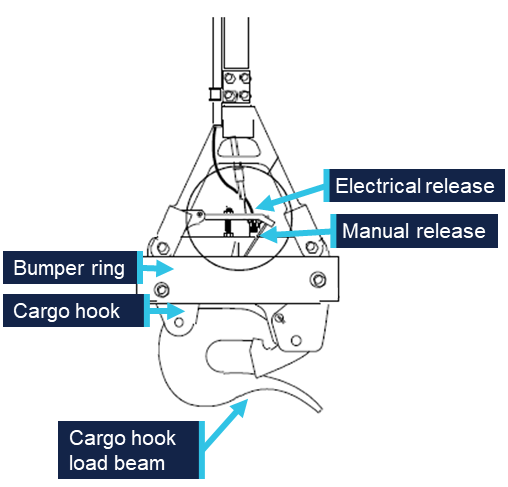
Source: Onboard Systems International, annotated by the ATSB
The release of the hook could be initiated electrically or mechanically. Normal release was completed by pilot actuation of a push button on the side of the cyclic (Figure 5, left). The button is guarded by a small ring to prevent inadvertent pilot activation. When this button is pressed the latch of the cargo hook is opened.
In addition to the electrical release, in an emergency a mechanical release can be completed by pushing a small pedal located between the 2 tail rotor pedals at the pilot’s feet (Figure 5, right). This activated a manual release cable attached to the cargo hook.
The cargo hook suspension system was required to be inspected annually or after 100 hours of external load operations, whichever came first. The system was last inspected on 20 February 2025.
Figure 5: Electrical and mechanical external load release systems

Left: the electrical release found on the cyclic grip. Right: mechanical release between the 2 pedals. Source: Coulson Aviation, annotated by the ATSB
Coulson Aviation required pilots to test the electrical and manual release system prior to conducting flights for the day. The pilot recalled testing both the electrical and mechanical release the morning of the accident. They stated that both systems were in working order. In addition to the tests, the pilot recalled that when landing at Zeehan after the accident, the electrical release was used to drop the longline and bucket without issue.
Coulson Aviation reported that both the electrical and mechanical releases of the hook were tested following the accident. Both were reported as serviceable.
Vertical reference door
The Bell 412EP helicopters are usually flown from the right-hand seat. This configuration is used when pilots are conducting either winching or reconnaissance operations. The helicopters can be modified to include a vertical reference door, which is designed to provide the pilot with a side bubble window and instruments for longline operations from the left-hand seat.
VH-VJF was modified with a vertical reference door in accordance with the Transwest vertical reference door supplement type certificate. This included a bubble window, viewing slot, and instruments and warning lights installed in the door (Figure 6).
Figure 6: Instruments and warning lights installed in the vertical reference door

Source: Coulson Aviation, annotated by the ATSB
In addition to the instruments and warning lights, the type certificate required the installation of several systems to be placed on the left side of the helicopter. This included:
- a force trim switch, cargo release switch and automatic flight control system (AFCS) release switch mounted on the left cyclic
- the torque meter and tachometer from the left-hand instrument panel moved to the vertical reference door
- an additional mechanical cargo release pedal between the left side pedals.
During the occurrence flight and other firebombing operations, the pilot was operating the helicopter from the left-hand seat, utilising the left cyclic and referencing the flight instruments through the vertical reference door. While conducting the water collection, the torque indicator was visible through the bubble window and could be monitored during the lift.
Bucket and longline information
The bucket and longline were attached to the external load system via a bow shackle (Figure 7, left).
The bucket was a Bambi Max bucket with a nominal capacity of 240 US gallons (910 L). The empty weight of the bucket was 137 lb (62 kg) and the maximum gross weight was 2,140 lbs (970 kg).
The collapsable bucket was equipped with multiple selectable drop valves. Pilots were able to use the bucket to split water loads into multiple drops (Figure 7, right) and had the capability to shed the load rapidly.
Figure 7: Longline attachment and Bambi Max bucket

Source: Coulson Aviation, annotated by the ATSB
The longline was constructed from high-strength synthetic fibre rope selected for its high tensile strength, low stretch characteristics, light weight, and resistance to heat and abrasion. The line incorporated an electrical cable along the line to control bucket release. The 150-ft length provided vertical separation between the helicopter and the load to reduce rotor downwash disturbance during water pick‑up.
Forward looking infrared (FLIR) camera
FLIR cameras are used on aerial firefighting aircraft to provide thermal imaging of fire grounds, enabling crews to detect heat sources through smoke, darkness, or challenging terrain. This capability allows operators to identify fire hotspots, monitor fire spread, and support decision-making for resource deployment and suppression strategies.
On the Bell 412s, the FLIR camera was mounted on the left side, just above the skids. Coulson Aviation stated that although the cameras could be removed, they would generally be kept on the helicopters throughout all operations, allowing the ability for the crews to be re-tasked for reconnaissance missions. Some pilots indicated to the ATSB that the camera could partially obscure visibility during bucketing.
Helicopter damage
The ATSB did not examine the helicopter or equipment. Coulson Aviation conducted an examination of the helicopter the morning after the occurrence. The following damage was identified:
- The #1 engine control tube had sheared at the lower tube end bell crank, resulting in a complete loss of pilot input to the engine.
- The #2 engine control tube bell crank attachment bracket had detached from the helicopter structure’s securing rib, restricting pilot control of the engine.
- The tail rotor control rod on the right-hand side of the external hook’s bell crank airframe attachment had broken away, with the primary structure also separated.
- The main transmission oil cooler pressure line exhibited significant contact damage, however, no splits or leaks were identified.
- The fuel tank interconnect braided hoses sustained minor contact damage.
- Multiple aft fuselage drain lines were damaged.
Images of the helicopter indicated that the structural fuselage honeycomb aluminium skin, adjacent to and aft of the external hook, was deformed and had separated from the primary structure (Figure 8).
Figure 8: Helicopter aluminium skin damage
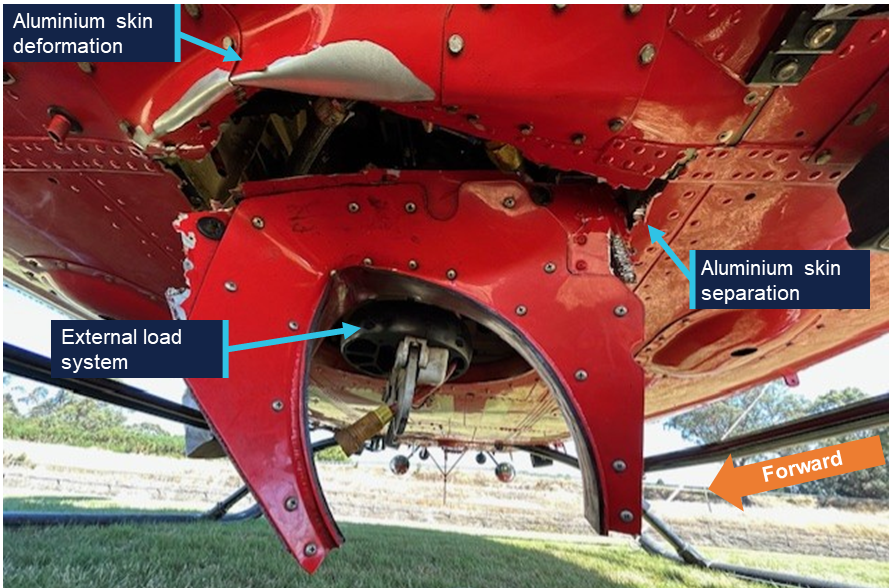
Source: Coulson Aviation, annotated by the ATSB
Images revealed indications consistent with contact between the longline and the rear cross tubes of the helicopter. In addition, inspection of the cargo hook and associated bumper stop components identified visible signs of impact damage (Figure 9).
Figure 9: External load system damage
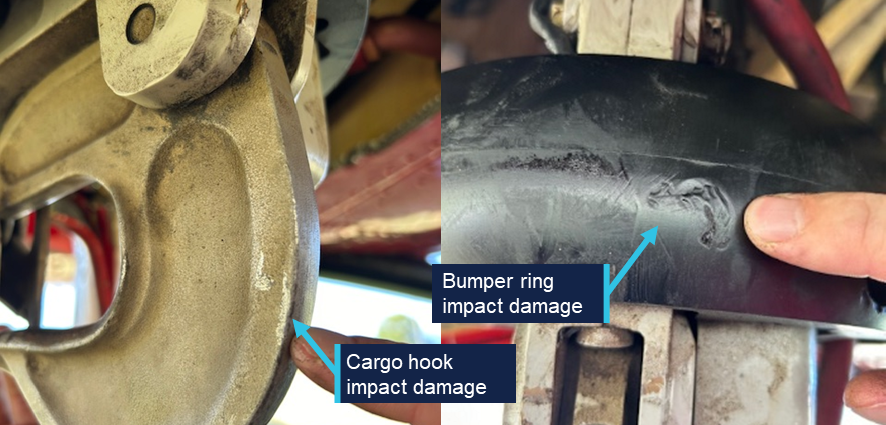
Source: Coulson Aviation, annotated by the ATSB
In addition, the ring in the middle of the Bambi bucket spoke assembly was fractured in 4 places (Figure 10).
Figure 10: Bambi Max damage to spoke assembly
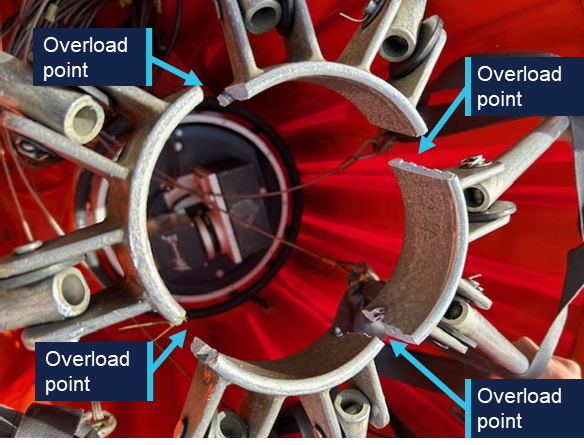
Source: Coulson Aviation, annotated by the ATSB
Multiple instances of cable bruising and stretching were reported to have been observed on the bucket cable wiring and attachment eye ends. The ATSB was unable to substantiate the presence of cable bruising and stretching based on the images provided of the cables.
Weather data
On departure from Strahan Airport, the meteorological aerodrome report (METAR)[11] reported wind west‑north-west at 6 kt, visibility greater than 10 km and no cloud cover.
The Tasmania Fire Service (TFS) incident action plan indicated that weather on the Canning Peak fire would change from north-westerly to west-south‑westerly by mid‑morning with winds reaching 10 kt by the afternoon (Table 1).
Table 1: Canning Peak fire forecast
| Local time | Temperature (°C) | Dew point (°C) | Wind direction | Wind speed (kt) | Wind gust (kt) |
| 0800 | 14 | 12 | N | 5 | 8 |
| 0900 | 17 | 13 | NNW | 8 | 10 |
| 1000 | 19 | 14 | NW | 8 | 14 |
| 1100 | 22 | 14 | WNW | 8 | 14 |
| 1200 | 23 | 14 | W | 10 | 16 |
| 1300 | 25 | 14 | W | 10 | 16 |
| 1400 | 26 | 13 | WSW | 10 | 16 |
| 1500 | 26 | 13 | WSW | 8 | 14 |
| 1600 | 26 | 13 | WSW | 8 | 10 |
The AAS reported that on the day of the accident the wind was calm, there was no turbulence and ‘great’ visibility. A change in wind direction was noted from mid-morning changing from northerly to south-westerly, however this was expected based on the forecast. They recalled the area in which the aircraft were working in was protected from south‑westerly winds due to the topography. They reported no feedback from pilots regarding the weather or any other environmental conditions on the day.
The pilot of HT201 reported there were blue skies and fairly light winds on the day of the accident. They recalled that although they were not bucketing on this day, during previous bucketing operations in the same valley, the wind conditions were variable and the wind would shift ‘back and forth’.
A weather station atop Mt Inglis, approximately 15 km north of the operating area (Figure 11), recorded south‑south-westerly winds at 5.7 kt gusting to 11.4 kt at the time of the accident.
Figure 11: Canning Peak weather station location to dip site
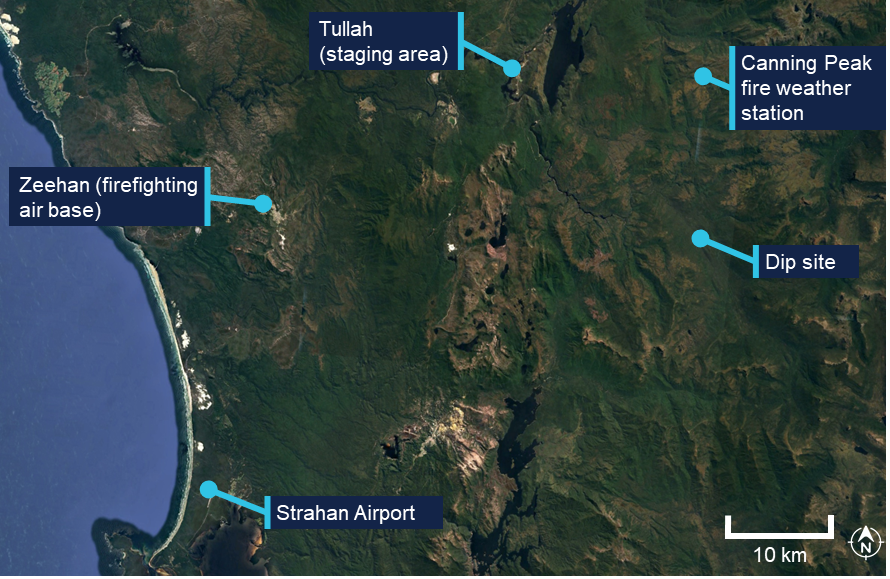
Source: Google Earth, annotated by the ATSB
Fireground information
The West Coast fire complex originated from 24 individual ignitions sparked by dry lightning strikes on 3 February 2025, across Tasmania’s remote western and north‑western regions. These separate fires were grouped into a single complex for coordinated management due to their proximity, shared weather influences, and overlapping spread patterns.
There were 4 primary firegrounds that accounted for the majority of the burnt area: the Canning Peak fireground, the Yellowband Plain fireground, the Mount Donaldson fireground, and the Corinna Road fireground. Each represented a distinct sector with unique terrain, vegetation types, and behavioural characteristics. These firegrounds collectively contributed to the complex’s total footprint of nearly 95,000 hectares.
Canning Peak fireground
The Canning Peak fireground was located in a more elevated and vegetated zone close to the Cradle Mountain area and in proximity to sections of the Overland Track. This sector featured rugged alpine-influenced terrain that complicated direct ground access, leading to heavy reliance on aerial suppression tactics.
Figure 12: Canning Peak fireground
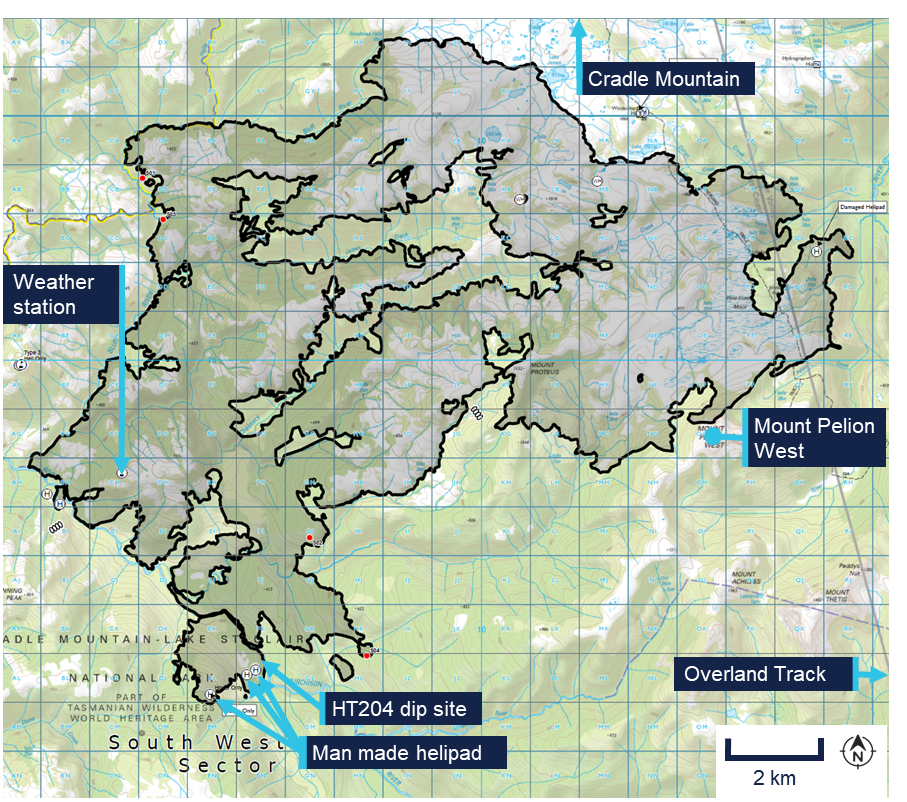
Black outline indicates area which has been burnt by fire. Source: Tasmania Parks and Wildlife Service, annotated by the ATSB
Day of accident
On the day of the accident HT201 was the designated winching helicopter and HT204 was part of the bucketing helicopters on the fireground. There were 6 helicopters (3 x AS350, 1 x Bell 412 (HT204), 1 x Bell 212, 1 x BK 117) bucketing within a 2 km proximity of each other intermittently. In addition, the air attack helicopter was on scene overhead.
The helicopters were distributed across 4 separate circuits, with 5 separate dip points, seperate individual and shared targets and some shared ground crew.
Dip site
The pilot reported that the general location for a dip site was provided prior to commencing operations on the fireground, with selection of the specific section of river within that area being at their discretion. The pilot advised that they chose this dip site location on the river as it was relatively wider than other areas and they had used this section as a dip site on the days preceding the accident.
HT204’s dip site was approximately 700 m from the next nearest dip site with working helicopters. The dip site was approximately 1 km south‑east of the drop zone, along the Murchison River. Google Earth images indicate the river width at the dip point was approximately 20 m (Figure 13).
Figure 13: Dip site location on Murchison River
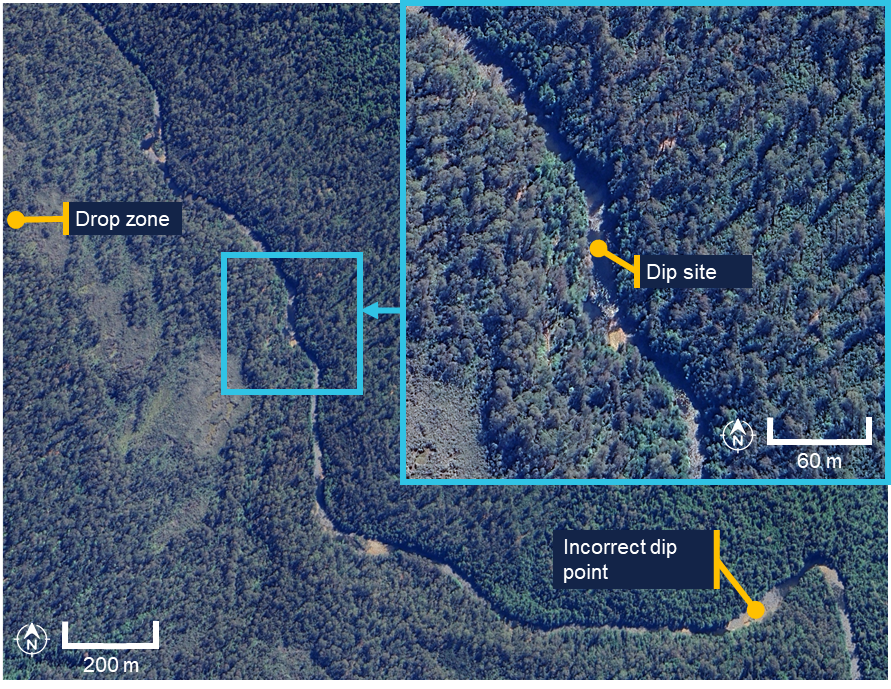
Source: Google Earth, annotated by the ATSB
The pilot described the dip site as a narrow section of river, approximately 50–60 m wide, with tall trees lining the bank. They reported that there were limited locations deep enough to operate the bucket, which constrained where they could dip and they stated they had used the same dip point on the days prior.
In addition, the river contained very little water at the time, allowing clear visibility to the riverbed. They stated that they could not recall whether any tree branches or rocks were present in the riverbed during the operation. Despite the presence of tall trees, the pilot indicated that the area was accessible to the aircraft and considered it one of the better dip sites along the river. They also noted that the turnaround time from the dip point to the fireground was approximately one minute.
The AAS described the dip site as a section of river with trees approximately 30–60 m tall on either side. They recalled that the pilot was the only one using the dip point and the only helicopter in the circuit. In previous weeks, when different crews had flown the same helicopter on similar missions, no pilots had reported any problems with the dip point. Based on the dips that were observed, the occurrence pilot appeared to be performing them safely and adequately.
Recorded data
Multiple independent data sources, including TracPlus satellite-based tracking logs, FlightAware ADS-B derived positions, and OzRunways electronic flight bag recordings, were cross‑referenced and correlated to reconstruct the helicopter’s flights throughout the day and to approximate the entry and exit angles into and out of the bucketing site.
TracPlus
The helicopter was fitted with a TracPlus surveillance system, which provided real-time tracking through a satellite or mobile phone network. It reported position, altitude, and speed at set time periods, in this case every 15 seconds.
OzRunways
The OzRunways application recorded the helicopter’s position at regular intervals of approximately 5 seconds throughout the day, capturing parameters including latitude, longitude, groundspeed, track, and truncated altitude (in 100 ft increments) where connectivity permitted. However, no position data was recorded during the bucketing operations (Figure 14). This absence of recorded data was likely attributable to the helicopter operating at very low levels, down to around 150 ft above ground level, while conducting repeated drops in mountainous terrain.
Figure 14: OzRunways flight data
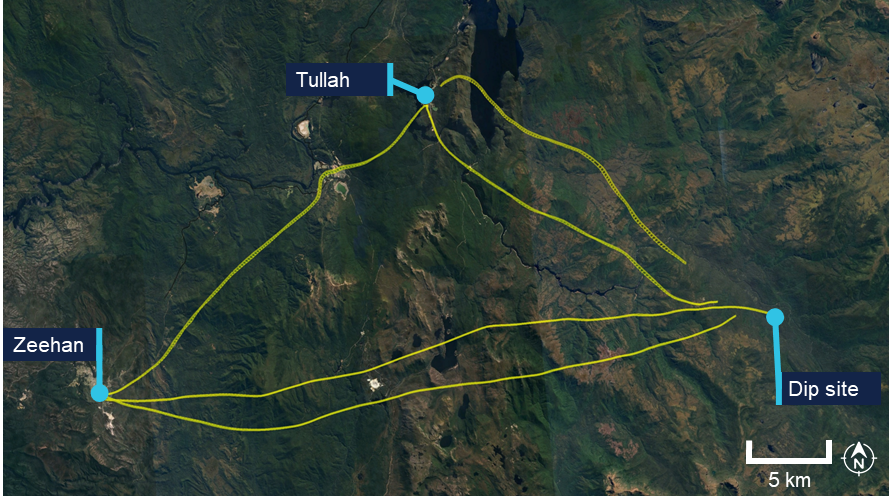
Source: Google Earth, annotated by the ATSB
FlightAware
The FlightAware flight tracking data captured the helicopter’s en route flight to the bucketing site, as well as the subsequent low-level manoeuvres involving repeated water dips and drops. Position reports were recorded at irregular intervals ranging between approximately 8 seconds and 40 seconds[12] during these operations.
In addition to the TracPlus data, FlightAware was incorporated into the data analysis. The differing sampling rates and coverage characteristics of the 2 systems together produced a more complete reconstruction of the helicopter’s flight circuit during the second fuel cycle (Figure 15).
Figure 15: Second fuel cycle data from TracPlus and FlightAware
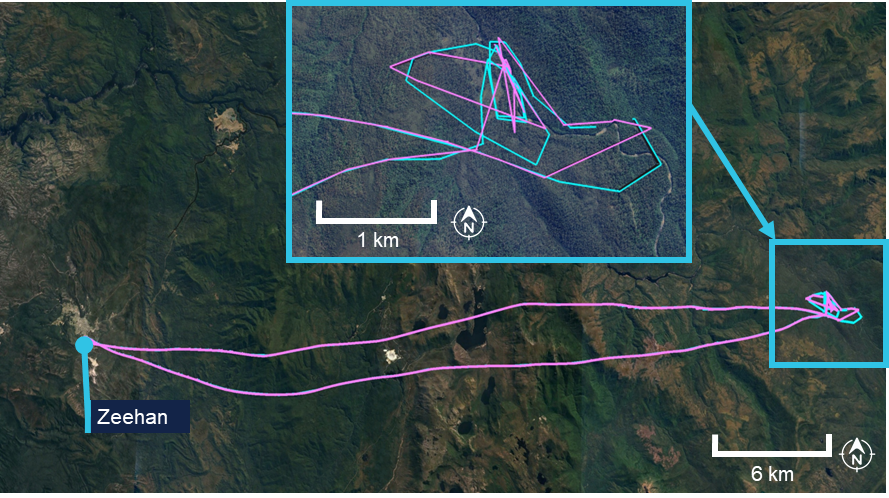
Pink line: TracPlus data. Blue line: FlightAware data. Source: Google Earth, annotated by the ATSB
Further investigation
To date, the ATSB has conducted the following activities:
- interviewed the pilot and other Coulson Aviation personnel
- interviewed the air attack supervisor from Tasmania Parks and Wildlife Service
- reviewed recorded aircraft information
- reviewed the forecast and observed weather conditions
- reviewed maintenance documentation for VH-VJF
- analysed recorded helicopter information
- reviewed pilot training delivered by Coulson Aviation.
The investigation is continuing and includes:
- review of Coulson Aviation’s risk controls for bucketing operations in the Bell 412
- review of Coulson Aviation’s operational and reporting procedures
- review of Tasmanian Fire Service operational and reporting procedures.
A final report will be released at the conclusion of the investigation. Should a critical safety issue be identified during the course of the investigation, the ATSB will immediately notify relevant parties so appropriate and timely safety action can be taken.
Purpose of safety investigationsThe objective of a safety investigation is to enhance transport safety. This is done through:
It is not a function of the ATSB to apportion blame or provide a means for determining liability. At the same time, an investigation report must include factual material of sufficient weight to support the analysis and findings. At all times the ATSB endeavours to balance the use of material that could imply adverse comment with the need to properly explain what happened, and why, in a fair and unbiased manner. The ATSB does not investigate for the purpose of taking administrative, regulatory or criminal action. About ATSB reportsATSB investigation reports are organised with regard to international standards or instruments, as applicable, and with ATSB procedures and guidelines. Reports must include factual material of sufficient weight to support the analysis and findings. At all times the ATSB endeavours to balance the use of material that could imply adverse comment with the need to properly explain what happened, and why, in a fair and unbiased manner. An explanation of terminology used in ATSB investigation reports is available here. This includes terms such as occurrence, contributing factor, other factor that increased risk, and safety issue. Publishing informationReleased in accordance with section 25 of the Transport Safety Investigation Act 2003 Published by: Australian Transport Safety Bureau © Commonwealth of Australia 2026 
Ownership of intellectual property rights in this publication Unless otherwise noted, copyright (and any other intellectual property rights, if any) in this report publication is owned by the Commonwealth of Australia. Creative Commons licence With the exception of the Commonwealth Coat of Arms, ATSB logo, and photos and graphics in which a third party holds copyright, this report is licensed under a Creative Commons Attribution 4.0 International licence. The CC BY 4.0 licence enables you to distribute, remix, adapt, and build upon our material in any medium or format, so long as attribution is given to the Australian Transport Safety Bureau. Copyright in material obtained from other agencies, private individuals or organisations, belongs to those agencies, individuals or organisations. Where you wish to use their material, you will need to contact them directly. |
[1] Firebombing: The National Aerial Firefighting Centre states that firebombing is the dropping of fire suppressant or fire retardant from an aircraft to assist with the control or suppression of a fire.
[2] Firebombing with a bucket, often known as ‘bucketing’, requires filling the bucket by lowering it into a water source, and emptying it as required at the flame front.
[3] A staging area is a designated location where aircraft and crews temporarily assemble and wait for tasking to active fires.
[4] Hot and cold trailing is a task requiring identification of hotspots along the fire perimeter, opening these areas/smouldering ground fire up with hand tools and directing pilots to drop buckets atop the burning material to prevent further fire spread.
[5] A dip site is a designated water source where helicopters equipped with buckets can collect water for aerial firefighting. These sites can be natural bodies of water, such as lakes, rivers, or ponds, or artificial sources like reservoirs and water tanks. Their key requirements are sufficient water depth, accessibility, and proximity to the fire to maximise efficiency.
[6] Engine torque split in a multi-engine helicopter is where there is an unequal proportion of total main rotor torque shared between each engine through the gearbox.
[7] The Bell 412EP cruise speed is 122 kt.
[8] The T-handles are a red handle which pilots pull in an emergency to shut off fuel, hydraulics, and other systems to an engine while arming the fire extinguishing bottles.
[9] A medium-lift helicopter is one capable of carrying moderate loads, typically between 2,000 kg and 5,000 kg.
[10] A Bambi bucket is a collapsible water bucket suspended beneath a helicopter, used to collect and drop water during aerial firefighting operations.
[11] METAR (Meteorological Aerodrome Report) is a routine aerodrome weather report issued at half‑hourly intervals. The report ordinarily covers an area of 8 km radius from the aerodrome reference point.
[12] This update rate arises from the way FlightAware processes ADS-B data: although equipped aircraft transmit position messages nominally every second, the displayed track depends on signals received by a network of ground stations. In remote hilly terrain, at low altitudes down to around 150 ft AGL, terrain shadowing, ridges, valleys, and line-of-sight limitations can prevent some transmissions from being captured reliably. As a result, FlightAware relies on the most consistent available reports, leading to longer effective intervals of 25–40 seconds or more during intermittent low-level reception.
Occurrence summary
| Investigation number | AO-2025-013 |
|---|---|
| Occurrence date | 10/03/2025 |
| Occurrence time and timezone | 1500 Australian Eastern Daylight Time |
| Location | 57 km north-east of Strahan Airport |
| State | Tasmania |
| Report release date | 06/10/2026 |
| Report status | Final |
| Investigation level | Systemic |
| Investigation type | Occurrence Investigation |
| Investigation phase | Final report: Dissemination |
| Investigation status | Completed |
| Mode of transport | Aviation |
| Aviation occurrence category | Collision with terrain, Control issues, Loss of control, Miscellaneous - Other |
| Occurrence class | Accident |
| Highest injury level | None |
Aircraft details
| Manufacturer | Bell Helicopter Co |
|---|---|
| Model | 412EP |
| Registration | VH-VJF |
| Serial number | 36329 |
| Aircraft operator | Coulson Aviation (Australia) Pty Ltd |
| Sector | Helicopter |
| Operation type | Part 138 Aerial work operations |
| Activity | General aviation / Recreational-Aerial work-Firefighting |
| Departure point | Tullah Helicopter Landing Site, Tasmania |
| Destination | Zeehan Aircraft Landing Area, Tasmania |
| Injuries | None |
| Damage | Substantial |