Beech Aircraft Corp 58, VH-FDN

Safety Action

The report produced by Airservices Australia recommended that the office of the Head Air Traffic Controller review the MATS in regard to the feasibility of how ATC shall ensure that appropriate broadcasts have been made on frequencies not monitored by that ATC sector.

The report also recommended that the intent of the letter of agreement (LOA) with the operator be clarified and that they be reminded that the LOA does not absolve them from complying with the requirements of AIP ENR 5.5.

Airservices Australia reported that the office of the Head Air Traffic Controller will be assuring that these recommendations are actioned.

Summary

The Australian Transport Safety Bureau did not conduct an on-scene investigation of this occurrence. The report presented below was prepared principally from information supplied to the Bureau and includes information from an investigation report produced by Airservices Australia.

REPORTED INFORMATION

On 1 December 2004, at 1403 western standard time, a Beech Aircraft Corporation Baron was tracking from Jandakot, WA for Cunderdin, WA. The aircraft was being operated under the instrument flight rules (IFR) at 7,000 ft. At 1409, a Cessna Aircraft Company Caravan, operating under the visual flight rules (VFR), was climbing to 14,000 ft for a parachute jumping exercise (PJE) within 5 NM of Brooklands, WA. Both aircraft were operating within radar coverage and were radar identified.

The airspace in the Brooklands area was classified as class G (non-controlled) airspace from ground level to 8,500 ft, and class C (controlled) airspace from 8,500 ft to 18,000 ft.

At 1419, the controller managing the class G airspace provided the pilot of the Baron with traffic information on the Caravan as part of a radar information service (RIS). The pilot of the Baron became concerned that the pilot of the Caravan was unaware of the Barons proximity to the parachute drop area, and was unable to establish radio contact with the pilot of the Caravan to determine whether the parachute drop was imminent.

At 1420, the pilot of the Caravan requested a clearance to deploy the parachutists, and to descend. The controller who was managing the class C airspace provided the pilot of the Caravan with a clearance and radar derived traffic information on the location of the Baron. At that time, the Baron was 2 NM ahead of the Caravan and heading north-east.

At 1421, the pilot of the Baron established radio contact with the pilot of the Caravan and negotiated a delay in the parachute drop until the Baron was clear of the area.

The Aeronautical Information Publication (AIP) ENR 5.5 4 paragraphs 2.1.3 to 2.3.4, effective 25 Nov 2004, specified that not less than two minutes before parachutists exit an aircraft, the pilot must make a broadcast on all relevant frequencies for the airspace through which the parachutists may descend, including a broadcast on each frequency specified for controlled and uncontrolled airspace. The pilot must not allow parachutists to exit the aircraft unless these broadcasts have been made.

In addition to the requirements specified in the AIP, a letter of agreement (LOA), effective 25 Nov 2004, existed between Airservices Australia and the PJE operator, which detailed the radio frequencies and procedures for PJE operations in that area. This LOA required the pilot to broadcast, on the class G frequency, an intention to deploy the parachutists, approximately 4 minutes prior to the drop point.

The Manual of Air Traffic Services (MATS) section 4.6.1, specified that Air Traffic Control (ATC) shall not issue a clearance to a pilot to deploy parachutists before the broadcasts specified in the AIP have been made.

The pilot of the Caravan later stated that all required broadcasts had been completed. However, transcripts provided by Airservices Australia of the ATC voice recordings of the relevant frequencies contained no evidence that the pilot had made the required broadcasts on either of the class G or class C frequencies, in accordance with either the AIP or the LOA, prior to the intended parachute deployment.

The controller managing the class C airspace did not ensure that those broadcasts had been made, prior to issuing the pilot of the Caravan with a clearance to deploy the parachutists.

Occurrence summary

Investigation number 200404930
Occurrence date 01/12/2004
Location 74 km E Perth, Aero.
State Western Australia
Report release date 22/06/2005
Report status Final
Investigation type Occurrence Investigation
Investigation status Completed
Mode of transport Aviation
Aviation occurrence category Separation issue
Occurrence class Incident
Highest injury level None

Aircraft details

Manufacturer Beech Aircraft Corp
Model 58
Registration VH-FDN
Serial number TH-126
Sector Piston
Operation type Private
Departure point Jandakot, WA
Destination Jandakot, WA
Damage Nil

Aircraft details

Manufacturer Cessna Aircraft Company
Model 208
Registration VH-OAI
Serial number 20800093
Sector Turboprop
Operation type Sports Aviation
Departure point Brooklands, WA
Destination Brooklands, WA
Damage Nil

Robinson R22 Beta, VH-HSI

Summary

The Australian Transport Safety Bureau did not conduct an on-scene investigation of this occurrence. The report presented below was prepared principally from information supplied to the Bureau.

REPORTED INFORMATION

On 4 December 2004, at approximately 1407 western standard time, a Robinson Helicopter Company R22 (helicopter) became airborne from the helipad adjacent to runway 06 left (L)/24 right (R) at Jandakot Airport. The helicopter departed in a south-westerly direction parallel to runway 24 and continued on that track. The pilot reported that he planned to depart the Jandakot circuit area to the south-west of the airport at 1,000 ft. While the helicopter was climbing on that south-westerly track, a Cessna 172R (C172) became airborne off runway 24R at Jandakot. The Jandakot control zone was operating under the General Aviation Airport Procedures (GAAP) at the time of the occurrence.

The C172 pilot reported that he had planned to depart the Jandakot circuit area on a north-westerly track. That track required a right turn from runway 24R, across the track of the departing helicopter. When the two aircraft were at an altitude of approximately 600 ft, the pilot of the C172 reported to the Jandakot aerodrome controller (ADC) that he had a helicopter in sight to his right. The ADC advised the pilot of the C172 to pass behind the helicopter. The pilot of the C172 acknowledged that broadcast and commenced a right turn.

The Aeronautical Information Publication (AIP) ENR 1.1, 25.1.1 stated that:

A pilot must:

  1. sight and maintain separation from other aircraft whilst operating in a GAAP control zone;
  2. comply with ATC instructions while ensuring that separation is maintained from other aircraft;
  3. advise ATC immediately if unable to comply with a control instruction;
  4. advise ATC if unable to sight, or if sight lost of, other aircraft notified as traffic.

The AIP ENR 1.1, 26.1 stated that:

Traffic information shall be issued by ATC when:

  1. the pilot of one aircraft was required to give way to, follow, or otherwise adjust the aircrafts flight path relative to that flown by another aircraft.

The ADC did not pass traffic information to the pilot of the C172 when he cleared that aircraft for take-off, because he believed there would be sufficient spacing to allow the C172 to pass behind the helicopter.

The instructor pilot of the helicopter reported that the C172 was in his 10 oclock position at the same altitude when the C172 pilot requested a right turn. He also reported that once the C172 pilot commenced the right turn, both aircraft would have collided if he had not taken evasive action that involved a rapid descent and a steep turn.

The pilot of the C172 reported that the helicopter was in his 2 oclock position when he requested the right turn. He subsequently commenced the right turn because he considered that it was safe to do so. He believed he would pass behind, and well clear of, the helicopter.

The ATSB was unable to determine the proximity of the two aircraft from recorded radar data due to the radar coverage limitations in the Jandakot circuit area. Therefore, the ATSB was unable to resolve the difference between the recollections of the helicopter pilot and the C172 pilot.

Occurrence summary

Investigation number 200404815
Occurrence date 04/12/2004
Location Jandakot, Aero.
State Western Australia
Report release date 23/03/2005
Report status Final
Investigation type Occurrence Investigation
Investigation status Completed
Mode of transport Aviation
Aviation occurrence category Separation issue
Occurrence class Incident
Highest injury level None

Aircraft details

Manufacturer Robinson Helicopter Co
Model R22
Registration VH-HSI
Serial number 2496
Sector Helicopter
Operation type Flying Training
Departure point Jandakot, WA
Destination Jandakot, WA
Damage Nil

Aircraft details

Manufacturer Cessna Aircraft Company
Model 172
Registration VH-YXS
Serial number 17280882
Sector Piston
Operation type Flying Training
Departure point Jandakot, WA
Destination Unknown
Damage Nil

Fokker F28 MK0100, VH-FWI

Safety Action

Aircraft Operator

On 9 February 2005, the aircraft operator reported to the ATSB that it had already implemented, or intended implementing the following improvements to the maintenance of the air-conditioning and bleed air systems:

  • Reduced the mesh size of external filters on the flow control valve and reduce the replacement interval from 4,000 flight hours to 500 flight hours.
  • Upgraded the turbine bypass valves to the latest standard.
  • Introduced regular heat exchanger cleaning at 2,000 flight hour intervals.
  • Cooling turbine overhaul period reduced to 9,000 flight hours.
  • Cooling turbine oil level and contamination check introduced.
  • Cooling turbine oil replacement interval reduced from 4,000 flight hours to 1,000 flight hours.
  • Shut-Off and Pressure Regulating Valve (SOPRV) and Shut-Off and Temperature Modulating Valve (SOTMV)1 to be overhauled at every shop visit (previously completed on condition).
  • Pressure regulating and temperature modulating valve filter replacement interval reduced from 4,000 flight hours to 500 flight hours.
  • A six-monthly bleed air system verification check has been introduced to check for proper system operation.
  • A 4,000 flight hour interval, complete system survey to check the entire bleed air and air-conditioning system has been introduced.

Aircraft Manufacturer

On 24 February 2005, the aircraft manufacturer advised the ATSB that it had issued two optional maintenance tasks for cleaning the primary and secondary heat exchangers and additional maintenance for the air cycle machine. These tasks were sent to the operators by means of a Temporary Revision to the Maintenance and Planning Document (TR OPT-002, dated January 12, 2004) and were incorporated into the F70/100 Maintenance and Planning Document, issued by Fokker Services B.V. on July 1, 2004.

1 The SOPRV and SOTMV are components in the bleed air system used to control the system pressure and temperature.

Summary

On 6 December 2004, a Fokker Services B.V. F28 Mk0100 (Fokker F100) aircraft, registered VH-FWI, was being prepared for a flight from Townsville to Brisbane, Queensland, when the ground crew noticed a rumbling noise coming from the left air-conditioning pack and notified the flight crew. No fault indications were present on the flight deck, so the flight crew elected to depart for Brisbane with both packs operational.

During cruise at Flight Level 350 (35,000 ft), the flight crew noticed a burning smell and a loud noise coming from the air-conditioning system. Based on the earlier report from the ground crew, the flight crew shut down the left air-conditioning system. The air-conditioning/pressurisation system is designed so that the left pack normally supplies the flight deck and the right pack normally supplies the cabin area. In the event that one system fails, or is shut down, the other system is capable of supplying the required air to both the flight deck and the cabin. The noise continued so the left pack was switched back on and the right pack was shut down. The noise then stopped, confirming that the failed system was on the right side.

Seven minutes later, the left pack produced similar symptoms and was shut down by the crew. With both systems shut down, the aircraft's pressurisation system was rendered inoperable and the cabin altitude began to rise. The crew donned oxygen masks, commenced an emergency decent to 10,000 ft and notified air traffic control. The flight continued to Brisbane without further incident.

Subsequently, both air cycle machines1 (ACMs) were removed from the aircraft. A general inspection of the ACMs by maintenance engineers found that the heat exchangers were in good condition so they were returned to service. However, the cooling turbines were not serviceable because the turbine shafts where difficult to rotate. These cooling turbines were replaced with serviceable items.

A maintenance ground run was subsequently carried out to check the aircraft bleed air system. The check found that both bleed air temperature modulating valves and one of the pressure regulating valves were malfunctioning. The malfunctioning valves were replaced and the aircraft returned to service.

Since June 2004, the operator had sustained seven (including these two) cooling turbine failures in its fleet of two Fokker F100 aircraft. The operator had previously noted the rate of these failures and had investigated ways to improve the reliability of the system.

The cooling turbines from this aircraft, along with four other failed units, were sent to the ACM component manufacturer for failure analysis. Those examinations found that all six units had failed because they had been operated outside of the speed range for which they had been designed.

A review of five of the six failed turbines found that at least one of the aircraft's bleed air control valves (pressure, temperature or flow rate) had also failed.

As a result of two overseas reports of the in-flight release of engine fan case ice impact panels, the Australian Civil Aviation Safety Authority (CASA) issued Airworthiness Directive (AD) AD/F100/59 in January 2004. This Airworthiness Directive (AD) included the following requirement:

Amend the Aeroplane Flight Manual, Section 5.05.01 to include the following conditions on the use of engine and airframe anti-icing systems by inserting the following:

Engine anti-icing must be switched ON during all ground or flight operations when Total Air Temperature TAT is below +6 degrees C (+42 degrees F) down to and including -25 degrees C (-13 degrees F), irrespective of the presence of visible moisture.

The operator reported that this AD resulted in the use of the anti-ice system increasing from approximately 20% of flights to approximately 90% of all flights.

The cooling turbine manufacturer noted that the use of anti-ice at altitudes above 30,000 ft can place the ACM outside the design conditions, resulting in an overspeed. The design standard for the aircraft (United States Federal Aviation Regulation Part 25) defines the limiting icing envelope up to an altitude of 30,000 ft. There was no requirement to design the system to operate in icing conditions above this altitude.

Following the issue of engine Airworthiness Directive AD/TAY/122 amendment 2, on 9 November 2004, CASA determined that the additional operational requirements of AD/F100/59 were no longer required. AD/TAY/12 amendment 2 required the following actions to be carried out:

  1. Carry out an initial and repetitive examination of the bonding of the low-pressure compressor ice impact panels in accordance with Rolls Royce SB TAY-72-1638R2 or TAY-72-1639R2 as applicable.

     
  2. Repair or replace all low-pressure compressor ice impact panels if any visible movement, rocking motion or reappearing moisture on the LP compressor case ice impact panel have been detected during the examination.

     
  3. Replace all affected low-pressure compressor case ice impact panels in accordance with Rolls Royce SB TAY-72-1638R2 or TAY-72-1639R2 as applicable.

CASA stated in the AD that 'The actions specified by this Airworthiness Directive are intended to make sure that the bonding of these LP compressor ice impact panels complies with the design intent'. CASA cancelled AD/F100/59 on 23 December 2004.

The aircraft operator has reported to the ATSB that there have been no cooling turbine failures since AD/F100/59 was cancelled.

1 The air cycle machine is the cooling section of the air-conditioning system and is comprised of a cooling turbine and heat exchanger.
2 The Fokker F100 series aircraft are fitted with Rolls Royce Tay engines.

Occurrence summary

Investigation number 200404823
Occurrence date 06/12/2004
Location 56 km SW Rockhampton, Aero.
State Queensland
Report release date 24/06/2005
Report status Final
Investigation type Occurrence Investigation
Investigation status Completed
Mode of transport Aviation
Aviation occurrence category Air/pressurisation
Occurrence class Serious Incident
Highest injury level None

Aircraft details

Manufacturer Fokker B.V.
Model F28
Registration VH-FWI
Serial number 11318
Sector Jet
Operation type Air Transport High Capacity
Departure point Townsville, QLD
Destination Brisbane, QLD
Damage Nil

Bombardier Learjet 45, VH-SQR

Summary

The report presented below was prepared principally from information supplied to the Bureau.

Reported Information

At 2040 eastern standard time on 7 December 2004, approximately 18 km north of Gayndah, Qld, the crew of a Bombardier Learjet 45 aircraft, registered VH-SQR, advised air traffic control that the aircraft pressurisation system had failed and that they were conducting an emergency descent to 10,000 ft. At the time, the aircraft was passing flight level 200 (20,000 ft) on descent to Maroochydore after a training flight from Townsville. The crew advised that they expected to make a normal approach and landing and that emergency services were not required. The aircraft landed at Maroochydore at 2102.

The crew subsequently reported that the aircraft's number 1 integrated computer had failed during cruise and that during descent the cabin pressure altimeter indicated a steady increase in cabin altitude. When it became apparent that the cabin altitude could not be controlled manually, and as the cabin altitude approached 10,000 ft, the crew donned oxygen masks and initiated an emergency descent to 10,000 ft. The crew advised that the maximum indicated cabin altitude was slightly above 13,000 ft.

The aircraft operator subsequently reported that extensive troubleshooting by company engineers was unable to identify any fault. As a precaution, the cabin pressure controller, the number 1 integrated computer, and the number 1 air data computer were changed and the removed items forwarded to the manufacturer for testing.

The aircraft was returned to service with no further reported faults. The operator subsequently reported that the manufacturer had found no fault in any of the components that might have contributed to the occurrence.

Occurrence summary

Investigation number 200404857
Occurrence date 07/12/2004
Location 130 km NW Maroochydore/Sunshine Coast, Aero.
State Queensland
Report release date 01/08/2005
Report status Final
Investigation type Occurrence Investigation
Investigation status Completed
Mode of transport Aviation
Aviation occurrence category Air/pressurisation
Occurrence class Serious Incident
Highest injury level None

Aircraft details

Manufacturer Learjet Inc
Model 45
Registration VH-SQR
Serial number 45-195
Sector Jet
Operation type Flying Training
Departure point Townsville, QLD
Destination Maroochydore, QLD
Damage Nil

Boeing 747-400, HS-TGJ

Safety Action

Safety Action

As a result of this occurrence, Airservices Australia has advised the Australian Transport Safety Bureau that it is reviewing the following issues in order to strengthen the operational risk controls for prevention and recovery from, similar occurrences:

  • The Australian Advanced Air Traffic System’s (TAAATS) existing human machine interface for effectiveness and efficiency and to ensure standardisation
  • Airspace, for division both laterally and vertically, to reduce airspace complexity and facilitate an improved ASD
  • Route structure, to remove unnecessary waypoints to assist controller interaction with data input
  • Coordination requirements, both domestically and internationally, to reduce complexity and controller workload, through increased automation
  • Supervision available, by either increasing the hours of operation of operations supervisors to 24 hour coverage, together with additional training, or by the provision of additional training for systems supervisors, for night time operation
  • The location of workstation positions at night, for improved peer support and situational awareness
  • Refresher training, to ensure all staff have completed required training in active listening, scanning, separation assurance, and recovery from an unusual situation such as a breakdown of separation. Additionally ensuring that this training adequately covers compromised separation in the non-radar environment.

In addition, The TAAATS Alerts Review and Enhancement Project is currently reviewing the processing and display of CLAM and other alerts for controllers. Software is currently being developed to allow a flight plan conflict function display for procedural tracks, including ADS tracks, for delivery late in 2006.

Analysis

Analysis

While it was not possible to determine the controller’s level of fatigue, it is likely that the significant level of workload and the controller’s acknowledged diminished level of mental alertness and the time of day, together contributed to the incident.

The routine display of CLAM alerts for expected events, such as the issue of discretionary climb, did little to enhance the controller’s situational awareness in regard to QF31s cleared level status.

Summary

On 28 November 2004, a Boeing Company 747-438 aircraft was en route from Sydney to Singapore at flight level (FL) 360. Another Boeing Company 747-400 aircraft was en route from Bangkok to Sydney at FL350. At 1509, the crew of the 747-438 had been issued with a clearance to climb to FL380 with a requirement to reach that level by 1550 and the crew planned to leave FL360 at 1544. At 1521, the crew of the 747-400 requested a clearance to climb to FL370 and were issued a clearance to reach FL370 by 1528. This resulted in an infringement of separation standards.

At 1538, approximately 150 NM north-west of waypoint NIKOM, the crew of the 747-438 observed an aircraft pass overhead. They informed the controller, and confirmed that they had a clearance to climb to F380. The controller acknowledged the crew, but took no further action to resolve the infringement of separation standards.

The controller reported that when he issued the climb instruction to the crew of the 747-400, his mental picture was that the 747-438 was maintaining FL360, and this was reinforced by a simultaneous separation problem with another aircraft. He also reported that it was possible that he may also have mixed up the displayed levels for the 747-438.

The controller indicated that his sleep pattern had been disrupted, and while he had assessed himself as fit for duty, and felt competent to acquit the required task, he felt ‘a bit more fatigued than normal’.

Occurrence summary

Investigation number 200404707
Occurrence date 28/11/2004
Location 278 km NW NIKOM, (IFR)
State International
Report release date 14/11/2005
Report status Final
Investigation type Occurrence Investigation
Investigation status Completed
Mode of transport Aviation
Aviation occurrence category Loss of separation
Occurrence class Incident
Highest injury level None

Aircraft details

Manufacturer The Boeing Company
Model 747
Registration HS-TGJ
Serial number NA
Sector Jet
Operation type Air Transport High Capacity
Departure point Bangkok Thailand
Destination Sydney NSW
Damage Nil

Aircraft details

Manufacturer The Boeing Company
Model 747
Registration VH-OJM
Serial number 25245
Sector Jet
Operation type Air Transport High Capacity
Departure point Sydney NSW
Destination Singapore
Damage Nil

Embraer EMB-110P1, VH-BWC

Safety Action

On 2 December 2004, the operator advised that as a result of this serious incident, the following changes had been implemented:

  • Bandeirante flights operated by the company will be restricted to two-pilot operations
  • A company memo will be issued immediately and the operations manual amended to reflect the company's fuel verification process, which will require that verification must be obtained by cross checking the amount of fuel on the fuel docket with the amount of fuel on board the aircraft. If no receipt is found it will be assumed that no refuelling has taken place
  • The pilot's senior management and flying activities are being addressed.

On 17 December 2004 the operator advised that it had implemented, or was in the process of implementing, the following safety actions:

4.1.1 Informal communications between the company and the refuelling service provider.

4.1.2 Safety Actions

4.1.2.1 The operations manual will be amended to require direct, flight crew supervision of aircraft fuelling whenever practical. Direct supervision means being present throughout the fuel uplift, receiving the delivery docket in person and confirming the type of fuel, the fuel quantity and the distribution between fuel tanks.

4.1.2.2 The operations manual will be amended to require flight crews to confirm receipt of the delivery docket before departure and crosscheck expected fuel on board by a second independent means. Eg: Fuel uplifted crosschecked by visual inspection in tank or aircraft fuel gauges.

4.1.2.3 A memo has been issued implementing the requirements of 4.1.2.2, effective until amendments are included in the operations manual.

4.1.1 [4.2.1] Conflict between responsibilities for a single person acting in multiple roles of management, line pilot and aircraft owner.

4.2.2 Safety Actions

4.2.2.1 The company has permanently restricted the office of Chief Executive Officer to only participate in formal, two pilot flight operations. (Two pilot operations do not include the operation of single pilot aircraft with a safety pilot, endorsed on type or otherwise.)

4.2.2.2 Aircraft owners who also participate in flight operations must employ a maintenance controller to oversee maintenance allocations and to that end, company management should interact only with the maintenance controller about those aircraft.

4.2.2.3 The company requires aircraft owners to relinquish any active participation in the overseeing of their aircraft during all periods when the owners are rostered for flight operations.

4.2.2.4 Where an aircraft owner also holds a management position within the company that could see them interacting with flying staff about those aircraft, another senior management staff member (preferably the chief pilot) must be included in any such interaction.

4.3.1 Some Bandeirante pilots were operating under 2 different procedures, single and two pilot SOP's.

4.3.2 Safety Actions

4.3.2.1 The company has ceased all single pilot operations in the Bandeirante and removed the single pilot SOP's from its operations manual. The Bandeirante will be operated under the companies 2 pilot SOP's only.

4.3.2.2 All crew members operating under the company 2 pilot SOP's for the 1st time, will be required to complete a minimum of 10 sectors as co-pilot or ICUS using those SOP's, before acting as PIC in 2 crew operations.

4.3.2.3 As a part of retraining, the requirements of 4.3.2.2 will apply to the PIC in the incident, when reintroduced to flight operations.

4.3.2.4 The operations manual will be amended to include 4.3.2.2, and the policy will be transferred to the company's Check and Training Manual (currently being written) when it is approved and incorporated into the operations manual.


4.4.1 Inadequate Bandeirante checklist requirements regarding fuel quantity.

4.4.2 Safety Actions

4.4.2.1 The company has ceased all single pilot operations in the Bandeirante and removed the single pilot SOP's from its operations manual. The Bandeirante will be operated under the companies 2 pilot SOP's only.

4.4.2.2 The company's SOP's for the Bandeirante, are being amended to include a crosscheck of actual fuel on board with full required for flight as a part of the pre-takeoff briefing by the handling pilot.

4.4.2.3 The chief pilot held a briefing session with current Bandeirante crewmembers, reviewing the BWC incident and implemented changes, including those in 4.4.2.2.

4.5.1 Operations Manager and support staff have insufficient understanding of pilots' duties and responsibilities during pre-flight and flight turnaround periods.

4.5.2 Safety Actions

4.5.2.1 The company is amending its operations manual to require flight crews sign on a minimum of 1 hour prior to departure.

4.5.2.2 Operations are to allow a minimum of 45 minutes between flights when rostering turnarounds in Darwin, and a minimum of 1 hour between flights that require a flight crew to change aircraft and/or aircraft type.

4.5.2.3 The company is preparing theory course material covering basic aeronautical knowledge appropriate to the company's fleet and type of operation, which the operations manager will be required to complete. The course is also to include the requirements of CAO 48 flight and duty time limitations. The course will be assessable and able to be audited.

4.5.2.4 The company is preparing appropriate theory course material covering the company's fleet and operations, which check-in and support staff will be required to complete. The course will be assessable and able to be audited.

4.5.2.5 The company is progressively requiring the operations manager, and all flying operations support staff to read the company's' operations manual with an appropriate pilot designated to assist in its understanding. Operations staff must sign that they have read, understood and will comply with its contents.'

Summary

Sequence of events

At about 1659 Central Standard Time, on 29 November 2004, the right engine of an Embraer-Empresa Brasileira de Aeronutica, E110-P1 Banderiante, failed during the landing approach. The aircraft, registered VH-BWC, was being operated on a charter flight from Bathurst Island to Darwin, NT, with two crew1 and 18 passengers.

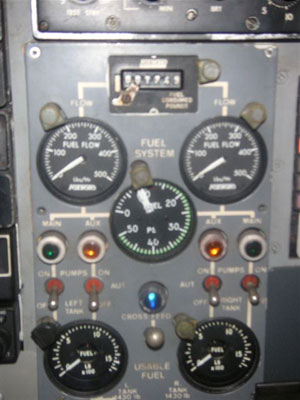
Instrument panel

The air traffic controller cleared the pilot to track via Lee Point for a right base for runway 29. The pilot reported that during the approach, about 6 NM from Darwin, he noticed that the right fuel pump warning light was flashing. Shortly after, the left fuel pump light flashed and he noticed that the fuel gauges were indicating empty. The pilot informed the controller that an engine was shutting down and requested and received a clearance to land on runway 18, which had about 5 kts downwind component. During the landing roll, the left engine also failed and both main landing gear tyres were damaged due to excessive brake application. There was no other damage and none of the occupants were injured.

The aircraft's fuel tanks were drained during the investigation, and were each found to contain about 3L of fuel. The aircraft's trip record sheet indicated that the fuel remaining prior to the last refuelling was 620 lbs and that 180 lbs had been added prior to the first flight of the day.2

The planned departure time from Darwin for the flight to Bathurst Island was 1600. At about 1500, the pilot ordered 450 lbs of fuel for the aircraft. The pilot held senior management responsibilities in the company and had been heavily distracted by those duties until after the planned departure time. He subsequently departed for Bathurst Island at 1610. The refueller was delayed and did not arrive at the operator's apron until after the aircraft had departed.

The pilot subsequently did not check the fuel quantity prior to departing from Darwin for Bathurst Island, and assumed that it had been refuelled. At the time of the incident the total fuel consumed since the last refuelling was 835 lbs.

The investigation found that the pilot in command omitted vital fuel quantity checks prior to departure from Darwin and again at Bathurst Island. The operator did not have a procedure to cross reference and verify that the required quantity of fuel had been added. The investigation determined that the lack of fuel verification procedures to confirm that the required fuel had been added, and the pilot's attention being diverted to management tasks, together contributed to this fuel exhaustion occurrence. The Bureau classified the occurrence as a serious incident due to the potential for a much worse outcome had the exhaustion occurred any earlier.

  1. The crew comprised a pilot in command and a flight attendant.
  2. The Bandeirante's fuel system records fuel quantity and usage in pounds (lbs). Fuel is ordered in litres. One litre of Jet A-1 fuel normally weighs 1.72 lbs, depending on the density of the fuel on the day.


Occurrence summary

Investigation number 200404700
Occurrence date 29/11/2004
Location 11 km N Darwin, Aero.
State Northern Territory
Report release date 24/12/2004
Report status Final
Investigation type Occurrence Investigation
Investigation status Completed
Mode of transport Aviation
Aviation occurrence category Fuel exhaustion
Occurrence class Serious Incident
Highest injury level None

Aircraft details

Manufacturer Embraer-Empresa Brasileira De Aeronautica
Model EMB-110
Registration VH-BWC
Serial number 110-261
Sector Turboprop
Operation type Charter
Departure point Bathurst Island, NT
Destination Darwin, NT
Damage Minor

Loss of control, Lake George, New South Wales, VH-TAG, SA227-AC Metro III

Summary

On 21 November 2004, the crew of a Fairchild Industries SA227-AC Metro III aircraft, registered VH-TAG, was conducting an endorsement training flight near Lake George, 33 km north-east of Canberra Airport. The flight included a planned in-flight engine shutdown and restart, conducted at an altitude below 4,500 ft (about 2,200 ft above ground level (AGL)). During the engine restart preparation, the instructor departed from the published procedure by moving the power lever for the left engine into the beta range and directing the pilot to select the unfeather test switch. These actions were appropriate to prepare an engine for start on the ground with a feathered propeller, but not during an air start. 

As a result, the propeller on the left engine became fixed in the start-locks position. The crew lost control of the aircraft, and it descended 1,000 ft, to about 450 ft AGL, before they regained control. The crew could not diagnose the source of the loss of control and proceeded to start the left engine while the propeller was fixed on the start-locks. As a result, the crew lost control of the aircraft for a second time and it descended 1,300 ft, to about 300 ft AGL, before they regained control. 

The SA226 / SA227 aircraft contain no lockout system to prevent pilots from intentionally moving the power lever into the beta range during flight. It was the first time the instructor had given a Metro endorsement, and he was subject to time pressure to complete the endorsement. His ongoing difficulties in adapting to his employment tasks were not successfully dealt with by the operator.  He had a limited understanding of the aircraft's engine and propeller systems, and had not practiced an air start for 8 years as the CASA check and training approval did not include an assessment of all flight critical exercises.

Occurrence summary

Investigation number 200404589
Occurrence date 21/11/2004
Location 33 km ENE Canberra, Aero.
State New South Wales
Report release date 19/07/2006
Report status Final
Investigation type Occurrence Investigation
Investigation status Completed
Mode of transport Aviation
Aviation occurrence category Loss of control
Occurrence class Serious Incident
Highest injury level None

Aircraft details

Manufacturer Fairchild Industries Inc
Model SA227
Registration VH-TAG
Serial number AC-705
Sector Turboprop
Operation type Flying Training
Departure point Canberra, ACT
Destination Canberra, ACT
Damage Nil

Bell 206B, VH-CSH, on 30 October 2004

Summary

At about 1215 EST on 30 October 2004, the pilot a of Bell Helicopter Company206B helicopter was engaged in aerial work operations in support of a plague locust control campaign. Also on board were two persons who were assisting the pilot in locating and determining the size of the locust infestation.

The helicopter was operating at a low level approximately 10 km south-west of Dunedoo NSW, when it struck powerlines and impacted the ground heavily. The pilot and the rear seat occupant suffered fatal injuries, while the remaining passenger suffered serious injuries.

The investigation found that the occupants of the helicopter were generally aware of the existence and location of the powerline during their operations.

Occurrence summary

Investigation number 200404590
Occurrence date 22/11/2004
Location 12 km SW Dunedoo, (ALA)
State New South Wales
Report release date 02/02/2006
Report status Final
Investigation type Occurrence Investigation
Investigation status Completed
Mode of transport Aviation
Aviation occurrence category Wirestrike
Occurrence class Accident
Highest injury level Fatal

Aircraft details

Manufacturer Bell Helicopter Co
Model 206
Registration VH-CSH
Serial number 358
Sector Helicopter
Operation type Aerial Work
Departure point Dubbo, NSW
Destination Dubbo, NSW
Damage Destroyed

de Havilland Canada DHC-8-315, VH-SBW

Summary

The investigation of this occurrence(200404436) has been discontinued. The circumstances of this occurrence are being considered as part of investigation 200403238.

Occurrence summary

Investigation number 200404436
Occurrence date 09/11/2004
Location 222 km S Brisbane, Aero.
Report release date 19/11/2004
Report status Discontinued
Investigation type Occurrence Investigation
Investigation status Discontinued
Mode of transport Aviation
Aviation occurrence category Avionics/flight instruments
Occurrence class Incident
Highest injury level None

Aircraft details

Manufacturer De Havilland Canada/De Havilland Aircraft of Canada
Model DHC-8
Registration VH-SBW
Operation type Air Transport High Capacity
Damage Nil

Cessna 414A, VH-PTA

Summary

The Australian Transport Safety Bureau did not conduct an on-scene investigation of this occurrence.

Sequence of events

On 12 November 2004, the air traffic control (ATC) sector controller advised the pilot of VH-PTA, a Cessna Aircraft Company 414A Chancellor, of an active restricted area up to flight level (FL) 260, ahead of the aircraft. The pilot requested permission to climb to FL260.

A short time later, while climbing through FL160, the pilot advised the controller that he was unable to climb to FL260. The controller advised the pilot of an alternative route and cleared him to track via that route. However, the pilot had difficulty reading back the amended route clearance and the controller noted that his speech was slurred. Another pilot who was monitoring the frequency suggested that the pilot may be hypoxic (suffering from oxygen deprivation). The controller declared an alert phase.

The pilot later commented that as the aircraft was climbing through FL160, the passengers expressed concerns regarding their comfort and that the air traffic controller queried him regarding the possible onset of hypoxia. The pilot reported that he checked the cabin pressurisation settings and noted that the pressurisation system was not switched on. He switched it on, but the needle went off the scale, so he switched it off and descended the aircraft to 9,000 ft.

An engineering check of the aircraft's pressurisation system found that the system was capable of normal operation and that it had probably been switched off following maintenance on the aircraft avionics. The engineers subsequently informed the pilot that even though the pressurisation gauge needle exceeded the upper limit, if he had left the system switched on the cabin pressure would have stabilised.

Following an accident investigation involving a pressurised aircraft in 2000, the ATSB issued two recommendations regarding aircraft pressurisation systems. The report ( BO/200003771) and the recommendations (R20000288 and R20000289) are available on the ATSB website or from the Bureau on request.

Occurrence summary

Investigation number 200404460
Occurrence date 12/11/2004
Location Mudgee, Aero.
State New South Wales
Report release date 17/12/2004
Report status Final
Investigation type Occurrence Investigation
Investigation status Completed
Mode of transport Aviation
Aviation occurrence category Flight crew incapacitation
Occurrence class Incident
Highest injury level None

Aircraft details

Manufacturer Cessna Aircraft Company
Model 414
Registration VH-PTA
Serial number 414A0490
Sector Piston
Operation type Private
Departure point Moorabbin, VIC
Destination Archerfield, QLD
Damage Nil