Approach to incorrect runway involving Aero Commander 500-U, VH-LRI, Moorabbin Airport, Victoria, on 9 August 2025

Final report

Report release date: 28/11/2025

Investigation summary

What happened

On the afternoon of 9 August 2025, an Aero Commander 500-U, registered VH-LRI, and operated by 360° Aviation Group, was being repositioned from Bacchus Marsh Airport to Moorabbin Airport, Victoria, with a single pilot on board. At the same time, a Cessna 172, registered VH-EUE and operated by CAE Melbourne Flight Training, was being used to conduct circuit training at Moorabbin Airport with a flight instructor and a student pilot on board.

During the approach to Moorabbin, the Aero Commander crossed through the centreline of the intended runway 17R and instead aligned with the parallel runway 17L, behind the Cessna 172. Separation between the aircraft reduced as they proceeded on final before air traffic control (ATC) observed the aircraft in close proximity. ATC then instructed the Aero Commander to climb and the Cessna 172 to continue landing and the aircraft were deconflicted. The Aero Commander subsequently conducted a visual circuit and landed without further incident, and the Cessna 172 continued circuit training.

What the ATSB found

The ATSB found that the pilot of the Aero Commander configured their GPS navigation unit to provide guidance to the runway. However, due to the waypoint and track selected, the guidance provided was significantly offset from the runway’s centreline. As a result, the pilot inadvertently intercepted the final approach path of the parallel runway behind the Cessna 172.

It was also found that after identifying that the aircraft were in close proximity, air traffic control quickly issued instructions to both pilots, deconflicting the aircraft and directing them away from other traffic.

What has been done as a result

360° Aviation Group disseminated information to flight crew about the potential for misleading indications when using the aerodrome reference point for navigation at Moorabbin Airport. In addition, CAE Melbourne Flight Training advised that it was incorporating ADS-B in/out capability into the Cessna 172s in its fleet that were not currently equipped. 

Safety message

Pilots are reminded of the importance of comprehensive preparation when planning a flight to an unfamiliar aerodrome. This is particularly the case when flying into a Metropolitan Class D airport due to their typical high traffic volumes, complex runway layouts, and use of local landmarks and procedures. When arriving during tower hours, advising air traffic control that you are unfamiliar with the airport alerts them to the fact that you may require additional guidance. They can also then direct extra attention to monitor your progress if their workload allows. It is also important to ask for clarification if an instruction from air traffic control is not understood, or if there is confusion or uncertainty about how the flight is progressing.

Airservices Australia publishes a number of resources for pilots operating into Class D airports. General information regarding operating in Class D airspace can be found in Operating in Class D airspace safety net and pilot safety information specific to each airport is available on the Airservices Industry Hub. The Civil Aviation Safety Authority (CASA) also publishes the Stay OnTrack series of booklets designed to help pilots flying under visual flight rules (VFR) in busy metropolitan areas.


The investigation

The ATSB scopes its investigations based on many factors, including the level of safety benefit likely to be obtained from an investigation and the associated resources required. For this occurrence, the ATSB conducted a limited-scope investigation in order to produce a short investigation report, and allow for greater industry awareness of findings that affect safety and potential learning opportunities.

The occurrence

On the afternoon of 9 August 2025 an Aero Commander 500-U, registered VH-LRI and operated by 360° Aviation Group, was being repositioned from Bacchus Marsh Airport to Moorabbin Airport, Victoria, with a single pilot on board. At the same time, a Cessna 172, registered VH-EUE and operated by CAE Melbourne Flight Training, was being used to conduct circuit training[1] at Moorabbin Airport with a flight instructor and a student pilot on board (Figure 1). Both aircraft were operating under the visual flight rules (VFR).[2] 

Figure 1: Aircraft flight paths
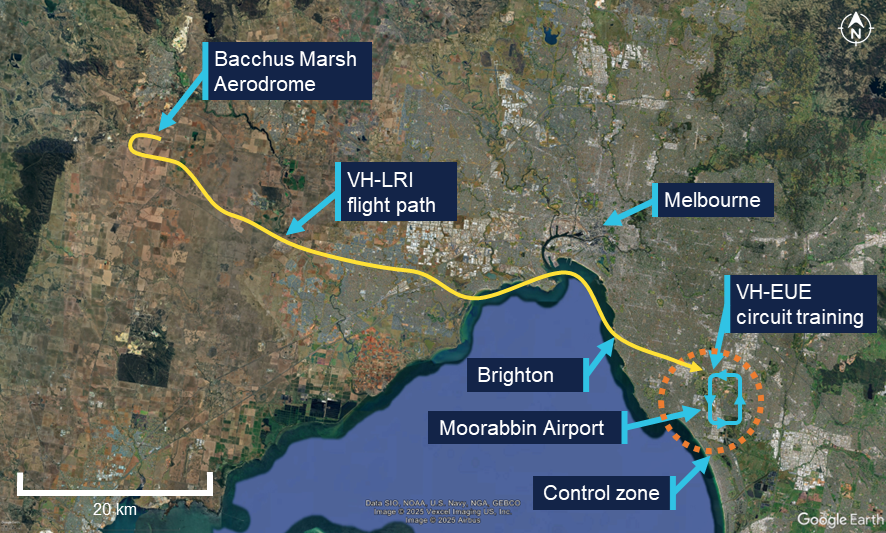
Aircraft flight paths

Source: Flight data overlaid on Google Earth, annotated by the ATSB

Weather conditions at the airport included clear skies, greater than 10 km visibility and a light southerly wind. At 1321, the pilot of VH-LRI contacted Moorabbin Airport air traffic control (ATC) as the aircraft approached Brighton to request a clearance to enter the control zone. The western circuit controller cleared the aircraft to enter the control zone and continue toward the airport, instructing the pilot to join an oblique base for runway 17R.[3] The controller also advised the pilot that they were ‘number 1’, indicating that there was no traffic ahead that was approaching the same runway.

The pilot of VH-LRI recalled that at this time they configured their GPS navigation unit to assist them in orienting with the runway. To achieve this, they set the destination waypoint as ‘YMMB’, the airport code for Moorabbin Airport (see the section titled Aerodrome reference point), and an inbound track of 170° corresponding to the approximate heading of runway 17R. This inbound track was 770 m offset to the east from the runway 17R extended centreline (Figure 2). They also carried an electronic flight bag (EFB) displaying navigation charts and showing the orientation of the runways.

Figure 2: Aircraft flight path relative to inbound track and runway centrelines
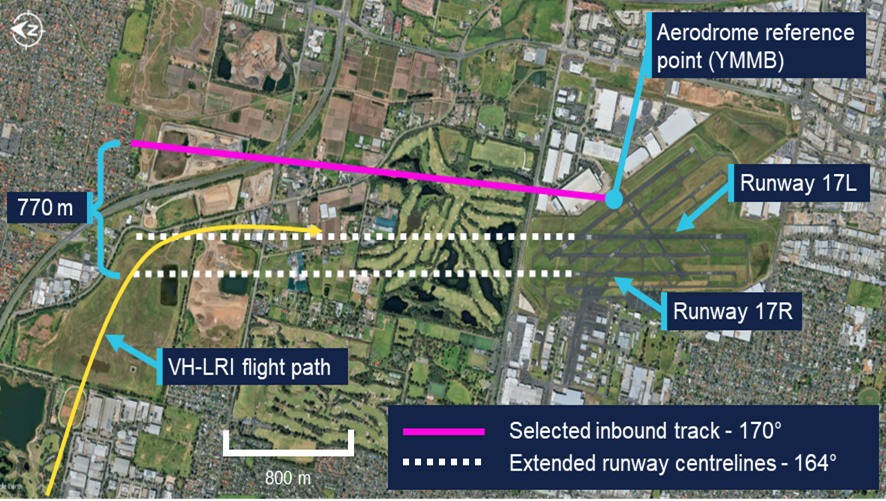
Aircraft flight path relative to inbound track and runway centrelines

Source: Google Earth, annotated by the ATSB

At 1325, the western controller observed VH-LRI on the base leg of runway 17R and cleared the aircraft to land. By this time VH-EUE was on final approach to runway 17L. The pilot of VH-LRI recalled using a combination of visual references, and GPS navigation indications, to inform when they were approaching the centreline of runway 17R and should commence a turn to intercept the final approach course. They also recalled that, while expecting to be aligning with the western runway closest to the coast, they observed that their GPS unit was aligning them to the left of where they expected. 

Approximately 12 seconds later, VH-LRI crossed the final approach course of runway 17R and turned to join final approach for runway 17L (Figure 3), aligning with the runway at 1325:26. The pilot of VH-LRI recalled that, at around that time they observed VH-EUE in front of them. Recognising that they had been advised not to expect preceding traffic they realised that they were not aligned with the correct runway.

Figure 3: VH-LRI and VH-EUE flight paths on final approach
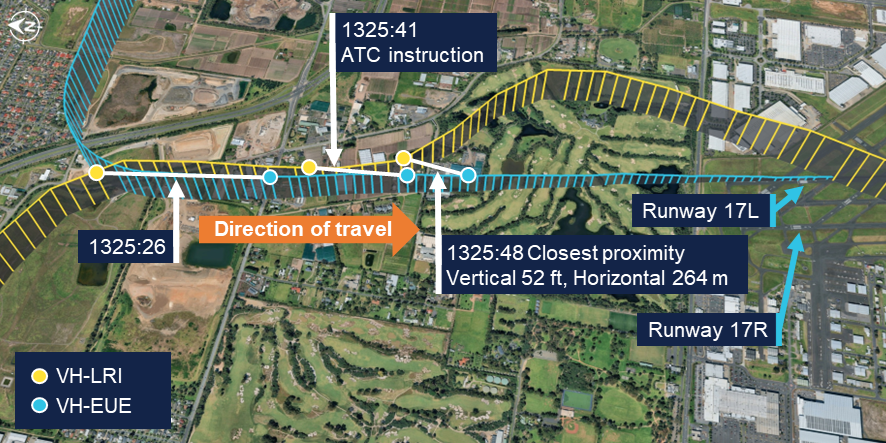
VH-LRI and VH-EUE flight paths on final approach

The ATSB has connected the data points from each flight at the same time to show the relative positions of the aircraft at the corresponding time. Source: Flight data overlaid on Google Earth, annotated by the ATSB

The western circuit controller reported that when looking toward the final approach area of the runways they observed that VH-LRI and VH-EUE were closer to each other than expected. They alerted the eastern circuit controller to the situation and, at 1325:41, asked the pilot of VH-LRI over the radio to confirm they were on final for runway 17R. Observing the aircraft commence a left turn, they immediately asked the pilot why they were doing so, to which the pilot responded that they were orbiting. The controller then advised the pilot that they could not orbit and instructed them to join upwind for runway 17R and climb to 1,500 ft. They further advised the pilot that there was traffic low, on short final for the other runway and to make sure they joined upwind for runway 17R. The pilot read back this instruction, discontinued the orbit and commenced a climb back toward the airport.

At the same time as the western circuit controller contacted the pilot of VH-LRI, the eastern circuit controller contacted the occupants of VH-EUE to advise that there was an aircraft in their vicinity approaching the incorrect runway. In response, the instructor of VH-EUE advised that they would go around. The controller instructed them not to go around, and instead to continue their approach, clearing them for a touch-and-go landing. The instructor read back the instruction and continued toward the runway. 

During the radio exchanges, at 1325:48, the proximity between the aircraft reduced to 52 ft vertically and 264 m horizontally. While the instructor on board VH-EUE did not see VH-LRI until it had passed on their left and had commenced climbing, the pilot of VH-LRI advised that they maintained visual contact with the Cessna throughout the final approach.

Following the deconfliction, VH-LRI climbed to 1,500 ft, conducted a visual circuit for runway 17R and landed without further incident. The instructor and student on board VH‑EUE completed a touch-and-go landing and continued circuit training. The instructor reported they were not aware of the proximity of VH-LRI until reviewing flight data after the flight. They also reported that the student pilot was solely focused on operating the aircraft at the time and was not aware that any incident had occurred.

Context

Pilots

The pilot of VH-LRI held a commercial pilot licence (aeroplane) issued in 2022 and a class 1 aviation medical certificate. They had accumulated 2,058 flight hours, of which 32 hours were operating the Aero Commander 500. In the previous 90 days, the pilot had accumulated 110 flight hours. They completed an instrument proficiency check in October 2024.

The pilot advised that they had flown into Moorabbin as pilot in command once previously, approximately 9 months before. They reported that they had talked to their chief pilot and another pilot at the operator familiar with Moorabbin Airport for advice prior to the flight. They further reported that they reviewed the En Route Supplement Australia (ERSA) and satellite imagery to familiarise themselves with the runway layout and procedures at Moorabbin and considered themselves sufficiently prepared.

The flight instructor on board VH-EUE held a commercial pilot licence (aeroplane) and a class 1 aviation medical certificate. They had accumulated 1,818 flight hours, of which 1,124 hours were operating the Cessna 172. In the previous 90 days, the pilot had accumulated 82 hours. The student pilot had accumulated 18 hours, all in the Cessna 172 and all within the last 90 days. 

Aircraft

Aero Commander VH-LRI

VH-LRI was an Aero Commander 500-U aircraft fitted with 2 Lycoming IO-540-E1A5 engines, each driving a Hartzell constant speed propellor. The aircraft was manufactured in 1967 and first registered in Australia in 1991. It was subsequently registered with the operator in August 2025.

At the time of the occurrence, the aircraft had accumulated 5,543 hours total time in service. The last periodic inspection was conducted in May 2025, and the maintenance release showed no outstanding items. The aircraft was equipped with both ADS-B out and in capability, including a traffic awareness and alerting system. The pilot recalled hearing the aural traffic alert activate prior to Brighton due to traffic in the area. However, they did not recall hearing any alert on approach to the airport.

Cessna 172S VH-EUE

VH-EUE was a Cessna 172S fitted with a Lycoming IO-360-L2A engine powering a McCauley propellor. The aircraft was manufactured and registered with the operator in 2006. The ATSB did not request any information on the aircraft’s maintenance history. The operator advised that the aircraft was not equipped with ADS-B out or in capability, however recorded flight data was downloaded from the aircraft’s avionics.

Moorabbin Airport

Runway layout

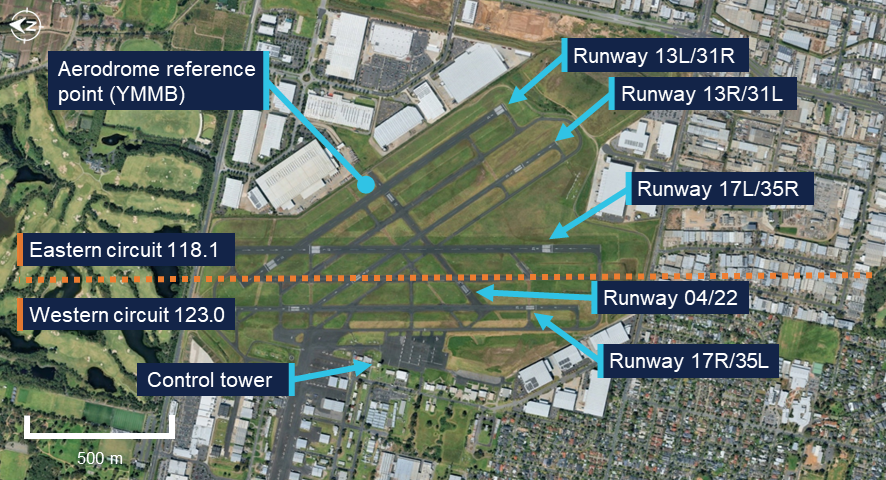
Moorabbin Airport has numerous runways (Figure 4), with the preferred runways being the north-south parallel runways of 17/35. Two additional parallel runways 13/31 were also available, while the shortest of the runways, runway 04/22, was not available unless operationally required. At the time of the occurrence, runways 17L and 17R were nominated as the duty runways.

Figure 4: Moorabbin Airport runway layout
Moorabbin Airport runway layout

Source: Google Earth, annotated by the ATSB

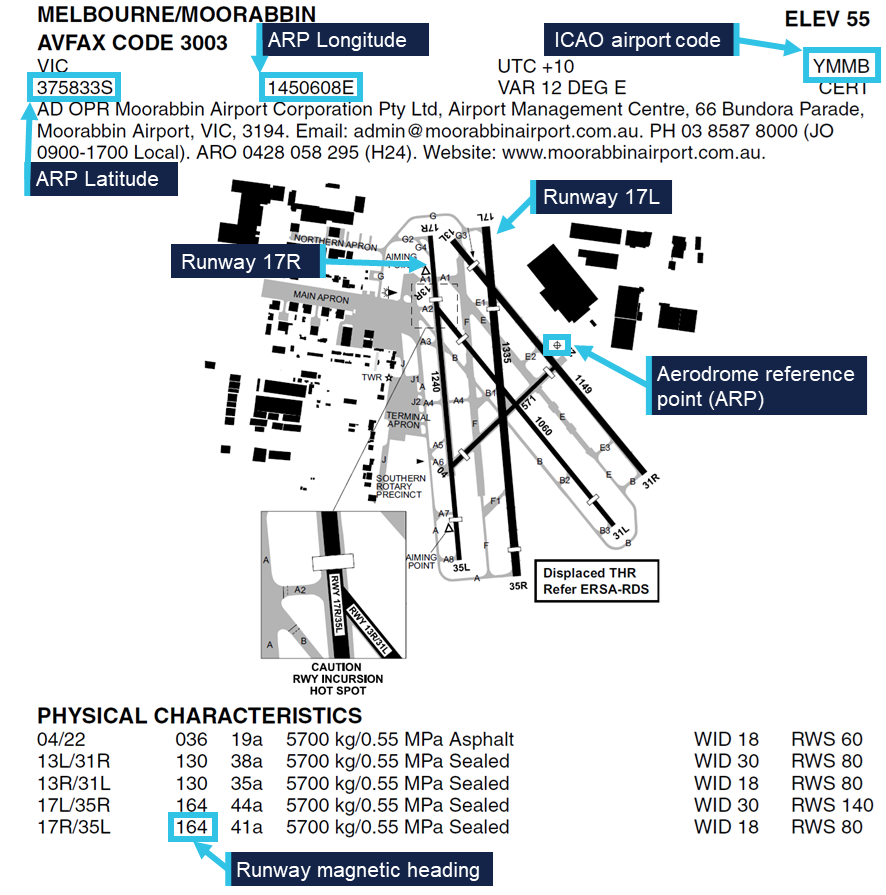
The En Route Supplement Australia (ERSA) (Figure 5) contained information on the physical characteristics of each runway, including that the magnetic heading was 164° for runways 17L and 17R. The runway designations represented the magnetic heading of the runway to the nearest 10°. However, the magnetic variation at Moorabbin Airport had increased approximately 1° over the previous 40 years and therefore the magnetic heading of the runways had drifted slightly since they were originally named.

Figure 5: En Route Supplement Australia (ERSA) extract
En Route Supplement Australia (ERSA) extract

Source: Airservices Australia, annotated by the ATSB

Aerodrome reference point

The airport’s aerodrome reference point (ARP) was the designated geographical location of the airport, and the location associated with the International Civil Aviation Organisation (ICAO) airport code YMMB in aircraft navigation databases. The ARP for Moorabbin Airport was located on the eastern side of the airport, near the runway 22 threshold and 440 m away from the runway 17R centreline. This location was published in the ERSA as a latitude and longitude and shown graphically on the aerodrome plan.

Air traffic control

During tower hours, Moorabbin Airport operated as a Class D aerodrome. Pilots were required to establish and maintain 2-way communications with the tower and receive a clearance prior to entering the control zone. When operating in the airspace, aircraft operating under the visual flight rules (VFR) were given traffic information with respect to all other flights, but did not receive a separation service. Pilots were responsible for sighting and maintaining separation from other aircraft. If a pilot was unable to see, or lost sight of, other aircraft notified as traffic they were required to immediately advise ATC.

When operating parallel runways, Moorabbin Airport operated simultaneous independent circuits with each circuit utilising a different radio frequency. The eastern circuit, on runway 17L, was predominantly for circuit training and used the radio frequency 118.1 for communications between flight crew operating in the circuit and ATC. The western circuit, on runway 17R, was typically used for aircraft arriving from and departing to the west and used the radio frequency 123.0. Pilots operating in one circuit were not expected to monitor the radio frequency of the other circuit and the Aeronautical Information Package (AIP) stated that:

Operations will be regulated independently in each circuit, with an ATC clearance required to enter the opposite circuit or airspace.

At the time of the occurrence, 3 controllers were on duty in the control tower. One controller was controlling the eastern circuit while another was controlling the western circuit. A third controller was responsible for ground movements on a separate frequency. The controllers communicated with pilots in their circuit on a headset. They also had an awareness of activity in the other circuit via speakers in the tower broadcasting each frequency. In addition, the controllers were positioned physically close to each other and could communicate directly when required.

The tower was equipped with a tower situational awareness display (TSAD) which provided radar information that could be used to assist when providing control services. The western circuit controller advised that information provided by this system was limited and therefore it was not typically utilised for monitoring aircraft within the circuit area. Instead, each aircraft was monitored visually, using binoculars to assist. They further advised that at the time of the occurrence the airport was busy with multiple aircraft arriving and departing, in addition to aircraft transiting outside of the control zone to the west. There were also multiple aircraft established in the eastern circuit in addition to VH-EUE. As such, the controllers’ workload required them to direct attention to each aircraft in turn.

Related occurrences

The ATSB database contained 73 instances of aircraft approaching or landing on the incorrect runway at Moorabbin between 2015 and July 2025. During the course of this investigation the ATSB was advised of a similar occurrence that occurred on 13 August 2025 involving the same aircraft, but with a different pilot and without confliction with other traffic. The pilot of this flight advised that they had similarly configured their GPS navigation unit to provide guidance to the aerodrome reference point without realising its distance from the runway. In addition, it was reported to the ATSB that due to the high number of training flights at Moorabbin Airport, aircraft inadvertently entering into the other circuit occurred relatively regularly and was something controllers were alert for.

Safety analysis

Planning the flight to Moorabbin Airport, the pilot of VH-LRI identified that having flown there only once previously, the flight required additional planning and preparation. This included:

  • consulting pilots familiar with Moorabbin Airport
  • reviewing the information in the En Route Supplement Australia (ERSA)
  • studying satellite imagery of the airport.

Additionally, in flight they utilised their electronic flight bag (EFB) to display the runway configuration and setup their GPS navigation to provide guidance. All of these measures were intended to improve the pilot’s situation awareness when approaching an unfamiliar aerodrome.

However, when reviewing the ERSA, the pilot did not identify that the aerodrome reference point (ARP) was located distant from the runway 17R centreline. Additionally, they did not identify that the magnetic heading of the runway differed slightly from that implied by its designation. Consequently, the inbound track configured for guidance was offset and deviated away from the runway centreline. At the point that the aircraft crossed the runway 17R centreline, the navigation unit would have indicated that the aircraft was still significantly to the right of the configured inbound track. Therefore, it is likely that the navigation indications contributed to the pilot flying through the runway centreline of 17R and joining final for 17L behind VH-EUE. VH-LRI was not advised of VH-EUE as traffic by air traffic control (ATC) as the other aircraft was operating in the eastern circuit, which required an additional clearance to enter. In addition, VH-EUE was not equipped with ADS-B out and therefore would not have been detected by a traffic awareness system.

VH-LRI was being periodically visually monitored by the western circuit controller as it approached the airport. During this time, both the eastern and western controllers’ attention was also directed to other traffic. Therefore, both controllers were likely looking away from the final approach path when VH-LRI crossed the runway 17R centreline and entered the eastern circuit. The deviation was not detected until visual contact was re‑established by the western circuit controller, by which time the aircraft was already on final approach for runway 17L.

While the distance between the aircraft reduced as they converged on the same final flightpath, as the pilot of VH-LRI reported that visual contact was maintained, there was likely no significant risk of a collision. However, upon intervention by ATC, the initial instinct of the pilot of VH-LRI was to orbit to the left, while the instructor on board VH‑EUE intended to climb. Initiation of a climb by VH-EUE would have increased the risk of collision between the aircraft, while an orbit would have placed VH-LRI in conflict with other aircraft in the eastern circuit. Therefore, the timely issuing of instructions contrary to the pilots’ intentions deconflicted the aircraft and directed them away from other traffic.

Findings

ATSB investigation report findings focus on safety factors (that is, events and conditions that increase risk). Safety factors include ‘contributing factors’ and ‘other factors that increased risk’ (that is, factors that did not meet the definition of a contributing factor for this occurrence but were still considered important to include in the report for the purpose of increasing awareness and enhancing safety). In addition ‘other findings’ may be included to provide important information about topics other than safety factors. 

These findings should not be read as apportioning blame or liability to any particular organisation or individual.

From the evidence available, the following findings are made with respect to the approach to incorrect runway involving Aero Commander 500-U, VH-LRI, at Moorabbin Airport, Victoria, on 9 August 2025. 

Contributing factors

  • Due to unfamiliarity with the airport, the pilot of the Aero Commander configured their GPS navigation unit to provide guidance to the runway. However, due to the waypoint and track selected, the guidance was significantly offset from the runway’s centreline, resulting in the pilot inadvertently intercepting the final approach path of the parallel runway in proximity to a Cessna 172.

Other findings

  • Identifying that the aircraft were in close proximity, air traffic control quickly issued instructions to both pilots, deconflicting the aircraft and directing them away from other traffic.

Safety actions

Whether or not the ATSB identifies safety issues in the course of an investigation, relevant organisations may proactively initiate safety action in order to reduce their safety risk. All of the directly involved parties are invited to provide submissions to this draft report. As part of that process, each organisation is asked to communicate what safety actions, if any, they have carried out to reduce the risk associated with this type of occurrences in the future. 

Safety action by 360° Aviation Group

360° Aviation Group disseminated information to flight crew about the potential for misleading indications when using the aerodrome reference point for navigation at Moorabbin Airport.

Safety action by CAE Melbourne Flight Training

CAE Melbourne Flight Training advised that it was incorporating ADS-B in/out capability into the Cessna 172s in its fleet that were not currently equipped.

Sources and submissions

Sources of information

The sources of information during the investigation included:

  • the pilot and operator of the Aero Commander
  • the flight instructor and operator of the Cessna
  • the air traffic controllers
  • recorded data from aircraft avionics
  • Airservices Australia
  • Bureau of Meteorology. 

Submissions

Under section 26 of the Transport Safety Investigation Act 2003, the ATSB may provide a draft report, on a confidential basis, to any person whom the ATSB considers appropriate. That section allows a person receiving a draft report to make submissions to the ATSB about the draft report. 

A draft of this report was provided to the following directly involved parties:

  • the pilot and operator of the Aero Commander
  • the flight instructor and operator of the Cessna
  • the air traffic controllers
  • Airservices Australia
  • Civil Aviation Safety Authority.

Submissions were received from:

  • the operator of the Aero Commander
  • the operator of the Cessna
  • Airservices Australia
  • Civil Aviation Safety Authority.

The submissions were reviewed and, where considered appropriate, the text of the report was amended accordingly.

Purpose of safety investigations

The objective of a safety investigation is to enhance transport safety. This is done through: 

  • identifying safety issues and facilitating safety action to address those issues
  • providing information about occurrences and their associated safety factors to facilitate learning within the transport industry.

It is not a function of the ATSB to apportion blame or provide a means for determining liability. At the same time, an investigation report must include factual material of sufficient weight to support the analysis and findings. At all times the ATSB endeavours to balance the use of material that could imply adverse comment with the need to properly explain what happened, and why, in a fair and unbiased manner. The ATSB does not investigate for the purpose of taking administrative, regulatory or criminal action.

About ATSB reports

ATSB investigation reports are organised with regard to international standards or instruments, as applicable, and with ATSB procedures and guidelines.

Reports must include factual material of sufficient weight to support the analysis and findings. At all times the ATSB endeavours to balance the use of material that could imply adverse comment with the need to properly explain what happened, and why, in a fair and unbiased manner.

An explanation of terminology used in ATSB investigation reports is available here. This includes terms such as occurrence, contributing factor, other factor that increased risk, and safety issue.

Publishing information

Released in accordance with section 25 of the Transport Safety Investigation Act 2003

Published by: Australian Transport Safety Bureau

© Commonwealth of Australia 2025

Title: Creative Commons BY - Description: Creative Commons BY

Ownership of intellectual property rights in this publication

Unless otherwise noted, copyright (and any other intellectual property rights, if any) in this report publication is owned by the Commonwealth of Australia.

Creative Commons licence

With the exception of the Commonwealth Coat of Arms, ATSB logo, and photos and graphics in which a third party holds copyright, this report is licensed under a Creative Commons Attribution 4.0 International licence.

The CC BY 4.0 licence enables you to distribute, remix, adapt, and build upon our material in any medium or format, so long as attribution is given to the Australian Transport Safety Bureau. 

Copyright in material obtained from other agencies, private individuals or organisations, belongs to those agencies, individuals or organisations. Where you wish to use their material, you will need to contact them directly.

[1]     Circuit training: a phase of pilot training focused on take-offs and landings. It involves making approaches to the runway, touching down and then applying power to take off again.

[2]     Visual flight rules (VFR): a set of regulations that permit a pilot to operate an aircraft only in weather conditions generally clear enough to allow the pilot to see where the aircraft is going.

[3]     Runway number: the number represents the magnetic heading of the runway. The runway identification may include L, or R as required for left or right when there are parallel runways.

Occurrence summary

Investigation number AO-2025-046
Occurrence date 09/08/2025
Location Moorabbin Airport
State Victoria
Report release date 28/11/2025
Report status Final
Investigation level Short
Investigation type Occurrence Investigation
Investigation status Completed
Mode of transport Aviation
Aviation occurrence category Aircraft separation, Depart/app/land wrong runway, Missed approach
Occurrence class Incident
Highest injury level None

Aircraft details

Manufacturer Aero Commander
Model 500-U
Registration VH-LRI
Serial number 1690-22
Aircraft operator 360 Aircraft Pty Ltd
Sector Piston
Operation type Part 135 Air transport operations - smaller aeroplanes
Departure point Bacchus Marsh (ALA), Victoria
Destination Moorabbin Airport, Victoria
Damage Nil

Aircraft details

Manufacturer Cessna Aircraft Company
Model 172S
Registration VH-EUE
Serial number 172S10224
Aircraft operator Oxford Aviation Academy (Australia) Pty Ltd
Sector Piston
Operation type Part 141 Recreational, private and commercial pilot flight training
Departure point Moorabbin Airport, Victoria
Destination Moorabbin Airport, Victoria
Damage Nil

Rail Safety Week a valuable reminder about the importance of safety investigations

This Rail Safety Week (1117 August 2025) the Australian Transport Safety Bureau joins the rail industry in reminding all road users and pedestrians about their responsibilities when approaching and using a level crossing.

There are more than 23,000 level crossings in Australia, many of which involve interactions between road traffic, cyclists and pedestrians. A level of risk to safety exists at all level crossings, and other than misadventure and trespass, accidents at level crossings are the primary cause of railway-related fatalities among the general public.

“A moment of distraction in or around trains, level crossings and other rail infrastructure can change the life of a passenger, road user, or rail worker forever,” said ATSB Director Transport Safety Kerri Hughes.

“As such we commend the TrackSAFE Foundation on 20 years of promoting rail safety to positively influence the behaviour of road users by increasing their awareness of safe actions at and around level crossings.”

Tragically, a small proportion of level crossing collisions result in fatalities and/or serious injuries to those in road vehicles.

“Some level crossing collisions involving heavy road vehicles can also result in serious adverse consequences to those on board trains,” Ms Hughes said. 

In March 2024, drawing on a range of data sources including investigations, the ATSB published a safety study that reviewed level crossing collisions between trains and heavy road vehicles. 

The study identified that, in a number of the accidents reviewed, heavy vehicle drivers were probably distracted prior to the collision or were dividing their attention between driving the vehicle and another task or thought.  

Ms Hughes said the safety study was an example of how the ATSB’s independent no-blame safety investigations play an important role nationally in influencing rail safety.

“This Rail Safety Week also coincides with our latest recruitment round seeking rail industry professionals to join the ATSB as rail Transport Safety Investigators,” she said.

“We’re seeking to expand our established cohort of rail specialists and are looking for candidates with proven experience in rail infrastructure or rail operations, and a strong commitment to enhancing safety across the rail industry,” Ms Hughes said. 

“The role as a rail safety investigator is ideally suited to those who are curious, detail-oriented, and committed to improving safety outcomes.  Highly desirable experience includes train driving and engineering disciplines such as civil, mechanical, maintenance, signalling and design.”

If you or someone you know is interested in joining the ATSB as a Rail Transport Safety Investigator, more information and how to apply can be found at www.atsb.gov.au/jobs (applications close on 31 August 2025).

Flight crew continued unstable approach during Perth landing

A continued unstable approach by a Fokker 100 into Perth earlier this year highlights the importance of flight crews ensuring they follow stabilised approach procedures.

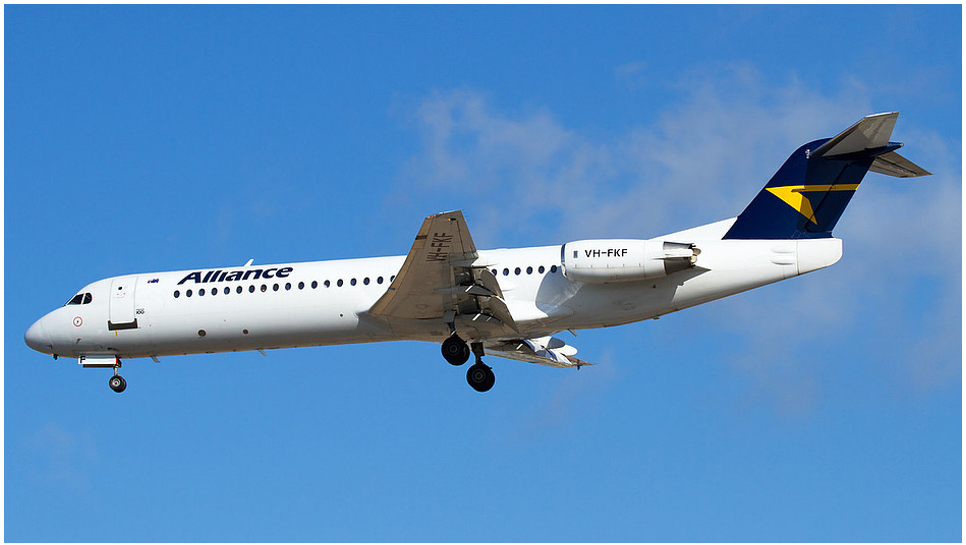
On 29 April 2025, an Alliance Airlines Fokker 100 received an air traffic control clearance to conduct a visual approach following a standard instrument arrival to Perth Airport’s runway 03. The approach required a 90° turn onto final that resulted in the aircraft being aligned with the runway, and on the correct approach profile about 4 NM from the runway threshold.

Passing about 1,000 ft radio altitude, the aircraft was above the operator’s permitted airspeed‑related stabilised approach criteria. However, a go‑around was not initiated.

“An ATSB investigation found that the captain, who was pilot flying, incorrectly assessed that the applicable stabilisation height was 500 ft, and therefore did not manage the aircraft’s energy state to ensure the stabilised approach speed was achieved by 1,000 ft,” said ATSB Director Transport Safety Stuart Macleod

“In addition, the first officer, as pilot monitoring, did not announce the approach was unstable, possibly due to their workload, the required check being completed slightly late, and an assessment that the airspeed was reducing.”

The aircraft, which was carrying four crew and 15 passengers, landed uneventfully.

Mr Macleod said the incident highlights the importance of flight crew having a common understanding of the approach requirements.

“Best practice advises flight crews to be aware of the relevant stable approach criteria, comply with the standard operating procedures, and advise air traffic control when unable to comply with a clearance that would result in the aircraft being too high or fast for that criterion,” he said.

While it did not contribute to the occurrence, the ATSB’s investigation also identified that the captain had inadvertently not changed the altimeter setting from standard pressure to QNH during the descent.

This resulted in the left altimeter indicating 300 ft lower than the right altimeter. Neither flight crewmember detected this incorrect setting during two subsequent checks prior to landing.

“This incident also illustrates the need for effective flight crew monitoring, which can be improved through the use of standard operating procedures, increased emphasis and practice,” Mr Macleod concluded.

Read the final report: Unstable approach involving Fokker 100, VH-FKF, near Perth Airport, Western Australia, on 29 April 2025

ATSB recruiting for rail transport safety investigators  

The Australian Transport Safety Bureau has opened a new recruitment round to engage rail industry professionals as transport safety investigators. 

The ATSB is completely independent of operators and the regulator, and has unique powers to gather and protect evidence under the Transport Safety Investigation Act 2003.  

Our role is to help prevent future occurrences by ensuring lessons are learned and safety improvements are made through evidence-based, no-blame investigations, providing assurance that systems are operating safely through growth and change. 

We are looking for candidates with proven experience in rail infrastructure or operations with a strong commitment to enhancing safety across the rail industry.  

Highly desirable experience includes train driving and engineering disciplines such as civil, mechanical, maintenance, signalling and design.  

The successful candidates will be supported in their transport safety investigator career path through a structured development and training program, including the opportunity to gain formal tertiary qualifications through our partnership with RMIT University.  

As their capabilities, skills and experiences develop, investigators take on increasingly complex investigations and can lead multiple investigations at any point in time. With on-the-job training and mentoring, they progressively become involved in larger and more systemic investigations that drive real safety change – such as our recently-released reported into the Traveston freight train derailment.   

Applications for these roles close on 31 August 2025. Read more here: Employment opportunities | ATSB 

Serious injury on pilot launch, 8 km from Devonport, Tasmania, on 25 May 2025

Occurrence Briefs are concise reports that detail the facts surrounding a transport safety occurrence, as received in the initial notification and any follow-up enquiries. They provide an opportunity to share safety messages in the absence of an investigation. Because occurrence briefs are not investigations under the Transport Safety Investigation Act 2003, the information in them is de-identified. 

What happened

At 0800 local time on 25 May 2025, the deckhand of a marine pilot transfer vessel (pilot launch) was seriously injured during pilot transfer operations off Devonport, Tasmania. The incident occurred at the pilot boarding ground while the 16 m pilot launch was alongside a 183 m tanker, preparing to transfer 2 marine pilots to the ship for its entry to the port. 

The pilot launch had departed the port at about 0715 with 2 crewmembers (launch master and deckhand) and 2 pilots (one was undertaking training) on board. During the transit to the pilot boarding ground, the launch master noted winds of 10 to 15 knots and a swell of 1.5 to 2 m, both from the north‑west. As the launch approached the lee side of the ship, those on board assessed the conditions and agreed to proceed with the transfer.

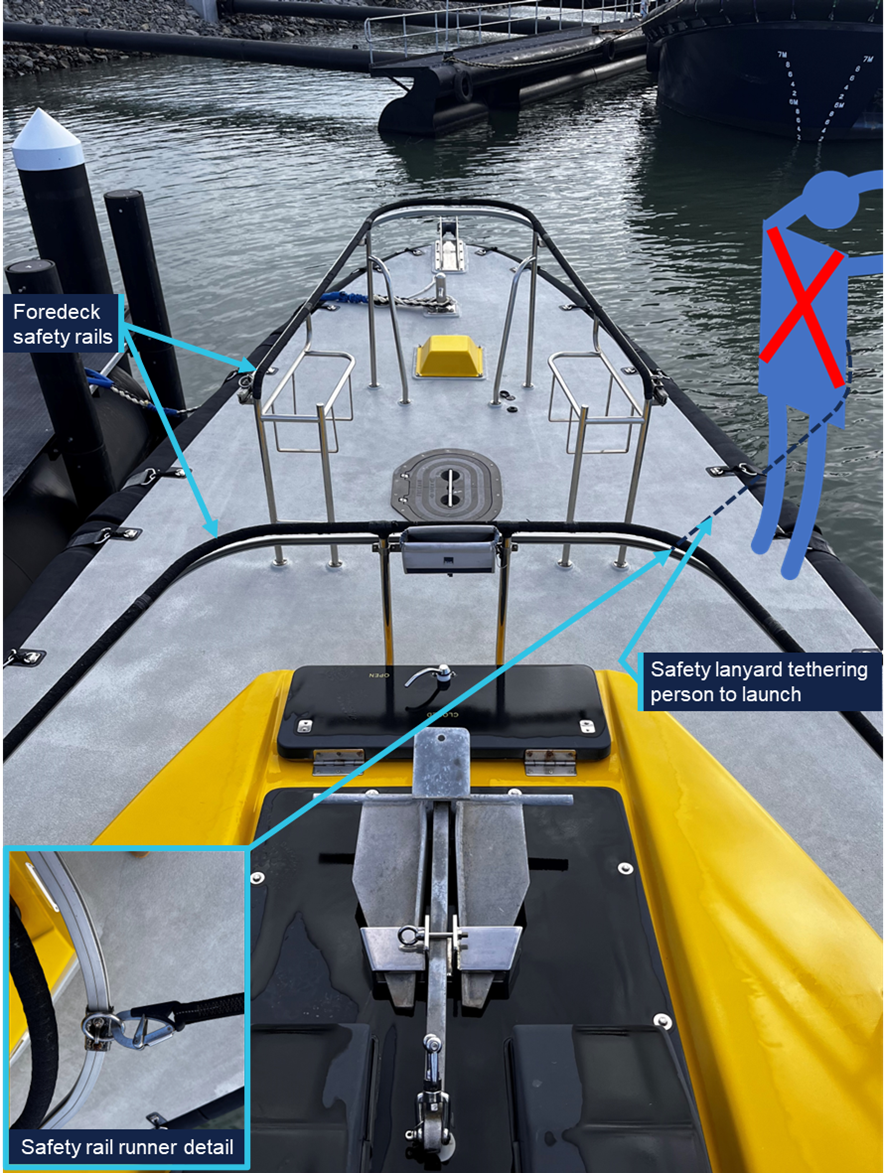
Once alongside, starboard side to the ship, the deckhand and both pilots left the launch wheelhouse and moved to the foredeck. Conditions in the lee of the ship were rougher than had been experienced during the recent months, and they waited for the launch’s motion to become more favourable. All 3 were tethered to the launch safety rail with individual lanyards.

After informing the pilot in charge, the deckhand, in accordance with company pilot transfer procedures, went forward to inspect the ship’s pilot ladder. The deckhand noted that the ladder was new and then took hold of it with both hands and stepped onto it to check if it was securely rigged (Figure 1). While the deckhand was on the ladder, the launch fell away into the trough of a passing wave. The deckhand was pulled by the lanyard, off the pilot ladder and onto the foredeck of the launch, resulting in serious injuries. The 2 pilots (who had not seen the approaching wave) quickly rendered assistance to the deckhand.

Shortly after, the launch master manoeuvred it clear of the ship and contacted Devonport vessel traffic service (VTS), requesting medical assistance. The pilot transfer was suspended and the launch returned to port where the deckhand was transferred ashore and taken to hospital. 

Figure 1: Pilot launch foredeck with crewmember position to test the pilot ladder shown

  Figure 1: Pilot launch foredeck with crewmember position to test the pilot ladder shown

Source: TasPorts, annotated by the ATSB

Pilot transfer

All vessels of 35 m or more (length overall) calling at Tasmanian ports must engage a licenced marine pilot (unless the master holds a pilotage exemption for that area) and must participate in the VTS.

In compliance with the harbour master’s instructions, arriving ships’ masters were to complete a ‘VTS – Pre Arrival form’ which included acknowledgement that the pilot ladder checklist had been read, understood and submitted at least 72 hours prior to the planned pilotage. 

The comprehensive checklist stated that the master was responsible for ensuring that the pilot ladder had been stored and maintained in good condition, was regularly inspected, was certified by the manufacturer of the ladder and complied with the SOLAS requirements.[1] Among the items on the checklist, was whether the pilot ladder had been properly secured to a strongpoint on the ship’s deck. The checklist was accompanied by a copy of the IMO / IMPA ‘Required boarding arrangements for pilot’ poster.[2]

In addition to requirements of and assurances from the arriving ship’s master, the pilotage provider also had a ‘Pilot vessel—pilot transfer procedure’ applicable to its operations across 10 ports. This procedure detailed that the master of the pilot launch was responsible for the safety of all persons on board the pilot launch while it was underway. The pilot (in charge) on board was responsible for the final assessment of the suitability for the transfer to continue. 

Any person not inside the launch cabin enclosed area was required to be tethered with a safety lanyard to the lanyard rail. The procedure also required the deckhand to assess/check the pilot ladder condition and if it was properly rigged. These checks routinely included checking if the ladder was secure by grasping the ladder with both hands and stepping one foot onto the ladder. This check was the common method used in this port and across other ports in Tasmania and other jurisdictions. This check was conducted on all ladders regardless of their apparent age. 

Safety action

The pilotage provider completed an internal investigation which found, among other things, that there were no swell parameters for Devonport pilot boarding ground transfers. Wind conditions, for which parameters existed, were well within limits during this transfer. The statements of those involved indicated that the conditions in the ship’s lee had not been experienced for several months but were not sufficiently adverse to not proceed with the transfer. However, as the motion of the launch subsided and the deckhand went forward to test the ladder, the pilots did not note the approaching wave trough and were unable to warn the deckhand.

As part of the internal investigation, a DMAIC (define, measure, analyse, improve, control) process was completed. The process identified several areas for improvement, including:

  • pilot transfer and pilot ladder testing methods and arrangements including review of practices in other ports
  • safety equipment including safety harness and lanyard use during pilot transfer
  • weather monitoring equipment and arrangements
  • the use of personnel and resources, rostering and training, including safety preparedness and response.

Following the investigation, the pilotage provider released a memorandum which outlined mandatory interim safety controls to be implemented across all pilot transfer operations. The new safety controls required that, prior to commencing the transfer, the launch master was to contact the ship and confirm that the pilot ladder had been rigged as per SOLAS requirements and that the arrangement had been tested. Further, any manual test by the launch crew was to be conducted using arms only while ensuring the tester’s body remained fully on the pilot launch’s deck.

A review of the safety lanyards in use has led to the implementation of a shorter lanyard which prevents the crewmember from shifting their weight fully onto the pilot ladder (external of the pilot launch). The memo also emphasised that the transfer was to be stopped should any doubt arise.

Safety message

Pilot transfer operations continue to be a high‑risk operation. This occurrence highlights that the risks also include preparations for the transfer involving other crew members along with the marine pilots. 

All persons involved in pilot transfer and transport need to be aware of risks involved in this operation. All should pay particular attention to the sea and to the motion it imparts to the pilot launch and the subsequent effects on the actions being undertaken at the time. The pilot launch is a small vessel alongside a much larger and more stable vessel. Transferring from the deck of the launch to the pilot ladder attached to the ship exposes personnel to the risks posed by the relative motion between the 2 vessels, especially if they remain attached to the launch. 

About this report

Decisions regarding whether to conduct an investigation, and the scope of an investigation, are based on many factors, including the level of safety benefit likely to be obtained from an investigation. For this occurrence, no investigation has been conducted and the ATSB did not verify the accuracy of the information. A brief description has been written using information supplied in the notification and any follow-up information in order to produce a short summary report, and allow for greater industry awareness of potential safety issues and possible safety actions.

[1]     SOLAS CH V- Regulation 23 - Pilot Transfer Arrangements Resolution A.1045 (27)

[2]     The International Maritime Pilots’ Association (IMPA) produced an industry reference poster outlining the SOLAS requirements pilot transfer arrangements. IMPA is the international non-governmental organization in consultative status representing maritime pilotage at the IMO. (www.impahq.org)

Occurrence summary

Mode of transport Marine
Occurrence ID MB-2025-003
Occurrence date 25/05/2025
Location 8 km from Devonport
State Tasmania
Occurrence class Serious Incident
Marine occurrence category Injury
Highest injury level Serious
Brief release date 13/08/2025

Ship details

Departure point Devonport, Tasmania
Destination Pilot boarding ground, return to port

Ground handling incident involving a Boeing 737-800, Brisbane Airport, Queensland, on 18 June 2025

Occurrence Briefs are concise reports that detail the facts surrounding a transport safety occurrence, as received in the initial notification and any follow-up enquiries. They provide an opportunity to share safety messages in the absence of an investigation. Because occurrence briefs are not investigations under the Transport Safety Investigation Act 2003, the information in them is de-identified. 

What happened

On 18 June 2025 at approximately 1845 Eastern Standard Time, a Boeing 737 was parked at gate 82 at Brisbane International Airport Terminal, Queensland, with the crew preparing the aircraft for disembarkation.

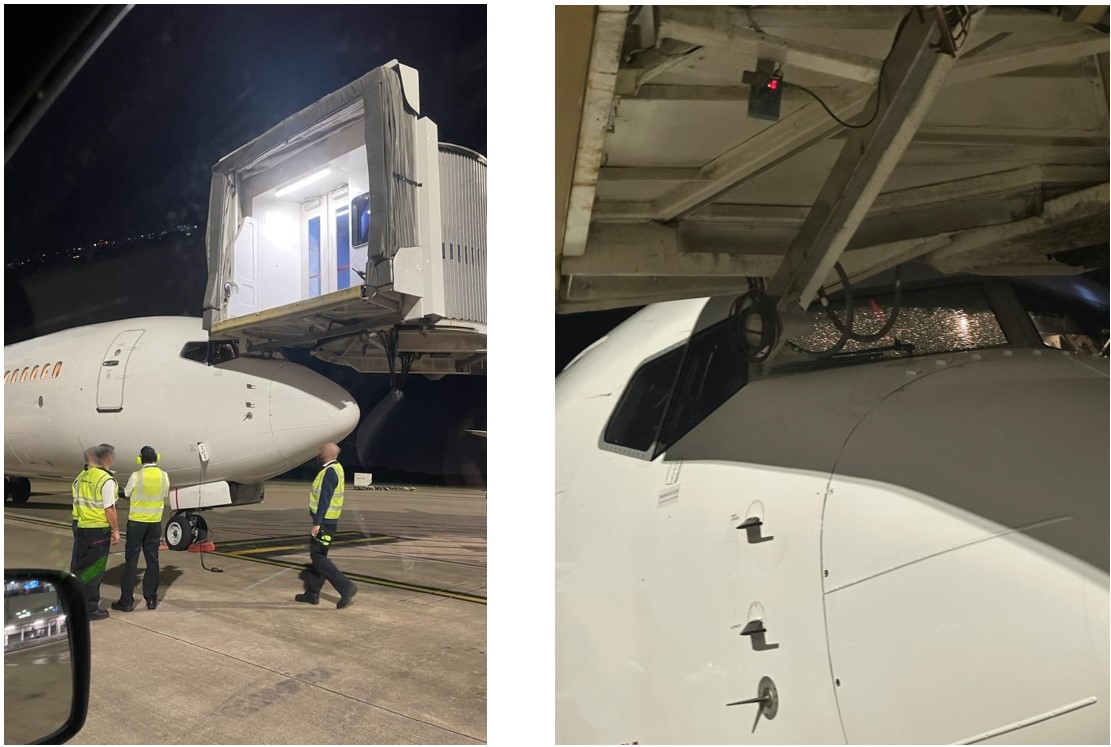
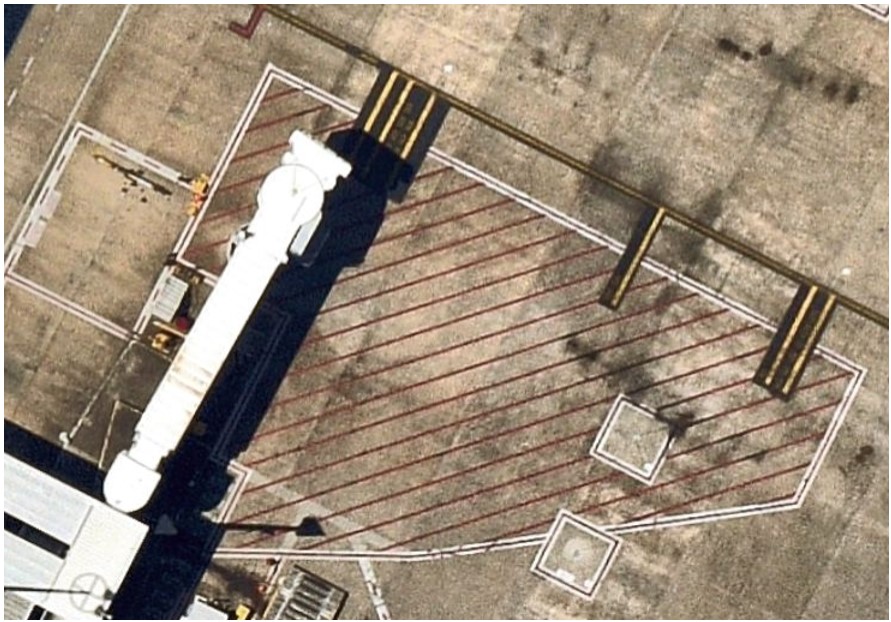
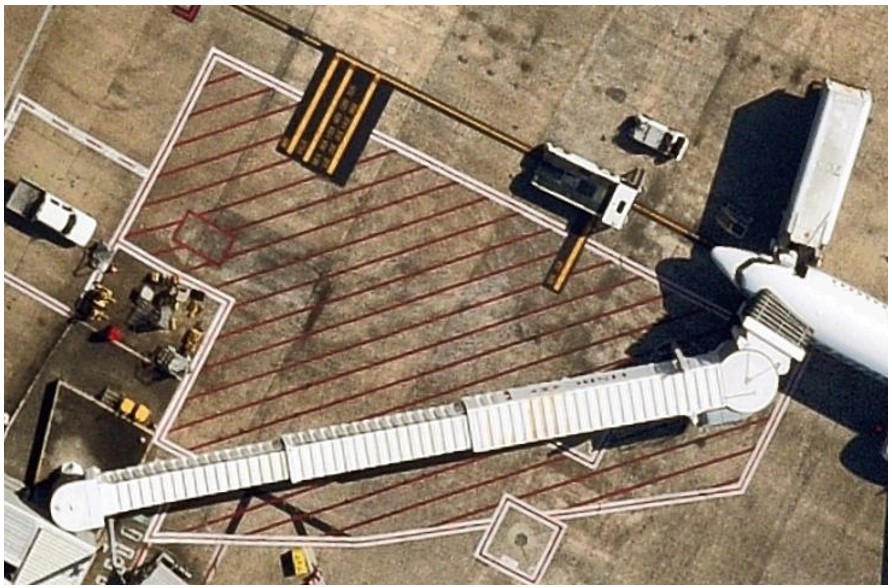
After the wheels were chocked and the park brake was released, the 2 flight crew members noticed that the aerobridge was approaching the aircraft from a high angle and further towards the nose of the aircraft than usual. The captain pressed the ground call switch on board, in an attempt to contact the engineer or other ground staff to advise them of their urgent concern that the aerobridge was likely going to impact the aircraft. As the engineer was no longer in the vicinity, they were unable to make contact before the aerobridge collided with the first officer’s windscreen, shattering the glass (Figure 1 left and right). Although the glass fragments landed on the first officer, they were uninjured in the incident. The flight crew reported that the ‘jolt of the impact was significant’, however, no passengers or cabin crew were injured.

Figure 1: Aerobridge position and impact with aircraft

Two image - left image shows the aerobridge position, the right image shows the aerobridge impact with aircraft

Source: Operator

The aircraft operator provided the ATSB with images showing the aerobridge home position (Figure 2) and the aerobridge docked to a Boeing 737 (Figure 3). The bridge must be moved approximately 30 metres laterally from the home position and lowered to gain visibility of the aircraft prior to forward movement. 

Figure 2: Aerobridge home position

This image shows the aerobridge in the home position, noting the aerobridge is situated in a north-north-east position.

Source: Operator

Figure 3: Aerobridge docked to a Boeing 737 aircraft

This image shows the aerobridge docked to a Boeing 737 aircraft. The aerobridge is situated in an east-north-east position, about 30 metres laterally from the home position.

Source: Operator

The aircraft operator is conducting an internal investigation to determine factors that may have influenced the incident.

The ATSB notes that a second ground handling incident involving a different airline occurred at Brisbane International Airport Terminal, gate 82 on 26 July 2025 in which an aerobridge collided with a parked Boeing 737 during passenger disembarkation. 

Safety message

This incident highlights that when in close proximity to an aircraft, the aerobridge must be moved with clear visual reference to the aircraft to prevent damage or injury.

About this report

Decisions regarding whether to conduct an investigation, and the scope of an investigation, are based on many factors, including the level of safety benefit likely to be obtained from an investigation. For this occurrence, no investigation has been conducted and the ATSB did not verify the accuracy of the information. A brief description has been written using information supplied in the notification and any follow-up information in order to produce a short summary report, and allow for greater industry awareness of potential safety issues and possible safety actions.

Occurrence summary

Mode of transport Aviation
Occurrence ID AB-2025-025
Occurrence date 18/06/2025
Location Brisbane Airport
State Queensland
Occurrence class Serious Incident
Aviation occurrence category Ground handling, Windows
Highest injury level None
Brief release date 07/08/2025

Aircraft details

Manufacturer The Boeing Company
Model 737-800
Sector Jet
Operation type Part 121 Air transport operations - larger aeroplanes
Departure point Queenstown International Airport, New Zealand
Destination Brisbane Airport, Queensland
Damage Minor

Unstable approach involving a Beech Aircraft B200C, near White Cliffs, New South Wales, on 15 July 2025

Occurrence Briefs are concise reports that detail the facts surrounding a transport safety occurrence, as received in the initial notification and any follow-up enquiries. They provide an opportunity to share safety messages in the absence of an investigation. Because occurrence briefs are not investigations under the Transport Safety Investigation Act 2003, the information in them is de-identified. 

What happened

On 15 July 2025, the pilot of a Beech Aircraft Corp B200C aircraft, undertaking a medical transport flight, was conducting a required Navigation Performance Approach to runway 12 at White Cliffs Airport, New South Wales.

The pilot reported that, after becoming visual 200 ft above the approach minimum, they commenced their landing checks and identified that they had not extended the landing gear. They started actions to lower the landing gear as the Terrain Awareness and Warning System (TAWS) aural annunciation TOO LOW GEAR began. After the pilot then checked airspeed, rate of descent and tracking, they decided to extend the landing gear and continue the approach. The aircraft landed without further incident. 

When the aircraft is not in landing mode, the TAWS system monitors the radio altitude, landing gear configuration, landing flaps configuration and airspeed, and generates a caution alert if there is insufficient terrain clearance. A TOO LOW GEAR caution is generated when radio altitude and airspeed are within the Too Low Gear envelope and the landing gear is not in a correct landing configuration. When generated, the caution annunciator lights, and TOO LOW GEAR is announced over the audio system. This caution is annunciated for as long as the condition exists.

The operator was able to determine that the TAWS alert began at a radio altitude of 469 ft and continued until a radio altitude of 374 ft. According to the operator’s stable approach criteria, the aircraft should have been completely configured for a landing by 500 ft. As this was not the case, the pilot should have conducted a missed approach when the TOO LOW GEAR caution was generated.

Safety message

The ATSB continues to stress the risks associated with unstable approaches. The Flight Safety Foundation cites a lack of go-arounds from unstable approaches as the number one risk factor in approach and landing accidents. The prompt execution of a go‑around will significantly reduce this risk.

About this report

Decisions regarding whether to conduct an investigation, and the scope of an investigation, are based on many factors, including the level of safety benefit likely to be obtained from an investigation. For this occurrence, no investigation has been conducted and the ATSB did not verify the accuracy of the information. A brief description has been written using information supplied in the notification and any follow-up information in order to produce a short summary report, and allow for greater industry awareness of potential safety issues and possible safety actions.

Occurrence summary

Mode of transport Aviation
Occurrence ID AB-2025-031
Occurrence date 15/07/2025
Location Near White Cliffs
State New South Wales
Occurrence class Incident
Aviation occurrence category E/GPWS warning, Incorrect configuration, Unstable approach
Highest injury level None
Brief release date 11/08/2025

Aircraft details

Manufacturer Beech Aircraft Corp
Model B200C
Sector Turboprop
Operation type Part 135 Air transport operations - smaller aeroplanes
Departure point Broken Hill Airport, New South Wales
Destination White Cliffs Airport, New South Wales
Damage Nil

Flight below minimum altitude involving Cessna 206G, VH-ARS, 6 km north-west of Archerfield Airport, Queensland, on 24 July 2025

Final report

Report release date: 24/11/2025

Investigation summary

What happened

On 24 July 2025, a Cessna 206G, VH-ARS, taxied for departure shortly before last light for a flight from Archerfield Airport, Queensland, to Rockhampton with a flight instructor and pilot under training on board. The pilot was a qualified private pilot conducting training for a private instrument rating. 

The flight was planned under the instrument flight rules, but the pilot informed air traffic control that they would conduct a visual flight rules departure. Air traffic control informed the pilot of the last light time and requested they confirm their departure would be before last light, which they did. However, shortly after departure, air traffic control issued them with a terrain alert and requested they expedite their climb. The pilot acknowledged and complied, and the flight continued without further incident.

What the ATSB found

The ATSB found that flight instructor elected to conduct a visual departure just prior to last light, which resulted in the aircraft operating below the minimum altitude after last light and the issuing of a terrain alert by air traffic control.

Safety message

The importance of planning, particularly around times when rules change, such as the transition from day to night, was previously promoted by the ATSB in the safety message for AO-2022-061. In this case the aircraft departed later than planned on a visual departure, rather than climbing within the circling area to the required safety height, which resulted in the terrain alert after last light.

Additionally, during the investigation the ATSB became aware of a potential conflict point overhead Archerfield Airport for instrument flight rules departures from Archerfield with arrivals to Brisbane Airport runway 01 right, currently being managed by ATC. This was known by the involved parties, with a project underway to develop a procedural instrument departure from Archerfield Airport.

The ATSB encourages the parties involved in this project to implement it as soon as reasonably practicable in order to provide improved traffic deconfliction.


The investigation

The ATSB scopes its investigations based on many factors, including the level of safety benefit likely to be obtained from an investigation and the associated resources required. For this occurrence, the ATSB conducted a limited-scope investigation in order to produce a short investigation report, and allow for greater industry awareness of findings that affect safety and potential learning opportunities.

The occurrence

On 24 July 2025, at 1732 local time, a Cessna 206G, registered VH-ARS, taxied for departure from Archerfield Airport, Queensland, bound for Rockhampton with a flight instructor and pilot under training on board. The pilot was a qualified private pilot conducting training for a private instrument rating and was making all the radio calls. A flight plan had been submitted for the flight under the instrument flight rules[1] (IFR) with a departure time of 1730. The Archerfield air traffic control (ATC) tower had closed at 1700 and common traffic advisory frequency (CTAF) procedures applied.

The pilot requested their aircraft transponder code for the flight from Brisbane Centre (Centre) at 1732:57, to which Centre initially responded with their allocated code and other IFR traffic, and then queried if they would depart before 1739, which was last light. The pilot confirmed they would depart before 1739 and were ‘happy’ to do a visual flight rules[2] (VFR) departure to the north (see the section titled Departure from Archerfield – En route Supplement Australia), which Centre acknowledged. The instructor reported at interview that they were aware that last light was at 1739. 

At 1736:01, the pilot reported on the CTAF that they were entering and rolling runway 28 right for departure to the north not above 1,000 ft. At 1736:50, Centre attempted to contact the aircraft to request they report at the runway holding point so that they could be transferred to Brisbane Departures (Departures) before take-off. However, noting that the aircraft had become airborne, they ceased their transmission. 

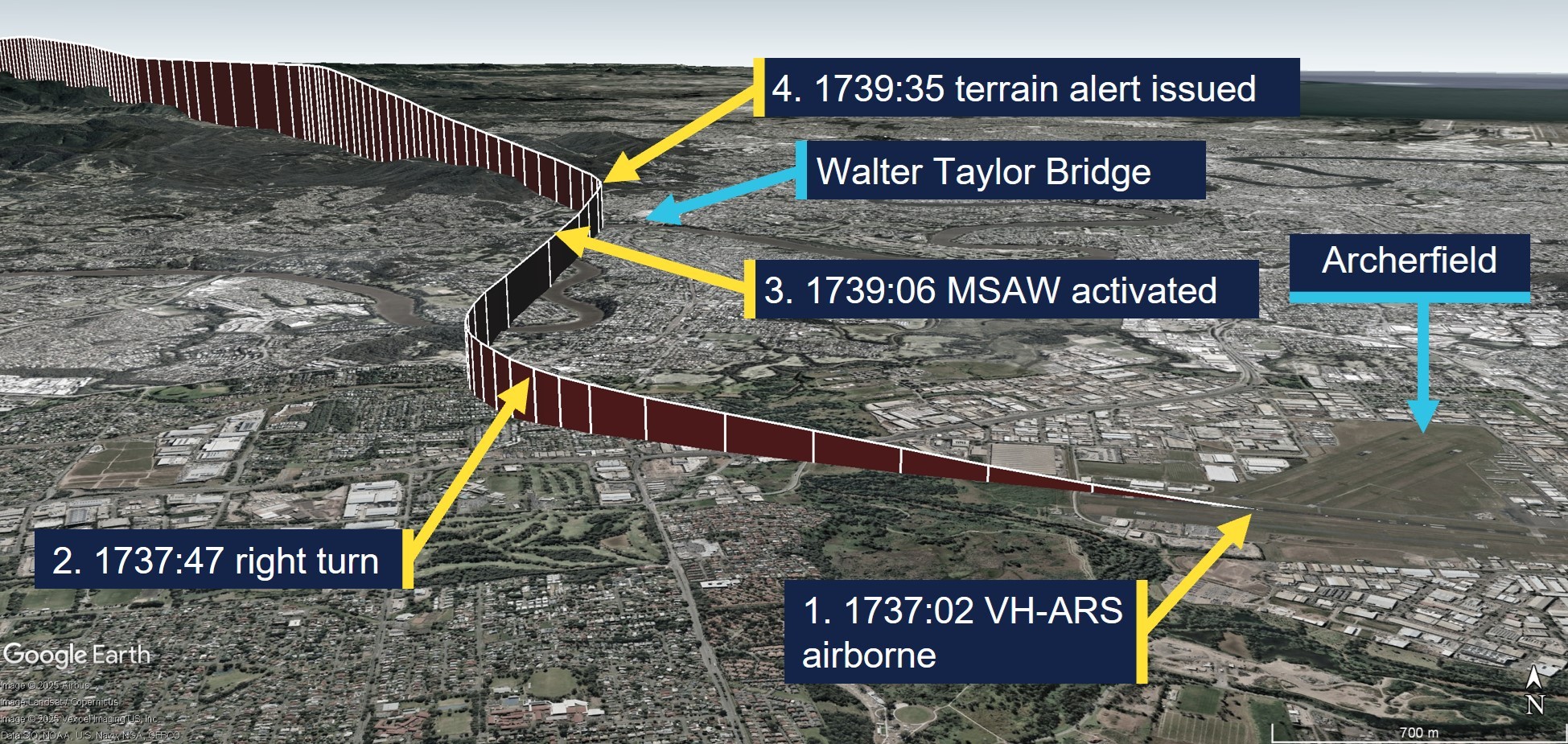
The pilot made a departure call on CTAF and, at 1737:15, they reported to Centre that they were airborne in a right turn towards the Walter Taylor Bridge. Centre acknowledged their airborne report and instructed them to verify their altitude and remain clear of controlled airspace, to which the pilot reported they were passing 400 ft and climbing to 1,000 ft. At 1737:56, Centre instructed them to contact Departures for their clearance to enter controlled airspace.

The pilot contacted Departures, and at 1738:39 received an initial clearance to climb to 3,000 ft on their flight planned route, which was then followed by a clearance to climb to 4,000 ft. At 1739:06, a minimum safe altitude warning (MSAW) activated for the aircraft on the ATC radar display. At 1739:35, the ATC radar indicated the aircraft was at 1,200 ft and Departures issued the pilot with a terrain alert due to the aircraft operating below the minimum altitude in their area (2,900 ft) after last light and requested they expedite their climb to ‘at least 3,000 ft’, which the pilot acknowledged and complied with. The flight continued without further incident and the departure flight path and key events are depicted in Figure 1.

Figure 1: Departure flight path from Archerfield with key events

Departure flight path from Archerfield with key events

Source: ADS-B Exchange and Google Earth, annotated by the ATSB

Context

Flight crew information

Flight instructor

The flight instructor held an air transport pilot licence (aeroplane) with multi-engine and single-engine class ratings, and a Grade 1 instructor rating with endorsements for instrument rating and night VFR training. The instructor’s last flight review was an instructor proficiency check on 25 March 2025, and they held a Class 1 aviation medical certificate, valid until 14 December 2025.

Pilot under training

According to the flight instructor, the pilot under training, who was also the aircraft owner, held a commercial pilot licence (helicopter) and a private pilot licence (aeroplane). They were studying for their private instrument rating, command instrument rating and night VFR rating exams at the time of the incident.

Meteorological information

The Archerfield Airport METAR[3] reports for 1700, 1730 and 1800 recorded light wind conditions, greater than 10 km visibility and no cloud detected. The aerodrome forecast was for CAVOK[4] conditions. The forecast and recorded conditions were consistent with the instructor’s report of clear sky conditions and they surmised that the good visual conditions might have influenced their decision to proceed with a VFR departure. 

Recorded data

The ATC radar data indicated the aircraft was at 1,100 ft when the MSAW activated at 1739:06 and it had reached 1,200 ft when Departures issued them with their terrain alert. Recorded data, retrieved from ADS-B (automatic dependent surveillance-broadcast) Exchange indicated that the aircraft’s speed initially reduced from 125 kt to 120 kt after the clearance from Brisbane Departures to climb to 3,000 ft. The speed then reduced to 80 kt after the terrain alert was issued until the aircraft reached 3,000 ft, and then the speed trend reversed and recovered to about 100 kt as the aircraft reached 4,000 ft. The aircraft took about 5 minutes to reach 3,000 ft after take-off.

Departures from Archerfield

En Route Supplement Australia

The En Route Supplement Australia entry for Archerfield Airport included the following flight procedures and notes:

IFR ACFT [aircraft] departing YBAF [Archerfield Airport] directly into Brisbane Class C airspace [controlled airspace] may EXP [expect] delays due terminal area traffic density. VFR ACFT DEP [departure] after last light may also EXP delays.

Pilots electing to commence or terminate an IFR flight under the VFR should communicate such intention at the earliest possible time to ensure their arrival or departure is processed efficiently.

Departure from the Archerfield CTR [control zone] shall be 1,000 ft.

For a planned DEP [departure] track BTN [between] 310 and 019 DEG MAG [degrees magnetic]: - Depart via “Northern DEP” – track via Walter Taylor (Indooroopilly) Bridge [about 8 km north-north-west of Archerfield];

By day VFR ACFT (and IFR ACFT conducting a VFR DEP) are to depart via the following procedures:

- Advise intended DEP procedure (Northern, Southern, Eastern or Western) on TAX [taxi].

- IFR ACFT conducting a VFR DEP will receive a directed FREQ [frequency] transfer from AF TWR [Archerfield Tower – Brisbane Centre outside tower hours].

The instructor reported that they were aware of a history of delays for IFR departures from Archerfield and that they believed ATC preferred them to depart VFR and then request a change to IFR. They reported that they were in visual conditions and could see obstacles on the ground along their flight path when Brisbane Departures provided their clearance to resume their flight planned track and climb to 3,000 ft.

Standard instrument departure

For an IFR departure from Archerfield there were 2 options, which were the Archerfield standard instrument departure (SID – radar) or a climb within the circling area[5] to the required safety height for the departure track. The instructor reported that a clearance from ATC would be required to climb above 1,500 ft and that a SID would have been their preferred option for an IFR departure, which they believed that they could have done.

The Archerfield SID instructions for runway 28 right were to maintain the runway track until at or above 900 ft, then turn to the ATC assigned heading, and to maintain a minimum climb gradient of 4.3% to 1,900 ft. The SID indicated the 10 NM minimum sector altitude was 2,900 ft.

Airservices Australia procedures

Following external review of the report, Airservices Australia provided the following procedural information:

  • Its manual of air traffic services prohibits vectoring aircraft outside controlled airspace except when warranted by an emergency.
  • Consistent with the above, the Brisbane local procedures prohibit use of the Archerfield radar SID outside of tower hours. However, Airservices Australia is developing a procedural SID for Archerfield that will be available all hours. The project for the Archerfield procedural SID commenced in 2019 to facilitate improved deconfliction of IFR departures from Archerfield with IFR arrivals to Brisbane runway 01 right.
  • IFR arrivals to Brisbane runway 01 right pass overhead Archerfield at 3,000 ft (4,000 ft for runway 01 left), which is the same altitude ATC need IFR departures from Archerfield to climb to in the circling area before departing, which creates a potential traffic conflict point for ATC to manage. In addition, there is a wake turbulence hazard for light aircraft departing overhead Archerfield between jet aircraft arrivals at Brisbane. Furthermore, the known delays for IFR departures from Archerfield may pressure pilots to depart VFR in marginal weather conditions.
  • The reason for the attempt to transfer the incident aircraft to Brisbane Departures before take-off was to provide a clearance to become airborne and climb in the circling area to above the radar lowest safe altitude while ensuring separation of the IFR departure from Archerfield with traffic arriving and/or departing from Brisbane Airport.

Safety analysis

The flight from Archerfield to Rockhampton was planned as an IFR training flight with a flight instructor and pilot-under-training on board. Despite the IFR plan, the instructor elected to conduct the VFR Northern departure instead of conducting an IFR departure because they believed it was the preferred method for Brisbane ATC traffic management. While it was feasible that the aircraft would reach the required minimum altitude before last light based on their flight plan departure time of 1730, take-off actually occurred 7 minutes later than what was flight planned. 

While the aircraft was taxiing for departure, ATC queried the pilot, who was making the radio calls, as to whether they would depart before last light. This query from ATC provided a prompt for the instructor and pilot to reconsider their plan. However, they elected to continue with the VFR Northern departure at 1,000 ft, which took the aircraft out of the circling area and into the 10 NM minimum sector altitude of 2,900 ft. Lift‑off occurred 2 minutes prior to last light and consequently they were below the 10 NM minimum altitude after last light and outside the circling area, which triggered a terrain alert from ATC.  

Findings

ATSB investigation report findings focus on safety factors (that is, events and conditions that increase risk). Safety factors include ‘contributing factors’ and ‘other factors that increased risk’ (that is, factors that did not meet the definition of a contributing factor for this occurrence but were still considered important to include in the report for the purpose of increasing awareness and enhancing safety). In addition, ‘other findings’ may be included to provide important information about topics other than safety factors. 

These findings should not be read as apportioning blame or liability to any particular organisation or individual.

From the evidence available, the following findings are made with respect to the flight below minimum altitude involving Cessna 206G, VH-ARS, 6 km north-west of Archerfield Airport, Queensland, on 24 July 2025. 

Contributing factors

  • The flight instructor elected to conduct a visual departure just prior to last light, which resulted in the aircraft operating below the minimum altitude after last light and the issuing of a terrain alert by air traffic control.

Sources and submissions

Sources of information

The sources of information during the investigation included:

  • ADS-B Exchange
  • Airservices Australia
  • Bureau of Meteorology
  • Civil Aviation Safety Authority
  • the flight instructor of the incident flight.

Submissions

Under section 26 of the Transport Safety Investigation Act 2003, the ATSB may provide a draft report, on a confidential basis, to any person whom the ATSB considers appropriate. That section allows a person receiving a draft report to make submissions to the ATSB about the draft report. 

A draft of this report was provided to the following directly involved parties:

  • Airservices Australia
  • Civil Aviation Safety Authority
  • the flight instructor.

A submission was received from:

  • Airservices Australia

The submission was reviewed and, where considered appropriate, the text of the report was amended accordingly.

Purpose of safety investigations

The objective of a safety investigation is to enhance transport safety. This is done through: 

  • identifying safety issues and facilitating safety action to address those issues
  • providing information about occurrences and their associated safety factors to facilitate learning within the transport industry.

It is not a function of the ATSB to apportion blame or provide a means for determining liability. At the same time, an investigation report must include factual material of sufficient weight to support the analysis and findings. At all times the ATSB endeavours to balance the use of material that could imply adverse comment with the need to properly explain what happened, and why, in a fair and unbiased manner. The ATSB does not investigate for the purpose of taking administrative, regulatory or criminal action.

About ATSB reports

ATSB investigation reports are organised with regard to international standards or instruments, as applicable, and with ATSB procedures and guidelines.

Reports must include factual material of sufficient weight to support the analysis and findings. At all times the ATSB endeavours to balance the use of material that could imply adverse comment with the need to properly explain what happened, and why, in a fair and unbiased manner.

An explanation of terminology used in ATSB investigation reports is available here. This includes terms such as occurrence, contributing factor, other factor that increased risk, and safety issue.

Publishing information

Released in accordance with section 25 of the Transport Safety Investigation Act 2003

Published by: Australian Transport Safety Bureau

© Commonwealth of Australia 2025

Title: Creative Commons BY - Description: Creative Commons BY


Ownership of intellectual property rights in this publication

Unless otherwise noted, copyright (and any other intellectual property rights, if any) in this report publication is owned by the Commonwealth of Australia.

Creative Commons licence

With the exception of the Commonwealth Coat of Arms, ATSB logo, and photos and graphics in which a third party holds copyright, this report is licensed under a Creative Commons Attribution 4.0 International licence.

The CC BY 4.0 licence enables you to distribute, remix, adapt, and build upon our material in any medium or format, so long as attribution is given to the Australian Transport Safety Bureau. 

Copyright in material obtained from other agencies, private individuals or organisations, belongs to those agencies, individuals or organisations. Where you wish to use their material, you will need to contact them directly.

[1]     Instrument flight rules (IFR): a set of regulations that permit the pilot to operate an aircraft in instrument meteorological conditions (IMC), which have much lower weather minimums than visual flight rules (VFR). Procedures and training are significantly more complex as a pilot must demonstrate competency in IMC conditions while controlling the aircraft solely by reference to instruments. IFR-capable aircraft have greater equipment and maintenance requirements.

[2]     Visual flight rules (VFR): a set of regulations that permit a pilot to operate an aircraft only in weather conditions generally clear enough to allow the pilot to see where the aircraft is going.

[3]     METAR: a routine report of meteorological conditions at an aerodrome. METAR are normally issued on the hour and half hour.

[4]     Ceiling and visibility okay (CAVOK): visibility, cloud and present weather are better than prescribed conditions. For an aerodrome weather report, those conditions are visibility 10 km or more, no significant cloud below 5,000 ft, no cumulonimbus cloud and no other significant weather.

[5]     The circling area is determined by drawing an arc centred on the threshold of each usable runway and joining these arcs by tangents. For Archerfield Airport, the radius for each arc was 2.59 NM (4.8 km) and the circling altitude was 1,010 ft. 

Occurrence summary

Investigation number AO-2025-045
Occurrence date 24/07/2025
Location 6 km north-west of Archerfield Airport
State Queensland
Report release date 24/11/2025
Report status Final
Investigation level Short
Investigation type Occurrence Investigation
Investigation status Completed
Mode of transport Aviation
Aviation occurrence category Flight below minimum altitude
Occurrence class Serious Incident
Highest injury level None

Aircraft details

Manufacturer Cessna Aircraft Company
Model U206G
Registration VH-ARS
Serial number U20606898
Aircraft operator Peace Aviation Rockhampton
Sector Piston
Operation type Part 141 Recreational, private and commercial pilot flight training
Departure point Archerfield Airport, Queensland
Destination Rockhampton Airport, Queensland
Damage Nil

Collision with terrain involving a Bell 47G-5, 51 km from Waikerie, South Australia, on 28 June 2025

Occurrence Briefs are concise reports that detail the facts surrounding a transport safety occurrence, as received in the initial notification and any follow-up enquiries. They provide an opportunity to share safety messages in the absence of an investigation. Because occurrence briefs are not investigations under the Transport Safety Investigation Act 2003, the information in them is de-identified. 

What happened

On 28 June 2025, a Bell Helicopter 47G-5 was conducting a ferry flight from Clare Valley Aerodrome, South Australia to Sydney, New South Wales. The pilot and passenger departed Clare Valley at about 0900 local time for an intended fuel stop at Renmark Airport, South Australia.

At about 0950, while in cruise flight at about 800 ft above ground level, the pilot felt a ‘couple of small kicks’ (in yaw[1]) and a ‘small shake’ alerting them to a problem. The pilot started to reduce power and altitude and scan the instruments and recalled that the carburettor[2] air temperature indicated the highest temperature on the gauge, although no carburettor heat was being applied. The engine then subsequently failed and the pilot conducted an autorotation[3] into a nearby field.

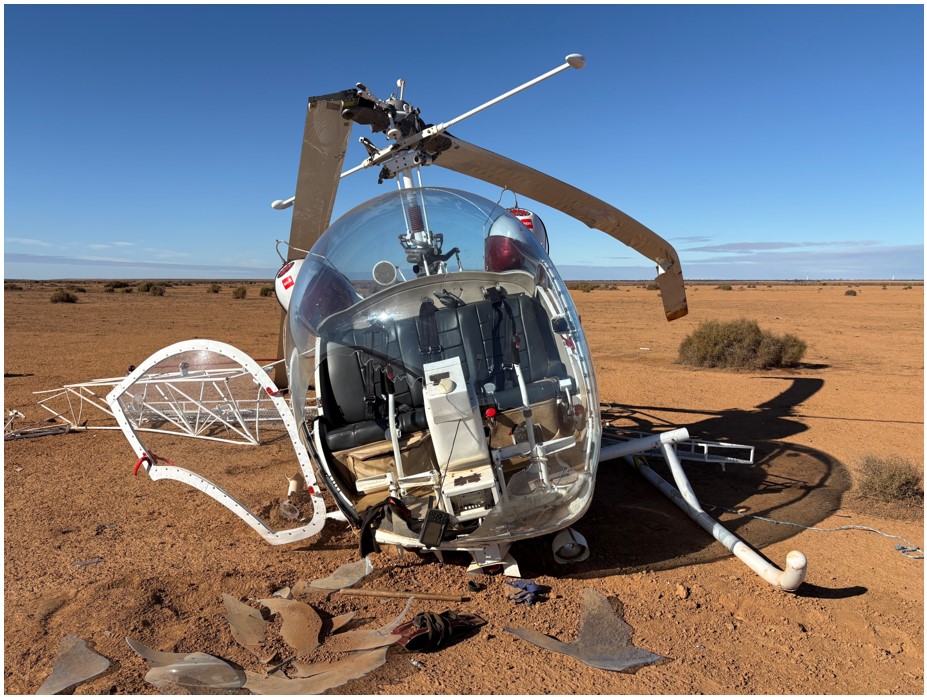
A run-on landing was conducted with forward speed, before the starboard side skid gear collapsed, causing the cabin to dig into the dirt whereby the helicopter tipped nose forward. As a result, the windscreen bubble ruptured, the advancing blade then struck the ground and severed the tail boom, with the helicopter coming to rest in an upright position, but substantially damaged (Figure 1).

Figure 1: Helicopter damage

Bell 47 picture taken from in front of helicopter after landing, with broken right skid and ruptured windscreen bubble.

Source: Operator

The pilot reported securing the cabin, switching the magnetos[4] and battery off and shutting off fuel (closing the fuel cut-off value). On exiting, the starter motor was smoking, the starter vibrator was buzzing, and the battery relay was chattering. The pilot then disconnected the battery which de-energised the starter system.

No injuries were reported by pilot or passenger.

Engineering inspection

Prior to the aircraft being recovered, engineers confirmed that the battery relay was energising, and the starter vibrator was also receiving power with the master switch in the OFF position when the battery was connected.

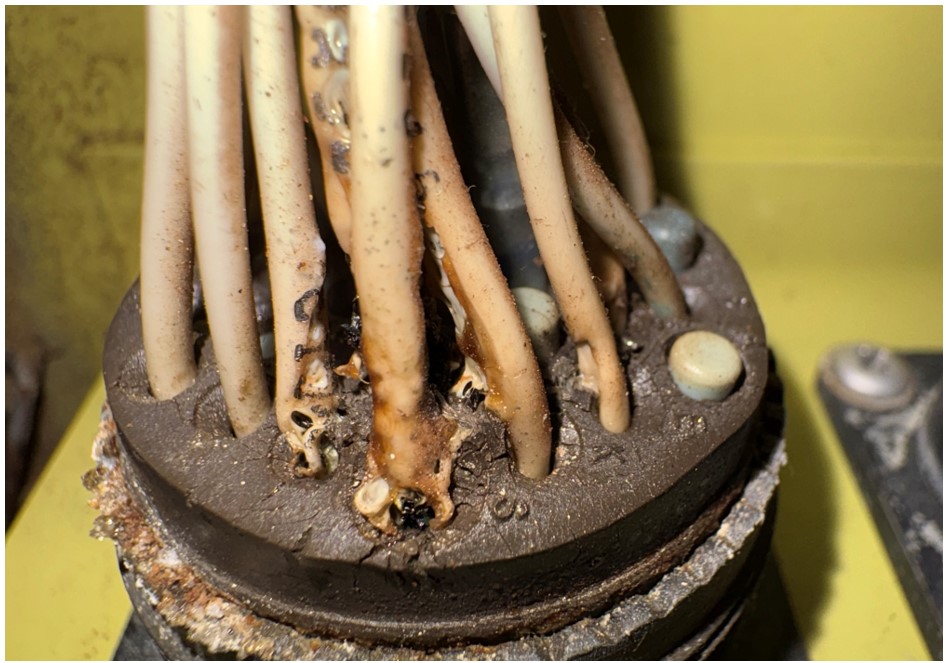
A subsequent engineering assessment detected heat damage in the main canon plug connector (connecting the cabin wiring loom with the airframe wiring loom) under the cabin floor, and heat damage in the wiring.

The assessment determined that corrosion in the plug wiring pins (Figure 2) has likely caused resistance to electrical current, and heat build-up. This likely resulted in several wires melting and creating a short circuit for the battery relay, starter vibrator, and instrument cluster.

The operator reported that the short circuit energised the starter vibrator and provided grounding to the magnetos which affected engine operation. 

Figure 2: Corrosion in the plug wiring pins

Bell 47 picture taken from in front of helicopter after landing, with broken right skid and ruptured windscreen bubble.

Source: Iconic Helicopters Maintenance Pty Ltd

Safety message

Precise positioning and energy maintenance is required for a successful autorotation landing. Autorotation is a high-risk skill requiring the pilot to descend the helicopter by lowering the collective lever so that the resultant airflow provides the driving force to turn the blades. Thorough and regular training in emergency procedures is crucial for all pilots. 

About this report

Decisions regarding whether to conduct an investigation, and the scope of an investigation, are based on many factors, including the level of safety benefit likely to be obtained from an investigation. For this occurrence, no investigation has been conducted and the ATSB did not verify the accuracy of the information. A brief description has been written using information supplied in the notification and any follow-up information in order to produce a short summary report, and allow for greater industry awareness of potential safety issues and possible safety actions.

[1]     The motion of an aircraft about its vertical or normal axis.

[2]     Device for continuously supplying the engine with optimum combustible mixture.

[3]     Autorotation is a condition of descending flight where, following engine failure or deliberate disengagement, the rotor blades are driven solely by aerodynamic forces resulting from rate of descent airflow through the rotor. The rate of descent is determined mainly by airspeed.

[4]     A type of electric generator using permanent magnets to supply an electric current for engine ignition. 


Occurrence summary

Mode of transport Aviation
Occurrence ID AB-2025-027
Occurrence date 28/06/2025
Location 51 km from Waikerie
State South Australia
Occurrence class Accident
Aviation occurrence category Abnormal engine indications, Collision with terrain, Engine failure or malfunction, Forced/precautionary landing
Highest injury level None
Brief release date 08/08/2025

Aircraft details

Manufacturer Bell Helicopter Co
Model 47G-5
Sector Helicopter
Operation type Part 91 General operating and flight rules
Departure point Clare Valley Aircraft Landing Area, South Australia
Destination Renmark Airport, South Australia
Damage Substantial

VFR into IMC involving a Piper PA-28R-180, Jandakot Airport, Western Australia, on 8 July 2025

Occurrence Briefs are concise reports that detail the facts surrounding a transport safety occurrence, as received in the initial notification and any follow-up enquiries. They provide an opportunity to share safety messages in the absence of an investigation. Because occurrence briefs are not investigations under the Transport Safety Investigation Act 2003, the information in them is de-identified. 

What happened

On 8 July 2025, the pilot of a Piper PA-28R-180 was conducting a private flight between Busselton Airport and Jandakot Airport, Western Australia. The flight was conducted under visual flight rules (VFR)[1] and the pilot held a recreational pilot licence with a navigation endorsement and a controlled aerodrome and airspace endorsement. 

Prior to departure the pilot reviewed various aviation weather forecasts, including the Bureau of Meteorology’s graphical and terminal forecasts for Jandakot Airport. For the planned flight, the forecast showed a cloud base no lower than 2,000 ft above mean sea level. 

After departure, the pilot maintained a track to Jandakot at 1,300 ft outside of controlled airspace. Remaining clear of cloud, the pilot further assessed the weather by listening to the ATIS[2] for Jandakot prior to entry into controlled airspace at the Oakford reporting point. 

When the aircraft then entered controlled airspace, air traffic control (ATC) instructed the pilot to maintain 1,000 ft and conduct orbits to the left of the airport until further specified. The pilot reported that they believed this was due to scheduled IFR arrivals. The aircraft completed 7 orbits to the west before being instructed by ATC to roll out and approach runway 06L. 

As the aircraft was rolling out of the orbits, the pilot could see that there was significant low cloud approaching from the east and requested Special VFR from ATC for arrival. Special VFR is a clearance issued by ATC on request from flight crew allowing pilots to operate in weather conditions that are below the VFR minimum requirement. This clearance was granted and the aircraft approached the airport for an overfly of the field. Descending through 700 ft on final approach, the pilot lost sight of the runway and inadvertently entered IMC.[3] The pilot contacted ATC advising that the aircraft was no longer visual with the runway. With ATC assistance, the pilot continued the descent, and at 500 ft reported to the controller that the aircraft was clear of cloud and continued the approach to land on runway 06L. The pilot later reported that the communication with ATC greatly assisted them to feel safe during the inadvertent entry into IMC.

Safety message

VFR into inadvertent IMC is a serious safety issue, and one that is consistently ranked as a top contributor to aviation accidents. The ATSB encourages all pilots, no matter what their experience level, to develop the knowledge and skills required to avoid unintentional operations in IMC.

Flying into cloud is a very confronting experience for a VFR pilot who is relying on visual reference points to orientate their aircraft. If a VFR pilot does enter IMC, utilising resources such as ATC assistance, if available, can help to achieve a safe outcome.

The ATSB booklet Accidents involving Visual Flight Rules pilots in Instrument Meteorological Conditions (AR-2011-050, revised 2019) provides guidance on avoiding VFR into adverse weather. 

About this report

Decisions regarding whether to conduct an investigation, and the scope of an investigation, are based on many factors, including the level of safety benefit likely to be obtained from an investigation. For this occurrence, no investigation has been conducted and the ATSB did not verify the accuracy of the information. A brief description has been written using information supplied in the notification and any follow-up information in order to produce a short summary report, and allow for greater industry awareness of potential safety issues and possible safety actions.

[1]     Visual flight rules (VFR): a set of regulations that permit a pilot to operate an aircraft only in weather conditions generally clear enough to allow the pilot to see where the aircraft is going.

[2]     Automatic Terminal Information Service (ATIS): an automated weather service that provides current airport weather information. The ATIS is obtained by flight crew prior to entering controlled airspace.

[3]     Instrument meteorological conditions (IMC): weather conditions that require pilots to fly primarily by reference to instruments, and therefore under instrument flight rules, rather than by outside visual reference. Typically, this means flying in cloud or limited visibility. 

Occurrence summary

Mode of transport Aviation
Occurrence ID AB-2025-030
Occurrence date 08/07/2025
Location Jandakot Airport
State Western Australia
Occurrence class Incident
Aviation occurrence category VFR into IMC
Highest injury level None
Brief release date 07/08/2025

Aircraft details

Manufacturer Piper Aircraft Corp
Model PA-28R-180
Sector Piston
Operation type Part 91 General operating and flight rules
Departure point Busselton Airport, Western Australia
Destination Jandakot Airport, Western Australia
Damage Nil