CR 209: Driver Fatigue: A Survey of Long Distance Transport Companies in Australia (2002)

This report describes the results of a national survey of transport companies in Australia. The aim was to survey companies about knowledge and awareness of fatigue, about work-rest scheduling practices and about the factors which underlie the way schedules are organised. The survey was designed to provide complimentary information to that obtained in a national survey of drivers undertaken at the same time and reported elsewhere. Telephone interviews with 200 companies carrying freight over distances greater than 300km were undertaken, covering all regulated mainland states of Australia, and the Northern Territory. Companies were selected randomly from the telephone directory. The Northern Territory was included because it provided a comparison with an unregulated state. A middle management staff member, familiar with line haul operations was interviewed from each company. This report presents the main descriptive data obtained in the survey and provides an overview of views, knowledge and practices with respect to fatigue management. Key comparisons were drawn with the data obtained from the driver survey undertaken at the same time.

One of the key findings of this report was that there is a lag between increased awareness of fatigue and changes in operational practice. The majority of companies reported that awareness of fatigue had increased, both for themselves and their company, as well as for the industry at large over the last 5 years. However, from the results it seems that this increased awareness does not guarantee better management of the problem. Only half of the companies surveyed reported that they believed that fatigue was well managed in the industry and one fifth reported that it is badly managed. Even so, this is more optimistic compared with the verdict of drivers, half of whom reported that fatigue is badly managed in the industry.

Further evidence of the lag between increased awareness about fatigue in general and companies actually coming to grips with better management of the problem came from views of causes of and strategies to manage fatigue. Virtually all companies endorsed the significance of sleep and recovery before and during trips, and the contribution of long hours. However, other key contributors to fatigue were grossly underestimated. Company representatives failed to report the significance of night work as a prime contributor to fatigue and consolidated night sleep as prime strategy for reducing fatigue. Similarly, there was lack of recognition by companies of the substantial contribution of non-driving work, particularly loading and unloading, to the overall burden on drivers, and accordingly lack of endorsement of limits for such work as a fatigue management strategy. This picture is in sharp contrast to that presented by drivers, where awareness of the key contributors and likely effective strategies was much more in line with current knowledge.

It is hardly surprising that fatigue has become a more prominent feature of companies risk management agenda. There have been a number of high-profile initiatives in safety promotions and legislative directions over the last decade all aiming to focus industry attention on better management of driver fatigue. The results of the survey highlight that increased awareness does not immediately translate into increased knowledge and operational changes.

This systemic inertia was also evident in the persistence of industry perceptions that the freight task needs to be maximally responsive to the demands of customers and freight forwarders, often described as the chain of responsibility. In fact, the picture presented by the companies themselves was rather different. The majority of companies reported that they have considerable control over schedules, with only a minority reporting that their work was mostly irregular. Strict estimated times of arrival were uncommon, and trip times were mostly based on company and driver estimates, according to the companies surveyed. In other words, companies appear to have potential for far greater control over their schedules than is recognised or exercised.

The study provided some evidence that better attitudes to fatigue were associated with company practices that were more likely to manage fatigue effectively. For example, more aware companies were more likely to monitor fatigue and were more likely to change their schedules to accommodate driver fatigue. In contrast, companies who relied on the industry in general for management of fatigue and/or in the working hours regulations were less likely to be paying attention to the problem, were less likely to monitor fatigue and were more likely to change schedules to suit customer demands rather than for driver fatigue. They also used fewer management strategies and were less likely to otherwise restrict hours. These findings suggest that while attitudes do not seem to have a dramatic effect on practice, education and information for companies is a useful strategy for actively involving companies in better management of fatigue and for overcoming complacency about the driver fatigue problem.

Fatigue management strategies reported by companies surveyed focused on limitations of daily and weekly hours of service. Not surprisingly, there was less intervention and active management of fatigue for non-employee drivers. Active fatigue management strategies, monitoring of fatigue, or even formal policies for fatigue management for sub-contractor and independent drivers were reported by only a small minority of companies. Yet half of the companies surveyed reported that they hire these types of drivers. In many cases fatigue management for non-employee drivers is likely to become, by default, the responsibility of the individual driver. This is a serious problem because effective fatigue management is unlikely to emerge without not only company co-operation, but also active and formal company collaboration.

Surprisingly few differences were evident between companies of different sizes. Obvious and predictable structural differences were reported, for example greater reliance of smaller companies on non-employee drivers. Also predictably, formal policies and technical monitoring approaches were less common, reflecting the resource intensive nature of these strategies. However, little impact was seen of company size on the attitudes to fatigue and scheduling practices reported by companies surveyed. This pattern of findings suggests that the translation of fatigue awareness into operational practices is universally slow and is not just a feature of some segments of the industry having reduced access to information and so forth.

Overall, this survey suggests that there is considerable scope for improving understanding and management of fatigue in the industry. Companies do not seem to be doing all that could be done to improve management of fatigue. Partly, this seems to reflect a lack of understanding about the phenomenon. There was poor understanding among line haul managers of how driver fatigue develops, the key role played by time of day and the contribution of total burden of work, not just driving. There needs to be greater

understanding in the industry that the problem requires a more sophisticated approach than simply restricting hours of driving. Education and information for companies is likely to be a useful strategy to alert companies to the most appropriate practices and to overcome complacency about the problem. The survey revealed that approaches affecting global attitudes, general increases in awareness and so forth, have had little impact on practices. On the other hand, they are likely to have been important for raising the profile of the problem in the industry and laying the groundwork for more targeted information and education. Indeed, it is hard to imagine how transport operators could develop the most effective interventions for their particular freight task, as demanded by Fatigue Management Programs, without being better informed. From the results of this survey, improved understanding of fatigue and its characteristics among transport managers must be seen as an immediate priority.

Publication details

Publication number CR209
Publication type Research and Analysis Report
Publication date 01/09/2001
Review date 01/09/2006
Authors A-M Feyer, A Williamson, R Friswell, S Sadural
ISBN 1877093092
ISSN 1445-4467
Subject matter Fatigue

Investigation into Ansett Australia maintenance safety deficiencies and the control of continuing airworthiness of Class A aircraft

Australia has an excellent air transport safety record. Major Australian airlines have long been regarded as being among the world's safest, and there have been no fatalities involving an Australian high-capacity jet aircraft. This enviable record is due, in part, to an aviation safety culture that recognises the need for constant safety awareness.

Given the commercial pressures facing international aviation, the events described in this report should be seen as a learning experience for the aviation industry, regulatory bodies, and all organisations concerned with continuing airworthiness assurance.

In December 2000 and in April 2001, a number of Ansett Australia (Ansett) Boeing 767 (B767) aircraft were withdrawn from service because certain required fatigue damage inspections of the aircraft structure had been missed. As a result there was uncertainty as to the continuing airworthiness status of the aircraft. In December 2000 the concerns related to possible fatigue cracking in the rear fuselage of the aircraft, and in April 2001 the concerns related to possible fatigue cracking of the engine strut fitting on the wing front spar.

On 11 January 2001, the Australian Transport Safety Bureau (ATSB) commenced an investigation into the circumstances surrounding the withdrawal from service of the Ansett B767 aircraft as the situation was regarded as indicative of a potential safety deficiencyi. On 10 April 2001 the ATSB investigation was extended to include an examination of the continuing airworthiness system for Australian Class Aii aircraft such as the B767.

Action by Ansett and the Civil Aviation Safety Authority (CASA) addressed the potential risks to fare-paying passengers. Although Ansett was subsequently placed into voluntary administration in September 2001, the ATSB continued a detailed systemic investigation because of the importance of the issues involved, both in Australia and internationally.

The international continuing airworthiness system, like all complex and safety-critical activities, is dependent on robustiii systems to maintain high reliability. The circumstances surrounding the withdrawal from service of the Ansett B767 aircraft revealed, among other things, that the reliability of the continuing airworthiness system was threatened by a number of weak defences.

The B767 aircraft type was among the first in the world to be designed and certified under damage tolerance principles. Damage tolerance certification relies heavily on scheduled inspections to ensure continuing airworthiness. The aircraft structure is designed to maintain integrity until any fatigue or corrosion damage can be detected at a scheduled inspection, and appropriate action taken. Therefore, in itself, the presence of fatigue cracks in the Ansett B767 aircraft was not necessarily a cause for undue concern. However, it was critical that there were robust systems to ensure that the required structural inspections were carried out to detect the cracks before they exceeded acceptable limits.

Withdrawal from service of Ansett B767 aircraft in December 2000

Ansett was the sixth airline worldwide, and the first airline outside North America, to operate the B767. Of the nine Ansett B767-200 aircraft, five were first flown in 1983 and two in 1984. The aircraft accumulated a high number of flight cyclesiv because they were mostly flown on comparatively short domestic sectors. Ansett had been working with Boeing on fatigue cracking in the area of the Body Stationv 1809.5 bulkhead outer chord since 1996.

In June 1997, Boeing introduced the Airworthiness Limitations Structural Inspection programvi for the B767. The program was an essential part of the damage tolerance requirements and was designed to detect fatigue cracking in susceptible areas that had been identified through testing and in-service experience. Ansett staff did not initially recognise that some Airworthiness Limitations Structural Inspections were required by 25,000 cycles and a period of almost two and a half years elapsed before that error was identified. At the time that the inspection program was introduced, some Ansett B767 aircraft had already flown more than 25,000 cycles. In June 2000, further 25,000 cycle inspections were introduced, including in the area of the Body Station 1809.5 bulkhead outer chord. Ansett did not initially act on this.

In December 2000, Ansett senior management became aware of the missed inspections and the aircraft were withdrawn from service on 23 December 2000, despite the high commercial cost to the company. At that time, both Ansett and CASA were of the belief that compliance with the missed inspections was mandatory. Subsequent legal advice indicated that the regulatory basis for mandating compliance with the Airworthiness Limitations Structural Inspections for Australian operators was unclear. On 29 December 2000, CASA issued a direction to Ansett specifically mandating the inspections for the Ansett B767 aircraft.

The ATSB investigation found that the Ansett system for the introduction and scheduling of the B767 Airworthiness Limitations Structural Inspections was deficient and vulnerable to human error. A mistake or omission by one or two people could potentially result in continuing airworthiness assurance being compromised. In addition, deficiencies existed in resource allocation and in the supporting information management systems.

From October 1998, Boeing also issued a series of service bulletins in relation to fatigue cracks in the area of the B767 Body Station 1809.5 bulkhead outer chord. Service bulletins are issued by aircraft, component, or engine manufacturers to provide operators with relevant service information. Not all service bulletins are safety-related, and compliance with a particular service bulletin can only be mandated by the State of Registry of an aircraft.

Boeing initially notified operators that the service bulletin requirements were primarily commercial in nature. It was not until November 2001 that Boeing indicated that the service bulletin dealt with a potentially major safety issue. The FAA had mandated action by US operators in relation to the service bulletin in April 2001.

Any action to be taken by Ansett in relation to the Body Station 1809.5 service bulletins issued by Boeing was complementary to requirements under the B767 Airworthiness Limitations Structural Inspection program. It was the failure by Ansett to appropriately incorporate the required Airworthiness Limitations Structural Inspections, issued in June 1997 and updated in June 2000, into the B767 system of maintenance that led to the withdrawal from service of six Ansett B767 aircraft in December 2000.

Withdrawal from service of Ansett B767 aircraft in April 2001

In March 2000, Boeing issued an Alertvii service bulletin to detect and repair fatigue cracks in the wing front spar outboard pitch load fitting of the B767 engine mounting strut. Boeing recommended that the work be carried out within 180 calendar days. A revision to the service bulletin was issued in November 2000. In March 2001, Ansett became aware that they had not acted on either the original or the revised service bulletins.

During the period from 7-9 April 2001, inspections revealed cracks in the pitch load fittings of three of the Ansett B767 aircraft and they were withdrawn from service. On 9 April 2001 CASA required that a further four Ansett B767 aircraft be withdrawn from service, pending inspection. Those inspections were subsequently carried out, and the aircraft were cleared to fly.

Deficiencies in the Ansett engineering and maintenance organisation

The ATSB investigation found that similar deficiencies within the Ansett engineering and maintenance organisation led to the withdrawal from service of the B767 aircraft in December 2000 and April 2001. Those deficiencies were related to:

  • organisational structure and change management
  • systems for managing work processes and tasks
  • resource allocation and workload.

However, the investigation found no evidence to suggest that Ansett had deliberately breached airworthiness regulations.

Ansett had undergone considerable change over a number of years. Many of the Ansett systems had developed at a time when the company faced a very different aviation environment. Over time, efficiency measures were introduced to improve productivity but the introduction of modern robust systems did not keep pace with the relative reduction in human resources and loss of corporate knowledge.

Risk management and implementation of change within the Ansett engineering and maintenance organisation were flawed. Inadequate allowance was made for the extra demand on resources in some key areas during the change period.

The Ansett fleet was diverse and the point had been reached where some essential aircraft support programs were largely dependent on one or two people. Hence it was possible for an error or omission by a particular specialist to go undetected for a number of years.

Resource allocation and workload issues had been evident within some areas of the Ansett engineering and maintenance organisation for a considerable period of time. The investigation found that measures aimed at achieving greater productivity had been introduced throughout the organisation without sufficient regard to the different circumstances and criticality of the different work areas. Insufficient consideration had been given to the possible consequences of resource constraints on the core activities of some safety-critical areas of the organisation.

People and robust systems are two of the prime defences against error. Therefore, a combination of poor systems and inadequate resources has the potential to compromise safety. If a failure by one or two individuals can result in a failure of the system as a whole, then the underlying problem is a deficient system, not simply human fallibility.

The Australian continuing airworthiness system

The ATSB investigation found that based on the Ansett B767 experience, the Australian system for continuing airworthiness of Class A aircraft was not as robust as it could have been, as evidenced by:

  • uncertainty about continuing airworthiness regulatory requirements
  • inadequate regulatory oversight of a major operators continuing airworthiness activities
  • Australian major defect report information not being used to best effect.

The investigation identified a need for the regulatory basis for continuing airworthiness requirements of Class A aircraft to be better defined and disseminated to operators.

No evidence was found to indicate that CASA had given formal consideration to monitoring the introduction of the B767 Airworthiness Limitations Structural Inspection program by Ansett from 1997 onwards.

Prior to December 2000, there was apparently little or no awareness among Ansett senior management or within CASA of the underlying systemic problems that had developed within the Ansett engineering and maintenance organisation. The presence of organisational deficiencies remained undetected. In addition, there were delays in adapting regulatory oversight of Ansett in response to indications that Ansett was an organisation facing increasing risk.

The decision by the then Civil Aviation Authority in the early 1990s to reduce its previous level of involvement in a number of safety-related areas did not adequately allow for possible longer-term adverse effects. This included reducing the work done by Authority specialist staff in reviewing manufacturer's service bulletins relevant to Australian Class A aircraft, and relying on operators' systems and on action by overseas regulators in some airworthiness matters.

CASA's central database for major defect reports was incomplete, partly due to deficiencies in reporting, and the information received was not always fully analysed. In addition, feedback to the initiators of major defect reports, and to other operators, was limited. As a result, the potential safety benefit of the major defect reporting system was not fully achieved.

The FAA and ICAO

Delays by the US Federal Aviation Administration (FAA) contributed to a lack of awareness by Ansett and CASA of required B767 Airworthiness Limitations Structural Inspections. This breakdown in FAA process was acknowledged by the US Secretary of Transportation in August 2001. The FAA did not issue airworthiness directives in relation to the June 1997 Airworthiness Limitations Structural Inspection program, or the service bulletins for the Body Station 1809.5 bulkhead outer chord and the wing front spar outboard pitch load fitting, until after the second Ansett groundings in April 2001.

Different views within the FAA as to the importance of airworthiness directives to mandate continuing airworthiness requirements for damage tolerance aircraft types contributed to a lack of timely action by the FAA. The ATSB report includes recommendations that the FAA ensure that such airworthiness directives are processed and released without undue delay, and that affected parties should be informed when delays do occur. The report also recommends that the FAA ensure that the process for determining grace periods for aircraft to comply with airworthiness directives is both systematic and transparent.

The ATSB report outlines where the existing international continuing airworthiness system, as defined by International Civil Aviation Organization (ICAO) standards and recommended practices, could be enhanced by the application of quality assurance mechanisms to the processing and distribution of safety-related information.

The events outlined in this report indicate that there was a breakdown in the continuing airworthiness system within Ansett, the FAA, and CASA. In addition, the possible safety significance of cracks in the area of the B767 Body Station 1809.5 bulkhead outer chord was not initially highlighted by Boeing.

Safety action

On 12 April 2001, the ATSB released two safety recommendations to CASA. The intent of these recommendations was to enhance the robustness of the systems used to manage the continuing airworthiness of Australian registered aircraft such as the B767 by ensuring that:

  • action, or lack of action, by another State did not adversely affect the safety of Australian Class A aircraft
  • all service bulletins relevant to Australian Class A aircraft were received, assessed and implemented or mandated as appropriate.

CASA subsequently initiated a comprehensive review of its systems to monitor, assess, and act on service bulletins, to ensure that those critical to safety could be readily identified and acted upon appropriately. Recommendations from that review were addressed in an associated implementation plan that detailed the nature and timing of the actions that CASA would take in response to the recommendations. The ATSB is monitoring the implementation of this important safety action.

In response to the circumstances of the events of December 2000 and April 2001, the FAA has included further checks and balances designed to ensure that all service bulletins issued by US manufacturers are properly reviewed and addressed. In addition, the FAA has established an 'early warning system' to provide non-US airworthiness authorities with information on pending occurrence investigations that may result in mandatory action by the FAA.

The manner in which events developed highlights the need for organisations to be continually mindful of potential threats to safe operations. Periodic review is needed to ensure that existing systems for maintaining air safety keep pace with the changing environment.

Implementation by the relevant organisations of the recommendations made by the ATSB as a result of this investigation should help to ensure that aviation systems, both within Australia and internationally, are strengthened and that air safety for Class A aircraft is enhanced.

i Section 19AD of the Air Navigation Act 1920 defines a safety deficiency as any situation related to aviation that can reasonably be regarded as having the potential to affect adversely the safety of aviation.

ii Class A refers to an aircraft with a Certificate of Airworthiness issued in the transport category, or one that is used for regular public transport operations.

iii In the context of this report, a system is robust if, when someone makes an error or a problem occurs for some other reason, the system can detect the deviation and recover without any significant negative effect.

iv A flight cycle is one completed take-off and landing.

v Body Station number is the distance in inches from a datum in front of the nose of the aircraft to a particular point of the aircraft structure.

vi The Airworthiness Limitations Structural Inspections were in addition to zonal inspections and scheduled structural inspections that had formed part of the B767 maintenance program from the time the aircraft entered service.

vii Boeing service bulletins are classified into three categories in order of urgency: Alert, Unusually Significant, and Standard. Alert service bulletins are issued for safety-related issues that require the immediate attention of the operator.

Publication details

Publication type Research and Analysis Report
Publication mode Aviation
Publication date 17/11/2002
Review date 17/11/2002
ISBN 1 877071 20 X

Final Report of the Investigation into the anomaly of the HyShot Rocket at Woomera, South Australia on 30 October 2001

On 30 October 2001, the University of Queensland Department of Mechanical Engineering (UQ), launched an experimental supersonic-combustion ram jet (scramjet) payload via a two-stage solid-fuel rocket that was provided by Astrotech Space Operations Inc (Astrotech). The rocket was launched from the Woomera Prohibited Area in northern South Australia, that was operated by the Department of Defence (DoD). The planned flight was to validate data obtained in the hypersonic wind tunnel at the UQ facilities.

The launch occurred at 1301 Australian Central Summer Time and according to observers and video evidence, the first stage booster appeared to operate successfully, although UQ personnel noted an anomaly in the received telemetry data. After the initial coast stage, during which time the first stage separated, the second stage ignited and observers reported seeing the rocket and the resultant exhaust trails appearing to curl in a 'cork screw' fashion. That continued with the stability of the rocket appearing to deteriorate until it was out of sight.

The first stage (Terrier) was recovered from the intended impact area shortly after the flight, while remnants of the first stage fixed fins were recovered north east of the flight path and between the first stage impact area and the launch pad approximately 12 weeks after the launch. The separate location of the fins indicated that the fins separated from the vehicle during the first stage flight.

The second stage (Orion) with fixed fins and payload was recovered about 16 weeks after the launch from an area about 28 km east of the Stuart Highway and about 100 km north west from the launch site rather than the 373 km nominal aiming point. The highway had not been closed to traffic, nor was it required to be.

After the flight, the UQ team reported that while examining their telemetry data they noted an anomaly in the accelerometer and magnetometer data at approximately 2.8 seconds after first stage ignition. UQ also noted that the vehicle had not achieved the spin rate (4-6Hz) that was intended. However, the UQ team suggested that the low spin rate was more likely the result of some other event, perhaps the loss of one or more fins, rather than contributing to the accident. Additionally, a number of personnel who viewed the post-flight video reported seeing what appeared to be objects falling from the vehicle during the first stage burn. However, the Optical Coordinator from the launch team and Australian Transport Safety Bureau (ATSB) investigators considered that the video images lacked sufficient resolution to determine what occurred at those times.

ATSB specialist examination of the first stage indicated that the fixed fin support structure had broken up during the flight. Examination of the fracture surfaces indicated overload through the fixed fin spindle (journal) sockets. Larger Nike fins had been fitted by Astrotech rather than the smaller standard Terrier fins. This was to achieve the required stability and ensure a stable platform during the scramjet experiment. No pre-existing defects were found within the physical structure of the fin support. Some of the fin journal sockets showed evidence of excessive angular bending forces, suggesting possible movement or rotation of the fins during flight. A considerable proportion of the first stage fixed fin skin and internal honeycomb material had not been recovered at the time the investigation was carried out. Of the material that was recovered, most of the damage and deformation suggested both aerodynamic and ground impact forces.

The Nike fixed fin angle of incidence was adjusted using trailing edge adjustment lugs. Marks and damage around the fixed fin adjustment lug mounting points indicated in-flight movement and possible insecurity of the fin adjustment lugs. Crushing damage of the fin rib sections beneath the lug mounting set-screws was possibly pre-flight damage which may have contributed to in-flight movement. It was also noted that the Nike fins were not designed for securing in the location used and contained no reinforcement or other strengthening features in this area. The Nike fins were designed to be secured on the leading side of the fin base, whereas the original Terrier fins were designed to be secured on the trailing side of the fin base.

ATSB specialist examination of the payload found no evidence to suggest that the payload or associated components had contributed to the flight anomaly, however the level of impact damage limited the examination.

During launch preparation, sandbags were placed around the base of the launcher. The Astrotech "Operation and Inspection Log for the Assembly of the Terrier-Orion Suborbital Launch vehicle system" called for grout to be placed at the base of the launcher. However, grout was not available, thus sandbags were used to protect the base of the launcher. UQ suggested that it was possible that a sandbag or a rock in a sandbag could have damaged a fin during the initial launch phase. That would have required a sandbag or rock to have been deflected off the infrastructure and impact a fin. Video footage and still images viewed by the ATSB Specialists and Astrotech, indicated that a number of the sandbags were ejected and/or disrupted during the ignition and launch. However, it was not possible to determine if a rock had impacted a fin during the launch sequence.

The examination could not conclusively determine what caused or allowed the first stage Nike fixed fins to move during the flight. However, based on the available evidence, it is likely that the first stage Nike fins either sustained damage from aerodynamic overload due to their movement during the flight or the fin support structure was unable to support the increased aerodynamic load of the larger Nike fins. It is also possible that the sandbags or rocks ejected during the launch damaged the first stage fixed fins. As a result, at separation, the second stage would have been in an unstable flight attitude and possibly not able to recover stabilised flight.

Because the Space Activities Act and Space Activities Regulations did not provide for a launch licensing instrument with a fee structure appropriate to the resources of educational/scientific organisations, UQ was granted an exemption certificate by the then Minister following a recommendation from the Australian regulator, the Space Licensing and Safety Office (SLASO). As part of UQ's application for an exemption certificate, it was required to furnish a risk hazard analysis of the project based on statutory methodology and informal guidance provided by SLASO.

The investigation determined that although the risk analysis conducted by UQ allowed for failure of the first stage and non ignition of the second stage, insufficient allowance was made for the rocket vehicle malfunctioning and going off course. During the investigation, UQ indicated that as part of its hazard identification during the risk hazard analysis process, it had not specifically considered the possibility of the rocket impacting near the Stuart Highway. The second stage and payload impacted about 28 kilometres east of the highway.

Although SLASO had expressed reservations in an internal document, prior to the launch, regarding the risk hazard analysis submitted by UQ, it assessed the analysis as part of the application and recommended that UQ be granted the exemption certificate. SLASO was satisfied that a risk hazard analysis has been performed and that the launch would comply with the Launch Safety Standards of the Flight Safety Code, provided there were adequate exclusion arrangements for the WIR and the area around the nominal aiming point. As part of that assessment, SLASO also relied, in part, on the granting of a licence to Astrotech by the United States regulator, the Federal Aviation Administration (FAA), the submission of a risk hazard analysis to the FAA by Astrotech as part of their launch licence application and an analysis conducted by the FAA. Although SLASO requested a copy of that analysis from the US regulator, it was not provided. After the Launch, SLASO commented that there was no evidence that the launch violated the risk acceptance criterion spelled out in the launch safety standards of the Flight Safety Code.

SLASO is seeking to acquire specialist risk analysis software, with appropriate user training, to assist with assessing risk hazard analysis models submitted by applicants. SLASO also indicated that it plans to provide additional guidance for applicants wishing to apply for a licence, permit or exemption certificate. Additionally, Government approval has been granted to amend the Space Activities Act to provide for educational/research activities with an appropriate fee structure. That will allow the requirements to be clearly spelt out in regulations made in respect of that certificate.

UQ has indicated that it intends to reassess its risk hazard analysis.

Astrotech indicated that it plans to review its pre-launch assembly procedures of the rocket vehicle.

DoD has indicated that it plans to review its internal procedures for the approval of Woomera Prohibited Area activities and that the MoU with SLASO may also be reviewed.

In addition to these safety actions, the Investigator issues the following recommendations.

1) That Astrotech review the:

a) suitability of the Nike fins for use on the Terrier vehicle;
b) suitability of the fin support attachment structure when other than Terrier fins are used;
c) suitability and effectiveness of the opposing set-screw arrangement for securing and setting the Nike fin incidence angle to the Terrier fin support structure; and
d) suitability of the use of sandbags at the base of the launcher pedestal, in lieu of the specified grouting.

2) That SLASO require all Australian launch operators to submit a comprehensive risk hazard analysis for independent verification prior to the issuing of a licence, permit or exemption certificate.

3) That SLASO consider requiring launch operators to submit their risk hazard analysis to stakeholders and participants, for review and discussion.

4) That launch infrastructure providers make available sufficient resources to enable the provision of appropriate recording equipment with suitably trained personnel to provide additional recorded evidence to aid any occurrence investigation that may be necessary.

5) That overseas organisations involved in an Australian launch provide any risk hazard analysis and/or assessment to SLASO to better enable SLASO to properly assess a launch application.

Publication details

Publication type Research and Analysis Report
Publication mode Aviation
Publication date 18/06/2002
Review date 18/06/2002
ISBN 0642 7 2210 2

Annual Review 2002

The ATSB Annual Review 2002 documents ATSB's achievements and safety activities from 1 July 2001 to 30 June 2002 and outlines its business planning for 2002-2003.

Executive Directors message

The Australian Transport Safety Bureau has made significant progress since it began on 1 July 1999 as an operationally independent body within the Commonwealth Department of Transport and Regional Services (DOTARS).

During 2001-02, the ATSB assisted the Minister for Transport and Regional Services to develop new legislation that would enable the Bureau to investigate rail accidents on the increasingly important interstate system. The legislation also updates and harmonises the Bureaus aviation and marine investigative powers. Introduced into parliament on 20 June 2002, the Transport Safety Investigation Bill 2002 (TSI Bill) passed the House of Representatives with bipartisan support on 24 September and is currently before the Senate. The Bureau is also involved with the drafting of associated Regulations and proposed memoranda of understanding with key stakeholders.

The Bureau revised its investigator work-level standards and developed an internal competency-based Diploma in Transport Safety Investigation, for which national tertiary accreditation has been granted for five years. The Diploma will help validate that ATSB investigators have reached a minimum competency standard before assuming more senior responsibilities.

The federal industry minister asked the ATSB to investigate, under the Space Activities Act, an accident involving the first HyShot rocket launch at Woomera. The launch was to test a University of Queensland scramjet, a world-leading project in the race for faster passenger transport. The Bureaus investigation of the October 2001 launch and its final report and recommendations led to important changes before a reportedly highly successful second launch.

The ATSB has continued to monitor and report on road safety progress under the National Road Safety Strategy framework approved by ministers of the Australian Transport Council (ATC). It has worked closely with state and territory transport agencies, and other major stakeholders, through the National Road Safety Strategy Panel. Toward the end of the financial year, the Bureau, aided by a panel of distinguished road safety experts, formed a task force to develop an Action Plan for 2003 and 2004. The national road fatality rate, which stood at nine deaths per 100 000 population in calendar year 2001, has plateaued since about 1997 and the new Action Plan will seek to substantially cut the road toll. ATC approved the Plan on 8 November 2002.

The Parliamentary Secretary, Senator the Hon. Ron Boswell, released several ATSB research reports and a number of other road safety publications throughout the year. Two important studies concerned speed risks. ATSB research findings on the links between travel speed and road trauma have been widely cited in policy papers produced by other agencies (both in Australia and overseas) and have supported a number of major public education campaigns on speed. The Bureau also released reports on motorcycle fatalities and on driveway deaths. ATSB researchers have a special interest in fatigue issues and are working to improve national injury data as well as data on heavy-vehicle safety.

The ATSB continued to participate in rail-safety investigations at the invitation of state governments. Since 1999, the Bureau has undertaken or taken part in nine investigations. Most of these were in Victoria, but others have involved WA, NSW, Queensland and SA. Investigations have brought about important safety changes, including to operational practices and to legislation. In cooperation with state rail regulators, the Bureau has also created a national rail occurrence database with a concise set of key statistical rail safety indicators for the calendar year 2001. Ongoing discussions with state rail regulators are directed to extending the databases coverage of safety occurrences, harmonising definitions and incorporating pre-2001 data.

In 2001-02, marine reports released included investigations of groundings and collisions between ships and fishing vessels. Recognising the international nature of the shipping industry, the ATSB has continued to actively support the work of the International Maritime Organization, where it has addressed topics such as lifeboat safety and vessel fires, and to provide marine investigation and safety training. Captain Kit Filor continued as chair of the Marine Accidents International Investigators Forum (MAIIF).

The ATSB released 118 final air safety investigation reports in the past financial year thereby reducing its investigation report backlog from 125 to 90. Major reports included:

  • the Whyalla Airlines VH-MZK Piper Chieftain accident with eight fatalities
  • the Beech Super King Air 200 VH-SKC ghost flight fatal accident which followed the incapacitation of the pilot and seven passengers
  • a serious incident involving loss of control during one engine inoperative training in a Beech 1900D airliner.

The Bureau continued to investigate maintenance problems involving Ansett's 767 fleet and Class A aircraft, as well as a fatal accident involving the WA Police Airwing at Newman. It also helped the Aviation Safety Council of Taiwan investigate a major Singapore Airlines SQ006 747 fatal accident. The President of Taiwan acknowledged the Bureaus contribution when he opened the International Society of Air Safety Investigators (ISASI) forum in October 2002. Aviation outputs also included CAIR reports, recommendations and safety notices, as well as articles in magazines such as Flight Safety Australia. The Bureau further developed its website www.atsb.gov.au and now receives more than four million hits each year.

When the Secretary reorganised the Department in January 2002, the Bureaus previous federal Black Spot and vehicle recall functions transferred to more appropriate divisions within DOTARS. I thank the staff involved for their contributions to the ATSB. I particularly wish to acknowledge Adrian Beresford-Wylie, who left the Bureau for a senior DOTARS position in September 2002. As a branch head, Adrian made a great contribution to the Bureau and to Australian road safety. I am pleased to welcome Joe Motha who has taken on Adrians former role.

I am grateful to the Deputy Prime Minister and Minister for Transport and Regional Services, the Hon. John Anderson, to our Parliamentary Secretary, Senator the Hon. Ron Boswell, and to the Department Secretary Mr Ken Matthews, for their support throughout the year. The ATSB is passionate about its role in contributing to safe transport and on behalf of the ATSBs hardworking staff, I affirm that the Bureau looks forward to meeting the challenges of 2002-03 and beyond in all four transport modes.

Kym Bills

Publication details

Publication type Annual Report
Publication mode Corporate
Publication date 19/10/2002
Review date 19/10/2009
ISBN 1877071226
ISSN 14444798

Analysis of a failed Pratt & Whitney JT9D-7R4 turbofan engine

Boeing 767-238, VH-EAQ

EXECUTIVE SUMMARY

The left engine of a Boeing 767-238 aircraft (VH-EAQ) failed during the climb phase of a regular passenger transport flight from Melbourne to Sydney. After the failure, which was characterised by a single loud 'bang' and severe vibration, the engine was shut down and the aircraft returned to Melbourne.

Engineering inspections of the JT9D-7R4 engine found that one of the fan blades had failed part-way along its length and impacted the fan case at the 11 o'clock position, causing the failure of several nose-cowl bolts and substantial damage to components adjacent to the impact point. After the initial impact, the failed blade struck the inside of the nose cowl, forward of the fan. This impact was of sufficient energy to puncture the nose cowl and allow the escape of the blade segment. No damage was caused externally to the airframe or control surfaces.

ATSB laboratory examination of the blade section remaining within the fan rotor disk found that the blade had fractured as a result of fatigue crack growth from a pre-existing defect at the blade trailing edge. The defect was identified as a shallow crack that had formed during or before the last blade refurbishment operation, carried out in 1991. Non-destructive examination procedures carried out on the blade following the refurbishment had failed to detect the defect.

In 1998, the manufacturer purchased the engine for use as a lease unit. The defective blade was installed into the engine shortly thereafter. At the time of failure, the blade had operated for 7,187 hours and through 2,083 cycles following its 1991 refurbishment. Operating times and cycles before the blade refurbishment were not available.

Publication details

Publication type Educational Fact Sheet
Publication mode Aviation
Publication date 27/11/2001
Review date 27/11/2001

Examination of Components from a Failed Turbomeca Arriel 1S1 Turboshaft Engine

Sikorsky S76 Helicopter, VH-EXX

1. FACTUAL INFORMATION

1.1 Introduction

A Sikorsky S76C helicopter (VH-EXX) sustained a failure of the number-two engine during cruise flight. The failed engine was a Turbomeca Arriel 1S1 turboshaft engine, serial number 15038 and had accumulated 7,935 hours and 6,784 cycles since new.

Reports from the flight crew indicated that the engine failure was associated with a loss of gas-generator turbine speed and an escalation of turbine outlet temperatures. Fire warnings for the engine were also received, prompting the pilot commanded shutdown of the engine and discharging of the fire suppression system.

1.2 Engine examination

Disassembly of the engine (figure 1) was carried out at the Bankstown (NSW) facility of Turbomeca Pty Ltd, in the presence of representatives from the engine manufacturer, the helicopter operator and the Australian Transport Safety Bureau. The examination revealed the following significant damage to the operating components of the engine:

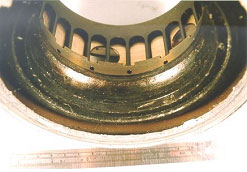
  • Outer wall of the centrifugal diffuser cracked and separated into seven pieces over half the circumference (figure 2).
  • First-stage gas-generator turbine blades oxidised and burnt over the outermost third of their length (figure 3).
  • Second-stage nozzle guide vanes extensively overheated and partially melted on the convex (trailing) face and on the trailing edges (figure 4).
  • Second-stage gas-generator turbine blade number 16 fractured beneath the platform. Remaining blades burnt and mechanically damaged on tip edges (figure 5).
  • Second-stage NGV housing indented and punctured, circumferential cracking extending from this area (figure 6).
  • Power turbine NGV missing two vanes; the remainder showing mechanical damage (figure 7).
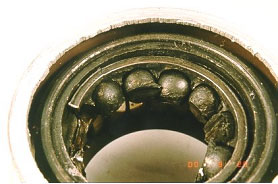
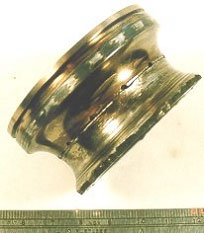
  • Number-three (rear) bearing collapsed, showing extensive overheating and out-of-balance damage to races and adjacent seals (figure 8).
  • Rear bearing air vent and oil return lines fractured from outside of housing (figure 9).
  • Two of the three T5 thermocouples burnt away completely (figure 10).

Arrial 1S1 engine, serial number 15038, as removed from the aircraft.

Figure 1. Arrial 1S1 engine, serial number 15038, as removed from the aircraft.

Diffuser assembly, showing break-up of the outer housing.

Figure 2. Diffuser assembly, showing break-up of the outer housing.

First-stage gas-generator turbine blades oxidised and burnt over their outer length.

Figure 3. First-stage gas-generator turbine blades oxidised and burnt over their outer length.

Second-stage nozzle guide vanes extensively melted and disrupted in a localised area.

Figure 4. Second-stage nozzle guide vanes extensively melted and disrupted in a localised area.

Figure 5. Second-stage gas-generator turbine blades damaged and oxidised, with one blade missing. Item in upper left corner is a guide vane from the power turbine NGV.

Figure 5. Second-stage gas-generator turbine blades damaged and oxidised, with one blade missing. Item in upper left corner is a guide vane from the power turbine NGV.

Figure 6. Second-stage NGV housing with a large puncture and cracking from the released turbine blade.

Figure 4. Second-stage NGV housing with a large puncture and cracking from the released turbine blade.

Power turbine NGV assembly, missing a vane

Figure 7. Power turbine NGV assembly, missing a vane (see Figure 5).

Rear bearing race and rotating air seals, showing extensive out-of-balance damage.

Figure 8. Rear bearing race and rotating air seals, showing extensive out-of-balance damage.

Rear bearing air vent line, fractured at point of connection with the bearing housing. The oil return line had failed in a similar way.

Figure 9. Rear bearing air vent line, fractured at point of connection with the bearing housing. The oil return line had failed in a similar way.

Thermocouple assembly - thermocouples at arrows burned/damaged.

Figure 10. Thermocouple assembly - thermocouples at arrows burned/damaged.

From these observations, the axial compressor diffuser assembly and the second stage turbine rotor were selected for further examination.

Publication details

Publication mode Aviation
Publication date 11/07/2001
Review date 11/07/2001

Wire-strike Accidents in General Aviation: Data Analysis 1994 to 2004

In June 2006, the ATSB released an aviation research investigation report titled Wire-strike Accidents in General Aviation: Data Analysis 1994 to 2004. Since the publication of this report the ATSB has received additional information from key industry stakeholders. As a result, the ATSB has made some revisions to the report to incorporate this advice.

Furthermore, a discrepancy was also identified in one of the tables, which has since been updated. Accordingly, the information contained in the report may differ slightly from that contained in the initial report.

Wire strikes are a significant safety concern for the aviation industry, in particular, the general aviation sector. Wire strikes may result in fatalities and/or the destruction of an aircraft. This report analyses the characteristics of wire-strike occurrences in the general aviation sector using accident and incident data collected by the Australian Transport Safety Bureau. The analysis found that 119 wire-strike accidents and 98 wire-strike incidents were reported between 1994 and 2004. The rate of wire-strike accidents reported per 100,000 hours flown ranged from around 0.9 in 1997 and 1998 to 0.1 in 2003. The figures suggested a downward trend beginning in 1998, with a return to previous accident rates in 2004. Reported wire-strike accidents were primarily in three of the statistical groups used by the Australian Transport Safety Bureau for investigative purposes - aerial agriculture, other aerial work, and private/business. The majority of wire-strike accidents were associated with aerial agriculture operations (62 per cent) followed by other aerial work (20 per cent), and private/business operations (15 per cent). The findings reinforce the clear danger to pilots flying at low level in the vicinity of powerlines and the need to be proactive in reducing the risks associated with such, including the implementation of risk management plans, thorough pre-flight planning and preparation, ongoing training, the use of powerline markers, and due diligence and care.

Publication details

Publication type Research and Analysis Report
Publication mode Aviation
Publication date 29/06/2006
Review date 29/06/2011
Authors ATSB
ISBN 1 921092 23 8
Subject matter Agriculture

MBZ Report: An Examination of Airspace-Related Occurrences in Mandatory Broadcast Zones between 2001 and 2004

EXECUTIVE SUMMARY

This report follows a previous report published by the Australian Transport Safety Bureau (ATSB) in 2003 on airspace-related occurrences titled Airspace-Related Occurrences Involving Regular Public Transport and Charter Aircraft within Mandatory Broadcast Zones. The 2003 report provided a detailed examination of the ATSB's accident and incident data for airspace-related occurrences in Mandatory Broadcast Zones (MBZs), between 1994 and 2001. In recognition of changes in traffic levels, occurrence reporting rates and the classification of incidents following the enactment of the Transport Safety Investigation Act in 2003 (ATSB, 2003b), an update of the analyses was considered necessary.

The purpose of the current report was to examine occurrences associated with MBZs in Australia. Specifically, the objectives of the report were to:

  • examine the number of occurrences involving General Aviation (GA) aircraft in addition to occurrences involving Regular Public Transport (RPT) aircraft that occurred in MBZ airspace from 2001 to 2004; and
  • examine the number of occurrences involving GA aircraft and RPT aircraft that were associated with intentional and unintentional non-compliance with MBZ procedures from 2001 to 2004.

MBZ occurrences were identified using the ATSB aviation occurrence database and subsequently validated by two ATSB Senior Transport Safety Investigators. The occurrences were then examined according to three different criteria. The first criterion encompassed all airspace-related occurrences within MBZs. The second criterion related to only those occurrences where the pilot intentionally mis-complied with MBZ procedures. In contrast, the third criterion related to only those occurrences where the pilot unintentionally mis-complied with MBZ procedures.

In total, 257 airspace-related occurrences in MBZ airspace involving GA aircraft and RPT aircraft for 2001 - 2004 were identified. The highest number of occurrences took place in 2001 and were classified as a Category 5. The number of airspace-related occurrences declined from 3.9 in 2001 to 3.1 per 100,000 hours flown by GA and RPT aircraft in 2002 and remained at 3.1 for 2003 and 2004. These findings suggest that the number of MBZ airspace-related occurrences declined slightly over the four-year period. The findings contrast with those presented in the 2003 report (Figure 1, page 9), which showed an increase in airspace-related occurrences between 1994 and 2001 (ATSB, 2003a).

Of the airspace-related occurrences identified, 145 involved intentional non-compliance with MBZ procedures and 25 involved unintentional non-compliance with MBZ procedures. Most of the non-compliance occurrences were in 2001 and were classified as a Category 5. The number of intentional non-compliance occurrences decreased from 2.6 per 100,000 hours flown by GA and RPT aircraft in 2001 to 1.4 in 2004. This finding suggests that the number of occurrences involving non-compliance generally declined over the 2001 - 2004 period. In contrast, the rate for unintentional occurrences remained below 1 per 100,000 hours flown and did not appear to vary across the four-year period.

Overall, the findings suggest that the number of MBZ airspace-related occurrences in Australia between 2001 and 2004, including those specifically relating to non-compliance with MBZ procedures, was relatively low. Furthermore, the findings suggest that the rate of MBZ-related occurrences did not rise during this period. It may therefore be deduced that the risk due to MBZ-related occurrences did not increase. Importantly though, due to recent changes and potential inconsistencies in the reporting and recording of occurrences, the findings on which these conclusions are based need to be interpreted with caution.

Publication details

Publication type Research and Analysis Report
Publication mode Aviation
Publication date 24/02/2006
Review date 24/02/2011
Subject matter Airspace

Examination of Engine Gas Generator Fairing Panels

Boeing 747-438, VH-OJJ

EXECUTIVE SUMMARY

Examination of Engine Gas Generator Fairing Panels

On 24 April 2001, a Boeing 747-400, VH-OJJ, experienced the loss of both left and right combustion fairing panels from the number three engine during take-off on a flight from Sydney to Los Angeles.

The fairing panels were ejected forcefully from the bypass duct of the engine, causing minor localised damage to the duct internal surfaces and the trailing edge of the centre wing flap section.

Examination by the Technical Analysis unit showed the damage to be consistent with fairing mis-installation, whereby the hooks on the right panel were not engaged with the respective socket pins of the upper fairing. This then permitted the free movement of the fairing sections to a point where they were caught by the bypass airflow and forcefully ejected.

The examination did not identify any defects in manufacture or maintenance of the fairing mounts or latches that could have contributed to the release.


Neville R. Blyth
Senior Transport Safety Investigator
Technical Analysis

Publication details

Publication mode Aviation
Publication date 24/04/2001
Review date 24/04/2001

Analysis of fatality trends involving civil aviation aircraft in Australian airspace between 1990 and 2005

The research paper examined fatal accidents and fatalities involving civil aviation aircraft in Australian airspace between 1990 and 2005. The purpose of the paper was to provide accurate data to industry and the public by identifying key trends and characteristics. Specifically, the objectives of the paper were to:

  1. identify trends for fatal accidents and fatalities from 1990 to 2005,
  2. examine the number of fatal accidents from 1990 to 2005 by pilot licence type, type of operation, level of proficiency, and aircraft weight, and
  3. examine the number of fatalities from 1990 to 2005 by pilot licence type, type of operation, level of proficiency and aircraft weight.

The ATSB aviation database was searched to identify all fatal accidents involving civil aviation aircraft operating in Australian airspace from 1 January 1990 to 31 December 2005. It was found that the number of reported fatal accidents and fatalities declined significantly between 1990 and 2005, with the highest number of fatal accidents and fatalities in 1990. The number of fatal accidents and fatalities reported in 2005 was below the annual average calculated for the 16-year period. Fatal accidents associated with both professional and non-professional pilots declined significantly between 1990 and 2005. In relation to type of operation, the findings show that both commercial and non-commercial operations experienced a significant decrease in the number of fatal accidents between 1990 and 2005. For commercial operations, 2004 was the lowest for the 16-year period for both fatal accidents and fatalities. An elevated fatality rate for 2005 was primarily because of a fatal accident at Lockhart River in Queensland, which involved 15 fatalities. The fatal accident and fatality rates for commercial and non-commercial operations in Australian airspace have been very low.

Publication details

Publication number 0388
Publication type Research and Analysis Report
Publication mode Aviation
Publication date 14/03/2006
Review date 14/03/2011
ISBN 1 921092 32 7