The Aviation Short Investigation Bulletin covers a range of the ATSB’s short investigations and highlights valuable safety lessons for pilots, operators and safety managers.
Released periodically, the Bulletin provides a summary of the less-complex factual investigation reports conducted by the ATSB. The results, based on information supplied by organisations or individuals involved in the occurrence, detail the facts behind the event, as well as any safety actions undertaken. The Bulletin also highlights important Safety Messages for the broader aviation community, drawing on earlier ATSB investigations and research.
Issue 46 of the Bulletin features ten safety investigations:
The Aviation Short Investigation Bulletin covers a range of the ATSB’s short investigations and highlights valuable safety lessons for pilots, operators and safety managers.
Released periodically, the Bulletin provides a summary of the less-complex factual investigation reports conducted by the ATSB. The results, based on information supplied by organisations or individuals involved in the occurrence, detail the facts behind the event, as well as any safety actions undertaken. The Bulletin also highlights important Safety Messages for the broader aviation community, drawing on earlier ATSB investigations and research.
Issue 44 of the Bulletin features 10 safety investigations:
The ATSB Annual Report 2014–15 outlines performance against the outcome and program structure in the 2014–15 Infrastructure and Regional Development Portfolio Budget Statements.
Chief Commissioner’s review 2014–15
This was the ATSB’s sixth year as a fully independent body within the Infrastructure and Regional Development portfolio. In addition to the continuing search for the missing Malaysia Airlines Flight MH370, 2014–15 saw the completion of a range of significant investigations and some significant governance changes for the ATSB.
In July 2013, I requested the Transportation Safety Board of Canada (TSB) to conduct an independent objective review of our safety investigation methodologies and processes. I asked that they benchmark Canadian methodologies with ours and compare both with international standards. The TSB looked, in particular, at three of our substantial investigations including the ditching of a Pel-Air Westwind jet off Norfolk Island in 2009 (AO-2009-072). This investigation had been strongly criticised in some quarters and was the subject of a report by the Senate Rural and Regional Affairs and Transport Committee.
The TSB report, released in December 2014, found that the ATSB’s investigation methodology and analysis tools represent best practice, and have been shown to produce very good results.
At the same time, the report highlighted room for improvement, particularly in relation to the way our processes were applied to the Pel-Air ditching investigation.
In response to the TSB review, the ATSB decided to reopen the investigation into the Pel‑Air accident. A completely new team was appointed to review the original investigation and associated report in light of any fresh evidence, relevant points from the TSB review and other recent aviation reviews. The ATSB expects to complete the reopened investigation in the first quarter of 2016.
After carefully considering the other findings and recommendations of the TSB report, the ATSB accepted all of them. We have worked our way methodically and carefully through implementation of the recommendations of the TSB review, resulting in improvements to the future work of the ATSB. Being able to compare our approaches and learn from our respected colleagues in Canada has been a valued opportunity.
In November 2013, in keeping with a pre-election commitment, the Deputy Prime Minister and Minister for Infrastructure and Regional Development, the Hon Warren Truss MP, commissioned a review of Australia’s aviation safety regulation system. This was to see how our safety regulation system is placed to deal with this economically important industry. Following completion of the report the ATSB contributed to the Government’s response.
On 3 December 2014, the Deputy Prime Minister made a statement in Parliament confirming that the Government fully supports the vital role of the ATSB. To give effect to a pre-election commitment, he undertook to appoint an additional Commissioner with aviation experience and to issue a new Statement of Expectations.
In accordance with the Deputy Prime Minister’s announcement, Mr Chris Manning was appointed as a Commissioner with effect from 9 March 2015. Chris has brought a wealth of experience in aviation as an expert pilot and prominent aviation manager, and from his arrival has made a very valuable contribution to our work.
The Deputy Prime Minister issued a revised Statement of Expectations on 19 April 2015. The statement largely confirmed our existing focus and direction, but also required us to implement the relevant parts of the Government’s response to the Aviation Safety Review Report and the agreed recommendations of the TSB review. The ATSB’s response to the Statement of Expectations is set out in our Corporate Plan.
The issuing of a Corporate Plan was part of our implementation of the Public Governance, Performance and Accountability Act 2013 (PGPA Act). To meet the requirements of the new PGPA Act, we have implemented more comprehensive business planning and risk management processes. These are all being managed consistently with our safety priorities, which have been at the centre of our SafetyWatch communication and safety awareness direction for the last three years.
The search for Malaysia Airlines Flight MH370
The search for the missing Malaysia Airlines Flight MH370 in the Southern Indian Ocean has been a major commitment during the whole year. It has involved complex and challenging activities including:
conducting ground-breaking technical analysis to determine the appropriate search area
determining the processes and standards necessary to undertake an unprecedented underwater search
selecting highly capable contractors with the expertise and equipment to conduct the search
continuing project and financial management
dealing with the incredible level of interest and enquiry from all over the world.
We have worked with our Minister and our Malaysian and Chinese counterparts to keep them informed of the search progress and enable joint decisions to be made when required.
Aviation
During the year we completed 40 aviation investigations and more than 100 short factual investigations.
The most significant of these was the crash of a Robinson R44 helicopter at Bulli Tops on 21 March 2013 (AO-2013-055). This, as well as two previous similar accidents involving R44 helicopters, highlighted the danger of rigid fuel tanks in low-impact helicopter crashes, where post-impact fires may make otherwise survivable accidents deadly. We confirmed this trend with detailed statistical analysis of similar accidents in Australia and the US over a 10-year period.
While the Civil Aviation Safety Authority (CASA) had recommended that owners and operators implement the manufacturer’s service bulletin recommendation to replace the fuel tanks with bladder-type tanks that would improve resistance to post-impact fuel leaks, it was clear that they would be unlikely to meet the 30 April 2014 deadline. Accordingly, the ATSB recommended that CASA mandate the requirement by the due date. As a result, all R44 helicopters in Australia are now compliant.
Following this action, other safety authorities in South Africa, New Zealand and Europe have also mandated the change. The ATSB has issued safety recommendations to the US Federal Aviation Administration that they also take action to mandate fitting of bladder-type fuel tanks. The outcome of this investigation illustrates the importance of our investigations and the far-reaching influence safety investigations can have in ensuring transport safety for all travellers, not only those in Australia or our immediate region.
Other significant aviation investigations have also led to improvements in the way air ambulance and rescue services undertake winching of patients. There have also been changes to air traffic control procedures and training of air traffic controllers following our investigation into a loss of separation assurance.
Marine
During the year we completed five marine investigations. These were mainly concerned with marine work practices and confirmed that ships are inherently dangerous places of employment.
It is essential that employees implement sound risk management and occupational health practices. The most serious of these incidents was the unexpected deployment of a lifeboat and the subsequent serious injury to an employee.
Errors by maritime pilots and other ship operators are still contributing to collisions and other mishaps.
Rail
We completed 20 rail investigations this year. Some of these concerned derailments, raising serious questions about the way operators are building and maintaining their rail networks.
Disappointingly, we are still seeing many instances where breaches of safe work practices put maintenance crews and operators at risk. This issue has been one of our safety priorities for the last three years. Continuing notifications suggest the existence of broader safety issues associated with work on track. Consequently, we have initiated a safety issues research project looking into the protection issues that provide for safe work on track. The project has commenced with an analysis of our statistical data which aims to present the Australian experience with safe work occurrences and highlight the key areas where further attention should be focussed.
We continue to work on a national approach to rail safety investigation and have been holding negotiations with Western Australia and Queensland to complete the process of establishing a unified national system of rail safety investigation.
Resource constraints
As reported last year, our resource situation led us to reduce our workforce by approximately 12 per cent. We have experienced further budgetary restraint this year despite the additional resources provided to undertake the search for MH370. Budget restraints have had a significant effect on our responsiveness and flexibility and continues to affect our capacity to conduct investigations. Our performance statistics for the year show this very clearly, particularly in regard to the timeliness of our investigations. This year, I have incorporated a table in our performance reporting which shows our longitudinal results over the past three years.
Safety priorities
Through our SafetyWatch initiative we maintain a continuing focus on nine safety priorities:
flying with reduced visual cues
general aviation pilots
handling the approach to land
data input errors
safety around non-controlled aerodromes
under-reporting of occurrences
safe work on rail
marine work practices
maritime pilotage.
Outlook for 2015–16
Resources continue to be constrained. It is a simple fact that with fewer resources we can do fewer investigations, or we must constrain the scope of some of the investigations we do undertake. More than ever, we need to choose those accidents or incidents that have the greatest potential to yield the greatest safety benefit. There remains a substantial risk we will miss an important issue. To minimise this risk, we are focussing strongly on analysis of our data and our investigation findings to identify emerging trends. Our short investigations also play an important role in enabling us to take a closer look at accidents and serious incidents which have the potential for more detailed systemic investigation. The importance of the work has not diminished, and I am pleased that the Government has reaffirmed the value of our work.
Once again, I would like to acknowledge the first-class work of our investigators and other staff, and to thank them for their continued commitment to the ATSB. I am also grateful for the continuing attention, support and wise counsel of my fellow Commissioners.
The Aviation Short Investigation Bulletin covers a range of the ATSB’s short investigations and highlights valuable safety lessons for pilots, operators and safety managers.
Released periodically, the Bulletin provides a summary of the less-complex factual investigation reports conducted by the ATSB. The results, based on information supplied by organisations or individuals involved in the occurrence, detail the facts behind the event, as well as any safety actions undertaken. The Bulletin also highlights important Safety Messages for the broader aviation community, drawing on earlier ATSB investigations and research.
Issue 42 of the Bulletin features 10 safety investigations:
The Australian Airports Association (AAA) commissioned preparation of this Airport Practice Note to provide aerodrome operators with species information fact sheets to assist them to manage the wildlife hazards at their aerodrome. The species information fact sheets were originally published in June 2004 by the Australian Transport Safety Bureau (ATSB) as Bird Information Fact Sheets.
The AAA was prompted to revise and add additional fact sheets for supplementary species by the release of the ATSB Australian aviation wildlife strike statistics 2004 – 2013 report. This report listed Kites and Bat/ Flying Foxes as having the largest overall number of strikes in the 2012-2013 reporting period representing a demonstrated risk to safe operations. As a result of this report the AAA partnered with Avisure in consultation with the ATSB to update the existing fact sheets and create new species information fact sheets focused on managing the strike risk of these species at Australian airports.
These new and revised fact sheets provide airport members with useful information and data regarding common wildlife species around Australian aerodromes and how best to manage these animals. The up-to-date suite of species information fact sheets will provide aerodrome operators with access to data, information and management techniques for the species posing the greatest risk to safe aerodrome operations in Australia. It is hoped that this document will be a worthwhile and useful asset to aerodrome operators across Australia and the AAA would like to acknowledge the contribution of Avisure and the ATSB in the development of this project.
The Aviation Short Investigation Bulletin covers a range of the ATSB’s short investigations and highlights valuable safety lessons for pilots, operators and safety managers.
Released periodically, the Bulletin provides a summary of the less-complex factual investigation reports conducted by the ATSB. The results, based on information supplied by organisations or individuals involved in the occurrence, detail the facts behind the event, as well as any safety actions undertaken. The Bulletin also highlights important Safety Messages for the broader aviation community, drawing on earlier ATSB investigations and research.
Issue 43 of the Bulletin features 10 safety investigations:
Looking at past accidents, there is almost always some debris left floating after an aircraft crashes in water. The opportunity to locate and recover debris from the sea surface diminishes rapidly over the first few weeks from the time of a crash. Thereafter some less permeable items of debris will remain afloat for a longer period, but they will be increasingly dispersed. To be found ashore, an item of debris must remain afloat long enough and be subjected to the right combination of wind and currents for it to make landfall.
The most recent drift modelling indicated that the net drift of most debris in the sixteen months to July 2015 is likely to have been north and then west away from the accident site. The drift analysis undertaken by the CSIRO further supports that the debris from MH370 may be found as far west of the search area as La Réunion Island.
This is consistent with the currently defined search area.
Introduction
There are several factors which together determine the likelihood of debris from MH370 being detected on the sea surface or washing up on a shoreline on the rim of the Indian Ocean. These are:
The quantity and nature of any floating debris created by the aircraft impacting the sea surface which in turn is determined by:
The physics of the impact, including the velocity and attitude of the aircraft, the structural strength of the aircraft and its components and therefore the nature and extent of the failure of the aircraft structure which liberated or created debris;
The composition and contents of the aircraft including structural components, internal fit-out and what was carried on board including passenger baggage and cargo.
The physical properties of the debris generated by the impact, i.e. material, size, shape, density which all have an effect on the surface drift[1] of each piece of debris and its permeability[2].
The prevailing wind and currents which act over time to move and disperse the debris on the sea surface.
Time.
Past examples
There are several examples of commercial aircraft impacting water at high speed and what debris may be left on the surface. Below are some examples:
Silk Air flight B737, 19 December 1997:(Opens in a new tab/window)On 19 December 1997, Silk Air flight 185, a Boeing B737, crashed into the Musi River in Sumatra. The aircraft was seen by witnesses to enter the water vertically at high-velocity and disintegrate on impact. Several parts of the tail of the aircraft had separated in-flight during the final descent and landed on shore and these were recovered. However, within 24 Hrs, due to the tidal nature of the river and proximity to the sea, there were no floating objects from the aircraft recovered. Almost the entire aircraft was buried in deep mud at the bottom of the river.
On 1 January 2007, Adam Air flight 574, a Boeing B737, crashed into the sea off Sulawesi while en route from Surabaya to Manado. On January 11, parts of the aircraft's tail stabilizer were found 300 m offshore. Later, other parts of the aircraft including passenger seats, life jackets, several food trays, several seat cushions, part of an aircraft tire, pieces of aluminium and fibre, an ID card, a briefcase, a flare and a headrest were also recovered from the area. By 13 January, a piece of a wing was also recovered. The total count of recovered objects by 29 January was 206, of which 194 were definitely from the aircraft.
Air France A330, 1 June 2009:(Opens in a new tab/window)On 1 June 2009, Air France flight AF447, an Airbus A330 aircraft, crashed into the Atlantic Ocean off the coast of Brazil. French and Brazilian navies were involved in a surface search and located the first part of floating debris on 5 June 2009. A surface search continued until 20 June 2009, in all over 700 pieces of floating debris were recovered. No further floating debris were located after 20 June, twenty days after the accident.
Air Asia A320, 28 December 2014:(Opens in a new tab/window)On 28 December 2014, Air Asia flight 8501, an Airbus A320 aircraft, crashed into the Java Sea while en route from Surabaya, Indonesia to Singapore. Observations by an Indonesian investigator were that floating wreckage included 3-4 economy seat pairs, some ceiling liner honeycomb material, an escape slide including bottle (it had not inflated), and some seat cushions. Some of the wreckage was recovered more than two weeks after the accident, up to 100 miles away.
Summary
Looking at past accidents, there is almost always some debris left floating after an aircraft crashes in water. The debris will often include those items designed to float including seat cushions, life jackets, escape slides etc but also many items of cabin fit out, like cabin linings and tray tables, which are made of low-density synthetic materials. Similarly, aircraft structural components, including flight surfaces, may entrap sufficient air to remain buoyant for reasonable periods and have also been commonly found afloat following a crash. The amount and type of debris varies but it is usually detected and recovered within the first few weeks of the accident before it has been significantly dispersed.
Over time, all floating debris will become water-logged and then sink. For some items of debris this may be relatively fast. For example, items which are buoyant due to entrapped air will sink when the air is released or void spaces become filled, a process which is hastened by the action of wind and waves. Other items constructed of materials which are less permeable, like seat cushions, will float for long periods but they too will eventually sink when the material degrades through chemical and/or mechanical decomposition. This decomposition may take a very long time in the case of some synthetic materials, plastics in particular, but is quicker for items which biodegrade.
In summary, the opportunity to locate and recover debris from the sea surface diminishes rapidly over the first few weeks from the time of a crash. Thereafter, there will be some less permeable items of debris which will remain afloat for a longer period, but they will be increasingly dispersed. Dispersal is directly related to the surface drift experienced by the individual items of debris which in turn is related to their physical characteristics: size, shape and density. To be found ashore, an item of debris must remain afloat long enough and be subjected to the right combination of wind and currents for it to make landfall.
Drift models for MH370
On 17 March 2014, 9 days after the aircraft disappeared, the sea surface search for MH370 shifted to the southern Indian Ocean. The Australian Maritime Safety Authority (AMSA) assumed the coordination of search operations. A summary of the first three weeks of search operations can be found on the AMSA website(Opens in a new tab/window).
In the first weeks of the surface search in the Indian Ocean, a broad area was searched which included some of the current area of the underwater search and some areas adjacent to it. The searchers were guided by early analysis of the data from the aircraft’s satellite communication system and satellite imagery which detected several items of interest, none of which were confirmed to have originated from MH370.
A drift modelling working group was set up, comprising a number of organisations including: the Commonwealth Scientific and Industrial Research Organisation (CSIRO), Asia-Pacific Applied Science Associates (APASA), the US Coastguard, the Bureau of Meteorology (BOM) and Global Environmental Modelling Systems (GEMS) to ensure that best practice modelling was put in place for the subsequent search. A number of search and rescue datum buoys were also deployed which were used to measure actual surface drift in the search area and to validate the drift models being used. Similarly, real-time wind and wave data from the search area was used to continuously update the drift model. The surface search for debris ended on 28 April 2014.
Following the release of the MH370 - Definition of Underwater Search Areas report on 26 June 2014, a drift model was applied by one organisation to the wide search area defined in the report. The drift modelling was run to provide an indication of when and where the first possible debris would make landfall. This modelling indicated that the first possible landfall was on the west coast of Sumatra, Indonesia and would have occurred in the first few weeks of July 2014. Indonesian search and rescue authorities were subsequently advised of the possibility of debris washing up on their shoreline.
In November 2014, the ATSB asked CSIRO to perform drift modelling based on the revised search area defined in the MH370 - Flight Path Analysis Update report released on 8 October 2014. This modelling indicated that there was an extremely low probability that any debris from MH370 would have made landfall at that time. As the CSIRO modelling was not consistent with the previous modelling performed by a different organisation, the question was asked as to why the two models were yielding different results and an error was found in the way in which BOM wind data was being transferred into the first model. While this error in that model had no impact on the way the surface search was conducted, it was important in order to understand over the course of time where debris might wash up and help verify or discount the various items found on beaches, particularly on the west coast of Australia.
Further refinement to the CSIRO drift modelling has been undertaken since 30 July 2015 with the most recent modelling taking into account the effect of waves (in addition to wind and current) and extending the scope of the area covered to include the western Indian Ocean.
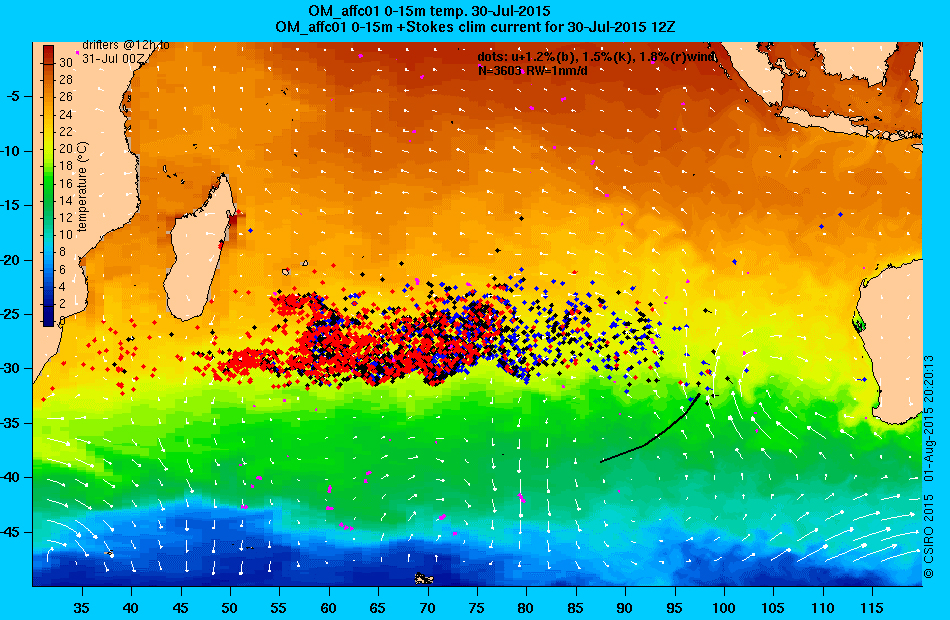
Figure 1 shows the indicative drift as at 30 July 2015, produced from the latest CSIRO modelling (released with permission of CSIRO). It shows the final image from a computer simulation of the movement of potential debris resulting from the crash of MH370 somewhere along the 7th arc between latitude 39°S and 32°S. The simulation was run from 8 March 2014 to 30 July 2015, to see if the flaperon found on La Réunion (21.2°S 57°E) could have drifted there from the MH370 search zone in the intervening time. The movement of the items is calculated from the combined influence of ocean currents, winds and waves. Currents and winds are estimated by the Bureau of Meteorology’s operational ocean and weather forecasting systems, while the Stokes drift due to ocean waves is estimated from the NOAA Wavewatch III model. Dr David Griffin from the CSIRO concluded that if the flaperon drifted with an effective leeway factor of about 1.5% then its arrival at La Réunion does not cast doubt on the validity of the present MH370 search area, taking the errors of the ocean, wind and wave models into account. He also concluded that because of the turbulent nature of the ocean, and the uncertainties of the modelling, it is impossible to use the La Réunion finding to refine or shift the search area.
Conclusion
The surface search in the southern Indian Ocean commenced 9 days after MH370 went missing. By this time much of any debris left floating after the crash would likely have either sunk or have been dispersed. The surface search initially, briefly, targeted the correct area based on the initial, and then subsequent work, to reconstruct the aircraft’s flight path and therefore the surface search at this point in time represented the best chance to identify and recover any floating debris.
Most recent drift modelling indicated that the net drift of most debris in the months to July 2015 is likely to have been north and then west away from the accident site. The drift analysis undertaken by the CSIRO further supports that the debris from MH370 may be found as far west of the search area as La Réunion Island and is consistent with the currently defined Search area.
Figure 1: Indicative drift from the Search Area as at 30 July 2015
Blue, black and red dots simulate items with leeway factors (applied to the 10m wind velocity) of 1.2, 1.5 and 1.8%. The items originated along the black arc (7th arc) on 8 March 2014. White arrows are the winds for the day shown. Magenta symbols are positions of real drifting buoys (with sea-anchors at 12m) on the day. Their movement has been used to estimate the errors of the ocean current component of the total drift velocity.
_________________
[1] The National Search and Rescue Supplement to the International Aeronautical and Maritime Search and Rescue Manual defines surface drift (sometimes called total drift) of an object floating on the sea surface as made up of the leeway drift and the movement of the upper layer of the ocean caused by the surface currents, tidal currents and ocean currents. Leeway is the movement of a search object through water caused by winds blowing against exposed surfaces. Generally, very buoyant objects float high and exhibit more leeway and therefore their drift is more influenced by prevailing winds, objects floating lower in the water have lower leeways and therefore are influenced more by currents.
[2] Permeability of a floating object is related to its composition and the change in its density over time when immersed in seawater and subject to degradation due mechanical wear (wind and wave action, marine growth) and chemical exposure (UV light, oxidation etc). Over time, all floating debris will degrade, absorb or fill with water and lose buoyancy until they sink.
The ATSB is leading the search for missing Malaysia Airlines flight 370 in the southern Indian Ocean. Geoscience Australia is providing advice, expertise and support to the ATSB. With the bathymetric survey completed, the underwater search commenced in October 2014.
Summary
The underwater search is being carried out utilising vessels equipped with a towfish – an underwater vehicle which carries various instruments used to survey the seafloor. The key instruments are side scan sonar and the multi-beam echo sounders which survey the nadir (the gap in side scan sonar coverage under the towfish). There is also an Autonomous Underwater Vehicle (AUV) used to scan those portions of the search area that cannot be searched effectively using the towfish.
As the search progresses, sonar analysts on board the vessels and ashore, identify and assess sonar ‘contacts’ – features or objects on the seabed that stand out from their surrounds which may require further investigation. Contacts of interest include anything that appears to be man-made or potentially exhibits characteristics of an aircraft debris field. All contacts are given classifications which differentiate the extent to which they warrant further inspection.
How are sonar contacts classified?
There are three classifications for sonar contacts which are identified during the course of the underwater search.
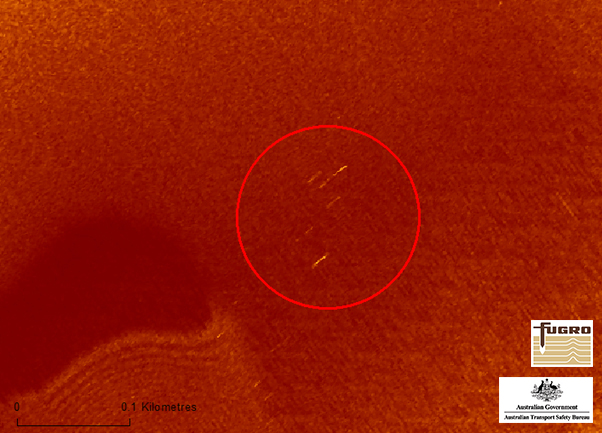
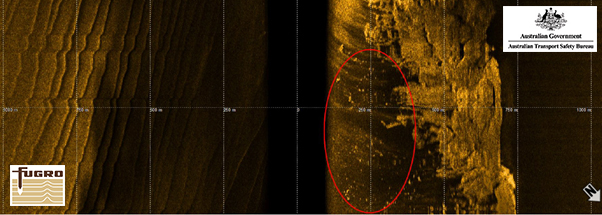
Classification 3 is assigned to sonar contacts that are of some interest as they stand out from their surroundings but have low probability of being significant to the search. The underwater search so far has identified more than 400 seabed features that have been classified as category 3.
Figure 2: Side Scan Sonar - Category 3 contact Source: ATSB, image by Fugro Survey
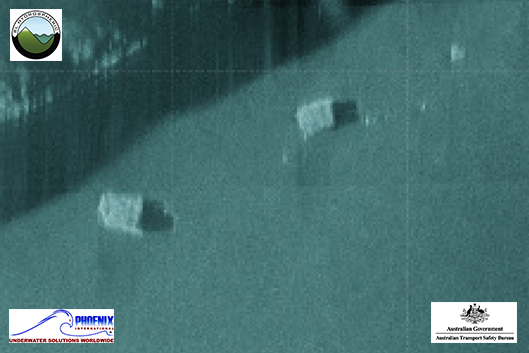
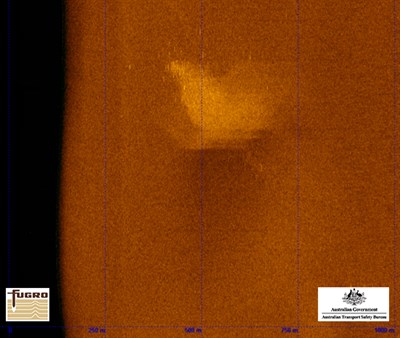
Classification 2 sonar contacts are of more interest but are still unlikely to be significant to the search. There have been more than 20 features that have been classified as category 2. These objects may or may not be man-made, but expert analysis of the sonar imagery ranks them as having a low probability of being an aircraft debris field.
Figure 4: Side Scan Sonar - Category 2 contact Source: ATSB, image by Fugro Survey
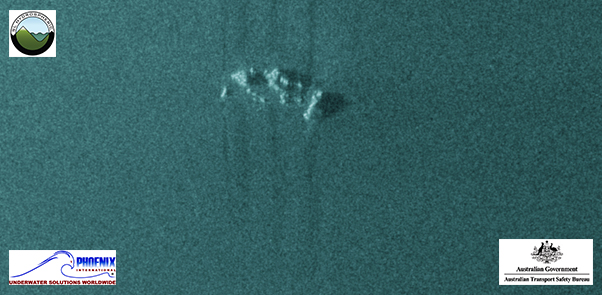
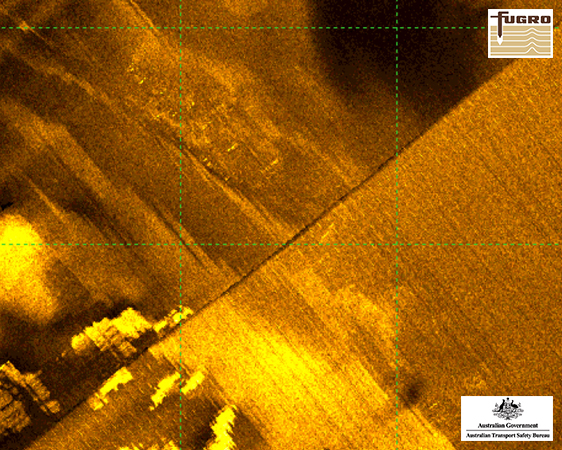
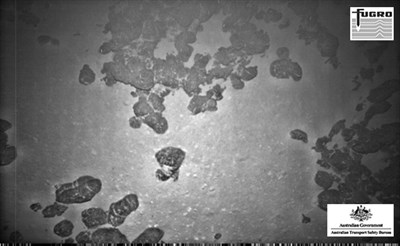
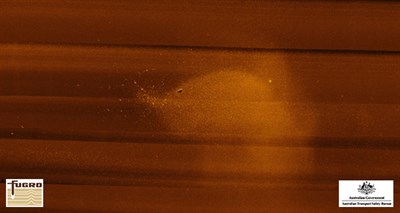
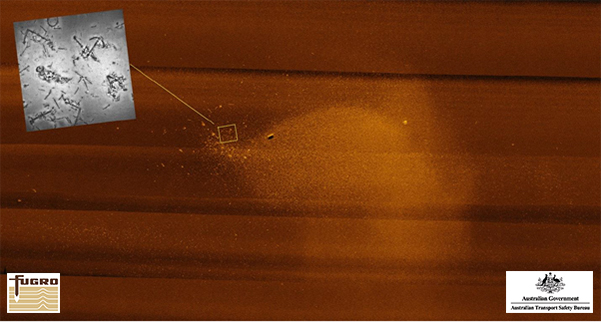
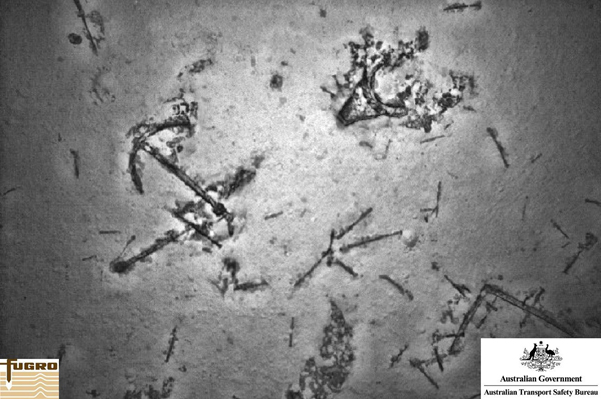
Classification 1 sonar contacts are of high interest and warrant immediate further investigation. When a Classification 1 sonar contact is reported, the search vessels are instructed to gather higher resolution/ high frequency sonar data flying the AUV or towfish closer to the seafloor, (an altitude of between 35 metres and 50 metres). If the high-resolution sonar data looks promising, a photo mission is then run at very low altitude (between 8 metres and 10 metres) to identify positively any objects on the seafloor. Generally, these contacts are rare, as only two have been marked to date. One was determined to be a rock field, and the second was found to be an old wooden shipwreck.
Figure 5: Side Scan Sonar - Category 1 contact Source: ATSB, image by Fugro Survey
Figure 6: Photo image of rock field gathered by Fugro’s Hugin AUV - Echo Surveyor VII
Source: ATSB, image by Fugro’s Hugin AUV – Echo Surveyor VII
Figure 7: Side Scan Sonar - Category 1 contact – Initial survey line with Fugro DT-1 towfish
Source: ATSB, image by Fugro Survey
Figure 8: Side Scan Sonar - Category 1 contact - Mosaic of high resolution side scan data of shipwreck debris field, collected with Furgo’s Hugin AUV – Echo Surveyor VII Source: ATSB, image by Fugro Survey
Figure 9: Mosaic of shipwreck debris field with photo of anchor taken by Echo Surveyor VII
Source: ATSB, image by Fugro Survey
Figure 10: Photo image of anchor and debris from shipwreck site – Echo Surveyor VII
This is the first publication in a series from the ATSB on aerial application (agricultural spraying and firefighting) accidents during the previous operational year (May 2014 to April 2015). Aerial application operations have a notably high accident rate relative to other aviation sectors. These operations involve inherent risks that are not present in most other types of flying. Risks include low-level flying with high workloads and numerous obstacles, in particular powerlines and uneven terrain. This report will focus on the aerial application accidents that occurred between May 2014 and April 2015 and fatal accident reports published in this period to coincide with the agriculture season in most parts of Australia.
The Aviation Short Investigation Bulletin covers a range of the ATSB’s short investigations and highlights valuable safety lessons for pilots, operators and safety managers.
Released periodically, the Bulletin provides a summary of the less-complex factual investigation reports conducted by the ATSB. The results, based on information supplied by organisations or individuals involved in the occurrence, detail the facts behind the event, as well as any safety actions undertaken. The Bulletin also highlights important Safety Messages for the broader aviation community, drawing on earlier ATSB investigations and research.
Issue 40 of the Bulletin features 10 safety investigations: