Thousands of safety occurrences involving Australian-registered and foreign aircraft are reported to the ATSB every year by individuals and organisations in Australia’s aviation industry, and by the public. The aim of the ATSB’s statistical report series is to give information back to pilots, operators, regulators, and other aviation industry participants on what accidents and incidents have happened, how often they are happening, and what we can learn from them.
What the ATSB found
In 2013, there were 106 accidents, 221 serious incidents, and about 5,500 incidents reported to the ATSB involving Australian (VH– registered) aircraft. There were also 71 accidents, 33 serious incidents, and 137 incidents involving Australian recreational aircraft and a further 200 foreign-registered aircraft operating within Australia or its airspace were involved in reportable safety occurrences.
Over the past 9 years, recreational aeroplane, aerial agriculture and private/business/sport operations had the most accidents per hour flown, with more than 160 accidents per million hours flown. Gyrocopters (recreational aviation) had the highest fatal accident rate over this period, followed by recreational aeroplane and private/business operations.
Commercial air transport aircraft were involved in the majority of occurrences, and in 2013 the most common occurrences reported were wildlife strikes, weather affecting aircraft, and aircraft system problems. Most accidents and serious incidents involved reduced aircraft separation, engine malfunction, or runway excursions. The number of incidents reported by commercial air transport operators has increased in each of the last 10 years, reflecting more flights and greater awareness of the importance of reporting safety occurrences.
General aviation aircraft, such as aircraft conducting flying training, aerial work, or private/pleasure flying, were involved in over one-third of occurrences reported to the ATSB in 2013. Wildlife strikes, runway events and aircraft separation issues were the most common incidents reported. In comparison, most accidents and serious incidents involved terrain collisions, reduced aircraft separation, or a loss of aircraft control. There was a fall in general aviation accidents and fatalities in 2013 particularly in private, business and sport flying (which is where most accidents and fatalities in general aviation happen) and in aerial work.
Recreational aviation aircraft (non-VH registered) were also involved in fewer reported accidents in 2013, although the number of fatal accidents doubled. Most accidents and serious incidents involved terrain collisions and engine malfunctions.
Safety message
Aviation occurrence statistics provide a reminder to everyone involved in the operation of aircraft that accidents, incidents, and injuries happen more often than is widely believed. Some of the most frequent accident types are preventable, particularly in general aviation. Pilots and operators should use the misfortunes of others to help identify the safety risks in their operation that could lead to a similar accident or serious incident.
Timely and thorough reporting of safety incidents is paramount. The ATSB’s capability to understand why accidents and incidents happen and to identify the major safety risks in different types of aviation operations is at its best when all aviation participants report all safety incidents. The information the ATSB provides helps everyone in the aviation industry to better manage their safety risk.
The Aviation Short Investigation Bulletin covers a range of the ATSB’s short investigations and highlights valuable safety lessons for pilots, operators and safety managers.
Released periodically, the Bulletin provides a summary of the less-complex factual investigation reports conducted by the ATSB. The results, based on information supplied by organisations or individuals involved in the occurrence, detail the facts behind the event, as well as any safety actions undertaken. The Bulletin also highlights important Safety Messages for the broader aviation community, drawing on earlier ATSB investigations and research.
Issue 35 of the Bulletin features 10 safety investigations:
The ATSB 2013–14 Annual Report outlines performance against the outcome and program structure in the 2013–14 Infrastructure and Transport Portfolio Budget Statements.
Chief Commissioner’s review 2013–14
2013–14 was the ATSB’s fifth year in its current form as a fully independent agency within the Infrastructure and Regional Development portfolio. I am honoured that the Deputy Prime Minister has appointed me to continue as Chief Commissioner for the next two years, which I take as a strong vote of confidence in the organisation and the work we do.
We have had another productive year in terms of our investigation outputs; at the same time, we have faced a number of serious challenges, in terms of both the complexity of the accidents and incidents we have had to deal with, and of the availability of resources.
By March of this year, planning our program for the next four years was showing that we would not be able to sustain the current level of staffing into future years. We took the difficult decision to reduce our complement of staff by twelve per cent. As a result, we have had to combine some of our functions, such as research and notifications, and our capacity is less than before in all teams including investigation, technical analysis and research and publication.
The decision to reduce our staff numbers was particularly difficult as it was made in the knowledge that there is no contingent workforce of highly skilled transport safety investigators available in the marketplace to be deployed at short notice in the event of a new crisis. It was indeed sobering to see more than 200 years of combined corporate and investigation experience leaving the ATSB.
In March, at the same time as we were required to undertake difficult decisions in relation to our staffing and resources, we received the news of the loss of Malaysia Airlines Flight 370 (MH370) and of its possible location in the Southern Indian Ocean, in Australia’s Search and Rescue Zone.
The ATSB became part of a whole of government response and worked closely with the Joint Agency Coordination Centre that was set up under the leadership of Air Chief Marshal (Retired) Angus Houston. We also worked closely with the Australian Maritime Safety Authority and other government agencies such as the Department of the Prime Minister and Cabinet and the Department of Foreign Affairs and Trade together with our Malaysian counterparts.
Our subsequent involvement in leading the search for the missing Malaysia Airlines Flight 370 has presented us with our greatest challenge yet. This is the most serious aviation occurrence ever to involve the ATSB and its precursors, and is arguably the most mystifying, expansive and difficult search operation ever undertaken in the history of commercial aircraft. Since then, in July 2014, Malaysia Airlines Flight 17 (MH17) was apparently brought down by a missile over the Ukraine with a significant number of Australian citizens and residents on board. The ATSB deployed two investigators to the Ukraine to work in support of the Dutch Safety Board-led Annex 13 safety investigation into the occurrence. The ATSB will continue to provide support to investigation activities associated with the MH17 tragedy.
The Australian Transport Safety Bureau (ATSB) is leading a seabed mapping and underwater search for missing Malaysia Airlines flight 370 in the southern Indian Ocean. Geoscience Australia is providing advice, expertise and support to the ATSB.
There are two planned phases of the search. Phase one, a bathymetric survey providing a detailed map of the seafloor topography of the search area and phase two, a deep ocean search using scanning equipment or submersible vehicles. The information gained in phase one will be used to build a map of the sea floor in the search area, which will aid navigation during phase two.
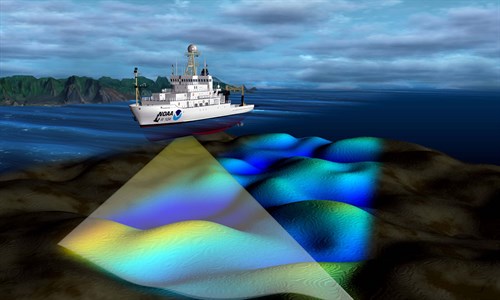
Multibeam Sonar
Multibeam sonar is a widely used tool for mapping the sea floor. It measures the amount of time taken for a sound wave to travel between a ship and the sea floor to calculate the depth (bathymetry). Multibeam sonar uses multiple beams to measure a swath of the seabed under the ship, in contrast to single beam sonar which only maps a point below the ship.
In the search area, the water is up to 6000 metres deep, so the survey relies on acquisition of bathymetry using a multibeam system that can detect the sea floor at great depths.
Figure 1:
Source: National Oceanic and Atmospheric Administration, US Dept. of Commerce. (Image is for illustrative purposes only. NOAA vessels are not involved in the search).
To acquire the multibeam data needed for the bathymetric survey, a multibeam sonar is mounted on the hull of the survey vessel. The sonar system sends out a pulse of sound, which reflects off the sea floor and returns to the multibeam sonar device. The time of return provides an indication of how deep the water is.
Water salinity, temperature and depth (pressure) impact on how fast sound travels—and noting that these change throughout a water column, signals are corrected for these changes. Different frequencies are used to map different water depths, with higher frequencies (>100kHz) used for shallow water and low frequencies (<30 kHz) for deeper water.
The survey vessel traverses the area of interest at set distances and the multibeam sonar continuously measures both the water depth and sea floor hardness data concurrently.
The Aviation Short Investigation Bulletin covers a range of the ATSB’s short investigations and highlights valuable safety lessons for pilots, operators and safety managers.
Released periodically, the Bulletin provides a summary of the less-complex factual investigation reports conducted by the ATSB. The results, based on information supplied by organisations or individuals involved in the occurrence, detail the facts behind the event, as well as any safety actions undertaken. The Bulletin also highlights important Safety Messages for the broader aviation community, drawing on earlier ATSB investigations and research.
Issue 34 of the Bulletin features 10 safety investigations:
The Australian Transport Safety Bureau (ATSB) is leading a sea floor mapping and underwater search for missing Malaysia Airlines flight MH370 in the southern Indian Ocean. Geoscience Australia(Opens in a new tab/window) is providing advice, expertise and support to the ATSB.
The search comprises two planned phases. Phase one, a bathymetric survey providing a detailed map of the sea floor topography of the search area and phase two, an underwater search using side scan sonar.
Bathymetric survey
Bathymetry is the study and mapping of sea floor topography. It involves obtaining measurements of the ocean depth and is equivalent to mapping topography on land. The bathymetric survey undertaken in the search for MH370 has resulted in a map that charts the contours, depths and hardness of the ocean floor.
Prior to the bathymetric survey, very little was known about the sea floor in the MH370 search area, as few marine surveys have taken place in the area. Existing maps of the sea floor were coarse, having been derived from satellites and only providing a general indication of water depth.
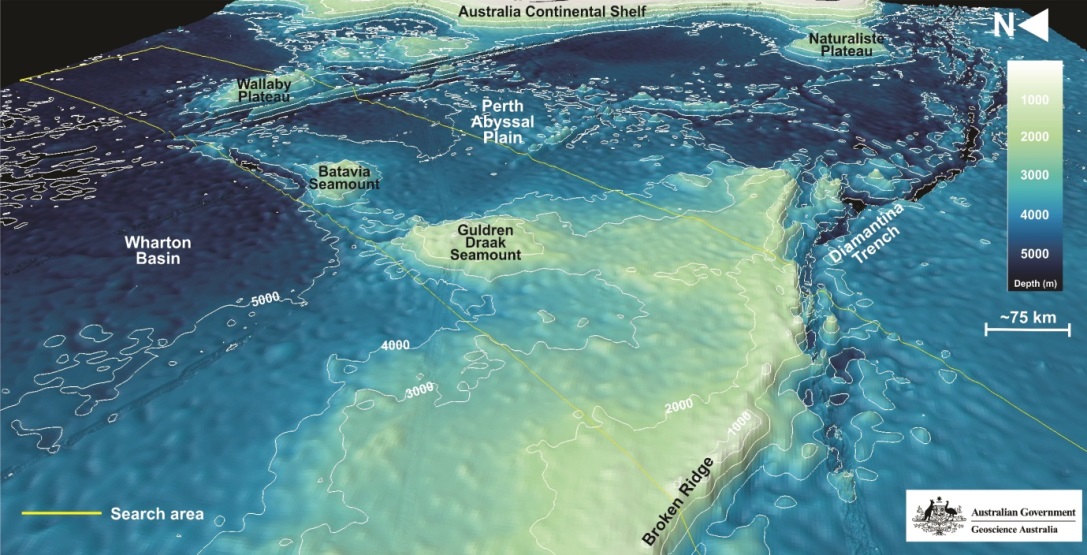
Figure 1: Coarse three-dimensional model of sea floor terrain
Figure 1: This model of the sea floor terrain was based on coarse pre-existing data, which was derived from satellite gravity measurements and ocean passage soundings. The MH370 bathymetric survey was undertaken to gather more detailed and higher resolution data in preparation for the underwater search phase.
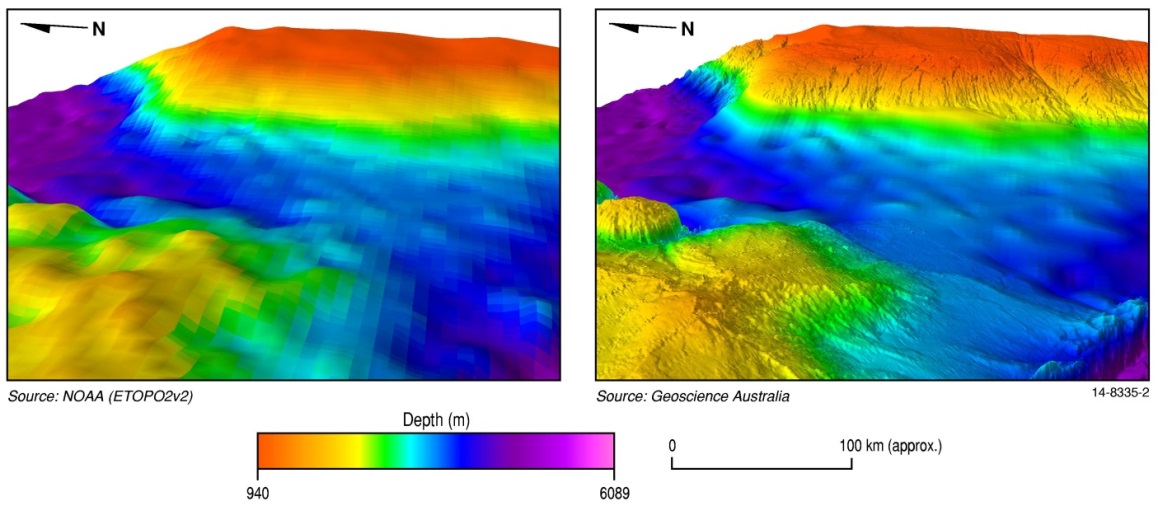
Figure 2:
Figure 2: The image on the left shows data at around 3400-metre resolution (data acquired predominantly by satellite altimetry), while the image on the right shows data with a combination of 250-metre and 50-metre resolutions (data acquired by bathymetric surveys from a vessel). The higher resolution data on the right more accurately reveals seabed features. This figure is for illustrative purposes only and does not show data from the search area.
The survey vessel Fugro Equator and the Chinese survey vessel Zhu Khezhen collaborated on the bathymetric survey, using multibeam sonar to gather data. That data—which was reviewed, corrected and analysed by experts at Geoscience Australia— revealed many seabed features for the first time. Newly discovered sea floor features include:
seamounts (remnant submarine volcanoes),
ridges (semi-parallel) up to 300 meters high, and
depressions up to 1400 metres deep (compared to the surrounding seafloor depths).
The data also revealed finer-scale seabed features that were not visible in the previous low-resolution, satellite-derived bathymetry data.
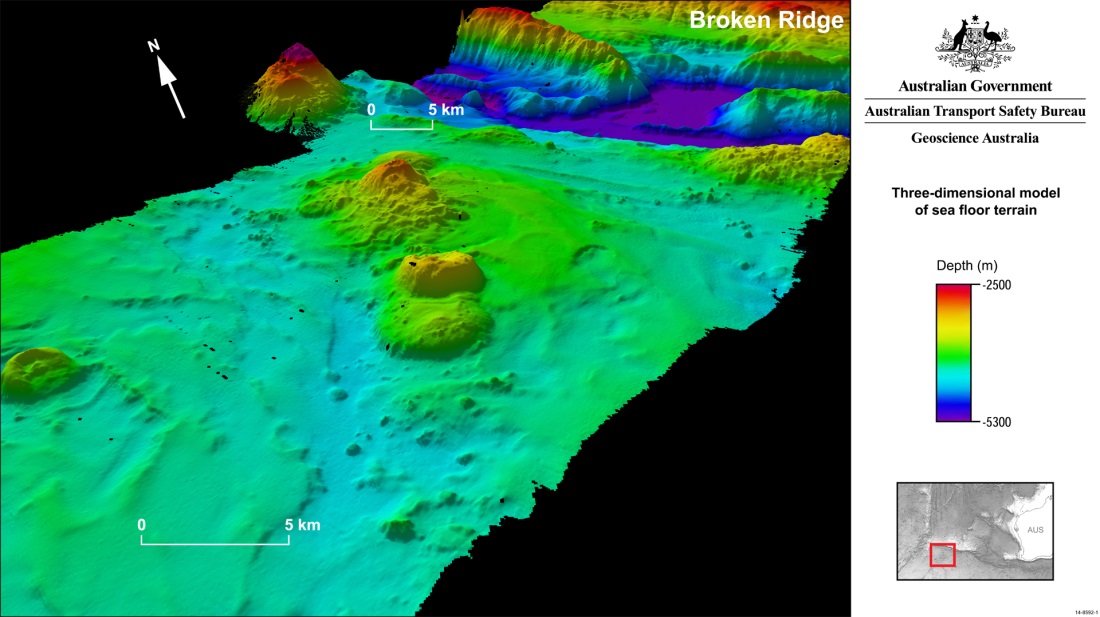
Figure 3: Detailed three-dimensional model of sea floor terrain
Figure 3: A three-dimensional model of the sea floor terrain in the MH370 search area was developed from high resolution (90-metre resolution) data from the bathymetric survey and revealed many seabed features for the first time.
Over 200,000 square kilometres of the sea floor were surveyed. The data collected in the bathymetric survey was used to build a comprehensive map of the sea floor in the search area, to be used in navigation for the underwater search. The ATSB also used the data when planning for search timings, methods, procedures, safety precautions and priority areas for each vessel to search.
While initial bathymetric survey operations have been completed and phase two has begun, further bathymetric survey work may recommence if the need arises.
Data collected as part of the bathymetric survey will be publicly released by Geoscience Australia in due course.
Visualisation of Sea Floor Terrain
Before the underwater search for MH370 could begin, it was necessary to accurately map the sea floor to ensure that the search is undertaken safely and effectively. Bathymetry survey vessels spent months at sea, scanning the sea floor with multibeam sonar to gather detailed, high-resolution data. The data has revealed many seabed features for the first time. This computer-animated ‘flythrough’ shows a visualisation of some of the sea floor terrain in the search area.
The Aviation Short Investigation Bulletin covers a range of the ATSB’s short investigations and highlights valuable safety lessons for pilots, operators and safety managers.
Released periodically, the Bulletin provides a summary of the less-complex factual investigation reports conducted by the ATSB. The results, based on information supplied by organisations or individuals involved in the occurrence, detail the facts behind the event, as well as any safety actions undertaken. The Bulletin also highlights important Safety Messages for the broader aviation community, drawing on earlier ATSB investigations and research.
Issue 33 of the Bulletin features 10 safety investigations:
At the request of the Malaysian Government, Australia is leading the search for missing Malaysia Airlines Flight MH370 in the Indian Ocean. The search is a complex operation that involves vast areas with only limited data and aircraft flight information available.
Over-water searches
Over-water aircraft accident locations are usually found by conducting a broad-area aerial search. The search area is generally determined by a combination of:
Position information from ground-based radar systems (maximum range is generally 250 NM)
Position information automatically transmitted from the aircraft at regular intervals
Position reports from the crew
Re-tracing the planned flight route
Eye-witness reports (possibly located on the shore, on other aircraft or on ships)
Uncertainty in the position of an accident location increases with time from the aircraft’s last known position (fix) so the search area will expand accordingly as the position data becomes ‘stale’.
Once floating wreckage is observed, reverse-drift techniques can be used to help determine the aircraft impact location. Only a small-area underwater search is then required to locate the wreckage and map the wreckage field. This underwater search can be aided by the underwater locator beacons fitted to flight recorders. As the beacons have a limited duration of nominally 30 days and to minimise the inaccuracies of the reverse-drift calculations, it is important that an aerial search is commenced as soon as possible and the floating debris is found quickly.
In the case of MH370:
The aircraft departed Kuala Lumpur at 1641 UTC
The final automatically transmitted position from the aircraft occurred at 17:07 UTC
No radio communications were received from the crew after 17:19 UTC
The final ATC (secondary) radar fix occurred at 17:22 UTC
At 17:25 UTC the aircraft deviated from the planned flight route
The final primary radar fix occurred at 18:22 UTC
The satellite communications log indicated the aircraft continued to fly for another 6 hours
No confirmed eye-witness reports were received
The search in the Australian search and rescue zone commenced on 18 March (10 days after the aircraft went missing)
As a result, the search area for MH370 has remained very large. A useful comparison is the search for Air France Flight 447 (AF477), which crashed in the Atlantic Ocean on 1 June 2009. The AF447 aircraft was programmed to send its position automatically every 10 minutes, there were a number of fault messages transmitted via satellite during the last few minutes of flight and it was following the planned flight route. The search for the aircraft began on 1 June and the first surface wreckage was discovered on 6 June, 5 days after the accident. Given the relative accuracy of the aircraft’s last known position, a circular search area of 40 NM was defined (17,240 km²). After a search effort involving five separate phases, the aircraft wreckage was located on the ocean floor almost two years later.
As none of the traditional sources of data could be used to locate the aircraft wreckage from MH370, it has been necessary to use novel sources of data and analysis techniques. This has led to a larger than typical search area; and there have been changes to its location as validation and calibration checks have been performed and the analysis is refined.
Determining the search area for MH370
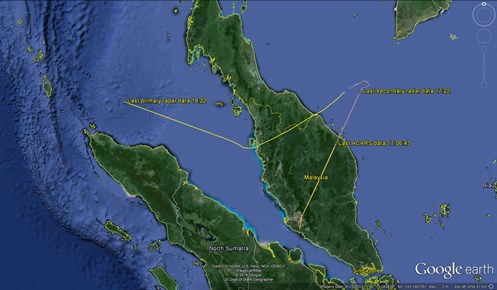
The flight path of MH370 has three distinct sections; one under secondary radar in which the aircraft transponder was operational and ACARS messages were being transmitted, a primary radar section during which the aircraft was being tracked solely by air defence radar systems and the final stage for which the only information available was the satellite communications log data.
ACARS and radar data
The final ACARS transmission was at 17:07 UTC and provided location reports from the initial stage of the flight as well as a recording of the aircraft fuel remaining. The final secondary radar point was at approximately 17:22 UTC. The final primary radar point was at 18:22 UTC. Figure 1 shows the first and second sections of the flight.
Figure 1: MH370 Flight path derived from Primary and Secondary radar data
Source: NTSB/Google
Satellite communications (SATCOM) data
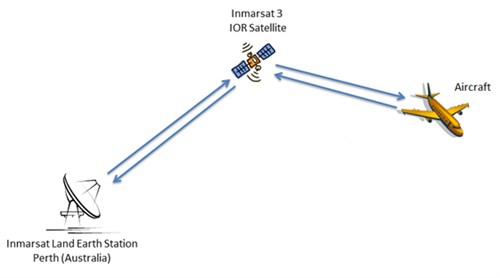
Following the loss of primary radar, the only available information was from satellite signalling messages, also referred to as ‘handshakes’, between the ground station, the satellite and the aircraft’s satellite communication system.
For each transmission to the aircraft, the ground station recorded the burst timing offset (BTO) and the burst frequency offset (BFO).
Figure 2: Satellite communications schematic
Source: Inmarsat
Burst Timing Offset (BTO)
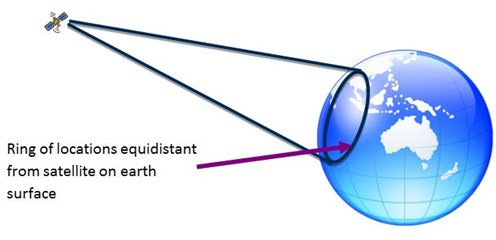
The BTO is a measure of the time taken for a transmission round trip (ground station to satellite to aircraft and back) and allows a calculation of the distance between the satellite and the aircraft. Based on this measure, a possible location ring can be mapped on the surface of the earth (Figure 3). An analysis of SATCOM system parameters showed that the accuracy of the rings was ± 10 km. This analysis was validated using recorded BTO values from the initial stage of the flight when the aircraft’s position was known.
Figure 3: Satellite ring derivation Source: Inmarsat
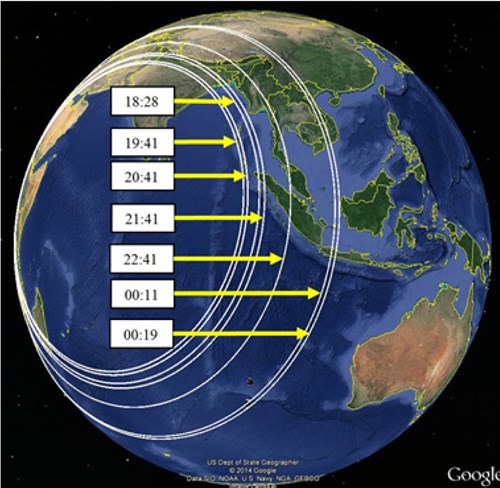
There were 7 handshakes between the ground station and the aircraft after the loss of primary radar data. The location rings calculated from the recorded BTO values are shown in figure 4.
Figure 4: MH370 timing (UTC) with corresponding rings arrowed
Source: Inmarsat/Boeing /Google
The information from the BTO places the aircraft somewhere on each ring at the corresponding time. By taking the maximum speed of the aircraft into account, the rings can be reduced in length to arcs – there are some areas of the rings it simply could not have reached.
Burst Frequency Offset (BFO)
The BFO is the measure of the difference between the expected frequency of the transmission and the frequency received at the ground station. This difference is attributed to various sources including the Doppler Effect from the motion of the satellite and the aircraft, as well as some processing effects. Once the known components that contribute to the BFO are resolved, the remainder can be used to estimate the speed and direction of the aircraft. There are a large number of speeds and headings that can be consistent with a BFO recording. These are limited, however, by the operational constraints of the aircraft.
Candidate paths of different speeds were created which met the BTO ring location/time constraints and the predicted BFO values of these paths have been compared with the recorded values. The better the match, the higher the probability that the path was close to that of MH370.
Final handshake message at 00:19 (7th arc)
The 00:19 signalling message (7th arc) was a logon request from the aircraft. This is consistent with the satellite communication equipment on the aircraft powering up following a power interruption. The interruption in electrical supply may have been caused by fuel exhaustion.
Note on the satellite communication
The satellite’s normal function is essentially communication and it was never initially intended to have the capability to track an aircraft. Following the Air France 447 accident, Inmarsat engineers began recording the BTO in order to provide another potential means of geo-locating aircraft in the event of a similar accident.
Aircraft Performance Calculations
Estimates of fuel consumption were calculated from the time of the last recorded fuel quantity, using a range of flight paths and speeds. The results of these calculations were consistent with fuel exhaustion occurring close to the 7th arc.
Validation
Several teams independently provided both satellite communications and performance analysis as part of the validation process. The location of 9M-MRO on previous flights as well as the locations of other aircraft in the air at the same time were all used to validate the techniques.
Other information
Surface search
An international air and maritime force conducted a surface search of drifted regions along the 7th arc from 18 March to 28 April 2014. A drifted region is created by modelling the movement of an area of water over the time period when the surface search is conducted. During this time, no debris was identified to be likely from MH370.
Underwater search
Acoustic detections possibly related to underwater locator beacons were made by two vessels in the refined probability area from 5 - 8 April 2014. To further investigate these signals, a search of the ocean floor around the detections was performed by a number of vessels. To date no further sign of MH370 has been detected.
Hydrophones
Low frequency hydroacoustic signals present in the Indian Ocean are being examined to determine whether they can provide any information to help define the search area. These signals are recorded by hydrophones as part of the United Nations Comprehensive Nuclear-Test-Ban-Treaty Organisation (CTBTO) or the Integrated Marine Observing System (IMOS).
Use of waypoints
Comparison of possible flight paths with tracks using waypoints is also under consideration.
Air Routes
There is only one published north-south air route in the south-eastern Indian Ocean. Air route M641 connects Cocos Island to Perth and has four waypoints. The air route crosses the area where the four acoustic signals were detected.
Shape of the search area
At the time MH370 reached the 7th arc, the aircraft is considered to have been descending. A study completed after the Air France 447 accident concluded that the majority of aircraft in loss of control accidents were found within 20 nautical miles (32 km) of their last known position. This provides a reasonable limitation for the size of the search area across the arc.
The ATSB has been advised that the hours flown data provided by the Bureau of Infrastructure, Transport and Regional Economics (BITRE) and used for the calculation of occurrence rates by aircraft type, may have been under-reported for some aircraft types used in charter operations. The ATSB is awaiting new hours flown data from BITRE and will update the reports accordingly when this data is available.
Why the ATSB did this research
This is the first in a series of research investigations looking at technical failures reported to the ATSB between 2008 and 2012. This report reviews power plant problems reported to the ATSB affecting turbofan-powered aircraft, and the types of incidents they are associated with.
By summarising power plant-related occurrences across all operators, this report provides an opportunity for operators to compare their own experiences with others flying the same or similar aircraft types, or aircraft using the same engines. By doing so, the ATSB hopes that the wider aviation industry will be able to learn from the experience of others.
What the ATSB found
Despite the complexity of modern turbofan engines, their reliability is evidenced by the remarkably low rate of power plant occurrences. With a combined total of over five and a half million flight hours for turbofan engine aircraft between 2008 and 2012, there were only 280 occurrences relating specifically to the power plant systems (or approximately one occurrence every 20,000 flight hours). Additionally, the vast majority of these (98%) were classified as being a low risk rating occurrence with a low or no accident outcome. Only four were classified as medium risk, two as high risk and one as very high risk. None resulted in injury to passengers or crew.
Although the rates were low for the turbofan engine aircraft group as a whole, there were large differences between individual aircraft models. Three aircraft types in particular, the Boeing 747 classic, the Fokker F28/F100 and the British Aerospace BAE 146/Avro RJ, had far greater rates of power plant occurrences between 2008 and 2012 than any other aircraft in this study. Although these three aircraft types represented some of the older fleets, there were other fleets of aircraft of similar ages with far lower rates of occurrences.
Safety message
The small number of high and very high risk power plant occurrences between 2008 and 2012 remind us that even highly sophisticated modern power plants can, and do, fail. Timely and vigilant reporting of all technical problems is therefore strongly encouraged to ensure as much information as possible is collected to better understand these problems. Of particular importance in technical occurrences are the follow-up reports from engineering inspections. These are often the only way that the root cause of the problem can be determined. The more comprehensively these are reported to the ATSB, the more insightful and useful reports like this become.
The Aviation Short Investigation Bulletin covers a range of the ATSB’s short investigations and highlights valuable safety lessons for pilots, operators and safety managers.
Released periodically, the Bulletin provides a summary of the less-complex factual investigation reports conducted by the ATSB. The results, based on information supplied by organisations or individuals involved in the occurrence, detail the facts behind the event, as well as any safety actions undertaken. The Bulletin also highlights important Safety Messages for the broader aviation community, drawing on earlier ATSB investigations and research.
Issue 32 of the Bulletin features 10 safety investigations: