

Final report
Report release date: 09/02/2017
What happened
On 18 November 2016, a Robinson R44 helicopter, registered VH-HHZ, was operating to support fire-fighting personnel near Sleisbeck, Northern Territory.
At about 1600 Central Standard Time (CST), the pilot conducted an approach to a landing site they had already landed at twice that day. The landing site was a flat rocky surface, but one side had a slight downwards slope. The pilot confirmed the wind direction from smoke nearby and approached the landing site into wind. As the pilot lowered the collective[1] and the helicopter’s skids touched down, the helicopter started to slide to the right. The pilot attempted to correct the sideways movement, but the main rotor blade struck a rock, and the helicopter started vibrating. The pilot rolled off the throttle and applied right pedal, but the helicopter rotated to the left and the horizontal stabiliser struck a rock. The helicopter sustained substantial damage (Figure 1). The pilot and two passengers were not injured.
Figure 1: Accident site showing damage to VH-HHZ
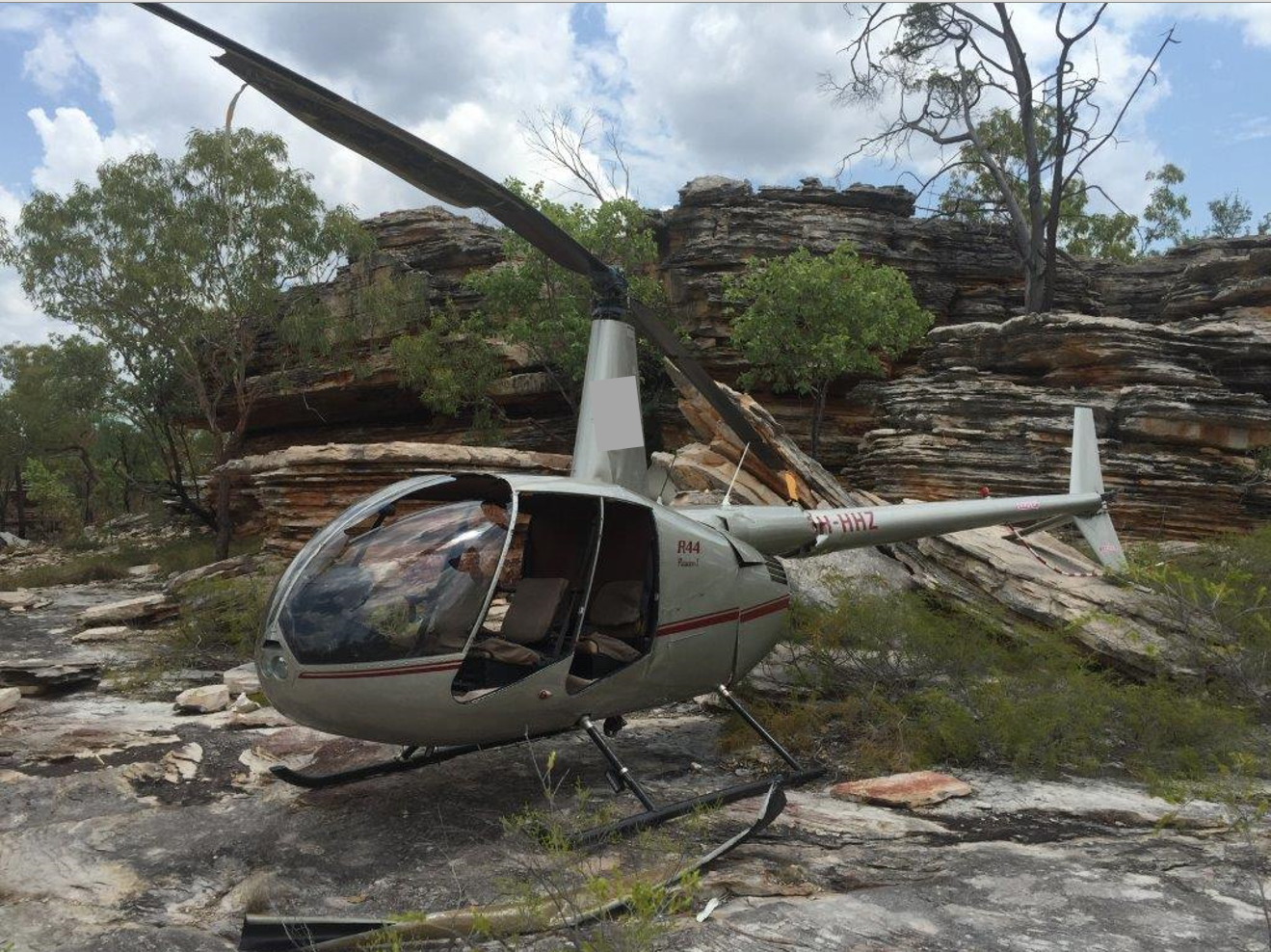
Source: Helicopter operator
Findings
These findings should not be read as apportioning blame or liability to any particular organisation or individual.
- The helicopter landed on a portion of rock, which had a slight downwards slope. The actions taken by the pilot, when the helicopter started to slide, did not prevent the main rotor blades and the horizontal stabiliser from striking a rock.
Safety action
Whether or not the ATSB identifies safety issues in the course of an investigation, relevant organisations may proactively initiate safety action in order to reduce their safety risk. The ATSB has been advised of the following safety action in response to this occurrence.
Helicopter operator
As a result of this occurrence, the helicopter operator has advised the ATSB that they are taking the following safety actions:
The company issued a notice to flight crew emphasising the importance of conducting a thorough aerial assessment before committing to landing at any remote location including confined areas.
The company also reminded pilots that in hot humid conditions, fatigue can occur a lot sooner that during the cooler months. They should make every effort to remain hydrated and inform the chief pilot immediately if they feel adversely affected.
Safety message
Civil Aviation Advisory Publication 92-2(2), Guidelines for the establishment and operation of onshore Helicopter Landing Sites, sets out factors that may be used to assess the suitability of a site for helicopters to land and take off. The guidelines include the recommendation that helicopter operators conduct thorough risk and hazard assessments for a basic helicopter landing site and implement controls to manage identified hazards.
Aviation Short Investigations Bulletin - Issue 57
About this reportDecisions regarding whether to conduct an investigation, and the scope of an investigation, are based on many factors, including the level of safety benefit likely to be obtained from an investigation. For this occurrence, a limited-scope, fact-gathering investigation was conducted in order to produce a short summary report, and allow for greater industry awareness of potential safety issues and possible safety actions. Publishing informationReleased in accordance with section 25 of the Transport Safety Investigation Act 2003 Published by: Australian Transport Safety Bureau © Commonwealth of Australia 2017 
Ownership of intellectual property rights in this publication Unless otherwise noted, copyright (and any other intellectual property rights, if any) in this report publication is owned by the Commonwealth of Australia. Creative Commons licence With the exception of the Coat of Arms, ATSB logo, and photos and graphics in which a third party holds copyright, this publication is licensed under a Creative Commons Attribution 3.0 Australia licence. Creative Commons Attribution 3.0 Australia Licence is a standard form licence agreement that allows you to copy, distribute, transmit and adapt this publication provided that you attribute the work. The ATSB’s preference is that you attribute this publication (and any material sourced from it) using the following wording: Source: Australian Transport Safety Bureau Copyright in material obtained from other agencies, private individuals or organisations, belongs to those agencies, individuals or organisations. Where you wish to use their material, you will need to contact them directly. |
__________
Occurrence summary
| Investigation number | AO-2016-158 |
|---|---|
| Occurrence date | 18/11/2016 |
| Location | 74 km north-east of Sleisbeck |
| State | Northern Territory |
| Report release date | 09/02/2017 |
| Report status | Final |
| Investigation level | Short |
| Investigation type | Occurrence Investigation |
| Investigation status | Completed |
| Mode of transport | Aviation |
| Aviation occurrence category | Collision with terrain |
| Occurrence class | Accident |
| Highest injury level | None |
Aircraft details
| Manufacturer | Robinson Helicopter Co |
|---|---|
| Model | R44 |
| Registration | VH-HHZ |
| Serial number | 2087 |
| Sector | Helicopter |
| Operation type | Charter |
| Departure point | Sleisbeck, Northern Territory |
| Destination | Sleisbeck, Northern Territory |
| Damage | Substantial |