Engine power loss after take-off involving a Piper PA-32RT, Jandakot, Western Australia, on 17 May 2019

Brief

Occurrence Briefs are concise reports that detail the facts surrounding a transport safety occurrence, as received in the initial notification and any follow-up enquiries. They provide an opportunity to share safety messages in the absence of an investigation.

What happened

On 17 May 2019, a Piper PA-32RT departed Jandakot, Western Australia, to conduct a training flight. There was an instructor and a student on board.

During initial climb at about 400 ft, the crew reported that the engine began running roughly and surged, and was not producing adequate power to perform a normal climb. The crew contacted Jandakot air traffic control tower and advised them of the engine malfunction, requesting an immediate landing. They also requested to land on runway 06R, as it was the closest runway available to them. The aircraft was able to maintain 100 ft above ground level allowing the crew to conduct a low-level circuit and safe landing on the runway.

Engineering Inspection

Following the incident, an engineering inspection revealed that the turbo waste gate[1] became stuck resulting in the rough running engine.

Safety message

Partial power loss in a single-engine aircraft is three times more likely to occur than a complete engine failure. When an engine failure occurs at low altitudes, pilots are confronted with minimal options and need to make important decisions in a very short space of time. The ATSB’s publication and YouTube video,

highlights the importance of pre-flight decision-making including planning for emergencies and abnormal situations.

About this report

Decisions regarding whether to conduct an investigation, and the scope of an investigation, are based on many factors, including the level of safety benefit likely to be obtained from an investigation. For this occurrence, no investigation has been conducted and the ATSB did not verify the accuracy of the information. A brief description has been written using information supplied in the notification and any follow-up information in order to produce a short summary report, and allow for greater industry awareness of potential safety issues and possible safety actions.

__________

  1. Waste gate: a waste gate is a valve that diverts exhaust gases away from the turbine wheel in a turbocharged engine system.

Occurrence summary

Mode of transport Aviation
Occurrence ID AB-2019-020
Occurrence date 17/05/2019
Location Jandakot Airport
State Western Australia
Occurrence class Serious Incident
Aviation occurrence category Engine failure or malfunction
Highest injury level None
Brief release date 24/06/2019

Aircraft details

Manufacturer Piper Aircraft Corp
Model PA-32RT-300T
Sector Piston
Operation type Flying Training
Departure point Jandakot, Western Australia
Destination Jandakot, Western Australia
Damage Nil

Heat damage involving a Kavanagh Balloons E-240, Yarra Glen, Victoria, on 8 April 2019

Brief

Occurrence Briefs are concise reports that detail the facts surrounding a transport safety occurrence, as received in the initial notification and any follow-up enquiries. They provide an opportunity to share safety messages in the absence of an investigation.

What happened

On 8 April 2019 at 0725 Eastern Standard Time, the pilot of a Kavanagh E-240 balloon with eight passengers on board was conducting a rapid descent from 2,500 ft to 100 ft at Yarra Glen, Victoria.

At approximately 600 ft, the balloon encountered windshear resulting in the distortion of the envelope. The pilot was unaware the envelope had caved-in due to the windshear and subsequently did not angle the burner to compensate. When he began to arrest the rate of descent by applying heat, the burner flame contacted the balloon fabric close to the mouth of the envelope, resulting in substantial burn damage to the Nomex[1] and ripstop nylon.[2] The balloon landed safely and no passengers were injured.

Safety message

This accident highlights the importance of maintaining situational awareness of the environment the balloon is operating in and the state of the balloon to better assess and manage risk. Looking up before applying heat will ensure that the burner is angled away from the envelope in the event of windshear.

About this report

Decisions regarding whether to conduct an investigation, and the scope of an investigation, are based on many factors, including the level of safety benefit likely to be obtained from an investigation. For this occurrence, no investigation has been conducted and the ATSB did not verify the accuracy of the information. A brief description has been written using information supplied in the notification and any follow-up information in order to produce a short summary report, and allow for greater industry awareness of potential safety issues and possible safety actions.

__________

  1. Nomex: the bottom of the balloon is normally made from ‘Nomex’ which is a heavy weight flame retardant fabric.
  2. Ripstop nylon: hot air balloons are generally made out of a specialised ripstop nylon fabric. The fabric weave is coated to give it better UV protection, make it somewhat flame retardant and to reduce the amount of air that will leak through the fabric weave.

Occurrence summary

Mode of transport Aviation
Occurrence ID AB-2019-014
Occurrence date 08/04/2019
Location Yarra Glen
State Victoria
Occurrence class Accident
Aviation occurrence category Fire
Highest injury level None
Brief release date 24/06/2019

Aircraft details

Manufacturer Kavanagh Balloons
Model E-240
Sector Balloon
Operation type Charter
Destination Yarra Glen, Victoria
Damage Substantial

VFR into IMC involving Piper PA-32, near Amberley, Queensland, on 26 March 2019

Brief

Occurrence Briefs are concise reports that detail the facts surrounding a transport safety occurrence, as received in the initial notification and any follow-up enquiries. They provide an opportunity to share safety messages in the absence of an investigation.

What happened

On 26 March 2019, at 1530 Eastern Standard Time, a Piper PA-32 with a pilot and three passengers on board departed Scone, New South Wales for Caloundra, Queensland. The flight was operating under visual flight rules (VFR).[1] As the aircraft was in cruise, the pilot, who was IFR[2] rated, detected a vacuum pump[3] failure, which prevented all vacuum gyroscopes from providing accurate readings.

Due to the high amount of cloud in the area, the pilot contacted air traffic control (ATC) and requested a lower altitude in order for the flight to continue in visual conditions. ATC granted a descent clearance to 4,500 ft, however due to the descent rate and approaching cloud, the aircraft inadvertently entered IMC.[4] The pilot contacted ATC and requested a further descent clearance, which was granted. The rest of the flight continued in visual conditions and the aircraft landed in Caloundra without further incident.

Safety message

The ATSB SafetyWatch highlights the broad safety concerns that come out of our investigation findings and from the occurrence data reported to us by industry. Inflight decision making remains one of the ATSB’s major safety concerns.

This incident highlights the importance of pilots being prepared for high workload situations that may arise, such as managing an equipment failure. In this instance, the pilot recognised the risk of entering into IMC with a faulty vacuum pump and effectively communicated with ATC for a safe outcome.

About this report

Decisions regarding whether to conduct an investigation, and the scope of an investigation, are based on many factors, including the level of safety benefit likely to be obtained from an investigation. For this occurrence, no investigation has been conducted and the ATSB did not verify the accuracy of the information. A brief description has been written using information supplied in the notification and any follow-up information in order to produce a short summary report, and allow for greater industry awareness of potential safety issues and possible safety actions.

__________

  1. Visual flight rules (VFR): a set of regulations that permit a pilot to operate an aircraft only in weather conditions generally clear enough to allow the pilot to see where the aircraft is going.
  2. Instrument flight rules (IFR): a set of regulations that permit the pilot to operate an aircraft in instrument meteorological conditions (IMC), which have much lower weather minimums than visual flight rules (VFR). Procedures and training are significantly more complex as a pilot must demonstrate competency in IMC while controlling the aircraft solely by reference to instruments. IFR-capable aircraft have greater equipment and maintenance requirements.
  3. The vacuum pump works by drawing air through a fine air filter as it enters the instruments to drive the gyro rotor. The vacuum pump has a limited life span and if it fails a slow drop in suction and gyros will slowly start to tumble in the instruments. This effect is especially noticeable in the attitude indicator.
  4. Instrument meteorological conditions (IMC): weather conditions that require pilots to fly primarily by reference to instruments, and therefore under Instrument Flight Rules (IFR), rather than by outside visual reference. Typically, this means flying in cloud or limited visibility.

Occurrence summary

Mode of transport Aviation
Occurrence ID AB-2019-011
Occurrence date 26/03/2019
Location near Amberley
State Queensland
Occurrence class Serious Incident
Aviation occurrence category VFR into IMC
Highest injury level None
Brief release date 14/06/2019

Aircraft details

Manufacturer Piper Aircraft Corp
Model PA-32-300
Sector Piston
Operation type Private
Departure point Scone, NSW
Destination Caloundra, Qld.
Damage Nil

Wirestrike and collision with terrain involving Robinson R22, near Charleville, Queensland, on 14 May 2019

Brief

Occurrence Briefs are concise reports that detail the facts surrounding a transport safety occurrence, as received in the initial notification and any follow-up enquiries. They provide an opportunity to share safety messages in the absence of an investigation.

What happened

On the morning of 14 May 2019, a Robinson R22 helicopter was on descent into a property near Charleville, Queensland to meet the property owner prior to conducting mustering operations. The property owner requested that the pilot land the helicopter in a particular area to the south of the owner’s house.

During descent, the pilot initially conducted an orbit of the property and identified multiple powerlines near the house and shed area. The pilot confirmed with the property owner that there were no powerlines in the vicinity of the landing spot. As the helicopter was coming in to land, the tail contacted a powerline running north to south. The pilot reported that he did not see the powerline as it was unexpected and obscured by a large tree.

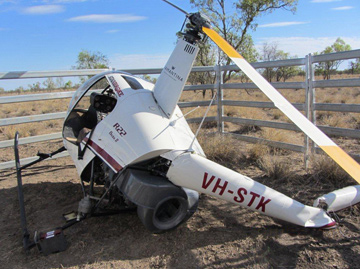
The helicopter subsequently collided with terrain and was substantially damaged. The pilot sustained minor injuries.

Figure 1: Damage to helicopter

Figure 1: Damage to helicopter, Robinson R22, near Charleville, Qld. Source: Queensland Police

Source: Queensland Police

Safety message

Wires can be difficult to sight and are often in the most unexpected places in rural areas. The ATSB research article, Avoidable Accidents No. 1 – Low level flying provides information on wire hazards associated with flight below 500 ft.

In this instance, the pilot requested pre-arrival information specifically regarding powerlines on the property and was provided with incorrect information.

Both pilots and property owners are reminded that they can always contact power companies to have wires marked if they could present a hazard to low-level operations.

About this report

Decisions regarding whether to conduct an investigation, and the scope of an investigation, are based on many factors, including the level of safety benefit likely to be obtained from an investigation. For this occurrence, no investigation has been conducted and the ATSB did not verify the accuracy of the information. A brief description has been written using information supplied in the notification and any follow-up information in order to produce a short summary report, and allow for greater industry awareness of potential safety issues and possible safety actions.

Occurrence summary

Mode of transport Aviation
Occurrence ID AB-2019-018
Occurrence date 14/05/2019
Location Near Charleville
State Queensland
Occurrence class Accident
Aviation occurrence category Wirestrike
Highest injury level Minor
Brief release date 17/06/2019

Aircraft details

Manufacturer Robinson Helicopter Co
Model R22 Beta
Sector Helicopter
Operation type Private
Destination near Charleville, Queensland
Damage Substantial

Landing on taxiway involving Vans RV-7, at Jandakot Airport, Western Australia, on 31 March 2019

Brief

Occurrence Briefs are concise reports that detail the facts surrounding a transport safety occurrence, as received in the initial notification and any follow-up enquiries. They provide an opportunity to share safety messages in the absence of an investigation.

What happened

On 31 March 2019 at 1225 Western Standard Time, a Vans RV-7 was on approach to Jandakot Airport, Western Australia. When overhead the airport at 1,500 ft, air traffic control (ATC) instructed the aircraft to join downwind for runway 06L.

As the aircraft turned onto the final approach path, the pilot observed reduced visibility due to haze, dust blowing from earthworks adjacent to runway 12/30 and a large portion of the field being covered in dry grass that blended in with the surrounding landscape.

When at a low altitude, the pilot realised that the aircraft was tracking for taxiway B rather than runway 06L (Figure 1). The pilot observed no other aircraft, vehicles or persons occupying or in close proximity to the taxiway, and given the low altitude, elected to continue to land.

Figure 1: Jandakot Airport map

Figure 1: Jandakot Airport map. Source: Airservices, annotated by the ATSB

Source: Airservices, annotated by the ATSB

The controller first observed the aircraft was landing on the taxiway as the main landing gear touched down. The controller scanned the taxiway for any potential conflicts, confirmed that it was clear and therefore elected not to issue a go-around instruction.

ATC comments: ‘There is not a huge distance between runway 06L and taxiway B so judging that an aircraft is not lined up with the runway is difficult until the aircraft is in a short final position.’

Safety message

Pilots are reminded that ATC cannot be solely relied upon to mitigate the risks of misidentification of a runway. Pilots should be aware of the layout of the aerodrome and runways where they are operating, and if pilots encounter reduced visibility or lose situational awareness, it is prudent to request assistance from ATC. In a situation similar to this, a request for ATC to activate the runway lights may have assisted in correctly identifying the active runway. It remains the pilot’s responsibility to correctly identify and confirm they are approaching the correct runway prior to landing.

About this report

Decisions regarding whether to conduct an investigation, and the scope of an investigation, are based on many factors, including the level of safety benefit likely to be obtained from an investigation. For this occurrence, no investigation has been conducted and the ATSB did not verify the accuracy of the information. A brief description has been written using information supplied in the notification and any follow-up information in order to produce a short summary report, and allow for greater industry awareness of potential safety issues and possible safety actions.

Occurrence summary

Mode of transport Aviation
Occurrence ID AB-2019-017
Occurrence date 31/03/2019
Location Jandakot Airport
State Western Australia
Occurrence class Incident
Aviation occurrence category Runway - Other
Highest injury level None
Brief release date 13/06/2019

Aircraft details

Manufacturer Van's Aircraft
Model RV-7
Sector Piston
Operation type Private
Destination Jandakot Airport, Western Australia
Damage Nil

Hard landing involving Luscombe Aircraft Corp 8A, Bunbury Airport, Western Australia, on 23 March 2019

Brief

Occurrence Briefs are concise reports that detail the facts surrounding a transport safety occurrence, as received in the initial notification and any follow-up enquiries. They provide an opportunity to share safety messages in the absence of an investigation.

What happened

On 23 March 2019, a Luscombe Aircraft Corp 8A departed Bunbury, Western Australia, to conduct a training flight with an instructor and a student on board. During approach to land back at Bunbury, the aircraft encountered unexpected turbulence and windshear[1] and as a result, the aircraft landed heavily. The crew exited the aircraft without injury and conducted an inspection to check for any damage. The post-flight inspection did not reveal any damage and the aircraft subsequently conducted two more flights.

On 25 March 2019, the aircraft was sent to a Licensed Aircraft Maintenance Engineer (LAME) to conduct a more detailed and thorough inspection. The engineering inspection revealed that the aircraft had sustained substantial damage with some slight creasing at the attach point of one of the undercarriage legs, some dimpling on top of a wing and skin dimpling behind the rear door post. The LAME found the aircraft to be unserviceable and it was consequently grounded.

Safety message

All pilots, regardless of their experience levels, should be prepared to undertake a go-around rather than continuing with an unstable approach. The Flight Safety Foundation released a briefing note Approach-and-landing accident reduction Briefing Note 6.1 to remind pilots of the importance of being prepared to conduct a go-around during all approaches. This occurrence also serves as a reminder that after any hard landing or other related incidents, where the integrity of the airframe or structure may be compromised, a detailed and thorough engineering inspection should always be carried out to ensure the serviceability of the aircraft and all of its components.

About this report

Decisions regarding whether to conduct an investigation, and the scope of an investigation, are based on many factors, including the level of safety benefit likely to be obtained from an investigation. For this occurrence, no investigation has been conducted and the ATSB did not verify the accuracy of the information. A brief description has been written using information supplied in the notification and any follow-up information in order to produce a short summary report, and allow for greater industry awareness of potential safety issues and possible safety actions.

__________

  1. Windshear: a change in wind velocity or direction that can be an extremely dangerous because, when encountered at a low altitude, windshear can cause a sudden and potentially disastrous difference to airspeed and thus lift.

Occurrence summary

Mode of transport Aviation
Occurrence ID AB-2019-012
Occurrence date 23/03/2019
Location Bunbury
State Western Australia
Occurrence class Accident
Aviation occurrence category Hard landing
Highest injury level None
Brief release date 06/06/2019

Aircraft details

Manufacturer Luscombe Aircraft Corp
Model 8A
Sector Piston
Operation type Flying Training
Departure point Bunbury, Western Australia
Damage Substantial

Fuel starvation involving Cessna 206, 3.5 NM north-east of Aldinga, South Australia, on 3 February 2019

Brief

Occurrence Briefs are concise reports that detail the facts surrounding a transport safety occurrence, as received in the initial notification and any follow-up enquiries. They provide an opportunity to share safety messages in the absence of an investigation.

What happened

On 3 February 2019, a Cessna 206 departed Aldinga, South Australia, to conduct parachuting operations. There was one pilot and four parachutists on board. At 1345 Central Daylight-saving Time, the aircraft was passing through 8,000 ft on climb when the engine failed. The pilot attempted to restart the engine and switched fuel tanks, but the attempt was unsuccessful.

At approximately 6,500 ft, the parachutists exited the aircraft and the pilot started to track back towards Aldinga. The pilot was able to restart the engine at 5,000 ft and conducted a straight in approach to Aldinga. After landing, the fuel tanks were dipped and it was found that the right tank was empty while the left tank had 110 litres of fuel on board. The pilot said that he likely forgot to change fuel tanks because he was distracted due to radio calls and high workload.

Safety message

Pilots are reminded to follow published procedures when operating any aircraft system in accordance with the manufacturer’s recommendations. Accidents involving fuel mismanagement are an ongoing aviation safety concern. Pilots need to:

  • understand how their aircraft fuel system works
  • know how much fuel is in each tank
  • ensure that the appropriate tank is selected at all times.

In this instance, selecting the appropriate fuel tank during checks would have avoided the pilot having to manage fuel during a high workload period. This in turn, would reduce the risk of a fuel starvation event.

Issue number 5 in the ATSB’s Avoidable Accident Series, Avoidable Accidents No. 5 - Starved and exhausted: Fuel management aviation accidents (AR-2011-112), provides more detail on these scenarios and is available from the ATSB website.

Occurrence summary

Mode of transport Aviation
Occurrence ID AB-2019-004
Occurrence date 03/02/2019
Location 6 km NE of Aldinga
State South Australia
Occurrence class Serious Incident
Aviation occurrence category Fuel starvation
Highest injury level None
Brief release date 11/06/2019

Aircraft details

Manufacturer Cessna Aircraft Company
Model U206G
Sector Piston
Operation type Sports Aviation
Departure point Aldinga, South Australia
Damage Nil

Engine failure and forced landing involving a Cessna 172M, Middalya, Western Australia, on 27 February 2019

Brief

Occurrence Briefs are concise reports that detail the facts surrounding a transport safety occurrence, as received in the initial notification and any follow-up enquiries. They provide an opportunity to share safety messages in the absence of an investigation.

What happened

On 27 February 2019, at approximately 1800 Western Standard Time, a Cessna 172M with one pilot on board was conducting a private flight from Lindon, Western Australia (WA) to Carnarvon, WA. During cruise at approximately 6,000 ft, the pilot heard a loud bang and observed oil on the windscreen of the aircraft. The engine subsequently ran rough for two minutes before failing completely. The pilot located an appropriate landing area at Middalya Station, WA and conducted a forced landing. The pilot was uninjured and there was no damage to the aircraft as a result of the forced landing. The engineering inspection determined that one cylinder in the engine had broken in half.

Safety message

This incident highlights the importance of frequent emergency procedures training. The pilot’s handling of the forced landing contributed positively to the outcome of this incident. The ATSB investigation report, Engine failure and forced landing involving Gippsland GA-8 Airvan, VH-BFL, 8.5 km NNW or Bellburn Airstrip Western Australia, on 15 May 2018 (AO-2018-036) states, ‘Although, as a minimum, flight reviews are required every two years, pilots and operators are reminded of the benefits of more frequent practice of emergency procedures.’

About this report

Decisions regarding whether to conduct an investigation, and the scope of an investigation, are based on many factors, including the level of safety benefit likely to be obtained from an investigation. For this occurrence, no investigation has been conducted and the ATSB did not verify the accuracy of the information. A brief description has been written using information supplied in the notification and any follow-up information in order to produce a short summary report, and allow for greater industry awareness of potential safety issues and possible safety actions.

Occurrence summary

Mode of transport Aviation
Occurrence ID AB-2019-008
Occurrence date 27/02/2019
Location Middalya Homestead,
State Western Australia
Occurrence class Serious Incident
Aviation occurrence category Engine failure or malfunction
Highest injury level None
Brief release date 24/05/2019

Aircraft details

Manufacturer Cessna Aircraft Company
Model 172M
Sector Piston
Operation type Private
Departure point Lindon, Western Australia
Destination Carnarvon, Western Australia
Damage Nil

Winching incident involving Sikorsky Aircraft S92A, near Broome, Western Australia, on 26 March 2019

Brief

Occurrence Briefs are concise reports that detail the facts surrounding a transport safety occurrence, as received in the initial notification and any follow-up enquiries. They provide an opportunity to share safety messages in the absence of an investigation.

What happened

On the morning of 26 March 2019, a Sikorsky S92 crew was conducting a search-and-rescue/medevac training sortie in conjunction with a contracted training vessel. On arrival at the rendezvous location, the crew established themselves in a stable hover over the vessel that was underway in relatively calm conditions. At approximately 0900 Western Standard Time, the crew commenced a winching operation to lower an Intensive Care Paramedic (ICP) onto a clear exposed area of the deck. As the ICP came over the intended landing area he was slightly spinning, which is normal in winching operations. The ICP’s foot contacted a fitting on the boat and with the momentum of the spin his knee struck a hatch cover causing a serious knee injury. After some consideration of the situation, the crew recovered the ICP and transported him to Broome for medical assistance.

The ICP’s knee injury required admission to hospital for surgery.

The operator conducted a review, identifying and confirming that all controls in place for this exercise are effective. No causal human factor has been identified that would contribute to, or instigate, an injury to the ICP, and no shortfall or omission in any existing formal documentation, training, competencies or operator processes could indicate a root cause.

Safety message

The company has established policy, procedures and training for conducting winch operations. This crew had seemingly done everything to conduct the training correctly. Weather and sea conditions were suitable to carry out the winching practice. So what can be learnt?

This occurrence is a first for this operator and from the collective prior experiences of aircrew staff members, it was noted that bump/impact injuries are not uncommon, and have occurred with most operators in similar roles. The occurrence of injury has been as low as reasonably practicable and the likelihood of a re-occurrence, whilst it is considered possible, is remote. This brief indicates that there were no faults in the performance of the crews during the training exercise, and despite all conditions being suitable, it still resulted in an accidental serious injury. Although this incident is comparable to a slip/trip/fall in the workplace environment with causal factors that are unlikely to be able to be ‘trained’ for, it is the recognition and understanding that winching operations are inherently hazardous.

This incident therefore provides a reminder to operators and crews to ensure all organisational policy, procedures and training mediums are current and comprehensive. For all crews undertaking any complex exercises, it is important to review, understand, and brief the hazards involved and recovery actions to follow in the event of an unplanned incident.

About this report

Decisions regarding whether to conduct an investigation, and the scope of an investigation, are based on many factors, including the level of safety benefit likely to be obtained from an investigation. For this occurrence, no investigation has been conducted and the ATSB did not verify the accuracy of the information. A brief description has been written using information supplied in the notification and any follow-up information in order to produce a short summary report, and allow for greater industry awareness of potential safety issues and possible safety actions.

Occurrence summary

Mode of transport Aviation
Occurrence ID AB-2019-013
Occurrence date 26/03/2019
Location Near Broome
State Western Australia
Occurrence class Accident
Aviation occurrence category Control - Other
Highest injury level Serious
Brief release date 03/05/2019

Aircraft details

Manufacturer Sikorsky Aircraft
Model S92
Sector Helicopter
Operation type Aerial Work
Departure point Broome, WA
Damage Nil

Unstable approach involving Boeing 737-800, at Sydney Airport, New South Wales, on 19 January 2019

Brief

Occurrence Briefs are concise reports that detail the facts surrounding a transport safety occurrence, as received in the initial notification and any follow-up enquiries. They provide an opportunity to share safety messages in the absence of an investigation.

What happened

On 19 January 2019 at approximately 1800 Eastern Daylight-saving Time, a Boeing 737-800 carrying 155 passengers was approaching Sydney, New South Wales from the north. Due to an oversight in planning and briefing for the approach, an incorrect waypoint crossing altitude was entered and the crew did not notice that the aircraft was high on profile for much of the initial descent. The crew noticed the discrepancy at approximately 30 NM, and took action to rectify the profile. Despite earlier than normal speed limitations from ATC due to slower preceding traffic on the same runway, the profile was not regained which lead to the aircraft remaining consistently high on the final approach profile.

The aircraft was above glideslope and descending on autopilot to 2,600 ft, when approaching the set altitude, the crew selected 3,000 ft on the autopilot in preparation for a potential go around. Due to the autopilot mode, this resulted in a thrust increase and the aircraft pitched up and commenced climbing to 3,000 ft. The crew decided to conduct a go around, during which the aircraft pitch changed and an accompanying decay in airspeed continued to a point that the warning “airspeed low” sounded. At approximately the same time as the crew received the warning they noted the low airspeed and ensured increased thrust was applied. The crew addressed the pitch attitude and as airspeed stabilised and flap was retracted, the go around was carried out according to the published procedure. The crew completed the required checklists and made a cabin announcement as the aircraft was vectored for a subsequent approach and landing.

Safety message

This incident highlights the need for crew to make early positive decisions to regain the required performance or profile when operations are not normal. Making a positive early decision may assist in avoiding forced decisions later when there is less margin for error. It is important to recognise the compounding effects that non-standard operations can produce, and that increased vigilance is required to successfully manage the situation.

Comprehensively pre-briefing a procedure and then monitoring progress is an effective way to minimise mistakes and recognise early that desired performance is not being achieved. Once a departure from the desired performance is recognised, a positive corrective action should be taken.

If ATC instructions are affecting your ability to meet the desired performance – speak up. An orbit or a vector for more track miles in a similar situation may be preferable to a forced go-around or missed approach.

SafetyWatch highlights the broad safety concerns that come out of our investigation findings

The ATSB SafetyWatch highlights the broad safety concerns that come out of our investigation findings and from the occurrence data reported to us by industry. One priority is Data input errors.

About this report

Decisions regarding whether to conduct an investigation, and the scope of an investigation, are based on many factors, including the level of safety benefit likely to be obtained from an investigation. For this occurrence, no investigation has been conducted and the ATSB did not verify the accuracy of the information. A brief description has been written using information supplied in the notification and any follow-up information in order to produce a short summary report, and allow for greater industry awareness of potential safety issues and possible safety actions.

Occurrence summary

Mode of transport Aviation
Occurrence ID AB-2019-007
Occurrence date 19/01/2019
Location Near Sydney
State New South Wales
Occurrence class Incident
Aviation occurrence category Unstable approach
Highest injury level None
Brief release date 03/05/2019

Aircraft details

Manufacturer The Boeing Company
Model 737-800
Sector Jet
Operation type Air Transport High Capacity
Destination Sydney Airport, NSW
Damage Nil