Nose gear up landing involving Beech 76, 28 km south of Jandakot, Western Australia, on 12 September 2018

Brief

Occurrence Briefs are concise reports that detail the facts surrounding a transport safety occurrence, as received in the initial notification and any follow-up enquiries. They provide an opportunity to share safety messages in the absence of an investigation.

What happened

On 12 September 2018, the crew of a Beech Aircraft Corp 76 departed Jandakot, Western Australia to conduct a flight test with two crew members on board.

Just after take-off, the crew proceeded 28 km south of Jandakot, WA, operating under Visual Flight Rules[1] (VFR). Whilst in the local training area, the crew conducted some training manoeuvres, which also included three in-flight gear extensions. The first two gear extensions were performed without incident. During the third gear extension, the nose gear failed to extend and lock into place. The crew attempted to extend the gear using the emergency procedures checklist located in the aircraft’s flight manual. After completing the landing gear manual extension checklist (Figure 1), the crew were unable to extend the nose gear. This was confirmed by the nose gear light not being illuminated and by visual inspection in the form of a mirror located on the inside of the left engine cowling. The crew conducted a return to Jandakot, declared a PAN-PAN[2] call to Jandakot tower and instructed the Tower that they would be performing a nose gear up landing.

Air Traffic Control (ATC) acknowledged the PAN-PAN and instructed the crew to hold south of the airport to process all arriving traffic in anticipation that the runway would become unserviceable, and to give the crew time to attempt to extend the gear and prepare for their approach. The crew conducted a fly-by of the tower for a visual inspection of the landing gear. ATC confirmed that the nose gear was not extended. Emergency services and procedures were activated and the aircraft was holding in the circuit area

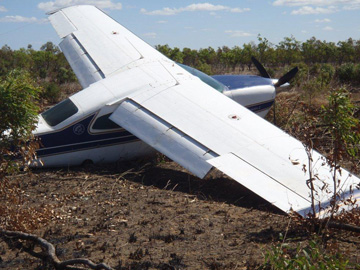
As the aircraft approached for landing, the crew completed the gear up landing checklist (Figure 2), which instructs them of the proper configuration the aircraft needs to be in to perform a gear up landing to minimise injury and damage to the aircraft. Prior to touching down on the runway, at about 200 ft above ground level, the crew pulled the engine throttles back to idle, the engine fuel mixtures to idle cut-off, the propeller pitch controls to feather and all electrical systems were turned off to prevent any damage to the engines, propellers and also to reduce the risk of a fire. As the main landing gear wheels touched down on the runway, the crew kept backpressure on the control column to keep the nose of the aircraft off the ground as long as possible and to slow the aircraft down. As the aircraft’s speed started to slow down, the nose slowly started to drop onto the runway and came in contact with the runway surface. The aircraft came to a complete stop shortly after. The crew disembarked the aircraft unharmed. The aircraft sustained minor damage to the nose section.

Engineering inspection

Following the incident, the inspection of the nose gear section revealed that the landing gear pivot bolts and leg pins on the landing gear doors were worn, which caused it to malfunction and prevented the doors from opening, therefore not allowing the nose gear to extend.

Figure 1: Landing gear manual extension checklist 

Figure 1: Landing gear manual extension checklist

Figure 2: Gear up landing checklist 

Figure 2: Gear up landing checklist

Safety message

Unanticipated failures can occur during flight. In this incident, although the aircraft was within the necessary distance from the runway to complete a nose gear up landing, it is safer to wait until the main landing gear has touched down on the runway before shutting down and feathering the engines. This is to ensure that if the aircraft has to go around or take-off again due to safety reasons or obstructions on the runway, the aircraft will have the necessary engine performance it requires to perform this task.

The crew, in this instance, took all possible precautions by following non-normal procedures, conducting additional checks to assess the situation, providing clear communications to ATC and returning the aircraft to land.

About this report

Decisions regarding whether to conduct an investigation, and the scope of an investigation, are based on many factors, including the level of safety benefit likely to be obtained from an investigation. For this occurrence, no investigation has been conducted and the ATSB did not verify the accuracy of the information. A brief description has been written using information supplied in the notification and any follow-up information in order to produce a short summary report, and allow for greater industry awareness of potential safety issues and possible safety actions.

__________

  1. Visual Flight Rules (VFR) - are a set of regulations under which a pilot operates an aircraft in weather conditions generally clear enough to allow the pilot to see where the aircraft is going. Specifically, the weather must be better than basic VFR weather minima.
  2. PAN-PAN - The radiotelephony message PAN-PAN is the international standard urgency signal that the crew on board an aircraft uses to declare that they have a situation that is urgent but, for the time being at least, does not pose an immediate danger to anyone's life or the aircraft itself.

Occurrence summary

Mode of transport Aviation
Occurrence ID AB-2018-111
Occurrence date 12/09/2018
Location 28 km South of Jandakot
State Western Australia
Occurrence class Serious Incident
Aviation occurrence category Landing gear/indication
Highest injury level Minor
Brief release date 20/12/2018

Aircraft details

Manufacturer Beech Aircraft Corp
Model 76
Sector Piston
Operation type Flying Training
Departure point 28 km South of Jandakot, WA
Damage Minor

Engine failure and forced landing involving de Havilland DH-82A, 4 km west of Mackay, Queensland, on 20 October 2018

Brief

Occurrence Briefs are concise reports that detail the facts surrounding a transport safety occurrence, as received in the initial notification and any follow-up enquiries. They provide an opportunity to share safety messages in the absence of an investigation.

What happened

On 20 October 2018, the pilot of a de Havilland Aircraft Company DH-82A Tiger Moth departed Mackay, Queensland to conduct a joy flight. There was one pilot and one passenger on board.

During cruise, while returning to Mackay, the engine failed. The pilot declared a MAYDAY[1], lowered the nose of the aircraft and searched for a suitable landing area, finding a nearby road to be suitable. The pilot conducted a successful forced landing on the surface of the road. The aircraft did not sustain any damage as a result of the landing.

Engineering Inspection

Following the incident, the engineering inspection revealed the crankshaft had broken at the no. 1 cylinder aft main bearing web.

Figure 1: de Havilland DH-82A broken crankshaft

Figure 1: de Havilland DH-82A broken crankshaft. Source: Pilot in Command

Source: Pilot in Command

Safety message

Simulated total loss of power and a subsequent practice forced landing is at the core of a pilot’s emergency training. Following the engine failure, the pilot involved in this incident had to make important decisions in a short space of time, including where to land and how to manage the remaining altitude. Pre-flight self-briefing is an important tool in reinforcing planned emergency actions, including in circumstances of unfavourable terrain immediately past the aerodrome.

About this report

Decisions regarding whether to conduct an investigation, and the scope of an investigation, are based on many factors, including the level of safety benefit likely to be obtained from an investigation. For this occurrence, no investigation has been conducted and the ATSB did not verify the accuracy of the information. A brief description has been written using information supplied in the notification and any follow-up information in order to produce a short summary report, and allow for greater industry awareness of potential safety issues and possible safety actions.

__________

  1. MAYDAY - Mayday is an emergency procedure word used internationally as a distress signal in voice-procedure radio communications. It is used to signal a life-threatening emergency.

Occurrence summary

Mode of transport Aviation
Occurrence ID AB-2018-125
Occurrence date 20/10/2018
Location 4 km west of Mackay
State Queensland
Occurrence class Serious Incident
Aviation occurrence category Engine failure or malfunction
Highest injury level None
Brief release date 20/12/2018

Aircraft details

Manufacturer de Havilland Aircraft
Model DH-82A Tiger Moth
Sector Piston
Operation type General Aviation
Departure point Mackay, Queensland
Damage Nil

Runway incursion involving a Bombardier DHC-8 and a Boeing 737, Brisbane, Queensland, on 9 April 2018

Brief

Occurrence Briefs are concise reports that detail the facts surrounding a transport safety occurrence, as received in the initial notification and any follow-up enquiries. They provide an opportunity to share safety messages in the absence of an investigation.

What happened

On 9 April 2018, while on taxi for departure at Brisbane Airport, Qld, Air Traffic Control (ATC) instructed the crew of a Bombardier DHC-8 to hold short of runway 01. After a Boeing 737 landed, the DHC-8 entered and lined up on the runway in preparation for departure, without a clearance, whilst another Boeing 737 was on short final.

ATC provided the 737 on final approach a clearance to land at around 500 ft. ATC then issued a conditional clearance for the DHC-8 to line up behind the 737 on short final. The DHC-8 crew informed the tower by radio that they were already occupying runway 01 and were ready for departure.

ATC subsequently instructed the Boeing 737 on short final to conduct a go-around[1] from about 300 ft. Departure instructions were provided and the Boeing 737 was transferred to the approach frequency for another approach to land. A short time later, ATC provided the DHC-8 with a clearance for take-off.

Figure 1: Sequence of events relating to aircraft movements at Brisbane Airport 

Figure 1: Sequence of events relating to aircraft movements at Brisbane Airport. Source: Background image Google Earth; annotated/modified by ATSB

Source: Background image Google Earth; annotated/modified by ATSB

Airservices Australia investigation

An occurrence review conducted by Operational Risk and Assurance, indicated that the runway incursion had not been detected by ATC and that the second Boeing 737 was cleared to land whilst the runway was occupied.

The occurrence review indicated that although the conflict had not been identified by ATC, that when recognised, the actions taken to recover the situation were appropriately managed.

Safety message

Maintaining situational awareness is imperative for both pilots and ATC in busy operational environments. Effective situational awareness is the timely and accurate perception of information pertaining to a situation, comprehension of that current situation and projection of what may occur in the future based on this information.

The risk of runway incursions and other separation events can be minimised through good communication. This incident highlights the importance of:

  • ATC and flight crews using correct phraseology
  • ATC and pilots challenging instructions which they have not heard or understood fully
  • pilots looking carefully for aircraft or other hazards before entering an active runway.

About this report

Decisions regarding whether to conduct an investigation, and the scope of an investigation, are based on many factors, including the level of safety benefit likely to be obtained from an investigation. For this occurrence, no investigation has been conducted and the ATSB did not verify the accuracy of the information. A brief description has been written using information supplied in the notification and any follow-up information in order to produce a short summary report, and allow for greater industry awareness of potential safety issues and possible safety actions.

__________

  1. To abandon the landing and make a fresh approach [Cambridge Aerospace Dictionary]

Occurrence summary

Mode of transport Aviation
Occurrence ID AB-2018-049
Occurrence date 09/04/2018
Location Brisbane Airport
State Queensland
Occurrence class Incident
Aviation occurrence category Runway incursion
Highest injury level None
Brief release date 19/12/2018

Aircraft details

Manufacturer Bombardier Inc
Model DHC-8
Sector Turboprop
Operation type Air Transport High Capacity
Departure point Brisbane Airport, Qld
Damage Nil

Aircraft details

Manufacturer The Boeing Company
Model 737
Sector Jet
Operation type Air Transport High Capacity
Destination Brisbane Airport, Qld
Damage Nil

Aircraft preparation incident involving Boeing 737-8FE, at Sydney Airport, New South Wales, on 07 August 2018

Brief

Occurrence Briefs are concise reports that detail the facts surrounding a transport safety occurrence, as received in the initial notification and any follow-up enquiries. They provide an opportunity to share safety messages in the absence of an investigation.

What happened

On 7 August 2018, a Boeing 737-8FE was being prepared for a commercial passenger flight from Sydney, New South Wales to Townsville, Queensland. As the flight crew were programming the standard instrument departure (SID) into the flight management system (FMS), an incorrect SID was entered. The flight crew had inadvertently programmed the SYDTSV1 SID into the FMS, instead of the SYDTSV2. Both SID’s commence at Sydney Airport and track to the same waypoint before separating.

A route check had been conducted by the flight crew but the error was not identified prior to take-off. Once the aircraft was airborne, Air Traffic Control (ATC) detected that the aircraft was deviating off track and notified the crew. The aircraft was placed on a heading by ATC while the correct route was entered into the FMS.

The procedure was reviewed and discussed by the flight crew.

Safety message

This incident highlights the importance of ensuring that the flight management system is programmed correctly for take-off. Ensuring that independent cross-checks are undertaken can reduce the risk that an aircraft attempts to take-off with incorrect performance data.

The ATSB SafetyWatch highlights the broad safety concerns that come out of our investigation findings and from the occurrence data reported to us by industry. One priority is Data input errors.

Further information is available from the ATSB research report AR-2009-052, Take-off performance calculation and entry errors: A global perspective.

The ATSB SafetyWatch highlights the broad safety concerns that come out of our investigation findings and from the occurrence data reported to us by industry. One priority is Data input errors.

About this report

Decisions regarding whether to conduct an investigation, and the scope of an investigation, are based on many factors, including the level of safety benefit likely to be obtained from an investigation. For this occurrence, no investigation has been conducted and the ATSB did not verify the accuracy of the information. A brief description has been written using information supplied in the notification and any follow-up information in order to produce a short summary report, and allow for greater industry awareness of potential safety issues and possible safety actions.

Occurrence summary

Mode of transport Aviation
Occurrence ID AB-2018-099
Occurrence date 07/08/2018
Location Sydney Airport
State New South Wales
Occurrence class Incident
Aviation occurrence category Aircraft preparation
Highest injury level None
Brief release date 17/12/2018

Aircraft details

Manufacturer The Boeing Company
Model 737-8FE
Sector Jet
Operation type Air Transport High Capacity
Departure point Sydney, NSW
Destination Townsville, Qld
Damage Nil

Flight below lowest safe altitude involving Piper PA-44, Perth, Western Australia, on 30 August 2018

Brief

Occurrence Briefs are concise reports that detail the facts surrounding a transport safety occurrence, as received in the initial notification and any follow-up enquiries. They provide an opportunity to share safety messages in the absence of an investigation.

What happened

On 30 August 2018, a Piper Seminole departed Jandakot, Western Australia on a dual IFR training flight.

During an ILS approach to Perth runway 24, the crew became visual at 1,800 ft and reported visual to tower. The crew were issued missed approach instructions to turn left 080 and climb to 2,500 ft visual. At the missed approach point, the crew initiated the missed approach under simulated asymmetric conditions and the instructor restored power to the engines once established in the climb. During the climb, the crew contacted the approach controller who issued an amended visual heading. The instructor then replied not visual to the approach controller who sought to confirm that the aircraft was in cloud, to which the instructor replied yes. The controller then, with the belief that the aircraft was in cloud below the minimum vector altitude, instructed the crew to climb at best rate to 2,800 ft which the crew complied with.

The pilot later reported that the crew were visual at the time they reported not visual, however were unable to maintain visual with the current clearance. As a result, the crew were instructed to climb above the minimum vector altitude of 2,500 ft in Instrument Metrological Conditions (IMC).

Following the incident, the operator advises that an investigation was undertaken and the pilot in command was interviewed and de-briefed.

Safety message

Pilots are responsible to inform ATC if they are unable to comply with a clearance. Doing so early will give more time for a controller to issue an alternative clearance.

About this report

Decisions regarding whether to conduct an investigation, and the scope of an investigation, are based on many factors, including the level of safety benefit likely to be obtained from an investigation. For this occurrence, no investigation has been conducted and the ATSB did not verify the accuracy of the information. A brief description has been written using information supplied in the notification and any follow-up information in order to produce a short summary report, and allow for greater industry awareness of potential safety issues and possible safety actions.

Occurrence summary

Mode of transport Aviation
Occurrence ID AB-2018-105
Occurrence date 30/08/2018
Location Perth
State Western Australia
Occurrence class Incident
Aviation occurrence category Flight below minimum altitude
Highest injury level None
Brief release date 20/12/2018

Aircraft details

Manufacturer Piper Aircraft Corp
Model PA-44-180
Sector Piston
Operation type Flying Training
Destination Perth, WA
Damage Nil

Flight crew incapacitation involving a Pilatus PC-12, 185 km south-west of Wiluna, Western Australia, on 12 August 2018

Brief

Occurrence Briefs are concise reports that detail the facts surrounding a transport safety occurrence, as received in the initial notification and any follow-up enquiries. They provide an opportunity to share safety messages in the absence of an investigation.

What happened

On 12 August 2018, a Pilatus PC-12 was being used to transport a patient from Wiluna, Western Australia (WA) to Jandakot, WA. It departed Wiluna at about 2053 Western Standard Time.

About 40 minutes into the flight, the pilot felt ill and vomited. During this time, the autopilot was engaged. After vomiting, he felt considerably better and was able to continue the flight to Jandakot. The only time that the pilot was not monitoring the flight instruments was whilst he was physically ill.

The pilot took sick leave for the rest of his shift and a Designated Aviation Medical Examiner (DAME)[1] checked him before he returned to work again.

It was reported that the pilot had been unwell for the previous few days and had reported for duty on the day of the incident saying that he felt well again.

Safety action

As a result, of this occurrence, the aircraft operator has advised the ATSB that they are taking the following safety actions:

  • The operator will update their manuals to reinforce the need to take the time to recover from illness. If a pilot reports in sick at the start of a shift, they will be required to remain on sick leave for the rest of the shift unless a DAME deems that they are fit for work. They will incorporate this change into the next edition of their manuals, which they will publish in due course.
  • The operator has already included this information in their pilots’ briefs and a formal written notification, by email, has been sent to all pilots in the organisation.

Safety message

This incident highlights the importance of flight crew being adequately recovered from illness before returning to work. This is particularly pertinent for single-pilot operations.

About this report

Decisions regarding whether to conduct an investigation, and the scope of an investigation, are based on many factors, including the level of safety benefit likely to be obtained from an investigation. For this occurrence, no investigation has been conducted and the ATSB did not verify the accuracy of the information. A brief description has been written using information supplied in the notification and any follow-up information in order to produce a short summary report, and allow for greater industry awareness of potential safety issues and possible safety actions.

__________

  1. Designated aviation medical examiners (DAMEs) are practitioners approved to perform medical examinations to meet the provisions of the Civil Aviation Act 1998, the Civil Aviation Regulations 1988 and the Civil Aviation Safety Regulations 1998.

Occurrence summary

Mode of transport Aviation
Occurrence ID AB-2018-100
Occurrence date 12/08/2018
Location 185 km SW of Wiluna
State Western Australia
Occurrence class Serious Incident
Aviation occurrence category Flight crew incapacitation
Highest injury level None
Brief release date 17/12/2018

Aircraft details

Manufacturer Pilatus Aircraft Ltd
Model PC-12
Sector Turboprop
Operation type Aerial Work
Departure point Wiluna, WA
Destination Jandakot, WA
Damage Nil

Failure to pass traffic involving a Robinson 66 and a Robinson 44, near Darwin, Northern Territory, on 3 July 2018

Brief

Occurrence Briefs are concise reports that detail the facts surrounding a transport safety occurrence, as received in the initial notification and any follow-up enquiries. They provide an opportunity to share safety messages in the absence of an investigation.

What happened

On 3 July 2018 at approximately 1330 Central Standard Time, two Robinson helicopters were conducting flights at the boundary of the Darwin control zone, in class C airspace. One of the Robinsons, an R44, had just departed Charles Darwin National Park to conduct a charter flight and was tracking via Elizabeth River Bridge. The other, an R66, was engaged in a general aviation flight and had departed Wishart Road, also tracking towards Elizabeth River Bridge. Both aircraft were operating under VFR[1] and ATC were aware of their operations.

The helicopters were approximately less than half a mile apart before ATC passed traffic information to either helicopter. The crew of the R44 had sighted the R66 approaching from an 8 o’clock position and was tracking at the same level, approximately 1,000 ft AGL. The pilot of the R44 conducted an avoidance manoeuvre, turning right of the approaching helicopter to maintain separation.

Both aircraft proceeded on their flights with nil further impact.

Safety message

In class C airspace, controllers will pass traffic information between VFR aircraft and the aircraft must maintain communication with ATC.

This incident highlights the importance of always maintaining situational awareness. ATC provided late traffic information, however the two VFR aircraft were able to sight each other and were able to conduct avoiding manoeuvres to maintain separation.

About this report

Decisions regarding whether to conduct an investigation, and the scope of an investigation, are based on many factors, including the level of safety benefit likely to be obtained from an investigation. For this occurrence, no investigation has been conducted and the ATSB did not verify the accuracy of the information. A brief description has been written using information supplied in the notification and any follow-up information in order to produce a short summary report, and allow for greater industry awareness of potential safety issues and possible safety actions.

__________

  1. Visual flight rules (VFR): a set of regulations that permit a pilot to operate an aircraft only in weather conditions generally clear enough to allow the pilot to see where the aircraft is going.

Occurrence summary

Mode of transport Aviation
Occurrence ID AB-2018-092
Occurrence date 03/07/2018
Location Near Darwin
State Northern Territory
Occurrence class Incident
Aviation occurrence category Airspace infringement
Highest injury level None
Brief release date 17/12/2018

Aircraft details

Manufacturer Robinson Helicopter Co
Model R44
Sector Helicopter
Operation type Charter
Departure point Charles Darwin National Park, NT
Destination Darwin, NT
Damage Nil

Aircraft details

Manufacturer Robinson Helicopter Co
Model R66
Sector Helicopter
Operation type General Aviation
Departure point Wishart Road, Darwin, NT
Destination Elizabeth River Bridge, Darwin, NT
Damage Nil

Fuel venting from fill points involving a Cessna 207, near William Creek, South Australia, on 24 July 2018

Brief

Occurrence Briefs are concise reports that detail the facts surrounding a transport safety occurrence, as received in the initial notification and any follow-up enquiries. They provide an opportunity to share safety messages in the absence of an investigation.

What happened

On 24 July 2018, a single engine Cessna was conducting a sightseeing charter flight with one pilot and two passengers on board. During a stop for lunch, the pilot refuelled the aircraft prior to conducting the second leg of the charter.

The pilot used a ladder to gain access and incrementally refuelled both wings. The pilot stepped off the ladder several times to check the bowser gauge. The pilot recalled hastening the left-wing refuelling because two people had arrived to use the bowser.

The pilot recorded the fuel load, checked the fuel for water and repositioned the aircraft closer to where the passengers were having lunch. The pilot was concerned about daylight time constraints so hurried up as much as possible to begin the second leg of the charter.

After take-off, the aircraft tracked to the sightseeing area. At cruise altitude, the pilot identified the fuel level in both wing tanks was lower than expected. The pilot cross checked the fuel indications and confirmed the position of the fuel selector.

The pilot observed fuel siphoning from both wings and realised he did not secure the fuel caps after refuelling.

The pilot elected to return to the airport, reducing power to conserve fuel. He could not ascertain the rate of fuel loss, and proactively identified suitable landing areas en route. The pilot was confident of reaching the airport and did not declare an emergency. He briefed the passengers and landed safety with 92 litres of fuel remaining.

Safety message

Distraction in flight; or when carrying out safety critical tasks on the ground, has contributed to a number of aviation accidents and incidents. The sources of most pilot distractions are not unique to any one type of operation. The findings from ATSB publication Dangerous distraction: An examination of accidents and incidents involving pilot distraction in Australia between 1997 and 2004 suggest that distractions can arise unexpectedly, during periods of high or low workload, or during any phase of the flight.

Fuel exhaustion or starvation can and do occur in any phase of flight, including take-off. Most reported occurrences have been in the cruise or in the descent, approach and landing phases of flight. However, a quarter of fuel starvation occurrences involved the taxi, take-off and climb phases.

ATSB publication Avoidable Accidents No. 5 - Starved and exhausted: Fuel management aviation accidents found of the reported fuel exhaustion occurrences from 2001 to 2010, most (82 per cent) led to a forced or precautionary landing off an aerodrome or ditching (but no fatalities or serious injuries).

This incident reinforces the need to:

  • avoid interruptions when completing safety critical tasks on the ground
  • conduct a thorough pre-flight inspection
  • determine prior to flight the expected rate of fuel consumption
  • monitor fuel consumption during flight.

About this report

Decisions regarding whether to conduct an investigation, and the scope of an investigation, are based on many factors, including the level of safety benefit likely to be obtained from an investigation. For this occurrence, no investigation has been conducted and the ATSB did not verify the accuracy of the information. A brief description has been written using information supplied in the notification and any follow-up information in order to produce a short summary report, and allow for greater industry awareness of potential safety issues and possible safety actions.

Occurrence summary

Mode of transport Aviation
Occurrence ID AB-2018-094
Occurrence date 24/07/2018
Location near William Creek
State South Australia
Occurrence class Incident
Aviation occurrence category Fuel - Other
Highest injury level None
Brief release date 17/12/2018

Aircraft details

Manufacturer Cessna Aircraft Company
Model 207
Sector Piston
Operation type Charter
Damage Nil

Hard landing involving Robinson R44, Mt Conner, Northern Territory, on 28 June 2018

Brief

Occurrence Briefs are concise reports that detail the facts surrounding a transport safety occurrence, as received in the initial notification and any follow-up enquiries. They provide an opportunity to share safety messages in the absence of an investigation.

What happened

On 28 June 2018 at 1125 Central Standard Time, the pilot of a Robinson R44 Raven II helicopter departed for a return charter flight from Connellan Airport, Northern Territory, to Mt Conner, NT. The originally scheduled, larger aircraft, a Bell JetRanger experienced an unserviceability, and the Robinson R44 was allocated to the flight. There were three passengers on board. When the pilot departed Connellan Airport, the helicopter was at its maximum gross weight of 1,134 kg. This was the pilot’s first trip to Mt Conner.

Mt Conner, known as Attila to the Pitjantjara people, is a mesa standing 2,818 ft above mean sea level, and 984 ft above ground level. On the day, a high-pressure weather system pushed the pressure altitude[1] slightly lower to around 2,600 ft. There was a light wind from the east-northeast. The flight to Mt Conner took just under 40 minutes, using 25 kg of fuel on the way. The landing weight of the helicopter at Mt Conner was 1,109 kg. According to flight manual performance charts, the helicopter was capable of performing an out of ground effect hover at the landing site.

The pilot wasn’t comfortable with his first approach and correctly aborted it. The second approach felt better to the pilot and he flew the helicopter at a 300 ft/min rate of descent towards the western ridgeline. At 40 KIAS[2], 50 ft above and 10 m from the ridge, the pilot noticed a sudden increase in rate of descent. The pilot thought he had entered vortex ring state[3] (VRS) and initiated a technique known as the Vuichard Recovery. This involves using full power, tail rotor thrust and lateral cyclic to move the helicopter sideways out of the downwash of the main rotor. The Vuichard Recovery technique had not been taught to the pilot, nor was his proficiency in its use tested.

At 40 knots, the helicopter’s downwash flows out behind the aircraft and VRS will not develop. The VRS recovery initiated did not arrest the rate of descent. The aircraft was now in a state whereby the power required to arrest the rate of descent exceeded the engine power available. Cancelling the lateral movement to avoid sideways contact with the ground, the pilot initially lowered the collective[4] before pulling full collective to reduce the rate of descent.

Pulling collective increases the pitch on the main rotor blades to increase lift and increases the power demand on the engine. The low RPM light and horn activated as aerodynamic drag on the main rotor blades exceed the available power from the engine, slowing the rotor; a situation known as overpitching. The aircraft landed heavily in a level attitude 20 m to the right of the helipad. The skids absorbed the impact and there were no injuries.

Safety message

Pinnacle approaches bring complexity not encountered on level ground. Particularly, a change in the way groundspeed is judged on approach. Visual references are further away than usual and do not provide adequate groundspeed reference. Approaching a pinnacle too fast will result in ground rush. The sudden availability of rate of closure cues is perceived as a rapid increase in rate of closure. The pilot must instead manage their approach through use of attitude, instruments and observation of the expansion rate of the sight picture around the aiming point.

Pinnacle approaches are an example of a sequence that requires practice and maintenance of skill. Practice allows a pilot to develop a suitable conceptual model of the sequence. This then allows the pilot to manage the current state of the aircraft against the desired state; using pre-determined gates[5] to manage the profile and detect divergence in the absence of normal visual cues. Development of the correct mental model through practice will support well-timed initiation of a correct course of action. Flight schools play a fundamental part in developing these mental models in new pilots.

Before using new techniques in flight, pilots need training in their use. Training sessions designed and conducted by pilots proficient in both instruction and the technique of interest, create a safe environment for pilots to develop new skills and test new techniques. All pilots are encouraged to discuss their needs with respect to training in new methods or techniques with their Chief Pilot prior to employing new manoeuvres in flight.

About this report

Decisions regarding whether to conduct an investigation, and the scope of an investigation, are based on many factors, including the level of safety benefit likely to be obtained from an investigation. For this occurrence, no investigation has been conducted and the ATSB did not verify the accuracy of the information. A brief description has been written using information supplied in the notification and any follow-up information in order to produce a short summary report, and allow for greater industry awareness of potential safety issues and possible safety actions.

__________

  1. Pressure Altitude: The elevation experienced relative to the International Standard Atmosphere used for calculating aircraft performance.
  2. KIAS: indicated airspeed expressed in knots, used by pilots as a reference for all aircraft manoeuvres.
  3. Vortex Ring State: The ingestion by a rotor system of its own downwash, causing loss of lift.
  4. Collective: a primary helicopter flight control that simultaneously affects the pitch of all blades of a lifting rotor. Collective input is the main control for vertical velocity.
  5. Gates: A series of targets for flight parameters used to manage aircraft performance. I.e. a desired combination of airspeed, rate of descent, altitude and power available achieved at a predetermined point. Missing a gate would result in discontinuation of the manoeuvre.

Occurrence summary

Mode of transport Aviation
Occurrence ID AB-2018-087
Occurrence date 28/06/2018
Location 22km from Curtin Springs
State Northern Territory
Occurrence class Accident
Aviation occurrence category Hard landing
Highest injury level None
Brief release date 17/12/2018

Aircraft details

Manufacturer Robinson Helicopter Co
Model R44 Raven II
Sector Helicopter
Operation type Charter
Departure point Connellan Airport, NT
Destination Mt Conner, NT
Damage Substantial

Engine RPM governor failure involving Robinson R44, abeam Brisbane, Queensland, on 15 June 2018

Brief

Occurrence Briefs are concise reports that detail the facts surrounding a transport safety occurrence, as received in the initial notification and any follow-up enquiries. They provide an opportunity to share safety messages in the absence of an investigation.

What happened

On 15 June 2018, at 1050 Eastern Standard Time, a Robinson R44 conducting a charter flight experienced an engine RPM governor[1] failure.

The charter was for a scenic tour of Brisbane, Queensland. On board the helicopter was a pilot and three passengers. Halfway through the flight at an altitude of 1,000 ft, the rotor RPM began to decay and the low rotor RPM horn[2] sounded. The pilot applied a low rotor RPM recovery technique[3] of lowering the collective and increasing the throttle. The aircraft descended to 800 ft before climbing back to 1,000 ft.

The pilot explained what was happening to the passengers who remained calm, then made a PAN[4] call to Air Traffic Control (ATC). ATC cleared a route for the aircraft to return direct to the airport. The pilot was not certain of the cause of the drop in RPM. Rather than turning off the governor as the flight manual instructs for governor failure, he elected to manually control engine RPM by overriding the clutch in the governor.

The aircraft’s magnetos had undergone a 500 hour service immediately prior to the scenic charter flight. An engineering inspection following the incident flight found that a problem with the tachometer points of the magneto[5] caused the governor to read a higher RPM than existed and wind down the throttle, subsequently slowing the rotor system.

Safety message

The right hand magneto provides a signal to the engine RPM governor. The tachometer points that provide the signal must be set precisely to avoid governor issues. In response to reports of governor malfunction between service intervals, Robinson issued service letter SL-62 stating, “Strict adherence to published magneto maintenance practices is essential for proper governor operation”. The service letter also refers to governor trouble-shooting advice in the aircraft maintenance manual.

In the normal course of operation, prior to the failure, the pilot had identified two potential forced landing areas, and during trouble-shooting the pilot steered the helicopter to maintain access to open ground. The pilot also alerted ATC and other aircraft in the vicinity to the problem by declaring PAN. This is another important element in managing an abnormal situation, which brings support to a pilot when they need it. On this occasion, the pilot had correctly determined that it was not necessary to land the helicopter as soon as possible. However, they had created options that allowed for doing so if required.

About this report

Decisions regarding whether to conduct an investigation, and the scope of an investigation, are based on many factors, including the level of safety benefit likely to be obtained from an investigation. For this occurrence, no investigation has been conducted and the ATSB did not verify the accuracy of the information. A brief description has been written using information supplied in the notification and any follow-up information in order to produce a short summary report, and allow for greater industry awareness of potential safety issues and possible safety actions.

__________

  1. Engine RPM Governor – This system senses engine RPM and makes adjustments to the throttle control to maintain a constant engine RPM, which leads to a constant rotor RPM in flight.
  2. Low rotor RPM horn – Maintaining correct rotor RPM is critical to sustained rotary wing flight. The low rotor RPM horn alerts the pilot to a reduction in rotor RPM. In the Robinson R44 it alerts the pilot if rotor RPM decays below 97%.
  3. Low rotor RPM recovery technique – For minor decay of rotor RPM, the pilot will lower the collective control, reducing aerodynamic drag on the rotor blades. Simultaneously they will open the throttle to increase the engine RPM providing increased drive to the rotor system.
  4. PAN call – Transmitted as “pan-pan” it is an internationally recognised distress call that alerts others to a problem aboard the aircraft that is currently less urgent than mayday.
  5. Magneto – A magneto is a device that provides a self-generated charge to the spark plugs of a piston engine. Two magnetos operate on the engine of an R44 and the engine’s right hand magneto provides the signal to the governor.

Occurrence summary

Mode of transport Aviation
Occurrence ID AB-2018-082
Occurrence date 15/06/2018
Location Brisbane
State Queensland
Occurrence class Incident
Aviation occurrence category Propeller/rotor malfunction
Highest injury level None
Brief release date 17/12/2018

Aircraft details

Manufacturer Robinson Helicopter Co
Model R44 Raven II
Sector Helicopter
Operation type Charter
Departure point Brisbane, Queensland
Damage Nil