Occurrence Briefs are concise reports that detail the facts surrounding a transport safety occurrence, as received in the initial notification and any follow-up enquiries. They provide an opportunity to share safety messages in the absence of an investigation.
What happened
On 16 December 2019, a Piper PA-32 departed from Groote Eylandt, Northern Territory for a chartered flight to Numbulwar, Northern Territory. There was one pilot and two passengers on board.
After landing in Numbulwar, the pilot conducted a post-flight inspection on the aircraft. During the inspection, he observed fuel leaking from the quick drain valve underneath the aircraft. He then conducted an inspection inside the aircraft to determine the reason for the fuel leak and found that the quick fuel drain lever had been moved into the open position.
The pilot moved the lever into the closed position and conducted a further inspection to ensure there was no more fuel leaking. It was determined that one of the passengers had inadvertently moved the quick fuel drain lever with their foot during the flight.
Safety message
This incident highlights the importance of comprehensive passenger safety briefings. A passenger briefing that includes an awareness of any controls within reach of passengers will help to ensure that these are not interfered with during the flight.
About this report
Decisions regarding whether to conduct an investigation, and the scope of an investigation, are based on many factors, including the level of safety benefit likely to be obtained from an investigation. For this occurrence, no investigation has been conducted and the ATSB did not verify the accuracy of the information. A brief description has been written using information supplied in the notification and any follow-up information in order to produce a short summary report, and allow for greater industry awareness of potential safety issues and possible safety actions.
Occurrence Briefs are concise reports that detail the facts surrounding a transport safety occurrence, as received in the initial notification and any follow-up enquiries. They provide an opportunity to share safety messages in the absence of an investigation.
What happened
On 13 November 2019, a Bell 214B helicopter was water bombing during fire control operations near Pechey, Queensland. At 1344 Eastern Standard Time, the helicopter approached the bushfire downwind and downhill from the north-west at about 60 knots, and made a descending right-hand turn back into wind over the fire.
The descent was continued towards the drop zone. The airspeed was further slowed and the height was reduced to about 150 feet above ground level (50 feet above treetop level). The pilot then released the load of water before departing the drop area into rising terrain. The pilot heard the low rotor RPM warning and had insufficient altitude and clearance from obstacles to recover the rotor RPM and continue flying. He was concerned that further actions required to recover the rotor RPM would result in the helicopter possibly striking trees or ending up in the actively burning fire.
In maintaining the climb to avoid rising ground, trees and fire, the rotor RPM appeared to decay further. As the helicopter cleared the trees, it began to descend, yawed to the right and the left-hand skid collided with the ground. The helicopter rolled onto its left side resulting in substantial damage. The pilot was able to turn off the fuel to stop the engine and exited the helicopter via the overhead window with minor injuries. Neither the g-force activated ELT beacon or flight tracking alarm were triggered.
The distance from the last water drop to the impact point was less than 100 metres and the recovered aircraft showed little evidence of damage from forward moment.
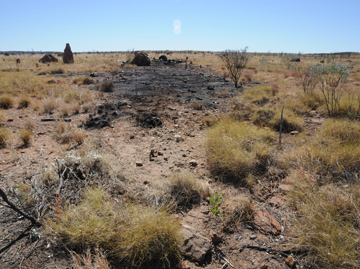
Figure 1: Aircraft prior to recovery – looking at reciprocal direction of approach. The final water drop occurred beyond the fuselage where the smoke is rising.
Source: Operator
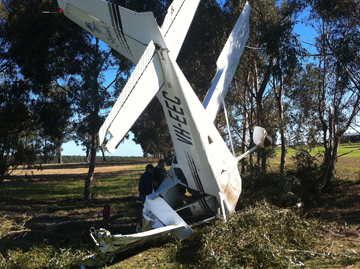
Figure 2: Aircraft wreckage
Source: Operator
Operator’s investigation and comments
Based on the pilot’s account of the accident and assessment of the recovered aircraft, mechanical malfunctions were ruled out as a contributing factor. The operator determined that the accident was most likely the result of a loss of rotor RPM that the pilot was unable to recover, due to a downwind descending turn, low altitude for the water drop, and a departure into rising terrain. The pilot had to make a decision between putting the helicopter into tall trees and active bushfire or climbing over the trees to clear ground. In choosing the latter, the rotor RPM decayed further, and the helicopter contacted the ground.
The operator stated that the helicopter type is renowned for its ‘hot and high’ performance making it a very effective firefighting platform. Firefighting combines a number of factors which result in flying that is close to the performance limits of the aircraft – high gross weights, low airspeeds, low altitude, close quarters manoeuvring, high work rate environment and adverse weather conditions. In this case the combination of factors immediately leading up to the accident resulted in the helicopter operating outside its performance envelope without having enough space and height to recover.
Safety action
As a result of this occurrence, the aircraft operator has advised the ATSB that they are taking the following safety actions:
The operator has provided a briefing to all of their pilots on the circumstances and the outcome of this accident. The pilot involved in this accident will be involved in future training and checking to enable the recognition and avoidance of the circumstances that saw the limitations and flight envelope exceeded. This training will become part of the operator’s annual training for all pilots conducting fire control operations.
Safety message
Fire control flying operations can involve challenges and complexities that require crews to maintain a heightened awareness of their aircraft’s operating limits and the environmental conditions. Flying within operating limits can ensure pilots have a performance margin to react to unforeseen circumstances.
About this report
Decisions regarding whether to conduct an investigation, and the scope of an investigation, are based on many factors, including the level of safety benefit likely to be obtained from an investigation. For this occurrence, no investigation has been conducted and the ATSB did not verify the accuracy of the information. A brief description has been written using information supplied in the notification and any follow-up information in order to produce a short summary report, and allow for greater industry awareness of potential safety issues and possible safety actions.
Occurrence Briefs are concise reports that detail the facts surrounding a transport safety occurrence, as received in the initial notification and any follow-up enquiries. They provide an opportunity to share safety messages in the absence of an investigation.
What happened
On the morning of 16 November 2019, a BRM Aero Bristell departed Essendon Airport, Victoria to conduct an instructor-rating proficiency check flight. There was an authorised testing officer (ATO) and instructor on board.
During approach into Drouin, Victoria, the ATO directed the instructor to perform a practice forced landing onto the grass airstrip. The instructor reduced power to idle, adopted best glide speed for the aircraft and began the approach. During the approach, the instructor acknowledged that he would not make the selected touch down point. He applied power of about 100 RPM to assist in the approach. Upon the application of power, the ATO noticed that the aircraft contacted treetops and foliage. Further power was then applied to correct the flight path and to clear the obstacles.
The aircraft landed without further incident and was taxied to the parking area for inspection by the crew. There was no visible damage identified. The crew notified the training organisation’s on-duty instructor and subsequently conducted a return flight to Essendon.
Safety action
As a result of this occurrence, the aircraft training organisation has advised the ATSB that they are taking the following safety action:
A meeting was held with the organisation’s instructional staff to brief them of this occurrence and to advise them that if an incident of this nature should occur, an engineer must confirm the aircraft is safe for further flight.
Safety message
During training flights, testing officers and instructors need to be vigilant and prepared to discontinue a glide approach if it is established that a successful landing cannot be achieved. It is important to be aware of any obstacles or obstructions in the flight path and to ensure clearance is maintained at all times. In the event of contact between an aircraft and treetops or obstacles, such as in this occurrence, it is imperative that an engineer confirms the aircraft is safe for flight.
About this report
Decisions regarding whether to conduct an investigation, and the scope of an investigation, are based on many factors, including the level of safety benefit likely to be obtained from an investigation. For this occurrence, no investigation has been conducted and the ATSB did not verify the accuracy of the information. A brief description has been written using information supplied in the notification and any follow-up information in order to produce a short summary report, and allow for greater industry awareness of potential safety issues and possible safety actions.
Occurrence Briefs are concise reports that detail the facts surrounding a transport safety occurrence, as received in the initial notification and any follow-up enquiries. They provide an opportunity to share safety messages in the absence of an investigation.
What happened
On 8 November 2019, a Robinson R44 helicopter was conducting sling load operations about 10 NM north-east of Jabiru, Northern Territory. On the first lift of the day at approximately 1430 Central Standard Time, the pilot attached a load estimated to be about 120 kilograms to the helicopter by a 30-foot sling. In the prevailing windless conditions, the pilot lifted into a high hover, began to lift the load off the ground, and continued to climb until the load was clear of the surrounding trees. Once established in the hover, at approximately 80-100 feet AGL, the pilot observed all the engine gauges to be in the normal range and the helicopter appeared to be operating normally.
As the pilot commenced the translation into forward flight over a treed area, the rotor RPM began to decay and the low rotor RPM warning horn sounded. The pilot unsuccessfully attempted to regain rotor RPM by lowering the collective[1] and increasing the throttle. In an attempt to alleviate the situation by reducing the weight on the helicopter, the pilot released the slung load. This action did not assist with the recovery of rotor RPM and the aircraft continued to descend into the trees before colliding with the ground.
Figure 1: Area of operations and wreckage
Source: Operator
Operator’s investigation
The operator has conducted an investigation into the circumstances surrounding this accident.
The investigation revealed that in the hot and humid operating conditions, a contributing factor to the accident was the pilot over-pitching during the sling load operation. The over-pitching was to such a degree that it made successful recovery in the circumstances unlikely. The operator’s investigation also stated the pilot’s decision to depart the pick-up location over a treed area when clearer areas were available also restricted the options available once the helicopter started to descend.
Over-pitching
The International Civil Aviation Organization (ICAO) manual of aircraft accident and incident investigation, chapter 15: Helicopter investigation, described over-pitching as a phenomena that happens when collective pitch is increased to a point where the main rotor blade angle of attack creates so much drag that all available engine power cannot maintain or restore normal operation rotor speed. At low rotor speed, the rotor blades bend upwards and drag increases. The high inflow angles and rotor drag quickly decay main rotor speed, which may decrease to the point where the main rotor blades stall.
Hover performance
Hover performance is essentially a product of engine power available and engine power required. The main factors affecting engine power required in a hover are helicopter weight, density of air and proximity to the ground (ground effect).
To maintain a steady high hover, lift a sling load or climb, the helicopter requires more main rotor thrust to act as lift, which in turn requires more engine power.
As air density decreases with an increase in altitude, temperature, and to a lesser degree humidity a normally aspirated engine produces less power. Additionally, if the same amount of rotor thrust is needed, the rotor blades need a higher angle of attack, which creates more drag and generates a requirement for more engine power.
When a helicopter is hovering within about one rotor diameter[2] of the ground, the performance of the main rotor is affected by ground effect. A helicopter hovering in-ground-effect requires less engine power to hover than a helicopter hovering out-of-ground-effect.
Safety action
As a result of this occurrence, the operator has advised the ATSB that they are taking the following safety actions:
The operator will produce a report for all company pilots to fully explain the circumstances surrounding this accident to further educate and train pilots of the considerations when undertaking similar operations. To increase the safety of company operations, this further training will concentrate on decision-making, helicopter performance and weather effects, over pitching and using available terrain features when approaching and departing from unprepared landing sites.
Safety message
This accident serves as a reminder that when operating helicopters from unprepared landing sites, pilots should consider the approach and departure routes available in conjunction with operational constraints, weather (particularly wind), performance available and possible emergency recovery. Time spent considering and confirming the fundamental factors of decision-making, helicopter performance and limitations and the consideration of actions in an emergency may help prevent injury to crew and damage to, or loss of, an aircraft.
About this report
Decisions regarding whether to conduct an investigation, and the scope of an investigation, are based on many factors, including the level of safety benefit likely to be obtained from an investigation. For this occurrence, no investigation has been conducted and the ATSB did not verify the accuracy of the information. A brief description has been written using information supplied in the notification and any follow-up information in order to produce a short summary report, and allow for greater industry awareness of potential safety issues and possible safety actions.
Occurrence Briefs are concise reports that detail the facts surrounding a transport safety occurrence, as received in the initial notification and any follow-up enquiries. They provide an opportunity to share safety messages in the absence of an investigation.
What happened
On 15 October 2019 at 2100 Eastern Daylight-saving Time, an anchor handling tug supply vessel was engaged in anchor handling operations with an offshore drilling rig. The operation involved deploying one of the rig’s anchor cables onto the vessel’s deck and disconnecting it from the rig. The vessel utilised a ‘J-lock’[1] to acquire and recover the chain. While in position approximately 45 m from the rig, the anchor handler believed they had J-locked onto the links of the anchor chain, close to where the cable transitions from chain to steel wire.
Once the anchor handler had locked onto the anchor chain,[2] the rig paid out approximately 200 m of wire to allow the anchor handler to move to a safer spot to bring the chain onto the vessel’s deck. As the anchor handler began recovering the chain onto the deck (through a winching system), it became evident that the J-lock was not securely locked onto the anchor chain.
As the J-lock was deploying over the stern roller, the hook jumped from the anchor chain to the anchor wire. The abrupt change in weight and tension on the anchor handler’s winch wire resulted in the vessel being rapidly set stern-first towards the rig. Two of the vessel’s engines were set at maximum power ahead and the work wire was paid out, however neither of these actions could arrest the vessel’s sternway. At about 2118, the anchor handler made contact with the drilling rig. The anchor handler sustained structural damage to the rig leg.
About this report
Decisions regarding whether to conduct an investigation, and the scope of an investigation, are based on many factors, including the level of safety benefit likely to be obtained from an investigation. For this occurrence, no investigation has been conducted and the ATSB did not verify the accuracy of the information. A brief description has been written using information supplied in the notification and any follow-up information in order to produce a short summary report, and allow for greater industry awareness of potential safety issues and possible safety actions.
Occurrence Briefs are concise reports that detail the facts surrounding a transport safety occurrence, as received in the initial notification and any follow-up enquiries. They provide an opportunity to share safety messages in the absence of an investigation.
What happened
On the afternoon of 14 October 2019, the solo student pilots of two Diamond DA 40 aircraft were approaching Coffs Harbour, New South Wales 20 minutes apart at the conclusion of a navigation exercise. The exercise was under visual flight rules and both aircraft were flying in visual meteorological conditions.
As the first DA 40 approached the airport from the north, the student pilot was cleared by air traffic control (ATC) to conduct a visual approach to runway 21. As the aircraft became closer to the airfield, ATC questioned the final heading of the aircraft and requested confirmation from the pilot that they had the runway environment in sight. This made the pilot aware that they were aligned on final approach to taxiway E3-E5 (Figures 1 and 2).
Approximately 20 minutes later, the second inbound DA 40 approached the airport from the same heading and was cleared by ATC to conduct a visual approach to runway 21. ATC also questioned the final heading of this aircraft which notified the pilot that they were also aligned on final approach to the taxiway.
Both pilots made the necessary corrections to successfully land on runway 21.
In the navigation exercise briefing, the students were made aware of the potential to misidentify the runway as it is not an uncommon occurrence at this aerodrome. They were thoroughly briefed and provided with methods to confirm the correct runway, particularly when approaching from the north. The possibility of misidentifying the runway is also annotated as a warning in Airservices publications, En Route Supplement Australia (ERSA) and Departure and Approach Procedures (DAP).
Figure 1: Aerodrome Chart – Coffs Harbour, NSW
Source: Airservices Australia
Figure 2: Aerial image of Coffs Harbour Airport, NSW
Source: Google Earth, annotated by the ATSB
Safety action
As a result of this occurrence, the training organisation has advised the ATSB that they will provide further information in the navigation briefing for students to mitigate against the misidentification of taxiway E3-E5 for runway 21 at Coffs Harbour. They now also require supervising instructors to provide special pre-flight briefings for all solo flights into this location regarding positive identification of the runway.
Similar occurrences
In the previous five years, there have been seven additional similar occurrences reported to the ATSB involving the E3-E5 taxiway being mistaken for runway 21 during approach into Coffs Harbour.
Safety message
Pilots and operators should be aware of documented and well-known issues when identifying particular features critical to navigation and airfield operations. In this situation, identifying the runway environment would have benefited from using secondary features to confirm identification – runway heading, surrounding topographical features and visible runway infrastructure (runway approach lighting and runway markings).
About this report
Decisions regarding whether to conduct an investigation, and the scope of an investigation, are based on many factors, including the level of safety benefit likely to be obtained from an investigation. For this occurrence, no investigation has been conducted and the ATSB did not verify the accuracy of the information. A brief description has been written using information supplied in the notification and any follow-up information in order to produce a short summary report, and allow for greater industry awareness of potential safety issues and possible safety actions.
Occurrence Briefs are concise reports that detail the facts surrounding a transport safety occurrence, as received in the initial notification and any follow-up enquiries. They provide an opportunity to share safety messages in the absence of an investigation.
What happened
On 18 October 2019, a Piper PA-28-140 operated a private return flight from Archerfield, Queensland to Narrabri, New South Wales with one pilot on board. The flight was to be operated under visual flight rules (VFR)[1] by day.
At 1915 Eastern Daylight Time, the aircraft returned to Archerfield after last light[2] at 1,500 ft, which was below the lower safe altitude (LSALT) of 2,900 ft that is applied after last light. Air traffic control subsequently issued a safety alert to the pilot.
Pilot comments
At the time of the occurrence, the pilot was yet to undertake night VFR and instrument flight rules training. He had planned to arrive back at Archerfield before last light, however had miscalculated the time and had a subsequent delayed departure from Narrabri. The pilot was unaware of the night VFR procedures for Archerfield, in particular the LSALT and therefore the approach was flown at 1,500 ft as per day VFR procedures.
The pilot advised that in response to this occurrence he plans to undertake night VFR training.
It is recommended that VFR pilots should also use a personal minimums checklist to identify and manage risk factors. A personal minimums checklist is an individual pilot’s own set of rules and criteria for deciding if and under what conditions to fly or to continue flying based on their knowledge, skills and experience.
The ATSB SafetyWatch highlights the broad safety concerns that come out of our investigation findings and from the occurrence data reported to us by industry. One of the safety concerns is inflight decision making.
About this report
Decisions regarding whether to conduct an investigation, and the scope of an investigation, are based on many factors, including the level of safety benefit likely to be obtained from an investigation. For this occurrence, no investigation has been conducted and the ATSB did not verify the accuracy of the information. A brief description has been written using information supplied in the notification and any follow-up information in order to produce a short summary report, and allow for greater industry awareness of potential safety issues and possible safety actions.
Occurrence Briefs are concise reports that detail the facts surrounding a transport safety occurrence, as received in the initial notification and any follow-up enquiries. They provide an opportunity to share safety messages in the absence of an investigation.
What happened
On 27 October 2019 at approximately 1740 Eastern Daylight-Saving Time, the crew of a foreign-registered Airbus A380 was conducting a regular public transport flight to Sydney Airport, New South Wales (NSW).
During cruise at FL 390 abeam Broken Hill, NSW the crew observed the cockpit oxygen bottle pressure of 487 psi. After referring to the flight crew operating manual (FCOM) for oxygen limitations, it was determined that this was below the minimum pressure for a two-person flight crew.
The crew discussed the situation, taking into account fuel on board, distance to the destination, weather and an en route alternate, and decided to continue the flight to Sydney.
The crew notified air traffic control of the oxygen issue and were cleared to descend to 10,000 ft. Maintenance control centre was also contacted and the cabin crew were advised of an early descent.
On approach at 800 ft, the pressure dropped to 350 psi and the crew received an oxygen cockpit low pressure caution on the electronic centralised aircraft monitor. The aircraft landed safely at 0755 UTC.
Engineering inspection
Following the incident, an inspection on the oxygen bottle system revealed a leak at the filling port cap. Replacement components were placed on board the aircraft as a preventative measure in case of a further valve leak.
Safety message
This incident highlights the importance of positive crew resource management when handling unanticipated failures during flight. In this instance, the crew proactively identified the oxygen bottle pressure and took all appropriate actions by consulting the FCOM, discussing the situation, assessing their options and communicating with external stakeholders to ensure a desirable outcome.
About this report
Decisions regarding whether to conduct an investigation, and the scope of an investigation, are based on many factors, including the level of safety benefit likely to be obtained from an investigation. For this occurrence, no investigation has been conducted and the ATSB did not verify the accuracy of the information. A brief description has been written using information supplied in the notification and any follow-up information in order to produce a short summary report, and allow for greater industry awareness of potential safety issues and possible safety actions.
Occurrence Briefs are concise reports that detail the facts surrounding a transport safety occurrence, as received in the initial notification and any follow-up enquiries. They provide an opportunity to share safety messages in the absence of an investigation.
What happened
On the 4 October 2019, an Agusta A109S helicopter was on approach to Sydney Airport, New South Wales. During approach, air traffic control (ATC) issued the pilot a clearance to track from the clearance limit to overhead the threshold runway 07. The pilot read back, ‘from the clearance limit track overhead the 07 threshold’. The pilot reported to the ATSB that he believed he was cleared to track overhead the 07 threshold (for the heliport).
A Boeing 737 waiting on the crossing runway for an intersection departure was provided with the helicopter traffic and advised ATC that the helicopter was in sight. ATC subsequently issued the take-off clearance.
ATC then advised the helicopter pilot that the clearance limit was the runway 07 threshold and passed traffic on the 737, however the transmission was blocked.
As the 737 began its take-off, ATC observed the helicopter continue past the runway 07 threshold and immediately issued instructions to the helicopter to expedite through the runway intersection.
Safety action
As a result of this occurrence, Airservices Australia advised the ATSB that they are taking the following safety action:
The air traffic controller will be counselled on the appropriate phraseology when issuing a clearance limit.
Safety message
This incident shows the effectiveness of the conflict resolution training received by ATC to resolve loss of separation events resulting from radio transmission errors or miscommunication between controllers and flight crew.
About this report
Decisions regarding whether to conduct an investigation, and the scope of an investigation, are based on many factors, including the level of safety benefit likely to be obtained from an investigation. For this occurrence, no investigation has been conducted and the ATSB did not verify the accuracy of the information. A brief description has been written using information supplied in the notification and any follow-up information in order to produce a short summary report, and allow for greater industry awareness of potential safety issues and possible safety actions.
Occurrence Briefs are concise reports that detail the facts surrounding a transport safety occurrence, as received in the initial notification and any follow-up enquiries. They provide an opportunity to share safety messages in the absence of an investigation.
What happened
On 20 September 2019, a Pilatus Britten-Norman BN2A-21 Islander operated a return charter flight from Horn Island to York Island, Queensland. There was one pilot and four passengers on board.
During taxi after landing at York Island in the morning, the pilot turned the fuel pumps on and switched the tank selector from main tanks to tip tanks. After the passengers disembarked and the aircraft was parked on the apron, the pilot completed his flight log and dipped the fuel tanks, confirming his estimate of remaining fuel on board.
The passengers returned late afternoon and the aircraft departed for its return flight to Horn Island at about 1600 Eastern Standard Time.
During cruise, the pilot observed the no. 1 engine surging. He immediately turned on both fuel pumps and monitored all instruments. He noticed that the fuel gauges were indicating that the tip tanks were almost empty and the main tanks had gained a significant amount of fuel. The pilot switched from tip tanks to main tanks and the surging stopped. As a precaution, he conducted a diversion to Warraber Island.
After landing, the pilot checked the fuel in the tip tanks and discovered that the tanks were empty and the fuel had transferred into the main tanks.
Engineering inspection
Following the incident, engineers determined that after switching the fuel selector from the main tanks to the tip tanks, the aircraft was shut down without allowing adequate time for the fuel transfer lines to close. This resulted in the fuel from the tip tanks to drain into the main tanks.
Safety action
As a result of this occurrence, the aircraft operator has advised the ATSB that they are taking the following safety actions:
An internal company document was raised to review procedures by dipping the fuel tanks before take-off when on the ground for 30 minutes or more.
A safety meeting was held to raise awareness and discuss the importance of fuel procedures, including allowing 5 to 10 minutes before shut down when switching to tip tanks on the ground.
A note has been included in the aircraft close to where the switches are, advising the importance of allowing time for the fuel selection change.
Safety message
Keeping fuel supplied to the engines during flight relies on the pilot’s knowledge of the aircraft’s fuel supply system and being familiar and proficient in its use. Accidents and incidents involving fuel mismanagement are an ongoing aviation safety concern, particularly those involving complex fuel delivery systems. The ATSB publication, Avoidable Accidents No. 5 - Starved and exhausted: Fuel management aviation accidents (AR-2011-112), is available from the ATSB website.
About this report
Decisions regarding whether to conduct an investigation, and the scope of an investigation, are based on many factors, including the level of safety benefit likely to be obtained from an investigation. For this occurrence, no investigation has been conducted and the ATSB did not verify the accuracy of the information. A brief description has been written using information supplied in the notification and any follow-up information in order to produce a short summary report, and allow for greater industry awareness of potential safety issues and possible safety actions.