Airspace infringement and loss of separation involving a Piper PA-28 and a Cirrus SR20, 26 NM west of Sydney, New South Wales, on 29 August 2020

Brief

Occurrence Briefs are concise reports that detail the facts surrounding a transport safety occurrence, as received in the initial notification and any follow-up enquiries. They provide an opportunity to share safety messages in the absence of an investigation.

What happened

At about 1117 Eastern Standard Time on 29 August 2020, a Piper PA-28 departed Bankstown Airport, New South Wales (NSW) for a private flight, tracking to Bathurst, NSW under the visual flight rules. After departure, the pilot of the PA-28 commenced a shallow climb with the intention of remaining clear of the Sydney control area steps. However, at approximately 26 NM west of Sydney, the pilot inadvertently entered controlled airspace without a clearance.

A short distance ahead and above the PA-28, a Cirrus SR20 was on a private flight from Bankstown Airport, NSW to Dubbo Airport, NSW under the instrument flight rules. The SR20 was on climb to 6,000 ft in class C airspace when the aircraft’s traffic advisory system alerted the pilot to the presence of the PA-28. The traffic advisory system indicated the PA-28 was climbing towards the aircraft in the 6 o’clock position relative to the SR20. The positioning of the two aircraft prevented the SR20 pilot from sighting the PA-28. The SR20 pilot queried the proximity of the PA-28 with Air Traffic Control (ATC). ATC then identified the conflict and issued a safety alert to the SR20.

At about 1127 EST, the SR20 and PA-28 came into close proximity, with separation between the two aircraft reduced to 0.8 NM laterally and 300 ft vertically. ATC made a broadcast to the unverified PA-28 informing the pilot of the airspace infringement and issuing turn instructions to regain separation. The PA-28 was observed by ATC to follow the separation instructions and commence a turn to the left. The conflict was subsequently resolved, and the PA-28 exited controlled airspace.

Safety message

This incident highlights the importance of maintaining navigational accuracy and traffic awareness when operating in close proximity to control area steps. It also illustrates the value of enhanced situational awareness provided by airborne traffic advisory systems such as that fitted to the involved Cirrus SR20.

About this report

Decisions regarding whether to conduct an investigation, and the scope of an investigation, are based on many factors, including the level of safety benefit likely to be obtained from an investigation. For this occurrence, no investigation has been conducted and the ATSB did not verify the accuracy of the information. A brief description has been written using information supplied in the notification and any follow-up information in order to produce a short summary report, and allow for greater industry awareness of potential safety issues and possible safety actions.

Occurrence summary

Mode of transport Aviation
Occurrence ID AB-2020-033
Occurrence date 29/08/2020
Location 26 NM west of Sydney
State New South Wales
Occurrence class Incident
Aviation occurrence category Loss of separation
Highest injury level None
Brief release date 08/10/2020

Aircraft details

Manufacturer Piper Aircraft Corp
Model PA-28
Sector Piston
Operation type General Aviation
Departure point Bankstown Airport, New South Wales
Destination Bathurst, New South Wales
Damage Nil

Aircraft details

Manufacturer Cirrus Design Corporation
Model SR20
Sector Piston
Operation type General Aviation
Departure point Bankstown, New South Wales
Destination Dubbo Airport, New South Wales
Damage Nil

Control issues involving a Robinson R44, near Jabiru, Northern Territory, on 3 August 2020

Brief

Occurrence Briefs are concise reports that detail the facts surrounding a transport safety occurrence, as received in the initial notification and any follow-up enquiries. They provide an opportunity to share safety messages in the absence of an investigation.

What happened

On 3 August 2020, a Robinson R44 helicopter was conducting fire surveillance and abatement operations about 50 NM east of Jabiru, Northern Territory. In the early afternoon, the helicopter landed and shutdown in a pre-arranged temporary landing site waiting to pick up three ground personnel. At about 1700 Central Standard Time, once the personnel and their equipment was secured, the helicopter was started and brought into a hover. After checking the power available, a vertical take-off and climb was conducted until the helicopter was approximately 75 ft above ground level when a translation to forward flight commenced. The direction chosen was the most suitable available when considering terrain and wind direction.

As the pilot commenced the translation into forward flight over a treed area, the helicopter initially maintained height but as the pilot increased collective[1] the rotor RPM began to decay. The pilot increased the throttle and lowered the collective in an attempt to regain rotor RPM. As the helicopter descended, the collective was again raised in an attempt to arrest the descent, however the low rotor RPM warning horn sounded. A further attempt to recover the rotor RPM by lowering the collective was unsuccessful leaving a forced landing as the only option available for the pilot.

A landing site was selected in the treed area and the helicopter settled onto the ground resulting in a heavy landing. The main rotor blades struck several branches as the helicopter came through the tree canopy resulting in minor damage to the blades. After securing the helicopter, the pilot and ground personnel exited the helicopter and moved a safe distance away. The heavy landing activated the inertia switch on the emergency locator transmitter.[2]

Figure 1: The helicopter in situ after the forced landing

Figure 1: The helicopter in situ after the forced landing.
Source: Operator

Source: Operator

Operator’s investigation

The operator conducted an investigation into the circumstances surrounding this accident that revealed several contributing factors that are summarised below:

  • The aircraft was within the maximum take-off weight limits however it was close to the performance limit for an out of ground effect[3] hover in the prevailing weather conditions.
  • The afternoon weather conditions had changed from both previous days and earlier that day. This was the first afternoon in approximately four months that there was a tropical build up with variable and quickly changing winds as opposed to the consistant south easterly winds associated with the dry season. The afternoon was hotter and more humid than previous days.
  • The helicopter was over-pitched to a degree that successful recovery in the circumstances was not possible.

Over-pitching

Over-pitching is a phenomena that happens when collective pitch is increased to a point where the main rotor blade angle of attack creates so much drag that all available engine power cannot maintain or restore normal operating rotor speed. At low rotor speed, the rotor blades bend upwards and drag increases further, which may decrease to the point where the main rotor blades stall. More information can be found in The International Civil Aviation Organization (ICAO) manual of aircraft accident and incident investigation, chapter 15: Helicopter investigation.

Hover performance

Hover performance is essentially a product of engine power available and engine power required. The main factors affecting engine power required in a hover are helicopter weight, density of air and proximity to the ground (ground effect).

To maintain a steady high hover or climb vertically, the helicopter requires more main rotor thrust to act as lift, which in turn requires more engine power.

As air density decreases with an increase in altitude, temperature, and to a lesser degree humidity, a normally aspirated engine produces less power. Additionally, if the same amount of rotor thrust is needed, the rotor blades need a higher angle of attack, which creates more drag and generates a requirement for more engine power.

When a helicopter is hovering within about one rotor diameter[4] of the ground, the performance of the main rotor is affected by ground effect. A helicopter hovering in-ground-effect requires less engine power to hover than a helicopter hovering out-of-ground-effect.

Safety action

As a result of this occurrence, the operator has advised the ATSB that they are taking the following safety actions:

  • It was identified post occurrence that there were some training and recency issues that were addressed particularly in the correct recovery actions for a low rotor RPM situation and the technique used to translate into forward flight from a vertical take-off or an OGE hover.
  • The operator has limited the number of ground personnel to a maximum of two providing a larger power margin available for operating in these situations.
  • All pilots have undertaken a flight review to identify and analyse any skill or knowledge deficiencies.

Safety message

This accident serves as a reminder that when operating helicopters from unprepared landing sites, pilots should consider the approach and departure routes available in conjunction with operational constraints, weather, performance available and possible emergency recovery. Time spent considering and confirming the fundamental factors of decision-making, helicopter performance and limitations and the consideration of actions in the event of performance limitations or an emergency may help prevent injury to crew and damage to, or loss of, an aircraft.

About this report

Decisions regarding whether to conduct an investigation, and the scope of an investigation, are based on many factors, including the level of safety benefit likely to be obtained from an investigation. For this occurrence, no investigation has been conducted and the ATSB did not verify the accuracy of the information. A brief description has been written using information supplied in the notification and any follow-up information in order to produce a short summary report, and allow for greater industry awareness of potential safety issues and possible safety actions.

__________

  1. Collective: a primary helicopter flight control that simultaneously affects the pitch of all blades of a lifting rotor. Collective input is the main control for vertical velocity.
  2. Emergency locator transmitter (ELT): a radio beacon that transmits an emergency signal that may include the position of a crashed aircraft, and is either impact or manually activated.
  3. Out of ground effect: helicopters require less power to hover when in ‘ground effect’ then when out of ‘ground effect’ due to the cushioning effect created by the main rotor downwash striking the ground. The height of ‘ground effect’ is usually defined as more than one main rotor diameter above the surface.
  4. The Robinson R44 main rotor diameter is 33 ft.

Occurrence summary

Mode of transport Aviation
Occurrence ID AB-2020-032
Occurrence date 03/08/2020
Location 50 NM east of Jabiru
State Northern Territory
Occurrence class Serious Incident
Aviation occurrence category Control issues
Highest injury level None
Brief release date 18/09/2020

Aircraft details

Manufacturer Robinson Helicopter Co
Model R44
Sector Helicopter
Operation type Aerial Work
Departure point East of Jabiru, Northern Territory
Destination East of Jabiru, Northern Territory
Damage Minor

Low fuel event involving a Diamond DA40, near Parafield Airport, South Australia, on 9 July 2020

Brief

Occurrence Briefs are concise reports that detail the facts surrounding a transport safety occurrence, as received in the initial notification and any follow-up enquiries. They provide an opportunity to share safety messages in the absence of an investigation.

What happened

On 9 July 2020, the student pilot of a Diamond DA40 was preparing the aircraft for a local solo flight from Parafield Airport, South Australia. As this was the student’s first solo navigational flight, the instructor assisted the student with the pre-flight inspection.

The instructor signalled for the fuel truck to come and refuel the aircraft. As the fuel truck was busy refuelling another aircraft at the time, the instructor left the student to complete the pre-flight inspection and refuel the aircraft.

After completing the pre-flight inspection, the student left the aircraft unattended to go to the office to collect their flight bag and gear and returned shortly after, with the assumption that the aircraft had been refuelled. The student did not check the fuel tanks or conduct a fuel drain, and departed Parafield for the navigational flight.

During cruise at 4,500 ft, approximately 18 NM from Parafield, the student received a low fuel warning. Approximately 30 minutes later, a second low fuel warning sounded and it was at this point in time that the student conducted a return to Parafield for an uneventful landing.

The post-flight inspection revealed that the aircraft landed outside the prescribed fuel reserves.

Operator investigation findings

Following the incident, the operator conducted an internal investigation and provided the ATSB with the following:

  • The student believed that the fuel tanks were full from the outset, influencing their judgement throughout the process.
  • When the student was alerted to a low fuel warning in the current tank, they correctly and immediately selected the other tank, but did not calculate the total on-board fuel. The decision was further influenced by the student’s belief that the fuel content indicator was not always accurate. This was remnant of a previous aircraft the student flew and not the DA40.
  • When the student was alerted by a low fuel warning on the second tank, they elected to discontinue the flight, but not to use the alternate airport. This resulted in a return to Parafield with the fuel contents remaining below that of the fixed reserve.

Safety message

This incident highlights the importance of ensuring that all pre-flight inspections and checklists are carried out systematically. Fuel quantity and quality should always be checked before each flight and after refuelling to ensure there is a correct amount of fuel on board the aircraft to conduct the flight.

It also reiterates the importance of being familiar and proficient with aircraft system, including the risks and controls associated with fuel management.

About this report

Decisions regarding whether to conduct an investigation, and the scope of an investigation, are based on many factors, including the level of safety benefit likely to be obtained from an investigation. For this occurrence, no investigation has been conducted and the ATSB did not verify the accuracy of the information. A brief description has been written using information supplied in the notification and any follow-up information in order to produce a short summary report, and allow for greater industry awareness of potential safety issues and possible safety actions.

Occurrence summary

Mode of transport Aviation
Occurrence ID AB-2020-029
Occurrence date 09/07/2020
Location Near Parafield Airport
State South Australia
Occurrence class Serious Incident
Aviation occurrence category Low fuel
Highest injury level None
Brief release date 04/09/2020

Aircraft details

Manufacturer Diamond Aircraft Industries
Model DA40
Sector Piston
Operation type Flying Training
Departure point Parafield Airport, South Australia
Destination Parafield Airport, South Australia
Damage Nil

Taxiing collision involving a Piper PA-28, Warrnambool, Victoria, on 18 July 2020

Brief

Occurrence Briefs are concise reports that detail the facts surrounding a transport safety occurrence, as received in the initial notification and any follow-up enquiries. They provide an opportunity to share safety messages in the absence of an investigation.

What happened

On 18 July 2020, at about 1000 Eastern Standard Time, a Piper PA-28 was taxiing to vacate the runway at Warrnambool Airport, Victoria. As the aircraft vacated the runway, the pilot proceeded towards the fuel bowser and aligned the aircraft on what was thought to be a taxiway guideline for the apron in front of the fuel bowser. As the aircraft slowed, it suddenly veered right and came to a stop. The right wing had contacted the shelter housing the fuel bowser, with further inspection revealing a dent in the leading edge of the wing. The pilot had mistaken the parking limit line for a taxi guideline marking and positioned the aircraft too far to the right, resulting in a collision with the structure as the aircraft approached the bowser (see Figure 1).

Figure 1: Warrnambool Airport apron markings

Figure 1: Warrnambool Airport apron markings. 
Source: Google annotated by the ATSB

Source: Google annotated by the ATSB

As depicted in Figure 2 from the Manual of Standards Part 139 – Aerodromes Volume 1: Chapter 8, limit markings differ in presentation from taxi guideline markings. Taxi guidelines consist of a single solid yellow line, whereas parking limit lines consist of two solid yellow lines surrounding a solid red line with the words ‘Parking Clearance’ appearing at regular intervals. A list of markings and their meanings are available to pilots in the Aeronautical Information Publication (AIP) AD 1.1 4.10.

Figure 2: Apron markings – taxi guideline marking and parking clearance line

Figure 2: Apron markings – taxi guideline marking and parking clearance line.
Source: Manual of Standards Part 139 - Aerodromes

Source: Manual of Standards Part 139 - Aerodromes

Safety message

This incident reinforces the importance of maintaining situational awareness[1], a good lookout while taxiing and a familiarity with apron markings.

About this report

Decisions regarding whether to conduct an investigation, and the scope of an investigation, are based on many factors, including the level of safety benefit likely to be obtained from an investigation. For this occurrence, no investigation has been conducted and the ATSB did not verify the accuracy of the information. A brief description has been written using information supplied in the notification and any follow-up information in order to produce a short summary report, and allow for greater industry awareness of potential safety issues and possible safety actions.

__________

  1. Situational awareness: Situational awareness is an accurate understanding of what is going on around you, and what is likely to happen next. Source: CASA Safety behaviours: human factors for pilots 2nd edition

Occurrence summary

Mode of transport Aviation
Occurrence ID AB-2020-031
Occurrence date 18/07/2020
Location Warrnambool
State Victoria
Occurrence class Incident
Aviation occurrence category Taxiing collision/near collision
Highest injury level None
Brief release date 04/09/2020

Aircraft details

Manufacturer Piper Aircraft Corp
Model PA-28-161
Sector Piston
Operation type Flying Training
Destination Warrnambool Airport, Victoria
Damage Minor

VFR into IMC involving a Beechcraft A36, near Mundubbera Aerodrome, Queensland, on 9 July 2020

Brief

Occurrence Briefs are concise reports that detail the facts surrounding a transport safety occurrence, as received in the initial notification and any follow-up enquiries. They provide an opportunity to share safety messages in the absence of an investigation.

What happened

On the afternoon of 9 July 2020, a Beechcraft A36 departed Lark Quarry in Central Queensland to conduct a private flight to Gympie, Queensland. There was a pilot and three passengers on board. The pilot received the en route weather forecast on the morning of departure, approximately 10 hours prior to the actual flight time due to lack of phone coverage in the area. The weather report at that point in time was suitable for a flight under VFR.[1]

During the flight, the weather began to deteriorate closer to the coast as the aircraft neared its planned destination. The pilot observed increasing overcast cloud on the intended track and commenced a descent from 9,500 ft to remain clear of cloud. The aircraft levelled at 4,500 ft, which appeared to be well below the cloud base.

A short time later, the aircraft entered cloud and the pilot lost all visual references. The pilot immediately contacted air traffic control (ATC) and declared a PAN PAN[2] to request assistance, while commencing a climbing turn onto a reciprocal heading. The climbing turn enabled the aircraft to regain VMC[3] after about two minutes in cloud.

The pilot then conducted a diversion to Mundubbera, Queensland and was able to maintain VMC for the remainder of the flight.

Visual Meteorological Conditions (VMC) requirements

Figure 1: VMC criteria for aeroplanes in Class G airspace

Figure 1: VMC criteria for aeroplanes in Class G airspace.
Source: Aeronautical Information Publication (AIP) Australia: ENR 1.2-4 14 May 20

Source: Aeronautical Information Publication (AIP) Australia: ENR 1.2-4 14 May 20

Pilot comments

The pilot advised the ATSB that they had a pre-planned course of action for the situation of inadvertently flying into weather that was less than VMC. An important part of this plan was to immediately notify ATC of the situation to ensure all possible assistance was gained. The pilot committed to this plan and carried it out to effect a safe recovery.

Obtaining weather forecasts

The AIP ENR 1.10 Section 1.2.2 states:

Flights for which a forecast is required and cannot be obtained, are permitted to depart provided the pilot is satisfied that the weather at the departure point will permit the safe return of the flight within one hour of departure. The flight is permitted to continue if a suitable forecast is obtained for the intended destination within 30 minutes after departure.

Figure 2: VMC criteria for aeroplanes in Class G airspace
Source: Visual Flight Rules Guide 14 May 20

Source: Visual Flight Rules Guide 14 May 20

If the pre-flight briefing is obtained more than one hour before the flight, the pilot should obtain an update before departure to ensure that the latest information available can be used for the flight.

Pilots can obtain forecasts and updates by radio en route if other forms of communication are unavailable.

Safety message

Obtaining the latest valid weather forecasts during the pre-flight planning phase is paramount to the safe conduct of a longer-distance VFR flight. Pilots are encouraged to make conservative decisions when considering how forecast weather may affect their flight. If poor weather is encountered en route, timely and conservative decision-making may be critical to ensuring a safe outcome.

ATSB SafetyWatch

VFR pilots are also encouraged to familiarise themselves with the definition of VMC criteria and carefully consider available options where forecast or actual conditions are such that continued flight in VMC cannot be assured.

Flying with reduced visual cues and Inflight decision making are two of the ATSB’s major safety concerns.

About this report

Decisions regarding whether to conduct an investigation, and the scope of an investigation, are based on many factors, including the level of safety benefit likely to be obtained from an investigation. For this occurrence, no investigation has been conducted and the ATSB did not verify the accuracy of the information. A brief description has been written using information supplied in the notification and any follow-up information in order to produce a short summary report, and allow for greater industry awareness of potential safety issues and possible safety actions.

__________

  1. Visual flight rules (VFR): a set of regulations that permit a pilot to operate an aircraft only in weather conditions generally clear enough to allow the pilot to see where the aircraft is going.
  2. PAN PAN: an internationally recognised radio call announcing an urgency condition which concerns the safety of an aircraft or its occupants but where the flight crew does not require immediate assistance.
  3. Visual Meteorological Conditions (VMC): an aviation flight category in which visual flight rules (VFR) flight is permitted – that is, conditions in which pilots have sufficient visibility to fly the aircraft while maintaining visual separation from terrain and other aircraft.

Occurrence summary

Mode of transport Aviation
Occurrence ID AB-2020-030
Occurrence date 09/07/2020
Location 28 km south-east of Mundubbera
State Queensland
Occurrence class Serious Incident
Aviation occurrence category VFR into IMC
Highest injury level None
Brief release date 27/08/2020

Aircraft details

Manufacturer Beechcraft
Model A36
Sector Piston
Operation type Private
Departure point Lark Quarry, Queensland
Destination Gympie, Queensland
Damage Nil

Wheels-up landing involving a Cessna 210H, Hamilton, Victoria, on 27 June 2020

Summary

Occurrence Briefs are concise reports that detail the facts surrounding a transport safety occurrence, as received in the initial notification and any follow-up enquiries. They provide an opportunity to share safety messages in the absence of an investigation.

What happened

On 27 June 2020, the owner of a Cessna 210H was conducting a private local flight at Hamilton, Victoria. The pilot was the only occupant on board.

As the aircraft re-entered the circuit and the pilot lowered the undercarriage, an unfamiliar noise was detected emanating from underneath the aircraft. The pilot checked the wing mirror to ensure the landing gear was down and observed the main right wheel was partially extended and not in a locked position. The pilot conducted operational checks on the landing gear and attempted to manually lock the undercarriage, however all attempts were unsuccessful.

The pilot notified Melbourne air traffic control of the situation and broadcast to local aircraft on the CTAF. The aircraft entered a hold over Hamilton to ensure emergency services had time to arrive at the airport. The pilot then notified nearby aircraft of the intention to land and conducted a wheels-up landing on the grassed area parallel to the runway, resulting in minor damage to the lower fuselage and propeller.

Safety message

This incident highlights the effectiveness of sound decision-making when presented with minimal options in emergency situations. In this instance, the pilot identified the fault, conducted trouble-shooting and provided clear communication about the intention to conduct a wheels-up landing. CASA has released a Decision Making booklet, which provides further advice on how to make sound decisions in high workload environments.  

About this report

Decisions regarding whether to conduct an investigation, and the scope of an investigation, are based on many factors, including the level of safety benefit likely to be obtained from an investigation. For this occurrence, no investigation has been conducted and the ATSB did not verify the accuracy of the information. A brief description has been written using information supplied in the notification and any follow-up information in order to produce a short summary report, and allow for greater industry awareness of potential safety issues and possible safety actions.

Occurrence summary

Mode of transport Aviation
Occurrence ID AB-2020-028
Occurrence date 27/06/2020
Location Hamilton Airport
State Victoria
Occurrence class Serious Incident
Aviation occurrence category Wheels up landing
Highest injury level None
Brief release date 19/08/2020

Aircraft details

Manufacturer Cessna Aircraft Company
Model 210H
Sector Piston
Operation type Private
Departure point Hamilton, Victoria
Destination Hamilton, Victoria
Damage Minor

Pre-flight preparation incident involving a Cessna 310, Darwin, Northern Territory, on 17 June 2020

Brief

Occurrence Briefs are concise reports that detail the facts surrounding a transport safety occurrence, as received in the initial notification and any follow-up enquiries. They provide an opportunity to share safety messages in the absence of an investigation.

What happened

On 17 June 2020, the pilot of a Cessna 310 commenced the first flight of the day from runway 11 at Darwin, Northern Territory. This was a planned charter flight with one pilot and four passengers on board. As the aircraft accelerated down the runway, the pilot observed an indicated airspeed of 40 kt, and with the understanding the airspeed was live,[1] attention was turned to engine readings and maintaining directional control for the remainder of the take-off run.

Shortly after becoming airborne, the pilot checked the airspeed and noticed that the indicated airspeed was now zero. A rejected take-off was not possible with the height already achieved and the length of runway remaining, so the pilot contacted air traffic control and conducted a return to land.

Upon exiting the aircraft, the pilot discovered the cover had been left on the pitot tube[2] (Figure 1). The operator assessed that the indication early in the take-off was likely due to fluctuations in pressure as the aircraft accelerated. The pitot cover was removed and the flight proceeded without further incident.

Operator comment

The aircraft operator has advised the ATSB that they have conducted a debrief with the pilot that included the pilot’s obligation to conduct a final walk-around prior to engine start.

Figure 1: Pitot tube cover

Figure 1: Pitot tube cover.
Source: Operator.

Source: Operator.

Figure 2: Cessna 310 pitot tube location

ab2020025_figure-2.jpg

Source: Stock photo; inset photo provided by operator. Annotated by the ATSB.

Safety message

This incident highlights the importance of ensuring that all pre-flight checks and procedures are carried out systematically as detailed in the flight manual.

It also serves as a reminder to remain vigilant with monitoring and checking aircraft performance, in particular during the critical phases of flight. Indicated airspeed is the primary means of determining whether an aircraft will have sufficient performance available to climb away, or if the pilot’s best course of action is to reject the take-off.

About this report

Decisions regarding whether to conduct an investigation, and the scope of an investigation, are based on many factors, including the level of safety benefit likely to be obtained from an investigation. For this occurrence, no investigation has been conducted and the ATSB did not verify the accuracy of the information. A brief description has been written using information supplied in the notification and any follow-up information in order to produce a short summary report, and allow for greater industry awareness of potential safety issues and possible safety actions.

__________

  1. Live: a term used to indicate that the needle or speed tape on the airspeed indicator is moving and indicating an airspeed above its minimum value.
  2. Pitot tube: an open-ended tube that forms part of the pitot-static system used to measure airspeed and altimetry.

Occurrence summary

Mode of transport Aviation
Occurrence ID AB-2020-025
Occurrence date 17/06/2020
Location Darwin
State Northern Territory
Occurrence class Incident
Aviation occurrence category Aircraft preparation
Highest injury level None
Brief release date 17/08/2020

Aircraft details

Manufacturer Cessna Aircraft Company
Model 310R
Sector Piston
Operation type Charter
Departure point Darwin, Northern Territory
Damage Nil

Engine failure involving a Cessna 402, near Jabiru, Northern Territory, on 29 June 2020

Brief

Occurrence Briefs are concise reports that detail the facts surrounding a transport safety occurrence, as received in the initial notification and any follow-up enquiries. They provide an opportunity to share safety messages in the absence of an investigation.

What happened

On 30 June 2020 at 1055 Western Standard Time, a Cessna 402 departed Groote Eylandt Airport for a charter flight to Darwin, Northern Territory (NT). There were two crew and five passengers on board.

During cruise at 10,000 ft, the aircraft experienced a rough running engine. The pilot began to troubleshoot the issue and observed the oil pressure dropping to zero. A short time later, the no. 1 engine sustained a total power loss.

The pilot completed the emergency checklists for the engine failure, contacted Brisbane Centre air traffic control and declared a PAN PAN.[1] The aircraft was diverted to Jabiru Aerodrome, NT and emergency services were organised for the arrival. The pilot then notified the passengers of the incident and planned diversion.

Prior to joining the circuit at Jabiru, the pilot reviewed the one engine inoperative checklist and planned the approach for runway 09. The aircraft landed without further incident.

Engineering inspection

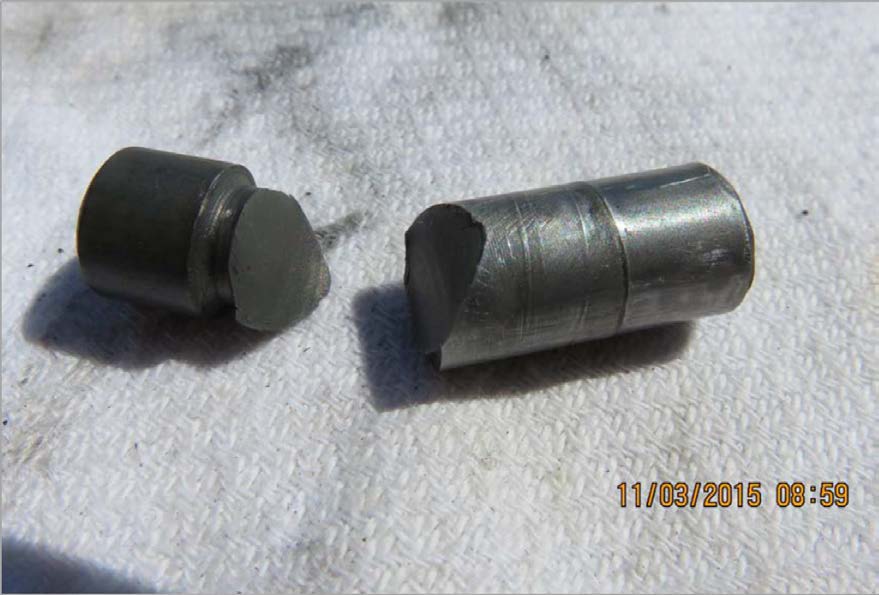
The engineering inspection revealed the engine’s no. 5 cylinder piston had failed due to detonation. When the contaminates from the piston entered the crankcase[2] and the sump, engineers suspect that the volume of the contaminates blocked the oil pick up scavenge screen and the pump ran dry. This was evidenced by lack of oil in the oil filter canister.

The no. 1 and no. 2 connecting rod big end bearings on the crank journal ran dry and once the bearings started to break down, the extreme heat and pressure stretched the no. 2 connecting rod bolts which then failed. Both connecting rods failed and contacted the top of the crankcase, leaving a hole in the case and breaking off the left magneto.

Safety message

This incident highlights the importance of flight crews maintaining awareness of all system states and being prepared to act as early as possible. In this incident, the pilot was quick to identify and troubleshoot the engine failure and followed procedures to ensure a safe outcome.

About this report

Decisions regarding whether to conduct an investigation, and the scope of an investigation, are based on many factors, including the level of safety benefit likely to be obtained from an investigation. For this occurrence, no investigation has been conducted and the ATSB did not verify the accuracy of the information. A brief description has been written using information supplied in the notification and any follow-up information in order to produce a short summary report, and allow for greater industry awareness of potential safety issues and possible safety actions.
__________

  1. PAN PAN: An internationally recognised radio call announcing an urgency condition which concerns the safety of an aircraft or its occupants but where the flight crew does not require immediate assistance.
  2. Crankcase: A crankcase is the housing for the crankshaft in a reciprocating internal combustion engine. The crankcase provides an enclosed volume for the crankshaft motion and piston connecting rods to move and operate.

Occurrence summary

Mode of transport Aviation
Occurrence ID AB-2020-027
Occurrence date 29/06/2020
Location Jabiru Aerodrome, north-east 53 km
State Northern Territory
Occurrence class Incident
Aviation occurrence category Engine failure or malfunction
Highest injury level None
Brief release date 05/08/2020

Aircraft details

Manufacturer Cessna Aircraft Company
Model 402C
Sector Piston
Operation type Charter
Departure point Groote Eylandt Airport, Northern Territory
Destination Darwin, Northern Territory
Damage Nil

Fuel starvation involving a Cessna 210M, near Maningrida, Northern Territory, on 4 June 2020

Brief

Occurrence Briefs are concise reports that detail the facts surrounding a transport safety occurrence, as received in the initial notification and any follow-up enquiries. They provide an opportunity to share safety messages in the absence of an investigation.

What happened

On 4 June 2020, a Cessna 210M departed Darwin for a charter flight to Maningrida, Northern Territory. There was a pilot and three passengers on board.

After take-off, the aircraft was cleared to climb to 7,500 ft and track direct to Maningrida. During cruise, the pilot switched from the left to the right fuel tank. Approximately 26 minutes after the tank switch, the pilot observed the exhaust gas temperature rising and the fuel flow gauge fluctuating. The pilot then turned on the fuel pump and observed that the fuel flow gauge ceased to fluctuate. Once the fuel pump was turned off again, the fuel flow fluctuations increased in severity, the engine’s performance was diminished and the RPM dropped. The engine subsequently stopped.

The pilot immediately turned on the fuel pump, reduced the mixture lever to halfway, switched the fuel tank from right back to left and successfully restarted the engine. With no suitable landing areas identified, the pilot closely monitored the engine’s performance and maintained 6,000 ft until overhead Maningrida. The aircraft joined the circuit and landed without further incident.

Post-flight, the pilot checked that the fuel caps were secured correctly and conducted a fuel drain to check for contamination, of which there was none.

Engineers conducted a thorough inspection of the fuel system and discovered mud wasp nests in both fuel vent lines.

Safety action

As a result of this incident, the operator and maintenance organisation advised the ATSB that they have taken the following safety action:

  • A full fleet inspection was conducted where all fuel vent lines were examined for blockages.
  • Fuel cap venting will be checked during 100 hourly aircraft inspections.

Safety message

The ATSB has investigated a number of incidents involving insect activity disrupting aircraft systems and causing blockages that have been particularly difficult to identify.  Mud wasps in particular, can build nests in aircraft that are stationary for very short periods of time. This incident serves as a reminder to operators that extra caution should always be taken in locations where known environmental hazards exist.

About this report

Decisions regarding whether to conduct an investigation, and the scope of an investigation, are based on many factors, including the level of safety benefit likely to be obtained from an investigation. For this occurrence, no investigation has been conducted and the ATSB did not verify the accuracy of the information. A brief description has been written using information supplied in the notification and any follow-up information in order to produce a short summary report, and allow for greater industry awareness of potential safety issues and possible safety actions.

Occurrence summary

Mode of transport Aviation
Occurrence ID AB-2020-026
Occurrence date 04/06/2020
Location near Maningrida
State Northern Territory
Occurrence class Incident
Aviation occurrence category Fuel starvation
Highest injury level None
Brief release date 30/07/2020

Aircraft details

Manufacturer Cessna Aircraft Company
Model 210M
Sector Piston
Operation type Charter
Departure point Darwin, Northern Territory
Destination Maningrida, Northern Territory
Damage Nil

Separation issue involving a Diamond DA 40 and a Cessna 172, Brisbane West Wellcamp, Queensland, on 23 April 2020

Brief

Occurrence Briefs are concise reports that detail the facts surrounding a transport safety occurrence, as received in the initial notification and any follow-up enquiries. They provide an opportunity to share safety messages in the absence of an investigation.

What happened

On 23 April 2020, the pilot of a Diamond DA 40 was conducting a solo navigation flight from Gold Coast, Queensland to Brisbane West Wellcamp (Wellcamp), Queensland. On the same day, the pilot of a Cessna 172 was conducting a return solo navigation flight from Gold Coast and had planned to conduct circuit training at Wellcamp on the return leg.

The standard circuit altitude at Wellcamp is 2,500 ft for piston aircraft utilising a non-standard right-hand circuit for runway 12 to avoid high terrain to the north-east of the runway. At about 1430 Eastern Standard Time, the pilot of the DA 40 overflew active runway 12 at Wellcamp at 3,500 ft with the intention of descending on the dead side[1] to join a right circuit. Around this time, the 172 was approaching the aerodrome from the west. Both pilots reported broadcasting on the common traffic advisory frequency (CTAF).

The pilot of the DA 40 conducted two descending orbits to join at the correct circuit height and as the aircraft turned back towards the runway to join midfield, the pilot detected the 172 on a converging track (Figure 1) and manoeuvred the aircraft to increase separation.

The two aircraft passed within close proximity, resulting in a vertical separation of approximately 100 ft and a horizontal separation of 300 m.

Figure 1: Relative flight paths and position of detected conflict (Diamond DA40 represented by green line, Cessna 172 represented by red line)

Figure 1: Relative flight paths and position of detected conflict (Diamond DA 40 represented by green line, Cessna 172 represented by red line)

Source: Google Earth. Annotated by the ATSB

The 172 pilot had made an inbound call at 10 NM stating that they were, ‘on descent to 2,500 for midfield crosswind for left base runway 12.’ The pilot reported being aware of the requirement to conduct right-hand circuits for runway 12 but recalled hearing traffic already in the circuit area conducting left circuits and elected to follow the existing traffic. A descent to circuit height was conducted on the dead side for a left circuit; however, this resulted in the aircraft tracking in the opposite direction to circuit traffic at the same height. After the 172 pilot observed the DA 40 pass in close proximity, a CTAF call was made to query the runway direction, which was relayed as the published right-hand circuit. The 172 pilot elected to discontinue the approach to Wellcamp and climbed away on the dead side of the circuit before continuing on the navigation exercise.

Operator comments

The operator of the 172 has advised the ATSB that during their internal investigation, it was apparent that there was some confusion as to what direction circuits were actually being conducted prior to the arrival at Wellcamp. Although the query regarding circuit direction was made late by the pilot, this action avoided any further conflict.

Safety message

This incident highlights the need for pilots to consult the En Route Supplement Australia (ERSA) when flying to an unfamiliar aerodrome. As illustrated by this incident, not all non-controlled aerodromes follow the same procedures. Being aware of local traffic procedures helps pilots to anticipate the likely position of other aircraft.

Additionally, this incident reinforces the need for pilots to maintain situational awareness and a vigilant lookout at all times. This is especially important when operating at non-controlled aerodromes where pilots are responsible for monitoring and broadcasting their intentions on the CTAF as effective communication is vital to the prevention of potential conflicts developing. Research conducted by the ATSB has found that insufficient communication between pilots contributes to a breakdown of situational awareness. Further information about operating safely at non-controlled aerodromes can be found on the ATSB website, A pilot's guide to staying safe in the vicinity of non-controlled aerodromes and the CASA website, Radio procedures in non-controlled airspace.

The ATSB SafetyWatch highlights the broad safety concerns that come out of our investigation findings and from the occurrence data reported to us by industry. One of the priorities is Non-controlled airspace.

The ATSB SafetyWatch highlights the broad safety concerns that come out of our investigation findings and from the occurrence data reported to us by industry. One of the priorities is Non-controlled airspace.

About this report

Decisions regarding whether to conduct an investigation, and the scope of an investigation, are based on many factors, including the level of safety benefit likely to be obtained from an investigation. For this occurrence, no investigation has been conducted and the ATSB did not verify the accuracy of the information. A brief description has been written using information supplied in the notification and any follow-up information in order to produce a short summary report, and allow for greater industry awareness of potential safety issues and possible safety actions.

__________

  1. Dead side: The area on the opposite side of the runway to where the circuit is flown.

Occurrence summary

Mode of transport Aviation
Occurrence ID AB-2020-022
Occurrence date 23/04/2020
Location Brisbane West Wellcamp
State Queensland
Occurrence class Incident
Aviation occurrence category Separation issue
Highest injury level None
Brief release date 29/07/2020

Aircraft details

Manufacturer Diamond Aircraft Industries
Model DA 40
Sector Piston
Operation type Flying Training
Departure point Gold Coast, Queensland
Destination Brisbane West Wellcamp, Queensland
Damage Nil

Aircraft details

Manufacturer Cessna Aircraft Company
Model 172S
Sector Piston
Operation type Flying Training
Departure point Gold Coast, Queensland
Destination Gold Coast, Queensland
Damage Nil