Partial engine power loss involving a Cessna 182P, near Gympie, Queensland, on 22 April 2020

Brief

Occurrence Briefs are concise reports that detail the facts surrounding a transport safety occurrence, as received in the initial notification and any follow-up enquiries. They provide an opportunity to share safety messages in the absence of an investigation.

What happened

On 22 April 2020, a Cessna 182P departed Caloundra, Queensland (Qld), for a private flight to Bowen, Qld. The pilot was the only occupant on board.

During take-off, there was a strong burning smell present in the cabin. After completing the take-off checklist, the pilot checked the cabin heat, mixture levers and fuel selectors but was unable to identify the source of the fumes.

Passing 3,000 ft on climb, the smell dissipated. The pilot continued the climb and the aircraft levelled off at 8,500 ft. At this time, the pilot reduced power to cruising power and leaned out the mixture. Approximately 37 km south of Gympie, Qld, the engine began spluttering.

The pilot conducted further checks and increased the fuel mixture to full rich, but was unable to rectify the issue. Approximately 19 km south of Gympie, the engine spluttering became progressively worse and a drop in airspeed was observed. The pilot contacted air traffic control (ATC) to advise of the engine problem, declared a PAN PAN,[1] and reported that the aircraft would be diverting to Gympie.

Following a safe landing at Gympie, the pilot conducted a visual inspection of the engine and performed a fuel drain and oil check. There was no visible damage to the engine and the fuel and oil levels and quantity were normal.

Pilot comments

The pilot reported that the aircraft had not been operated for an extended period prior to this flight and it is suspected that this is what contributed to both the fumes and the rough running engine.

Safety message

Faced with an abnormal situation, pilots are reminded that making an early decision to reject the take-off if it is safe to do so, or to conduct a precautionary landing as soon as practical will reduce the likelihood of further incident.

About this report

Decisions regarding whether to conduct an investigation, and the scope of an investigation, are based on many factors, including the level of safety benefit likely to be obtained from an investigation. For this occurrence, no investigation has been conducted and the ATSB did not verify the accuracy of the information. A brief description has been written using information supplied in the notification and any follow-up information in order to produce a short summary report, and allow for greater industry awareness of potential safety issues and possible safety actions.

__________

  1. PAN PAN: an internationally recognised radio call announcing an urgency condition which concerns the safety of an aircraft or its occupants but where the flight crew does not require immediate assistance.

Occurrence summary

Mode of transport Aviation
Occurrence ID AB-2020-016
Occurrence date 22/04/2020
Location 37 km S of Gympie
State Queensland
Occurrence class Incident
Aviation occurrence category Engine failure or malfunction
Highest injury level None
Brief release date 30/06/2020

Aircraft details

Manufacturer Cessna Aircraft Company
Model 182P
Sector Piston
Operation type Private
Destination Bowen, Queensland
Damage Nil

Loss of control involving a Robinson R22 helicopter, near Tindal, Northern Territory, on 14 June 2020

Brief

Occurrence Briefs are concise reports that detail the facts surrounding a transport safety occurrence, as received in the initial notification and any follow-up enquiries. They provide an opportunity to share safety messages in the absence of an investigation.

What happened

On 14 June 2020 at approximately 1600 Central Standard Time, the pilot of a Robinson R22 helicopter was conducting mustering operations on a property near Tindal Airport, Northern Territory.

The pilot was attempting to herd a number of cattle into a yard, which was proving difficult as the cattle were not moving as required. The pilot decided to land the helicopter behind the cattle to encourage them to move forward, and selected a landing site on a graded road bordered on either side by trees. The pilot was confident that the dust would be minimal in the selected landing area and planned to use a direct-to-the-ground approach to reduce the potential of creating a dust cloud and a possible brownout condition.[1]

As the helicopter descended below 3 ft, an excessive amount of dust was raised from the landing area and the helicopter immediately became fully enveloped by the dust cloud. The pilot elected to reject the landing and commenced a climb, but as all visual references were lost and there were obstacles close by, the pilot quickly decided to put the helicopter on the ground as soon as possible.

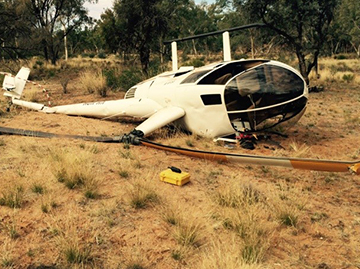
The pilot lowered the collective[2] and the helicopter contacted the ground with an amount of left lateral movement resulting in a rollover. The helicopter came to rest on its side sustaining substantial damage (Figure 1). The pilot was uninjured in the accident.

Figure 1: Helicopter post-accident

Figure 1: Helicopter post-accident.
Source: Operator

Source: Operator

Pilot comments

The pilot commented that normally a request for ground personnel assistance to herd the cattle would have been made, however as one of the ground personnel was recently injured the pilot was reluctant to ask for help. The pilot also advised that the mustering job had been delayed to late in the day, and therefore self-induced time pressure to complete the task existed. On reflection, the pilot advised the ATSB that these considerations may have influenced the decisions made on the day.

Brownout condition

The brownout phenomenon can lead to accidents during helicopter take-off and landing operations in arid / desert terrain. Dust clouds created by the rotor downwash during near-ground flight can result in the pilot losing visual reference. This increases the risk of the helicopter colliding with the ground and other obstacles, as well as dynamic rollover due to sloped, uneven terrain or uncommanded aircraft movement due to spatial disorientation.

There are several factors that affect the probability and severity of brownout:

  • aircraft weight / rotor disk loading
  • soil composition
  • wind
  • approach speed and angle.

Safety message

This accident highlights the importance of selecting a suitable landing area and the best approach path and landing technique for the surrounding environment. This includes consideration of appropriate escape routes when faced with an unexpected situation such as a brownout condition. Pilots should also always maintain situational awareness of environmental factors like wind direction, obstacles and surface conditions in order to mitigate risk and avoid an unfavourable situation.

About this report

Decisions regarding whether to conduct an investigation, and the scope of an investigation, are based on many factors, including the level of safety benefit likely to be obtained from an investigation. For this occurrence, no investigation has been conducted and the ATSB did not verify the accuracy of the information. A brief description has been written using information supplied in the notification and any follow-up information in order to produce a short summary report, and allow for greater industry awareness of potential safety issues and possible safety actions.
__________

  1. Brownout condition: is an in-flight visibility restriction due to dust or sand in the air. In a brownout, the pilot cannot see nearby objects which provide the outside visual references necessary to control the aircraft near the ground.  This can cause spatial disorientation and loss of situational awareness leading to an accident.
  2. Collective: a primary helicopter flight control that simultaneously affects the pitch of all blades of a lifting rotor. Collective input is the main control for vertical velocity.

Occurrence summary

Mode of transport Aviation
Occurrence ID AB-2020-024
Occurrence date 14/06/2020
Location Near Tindal Aerodrome
State Northern Territory
Occurrence class Accident
Aviation occurrence category Loss of control
Highest injury level None
Brief release date 27/07/2020

Aircraft details

Manufacturer Robinson Helicopter Co
Model R22 Beta II
Sector Helicopter
Operation type Aerial Work
Departure point Property near Tindal, Northern Territory
Damage Substantial

Fumes event involving a Gippsland Aeronautics GA-8, Elcho Island, Northern Territory, on 5 May 2020

Brief

Occurrence Briefs are concise reports that detail the facts surrounding a transport safety occurrence, as received in the initial notification and any follow-up enquiries. They provide an opportunity to share safety messages in the absence of an investigation.

What happened

On 5 May 2020, a Gippsland Aeronautics GA-8 was scheduled to operate a charter flight from Elcho Island to Ramingining, Northern Territory.

During the boarding process, the pilot asked the single passenger whether there were any dangerous goods in their luggage. The passenger proceeded to check the luggage and willingly handed over two spray cans with flammable contents. Following this, the pilot loaded the luggage into the aircraft.

As the aircraft climbed through approximately 4,000 ft, fumes were detected in the cabin described as smelling of solvent. At this time, the pilot became light-headed and adjusted the air vent to ensure fresh air was coming into the cabin. The pilot directed the passenger to check through the luggage for the source of the fumes. The passenger returned with a plastic container of glue, which had subsequently leaked. The pilot completed the fumes checklist and jettisoned the container safely out of the aircraft while operating over water.

Safety message

This incident highlights the importance of ensuring that all items taken on board an aircraft do not pose a safety risk to the flight. More information regarding dangerous goods can be found on the CASA website, including the Can I pack that? dangerous goods app for passengers.

About this report

Decisions regarding whether to conduct an investigation, and the scope of an investigation, are based on many factors, including the level of safety benefit likely to be obtained from an investigation. For this occurrence, no investigation has been conducted and the ATSB did not verify the accuracy of the information. A brief description has been written using information supplied in the notification and any follow-up information in order to produce a short summary report, and allow for greater industry awareness of potential safety issues and possible safety actions.

Occurrence summary

Mode of transport Aviation
Occurrence ID AB-2020-021
Occurrence date 05/05/2020
Location Elcho Island
State Northern Territory
Occurrence class Incident
Aviation occurrence category Fumes
Highest injury level None
Brief release date 25/06/2020

Aircraft details

Manufacturer Gippsland Aeronautics Pty Ltd
Model GA-8
Sector Piston
Operation type Charter
Departure point Elcho Island, Northern Territory
Destination Ramingining, Northern Territory
Damage Nil

Inadvertent cable cutter activation involving a Leonardo S.p.A. Helicopters AW139, near Tumut, New South Wales, on 22 April 2020

Brief

Occurrence Briefs are concise reports that detail the facts surrounding a transport safety occurrence, as received in the initial notification and any follow-up enquiries. They provide an opportunity to share safety messages in the absence of an investigation.

What happened

On 22 April 2020 at about 2323 Eastern Standard Time, the crew of a Leonardo S.p.A. Helicopters AW139 was conducting a mission involving the insertion of paramedics into a remote area in support of bushwalkers who had requested assistance. A short time after the safe insertion by hoist of the paramedics and their equipment, the paramedics requested that the helicopter return to overhead their position to assist with illuminating the area.

As the helicopter moved into position, the hoist operator positioned himself to use the hoist downlight for the illumination task. This involved him holding the hoist control pendant in his left hand and reaching for the search light directional control switch on the hoist panel with his right hand. At this moment, the helicopter experienced a gust of wind that disturbed the steady hover and caused the hoist operator to partially lose his balance.

In an attempt to stabilise himself, he held the door with his left hand and his right hand remained on or near the hoist control panel. As he was looking outside, the hoist operator’s gloved hand or wrist inadvertently flicked up the cable cutter guard and depressed the cable cutter switch in one movement, severing the hoist wire and resulting in the hook assembly falling to the ground.

Figure 1: Hoist control panel

Figure 1: Hoist control panel    Source: Operator

Source: Operator

Operator’s investigation

The proximity of the cable cutter guard to the searchlight directional control switch has been assessed by the operator as an issue since 2016 with various procedural controls being enacted and/or refreshed at various times. A Civil Aviation Safety Authority‑approved modification was applied to the original panel to reduce the risk of inadvertent cable cut activation, which included the cable cut shroud as well as restraint of the intercom system lead. This did not completely eliminate the risk, but did provide a measure of design protection.

Although numerous actions to reduce the risk of inadvertent cutter activation have been recorded in the operator’s safety management system since 2016, the operator considers that a design relocation of the searchlight control switch would reduce the risk of inadvertent activation to as low as reasonably practicable.

Safety action

As a result of earlier occurrences, the operator implemented an engineered risk reduction solution on their fleet in 2017 that included a shroud around the cable cut switch (Figure 2 left). This shroud was present during this occurrence.

The manufacturer released a service bulletin in September 2019 that introduced the optional installation of a hoist cable cutter frame ‘to prevent inadvertent cable cut lifting actions on the hoist control panel’ (Figure 2 right). Following this occurrence, the manufacturer issued revised alert service bulletin 139-637 in June 2020 to mandate the information from operational to mandatory, and provide modification instructions for installation.

The European Union Aviation Safety Agency also issued airworthiness directive no. 2020-0131 to require installation of the frame.

Figure 2: Operator’s solution - shroud around cable cut switch (left)

Manufacturer’s solution - frame around cable cut switch (right)

Figure 2: Operator’s solution - shroud around cable cut switch (left)    Manufacturer’s solution - frame around cable cut switch (right)

Source: Operator (left) and Leonardo Helicopters Service Bulletin 139-557 (right)

The aircraft operator advised the ATSB that in response to this recent occurrence they have undertaken a preliminary assessment to have the searchlight control switch moved from the hoist control panel and have it incorporated into the hoist operator’s pendant control. This will remove the need for the hoist operator to have their hand in close proximity to the cable cut switch on the hoist control panel while operating the searchlight directional switch.

Safety message

This incident serves as a reminder for all crew members that ergonomic aircraft characteristics may pose a potential hazard to the safe operation of the aircraft or its systems. Identification and communication of such hazards allows safety action to mitigate the associated risk.

About this report

Decisions regarding whether to conduct an investigation, and the scope of an investigation, are based on many factors, including the level of safety benefit likely to be obtained from an investigation. For this occurrence, no investigation has been conducted and the ATSB did not verify the accuracy of the information. A brief description has been written using information supplied in the notification and any follow-up information in order to produce a short summary report, and allow for greater industry awareness of potential safety issues and possible safety actions.

Occurrence summary

Mode of transport Aviation
Occurrence ID AB-2020-017
Occurrence date 22/04/2020
Location Near Tumut
State New South Wales
Occurrence class Incident
Highest injury level None
Brief release date 24/06/2020

Aircraft details

Manufacturer Leonardo Helicopters
Model AW139
Sector Helicopter
Operation type Aerial Work
Departure point Near Tumut, New South Wales
Damage Nil

Inadvertent load release involving an Airbus Helicopters AS 350 B3, near Wentworth Falls, New South Wales, on 20 February 2020

Brief

Occurrence Briefs are concise reports that detail the facts surrounding a transport safety occurrence, as received in the initial notification and any follow-up enquiries. They provide an opportunity to share safety messages in the absence of an investigation.

What happened

On 20 February 2020 at about 1322 Eastern Daylight-saving Time, the pilot of an Airbus Helicopters AS 350 B3 was conducting external load activities at the Rocket Point walking track near Wentworth Falls, New South Wales.

As the remote hook, slung 150 ft below the helicopter lifted a 122 kg load of pipe, the pilot checked the rigging and slowly accelerated the helicopter into forward flight. As the pilot observed the load was stable, the helicopter was accelerated to 40 kt. A short time later, the load was inadvertently released from the hook and fell approximately 1,000 ft into unoccupied bushland.

Operator’s investigation

The operator conducted an in-depth investigation into this occurrence and determined that there were three significant factors that contributed to the load release. They were unable to establish a clear single cause as to what precipitated the occurrence.

The first contributing factor was the use of load beam part number (P/N) 290-683-00, which is of a different design to the normal in-service load beam P/N 290-683-02, specifically in the length of the beam (Figure 1) and slight variation in geometry. According to the manufacturer’s manual, the shortened load beam can be retrofitted to different P/N cargo hooks, however the load ring warning decal that specifies a smaller diameter shackle must be displayed. The cargo hook and load beam in use at the time of occurrence had incorrectly been marked with warning decal for the longer beam design (this contravened the manufacturer’s manual by not displaying the correct load ring warning decal). This is how the operator received the hook back from a routine equipment servicing in 2017.

The load beam that was in use has approximately 30 mm reduced beam length and different geometry to the more commonly used load beam, further increasing the likelihood of dynamic rollout occurring.

Dynamic rollout (or ring rollout/D-ring reversal) is a phenomenon that can be described as the unintended release of the primary engaging ring from a winch or cargo hook that may occur after a momentary unloading situation. An unloading event permits a dynamic condition allowing the ring to travel up and flip over the beak (tip) of the hook and come to rest on the spring-loaded keeper. The ring is now only supported by the spring-loaded keeper. When the load is re-applied, the spring-loaded keeper allows the ring to fall free from the hook, thereby inadvertently releasing the load.

Figure 1: Remote Hooks – the different load beams

Figure 1: Remote Hooks – the different load beams.
Source: Operator

Source: Operator

Secondly, it had become common practice for ground staff to utilise the method of attaching loads by attaching the strop loop directly to the hook’s load beam. As the radius of the loop in the nylon strop is greater than the length of the load beam, the likelihood of dynamic rollout occurring significantly increases. The operator had prepared an internal safety alert stipulating that a correctly sized shackle must be used when attaching loads to the load beam, however due to delays this was not released by the time of the occurrence.

Lastly, with the four strop loops of the load within the hook, it is possible that this created an overcrowding situation which could have prevented the keeper from correctly operating and/or being less visible to the ground crew if the strops had been placed on the hook correctly.

While the operator was unable to determine the exact cause for the inadvertent release of the load, the operator concluded it was reasonable that the load dropped due to dynamic rollout or due to the incorrect rigging of the nylon load strops to the shortened load beam. Dynamic rollout is more likely, as it is a known fault to occur when using the nylon strops without shackles. The use of the remote hook with a shorter load beam further exacerbated the situation leading to the loss of the load.

Safety action

As a result of this occurrence, the aircraft operator has advised the ATSB that they have updated their operations manual procedure to prevent unintentional release from the remote hook. Specifically, this involves the use of a self-locking hook and swivel with a correctly sized shackle as the single attachment to the remote hook.

Figure 2: Remote Hook lifting load with self-locking hook and swivel

Figure 2: Remote Hook lifting load with self-locking hook and swivel.
Source: Operator

Source: Operator

Safety message

This incident serves as a reminder for both ground and aircrew members that while conducting sling and winch operations, there are potential hazards to the safe completion of the task. Identification and communication of such hazards allows safety action to mitigate the associated risk. Further information on dynamic rollout and prevention can be found in CASA’s Airworthiness Bulletin 25-006.

About this report

Decisions regarding whether to conduct an investigation, and the scope of an investigation, are based on many factors, including the level of safety benefit likely to be obtained from an investigation. For this occurrence, no investigation has been conducted and the ATSB did not verify the accuracy of the information. A brief description has been written using information supplied in the notification and any follow-up information in order to produce a short summary report, and allow for greater industry awareness of potential safety issues and possible safety actions.

Occurrence summary

Mode of transport Aviation
Occurrence ID AB-2020-023
Occurrence date 20/02/2020
Location Near Wentworth Falls
State New South Wales
Occurrence class Incident
Aviation occurrence category Loading related
Highest injury level None
Brief release date 22/06/2020

Aircraft details

Manufacturer Airbus Helicopters
Model AS 350 B3
Sector Helicopter
Operation type Aerial Work
Damage Nil

Landing gear malfunction involving an Aero Commander 500-S, Port Lincoln, South Australia, on 4 May 2020

Brief

Occurrence Briefs are concise reports that detail the facts surrounding a transport safety occurrence, as received in the initial notification and any follow-up enquiries. They provide an opportunity to share safety messages in the absence of an investigation.

What happened

On 4 May 2020, an Aero Commander 500-S was operating a freight charter flight from Port Lincoln Airport, South Australia with a single pilot on board. During initial climb, the pilot noticed that the landing gear unsafe light did not extinguish after the gear was retracted. The pilot contacted aerodrome ground crew to inspect the aircraft’s landing gear during a low-level fly-by. The ground crew, including an engineer, confirmed that the nose wheel was down but did not appear to be locked.

The pilot requested that emergency services attend the aerodrome for a return landing on runway 01, and continued troubleshooting in accordance with the operator’s standard operating procedures and the aircraft flight manual. The pilot conducted a touch-and-go landing on the rear wheels, which resulted in three green indication lights in the cockpit confirming the gear was down and locked. The crew subsequently conducted a further fly-by inspection where ground crew also confirmed the position of the nose landing gear. The aircraft then landed without further incident.

After an engineer inspected the landing gear, the aircraft taxied off the runway. An inspection of the landing gear system revealed that the nose gear actuator shaft had failed.

Figure 1: Failed nose gear actuator shaft

Figure 1: Failed nose gear actuator shaft.

Source: Aircraft operator

Safety action

As a result of previous similar occurrences, the aircraft operator has advised the ATSB that it has been conducting midlife inspections of the nose landing gear area, as well as additional testing of the actuator during overhauls. Additionally, their entire fleet of Aero Commander 500 aircraft has been fitted with underbelly skid blocks to support the nose in the event of a gear failure.

Safety message

This incident highlights the importance of effective cockpit scans for the early detection of any abnormal situations during flight. In this instance, the pilot identified the fault, took all precautionary measures and communicated clearly with ground crews resulting in a safe landing.

About this report

Decisions regarding whether to conduct an investigation, and the scope of an investigation, are based on many factors, including the level of safety benefit likely to be obtained from an investigation. For this occurrence, no investigation has been conducted and the ATSB did not verify the accuracy of the information. A brief description has been written using information supplied in the notification and any follow-up information in order to produce a short summary report, and allow for greater industry awareness of potential safety issues and possible safety actions.

Occurrence summary

Mode of transport Aviation
Occurrence ID AB-2020-019
Occurrence date 04/05/2020
Location Port Lincoln Airport
State South Australia
Occurrence class Incident
Aviation occurrence category Landing gear/indication
Highest injury level None
Brief release date 19/06/2020

Aircraft details

Manufacturer Aero Commander
Model 500-S
Sector Piston
Operation type Charter
Departure point Port Lincoln Airport, South Australia
Damage Nil

Request for navigational assistance involving a Piper PA-28-181, near Scone Airport, New South Wales, on 3 May 2020

Brief

Occurrence Briefs are concise reports that detail the facts surrounding a transport safety occurrence, as received in the initial notification and any follow-up enquiries. They provide an opportunity to share safety messages in the absence of an investigation.

What happened

On 3 May 2020 at about 1400 Eastern Standard Time, a solo student pilot was conducting a navigation exercise in a Piper PA-28-181 in the vicinity of Scone, New South Wales. The pilot became unsure of the aircraft’s position when he was unable to identify Scone Airport and followed the lost procedure, contacting air traffic control (ATC) for assistance.

As there was poor VHF reception with the aircraft, two other aircraft in the area provided navigational assistance and relayed instructions between ATC and the pilot of the Piper PA-28-181. ATC requested the aircraft climb to 7,500 ft in an attempt to be identified by radar. Once the aircraft was identified, ATC then provided a heading for Scone Airport and the aircraft proceeded without further incident.

Following the flight, the instructor conducted a two-hour incident debrief with the student pilot. The student will undertake further map reading training to ensure proficiency in this area prior to his next flight.

Safety message

This incident highlights the importance of remaining calm and remembering procedures in the face of uncertainty. If a pilot is unsure of the aircraft’s location, ATC is able to assist with locating positions using transponder codes, prominent landmarks and radio navigation.

In this incident, the further assistance provided by aircraft in the vicinity ensured a positive outcome.

About this report

Decisions regarding whether to conduct an investigation, and the scope of an investigation, are based on many factors, including the level of safety benefit likely to be obtained from an investigation. For this occurrence, no investigation has been conducted and the ATSB did not verify the accuracy of the information. A brief description has been written using information supplied in the notification and any follow-up information in order to produce a short summary report, and allow for greater industry awareness of potential safety issues and possible safety actions.

Occurrence summary

Mode of transport Aviation
Occurrence ID AB-2020-020
Occurrence date 03/05/2020
Location Near Scone
State New South Wales
Occurrence class Incident
Aviation occurrence category Lost/unsure of position
Highest injury level None
Brief release date 05/06/2020

Aircraft details

Manufacturer Piper Aircraft Corp
Model PA-28-181
Sector Piston
Operation type Flying Training
Departure point Scone Airport, New South Wales
Destination Scone Airport, New South Wales
Damage Nil

Fuel starvation and forced landing involving a Miles M3A Falcon, near Hamilton Airport, Victoria, on 17 April 2020

Brief

Occurrence Briefs are concise reports that detail the facts surrounding a transport safety occurrence, as received in the initial notification and any follow-up enquiries. They provide an opportunity to share safety messages in the absence of an investigation.

What happened

On 17 April 2020, a Miles M3A Falcon single-engine piston aircraft was operating a ferry flight from Lilydale to Nelson, Victoria. There was one pilot and one passenger on board.

During cruise, after flying for about 2 hours and 20 minutes, the pilot decided to conduct a diversion to Hamilton for the day due to approaching weather and lighting conditions. Approximately 9 km south-east of Hamilton at 2,000 ft AGL, the engine failed. The pilot attempted to restart the engine by changing the fuel selector from the ‘both’ selection to the left tank but was unsuccessful. The pilot then changed the fuel selector to the right tank and the engine restarted momentarily, before cutting out again.

The pilot identified a large paddock nearby to conduct a forced landing. The aircraft was unable to reach the desired paddock and the pilot subsequently conducted the forced landing in a smaller paddock.

After touchdown, the right wing struck a fence post and the aircraft swung sideways. The aircraft then struck a second wire fence, and the wire pulled the aircraft to a stop. The right landing gear collapsed, the propeller struck the ground and the wing’s leading edge sustained damage. The pilot and passenger were uninjured.

Engineering inspection

The engineering inspection revealed that as the aircraft had not been operated for several years, debris accumulated in the fuel lines resulting in a blockage during flight and the engine failure. The inspection further revealed that there was 60 litres of fuel remaining in the left tank, and no fuel remained in the right tank.

Figure 1: Fuel line blockage and debris

Figure 1: Fuel line blockage and debris.
Source: Pilot

Source: Pilot

Figure 2: Fuel line blockage and debris

Figure 2: Fuel line blockage and debris.
Source: Pilot

Source: Pilot

Pilot comments

The pilot advised that normally, a low-wing aircraft would only have left and right fuel selector positions. This aircraft, which he had recently purchased, is fitted with a fuel selector that has a ‘both’ position and he assumed that fuel was drawing equally from both wing tanks. He therefore believed having the fuel selector set to this position was the best option for the flight. The pilot further commented that it would have been beneficial to have conducted a check of the fuel supply from the left-wing tank 1.5 hours into the flight to ensure there was enough fuel flow for the cruise consumption of 32 litres per hour and to check that fuel was drawing from both wing tanks.

Safety message

This accident highlights the importance of ensuring all aircraft systems and components are operating as per the aircraft manual.

It also serves as a reminder that keeping fuel supplied to the engine during flight relies on the pilot’s knowledge of the aircraft’s fuel supply system and being familiar and proficient in its use.

More information on fuel management can be found in the ATSB research report, Starved and Exhausted: Fuel management aviation accidents (AR-2011-112).

About this report

Decisions regarding whether to conduct an investigation, and the scope of an investigation, are based on many factors, including the level of safety benefit likely to be obtained from an investigation. For this occurrence, no investigation has been conducted and the ATSB did not verify the accuracy of the information. A brief description has been written using information supplied in the notification and any follow-up information in order to produce a short summary report, and allow for greater industry awareness of potential safety issues and possible safety actions.

Occurrence summary

Mode of transport Aviation
Occurrence ID AB-2020-014
Occurrence date 17/04/2020
Location 9 km south-east of Hamilton Airport
State Victoria
Occurrence class Accident
Aviation occurrence category Fuel starvation
Highest injury level None
Brief release date 22/05/2020

Aircraft details

Model Miles M3A Falcon
Sector Piston
Operation type Private
Departure point Lilydale, Victoria
Destination Nelson, Victoria
Damage Substantial

Loss of control involving a Robinson R44 helicopter, Townsville Airport, Queensland, on 23 April 2020

Brief

Occurrence Briefs are concise reports that detail the facts surrounding a transport safety occurrence, as received in the initial notification and any follow-up enquiries. They provide an opportunity to share safety messages in the absence of an investigation.

What happened

On 23 April 2020, the student pilot of a Robinson R44 helicopter was returning to Townsville Airport, Queensland, from a solo training navigation exercise.

As the pilot returned the helicopter to the parking position near the hangar and was in the process of landing from the hover, he momentarily lost directional yaw control. At this time, one of the helicopter’s skids was in contact with the ground while the collective[1] was in a raised position. This resulted in an unstable airframe that commenced a roll about the skid.

Despite the efforts of the pilot to recover, the helicopter continued to rollover and came to rest on its side resulting in substantial damage. The pilot was uninjured in the accident.

Figure 1: Helicopter post-accident

Figure 1: Helicopter post-accident.
Source: Townsville Airport

Source: Townsville Airport

Figure 2: Helicopter’s bent tail boom and broken main rotor blade

Figure 2: Helicopter’s bent tail boom and broken main rotor blade.
Source: Townsville Airport

Source: Townsville Airport

Helicopter static and dynamic rollovers

Static rollover occurs when a helicopter is pivoted about one of its landing skids or wheels and the helicopter’s centre of gravity passes outside the in-contact skid or wheel. Once in this position, removal of the original force that raised the helicopter to that angle will not stop the helicopter from rolling further. This angle is termed the ‘static rollover angle.’

A rotors-running helicopter resting with one landing skid or wheel on the ground may, without appropriate pilot input, commence rolling. Under certain circumstances, this roll cannot be controlled and the helicopter rolls over. This condition is known as ‘dynamic rollover’ and is a function of the interaction between the:

  • horizontal component of the total rotor thrust (or lift) acting about the point of ground contact
  • weight of the aircraft, initially acting between the helicopter’s skid landing gear or wheels. This second, counter-rolling moment decreases the greater the roll.

Recovery from dynamic rollover is by smoothly lowering the collective lever while controlling any tendency to roll in the opposite direction with cyclic[2] to re-establish the helicopter’s weight evenly on the ground. In general, the application of smooth collective inputs is more effective in avoiding rollover issues than using the cyclic control.

Safety message

This accident highlights the importance of smooth and controlled flight control inputs in the critical phases of flight. While a helicopter is in contact with the ground and before its full weight is applied to the landing gear, it is subject to various influences such as the possibility of a rollover. A thorough understanding of the principles of, and contributing factors to, both static and dynamic rollover and the recovery methods are essential to conducting safe helicopter lift-offs and landings.

About this report

Decisions regarding whether to conduct an investigation, and the scope of an investigation, are based on many factors, including the level of safety benefit likely to be obtained from an investigation. For this occurrence, no investigation has been conducted and the ATSB did not verify the accuracy of the information. A brief description has been written using information supplied in the notification and any follow-up information in order to produce a short summary report, and allow for greater industry awareness of potential safety issues and possible safety actions.

__________

  1. Collective: a primary helicopter flight control that simultaneously affects the pitch of all blades of a lifting rotor. Collective input is the main control for vertical velocity.
  2. Cyclic: a primary helicopter flight control that is similar to an aircraft control column. Cyclic input tilts the main rotor disc, varying the attitude of the helicopter and hence the lateral direction.

Occurrence summary

Mode of transport Aviation
Occurrence ID AB-2020-015
Occurrence date 23/04/2020
Location Townsville Airport
State Queensland
Occurrence class Serious Incident
Aviation occurrence category Loss of control
Highest injury level None
Brief release date 09/06/2020

Aircraft details

Manufacturer Robinson Helicopter Co
Model R44 II
Sector Helicopter
Operation type Flying Training
Destination Townsville Airport, Queensland
Damage Substantial

Pre-flight preparation incident involving a Beechcraft B200, Brisbane, Queensland, on 28 April 2020

Brief

Occurrence Briefs are concise reports that detail the facts surrounding a transport safety occurrence, as received in the initial notification and any follow-up enquiries. They provide an opportunity to share safety messages in the absence of an investigation.

What happened

On 28 April 2020 at about 1900 Eastern Standard Time, after last light, a Beechcraft B200 was being prepared for a flight from Brisbane to Rockhampton, Queensland. The aircraft was parked on an apron that required it to be chocked for refuelling.

Shortly after take-off, the pilot heard a noise outside the aircraft and asked a crew member to look out the window to confirm if the wing lockers were visibly closed. The crew member confirmed, and as the source of the noise could not be immediately determined the pilot decided to return the aircraft to Brisbane.

During the approach, the crew member identified that one of the aircraft's wooden chocks was not secured correctly and was hanging outside the aircraft by a rope.

Figure 1: Wheel chock-tie hanging out of the door

Figure 1: Wheel chock-tie hanging out of the door.
Source: Operator

Source: Operator

Operator comments

The operator has advised the ATSB that as there is a company requirement to use the chocks while refuelling at Brisbane, they are often stored loose in the cargo area for ease of access rather than in the bung bag, underneath equipment. The aircraft was also being prepared for departure at night, which contributed to the incident.

Safety action

As a result of this occurrence, the operator has advised the ATSB that it is taking the following safety action:

An advisory will be issued to all crew to beware of the possibility of items trapped or falling from the door while being closed, and also to ensure adequate illumination is used when securing doors or items in the aircraft.

The operator is also exploring alternative stowage locations and methods for securing loose chocks.

Safety message

The main cargo area in general aviation aircraft is often located adjacent to doors or hatches. Items stored in these locations have the potential to obstruct or impact the security of the door. This incident highlights the importance of conducting a thorough pre-flight inspection and ensuring loose articles are correctly stowed before departure.

About this report

Decisions regarding whether to conduct an investigation, and the scope of an investigation, are based on many factors, including the level of safety benefit likely to be obtained from an investigation. For this occurrence, no investigation has been conducted and the ATSB did not verify the accuracy of the information. A brief description has been written using information supplied in the notification and any follow-up information in order to produce a short summary report, and allow for greater industry awareness of potential safety issues and possible safety actions.

Occurrence summary

Mode of transport Aviation
Occurrence ID AB-2020-018
Occurrence date 29/04/2020
Location Brisbane Airport
State Queensland
Occurrence class Incident
Aviation occurrence category Aircraft preparation
Brief release date 28/05/2020

Aircraft details

Manufacturer Hawker Beechcraft Corporation
Model B200
Sector Turboprop
Operation type Aerial Work
Departure point Brisbane, Queensland
Destination Rockhampton, Queensland
Damage Minor