Loss of control

Collision with terrain involving Cessna 172N, VH-SCU, about 6 km south of Newcastle Waters, Northern Territory, on 7 November 2025

Final report

Report release date: 20/05/2026

Investigation summary

What happened

At around 0655 local time on 7 November 2025, a Cessna 172N, registered VH-SCU and operated by Consolidated Pastoral Company (CPC), departed Newcastle Waters Airport, Northern Territory, on a training flight. On board the aircraft were the pilot and an instructor. The pilot was being trained to fly at low level, with the intention of obtaining a low-level operational rating. 

About one hour into the flight while flying at around 300 ft above the ground at an airspeed of 80 kts, and manoeuvring to follow a creek bed, the pilot initiated a steep turn to the right. During the turn, control of the aircraft was lost and it descended towards the ground. The instructor attempted to override the pilot’s control inputs but could not do so before the aircraft impacted terrain. The aircraft came to rest upright but was substantially damaged. The instructor received minor injuries, the pilot was uninjured.      

What the ATSB found

The ATSB found that while conducting a steep turn at low level, excessive aft control input was applied which almost certainly caused the aircraft to enter an aerodynamic stall. Subsequently, inappropriate recovery control inputs by the pilot limited the instructor’s ability to intervene before the aircraft collided with the ground.

The initial excessive control input was likely a combined result of the pilot being focused on maintaining a track over the ground feature and their inexperience in handling the aircraft during low-level flight. The subsequent application of an inappropriate stall recovery technique was likely caused by the pilot reverting to instinctive rather than learned behaviour under stress.   

The ATSB also found that the instructor's recovery control inputs likely prevented the aircraft from impacting terrain in a nose down attitude and reduced the severity of the collision. 

What has been done as a result

The flight training provider undertook a critical review of its training practices and risk mitigation measures. 

Safety message

This accident highlights the importance of understanding the relationship between the elevator control stick position and the aircraft’s angle of attack, to minimise the risk of an aerodynamic stall. The wing will stall when the control stick is moved beyond a fixed position, irrespective of airspeed and attitude. During steep turns at low airspeed, awareness of the stick position provides increased awareness of the aircraft’s performance relative to its limits. This is particularly important to consider when operating close to the ground, such as during take-off, landing, and when conducting low-level air work. Attention may become focused on positioning the aircraft relative to ground features rather than monitoring its aerodynamic performance, and the time available for recovery from an undesired state will be limited. 


The investigation

The ATSB scopes its investigations based on many factors, including the level of safety benefit likely to be obtained from an investigation and the associated resources required. For this occurrence, the ATSB conducted a limited-scope investigation in order to produce a short investigation report, and allow for greater industry awareness of findings that affect safety and potential learning opportunities.

The occurrence

At around 0655 local time on 7 November 2025, a Cessna 172N, registered VH-SCU and operated by Consolidated Pastoral Company (CPC), departed Newcastle Waters Airport, Northern Territory, on a training flight. On board the aircraft were the pilot and an instructor. The pilot was being trained to fly at low level,1 with the intention of obtaining a low-level operational rating and had completed 6 training flights with the instructor over the previous 3 days. The purpose of this flight was to consolidate the earlier training and prepare for the low-level rating flight test.

The aircraft was initially climbed to an altitude of approximately 2,000 ft above ground level (AGL), where the pilot demonstrated a sequence of flight manoeuvres. These included left and right turns at angles of bank up to 60° and minimum radius turns at angles of bank up to 45° (see the section titled Minimum radius turns). The pilot also demonstrated their ability to identify and recover from a stall during a minimum radius turn.

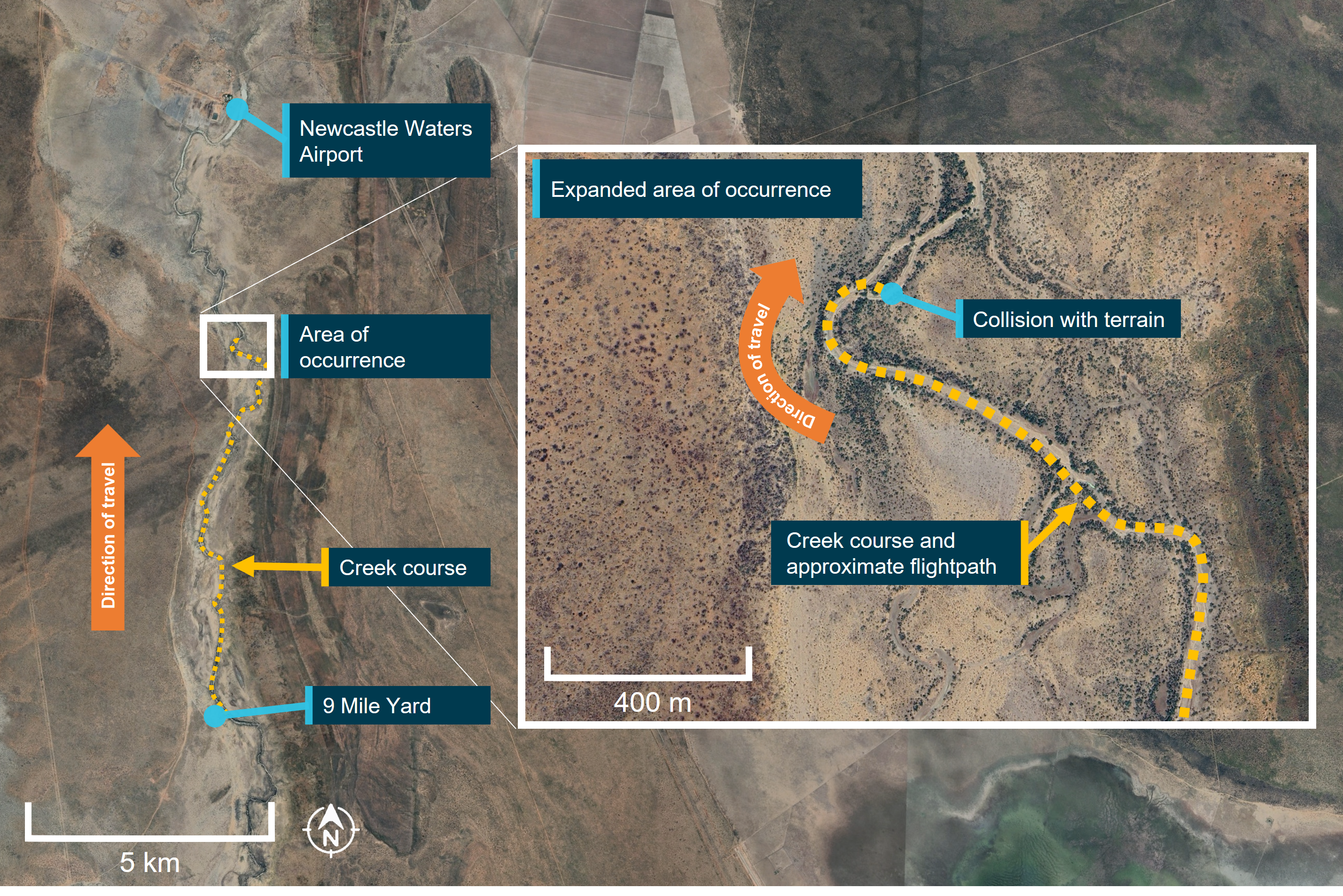
The pilot then proceeded to perform a pre-briefed low-level task, which simulated a typical airborne survey of station infrastructure. This task was flown at altitudes between 200 ft and 1,000 ft AGL and incorporated simulated contingencies such as system and engine failures. At the completion of this portion of the training flight, the aircraft was approximately 13 km south of Newcastle Waters Airport, just north of 9 Mile Yard (Figure 1).

The instructor then asked the pilot to return to the departure airport by following the Newcastle Waters Creek in a northerly direction, simulating a water course survey activity (Figure 1). The task commenced at an altitude of 300 ft and the pilot was reminded not to descend below the pre-briefed minimum altitude of 200 ft. At around 0750, a few minutes into the activity, the pilot observed that the creek bed ahead made a sharp turn to the right and they began to manoeuvre the aircraft to keep the ground feature directly below the aircraft. At the start of this manoeuvre, the aircraft was flying approximately 300 ft above the terrain at an airspeed of around 80 kt, with flaps retracted. 

Figure 1: Low-level flightpath over the Newcastle Waters Creek and the location of the collision with terrain  

The image is an annotated Google Earth map showing the flightpath from 9 Mile Yard to the accident site.

Source: Google Earth, annotated by ATSB

The pilot rolled the aircraft right to a bank angle of around 45º. As the turn commenced, both the pilot and instructor noted that the aircraft’s nose was pitching down and the aircraft was beginning to descend. The instructor expected that the pilot would correct the pitch attitude by adding power, following the technique that had been taught and successfully demonstrated during the preceding training. 

In addition to the observed descent, the pilot also noted that the aircraft was not turning quickly enough to remain above the ground feature, and in response they rapidly applied more aft control column input to tighten the turn, recalling that they also added a ‘smidge’ more power, however the instructor advised no power was added. In response, the aircraft rolled further to the right and continued to descend. Immediately, the pilot attempted to level the aircraft’s wings and arrest its descent by applying left roll control input, however they maintained aft control input. They stated they did not hear the stall warning horn activate throughout the manoeuvre. 

The instructor could also not recall if they heard the stall warning, however they assessed that the aircraft was in an aerodynamic stall and attempted to intervene by making opposing corrective inputs through their own control column but they could not overcome the control forces being held by the pilot. They could not remember if they advised they were ‘taking over’ however, the pilot flying recalled that the instructor had announced that they were ‘taking over’ and they subsequently released the controls. The pilot advised that the aircraft was already below the tops of the trees before the instructor’s inputs could take effect. 

The instructor stated that they judged that the aircraft would now almost certainly impact the terrain, and that the rudder pedals and throttle were the only effective control inputs available. They applied full power and right rudder with the aim of raising the aircraft’s nose and inducing further right yaw. The instructor’s intent was to prevent the aircraft from impacting terrain nose first and therefore improve the likelihood of survivability. 

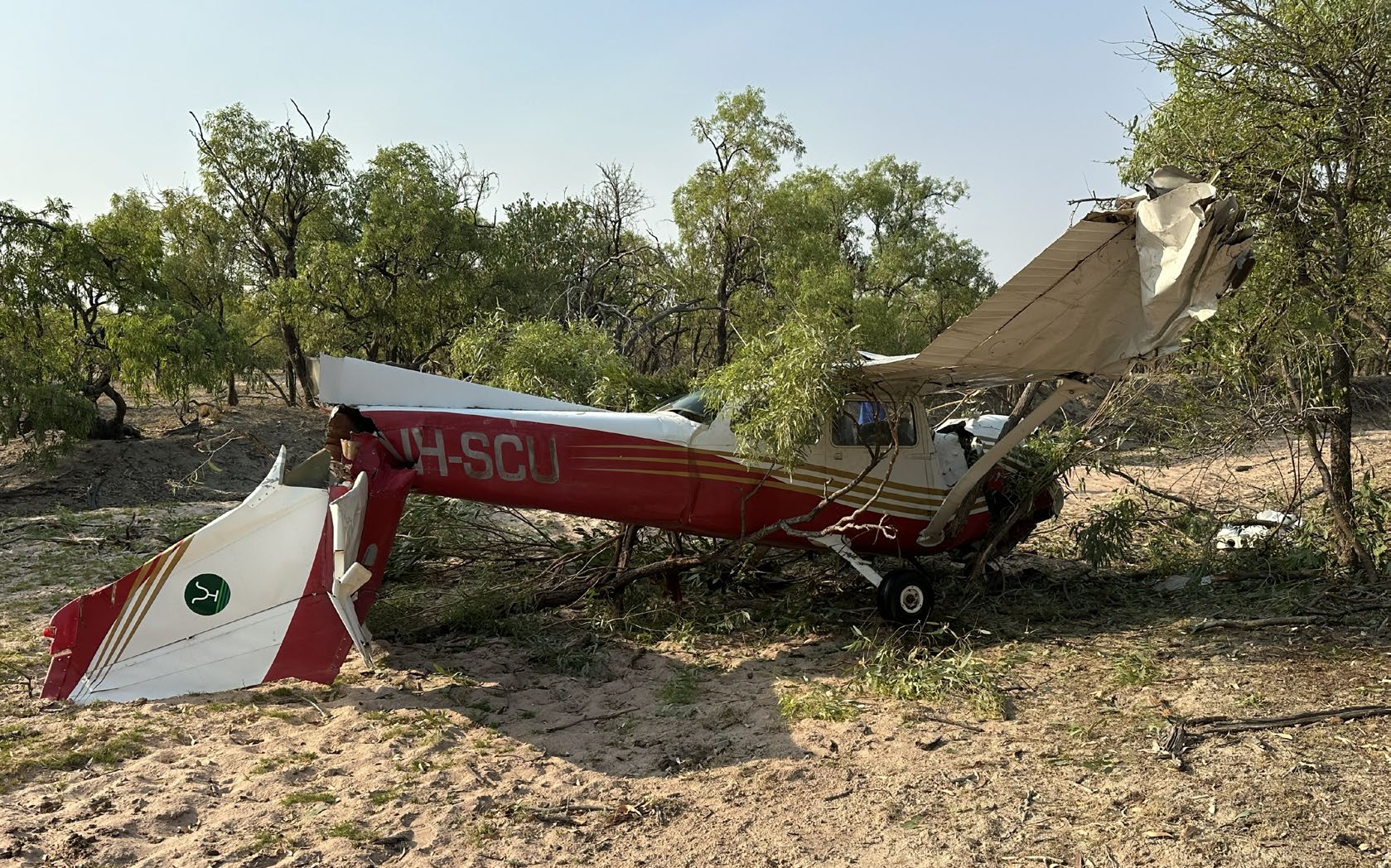
As the aircraft descended below the height of the treetops, its pitch attitude had almost levelled, its roll angle had reduced, and it was yawing to the right. The aircraft then impacted the trees, before coming to rest upright on its undercarriage, on relatively flat terrain. It had yawed during the impact sequence, such that it was facing back along its flightpath through the trees. The aircraft sustained extensive damage, particularly to its wings and tail section, with the latter being almost completely detached from the rear fuselage (Figure 2).

Figure 2: VH-SCU as it came to rest following impact with trees and terrain

AO-2025-066 Figure 2 image.jpeg

Source: Supplied

Immediately after the aircraft came to rest, fuel began draining from a rupture in the right wing prompting the crew to exit the aircraft through the left door. During the impact, the instructor sustained minor injuries, while the pilot suffered no visible injuries but reported some neck pain. 

The pilot used a mobile telephone to report the occurrence to the operator, and a ground vehicle was dispatched, which arrived at the accident site at around 0835 and subsequently transported both crew members back to the Newcastle Waters station. Following an initial examination by medical staff, both crew were conveyed to a medical clinic for treatment. The instructor was later discharged, while the pilot was transported to a hospital in Alice Springs for further assessment and monitoring. The pilot was discharged from hospital the following day. 

Context

Flight crew

The pilot of VH-SCU held a Commercial Pilot Licence (Aeroplane) issued in 2024 and a class 1 aviation medical certificate. They had accumulated around 300 flight hours, mostly on single engine piston training aircraft, including the Cessna 172 and Diamond DA40. They had worked as a pilot on the station since October 2025.

The instructor held an Air Transport Pilot Licence (Aeroplane), a class 1 aviation medical, and a low-level rating, among other ratings and endorsements. They had accumulated a total of around 24,500 flying hours, with approximately 2,500 hours in the Cessna 172. They had flown 240 hours in the 90 days prior to the occurrence, with 25 of those in the Cessna 172. 

Aircraft

VH-SCU was a Cessna Aircraft Company 172N manufactured in the United States in 1977 and assigned serial number 17268700. It was equipped with a Textron Lycoming O‑320‑H2AD piston engine, fixed pitch propeller, and fixed tricycle undercarriage. Maintenance records indicated that the airframe had accumulated a total flying time of 15,995 hours prior to the accident flight and the engine had 927.6 hours since overhaul. The aircraft was being maintained under the Civil Aviation Safety Authority Schedule 5 and had flown 45 hours since its most recent maintenance event, which was a 100-hour inspection performed on 23 August 2025. 

The aircraft had no recording devices on board and nor was it required to.

Weather

No weather information was recorded for Newcastle Waters station, however the Bureau of Meteorology provided information for the nearest observation station at Daly Waters, approximately 123 km north. An observation issued at 0800 local time reported the temperature to be 29°, with a dew point of 21°, an atmospheric pressure of 1010 hectopascals, and a surface wind of between 8–10 kt from the north. This station did not provide a report of visibility or cloud cover.

Both flight crew provided consistent reports of the weather conditions at Newcastle Waters. They recalled a temperature of between 22–26°, winds of between 5–10 kt from the north-west, smooth air with no mechanical turbulence, and no cloud. There was light smoke haze but this did not significantly impair their visibility. The instructor estimated the density altitude2 to be approximately 3,000 ft.  

Low-level training

The low-level flight training was being provided under the provisions of Part 141 of the Civil Aviation Safety Regulations (CASR). The instructor was qualified to deliver this training and had provided the same training to other pilots, employed at the station, on numerous occasions prior.

Part 61 of the CASR required an applicant for a low-level rating and aeroplane low-level endorsement to have, among other conditions: 

• undertaken at least 5 hours of dual flight training in an aeroplane while receiving training in low level operations

• pass a flight test defined in the Part 61 manual of standards.  

The Part 61 manual of standards prescribed a set of knowledge and flying competencies, which must be satisfactorily demonstrated during the low-level rating flight test. The specific activities and manoeuvres to be demonstrated during the flight test included:

• navigate at low-level

• conduct steep, max rate and min radius turns

• recover from approach to stalls – level and turning

• recover from unusual attitudes

• recover from wing drop at the stall

The training syllabus employed by the instructor planned for all airborne activities and manoeuvres to be taught over a period of 5 flying hours. The instructor reported that, in their experience, most students achieved competency within this period. 

At the time of the accident, the pilot flying had undertaken 10.1 hours of low-level training. Training records indicated that additional flying hours were required at the start of the course for the student to demonstrate competency in some manoeuvres, including maintaining altitude during steep turns, stall recognition and recovery. However, during a period of upper air work conducted earlier in the accident flight, the student had successfully demonstrated competency in all these manoeuvres. 

Aircraft stall behaviour

The angle of attack (AOA) is the angle at which the wing meets the relative airflow passing the aircraft. It is directly related to elevator position and therefore control stick position. The amount of lifting force produced by the wing increases with increasing AOA until a critical angle is reached. At the critical AOA (typically 16–18°), the wing aerodynamically stalls and lift production decreases abruptly. Recovering from a stall requires AOA be reduced below the critical angle by reducing aft control stick displacement. 

Should the critical AOA be approached during a turn, using aileron to level the wings increases the AOA of the inside wing and may cause it to stall prior to the outside wing. This can result in the angle of bank rapidly increasing rather than decreasing. Instead, it is recommended that rudder is used to level the wings when a stall is encountered. 

Minimum radius turns

A minimum radius turn achieves a change in aircraft direction over the smallest possible ground space. This technique is often used in low-flying operations where manoeuvring is made with respect to a ground feature and within confined terrain. Minimum radius turns are typically conducted at high angles of bank and lower airspeeds. Both conditions increase the AOA required to maintain level flight. The margin between required AOA and the critical (stalled) AOA is therefore reduced. 

Adding additional aft control stick displacement during a minimum radius turn can quickly result in the wing exceeding the critical AOA and entering a stalled condition. For this reason, pilots are often instructed to correct low attitude during minimum radius turns through application of power, rather than additional aft control stick input.

Related occurrences

There have been a number of recent ATSB investigations into fatal accidents that resulted from a loss of control while manoeuvring during low-level flight. 

ATSB investigation AO-2024-037

On 27 June 2024, the pilot of a Cessna 172N, registered VH-SQO, was mustering sheep at Mulgathing Station, South Australia. The aircraft was observed to dive to an estimated height of about 50 ft above the ground before climbing rapidly, turning to the left and then descending towards the ground. The ATSB found that, while mustering without the appropriate endorsement, the pilot lost control of the aircraft leading to an aerodynamic stall and spin from an altitude that was not recoverable.

ATSB investigation AO-2022-011

On 3 March 2022, the sole pilot of a Cessna U206G, registered VH-JVR, was conducting a low-level geophysical survey, about 120 km west of Norseman, Western Australia. At about 1430, the aircraft’s satellite tracking system stopped reporting its position. Wreckage was subsequently located 3.2 km west of the aircraft’s last recorded position. The ATSB found it was likely that, during a manoeuvre to intercept the next survey line, for undetermined reasons, control of the aircraft was lost at a height from which recovery was not possible. 

ATSB investigation AO-2021-016

On 13 April 2021, a Cessna R172K, registered VH-DLA, departed Canberra Airport, Australian Capital Territory, with a pilot and observer on board to conduct powerline survey work to the north of Sutton township, New South Wales. The aircraft was subsequently observed flying low above the trees before commencing a left turn that continued in to a steep descent and collision with terrain. The ATSB found that while manoeuvring to align the aircraft to inspect a powerline, the aircraft aerodynamically stalled and entered a spin at a height that was insufficient for recovery prior to the collision with terrain.

ATSB investigation AO-2021-052

On 4 December 2021, the pilot of an Air Tractor AT-400 aircraft, registered VH-ACQ, was conducting aerial spraying operations on a property 75 km west-south-west of Moree, New South Wales. During a right procedure turn, the aircraft was observed to climb then descend rapidly and collide with terrain. The ATSB found that the aircraft was too close to the start of the spray run during the turn, which probably resulted in the pilot tightening the turn. This almost certainly resulted in an aerodynamic stall at a height too low to recover before colliding with the terrain.

Safety analysis

The pilot and instructor were conducting a low-level navigation exercise, tracking along a ground feature at approximately 300 ft AGL and 80 kt. 

Accounts from both crew members indicated that while making a steep right turn to follow the ground feature, the aircraft’s nose dropped. Additionally, the pilot observed that the aircraft was not turning quickly enough to remain over the river. In response, they sharply increased their aft control stick input rather than increase the bank angle. This almost certainly placed the aircraft into an aerodynamically stalled condition rapidly increasing the rate of descent and further rolling to the right. 

The pilot did not follow the recommended method to address the nose drop at low level - application of power rather than increasing pitch, which they had demonstrated successfully earlier in the flight. The ATSB could not determine why the correct recovery technique was not applied. However, human factors research (Martin, Murray, Bates and Lee 2013) noted that when faced with a sudden unexpected aircraft condition, pilots may experience a rapid increase in stress and revert to instinctive behaviour over trained behaviour. 

After recognising that the pilot had applied inappropriate control inputs the instructor attempted to intervene. It is uncertain what verbal communication was made between the crew, but there was a period of confusion over who had control of the aircraft, and it is likely both crew members were making control inputs simultaneously resulting in the instructor being unable to override the control inputs of the pilot, delaying the effectiveness of the recovery actions. Due to the proximity to the ground, the aircraft descended into terrain before this confusion could be resolved. Despite this, the instructor’s inputs to the throttle and rudder likely prevented the aircraft from contacting the ground in a nose down attitude and reduced the severity of the impact.    

Findings

ATSB investigation report findings focus on safety factors (that is, events and conditions that increase risk). Safety factors include ‘contributing factors’ and ‘other factors that increased risk’ (that is, factors that did not meet the definition of a contributing factor for this occurrence but were still considered important to include in the report for the purpose of increasing awareness and enhancing safety). In addition ‘other findings’ may be included to provide important information about topics other than safety factors. 

These findings should not be read as apportioning blame or liability to any particular organisation or individual.

From the evidence available, the following findings are made with respect to the collision with terrain involving Cessna 172, VH-SCU, about 6 km south of Newcastle Waters, Northern Territory, on 7 November 2025. 

Contributing factor

  • While training to follow a ground feature at low level, the pilot flying applied and held inappropriate control inputs, which led to an aerodynamic stall and limited the instructor’s ability to make corrective actions, resulting in the aircraft colliding with terrain.

Other finding

  • The instructor's control inputs likely prevented the aircraft from impacting terrain in a nose down attitude and reduced the severity of the collision.

Safety actions

Whether or not the ATSB identifies safety issues in the course of an investigation, relevant organisations may proactively initiate safety action in order to reduce their safety risk. The ATSB has been advised of the following proactive safety action in response to this occurrence.

Safety action by flight training provider

The flight training provider undertook a critical review of its training practices and risk mitigation measures.

Sources and submissions

Sources of information

The sources of information during the investigation included:

  • the pilot and instructor of the accident flight
  • Consolidated Pastoral Company
  • Bureau of Meteorology.

References

Martin, Murray, Bates, and Lee (2015) Fear-potentiated startle: A review from an aviation perspective. The International Journal of Aviation Psychology25(2), pp.97-107.

Submissions

Under section 26 of the Transport Safety Investigation Act 2003, the ATSB may provide a draft report, on a confidential basis, to any person whom the ATSB considers appropriate. That section allows a person receiving a draft report to make submissions to the ATSB about the draft report. 

A draft of this report was provided to the following directly involved parties:

  • the pilot and instructor of the accident flight
  • Consolidated Pastoral Company
  • Civil Aviation Safety Authority.

Submissions were received from:

  • the pilot and instructor of the accident flight
  • Consolidated Pastoral Company.

The submissions were reviewed and, where considered appropriate, the text of the report was amended accordingly.

Purpose of safety investigations

The objective of a safety investigation is to enhance transport safety. This is done through: 

  • identifying safety issues and facilitating safety action to address those issues
  • providing information about occurrences and their associated safety factors to facilitate learning within the transport industry.

It is not a function of the ATSB to apportion blame or provide a means for determining liability. At the same time, an investigation report must include factual material of sufficient weight to support the analysis and findings. At all times the ATSB endeavours to balance the use of material that could imply adverse comment with the need to properly explain what happened, and why, in a fair and unbiased manner. The ATSB does not investigate for the purpose of taking administrative, regulatory or criminal action.

About ATSB reports

ATSB investigation reports are organised with regard to international standards or instruments, as applicable, and with ATSB procedures and guidelines.

Reports must include factual material of sufficient weight to support the analysis and findings. At all times the ATSB endeavours to balance the use of material that could imply adverse comment with the need to properly explain what happened, and why, in a fair and unbiased manner.

An explanation of terminology used in ATSB investigation reports is available here. This includes terms such as occurrence, contributing factor, other factor that increased risk, and safety issue.

Publishing information

Released in accordance with section 25 of the Transport Safety Investigation Act 2003

Published by: Australian Transport Safety Bureau

© Commonwealth of Australia 2025

 Ownership of intellectual property rights in this publication

Unless otherwise noted, copyright (and any other intellectual property rights, if any) in this report publication is owned by the Commonwealth of Australia.

Creative Commons licence

With the exception of the Commonwealth Coat of Arms, ATSB logo, and photos and graphics in which a third party holds copyright, this report is licensed under a Creative Commons Attribution 4.0 International licence.

CC BY logo

The CC BY 4.0 licence enables you to distribute, remix, adapt, and build upon our material in any medium or format, so long as attribution is given to the Australian Transport Safety Bureau. 

Copyright in material obtained from other agencies, private individuals or organisations, belongs to those agencies, individuals or organisations. Where you wish to use their material, you will need to contact them directly.

  1. ^    CASA defines low-level flight operation as any flying conducted below 500 ft above ground level (AGL), other than for the purpose of take-off or landing.
  2. ^    Density altitude is the pressure altitude corrected for non-standard temperature. It is the altitude at which the aircraft ‘feels’ it is flying regardless of its actual height above sea level. 

Occurrence summary

Investigation number AO-2025-066
Occurrence date 07/11/2025
Occurrence time and timezone 07:50 Central Standard Time
Location About 6 km south of Newcastle Waters
State Northern Territory
Report release date 20/05/2026
Report status Final
Investigation level Short
Investigation type Occurrence Investigation
Investigation phase Final report: Dissemination
Investigation status Completed
Mode of transport Aviation
Aviation occurrence category Collision with terrain, Loss of control
Occurrence class Accident
Highest injury level Minor

Aircraft details

Manufacturer Cessna Aircraft Company
Model 172N
Registration VH-SCU
Serial number 17268700
Aircraft operator Consolidated Pastoral Company Pty Limited
Sector Piston
Operation type Part 141 Recreational, private and commercial pilot flight training
Activity General aviation / Recreational-Instructional flying-Instructional flying - dual
Departure point Newcastle Waters Aircraft Landing Area, Northern Territory
Destination Newcastle Waters Aircraft Landing Area, Northern Territory
Injuries Crew - 1 (Minor)
Damage Destroyed

Loss of control and collision with terrain involving a Cessna 172H, 62 km south-west of Blackwater, Queensland, on 23 September 2025

Occurrence Briefs are concise reports that detail the facts surrounding a transport safety occurrence, as received in the initial notification and any follow-up enquiries. They provide an opportunity to share safety messages in the absence of an investigation. Because occurrence briefs are not investigations under the Transport Safety Investigation Act 2003, the information in them is de-identified. 

What happened

On the afternoon of 23 September 2025, a Cessna 172 was conducting private runway inspections at multiple farms near Blackwater, Queensland. 

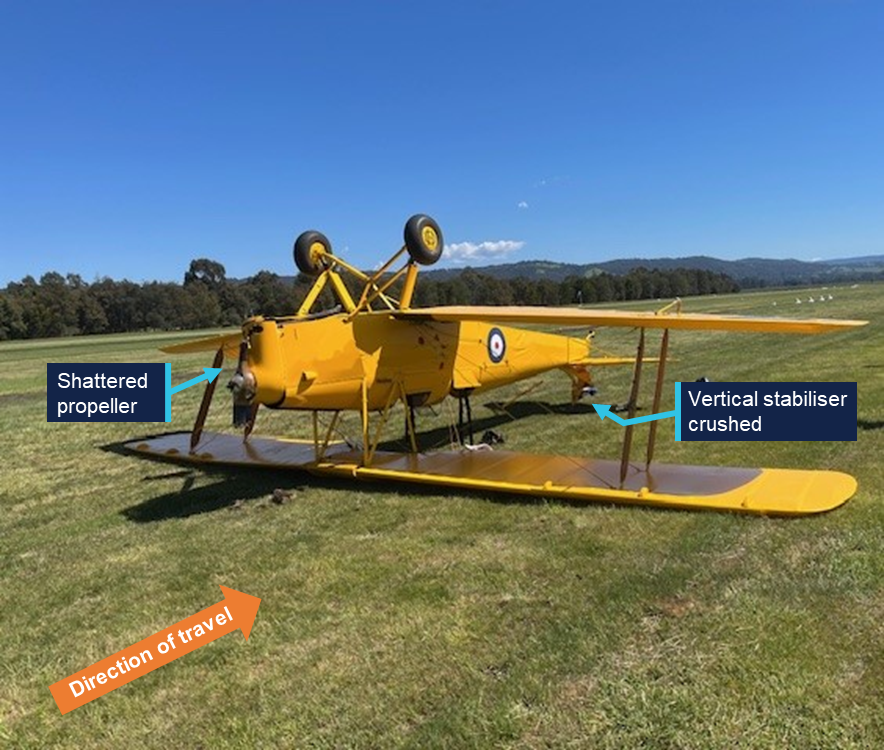
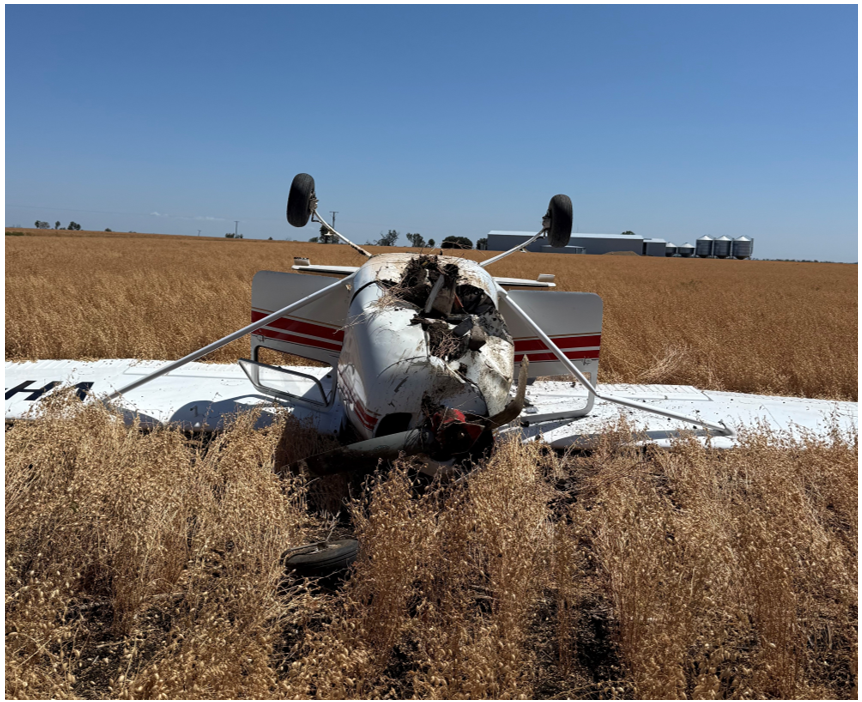
During a low level overfly of one such runway strip at about 200 ft AGL, the aircraft began to lose height. When the pilot attempted to add power, the aircraft did not respond as anticipated, resulting in a loss of control. The aircraft collided with the ground, bounced and came to rest inverted, resulting in substantial damage to the propellor, main landing gear, right wing strut, engine cowl and vertical stabiliser (Figure 1).

The pilot reported that possible contributing factors to the accident included a crosswind from the south and the warmer weather, with the aircraft not having enough lift as power was applied. 

Figure 1: Cessna 172H inverted after landing

Figure 1: Cessna 172H inverted after landing

Source: Operator

Safety message

This incident highlights that low-level flying operations have a lower margin for error with minimal time to recover the aircraft in the event of a loss of control. 

Low-level flying, particularly at private and unregulated airstrips, is inherently high risk and therefore requires effective risk management. This should include a risk assessment to consider the hazards common to the type of operation, as well as specific to the location, to develop mitigations and reduce the chance of an accident occurring.

About this report

Decisions regarding whether to conduct an investigation, and the scope of an investigation, are based on many factors, including the level of safety benefit likely to be obtained from an investigation. For this occurrence, no investigation has been conducted and the ATSB did not verify the accuracy of the information. A brief description has been written using information supplied in the notification and any follow-up information in order to produce a short summary report, and allow for greater industry awareness of potential safety issues and possible safety actions.

Occurrence summary

Mode of transport Aviation
Occurrence ID AB-2025-049
Occurrence date 23/09/2025
Location 62 km south-west of Blackwater
State Queensland
Occurrence class Accident
Aviation occurrence category Collision with terrain, Loss of control
Highest injury level None
Brief release date 31/10/2025

Aircraft details

Manufacturer Cessna Aircraft Company
Model 172H
Sector Piston
Operation type Part 91 General operating and flight rules
Departure point Private property, Queensland
Destination Private property, Queensland
Damage Substantial

Collision with terrain involving Piper PA-32R-300, VH-JVA, Shellharbour Airport, New South Wales, on 11 October 2025

Summary

The ATSB is investigating a collision with terrain involving a Piper PA-32-300 aircraft, registered VH-JVA, at Shellharbour Airport, New South Wales, on 11 October 2025.

Shortly after take-off, the aircraft collided with terrain at the end of the intersecting runway and was destroyed. The 3 occupants were fatally injured.

The final report has been drafted and is undergoing internal review to ensure the report adequately and accurately reflects the evidence collected, analysis, and agreed findings.

The ATSB released a preliminary report, which details factual information established in the investigation’s early evidence collection phase, on 14 November 2025. See below.

The final report will be released at the conclusion of the investigation. Should a critical safety issue be identified during the course of the investigation, the ATSB will immediately notify relevant parties, so that appropriate safety action can be taken.

Last updated:

Preliminary report

Report release date: 14/11/2025

This preliminary report details factual information established in the investigation’s early evidence collection phase, and has been prepared to provide timely information to the industry and public. Preliminary reports contain no analysis or findings, which will be detailed in the investigation’s final report. The information contained in this preliminary report is released in accordance with section 25 of the Transport Safety Investigation Act 2003

Summary video

The occurrence

On the morning of 11 October 2025, a Piper PA-32R-300 Cherokee Lance, registered VH-JVA, taxied for a private flight from Shellharbour Airport to Bathurst Airport, New South Wales. The flight was being operated under the instrument flight rules[1] with the pilot and 2 passengers on board.

At 0956 local time, as the aircraft approached runway 26, the pilot announced on the Shellharbour common traffic advisory frequency (CTAF) that the aircraft was entering the runway and lining up to depart. The pilot then taxied the aircraft onto the runway starter extension[2] and lined up. While VH-JVA was lined up, a Cessna Caravan taxiing behind VH-JVA stopped at the holding point at the runway 26 threshold. The pilot of VH-JVA invited the pilot of the Cessna to depart ahead of VH-JVA and the Cessna took-off shortly after.

About a minute after the Cessna departed, VH-JVA began a take-off from runway 26. Following a ground roll of about 410 m, VH-JVA abruptly pitched up and yawed left as it became airborne. The aircraft then climbed away from the runway in a nose high attitude while skidding[3] and rolling left (Figure 1 and Figure 2).

Figure 1: Composite image of recorded security camera footage of the whole flight

A composite still image from the recorded video of the accident flight. The image shows the left arcing flight path of VH-JVA.

Source: Supplied, annotated by the ATSB

Figure 2: Composite image of recorded security camera footage of later part of flight

A composite still image from the recorded video of the later part of the accident flight. The image shows the left arcing flight path of VH-JVA.

Source: Shellharbour Airport, annotated by the ATSB

The angle of bank then appeared to stabilise briefly as the aircraft followed a left-turning flight path. As it turned to a heading of about 200° magnetic (M), it reached a maximum recorded altitude of about 50 ft above ground level (AGL) and then began descending. Three seconds after reaching 50 ft AGL, the angle of bank and descent rate began increasing rapidly before the aircraft collided with terrain, coming to rest at the threshold of the intersecting runway (runway 34). The pilot and passengers were fatally injured in the accident, and the aircraft was destroyed.

Context

Pilot details

The pilot held a private pilot licence (aeroplane) and the required class rating and endorsements to operate the aircraft. The pilot also held a private instrument rating and Class 2 aviation medical certificate, which were both current at the time of the accident. 

The pilot’s logbook was reported to be in the aircraft during the accident flight. The cabin area of the aircraft was extensively fire damaged following the accident and the logbook could not be located during the wreckage examination. At the pilot’s last medical examination, the pilot had declared a total of 1,015 hours aeronautical experience. Maintenance release entries for VH-JVA showed that since that medical examination, the pilot had flown 27.1 hours in the aircraft. Of these, 4.6 hours were in the 90 days before the accident and none in the 30 days before the accident.

Aircraft details

The Piper PA-32R-300 Cherokee Lance is a single-engine, low-wing, retractable tricycle landing gear aircraft. The Lance is powered by a Lycoming IO-540 fuel-injected, horizontally opposed piston engine driving a three-blade variable-pitch propeller and is fitted with dual controls. VH-JVA (Figure 3), serial number 32R-7680030, was manufactured in the United States in 1975 and first registered in Australia in 1985. The most recent periodic inspection was completed on 14 May 2025, at 3,898.2 hours total time in service. At the time of the accident, VH-JVA had accumulated 3,915 hours in service.

Figure 3: VH-JVA

An image of VH-JVA taxiing.

Source: Clinton J Down Photography, modified by the ATSB

Aircraft loading

The pilot and a passenger were in the 2 front seats while the other passenger was seated in the second row. Witness statements and fuel records indicated that the aircraft departed with full tanks. 

The purpose of the flight was an overnight stay at Bathurst before returning to Shellharbour the following day. No large or heavy items were identified in the aircraft during the examination of the wreckage and the ATSB estimated the aircraft to be within weight and balance limitations for the flight.

Meteorological information

The terminal area forecast valid for Shellharbour Airport at the time of the accident included winds of 10 kt from 257° M. Severe turbulence[4] was also forecast below 5,000 ft AMSL. From 1000, the winds were forecast to increase in strength to 15 kt with gusts to 25 kt. 

At 0959, as the aircraft departed runway 26, the Bureau of Meteorology automatic weather station at Shellharbour Airport recorded the temperature as 27°C and the wind as 12 kt from 278° M. There was no recorded cloud, and visibility was recorded as greater than 10 km.

The pilot of the preceding Cessna reported that, during their departure, the winds were gusty with light windshear and moderate turbulence. This pilot also stated that this was common for Shellharbour Airport with strong westerly winds. The accident pilot and aircraft were based at Shellharbour Airport, and the pilot was reported to be familiar with mechanical turbulence associated with strong westerly winds at the airport.

Impact and wreckage information

The aircraft impacted the ground to the west of runway 34 while travelling in the 138° M direction (Figure 4). The left wing tip impacted the ground first with the aircraft at near 90° angle of bank and a slightly nose down attitude. The propeller and engine then impacted the ground 12 m from the wing tip and ground scars consistent with propeller strikes were indicative of engine rotation. The left wing separated from the aircraft and the main wreckage continued along the ground for a further 47 m before coming to rest on runway 34 near the runway threshold. The integral fuel tanks in both wings ruptured during the accident sequence, leading to a post-impact fire that destroyed most of the fuselage.

Figure 4: Accident site

An overview image of the accident site showing the initial impact mark, wreckage and burn trail and the main wreckage.

Source: ATSB

The ATSB conducted an initial examination of the wreckage at the accident site before moving the wreckage to an airport hangar for further examination. All major aircraft components were accounted for at the accident site. The damage to the propeller indicated that the engine was driving the propeller at the time of impact. The landing gear was extended and the flaps were extended to the 10-degree setting. The stabilator trim was set to slightly nose up and the rudder trim was neutral. Damage to the pilot’s seat rails indicated that it was locked in an appropriate position. The left pin of the passenger’s seat was found secured in the rearmost position while the right pin was found not secured into a position. There was no damage to the outboard passenger seat rail stop to indicate that this seat had slid rearward.[5]

Recorded data

Recorded automatic dependent surveillance broadcast (ADS-B) data and a number of security cameras captured the flight (Figure 5). A witness also captured 2 photographs of the aircraft while airborne (Figure 6). The data showed that:

  • during the take-off ground roll, until the nose wheel lifted from the runway, the take-off appeared normal and the stabilator was in a neutral position
  • the recorded groundspeed at the time the aircraft became airborne was 61 kt
  • the groundspeed increased to 64 kt as the aircraft commenced turning left and then remained between 60–61 kt as the aircraft turned through 180° M. As the turn continued and with an increasing tailwind component, the groundspeed increased to the recorded maximum of 70 kt immediately before impact
  • all doors appeared to be correctly secured.

Figure 5: Flight path and recorded data from flight

A satellite image overlaid with the recorded ADSB track.

All speeds are groundspeed, and the altitude is above mean sea level (equating to about 50 ft above ground level). Source: Google Earth, Bureau of Meteorology, Avdata and publicly available ADSB data, annotated by the ATSB

Figure 6: Photographs of VH-JVA during the accident flight

The two images taken by the witness showing the aircraft in a left turn. The location of the aircraft along the ADSB track is identified.

Source: Ari Bone and Google Earth, modified by the ATSB

A Garmin 750 navigation unit was recovered from the aircraft wreckage and retained by the ATSB for further investigation. 

Shellharbour Airport CTAF recordings captured no further broadcasts from the pilot of VH-JVA following those made prior to take-off.

Further investigation

To date, the ATSB has examined the site and wreckage, conducted interviews and collected documentation and recorded data relating to the accident flight.

The investigation is continuing and will include further review and examination of:

  • recorded data
  • aircraft documentation
  • aircraft maintenance records
  • recovered aircraft components
  • pilot medical records, qualifications, and experience.

A final report will be released at the conclusion of the investigation. Should a critical safety issue be identified during the course of the investigation, the ATSB will immediately notify relevant parties so appropriate and timely safety action can be taken. 

Acknowledgements

The ATSB would like to acknowledge the assistance of New South Wales Police, Shellharbour Airport, and the airport hangar operator during the onsite stage of the investigation.

Purpose of safety investigations

The objective of a safety investigation is to enhance transport safety. This is done through: 

  • identifying safety issues and facilitating safety action to address those issues
  • providing information about occurrences and their associated safety factors to facilitate learning within the transport industry.

It is not a function of the ATSB to apportion blame or provide a means for determining liability. At the same time, an investigation report must include factual material of sufficient weight to support the analysis and findings. At all times the ATSB endeavours to balance the use of material that could imply adverse comment with the need to properly explain what happened, and why, in a fair and unbiased manner. The ATSB does not investigate for the purpose of taking administrative, regulatory or criminal action.

About ATSB reports

ATSB investigation reports are organised with regard to international standards or instruments, as applicable, and with ATSB procedures and guidelines.

Reports must include factual material of sufficient weight to support the analysis and findings. At all times the ATSB endeavours to balance the use of material that could imply adverse comment with the need to properly explain what happened, and why, in a fair and unbiased manner.

An explanation of terminology used in ATSB investigation reports is available here. This includes terms such as occurrence, contributing factor, other factor that increased risk, and safety issue.

Publishing information

Released in accordance with section 25 of the Transport Safety Investigation Act 2003

Published by: Australian Transport Safety Bureau

© Commonwealth of Australia 2025

Title: Creative Commons BY - Description: Creative Commons BY

 Ownership of intellectual property rights in this publication

Unless otherwise noted, copyright (and any other intellectual property rights, if any) in this report publication is owned by the Commonwealth of Australia.

Creative Commons licence

With the exception of the Commonwealth Coat of Arms, ATSB logo, and photos and graphics in which a third party holds copyright, this report is licensed under a Creative Commons Attribution 4.0 International licence.

The CC BY 4.0 licence enables you to distribute, remix, adapt, and build upon our material in any medium or format, so long as attribution is given to the Australian Transport Safety Bureau. 

Copyright in material obtained from other agencies, private individuals or organisations, belongs to those agencies, individuals or organisations. Where you wish to use their material, you will need to contact them directly.

[1]     Instrument flight rules (IFR): a set of regulations that permit the pilot to operate an aircraft in instrument meteorological conditions (IMC), which have much lower weather minimums than visual flight rules (VFR). Procedures and training are significantly more complex as a pilot must demonstrate competency in IMC conditions while controlling the aircraft solely by reference to instruments. IFR-capable aircraft have greater equipment and maintenance requirements.

[2]     The runway starter extension is additional runway length available for take-off (not landing) before the runway threshold.

[3]     A skidding turn is an uncoordinated turn where the fuselage of the aircraft is not aligned with the airflow. In a skid the tail of the aircraft follows a path that is outside of that followed by the nose.

[4]     Moderate turbulence is usually associated with small changes in airspeed and moderate changes to aircraft attitude and/or altitude, but the aircraft remains under positive control. Severe turbulence is associated with large changes in airspeed and abrupt changes to aircraft attitude and/or altitude; in severe turbulence the aircraft may be out of control for short periods.

[5]     The seat rail stops limit the fore/aft seat movement, ensuring that the seat feet remain attached to the rails.

Occurrence summary

Investigation number AO-2025-064
Occurrence date 11/10/2025
Occurrence time and timezone 09:59 Australian Eastern Daylight Time
Location Shellharbour Airport
State New South Wales
Report release date 14/11/2025
Report status Preliminary
Anticipated completion Q2 2026
Investigation level Short
Investigation type Occurrence Investigation
Investigation phase Final report: Internal review
Investigation status Active
Mode of transport Aviation
Aviation occurrence category Collision with terrain, Loss of control
Occurrence class Accident
Highest injury level Fatal

Aircraft details

Manufacturer Piper Aircraft Corp
Model PA-32R-300
Registration VH-JVA
Serial number 32R-7680030
Sector Piston
Operation type Part 91 General operating and flight rules
Activity General aviation / Recreational-Sport and pleasure flying-Pleasure and personal transport
Departure point Shellharbour Airport, New South Wales
Destination Bathurst Airport, New South Wales
Injuries Crew - 1 (fatal), Passengers - 2 (fatal)
Damage Destroyed

Loss of control and collision with terrain involving Pilatus PC-6, VH-XAA, 2.5 km north of Moruya Airport, New South Wales, on 27 September 2025

Summary

The ATSB is investigating a collision with terrain involving a Pilatus Aircraft Ltd PC-6, registered VH-XAA, 2 km north of Moruya Airport, New South Wales, on 27 September 2025.

While returning to Moruya Airport following the completion of a skydiving drop, the aircraft collided with terrain. The pilot sustained fatal injuries.

The ATSB deployed a team of transport safety investigators to the accident site with experience in aircraft operations, maintenance and engineering.

As part of the evidence collection phase of the investigation, ATSB investigators will examine the aircraft wreckage and other information from the accident site, examine operator procedures, interview witnesses and any involved parties, and examine maintenance records and any recorded data.

The ATSB released a preliminary report, which details factual information established in the investigation’s early evidence collection phase, on 12 November 2025. See below.

A final report will be released at the conclusion of the investigation. Should a critical safety issue be identified during the course of the investigation, the ATSB will immediately notify relevant parties, so that appropriate safety action can be taken.

Preliminary report

Report release date: 12/11/2025

This preliminary report details factual information established in the investigation’s early evidence collection phase, and has been prepared to provide timely information to the industry and public. Preliminary reports contain no analysis or findings, which will be detailed in the investigation’s final report. The information contained in this preliminary report is released in accordance with section 25 of the Transport Safety Investigation Act 2003.

Summary video

The occurrence

On 27 September 2025, the pilot and owner of a Pilatus PC-6/B2-H4 aircraft, registered VH-XAA and operated by Jump Aviation for SKYONE Moruya Heads parachuting organisation, was conducting parachute operations over Moruya Airport, New South Wales. After conducting 8 successful parachute drops, at 1348:58 local time, the pilot broadcast on the common traffic advisory frequency (CTAF)[1] that they were taxiing for runway 04[2] to conduct the next flight. On board were 8 parachutists and the pilot. The pilot was wearing the fitted 4-point restraint and an emergency parachute in accordance with company procedures.

At 1351:08, the pilot broadcast that the aircraft was airborne off runway 04, for an upwind departure and on climb to flight levels (FL)[3] for parachute operations. During the climb to the planned drop between FL 140 and 150, several parachutists reported feeling a bump and hearing the stall warning[4] activate momentarily, passing about 10,000 ft. 

At 1400:52, the pilot broadcast on the CTAF that they were 4 minutes to a parachute drop, then advised the same to Melbourne Centre air traffic control. Recorded data showed the ‘jump run’ tracked in a northerly direction about 2 km west of Moruya Airport runway 36, in a gradual descent between FL 150 and 140. The parachutists reported that the jump run was normal, and all the parachutists exited successfully. At 1406:15, the pilot broadcast that the parachutists had exited and the aircraft was on descent. 

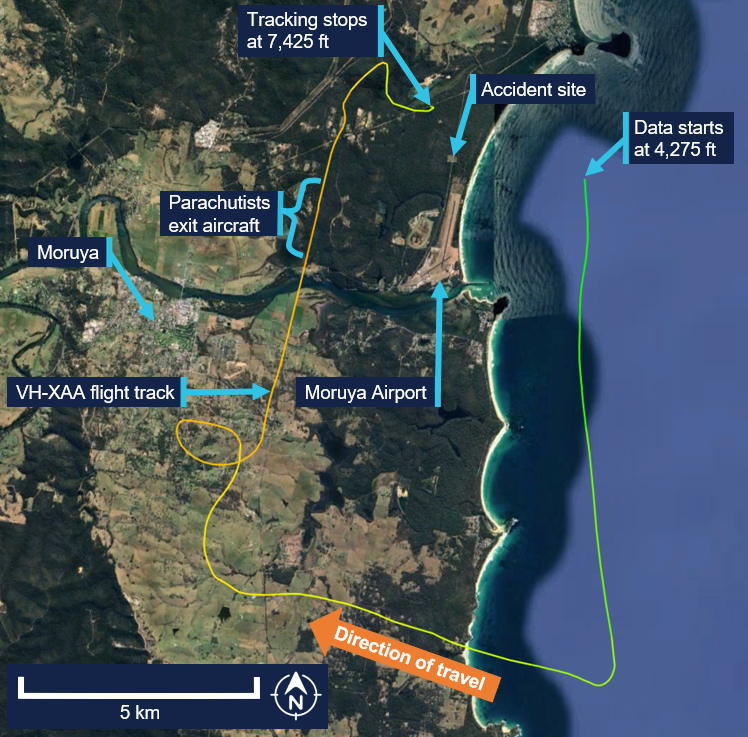
Several witnesses on the ground observed the aircraft enter a steep nose-down dive, rotating left before pitching[5] up and rolling[6] right. Recorded data showed the aircraft initially descended from FL 140 at about 5,000 fpm, but approaching FL 120, the descent rate increased significantly. The last recorded automatic dependent surveillance‑broadcast (ADS-B) data position was at 1407:26 and 7,425 ft, descending at about 15,000 fpm (Figure 1). The aircraft subsequently impacted trees and terrain about 2 km north of Moruya Airport. The pilot sustained fatal injuries, and the aircraft was destroyed.

Figure 1: VH-XAA flight track and accident site

Figure shows the flight path of VH-XAA and accident site and the location of Moruya Airport.

Source: Google Earth, annotated by the ATSB 

Context

Pilot

The pilot held a private pilot licence (aeroplane) with the last flight review conducted in August 2025, and a class 2 aviation medical certificate, valid until June 2027. The pilot held the appropriate ratings and endorsements for the flight. In addition, the pilot held aerobatics and spin endorsements and jump pilot authorisation. At the time of the accident, they had about 11,690 hours total aeronautical experience. In the previous 90 days, they had flown 135.2 hours, most of which were conducting parachuting operations in Cessna 206 and 208 aircraft. 

The pilot’s logbook recorded an endorsement for the Pilatus PC-6 (required by the then Civil Aviation Regulations) in 1998. The ATSB was unable to access some of the pilot’s logbooks to confirm how many hours they had logged flying the Pilatus PC-6 prior to purchasing VH‑XAA from New Zealand (NZ). Between 22 and 24 August 2025, the pilot and an instructor flew the aircraft from Auckland, NZ, to Dubbo, New South Wales, logging 19.5 hours of flight time. The pilot then recorded 2 hours operating the aircraft to Moruya on 12 September 2025. From 20 to 24 September 2025 inclusive, the pilot recorded 9.7 hours in the aircraft conducting parachute operations. At the start of the accident morning, the pilot had logged 31.2 hours in VH-XAA.

The pilot was an experienced parachutist and had been a member of the Australian Parachute Federation (APF)[7] since 1987. On 30 June 2025, the pilot reported having conducted 17,000 jumps. The pilot held numerous parachuting qualifications including senior instructor and a Certificate F, which was the highest certificate issued by the APF. The pilot was the senior pilot of Jump Aviation and the chief parachute instructor of the parachuting operator SKYONE Moruya Heads – a group member of the APF. 

Aircraft

General information

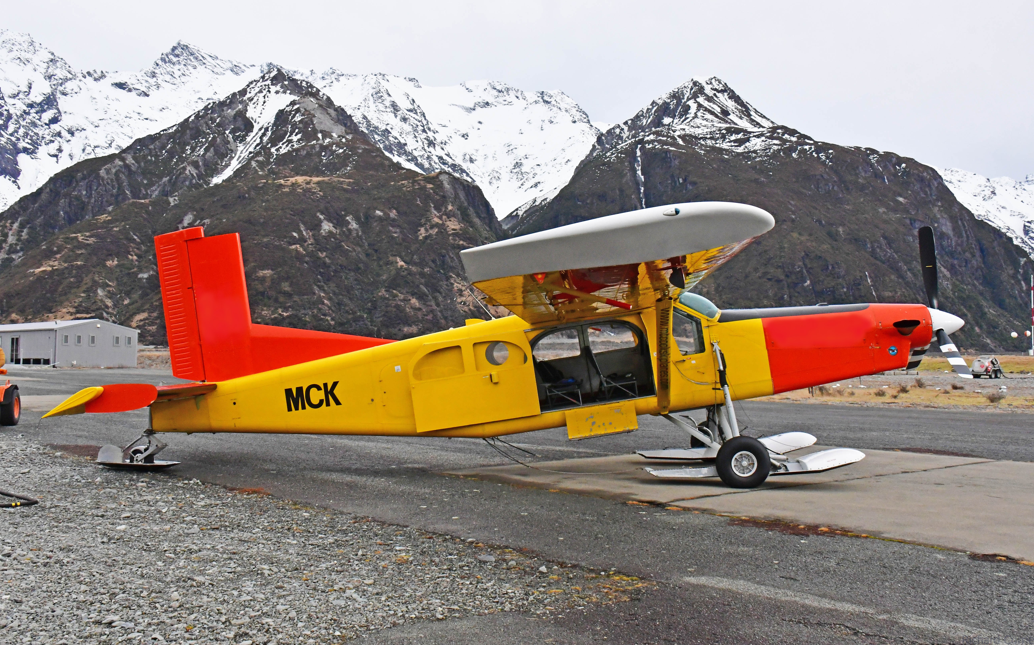
VH-XAA was a Pilatus Aircraft PC-6/B2-H4, short take-off and landing utility aeroplane with fixed landing gear (Figure 2). It was powered by a Pratt & Whitney Canada PT6A-27 turbine engine and a Hartzell Propellers HC-B3TN-3D 3-bladed propeller. The aircraft was not approved for aerobatic manoeuvres including spins. 

Figure 2: VH-XAA when operating in New Zealand as ZK-MCK

VH-XAA when operating in New Zealand as ZK-MCK.

Source: Richard Currie, modified by the ATSB

It was manufactured in Switzerland in 1980 and issued serial number 809. The aircraft had been used for parachute operations in New Zealand (NZ) since 1982. As such, the passenger seats, copilot seat and copilot control stick had been removed. Additionally, a skydiving step and hand hold had been installed.  

A 7,000 hour/14-year ‘complete overhaul’ maintenance activity was performed in NZ and finalised on 14 August 2025. During the maintenance activity, the horizontal stabiliser electric trim actuator was removed and overhauled by the manufacturer in the United States. 

The aircraft was added to the Australian civil aircraft register on 15 August 2025, and a special flight permit[8] was issued to allow the aircraft to be flown from NZ to Australia. After the pilot ferried the aircraft to Australia, a certificate of airworthiness was issued for VH-XAA on 19 September 2025. At the time of the accident, VH-XAA had accrued 13,594.5 hours total time in service.

Doors

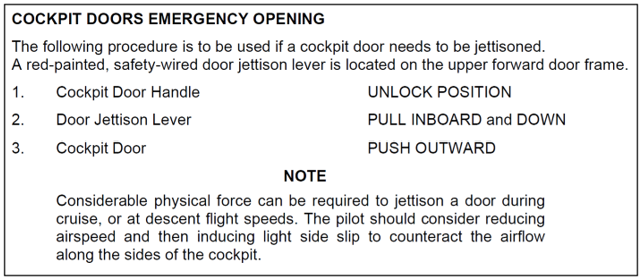
The aircraft had a door on each side of the cockpit for pilot and copilot access, which were fitted with a jettison system. Figure 3 shows the Pilatus PC-6 airplane flight manual[9] (AFM) procedure for emergency opening of the cockpit doors: 

Figure 3: Cockpit doors emergency opening checklist

Pilatus PC-6 airplane flight manual procedure for cockpit door emergency opening'

Source: Pilatus PC-6 airplane flight manual

The aircraft cabin had a sliding door on the right side, which was used for parachutists to exit, and 2 hinged doors on the left side, which were fitted with an emergency jettison system. The sliding door had a mechanism to open it from inside the aircraft, but it could not be locked open. Parachutists reported that, on the day of the accident, the pilot had landed with the sliding door open on some flights and closed on others. Although it was not identified at the accident site, several parachutists reported that there was a fishing gaffer hook on a pole onboard the aircraft that the pilot used to close the sliding door in flight from the pilot’s seat. 

Key speeds

The AFM included the following key speeds:

  • never exceed speed (VNE)[10] 151 kt
  • manoeuvring speed (VA)[11] 119 kt
  • maximum speed with the sliding door open 119 kt
  • stalling speeds at a gross weight of 2,800 kg, power off and 0° angle of bank including:
    • 58 kt calibrated airspeed[12] (KCAS) with flap retracted
    • 52 KCAS with landing flap extended. 
Horizontal stabiliser electric trim system

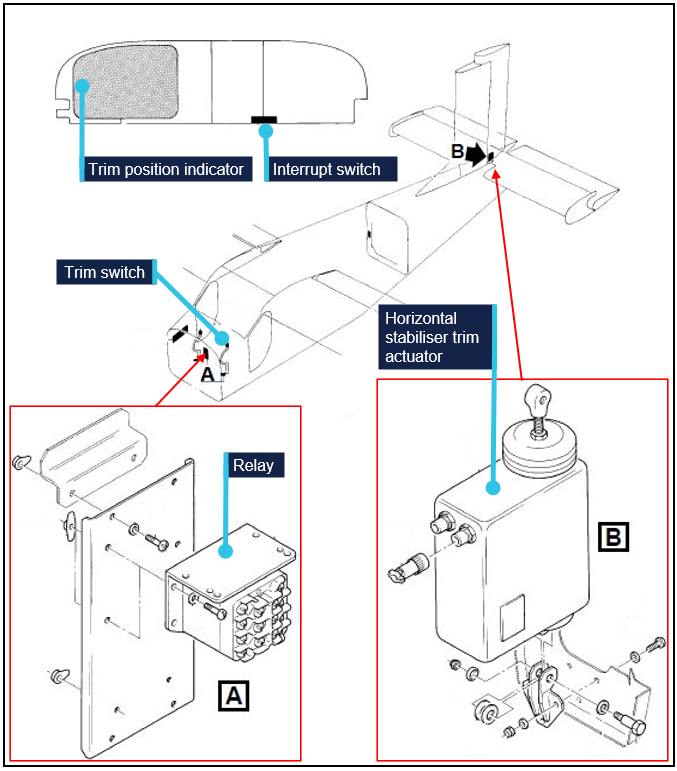
The aircraft was fitted with a horizontal stabiliser electric trim system, designed to move the entire horizontal stabiliser to adjust the pitch trim of the aircraft and balance the aerodynamic forces to reduce the pilot control forces on the elevator. The system (Figure 4), consisted of:

  • a dual motor (main and alternate motors) electrically‑operated linear trim actuator
  • a 3-position spring-loaded trim switch, located on the control column grip
  • a relay located on the firewall
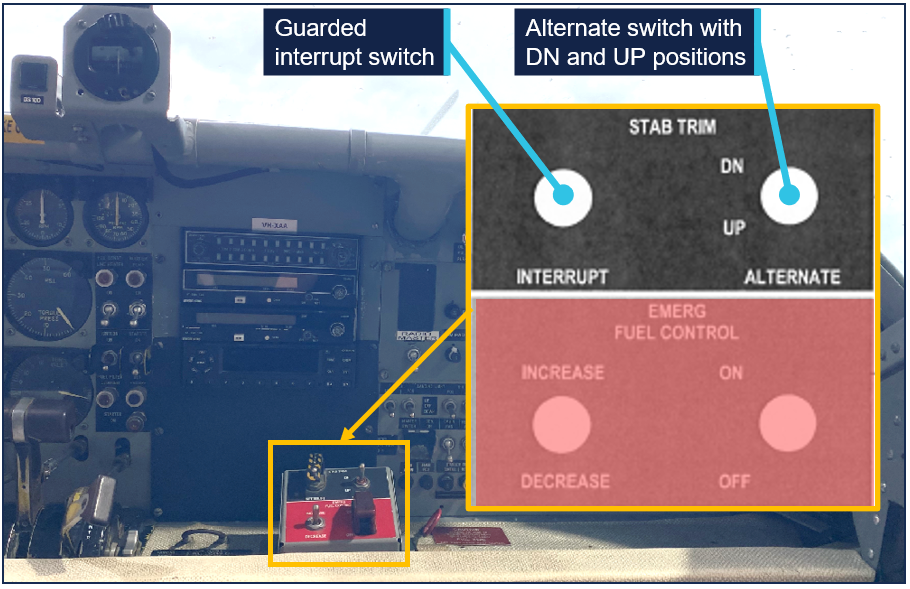
  • an interrupt system incorporating a guarded switch on the instrument panel shelf and an alternate trim control system with a 3-position spring-loaded trim switch (Figure 5)
  • an electrically‑operated trim position indicator on the upper left side of the instrument panel.

Figure 4: Schematic of horizontal stabiliser trim system 

Schematic of the horizontal stabiliser trim system, showing the trim actuator, trim switch, relay, trim position indicator and interrupt switch system.

Source: Pilatus PC-6 Illustrated Parts Catalogue, modified and annotated by the ATSB

Figure 5: Instrument panel shelf horizontal stabiliser trim switches 

Pilatus electric interrupt switch panel showing the guarded interrupt switch and the alternate trim control switch as fitted to VH-XAA

Source: Supplied and Pilatus PC-6 AFM, annotated by the ATSB

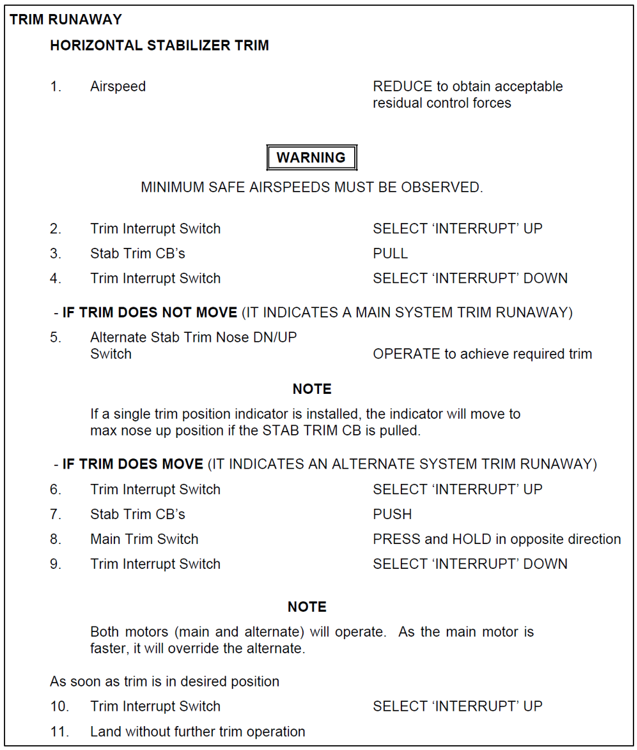
The AFM included the following procedure (Figure 6) in the event of a trim runaway:[13]

Figure 6: Horizontal stabiliser trim runaway emergency procedure

Pilatus PC-6 airplane flight manual of the emergency procedure for horizontal stabiliser trim runaway.

Source: Pilatus PC-6 airplane flight manual

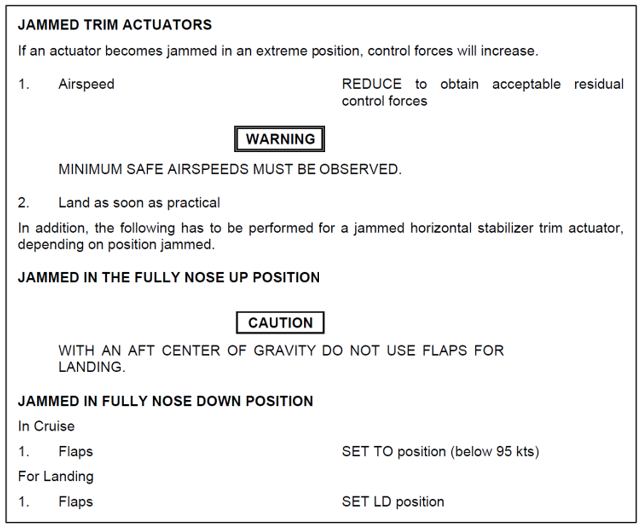
The AFM included the following procedure (Figure 7) for jammed trim actuators:

Figure 7: Jammed horizontal stabiliser trim actuator emergency procedure

Pilatus PC-6 airplane flight manual procedure for jammed trim actuators.

Source: Pilatus PC-6 airplane flight manual

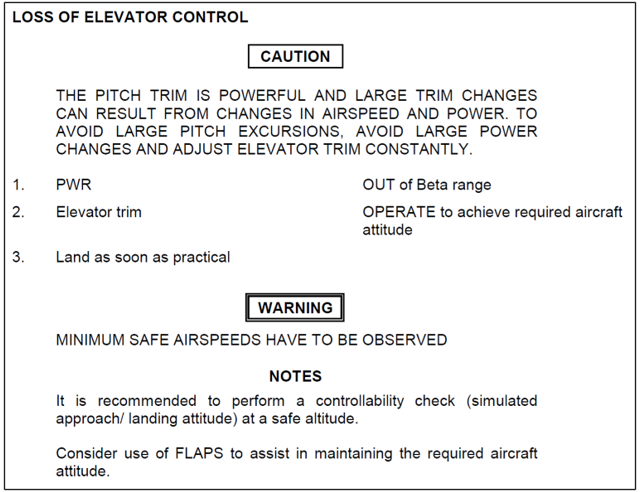
The AFM also included the following procedure (Figure 8) for loss of elevator control:

Figure 8: Loss of elevator control emergency procedure

Pilatus PC-6 airplane flight manual procedure for loss of elevator control.

Source: Pilatus PC-6 airplane flight manual

Beta mode

The AFM described beta mode as ‘operation of the propeller used in flight to achieve fast deceleration and high rates of descent’. The AFM stated:

In the beta range, the propeller blades are set at a low positive pitch angle to provide a braking effect for steep controlled descents. When operating in the beta mode, the propeller pitch angle is controlled by power lever movement between the lift detent and the point where constant speed operation becomes effective. 

NOTE

BETA MODE is provided in descent at airspeeds below 100 KIAS [kt indicated airspeed] with the POWER lever near or at the detent. Only small movements of the POWER lever are necessary to change rate of descent or airspeed. Approaches in full BETA MODE (POWER lever at detent) are not permitted at airspeeds below 1.3 Vs.[14]

Meteorological information 

The Bureau of Meteorology aerodrome forecast for Moruya Airport, issued at 1109 on 27 September 2025 included wind from 090° at 5 kt, which was expected to change to 310° and become gusty between 1200 and 1300. The grid point wind and temperature chart showed the forecast winds:

  • at 10,000 ft from 270° at 42 kt
  • at FL 140 from 270° at 51 kt. 

The Bureau of Meteorology had also issued SIGMETs[15] for severe turbulence below 8,000 ft and mountain waves from 4,000 ft to FL 320 in an area that included Moruya Airport, between 1100 and 1500. 

The conditions recorded in the METAR[16] at Moruya Airport at 1400 included wind from 130° at 6 kt, visibility greater than 10 km, temperature 22°C, and QNH[17] 1,007 hPa. 

Recorded data

The ATSB conducted preliminary analysis of the aircraft’s 3-dimensional position information recorded in the ADS-B data for the 9 flights on 27 September 2025, the last of which was the accident flight. The positional data was interpolated between recorded positions and a trajectory analysis conducted to estimate other flight performance and handling parameters. The analysis was based on the forecast wind and an estimated aircraft weight of 1,587 kg (3,500 lb). For most of the flights, there was no recorded ADS‑B data below about 4,000 ft above mean sea level. 

A comparison of the following key parameters for the 9 flights was conducted for the descent following parachute drop from about FL 140: 

  • altitude
  • descent rate
  • estimated calibrated airspeed
  • estimated pitch and roll angles.  

For flights 1–5, 7 and 8, the values of these parameters were similar. In those 7 flights, the descent commenced at an airspeed of about 55–70 KCAS, with an initial nose-down pitch of about 30° and either a right or left roll of about 30° (on flight 4 the roll angle was possibly up to 50°). The maximum descent rate for these 7 flights was between about 5,500 and 8,000 fpm. 

On flight 6, the descent was initiated slightly slower, at about 54 KCAS, which increased within 10 seconds to about 145 KCAS, coincident with a maximum momentary descent rate of about 14,000 fpm, a steep (70°) pitch down in conjunction with a substantial roll right.

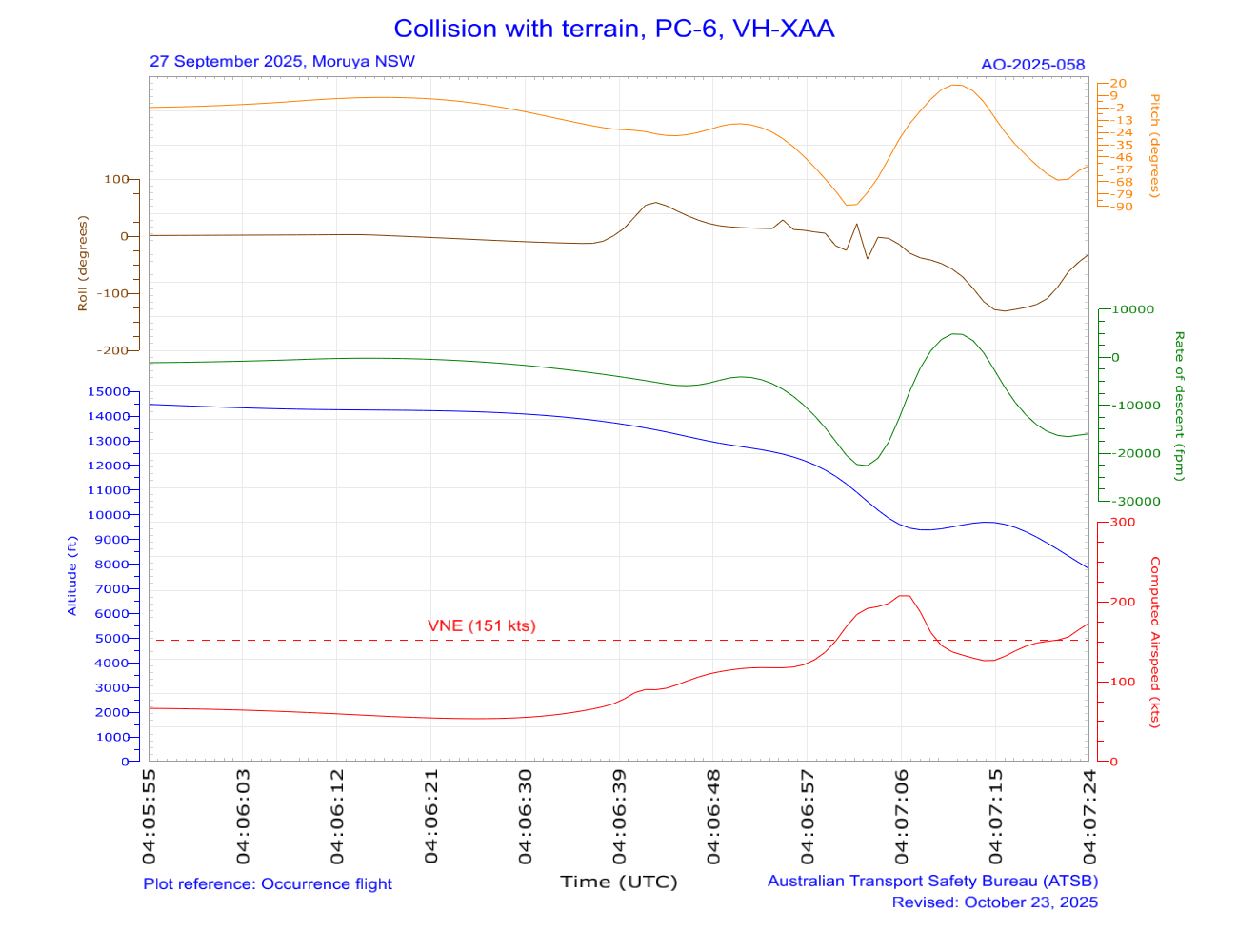
The descent on the accident flight (flight 9) was initiated at about 53 KCAS from 14,200 ft to a nose-down pitch of about 25°, with a 60° right roll. The aircraft briefly reduced pitch slightly before nosing vertically down (about 90°) in a left roll, reaching a maximum descent rate of over 20,000 fpm. The aircraft then pitched up to a shallow climb and into a roll of more than 120°. From the data it could not be confirmed whether this manoeuvre was conducted upright or inverted. Passing about 9,600 ft, the airspeed reduced to 125‍–‍130 KCAS before increasing again. The last recorded position, passing about 8,000 ft indicated the aircraft had accelerated to 173 KCAS, with a final descent rate above 15,000 fpm (Figure 9).

 Figure 9: Preliminary plot of key parameters from the accident flight descent

Preliminary plot of key parameters from the accident flight descent

Due to the aircraft’s manoeuvring, the roll information may be inaccurate. Local time was UTC+10 hours. Source: ATSB

Site and wreckage

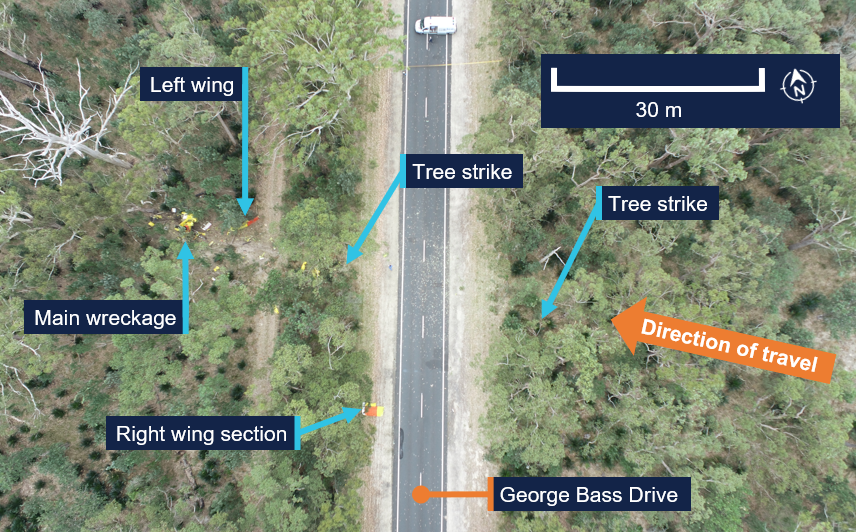
The wreckage site was about 2.5 km north (and slightly west) of the northern end of the Moruya Airport runway 36. ATSB examination showed that the right wing struck a tree on the eastern side of George Bass Drive and separated from the fuselage, before the aircraft collided with trees on the western side of the road and subsequently impacted terrain in a nose-down inverted attitude (Figure 10). The outer section of the right wing landed on the road but was moved clear by members of the public shortly after the accident. 

Figure 10: Overview of VH-XAA accident site

Overhead view of accident site showing direction of travel, trees struck and location of the main wreckage

Source: ATSB

The examination identified: 

  • there was fuel remaining and no post-impact fire occurred
  • all major components of the aircraft were at the site, indicating there was no in-flight breakup
  • the propeller had indications that the engine was producing power at impact
  • there were no indications of any pre-impact mechanical anomalies that would have precluded normal engine operation
  • the pilot’s 4-point restraint was undone, and the pilot was almost certainly not in the pilot seat at the time of impact
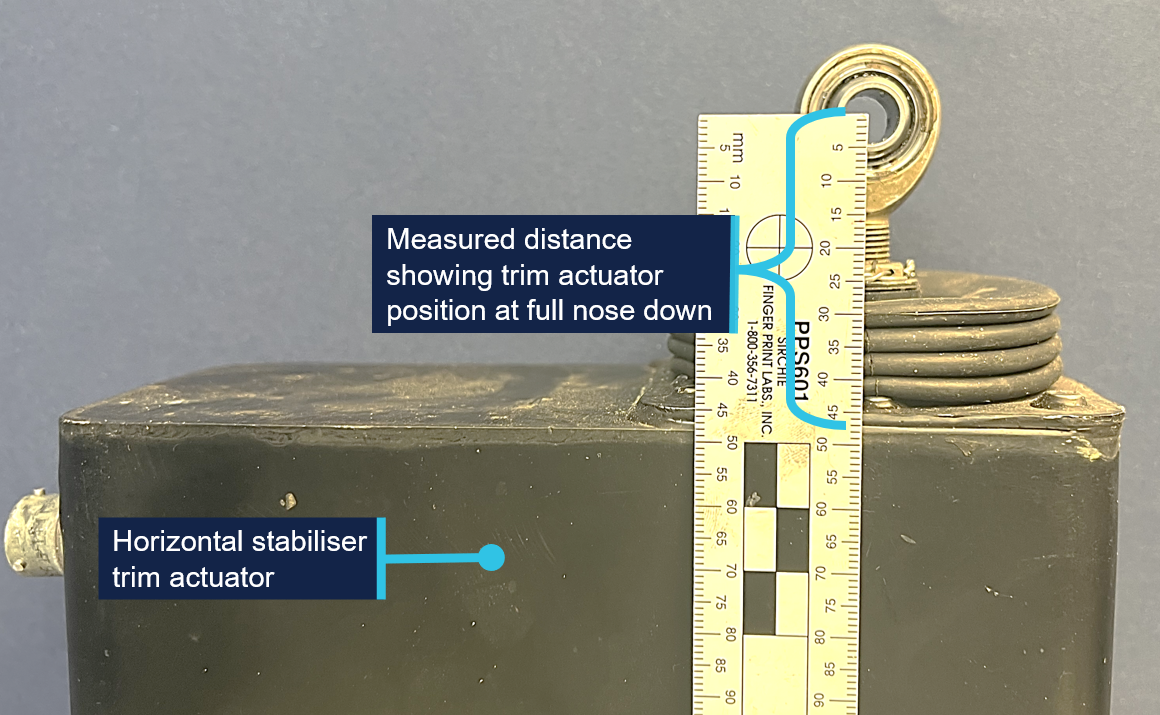
  • the horizontal stabiliser trim actuator was found in the full nose-down position (Figure 11).

Figure 11: Horizontal stabiliser trim actuator showing trim position

Image showing the horizontal stabiliser trim actuator and trim rod at full nose down position.

Source: ATSB

Further investigation

To date, the ATSB has: 

  • interviewed witnesses and involved parties
  • obtained pilot and aircraft documentation
  • analysed recorded data
  • reviewed recorded audio transmissions
  • assessed the accident site and examined the aircraft wreckage.

The investigation is continuing and will include further examination of:

  • the horizontal stabiliser trim system
  • recorded flight data
  • aircraft configuration, maintenance and documentation
  • operational procedures and documentation
  • pilot training records
  • survivability and opportunity for egress
  • other similar occurrences. 

A final report will be released at the conclusion of the investigation. Should a critical safety issue be identified during the course of the investigation, the ATSB will immediately notify relevant parties so appropriate and timely safety action can be taken. 

Acknowledgements

The ATSB would like to acknowledge the assistance of the NSW Police Force, Fire and Rescue NSW, and first responders.

Purpose of safety investigations

The objective of a safety investigation is to enhance transport safety. This is done through: 

  • identifying safety issues and facilitating safety action to address those issues
  • providing information about occurrences and their associated safety factors to facilitate learning within the transport industry.

It is not a function of the ATSB to apportion blame or provide a means for determining liability. At the same time, an investigation report must include factual material of sufficient weight to support the analysis and findings. At all times the ATSB endeavours to balance the use of material that could imply adverse comment with the need to properly explain what happened, and why, in a fair and unbiased manner. The ATSB does not investigate for the purpose of taking administrative, regulatory or criminal action.

About ATSB reports

ATSB investigation reports are organised with regard to international standards or instruments, as applicable, and with ATSB procedures and guidelines.

Reports must include factual material of sufficient weight to support the analysis and findings. At all times the ATSB endeavours to balance the use of material that could imply adverse comment with the need to properly explain what happened, and why, in a fair and unbiased manner.

An explanation of terminology used in ATSB investigation reports is available here. This includes terms such as occurrence, contributing factor, other factor that increased risk, and safety issue.

Publishing information

Released in accordance with section 25 of the Transport Safety Investigation Act 2003

Published by: Australian Transport Safety Bureau

© Commonwealth of Australia 2025

Title: Creative Commons BY - Description: Creative Commons BY

Ownership of intellectual property rights in this publication

Unless otherwise noted, copyright (and any other intellectual property rights, if any) in this report publication is owned by the Commonwealth of Australia.

Creative Commons licence

With the exception of the Commonwealth Coat of Arms, ATSB logo, and photos and graphics in which a third party holds copyright, this report is licensed under a Creative Commons Attribution 4.0 International licence.

The CC BY 4.0 licence enables you to distribute, remix, adapt, and build upon our material in any medium or format, so long as attribution is given to the Australian Transport Safety Bureau. 

Copyright in material obtained from other agencies, private individuals or organisations, belongs to those agencies, individuals or organisations. Where you wish to use their material, you will need to contact them directly.

[1]     Common traffic advisory frequency (CTAF): a designated frequency on which pilots make positional broadcasts when operating in the vicinity of a non-controlled aerodrome or within a broadcast area.

[2]     Moruya Airport had 2 sealed runways, 18/36 and 04/22. The runway number represents its magnetic heading. 

[3]     Flight level: at altitudes above 10,000 ft in Australia, an aircraft’s height above mean sea level is referred to as a flight level (FL). FL 140 equates to 14,000 ft.

[4]     A stall warning system provides the pilot with advance warning of an impending aerodynamic stall.

[5]     Pitching: the motion of an aircraft about its lateral (wingtip-to-wingtip) axis.

[6]     Rolling: the movement of an aircraft about its longitudinal axis.

[7]     The APF is the peak body for the administration and representation of Australian Sport Parachuting.

[8]     Special Flight Permit (SFP): issued to allow the operation of an aircraft that does not meet its airworthiness requirements but under certain circumstances, and for a particular intended purpose, the aircraft may still be capable of safe flight.

[9]     Airplane flight manual (AFM): a manual that is part of the certification basis of the aircraft, containing the operating limitations within which the aircraft is considered airworthy, and any other information required for the safe operation of the aircraft, including all amendments and supplements for that manual.

[10]    Never exceed speed (VNE): the indicated airspeed which, if exceeded, may result in structural damage to the aircraft, normally represented by a red line on the airspeed indicator.

[11]    Manoeuvring speed (VA): the maximum speed at which a pilot can make full or abrupt control movements without causing structural failure of the aircraft. 

[12]    Calibrated airspeed: indicated airspeed corrected for air speed indicator system errors.

[13]    Pitch trim runaway is an uncontrolled movement of the aircraft’s trim system causing uncommanded nose-up or nose‑down pitch.

[14]    Vs - Stall speed or minimum steady flight speed for which the aircraft is still controllable.

[15]    SIGMET: a concise description of the occurrence or expected occurrence, in an area over which area meteorological watch is maintained, of specified phenomena which may affect the safety of aircraft operations. 

[16]    METAR: a routine report of meteorological conditions at an aerodrome. METAR are normally issued on the hour and half hour.

[17]    QNH: the altimeter barometric pressure subscale setting used to indicate the height above mean seal level.

Occurrence summary

Investigation number AO-2025-058
Occurrence date 27/09/2025
Occurrence time and timezone 14:00 Australian Eastern Standard Time
Location 2.5 km north of Moruya Airport
State New South Wales
Report release date 12/11/2025
Report status Preliminary
Anticipated completion Q1 2026
Investigation level Short
Investigation type Occurrence Investigation
Investigation phase Evidence collection
Investigation status Active
Mode of transport Aviation
Aviation occurrence category Collision with terrain, Loss of control
Occurrence class Accident
Highest injury level Fatal

Aircraft details

Manufacturer Pilatus Aircraft Ltd
Model PC-6/B2-H4
Registration VH-XAA
Serial number 809
Aircraft operator Jump Aviation Pty Ltd
Sector Turboprop
Operation type Part 105 Parachuting
Activity General aviation / Recreational-Sport and pleasure flying-Parachute dropping
Departure point Moruya Airport, New South Wales
Destination Moruya Airport, New South Wales
Injuries Crew - 1 (fatal)
Damage Destroyed

Ditching involving a Just Aircraft SuperSTOL XL, 155 km north-west of Cooktown Airport, Queensland, on 14 August 2025

Occurrence Briefs are concise reports that detail the facts surrounding a transport safety occurrence, as received in the initial notification and any follow-up enquiries. They provide an opportunity to share safety messages in the absence of an investigation. Because occurrence briefs are not investigations under the Transport Safety Investigation Act 2003, the information in them is de-identified. 

What happened

On 14 August 2025, a Just Aircraft SuperSTOL XL amateur-built aircraft departed from Weipa, Queensland, for a flight to Cooktown. The pilot was the sole person on board and the flight was planned to proceed via Coen with a subsequent refuelling stop, if required, using fuel carried in a container on board the aircraft. After leaving Coen, the pilot determined that refuelling was required and selected an off-airfield landing location near Bathurst Bay where, after an aerial inspection of the selected area, the pilot made an uneventful landing at the mouth of a river.

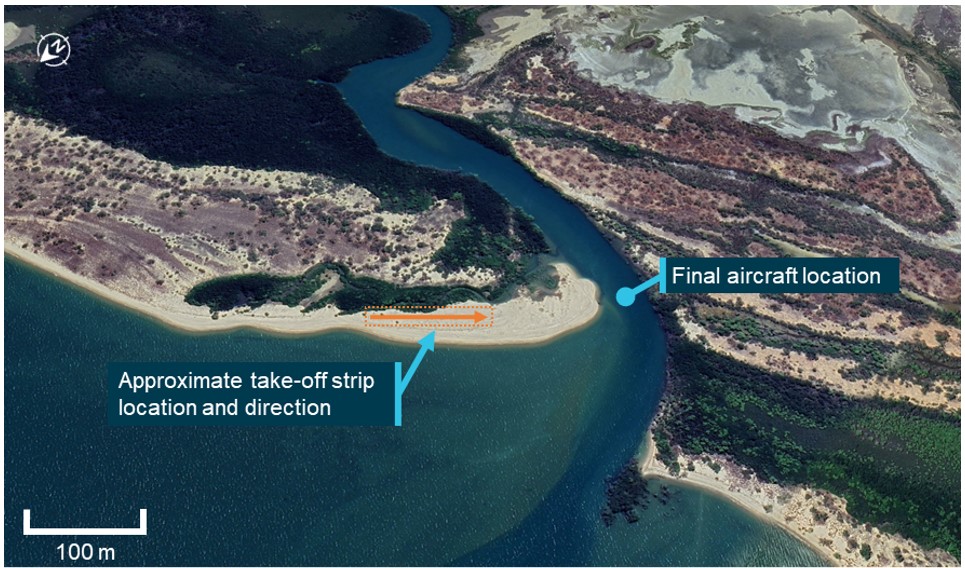
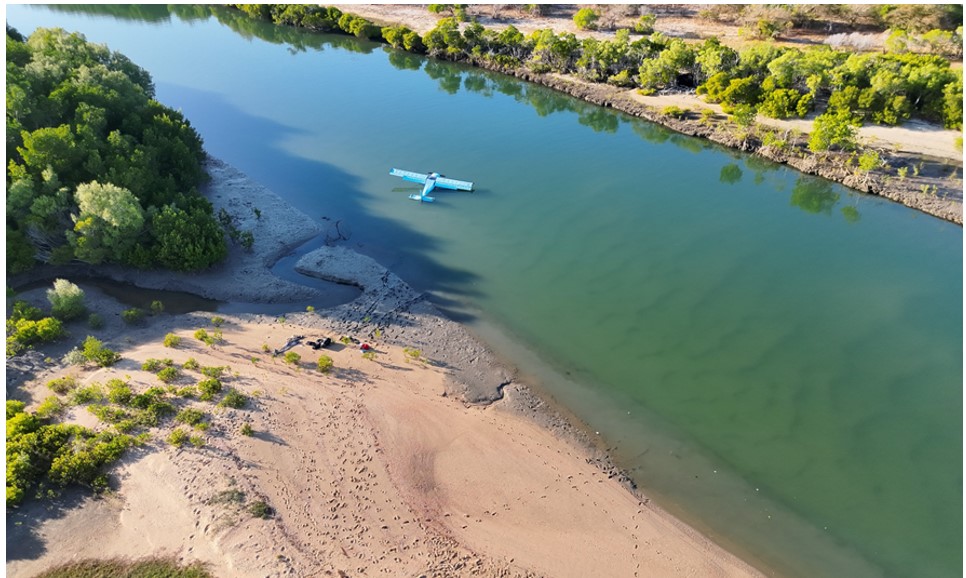
At around 1630, after refuelling and having inspected the intended take-off strip area for suitability, the pilot commenced the take-off. The pilot later reported that, shortly after clearing the ground, the aircraft encountered a strong crosswind gust from the left and the aircraft yawed forcefully into the wind. Directional control and climb performance of the aircraft was rapidly lost and the pilot ditched the aircraft in the shallow river to the left of the strip end (Figure 1). The pilot was uninjured and able to evacuate the aircraft and swim to the shore, however the aircraft became partially submerged (Figure 2) and was substantially damaged by water ingress.

Figure 1: Overview of take-off strip and accident location

Figure 1: Overview of take-off strip and accident location

Source: Google Earth, annotated by the ATSB

Figure 2: Aircraft final location after being moved by incoming tide, partially submerged 

Figure 2: Aircraft final location after being moved by incoming tide, partially submerged

Source: Pilot supplied

Safety message

Take-offs and landings away from established aerodromes and aircraft landing areas (ALAs) can present challenges and significantly increased risks for operating crew. In this instance, while the pilot was operating an aircraft designed and equipped for such off‑field work, the presence of obstacles and hazards close to the chosen strip reduced the options available to the pilot for a safe recovery or landing after the wind gusts and controllability issues were encountered. 

Pilots should also consider the shielding effects of any elevated terrain surrounding planned take-off areas and consider the potential effects of abrupt wind changes and windshear once the aircraft outclimbs the terrain.

About this report

Decisions regarding whether to conduct an investigation, and the scope of an investigation, are based on many factors, including the level of safety benefit likely to be obtained from an investigation. For this occurrence, no investigation has been conducted and the ATSB did not verify the accuracy of the information. A brief description has been written using information supplied in the notification and any follow-up information in order to produce a short summary report, and allow for greater industry awareness of potential safety issues and possible safety actions.

Occurrence summary

Mode of transport Aviation
Occurrence ID AB-2025-040
Occurrence date 14/08/2025
Location 155 km north-west of Cooktown Airport
State Queensland
Occurrence class Accident
Aviation occurrence category Collision with terrain, Loss of control, Weather - Other
Highest injury level None
Brief release date 19/09/2025

Aircraft details

Manufacturer Just Aircraft
Model SuperSTOL XL
Sector Piston
Operation type Part 91 General operating and flight rules
Departure point Bathurst Bay, Queensland
Destination Cooktown Airport, Queensland
Damage Substantial

Collision with terrain involving Reims Aviation F406, VH-EYQ, 3 km from Oakey Airport, Queensland, on 20 July 2025

Summary

The ATSB is investigating a collision with terrain accident involving a Reims Cessna F406 aircraft, registered VH‑EYQ, near Oakey, Queensland, on 20 July 2025.

The aircraft was being used for a pilot check flight and was conducting an instrument approach to land at Oakey Army Aviation Centre when it collided with terrain in a field approximately 2 km from the runway. The 2 occupants on board, a pilot and a flight examiner, were fatally injured.

The ATSB has commenced the examination and analysis of the initial evidence collected.

To date, the ATSB has:

  • examined the wreckage and accident site
  • examined meteorological information
  • interviewed relevant parties
  • collected radio communication, aircraft traffic surveillance data, and navigational 
    application data
  • collected aircraft, pilot, crew and operator documentation.

The investigation is continuing and will include review and examination of:

  • pilots’ recent history
  • propellers
  • maintenance records 
  • pilot and crew training and medical records
  • operational procedures and documentation
  • further interviews with relevant parties
  • flight data and air traffic surveillance data
  • the requirements of conducting simulated one engine inoperative exercises at low heights.

A preliminary report, which detailed factual information established during the evidence collection phase, was released on 10 December 2025 (see below).

A final report will be released at the conclusion of the investigation. Should a critical safety issue be identified during the course of the investigation, the ATSB will immediately notify relevant parties, so that appropriate safety action can be taken.

Last updated:

Preliminary report

Report release date: 10/12/2025

This preliminary report details factual information established in the investigation’s early evidence collection phase, and has been prepared to provide timely information to the industry and public. Preliminary reports contain no analysis or findings, which will be detailed in the investigation’s final report. The information contained in this preliminary report is released in accordance with section 25 of the Transport Safety Investigation Act 2003.

Summary video

The occurrence

On 20 July 2025, a Reims Aviation F406 Caravan II, registered VH-EYQ, was being utilised for an instrument proficiency check (IPC)[1] with a pilot and a flight examiner on board. The flight was conducted under the instrument flight rules[2] and the planned route was from Warwick Airport to Oakey Airport, Queensland, later returning to Warwick Airport. 

The IPC was the pilot’s third flight for the day. They had undertaken an aerial survey mission in VH-EYQ that morning for Aero Logistics, having departed Emerald Airport, Queensland, at 0747 and arrived at Archerfield Airport, Queensland, at 1208. The pilot refuelled the aircraft at Archerfield Airport and departed at 1308 for the flight to Warwick Airport for the purposes of undertaking the IPC. 

The pilot arrived at Warwick Airport at 1345 where they met the flight examiner. At 1426, the aircraft departed Warwick Airport. About 16 seconds after departure, the aircraft’s groundspeed began to decrease from 109 kt, and the aircraft stopped climbing and commenced a slow turn to the right (Figure 1). This turn was not consistent with the submitted flight plan. The aircraft’s groundspeed continued to reduce over a period of about one minute to 80 kt (see Recorded flight data). The aircraft then began to accelerate before turning left and commencing a climb to an altitude of 6,100 ft above mean sea level. 

Figure 1: VH-EYQ departure from Warwick Airport

VH-EYQ departure from Warwick Airport

Source: Google Earth, annotated by the ATSB

At 1433, Brisbane Centre air traffic control (ATC) issued the pilot with a clearance to track directly to reporting point[3] NUTPA, which was the commencement point for the Oakey Airport runway 14 instrument landing system (ILS)[4] approach (Figure 2).

Figure 2: VH-EYQ flight overview

VH-EYQ flight overview

Source: Google Earth, annotated by the ATSB

At 1439, the pilot advised ATC that they would be conducting airwork in the Oakey area, not above an altitude of 4,000 ft, and they would contact ATC again on completion or by 1530. At that time, the Oakey Airport ATC tower was inactive. After commencing the descent for NUTPA at 1441, the pilot changed frequency to the common traffic advisory frequency (CTAF) in the Oakey Airport area, and all subsequent air-to-air communications took place on the CTAF. Between 1443 and 1454 the pilot made 5 transmissions on this frequency for traffic sequencing purposes. 

At 1450, the aircraft passed overhead NUTPA and conducted one holding pattern. At 1456, the aircraft commenced a descent from 3,800 ft and the pilot made a radio broadcast to advise that the aircraft was established on the ILS. 

At 1457, the aircraft began to deviate from the horizontal profile for the approach. The aircraft initially deviated right of the extended centreline and then to the left (Figure 3). Fluctuations in vertical speed also occurred during this period. The aircraft continued the approach slightly left of the extended centreline, but the vertical profile of the approach remained on the glideslope.[5] The wind conditions recorded at Oakey Airport at the time were a light breeze of 6 kt, with a mean direction of 190°M (see Meteorological information).

Figure 3: Final approach track

VH-EYQ final approach track


Source: Google Earth, annotated by the ATSB

At about 1458:45, and an altitude of 2,500 ft, the aircraft began to descend below the glideslope. This was initially corrected, and the aircraft flew level at about 2,200 ft for 30 seconds. At 1459:25, the aircraft descended below the glideslope again, and the descent continued to an altitude of about 1,700 ft, which equated to a height of between 300–400 ft above ground level (AGL). During this period the aircraft’s groundspeed began to decay. At 1459:39, the aircraft’s groundspeed had reduced to 85 kt (see Recorded flight data). At about 1459:53,[6] a 2‑second radio broadcast was made from the aircraft with an alarm sounding in the background.

A motorist travelling south observed the aircraft on approach and maintained visual contact with it for about 3 km (Figure 4). They observed the aircraft commence a flat turn and yaw[7] to the left at a height of about 300 ft AGL and pass above the road ahead of them. They recalled seeing the aircraft then roll to the left, pitch down, and impact the terrain. 

Figure 4: Witness and closed-circuit television camera locations

Witness and CCTV camera locations

Source: Google Earth, annotated by the ATSB

Closed-circuit television (CCTV) cameras located at a nearby property and Oakey Airport captured the aircraft commence a steep descent before colliding with terrain (Figure 5).

The aircraft was destroyed in a post-impact fire, and both occupants were fatally injured.

Figure 5: Composite images of recorded CCTV camera footage

Composite images of recorded CCTV camera footage

Source: CCTV camera recordings


Context

Pilot information

Pilot experience

The pilot held a valid class 1 aviation medical certificate and an air transport pilot licence (ATPL) (aeroplane). Additionally, they held a grade 3 flight instructor rating with multi‑engine aeroplane training approval and design feature endorsements to operate VH-EYQ. The pilot held a valid multi-engine instrument rating with the previous instrument proficiency check (IPC) completed in August 2024. 

At the time of the accident, the pilot had accumulated 5,767 hours total aeronautical experience. This included 4,170 flight hours as pilot in command with 3,514 hours in multi-engine aeroplanes and about 1,200 hours in command of a Reims F406. In the preceding 90 days they had flown 95 hours, including 54 hours in the Reims F406. They had worked for the aircraft operator since March 2017.

Known recent activity

The pilot’s work roster for the week prior to the accident (from 14 to 20 July 2025) is shown in Table 1. During this week, the pilot was based away from home and conducted multiple survey flights. The pilot’s duties for 20 July included the survey flight in the morning with no additional rostered flying.

Table 1: Pilot rostered duties, 14 to 20 July 2025

DateShift start-finish timeTotal flight hours
14 JulyOFF0
15 July0630-14301.5
16 July0630-14302.1
17 July0630-14301.8
18 July0630-14302.4
19 JulyOFF0
20 July0730-15005:31

A text message sent from the pilot the evening of 19 July indicated that the pilot had intended to conduct the IPC the following day. Additionally, the message indicated they had sleep opportunity from about 2130. 

Flight examiner information

Flight examiner experience

The flight examiner held a valid class 1 aviation medical certificate and an ATPL (aeroplane). They also held grade 1 flight instructor and flight examiner operational ratings, with multi-engine aeroplane and instrument rating (aeroplane) training approval. Their flight instructor rating also had a spin endorsement, and they held design feature endorsements to operate VH-EYQ. The examiner held a valid multi-engine instrument rating with the previous IPC completed in October 2024.

The flight examiner’s logbook records were destroyed in the post-impact fire. Based on records of the pilot’s hours from January 2025, the flight examiner’s total aeronautical experience was in excess of 20,000 hrs. Additionally, they had flown 3 similar proficiency check flights for the aircraft operator in the previous 12 months, totalling 3.6 hours in the Reims F406. The flight examiner was external to the aircraft operator and was regularly hired to complete the IPC for their pilots.

Known recent activity

Along with their logbook, the flight examiner's work records were destroyed in the post‑impact fire. 

A family member recalled that the flight examiner had returned from a chartered flight to western Queensland on Tuesday 15 July. During the week, they had spent a day providing aviation theory instruction to students but had no other work engagements. On the day of the accident, the flight examiner woke at their normal time. They were reported to have slept well and, when leaving home for the IPC flight, they appeared their normal self with no signs of fatigue.

Aircraft information

General information

The Reims Aviation F406 is a low wing, twin‑engine aircraft powered by 2 Pratt & Whitney Canada PT6A-112 turbine engines, each driving a 3-bladed McCauley constant speed, full-feathering propeller (Figure 6). The accident aircraft, serial number F406‑0047, was manufactured in France in 1990 and first registered in Australia as VH‑EYQ in 2012. 

Figure 6: Reims F406

Three-view drawing of the Reims F406

Source: ASI Aviation

Recent maintenance activity

The aircraft was to be maintained in accordance with the aircraft operator’s Civil Aviation Safety Authority (CASA) approved system of maintenance. This required a periodic inspection every 100 hours or 12 months, whichever came first. The system of maintenance allowed for periodic inspection intervals to be extended up to a maximum of 10 hours. The most recent periodic inspection was completed on 11 June 2025, at 17,376 hours in service. At the time of the accident, the aircraft had accumulated 17,475.6 hours total time in service.

Configuration

VH-EYQ was configured in a 5-seat survey layout. This comprised the pilot (left) and copilot (right) seats in the front row, followed by 1 passenger seat in row 3, and 2 passenger seats in row 5. The remaining passenger seats were removed from the cabin to accommodate the installation of aerial survey equipment (Figure 7). An electronic loading system had been generated for this configuration by an approved load controller, and records show that this was utilised by the pilot for previous flights.

Figure 7: VH-EYQ cabin configuration

VH-EYQ cabin configuration

Source: ASI Aviation, annotated by the ATSB

Weight and balance

Prior to its departure from Archerfield Airport, the aircraft was fuelled with 1,086 L of Jet A1 fuel. The aircraft operator advised that, based on this fuel uplift and the intended flying activity, it was very likely that the aircraft had full fuel on board for the flight to Warwick Airport. Fuel calculations based on flight times and expected consumption rates indicated that, at the time of the accident, the aircraft probably had about 1,280 L of fuel on board. This meant the aircraft weight at the time of the accident was about 600 kg below the aircraft’s maximum take-off weight. Based on the survey flying configuration and loading of the aircraft, the aircraft’s centre of gravity was calculated and assessed to be within prescribed limits.

Performance

The pilot operating handbook airplane flight manual (POH) provided applicable limitations which included:

  • a stall speed[8] of 75 KIAS[9] in the landing configuration (VSO), and 94 KIAS with flaps in the up position (VS)
  • an intentional one engine inoperative speed (VSSE)[10] of 98 KIAS
  • an air minimum control speed (VMCA)[11] of 90 KIAS
  • a one engine inoperative best rate-of-climb speed at sea level (VYSE) of 108 KIAS. 
One engine inoperative procedures

The POH included recommended procedures in the event of an emergency. This included checklists for an engine failure in flight, and for the conduct of an approach and missed approach with one engine inoperative. The recommended approach speed with an engine inoperative was 110 KIAS reducing to 101 KIAS only once landing was assured.

Site and wreckage information

Accident site

The ATSB conducted an onsite examination of the aircraft wreckage, which was located in an open paddock about 2.6 km from the threshold of runway 14 at Oakey Airport (Figure 8).

Figure 8: Location of accident

Location of accident

Source: Google Earth, annotated by the ATSB

The wreckage was confined to a 30 m radius of the accident site. The impact marks and wreckage position indicated the aircraft impacted terrain left wing low with little forward momentum. Ground scars indicated the aircraft moved about 6 m after the initial impact. All components were upright.

The tail and aft cabin section showed signs of vertical compression. There was no fore or aft compression damage to the nose or wings. The left wing had separated from the aircraft just outboard of the left engine, and the right wing had separated just inboard of the right engine. Both wings had swung forward to lay parallel to the fuselage (Figure 9).

Figure 9: VH-EYQ accident site

VH-EYQ accident site

Source: ATSB

All major aircraft components were accounted for at the point of impact. A post‑impact fire consumed the forward section of the aircraft to the aft cabin door (Figure 10). This damage limited the extent to which pre-impact defects could be identified.

Figure 10: VH-EYQ wreckage

VH-EYQ wreckage

Source: ATSB 

Engines

Both engines were retained for further examination. This was conducted by ATSB investigators who were assisted by investigators from Pratt & Whitney Canada.[12] The engine examination determined: 

  • there were no indications of pre-impact mechanical anomalies to any of the engine components that would have precluded normal engine operation
  • the left engine displayed indications that it was rotating at the time of impact
  • the right engine displayed characteristics that it was developing power at the time of impact.
Propellers

Both propellers showed indications that the engines were running at impact. The right propeller was determined to be in a fine pitch position[13] and exhibited bending in multiple directions.

Both propellers were retained, and an independent inspection was carried out at a propeller overhaul facility under the direction of ATSB investigators. Further analysis is required to determine the position of the left propeller at the time of impact.  

Meteorological information

The Bureau of Meteorology (BoM) graphical area forecast valid at the time of the accident included the following conditions en route:

  • scattered cloud bases of 3,000 ft to 5,000 ft, extending up to 8,000 ft
  • isolated showers of rain with broken cloud from 1,000 ft to 2,000 ft and scattered cloud from 2,000 ft to above 10,000 ft.

At 1500, at about the same time the aircraft impacted terrain, the BoM issued a meteorological aerodrome report for Oakey Airport which reported the conditions at that time were:

  • a wind of 6 kt, with a mean direction of 190°M, varying between 160°M–220°M
  • visibility of 10 km or greater
  • no cloud detected
  • a temperature of 20°C and a dew point of 6°C
  • a QNH[14] of 1,016 millibars
  • no recorded rainfall since 0900.

Satellite images and CCTV footage captured areas of scattered cloud in the vicinity of the aerodrome at the time of the approach.

Flight activity

General

For a pilot to operate an aircraft under the instrument flight rules, they are required to hold an instrument rating. Pilots are also required to pass an annual instrument proficiency check (IPC) flight to ensure that they maintain the necessary skills and competency to operate safely. The purpose of the accident flight was for the pilot to complete their annual IPC. 

An IPC can be completed by a flight examiner with an instrument rating, MPL[15] or ATPL (aeroplane) flight test endorsement, or by a person approved by CASA. While the aircraft operator had a training and checking system,[16] they scheduled IPC flights with external examiners and permitted the pilots to arrange their IPC flights privately. The head of flying operations (HOFO) of the aircraft operator recalled that the accident pilot had advised them that their IPC expiry date was approaching and requested the use of VH‑EYQ to complete the flight. In response, provisions were made by the HOFO and head of aircraft airworthiness and maintenance control delegate to make the aircraft available to the pilot for the purpose of conducting the IPC flight. 

The pilot arranged the IPC with the external flight examiner and records show that the IPC was booked into the CASA flight test management system[17] by the flight examiner during the afternoon of 18 July and scheduled to take place on the afternoon of 20 July. 

Instrument proficiency check assessment

During an IPC flight, a pilot’s competency is assessed in actual or simulated instrument meteorological conditions. During the flight, a pilot is required to meet specified standards for:

  • departure
  • en route skills
  • arrival
  • approach
  • missed approach
  • approach to land manoeuvres.

If the IPC is for multi-engine operations, the assessment also requires the satisfactory completion of a simulated one engine inoperative (OEI) departure and a simulated OEI approach. 

The HOFO of the aircraft operator recalled that the external flight examiner had, in the past, typically conducted the simulated OEI departure after take-off from Warwick Airport and the simulated OEI approach at Oakey Airport. 

Recorded information

Recorded flight data

The aircraft was not fitted with a flight data recorder or a cockpit voice recorder, nor was it required to be. During the accident flight, data was being transmitted by the aircraft’s automatic dependent surveillance broadcast (ADS-B) equipment. This data, recorded at 2–5 second intervals by amateur ground-based receivers, captured the aircraft’s position, altitude and groundspeed during the flight. Flight data was also being transmitted from a Spidertracks[18] tracking device fitted to the aircraft. This data, recorded at 15-second intervals, captured the aircraft’s position, altitude, groundspeed and heading during the flight.

The ADS-B altitude and groundspeed data for the aircraft’s departure from Warwick Airport is depicted in Figure 11.

Figure 11: VH-EYQ altitude and groundspeed during the Warwick Airport departure

AO-2025-042 prelim Figure 11.png

Source: ATSB 

The ADS-B altitude and groundspeed data for the aircraft’s ILS approach at Oakey Airport is depicted in Figure 12.

Figure 12: VH-EYQ altitude and groundspeed during the Oakey Airport approach

VH-EYQ altitude and groundspeed during the Oakey Airport approach

Source: ATSB 

A Garmin GTN-650 global positioning system was also recovered from the accident site and transported to the ATSB’s Canberra technical facility for further examination. The unit showed signs of significant heat damage with melting and evidence of charring on the internal circuitry. The remains of 2 SD[19] cards were found within the unit, however, the post-impact fire had damaged the SD card memory chips to the point that data could not be extracted using normal recovery methods. 

Record radio communications

All radio communications made and received by Airservices Australia throughout the entirety of VH-EYQ’s flight from Warwick Airport were recorded.

Recorded CCTV footage

Two CCTV cameras captured footage of the aircraft immediately prior to the collision with terrain. One camera was located on a property 1.4 km to the north-west of the accident and the second camera was located on Oakey Airport about 3 km south of the accident site. 

The property CCTV footage was timestamped. The aircraft entered frame at 1459:53 and remained in frame for the duration of the recording which captured the collision with terrain at 1500:00.

The Oakey Airport CCTV footage did not contain a timestamp. The aircraft entered frame 1 second into the recording and remained in frame until the collision with terrain that occurred 7 seconds later.

Further investigation

To date, the ATSB has:

  • examined the wreckage and accident site
  • examined meteorological information
  • interviewed relevant parties
  • collected radio communication, aircraft traffic surveillance data, and navigational application data
  • collected aircraft, pilot, crew and operator documentation.

The investigation is continuing and will include review and examination of:

  • pilots’ recent history
  • propellers
  • maintenance records
  • pilot and crew training and medical records
  • operational procedures and documentation
  • further interviews with relevant parties
  • flight data and air traffic surveillance data
  • the requirements of conducting simulated one engine inoperative exercises at low heights.

A final report will be released at the conclusion of the investigation. Should a critical safety issue be identified during the course of the investigation, the ATSB will immediately notify relevant parties so appropriate and timely safety action can be taken. 

Acknowledgements

The ATSB would like to acknowledge the assistance provided by the Australian Defence Force personnel at the Oakey Army Aviation Centre during the initial evidence collection activities.

Purpose of safety investigations

The objective of a safety investigation is to enhance transport safety. This is done through: 

  • identifying safety issues and facilitating safety action to address those issues
  • providing information about occurrences and their associated safety factors to facilitate learning within the transport industry.

It is not a function of the ATSB to apportion blame or provide a means for determining liability. At the same time, an investigation report must include factual material of sufficient weight to support the analysis and findings. At all times the ATSB endeavours to balance the use of material that could imply adverse comment with the need to properly explain what happened, and why, in a fair and unbiased manner. The ATSB does not investigate for the purpose of taking administrative, regulatory or criminal action.

About ATSB reports

ATSB investigation reports are organised with regard to international standards or instruments, as applicable, and with ATSB procedures and guidelines.

Reports must include factual material of sufficient weight to support the analysis and findings. At all times the ATSB endeavours to balance the use of material that could imply adverse comment with the need to properly explain what happened, and why, in a fair and unbiased manner.

An explanation of terminology used in ATSB investigation reports is available here. This includes terms such as occurrence, contributing factor, other factor that increased risk, and safety issue.

Publishing information

Released in accordance with section 25 of the Transport Safety Investigation Act 2003

Published by: Australian Transport Safety Bureau

© Commonwealth of Australia 2025

Title: Creative Commons BY - Description: Creative Commons BY

Ownership of intellectual property rights in this publication

Unless otherwise noted, copyright (and any other intellectual property rights, if any) in this report publication is owned by the Commonwealth of Australia.

Creative Commons licence

With the exception of the Commonwealth Coat of Arms, ATSB logo, and photos and graphics in which a third party holds copyright, this report is licensed under a Creative Commons Attribution 4.0 International licence.

The CC BY 4.0 licence enables you to distribute, remix, adapt, and build upon our material in any medium or format, so long as attribution is given to the Australian Transport Safety Bureau. 

Copyright in material obtained from other agencies, private individuals or organisations, belongs to those agencies, individuals or organisations. Where you wish to use their material, you will need to contact them directly.

[1]     Instrument proficiency check: an assessment of a pilot’s skills and operational knowledge required to exercise licence ratings and privileges when flying under the instrument flight rules.

[2]     Instrument flight rules (IFR): a set of regulations that permit the pilot to operate an aircraft in instrument meteorological conditions (IMC), which have much lower weather minimums than visual flight rules (VFR).

[3]     Reporting point: a specified geographical location in relation to which the position of an aircraft can be reported.

[4]     Instrument landing system (ILS): a precision instrument approach system which normally consists of a VHF localiser providing horizontal guidance and a UHF glideslope providing vertical guidance.

[5]     Glideslope: a component of the instrument landing system providing vertical (up/down) guidance toward the runway touchdown point, usually at a 3° slope.

[6]     The provided CTAF recording was found to have a discrepancy that could not be resolved.

[7]     Yaw: the motion of an aircraft about its vertical or normal axis.

[8]     Aerodynamic stall: or stall, occurs when airflow separates from the wing’s upper surface and becomes turbulent. A stall occurs at high angles of attack, typically 16˚ to 18˚, and results in reduced lift.

[9]     KIAS: indicated airspeed expressed in knots, used by pilots as a reference for all aircraft manoeuvres.

[10]    The manufacturer’s minimum speed for rendering one engine inoperative in flight for pilot training.

[11]    The minimum indicated airspeed at which the aircraft was laterally controllable with one engine inoperative and a 5° bank angle towards the operative engine.

[12]    Pratt & Whitney Canada: engine manufacturer of the engines installed on VH-EYQ.

[13]    Fine pitch: refers to a fine or low pitch angle which yields good low speed acceleration.

[14]    QNH: the altimeter barometric pressure subscale setting used to indicate the height above mean seal level.

[15]    MPL: multi-crew pilot licence.

[16]    Training and checking system: a training and checking system ensures that operational safety-critical personnel are proficient in the required competencies to support an operator's air operations.

[17]    Flight test management system: online record system used to notify CASA of planned flight tests. Flight examiners also use the system to schedule and record the outcomes of flight tests and proficiency checks. The system is used by CASA to keep track of the flight testing process and analyse trends at industry level.

[18]    Spidertracks: a satellite-based tracking system, combining satellite communication and GPS technology.

[19]    Secure digital card (SD): a type of memory card typically used in portable devices.

Occurrence summary

Investigation number AO-2025-042
Occurrence date 20/07/2025
Occurrence time and timezone 15:00 Australian Eastern Standard Time
Location 3.4 km north of Oakey Airport
State Queensland
Report release date 10/12/2025
Report status Preliminary
Anticipated completion Q4 2026
Investigation level Short
Investigation type Occurrence Investigation
Investigation phase Examination and analysis
Investigation status Active
Mode of transport Aviation
Aviation occurrence category Collision with terrain, Loss of control
Occurrence class Accident
Highest injury level Fatal

Aircraft details

Manufacturer Reims Aviation S.A.
Model F406
Registration VH-EYQ
Serial number F406-0047
Aircraft operator Bayswater Road Pty Ltd (trading as Aero Logistics)
Sector Turboprop
Operation type Part 91 General operating and flight rules
Activity General aviation / Recreational-Instructional flying-Instructional flying - dual
Departure point Warwick Airport, Queensland
Destination Warwick Airport, Queensland
Injuries Crew - 2 (fatal)
Damage Destroyed

Collision with terrain involving Eurocopter EC120B, VH-JDZ, Porepunkah Aerodrome, Victoria, on 15 May 2025

Final report

Report release date: 06/11/2025

Investigation summary

What happened

On 15 May 2025, a Eurocopter EC120B helicopter, registered VH-JDZ, was operated at Porepunkah aerodrome, with a pilot and one passenger on board. While lifting into a hover, left yaw was allowed to develop without correction. After turning 180° the pilot attempted to arrest the yaw with right pedal input. However, the yaw continued and the helicopter began to rotate, entering an uncontrolled turn. After about three quarters of a revolution the right skid contacted the ground while the helicopter continued to rotate. The helicopter then rolled over, resulting in substantial damage to the aircraft. Neither the pilot nor the passenger sustained injury and safely exited the aircraft.

What the ATSB found

Adequate control of the left yaw after hover was not achieved due to the insufficient application of opposing right pedal input to the tail rotor. 

The pilot was highly experienced in rotary wing operations, though reported that they had not flown this type of helicopter (EC120B) for about 15 years. The EC120B is fitted with a Fenestron tail rotor which requires greater pedal response than conventional tail rotor helicopters to counter the torque effect. In this case the pilot had more recent experience flying helicopters with a conventional tail rotor system. Although they were a highly experienced helicopter pilot, the limited recent type-specific experience on the EC120B had degraded their ability to respond appropriately to the helicopter’s different pedal requirements.

Safety message

Maintaining recent type-specific flight experience is vital to prevent degraded performance when transitioning between aircraft with differing control characteristics. 

Understanding the aircraft’s characteristics is important for helicopter pilots so that they can anticipate its response when becoming airborne and are not surprised by events. Controlling yaw in helicopters with a Fenestron tail rotor, as in this case, is an essential consideration. Airbus Helicopters and the European Union Aviation Safety Agency (EASA) provide specific guidance relating to this issue to assist pilots.


The investigation

The ATSB scopes its investigations based on many factors, including the level of safety benefit likely to be obtained from an investigation and the associated resources required. For this occurrence, the ATSB conducted a limited-scope investigation in order to produce a short investigation report, and allow for greater industry awareness of findings that affect safety and potential learning opportunities.

The occurrence

On 15 May 2025, a Eurocopter[1] (Airbus Helicopters) EC120B helicopter, registered VH‑JDZ, was operated at Porepunkah aerodrome, Victoria, for planned private flight to Albury, about 38 NM to the north. On board were the pilot and a passenger, who was also licenced and qualified on the helicopter. 

On arrival at the aerodrome, the pilot and passenger prepared the helicopter by moving it out of the hangar and conducting a visual inspection in preparation for flight. At about 1300, the pilot commenced engine start and a short time later began the take-off sequence and brought the helicopter into a hover. The pilot reported that the helicopter was initially slow to lift off but then rapidly rose and began an uncommanded 90° left yaw.[2] The pilot stated that although the yaw was not commanded, they intended to turn in that direction anyway so allowed the yaw to continue and planned to arrest it after it turned 180°. 

The pilot then attempted to correct the left yaw with right pedal input while simultaneously pulling up the collective to gain more height. However, the yaw was not adequately countered and with additional torque, the left yaw increased. The helicopter then began to rotate and entered an uncontrolled turn. 

The pilot was unable to regain control and the helicopter completed about three quarters of a revolution before the right aft skid contacted the ground, leading to a further rotation on the ground and a dynamic rollover.[3]

The helicopter came to a rest on its right side and the pilot immediatley checked on the welfare of the passenger and turned off the fuel. Noticing smoke and mindful of the potential fire risk, the pilot gave instructions to evacuate immediately. 

With some difficulty, due to their wreckage position, both occupants removed their seat restraints, independently exited the helicopter and moved to an area a safe distance away from the wreckage. 

As a result of the impact, the aircraft was substantially damaged (Figure 1).

Aerodrome staff and an ambulance arrived at the site shortly after the incident and conducted a medical assessment. It was determined that neither occupant had sustained serious injury. 

Figure 1: VH-JDZ photographed after the dynamic rollover 

Photograph of the damaged helicopter wreckage after dynamic rollover.

Source: Owner

Context

Pilot information 

The pilot held a commercial pilot licence (CPL-H) helicopter issued in September 1994. At the time of the occurrence the pilot’s total flying experience was 11,257 flight hours and they were endorsed to fly the EC120B and had previously owned and operated a commercial helicopter business.

In the 12 months before the accident, the pilot had logged about 100 flight hours, primarily in a Robinson R44. They stated they had not flown an EC120B for about 15 years. 

The pilot held a Class 1 aviation medical certificate and reported having a regular sleep pattern of about 7.5–8 hours nightly and had no feeling of fatigue on the day of the incident.

To exercise the privileges of a flight crew licence, the regulations require the pilot to have a valid helicopter flight review (HFR). The pilot last completed this on 6 October 2024 in a Robinson R44 while obtaining a low-level endorsement on the same date.

Aircraft information 

The EC120B is a 5-seat, light utility helicopter, powered by a single turboshaft engine. It has a 3-blade main rotor head and a Fenestron anti-torque tail rotor (see Fenestron tail rotor).

The EC120B is powered by a Safran Helicopter engines Arrius 2F single gas turbine engine. VH-JDZ was manufactured in France in 2003 and was first registered in Australia on 24 June 2003. The current owner purchased the helicopter on 14 September 2021. 

The helicopter’s maintenance release showed the last daily inspection was completed on 2 May 2025 and showed the helicopter had accrued about 3,172 hours flight time.

Fuel, weight and balance 

The pilot reported that the helicopter was carrying a full fuel load. The maximum take of weight (MTOW) is 1,715 kg, of which the fuel capacity is about 410 litres (326 kg) of aviation turbine fuel. With the pilot and passenger on board and full fuel tanks, the helicopter weighed about 1,560 kg which was below the MTOW and within balance. 

Flight controls

The helicopter was fitted with standard primary flight controls: cyclic,[4] collective[5] and dual tail rotor anti-torque pedals. The pilot stated that the passenger (also a rated pilot) did not touch the controls. The aircraft was equipped with a single hydraulic system, which assisted main rotor control through 3 hydraulic servos. The tail rotor was not hydraulically assisted and dual controls were installed in the helicopter which are removable when not required. The pilot reported that they were not removed but had adjusted the pedals prior to flight on their side to suit their leg length.

Aircraft handling characteristics
Fenestron tail rotor

The EC120B is equipped with a Fenestron tail rotor or fan-in-fin system (Figure 2). The vertical fin or stabiliser was designed to provide aerodynamic directional stability in forward flight and is larger than those found on similar-sized helicopters with a conventional tail rotor (CTR). The fin was paired with a 0.75 m diameter, 8-bladed tail rotor. The tail rotor was mounted on stators[6] integrated into the vertical fin. 

These features combined to change the aerodynamics of the tail rotor, and the relative effectiveness of the anti-torque pedals for a given range of movement, when compared with helicopters with a CTR. Because the tail rotor blades are located within a circular duct, the Fenestron design is considered a safety feature, reducing the risk of contact with people or objects. 

Figure 2: Illustration of the design difference between the Fenestron tail rotor and a conventional tail rotor

Photo of a conventional tail rotor and a Fenestron tail pictured side by side.

Source: ATSB

Anti-torque pedals 

The main rotor on the EC120B rotated clockwise (as viewed from above). The main rotor is driven from a central point, resulting in a torque reaction which causes the fuselage of the helicopter to yaw in the opposite direction to the main rotor’s rotation (Figure 3). In the case of the EC120B, this torque reaction means the helicopter will yaw to the left when power is applied. The force to resist and balance the yaw is produced by the tail rotor and is controlled by the anti-torque pedals in the cockpit. Tail rotor thrust can be increased by pushing the right anti-torque pedal to force the nose to yaw to the right. When a pilot demands power from the engine to increase lift, or as a result of lifting the collective (increasing main rotor blade angle), the torque reaction and yaw to the left will increase. 

While both types of helicopters (Fenestron and CTR) may have the same methods of handling unanticipated yaw, the direction of rotation means that opposite pedal inputs are required and there are different requirements for the magnitude of pedal input and different expected performance (Airbus, 2020). 

Figure 3: Direction of main rotor rotation for the EC120B showing corresponding torque reaction

Image that shows the direction of main rotor rotation for the EC120B showing corresponding torque reaction.

Source: ATSB

Manufacturer’s guidance on unanticipated yaw 

Unanticipated yaw at low speed has previously been the subject of Safety Information Notices (SIN) published by Airbus Helicopters. In 2005, Eurocopter (prior to becoming part of the Airbus group) released Service Letter 1673-67-04 (Reminder concerning the YAW axis control for all helicopters in some situations). The service letter reminded pilots that Fenestron tail rotors required significantly more pedal travel than conventional tail rotors when transitioning from forward flight to a hover. 

Airbus Helicopters issued SIN 3297-S-00 Unanticipated left yaw (main rotor rotating clockwise), commonly referred to as LTE[7] in 2019. This notice outlined a detailed explanation of the phenomenon of unanticipated yaw due to insufficient pedal application. The full notice is provided in SIN 3297-S-00 and details of some related accidents are provided in Appendix A of ATSB report AO-2018-026. 

The Airbus notice defined unanticipated yaw as an ‘uncommanded rapid yaw rate which does not subside of its own accord’. The notice also stated: 

Unanticipated yaw is a flight characteristic to which all types of single rotor helicopter (regardless of anti-torque design) can be susceptible at low speed, often dependent on the direction and strength of the wind relative to the helicopter… 

…Where this type of unanticipated yaw situation is encountered, it may be rapid and most often will be in the opposite direction of the rotation of the main rotor blades (i.e. left yaw where the blades rotate clockwise). Swift corrective action is needed in response otherwise loss of control and possible accident may result. 

However, use of the rudder pedal in the first instance may not cause the yaw to immediately subside, thus causing the pilot to make inadequate use of the pedal to correct the situation because he suspects that it is ineffective when, in fact, thrust capability of the tail rotor available to him remains undiminished. "Loss of tail rotor effectiveness" is not, therefore, a most efficient description as it wrongly implies that tail rotor efficiency is reduced in certain conditions.

Related to SIN 3297-S-00 and superseding Service Letter 1673-67-04, Airbus issued SIN 3539-I-00 in 2020 (Fenestron versus Conventional Tail Rotor for helicopters equipped with a main rotor rotating clockwise when seen from above). This notice identified some specific characteristics of the Fenestron design, especially when transitioning from a helicopter equipped with a CTR. SIN 3529-I-00 showed graphically how the thrust varies with the pedal position on a Fenestron and on a CTR in hover conditions (Figure 4). The notice stated:

More negative thrust is required at 0% pedal position with a Fenestron to counterbalance the larger fin lateral lift in autorotation. The change of slope in the vicinity of zero thrust is more pronounced on the Fenestron curve than on the CTR curve. The CTR curve is more linear. The effect of a control input is almost constant in the whole pedal range, while it significantly varies for the Fenestron. The slope, and thus the perceived efficiency of the control, is much larger when coming close to full right pedal stop.

Figure 4: Comparison of Fenestron and conventional tail rotor in hover

A graph with a line showing the difference in pedal and thrust for a conventional helicopter tail rotor and a fenestron tail

Source: Airbus Helicopters

The pilot stated they were not aware of the information provided by Airbus, but were aware of the increased pedal input required to achieve tail rotor authority due to their previous flying experience on type.

Meteorological conditions 

Meteorological conditions were not recorded at Porepunkah aerodrome, however during interview, the pilot and the passenger reported that no adverse weather conditions had been forecast or were observed. The pilot identified that there was very little wind directly before the incident as indicated by the windsock at the aerodrome. They estimated the wind to be very light as the pilot reported the windsock appeared to be wrapped around the flagpole.

General competency requirements

The Civil Aviation Safety Authority (CASA) recognises that skill decay occurs over time, and that checks are an ongoing measure and ensure that the licence competencies specified in the Civil Aviation Safety Regulation (CASR) Part 61 Manual of Standards continue to be met. 

HFR is an opportunity for pilots to practise in-flight emergencies with an instructor and to demonstrate the required competence to safely operate a helicopter every 2 years. In discussing the aim of a flight review, CASA published Civil Aviation Advisory Publication (CAAP) 5.81-01 - Flight crew licensing flight reviews, which stated: 

...With the passage of time and lack of practice some skills and knowledge can degrade. A flight review affords the opportunity to restore these degraded skills and gain new knowledge. 

The flight review must be seen in the context of a broader aviation safety philosophy. The flight review, although important (and required by legislation), is one process that contributes to continuing pilot proficiency and consequently the safety of flight. A flight review every two years does not, in itself, ensure safety. Safety is achieved when each pilot takes responsibility for a continuing process of hazard identification and risk management for their own aviation activities. 

CASR Part 61.385 Limitations on exercise of privileges of pilots licences – general competency requirement states:

 - The holder of a pilot licence is authorised to exercise the privileges of the licence in an aircraft only if the holder is competent in operating the aircraft to the standards mentioned in the Part 61 Manual of Standards for the class or type to which the aircraft belongs… 

CASA recommends that pilots should refresh their knowledge before commencing their next flight. 

The guidance acknowledges that while a flight review can restore degraded skills it should be seen within the broader context of aviation safety. Regulations alone cannot guarantee safe outcomes and do not remove the need for pilots to monitor and maintain their own level of competency before flying.

Skill decay

Skill decay, sometimes termed as skill fade, is a recognised phenomenon in aviation particularly when pilots have not flown a specific aircraft type for some time. Arthur and others (1998) defined skill decay as ‘the loss or decay of trained or acquired skills (or knowledge) after periods of non-use’. Wang and others (2013) note several factors that influence skill decay such as retention interval, task type, conditions of retrieval, training methods, individual ability. 

Skill decay is particularly salient in situations where individuals receive training on information and skills that they may not be required to use for extended periods of time. Previous research identified that there is a negative relation between skill retention and the length of non-use, starting from the day of training, with participants showing a 92 per cent reduction in performance when more than 365 days elapse between training and performing the skill again (Arthur and others 1998)

The pilot had logged nearly 12,000 hours on rotary aircraft but had not piloted an EC120B for over a decade. 

Related occurrences

There have been a considerable number of accidents resulting from unanticipated yaw in helicopters at low height and low airspeed, both nationally and internationally. This is illustrated in the following cases drawn from other investigation reports.

Accident involving EC130 at Mansfield, Victoria, on 19 January 2019

The helicopter rolled on its side during take-off, resulting in substantial damage to the helicopter and minor injuries to the pilot. The ATSB report 

AO-2019-005 (355.44 KB)

stated:

On the morning of 19 January 2019, a Eurocopter EC130 helicopter, registered VH-YHS, conducted a private flight from Moorabbin Airport to an authorised landing area (ALA) near Mansfield, Victoria with the pilot and two passengers on board. A return flight to Moorabbin was planned for later that afternoon. At about 1500… the pilot and passengers boarded the helicopter at the ALA for the return flight. The pilot prepared for take-off and lifted off the helicopter more rapidly than he normally did. As the helicopter became airborne, it began to rotate counterclockwise (yaw to the left). The pilot tried to control the yaw but the helicopter quickly turned through 360° and, unable to control it, he made a decision to land the helicopter. The left skid of the descending helicopter subsequently contacted the ground, resulting in a rolling movement that led to the main rotor blades striking the ground… The investigation did not identify any airworthiness issues with the helicopter and it was considered that the loss of control was not attributable to a mechanical issue. It was also determined that the prevailing light winds did not contribute to the loss of control. The pilot reported that he did not lift the helicopter into a balanced hover and tried controlling its yaw mainly with the cyclic control instead of through the full application of opposing right, tail rotor pedal. Management of unanticipated yaw in helicopters with shrouded tail rotors (Fenestron) is the subject of the manufacturer’s guidance and learnings from similar accidents.

The pilot had 315 total flight hours, including 227 hours on the EC130.

Accident involving EC120B at Ballina, New South Wales, on 8 December 2013

The EC120B helicopter rolled onto its side during landing, resulting in substantial damage to the helicopter. The ATSB 

AO-2018-026 (8.38 MB)

report stated:

On 8 December 2013, … [an EC120B] helicopter, registered VH-VMT, departed from a property 16 km north of the Ballina/Byron Gateway Airport, New South Wales for a local flight. On board the helicopter were the pilot and two passengers. At about 1555, the helicopter returned to the property from the north, overflew and approached to land on a heading of about 340º. The pilot reported that the wind was from the north, at about 20 kt. When about 3 ft above ground level, the pilot reported that he entered the hover with an airspeed of less than 10 kt and with full engine power selected. Immediately after, the helicopter began to yaw to the left. The pilot applied right anti-torque pedal to counteract the yaw and reduced the engine power to idle. The helicopter continued to yaw left and the pilot applied full right anti-torque pedal but was unable to arrest the rotation. The helicopter rotated left about 90° before the left skid lowered and contacted the ground. It continued to rotate and rolled onto its right side. The helicopter was substantially damaged and the pilot and passengers were able to evacuate uninjured…

The pilot had 550 total flight hours, including 280 hours on the EC120B. The pilot reported that they had recently been operating a Eurocopter AS350 helicopter, which required less anti-torque pedal input than the EC120B.

Accident involving EC130 at Deer Isle, United States, on 1 August 2009

The EC130 helicopter was substantially damaged during a forced landing. The NTSB report ERA09LA436 stated: 

The helicopter departed a private yacht and was flying along an island shoreline at approximately 400 feet above mean sea level when the pilot entered an out-of-ground effect hover and initiated a left pedal turn. The helicopter started turning faster than commanded, and the pilot was unable to regain control. The helicopter subsequently lost altitude and impacted the water. Prior to impacting the water, the pilot deployed the emergency skid mounted floats to prevent sinking. According to the pilot, "the accident was totally pilot error with no mechanical malfunction." Examination of the wreckage confirmed no evidence of any mechanical malfunction or failure… The National Transportation Safety Board determines the probable cause(s) of this accident to be: The pilot's loss of directional control during an out-of-ground-effect hover. 

The pilot had 680 total flight hours in rotorcraft, and 55 hours on the EC130.

Accident involving EC120B at Skogn Airport, Norway, on 25 May 2018

The EC120B helicopter rolled over during landing, resulting in substantial damage. The Accident Investigation Board Norway (AIBN) published an English summary, which stated: 

The helicopter came out of control in connection with landing. It rotated uncontrolled before it ended up on the side, after the left skid had first hit the ground. There were two people on board. The commander was uninjured while the passenger suffered minor cuts. The helicopter was substantially damaged. Examinations of the helicopter have not revealed technical findings that can explain the loss of control. The Accident Investigation Board Norway finds it probable that the phenomenon of Loss of Tail rotor effectiveness (LTE) may have occurred after the commander failed to correct the helicopter using the right pedal. The AIBN believes that the commander's low experience level contributed to the situation, which was not interrupted in time. 

Additional information from the full report (in Norwegian) included: 

  • The pilot had 143 total flight hours and 8 flight hours on the EC120B (3 hours in command). The pilot’s other experience was on the Robinson R44.
  • The pilot reported applying full right pedal input to oppose the left yaw and then lifted the collective, which required additional power and increased the yaw to the left.

Safety analysis

On 15 May 2025, an Airbus EC120B helicopter was operated at Porepunkah aerodrome, Victoria, for planned private flight to Albury with the pilot and one passenger on board. During take-off into a hover the helicopter entered a left yaw. Attempts by the pilot to correct the yaw with the right pedal were ineffective and the helicopter entered an uncontrolled spin. The right skid struck the ground leading to a dynamic rollover. Both occupants evacuated without serious injury. The following analysis examines how a limited recency on type and skill decay contributed to the loss of control during take-off.

Skill decay

Aircraft type specific handling skills can deteriorate after periods of non-use (Childs and others, 1986; Wang and others, 2013). This effect has been shown in studies conducted during the COVID 19 pandemic which found that pilots underestimated skill decline after a period of extended absence (Mizzi and others, 2024). A similar underestimation is likely to have influenced the pilot’s expectation of yaw response in the EC120B. 

In contrast to procedural skills for simple tasks, more complex tasks such as monitoring, detecting changes and predicting system behaviour typically take longer to acquire and may decay faster (Klostermann and others, 2022). The pilot reported completing a pre‑flight pedal check and was aware significant pedal input was required, however the pilot’s expectations of the aircraft yaw response were likely shaped by the handling characteristics of CTR aircraft, with lower anti-torque pedal demands. 

In response to the yaw, the pilot attempted to gain height and reported increasing the collective. This action led to a corresponding rise in engine power. The increased power output and increased main rotor blade angle amplified the reaction torque and therefore the rotation in yaw to the left. 

With more power to the main rotor, less was available to the tail rotor and therefore the effectiveness of the right pedal input was reduced, allowing the continued helicopter rotation that resulted in ground contact and dynamic rollover.

When the pilot increased the collective on the accident flight, it is almost certain that the range of pedal movement required to arrest the unanticipated yaw outpaced the pilot’s input.

Recency

Although the pilot had extensive helicopter flying experience and was licenced to operate the aircraft, the pilot had not flown an EC120B aircraft type for about 15 years. Having recency on the Robinson R44 helicopter, the yaw control characteristics of the EC120B were sufficiently different to produce effects in excess of the pilot’s expectations. The EC120B yawed to the left, rather than the right, on application of power and required a larger opposite pedal input to arrest the yaw. Being highly experienced in rotary wing operations, this likely increased the pilot’s perception of their ability to operate the helicopter type, even though they had not operated the aircraft type for several years. 

It is likely that the lack of recency on the EC120B led to a degradation in the skill required to counter unanticipated yaw in an aircraft, where the pedal input required was much greater due to the Fenestron design.

Findings

ATSB investigation report findings focus on safety factors (that is, events and conditions that increase risk). Safety factors include ‘contributing factors’ and ‘other factors that increased risk’ (that is, factors that did not meet the definition of a contributing factor for this occurrence but were still considered important to include in the report for the purpose of increasing awareness and enhancing safety). In addition ‘other findings’ may be included to provide important information about topics other than safety factors. 

These findings should not be read as apportioning blame or liability to any particular organisation or individual.

From the evidence available, the following findings are made with respect to the collision with terrain involving Eurocopter EC120B, VH-JDZ, at Porepunkah aerodrome, Victoria, on 15 May 2025.

Contributing factors

  • The pilot did not anticipate the performance of the design difference of the EC120B. Almost immediately after lifting off, the pilot was unable to counter the helicopter’s left yaw resulting in ground contact and dynamic rollover.
  • Limited recent flying experience on this helicopter type degraded the pilot’s ability to manage the controls effectively. The pilot was unaware that this lack of currency had diminished their competence to safely operate the aircraft type.

Sources and submissions

Sources of information

The sources of information during the investigation included the:

  • pilot of the accident flight
  • passenger on board at time of accident
  • Civil Aviation Safety Authority
  • aircraft manufacturer
  • maintenance organisation for VH-JDZ
  • Bureau of Meteorology.

References

Airbus (2020). Fenestron versus Conventional Tail Rotor (CTR) for helicopters equipped with a main rotor rotating clockwise when seen from above. (Safety Information Notice 3539-I-00). Airbus S.A.S. Retrieved from Microsoft Word - 3539-I-00-Rev-0-EN.doc

Arthur Jr, W., Bennett, J. W., & Stanush, P. .. (1998). Factors that influence skill decay and retention: A Quantitative Review and Analysis. Human Performance, 11(1) 57-101.

Childs, J., & Spears, W. D. (1986). Flight-skill decay and recurrent training. Perceptual and motor skills, 62(1), 235-242.

Klostermann, M. C., Conein, S., Felkl, T., & Kluge, A. (2022). Factors influencing attenuating skill decay in high-risk industries: a scoping review. Safety, 8(2), 22.

Mizzi, A. L. Lohmann, G., & Carim Junior, G. (2024). The role of self-study in addressing competency decline among airline pilots during the COVID-19 pandemic. Human Factors, 66(3), 807-817.

Wang, X. D. (2013). Factors influencing knowledge and skill decay after training: A meta-analysis. In Individual and team skill decay. Individual and team skill decay , 68-116.

Submissions

Under section 26 of the Transport Safety Investigation Act 2003, the ATSB may provide a draft report, on a confidential basis, to any person whom the ATSB considers appropriate. That section allows a person receiving a draft report to make submissions to the ATSB about the draft report. 

A draft of this report was provided to the following directly involved parties:

  • the pilot
  • the passenger
  • Bureau d'Enquêtes et d'Analyses pour la sécurité de l'aviation civile
  • Civil Aviation Safety Authority
  • Airbus. 

Submissions were received from:

  • the pilot
  • the passenger
  • Bureau d'Enquêtes et d'Analyses pour la sécurité de l'aviation civile.

The submissions were reviewed and, where considered appropriate, the text of the report was amended accordingly.

Purpose of safety investigations

The objective of a safety investigation is to enhance transport safety. This is done through: 

  • identifying safety issues and facilitating safety action to address those issues
  • providing information about occurrences and their associated safety factors to facilitate learning within the transport industry.

It is not a function of the ATSB to apportion blame or provide a means for determining liability. At the same time, an investigation report must include factual material of sufficient weight to support the analysis and findings. At all times the ATSB endeavours to balance the use of material that could imply adverse comment with the need to properly explain what happened, and why, in a fair and unbiased manner. The ATSB does not investigate for the purpose of taking administrative, regulatory or criminal action.

About ATSB reports

ATSB investigation reports are organised with regard to international standards or instruments, as applicable, and with ATSB procedures and guidelines.

Reports must include factual material of sufficient weight to support the analysis and findings. At all times the ATSB endeavours to balance the use of material that could imply adverse comment with the need to properly explain what happened, and why, in a fair and unbiased manner.

An explanation of terminology used in ATSB investigation reports is available here. This includes terms such as occurrence, contributing factor, other factor that increased risk, and safety issue.

Publishing information

Released in accordance with section 25 of the Transport Safety Investigation Act 2003

Published by: Australian Transport Safety Bureau

© Commonwealth of Australia 2025

Title: Creative Commons BY - Description: Creative Commons BY

Ownership of intellectual property rights in this publication

Unless otherwise noted, copyright (and any other intellectual property rights, if any) in this report publication is owned by the Commonwealth of Australia.

Creative Commons licence

With the exception of the Commonwealth Coat of Arms, ATSB logo, and photos and graphics in which a third party holds copyright, this report is licensed under a Creative Commons Attribution 4.0 International licence.

The CC BY 4.0 licence enables you to distribute, remix, adapt, and build upon our material in any medium or format, so long as attribution is given to the Australian Transport Safety Bureau. 

Copyright in material obtained from other agencies, private individuals or organisations, belongs to those agencies, individuals or organisations. Where you wish to use their material, you will need to contact them directly.

[1]     The EC120B Colibri was originally manufactured by Eurocopter in 1995. Eurocopter was purchased and became Airbus Helicopters in 2014. Airbus Helicopters ceased production of the EC120B in 2017.

[2]     Yaw: the motion of an aircraft about its vertical or normal axis.

[3]     Dynamic rollover: a helicopter is susceptible to a lateral rolling tendency. It begins when the helicopter starts to pivot laterally around its skid or wheel while in contact with the ground. Once the critical angle, typically around 5–8° is exceeded, the helicopter rolls over, often too quickly for any corrective pilot action.

[4]     Cyclic: a primary helicopter flight control that is similar to an aircraft control column. Cyclic input tilts the main rotor disc, varying the attitude of the helicopter and hence the lateral direction.

[5]     Collective: a primary helicopter flight control that simultaneously affects the pitch of all blades of a lifting rotor. Collective input is the main control for vertical velocity.

[6]     Stators are the ‘blades’ that you can see inside the Fenestron duct that never move and are designed to direct airflow.

[7]     Loss of tail rotor effectiveness (LTE).

Occurrence summary

Investigation number AO-2025-023
Occurrence date 15/05/2025
Location Porepunkah Aerodrome
State Victoria
Report release date 06/11/2025
Report status Final
Investigation level Short
Investigation type Occurrence Investigation
Investigation status Completed
Mode of transport Aviation
Aviation occurrence category Collision with terrain, Loss of control
Occurrence class Accident
Highest injury level None

Aircraft details

Manufacturer Eurocopter
Model EC120B
Registration VH-JDZ
Serial number 1352
Aircraft operator Dewpoint Investments Pty Ltd
Sector Helicopter
Operation type Part 91 General operating and flight rules
Departure point Porepunkah Aircraft Landing Area, Victoria
Destination Albury Airport, New South Wales
Damage Substantial

Collision with water involving Robinson R44, VH-CTT, 13 km east of Barwon Heads Airport, Victoria, on 2 May 2025

Summary

The ATSB is investigating a collision with water involving Robinson R44, VH-CTT, 13 km east of Barwon Heads Airport, Victoria, on 2 May 2025.

The final report has been drafted and is undergoing internal review to ensure the report adequately and accurately reflects the evidence collected, analysis, and agreed findings.

The final report will be released at the conclusion of the investigation. Should a critical safety issue be identified during the course of the investigation, the ATSB will immediately notify relevant parties, so that appropriate safety action can be taken.

Last updated:

Occurrence summary

Investigation number AO-2025-022
Occurrence date 02/05/2025
Occurrence time and timezone 09:43 Australian Eastern Standard Time
Location 13 km east of Barwon Heads Airport
State Victoria
Report status Pending
Anticipated completion Q2 2026
Investigation level Short
Investigation type Occurrence Investigation
Investigation phase Final report: Internal review
Investigation status Active
Mode of transport Aviation
Aviation occurrence category Abnormal engine indications, Collision with terrain, Engine failure or malfunction, Loss of control
Occurrence class Accident
Highest injury level Serious

Aircraft details

Manufacturer Robinson Helicopter Co
Model R44 II
Registration VH-CTT
Serial number 12599
Aircraft operator Helicopter Adventures Pty Ltd
Sector Helicopter
Operation type Part 133 Air transport operations - rotorcraft
Activity Commercial air transport-Non-scheduled-Joyflights / sightseeing charters
Departure point Barwon Heads/Geelong Aircraft Landing Area, Victoria
Destination Barwon Heads/Geelong Aircraft Landing Area, Victoria
Injuries Crew - 1 (serious), Passengers - 2 (Serious)
Damage Destroyed

Collision with terrain involving Robinson R22 Beta, VH-8BW, 29 km from Southport Aerodrome, Queensland, on 26 February 2025

Final report

Report release date: 04/11/2025

Investigation summary

What happened

On 26 February 2025, a Robinson Helicopter Company R22, with an instructor and a student on board, departed Archerfield Airport, Queensland, to conduct advanced emergency training at Pannikin Island in Moreton Bay, Queensland. 

After practising emergency procedures and low-level flying, the student pilot performed several low-level torque turns, a manoeuvre not originally included in the lesson plan. During the final turn, the helicopter entered a low nose attitude and descended rapidly. The instructor attempted to recover, but due to the low height, was unsuccessful. The helicopter impacted the ground and skidded for some distance before rolling and coming to rest on its left side. The instructor sustained serious injuries and the student sustained minor injuries. The helicopter was destroyed.

What the ATSB found

Low‑level torque turns that were not part of the lesson plan, nor a requirement for commercial licence training, were conducted by a student pilot without a formal pre-flight briefing or guidelines. As the manoeuvre fell outside of the syllabus the ad hoc nature of its inclusion and conduct at the end of the lesson relied on an inflight briefing by the instructor to prepare the student for the exercise. Beginning the low-level torque turn exercise at 50 ft AGL rather than starting higher and working down as the student’s capability improved increased operational risk. Due to the low-level conduct of the exercise, this reduced the available safety margin and placed reliance on the instructor as the only risk control to recover from any unexpected mishandling of the sequence. 

Although the instructor immediately identified that the helicopter was descending rapidly, and took the controls, their actions were unable to recover the helicopter before colliding with terrain. Environmental conditions may have further reduced the safety margin and complicated the low-level recovery.

The operator had no formal process for monitoring the return of training flights. This would likely delay any search and rescue response and reduce post-impact survivability of the helicopter occupants in the event of life-threatening injuries.

What has been done as a result

The operator reported that SARTIME procedures for the flying school have been revised.

Safety message

Ensuring and maintaining sufficient height for recovery is vital in a training environment when a student has limited experience to manage unexpected aircraft or helicopter behaviour. 

All aspects of the lesson should be clearly briefed before flight including planned sequence, risks and hazards to ensure an understanding between instructor and student.

Instructors must rely on conservative in-flight decision‑making to manage risk during flight training operations and to anticipate and be ready to intervene quickly, especially during low-level, or elevated risk manoeuvres.


The investigation

The ATSB scopes its investigations based on many factors, including the level of safety benefit likely to be obtained from an investigation and the associated resources required. For this occurrence, the ATSB conducted a limited-scope investigation in order to produce a short investigation report, and allow for greater industry awareness of findings that affect safety and potential learning opportunities.

The occurrence

On 26 February 2025, an instructor and a pilot under instruction (student) were conducting an advanced emergency training exercise in a Robinson Helicopter Company R22 (R22), registered VH-8BW, operated by Utility Helicopters, leased from Heliflite. The training commenced from the operator’s company base at Archerfield Airport, Queensland.

At about 0700, the student conducted a daily inspection of the helicopter under the supervision of the instructor. The intended training flight formed part of the requirements for a commercial helicopter pilot licence and the lesson plan intended to cover advanced emergency procedures. 

At about 0730 the helicopter, with the student flying, departed Archerfield Airport to the south‑east for a designated training area located in Moreton Bay. After reaching the uninhabited Pannikin Island training area, the emergency training commenced with autorotation[1] and tail rotor failure practise. After about 45 minutes, the student then commenced low-level flying practise, completing several clockwise laps around the island. These were completed between 50–100 ft above ground level (AGL) and at a speed of between 60–70 kt. 

Toward the end of the lesson, the instructor recalled that the student requested to practise some agricultural flying operations, which included torque turns.[2] These manoeuvres were not on the lesson plan for the flight, or part of the commercial flight training syllabus, and there had been no plan to conduct them until this point. The instructor demonstrated the manoeuvre before the student took control and successfully completed 4 torque turns. The instructor reported these were conducted at a height of about 50 ft AGL. 

The instructor stated that the low-level turns were conducted across the island roughly in an east–west direction. The exercise was conducted across the prevailing wind direction to avoid a downwind component on each low-level manoeuvre. Torque turns were performed on the eastern side of the island and procedural turns on the western side, with about 4 turns completed at each location. These were executed at a height of about 50 ft AGL. 

As the lesson neared completion, they elected to do one more torque turn before returning to base. The instructor recalled noticing the wind had increased a little and had started gusting but stated that these were not considered abnormal conditions and that both he and the student had flown in these conditions before.

The instructor described that at the top of the last torque turn, they were at a height of 100–150 ft AGL when they began to descend to build airspeed and return to level flight. During the recovery, the instructor noticed that the nose of the helicopter was pointing slightly down toward the ground at a height of about 20 ft. The instructor recalled that they were about to correct the student when a sudden gust of wind increased the rate of descent. Aware of the ground proximity,the instructor immediately took over the controls and recalled moving the cyclic[3] aft to arrest the rate of descent. The instructor reported the helicopter shuddering, shaking, and experiencing a jolt in the collective but was unable to prevent the helicopter impacting the ground. 

Both occupants recalled that everything happened quickly prior to ground contact and that the estimated speed at impact was about 60–70 kt. The instructor recalled that the helicopter impacted hard in a flared nose high attitude and that the stinger[4] contacted the ground first. The helicopter slid along the ground on its skids for about 40–50 m between mangrove bushes before the left skid dug into the muddy ground and dynamically rolled over.[5] The helicopter came to a stop on its left side after numerous rotations and was destroyed (Figure 1). The instructor recalled that the student remained in the helicopter momentarily after impact and then managed to exit and appeared to have had less injuries than themselves so was able to follow instructions to shut down the machine. 

Figure 1: Accident site

A helicopter that has crashed into a mangrove swamp

Source: Student

The student turned off the battery master and assisted the instructor to exit the helicopter. The instructor was unsure if any staff would be in the office and recalled asking the student to use their mobile phone to call for help. They stated that calling the office would not be as effective as calling their partner, as they were aware that several of the staff were away on business. The company was contacted and another helicopter from the base at Archerfield Airport was then dispatched to collect both occupants. About 25 minutes later they were rescued by a colleague who arrived in another helicopter. 

Emergency services were contacted, and an ambulance met the retrieval helicopter on arrival back at Archerfield Airport. Post-accident medical assessment determined that the instructor had sustained serious injuries and the student only minor injuries, both were taken to hospital for treatment.

Context

Aircraft information 

The Robinson R22 is a 2-seat, 2-bladed, single-engine, light utility helicopter manufactured by Robinson Helicopter Company in the United States. It has a maximum all up weight of 622 kg. The R22 is powered by a Lycoming O-360 4-cylinder piston engine that is derated to 131 horsepower for take-off and 124 horsepower for cruise at 2,652 RPM. The R22 is mostly used for private operations, rotary wing flight training and agricultural operations. 

The instructor reported that there were no mechanical issues identified with the helicopter during the daily inspection and pre-flight that would have precluded normal operation.

Flight controls 

The helicopter was fitted with conventional light helicopter flight controls, such as dual cyclic controls for each seat, and a centre‑mounted collective.[6] The engine throttle is connected to collective inputs through a mechanical linkage; when the collective is raised, the throttle is opened and when lowered, the throttle is closed.

Pilot information

Instructor 

The instructor held a commercial pilot licence (CPL-H) helicopter and had been an instructor with the operator for 3 years and 3 months. They began as a grade 3 instructor and progressed to a grade 1 instructor during their employment, logging about 2,800 flying hours. The instructor’s last proficiency check was 29 November 2024. The instructor obtained a low-level rating in 2021 and their low-level flight review for the R22 was valid until 13 November 2025. The instructor held a current Class 1 medical certificate.

Student pilot 

The student pilot had been conducting training with the operator for about 3.5 years. Initially training for a private pilot licence (PPL-H) helicopter, they had not finalised the required ground theory or conducted a flight test. Although they did not hold a PPL-H, they continued training to obtain the required flight hours for a CPL-H. 

Nearing completion of the commercial flight training, the student scheduled their lessons to coincide with their work commitments and they were not regular, but rather when time permitted. Their last lesson before the accident was conducted on 29 January 2025, about 4 weeks prior. They had previously completed advanced emergency training and the intention was to use the lesson as a refresher for CPL-H competency elements. The student reported they wanted to consolidate their low-level flying skills with a goal of working in the agricultural sector. 

At the time of the accident the student had accrued 89 hours of pilot training with the operator. The student reported that about two thirds of all the lessons had been taken with the instructor involved in the accident and the remainder with head of operations (HOO) and one other instructor. 

Meteorological information

Minute-by-minute wind data from the Bureau of Meteorology around the time of the accident indicated generally moderate winds with some directional variability.

Brisbane Airport observations recorded winds at 126°–143° with wind speeds of 9–13 kt, gusting to 18 kt. Similarly, Gold Coast Airport recorded winds at 150°– 208° with wind speeds of 9–14 kt, gusting to 18 kt. The accident site which was located between these two reporting stations (Figure 2) was likely subject to similar wind conditions.

Figure 2: Map showing location of weather stations and Pannikin Island

Map showing location of weather stations and Pannikin Island

Source: Google Earth, annotated by the ATSB

The instructor stated that they checked the weather conditions before departing, and that the wind direction indicated a south‑easterly wind at about 15 kt. On arrival at Pannikin Island, they recalled that the surface wind was observed to be more southerly in direction and felt slightly stronger than 15 kt. 

Downdraught 

Downdraught is a vertical atmospheric condition where a current of air sinks rapidly, leading to sudden changes in conditions at ground level and can produce strong surface winds. Downdraughts can pose a significant threat to rotary aircraft, particularly while manuevering at low level. The most common causes of downdraught experienced by helicopter pilots are due to irregular terrain when combined with strong surface winds, mechanical turbulence,[7] temperature inversions or thermal convection movements. 

Accident site and wreckage

The operator conducted training over Pannikin Island, a designated training area to the south-east of Archerfield Airport. The island is one of several uninhabited islands located in southern Moreton Bay, about 56 km south-east of Brisbane (Figure 3).

The instructor recalled that the Pannikin Island training area extended from sea level to 3,500 ft. The vegetation on the island is mainly mangrove shrubland, with no buildings or power lines in the vicinity, and for this reason was used for low-level training.

Figure 3: Google Earth image of location of Pannikin Island, Queensland

Google Earth image of location of Pannikin Island, Queensland

Source: Google Earth, annotated by the ATSB

The initial ground contact of the helicopter indicated a high‑speed, upright skid contact before further loss of directional control and impact (Figure 4). The student and instructor reported that the speed on touchdown of the helicopter was about 70 kt and was consistent with the skid mark length.

Figure 4: Photograph of impact site

Photograph of impact site

Source: Student

After further impacting mangrove trees, the tail rotor assembly, including tail rotor, gearbox vertical and horizontal stabiliser, separated from the cabin and was reported as being located about 15 m north of the wreckage (Figure 5) and was largely intact. 

Figure 5: Photograph of main and tail rotor wreckage at accident site

Wreckage of empennage and main cabin of helicopter in a mangrove swamp

Source: Student

Post-accident aircraft examination

The operator’s chief engineer carried out an inspection of the helicopter at the accident site before the wreckage was removed. The engineer reported that their examination found no evidence of mechanical issues that could have led to the accident. 

Recorded data

There was no onboard data recording on the helicopter to determine the flight control inputs and their effect on the helicopter during the accident. 

Recorded radar data was available of the helicopter in the training area, however due to the low-level nature of the operation, this was intermittent.

Helicopter exercises and operator’s procedures 

Helicopter pilots are taught a range of manoeuvres as part of their training and licensing requirements. These are typically categorised as either normal, advanced or emergency procedures and are detailed by the Civil Aviation Safety Authority (CASA) for different licence levels and ratings.

In addition to the standard syllabus for advanced emergencies (e.g. autorotation, tail rotor failure), advanced procedures that are not required for the CPL-H may be introduced by flight instructors to extend a student’s capability and confidence. The approved Civil Aviation Safety Regulation (CASR) Part 141 operator exposition did not include torque turns as a requirement to obtain a CPL-H.

Pre-flight briefing

Briefings prior to a flying lesson are an essential part of flight preparation and represent an opportunity to gather, mentally prepare and organise the structure of the upcoming training flight. It is also an opportunity to assess the potential risks and hazards that might arise during normal and emergency operations. Discussion on the procedures to be used in the case of unexpected events disrupting the planned flight operations are also covered, and this prepares and sets student expectations for the lesson.

While pre-flight briefings were normally conducted before each lesson covering the intended lesson sequences, on this occasion the instructor considered a detailed briefing was unnecessary due to the student’s previous experience. Before departure, the instructor and student recalled a brief discussion focused primarily on the weather, but this did not include a formal briefing covering the planned exercises and potential risks. 

The intent of the lesson was to consolidate the student’s prior training and both pilots recalled that the session was to refresh and consolidate advanced emergency procedures. 

Low-level operations 

A low-level operation is defined by regulation 61.010 of CASR as flight at a height lower than 500 ft AGL, other than when taking off or landing, and is not permitted unless the circumstances outlined in sub regulation 91.267(3) of CASR apply to the flight and the pilot is authorised under Part 61 to conduct the operation. Low‑level operations can introduce increased risk for all pilots as the proximity to terrain and reduced margin for recovery intensify the consequences of any deviation from the expected performance. There is also an increased susceptibility to adverse environmental conditions for students with less experience.

Torque turns 

A torque turn is an advanced manoeuvre to quickly complete a 180° change in direction of flight (Figure 6). The manoeuvre begins with a pitch upwards to reduce forward airspeed followed by an application of power to increase altitude. As airspeed decreases, aerodynamic stability is reduced and the increased torque induces yaw.[8] This yaw is used to initiate the turn which continues until the helicopter is facing the opposite direction. Once the turn is complete, the pilot regains airspeed, eases out of the dive and resumes level flight in the new direction. 

Figure 6: Helicopter torque turn flight sequence

Diagram of helicopter showing torque turn procedure.

Source: ATSB

The student reported that their request to conduct the torque turn training was driven by their desire to seek employment in the agricultural domain (aerial application and dispensing operations) after obtaining their commercial licence. They recalled completing several turns successfully before the accident turn. 

However, in response to the draft report, CASA stated that torque turns are not common and are actually avoided in rotorcraft aerial application and dispensing operations, in favour of accurately flown and coordinated procedure turns (see below).

No official height for conducting torque turns in training is provided by CASA, however general guidance provided for starting more advanced or complex manoeuvres is to begin at higher altitudes and reduce once competence is gained.

Procedure turns

A procedure turn is a standard course reversal manoeuvre used to change the helicopter’s direction. ICAO defines the manoeuvre as a turn made away from a designated track followed by a turn in the opposite direction to permit the aircraft to intercept and proceed along the reciprocal of the designated track. Procedure turns may be designated as being made either in level flight or while descending, according to the circumstances of each individual approach procedure. To commence the turn the aircraft would turn off track, maintain airspeed, conduct the turn and turn onto the reverse of the original course. They are sometimes referred to as ‘P turns’ as the flight track looks like a ‘P’ from above.

The Part 61 Manual of Standards competency standards for unit AA2 – Helicopter aerial application operation, specifically requires procedure turns in element AA2.6 – Manipulate helicopter at low level:

(a) manoeuvres helicopter at all speeds below 500 ft AGL, up to and not beyond the limits of the flight-manoeuvring envelope, without exceeding the operating limitations of the helicopter; 

(b) conducts coordinated, smooth procedure (P) turns with varying power settings.

Operator low-level training

In line with the CASA requirements, the operator’s exposition stated that procedure turns were required for advanced low-level training and detailed amongst other manoeuvres that the height range for the conduct of these was between 200 ft and 5 ft AGL. However, no specific minimum height was declared for procedure turns.

There was no reference for torque turns in the operator’s exposition.

Search and rescue

Search and rescue time (SARTIME) is the time nominated by a pilot for the initiation of search and rescue action. Any person deemed to be a responsible person can hold SARTIME for a pilot’s safe arrival. 

There was no regulatory requirement for the operator’s local training flights under CASR Part 91 for a SARTIME, however the absence of a formal flight following process during flight training may have implications for the operator’s duty of care during the operation.

The operator’s head of operations (HOO) reported that a range of tracking systems were used across the operator’s fleet, including satellite trackers and transponders. These devices allowed staff to monitor the location of helicopters during flight and, if a helicopter did not return within an expected time, its position could be quickly determined. A television screen located in the operator’s office displayed tracking data, however, no personnel were specifically assigned to monitor return times or to observe the radar feed.

Many of the flight training lessons were conducted from the operator’s base at Archerfield Airport, where staff could maintain direct visual oversight of helicopter movements. However, as the accident flight was early in the morning, there was only one other instructor conducting flight training and the office staff were not yet on duty.

Some helicopters in the fleet were fitted with electronic locator transmitters and others with personal locator beacons. Under CASR regulations these are mandated for flights greater than 50 NM from the departure aerodrome. The accident helicopter was fitted with a manually‑activated personal locator beacon, however the instructor reported that they were dazed immediately after the accident and did not prioritise the activation.

Safety analysis

Introduction

An instructor and a student were conducting advanced emergency training in a Robinson Helicopter Company R22 (R22) helicopter, registered VH-8BW, at Pannikin Island in Moreton Bay, Queensland. Near completion of the commercial helicopter pilot lesson, the instructor and student agreed to conduct torque turns, an advanced helicopter handling manoeuvre that was outside of the training syllabus. After conducting several torque turns, the helicopter entered an increased low nose attitude during recovery at low altitude which resulted in a collision with terrain and dynamic rollover. 

This analysis will consider decision‑making of the instructor and student and the instructor’s recovery as factors in the accident. 

Decision-making

Instructing is a complex task and flight instructors must balance the benefit to the student’s learning and experience with safe margins of operation in a dynamic and sometimes rapidly changing environment. 

The decision to conduct torque turns was only discussed between the instructor and the student during the flight.

Instructors consider several factors such as student performance, recent progress and training objectives when making in‑flight decisions to alter or vary the training flight plan. While instructors can adapt lessons to suit the student’s progress, deviations from planned activities should be underpinned by clear safety considerations, briefings and effective risk management. 

Effective instructional decision-making balances educational value with operational risk. The instructor assessed the student to be capable of performing the manoeuvres based on their recent progress and performance during the lesson and having completed many previous training hours together. However, this assessment was done during the training flight, limiting the time available for the instructor to fully consider the benefits and risks (including height to conduct the training – see below).   

The benefits of conducting a pre-flight brief of the lesson, especially where training operations are conducted in emergencies is well-established. Such a briefing reaffirms standard operating procedures, promotes predictable behaviour, and sets expectations (Sumwalt and others, 2010). 

The torque turns were not part of the syllabus and were not necessary for the lesson. However, if the decision to conduct them had been agreed before flight, this would have allowed for a full ground briefing to establish the torque turn procedures, discuss the conduct of the manoeuvre and ensure a common understanding of how the practise turns would be conducted. 

Manoeuvre height

Torque turns were outside of the advanced emergency lesson for the operator’s commercial pilot training syllabus and consequently no procedure was identified in the training materials for conducting them during training. The absence of a defined procedure places the reliance on the instructor to become the risk control. In this case there was an increase in risk as the manoeuvre was conducted at a height that reduced the available safety margin and limited the opportunity for recovery when the helicopter entered an undesired state. By contrast, if the manoeuvre had been initiated at a higher altitude, the increased height would have provided more time for the student and instructor to identify, intervene and recover from the undesired aircraft state. Increased altitude when practising a high-risk manoeuvre with a student would allow time for corrective control inputs from the instructor to avoid collision with terrain. 

Beginning the low-level torque turn exercise at 50 ft AGL, rather than starting higher and working down as the student’s capability improved, increased operational risk.

Instructor recovery

During the torque turn, the helicopter exited the manoeuvre in a lower than expected nose attitude. Instructor intervention is a critical control in flight training and is often the final opportunity to regain control of the helicopter. Although the instructor took over control as soon as they recognised the rapid descent rate, the low height on exiting the torque turn limited the time available to arrest the descent before ground contact occurred. Environmental conditions may have further reduced the safety margin and complicated the low-level recovery.

Due to the high speed of the helicopter and approaching vegetation, the instructor likely attempted to slow the helicopter using rear cyclic (as would be normal practice when airborne), however, after skid contact with the ground in an upright attitude, this likely resulted in the main rotor disk flexing and making contact with the tail boom. This resulted in the severing of the tail boom by the main rotor blades, loss of torque control and the front left skid digging into soft soil, leading to a dynamic rollover. 

SARTIME 

The operator had no formal process for monitoring the return of training flights. While many operations were conducted within line-of-sight or in close proximity to the operator’s base, this informal system provided limited assurance that an overdue returning training flight outside of the airport vicinity would be identified. In this case, had the crew been more seriously injured or rendered unconcious, the lack of formal SARTIME and flight following would likely have delayed the initiation of search and rescue efforts and substantially reduced survivability. 

Findings

ATSB investigation report findings focus on safety factors (that is, events and conditions that increase risk). Safety factors include ‘contributing factors’ and ‘other factors that increased risk’ (that is, factors that did not meet the definition of a contributing factor for this occurrence but were still considered important to include in the report for the purpose of increasing awareness and enhancing safety). In addition ‘other findings’ may be included to provide important information about topics other than safety factors. 

These findings should not be read as apportioning blame or liability to any particular organisation or individual.

From the evidence available, the following findings are made with respect to the collision with terrain involving Robinson R22 Beta, VH-8BW, 29 km north of Southport Aerodrome, Queensland, on 26 February 2025.

Contributing factors

  • While conducting commercial training consolidation for low‑level and emergency procedures, the instructor and student agreed to conduct torque turns, which were outside the lesson plan and training syllabus.
  • Without a procedure, the instructor conducted the exercise at an inappropriate low height, which increased risk and did not allow for a margin of error.
  • During the torque turn exercise the helicopter exited the turn in a lower than expected attitude. The instructor assumed control but was unable to prevent a collision with terrain.

Other findings

  • The operator had no formal process for monitoring the return of training flights. This would delay search and rescue response and reduces post-impact survivability of aircraft occupants in the event of life-threatening injuries.

Safety actions

Whether or not the ATSB identifies safety issues in the course of an investigation, relevant organisations may proactively initiate safety action in order to reduce their safety risk. All of the directly involved parties are invited to provide submissions to this draft report. As part of that process, each organisation is asked to communicate what safety actions, if any, they have carried out to reduce the risk associated with this type of occurrences in the future. The ATSB has so far been advised of the following proactive safety action in response to this occurrence. 

Safety action addressing SARTIME

The operator has implemented a SARTIME procedure using an application for shared messaging between instructors and staff. For each flight, the instructor records the helicopter registration, flight details and estimated time of arrival back at base. Any delays are communicated through the group and landings are confirmed upon arrival at base or the intended destination. The procedure is documented on the pre-flight board.

Sources and submissions

Sources of information

The sources of information during the investigation included the:

  • instructor of the accident flight
  • student pilot
  • operator CEO and HOO
  • Civil Aviation Safety Authority
  • Bureau of Meteorology.

References

Sumwalt, R. L. Lemos, K. A., & McKendrick, R. (2019). The accident investigator’s perspective. In Crew resource management (pp. 489-513). Academic Press.

Submissions

Under section 26 of the Transport Safety Investigation Act 2003, the ATSB may provide a draft report, on a confidential basis, to any person whom the ATSB considers appropriate. That section allows a person receiving a draft report to make submissions to the ATSB about the draft report. 

A draft of this report was provided to the following directly involved parties:

  • instructor of the accident flight
  • student pilot
  • operator CEO and HOO
  • Civil Aviation Safety Authority.

Submissions were received from:

  • instructor of the accident flight
  • operator CEO and HOO
  • Civil Aviation Safety Authority.

The submissions were reviewed and, where considered appropriate, the text of the report was amended accordingly.

Purpose of safety investigations

The objective of a safety investigation is to enhance transport safety. This is done through: 

  • identifying safety issues and facilitating safety action to address those issues
  • providing information about occurrences and their associated safety factors to facilitate learning within the transport industry.

It is not a function of the ATSB to apportion blame or provide a means for determining liability. At the same time, an investigation report must include factual material of sufficient weight to support the analysis and findings. At all times the ATSB endeavours to balance the use of material that could imply adverse comment with the need to properly explain what happened, and why, in a fair and unbiased manner. The ATSB does not investigate for the purpose of taking administrative, regulatory or criminal action.

About ATSB reports

ATSB investigation reports are organised with regard to international standards or instruments, as applicable, and with ATSB procedures and guidelines.

Reports must include factual material of sufficient weight to support the analysis and findings. At all times the ATSB endeavours to balance the use of material that could imply adverse comment with the need to properly explain what happened, and why, in a fair and unbiased manner.

An explanation of terminology used in ATSB investigation reports is available here. This includes terms such as occurrence, contributing factor, other factor that increased risk, and safety issue.

Publishing information

Released in accordance with section 25 of the Transport Safety Investigation Act 2003

Published by: Australian Transport Safety Bureau

© Commonwealth of Australia 2025

Title: Creative Commons BY - Description: Creative Commons BY

Ownership of intellectual property rights in this publication

Unless otherwise noted, copyright (and any other intellectual property rights, if any) in this report publication is owned by the Commonwealth of Australia.

Creative Commons licence

With the exception of the Commonwealth Coat of Arms, ATSB logo, and photos and graphics in which a third party holds copyright, this report is licensed under a Creative Commons Attribution 4.0 International licence.

The CC BY 4.0 licence enables you to distribute, remix, adapt, and build upon our material in any medium or format, so long as attribution is given to the Australian Transport Safety Bureau. 

Copyright in material obtained from other agencies, private individuals or organisations, belongs to those agencies, individuals or organisations. Where you wish to use their material, you will need to contact them directly.

[1]     Autorotation is a condition of descending flight where the main rotor of a helicopter is driven only by aerodynamic forces with no power from the engine due to engine failure or deliberate disengagement.

[2]     A torque turn is an advanced manoeuvre involving rapid yaw using engine torque to change direction.

[3]     Cyclic: a helicopter control used to tilt the rotor disc allowing the aircraft to move in a particular direction. 

[4]     A stinger, otherwise known as the tail skid, is a protrusion at the rear of a helicopter that is intended to protect the tail boom when landing.

[5]     Dynamic rollover: a helicopter is susceptible to a lateral rolling tendency. It begins when the helicopter starts to pivot laterally around its skid or wheel while in contact with the ground. Once the critical angle, typically around 5–8° is exceeded, the helicopter rolls over, often too quickly for any corrective pilot action.

[6]     Collective: a primary helicopter flight control that simultaneously affects the pitch of all blades of a lifting rotor. Collective input is the main control for vertical velocity. 

[7]     Mechanical turbulence occurs when wind flows over obstacles like mountains or buildings, disrupting smooth airflow and creating bumpy flight experiences. 

[8]     The motion of an aircraft about its vertical or normal axis.

Occurrence summary

Investigation number AO-2025-011
Occurrence date 26/02/2025
Location 29 km from Southport Aerodrome
State Queensland
Report release date 04/11/2025
Report status Final
Investigation level Short
Investigation type Occurrence Investigation
Investigation status Completed
Mode of transport Aviation
Aviation occurrence category Collision with terrain, Flight control systems, Loss of control, Weather - Other
Occurrence class Accident
Highest injury level Serious

Aircraft details

Manufacturer Robinson Helicopter Co
Model R22 Beta
Registration VH-8BW
Serial number 4200
Sector Helicopter
Operation type Part 141 Recreational, private and commercial pilot flight training
Departure point Archerfield Airport, Queensland
Destination Archerfield Airport, Queensland
Damage Destroyed

Loss of control and equipment contact with water involving Bell 412EP, VH-VJF, 57 km north-east of Strahan Airport, Tasmania, on 10 March 2025

Summary

The ATSB is investigating a loss of control event involving a Bell 412EP, registered VH-VJF, 57 km north-east of Strahan Aerodrome, Tasmania, on 10 March 2025.

The helicopter was being operated by Coulson Aviation for firefighting operations using a sling‑loaded water bucket. While hovering to load the bucket from a river, the helicopter unexpectedly sank about 50 ft. In an attempt to recover, the pilot initiated forward flight but was unable to jettison the load before the longline became taut, causing a sudden stop and an abrupt tail-down motion. This resulted in the external hook and longline making contact with the lower fuselage.

The pilot flew back to the base at Zeehan where inspection identified damage to the helicopter’s fuselage, control tubes for both the engines and the tail rotor. Damage was also identified to the bucket and longline.  

To date, the ATSB investigation has included:

  • interviewing involved parties
  • retrieving recorded data
  • the collection of other relevant information
  • reviewed recorded aircraft information
  • reviewed the forecast and observed weather conditions
  • reviewed maintenance documentation for VH-VJF
  • analysed recorded helicopter information
  • reviewed pilot training delivered by Coulson Aviation.

An interim report, which details factual information established during the course of the investigation, was released on 17 March 2026 (see below).

The continuing investigation will include:

  • review of Coulson Aviation’s risk controls for bucketing operations in the Bell 412
  • review of Coulson Aviation’s operational and reporting procedures
  • review of Tasmanian Fire Service operational and reporting procedures.

In the course of the investigation, the ATSB has identified potential limitations in risk controls that are considered likely to have contributed to the occurrence. Examination of these factors represent a significant increase in the scope of this investigation, and it has been upgraded from Short to Defined as a result (the ATSB's different levels of investigation are detailed here).

The ATSB has completed the evidence collection and analysis phases of the investigation and is drafting the final report.

The final report will be released at the conclusion of the investigation. Should a critical safety issue be identified during the course of the investigation, the ATSB will immediately notify relevant parties, so that appropriate safety action can be taken.

Interim report

Report release date: 17/03/2026

This interim report details factual information established in the investigation’s early evidence collection phase, and has been prepared to provide timely information to the industry and public. Interim reports contain no analysis or findings, which will be detailed in the investigation’s final report. The information contained in this interim report is released in accordance with section 25 of the Transport Safety Investigation Act 2003


The occurrence

Prior to the occurrence flight

On 10 March 2025, a Bell 421EP, registered VH-VJF and operated by Coulson Aviation as HT204, was tasked with ground crew support operations on the Canning Peak fire, a sub‑fire of the West Coast fire complex in Tasmania. 

At about 0830, the Tasmanian Fire Service briefed pilots on the weather and taskings for the day while at Strahan Airport. The Air Attack Supervisor (AAS) reported that the 2 Bell 412 helicopters were tasked with the insertion of crews into the fireground (HT201) and then firebombing[1] in support of those crews with a 150-ft longline and bucket[2] (HT204).

At about 0900, both helicopters departed Strahan Airport for Tullah, which was the designated staging area[3] for the activities. Approximately 25 minutes later both helicopters arrived at Tullah. The pilot of HT204 reported shutting down the helicopter and waiting until they were required for firebombing operations. The pilot of HT201 reported picking up a crew and completing an insertion into the fireground before returning to Tullah and remaining on standby in case an extraction was required. 

First fuel cycle

At about 1215, HT204 was tasked with firebombing operations in direct support of ground crew who were undertaking hot and cold trailing.[4] 

At 1226 local time the pilot departed Tullah for hotspots located west of the Murchison River on the south‑east end of the fire. The pilot was the only person on board. The pilot reported that the weather conditions on departure were calm, with a temperature of 22°C and light, variable winds. 

When reaching the dip site[5] the pilot completed one fuel cycle, approximately 10 bucket loads, under relatively stable conditions. The pilot described the dip site as a narrow section of river, approximately 50–60 m wide, with tall trees lining the bank (see also Dip site). The drop zone was located approximately 1 km west of the dip site. 

The pilot then returned to Tullah to pick up an air crew officer (ACO) at 1400 and continued onto the designated air base in Zeehan, which had a sports oval being used as a refuel base (Figure 1).

Figure 1: First fuel cycle and return to Tullah

A google Earth image outlining the flight path from Tullah to the dip site and back. Then the flight path from Tullah to Zeehan.

White line: flight path of the first fuel cycle and return to Tullah. Purple line: flight path from Tullah to Zeehan. Source: Google Earth, annotated by the ATSB

Zeehan air base

During the approach to Zeehan, the pilot noted a significant weather change, with winds shifting to a westerly direction at approximately 30 knots. 

While on the ground, the helicopter was refuelled for the next cycle. At about 1440 the pilot departed Zeehan and returned to the Canning Peak fireground. 

Second fuel cycle and occurrence

The pilot recalled that various dip sites along the river looked similar. Flight data (Figure 2) indicated the pilot initially conducted a descent into an incorrect dip site. The pilot recognised this and undertook reconnaissance to find the intended dip site. Once reaching the dip site, the pilot resumed bucketing operations. 

Figure 2: Second fuel cycle flight path

Second fuel cycle flight path including the incorrect dip point, the reconnaissance flight and the location of the main dip point.

Source: Google Earth, annotated by the ATSB

The pilot reported that, at about 1525, while filling the third bucket load of water, the helicopter had been in a stable hover at about 150 ft above the water, when it unexpectedly sank. The pilot recalled the helicopter sinking approximately 50 ft. To recover control, the pilot applied forward cyclic and upward collective inputs to transition to forward flight and stabilise the helicopter, while aiming to avoid an over-torque event. 

Prior to this manoeuvre, the pilot reported they were unable to jettison the longline, which they attributed to pressing on the button’s ring guard instead of its centre, and the longline subsequently became taut. The helicopter then came to an abrupt stop and the pilot heard a ‘loud clunking noise’. The pilot then recovered the helicopter to a stable hover approximately 30 ft above the water and initiated rearward flight to release the water and retrieve the bucket from the river. The pilot observed an engine torque split[6] and once the bucket and longline were recovered they initiated a climb to clear the surrounding trees. 

The pilot reported that once they had cleared the trees, the torque split levelled back out. They conducted a range of tests to assess controllability and engine performance, including minor adjustments to engine torque. The pilot noted that the tail rotor control pedals felt stiff, however they continued to provide adequate input for sufficient helicopter control. 

The pilot contacted the AAS on the fire common traffic advisory frequency (FCTAF) stating they had a bucket issue and a flight control issue.  

The air attack pilot (who flew the helicopter with the AAS on board) oriented the helicopter to view HT204. The AAS recalled HT204 gaining altitude and tracking away from the Murchison River, over the fire, heading on a bearing south‑west uphill and back to Zeehan. They noted the helicopter was climbing slowly and appeared to be flying irregularly during this period. They reported they had not seen the occurrence as the dip site HT204 was using was beneath and behind the air attack helicopter. 

The AAS contacted the pilot on the FCTAF. The pilot of HT204 reported issues with the helicopter pedals and when asked what their intention was, the pilot reported they were heading back to Zeehan. The AAS acknowledged this and reported they would follow HT204 back. 

The pilot of HT204 assessed available landing options but elected to continue toward Zeehan rather than commit to an off-field landing. This decision was influenced by a previous experience where a potential landing site, assessed from approximately 500 ft, had appeared suitable but proved unsuitable upon reaching around 30 ft. The pilot considered that committing to a landing carried the risk of being unable to complete it safely.

The AAS and air attack pilot discussed possible landing options nearby. However, given the impaired controllability of HT204 and the smaller prepared landing areas on the fireground, they agreed the best action would be to return to Zeehan. 

Return flight

The pilot of HT204 reported that, during the return flight to Zeehan, airspeed was maintained between 65 and 70 kt[7] due to the tail rotor pedals feeling stiff. This would reduce strain on the tail rotor by operating the helicopter at a lower power setting.

The pilot reported continuing the flight toward Zeehan with a plan that, should the situation deteriorate further, the flight would be changed to Strahan Airport as an alternative. Throughout the remainder of the flight, pedal inputs were minimised in an effort to avoid exacerbating the condition.

The AAS described the helicopter’s flight en route to Zeehan as appearing abnormal. In addition to the notably reduced speed, HT204 appeared to be yawing from side to side and maintained an unusually low height above ground. They reported that due to the pilot sounding stressed they did not contact the pilot further.

The AAS recalled contacting the air base manager at Strahan and the air operations manager and advised them of an unknown mechanical malfunction with HT204. They reported that the pilot was still in control, and that they were following HT204 back to Zeehan.

Landing at Zeehan

At about 1548, the pilot conducted a shallow approach to set up a vertical descent to the oval in Zeehan with the bucket and longline attached. During the landing sequence, the ACO secured the bucket and longline and moved it away and forward of the landing zone. The pilot then released the line and allowed the helicopter to sink, utilising available power, which resulted in what they stated ‘appeared to be a satisfactory landing with minimal pedal input required’.

After landing, during the shutdown procedure, the pilot was unable to roll the engine throttles back to idle. While disconnecting the longline from the hook, the ACO observed significant damage to the helicopter’s fuselage structure aft of the external hook. 

The pilot of HT201 recalled that they landed and shut down their helicopter in Zeehan. They observed HT204 still running and the pilot underneath the helicopter assessing damage. They discussed the issue of not being able to roll the engines back and the pilot of HT201 suggested pulling the helicopter’s T-handles.[8] The T-handles were pulled to shut down the engines. 


Context

Pilot information

The pilot held a Commercial Pilot (Helicopter) Licence, with a single engine class rating for helicopters. They held type ratings for the Bell 212, 412 and 427. The pilot’s total aeronautical experience was over 3,000 hours of which 120.6 hours were on the Bell 412. In the previous 90 days the pilot had flown 50.3 hours, all on the Bell 412. 

The pilot was qualified to conduct helicopter firefighting operations and had low‑level and sling operation ratings.

The pilot last completed an aerial application proficiency check on 11 November 2024, which was valid for 12 months, and a low-level helicopter flight review on 4 December 2023. 

The pilot held a valid Class 1 aviation medical certificate, valid to July 2025. The certificate specified that the pilot was to wear distance vision correction while flying, which was being worn on this occasion.

Helicopter information

General information

The Bell Helicopter Company 412EP is a medium‑lift[9] utility helicopter commonly used for firefighting, search and rescue and transport operations. The helicopter had a 4-blade main rotor and 2‑blade tail rotor and was powered by 2 Pratt & Whitney PT6T-3DF turboshaft engines. The helicopter was manufactured in Canada in 2004 and first registered in Australia in 2020. The helicopter was owned by NSW Rural Fire Service (RFS) and operated by Coulson Aviation Australia. 

VH-VJF had accumulated about 4,819 flight hours total time in service and had a current certificate of airworthiness and registration. The helicopter’s technical log indicated no outstanding defects at the time of the accident. 

The helicopter’s multi-role configuration enabled it to be utilised in a range of aerial firefighting tasks, including reconnaissance, winching operations and firebombing using either a belly tank or external bucket system (Figure 3).

Figure 3: NSW RFS Bell 412 EP VH-VJF

Image of the Bell 412 HT204 indicating the location of the FLIR camera, winch, external load system and vertical reference door.

Source: Lesley de Robllard, annotated by the ATSB

On the day of the accident, the helicopter was configured for firebombing operations and was fitted with an external load system, a vertical reference door, and a 150‑ft longline attached to a Bambi bucket[10] (see Bucket and longline information). In addition to these items, the helicopter also had a forward looking infrared (FLIR) camera mounted on the left‑hand side of the helicopter above the skids.

External load system

VH-VJF was equipped with an Onboard Systems International cargo hook suspension system. The system attached to an existing Bell hard point and hung at approximately the centre of gravity. It extended through an opening in the lower fuselage, which was fitted with a protective rubber ring around the edge (Figure 4). This protective ring was used to reduce the risk of damage if the hook hit the edge of the opening.

Figure 4: Onboard Systems International cargo hook suspension system on the Bell 412

Diagram of the Onboard Systems International cargo hook suspension system on the Bell 412.

Source: Onboard Systems International, annotated by the ATSB

The release of the hook could be initiated electrically or mechanically. Normal release was completed by pilot actuation of a push button on the side of the cyclic (Figure 5, left). The button is guarded by a small ring to prevent inadvertent pilot activation. When this button is pressed the latch of the cargo hook is opened. 

In addition to the electrical release, in an emergency a mechanical release can be completed by pushing a small pedal located between the 2 tail rotor pedals at the pilot’s feet (Figure 5, right). This activated a manual release cable attached to the cargo hook.

The cargo hook suspension system was required to be inspected annually or after 100 hours of external load operations, whichever came first. The system was last inspected on 20 February 2025. 

Figure 5: Electrical and mechanical external load release systems

Images of the electrical and mechanical external load release systems.

Left: the electrical release found on the cyclic grip. Right: mechanical release between the 2 pedals. Source: Coulson Aviation, annotated by the ATSB

Coulson Aviation required pilots to test the electrical and manual release system prior to conducting flights for the day. The pilot recalled testing both the electrical and mechanical release the morning of the accident. They stated that both systems were in working order. In addition to the tests, the pilot recalled that when landing at Zeehan after the accident, the electrical release was used to drop the longline and bucket without issue. 

Coulson Aviation reported that both the electrical and mechanical releases of the hook were tested following the accident. Both were reported as serviceable. 

Vertical reference door

The Bell 412EP helicopters are usually flown from the right-hand seat. This configuration is used when pilots are conducting either winching or reconnaissance operations. The helicopters can be modified to include a vertical reference door, which is designed to provide the pilot with a side bubble window and instruments for longline operations from the left-hand seat.

VH-VJF was modified with a vertical reference door in accordance with the Transwest vertical reference door supplement type certificate. This included a bubble window, viewing slot, and instruments and warning lights installed in the door (Figure 6).

Figure 6: Instruments and warning lights installed in the vertical reference door

Image of the instruments and warning lights installed in the vertical reference door, including the dual torque indicator and the triple tachometer.

Source: Coulson Aviation, annotated by the ATSB

In addition to the instruments and warning lights, the type certificate required the installation of several systems to be placed on the left side of the helicopter. This included: 

  • a force trim switch, cargo release switch and automatic flight control system (AFCS) release switch mounted on the left cyclic
  • the torque meter and tachometer from the left-hand instrument panel moved to the vertical reference door
  • an additional mechanical cargo release pedal between the left side pedals.

During the occurrence flight and other firebombing operations, the pilot was operating the helicopter from the left-hand seat, utilising the left cyclic and referencing the flight instruments through the vertical reference door. While conducting the water collection, the torque indicator was visible through the bubble window and could be monitored during the lift. 

Bucket and longline information

The bucket and longline were attached to the external load system via a bow shackle (Figure 7, left). 

The bucket was a Bambi Max bucket with a nominal capacity of 240 US gallons (910 L). The empty weight of the bucket was 137 lb (62 kg) and the maximum gross weight was 2,140 lbs (970 kg).

The collapsable bucket was equipped with multiple selectable drop valves. Pilots were able to use the bucket to split water loads into multiple drops (Figure 7, right) and had the capability to shed the load rapidly.

Figure 7: Longline attachment and Bambi Max bucket

Image of the longline attachment and Bambi Max bucket

Source: Coulson Aviation, annotated by the ATSB

The longline was constructed from high-strength synthetic fibre rope selected for its high tensile strength, low stretch characteristics, light weight, and resistance to heat and abrasion. The line incorporated an electrical cable along the line to control bucket release. The 150-ft length provided vertical separation between the helicopter and the load to reduce rotor downwash disturbance during water pick‑up. 

Forward looking infrared (FLIR) camera

FLIR cameras are used on aerial firefighting aircraft to provide thermal imaging of fire grounds, enabling crews to detect heat sources through smoke, darkness, or challenging terrain. This capability allows operators to identify fire hotspots, monitor fire spread, and support decision-making for resource deployment and suppression strategies.

On the Bell 412s, the FLIR camera was mounted on the left side, just above the skids. Coulson Aviation stated that although the cameras could be removed, they would generally be kept on the helicopters throughout all operations, allowing the ability for the crews to be re-tasked for reconnaissance missions. Some pilots indicated to the ATSB that the camera could partially obscure visibility during bucketing.

Helicopter damage

The ATSB did not examine the helicopter or equipment. Coulson Aviation conducted an examination of the helicopter the morning after the occurrence. The following damage was identified:

  • The #1 engine control tube had sheared at the lower tube end bell crank, resulting in a complete loss of pilot input to the engine.
  • The #2 engine control tube bell crank attachment bracket had detached from the helicopter structure’s securing rib, restricting pilot control of the engine.
  • The tail rotor control rod on the right-hand side of the external hook’s bell crank airframe attachment had broken away, with the primary structure also separated.
  • The main transmission oil cooler pressure line exhibited significant contact damage, however, no splits or leaks were identified.
  • The fuel tank interconnect braided hoses sustained minor contact damage.
  • Multiple aft fuselage drain lines were damaged.

Images of the helicopter indicated that the structural fuselage honeycomb aluminium skin, adjacent to and aft of the external hook, was deformed and had separated from the primary structure (Figure 8).

Figure 8: Helicopter aluminium skin damage

Damage to the helicopter aluminium skin.

Source: Coulson Aviation, annotated by the ATSB

Images revealed indications consistent with contact between the longline and the rear cross tubes of the helicopter. In addition, inspection of the cargo hook and associated bumper stop components identified visible signs of impact damage (Figure 9).

Figure 9: External load system damage

Image of the damage to the external load system.

Source: Coulson Aviation, annotated by the ATSB

In addition, the ring in the middle of the Bambi bucket spoke assembly was fractured in 4 places (Figure 10).

Figure 10: Bambi Max damage to spoke assembly

Image of the damage to the Bambi bucket

Source: Coulson Aviation, annotated by the ATSB

Multiple instances of cable bruising and stretching were reported to have been observed on the bucket cable wiring and attachment eye ends. The ATSB was unable to substantiate the presence of cable bruising and stretching based on the images provided of the cables.   

Weather data

On departure from Strahan Airport, the meteorological aerodrome report (METAR)[11] reported wind west‑north-west at 6 kt, visibility greater than 10 km and no cloud cover. 

The Tasmania Fire Service (TFS) incident action plan indicated that weather on the Canning Peak fire would change from north-westerly to west-south‑westerly by mid‑morning with winds reaching 10 kt by the afternoon (Table 1).

 Table 1: Canning Peak fire forecast

Local timeTemperature (°C)Dew point (°C)Wind directionWind speed (kt)Wind gust (kt)
08001412N58
09001713NNW810
10001914NW814
11002214WNW814
12002314W1016
13002514W1016
14002613WSW1016
15002613WSW814
16002613WSW810

The AAS reported that on the day of the accident the wind was calm, there was no turbulence and ‘great’ visibility. A change in wind direction was noted from mid-morning changing from northerly to south-westerly, however this was expected based on the forecast. They recalled the area in which the aircraft were working in was protected from south‑westerly winds due to the topography. They reported no feedback from pilots regarding the weather or any other environmental conditions on the day. 

The pilot of HT201 reported there were blue skies and fairly light winds on the day of the accident. They recalled that although they were not bucketing on this day, during previous bucketing operations in the same valley, the wind conditions were variable and the wind would shift ‘back and forth’. 

 A weather station atop Mt Inglis, approximately 15 km north of the operating area (Figure 11), recorded south‑south-westerly winds at 5.7 kt gusting to 11.4 kt at the time of the accident. 

Figure 11: Canning Peak weather station location to dip site

Image of the location of the weather station in relation to the dip site and the staging area.

Source: Google Earth, annotated by the ATSB

Fireground information

The West Coast fire complex originated from 24 individual ignitions sparked by dry lightning strikes on 3 February 2025, across Tasmania’s remote western and north‑western regions. These separate fires were grouped into a single complex for coordinated management due to their proximity, shared weather influences, and overlapping spread patterns. 

There were 4 primary firegrounds that accounted for the majority of the burnt area: the Canning Peak fireground, the Yellowband Plain fireground, the Mount Donaldson fireground, and the Corinna Road fireground. Each represented a distinct sector with unique terrain, vegetation types, and behavioural characteristics. These firegrounds collectively contributed to the complex’s total footprint of nearly 95,000 hectares.

Canning Peak fireground

The Canning Peak fireground was located in a more elevated and vegetated zone close to the Cradle Mountain area and in proximity to sections of the Overland Track. This sector featured rugged alpine-influenced terrain that complicated direct ground access, leading to heavy reliance on aerial suppression tactics. 

Figure 12: Canning Peak fireground

Outline of the Canning Peak fireground.

Black outline indicates area which has been burnt by fire. Source: Tasmania Parks and Wildlife Service, annotated by the ATSB

Day of accident

On the day of the accident HT201 was the designated winching helicopter and HT204 was part of the bucketing helicopters on the fireground. There were 6 helicopters (3 x AS350, 1 x Bell 412 (HT204), 1 x Bell 212, 1 x BK 117) bucketing within a 2 km proximity of each other intermittently. In addition, the air attack helicopter was on scene overhead.

The helicopters were distributed across 4 separate circuits, with 5 separate dip points, seperate individual and shared targets and some shared ground crew. 

Dip site

The pilot reported that the general location for a dip site was provided prior to commencing operations on the fireground, with selection of the specific section of river within that area being at their discretion. The pilot advised that they chose this dip site location on the river as it was relatively wider than other areas and they had used this section as a dip site on the days preceding the accident.

HT204’s dip site was approximately 700 m from the next nearest dip site with working helicopters. The dip site was approximately 1 km south‑east of the drop zone, along the Murchison River. Google Earth images indicate the river width at the dip point was approximately 20 m (Figure 13).

Figure 13: Dip site location on Murchison River

Google Earth image of the dip site and drop zone.

Source: Google Earth, annotated by the ATSB

The pilot described the dip site as a narrow section of river, approximately 50–60 m wide, with tall trees lining the bank. They reported that there were limited locations deep enough to operate the bucket, which constrained where they could dip and they stated they had used the same dip point on the days prior.

In addition, the river contained very little water at the time, allowing clear visibility to the riverbed. They stated that they could not recall whether any tree branches or rocks were present in the riverbed during the operation. Despite the presence of tall trees, the pilot indicated that the area was accessible to the aircraft and considered it one of the better dip sites along the river. They also noted that the turnaround time from the dip point to the fireground was approximately one minute. 

The AAS described the dip site as a section of river with trees approximately 30–60 m tall on either side. They recalled that the pilot was the only one using the dip point and the only helicopter in the circuit. In previous weeks, when different crews had flown the same helicopter on similar missions, no pilots had reported any problems with the dip point. Based on the dips that were observed, the occurrence pilot appeared to be performing them safely and adequately.

Recorded data

Multiple independent data sources, including TracPlus satellite-based tracking logs, FlightAware ADS-B derived positions, and OzRunways electronic flight bag recordings, were cross‑referenced and correlated to reconstruct the helicopter’s flights throughout the day and to approximate the entry and exit angles into and out of the bucketing site.

TracPlus

The helicopter was fitted with a TracPlus surveillance system, which provided real-time tracking through a satellite or mobile phone network. It reported position, altitude, and speed at set time periods, in this case every 15 seconds. 

OzRunways

The OzRunways application recorded the helicopter’s position at regular intervals of approximately 5 seconds throughout the day, capturing parameters including latitude, longitude, groundspeed, track, and truncated altitude (in 100 ft increments) where connectivity permitted. However, no position data was recorded during the bucketing operations (Figure 14). This absence of recorded data was likely attributable to the helicopter operating at very low levels, down to around 150 ft above ground level, while conducting repeated drops in mountainous terrain.

Figure 14: OzRunways flight data

Google Earth image indicating the flight path data recorded by OzRunways.

Source: Google Earth, annotated by the ATSB

FlightAware

The FlightAware flight tracking data captured the helicopter’s en route flight to the bucketing site, as well as the subsequent low-level manoeuvres involving repeated water dips and drops. Position reports were recorded at irregular intervals ranging between approximately 8 seconds and 40 seconds[12] during these operations.

In addition to the TracPlus data, FlightAware was incorporated into the data analysis. The differing sampling rates and coverage characteristics of the 2 systems together produced a more complete reconstruction of the helicopter’s flight circuit during the second fuel cycle (Figure 15).

Figure 15: Second fuel cycle data from TracPlus and FlightAware

Google Earth image indicating the flight path data recorded by TracPlus overlaid with data from FlightAware.

Pink line: TracPlus data. Blue line: FlightAware data. Source: Google Earth, annotated by the ATSB

Further investigation

To date, the ATSB has conducted the following activities:

  • interviewed the pilot and other Coulson Aviation personnel
  • interviewed the air attack supervisor from Tasmania Parks and Wildlife Service
  • reviewed recorded aircraft information
  • reviewed the forecast and observed weather conditions
  • reviewed maintenance documentation for VH-VJF
  • analysed recorded helicopter information
  • reviewed pilot training delivered by Coulson Aviation.

The investigation is continuing and includes:

  • review of Coulson Aviation’s risk controls for bucketing operations in the Bell 412
  • review of Coulson Aviation’s operational and reporting procedures
  • review of Tasmanian Fire Service operational and reporting procedures.

A final report will be released at the conclusion of the investigation. Should a critical safety issue be identified during the course of the investigation, the ATSB will immediately notify relevant parties so appropriate and timely safety action can be taken.

Purpose of safety investigations

The objective of a safety investigation is to enhance transport safety. This is done through: 

  • identifying safety issues and facilitating safety action to address those issues
  • providing information about occurrences and their associated safety factors to facilitate learning within the transport industry.

It is not a function of the ATSB to apportion blame or provide a means for determining liability. At the same time, an investigation report must include factual material of sufficient weight to support the analysis and findings. At all times the ATSB endeavours to balance the use of material that could imply adverse comment with the need to properly explain what happened, and why, in a fair and unbiased manner. The ATSB does not investigate for the purpose of taking administrative, regulatory or criminal action.

About ATSB reports

ATSB investigation reports are organised with regard to international standards or instruments, as applicable, and with ATSB procedures and guidelines.

Reports must include factual material of sufficient weight to support the analysis and findings. At all times the ATSB endeavours to balance the use of material that could imply adverse comment with the need to properly explain what happened, and why, in a fair and unbiased manner.

An explanation of terminology used in ATSB investigation reports is available here. This includes terms such as occurrence, contributing factor, other factor that increased risk, and safety issue.

Publishing information

Released in accordance with section 25 of the Transport Safety Investigation Act 2003

Published by: Australian Transport Safety Bureau

© Commonwealth of Australia 2025

Title: Creative Commons BY - Description: Creative Commons BY

Ownership of intellectual property rights in this publication

Unless otherwise noted, copyright (and any other intellectual property rights, if any) in this report publication is owned by the Commonwealth of Australia.

Creative Commons licence

With the exception of the Commonwealth Coat of Arms, ATSB logo, and photos and graphics in which a third party holds copyright, this report is licensed under a Creative Commons Attribution 4.0 International licence.

The CC BY 4.0 licence enables you to distribute, remix, adapt, and build upon our material in any medium or format, so long as attribution is given to the Australian Transport Safety Bureau. 

Copyright in material obtained from other agencies, private individuals or organisations, belongs to those agencies, individuals or organisations. Where you wish to use their material, you will need to contact them directly.

[1]     Firebombing: The National Aerial Firefighting Centre states that firebombing is the dropping of fire suppressant or fire retardant from an aircraft to assist with the control or suppression of a fire. 

[2]     Firebombing with a bucket, often known as ‘bucketing’, requires filling the bucket by lowering it into a water source, and emptying it as required at the flame front. 

[3]     A staging area is a designated location where aircraft and crews temporarily assemble and wait for tasking to active fires.

[4]     Hot and cold trailing is a task requiring identification of hotspots along the fire perimeter, opening these areas/smouldering ground fire up with hand tools and directing pilots to drop buckets atop the burning material to prevent further fire spread.

[5]     A dip site is a designated water source where helicopters equipped with buckets can collect water for aerial firefighting. These sites can be natural bodies of water, such as lakes, rivers, or ponds, or artificial sources like reservoirs and water tanks. Their key requirements are sufficient water depth, accessibility, and proximity to the fire to maximise efficiency.

[6]     Engine torque split in a multi-engine helicopter is where there is an unequal proportion of total main rotor torque shared between each engine through the gearbox.

[7]     The Bell 412EP cruise speed is 122 kt.

[8]     The T-handles are a red handle which pilots pull in an emergency to shut off fuel, hydraulics, and other systems to an engine while arming the fire extinguishing bottles. 

[9]     A medium-lift helicopter is one capable of carrying moderate loads, typically between 2,000 kg and 5,000 kg. 

[10]    A Bambi bucket is a collapsible water bucket suspended beneath a helicopter, used to collect and drop water during aerial firefighting operations. 

[11]    METAR (Meteorological Aerodrome Report) is a routine aerodrome weather report issued at half‑hourly intervals. The report ordinarily covers an area of 8 km radius from the aerodrome reference point.

[12]    This update rate arises from the way FlightAware processes ADS-B data: although equipped aircraft transmit position messages nominally every second, the displayed track depends on signals received by a network of ground stations. In remote hilly terrain, at low altitudes down to around 150 ft AGL, terrain shadowing, ridges, valleys, and line-of-sight limitations can prevent some transmissions from being captured reliably. As a result, FlightAware relies on the most consistent available reports, leading to longer effective intervals of 25–40 seconds or more during intermittent low-level reception.

Occurrence summary

Investigation number AO-2025-013
Occurrence date 10/03/2025
Occurrence time and timezone 15:25 Australian Eastern Daylight Time
Location 57 km north-east of Strahan Aerodrome
State Tasmania
Report release date 17/03/2026
Report status Interim
Anticipated completion Q3 2026
Investigation level Defined
Investigation type Occurrence Investigation
Investigation phase Final report: Drafting
Investigation status Active
Mode of transport Aviation
Aviation occurrence category Collision with terrain, Control issues, Loss of control, Miscellaneous - Other
Occurrence class Accident
Highest injury level None

Aircraft details

Manufacturer Bell Helicopter Co
Model 412EP
Registration VH-VJF
Serial number 36329
Aircraft operator Coulson Aviation (Australia) Pty Ltd
Sector Helicopter
Operation type Part 138 Aerial work operations
Activity General aviation / Recreational-Aerial work-Firefighting
Departure point Tullah Helicopter Landing Site, Tasmania
Destination Zeehan Aircraft Landing Area, Tasmania
Injuries None
Damage Substantial