

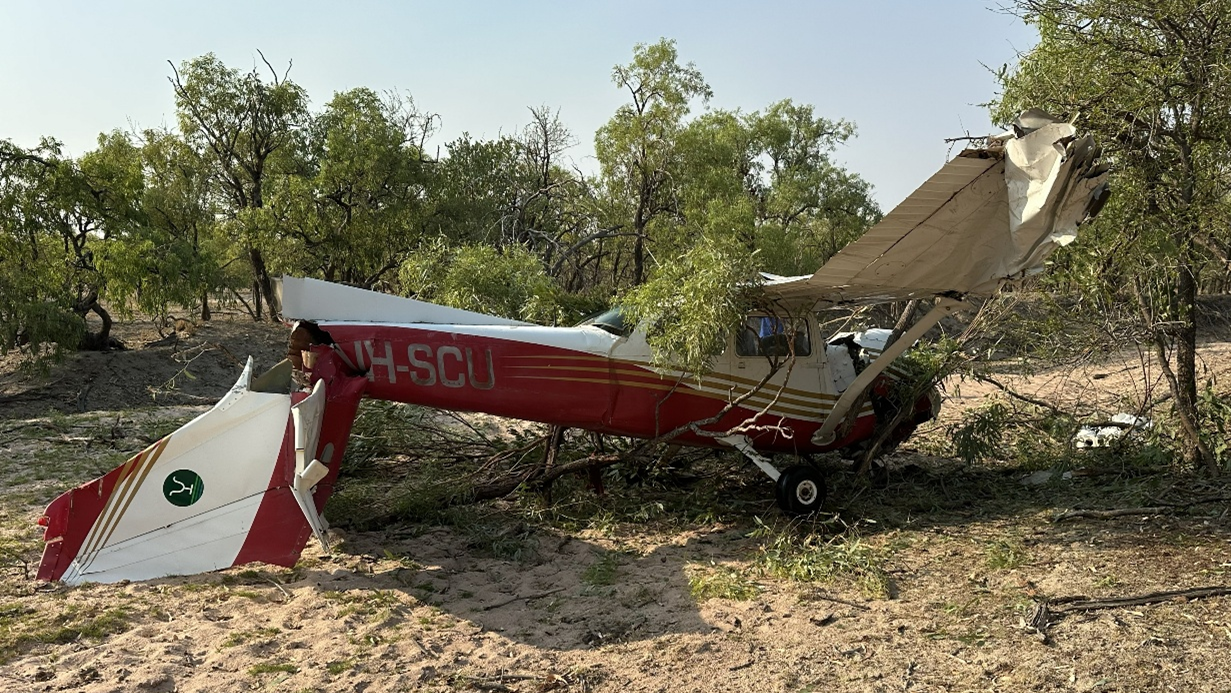
An instructor was unable to override inappropriate control inputs during a low-level training flight in the Northern Territory, but likely reduced the severity of impact when the aircraft collided with terrain, an ATSB investigation has concluded.
On 7 November 2025, a pilot and an instructor took off in a single-engine Cessna 172 for a low-level training flight from Newcastle Waters Airport, in the NT’s Barkly Region.
About an hour into the flight the pair were conducting a low-level navigation exercise, manoeuvring to follow a creek bed at approximately 300 ft above ground level, and travelling at about 80 kt.
During a steep right turn, the aircraft’s nose dropped, and the pilot under instruction, who had control of the aircraft, observed it was not turning quickly enough to remain over the creek bed.
Rather than applying additional power, the pilot responded to the nose drop with a sharp increase in aft control stick input.
With the aircraft turning steeply, the ATSB found this control input almost certainly placed the aircraft into an aerodynamic stall, rapidly increasing the rate of descent.
“This initial excessive control input was likely a combined result of the pilot being focused on maintaining a track over the ground feature, and their inexperience handling the aircraft during low-level flight,” ATSB Director of Transport Safety Stuart Macleod explained.
The instructor attempted to intervene when they identified the inappropriate control input.
“It’s unclear what verbal communication was made, but there was a period of confusion and it is likely both the pilot and instructor were making control inputs simultaneously, resulting in the instructor being unable to override the pilot’s control inputs,” Mr Macleod said.
The proximity of the ground meant the aircraft descended into terrain before this confusion could be resolved.
“Despite this, the instructor’s inputs to the throttle and rudder likely prevented the aircraft from contacting the ground in a nose down attitude, reducing the severity of the impact.”
The aircraft came to rest upright, but was substantially damaged. The instructor received minor injuries, and the pilot was uninjured.
Mr Macleod said the accident highlighted the importance of pilots understanding the relationship between the elevator control stick position, and the aircraft’s angle of attack.
“The wing will stall when the control stick is moved beyond a fixed position, irrespective of airspeed and attitude,” he said.
“During steep turns at low airspeed, awareness of the stick position provides increased awareness of the aircraft’s performance relative to its limits.
“This is particularly important to consider when operating close to the ground, such as during take-off, landing, and when conducting low-level air work.”
Read the final report: Collision with terrain involving Cessna 172N, VH-SCU, about 6 km south of Newcastle Waters, Northern Territory, on 7 November 2025