

Summary
The ATSB is investigating a collision with terrain involving a Pilatus Aircraft Ltd PC-6, registered VH-XAA, 2.5 km north of Moruya Airport, New South Wales, on 27 September 2025.
While returning to Moruya Airport following the completion of a skydiving drop, the aircraft collided with terrain. The pilot sustained fatal injuries.
The ATSB has commenced the examination and analysis of the initial evidence collected.
To date, the ATSB has:
- interviewed witnesses and involved parties
- obtained pilot and aircraft documentation
- analysed recorded data
- reviewed recorded audio transmissions
- assessed the accident site and examined the aircraft wreckage.
The investigation is continuing and will include further examination of:
- the horizontal stabiliser trim system
- recorded flight data
- aircraft configuration, maintenance and documentation
- operational procedures and documentation
- pilot training records
- survivability and opportunity for egress
- other similar occurrences.
The ATSB released a preliminary report, which details factual information established in the investigation’s early evidence collection phase, on 12 November 2025. See below.
A final report will be released at the conclusion of the investigation. Should a critical safety issue be identified during the course of the investigation, the ATSB will immediately notify relevant parties, so that appropriate safety action can be taken.
Last updated:
Preliminary report
Report release date: 12/11/2025
| This preliminary report details factual information established in the investigation’s early evidence collection phase, and has been prepared to provide timely information to the industry and public. Preliminary reports contain no analysis or findings, which will be detailed in the investigation’s final report. The information contained in this preliminary report is released in accordance with section 25 of the Transport Safety Investigation Act 2003. |
Summary video
The occurrence
On 27 September 2025, the pilot and owner of a Pilatus PC-6/B2-H4 aircraft, registered VH-XAA and operated by Jump Aviation for SKYONE Moruya Heads parachuting organisation, was conducting parachute operations over Moruya Airport, New South Wales. After conducting 8 successful parachute drops, at 1348:58 local time, the pilot broadcast on the common traffic advisory frequency (CTAF)[1] that they were taxiing for runway 04[2] to conduct the next flight. On board were 8 parachutists and the pilot. The pilot was wearing the fitted 4-point restraint and an emergency parachute in accordance with company procedures.
At 1351:08, the pilot broadcast that the aircraft was airborne off runway 04, for an upwind departure and on climb to flight levels (FL)[3] for parachute operations. During the climb to the planned drop between FL 140 and 150, several parachutists reported feeling a bump and hearing the stall warning[4] activate momentarily, passing about 10,000 ft.
At 1400:52, the pilot broadcast on the CTAF that they were 4 minutes to a parachute drop, then advised the same to Melbourne Centre air traffic control. Recorded data showed the ‘jump run’ tracked in a northerly direction about 2 km west of Moruya Airport runway 36, in a gradual descent between FL 150 and 140. The parachutists reported that the jump run was normal, and all the parachutists exited successfully. At 1406:15, the pilot broadcast that the parachutists had exited and the aircraft was on descent.
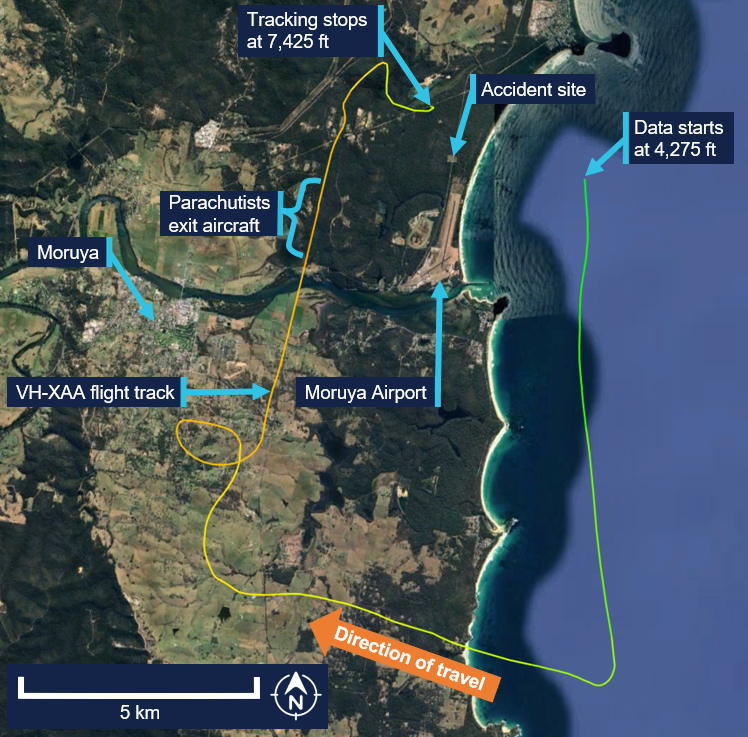
Several witnesses on the ground observed the aircraft enter a steep nose-down dive, rotating left before pitching[5] up and rolling[6] right. Recorded data showed the aircraft initially descended from FL 140 at about 5,000 fpm, but approaching FL 120, the descent rate increased significantly. The last recorded automatic dependent surveillance‑broadcast (ADS-B) data position was at 1407:26 and 7,425 ft, descending at about 15,000 fpm (Figure 1). The aircraft subsequently impacted trees and terrain about 2 km north of Moruya Airport. The pilot sustained fatal injuries, and the aircraft was destroyed.
Figure 1: VH-XAA flight track and accident site
Source: Google Earth, annotated by the ATSB
Context
Pilot
The pilot held a private pilot licence (aeroplane) with the last flight review conducted in August 2025, and a class 2 aviation medical certificate, valid until June 2027. The pilot held the appropriate ratings and endorsements for the flight. In addition, the pilot held aerobatics and spin endorsements and jump pilot authorisation. At the time of the accident, they had about 11,690 hours total aeronautical experience. In the previous 90 days, they had flown 135.2 hours, most of which were conducting parachuting operations in Cessna 206 and 208 aircraft.
The pilot’s logbook recorded an endorsement for the Pilatus PC-6 (required by the then Civil Aviation Regulations) in 1998. The ATSB was unable to access some of the pilot’s logbooks to confirm how many hours they had logged flying the Pilatus PC-6 prior to purchasing VH‑XAA from New Zealand (NZ). Between 22 and 24 August 2025, the pilot and an instructor flew the aircraft from Auckland, NZ, to Dubbo, New South Wales, logging 19.5 hours of flight time. The pilot then recorded 2 hours operating the aircraft to Moruya on 12 September 2025. From 20 to 24 September 2025 inclusive, the pilot recorded 9.7 hours in the aircraft conducting parachute operations. At the start of the accident morning, the pilot had logged 31.2 hours in VH-XAA.
The pilot was an experienced parachutist and had been a member of the Australian Parachute Federation (APF)[7] since 1987. On 30 June 2025, the pilot reported having conducted 17,000 jumps. The pilot held numerous parachuting qualifications including senior instructor and a Certificate F, which was the highest certificate issued by the APF. The pilot was the senior pilot of Jump Aviation and the chief parachute instructor of the parachuting operator SKYONE Moruya Heads – a group member of the APF.
Aircraft
General information
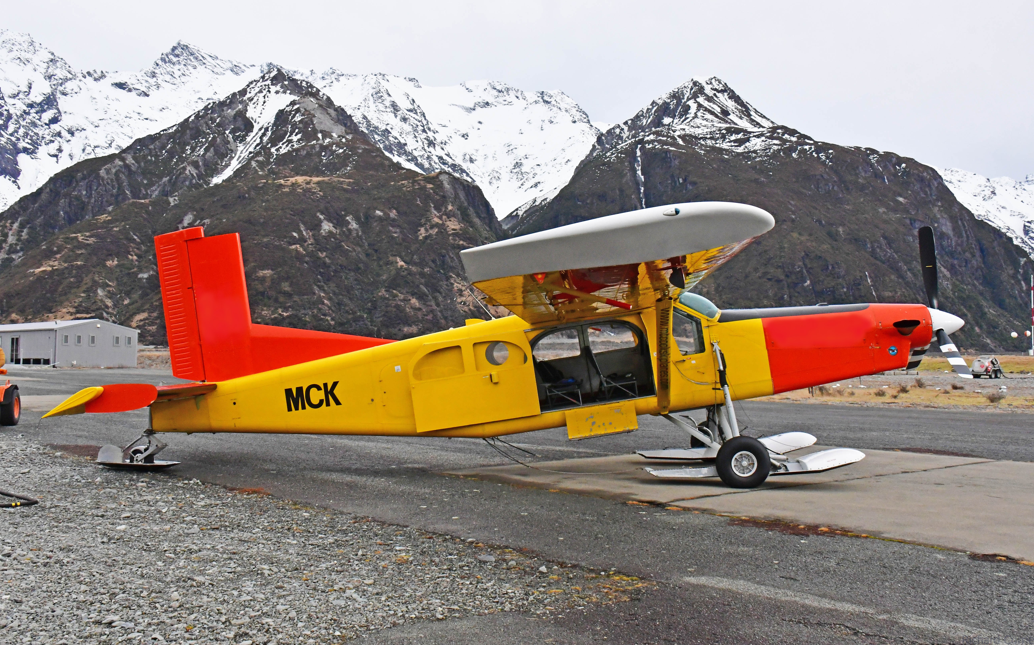
VH-XAA was a Pilatus Aircraft PC-6/B2-H4, short take-off and landing utility aeroplane with fixed landing gear (Figure 2). It was powered by a Pratt & Whitney Canada PT6A-27 turbine engine and a Hartzell Propellers HC-B3TN-3D 3-bladed propeller. The aircraft was not approved for aerobatic manoeuvres including spins.
Figure 2: VH-XAA when operating in New Zealand as ZK-MCK
Source: Richard Currie, modified by the ATSB
It was manufactured in Switzerland in 1980 and issued serial number 809. The aircraft had been used for parachute operations in New Zealand (NZ) since 1982. As such, the passenger seats, copilot seat and copilot control stick had been removed. Additionally, a skydiving step and hand hold had been installed.
A 7,000 hour/14-year ‘complete overhaul’ maintenance activity was performed in NZ and finalised on 14 August 2025. During the maintenance activity, the horizontal stabiliser electric trim actuator was removed and overhauled by the manufacturer in the United States.
The aircraft was added to the Australian civil aircraft register on 15 August 2025, and a special flight permit[8] was issued to allow the aircraft to be flown from NZ to Australia. After the pilot ferried the aircraft to Australia, a certificate of airworthiness was issued for VH-XAA on 19 September 2025. At the time of the accident, VH-XAA had accrued 13,594.5 hours total time in service.
Doors
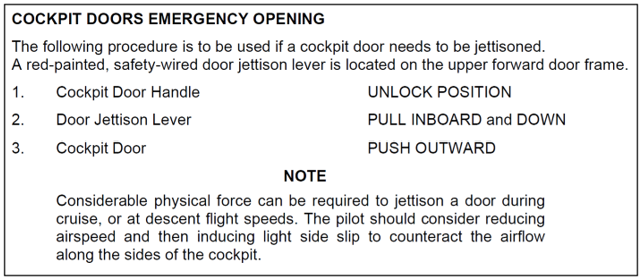
The aircraft had a door on each side of the cockpit for pilot and copilot access, which were fitted with a jettison system. Figure 3 shows the Pilatus PC-6 airplane flight manual[9] (AFM) procedure for emergency opening of the cockpit doors:
Figure 3: Cockpit doors emergency opening checklist
Source: Pilatus PC-6 airplane flight manual
The aircraft cabin had a sliding door on the right side, which was used for parachutists to exit, and 2 hinged doors on the left side, which were fitted with an emergency jettison system. The sliding door had a mechanism to open it from inside the aircraft, but it could not be locked open. Parachutists reported that, on the day of the accident, the pilot had landed with the sliding door open on some flights and closed on others. Although it was not identified at the accident site, several parachutists reported that there was a fishing gaffer hook on a pole onboard the aircraft that the pilot used to close the sliding door in flight from the pilot’s seat.
Key speeds
The AFM included the following key speeds:
- never exceed speed (VNE)[10] 151 kt
- manoeuvring speed (VA)[11] 119 kt
- maximum speed with the sliding door open 119 kt
- stalling speeds at a gross weight of 2,800 kg, power off and 0° angle of bank including:
- 58 kt calibrated airspeed[12] (KCAS) with flap retracted
- 52 KCAS with landing flap extended.
Horizontal stabiliser electric trim system
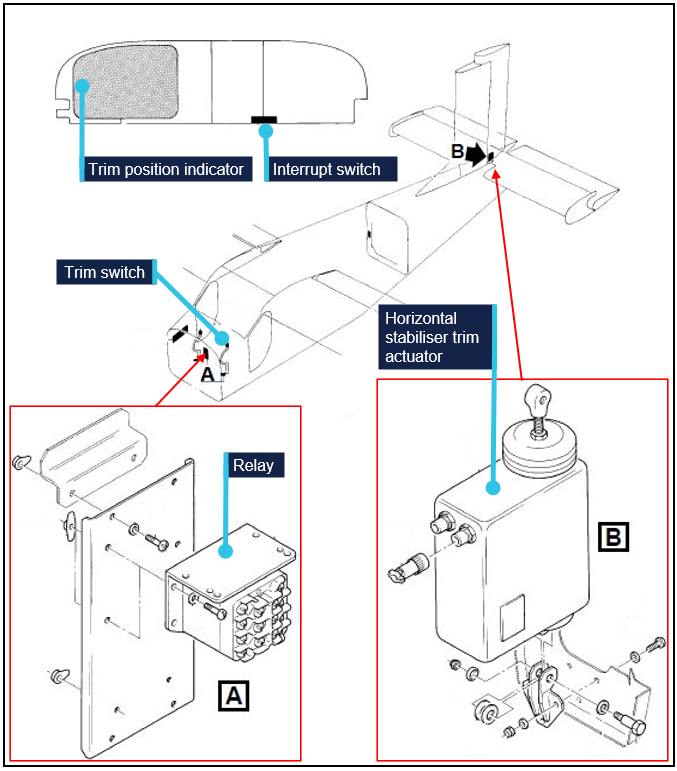
The aircraft was fitted with a horizontal stabiliser electric trim system, designed to move the entire horizontal stabiliser to adjust the pitch trim of the aircraft and balance the aerodynamic forces to reduce the pilot control forces on the elevator. The system (Figure 4), consisted of:
- a dual motor (main and alternate motors) electrically‑operated linear trim actuator
- a 3-position spring-loaded trim switch, located on the control column grip
- a relay located on the firewall
- an interrupt system incorporating a guarded switch on the instrument panel shelf and an alternate trim control system with a 3-position spring-loaded trim switch (Figure 5)
- an electrically‑operated trim position indicator on the upper left side of the instrument panel.
Figure 4: Schematic of horizontal stabiliser trim system
Source: Pilatus PC-6 Illustrated Parts Catalogue, modified and annotated by the ATSB
Figure 5: Instrument panel shelf horizontal stabiliser trim switches
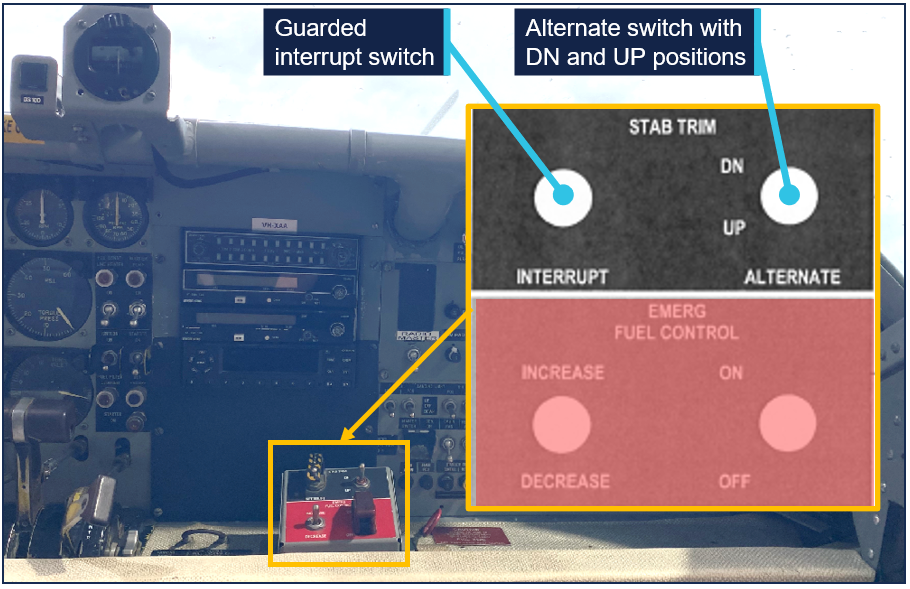
Source: Supplied and Pilatus PC-6 AFM, annotated by the ATSB
The AFM included the following procedure (Figure 6) in the event of a trim runaway:[13]
Figure 6: Horizontal stabiliser trim runaway emergency procedure
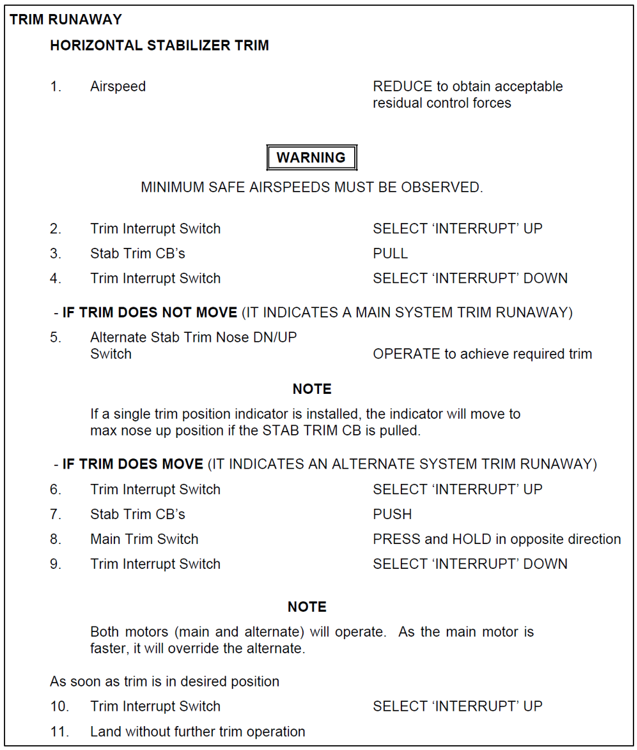
Source: Pilatus PC-6 airplane flight manual
The AFM included the following procedure (Figure 7) for jammed trim actuators:
Figure 7: Jammed horizontal stabiliser trim actuator emergency procedure
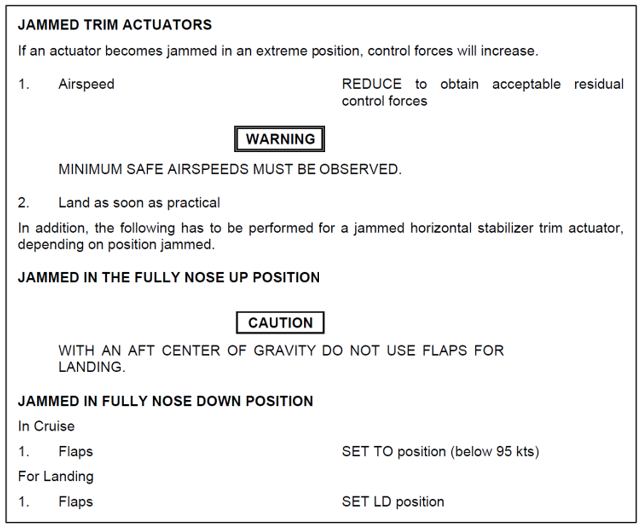
Source: Pilatus PC-6 airplane flight manual
The AFM also included the following procedure (Figure 8) for loss of elevator control:
Figure 8: Loss of elevator control emergency procedure
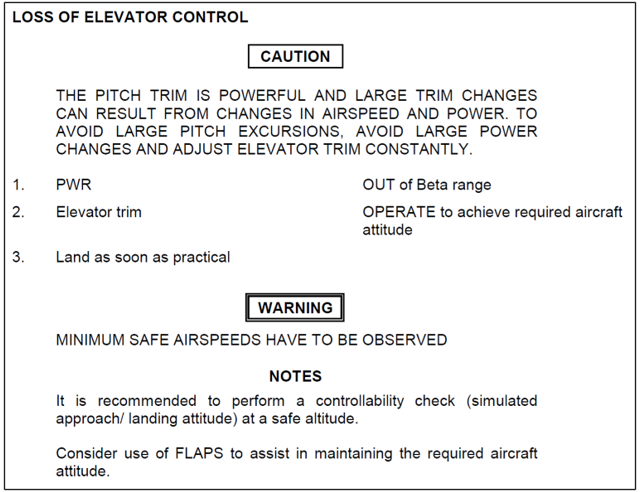
Source: Pilatus PC-6 airplane flight manual
Beta mode
The AFM described beta mode as ‘operation of the propeller used in flight to achieve fast deceleration and high rates of descent’. The AFM stated:
In the beta range, the propeller blades are set at a low positive pitch angle to provide a braking effect for steep controlled descents. When operating in the beta mode, the propeller pitch angle is controlled by power lever movement between the lift detent and the point where constant speed operation becomes effective.
NOTE
BETA MODE is provided in descent at airspeeds below 100 KIAS [kt indicated airspeed] with the POWER lever near or at the detent. Only small movements of the POWER lever are necessary to change rate of descent or airspeed. Approaches in full BETA MODE (POWER lever at detent) are not permitted at airspeeds below 1.3 Vs.[14]
Meteorological information
The Bureau of Meteorology aerodrome forecast for Moruya Airport, issued at 1109 on 27 September 2025 included wind from 090° at 5 kt, which was expected to change to 310° and become gusty between 1200 and 1300. The grid point wind and temperature chart showed the forecast winds:
- at 10,000 ft from 270° at 42 kt
- at FL 140 from 270° at 51 kt.
The Bureau of Meteorology had also issued SIGMETs[15] for severe turbulence below 8,000 ft and mountain waves from 4,000 ft to FL 320 in an area that included Moruya Airport, between 1100 and 1500.
The conditions recorded in the METAR[16] at Moruya Airport at 1400 included wind from 130° at 6 kt, visibility greater than 10 km, temperature 22°C, and QNH[17] 1,007 hPa.
Recorded data
The ATSB conducted preliminary analysis of the aircraft’s 3-dimensional position information recorded in the ADS-B data for the 9 flights on 27 September 2025, the last of which was the accident flight. The positional data was interpolated between recorded positions and a trajectory analysis conducted to estimate other flight performance and handling parameters. The analysis was based on the forecast wind and an estimated aircraft weight of 1,587 kg (3,500 lb). For most of the flights, there was no recorded ADS‑B data below about 4,000 ft above mean sea level.
A comparison of the following key parameters for the 9 flights was conducted for the descent following parachute drop from about FL 140:
- altitude
- descent rate
- estimated calibrated airspeed
- estimated pitch and roll angles.
For flights 1–5, 7 and 8, the values of these parameters were similar. In those 7 flights, the descent commenced at an airspeed of about 55–70 KCAS, with an initial nose-down pitch of about 30° and either a right or left roll of about 30° (on flight 4 the roll angle was possibly up to 50°). The maximum descent rate for these 7 flights was between about 5,500 and 8,000 fpm.
On flight 6, the descent was initiated slightly slower, at about 54 KCAS, which increased within 10 seconds to about 145 KCAS, coincident with a maximum momentary descent rate of about 14,000 fpm, a steep (70°) pitch down in conjunction with a substantial roll right.
The descent on the accident flight (flight 9) was initiated at about 53 KCAS from 14,200 ft to a nose-down pitch of about 25°, with a 60° right roll. The aircraft briefly reduced pitch slightly before nosing vertically down (about 90°) in a left roll, reaching a maximum descent rate of over 20,000 fpm. The aircraft then pitched up to a shallow climb and into a roll of more than 120°. From the data it could not be confirmed whether this manoeuvre was conducted upright or inverted. Passing about 9,600 ft, the airspeed reduced to 125–130 KCAS before increasing again. The last recorded position, passing about 8,000 ft indicated the aircraft had accelerated to 173 KCAS, with a final descent rate above 15,000 fpm (Figure 9).
Figure 9: Preliminary plot of key parameters from the accident flight descent
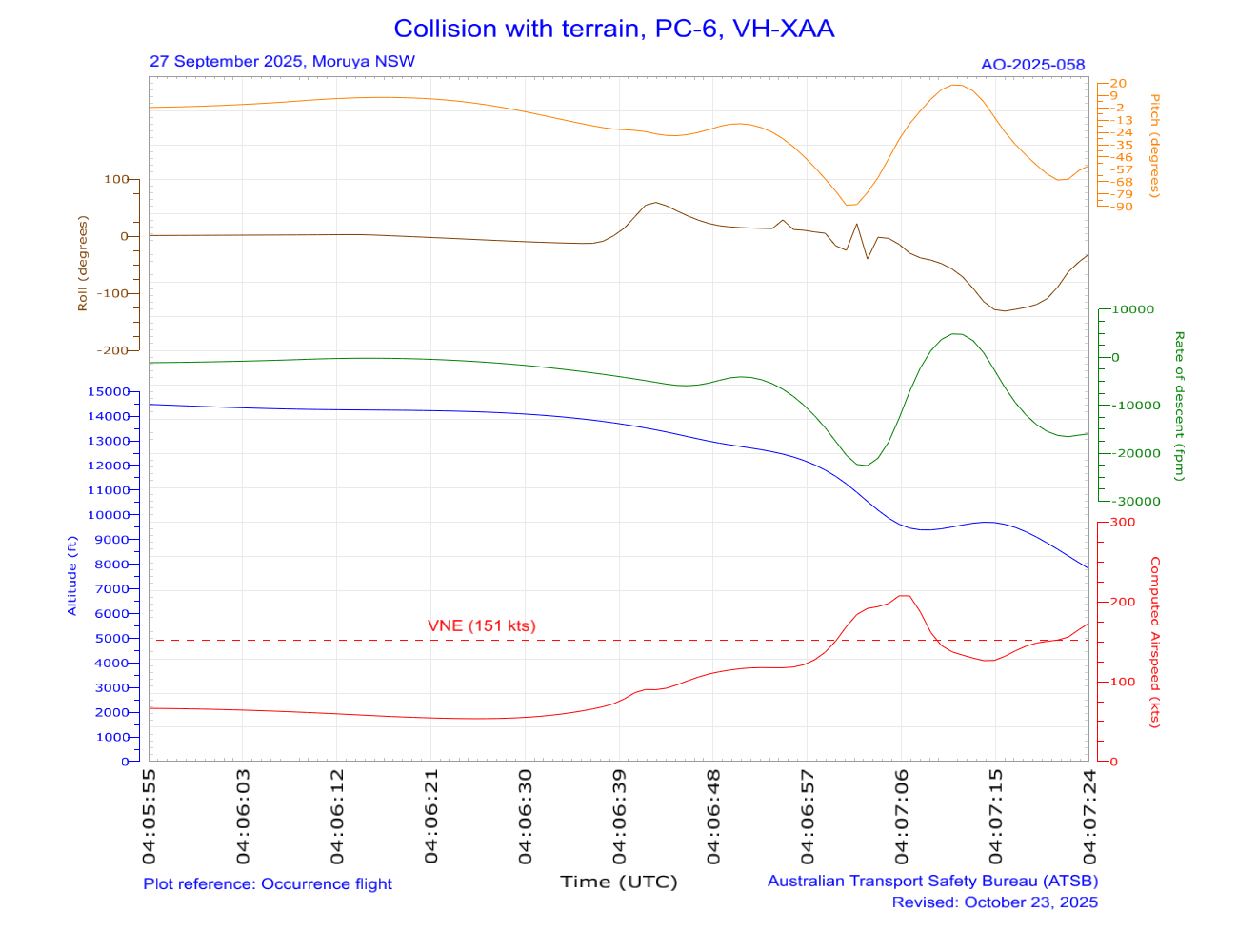
Due to the aircraft’s manoeuvring, the roll information may be inaccurate. Local time was UTC+10 hours. Source: ATSB
Site and wreckage
The wreckage site was about 2.5 km north (and slightly west) of the northern end of the Moruya Airport runway 36. ATSB examination showed that the right wing struck a tree on the eastern side of George Bass Drive and separated from the fuselage, before the aircraft collided with trees on the western side of the road and subsequently impacted terrain in a nose-down inverted attitude (Figure 10). The outer section of the right wing landed on the road but was moved clear by members of the public shortly after the accident.
Figure 10: Overview of VH-XAA accident site
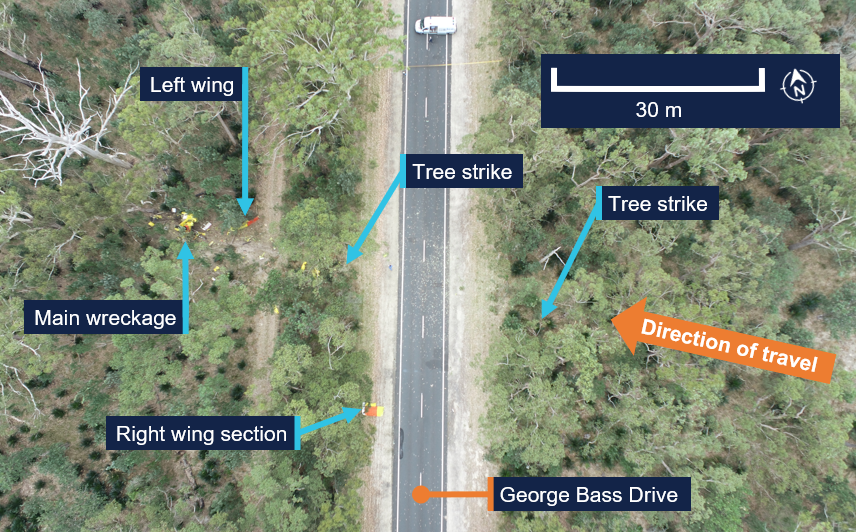
Source: ATSB
The examination identified:
- there was fuel remaining and no post-impact fire occurred
- all major components of the aircraft were at the site, indicating there was no in-flight breakup
- the propeller had indications that the engine was producing power at impact
- there were no indications of any pre-impact mechanical anomalies that would have precluded normal engine operation
- the pilot’s 4-point restraint was undone, and the pilot was almost certainly not in the pilot seat at the time of impact
- the horizontal stabiliser trim actuator was found in the full nose-down position (Figure 11).
Figure 11: Horizontal stabiliser trim actuator showing trim position
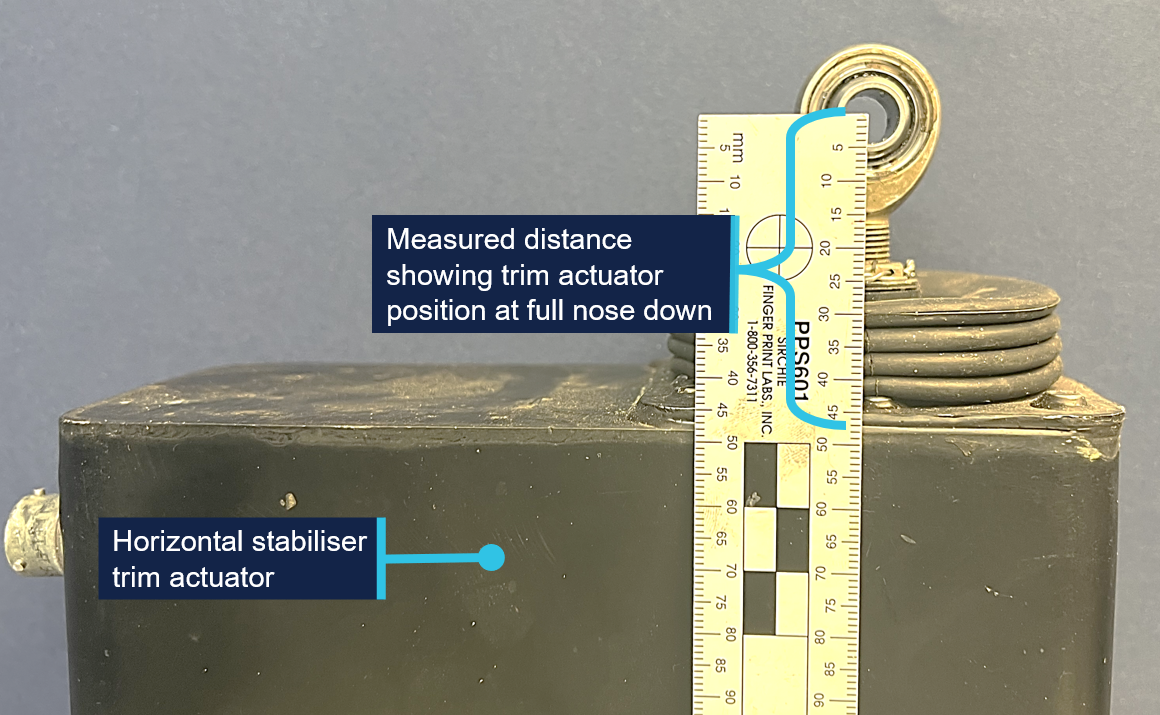
Source: ATSB
Further investigation
- interviewed witnesses and involved parties
- obtained pilot and aircraft documentation
- analysed recorded data
- reviewed recorded audio transmissions
- assessed the accident site and examined the aircraft wreckage.
The investigation is continuing and will include further examination of:
- the horizontal stabiliser trim system
- recorded flight data
- aircraft configuration, maintenance and documentation
- operational procedures and documentation
- pilot training records
- survivability and opportunity for egress
- other similar occurrences.
A final report will be released at the conclusion of the investigation. Should a critical safety issue be identified during the course of the investigation, the ATSB will immediately notify relevant parties so appropriate and timely safety action can be taken.
Acknowledgements
The ATSB would like to acknowledge the assistance of the NSW Police Force, Fire and Rescue NSW, and first responders.
Purpose of safety investigationsThe objective of a safety investigation is to enhance transport safety. This is done through:
It is not a function of the ATSB to apportion blame or provide a means for determining liability. At the same time, an investigation report must include factual material of sufficient weight to support the analysis and findings. At all times the ATSB endeavours to balance the use of material that could imply adverse comment with the need to properly explain what happened, and why, in a fair and unbiased manner. The ATSB does not investigate for the purpose of taking administrative, regulatory or criminal action. About ATSB reportsATSB investigation reports are organised with regard to international standards or instruments, as applicable, and with ATSB procedures and guidelines. Reports must include factual material of sufficient weight to support the analysis and findings. At all times the ATSB endeavours to balance the use of material that could imply adverse comment with the need to properly explain what happened, and why, in a fair and unbiased manner. An explanation of terminology used in ATSB investigation reports is available here. This includes terms such as occurrence, contributing factor, other factor that increased risk, and safety issue. Publishing informationReleased in accordance with section 25 of the Transport Safety Investigation Act 2003 Published by: Australian Transport Safety Bureau © Commonwealth of Australia 2025 
Ownership of intellectual property rights in this publication Unless otherwise noted, copyright (and any other intellectual property rights, if any) in this report publication is owned by the Commonwealth of Australia. Creative Commons licence With the exception of the Commonwealth Coat of Arms, ATSB logo, and photos and graphics in which a third party holds copyright, this report is licensed under a Creative Commons Attribution 4.0 International licence. The CC BY 4.0 licence enables you to distribute, remix, adapt, and build upon our material in any medium or format, so long as attribution is given to the Australian Transport Safety Bureau. Copyright in material obtained from other agencies, private individuals or organisations, belongs to those agencies, individuals or organisations. Where you wish to use their material, you will need to contact them directly. |
[1] Common traffic advisory frequency (CTAF): a designated frequency on which pilots make positional broadcasts when operating in the vicinity of a non-controlled aerodrome or within a broadcast area.
[2] Moruya Airport had 2 sealed runways, 18/36 and 04/22. The runway number represents its magnetic heading.
[3] Flight level: at altitudes above 10,000 ft in Australia, an aircraft’s height above mean sea level is referred to as a flight level (FL). FL 140 equates to 14,000 ft.
[4] A stall warning system provides the pilot with advance warning of an impending aerodynamic stall.
[5] Pitching: the motion of an aircraft about its lateral (wingtip-to-wingtip) axis.
[6] Rolling: the movement of an aircraft about its longitudinal axis.
[7] The APF is the peak body for the administration and representation of Australian Sport Parachuting.
[8] Special Flight Permit (SFP): issued to allow the operation of an aircraft that does not meet its airworthiness requirements but under certain circumstances, and for a particular intended purpose, the aircraft may still be capable of safe flight.
[9] Airplane flight manual (AFM): a manual that is part of the certification basis of the aircraft, containing the operating limitations within which the aircraft is considered airworthy, and any other information required for the safe operation of the aircraft, including all amendments and supplements for that manual.
[10] Never exceed speed (VNE): the indicated airspeed which, if exceeded, may result in structural damage to the aircraft, normally represented by a red line on the airspeed indicator.
[11] Manoeuvring speed (VA): the maximum speed at which a pilot can make full or abrupt control movements without causing structural failure of the aircraft.
[12] Calibrated airspeed: indicated airspeed corrected for air speed indicator system errors.
[13] Pitch trim runaway is an uncontrolled movement of the aircraft’s trim system causing uncommanded nose-up or nose‑down pitch.
[14] Vs - Stall speed or minimum steady flight speed for which the aircraft is still controllable.
[15] SIGMET: a concise description of the occurrence or expected occurrence, in an area over which area meteorological watch is maintained, of specified phenomena which may affect the safety of aircraft operations.
[16] METAR: a routine report of meteorological conditions at an aerodrome. METAR are normally issued on the hour and half hour.
[17] QNH: the altimeter barometric pressure subscale setting used to indicate the height above mean seal level.
Occurrence summary
| Investigation number | AO-2025-058 |
|---|---|
| Occurrence date | 27/09/2025 |
| Occurrence time and timezone | 14:00 Australian Eastern Standard Time |
| Location | 2.5 km north of Moruya Airport |
| State | New South Wales |
| Report release date | 12/11/2025 |
| Report status | Preliminary |
| Anticipated completion | Q1 2027 |
| Investigation level | Short |
| Investigation type | Occurrence Investigation |
| Investigation phase | Examination and analysis |
| Investigation status | Active |
| Mode of transport | Aviation |
| Aviation occurrence category | Collision with terrain, Loss of control |
| Occurrence class | Accident |
| Highest injury level | Fatal |
Aircraft details
| Manufacturer | Pilatus Aircraft Ltd |
|---|---|
| Model | PC-6/B2-H4 |
| Registration | VH-XAA |
| Serial number | 809 |
| Aircraft operator | Jump Aviation Pty Ltd |
| Sector | Turboprop |
| Operation type | Part 105 Parachuting |
| Activity | General aviation / Recreational-Sport and pleasure flying-Parachute dropping |
| Departure point | Moruya Airport, New South Wales |
| Destination | Moruya Airport, New South Wales |
| Injuries | Crew - 1 (fatal) |
| Damage | Destroyed |