

Final report
Report release date: 02/07/2026
Investigation summary
What happened
On the morning of 11 October 2025, a Piper PA-32R-300 Cherokee Lance, registered VH-JVA, commenced a take-off from runway 26 at Shellharbour Airport, New South Wales, for a private instrument flight rules flight to Bathurst Airport, with a pilot and 2 passengers on board.
After a ground roll of 410 m, the aircraft abruptly pitched up, yawed left and became airborne. The aircraft then climbed away from the runway in a nose high attitude while skidding and rolling left. It then followed a left-turning flight path and reached a maximum recorded altitude of about 50 ft above ground level (AGL) before it began descending. As the aircraft descended, it appeared to stall, the angle of bank increased, and the descent rate increased rapidly. The aircraft collided with terrain and came to rest at the threshold of the intersecting runway (runway 34). The pilot and passengers were fatally injured in the accident, and the aircraft was destroyed.
What the ATSB found
The ATSB found that during the take-off roll, the horizontal stabilator moved to a full, or near-full, nose up deflection and very likely remained in this position for the entire flight. The reason for the control deflection could not be determined.
The ATSB also found that at the time of the accident flight, required scheduled instrument and avionics maintenance inspections had not been completed. While not contributory to the accident, that reduced the assurance that these systems were functioning accurately.
What has been done as a result
In response, the aircraft maintainer advised that they had automated the tracking and alerting of aircraft maintenance requirements to ensure that all required items were completed.
Safety message
If not rapidly corrected, an uncommanded pitch up during take-off can lead to a stall and a loss of control. This is not a scenario typically included in training and a pilot confronted with this scenario faces an unexpected and challenging situation. If control cannot be quickly regained by pushing forward on the control column, engine power should be promptly reduced and control maintained as best as possible to attempt a landing.
Inspections of aircraft instruments and avionics are vital to ensure these systems operate correctly and present accurate and reliable information. While the overdue inspections did not contribute to the accident, pilots can be entirely reliant on these systems to ensure the safety of a flight. Therefore, both pilots and maintainers should ensure required inspections are completed prior to a flight.
Summary video
The investigation
| The ATSB scopes its investigations based on many factors, including the level of safety benefit likely to be obtained from an investigation and the associated resources required. For this occurrence, the ATSB conducted a limited-scope investigation in order to produce a short investigation report and allow for greater industry awareness of findings that affect safety and potential learning opportunities. |
The occurrence
On the morning of 11 October 2025, a Piper PA-32R-300 Cherokee Lance, registered VH-JVA, taxied for a private flight from Shellharbour Airport to Bathurst Airport, New South Wales. The flight was being operated under the instrument flight rules1 with the pilot and 2 passengers on board.
At 0956 local time, as the aircraft approached runway 26, the pilot announced on the Shellharbour common traffic advisory frequency (CTAF) that the aircraft was entering the runway and lining up to depart. The pilot then taxied the aircraft onto the runway starter extension2, lined up and conducted pre‑take‑off checks and engine run ups. While VH‑JVA was lined up, a Cessna Caravan taxiing behind VH‑JVA stopped at the holding point at the runway 26 threshold. The pilot of VH‑JVA invited the pilot of the Cessna to depart ahead of VH‑JVA and the Cessna took off shortly after.
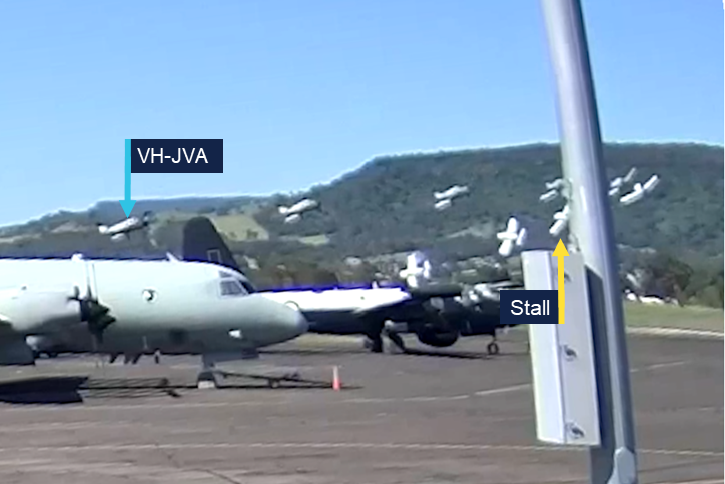
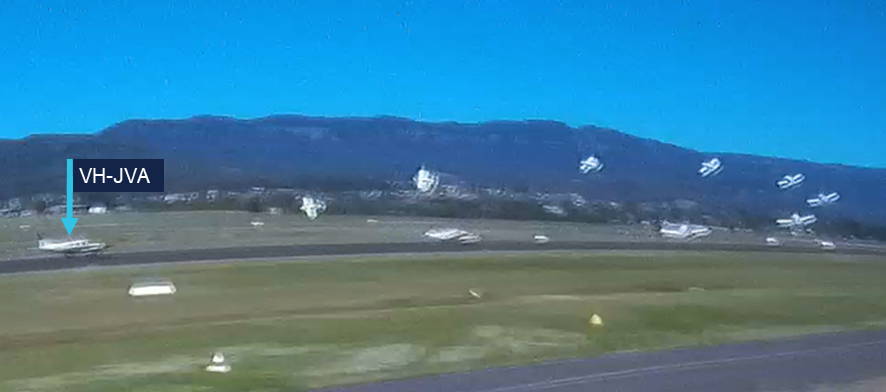
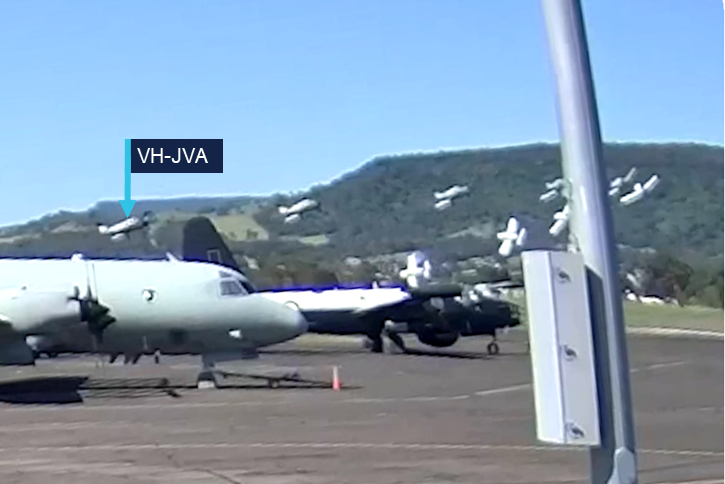
About a minute after the Cessna departed, VH-JVA began a take-off from runway 26. Following a ground roll of about 410 m, VH-JVA abruptly pitched up and yawed left as it became airborne. The aircraft then climbed away from the runway in a nose high attitude while skidding3 and rolling left (Figure 1 and Figure 2).
Figure 1: Composite image of recorded security camera footage of the flight
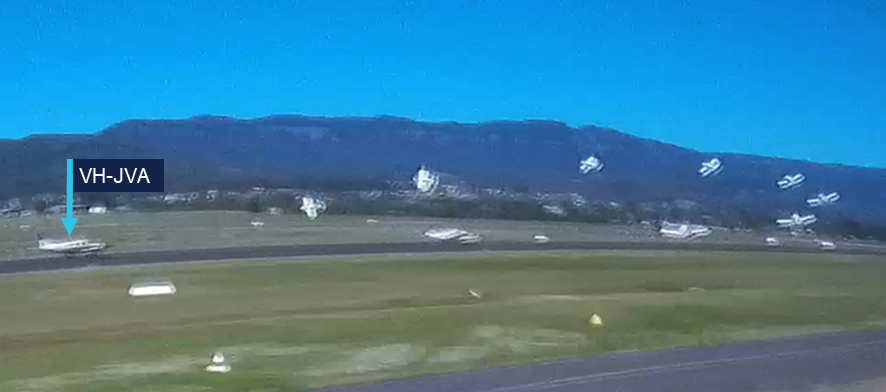
Figure 2: Composite image of recorded security camera footage of later part of the flight
The angle of bank then appeared to stabilise briefly as the aircraft followed a left-turning flight path (Figure 3). As it turned to a heading of about 200° magnetic (M), it reached a maximum recorded altitude of about 50 ft above ground level (AGL) and then began descending. Three seconds after reaching 50 ft AGL, the aircraft appeared to stall, the angle of bank increased, and the descent rate began increasing rapidly. As the descent rate increased, engine power reduced before the aircraft collided with terrain.
Figure 3: Flight overview
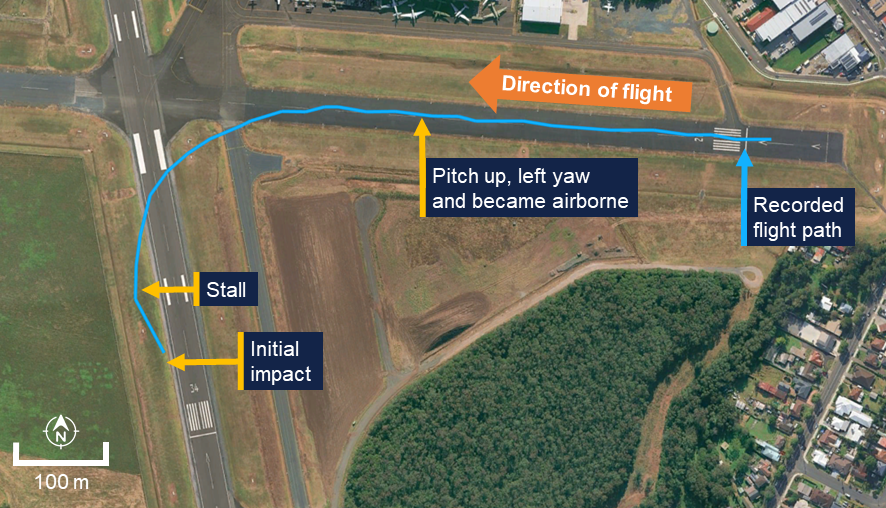
A post-impact fire commenced and the aircraft came to rest at the threshold of the intersecting runway (runway 34). The pilot and passengers were fatally injured in the accident, and the aircraft was destroyed.
Context
Pilot details
The pilot held a Private Pilot Licence (Aeroplane) and the required class rating and endorsements to operate the aircraft. The pilot also held a private instrument rating and Class 2 aviation medical certificate, which were both current at the time of the accident.
The pilot’s logbook was reported to be in the aircraft during the accident flight. However, the cabin area of the aircraft was extensively fire damaged following the accident and the logbook could not be located.
At the pilot’s last aviation medical examination, the pilot had declared a total of 1,015 hours of aeronautical experience. Maintenance release entries showed that since that medical examination, the pilot had flown 27.1 hours in the aircraft. Of these, 4.6 hours were in the 90 days before the accident and none in the 30 days before the accident.
The ATSB found no indicators that the pilot was experiencing a level of fatigue known to adversely affect performance.
Medical details
A review of medical records and post‑mortem examinations of the pilot and passengers identified no pre‑existing conditions that were likely to adversely impact their actions or behaviours. Similarly, the toxicological examinations did not identify any substances, including carbon monoxide concentration, that could have impaired the pilot’s performance or adversely impacted the passengers’ actions or behaviours.
Aircraft details
General information
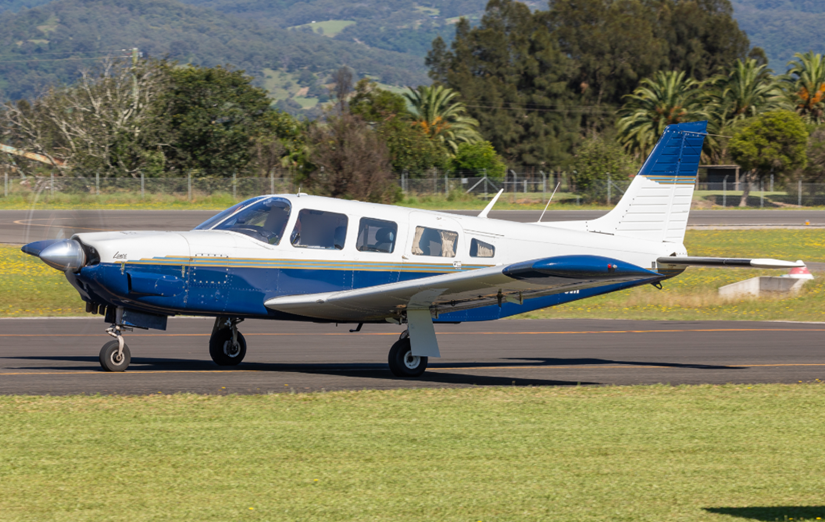
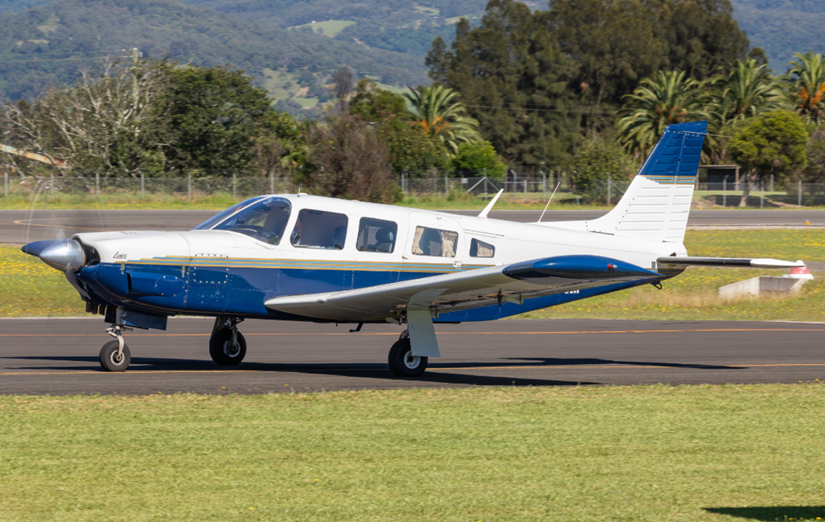
The Piper PA-32R-300 Cherokee Lance is a single-engine, low-wing, retractable-tricycle landing gear aircraft. The Lance is powered by a Lycoming IO-540 fuel-injected, horizontally-opposed piston engine driving a 3-blade, variable-pitch propeller. VH‑JVA (Figure 4), serial number 32R-7680030, was manufactured in the United States in 1975 and first registered in Australia in 1985. The maintenance release stated that the aircraft was approved for IFR, visual flight rules4 (VFR) night and VFR day operations.
Prior to the accident flight, the aircraft was last flown on 12 September 2025 and, at the completion of that flight, the aircraft had accumulated 3,915.5 hours total time in service. At the time of the accident, the engine had accumulated 2,043 hours in service since its last overhaul in 1991.
The aircraft was configured with 7 seats (all forward facing) and equipped with dual flight controls. The aircraft was not fitted with aileron trim and was equipped with a Century IIB autopilot, which incorporated a servo on the aileron control system only. In the event of a malfunction, the autopilot servo was designed to allow a pilot to manually override the system.
Figure 4: VH-JVA
Horizontal stabilator
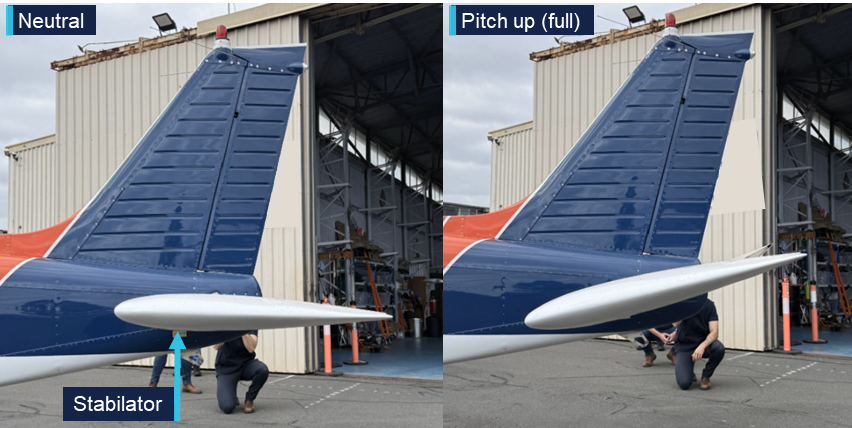
The aircraft was fitted with a horizontal stabilator (Figure 5), sometimes referred to as an all-moving tail. A horizontal stabilator is a fully movable aircraft horizontal stabiliser in which the entire horizontal tail surface is responsive to control column inputs.
Figure 5: Horizontal stabilator
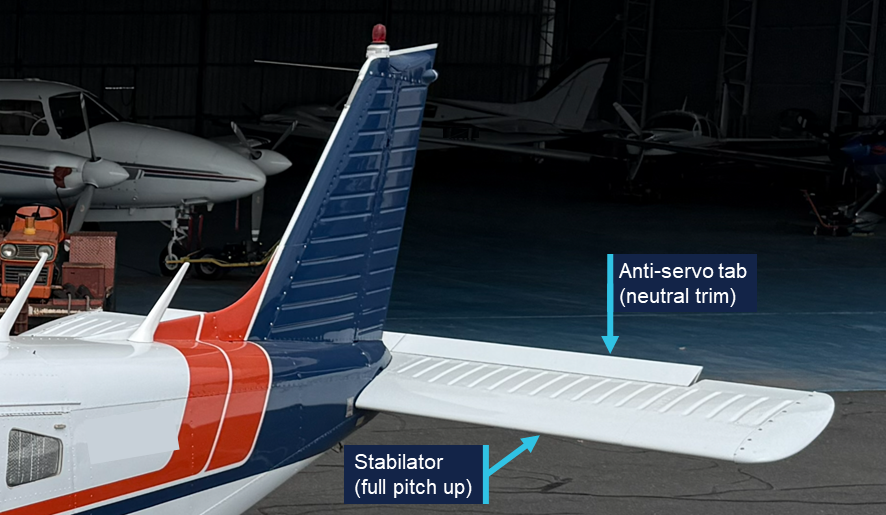
The stabilator was fitted with an anti-servo tab (Figure 6), a small, hinged surface set into the trailing edge of the stabilator. As the stabilator deflected from the trim position, the tab moved in the same direction, but further than the stabilator, to provide an opposing force.
Figure 6: Stabilator and anti-servo tab
Maintenance
The aircraft was maintained in accordance with the Civil Aviation Safety Authority (CASA) maintenance schedule, which required a periodic inspection every 100 hours or 12 months, whichever came first. The CASA maintenance schedule for periodic inspections is divided into airframe, engine, electrical, instruments and radio sections. For aircraft operating only under the visual flight rules (VFR), these inspections could be certified by an ‘airframe’ licenced aircraft maintenance engineer (LAME). For IFR approved aircraft, the radio section contained additional requirements that could only be certified by a suitably-endorsed avionics LAME.5
The logbook for VH-JVA indicated that a periodic inspection had been completed on 14 May 2025 at 3,898.2 hours in service. However, the logbook entry by the aircraft’s current maintainer (who was not an avionics LAME) did not specify which elements of the maintenance schedule had been completed. Logbook entries for previous periodic inspections conducted by other maintenance organisations specifically noted where the VFR-required inspections had been completed, with a separate entry certifying the completion of the IFR requirements.
The current aircraft maintainer advised that all logbook entries reflected inspections and maintenance completed as specified in work packages.6 The maintainer also advised that for several aircraft, including VH-JVA, the completed work package documents had been inadvertently disposed of, or destroyed by recent flooding of their premises. Therefore, the ATSB could not verify which elements of the VFR maintenance schedule had been completed by the maintainer under their airframe licence. The instrument and radio system inspections for IFR flight (required to be certified by an avionics LAME) were not completed during the May 2025 inspection or at any subsequent time before the accident flight.
Further to the periodic inspections, CASA Civil Aviation Order (CAO) 100.5 General requirements in respect of maintenance of Australian aircraft set out additional maintenance requirements for specific systems that were not covered in the maintenance schedule. The aircraft logbook recorded the following CAO 100.5 instrument and radio inspections as being last completed on the dates listed in Table 1.
Table 1: CAO 100.5 instrument and radio inspections
| Inspection item | Required frequency | Most recent logbook entry | Next inspection due (IFR flight) |
| Pitot-static systems | 24 months | 17 April 2023 | 17 April 2025 |
| Pressure altimeters | 24 months | 17 April 2023 | 17 April 2025 |
| Airspeed indicator | 48 months | 17 April 2023 | 17 April 2027 |
| ATC transponder | 24 months | 17 April 2023 | 17 April 2025 |
CAO 100.5 allowed for time extensions of up to 60 days for compliance with these inspections (to 16 June 2025, except for the airspeed indicator). However, there was no record of these CAO 100.5 maintenance inspections being completed before the accident flight in October 2025.
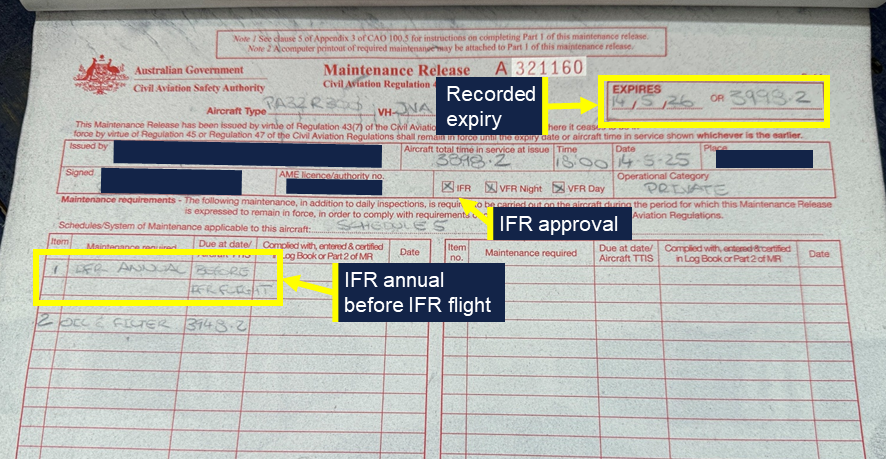
The aircraft’s original maintenance release was not found in the fire-damaged wreckage, but the ATSB viewed the carbon copy of the current maintenance release that was retained by the maintainer. The current maintenance release, issued by the maintainer, was endorsed for IFR operations and was recorded as expiring on 14 May 2026, or 3,998.2 hours in service, whichever occurred sooner (Figure 7).
Part 1 of the maintenance release included a section where any maintenance required within the validity period could be recorded. Any flight outside of the conditions endorsed in the maintenance release was not permissible until the required item had been addressed and certified by a suitably qualified person. The ‘Maintenance required’ section of the current maintenance release noted that an ‘IFR annual’ was required before IFR flight. This ‘IFR annual’ (IFR-required periodic inspections) was not completed before the accident flight. Additionally, the ‘Maintenance required’ section of the release did not contain any entry relating to the CAO 100.5 inspections required to be completed by 16 June 2025.
Figure 7: Maintenance release carbon copy
Aircraft loading and take-off performance
The pilot and a passenger were in the 2 front seats while the other passenger was seated in the left seat of the second row. Witness statements and fuel records indicated that the aircraft departed with full tanks.
The purpose of the flight was an overnight stay at Bathurst before returning to Shellharbour the following afternoon. No large or heavy items were identified in the aircraft during the examination of the wreckage and the ATSB estimated the aircraft to be within weight and balance limitations for the flight.
The pilot’s operating handbook (POH) indicated that for the conditions of the accident take-off, the ground roll for a maximum performance take-off could be expected to be between about 260 m (flaps 25) and 365 m (flaps 0).
Impact and wreckage information
Overview
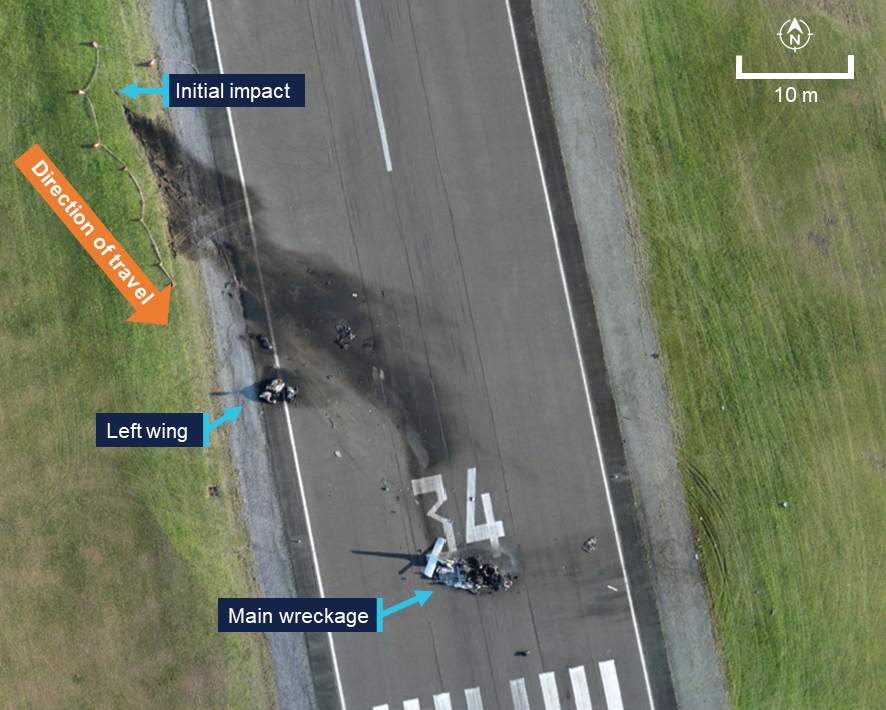
The aircraft impacted the ground to the west of runway 34 while travelling in the 138° M direction (Figure 8). The left wing tip impacted the ground first with the aircraft at or near a 90° angle of bank and with a nose down attitude. The propeller and engine then impacted the ground about 12 m from the wing tip impact. The left wing separated from the aircraft and the main wreckage continued along the ground for a further 47 m before coming to rest on runway 34 near the runway threshold. The integral fuel tanks in both wings ruptured during the accident sequence, leading to a post-impact fire that destroyed most of the fuselage (Figure 9).
Figure 8: Accident site
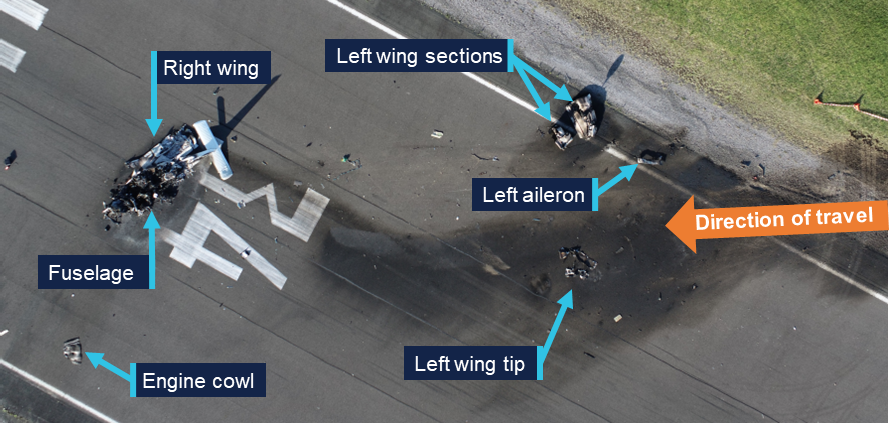
Figure 9: Fuselage wreckage
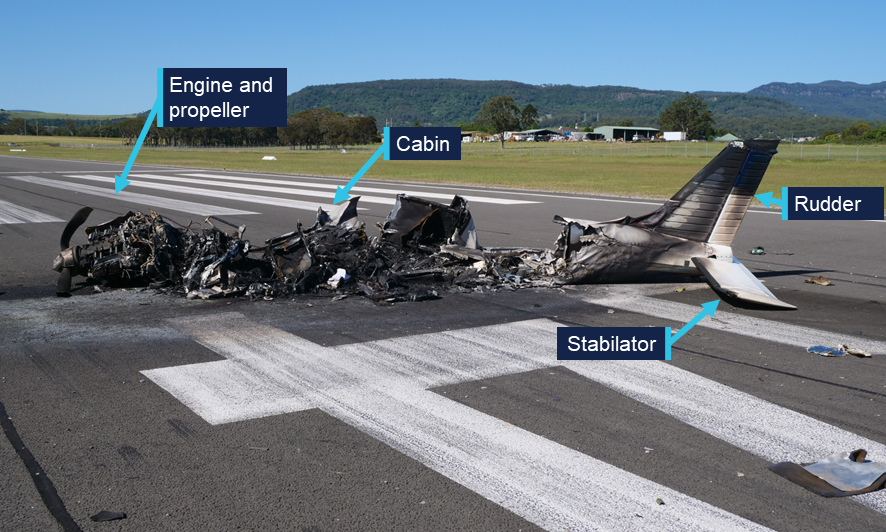
All major aircraft components were accounted for at the accident site. The ATSB conducted an initial examination of the wreckage at the site before moving the wreckage to an airport hangar for further examination. This examination did not identify any pre‑existing faults with the aircraft, the primary flight controls or the associated trim systems.
The landing gear was extended, and the flaps were extended to the 10-degree setting at impact. The stabilator trim was set to slightly nose up and the rudder trim was neutral (both positions were in accordance with POH guidance for take-off). Damage to the pilot’s seat rails indicated that it was locked in an appropriate position for the flight. The left (inboard) pin of the passenger’s seat was found secured in the rearmost position while the right (outboard) pin was found not secured into a position. However, there was no damage to the passenger seat rails or outboard rail stop to indicate that this seat had slid rearward.7
An inspection of runway 26 and the wreckage examination found no evidence of an animal strike.
Engine and propeller examination
The damage to the propeller indicated that the engine was driving the propeller at the time of impact. The throttle, propeller and mixture controls were all found fully forward although movement of the controls during the accident sequence could not be ruled out.
In December 2025, the engine was disassembled and examined at a CASA-authorised maintenance facility under the supervision of the ATSB. The engine condition was consistent with the engine’s recorded time in service since overhaul. No internal or external damage was identified that may have prevented the engine from operating normally prior to the accident. No defects were identified in the induction system components or engine accessories that may have affected its pre-accident operation.
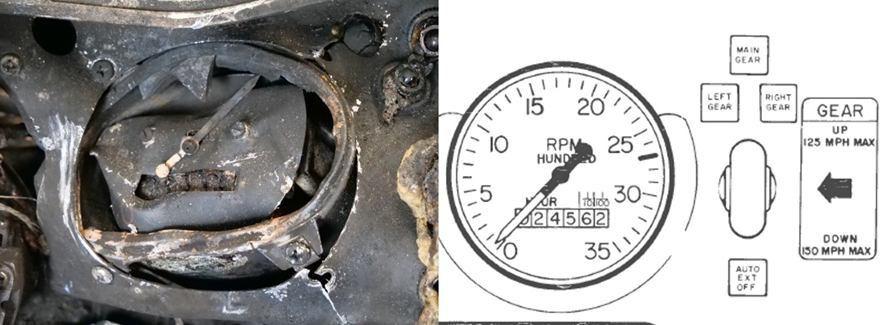
The propeller blades were all retained in the propeller hub. The blades and the spinner also exhibited signatures consistent with the propeller being driven by the engine at moderate power at the time of impact. Propeller ground scars and the tachometer needle position indicated that the engine was rotating at about 2,000 to 2,200 RPM at the time of the ground impact (Figure 10).
Figure 10: Tachometer from the aircraft (left) and an extract from the pilot’s operating handbook (right)
Recorded data
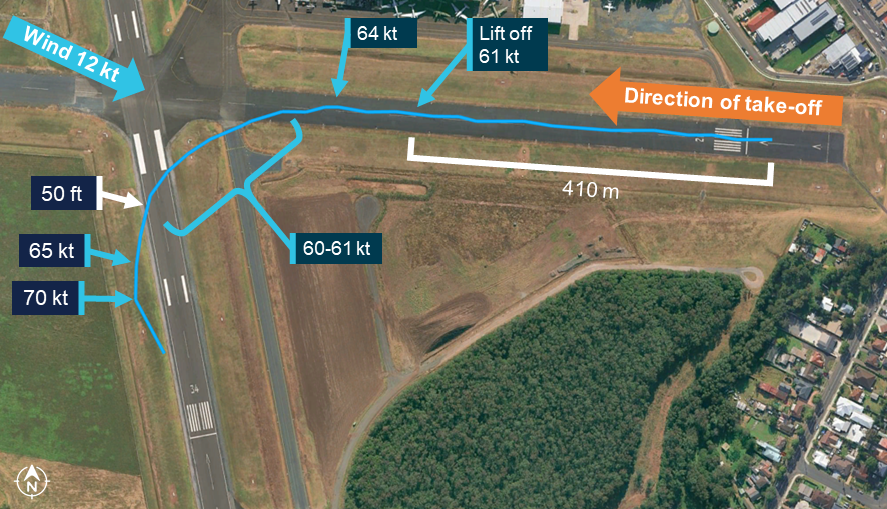
The ATSB obtained recorded automatic dependent surveillance‑broadcast (ADS-B) data for the accident flight. In addition, several security cameras captured the aircraft before and during the flight (Figure 11 and Figure 12)
Figure 11: The aircraft taxiing prior to take-off
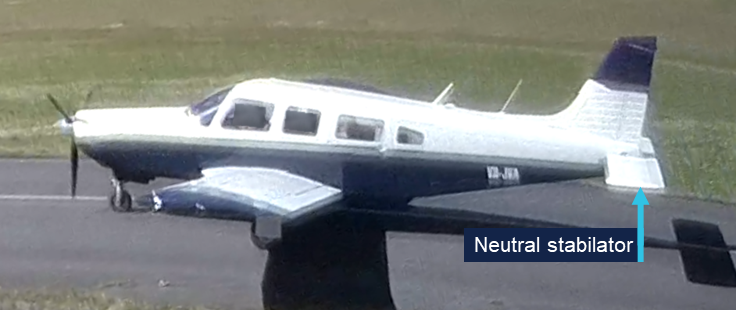
Figure 12: Flight path and recorded data
A witness also captured 2 photographs of the aircraft while airborne (Figure 13 and Figure 14). From the security camera footage, photographs and ADS-B data, the ATSB was able to establish that:
- the primary flight controls were not locked
- during the initial take-off ground roll, the stabilator was in a neutral position
- the initial take-off ground roll appeared normal
- the recorded groundspeed at the time the aircraft became airborne was 61 kt
- the groundspeed increased to 64 kt as the aircraft commenced turning left and then remained between 60–61 kt as the aircraft turned through 180° M. As the turn continued and with an increasing tailwind component, the groundspeed increased to the recorded maximum of 70 kt immediately before impact
- in the second photograph (Figure 13), taken just before impact, the propeller was rotating at about 2,700 RPM
- there was no evidence of an animal strike
- all cabin and baggage compartment doors appeared to be correctly secured
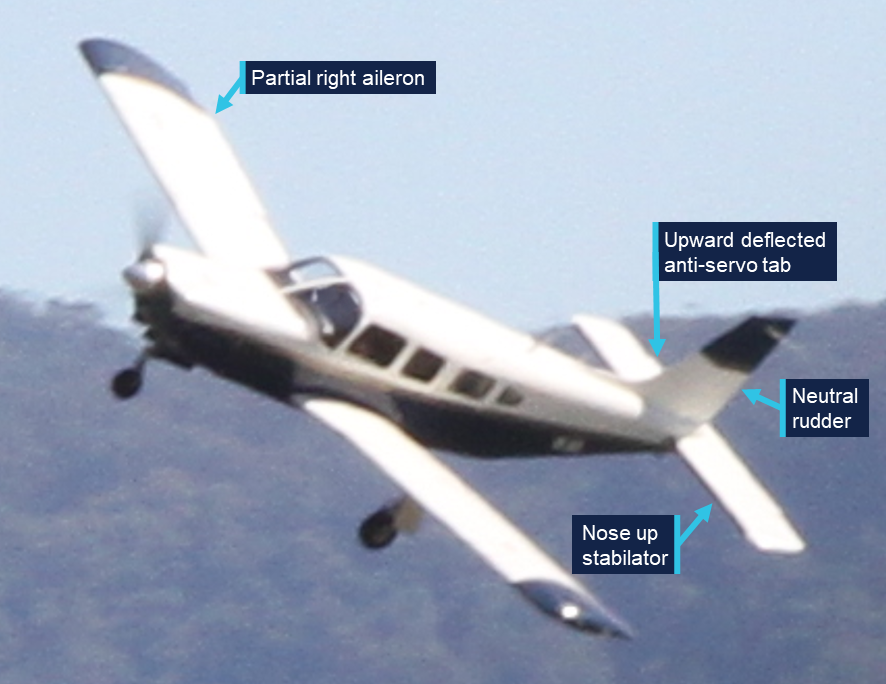
- in the 2 photographs, the rudder was at a near-neutral position, the stabilator was at a full, or near-full, nose up deflection and the ailerons were partially deflected to the right
- in the first photograph (Figure 14), the stabilator trim anti-servo tab was deflected up (the tab is not visible in the second photograph)
- the security camera footage was not of sufficient resolution to determine control deflections during the flight.
Figure 13: Photographs of the aircraft during the accident flight
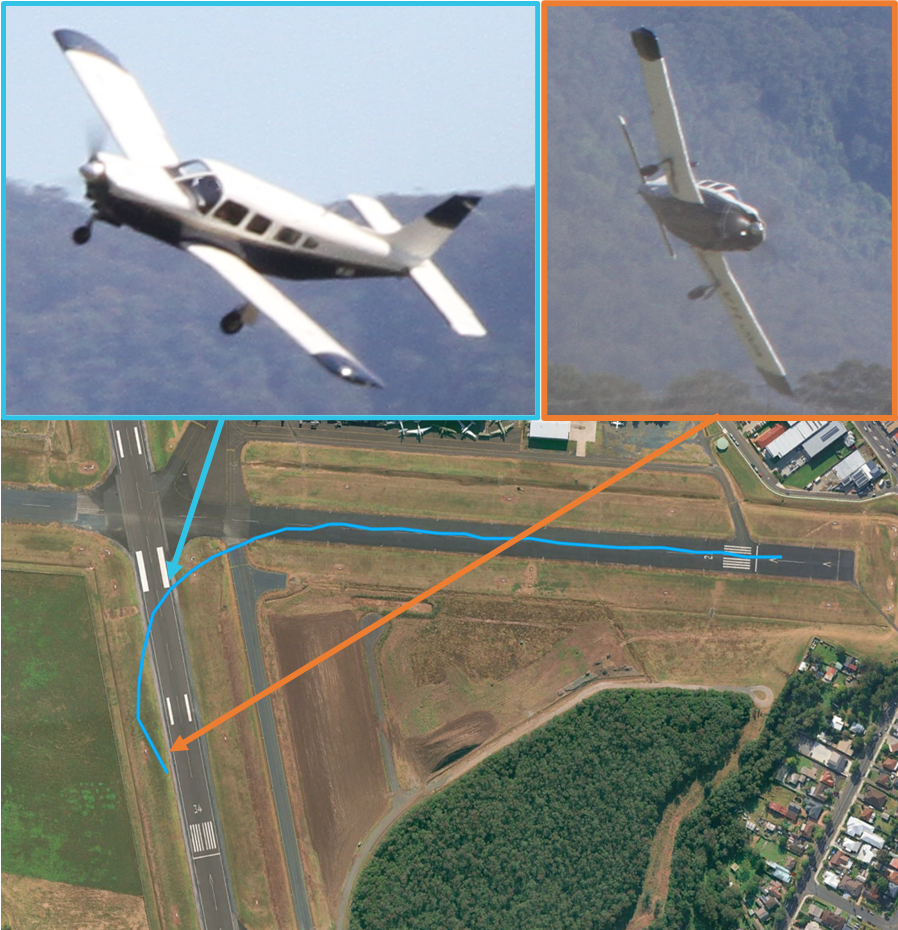
Figure 14: Enlargement of first photograph
A Garmin 750 navigation unit was recovered from the aircraft wreckage, but the installed software version did not record track logs.
Shellharbour Airport CTAF recordings captured no further broadcasts from the pilot of VH-JVA following those made prior to take-off.
Meteorological information
Shellharbour
The terminal area forecast valid for Shellharbour Airport at the time of the accident indicated winds of 10 kt from 260° M. Severe turbulence8 was also forecast below 5,000 ft above mean sea level (AMSL). From 1000, the winds were forecast to increase in strength to 15 kt, gusting to 25 kt.
At 0959, as the aircraft departed runway 26, the Bureau of Meteorology automatic weather station at Shellharbour Airport recorded the temperature as 27°C and the wind as 12 kt from 278° M. There was no recorded cloud, and visibility was recorded as greater than 10 km.
The pilot of the preceding Cessna reported that during their departure, the winds were gusty with light windshear and moderate turbulence. This pilot also stated that this was common for Shellharbour Airport with strong westerly winds. The accident pilot and aircraft were based at Shellharbour Airport, and the pilot was reported to be familiar with mechanical turbulence associated with strong westerly winds at the airport.
En route and Bathurst
The flight plan indicated that the pilot intended to climb to 6,000 ft AMSL for the flight to Bathurst. The graphical area forecast valid for the flight to Bathurst included a visibility of greater than 10 km with scattered9 stratocumulus cloud between 4,000 ft AMSL and 8,000 ft AMSL. The terminal area forecast valid for the estimated time of arrival at Bathurst included winds of 12 kt from 260° M, with the ceiling, visibility and weather forecast to be OK (CAVOK).10
For the return flight planned for 1600 the following day, the terminal area forecast, valid for Bathurst Airport, included light showers of rain, winds of 10 kt from 250° M, scattered cloud at 3,435 ft (1,000 ft above the airport elevation) and visibility greater than 10 km. This forecast also included periods of up to 30 mins (INTER) with rain showers, wind of 20 kt gusting to 35 kt and a variable direction. These periods also forecast broken cloud at 3,235 ft (800 ft above airport elevation), scattered towering cumulus cloud at 5,435 ft (3,000 ft above aerodrome elevation) and 4 km visibility.
The graphical area forecast for this flight included a general visibility greater than 10 km but reducing to 7 km in scattered light rain showers and 3 km in isolated rain showers. Scattered cumulus cloud was forecast extending from 5,000 ft AMSL to above 10,000 ft AMSL. The scattered light showers were associated with scattered stratocumulus cloud between 4,000 ft AMSL and 8,000 ft AMSL and broken altocumulus/altostratus cloud from 8,000 ft AMSL to above 10,000 ft AMSL. The isolated rain showers were associated with isolated towering cumulus cloud from 6,000 ft AMSL to above 10,000 ft AMSL and broken stratocumulus and cumulus cloud from 2,000 ft AMSL to above 10,000 ft AMSL.
Safety analysis
Stabilator deflection
The aircraft started the take-off roll with the stabilator in a near-neutral position. However, during the take-off roll, the horizontal stabilator moved to a full, or near-full, nose up deflection.
The reason for the stabilator deflection could not be determined. The selected stabilator trim was correct and examination of the flight control and trim systems did not identify any pre-accident defects. Furthermore, neither control seat slid rearward, the aircraft was not equipped with an autopilot servo on the stabilator control and the observed stabilator anti-servo tab position during the flight indicated that the tab was operating correctly. In addition, the aircraft did not appear to be subjected to an external influence such as an animal strike or environmental effect. There was also no evidence to indicate that the stabilator deflection resulted from any intentional or inadvertent action or a medical episode of the pilot or passengers.
When the stabilator moved to the nose up deflection, the aircraft pitched abruptly nose up, yawed left and became airborne. The aircraft’s propeller rotated right (clockwise) when viewed from the cabin, generating a torque effect and a spiralling slipstream acting on the left side of the vertical stabiliser. These forces result in the aircraft yawing left with an associated rolling tendency. These left-turning tendencies are particularly apparent at high engine power settings and low air speeds, such as those experienced by the aircraft as it became airborne and are primarily corrected using right rudder input.
Photographs taken during the flight showed the rudder was maintained in a neutral position. The left yaw and roll and left turning flightpath likely occurred because of the aircraft’s left turning tendency not being corrected with rudder input. However, the right aileron input during the flight and the engine power reduction just before impact indicated attempts to correct the flightpath and reduce the severity of the impact.
The photographs and flight path indicate that the stabilator very likely remained in the nose up deflection for the entire flight. Late in the flight, as the aircraft began descending, it stalled, the angle of bank increased, and the descent rate increased rapidly before the aircraft collided with terrain.
Overdue instrument and radio inspections
The aircraft logbook last recorded specific instrument system inspections required under Civil Aviation Order 100.5 as being completed on 17 April 2023 and, with the exception of the air speed indicator, these inspections needed to be completed again no later than 16 June 2025 (3 months before the accident).
On 14 May 2025, the maintenance release was issued with an expiry date or time of 14 May 2026, or 3,998.2 hours in service, whichever occurred sooner. This maintenance release included a statement in the ‘Maintenance required’ section noting that an ‘IFR annual’ inspection was required before an instrument flight rules (IFR) flight. However, the IFR annual instrument and radio system inspections were not completed before the accident flight that was conducted under the instrument flight rules. Additionally, the maintenance release did not state that certain CAO 100.5 inspections for visual flight rules flight were also due during the period of the maintenance release validity (16 June 2025). The aircraft logbook had no record of these inspections being completed prior to the accident flight. Therefore, the maintenance release should have ceased to be valid as of 16 June 2025.
The forecast weather conditions for the flight to Bathurst and particularly the return flight on the following day indicated a high likelihood of encountering cloud with associated reduced visibility. During these periods, the pilot would have been solely reliant on the aircraft’s instrument and radio systems to ensure the safe completion of the flight. The overdue inspections for these systems reduced assurance that the indications provided by these systems were accurate and therefore increased risk to the flights.
While these inspections were not completed prior to the flight being conducted, they did not relate to the stabilator or its control systems. Therefore, the absence of these inspections did not contribute to the accident.
Findings
ATSB investigation report findings focus on safety factors (that is, events and conditions that increase risk). Safety factors include ‘contributing factors’ and ‘other factors that increased risk’ (that is, factors that did not meet the definition of a contributing factor for this occurrence but were still considered important to include in the report for the purpose of increasing awareness and enhancing safety). In addition ‘other findings’ may be included to provide important information about topics other than safety factors. These findings should not be read as apportioning blame or liability to any particular organisation or individual. |
From the evidence available, the following findings are made with respect to the collision with terrain involving Piper PA-32R-300, VH-JVA, at Shellharbour Airport, New South Wales on 11 October 2025.
Contributing factors
- During the take-off roll, the horizontal stabilator moved to a full, or near-full, nose up deflection and very likely remained in this position for the entire flight.
- Following the significant stabilator movement the aircraft pitched abruptly nose up, yawed to the left and became airborne. The aircraft then followed a left turning flight path until it stalled and collided with terrain.
Other factors that increased risk
- At the time of the accident flight, required instrument and avionics maintenance inspections had not been completed, reducing the assurance that the indications provided by these systems were accurate.
Safety actions
| Whether or not the ATSB identifies safety issues in the course of an investigation, relevant organisations may proactively initiate safety action in order to reduce their safety risk. The ATSB has been advised of the following proactive safety action in response to this occurrence |
Safety action by maintenance organisation
In response to the accident, the maintainer advised that they had automated the tracking of aircraft maintenance requirements to ensure that all required items were completed during maintenance events.
Sources and submissions
Sources of information
The sources of information during the investigation included:
- Civil Aviation Safety Authority
- Airservices Australia
- New South Wales Police
- New South Wales Health
- Shellharbour Airport
- Piper Aircraft
- the maintenance organisation for VH-JVA
- the aircraft co-owner
- witnesses
- security camera footage and photographs of the accident flight
- Bureau of Meteorology.
Submissions
Under section 26 of the Transport Safety Investigation Act 2003, the ATSB may provide a draft report, on a confidential basis, to any person whom the ATSB considers appropriate. That section allows a person receiving a draft report to make submissions to the ATSB about the draft report.
A draft of this report was provided to the following directly involved parties:
- Civil Aviation Safety Authority
- United States National Transportation Safety Board
- Piper Aircraft
- the maintenance organisation for VH-JVA
- the aircraft co-owner.
A submission was received from:
- the maintenance organisation for VH-JVA
The submission was reviewed and, where considered appropriate, the text of the report was amended accordingly.
Purpose of safety investigationsThe objective of a safety investigation is to enhance transport safety. This is done through:
It is not a function of the ATSB to apportion blame or provide a means for determining liability. At the same time, an investigation report must include factual material of sufficient weight to support the analysis and findings. At all times the ATSB endeavours to balance the use of material that could imply adverse comment with the need to properly explain what happened, and why, in a fair and unbiased manner. The ATSB does not investigate for the purpose of taking administrative, regulatory or criminal action. About ATSB reportsATSB investigation reports are organised with regard to international standards or instruments, as applicable, and with ATSB procedures and guidelines. Reports must include factual material of sufficient weight to support the analysis and findings. At all times the ATSB endeavours to balance the use of material that could imply adverse comment with the need to properly explain what happened, and why, in a fair and unbiased manner. An explanation of terminology used in ATSB investigation reports is available here. This includes terms such as occurrence, contributing factor, other factor that increased risk, and safety issue. Publishing informationReleased in accordance with section 25 of the Transport Safety Investigation Act 2003 Published by: Australian Transport Safety Bureau © Commonwealth of Australia 2026 
Ownership of intellectual property rights in this publication Unless otherwise noted, copyright (and any other intellectual property rights, if any) in this report publication is owned by the Commonwealth of Australia. Creative Commons licence With the exception of the Commonwealth Coat of Arms, ATSB logo, and photos and graphics in which a third party holds copyright, this report is licensed under a Creative Commons Attribution 4.0 International licence. The CC BY 4.0 licence enables you to distribute, remix, adapt, and build upon our material in any medium or format, so long as attribution is given to the Australian Transport Safety Bureau. Copyright in material obtained from other agencies, private individuals or organisations, belongs to those agencies, individuals or organisations. Where you wish to use their material, you will need to contact them directly. |
- ^ Instrument flight rules (IFR): a set of regulations that permit the pilot to operate an aircraft in instrument meteorological conditions (IMC), which have much lower weather minimums than visual flight rules (VFR). Procedures and training are significantly more complex as a pilot must demonstrate competency in IMC while controlling the aircraft solely by reference to instruments. IFR-capable aircraft have greater equipment and maintenance requirements.
- ^ The runway starter extension is additional runway length available for take-off (not landing) before the runway threshold.
- ^ A skidding turn is an uncoordinated turn where the fuselage of the aircraft is not aligned with the airflow. In a skid the tail of the aircraft follows a path that is outside of that followed by the nose.
- ^ Visual flight rules (VFR): a set of regulations that permit a pilot to operate an aircraft only in weather conditions generally clear enough to allow the pilot to fly using external references and without relying on instrument indications.
- ^ ‘Avionics’ LAME relates to where specialist knowledge, techniques and equipment is required by LAMEs for specified electrical, instrument and radio systems maintenance.
- ^ Work packages are documents which define a set of maintenance tasks that are to be performed on an aircraft during an inspection. These contain notes of test results, certification for the completion of maintenance tasks and records of parts removed/installed.
- ^ The seat rail stops limit the fore/aft seat movement, ensuring that the seat feet remain attached to the rails.
- ^ Moderate turbulence is usually associated with small changes in airspeed and moderate changes to aircraft attitude and/or altitude, but the aircraft remains under positive control. Severe turbulence is associated with large changes in airspeed and abrupt changes to aircraft attitude and/or altitude; in severe turbulence the aircraft may be out of control for short periods.
- ^ Scattered cloud indicates that cloud is covering between a quarter and a half of the sky. Broken cloud indicates that more than half to almost all the sky is covered, and ‘overcast’ indicates that all the sky is covered.
- ^ CAVOK indicated that the following conditions were forecast simultaneously: visibility is 10 km or more, no cloud below the higher of 5,000 ft or the highest 25 nm minimum sector altitude, no cumulonimbus or towering cumulus cloud types, and no other weather of significance to aviation.
Preliminary report
Report release date: 14/11/2025
| This preliminary report details factual information established in the investigation’s early evidence collection phase, and has been prepared to provide timely information to the industry and public. Preliminary reports contain no analysis or findings, which will be detailed in the investigation’s final report. The information contained in this preliminary report is released in accordance with section 25 of the Transport Safety Investigation Act 2003. |
Summary video
The occurrence
On the morning of 11 October 2025, a Piper PA-32R-300 Cherokee Lance, registered VH-JVA, taxied for a private flight from Shellharbour Airport to Bathurst Airport, New South Wales. The flight was being operated under the instrument flight rules[1] with the pilot and 2 passengers on board.
At 0956 local time, as the aircraft approached runway 26, the pilot announced on the Shellharbour common traffic advisory frequency (CTAF) that the aircraft was entering the runway and lining up to depart. The pilot then taxied the aircraft onto the runway starter extension[2] and lined up. While VH-JVA was lined up, a Cessna Caravan taxiing behind VH-JVA stopped at the holding point at the runway 26 threshold. The pilot of VH-JVA invited the pilot of the Cessna to depart ahead of VH-JVA and the Cessna took-off shortly after.
About a minute after the Cessna departed, VH-JVA began a take-off from runway 26. Following a ground roll of about 410 m, VH-JVA abruptly pitched up and yawed left as it became airborne. The aircraft then climbed away from the runway in a nose high attitude while skidding[3] and rolling left (Figure 1 and Figure 2).
Figure 1: Composite image of recorded security camera footage of the whole flight
Source: Supplied, annotated by the ATSB
Figure 2: Composite image of recorded security camera footage of later part of flight
Source: Shellharbour Airport, annotated by the ATSB
The angle of bank then appeared to stabilise briefly as the aircraft followed a left-turning flight path. As it turned to a heading of about 200° magnetic (M), it reached a maximum recorded altitude of about 50 ft above ground level (AGL) and then began descending. Three seconds after reaching 50 ft AGL, the angle of bank and descent rate began increasing rapidly before the aircraft collided with terrain, coming to rest at the threshold of the intersecting runway (runway 34). The pilot and passengers were fatally injured in the accident, and the aircraft was destroyed.
Context
Pilot details
The pilot held a private pilot licence (aeroplane) and the required class rating and endorsements to operate the aircraft. The pilot also held a private instrument rating and Class 2 aviation medical certificate, which were both current at the time of the accident.
The pilot’s logbook was reported to be in the aircraft during the accident flight. The cabin area of the aircraft was extensively fire damaged following the accident and the logbook could not be located during the wreckage examination. At the pilot’s last medical examination, the pilot had declared a total of 1,015 hours aeronautical experience. Maintenance release entries for VH-JVA showed that since that medical examination, the pilot had flown 27.1 hours in the aircraft. Of these, 4.6 hours were in the 90 days before the accident and none in the 30 days before the accident.
Aircraft details
The Piper PA-32R-300 Cherokee Lance is a single-engine, low-wing, retractable tricycle landing gear aircraft. The Lance is powered by a Lycoming IO-540 fuel-injected, horizontally opposed piston engine driving a three-blade variable-pitch propeller and is fitted with dual controls. VH-JVA (Figure 3), serial number 32R-7680030, was manufactured in the United States in 1975 and first registered in Australia in 1985. The most recent periodic inspection was completed on 14 May 2025, at 3,898.2 hours total time in service. At the time of the accident, VH-JVA had accumulated 3,915 hours in service.
Figure 3: VH-JVA
Source: Clinton J Down Photography, modified by the ATSB
Aircraft loading
The pilot and a passenger were in the 2 front seats while the other passenger was seated in the second row. Witness statements and fuel records indicated that the aircraft departed with full tanks.
The purpose of the flight was an overnight stay at Bathurst before returning to Shellharbour the following day. No large or heavy items were identified in the aircraft during the examination of the wreckage and the ATSB estimated the aircraft to be within weight and balance limitations for the flight.
Meteorological information
The terminal area forecast valid for Shellharbour Airport at the time of the accident included winds of 10 kt from 257° M. Severe turbulence[4] was also forecast below 5,000 ft AMSL. From 1000, the winds were forecast to increase in strength to 15 kt with gusts to 25 kt.
At 0959, as the aircraft departed runway 26, the Bureau of Meteorology automatic weather station at Shellharbour Airport recorded the temperature as 27°C and the wind as 12 kt from 278° M. There was no recorded cloud, and visibility was recorded as greater than 10 km.
The pilot of the preceding Cessna reported that, during their departure, the winds were gusty with light windshear and moderate turbulence. This pilot also stated that this was common for Shellharbour Airport with strong westerly winds. The accident pilot and aircraft were based at Shellharbour Airport, and the pilot was reported to be familiar with mechanical turbulence associated with strong westerly winds at the airport.
Impact and wreckage information
The aircraft impacted the ground to the west of runway 34 while travelling in the 138° M direction (Figure 4). The left wing tip impacted the ground first with the aircraft at near 90° angle of bank and a slightly nose down attitude. The propeller and engine then impacted the ground 12 m from the wing tip and ground scars consistent with propeller strikes were indicative of engine rotation. The left wing separated from the aircraft and the main wreckage continued along the ground for a further 47 m before coming to rest on runway 34 near the runway threshold. The integral fuel tanks in both wings ruptured during the accident sequence, leading to a post-impact fire that destroyed most of the fuselage.
Figure 4: Accident site
Source: ATSB
The ATSB conducted an initial examination of the wreckage at the accident site before moving the wreckage to an airport hangar for further examination. All major aircraft components were accounted for at the accident site. The damage to the propeller indicated that the engine was driving the propeller at the time of impact. The landing gear was extended and the flaps were extended to the 10-degree setting. The stabilator trim was set to slightly nose up and the rudder trim was neutral. Damage to the pilot’s seat rails indicated that it was locked in an appropriate position. The left pin of the passenger’s seat was found secured in the rearmost position while the right pin was found not secured into a position. There was no damage to the outboard passenger seat rail stop to indicate that this seat had slid rearward.[5]
Recorded data
Recorded automatic dependent surveillance broadcast (ADS-B) data and a number of security cameras captured the flight (Figure 5). A witness also captured 2 photographs of the aircraft while airborne (Figure 6). The data showed that:
- during the take-off ground roll, until the nose wheel lifted from the runway, the take-off appeared normal and the stabilator was in a neutral position
- the recorded groundspeed at the time the aircraft became airborne was 61 kt
- the groundspeed increased to 64 kt as the aircraft commenced turning left and then remained between 60–61 kt as the aircraft turned through 180° M. As the turn continued and with an increasing tailwind component, the groundspeed increased to the recorded maximum of 70 kt immediately before impact
- all doors appeared to be correctly secured.
Figure 5: Flight path and recorded data from flight
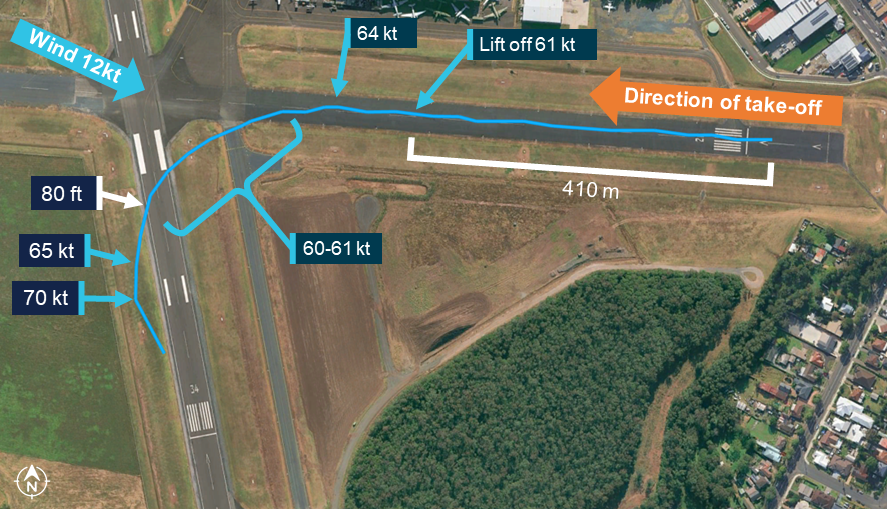
All speeds are groundspeed, and the altitude is above mean sea level (equating to about 50 ft above ground level). Source: Google Earth, Bureau of Meteorology, Avdata and publicly available ADSB data, annotated by the ATSB
Figure 6: Photographs of VH-JVA during the accident flight
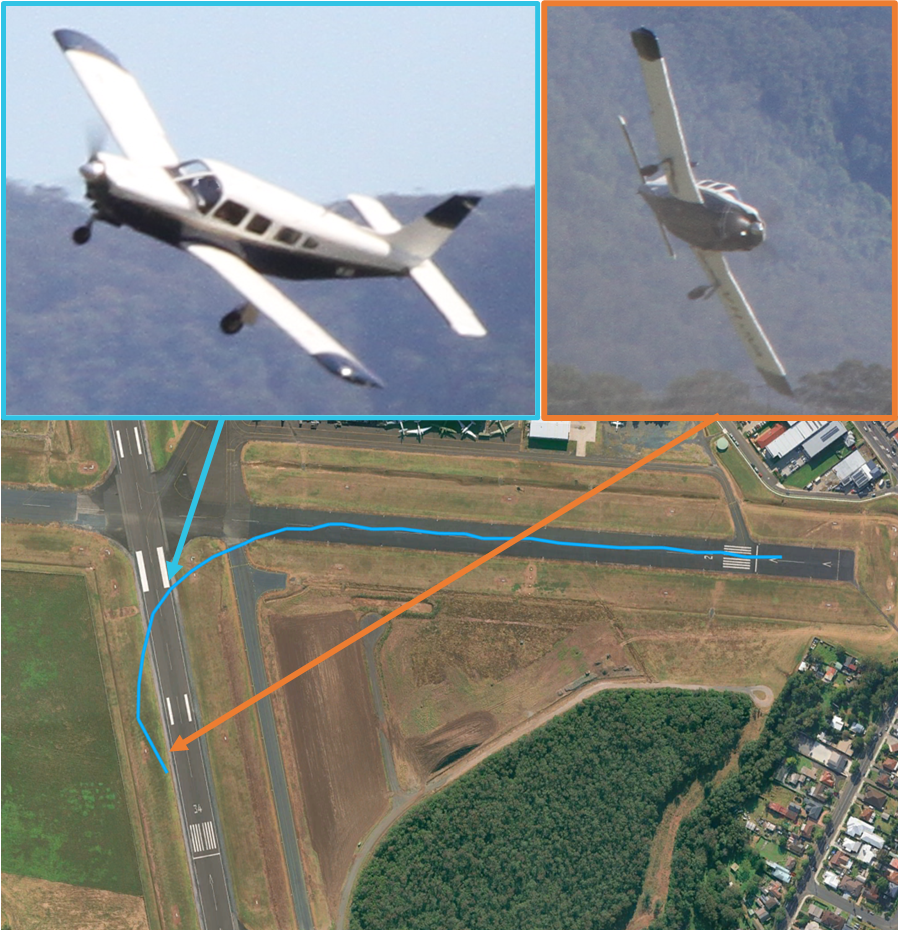
Source: Ari Bone and Google Earth, modified by the ATSB
A Garmin 750 navigation unit was recovered from the aircraft wreckage and retained by the ATSB for further investigation.
Shellharbour Airport CTAF recordings captured no further broadcasts from the pilot of VH-JVA following those made prior to take-off.
Further investigation
To date, the ATSB has examined the site and wreckage, conducted interviews and collected documentation and recorded data relating to the accident flight.
The investigation is continuing and will include further review and examination of:
- recorded data
- aircraft documentation
- aircraft maintenance records
- recovered aircraft components
- pilot medical records, qualifications, and experience.
A final report will be released at the conclusion of the investigation. Should a critical safety issue be identified during the course of the investigation, the ATSB will immediately notify relevant parties so appropriate and timely safety action can be taken.
Acknowledgements
The ATSB would like to acknowledge the assistance of New South Wales Police, Shellharbour Airport, and the airport hangar operator during the onsite stage of the investigation.
Purpose of safety investigationsThe objective of a safety investigation is to enhance transport safety. This is done through:
It is not a function of the ATSB to apportion blame or provide a means for determining liability. At the same time, an investigation report must include factual material of sufficient weight to support the analysis and findings. At all times the ATSB endeavours to balance the use of material that could imply adverse comment with the need to properly explain what happened, and why, in a fair and unbiased manner. The ATSB does not investigate for the purpose of taking administrative, regulatory or criminal action. About ATSB reportsATSB investigation reports are organised with regard to international standards or instruments, as applicable, and with ATSB procedures and guidelines. Reports must include factual material of sufficient weight to support the analysis and findings. At all times the ATSB endeavours to balance the use of material that could imply adverse comment with the need to properly explain what happened, and why, in a fair and unbiased manner. An explanation of terminology used in ATSB investigation reports is available here. This includes terms such as occurrence, contributing factor, other factor that increased risk, and safety issue. Publishing informationReleased in accordance with section 25 of the Transport Safety Investigation Act 2003 Published by: Australian Transport Safety Bureau © Commonwealth of Australia 2025
Ownership of intellectual property rights in this publication Unless otherwise noted, copyright (and any other intellectual property rights, if any) in this report publication is owned by the Commonwealth of Australia. Creative Commons licence With the exception of the Commonwealth Coat of Arms, ATSB logo, and photos and graphics in which a third party holds copyright, this report is licensed under a Creative Commons Attribution 4.0 International licence. The CC BY 4.0 licence enables you to distribute, remix, adapt, and build upon our material in any medium or format, so long as attribution is given to the Australian Transport Safety Bureau. Copyright in material obtained from other agencies, private individuals or organisations, belongs to those agencies, individuals or organisations. Where you wish to use their material, you will need to contact them directly. |
[1] Instrument flight rules (IFR): a set of regulations that permit the pilot to operate an aircraft in instrument meteorological conditions (IMC), which have much lower weather minimums than visual flight rules (VFR). Procedures and training are significantly more complex as a pilot must demonstrate competency in IMC conditions while controlling the aircraft solely by reference to instruments. IFR-capable aircraft have greater equipment and maintenance requirements.
[2] The runway starter extension is additional runway length available for take-off (not landing) before the runway threshold.
[3] A skidding turn is an uncoordinated turn where the fuselage of the aircraft is not aligned with the airflow. In a skid the tail of the aircraft follows a path that is outside of that followed by the nose.
[4] Moderate turbulence is usually associated with small changes in airspeed and moderate changes to aircraft attitude and/or altitude, but the aircraft remains under positive control. Severe turbulence is associated with large changes in airspeed and abrupt changes to aircraft attitude and/or altitude; in severe turbulence the aircraft may be out of control for short periods.
[5] The seat rail stops limit the fore/aft seat movement, ensuring that the seat feet remain attached to the rails.
Occurrence summary
| Investigation number | AO-2025-064 |
|---|---|
| Occurrence date | 11/10/2025 |
| Occurrence time and timezone | 0959 Eastern Daylight-saving Time |
| Location | Shellharbour Airport |
| State | New South Wales |
| Report release date | 02/07/2026 |
| Report status | Final |
| Investigation level | Short |
| Investigation type | Occurrence Investigation |
| Investigation status | Completed |
| Mode of transport | Aviation |
| Aviation occurrence category | Collision with terrain |
| Occurrence class | Accident |
| Highest injury level | Fatal |
Aircraft details
| Manufacturer | Piper Aircraft Corp |
|---|---|
| Model | PA-32R-300 |
| Registration | VH-JVA |
| Serial number | 32R-7680030 |
| Sector | Piston |
| Operation type | Private |
| Departure point | Shellharbour Airport, New South Wales |
| Destination | Bathurst Airport, New South Wales |
| Injuries | Crew - 1 (fatal), Passengers - 2 (fatal) |
| Damage | Destroyed |