On 28 August 2023 an Air New Zealand Q300 passenger aircraft, ZK-NES, en route from Whangarei to Auckland, and a Beech 76 Duchess aircraft, ZK-JED, en route from Auckland to Whangarei, were on reciprocal tracks when reportedly a close proximity event occurred. The crew of ZK-NES took avoiding action. There was no collision, no damage, and nobody was injured.
The New Zealand Transport Accident Investigation Commission (TAIC) is investigating the occurrence. TAIC has requested assistance from the ATSB to download the aircraft’s cockpit voice recorder (CVR) and assist with reviewing the flight data recorder (FDR) to assist their investigation.
To facilitate this support and to provide the appropriate protections for the information, the ATSB appointed an accredited representative in accordance with paragraph 5.23 of ICAO Annex 13 and commenced an investigation under the Australian Transport Safety Investigation Act 2003.
Any enquiries relating to the investigation should be directed to TAIC.
On 24 August 2023, an Alliance Airlines Embraer E190-100 IGW aircraft, registered VH-UYN, was being operated on a scheduled passenger flight, QF1960, from Darwin to Alice Springs, Northern Territory.
The flight crew were expecting to overfly and conduct a circuit to runway 12, and the aircraft was configured accordingly. During descent, ATC offered a late call for a shortened track and visual approach to the final approach fix, which the crew accepted.
As the aircraft tracked to the waypoint, the crew configured the aircraft with high drag to expedite the aircraft’s descent. However, the rate of descent was higher than the crew anticipated and attempts to arrest the rate of descent were not immediately successful.
The aircraft descended below 1,800 ft AGL with a rate of descent above 3,000 ft/min.
When the aircraft’s automation was not responding to the flight crew inputs in the way the crew anticipated, the crew disconnected the autopilot and took manual control of the aircraft.
What the ATSB found
The ATSB identified that, after accepting an ATC request at short notice to conduct a straight-in approach, the flight crew unnecessarily re‑configured the aircraft to increase drag and expedite the descent. Due to the autopilot flight mode active at the time, the aircraft pitched down to maintain airspeed at the higher drag. Shortly after, as the aircraft descended at a high vertical rate towards the selected altitude, the pilot flying made an inadvertent mode selection in the automatic flight system that went undetected by the flight crew.
Due possibly in part to their workload, the pilot flying did not identify that the aircraft was starting to automatically capture the selected altitude, and selected a higher altitude, which disarmed the altitude select mode. This resulted in the flight director resuming the high rate of descent close to terrain.
These changes were not promptly identified by the aircraft captain in their role as pilot monitoring, due in part to their focus to visually assessing the terrain clearance.
Safety message
This incident highlights how important continuous attention to the autoflight system modes displayed on the primary flight display is to situation awareness.
The ATSB reminds flight crews the importance of continually monitoring descent profiles, irrespective of the type of approach being flown and the level of automation being used.
they recognise they are uncertain about the autoflight modes or energy state, they should not allow the airplane to continue in an unstable or unpredictable flight path or energy state while attempting to correct the situation. Instead, pilots should revert to a better (usually lower) understood level or combination of automation until the aircraft resumes the desired flight path and/or airspeed. This may ultimately require that pilots turn off all automation systems and fly the aircraft manually.
The investigation
Decisions regarding the scope of an investigation are based on many factors, including the level of safety benefit likely to be obtained from an investigation and the associated resources required. For this occurrence, a limited-scope investigation was conducted in order to produce a short investigation report, and allow for greater industry awareness of findings that affect safety and potential learning opportunities.
The occurrence
On 24 August 2023, an Alliance Airlines Embraer E190-100 IGW aircraft, registered VH-UYN, was being operated on scheduled passenger flight QF1960 from Darwin to Alice Springs, Northern Territory. On board were the captain as the pilot monitoring (PM), first officer as the pilot flying (PF),[1] 2 cabin crew and 63 passengers. The weather conditions in the area were fine and suitable for operation under the visual flight rules.[2]
A trainee aerodrome controller (ADC), along with an on-the-job training instructor (OJTI), were controlling arriving and departing aircraft from the air traffic control (ATC) tower at Alice Springs Airport. The trainee ADC was providing procedural traffic separation and communicating with aircraft on the radio. The OJTI was overseeing the trainee and was ultimately responsible for ATC decisions and communications.
The en route controller had advised the trainee ADC and OJTI that the crew of VH-UYN had requested a straight-in approach to runway 12.[3] However, due to a preceding Pilatus PC-12 aircraft inbound from the north, and a helicopter arriving from the south, the trainee ADC was not comfortable offering VH-UYN this approach due to an anticipated increase in their workload. As a result, at 1617 local time, as the aircraft was passing 10,000 ft on approach to Alice Springs, the trainee ADC advised the flight crew to expect to overfly the airport and then conduct a right circuit for runway 12.
One minute later, due to preceding traffic, the trainee ADC instructed the flight crew to reduce speed to 210 kt, which the crew set in the autoflight control system (see the section titled Autoflight control system). The OJTI then assessed that if VH-UYN overflew the airport, it may result in a conflict with the helicopter arriving from the south and suggested that the trainee controller offer VH-UYN a clearance to track direct to waypoint ALDIM[4] to conduct a straight-in approach.
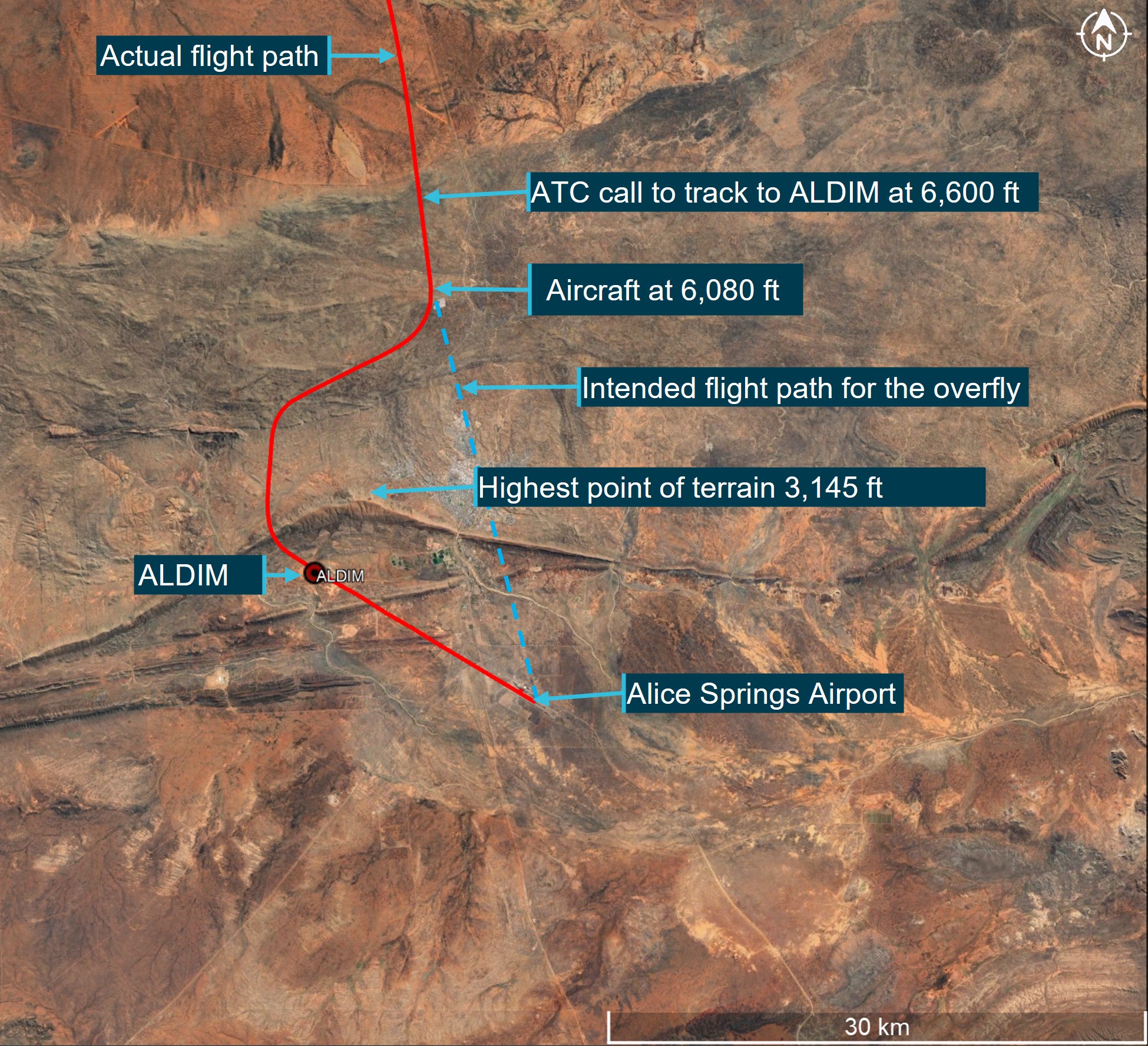
At 1621 local time, when the aircraft was passing 6,600 ft AMSL[5] and approximately 12 NM from the airport, the trainee ADC advised the flight crew that a straight-in visual approach was now available and asked if they could track direct to ALDIM, which was around 10 NM south-west of their position (Figure 1).
Source: Google Earth overlaid with flight data, annotated by ATSB
The PM advised ATC that they could accept the straight-in approach but would need extra track miles to configure the aircraft (as the aircraft was at a higher altitude than it normally would be for that approach). The trainee ADC cleared the crew to track right of track as required to ALDIM and cleared them for a visual approach.
During a visual approach, flight crew are required to maintain visual separation with terrain and manage the descent profile as required to intercept the final approach. Once the flight crew acknowledged the clearance, the trainee ADC and OJTI turned their attention to other traffic.
The crew initiated a turn to the west, and thirty seconds later they extended the slats to 15° then selected a target altitude of 3,300 ft AMSL (1,500 ft above aerodrome level (AAL))[6] on the guidance panel (see the section titled Altitude select mode). They then extended the flaps to position 1 (7°) and deployed the speedbrakes[7] to expedite the aircraft’s descent.
The PM suggested the PF use the flight level change (FLCH) mode in the autoflight system, which the PF selected. After FLCH was selected, the autoflight system reduced the selected speed to 175 kt before the PF manually increased it to 200 kt.
At 1622:44, passing 4,692 ft AMSL, the crew considered that the aircraft was still too high, and they extended the landing gear to add further drag to the aircraft. The crew commenced a turn towards ALDIM at this time. The PF later recalled that as the landing gear was extending, the aircraft pitched down more than expected.
About 8 seconds later, as the landing gear locked in the down position, the aircraft’s autoflight mode was changed from FLCH to flight path angle (FPA). The flight crew did not recall selecting this mode change and did not detect it. During the next 6 seconds, as the aircraft descended below 4,000 ft AMSL (1,800 ft radio altimeter height),[8] the rate of descent increased to more than 3,000 ft/min.
At 1623:00, in an attempt to reduce the observed rate of descent, the PF selected a higher altitude (from 3,300 to around 5,000 ft) on the altitude selector. However, the aircraft did not respond as the crew expected. The PF then increased the selected altitude to 8,800 ft, which also had no effect on the rate of descent (see the section titled Flight path angle mode).
The PM recalled that at this time they were looking outside to visually ensure terrain separation rather than monitoring the automation as they were aware of surrounding high terrain and an upcoming ridge line which they were required to cross. As a result, the PM was not monitoring the aircraft’s vertical speed or vertical modes during this period.
At 1623:12, as the aircraft approached 2,973 ft AMSL (1,498 ft radio altimeter height), the PM advised the PF to disconnect the autopilot and initiate a climb due to the terrain proximity. The PF disconnected the autoflight system and pitched the aircraft up to initiate a climb, leaving the autothrottle engaged and the landing gear, speedbrakes and flaps extended.
Although the rate of descent started to decrease, the thrust did not increase for 8 seconds, and the aircraft continued to descend. As thrust was eventually applied through the autothrottle, the aircraft started to climb and the crew manually reduced the aircraft’s selected speed to 185 kt.
Shortly after, the OJTI observed the aircraft on the tower situational awareness display (TSAD)[9] approximately 10 NM from the airport at approximately 3,300 ft AMSL, which the controller thought was lower than usual. The controller then looked out the window and was unable to see the aircraft above the adjacent ridge line, which the controller described as ‘alarming’, and instructed the trainee ADC to issue the flight crew a terrain safety alert[10] which was issued at 1623:40.
The PM acknowledged the alert, after which the OJTI sighted the aircraft climbing above the ridge line (at about 1,700 ft AGL). About 30 seconds after passing ALDIM, the aircraft intercepted the instrument landing system (ILS)[11] glideslope from below and the glide slope was maintained until landing.
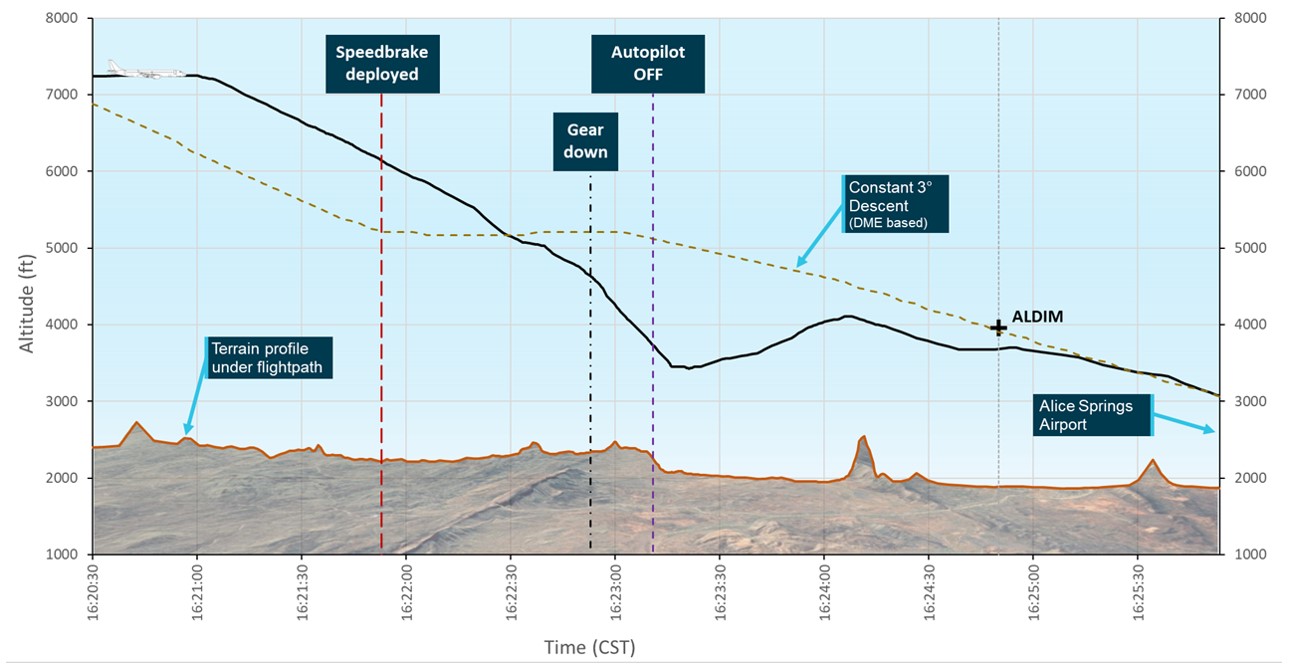
The captain later stated that while the approach (Figure 2) was ‘untidy’, they were aware of, and visual with terrain, and did not feel that the flight was in danger at any time.
The representation of a constant 3° approach profile (brown dashed line) is based upon the DME distance from Alice Springs and is not a straight line, as may be expected for a constant 3° approach. Firstly, a 3° approach is a geometric profile, but the horizontal axis of the plot is time, so any variations in speed will distort it from a straight line. Also, the path in Figure 2 follows along the actual flight path, not a straight-in 3° approach. As such, when the aircraft is flying in a south-westerly direction, it is flying roughly tangentially to a circle centred on the DME transmitter, that is, the DME distance is not changing significantly during that period of time, so the 3° approach in Figure 2 flattens out.
Source: ATSB
Context
Flight crew
The captain and first officer each held an air transport pilot licence (aeroplane) and class 1 aviation medical certificate. The captain had over 18,000 hours of flying experience, of which about 450 were on the E190 aircraft type. The first officer had over 4,300 hours of flying experience, of which about 750 were on the E190.
Both flight crew members regularly operated from Darwin to Alice Springs and were familiar with the approach and surrounding terrain. They reported feeling well rested and alert at the time of the incident and stated that there were no distractions or stressors in the cockpit prior to the incident.
Alice Springs approach
When conditions favoured a visual approach to runway 12 at Alice Springs, the captain’s preference was to conduct a straight-in ILS approach on a standard 3° profile as per the operator’s standard operating procedures, intercepting the localiser at or before waypoint ALDIM, which was the final approach fix for runway 12. An aircraft on the 3° approach profile would cross ALDIM at 3,960 ft AMSL. The minimum height at ALDIM was 3,600 ft to provide separation with the nearby ridge line, which was 3,145 ft AMSL.
While the flight crew maintained visual separation with terrain and the above minimum altitude requirements did not apply to the visual approach, it was the crew’s intention to approximately follow the approach profile and overfly ALDIM at 3,960 ft to intercept the ILS glideslope.
Aircraft
The aircraft was an ERJ 190-100 IGW, manufactured in Brazil in 2019 and issued serial number 19000095. It was registered in Australia as VH-UYN on 3 August 2021. The aircraft was fitted with 2 General Electric Company CF34-10E5 turbofan engines.
The ERJ 190 autoflight control system is controlled from the guidance panel, located on the glareshield panel in the cockpit. This panel allows either the captain or the first officer to select the flight guidance control system functions.
Flight Director
The E190 aircraft maintenance manual (AMM) stated that:
the Flight Guidance Computer System calculates the Flight Director (FD) commands that show on the primary flight display (PFD). The FD system has two categories of operation modes: vertical axis and lateral axis. The vertical FD modes supply the FD guidance commands.
Vertical flight modes
Mode selection
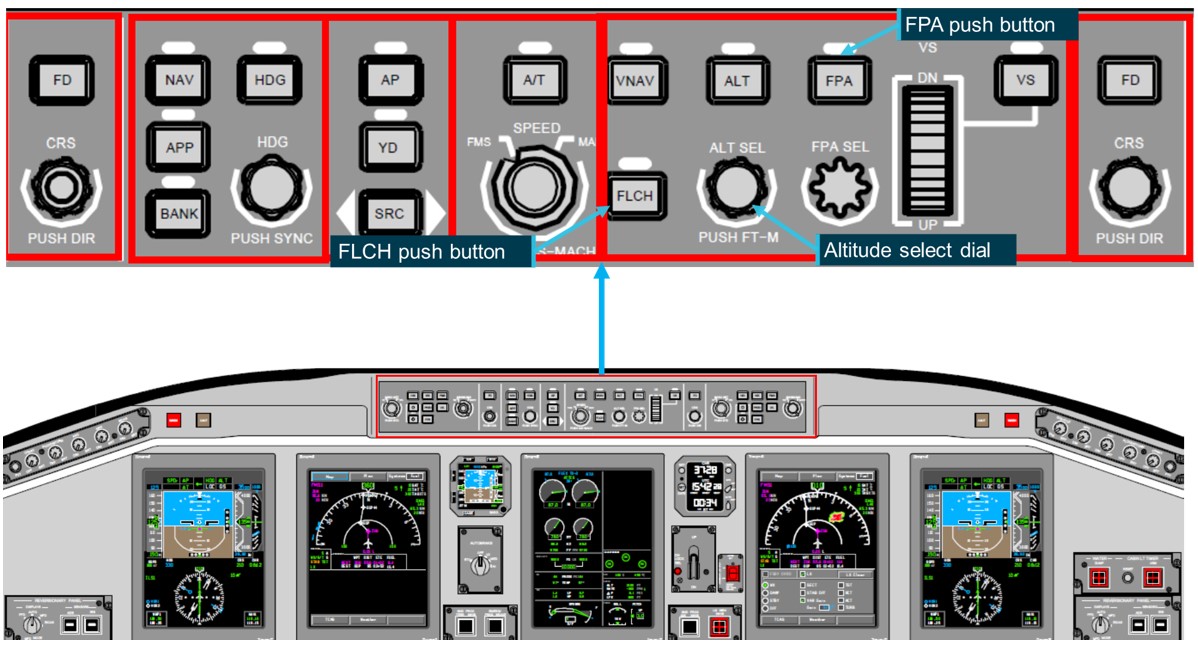
The autoflight control system (AFCS) has 11 modes that control the aircraft’s vertical flight path. These can either be engaged automatically by the flight management system (FMS), or by flight crew selection using the guidance panel (Figure 3).
Source: Alliance Airlines training material annotated by ATSB
The engaged mode is illuminated on each primary flight display. When a flight mode change is selected by the flight crew, the active mode is displayed and flashes in reverse video with a green background for 3 seconds (Figure 4). When the FMS changes the vertical mode, the active mode flashes in magenta.
Figure 4: Automatic flight control system flight modes on the primary flight display
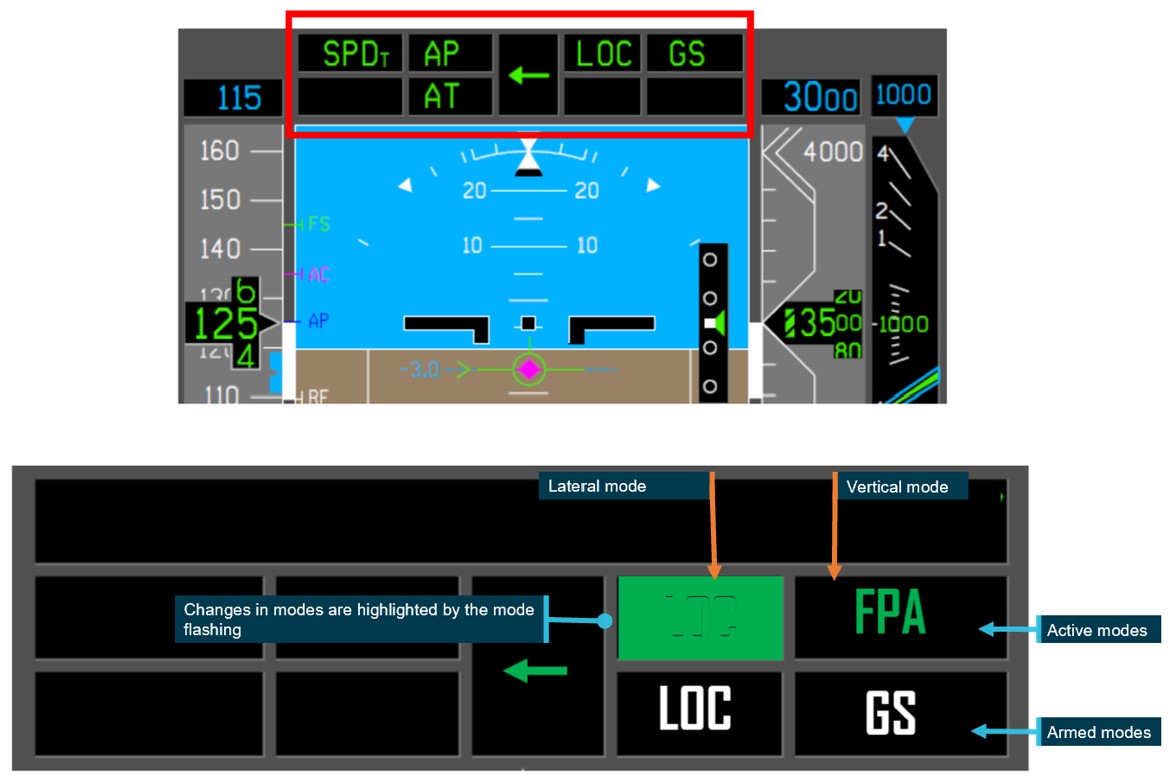
Diagram is showing the reverse video with a green background.
Source: Alliance training material annotated by ATSB
Flight level change mode
According to the operator’s E190 aircraft operations manual (AOM), FLCH mode provides commands to climb or descend to the selected altitude while holding the selected speed. The speed selected will be controlled via pitch changes through elevator inputs. The aircraft’s thrust will not be adjusted.
FLCH mode is activated by pressing the FLCH button and deactivated when another vertical mode is selected or by pressing the FLCH button again.
The aircraft manufacturer advised that the FD, while in FLCH mode, will not generate commands that could lead the aircraft to exceed the aircraft’s maximum operating limit speed (Vmo/Mmo). The FD has an overspeed protection function in which the normal acceleration limit is set to ± 0.3 G. This function tracks the selected calibrated airspeed (CAS) target within ± 5 kts or the selected Mach target within ± 0.02 Mach, depending on whether the controlling speed target is CAS or Mach.
They also advised that the FLCH mode will revert to basic mode (FPA) when an invalid condition is detected. Should this occur, the CAS message FD VERT MODE OFF would be announced and recorded in the aircraft flight data. An invalid condition is when an input parameter is considered invalid due to a sensor failure or when the parameter value exceeds the expected limits. A review of the occurrence flight data by the ATSB identified no CAS messages.
According to the manufacturer’s E190 AMM, the FPA mode supplies guidance to keep a set flight path angle[12] reference. The operator’s E190 AOM stated that FPA:
is the basic vertical mode (except for take-off)
can be used for vertical navigation by selecting a higher or lower altitude on the ALTSEL and then pressing the FPA button
becomes the active mode when:
the autopilot is engaged and no flight director (FD) mode is selected
the FPA button is selected on the guidance panel
a lateral mode is selected and no vertical mode is selected
the active vertical mode is deselected.
The pilot selects the required flight path angle using the FPA select knob on the guidance panel, however if no flight path angle is specified when FPA is selected, the FD will select and hold the current flight path angle via elevator movements. The autothrottle will adjust the thrust levers to maintain the selected airspeed.
the FD supplies flight path commands to lock on the set altitude
The aircraft manufacturer stated that when in FPA mode, as the aircraft’s altitude begins to approach the selected altitude, the mode will automatically change to ASEL until the altitude is captured and it will then change to altitude hold mode. However, ASEL mode is disarmed automatically if the selected altitude is changed. If this occurs the FD will automatically reselect FPA.
Autothrottle
The E190 AOM stated that when the FD is selected off and there are no active modes on the flight mode annunciator, the autothrottle will adjust the thrust levers to maintain the selected airspeed.
The operator’s standard operating procedures manual stated that:
The autothrottle should be used during the entire flight, engaged just prior to take-off and disengaged after touchdown or at the PF’s discretion. Pilots must always be alert and monitor the autothrottle operation checking the movement of the thrust levers in the correct direction. Normally, high level of automation induces crews to stay out of the loop, with excessive confidence on automatic flight systems.
The AOM further stated that:
The autothrottle (AT) can be overridden by moving the thrust levers in any direction without causing its disengagement. If the AT is overridden by a pilot. ‘’OVRD’ is displayed on the flight mode annunciator. When the thrust levers are released, the AT will once again return the thrust levers to their command position.
Flight data
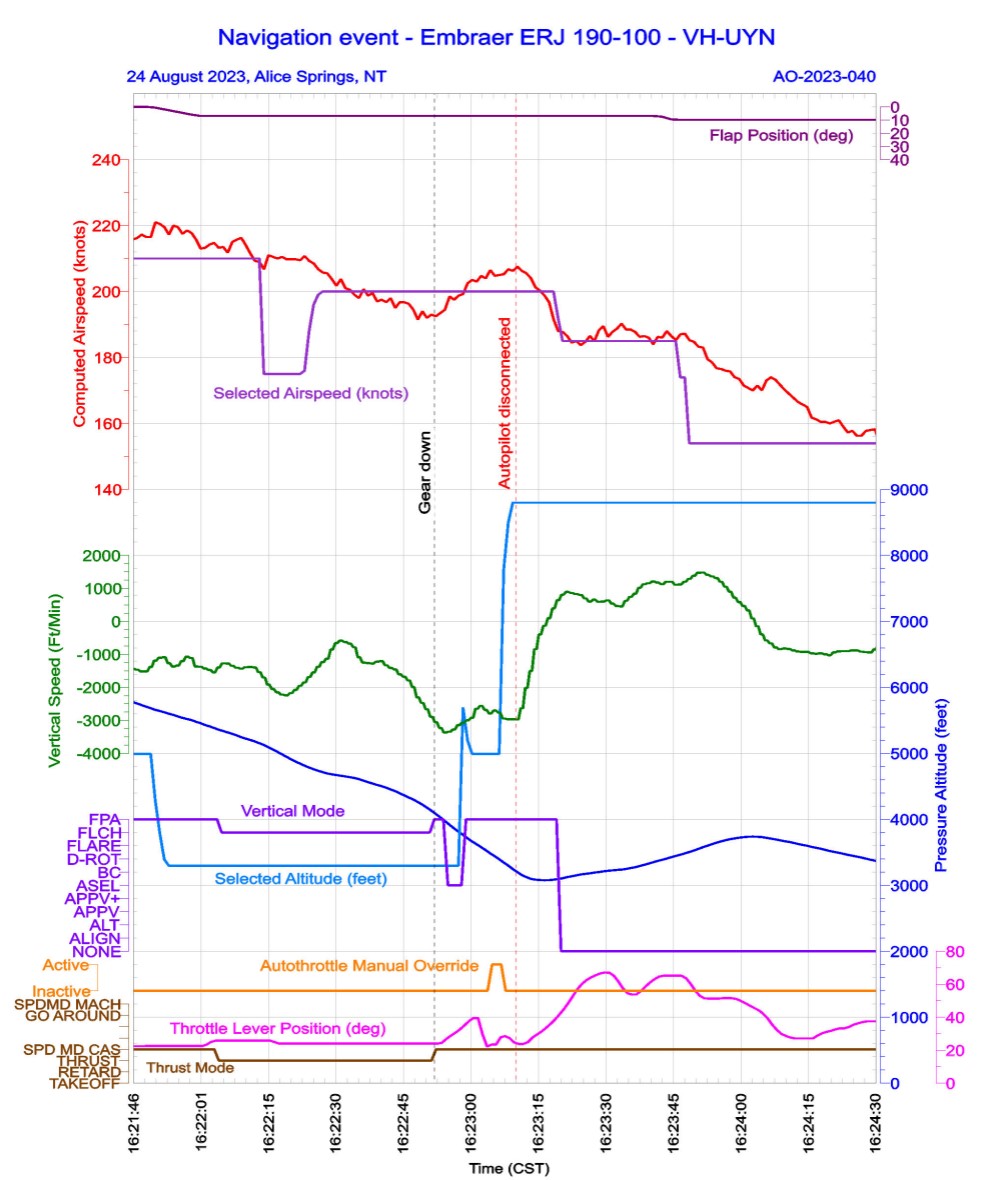
The incident flight data from the aircraft’s quick access recorder was analysed by the ATSB and the aircraft manufacturer, Embraer (Figure 5) and (Table 1).
A review of the data identified that between the 2-minutes between 1621:13 and 1623:12 (from when the aircraft turned towards ALDIM until the autopilot was selected off), the aircraft was configured with flap and slats and flight level change (FLCH) mode was selected. Then as the landing gear locked down, flight path angle (FPA) mode was selected in the flight management system (FMS). The FMS then automatically changed to altitude select (ASEL) mode as the aircraft neared the selected altitude and while this was active, the throttle lever position increased (consistent with normal autothrottle operation) indicating the aircraft was starting to level off. However, prior to this occurring, the selected altitude was manually changed, and the flight mode reverted to FPA, and the throttle lever position automatically reduced.
The data also showed that between the first and second selection of the higher altitude in the altitude selector, the autothrottle override activated for 3 seconds. The autopilot was then intentionally disconnected, and as the speed started to reduce to the selected speed of 200 kt, the autothrottle began to increase the throttle lever angle, reducing the rate of descent. The crew then reduced the selected speed to 185 kt. This resulted in the autothrottle increasing the thrust further and the aircraft started to climb.
Table 1: Excerpt from QAR data for incident flight
Time (CST)
Significant event
Vertical mode
Vertical speed (f/m)
Radio height (ft)
Altitude (ft) (AMSL)
Flight path angle (degrees)
Selected Altitude (ft) (AMSL)
1621:13
ATC cleared the aircraft for a visual approach via ALDIM
FPA
6,600
4,992
1621:47
Slats 15 selected
FPA
5,995
-5.98
4,992
1621:54
3,300 ft selected altitude
FPA
5,862
-4.75
3,392
1621:59
Flaps 1 and speedbrakes selected
FPA
5,760
-4.39
3,392
1622:07
PF selected FLCH
FLCH
-1,274
N/A
5,578
-5.27
3,296
1622:46
PF selected Gear down
FLCH
-1,604
N/A
4,392
-11.25
3,296
1622:54
Gear down and locked and crew member selected FPA (or deselected FLCH)
FPA
-3,056
2,290
4,319
-14.77
3,296
1622:55
FPA
-3,229
2,219
4,268
-15.47
3,296
1622:56
FPA
-3,371
2,167
4,213
-15.64
3,296
1622:57
ASEL
-3,346
2,100
4,157
-15.29
3,296
1622:58
ASEL
-3,277
2,032
4,102
-14.77
3,296
1622:59
ASEL
-3,145
1,947
4,051
-14.41
3,296
1623:00
PF wound up selected altitude
ASEL
-3,075
1,843
4,003
-14.06
5,696
1623:01
FMS selected FPA
FPA
-3,000
1,809
3,951
-13.89
5,200
1623:02
FPA
-2,921
1,798
3,902
-12.66
4,992
1623:03
FPA
-2,647
1,770
3,861
-11.78
4,992
1623:04
FPA
-2,562
1,719
3,816
-12.13
4,992
1623:05
FPA
-2,682
1,710
3,772
-12.83
4,992
1623:06
Autothrottle override activated
FPA
-2,795
1,673
3,723
-12.66
4,992
1623:07
FPA
-2,701
1,613
3,680
-12.48
4,992
1623:08
FPA
-2,766
1,559
3,633
-13.36
4,992
1623:09
PF wound up selected altitude
FPA
-2,945
1,541
3,589
-13.71
7,792
1623:10
FPA
-2,968
1,517
3,537
-13.71
8,496
1623:11
FPA
-2,966
1,519
3,486
-13.71
8,800
1623:12
PF disengaged autopilot
-2,973
1,498
3,439
-12.83
8,800
1623:13
-2,632
1,501
3,395
-10.02
1623:14
-2,017
1,471
3,363
-7.56
1623:15
-1,501
1,438
3,337
-4.75
1623:16
-844
1,410
3,325
-2.86
1623:17
-394.63
1,400
3,319
-0.88
1623:18
-132.5
1,381
3,316
0
1623:19
97.38
1,361
3,318
1.58
1623:40
ATC issue safety alert ‘terrain’
1,128
1,682
3,325
5.80
There is a resolution difference between the recorded data and the pilot’s flight display, which only shows to the nearest 100 ft.
Company procedures
The operator’s operations policy and procedures manual stated the following values for the rate of descent below the transition altitude[13] shall not normally be exceeded:
3,000 ft/min down to an altitude of 3,000 ft AAL
2,000 ft/min down to an altitude of 2,000 ft AAL transitioning to 1,000 ft AAL
1,000 ft/min below 1,000 ft AAL
The decrease in recommended descent rate with altitude was to ensure increased recognition and response times in the event of an unintentional conflict with terrain.
Regarding roles and responsibilities, the operator’s manual stated that:
The PF is responsible for controlling the vertical flight path and horizontal flight path and for energy management by either:
• Supervising the auto pilot vertical and lateral modes through awareness of modes being armed or engaged, mode changes and of selected mode targets; or
• Hand flying the aircraft, with or without flight director guidance.
The PNF [PM] is responsible for:
• Systems related monitoring
• Monitoring tasks
• Performing the actions requested by the PF.
Crew training
It was an operator requirement for flight crew to monitor the automatic flight control system, and flight crew were trained to intervene, and disconnect the automation if the aircraft did not respond in the way the flight crew wanted or expected.
Workload
The PF stated that the autopilot mode changes would have been flashing on the multifunction display and while they probably saw the changes, it was likely that they did not actively absorb that information due to the high workload in the cockpit.
Research looking at unexpected changes in workload during flight has found that pilots who encounter abnormal or emergency situations experience a higher workload with an increase in the number of errors compared to pilots who do not experience these situations (Johannsen and Rouse, 1983).
Safety analysis
When ATC asked the flight crew if they could alter their flight path to conduct a straight-in approach (instead of overflying the airport), the aircraft was approximately 12 NM from the airport and passing 6,600 ft AMSL on descent. The crew accepted and, on request, were cleared to track as required to ALDIM, which was about 10 NM from the aircraft.
With the intention of crossing ALDIM between 3,600 and 4,000 ft, the crew elected to increase the rate of descent by extending slats, flaps and speedbrakes, and then selected flight level change mode (FLCH) in the flight management system to ensure the aircraft did not exceed the 210 kt speed requirement set by ATC.
When the aircraft was 5.4 NM from ALDIM and passing 4,692 ft AMSL (around 800 ft higher than the intended crossing altitude at ALDIM), the crew further increased their descent rate by extending the landing gear despite the aircraft having sufficient track miles remaining to comfortably intercept a normal descent profile.
As the aircraft was in FLCH, there were no automated thrust changes. Consequently, when the landing gear was extending and the aircraft entered a turn, the increase in drag was not offset by an increase in thrust. As a result, the aircraft pitched nose down to maintain the selected speed of 200 kt, which increased the rate of descent significantly.
Shortly thereafter, and possibly influenced by their workload, the PF inadvertently changed the selected vertical control mode to flight path angle (either by selecting FPA or deselecting FLCH). At this time, the captain’s attention was outside the cockpit, monitoring terrain clearance, and they did not detect the mode change.
As the aircraft continued to descend, the flight director entered altitude select mode to level off at 3,300 ft. The crew did not detect the mode change or that the aircraft was levelling off. Rather, in an attempt to arrest the rate of descent, the PF selected a higher altitude. In doing so, the altitude select mode was deselected, the flight director automatically reverted to FPA mode and selected the current flight path angle, which at that time was -13°. Subsequently, the PF momentarily overrode the autothrottle by manually increasing the thrust and then selected a higher altitude. The aircraft descended to 1,498 ft (AGL) during this period at a 2,973 ft/min rate of descent.
In response to the excessively high rate of descent, the flight crew turned off the autopilot and raised the nose, leaving autothrottle engaged and the selected speed unchanged. Given the aircraft’s speed was above the selected value, the autothrottle did not immediately increase thrust and the aircraft continued descending (to 1,381 ft AAL) until the speed decreased towards the selected speed. The crew then selected a lower speed and the autothrottle increased to climb power.
When the OJTI detected that the aircraft was not where they expected, they immediately instructed the trainee controller to make a terrain safety alert. However, in this case the crew had already taken action to correct the descent.
Findings
ATSB investigation report findings focus on safety factors (that is, events and conditions that increase risk). Safety factors include ‘contributing factors’ and ‘other factors that increased risk’ (that is, factors that did not meet the definition of a contributing factor for this occurrence but were still considered important to include in the report for the purpose of increasing awareness and enhancing safety). In addition, ‘other findings’ may be included to provide important information about topics other than safety factors.
These findings should not be read as apportioning blame or liability to any particular organisation or individual.
From the evidence available, the following findings are made with respect to the navigation event involving Embraer E190, VH-UYN, 20 km north-west of Alice Springs, Northern Territory, on 24 August 2023.
Contributing factors
After accepting an ATC request at short notice to conduct a straight-in approach, the flight crew unnecessarily configured the aircraft with high drag in flight level change to expedite the descent. As the aircraft pitched down to maintain airspeed, the pilot flying made an inadvertent mode selection in the automatic flight system that went undetected by the flight crew.
Due possibly in part to their workload, the pilot flying did not identify that the aircraft was starting to automatically capture the selected altitude, and selected a higher altitude, which disarmed the altitude select mode. This resulted in the flight director resuming the high rate of descent close to terrain. These changes were not promptly identified by the pilot monitoring due in part to their focus to visually assessing the terrain clearance.
Key finding
The air traffic controller on the job training instructor detected the unusual descent and immediately alerted the flight crew.
Sources and submissions
Sources of information
The sources of information during the investigation included:
the captain
the first officer
the operator
the aircraft manufacturer
the controller
Airservices Australia
recorded data from the aircraft’s quick access recorder
Alliance Airlines, 2023. Operations policy and procedures manual, v. 2.13, Chapter 7 – Approach procedures, p. 430
Alliance Airlines, 2021, Standard operating procedures manual, issue 1.1, section 4.5 – Use of autothrottle, p 45.
Embraer S.A., 2023. Embraer 190/195 Aircraft Maintenance Manual, Part 1 – Flight Guidance and Control System, pp.60-66
Johannsen, G & Rouse, WB, 1983. Studies of planning behaviour of aircraft pilots in normal, abnormal, and emergency situations. Systems, Man and Cybernetics, IEEE Transactions on, (3), pp.267-278.
International Civil Aviation Organisation Regional Aviation Safety Group – Pan America, Safety Advisory -09 ‘Mode awareness and energy state management aspects of flight deck automation’, 2022.
Submissions
Under section 26 of the Transport Safety Investigation Act 2003, the ATSB may provide a draft report, on a confidential basis, to any person whom the ATSB considers appropriate. That section allows a person receiving a draft report to make submissions to the ATSB about the draft report.
A draft of this report was provided to the following directly involved parties:
flight crew
operator
controller
Airservices Australia
Civil Aviation Safety Authority
Embraer
Aeronautical Accidents Investigation and Prevention Centre (CENIPA), Brazil
A submission was received from:
Embraer
The submission was reviewed and, where considered appropriate, the text of the report was amended accordingly.
Purpose of safety investigations
The objective of a safety investigation is to enhance transport safety. This is done through:
identifying safety issues and facilitating safety action to address those issues
providing information about occurrences and their associated safety factors to facilitate learning within the transport industry.
It is not a function of the ATSB to apportion blame or provide a means for determining liability. At the same time, an investigation report must include factual material of sufficient weight to support the analysis and findings. At all times the ATSB endeavours to balance the use of material that could imply adverse comment with the need to properly explain what happened, and why, in a fair and unbiased manner. The ATSB does not investigate for the purpose of taking administrative, regulatory or criminal action.
Terminology
An explanation of terminology used in ATSB investigation reports is available here. This includes terms such as occurrence, contributing factor, other factor that increased risk, and safety issue.
Publishing information
Released in accordance with section 25 of the Transport Safety Investigation Act 2003
Ownership of intellectual property rights in this publication
Unless otherwise noted, copyright (and any other intellectual property rights, if any) in this report publication is owned by the Commonwealth of Australia.
Creative Commons licence
With the exception of the Coat of Arms, ATSB logo, and photos and graphics in which a third party holds copyright, this publication is licensed under a Creative Commons Attribution 3.0 Australia licence.
Creative Commons Attribution 3.0 Australia Licence is a standard form licence agreement that allows you to copy, distribute, transmit and adapt this publication provided that you attribute the work.
The ATSB’s preference is that you attribute this publication (and any material sourced from it) using the following wording: Source: Australian Transport Safety Bureau
Copyright in material obtained from other agencies, private individuals or organisations, belongs to those agencies, individuals or organisations. Where you wish to use their material, you will need to contact them directly.
[1]Pilot Flying (PF) and Pilot Monitoring (PM): procedurally assigned roles with specifically assigned duties at specific stages of a flight. The PF does most of the flying, except in defined circumstances; such as planning for descent, approach and landing. The PM carries out support duties and monitors the PF’s actions and the aircraft’s flight path.
[2]Visual flight rules (VFR): a set of regulations that permit a pilot to operate an aircraft only in weather conditions generally clear enough to allow the pilot to see where the aircraft is going.
[3]Runway number: the number represents the magnetic heading of the runway.
[4]Waypoint: A specified geographical location used to define an area navigation route or the flight path of an aircraft employing area navigation. ALDIM was the final approach point on the ILS for runway 12.
[5]Above mean sea level (AMSL): The vertical distance of a level, a point, or an object considered as a point measured from mean sea level.
[6]Above aerodrome level (AAL): The elevation of the highest point of the landing area. This is usually the same as the altitude above ground level (AGL), but AAL is more precise, as in extremely hilly or mountainous areas, elevation AGL can change dramatically over small distances.
[7]Speedbrakes: spoilers are panels mounted on the upper surface of the wing that, when extended, both increase drag and decrease lift by disrupting the airflow over the wing. On the Embraer E190, the spoilers serve as ground spoilers, roll spoilers and flight spoilers (speedbrakes).
[8]A radio altimeter is an onboard electronic device capable of measuring the height of the aircraft above terrain immediately below the aircraft. The radio altimeter activates when the aircraft is within 2,500 ft of terrain.
[9]Tower Situation Awareness Display (TSAD) is used by the controller for situational awareness to assist with traffic management. The TSAD shows controllers the aircraft’s altitude and groundspeed, and depicts whether the aircraft is descending, climbing or in level flight. Controllers can use the information displayed on the TSAD for situational awareness; however, on and in the vicinity of the aerodrome, controllers are required to maintain visual observation of operations and apply procedural standards and procedures.
[10]Safety alert: the provision of advice to an aircraft when an ATS officer becomes aware that an aircraft is in a position which is considered to place it in unsafe proximity to terrain, obstructions, active restricted or prohibited areas, or another aircraft.
[11]Instrument Landing System (ILS): a precision instrument approach system which normally consists of a VHF localiser, UHF glide slope and VHF marker beacons.
[12]Flight path angle: the angle between the flight path vector, where the aircraft is going and the horizon; the aircraft's climb/descent angle.
[13]Transition altitude: When passing an altitude of 10,000 ft, aircraft transition from using the area QNH to set their altimeter to a standard setting of 1013 hPa.
Occurrence summary
Investigation number
AO-2023-040
Occurrence date
24/08/2023
Location
20 km north-west of Alice Springs Airport
State
Northern Territory
Report release date
02/08/2024
Report status
Final
Investigation level
Short
Investigation type
Occurrence Investigation
Investigation status
Completed
Mode of transport
Aviation
Aviation occurrence category
Flight Preparation / Navigation
Occurrence class
Incident
Highest injury level
None
Aircraft details
Manufacturer
Embraer-Empresa Brasileira De Aeronautica
Model
ERJ 190-100 IGW
Registration
VH-UYN
Serial number
19000095
Sector
Jet
Operation type
Part 121 Air transport operations - larger aeroplanes
I am pleased to present the Australian Transport Safety Bureau (ATSB) Corporate Plan for the period 2024-25 to 2027-28.
This Corporate Plan has been prepared consistent with paragraph 35(1)(b) of the Public Governance, Performance and Accountability Act 2013 and the relevant provisions of the Transport Safety Investigation Act 2003 (the TSI Act), which establishes the ATSB. The Corporate Plan is also consistent with the Statement of Expectations 2023-25 (SOE) for the ATSB, as notified under Section 12AE of the TSI Act, by the Minister for Infrastructure, Transport, Regional Development and Local Government.
The SOE sets out clear expectations relating to the ATSB’s governance, strategic direction, key initiatives, and stakeholder engagement, such that the ATSB’s resources be used in an efficient, effective, and ethical way, following best practice principles and guidelines.
To that end, a key focus for the agency has been the implementation of our strategic plan, which we launched in 2023. Developed with extensive involvement of staff, the plan clearly identifies the ATSB’s key objectives, strategies, and actions for the short to medium term, with a particular focus on:
enhancing our products and stakeholder engagement for improving transport safety
fostering organisational resilience
affirming our role as the national transport safety investigator.
We are continuing to work towards achieving the goals while being adaptable to our changing and growing operating environment, and the expectations of government. For example, we will be adjusting operations to participate in the Department of Foreign Affairs and Trade’s Transport Safety in the Pacific program. We are already supporting Tonga and Vanuatu with investigations in those countries. We will also be prepared to address outcomes of the Aviation White Paper relevant to the ATSB. Further, we are focussed on addressing the ATSB’s role as the national safety investigator for rail accidents and incidentsnoting the funding parameters that have resulted from the intergovernmental framework for rail safety.
It remains a priority across the aviation, marine and rail transport modes for the ATSB to work with governments and industry to ensure expectations are well defined, with the ultimate goal of making the greatest possible positive contribution to transport safety. A key tenant to this goal continues to be the publishing of high-quality transport safety investigation reports that lead to definable safety improvements across the broad spectrum of transport industry stakeholders.
For example, our investigation into a fire in the engine room of a multipurpose vessel chartered by the Australian Antarctic Division that was transiting the Southern Ocean in April 2021 identified eight safety issues. The investigation had findings covering technical faults, inappropriate watchkeeping practices, characteristics of the ship’s integrated automation system, crew fatigue, and the design of the ship which itself contributed to fuel oil overflowing into the engine room, and the subsequent fire. Although the 37 crew and 72 passengers faced an extremely precarious emergency situation more than 1,500 miles from the nearest refuge, there were miraculously no reported physical injuries.
Meanwhile, our investigation into an EC130 helicopter accident on Mount Disappointment, north of Melbourne in March 2022, highlighted the importance of having multiple layers of controls to effectively manage the risk of inadvertent entry into instrument meteorological conditions (IIMC).
The pilot, operating under visual flight rules (VFR), rapidly sought to change course to avoid entering cloud. However, without visual cues in reduced visibility the helicopter developed a high rate of bank and descent during the attempted U-turn, resulting in the collision with terrain. Tragically all five occupants of the helicopter were fatally injured. The ATSB investigation found that the pilot had no instrument flying experience, nor was the commercially chartered helicopter equipped with any form of artificial stabilisation, neither of which are required for visual flight rules flying.
The subject of risk controls was also a key message from an ATSB longitudinal safety study investigation into accidents at rail level crossings involving heavy vehicles. The study found that in a large majority of accidents at passively-controlled crossings (without flashing lights or boom gates), the heavy vehicle driver did not either detect the train or recognise an imminent risk was present until it became too late to avoid a collision.
So long as passively-controlled level crossing safety systems rely on road vehicle drivers always detecting the presence of trains, it is certain that this will fail from time to time and continue, without further effective risk mitigations, to result in future accidents. The study noted that additional engineering controls to alert road users to the need to stop would almost certainly provide an enhanced level of safety at level crossings.
Those investigation case studies demonstrate our expertise in uncovering safety issues and driving safety change, work that builds on decades of experience performing this function in the transport safety system. On 1 July 2024, the ATSB celebrated the 25th anniversary of our establishment. In the 25 years since, the ATSB has commenced more than 1,950 investigations, uncovering over 1,230 safety issues and issuing 221 safety recommendations and 104 safety advisory notices.
While the number of lives that have been saved because of the work conducted by the ATSB is difficult to measure, the deaths that continue in our transport networks are measured both in both financial impacts and more pointedly in the lifelong impact and trauma to family, friends and colleagues.
A significant number of ATSB investigations involving helicopters and small aeroplanes have identified safety factors associated with accident survivability. Such a finding indicates a fatal or serious injury would probably have been avoided, or the risk of such an injury would have been decreased, if the availability of safety equipment or compliance with relevant procedures or good practice was followed.
Survivability concepts addressed in ATSB investigations include:
Helicopter underwater escape training (HUET) and currency
Survivability research reports have consistently found drowning to be the leading cause of fatalities in helicopter water impact and ditching accidents, and multiple ATSB investigations have discussed the importance of regular helicopter underwater escape training (HUET) for helicopter pilots and crew regularly operating overwater. In January 2020, a UH-1H helicopter had an engine failure over Ben Boyd Reservoir, NSW, leading to a collision with water. The pilot was not equipped with emergency breathing system, nor were they required to be. Fortunately, in this case, the pilot was able to escape, and credited HUET for their survival.
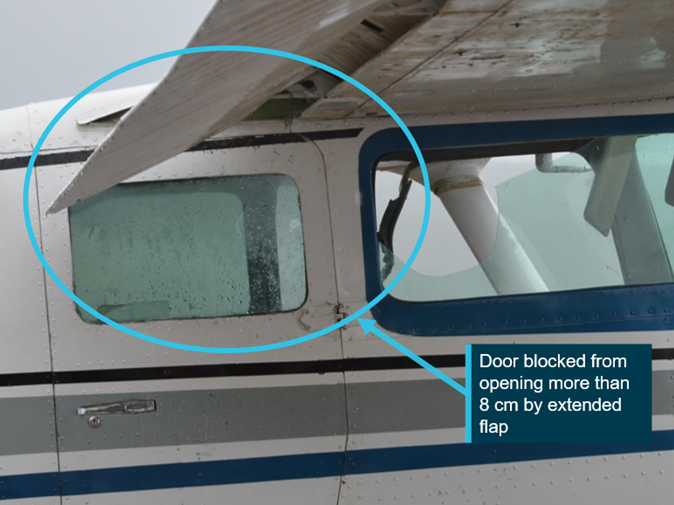
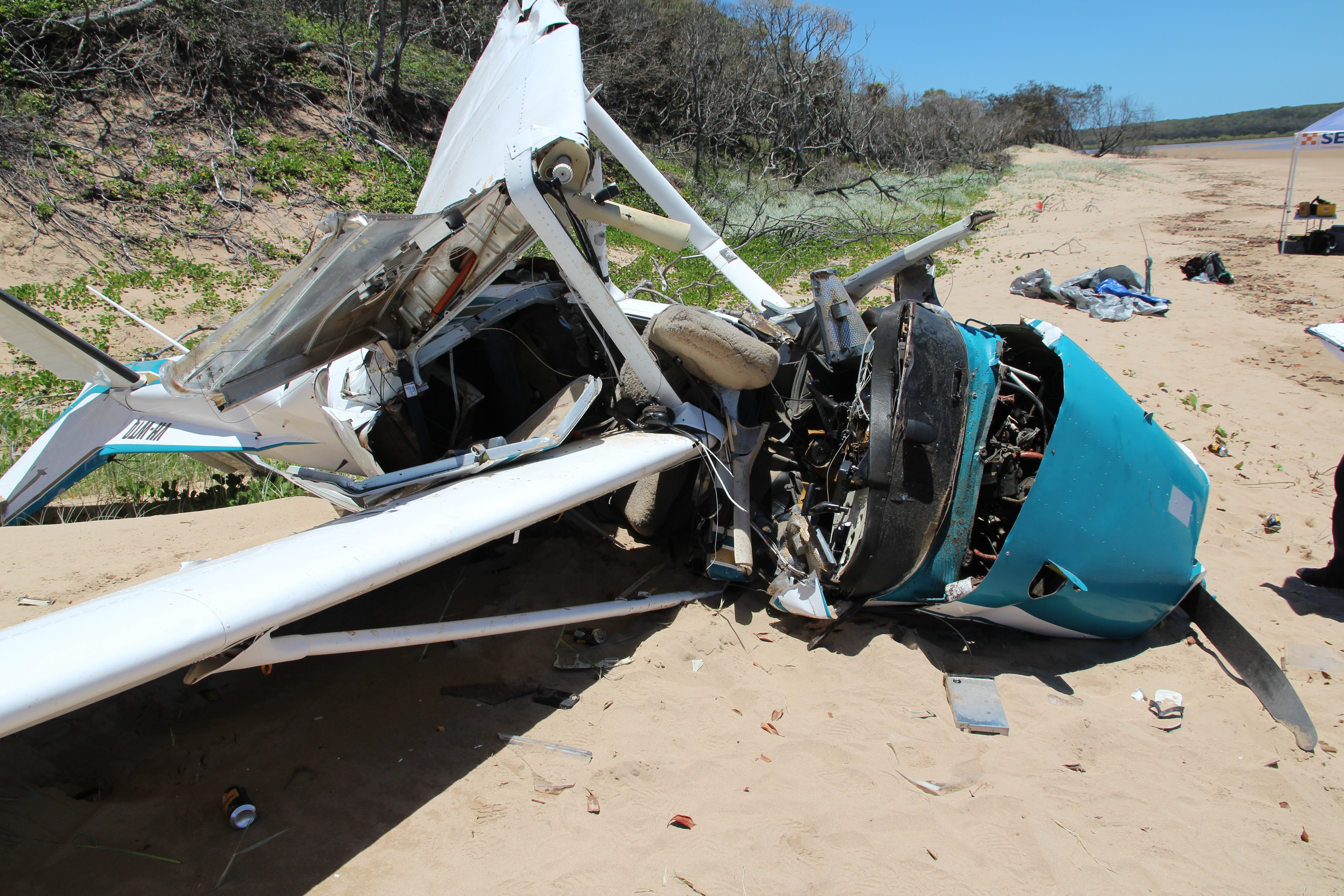
A pair of survivability issues were highlighted when a Cessna 206 ditched off Fraser Island, Queensland. First, the aircraft’s rear cargo door was blocked by the extended wing flap. Second, the cargo door was found to not meet aircraft certification basis for the design of cabin exits, due to the complexity associated with opening it if blocked by flaps.
Use and fitment of helmets during low-level operations
An R44 helicopter pilot was fatally injured in a wirestrike and collision with terrain accident near Hay, NSW. The pilot’s injuries were consistent with flailing, and the pilot’s helmet did not attenuate the impact to survivable levels. At the conclusion of its investigation, the ATSB issued a Safety Advisory Notice, strongly encouraging pilots conducting low-level operations to wear a flight helmet, and to ensure it is fit for purpose, custom fitted to the pilot's head, properly secured with a chin strap, and maintained in accordance with the manufacturer's recommendations.
Seatbelts
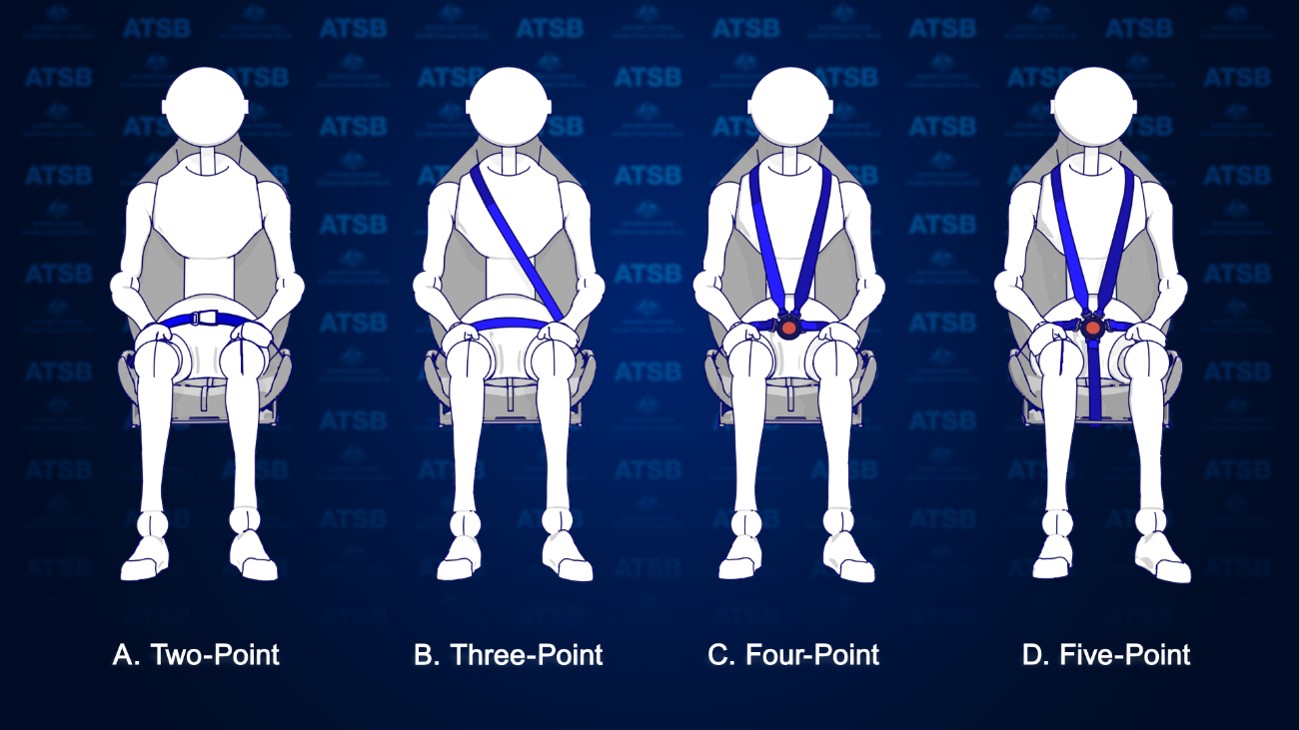
In several of its investigations, the ATSB has found injuries to aircraft occupants may have been avoided, or made less severe, through the appropriate use of multi-point harnesses.
In one example, the ATSB issued a Safety Advisory Notice as a result of a collision with terrain involving a Cessna 172M, which encountered an engine failure while flying about 60 ft over a beach. The aircraft was not fitted with, nor was it required to be fitted with, upper torso restraints, and , the ATSB concluded this very likely increased the severity of injury to the four occupants - one of whom was fatally injured. The ATSB's subsequent safety advisory notice strongly encourages operators and owners of small aeroplanes manufactured before December 1986, and helicopters manufactured before September 1992, to fit upper torso restraints to all seats in their aircraft (if they are not already fitted).
More recently, the ATSB has issued a Safety Advisory Notice as part of its investigation into the mid-air collision between two Eurocopter EC130 helicopters on the Gold Coast, Queensland. That notice specifically concerns the fitment of constant wear lifejackets, and ensuring they do not interfere with the proper fitment of aircraft seatbelts.
Australia is a vast and sparsely-populated continent, with a highly active general aviation sector, and a healthy charter and scheduled passenger air transport sector servicing regional centres.
These factors are among those which contribute to Australia having more than 330 certified aerodromes (as defined by the Civil Aviation Safety Authority), and more than 2,000 defined aircraft landing areas (or ALAs). The vast majority of these are non-towered, with no separation or traffic guidance provided by a ground-based controller, as you would have in a major airport.
Without a ground-based controller, pilots are responsible for maintaining separation between one another. This practice of ‘self-separation’ relies on pilots making regular and clear radio calls, and paying attention to the calls being made by other pilots sharing the same airspace.
The ATSB often receives reports from pilots that another aircraft has flown too close to them in uncontrolled airspace. Not surprisingly, three quarters of these reports involve pilots flying within 10 nautical miles of a non-controlled aerodrome.
Twice as many near-collisions are reported to the ATSB where pilots had no prior warning of other aircraft in their vicinity, compared with situations when a pilot received an alert by radio or a traffic alerting system like TCAS. Insufficient communication between pilots operating in the same area is the most common cause of safety incidents near non-controlled aerodromes.
Recent ATSB investigations involving multiple aircraft around non-towered aerodromes
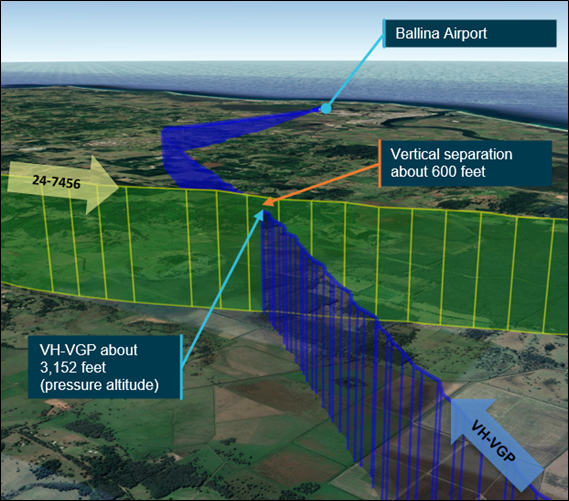
AO-2020-062 Separation occurrence involving Airbus A320-232, VH-VGP and Jabiru J230D, 24-7456 near Ballina Byron Gateway Airport, New South Wales, 28 November 2020
The flight paths of a Jabiru recreational aircraft and a Jetstar Airways A320 with 170 people on board intersected, with just 600 ft of vertical separation, near Ballina Airport, NSW. The ATSB’s investigation found the pilot of the Jabiru was unaware of the presence of the A320 before their flight paths intersected, and the A320 flight crew were unaware of the impending conflict until alerted by their aircraft’s traffic collision avoidance system (TCAS). Read more
AO-2020-051 Collision on runway between Extra EA-300 aeroplane, VH EXR and Guimbal Cabri G2 helicopter, VH-LTO Caloundra Airport, Queensland, on 18 September 2020
An Extra EA-300 was conducting circuits at Caloundra Airport, Queensland, when a Guimbal Cabri G2 helicopter joined the circuit and conducted a stop-and-go on the active runway. The Extra landed on the runway and, during its landing roll, collided with the rear of the hovering helicopter, resulting in substantial damage to both aircraft but, fortunately, no injuries. Read more
AO-2020-012 Mid-air collision involving Piper PA-44-180 Seminole, VH-JQF and Beech D95A Travel Air, VH-AEM 8 km south of Mangalore Airport, Victoria on 19 February 2020
Two twin-engine light aircraft operating under the instrument flight rules (IFR) collided mid-air in non-controlled airspace south of Mangalore Airport, Victoria. All four pilots (two in each aircraft) were fatally injured, and both aircraft were destroyed. Read more
CASA radio calls at non-controlled aerodromes safety promotion video
The ATSB has released a preliminary report detailing evidence gathered to date in its investigation of a fatal mustering accident, which occurred approximately 550 km south of Darwin in June.
The preliminary report, which contains no analysis or findings, notes two pilots were taking part in mustering operations at Limbunya Station, in the Northern Territory’s Victoria River region, on the morning of 27 June 2023.
Both pilots were using Robinson R22 helicopters to conduct the aerial work, which started that day at around 0700 local time.
At about 0930, one pilot set down at a collection of fuel drums to refuel, then departed.
The second pilot advised via radio that they had done the same at about 0945.
Approximately 15 minutes after that, the first pilot contacted the head musterer to ask whether they had heard from the second pilot. The head musterer advised they had not.
After a short aerial search, the first pilot located the wreckage of the second helicopter at about 1015.
The helicopter was destroyed, and the pilot had sustained fatal injuries.
The ATSB deployed investigators to examine the accident site and wreckage.
“As well as on-site work, the investigation has so far included the collection of meteorological data, and pilot and aircraft records,” ATSB Director Transport Safety Kerri Hughes said.
“Investigators have also conducted interviews and liaised with the Northern Territory Police Force.”
As it progresses, the ATSB’s investigation will include further review and analysis of the meteorological data, wreckage information, and instruments and components gathered from the accident site.
“Electronic data from the accident pilot’s mobile phone, the aircraft’s maintenance history, and any similar occurrences will also be reviewed,” Ms Hughes added.
A final report will be released at the conclusion of the investigation.
“Should a critical safety issue be identified during the course of the investigation, the ATSB will immediately notify relevant parties, so appropriate and timely safety action can be taken,” Ms Hughes concluded.
Section 21 (2) of the Transport Safety Investigation Act 2003 (TSI Act) empowers the ATSB to discontinue an investigation into a transport safety matter at any time. Section 21 (3) of the TSI Act requires the ATSB to publish a statement setting out the reasons for discontinuing an investigation. The statement is published as a report in accordance with section 25 of the TSI Act, capturing information from the investigation up to the time of discontinuance.
Overview of the investigation
On 20 August 2023, 2 Embraer ERJ 190-100 IGW aircraft, registered VH-UZI (UZI), and VH-XVS (XVS) were conducting air transport flights. Both aircraft were operated by Alliance Airlines.
UZI was operating as Qantas flight 1948 from Hobart, Tasmania, to Brisbane, Queensland, and was tracking in a northerly direction maintaining flight level[1] (FL) 350. XVS was operating as Qantas flight 1907 from Brisbane to Canberra, Australian Capital Territory, and was in a climb tracking in a southerly direction. Both aircraft were flying in a section of airspace referred to as ‘Byron’ and were in communication with a controller at Brisbane Centre air traffic control (the controller). Within the Byron airspace, the controller was operating 2 sectors, ‘Inverell’ and ‘Gold Coast’.
At 1523:15 local time, the flight crew of XVS entered the Gold Coast sector and contacted the controller and were instructed to climb to FL 360. About 4 minutes later, and while climbing through FL 200, XVS turned left slightly onto air route[2] H91 on a track of 190° (magnetic).
At 1536:46, UZI entered the Inverell sector on air route H66 on a track of 30° (magnetic). The flight crew contacted the controller advising that they were maintaining FL 350, with the controller providing instructions for arrival at Brisbane. Between 1540:56 and 1541:42, the controller provided instructions to 2 other aircraft.
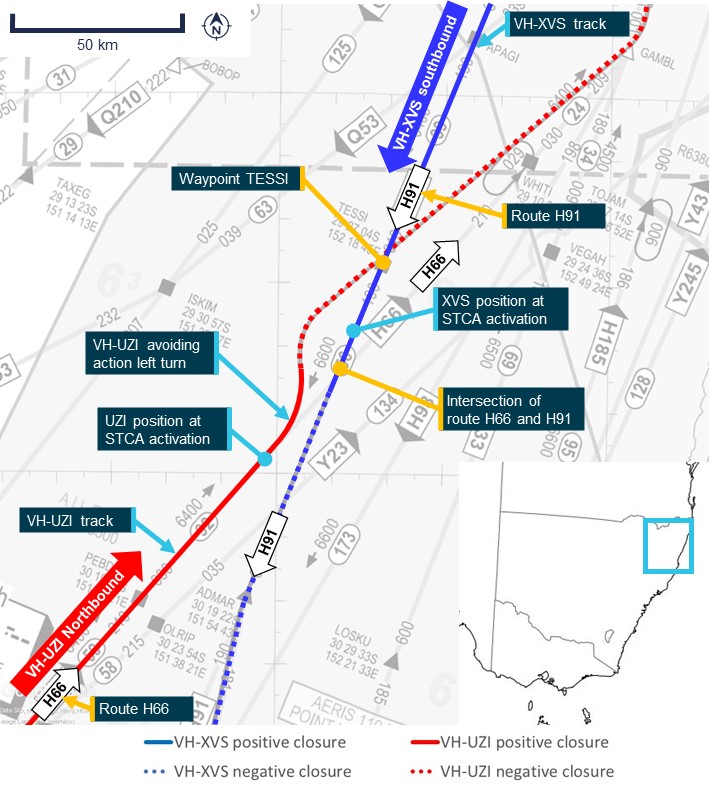
At 1541:55, when both aircraft were in the vicinity of the waypoint TESSI, a short-term conflict-alert[3] (STCA) between XVS and UZI activated and was displayed on the controller’s screen. The relative position of each aircraft at the time of the STCA activation is shown in Figure 1. At this time, UZI was maintaining FL 350 and XVS was climbing through FL 345, with the captain of XVS reporting a climb rate of 700 ft/min. The aircraft were separated by approximately 25 NM (46 km) with a closure rate of about 900 kt and 20° off a reciprocal track.
At about the same time as the STCA activation, the following exchange occurred between the controller and the flight crew of XVS:
Controller: Qantas nineteen zero seven…just confirm maintain flight level three six zero
XVS: Maintain flight level three six zero Qantas nineteen zero seven.
At 1542:06, shortly after the STCA activation, the controller issued avoiding action instructions to both aircraft, with the following radio transmissions occurring:
1542:06 Controller: Qantas nineteen forty-eight avoiding action turn left heading two seven zero
1542:10 UZI: Left turn heading two seven zero Qantas nineteen forty-eight
1542:14 Controller: Qantas nineteen forty-seven descend immediately flight level three four zero
1542:21 Controller: Qantas nineteen zero seven descend immediately flight level three four zero
1542:25 XVS: Descend three four zero Qantas nineteen zero seven
The captain of UZI reported that immediately after receiving the instruction, the first officer dialled the heading bug to 270° (magnetic) that was coupled to the autopilot, with the aircraft starting to respond to the commanded direction change. The captain of XVS reported that after hearing the controller’s instruction to UZI, they were anticipating an instruction from the controller, and as a result, the flight crew of XVS commanded a descent to FL 340 ‘pretty quickly’ after receiving the instruction.
At 1542:48, the controller further queried both flight crews about their position with the follow exchange occurring:
1542:48 Controller: Qantas nineteen forty eight, you turning?
1542:51 UZI: Affirm
1542:53 Controller: Qantas nineteen zero seven, descending? Report maintaining three four zero
1542:57 XVS: Ahh, descending past three four five Qantas nineteen zero seven
While this exchange was occurring, the captains of both aircraft reported observing traffic advisory indications for the other aircraft on the traffic alert and avoidance system.[4] Additionally, both captains recalled hearing a traffic advisory[5] with an audible key phrase ‘Traffic’ generated by this system as the aircraft passed each other.
Subsequently, at 1543:17, the following radio transmissions were broadcast:
1543:17 XVS: Qantas nineteen zero seven is maintaining flight level three four zero.
1543:21 ATC: Qantas nineteen forty-seven, correction nineteen zero seven.
1543:23 ATC: Qantas nineteen forty-eight, clear of conflict, cleared now direct to…IDDNA
As a result, while the separation did not reduce below the standard of 5 NM (9 km) horizontally and 1,000 ft vertically, the emerging conflict between the 2 aircraft was not initially identified and managed resulting in a loss of separation assurance.[6]
Figure 1: Position of VH-UZI and VH-XVS shown on en route high charts during the STCA activation
Source: Airservices Australia and Geoscience Australia, annotated by the ATSB
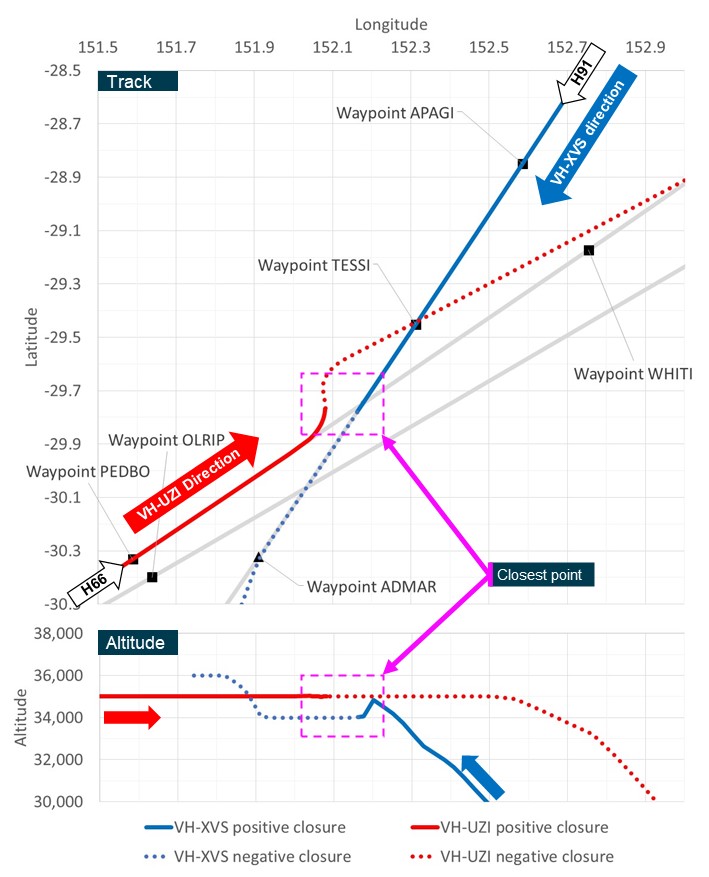
Figure 2 shows simplified track information for the incident in the upper portion of the figure, similar toFigure 1, and additionally includes altitude information for the 2 aircraft along the track in the lower portion. Key waypoints are labelled for reference in the upper ‘track’ plot. The light grey lines show the air routes, denoted by arrow labels. The lower ‘Altitude’ plot shows the aircraft altitude at the same latitude as the upper plot.
The southbound flight path of XVS along route ‘H91’ is shown in blue, and the northbound flight path of UZI starting on route ‘H66’ is shown in red. The areas in Figure 2 labelled ‘Closest point’ show the relative location of the avoiding action turn conducted by UZI on the upper plot and altitude changes by XVS on the lower plot. The solid blue (XVS) and solid red (UZI) lines show the flight path as the aircraft approached each other, and the dotted lines show the flight path as the aircraft started to move away from each other.
The tracks in the area of ‘Closest point’ boxes of Figure 2 show that XVS was approaching the same level of UZI (FL 350) near the crossing point between route H91 and H66. At 1543:14, the aircraft were separated by about 6 NM (11 km) as XVS approached FL 340, 1,000 ft below UZI.
Figure 2: Tracks (upper graph) and altitudes (lower graph) of VH-XVS (blue lines) and VH‑UZI (red lines) during the loss of separation assurance at 1542
Note: Positive closure refers to a positive closure rate, when the aircraft were converging toward each other, while negative closure is where the aircraft were diverging. Source: ATSB
Related occurrences
A search of the ATSB’s occurrence database was conducted to identify similar events to the incident flight for this investigation. An additional 2 occurrences were identified involving conflicts between aircraft climbing southbound on air route H91 and northbound on routes H66 or Y23. The occurrences were dated 15 May 2023 and 3 July 2023. These are described below.
ATSB occurrence OA2023-00783
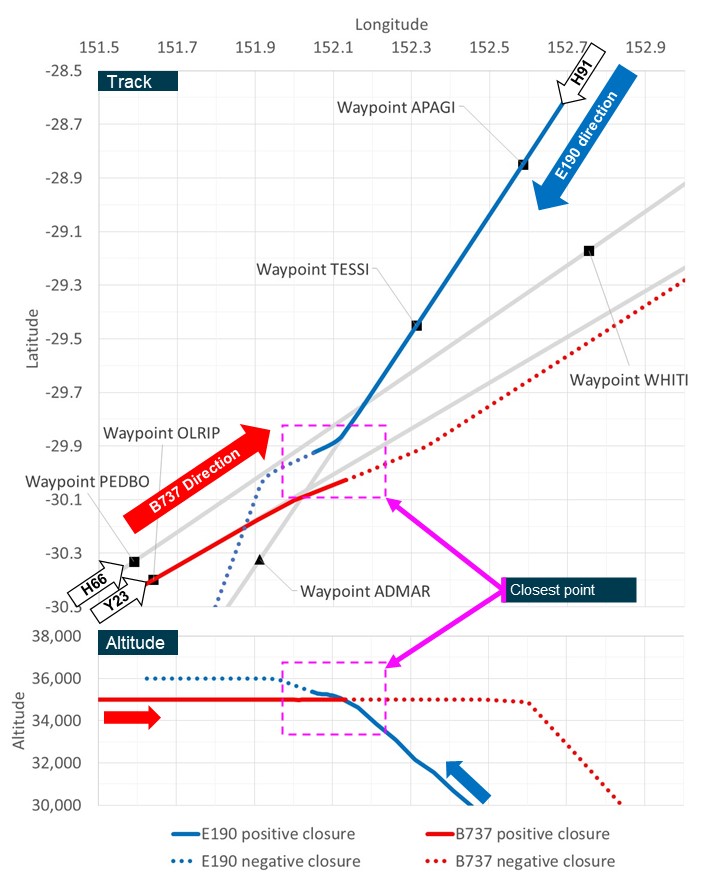
On 15 May 2023, a 737-800 aircraft (B737) was in the cruise at FL 350 from Melbourne, Victoria, to Gold Coast Airport, Queensland. At the same time, an Embraer ERJ 190‑100 IGW (E190) aircraft was in a climb after departing Brisbane, Queensland, en route to Canberra, Australian Capital Territory. Both aircraft were conducting air transport flights. This is depicted in Figure 3 in the same way as Figure 2 above.
The B737 was travelling north along route ‘Y23’ (red lines in Figure 3), and the E190 was travelling south on route ‘H91’ (blue lines in Figure 3). At 1150, an STCA alert identifying a conflict between the aircraft was noticed by the Byron airspace controller.
Airservices Australia reported that the controller issued an instruction to the B737 flight crew to immediately turn right onto a heading of 040°. Following readback, the controller issued an instruction to the E190 flight crew to immediately turn right onto a heading of 230°.
The flight crew of the E190 initially responded requesting confirmation of the instruction, which was re-issued by the controller. The controller advised the conflict had not been identified until alerted. As a result, there was a loss of separation assurance.
The flight paths in the ‘Closest point’ boxes of Figure 3 shows that the E190 had climbed through the same level of the B737 (FL 350) just prior to both aircraft starting to turn right. ATSB analysis showed that, at this time, the aircraft had a similar closure rate to the occurrence incident (between XVS and UZI) of about 916 kt. Airservices Australia reported that the closest point between the aircraft was approximately 7.2 NM (13 km) following the turns.
Figure 3: Tracks (upper graph) and altitudes (lower graph) of the E190 (blue lines) and B737 (red lines) during loss of separation assurance
Source: ATSB
ATSB occurrence OA2023-03542
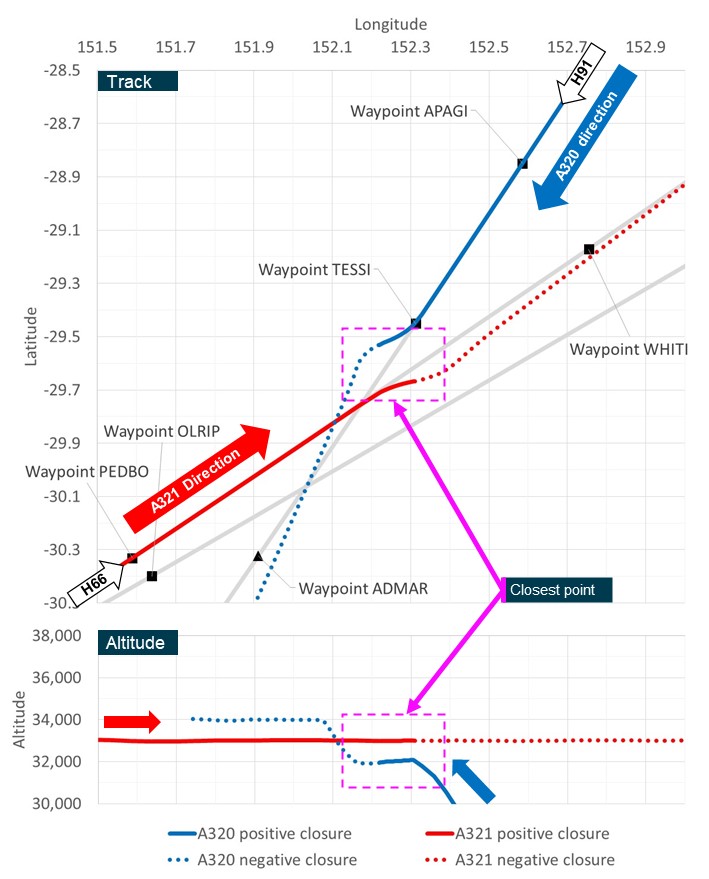
On 3 July 2023, an Airbus A321-231 (A321) aircraft was in the cruise at FL 330 from Melbourne, Victoria, to Sunshine Coast Airport, Queensland. At the same time, an Airbus A320-232 (A320) aircraft was in a climb after departing Brisbane, Queensland, en route to Launceston, Tasmania. Both aircraft were conducting air transport flights. This is depicted in Figure 4 in the same way as Figure 2 and Figure 3 above.
The A321 was travelling north along route ‘H66’ (red lines in Figure 4), and the A320 was travelling south on route ‘H91’ (blue lines in Figure 4). Airservices Australia reported that the A320 was on climb and was assigned FL 340. At approximately 1409, an STCA alerted the controller to a conflict between the aircraft. As a result, there was a loss of separation assurance.
The controller issued avoiding action to the A320 with an instruction to turn right and maintain FL 320. The controller subsequently also issued avoiding action to the A321 to turn right. Figure 4 shows that the A320 levelled out near FL 320 at the time that both aircraft starting to turn right, and just after the A321 had passed waypoint TESSI.
Figure 4: Tracks (upper graph) and altitudes (lower graph) of the A320 (blue lines) and the A321 (red lines) during the loss of separation assurance
Source: ATSB
Comparative analysis of flight paths
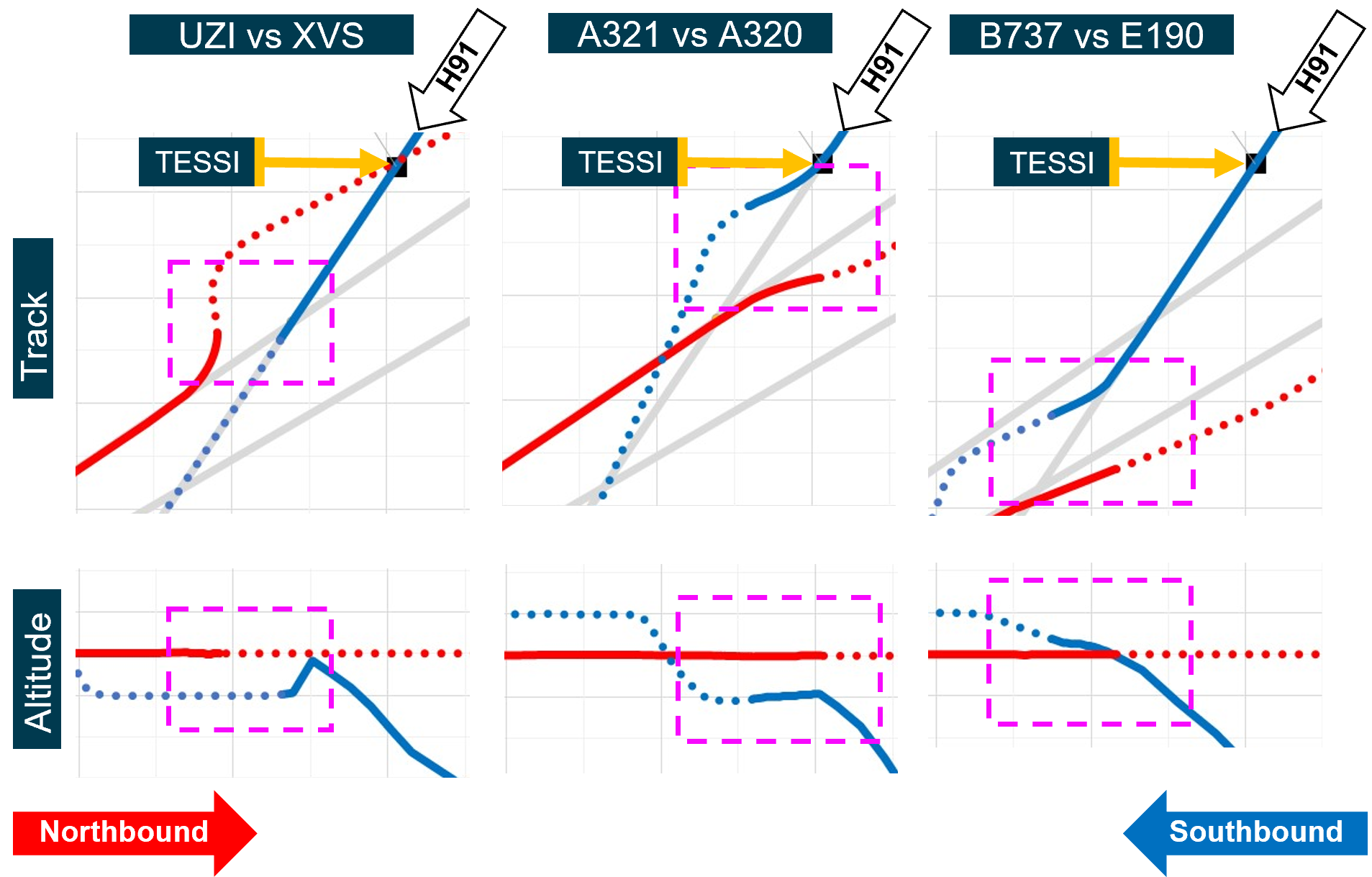
The ATSB compared the flight paths of all 3 incidents on 15 May, 3 July and 20 August 2023 (this investigation). The flight tracks and relative altitude for each of the 6 aircraft involved are shown in Figure 5.
Figure 5 uses the same data as Figure 2, Figure 4 and Figure 3, with the pink box showing the closest point for each incident in the same locations as in these figures. As in the above figures, solid lines show the flight paths as the aircraft approached each other, with the dotted lines showing the flight paths as the aircraft moved away from each other. The upper ‘Track’ plots are shown in the same location for all incidents, with waypoint ‘TESSI’ and route ‘H91’ labelled for reference. The light grey lines show the other air routes as labelled in the figures above. The lower ‘Altitude’ plots are shown with the same latitude (corresponding to the upper plots, although with the altitude adjusted to be centred on the northbound aircraft cruise level.
Figure 5: Comparison of flight paths involving a loss of separation assurance on air route 91 near waypoint TESSI between 15 May and 20 August 2023
Source: ATSB
Comparison of the 3 incidents depicted in Figure 5 showed:
All southbound aircraft were on route H91 in a climb and had not reached the assigned altitude.
Two of the southbound aircraft (the A320 and E190) turned right in response to the conflict, with the track of VH-XVS remaining straight.
Two of the southbound aircraft (XVS and the A320) stopped or reversed the climb, with separation maintained by attaining 1,000 ft separation.
Of the 3 incidents, the E190 was the slowest climbing aircraft to reach the conflict altitude, leading to the conflict with the B737 on route Y23.
The northbound aircraft were all in cruise on air route H66 or Y23.
In all cases, the northbound aircraft remained in cruise during each incident, with the responding avoiding action being a left or right deviation from the published air route.
Safety action
The following section describes safety action taken by Airservices Australia in response to the incident of this investigation, and the 2 other incidents noted in the Related occurrences section.
Issue of standardisation directive
On 22 August 2023, 2 days after the incident related to this investigation, Airservices Australia published standardisation directive DIR_23_0055 (the directive). This directive was specific to staff working on the Byron airspace in Brisbane Centre air traffic control. This provided the following context:
In the last 3 months there have been 3 occasions where the STCA has alerted controllers to a potential conflict in the vicinity of the TESSI waypoint. Each time the controller had issued climb to the southbound aircraft through the level of a maintaining northbound aircraft.
Each time the controller had issued the climb they either decided to monitor the separation or did not pick up the conflict.
The directive specified that there would be focus by Airservices Australia employees with roles as air traffic service workplace assessors (ATSWpA’s) on maintaining separation assurance between southbound aircraft on route H91 and northbound aircraft on route H66:
There will now be a focus by Byron group ATSWpA’s that separation assurance is maintained at all times between aircraft tracking southbound on H91 and aircraft tracking northbound on H66.
Byron ATSWpA’s will monitor the group compliance with separation assurance requirements, to be clear it is not acceptable to just monitor the climb of a conflicting pair of aircraft.
The directive also provided some detail on options to mitigate the risk of the southbound aircraft climbing into the path of the northbound aircraft:
If in doubt controllers are to issue either a requirement or an intermediate level. Controllers are reminded that issuing climb with a requirement to reach a level by TESSI to southbound aircraft on H91 will ensure separation with crossing northbound aircraft below on H66.
The standardisation directive expired on 21 November 2023.
Change to airspace design of ATS route H91
On 10 July 2024, Airservices Australia finalised a review for the incident related to this investigation. This review proposed further safety action relating to these conflicts in the vicinity of TESSI. This included:
• ATS [air traffic service] Route H91 - It was identified through occurrence review that inadequate separation assurance occurrence was linked to current crossing point between H91 and H66 routes
• Aircraft tracking south on H91 are still on climb and the position of the crossing point is at a distance where both aircraft would be at approximately the same level as H66 without ATC [air traffic control] intervention.
• Proposal to amend H91, new waypoint 6nm NW [11 km] of the H91/H66 crossing point and then track to [waypoint] ADMAR to rejoin the route, proposal has been sim validated by Byron ATC.
• The route from [waypoints] APAGI – TESSI – ADMAR to be removed
On 14 May 2025, Airservices Australia advised the ATSB the airspace change had been validated using simulator trials.
This process involves putting the new route into one of the Byron training simulator exercises that has the TESSI crossover incorporated. The new route is added and the results evaluated with simulator traffic. The simulator testing was valuable and resulted in a slight amendment to the planned waypoint.
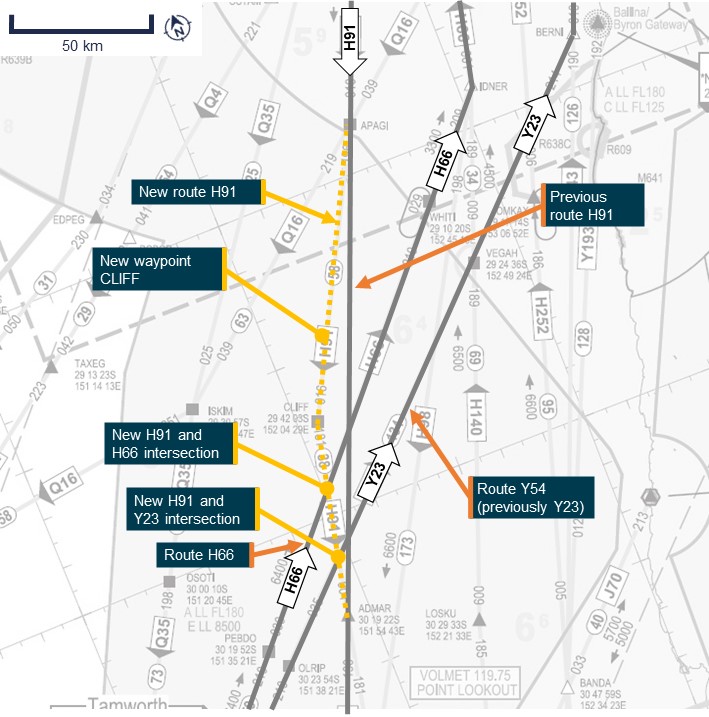
On 12 June 2025, the proposed changes to the airspace design came into effect. A review of the en route high chart 1 that became effective on 12 June 2025 showed an alteration to air route H91 to include APAGI – CLIFF – ADMAR. As noted in the proposed changes, the new waypoint CLIFF was 6 NM (11 km) north-west of the original H91/H66 crossing point. For reference, a section of this new route H91 is depicted in yellow in Figure 6. Note that route Y23 changed names to route Y54 after these incidents. The changes to route H91 increased the track miles by 11.9 NM (22 km) to the crossing point with route H66, and by 4.9 NM (9 km) to the crossing point with route Y23 (now Y54).
Figure 6: New route H91 shown in yellow over en route high chart dated 12 June 2025
Source: Airservices Australia, annotated by the ATSB
Assessment of safety action
ATSB assessment of airspace changes
The ATSB assessed the changes to air route H91 on the 3 incident flights. This analysis was performed by projecting the flight paths of all 3 southbound climbing aircraft involved in the incidents on air route H91 onto the new route H91. The projected location of each aircraft at the flight level of the northbound conflicting aircraft were estimated based on the actual average climb performance, prior to air traffic control intervention.
Based on the climb performance achieved, all 3 climbing incident aircraft would have passed through the altitude of the opposing aircraft prior to the new crossing point of H91 and H66. However, the analysis of the southbound climbing aircraft for the incident of this investigation (XVS) and ATSB occurrence OA2023-00783 indicated that these aircraft would have likely been within 5 NM (9 km) of air route H66 prior to reaching 1,000 ft vertical separation with the conflict flight level (FL 350).
Therefore, the ATSB’s analysis of the airspace changes indicated that the likelihood of a conflict between aircraft in similar circumstances to these incidents has been reduced by the increase in track miles and spacing between routes prior to the crossing points. However, the possibility of a loss of separation from slow-to-climb aircraft still existed in 2 of the 3 incidents.
Response by Airservices Australia
On 14 May 2025, Airservices Australia provided the following comment about the ATSB’s assessment of the airspace changes:
In relation to the ATSB analysis noting ‘the possibility of a loss of separation from slow-to-climb aircraft still exists’, that is technically accurate, however it is also the reason Air Traffic Control exists. At some point arrival and departure tracks cross at most of our major ports in Australia. The Air Traffic Controller on the relevant sector is trained to recognise the conflict and to provide the appropriate solution whether that be to stop climb, issue climb requirements or vector. The reason a H91/TESSI route change was put forward as a safety improvement was that the current climb and descent profiles of aircraft had added an increased risk of climb/descent conflictions at the H91/H66 crossing point. The route change shifts the crossing point to a better position and gives departing the aircraft more track miles to get to their planned level and arriving aircraft more time to commence descent.
ATSB asked Airservices Australia to advise on any other controls in place to mitigate the risk of a conflict between slow-to-climb aircraft on route 91 and aircraft in cruise on route H66 following the expiry of the standardisation directive. They advised that the controls in place while waiting for the route change to be processed were:
• Discussions with the Director Operations, the Line Leader, CSS [check and standardisation supervisor] and senior controllers in regard to TESSI and the importance of issuing requirements.
• Confirmation from CSS [check and standardisation supervisor] and senior controllers that the TESSI crossover was a major part of the Byron training package.
• A focus on the TESSI crossover and the issuing and monitoring of requirements by the Byron CSS during observations and checks.
Airservices Australia also advised that no similar on-climb conflicts had been identified since the release of the standardisation directive and the CSS (check and standardisation supervisor) focus on the crossover between route H91 and the northbound routes. Airservices Australia advised of another scenario where the STCA alarm activated, although this related to an aircraft being permitted to descend early in the proximity of the crossing of H91 and H66. There was no loss of separation for this incident.
Reasons for the discontinuation
The ATSB strives to use its limited resources for maximum safety benefit and considers that in this case the likelihood of a conflict between aircraft has been reduced by the increase in track miles and spacing between routes prior to the crossing points. The ATSB accepts that this airspace change, combined with existing risk controls, such as air traffic control and conflict alert systems have adequately controlled the risk of conflicts in similar circumstances to these incidents at this location and, as such, has reduced the likelihood of a loss of separation from slow-to-climb aircraft. Consequently, the ATSB has discontinued this investigation.
[1]Flight level: at altitudes above 10,000 ft in Australia, an aircraft’s height above mean sea level is referred to as a flight level (FL). FL 350 equates to 35,000 ft.
[2]Air route: a specified route designed for channelling the flow of traffic as necessary for the provision of air traffic services.
[3]Short-term conflict-alert (STCA): the STCA in Airservices Australia’s Australian Advanced Air Traffic System (TAAATS) determines all of the possible surveillance track pairs for which, in a predefined period, the minimum separation between each track pair will be less than the minimum safety requirements.
[4]Traffic alert and avoidance system (TCAS): a type of airborne collision avoidance system (ACAS).
[5]Traffic advisory (TA): an alert issued by an airborne collision avoidance system (ACAS) when the detected traffic may result in a conflict. Pilots are expected to initiate a visual search for the traffic causing the TA.
[6]A loss of separation assurance is an occurrence where separation has been maintained but has not been planned, actioned or monitored appropriately.
Occurrence summary
Investigation number
AO-2023-039
Occurrence date
20/08/2023
Location
86 km west of Grafton Airport
State
New South Wales
Report release date
26/03/2026
Report status
Discontinued
Investigation level
Defined
Investigation type
Occurrence Investigation
Investigation status
Discontinued
Mode of transport
Aviation
Aviation occurrence category
Loss of separation assurance
Occurrence class
Incident
Highest injury level
None
Aircraft details
Manufacturer
Embraer-Empresa Brasileira De Aeronautica
Model
ERJ 190-100 IGW
Registration
VH-XVS
Serial number
19000062
Aircraft operator
Alliance Airlines Pty Limited
Sector
Jet
Operation type
Part 121 Air transport operations - larger aeroplanes
Departure point
Brisbane Airport, Queensland
Destination
Canberra Airport, Australian Capital Territory
Damage
Nil
Aircraft details
Manufacturer
Embraer-Empresa Brasileira De Aeronautica
Model
ERJ 190-100 IGW
Registration
VH-UZI
Serial number
19000191
Aircraft operator
Alliance Airlines Pty Limited
Sector
Jet
Operation type
Part 121 Air transport operations - larger aeroplanes
On 8 June 2022, a Boeing 737 on a cargo flight from Sydney, Australia landed at Auckland, New Zealand with little fuel remaining in the wing tanks, and no fuel being fed to the engines from the centre tank.
The New Zealand Transport Accident Investigation Commission (TAIC) is investigating this occurrence. TAIC has requested assistance and the appointment of an accredited representative from the ATSB.
To facilitate this support and to provide the appropriate protections for the information, the ATSB appointed an accredited representative in accordance with paragraph 5.23 of the International Civil Aviation Organization Annex 13 and commenced an investigation under the Australian Transport Safety Investigation Act 2003.
The final report into this investigation was released by TAIC on 28 November 2024. The report is available for download on the TAIC website, www.taic.org.nz
An ATSB preliminary report details early factual information established as part of its ongoing investigation into a June 2023 accident involving a Cessna 210 charter aircraft on Groote Eylandt, in the Northern Territory, in which four passengers were seriously injured.
A piston-engined Cessna 210L landed off the runway and flipped over at Groote Eylandt Airport on 16 June.
The preliminary report notes the pilot had just taken off in an easterly direction when they noticed fuel flow fluctuations and engine surging.
The pilot made a radio broadcast on the common traffic advisory frequency (CTAF) of their intention to return to land at the airport, and turned the aircraft around.
During the descent, the aircraft passed diagonally over the eastern end of the runway, and then continued parallel to it, before passing the western runway threshold at an altitude of about 100 ft.
“The aircraft continued to descend, before touching down in a clear grassed area about 500 m beyond the end of the runway,” Director Transport Safety Dr Stuart Godley said.
The aircraft rolled along the ground for about 120 m, with a recorded groundspeed of 87—62 kt, before hitting an embankment on one side of a culvert, then a larger embankment on the other side.
The aircraft flipped over and came to a rest, inverted, on a mine service road.
Four of the five passengers were seriously injured, while the pilot and fifth passenger sustained minor injuries.
ATSB investigators examined the wreckage and accident site and recovered components for further examination.
They also interviewed relevant parties, and collected aircraft, pilot and operator documentation.
“The ATSB has also analysed engine data management system information, as well as video recordings and recorded flight data,” Dr Godley added.
“Moving forward, our investigators will review and examine the aircraft components which were recovered from the accident site, and will also review the documentation gathered.”
The investigation will also include analysis of engine data management system information, and a review of airport documentation and the runway end safety area.
A final report, which will include analysis and detail the ATSB’s findings, will be released at the conclusion of the investigation.
“However, should a critical safety issue be identified during the course of the investigation, the ATSB will immediately notify relevant parties so appropriate and timely safety action can be taken,” Dr Godley concluded.
On 24 May 2023, VH-IKJ, an Embraer ERJ 190-300, was flown below the minimum safe altitude at night while conducting the Napier RNP 16 instrument approach procedure. The flight crew conducted an orbit at 1,800 ft where the minimum safe altitude was 3,300 ft. After completing the orbit, the crew re-intercepted the final approach and landed at Napier Airport, New Zealand.
What the ATSB found
The ATSB found that the crew experienced a high workload during a critical phase of flight and the aircraft became high on the vertical descent profile for the instrument approach. Perceived time pressures by the flight crew and the belief the visual approach criteria could be complied with, influenced a decision to conduct an orbit during the approach rather than conducting a missed approach.
What has been done as a result
The proactive safety action taken by Pionair Australia as a result of this incident includes but is not limited to the following:
the aircraft’s quick access recorder card was replaced and data is now being captured and analysed
a simulator exercise was developed to replicate the Napier event and how to manage a 2D approach should the aircraft become high on the approach; the simulator exercise commenced on 6 June 2023 as part of the E190 recurrent simulator program
a notice to staff (NTS) has been issued reiterating their obligations to check the operational flight plan is correct and they have received all the NOTAMS and weather forecasts required for the flight
the decision-making events that occurred on the ground in Auckland, during flight and approach to Napier Airport will be included in the human factors and non-technical skills training.
Safety message
This incident highlights the effect that perceived time pressures can have on flight safety. Crews should be focused on arriving at the destination as safely as possible and where unexpected tasks arise, they should take time to reassess the situation and develop a new plan if needed. Flight crews can utilise published holding patterns on approaches to ensure all crew members have completed individual tasks and are ready to provide their full attention during the critical stage of flight. Complying with a published holding pattern combined with flight path monitoring will ensure the aircraft has terrain clearance while the crew are completing other tasks.
The investigation
Decisions regarding the scope of an investigation are based on many factors, including the level of safety benefit likely to be obtained from an investigation and the associated resources required. For this occurrence, a limited-scope investigation was conducted in order to produce a short investigation report, and allow for greater industry awareness of findings that affect safety and potential learning opportunities.
The occurrence
On 24 May 2023, an Embraer Regional Jet (ERJ) 190-300, registered VH-IKJ, and operated by Pionair Australia Pty Ltd on a non-scheduled air transport flight, with 6 crew members (2 flight crew, 3 cabin attendants, one aircraft maintenance engineer) and 86 passengers on board, was planned to depart Brisbane, Australia, for Napier, New Zealand, with a scheduled stop in Auckland to clear New Zealand customs. The flight departed Brisbane at 0343 UTC[1] (1343 local) and arrived in Auckland at 0658 (1858 local). On arrival in Auckland, the aircraft was 52 minutes behind schedule.
Further delays were experienced in Auckland, where the international customs process took longer than expected and a passenger requested personal items be retrieved from the cargo hold. When the crew began preparing the aircraft for departure, they requested extra fuel to plan-ahead for the return leg to Auckland, requesting 3,014 kg more than the figure stated on the flight plan. The fuel had already been loaded when the crew requested their airways clearance. Air traffic control (ATC) advised the crew that the planned track was to fly approximately 113 NM to the north before turning and tracking south again overhead Auckland, adding an unnecessary 227 NM to the flight. The crew accepted an airways clearance to avoid the extra track miles, opting for a more direct route.
As the ground delay increased, the crew were advised by a company operations member that they would need to depart shortly, or Napier Airport would be closed when they arrived. At 2247 local time, the aircraft departed Auckland, 2 hours and 47 minutes after the planned departure time.
During descent, approaching the waypoint[2] GENDA (Figure 1), the crew determined that due to the reduced track miles and extra fuel uplifted in Auckland, the aircraft would be approaching its maximum landing weight on arrival at Napier. To reduce the aircraft weight, they conducted a holding pattern and started the auxiliary power unit (APU) to increase the fuel burn. After the holding pattern, a descent toward the Napier RNP 16 initial approach fix, waypoint ELBOW, (see section titled Napier RNP 16 instrument approach) was conducted and the crew completed the required checklists.
Source: Google Earth with ADS-B exchange data, annotated by ATSB
Near waypoint ELBOW, the aircraft flew through a thin layer of stratus cloud resulting in an ice detection system advisory alert. This required the crew to conduct the Stall Protection Ice Speed checklist, and to recomplete the Approach checklist. Passing the intermediate approach fix at AROPA, the crew observed that the aircraft was now high on the approach and increased the descent rate in an attempt to capture the vertical profile from above.
Just prior to reaching the final approach fix at FF16, the captain, who was the pilot flying,[3] engaged altitude hold along with heading mode on the autopilot, and commanded the aircraft to conduct a left orbit over the ocean. This took the aircraft beyond the inbound approach track tolerance for the approach segment and below the minimum safe altitude (see section titled Minimum altitude for flight). The crew completed the Stall Protection Ice Speed checklist and after re-intercepting the final approach track, re-commenced the descent, before continuing the procedure and landing at Napier Airport.
Context
Aircraft
The aircraft was an ERJ 190-300, manufactured in Brazil in 2019 and issued serial number 19020029. It was registered in Australia as VH-IKJ on 13 February 2020. The aircraft was fitted with 2 Pratt & Whitney PW1919G turbofan engines.
The aircraft requires external stairs for access to the cabin and it was reported that scaffolding had been arranged at Napier Airport as appropriate stairs could not be sourced locally. It had also been arranged for a local ground crew to assist the aircraft on arrival.
Flight Crew
Captain
The captain held an air transport pilot licence (aeroplane) and at the time of the occurrence had a total flying experience of 7,507 hours of which 2,794 were accrued on Embraer 190 type aircraft. On the Embraer 190-300 variant, they had 65 hours flight experience, of which 17 hours were in command. In the previous 90 days, they had flown 19.6 hours. The captain also held an instrument rating[4] with 374 hours of instrument flight time.
The captain reported having experience in many other countries however, the incident flight was the first international leg as pilot in command of an E190-300 type aircraft.
Captain’s duty period
The captain was free of duty in the 72 hours prior to the beginning of the flight duty period and reported receiving a total of 14 hours and 55 minutes of sleep in the previous 48 hours. They received 7 hours and 30 minutes of average quality sleep prior to the flight duty period and had been awake for 16 hours and 30 minutes at the time of the incident.
The captain advised that during the approach, they were mentally tired due to the logistical issues throughout the flight duty period.
First Officer
The first officer held a commercial pilot licence (aeroplane) with a total flying experience of 7,467 hours and 2,556 hours on the Embraer 190 type aircraft. They had 19 hours flight time on the E190-300 variant. The first officer also held an instrument rating with 377 hours of instrument flight time. In the previous 90 days, the first officer had completed 24 hours of flight time.
First officer duty period
The first officer was free of duty for 72 hours prior to the occurrence flight and received approximately 12 hours of good quality sleep in the previous 48 hours.
At the time of the incident, the first officer believed their fatigue level was very lively, responsive, but not at peak.
Flight planning
Flight dispatch
A computer-based flight planning program was used to generate a flight plan for the flight between Auckland and Napier. A flight dispatcher generated the flight plan package (package) however, it was the flight crew who were responsible for ensuring the plan was correct before departure.
The package provided to the flight crew did not include weather reports for Napier Airport, as the system was not designed to retrieve weather from regional airports. A weather forecast for Napier was obtained by the flight crew from the ground handlers in Auckland.
The package included wind direction, velocity and outside air temperature. However, the outside air temperature at 32,000 ft at waypoint TAUPO was -5°C whereas at waypoint GOSTI, 19 NM from TAUPO, the package indicated a temperature of -53°C which would be closer to the expected temperature at this altitude. At Napier, the 5,000 ft temperature was reported as -3°C.
As the crew had obtained a weather report for Napier before departure, it was determined that the omission of destination weather from the package did not contribute to the incident.
Weather
The terminal area forecast (TAF) for Napier Airport was issued on 23 May at 2305 UTC and was valid from 24 May 0000 to 1200 UTC. The active forecast for the arrival at 1200 UTC was light showers of rain and scattered[5] cloud at 3,000 ft with periods of 30–60 minutes where showers of rain were forecast reducing visibility to 7,000 m.
The Meteorological aerodrome report (METAR)[6] prior to the aircraft departure was:
METAR NZNR 241030Z AUTO 22009KT 20KM BKN070 11/09 Q1019
The METAR at the time of arrival was:
METAR NZNR 250000Z AUTO 25006KT 20KM NCD 09/08 Q1020
Basic operating weight
The flight plan reflected a basic operating weight[7] for the aircraft of 33,800 kg however, the load instruction report indicated a dry operating weight of 34,233 kg. The 2 weights should match however, on this occasion they did not, and the weight discrepancy was not rectified prior to departing.
The basic operating weight used by the crew on the load instruction report at the time of departure was higher than the figure provided on the flight plan. Using the higher weight of 34,233 kg, the aircraft remained below the maximum zero fuel weight,[8] maximum take-off weight,[9] and maximum landing weight.
The operator later advised that the basic operating weight for VH-IKJ, when configured as it was on the flight (2 pilots and 3 cabin crew), was 33,907 kg.
The basic operating weight discrepancies did not result in an aircraft limitation exceedance however, if the correct figure had been used, the margin to the maximum landing weight would have been greater. If the crew had not completed the hold at GENDA, they would have arrived about 5 minutes earlier.
The time saved was unlikely to be significant enough to have changed the perceived time pressures (see section titled Perceived time pressure). Therefore, it was unlikely that the weight discrepancy contributed to the descent below minimum safe altitude.
The aircraft was scheduled to arrive in Napier at 2125 local time however, it arrived 2 hours and 35 minutes late. The airport does not have a curfew and does not close to operating aircraft overnight.
While the flight plan listed Auckland as an alternate aerodrome if they could not land at Napier, there were no plans in place to ensure the aircraft could obtain ground handling to assist with disembarking the aircraft at Napier if the flight was delayed.
The Approach checklist is part of the normal procedures and is completed on all flights. It requires the flight crew to check the following items are set appropriately for the approach phase of flight:
passenger signs panel
ice speed reset
landing speeds
speed knob
altimeters
approach aids.
After completing the tasks, a challenge and response checklist must be completed which verifies the following items are set correctly and completes the Approach checklist:
passenger signs panel
ice speed reset
altimeters.
Stall Protection Ice Speed checklist
If the aircraft detects icing conditions exist, the stall protection ice speed system will automatically increase the approach and landing reference speeds. At a landing weight of 49,000 kg, a typical full flap approach speed is 126 kt; with ice detected, the speed increases to 130 kt. The higher speeds result in a longer landing distance. However, it is possible to reset the reference speeds under the following conditions:
ice detectors are not detecting icing conditions
static air temperature[10] (SAT) is at or above 5°C.
The Stall Protection Ice Speed checklist is found in the aircraft electronic Quick Reference Handbook (e-QRH).
The ATSB could not verify the static air temperature at the time the checklist was completed however, the flight crew completed the Stall Protection Ice Speed checklist and reset the ice speeds.
The crew were operating in a foreign country at night and conducted the instrument approach procedure to ensure the aircraft remained clear of terrain. The New Zealand Civil Aviation Authority (CAA) required IFR aircraft to remain at or above the minimum altitudes published in the applicable instrument approach procedure to ensure minimum obstacle clearance.
A minimum sector altitude is provided for different areas centred on the airport reference point and defined on the approach plate. They define the minimum altitude an aircraft may descend to unless established on a published approach track with a lower altitude. The minimum sector altitude for the area northeast of Napier was 3,900 ft (Figure 3).
The terminal arrival altitude (TAA) provides a minimum safe altitude from an approach reference point providing a minimum terrain clearance of 1,000 ft at the TAA altitude. The instrument approach has a TAA referenced to AROPA of 3,300 ft (Figure 3).
When flying the RNP approach, the inbound track has a minimum segment altitude which applies to a lateral tracking tolerance[11] on the inbound track. This is often lower than the minimum sector and terminal arrival altitudes. The minimum segment altitude for the inbound track between AROPA and FF16 was 1,600 ft.
The Napier RNP 16 approach procedure used fly-by waypoints for the initial, intermediate, and final approach waypoints. The fly-by waypoints (when the next waypoint is not on the same track) are different to fly-over waypoints in that the flight path generated creates a constant rate turn toward the next waypoint in the sequence and the aircraft does not pass directly overhead the waypoint (Figure 2). The result of the fly-by waypoint is a reduction in flight distance to the next waypoint. The total track miles lost, when using a fly-by waypoint, changes depending on the aircraft turn radius which is determined by the aircraft bank angle and speed.
The aircraft was classed as a category C (CAT C) type aircraft. According to the ICAO Doc 8186 Procedures for Air Navigation Services – Aircraft Operations (PANS-OPS), for CAT C aircraft, the maximum change between the final approach track (FAT) and runway centreline was 15°. Advisory Circular AC173-1 - Instrument Flight Procedure Design, published by the Civil Aviation Authority (CAA) of New Zealand, noted that the Napier RNP 16 approach for CAT C aircraft was ‘not in accordance with ICAO PANS-OPS straight in criteria, as it had an offset FAT of 22°.
The CAA also advised that the RNP approach does not intersect the runway centreline at a minimum of 1400 m as per the PANS-OPS requirements. The Napier RNP approach is the only example of this in New Zealand.
Despite these differences to PANS-OPS requirements, as the aircraft had not reached the point in the approach where these differences would have affected the flight, they were not considered to have influenced the event.
Source: Jeppesen approach plate provided by operator and annotated by ATSB
Data
The ATSB was unable to review the aircraft’s quick access recorder as there was an issue with the data card used to record the information.
ADS-B data was transmitted by the aircraft and was obtained by the ATSB from a third-party website to analyse the aircraft’s lateral and vertical flight path (Figure 4). The ADS-B data also provided information on the selected autopilot modes at the time of the approach (Table 1).
Figure 4: ADS-B data overlay on the RNP 16 approach
The approach track is labelled to show the altitude the aircraft was at against the vertical profile.
Source: ADS-B data overlay on Jeppesen NZNR RNP 16 annotated by the ATSB
Autopilot modes
The aircraft is equipped with an autopilot system capable of vertical navigation (VNAV) and lateral navigation (LNAV).
While there are multiple VNAV sub-modes available to the flight crew, the ones listed below were appropriate for this occurrence:
flight path angle – maintains a constant angle of descent or climb set by the flight crew until the selected altitude is reached.
altitude hold – maintains the aircraft’s altitude at the time of selection or after the selected altitude has been successfully captured by the autopilot.
Approach mode is a combination of a VNAV and LNAV. When approach mode is active, the aircraft descends using the pre-loaded instrument approach procedure in the aircraft flight management computer database. VNAV autopilot function follows the vertical glide path, and LNAV follows the instrument approach procedure waypoints.
Vertical Glide path – to engage the vertical glide path functionality, approach mode must be armed, and the aircraft must be within 5 NM of the final approach fix with the lateral navigation active. If there is a change in vertical procedure profile, the vertical glide path does not engage.
The flight crew advised that at about AROPA, when they recognised the approach mode had not automatically become the active mode, the pilot flying used the VNAV sub-mode, flight path angle, to try to intercept the glide path from above. It was reported that an angle of 4.5° was utilised in an attempt to recapture the desired 3° vertical profile.
Autopilot is engaged in VNAV and the sub-mode is unknown
11:47:48
During inbound turn at AROPA
3,900
203
-2,112
VNAV
Approach mode is not active as was expected by the crew
11:48:56
Turning off the final approach track prior to FF16
2,300
187
-640
Altitude Hold
Aircraft is maintaining the selected altitude
11:52:50
Established inbound on the final approach leg after completing orbit
1,700
142
-1,088
Approach
Approach mode has become active
Standard operating procedures
Missed approach procedure
The operator’s operations manual stated that in accordance with Civil Aviation Safety Regulations (CASR) Part 91 Manual of standards section 15.11:
During an instrument approach (IAP), the pilot in command of an aircraft must immediately execute the missed approach procedure for the IAP in any of the following circumstances:
a) during the final segment of the IAP — if the aircraft is flown outside the navigational tolerance for the navigation aid being used; …
The operations manual also stated that in accordance with CASR Part 91.305:
The flight crew will not allow the aircraft to be flown below the minimum flight altitude, except when:
• the aircraft is taking off or landing
• the aircraft is being flown in accordance with:
- requirements relating to visual approach or departure procedures published in the authorised aeronautical information for the flight
- an authorised instrument departure procedure or an authorised instrument approach procedure
- an air traffic control clearance
- the aircraft is being flown in VMC by day.
Forecasts
The operator required a forecast for the destination airport be obtained for all flights.
For all Company flights a flight forecast must be obtained.
The [pilot in command] PIC must ensure that the forecasts cover the period for the flight and the aerodrome forecasts for the destination and alternate aerodromes nominated in the flight plan, are valid for a period of not less than 30 minutes before and 60 minutes after the planned ETA. When a flight is delayed so that the meteorological and operational information does not cover the period of the flight, updates must be obtained, as necessary, to allow the flight to be concluded safely.
When a pre-flight briefing is obtained more than one hour prior to [estimate off-block time] EOBT, pilots shall obtain an update before each departure to ensure that the latest information available can be used for the flight. The update shall be obtained via the Company service provider or NAIPS, or by telephone or when this is impractical, by radio.
The approved external briefing services are:
Bureau of Meteorology website
Airservices Australia website – National Aeronautical Information Processing System (NAIPS)
NAIPS iPad application
None of the above approved methods will generate a forecast for Napier Airport, New Zealand.
Inexperienced flight crew
The operations manual also stated:
Inexperienced Flight Crew members, defined within this section, must not be crewed together. Flight Crew members are considered as inexperienced, until they have achieved 100 hours and 10 sectors on the aeroplane type during line operations (This may include experience while the Flight Crew member is flying under supervision.)
Safety analysis
Prior to the departure from Auckland, the flight was significantly delayed, and the crew were advised that the airport at Napier would close if they did not depart within a short timeframe. This resulted in the crew feeling rushed during their preparations. They advised they continued to feel rushed during the flight and the requirement to enter a holding pattern to burn extra fuel added to this perceived time pressure.
During their approach brief, the crew did not identify icing as a potential threat and therefore were not prepared to complete the Stall Protection Ice Speed checklist when they received the advisory message. A high workload quickly developed inside the cockpit as the first officer had difficulty locating the checklist in the electronic Quick Reference Handbook.
ADS-B data confirmed that the aircraft became high on the vertical approach profile prior to joining the Napier RNP 16 instrument procedure. It also confirmed that the crew did not enter the published holding pattern at AROPA to complete the preparations and instead, continued descending to join the vertical profile. At this time, the pilot monitoring was still completing the checklist and was unable to give full attention to monitoring the aircraft’s flight path.
The pilot flying was using the VNAV autopilot function to descend the aircraft and had expected the autopilot to capture the vertical glide path and begin a constant rate of descent. However, a combination of the aircraft been too high, and underestimating the distance to run due to a misinterpretation of the fly-by waypoint, resulted in the aircraft’s position not being within the autopilot parameters to capture the vertical glide path. The pilot flying attempted to capture the glide path from above using the flight path angle autopilot mode but was unable to successfully do so.
The captain decided that they needed to reduce the workload in the cockpit prior to continuing through the final approach fix. Due to the perceived time pressure and a desire to minimise further delay they decided to do this by conducting an orbit rather than a missed approach which would take significantly longer. They believed the visual approach criteria could be complied with and without further discussion, a left turn was commanded via the autopilot descending to 1,800 ft. The left turn took the aircraft beyond the lateral tolerance of the intermediate approach segment and below the minimum safe altitude of 3,300 ft.
The flight crew reported that the E190-300 flight characteristics and autopilot system are slightly different to other variants the crew were more experienced with. So, while their experience on the type technically exceeded the ‘inexperience flight crew’ requirements, the combined 89 hours of E190-300 experience likely contributed to the high workload in the cockpit.
Findings
ATSB investigation report findings focus on safety factors (that is, events and conditions that increase risk). Safety factors include ‘contributing factors’ and ‘other factors that increased risk’ (that is, factors that did not meet the definition of a contributing factor for this occurrence but were still considered important to include in the report for the purpose of increasing awareness and enhancing safety). In addition ‘other findings’ may be included to provide important information about topics other than safety factors.
These findings should not be read as apportioning blame or liability to any particular organisation or individual.
From the evidence available, the following findings are made with respect to the flight below lowest safe altitude involving Embraer ERJ 190-300, registration VH-IKJ at about 11 km north‑north-east of Napier Airport, New Zealand.
Contributing factors
After passing the initial approach fix at ELBOW, the aircraft unexpectedly encountered ice, requiring the crew to conduct the appropriate checklists which increased their workload during a critical phase of flight.
After passing the intermediate approach fix at AROPA, the aircraft was high on the approach and the crew felt time pressure to land the aircraft resulting in the crew conducting an orbit, which was not part of the approach criteria.
The pilot flying believed the visual approach criteria had been met resulting in the flight crew conducting an orbit below the minimum safe altitude.
Safety actions
Whether or not the ATSB identifies safety issues in the course of an investigation, relevant organisations may proactively initiate safety action in order to reduce their safety risk. All of the directly involved parties are invited to provide submissions to this draft report. As part of that process, each organisation is asked to communicate what safety actions, if any, they have carried out to reduce the risk associated with this type of occurrences in the future.
Safety action
The proactive safety action taken by Pionair Australia as a result of this incident includes but is not limited to the following:
the quick access recorder card was replaced and data is now being captured and analysed
Two E190 charter debriefings were held on 6 July and 25 August 2023. The purpose of the debriefings was to bring all key stakeholders together and discuss the issues that had occurred on this charter and other recent E190 charters and develop an action plan to prevent recurrence
the E190 fleet manager and training manager developed a simulator exercise to replicate the Napier event and how to manage a 2D approach should the aircraft become high on the approach. The simulator exercise commenced on 6 June 2023 as part of the E190 recurrent simulator program
a different flight planning software has been selected for use by the operator
a preliminary risk assessment will be developed and will be required to be completed prior to accepting charters
registered access to the Airways New Zealand Internet Flight Information Service (IFIS) will be obtained
a notice to staff (NTS) has been issued reiterating their obligations to check the operational flight plan (OFP) is correct and they have received all the NOTAMS and weather forecasts required for the flight. If there are any issues with the OFP and/or the NOTAMS or weather forecasts provided, the pilot in command must contact the operations controller and have errors corrected. The NTS also states that weather forecast can only be from an approved source
the decision-making events that occurred on the ground in Auckland, during flight and approach to Napier Airport will be included in the human factors and non-technical skills training
an email has been sent to company E190 pilots requiring them to compare the basic operating weight of the aircraft on the flight plan with the load sheet, this will also be formalised as a notice to pilots.
Sources and submissions
Sources of information
The sources of information during the investigation included:
Under section 26 of the Transport Safety Investigation Act 2003, the ATSB may provide a draft report, on a confidential basis, to any person whom the ATSB considers appropriate. That section allows a person receiving a draft report to make submissions to the ATSB about the draft report.
A draft of this report was provided to the following directly involved parties:
flight crew
Pionair Australia Pty Ltd
aircraft manufacturer
Civil Aviation Safety Authority (Australia)
New Zealand Transport Accident Investigation Commission (TAIC)
New Zealand Civil Aviation Authority
Submissions were received from:
Pionair Australia Pty Ltd
New Zealand Civil Aviation Authority /Airways New Zealand
New Zealand Transport Accident Investigation Commission (TAIC)
The submissions were reviewed and, where considered appropriate, the text of the report was amended accordingly.
Purpose of safety investigations
The objective of a safety investigation is to enhance transport safety. This is done through:
identifying safety issues and facilitating safety action to address those issues
providing information about occurrences and their associated safety factors to facilitate learning within the transport industry.
It is not a function of the ATSB to apportion blame or provide a means for determining liability. At the same time, an investigation report must include factual material of sufficient weight to support the analysis and findings. At all times the ATSB endeavours to balance the use of material that could imply adverse comment with the need to properly explain what happened, and why, in a fair and unbiased manner. The ATSB does not investigate for the purpose of taking administrative, regulatory or criminal action.
Terminology
An explanation of terminology used in ATSB investigation reports is available here. This includes terms such as occurrence, contributing factor, other factor that increased risk, and safety issue.
Publishing information
Released in accordance with section 25 of the Transport Safety Investigation Act 2003
Ownership of intellectual property rights in this publication
Unless otherwise noted, copyright (and any other intellectual property rights, if any) in this report publication is owned by the Commonwealth of Australia.
Creative Commons licence
With the exception of the Commonwealth Coat of Arms, ATSB logo, and photos and graphics in which a third party holds copyright, this report is licensed under a Creative Commons Attribution 4.0 International licence.
The CC BY 4.0 licence enables you to distribute, remix, adapt, and build upon our material in any medium or format, so long as attribution is given to the Australian Transport Safety Bureau.
Copyright in material obtained from other agencies, private individuals or organisations, belongs to those agencies, individuals or organisations. Where you wish to use their material, you will need to contact them directly.
[1] Coordinated Universal Time (UTC): the time zone used for aviation. Local time zones around the world can be expressed as positive or negative offsets from UTC.
[2] Waypoint: A defined position of latitude and longitude coordinates, primarily used for navigation.
[3] Pilot Flying (PF) and Pilot Monitoring (PM): procedurally assigned roles with specifically assigned duties at specific stages of a flight. The PF has responsibility for flying the aircraft and the PM carries out support duties and monitors the PF’s actions and the aircraft’s flight path.
[4] Instrument flight rules (IFR): a set of regulations that permit the pilot to operate an aircraft in instrument meteorological conditions (IMC), which have much lower weather minimums than visual flight rules (VFR). Procedures and training are significantly more complex as a pilot must demonstrate competency in IMC conditions while controlling the aircraft solely by reference to instruments. IFR-capable aircraft have greater equipment and maintenance requirements.
[5] Cloud cover: in aviation, cloud cover is reported using words that denote the extent of the cover – ‘scattered’ indicates that cloud is covering between a quarter and a half of the sky.
[6] METAR: a routine report of meteorological conditions at an aerodrome. METAR are normally issued on the hour and half hour.
[7] Basic operating weight or dry operating weight: includes the weight of everything required to operate the aircraft such as the aircraft weight and operating crew however it excludes passengers and fuel.
[8] Maximum zero fuel weight: the weight of the aircraft and payload, everything required to complete the flight excluding fuel.
[9] Maximum take-off weight: the maximum weight of the aircraft, payload and fuel at take-off.
[10] Static air temperature: often referred to as the outside air temperature, it is the undisturbed temperature of the air mass surrounding the aircraft.
[11] The lateral tracking tolerance reduces from 1 NM at the intermediate approach fix to 0.3 NM at the final approach fix.
Occurrence summary
Investigation number
AO-2023-038
Occurrence date
24/05/2023
Location
about 11km north-north-east of Napier Airport
State
International
Report release date
05/03/2024
Report status
Final
Investigation level
Short
Investigation type
Occurrence Investigation
Investigation status
Completed
Mode of transport
Aviation
Aviation occurrence category
Flight Preparation / Navigation
Occurrence class
Incident
Highest injury level
None
Aircraft details
Manufacturer
Embraer S.A.
Model
ERJ 190-300
Registration
VH-IKJ
Serial number
19020029
Aircraft operator
Pionair Australia Pty Ltd
Sector
Jet
Operation type
Part 121 Air transport operations - larger aeroplanes