While the investigation was unable to establish the actual altitudes the aircraft were maintaining, due to the lack of radar coverage, both aircraft were reported to be at altitudes that would enable 500 ft spacing. However, even had that spacing been achieved, an unalerted aircraft suddenly appearing in a pilot's vision might be perceived to be closer than it actually is, leading an observer to think that there is a collision risk. It is also possible, given the error margins of altitude equipment on each aircraft, that the actual spacing may have been less than 500 ft.
It is possible that the pilot of the Shrike did not hear the Chieftain pilot's report because it was mixed with radio transmissions from other pilots on the frequency at the time. Given the reported altitude of the Chieftain of 7,000 ft and the Shrike's reported altitude of 6,500 ft, even if the Shrike pilot had heard that report there would have been no requirement for him to make a radio transmission and the situation would have remained unalerted for the Chieftain pilot.
Radio broadcasts can enhance a pilot's situational awareness when used in conjunction with maintaining a look out to see and avoid other aircraft. Flying in Class G airspace often involves the simultaneous monitoring of two radio frequencies, such as the area frequency and the MBZ frequency. If a radio transmission is not heard, a pilot has to rely on segregation from other aircraft through use of appropriate cruising altitudes and seeing other aircraft.
The limitations of see and avoid as a sole means to maintain awareness are well known (see ATSB website).
Factual information
On 31 August 2004, at about 1000 eastern standard time, the pilot of a Piper Aircraft Corporation PA-31 (Chieftain), registered VH-LTW, was conducting an instrument flight rules (IFR) flight from King Island to Devonport. The aircraft was maintaining 7,000 feet in visual meteorological conditions. The pilot saw an aircraft flying in the opposite direction passing between 100 ft and 200 ft, down the left of the Chieftain. He took immediate avoiding action. The pilot estimated that there was two to three seconds between initially seeing and then passing the other aircraft.
The other aircraft was later identified as an Aero Commander 500-S (Shrike), registered VH-LET, on a visual flight rules (VFR) flight at 6,500 feet from Launceston to King Island via overhead Devonport. The presence of the Shrike was established when the pilot of that aircraft advised the pilot of a third aircraft, that was east of King Island en route to Wynyard at 7,000 ft, of his position and altitude of 6,500 ft. The pilot of the third aircraft (tracking to Wynyard) had broadcast his intention to descend from 7,000 ft and that radio transmission alerted the Shrike pilot to a possible conflict. The pilots agreed to maintain their respective altitudes until the aircraft had passed. Neither the pilot nor the passenger in the Shrike saw the Chieftain.
At 1001, the Chieftain was 61 NM from Devonport and the pilot advised the controller of the occurrence and requested traffic information on any other aircraft in the area. The controller replied that there was no observed traffic [displayed on the radar].
Both pilots reported operating their aircraft transponders, including the Mode C altitude function, as required by the Aeronautical Information Publication (AIP) procedures. A review of the recorded air traffic control radar data confirmed that both aircraft were cruising at their reported altitudes about 20 minutes before they passed. However, the area where the aircraft passed was not within radar coverage and the investigation could not confirm the altitudes of the aircraft when they passed.
The Chieftain was fitted with two altimeters and the pilot reported that he had set both subscales to the area QNH and had engaged the autopilot. The Shrike was fitted with two altimeters and the pilot reported that he had set both subscales to either the local QNH or, when outside the mandatory broadcast zone (MBZ), the area QNH. The pilot had also engaged the auto-pilot. Both aircraft were maintained to IFR equipment requirements.
The AIP detailed altitudes to be used for aircraft on IFR/VFR flights in an easterly or westerly direction. The altitudes reported by the pilots were in accordance with the AIP.
Both aircraft were fitted with dual very high frequency radios. From about 0954, both pilots were simultaneously monitoring the Melbourne Centre area frequency on 122.6 MHz and the Devonport/Wynyard MBZ frequency on 126.9 MHz. At that time, the Chieftain pilot reported his Devonport estimate of 1020 to the Melbourne Centre controller. The pilot of the Shrike was monitoring Melbourne Centre on 122.6 MHz, but could not recall hearing the position report by the Chieftain pilot to Melbourne Centre. The pilot of the Shrike was not required to make any radio broadcasts. Also, pilots were not required to make any radio broadcasts when leaving an MBZ. A replay of the Melbourne Centre on 122.6 MHz revealed some interruptions by other pilots on that frequency.
Apart from the mandated broadcasts, the procedure in MBZ and Class G airspace is for pilots to listen on the appropriate frequency and to make a radio broadcast if there is the potential for aircraft to come into conflict.
In Class G airspace, air traffic control (ATC) provides traffic information to pilots of aircraft operating an IFR flight about other aircraft operating as IFR flights and military jet aircraft. Pilots operating a VFR flight may request traffic information from ATC, but it is provided subject to workload at the time. Pilots may make additional radio broadcasts at their discretion.
Neither aircraft was fitted with a traffic alert and collision avoidance system, nor was there any legislated requirement to do so.
Summary
On 31 August 2004, at about 1000 eastern standard time, the pilot of a Piper Aircraft Corporation PA-31 (Chieftain), registered VH-LTW, was conducting an instrument flight rules (IFR) flight from King Island to Devonport. The aircraft was maintaining 7,000 feet in visual meteorological conditions. The pilot saw an aircraft flying in the opposite direction passing between 100 ft and 200 ft, down the left of the Chieftain. He took immediate avoiding action. The pilot estimated that there was two to three seconds between initially seeing and then passing the other aircraft.
The operator reported that the fuel management procedure at the remote operating base was changed to be consistent with the procedure for operations from Jabiru.
Analysis
The engine failed after exhaustion of the fuel from the selected tank. Despite the pilot's engine failure recovery actions, 700 to 800 ft of altitude was lost before the engine restarted. If the engine failure had occurred while the aircraft was below 700 ft AGL, it would have resulted in a forced landing.
The different fuel management procedures at the two operational bases led to the inappropriate fuel selector position for operations from Jabiru. The pilot then overlooked the specific fuel tank selection during the pre-flight checks, because he had an expectation that it would already be appropriately positioned. During both the preceding and the occurrence flight, the fuel gauges had the potential to alert the pilot to the developing unsafe condition. This required reliable fuel gauges and regular comparison of their indications with planned fuel usage and fuel tank selection.
The pilot's response to the engine failure was not consistent with the aircraft manufacturer's or the operator's emergency and abnormal checklist instructions. It is likely that sustained operation of the auxiliary fuel pump introduced excessive fuel into the engine preventing an immediate restart. Selection of the fuel pump to the OFF position after priming the engine in accordance with the operator's Cessna 207 emergency and abnormal checklist should have resulted in a quicker restart with minimal altitude loss.
Although the pilot had read the operations manual that contained the relevant checklist, the operator did not require him to be able to recall the specific checklist items following an engine failure. The operator's induction training did not ensure that the pilot was able to follow the type-specific procedure when responding to an engine failure at a relatively low altitude. Standard operating procedures are an accepted means of reducing the risk of aircraft operation. By allowing the use of procedures that were inconsistent with the operations manual, the operator reduced the effectiveness of that risk control.
The chief pilot's belief that emergency procedures learned during early training could be effectively applied to any general aviation aircraft did not allow for significant variations between aircraft systems and in particular fuel systems. For example, the in-flight engine restart procedure for a low-wing aircraft with a carburetted engine that is commonly used for initial flight training is significantly different from the engine restart procedure for the Cessna 207, which is a high-wing aircraft with a fuel injected engine.
Induction training that facilitated memorisation of the Cessna 207 `engine failure during flight (restart procedures)' checklist with the opportunity for in-flight simulated engine failures would have decreased the risk of an inappropriate response to an engine failure.
Summary
The Australian Transport Safety Bureau did not conduct an on-scene investigation of this occurrence.
During the early afternoon of 30 August 2004, the pilot and six passengers onboard a Cessna Aircraft Company 207 Stationair (Cessna 207) departed Jabiru, NT for a 30 minute scenic charter flight.
The pilot reported that about 10 minutes after departure and while cruising at about 1,500 ft above ground level (AGL), the engine abruptly failed. The pilot reset the mixture and throttle controls, changed the selector position from the left to the right fuel tank, switched the auxiliary fuel pump to ON and established a glide speed of 80 kts. When the engine did not immediately respond, the pilot positioned the aircraft for a forced landing at a nearby outstation airstrip. At about 750 ft AGL the engine restarted. Unsure of why the engine had lost power, the pilot continued with the approach and transmitted a PAN alert. When assured of a landing he shut down the engine as a precaution against fire and landed.
The left fuel tank was found to contain no usable fuel and the right tank about 100L. The aircraft was ferried back to Jabiru with the right fuel tank selected and was operated on subsequent flights without incident.
The day before the occurrence, the aircraft was relocated to Jabiru from a remote base. The procedure at the remote base was to use the left fuel tank for flight fuel, and the right tank for reserve fuel. The fuel selector was positioned to the left tank when the aircraft arrived at Jabiru. However, for scenic flights from Jabiru the procedure was the opposite. The aircraft was refuelled to provide 40L reserve in the left tank and 100L in the right tank. The operator advised that these procedures were intended to reduce the risk of fuel starvation during scenic flights.
Early on the day of the occurrence, the pilot conducted a daily inspection of the aircraft and by dipping the tanks, visually confirmed that the fuel quantity accorded with the operator's procedure. He then conducted a 30 minute scenic flight without incident. As the total fuel on board for the occurrence flight was adequate, the quantity of fuel in each tank was not verified visually. The operator stated that the fuel gauges were serviceable. However, the pilot stated that the fuel gauge indicators constantly flickered between full and empty, which prompted him to disregard them.
The operator's maintenance controller informed the ATSB that the maintenance release had not been annotated with details of a fuel gauge defect. A check following the incident revealed that the indications on the aircraft's fuel gauges matched the dip stick measurements for the left and right fuel tanks. He advised that the aircraft was returned to service and there has been no report of a fuel gauge defect.
The aircraft's fuel selector valve had LEFT, OFF and RIGHT positions. The pilot said that, during the pre-flight cockpit checks for both the preceding flight and the occurrence flight, he had checked that the fuel selector was positioned to a fuel tank, but did not realise that it was positioned to the tank containing only reserve fuel.
The Cessna 207 `engine failure during flight (restart procedures) checklist' in the operations manual was similar to the corresponding procedure produced by the aircraft manufacturer. Importantly, both identified the need to use the auxiliary fuel pump only briefly. However, the pilot said that he had applied a memorised generic engine failure procedure that he had learnt in initial flight training. That procedure did not address specific use of the auxiliary fuel pump. The pilot said that, had there been more time after the engine failure, he would have referred to the copy of the operations manual checklist in the aircraft.
Information provided by the operator indicated that, one week prior to the occurrence, the pilot's induction training had included discussion of engine failure procedures based on a generic procedure similar to that used by the pilot. That training did not include the Cessna 207 `engine failure during flight (restart procedures) checklist' in the operations manual, or in-flight simulated engine failures.
The chief pilot reported that the operator's pilots were required to apply whatever normal and emergency/abnormal procedures they had learnt during early training. The chief pilot stated that: `Once learnt, I believe these checks stand a pilot in good stead for their entire flying career in GA [general aviation] and cannot see any reason to change that approach.' The chief pilot added that: `… all pilots are told when time permits to use the supplied check lists in an emergency.'
The ATSB recently completed an investigation into an engine failure involving a similar aircraft type (Cessna 206, ATSB report 200402049). Although there was fuel on board and no identified aircraft defects, the engine did not restart. The four occupants were seriously injured during the subsequent forced landing. The investigation found that the in-flight engine restart procedures published by the aircraft manufacturer were not followed.
At approximately 0104 Eastern Standard Time on 25 Aug 2004, the left engine surged during take-off from Runway 34 at Melbourne Airport. The crew of the Singaporean registered Boeing 777-312 aircraft, 9V-SYB, subsequently reported that the surge occurred just at V1. The crew elected to continue the take-off and the left engine surged multiple times during the departure, until they shut down the engine. Due to forecast turbulence, the crew maintained an altitude of approximately 3,000 ft above ground level to dump fuel and reduce the aircraft’s weight for landing.
Air Traffic Services vectored the aircraft over Port Phillip Bay for the fuel dump, which took approximately 1 hour, before the aircraft was returned to Melbourne for an uneventful single-engine landing. There were 300 persons on board and there were no reported injuries.
An examination of the engine found that several of the High-Pressure Compressor (HPC) casing liners had eroded to the point of reducing the efficiency of the HPC.
For reasons that could not be determined, the aircraft commenced a slight left angle of bank and drifted left after lift-off at a height from which the pilot was unable to recover prior to striking trees to the left of the runway.
Analysis
Preparation for take-off
The pilot was qualified, appropriately endorsed and reported to be fit and well for the flight. The available aircraft and maintenance documentation, results of the recent 50-hourly inspection and subsequent engine ground run, and the successful 2-hour flight to El Questro indicated that there were no known pre-existing aircraft anomalies that might have contributed to the occurrence.
Although it was reported that the pilot most likely observed the El Questro Aircraft Landing Area (ALA) in June 2003, the investigation was unable to determine the means by which the pilot satisfied himself prior to arriving on 28 August 2004 that the ALA was suitable for his operation in accordance with the requirements of Civil Aviation Regulation 92. The runway width and length satisfied the guidance provided by Civil Aviation Advisory Publication (CAAP) 92-1(1) for the aircraft. While the tree that was initially struck by the aircraft may have infringed the lateral transitional slope, the pilot had indicated his acceptance of the suitability of the ALA for his operation and had landed without incident on 28 August 2004.
The results of the fuel tests, and the large number of other aircraft that had also used the Broome fuel supply without any reported problems, indicated that the quality of that fuel supply had not contributed to the development of the occurrence. The reported conduct by the pilot of the left underwing fuel drain test and observed presence of the pilot underneath the right wing tended to suggest that the pilot had completed the fuel drain and sump checks. That supported the consistent reports from all witnesses that the aircraft's engines sounded 'normal' throughout the take-off, and decreased the likelihood that water or other particulate contamination of the aircraft's fuel supply to the engines had any effect during the take-off.
The pilot's extensive and recent experience in the operation of this type of aircraft, and apparent intimate knowledge of its systems and procedures, would have reduced the likelihood of the pilot omitting to unlock the aircraft's controls prior to commencing the take-off. In any case, the ability of the pilot to fly the aircraft from the runway meant that the control column and optional rudder gust locks were unlocked at that time. Therefore, the pilot should have been able to react to the reported initially slight left bank after take-off.
The Broome engineer's report that the engines had started and run normally after the 50-hourly inspection, and the lack of any indication by the pilot during his stay at El Questro of any problems affecting the flight to El Questro indicated that the aircraft probably did not have a recurring engine starting problem. The action by the pilot to continue the engines start, taxi and take-off without interruption indicated that the pilot was unconcerned by the reported initial difficulty starting the left engine, or by the 'frequency vibration' that was reported by the passenger witnesses at the runway 32 parking area. In addition, given the history of extensive efforts by the pilot during the flight to Australia to at all times ensure the serviceability of the aircraft, it was likely that the pilot would have attended to any engine(s) start or after-start anomaly as soon as it became evident. The investigation concluded that the start and after-start passenger witness reports probably resulted from observations that were accepted as 'normal' by the pilot and also by the pilot witness who was also located at the runway 32 parking area.
Take-off
The action to conduct a rolling take-off was consistent with an attempt by the pilot to minimise the potential for damage to the propeller blades and underside of the aircraft as a result of the dislodgement from the runway surface of pebbles and other potentially damaging debris. The investigation considered whether the pilot may have attempted to lift off the runway earlier than normal in an attempt to minimise the possibility of such damage. However, this was considered unlikely given the report from the pilot witness, that the lift-off appeared to reflect other twin-engine aircraft take-offs that he had observed, and the approximation of the length of the take-off roll to that predicted by the Pilot's Operating Handbook (POH) performance charts.
The reports from the witnesses at the runway 32 parking area that there had been no smoke or fumes observed emanating from the aircraft and that nothing fell from it during the take-off, corroborated the results of the after-accident runway inspection. That, along with the identification of all control surfaces at the accident site, and the distribution of the aircraft wreckage, indicated that there had been no aircraft break-up or detachment of the aircraft's control surfaces prior to the impact with the trees and ground.
There was no evidence of any pre-existing failure or anomaly in either engine or their supporting assemblies or components that were able to be tested, that might have adversely influenced the performance of the engines during the take-off. In addition, the nature of the damage to the propellers and propeller hubs was consistent with the delivery of comparable amounts of power to both propellers from within the engines' upper operating range at the time of ground impact. There was no evidence of an enduring power failure of either engine during the take-off.
The investigation considered a number of possible factors that could have had the potential to affect the lateral control of the aircraft. Those factors included: the possibility of a lateral weight imbalance; an aerodynamic influence on the performance of the aircraft; and whether the pilot might have either intentionally or inadvertently manoeuvred the aircraft to the left of the runway immediately after lift-off.
Given that all of the baggage was observed being stowed in the aircraft cabin, there was minimal potential for the baggage distribution on take-off to have adversely affected the lateral control of the aircraft. The pilot's high and recent experience operating the aircraft minimised the possibility that he might have neglected to check the correct engine fuel selections on the three occasions (at least) required by the POH during the flight to El Questro. Similarly, had the pilot inadvertently mis-selected the engines' fuel supply, the nature of the aircraft checks meant that it was unlikely that a mis-selection would remain undetected by the pilot for the duration of the flight to El Questro. Therefore, it was considered that the potential for a lateral fuel load imbalance, and therefore aircraft weight imbalance to have developed during the flight to El Questro was minimal.
In any case, given the short taxi to runway 32 from the parking area and the rolling take-off, any disparity that may have existed in the lateral fuel distribution for the take-off was estimated to have been within 50 pounds of that for the landing at El Questro. That meant that the pilot would have been aware of the potential for any associated aircraft roll during the take-off and would have been ready to compensate. In addition, as indicated in the POH, the relatively benign nature of the ambient conditions and reported 'normal' appearance of the take-off ought to have allowed the pilot to control the aircraft even had there been a lateral fuel imbalance.
The aerodynamic factors with the potential to have affected the lateral control of the aircraft included the effects of asymmetric or 'split' flap and a wing stall. The damage to the left flap meant that, in the first instance, the investigation could not discount that split flap might have occurred during the lift-off. However, given that the right flap was confirmed retracted at ground impact, the only possibility was that the left flap might have self-extended. In that case, the aircraft would have rolled to the right after lift-off. That was not consistent with the witness reports that the aircraft banked to the left after lift-off before striking the trees to the left of the runway. On that basis, the investigation discounted that split flaps had occurred.
It was considered most likely that the experienced and proficient pilot would have raised the nose wheel at 95 knots indicated air speed (KIAS) and lifted the aircraft from the runway at 100 KIAS in accordance with the procedures recommended in the POH.
The pilot witness's description of the take-off and initial slight left bank after take-off could be construed as normal manoeuvring. In that case and given the reported lack of a very steep pitch angle after take-off, it ought to have been difficult for the pilot to have stalled the aircraft. In addition, the pilot's high experience and proficiency in the aircraft, and intimate knowledge of its systems meant that it was highly unlikely that he might have: allowed the speed to decrease to between about 88 to 93 KIAS in order for the stall warning to have activated; to have then reacted inappropriately, or not at all to that warning; to have finally not, or inappropriately, reacted to any developing mild and then increasing aerodynamic buffet; and, instead allowed a continuing reduction in airspeed until reaching about 83 KIAS whereupon the aircraft stalled. On that basis, it was concluded that an aerodynamic stall had most likely not occurred.
Given the pilot's predominant recent experience during the flight to Australia of landing and taking off from major or international aerodromes, the occurrence take-off was potentially his first from an airstrip and surface such as that at the El Questro ALA for some time. In addition, as a result of the pilot having landed the aircraft on runway 14, the take-off from runway 32 was potentially his first opportunity to have comprehended the relative proximity of the trees to the left of the runway. That comprehension was probably only possible during the conduct of the occurrence take-off and may have influenced the pilot's awareness of the need to maintain the aircraft overhead the runway centreline during the take-off.
The absence of bird or other animal remains along the runway surface, and the reported absence of any thermal activity or dust devils, indicated that the pilot most likely was not required to intentionally manoeuvre the aircraft as a result of those potential influences on the take-off. Also, the nature of the pilot's recent flying experience, the number and variety of the exotic locations visited during his flight to Australia, the pilot's age and total flying experience, and his probable desire to not compound any apprehension on the part of the passenger meant that it was most unlikely that the pilot was performing the early stages of any sort of intentional low-level manoeuvre.
The investigation could not discount that the pilot might have been momentarily distracted during the lift-off from the runway to the extent that the aircraft developed an unintended slight left bank and drift. The probable small amount of time for the pilot to have reacted once he perceived any unintended movement of the aircraft would have minimised the possibility for the pilot to have avoided impacting the trees to the left of the runway.
Summary
There was no documentary, physical or witness evidence identified during the investigation that indicated that an anomaly or failure in the aircraft or its systems contributed to the development of the occurrence. In addition, there was no evidence to indicate that the reported slight left bank after lift-off from the runway was the result of a lateral imbalance of the aircraft, an aerodynamic effect or an intentional control input by the pilot. However, the investigation was unable to determine whether the pilot might have been distracted during the lift-off by an unidentified event to the extent that he did not notice or was unable to react to any unintentional left bank and drift of the aircraft in sufficient time to prevent the aircraft impacting the trees to the left of the runway.
CONCLUSIONS
Findings
Pilot
The pilot was qualified and appropriately endorsed for the flight.
The pilot was reported to have 975 hours experience flying the Cessna 421 B and C models over the preceding 10-year period and at least 2,100 total flying hours.
The pilot held a valid Class 2 medical certificate.
The pilot was reported to be fit and well and in good spirits prior to the flight.
There was no evidence of any pre-existing medical disease, sudden illness or incapacitation that may have affected the pilot's ability to control the aircraft.
Aircraft
Export Certificate of Airworthiness number 3588/04 was issued for the Swiss-registered aircraft by Swiss regulatory authorities on 27 February 2004.
The quality of the fuel that was supplied from the Broome supplier was not a factor in the occurrence.
There was sufficient fuel onboard the aircraft to complete the flight to Broome.
The aircraft weight and balance was estimated to be within the published limits at the time of the take-off.
The ability of the pilot to lift the aircraft from the runway meant that the control column lock and optional rudder gust lock were unlocked at that time.
There was no break-up of the aircraft or detachment of the aircraft's control surfaces prior to the impact with the trees and ground at the accident site.
There was no evidence of any pre-existing failure or anomaly in either engine or their supporting assemblies or components.
Comparable amounts of power were being delivered to both propellers from within both engines' upper operating range when the aircraft impacted the ground.
Other findings
Witness reports indicated that, shortly after lift-off from the runway, the aircraft banked and drifted to the left slightly, before striking the trees to the side of the runway and impacting the ground.
There was no evidence that the ambient conditions contributed to the circumstances of the occurrence.
The pilot indicated that the El Questro ALA was suitable for his operation.
There was no distress radio transmission by the pilot.
Based on the available evidence, it was considered most unlikely that the pilot was performing the early stages of any sort of intentional low-level manoeuvre.
The investigation could not discount that the pilot might have been momentarily distracted during the lift-off, resulting in the development of an unintentional slight left bank and drift of the aircraft.
The relative proximity of the trees to the left of the runway would have adversely affected the time available for the pilot to have reacted to the development of any unintentional left bank and drift.
The destruction of the aircraft cockpit and cabin from the combined effects of the impact forces and post-impact fire rendered the accident non-survivable.
On 30 August 2004, shortly before 1200 Western Standard Time, the owner-pilot of a twin-engine Cessna Aircraft Company 421C Golden Eagle (C421) aircraft, registered HB-LRW, commenced his take-off from runway 32 at El Questro Aircraft Landing Area (ALA). The private flight was to Broome, where the pilot intended resuming the aircraft delivery flight from Switzerland to Perth. The available documentation indicated that the flight segments en route to Australia had all been to international or major aerodromes.
The pilot of a Cessna Aircraft Company 210 (C210) and his two passengers in the runway 32 parking area witnessed the take-off. Those witnesses reported that the C421 pilot carried out a pre-flight inspection of the aircraft prior to boarding for the take-off. During that inspection, he was observed preparing for and conducting a fuel drain check under the left wing, and to have removed some weed-like material from the right main wheel. He then loaded a small amount of personal luggage into the aircraft cabin, before he and the sole passenger boarded.
The C210 pilot witness, who reported having observed a number of twin-engine aircraft operations at another aerodrome, did not comment on the nature of the pilot's start and engines run-up checks. The passenger witnesses reported that the pilot of the C421 made a number of unsuccessful attempts to start the left engine, before reverting to starting the right engine. He then started the left engine and moved the aircraft clear of the C210 in order to conduct his engine run-up checks. The passenger witnesses reported that during those checks they heard a 'frequency vibration' as the C421 pilot manipulated the engines' controls.
The witnesses at the parking area reported that the C421 pilot taxied the aircraft onto the runway and applied power to commence a rolling take-off.2 They, together with a hearing witness3 located to the north of the ALA indicated that the engines sounded 'normal' throughout the take-off. Witnesses who observed the take-off reported that the aircraft accelerated away 'briskly'. The pilot witness stated that the take-off roll and lift-off from the runway appeared similar to other twin-engine aircraft take-offs that he had observed.
The witnesses at the parking area also stated that, shortly after lift-off from the runway, the aircraft banked slightly to the left at an estimated 10 to 15 degrees angle of bank and drifted left before striking the trees along the side of the runway and impacting the ground. There was no report of any objects falling from the aircraft, or of any smoke or vapour emanating from the aircraft during the take-off. The aircraft was destroyed by the impact forces and post-impact fire. The pilot and passenger were fatally injured.
Personnel information
The 60-year-old pilot was appropriately licensed and held the relevant aircraft and other endorsements to conduct the flight. It was reported that the pilot had accumulated more than 975 hours experience flying the Cessna 421 B and C model aircraft over the preceding 10 year period and had at least 2,100 total flying hours. The pilot had flown about 50 to 60 hours in the aircraft since March 2004 and held a valid Class 2 medical certificate. He last underwent an electro cardiogram examination (ECG) in support of the revalidation of his medical certificate, on 22 September 1999. That included an annotation by the consulting doctor that the ECG was 'normal'. The pilot's family indicated that the pilot's personal logbook would have been in the aircraft at the time of the accident.
The passenger had accompanied the pilot for the majority of the flight from Switzerland to Australia, but was reported to have been a little nervous about take-offs and landings.
The pilot and passenger arrived at the El Questro ALA at about 1330 on 28 August 2004 and landed on runway 14. They were reported to have spent the next two days relaxing in the tourist resort and homestead. During that time, the pilot was observed by staff to have retired for bed by about 2200 and appeared from his room by about 0930 each day. During his stay the pilot ate regularly, drank alcohol only socially, and recounted many of his experiences during the delivery flight to staff and other guests. That did not include the discussion of any difficulty starting the aircraft engines, of any anomalies during the after-start checks and procedures, or during the flight to El Questro. The pilot was reported to be fit and well and in good spirits on the morning of the accident.
Aircraft information
General information
All of the aircraft's original maintenance documentation was reported to be on board the aircraft for the flight to Australia and was subsequently destroyed in the post-impact fire. The loss of the aircraft's maintenance documentation and historical records precluded a thorough review of the aircraft's documentation concerning compliance with applicable airworthiness directives and service bulletins. Aircraft and engine maintenance and airworthiness-related issues were reconstructed from available secondary documentation, including: pilot and other relevant party e-mails and facsimile messages, and data from international regulatory and other agencies.
Forward limit: 152.59 ins at 7,450 lbs or less and 147.14 ins at 6,100 lbs or less with a straight line variation between those points
Manufacturer
Cessna Aircraft Company
Model
421C Golden Eagle
Serial number
421C-0633
Registration
LB-LRW
Year of manufacture
1979
Export Certificate of Airworthiness
Certificate number 3588/04 i ssued in Switzerland on 27 February 2004
Allowable centre of gravity limits (measured aft of the reference datum)
Aft limit: 157.95 inches (ins) at 7,450 lbs or less
Centre of gravity at occurrence
157.5 ins (estimated)
E-mail correspondence from the pilot dated 16 September 2003 indicated that the aircraft was equipped with the Robertson Short Take-off and Landing (R-STOL) Kit. That kit included the following changes to the configuration of the aircraft:
Replacement of the existing trailing-edge split flaps with R-STOL slotted flaps for use with the flaps extended 10°. The effect was to reduce the aircraft stall speed and the best single-engine climb speed.
Introduction of a scissors-type aileron bell crank that allows symmetrical aileron droop with extension of the flaps. This had the effect of further reducing the aircraft stall speed.
Introduction of a spring/cable flap/elevator interconnect to minimise pitch trim changes with flap extension or retraction.
In this instance, and as discussed in the wreckage examination discussion at page 13, and the asymmetric or 'split' flap discussion at page 19, the aircraft flaps were retracted. In that case, the R-STOL kit would have had no effect on the aircraft take-off performance, and the aircraft's performance would have been in accordance with a standard C421C in a flaps retracted configuration.
The aircraft's take-off weight and centre of gravity were estimated by the investigation to be within the limits published in the C421C's Pilot's Operating Handbook (POH). The POH also included a Normal Take-off Distance prediction chart. Application of the estimated aircraft take-off weight and reported ambient conditions for a normally configured C421C to that chart resulted in a predicted take-off roll that approximated the estimated take-off distance reported by the witnesses located at the runway 32 parking area.
Aircraft history
The aircraft was manufactured in the United States (US) and was US-registered until 1992, when it was exported to Switzerland. It was operated in Switzerland in the private category until purchased by the pilot in December 2003. E-mail correspondence from the pilot and dated 4 December 2003 indicated that a Swiss maintenance organisation would commence a 'new annual/200-hours check' on 10 December 2003. The available aircraft maintenance records indicated that the total aircraft flight hours were 3,192 hours 40 minutes as at 10 December 2003. That corresponded with the initial entry made by the pilot in the aircraft maintenance record after a flight in the aircraft on 2 March 2004. The last entry in the aircraft's maintenance record, that was available to the investigation, was a total of 3,233.6 aircraft flight hours at Ahmedabad, India on 9 August 2004.
A number of aircraft anomalies or maintenance requirements needed resolution while the aircraft was en-route from Switzerland to Australia. They included:
In Malta, where an approved maintenance facility:
replaced leaking right engine push rod tube seals
replaced a faulty left engine vacuum pump
identified a leaking right main landing gear oleo and disassembled the landing gear oleo and installed new packings and 'o' ring seals before reinstalling the oleo on the aircraft.
In Cyprus, where a crack was discovered in the right engine crankcase that necessitated the replacement of that engine.
In the United Arab Emirates and Oman, where a number of attempts were made by local engineering companies to resolve a problem with the operation of the aircraft's landing gear. That ultimately required the replacement of a selector valve and hydraulic line.
In addition, the pilot established communications with a twin-engine Cessna owners group in an effort to fault analyse ongoing problems with:
the left and right hydraulic pumps that supplied the necessary hydraulic pressure to extend and retract the landing gear, and
the right alternator warning light, which was reported to commence flickering after about 30 minutes flight time. That anomaly was reported to have commenced in July 2004.
The resolution or otherwise of those two anomalies was not documented by the pilot.
On arrival in Australia, a 50-hourly inspection of the aircraft was carried out by a Broome aircraft maintenance company on 26 August 2004. The total airframe hours at the time of that inspection were not noted on the inspection work sheet. At the conclusion of the inspection, a company engineer carried out a ground run of the engines with the pilot accompanying him in the right front seat. The engineer reported that during that ground run, both engines started on the first attempt and ran normally without any anomalies being noted.
The available right engine documentation indicated that it had been certified by a US Federal Aviation Administration-approved maintenance organisation. In addition, the documentation confirmed that the engine complied with all of the engine manufacturer's service bulletins and service letters that affected the engine up to and including 17 May 2004.
The details of the propellers, including their relationship to their respective engines, were determined from examination of the pilot's e-mail correspondence and the aircraft sales brochures, and included:
A Bureau of Meteorology (BoM) post-accident assessment of the wind at the ALA at the time of the accident was that it would have been a light southerly at around 5 kts. An estimation of the ambient temperature and humidity at the ALA was not included in the BoM assessment. The BoM indicated that any difference between the BoM estimation of the prevailing wind and that reported by any witnesses could have been due to local topographical effects at the site. The BoM advised that a possible influencing factor on the aircraft's take-off could have been the presence of a dust devil9, but that the presence of that phenomenon would also require confirmation by any witnesses at the scene of the accident.
The witnesses at the landing area estimated that the wind affecting the runway was south-easterly at 5 to 10 kts at the time of the take-off. There were no dust devils reported in the vicinity of the runway at that time, and another pilot who was conducting charter work in the vicinity of the landing area indicated that there was minimal thermal activity.
Aerodrome and communications information
Aerodrome
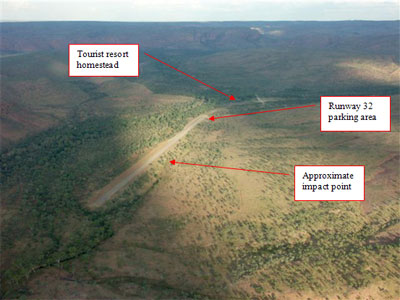
The El Questro ALA, designation YEQO, is located at 16°00.5'S, 127°58.5'E and is at an elevation of 300 ft above mean sea level. The dirt runway is aligned south-east (runway 14) to north-west (runway 32) and is 1,400 m long and about 15 m wide. Windsocks are located at the northern side of the threshold to runway 14 and at the tourist resort homestead, which is located about 1 km south-east of the landing area.
The manager of the tourist resort indicated that when making bookings with the resort, visiting pilots generally included that they were 'self-fliers'. That was the case with the occurrence pilot. In addition, it was reported that the pilot telephoned the resort manager on the morning of 28 August 2004 and nominated a SARTIME10 for his arrival at El Questro. During that call, the pilot confirmed that he was comfortable with the location and details of the ALA. Other twin-engine aircraft of similar size to the C421 Golden Eagle were reported by the resort manager to have operated to, and continue to operate to, the El Questro ALA.
It was reported that in mid-March each year, just prior to the commencement of each tourist season, resort staff conducted a routine inspection of the runway and environs. As a result of those inspections, any newly growing vegetation was cleared from the runway and its surrounds, runway markers were repainted as required and other actions were undertaken by resort staff as and when required. In addition, the resort manager stated that he routinely consulted with aircraft operators who regularly fly to the resort, in order to confirm the ongoing suitability of the ALA for aircraft operations.
Communications
The charter pilot indicated that just prior to 1200, he exchanged a number of radio transmissions with the pilot of an unknown aircraft on frequency 126.7 Mhz in order to coordinate that pilot's take-off from the ALA. The charter pilot reported observing a plume of smoke from the vicinity of the ALA shortly thereafter, and that he did not hear a distress radio transmission. There was no facility at the ALA to record pilots' radio transmissions.
Wreckage information
The impact forces and post-impact fire sustained by aircraft structures in occurrences of this type can result in erroneous control position indications. In general, the position of the flight controls after impact cannot be relied upon as evidence of the aircraft's pre-impact configuration.
Overview of accident site and aircraft wreckage
The accident site was located on level ground, alongside a dry creek bed about 106 m to the left of the runway centreline and abeam a point on the runway about 888 m from the runway 32 threshold. A photograph of the general location of the accident site is at Figure 1. Groupings of rocks were located about the site and the surrounding light scrub was interspersed with isolated larger Boab and other trees.
Figure 1: General location of the accident site
A number of trees to the left of the runway were struck by the aircraft before it impacted the ground. Those trees were oriented along a line at about 15° to the left of the runway heading. Laser range equipment was used to measure the distances of those tree strikes from the aircraft wreckage. Trigonometry was then applied to the laser ranges in order to estimate the height of the strikes above ground level as follows:
The initial tree strike was to a tree located about 66 m to the left of the runway centreline and at an estimated height of about 8.2 m (27 feet (ft)).
The final tree that was struck prior to ground impact was located about 97 m from the runway centreline. That tree was struck at an estimated height of about 10.7 m (36 ft). The location of the left-wing tip and remnants of the left navigation light in the immediate vicinity of that tree indicated that tree strike had been by the left wing.
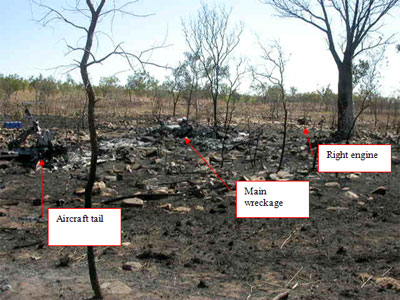
The aircraft impacted the ground about 33 m beyond the last tree, in a left-wing low attitude and cartwheeled counter-clockwise. The right wing and tail then struck the ground. During the impact sequence, the right engine separated from the airframe mounts and was thrown about 26 m from the main wreckage and the tail section separated from the aircraft. The main wreckage came to rest upright, with the nose of the aircraft facing south-east. All structural components and flight control surfaces were accounted for in the vicinity of the impact point. A severe post-impact fire destroyed the majority of the aircraft's fuselage, wings, tail section, cockpit and cabin, and damaged the left engine. The right engine sustained minor fire damage from a scrub fire that was started by the aircraft fire. A photograph of the aircraft wreckage is shown at Figure 2.
Figure 2: Aircraft wreckage
Wreckage examination
The investigation conducted a post-accident inspection of runway 32 from the threshold of the runway to a point on the runway abeam the ground impact point. That inspection found no evidence of any: bird or other animal remains; gouges, scrapes or other abnormal ground marks; or the presence of any detached aircraft items or components.
Very few ground impact scars or marks were able to be examined at the accident site due to them having been partially obliterated by the vehicles and personnel involved in the initial firefighting and rescue response. However, a number of rocks located in the dry creek bed had evidence of propeller impacts at substantial propeller revolutions per minute (RPM).
Both wing structures were destroyed by the fire. The right-wing forward attachment point was intact, and the aft spar was fractured in overload consistent with upward loads in excess of design limits. The left-wing structure had separated at the wing spar outboard of the engine nacelle, having also failed in overload due to the ground impact.
The fire severely damaged the aircraft fuel system. Both wing tanks were destroyed, and their associated auxiliary pumps were severely damaged. The left- and right-over-wing filler caps were secure. Damage during the impact, and the post-impact fire precluded the recovery of a fuel sample from the wreckage.
Both of the engines' air boxes and both turbocharger compressor turbines, together with their associated valves were fire damaged. On-site examination of the turbochargers did not reveal any anomalies, or foreign object, or other damage that might have adversely affected their operation. Deformation damage to the right engine's exhaust system was consistent with engine operation at ground impact. The left and right engines were recovered from the accident site and transported to an authorised overhaul facility for subsequent inspection under the supervision of the Australian Transport Safety Bureau (ATSB).
All six propeller blades separated from their respective hubs during the ground impact. Four intact propeller blades and segments from the remaining two blades were recovered from the accident site for subsequent technical examination.
Both engine propeller hubs flanges displayed indications of rotation at high RPM at the time of ground impact and were recovered from the accident site for subsequent technical examination. Severe impact damage to the propeller static stops prevented any determination of the propeller pitch settings at the time of ground impact. All of the propeller counterweights were recovered and examined on site. That examination identified overload of the threaded inserts, to the extent that a number of the counterweights had separated from their housing. That corroborated the earlier evidence of high engine RPM at the time of ground impact.
All of the cockpit and cabin seats and structures, along with the seat belts and their attachments, were destroyed by the fire. Most of the cabin fittings and cockpit, including instrumentation and switches were also destroyed. The nature of the damage to the switches was such that their position prior to the ground impact could not be ascertained. The control columns and flap actuator were destroyed in the fire and the engine controls, and the cockpit instruments and radios were severely damaged. While that prevented the examination of most of the instruments, the attitude indicators and annunciator panel were recovered for subsequent technical examination.
Pre-impact flight control continuity was confirmed for the elevator and rudder control surfaces. Flight control continuity was evident for the ailerons, from the cockpit controls aft to the point where the wing impact damage occurred. A continuity check of the engine controls was not possible as a result of the fire damage. The nature of the damage to the right flap indicated that it was retracted at the time of ground impact. The more extensive damage to the left flap precluded a definitive assessment of its position at ground impact. The landing gear was fully extended. The tyres were destroyed by the fire. The severe disruption of the tail structure rendered the determination of the aircraft trim measurements inconclusive.
Examination of components recovered from the wreckage
The left and right engines were disassembled and inspected at an authorised overhaul facility under the supervision of the ATSB and with the engine manufacturer's representative in attendance. That inspection found no evidence of internal mechanical failure within either engine, or of their associated accessories or components that would have prevented the normal operation of either engine prior to the accident.
Technical examination of the propellers and propeller segments indicated multiple high-energy hard object impact signatures on all blade surfaces. Several of those impacts were of sufficient force to have caused ductile shear of the outer airfoil sections. In addition, there was backward curling or loss of material from the blades' leading edges, with associated chordwise scoring and gouging across the airfoil sections. That was consistent with each propeller being actively driven by a comparable amount of power from within the respective engine's upper operating range at the time of ground impact.
Both engine propeller hubs sustained similar multiple fractures to their aluminium alloy housings that was consistent with ductile overload during the accident sequence. There was no indication of any pre-impact cracking or manufacturing defects. The propeller hubs were exposed to gross bending loads through the blade sockets, which was assessed as being consistent with the magnitude of the impact forces that damaged the propellers.
The technical examination of the primary attitude indicator proved inconclusive due to the extensive heat damage to the instrument. There was evidence of rotational scoring to the inside of the secondary attitude indicator's instrument case and to the gyro armature, which indicated that pneumatic drive was available to the aircraft's vacuum instruments at the time of ground impact.
The filaments from the annunciator panel globes were distorted and encased in molten glass as a result of the fire. That prevented the analysis of whether any of those lights had been illuminated at the time of ground impact.
Medical and pathological information
A review of the pilot's aviation-related medical records and the results of the pilot's postmortem examination found no evidence of any pre-existing medical disease, sudden illness or incapacitation that may have affected his ability to control the aircraft.
Fire
There was no report by the witnesses to the take-off, or evidence, of an in-flight fire. The tourist resort volunteer fire-fighting crew responded to the accident site and scrub fires.
The source of the intense post-impact fire was fuel that had spilled from the ruptured wing fuel tanks. The ignition source of the fire could not be confirmed but was likely the hot engine exhausts.
Survival aspects
The emergency locator transmitter (ELT) was destroyed in the post-impact fire. There was no report from the charter pilot, or from the search and rescue authorities to indicate that the ELT had activated on ground impact.
The destruction of the cockpit and cabin from the combined effects of the impact forces and fire rendered the accident non-survivable.
Tests and research - aircraft fuel
The last recorded refuel of the aircraft was the addition of 594 litres of aviation gasoline 100 at Broome on 27 August 2004. It was reported that the pilot refuelled the aircraft's tanks to capacity. The investigation team quarantined a sample of that fuel for subsequent analysis by an approved National Association of Testing Authorities facility. That analysis indicated that the fuel:
was clear and bright
was free from water and sediment
conformed to specification for aviation gasoline 100.
Examination of the Broome fuel supplier's records confirmed that 18 other aircraft were refuelled from that source after the occurrence aircraft on that day. There were no reports from the pilots of those aircraft of any fuel-related problems.
There were no aircraft refuelling facilities at El Questro.
Additional information
Use of aerodromes
Civil Aviation Regulation 92 places responsibility for ensuring that an aircraft landing area is suitable for landing or take-off with the pilot in command. In addition, the regulation requires the pilot to have regard to the prevailing weather conditions and other circumstances affecting the proposed landing or take-off. The determination by a pilot of which other circumstances should be considered is not stated in that regulation.
Civil Aviation Advisory Publication (CAAP) 92-1(1): Guidelines for Aeroplane Landing Areas includes guidance on the factors that may be considered by a pilot when determining the suitability of a potential landing area. While there was no evidence that the pilot had considered the requirements of the CAAP prior to planning his arrival at the El Questro ALA, the investigation applied the minimum landing area physical characteristics recommended by the CAAP to the pilot's take-off from runway 32 until the point at which the aircraft first struck a tree to the left of the runway. That examination determined the following relevant recommended parameters for the take-off:
minimum runway width - 15 m
required runway length - about 624 m
suitable lateral transitional slope, which the CAAP notes could allow for a desirable area of increased lateral clearance during the take-off and may reduce wind shear if near tall trees - maximum obstacle height of about 7.2 m at 66 m from the runway centreline.
The pilot's family indicated that the pilot had operated at a gravel airstrip in the south-west of Western Australia on a number of occasions over the previous 3 years. In addition, the family reported that the pilot drove to El Questro in June 2003 and, during that visit, most likely observed the ALA.
Preparation for flight
The pilot submitted a flight notification to Airservices Australia on the morning of the accident, for a 2 hours 15 minutes flight under the Visual Flight Rules from El Questro to Broome. The investigation estimated that 740 lbs of fuel remained after the reported 2-hour flight from Broome to El Questro, and the POH stated that 50 lbs of fuel was required for 'taxiing for take-off'. That, and the endurance nominated by the pilot in the flight notification, indicated that sufficient fuel was carried for the planned flight to Broome.
The POH stated that the aircraft equipment included a control column lock that restricted control column movement and held the ailerons in a neutral position and the elevators at about 10° trailing edge down. The aircraft manufacturer indicated that the design of the control column lock was such that, if inadvertently left engaged by a pilot, the aircraft would be unable to take-off. The available documentation indicated that an optional rudder gust lock was also included in the aircraft equipment. The POH stated that engagement of that lock required the rudder to be centralised and the elevators to be moved to the fully 'down' position. Disengagement of the rudder lock was possible either manually during the aircraft pre-flight, or automatically as the elevator was moved up through the 6° 'down' position. Due to the damage to the aircraft, the investigation was unable to confirm the position of these locks.
Manufacturer data
The POH promulgated the necessary checks to be carried out by the pilot when operating the aircraft. That included confirmation of the selection of the left and right engines to the left and right main fuel tanks respectively as part of the following checks: before start, before take-off and during the descent. In addition, the POH stated that:
A take-off with one main tank full and the opposite tank low on fuel creates a lateral unbalance. This is not recommended since gusty air or premature lift-off could create a serious control problem.
The published take-off technique included the requirement for the pilot to raise the nose wheel at 95 kts indicated air speed (KIAS) and lift the aircraft from the runway at 100 KIAS. In addition, the POH included a description of the aircraft stall including that:
the stall characteristics are conventional
there is an aural stall warning device that operates at 5 to 10 KIAS above the stall in all configurations
the stall is preceded by a mild, aerodynamic buffet, which increases in intensity as the stall is approached
the power-on stall occurs at a very steep pitch angle, either with or without flaps extended
it is difficult to inadvertently stall the aircraft during normal manoeuvring.
Stall speeds were published in the POH for a number of aircraft configurations. None of those configurations reflected the aircraft's take-off configuration. At the estimated aircraft weight and with wings level, the maximum stall speed for the published configurations was calculated as 83 KIAS. The increase in stall speed at 15° angle of bank for all published configurations was about 2 KIAS.
The manufacturer's Pilot Safety and Warning Supplements identified a rare, but potentially serious problem known as 'split wing flaps'. Split or asymmetric wing flaps may result from a mechanical failure in the flap system and cause the flap position on one wing to differ from that of the opposite wing flap. The result is a tendency for the aircraft to roll in the direction of the retracted flap. Depending on the experience and proficiency of a pilot, the manufacturer indicated that any rolling tendency caused by a split flap situation may be controlled with opposite aileron. In addition, there was the potential for a pilot to apply differential power in a multi-engine aircraft to assist in managing the condition. This is discussed further in the Analysis under 'Take-off'.
Only those investigation areas identified by the headings and subheadings were considered to be relevant to the circumstances of the occurrence.
A take-off commenced by a pilot without pausing an aircraft in a stationary position on a runway, or decreasing the speed of an aircraft on arriving at a runway intended for use for a take-off.
A witness that heard, but did not observe the take-off.
On 14 November 2003, the pilot submitted an application to the Australian Civil Aviation Safety Authority (CASA) to reserve an Australian aircraft registration in anticipation of registering the aircraft in Australia. That reservation was granted by CASA.
Based on the 50-hourly inspection that was carried out in Broome on 26 August 2004 being conducted within the potential 10-hour extension period that had been authorised by the Swiss regulatory authorities. That was between 50 and 60 hours after an annual/200 hours check that was reported as being commenced in Switzerland on 10 December 2003, and included the 2.0 hour flight to El Questro ALA.
Derived from e-mail correspondence from the pilot dated over the period 16 September 2003 to 24 August 2004 and the available aircraft and engine documentation.
Derived from the right engine Export Certificate of Airworthiness of 19 May 2004 and e-mail correspondence from the pilot dated 29 July to 19 August 2004.
Precise date not available.
A miniature whirlwind with the potential to be of considerable intensity, and to pick up dust and perhaps other items and carry them some distance into the air.
The time nominated by a pilot for the initiation of Search and Rescue action if a report has not been received by the nominated unit.
Preliminary investigation was undertaken into a category 4 occurrence involving a TCAS alert on a de Havilland Dash 8 aircraft about a Beechcraft King Air aircraft near Essendon Airport. The ATSB has terminated the investigation based on information from the pilot of the King Air that he diverted his attention during the climb and did not adequately monitor the aircraft's altitude following the departure. There was relatively little safety benefit to be gained from continuing the investigation compared with other priorities.
Status: Downgraded the occurrence to category 5 and investigation discontinued.
Occurrence summary
Investigation number
200403106
Occurrence date
24/08/2004
Location
7 km E Essendon, (NDB)
Report release date
24/06/2004
Report status
Discontinued
Investigation type
Occurrence Investigation
Investigation status
Discontinued
Mode of transport
Aviation
Aviation occurrence category
Loss of separation
Occurrence class
Incident
Highest injury level
None
Aircraft details
Manufacturer
Beech Aircraft Corp
Model
200
Registration
VH-ITH
Operation type
Charter
Damage
Nil
Aircraft details
Manufacturer
De Havilland Canada/De Havilland Aircraft of Canada
Appendix A: Radar data relating to Mooney M20K VH-DXZ
Time (EST)
Altitude (ft AMSL)
Groundspeed (kts)
Explanatory notes
2014:01
1440
189
2014:04
1440
189
2014:08
1340
183
2014:12
1340
183
2014:15
1240
183
2014:19
1240
183
2014:23
1140
183
Overhead Caloundra
2014:26
1240
183
2014:30
1240
183
2014:34
1342
183
2014:38
1342
179
2014:41
1342
177
2014:45
1342
185
2014:49
1242
179
2014:52
1242
165
2014:56
1242
176
2014:59
1142
172
2015:03
1142
172
2015:07
1042
182
2015:11
1042
182
2015:14
1042
182
2015:18
1042
182
2015:22
942
182
2015:25
942
182
2015:29
842
182
2015:33
842
182
2015:37
742
182
2015:40
742
183
2015:44
642
183
2015:48
642
183
2015:51
542
185
2015:55
542
179
2015:59
442
189
Minimum recorded altitude
2016:02
542
185
2016:06
642
186
2016:10
742
183
2016:13
642
173
Last valid radar return
Safety Action
Previous recommendation
On 23 October 2002 the ATSB issued the following recommendation as a result of a fatal accident at night near Newman, WA, (ATSB Investigation BO/200100348):
Recommendation R20020193 The Australian Transport Safety Bureau recommends that the Civil Aviation Safety Authority (CASA) review the general operational requirements, training requirements, flight planning requirements and guidance material provided to pilots conducting VFR operations in dark night conditions.
On 13 December 2002, CASA responded to the recommendation as follows:
CASA acknowledges the intent of this Recommendation. As part of the proposed CASR [Civil Aviation Safety Regulations] Part 61, CASA is developing the requirements for night VFR ratings which will be based on the existing Civil Aviation Order CAO 40.2.2. In addition, a draft competency standard for night visual flight operations has been developed for inclusion in the proposed CASR Part 61 Manual of Standards. CASA plans to publish a Notice of Proposed Rule Making [NPRM] in relation to this matter in March 2003.
During July 2003, CASA published NPRM 0309FS Flight Crew Licensing and Draft Part 61 Manual of Standards [MOS]. The draft MOS included a requirement for a periodic flight review of night flying competencies. On 24 November 2004, the Chief Executive Officer of CASA issued two directives related to the regulatory reform process. As of March 2005, CASA was working on the processes necessary to apply the directives to the development of new CASR parts, including Part 61. In a letter to the ATSB dated 6 January 2006, CASA advised that the proposed CASR Part 61 would require night VFR rating holders to undergo flight reviews covering night and instrument flying, in addition to structural changes to the night VFR rating. CASA advised that Part 61 could be completed in the second half of 2006.
During March 2005, the ATSB issued Aviation Safety Investigation report BO/200304282 on the fatal night accident involving a Bell 407 helicopter, registered VH-HTD, which occurred off Cape Hillsborough, Queensland, on 17 October 2003. The report stated that CASA had advised that they intended to issue a CAAP (Civil Aviation Advisory Publication) to clarify safety guidelines for night VFR operations. In a letter to the ATSB dated 6 January 2006, CASA advised that the Night VFR CAAP was in the final stages of preparation, and it was intended that it would be published in the first quarter of 2006. The CAAP would include competency standards for night and instrument flying.
CASA has also advised that copies of a night VFR-related 'Briefing in a Box' were distributed to flying schools in March 2006. The briefings included safety material on night flying and were intended to assist flying instructors and flying schools in providing appropriate training to night VFR pilots.
Analysis
The investigation was unable to establish why the pilot lost control of the aircraft during a climbing turn while apparently returning to land at Caloundra aerodrome.
However, the following issues are considered to have been significant to the circumstances of the accident.
Aircraft altitude
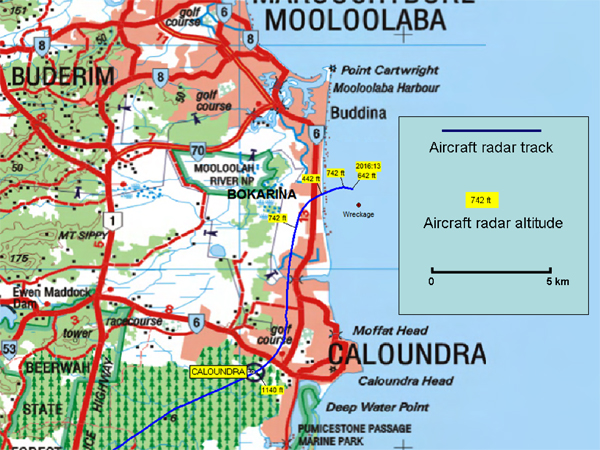
The altitude of the aircraft as it passed over Bokarina was well below the minimum permissible for a night visual flight rules (VFR) flight, and was also below the minimum for a flight over a populated area. The aircraft's maximum altitude of 742 ft after it crossed the coast provided little margin for inadvertent height loss during the subsequent turn, and was evidently insufficient to allow the pilot to regain control of the aircraft.
Aircraft systems
There was no indication from the recorded radar information that the performance of the aircraft was abnormal. No radio transmission was heard from the pilot to indicate any problem with the aircraft.
Although one witness at Bokarina described the engine noise as abnormal, three other witnesses described the sound as normal and there was clear physical evidence that the engine was operating at high power at impact. There was also evidence that electrical power was being delivered to the lights, and that pneumatic power was being delivered to the gyroscopic instruments.
There was no evidence of a defect that could have affected the controllability of the aircraft. However, impact damage and the unavailability of some parts of the aircraft prevented a comprehensive assessment of the pre-impact serviceability of the flight control system.
Physiological and cognitive factors
The aircraft's recorded cruise altitude of 11,300 ft was above the altitude at which the Civil Aviation Safety Authority (CASA) required supplemental oxygen to be used, but was below the altitude above which oxygen should be used according to the aircraft flight manual.
By flying at 11,300 ft without supplemental oxygen, the pilot increased his risk of developing hypoxia. However, any hypoxic effect on the pilot's performance could not be quantified. The aircraft's steady track and descent profile prior to passing overhead Caloundra suggest that the pilot, probably assisted by the autopilot, was effectively controlling the aircraft. Further, any adverse physiological effects of mild hypoxia would have reduced before the final stages of the flight. However, it is possible that the pilot's cognitive function during the latter part of the flight was affected by earlier exposure to hypoxic conditions.
The duration of the day's flying, together with an inadequate food intake, could have caused the pilot to become fatigued.
Fatigue and hypoxia have been demonstrated to adversely affect areas of cognitive function such as response time, decision-making and risk assessment. Any decrement in cognitive function could have reduced the pilot's ability to identify the reduced level of safety associated with conducting a low-level flight at night over a populated area, and transitioning from an area of extensive ground lighting to an area where surface features and the natural horizon were difficult to discern. However, there was no means of determining if the pilot's cognitive function had been adversely affected. Nor was it possible to determine that if affected, it had not recovered to its normal state once the pilot was no longer exposed to hypoxic conditions.
The pilot's reported difficulties with balance following the April 2002 stapedectomy and subsequent removal of the prosthesis were consistent with expected side-effects of the operations. While these difficulties persisted for some months after the operation, the available evidence indicated that the pilot was not affected by dizziness or balance problems in the months preceding the accident.
Spatial disorientation
The forecast weather conditions did not preclude night VFR flight, and witness reports indicated that there was no reduction in visibility due to smoke or cloud at the time of the accident. The pilot's attention was probably directed outside the cockpit as he positioned the aircraft to fly over his home. Extensive ground lighting associated with the populated Sunshine Coast area would have provided him with good surface and horizon reference during that period. However, after the aircraft turned east, it was heading towards an area of no surface lighting (other than that provided by one or two large ships), and minimal celestial illumination. Consequently, surface features and the natural horizon would have been difficult to discern. Those conditions required that the pilot transition to flight by reference to the aircraft instruments.
The pilot's recorded night flight time indicated that he satisfied the recency requirements for night VFR. Further, the pilot was flying a familiar aircraft, which was suitably equipped (including a standby pneumatic power source) and maintained for instrument flight. However, the pilot had not demonstrated competence in flight solely by reference to instruments since 1998. The Federal Aviation Administration Advisory Circular 60-4A indicated that even qualified instrument pilots can take up to 35 seconds to complete the transition from visual to instrument flight. If the pilot did not achieve a rapid and complete transition to instrument flight during the climbing turn, it is likely that he would have experienced the effects of spatial disorientation.
Because there was no regulatory requirement that the pilot's recurrent aeroplane flight reviews include night VFR or instrument flight, his level of recent competence could not be assessed. The pilot's ability to transition to flight solely by reference to instruments may have been adversely affected by various factors, including a lack of recent experience in instrument flight, possible residual effects of hypoxia, fatigue, and/or a distraction in the cockpit. If the pilot's attention was directed elsewhere, he may not have initially recognised that the aircraft was descending, or the degree to which it was turning after it crossed the coast.
The ability to maintain visual reference with surface features and the natural horizon at night is not assured, even in meteorological conditions that satisfy the night VFR requirements. Consequently, as the Flight Safety Australia (May-June 2005) article advised, it is imperative that night VFR pilots are competent and current in instrument flight. Completing an aeroplane flight review and satisfying the night VFR requirements may not sufficiently reduce the risk of spatial disorientation of a pilot during night VFR operations.
Conclusions
The circumstances of the accident are consistent with a loss of control due to the pilot becoming spatially disoriented after flying into an area of minimal surface and celestial illumination. Physiological and cognitive factors may have contributed to the development of the accident. However, the factors that contributed to the aircraft descending into the water could not be conclusively established.
This accident highlights the need for night VFR pilots to manage the risk of spatial disorientation in dark night conditions by maintaining proficiency in instrument flight.
Factual information
FACTUAL INFORMATION
History of the flight
At about 1730 Eastern Standard Time on 15 August 2004, the pilot of a Mooney Aircraft Corporation M20K aircraft, registered VH-DXZ, departed Cobar, NSW, on a private flight to Caloundra, Qld. The flight was conducted under the visual flight rules (VFR), with the latter part at night.
At about 2015, several people saw and heard the aircraft, with its wing tip strobe lights flashing, flying low in a northerly direction over Bokarina, 8 km north-north-east of Caloundra aerodrome. One witness said that the engine sounded as though it was 'struggling and cutting out'. Two other witnesses described the engine sound as a 'steady drone', while another said it sounded like it was 'turning at low [revolutions], as if it was powered down for a landing'.
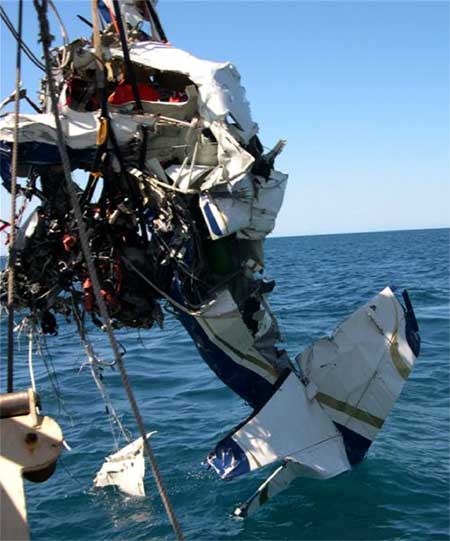
The aircraft was then observed to turn east and cross the coast before descending steeply and impacting the water. The impact was accompanied by a bright flash. The aircraft wreckage was located 4 days later, approximately 1.5 km east of Bokarina beach, at a depth of about 16 m. The pilot, who owned the aircraft and was the sole occupant, did not survive the impact.
Earlier that afternoon, the pilot had flown from Caloundra to Cobar with one passenger. The passenger remained at Cobar and reported that the flight from Caloundra had been uneventful and that they arrived at Cobar at about 1700. The refueller advised that the pilot refuelled the aircraft with 156 L of avgas (apparently to full tanks) and checked the engine oil before departing on the return flight to Caloundra.
The pilot lived at Bokarina and family members reported that he did not normally fly over his home on returning from a flight. They indicated that the pilot's car was at the aerodrome, so he did not need to be met and driven home. They assumed that the purpose of flying over the house was to let them know that he would be home soon.
Recorded information
The pilot was not required to report to air traffic control during the flight and there was no record of him having done so. The Caloundra Common Traffic Advisory Frequency did not have a recording capability.
A pilot conducting a VFR flight was required to operate the aircraft's secondary surveillance radar (SSR) transponder on code 1200 in airspace not subject to air traffic control. The Mooney's SSR track for the flight was recorded by The
Australian Advanced Air Traffic System. That data showed that the aircraft first appeared on radar at 1903, north of Moree, NSW, on the direct track from Cobar to Caloundra at 11,300 ft. The aircraft maintained that altitude until 1937, when it commenced descent, passing through 10,000 ft at about 1940, and 5,000 ft at about 1958. It maintained a steady track and descent profile, and was overhead Caloundra at 2014, at 1,140 ft. The aircraft then maintained a relatively constant altitude and tracked north towards Bokarina (Figure 1).
At 2015, the aircraft commenced a further descent and when overhead Bokarina, turned right and headed east-north-east, towards the ocean. Radar data indicated that the aircraft descended to 442 ft about the time it flew over the beach. The aircraft's altitude then increased, reaching a maximum of 742 ft. The last valid radar information was recorded at 2016:13, and indicated that the aircraft had entered a descending right turn. The recorded radar data did not reveal any abrupt or abnormal changes in the aircraft's altitude, groundspeed, or track. The recorded speeds were consistent with normal cruise and descent speeds for the aircraft type (Appendix A).
Figure 1: The aircraft's radar-recorded track
Pilot information
The pilot purchased the aircraft in May 1994, and was issued with a private pilot (aeroplane) licence in July 1994. His logbook recorded his total flying experience at the time of the accident as about 1800 hours, 142 of which were at night. In April, May and June 2004, the pilot logged 5, 0.5 and 5.4 hours night flying respectively, all in DXZ. In those same months, he also logged 20.8, 12.3, and 25.4 hours day flying. The pilot last flew at night on 19 June 2004, and in actual or simulated instrument meteorological conditions, during 1998. His total instrument flight time was recorded as 32.4 hours.
The pilot was issued with a night VFR rating on 11 June 1998. There was no evidence that he had ever held an instrument rating. His three most recent flight reviews were completed on 29 March 2003, 18 November 2001, and 24 November 2000. They were logged as day flights, with no instrument or night flight recorded.
The pilot's family reported that he was well rested before the flight, was not affected by any illness and had never smoked cigarettes.
A person who spoke to the pilot while he was at Cobar reported that he said that it had been a busy day, and that he had not had any lunch, but was carrying some nuts and a drink on the aircraft.
Aircraft information
The aircraft was manufactured in the US in 1988 and was imported into Australia in the same year. At the time of the accident, it had accumulated about 2,868 flight hours. The aircraft was equipped and maintained in the instrument flight rules (IFR) category. It was fitted with a turbo-charged, piston engine which had accumulated about 180 hours since the last overhaul.
The aircraft cabin was not pressurised but was fitted with a supplemental oxygen system. The organisation that maintained the aircraft reported that the supplemental oxygen system tank was empty. There was no indication that the oxygen tank had been charged at Cobar.
A review of the aircraft's maintenance records revealed that the requirements of Airworthiness Directives (AD) RAD/43 and RAD/471 were due to be completed in July 2004 but had not been carried out. No other discrepancies were noted, and no defects had been recorded on the maintenance release.
The aircraft was fitted with an electrically driven standby vacuum system for providing pneumatic power to the gyroscopic instruments, and a Century 2000 autopilot system.
Meteorological information
Information provided by the Bureau of Meteorology indicated that the weather conditions in the Bokarina area at the time of the accident were benign. Smoke areas were forecast below 6,000 ft with visibility reducing to 4,000 m in smoke, and 1,000 m in thick smoke. The terminal area forecast for Maroochydore aerodrome (15 km north-north-west of Bokarina), issued at 1813, predicted visibility greater than 10 km and scattered cloud at 3,000 ft. None of the witnesses reported that smoke, cloud or haze affected their ability to see the aircraft.
The QNH2 recorded by the automatic weather station at Maroochydore at 2020 on the day of the accident was 1014 hPa.
On 15 August 2004 at the accident location, astronomical twilight occurred at 1846 and the moon set at 16373. Two cargo ships were located east of Maroochydore at the time of the occurrence, at least one of which was at anchor, and therefore displaying lights4. Several hours after the accident, witnesses observed two large ships moored east of Maroochydore which were displaying deck lights.
Wreckage and impact information
The wreckage was raised from the seabed on 28 August 2004 (Figure 2). Most of the aircraft was recovered, including the engine, fuselage, left wing, all three propeller blades and the propeller hub. The right horizontal stabiliser, right elevator, and parts of the right wing were not recovered.
An examination of the wreckage indicated that:
The aircraft was banked right, and in a nose-down attitude of approximately 45 degrees when it struck the water.
The nature of the damage to the engine crankshaft and the propeller blades was consistent with the engine delivering high power at impact.
The frangible plastic drive shaft of the engine driven vacuum pump had failed under a sideways load. The drive shaft of the electrically driven vacuum pump was intact.
Damage to the gyroscopes in the artificial horizon and directional indicator flight instruments was consistent with gyroscopic rotation at impact.
The light globes in the artificial horizon and the directional indicator flight instruments were receiving electrical power at impact.
The landing gear was retracted, and the wing flaps were extended about 10 degrees, at impact.
The altimeter subscale was set at 1015.
There was evidence of a short duration, post-impact fire.
Impact and saltwater corrosion damage precluded a determination of the serviceability of the automatic pilot system and its operational status during the final stages of the flight. None of the windscreen was recovered. There was no evidence in the recovered wreckage that the aircraft had struck a bird or a bat during flight.
The extent of airframe disruption and the missing parts of the right wing, horizontal stabiliser and right elevator prevented a comprehensive assessment of the functionality of the flight controls at impact.
Figure 2: Recovery of the main wreckage
Regulatory aspects
The pilot's night VFR rating authorised him to act as pilot in command of private or aerial work flights at night under the VFR. Civil Aviation Order (CAO) 40.2.2 detailed the flight tests and other requirements for the issue of a night VFR rating. The test requirements included recovery from unusual attitudes, basic turns, and straight and level flight, which were required to be conducted solely by reference to flight instruments. The CAO also required that training for the issue of a night VFR rating included at least one landing at an aerodrome 'that is not in an area that has sufficient ground lighting to create a discernible horizon'.
Once issued, a night VFR rating remained permanently valid. To exercise the privileges of the rating, a pilot needed to meet certain minimum recent experience requirements. There was no requirement for the holder of a night VFR rating to have any recent instrument flight time prior to conducting a flight at night 5.
Except during take-off, landing, or radar vectoring, the pilot of a night VFR flight was required to ensure than the aircraft remained at or above the calculated lowest safe altitude (LSALT) while further than 3 NM from the destination aerodrome. The minimum LSALT for the Bokarina area was 1,500 ft. Aircraft operating overpopulated areas were generally required to remain at or above 1,000 ft.
A pilot was required to satisfactorily complete an aeroplane flight review every 2 years. There were no published requirements or guidance material regarding theoretical knowledge or practical skills (such as flight conducted solely by reference to flight instruments) required to be demonstrated by pilots undergoing an aeroplane flight review.
Medical and pathological information
The pilot held a valid Class 2 Medical Certificate at the time of the occurrence. His medical records indicated that he had undergone a stapedectomy6 operation on his left ear about 22 years before the accident. He underwent a stapedectomy on his right ear on 11 April 2002 because of hearing loss. However, due to a post-operative decline in hearing and persistent balance problems, the prosthesis was removed on 24 April 2002. During two subsequent telephone conversations with the surgeon in June and July 2002, the pilot reported that he was still dizzy, couldn't look up and down quickly, and was still unsteady.
The pilot underwent a Class 2 aviation medical examination on 1 March 2004. The designated aviation medical examiner who performed that examination reported that the pilot had advised of no ongoing dizziness, disorientation, or other related problems.
A pathological examination did not identify any indication of a pre-existing medical condition that could have contributed to the development of the accident. It was not possible to establish when, or what, the pilot had last eaten.
Hypoxia
Hypoxia is a condition in which there is reduced oxygen supply to the body. Available oxygen decreases with increased altitude, such that at 12,000 ft, brain oxygen saturation is approximately 87%, compared with sea level saturation of 96%. The investigation calculated that if the entire cruise segment of the flight had been conducted at 11,300 ft, the aircraft would have been at that level for almost 2 hours.
The US Federal Aviation Administration7 (FAA) recommended that pilots use supplemental oxygen when flying above 10,000 ft during the day and above 5,000 ft at night when the eyes become more sensitive to oxygen deprivation.
The Mooney M20K Aircraft Flight Manual stated that 'supplemental oxygen should be used when cruising above 12,500 feet. It is often advisable to use oxygen at altitude lower than 12,500 feet under conditions of night flying, fatigue, …'. Civil Aviation Order (CAO) Part 20.4 paragraph 6.1 stated:
A flight crew member who is on flight deck duty in an unpressurised aircraft must be provided with, and continuously use, supplemental oxygen at all times during which the aircraft flies above 10,000 feet altitude.
An article8 in Flight Safety Australia magazine stated '[a]fter vision, the tissues most affected by hypoxia are those areas of the brain associated with judgement, self-criticism and the accurate performance of mental tasks'. An associated article9 in the same magazine indicated that the use of oxygen during night flight below 10,000 ft resulted in an increase in alertness and cognitive function, and a reduction in fatigue. Studies of the effects of exposure to altitudes between 10,000 ft and 15,000 ft have consistently shown small to moderate effects on human performance. Those effects included a reduction in night and peripheral vision, increased drowsiness, decreased response time, decreased short-term memory capacity, and poorer performance on complex and reasoning tasks.
The FAA Civil Aerospace Medical Institute Human Factors Research Laboratory in Oklahoma City, USA advised that restoration of a sea level atmosphere following exposure to hypoxic conditions caused rapid physiological recovery, but that cognitive recovery was slower.
Fatigue
Fatigue results from inadequate rest over a period of time, and leads to physical and mental impairment. The effects of fatigue include decreased short-term memory, slowed reaction time, decreased work efficiency, increased variability in work performance, a tendency to accept lower levels of performance and not correct errors. Not consuming food regularly is known to exacerbate the effects of fatigue. Based on previous flights recorded in the pilot's logbook, the total flight time for the trip from Caloundra to Cobar and return to Caloundra would probably have been between 6.4 and 6.9 hours.
Stapedectomy
Stapedectomy involved a small risk of ongoing episodes of dizziness and hearing loss10. However, according to an article published in 1998 in the journal Otolaryngology - Head and Neck Surgery11,
The FAA [Federal Aviation Administration] has always had the most experience with aircrew returning to flying duties after stapedectomy. The civilian track record is excellent with no reported cases of sudden incapacitating vertigo, sudden hearing loss, or other poststapedectomy related sequelae.
Spatial disorientation
Spatial disorientation describes an in-flight situation in which a pilot does not correctly sense the position, motion or attitude of the aircraft, and may be unable to tell which way is up. A pilot operating under the VFR determines the attitude of an aircraft by reference to the natural horizon or surface features. If these references are not visible, the pilot must use the flight instruments to determine the aircraft's attitude.
The risks of non-instrument rated pilots flying in conditions in which they are not able to orientate the aircraft by visual reference have been well known for over 50 years. During testing conducted on a group of non-instrument rated pilots, the average time before loss of control of the aircraft, after visual reference was lost, was 178 seconds12. An article titled 'Fatal Night Flight' in the Civil Aviation Safety Authority (CASA) magazine Flight Safety Australia (May-June 2005) stated that:
[v]isual disorientation is a distinct possibility on dark nights or away from areas of extensive ground lighting. Disorientation can be caused by sudden loss of visual reference such as when turning away from a well lighted area towards an area without ground lighting.
The article also stated that 'it is imperative that Night VFR pilots are competent and current in instrument flight'.
US FAA Advisory Circular 60-4A, Pilot's Spatial Disorientation, was published in 1983 and was intended to inform pilots of the hazards associated with disorientation caused by loss of visual reference with the surface. It included the following information:
Tests conducted with qualified instrument pilots indicate that it can take as much as 35 seconds to establish full control by instruments after the loss of visual reference with the surface.
Surface references and the natural horizon may at times become obscured, although visibility may be above visual flight rule minimums. The lack of natural horizon or surface reference is common on over water flights, at night, and especially at night in extremely sparsely populated areas, or in low visibility conditions.
Recent night VFR accident
On the evening of 17 October 2003, an air ambulance Bell 407 helicopter descended into the sea near Mackay, Qld. The ATSB investigation (200304282) was unable to determine, with certainty, what factors led to loss of control of the helicopter. The investigation considered that although the forecast weather conditions did not necessarily preclude flight under the night VFR rules, the lack of a visible horizon and surface lighting, and the pilot's limited instrument flying experience may have contributed to the accident. The investigation concluded that the circumstances of the accident were consistent with loss of control due to the pilot becoming spatially disoriented.
AD/RAD/43 required a biennial altimeter and encoder check and AD/RAD/47 required a biennial transponder check.
Vessels over 100 m long and at anchor are required to display white lights at either end of the vessel and available working lights or equivalent to illuminate the decks.
In contrast, the holder of an instrument rating was required to undergo an annual instrument flight test, and comply with flight and instrument approach recency requirements, in order to keep the instrument rating current.
Stapedectomy is an operation to remove the fixed stapes [the third middle ear bone] and to replace it with a prosthesis. That allows sound vibrations to be transmitted properly to the inner ear for improved hearing. http://www.bcm.edu/oto/clinic/educate/stapled.html
Federal Aviation Administration. 2003. Advisory Circular AC 61-107A Operations of Aircraft at Altitudes Above 25,000 feet MSL and/or Mach Numbers (MMO) Greater than .75.
Brock, J. & Bencke, R. 1998. Hypoxia. Flight Safety Australia. Volume 3 Number 1. Civil Aviation Safety Authority. Canberra.
Thom, A. 1998. Improved Performance. Flight Safety Australia. Volume 3 Number 1. Civil Aviation Safety Authority. Canberra.
Thiringer, J.K. & Arriaga, M.A. 1998. Stapedectomy in Military Aircrew. Otolaryngology - Head and Neck Surgery. Volume 118 Number 1. January 1998.
Bryan, L.A., Stonecipher, J.W. & Aron, K. 1954. 180-degree turn experiment. University of Illinois Bulletin. 54(11), 1-52.
Summary
At about 2017 Eastern Standard Time on 15 August 2004, a Mooney Aircraft Corporation M20K aircraft, registered VH-DXZ, descended into the ocean off Bokarina, Queensland. The pilot, who owned the aircraft and was the sole occupant, did not survive the impact.
The pilot held a private pilot (aeroplane) licence and a night visual flight rules (VFR) rating. His logbook recorded his total flying experience at the time of the accident as about 1800 hours, 142 of which were at night. The pilot last flew at night on 19 June 2004, and in actual or simulated instrument meteorological conditions, during 1998. His three most recent flight reviews were logged as day flights, with no instrument or night flight recorded.
The weather conditions in the area at the time of the occurrence were benign. Astronomical twilight occurred at 1846 and the moon set at 1637.
The wreckage was recovered 13 days after the accident. An examination revealed that at the time of impact; the engine was delivering high power, the instrument lights were receiving electrical power, and the gyroscopic instruments were receiving pneumatic power.
The circumstances of the accident are consistent with a loss of control due to the pilot becoming spatially disoriented after flying into an area of minimal surface and celestial illumination. Physiological and cognitive factors may have contributed to the development of the accident. However, the factors that contributed to the aircraft descending into the water could not be conclusively established.
This accident highlights the need for night VFR pilots to manage the risk of spatial disorientation in dark night conditions by maintaining proficiency in instrument flight.
Following this and several other similar failures worldwide, the engine manufacturer re-designed the Stage-1 High Pressure Turbine (HPT 1) blades and prioritised the removal of the remaining affected blades from the world fleet. Significant design changes were made to the HPT 1, Life Improvement Package (LIP) blade's internal cooling passage fillet radius to reduce the stress concentrations in that area. The vapour aluminised coating is also no longer applied to the blade's internal passages.
The manufacturer instigated a blade replacement program with the highest cycle usage engines in the world fleet, totalling 94 units, to be returned to the factory for blade replacement first, with the remaining engines being completed in highest cycle order.
The probability of a double in flight shut-down (DIFSD) event occurring, where an aircraft was fitted with two BR700-715 engines with time in service approximating the time at which the HPT 1 blade problems were occurring, was analysed. That analysis identified that the possibility of a DIFSD existed. To mitigate the immediate risk, the manufacturer required that operators with aircraft with both engines affected, remove the higher cycle count engine and replace it with an unaffected engine.
The manufacturer issued BR 700 Propulsion System, Service Bulletin (SB), SB-BR700-72-9003616. That SB introduced an on-wing, ultrasonic inspection of the HPT 1 LIP blades for in-service engines.
Operator
Once the mode of failure for the engine was known, the operator independently checked their fleet to determine if any of their aircraft had both engines with time in service approximating the time at which the failures were occurring in the world fleet. One engine change was carried out following that check.
6. BR 700 Propulsion System, Service Bulletin (SB), ENGINE - HIGH PRESSURE (HP) TURBINE BLADES - ULTRASONIC INSPECTION OF THE HP TURBINE STAGE 1 BLADES, NON-MODIFICATION SB-BR700-72-900361; dated Jun 03/05.
Analysis
ANALYSIS
The circumstances of the engine failure were such that there was no prior indication to enable the crew to take any action that may have minimised the extent of the engine damage.
The blade failed as a result of a low cycle fatigue cracking mechanism associated with cracking of the blade's vapour aluminised coating.
Factual information
FACTUAL INFORMATION
At 1435 Eastern Standard Time on 10 August 2004, a Boeing Company 717-200 aircraft, registered VH-VQA, was climbing to cruise altitude on a scheduled passenger service from Melbourne, Vic. to Hobart, Tas. with six crew and 52 passengers on board. As the aircraft passed through flight level (FL) 110, the crew heard a loud bang, with a corresponding increase in indicated left engine vibrations. The left engine began to spool down and the turbine gas temperature (TGT) indications began to increase significantly.
The crew initially brought the left engine power lever back to idle. However, the TGT continued to increase, indicating a maximum of 1,149oC, before they shut the engine down and discharged a fire bottle into the cowling area in accordance with the operator's procedures. They then notified Melbourne air traffic control (ATC) of the engine failure and returned to Melbourne.
The operator examined the left engine and found metal fragments in the exhaust area and some metallisation1 of the exhaust duct.
At the time of the failure, the BR700-715 engine, serial number 13148, had completed 10, 321 hours and 8,888 cycles since new, and 6,474 hours and 5,417 cycles since repair.
Engine investigation
The operator removed the engine and forwarded it to the engine manufacturer in Germany for detailed investigation, under the supervision of a representative of the German Federal Bureau of Aircraft Accident Investigation (BFU2), on behalf of the Australian Transport Safety Bureau (ATSB).
The manufacturer conducted a visual inspection of the engine's exterior, noting a bulge around most of the circumference of the high-pressure turbine (HPT) casing (Figure 1), in line with the Stage-1 HPT (HPT 1). A borescope examination of the engine interior showed that one HPT 1 blade was almost completely missing, with the remaining HPT 1 blades separated just above the blade platforms (Figure 2). There was also significant damage to the subsequent HPT and low-pressure turbine stages. Examination of the engine's compressor assembly revealed no significant damage. All of the high energy debris from the failure had been fully contained3.
A detailed examination of the engine revealed that the reason for the engine failure was the release of a single HPT 1 blade. The blade failed following the development of low-cycle fatigue4 (LCF) cracking in its internal cooling passages. All other engine damage was considered to be a consequence of the initial HPT 1 blade failure.
Figure 1: Bulged HPT casing
Figure 2: Damage to HPT 1 and HPT 2 rotors
Blade design considerations
The failed HPT 1 blade (Figure 3) was a life improvement package5 (LIP) blade. The blade was a shrouded-tip aerofoil design, with multi-passage internal cooling (Figure 4). There was a vapour aluminised coating on the blade's external aerodynamic surfaces and internal cooling passages.
The manufacturer indicated that there have been four similar failures of LIP HPT blades in the BR700-715 engine type, with another engine failure still under investigation. One failure occurred prior to this event in November 2003. The remainder occurred after this incident.
Figure 3: The failed HPT 1 blade (position 21)
Following those failures, the manufacturer conducted additional computer stress modelling on the LIP blades. That modelling found that there were stress levels in the larger trombone radius feature, within the blade's cooling passages (Figure 4) that were potentially in excess of the manufacturer's original design intent. The manufacturer also found that the thickness of the vapour aluminised coating inside the blade's internal cooling passages was variable and difficult to predict. In certain operational conditions, dependent upon high strains in areas of stress concentration and local temperature, the coating could crack with the possibility of subsequent growth into the coated (parent) material. The area from which the failure occurred was confirmed to be the most susceptible to this behaviour (Figure 5).
Figure 5: Computer generated stress diagram from the manufacturer indicating the point of potentially excessive stress and crack origin
Flight data recorder information
The ATSB's examination of the aircraft's flight data recorder (FDR) for the occurrence flight found that the left engine had surged as the aircraft passed through 10,240 ft. The engine pressure ratio (EPR) and engine rotational speed indications decreased abruptly, while the turbine gas temperature (TGT) for the engine began to increase. HPT vibration values for the engine increased from a level of 0.5 units before the failure to a maximum of 6.3 units over a three-second period. The manufacturer's high-limit for vibrations was 4.0 units.
The FDR readout indicated that the TGT for the engine continued to increase following the engine failure and remained at an indicated maximum of 1,149oC for 1 minute and 46 seconds before decreasing (Figure 6). It is likely that the maximum TGT reached during the failure was higher than 1,149oC, however the aircraft systems do not record above that temperature.
The FDR report indicated that there were no anomalies observed in the performance of the left engine prior to the failure.
Figure 6: FDR data plot of key engine parameters at the time of the failure
Metal pulverised by the turbine becomes molten and flows rearward attaching to the subsequent turbine and exhaust assemblies (US Department of the Air Force (1987). Safety Investigative Techniques (AF Pamphlet 127-1, Volume II. Washington DC: Author).
Bundesstelle für Flugunfalluntersuchung (BFU).
FAA AC 33-5, paragraph 5.c. definitions state '…Contained means that no fragments are released through the engine structure, but fragments may be ejected out of the engine air inlet or exhaust'.
Fatigue that occurs at relatively small numbers of cycles. Brooks, C. (1993). Metalurgical Failure Analysis. USA: McGraw-Hill, Inc.
The Life improvement Package 3 (LIP3) was a suite of HP Turbine modifications that included the HPT blade P/N BRH20351. The manufacturer introduced the package by SB-BR700-72-100801.
Summary
At 1435 Eastern Standard Time on 10 August 2004, a Boeing Company B717-200 aircraft, registered VH-VQA, was climbing to cruise altitude on a scheduled passenger service from Melbourne, Victoria to Hobart, Tasmania. As the aircraft passed through flight level 110, the crew heard a loud bang, with a corresponding increase in indicated left engine vibrations and the left engine began to spool down. The crew then shut the engine down in accordance with the operator's procedures and returned for a landing.
Post incident examination of the BR700-715 engine found metal fragments and metallisation in the exhaust area.
The engine was forwarded to the engine manufacturer for a detailed investigation that was supervised by a representative of the German Federal Bureau of Aircraft Accident Investigation. That investigation found that the engine failure was due the release of a single blade from Stage-1 of the high-pressure turbine (HPT), following the development of low-cycle fatigue cracking in its internal cooling passages. The manufacturer indicated that there had been four similar BR700-715 engine failures, with another engine failure under investigation.
Computer stress modelling, carried out by the manufacturer on the HPT blades, found stress levels in the blade's internal cooling passages, in the area of the occurrence blade's crack propagation, that were potentially in excess of the manufacturer's original design intent. The thickness of the vapour aluminised surface coating in the internal cooling passages was also variable. In certain operational conditions the coating could crack, with the subsequent growth of the crack into the parent material.
As a result of this and the other engine failures the operator and the engine manufacturer have completed a number of safety actions to prevent re-occurrence.
The Australian Transport Safety Bureau did not conduct an on-scene investigation of this occurrence. The report presented below was derived from information supplied to the Bureau.
During an approach to land in a cleared area, the balloon basket contacted a powerline. The line stretched and broke and the balloon subsequently landed uneventfully. The balloon was not damaged, and all occupants evacuated without injury.
The pilot in command reported that he had seen a number of powerlines in the area but had not seen the lines that the balloon contacted. This was partially due to the lines being difficult to see because of background foliage.
The operator reported that training for their pilots in regard to searching for powerlines during an approach is being improved.
The investigation did not identify any fault in the engines or their operating systems that could have resulted in a sudden and apparently simultaneous failure of both engines.
Although the pilot reported that he had leaned the mixtures during the cruise segment of the flight, the power settings typically used and the cruise altitude, made it unlikely that engine operation would have been significantly affected if the mixtures were not reset to RICH during descent or on completion of the pre-landing checks. Each fuel tank contained useable quantities of fuel, and the pilot reported that he had not used either the outboard fuel tanks or crossfeed on the day of the accident. Based on the quantity of fuel recovered from the inboard tanks, the power loss was not due to fuel exhaustion.
However, a sudden and near-simultaneous interruption of fuel flow to the engines could have been achieved by simultaneously moving the mixture controls to idle cut off, positioning the fuel selectors to the OFF position or by activating the emergency firewall shutoff.
The aircraft was about 1,000 ft when the pilot noticed the loss of engine power, and this was shortly after he had completed his pre-landing checklist. The power loss occurred at a critical stage of the flight and while the aircraft was beyond the gliding range of the airport. The final descent occurred over a period of approximately 1 minute. There was limited time for the pilot to complete troubleshooting of the aircraft systems and perform an emergency landing.
The investigation was unable to further identify factors that may have contributed to the simultaneous failure of the engines.
Summary
The Australian Transport Safety Bureau (ATSB) investigated this occurrence in accordance with the Transport Safety Investigation Act 2003, for the sole purpose of improving transport safety. It is not the object of an ATSB investigation to determine blame, provide a means of determining liability, or to assist in court proceedings between parties.
FACTUAL INFORMATION
Sequence of events
On 10 August 2004, the pilot of a Piper Aircraft Corporation PA-31-350 (Chieftain) aircraft, registered VH-MZV, was conducting a visual flight rules charter flight from Darwin to Bathurst Island1 and return. The pilot was the only person onboard for the return to Darwin.
As the aircraft approached Darwin, air traffic control cleared the pilot to make a visual approach to runway 11. Recorded radar data indicated that at 5 NM the pilot turned onto the left base leg of the circuit at an altitude of about 1,000 ft. At about that time the pilot broadcast a Mayday2, indicating that both engines had failed. He landed on tidal mudflats to the west of the airport.
Damage was sustained to the propellers and lower fuselage skins and bulkheads. The pilot was not injured.
The pilot recalled that the flight from Bathurst Island had been normal and that he had leaned the engines during the cruise at 3,500 ft. Turning onto the base leg, he reduced airspeed, extended the first stage of flap, lowered the landing gear and completed the pre-landing checklist. As the aircraft's speed reduced, the pilot moved the throttle controls forward, but neither engine responded. There was no significant yawing or rolling associated with the power loss. The pilot considered that both engines lost power simultaneously without any surging, misfiring, rough running or abnormal vibrations. He checked the position of the fuel tank selectors, confirmed that the mixture controls were positioned to full rich, and that the fuel boost pumps and magnetos were on. When those actions did not restore engine power, the pilot retracted the landing gear and concentrated on landing on the mudflats.
Aircraft examination
In accordance with normal procedures, the Australian Transport Safety Bureau (ATSB) placed a protection order3 on the aircraft to preserve the physical evidence while investigators travelled to Darwin. Staff from the Darwin office of the Civil Aviation Safety Authority attended the site and supervised, on behalf of the ATSB, the relocation of the aircraft from the tidal mudflats to dry land. That necessitated removal of the engines from the airframe, and each was separately lifted out by helicopter. The aircraft and its engines were cordoned off at a vacant block of land and a security guard was in attendance until investigators examined the aircraft.
The propellers had continued to windmill after the engines failed, operating the engine-driven hydraulic pumps, which provided hydraulic pressure to enable retraction of the landing gear.
Both propellers exhibited damage consistent with little or no power being produced by the engines during the wheels-up landing. Neither propeller had been feathered. The wing flaps were not extended.
The quantity of fuel contained in each inboard tank was not sufficient to enable the tank contents to be visually assessed through the filler neck. Fuel from the inboard tanks would not flow under gravity from the engine firewall fuel line fitting when the fuel line was disconnected. A check of another Chieftain fuelled to a similar quantity confirmed that this was a normal characteristic of the fuel system design.
A total of approximately 236 L of fuel was recovered from the aircraft's fuel tanks, which comprised 101 L from the left inboard tank (main), 105 L from the right inboard tank (main) and about 15 L from each outboard tank. Each inboard tank had a capacity of 212 L, including about 11 L unusable. The capacity of each outboard tank was 152 L, including about 8 L unusable.
Inspection of the fuel system confirmed the correct operation of the fuel selector controls, the fuel filters were clear of contaminants and the tank venting system functioned normally. No water or other contaminant was recovered from the fuel system drains and collector points. There was no evidence to indicate that fuel had been lost from the aircraft during flight.
Inspection of the engines and their systems did not identify any defect that may have influenced the circumstances of the occurrence. The engines and their accessories operated normally in an engine test stand.
Fuelling records
Trip and fuelling records indicated that the inboard fuel tanks were fully fuelled (capacity 402 L usable fuel) during the morning of 9 August 2004. Fuel consumption of 180 L was recorded during a subsequent two-sector return flight of 1.1 hours duration and 222 L of fuel remained in the inboard tanks. That pilot reported that he did not use the outboard tanks during those flights.
The occurrence pilot requested that the aircraft be refuelled with 80 L on the morning of the occurrence. Fuelling records indicated that this fuel was delivered to the aircraft. The pilot estimated that after refuelling, the inboard tanks contained about 300 L, sufficient fuel to complete the return flight to Bathurst Island.
The aircraft had flown 0.6 hours since departing Darwin and was completing the second sector at the time of the occurrence. Based on the trip records and the calculated fuel consumption, the aircraft main tanks should have contained about 160 L.
The pilot reported that on the day of the occurrence he did not operate either tank on 'crossfeed'4, nor did he select the outboard tanks.
Fuel testing
Laboratory analysis of fuel samples from the aircraft's fuel tanks confirmed that the fuel complied with the relevant specifications for AVGAS 100. Although minor traces of water and fine particulates were detected, that sample was obtained from a fuel line disconnected during recovery of the aircraft. The quantity of those contaminants was not significant.
Descent profile
Analysis of the radar data indicated that the aircraft's descent profile was normal until reaching left base for runway 11. Soon after the turn onto the base leg, the aircraft's groundspeed reduced significantly, and the rate of descent increased. The final descent to the emergency landing area took about 1 minute.
Data from the aircraft manufacturer indicated that the aircraft's glide ratio was approximately 12.5:1 and accordingly, from a height of 1,000 ft, the aircraft could glide about 2 NM.5 The investigation concluded that the aircraft was not within gliding range of the airport when the engines failed.
Operational information
The pilot had logged approximately 1,000 hours on PA-31 type aircraft. The pilot also regularly operated the company's Embraer E110-P1 Bandeirante aircraft in single pilot operations. The pilot's practice was to select the Bandeirante's engine fuel condition levers to LO IDLE during his pre-landing checks. The configuration of those engine controls was similar to that of the Chieftain's fuel mixture controls. Moving the Chieftain's mixture controls to a position consistent with LO IDLE for a Bandeirante would stop the flow of fuel to both engines and result in a sudden and complete loss of engine power.
Bathurst Island is located approximately 40 NM north-west of Darwin.
Mayday is an internationally recognised call for urgent assistance.
A protection order is issued under the provisions of section 45 of the Transport Safety Investigation Act 2003 for the purpose of protecting evidence that might be relevant to an investigation.
Crossfeed describes an abnormal operating configuration, where fuel from tanks on one side of the aircraft is provided to the opposite engine, therefore operating both engines from the same tank of fuel.
In nil wind, at the airspeed for best glide, wheels and flap retracted and propellers of both inoperative engines feathered.
As a result of this occurrence, the aircraft operator took immediate action and issued a company memorandum to all engineering staff clarifying the requirements of Civil Aviation Regulation 42G in regard to flight control system maintenance and inspections requirements. This memorandum reiterated the requirement for duplicate inspections inclusive of all trim systems.
The aircraft operator also advised the ATSB that the maintenance control and engineering procedures manuals had been revised and that the following corrective action had been taken:
a new engineering procedure has been introduced, which addresses hand over of maintenance co-ordination of tasks between shifts that involve multiple personnel across those shifts, and hand over procedures for maintenance tasks between engineers completing separate portions of the one task.
The Engineering Procedures Manual (EPM) has been revised to include procedures for certification of stages of maintenance within a task and now incorporates a procedure to identify when duplicate inspections are required and ensures the incorporation of duplicate inspection entries in maintenance documentation for those tasks deemed by civil aviation legislation and company policy to require them. This EPM Section also identifies personnel responsible for ensuring that duplicate inspection requirements are invoked when maintenance activities require them.
All maintenance documentation has been reviewed and the layouts amended to address the appropriateness of maintenance log sheets, work cards and other such documents to facilitate these procedural changes.
The operator also advised that they had reviewed the company induction and training program for maintenance engineers and now emphasise the sections of the Fairchild Aircraft Maintenance Manual that relate to the pitch trim and control maintenance practices. The sonalert unit in the aircraft was replaced after the incident. This aircraft’s sonalert operation now conforms to that of the operator’s fleet.
RECOMMENDATION
As a result of this and previous occurrences, the Australian Transport Safety Bureau issues the following safety recommendation:
R20040078
The Australian Transport Safety Bureau recommends that M7 Aerospace Pty Ltd review and amend its Fairchild SA-227 series maintenance manual to ensure that notes on operational tests, with regard to horizontal stabiliser movement versus trim switch position referred to in Section 27-40-10 for removal of the pitch trim switch, are included in Section 27-10-10 for related maintenance activities, or references to them are clearly noted in that part.
Significant Factors
SIGNIFICANT FACTORS
The wiring for the pilot’s control wheel horizontal stabiliser trim switches was reassembled in the reverse sense.
The maintenance manual post-maintenance functional test requirements for the horizontal stabiliser trim switches, which would have identified the reversed trim were not clearly noted by the manufacturer in the chapter that was referred to by the engineers for this task.
The post-maintenance duplicate inspection requirements in accordance with Civil Aviation Regulation (CAR) 42G were not included in the maintenance worksheets for the horizontal stabiliser trim system prior to release of the aircraft for flight and therefore were not performed or certified for.
The post-maintenance functional test that was performed by the engineers did not meet the intent of CAR 42G duplicate inspection criteria, in that the functioning of horizontal stabiliser trim switches did not include correlation of the horizontal stabiliser surface motion to trim switch movement.
Pre-flight inspection by the flight crew did not detect the reversed trim motion.
Having identified a problem with the pitch trim, the flight crew did not select stabiliser trim control from the pilot to the co-pilot control wheel during the occurrence flight.
Analysis
ANALYSIS
The control difficulties experienced by the crew shortly after departure could be attributed directly to the horizontal trim system operating in the reverse travel sense to that commanded by the pilot in command’s (PIC) inputs to the horizontal stabilizer trim switches.
The investigation determined that systemic failures present during maintenance allowed the aircraft to be returned to service with a horizontal stabiliser trim system that operated in the reverse sense. Further, this incorrect flight control function was not detected during the pre-flight inspection by the flight crew.
A task that was maintenance intensive and/or extended over several shift periods involving numerous personnel required careful management in the co-ordination of effort to ensure every requirement was addressed to safely return the aircraft to an airworthy condition. In this incident there was a breakdown in this defence through absent or poorly defined handover procedures, documentation and co-ordination of the maintenance.
Disturbance of a flight control system during maintenance triggers the requirement for an additional layer of defence in the duplicate inspection procedure. In this incident the engineers were unsure of when the procedure was to be employed and this lead to a breakdown of the defence. A clearly defined procedure in the company maintenance control manual for invoking the duplicate inspection would have ensured a duplicate inspection was prescribed, which in turn should have identified the trim reversal prior to the aircraft’s release to service.
The aircraft provided the crew with an aural alert system with a known difference from its fleet siblings. The perception by the pilot in command (PIC) of the aircraft being inherently different, combined with a loading distraction at the critical trim function check time in the pre-flight sequence, probably led to a misinterpretation by the PIC of his response to the anomaly.
Once airborne and with the emergency in progress, the PIC established that he had control but neglected to consider selection of the trim system control to the copilot’s control wheel as an option. This may have been as a result of his decision not to manipulate the trim system any further due to possible mechanical failure.
Summary
FACTUAL INFORMATION
History of the flight
At 1100 Western Standard Time on 2 August 2004, a Fairchild Industries Inc. Metro 23 aircraft, registered VH-HWR, departed Perth on a scheduled passenger service to Kalbarri, WA. with two crew and nineteen passengers. Normal trim inputs were made by the pilot in command (PIC) during the departure and initial climb. He reported that at about the time the flaps were retracted, the control forces increased nose upward in the pitch axis.
The PIC reported that he looked at the horizontal-trim indicator and noticed a large deflection, but did not initially relate this to the control problem or identify the indicator deflection as abnormal. Rather, the PIC assumed that the problem related to the flap retraction, and he instructed the copilot to reselect the flaps to the take-off position, but this appeared to have no effect. The PIC did not attempt to switch electrical control of the aircraft's pitch trim system to the co-pilot's control using the pedestal mounted selector switch. He reported that the control forces required to maintain straight and level flight were very high and fatiguing, and he elected to fly the aircraft in this configuration back to Perth Airport.
A subsequent engineering examination revealed that the pilot in command's (left side) control yoke pitch trim switch had been wired incorrectly and that the left side pitch trim system was operating in the reverse sense from normal operation.
Flight data recorder information
The aircraft was fitted with a solid-state flight data recorder (SSFDR). The parameters recorded by the SSFDR included pitch and roll attitude angles, indicated airspeed, pressure altitude, magnetic heading and stabiliser position. Control column position was not recorded on the SSFDR.
This data was compared with the data readouts from the previous flight, and also to the flight following the incident flight. This comparison showed that stabiliser movement during the incident flight differed from that observed during the comparison flights. During the incident flight, following rotation, the stabiliser moved in an aircraft nose-up direction only. In the comparison flights, following climb out, the stabiliser moved in the opposite sense or a nose-down direction.
Aircraft maintenance
Prior to the incident, the aircraft had undergone maintenance for the flight controls being heavy in the roll (aileron) axis. The problem was traced to a binding bearing in the left side control yoke. To access the bearings, it was necessary to remove the control yoke and the control yoke pitch trim switch by de-soldering the switch wiring and removing the switch from the yoke housing. After the control column bearings were replaced, the control yoke was re-installed, and the trim switch wiring was re-soldered to the respective terminals. During this task, the wiring labelling was misread and the trim switch wires were inadvertently transposed, which would result in the trim switch operating in the reverse sense when activated. The trim switch was then re-installed into the control yoke. There were no markings or labels on the control yoke or the trim switch to indicate trim up or down.
During the aircraft maintenance activity, there were a number of different maintenance engineers involved over several shifts. The handover between the shifts was completed through the use of a shift handover book and details of the aircraft's pitch trim system wiring information was not referred to the incoming shift engineers through the handover book.
Aircraft maintenance manual and post maintenance trim switch functional test
The aircraft operator's maintenance worksheets recorded that the task to remove and replace the control yoke bearing was accomplished in accordance with the Fairchild Aircraft Maintenance Manual (FAMM) Section 27-10-10. This section contained maintenance steps to be followed in relation to the removal and refitting of the control yoke and control yoke switches. However, it contained no reference to a following section, 27-40-01, that detailed the removal and installation procedures for the pitch trim control switches. That procedure included the following note in relation to the operational check of the trim switch:
Pushing switch UP moves horizontal stabilizer toward NOSE DOWN direction; pushing switch DOWN moves stabilizer towards NOSE UP
Civil Aviation Safety Authority requirements
The Australian Civil Aviation Safety Authority (CASA) promulgated specific inspection requirements for flight controls in Civil Aviation Regulation 42G. Those requirements are for the inspection and functional checks of any part of an aircraft flight control system that is assembled, adjusted, repaired, modified or replaced in the course of carrying out maintenance on an aircraft. In these cases, the flight control system must be inspected by the person who carried out the work and additionally by an independent person.
During the maintenance activities to the aircraft prior to the incident, several tasks were performed that required a duplicate inspection in accordance with the CASA requirements. An examination of the aircraft maintenance records indicated that two duplicate inspections were omitted, including one for the left side control yoke wiring reconnection. A review of the aircraft operator's maintenance control and engineering procedures manual indicated that this requirement was not clearly defined. In addition, in this occurrence, engineers reported that they were unsure of when such a procedure was to be employed.
Pre-flight actions by the flight crew
The PIC stated that he had performed the pre-flight cockpit checks while the copilot conducted the aircraft external checks. He stated that he had performed a daily trim check in accordance with the approved flight manual, during which he said he noticed something was 'not quite right'. He stated that one pilot's trim switch activated the sonalert1 aural warning system, while the other remained silent. The aural warning system in this aircraft was known to have activation characteristics that were different from the rest of the operator's aircraft fleet, and this was in his mind when he discussed the issue with the copilot. However, he was then distracted by a baggage loading issue and did not return to the perceived discrepancy prior to take-off.
Previous occurrences
The ATSB investigated a similar previous incident that occurred on 22 March 2004, involving a different operator (see ATSB report BO/200400998) in which the pitch trim switch had been incorrectly re-installed into the control yoke of a Fairchild Industries Inc. Metro 23 aircraft, resulting in the operation of the pitch trim switch in the reverse sense. As a result of that and other similar occurrences, CASA advised the US Federal Administration of the occurrences and published an article titled Nose up, nose down regarding trim switches in the November/December 2004 issue of Flight Safety Australia magazine. The article analysed the cause of those failures and highlighted the importance of maintaining switches and following correct procedures to prevent similar occurrences.
Sonalert - When pitch trim actuation is detected a tone generator emits an audible low frequency sound in the cockpit to alert the crew when the stabiliser trim is in motion.