Boeing 767-336, VH-ZXC

Summary

Sequence of events

On 1 November 2004, a Boeing Company B767-336 (767) aircraft, registered VH-ZXC, was cleared for departure via the Sydney RWY 34R MARUB THREE standard instrument departure (SID) with a clearance limit of 5,000 ft. A military Lockheed Georgia Company C-130J (C130) aircraft was inbound to Richmond, NSW, from Nadi, Fiji, and had been cleared to descend to 6,000 ft and was tracking overhead Sydney for Richmond. As the aircraft approached each other about 5 NM east of Sydney, an infringement of the separation standard occurred.

The copilot of the 767 was the handling pilot for the sector and was manually flying the aircraft while tracking via the SID. After take-off, and when passing 1,500 ft, the copilot called for climb thrust to be set, and for the vertical navigation mode to be selected on the Mode Control Panel (MCP) of the aircraft's Autopilot Flight Director System. The pilot in command said that he selected climb thrust on the MCP, but did not recall seeing climb thrust annunciated. The copilot then called for the lateral navigation mode to be selected on the MCP and at 3,000 ft the aircraft began to reduce the rate of climb.

Passing through 4,000 ft, with the flaps fully retracted, the copilot noticed that climb thrust was not annunciated and advised the pilot in command that the Command Airspeed Bug was not in the correct position. The pilot in command reached over and reselected climb thrust and noted correct climb thrust annunciation. As the aircraft was passing through 4,600 ft and climbing at about 3,500 ft/min, the copilot engaged the autopilot. The pilot in command told the copilot to "nose it over" but the aircraft climbed to 5,350 ft before descending back to the assigned level of 5,000 ft.

The 767's traffic alert and collision avoidance system (TCAS) activated a resolution advisory (RA) for the crew to "monitor vertical speed". The pilot in command of the 767 saw the C130 during the period of the TCAS activation.

The crew of the C130 were alerted to the proximity of the 767 by the aircraft's TCAS display, when it was at 4 NM in the 10 o'clock position indicating 700 ft below their level of 6,000 ft. They then saw the 767 and their TCAS activated a RA advising them to climb, which they acted upon. At 6,400 ft, the TCAS RA instructed the crew of the C130 to maintain altitude. After the 767 was observed to pass below the C130, the crew said that they notified air traffic control of the infringement of separation standards. The air traffic controller then advised the crew to descend back to 6,000 ft because the aircraft were no longer in conflict.

Recorded radar data indicated that lateral separation between the aircraft reduced to 2.6 NM with a vertical separation of 600 ft. The required radar separation standard was 3 NM laterally or 1,000 ft vertically.

Occurrence summary

Investigation number 200404287
Occurrence date 01/11/2004
Location 9 km ENE Sydney, Aero.
State New South Wales
Report release date 09/09/2005
Report status Final
Investigation type Occurrence Investigation
Investigation status Completed
Mode of transport Aviation
Aviation occurrence category Loss of separation
Occurrence class Incident
Highest injury level None

Aircraft details

Manufacturer The Boeing Company
Model 767
Registration VH-ZXC
Serial number 24339
Sector Jet
Operation type Air Transport High Capacity
Departure point Sydney, NSW
Destination Melbourne, VIC
Damage Nil

Aircraft details

Manufacturer Lockheed Aircraft Corp
Model C-130
Registration A97J
Sector Turboprop
Operation type Military
Departure point Nadi, Fiji
Destination Richmond, NSW
Damage Nil

Bell 47G-4A, VH-AHL

Safety Action

The responsible power company has:

  • installed overhead markers to the repaired power cables. Those markers approximate 'truck mudflap size', are bright in colour and include a reflector in the centre of the marker
  • nominated to be included in the Standards Australia committee responsible for the development of the standards affecting the mapping and marking of power cables and their supporting structures
  • indicated its intention to propose the overhead markers used to mark the repaired power cable for inclusion within the relevant Australian Standard.

The Australian Transport Safety Bureau has commenced a research project that will examine the potential influence of contractual structure and organisational interaction on the safety of aviation campaign operations such as invertebrate pest management and airborne fire-fighting activities. That examination will include the responsibilities for the management of the unique risks inherent to those types of campaign and seek to highlight risk mitigation options for consideration by future aviation campaign participants.

Summary

The Australian Transport Safety Bureau did not conduct an on scene investigation of this occurrence. The report presented below was derived from information supplied to the Bureau.

Sequence of events

At about 0900 Eastern Summer Time on 1 November 2004, the pilot of a Bell Helicopter Company 47G-4A, registered VH-AHL, repositioned the helicopter for loading prior to departing from his property airstrip for a locust spraying operation. That involved the pilot air taxiing1 the helicopter around and behind another helicopter that had already been loaded, and was about to depart the designated loading area.

The pilot reported that, as he air taxied abeam the other helicopter, he noted a power pole about 300 m from the helicopter, but had forgotten about the power cables that passed about 50 m from the airstrip. Those power cables were estimated to be at tree top height, which was less than 90 m above the ground. During the repositioning, the helicopter struck the power cables, and the pilot reported 'fighting' the helicopter to the ground. The helicopter was destroyed by the ground impact and post-impact fire. The pilot suffered minor injuries.

The pilot was appropriately qualified for the flight, and reported being medically fit and feeling well. There were no reported environmental or helicopter maintenance factors relevant to the circumstances of the occurrence.

In the pilot's opinion, had the power cables been marked,2 he would have seen and been able to avoid them. The pilot commented that land owners were expected to pay the cost of installing power cable markers, and that the installation costs could be prohibitive.

The requirements for the mapping and marking of power cables and their supporting structures are published in the following Australian Standards:3

  • AS 3891.1 - 1991 Part 1: Permanent marking of overhead cables and their supporting structures. This standard was approved on 18 February 1991 and published on 15 April 1991, and '...specifies the requirements for aircraft warning markers for use on overhead cables and their supporting structures'. In general, there is no requirement for the marking of cables with a height above terrain or obstacles of less than 90 m.
  • AS 3891.2 - 1992 Part 2: Marking of overhead cables for low level flying. This standard was approved on 1 September 1992 and published on 14 December 1992, and '...specifies requirements for permanent and temporary marking of overhead cables and their supporting structures for visual warnings to pilots of aircraft involved in low-level flying operations'. The Standard assumes pilot familiarity with the hazards in the low-level operating area, and that a visual reminder only is required of the exact location of the cables. Pilots are required to '...be satisfied as to the need for and effectiveness of markers prior to commencing low-level operations'. The installation of above ground markers requires the approval of the cable owner.

The responsible power company indicated that the land owner contacted the company after the occurrence regarding the possibility of marking the repaired power cables.

1 Airborne movement of the helicopter at low speed and generally when in ground effect.
2 Identifiable by a marker or markers installed on the power cables or their supporting structures or poles.
3 Prepared by the Standards Australia Committee on Geographic Information Systems in response to growing concern expressed by certain pilot and private and commercial aviation interest groups, the Civil Aviation Safety Authority, Government instrumentalities about the increase in incidents involving aircraft and overhead power cables.

Occurrence summary

Investigation number 200404286
Occurrence date 01/11/2004
Location Mudgee, Aero.
State New South Wales
Report release date 23/12/2004
Report status Final
Investigation type Occurrence Investigation
Investigation status Completed
Mode of transport Aviation
Aviation occurrence category Wirestrike
Occurrence class Accident
Highest injury level Minor

Aircraft details

Manufacturer Bell Helicopter Co
Model 47
Registration VH-AHL
Serial number 7632
Sector Helicopter
Operation type Aerial Work
Departure point Binomea Homestead, NSW
Destination Unknown
Damage Destroyed

Bell 206B, VH-JVW

Safety Action

Operator

The Chief Pilot has amended the company procedures to include the requirement for pilots to restrict the number of persons carried during locust survey operations to two. That was in order to increase the anticipated helicopter power margin, which would decrease the incidence of pilots being constrained to the conduct of heavy, shallow arrivals and departures to/from landing areas.

Civil Aviation Safety Authority

On 31 January 2005, the Civil Aviation Safety Authority (CASA) convened a round table discussion to consider potential safety activities relating to the conduct of aerial work in proximity to power cables. The participants in that discussion included representatives from relevant industry associations and other bodies and affected Government departments and agencies.

CASA has commenced planning to facilitate a conference in September 2005 involving relevant industry associations and other bodies and affected Government departments and agencies to further progress those safety issues confronting aerial work operations that were identified during the 31 January 2005 round table discussions.

Subsequent to the release of this report, the ATSB received advice from CASA on 14 July 2005 that due to funding constraints and minimal financial support from those organisations approached to support the conference, the conference would not go ahead. CASA advised further that the Authority would continue to work with the Aerial Agricultural Association of Australia and other relevant organisations in order to progress the safety issues affecting the potential for wire strikes to occur in the aerial work industry.

Aerial Agricultural Association of Australia Limited

The Aerial Agricultural Association of Australia Limited has nominated to be included in the Standards Australia committee responsible for the development of the standards affecting the mapping and marking of power cables and their supporting structures.

The NSW Department of Primary Industries

The NSW DPI has commenced an iterative approach to the review and amendment of the NSW DPI / RLPB SOP for Locust Control. That has included:

  • involving an operator having extensive experience in the conduct of plague locust campaigns in the re-development of the SOP
  • deleting the requirement for low-level flight along tree lines in order to flush adult locusts up and ahead of the helicopter
  • developing standard Task Profiles for the aerial survey and spotting tasks that include the following operating height limitations:
    - locust survey, not below 500 ft AGL
    - locust spotting, not below 100 ft AGL
  • promulgating minimum personal protective equipment requirements for the conduct of locust survey and spotting tasks
  • promulgating a minimum crew composition for locust survey and spotting tasks of one pilot and one aviation trained observer. That observer is to be provided by the aircraft operator, be appropriately trained and have a minimum of 50 hours aviation experience. The aviation trained observer is responsible for assisting the pilot with:
    - the operation of the aircraft
    - identification of hazards and their avoidance
    - mapping identified locust infestations
  • establishing an observer position, which can include carriage of either RLPB / DPI staff or local farmers in the rear of the survey aircraft. If carried, that observer has responsibility for assisting the pilot with:
    - local knowledge, including property boundaries and owners and environmentally sensitive areas
    - identification and mapping of locusts infestations
  • other than approved observers, prohibiting the carriage of back seat passengers
  • prohibiting flight by RLPB / DPI employees below 100 feet AGL
  • amending the flight following and search and rescue procedures.

RLPB and DPI staff members likely to be involved in locust control helicopter operations have completed the National Parks and Wildlife aircraft operations awareness course.

ATSB

The Australian Transport Safety Bureau has commenced a research project that is examining the potential influence of contractual structure and organisational interaction on the safety of aviation campaign operations such as invertebrate pest management and airborne fire-fighting activities. That examination includes the responsibilities for the management of the unique risks inherent to those types of campaign, and seeks to highlight risk mitigation options for consideration by future aviation campaign participants.

When complete, the research project report will be published on the ATSB website www.atsb.gov.au or be available from the Bureau on request.

Significant Factors

  1. No-one aboard the helicopter identified the spur line overhead the intended touchdown point in sufficient time to allow the pilot to avoid impacting the wire.


Analysis

Risk management options for application during an airborne task include reducing the consequence and/or likelihood of adverse events, such as an aircraft striking a power cable. Those options having the potential to affect the consequence of a wire strike include:

  • the use of helmets and wearing of full-cover clothing by aircraft occupants
  • installation of wire-strike protection systems
  • inclusion of advanced safety harnesses
  • appropriate flight following and search and rescue procedures.

However, in terms of risk, the consequence of an aircraft striking a power cable can generally be expected to be severe to catastrophic. As a result, a large investment is generally made by involved parties in order to decrease the likelihood, and therefore risk of a wire strike. That was the case during the 2004 Plague Locust Control Campaign.

The regulatory requirements affecting aircraft operations below 500 ft above ground level, including in the plague locust aerial support task, were an attempt to reduce the likelihood of an adverse event affecting a pilot during those operations. In addition, the Expression of Interest (EOI) mandated requirements affecting the acceptability of nominated pilots for employment in the locust survey task, indicated an attempt by the NSW Department of Primary Industries (DPI) to further reduce the likelihood of an adverse event during the locust control campaign. Also, the establishment by the operator of specific pilot low-level operations competency requirements defined an additional risk mitigation strategy that was based on the reduction of the likelihood of an adverse event in that environment. Both the DPI and the operator's requirements were in excess of the Civil Aviation Safety Authority regulatory requirements, and were valid risk management options for application in the locust survey task.

It was likely that Rural Lands Protection Boards (RLPBs) relied on the pilot's competence and experiential requirements of the EOI when considering the risks affecting their employees during aerial survey operations. The lack of any local control measure that would have allowed the Forbes or other control centre staffs to ensure that the occurrence and other pilots complied with those requirements meant that the Forbes, and possibly other RLPBs unknowingly placed its employees in a potentially higher risk environment than intended. Similarly, the residual risk inherent in the locust control campaign, including that of a wire strike could have been higher than initially accepted by the State Council in order for the campaign to commence.

The emergency nature of the 2004 locust control infestation resulted in the involvement of DPI and RLPB staff volunteers from throughout NSW in the locust control campaign. In addition, operators and pilots from many backgrounds and experience bases were also involved in that campaign. Those circumstances, together with the 'living' nature of the Standard Operating Procedures (SOP) and, in some instances verbal amendment process minimised the likelihood of the standardisation of airborne techniques and procedures among those operators, pilots and DPI / RLPB staff. That was confirmed in this instance by the recent consideration of whether a survey helicopter needed to land to examine the bands of locusts and the variation in knowledge of the content and application of the SOPs among the DPI / RLPB staff aboard the helicopter.

It was probable that the pilot was unaware of the rear seat occupants' perceived lack of involvement in the identification of power cables or other hazards, or communication equipment difficulties affecting that process. That meant that the identification of any power cables and other hazards effectively rested with the pilot and senior ranger. It was likely that, having drawn the pilot's attention to the wires to the west of the landing area, the senior ranger applied his concentration to the locust band in the paddock once the pilot commenced the final stages of the approach to land. In that case, the identification of the west to east spur line fell to the pilot. Although unable to be quantified, there was the potential that the pilot's workload during the approach to land in the unfamiliar environment adversely impacted on his ability to detect the west to east spur line. The result was that no-one onboard the helicopter detected that spur line.

The abbreviated nature of the pilot's induction meant that the pilot had to integrate relevant aspects of his low flying training and previous experience to the specifics of the locust survey task while carrying out that task. In contrast to the pilot's likely intimate knowledge of the few power cables in the Kununurra area, the density of the power cables in the Forbes area, and the differing environmental and other cues indicating the presence of those cables, suggested that the pilot would have benefited from a practical consolidation of elements of the Chief Pilot's brief. The lack of that practical consolidation had the potential to reduce the reliability of the operator's low-level rating/approval/training requirement as a risk management tool.

Depending on respective pilots' ratings and endorsements, there was a potential difference between survey and spray pilots' knowledge and skills bases affecting the low-level locust control operations. Adherence to the DPI SOP meant that, in the event that a survey pilot did not have an agricultural rating, the pilot may not be able to contribute effectively to the identification and communication of low-level hazards and sensitive areas by an on board ranger or spotter. That could result in the ranger or spotter unwittingly omitting information that was potentially critical to the safe application of relevant chemicals by a spray pilot. Although a spray pilot retained ultimate responsibility for the safety of that application, the investigation concluded that the SOP compounded the risk of an unsafe or environmentally unsound application by a spray pilot.

The SOP requirement for locust survey pilots to fly along creek and tree lines in order to flush up adult locusts could be perceived to represent a form of mustering manoeuvre. Unless included as an individual operator requirement, or an individual pilot held a mustering approval or had completed low-level training, the SOP required pilots to conduct those mustering-like manoeuvres without the benefit of the competency-based mustering risk controls inherent in the requirements of Civil Aviation Order 29.10. In addition, that procedure placed pilots in an environment identified by the Chief Pilot as being particularly dangerous with regard to power cables and other hazards. There was the potential that the SOP manoeuvre requirement could combine with those environmental dangers to increase the likelihood, and therefore risk that a pilot might strike a power cable or other hazard to unacceptable levels.

This investigation identified the potential for the application of relevant risk management strategies to reduce the residual risk affecting a low-level aircraft operation to a level considered acceptable by that operation's stakeholders. The majority of the investment in risk management in that environment was found to be in the reduction of the likelihood of an adverse event. In this occurrence, the lack of a robust application of existing risk controls to the locust survey task resulted in the level of residual risk, including that of a wire strike, being above that intended by the State Council, and considered by respective RLPBs when approving the employment of their staff in airborne operations. The investigation was unable to quantify the contribution of that elevated residual risk to the development of the accident.

Summary

Sequence of events

At about 1215 eastern summer time on 30 October 2004, the pilot of Bell Helicopter Company 206B, registered VH-JVW, was conducting aerial work in support of the Forbes area Plague Locust Control Campaign (campaign) that was being administered by the NSW Department of Primary Industries (DPI). Also on board the helicopter were the local Rural Lands Protection Board (RLPB) senior ranger, who was seated in the left front seat of the helicopter, and one RLPB and one DPI staff member who were seated in the rear cabin of the helicopter.

The senior ranger requested the pilot to land in a paddock in order to examine a previously unidentified band1 of locusts. The pilot reported conducting two orbits of the proposed landing area prior to commencing the approach to land in a north-easterly direction. During those orbits, the pilot asked all the occupants of the helicopter to keep a look out for power cables and other potential hazards in or around the landing area. However, one of the rear seat occupants reported the understanding of not being required to call or report power cables unless it was felt that the pilot had not seen a cable. While neither of the rear seat occupants reported the presence of any power cables to the pilot, the pilot and senior ranger saw a north to south running power cable located on the western boundary of the paddock. They also noted a westerly spur line emanating from a power pole located abeam the intended landing point. That power pole was also supporting the north to south power cable. No-one aboard the helicopter identified a second spur line emanating from that same power pole, and tracking to the east and overhead the intended touchdown point.

The pilot reported that, when at 'low airspeed' and passing through an estimated 25 ft above ground level (AGL) on the final stages of the approach to land, a previously unidentified power cable became caught between the skids and underbelly of the helicopter. The pilot indicated that he attempted to manoeuvre the helicopter free from the cable, but that the helicopter pitched 90 degrees nose down and impacted the ground heavily on its nose before rolling onto its roof. The helicopter came to rest on its right side, facing back along the direction of approach, and was extensively damaged. There was no fire. The senior ranger suffered minor injuries, and the pilot and rear cabin occupants were not injured.

Personnel information

The pilot was appropriately qualified for aerial work operations in the helicopter, and reported being medically fit, feeling well and adequately rested. The pilot was not required to wear or carry any vision correction spectacles, although he reported that he was wearing tinted sunglasses at the time of the accident. He had about 300 hours low flying experience2 at the time he was nominated by the operator for employment in the plague locust survey task. The pilot indicated that he had:

  • most recently been operating in the Kununurra area
  • not previously operated in the Forbes area, or with the operator
  • no experience in plague locust survey or other operations.

The senior ranger indicated that he had flown in a helicopter once prior to the 2004 campaign. However, he had carried out an estimated 15 to 20 plague locust survey flights in helicopters during the 20 to 25 days preceding the accident. He had attended in-class locust control training courses that were administered by the DPI earlier in the year, but had received no experiential training in accordance with the requirements of DPI Standard Operating Procedure (SOP) for Australian Plague Locust Control in NSW number 15.16. Among other requirements, that SOP required that all DPI and RLPB staff assigned to fly in survey aircraft should have appropriate experience in detecting bands and directing spray aircraft. The senior ranger reported that, during the occurrence flight, his responsibilities included managing the survey task and acting as an observer.

One of the rear seat occupants had been involved in two previous survey flights during the campaign, and reported being responsible for spotting and recording locusts during the flight. That spotter had attended two brief, in-class training courses conducted by the DPI shortly before the campaign, but had been given no experiential training in the detection of bands or direction of spray aircraft.

The second rear seat occupant had been airborne in a helicopter once previously during the campaign and had minimal aviation experience. During the flight, that occupant shared responsibility for spotting and recording locust infestations. That spotter reported having attended a DPI workshop prior to participating in the campaign that examined the identification of plague locusts, but that no experiential training in relation to the detection of bands of direction of spray aircraft had been provided.

Aircraft information

Based on the evidence provided to the investigation, the aircraft was certified, equipped and maintained in accordance with the regulations and approved procedures. The windscreen was reported to have been clean, and there was no damage to the windscreen, or any obstruction that might have adversely affected visibility from the cockpit. The aircraft was not fitted with, and neither was there a regulatory requirement for the installation of a wire-strike protection system3 (WSPS). The Chief Pilot indicated that he felt WSPS might not have had any effect in this instance because the helicopter struck the power cable at low speed.

One spotter reported an intermittently operating intercom system, requiring communication with the remainder of the helicopter occupants through the second rear seat occupant. The rear seat belts installation included four-point lap and shoulder harness seatbelts for each occupant.

Meteorological information

No evidence was found to suggest that the weather conditions influenced the circumstances of the occurrence.

Survival aspects

Civil Aviation Order (CAO) 20.11 included the requirement for pilots to orally brief all passengers before each take-off. The pilot reported that, while he had briefed the passengers in accordance with that requirement, the actions in the event of an emergency and a reliable method for reporting power cables, or other hazards by the senior ranger and spotter were not discussed. For example, …wire right 3 o'clock, 300 m, travelling front to rear (of survey helicopter), etc.

The pilot indicated that he had been wearing a helmet at the time of the occurrence, and that the helmet visor was in the raised position. There was no regulated requirement for the senior ranger or rear seat spotters to be similarly equipped, and no stipulated minimum standard of flying or personal clothing for those persons for airborne operations in accordance with DPI or RLPB requirements. Such requirements might typically include full-cover clothing, safety boots, etc.

Administration of the 2004 plague locust infestation

In NSW, the Rural Lands Protection Act 1998 (RLPB Act) and Pest Control Order Number 6 under that Act declared the Australian Plague Locust to be a pest and imposed obligations on the occupiers of controlled land to report locusts on their lands to their local RLPB and to destroy those locusts. Assistance could be provided by the relevant RLPB, DPI or Australian Plague Locust Commission when the destruction of the locusts became beyond the capability of the individual land owner(s). In addition, the RLPB Act established a State Council as a corporate body with responsibility for ensuring implementation by RLPBs of:

  • the general policies for the protection of rural lands
  • operations in accordance with determinations made from time to time at State Conferences or by postal ballot.

The State Emergency and Rescue Management Act 1989 (SERM Act) required the DPI to coordinate the response to agricultural or animal emergencies with the support of relevant participating and supporting organisations. The State Agricultural and Animal Services Supporting Plan Memorandum of Understanding (MOU) established the DPI and State Council responsibilities for the preparedness for, and response to agricultural or animal emergencies. That MOU enabled the DPI to approach the State Council in order to seek technical expertise, personnel support and other assistance from RLPBs in agricultural emergencies.

At the time of the accident, there were 48 RLPBs throughout NSW. Each Board was a statutory authority under the RLP Act and was constituted for each rural lands protection district. Legislated RLPB responsibilities included those functions affecting the protection of rural lands, including the surveying and monitoring of plague locust infestations on pastoral lands. Should an infestation be considered to reach a defined density, the relevant RLPB and DPI determined the appropriate control measure. That was the case in 2004, when the locust infestation reached plague proportions in certain regions of NSW.

In response to the expected magnitude of the locust outbreak in the spring of 2004, the DPI requested through the State Emergency Management Committee (SEMC) that the locust outbreaks should be recognised as an emergency under the SERM Act, with DPI as the lead agency in any emergency response. That was supported by the SEMC and allowed the DPI to access relevant emergency management systems and resources. That included a request for assistance from the State Council to RLPBs from throughout NSW.

In response, RLPBs sought volunteers from among their staff who: were willing to be involved; could be released from their own Boards for the agreed period; and had the requisite skills or experience for the necessary tasks. During the campaign, those volunteer personnel were under the control of the relevant Local (locust) Control Centre, while administratively remaining a responsibility of their respective RLPB.

Aerial control of the 2004 locust infestation was coordinated by the Australian Plague Locust Commission, with responsibility for the area west of the Newell Highway and the DPI, east of that highway. The DPI responsibility included:

  • monitoring locust populations and levels of infestation
  • implementing particular aerial control measures for application in specific areas
  • contracting for the provision of aeroplane and helicopter services in response to aerial spraying and survey requirements
  • the purchase and supply of chemicals for airborne and ground-based application.

Contractual information

In response to the unpredictable nature of the requirement for aerial support to assist in activities related to the control of Australian plague locust and other species, the DPI sought Expressions of Interest (EOI) from aircraft operators to become 'prequalified service providers' of that aerial support. Successfully pre-qualified operators were placed on an approved pre-qualified applicant list, indicating operators' agreement that their aircraft, pilots and crewmembers would assist with locust control activities on a 'call when needed' basis.

The submission of an EOI by an operator indicated the operator's agreement with the Conditions of Contract as set out in section three of the EOI. Those conditions included that:

  • The operator was required to notify the DPI of any variation in respect of aircraft and/or pilot information and obtain DPI approval in writing for that variation.
  • The operator and its employees were suitably trained and able to demonstrate current competency. In that regard, an operator's Chief Pilot was required to certify that each pilot was rated, endorsed and competent to complete plague locust tasking.
  • No pilot may undertake any task for the DPI unless approved in writing. That was reflected in the contract clauses, requiring an operator to obtain that written approval before allowing a pilot to undertake aerial support in connection with locust control services.

In respect of the operator's interaction with the DPI under those conditions:

  • In response to a post-accident request by DPI, the operator provided the pilot's information by facsimile on 17 December 2004. There was no measure in place at the Forbes or other local control centres to allow local staff to check variations in pilot information against a DPI master list of approved pilots prior to a pilot commencing locust control work. That was the case with the occurrence pilot.
  • The Chief Pilot certified the pilot's ratings, endorsements and competence for employment in the plague locust task on 29 October 2004. That certification was not forwarded to DPI until 17 December 2004.
  • There was no control measure in place at local control centres to ensure that written approval was given by the DPI prior to the occurrence, or other pilots undertaking locust survey tasks.

In addition, the EOI allocated responsibility for the training of DPI and RLPB staff, and any other person involved in airborne operations, to the operators of those aircraft. The minimum requirements for applicants for pre-qualification included that 'pilots engaged or to be engaged by the Applicant must have at least 50 hours plague locust spraying and/or survey experience as appropriate' and 'Low Flying approval with at least 500 hours experience'. In the case of aerial spraying of locusts, pilots were required to hold a Grade 1 Agricultural Rating and be Spray Safe-accredited by the Aerial Agricultural Association of Australia (AAAA). In addition to requiring defined flying experience in agricultural operations, that rating included an examination to confirm a pilot's knowledge of the content of the CASA Aerial Agricultural Pilot's Manual, which stressed the importance of an agricultural pilot to carry out his or her own airborne inspection of an area to be sprayed. That was because it was the spray pilot's last critical opportunity to confirm their hazard map and other planning details. In the case of locust survey aircraft:

…the pilot must have a general permit for low flying ("Low Flying approval") in accordance with Regulation 157 of the Civil Aviation Regulations 19884.

During the evaluation of the response to the EOI that was submitted by the operator, DPI staff identified that, of the two company pilots initially nominated for the plague locust survey task, one certified having 18 hours locust survey experience and, the second pilot, no locust survey experience. Notwithstanding, the operator was contracted by the DPI as a Pre-Qualified Service Provider, Locust Control on 13 October 2004.

The Chief Pilot reported having an agreement with an operator located in the north of WA for the cross-hire of helicopters between the companies, and short notice cross-employment of pilots. That was to allow for the movement of those resources in response to seasonal up and downturns in each company's workload. The occurrence pilot commenced plague locust survey support work in the Forbes area while remaining an employee of the WA-based operator.

NSW DPI / RLPB Standard Operating Procedures for Locust Control - Effective 16 July 2004

The NSW DPI / RLPB Standard Operating Procedures (SOPs) for Locust Control established the requirements for aircraft operations involved in the 2004 campaign. Knowledge of the content of the SOPs varied amongst those aboard the helicopter. One DPI / RLPB staff member indicated having read the SOPs, although being unsure of the requirements placed on locust survey aircraft, while another confirmed that there were SOPs, but indicated having not read them comprehensively.

All DPI and RLPB staff assigned to fly in locust survey aircraft were required to '…have SLC [State Locust Controller] approval to fly and appropriate training and experience in detecting bands and directing spray aircraft'. During the investigation a previously unknown error in the SOP was identified by DPI concerning that approval. That error included that approval for DPI and RLPB staff to undertake locust survey flights had always been at the local level. DPI advice was that at the Forbes Control Centre, employees were allocated to locust survey aircraft on a weekly basis, and that allocation was notified to staff on a whiteboard. No written record was available to confirm staff allocation to the occurrence helicopter. Subsequent advice from the DPI included that, due to the nature of the 2004 locust campaign, the SOPs 'were seen as "living" documents which could be changed if required'. In that regard, the change in the approval process for employees to fly in survey helicopters had been conveyed to local control centres verbally, although the text of the SOPs had not been modified.

The SOP included the potential for helicopter survey of widespread and sparsely concentrated young (nymphs) or adult locusts. In the case of nymphs, the initial survey was required to be conducted at about 1,500 feet AGL. The location of significant infestations was marked using Global Positioning System (GPS) equipment and the number and size of the nymphs estimated in order to identify 'blocks' for subsequent aerial control, including aerial spraying of identified infestations to complement the ground spraying campaign.

The SOP included that onboard DPI / RLPB observer(s) 'may require the helicopter to land so that [they can] verify their observations' if the nymphs were not 'banding as normal5', or there was extensive ground cover. It was reported that had been the case during the occurrence flight, when the senior ranger had decided that the pilot should land the helicopter in order to prioritise target bands for spraying the following day. The senior ranger indicated that there had been recent discussion between local and other RLPB / DPI staff regarding the need to land a survey helicopter in order to prioritise bands for subsequent spraying. The senior ranger was unable to confirm the outcome of that consideration.

When conducting searches for adult locusts, and in the expectation that the adult locusts would flush up ahead or around the manoeuvring helicopter, the SOP required pilots to:

…fly along tree and creek lines and in localised areas of green vegetation approximately 12 ft (3 m) above ground level and at 30 knots (60 km/h).

Once a target group of locusts had been identified for aerial spraying, the SOP required the Local Locust Controller (LLC) or ranger aboard the locust survey aircraft to direct the spray aircraft to the target using GPS coordinates. The LLC or ranger was then required to:


  • Relay the boundaries of the target to the pilot of the spray aircraft. That entailed either:
    - the survey pilot flying the boundaries, and the LLC or ranger confirming the spray pilot's understanding of the boundaries via radio communication; or
    - the LLC or ranger verbalising the boundaries via radio communication, then observing the spray pilot flying around those boundaries.
  • Identify and highlight any sensitive areas and hazards to the spray pilot. That included environmental and physical hazards, such as farm dams and power lines.

The Airfield Controller (controller) was responsible for coordinating aircraft operations at an airfield or landing area, compiling and managing Search and Rescue (SAR) logs, etc. That controller complied with the SOP requirement for the completion of a SAR - Aircraft Information Sheet for the occurrence helicopter task. In addition, the SOP required the controller to follow laid down, incremental search procedures should an aircraft fail to make a planned radio broadcast indicating normal aircraft operations or to return to base. The pilot indicated that he had been transmitting scheduled Operations Normal radio broadcasts at regular intervals to indicate normal helicopter operations, and the expected time of the next such transmission by the pilot. The pilot reported that he did not transmit a distress call upon striking the power cable. Notification of the occurrence was via a combination of telephone calls by the pilot and DPI / RLPB staff once clear of the wreckage.

Regulatory framework

In accordance with Civil Aviation Regulations (CAR) 157, flight is authorised below 500 ft when clear of any city, town or populous area and the aircraft is conducting aerial work operations that:

…require low flying, and the owner or operator of the aircraft has received from CASA either a general permit for all flights or a specific permit for the particular flight to be made at a lower height while engaged in such operations;…

The operator held a Low Level Flying Permit that authorised air work operations below a height of 500 ft AGL. Those operations were specified in the company Operations Manual and included aerial spotting and/or counting of wildlife and other similar tasks on behalf of landowners or Government Departments/Agencies/Instrumentalities. In addition, the company Operations Manual included that pilots in command of company aircraft carrying out low-level aerial spotting operations must:

(b) hold an appropriate agricultural rating or mustering approval or have satisfactorily completed the dual training specified for the appropriate kind of aircraft in CAO 29.10, Appendix 1;

CAR 206 lists aerial spotting and agricultural operations as operations conducted for aerial work purposes. Agricultural operations are defined as:

…the broadcasting of chemicals, seeds, fertilizers and other substances from aircraft for agricultural purposes of pest and disease control.

CAO 40.6 defines the requirements of Agricultural Pilot Rating Grades 1 and 2. Those requirements include completion of a period of ground training and a written exam, before carrying out initial and operational flying training. The operational flying training is followed by a period under supervision, before the newly rated agricultural pilot is able to conduct unrestricted agricultural operations. The Grade 1 rating required a helicopter pilot to hold, or have held a Grade 2 rating, and to have logged a minimum of 500 hours experience on helicopter agricultural operations.6

Aerial stock mustering is defined in CAO 29.10 as 'the use of aircraft to locate, direct and concentrate livestock whilst flying below 500 feet above ground level'. The aeronautical experience requirements for a pilot to engage in mustering operations include that the pilot must complete 5 hours low flying training7 and an exam to confirm pilot proficiency, followed by 10 hours operational training. The occurrence pilot completed the low flying training component of that requirement in March 1999.

Pilot induction

The Chief Pilot indicated that the pilot's preparation for the conduct of plague locust survey support included that:

  • On 29 October 2004, the pilot signed as having read the company Operations Manual. That indicated the pilot's agreement to operate the helicopter in accordance with that manual
  • The Chief Pilot conducted a pre-flight brief followed by a 0.3 hour check flight with the pilot on the morning of the accident. The content and duration of that flight was reported to be based on the pilot's recency with the helicopter type, and the high degree of commonality between the Bell 206B helicopters being operated by the company in support of the locust control campaign, and by the pilot's company in the north of WA. The primary differences between the helicopters included the radio installation and associated switches.

The Chief Pilot reported placing heavy emphasis on identification and avoidance of power cables and other hazards during the pre-flight brief, and stressing the particular dangers associated with operating below the tree tops. That was in recognition of the majority of the pilot's experience being in the Kununurra area, where the Chief Pilot felt there were not as many wires compared with the Forbes area. There was no practical application or review in the check flight of means available to a pilot to identify power cables and their orientation, or to demonstrate the difficulties affecting that identification.

In addition, the Chief Pilot indicated that he preferred steeper landing approaches and departures, because that increased the likelihood that any power cables might be seen during the approach or departure. In order to increase the power margin8 available for that steeper landing approach and departure technique, the Chief Pilot's preference was to restrict the number of passengers carried to no more than two. Those considerations were developed by the Chief Pilot during the campaign, and were not passed on to the pilot during the pre-flight brief or check flight.

Risk management

Australian/New Zealand Standard AS/NZS 4360:2004 Risk Management (the Standard) defined risk as:

the chance of something happening that will have an impact upon objectives.
NOTE 1: A risk is often specified in terms of an event or circumstance and the consequences that may flow from it.
NOTE 2: Risk is measured in terms of a combination of the consequences of an event … and their likelihood…
NOTE 3: Risk may have a positive or negative impact.

The Standard described risk management as 'the culture, processes and structures that are directed towards realizing potential opportunities whilst managing adverse [or negative] effects'. Residual risk is that 'risk remaining after implementation of risk treatment'. Options for modifying or treating identified risks with negative outcomes included:

  • influencing the likelihood of a risk, in order to reduce the probability of a negative outcome
  • changing the consequence(s) of an event to minimise the extent of any losses.

RLPBs were required to satisfy themselves that adequate arrangements were in place to manage risks associated with aerial survey operations before allowing their employees to undertake work-related tasks in support of the locust control campaign. There was no evidence of any guidance, such as the Standard having been provided to RLPBs to allow their confirmation of the adequacy of those arrangements. The State Council indicated that, while low-level survey by any aircraft was a high risk activity, the adoption of appropriate risk control measures had the potential to reduce the probability of an adverse incident to acceptable levels. However, the Council recognised that, even with such risk controls in place, there remained the residual risk of a serious incident or accident.

Wire density and the requirement to mark overhead power cables

The pilot stated that there were virtually no power cables in the Kununurra area when compared with his locust survey support experience in the Forbes area. The investigation determined that the density of the known power cables within a 100 km radius of Kununurra, excluding in the townships of Kununurra and Wyndham was one known power cable per 10,476 square kilometres. That represented three power cables that tracked between the two towns, and from Kununurra to the Ord River Dam and on to the site of the Argyle Diamond Mine.

In the Forbes area, that wire density, excluding in any townships was estimated to approach one known power cable per 10 square kilometres. The pilot indicated that the cable struck by the helicopter had not been marked on the World Aeronautical Chart used to navigate to the nominated survey area. He felt that the power cable had been difficult to see because of the extended spacing between the poles supporting that cable when compared with the spacing of the poles supporting the north to south power cable that was identified on the western boundary of the intended landing area.

The requirements for the mapping and marking of power cables and their supporting structures are published in Australian Standards AS 3891.1 1991 Part 1: Permanent marking of overhead cables and their supporting structures, and AS 3891.2 - 1992 Part 2: Marking of overhead cables for low level flying. The general requirements of those standards were discussed in ATSB investigation report BO/200404286 and include that, in general, there is no requirement for the marking of power cables with a height above terrain or obstacles of less than 90 m. The power cable that was struck by the helicopter did not require marking in accordance with either standard.

Technical committees are formed by Standards Australia to develop and review relevant standards, and comprise a balance of interested and affected parties that are nominated by generally national organisations. The aim is that the standards should include consideration of the views of large, common interest groups. Organisations that consider they represent a valid, previously unrepresented interest group are able to nominate for consideration for inclusion in a committee. A number of aviation industry associations and other bodies were involved in the development of the Australian Standards affecting the marking of overhead power cables and their supporting structures. That did not include some of the groups and associations normally associated with a number of agricultural and other low-level operations.

1 A 'band' was described by a ranger to indicate the presence of immature, ground-limited locusts. Bands appear as dark, ribbon-like or patchy marks, somewhat like a tide mark or stain.
2 The pilot indicated that his experience included bird control, some power line work and telecommunication equipment survey and support work in the Kununurra area in the north of WA.
3 Equipment installed on an aircraft to reduce the lethality of an impact with power or other cables.
4 CAR 157 placed a requirement on an operator; it did not directly affect qualifications required to be held by a pilot.
5 One of the rear seat occupants indicated that, on a hotter day, the locusts were more active. In that case, the band would be more dispersed and therefore difficult to interpret from the air in terms of density, size, etc.
6 Experience for the award of an Agricultural Pilot (Aeroplane) Rating Grade 1 included 1,000 hours agricultural flight time, of which 250 hours experience was required on spraying operations.
7 Including: avoidance of obstacles; aerial reconnaissance and operational planning; and the effect of obstacles on operational procedures.
8 The surplus of power between that produced by the helicopter engine compared to the power required by the helicopter and its systems during the approach in the ambient conditions.

Occurrence summary

Investigation number 200404285
Occurrence date 30/10/2004
Location Forbes, (ALA)
State New South Wales
Report release date 02/06/2005
Report status Final
Investigation type Occurrence Investigation
Investigation status Completed
Mode of transport Aviation
Aviation occurrence category Wirestrike
Occurrence class Accident
Highest injury level Minor

Aircraft details

Manufacturer Bell Helicopter Co
Model 206
Registration VH-JVW
Serial number 699
Sector Helicopter
Operation type Aerial Work
Departure point Forbes, NSW
Destination Forbes, NSW
Damage Substantial

Boeing 747-338, VH-EBU

Appendix A

1. FACTUAL INFORMATION

1.1. Examination brief

During a climb to a new cruise level with maximum climb thrust set, the flight crew of a scheduled passenger service Boeing 747-338 aircraft noted an increase in vibration from the number 3 engine, accompanied by warning indications from the engine monitoring instrumentation. The engine was shut down and the flight continued to its destination.

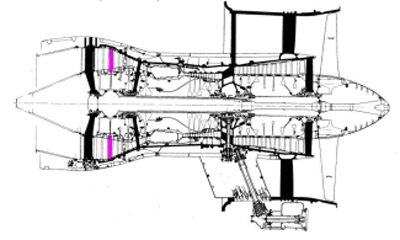
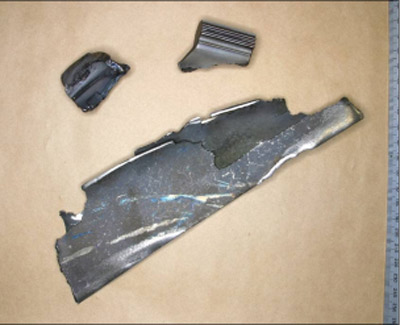
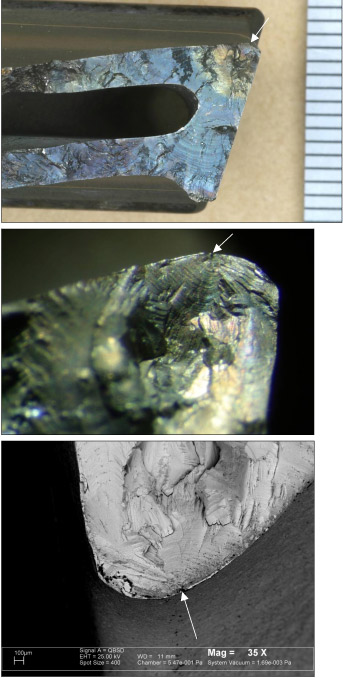
Subsequent engineering examination of the RB211-524D2 engine (serial number 12682) revealed the failure of a single blade from the low-pressure turbine second stage (LPT-2, figure 1). Sections of the failed blade, including the root block, and portions of the separated airfoil section were recovered from the engine and forwarded to the Australian Transport Safety Bureau (ATSB) for examination (figure 2).

Figure 1: RB211-524 engine profile showing location of LPT-2 blades (coloured)

aair200404214_001.jpg

Figure 2: Blade fragments recovered from the failed engine

aair200404214_002.jpg

1.2. Visual characterisation

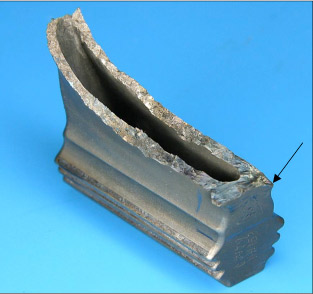
The part number LK83851 stage-2 low-pressure turbine blade (serial number TA6939B) had fractured through the base of the airfoil section; the fracture path extending diagonally from just above the dovetail transition at the rear face, to a position approximately 33 mm above the blade base, measured along the forward face (figure 3).

Figure 3: LPT-2 blade root section showing the fracture profile and its point of origin (arrowed)

aair200404214_003.jpg

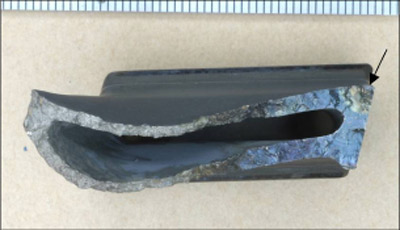
The entire fracture was confined to the region beneath the blade platform and airfoil section transition. The fracture surface morphology confirmed a progressive fatigue cracking mechanism (figure 4), with optical and electron microscopy identifying a single origin approximately 790 µm from the rear face of the root block (figures 5 - 7).

Figure 4: Plan view of the blade fracture showing the fatigue cracking morphology and point of initiation

aair200404214_004.jpg

Figures 5 - 7: Blade fracture at increasing magnifications with origin identified

aair200404214_005.jpg

Other than mechanical damage attributable to the loss of the outer blade section, the blade root block showed no evidence of external tool marks, handling damage or other physical features that could be held as contributory to fatigue initiation.\

The blade root block carried the embossed and engraved identification:

Trailing edge face: C2179 1H1153 < 22>
Leading edge face: LK83851 TA6939B < 9> < 13> < 29> < 201>

The engine manufacturer confirmed that the numbers represented as <xx> above indicated the application of various repair schemes during prior blade overhaul/s. On review, none of those schemes contained actions involving activity at or in the vicinity of the fatigue origin. The manufacturer also indicated that the engraved (vibro-etched) markings '< 201>' had been placed closer to the shank edge than allowed by the particular repair scheme, and that markings too close to section corners have the potential to adversely affect the blade integrity. In this instance however, the cracking showed no association with the < 201> marking, or any other similar feature.

1.3. Metallography & micro-analysis

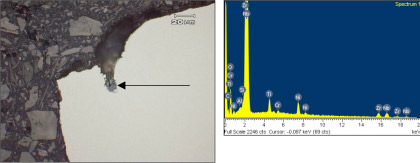
A serial grind-polish-examine process was used to investigate and characterise the features at and surrounding the fatigue origin. The plane of grinding was parallel to the trailing edge root block face and a total of four metallographic planes were examined through the origin area. A fractured and intrusive dark oxide-like material inclusion was observed during the second stage of examination (figure 8).

Figure 8 and 9: Metallographic cross-section through origin and EDS spectra of inclusion present at arrow

aair200404214_008.jpg

Energy dispersive x-ray analysis (EDS, figure 9) of the inclusion identified a range of elements from the typical base metal chemistry (Ni, Nb, Ti), as well as zirconium (Zr) which was foreign to the base metal alloy but later identified as a component of the refractory moulding material used during the investment casting of the turbine blades. Dimensionally, the visible sections of the inclusion measured approximately 40 µm in the major dimension, with the engine manufacturer indicating that the maximum root defect dimension allowable by the relevant quality acceptance standards (QAS) was in the order of 508 µm (0.2").

The general blade microstructure was typical of a cast nickel-based high temperature alloy, with massive semi-script form carbides within a solid-solution (?, gamma) matrix.

1.4. Chemical analysis

Spectrographic analysis techniques identified the base LPT blade alloy as an IN713LC nickel-chromium-aluminium-molybdenum material. The engine manufacturer confirmed this as the intended LPT blade alloy.

1.5. Fatigue loading and operating conditions

The initiation of fatigue cracking within any component is an indication that the magnitude and number of local stress cycles sustained have exceeded the limits of the material at the crack origin. Components such as the LPT-2 blades that do not have a prescribed fatigue life limit are engineered such that the nominal and expected transient design stresses and stress cycles are kept below the threshold for fatigue initiation. Where fatigue cracking does initiate in these items, it is, by implication, an indication that either the component has been subject to general stresses above the design limits, or that some anomaly has acted to locally concentrate the stresses in the affected area. The presence of notches, tool marks, physical defects, inclusions or microstructural abnormalities can all lead to local stress concentration effects, thus providing conditions suitable for fatigue crack initiation.
In the analysis of previous LPT-2 blade failures, the engine manufacturer had implicated uneven fuel distribution issues in the excitation of blade vibration sufficient to produce high-cycle fatigue cracking. In this instance however, there was no reported evidence from the engine examination to suggest that fuel distribution or combustion conditions had been problematic, or that those conditions had contributed to the blade failure.

2. ANALYSIS

The LPT-2 blade fracture morphology indicated that failure had resulted from a progressive high-cycle fatigue (HCF) mechanism, initiated from a surface or near-surface inclusion at the rear trailing corner of the blade root section. The inclusion chemistry and morphology suggested its origin from the refractory mould used to cast the blade during initial manufacture.
Given that inclusions and other entrained discontinuities are inherently difficult to avoid in components produced by casting processes, limits are conventionally placed on the size and location of such features to maintain the structural integrity of the items under static and dynamical loading conditions. In this instance, although the dimensions of the visible portion of the inclusion were below the manufacturer's allowance for discontinuities of that nature, it was possible that the defect in total may have been considerably larger, being broken up and partly lost during the blade fracture and separation.

3. CONCLUSIONS

The following conclusions were drawn from the examination of the failed LPT-2 blade from RB211-524D2 engine serial number 12682.

1. Blade failure resulted from the initiation and growth of a fatigue crack from the rear trailing corner of the blade root section.

2. Physical evidence suggested the initiation of cracking from a casting inclusion formed during blade manufacture.

Analysis

The number 3 engine failed in flight as a result of a low-pressure turbine (LPT) second stage blade failure.  The blade failure was a result of a fatigue crack that propagated from a casting inclusion formed during blade manufacture.

Despite the engine manufacturer's recommendations regarding the maintenance of life records for Group B components, the LPT blades are not subject to any mandatory life recording program, and so the actual time and hours in service cannot be determined for any individual blade. In addition, unless the life of each blade is recorded from new, the introduction of any life recording program to components already in-service would not be of any benefit.

Factual information

On 22 October 2004, at approximately 0510 Australian Eastern Standard Time, an Australian registered (VH-EBU), Boeing Company 747-338 aircraft, was being operated on a scheduled passenger service from Honolulu, in the United States of America, to Sydney, Australia.  Near the instrument flight rules reporting point ISTEM, located approximately 700 nautical miles north-east of Sydney, the flight crew had been cleared by air traffic control to climb from flight level (FL) 340 to FL360.  When the crew set climb thrust on the engines, they reported that they felt a vibration in the aircraft and the number 3 engine airborne vibration monitor lights illuminated, indicating that the number 3 engine had an abnormal vibration level.  The crew shut down the number 3 engine and continued to Sydney.

A subsequent engineering examination of the number 3 engine indicated that a low-pressure turbine (LPT) second stage blade had failed.  The engine, a Rolls-Royce RB211-524D4 turbofan, serial number 12682, was removed from the aircraft and the recovered LPT blade fragments were sent to the Australian Transport Safety Bureau (ATSB) for detailed examination.  At the time of the failure, the engine had a recorded time in service of 71,200 hours and 11,221 cycles since new and 14,787 hours and 2,513 cycles since repair. The ATSB examination revealed that the LPT blade had failed as a result of high cycle fatigue cracking (HCF), originating at an anomalous inclusion in the blade material. Details of the failed LPT blade examination are contained in the Technical Analysis report (Appendix A).

Previous LPT blade failures

The engine manufacturer reported that there had been three previous LPT blade failures in this engine type.  Two of the events were attributed to engine fuel mal-distribution and subsequent blade excitation, leading to HCF and failure.  There was no detail provided on the third event. The failure of this blade type was a rare event, given that the engine type has accumulated in excess of 25 million flight hours in service.

LPT blade life monitoring

The LPT blades in the Rolls-Royce RB-211 series engines do not have a defined blade retirement life and are maintained on condition; being monitored throughout their service life by inspection and engine trend analysis.  Once the engine LPT performance parameters change to pre-determined levels, the engine is removed for overhaul or repair.  During engine overhaul, the LPT blades are subject to inspections to determine if they meet the dimensional requirements for continued service.  LPT blades may be exchanged between various engines during this process.

The engine manufacturer's Time Limits Manual for RB211-524 series engines specified that LPT blades are 'Group B' parts and states that it is 'considered necessary to life mark or maintain life records of Group B parts'. While it was evident that engine serial number 12682 had been overhauled in accordance with the manufacturer's requirements, the individual LPT blades' service lives were not recorded and so the age and life history of the failed blade could not be determined.

Summary

On 22 October 2004, at approximately 1910 Universal Co-ordinated Time, a Boeing Company 747-338 aircraft, registered VH-EBU, was being operated on a scheduled passenger service from Honolulu, in the United States of America, to Sydney, Australia. The flight crew had been cleared by air traffic control to climb from flight level (FL) 340 to FL360. When the crew set climb thrust on the engines, they reported that they felt a vibration in the aircraft and the number 3 engine airborne vibration monitor lights illuminated, indicating that the number 3 engine had an abnormal vibration level. The crew shut down the number 3 engine and continued to Sydney.

A subsequent engineering examination of the number 3 engine indicated that a low-pressure turbine (LPT) second stage blade had failed. The ATSB examination revealed that the LPT blade had failed as a result of high cycle fatigue originating at a site of an anomalous inclusion in the blade material.

Occurrence summary

Investigation number 200404214
Occurrence date 22/10/2004
Location Istem, (IFR)
State International
Report release date 26/04/2006
Report status Final
Investigation type Occurrence Investigation
Investigation status Completed
Mode of transport Aviation
Aviation occurrence category Engine failure or malfunction
Occurrence class Incident
Highest injury level None

Aircraft details

Manufacturer The Boeing Company
Model 747
Registration VH-EBU
Serial number 23223
Sector Jet
Operation type Air Transport High Capacity
Departure point Honolulu, USA
Destination Sydney, NSW
Damage Nil

Collision with terrain, Gyroflug Speed Canard, VH-ZXZ, 20 km south-west of St George, Queensland, on 19 October 2004

Summary

At 0944 Eastern Standard Time on 19 October 2004, the Gyroflug Speed Canard aircraft departed Bundaberg, Qld, on a private flight to Parafield, SA, with a planned refuelling stop at Bourke, NSW. At about 1145, the pilot, who owned the aircraft and was the only occupant, radioed another pilot who was operating in the St George, Qld, area and advised that he was feeling dizzy, faint and disoriented, and was having difficulty lining up the aircraft to land on the St George runway. The aircraft remained airborne in the vicinity of St George for approximately 90 minutes. At about 1335, the aircraft impacted terrain 20 km south-west of St George, and the pilot sustained fatal injuries.

There was no evidence that the aircraft was not capable of normal operation at the time of the accident.

During a routine aviation medical examination in 2003, the pilot was diagnosed with diabetes.

The pilot apparently became incapacitated during flight and was unable to manoeuvre the aircraft to a successful landing.

It could not be established why the pilot became incapacitated, however a diabetes-related condition could not be ruled out.

Occurrence summary

Investigation number 200404085
Occurrence date 19/10/2004
Location 20 km SW Saint George
State Queensland
Report release date 12/01/2007
Report status Final
Investigation type Occurrence Investigation
Investigation status Completed
Mode of transport Aviation
Aviation occurrence category Collision with terrain
Occurrence class Accident
Highest injury level Fatal

Aircraft details

Manufacturer Gyroflug
Model SC01 B-160 Speed Canard
Registration VH-ZXZ
Serial number S 43
Sector Piston
Operation type Private
Damage Destroyed

Boeing 737-76N, Beech Aircraft Corp Baron

Summary

The report presented was prepared principally from the information supplied to the Bureau.

Reported Information

On 21 October 2004, at about 1150 Central Standard Time, a Boeing Company 737-76N aircraft (737) registered VH-VBN was tracking to Alice Springs Airport on the 122 radial of the VHF omnidirectional radio range (VOR) navigation aid on descent to 9,000 ft. The crew reported that at about 35 NM from the airport, they received a traffic alert and collision avoidance system (TCAS) traffic advisory (TA) alert. Shortly after, the crew received a TCAS resolution advisory (RA) to reduce the aircraft's rate of descent. After changing to the Alice Springs aerodrome controller's (ADC) frequency, the crew was provided with traffic information on a Beech Aircraft Corporation 58 Baron aircraft (Baron), that was in the vicinity of the 737 at 9,500 ft and tracking in the opposite direction.

The ADC provided an air traffic service in the Class D control zone and the Class E control area steps surrounding the Alice Springs Airport, from ground level to 8,500 ft, within an area encompassed by a circle with a radius of 36 NM centred on Alice Springs Airport. Controllers were required, in Class D airspace, to separate instrument flight rules (IFR) flights from other IFR flights and to provide traffic information to pilots of IFR flights about any visual flight rules (VFR) flights. A similar level of service was required within Class E airspace for IFR flights with the exception that pilots of IFR flights would be provided with traffic information on VFR flights as far as practicable. The 737 was an IFR category flight and the Baron was a VFR category flight.

The ADC had flight details on both aircraft and it would have been prudent to provide traffic information to the crew of the 737 in sufficient time to enable them to assess the likelihood of a conflict in either class of airspace. At the time of the occurrence the ADC was busy with coordination tasks and managing other aircraft.

On 25 November 2004, as a result of National Airspace System (NAS) changes, the Class E airspace around Alice Springs was changed to Class C. In Class C airspace controllers are required to separate IFR flights from other IFR and VFR flights. Consequently, in future similar circumstances the ADC will be required to separate the aircraft.

Occurrence summary

Investigation number 200404178
Occurrence date 21/10/2004
Location 65 km SE Alice Springs, Aero.
State Northern Territory
Report release date 31/10/2005
Report status Final
Investigation type Occurrence Investigation
Investigation status Completed
Mode of transport Aviation
Aviation occurrence category ACAS warning
Occurrence class Incident
Highest injury level None

Aircraft details

Manufacturer The Boeing Company
Model 737
Registration VH-VBN
Sector Jet
Operation type Air Transport High Capacity
Departure point Sydney NSW
Destination Alice Springs NT
Damage Nil

Aircraft details

Manufacturer Beech Aircraft Corp
Model 58
Registration VH-XSY
Sector Piston
Operation type Private
Departure point Alice Springs NT
Destination Unknown
Damage Nil

Airprox, Cessna Aircraft 182R, and Piper Aircraft PA-28, Jandakot, Western Australia, on 13 October 2004

Analysis

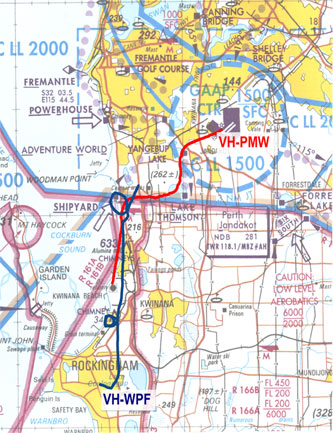
Radar data confirmed that the pilot of the Warrior departed Jandakot via the relevant tracking points, but remained at 1,500 ft and tracked towards the coast. That tracked the aircraft towards an aerodrome approach point, at the same altitude as used by inbound aircraft.

The investigation concluded that if the Warrior pilot had, as recommended in the En Route Supplement Australia, climbed above 1,500 ft when clear of the Jandakot control zone, a conflict with inbound aircraft would have been less likely to occur.

Factual information

The radar data indicated that the Warrior departed Jandakot via 'Yangebup Lake' and 'Lake Thomson', which were tracking points published for VFR aircraft departing to the south. After passing overhead Lake Thompson, the pilot of the Warrior turned onto a westerly heading, tracking towards the coast at an altitude of 1,500 ft. The aircraft turned onto a southerly heading approaching the coast and passed about 0.5 NM to the southwest of Shipyard (see Figure 1).

General Aviation Aerodrome Procedures (GAAP) were in use at Jandakot. Procedures published in the Airservices Australia Aeronautical Information Publication (AIP), ENR 1.1, 30.3(d) stipulated that when departing, the pilot must:

track via departure procedures (if any) for the particular GAAP aerodrome as specified in ERSA [En route Supplement Australia], or track well clear of GAAP approach points and associated VFR routes, to reduce possible conflict with inbound aircraft.

The ERSA entry for Jandakot stated that aircraft departing via Yangebup Lake should climb to an altitude above 1,500 ft as soon as practical upon leaving the control zone.

The AIP ENR 1.1, 31.5 stipulated that whenever possible, pilots of aircraft arriving from outside controlled airspace:

must track visually via a GAAP aerodrome approach point as specified in ERSA.

The ERSA nominated 1,500 ft as the inbound altitude for arriving aircraft and Shipyard as one of the aerodrome approach points.

The pilot of the Warrior held an overseas flight crew licence and was operating in accordance with a CASA-issued Certificate of Validation. That validation had been recently issued and recognised the pilot's overseas qualifications and permitted the pilot to operate Australian-registered aircraft, while engaged in private day VFR operations. As part of the process of validation, the pilot had undertaken training on local procedures for operating at Jandakot.

The pilot of the Warrior reported that he did not see the opposite direction aircraft.

aair200403956_001.jpg

Summary

At about 1125 Western Standard Time on 13 October 2004, a Cessna Aircraft Company 182R (C182), registered VH-WPF, was inbound to Jandakot at 1,500 ft. It was approximately 1 NM south of the aerodrome approach point 'Shipyard' when it conflicted with an aircraft travelling in the opposite direction. The pilot reported sighting the aircraft at close range and initiated a steep right turn to avoid a possible collision. The aircraft were outside controlled airspace and operating under the Visual Flight Rules (VFR). The Australian Transport Safety Bureau classified the occurrence as both an Airprox1 and a serious incident2. Recorded radar data and a subsequent radio transmission, positively identified the other aircraft as a Piper Aircraft Corporation PA28-151 (Warrior), registered VH-PMW.

  1. An occurrence in which two or more aircraft come into such close proximity that a threat to the safety of the aircraft exists or may exist, in airspace where the aircraft are not subject to an air traffic separation standard or where separation is a pilot responsibility.
  2. Annex 13 to the Convention on International Civil Aviation defines a serious incident as:
    An incident involving circumstances indicating that an accident nearly occurred.
    Note 1.- The difference between an accident and a serious incident lies only in the result.
    Note 2.- Examples of serious incidents can be found in Attachment C of Annex 13 and in the International Civil Aviation Organization's Accident/Incident Reporting Manual (Doc 9156).

Occurrence summary

Investigation number 200403956
Occurrence date 13/10/2004
Location 11 km SW Jandakot, Aero.
Report release date 27/10/2005
Report status Final
Investigation type Occurrence Investigation
Investigation status Completed
Mode of transport Aviation
Aviation occurrence category Near collision
Occurrence class Serious Incident
Highest injury level Serious

Aircraft details

Manufacturer Cessna Aircraft Company
Model 182
Registration VH-WPF
Serial number 18268545
Sector Piston
Operation type Aerial Work
Departure point Jandakot WA
Destination Jandakot WA
Damage Nil

Aircraft details

Manufacturer Piper Aircraft Corp
Model PA-28
Registration VH-PMW
Serial number 28-7515074
Sector Piston
Operation type Private
Departure point Jandakot WA
Destination Margaret River WA
Damage Nil

Boeing 737-86Q, VH-VOF

Analysis

The operator's 737 Flight Crew Training Manual (FCTM) provided information on the correct handling techniques to maintain tail clearance margins during the take-off manoeuvre, including take-offs in gusty conditions. The Automatic Terminal Information Service provided the crew with information on the existence of crosswind conditions on runway 03 at Perth. It also provided the crew with information that windshear was present in the vicinity of Perth aerodrome.

The copilot initiated the rotation at the V1 speed of 142 kts, which was 5 kts before the scheduled VR speed. The lack of change in airspeed at V1 was indicative that the aircraft had encountered a wind gust, which was consistent with the crosswind conditions. However, the rotation was not delayed when the gust was encountered, as recommended in the FCTM. Rotation continued beyond the target 8.2 degrees nose up pitch lift off attitude, and the aircraft was at a nose up pitch of 13.2 degrees at lift-off. Despite the early rotation, it was conducted at a pitch rate of about 3 degrees per second, which was consistent with the information in the FCTM.

The application of left control wheel during the take-off was sufficient to deploy flight spoiler panels 3 and 4. That reduced the lift coefficient, and consequently, the tail clearance was reduced as the aircraft became airborne. The point at which the aft underside portion of the aircraft contacted the runway surface was evidenced by the 1.19g spike in the normal load factor data at the point of lift off.

This occurrence highlights that during the take-off manoeuvre, tail clearance margins will reduce to the point where a tail strike will probably occur if:

  • rotation is below the scheduled VR speed, and/or
  • rotation is beyond target lift off attitude, and/or
  • excessive control wheel is applied, which results in the deployment of flight spoilers.

Summary

The Australian Transport Safety Bureau did not conduct an on-scene investigation of this occurrence.

FACTUAL INFORMATION

On 11 October 2004, a Boeing Company 737-86Q (737) aircraft, registered VH-VOF, was being operated on a scheduled passenger service from Perth, WA, to Sydney, NSW. The copilot was the handling pilot for the flight.

At 1124 western standard time, as the aircraft became airborne from runway 03 at Perth, the cabin crew members seated at the rear of the aircraft felt and heard the aft fuselage scrape the runway. At about FL160 during the climb, the cabin crew alerted the flight crew of a possible tail strike during the take-off. The pilot in command assumed control of the aircraft and elected to return to Perth. The aircraft was descended to 9,000 ft, and during the descent the flight crew performed the 737 Quick Reference Handbook (QRH) Non-Normal Checklist for a tail strike on take-off. However, because no cabin pressurisation problems had occurred following the suspected tail strike, they elected to leave the aircraft pressurised.

Air traffic control cleared the crew to hold the aircraft to the west of Perth to allow sufficient fuel burn to reduce the aircraft to its maximum permitted landing weight, and the aircraft landed at Perth about 2 hours later.

Engineering inspection confirmed that the aircraft had sustained a tail strike during the take-off. The tail strike ground contact was slight, and resulted in minor scuffing to the base of the shoe on the tail-skid assembly. The crushable cartridge within the tail-skid assembly was undamaged.

The load trim sheet provided to the flight crew by the operator indicated that the planned take-off weight was 71,331 kg, which was used by the crew in conjunction with data from the operator's Airport Analysis Manual to determine the take-off speeds for the departure from Perth, using the full length of runway 03. Those speeds were the take-off decision speed (V1) of 142 kts, the take-off rotation speed (VR) of 147 kts, and the take-off safety speed (V2) of 151 kts.

Following the occurrence, all luggage and freight carried in the cargo compartments of the aircraft was re-weighed. The total cargo compartment load noted on the original load and trim sheet provided to the crew was about 160 kg less than the actual weight revealed by the re-weigh. The actual take-off weight was therefore 71,493 kg, and the take-off speeds for that weight were only 1 kt greater than the speeds determined by the flight crew. The minor discrepancy between the planned and actual weights was not a factor in the occurrence, and the aircraft was within its approved centre of gravity limits.

Perth aerodrome automatic terminal information service (ATIS) provided current, routine information to arriving and departing aircraft at Perth by means of continuous and repetitive radio broadcasts. Information Papa was current at the time of the occurrence and advised that the duty runway was runway 03 (wet), wind was 320 degrees magnetic at 20 kts, with an associated crosswind of 18 kts. The barometric pressure was 1010 hPa, and the temperature was 20 degrees C. The ATIS also included information that windshear was present in the vicinity of the aerodrome, and that the wind direction and speed at a height of 250 ft above ground level was 330 degrees magnetic at 25 kts, gusting to 35 kts.

The Bureau of Meteorology one-minute wind data at the time of the take-off indicated that the wind was a gusty crosswind. The average wind direction and speed was 325 degrees true at 19 kts. However, during the take-off, the wind direction and speed fluctuated between 319 and 331 degrees true, and from 18 to 21 kts.

The aircraft was fitted with an Allied Signal solid state flight data recorder. The ATSB analysed the recorded flight data to assist in establishing the factors that led to the tail strike.

The computed airspeed data revealed that acceleration was normal up to V1, at which point the aircraft's speed remained constant at 142 kts until rotation was initiated. At lift-off, the computed airspeed was about 152 kts. During the period between the commencement of rotation and the lift off of the main landing gears, the aircraft's nose-up pitch increased steadily from 0 degrees to 13.2 degrees. There was a 1.19g spike in the normal load factor data at the point of lift off.

About 23 degrees of left control wheel was applied throughout the take-off run until the aircraft was rotated. Left control wheel input increased from the point of rotation, and was about 43 degrees when the main landing gears became airborne. The left aileron was displaced 9.7 degrees up, and flight spoiler panels 3 and 4 were deployed 4.4 degrees and 11 degrees respectively at lift off. During the 2 seconds following lift off, left control wheel input increased to 48.8 degrees, then reduced to 28.7 degrees. The deployment of flight spoiler panels 3 and 4 increased to 13.9 degrees and 13.5 degrees respectively with the application of 48.8 degrees of left control wheel deflection. Right rudder was also applied during the take-off roll, which was consistent with the prevailing crosswind conditions.

Aircraft can achieve high angles of pitch relative to a runway during both take-off and landing segments of flight. If the pitch angle exceeds prescribed limits when an aircraft is close to the ground, the aft underside portion of the aircraft may contact the runway surface. That contact is referred to as a tail strike, and can result in significant damage to the aircraft. Aircraft manufacturers provide guidance to flight crews on the correct pitch rates and speeds to avoid tail strikes during take-off and landing manoeuvres.

The point of minimum tail clearance during take-off occurs after the lift-off speed has been attained. Initiation of rotation before the scheduled VR speed or rotation at an excessive rate will reduce the minimum tail clearance, and under those circumstances, contact with the ground will probably occur.

Chapter 3 of the operator's 737 Flight Crew Training Manual (FCTM) provided the following information on the take-off rotation manoeuvre:

When a smooth continuous rotation is initiated at VR, tail clearance margin is assured because computed takeoff speeds depicted in the QRH, airport analysis, or FMC, are adjusted to provide adequate tail clearance.

The FCTM also provided information that:

Take-off and initial climb performance depend on rotating at the correct airspeed and proper rate to the rotation target attitude. Early or rapid rotation may cause a tail strike.

The FCTM provided information that the lift-off attitude of the 737-800 was 8.2 degrees with the wing flaps extended 5 degrees. The minimum tail clearance at that pitch attitude was 51 cm, and the tail strike pitch attitude was 11.0 degrees with the main landing gear oleo struts extended.

The FCTM also provided information and recommendations on flight manoeuvres and techniques in gusty wind and strong wind conditions for the 737, as follows:

For take-off in gusty or strong crosswind conditions, maximum take-off thrust is recommended. This maximizes available runway and minimizes the airplane exposure to gusty conditions during the rotation and take-off maneuver [sic].

Avoid rotation during a gust. If a gust is experienced near VR, as indicated by stagnant airspeed or rapid airspeed acceleration, momentarily delay rotation. This slight delay allows the airplane additional time to accelerate through the gust and the resulting additional airspeed improves the tail clearance margin. Do not rotate early or use a higher than normal rotation rate in an attempt to clear the ground and reduce the gust effect because this reduces tail clearance margins. Limit control wheel input to that required to keep the wings level. Use of excessive control wheel may cause spoilers to rise which has the effect of reducing tail clearance limits. All of these factors provide maximum energy to accelerate through gusts while maintaining tail clearance margins at liftoff.

The aircraft manufacturer advised that deflection of flight spoilers and ailerons due to control wheel input reduces the lift coefficient of the wing and that the reduction in lift coefficient effectively reduces the tail clearance at rotation during the take-off manoeuvre.

Occurrence summary

Investigation number 200403868
Occurrence date 11/10/2004
Location Perth, Aero.
State Western Australia
Report release date 28/06/2005
Report status Final
Investigation type Occurrence Investigation
Investigation status Completed
Mode of transport Aviation
Aviation occurrence category Ground strike
Occurrence class Serious Incident
Highest injury level None

Aircraft details

Manufacturer The Boeing Company
Model 737
Registration VH-VOF
Serial number 30274
Sector Jet
Operation type Air Transport High Capacity
Departure point Perth, WA
Destination Sydney, NSW
Damage Minor

de Havilland Canada DHC-8-102, VH-TNW

Safety Action

As a result of this and a number of similar occurrences, the ATSB is reviewing past investigations and data held by the Bureau covering safety issues relating to the communication of weather information to aircrews and between Airservices Australia and the Bureau of Meteorology and the safety action taken by these organisations to mitigate known problems in this area.

The ATSB has previously published reports of the investigations into occurrences that involved flight by regular public transport aircraft into convective weather and other weather situations where the availability of accurate weather information and communication of weather information to flight crews was a factor. For further information, readers are directed to ATSB occurrence investigations 200100213, 200105157, 200201228, 200301941 and 200304400 and associated safety recommendations. Copies of these reports are available from the ATSB website, or from the Bureau on request.

Analysis

The Terminal Area Forecast (TAF) provided information to the crew that moderate turbulence was likely to be encountered during the flight. The meteorology information provided no warning of severe turbulence until after the flight had landed at the Gold Coast. The TAF that the crew had used indicated that the change in wind direction and strength at 1600 would signify the passage of the front over the Gold Coast.

The turbulence encountered during the Dash 8's initial approach and the visual observations reported by the crew of a roll cloud and water spouts, were consistent with the aircraft having encountered the leading edge of the frontal zone. This was about 2 hours earlier than forecast. The indications from the weather stations at Evans Head and Cape Byron confirmed that the front was moving to the north faster than expected. However, the severe turbulence associated with the front could not be determined from those weather stations and was therefore unexpected.

The drop in temperature of 7 degrees provided the pilot in command of the B717 with an indication that conditions at the Gold Coast Airport were changing earlier than forecast. This temperature drop was also recorded by the automatic weather station at the Gold Coast Airport. While the drop in temperature cannot by itself indicate the degree and/or severity of turbulence likely to be encountered, it did indicate the arrival of the front.

As the aviation special weather report issued at 1258 was not passed to the crew of TNW, they were not in a position to appreciate that the passage of the front over the Gold Coast Airport was earlier than expected. The crew were aware that the B717 had encountered turbulence in the area of the Gold Coast Airport, but were not fully aware of the severity of that turbulence.

During the missed approach, the flap 5 limit speed was exceeded for a short period of time. At the time, the crew were likely to have been preoccupied with the low oil pressure warning and maintaining control of the aircraft due to the turbulent conditions. The overspeed did not result in damage to the aircraft. The extreme roll rates encountered by the aircraft could have given the perception that the aircraft rolled to unacceptably high roll angles, however the data recovered from the flight data recorder revealed that the roll angles encountered were within normal operating parameters.

The changes recorded in vertical `g' readings were indicative of a severe turbulence encounter. The decision by the crew to conduct a missed approach due to the turbulence was in accordance with normal operating procedures.

Factual information

The Australian Transport Safety Bureau did not conduct an on-scene investigation of this occurrence.

FACTUAL INFORMATION

At approximately 1330 Eastern Standard Time (EST) on 8 October 2004, a de Havilland Canada DHC-8-102 (Dash 8) aircraft, registered VH-TNW (TNW), with a crew of three and 18 passengers, encountered severe turbulence during approach to the Gold Coast Airport, Queensland. The aircraft was being operated on a scheduled passenger service from Brisbane to the Gold Coast.

The flight crew reported that conditions were quite rough with moderate turbulence during the flight. Approximately 25 NM from the Gold Coast Airport, at an altitude of 5,000 ft, the aircraft encountered turbulence that resulted in a wing drop, while operating with the autopilot engaged. The crew were then cleared by air traffic control (ATC) to descend to 4,000 ft and to reduce speed, as they were being radar vectored behind a Boeing Company 717 (B717) aircraft that had conducted a missed approach at the Gold Coast Airport due to encountering turbulence.

The crew of TNW reconfigured the aircraft for a flap 15 landing. They were then advised by ATC that they would be in front of the B717, were cleared for a visual approach and advised to contact the control tower. Passing through approximately 2,500 ft, the crew reported that they encountered a severe updraft that stopped the aircraft's descent. They then disconnected the autopilot and continued the descent. The crew reported that as the aircraft was passing through approximately 1,500 ft, they encountered severe turbulence, which required them to apply almost full control inputs to control the aircraft. The pilot in command then carried out a missed approach and the aircraft was reconfigured for a climb. During the missed approach, the number 1 engine `low oil pressure' warning light illuminated for a short time. The crew checked the cockpit indications and confirmed that the oil pressure was within limits.

They climbed the aircraft to 3,000 ft and manoeuvred for another approach. The pilot in command reported that during the downwind leg they observed that the water off the coast appeared to be `foaming'. He also reported a number of small waterspouts present, and that there appeared to be a roll cloud forming ahead of the aircraft.

After landing, the crew advised the ground engineers that they had encountered severe turbulence. Following discussions with the operating company's base, a decision was made to ground the aircraft to allow a thorough engineering inspection. That inspection was to include flap over-speed and severe turbulence encounter inspections.

A review of the recovered data from the aircraft's flight data recorder revealed that, at a recorded altitude of 1,460 ft, the aircraft encountered a turbulence event that recorded +2.26 vertical `g'. At that point, the aircraft was banked to the left to 21 degrees. Almost immediately following this, the aircraft banked to the right to 20 degrees. The data also revealed that during the missed approach the engine torque values exceeded 100% for a period of two seconds and that the flap 5 limit speed of 148 kts was also exceeded.

The aircraft was not damaged during the turbulence encounter and none of the occupants were injured.

The pilot in command of the B717 reported that, when they had started descent, they were advised that the automatic terminal information service (ATIS) had changed. The new information that they received indicated that the temperature had dropped 7 degrees from the temperature that they had recorded just prior to starting the descent. He also reported that the conditions became very turbulent as the aircraft descended below 10,000 ft. While on approach, the conditions became very turbulent, and he conducted a missed approach when the aircraft became unstable on the approach.

The general meteorological forecast for the morning of 8 October 2004 indicated that a trough line was moving across south-east Queensland. Coincident with the movement of this trough, a front was moving north along the New South Wales coast and was expected to move through south-east Queensland in the mid to late afternoon.

The Terminal Area Forecast (TAF) for the Gold Coast Airport, issued at 1104, indicated that the wind was from 300 degrees at 18 kts, with gusts to 30 kts. It further indicated that the wind was to change direction and strength at 1600. The TAF also indicated that moderate turbulence was expected below 5,000 ft from 1100 until 1700.

An amended TAF was issued at 1335, which indicated that the wind was from 160 degrees at 20 kts. This TAF also indicated that moderate turbulence was expected below 5,000 ft from 1300 until 1700.

Data from the automatic weather station (AWS) at the Gold Coast Airport indicated that the wind direction started to change from a north-westerly direction to an easterly and finally a south-easterly direction between 1230 and 1326. The recorded temperature also decreased from 34.6 degrees to 26.8 degrees in the same period. An aviation special weather (SPECI) report related to a change in wind direction and a drop of temperature of more than 5 degrees was issued by the Gold Coast Airport AWS at 1258. That information was not passed to the crew of the TNW.

A significant meteorological (SIGMET) warning of severe turbulence was issued at 1449 that covered the area surrounding the Gold Coast Airport. This turbulence was expected below 8,000 ft.

The passage of the front along the New South Wales coast was detected by automatic weather stations at Evans Head and Cape Byron. These stations did not have the capability to provide 1-minute updates to the data. Therefore, they could only provide aviation routine weather (METAR) and SPECI reports.

SPECI data from Evans Head and Cape Byron stations indicated the passage of the front through those locations at 1025 and 1131 respectively.

Occurrence summary

Investigation number 200403825
Occurrence date 08/10/2004
Location Gold Coast, Aero.
State Queensland
Report release date 01/08/2005
Report status Final
Investigation type Occurrence Investigation
Investigation status Completed
Mode of transport Aviation
Aviation occurrence category Turbulence/windshear/microburst
Occurrence class Serious Incident
Highest injury level None

Aircraft details

Manufacturer De Havilland Canada/De Havilland Aircraft of Canada
Model DHC-8
Registration VH-TNW
Serial number 102
Sector Turboprop
Operation type Air Transport Low Capacity
Departure point Brisbane, QLD
Destination Coolangatta, QLD
Damage Nil

de Havilland Canada DHC-8-315, VH-SBV

Summary

The Australian Transport Safety Bureau did not conduct an on-scene investigation of this occurrence. The report presented below was prepared principally from information supplied to the Bureau.

REPORTED INFORMATION

At 1151 Eastern Standard Time, on 11 October 2004, while in cruise at FL230, the pilots of a DHC-8-315 aircraft, registered VH-SBV, operating a scheduled flight from Horn Island to Cairns, Queensland, noticed the presence of smoke in the flight deck, which was followed by a loud bang emanating from a panel behind the pilot in command's (PIC) seat.

At the same time, a number of warning lights illuminated, including the primary and auxiliary inverter annunciations. The PIC's electronic horizontal situation indicator, attitude director, altimeter and vertical speed indicator instruments lost electrical power, so control of the aircraft was handed over to the copilot.

Because of the presence of smoke, the pilots donned their oxygen masks, commenced an emergency descent and conducted `Oxygen' and `Fire and Smoke' drills. By the time those drills had been completed, the smoke had dissipated enough to allow the removal of the oxygen masks, and the aircraft was levelled at 10,000 feet.

Inspection of the panel behind the PIC's seat identified a problem with the primary inverter. After completing the appropriate emergency procedures listed in the Quick Reference Handbook (QRH), the primary inverter was isolated and the auxiliary inverter selected, however, the PIC's instruments did not resume operation.

As the smoke had dissipated rapidly from the flight deck and the primary inverter had been isolated, the crew elected to continue to Cairns where a normal approach and landing was carried out.

A subsequent examination by the operator's ground engineers confirmed that the primary inverter had failed creating a power spike that resulted in a number of circuit breakers (CB) tripping, including the auxiliary inverter CB. The tripping of the auxiliary inverter CB prevented the restoration of electrical power to the PIC's instruments.

After resetting the auxiliary inverter CB and functionally testing the system, the aircraft was flown to Brisbane, under the provisions of the minimum equipment list, where the primary inverter was replaced, and the aircraft was returned to service.

Occurrence summary

Investigation number 200403857
Occurrence date 11/10/2004
Location 277 km NW Cairns, (VOR)
State Queensland
Report release date 08/04/2005
Report status Final
Investigation type Occurrence Investigation
Investigation status Completed
Mode of transport Aviation
Aviation occurrence category Smoke
Occurrence class Serious Incident
Highest injury level None

Aircraft details

Manufacturer De Havilland Canada/De Havilland Aircraft of Canada
Model DHC-8
Registration VH-SBV
Serial number 595
Sector Turboprop
Operation type Air Transport High Capacity
Departure point Horn Island, QLD
Destination Cairns, QLD
Damage Nil