The Australian Transport Safety Bureau did not conduct an on-scene investigation of this occurrence. The report presented below was prepared principally from information supplied to the Bureau.
REPORTED INFORMATION
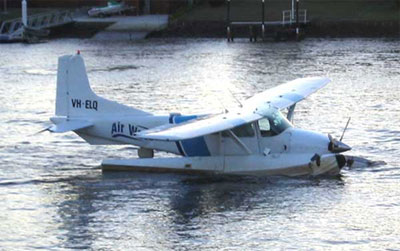
On 3 October 2004, a Cessna 185 float plane, registered VH-ELQ, was being used to conduct joy flights from the Broadwater at Southport, Queensland. The pilot, who was the company chief pilot, had conducted a series of short flights during the day and reported that the aircraft operated normally throughout. The last flight of the day was to be a 10-minute scenic flight at 1,000 ft, south from the Broadwater to Jupiter's Casino and return. The pilot reported that, prior to that flight, the right-wing tank contained 45 L of fuel. The left-wing tank was empty.
The flight departed with three passengers at about 1650 Eastern Standard Time. The take-off and southern leg of the flight proceeded normally, and the pilot initiated a wide right turn at 1,000 ft abeam Jupiter's Casino for the return leg. The pilot reported that, to give the passengers the best view from the aircraft, he conducted a 'flat turn' using little or no bank, by applying a combination of right rudder and opposite aileron control. The pilot reported that, about 30 seconds after resuming straight and level flight, the engine 'gave a couple of splutters' and lost power and he conducted an uneventful precautionary landing on the Nerang River with partial engine power.
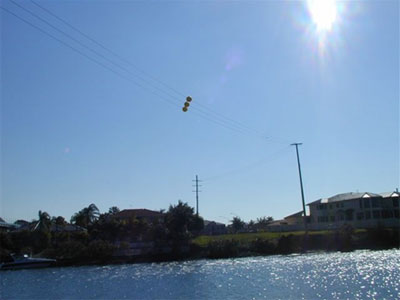
The pilot said that, after landing, he shut down the engine and confirmed that the right-wing tank contained 40 L of fuel. He then drained fuel from the fuel strainer to clear any water that might have been present. The pilot then restarted the engine. All engine instrument indications were normal. He said that he manoeuvred the aircraft left and right while taxiing and increased engine power. The aircraft's speed increased, and he was able to manoeuvre the aircraft so that the floats were on the step1. The engine continued to operate normally. The pilot reported that he then set maximum engine power, and after noting that the engine was delivering full power, continued to accelerate and take-off. Shortly after the aircraft became airborne, he initiated a gentle climbing right turn to follow a bend in the river. A very short time later, the engine again lost power. The pilot said that he lowered the nose of the aircraft to land back on the river but saw a cluster of brightly coloured balls indicating the presence of powerlines immediately ahead of the aircraft.
He decided to fly over the powerlines and as he was raising the nose to achieve that, there was a power surge from the engine. After the aircraft cleared the wires, the pilot observed that the indicated airspeed was below 45 kts. He reported that the aircraft then descended rapidly, heavily impacting the water. The pilot assisted the passengers from the aircraft onto waiting boats. There were no injuries.
Photographs of the aircraft showed that both floats and their supports had been substantially damaged and forced upwards from their normal position so that the aircraft's lower fuselage was in contact with the water.
The forward section of the right float had a large cut from one or more propeller blade strikes, indicating that the engine was operating when the aircraft impacted the water.
The pilot reported that at the time of the first forced landing, there was no other company person on duty from whom he could seek advice. Further, he could see no suitable location on the river where he could anchor or beach the floatplane. Last light was approaching, and he was considering the welfare of the passengers. He thought that the engine problem may have been caused by the fuel quantity, or by water in the fuel. However, after he confirmed the amount of fuel in the right-wing tank and conducted a fuel drain, he concluded that he could fly the aircraft back to the Broadwater. The pilot reported that before the take-off, he did not check beyond the bend in the river for overhead obstructions.
The operator reported that a mobile telephone was carried on the aircraft, which provided the pilot with the means to contact the operator or the company's approved maintenance organisation.
The aircraft's maintenance organisation subsequently reported that they drained all fuel from the right-wing tank after the aircraft was recovered. The right-wing tank contained 37 L of fuel. The left-wing tank was empty. There was no water in the fuel. There was a minor amount of rust coloured sediment in the fuel strainer, but the quantity was insufficient to affect the flow of fuel to the engine. There was no evidence of the sediment in any other filter or the fuel distributor. The maintenance organisation also reported that there were no obstructions to the flow of fuel from either the forward or the rear outlet pipes from the right-wing fuel tank to the fuel accumulator tank.
1 'on the step' refers to the float transitioning from displacement mode to planning mode, as the speed increases on the surface of the waters.
The Australian Transport Safety Bureau did not conduct an on-scene investigation of this occurrence. The information presented below was obtained from information supplied to the Bureau.
On 6 October 2004, at 1301 central standard time, a Lockheed Georgia Company C-130H (C130) operated by the Royal Australian Air Force (RAAF) departed Darwin Airport for Edinburgh, tracking via air route A461. The pilot of the C130 was cleared to climb to flight level (FL) 250. Eleven minutes after the C130 departed, a Boeing Company 737-838 (737), registered VH-VXM, departed Darwin Airport for Adelaide, also tracking via A461.
The sector controller located in the Brisbane Centre recognised that the faster following 737 could potentially conflict with the C130 during its climb and contacted RAAF Darwin Approach. The controllers agreed that the Darwin approach controller would establish a method to resolve the conflict and accept responsibility for separation. The Darwin controller issued a requirement to the crew of the 737 to reach FL260 by 90 DME (a measure in nautical miles after application of navigation aid and other tolerances using Distance Measuring Equipment) from Darwin. This requirement did not provide separation assurance with the C130. This error was not detected by either controller.
At 1319, a radar handoff of the 737 was completed between the two controllers and the climb requirement was reiterated to the crew of the 737 by the Darwin approach controller. At 1321, when the crew of the 737 made their initial call on the sector controller's frequency, that controller realised that there was a problem with the separation method being applied. At that time, the 737 was passing FL212 and the C130 was passing FL220, and the distance between the two aircraft was reducing. The controller immediately instructed the 737 crew to climb to FL370 and to expedite their climb through FL230. At 1322, the radar system's short term conflict alert activated. The C130 crew was instructed to descend their aircraft to FL220. The distance between the aircraft reduced to 3.9 NM, which was less than the required 5 NM radar separation standard, before the 1,000 ft vertical separation standard was re-established. There was an infringement of separation standards.
The RAAF and Airservices Australia investigated the occurrence. Those investigations found that:
the Darwin approach controller did not apply an appropriate requirement to the crew of the 737 to ensure separation was maintained
the sector controller's monitoring of the situation was inadequate.
As a result of this occurrence, the aircraft operator has issued an information package to its crews concerning airport operations. The package contains guidance on:
hazards associated with airport operations
operational and human factors involved in runway incursions
best practices, prevention strategies and lines of defence
cockpit procedures for maintaining situational awareness
The aerodrome operator reported that, as a result of this occurrence it is examining options relating to improving the delineation of holding bays at Melbourne Airport to reduce the potential for misidentification.
______________
1Taxiways at Melbourne Airport were referred to by their phonetic identifier. The taxiways referred to during this incident were taxiways Echo, Papa, Quebec, Sierra, and Tango.
Summary
Sequence of events
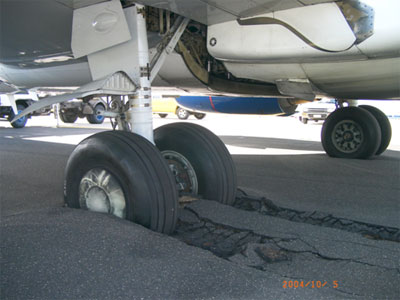
At 1940 eastern standard time (EST), on 4 October 2004, the Boeing Company 737-300 aircraft, registered ZK-FDM, became bogged (Figure 1) at Melbourne Airport. The aircraft was being taxied to runway 27 for a scheduled international passenger service to Hamilton, New Zealand.
Figure 1: Left main landing gear tyres after penetrating the blast-protection surface adjacent to taxiway Papa.
The flight crew commenced taxiing the aircraft to runway 27 from bay 'Delta 4' at the international terminal. Taxiing to Papa1 via Tango was not available because of the stage A2a works in progress on the northern apron (depicted at Attachment 1), and the surface movement controller (SMC) instructed the crew to taxi the aircraft via Sierra and Echo to the runway 27 holding point on Papa. As the aircraft approached Sierra the crew requested confirmation of the taxiing instructions, and the SMC repeated those previously given. The SMC then told the crew to contact the aerodrome controller (ADC) on frequency 120.5 MHz.
The flight crew subsequently reported that while taxiing east along Echo, their attention had been drawn to the lighting associated with the apron works near the intersection of Tango and Papa. There was a holding bay located north of Echo, and the first lead-in light to the holding bay was about 40 m west of the first lead-in light to Papa. As the aircraft approached the lead-in lights to the holding bay, the pilot in command stopped the aircraft. The copilot asked the ADC "is it hard left Papa here?"
The ADC was located in the aerodrome control tower, which was about 1,450 m to the west-southwest of the aircraft's position. From the ADC's vantage point, and in the night conditions, the aircraft would have appeared to have been at the lead-in to Papa, and the ADC confirmed to the crew that it was Papa.
The pilot in command, in response to the advice from the ADC, turned the aircraft left and began to enter the holding bay, thinking it was taxiway Papa. It then became obvious to the crew that they were not on Papa, and the pilot in command turned the aircraft to the right to regain taxiway Echo and the lead-in to Papa. He subsequently reported that another aircraft taxiing on Quebec for runway 27 had its lights 'very brightly shining', and that he misidentified the double lines on the taxiway shoulder as being the taxiway centreline. As a result, the pilot in command inadvertently steered the aircraft onto the blast-protection surface adjacent to the taxiway shoulder pavement. The left main landing gear tyres of the aircraft penetrated the blast-protection surface, and the aircraft became bogged.
The aircraft could not be moved from its bogged position, and the 104 aircraft occupants, which comprised two technical crew, three cabin crew and 99 passengers, were disembarked and taken back to the international terminal.
The aerodrome operator reported that all airside signs, markings and lights complied with ICAO standards and CASA regulations, and that they were serviceable and operating normally at the time of the occurrence. The circumstances of the occurrence did not suggest that there were any deficiencies in the aerodrome airside signs, markings and lighting systems.
The aircraft weight and balance data for the planned flight revealed that its taxi weight was 54,434 kg, and the centre of gravity was at 20.4 percent mean aerodynamic chord. Under those conditions, about 90 percent (49,500 kg) of the aircraft's total landing gear pavement load was exerted by both the main landing gears, that is, each main landing gear pavement load was about 24,750 kg. The left main landing gear pavement load was of sufficient magnitude to result in the left main landing gear tyres penetrating the blast protection surface.
The aircraft was recovered from its bogged position on the following day and subjected to a heavy landing engineering inspection. The inspection revealed no damage resulted from the incident, and the aircraft was returned to service.
On 30 September 2004, at approximately 0920 Eastern Standard Time, a Sydney Airport Corporation works safety officer (WSO) drove a vehicle across runway 07/25 at Sydney airport. The driver did not receive a clearance from air traffic control (ATC) to enter the runway. The WSO was leading a works party consisting of a total of four vehicles, all of which crossed the runway.
Although the runway was not active at the time of the occurrence, a clearance to cross or to enter a non-active runway was still required to be obtained from ATC. The WSO later reported that she was aware that the runway was not active, but that a clearance to cross a non-active runway was required.
The WSO was authorised to drive on all airside areas of Sydney airport. That included an authorisation to operate on, and cross, runways and taxiways in accordance with airport procedures.
The WSO reported that:
She was familiar with runway and taxiway signage and markings
At the time of the occurrence she was training another works safety officer who was a passenger in the vehicle
She had only received about 4 hours of sleep the night before the shift
The weather at Sydney airport at the time of the occurrence was below visual meteorological conditions and raining.
The investigation concluded that the WSO may have been fatigued. Weather conditions at the time of the occurrence and training officer duties may also have exacerbated the situation.
Examination of a failed helicopter tail rotor shaft coupling assembly, Kawasaki Heavy Industries 47G3B-KH4
1 FACTUAL INFORMATION
1.1 Investigation brief
Accident event
On 27 September 2004, as the Kawasaki KH 4 helicopter was approaching to land, the pilot reported that the helicopter commenced an uncommanded right yaw motion that could not be arrested by tail rotor control inputs. Upon increasing power, the rate of yaw and rotation also increased, with the helicopter revolving approximately five times before the pilot reduced power and main rotor collective, allowing the helicopter to settle to the ground where it rolled onto its right side. The three occupants exited the helicopter, having sustained minor injuries.
Examination
During the post-accident investigation of the helicopter, the owner reporting finding the tail rotor drive shaft fractured at the point where it adjoined the forward coupling. The tail rotor had impacted the ground, however the damage sustained by the blades showed no evidence of rotation under power. The fractured drive shaft and both forward and rear couplings were recovered from the accident site by the aircraft owner and submitted to the Australian Transport Safety Bureau (ATSB) for technical examination to assist in the investigation of the occurrence.
1.2 Inspection
Coupling design
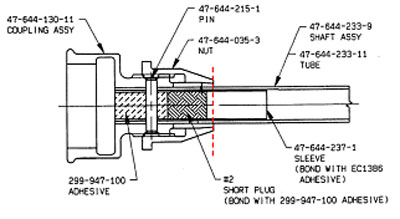
The helicopter tail rotor coupling assembly employed a tapered clamping nut arrangement bearing upon the outer circumference of the shaft tube. For rigidity in the clamped locations, an internal sleeve was fitted and secured with adhesive injected between the sleeve and tube bore. A single machine pin passed transversely through the coupling, tube and sleeve to provide for the positive positional security of the components. Figure 11 illustrates the assembly as a sectional view.
Figure 1: Tail rotor drive shaft coupling, point of failure indicated
Forward coupling and shaft fracture
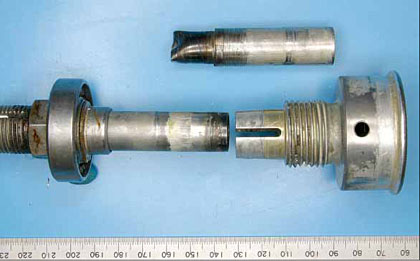
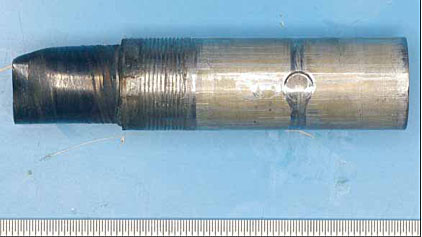
Upon initial receipt, the tail rotor drive shaft was confirmed as failed and separated at the point where it entered the forward coupling socket assembly (refer to figure 2). The fractured end of the shaft remained within the coupling, requiring removal by boring of the securing through-pin ends and pressing of the shaft stub out of the coupling (refer to figure 3).
Figure 2: Forward drive shaft coupling after disassembly
Figure 3: Drive shaft stub after removal from coupling
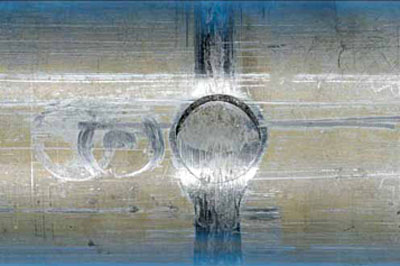
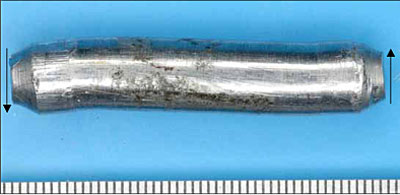
The failure of the securing through-pin at both protruding ends (refer to figure 4) was evident after removal of the shaft stub. The morphology of both fractures was typical of ductile shear overload under transverse loading (shaft twisting) conditions.
Figure 4: Fractured through-pin from the forward coupling. Note also the scoring from post-fracture rotation of the shaft
Figure 5: Spiral scoring on the gripped section of the shaft, adjacent to the fracture
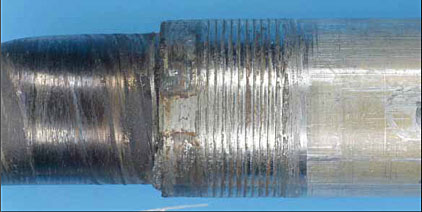
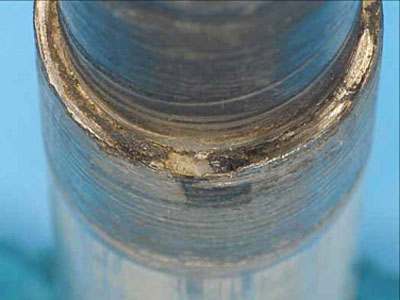
Circumferential scoring of the shaft surfaces to either side of the through-pin indicated subsequent rotation of the shaft inside the coupling after separation. The shaft had fractured approximately 48 mm from the coupling end, exposing the end 18mm of the internal reinforcing sleeve. The last 12 mm of the shaft before the fracture showed deep spiral scoring where the tapered grip segments normally clamped upon the surface (refer to figure 5). The shaft fracture surfaces had been marred and damaged by continuing contact after separation and presented no appreciable evidence of the failure mode (refer to figure 6).
Figure 6: Damaged shaft fracture surface
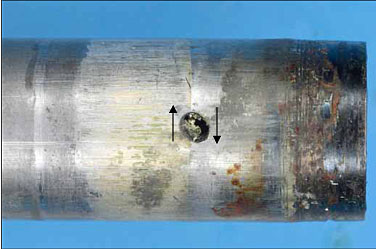
Figure 7: Torsional distortion of the drive shaft adjacent to the point of failure. Note the elongation of the small hole
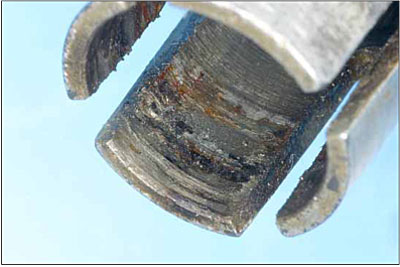
The opposing fracture and section of the shaft that extended from the forward coupling (refer to figure 7) showed extensive scoring, discolouration and galling, consistent with the damage noted inside the taper coupling bore (refer to figure 8). The examination also noted the torsional distortion of the material around a small adhesive bleed hole in the shaft wall (refer to figure 7 also). In a similar manner to the opposing section, the fracture surface had been heavily damaged by post-failure interference and presented little information of value.
Figure 8: Extensive galling and metal adhesion inside the clamping section of the forward coupling
Rear coupling
The rear tail rotor drive shaft coupling was a similar design to the forward unit. The rear coupling showed no significant evidence of slippage of the shaft within the clamped section. The securing through-pin had not failed, however upon removal it presented with appreciable opposing axial bending around the points where the pin passed through the assembly (refer to figure 9).
Figure 9: Through-pin removed from the rear coupling, showing axial distortion typical of a significant torsional overload
2 ANALYSIS
The ATSB examination confirmed the failure and separation of the tail rotor shaft at the point of engagement with the forward drive coupling, approximately 48 mm from the forward end of the shaft. While the shaft fracture surfaces were damaged beyond allowing any interpretation of the original failure mode, the twisting and distortion of the tube material at either side of the fracture was evidence of the shaft having sustained transient torsional overloading conditions. Similarly, the shear failure of the coupling through-pin and the subsequent shaft rotation inside the coupling was a further indication that the assembly had carried, or sustained torsional loads of a magnitude well above the design allowable limits. Mirroring the torsional overload along the load path was the distorted through-pin from the rear coupling. On the basis of the damage sustained by the forward coupling and engaged shaft, it was evident that the failure had proceeded in two distinct stages. Initially, the transient torsional overload event had overcome the clamping friction and caused the shear failure of the through-pin on the forward coupling. Once the pin had failed, the shaft was then able to slip and rotate within the coupling, where it was likely that the galling damage generated between the coupling bore and shaft surface led to the 'screwing' action that pulled the shaft further into the coupling and produced the surface damage that ultimately led to the shaft fracture at that point. While the fracture surfaces were damaged, it was probable that the shaft fracture mode was one of ductile torsional shear. The transverse plane of fracture supports this.
Contributory events
During normal flight and ground operation, the helicopter tail rotor shaft should not sustain any transient torsional loads beyond those imposed by normal engine power changes and/or tail rotor pitch movements. To produce the overload failure and damage to the coupling pins, the tail rotor system must have at some time, been exposed to conditions or events capable of producing a significant increase in the rotational resistance of the assembly. Gross mechanical failures within the tail rotor gearbox, tail rotor impacts, or drive shaft bearing seizures remain as possibilities in that regard. The reported loss of tail rotor effectiveness and the absence of rotational damage to the tail rotor upon ground impact was consistent with the drive shaft coupling slippage and rotation developing during the landing approach. While the coupling pin failure must have been a precursor to the slippage, there was no physical or reported evidence to suggest when that failure may have occurred or what events may have contributed to it.
3 CONCLUSIONS
On the basis of the investigation findings, the following conclusions could be drawn:
The helicopter tail rotor drive shaft had sustained damage consistent with a significant torsional overload event and subsequent rotational slippage and separation of the shaft at the forward coupling.
The accident scenario and damage sustained was consistent with the slippage and separation of the shaft during the helicopter's landing approach.
The factors contributing to the initial overload event could not be conclusively established.
Diagram provided by Kawasaki Heavy Industries Ltd, assembly reference 47-640-052-39 (Shaft Assembly)
Analysis
ANALYSIS
The circumstances of the accident were consistent with a loss of tail rotor thrust following the failure of the tail rotor drive shaft as the helicopter entered the hover.
The time at which the damage to the drive shaft occurred was not able to be determined. However, given the absence of rotational damage to the tail rotor blades, it is unlikely that it occurred during the accident flight.
The action of the pilot in increasing engine power when faced with the loss of tail rotor thrust was inappropriate and exacerbated the situation.
Factual information
FACTUAL INFORMATION
At 1215 Eastern Standard Time1 on 27 September 2004, a Kawasaki Heavy Industries, 47G3B-KH42 helicopter, registered VH-MTF, was being operated on a tourist flight with one adult and a young boy as passengers. The flight included landing on a 1 m high wooden platform in the Teepookana Forest in north-west Tasmania.
The pilot reported that as he brought the helicopter to a 1 m hover above the platform, the helicopter began to rotate slowly to the right. He unsuccessfully attempted to counter the rotation by applying left tail rotor control input. The pilot then increased engine power in an attempt to regain tail rotor control and to move the helicopter clear of the landing platform. That action had the effect of rapidly increasing the rotation of the helicopter to the right and it began to ascend, reaching about 5 m above ground level. The pilot then lowered the collective control and the helicopter impacted the ground heavily on its right side, several metres from the landing platform. The pilot and adult passenger released their seatbelts and then both assisted the young boy to exit the wreckage. The pilot and passengers received minor injuries.
The pilot described the wind conditions at the time of the accident as a headwind with an approximate strength of 8 kts. That assessment was consistent with the wind data for the Strahan area provided by the Bureau of Meteorology3. The pilot also reported that the main rotor RPM indications were normal and that the helicopter had sufficient power to complete the approach4. At the time of the accident, the weight and balance of the helicopter were within prescribed limits. There was no evidence that the helicopter had collided with anything during the approach.
The pilot was appropriately qualified and endorsed to operate the helicopter type and held a valid medical certificate. He was a very experienced agricultural aeroplane pilot and had obtained a commercial pilot (helicopter) licence 14 months before the accident. He had accrued at total of 292 hours in helicopters since that time; 286.4 hours of which had been in the Bell 47 helicopter type. The pilot was experienced with operations into and out of the Teepookana Forest landing platform.
The landing platform was located within a dense forest in an area that was cleared of trees but covered by 1 m high scrub. The trees closest to the clearing had been trimmed to a height of about 5 m to allow a 'fly-in, fly-out' approach. There was no requirement to conduct a vertical approach to the platform.
The helicopter's fuselage structure was deformed by the impact and the tail boom was bent in a downward direction at approximately station 1005. There was corresponding bending damage to the tail rotor drive shaft assembly long shaft at the same point. The operator reported that examination of the damaged tail rotor pitch control system revealed that the controls were intact and would have been capable of normal operation. All parts of the helicopter were accounted for by the operator at the accident site.
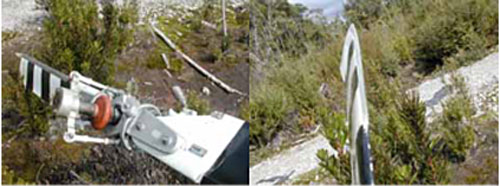
The two-blade tail rotor assembly, mounted on the right side of the tail boom, was intact and correctly attached to the helicopter. There was no evidence of rotational damage to the leading edges or tips of either blade (Figure 1). During the ground impact one blade had been bent outward at the tip and the other was bent in toward the tail rotor gearbox.
Figure 1: Tail rotor blade damage
The helicopter's tail rotor drive shaft assembly consisted of a series of two short shafts and one long shaft that were situated on the top of the tail boom assembly. The long shaft was supported in eight hanger bearing assemblies and was secured at its front and rear by drive coupling assemblies. The operator inspected the tail rotor drive system and found that the long shaft assembly tubing was fractured and the pin situated through the front drive coupling assembly was sheared. There was also significant distortion of the corresponding pin in the shaft's rear coupling.
Inspection of the tail rotor drive system, including the drive shaft bearings, tail rotor extension housing and tail rotor gearbox, with the exception of the long drive shaft, revealed nothing that would have prevented normal operation.
ATSB specialist examination of the failed components (Appendix A) attributed the tail rotor drive shaft failure to a significant torsional overload event, leading to a loss of coupling security and the subsequent slippage, frictional heating and shear fracture of the shaft. That examination was unable to determine when the torsional overload occurred or what specific events may have contributed to it.
At the time of the accident, the helicopter had logged 72 flight hours since the issue of the current maintenance release. The last recorded maintenance carried out on the helicopter was a spark plug change on 21 September 2004, 1.0 flight hour prior to the accident. On 31 August 2004, 5.7 flight hours prior to the accident, one tail rotor blade was replaced because of delamination of the leading edge wear strip.
Information received from the operator and from the maintenance organisation indicated that there had been no known tail rotor strike or sudden rotor stoppage since the helicopter was placed on the Australian aircraft register in 1992. The helicopter's prior history was not examined.
The company operations manual contained the published normal and emergency procedures affecting aircraft operations. An appendix to the manual contained the flight check systems and operating procedures specific to each aircraft type operated by the company, with the exception of the Kawasaki-Bell 47G3B-KH4 helicopter. The company did however, make available to pilots a copy of the Civil Aviation Safety Authority approved Kawasaki-Bell 47G3B-KH4 helicopter flight manual.
With reference to tail rotor failures, that flight manual stipulated:
Immediately execute an autorotative descent and maintain an airspeed of 34 KIAS at least.
Execute a normal autorotative descent and landing.
The flight manual did not contain any specific advice for pilots in response to a tail rotor drive failure when hovering.
Information in the company operations manual regarding pilot response to a tail rotor drive failure in another piston-engine helicopter (Robinson R44) included:
LOSS OF TAIL ROTOR THRUST DURING HOVER
Failure is usually indicated by right yaw which cannot be stopped by applying left pedal.
Immediately roll throttle off into detent spring and allow aircraft to settle.
Raise collective just before touchdown to cushion landing
The generally accepted procedure for pilot actions in the event of a tail rotor failure is to quickly roll off the throttle or snap close the throttle and perform a hovering autorotation6,7,8,9 For example:
The likely worst place for loss of tail rotor thrust to happen is in the hover, and the reaction is quite simple - get rid of the engine power and land the helicopter from a hovering engine failure condition. Easy to do on those machines that have throttle(s) on the collective10.
The 24-hour clock is used in this report to describe the local time of day, Eastern Standard Time (EST), as particular events occurred. Eastern Standard Time was Coordinated Universal Time (UTC) + 10 hours.
The Kawasaki Heavy Industries, 47G3B-KH4 helicopter is a single pilot/single flight control helicopter manufactured under licence from Bell Helicopters. It is commonly known as the KH4 helicopter and is a derivative of the Bell 47.
Given that the pilot positioned the helicopter into wind during the approach and landing, the risk of loss of tail rotor effectiveness (LTE) was negligible.
There were no external conditions that would have placed the pilot at risk of overpitching or drooping the main rotor.
Positioned 100 inches aft of the datum. The datum was located 2 inches forward of the rotor mast centre-line.
Coyle, S. (2003). Cyclic & collective - More art and science of flying helicopters. Mojave, CA: Helobooks, pages 341and 342.
Newman, R. (1999). Helicopters will take you anywhere: A manual for helicopter pilots. Mentone, Vic: The Helicopter Book Company.
Becker, M. (1997). Mike Becker's helicopter handbook. Noosaville, QLD: Becker Helicopters Australia.
The Kawasaki-Bell 47G3B-KH4 helicopter had a throttle of this design.
Summary
At 1215 Eastern Standard Time on 27 September 2004, the pilot of a Kawasaki Heavy Industries, 47G3B-KH4 helicopter, registered VH-MTF, was being operated on a tourist flight with two passengers in north-west Tasmania. The pilot reported that as he brought the helicopter to a 1 m hover above the raised landing platform, the helicopter began to rotate slowly to the right. The pilot unsuccessfully attempted to counter the rotation by applying left tail rotor control input. The pilot then increased engine power, however, that action had the effect of rapidly increasing the rotation of the helicopter to the right and the helicopter climbed to about 5 m above the ground. After the pilot lowered the collective control, the helicopter impacted the ground heavily on its right side. The pilot and passengers received minor injuries.
The helicopter's tail rotor drive shaft had failed during the occurrence. ATSB specialist examination of the failed drive shaft, attributed the failure to damage from a significant torsional overload event, leading to the shear fracture of the shaft. The examination was unable to determine when the torsional overload occurred, however, examination of the wreckage indicated that it was likely that it had occurred prior to this accident
Information received from the operator and from the maintenance organisation indicated that there had been no known tail rotor strike or sudden rotor stoppage since the helicopter was placed on the Australian aircraft register in 1992. The helicopter's history prior to that time was not examined.
The action of the pilot in increasing engine power when faced with the loss of tail rotor thrust was also examined.
The Australian Transport Safety Bureau did not conduct an on-scene investigation of this occurrence. The report presented below was derived from information supplied to the Bureau.
The pilot of the Cessna 210 aircraft, registered VH-UPN, reported that during the landing roll at Cockatoo Island, Western Australia, the wheel separated from the nose landing gear strut. The aircraft nosed-over and came to rest inverted. All occupants evacuated the aircraft without injury.
The operator examined the aircraft and found that the self-locking nut and through bolt for the nose landing gear wheel axle had separated from the nose landing gear, either prior to, or during, the take-off at Broome. The bolt and a washer were subsequently found on the runway at Broome. During the landing, the wheel became loose when the axle moved from the landing gear forks.
As a result of this occurrence, the operator has initiated an immediate inspection of its aircraft to ensure that only new through bolt retaining nuts are installed.
The Australian Transport Safety Bureau did not conduct an on-scene investigation of this occurrence. The report presented below was prepared principally from information supplied to the Bureau.
REPORTED INFORMATION
The pilot of a Piper PA-31-350 aircraft, registered VH-BSM, reported that on 19 August 2004, the aircraft had been chartered for a flight from Port Macquarie to Gunnedah, NSW with nine passengers. The weather forecast indicated that instrument meteorological conditions would exist throughout the flight. Shortly after departure from Port Macquarie, the pilot noticed light aerodynamic shuddering through the airframe, but discounted this as just an idiosyncrasy of this particular aircraft.
About 75 NM from Tamworth, the pilot noticed the right engine RPM fluctuating and the engine began to misfire. The pilot readjusted the propeller lever for the right engine, checked the fuel flow, and commenced a climb to a higher altitude. At approximately 9,000 ft the right engine misfiring increased. He then checked the right engine instruments and noticed that the exhaust gas temperature gauge was indicating above the red line and in excess of normal operating parameters, while the fuel flow indication was decreasing. The pilot shut down the right engine and feathered the right propeller, then transmitted a PAN call (urgency alert) to air traffic control informing the controller that he `was shutting down one engine' and diverting to Tamworth.
However, because the aircraft would not maintain altitude, the pilot asked the controller to provide track guidance to the Walcha airstrip. The pilot reported that during the diversion to Walcha he was unable to prevent the aircraft from descending below the lowest safe altitude. The controller informed the pilot that the aircraft was deviating from the track towards an area of higher terrain. The pilot reported that he checked the flight instruments and found that the vertical speed indicator was indicating an increasing rate of descent and the altimeter was decreasing, while the airspeed was increasing. He instinctively applied corrective pitch and roll action with reference to the attitude indicator, but the situation worsened. He looked across at the copilot's attitude indicator and saw that it was indicating a 45 degree angle of bank descending turn. He levelled off with reference to that instrument and the aircraft returned to a wings level attitude.
At about 6 NM from Walcha, the pilot saw the ground through a hole in the cloud and he estimated that the aircraft was about 400 ft above ground level. Shortly after, he landed the aircraft at the Walcha airstrip.
A maintenance engineering inspection revealed that a fuel line on the right engine had come loose resulting in fuel starvation of the right engine. The pilot also noticed that the wing flaps were extended about 5 degrees, even though the flap selector was in the retracted position. The pilot believed that the aerodynamic drag produced by the flaps in that position would have contributed to the inability to maintain altitude with one engine inoperative and may also have caused the shuddering during the take-off. No fault could be found with the primary attitude indicator.
After returning to Port Macquarie, the pilot discussed the incident with the owner of the aircraft who informed him that the flaps had been in that position for some time. The pilot reported that the defect had not previously been annotated on the maintenance release.
The owner later reported to the Bureau that the trailing flaps issue had been rectified following the return of the aircraft to Port Macquarie.
On 17 November 2004, the helicopter manufacturer advised that it had contacted the emergency locator transmitter (ELT) manufacturer concerning the ELT antenna coaxial cable connectors. The ELT manufacturer had undertaken to test coaxial cable connectors with a 30 lb. tension load. Connectors held in stock by the helicopter manufacturer would also be tested. The helicopter manufacturer advised that it was converting to the new 406 MHz capable ELTs. The antenna connector for the new installation would be crimped by the helicopter manufacturer. The style of crimping used by the helicopter manufacturer has been tested and could typically withstand in excess of 100 lb tension. The helicopter manufacturer believed that those actions would prevent failures of the type that occurred to the ELT installation in the occurrence helicopter.
ATSB
A summary of this accident report will be included in a future edition of CASA's Flight Safety Australia magazine.
Analysis
ANALYSIS
The investigation found that there was no evidence of a pre-existing defect in the helicopter that may have contributed to the occurrence, nor was there any evidence of a medical condition that could have affected the pilot's ability to control the helicopter. Consequently, the investigation concluded that in the prevailing environmental conditions, the accident was consistent with pilot spatial disorientation. This analysis examines the development of the occurrence and highlights a significant risk associated with night VFR operations.
The pilot departed for Eurella homestead 6 minutes after civil twilight in moonless, overcast, and probably showery conditions that were likely to restrict visibility to less than the required 5 km. Except for the homestead lights, the ground lighting or celestial illumination required by the Aircraft Flight Manual was not available. Although the pilot had flown at night on two recent occasions (23 and 26 August 2004), those flights did not fully satisfy the night VFR recency requirements and were probably over a well lit area. Given the pilot's limited recent and overall helicopter night flying experience, and the forecast weather conditions, it is unlikely that the pilot planned to conduct the return flight at night. The pilot had probably used the helicopter to move cattle and that task may have taken longer than expected. The proximity of the homestead, the local knowledge of his passenger, the night VFR capability of the aircraft and access to GPS information may have influenced the pilot to attempt the return flight.
The track information recovered from the hand-held GPS showed manoeuvring after 1830 that suggests that the pilot, probably using GPS information, made several attempts to track to the homestead, but was unable to do so. It is likely that during the manoeuvring the pilot was at a low altitude, attempting to maintain visual contact with surface features, possibly with the assistance of the landing lights. Such visual contact would have enabled control of the helicopter and clearance from terrain. In the absence of a consistently discernable horizon, any visual contact with the homestead lights would not have enabled the pilot to determine the helicopter's attitude. Prior to the impact, the pilot may have lost visual contact with the surface due to cloud and/or rain and become spatially disorientated.
The pilot may have attempted to control the helicopter by reference to the flight instruments. However, he had not logged any instrument flight time in a helicopter and had not been exposed to significant night-flight away from metropolitan areas. The relative instability of the helicopter and the different operating environment meant that the pilot's considerable aeroplane night and instrument flight experience was not directly transferable to night VFR helicopter operations. Consequently, spatial disorientation could have developed rapidly.
Flying the helicopter at a low altitude at night with cloud and/or showers in an area with little lighting was a very demanding task with little margin for error. However, once the helicopter became airborne after civil twilight, there were few options available to the pilot. The pilot's lack of helicopter instrument flight experience would probably have precluded consideration of climbing to the lowest safe altitude and tracking to an aerodrome with an instrument approach. Given that the adverse weather was widespread, diversion to another location while maintaining external visual reference was also an unlikely option.
A landing at a location other than the homestead was an option. It is possible that the accident occurred when the pilot became spatially disorientated in the adverse conditions while attempting to land the helicopter. However, it is also possible that, unable to communicate with the homestead, the pilot avoided an out-landing due to the consequent difficulty in reaching the homestead without transport.
Illumination of the clutch light as indicated by the stretched filament may have resulted from clutch operation during flight or from disruption during the impact. If the clutch light had illuminated during flight it may have distracted the pilot and contributed to spatial disorientation.
As a result of the separated ELT antenna cable, the search and rescue effort was significantly affected. However, in this case, the nature of the impact and the extent of injury to the occupants indicated that the search and rescue effort would not have influenced their survivability.
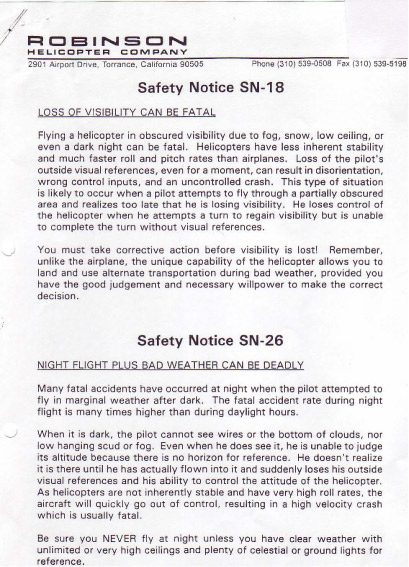
The circumstances of this occurrence highlight the risk of spatial disorientation during night VFR operations and reinforce the significance of the cautions included in the helicopter manufacturer's safety notices SN-18 and SN-26.
SIGNIFICANT FACTOR
The pilot departed after civil twilight in conditions where a natural horizon was probably not discernible and consistent visual reference to surface features was not likely.
Factual information
FACTUAL INFORMATION
History of the flight
On 8 September 2004, the owner/pilot of a Robinson Helicopter Company R44 Raven II helicopter, registered VH-JWX, conducted a private flight under the visual flight rules (VFR) from Coffs Harbour, NSW to Eurella Station, Qld. The flight included a landing at Roma, Qld where the pilot refuelled the helicopter with 180 L of Avgas from the bulk underground fuel storage supply.1 The pilot then continued to Eurella Station, located approximately 54 km west of Roma, arriving at 1705 Eastern Standard Time. The pilot shut down the engine and the property owner boarded the helicopter for a pre-arranged local flight. The pilot made several attempts to start the engine, during which it backfired a few times. Once started, the engine seemed to function normally.
The helicopter departed the homestead at 1725 in a northerly direction. A person on an adjoining property about 7 km north of Eurella homestead saw the helicopter operating to the east late in the afternoon. He reported that the helicopter conducted a number of take-offs and landings in what appeared to be the same general area over a period of about 30 minutes. He saw the helicopter depart in a southerly direction at about 1830.
The next reported sighting was by a person at Eurella homestead who, in poor light conditions, saw what appeared to be the helicopter's landing light to the north of the homestead. The light moved toward the west of the homestead. Soon after, that person again saw the light to the west and expected the helicopter to land at the homestead within a few minutes. However, she became concerned when the helicopter did not arrive and telephoned an employee of the property owner to report her concern. The employee contacted the Australian Search and Rescue organisation (AusSAR) and search action was initiated. The helicopter was located the following morning in open, rolling country, 3 km west of Eurella homestead. The two occupants were fatally injured, and the helicopter was destroyed.
Search and rescue
AusSAR reported that it was notified at 1947 that the helicopter was overdue. Weather conditions were unsuitable for an air search, but a surface search was initiated. AusSAR advised that no ELT signal was received on 8 September by satellite or by aircraft at high altitude passing within 130 km of Eurella Station. An ELT signal was detected on two satellite passes early on the morning of 9 September. The signals were identified as originating from separate locations; one approximately 22 km to the south-west, and the other approximately 22 km to the south-east, of Eurella Station. However, those signals were not merged by the satellites as coming from the same source, so they were of little assistance in the search. Local aircraft were tasked to begin a search at daylight on 9 September and the wreckage was located at 0708 by the crew of a search aircraft. Accident site information
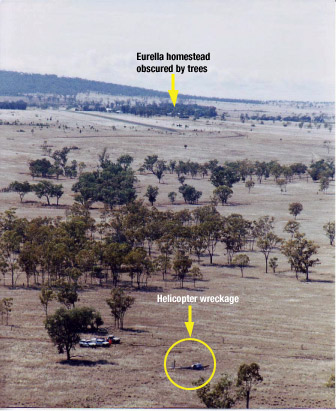
The accident site elevation was about 30 m below the ground elevation at the homestead. The homestead was not visible from the accident site.
Figure 1: Aerial view of the accident site
GPS track information
The helicopter was fitted with a fixed global positioning system (GPS) receiver, and also a handheld GPS receiver mounted in a cradle on the instrument panel. The fixed receiver did not contain a non-volatile memory card, but the handheld unit did. Track and ground-speed data for the occurrence flight was retrieved from the non-volatile memory card. Altitude information was not retained in the memory card.
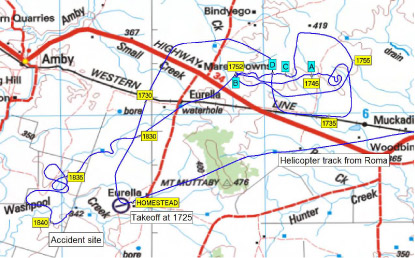
Figure 2 displays the GPS recorded track of the helicopter overlaid in blue on a 1 in 250,000 scale topographical map of the area. The local times that the helicopter was at various locations are depicted.
Figure 2: GPS track overlay, with the landing sites A, B, C and D
The GPS data showed that the helicopter landed five times during the flight. Those positions are depicted on the map and are described as follows:
Position A
The helicopter landed at 1742 and departed at 1745. There was a water tank adjacent to that location.
Position B
The helicopter landed at 1749 and departed at 1752.
Position C
The helicopter landed at 1800 and departed at 1802.
Position D
The helicopter landed at 1805 and departed at 1807.
Position B
The helicopter returned to position B at 1823 and departed at 1827.
The data indicated that, after the helicopter departed position B at 1827, it initially tracked almost directly toward the homestead, but that the track then veered south-west. That track was clear of the high ground indicated by the 400 m contour near Mt Muttaby, as depicted on the chart at Figure 2. There are distinct features in the helicopter's track after 1830, indicating that the pilot turned toward the homestead on four separate occasions between 1830 and 1840, only to turn away each time. The accident occurred on the fifth occasion that the helicopter's recorded track turned in the approximate direction of the homestead.
Subsequent to the occurrence, an employee from Eurella Station found that cattle had been moved from the paddock that included positions A, C, and D, to an adjoining paddock. Those paddocks were linked by a gate adjacent to position B. The employee recalled that the property owner had intended to move the cattle to the adjoining paddock and that the gate adjacent to position B was the gate through which he would have expected the cattle to be moved.
Pilot information
The pilot held an air transport (aeroplane) pilot licence and a command multi-engine instrument rating. He had extensive aeroplane flying experience, including regular public transport turbo-jet aircraft and corporate turbo-jet aircraft operations in Australia and overseas. His aeroplane flying experience exceeded 10,000 hours and included 1,418 hours of night flight and 711 hours of instrument flight.
The pilot obtained a private pilot (helicopter) licence on 23 September 1998 and had about 582 hours helicopter experience. He obtained a night VFR (helicopter) rating on 12 September 2000 and since that date had recorded about 11 hours helicopter night flight. Almost all of the logged flights were in the Sydney metropolitan area. Helicopter night flying recorded by the pilot in the two years prior to the occurrence was 0.4 hours on 23 August 2004 and 0.6 hours on 26 August 2004. That night flying most likely occurred during the latter stages of flights to the Sydney metropolitan area.
There was no record of the pilot having received any specific training in operating helicopters in remote areas or dark night conditions where there was little or no ambient lighting. No helicopter instrument flight time was logged.
The pilot held a valid medical certificate. Post-mortem and toxicology examinations did not reveal any pre-existing condition that might have affected the pilot's ability to safely conduct the flight.
Helicopter information
The pilot purchased the helicopter new in early August 2004. At the time of the occurrence the helicopter had operated for 34.1 hours. The maintenance release was valid and the documentation indicated that all applicable maintenance and regulatory requirements had been met.
The helicopter was equipped and certified for night VFR operations. Instrumentation included an airspeed indicator, artificial horizon, sensitive pressure altimeter, turn coordinator, horizontal situation indicator, global positioning system indicator, and vertical speed indicator.
The helicopter was equipped with twin landing lights in the lower nose section. The lights were fitted with 100 watt spot globes and, according to the Aircraft Flight Manual, were 'set at different angles to increase the pilot's field of vision'. Both lights were activated by the one switch which was mounted on the cyclic control centre post.
A row of eight amber warning lights located at the top of the flight instrument panel included a clutch warning light. A further six warning lights were positioned at the top of the centre pedestal.
The helicopter's engine was coupled to the rotor drive system via four double-stranded vee-belts. After engine start, an electric actuator would tension the belts when the pilot engaged the clutch switch. The actuator sensed belt tension and was automatically energised when the tension was less than required. The clutch warning light would illuminate whenever the clutch actuator circuit was activated. The Aircraft Flight Manual included a note regarding the clutch in Section 3, Emergency Procedures. The note stated that stretching of the belts often resulted in illumination of the clutch warning light for brief periods as the drive actuator readjusted belt tension. The note also included actions that the pilot should take after 7 or 8 seconds of illumination of the clutch light. One of those actions was to pull the clutch circuit breaker.
The helicopter was fitted with a Pointer (TSO-C91A) Model 3000-10 emergency locator transmitter (ELT). The unit was located on the left side of the rear fuselage.
The total flight time from Roma until the time of the occurrence was about 1 hour 35 minutes. Assuming a fuel usage rate of 60 L per hour, approximately 95 L would have been consumed during that time. On that basis, approximately 95 L should have remained at the time of the occurrence.
Wreckage information
opposite to the helicopter's direction of travel at impact. The impact severely crushed most of the cabin area and deformed the fuselage and tail boom structures. Two distinct main rotor blade impact marks on the ground forward and to the right of the initial nose impact position, and the damage to the main rotor blades, indicated that the rotor blades were being driven by the engine at impact. The tail-rotor system was intact and there was no evidence that the fuselage was yawing at impact. There was no indication that the helicopter had struck any of the trees in the vicinity of the impact site.
The left fuel tank ruptured during the impact sequence and was empty. The right fuel tank was also empty. With the helicopter lying on its left side, the right fuel tank vent line was at the lowest part of the tank and would have allowed fuel to drain out. There was a strong smell of Avgas in the vicinity of the wreckage on the day after the accident.
The hydraulic system switch was found in the ON position.
Instrument panel light globe and instrument examination confirmed that electrical power was available to the instruments. There was no evidence of malfunction of any of the instruments.
The six warning lights at the top of the centre pedestal were destroyed by impact forces, preventing an assessment being made of their status at impact. The eight warning lights at the top of the flight instrument panel were intact. Examination of those light globes revealed stretching of the clutch warning light filament. Stretching indicates that the filament was hot and that electrical power was applied to the globe when it was subject to forces during the impact sequence. It was not possible to determine the length of time that the globe had been illuminated. Filament stretch was not evident in any of the other seven warning light globes from the top of the instrument panel.
Damage to the landing light globes prevented any assessment being made regarding their status at the time of the occurrence. The damage to the landing light switch indicated that it was in the ON position at impact.
The circuit breaker panel was destroyed by impact forces. The clutch actuator fuse was serviceable. The wreckage examination did not reveal any fault in the clutch system. Although the circuit breaker panel was destroyed, the evidence of electrical power to the clutch warning light indicates that the circuit breaker was engaged, and therefore the system was powered at the time.
The coaxial cable from the ELT unit to the external antenna had separated at the connector to the antenna base on the inside of the antenna mounting panel. The separation of the coaxial cable trapped the transmitted signal within the fuselage compartment. That rendered the ELT unit ineffective and prevented satellite detection of the signal. The separation of the cable appeared to have been as a result of impact forces. As a result, the search and rescue effort was significantly affected.
Specialist examination of the ELT revealed that it had activated upon impact and, when connected to a suitable antenna, was capable of transmitting a normal signal.
The engine was test run after removal from the wreckage and operated normally. The hydraulic pump and three hydraulic servos that formed part of the main rotor flight control system were removed from the wreckage for functional testing. The tests were conducted at the helicopter manufacturer's facility in the USA and supervised on behalf of the ATSB by a representative from the US National Transportation Safety Board. The tests confirmed that the hydraulic system components met the specifications for normal operation.
Meteorological information
Documents found in the helicopter included an Area 41 weather forecast valid from 0900 to 2100 on the day of the occurrence and the Roma terminal area forecast (TAF) valid from 1200 to 2400 on the day of the occurrence.
The area forecast indicated that the weather in the vicinity of Eurella Station would include areas of rain with locally moderate falls, scattered showers and isolated thunderstorms. The Roma TAF indicated that between 1500 and 2400 there would be 60 minute periods in which the visibility would be 2 km in heavy rain, with broken cloud2 at 700 ft.
An analysis by the Bureau of Meteorology indicated that during the late afternoon on the day of the occurrence, a surface trough was located from Camooweal to St George, with cold south-west winds to its west and northerlies to its east. The surface trough combined with an upper level trough over the southwest of the state to bring a large cloud band with widespread rain and isolated thunderstorms to the interior. The analysis of satellite imagery and synoptic reports, concluded that there was a high probability of rain in the Eurella Station area around the time of the occurrence, and most likely greater than 5 oktas of cloud cover. However, because the nearest weather radar station was about 200 km distant at Charleville, the amount of cloud cover in the area of the occurrence could not be confirmed.
Persons at and near Eurella Station variously reported that the weather conditions during the day of the accident were windy, with heavy cloud and showers.
Astronomical information
According to information published on the Geoscience Australia website, sunset and twilight times at Eurella Station on the day of the occurrence were:
Other information on the website indicated that the moon set at 1409 and was 79 degrees 31 seconds below the horizon at 1830 that evening.
Helicopter night VFR
The pilot's night VFR (helicopter) rating authorised him to act as pilot in command of private or aerial work flights at night under the VFR. Once issued, a night VFR rating remained permanently valid. To exercise the privileges of the rating, a pilot needed to complete a 1-hour night flight during the previous 12 months and one take-off and landing at night during the previous 6 months. There was no requirement for the holder of a night VFR rating to have any recent instrument flight time prior to conducting a flight at night.
A pilot operating under the VFR at night was required to operate in visual meteorological conditions that included a minimum of 5 km visibility. The Aircraft Flight Manual, Section 2, Limitations, included the following statements:
VFR operation at night is permitted when landing, instrument, and anti-collision lights are operational. Orientation during night flight must be maintained by visual reference to ground objects illuminated solely by lights on the ground or adequate celestial illumination.
At the time of the occurrence there was a 1,000 watt flood light on each of the northern and western walls of Eurella homestead, as well as lights in other buildings. However, there were many trees in the vicinity of the homestead, some of which were higher than the homestead roof. Depending on the altitude and position of the helicopter, the trees could have prevented those lights being seen from the helicopter (Figure 1). There was no other lighting in the general area, including at the airstrip adjacent to the homestead. The homestead lights, in effect, formed a 'point' source of light.
Spatial Disorientation
Spatial disorientation refers to a situation in flight in which the pilot fails to sense correctly the position, motion or attitude of the aircraft. When the condition is fully developed, the pilot is unable to tell which way is 'up'.
The risks of non-instrument rated pilots flying in conditions in which they are not able to orientate the aircraft by visual reference have been well known for over 50 years. During testing conducted on a group of non-instrument rated pilots, the average time before loss of control of the aeroplane, after visual reference was lost, was 178 seconds.5
US FAA Advisory Circular 60-4A, Pilot's Spatial Disorientation, was published in 1983 and was intended to inform pilots of the hazards associated with disorientation caused by loss of visual reference with the external environment. It included the following information:
Tests conducted with qualified instrument pilots indicate that it can take as much as 35 seconds to establish full control by instruments after the loss of visual reference with the surface.
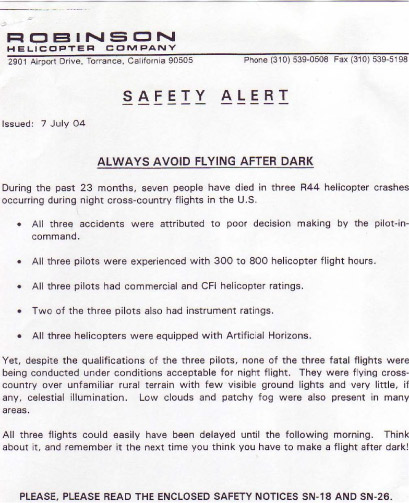
The helicopter manufacturer issued a safety alert and safety notices (SN) as a result of various occurrences and incidents, and included those notices in the Aircraft Flight Manual Section 10, Safety Tips. Two of the notices related to night flight - SN-18 Loss of Visibility Can Be Fatal, and SN-26 Night Flight Plus Bad Weather Can Be Deadly (see Appendix A). Safety notice SN-18 stated in part:
Helicopters have less inherent stability and much faster roll and pitch rates than airplanes. Loss of the pilot's outside visual references, even for a moment, can result in disorientation, wrong control inputs, and an uncontrolled crash.
Appendix A
1.On the day of the occurrence, other aircraft were refuelled from the Roma bulk fuel storage. The ATSB received no reports of fuel quality related problems involving those aircraft.
2. Forecast cloud was explained as 'few'-1 to 2 oktas (okta - a unit of visible sky area representing one-eighth of the total area visible to the celestial horizon), 'scattered'- 3 to 4 oktas, 'broken'- 5 to 7 oktas and 'overcast'- 8 oktas.
3. Sunset is defined as the instant in the evening under ideal meteorological conditions, with standard refraction of the sun's rays, when the upper edge of the sun's disk is coincident with an ideal horizon.
4. Ending of evening civil twilight is defined as the instant in the evening when the centre of the sun is at a depression angle of six degrees below an ideal horizon. In the absence of moonlight, artificial lighting or adverse atmospheric conditions, the illumination is such that large objects may be seen, but no detail is discernible.
5. Bryan, L.A., Stonecipher, J.W. & Aron, K. 1954. 180-degree turn experiment. University of Illinois Bulletin. 54(11), 1-52.
Summary
On 8 September 2004, the owner/pilot of a Robinson Helicopter Company R44 Raven II helicopter, registered VH-JWX, conducted a private flight under the visual flight rules (VFR) from Coffs Harbour, NSW to Eurella Station, Qld. The flight included a landing at Roma, Qld where the pilot refuelled the helicopter with 180 L of Avgas from the bulk underground fuel storage supply. The pilot then continued to Eurella Station, located approximately 54 km west of Roma, arriving at 1705 Eastern Standard Time. The pilot shut down the engine and the property owner boarded the helicopter for a pre-arranged local flight. The pilot made several attempts to start the engine, during which it backfired a few times. Once started, the engine seemed to function normally.
As a result of this occurrence the Australian Transport Safety Bureau issued the following safety recommendations:
R20040074 Issued on 25 October 2004
The Australian Transport Safety Bureau recommends that the Civil Aviation Safety Authority advise operators of Beechcraft King Air and Raytheon King Air aircraft of the potential safety deficiency of the cabin door warning system becoming prematurely earthed, resulting in a sense switch or switches no longer providing an electrical signal for its or their position.
Civil Aviation Safety Authority response
On 10 February 2005, the Civil Aviation Safety Authority issued Airworthiness Bulletin AWB31-3 Issue 1, recommending that all operators of Beechcraft King Air and Raytheon King Air aircraft examine the cabin door internal switches for possible earthing of switch terminals.
ATSB Response status: Closed - accepted
R20040075 Issued on 25 October 2004
The Australian Transport Safety Bureau recommends that the United States Federal Aviation Administration advise operators of Beechcraft King Air and Raytheon King Air aircraft of the potential safety deficiency of the cabin door warning system becoming prematurely earthed, resulting in a sense switch or switches no longer providing an electrical signal for its or their position.
US Federal Aviation Administration response
To date, there has been no response from the US Federal Aviation Administration to safety recommendation R20040075.
Aircraft manufacturer
In November 2004, the aircraft manufacturer issued Safety Communiqué No.251, that advised all operators of B300 series aircraft of the possibility of the inadvertent earthing of the cabin door sense switch. In December 2004, the manufacturer issued mandatory service bulletin SB52-3701, detailing inspection and installation requirements of the forward and rear cabin airstair door latch hook switches.
Analysis
No defects were found with the cabin door mechanical locking system. Prior to take-off, the locking mechanism of the door was checked by the safety pilot and no problems were reported. When the separated door was located, the external handle was not in the locked position and the latch bolts were not fully extended.
It was possible to move the door locking handle to a high resistance position, where the green line indicators on the latch bolts appeared to line up with the stationary arrow heads in the inspection windows, but the door locking mechanism was not fully engaged. At that position, if the top latch hook sense switch was short circuited due to the proximity of the sense switch terminal and the mounting nut, the door warning light would be extinguished. This condition would provide the crew with no indication that the door was not correctly locked.
Factual information
Factual Information
The PIC reported that, while passing Flight Level 175 on descent, he heard a loud muffled thud and then air noise, and saw that the cabin door had opened and separated from the aircraft. There had been no door warning indication prior to the door opening.
Following the door separation, the cabin door warning light illuminated and the cabin oxygen masks deployed. The PIC completed emergency checks before diverting the aircraft to Thangool, Queensland.
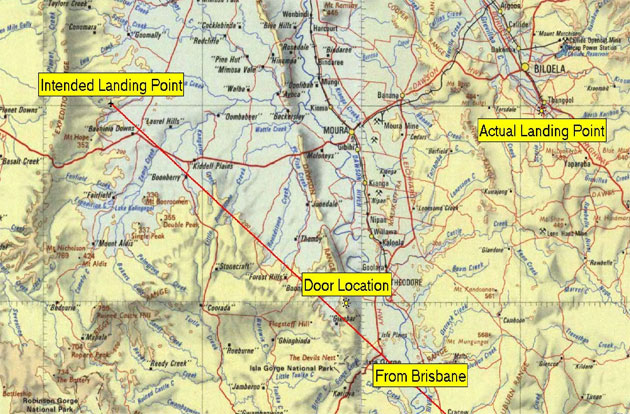
On 12 September 2004, after a search by the aircraft operator, the cabin door was found approximately 3 NM north of Glenbar, Queensland (see Figure 1). When the door was found, the external handle was not in the locked position and the latch bolts were not fully extended.
Figure 1: Location of recovered door
Aircraft cabin door
The aircraft's cabin door was an outward-opening airstair type, hinged at the bottom, with a diaphragm and mechanical over-centre locking mechanism. It was also fitted with a pressurised seal.
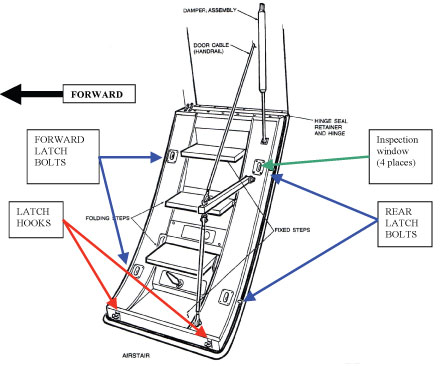
The cabin door mechanical locking system consisted of four latch bolts. Two were located on the rear side of the door and two on the forward side of the door. In addition, two latch hooks located on the top of the door engaged onto stationary locking pins located within the fuselage (see Figure 2).
Figure 2: B300 cabin door locking mechanism
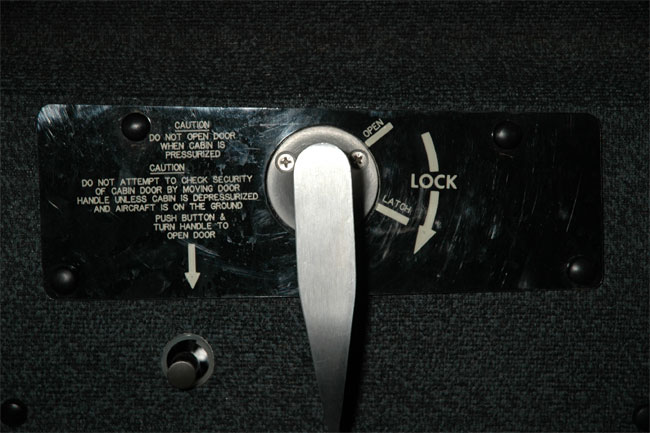
Locking and unlocking of the cabin door was accomplished by means of either the external or internal door handles. Once the aircraft was pressurised, the door's pressure seal inflated. As the pressure differential between the interior and exterior of the aircraft increased, the cabin door's internal diaphragm expanded and locked the interior handle to prevent inadvertent opening in-flight. The cabin door interior trim had three positions marked for the door handle, OPEN, LATCH and LOCK (see Figure 3).
Figure 3: Cabin door interior handle in lock position
When the locking mechanism was in the LOCK position, the door handle could not be moved to the LATCH or OPEN position until a release button on the internal diaphragm was depressed.
Each forward and rear latch bolt was marked with green line indicators, which aligned with stationary arrow heads that indicated that the cabin door was locked. The green line indicators were viewed through inspection windows at four locations on the inside of the door.
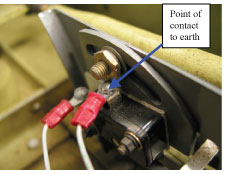
The recovered door was sent to the Australian Transport Safety Bureau for further examination. The investigation found that the mechanical latching mechanism was intact, however the door's rear latch hook sense switch terminal screw and the sense switch adjustment nut were located in very close proximity and intermittently contacted (see Figure 4).
Figure 4: Rear latch hook sense switch
The rear latch hook sense switch mounting plate showed no significant distortion and there was no evidence of in-service movement of the rear latch hook sense switch adjustment mechanism.
A circuit test of the three sense switches located within the door (two switches for the two latch hooks and one for the door handle position), determined that it was possible for the rear latch hook sense switch terminal to contact the switch mounting plate retaining nut, providing a short circuit to earth. This had the effect of rendering the door handle centre lock sense switch inoperative. In this condition, the door handle centre lock sense switch would not provide an indication to the crew of an unlocked door.
The examination also found that the door handle reached a position of maximum resistance between the LATCH and LOCK position just prior to the mechanism reaching the over-centre and locked position. It was possible to move the locking handle to this high resistance position, where the green line indicators on the latch bolts appeared to align with the stationary arrow heads in the inspection windows, but the latching hook had not yet activated the centre locking mechanism handle sense switch.
Summary
On 7 September 2004, at about 0710 Eastern Standard Time, a Raytheon B300 King Air aircraft, registered VH-KJD, was being operated on a private Instrument Flight Rules flight, from Brisbane to Truganinnie, Queensland, with the pilot in command (PIC) and, what the operator termed, a 'safety pilot'. The safety pilot was qualified on the aircraft type. Prior to departure from Brisbane, the aircraft's cabin door had been closed by the safety pilot, who stated that all of the pre-flight cabin door checks had been conducted in accordance with the pilot operating handbook.
In August and November 2004, two Bombardier DHC8-315 aircraft, VH-SBJ and VH-SBW, experienced similar abnormal airspeed indications during flight. At the time, both aircraft were being operated in instrument meteorological conditions in cloud and conditions conducive to icing. Examination of flight data recorder information suggested that the pitot heads had become blocked, most probably by ice, preventing air pressure being sensed by the instruments.
The investigation found that the aircraft maintenance manual contained inadequate guidance regarding the continued airworthiness of the pitot head and associated electrical system and that the Quick Reference Handbook for the DHC8-300 did not contain adequate guidance for the flight crew to resolve the abnormal operation of the aircraft systems.
Following the reported incidents, Bombardier, the manufacturer of the DHC8 series aircraft, published a service letter, DH8-SL-34-023. The service letter advised of new procedures regarding the maintenance of pitot head assemblies and associated electrical connectors.
Occurrence summary
Investigation number
200403238
Occurrence date
31/08/2004
Location
78km NNW Brisbane, VOR
State
Queensland
Report release date
08/06/2007
Report status
Final
Investigation type
Occurrence Investigation
Investigation status
Completed
Mode of transport
Aviation
Aviation occurrence category
Icing
Occurrence class
Incident
Highest injury level
None
Aircraft details
Manufacturer
De Havilland Canada/De Havilland Aircraft of Canada