The following safety actions have been carried out by the engine manufacturer following this failure:
The engine manufacturer introduced Temporary Revision 72-937, dated 11 February 2005 for the engine maintenance manual. This temporary revision introduced a modified procedure for the installation of the number 3 bearing package 'O' rings to reduce the risk of damaging the 'O' rings during installation. The temporary revision is scheduled to be incorporated into the next full revision of the engine maintenance manual.
The manufacturer also evaluated changing the current 32 to 28 degree chamfer on the engine's gas producer module stub frame mount surface to 15 to 20 degrees. However, after performing several installation and removal trials, it was felt that this change was not necessary. No further changes or corrective actions are anticipated.
Analysis
The number 4 engine in-flight failure was the result of the failure of the high-pressure compressor rotor, number 1 bearing, due to insufficient lubrication. The lack of lubrication was the result of leakage past the two damaged 'O' rings on the perimeter of the number 3 bearing package support assembly, and the blockage of an oil jet in the package support that supplied oil to the front side of the number 1 bearing.
It is probable that the two 'O' rings were damaged during installation while the new carbon seals were being fitted on 24 December 2003.
Factual information
On 28 July 2004, a British Aerospace PLC, BAe 146 aircraft, registered VH-NJA, was in cruise flight at flight level (FL) 280, on a scheduled passenger service from Brisbane to Adelaide. At 1245 EST, the flight crew (crew) felt and heard a light to moderate rumbling and grinding noise.
A check of the aircraft and engine instruments indicated that the number 4 engine had a rapidly decreasing N11 RPM and an N22 RPM of less than 10%. The turbine gas temperature (TGT) for that engine appeared to indicate zero and the thrust management system (TMS) showed an error message and a 'Test Fail' indication.
The crew shut the engine down in accordance with the operator's abnormal checklist procedures and turned off the TMS. A fire bottle was discharged into the number 4 engine cowling area as a precaution.
The crew informed the cabin crew of the engine failure, with one of the flight attendants reporting having seen sparks coming from the engine.
The crew contacted air traffic control (ATC) requesting a descent to FL150 to start the auxiliary power unit (APU). The passengers were also advised that a generator failure had occurred. The air traffic controller later contacted the crew asking if operations were normal. At that time, they informed ATC that the engine had failed and that they were continuing to Adelaide. The crew advised that they would not be declaring an emergency.
After starting the APU, the crew climbed the aircraft to FL240 and continued to Adelaide.
The failed ALF502R-5(-103A) engine, serial number LF05932, was removed from the aircraft and forwarded by the Australian Transport Safety Bureau (ATSB) to the engine manufacturer in the US. An investigation of the failed engine was carried out by the engine's manufacturer in August 2004, with a representative of the US National Transportation Safety Board present on behalf of the ATSB.
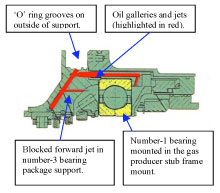
The investigation found that the engine failure resulted from the failure of the high-pressure compressor rotor, number 1 bearing, due to high temperature damage resulting from insufficient lubrication. The number 1 bearing was located in the stub frame mount in the engine's gas producer module (see diagram).
Lubricating and cooling oil was supplied to the bearing via two jets: one each for the front and rear of the bearing.
Oil was ported to the two oil jets through galleries located in the number 3 bearing support assembly. The oil supply galleries and jets were sealed by two 'O' ring packings that were positioned on the outside diameter of the number 3 bearing support assembly.
Examination of the number 3 bearing package support assembly found that both 'O' rings on the outside diameter of the support had multiple 'nibbles' (small missing pieces) around their circumference. The forward 'O' ring had also been cut completely through. Sectioning of the number 3 bearing support found that the oil jet that supplied lubrication to the front of the number 1 bearing was also blocked with 'O' ring material. Analysis of that material found it was consistent with the missing pieces of 'O' ring from the outside of the number 3 bearing package support.
The engine manufacturer estimated that leakage past the damaged 'O' ring and the blocked oil jet had reduced the lubricating and cooling oil supply to the number 1 bearing by approximately 50 to 60 percent. The report further indicated that all other engine damage noted had resulted from the failure of the number 1 bearing.
The ATSB determined that the number 3 bearing package support was last removed from the engine by the aircraft operator during maintenance on 24 December 2003. The bearing package support had been removed to facilitate the fitment of new carbon seals to the number 1 and number 3 bearings. During that maintenance, both 'O' rings on the support were replaced. At the time of the engine failure, the engine had completed 975 hours and 706 cycles since that maintenance. Information from the operator indicated that there had been no history of excessive oil usage or excessive vibration on the trend graphs for the engine.
N1 (NL) engine low pressure turbine and fan RPM.
N2 (NH) engine high pressure compressor and turbine RPM
Summary
On 28 July 2004, a British Aerospace PLC, BAe 146 aircraft, registered VH-NJA, was in cruise flight at flight level (FL) 280, on a scheduled passenger service from Brisbane to Adelaide. At 1245 EST, the flight crew (crew) felt and heard a light to moderate rumbling and grinding noise.
On 11 November 2005, CASA advised that is was considering a review of Civil Aviation Advisory Publication (CAAP) 92-2(1) - Guidelines for the establishment and use of helicopter landing sites, which would take into account issues including helipad load bearing capability, including how such information is relevant to owners and users of helipads, the differences in deck-imposed loads for wheel compared to skid equipped helicopters, and whether the load bearing capability of a helipad should be painted on the landing surface.
CASA also advised that it represented Australia on the International Civil Aviation Organization Aerodromes Panel which has established a Heliport Design Working Group to review the design standards for helicopter landing sites. Recommendations from the working group, which are expected in mid 2006, may assist in a review of the CAAP.
On 18 October 2005, the Queensland Government advised that it had undertaken significant action to review and enhance its management and operation of its helicopter landing sites in Queensland since the accident. Those measures included:
closure and removal of the helipad from the Brisbane River;
the conduct of an audit of Queensland Government owned helicopter landing sites;
establishment of a project within the Department of Public Works assisted by a whole of government reference group to develop comprehensive guidelines for administration of Queensland Government helicopter landing sites, in consultation with the Civil Aviation Safety Authority; and
engagement of a consultant to prepare the guidelines, due for completion in December 2005.
On 9 January 2006, the Queensland Government advised that:
… the consultant appointed to develop guidelines for the management of government helicopter landing sites has been given an extension until 25 January 2006 to complete the guidelines. Following review by the Committee and government consideration, it is anticipated that the guidelines will be finalised and adopted during the first quarter of 2006.
Analysis
ANALYSIS
The circumstances of the accident are consistent with dynamic rollover occurring after the right wheel penetrated the helipad surface and acted as a pivot point about which the helicopter rolled. As the helicopter rolled, the main rotor blades contacted the walkway. Because the timing and order of the events that occurred during the rollover were not available, a detailed analysis of the accident sequence was not possible. However, the pilot's response of applying opposite cyclic control, but not lowering the collective pitch control when the helicopter began to roll was not the most effective method of preventing the development of the rollover. Whether the rollover may have been prevented and/or the consequences limited had the pilot lowered the collective pitch control was not able to be determined.
The pilot did not establish before the landing that the load capability of the helipad was appropriate to the requirements. He appeared to have two bases to support his decision to operate the Agusta A109C onto the helipad. One was that neither the helipad owner, nor CASA, had told him that he could not. Such reasoning was inadequate and demonstrated a low level of risk awareness. The second was that other helicopters of operating weight similar to the Agusta A109C had used the helipad. That reasoning was also inadequate because it did not take into account that those helicopters were skid-equipped, and would not subject the helipad deck to the point loads that would exist with the Agusta A109C. It demonstrated an inadequate level of knowledge.
The location of the deck failure was where the plywood would be subject to the greatest bending for a given load, and consequently, where a failure was most likely to occur. The potential for a similar failure would have been present since changes were made to the plywood sheeting size and grade. However, variability between factors such as helicopter wheel positions, dynamic movement of the helipad, and the pilot's flight control inputs would have changed the effect on the deck of each landing. It is likely that the crack in the underside of the plywood in the area of the deck opposite the failure location was an example of the effect of those factors during a previous landing by the helicopter.
Documentation regarding maintenance of the helipad indicated that the installation of the smaller size sheeting most likely occurred during repairs that were completed in September 2000. At that time, other than by way of the design drawings prepared in 1984, full-width plywood sheeting was not specifically addressed either by the oversighting government department or the contractor conducting the repairs.
The strength of the helipad deck compared with the load imposed by the helicopter can be demonstrated from the following information:
Decking design load
73 kg (evenly distributed on each 600 mm x 400 mm panel)
Calculated static load on each helicopter main wheel
928 kg (spread over the tyre footprint, which approximates a point load of 66 MPa)
Decking design stress
5.138 MPa
Measured strength of plywood from failed deck
61 MPa
Strength of marine grade plywood
40 MPa
It is apparent that the strength of the plywood used in the decking (61 MPa) was approximately 12 times greater than required by the design (5.138 MPa). By comparison, the load applied by each main wheel (928 kg) was approximately 13 times greater than the design load (73 kg per panel).
It is unlikely that the helipad owner calculated the load bearing capability of the helipad with respect to specific helicopters that used the helipad, or their type of landing gear. In particular, the reason for the 2,000 kg load limit, as advised to users of the helipad, appears to be unsubstantiated. The potential for the plywood to be subjected to point loads by helicopter wheels, was not taken into account during the design of the replacement deck. Together with the dynamic movement of the deck by wind and wave action, that effect would have significantly increased the effective ratio of wheel loading to deck design load.
The load limit issues, the installation of plywood deck sheeting of size inappropriate given the existing supporting structure, and the poor condition of some areas of the deck indicated shortcomings in the maintenance and management oversight of the helipad.
Prior to April 2004 there was apparently no awareness within the helipad owner's organisation of the significance of helicopter landing gear configuration to the load bearing capability of the helipad. Nor were there indications that the owner was aware of CAAP 92-2(1), or the guidance it contained. It is likely that those issues were unrecognised due to a lack of aviation technical expertise within the helipad owner's organisation.
CONCLUSIONS
Factors
Management and maintenance of the helipad did not encompass all the aspects necessary to ensure that the actual load bearing capability of the helipad, including for skid and wheel type landing gear equipped helicopters, was known.
The actual load bearing capability of the helipad was less than that required for safe use by the Agusta A109C helicopter.
The pilot did not check before the flight, whether the helipad was capable of safely accepting the loads imposed by the Agusta A109C helicopter.
On 30 July 2004, at about 1120 Eastern Standard Time, an Agusta A109C helicopter, registered VH-ZZN, was being operated on a private flight from the Gold Coast to Brisbane Airport via the Brisbane River Helipad. The pilot and two passengers were on board. The intention was to disembark one of the passengers at the helipad, without shutting-down the engines, and then to continue the flight to Brisbane Airport.
The pilot reported that he established the helicopter in a low hover above the helipad and was satisfied that it was correctly positioned above the painted white landing circle. He then allowed the wheels to settle on the helipad, with the right side of the helicopter facing the river bank. The pilot said that he kept his left hand on the collective pitch control lever and his feet on the tail rotor pedals. He then gripped the cyclic control with his knees so that he could open the cockpit door with his right hand. He leaned out and checked that the helicopter was centrally positioned in the landing circle and that the right main wheel was not causing any visible stress to the helipad surface. He then applied the parking brake and closed the door before telling the passenger to disembark through the right cabin door.
The pilot recounted that when the passenger was safely clear of the helicopter, he applied a small amount of collective pitch control in preparation for lift off. He then felt the helicopter lurch and begin to roll right. The pilot immediately applied full left cyclic pitch control and maintained the collective pitch control position. However, the helicopter continued to roll rapidly right and the main rotor blades struck the walkway safety rails. The helicopter came to rest inverted between the helipad and the riverbank, with the forward fuselage against the junction between the helipad and the connecting walkway.
The helicopter was not fitted with a flight data recorder or cockpit voice recorder, nor was it required to be by relevant aviation regulations. Consequently, there was no information available regarding the events or timing of the accident sequence, including the rate of helicopter movement and any control inputs made by the pilot.
Injuries to persons
The pilot and passenger received minor injuries but were able to egress from the helicopter unassisted.
Damage to the helicopter
The helicopter was substantially damaged during the rollover sequence. Contact with the walkway destroyed the main rotor blades and damaged the forward fuselage. The fuselage was partly immersed in water. There was no fire.
Debris from the helicopter was found up to 200m from the helipad, both on and adjacent to the pedestrian/bikeway on the riverbank. There was potential for debris to have been thrown onto the adjacent road complex.
Other damage
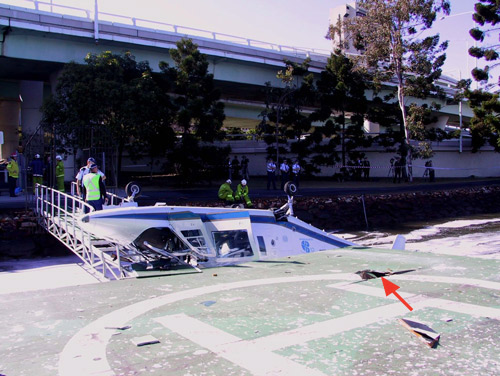
Initial examination of the helipad revealed that the helicopter's right main wheel had broken through the deck sheeting on the edge of the white painted landing circle (Figure 1). See also page 7, 'Helipad examination'.
The helicopter's main rotor blades caused substantial damage to the walkway linking the pontoon to the riverbank.
Figure 1: The helicopter as it came to rest. The arrow points to the location of the deck surface failure
Pilot in command
The pilot, who was the chief pilot of the organisation that operated the helicopter, held a valid commercial pilot licence (helicopters). His total flying experience (all rotary wing) was 1,720 hours, of which approximately 250 hours were on the Agusta A109C type (all on VH-ZZN). The pilot had operated onto the Brisbane River Helipad on numerous occasions since 1 July 2003 in Hughes 500 and McDonnell Douglas 600 type helicopters, and on 19 occasions in the Agusta A109C type2.
Aircraft information
The Agusta A109C was a twin turbine-engine helicopter capable of carrying up to seven passengers. Its maximum operating weight with an internal load was 2,720 kg. The helicopter was equipped with a retractable landing gear, which comprised a nose wheel and two main wheels.
The estimated weight of the helicopter at the time of the accident (including approximately 300 L aviation turbine fuel) was 2,471 kg. Under those conditions, and taking account of the centre of gravity position, the static load on each main wheel was about 930 kg. According to documentation provided by the operator, there were no outstanding maintenance requirements for the helicopter at the time of the accident. The pilot reported that the helicopter was operating normally in the period prior to the accident.
Brisbane River Helipad
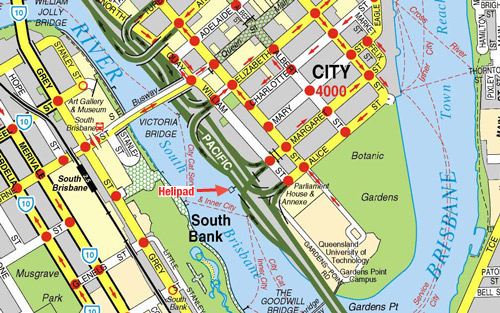
The 9.4 m square helipad was owned and administered by the Queensland State Government. It was located adjacent to the northern bank of the Brisbane River at the end of Margaret Street in Brisbane City (Figure 2). It was mounted on a tethered floating pontoon that was linked to the riverbank by an 11 m walkway. Safety rails approximately one metre high were attached to either side of the walkway. There was a pedestrian pathway and motor vehicle road infrastructure along the riverbank adjacent to the helipad.
Figure 2: The Brisbane River Helipad location
Documentation relating to the operation and maintenance of the helipad was contained in separate files that were administered by various Queensland State Government departments and branches of departments during the period 1981-2004. Through most of that time, operational control and maintenance responsibility for the helipad were held by separate departments, with maintenance aspects being handled predominantly by the department that had responsibility for maritime safety and/or harbours and marine. No record was found on the files of the original design criteria for the helipad, including the helicopter type(s), operating weights, and type of landing gear (skid or wheels) for which it was intended to be used.
Helipad examination
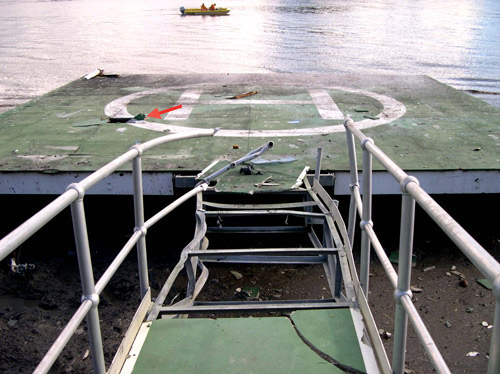
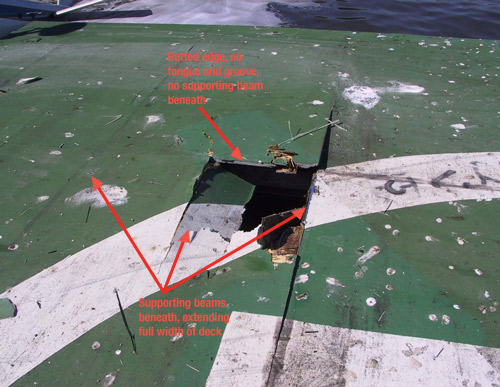
The helipad deck (Figure 3) consisted of 1,200 mm x 2,400 mm plywood sheeting nailed to 100 mm x 75 mm hardwood joists 600 mm apart. The joists were attached to a series of aluminium 'I' beams mounted on two pontoons. The longer (2,400 mm) sides of the plywood sheets had tongue and groove edges and butted over the approximate mid-point of every alternate joist. The shorter (1,200 mm) sides of the plywood sheets did not have tongue and groove edges and were not structurally connected. There was no supporting structure beneath those sides except at the midpoint position at the location of a joist. The central area of the helipad surface (where the helicopter landed) appeared to have been in relatively good condition.
Figure 3: After removal of the wreckage. Individual plywood decking sheets are evident. The arrow points to the location of the deck failure
Figure 4: Location of the deck failure and its relationship to the supporting framework
The location of the deck failure coincided with the corner of one of the plywood decking sheets (Figure 4). The nature of the failure was consistent with the right wheel of the helicopter bearing down on the plywood sheet midway between two adjacent joists, and near the edge of the sheet. The edge formed the shorter (1,200 mm) side of the sheet and was not structurally connected to the adjacent sheet edge.
Specialist examination concluded that the final failure occurred at the point of highest bending moment between the joists. The individual layers within the decking sheet all failed at the point of highest bending, suggesting that the plywood adhesive and the timber layers had not deteriorated due to water ingress.
Laboratory tests carried out on samples taken from the failed section of the deck revealed a bending strength of 61 megapascals (MPa). The size of the test samples was smaller than stipulated by the standard. However, that bending strength exceeded the bending strength of marine grade plywood3.
Examination of the underside of the deck revealed a significant longitudinal crack on the side of the deck opposite the failed section. The deck upper surface at that location showed no sign of damage. The crack displayed damage to the lower layers of the plywood midway between two longitudinal joists. The cracking was not adjacent to the edge of a plywood sheet and was not observed when the helipad was inspected in April 2004. Specialist assessment of the damage concluded that it was likely to have been caused by a point loading in the order of 1,200 kg.
Some areas of the deck on the river and upstream sides of the helipad were significantly degraded due to water ingress into the layers of the plywood, probably as a result of wave action. Examination of those areas indicated that both the ply adhesive and the wood itself had deteriorated significantly. Deterioration of that nature was consistent with continuous contact with, or immersion in, water for an extended period. Those areas, however, were not related to the occurrence.
Helipad load bearing capability
There were numerous references in the helipad owner's documentation regarding the pad's load bearing capability. The earliest of those appeared in drawings that were completed in 1984 for the installation of a new deck consisting of plywood sheets mounted on aluminium support beams (Drawing No. BN-5-43-1). The design strength of the replacement deck was based on a pressure of 3 kilopascals (kPa) evenly distributed over the entire deck area, although the origin of the selected value was not clear. A pressure of 3 kPa is equivalent to 306 kg evenly spread over each square metre of decking. The layout of the plywood sheets over the aluminium support beams resulted in a design panel size of 600 x 400 mm (0.24 sq.m), equivalent to 73 kg evenly distributed on each design panel. The designer's calculations showed that this loading would create a bending stress of 5.138 megapascals (MPa) in the plywood decking, which was well within the allowable working stresses for the F114 grade structural plywood selected for the repairs. There was no indication in the documentation that the design of the repairs included any consideration for point loads, such as would be experienced from wheel equipped helicopters.
In May 1982, a request to land a helicopter weighing up to 3,630 kg on the helipad was refused because 'it would be unsafe to place this weight on the helipad'. However, there was no supporting documentation for that statement.
A July 1997 document authorising a private operator to use the helipad included the statement that the applicant 'should be aware that there is a load limit for the HLS [helicopter landing site], and aircraft in excess of 1,400 kg should not access the HLS'. There was no information regarding the origin of that figure.
In late 1996, the Queensland Government commissioned a feasibility study by a town planning consultant on the future options for the helipad. The study, completed in late 1997, noted that there was:
… no evidence at hand which would indicate it's [the helipad's] safe load capabilities but it appears to be beyond the operation of the Queensland Emergency Services helicopter - a Bell 412 with a maximum take-off weight approaching 5,400 kg - but comfortably accommodates most small to medium-sized turbo driven helicopters in use in the region. The practical limit appears to be approximately 3,000 kg.
There was no supporting evidence to indicate how that conclusion was reached.
In March 1997, there was internal correspondence regarding the establishment of a deed of indemnity that was to apply to users of the helipad. A deed was developed and in early 1999 was sent to users of the helipad for signature. In June 1999, in response to a request to use the helipad, a list of 'requirements that apply to the use of the helipad' was included, for the first time, in the covering letter to the deed. Those requirements included the following:
1. The helicopter landing site is intended for the use by helicopters within the "small" utility class only i.e. helicopters up to 2,000 kg in mass, and 2. The permittee, or their nominated pilot, are responsible for ensuring that the helicopter landing site is in suitable condition before intended use.
There was no indication in the documents regarding the origin of those 'requirements'. Subsequently, there were other instances where prospective users of the helipad were provided with a copy of the requirements when they were asked to sign the deed of indemnity.
In April 2004, a helicopter operator not associated with VH-ZZN contacted the helipad owner requesting confirmation that an Agusta A109C helicopter could land on the helipad. The operator noted that the weight of the Agusta A109C was between 2,000 and 3,000 kg and that, because the helicopter was equipped with wheel instead of skid type landing gear, a 'wheel footprint' of about '1,200 kg per mainwheel' would exist. A reply was sent to the operator advising that the helicopter weight exceeded the 2,000 kg limit that formed part of the standard terms of use for the helipad. The operator replied, noting that skid equipped helicopters weighing greater than 2,000 kg, such as the AS350 Squirrel5, had landed on the helipad.
In May 2004, the Civil Aviation Safety Authority (CASA) contacted the helipad owner regarding the helipad. CASA requested the weight restrictions and the conditions of use of the helipad, and asked whether the weight limit was clearly marked on the helipad. That request, along with the earlier questions and information regarding the suitability of the helipad for the Agusta 109 helicopter, generated activity by the helipad owner including the proposal that a safety audit of the helipad be conducted as a matter of priority.
The justification for the proposed audit was that there may be safety issues associated with the helipad that were not being adequately addressed, such as appropriate usage and signage, and the proximity of the helipad to pedestrian and motor vehicle traffic adjacent to the helipad. At the time of the accident, those issues had not been progressed.
Helipad maintenance history
The helipad owner conducted major maintenance on the helipad in 1984, 1997, 2000 and 2004. In the intervening periods, minor maintenance was conducted. The maintenance activities generally involved work on the flotation pontoons, mooring chains, and the walkway linking the pontoon to the riverbank, and the helipad deck. For the purposes of this report, however, discussion of maintenance activities will focus on the helipad deck.
The drawings for the helipad prepared in 1984 (Drawing No. BN-5-43-1) indicated nominal deck dimensions of 9,400 mm x 9,400 mm and specified a series of hardwood plywood 'rot proofed' decking sheets 9,400 mm x 1,200 mm, with minimum stress grade F11.
At the commencement of the work phase of the repairs conducted in 1984, the contractor proposed standard size plywood sheeting 2,400 mm x 1,200 mm for the decking but that was deemed not acceptable by the helipad owner because the sheet size was not in accordance with the drawing specifications. Subsequently, a special order of 9,400 mm x 1,200 mm plywood sheeting was obtained. The repairs to the helipad, including the installation of the new 9,400 mm long plywood decking sheets on aluminium support beams, were completed in March 1985.
The major maintenance undertaken on the helipad in 1997 included the replacement of two plywood decking sheets and painting of the deck. The documentation indicated that the replacement plywood sheets were 9,400 mm long.
Inspection of the helipad in May 2000 revealed that, in addition to other items requiring rectification, most of the plywood decking was badly deteriorated and beyond repair. On 4 May 2000, the company that subsequently won the contract to conduct the repairs was asked to provide a price:
… to replace any damaged structural plywood sheeting of the deck of the helipad (both a price to replace each sheet and a price to replace all the sheeting). The plywood shall [be] in accordance with Drawing No. BN-5-43-1 and classified as Marine Grade Structural Plywood.
The contractor provided a price to remove and replace all sheets/deck and to coat all surfaces with a product that he stated would waterproof all surfaces and provide total protection to the pontoon/helipad for many years. The contractor was awarded the contract on 16 May 2000. Aside from the reference contained in drawing No. BN-5-43-1, the documents did not refer to the plywood decking sheet size. Documents dated early September 2000 indicated that the rectification works had been inspected as being completed. There was no confirmation in those documents regarding the grade of plywood or sheet size used on the deck.
Another inspection of the helipad was conducted in December 2003. Among the defects identified were four areas of deck sheeting that had loosened, and that the deck needed repainting. The pontoon was removed from the river in March 2004 and the repairs undertaken. There was no reference to any plywood deck panels or supporting beams being replaced during that work. The helipad was returned to service on 21 April 2004.
Operator's information regarding the helipad
The helicopter operating company's operations manual included a register of helicopter landing sites that were used by the company, and pertinent details regarding those sites. The Brisbane River helipad was included in that register. The register details included a caution note regarding river craft during approach and departure, and local pedestrian traffic during approach termination. The register contained no information regarding the load capability of the helipad.
An email dated 1 December 2003 was sent by the helipad owner to the company operating the helicopter regarding access by that operator to the Brisbane River Helicopter Landing Site. The email stated that the deed of indemnity applying to the operator was attached to the email along with:
a copy of the cover sheet that accompanies the Deed of Indemnity as this cover sheet provides details of access restrictions etc.
However, the investigation was unable to establish conclusively that details of the access restrictions had been attached to the email. The deed of indemnity, signed by the helicopter pilot under the company seal, was returned to the helipad owner by facsimile on 1 December 2003 under the signature of the company operations manager.
The pilot reported that he had not sought any information from the helipad owner regarding the load capability of the helipad and claimed that he was not aware that the helipad had a load rating. He stated that he had never seen any document regarding a load rating for the helipad and that the helipad owner had never advised him of a weight limit for operating on the helipad. His rationale for not seeking information regarding the load capability of the helipad was that both the helipad owner and CASA were aware that he was operating the helicopter onto the helipad and neither organisation had advised him against such operations. He had therefore presumed that it was safe to land on the helipad.
The pilot believed that a Bell 412 helicopter operated by the helipad owner had landed on the helipad, and that 'countless other helicopters of larger sizes' than the Agusta 109 had operated onto the helipad. (Personnel involved in the operation of the helipad owner's Bell 412 helicopters reported that they had never operated the Bell 412 helicopter type onto the Brisbane River helipad. No record was found to indicate that any helicopter larger than the Agusta 109, or any other wheel equipped helicopter, had landed on the helipad.)
Operator's procedures
The operator advised that its standard procedures for operating onto a marine helipad included the following after-landing checks:
• visually determine if the helicopter is actually centred on the heli-pad; • visually observe the deck of the pad to make sure [sic] it is holding the aircraft well; and • Apply the handbrake and allow passenger(s) disembarkation.
The pilot reported that he followed those procedures for all landings on helipads with both wheel and skid equipped helicopters, and did so on this occasion. In the case of the Agusta A109C, it was necessary to open the door to view below, and fore and aft of, the helicopter. When he checked after landing whether the right main wheel was causing any stress to the helipad surface, it was as part of his standard practice and not because he was unsure as to whether the deck would support the helicopter.
Regulatory aspects
The Civil Aviation Safety Authority issued the Civil Aviation Advisory Publication (CAAP) 92-2(1), in January 1996 titled Guidelines for the establishment and use of helicopter landing sites (HLS). The CAAP included the following introductory statement:
The information contained in this publication is advisory only. There is no legal requirement to observe the details as set out. The Civil Aviation Regulations detail the legal requirements that must be complied with in relation to use of areas for takeoff and landings by a helicopter. While there may be a number of methods of ensuring that the requirements of the Civil Aviation Regulations are met, this CAAP sets out criteria which ensures compliance with the regulations. The CAAP must be read in conjunction with the Civil Aviation Regulations.
The following text appeared under the heading 'Purpose of this CAAP':
Civil Aviation Regulation 92 (1) states that: "an aircraft shall not land at, or take-off from, any place unless: … (d) the place …. is suitable for use as an aerodrome for the purposes of the landing and taking off of aircraft; and, having regard to all the circumstances of the proposed landing or take-off (including the prevailing weather conditions), the aircraft can land at, or take-off from, the place in safety."
Regulation 92 (1) does not specify the method of determining which "circumstances", other than the prevailing weather conditions, should be considered in any particular case. These matters are the responsibility of the pilot in command and, in some circumstances, are shared with the aircraft operator. These guidelines set out factors that may be used to determine suitability of place for the landing and taking off of helicopters. Experience has shown that, in most cases, application of these guidelines will enable a take-off or landing to be completed safely, provided that the pilot in command: • has sound piloting skills; and • displays sound airmanship.
Under the heading 'Factors that should be considered prior to using an HLS', the CAAP stated, in part, that:
The pilot of the helicopter operating to, from or at an HLS should ensure that: • the HLS is clear of all: - persons, other than persons essential to the helicopter operation; and - objects and animals likely to be a hazard to manoeuvring the helicopter, other than objects essential to the helicopter operation; and • no person outside the helicopter, other than a person essential to the operation is within 30 m of the helicopter; and • appropriate permission from the owners and authorities has been given.
The CAAP also listed recommended criteria for two types of HLS - Basic and Standard.
The CAAP defined a basic HLS as 'a place that may be used as an aerodrome for infrequent, opportunity and short-term basis for all types of operation, other than RPT, by day under helicopter VMC6'. The criteria for a basic HLS included that it should be large enough to accommodate the helicopter safely and should have a surface capable of withstanding the static and dynamic load imposed by the helicopter.
The CAAP defined a standard HLS as a place that may be used as an aerodrome for helicopter operations by day or night. The recommended criteria for a standard HLS were more comprehensive than those for a basic HLS.
Documents from the helipad owner revealed that in 1992 the question arose as to whether the helipad complied with the then Civil Aviation Authority (CAA) regulations. In 1994, that issue was raised again and there was concern that if the helipad was moved a further 11 metres away from the riverbank to comply with CAA regulations, such action could conflict with the requirements of the Harbours Act.
The consultant undertaking the feasibility study commissioned in late 1996 advised the helipad owner at that time that the CAA requirement impacting on the distance of the helipad from the riverbank had been removed, and that it was now up to the pilot to determine the suitability of a particular location for landing.
The consultant's report, completed in October 1997, expanded on the advice given in late 1996 and discussed some aspects of CAAP 92-2(1). The study noted that 'the type of HLS to be authorised for use at this site under the Civil Aviation Regulations is a little obscure but would appear to fit the 'Marine HLS' model'. The study concluded that the 'existing facility' did not conform to the Marine HLS criteria due to the proximity of the adjacent infrastructure. The study did not address the basic or standard HLS load bearing criteria contained in the CAAP. There was no evidence on the files examined that there had been any follow-up by the helipad owner regarding the criteria of the helipad against those of the CAAP.
Dynamic rollover
A phenomenon known as dynamic rollover can occur during helicopter operations. It arises when the helicopter is placed in a situation where it is pivoting or rolling around a wheel or skid that is in contact with a fixed object.
Dynamic rollover can occur during or prior to the hover when any part of the helicopter acts as a pivot and the helicopter exceeds a critical angle of roll. This angle is dependant upon control limits and, in most helicopters, is in the order of 15 degrees.
Rough ground or obstructions that pin a wheel or skid to the ground can contribute to dynamic rollover. Several rollover accidents have been caused by hitting an obstruction with the landing gear or by attempting a take-off with an obstruction next to the gear.
Regardless of rotor design, actions needed to correct a roll rate are the same and should be instinctive: simultaneously reduce collective and adjust cyclic to maintain lateral trim.7
Once started, dynamic rollover cannot be stopped by application of opposite cyclic control alone. For example, if the right skid or wheel of a helicopter contacted an object and became the pivot point while the helicopter started to roll to the right. Even with full left cyclic applied, the main rotor thrust vector and its moment would follow the aircraft as it continued rolling to the right. Quickly applying down collective is the most effective way to stop the development of dynamic rollover. The phenomenon can occur in both skid and wheel equipped helicopters, and all types of rotor systems.8
Dynamic rollover has been identified in Australia9 and overseas as a contributing factor in helicopter accidents.
The helicopter manufacturer advised that the critical dynamic rollover angle for the A109C had not been determined. The static lateral rollover limit for the helicopter was 27.8 degrees at minimum flight weight (the most critical condition). The maximum slope from which the helicopter was able to takeoff and land with adequate safety margins was 10 degrees.
1. Only those investigation areas identified by the headings and subheadings were considered to be relevant to the circumstances of the occurrence. 2. The Hughes 500 and McDonnell Douglas 600 were small utility type helicopters whose normal maximum operating weights were less than 2000 kg. Both were equipped with skid type landing gear. 3. Table B1 of AS/NZS 2272 1996 Plywood Marine stated that 'The stress grade of plywood manufactured to this standard is a minimum of F14. The sectional properties, if required, shall be calculated by the method specified in AS/NZS 2269'. Table 4.1 of AN/NZS 2269 Plywood-Structural stated that the characteristic bending strength of F14 plywood was 40 MPa. 4. 'Stress grade' refers to the classification of a piece of timber to indicate, for purposes of structural design, a set of basic working stresses and stiffness appropriate to that piece. The grade is designated by a number preceded by the letter F eg. F8. The letter stands for "force" and the number is the amount of stress, in megapascals, that the timber will withstand without bendin beyond acceptable limits in a test situation. 5. It was reported that a single-engine Eurocopter Squirrel helicopter, which had a maximum all-up weight of 2,100 kg and a twin-engine Eurocopter Squirrel helicopter, which had a maximum all up weight of 2,540 kg had operated onto the Brisbane River Helipad. However, the operating weights of the helicopters on those occasions were not established. 6. Visual Meteorological Conditions (VMC) define the in-flight conditions (visibility and distance from cloud) under which aircraft should operate to conduct flight under the visual flight rules (VFR). 7. Rotorcraft Dynamic Rollover. A new look at the problem. Flight Safety Australia, April 1999. 8.Rotorcraft Flying Handbook (FAA-H-8083-21) 2000, Federal Aviation Administration, Flight Standards Service. 9.ATSB report 200300982.
Summary
The pilot landed the helicopter on the Brisbane River Helipad to disembark a passenger. As the pilot prepared to lift off, the right main wheel penetrated the pontoon deck, causing the helicopter to capsize. The circumstances were consistent with dynamic rollover. The pilot did not lower the collective pitch control (the recommended response to dynamic rollover) when the helicopter began to roll.
The helipad consisted of a plywood deck mounted on a framework that formed a floating pontoon moored to the river bank. Prior to the flight the pilot had not checked the load bearing capability of the deck, but assumed that the helipad was capable of accepting the Agusta 109 helicopter. Examination revealed that the point load imposed by the main wheels of the helicopter was close to the tested strength of the plywood pontoon decking material. The additional dynamic load effects due to helicopter movement, and wind and water action, were likely to have increased the loads on the deck surface, causing failure of the plywood.
Documentation relating to the management and maintenance of the helipad revealed that the actual load bearing capability had never been established. Potential users of the helipad had been advised of a load limit of 2,000 kg, although the origin of that figure was unknown. The pilot claimed that he was not aware of that limit.
The engineering drawings for the deck called for plywood sheets that extended the full width of the deck. However, smaller sheets were used when the deck surface was last replaced. That had the effect of introducing weaker areas where sheet ends butted together but were unsupported. The deck failure occurred at one of the sheet ends.
On 28 July 2004, a Piper PA-31T Cheyenne, VH-TNP, with one pilot and five passengers, on a private, instrument flight rules flight from Bankstown to Benalla, collided with terrain 34 km south-east of Benalla. All occupants were fatally injured, and the aircraft was destroyed. Instrument meteorological conditions existed at the time and the pilot had reported commencing a Global Positioning System (GPS) non-precision approach (NPA) to Benalla.
The experienced pilot was familiar with the aircraft and its systems and used the GPS satellite navigation system for tracking. The flight did not follow the usual route to Benalla but diverted south along the coast before tracking to the northernmost initial approach waypoint BLAED of the Benalla Runway 26L GPS NPA. While tracking to BLAED the aircraft diverged between 3.5 and 4 degrees left, without the pilot being aware of the error.
The possibility of an error within the aircraft's navigation equipment or incorrect manipulation of the aircraft's navigation and automatic flight control systems could not be determined. Destruction of navigation and other components limited the usefulness of any testing and examination.
The air traffic control Route Adherence Monitoring (RAM) system triggered alerts, but controllers believed the aircraft was tracking to a different waypoint and did not question the pilot about the aircraft's position.
The occurrence drew pilots' attention to the risk of relying on single-source information and the need to pay careful attention to the use of automated flight systems. It also demonstrated the need for effective communication between controllers and pilots to clarify any apparent tracking anomalies.
The investigation found that instructions to controllers relating to RAM alerts could be ambiguous. Actions taken by Airservices Australia to enhance alerts and clarify controllers' responses to them, should avoid a recurrence.
Summary
On 28 July 2004, a Piper PA-31T Cheyenne, VH-TNP, with one pilot and five passengers, on a private, instrument flight rules flight from Bankstown to Benalla, collided with terrain 34 km south-east of Benalla. All occupants were fatally injured, and the aircraft was destroyed by impact forces and fire. Instrument meteorological conditions existed at the time and the pilot had reported commencing a Global Positioning System (GPS) non-precision approach (NPA) to Benalla.
The experienced pilot was familiar with the aircraft and its navigation and autoflight systems. The flight did not follow the usual route to Benalla but diverted south along the coast before tracking to the northernmost initial approach waypoint BLAED of the Benalla Runway 26L GPS NPA. While tracking to BLAED the aircraft diverged left of track, without the pilot being aware of the error. The air traffic control Route Adherence Monitoring (RAM) system triggered alerts, but controllers believed the aircraft was tracking to a different waypoint and did not question the pilot about the aircraft's position. The destruction of the aircraft navigation and flight control systems did not permit verification of their operational status. The investigation found that instructions to controllers relating to RAM alerts could be ambiguous. Actions were taken by Airservices Australia to enhance alerts and clarify controllers' responses to them.
The occurrence drew pilots' attention to the need to pay careful attention to the use of automated flight and navigation systems and also demonstrated the need for effective communication between controllers and pilots to clarify any apparent tracking anomalies. The Australian Transport Safety Bureau's (ATSB) final report was released on 7 February 2006.
In July 2008, during the subsequent coronial inquest, additional information about the possibility of dead reckoning navigation by the GPS receiver was provided. The ATSB investigation was reopened to examine that possibility and an amended report issued. That investigation found that dead reckoning navigation could not be positively established as there were inconsistencies between dead reckoning principles and the recorded radar data. Neither could it reconcile how a pilot would continue navigation by GPS with the alerts and warnings provided by the GPS receiver and the instrument indications. As a result of the reopened investigation, the ATSB issued a safety advisory notice alerting users of GPS navigation receivers to take appropriate action to ensure familiarity with dead-reckoning operation and any associated receiver-generated warning messages.
A Victorian Coroner recently released findings into a 2004 fatal Piper aircraft crash near Benalla, Victoria. The findings highlight a number of safety concerns that require review by the aviation industry in relation to the safety issues raised by the ATSB in its reports released on 7 February 2006 and 2 March 2009.
These issues cover:
communications between pilots and air traffic control
terrain awareness warning systems
awareness of GPS in dead reckoning mode and the use of automated flight systems.
Circumstances of the accident
On 28 July 2004, a Piper PA31T Cheyenne crashed with six people on board, travelling from Bankstown to Benalla. Prior to the accident the pilot reported commencing a Global Positioning System (GPS) non-precision approach (NPA) to Benalla in instrument meteorological conditions.
The flight did not follow the usual route to Benalla, but diverted south along the coast before tracking to the northernmost initial approach waypoint BLAED of the Benalla Runway 26L GPS NPA. While tracking to BLAED the aircraft diverged left of track, without the pilot being aware of the error. The air traffic control Route Adherence Monitoring (RAM) system triggered alerts, but controllers believed the aircraft was tracking to a different waypoint and did not question the pilot about the aircraft's position. The pilot commenced the landing at an incorrect location.
The destruction of the aircraft navigation and flight control systems did not permit verification of their operational status.
Safety Issues
The ATSB found the following safety issues as part of the investigation:
1.Communication between Pilots and Air Traffic Controllers
The Investigation found that instructions to controllers relating to RAM alerts could be ambiguous. Actions were taken by Airservices Australia to enhance alerts and clarify controllers' responses to them. The occurrence demonstrated the need for effective communication between controllers and pilots to clarify any tracking anomalies.
2.Terrain Awareness Warning Systems
The ATSB made a recommendation to CASA to review the requirements for Terrain Awareness Warning Systems (TAWS) for Australian registered turbine-powered aircraft below 5,700kg with the aim of reducing the potential for Controlled Flight into Terrain accidents.
In a recent notice of proposed rule making for Part 135 of the Civil Aviation Safety Regulations 1998, CASA included a proposed regulation that would require aircraft carrying six or more passengers, operating in instrument conditions, to be equipped with a TAWS. This would address they type of operation in which the accident aircraft was engaged.
3.GPS in DR Mode
The ATSB and the Coroner differed in their views as to whether or not the GPS may have been in Dead Reckoning (DR) mode without the pilot being aware.[1] The ATSB considered there was an absence of technical and factual evidence to allow a positive finding to be made but acknowledged the possibility. Further, the ATSB proposed that a fault within the aircraft's navigation or autoflight systems, mis-selection of those systems, or some combination of those factors may have contributed to the accident.
Despite not making a positive finding with respect to the GPS being in DR mode, the ATSB noted that users of satellite navigation receivers have very little explanatory information about in-flight dead reckoning navigation. They may not appreciate that in-flight dead-reckoning navigation can provide navigation guidance along preselected routes, including the tracks of the instrument approach, without any user interaction.
The ATSB issued Safety Advisory Notice AO-2008-050-SAN-008 advising users of GPS navigation receivers to note the safety issue and take appropriate action to ensure familiarity with dead-reckoning operation and any associated receiver-generated warning messages.
The occurrence also draws the attention of pilots to the need to pay careful attention to the use of automated flight and navigation systems.
The Coroner reinforced the need for pilots to be aware of this safety issue.
ATSB Investigations and Coronial Inquiries
Inquests are separate to ATSB investigations. There are differences in the ATSB's and the Coroner's conclusions with respect to this accident. However, as outlined above, the respective authorities largely agree on what the safety issues are that the industry needs to take account of.
The ATSB's report can be downloaded by clicking on the link: AO-2008-050. Feedback can be provided via the website.
The Coroner's report can be downloaded by clicking on the link: Coroner's Report. Queries regarding the Coroner's findings should be directed to the Coroner's Court of Victoria.
[1] In DR mode, signals are not being interpreted from satellites, instead the computer estimates the position based upon a calculation using the aircraft's speed and a wind component established at the last verified position.
The Australian Transport Safety Bureau did not conduct an on-scene investigation of this occurrence. The report presented below was derived from information supplied to the Bureau.
At 1015 hours Eastern Standard Time (EST) on 28 July 2004, the Robinson Helicopter Co R22, VH-KHU, was being operated to conduct circuit training at Mangalore aerodrome, Victoria. The pilot, the sole occupant of the helicopter, held a current private pilot licence (helicopter). The pilot reported that shortly after reaching circuit height on the crosswind leg of the circuit, the helicopter began to yaw rapidly in alternating left and right directions. The pilot turned the helicopter towards the aerodrome for an immediate landing. He subsequently reported that during the descent, the main rotor low RPM horn sounded twice, accompanied by the illumination of the main rotor low RPM light. The pilot also reported that at about 200 ft above ground level the main rotor low RPM warnings were again triggered by `the full collapse of engine RPM'. The pilot performed an autorotation, but the helicopter was landed heavily. Impact forces destroyed the helicopter, and the pilot received minor injuries.
The helicopter was not recovered from the aerodrome until the following day. The weather at Mangalore aerodrome included some periods of rain after the accident, and the operator reported that some water may have entered the helicopter's fuel tank, which was ruptured by the impact forces.
The helicopter's engine was removed and tested to determine its serviceability, but the engine operated normally, and no mechanical faults were detected. Some water was found in the engine's fuel system. The operator reported that testing was performed on a fuel sample taken from the Mangalore aerodrome fuel supply. The testing revealed that the fuel was not water contaminated. The operator also reported that an instructor and the pilot had each completed independent daily inspections of the helicopter before the accident flight. Both had conducted fuel drains, and both reported that the fuel samples contained no water.
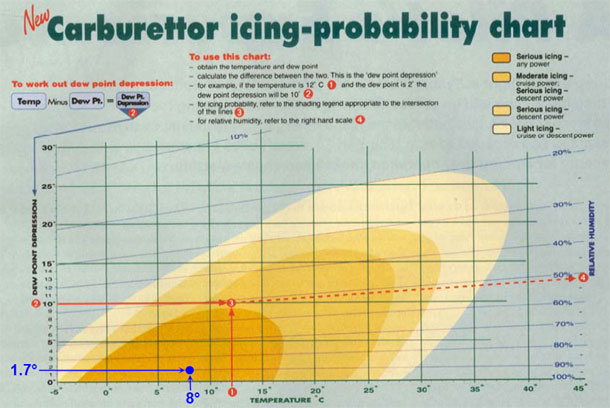
It was subsequently reported that at the time of the occurrence, the cloud base at Mangalore aerodrome was about 1,400 ft. The 1000 EST Mangalore automatic weather station data revealed that the temperature was 8 degrees C, and the dewpoint temperature was 6.3 degrees C. The dew point depression was therefore 1.7 degrees C, which meant that there was a probability of serious carburettor-icing, as depicted at fig. 1. Other helicopters were operating in the Mangalore circuit at the time of the occurrence. Although the pilots of those helicopters reported that their helicopters had not been affected by carburettor-icing, the investigation was unable to discount that carburettor-icing may have been the factor that resulted in the abnormal operation of the helicopter's engine.
Figure 1: Carburettor icing-probability chart.
Source:Melting Moments: understanding carburettor icing, Asia Pacific Air Safety, June 1999, Issue 22.
On 2 September 2004, the aircraft manufacturer reported that it was reviewing the following:
failure conditions that can affect lavatory hand basin water shutoff mechanisms
design, panel assembly and installation of 717 aft cabin interphones
electrical installations associated with 717 aircraft lavatory modules
lavatory faucet reliability data.
Operator
On 5 December 2004, the aircraft operator reported that its 717 flight simulator landing gear `down' indication during flight on emergency electrical power was incorrect. As a consequence, the aircraft manufacturer made software changes to 717 flight simulators to correct that anomaly.
Factual Information
FACTUAL INFORMATION
At 1435 Eastern Standard Time on 10 August 2004, a Boeing Company 717-200 aircraft, registered VH-VQA, was climbing to cruise altitude on a scheduled passenger service from Melbourne, Vic. to Hobart, Tas. with six crew and 52 passengers on board. As the aircraft passed through flight level (FL) 110, the crew heard a loud bang, with a corresponding increase in indicated left engine vibrations. The left engine began to spool down and the turbine gas temperature (TGT) indications began to increase significantly.
The crew initially brought the left engine power lever back to idle. However, the TGT continued to increase, indicating a maximum of 1,149oC, before they shut the engine down and discharged a fire bottle into the cowling area in accordance with the operator's procedures. They then notified Melbourne air traffic control (ATC) of the engine failure and returned to Melbourne.
The operator examined the left engine and found metal fragments in the exhaust area and some metallisation1 of the exhaust duct.
At the time of the failure, the BR700-715 engine, serial number 13148, had completed 10, 321 hours and 8,888 cycles since new, and 6,474 hours and 5,417 cycles since repair.
Engine investigation
The operator removed the engine and forwarded it to the engine manufacturer in Germany for detailed investigation, under the supervision of a representative of the German Federal Bureau of Aircraft Accident Investigation (BFU2), on behalf of the Australian Transport Safety Bureau (ATSB).
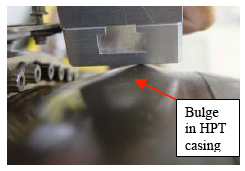
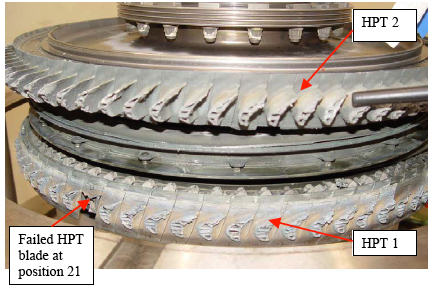
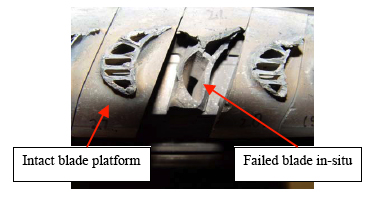
The manufacturer conducted a visual inspection of the engine's exterior, noting a bulge around most of the circumference of the high-pressure turbine (HPT) casing (Figure 1), in line with the Stage-1 HPT (HPT 1). A borescope examination of the engine interior showed that one HPT 1 blade was almost completely missing, with the remaining HPT 1 blades separated just above the blade platforms (Figure 2). There was also significant damage to the subsequent HPT and low-pressure turbine stages. Examination of the engine's compressor assembly revealed no significant damage. All of the high energy debris from the failure had been fully contained3.
A detailed examination of the engine revealed that the reason for the engine failure was the release of a single HPT 1 blade. The blade failed following the development of low-cycle fatigue4 (LCF) cracking in its internal cooling passages. All other engine damage was considered to be a consequence of the initial HPT 1 blade failure.
Figure 1: Bulged HPT casing
Figure 2: Damage to HPT 1 and HPT 2 rotors
Blade design considerations
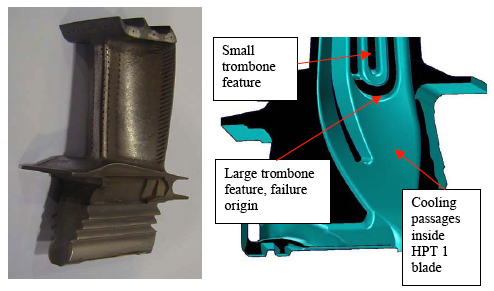
The failed HPT 1 blade (Figure 3) was a life improvement package5 (LIP) blade. The blade was a shrouded-tip aerofoil design, with multi-passage internal cooling (Figure 4). There was a vapour aluminised coating on the blade's external aerodynamic surfaces and internal cooling passages.
The manufacturer indicated that there have been four similar failures of LIP HPT blades in the BR700-715 engine type, with another engine failure still under investigation. One failure occurred prior to this event in November 2003. The remainder occurred after this incident.
Figure 3: The failed HPT 1 blade (position 21)
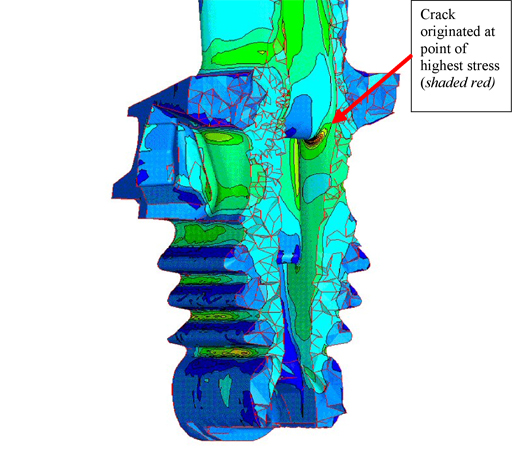
Following those failures, the manufacturer conducted additional computer stress modelling on the LIP blades. That modelling found that there were stress levels in the larger trombone radius feature, within the blade's cooling passages (Figure 4) that were potentially in excess of the manufacturer's original design intent. The manufacturer also found that the thickness of the vapour aluminised coating inside the blade's internal cooling passages was variable and difficult to predict. In certain operational conditions, dependent upon high strains in areas of stress concentration and local temperature, the coating could crack with the possibility of subsequent growth into the coated (parent) material. The area from which the failure occurred was confirmed to be the most susceptible to this behaviour (Figure 5).
Figure 5: Computer generated stress diagram from the manufacturer indicating the point of potentially excessive stress and crack origin
Flight data recorder information
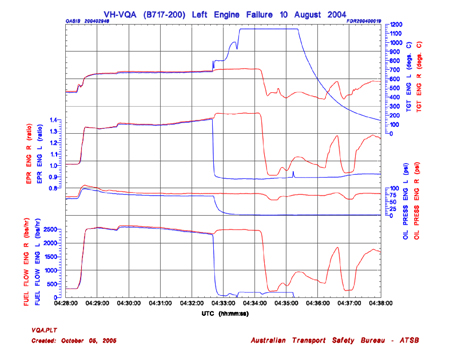
The ATSB's examination of the aircraft's flight data recorder (FDR) for the occurrence flight found that the left engine had surged as the aircraft passed through 10,240 ft. The engine pressure ratio (EPR) and engine rotational speed indications decreased abruptly, while the turbine gas temperature (TGT) for the engine began to increase. HPT vibration values for the engine increased from a level of 0.5 units before the failure to a maximum of 6.3 units over a three-second period. The manufacturer's high-limit for vibrations was 4.0 units.
The FDR readout indicated that the TGT for the engine continued to increase following the engine failure and remained at an indicated maximum of 1,149oC for 1 minute and 46 seconds before decreasing (Figure 6). It is likely that the maximum TGT reached during the failure was higher than 1,149oC, however the aircraft systems do not record above that temperature.
The FDR report indicated that there were no anomalies observed in the performance of the left engine prior to the failure.
Figure 6: FDR data plot of key engine parameters at the time of the failure
1 Metal pulverised by the turbine becomes molten and flows rearward attaching to the subsequent turbine and exhaust assemblies (US Department of the Air Force (1987). Safety Investigative Techniques (AF Pamphlet 127-1, Volume II. Washington DC: Author). 2 Bundesstelle für Flugunfalluntersuchung (BFU). 3 FAA AC 33-5, paragraph 5.c. definitions state '…Contained means that no fragments are released through the engine structure, but fragments may be ejected out of the engine air inlet or exhaust'. 4 Fatigue that occurs at relatively small numbers of cycles. Brooks, C. (1993). Metalurgical Failure Analysis. USA: McGraw-Hill, Inc. 5 The Life improvement Package 3 (LIP3) was a suite of HP Turbine modifications that included the HPT blade P/N BRH20351. The manufacturer introduced the package by SB-BR700-72-100801.
Summary
Sequence of events
On 26 July 2004, as the Boeing 717 (717), registered VH-VQA, was being prepared a scheduled passenger service between Brisbane and Hamilton Island Qld, the cabin crew noticed water spilling from the hand basin in the aircraft's aft left lavatory, and notified the flight crew. The leakage was cleaned up, and the aircraft was dispatched from Brisbane with the aft lavatory locked and placarded to prevent its use during the flight, in accordance with the provisions of the CASA-approved aircraft minimum equipment list.
During the cruise at flight level 320, when the aircraft was about 60 NM south of Mackay, the cabin crew noticed a faint `electrical smell' in the aft area of the passenger cabin. The cabin manager notified the flight crew, and about 1 minute later advised the flight crew that the aft cabin interphone hand piece located on the outside wall of the aft left lavatory was very hot, and that the smell was becoming stronger. Shortly after, the cabin manager notified the flight crew that the aft cabin interphone handset flexible-wiring loom was `melting'.
The flight crew conducted the aircraft quick reference handbook (QRH) `Electrical Smoke/Fumes of Unknown Origin' non-normal checklist. They both donned their oxygen masks, and selected emergency electrical power, as per the checklist. The 717 QRH non-normal checklist procedure dictated that a flight crew should plan to land at the nearest suitable airport. At that stage, the aircraft was about 30 NM south of Mackay. The flight crew broadcast a PAN1 to air traffic control, and advised the controller that they required a clearance for an immediate descent and diversion to Mackay. The flight crew notified the cabin crew of their intentions, and the cabin crew prepared the passenger cabin for the landing at Mackay.
The controller in receipt of the PAN call notified the Mackay tower controller, who activated the aerodrome emergency plan and notified the emergency response services. The aircraft landed safely at Mackay about 9 minutes after the flight crew first notified air traffic control of the problem. After the aircraft landed, the flight crew confirmed with the aerodrome rescue and fire fighting service that there was no smoke at the rear of the aircraft. The flight crew also confirmed with the cabin manager that the electrical smell had abated and that the cabin interphone had cooled down. The aircraft was taxied to the terminal, and a normal disembarkation was conducted through the forward door of the aircraft. Eight of the occupants were treated for smoke/fumes inhalation after they had left the aircraft. There were no other reported injuries.
Following the occurrence, the flight crew reported to the operator that during the landing approach at Mackay, the landing gear `down' indication in the aircraft was different from that indicated in the 717 flight simulator during training sessions for flight on emergency electrical power. The operator conducted an investigation into the matter, and determined that the simulator landing gear `down' indication for flight under those conditions was incorrect. That was confirmed by the aircraft manufacturer.
During the subsequent engineering inspection of the aircraft, the B1-778 `Miscellaneous Cabin & Lavatory Occupied Aft' electrical circuit breaker was found to have popped, and could not be reset. The fault was traced to a short circuit in a connector plug located under the aft left lavatory hand basin. Water from the overflowing hand basin had seeped into the connector plug. The short circuit within the connector plug resulted in several pins within the plug becoming welded together. As a consequence, the aft cabin interphone handset flexible-wiring loom was overheated from a 115 VAC over-current within the loom and resulted in the in-flight `electrical smell' and overheating of the handset. The damaged components were replaced, and the aircraft was returned to service.
1 PAN is a radio broadcast indicating uncertainty or alert. It is a general broadcast to the widest area, but not yet the level of a MAYDAY, which is the international broadcast for urgent assistance.
On 24 July 2004, the flight crew of a Boeing 737-838 aircraft, registered VH-VXF, received a terrain proximity caution from the aircraft's enhanced ground proximity warning system (EGPWS) while descending to the south-south-east of Canberra Airport. The aircraft was being operated on a scheduled fare-paying passenger service from Perth to Canberra with two pilots, five cabin crew and 80 passengers on board.
Due to staff shortages on the morning of the occurrence, the approach control services normally provided by the Canberra Terminal Control Unit did not become available until approximately 40 minutes after the scheduled unit opening time. This meant that the aircraft's descent below 9,000 ft was conducted without air traffic control radar assistance.
The aircraft departed Perth at 0211 Eastern Standard Time (EST) and the occurrence was at 0544 EST. The flight deck during the flight was abnormally hot because of a pre-existing air conditioning problem.
As the aircraft approached Canberra, the crew elected to track to Church Creek1 (CCK), to enter the holding pattern at that position and descended to 5,000 ft to intercept the instrument landing system (ILS) approach in accordance with Airservices Australia and Jeppesen published procedures for the approach for runway 35.
The published CCK holding pattern requires that aircraft holding at 5,000 ft observe a maximum indicated airspeed (IAS) of 170 kts and limit time outbound to either 1 minute or a distance measuring equipment (DME) limit of 14 NM from Canberra, whichever is reached first.
As the aircraft approached CCK, the copilot, under the direction of the pilot in command, entered the holding pattern details into the Flight Management Computer (FMC). In doing so, an erroneous entry was made, which resulted in the FMC computing a holding pattern with a leg length of 14 NM, instead of 1 minute or a maximum distance from Canberra of 14 NM.
By entering a leg distance of 14 NM, the crew inadvertently commanded the FMC to establish the aircraft in a holding pattern that would take the aircraft about 11 NM beyond the published holding pattern limit. The crew initiated descent to 5,000 ft after passing overhead CCK. As it descended, the aircraft proceeded outside the airspace specified for holding. Consequently, the aircraft was operated closer to the surrounding terrain than would normally occur.
The aircraft was fitted with an EGPWS, which detected the aircraft's proximity to the terrain and provided the crew with a 'CAUTION TERRAIN' message to which the crew responded by climbing the aircraft to 6,500 ft. Sixteen seconds before the message, the crew had commenced a right turn to intercept the inbound track to CCK. At the time of the message, the aircraft's height above terrain was 2,502 ft (radio altimeter indication).
During the turn, the aircraft passed 0.6 NM (1.11 km) north abeam and 810 ft higher than the closest terrain that had a spot height of 4,920 ft above mean sea level. It also passed 2.7 NM (5 km) north abeam Tinderry Peak. The aircraft climbed to 6,500 ft and subsequently joined the runway 35 localiser.
This occurrence was not simply a case of incorrect data entry, but was influenced by a number of events occurring prior to, and during the flight that affected the crew, the aircraft and the air traffic control system. Evidence suggests that the flight crew's operational performance was affected at a critical stage of the flight by fatigue, the late advice of the status of air traffic services and the crew's misinterpretation of the CCK locator holding pattern data on the runway 35 ILS approach chart.
The crew's ineffective contingency planning for a descent to Canberra without air traffic control support and the erroneous data entry in the aircraft's flight management computer (FMC) suggest that the crew was not functioning at an appropriate level of alertness.
It is likely that both the pilot in command and the copilot were experiencing fatigue due to the cumulative effects of ineffective sleep in the period preceding the Perth to Canberra night sector and the ongoing period of wakefulness during the flight. Additionally, as they approached Canberra, the crew was working at a low point in their circadian rhythms2. It is therefore likely that they were experiencing a decreased level of alertness. The application of the minimum equipment list on the flight deck air conditioning system allowed continued flight operation despite abnormally hot conditions, about 10 degrees Celsius above normal. While this may have had less impact on crew performance during a short daylight flight, it was of greater significance during a night flight of more than three hours. In combination, those conditions probably interacted to reduce the level of crew alertness, performance and attention. The crew's lack of recognition of the inaccurate entry in the FMC is consistent with the effects of fatigue, and it is likely that those effects were exacerbated by the excessive flight deck temperatures.
As a result of this occurrence, the aircraft operator has taken action to ensure earliest rectification of flight deck or passenger cabin temperature control problems and increased the minimum holding pattern altitude at Church Creek. Airservices Australia has issued a temporary local instruction detailing how the Canberra Terminal Control Unit staff shortage contingency plan should be activated. Additionally, Jeppesen Sanderson Inc. has advised the ATSB that they intend to include the DME identifier in the holding pattern limit notes on relevant charts.
1 Church Creek is an instrument approach fix (locator) 10.9 NM from Canberra Airport. 2 Circadian rhythms refer to body functions (i.e. sleep/wakefulness, motor activity, hormonal processes, body temperature, and performance) that are controlled by internal biological clocks and that vary over a 24 hour cycle. As a result, levels of human performance also vary significantly during the 24 hour period.
The Australian Transport Safety Bureau did not conduct an on scene investigation of this occurrence.
Sequence of events
On 22 July 2004, the pilot of the Cessna Aircraft Company Titan, registered VH-ANM, was conducting a charter flight from Goulburn Island to Darwin with 12 passengers. He tracked the aircraft for landing at Darwin via a position 5 NM on final approach for runway 29.
The pilot reported that he normally completed his pre-landing checks when about 5 NM from Darwin. In this instance, that coincided with the pilot's attempt to fault-analyse a problem with the aircraft instrument landing system. He reported being established on final approach for runway 29 at 4.3 NM from Darwin.
The pilot reported that in order to avoid the expected jet thrust turbulence from a Mirage fighter, which had been cleared for takeoff from runway 29, he amended his approach profile to touch down further along the runway. He reported that consideration and execution of that amended profile coincided with when he normally completed his PUFF1 checks. The pilot was subsequently cleared to land on runway 29, with a requirement to hold short of the crossing runway 36 intersection. Later on final approach, the pilot noted the unusual nature and content of a radio transmission from the pilot of a following C-130 Hercules aircraft. Consideration of that radio call by the pilot coincided with where he normally carried out the last check of his aircraft configuration in preparation for landing.
The pilot reported that, as he realised that he was 'a bit low' during the flare for landing, and that the aircraft's wheels should have contacted the runway, he heard a radio transmission stating `no gear, no gear, no gear'. The pilot advanced the throttles and raised the aircraft's nose, but was unable to prevent the aircraft contacting the runway. Shortly thereafter, the pilot lowered the landing gear, with the initial intent of landing in the remaining available runway. The pilot noted 'that he had three greens2', but after consideration of the requirement to hold short of runway 36, and of the remaining runway length, decided to go around for another landing. The pilot and passengers were not injured.
Damage to the aircraft was confined to the tips of the propellers, the wing flaps, main landing gear tyres, and the left rear automatic direction finder antenna. Superficial damage to the runway surface was identified over a distance of about 11 m, commencing at about 1,000 m upwind from the landing threshold, and displaced about 3 m to the left of the runway centreline. That damage was consistent with a number of propeller tip strikes.
The pilot was appropriately qualified for the operation and complied with company duty requirements. While the pilot reported being medically fit for the flight, he indicated a number of personal and other factors that may have adversely affected his recent sleeping and eating patterns, to the extent that `he didn't feel 100% in himself'.
Royal Australian Air Force, Darwin Air Traffic Control personnel followed published procedures during this occurrence. There was no evidence that any environmental factors were relevant to the circumstances of the occurrence.
The pilot reported that the aircraft landing gear operated normally on the previous landing at Goulburn Island, and on the second landing at Darwin. In addition, the company chief pilot reported that, when tested by company engineers after the occurrence, the landing gear warning horn3 operated normally. The pilot did not recall hearing the warning horn during the occurrence.
It was likely that the pilot's personal and other problems, and the resulting interrupted sleeping and eating patterns diminished the pilot's ability to manage the tasks necessary to prepare the aircraft for landing. That degradation in performance was compounded by the in-flight distractions that coincided with when the pilot would have normally conducted his sequence of pre-landing actions and checks. The result was that the pilot unwittingly omitted to lower the aircraft's landing gear.
1 A personal mnemonic applied by the pilot that checked completion of the actions necessary to confirm that the aircraft was in the landing configuration, including: set propeller pitch, undercarriage down, and flaps full down. 2 Three landing gear position indicator lights are located just left of centre of the aircraft instrument panel. Those lights illuminate when each landing gear is fully extended and locked. 3 The landing gear warning horn can be independently activated by either the throttle position or wing flap position switch. That switch activates the horn if the flaps are lowered past the take-off and approach position, with the landing gear in any position except extended and locked.
Since this occurrence the RAAF has removed Wickham Point from the local procedure to reduce the risk of a conflict between a departing helicopter and other aircraft.
Factual information
The Australian Transport Safety Bureau did not conduct an investigation into this occurrence. The report produced below is derived from an investigation conducted by the Department of Defence-Royal Australian Air Force (RAAF)1.
Reported information
On 20 July 2004, at approximately 1514 central standard time, a de Havilland Dash 8-200 (Dash 8) was on a visual approach for a landing on runway 36 at Darwin and was operating under the instrument flight rules (IFR). At the same time, an Australian Army Bell 206B-1 (Kiowa) helicopter was departing Darwin and was operating under the visual flight rules (VFR). The helicopter crew had been cleared to depart the Darwin control zone via Wickham Point. Wickham Point was a visual fix located approximately 3.5 NM south of the threshold of runway 36. According to the RAAF report, the two aircraft came within 2.6 NM of each other when there was 500 ft vertically between them. There was an infringement of separation standards.
The RAAF, as the airspace administering authority, was responsible for the provision of air traffic control services at Darwin. Local 'low level helicopter release procedures' authorised the aerodrome controller (ADC) to depart VFR helicopters not above 1,000 ft, tracking direct to one of six visual fixes around the Darwin control zone, whilst separating the VFR helicopter from all traffic operating under the IFR.
According to those procedures the approach controller became aware of a departing helicopter once the aircraft taxied and the surface movement controller entered the aircraft details into the automated air traffic control system in use at Darwin. The approach controller would again be alerted to the departing helicopter when the radar detected the departing aircraft and the aircraft's track symbol appeared on the radar display. The approach controller was also required to advise the ADC of any inbound aircraft so that the ADC could separate a departing helicopter with other relevant aircraft.
The RAAF report found that:
the team of controllers that were operating in the control tower at the time of the occurrence had been controlling for 2.5 hours, in high density and complex traffic levels, and may have been fatigued
the controllers in both the tower and in approach had difficulties coordinating with each other due to the high traffic levels
the approach controller did not receive notification that the Kiowa was taxying
the approach controller coordinated the inbound Dash 8 with the ADC when that aircraft had left 2,000 ft on descent and the helicopter was level at 1,000 ft
the approach controller became aware of the helicopter when that aircraft's track symbol appeared on his radar display.
1 For further information on the RAAF report contact The Directorate of Flying Safety - Australian Defence Force (FS5), Campbell Park Offices, Canberra ACT 2600.
Occurrence summary
Investigation number
200402703
Occurrence date
20/07/2004
Location
Darwin, Aero.
State
Northern Territory
Report release date
03/02/2005
Report status
Final
Investigation type
Occurrence Investigation
Investigation status
Completed
Mode of transport
Aviation
Aviation occurrence category
Loss of separation
Occurrence class
Incident
Highest injury level
None
Aircraft details
Manufacturer
Bell Helicopter Co
Model
206A
Sector
Helicopter
Operation type
Military
Departure point
Darwin, NT
Damage
Nil
Aircraft details
Manufacturer
De Havilland Canada/De Havilland Aircraft of Canada
To ensure that separation responsibility in these circumstances is clearly defined, the RAAF at Darwin amended its auto-release procedures so that when more than one preceding aircraft have already been assigned the same auto release heading, a following aircraft operating under the IFR shall be assigned a different auto release heading.
Summary
The Australian Transport Safety Bureau did not conduct an investigation into this occurrence. The report produced below is derived from an investigation report produced by the Department of Defence-Royal Australian Air Force (RAAF)1 which was the administering authority for the Darwin Control Zone.
Reported information
On 21 July 2004, at 0955 central standard time, a Cessna Aircraft Company 206 (C206) departed Darwin for Croker Island, NT. The aircraft was being operated under the visual flight rules (VFR). Another aircraft, a Cessna Aircraft Company 210 (C210) departed Darwin at 0956 for Snake Bay, NT, and was also being operated under the VFR. A third aircraft, a Cessna Aircraft Company 404 (C404) departed Darwin at 0958 for Croker Island. That aircraft was being operated under the instrument flight rules (IFR). All three aircraft were instructed by the aerodrome controller (ADC) to fly a heading of 060 degrees after take off.
The RAAF investigation report found that the pilot of the C404 had been instructed to sight and maintain visual separation with the C210. However, the C404 also caught up with and eventually overtook, the C206. Neither the pilot of the C206 nor the pilot of the C404 received traffic information on the other aircraft, and neither pilot was assigned the responsibility for separation with the other aircraft. According to the RAAF investigation report, the C404 passed within 0.2 NM of the C206 while both aircraft were at the same altitude. There was an infringement of separation standards.
The Manual of Air Traffic Services (MATS) section 4.5.1.4 authorised the assignment of responsibility for separation to the pilot of one aircraft if that pilot reported 'sighting the other aircraft and is instructed to maintain visual separation with, or to follow that aircraft'. The MATS Section 4.5.1.2 also stated that, when applying visual separation, 'controllers shall consider aircraft performance characteristics, particularly in relation to faster following aircraft'.
Darwin was operating on auto-release procedures at the time of the occurrence. The MATS Part 10, section 1 defined auto release as a procedure whereby the ADC must ensure that the spacing between successive departing aircraft is sufficient to enable the Departures controller to establish and maintain the required separation minima. In this occurrence, the responsibility for establishing and maintaining the required separation minima between the C210 and the C404 had been assigned to the pilot of the C404. The ADC did not ensure that the departures controller could establish and maintain separation between the C206 and the C404, and the responsibility for establishing and maintaining separation had not been assigned to either pilot.
1 For further information on the RAAF report contact The Directorate of Flying Safety - Australian Defence Force (FS5), Campbell Park Offices, Canberra ACT 2600.
The Australian Transport Safety Bureau did not conduct an on-scene investigation of this occurrence. The report presented below was derived from information supplied to the Bureau.
On 20 July 2004, a Cessna Aircraft Company 206, registered VH-DSP, struck trees while the pilot was attempting to land at Medlow Bath airfield (Katoomba) in the Blue Mountains, NSW. The aircraft was being operated on a private flight carrying two passengers from Canberra to Katoomba.
The pilot reported that on arrival at Katoomba, he overflew the airfield. After observing the surface wind direction from the windsocks, he elected to land on the south-west strip. The pilot extended the aircraft wing flaps to 10 degrees for the approach and landing. During the landing flare, when the aircraft was about 8 ft above the ground, it began to drift to the right because of crosswind. The pilot applied left rudder to counter the drift and to regain control of the aircraft, but the drift continued. The pilot then decided to discontinue the landing, and applied go-around power. Moments later, the aircraft impacted a pile of felled trees adjacent to, and to the right of, the landing strip. The aircraft came to rest in an inverted attitude and was extensively damaged. The three occupants received minor injuries but were able to exit the aircraft unaided.
Figure 1: Aerial view of the Medlow Bath airfield showing the aircraft wreckage.
The Bureau of Meteorology (BoM) provided an assessment of the surface wind conditions at Katoomba airstrip on the day of the occurrence. BoM analysed the wind data recorded by the Mt Boyce automatic weather station (AWS), which was located near Katoomba airstrip. The recorded data revealed that the surface wind was from the south-southwest at 5 to 8 kts (mean) for most of the day, with gusts to 11 kts. BoM reported that stronger gusts probably occurred, but because of their transient nature, they were not recorded by the AWS.
A witness at Katoomba airstrip observed the accident and reported that a crosswind gust of about 15 to 20 kts occurred as the aircraft was landing. The witness observed the aircraft rolling to the right before cartwheeling into the timber.
The pilot's attempt to counter the unexpected and sudden increase in the crosswind was unsuccessful. The investigation concluded that the aircraft's continued drift to the right of the runway while still airborne, and the late attempt by the pilot to discontinue the landing, resulted in its inadvertent impact with the pile of felled trees.