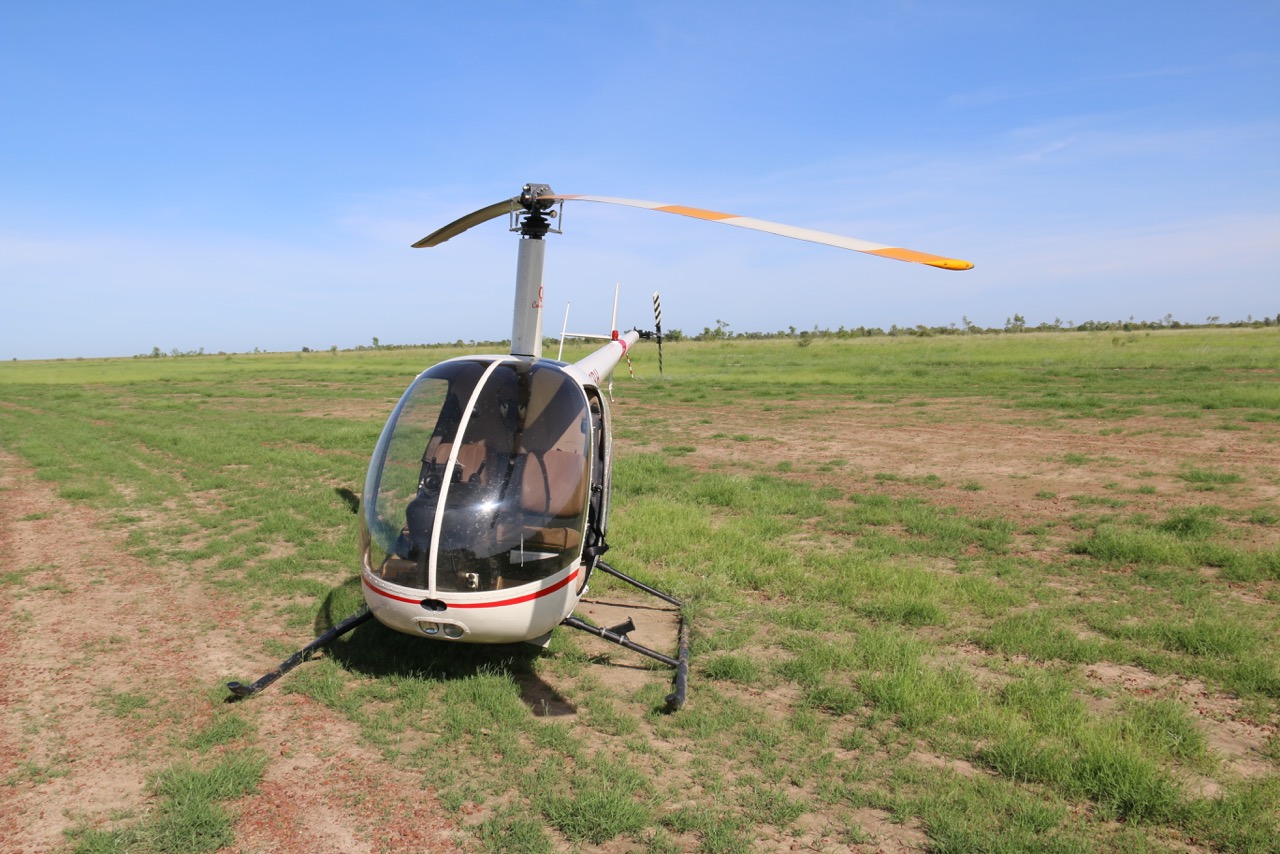
On 23 January 2015, the pilot of a Robinson R22 helicopter, registered VH-ZBH, prepared for a private flight to inspect a property at Herbertvale, Queensland, with one passenger on board. Nothing abnormal was found during the pre-flight inspection of the helicopter. About 35 L of fuel was on board the helicopter, and the pilot conducted a fuel drain with nil contaminants found. At about 0600 Eastern Standard Time (EST), the pilot started the engine. All indications were normal throughout the run-up checks.
The pilot then increased the power to 104% for take-off and the helicopter lifted off into a low hover. The pilot reported that the helicopter responded normally and he turned the helicopter 90° to the north to depart. The helicopter transitioned from the hover to forward flight, moving about 10 m forwards and climbed to about 20 ft above ground level. The engine then lost power and the pilot detected vibration. He observed the rotor rpm decreasing and the low rotor rpm warning sounded.
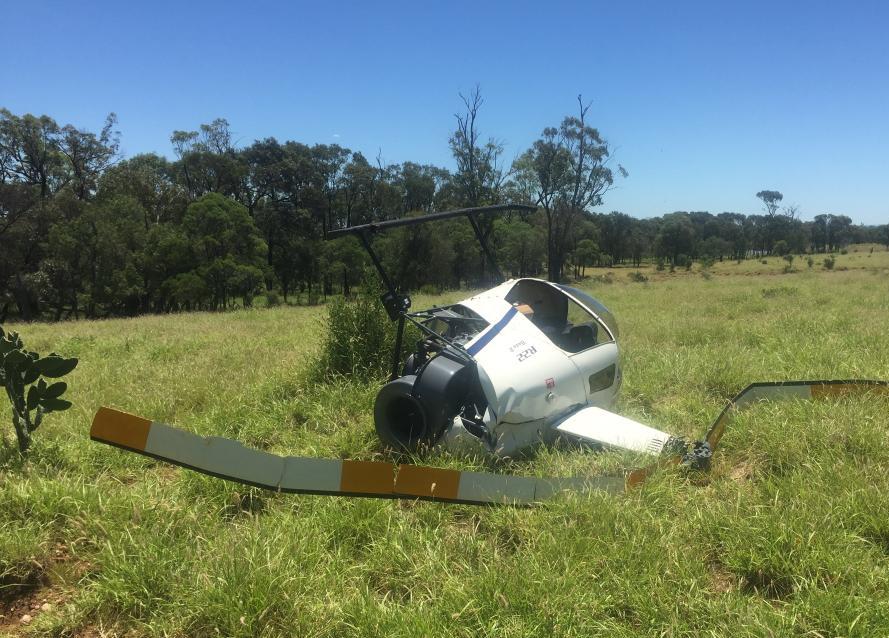
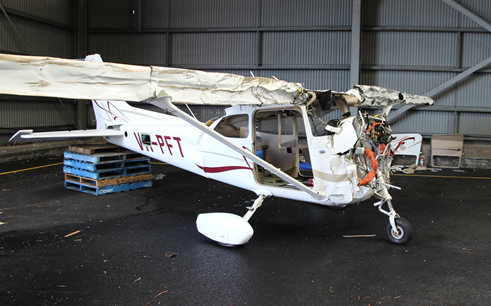
The pilot immediately wound on throttle and lowered the collective[1] in an attempt to increase the rotor rpm and to ensure the helicopter cleared a fence. He then prepared for an emergency landing. The rear of the skids touched down first and the helicopter skidded forwards. As the helicopter still had forward momentum, the pilot then pulled back on the cyclic[2] to prevent the helicopter rolling over forwards, and it became airborne, moved forwards and yawed right, and bounced again before coming to rest upright (Figure 1).
The helicopter was substantially damaged due to the impact on the skids, and the pilot and passenger were uninjured.
Engineering inspection
A post-accident engineering inspection did not reveal any cause of the engine loss of power.
Figure 1: Damage to VH-ZBH
Source: Owner
Safety message
The pilot in this incident had recently completed a check flight including practice autorotations. The avoidance of injury and handling of the autorotation highlights the benefits of practice. The following links provide information regarding practice autorotations:
Decisions regarding whether to conduct an investigation, and the scope of an investigation, are based on many factors, including the level of safety benefit likely to be obtained from an investigation. For this occurrence, a limited-scope, fact-gathering investigation was conducted in order to produce a short summary report, and allow for greater industry awareness of potential safety issues and possible safety actions.
Publishing information
Released in accordance with section 25 of the Transport Safety Investigation Act 2003
Ownership of intellectual property rights in this publication
Unless otherwise noted, copyright (and any other intellectual property rights, if any) in this report publication is owned by the Commonwealth of Australia.
Creative Commons licence
With the exception of the Coat of Arms, ATSB logo, and photos and graphics in which a third party holds copyright, this publication is licensed under a Creative Commons Attribution 3.0 Australia licence.
Creative Commons Attribution 3.0 Australia Licence is a standard form licence agreement that allows you to copy, distribute, transmit and adapt this publication provided that you attribute the work.
The ATSB’s preference is that you attribute this publication (and any material sourced from it) using the following wording: Source: Australian Transport Safety Bureau
Copyright in material obtained from other agencies, private individuals or organisations, belongs to those agencies, individuals or organisations. Where you wish to use their material, you will need to contact them directly.
On 16 January 2015, at about 0930 Eastern Standard Time (EST), the pilot of a Robinson R22 helicopter, registered VHSSD, was conducting aerial mustering operations on a property 23 km north-east of Roma, Queensland.
The helicopter was about 100 ft above ground level (AGL), with a low forward airspeed of about 5-10 kt and the cattle moving slowly uphill, when the pilot observed the cattle start to move back down the side of the hill towards a creek. The wind was light and blowing across the path of the helicopter from the left. The pilot elected to descend along the side of the cattle and turned the helicopter towards the right.
As he did that, the helicopter turned downwind with a high-power setting and low forward speed. The pilot realised he had turned downwind and started to raise the nose of the helicopter and raise collective.[1] He then detected a high rate of descent and an incipient vortex ring state, as the helicopter started to settle into its own downwash. He attempted to fly out of the situation, lowered the collective and wound the throttle on, but had insufficient forward speed and low rotor rpm. The low rotor rpm horn sounded at about 15-20 ft AGL. The pilot tried to regain rotor rpm but the helicopter sank quickly.
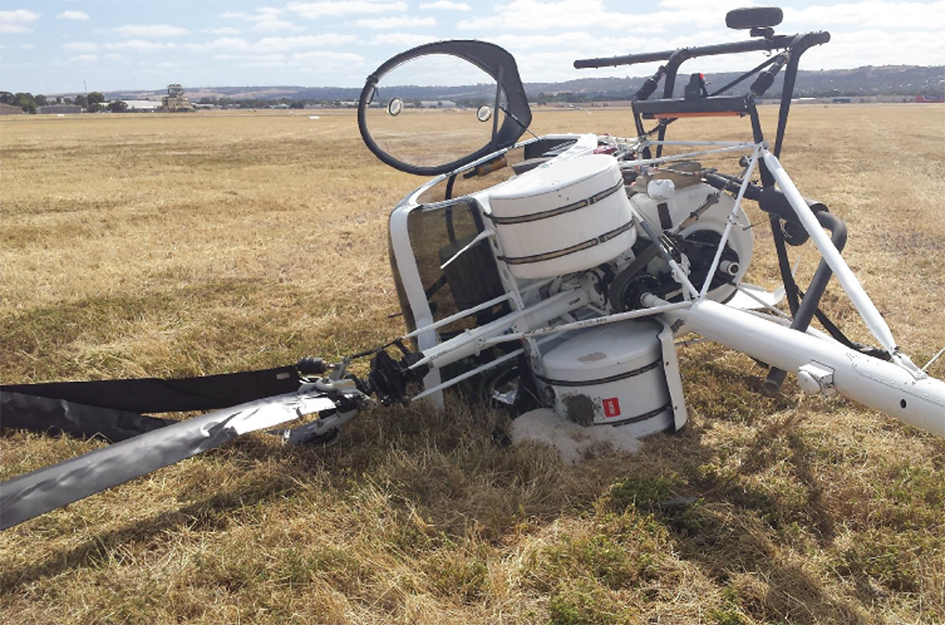
The pilot then ensured the skids were level and the helicopter collided with the ground. Due to the rough surface, the helicopter bounced into the air. The pilot pulled back on the cyclic[2] control, which resulted in the tail of the helicopter being chopped off by the main rotor. The helicopter then spun around and came to rest on its side (Figure 1). The helicopter was substantially damaged, and the pilot was uninjured.
Figure 1: Damage to VH-SSD
Source: Operator
Vortex ring state
The United States Federal Aviation Administration (FAA) handbook www.faa.gov/regulations_policies/handbooks_manuals/ describes the vortex ring state or settling with power, as an aerodynamic condition in which a helicopter may be in a vertical descent with 20% to maximum power applied and little or no climb performance.
The following combination of conditions is likely to cause settling in a vortex ring state in any helicopter:
1. A vertical or nearly vertical descent of at least 300 feet per minute (fpm). The actual critical rate depends on the gross weight, rpm, density altitude, and other pertinent factors.
2. The rotor system must be using some of the available engine power, between 20-100%.
3. The horizontal velocity must be slower than effective translational lift.
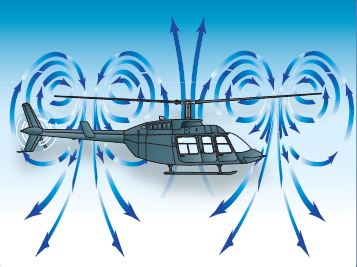
A fully developed vortex ring state is characterized by an unstable condition in which the helicopter has uncommanded pitch and roll oscillations, little or no collective authority, and a descent rate that may approach 6,000 fpm, if allowed to develop (Figure 2).
Figure 2: Vortex ring state
Source: FAA
Safety message
The pilot involved in this incident was highly experienced, with over 10,000 hours total flying (helicopter) time and over 6,000 hours in Robinson R22 aircraft. He stated that the fundamental message was to always have forward airspeed before turning downwind.
This incident highlights the importance of continually assessing and reassessing the prevailing conditions and their effect on aircraft performance. The Airbus Helicopters (formerly Eurocopter) publication, Decision Making for Single-Pilot Helicopter Operations, explains some of the factors that affect pilots’ decision making.
In the ATSB investigation AO-2013-099, the pilot of the helicopter lost situational awareness during a night approach and the helicopter developed a high rate of descent with a low forward airspeed. This resulted in the onset of an incipient vortex ring state in the final stages of flight.
Decisions regarding whether to conduct an investigation, and the scope of an investigation, are based on many factors, including the level of safety benefit likely to be obtained from an investigation. For this occurrence, a limited-scope, fact-gathering investigation was conducted in order to produce a short summary report, and allow for greater industry awareness of potential safety issues and possible safety actions.
Publishing information
Released in accordance with section 25 of the Transport Safety Investigation Act 2003
Ownership of intellectual property rights in this publication
Unless otherwise noted, copyright (and any other intellectual property rights, if any) in this report publication is owned by the Commonwealth of Australia.
Creative Commons licence
With the exception of the Coat of Arms, ATSB logo, and photos and graphics in which a third party holds copyright, this publication is licensed under a Creative Commons Attribution 3.0 Australia licence.
Creative Commons Attribution 3.0 Australia Licence is a standard form licence agreement that allows you to copy, distribute, transmit and adapt this publication provided that you attribute the work.
The ATSB’s preference is that you attribute this publication (and any material sourced from it) using the following wording: Source: Australian Transport Safety Bureau
Copyright in material obtained from other agencies, private individuals or organisations, belongs to those agencies, individuals or organisations. Where you wish to use their material, you will need to contact them directly.
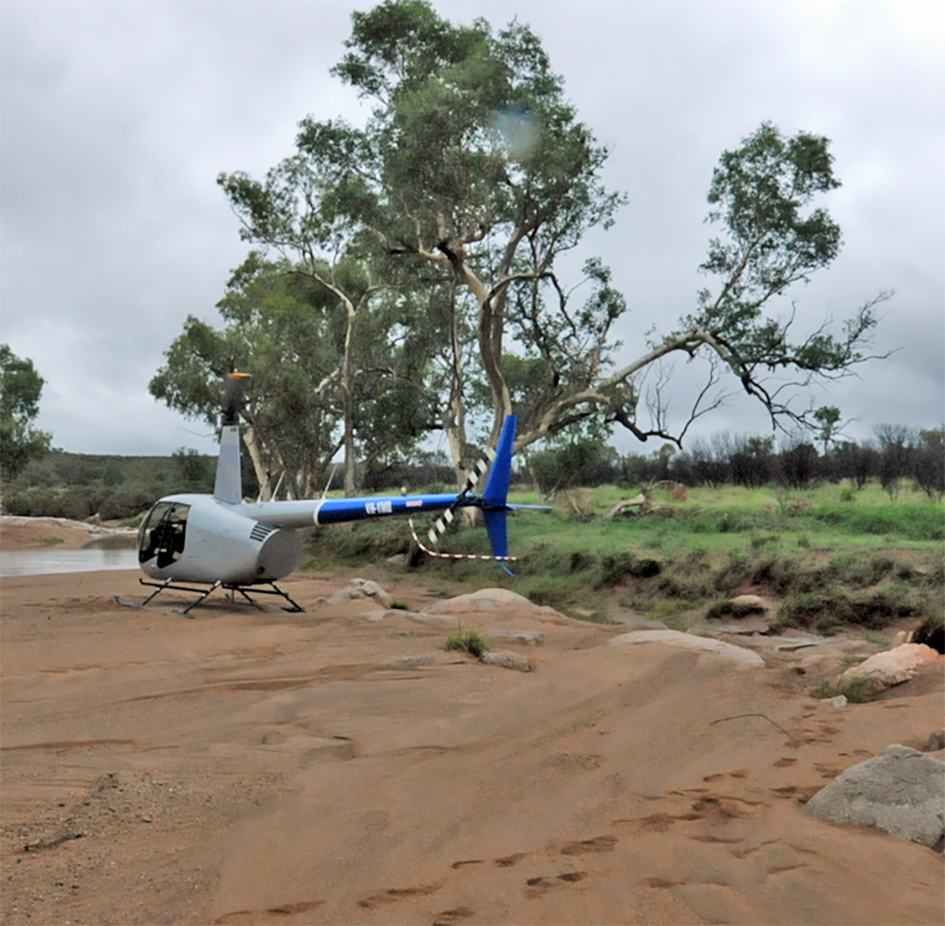
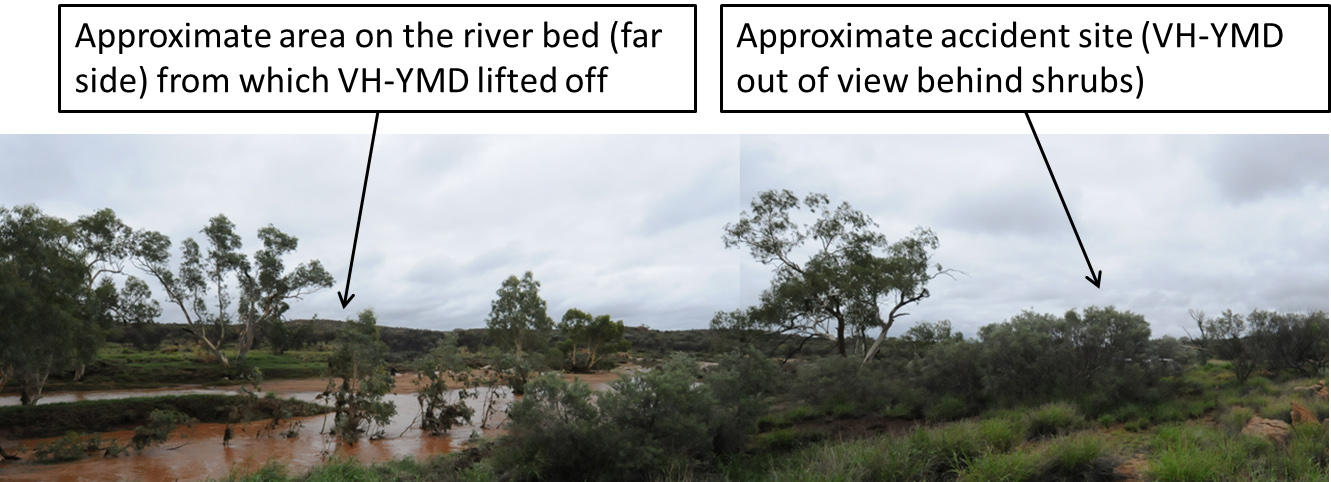
During the morning of 9 January 2015, the pilot of VH-YMD was operating in support of the Northern Territory Police. As part of the operation, the pilot conveyed two passengers to a site on the Todd River, just north of Alice Springs. The pilot landed on the sandy surface of the river bed where the passengers disembarked, then flew the helicopter from that location to a local landmark known as the Telegraph Station, about 3 km away. The pilot then conveyed another two passengers from the Telegraph Station to the site, and again landed on the sandy surface of the river bed, facing in a westerly direction (Figure 1).
Figure 1: VH-YMD landing site on the river bed
Source: Northern Territory Police
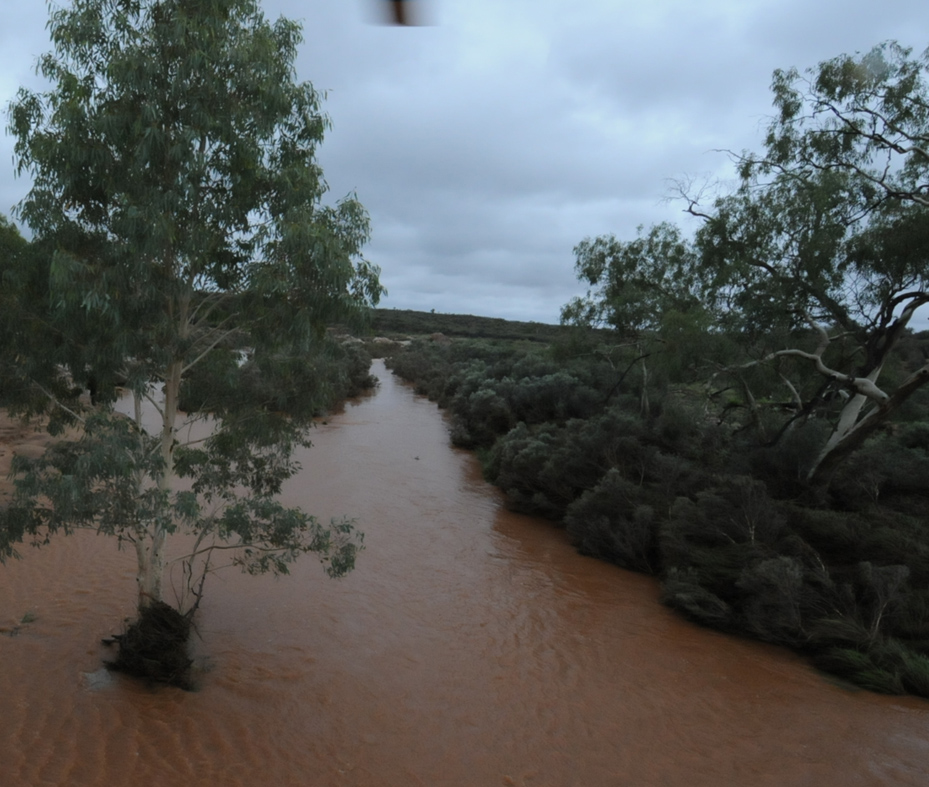
Soon after, the pilot was asked to convey three passengers back to the Telegraph Station, as a continuing part of the police operation. When all three passengers had boarded the helicopter, the pilot lifted off from the river bed. Lift-off was normal, and the pilot commenced departure in a southerly direction over the river (Figure 2) to follow what he assessed to be the most clear and suitable departure route from the river bed. As the helicopter climbed away from the river bed, the pilot became aware that the main rotor RPM was decaying. In response, he overrode the governor and applied full throttle.
The pilot needed to maintain height to clear the rocks and shrubs on the southern side of the river, but was acutely aware that rotor RPM would be further compromised by the application of more collective.[1] The pilot carefully managed the collective and the helicopter cleared the rocks and shrubs, but with decaying rotor RPM, he realised that continued climb was not possible. The pilot steered the helicopter toward a flat area, just above the river bed on the southern side of the river, and conducted a run-on landing[2] (Figure 3).
Figure 2: Photograph taken from left side of VH-YMD as it crossed the river
Source: Northern Territory Police
Figure 3: Take-off and landing area
Source: Northern Territory Police (two photographs joined and edited by the ATSB)
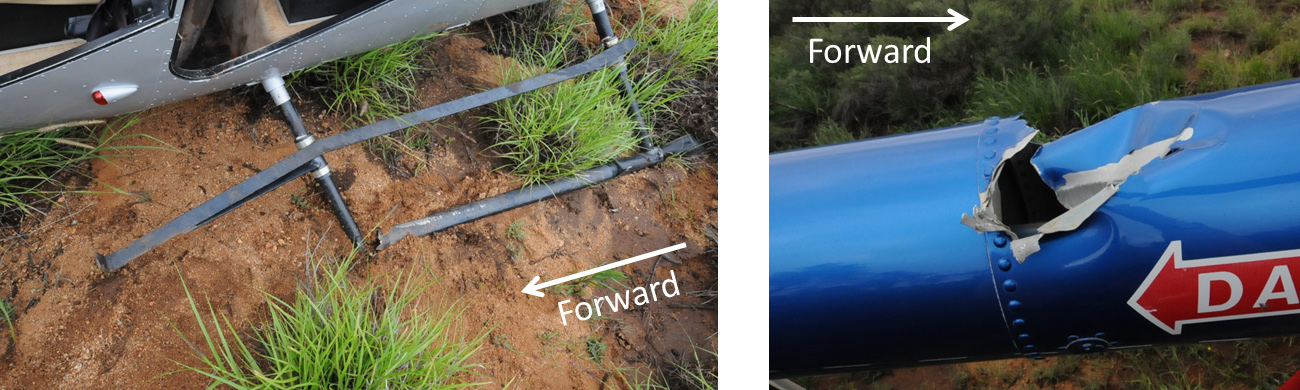
During the run-on landing, the left skid sank into mud and struck a rock. The left skid was substantially damaged by the impact (Figure 4) and the helicopter tipped precariously. As the helicopter came to a stop, it was on a substantial lean. The pilot reported that he considered the situation to be unsafe, so he immediately lifted off again and repositioned the helicopter on the ground with a level attitude. During the second lift off, a passenger recalled that the main rotor of the helicopter struck the limb of a tree, and that this was when damage to the tail boom occurred[3] (Figure 4). The pilot then shut down the engine and the passengers evacuated the helicopter.
Figure 4: Damage to VH-YMD skid (left) and tail boom (right)
Source: Northern Territory Police (edited by the ATSB)
Weather conditions
At the time of the accident, weather conditions were overcast, with showers in the area and a temperature of about 25 ºC. The wind at Alice Springs Airport (about 18 km to the south) was from the north-west at about 15 kt, and the QNH[4] was about 1003 hectopascals. While the pilot was aware that the wind was generally a north-westerly, he assessed the wind at the site as relatively light and variable. The relative humidity at Alice Springs Airport was around 80 per cent, and the pilot reported humid conditions at the accident site.
Pilot comment
The pilot commented that he believed that the accident resulted from a combination of a relatively heavy take-off weight, the prevailing conditions, and limited departure options because of surrounding terrain and obstacles. The pilot indicated that, with the benefit of hindsight, he should have taken two trips to move the three passengers, rather than attempt to take off with three passengers on board. He believed that he would have been able to complete the departure safely at a lower take-off weight.
Power required and power available
A number of factors related to the power required and the power available warrant consideration in understanding the probable reasons for which the pilot experienced decaying main rotor RPM during departure from the river bed, as the helicopter moved out of ground effect[5] and transitioned into forward flight. These factors include density altitude, take-off weight and the wind component.
Density altitude. Increasing density altitude adversely affects helicopter performance through the combined effects of reducing the power available and increasing the power required. Considering elevation and temperature, and barometric pressure in the area, the density altitude at the accident site would have been around 4,000 ft. High relative humidity would have had the effect of further increasing the density altitude.
Take-off weight. Increasing the take-off weight increases the power required. The greater lifting force demanded of the main rotor, and the requirement to counter the associated increased torque effect[6] with the tail rotor, both contribute to an increased power requirement. The pilot estimated the weight of the helicopter at the time of the accident to be less than the maximum permitted take-off weight, however subsequent calculations by the operator using actual data, indicated that the take-off weight was marginally above the maximum permitted take-off weight.
Wind component. Taking off with a tailwind component increases the power required because of the diminished or delayed influence of translational lift.[7] Additionally, a tailwind or crosswind component may require greater tail rotor force to maintain directional control during departure, which places an increased power demand on the engine. Although the pilot commented that the wind seemed light and variable prior to departure, the helicopter may have encountered a tailwind component as it climbed away from the river bed during the accident flight.
The following references discuss factors affecting helicopter performance, and provide some guidance to pilots regarding the associated considerations:
A ‘Good Aviation Practice’ booklet titled Helicopter Performance, produced by the Civil Aviation Authority (CAA) of New Zealand. The booklet is available via the CAA website.
The Federal Aviation Administration (FAA) Helicopter Flying Handbook(chapter 7 deals with helicopter performance). The handbook is available on the FAA website.
Safety message
The Robinson R44 Pilot’s Operating Handbook includes a number of important safety tips and notices. Pilots (particularly those who fly Robinson helicopters) are encouraged to carefully reflect on these safety tips and notices – the tips are suggestions intended to improve safety, while the notices have been issued as a result of various accidents and incidents. The safety tips and notices are available in the R44 Pilot’s Operating Handbook on the Robinson Helicopter Company website under the Publications tab. Two Safety Notices with relevance to this accident are Safety Notice 10 (Fatal accidents caused by low RPM rotor stall) and Safety Notice 24 (Low RPM rotor stall can be fatal). One safety tip with particular relevance to this accident is:
Never allow rotor RPM to become dangerously low. Most hard landings will be survivable as long as the rotor is not allowed to stall.
Three other ATSB investigation reports that identified helicopter performance and low main rotor RPM as possible factors include AO-2013-203, 200600979 and 199900833. These investigation reports are available on the ATSB website.
This accident provides a reminder of the effect on helicopter performance of density altitude, weight, and possibly wind. Pilots are encouraged to carefully and accurately assess these factors before committing to any departure. Careful assessment of these factors is essential to ensure that an adequate performance margin is maintained, particularly under high density altitude conditions, when the helicopter is near its maximum take-off weight, or where the direction of departure is downwind. When performance is likely to be adversely affected by a combination of these factors, extreme caution is warranted.
Decisions regarding whether to conduct an investigation, and the scope of an investigation, are based on many factors, including the level of safety benefit likely to be obtained from an investigation. For this occurrence, a limited-scope, fact-gathering investigation was conducted in order to produce a short summary report, and allow for greater industry awareness of potential safety issues and possible safety actions.
Publishing information
Released in accordance with section 25 of the Transport Safety Investigation Act 2003
Ownership of intellectual property rights in this publication
Unless otherwise noted, copyright (and any other intellectual property rights, if any) in this report publication is owned by the Commonwealth of Australia.
Creative Commons licence
With the exception of the Coat of Arms, ATSB logo, and photos and graphics in which a third party holds copyright, this publication is licensed under a Creative Commons Attribution 3.0 Australia licence.
Creative Commons Attribution 3.0 Australia Licence is a standard form licence agreement that allows you to copy, distribute, transmit and adapt this publication provided that you attribute the work.
The ATSB’s preference is that you attribute this publication (and any material sourced from it) using the following wording: Source: Australian Transport Safety Bureau
Copyright in material obtained from other agencies, private individuals or organisations, belongs to those agencies, individuals or organisations. Where you wish to use their material, you will need to contact them directly.
On 9 January 2015, a pilot in-command-under-supervision (ICUS), and a supervising pilot, operated a Piper PA-31-350 aircraft, registered VH-TXK, on a charter flight from Palm Island to Townsville, Queensland, with seven passengers on board. At about 1630 Eastern Standard Time (EST), air traffic control (ATC) cleared the aircraft to conduct a visual approach via a left base, to runway 07 at Townsville Airport.
When about 4 NM from the runway, the pilot ICUS performed the pre-landing checks, but omitted to extend the landing gear. The supervising pilot confirmed the mixture, fuel pumps and landing lights had been set correctly, and assumed the rest of the checks had been similarly completed. As the aircraft turned from base to final for runway 07, the supervising pilot alerted the pilot ICUS that the aircraft was too high, which the pilot ICUS immediately corrected by selecting full flap and a lower nose attitude. As the aircraft was then slightly higher and faster than for a normal approach, the pilot ICUS reduced the throttle to idle slighter earlier than normal. As he flared the aircraft to land, he anticipated the landing gear touching down on the runway, but as it did not occur when he expected, he commenced a go-around. At the same time, the supervising pilot expected the landing gear to touch down and called ‘go around’. Neither of the pilots heard an aural gear warning horn sound.
As the pilot ICUS commenced the go-around, a VHF antenna fitted to the underside of the aircraft fuselage contacted the runway and both pilots heard a scraping sound. The pilots broadcast ‘going around’ and did not receive a response. After a second call to ATC also did not elicit a response, the supervising pilot selected the second VHF radio (COMM2) and was then able to communicate with ATC. When at about 50 ft above ground level (AGL), the pilot ICUS observed the landing gear lever in the UP position, and was then unsure whether he had omitted to select the landing gear DOWN during the pre-landing checks, or whether a technical fault had occurred.
The supervising pilot assumed that there was a technical fault with the landing gear and prepared to perform a manual gear extension. The pilot ICUS established the aircraft in a slow cruise configuration at about 1,400 ft (AGL), extended flap and, when the aircraft was below the maximum gear extension speed, selected the landing gear lever to the extended position. The landing gear extended and locked and three green lights indicated a safe extension. The pilot ICUS confirmed visually that the nose landing gear was extended. The pilots discussed the option of conducting a fly-by to verify the landing gear had extended fully, but elected to return for a landing. The aircraft subsequently landed on runway 07 without further incident.
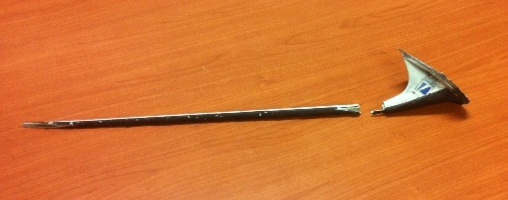
The VHF antenna was found on the runway, having broken off from the underside of the aircraft after striking the runway (Figures 1 and 2). Two aerodynamic fins also sustained minor scrapes from the runway. The pilots and passengers were uninjured in the occurrence and a subsequent engineering inspection found that the landing gear warning horn was serviceable.
Figure 1: Broken antenna
Source: Aircraft operator
Figure 2: Photo of new antenna fitted to VH-TXK
Source: Aircraft operator
Pilot comments
The pilots provided the following comments:
The pre-landing and finals checks were conducted from memory, rather than a written checklist. With a pilot ICUS and supervising pilot, the pilot may have vocalised the checks as they were being performed, but on this flight the pilot ICUS could not recall vocalising the checks and the supervising pilot did not recall hearing them. The company did not have standard procedures for ICUS flights.
Neither pilot completed checks when on final to confirm the landing gear indicated three green lights. The supervising pilot reported that when landing on runway 07 late in the afternoon, the position of the sun often made the cockpit display, including the landing gear indication, appear to be illuminated.
The stall warning would normally sound during the landing phase in that aircraft. Neither pilot recalled hearing the aural stall warning or landing gear warning horn. As the aircraft was on a slightly higher and faster approach than normal, the pilot ICUS reduced the throttle to idle earlier than for a normal landing. This should have activated the landing gear warning, unless the throttle levers were not retarded to a position fully against the idle stops.
The pilot ICUS had used written checklists when operating other aircraft, but had been trained to perform checks from memory for the PA-31.
Aircraft operator comments
The pilot ICUS held the appropriate endorsements for the aircraft and had 47.7 hours experience on the aircraft type. His total flying time was 319.5 hours. The aircraft insurer required a pilot to hold a minimum of 600 hours total time to operate the aircraft as pilot in command, hence the pilot was operating under supervision.
As they do not normally conduct two-pilot operations, they did not have a training program in place for such operations.
Department of Defence investigation
The Department of Defence conducted an internal investigation into the incident and reported that, during normal operations, the Tower controller was required to scan an aircraft during critical stages of flight. This included monitoring that the aircraft was on the appropriate track, level and positioned for the correct runway. They were also required to scan for any abnormalities with the aircraft. It was normal process for all Townsville air traffic controllers to visually scan the undercarriage status of all aircraft on final approach.
The Tower controller could not recall specifically observing the position of the aircraft’s landing gear when scanning the aircraft on final approach, but the position of the sun at the time of the incident may have affected the Tower controller’s ability to observe the aircraft’s landing gear.
Safety action
Whether or not the ATSB identifies safety issues in the course of an investigation, relevant organisations may proactively initiate safety action in order to reduce their safety risk. The ATSB has been advised of the following proactive safety action in response to this occurrence.
Aircraft operator
As a result of this occurrence, the aircraft operator has advised the ATSB that pilots will henceforth require a minimum of 600 hours total aeronautical experience prior to operating that aircraft type. Company pilots will receive additional experience and training prior to operating as supervising pilots.
Department of Defence
As a result of this occurrence, the Department of Defence has advised the ATSB that they are taking the following safety actions:
A safety awareness poster was created and displayed in prominent locations for Townsville based controllers to view, describing an ‘effective scan’.
Townsville controllers were briefed on the importance of proper scan technique during the critical stages of an aircraft’s flight. Particular mention was made of the importance of checking the status of the landing gear when an aircraft is cleared to land.
Safety message
This incident is a reminder for pilots and operators of the limitations of human performance and highlights the need to follow procedures and complete checklists diligently.
Decisions regarding whether to conduct an investigation, and the scope of an investigation, are based on many factors, including the level of safety benefit likely to be obtained from an investigation. For this occurrence, a limited-scope, fact-gathering investigation was conducted in order to produce a short summary report, and allow for greater industry awareness of potential safety issues and possible safety actions.
Publishing information
Released in accordance with section 25 of the Transport Safety Investigation Act 2003
Ownership of intellectual property rights in this publication
Unless otherwise noted, copyright (and any other intellectual property rights, if any) in this report publication is owned by the Commonwealth of Australia.
Creative Commons licence
With the exception of the Coat of Arms, ATSB logo, and photos and graphics in which a third party holds copyright, this publication is licensed under a Creative Commons Attribution 3.0 Australia licence.
Creative Commons Attribution 3.0 Australia Licence is a standard form licence agreement that allows you to copy, distribute, transmit and adapt this publication provided that you attribute the work.
The ATSB’s preference is that you attribute this publication (and any material sourced from it) using the following wording: Source: Australian Transport Safety Bureau
Copyright in material obtained from other agencies, private individuals or organisations, belongs to those agencies, individuals or organisations. Where you wish to use their material, you will need to contact them directly.
On the morning of 9 January 2015, a Regional Express operated SAAB 340B aircraft, registered VH-OLM struck a flock of birds during its landing roll at Moruya, New South Wales. Inspection of the aircraft by the flight crew found bird impact marks but no visually identifiable damage. The crew continued their schedule to Merimbula, New South Wales. At Merimbula, the first officer noticed the tip of one propeller blade was missing, and the aircraft was subsequently grounded.
What the ATSB found
The blade tip failure was almost certainly a result of the birdstrike during the landing roll of the previous flight, weakening the internal structure of the blade.
The flight crew conducted a visual inspection in accordance with the operator’s procedures, and this inspection did not find any damage. However, the propeller manufacturer’s birdstrike inspection procedure was deemed a maintenance task. As such, it was not suitable for flight crew.
What's been done as a result
The operator changed its birdstrike procedures to ensure aircraft remained on the ground until a maintenance inspection was carried out in accordance with appropriate documented inspection procedures. In addition, pilot and engineering notices were issued clarifying these requirements.
Safety message
Adherence to regulations and company procedures is essential for the ongoing airworthiness of aircraft. Therefore, it is vital that procedures are clear and do not lead to ambiguity or misinterpretation. Where uncertainty exists, seeking clarification from the relevant authority can reduce the risk of an unserviceability affecting flight safety.
The occurrence
On the morning of 9 January 2015, the crew of a Regional Express operated Saab 340B aircraft, registered VH-OLM, and were conducting a series of scheduled passenger flights between Sydney, Moruya and Merimbula, New South Wales. The first officer was the pilot flying on the Sydney to Moruya sector.
At about 0955 Eastern Daylight-saving Time, a visual, straight-in approach was conducted to land on runway 18[1] at Moruya. The aerodrome forecast for arrival at Moruya showed a 7 kt wind from the north-east, good visibility and cloud from 2,000 ft above the aerodrome.
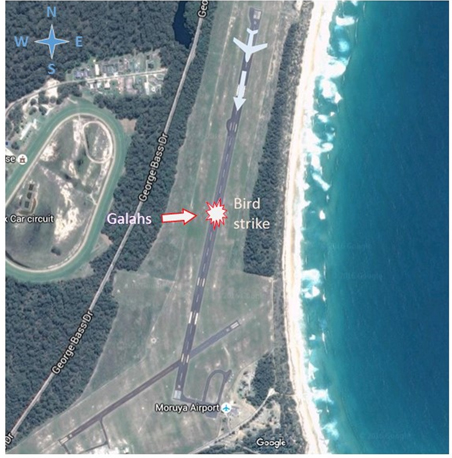
After touchdown, as the aircraft slowed through 80 kt, the captain took control of the aircraft for the taxi to the terminal in accordance with normal company operating procedures. The crew reported that, shortly after the captain took control, a large flock of galahs[2] took off from the grass to the west (right) of the runway and flew at a low height over the runway eastbound (Figure 1). In anticipation of a birdstrike, the captain increased wheel braking and applied reverse thrust on both engines. Prior to reaching the galahs forward thrust was selected. Despite that action, about halfway down the runway the first officer observed birds had impacted the aircraft.
Figure 1: Moruya Airport showing aircraft and galah flock direction of travel and approximate impact point
Source: Google maps (Modified by the ATSB)
On reaching their designated parking area, and in accordance with the operator’s birdstrike procedures, the flight crew carried out testing of the ice protection system before the engines were shut down, with no issues identified. Once the passengers who were disembarking at Moruya had left the aircraft, the first officer commenced an external inspection of the aircraft. The captain notified the airport reporting officer of the birdstrike. The airport safety officer subsequently found around 10 bird carcases on the runway.
The first officer found clear evidence of multiple birdstrikes on the right side of the fuselage, and the right engine and propeller, in the form of blood staining and bird carcass debris. One of the left engine propeller blades also displayed blood staining and white powder marks, consistent with a birdstrike. Despite the bird impacts, no evidence of ingestion into the engines or physical damage to the aircraft or propeller blades was observed.
The captain and the first officer reported that they subsequently carried out a detailed visual examination of the birdstrike-affected blades. The examination included rotating the propellers so that the forward and aft blade surfaces could be inspected for cracking, buckling, chips, dents or deformation along each affected blade’s leading edge. When no damage was identified, the captain contacted the operator for further technical advice and the crew were subsequently cleared to continue with the flight schedule.
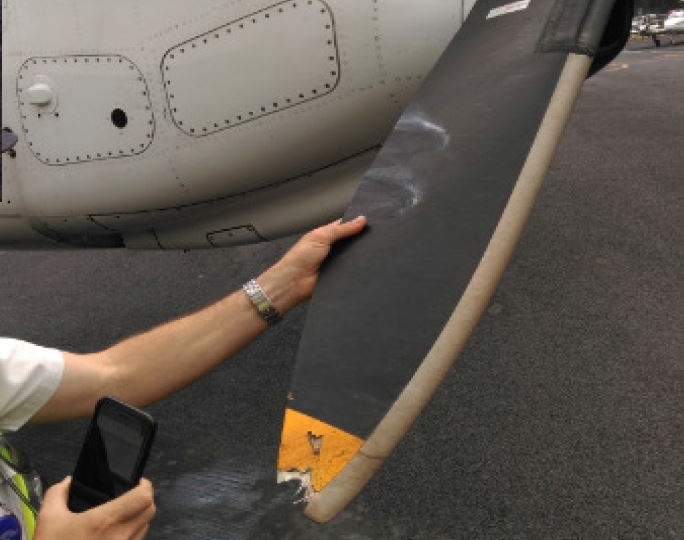
The crew then operated the aircraft from Moruya to Merimbula. After engine shutdown at Merimbula, the first officer opened the forward left door and observed that the tip of one of the left propeller blades had detached (Figure 2). The aircraft was declared unserviceable and grounded.
There were no reported injuries to the crew or passengers. No damage to the aircraft structure was identified as a result of the loss of the blade tip.
Figure 2: Left engine propeller showing damaged blade tip on arrival at Merimbula
Both the captain and first officer held valid Class 1 medical certificates, and were appropriately qualified to conduct the flight. The captain had a total aeronautical experience of approximately 7,000 hours with 4,300 hours flying Saab 340 aircraft. The first officer had a total aeronautical experience of around 5,400 hours with 4,200 hours flying Saab 340 aircraft.
A review of the crew’s recent history indicated that fatigue was not a factor, with both crew reporting they had an average to good sleep during the previous 72 hours.
Aircraft information
The aircraft, a Saab Aircraft CO 340B-2, was manufactured in 1990 and entered the Australian aviation register in October of that year. The aircraft is a twin engine turbo-prop and configured to carry 36 passengers and three crew. The aircraft was maintained under Civil Aviation Safety Regulation Part 42, which detailed the continued airworthiness requirements for regular public transport aircraft.
Aircraft damage information
The majority of the bird remains were found on the right side of the fuselage behind the forward right door, which was consistent with birds contacting the lower half of the right propeller disc. Small items of debris were also observed on both engine nacelles. There was no evidence of debris entering either engine. All of the blades on the right propeller showed evidence of impact with birds. Only one blade on the left propeller displayed evidence of bird contact.
Data from the aircraft’s flight data recorder for the flight from Moruya to Merimbula was examined. That data did not show any anomalies that would have identified the point when the propeller blade tip separated.
Propeller blade
Propeller blade construction
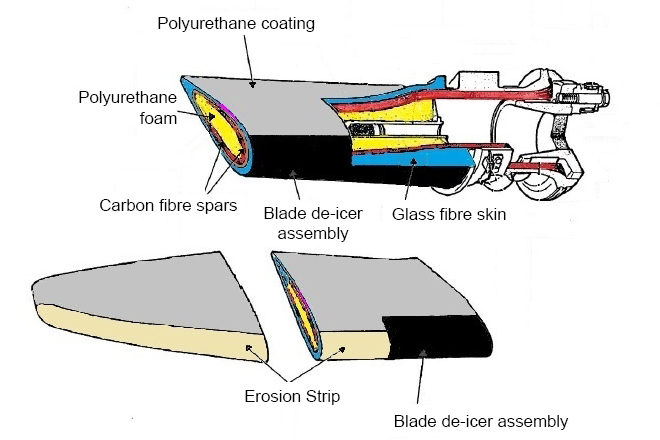
The propeller blades were manufactured by Dowty Propellers. They were made of composite construction with a polyurethane foam core, carbon fibre spars, glass fibre skin, and a polyurethane coating. A braided metal strip between the glass fibre and polyurethane coating ran from the tip of the blade to its root, providing lightning protection (Figure 3).
Figure 3: Propeller blade construction
Source: Dowty Propellers modified by ATSB
Left propeller blade damage
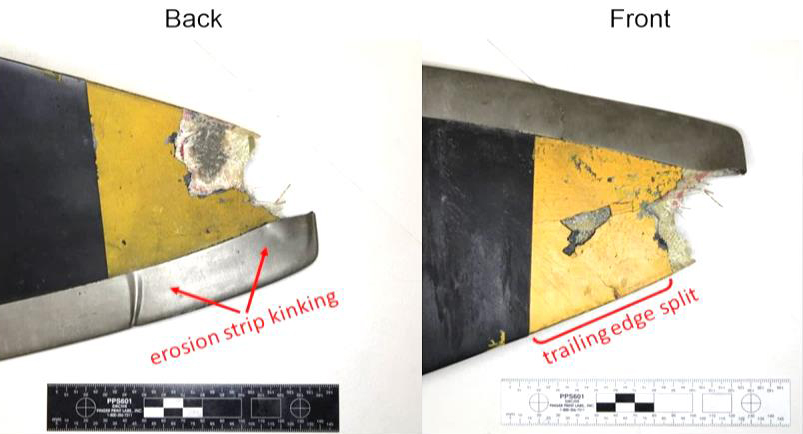
The left propeller blade presented with white powder impact marks toward the trailing edge, about 300–400 mm from the blade tip; about one third up the blade’s length. A section of blade was missing from the tip. Within the tip damage region, splitting at the trailing edge was identified (Figure 4). Damage to the leading edge erosion strip near the tip was also identified, with kinking on the back, and a corresponding crack on the front of the blade.
Figure 4: Left propeller blade damage showing tip separation, kinking, crack, and splitting of trailing edge
Source: ATSB
Blade history
A review of the damaged blade’s service history showed it was installed on the propeller as a new item in 2000. The propeller had also undergone a number of inspections since that time, including overhaul in 2011. The overhaul facility advised that during the 2011 propeller overhaul, ultrasonic NDT was carried out on the propeller’s blades. All of the blades were found to be serviceable. There were no reported incidents of impact to the blade prior to this occurrence.
Blade examination
The damaged blade was sent to the ATSB for in initial assessment. A visual inspection, and a ‘tap test’ using a metallic object were conducted on the blade. That test revealed a potential area of delamination or disbond under the surface extending from the tip separation point.
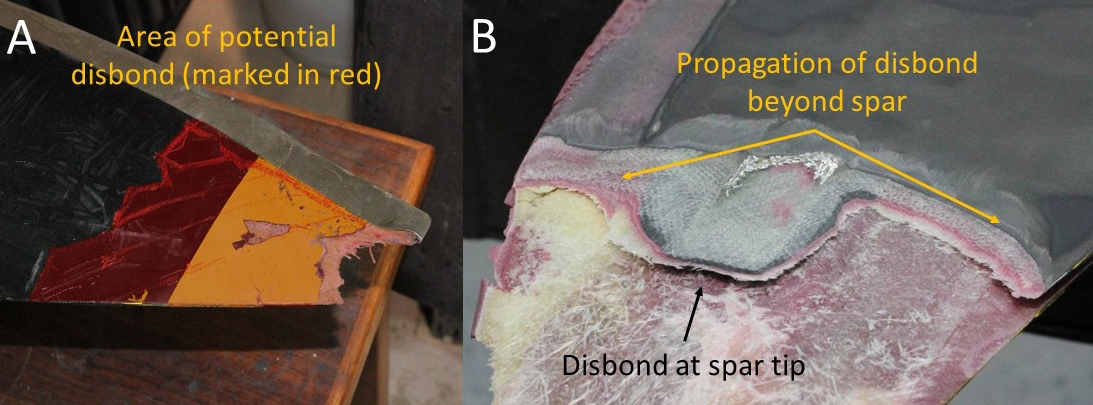
The blade was subsequently sent to a third-party laboratory for NDT and destructive testing under the supervision of the ATSB. A dual probe ultrasonic tester was used over the entire surface of the blade. Disbond was detected in a region extending from the spar through to the tip of the blade (Figure 5A). Further destructive testing in the form of surface grinding was carried out to determine at which layers the disbond had occurred. That action showed disbonding at the carbon fibre spar tips. The disbond had also propagated along the glass fibre layer of the blade beyond the spars (Figure 5B).
Figure 5: Region of disbonding shown
Source: ATSB
The propeller manufacturer determined the damage was consistent with the effects of impact on the blade from the birdstrike. The most likely failure mechanism was considered to be delamination between the blade’s foam core and spar barrier membrane. The delamination then progressed outboard into the fibreglass layer beyond the spar resulting in the subsequent tip failure.
The propeller manufacturer concluded that the kink in the erosion strip on the back of the blade (Figure 4) was consistent with an impact on the front of the blade near the tip, bending the blade tip rearwards rather than forwards. The manufacturer considered this damage was consistent with a bird or other hard object impact. It also stated that it considered that the buckling of the guard would probably have occurred as a result of the impact rather than due to subsequent aerodynamic loading. Therefore, it believed the kink would most likely have been present at the time the blade was inspected at Moruya.
Propeller and blade maintenance requirements
Birdstrike procedure
The operator’s policy and procedures manual included a section on birdstrikes, which stated:
Following a known or suspected Bird Strike the Flight Crew must complete the External Inspection (Crew Change) in its entirety in accordance with the Saab 340 Flight Crew Operating Manual [FCOM].
Generally, blood and/or feathers are noticeable in the impact area of a bird strike. In low light conditions a torch must be used.
Any defect, major damage or evidence of ingestion into an engine or airframe intake (include AC & DC Generator intakes) must be entered in an AML [aircraft maintenance log] and an engineering inspection must be performed prior to any subsequent flight.
If the inspection does not reveal the existence of a defect or damage, and there was no effect on the aircraft’s performance following the event, the aircraft may continue to operate.
Prior to the next flight, the Ice Protection must be checked in accordance with the Saab 340 Flight Crew Operating Manual.
Flight crew inspections
The operator’s Saab 340 flight crew operating manual (FCOM) included procedures for three types of external aircraft inspections by flight crew:
daily inspection, conducted prior to the first flight of the day
crew change inspection, conducted prior to the next flight when a flight crew accept an aircraft previously flown by another crew that day, if the aircraft has been taken off-line for maintenance during the day, or the aircraft is left unattended and not under continuous surveillance of the flight crew
post flight inspection, conducted at the conclusion of each flight.
The FCOM procedures for a daily inspection and a crew change inspection both included a detailed list of items required to be checked by a flight crew. The only propeller specific items were:
Inspect propeller assembly for oil or grease leakage from hub assembly
Inspect propeller de-icer boots…
The FCOM procedures for a post-flight inspection included a smaller list of items. In terms of propellers, the items included:
Propellers – including freedom of rotation and each blade front and back for obvious damage.
Maintenance procedures
The operator’s system of maintenance was conditional on the inclusion of the relevant manufacturer’s maintenance manuals. Consequently, birdstrike inspection procedures were derived from the aircraft manufacturer’s aircraft maintenance manual (AMM) for airframe inspections, and the propeller manufacturer’s component maintenance manual (CMM) and an aircraft specific propeller maintenance manual (PMM) for propeller inspections.
The CMM and PMM provided the primary source of information on maintenance requirements and serviceability limitations of the propeller and its blades. Contained within the introduction chapter of the CMM was the statement:
Use qualified personnel and good engineering practice for all procedures and standard practices used in this manual.
The PMM inspection and check section included the following requirements in a section titled ‘Bird Strike or other Impact Damage’:
1. Propellers which have had, or are thought to of had a bird strike or other impact must be examined immediately.
2. Refer to propeller blade damage limits for allowable damage limits and repairs. Refer to CMM 61-10-39 Check. If the damage is within the allowable limits the propeller can stay in service.
3. If the damage is more than the allowable limits, but within the repair limits, a ferry flight may be allowed. The operator should write a ferry flight request on a concession form and send it to Dowty Propellers. Refer to Service Letter E340.
4. Equipment sent for repair must be clearly identified with the reason why.
The CMM 61-10-39 check section described the procedure of examination as a two-level process, consisting of a general check of all parts and a special check of specific parts. The section also contained non-destructive testing (NDT) techniques to be used on the blade assemblies and it provided blade damage limits relevant to blade location.
The CMM general check procedure included a section titled ‘Impact Damage’, which applied to birdstrikes. This section stated:
1. If the propeller has had impact damage, do the applicable visual and NDT inspection procedures given for the area of impact.
2. If the position of the impact will cause impact damage to other propeller components, do the applicable visual and NDT inspection procedures given for ‘secondary’ area of impact…
3. If it is not clear where the damage is, or if there is doubt concerning secondary impact damage contact Dowty Propellers.
The ATSB found ambiguity in the CMM procedures for assessing blades following a birdstrike impact. It was not readily apparent from the procedures whether the bird contact alone would constitute damage or whether subsequent blade NDT was required. As a result, the ATSB sought clarification from the manufacturer. The manufacturer advised:
Generally, the intent is that there must be signs of damage before NDT is required.... Not many impacts leave no trace at all and generally, anything that is going to cause structural damage will have an associated visual indicator…
Dowty would not consider evidence of animal matter as damage however it would be an indication that there had been an impact and that further investigation may be needed, again we would always recommend caution if there was any doubt.
Therefore, according to the manufacturer, the presence of feathers and dust marks (a visual indicator), while not displaying visible damage, may require further investigation.
Additional information
In 2011, the operator applied to the Civil Aviation Safety Authority (CASA) for approval to allow flight crew to undertake birdstrike inspections of aircraft. The CASA response (9 February 2012) highlighted the requirements of the Civil Aviation Safety Regulation Part 42 and the associated Part 42 Manual of Standards. Guidance on the continuous airworthiness requirements was provided,[3] including examples of situations that would exclude flight crews’ ability to undertake inspections, as well as situations where flight crew inspections would be allowed.
CASA determined that where a specific birdstrike inspection was required by a manufacturer, that inspection would be deemed an engineering maintenance task and outside the scope of flight crew approved maintenance. Where specific inspection requirements did not exist and where there had been no effect on the aircraft’s performance, external inspection by flight crews to determine if damage had been sustained was acceptable. CASA stated that the operator needed to submit its proposed procedures to CASA’s oversighting office for the operator.
Based on the CASA advice, and believing there was no manufacturer specific inspection, the operator developed a draft birdstrike inspection procedure for flight crew. The draft procedure (and associated external inspections) was submitted to CASA’s oversighting office for the operator and, following minor amendments, was issued to flight crew in an operations notice on 24 February 2012, and incorporated into the operator’s policy and procedures manual in April 2012.
Following the 9 January 2015 occurrence, the operator advised the ATSB that it had misinterpreted the requirements in the CASA letter. The operator also advised that when it developed its birdstrike procedure, it relied on the aircraft manufacturer’s AMM and information from the aircraft manufacturer. It inadvertently did not consider the propeller manufacturer’s PMM. As noted in in the previous section, the PMM documented a birdstrike inspection.
The operator advised the ATSB that it had approached the propeller manufacturer to include tap testing of the blade surface as part of the engineering birdstrike inspection procedure. The manufacturer indicated that a tap test of the blade is of very limited value because it did not give a sufficiently definitive result and risked not detecting blade delamination, except for the blade erosion strip.
Wildlife hazard management requirements and guidance
General requirements and guidance
A number of regulations, standards, and guidelines apply to wildlife hazard management at airports. The International Civil Aviation Organization established the standards for the management of collisions between wildlife and aircraft. It also provides guidance on effective wildlife management programs.
Within Australia, CASR 139 required a certified aerodrome to have an aerodrome manual, which must include details regarding bird and animal hazard management. The Manual of Standards (MOS) for Part 139 provides more detailed requirements. These included a requirement that, where regular monitoring confirmed the existence of a bird or animal hazard, or at the direction of CASA, the aerodrome operator must develop a bird or animal hazard management plan. The plan had to be developed by a suitably qualified person such as an ornithologist or biologist, and had to address the following factors:
hazard assessment, including monitoring action and analysis;
pilot notification [reporting];
liaison and working relationships with land use planning authorities;
on-airport bird and animal attractors which provide food, water or shelter
suitable harassment methods; and
an ongoing strategy for bird and animal hazard reduction, including provision of appropriate fencing.
Advisory Circular (AC) 139-26(0) Wildlife hazard management at aerodromes provides further guidance information about managing wildlife hazards at aerodromes. It states that that once a wildlife hazard is identified, appropriate and effective treatment should be employed. Treatment methods fall into two categories:
pre-emptive (such as removal of food sources, maintenance of grass, etc.) and where necessary
active (such as scare tactics using horns, siren, or dogs).
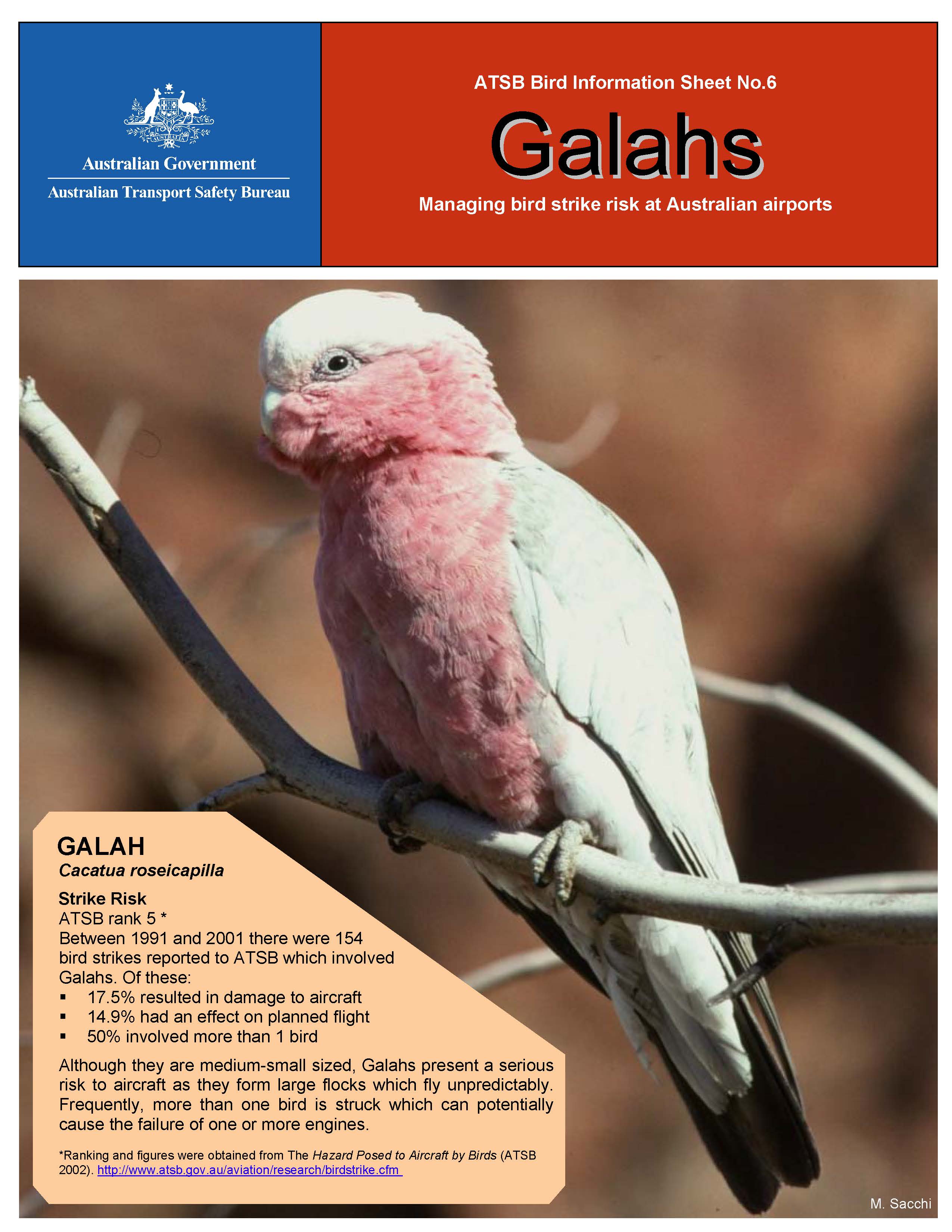
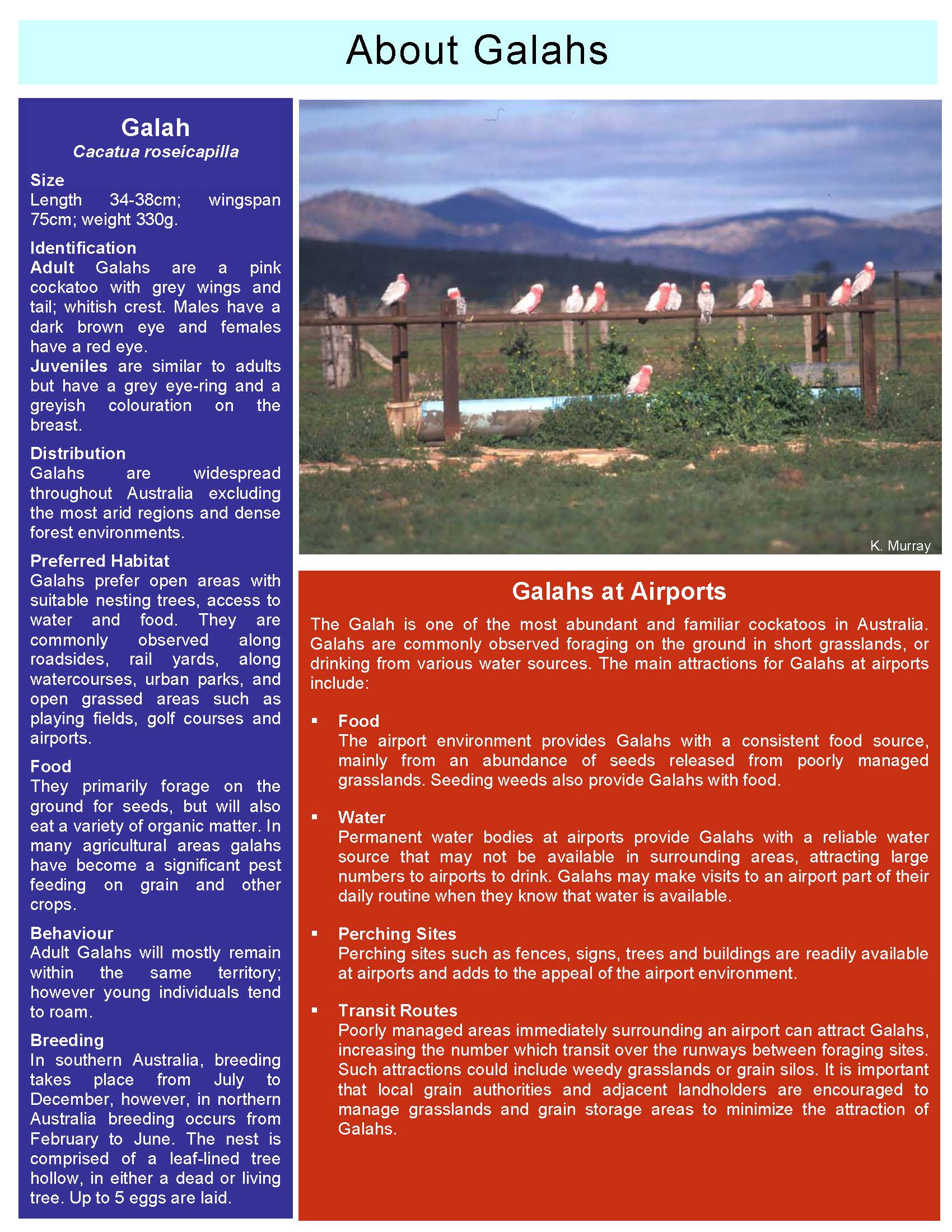
The ATSB’s bird information data sheets for the management of birdstrike risks at airports, ATSB bird information sheet number 6, refers to the galah (reproduced in the Appendix). The information sheet advises that all bird management strategies should seek to make an airport as undesirable as possible to birds through habitat modification. With regard to galahs, amongst various suggestions, it recommends that:
a tall grass policy (30 cm) be maintained as galahs find it difficult to see approaching predators
manage grasslands to limit production of seeds.
Additional active management strategies that can be used to disperse and control the birds include:
use of pyrotechnics (cracker shells), portable distress callers, sirens, lights and vehicles
use of trained animals (birds of prey, dogs, etc.), and where necessary, and permitted, culling may be required.
Airport information
Moruya was a certified, uncontrolled, two runway airport situated close to the coastline (Figure 1).
The airport had a bird and animal (wildlife)[4] management program. This includes daily inspection of the airport with reporting on wildlife activity, low level harassment with a vehicle to disperse wildlife, and maintenance of grass areas to minimise or deter habitation. The airport coordinator advised that the local galahs tended to stay close to the buildings and trees, but it was not usual for them to be in the runway area. The grass around the runway was long and had been scheduled for cutting that day. The airport coordinator considered the longer grass may have attracted the galahs to feed on the grass seeds.
The airport’s records of wildlife strikes indicated they were not seasonal, with birdstrikes occurring throughout the year, over the previous five years. In 2014, however, the only three reported birdstrikes were confined to the first quarter of the year (January to March). None of these involved galahs.
A review of the 2014 annual report revealed a consistent number of galahs resided at the airport, with between two and 10 birds observed regularly. Their activity was predominantly around the terminal area in the early morning, usually departing before 0800. There was only one instance of flocking behaviour by galahs in the 2014 report. That occurrence was in February 2014 when large groups of about 32 galahs were observed coming in from a nearby camping area to graze near the terminal building, and departing by about 0800.
The presence of birds at Moruya Airport was frequent and significant enough for the aeronautical information package, En Route Supplement Australia, to include an additional information note that a bird hazard exists.
The ATSB compared birdstrike rates per 10 000 aerodrome movements for Moruya against other regional aerodromes, and the birdstrike rates for Moruya were considerably lower than most.
Other occurrences
A review of the ATSB occurrence database for the period 1977 to 2014 did not reveal any additional blade failures or in-flight blade tip failures for the propeller type due to a birdstrike.
During the landing roll at Moruya Airport, a number of birds were struck. On the following flight, the left propeller blade tip failed. This analysis examines the actions of the flight crew, the failure mechanism of the blade, inspection requirements following a birdstrike, and factors that may have identified the potential risk of blade failure.
Flight crew actions
The presence of galahs to the right of the runway during the landing roll presented a high risk of impact to approaching aircraft. The captain followed appropriate actions to maximise aircraft deceleration while minimising potential impact damage through effective use of reverse thrust and aircraft wheel braking. Despite the crew’s best efforts, the subsequent impact with the birds was considered unavoidable.
The birdstrike inspection carried out by the flight crew was in accordance with the operator’s procedures. The crew reported performing a thorough visual inspection of the individual blades on both propellers, including rotation of the propellers to sight along each blade surface for damage or deformation. Despite the lack of visible damage associated with the bird impacts, the captain sought further advice from the operator’s engineering department before determining the aircraft was serviceable. The engineering department reportedly advised the captain to follow the flight crew’s documented procedures, and if no damage was evident, continue with the flight schedule.
Blade failure mechanism
Review of the blade’s service history showed it had undergone numerous non-destructive tests (NDT) and inspections, including an ultrasound inspection in 2011. None of those inspections revealed evidence of internal delamination. As there were no previously reported incidents of impact to the blade, it is unlikely that a pre-existing defect below the blade surface existed or influenced the blade’s failure.
Examination of the blade found that the failure mode was consistent with a bird impact. Consequently, given the failure occurred on the flight following the birdstrike, it is almost certain that impact with one or more galahs initiated the internal delamination of the blade. This led to a rapid decay of its structural integrity and subsequent separation of the tip, as the blade was subjected to aerodynamic loads during the following flight.
The propeller manufacturer indicated that the buckling of the blade guard would probably have occurred as a result of the impact rather than due to subsequent aerodynamic loading, and the damage to the guard would have been evident when the blade was inspected by the flight crew at Moruya.
The ATSB agrees it is plausible that the birdstrike resulted in cracking of the leading edge of the guard. However, the extent to which the damage to the guard would have been readily detectable when the blade was inspected at Moruya is unclear. Once the leading edge guard lost structural integrity, together with internal delamination damage, it is difficult to determine the nature of the subsequent loading conditions during flight.
Inspection requirements
The flight crew were not familiar with the propeller manufacturer’s inspection procedure, however, there were specific propeller inspection instructions in their normal procedures following a birdstrike, and the captain and first officer reported carrying out a thorough visual examination of the propeller blades in line with these procedures. Regardless of the nature of the flight crew’s inspection, both CASA and the propeller manufacturer considered the inspection to be a maintenance task, and required it to be carried out by qualified maintenance personnel.
The ATSB could not determine if an engineering inspection would have highlighted any possible damage. However, if an appropriately qualified person inspected the multiple bird impacts on the blades, they may have sought further advice from the propeller manufacturer in accordance with the documented propeller manufacturer’s maintenance procedure ‘if there is doubt concerning secondary impact damage…’ As the flight crew did not have this document, they would not have been aware of this procedure. Despite this, the captain did seek further advice from the operator’s engineering department. As an on-site engineering inspection was not carried out, the operator’s engineering department may not have had a full appreciation regarding the multiple birdstrikes.
The discussion between engineering and the flight crew focused on the presence of visible damage to the blade, and the documented flight crew inspection procedures. Consequently, the reported blade condition did not raise concerns with the engineering department about potential secondary damage or reduced structural integrity. That determination presented a missed opportunity to undertake an engineering inspection of the aircraft prior to take off. Consequently, the potential to detect sub-surface damage was also missed.
The Civil Aviation Safety Authority (CASA) provided the operator with advice on interpreting regulations for situations where pilots may or may not undertake birdstrike inspections. That advice included that if specific birdstrike inspection procedures within instructions for continuing airworthiness (ICA) deemed the inspection task as being a maintenance requirement then they were not suitable for flight crew. It is apparent the operator misinterpreted the advice from CASA as only referring to the aircraft manufacturer’s procedures and not also the propeller manufacturer’s procedures. As a result, the operator’s procedures allowed flight crew to undertake visual inspections after a birdstrike (beyond confirmation of whether there was a strike).
Moruya Airport bird and animal control
The frequency of bird and animal (wildlife) strike incidents over a 10-year period did not indicate that an increasing wildlife problem existed at Moruya Airport. The presence of galahs was common, however the galahs were typically in small numbers, and contained to around the buildings and treed areas.
According to the Moruya 2014 bird and animal report, and along with the birdstrike statistics for Moruya, the airport’s reliance on the maintenance of the grass adjacent to the runway as a pre-emptive means of bird management generally appeared to work for maintaining low wildlife strike incidents. On the day of the occurrence, the grass around the runway was long, and was scheduled for cutting later in the day. The ATSB bird information sheet indicates long grass can deter galahs. However, in this instance, the presence of grass seeds on the long grass may have contributed to their increased numbers and proximity to the runway. Consequently, when birds are located in the grass adjacent to the runway, an increased risk of aircraft strikes existed.
Findings
From the evidence available, the following findings are made with respect to the damage and subsequent propeller blade tip separation associated with the birdstrike occurrence involving a Saab 340B, registered VH-OLM, at Moruya Airport, New South Wales on 9 January 2015. These findings should not be read as apportioning blame or liability to any particular organisation or individual.
Contributing factors
The impact from multiple galahs almost certainly reduced the structural integrity of a propeller blade, resulting in the separation of its tip during the subsequent flight.
Other factors that increased risk
The permitting of flight crew to carry out post birdstrike inspections was outside the approval of the regulator and propeller manufacturer, and reduced the likelihood of identifying serviceability issues.
Safety issues and actions
Additional safety action
Whether or not the ATSB identifies safety issues in the course of an investigation, relevant organisations may proactively initiate safety action in order to reduce their safety risk. The ATSB has been advised of the following proactive safety action in response to this occurrence.
Regional Express
As a result of this occurrence, Regional Express advised the ATSB that it had undertaken pro-active safety action through issuing the following:
Notice to aircrew NOTAC 091/15, REPORTING OF BIRD AND WILDLIFE STRIKES - REISSUED. Which stated:
If there is any evidence of impact (blood/feathers/dust) on the propellers following wildlife strike the aircraft must not depart until an engineering inspection is complete. In addition to the requirements of PPM 13.1 1-Bird Strike, an AML [aircraft maintenance log] must be raised for wildlife impact with the propeller. All bird and wildlife strikes or suspected strikes encountered on approach/departure, take-off/landing should be reported to the Network Ops Centre (NOC) as soon as practicable following a strike. The NOC will then inform the aerodrome operator to enable immediate dispatch of the ARO [aerodrome reporting officer] to inspect the runway and vicinity of the airport in the effort to locate and remove any animal remains, as well as assisting in the identification of the species for wildlife management within the region. The SMS requirements remain unchanged.
Notice to engineers NOTEM 83, Bird Strike Inspections. Which stated:
Until further notice if a bird (wildlife) strike is reported and there is evidence of impact (blood/feathers/dust) on the propeller then the aircraft must not be released to service until both the CAM [continued airworthiness manager] and Chief Pilot have given approval. AML is required to be raised for any event where there is evidence of impact on the propeller.
Engineering technical notice TN-SAAB-6100-008-15, Propeller Bird Strikes. Which stated:
1. Introduction
This Technical Notice is issued to provide information for engineers dealing with aircraft bird strikes involving contact with propeller or any other impact experienced by the propeller whilst installed.
2. Content
When an aircraft is reported to have experienced a bird strike and there is evidence of contact with the propeller an AML must be raised and an engineering inspection of the propeller must be conducted IAW the applicable maintenance manual.
For Dowty propellers refer to the applicable Maintenance Manual and Component Maintenance Manual, a flow chart is provided on page 2 of this TN to help engineers perform the required inspection and make airworthiness assessment for Dowty propellers.
For the Hamilton Sundstrand propeller refer to the Maintenance Manual P5199, CHECK, Inspection After Impact procedure. A copy of this procedure is included on page 3 of this TN. Note: It is a requirement to check the blade track as part of this procedure.
The same procedures should be used for any report of impact experienced by the propeller while it is installed.
These notices were subsequently included in relevant manual updates.
Sources and submissions
Sources of information
The sources of information during the investigation included the:
flight crew
aircraft operator (Regional Express)
propeller manufacturer
propeller overhaul organisation
Moruya airport operator
United Kingdom Air Accidents Investigation Branch
Swedish Accident Investigation Authority
Australian Bureau of Meteorology.
Submissions
Under Part 4, Division 2 (Investigation Reports), Section 26 of the Transport Safety Investigation Act 2003 (the Act), the Australian Transport Safety Bureau (ATSB) may provide a draft report, on a confidential basis, to any person whom the ATSB considers appropriate. Section 26 (1) (a) of the Act allows a person receiving a draft report to make submissions to the ATSB about the draft report.
A draft of this report was provided to the captain, first officer, Regional Express, Moruya airport operator, Civil Aviation Safety Authority (CASA), Dowty Propellers, and the United Kingdom Air Accidents Investigation Branch.
Submissions with comments were received from the operator, CASA and the propeller manufacturer. The submissions were reviewed and, where considered appropriate, the text of the report was amended accordingly.
Appendix A: ATSB Bird Information Sheet No 6
Purpose of safety investigations
The objective of a safety investigation is to enhance transport safety. This is done through:
identifying safety issues and facilitating safety action to address those issues
providing information about occurrences and their associated safety factors to facilitate learning within the transport industry.
It is not a function of the ATSB to apportion blame or provide a means for determining liability. At the same time, an investigation report must include factual material of sufficient weight to support the analysis and findings. At all times the ATSB endeavours to balance the use of material that could imply adverse comment with the need to properly explain what happened, and why, in a fair and unbiased manner. The ATSB does not investigate for the purpose of taking administrative, regulatory or criminal action.
Terminology
An explanation of terminology used in ATSB investigation reports is available here. This includes terms such as occurrence, contributing factor, other factor that increased risk, and safety issue.
Publishing information
Released in accordance with section 25 of the Transport Safety Investigation Act 2003
Ownership of intellectual property rights in this publication
Unless otherwise noted, copyright (and any other intellectual property rights, if any) in this report publication is owned by the Commonwealth of Australia.
Creative Commons licence
With the exception of the Coat of Arms, ATSB logo, and photos and graphics in which a third party holds copyright, this publication is licensed under a Creative Commons Attribution 3.0 Australia licence.
Creative Commons Attribution 3.0 Australia Licence is a standard form licence agreement that allows you to copy, distribute, transmit and adapt this publication provided that you attribute the work.
The ATSB’s preference is that you attribute this publication (and any material sourced from it) using the following wording: Source: Australian Transport Safety Bureau
Copyright in material obtained from other agencies, private individuals or organisations, belongs to those agencies, individuals or organisations. Where you wish to use their material, you will need to contact them directly.
On 4 January 2015, the pilot of a Beechcraft 76 aircraft, registered VH-ZUA (ZUA), commenced a ferry flight from Archerfield to the Gold Coast, Queensland. The private flight was conducted under the visual flight rules (VFR), and the pilot was the sole person on board. The aircraft departed Archerfield at about 1200 Eastern Daylight Time (EDT), and climbed to a planned cruising level of 1,500 ft above mean sea level.
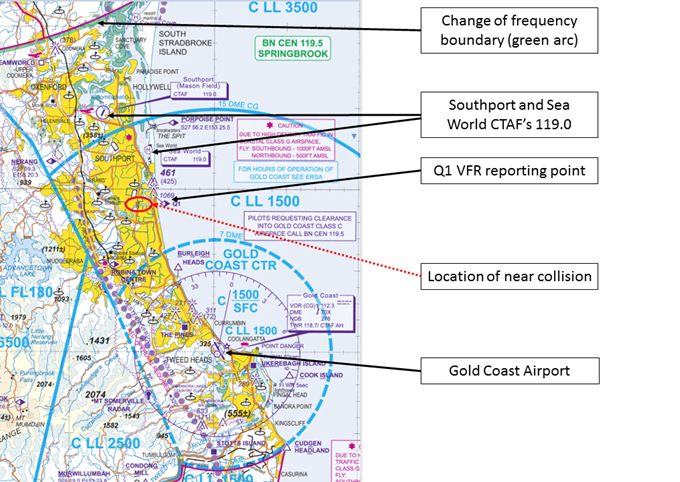
Figure 1: Gold Coast VTC
Source: Airservices Australia: Visual Terminal Chart modified by the ATSB
At about 1210, as ZUA approached the change of frequency boundary (Figure 1) just north of Dreamworld, the pilot changed to the area frequency (119.5 MHz) on COMM 1[1] with the Southport CTAF frequency (119.0 MHz) in the standby section of the Garmin 530. As he approached Southport airport, the pilot moved the standby frequency (119.0 MHz) into the active box and as required, broadcast the aircraft’s position and intentions. The CTAF frequency is common to both Southport Airport and the nearby Sea World helipad (Figure 1).
At about 1212, the pilot of an AS350 helicopter, registered VH-SWX (SWX) prepared to depart from Sea World, Queensland, for a 15 minute local commercial scenic flight. The first sector was from Sea World to overhead the Robina shopping centre (Figure 2). On board were the pilot and 5 passengers.
The pilot obtained the Gold Coast automatic terminal information service (ATIS) prior to becoming airborne at about 1215 and broadcasting his intentions on the Sea World CTAF frequency of 119.0 MHz (the same frequency as the Southport CTAF). As a small sector of the scenic flight was to be conducted in the Gold Coast control Zone, the pilot obtained a transponder code from Gold Coast Ground air traffic control soon after the helicopter had departed.
At about 1220, as ZUA neared the Q1 VFR reporting point (Figure 1), the pilot requested and obtained a clearance from the Gold Coast tower controller to enter the control zone. The pilot acknowledged and read back the clearance, which was to track from his present position direct to the Gold Coast airport at 1,500 ft. Soon after, the tower controller issued the pilot a Safety Alert, advising of traffic in his 10 o’clock position[2], 2 NM and tracking west (toward ZUA) at an unverified level of 1,400 ft (Table 1). The pilot acknowledged the Safety Alert, advising the tower controller that the traffic was in sight.
Figure 2: Approximate flight path of ZUA and SWX
Source: Airservices Visual Terminal Chart modified by ATSB
Table 1: Summary of radio communication by ZUA and SWX
Time
Action
Frequency MHz
Content
1215
SWX departed helipad for a 15 minutes scenic flight
CTAF 112.3 CTAF 119.0GC Ground (SMC) 121.8
COMM 2 (Obtained ATIS from Gold Coast)COMM 1 Airborne Sea World; on climb to 1,500 tracking for Robina.(COMM2 was tuned to Gold Coast Ground to obtain a transponder code for the sector of the flight which transited through controlled airspace).
1219.58
Approaching Q1, ZUA to TWR
118.7
Advised TWR that ZUA was approaching Q1, 1,500 inbound and in receipt of the current ATIS and requested a clearance to enter the Control Zone.
1220.14
Gold Coast TWR to ZUA
118.7
Cleared ZUA direct to the Gold Coast, 1,500 with an expectation for a straight in approach to RWY 14.
1220.22
ZUA to TWR
118.7
Pilot read back the clearance
1220.28
TWR to ZUA
118.7
Issued ZUA with a SAFETY ALERT for traffic in their 1000 position, 2 NM and tracking west unverified level 1,400 ft
1220.51
ZUA to TWR
PIC reported traffic sighted
1221.18
Centre to ZUA
119.5
Issued ZUA with a SAFETY ALERT for traffic in their 10 o’clock position same level, and half a mile. Centre called twice but did not receive a response from the PIC of ZUA.
1221.29
Centre to TWR
Issued a SAFETY ALERT to TWR. TWR advised that the pilot of ZUA had been issued a SAFETY ALERT for traffic
1221.42
Near Collision
1221.57
ZUA to TWR
118.7
Reported to TWR that he had just taken evasive action to avoid the helicopter, and was now tracking to the Gold Coast again
1223.40
SWX to TWR
118.7
PIC obtains clearance to enter the Gold Coast control zone and also requests further information about ZUA
1224.00
SWX to TWR
118.7
PIC advised TWR that a fixed wing aircraft [ZUA] had passed from behind about 30 ft over the top of the helicopter. He had made two calls on 119.0 to make contact with the pilot but had not received a reply
Source: Airservices Australia
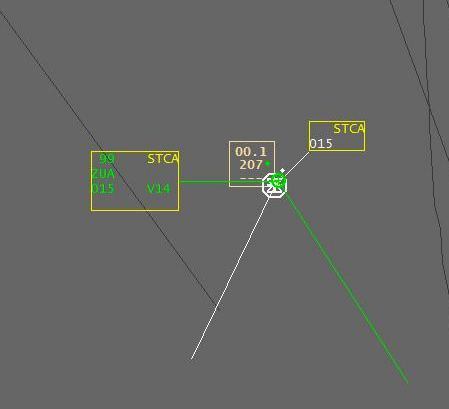
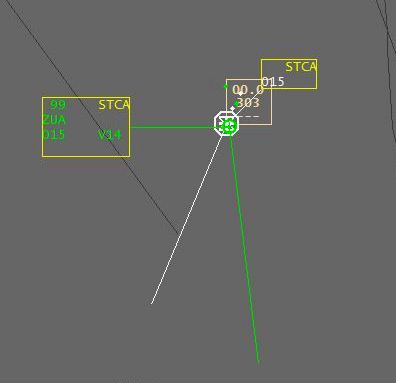
Also noticing the short-term conflict alert (STCA) (Figures 3 and 4) on the air situation display, the Brisbane Centre controller twice attempted to make contact with ZUA which was still in uncontrolled airspace; but there was no response. The controller then contacted the Gold Coast tower controller via the internal coordination line, to confirm that a safety alert had been issued. The tower controller advised the Brisbane Centre controller that a safety alert had already been issued and the situation was under control.
Soon after, while distracted by entering and changing frequencies on both COMM 1 and COMM 2, the pilot of ZUA had lost sight of SWX and turned his attention to visually re-acquire the helicopter. The pilot then realised that the helicopter was not flying parallel to his course as he had initially thought; but was on a collision course with ZUA and at a similar altitude. The pilot initiated a short climb and a steep right turn in ZUA. He did not see SWX during this evasive manoeuvre, so turned left and continued to the Gold Coast as cleared, and advised the tower controller of the conflict and subsequently landed.
Figures 3: Radar surveillance data
Time: 2.21.37 ZUA at 1,500 ft; SWX 1,500 ft; about 100 m horizontally STCA – Short term conflict alert
Source: Airservices Australia
Figures 4: Radar surveillance data
Time: 2.21.42 Near collision ZUA at 1,500 ft; SWX 1,500 ft; Nil horizontal distance showing on radar
Source: Airservices Australia
The traffic collision avoidance system (TCAS) on board the helicopter did not alert the pilot to the potential conflict, possibly because ZUA overflew the helicopter from behind, which may have shielded the TCAS aerial.
VH-ZUA radio equipment
ZUA had Garmin 530 and Garmin 430 units installed.
VH-SWX radio equipment
SWX had two communication navigation (COMM NAV) units installed, also allowing the pilot to have two active and two standby radio frequencies selected. SWX also had a terrain collision avoidance system (TCAS) fitted.
VH-ZUA pilot experience and comments
The pilot had around 270 hours total time, with about 38 hours on the B76 type aircraft. He had been undergoing training for a multi-engine command instrument rating (MECIR), and this positioning flight was his first solo flight in the aircraft.
He recalled being advised about conflicting traffic by the Gold Coast tower controller, and recalled having responded ‘traffic sighted’. He reported when he first sighted SWX, he incorrectly thought it was tracking parallel to ZUA, and did not appear to be getting any closer. Hence, he turned his attention to trying to reset the CTAF of 119.0 MHz on COMM1, to enable him to communicate with the helicopter. At this stage, he had changed the selected frequencies to having the Gold Coast tower frequency on COMM 1, and the ATIS and CTAF on COMM 2. Then he changed COMM 2 to have the Gold Coast Ground frequency selected in preparation for taxi after landing.
During the process of entering, changing and selecting frequencies on the two COMM sets, his attention had shifted from keeping the helicopter in sight, to attempting to communicate with it and arrange clearances.
He reported that at this stage SWX appeared to have ‘turned toward him’[3] and as he watched it he realised it was heading directly at ZUA. He commenced evasive action by initiating a brief climb and a steep turn to the right. His intention was to parallel the track of the helicopter and keep it in sight.
Additionally, he reported that his sleep the night before had been disturbed.
VH-SWX pilot experience and comments
The pilot held a Commercial licence (Helicopter) and had around 6,500 hours flying experience. The pilot commented that the first awareness of ZUA was when it passed over the helicopter from behind.
Safety message
This incident highlights the importance of having the correct radio frequencies planned and correctly set up prior to and during flight and the need for vigilance when keeping conflicting traffic in sight. Pre-flight preparation is an essential part of safe flying operations and can prevent a loss of situational awareness and avoid the pilot’s attention being focused for long periods inside the cockpit.
CASA has developed the Look out! Situational awareness DVD for pilots to learn more about the safety-critical skills that makes up situational awareness. There is a strong emphasis on the need to prepare and plan for every flight. The DVD gives a definition of situational awareness of “what’s happened, what’s happening and what might happen”.
The CASA DVD is available from the CASA online store.
Decisions regarding whether to conduct an investigation, and the scope of an investigation, are based on many factors, including the level of safety benefit likely to be obtained from an investigation. For this occurrence, a limited-scope, fact-gathering investigation was conducted in order to produce a short summary report, and allow for greater industry awareness of potential safety issues and possible safety actions.
Publishing information
Released in accordance with section 25 of the Transport Safety Investigation Act 2003
Ownership of intellectual property rights in this publication
Unless otherwise noted, copyright (and any other intellectual property rights, if any) in this report publication is owned by the Commonwealth of Australia.
Creative Commons licence
With the exception of the Coat of Arms, ATSB logo, and photos and graphics in which a third party holds copyright, this publication is licensed under a Creative Commons Attribution 3.0 Australia licence.
Creative Commons Attribution 3.0 Australia Licence is a standard form licence agreement that allows you to copy, distribute, transmit and adapt this publication provided that you attribute the work.
The ATSB’s preference is that you attribute this publication (and any material sourced from it) using the following wording: Source: Australian Transport Safety Bureau
Copyright in material obtained from other agencies, private individuals or organisations, belongs to those agencies, individuals or organisations. Where you wish to use their material, you will need to contact them directly.
On 28 December 2014, at about 1312 Eastern Daylight-saving Time, the pilot of a Robinson R44 helicopter, registered VH-JKF (JKF), departed for a scenic flight from Essendon Airport, Victoria. The helicopter travelled as the lead helicopter ‘in-company’ with another helicopter and the pilot of JKF was responsible for making all radio calls on behalf of both helicopters.
At about 1315, the student pilot and instructor of a Cessna 172 aircraft, registered VH-EVR (EVR), taxied for a training flight to Point Cook. At about 1323, EVR was cleared to track direct to Point Cook and subsequently cleared for take-off from runway 17. The pilot of JKF heard the communications with EVR while he was briefing passengers for landing and he did not hear the runway direction in the instructions issued to EVR. He had observed the wind over the city coming from a northerly direction, and assumed EVR would be taking off from runway 35.
At about 1325, the controller instructed JKF and company to track towards the runway 17 threshold and to report sighting the Cessna in the take-off roll. The pilot of JKF read back the instruction, but inadvertently tracked towards the 35 threshold. After reporting the Cessna in sight, JKF was directed to pass behind it.
About 16 seconds later, both helicopters were asked to confirm they had the aircraft in sight and the instructor of EVR observed JKF in close proximity. The pilot of JKF then realised that he was tracking to the incorrect threshold and slowed the helicopter to pass about 75 m behind and 100 ft below EVR.
This incident serves as a reminder to keep a good lookout at all times, including in Class C airspace.
On 2 January 2015, at about 1400 Eastern Daylight-saving Time, the pilot of a Starduster SA300 aircraft, registered VH-XRS (XRS), commenced pre-flight preparations for a local private flight at Tyabb Airport, Victoria (Figure 1). The pilot of XRS observed the windsock indicating calm conditions. The pilot elected to follow the airport operator’s procedures for nil wind, and use the preferred runway, runway 17. During the next 30 minutes, no aircraft operated in the circuit. The pilot did not hear any broadcasts on the common traffic advisory frequency (CTAF) during that time.
Figure 1: VH-XRS
Source: Aircraft owner
At about 1430, a Cessna 152 aircraft, registered VHNKL (NKL), conducted pre-taxi checks prior to a dual training flight. The instructor and student pilot planned to conduct circuits at Tyabb. During the pre-taxi checks, the student pilot selected Tyabb common traffic advisory frequency (CTAF) on the radio, and checked the squelch,[1] to verify that the radio was operating. The instructor reported that the wind was less than 5 kt and from the east-northeast. Although the preferred runway in those conditions was runway 17, they elected to use runway 35. This runway selection provided an opportunity for the student to practice backtracking on the runway. The student pilot broadcast taxiing for runway 35 and commenced taxiing south from the apron towards the threshold of runway 35.
The pilot of XRS did not hear the taxi broadcast from the pilot of NKL, or sight NKL at that time, and commenced taxiing from the hangar to the apron area. At the apron, the pilot of XRS conducted engine run-ups, then broadcast taxiing for runway 17 and commenced taxiing north towards the threshold of runway 17. Neither the student pilot nor instructor of NKL heard the taxi broadcast from the pilot of XRS.
The student pilot of NKL then broadcast entering and backtracking runway 35, and NKL entered the runway and taxied to the southern threshold. After reaching the threshold, the student pilot turned the aircraft, broadcast lining up and departing runway 35 for circuits. The pilot of XRS did not hear that broadcast, but was by then at the threshold of runway 17 and broadcast lining up and departing runway 17. The pilots of NKL did not hear that broadcast.
The pilot of another Cessna aircraft, then at the apron, heard both ‘lining up’ broadcasts on the CTAF. This pilot immediately attempted to broadcast a conflict alert, to advise the pilots that the aircraft were on opposing runways. The pilots of XRS and NKL did not hear that broadcast. The student pilot of NKL broadcast ‘rolling runway 35’ at the same time, which may have over-transmitted the other call.
When about 500 m along the runway and at rotate speed, the instructor of NKL pointed out the airspeed to the student and the aircraft lifted off. The instructor then sighted XRS in the take-off run on the opposite runway. The instructor immediately took control of the aircraft from the student and commenced a left climbing turn, while keeping XRS in sight (Figure 2).
When about 300 m along the runway, XRS lifted off. When at about 10 ft above ground level, the pilot of XRS sighted NKL, about 300 m ahead and banking to the left. He also commenced a left turn to increase separation between the two aircraft, which then passed about 50 m from each other, with NKL slightly higher than XRS. The pilot of XRS then joined the circuit for runway 35 on the crosswind leg, and broadcast that he was joining the circuit to return to land at Tyabb.
Figure 2: Tyabb Airport and aircraft tracks
Source: Google earth
The instructor of NKL then requested a radio check, which the pilot of the other Cessna operating in the area heard and responded to.
Radio broadcasts
The CTAF at Tyabb was not recorded and the ATSB was unable to verify broadcasts made, other than those reported by the pilot of another aircraft operating at the airport at the time. The CTAF did not have an aerodrome frequency response unit (AFRU). An AFRU assists in indicating selection of the correct VHF frequency at non-towered aerodromes, by automatically responding with either a pre-recorded voice message, if no transmission has been received in the last five minutes or otherwise a ‘beep-back’, on the CTAF.
Preferred runway in nil wind conditions
The En Route Supplement Australia (ERSA) for Tyabb,[2] indicated under noise abatement procedures, that the preferred runway was 35/17 and that runway 08/26 was only to be used when operationally required. The page layout may have been considered to be misleading with 35 printed above 17, but that was not designed to imply that runway 35 was the preferred runway in the event the wind did not favour either direction.
The Chief Flying Instructor at Tyabb provided the ATSB with a copy of the runway diagram and local instructions. He reported that this was issued to pilots operating at the airfield. In the notes section, it stated ‘Preferred runway in nil wind conditions, Runway 17’. Both the pilot of XRS and the instructor of NKL were local pilots and aware of the local instruction for the preferred runway in nil- or crosswind conditions.
Pilot comments
Pilot of XRS
After the incident, as XRS was returning to land, the pilot of XRS heard the second Cessna aircraft pilot broadcast lining up and departing. He was able to hear broadcasts from aircraft on the ground while XRS was in the air, but is unsure whether an aircraft at one end of the runway could hear a broadcast from an aircraft at the opposite end. The VHF radio requires line-of-sight, and a pilot in an aircraft at the threshold at one end of the runway is unable to see an aircraft at the opposite threshold, due to a slope in the runway.
Pilot of other Cessna
The pilot of the Cessna at the apron reported that the radio transmissions from XRS were of poor quality.
Instructor of NKL
The instructor provided the following comments:
He held a formation endorsement, and during formation flying there was an emphasis on keeping the other aircraft in sight. When he sighted XRS, he conducted a left turn to maintain visual contact with XRS.
He did not hear any broadcasts from the pilot of XRS. After the incident, he heard the pilot of the other Cessna make the standard broadcasts.
Safety action
Whether or not the ATSB identifies safety issues in the course of an investigation, relevant organisations may proactively initiate safety action in order to reduce their safety risk. The ATSB has been advised of the following proactive safety action in response to this occurrence.
Aero club
As a result of this occurrence, the local aero club has advised the ATSB that they are taking the following safety actions:
Communication
The incident will be discussed at a monthly meeting, emphasising the use of the preferred runway in nil wind conditions. Pilots and instructors will be reminded that operating outside of the normal and expected procedures, requires higher levels of alertness.
ERSA
The ERSA entry for Tyabb will be amended as the layout may have been misleading.
AFRU
They will review the installation of an AFRU and possible means of recording the CTAF.
Accident emergency plan
The emergency management plan will also be reviewed.
Safety message
As detailed in the booklet A pilot’s guide to staying safe in the vicinity of non-towered aerodromes, ATSB research found that, between 2003 and 2008, there were 709 airspace-related events at, or in the vicinity of non-towered aerodromes. This included 60 serious incidents and six accidents (mid-air and ground collisions). Most of the 60 serious incidents were near mid-air collisions.
Issues associated with unalerted see-and-avoid have been detailed in the ATSB research report Limitations of the See-and-Avoid Principle. The report highlights that unalerted see-and-avoid relies entirely on the pilot’s ability to sight other aircraft. Broadcasting on the CTAF is known as radio-alerted see-and-avoid, and assists by supporting a pilot’s visual lookout for traffic. An alerted search is more likely to be successful as knowing where to look greatly increases the chances of sighting traffic.
11.5 Pilots should be mindful that transmission of information by radio does not guarantee receipt and complete understanding of that information. Many of the worst aviation accidents in history have their genesis in misunderstanding of radio calls, over-transmissions, or poor language/phraseology which undermined the value of the information being transmitted.
11.6 Without understanding and confirmation of the transmitted information, the potential for alerted see-and-avoid is reduced to the less safe situation of unalerted see-and-avoid.
In this incident, the instructor of NKL diverged left on sighting XRS. When the pilot of XRS sighted NKL, it was already banking to the left and therefore he was able to also conduct a left turn to increase separation. However, the Civil Aviation Regulations 1988 – Reg162, Rules for prevention of collision,[3] stated:
When two aircraft are approaching head-on or approximately so and there is danger of collision, each shall alter its heading to the right.
The risk of reduced separation events can be minimised through good communication by pilots. Most importantly, a good visual lookout should be maintained at all times, particularly when operating at aerodromes where the carriage of a radio is not mandatory.
A local procedure that improves safety, such as a preferred runway, should be well-documented, and communicated to all pilots operating at the aerodrome.
Decisions regarding whether to conduct an investigation, and the scope of an investigation, are based on many factors, including the level of safety benefit likely to be obtained from an investigation. For this occurrence, a limited-scope, fact-gathering investigation was conducted in order to produce a short summary report, and allow for greater industry awareness of potential safety issues and possible safety actions.
Publishing information
Released in accordance with section 25 of the Transport Safety Investigation Act 2003
Ownership of intellectual property rights in this publication
Unless otherwise noted, copyright (and any other intellectual property rights, if any) in this report publication is owned by the Commonwealth of Australia.
Creative Commons licence
With the exception of the Coat of Arms, ATSB logo, and photos and graphics in which a third party holds copyright, this publication is licensed under a Creative Commons Attribution 3.0 Australia licence.
Creative Commons Attribution 3.0 Australia Licence is a standard form licence agreement that allows you to copy, distribute, transmit and adapt this publication provided that you attribute the work.
The ATSB’s preference is that you attribute this publication (and any material sourced from it) using the following wording: Source: Australian Transport Safety Bureau
Copyright in material obtained from other agencies, private individuals or organisations, belongs to those agencies, individuals or organisations. Where you wish to use their material, you will need to contact them directly.
At 1748 Australian Eastern Daylight-saving Time on 29 December 2014, a Cessna 172S aircraft, registered VH‑PFT, departed Cambridge Airport, Tasmania to photograph yachts participating in the 2014 Sydney Hobart race as they made their way around the southern coast of the Tasman Peninsula. On board the aircraft were the pilot and a photographer.
At about 1815 the aircraft commenced low-level photographic runs on yachts to the east of Cape Raoul. Shortly after completing a run on one yacht at a height of about 50 ft, the aircraft entered a steep climbing turn. The aircraft had almost completed a 180° turn when the upper (right) wing dropped sharply while the aircraft’s nose pitched down to almost vertical. The aircraft impacted the water’s surface in an almost vertical nose down attitude with wings about level. Both aircraft occupants were fatally injured, and the aircraft was seriously damaged.
What the ATSB found
As a result of the steep climbing turn, the aircraft’s upper wing aerodynamically stalled, resulting in a rapid rotation out of the turn. The steep pitch attitude indicated that, because of the stalled upper wing, the aircraft entered a spin. There was insufficient height for the pilot to recover the aircraft. The steep climbing manoeuvre was not in accordance with the pilot’s training for low-level flight. Cessna identified that any C172 type aircraft that enters a stall/spin condition will require significant height to recover.
The Civil Aviation Safety Authority had issued the operator with a dispensation that permitted low-level flight down to 150 ft above obstacles. Low-level photographic operations on yachts conducted by the operator had been consistently flown at heights down to 50 ft. Although the aircraft was being operated at a height lower than that authorised by the dispensation, that in itself was not likely to have contributed to the accident.
The ATSB examined the role of the operators’ Safety Management System (SMS). While it was not established that the safety risk management processes and practices directly contributed to the occurrence, there were aspects that the operator could consider working towards to more effectively identify all key operational risks.
What's been done as a result
The operator advised that it has ceased low-level photography flights.
Safety message
Turning manoeuvres at or close to the aircraft’s critical angle of attack, or stall speed, if poorly handled, can result in a stall that will probably result in the aircraft entering a spin. This is particularly true for aircraft under 5,700 kg. The normally benign stalling characteristics of these aircraft types are exacerbated by the spin entry, which results in a steep pitch down and rotation towards the stalled wing. Recovery from this condition will take a considerable amount of altitude, dependant on the speed of response by the pilot and the use of appropriate control inputs.
Photograph of VH-PFT
Source: Aircraft operator
The occurrence
At 1748 Australian Eastern Daylight-saving Time[1] on 29 December 2014, a Cessna 172S aircraft, registered VH-PFT, departed Cambridge Airport, Tasmania on an aerial work flight. On board the aircraft were the pilot and a photographer. The purpose of the flight was to photograph yachts participating in the 2014 Sydney Hobart Yacht Race as they sailed around the southern coast of the Tasman Peninsula and into Storm Bay en route to Hobart. This was the third photographic flight conducted by this pilot and photographer that day.
The aircraft transited from Cambridge Airport to Clifton Beach and then, at about 1757, descended from around 1,500 ft down to a height below 500 ft at a position about 8 km to the north-west of Wedge Island (Figure 1). At about 1800, the aircraft commenced low-level photographic passes (photographic run) on yachts to the west of Wedge Bay. It then tracked to the south-east towards Cape Raoul and after passing Cape Raoul tracked in an easterly direction, while continuing to conduct photographic runs on yachts.
Figure 1: Maritime map of the southern Tasman Peninsula coast, with Wedge Island, Cape Raoul and the location of the wreckage highlighted
Source: Australian Hydrographic Service, modified by ATSB
About 25 minutes into the flight, the aircraft commenced photographic runs on a number of yachts that were becalmed to the south of Maingon Bay. At about 1815, it commenced a photographic run on the yacht Mistraal, which was transiting Maingon Bay under power. Witnesses stated that, during that photographic run, the aircraft was tracking in a north-westerly direction and passed close to Mistraal’s port side bow at about mast height. The pilot had positioned the aircraft so that Mistraal passed down the aircraft’s starboard side. After passing abeam Mistraal, the aircraft continued on its north-westerly track for about 20 seconds and then commenced a steep left turn.
A witness to the full accident sequence, who was about 500 m to the south-west of Mistraal, stated that the aircraft:
appeared to pitch up and climb about three to four aircraft lengths while simultaneously banking sharply to the left
had almost completed a 180° turn when the upper (right) wing dropped sharply and the aircraft’s direction of turn reversed
was at an estimated height above the water’s surface, at that time, of about two to three times the mast height of Mistraal
pitch attitude dropped sharply and the aircraft descend rapidly in a steep nose-down attitude.
The observations of a second witness, who was about 3 NM (5 km) to the south of Mistraal, supported the observations of the first witness, but this witness stated that the turn appeared to be made at a level height.
The aircraft impacted the water’s surface in an almost vertical nose-down attitude with wings about level, approximately 4 km to the east of Cape Raoul.
Mistraal, and a number of other yachts in the vicinity, turned towards the aircraft to give aid. Witnesses stated that the aircraft could be seen mostly submerged with the tail section protruding above the surface of the water. As Mistraal approached the aircraft, it submerged and sank. The location of the aircraft was marked by Mistraal using its global positioning system.
Both aircraft occupants were fatally injured and the aircraft seriously damaged.
The pilot was issued with a Private Pilot (Aeroplane) licence in April 2010 and a Commercial Pilot (Aeroplane) Licence in January 2012. The licence included the following endorsements and ratings:
manual propeller pitch control
single-engine aircraft under 5.7 tonnes maximum take-off weight
retractable undercarriage
aerobatics
a low-level flight rating
a multi-engine BN2 Britten-Norman Islander rating
a multi-engine BE76 Beechcraft Duchess rating
a command instrument rating for multi-engine aircraft, issued in August 2014.
A summary of the pilot’s flight experience is at Table 1.
Table 1: Summary of flight hours
Flying Time
Cessna 172
Other Single Engine
Multi Engine
Last 90 days
65
10
55
Total
820
275
310
235
The pilot completed a flight review and a renewal of the low-level rating on 19 December 2014. That low-level rating renewal was conducted in a Cessna 172. The record of the flight review included a number of relevant observations:
a stall recovery was demonstrated, and that the pilot recovered the aircraft from the stall with a 100 ft altitude loss
the pilot displayed good stall awareness
the pilot demonstrated 45° angle of bank turns at 150 ft above ground level to a satisfactory standard
during low-level turning around a point, the pilot had a tendency to climb as the turns progressed.
With respect to the pilot’s low-level flying, records indicated that the pilot:
obtained the low-level rating in August 2011
had accrued about 18 hours of low-level flight experience
had conducted 3 days of low-level over water flights for the purpose of photographing yachts during the 2013 Sydney Hobart race, with a total flight time of about 6 hours
had completed two low-level overwater flights for the purpose of photographing yachts during the 2014 Sydney Hobart race. These flights were completed earlier in the day on 29 December 2014.
The pilot held a valid Class 1 medical certificate that was renewed in November 2014.
Fatigue
The pilot’s duty and flight hours were within the limits prescribed under Civil Aviation Order 48.1. The first flight of the day conducted by the pilot departed Cambridge at 0608 and landed at 0817; the second flight departed Cambridge at 1320 and landed at 1511. Witnesses reported that in the period between the second and third flight, the pilot did not appear to be fatigued.
The investigation included an assessment of whether the pilot may have been experiencing a level of fatigue known to have an effect on performance. Consideration was made of the pilot’s early start, time awake at the time of the occurrence, potential workload associated with the task, environmental factors, and organisational support; however, the limited data available regarding the pilot’s activities on the day meant there was insufficient evidence to determine whether fatigue was contributory to this occurrence.
The photographer
The photographer’s first experience in aerial photography of yachts was during the 2013 Sydney Hobart race. Those low-level photographic flights were conducted exclusively with the accident pilot. The photographer had requested, and was assigned the same pilot for the photography flights for the 2014 Sydney Hobart race.
Aircraft information
General
The Cessna Aircraft Company 172S (C172S) is a four seat, high wing, all metal, unpressurised, fixed undercarriage aircraft with a single reciprocating engine. It was certified in the Normal and Utility aircraft categories.
VH-PFT
VH‑PFT (PFT) held a current certificate of airworthiness and certificate of registration. The aircraft had a current maintenance release with no noted defects. The last periodic maintenance inspection on PFT was conducted on 24 December 2014, at which time the aircraft had logged about 2,265 hours.
The operator’s Operations Manual did not require a calculation of the aircraft’s weight and balance for the accident flight, and there was no record of a weight and balance for that flight. A post‑accident analysis of the aircraft’s weight and balance indicated that the aircraft was most likely within limits during the entire flight. Records indicate that the aircraft departed with full fuel.
Figure 2: The C172S aircraft registered as VH-PFT
Source: Aircraft operator
The C172S Stall Speed
The stall speeds for the C172S are contained within the C172S Pilot Operating Handbook (POH). For the C172S:
The stall speeds are quoted at the aircraft’s maximum certified take-off weight of 2,550 pounds (1,157 kg).
Variation in the aircraft’s centre of gravity can result in minor changes in the aircraft’s stall speed.
The selection of flap changes the shape of the aircraft’s wing, lowering the stall speeds.
When banking an aircraft, it is necessary to increase the amount of lift generated to ensure that the aircraft does not descend. The effect is to increase the stall speed as the angle of bank increases.
The relevant stall speeds listed in the C172S POH are listed in Table 2. The POH noted that the speeds were for the aircraft with power at idle, and that the indicated airspeeds (KIAS) quoted were approximate.
Table 2: C172S stall speeds in KIAS
Source: Cessna
The POH also noted that the altitude loss during a stall recovery could be as much as 230 ft.
Instruments and avionics
The C172S is fitted with a pneumatic-type stall warning system. It consists of an inlet in the leading edge of the left wing and a warning horn in the upper left corner of the windshield. The inlet and horn are connected by tubing. As the aircraft approaches the stall, the low pressure on the upper surface of the wings moves forward around the leading edge of the wing. This low pressure creates a differential pressure in the stall warning system that draws air through the warning horn, resulting in an audible warning. The stall warning system was set to produce a stall warning between 5 and 10 kt above the stall speed in all configurations.
PFT was fitted with a Garmin G1000 avionics system. The G1000 used two Garmin Display Units (GDU), the left GDU being the Primary Flight Display (PFD) and the right GDU a Multi-Function Display (MFD) (Figure 3). The G1000 system is capable of storing critical flight and engine data on a memory card, which is inserted into the lower card slot of the MFD. Data is logged in a new file that is created each time the MFD is powered on.
Figure 3: Garmin G1000 avionics system showing normal location of the memory card, as well as the recovered memory card
Source: Aircraft operator
Operational information
Low-flying regulations
The conduct of low-level flying was regulated under Civil Aviation Regulations 1988 (CAR), r. 157. This regulation had two relevant parts:
Flight must not be conducted below a height of 500 ft.[2]
This height is in relation to the highest point of terrain or any object on that terrain within a radius of 600 m of the aircraft.[3]
CAR r. 157 (4) enabled the Civil Aviation Safety Authority (CASA) to issue a permit for aerial work operations where there was a requirement to operate below the minimum height identified in CAR r. 157. CASA issued the operator with a ‘Low Flying Permission’ under Instrument SR 268/12 dated November 2012. The permission set up a system of conditions required for low flight operations, including oversight and training requirements. The conditions included a requirement that the aeroplane not be flown at a height below 150 ft above obstacles. While not stated explicitly within the instrument, r. 157’s requirement that the lowest height for flight relates to ‘the highest point of terrain or obstacles on that terrain within a 600 m radius of the aircraft’ still applied.
The operator’s Operations Manual
The operator’s Operations Manual (OM) included a requirement for specific approval to be obtained before the conduct of operations below the minimum height requirement of CAR r. 157. The OM identified that SR 268/12 provided that specific approval. SR 268/12 was contained within the appendices to the OM.
The OM also included a section specific to low-level flight, which contained all procedures applicable to the conduct of low-level flight. This section included the following requirements:
Except for emergency avoidance of hazards, the maximum angle of bank during flight below 500 ft is 45°.
The minimum horizontal distance to be maintained from buildings when operating below 500 ft above ground level (AGL) or above mean sea level (AMSL) is 600 m.
The minimum indicated airspeed while flying below 500 ft AGL/AMSL is to be 1.5 times the stall speed (Vs) in the low flying configuration.
When flying below 500 ft AGL/AMSL the maximum flap setting to be used during level and climbing flight is the maximum take-off flap setting listed in the pilot’s notes or aircraft flight manual.
The C172S POH stated that flap settings greater than 10° are not approved for take-off. Therefore, the maximum flap setting for low-level operations was 10°.
The training syllabus for low-level operations was also contained within the OM. The training syllabus included specific flight sequences and required manoeuvres that were to be demonstrated during low-level flying endorsement training. The training section of the OM did not contain information regarding any methods and skills (techniques) specific to low-level flying.
Low-level flight training
The operator had a number of pilots responsible for low-level flight training and checking (check pilots). They reported that there were a number of techniques specific to the Cessna 172 (C172) type that were emphasised during training for low-level flight. They identified that it was critical to maintain the aircraft in a stable energy state while operating at low level. In doing so, the emphasis was not to perform manoeuvres with large pitch attitude changes, nor to perform radical manoeuvres. These techniques were not included within the operator’s OM.
Stall/spin training and familiarity with the stall/spin
The pilot was familiar with the stalling characteristics of the C172 and with the activation of the stall warning. During the recent flight test, the pilot had demonstrated an ability to recover from the stall with a 100 ft altitude loss.
The pilot’s low-level flight training included emergency manoeuvring sequences that required the pilot to demonstrate maximum rate turns for emergency purposes. The emergency manoeuvre involved the application of backpressure on the control column to attain the maximum lift, which placed the aircraft wing very close to the stall angle. In these circumstances, the pilot was trained to maintain the airspeed for maximum lift by adjusting pitch attitude so that the stall warning activation was intermittent.
When conducting photographic flights, the passenger side cabin window was open to enable clear photography. A test flight by the operator confirmed that the stall warning system was clearly audible when flying with a cabin window open.
Meteorological information
Weather information reported by yachts in the vicinity of the accident identified that the conditions were as follows:
about 30 minutes before the accident, a squall line passed through the area to the south and east of Cape Raoul
after the squall line the weather conditions were benign
at the time of the accident, the wind was 210° at 3.5 kt and there was some low cloud in the area. There was no low cloud in the area where the aircraft was operating at the time of the accident
about 30 minutes after the accident another squall line passed through the area.
The images recovered from the photographer’s camera and other photography from the yachts in the area confirm these observations.
The Bureau of Meteorology aviation forecast for the Hobart area issued at 1540, covering the period 1600 to 0400 on 30 December, stated that a cold front was expected to pass through Hobart at about 1600 and to continue in an easterly direction, passing through the eastern maritime area at about 1800. East of the front, the winds at 2,000 ft were forecast to be northerly at 35 kt, while to the west of the front the winds would back to westerly at 35 kt. The forecast also included a severe low-level turbulence warning. The bureau provided actual wind recordings from a number of automated weather stations in the Storm Bay area. Detailed records from these weather stations indicated that the wind was generally westerly at about 25 kt at the time of the accident. These records identify that the cold front probably passed through the Maingon Bay area about 1805.
Bureau of Meteorology wind data from a number of automated weather stations in the Storm Bay area is listed in appendix A.
Communications
At the time of the accident, there were no communications from PFT recorded on local air traffic control frequencies. At 1817, when Mistraal turned towards the aircraft to provide assistance, the yacht’s crew notified the yacht race controllers of the accident by marine band radio.
Wreckage information
Recovery of the wreckage
The crew of Mistraal provided their recorded GPS position of the accident location to the Tasmanian Police. A search for, and recovery of, the aircraft wreckage commenced on 31 December 2014. A Tasmanian Water Police vessel was to perform the recovery of the wreckage. To assist with the search and recovery, the Tasmanian Police contracted a Remotely Operated Vehicle (ROV) operator. The ROV was fitted with sonar equipment to aid in locating the aircraft wreckage.
The ROV located the aircraft wreckage at the position provided by Mistraal. Before commencing the recovery, the ROV conducted a survey of the aircraft wreckage using a recorded video link (Figure 4). The survey:
identified that the aircraft was at a depth of about 90 m
identified that the aircraft had remained relatively intact and had come to rest upside down
provided an accurate record of the damage to the aircraft
identified and recovered the photographer’s camera
established that the photographer’s seat was at around the fully aft selectable position, indicating that it was unlikely that the passenger could have interfered with the flight controls in flight
established that the pilot’s seat appeared to be in a normal position.
Figure 4: Image taken from the ROV video recording during the survey of the aircraft on the first recovery operation. The aircraft was lying inverted on the seabed
Source: Tasmania Police
The first attempt to recover the aircraft was unsuccessful. The recovery vessel’s winch raised the aircraft to within 15 m of the surface when the rope securing the aircraft broke. The aircraft returned to the ocean floor and came to rest upside down. Due to the weather and ROV availability there was a delay in a second attempted recovery.
On 6 January 2015, a second attempt to recover the aircraft was made utilising the same ROV operator and a locally contracted barge. The barge had specially designed lifting equipment that was not available during the first recovery. The ROV secured that equipment to the aircraft structure (Figure 5) and all of the aircraft was recovered, with the exception of the engine cowling.
Figure 5: Wreckage immediately before the second, successful recovery onto the barge
Source: ATSB
Wreckage inspection
Inspection of the wreckage (Figure 6) and video footage from the ROV identified that:
the wing leading edges had been forced rearwards to a relatively flat position on the front wing spars
the nose of the aircraft had been forced rearwards and upwards
the aircraft’s forward and rear windshields were destroyed as a result of the impact.
the main structure of the aircraft had remained intact
all flight controls were still connected and no anomalies identified. The elevator trim was in about the neutral position
the flap actuator position indicated that the flaps were between the 10° and 20° selectable positions
the engine mount frames were broken, but the engine was still attached to the fuselage by control cables and fluid carrying lines
both aircraft doors could not be opened by normal means. The doors were found to be in a latched shut position and were also jammed due to accident damage
the cabin area maintained its structural integrity
there were no anomalies identified with the engine; however, salt water immersion precluded component testing for function
there were no pre-accident defects identified
the aircraft’s stall warning system was considerably damaged by the impact with the water, and therefore the serviceability of the system was unable to be determined.
A data card was recovered from the aircraft wreckage. It had become dislodged and was located behind the MFD.
Figure 6: Aircraft wreckage after recovery
Source: ATSB
The operator advised that the stall warning system in PFT was regularly utilised during their flight training school activities. The stall system was inspected and signed off as serviceable during a CASA Maintenance Schedule 5 inspection completed on 24 December 2014. The POH also included an inspection and function test for the stall system during a pre-flight inspection. The aircraft’s stall warning system was most likely serviceable when the aircraft departed on the accident flight.
The significant damage to the underside of the fuselage engine area and the type of damage to the aircraft’s leading edges indicate a very steep impact angle. The flap being between selectable positions indicates possible inadvertent movement of the flap selector when the aircraft impacted the water.
Recorded data
The recovered data card appeared to be in a good condition. The card was cleaned, dried, and sent to the Tasmanian Police forensic unit for data recovery. The forensic unit was unable to recover any data from the card. The card was then then transferred to the ATSB, where a more detailed forensic examination was conducted. This examination identified that the memory chip on the card was cracked through its centre, rendering the memory card unserviceable and any data contained in the chip unrecoverable.
Pathological information
Post-mortem examination identified that both the pilot and the photographer sustained multiple fatal injuries consistent with an aircraft impacting water.
Survival aspects
The accident impact forces imparted on the aircraft’s occupants was considered by the ATSB to be unsurvivable.
ELT
A fixed 406 MHz emergency locator transmitter (ELT) was fitted to the aircraft. The ELT was inspected and signed off as serviceable during a CASA Maintenance Schedule 5 inspection completed on 24 December 2014. That inspection consisted of an inspection of the ELT batteries for electrolyte leakage and that the battery life had not expired. The transmitter was found securely located in its mounting, and appeared undamaged externally. It was set to the auto position and the activation light was not illuminated, most likely due to being submerged. The ELT was registered with the Australian Maritime Safety Authority (AMSA). AMSA advised that there was no record of that ELT being detected at around the date and time of the accident.
Seatbelt mounted airbags
The original manufacturer’s design for the C172S did not include seatbelt airbags. They were fitted under a United States (US) Supplemental Type Certificate (STC)[4] and as a result PFT was originally equipped with seatbelt airbags. The operator removed the seatbelt airbags in accordance with the C172 Maintenance Manual and replaced them with seatbelts that met the aircraft’s original certification status. The operator reported that this was for fleet commonality purposes.
Life jackets
There were life jackets under each of the pilot seats. Both occupants were also wearing waist‑mounted life jackets. These waist-mounted units stored the life jacket in a pocket attached to a belt. Attaching this unit to the occupant enabled easy access to a life jacket if required. Examination of the life jackets identified that none had been inflated by the aircraft occupants.
The operator’s Safety Management System
The operator’s Air Operations Certificate (AOC) included authorisation for Regular Public Transport (RPT) operations using aircraft that were not high capacity. Therefore, under the requirements of Civil Aviation Order (CAO) 82.3 Conditions on Air Operators’ Certificates authorising regular public transport operations in other than high capacity aircraft, the operator was required to implement a Safety Management System (SMS).
At the time, guidance for the implementation of the CAO 82.3 SMS requirement was provided in Civil Aviation Advisory Publication (CAAP) SMS-1(0) Safety Management Systems for Regulator Public Transport Operations. This document defined an SMS as ‘a systematic approach to managing safety, including the necessary organisational structures, accountabilities, policies and procedures.’ The CAAP also stated that ‘[a] successful SMS provides…a systematic, explicit and comprehensive process for identifying hazards and the risks they bring, and for minimising those hazards.’ The CAAP details key components and elements for delivering a successful SMS. These components include:
Safety policy and objectives, and planning. This includes the appointment of key safety personnel and the conduct of safety committees.
Safety risk management. This requires hazard identification (inclusive of safety reporting), and risk assessment and mitigation processes.
The operator’s safety management system
The content of this section outlines key elements of the operator’s SMS in accordance with the CAAP. It was also developed with consideration of the SMS hierarchy of influences, which includes reviewing an organisation’s safety philosophy, policies, procedures and practices (Degani and Weiner, 1994).
CASA approved the operator’s SMS for their RPT operation in July 2014. The SMS was designed to be implemented across the various operations conducted by the organisation, including their charter operations and aerial work. Throughout 2014, the operator was also required to maintain a separate SMS specific to their Part 145 maintenance operations. At the time of the occurrence, the evidence gathered as part of the investigation indicated that the operator’s SMS complied with the applicable regulatory requirements.
Appointment of key safety personnel
The CAAP specifies that the organisation’s Chief Executive Officer (CEO) maintains accountability for the SMS, that a safety manager (SM) be appointed, and that the SM should report directly to the CEO. Depending on the size of an organisation, the SM should possess operational management experience, an adequate technical background to understand the context in which they are working, and a sound understanding of safety management principles. Safety managers should be responsible for promoting safety, reporting safety performance to the CEO and ensuring the SMS is implemented and maintained.
Towards the end of 2013, the operator’s Chief Flying Instructor (CFI) was appointed as the SM. The CFI was typically only able to allocate about one day a week to SMS-related activities. The operator’s SMS manual documented that the SM position reported to the CEO, to ensure independence to the role. During the year, in response to a growing workload within the SM role, the safety committee discussed plans to introduce a deputy SM, with the intention that the person appointed to this role would take over as a full time SM in 2015.
Safety committee
The CAAP encourages organisations to hold safety committee meetings, the objective of which is to ‘provide a forum to discuss safety issues and the overall health and direction of the SMS’. These meetings should include the accountable manager, the SM, and other senior management. It can be a key source of risk information and assist with the treatment of safety risks. The operator conducted quarterly safety committee meetings. Points of discussion included:
review of new and active hazard reports
operational safety and security issues
risk assessments for operational and commercial changes
results of the annual SMS review.
Meeting minutes included no record of discussions regarding key areas of safety risk for the operation overall, or safety issue trends. However, the CEO was satisfied that the safety committee meetings were effective in contributing to the operations’ overall risk picture.
Safety Risk Management
The CAAP outlined the following guidance on the risk management process:
the process of risk management involves…applying a logical and systematic method of establishing the context, identifying, analysing, evaluating, treating, monitoring and communicating risks associated with any activity, function or process...at the strategic or operational levels.
The CAAP identifies that the safety risk management component includes the implementation of a risk management process and associated risk criteria, internal reporting and auditing. With respect to risk identification, an organisation ‘should identify sources of risk, areas of impact…and their causes and their potential consequences’ (ISO, 2009). Processes and tools to be used to achieve an effective outcome include (but are not limited to) the following:
discussions (including brainstorming)
hazard and occurrence reporting
employment of the risk management process
monitoring of normal operations
trend analysis
development of risk scenarios
information exchange.
The CAAP also identifies change within an organisation as a possible source of hazards. The management of change should therefore include a formal application of risk management processes.
The operator’s SMS Manual documented the processes and tools to conduct risk assessments. It included a risk matrix and descriptors to facilitate the prioritisation of risks. Additionally, records and interviews with relevant managers established the following with respect to the operator’s safety risk management processes and practices:
The risk assessment process was mostly applied to organisational changes affecting operations, or for regulatory requirements.
The risk management process predominantly relied upon content from hazard reports, topics discussed at safety committees and informal discussions amongst the managers, as it was a small organisation.
The organisation maintained both a risk register and a hazard register. The risk register included some of the overall risks that the organisation may face. A new risk could be added to the risk register if it appeared as a report multiple times in the hazard register (see safety reporting).
The SM reported that the risk register was updated when a new activity or task was started. The risks included in the register were general issues common to aviation operations including bird strikes, dangerous goods, fatigue and non-compliance. No risks specific to low‑level flying were included in the register.
A stand-alone risk assessment on low-level flying was completed in April 2012 to meet regulatory requirements as part of its introduction onto the operator’s AOC. It included a limited number and scope of risks; the five key risks were recorded as follows
controlled flight into terrain
bird hazard
turbulence hazard
public complaints
engine/aircraft emergency at low level.
Treatment options included ensuring that pilots went through an ‘approved training program’ and reducing the likelihood of aircraft emergencies at critical stages, including low level, through ‘specialised procedures’.
Internal reporting
The CAAP stated that ‘to enable analysis and organisational learning, the organisation should maintain procedures for the internal and external reporting … on incidents, hazards and other safety-related issues’ and should encompass elements such as collecting, storing and distributing data, and documenting and determining the effect of corrective action. ICAO (2013) adds that an effective safety reporting database should include input from multiple sources including crew reports, investigation data, audit findings, and risk assessment outcomes.
The operator’s SMS manual stated that the primary method for hazard identification was through the safety reporting system. A hazard register was used to capture all safety reports received from crew and staff. The manual also documented a just culture policy designed to encourage reporting. Interviews with relevant managers and examination of records identified that:
The type of the reports in the hazard register included issues about operations, training, maintenance and personal safety. There were no reports specifically about low-level flying.
The rate of reporting into the safety report system increased from about two reports per quarter in 2012 to about six in 2014. This was in response to management efforts to improve reporting through the introduction of the just culture policy, and promotion of proactive safety reporting amongst the crew.
No other sources of information were used to populate the hazard register.
Additional information
In-flight photography
Determination of aircraft altitude from in-flight photography
When a photograph of a yacht is taken from an aircraft, and that image includes the horizon, the height of the aircraft above the surface of the water may be estimated if the yacht’s air draft is known. The air draft of a yacht is the distance from the surface of the water to the highest point on the yacht. Figure 7 depicts this situation.
Figure 7: Air photography height calculation, where i = camera height, h = height where the horizon intersects the yacht’s mast, d = distance from the yacht to the horizon, a = distance from the aircraft to the yacht
Source: ATSB
The height of the point at which the horizon intersects the yacht’s mast is determined by the equation:
The height of the camera i (or the camera operator’s sight axis) is determined by the equation:
Where the distance a is of a significant order of magnitude less than d, then i ≈h. That is, the point where the horizon intercepts the mast approximates the height of the camera recording that image.
Photography from 29 December 2014
The photographer’s camera was recovered from the seabed and contained a number of images of yachts taken during the accident flight. These images included an image of Mistraal taken immediately before the accident. Mistraal’s air draft was reported to be 24 m. Therefore, the lens height at the time of the photograph was about 50 ft (Figure 8). This is also the approximate height of the aircraft.
Figure 8: An image of the yacht Mistraal, taken by the photographer immediately prior to the accident, with the air photography height calculation overlaid
Source: The photographer’s camera, recovered from the aircraft wreckage
Images of yachts taken before Mistraal were examined to determine the aircraft altitude for those particular photographic runs. These images identified that the aircraft was regularly at a height of about 50 to 60 ft when those images were taken.
Other photography of Sydney Hobart yachts taken around Hobart
The investigation obtained other photographs taken by the photographer during previous flights of Sydney Hobart yachts during 2013 and 2014. Those photographs identified a trend for the aircraft to be regularly flown at a height well below 150 ft during photographic runs.
The investigation also examined other publicly available images of Sydney Hobart yachts taken in the Hobart region during the 2013 and 2014 races, as well as from before 2013. These images also recorded a consistent trend of the aircraft regularly being at a height well below 150 ft above the water’s surface. For the years 2013 and 2014, these publicly sourced images were also taken from the operator’s aircraft.
The stall/spin condition
A wing develops lift as a result of the pressure differential created by airflow over the wing’s surface. The amount of lift generated by the wing is proportional to the direction of the airflow relative to the wing, known as the wing’s angle of attack. As the angle of attack increases, lift increases, until at a particular angle the flow over the upper wing separates from the surface (Figure 9). This condition is known as the aerodynamic stall (or simply stall) and results in a rapid reduction in the lift generated. The stall may occur at any pitch attitude or airspeed. Most aircraft do not have an instrument that indicates the aircraft’s angle of attack; however, the angle of attack at which the stall occurs may be referenced to an airspeed (the stall speed or VRsR). The quoted stall speed relates to the aircraft in a particular flight configuration, normally wings level, zero rate of descent and a predetermined rate of deceleration.
Figure 9: Increasing angle of attack increases lift, until at the critical angle disrupted airflow and the stall occurs
Source: United States Federal Aviation Authority publication FAA-H-8083-3A
The spin is often described as an aggravated stall. When a pilot is training for spin recovery, the normal method of entry into the spin is to yaw the aircraft while approaching the stall. This unbalanced[5] flight condition causes the wing that the aircraft is yawing towards to stall before the other wing. The example presented in Figure 10 shows an aircraft yawing to the right while stalled. The right wing has stalled more than the left, and in association with the increased drag resultant from the more stalled wing, the aircraft will roll and yaw towards the right. The nose of the aircraft will also probably drop. In aircraft such as the Cessna 172 type (C172), the aircraft will recover if pro-spin flight control inputs are not maintained.
Figure 10: A C172 entering a spin while yawing to the right
Source: Federal Aviation Authority publication FAA-H-8083-3A
The stall leading into a spin manoeuvre discussed above is a deliberate manoeuvre. Accidents involving low-level stalling of general aviation type aircraft often involve an unintended stall while the aircraft is turning and in unbalanced flight.[6] The result is often a rapid wing drop and steep pitch down as the aircraft enters the stall/spin condition. There are two types of stall/spin conditions:
the stall resulting in an into turn spin
the stall resulting in an out of turn spin.
The into turn stall/spin is discussed in FAA (2004)[7] under the description of a cross-control stall. It often involves the pilot maintaining bank angle while attempting to increase the rate of heading change by introducing extra rudder (yaw) into the turn. This results in unbalanced flight. If the airspeed is close to the stall and the pilot increases elevator backpressure, the conditions are right for the low wing to stall before the other wing. This is a condition equivalent to that shown in Figure 10, and will result in the onset of an into turn spin, with steep pitch down.
The out of turn stall/spin is described in TheAerial Mustering Code of Practice.[8] This publication included a discussion on a specific stall/spin type of accident that had been observed in a number of low-level fatal accidents involving mustering operations. The common theme was a stall leading to the aircraft impacting terrain in a steep nose down pitch attitude. The sequence of events in these type of accidents followed a similar path to the stall/spin conditions above:
Before entering the stall the aircraft was in a steep turn with a nose high attitude.
During the turn the airspeed dropped to near the stall speed, while the pilot continued to hold or increase back pressure on the elevator.
In this configuration the upper wing stalled and the aircraft would flick out of the turn into a steep turn in the other direction, and the onset of an out of turn spin.
At the same time the nose would fall away to a steep pitch down attitude.
Recovery from these stall/spin conditions required significant altitude. A figure of about 400 ft or more is often quoted. From an accident perspective, the strongest indication of a stall/spin is the steep nose down attitude, particularly when the aircraft was operating at low altitude. Without the spin entry, a Cessna stall typically will not drop the nose to a steep pitch down attitude.
Related/previous occurrences
The ATSB has investigated a number of accidents where a Cessna 172 type aircraft has stalled and impacted terrain in a steep nose down pitch attitude. A summary of 6 of these investigations, as well as a Cessna 150 and Socata TB 20 accident that have similar signatures, are at appendix B. Each of these accidents identify that, while the stalling characteristics of these aircraft types is benign, the stall condition is exacerbated through mishandling of the aircraft during the stall, which can result in entry into a spin. The stall/spin will result in a steep pitch down and rotation towards the stalled wing. Recovery from this condition will take a considerable amount of altitude, the magnitude of which is dependent on the speed of response by the pilot and the use of appropriate control inputs.
This analysis will examine the operational factors surrounding the accident involving VH-PFT (PFT). Evidence from the witnesses to the accident and inspection of the aircraft wreckage indicate that the pilot most likely lost control of the aircraft while executing a climbing steep turn. The witnesses’ descriptions of a rapid pitch down and simultaneous rotation away from the turn, and the almost vertical attitude of the aircraft on impact with the water, are consistent with the aircraft entering an aerodynamic stall and subsequent spin. Examination of the aircraft wreckage also confirmed the steep angle that the aircraft impacted the water. The analysis will consider the development of circumstances that preceded that event.
Unstable flight while at low level
The training provided to the pilot included instruction that, when conducting low-level operations in a Cessna 172 (C172) type aircraft:
the principal consideration was stable flight
manoeuvring was to be conducted at a level height and radical manoeuvres were to be avoided
manoeuvres involving large pitch attitude changes should not be performed at low level.
The type of manoeuvre that led to the loss of control of the aircraft could not be precisely ascertained. Witness statements indicated that the bank angle was steep, but the pilot was authorised and required to demonstrate 45° banking turns at low level. The altitude gain identified by the closest witness was not in accordance with training and procedural practice; however, this may have been due to another unknown reason. The manoeuvre described by witnesses indicates vertical altitude and pitch attitude changes inconsistent with the principal consideration of stable flight.
Information provided by Cessna concerning the witness descriptions of the final uncontrolled manoeuvre indicates that the aircraft entered a stall/spin combination. The rapid drop of the upper wing, the turn reversal and the sudden and dramatic pitch down indicates a stall of the upper wing that led to a spin entry. This loss of control may have been the result of a combination of the aircraft having a nose high attitude during the turn, and/or the pilot applying too much back pressure, and/or the turn being unbalanced.
The local weather conditions reported by the yachts in the immediate vicinity of the accident, as well as photography of those yachts from the aircraft in the period leading up to the accident, indicate that the surface wind was calm. While the surface wind conditions at the accident site contrast with the automated weather station records, a stall resultant from changing wind conditions would be expected to stall both wings. Further, due to the extremely low altitude of the aircraft, it is most likely that the aircraft would have experienced the same wind conditions as that recorded by the yachts. Therefore, the wind is not considered to have contributed to the accident.
The height of the aircraft above the surface of the water was insufficient for the pilot to recover control of the aircraft prior to the aircraft impacting the water’s surface. Cessna identified that the height required to recover the aircraft from the stall/spin condition is significant, and at least in the order of 400 ft. This factor alone strongly supports the importance placed on the requirements for stable flight, no radical manoeuvres and no manoeuvres involving large pitch changes while conducting low-level flight in a C172 type aircraft.
Flight at exceptionally low level
Images recovered from the photographer’s camera identified that, immediately prior to entering the climbing steep turn, the aircraft was operating at an exceptionally low height of about 50 ft above the water’s surface. This height was significantly lower than the authorised height of 150 ft above obstacles. Even if the aircraft had been operating at the authorised height, given the resultant stall/spin condition it is unlikely that the pilot would have been able to recover control of the aircraft before impacting the water’s surface. It is for this reason that the exceptionally low level of flight is not considered to have contributed to the accident.
The purpose of the aerial photography was to capture the yachts and their crews as they participated in the final stages of the yacht race, which would then be offered for sale to the yachtsmen and the public. The desired framing of the yacht for those photographs required the aircraft to be flown at an exceptionally low height. Historical records of photography conducted on Sydney Hobart yachts identified a significant proportion of images where the aircraft was being operated at an exceptionally low height. The exceptionally low height of the accident flight was not an unusual occurrence, but in fact more the norm for the conduct of this photography. The exceptionally low height at which airborne photography on yachts was routinely being conducted was contrary to the CASA low flying regulations, and the operator’s procedures.
The operator was not aware that the low-level flights being conducted for photography on Sydney Hobart yachts were being flown at exceptionally low levels. Also, company documentation had misidentified the limitations on low-level flight and had failed to identify that the clearance to 150 ft was in relation to obstacles. Obstacles would include the masts of yachts.
The operator’s safety management system
The ATSB examined the role of the operators’ Safety Management System (SMS). While it was not established that the safety risk management processes and practices directly contributed to the occurrence, there were aspects that the operator could consider working towards to more effectively identify of all key operational risks.
The International Standard ISO31000:2009 Risk Management – Principles and guidelines defines risk as ‘the effect of uncertainty on objectives’, and risk management as ‘coordinated activities to direct and control an organization with regard to risk.’ ICAO (2013) further outlines that ‘the objective of safety risk management is to assess the risks associated with identified hazards and develop and implement effective and appropriate mitigations’.
In the context of this investigation, the operator’s objective was to conduct safe and effective yacht photography flights during the Sydney Hobart event. In reviewing components of the operator’s SMS, it was evident that the ability to identify operational risks associated with this type of flight was affected by the following factors:
The main source of safety risk information were safety reports submitted by crew, in an environment where the reporting culture had only recently improved amongst the small flight crew workforce.
The risk management process was only utilised for managing operational or organisational changes, which precluded the proactive identification of risks in existing operational activities such as low-level flying.
The ability for managers to be aware of existing operational risks was reduced due to the narrow application of documented risk management processes and tools (including the risk register).
The resources to facilitate the implementation and improvement of the SMS were limited to the time that the CFI could spend in the role of safety manager. This reduced the opportunity to implement the operators’ risk management processes and tools more extensively.
Given the above factors, at the time of the occurrence, the operator's safety risk management processes and practices were not sufficient to facilitate the identification of all key operational risks associated with low-level flying that was being conducted on Sydney Hobart race yachts.
Findings
From the evidence available, the following findings are made with respect to the loss of control and impact with terrain involving the Cessna Aircraft Company 172S (C172S), registered VH-PFT, that occurred in Storm Bay (near Port Arthur), Tasmania on 29 December 2014. These findings should not be read as apportioning blame or liability to any particular organisation or individual.
Contributing factors
The aircraft’s final manoeuvre prior to impact with the water resulted in a stall/spin condition, an uncontrolled aircraft state from which there was insufficient altitude to recover before impacting terrain.
Other factors that increased risk
The exceptionally low height at which airborne photography of yachts was routinely being conducted at was contrary to the Civil Aviation Safety Authority low-flying regulations, and the operator’s procedures.
The operator's safety risk management processes and practices were not sufficient to facilitate the identification of all key operational risks associated with low-level flying that was being conducted on Sydney Hobart race yachts.
Sources and submissions
Sources of information
The sources of information during the investigation included the:
aircraft operator
Tasmania Police
Civil Aviation Safety Authority
Cruising Yacht Club of Australia and participants in Sydney Hobart 2014
Aviation Safety Investigations and Reports (ASIR) 1999,Investigation Number 199905698, Australian Transport Safety Bureau (ATSB), Canberra. Available at ATSB website.
Degani, A., & Weiner, E. L. (1994). On the design of flight-deck procedures (NASA Contractor Report 177642). Moffett Field, CA: NASA-Ames Research Center.
ICAO (2013). Doc, 9859–Safety Management Manual.
ISO, I. (2009). 31000: 2009 Risk management–Principles and guidelines. International Organization for Standardization, Geneva, Switzerland.
Pastoralists & Graziers Association (PGA) of WA (Inc), Aerial Mustering Code of Practice, West Perth, Western Australia. Cited in ATSB B2005/0055.
Submissions
Under Part 4, Division 2 (Investigation Reports), Section 26 of the Transport Safety Investigation Act 2003 (the Act), the ATSB may provide a draft report, on a confidential basis, to any person whom the ATSB considers appropriate. Section 26 (1) (a) of the Act allows a person receiving a draft report to make submissions to the ATSB about the draft report.
A draft of this report was provided to the Civil Aviation Safety Authority and the aircraft operator.
Submissions were received from the aircraft operator. The submissions were reviewed and where considered appropriate, the text of the report was amended accordingly.
Appendices
Appendix A – Bureau of Meteorology wind data
The Bureau of Meteorology provided wind data for a number of automated weather stations in the Storm Bay area (Figure A1).
Figure A1: Map of the Storm Bay area showing the location of the Automated Weather Stations, the accident location, and the reported winds at 1815
Source: Basemap - Geoscience Australia, additional data - Bureau of Meteorology, modified by ATSB
A record of winds taken at 5-minute intervals for each of these weather stations is at Table 3.
Table 3: Automated Weather Data
Time
Wind direction (degrees true)
Wind speed (kt)
Maximum wind gust (kt)
Cape Bruny
1800
277
25
29
1805
280
23
28
1810
282
25
30
1815
282
22
24
1820
278
29
35
1825
284
29
34
1830
282
31
34
Denes Point
1800
290
11
13
1805
294
12
14
1810
280
26
30
1815
289
24
28
1820
282
19
23
1825
270
25
29
1830
273
21
23
Dunalley (Stroud Point)
1800
272
19
22
1805
281
13
16
1810
279
16
18
1815
274
17
20
1820
275
15
19
1825
273
11
13
1830
278
12
14
Tasman Island
1800
290
11
13
1805
294
12
14
1810
280
26
30
1815
289
24
28
1820
282
19
23
1825
270
25
29
1830
273
21
23
Appendix B – Related/previous occurrences
The following ATSB accident investigations are drawn from investigation reports published post 2000. The common theme from these investigations is the loss of control of the aircraft following an aerodynamic stall, with a resultant steep pitch attitude and insufficient altitude to enable recovery before impacting terrain.
The aircraft, a Cessna 172 (C172), was reported to be operating between 500 and 900 ft AGL. It was observed heading north with a nose-high attitude before entering a steep left turn. Witnesses stated that aircraft's bank angle steepened as it passed a westerly heading and then the nose dropped such that the aircraft was heading approximately south in a near vertical, nose-down attitude. The manoeuvre was consistent with the aircraft stalling during the steep left turn. The aircraft impacted the ground heading approximately south and in a nose-down, right wing low attitude. At the time of the impact, the aircraft’s engine was producing power and that the flaps were extended to approximately 10 . The report concluded that the pilot lost control following a stall, and failed to recover control in the height available was consistent with the stall occurring during unbalanced flight. The report included the following information.
Coordinated use of aileron, elevator and rudder controls will ensure that an aircraft maintains balanced flight. Discussions with the US Federal Aviation Authority (FAA) indicated that the Cessna 172 aircraft will exhibit mild stall characteristics if the aircraft stalls during balanced flight, and a pilot can regain control of the aircraft with a minimal loss of height. Balanced flight requires the use of coordinated aileron, elevator and rudder controls. Most aircraft would require significantly more height above the ground to allow a pilot to recover control following a stall during unbalanced flight.
The Cessna Integrated Flight Training System Manual of Flight stated that a stall during a steep turn will result in a sharp nose and wing drop and that recovery actions must be prompt and precise.
A C172 was being used to assist with the mustering of sheep. It was being operated below 500 ft AGL and had just completed a pass over witnesses when they reported hearing the sound of the aircraft impacting terrain. Damage to the aircraft was consistent with the aircraft having impacted the ground in a near vertical attitude at a low forward speed.
A C172 on a private flight was attempting to land in moderate crosswinds. After initiating a go-around, the aircraft made a sharp left turn downwind at low altitude in an apparent attempt to avoid trees. Witness stated that during the turn the wings were rocking and the aircraft had a pronounced nose high attitude. Its nose then suddenly dropped and it adopted a steep nose-down attitude before impacting the ground. The aircraft impacted the ground in a steep, nose-down, almost wings-level attitude with little forward velocity. The investigation concluded that the pilot probably retracted flap during the go-around, which, with a high nose attitude and the turn downwind probably reduced the aircraft's speed such that the wings stalled at a height that was insufficient to allow recovery before the aircraft impacted the ground.
A Cessna 150 (C150) was conducting aerial mustering operations during the early morning. The aircraft was observed to circle some sheep at about 250 ft AGL. Shortly after, witnesses noticed smoke nearby, and found that the aircraft had impacted terrain. The aircraft wreckage was upright with evidence of severe impact damage to the left wing, nose section and rear fuselage. The steepness of the angle of bank and the nose-down pitch attitude at the aircraft's point of ground impact indicated that the aircraft was in a steep left turn at impact. Those indications and the minimal forward movement of the aircraft after ground contact were consistent with the aircraft having stalled and slipped out of the turn. The lack of aircraft rotation at impact indicated that there had been insufficient time for the stall to develop into a spin, consistent with it occurring at low level.
A C172 was engaged in cattle spotting and was orbiting at about 500 ft AGL when the pilot lost control of the aircraft. Damage to the aircraft was consistent with the right wing colliding with a tree branch, followed by the aircraft impacting the ground inverted, with a steep nose-down attitude. The pilot reported that the most likely reason for the accident was an inadvertent stall due to distraction while performing a steep turn.
A C172 was operating at low level to assist a ground party locate two horses. The aircraft was seen manoeuvring at low level before radio and visual contact was lost. A search found that the aircraft had impacted terrain near a dry creek bed. Inspection of the wreckage indicated that the aircraft’s attitude at impact was about 55° nose-down, and that the right wing impacted the ground before the left wing. This was consistent with a loss of control following aerodynamic stall at an altitude where a ground collision was unavoidable.
A C150 was engaged in aerial stock mustering. Witnesses observed the aircraft circling, and then in a steep descent followed by the sound of an impact. The report concluded that, while manoeuvring at low level, the pilot inadvertently allowed the aircraft to aerodynamically stall, resulting in a high rate of descent and collision with terrain. There was insufficient information about pilot control inputs to establish the factors that precipitated the stall.
A SOCATA TB 20 on a training flight was conducting circuit training when, while making a left turn from downwind to base, the aircraft aerodynamically stalled and the left wing dropped steeply. A recovery was commenced, but the aircraft collided with terrain in a paddock. The report concluded that, while making a left turn in the circuit, an aerodynamic stall occurred, resulting in a significant left-wing low and nose-down attitude in close proximity to the terrain. Although it appeared that a stall recovery was commenced, the aircraft stalled at an altitude from which a full recovery to controlled flight was unable to be achieved before the aircraft collided with the terrain.
The objective of a safety investigation is to enhance transport safety. This is done through:
identifying safety issues and facilitating safety action to address those issues
providing information about occurrences and their associated safety factors to facilitate learning within the transport industry.
It is not a function of the ATSB to apportion blame or provide a means for determining liability. At the same time, an investigation report must include factual material of sufficient weight to support the analysis and findings. At all times the ATSB endeavours to balance the use of material that could imply adverse comment with the need to properly explain what happened, and why, in a fair and unbiased manner. The ATSB does not investigate for the purpose of taking administrative, regulatory or criminal action.
Terminology
An explanation of terminology used in ATSB investigation reports is available here. This includes terms such as occurrence, contributing factor, other factor that increased risk, and safety issue.
Publishing information
Released in accordance with section 25 of the Transport Safety Investigation Act 2003
Ownership of intellectual property rights in this publication
Unless otherwise noted, copyright (and any other intellectual property rights, if any) in this report publication is owned by the Commonwealth of Australia.
Creative Commons licence
With the exception of the Coat of Arms, ATSB logo, and photos and graphics in which a third party holds copyright, this publication is licensed under a Creative Commons Attribution 3.0 Australia licence.
Creative Commons Attribution 3.0 Australia Licence is a standard form licence agreement that allows you to copy, distribute, transmit and adapt this publication provided that you attribute the work.
The ATSB’s preference is that you attribute this publication (and any material sourced from it) using the following wording: Source: Australian Transport Safety Bureau
Copyright in material obtained from other agencies, private individuals or organisations, belongs to those agencies, individuals or organisations. Where you wish to use their material, you will need to contact them directly.
Preliminary report
Report release date: 27/01/2015
Updated: 27 January 2015
At 1748 Eastern Daylight-saving Time[1] on 29 December 2014, a Cessna 172S aircraft, registered VH‑PFT, with a pilot and photographer on board departed Cambridge Airport, Tasmania on an aerial work flight. The purpose of the flight was to photograph yachts participating in the Sydney Hobart Yacht Race 2014 as they sailed around the southern coast of the Tasman Peninsula and into Storm Bay en route to Hobart.
The pilot of the aircraft had completed a number of low-level passes on various yachts in the vicinity of Storm Bay before commencing a low-level pass from a southerly direction on the yacht Mistraal. After passing abeam Mistraal, the aircraft continued on its northerly track for about 20 seconds and then commenced what witnesses described as a level, steep left turn. Witnesses stated that shortly after commencing the turn, the aircraft’s nose dropped sharply and the aircraft descended rapidly, impacting the surface of the ocean.
Mistraal’s crew turned their yacht towards the aircraft, which could be seen mostly submerged with the tail section protruding above the surface of the water and, at 1817, notified the yacht race controllers of the accident by radio. However, the aircraft completely submerged before Mistraal could arrive at the location and a Mistraal crewmember marked the position of the aircraft using onboard global positioning system equipment. Witnesses described the weather at the time of the accident as being fine, with a light wind from the south-west.
A number of other nearby yachts also diverted to render assistance after observing the aircraft impact the water or in response to the emergency broadcast from the Mistraal crew. A police vessel arrived at the site to coordinate the search and rescue activities approximately 20 minutes after the accident was first reported.
The aircraft was recovered from about 90 m of water on 6 January 2015 by Tasmania Police and transported to Hobart. The aircraft occupants were fatally injured and the aircraft seriously damaged.[2]
Initial inspection of the aircraft wreckage has not identified any mechanical failures that may have contributed to the accident. Damage to the aircraft structure confirmed that it impacted the water in a steep, nose-down attitude (Figure 1). A number of aircraft components, including onboard recording media, were retained for technical analysis at the ATSB’s facilities in Canberra, the Australian Capital Territory.
Figure 1: Aircraft wreckage
The investigation is continuing and will include:
examination of the recovered aircraft components, including recorded data
an assessment of the weather in the area at the time
a review of the operator’s procedures, in particular for low-level and photographic flights
a review of relevant human factors issues.
_______________________
The information contained in this web update is released in accordance with section 25 of the Transport Safety Investigation Act 2003 and is derived from the initial investigation of the occurrence. Readers are cautioned that new evidence will become available as the investigation progresses that will enhance the ATSB's understanding of the accident as outlined in this web update. As such, no analysis or findings are included in this update.
[1] Eastern Daylight-saving Time (EDT) was Coordinated Universal Time (UTC) + 11 hours.
[2] In accordance with Regulation 1.3 of the Transport Safety Investigation Regulations 2003, serious damage sustained by a transport vehicle can include the destruction of the vehicle.
On the morning of 24 December 2014, an instructor and student were conducting circuits and emergency training in a Schweizer 269C-1 helicopter, on the grass area south of runway 08 at Parafield Airport, South Australia. The weather was clear at the time, with a temperature of 190 C. The wind was initially light and variable, but as the flight progressed, the wind became a south-easterly at about 10 kt. After a number of exercises, including simulated engine failures, the instructor assumed control of the helicopter to demonstrate how to respond to a tail rotor failure while hovering.
To assist the student’s understanding of what to expect, the instructor planned to slow the exercise down and highlight the component parts of the sequence. Accordingly, the instructor intended to initially demonstrate the yawing motion (main rotor torque effect) that could be expected in the event of a tail rotor failure. To add emphasis, the instructor intended to allow the yawing motion to continue through 360 degrees. As the helicopter neared 360 degrees of rotation, the instructor intended to reduce the throttle setting (reduce the main rotor torque effect) to eliminate the yawing motion. Then he planned to demonstrate how to control the ensuing descent using the remaining inertia of the main rotor.
While in the hover with the skids about 5 ft above ground level (AGL) and the helicopter facing into wind (toward the south-east), the instructor commenced the demonstration by adjusting pedal pressure to initiate a yaw to the right. As planned, the instructor allowed the yaw to continue through about 360 degrees, with the helicopter still about 5 ft AGL. As the helicopter neared 360 degrees of rotation, again facing into the wind, the instructor began reducing engine power by slowly closing the throttle. Contrary to the instructor’s intent, as he closed the throttle, the helicopter began yawing rapidly in the opposite direction (to the left), and also drifting sideways to the left. The instructor believed that the drift was probably in part due to the influence of the wind which, because of the unintended yaw to the left, was now a crosswind from the right.
After about 90 degrees of rotation to the left, the instructor was able to arrest the unintended yaw, but despite the application of right cyclic,[1] he was unable to stop the left drift. With the helicopter now descending, the instructor applied full throttle and raised the collective[2] in an attempt to recover the situation. He heard the engine respond to the throttle application, but at that point main rotor RPM had probably decayed substantially, limiting the immediate effectiveness of throttle application. Even with full right cyclic, the left drift continued as the helicopter touched down on the left skid. The skid initially scuffed the ground and lifted off, then touched down again as the helicopter rolled over the skid onto its left side.
After the helicopter had rolled onto its side, the instructor switched the battery off and activated the Emergency Location Transmitter.[3] The instructor directed the student to shut the fuel off, and then assisted the student to evacuate the helicopter through the right door. The instructor then evacuated the helicopter behind the student. Apart from some minor bruising, both the instructor and student were uninjured. The helicopter main rotor assembly and upper-left cabin area were damaged in the accident (Figure 1). The tail rotor also showed some evidence of having scuffed the ground during the accident sequence.
Figure 1: Orientation of helicopter following accident, facing to the north-east
Source: Helicopter operator
Note: Absorbent material placed next to the fuel tank by emergency services personnel, and the panel on the ground visible in the photograph behind the helicopter, was removed by emergency services personnel following the accident.
Operator’s report
The operator’s report dealing with the accident found that the instructor introduced complications by endeavouring to slow down the sequence and break it into component parts. These complications placed the helicopter in a situation from which the instructor was unable to effectively recover.
The report noted that the demonstration on this occasion varied from the manner in which a tail rotor failure while hovering would normally be simulated. The exercise normally involved introducing a yaw to the right by varying pedal pressure, then arresting the yaw by smartly closing the throttle to eliminate main rotor torque. The yaw would normally be arrested after less than about 90 degrees of rotation, and the helicopter would then be allowed to sink onto the ground, with the landing cushioned by increasing collective (using existing main rotor inertia). During a normal simulation of tail rotor failure while hovering, the time taken from closing the throttle to touch down is relatively brief (around 2 seconds), allowing the main rotor RPM to be sufficiently preserved to ensure effective control.
On this occasion, slow power reduction would have resulted in a gradual decrease in main rotor RPM and reduced the effectiveness of the instructor’s attempts to subsequently control the helicopter. The report noted that, although the instructor applied power and collective in an attempt to recover the situation, main rotor RPM had probably decayed to the point that his control inputs were ineffective. As engine power was increasing, the final motion of the helicopter as it tipped onto its side may have been the result of dynamic rollover.[4]
Instructor’s comments
The instructor was concerned that the student did not fully understand the theory behind the recovery technique associated with a tail rotor failure while hovering, even though they had covered the technique during the pre-flight brief. He therefore considered it important to slow the exercise down and clearly demonstrate the various stages of the sequence, in order to eliminate any confusion or misunderstanding.
Although the instructor had considerable experience as a fixed wing instructor, he had relatively limited experience in rotary wing instruction, and this was the first time he had taught this particular sequence. He commented that even though he considered himself to be a cautious pilot, his decision to modify the training sequence may have been influenced by a level of confidence that stemmed from his considerable fixed wing experience. The instructor added that with the benefit of hindsight, he would not have broken the sequence down in the manner he attempted.
The instructor indicated that he generally preferred to hover slightly high during some training exercises, to provide a margin for error in the event of any handling difficulties. The instructor recalled that having commenced the demonstration at a height of about 5 ft AGL, and closing the throttle slowly at about that height, there was insufficient main rotor inertia to effectively control the helicopter during the ensuing descent. The instructor believed that the accident may have been avoided if he had commenced the demonstration at a lower height. Less main rotor inertia would have been required to control descent from a lower height, and the crosswind would probably have had less time to influence the motion of the helicopter.
Although the student did not believe that he was applying any force to the controls at the time of the accident, the instructor recalled that the controls felt relatively heavy during the demonstration. Heaviness of the controls may have adversely affected the instructor’s ability to control the helicopter, particularly as the unintended yaw and lateral drift developed.
Safety action
Whether or not the ATSB identifies safety issues in the course of an investigation, relevant organisations may proactively initiate safety action in order to reduce their safety risk. The ATSB has been advised of the following proactive safety action in response to this occurrence.
Helicopter operator
In response to this occurrence, the helicopter operator planned a number of actions, including reinforcing appropriate conventions when instructors are demonstrating sequences that involve an increased level of risk. The operator also intended to highlight the importance of appropriate threat and error management to instructors and students engaged in training exercises of this nature.
Safety message
This incident serves to highlight the importance of standardised instructional sequences, and the provision of comprehensive guidance with respect to the associated demonstrations, and the potential safety risks involved. This is particularly important where a demonstration involves substantial manipulation of flight controls and engine power near the ground. Under those circumstances, any mishandling leaves little opportunity for an effective recovery.
Where there is any doubt about the best way to demonstrate a particular sequence to a student, instructors are encouraged to seek guidance from the Chief Flying Instructor. While the training effectiveness of a demonstration is undoubtedly important, of even greater importance is the need to ensure that any associated hazards are identified and effectively managed.
The instructor’s comments regarding fixed wing and rotary wing experience are important and insightful. A Safety Information Notice published by Eurocopter (No 2418-S-00) titled Helicopter Airmanship includes the comment:
… A more cautious approach is necessary in the case of experienced fixed wing pilots, who have little helicopter experience. You may be confident and relaxed in the air but will not yet have developed the reflex responses, control feel, coordination and sensitivity necessary in a helicopter ….
Rotary wing flying instructors may find the CASA Flight Instructor Manual (Helicopter) and the Federal Aviation Administration Helicopter Flying Handbook to be valuable references.
Decisions regarding whether to conduct an investigation, and the scope of an investigation, are based on many factors, including the level of safety benefit likely to be obtained from an investigation. For this occurrence, a limited-scope, fact-gathering investigation was conducted in order to produce a short summary report, and allow for greater industry awareness of potential safety issues and possible safety actions.
Publishing information
Released in accordance with section 25 of the Transport Safety Investigation Act 2003
Ownership of intellectual property rights in this publication
Unless otherwise noted, copyright (and any other intellectual property rights, if any) in this report publication is owned by the Commonwealth of Australia.
Creative Commons licence
With the exception of the Coat of Arms, ATSB logo, and photos and graphics in which a third party holds copyright, this publication is licensed under a Creative Commons Attribution 3.0 Australia licence.
Creative Commons Attribution 3.0 Australia Licence is a standard form licence agreement that allows you to copy, distribute, transmit and adapt this publication provided that you attribute the work.
The ATSB’s preference is that you attribute this publication (and any material sourced from it) using the following wording: Source: Australian Transport Safety Bureau
Copyright in material obtained from other agencies, private individuals or organisations, belongs to those agencies, individuals or organisations. Where you wish to use their material, you will need to contact them directly.