Engine failure involving a de Havilland Canada DHC-1, VH-RVY, near Luskintyre, New South Wales, on 14 November 2014
Final report
Report release date: 27/08/2015
What happened
On 14 November 2014, at about 1230 Eastern Daylight-saving Time (EDT), a de Havilland Canada DHC-1 (Chipmunk) aircraft, registered VHRVY (RVY), departed from Luskintyre Airfield, New South Wales, for a post-maintenance flight with the pilot and one passenger on board. The flight plan was to conduct the flight near the airfield and at a safe altitude. The aircraft had a history of ongoing problems with both the engine revolutions per minute (RPM) governing system as well as the rear vertical speed indicator (VSI). The passenger who was seated in the rear seat was to monitor and report any engine RPM fluctuations and observe the VSI indication.
After about 10 minutes of straight and level flight, as well as climbs and descents, with no fluctuations in the engine RPM, the pilot commenced some gentle aerobatics. These aerobatics were to ensure the selected engine speed was maintained through a range of flight attitudes and airspeeds. As everything appeared to be functioning correctly, the pilot then progressed to some more advanced aerobatic manoeuvres.
As the aircraft was exiting the bottom of a modified loop manoeuvre, at around 140 kt indicated airspeed (IAS), the engine began to over speed without warning.[1] The pilot reduced the engine power and commenced trouble shooting the problem.
At the time, RVY was about 1 km north of Luskintyre Airfield (Figure 1), heading east at about 3,000 ft above ground level (AGL). The westerly wind was reported to be gusting at around 2030 kt. The pilot joined downwind for a landing on runway 30, noting the groundspeed was around 150-160 kt. While on downwind, the pilot advanced the throttle lever and noted that at about 1/3 lever movement the engine speed was at about 3,000 RPM (maximum continuous RPM at sea level pressure altitude is 2,700). Despite the engine speed, the aircraft was not able to maintain altitude. In an attempt to ‘get back’ to the airfield the pilot turned from a slightly extended downwind onto a ‘base leg’. As the aircraft turned, the engine stopped producing power. The pilot unsuccessfully attempted to restart the engine.
When RVY turned onto a final approach, the aircraft was still descending. At about 500 ft AGL, the pilot determined that they would not make the runway, so he elected to land in a paddock about 500 m east of the airfield (Figure 1). During this manoeuvre, the right wing stalled and dropped slightly. To recover, the pilot lowered the nose of the aircraft to gain more airspeed. The pilot reported that due to the high outside air temperature and gusting wind, the conditions were quite turbulent near the ground. The pilot flared the aircraft in preparation for landing and noted airframe buffeting, with little to no response from the elevator. The aircraft landed heavily, travelling through an electric fence before the aircraft stopped on a drive way just short of the selected landing area (Figure 1).
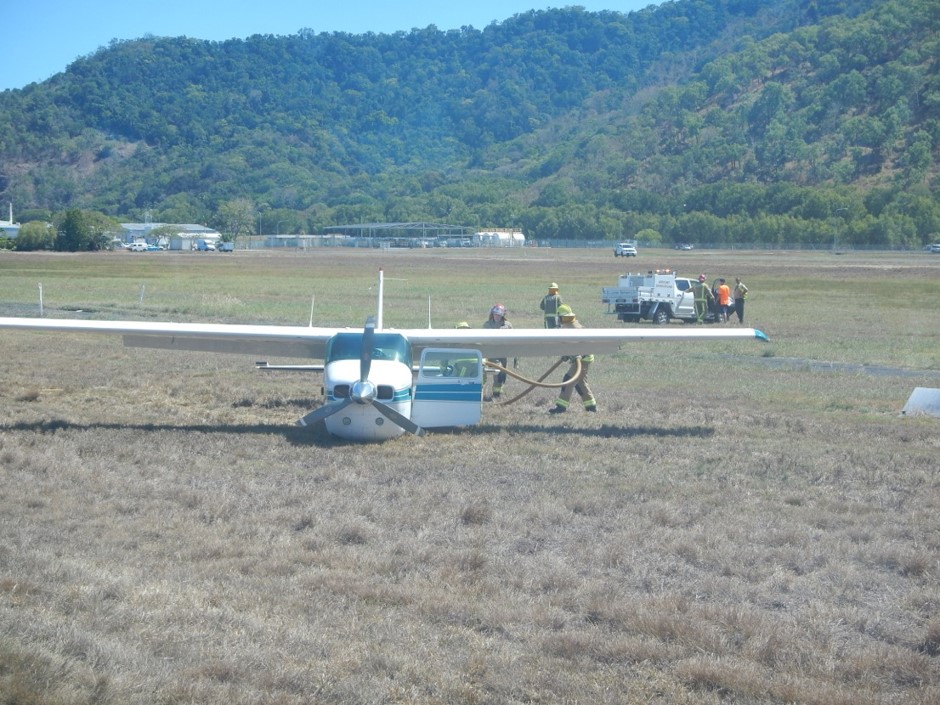
The pilot exited the aircraft quickly as the right wing fuel tank had ruptured during the landing and fuel had spilt onto the ground. The pilot tried to assist the passenger, but due to the pilot’s injuries he was unable to provide any physical assistance. After a short time, the passenger exited the aircraft. The pilot and passenger sustained serious injuries and the aircraft was substantially damaged (Figure 2).
Figure 1: Accident location
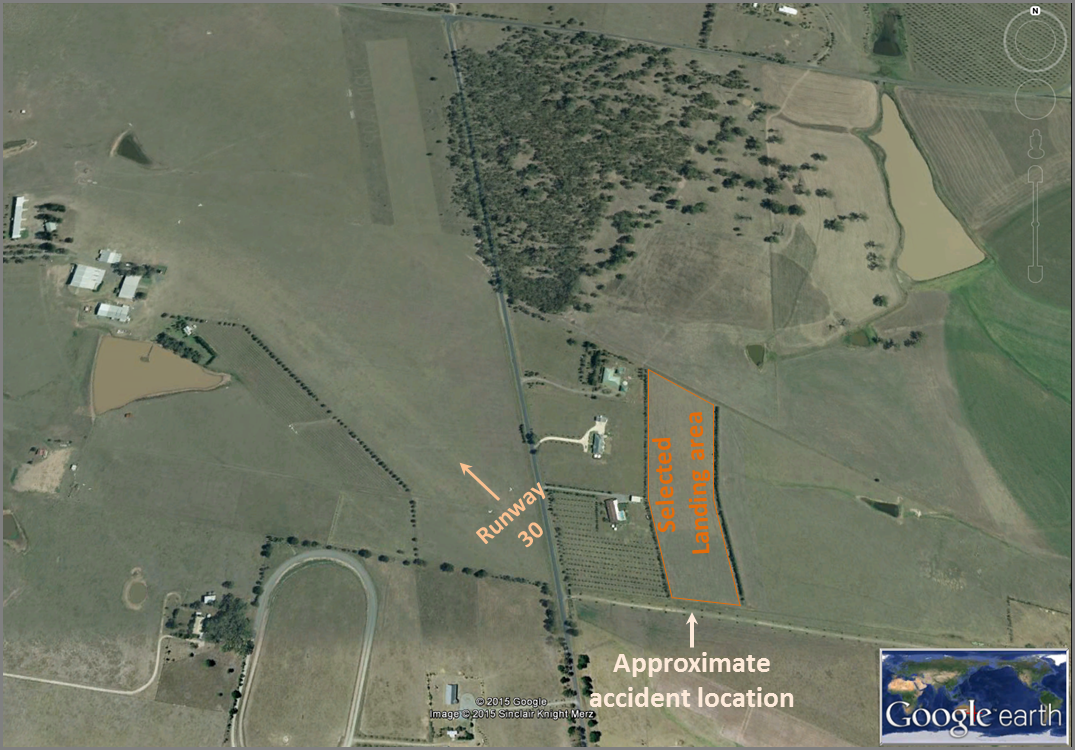
Source: Google™ earth, annotated by the ATSB
Figure 2: VH-RVY
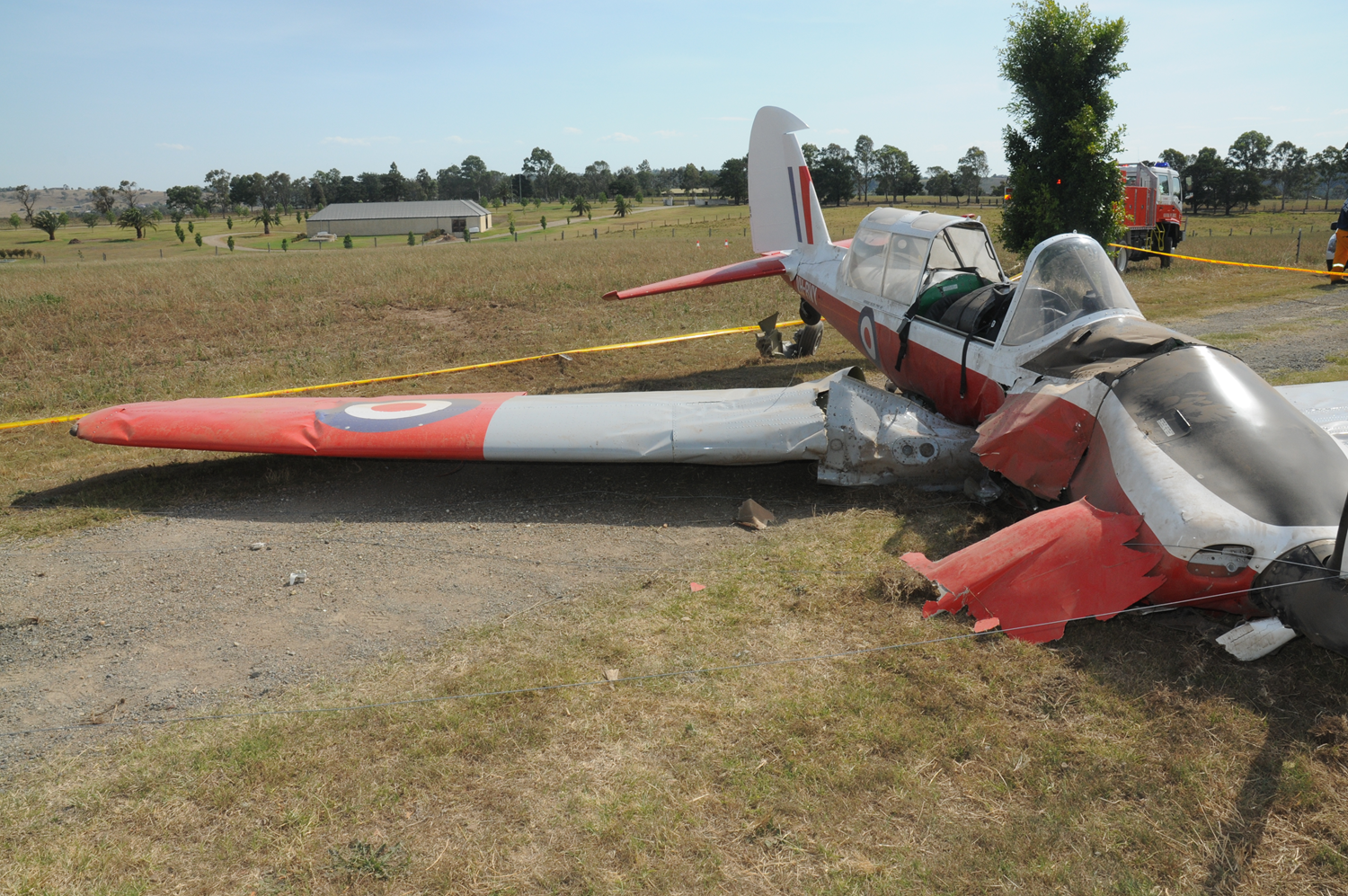
Source: New South Wales Police Force
Aircraft information
The aircraft was manufactured in the United Kingdom in 1951 and was first registered in Australia in 1954. The aircraft had been modified by the previous owner, between 1978 to 1983, where the de Havilland Engine Company Gipsy Major engine and fixed pitch propeller instillation was replaced with a Lycoming IO-360A1B6 engine, constant speed propeller, propeller governor and an accumulator installation.
Pilot comment
The pilot worked for the maintenance organisation and had flown the aircraft after its last maintenance in 2013. The pilot indicated that at the annual maintenance inspection in 2013, small fluctuations in the selected engine RPM had been reported. Both the propeller and propeller governor were sent to be overhauled and reinstalled on the aircraft, however there continued to be slight RPM fluctuations. After the annual inspection conducted just prior to the accident, it was found that there was about a 100 engine RPM fluctuation, during gentle climbing and descending. The propeller governor and accumulator were again sent to be overhauled. The components were returned serviceable with no defects found. The pilot reported that during the overhaul some adjustments were made to the internal operating pressures of the propeller governor. The components were reinstalled on RVY and ground tested with no defects found.
The pilot believed that coming out of the modified loop manoeuvre the propeller had gone into full fine pitch, resulting in the engine entering an “overspeed” condition.
The pilot reported that apart from the strong gusty winds, the temperature was about 39°C.
Owner investigation
An investigation was conducted on behalf of the owner that found the following:
- After the accident, the engine, propeller, propeller governor and accumulator were removed from the aircraft and were inspected and tested to identify any defects.
- The engine was functionally tested on an engine test truck and no defects were found.
- The propeller was inspected at a propeller overhaul facility and did not find any evidence of damage or failure within the propeller that would explain an uncommanded movement to fine pitch.
- The propeller governor was functionally tested at an aircraft component overhaul facility and no defects were identified.
- The accumulator was functionally tested at an aircraft component overhaul facility and no defects were identified. The engineering order that approved the installation of the accumulator was reported to specify an accumulator air charge pressure of about 250 PSI. The overhaul facility test equipment was only capable of testing the accumulator to about 100 PSI.
The investigation determined that there was no conclusive reason why the engine suffered an overspeed and ceased to operate. It was suggested that the overspeed may have been a result of lack of oil pressure to the propeller when the engine of RVY was inverted, during the aerobatic manoeuvre resulting in the propeller moving to fine pitch.
Safety message
Engine failure in flight
This accident is a timely reminder to pilots to consider the effect an in-flight engine failure at different altitudes and in the given conditions can have on the options available to manage that failure and to identify a suitable forced landing area. The combination of two people on board and the high temperature would have adversely affected the aircraft’s performance on the day.
The ATSB booklet Avoidable Accidents No. 3 - Managing partial power loss after take-off in single-engine aircraft contains information that is also relevant to a complete engine power loss.
The booklet highlights the importance of:
- pre-flight decision making and planning for emergencies and abnormal situations for the particular aerodrome including a thorough pre-flight self-brief covering the different emergency scenarios.
- taking positive action and maintaining aircraft control either when turning back to the aerodrome or conducting a forced landing until on the ground, while being aware of flare energy and aircraft stall speeds.
Aviation Short Investigations Bulletin - Issue 42
About this reportDecisions regarding whether to conduct an investigation, and the scope of an investigation, are based on many factors, including the level of safety benefit likely to be obtained from an investigation. For this occurrence, a limited-scope, fact-gathering investigation was conducted in order to produce a short summary report, and allow for greater industry awareness of potential safety issues and possible safety actions. Publishing informationReleased in accordance with section 25 of the Transport Safety Investigation Act 2003 Published by: Australian Transport Safety Bureau © Commonwealth of Australia 2015 
Ownership of intellectual property rights in this publication Unless otherwise noted, copyright (and any other intellectual property rights, if any) in this report publication is owned by the Commonwealth of Australia. Creative Commons licence With the exception of the Coat of Arms, ATSB logo, and photos and graphics in which a third party holds copyright, this publication is licensed under a Creative Commons Attribution 3.0 Australia licence. Creative Commons Attribution 3.0 Australia Licence is a standard form licence agreement that allows you to copy, distribute, transmit and adapt this publication provided that you attribute the work. The ATSB’s preference is that you attribute this publication (and any material sourced from it) using the following wording: Source: Australian Transport Safety Bureau Copyright in material obtained from other agencies, private individuals or organisations, belongs to those agencies, individuals or organisations. Where you wish to use their material, you will need to contact them directly. |
__________
- An engine overspeed is a condition in which an engine is allowed or forced to rotate beyond its design limit.
Occurrence summary
| Investigation number | AO-2014-180 |
|---|---|
| Occurrence date | 14/11/2014 |
| Location | Near Luskintyre |
| State | New South Wales |
| Report release date | 27/08/2015 |
| Report status | Final |
| Investigation level | Short |
| Investigation type | Occurrence Investigation |
| Investigation status | Completed |
| Mode of transport | Aviation |
| Aviation occurrence category | Forced/precautionary landing |
| Occurrence class | Accident |
| Highest injury level | Serious |
Aircraft details
| Manufacturer | De Havilland Canada/De Havilland Aircraft of Canada |
|---|---|
| Model | DHC-1 T MK 10 |
| Registration | VH-RVY |
| Serial number | DHB-F336 |
| Sector | Piston |
| Operation type | Private |
| Destination | Luskintyre, New South Wales |
| Damage | Substantial |