Lightning strike involving Airbus A330, VH-XFJ, Perth Airport, Western Australia, on 26 November 2014
Final report
Report release date: 08/03/2017
Safety summary
What happened
At about 1717 on 26 November 2014, the crew of a Virgin Australia Airlines Pty Ltd Airbus A330 aircraft, registered VH-XFJ, taxied to gate 20A at Perth Airport, Western Australia after holding short for about an hour due to severe thunderstorm activity in the area. When the aircraft stopped, the Ramp Supervisor connected the headset to communicate with the flight crew. At about the same time, other ground crew reported observing lightning strike the aircraft’s tail. As a result, an electrical discharge passed through the headset rendering the ramp supervisor unconscious. Another ground crew member who was assisting the arrival of VH-XFJ was also affected by electrical discharge from the lightning strike. That person remained conscious. Both ground crew were hospitalised for observation. There was no apparent damage to the aircraft.
What the ATSB found
The ATSB found that, while the airport’s lightning detection system was working within its rated specifications, it did not show ground strikes leading up to, or at the time of the injuries sustained by the ground crew. This highlights the importance of local observations when making risk assessments about resuming ramp duties. The ATSB also found that on the day of the incident, perceived operational pressure, weather advice, and a decrease in local storm activity influenced the Ramp Supervisor’s decision to resume ramp activities.
What's been done as a result
Subsequent to this occurrence, Perth Airport Pty Ltd has installed a thunderstorm warning system that provides audible and visual alerts to airport staff when it is unsafe to be on the ramp.
In addition, the ground-handling organisation made changes to its severe weather procedures, which include ceasing using aircraft-connected headsets when lightning activity is within 10 NM (19 km) of an airport.
Finally, Virgin Australia Airlines Pty Ltd advised that they provided all Airport Movement Coordinators with additional training in weather and flight planning. This included automated thunderstorm alerting system-specific training. In addition, the airline has aligned their manuals with other stakeholders’ extreme weather policy and procedures and commenced using wireless headsets at some airports.
Safety message
This occurrence reaffirms that perceived or actual operational requirements should not be allowed to compromise safety. When assessing if work can resume on the airfield in the face of potentially‑hazardous weather conditions, local observations of those conditions should be an integral part of the decision-making process. The final decision to resume duties should remain with the responsible person at that location.
Lightning at Perth Airport (not the day of the incident)
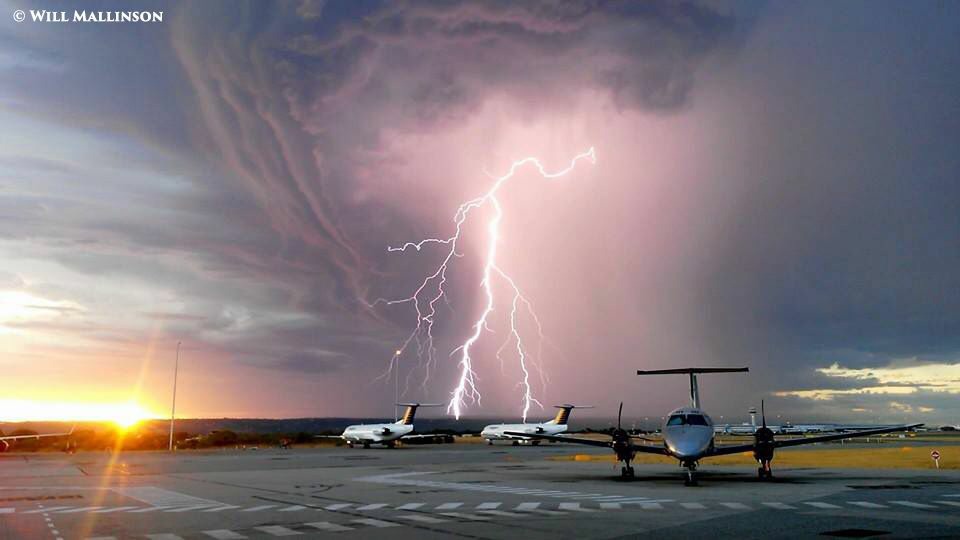
Source: Will Mallinson
The occurrence
On 26 November 2014, the flight crew of an Airbus A330 aircraft, registered VH-XFJ (XFJ) and operated by Virgin Airlines Australia Pty Ltd (Virgin), was conducting a scheduled passenger flight from Sydney, New South Wales, to Perth Airport, Western Australia. The general weather forecast for arrival at Perth included scattered thunderstorms. As a result, the aircraft was vectored a number of times by air traffic control to avoid the storm cells in the area.
At about 1435 Western Standard Time,[1] due to an electrical storm at Perth Airport, all work on the ramp stopped. At about 1515, no further lightning activity was observed on the weather radar, so the ground crew resumed their duties. However, shortly after, cloud-to-cloud lightning was observed and lightning struck the ramp behind an aircraft. All work activities immediately ceased again. The Ramp Supervisor (RS) reported continually monitoring the local conditions from that time to determine when it would be safe for staff to resume work on the ramp.
The captain reported that, on approach into Perth, the aircraft descended through cloud and that they became visual between 4,000–5,000 ft above ground level with small storm cells and lightning activity observed to the north of the airport. The captain recalled landing on runway 06 shortly after 1615 and, during the landing roll, seeing lightning strike the ground about 500 m to the right of the aircraft. The flight crew were advised by air traffic control to hold on the taxiway as the ramp was closed and their designated bay (20A) was occupied.
At about 1630, the Airport Movement Coordinator advised the RS they had been contacted by Virgin’s operations controller located in Brisbane, who queried why duties on the ramp had not recommenced, as other airlines had already resumed their Perth operations. The RS called the Operations Controller and was questioned directly as to why they had not returned to the ramp. During this conversation, the RS was told of advice from Virgin’s Meteorological Officer that there had not been any lightning activity in the area for the past 30 minutes. In response, the RS relayed that lightning was still visible overhead, and was told to discuss this with Virgin’s Meteorological Officer. After being unsuccessfully transferred to the Meteorological Officer’s phone, the RS hung up and reviewed the Bureau of Meteorology weather radar images.
After assessing the weather radar images, the RS determined that there could shortly be about a 45-minute break in the storm cell activity in the area. The Airport Movement Coordinator received a number of additional calls from the Operations Controller about the resumption of ramp duties, which were relayed to the RS. Following a discussion with other senior ground crew, and observing a reduction in the local storm activity, the RS decided to resume work on the ramp. The RS gave priority to clearing the backlog of aircraft waiting to be unloaded, then directed ground crew to move the aircraft already at bay 20A to nearby ‘stand-off’ bay 915 (Figure 1).
At about 1717, the crew of XFJ taxied to bay 20A. After they came to a stop, the RS chocked the nose wheels and connected a headset to the intercom jack at the aircraft’s nose landing gear (Figure 2).
As the ground crew were parking the other aircraft on bay 915, lightning was observed to strike the tail region of XFJ. Simultaneously, engineers located at bay 20A reported observing a lightning flash to the rear-left of XFJ. As the RS depressed the ‘push-to-talk’ button and established contact with the flight crew, the RS received an electrical shock consistent with a high voltage electrical discharge.
The RS staggered from the aircraft before collapsing unconscious on the ground. A second ground crew member assigned to XFJ was also subjected to the electrical discharge and sustained a burn injury. That ground crew member did not lose consciousness.
Both ground crew were transported to hospital for observation. The second injured ground crew member was released the next day and the RS remained in hospital for a number of days before being released.
Inspection of the aircraft by Virgin did not find any evidence of the lightning strike entry or exit points, nor were any defects found that could account for the injuries sustained by the ground crew.
Figure 1: Terminal three at Perth Airport indicating parking bays 20A (in red) and 915 (in green) and the witness locations
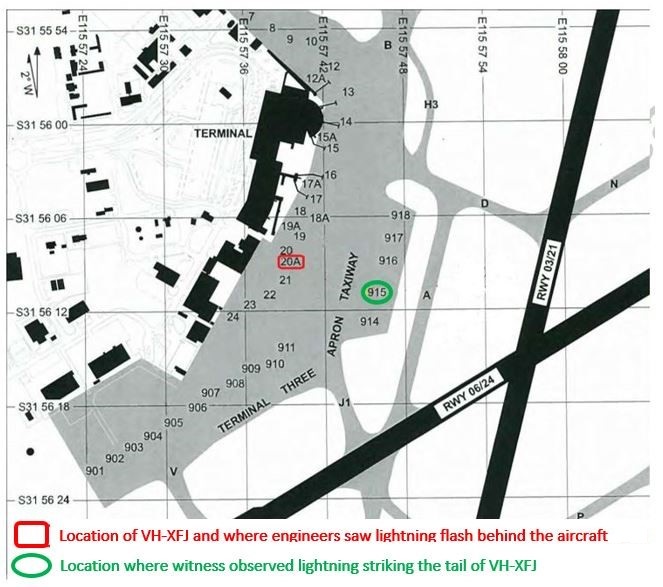
Source: Airservices Australia, modified by the ATSB
Figure 2: Perth Airport ramp closed-circuit television images showing the RS at the nose landing gear of XFJ
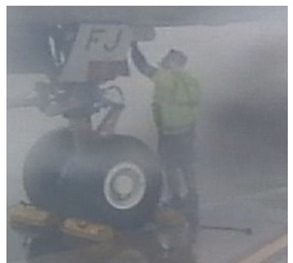
Source: Perth Airport Pty Ltd
__________
Context
Aircraft information
General information
The aircraft, an Airbus A330-243, serial number 1561, was manufactured in France in 2014 and placed on the Australian register on 11 June that year. The aircraft was maintained in accordance with Civil Aviation Safety Authority requirements through the Virgin Australia Airlines Pty Ltd (Virgin) approved system of maintenance. The aircraft’s logbook did not contain any defects at the time of the occurrence that would have effected its airworthiness or account for the injuries sustained by the ground crew.
Aircraft lightning protection
Regulatory requirements
The United States Federal Aviation Administration (FAA) had developed an electrical system harmonisation working group to standardise regulations between the Federal Aviation Administration regulations (FAR) and the European Joint Aviation Authority regulations (JAR). This included electrical bonding[2] and protection against lightning and static electricity. As a result, FAR 25 and JAR 25 closely mirrored each other.
FAR/JAR 25 provided airworthiness standards for transport category aircraft. Regulations FAR/JAR 25.581 specifically addressed lightning protection. They stated that:
…an aircraft must be protected against catastrophic effects from lightning through the bonding of metallic components to the airframe, or designing the components so that a lightning strike will not endanger the aircraft. For non-metallic components, the regulations requires they are designed to minimise the effect of a strike, or incorporate an acceptable means of diverting the resulting electrical current so as not to endanger the aircraft.
Regulations FAR 25.899 and JAR ACJ 25X899 related to electrical bonding and protection against static electricity. These regulations highlighted that bonding design must minimise the accumulation of electrostatic charge that would cause:
- human injury from electrical shock
- ignition of flammable vapours
or
- interference with installed electrical and electronic equipment.
They also reinforced that metallic components needed to be properly bonded to the airframe. Where other acceptable means of dissipating the resulting electrical current were used, they could not endanger the aircraft, personnel, or the operation of installed electronic and electrical equipment.
Aircraft design
Airbus advised that the A330 design was protected against the effects of lightning in accordance with FAR/JAR 25. That compliance was assessed during the aircraft design stage through analysis and testing that ranged from specific equipment installed on the aircraft, to full-scale aircraft testing.
The aircraft was designed to behave as a Faraday cage[3] in the event of a lightning strike. The aircraft’s structure and systems were protected through electrical bonding to minimize structural damage and electrostatic charge build-up, and to ensure that critical systems would remain available.
Aircraft bonding
Airbus also advised that any electrical charge from a lightning strike would most probably dissipate through the landing gear to the ground. Airbus Maintenance Briefing Note 12/5/2014 provided a number of illustrations and flow charts that referenced mandatory earthing for transit, base or hangar aircraft maintenance during storm conditions (Figure 3).
Figure 3: Airbus Maintenance Briefing Note 12/5/2014 extract showing the bonding requirements for transit, base or hangar maintenance during storm conditions
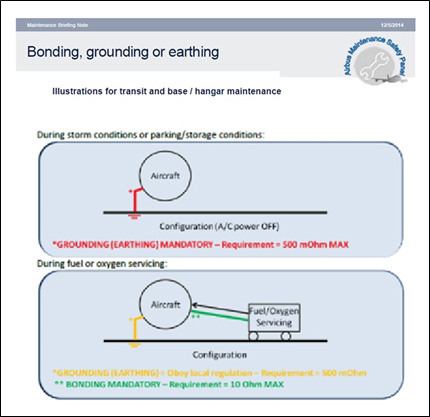
Source: Airbus
Aircraft Maintenance
Safe practices
Whether an aircraft is electrically earthed[4] or not, the risk of injury to ground crew working around the aircraft when it is struck by lightning is high and increases significantly if direct contact is made with the aircraft.
To minimise the likelihood of injury from lightning, the aircraft maintenance manual provided the following warning:
WARNING: DO NOT TOUCH CONNECTIONS TO THE AIRCRAFT, DO NOT USE HEADSETS, LIGHTNING STRIKE AND HIGH DISCHARGE CURRENTS ARE VERY DANGEROUS FOR PERSONNEL AND CAN CAUSE DAMAGE TO EQUIPMENT.
The aircraft maintenance manual defined a ‘WARNING’ as:
CALLS ATTENTION TO USE OF MATERIAL, PROCESSES, METHODS, PROCEDURES OR LIMITS WHICH MUST BE FOLLOWED PRECISELY TO AVOID INJURY OR DEATH TO PERSONS.
Lightning strike inspection procedure
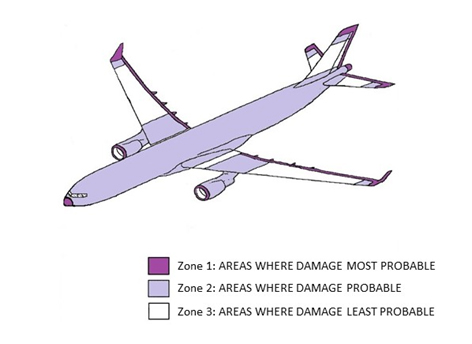
The aircraft maintenance manual after lightning strike inspection detailed the maintenance actions after a lightning strike to the aircraft. The procedure defined lightning strike probability on the aircraft in terms of three probability zones (Figure 4).
Figure 4: Airbus lightning strike inspection areas
Source: Airbus, modified by the ATSB
The inspection procedure consisted of three phases:
- phase 1, which entailed a visual inspection
- phase 2, consisting of a system test
- phase 3, which resulted in the replacement/repair of damaged equipment or components.
If the phase 1 inspection did not identify any defects, the subsequent phase inspections were not required. Review of the aircraft’s maintenance documentation revealed that no defects were identified during the phase 1 inspection after the lightning strike.
Meteorological information
Lightning
Lightning is an atmospheric discharge of electricity, which typically occurs during thunderstorms, but can occur during volcanic eruptions or dust storms. While the formation of lightning is still under debate, ice in clouds is believed to play a key role in lightning formation and the forcible separation of positive and negative charges within a cloud. Lightning can occur within clouds (cloud-to-cloud) or between the earth and a cloud (cloud-to-ground or ground-to-cloud).
As the thundercloud moves over the earth an equal but opposite electrical charge is induced on the ground. The negatively ionised air channels within the cloud (called leaders) are drawn toward positive ions in quick jumps. As these ‘stepped’ leaders approach within 15 to 50 m of the ground, the electrical potential increases until the remaining gap is bridged. A neutralising current flows along the ionised path, and is visible as a flash (bolt) in the return stroke.
Lightning often strikes outside heavy rain and can occur up to 16 km from the storm cloud. The typical ground bolt length is 1.6 km long.
Weather forecasting
The Bureau of Meteorology (BoM) produced a number of forecasts and reports for Perth Airport throughout the day. These included aerodrome warnings, aerodrome weather, aerodrome forecasts (TAF)[5] and trend forecasts (TTF)[6].
Aerodrome warning
Aerodrome warnings were issued when meteorological conditions that could adversely affect airport facilities, services, or aircraft on the ground were anticipated.
At 0839, an aerodrome warning (valid from 0840 to 2040) was issued for Perth Airport. It stated that thunderstorms were observed within the terminal area to the north and east that were expected to persist throughout the day and into the evening.
A second warning (valid from 1340 to 1700) was issued at 1340. This warning confirmed the presence of hail in the region with the possibility of hail at the airport in the afternoon until at least 1700.
Aerodrome weather briefing
An aerodrome weather briefing issued at 1331 confirmed the presence of thunderstorms to the north of Perth Airport and stated they were expected to continue until 1700 the following day. This included an at least 50 per cent probability of thunderstorms at the terminal until 1700 that day, and a 30 per cent probability of thunderstorms until 1700 the next day.
Amended TAF
At 1518, an amended TAF for Perth Airport (valid from 1500 to 2000 the following day) was issued. That forecast predicted rain showers and periods of thunderstorms and hail around the time of the occurrence.
TTFs
TTF (SPECI) reports were issued for Perth Airport at 1630, 1700, 1721 and 1730. These reports documented the presence of thunderstorm activity in the area.
Weather radar
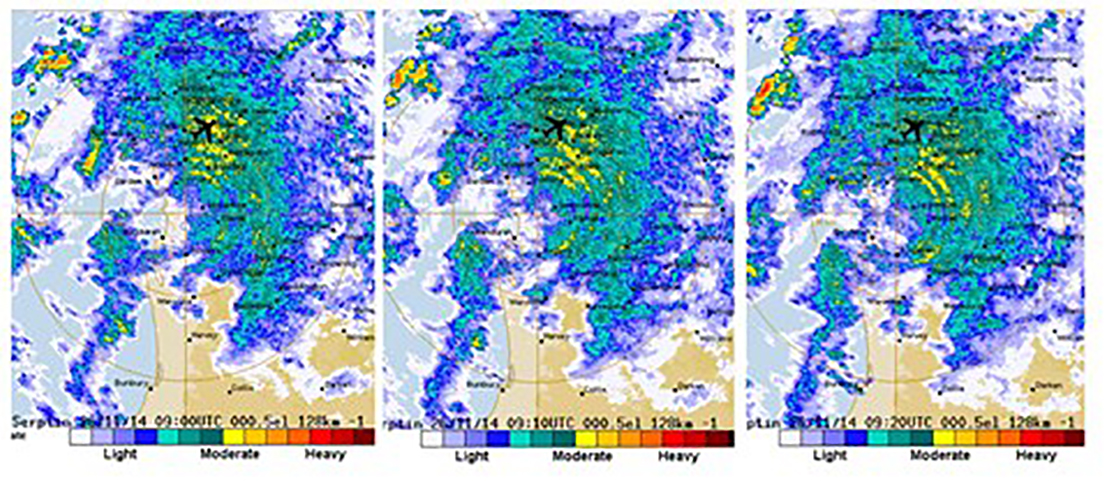
The BoM provided copies of weather radar images for Perth Airport at the time of the incident. The weather radar images show only precipitation, not cloud formations, thunderstorms or lightning strikes. The images provided confirm the presence of rain in the vicinity of the airport at the time of the occurrence (Figure 5).
Figure 5: BoM weather radar screen captures of the weather at Perth Airport from 1700 to 1720 (0900 to 0920 UTC) on 26 November 2014 showing consistent light-to-moderate rain
Source: BoM, modified by the ATSB
Adverse weather monitoring
Automated Thunderstorm Alerting System
The BoM developed the Automated Thunderstorm Alerting System (ATSAS) to provide real-time information about thunderstorms and lightning activity at major airports. The system used radar data combined with localised single station lightning sensors at supported airports, including at Perth, to record cloud-to-cloud and cloud-to-ground lightning strikes within 10 NM (19 km) of the airport. The system had a reported accuracy of 90 per cent for lightning detection, with information updates occurring every minute. Data gathered was presented as a graphic for registered users, showing the airport in plan view, thunderstorm cell location and its forecast movement for up to 30 minutes.
Global Positioning and Tracking System
An alternate commercial lightning detection system was in operation in Australia at the time of the occurrence. The Global Positioning and Tracking System comprised of a network of sensors that used a different method of tracking lightning strikes. Data from that system was available to the BoM.
Global Positioning and Tracking System data was available for the period of the occurrence. The data showed multiple lightning strikes on the airport at 1342 and 1524.
Alerting system data
Neither the Global Positioning and Tracking System nor ATSAS data identified cloud-to-ground lightning strikes at or within a 5 NM (9 km) radius of the airport at the time of the occurrence. The data did show an increase in cloud-to-cloud lightning activity at that time.
Virgin adverse weather monitoring
Virgin reported that their Brisbane-based contracted Meteorological Officer monitored the storm activity in the vicinity of the Perth Airport that day. The Meteorological Officer stated that the data indicated that the last lightning strike within 5 NM (9 km) of the airport occurred about 16 minutes prior to the aircraft being parked at bay 20A. At the time of the occurrence, lightning activity was indicated approximately 21 NM (39 km) south-south-west of the airport. The Meteorological Officer reported that a significant increase in the number of cloud-to-cloud lightning strikes could signify an imminent cloud-to-ground strike.
Severe weather procedures
Virgin
Virgin’s Airport Airside Operations (AAO) manual discussed severe weather operations procedures. In accordance with the manual, either the Ramp Duty Manager (RDM)[7] or the Airport Duty Manager (ADM) were responsible for declaring a thunderstorm watch and activating the various stages of the phased response procedures. Activation was to be undertaken in conjunction with local observations and assessment.
The thunderstorm watch phased response procedures included the:
- Alert Phase:
- Once a storm front was within 10 NM (19 km) of the airport and continuing to approach, the RDM/ADM was to notify the likelihood of an operational shutdown to all ramp staff and key personnel. This included the on-duty Airport Manager, duty Operations Controller, Airport Movement Coordinator, flight crew and cabin supervisors, contractors and service providers, and so on.
- Preparations for shutdown included suspending non-essential open area activities, alerting staff using headsets, advising fuelling operations to monitor the approaching storm and avoiding use of highly-conductive equipment.
- Stop/Shutdown Phase:
- When the storm was within 5 NM (9 km), the RDM/ADM was to declare the Stop/Shutdown Phase and ensure the information was relayed to all relevant personnel.
- On announcement of the Stop/Shutdown Phase, personnel were to stop all ramp activities, including fuelling. Communication with the aircraft via headset was to be discontinued and personnel were to seek shelter inside buildings. All passenger boarding was to cease and arriving aircraft be held off their gate.
- All Clear/Downgrade/Cancellation Phase:
- When the storm had passed 5 NM (9 km) from the airport, there was a downgrade to the Alert Phase. When the storm reached 10 NM (19 km) from the airport, the Alert Phase could be cancelled.
- The AAO manual contained the following note in respect of the procedure for ATSAS airports:
- [duty engineering supervisor][duty engineering supervisor]
- The AAO acknowledged the risk of lightning injury and advised that many lightning injuries occurred after the perceived threat had passed. The manual also stated that ‘lightning generally diminishes with time after the last sound of thunder, but may persist for more than 30 minutes.’
- The manual’s thunderstorm and lightning safety subsection listed activities that should not be undertaken during lightning events. These included the use of a headset that was connected to an aircraft and not staying in open areas or under the aircraft.
Ground handling
Virgin used a third party for aircraft ground-handling operations at Perth Airport. The ground handling organisation was one of the largest independent providers of ground support services in Australia, with operations at 16 major airports.
The ground-handling organisation’s Quality Manual contained procedures for adverse weather operations, including thunderstorms. While the procedures identified BoM and Virgin’s meteorological services as major sources of weather information, the procedure noted that:
Airport managers and Ramp Supervisors should use this information carefully, also taking into account local visual observations.
The stipulated response to adverse weather conditions was divided into the following five phases:
- Awareness
- Storm watch
- Alert
- Airside operations shutdown
- Downgrade/cancellation.
These phases aligned closely with Virgin’s procedures in regard to storm proximity to the airport and the cessation/resumption of ramp activities.
Airport procedures
The Perth Airport Pty Ltd operating protocols placed the onus on the airlines and their contractors to ensure that their staff were competent in airfield and ramp occupational health and safety practices. Consequently, the airport’s policy and procedures did not incorporate any specific adverse weather practices or procedures. Perth Airport did not have an airfield thunderstorm/lightning warning system for alerting personnel on the apron.
Organisational and Management information
Workload/operational pressure
At the first sign of lightning near the ramp (at about 1515), the RS ceased work activities and withdrew the ground-handling staff. At about 1630, the Aircraft Movement Coordinator and Operations Controller questioned why the RS had not recommenced work on the ramp as the meteorological information provided showed no lightning activity since about 1600. At that time, work had ceased for over an hour and there were partially-unloaded aircraft that had landed just prior to the lightning activity.
The Operations Controller re-enforced that the aircraft needed to be unloaded and dispatched, as they were required on the ‘east coast’ that night. As a result, the RS reviewed the radar data on the BoM website before directing the ground handlers to resume ramp duties
The RS stated that had he not felt pressured by the Operations Controller and Aircraft Movement Coordinator, he would most likely not have resumed work on the ramp at that time.
Additional information
Decision making
Studies have found that decision quality decreased when time pressures are imposed (Kerstholt 1991). The decision maker will tend to narrow their focus with selective processing of the available information. Research into the effect of time pressure on aviation maintenance errors found that decision making accounted for about 9 per cent of errors studied (Suzuki and others 2008). That percentage increased to about 27 per cent when time pressures were applied.
The RS advised of feeling under pressure to return ground-handling staff to ramp duties quickly to facilitate the relocation of aircraft to the east coast that day.
Lightning injuries
On average, there are about 10 fatal lightning strikes and about 100 strikes that result in injury in Australia each year. Injuries from lightning can occur through the following discharge methods:
- direct strike, in which the person is the point of the lightning strike
- contact strike, where the person is in contact with an object that is struck
- side flash, where lightning strikes an object and jumps/splashes to a nearby person
- upward leader strike, in which the positive current moves upward without contacting the downward stroke
- ground flash/current, where the lightning strikes the ground some distance from the person. The lightning then spreads across and energises the ground.
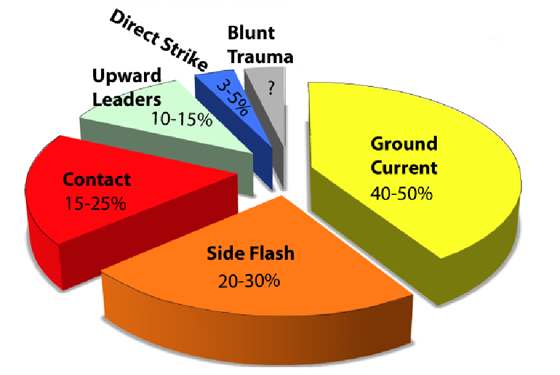
Canadian research statistics have shown that the most common lightning injuries are the result of indirect strikes, with ground flash/current accounting for 40 to 50 per cent of injuries, and side flash accounting for 20 to 30 per cent of injuries. Only 3–5 per cent of injuries were attributed to direct strikes (Figure 6).
Figure 6: Pie chart of Canadian lightning strike types and annual injury percentages
Source: Environment Canada
It is a common misconception that lightning strike victims remain electrically charged and that contact with that person can result in injury. This is incorrect, as the electrical discharge passes through the strike victim to earth. Consequently, shock injuries do not occur as a result of touching someone who has been struck by lightning.
Other occurrences
Perth Airport Pty Ltd advised that they had no record of any previous injuries due to aircraft lightning strikes occurring at Perth Airport.
The ground-handling organisation advised that their records showed four incidents of possible lightning strike electrical discharge injuries across their operations. These included:
- 2008 Gold Coast Airport, Queensland. During the aircraft’s arrival, the ground crew felt a minor shock through the headset.
- 2013 Perth Airport. During dispatch, the ground crew felt a minor shock through the headset.
- 2014 Darwin Airport, Northern Territory. During waste water servicing, the ground crew was knocked to the ground but was able to continue their duties.
- 2014 Perth Airport (this incident).
- A search of the ATSB occurrence database identified 19 lightning strikes to aircraft that were parked or taxiing at aerodromes in Australia from 1974 to 2014. Of these incidents, only this occurrence resulted in serious injury to personnel.
______
- Electrical bonding: the establishment of a current path between electrically conductive parts in order to assure electrical continuity.
- Faraday cage: a shield that protects its inner contents from static electricity fields.
- Electrically earthed: the establishment of electrical continuity between the aircraft and the earth’s surface (ground).
- Aerodrome Forecast (TAF): a statement of meteorological conditions expected for a specific period of time in the airspace within a radius of 5 NM (9 km) of the aerodrome reference point.
- Trend Forecast (TTF): an aerodrome weather report (either routine (METAR) and issued at fixed times (hourly or half hourly), or special (SPECI) and issued whenever weather conditions fluctuate about or are below specified criteria. A statement of trend is appended to these reports.
- RDM: the Virgin designation for the Ramp Supervisor (RS).
Safety analysis
Introduction
After VH-XFJ (XFJ) arrived at gate 20A at Perth Airport, lightning was observed striking the tail region and rear-left of the tail of the aircraft. The two ground crew who were receiving the aircraft sustained injuries consistent with electrical discharge from the lightning strike.
The aircraft was manufactured to the required lightning protection design standards. Inspection of the aircraft by Virgin Australia Airlines Pty Ltd (Virgin) maintenance staff did not identify the lightning strike point of entry, nor was evidence of an electrical bonding deficiency found. Further, the aircraft did not contain any defects that could account for the injuries sustained. As a result, the aircraft design or its systems were not considered contributory to the occurrence. Therefore, this analysis will focus on factors relating to the:
- lightning strike
- effectiveness of the monitoring of the lightning activity
- effectiveness of the adverse weather procedures employed by the parties involved
- effect of perceived or actual operational pressure on decision making.
Lightning strike
Location of the strike
The lack of an identifiable lightning strike entry or exit point on XFJ could be attributed to the integrity of the aircraft’s electrical bonding and that ground discharge occurred through the headset and ramp supervisor (RS). However, a lightning strike to the ground adjacent to the aircraft, rather than to the aircraft itself, would also account for the absence of lightning damage to the aircraft.
The ground staff on bay 915 reported seeing lightning strike the tail of XFJ. The presence of lightning was further supported by the flash at the rear-left of the tail of the aircraft as reported by the engineers on bay 20A.
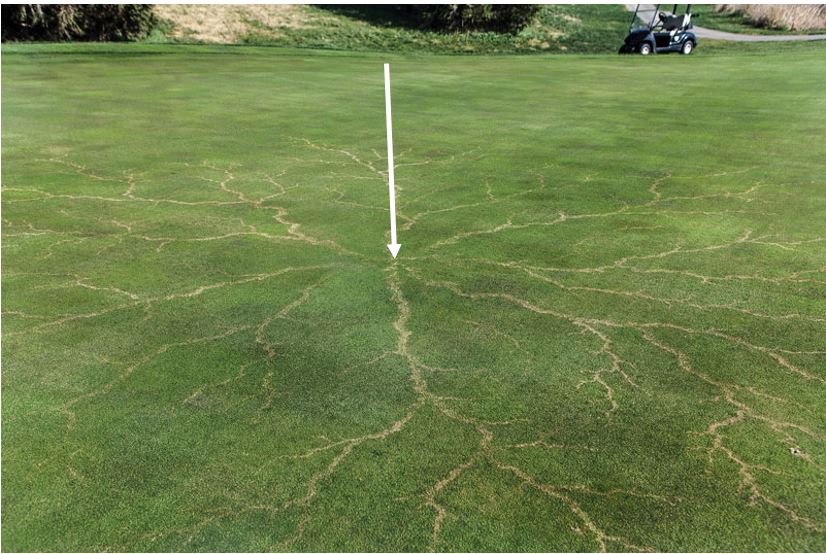
The ATSB considered which of a lightning strike to the tail or to the nearby ground was more likely. In this regard, a lightning ground strike would result in radial discharge from the point of strike as shown in Figure 7.
Figure 7: Ground lightning strike showing radial discharge from a central strike point (indicated by a white arrow)
Source: Mr Al Gamaty, courtesy of Reddit
Had a ground strike occurred at the near-rear of the aircraft, and discharged outward toward the location of the RS and second ground crew member at the nose wheel, it would have also radiated approximately the same distance behind and to the sides of the aircraft. Given the lack of reported lightning injuries/effects to other ground crew working in those areas, a ground strike is considered less likely than a tail strike.
Ground crew injuries
The injuries sustained by the two ground crew were consistent with high voltage electrical discharge. A lightning strike to the ground close to the aircraft could have resulted in a ground current passing through both ground crew. However, in the case of the RS, the injuries appear more likely a result of lightning striking the tail of the aircraft and discharging through the headset and RS to earth. This is termed a ‘contact’ strike. Due to their close proximity to the aircraft, the second ground crew member most likely received a less severe, ‘side flash’ strike.
Lightning activity monitoring and the decision to resume tarmac operations
Lightning activity monitoring
Virgin’s Brisbane-based Meteorological Officer had access to Bureau of Meteorology weather data and was monitoring the weather at Perth Airport. Specific to lightning activity, they had access to the Automated Thunderstorm Alerting System (ATSAS) and the Global Positioning and Tracking System data. Neither system showed ground strikes at the airport prior to or during the occurrence. The absence of lightning activity in that data, which was briefed to the Operations Controller by the Virgin Meteorological Officer, was a significant factor influencing the controller to discuss the resumption of work on the ramp with the RS.
The ATSAS and Global Positioning and Tracking system provided a high level of accuracy in the detection of cloud-to-ground lightning strikes (reported as up to 90 per cent accuracy). However, the absence of detection by either system in this occurrence supports the need to source collaborative local data when determining whether it is safe to return to work activities.
The decision to resume tarmac operations
The RS attempted to clarify the lightning risk after the Operations Controller called to advise that no lightning activity was recorded in the area for the last 30 minutes, and that other operators had resumed tarmac operations. This entailed the RS attempting to telephone the Brisbane-based Meteorological Officer to discuss the disparity in the controller’s advice as compared to the lighting still being observed overhead. The RS was unable to contact the Meteorological Officer.
Consistent with the reported perception by the RS of pressure from the Operations Controller and Airport Movement Coordinator to resume work earlier than they would have liked, the RS used the Bureau of Meteorology website’s weather radar information to assess the local conditions and estimate the storm’s movement. The weather radar displayed areas of precipitation, but did not directly show cloud formation, thunderstorm or lightning strike activity. Therefore, the weather radar alone did not provide sufficient information to predict lightning strikes. Additionally, the use and interpretation of weather radar information without formal training increased the likelihood that the RS was not aware of this limitation.
In the event, the RS’s decision to resume tarmac activities was informed by their interpretation of the radar data accessed on the Bureau of Meteorology website. This interpretation was reinforced by the report from the Operations Controller of no lightning activity in the area in the preceding 30 minutes, and by the supervisor’s perception of a reduction in local storm activity.
A review of weather radar images for the period leading up to the incident indicated ongoing rain in the vicinity of the airport (Figure 5). The data did not show a clear break in the storm.
Severe weather procedures
Virgin
In respect of the resumption of duties at ATSAS-equipped airports such as Perth, Virgin’s Airport Airside Operations manual severe weather operations procedure stated:
The decision to resume normal duties shall take into account any cells observed outside the 5 nm [9 km] radius which are expected to impact on the airport in the immediate future. Where a second cell is anticipated to impact on the 5 nm [9 km] area, the decision to resume ramp activities rests with the RDM [Ramp Supervisor] and the DES [Duty Engineering Supervisor].
Despite those requirements, it appears that Virgin’s Operations Controller did not consider seeking an understanding of the local weather conditions from either the RS or the Duty Engineering Supervisor. A discussion with the RS of the need to resume ramp duties would have, if able to have been carried out, provided an ideal opportunity for the Operations Controller to gain that understanding. There was the potential for it to have also had an effect on the pressure felt by the RS to resume those operations.
Ground-handling organisation
The ground-handling organisation’s procedures in the case of thunderstorm and lightning activity closely followed those of Virgin with regard to alert stages and the cessation and resumption of duties. The procedures supported the use of weather information as part of the assessment process and stated that local visual observations should be taken into account when assessing the resumption of duties, but cautioned that airport managers and ramp supervisors should use weather information carefully. However, no formal guidance or training on which weather information was suitable given the situation, or how to interpret that information, was provided.
Summary
Virgin’s and the ground-handling organisation’s procedures provided for local observations to be taken into account when considering the resumption of ramp duties. However, the reliance by the Operations Controller on the Meteorological Officer’s advice that lightning activity had ceased affected the application of those procedures in this case. The conversation between the controller and the RS, and then the Airport Movement Coordinator and the RS, resulted in perceived pressure by the RS to resume ramp duties. Given the report of lightning still being observed overhead, the decision by the RS to resume those operations increased the risk of a lightning strike and injury to ground personnel.
Findings
From the evidence available, the following findings are made with respect to the lightning strike involving Airbus A330, registered VH-XFJ, at Perth Airport, Western Australia on 26 November 2014. These findings should not be read as apportioning blame or liability to any particular organisation or individual.
Contributing factors
- In combination, perceived operational pressure by the Ramp Supervisor, and their assessment that there would be a 45-minute break in thunderstorm activity, influenced the decision to resume work on the ramp during local thunderstorm activity.
- Consistent with the observed lightning strike to the tail of the aircraft, connection of the headset to the aircraft during local thunderstorm activity resulted in a ‘contact’ strike to the ramp supervisor.
Other factors that increased risk
- The Automated Thunderstorm Alerting System and Global Positioning and Tracking System data did not show cloud-to-ground lightning activity within 10 NM (19 km) of the airport prior to work resuming on the tarmac or at the time of the injuries. Despite the observed local conditions, the lack of recorded ground strikes prior to the incident may have created a false impression of a low lightning risk environment.
- The Virgin Australia Airlines Pty Ltd Meteorological Officer report of no lightning activity in the area in the previous 30 minutes was communicated to the Ramp Supervisor by the Operations Controller. That and the subsequent communication by the Airport Movement Coordinator was perceived by the Ramp Supervisor as pressure to resume ramp duties.
Other finding
- The Ramp Supervisor’s assessment that there would be a 45-minute break in thunderstorm activity was reinforced by the report by the Operations Controller of no lightning activity in the area in the preceding 30 minutes, and the supervisor’s perception of a reduction in local storm activity.
Safety issues and actions
Additional safety action
Whether or not the ATSB identifies safety issues in the course of an investigation, relevant organisations may proactively initiate safety action in order to reduce their safety risk. The ATSB has been advised of the following proactive safety action in response to this occurrence
Proactive safety action taken by Virgin Australia Airlines Pty Ltd
As a result of this occurrence, Virgin Australia Airlines Pty Ltd:
- Enhanced its flight planning and weather training for all ground operations Airport Movement Coordinators, incorporating a specific Automated Thunderstorm Alert System training package.
- Is considering the implementation of a ‘Severe Weather’ text message alert system to airports on their network that were not covered by the Automated Thunderstorm Alerting System. These alerts would be sent in advance of severe wind, lightning, and so on and would direct the recipient to the Bureau of Meteorology for more information.
- Commenced a trial of smartphone weather alert applications with key operational personnel across the domestic network.
- Commenced using wireless headsets at some airports.
- Aligned their manuals with other stakeholders’ extreme weather policy and procedures.
Proactive safety action taken by Aerocare
As a result of this occurrence, Aerocare (the ground-handling organisation) made a number of changes to its adverse weather procedures. These included:
- increased emphasis that Ramp Supervisors have the authority to determine the cessation and recommencement of work activities
- increased emphasis on the risk of electrical discharge as a result of connecting a headset to an aircraft during storm activity and increasing the minimum distance from such storm activity at which headset connection takes place from 10 km to 18 km
- clarification of a number of terms/distances
- increasing the lightning risk distance from an airport from 10 km to 18 km
- the inclusion of first aid and emergency response information in case of a lightning strike
- greater guidance on the available weather-monitoring tools
- standardisation of the adverse weather phases as follows:
- Awareness – forecast adverse weather
- Watch – 30 NM (56 km) and approaching
- Alert – 10 NM (19 km) and approaching
- Airside operational shutdown – 5 NM (9 km) and approaching
- Downgrade - greater than 5 NM (9 km) and receding
- Cancellation – no thunderstorm activity is forecast or observed locally.
Proactive safety action taken by Perth Airport Pty Ltd
As a result of this occurrence, in December 2014 Perth Airport Pty Ltd produced Safety Bulletin issue 05. The bulletin highlighted the importance of taking appropriate action during severe weather to airside operators and personnel.
Additionally, in September 2015 a thunderstorm warning system that featured audio and visual warnings to staff on the airport was installed. Perth Airport Pty Ltd advised that, since installation, the warning system had been used successfully on a number of occasions.
Sources and submissions
Sources of information
The sources of information during the investigation included the:
- ramp supervisor
- ground crew
- ground-handling organisation
- Bureau of Meteorology
- Virgin Australia Airlines Pty Ltd
- Airbus
- Perth Airport Pty Ltd.
References
Suzuki T, Von Thaden TL, Geibel WD. 2008, Influence of time pressure on aircraft maintenance errors. Champaign Illinois.
Kerstholt J H. 1991, Time pressure effects on decision making in a dynamic task environment, TNO, Soesterberg.
Submissions
Under Part 4, Division 2 (Investigation Reports), Section 26 of the Transport Safety Investigation Act 2003 (the Act), the ATSB may provide a draft report, on a confidential basis, to any person whom the ATSB considers appropriate. Section 26 (1) (a) of the Act allows a person receiving a draft report to make submissions to the ATSB about the draft report.
A draft of this report was provided to Virgin Australia Airlines Pty Ltd, Airbus, Bureau d'Enquêtes et d'Analyses pour la sécurité de l'aviation civile, the Bureau of Meteorology, Perth Airport Pty Ltd, the ground-handling organisation, the Ramp Supervisor and the second ground crew member working on VH-XFJ and the Civil Aviation Safety Authority.
Submissions were received from Bureau of Meteorology, the Civil Aviation Safety Authority and Virgin Australia Airlines Pty Ltd. The submissions were reviewed and where considered appropriate, the text of the report was amended accordingly.
Purpose of safety investigationsThe objective of a safety investigation is to enhance transport safety. This is done through:
It is not a function of the ATSB to apportion blame or provide a means for determining liability. At the same time, an investigation report must include factual material of sufficient weight to support the analysis and findings. At all times the ATSB endeavours to balance the use of material that could imply adverse comment with the need to properly explain what happened, and why, in a fair and unbiased manner. The ATSB does not investigate for the purpose of taking administrative, regulatory or criminal action. TerminologyAn explanation of terminology used in ATSB investigation reports is available here. This includes terms such as occurrence, contributing factor, other factor that increased risk, and safety issue. Publishing informationReleased in accordance with section 25 of the Transport Safety Investigation Act 2003 Published by: Australian Transport Safety Bureau © Commonwealth of Australia 2017 
Ownership of intellectual property rights in this publication Unless otherwise noted, copyright (and any other intellectual property rights, if any) in this report publication is owned by the Commonwealth of Australia. Creative Commons licence With the exception of the Coat of Arms, ATSB logo, and photos and graphics in which a third party holds copyright, this publication is licensed under a Creative Commons Attribution 3.0 Australia licence. Creative Commons Attribution 3.0 Australia Licence is a standard form licence agreement that allows you to copy, distribute, transmit and adapt this publication provided that you attribute the work. The ATSB’s preference is that you attribute this publication (and any material sourced from it) using the following wording: Source: Australian Transport Safety Bureau Copyright in material obtained from other agencies, private individuals or organisations, belongs to those agencies, individuals or organisations. Where you wish to use their material, you will need to contact them directly. |
Occurrence summary
| Investigation number | AO-2014-185 |
|---|---|
| Occurrence date | 26/11/2014 |
| Location | Perth Airport |
| State | Western Australia |
| Report release date | 08/03/2017 |
| Report status | Final |
| Investigation level | Defined |
| Investigation type | Occurrence Investigation |
| Investigation status | Completed |
| Mode of transport | Aviation |
| Aviation occurrence category | Lightning strike |
| Occurrence class | Serious Incident |
| Highest injury level | Serious |
Aircraft details
| Manufacturer | Airbus |
|---|---|
| Model | A330-243 |
| Registration | VH-XFJ |
| Serial number | 1561 |
| Aircraft operator | Virgin Australia |
| Sector | Jet |
| Operation type | Air Transport High Capacity |
| Departure point | Sydney, New South Wales |
| Destination | Perth, Western Australia |
| Damage | Nil |