An Air Tractor pilot’s attention was likely diverted by a spray system warning before their aircraft struck the ground during a spray run near Bourke, NSW, an ATSB final report details.
Commencing their first spray run of the day on the morning of 10 February 2024, the pilot activated the AT‑502 aircraft’s spray system to disperse herbicide on the unsown field, but data reviewed during the ATSB investigation indicated that no spray flow was recorded.
“This likely triggered a visual warning on the Satloc spray system’s display in the cockpit, and it was likely the pilot’s attention was momentarily diverted, before the aircraft inadvertently descended into the field,” ATSB Chief Commissioner Angus Mitchell said.
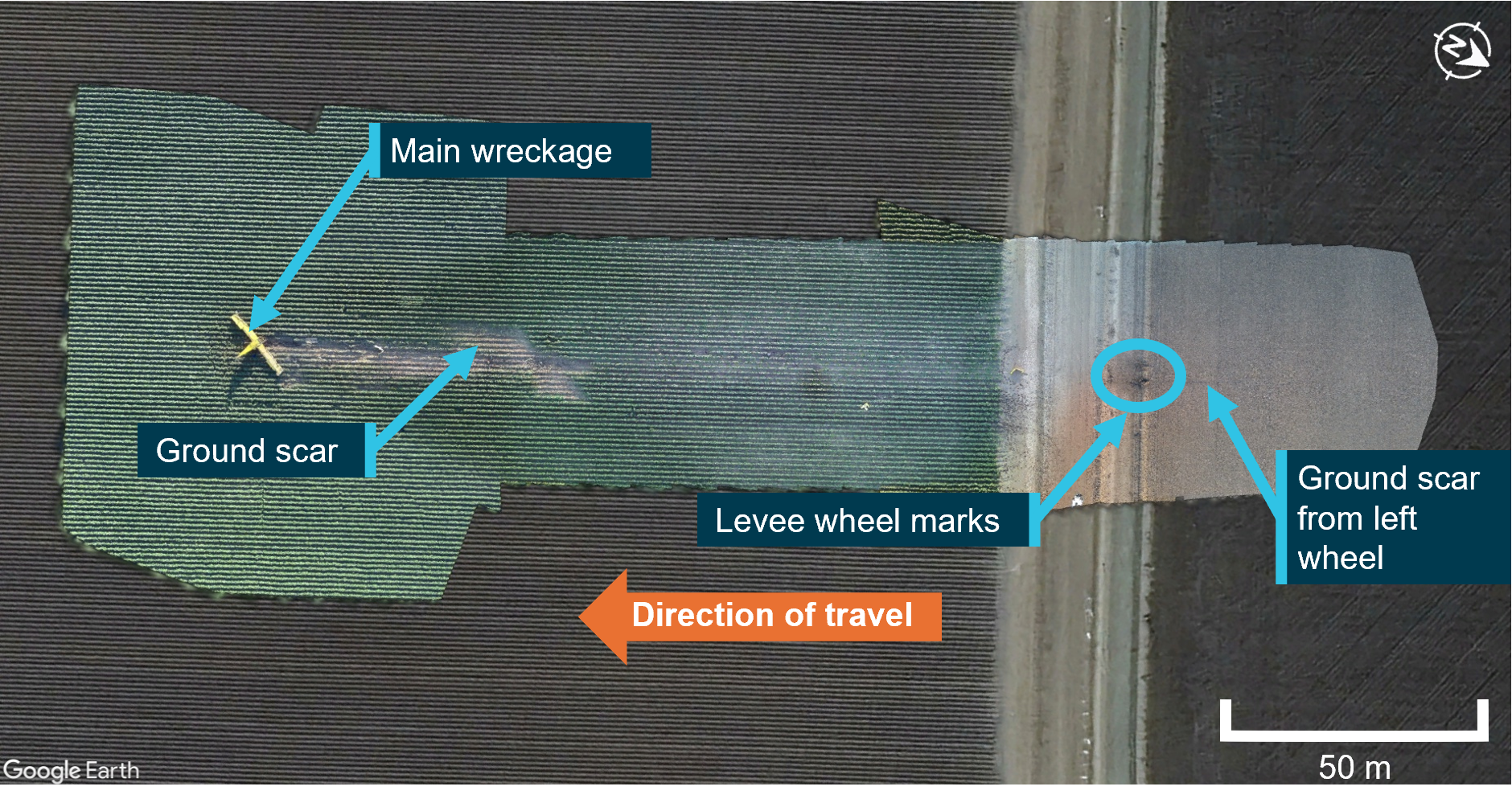
The descent led the aircraft’s left main wheel to touch down near the edge of the field, with the aircraft travelling for a further 27 m before both landing gear wheels struck an irrigation levee that ran perpendicular to the end of the field.
The wreckage of the destroyed aircraft was found inverted in an adjacent cotton field, at the end of a ground scar and wreckage trail that aligned with the final data point recorded on a track of about 160°. The pilot was fatally injured, and the aircraft was destroyed.
Subsequent wreckage examination by ATSB transport safety investigators indicated the aircraft originally contacted the ground nose down, before coming to rest inverted. No pre‑impact defects were identified, nor was there evidence of bird strike or in‑flight break-up.
GPS data from the Satloc system showed that the aircraft was positioned at a height between 10 ft and 22 ft above ground level when the spray system was activated at the start of the run, but no spray flow was recorded.
For 40 seconds, the aircraft maintained the same heading during the run tracking in a south‑easterly direction with a ground speed between 112 kt and 115 kt and a height between 4 ft and 22 ft. A final data point recorded the aircraft as having a ground speed of about 115 kt, a height of up to 7 ft and maintaining heading.
Shortly after this point, the aircraft contacted the ground.
“This tragic accident is a reminder that unexpected alerts can divert a pilot’s attention from the primary task of flying the aircraft,” Mr Mitchell said.
In this accident, with the aircraft flying at 120 kt and around 10 ft, in one second the aircraft would travel around 60 m, and even the smallest change in attitude could be imperceivable but still result in a collision with terrain.
“Given the limited height and time available during low‑level operations, even a momentary change in focus of attention can have a significant consequence,” Mr Mitchell continued.
“When possible, pilots should climb the aircraft when receiving any unexpected alerts, before conducting troubleshooting of a potential system failure at a safer height.”
Occurrence Briefs are concise reports that detail the facts surrounding a transport safety occurrence, as received in the initial notification and any follow-up enquiries. They provide an opportunity to share safety messages in the absence of an investigation. Because occurrence briefs are not investigations under the Transport Safety Investigation Act 2003, the information in them is de-identified.
What happened
On 4 August 2025, an amateur-built Lancair IV departed Orange Airport, New South Wales, at 0652 local time, intending to fly to Bankstown Airport.
During cruise, the aircraft sustained an electrical system failure, resulting in numerous electrically driven systems failing. The pilot then made the decision to conduct an air return to Orange Airport, rather than continue the flight towards Bankstown.
Orange Airport consists of primary runway 11/29 which is 2,213 m long and is a sealed surface with a secondary runway 04/22 which is a 964 m long unsealed surface.
Due to the electrical malfunction, several systems of the aircraft were impacted, including the landing gear and VHF radio communication systems. The pilot used their mobile phone to communicate with a ground station to aid in facilitating their arrival at Orange Airport.
As the landing gear system is electrically controlled and hydraulically operated, due to the electrical failure, the primary method of the gear extension was not functional.
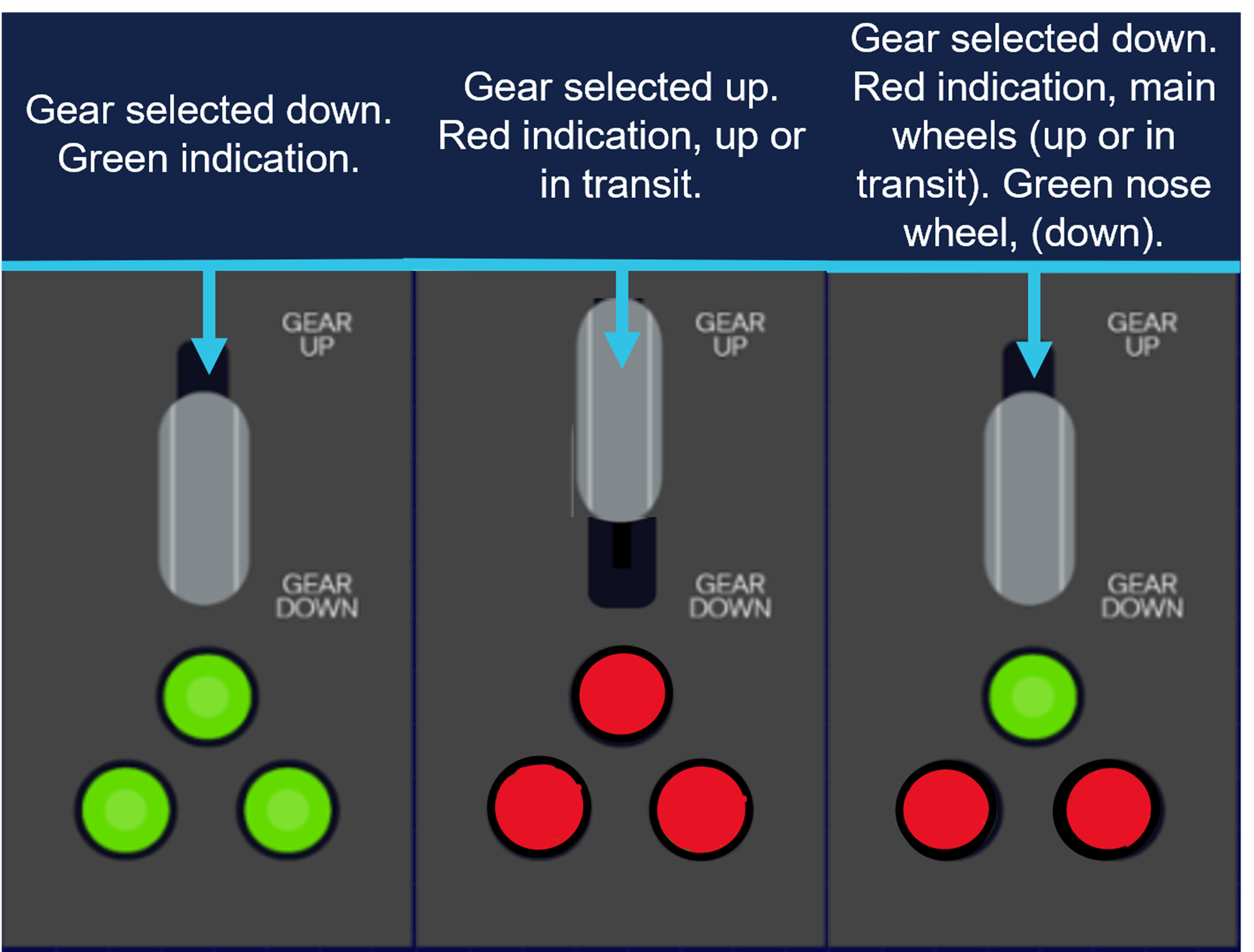
During the initial approach to the primary runway, the pilot manually selected the landing gear ‘down’ to extend the landing gear. Once manually selected ‘down’, the undercarriage extension indicator showed that only the nose gear had locked ‘down’, indicating (green), with the main gear, not indicating that it had ‘locked’ down (Figure 1).
Figure 1: Generic representation of landing gear selection
Source: ATSB representation of landing gear selection and indication. May not be indicative to type of aircraft.
The pilot proceeded to conduct several low passes of the runway to try to ascertain the condition of the landing gear with people on the ground.
However, after not being able to confirm the gear was fully down and locked, the pilot then made the decision to conduct a precautionary landing on the non-sealed cross strip, runway 04.
The pilot conducted the approach and landed, however on touchdown the main undercarriage legs collapsed, and the aircraft slid on the nosewheel (front of the aircraft) and rudder (rear of the aircraft) before coming to rest at the fence at the end of the runway.
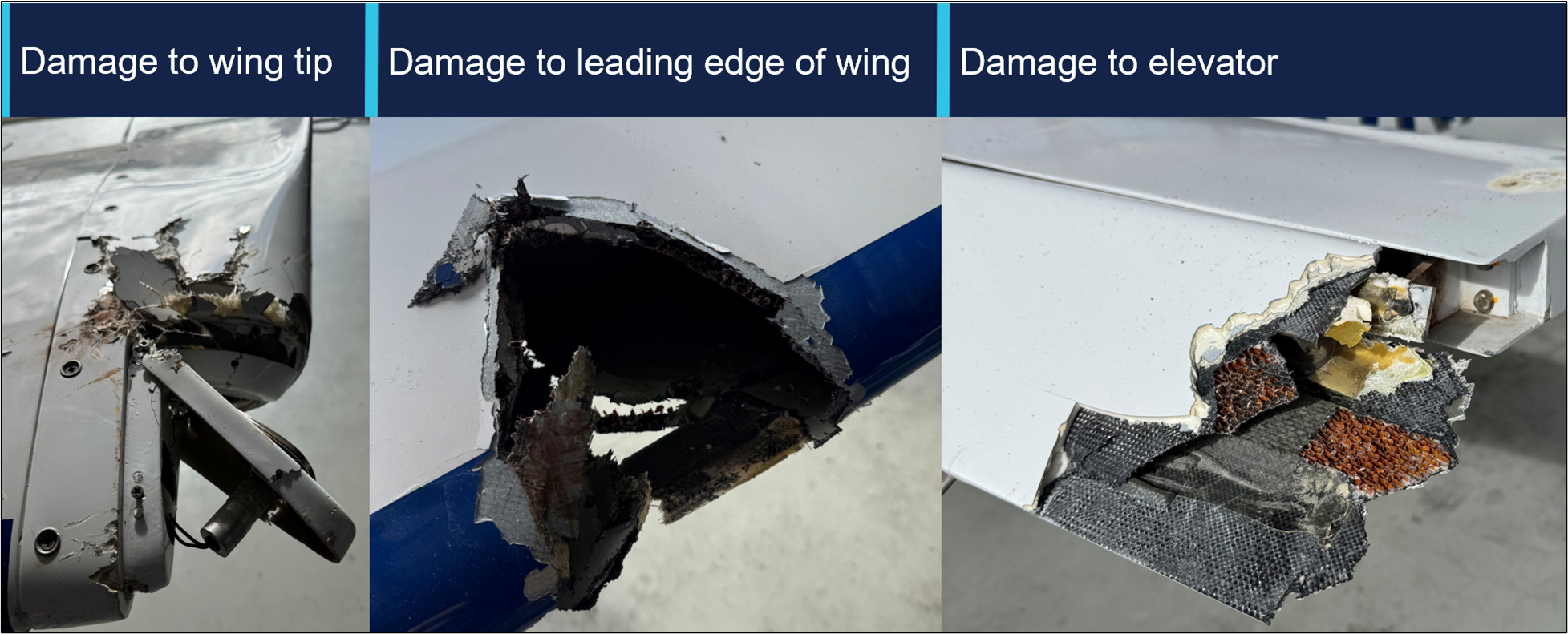
The aircraft incurred some minor damage (Figure 2) to the wingtip and elevator with no injuries to the pilot.
Figure 2: Damage to aircraft
Source: Operator, annotated by the ATSB
Subsequent engineering inspections found the electrical system had failed due to a defective voltage regulator.
Safety message
This occurrence illustrates that a good knowledge of aircraft systems coupled with sound decision‑making can help facilitate a positive outcome to an emergency.
Aircraft rely on hydraulic or electrical systems to extend and retract the landing gear. Should any component in these systems fail, pilots may be left with no choice but to manually extend the undercarriage or potentially execute a wheels-up landing.
Applying a structured and proactive approach to identifying and managing threats and errors, influences the safety of the flight.
In this instance, the pilot was able to identify the aircraft system failure and make several calculated risk-based decisions to manage the emergency. This was achieved by using various resources at their disposal, such as their mobile phone, to seek ground assistance in the absence of normal VHF radio.
In emergency situations, pilots need to utilise all the available resources at their disposal. Maintaining a degree of flexibility and adapting to select the most appropriate landing area can minimise risk, limit damage and maximise survivability.
About this report
Decisions regarding whether to conduct an investigation, and the scope of an investigation, are based on many factors, including the level of safety benefit likely to be obtained from an investigation. For this occurrence, no investigation has been conducted and the ATSB did not verify the accuracy of the information. A brief description has been written using information supplied in the notification and any follow-up information in order to produce a short summary report and allow for greater industry awareness of potential safety issues and possible safety actions.
Occurrence summary
Mode of transport
Aviation
Occurrence ID
AB-2025-039
Occurrence date
04/08/2025
Location
Orange Airport
State
New South Wales
Aviation occurrence category
Collision with terrain, Diversion/return, Electrical system, Landing gear/indication, Runway excursion, Wheels up landing
A livestock carrier’s engine failure in the Port of Fremantle earlier this year highlights the need for ship owners and managers to properly manage maintenance, and for marine pilots to follow communication protocols, an ATSB final report notes.
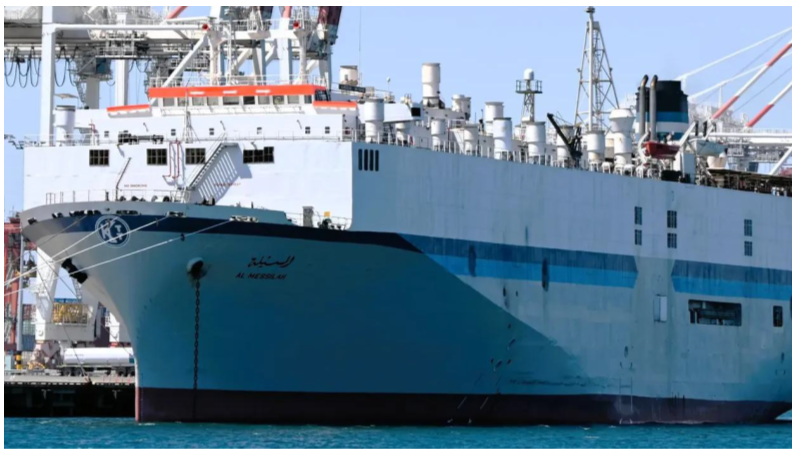
On 4 March 2025, Kuwait-flagged livestock carrier Al Messilah was under pilotage into the Port of Fremantle, WA, when it briefly lost propulsion near the Inner Harbour entrance.
After the initial loss of propulsion was resolved, the engine failed again as the ship was transiting the Inner Harbour.
The ship was manoeuvred safely to berth with tug assistance, but the ATSB’s investigation found communication issues increased risk during the incident.
The investigation’s final report notes Fremantle Ports’ formal protocols designated VHF channel 12 as the primary channel for vessel traffic service (VTS) communications, and channel 8 for towage operations.
“However, the pilotage provider, Fremantle Pilots, routinely used VHF channel 8 for pilotage communications during Inner Harbour transits, expecting it to be monitored by all involved parties, including VTS,” ATSB Chief Commissioner Angus Mitchell explained.
“During the Al Messilah incident, the marine pilot’s attempts to contact VTS on channel 8 about the engine failure were unsuccessful.
“This deviation from established protocol reduced communication reliability at a time when radio communication was essential, leading to delayed emergency coordination.”
In response to the ATSB’s finding, Fremantle Pilots has endeavoured to improve communication protocols and is actively working with Fremantle Port Authority to review and update existing practices.
This work includes benchmarking across best practices at other Australian ports, and providing feedback on the port information guide.
Planned maintenance systems also highlighted
Meanwhile, the investigation also found Al Messilah’s engine failures were caused by a malfunction of the main air distributor’s servo piston within the engine’s pneumatic control system, as key components of that system were not maintained in accordance with the manufacturer’s guidelines.
“The ship’s planned maintenance system (PMS) did not provide enough detail to track maintenance schedules, and did not have a specific maintenance item to record the maintenance activities on the main engine pneumatic system,” Mr Mitchell said.
“A comprehensive and well‑documented PMS is important to ensure the reliability of critical machinery, particularly systems that directly affect a ship’s manoeuvrability and safety.”
After the incident, the ship’s main engine pneumatic system was overhauled in the United Arab Emirates.
In addition, a comprehensive review of the ship’s PMS was initiated, with 27 corrective actions identified and prioritised for implementation.
On 28 August 2025, a pilot and a passenger in a Piper Aircraft PA-28 were participating in the Outback Air Race from Daly Waters Airport to Royal Australian Air Force Base Tindal, Northern Territory. After the engine was started, the pilot detected a tripped circuit breaker and requested that a maintainer attend the aircraft to assess the fault. The maintainer found that the alternator was unserviceable and charged the battery to allow the aircraft to fly to Tindal where further maintenance could be conducted.
En route to Tindal, the aircraft lost electrical power and the pilot was unable to communicate using the aircraft’s radio. The aircraft was subsequently climbed into restricted airspace without clearance and continued to the airport while the pilot and passenger communicated with fellow race participants on a mobile phone group chat application.
At the same time, a formation of 2 Lockheed Martin F-35 aircraft was returning to Tindal. Unaware that the PA-28 was inbound, air traffic control cleared the formation to join left base and land on the runway. While the second F-35 completed the turn to final approach, the PA-28 also joined final in close proximity. Separation between the aircraft reduced to approximately 72 m laterally and 25 ft vertically before the PA-28 subsequently landed behind the F-35.
What the ATSB found
The ATSB found that after identifying a fault with the alternator, the licensed aircraft maintenance engineer encouraged the pilot to conduct the flight without assessing the time the battery could supply the aircraft with electrical power. Additionally, they did not record the issue or maintenance activity on the aircraft’s maintenance release.
It also identified that, prior to departure, the pilot did not conduct contingency planning to prepare for a loss of electrical power in flight. In addition, during the flight the pilot did not monitor the aircraft’s electrical system. Subsequently, the aircraft lost electrical power and the pilot was unable to communicate with air traffic control via the aircraft’s radio, and the aircraft could not be detected by the surveillance systems in use.
In addition, it was found that the pilot did not divert to the closest airport or follow advice to remain outside controlled airspace, and the aircraft entered controlled airspace without the required clearance. Subsequently, the aircraft joined final approach in close proximity to an F-35 approaching the same runway.
The ATSB also found that when conducting a visual check of the F-35 formation’s approach path, the tower controller did not detect the PA-28 on approach to the runway.
Safety message
This incident highlights the importance of clear communication between maintenance personnel and pilots. Recording of defects and subsequent maintenance actions on the aircraft’s maintenance release is central to ensuring that all parties share a common understanding of identified faults, the anticipated in-flight effects and their impact on the overall airworthiness of the aircraft.
Pilots are also reminded that if the aircraft has an increased risk of an abnormal event, contingency planning and identifying potential courses of action prior to take-off can reduce workload and help to facilitate a safe outcome. In addition, following published emergency procedures in the En Route Supplement Australia will ensure that action taken aligns with air traffic control expectations. This is particularly important in situations involving interruptions to electrical power, where communication or surveillance capability is affected.
The investigation
The ATSB scopes its investigations based on many factors, including the level of safety benefit likely to be obtained from an investigation and the associated resources required. For this occurrence, the ATSB conducted a limited-scope investigation in order to produce a short investigation report, and allow for greater industry awareness of findings that affect safety and potential learning opportunities.
The occurrence
Overview
On 28 August 2025, a pilot was participating in the Outback Air Race (OAR) (see the section titled Outback Air Race) in a Piper Aircraft Inc. PA-28-236 (PA-28) aircraft, registered VH‑TKX and using callsign ‘Air Race 9’. They planned to conduct a flight under the visual flight rules[1] from Daly Waters Airport to Royal Australian Air Force (RAAF) Base Tindal (Tindal), Northern Territory, on stage 4 of the 9-stage race, with a passenger who had been accompanying them throughout the event.
Maintenance prior to the departure
On starting the aircraft’s engine at Daly Waters Airport that morning, the pilot observed that the alternator circuit breaker had tripped. After trying unsuccessfully to reset the circuit breaker, they shut down the engine and requested assistance from the licensed aircraft maintenance engineer (LAME) that had been provided by the race organiser to assist participants with maintenance issues.
The LAME determined that the alternator was unserviceable, and that the issue could not be rectified at Daly Waters as they required space in a workshop to do the work and spare parts, which were available at Tindal. During the assessment, they identified a loose alternator attachment bolt, which they tightened. They also charged the aircraft battery. The LAME recalled that the pilot was aware that the flight would be conducted with the battery providing electrical power (see the section titled Maintenance actions).
The pilot confirmed that they were aware that the flight would be conducted with the battery providing electrical power, but when taxiing for departure, they made a final attempt at resetting the alternator’s circuit breaker, which was successful. No entry was made on the maintenance release to record that the alternator was unserviceable or that maintenance had been conducted prior to departing Daly Waters.
The OAR flight manager, who was not at the airport at the time, received a phone call from the pilot prior to the flight, to discuss the issue and the impact on their expected departure time. The flight manager recalled that the pilot told them that the alternator was not working and that the LAME had told them they would probably have sufficient battery-supplied electrical power to conduct the flight to Tindal. They further recalled that the pilot was willing to conduct the flight under these circumstances. In addition, they advised that the pilot requested to depart as soon as possible, to allow them to arrive at Tindal before the maintenance facility closed for the day.
The flight
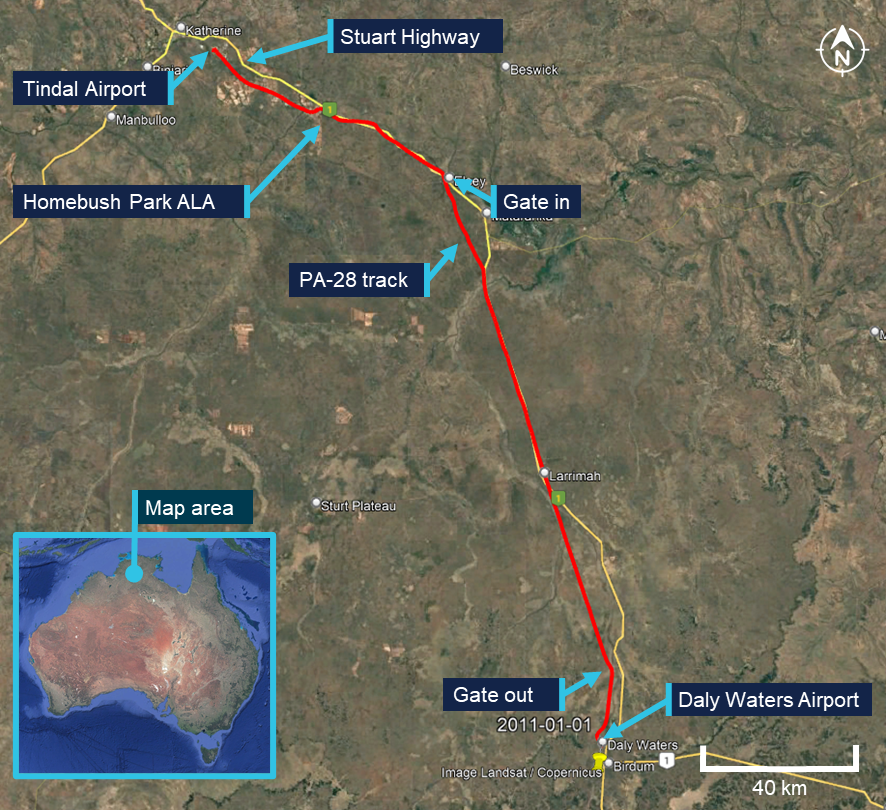
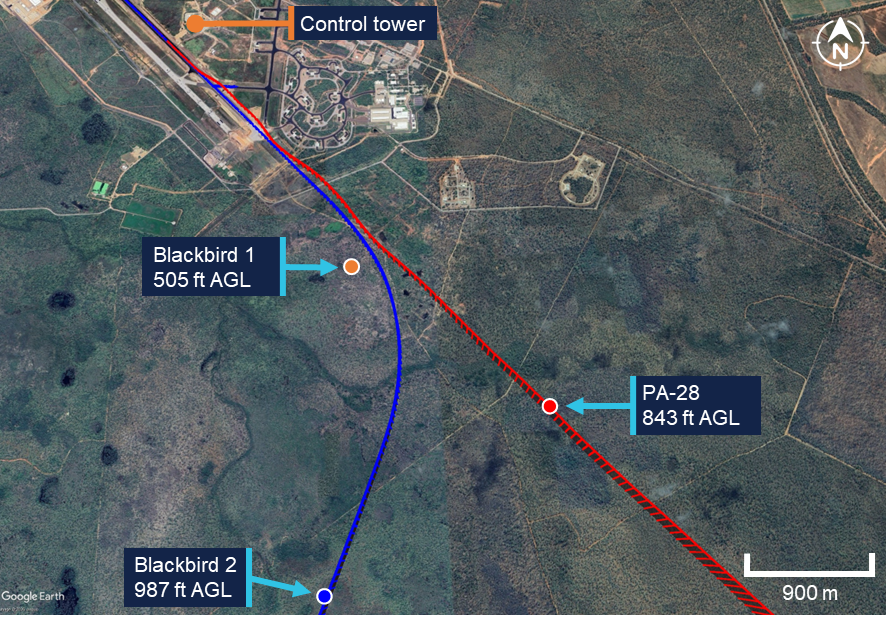
After being repositioned in the race departure sequence, the aircraft departed Daly Waters at 1211 local time. At 1217, it flew over the ‘Gate out’, commencing the time trial. The pilot conducted the race leg, which was completed at 1257 by flying through ‘Gate in’, a position 39.5 NM (about 73 km) to the south-east of Tindal (Figure 1).
Figure 1: PA-28 track
Source: Google Earth with fight radar tracking, annotated by the ATSB
Coincident with the conduct of the race leg, a formation of 2 Lockheed Martin F-35 Lighting II (F-35) aircraft, callsign ‘Blackbird’, was conducting operations to the south‑west of Tindal. Each aircraft had a single pilot on board. At 1252, they finished their operation and were cleared by Tindal Air Traffic Control (ATC) to return to Tindal. At the time, they were advised by ATC of multiple aircraft participating in the air race, inbound to Tindal from the south-east, following the Stuart Highway at an altitude of 1,500 ft. To facilitate a faster return, the controller instructed the pilots of the F-35s to track for the left base leg of the circuit for runway 32R,[2] instead of joining for a low initial and pitch.[3]
At approximately 1302, the pilot of the PA-28 observed a series of progressive failures of the aircraft’s electrical components including:
the transponder
the radios
one of the G5 units
the GPS navigation unit
the autopilot
the GI 275 unit.
They also recalled detecting an acrid burning smell in the cockpit. No longer able to communicate through their headsets, the pilot discussed the situation with the passenger, recalling that communication was difficult due to the level of noise in the cabin. At 1304, the passenger of the PA-28 communicated with fellow race participants via a group chat[4] (using a mobile telephone application), advising that:
they had lost electrical power, and the radio had failed
they were 10 minutes away from Tindal
they might have to land at Homebush Park aircraft landing area (ALA).
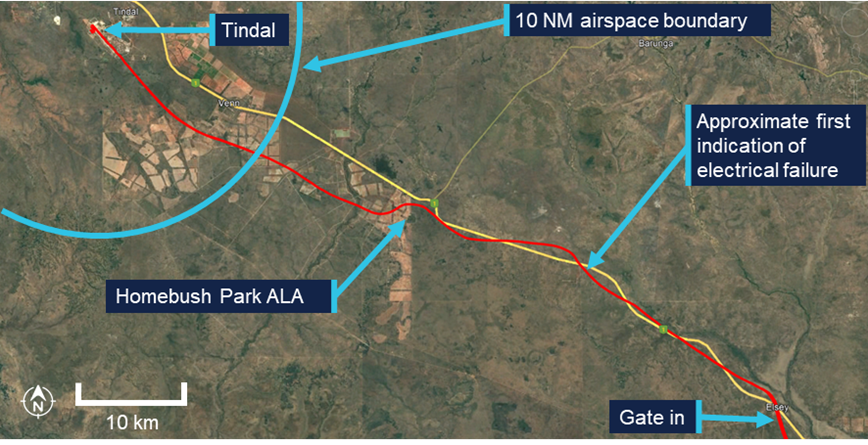
The ALA was approximately 18 NM (33 km) to the south-east of Tindal and outside controlled airspace (Figure 2). At 1306, they flew over the ALA, and asked, via the group chat, if they should land there or continue to Tindal. Having not received a response, 1 minute later they wrote in the chat that they were 7 minutes from Tindal, were heading there directly and required the ‘airways cleared’.
At around this time, the aircraft commenced a climb from 1,500 ft to 4,000 ft. The pilot stated that they commenced a climb to ensure they had additional gliding range if the engine failed, as they were unsure of the source of the burning smell. As the airspace above 1,500 ft was an active military restricted area (see the section titled Royal Australian Air Force Base Tindal), the aircraft entered controlled airspace without a clearance. The pilot later reported being aware of this, but considered that ATC was aware of their position.
Figure 2: PA-28 track (in red) from ‘Gate in’ to Tindal
Source: Google Earth with fight radar tracking, annotated by the ATSB
At 1308, multiple race participants posted the telephone number for both Tindal Approach and Tower on the group chat and advised the pilot to call Tindal ATC. The PA‑28 occupants responded stating they were unable to make a telephone call due to the noise in the cockpit. They were then advised that one of the other race participants was attempting to call Tindal ATC. The pilot later advised that their headset was not equipped with Bluetooth connectivity and, while the passenger’s headset was equipped, they had previously been unsuccessful when trying to use that functionality.
At 1310, the Tindal approach controller received a phone call from a member of the group chat advising that they were receiving messages from the occupants of an aircraft holding over Homebush Park with an electrical failure.[5] During the call, the controller advised the caller that it was unsafe for the PA-28 to land at Tindal due to the level of traffic and instructed that the aircraft land or hold at Homebush Park and, if required, the PA-28 pilot should call ATC directly. A message was posted to the group chat advising the PA-28 pilot of these instructions. The PA-28 occupants responded in the group chat that they were not landing at Homebush Park and instead were tracking direct to the runway at Tindal and were climbing to 3,500 ft.
During the phone call, the approach controller advised the F-35 pilots that one of the race participants was subject to an emergency. At this time, the F‑35s were approximately 30 NM (56 km) to the south and tracking towards the airport.
At 1311, a third, different member of the group chat also wrote that ATC had instructed the PA-28 to land at Homebush Park. However, the PA-28 pilot continued to climb and track for the runway at Tindal, responding in the group chat that it was too late and requesting runway 32.
Concurrently, the approach planner (see the section titled Royal Australian Air Force Base Tindal – Air traffic control) requested a supervisor to assist as they had 2 additional OAR participants, unrelated to the emergency, holding outside restricted airspace (see the section titled Air traffic control actions), and they were concerned that they were not maintaining separation from each other. When the supervisor entered the control room, the approach controller advised them that they had 2 F-35s returning and that they had received a phone call about an aircraft with an emergency and, other than they were holding over Homebush Park ALA to diagnose an electrical fault, they had few details.
At 1312, the member of the group chat who had called the approach controller 2 minutes earlier, called again and on this occasion, the approach supervisor answered the call. This call lasted 6 minutes during which the caller advised that the PA-28 was 3 minutes from the threshold, they were coming into land, and they could see the runway.
The approach supervisor advised that it took them time to establish that the caller was not in the PA-28 and was relaying information from the group chat. It was also initially unclear that the caller was simultaneously relaying information to somebody else who was entering the information into the group chat. During the call, the supervisor recalled passing information that the 2 F-35s were on approach and also instructed that the PA‑28 remain outside controlled airspace. The supervisor was still on the telephone with the caller and was standing behind the approach controller advising that there was an inbound aircraft, when the near collision occurred.
Also at 1312, a different member of the group chat posted a question to the PA-28 occupants asking if they wanted them to declare a PAN (see the section titled In-flight emergencies), to which the PA-28 responded that they did. The pilot later advised that as they considered that a PAN had been declared on their behalf, they thought that other traffic would be cleared from their planned flight path. They further advised that they had access to their tablet device running the AvPlan electronic flight bag (EFB). This showed the 2 air race participants holding outside controlled airspace, which they incorrectly assumed meant that ATC were holding them to clear the airspace for the PA-28 to continue. None of the air traffic controllers recalled a PAN being declared on behalf of the PA-28.
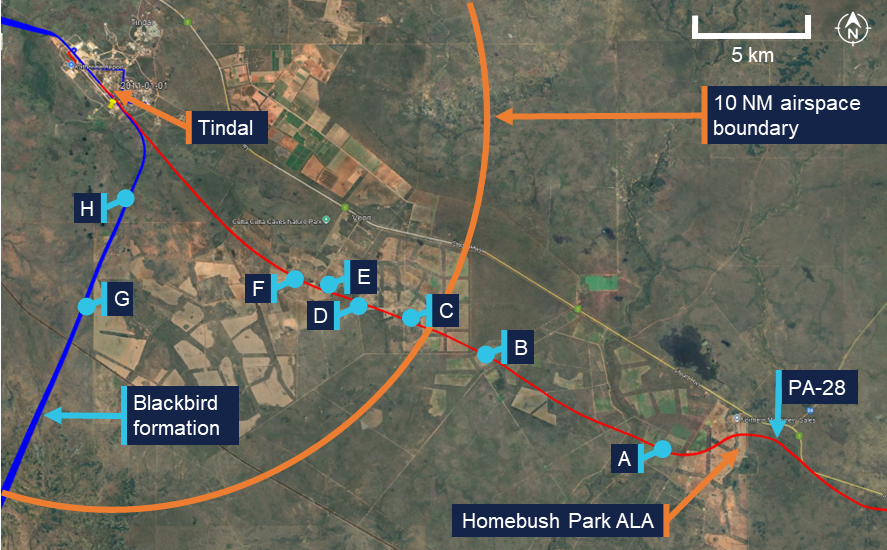
At 1313, the F-35 formation leader called the tower controller on the radio at 5 NM (9 km) (Figure 3 and Table 1). One minute later, after visually checking the base and final legs of the circuit and not sighting the PA-28, the tower controller cleared the formation to land. At this time a member of the group chat wrote in the chat that there was an F-35 on a 3 NM (6 km) final, likely relaying traffic information given by the approach supervisor during the telephone call.
Also at this time, an additional phone call was made by the OAR flight manager to the tower, which was answered by the tower supervisor. The flight manager advised the tower supervisor that a PA-28 had experienced an electrical failure somewhere between Daly Waters and Tindal and may have had issues. The tower supervisor was on the phone with the caller when the near collision occurred.
Figure 3: Aircraft tracks with events
The red track is the PA-28 inbound from Homebush Park ALA, the blue track is the track of both F-35 aircraft tracking in company. Source: Google Earth with fight radar tracking, annotated by the ATSB
Table 1: Key events
Time
Description
A
1307:40
PA-28 commenced climb above 1,500 ft
B
1310:00
PA-28 told to expect landing at Homebush Park via group chat
C
1311:00
PA-28 directed again to land at Homebush Park via group chat
D
1311:36
PA-28 peak of climb 3,910 ft
E
1312:00
PA-28 occupants asked if they wanted to declare a PAN via group chat
F
1312:16
Approach received a 6-minute-long phone call advising location of the PA-28
G
1313:24
Blackbird (F-35) formation called tower controller at 5 NM
H
1314:19
Tower controller cleared Blackbird formation to land
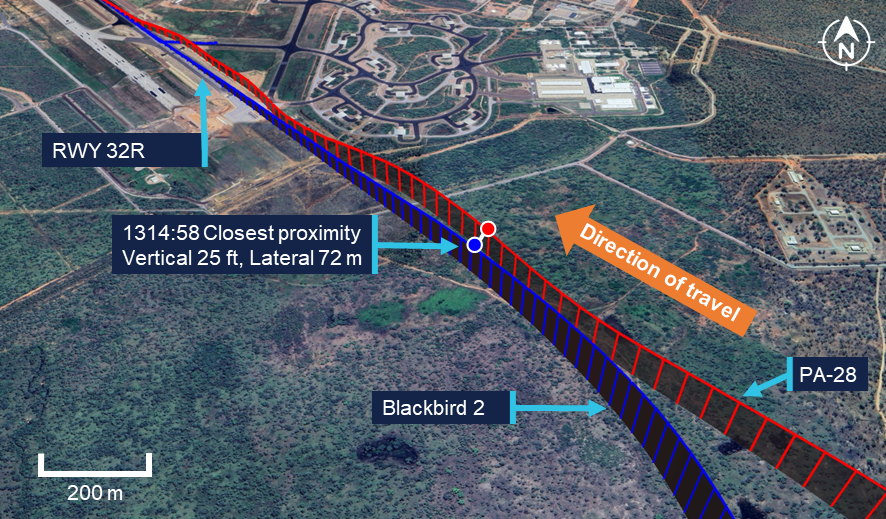
As the PA-28 joined final approach, its pilot observed the 2 F‑35s joining the circuit from their left. The first F-35 (Blackbird 1) joined final in front of the PA‑28, while the second F‑35 (Blackbird 2) turned and joined final at approximately the same location as the PA‑28 (Figure 4). Flight data showed that separation between the PA‑28 and the second F‑35 reduced to approximately 72 m laterally and 25 ft vertically. The PA‑28 pilot then manoeuvred their aircraft to the right to increase separation, while continuing towards the runway.
The PA-28 pilot advised that they assumed that the F-35 pilots would have been informed of their emergency and would maintain separation. They also assumed that the PA-28 had priority due to the PAN declaration.
Figure 4: Tracks of PA-28 and F-35
Source: Google Earth with recorded fight data, annotated by the ATSB
The pilot of Blackbird 2 recalled seeing the PA-28 over their right wing tip as they completed their turn onto final. They notified the tower controller of an aircraft on short final and continued to land. In response, the tower controller instructed the PA-28 to go around immediately. However, due to the aircraft’s electrical failure, the PA-28 pilot did not receive the instruction and continued to land behind Blackbird 2. The PA-28 pilot advised they landed on the right edge of the runway to avoid the wake turbulence from the F-35.
The following day, the alternator on the PA-28 was replaced at Tindal and the pilot and passenger continued with the race. The maintenance organisation at Tindal determined that the alternator failed due to an internal electrical defect.
Context
Pilot information
The pilot of the PA-28 held a Commercial Pilot Licence (Aeroplane) and instrument rating and had a class 1 aviation medical certificate. They had a total of 365 hours flying experience, of which 250 were on the PA-28. They had flown 24 hours in the previous 90 days.
Both F-35 pilots fully met the RAAF requirements to operate the aircraft.
Aircraft information
VH-TKX was a Piper Aircraft PA-28-236, a 4-seat, low-wing, fixed-undercarriage aircraft with a piston engine. The aircraft was manufactured in 1978 and first registered in Australia in 1983. It was equipped with an upgraded Garmin GI 275 electronic flight instrument as the engine indicating system and 2 Garmin G5 electronic flight instruments providing an attitude indicator and horizontal situation indicator. The GI 275 did not have backup power. The G5s each had a backup battery designed to power the unit for 4 hours independently of the aircraft’s electrical system. The aircraft maintainer advised that the display of the G5 could be affected during a loss of electrical power due to associated interruptions to input data signals.
The aircraft was maintained in accordance with schedule 5 of the Civil Aviation Regulations 1988, which required a periodic inspection every 100 flight hours or 12 months, whichever came first. The last periodic inspection was conducted on 30 June 2025, and there were no outstanding items recorded on the aircraft’s maintenance release. At the time of the incident, the aircraft had accumulated 4,181 hours total time in service.
Pilot operating handbook
The pilot operating handbook (POH) stated that the required actions following an electrical failure were to:
select the alternator switch to OFF
minimise the electrical load
land as soon as practical.
It also stated that when the alternator failed the battery would supply the electrical load, but did not state how long this would last.
The POH also stated that if smoke or fumes were detected in the cabin, this indicated an electrical fire, which required that the master switch, cabin heat and defroster be selected to OFF and air vents be opened to clear smoke and fumes from the cabin. It also required that the aircraft land as soon as practicable.
Maintenance actions
The LAME advised that when they assessed that the alternator was unserviceable, they sought to get the aircraft to a workshop at Tindal for repair. They made an assessment, without checking the electrical load requirements (and therefore the likely usable time of battery power), that the aircraft, having no retractable gear or electric flaps, and modern avionics equipment which did not use much power, would likely be able to complete the planned flight with only the battery providing the required electrical power. They recalled communicating this assessment to the pilot but did not recall whether they specifically stated that the alternator was unserviceable.
The LAME reported that they charged the battery as a contingency. They also advised that they considered their role was to advise a pilot what the problem was and that it was the responsibility of the pilot to make the decision as to whether to conduct the flight. However, while they reported that they didn’t want to get involved in operational decision‑making, they felt that they encouraged the pilot to conduct the flight.
In hindsight, they also identified a number of measures that could have been discussed with the pilot to mitigate the risk of an in-flight electrical failure. These included waiting until the military-controlled airspace was de-active and providing an escort aircraft.
Outback Air Race
The 2025 Outback Air Race (OAR) was a fundraising event for the Royal Flying Doctor Service with approximately 40 aircraft participating in the 9-stage time trial across outback Australia. The race was conducted between 24 August 2025 and 7 September 2025 commencing at Yulara, Northern Territory, flying via:
Alice Springs
Tennant Creek
Daly Waters
Katherine (Tindal)
Kununurra
Broome
Onslow
Exmouth
and finishing at Carnarvon, Western Australia.
In the lead up to the event, race participants were provided with briefings on items including race rules and airspace requirements, as well as being provided with a guide for how to conduct the race. Additionally, a supplement to the guide was provided which described the features of each stage of the race, and the airspace requirements, including radio call examples unique to each stage. In addition, a brief was conducted each morning for all race participants to clarify any queries. Noting the race’s remote nature, the OAR organisers also provided a LAME and designated aviation medical examiner to assist during the event.
The concept was a time trial event with the time commencing at a predetermined ground feature, referred to as ‘Gate out’ and ending with a ground feature some way from the destination airport, referred to as ‘Gate in’. This allowed pilots to pay full attention to departure and landing procedures without the pressures of the race construct. To assist with maintaining aircraft separation during the race, the OAR had sequenced aircraft to depart based on their relative speed.
As the stage from Daly Waters to Tindal was due to enter military airspace, the race organisers liaised with Tindal ATC and 75 Squadron[6] to facilitate arrivals and departures, ideally deconflicting with the F-35 operating windows as much as possible. A coded clearance, ‘Route Outback’ was developed to simplify the airways clearance into Tindal, which required the aircraft to track 1 NM (2 km) to the north of the Stuart Highway at 1,500 ft.
ATC liaised with the OAR flight manager, Tindal Base Aviation Safety Officer and 75 Squadron to coordinate flights arriving at Tindal on the day. It was agreed that during the F-35 operating windows, OAR aircraft would arrive with 15-minute spacing and outside the F-35 operating windows the aircraft would arrive with 5-minute spacing. The F-35 operating windows were scheduled for 0945–1300 and 1430–1645 local time.
Royal Australian Air Force Base Tindal
General information
Tindal was a joint military and civilian user airport operated by the RAAF. The airport had one runway, 14/32. At the time of the incident, the runway was closed due to works and the parallel taxiway ‘A’ was being used as a runway, designated 14L/32R.
When the tower at Tindal was active, the area within 10 NM (19 km) of the airport became controlled airspace, requiring a clearance from ATC to enter. Sectors of restricted airspace also became active during tower hours. When active, this airspace also required a clearance to enter and included:
between 10–20 NM (19–37 km) from the airport above 1,500 ft
between 20–30 NM (37–56 km) from the airport above 2,500 ft.
Outside of tower hours, the airport operated as a non-controlled airport and the restricted airspace was not active.
The structure of Tindal airspace was published by Airservices Australia in the Tindal Visual Navigation Chart (Figure 5). Additional information about operating at Tindal was published in the En Route Supplement Australia (ERSA), including 2 phone numbers for ATC enquiries.
Figure 5: Tindal airspace during tower hours
Source: Airservices Australia, annotated by the ATSB
Air traffic control
At the time of the occurrence, Tindal air traffic control was comprised of 5 positions. Approach consisted of an approach controller, an approach supervisor and an approach planner. In the control tower were a tower controller and a tower supervisor with a dedicated communications line to the approach controllers. Only the controllers in the control tower had visibility of the airport and runway. All controllers were members of the RAAF, had a current proficiency check and each had experience operating at Tindal for at least 12 months.
Tindal ATC utilised a combination of primary surveillance radar (PSR), secondary surveillance radar (SSR) and air ground air (AGA) communication systems. On the day of the incident, the PSR was not available.
Both approach and tower controllers had access to tablet devices with the OzRunways electronic flight bag (EFB) installed. These displayed aircraft as traffic when a pilot was using the same software on a device in the aircraft and it was configured to broadcast the aircraft’s position.
The controllers advised that during the morning the air race aircraft were arriving with about 10–15-minute spacing, however the aircraft had not been adhering to the standard clearance, with some aircraft operating above the agreed altitude when they were outside controlled airspace. In addition, as agreed with the race managers, there were no flight plans submitted, and ATC had preprepared flight strips ready for each inbound aircraft.
Previous emergency
Earlier the same day, another air race aircraft experienced an alternator failure also resulting in an electrical failure. The pilot of this aircraft called Tindal ATC directly using their mobile phone, advising them of their emergency, and received a clearance to enter controlled airspace and land at Tindal.
Air traffic control actions
Approach
The approach controller advised that during the F-35 morning operating window, the longer spacing between the arriving air race aircraft enabled them to be held at the control zone boundary without creating a proximity hazard with other participating aircraft. When the OAR aircraft arrived earlier with a similar electrical emergency, the controllers had held the final formation of F-35s (the incident formation) on the ground until the aircraft landed. This delay resulted in this formation returning to the airport about 15 minutes after the agreed operating window had passed, and spacing between the air race aircraft had reduced. The controllers advised that they observed a string of aircraft on the SSR coming along the Stuart Highway. Additionally, the pilot of the occurrence PA-28 advised they were using a 3-minute separation rather than the agreed 5-minute separation.
The approach controller also advised that normally when the F-35s returned to base they returned with minimal fuel. Therefore, when the F-35 formation advised they were inbound, the controller decided to expedite their return while there were not many other aircraft in the area.
At that stage, one race aircraft was already cleared for a visual approach, and they were in the process of transferring responsibility for this aircraft to the tower controller. They instructed the next 2 OAR aircraft to hold outside controlled airspace. They were then contacted by an inbound helicopter, which they also advised to remain outside controlled airspace. At the same time, the approach planner observed that separation between the 2 OAR aircraft holding outside controlled airspace was reducing and they were coordinating with the approach controller to obtain a clearance for one aircraft to climb into controlled airspace to create vertical separation.
The first phone call from an OAR participant about the emergency aircraft was taken by the approach controller. They recalled that earlier in the day, another of the air race aircraft had also experienced a complete electrical failure, and they were initially unsure if this was the emergency from earlier misread in the group chat or if it was a new emergency (see the section titled Previous emergency). After requesting that the aircraft hold or land at Homebush Park, they concluded the call.
Subsequently, they contacted the tower controller via the internal line to discuss bringing the F-35s in quickly to facilitate the approach of an emergency aircraft with a possible electrical issue.
The approach supervisor had been on a break when the planner requested that they return to duty and, just after they entered the room, they answered an incoming telephone call. At that stage, they had just received a quick briefing from the approach controller, using the SSR screen to gain situational awareness of the traffic and had been advised of the aircraft with an emergency.
They recalled that it took some time to determine that the caller was not in the aircraft but was on the ground reading group chat messages. During the conversation they were told that the emergency aircraft was 3 minutes from the threshold and had the runway in sight, but could not recall how far through the call this information was received. Additionally, they recalled passing information about the F-35s on approach, and advised the caller that the emergency aircraft should remain outside controlled airspace. It was during this call they heard on the tower frequency that the near collision had occurred.
Tower
The tower supervisor had taken the telephone call from the OAR flight manager and was trying to ascertain information about the PA-28 to provide to the tower controller. Both the tower supervisor and controller were looking on the radar screen for a return to identify the aircraft’s position. In addition, the tower controller looked at the OzRunways EFB for traffic but did not identify any within the control zone. The tower supervisor advised that, while normally their duties included periodically visually scanning for other aircraft with binoculars, they were unable to do so during the phone call. In addition, they advised that sighting small aircraft such as a PA-28 was difficult when their exact position was not known.
At the time of the occurrence, the tower controller was controlling both the tower airspace and ground movements. Leading up to the near collision, several of the recently arrived air race aircraft on the ground were requesting clearance and directions to the refuelling bay and parking bays. Additionally, some of these aircraft had left their transponders on, which created clutter on the SSR screen. They recalled being initially aware of an emergency aircraft when discussing the plan to bring the F-35s back with the approach controller. They were also aware that the supervisor was likely talking to someone about the same aircraft however, they believed that the aircraft was outside controlled airspace.
The tower controller reported that, prior to clearing the F-35 formation to land, they conducted a visual scan of their final approach path for traffic, hazards or obstructions. At this time, the PA-28 was 2 NM (4 km) from the runway and 1.2 NM (2 km) from Blackbird 2 on a converging flight path (Figure 6). They further advised that their scan involved looking from the departure end down the runway, along the projected final approach path and around base to see the F-35s on their base turn. From this point they reported that they watched Blackbird 1 land.
Once that aircraft had landed, they looked back up the runway and final to watch Blackbird 2 on final approach. It was at this time that they observed the PA-28 for the first time, and in close proximity to the F-35.
Figure 6: Aircraft positions at the time of F-35 formation landing clearance (1314)
Source: Google Earth with recorded fight data, annotated by the ATSB
Regulations and guidance
Operations in controlled airspace
The requirements for operations in controlled airspace were contained in the Aeronautical Information Publication (AIP), which stated that:
a pilot in command of an aircraft must not enter a control zone or a control area that is a Class A, B, C, D, or E airspace without ATC clearance unless it is a VFR aircraft entering Class E airspace.
In-flight emergencies
When encountering an in-flight emergency, pilots are trained to communicate with air traffic control for assistance by making an emergency declaration. Depending on the nature of the emergency, this declaration can be either:
A MAYDAY call, indicating that the aircraft and occupants are threatened by grave and immediate danger and require immediate assistance
A PAN call, when encountering a less urgent situation, but requiring attention and assistance.
When receiving an emergency declaration, ATC will acknowledge the request, gather more information regarding the nature of the emergency and provide assistance as required.
The AIP contained requirements specific to communication failure that stated:
In the event of a total loss of communication, an aircraft shall:
a. Try to re-establish communication by all other means
Additionally, the ERSA Emergency Procedures for radio failure stated that if the failure occurs in uncontrolled airspace when operating under the visual flight rules, the aircraft was:
to remain in Class G [non-controlled] airspace and land at the nearest suitable airport.
Operations without a radio
Where a radio is inoperative prior to a flight the AIP stated:
Where repair facilities are not available, flight to the nearest appropriate repair facility may proceed in class G [uncontrolled] airspace in VMC only. If flight to the nearest appropriate repair facility entails flight in controlled airspace, the flight may proceed provided that ATS is advised of the radio failure and a clearance for the flight is obtained from ATC.
The AIP also stated that:
An aircraft not equipped with an operative radio may operate at, or in the vicinity of a non-controlled certified or military aerodrome provided that:
a. the aircraft is operated VMC by day; and
b. The aircraft arrives or departs in the company of another radio-equipped aircraft that is flown by a radio qualified pilot which will allow the latter to make radio calls on behalf of both aircraft.
Safety analysis
On 28 August 2025, a pilot and passenger, in a Piper Aircraft PA-28, were participating in stage 4 of the Outback Air Race from Daly Waters Airport to RAAF Base Tindal, Northern Territory. The aircraft lost electrical power during the flight, with the pilot electing to continue to Tindal. On final approach, the aircraft came in close proximity to a Lockheed Martin F-35 that was approaching the same runway.
This analysis will discuss the maintenance conducted prior to departure. In addition, it will examine the pilot’s actions prior to departure, in-flight and in response to the loss of electrical power. The analysis will also consider the actions of air traffic control at Tindal.
Maintenance
Prior to departure, the pilot identified a fault with the alternator and requested assistance from the race-provided LAME. After determining that the alternator was unserviceable, and wanting to get the aircraft to Tindal for maintenance, the LAME encouraged the pilot to conduct the flight. Recognising the need to maximise battery power, they charged the battery prior to departure. However, they did not assess the expected electrical load of the aircraft or the capacity of the battery to determine if it would be able to provide sufficient electrical power for the planned flight. Instead, they provided a level of assurance to the pilot that the battery power was sufficient. In addition, they did not discuss the fault with the pilot in detail nor contingency planning around a failure in flight.
Moreover, no entry was made in the maintenance release to record the alternator issue or the work conducted. Recording this entry was a legislated requirement and such documentation provides the opportunity for pilots and maintenance personnel to have a complete understanding of the nature of the unserviceability.
Planning and monitoring
Prior to the flight, the pilot was aware that maintenance had been conducted on the alternator and that only the battery was supplying electrical power. Therefore, they were aware of an increased risk of losing electrical power during the flight.
In that context, given the increased impact of a total electrical failure when flying to a controlled airport, contingency planning for this scenario should have been conducted prior to departure. Planning on the ground would have identified Homebush Park ALA as a viable alternate Class G airspace destination. It would also have ensured that any action taken aligned with published emergency procedures.
The pilot reported that prior to departure, they successfully reset the alternator’s circuit breaker, and that prior to the electrical failure the aircraft was operating normally. However, the installed ammeter would have shown that the alternator was not operating correctly. Therefore, it is likely the pilot did not monitor the aircraft’s electrical system effectively during the flight.
Pilot actions after the loss of electrical power
When the aircraft was about 15 km from Homebush Park ALA, the electrical charge in the battery depleted sufficiently to result in a loss of electrical power and the pilot was unable to communicate with ATC via radio. However, the pilot had access to a telephone and was given information about how to call ATC directly. This did not occur as the cockpit noise was reportedly too loud to effectively communicate in this manner. In addition, while the passenger’s headset was Bluetooth-enabled, they did not attempt to utilise the functionality due to difficulties using it in the past.
The pilot was concerned about the loss of electrical power and also considered that a possibility of an engine failure existed, due to the detected fumes. The pilot operating handbook (POH) advised that the aircraft should be landed as soon as practicable in such situations. Furthermore, at the time of the electrical power loss, the aircraft was in visual meteorological conditions, in non-controlled airspace and close to Homebush Park ALA. Emergency procedures in the ERSA advised that if the aircraft was in Class G airspace when an emergency occurred, they should remain in non-controlled airspace and land at the nearest suitable airport.
Instead, the pilot communicated via a group chat and fellow race participants relayed information to ATC while the aircraft was without electrical power. During this chat, the pilot advised that they required a PAN declared, after which they incorrectly believed that they had priority to approach and land at Tindal. While declaring a PAN was appropriate given the nature of the emergency, without direct communication with ATC they did not receive confirmation that the PAN had been received. Furthermore, they did not follow advice that ATC had instructed them to remain outside controlled airspace and to land at Homebush Park ALA, consistent with radio failure procedures. It is possible that this was influenced by perceived operational pressure to complete the flight to Tindal to ensure that they arrived in time for the planned maintenance to be conducted. In addition, the pilot was advised via the group chat of the presence of an F-35 on their planned approach path, indicating that traffic had not been cleared for their approach contrary to their expectation.
Air traffic control
ATC had several technologies available to assist in aircraft identification and facilitate the provision of separation. However, the primary radar was not available and, due to the loss of electrical power, the PA-28 was not visible on the secondary surveillance radar. Furthermore, while ATC had access to the OzRunways EFB software, it was unable to show the PA-28 as traffic as the pilot was running a different EFB application.
The approach controller received the first phone call from an OAR participant providing relay information from the PA-28 pilot approximately 5 minutes before the incident. As they directed the PA-28 to remain outside controlled airspace and thought the pilot would use their mobile phone to call and request a clearance, they did not consider the aircraft would enter controlled airspace. However, they advised the F-35 pilots of a possible emergency aircraft and changed their tracking instructions to join the base leg of the circuit. Consequently, the F-35 pilots believed that ATC had knowledge of the aircraft’s location and were providing separation.
The approach supervisor answered a call from an OAR participant, approximately 3 minutes prior to the near collision. They considered that the PA-28 was remaining outside controlled airspace and initially thought the caller was in the aircraft. However, as they clarified the situation and were advised that the PA-28 was 3 minutes from the runway and had the runway in sight, the PA-28 was joining final in close proximity to the second F-35. It could not be determined if there was sufficient time for the approach controllers to assess the information as credible and relay it to the tower controllers in time for action to be taken to prevent the occurrence.
Concurrently, 2 minutes before the incident, the tower supervisor also received a phone call about the PA-28. Although information provided in the call included the nature of the emergency and the aircraft’s callsign, the details provided were limited and did not include the aircraft’s position. As a result, they attempted to identify the aircraft on the SSR screen rather than acquire them visually. Without knowing its approximate position, it was unlikely that conducting a visual scan would have successfully located the aircraft. In addition, as the phone call continued through to the near collision there was limited opportunity to conduct the scan.
The tower controller conducted a visual scan when clearing the F-35 formation to land. However, at the time the PA-28 was approximately 2 NM (4 km) from the runway threshold and away from the approach path of the formation where the controller’s scan was focused. In addition, while they were aware of the existence of an aircraft with an emergency, they believed that it was remaining outside the control zone.
Consequently, while the aircraft was close enough to be visible to the controller, they did not detect it during their visual scan when clearing the formation to land. Following this visual scan, the controller watched the first F-35 through to landing so they did not sight the PA-28 before the near collision occurred.
Finally, while well intentioned, the multiple telephone calls from several participants in the race to different ATC personnel created confusion that aggravated the situation. Had specific individuals been nominated to contact ATC and the PA-28 occupants in a coordinated manner, communication of the situation (and the plan to resolve it) would have been clearer to all involved. This may have prevented the occurrence.
Findings
ATSB investigation report findings focus on safety factors (that is, events and conditions that increase risk). Safety factors include ‘contributing factors’ and ‘other factors that increased risk’ (that is, factors that did not meet the definition of a contributing factor for this occurrence but were still considered important to include in the report for the purpose of increasing awareness and enhancing safety). In addition ‘other findings’ may be included to provide important information about topics other than safety factors.
These findings should not be read as apportioning blame or liability to any particular organisation or individual.
From the evidence available, the following findings are made with respect to the near collision involving Piper PA-28, VH-TKX and a Lockheed Marting F-35 Lightning II, at Royal Australian Air Force Base Tindal, Northern Territory, on 28 August 2025.
Contributing factors
After identifying a fault with the alternator, the licensed aircraft maintenance engineer encouraged the pilot to conduct the flight without assessing the time the battery could supply the aircraft with electrical power. Additionally, they did not record the issue or maintenance activity on the aircraft’s maintenance release.
Prior to departure, the pilot did not conduct contingency planning to prepare for a loss of electrical power in-flight. In addition, during the flight the pilot did not effectively monitor the aircraft’s electrical system. Subsequently, the aircraft lost electrical power and the pilot was unable to communicate with air traffic control via the aircraft’s radio, and the aircraft could not be detected by the surveillance systems in use.
The pilot did not divert to the closest airport or follow advice to remain outside controlled airspace, and the aircraft entered controlled airspace without the required clearance. Subsequently, the aircraft joined final approach in close proximity to an F‑35 approaching the same runway.
When conducting a visual check of the F-35 formation’s approach path, the tower controller did not detect the PA-28 on approach to the runway.
Sources and submissions
Sources of information
The sources of information during the investigation included the:
pilot of the PA-28
pilots of the F-35s
Outback Air Race maintenance engineer
Outback Air Race flight manager
owner / maintainer of the PA-28
air traffic controllers
Defence Flight Safety Bureau
recorded data from the GPS unit on the aircraft.
Submissions
Under section 26 of the Transport Safety Investigation Act 2003, the ATSB may provide a draft report, on a confidential basis, to any person whom the ATSB considers appropriate. That section allows a person receiving a draft report to make submissions to the ATSB about the draft report.
A draft of this report was provided to the following directly involved parties:
pilot of the PA-28
pilots of the F-35s
Outback Air Race maintenance engineer
Outback Air Race flight manager
owner / maintainer of the PA-28
air traffic controllers
Defence Flight Safety Bureau
Civil Aviation Safety Authority.
Submissions were received from the:
pilot of the PA-28
Outback Air Race flight manager
air traffic controllers
Defence Flight Safety Bureau.
The submissions were reviewed and, where considered appropriate, the text of the report was amended accordingly.
Purpose of safety investigations
The objective of a safety investigation is to enhance transport safety. This is done through:
identifying safety issues and facilitating safety action to address those issues
providing information about occurrences and their associated safety factors to facilitate learning within the transport industry.
It is not a function of the ATSB to apportion blame or provide a means for determining liability. At the same time, an investigation report must include factual material of sufficient weight to support the analysis and findings. At all times the ATSB endeavours to balance the use of material that could imply adverse comment with the need to properly explain what happened, and why, in a fair and unbiased manner. The ATSB does not investigate for the purpose of taking administrative, regulatory or criminal action.
About ATSB reports
ATSB investigation reports are organised with regard to international standards or instruments, as applicable, and with ATSB procedures and guidelines.
Reports must include factual material of sufficient weight to support the analysis and findings. At all times the ATSB endeavours to balance the use of material that could imply adverse comment with the need to properly explain what happened, and why, in a fair and unbiased manner.
An explanation of terminology used in ATSB investigation reports is available here. This includes terms such as occurrence, contributing factor, other factor that increased risk, and safety issue.
Publishing information
Released in accordance with section 25 of the Transport Safety Investigation Act 2003
Ownership of intellectual property rights in this publication
Unless otherwise noted, copyright (and any other intellectual property rights, if any) in this report publication is owned by the Commonwealth of Australia.
Creative Commons licence
With the exception of the Commonwealth Coat of Arms, ATSB logo, and photos and graphics in which a third party holds copyright, this report is licensed under a Creative Commons Attribution 4.0 International licence.
The CC BY 4.0 licence enables you to distribute, remix, adapt, and build upon our material in any medium or format, so long as attribution is given to the Australian Transport Safety Bureau.
Copyright in material obtained from other agencies, private individuals or organisations, belongs to those agencies, individuals or organisations. Where you wish to use their material, you will need to contact them directly.
[1]Visual flight rules (VFR): a set of regulations that permit a pilot to operate an aircraft only in weather conditions generally clear enough to allow the pilot to see where the aircraft is going.
[2]Runway number: the number represents the magnetic heading of the runway. The runway identification may include L, R or C as required for left, right or centre.
[3]A military-specific manoeuvre where the aircraft joins an extended centreline of the duty runway then conducts a high‑speed pass over the runway before turning 180° and slowing to join the downwind leg of the circuit.
[4]The group chat was set up between the race management and participants to share important information.
[5]As the phone calls were not recorded the ATSB was unable to verify the content of the conversation.
[6]75 Squadron operated F-35 aircraft from Tindal.
Occurrence summary
Investigation number
AO-2025-051
Occurrence date
28/08/2025
Occurrence time and timezone
1315 Central Standard Time
Location
RAAF Base Tindal
State
Northern Territory
Report release date
19/03/2026
Report status
Final
Investigation level
Short
Investigation type
Occurrence Investigation
Investigation status
Completed
Mode of transport
Aviation
Aviation occurrence category
Electrical system, Near collision, Radar/surveillance
Occurrence Briefs are concise reports that detail the facts surrounding a transport safety occurrence, as received in the initial notification and any follow-up enquiries. They provide an opportunity to share safety messages in the absence of an investigation. Because occurrence briefs are not investigations under the Transport Safety Investigation Act 2003, the information in them is de-identified.
What happened
On 12 July 2025, at approximately 0940 local time, an Airbus A380 was parked at Sydney Airport, New South Wales. Once boarding of the aircraft’s upper deck had been completed and the upper main left door was closed by the customer service supervisor (inside the aircraft) assisted by the customer service agent (outside the aircraft), the agent returned to the double doors located inside of the aerobridge cabin.
The supervisor requested that the agent retract the aerobridge that was attached to the upper main left door. The agent reported having difficulty closing the aerobridge double doors prior to retraction, only closing the right door after the fourth attempt. When the agent then swiped on at the aerobridge operating panel to begin retracting the aerobridge, they heard alarms sounding. The agent returned to the double doors on the aerobridge to see if this was the source of the alarms and reported that they assessed the alarms as being associated with the nearby lower deck aerobridge attached to the aircraft.
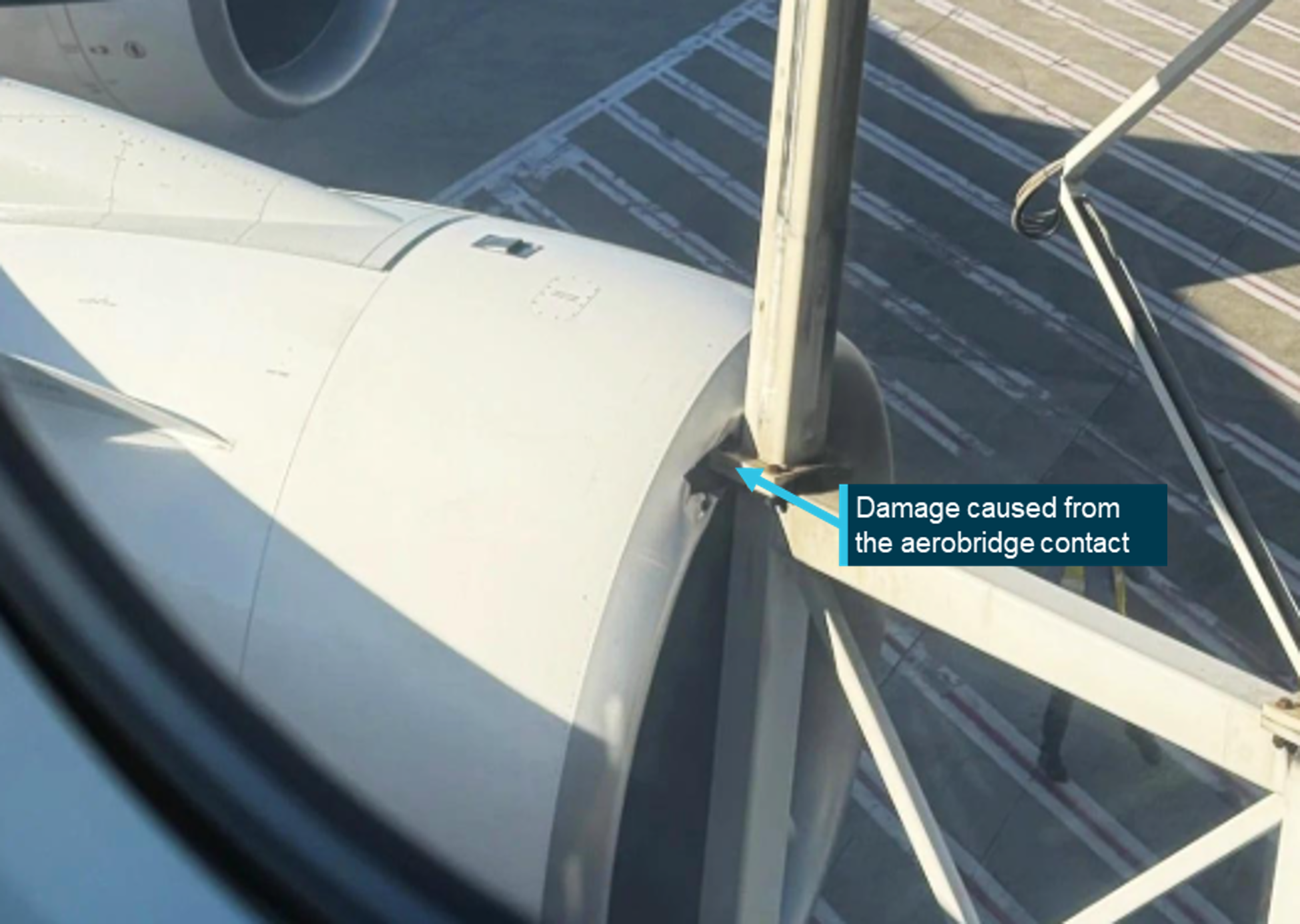
With the alarms still sounding, the agent then attempted to retract the aerobridge straight back multiple times without success. Believing that a straight back retraction could be achieved if the aerobridge was moved slightly to the right, they proceeded with this aerobridge movement. However, while moving to the right, the aerobridge contacted with the number 2 engine (Figure 1). The aircraft sustained minor damage.
Figure 1: Aerobridge contact with no 2 engine
Source: Media, annotated by the ATSB
Safety message
A 2010 ATSB research study into Ground operations occurrences at Australian airports found approximately 28 per cent of all ground operations occurrences happened while the aircraft was parked at the gate. Collision or contact with an aircraft by a vehicle, including aerobridges, was the most common gate event reported to the ATSB.
There are many risk controls in place at airports and within ground handling companies and airlines to help minimise the hazards associated with airport ground operations. The ATSB reminds all ground handling personnel operating airside vehicles that if an abnormal situation should occur, such as the audible alarms in this incident, to cease operations immediately and request assistance. Effective communication is vital to reduce the risk of ground operations occurrences.
About this report
Decisions regarding whether to conduct an investigation, and the scope of an investigation, are based on many factors, including the level of safety benefit likely to be obtained from an investigation. For this occurrence, no investigation has been conducted and the ATSB did not verify the accuracy of the information. A brief description has been written using information supplied in the notification and any follow-up information in order to produce a short summary report, and allow for greater industry awareness of potential safety issues and possible safety actions.
Occurrence summary
Mode of transport
Aviation
Occurrence ID
AB-2025-033
Occurrence date
12/07/2025
Location
Sydney Airport
State
New South Wales
Occurrence class
Incident
Aviation occurrence category
Ground handling
Highest injury level
None
Brief release date
03/09/2025
Aircraft details
Manufacturer
Airbus
Model
A380-842
Sector
Jet
Operation type
Part 121 Air transport operations - larger aeroplanes
On the afternoon of 11 August 2025, an Airbus A320, registered VH-VQL, was operated by Jetstar on a passenger transport flight from Sydney, New South Wales, to Hervey Bay, Queensland.
Prior to the arrival at Hervey Bay Airport, the first officer attempted to activate the pilot‑activated lighting (PAL) system, which would provide visual guidance for the vertical approach path via pilot approach path indicators (PAPI). However, once the aircraft turned onto final approach, the crew observed that the PAPI were not illuminated.
A steeper than normal descent profile was subsequently flown, and the operator’s stabilised approach criteria were not met. The crew were unaware of the unstable approach and proceeded to land the aircraft.
What the ATSB found
The first officer was unsuccessful in remotely activating the PAL, as they used an outdated radio keying sequence to activate the PAL system, rather than the updated sequence published in the relevant notice to airmen (NOTAM). They ultimately believed that the PAL had been successfully activated due to hearing what they thought was an automated confirmation response.
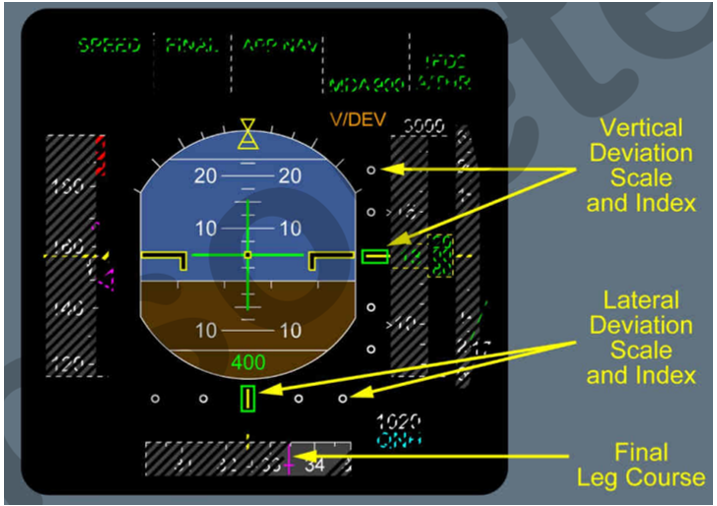
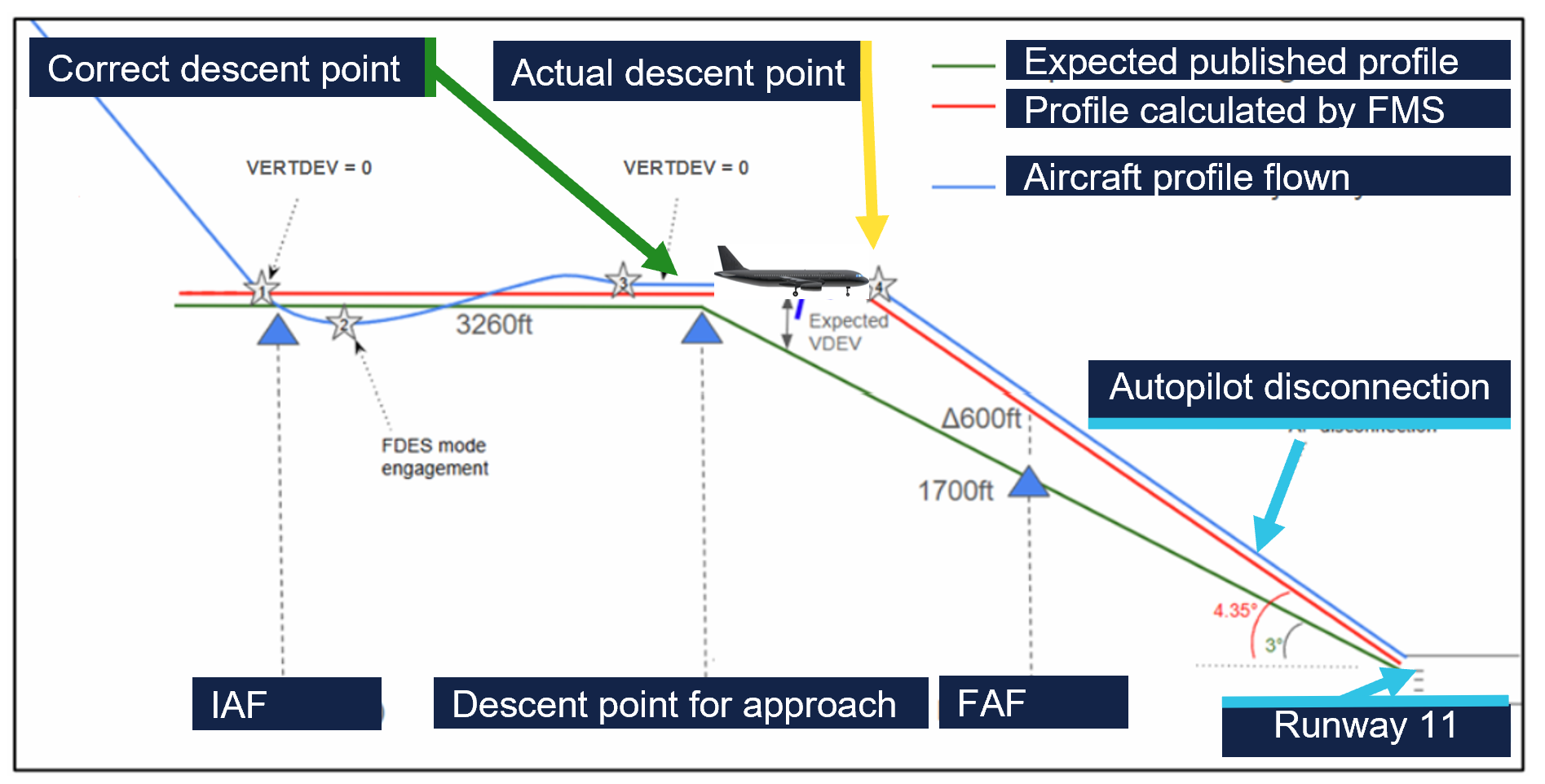
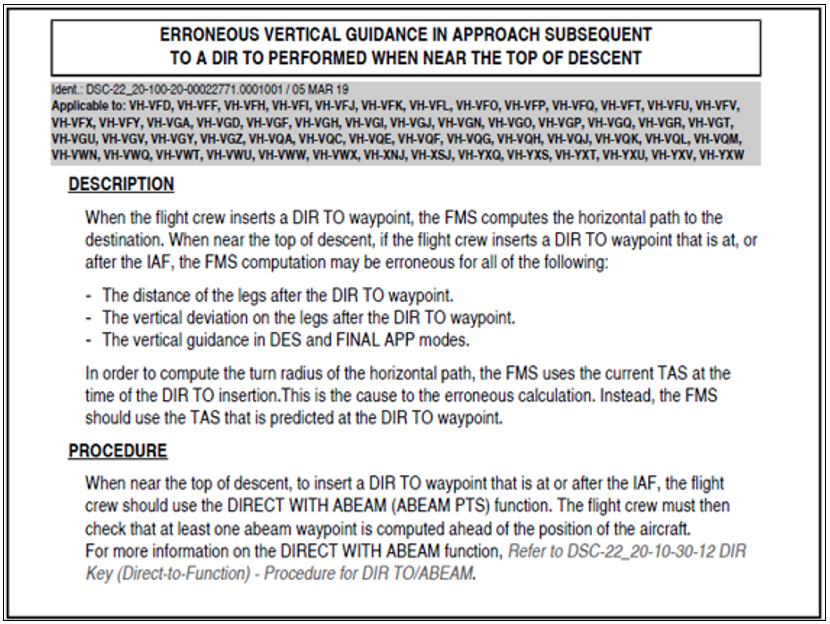
The ATSB found that near top of descent the flight crew selected DIR TO (direct to) the initial approach fix for the approach, which very likely triggered a previously‑known abnormality in the auto flight system. The flight crew had known about the software issue but did not recall it at the time.This software error almost certainly resulted in erroneous vertical guidance being computed and displayed to the pilots, showing the aircraft as being on the correct path when in fact the path was too steep.
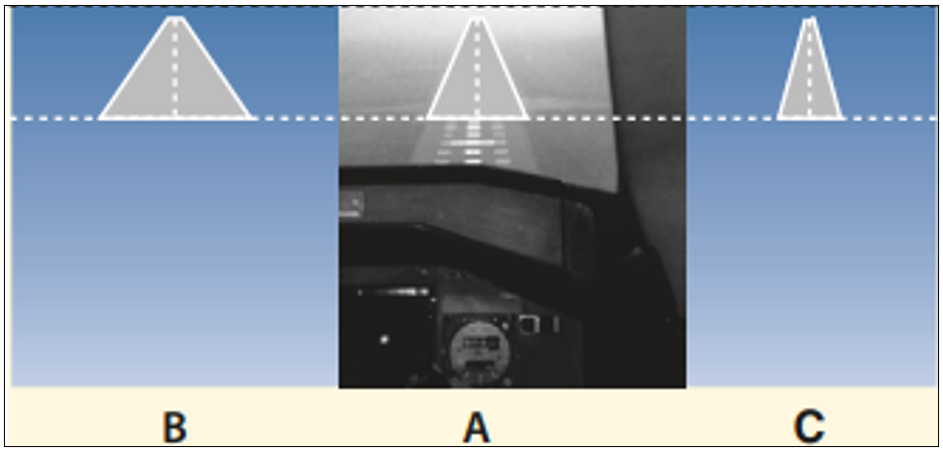
The flight crew initially visually perceived that they were high on approach but were unable to confirm that they had deviated from the normal approach profile. This was due to the erroneous instrument guidance, the absence of the PAPI, and the flight crew thinking that a visual illusion (from the narrower than usual runway) was the reason for the approach seeming too steep.
The approach was unstable according to multiple parameters: vertical speed, the use of speed brake, and the extension of flap. However, the flight crew likely did not fully recognise multiple exceedances of the stable approach criteria, or erroneously considered some exceedances to be momentary. Rather than conduct a missed approach, the flight crew continued the approach without clearly voicing or acting on their concerns after perceiving indications that multiple aspects of the approach were unusual or marginal.
A software update had been made available by Airbus in 2020 but not yet implemented by Jetstar in its A320 fleet at the time of the occurrence, partly due to a later update taking longer than expected to become available. As a result, for nearly 5 years Jetstar continued to rely on a procedural control that was subject to human factors limitations.
What has been done as a result
Jetstar advised that it would be updating its A320 fleet to the H3 software standard, which resolves the temporary abnormal behaviour (TAB) relevant to this occurrence.
Jetstar published an internal newsletter to flight crew in November 2025 to provide further education and awareness to all Jetstar Airbus pilots of the TAB that was a factor in this occurrence.
Safety message
This occurrence highlights the importance of flight crews being aware of known and documented limitations or anomalies with aircraft systems, particularly those that can result in incorrect flight information being used and presented to pilots at a critical phase of flight. While this is important, the occurrence also highlights that removing system problems rather than relying on procedural workarounds is always preferable when possible.
It can be challenging for flight crews to recognise the point at which multiple individually minor issues start to become serious. Individually these abnormal aspects, or ‘yellow flags’, may not constitute a threat, but collectively they may form an indication of a situation that is drifting towards unsafe territory. Effective monitoring in a multi‑crew environment is paramount to aircraft safety. If a pilot notices anomalies or attributes of the flight they can’t readily explain or see as a problem, even if relatively minor, it would be prudent to communicate these concerns to the other pilot and consider discontinuing the task to allow the crew to ‘take stock’ and reset.
The investigation
The ATSB scopes its investigations based on many factors, including the level of safety benefit likely to be obtained from an investigation and the associated resources required. For this occurrence, the ATSB conducted a limited-scope investigation in order to produce a short investigation report, and allow for greater industry awareness of findings that affect safety and potential learning opportunities.
The occurrence
Descent and initial approach
On the afternoon of 11 August 2025, an Airbus A320, registered VH-VQL, was being operated by Jetstar on a passenger transport flight from Sydney, New South Wales, to Hervey Bay, Queensland. The captain was the pilot flying (PF) and the first officer was the pilot monitoring (PM).1
The approach was conducted in daytime visual meteorological conditions. At 1330 the wind was 140° at 11 kt. Visibility was recorded as greater than 10 km. Cloud cover was recorded as FEW 3,800 and SCT 4,9002 with no precipitation.
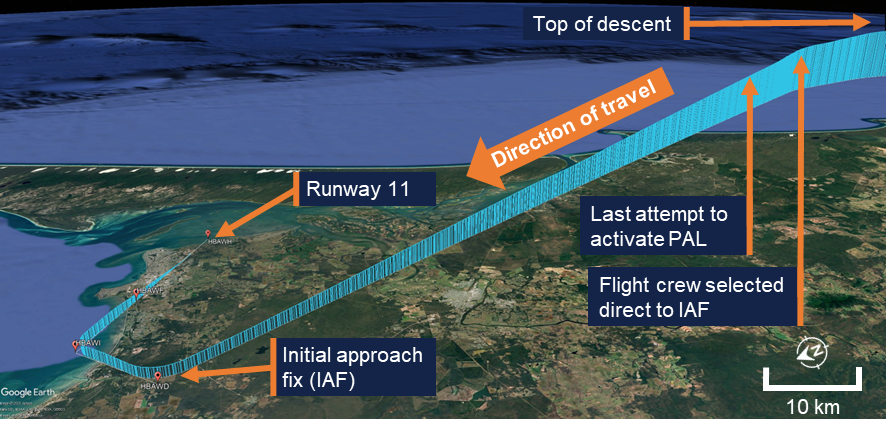
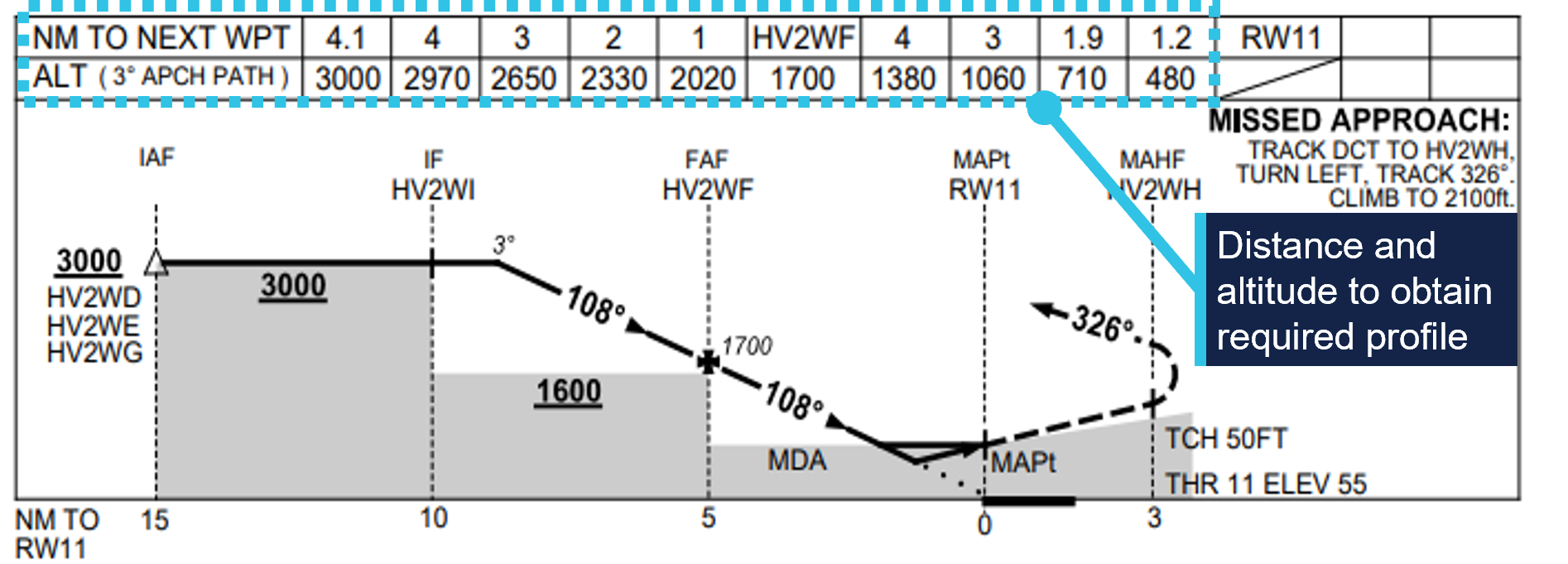
As the aircraft approached the top of descent (TOD), air traffic control provided clearance for the crew to track direct to the initial approach fix (IAF)3 for the RNAV approach,4 for runway 11 at Hervey Bay. The flight crew had the autopilot engaged, and commenced descent at about 1325.
At about 1328 while the aircraft was descending, the crew selected DIR TO (direct to)5 the IAF in the flight management system (FMS)6. This action was to direct the autopilot to track to this position at which point the crew would commence the approach to land (Figure 1).
Figure 1: Flight path from top of descent
Source: Google Earth, annotated by the ATSB
During the descent, passing FL320, the PM attempted to switch on the aerodrome pilot activated lights (PAL)7 via the VHF COM 3 radio.8 The PM reported not hearing the aerodrome frequency response unit AFRU9 readback and attempting to activate PAL several times. Some of these unsuccessful attempts were attributed by the PM as being a result of the distance from the airport. On one or possibly 2 occasions, they heard a male voice responding which, at the time, the PM thought might have been from the AFRU readback and thought it said the airport lighting was on, but was unable to hear it clearly due to another concurrent radio call. The PF also heard this voice thinking it was the AFRU. The male voice was unexpected, as the PM recalled conducting the same flight previously and had recalled hearing a female voice on the AFRU readback. The PM reported they ultimately believed that the PAL had been successfully activated.
Recorded aircraft data showed the VHF 3 radio being keyed in 6 distinct sets of 3, 1‑second transmissions from 1326:34 (passing FL320) to 1330:22 (passing FL220), consistent with attempts to activate the AFRU but with a keying sequence that was no longer current at Hervey Bay (see Aerodrome information). As a result, unknown to the flight crew at the time, the PAL was not activated by any of the PM’s attempts. The PM reported that later, during the descent, the flight crew were dealing with several issues including managing the aircraft’s speed and descent rate as well as a potential traffic conflict, and forgot to try activating the lights again.
Final approach
After turning onto the final approach for the runway 11 RNAV approach at 1344 using Jetstar’s visual procedures (see Operator’s visual procedures for instrument approach), the crew observed and discussed that the profile of the aircraft appeared high, based on the visual aspect of the runway from the cockpit. However, the flight guidance shown on the instruments indicated that a normal programmed profile was being flown. At the time, the crew attributed their observation to a runway visual illusion.10
By this point the precision approach path indicator (PAPI)11 lights should have been visible to the flight crew, and active (lit) as part of the PAL. However, the flight crew observed that they were not activated. The PM reported being surprised by this as they had felt sure the lights had been activated. The PF felt it more important for the PM to focus on traffic and the radio than to try activating the PAL again.
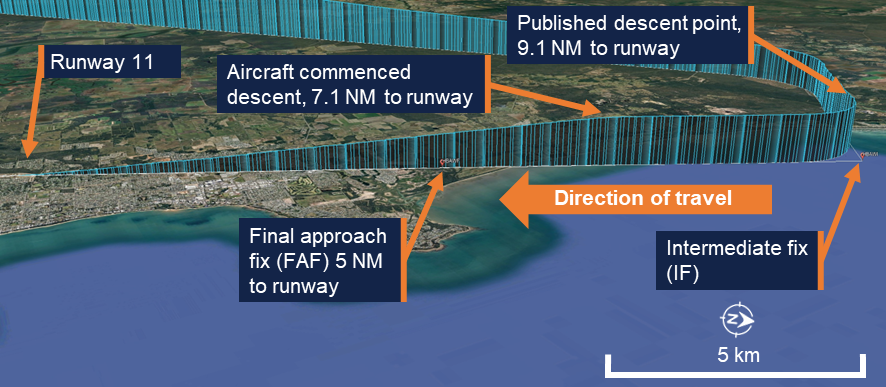
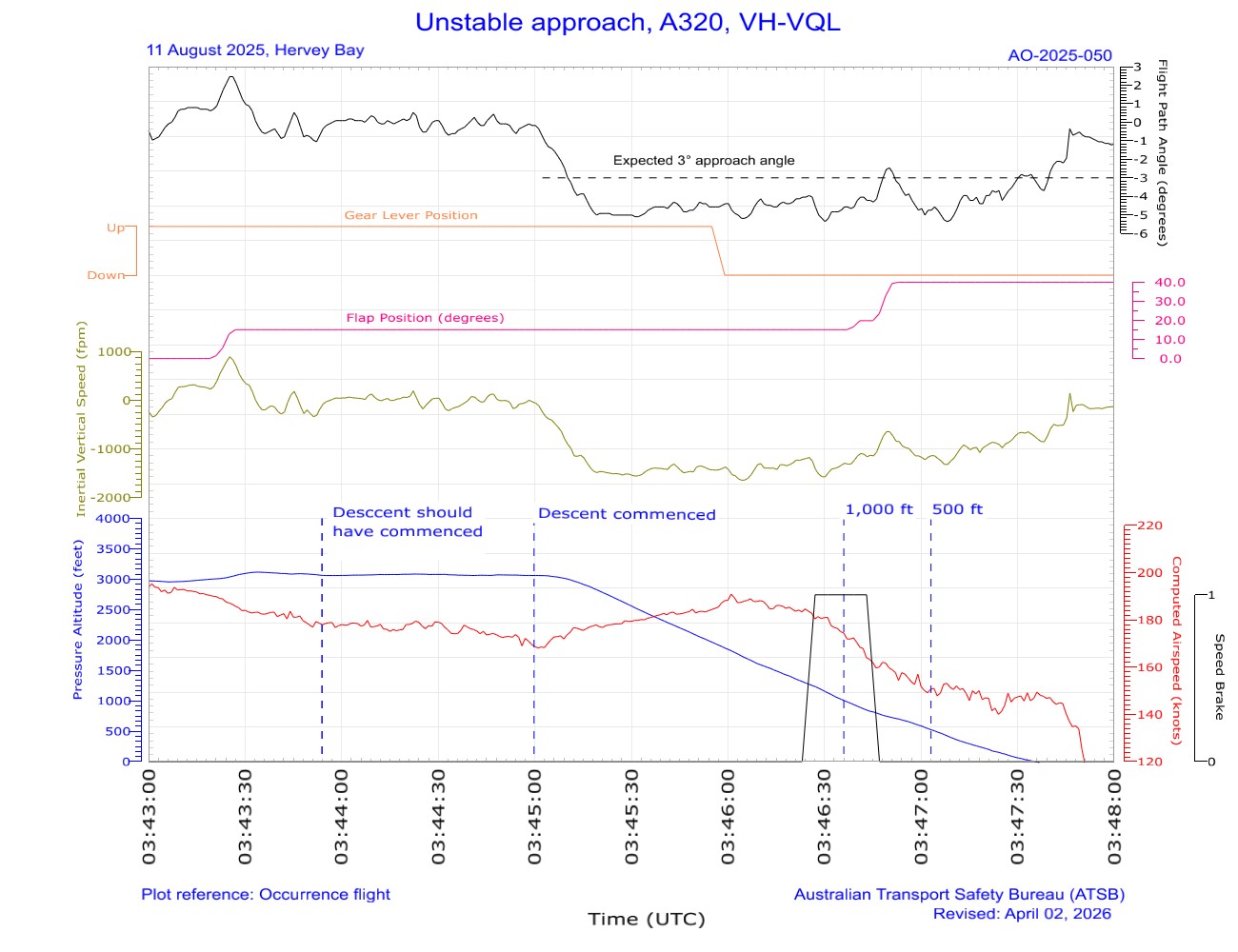
The aircraft levelled out at about 3,200 ft.12 The normal descent profile for this approach was 3° and commenced at the intermediate fix (IF), 9.1 NM (17 km) from the runway. The aircraft passed this point at about 1343:53. Flight data indicated that the aircraft commenced the approach descent from 3,000 ft at about 1345:00, when 7.1 NM (13 km) from the runway. Unknown to the flight crew, this resulted in the flight management system (FMS) generating an approach angle of greater than 4° (Figure 2; also see Vertical guidance temporary abnormal behaviour). The steep approach profile resulted in a high vertical speed. The landing gear was extended at about 2,000 ft.
Observing the high vertical speed, the flight crew used speed brake13 to reduce the aircraft’s energy (see Recorded data) and the aircraft slowed to the maximum speed with flaps fully extended (VFE) when passing 1,070 ft.
Figure 2: Flight path on final approach
Source: Google Earth, annotated by the ATSB
Jetstar’s stabilised approach requirements (see Stabilised approach criteria) involved checks at 2 points during approach. These checks each required the PM to identify and then verbalise that the stabilised approach criteria have been satisfied.
The PM believed the criteria had been met and recalled that they called ‘configured’ at 1,000 ft height above aerodrome at about the same time that full flap was selected. The recorded data showed that the crew selected the next stage of flap when passing 1,000 ft, and then full flap at about 800 ft (see Recorded data).
The PM recalled making a ‘stable’ call at about 500 ft. Between 1,000 ft AAH and 500 ft the aircraft had high vertical speeds, and the PM subsequently made an ‘exceedance call’ to the PF. The PF responded to this vertical speed exceedance call by disconnecting the autopilot at 338 ft and adjusting the vertical speed.
The PF landed at 1348 with a touchdown loading of 1.55 g, which exceeded the threshold for further assessment by Jetstar’s flight data analysis programme but did not exceed the threshold for maintenance action.
The crew conducted a post-occurrence review on the ground due to the aircraft’s behaviour seeming strange, and the crew being uncomfortable with the approach. This included reviewing the current NOTAMs14 (specifically in relation to the amended procedure15 for activating the PAL), and successfully testing the PAL including hearing a female voice as the readback. The PM subsequently realised the PAPI was not activated due to them not having keyed the PAL in the way indicated by the NOTAM. The crew confirmed that the QNH16 for the airport matched the QNH they used for the approach.
The flight crew also discussed the guidance system’s behaviour after the occurrence, recalling that there was information in the aircraft manuals about the DIR TO scenario but could not recall any specifics. They reported realising what the problem was only when reviewing the aircraft manuals and seeing the temporary abnormal behaviour (TAB) list (see Temporary abnormal behaviour (TAB)).
Context
Flight crew information
Captain
The captain held an Air Transport Pilot Licence (Aeroplane) and a class 1 aviation medical certificate. They had 14,460 hours of flying experience, of which 7,500 hours were on the Airbus A320. They had flown 184 hours in the previous 90 days.
First officer
The first officer held a Commercial Pilot Licence (Aeroplane) with a class 1 aviation medical certificate. They had 1,024 hours of flying experience, of which 809 hours were on the Airbus A320. They had flown 231 hours in the previous 90 days and had been checked to line by Jetstar since November 2024.
Aerodrome information
Approach profile to runway 11
Hervey Bay Airport is a non-controlled, certified aerodrome consisting of a 2,000 m long and 30 m wide runway orientated 11/29. The approach profile for runway 11 is 3° and is published on the relevant approach chart (Figure 3).
Figure 3: Published approach profile
Source: Airservices Australia, annotated by the ATSB
Pilot-activated lighting (PAL)
The airport had a pilot-activated lighting system (PAL) that was used to activate the aerodrome lighting, including approach lights, runway edge lights, and taxiways. The precision approach path indicator (PAPI) lights provide visual descent guidance to pilots during the final approach to help determine if the aircraft is above or below the normal 3° approach profile. The PAPI consist of 4 high‑intensity light beams with coloured filters: 2 red and 2 white lights visible indicate that the aircraft is on the correct approach profile.
The daily serviceability inspection of the aerodrome lighting system was carried out by the airport reporting officer17 on the morning of the occurrence. The lighting system, including the PAPI, was reported to be serviceable.
At dusk, all lights become active when the PAL is activated. During the daytime, only the PAPI becomes active.
To activate the PAL, a pilot selects the press-to-talk switch (of the aircraft VHF radio) keying a set pattern of transmission. The instructions to activate the PAL were contained in the ERSA18 and required 3, 1‑second transmissions on the frequency 122.8 MHz.
Flight crews are required to review NOTAMs during flight preparation. On 9 August 2025, a NOTAM was had been issued (and was still current on 11 August) with amended instructions to activate the PAL, requiring the pilot to make 3, 3‑second transmissions, on 122.8 MHz. The flight crew did not recall seeing this NOTAM.19
The PM stated in interview that they realised when reviewing the NOTAMs after the flight that they probably used the wrong keying method. As stated in The occurrence, recorded aircraft data showed the VHF 3 radio being keyed in 6 distinct sets of 3, 1‑second transmissions from 1326:34 to 1330:22 (Table 1).
Table 1: Attempts to activate PAL
Time
Approximate altitude
1326:34
FL320
1326:45
FL320
1328:12
FL280
1328:25
FL270
1328:51
FL260
1330:22
FL220
Aircraft information
Auto flight system architecture and basic operation principles
Flight in the A320 is extensively managed via the flight management guidance system (FMGS). The FMGS is an integrated system that includes the flight management system (FMS), autopilot and flight directors, as well as engine auto thrust and navigational sensors.
Flight and aircraft information is interfaced, calculated, manipulated and presented via the flight management guidance computer (FMGC), multi-function control and display unit (MCDU)20 and presented on the primary flight display (PFD) and navigational display (ND).
With the autopilot engaged the aircraft will fly the relevant lateral and vertical profile dictated by the auto flight system. During descent the system indicates any vertical deviation from the computed descent profile on the pilot’s instruments (PFD and MCDU).
Information displayed to the flight crew
The information used by the flight crew during the approach would have been predominantly through the PFD, which had an indication of the vertical and lateral profile being flown (Figure 4). The aircraft’s ND and MCDU in the flight deck can be set to show the distance to the runway in the current programmed flight plan.
Figure 4: Primary flight display on A320
Source: Airbus
In this occurrence, the PF reported the vertical and lateral deviation indicator was in the expected location on the PFD, to indicate that there was no deviation from the datum (slope and track).
Temporary abnormal behaviour (TAB)
Documented temporary abnormal behaviours
In Airbus terminology, temporary abnormal behaviour (TAB) is a system behaviour that temporarily deviates from the intended system design. Any TABs affecting Jetstar A320 or A321 aircraft were documented in the Jetstar Airways A320/A321 Flight crew operating manual (FCOM) to provide information for pilots to recognise, understand and account for the abnormal behaviour. Flight crews are required to be familiar with any TABs applicable to the aircraft they are operating.
At the time of the occurrence, the TAB section of the FCOM listed 23 temporary abnormal behaviours for the aircraft’s auto flight system, and 16 associated with other aircraft systems such as radio communications, cabin pressure and weather radar systems. Each had a description, and many had an associated procedure or operational recommendations for avoidance or mitigation. Due to differences in equipment configuration, most TABs applied to some, but not all, of Jetstar’s A320 and A321 fleet.
The captain advised the ATSB that this flight was their first time observing this particular TAB.
Vertical guidance temporary abnormal behaviour
Airbus had identified some years prior to the occurrence that certain A320 FMS software versions, including the ‘H2C standard’ on the occurrence aircraft, contained an anomaly where erroneous descent and approach calculations could be triggered when a DIR TO was selected at TOD.
Airbus advised that, in this occurrence, the FMS used an erroneous (higher) true airspeed value, leading to an erroneous (longer) calculated track length. Figure 5 shows the intended, correct, descent profile (shown in green). In this figure, the incorrect profile calculated by the FMS is shown in red, and the aircraft’s actual path in blue. Throughout the descent, the FMS was calculating the intended vertical guidance (altitude) based on the aircraft’s distance to the runway, but the actual distance to the runway was shorter at any given time. This made the actual approach profile generated by the FMS steeper. Airbus stated the FMS ‘computed an incorrect vertical profile with a slope (−4.35°) greater than the one requested by the chart (−3°), and consequently the autopilot guided the aircraft on the incorrect profile.’
Figure 5: Relationship of profile expected vs constructed vs flown
Not to scale. VERTDEV and VDEV: vertical deviation. FDES: Autopilot vertical mode change.Source: Airbus, annotated by the ATSB
The FCOM procedure for flight crew to address this TAB issue was documented in Jetstar’s A320/A321 FCOM. The TAB issue affected almost all A320s and A321s in the Jetstar fleet. The applicable FCOM section is shown in Figure 6.
Figure 6: Procedure addressing abnormality
Source: Jetstar
The flight crew of VH-VQL reported that they had read about this TAB, but they did not identify the TAB and the subsequent procedure at the time of the occurrence.
Updated software
Airbus had provided an update to the FMGC software from the H2C standard, to the H3C standard software, which corrected the TAB that was a factor in this occurrence. This update was available to operators as an optional safety enhancement via Service Bulletin SB A320-22-1715 from December 2020 onwards. There was no airworthiness directive associated with this update.
Jetstar advised the ATSB that it had considered the service bulletin when it was issued but the decision was made at the time to await, and then update directly to, the H4 standard (with additional enhancements), which was expected to become available in 2021/22. However, Airbus advised Jetstar in 2024 that the certification process of the H4 standard had ceased, with a newer H5 standard still in development at the time of writing. Jetstar’s decision not to update to the H3 standard was mainly predicated on:
the cost and risk associated with the need to adapt the navigation database to be compatible with the newer standard, and
configuration management problems experienced following the delivery of Airbus A321s with the H4 standard in 2022, which required a different navigation database to the current aircraft with the H2C standard.
Jetstar instead decided to retain the H2C standard, so that there were only 2 FMGC standards and 2 navigation databases instead of the 3 that would have resulted had the H3 standard been incrementally rolled out across the A320 fleet, until the problems with configuration management could be resolved.
Jetstar procedures
Operator’s visual procedures for instrument approach
The actions of the crew can vary depending on if the pilots are conducting the approach using Jetstar’s visual or instrument procedures.
When the flight crew use an instrument approach procedure for flight path guidance, but nominate or transition to visual procedures, the stable approach requirements remain unchanged.
When visual procedures are nominated, any remaining instrument procedure calls are cancelled, and only standard approach calls need to be made.
When conducting some types of instrument approach, the flight crew are required to conduct a check confirming the approach profile at the final approach fix (FAF).21 It would include a comparison of the aircraft’s height and distance to the runway, with the published height and distance. The check mitigated risks on approach, such as false glideslope capture and erroneous indications. However, the FAF height check was not required under visual procedures.
Stabilised approach criteria
A stabilised approach is one where an aircraft maintains a constant descent to the runway while other key flight parameters such as airspeed and aircraft configuration are controlled within specific ranges. An approach is stable when all the stabilisation criteria specified by the operator are met.
The FCOM required that all approaches be configured and stabilised in accordance with the following requirements:
By 1,000 ft HAA:
1. Established on the correct lateral and vertical flight path, with only small changes to required bank angle and pitch needed to maintain the path;
2. Configured with the planned landing flap extended and gear down;
3. Sink rate not greater than 1,000 fpm;
4. Thrust setting appropriate to achieve and/or maintain the approach speed;
5. All briefings completed.
In addition, by 500 ft HAA:
1. Airspeed not more than speed target +10 kt and not less than the speed target -5 kt;
2. Landing checklist completed.
…
Note: Momentary excursions of speed and sink rate limits are permitted provided they are immediately corrected.
…
The PM shall call “Not Configured” at 1000 ft if the aircraft is not in the intended landing configuration, or if below 1000 ft it is identified that the incorrect landing flap setting has been mistakenly selected.
The PM shall call “Not Stable” at or below 500 ft if:
1. All checklists have not been completed; or
2. The aircraft is not configured for the planned landing; or
3. The PM observes a sustained exceedance of an approach tolerance; or
4. The PF fails to correct the aircraft’s flight path following the calling of an approach tolerance or exceedance.
At any time the listed stable criteria are not met or cease to be met below 1000 ft HAA or the PM calls “Not Configured” or “Not Stable” then the PF is required to initiate a go-around or missed approach.
Note: Speed brake deployment or activation of the flap load relief system below 1000 ft HAA constitutes an unstable approach as the landing configuration has been compromised and a go-around or missed approach must be conducted.
The FCOM encouraged flight crews to ‘perform a missed approach whenever any doubt exists to the safe continuation of an approach and landing.’ The policy stated that a missed approach (or a go-around) that is carried out as a conservative and defensive measure, will not result in disciplinary action.
ATSB flight data analysis identified the following exceedances of the stabilised approach criteria (see also Recorded data):
The flap selector was moved to full flap at about 800 ft (about 12 seconds after passing 1,000 ft), and the flaps did not reach the full extended position until about 730 ft.
The speed brake was used between about 1,270 ft and 820 ft (the lower limit was 1,000 ft).
Vertical speed remained above 1,000 fpm (the upper limit) until about 800 ft.
Vertical speed exceeded the upper limit again for a period of about 15 seconds from about 640 ft to about 350 ft (averaging 1,188 fpm during this period and peaking at 1,320 fpm). There were further brief (less than 2-second) exceedances, at 290 ft and 243 ft.
Both flight crew reported they recognised the high vertical speed on approach and believed that the exceedances could be controlled by 1,000 ft. They did not disclose any awareness of other exceedances.
The flight crew both advised the ATSB that they were uncomfortable and considering go‑around (missed approach) options during the approach. They were aware that some parameters were approaching or had gone beyond the stabilised approach criteria, but considered these to be momentary.
The PM recalled that towards the end of the approach they felt ‘extremely uncomfortable’ in retrospect. The PM recalled advising the PF that the vertical speed was high by making advisory vertical speed awareness calls, at around 2,000 ft. The PM made an exceedance call when the vertical speed was greater than 1,000 fpm, between 1,000 ft and 500 ft; the PF acknowledged and reduced the vertical speed. The PM reported hesitating before the 500 ft call because of the vertical speed, but both crew reported that while the vertical speed was above the criteria limit, they thought it was not excessively high and they both thought the PF was getting it under control. The PM commented in interview that they believed they had until 500 ft to meet the vertical speed requirement of the stabilised approach.
The PF recalled being mentally ‘overloaded’ shortly before the landing. The PM recalled experiencing a brief period of significantly reduced mental capacity shortly after passing 500 ft, while considering whether the PM should have called for a missed approach.
Recorded data
The ATSB conducted analysis of the recorded flight data applicable to the occurrence (Figure 7). Flight data analysis showed the profile for this approach was steeper than that of a normal approach. This was due to the aircraft commencing its descent from 3,000 ft at 7.1 NM (13 km) from the threshold (2.1 NM [4 km] from the FAF) instead of the published 9.1 NM (17 km) from the threshold (Table 2). Between the FAF and landing, the approach angle averaged around 4.5°, with a maximum recorded value of 5.36°. As shown in the table, the aircraft was well above the expected altitude for the entire approach from the IF (9.1 NM [17 km] from the runway) onwards.
Table 2: Approach profile data from the intermediate fix to landing
Distance to next waypoint (NM)
Distance to runway threshold (NM)
Barometric corrected altitude (ft)
Altitude expected for approach (ft)
Difference (ft)
4.1 (at IAF)
9.1
3,253
3,000
253
4.0
9.0
3,253
2,970
283
3.0
8.0
3,240
2,650
590
2.0
7.0
3,214
2,330
884
1.0
6.0
2,794
2,020
774
(at FAF)
5.0
2,321
1,700
621
4.0
4.0
1,823
1,380
443
3.0
3.0
1,383
1,060
323
1.9
1.9
960
710
250
1.2
1.2
609
480
129
(Runway 11)
0.0
---
---
---
Figure 7: Occurrence flight data showing approach angle
Source: ATSB
Runway visual illusion
If a runway is either wide or narrow it can present a visual illusion to the pilots. A final approach to a narrow runway may produce the visual illusion of being high. The below illustration shows an aircraft on a 3° profile (Figure 8) (Flight Safety Foundation , 2000). The visual perspective shows a contrast between 3 different pilot views:
perspective ‘A’ is for a 45 m wide runway
perspective ‘B’ is a wider runway
perspective ‘C’ is a narrower runway.
Figure 8: Runway with affecting approach perception
Source: Flight Safety Foundation
A 45 m wide runway is standard for an air transport aircraft. The runway at Hervey Bay Airport was 30 m wide.
The perspective seen for a narrower runway on the 3° profile appears further away, and so is similar to the perspective seen by a pilot of a normal width runway when above the 3° profile.
Safety analysis
Erroneous vertical guidance
The Jetstar A320/A321 flight crew operating manual (FCOM) contained information related to the flight management temporary abnormal behaviours (TAB). This included that a number of flight management system (FMS) computations, including vertical guidance, could be erroneously generated if pilots execute the DIR TO (direct to) function when close to top of descent.
The flight crew forgot about the TAB and FCOM procedure at the time of the occurrence. As a result, they engaged the DIR TO function at a time that doing so was known to trigger the TAB, resulting in the FMS almost certainly computing an erroneously high descent rate and steep approach path.
However, the crew did not recognise this as an initial indication of an erroneous calculation of the descent profile by the FMS. The vertical path, for both the descent and approach, was displayed to the flight crew via the PFD and would have indicated they were following the correct profile. However, the actual profile being flown did not correlate with the published approach path.
Flight crews are required to be familiar with any TABs applicable to their aircraft, and there were 38 TABs listed in the FCOM. The flight crew reported that they had previously been aware of the existence of this TAB, but the captain reported they had never experienced this particular TAB before.
Availability of updated software
Airbus had made an optional, updated software standard (version) available to address the TAB in December 2020. There was no airworthiness directive associated with this update. Jetstar had considered the service bulletin when it was issued, but for various reasons decided to wait for the next standard to be made available, which was expected at the time to be in 2021/22. Ultimately, however, this newer standard did not become available, and Jetstar’s 2020 decision not to implement the available standard was not revisited in the interim. As a result, Jetstar continued to rely on a procedural control to avoid the software issue at the time of the occurrence for nearly 5 years.
Approach lighting not activated
Precision approach path indicator (PAPI) lights are a useful tool available for flight crews to verify their approach profile. As the aircraft approached Hervey Bay Airport the PM attempted to activate the PAPI lights through the pilot‑activated lighting (PAL) system. Numerous attempts were made by the PM to activate the PAL while on descent. The PM recognised that they were unsuccessful, however, they attributed the unsuccessful attempts to being too far away from the airport. The PM also thought that they heard the AFRU readback say that the airport lighting was on. The PM ultimately believed that the PAL had been successfully activated.
However, the PAPI lights were serviceable but were not activated because the PM used a keying sequence that was no longer current at Hervey Bay as per the NOTAM. The flight crew were required to review the NOTAMs as part of their flight preparation, but it is likely that this NOTAM was overlooked.
Flight path monitoring
During the final approach to land, the flight crew were presented conflicting information between the electronic vertical guidance and the runway visual profile. The absence of PAPI approach guidance meant it was more difficult to visually confirm that they were correctly flying the intended approach. Pilots who fly by instrument flight rules (IFR) procedures are trained and conditioned to rely heavily on their aircraft’s instruments and navigation systems rather than visual cues from the environment. The FAA Instrument Procedures Handbook (Federal Aviation Administration, 2017) noted:
The pilot must trust the flight instruments concerning the aircraft’s attitude regardless of intuition or visual interpretation.
The pilots correctly recognised and discussed that the aircraft appeared to be high on profile when visually observing the runway. However, the information presented to the pilots via the instruments indicated that the aircraft was following the correct vertical path. The pilots continued to believe the aircraft was on the correct profile based solely on the indications from the PFD and did not attempt to verify it using other sources.
Conflicting information has been shown to have deleterious effects on decision‑making including reduction in accuracy of decisions, longer decision times and less confidence that the decision was correct (Carroll, Sanchez, & Wilt, 2021). In this case, the cues used to judge the aircraft’s vertical flight path were conflicting, erroneous, and/or absent.
The crew rationalised their observation believing it to be a result of a runway visual illusion: they knew a narrow runway could make the correct approach seem too high, and so didn’t realise that it actually was too high.
The absence of PAPI guidance removed an additional mechanism for approach profile verification by the pilots. The aircraft’s high vertical speed should have also indicated a deviation from the normal approach profile.
The FAA Instrument Procedures Handbook (Federal Aviation Administration, 2017) suggests that crossing the FAF at the published altitude is often a critical component of a successful approach. As the approach was conducted using visual procedures, the flight crew were not required to conduct a height check at the FAF, thus removing an opportunity to identify the erroneous electronic vertical guidance caused by the TAB at that point of the approach. Standard rules of thumb are also available to help in determining their approach profile, such as checking that the aircraft’s height above the runway should be 300 ft for every nautical mile to the runway, or multiplying groundspeed in knots by 5 to estimate the correct descent rate in feet per minute (Skybrary 2021). The flight crew did not perform any of these secondary checks of the flight profile after realising that they were receiving conflicting information.
Exceedance of the stable approach criteria
The key altitudes of 1,000 ft height above aerodrome (HAA) and 500 ft HAA were the critical points for determining if the approach is stable. Both flight crew have responsibility to call exceedances at or after these points, particularly the PM whose main role it is to monitor flight parameters. Elements of the stable approach criteria (requiring flaps to be fully extended, speed brake not deployed below 1,000 ft, and vertical speed to be under 1,000 fpm) were not met at the 1,000 ft check. This constituted an unstable approach (requiring a missed approach) and was not fully recognised by the flight crew. Most notably, the vertical speed was above 1,000 fpm for 15 seconds either side of the 500 ft call.
Both flight crew were aware that some parameters were approaching or had gone beyond the stabilised approach criteria, but considered these to be brief and/or transitory. The PM hesitated before making the 500 ft call, but thought the vertical speed was not excessively high and both flight crew thought the PF was getting it under control. The flight crew continued, probably not fully recognising these deviations in the dynamic, time-compressed situation with a high workload.
A higher than normal cognitive workload was a result of the aircraft flying a steeper than usual approach that required a high vertical rate of descent and the use of speed brake to manage the aircraft’s energy. It also seemed strange to the flight crew, based on their understanding that a normal 3° profile was being flown. The information observed by the flight crew (normal profile) conflicted with the outcome (difficulty managing aircraft energy from steep approach) resulting in a high cognitive workload and reduced capacity to recognise the situation and initiate a missed approach.
Ultimately, the exceedances were not detected and a missed approach was not called for, likely due to a combination of factors including:
the high cognitive workload being experienced by the flight crew
the flight crew misjudging some of the deviations as being marginal or momentary
the PM’s understanding at the time that the vertical speed only needed to meet the stabilised approach requirement at 500 ft
the PM having called the vertical speed exceedance (notifying the PF) and the descent rate subsequently being reduced.
Recognition of multiple unusual or marginal aspects of the approach
While on descent and approach the flight crew were presented with, and likely aware of, multiple indications that the approach was unusual:
auto flight system delaying descent during the approach
PAPI lights not being activated
the need for speed brake use on final approach to manage speed
high vertical speed throughout the approach
delayed descent just prior to commencing the final approach
several 1,000 ft AAH configuration requirements being close to, or beyond, the limit
500 ft AAH configuration requirements being above the limit.
It can be challenging for flight crews to recognise the point at which multiple individually minor issues start to become serious. The flight crew indicated they felt a level of discomfort (the PM describing it as ‘extremely uncomfortable’) that the approach was not proceeding as intended but did not identify any clear ‘red flags’ that would have prompted them to initiate a go-around. Individually these abnormal aspects, or ‘yellow flags’ may not constitute a threat, but collectively formed an indication of a situation that was drifting towards unsafe territory, which the flight crew likely did not completely recognise at the time.
One way to address discomfort is to voice concerns as part of crew resource management. Monitoring and calling exceedances, however slight, can help both flight crewmembers recognise a deteriorating situation. Once acknowledged, concerns can be assessed and corrective actions discussed between crewmembers.
Findings
ATSB investigation report findings focus on safety factors (that is, events and conditions that increase risk). Safety factors include ‘contributing factors’ and ‘other factors that increased risk’ (that is, factors that did not meet the definition of a contributing factor for this occurrence but were still considered important to include in the report for the purpose of increasing awareness and enhancing safety). In addition ‘other findings’ may be included to provide important information about topics other than safety factors.
These findings should not be read as apportioning blame or liability to any particular organisation or individual.
From the evidence available, the following findings are made with respect to the unstable approach involving Airbus A320, VH-VQL, at Hervey Bay Airport, Queensland, on 11 August 2025.
Contributing factors
The flight crew selected DIR TO (direct to) the initial approach fix into the flight management guidance system near top of descent which, due to a known software issue not remembered by the flight crew at the time, almost certainly resulted in erroneous vertical guidance being computed.
Jetstar had deferred an optional safety enhancement (software update) to correct the issue in the A320 fleet flight management system, in order to await a newer update that ultimately did not become available. As a result, for nearly 5 years Jetstar continued to rely on a procedural control that was subject to human factors limitations.
The pilot monitoring used the incorrect, outdated radio keying sequence to activate the pilot activated lighting (PAL) system at Hervey Bay, rather than the sequence published in the relevant notice to airmen (NOTAM).
The flight crew did not identify that the aircraft had deviated from the normal approach profile, partly due to being presented with erroneous vertical guidance and the absence of precision approach path indicator (PAPI) lighting.
On approach to land, the flight crew likely did not fully recognise multiple exceedances of the stable approach criteria, or erroneously considered some exceedances to be momentary.
The flight crew continued the approach without clearly voicing or acting on their concerns after perceiving indications that multiple aspects of the approach were unusual or marginal.
Safety actions
Whether or not the ATSB identifies safety issues in the course of an investigation, relevant organisations may proactively initiate safety action in order to reduce their safety risk. All of the directly involved parties are invited to provide submissions to this draft report. As part of that process, each organisation is asked to communicate what safety actions, if any, they have carried out to reduce the risk associated with this type of occurrences in the future.
Safety action by Jetstar Airways
Jetstar advised that it would be updating its A320 fleet to the H3 software standard, which resolves the temporary abnormal behaviour (TAB) relevant to this occurrence.
Jetstar published an internal newsletter to flight crew in November 2025 to provide further education and awareness to all Jetstar Airbus pilots of the TAB that was a factor in this occurrence.
Sources and submissions
Sources of information
The sources of information during the investigation included:
flight crew
Jetstar Airways
Hervey Bay Airport
Civil Aviation Safety Authority
Airbus
Airservices Australia
Bureau of Meteorology
recorded data from the aircraft.
References
Carroll, M., Sanchez, P., & Wilt, D. (2021). Recommended Training Practices to Prepare Pilots to Cope with Information Conflicts. Wright State University.
Federal Aviation Administration (2017). Instrument Procedures Handbook, U.S. Department of Transport.
Under section 26 of the Transport Safety Investigation Act 2003, the ATSB may provide a draft report, on a confidential basis, to any person whom the ATSB considers appropriate. That section allows a person receiving a draft report to make submissions to the ATSB about the draft report.
A draft of this report was provided to the following directly involved parties:
flight crew
Jetstar Airways
Civil Aviation Safety Authority
French Bureau of Enquiry and Analysis for Civil Aviation Safety (BEA)
Airbus.
Submissions were received from:
the captain
the first officer
Jetstar Airways.
The submissions were reviewed and, where considered appropriate, the text of the report was amended accordingly.
Purpose of safety investigations
The objective of a safety investigation is to enhance transport safety. This is done through:
identifying safety issues and facilitating safety action to address those issues
providing information about occurrences and their associated safety factors to facilitate learning within the transport industry.
It is not a function of the ATSB to apportion blame or provide a means for determining liability. At the same time, an investigation report must include factual material of sufficient weight to support the analysis and findings. At all times the ATSB endeavours to balance the use of material that could imply adverse comment with the need to properly explain what happened, and why, in a fair and unbiased manner. The ATSB does not investigate for the purpose of taking administrative, regulatory or criminal action.
About ATSB reports
ATSB investigation reports are organised with regard to international standards or instruments, as applicable, and with ATSB procedures and guidelines.
Reports must include factual material of sufficient weight to support the analysis and findings. At all times the ATSB endeavours to balance the use of material that could imply adverse comment with the need to properly explain what happened, and why, in a fair and unbiased manner.
An explanation of terminology used in ATSB investigation reports is available here. This includes terms such as occurrence, contributing factor, other factor that increased risk, and safety issue.
Publishing information
Released in accordance with section 25 of the Transport Safety Investigation Act 2003
Ownership of intellectual property rights in this publication
Unless otherwise noted, copyright (and any other intellectual property rights, if any) in this report publication is owned by the Commonwealth of Australia.
Creative Commons licence
With the exception of the Commonwealth Coat of Arms, ATSB logo, and photos and graphics in which a third party holds copyright, this report is licensed under a Creative Commons Attribution 4.0 International licence.
The CC BY 4.0 licence enables you to distribute, remix, adapt, and build upon our material in any medium or format, so long as attribution is given to the Australian Transport Safety Bureau.
Copyright in material obtained from other agencies, private individuals or organisations, belongs to those agencies, individuals or organisations. Where you wish to use their material, you will need to contact them directly.
^Pilot flying (PF) is responsible for flying, while pilot monitoring (PM) monitors and supports the PF, and cross-checks their actions.
^Cloud cover: in aviation, cloud cover is reported using words that denote the extent of the cover. ‘FEW’ indicates that up to a quarter of the sky was covered. ‘SCT’ indicates that approximately half of the sky was covered. The number following the descriptor is the altitude of the cloud base in feet.
^The initial approach fix (IAF) is the point where the initial approach segment of an instrument approach begins.
^An RNAV (area navigation) arrival is a procedure that allows an aircraft to fly a direct path to an airport using a combination of navigation systems, rather than being restricted to routes defined by ground-based beacons.
^The pilot uses the direct to (DIR TO) function to define a direct leg from the present position to another position.
^A flight management system (FMS) is an on-board multi-purpose navigation, performance, and aircraft operations computer. The FMS provides flight planning and navigational information, performance calculations and long-term guidance targets.
^PAL is a system that allows aircraft pilots to control the lighting of an airport or airfield's approach lights, runway edge lights, and taxiways via radio.
^The A320 is equipped with 3 VHF communication (VHF COM 1, VHF COM 2 and VHF COM 3) radios that can be used to monitor and transmit different frequencies independently.
^Aerodrome frequency response unit: a radio transceiver which provides an automatic synthetic voice response when the pilot transmits on the traffic frequency (normally a CTAF) for a particular non-controlled aerodrome. In this case, the AFRU would additionally respond that the PAL had been activated.
^Where the width and length of a runway can create an illusion of the aircraft being higher or lower than it is. At Hervey Bay Airport, the relatively long, narrow runway could give the impression that an aircraft is high on approach. See Runway visual illusion.
^A precision approach path indicator (PAPI) is a system of lights on the side of an airport runway threshold that provides visual descent guidance information.
^The aircraft initially overshot the intended levelling-out altitude, which Airbus later indicated was probably due to the flight crew’s vertical mode selection.
^Speed brakes are secondary flight control surfaces that can be deployed manually by the pilot to increase drag. Aiding the pilot in managing speed and descent profiles.
^Notice to airmen (NOTAM): A notice distributed by means of telecommunication containing information concerning the establishment, condition or change in any aeronautical facility, service, procedure or hazard, the timely knowledge of which is essential to personnel concerned with flight operations.
^An amended procedure for the activation of the PAL was in force, and had been communicated via a NOTAM.
^QNH: The pressure set on the subscale of the altimeter so that the instrument indicates its height above sea level. The altimeter will read runway elevation when the aircraft is on the runway. Incorrect QNH is a common cause of errors in RNAV approaches.
^An aerodrome reporting officer (ARO) is responsible for maintaining the safety and functionality of airfield operations.
^ERSA is a publication with flight planning info, including aerodrome details, and includes the Runway Distance Supplement (RDS) for take-off/landing data.
^As stated in The occurrence, the PM recalled hearing the AFRU when flying into Hervey Bay prior to this occurrence. The ATSB did not obtain data on the keying sequence used, and concluded that the PM had probably used the correct sequence then.
^The MCDU allows the pilots to input parameters and commands for the FMGC. These would include selection of lateral
and vertical trajectories such as selection directions to a waypoint and an approach to be flown.
^The final approach fix (FAF) is a fix or point of an instrument approach procedure where the final approach segment commences.
Occurrence summary
Investigation number
AO-2025-050
Occurrence date
11/08/2025
Occurrence time and timezone
13:45 Australian Eastern Standard Time
Location
Hervey Bay Airport
State
Queensland
Report release date
16/06/2026
Report status
Final
Investigation level
Short
Investigation type
Occurrence Investigation
Investigation phase
Final report: Dissemination
Investigation status
Completed
Mode of transport
Aviation
Aviation occurrence category
Unstable approach
Occurrence class
Incident
Highest injury level
None
Aircraft details
Manufacturer
Airbus
Model
A320-232
Registration
VH-VQL
Serial number
2642
Aircraft operator
Jetstar Airways Pty Limited
Sector
Jet
Operation type
Part 121 Air transport operations - larger aeroplanes
Two E190 passenger jets landed with incorrect flap settings due in part to the before landing checklist having no requirement to crosscheck the briefed setting with the actual configuration selected, an ATSB investigation has found.
The ATSB investigated two separate incidents involving Embraer E190s operated by Alliance Airlines and conducting scheduled passenger flights: the first in February 2025, the second in March 2025.
For operational reasons, each flight crew opted for a full flap landing, rather than the more common flap 5 landing, and entered calculated performance figures for a full flap landing into the flight management system prior to descent.
Then, while configuring the aircraft for landing about 25 minutes later, neither flight crew recalled briefing for full flap, and instead incorrectly selected flap 5 for the landings.
“In both cases there was sufficient margin to safely complete the landing,” ATSB Director Transport Safety Stuart Macleod noted.
“However, landing in a different configuration to what was planned can result in reduced margins for landing speeds, and therefore reduced margins for safe operation.”
Alliance Airlines identified its ‘before landing’ checklist had no procedure for flight crews to crosscheck the selected flap setting with what had been entered into the flight management system.
Since the incidents, Alliance has amended the workflow in the ‘before landing’ checklist to include a requirement to confirm that the actual landing flap setting aligns with the planned flap configuration.
The operator has also mandated for E190 operations that the multifunction control and display unit (MCDU) page displaying required landing flap should be selected on the pilot flying side before the approach commences.
Crews were then required to check the planned flap setting in the MCDU against the landing flap setting in the engine-indication and crew alerting system.
Mr Macleod said the ATSB welcomed the safety actions, and noted the incidents demonstrate the need for safety systems to account for the fallibility of human memory.
“The procedures in place at the time of both occurrences required crew to brief the landing flap setting prior to top of descent, and there was no further prompt or crosscheck to ensure that the briefed flap settings were selected when configuring the aircraft for landing, around 25 minutes later,” he said.
“Both incidents also highlight the importance in multi-crew operations of the role of the pilot monitoring in identifying if, and intervening when, the other flight crew member deviates from the briefed plan.”
The final report notes the United Kingdom Civil Aviation Authority’s guidance on the development of pilot monitoring skills, which states that during briefings for less common configurations, it can be beneficial to include ‘monitor me’ type comments to encourage intervention, such as ‘remind me we are doing a full flap landing’.