

Final report
Report release date: 16/06/2026
Investigation summary
What happened
On the afternoon of 11 August 2025, an Airbus A320, registered VH-VQL, was operated by Jetstar on a passenger transport flight from Sydney, New South Wales, to Hervey Bay, Queensland.
Prior to the arrival at Hervey Bay Airport, the first officer attempted to activate the pilot‑activated lighting (PAL) system, which would provide visual guidance for the vertical approach path via pilot approach path indicators (PAPI). However, once the aircraft turned onto final approach, the crew observed that the PAPI were not illuminated.
A steeper than normal descent profile was subsequently flown, and the operator’s stabilised approach criteria were not met. The crew were unaware of the unstable approach and proceeded to land the aircraft.
What the ATSB found
The first officer was unsuccessful in remotely activating the PAL, as they used an outdated radio keying sequence to activate the PAL system, rather than the updated sequence published in the relevant notice to airmen (NOTAM). They ultimately believed that the PAL had been successfully activated due to hearing what they thought was an automated confirmation response.
The ATSB found that near top of descent the flight crew selected DIR TO (direct to) the initial approach fix for the approach, which very likely triggered a previously‑known abnormality in the auto flight system. The flight crew had known about the software issue but did not recall it at the time. This software error almost certainly resulted in erroneous vertical guidance being computed and displayed to the pilots, showing the aircraft as being on the correct path when in fact the path was too steep.
The flight crew initially visually perceived that they were high on approach but were unable to confirm that they had deviated from the normal approach profile. This was due to the erroneous instrument guidance, the absence of the PAPI, and the flight crew thinking that a visual illusion (from the narrower than usual runway) was the reason for the approach seeming too steep.
The approach was unstable according to multiple parameters: vertical speed, the use of speed brake, and the extension of flap. However, the flight crew likely did not fully recognise multiple exceedances of the stable approach criteria, or erroneously considered some exceedances to be momentary. Rather than conduct a missed approach, the flight crew continued the approach without clearly voicing or acting on their concerns after perceiving indications that multiple aspects of the approach were unusual or marginal.
A software update had been made available by Airbus in 2020 but not yet implemented by Jetstar in its A320 fleet at the time of the occurrence, partly due to a later update taking longer than expected to become available. As a result, for nearly 5 years Jetstar continued to rely on a procedural control that was subject to human factors limitations.
What has been done as a result
Jetstar advised that it would be updating its A320 fleet to the H3 software standard, which resolves the temporary abnormal behaviour (TAB) relevant to this occurrence.
Jetstar published an internal newsletter to flight crew in November 2025 to provide further education and awareness to all Jetstar Airbus pilots of the TAB that was a factor in this occurrence.
Safety message
This occurrence highlights the importance of flight crews being aware of known and documented limitations or anomalies with aircraft systems, particularly those that can result in incorrect flight information being used and presented to pilots at a critical phase of flight. While this is important, the occurrence also highlights that removing system problems rather than relying on procedural workarounds is always preferable when possible.
It can be challenging for flight crews to recognise the point at which multiple individually minor issues start to become serious. Individually these abnormal aspects, or ‘yellow flags’, may not constitute a threat, but collectively they may form an indication of a situation that is drifting towards unsafe territory. Effective monitoring in a multi‑crew environment is paramount to aircraft safety. If a pilot notices anomalies or attributes of the flight they can’t readily explain or see as a problem, even if relatively minor, it would be prudent to communicate these concerns to the other pilot and consider discontinuing the task to allow the crew to ‘take stock’ and reset.
The investigation
| The ATSB scopes its investigations based on many factors, including the level of safety benefit likely to be obtained from an investigation and the associated resources required. For this occurrence, the ATSB conducted a limited-scope investigation in order to produce a short investigation report, and allow for greater industry awareness of findings that affect safety and potential learning opportunities. |
The occurrence
Descent and initial approach
On the afternoon of 11 August 2025, an Airbus A320, registered VH-VQL, was being operated by Jetstar on a passenger transport flight from Sydney, New South Wales, to Hervey Bay, Queensland. The captain was the pilot flying (PF) and the first officer was the pilot monitoring (PM).1
The approach was conducted in daytime visual meteorological conditions. At 1330 the wind was 140° at 11 kt. Visibility was recorded as greater than 10 km. Cloud cover was recorded as FEW 3,800 and SCT 4,9002 with no precipitation.
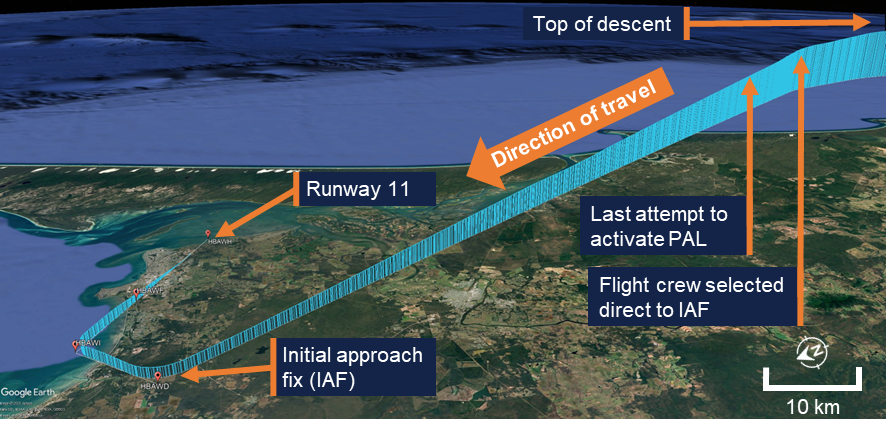
As the aircraft approached the top of descent (TOD), air traffic control provided clearance for the crew to track direct to the initial approach fix (IAF)3 for the RNAV approach,4 for runway 11 at Hervey Bay. The flight crew had the autopilot engaged, and commenced descent at about 1325.
At about 1328 while the aircraft was descending, the crew selected DIR TO (direct to)5 the IAF in the flight management system (FMS)6. This action was to direct the autopilot to track to this position at which point the crew would commence the approach to land (Figure 1).
Figure 1: Flight path from top of descent
Source: Google Earth, annotated by the ATSB
During the descent, passing FL320, the PM attempted to switch on the aerodrome pilot activated lights (PAL)7 via the VHF COM 3 radio.8 The PM reported not hearing the aerodrome frequency response unit AFRU9 readback and attempting to activate PAL several times. Some of these unsuccessful attempts were attributed by the PM as being a result of the distance from the airport. On one or possibly 2 occasions, they heard a male voice responding which, at the time, the PM thought might have been from the AFRU readback and thought it said the airport lighting was on, but was unable to hear it clearly due to another concurrent radio call. The PF also heard this voice thinking it was the AFRU. The male voice was unexpected, as the PM recalled conducting the same flight previously and had recalled hearing a female voice on the AFRU readback. The PM reported they ultimately believed that the PAL had been successfully activated.
Recorded aircraft data showed the VHF 3 radio being keyed in 6 distinct sets of 3, 1‑second transmissions from 1326:34 (passing FL320) to 1330:22 (passing FL220), consistent with attempts to activate the AFRU but with a keying sequence that was no longer current at Hervey Bay (see Aerodrome information). As a result, unknown to the flight crew at the time, the PAL was not activated by any of the PM’s attempts. The PM reported that later, during the descent, the flight crew were dealing with several issues including managing the aircraft’s speed and descent rate as well as a potential traffic conflict, and forgot to try activating the lights again.
Final approach
After turning onto the final approach for the runway 11 RNAV approach at 1344 using Jetstar’s visual procedures (see Operator’s visual procedures for instrument approach), the crew observed and discussed that the profile of the aircraft appeared high, based on the visual aspect of the runway from the cockpit. However, the flight guidance shown on the instruments indicated that a normal programmed profile was being flown. At the time, the crew attributed their observation to a runway visual illusion.10
By this point the precision approach path indicator (PAPI)11 lights should have been visible to the flight crew, and active (lit) as part of the PAL. However, the flight crew observed that they were not activated. The PM reported being surprised by this as they had felt sure the lights had been activated. The PF felt it more important for the PM to focus on traffic and the radio than to try activating the PAL again.
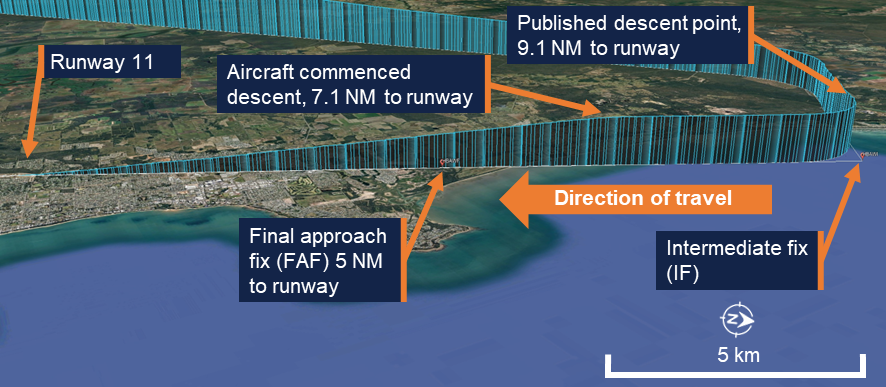
The aircraft levelled out at about 3,200 ft.12 The normal descent profile for this approach was 3° and commenced at the intermediate fix (IF), 9.1 NM (17 km) from the runway. The aircraft passed this point at about 1343:53. Flight data indicated that the aircraft commenced the approach descent from 3,000 ft at about 1345:00, when 7.1 NM (13 km) from the runway. Unknown to the flight crew, this resulted in the flight management system (FMS) generating an approach angle of greater than 4° (Figure 2; also see Vertical guidance temporary abnormal behaviour). The steep approach profile resulted in a high vertical speed. The landing gear was extended at about 2,000 ft.
Observing the high vertical speed, the flight crew used speed brake13 to reduce the aircraft’s energy (see Recorded data) and the aircraft slowed to the maximum speed with flaps fully extended (VFE) when passing 1,070 ft.
Figure 2: Flight path on final approach
Source: Google Earth, annotated by the ATSB
Jetstar’s stabilised approach requirements (see Stabilised approach criteria) involved checks at 2 points during approach. These checks each required the PM to identify and then verbalise that the stabilised approach criteria have been satisfied.
The PM believed the criteria had been met and recalled that they called ‘configured’ at 1,000 ft height above aerodrome at about the same time that full flap was selected. The recorded data showed that the crew selected the next stage of flap when passing 1,000 ft, and then full flap at about 800 ft (see Recorded data).
The PM recalled making a ‘stable’ call at about 500 ft. Between 1,000 ft AAH and 500 ft the aircraft had high vertical speeds, and the PM subsequently made an ‘exceedance call’ to the PF. The PF responded to this vertical speed exceedance call by disconnecting the autopilot at 338 ft and adjusting the vertical speed.
The PF landed at 1348 with a touchdown loading of 1.55 g, which exceeded the threshold for further assessment by Jetstar’s flight data analysis programme but did not exceed the threshold for maintenance action.
The crew conducted a post-occurrence review on the ground due to the aircraft’s behaviour seeming strange, and the crew being uncomfortable with the approach. This included reviewing the current NOTAMs14 (specifically in relation to the amended procedure15 for activating the PAL), and successfully testing the PAL including hearing a female voice as the readback. The PM subsequently realised the PAPI was not activated due to them not having keyed the PAL in the way indicated by the NOTAM. The crew confirmed that the QNH16 for the airport matched the QNH they used for the approach.
The flight crew also discussed the guidance system’s behaviour after the occurrence, recalling that there was information in the aircraft manuals about the DIR TO scenario but could not recall any specifics. They reported realising what the problem was only when reviewing the aircraft manuals and seeing the temporary abnormal behaviour (TAB) list (see Temporary abnormal behaviour (TAB)).
Context
Flight crew information
Captain
The captain held an Air Transport Pilot Licence (Aeroplane) and a class 1 aviation medical certificate. They had 14,460 hours of flying experience, of which 7,500 hours were on the Airbus A320. They had flown 184 hours in the previous 90 days.
First officer
The first officer held a Commercial Pilot Licence (Aeroplane) with a class 1 aviation medical certificate. They had 1,024 hours of flying experience, of which 809 hours were on the Airbus A320. They had flown 231 hours in the previous 90 days and had been checked to line by Jetstar since November 2024.
Aerodrome information
Approach profile to runway 11
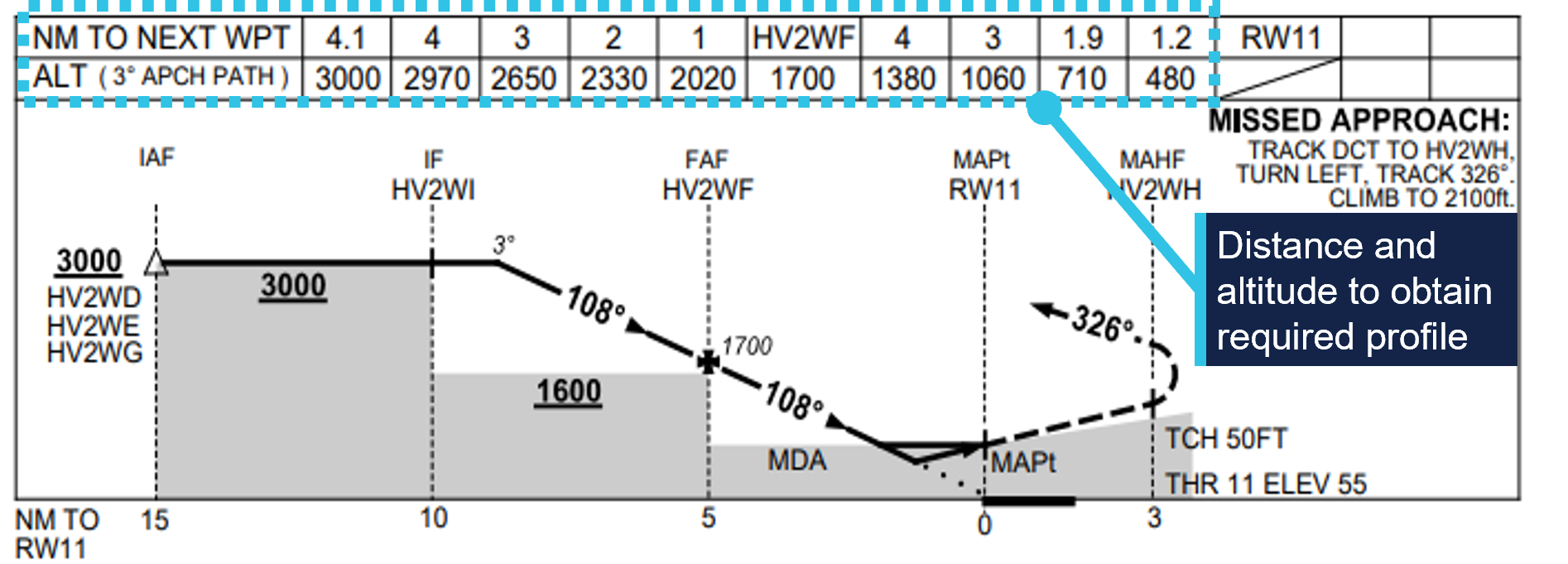
Hervey Bay Airport is a non-controlled, certified aerodrome consisting of a 2,000 m long and 30 m wide runway orientated 11/29. The approach profile for runway 11 is 3° and is published on the relevant approach chart (Figure 3).
Figure 3: Published approach profile
Source: Airservices Australia, annotated by the ATSB
Pilot-activated lighting (PAL)
The airport had a pilot-activated lighting system (PAL) that was used to activate the aerodrome lighting, including approach lights, runway edge lights, and taxiways. The precision approach path indicator (PAPI) lights provide visual descent guidance to pilots during the final approach to help determine if the aircraft is above or below the normal 3° approach profile. The PAPI consist of 4 high‑intensity light beams with coloured filters: 2 red and 2 white lights visible indicate that the aircraft is on the correct approach profile.
The daily serviceability inspection of the aerodrome lighting system was carried out by the airport reporting officer17 on the morning of the occurrence. The lighting system, including the PAPI, was reported to be serviceable.
At dusk, all lights become active when the PAL is activated. During the daytime, only the PAPI becomes active.
To activate the PAL, a pilot selects the press-to-talk switch (of the aircraft VHF radio) keying a set pattern of transmission. The instructions to activate the PAL were contained in the ERSA18 and required 3, 1‑second transmissions on the frequency 122.8 MHz.
Flight crews are required to review NOTAMs during flight preparation. On 9 August 2025, a NOTAM was had been issued (and was still current on 11 August) with amended instructions to activate the PAL, requiring the pilot to make 3, 3‑second transmissions, on 122.8 MHz. The flight crew did not recall seeing this NOTAM.19
The PM stated in interview that they realised when reviewing the NOTAMs after the flight that they probably used the wrong keying method. As stated in The occurrence, recorded aircraft data showed the VHF 3 radio being keyed in 6 distinct sets of 3, 1‑second transmissions from 1326:34 to 1330:22 (Table 1).
Table 1: Attempts to activate PAL
| Time | Approximate altitude |
| 1326:34 | FL320 |
| 1326:45 | FL320 |
| 1328:12 | FL280 |
| 1328:25 | FL270 |
| 1328:51 | FL260 |
| 1330:22 | FL220 |
Aircraft information
Auto flight system architecture and basic operation principles
Flight in the A320 is extensively managed via the flight management guidance system (FMGS). The FMGS is an integrated system that includes the flight management system (FMS), autopilot and flight directors, as well as engine auto thrust and navigational sensors.
Flight and aircraft information is interfaced, calculated, manipulated and presented via the flight management guidance computer (FMGC), multi-function control and display unit (MCDU)20 and presented on the primary flight display (PFD) and navigational display (ND).
With the autopilot engaged the aircraft will fly the relevant lateral and vertical profile dictated by the auto flight system. During descent the system indicates any vertical deviation from the computed descent profile on the pilot’s instruments (PFD and MCDU).
Information displayed to the flight crew
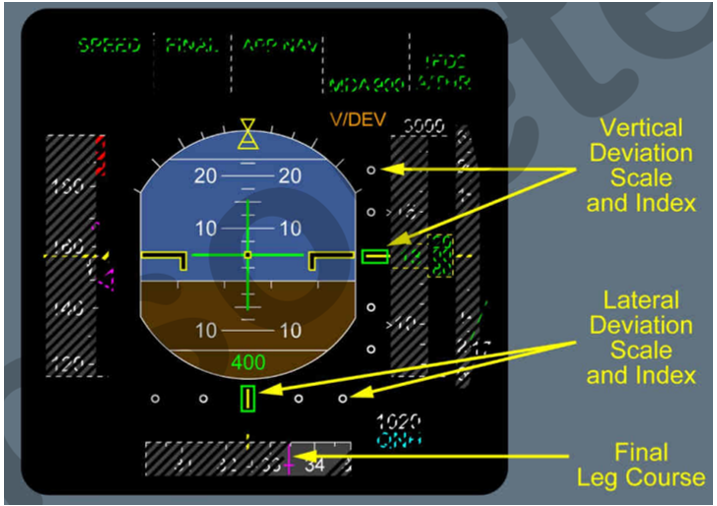
The information used by the flight crew during the approach would have been predominantly through the PFD, which had an indication of the vertical and lateral profile being flown (Figure 4). The aircraft’s ND and MCDU in the flight deck can be set to show the distance to the runway in the current programmed flight plan.
Figure 4: Primary flight display on A320
Source: Airbus
In this occurrence, the PF reported the vertical and lateral deviation indicator was in the expected location on the PFD, to indicate that there was no deviation from the datum (slope and track).
Temporary abnormal behaviour (TAB)
Documented temporary abnormal behaviours
In Airbus terminology, temporary abnormal behaviour (TAB) is a system behaviour that temporarily deviates from the intended system design. Any TABs affecting Jetstar A320 or A321 aircraft were documented in the Jetstar Airways A320/A321 Flight crew operating manual (FCOM) to provide information for pilots to recognise, understand and account for the abnormal behaviour. Flight crews are required to be familiar with any TABs applicable to the aircraft they are operating.
At the time of the occurrence, the TAB section of the FCOM listed 23 temporary abnormal behaviours for the aircraft’s auto flight system, and 16 associated with other aircraft systems such as radio communications, cabin pressure and weather radar systems. Each had a description, and many had an associated procedure or operational recommendations for avoidance or mitigation. Due to differences in equipment configuration, most TABs applied to some, but not all, of Jetstar’s A320 and A321 fleet.
The captain advised the ATSB that this flight was their first time observing this particular TAB.
Vertical guidance temporary abnormal behaviour
Airbus had identified some years prior to the occurrence that certain A320 FMS software versions, including the ‘H2C standard’ on the occurrence aircraft, contained an anomaly where erroneous descent and approach calculations could be triggered when a DIR TO was selected at TOD.
Airbus advised that, in this occurrence, the FMS used an erroneous (higher) true airspeed value, leading to an erroneous (longer) calculated track length. Figure 5 shows the intended, correct, descent profile (shown in green). In this figure, the incorrect profile calculated by the FMS is shown in red, and the aircraft’s actual path in blue. Throughout the descent, the FMS was calculating the intended vertical guidance (altitude) based on the aircraft’s distance to the runway, but the actual distance to the runway was shorter at any given time. This made the actual approach profile generated by the FMS steeper. Airbus stated the FMS ‘computed an incorrect vertical profile with a slope (−4.35°) greater than the one requested by the chart (−3°), and consequently the autopilot guided the aircraft on the incorrect profile.’
Figure 5: Relationship of profile expected vs constructed vs flown
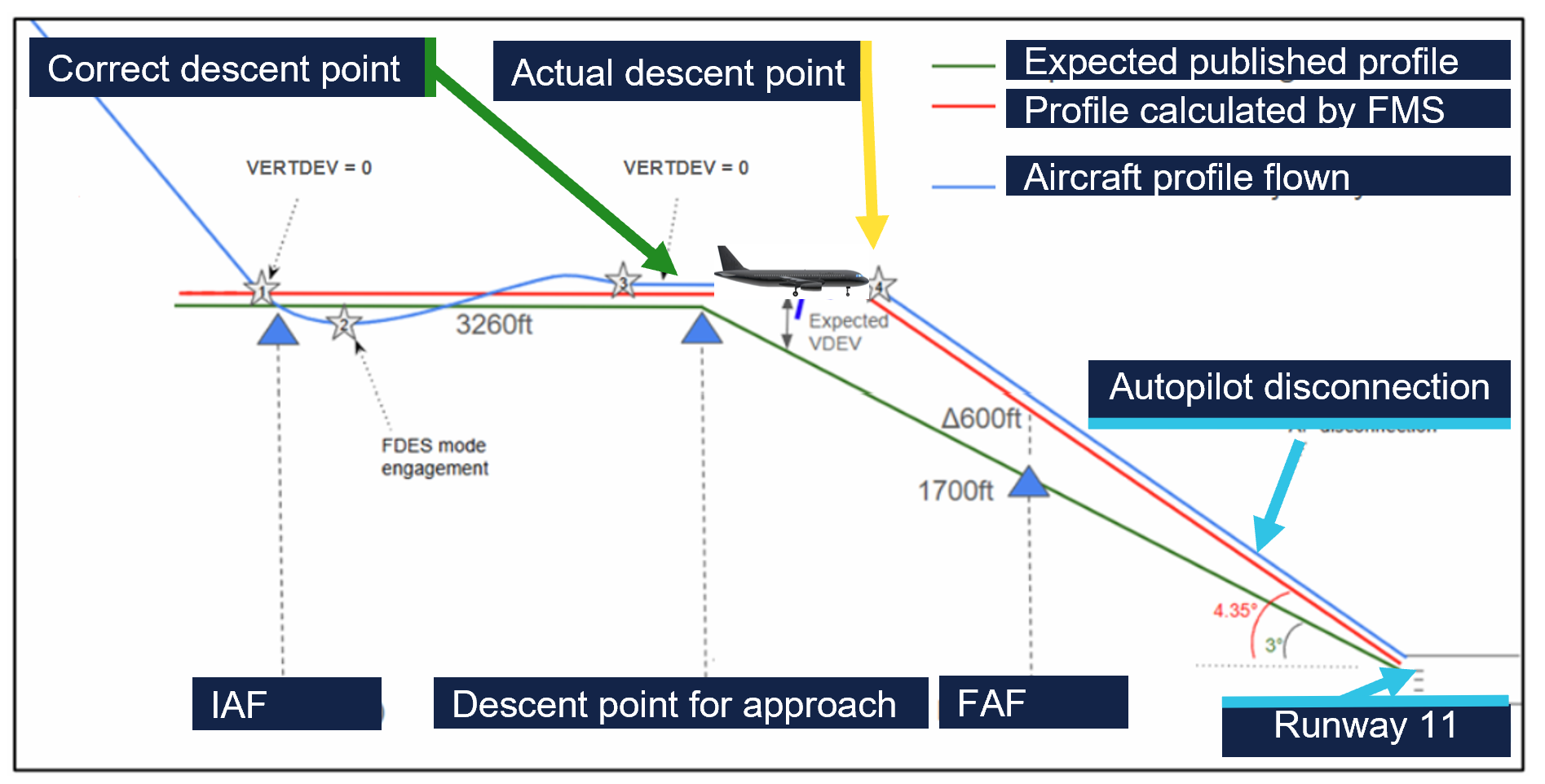
Not to scale. VERTDEV and VDEV: vertical deviation. FDES: Autopilot vertical mode change. Source: Airbus, annotated by the ATSB
The FCOM procedure for flight crew to address this TAB issue was documented in Jetstar’s A320/A321 FCOM. The TAB issue affected almost all A320s and A321s in the Jetstar fleet. The applicable FCOM section is shown in Figure 6.
Figure 6: Procedure addressing abnormality
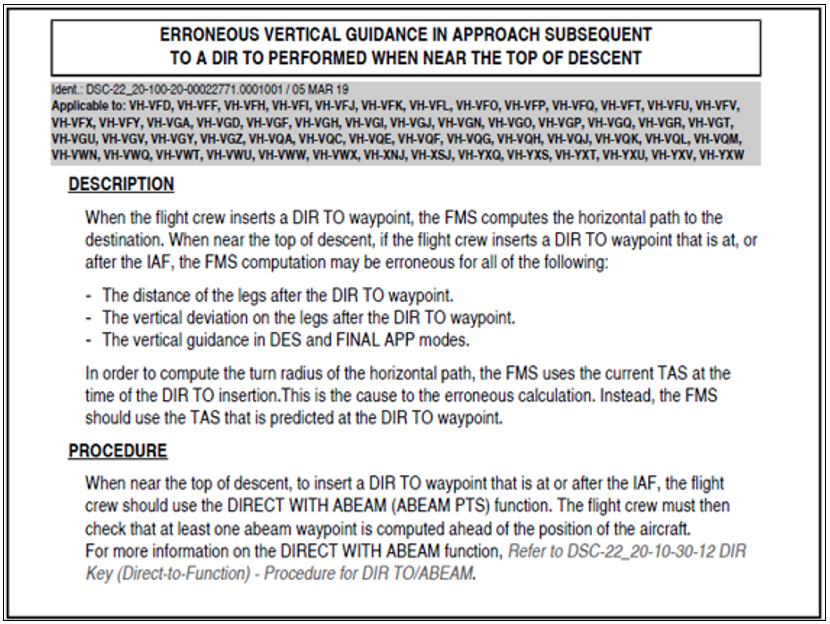
Source: Jetstar
The flight crew of VH-VQL reported that they had read about this TAB, but they did not identify the TAB and the subsequent procedure at the time of the occurrence.
Updated software
Airbus had provided an update to the FMGC software from the H2C standard, to the H3C standard software, which corrected the TAB that was a factor in this occurrence. This update was available to operators as an optional safety enhancement via Service Bulletin SB A320-22-1715 from December 2020 onwards. There was no airworthiness directive associated with this update.
Jetstar advised the ATSB that it had considered the service bulletin when it was issued but the decision was made at the time to await, and then update directly to, the H4 standard (with additional enhancements), which was expected to become available in 2021/22. However, Airbus advised Jetstar in 2024 that the certification process of the H4 standard had ceased, with a newer H5 standard still in development at the time of writing. Jetstar’s decision not to update to the H3 standard was mainly predicated on:
- the cost and risk associated with the need to adapt the navigation database to be compatible with the newer standard, and
- configuration management problems experienced following the delivery of Airbus A321s with the H4 standard in 2022, which required a different navigation database to the current aircraft with the H2C standard.
Jetstar instead decided to retain the H2C standard, so that there were only 2 FMGC standards and 2 navigation databases instead of the 3 that would have resulted had the H3 standard been incrementally rolled out across the A320 fleet, until the problems with configuration management could be resolved.
Jetstar procedures
Operator’s visual procedures for instrument approach
The actions of the crew can vary depending on if the pilots are conducting the approach using Jetstar’s visual or instrument procedures.
When the flight crew use an instrument approach procedure for flight path guidance, but nominate or transition to visual procedures, the stable approach requirements remain unchanged.
When visual procedures are nominated, any remaining instrument procedure calls are cancelled, and only standard approach calls need to be made.
When conducting some types of instrument approach, the flight crew are required to conduct a check confirming the approach profile at the final approach fix (FAF).21 It would include a comparison of the aircraft’s height and distance to the runway, with the published height and distance. The check mitigated risks on approach, such as false glideslope capture and erroneous indications. However, the FAF height check was not required under visual procedures.
Stabilised approach criteria
A stabilised approach is one where an aircraft maintains a constant descent to the runway while other key flight parameters such as airspeed and aircraft configuration are controlled within specific ranges. An approach is stable when all the stabilisation criteria specified by the operator are met.
The FCOM required that all approaches be configured and stabilised in accordance with the following requirements:
By 1,000 ft HAA:
1. Established on the correct lateral and vertical flight path, with only small changes to required bank angle and pitch needed to maintain the path;
2. Configured with the planned landing flap extended and gear down;
3. Sink rate not greater than 1,000 fpm;
4. Thrust setting appropriate to achieve and/or maintain the approach speed;
5. All briefings completed.
In addition, by 500 ft HAA:
1. Airspeed not more than speed target +10 kt and not less than the speed target -5 kt;
2. Landing checklist completed.
…
Note: Momentary excursions of speed and sink rate limits are permitted provided they are immediately corrected.
…
The PM shall call “Not Configured” at 1000 ft if the aircraft is not in the intended landing configuration, or if below 1000 ft it is identified that the incorrect landing flap setting has been mistakenly selected.
The PM shall call “Not Stable” at or below 500 ft if:
1. All checklists have not been completed; or
2. The aircraft is not configured for the planned landing; or
3. The PM observes a sustained exceedance of an approach tolerance; or
4. The PF fails to correct the aircraft’s flight path following the calling of an approach tolerance or exceedance.
At any time the listed stable criteria are not met or cease to be met below 1000 ft HAA or the PM calls “Not Configured” or “Not Stable” then the PF is required to initiate a go-around or missed approach.
Note: Speed brake deployment or activation of the flap load relief system below 1000 ft HAA constitutes an unstable approach as the landing configuration has been compromised and a go-around or missed approach must be conducted.
The FCOM encouraged flight crews to ‘perform a missed approach whenever any doubt exists to the safe continuation of an approach and landing.’ The policy stated that a missed approach (or a go-around) that is carried out as a conservative and defensive measure, will not result in disciplinary action.
ATSB flight data analysis identified the following exceedances of the stabilised approach criteria (see also Recorded data):
- The flap selector was moved to full flap at about 800 ft (about 12 seconds after passing 1,000 ft), and the flaps did not reach the full extended position until about 730 ft.
- The speed brake was used between about 1,270 ft and 820 ft (the lower limit was 1,000 ft).
- Vertical speed remained above 1,000 fpm (the upper limit) until about 800 ft.
- Vertical speed exceeded the upper limit again for a period of about 15 seconds from about 640 ft to about 350 ft (averaging 1,188 fpm during this period and peaking at 1,320 fpm). There were further brief (less than 2-second) exceedances, at 290 ft and 243 ft.
Both flight crew reported they recognised the high vertical speed on approach and believed that the exceedances could be controlled by 1,000 ft. They did not disclose any awareness of other exceedances.
The flight crew both advised the ATSB that they were uncomfortable and considering go‑around (missed approach) options during the approach. They were aware that some parameters were approaching or had gone beyond the stabilised approach criteria, but considered these to be momentary.
The PM recalled that towards the end of the approach they felt ‘extremely uncomfortable’ in retrospect. The PM recalled advising the PF that the vertical speed was high by making advisory vertical speed awareness calls, at around 2,000 ft. The PM made an exceedance call when the vertical speed was greater than 1,000 fpm, between 1,000 ft and 500 ft; the PF acknowledged and reduced the vertical speed. The PM reported hesitating before the 500 ft call because of the vertical speed, but both crew reported that while the vertical speed was above the criteria limit, they thought it was not excessively high and they both thought the PF was getting it under control. The PM commented in interview that they believed they had until 500 ft to meet the vertical speed requirement of the stabilised approach.
The PF recalled being mentally ‘overloaded’ shortly before the landing. The PM recalled experiencing a brief period of significantly reduced mental capacity shortly after passing 500 ft, while considering whether the PM should have called for a missed approach.
Recorded data
The ATSB conducted analysis of the recorded flight data applicable to the occurrence (Figure 7). Flight data analysis showed the profile for this approach was steeper than that of a normal approach. This was due to the aircraft commencing its descent from 3,000 ft at 7.1 NM (13 km) from the threshold (2.1 NM [4 km] from the FAF) instead of the published 9.1 NM (17 km) from the threshold (Table 2). Between the FAF and landing, the approach angle averaged around 4.5°, with a maximum recorded value of 5.36°. As shown in the table, the aircraft was well above the expected altitude for the entire approach from the IF (9.1 NM [17 km] from the runway) onwards.
Table 2: Approach profile data from the intermediate fix to landing
| Distance to next waypoint (NM) | Distance to runway threshold (NM) | Barometric corrected altitude (ft) | Altitude expected for approach (ft) | Difference (ft) |
| 4.1 (at IAF) | 9.1 | 3,253 | 3,000 | 253 |
| 4.0 | 9.0 | 3,253 | 2,970 | 283 |
| 3.0 | 8.0 | 3,240 | 2,650 | 590 |
| 2.0 | 7.0 | 3,214 | 2,330 | 884 |
| 1.0 | 6.0 | 2,794 | 2,020 | 774 |
| (at FAF) | 5.0 | 2,321 | 1,700 | 621 |
| 4.0 | 4.0 | 1,823 | 1,380 | 443 |
| 3.0 | 3.0 | 1,383 | 1,060 | 323 |
| 1.9 | 1.9 | 960 | 710 | 250 |
| 1.2 | 1.2 | 609 | 480 | 129 |
| (Runway 11) | 0.0 | --- | --- | --- |
Figure 7: Occurrence flight data showing approach angle
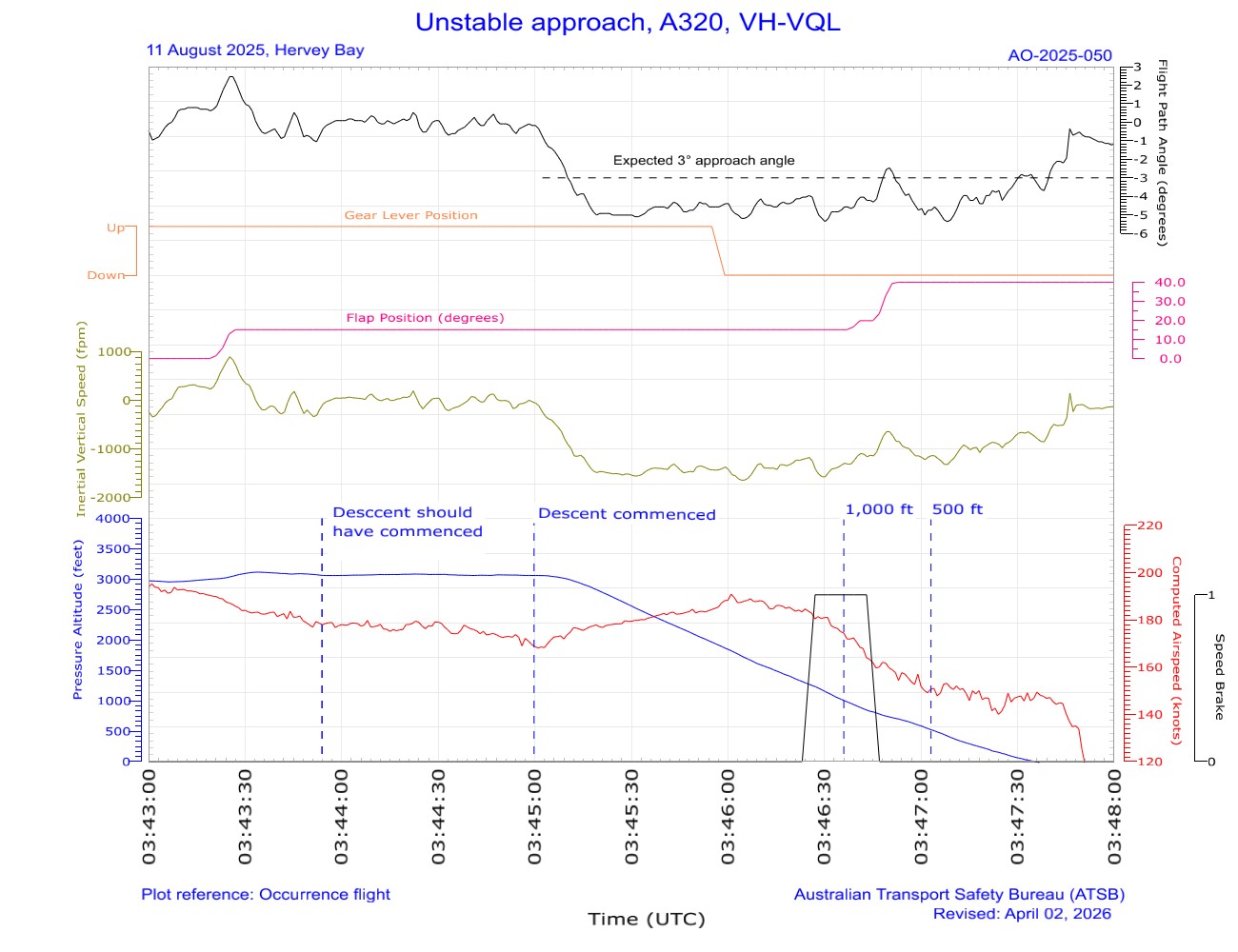
Source: ATSB
Runway visual illusion
If a runway is either wide or narrow it can present a visual illusion to the pilots. A final approach to a narrow runway may produce the visual illusion of being high. The below illustration shows an aircraft on a 3° profile (Figure 8) (Flight Safety Foundation , 2000). The visual perspective shows a contrast between 3 different pilot views:
- perspective ‘A’ is for a 45 m wide runway
- perspective ‘B’ is a wider runway
- perspective ‘C’ is a narrower runway.
Figure 8: Runway with affecting approach perception
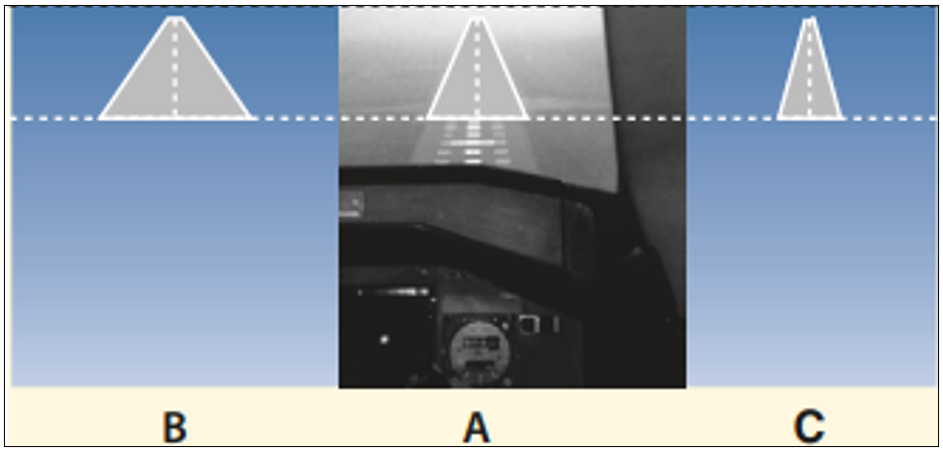
Source: Flight Safety Foundation
A 45 m wide runway is standard for an air transport aircraft. The runway at Hervey Bay Airport was 30 m wide.
The perspective seen for a narrower runway on the 3° profile appears further away, and so is similar to the perspective seen by a pilot of a normal width runway when above the 3° profile.
Safety analysis
Erroneous vertical guidance
The Jetstar A320/A321 flight crew operating manual (FCOM) contained information related to the flight management temporary abnormal behaviours (TAB). This included that a number of flight management system (FMS) computations, including vertical guidance, could be erroneously generated if pilots execute the DIR TO (direct to) function when close to top of descent.
The flight crew forgot about the TAB and FCOM procedure at the time of the occurrence. As a result, they engaged the DIR TO function at a time that doing so was known to trigger the TAB, resulting in the FMS almost certainly computing an erroneously high descent rate and steep approach path.
However, the crew did not recognise this as an initial indication of an erroneous calculation of the descent profile by the FMS. The vertical path, for both the descent and approach, was displayed to the flight crew via the PFD and would have indicated they were following the correct profile. However, the actual profile being flown did not correlate with the published approach path.
Flight crews are required to be familiar with any TABs applicable to their aircraft, and there were 38 TABs listed in the FCOM. The flight crew reported that they had previously been aware of the existence of this TAB, but the captain reported they had never experienced this particular TAB before.
Availability of updated software
Airbus had made an optional, updated software standard (version) available to address the TAB in December 2020. There was no airworthiness directive associated with this update. Jetstar had considered the service bulletin when it was issued, but for various reasons decided to wait for the next standard to be made available, which was expected at the time to be in 2021/22. Ultimately, however, this newer standard did not become available, and Jetstar’s 2020 decision not to implement the available standard was not revisited in the interim. As a result, Jetstar continued to rely on a procedural control to avoid the software issue at the time of the occurrence for nearly 5 years.
Approach lighting not activated
Precision approach path indicator (PAPI) lights are a useful tool available for flight crews to verify their approach profile. As the aircraft approached Hervey Bay Airport the PM attempted to activate the PAPI lights through the pilot‑activated lighting (PAL) system. Numerous attempts were made by the PM to activate the PAL while on descent. The PM recognised that they were unsuccessful, however, they attributed the unsuccessful attempts to being too far away from the airport. The PM also thought that they heard the AFRU readback say that the airport lighting was on. The PM ultimately believed that the PAL had been successfully activated.
However, the PAPI lights were serviceable but were not activated because the PM used a keying sequence that was no longer current at Hervey Bay as per the NOTAM. The flight crew were required to review the NOTAMs as part of their flight preparation, but it is likely that this NOTAM was overlooked.
Flight path monitoring
During the final approach to land, the flight crew were presented conflicting information between the electronic vertical guidance and the runway visual profile. The absence of PAPI approach guidance meant it was more difficult to visually confirm that they were correctly flying the intended approach. Pilots who fly by instrument flight rules (IFR) procedures are trained and conditioned to rely heavily on their aircraft’s instruments and navigation systems rather than visual cues from the environment. The FAA Instrument Procedures Handbook (Federal Aviation Administration, 2017) noted:
The pilot must trust the flight instruments concerning the aircraft’s attitude regardless of intuition or visual interpretation.
The pilots correctly recognised and discussed that the aircraft appeared to be high on profile when visually observing the runway. However, the information presented to the pilots via the instruments indicated that the aircraft was following the correct vertical path. The pilots continued to believe the aircraft was on the correct profile based solely on the indications from the PFD and did not attempt to verify it using other sources.
Conflicting information has been shown to have deleterious effects on decision‑making including reduction in accuracy of decisions, longer decision times and less confidence that the decision was correct (Carroll, Sanchez, & Wilt, 2021). In this case, the cues used to judge the aircraft’s vertical flight path were conflicting, erroneous, and/or absent.
The crew rationalised their observation believing it to be a result of a runway visual illusion: they knew a narrow runway could make the correct approach seem too high, and so didn’t realise that it actually was too high.
The absence of PAPI guidance removed an additional mechanism for approach profile verification by the pilots. The aircraft’s high vertical speed should have also indicated a deviation from the normal approach profile.
The FAA Instrument Procedures Handbook (Federal Aviation Administration, 2017) suggests that crossing the FAF at the published altitude is often a critical component of a successful approach. As the approach was conducted using visual procedures, the flight crew were not required to conduct a height check at the FAF, thus removing an opportunity to identify the erroneous electronic vertical guidance caused by the TAB at that point of the approach. Standard rules of thumb are also available to help in determining their approach profile, such as checking that the aircraft’s height above the runway should be 300 ft for every nautical mile to the runway, or multiplying groundspeed in knots by 5 to estimate the correct descent rate in feet per minute (Skybrary 2021). The flight crew did not perform any of these secondary checks of the flight profile after realising that they were receiving conflicting information.
Exceedance of the stable approach criteria
The key altitudes of 1,000 ft height above aerodrome (HAA) and 500 ft HAA were the critical points for determining if the approach is stable. Both flight crew have responsibility to call exceedances at or after these points, particularly the PM whose main role it is to monitor flight parameters. Elements of the stable approach criteria (requiring flaps to be fully extended, speed brake not deployed below 1,000 ft, and vertical speed to be under 1,000 fpm) were not met at the 1,000 ft check. This constituted an unstable approach (requiring a missed approach) and was not fully recognised by the flight crew. Most notably, the vertical speed was above 1,000 fpm for 15 seconds either side of the 500 ft call.
Both flight crew were aware that some parameters were approaching or had gone beyond the stabilised approach criteria, but considered these to be brief and/or transitory. The PM hesitated before making the 500 ft call, but thought the vertical speed was not excessively high and both flight crew thought the PF was getting it under control. The flight crew continued, probably not fully recognising these deviations in the dynamic, time-compressed situation with a high workload.
A higher than normal cognitive workload was a result of the aircraft flying a steeper than usual approach that required a high vertical rate of descent and the use of speed brake to manage the aircraft’s energy. It also seemed strange to the flight crew, based on their understanding that a normal 3° profile was being flown. The information observed by the flight crew (normal profile) conflicted with the outcome (difficulty managing aircraft energy from steep approach) resulting in a high cognitive workload and reduced capacity to recognise the situation and initiate a missed approach.
Ultimately, the exceedances were not detected and a missed approach was not called for, likely due to a combination of factors including:
- the high cognitive workload being experienced by the flight crew
- the flight crew misjudging some of the deviations as being marginal or momentary
- the PM’s understanding at the time that the vertical speed only needed to meet the stabilised approach requirement at 500 ft
- the PM having called the vertical speed exceedance (notifying the PF) and the descent rate subsequently being reduced.
Recognition of multiple unusual or marginal aspects of the approach
While on descent and approach the flight crew were presented with, and likely aware of, multiple indications that the approach was unusual:
- auto flight system delaying descent during the approach
- PAPI lights not being activated
- the need for speed brake use on final approach to manage speed
- high vertical speed throughout the approach
- delayed descent just prior to commencing the final approach
- several 1,000 ft AAH configuration requirements being close to, or beyond, the limit
- 500 ft AAH configuration requirements being above the limit.
It can be challenging for flight crews to recognise the point at which multiple individually minor issues start to become serious. The flight crew indicated they felt a level of discomfort (the PM describing it as ‘extremely uncomfortable’) that the approach was not proceeding as intended but did not identify any clear ‘red flags’ that would have prompted them to initiate a go-around. Individually these abnormal aspects, or ‘yellow flags’ may not constitute a threat, but collectively formed an indication of a situation that was drifting towards unsafe territory, which the flight crew likely did not completely recognise at the time.
One way to address discomfort is to voice concerns as part of crew resource management. Monitoring and calling exceedances, however slight, can help both flight crewmembers recognise a deteriorating situation. Once acknowledged, concerns can be assessed and corrective actions discussed between crewmembers.
Findings
ATSB investigation report findings focus on safety factors (that is, events and conditions that increase risk). Safety factors include ‘contributing factors’ and ‘other factors that increased risk’ (that is, factors that did not meet the definition of a contributing factor for this occurrence but were still considered important to include in the report for the purpose of increasing awareness and enhancing safety). In addition ‘other findings’ may be included to provide important information about topics other than safety factors. These findings should not be read as apportioning blame or liability to any particular organisation or individual. |
From the evidence available, the following findings are made with respect to the unstable approach involving Airbus A320, VH-VQL, at Hervey Bay Airport, Queensland, on 11 August 2025.
Contributing factors
- The flight crew selected DIR TO (direct to) the initial approach fix into the flight management guidance system near top of descent which, due to a known software issue not remembered by the flight crew at the time, almost certainly resulted in erroneous vertical guidance being computed.
- Jetstar had deferred an optional safety enhancement (software update) to correct the issue in the A320 fleet flight management system, in order to await a newer update that ultimately did not become available. As a result, for nearly 5 years Jetstar continued to rely on a procedural control that was subject to human factors limitations.
- The pilot monitoring used the incorrect, outdated radio keying sequence to activate the pilot activated lighting (PAL) system at Hervey Bay, rather than the sequence published in the relevant notice to airmen (NOTAM).
- The flight crew did not identify that the aircraft had deviated from the normal approach profile, partly due to being presented with erroneous vertical guidance and the absence of precision approach path indicator (PAPI) lighting.
- On approach to land, the flight crew likely did not fully recognise multiple exceedances of the stable approach criteria, or erroneously considered some exceedances to be momentary.
- The flight crew continued the approach without clearly voicing or acting on their concerns after perceiving indications that multiple aspects of the approach were unusual or marginal.
Safety actions
| Whether or not the ATSB identifies safety issues in the course of an investigation, relevant organisations may proactively initiate safety action in order to reduce their safety risk. All of the directly involved parties are invited to provide submissions to this draft report. As part of that process, each organisation is asked to communicate what safety actions, if any, they have carried out to reduce the risk associated with this type of occurrences in the future. |
Safety action by Jetstar Airways
Jetstar advised that it would be updating its A320 fleet to the H3 software standard, which resolves the temporary abnormal behaviour (TAB) relevant to this occurrence.
Jetstar published an internal newsletter to flight crew in November 2025 to provide further education and awareness to all Jetstar Airbus pilots of the TAB that was a factor in this occurrence.
Sources and submissions
Sources of information
The sources of information during the investigation included:
- flight crew
- Jetstar Airways
- Hervey Bay Airport
- Civil Aviation Safety Authority
- Airbus
- Airservices Australia
- Bureau of Meteorology
- recorded data from the aircraft.
References
Carroll, M., Sanchez, P., & Wilt, D. (2021). Recommended Training Practices to Prepare Pilots to Cope with Information Conflicts. Wright State University.
Federal Aviation Administration (2017). Instrument Procedures Handbook, U.S. Department of Transport.
Flight Safety Foundation (2000). FSF ALAR Briefing note 5.2 Visual Illusion. Flight Safety Digest.
SKYbrary Aviation Safety (2021). Rules of Thumb. https://skybrary.aero/articles/rules-thumb. Accessed 1 April 2026.
Submissions
Under section 26 of the Transport Safety Investigation Act 2003, the ATSB may provide a draft report, on a confidential basis, to any person whom the ATSB considers appropriate. That section allows a person receiving a draft report to make submissions to the ATSB about the draft report.
A draft of this report was provided to the following directly involved parties:
- flight crew
- Jetstar Airways
- Civil Aviation Safety Authority
- French Bureau of Enquiry and Analysis for Civil Aviation Safety (BEA)
- Airbus.
Submissions were received from:
- the captain
- the first officer
- Jetstar Airways.
The submissions were reviewed and, where considered appropriate, the text of the report was amended accordingly.
Purpose of safety investigationsThe objective of a safety investigation is to enhance transport safety. This is done through:
It is not a function of the ATSB to apportion blame or provide a means for determining liability. At the same time, an investigation report must include factual material of sufficient weight to support the analysis and findings. At all times the ATSB endeavours to balance the use of material that could imply adverse comment with the need to properly explain what happened, and why, in a fair and unbiased manner. The ATSB does not investigate for the purpose of taking administrative, regulatory or criminal action. About ATSB reportsATSB investigation reports are organised with regard to international standards or instruments, as applicable, and with ATSB procedures and guidelines. Reports must include factual material of sufficient weight to support the analysis and findings. At all times the ATSB endeavours to balance the use of material that could imply adverse comment with the need to properly explain what happened, and why, in a fair and unbiased manner. An explanation of terminology used in ATSB investigation reports is available here. This includes terms such as occurrence, contributing factor, other factor that increased risk, and safety issue. Publishing informationReleased in accordance with section 25 of the Transport Safety Investigation Act 2003 Published by: Australian Transport Safety Bureau © Commonwealth of Australia 2026 
Ownership of intellectual property rights in this publication Unless otherwise noted, copyright (and any other intellectual property rights, if any) in this report publication is owned by the Commonwealth of Australia. Creative Commons licence With the exception of the Commonwealth Coat of Arms, ATSB logo, and photos and graphics in which a third party holds copyright, this report is licensed under a Creative Commons Attribution 4.0 International licence. The CC BY 4.0 licence enables you to distribute, remix, adapt, and build upon our material in any medium or format, so long as attribution is given to the Australian Transport Safety Bureau. Copyright in material obtained from other agencies, private individuals or organisations, belongs to those agencies, individuals or organisations. Where you wish to use their material, you will need to contact them directly. |
- ^ Pilot flying (PF) is responsible for flying, while pilot monitoring (PM) monitors and supports the PF, and cross-checks their actions.
- ^ Cloud cover: in aviation, cloud cover is reported using words that denote the extent of the cover. ‘FEW’ indicates that up to a quarter of the sky was covered. ‘SCT’ indicates that approximately half of the sky was covered. The number following the descriptor is the altitude of the cloud base in feet.
- ^ The initial approach fix (IAF) is the point where the initial approach segment of an instrument approach begins.
- ^ An RNAV (area navigation) arrival is a procedure that allows an aircraft to fly a direct path to an airport using a combination of navigation systems, rather than being restricted to routes defined by ground-based beacons.
- ^ The pilot uses the direct to (DIR TO) function to define a direct leg from the present position to another position.
- ^ A flight management system (FMS) is an on-board multi-purpose navigation, performance, and aircraft operations computer. The FMS provides flight planning and navigational information, performance calculations and long-term guidance targets.
- ^ PAL is a system that allows aircraft pilots to control the lighting of an airport or airfield's approach lights, runway edge lights, and taxiways via radio.
- ^ The A320 is equipped with 3 VHF communication (VHF COM 1, VHF COM 2 and VHF COM 3) radios that can be used to monitor and transmit different frequencies independently.
- ^ Aerodrome frequency response unit: a radio transceiver which provides an automatic synthetic voice response when the pilot transmits on the traffic frequency (normally a CTAF) for a particular non-controlled aerodrome. In this case, the AFRU would additionally respond that the PAL had been activated.
- ^ Where the width and length of a runway can create an illusion of the aircraft being higher or lower than it is. At Hervey Bay Airport, the relatively long, narrow runway could give the impression that an aircraft is high on approach. See Runway visual illusion.
- ^ A precision approach path indicator (PAPI) is a system of lights on the side of an airport runway threshold that provides visual descent guidance information.
- ^ The aircraft initially overshot the intended levelling-out altitude, which Airbus later indicated was probably due to the flight crew’s vertical mode selection.
- ^ Speed brakes are secondary flight control surfaces that can be deployed manually by the pilot to increase drag. Aiding the pilot in managing speed and descent profiles.
- ^ Notice to airmen (NOTAM): A notice distributed by means of telecommunication containing information concerning the establishment, condition or change in any aeronautical facility, service, procedure or hazard, the timely knowledge of which is essential to personnel concerned with flight operations.
- ^ An amended procedure for the activation of the PAL was in force, and had been communicated via a NOTAM.
- ^ QNH: The pressure set on the subscale of the altimeter so that the instrument indicates its height above sea level. The altimeter will read runway elevation when the aircraft is on the runway. Incorrect QNH is a common cause of errors in RNAV approaches.
- ^ An aerodrome reporting officer (ARO) is responsible for maintaining the safety and functionality of airfield operations.
- ^ ERSA is a publication with flight planning info, including aerodrome details, and includes the Runway Distance Supplement (RDS) for take-off/landing data.
- ^ As stated in The occurrence, the PM recalled hearing the AFRU when flying into Hervey Bay prior to this occurrence. The ATSB did not obtain data on the keying sequence used, and concluded that the PM had probably used the correct sequence then.
^ The MCDU allows the pilots to input parameters and commands for the FMGC. These would include selection of lateral
and vertical trajectories such as selection directions to a waypoint and an approach to be flown.
- ^ The final approach fix (FAF) is a fix or point of an instrument approach procedure where the final approach segment commences.
Occurrence summary
| Investigation number | AO-2025-050 |
|---|---|
| Occurrence date | 11/08/2025 |
| Occurrence time and timezone | 13:45 Australian Eastern Standard Time |
| Location | Hervey Bay Airport |
| State | Queensland |
| Report release date | 16/06/2026 |
| Report status | Final |
| Investigation level | Short |
| Investigation type | Occurrence Investigation |
| Investigation status | Completed |
| Mode of transport | Aviation |
| Aviation occurrence category | Unstable approach |
| Occurrence class | Incident |
| Highest injury level | None |
Aircraft details
| Manufacturer | Airbus |
|---|---|
| Model | A320-232 |
| Registration | VH-VQL |
| Serial number | 2642 |
| Aircraft operator | Jetstar Airways Pty Limited |
| Sector | Jet |
| Operation type | Part 121 Air transport operations - larger aeroplanes |
| Activity | Commercial air transport - Scheduled - Domestic |
| Departure point | Sydney Airport, New South Wales |
| Destination | Hervey Bay Airport, Queensland |
| Injuries | None |
| Damage | Nil |