Ballooning tragedy

A tragic ballooning accident in the Northern Territory shows how quickly clothing entanglement in industrial equipment can cause a fatality.

AO-2013-116_Kavanagh.jpg

A tragic ballooning accident in the Northern Territory shows how quickly clothing entanglement in industrial equipment can cause a fatality.

On 13 July 2013 a Kavanagh E‑260 balloon was being prepared for a charter tourist flight near Alice Springs, Northern Territory. Due to the wind conditions at the time, the passengers were pre-loaded into the balloon basket as it lay on its side. As one of the passengers prepared to enter the basket, their scarf became entangled in a fan that was being used to inflate the balloon envelope. Consequently, the passenger was rapidly drawn into contact with the fan’s steel guard and the scarf was pulled tightly around their neck. Despite being provided with first aid, and subsequent medical treatment, the passenger died as a result of their injuries several days later.

The ATSB found that pre-loading of the passengers during the inflation process, although appropriate in the wind conditions, resulted in them coming into close proximity to the operating inflation fan. Additionally, the mesh and steel tubing guard positioned around the inflation fan was ineffective in preventing loose items of clothing from becoming entangled in the wooden fan blades and driveshaft. As a result, when the passenger approached the balloon basket in preparation for loading, their scarf was drawn into the fan blades, leading to fatal injuries.

The pilot conducted two safety briefings prior to the proposed flight that advised the passengers to remain clear of the fan as it was noisy and dangerous. A warning sign fitted to the fan was also pointed out. However, none of the passengers recalled that the specific danger of fan entanglement had been mentioned.

Shortly after this accident, the ATSB forwarded a Safety Advisory Notice (SAN) to balloon operators highlighting the circumstances of this occurrence and advising that they review their risk controls in relation to the safety of inflation fans. With the assistance of the Professional Balloon Association of Australia and the Australian Ballooning Federation (ABF) the SAN was also provided to their members. The ABF and Northern Territory (NT) WorkSafe also issued safety alerts highlighting the danger of fan entanglement.

The balloon operator made a number of changes to prevent a similar accident, including:

  • modification of all fan guards to reduce the likelihood of entanglement
  • establishment of a passenger exclusion zone in the vicinity of the fan
  • assignment of a crew member whose sole duty was to operate and supervise the fan
  • inclusion of detail on the danger of entanglement in the passenger briefing card.

Safety message

This accident highlights how quickly entanglement in industrial equipment, such as the inflation fan, can cause fatal injury. While highlighting the danger to those unfamiliar can reduce the risk, isolating the hazard through effective fan safeguarding and passenger control is the most effective method of preventing such tragic accidents.

Read the final report: Flight preparation event involving Kavanagh Balloons E-260, VH-FSR, near Alice Springs Airport, Northern Territory, on 13 July 2013

Axle bearing failure

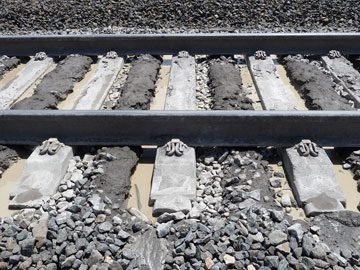
An axle bearing failure on a train wagon contributed to the derailment of a freight train near Hugh River in the Northern Territory on 23 December 2014.

Hugh River_train-2AD1.jpg

An axle bearing failure on a train wagon contributed to the derailment of a freight train near Hugh River in the Northern Territory on 23 December 2014.

The wagon, carrying distillate fuel, remained upright and there was some minor damage to the track (sleepers and rail clips). Fortunately, there were no injuries.

The ATSB found that the journal and bearing on the wagon seized and lost interference fit. This generated high levels of frictional heating between the bearing and axle journal, and the subsequent torsional shearing failure of the axle (a ‘screwed journal’). The axle failure immediately caused the leading axle of the trailing bogie to derail.

The ATSB concluded that a loss of lubrication or an internal bearing cage failure was the most likely contributor to the bearing breakdown and seizure. Evidence also suggested the breakdown developed relatively rapidly, given the absence of a positive fault detection from two bearing acoustic monitoring systems (RailBAM®) passed on the day of the occurrence.

Safety message

Bearing failures leading to derailment continue to occur within the Australian rail network. Rail operators must continue to be vigilant and ensure axle bearings, and in particular axle box type bearings, are correctly installed, maintained and monitored throughout their life.

Read the final report: Derailment of freight train 2AD1, near Hugh River, Northern Territory, on 23 December 2014

Unauthorised repairs

The ATSB found that an unauthorised, non-standard repair had been carried out on the axle ...

Rail_RO2014001_news.jpg

On 15 January 2014, a Sydney Trains service made up of two four-carriage Tangara electric multiple units entered the underground section of the Eastern Suburbs Line under Sydney city centre heading towards its destination, Bondi Junction.

Some smoke and a burning smell were apparent emanating from the train at Central station and at all subsequent stations to Bondi Junction. A number of station and train crewing staff were aware of this but the condition was not reported to the appropriate network control officer as required under Sydney Trains’ Network Rules and Procedures.

The train terminated at Bondi Junction where a different driver took control of the train before it departed on its return journey. It then travelled to the next station, Edgecliff.

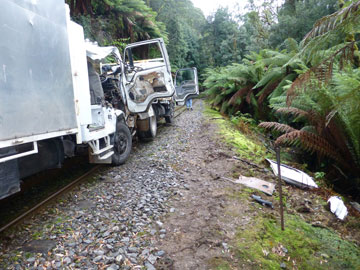
Shortly after departure from Edgecliff, at 1726, the lead bogie of the third carriage derailed due to a broken axle on the leading bogie of the third carriage. A piece of angle iron that became dislodged from the track infrastructure penetrated the floor of the third carriage and entered a space occupied by passengers. Fortunately, no passengers or train crew were injured.  

The ATSB found that an unauthorised, non-standard repair had been carried out on the axle in December 1998 or January 1999 which introduced stress initiators, causing a crack to develop which over time propagated to the extent that the axle failed in service.

It was also determined that a number of organisational factors contributed to the incident. Poor communication and lack of adherence to procedures and reporting lines after the first problems were noticed, led to the train continuing in service and subsequently derailing. 

Seven axles, including the failed axle, had been repaired in the same way. All were immediately located and removed from service.

Sydney Trains produced a number of safety recommendations which are being incorporated into their Safety Action Management procedures.

Safety message

Rail operators should ensure that maintenance procedures are followed and that non-standard repairs comply strictly with an approved variation and do not introduce new risks to operations.

Also, rail operators should review their internal training and communication pathways to ensure that critical communication can occur in line with best Rail Resource Management principles.

Read the final report: Derailment of Sydney Trains Passenger Train 602M, near Edgecliff station, Sydney, New South Wales, on 15 January 2014

Who’s in control?

A recent aviation incident involving a student pilot and instructor shows why it’s essential to have a positive exchange of flight controls during flight training.

A recent aviation incident involving a student pilot and instructor shows why it’s essential to have a positive exchange of flight controls during flight training.

The incident occurred when the student pilot and instructor were doing crosswind circuit training in a Victa 115 Airtourer. As the aircraft flared to land, a strong gust of wind blew it off the runway centreline to the left, and the aircraft bounced hard.

The student initiated a go-around, applying full power, but the aircraft still drifted further to the left. As the aircraft was not climbing, the instructor called “taking over” and the student handed over control. The instructor lowered the nose of the aircraft to gain airspeed.

The aircraft continued to drift further away from the runway centreline.

The student noticed the flaps were in the down position and, thinking it would assist, and without checking with the instructor, retracted the flaps to the up position.

There should never be any doubt about who is flying the aircraft.

The aircraft descended and about 100 metres past the threshold of the runway,it collided with the airport perimeter fence. After a further 20 metres, the aircraft flipped over the fence and came to rest upside down. The instructor and student exited the aircraft quickly through the broken canopy, as fuel was gushing from the fuel tanks. Both received minor injuries, and the aircraft was substantially damaged.

Source: Aircraft operator

Safety message

It is important in flight training to have a positive exchange of flight controls. The US Federal Aviation Administration (FAA) has found that numerous accidents have occurred due to a lack of communication or misunderstanding regarding who had actual control of the aircraft, particularly between students and flight instructors. The FAA publication Aviation Instructor’s Handbook(Opens in a new tab/window), includes a section on the Positive Exchange of Flight Controls. The handbook provides guidance to use for the positive exchange of flight controls

FAA positive exchange of flight controls

FAA positive exchange of flight controls

Source: US Federal Aviation Administration

Read the final report: Collision with terrain involving a Victa 115 Airtourer, VH-MUV, at Leongatha Airport, Victoria, on 29 May 2015

Aircraft Operations Investigation

The Accident Investigation Commission of PNG is seeking to recruit a suitable person for appointment to the position of Manager – Aircraft Operations Investigation.
  • This position is open to international candidates.
PNG_AIC_job_0.jpg

The Accident Investigation Commission of PNG is seeking to recruit a suitable person for appointment to the position of Manager – Aircraft Operations Investigation. 

The position is jointly co-funded by the Accident Investigation Commission and the Papua New Guinea – Australia Transport Sector Support Program, funded by the Australian Government.

The AIC was established in 2010 and is responsible for meeting PNG's accident investigation obligations under Annex 13 to the Chicago Convention on International Civil Aviation (ICAO Annex 13). This role is a critical position in leading the investigation into incidents and accidents in relation aircraft operations. The incumbent will lead a team of investigators and actively develop their skills along with the engagement and development of a team of cadet investigators as part of a structured Staff Development and Training Program.

This position is open to both qualified and experienced Papua New Guinea nationals and international candidates.

Key requirements for success in the role include:

  • comprehensive understanding and extensive experience in leading aircraft incident and accident investigations
  • significant experience as a pilot, aircraft engineer, or air traffic controller
  • coaching and mentoring skills to develop the AIC's national investigators
  • proficiency in the English language
  • good communication skills.

A copy of the job description for the role and details of the remuneration package are available by contacting Mrs. Arlene Pitil at apitil@aic.gov.pg.

All applications should be submitted to:

The Selection Committee
PNG Accident Investigation Commission 
PO Box 1709
Boroko, NCD, Papua New Guinea

Or email: apitil@aic.gov.pg

Applications should include a current resume and a statement detailing skills, qualifications, and experience relevant to the key requirements of the role, and certified copies of qualifications and professional licenses.

Applications must be received at the AIC by close of business on Friday, 4 December 2015.

PNG Accident Investigation Commission website: http://aic.gov.pg(Opens in a new tab/window)

Aircraft maintenance schedule

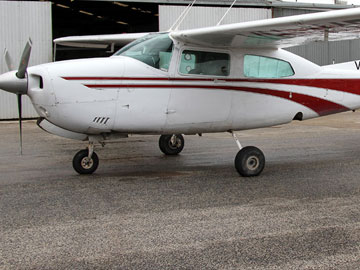
A recent landing gear incident involving a Cessna 210 shows how as aircraft age, the original maintenance schedule for an aircraft may not be sufficient to ensure the aircraft’s ongoing safety.

A recent landing gear incident involving a Cessna 210 shows how as aircraft age, their original maintenance schedule may not be sufficient to ensure ongoing safety.

The Cessna 210, returning from a scenic flight with five passengers on board, was approaching to land at Kununurra Airport, Western Australia.

During the approach, the pilot selected the landing gear down but the landing gear down indicator light did not illuminate. The right and left main landing gear appeared to be down and locked but the pilot was unable to see the nose landing gear.

The pilot completed the relevant checklists and conducted a low-level pass over the runway so the aircraft’s operator could see from the ground if the landing gear was down.

As aircraft age, the original maintenance schedules may not be sufficient to ensure the aircraft’s ongoing safety.

The operator observed the landing gear and reported to the pilot that the landing gear appeared to be in the down position. The pilot returned for a landing on runway 12.

On landing, the main landing gear wheels touched down first. The pilot held full back pressure on the elevator controls to hold the nose wheel off the runway for as long as possible. After about 100 m, the nose of the aircraft sank on to the runway. At this point, the nose wheel collapsed, the propeller struck the runway, and the aircraft came to a stop. The pilot and five passengers were uninjured. The aircraft sustained minor damage, including damage to the propeller, nose wheel, and engine cowling.

The aircraft was last flown about three weeks before this incident, and the pilot reported that there was no outstanding maintenance.

This aircraft was manufactured in 1976 and, and at the time had 9,965 hours total time in service. The owner’s investigation into the incident determined that one of the nose landing gear down lock pins had failed. The pin failed in the area of the machined groove for the pin retention roll pin . The failed down lock pin migrated out and interfered with the nose landing gear actuator. This movement prevented the nose landing gear down lock mechanism from engaging in the down and locked position.

Failed nose landing gear downlock pin


Source: Aircraft owner

The Cessna nose landing gear downlock actuator pins have had a history of cracking and failing. In response, Cessna recommended the inspection of the pins to determine their safety.

Safety message

The incident highlights the importance of comprehensive, periodic maintenance inspections. It also shows the role manufacturers have in the continuing airworthiness instructions for maintaining ageing aircraft. As aircraft age, the original maintenance schedules may not be sufficient to ensure the aircraft’s ongoing safety. As a result of investigation report AO-2011-115 the ATSB encourages registration holders of class B aircraft to review their aircraft’s maintenance schedule to determine if it is the most appropriate for their aircraft and to ensure that it adequately provides for the continuing airworthiness of the aircraft.

In 2007, the ATSB released research report How Old is Too Old? The impact of ageing aircraft on aviation safety. The report found that some aircraft manufacturers have recognised that the original maintenance schedules may not be sufficient to ensure the aircraft’s (ongoing) safety. Those manufacturers have developed additional continuing airworthiness information.

In 2012, in recognition of the Australian general aviation aging aircraft fleet, CASA released a discussion paper Ageing Aircraft Management Plan (AAMP)(Opens in a new tab/window). The discussion paper makes the following relevant points:

  • As an aircraft ages up to and beyond its original design assumptions, the nominated maintenance program needs to be modified to take into account ageing issues. In particular, inspections of key areas or components not usually accessed.
  • CASA and Authorised Persons are obliged to take into account all relevant maintenance data or information pertinent to a particular aircraft type. This includes manufacturer’s data, Airworthiness Directives, Service Bulletins and other continuing airworthiness information.
  • CASA Maintenance Schedule 5 was originally conceived as a minimum schedule of maintenance activities, to be undertaken on a very limited range of relatively simple, ‘orphan’ aircraft
  • CASA Maintenance Schedule 5 was not originally intended to address ageing aircraft related issues. The literal application of this schedule on its own was not intended to replace the manufacturer’s instructions for continued airworthiness, where available.

The adequate maintenance of ageing aircraft requires the participation and ongoing cooperation of aircraft manufacturers, regulatory authorities, owners, operators, and maintainers.

Read the final report: Landing gear malfunction involving a Cessna 210, VH-SMP, at Kununurra Airport, Western Australia, on 1 February 2015

Unauthorised maintenance

The pilot’s decision not to have proper maintenance performed on the aircraft most likely contributed to the ejection of the spark plug, resulting in the accident.

VH-CTE_AO2013174_news.jpg

On the morning of Saturday 5 October 2013, the pilot of a Rand Robinson KR-2 aircraft, registered VH-CTE, took off from an airstrip on private property 12 km west of Tumut, New South Wales. The pilot was reported to have intended flying to Holbrook, New South Wales, and return home the following evening.

When the pilot had not returned by early Sunday evening, authorities were notified. A search located the aircraft wreckage in the early morning on 7 October 2013. The wreckage was found about 450 m east-north-east of the departure airstrip. The pilot was fatally injured and the aircraft was destroyed by impact forces.

The pilot’s decision not to have proper maintenance performed on the aircraft most likely contributed to the ejection of the spark plug, resulting in the accident.

Data from a global positioning system receiver recovered from the wreckage identified that the pilot turned back towards the departure airstrip shortly after take-off. During the attempt to land back on the airstrip, the aircraft likely entered a stall. The pilot was unable to recover the aircraft before impacting terrain.

The ATSB’s examination of the wreckage found that a spark plug had been ejected from its respective cylinder head mount. The failure of the cylinder head spark plug mount was probably the result of an incorrectly installed thread insert. There were reports and evidence that the pilot maintained and modified the aircraft, despite not being qualified or authorised to do so. As well, in the previous 2 years, an authorised maintainer had not completed the required regular aircraft maintenance.

The pilot’s decision not to have proper maintenance performed on the aircraft most likely contributed to the ejection of the spark plug, resulting in the accident.

Safety message

Unauthorised maintenance increases the risk of mechanical failure. This, in turn, reduces the level of safety and increases the risk of injury or death.

Authorised aircraft maintenance is mandated to assure a level of safety for aircraft operations. That directive also identifies the requisite qualifications for the maintainer.

As well, managing airspeed and bank angle is critical to preventing an aerodynamic stall following partial engine failure after take-off. Research shows partial engine power loss is more complex and more frequent than a complete engine power loss. These accidents are typically a result of the aircraft entering an aerodynamic stall from a height where recovery is not possible.

More information on managing partial power loss after take-off is available from the ATSB’s avoidable accident web page.

Read the final report: Loss of control following partial engine failure involving amateur-built Rand Robinson KR-2, VH-CTE, 12 km west of Tumut, New South Wales, on 5 October 2013

WA joins national rail safety scheme

The ATSB will now investigate accidents and incidents on Western Australia’s metropolitan and regional passenger, and freight rail networks.
RailInvestigations_WA.jpg

From 2 November 2015, the ATSB will start investigating accidents and incidents on Western Australia’s metropolitan and regional passenger, and freight rail networks. 

This new focus in Western Australia will see more investigations conducted across a greater range of safety matters. It will also mean that the ATSB will be the mandatory notification point for all Category-A occurrences within Western Australia.  

The changes are a result of Western Australia joining the national rail safety scheme. The Office of the National Rail Safety Regulator (ONRSR) will also assume regulatory oversight in the state.

Western Australia now joins South Australia, Tasmania, Northern Territory, New South Wales, Victoria and the Australian Capital Territory in the national scheme.

Reporting rail safety occurrences

  • ATSB is the national independent, no-blame safety investigator for rail incidents and accidents.
  • Report all Category-A rail occurrences to the ATSB on 1800 011 034.

More information on rail accident or incident notifications.

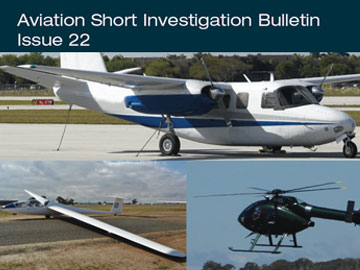
Aviation Bulletin Issue 44

The ATSB has released its latest Bulletin of short investigations covering incidents involving light aircraft and helicopters.
bulletin_44.jpg

The ATSB has released its latest Bulletin of short investigations covering incidents involving light aircraft and helicopters.

The Bulletin also highlights important safety messages for the broader aviation community, drawing on earlier ATSB investigations and research.

Released periodically, the Bulletin provides a summary of the less-complex factual investigation reports conducted by the ATSB. The results, based on information supplied by organisations or individuals involved in the occurrence, detail the facts behind the event, as well as any safety actions undertaken or identified.

Issue 44 of the Bulletin features 10 safety investigations:

Piston aircraft

Helicopters

Follow this link to: Aviation Short Investigation Bulletin - Issue 44

Safety vehicle: close call

This incident shows just how easily they can happen, even while following procedures and carrying out routine duties.

Runway incursions are an ongoing safety concern at airports. This incident shows just how easily they can happen, even while following procedures and carrying out routine duties.

The incident occurred shortly after an ATR 72 aircraft, operated by Virgin Australia Regional Airlines, broadcast on the common traffic advisory frequency (CTAF), that they ‘should be turning straight in for a landing runway 16’.

At about the same time, the aerodrome reporting officer (ARO) was asked by airport ground staff to conduct a runway inspection, following a birdstrike report of another aircraft that just landed. He entered a safety vehicle, which was fitted with a flashing orange beacon, and then drove to the holding point for runway 16/34.

The ARO broadcast on the CTAF advising that the vehicle was preparing to enter the runway for a runway inspection. The ARO heard a beep-back, confirming that he had made the call on the correct frequency, but no other response was heard on the CTAF.

...the ARO heard ‘car vacate’ broadcast on the CTAF and sighted the aircraft landing on the far end of the runway in the rear-view mirror of the vehicle.

The CTAF broadcasts an automatic voice-back response if no calls have been made on the frequency for five minutes; otherwise a beep-back is broadcast. The ARO assumed that he received a beep-back rather than a voice-back, due to the calls made by the crew of the aircraft that had just landed.

He then conducted a thorough lookout for aircraft approaching and did not sight any. The ARO broadcast that he was entering the runway and commenced driving north along the runway. When at the northern threshold, the vehicle turned and drove south along the runway with no evidence of a birdstrike found.

The crew of the ATR 72 did not hear either broadcast from the ARO. The aircraft was in cloud during the approach, with the cloud base at about 2,600 feet and encountered some turbulence on final, with a crosswind of about 12 kt. The captain looked up out of the cockpit along the runway and sighted the safety vehicle on the white runway aiming point markings near the far end of the runway and immediately broadcast ‘car vacate’. (The first officer sighted the orange beacon when at about 10 feet AGL, but was not immediately aware that it indicated the presence of a vehicle on the runway).

When about 100 m from the southern end of the runway, facing south, the ARO heard ‘car vacate’ broadcast on the CTAF and sighted the aircraft landing on the far end of the runway in the rear-view mirror of the vehicle.

The ARO immediately drove the vehicle off the runway and once clear, broadcast that the safety vehicle had now vacated all runways.

The ARO had a handheld VHF radio and a VHF radio was fitted in the safety vehicle. When in the vehicle, the ARO switched off the handheld radio to avoid interference with the fitted radio. The ARO could alternatively be contacted via mobile phone. The ARO also had a UHF radio which was used to communicate with aerodrome ground staff. All normal communications between flight crew and the ARO are on the CTAF via VHF radio. The ARO reported that inside the terminal building there was a ‘black spot’ for VHF reception.

The ATSB was provided with the CTAF recordings. Both of the broadcasts made by the ARO included the standard phraseology of prefixing and suffixing each call with ‘Traffic Moranbah’ to alert aircraft to the location of the caller.

The ATSB’s investigation found that the ARO was in the airport compound for the duration of the calls broadcast at 25 NM, 10 NM and overhead by the aircraft. This meant he was not aware the aircraft was in the vicinity. The recording of the CTAF obtained by the ATSB verified all calls made by the crew of the aircraft and the ARO. The ARO calls were audible but less clear than the aircraft calls; however it could not be determined why the crew of the aircraft did not hear the ARO broadcasts. There was no requirement for the ARO to maintain a continuous listening watch on the CTAF. Six minutes elapsed between the broadcast from the captain of the aircraft overhead the aerodrome, to the call to the car to vacate.

Read the final report: Runway incursion involving an ATR 72, VH-FVI and a vehicle, Moranbah Airport, Queensland, on 5 March 2014

Safety message

Safety around non-controlled aerodromes is one of the ATSB’s major safety priorities. Research conducted by the ATSB found that, between 2003 and 2008, 32 runway incursions were recorded at non-controlled aerodromes. Broadcasting on and monitoring of the CTAF is the key way for pilots to establish situational and traffic awareness. The ATSB Limitations of the see-and-avoid principle study found that the effectiveness of a search for other traffic is eight times greater when a radio is used effectively in combination with a visual lookout, than when no radio is used. A pilot's guide to staying safe in the vicinity of non-controlled aerodromes is also a good source of information.