The ATSB has welcomed the findings of the Transportation Safety Board of Canada’s (TSB’s) independent review into the ATSB’s investigation methodologies and processes.
The ATSB has welcomed the findings of the Transportation Safety Board of Canada’s (TSB’s) independent review into the ATSB’s investigation methodologies and processes.
Publicly released by the TSB today, the review found that both TSB and ATSB investigation methodologies either met or exceeded international best-practice standards.
The review also made 14 recommendations for improvements in how the ATSB conducts transport safety investigations.
ATSB Chief Commissioner Mr Martin Dolan said he requested the TSB to conduct the review as they have a similar legislative framework to the ATSB and a long-standing commitment to systemic investigation to improve safety.
“The TSB’s independent review has provided valuable independent insight into the ATSB’s investigation methodologies and procedures, and how these compare to international best practice,” Mr Dolan said.
“While I’m pleased to see that the ATSB mostly met or exceeded international investigative standards, there is clearly room for improvement.
“We will carefully and methodically work through the review’s findings as part of our ongoing efforts to improve our processes and procedures.
“I am sincerely grateful for the valuable time and effort our Canadian colleagues have contributed to complete this important piece of work.”
The ATSB Commission will provide TSB a detailed, formal response to the review in early 2015. This response will be made publicly available at the ATSB website.
The ATSB’s first report of safety trends in Australian aviation reveals that while our skies remain safe, there are some shifting trends to watch.
The ATSB’s first report of safety trends in Australian aviation reveals that while our skies remain safe, there are some shifting trends to watch.
Released today, the report summarises trends in Australian aviation from January to June 2014, comparing it to a five-year average, and what safety action was taken to address those trends. Trends will be updated every six months in this new ATSB analysis series.
Of note in this reporting period was an increase in the rate of airborne collision alert system warnings in high-capacity air transport operations over the past five quarters (since April-June 2013).
Most of these occurred in Sydney (12 of 28 in the past six months). All of these happened during independent visual approaches (IVAs) and 10 of them on runway 34L/R. An ATSB investigation into IVAs at Sydney Airport will be completed later this year.
While control issues with high-capacity aircraft are a low frequency occurrence, there was an increase in occurrences from January to June 2014. However, 10 of 16 of these were reported by one airline. The Fokker 100 was over-represented by fleet and activity size with five occurrences.
Loss of separation incidents involving low-capacity air transport also increase in January to June. Darwin and the Northern Territory in general were the most common location for these. Most were low risk although there was one high collision risk occurrence during this six-month period.
Safety trends in Australian aviation reveals that while our skies remain safe, there are some shifting trends to watch.
Dr Stuart Godley, Manager of ATSB Reporting & Analysis, said the ATSB would continue to monitor all safety trends.
“By maintaining a constant watch on aviation safety, we can effectively gauge trends and alert and advise industry of potential safety issues,” Dr Godley said.
Australia’s transport industries are some of the safest in the world but more can be done to improve safety, according to the ATSB’s annual report.
Approved for tabling by the Deputy Prime Minister the Hon Warren Truss, the annual report highlights the ATSB’s top transport safety concerns across the aviation, maritime and rail industries.
ATSB Chief Commissioner Martin Dolan said the safety concerns bring together the ATSB’s investigation findings and analysis of the safety occurrence data reported by industry.
“We are urging industry to give heightened attention to the risk areas identified by the ATSB,” Mr Dolan said. “While we are seeing improvements in certain areas of transport safety, other risk areas remain a concern to the ATSB. We’ll continue to closely monitor these transport safety hotspots over the coming year.”
One of the year’s notable transport safety achievements was the nation-wide fit out of the bladder-type fuel tank on all Robinson R44 helicopters (in accordance with the manufacturer’s directive). The bladder tank replaced the rigid aluminium fuel tank that was highly susceptible to post-impact fires.
The ATSB’s growing concern about accidents caused by flying with reduced visual references, such as in cloud or at night, has led to that matter being included as a top transport safety risk area identified in the ATSB’s safety priorities.
“We’ve moved to address concerns about the increasing number of accidents caused by flying with reduced visual references,” Mr Dolan said. “By highlighting these priorities to visual flight rules pilots, we aim to make them more aware of the risks and of what can be done to avoid what can be catastrophic mistakes while flying.”
Three significant investigations into flying with reduced visual cues are included in the annual report, along with features on some of the 217 investigations conducted by the ATSB in 2013–14.
The annual report also details the ATSB’s involvement as the lead organisation in the search for missing Malaysia Airlines flight MH370 that disappeared in March 2014. “Finding the missing aircraft and helping solve the mystery of its disappearance is our greatest challenge. Just as importantly, though, we continue our work to improve safety through investigating aviation, maritime and rail incidents at home,” Mr Dolan said.
Australia’s current top transport safety priorities across aviation, maritime and rail (SafetyWatch):
Flying with reduced visual cues
Marine work practices
Safe work on rail
Data input areas for aviation
Safety around non-controlled aerodromes
General aviation pilot risks
Maritime pilotage
Under reporting of occurrences
Handling approach to land
More information on these risk areas can be found at the ATSB’s SafetyWatch web page.
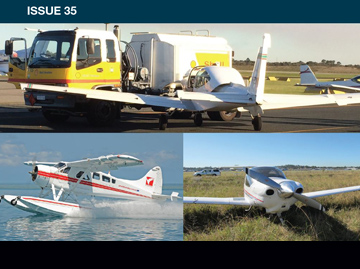
The ATSB has just released a new aviation bulletin containing 10 investigation reports. Issue 35
The Aviation Short Investigation Bulletin covers a range of the ATSB’s short investigations and highlights valuable safety lessons for pilots, operators and safety managers.
Released periodically, the Bulletin provides a summary of the less-complex factual investigation reports conducted by the ATSB. The results, based on information supplied by organisations or individuals involved in the occurrence, detail the facts behind the event, as well as any safety actions undertaken. The Bulletin also highlights important Safety Messages for the broader aviation community, drawing on earlier ATSB investigations and research.
Issue 35 of the Bulletin features 10 safety investigations:
The ATSB is urging pilots of single-engine aircraft to plan for partial power loss, following the release of a new educational video.
The ATSB is urging pilots of single-engine aircraft to plan for partial power loss, following the release of a new educational video.
Between 2000 and 2010, there were nine fatal accidents resulting in 20 people losing their lives as a result of a response to a partial power loss soon after take-off. Importantly, there were no fatal accidents where the engine initially completely failed.
ATSB research manager Dr Stuart Godley says the high number of fatalities and serious injuries resulting from partial power loss should be of concern to pilots and flight instructors.
Our accident data shows that for single engine aircraft, a partial power loss during and after take-off is three times more likely to occur than a complete engine failure.
“Historically, the simulated total loss of power and subsequent practice forced landing has been the core of a pilot’s emergency training,” Dr Godley says. “However, our accident data shows that for single engine aircraft, a partial power loss during and after take-off is three times more likely to occur than a complete engine failure.”
While partial power loss can be more challenging to manage—due to the number of choices and decisions confronting the pilot—Dr Godley says that the lack of training, coupled with the lack of pilot preparation and planning, may also help explain the higher number of fatalities.
“Total engine failure after take-off is part of the Day VFR syllabus and is taught and practiced throughout a pilot’s initial training. However, partial power loss after take-off is not a practiced syllabus item and probably does not receive the same emphasis during training.
“A pre-flight briefing for both a complete engine failure and partial power loss is the key to a pilot maintaining control of their aircraft.” says Dr Godley.
The new short video, available on the ATSB’s YouTube channe(Opens in a new tab/window)l (ATSBinfo) provides pilots and flight instructors advice on how to manage the dangers surrounding partial power loss in single engine aircraft.
The ATSB has just released a new aviation bulletin containing 10 investigation reports. Issue 34
The ATSB has just released a new aviation bulletin containing 10 investigation reports. The Aviation Short Investigation Bulletin Issue 34 covers short, office-based investigations.
The bulletin covers incidents, serious incidents and accidents involving jet, turboprop and piston aircraft, as well as helicopters.
Short investigations cover incidents and accidents where the associated factors are usually well-understood and do not require more detailed investigations. Nonetheless, each investigation has the potential to produce important Safety Messages for pilots, operators and others in the aviation industry. The investigations also help the ATSB identify statistics and trends in air safety.
Issue 34 of the Bulletin features 10 safety investigations:
If you require assistance, please telephone (toll-free, 24 hours): 1800 011 034.
We’ve all been there. The moment when you see something that just doesn’t seem quite right. There’s a problem in front of you, and while it may not have caused an accident yet, you can easily imagine how one day, maybe one day soon, it could end badly. But if you say anything, if you point out that something is being done incorrectly, this could mean trouble.
It’s a situation that’s all too common, where sometimes people won’t thank you for pointing out a problem. But there is a way for you to share your concerns and see something done about them, without fear of being identified. The Australian Transport Safety Bureau’s (ATSB) confidential reporting scheme, REPCON, allows people with safety concerns about the rail, aviation or marine industries to disclose them to the ATSB. These reports often contain valuable information that can help the industry address unsafe procedures, practices or conditions.
Crucially, REPCON is not used to apportion blame or liability—the underpinning legislation specifically precludes information in a report being used for disciplinary purposes. As well, REPCON reports are inadmissible in evidence in a court, except where a person has committed an offence under the Criminal Code (False or misleading information) in making the report.
“REPCON is all about solving problems, and anyone can make a call to us,” explains Elaine Hargreaves, the ATSB’s team leader for confidential reporting. She oversees REPCON, and she is a woman who keeps secrets. At the core of the scheme is the assurance that no one outside the REPCON office will learn who has reported their concerns. “I will never reveal a reporter’s identity to anyone – not even the Chief Commissioner of the ATSB. There are people out there who will only report to us, and they do that because they know they won’t be punished for speaking their mind and sharing their concerns. We’ve received calls from all around the country, from members of the public and people working within the industry itself.”
“People will call us at any time of day,” continues Hargreaves. “They’ll lay out their basic concerns, and then we receive a written report from them.” She acknowledges that a scheme that guarantees anonymity also offers opportunities for abuse, but tremendous care is taken to ensure that a report meets the requirements of what a safety concern is. “We assess the reports thoroughly to make sure they’re not solely focussed on an industrial action, that it’s not criminal or a threat.”
If the matter is deemed to be a genuine safety concern, the report is carefully de-identified, removing all personal attributes, and information that might lead to the identification of the reporter. The ATSB also removes the names of any other individuals mentioned in the report, ensuring that people don’t abuse the program to satisfy grudges or out of spite.
From there, the REPCON office assesses the de-identified text to ensure that the report has not become so benign that there would be no chance of any safety outcomes. After all, when the report is provided to an operator, they will need enough details to find the problem.
“We forward the de-identified text back to the reporter to get their approval before we send it out,” says Hargreaves. “Nothing happens until they’re satisfied that the right message is getting passed along, and that their identity is sufficiently protected. The report can go back and forth between the REPCON office and the reporter a few times before everyone is satisfied.”
The ATSB then provides the final report to the operator, and they have five working days in which to respond. (An extension may be granted, depending on the circumstances.) The operator’s response, along with the de-identified text is forwarded to the regulator, to take whatever action is deemed necessary. The regulator is required to respond, in accordance with a signed MOU.
“Once we’ve had a response from the regulator, feedback is provided to the operator and the reporter, where they have the opportunity to provide feedback on the outcome,” says Hargreaves. “That feedback will be reviewed, and everyone is kept abreast of developments. The report is not considered closed until all avenues for addressing the safety concern have been exhausted.”
Once the REPCON case is closed, all personal information is destroyed, and the final report (with all the relevant input) is published on the ATSB website. This final report contains no information which will identify the reporter and all efforts are made to de-identify the operator involved. Only the details of the safety concerns, as well as the responses and safety actions taken by relevant organisations or government agencies are retained. “So many important safety concerns are reported to us through REPCON,” said Hargreaves. “We publish this information so that all of industry can be aware of, and can learn from, the problems that others have encountered, and the solutions that they’ve implemented.”
If you have a concern about transport safety that you’re uncomfortable reporting to the operator, you can submit a REPCON report yourself, either via the REPCON webpage or the reporting line on 1800 020 505.
The safety of Australia’s rail workers is under examination following the launch of a systemic safety investigation by Australia’s national transport safety investigator, the ATSB.
To take around 12 months to complete, the safety issues investigation has been prompted by continuing reports of accidents and incidents that occurred while maintenance work was being undertaken on or near railway tracks.
ATSB Chief Commissioner Martin Dolan said these ongoing incidents hint at broader safety issues that continue to raise risks for rail track workers.
“Through the ATSB’s SafetyWatch initiative, we have been urging industry to give heightened attention to rail worker safety over the past several years,” Mr Dolan said.
“While many operators are continuing to improve the safety of their workers, the ATSB remains concerned about the continuing number of reported incidents involving work on track.
“This investigation will provide a national examination of rail worker safety and aim to identify areas where safety can be improved.”
The scope of the investigation will be wide ranging and include:
examination of occurrence data to ascertain common safety risks associated with work on track accidents and incidents nation-wide
survey of stakeholders (rail safety workers/safety managers) involved with the implementation of worksite protection systems to identify areas of concern and possible improvements in safety when carrying out work on track
examination of the rules, procedures and forms used nation-wide to manage risk to rail safety workers arising from work on track
examination of work practices in the coordination and communication processes/protocols employed by rail operators when managing worksite protection
review of rail transport operators’ safety actions in response to findings arising from internal investigation and external (independent) investigations into worksite protection incidents
examination of the interaction between organisations’ worksite protection rules and procedures and ancillary tasks associated with work on track, including the planning, preparation and application of onsite hazard assessment.
The launch of the ATSB’s systemic investigation coincides with Rail Safety Week, which aims to raise awareness about rail safety. The ATSB is participating in Rail Safety Week to highlight the ongoing concerns facing workers on track.
Born: Taree, 10 April 1926 – died: Melbourne, 6 August 2014.
The ATSB would like to pay tribute to Macarthur ‘Mac’ Job who sadly passed away on Wednesday after battling cancer for a number of years. Mac was aged 88.
As a highly accomplished aviation writer and air safety consultant over many decades, Mac established a lasting legacy in promoting aviation safety in Australia. Mac’s contribution was recognised with his 2003 award of the Medal of the Order of Australia (OAM) ‘for services to the promotion of aviation safety’.
We extend our deepest sympathies to Mac’s wife, Esma, and his five children.
The ATSB has just released a new aviation bulletin containing 10 investigation reports.
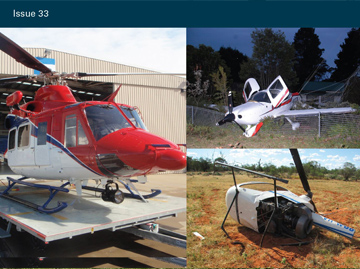
The ATSB has just released a new aviation bulletin containing 10 investigation reports. The Aviation Short Investigation Bulletin Issue 33 covers short, office-based investigations.
The bulletin covers incidents, serious incidents and accidents involving jet, turboprop and piston aircraft, as well as helicopters.
Short investigations cover incidents and accidents where the associated factors are usually well-understood and do not require more detailed investigations. Nonetheless, each investigation has the potential to produce important Safety Messages for pilots, operators and others in the aviation industry. The investigations also help the ATSB identify statistics and trends in air safety.
Issue 33 of the Bulletin features 10 safety investigations: