Rail worker safety in spotlight

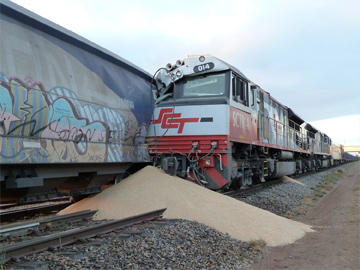
‘Safe work on rail’ is an area of heightened concern within the ATSB’s SafetyWatch program.
TrackExcavatorAccidentSite.jpg

The ATSB continues to investigate accidents and serious incidents that have occurred when work was being carried out on or near railway tracks.

Conducting work on or near a railway track will be dangerous if safeworking rules and procedures have not been correctly implemented to protect the worksite. Trains cannot be stopped quickly and any breakdown in the communication or management of a worksite can expose workers to great risk.

Operational safe working on track requires a high level of preparation and organisation. Whenever there is work taking place on or near operating track, coordination and communication are essential. Before authority is granted to occupy or work near a track, it is critical that all information is clearly communicated and verified between the Protection Officer and the Network Control Officer. 

‘Safe work on rail’ is an area of heightened concern within the ATSB’s SafetyWatch program.

An adequate briefing about the work site and effective communications methods must be made available to the track workers. For track workers, it is vital to ensure that all levels of worksite protection have been fully established and implemented before work on or near the track is commenced. Established roles and responsibilities for worksite protection must be respected, and work should be stopped immediately and the track vacated if there is any uncertainty around the site protection status or effectiveness.

Read more on ATSB’s SafetyWatch initiative.

Engine failure in flight

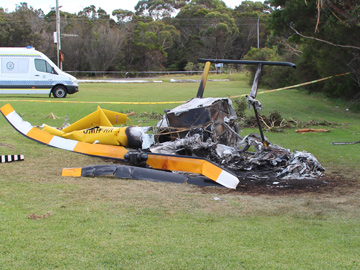
Chipmunk aircraft crashes after engine failure.
Chipmunk_VH-RVY_news.jpg

Chipmunk aircraft crashes after engine failure

The pilot and passenger of a Chipmunk suffered serious injuries, when their aircraft crashed in a paddock, after the engine failed during a post-maintenance check flight near Luskintyre, New South Wales.

The aircraft had a history of fluctuations in the engine RPM, so the pilot, who was also a maintenance engineer, conducted a check flight including about 10 minutes of normal flight conditions, and some gentle aerobatics. As the engine functioned normally throughout, the pilot then performed a loop. At the bottom of the loop, the engine began to overspeed. The pilot reduced the engine power and turned the aircraft towards to the airfield.

The ATSB urges pilots of single-engine aircraft to plan for partial power loss.

During the approach, the aircraft was unable to maintain altitude. As the pilot turned onto base leg for the runway, the engine failed. The pilot assessed that the aircraft was descending too rapidly to reach the runway, and elected to land in a paddock. Due to strong and gusty wind, with turbulence close to the ground, the aircraft landed heavily. It then travelled through a fence, and sustained substantial damage. A subsequent inspection of the engine did not find a conclusive reason for the overspeed or failure.

Safety message

This accident is a timely reminder to pilots to consider the effect an in-flight engine failure at different altitudes and in the given conditions can have on the options available to manage that failure and to identify a suitable forced landing area. The combination of two people on board and the high temperature would have adversely affected the aircraft’s performance on the day.

The ATSB booklet Avoidable Accidents No. 3 - Managing partial power loss after take-off in single-engine aircraft contains information that is also relevant to a complete engine power loss.

The booklet highlights the importance of:

  • pre-flight decision making and planning for emergencies and abnormal situations for the particular aerodrome including a thorough pre-flight self-brief covering the different emergency scenarios.
  • taking positive action and maintaining aircraft control either when turning back to the aerodrome or conducting a forced landing until on the ground, while being aware of flare energy and aircraft stall speeds.

Read the final report: Engine failure involving a de Havilland Canada DHC-1 (Chipmunk), VH-RVY, near Luskintyre, New South Wales, on 14 November 2014

The ATSB urges pilots of single-engine aircraft to plan for partial power loss.

Data input error

A data entry error contributed to a slow approach speed and a nose high landing in a Qantas Boeing 737 aircraft.

  • Errors can occur irrespective of pilot experience, operator, aircraft type, location and take-off (or landing) performance calculation method.
genericcockpitpic.jpg

A data entry error contributed to a slow approach speed and a nose high landing of a Qantas Boeing 737, Adelaide Airport, South Australia in October last year.

Prior to commencing the descent to Adelaide Airport, the monitoring pilot entered an aircraft gross weight of 52 tonnes instead of 62 tonnes into the flight management computer. The computer then calculated flap and landing speeds based on that weight.

During the approach, the monitoring pilot stated that the airspeed was ‘wrong’, but the pilot flying assessed it to be normal and continued the approach. At about 200 ft, the monitoring pilot called ‘speed’ after noticing the speed was trending towards the minimum manoeuvre speed on the airspeed indicator. During touchdown, the aircraft nose was higher than usual; the pitch up was 7.5 degrees, whereas normal is between 3.5 and 3.75 degrees.

Qantas subsequently implemented a requirement for the monitoring pilot to compare landing weight entered to the flight management computer with the load sheet estimated landing weight.

Read the final report: Data input error involving a Boeing 737, VH-XZI, near Adelaide Airport, South Australia, on 12 October 2014

The ATSB’s SafetyWatch initiative identifies data input error as a top aviation safety priority.

More information: Take-off performance calculated and entry errors: A global perspective is a research paper which focused on such incidents and accidents in the 20 years prior to 2009.

RPA crashes near MCG

The aircraft was providing media coverage of the cricket World Cup Final on 29 March 2015.
AeronavicsSkyJib8.jpg

Radio frequency interference at a crowded Melbourne Cricket Ground (MCG) likely resulted in the loss of control and crash of a remotely piloted aircraft. The aircraft was providing media coverage of the cricket World Cup Final on 29 March 2015.

The three-man crew operating the aircraft consisted of a flight controller, a ground station controller, and a camera gimbal controller. The crew launched the aircraft to capture footage as the teams entered the MCG. The aircraft took off from the top of one of the MCG scoreboards and climbed normally to about 300 ft above ground level, tracking south towards Hisense Arena.

About two minutes into the flight, with the aircraft over the northern roof of Hisense Arena, the camera gimbal operator lost control of the gimbal. Seconds later, the ground station controller lost communication with the aircraft. The flight controller decided to discontinue the flight, but found that the aircraft was unresponsive to flight control commands. Aircraft recovery procedures were implemented but ineffective, and continued attempts to regain control were unsuccessful.

The aircraft travelled west for a distance, and after hovering momentarily just south of the Rod Laver Arena, it descended and collided with the ground on the median strip on Batman Avenue. The aircraft and its equipment sustained substantial damage. No one was injured in the collision, and there was no damage to other property.

... this accident highlights the ongoing importance of appropriate RPA operational controls and procedures.

The operator’s report concluded that radio frequency interference was the most likely cause of the accident. The volume of radio frequency traffic at the time of the accident would have been substantial, and perhaps sufficient to affect aircraft control signals. Numerous fixed telecommunications facilities and mobile broadcast vehicles in the vicinity of the MCG were likely to be transmitting at the time of the accident. Over 93,000 people attended the event, many of whom were probably using personal mobile communication devices at about the time of the accident. Furthermore, the use of portable communication devices by event management personnel may also have contributed to the volume of radio frequency traffic.

Read the final report: Loss of operator control involving an Aeronavics SkyJib 8 remotely piloted aircraft, near the Melbourne Cricket Ground, Melbourne, Victoria, on 29 March 2015

Partial engine power loss

Do you have a plan for partial power loss after take-off?
PartialPowerLoss_news.jpg

Partial engine power loss is more complex and more frequent than a complete engine power loss.

Partial engine power loss can range from providing very little power to almost full power, with varying levels of reliability of the remaining engine power. When faced with a partial power loss, pilots should not try to diagnose the engine problems at the expense of maintaining aircraft control.

Loss of control — Case Study

The pilot of an amateur-built Lancair 360 aircraft was conducting circuits at Bankstown Airport in April 2006. It was the aircraft’s first flight since being repaired after a landing accident. Following an overflight of the runway and a touch-and-go, the pilot conducted another touch-and-go and, shortly after lift-off at an altitude estimated by witnesses to be between 100 feet and 400 feet, the engine was heard to malfunction. Almost immediately, while still not above 500 feet, the aircraft rolled into a steep right turn.

Engine power was heard to return, but sounded intermittent. After turning approximately 90 degrees, the aircraft rolled out of the turn momentarily to about wings level, before the turn steepened again to the right. The aircraft was observed to roll further to the right and descend steeply. The aircraft impacted a taxiway. Tragically, the pilot died, and the aircraft destroyed.

The ATSB investigation found that the engine power loss was probably due to interruptions of fuel flow to the engine. The aircraft stalled at a height insufficient to allow the pilot to recover.

Do you have a plan for partial power loss after take-off? The following initial actions should be considered when responding to a partial loss in power.

  • Lower the nose to maintain the glide speed of the aircraft.
  • Conduct the basic initial engine trouble checks as per an engine failure in accordance with manufacturer’s advice. However, this should be done only if there is sufficient time.
  • Maintain glide speed and assess whether the aircraft is maintaining, gaining or losing height to gauge current aircraft performance. This will help to inform the options available for landing.
  • Fly the aircraft to make a landing, given the aircraft’s height and performance, and the pre-planned routes for the scenario. If turning is conducted, keep in mind an increased bank angle will increase the stall speed of the aircraft. Keeping the aircraft in balance will minimise rate of descent in any turn.
  • Re-assess landing options throughout any manoeuvres. Be decisive but be prepared to modify the plan if required.
  • Land the aircraft.
    • Have a minimum height planned to roll wings level. It is suggested in CASA documentation that turns should not be attempted below 200 feet AGL. However, this will depend on the aircraft’s roll rate, the airspeed and personal experience.
  • Maintain glide speed up to the point of flare; this will ensure that when flaring there is enough energy to arrest the vertical descent rate.

As is the case with a total power loss after take-off, during a partial power loss after take-off, diagnoses of the cause of the engine problem should not be attempted at the expense of maintaining control of the aircraft.

Key safety message

Most fatal and serious injury accidents resulting from partial power loss after take-off are avoidable. You can prevent or significantly reduce the risk of harm following a partial or complete engine power loss after take-off by using these strategies: 

  • Pre-flight decision making and planning for emergencies and abnormal situations for the particular aerodrome. 
  • Conducting a thorough pre-flight and engine ground run to reduce the risk of a partial power loss occurring.
  • Taking positive action and maintaining aircraft control either when turning back to the aerodrome or conducting a forced landing until on the ground.

Do you have a plan for partial power loss after take-off?

Have you ever experienced a partial power loss after take-off? Share your experiences on Facebook.(Opens in a new tab/window)

Read more about: Managing partial power loss after take-off in single-engine aircraft

Managing partial power loss after take-off in single-engine aircraft
 

Orange has always been black

The latest hit on Netflix may well tell us that Orange is the New Black but in the aviation safety world, we have known that for half a century.
  • The ATSB’s central office in Canberra, houses specialist technical facilities for the download and analysis of recorded audio and flight data information.
Recorder_news.jpg

The latest hit on Netflix may well tell us that Orange is the New Black but in the aviation safety world, we have known that for half a century.

An aircraft’s flight recorders which are popularly known as ‘black boxes’, are painted orange so they can be easily found following an accident.

Black boxes are an important tool for investigators in identifying the factors behind an accident. Recorders usually comprise two individual boxes: the Cockpit Voice Recorder (CVR) and the Flight Data Recorder (FDR).

The ATSB’s central office in Canberra, houses specialist technical facilities for the download and analysis of recorded audio and flight data information. Australia is one of a few countries in the Asia-Pacific region with these facilities and we regularly provide assistance and expertise to international investigations.

If an accident occurs at night in a remote area or at sea, the flight recorders may be the main, if not only, means of establishing the sequence of events just before the accident. At the very least, CVR and FDR data can help the work of the on-site  investigation team as it examines the wreckage, and can save many months in the overall investigation.

Flight recorders are particularly useful for cases in which evidence is transitory, e.g. occurrences involving environmental factors like windshear and severe turbulence. Data from flight recorders can reveal the sudden effects of windshear on an aircraft’s flight path without which, it may be difficult or impossible to determine with certainty the factors associated with an accident. The evidence available from flight recordings has shown that investigators can underestimate or misunderstand the effect of environmental factors like windshear.

Virgin Australia pilots on a tour of ATSB’s technical facilities

More about Black box flight recorders

Avoidable wirestrike

Before you decide to conduct low-level flying, ask yourself whether there is a legitimate or operational reason for you to do so.
  • This case study from the Avoidable Accident SeriesLow-level flying is a powerful reminder of low-level flight dangers.
AvoidableWirestrike_news.jpg

In November 2007, three German tourists, who had hired a Cessna 172N Skyhawk Aircraft as part of a contingent of three aircraft for an around Australia trip, were flying from Katherine to Tennant Creek in the Northern Territory.

There were no eyewitnesses to the accident, but the occupants of a car that was travelling on the Stuart Highway reported seeing the aircraft flying low above the highway moments before the accident. The witnesses recalled seeing an aircraft that was flying about 4 to 5 km to the west of the highway, about 150 ft above ground level. The Cessna made a slow, deliberate turn to line up with the highway, before it disappeared from sight behind a crest in the highway some distance in front of them. Shortly after, they saw the wreckage beside the highway.

Another wirestrike

The aircraft’s tail section hit a powerline that spanned the Stuart Highway, breaking the tail, which rendered the aircraft uncontrollable. The aircraft impacted the highway in a steep nose-down attitude and came to rest upside down about 150 m from the point where it had impacted the powerline. The aircraft was destroyed and the accident was not survivable.

Investigation of the aircraft wreckage determined that the aircraft’s ground speed at the time of the accident was at least 72 kts. The powerline involved in the accident was only 49 ft (15 m) above the road surface.

Before you decide to conduct low-level flying, ask yourself whether there is a legitimate or operational reason for you to do so.

Conscious decision to fly low

Evidence from images and video footage recovered from cameras found among the wreckage, suggests that there was a history of low flying by the group. One week before the accident, camera images show that the aircraft was flown low along a Western Australian beach by the same occupants with the pressure altimeter indicating an altitude of 70 ft above sea level. Video footage showed the aircraft flying below 100 ft along the beach for about 5 minutes.

Examination of the wreckage and previous pilot behaviour suggested that the pilots made a conscious decision to fly low, and were not conducting a forced landing at the time of the accident.

Earlier low flying by the group of tourists

Two of the three occupants held German private pilot licences and were sitting in the front seats. Neither of the pilots were approved to conduct low-level operations, and there was no evidence that either had undertaken any low-level flying training. Without approval to fly low and with no low-level training, the pilots probably had limited awareness of the hazards associated with flying low, such as impact with powerlines. Considering the remoteness of the area where the accident occurred, the pilots may not have expected to encounter man-made obstacles.

Safety message

Don’t forget that powerlines can be anywhere — even in the desert.

Don’t give in to the temptation to get down low for a better view of the scenery. Passengers may request you to fly lower but they probably don’t understand the risks. As the pilot, you are the one who needs to set the height limits.

Conclusion

Low-level flying is inherently unsafe for a number of reasons, so it should be avoided at all costs when there is no operational reason to do it (regardless of whether you have been trained and/or approved to do so).

Flying at low level is unsafe because:

  • there are more obstacles to avoid, many of which are hard to see until it is too late (e.g. powerlines and birds)
  • pilots have a higher workload because there are more hazards to negotiate in the environment
  • there may be turbulence and windshear that pilots do not encounter at higher levels and
  • there is very little time to recover control of the aircraft if something goes wrong.

From the accidents described in Avoidable Accidents - Low-level flying, it is apparent that the two major hazards of low flying are wirestrikes and pilots’ reduced opportunity to recover their aircraft from a stall or loss of control.

It is important to keep in mind that powerlines also exist in remote areas where you least expect. For example, the pilots of the Stuart Highway accident probably did not expect powerlines in the remoteness of the Northern Territory.

The effects of wirestrikes at low level are obvious — significant damage to the aircraft, usually leading to a loss of control and, because of the lower margin for recovery, subsequent impact with the ground or water. Pilots must keep in mind that not only do powerlines exist at low levels and in remote areas, they are also not easy to identify.

Even against a clear blue sky, wires are difficult to spot for a number of reasons. Wires can oxidise to a blue/grey tinge and may blend into the background, or the wire may be obscured by terrain. Single wires are difficult to detect from the air and can be encountered in the most unexpected places in rural areas. Even if a pilot has spotted a powerline, his or her ability to judge its distance from the aircraft can be distorted by optical illusions or a lack of nearby visual reference points.

Pre-flight assessment and planning is an important part of any flight. Make sure you have maps of your intended flight path with you when you fly, and study them before you get into your aircraft to identify any terrain, wire, or other obstacles that you need to avoid should operational circumstances necessitate flight at low level. If you have been trained and are qualified for low flying, and low flying is necessary, ensure that you conduct an aerial survey of the area from an appropriate height before you conduct any low flying.

Low-level flying also presents fewer opportunities to recover from a loss of control compared to flight at higher altitudes. It takes time to react and to regain control of an aircraft, and the closer to the ground you are, the less time and distance you have.

Flying at low altitudes is not only risky when things are going right; it becomes downright perilous when things are going wrong.

Before you decide to conduct low-level flying, ask yourself whether there is a legitimate or operational reason for you to do so.

More about Avoidable Accidents - Low-level flying

 General Aviation SafetyWatch video

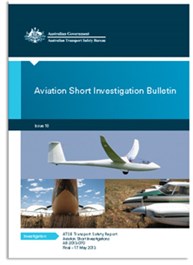
Aviation Short Investigations Bulletin

The ATSB has released its latest Bulletin of short investigations covering incidents involving regular passenger transport aircraft, light aircraft and helicopters.
Bulletin42_news.jpg

The Australian Transport Safety Bureau has released its latest Bulletin of short investigations covering incidents involving regular passenger transport aircraft, light aircraft and helicopters.

Issue 42 of the Bulletin covers 10 safety investigations and highlights valuable safety lessons for pilots, operators and safety managers.  The Bulletin also highlights important safety messages for the broader aviation community, drawing on earlier ATSB investigations and research.

Released periodically, the Bulletin provides a summary of the less-complex factual investigation reports conducted by the ATSB. The results, based on information supplied by organisations or individuals involved in the occurrence, detail the facts behind the event, as well as any safety actions undertaken or identified.

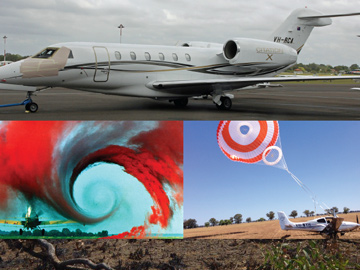
Issue 42 of the Bulletin features 10 safety investigations.

Jet aircraft

Piston aircraft

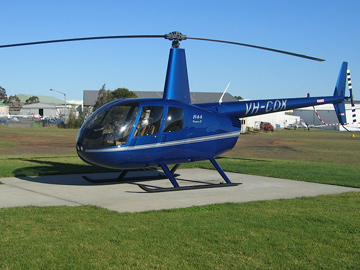
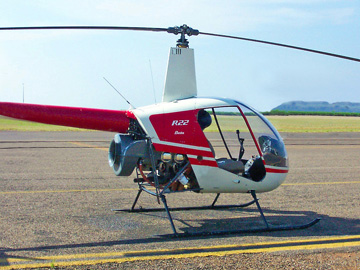
Helicopters

Remotely piloted aircraft systems

Follow this link to: Aviation Short Investigation Bulletin - Issue 42

Cicaré CH-7B helicopters

The ATSB recommends owners of CH-7B series helicopters ensure the integrity of the stabiliser before flying.

  • The ATSB recommends owners of CH-7B series helicopters ensure the integrity of the stabiliser before flying.
Cicare_helicopter_News.jpg

The ATSB is investigating a second fatal accident involving in‑flight separation of the stabiliser, and subsequent loss of control, involving Cicaré CH-7B helicopters.

Preliminary technical examination at the ATSB’s facilities in Canberra, indicates that in both instances the stabiliser failed due to cracking associated with metal fatigue. In the most recent accident, the crack propagated in a circumferential manner through approximately 75 per cent of the welded structure prior to failure.

While the ATSB is working to establish the factors leading to the two failures, owners are advised to exercise extreme caution in the operation of their helicopters.

The examination showed cracking in the stabiliser attachment outboard of the tail boom, coincident with the welded intersection of the conical and tubular sections of the attachment. The location of the cracking in the attachment cannot be easily inspected as they are obscured by the upper and lower vertical stabiliser fairings.

Stabiliser attachment failure location

The cracking is unlikely to be easily visible during inspection. However, black dust in the vicinity of the attachment bracket, and working rivets are indicative of increasing stabiliser movement as the crack develops.

The ATSB is working to establish the origin of the failure. However, initial indications are that the fatigue cracking occurred after as little as 100 hours of operation and may be associated with aerial stock mustering. Additionally, in the first accident, operation of the helicopter with a high level of vibration may have been a factor.

CH‑7Bt tail section showing the location of fatigue fracture on the stabiliser attachment


Fractured stabiliser attachment bracket with black dust outlined in white (in two places)

Typical indication of ‘working’ rivets (photograph not of a CH-7B helicopter)

The ATSB recommends that owners of CH-7B series helicopters ensure the integrity of the stabiliser prior to further operation and on an ongoing basis. While the ATSB is working to establish the factors leading to the two failures, owners are advised to exercise extreme caution in the operation of their helicopters.

Cicaré has advised that if any doubt arises concerning the inspection or maintenance of any part, piece or component, their technical department should be immediately consulted.

In addition, owners may wish to discuss any concerns with an appropriately‑licenced aircraft maintenance engineer, the Sport Aircraft Association of Australia or with the Civil Aviation Safety Authority before further flight.

If you find any cracks in the stabiliser attachment, please call us on 1800 020 616 or email ATSBinfo@atsb.gov.au.

Related investigations:

E-cigarette safety hazard

Carrying an e-cigarette in your luggage can pose a safety hazard to flights.
Ecigarette.jpg

Carrying an e-cigarette in your luggage can pose a safety hazard to flights.

A recent incident in the United States demonstrates the potential risk after a passenger found her e-cigarette was smouldering and smoking in her handbag after she got off her flight. Walking through the terminal she realised something was wrong and hurried outside to dump her bag. It had generated enough heat to melt several items in her handbag.

The passenger said that the safety switch on the e-cigarette was off. If the timing was even a little different, it could have resulted in a fire on board the aircraft during flight.

Anyone involved in flight operations, and even passengers, can report a safety concern.

Airline passengers are reminded that e-cigarettes are considered to be personal electronic devices. They must only be carried on aircraft on your person or in your carry-on luggage. Like other lithium battery devices, there is a risk of their catching fire. The ATSB has been notified of similar incidents of smouldering items — including mobile phones, tablets, and an air purifier — carried on board by passengers in recent years.

This incident was reported by a cabin crew member to the United States’ Aviation Safety Reporting Scheme (ASRS), a confidential reporting scheme run by NASA. In Australia, the ATSB runs a similar confidential safety reporting scheme called REPCON. Anyone involved in flight operations, and even passengers, can report a safety concern.

If you have any information which you consider may affect aviation safety please do not keep it to yourself. You can contact the REPCON office on 1800 020 505 or submit a report online.