Wildlife strike statistics

Wildlife strikes in Australian aviation have increased significantly over the past two years and continue to pose a safety risk to aircraft operators, according to a new report released by the ATSB.

The report, which provides aviation birdstrike and animal strike occurrence data over ten years, shows that there were 1,977 birdstrikes and 53 ground-based animal strikes in 2015. Most of these occurrences involved high capacity air transport aircraft.

The wildlife strike rate for six of the ten major airports increased markedly in the past two years, relative to the ten-year average. The largest increase in the rate of birdstrikes was at Cairns, Canberra, Darwin, Gold Coast and Sydney.

Bats and flying foxes, swallows and martins, kites, and lapwings and plovers were the most commonly struck type of flying animal.

Ground-based animal strikes were relatively rare. The most common ground animals struck by aircraft were hares and rabbits, kangaroos, wallabies, and dogs and foxes. Damaging animal strikes mostly involved kangaroos, wallabies and livestock.

The report also estimates that 766 kg of flying animals were struck per year by aircraft in Australia. Additionally, for every 1 kg increase in animal mass, the likelihood of a birdstrike causing damage increases by approximately 12.5%.

Although the vast majority of wildlife strikes do not result in any damage or operational consequence, they still pose a serious safety risk to aircraft.

One of the more recent serious birdstrike incidents occurred in July 2014 when a Cessna 206 aircraft struck a flock of birds at about 1,800 feet near Mackay, Queensland, while conducting survey work. The birds impacted several parts of the aircraft, including the windscreen, which was broken by the impact. Fortunately, the pilot safely landed the aircraft at Mackay.

Read the ATSB research report AR-2016-063 - Australian aviation wildlife strike statistics

Incorrect reference data

Incorrect reference data can have potentially serious consequences in remotely piloted and manned aircraft.

On 27 September 2016, a Pulse Aerospace Vapor 55 remotely piloted aircraft (RPA), was operating a test flight at Lighthouse Beach, Ballina, New South Wales.

The RPA tracked according to manual inputs from the pilot for about seven minutes, after which time (when at 124 ft altitude) the data-link signal was lost. After 30 seconds without signal, the RPA entered the ‘home’ flight mode, and began tracking to the incorrectly programmed home position at an altitude of 154 ft.

The RPA did not respond to control inputs made by the pilot, and the pilot subsequently lost sight of the RPA which was travelling out to sea. The RPA was not found despite an extensive search.

The south-eastern point used to georeference the image on the ground control station map was selected to a northern hemisphere latitude, which resulted in incorrect waypoints and home position for the mission.

The RPA data-link signal to the ground control station was lost, so it began tracking to the incorrectly programmed home position, which was in the Coral Sea Islands about 1,200 km north of the start position.

Safety message

Australian Transport Safety Bureau Chief Commissioner Greg Hood says incorrect reference data can have potentially serious consequences in remotely piloted and manned aircraft. “RPAS operators should expect data loss events and prepare for these appropriately,” Mr Hood said.

“It is imperative that remotely piloted aircraft systems incorporate means of minimising the opportunity for errors to occur and also for detecting and correcting errors that do occur.

“The careful application of operational controls and procedures, underpinned by robust risk assessment, will become increasingly important as relevant technologies develop further and new remotely piloted aircraft systems (RPAS) applications continue to emerge.”

Mr Hood says the ATSB SafetyWatch highlights the broad safety concerns that come out of our investigation findings and from the occurrence data reported to us by industry. One of the safety concerns relates to data input errors.

Read the investigation report AO-2016-128

B777 engine in-flight shutdown

An excellent example of effective crew resource management techniques when faced with an abnormal situation.

On 7 September 2016, an Emirates Boeing 777-31HER aircraft, registered A6-EGA, was operating a scheduled passenger flight from Dubai, United Arab Emirates, to Brisbane, Queensland. On board were 22 crew members and 308 passengers.

At about 1916 Central Standard Time, the left engine oil quantity started to decrease from 16.4 quarts, stabilising at 2 quarts at 1927, when the aircraft was about 650 km north-west of Adelaide, South Australia, and at flight level (FL) 353.  The flight crew contacted company engineering and operations staff and advised them of the situation.

The flight crew received a left engine low oil engine-indicating and crew-alerting system (EICAS) message and conducted the associated non-normal checklist. At about 1951, the flight crew shut the left engine down.

The flight crew contacted air traffic control, declared a PAN and conducted a diversion to Adelaide Airport, which was the nearest suitable airport. The flight crew commenced a gradual descent to FL 270, and conducted an area navigation (RNAV) approach to runway 05 at Adelaide. The aircraft landed without incident. There was no damage to the aircraft or injuries to crew or passengers.

A subsequent engineering inspection found the left oil supply line to bearings numbers 4 and 5 had fractured and the associated clamp was broken. The operator performed a fleet-wide inspection and found no leaks or cracks on any other engine.

This incident provides an excellent example of effective crew resource management techniques when faced with an abnormal situation. Additionally, regular proficiency checks in the simulator including scenarios of a single engine failure allow flight crew to respond appropriately in the event of such an occurrence in flight.

Read the investigation report AO-2016-113

Aviation Bulletin Issue 56

The Aviation Short Investigation Bulletin covers a range of the ATSB’s short investigations and highlights valuable safety lessons for pilots, operators and safety managers.

The Aviation Short Investigation Bulletin covers a range of the ATSB’s short investigations and highlights valuable safety lessons for pilots, operators and safety managers.

Released periodically, the Bulletin provides a summary of the less-complex factual investigation reports conducted by the ATSB. The results, based on information supplied by organisations or individuals involved in the occurrence, detail the facts behind the event, as well as any safety actions undertaken. The Bulletin also highlights important Safety Messages for the broader aviation community, drawing on earlier ATSB investigations and research.

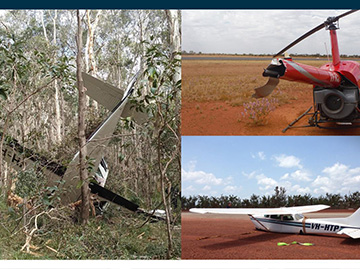
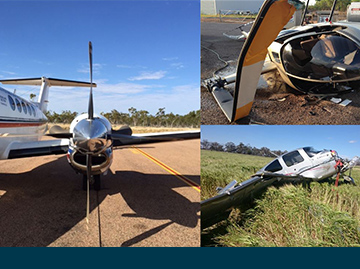
Issue 56 of the Bulletin features ten safety investigations:

Jet aircraft

Turboprop aircraft

Piston aircraft

Separation issues

Remotely Piloted Aircraft

Commercial aviation safe

Commercial air travel in 2015 was safer than in any of the previous 10 years, according to Australian Transport Safety Bureau (ATSB) research, released today.

The ATSB’s report Aviation occurrence statistics 2006 to 2015 found that commercial air transport in 2015 had one fatality from nine accidents. General aviation had 12 fatalities from 130 accidents and recreational aviation had 18 fatalities from 76 accidents.

ATSB Chief Commissioner Greg Hood said 28 aircraft were involved in fatal accidents in 2015 and a further 28 in an accident resulting in serious injuries.

“The majority of fatalities in the 10‑year period occurred within general aviation, with around 20 per cent of fatal accidents resulting from a loss of control,” Mr Hood said.

Thousands of safety occurrences involving Australian-registered and foreign aircraft are reported to the ATSB every year by individuals and organisations in Australia’s aviation industry, and by the public.

Mr Hood said that for all accidents, the highest accident rates occurred with recreational aeroplanes, followed by aerial agriculture, private/business and sport aviation, and recreational gyrocopters.

Of concern was that in 2014 (the most recent year flying hours data was available for), the flying training accident rate per million hours flown was more than double that of any year in the previous eight.

“The increase in accident rates involving flying training is an emerging safety concern—we’ll continue to keep a close eye on this sector to get a better understanding of the safety issues involved,” Mr Hood said.

Also increasing was the number of remotely piloted aircraft accidents and incidents. “This has gone up from 14 occurrences in the eight years from 2006–2013 to 37 in 2014–2015.

“Given the significant growth in the use of remotely piloted aircraft, it is likely that the number of incidents and accidents will continue to increase in the short term.”

Mr Hood said growth in recreational (non‑VH) flying and improving awareness of reporting requirements led to more than a tenfold increase in the number of recreational safety incidents reported to the ATSB from 2006 to 2015.

The aim of the ATSB’s statistical report series is to provide feedback and information to pilots, operators, regulators, and other aviation industry participants on accidents and incidents that have occurred, how often they have occurred, and what can be learnt from them.

The statistics are used by the ATSB to inform its SafetyWatch priorities.

Read the ATSB research report AR-2016-122 - Aviation occurrence statistics 2006 to 2015.

High risk flying

There are increasing risks associated with flying visually with rising terrain and lowering cloud base.

The risks of flying visually with rising terrain and lowering cloud base became evident to an RV4 pilot in December 2016.

smallfixedwingaircraft.jpg

On departing Inverell, NSW, on the last leg of a flight from Corowa, NSW, to Archerfield, Queensland, the pilot inadvertently ended up flying in a valley. The pilot decided the only option to fly out of the valley was to enter instrument meteorological conditions (IMC) in cloud and climb through.

Just after contacting Air Traffic Control (ATC), the aircraft broke clear of the cloud at about 7500 ft above sea level. The pilot asked for a weather report for near the coast and was informed by another pilot that Ballina weather was clear.

With ATC monitoring, the pilot was able to sight Ballina and made a normal visual approach. After a few hours on the ground, the pilot then flew on to Archerfield without incident.

Not all pilots are so lucky. Flying with reduced visual cues too often results in fatal accidents, made all the more tragic because they are avoidable. In the five years from 2012 to 2016 there have been around 40 occurrences of VFR into IMC, resulting in four accidents, 10 serious incidents and seven fatalities.

Problems with pilots’ assessing and planning contributes to about half of all fatal accidents in private operations.

To improve the odds of reaching a destination, pilots should make decisions before the flight. They should continually assess flight conditions (especially weather) and evaluate the effectiveness of their plans.

Pilots should set personal minimums and assess their fitness to fly and make safety the primary goal. And they should seek local knowledge of the route and destination as part of their pre-flight planning.

More information about VFR into IMC is available from the ATSB's Avoidable Accidents booklet and our SafetyWatch page Flying with reduced visual cues.

Wirestrike warning for pilots

ATSB reminds pilots operating at low level in a high workload environment to be constantly vigilant.

A recent accident involving a Bell 206 helicopter highlights the ongoing dangers wirestrikes pose to pilots flying at low levels in a high workload environment.

On 18 December 2016, the pilot was flying a Bell 206 helicopter from Bathurst to Wagga Wagga, NSW for maintenance, in wet and cloudy weather conditions.

While flying at low level to maintain visibility, the pilot reported that the aircraft ‘yawed slightly right and nose pitched slightly down’. Initially suspecting a tail rotor issue, the pilot continued to maintain control of the aircraft. A few seconds later, the helicopter’s Perspex screen shattered. The pilot then realised the aircraft had struck a wire before landing safely without injury.

The ATSB continues to investigate wirestrike accidents that result in loss of life and serious injury. Over the past 10 years, 18 people have died and more than 20 people suffered serious injury as a result of wirestike accidents.

A recent ATSB investigation into a wirestrike accident involving a Robinson R22 near Blackall, Queensland reinforces the increased risk of striking hazards at low-level flight. On this occasion, the pilot was seriously injured after the aircraft struck a powerline 4.8 metres above the ground. The helicopter was destroyed.

The ATSB reminds pilots operating at low level in a high workload environment to be constantly vigilant for the presence of powerlines and wires.

More information on managing wirestrike hazards can be found in the ATSB’s booklet Avoidable Accidents No. 2 - Wirestrikes involving known wires: A manageable aerial agriculture hazard.

New way to report occurrences

Aircraft operators and organisations involved in aviation safety will soon have access to a new method of submitting written notifications to the ATSB of aviation safety matters.

Aircraft operators and organisations involved in aviation safety will soon have access to a new method of submitting written notifications to the ATSB of aviation safety matters.

schema2.jpg

This method will allow operators and organisations to report out of their own safety management systems or reporting software and directly transfer accident and incident notifications to the ATSB notification system.

This new option is set to significantly improve the way aviation transport safety matters are reported to the ATSB.

How it works

To ensure that accident and incident data reported to the ATSB is compatible with the ATSB’s notification system, we have developed an ‘XML schema’ that is available upon request through the ATSB website.

The schema will provide a framework for organisations and software vendors to develop and automate accident and incident reporting solutions in a format compatible with the ATSB notification system.

Draft schema

Before we roll out the schema, we’re offering an opportunity for interested parties to review and evaluate a draft version.

We’re particularly keen to engage with software vendors and operators of safety management systems who are looking to either update existing systems or build new systems that are capable of using the ATSB’s schema for reporting accidents and incidents.

Once the final schema is released, the ATSB will provide a section on its website where software vendors and safety management system providers can apply to have their compatible reporting systems listed as being ‘ATSB Reporting Compliant’.

This listing option will be conditional on the ATSB validating that the outputs of any reporting system are fully compliant with schema and the ATSB’s notification system.

Reporting options

The ATSB’s current options for reporting incidents and accidents include a web form, email, fax, post and electronic formats. Within the next 12 months, the ATSB will move towards only accepting electronic formats for the submission of written accident and incident notifications.

This means that aircraft operators and organisations will eventually need to report aviation transport safety matters to the ATSB via their compatible reporting solution or through the ATSB’s web notification form. The ATSB will keep you updated on the new reporting requirements over the coming months.

Compliance

Irrespective of the schema’s implementation, users need to ensure that they are compliant with all aspects of the aviation accident and incident reporting requirements of the Transport Safety Investigation Act 2003 or any other applicable statutory instrument.

Prior to receiving the schema details, users will need to accept the license terms and conditions associated with its use, which will be supplied by the ATSB.

Licencing

A licence for use of the schema will be provided in accordance with the terms of Creative Commons Licence Attribution CC BY 3.0(Opens in a new tab/window).

More info

To get a copy of the draft schema or for more information, please contact the ATSB’s Manager of Reporting, Short Investigations & Research at atsbinfo@atsb.gov.au.

Safer transport for PNG

The ATSB recently renewed an Agency Arrangement with the Department of Infrastructure as part of the Australian and PNG governments’ cooperation in the transport sector.

The ATSB recently renewed an Agency Arrangement with the Department of Infrastructure as part of the Australian and PNG governments’ cooperation in the transport sector.

png_mou_signing.jpg

The Agency Arrangement supports the program of cooperation between the ATSB and the PNG Accident Investigation Commission (AIC), with the aim of improving transport safety in PNG through a number of activities with funding from an Australian aid initiative.

The program supports capability building activities with the main objective of supporting the AIC to move closer to international standards and recommended practices in aviation safety investigation.

The ongoing relationship will result in a safer and more secure transport system for PNG citizens, visitors to the country, and people and assets moving into and out of PNG airspace.

The relationship means PNG will be better placed to realise its medium and long-term transport infrastructure development goals and build the country’s capability to manage its transport safety responsibilities.

A functional and appropriate PNG transport network will in turn enable economic growth that supports productivity, employment and access to basic services.

PHOTO: Department of Infrastructure Deputy Secretary Pip Spence and ATSB Chief Commissioner Greg Hood renew an Agency Arrangement

Aviation Bulletin Issue 55

The Aviation Short Investigation Bulletin covers a range of the ATSB’s short investigations and highlights valuable safety lessons for pilots, operators and safety managers.

The Aviation Short Investigation Bulletin covers a range of the ATSB’s short investigations and highlights valuable safety lessons for pilots, operators and safety managers.

Released periodically, the Bulletin provides a summary of the less-complex factual investigation reports conducted by the ATSB. The results, based on information supplied by organisations or individuals involved in the occurrence, detail the facts behind the event, as well as any safety actions undertaken. The Bulletin also highlights important Safety Messages for the broader aviation community, drawing on earlier ATSB investigations and research.

Issue 55 of the Bulletin features ten safety investigations:

Jet aircraft

Turboprop Aircraft

Piston Aircraft

Helicopter

Near Collision