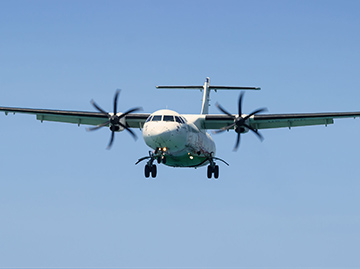
Update: SAAB 340 propeller

The ATSB has today released a preliminary report into the in-flight propeller detachment involving a Regional Express SAAB 340 aircraft near Sydney Airport on 17 March 2017.

The ATSB’s inspection of the aircraft identified that the propeller shaft fractured, leading to the separation of the propeller.

An inspection of the propeller at the ATSB’s technical facilities in Canberra revealed a fatigue fracture that began in the propeller mounting flange (the part that attaches the propeller to the gearbox) and continued into the propeller shaft. The inspection also found corrosion near the initiation of the fracture.

ATSB Chief Commissioner Greg Hood says the ATSB has been working closely with the Civil Aviation Safety Authority (CASA), SAAB, GE Aviation (engine manufacturer) and Regional Express during the investigation.

“This is the first known critical failure of this type, initiating within the propeller hub flange of the GE Aviation CT7-9B engine,” Mr Hood said.

“Both the operator and the engine manufacturer have already taken proactive safety action in response to the ATSB’s safety advisory notice.

“GE Aviation is conducting metallurgical analysis on the propeller flange and hardware at its laboratories in Cincinnati, USA. They are also inspecting additional propeller gearboxes and reminding all operators to follow maintenance and inspection procedures. GE Aviation will release additional maintenance and inspection recommendations if they become necessary.

“Regional Express has quarantined all propeller gearboxes with propeller shafts of the same series as that installed in the aircraft involved in the incident.”

The ATSB’s ongoing investigation will focus on maintenance procedures associated with the propeller gear box shaft and examine factors that may have contributed to the fatigue fracture at the propeller mounting flange.

Mr Hood says the ATSB will continue to work closely with all involved parties to determine the cause of the propeller detachment.

Read the preliminary report: In-flight loss of propeller involving Saab 340B, VH-NRX, 19 km (10 NM) SW of Sydney Airport, NSW, on 17 March 2017

Indonesian rail safety investigators

Two Indonesian rail safety investigators are in Australia this week to enhance their knowledge.

Suprapto Resorasmin is the Head of the Indonesia’s National Transport Safety Committee (NTSC) Railway Accident Investigation Sub Committee and Riduan Siregar is an NTSC Railway Safety Investigator. Both have professional qualifications in science and engineering and are experienced railway safety investigators.

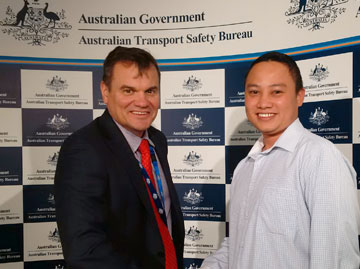
They are attending a two day Rail Safety Conference 2017 in Brisbane, hosted by the Australian Rail Industry Safety and Standards Board (RISSB). They have spent time with ATSB rail investigators Hans Boon and Jeff Stone and have visited the Queensland Rail Train Control Centre.

The Rail Safety Conference will include a visit to the Queensland Government’s $190 million, state-of-the-art centre at Wulkuraka, west of Ipswich, opened in February 2016. The centre is responsible for the maintenance, service and repair of the New Generation Rollingstock fleet.

ITSAP was developed between Australia and the Government of Indonesia to address key Indonesian transport safety priorities. The main elements of the ATSB's contribution to the program have been to deliver training and support for investigators from the ATSB's Indonesian counterpart agency, the NTSC.

This has included the ATSB providing staff dedicated to various capacity building projects, funding ATSB training courses in Indonesia and Australia, and opportunities for aviation, marine, and rail investigators to work with their ATSB counterparts.

This cooperation between the ATSB and the NTSC is one of the key elements in ensuring lasting transportation safety for the people of Indonesia and Australian travellers to Indonesia.

Three NTSC investigators travelled to Australia last year for placements with the ATSB. Apib Prayogi Aeronautical Engineer, Ucu Suherman, Human Factors specialist, and Andreas Hananto, Flight Recorder specialist all participated in the ITSAP program.

Propeller lifted from bushland

Update: Recovered the propeller assembly in bushland at Revesby in Sydney’s South West.

Updated: 23 March 2017

The ATSB investigation into the in-flight propeller detachment involving SAAB 340 VH-NRX, 19 km SW of Sydney Airport, NSW, on 17 March 2017 is continuing.

With assistance from the NSW Police at Bankstown and NSW Police Air Wing, the investigation team yesterday recovered the propeller assembly in bushland at Revesby in Sydney’s South West. ATSB investigators have also interviewed flight and cabin crew.

The team are now:

  • consulting with the engine and aircraft manufacturers and the aircraft operator
  • reviewing the aircraft’s maintenance requirements and records
  • examining the aircraft’s flight data recorder
  • examining physical components, including the propeller assembly and engine, in consultation with relevant parties.

Updates will be provided as significant information comes to hand.

A preliminary factual report is expected to be publicly released within a month.


Updated: 22 March 2017

ATSB senior transport safety investigators Aaron Holman (left) and Max Marton with the SAAB 340 propeller that detached from the engine on a Rex flight from Albury to Sydney on 17 March.

The propeller was lifted from its position in bushland near Revesby, south-west of Sydney, to a nearby field using a PolAir helicopter.

It was then transported by truck for storage at a NSW Police Aviation Support Branch facility at Bankstown where ATSB investigators will continue their investigation into the incident.

ATSB senior transport safety investigators Aaron Holman (left) and Max Marton with the SAAB 340 propeller

Source: Australian Transport Safety Bureau


21 March 2017

The detached propeller from the Regional Express (REX) SAAB 340 was located by NSW Police at around noon today.

The propeller was located by NSW Police helicopter PolAir1 in an area of bushland near Revesby in Sydney’s south-west.

The ATSB is now working with NSW Police to recover the 100kg propeller assembly in preparation for examination.

Since the propeller assembly detached from the engine on a flight from Albury to Sydney on 17 March, the ATSB has been calculating its likely trajectory, using data from the aircraft’s flight data recorder. The propeller was located in an area broadly consistent with the ATSB’s calculations.

The ATSB investigation team will examine the propeller assembly to determine the contributing factors that led to its detachment from the aircraft.

ATSB Chief Commissioner Greg Hood thanked NSW Police for their ongoing cooperation with locating and recovering the propeller.

More information about this incident and the ATSB’s investigation is available on the ATSB’s website.

Link to the PolAir1 vision(Opens in a new tab/window).


Published: 17 March 2017

The Australian Transport Safety Bureau (ATSB) is investigating an incident involving a Saab 340, registration VH-NRX, about 19 km from Sydney on 17 March 2017.

It is reported that the right propeller assembly detached in-flight during the Regional Express (REX) flight from Albury to Sydney, with 16 passengers and three crew on board. The aircraft landed safely at Sydney.

The ATSB is deploying a team of three investigators with expertise in materials failure engineering, recorded flight data analysis, and human factors.

Over the next few days, investigators will examine the aircraft, interview the flight and cabin crew, collect maintenance records and recorded flight data.

Important: The ATSB urges anyone who finds a piece of suspected aircraft debris NOT to handle it. Please call the local police or the ATSB on 1800 020 616.

Drone safety research report

The ATSB has today released a research report into the safety of remotely piloted aircraft systems (RPAS) or drones.

The report finds the number of encounters is increasing. While there have been no reported collisions between RPAS and manned aircraft in Australia, and given the variables, the potential consequences of collisions are not yet fully understood.

“Our report seeks to better understand the implications for transport safety associated with the expected continual growth in the number of RPAS in Australia,” ATSB Chief Commissioner Greg Hood said.

“We expect there could be a doubling in the number of RPAS in Australia by the end of 2017.”

About half of the 180 occurrences from 2012 to 2016 involved proximity encounters with manned aircraft. Over 60 per cent of all reported RPAS encounters (108 occurrences) occurred in 2016 (69 occurrences).

“Based on our knowledge of birdstrikes, RPAS collisions with high capacity air transport aircraft could lead to an engine ingestion in about eight per cent of strikes,” Mr Hood said.

“RPAS also have the potential to damage a general aviation aircraft’s flight surfaces (wings and tail), which could result in a loss of control.

“Similar to the impact from a large bird, collision between a RPAS and a general aviation aircraft’s windscreen poses a high risk of penetration.”

The operation of remotely piloted aircraft requires close monitoring as the popularity of these aircraft continues to rapidly grow.

Read the ATSB research report AR-2017-016: A safety analysis of remotely piloted aircraft systems 2012 to 2016

Aircraft loses power in-flight

Incident highlights the potential catastrophic risks of not completing aircraft maintenance.

On 11 November 2016, a Cessna 208B aircraft was on a re-familiarisation training flight with an instructor and trainee pilot on-board.

After take-off, at an altitude of about 500 ft, the instructor noted the climb speed reducing while the trainee continued to maintain the nose attitude for best angle of climb. At the same time, the instructor heard the engine lose power and a thin film of fuel partially obscured the windscreen.

As the airspeed reduced to 60 kt, the instructor took control and identified a suitable area for a forced landing and began a left turn at the target glide speed of 85 kt. At the completion of the turn, they selected 30 degrees of flaps to provide a short climb, which allowed the aircraft to clear two hangars and an area of trees.

After clearing the hangars and trees, the aircraft landed without further incident.

A post-accident examination of the engine found the number eight fuel nozzle locking plate missing—probably not reinstalled when fuel transfer tubes and nozzles were installed after replacement.

The missing locking plate allowed the fuel transfer tube to slowly migrate out of the nozzle adaptor over the 86 hours since the maintenance occurred. Fuel escaped, leading to engine power loss in flight.

Australian Transport Safety Bureau Chief Commissioner Greg Hood says the incident serves to underline the importance of ensuring all maintenance is completed entirely and correctly.

“The locking plate was not installed during scheduled maintenance, and yet the fuel leak did not develop for a further 86 flight hours,” he said. “This demonstrates how the effects of incomplete maintenance can take a long period of time to manifest.”

Read the final report: Engine failure and forced landing involving Cessna 208, VH-TYV, Darwin Airport, Northern Territory, on 11 November 2016

ATSB: National rail investigator

The ATSB is set to conduct no-blame safety investigations of rail occurrences across all of Australia from 30 June 2017.

This follows the Queensland Government passing legislation that will see the ATSB investigating accidents and incidents on Queensland’s metropolitan and regional passenger, and freight rail networks.

The ATSB’s investigation role will occur concurrently with the Office of National Rail Safety Regulator overseeing rail safety regulation in every Australian state and territory.

ATSB Chief Commissioner Greg Hood welcomed the expanded role for the national transport safety investigator.

“The ATSB will operate as the rail safety investigator for no-blame investigations and will engage with Queensland operators over the coming months to ensure they understand the new environment,” Mr Hood said.

“The ATSB has extensive investigation experience in the rail, aviation and marine sectors—a move to a fully national investigation role for rail will further enhance transport safety in Australia.”

The rail industry makes a significant contribution to the Australian economy and greater consistency of national safety requirements will help increase productivity and efficiency across the sector.

More information on rail accident or incident notifications.

It pays to follow procedures

Effective procedures help crew safely deliver passengers after a mid-flight engine failure.

Effective use of Crew Resource Management procedures by a Fairchild SA227 flight crew helped them safely deliver 13 passengers from Armidale, NSW, to Brisbane, Queensland, after a mid-flight engine failure.

At 7.55 am on 12 October 2016, the aircraft was about 170 km south of Brisbane when it suddenly yawed to the right.

The flight crew noted that all right engine indications were normal except for a low torque reading and low fuel flow. They confirmed that the right engine was not delivering power, shut it down and feathered the right propeller.

Air traffic control gave them a direct track to Brisbane Airport. After completing their normal and single engine landing checklist, the Fairchild landed at Brisbane Airport runway 19 without further incident.

Australian Transport Safety Bureau Chief Commissioner Greg Hood says that, following the aircraft yaw, the flight crew actively employed their crew resource management procedures to identify and confirm the engine fault and shut it down.

“The use of these procedures reduced the risk of an incorrect diagnosis of the fault, or activation of the incorrect engine controls during shut down,” Mr Hood said.

The ATSB investigation found that the failure of a retainer ring that led to an engine gearbox malfunction, was within the required gearbox inspection intervals and without prior warning of an impending failure.

As a result of this occurrence and subsequent to an update by the engine manufacturer to the engine manufacturer’s service bulletin, the aircraft operator has advised the ATSB that they have reduced their engine oil testing interval from 150 hours to 100 hours.

Retainer ring

Figure 2: Retainer ring

Read the final report: Engine failure involving Fairchild SA227, VH-VEU, 170 km south of Brisbane, Queensland, on 12 October 2016

Crew praised for landing

Education and training helped the crew of a Fokker F28 MK 100 manage two emergencies, including a hydraulic failure that compromised nose-wheel steering.

The crew’s response ultimately ensured the safe landing, taxiing and subsequent evacuation of 97 passengers, three cabin crew and two flight crew on a Newman to Perth flight on 23 September 2016.

About 550 km north of Perth, the flight crew were alerted to the issue resulting from the hydraulic failure. They arranged for assistance to be available at Perth airport to tow the aircraft from the runway to the gate.

The flight crew notified Air Traffic Control of the fault and discussed the implications of the failure. Without nose-wheel steering, they planned to land the aircraft on runway 21 at Perth Airport and roll through to the end of the runway, where a pre-positioned tug would tow it to the allocated gate for passenger disembarkation.

Rather than use the engines for electrical power and air-conditioning during the aircraft tow, the captain elected to start the auxiliary power unit (APU) during the approach. The APU would then supply air for the air-conditioning system after landing and electrical power after the engines were shut down.

The aircraft landed without further incident and rolled through to the end of runway 21.

Despite the pre-arrangement, there was no tug waiting for the aircraft, so the flight crew used differential braking to turn the aircraft off the runway and onto the taxiway before stopping.

At this point the cabin crew manager reported to the captain that fumes were present in the cabin. An emergency evacuation was conducted, during which three passengers received minor injuries.

Australian Transport Safety Bureau Chief Commissioner Greg Hood says the incident highlights the importance of training and procedures, and the need for organisations to educate their workforce about safety incidents.

“The flight crew were confronted with consecutive emergencies,” Mr Hood said. “They responded to each situation in accordance with their training and procedures, which resulted in everyone safely evacuating the aircraft with only minor injuries reported.”

Read the final report: Emergency evacuation involving Fokker F28, VH-NHY, Perth Airport, Western Australia, on 23 September 2016

Chief Pilots land in Canberra

Chief Pilots from around Australia converged on the ATSB’s office in Canberra today to take part in the national Chief Pilots’ forum.

The Group of Chief Pilots from the majority of Australia’s high capacity carriers meet on a regular basis to discuss safety-related issues. (High capacity aircraft are those certificated as having a maximum seating capacity exceeding 38 seats or a maximum payload exceeding 4200 kilograms.)

The forum encourages the ongoing, effective relationship with industry stakeholders and regulators. The primary aim of the forum is to enhance aviation safety.

Each airline Chief Pilot usually hosts the forum at their corporate office. While today’s forum is hosted by Virgin Australia Regional Airlines, the group will meet at the ATSB to discuss transport safety notifications and occurrence reporting as well as aviation regulatory matters.

ATSB Chief Commissioner Greg Hood will also provide an overview of how the national transport safety investigator is evolving to meet a host of new challenges within the aviation industry.

Program participants will have an opportunity to tour the ATSB’s technical facilities where investigators analyse Cockpit Voice Recorder and Flight Data Recorder readouts for occurrences in Australia and overseas. Australia is one of few countries in the Asia-Pacific region to possess these types of labs.

Chief Pilots forum

Take-offs without lighting

The hazards associated with change blindness, inattention blindness & expectation bias.

On 19 August 2016, a JetGo Australia Embraer EMB-135LR, registered VH-JTG, operated scheduled passenger flight JG65 from Tamworth, New South Wales, to Brisbane, Queensland. At 2104 Eastern Standard Time, the aircraft began to taxi from parking bay 1 to runway 30 right (30R) with the taxiway and runway lights not activated. The captain taxied the aircraft onto the runway and immediately began the take-off run. During the take-off run, at a speed of about 70 knots, the first officer detected the runway lights were not illuminated and activated them using the pilot activated lighting.

On 28 August 2016, the same aircraft operated scheduled passenger flight JG65 from Tamworth to Brisbane. At 1937, the aircraft began to taxi from parking bay 1 to runway 30R. As the aircraft taxied, the runway and taxiway lights extinguished. The flight crew continued to taxi and lined up on runway 30R. The aircraft began the take-off run and departed runway 30R with the runway lights not activated.

No persons were injured and the aircraft was not damaged in the incidents.

These incidents demonstrate the impact workload stress can have on operations.

These incidents demonstrate the impact workload stress can have on operations. The short taxi created a high workload situation which impacted on the flight crews’ ability to detect the extinguished runway lighting.

The incident on the 28 August also highlights the hazards associated with change blindness, inattention blindness and expectation bias.

Change blindness occurs when a person does not notice that something is different about the visual environment relative to before the change. Research has shown that in some cases, quite dramatic changes are not detected, particularly if changes occur when the observer is not looking at the relevant part of the visual environment at the time. In this incident the flight crew did not detect the runway lights extinguish during taxi prior to departure.

Read the full investigation report AO-2016-108