Fatigue crack in XPT axle leads to derailment.

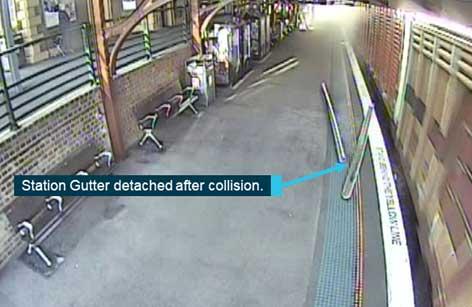
An ATSB investigation has found that fatigue cracking in an XPT axle led to a minor derailment of an XPT passenger service from Melbourne to Sydney on 9 February 2006 at Harden.

The Australian Transport Safety Bureau investigation into the derailment concluded that train ST22 derailed as a result of the axle completely fracturing and eventually derailing one wheel.

Subsequent examinations by RailCorp, the train operator, led to the discovery of thirteen other XPT power car axles with surface defects, or cracks initiated by surface defects, in highly stressed areas.

The ATSBs examination of five of the axles revealed a crystalline material, consistent with track ballast, embedded in each fatigue crack at its origin. It was probable that impacts from track ballast from unknown location(s) had led to the formation of the cracks in the axles.

The investigation also found that routine testing of the axles carried out by the operators maintenance contractor was ineffective and resulted in the fatigue cracks going undetected for a considerable period of time.

Both RailCorp and the New South Wales rail regulator have initiated safety actions to reduce the risk of fatigue cracks leading to similar axle failures.

The ATSB has issued a safety advisory notice to all rail vehicle operators in Australia to consider their maintenance and inspection regimes to detect possible fatigue cracks.

Read the report: Derailment of XPT Passenger Train, ST22; Harden, NSW; 9 February 2006

Report on tanker grounding in Tamar River released today

A report released today by the Australian Transport Safety Bureau found that the Kuwaiti flag tanker Al Deerah, loaded with cargo, had grounded in the Tamar River, Tasmania on 30 April 2000 due to factors related to the tide and the rate of turn in the river.

The effects of starboard rudder used in the turn off Garden Island, combined with differing tidal strengths at the bow and the stern of the vessel and the inability to reduce the rapid rate of turn, were the main factors.

The accident happened when the tanker, inbound for Bell Bay on a flood tide, was following normal navigational procedures. During the turn to starboard to round Garden Island, the ship's pilot noticed that it was turning too quickly, and despite the use of full counter rudder, it continued to swing to starboard.

The tanker made contact with the bottom southeast of Garden Island. It listed to starboard as ballast tanks (which protected the inner cargo tanks on the double hull vessel) were breached and began filling with water.

The tanker was anchored to assess the effects of the damage and was later berthed in Bell Bay without further incident. The cargo tanks were undamaged, no-one was injured and no pollutants escaped the ship.

The Australian Maritime Safety Authority detained the tanker and an examination of the hull was conducted by the classification society. On 1 May 2000 the vessel was released to sail for Burnie and, after completion of cargo discharge at Port Botany, to dry dock for repairs.

Read the report summary or download the full report

Level crossing collision, Elizabeth River, Northern Territory

The ATSB has found that a collision occurred at level crossing near Elizabeth River (NT) on 20 October 2006 because the driver of a road-train truck did not stop at a Stop sign to give way to an approaching freight train.

The Australian Transport Safety Bureau investigation established that an adjacent road junction, low train conspicuity and a low expectation of seeing a train probably combined to mistakenly filter the truck drivers attention away from the importance of looking for a train. Consequently he did not see the approaching train, even though it is likely that he looked in that direction.

The ATSB also concluded that it had become normal practice for the truck driver to slow but not stop at the level crossing Stop sign.

The ATSB report makes recommendations relating to public awareness and visibility of approaching trains and acknowledges that the rail operator and the NT Government have implemented strategies to prevent similar collisions at this location.

Read the report: Level crossing Collision, Elizabeth River, Northern Territory, on 20 October 2006

Ship in distress after cargo shifts

According to a report issued today by the Australian Transport Safety Bureau (ATSB), a shift of a cargo of packaged timber resulted in the Panamanian flag general cargo vessel Sun Breeze experiencing a large list and sending out a 'Mayday' call off the West Australian port of Bunbury on 21 August 1999.

Sun Breeze had sailed from Bunbury at 1800 on 21 August with timber loaded underdeck as well as on the deck and hatchtops. The Master had just left the bridge when the vessel, on autopilot, turned to starboard on its own accord. It then appeared to list to port before taking a starboard list of about 25, losing a number of packs of timber from the hatchtops overboard. The Master anchored the vessel just north of the port and corrected the list by adjusting ballast.

The vessel re-entered the port the next day when it was found that the underdeck cargo had shifted. After cargo was restowed and secured, the vessel sailed for the discharge port in China where it arrived safely.

The ATSB report concluded that a number of factors had contributed to the incident, including partially filled tanks that had reduced the vessel's stability and cargo that had not been correctly secured.

The vessel's stability data was based on an inclining experiment, when Sun Breeze was built, that did not conform to standards of the International Maritime Organization (IMO). The report notes that the ATSB took up this issue with the classification society.

The ATSB also queried other details of the stability data, which led to the classification society making the necessary amendments to the vessel's approved stability booklet.

Read the ATSB report 150.

Boeing 737 – Garuda Airways Accident at Adisucipto Airport, Yogyakarta, Indonesia on 7 March 2007

The Australian Transport Safety Bureau (ATSB) is assisting the Indonesian National Transportation Safety Committee (NTSC) with the investigation into the circumstances surrounding the tragic accident involving a Boeing 737-400 on 7 March 2007 at Yogyakarta, Indonesia.

As part of this assistance, the ATSB will download and analyse data from both the cockpit voice recorder (CVR) and flight data recorder (FDR) recovered from the aircraft. Depending on the extent of damage, this may involve significant time in transferring data to new black box chassis before download and then analysis. If there is useable data, preliminary results are expected early next week.

The recorders are arriving in Canberra today at approximately 12.00 (midday) at the Corporate Air Facilities at Canberra Airport. The recorders will then be transferred to the ATSB headquarters at 15 Mort Street, Canberra.

There will be an opportunity for the media to film the arrival of the recorders at both locations, Corporate Air Facilities, Canberra Airport and subsequently at ATSB headquarters, 15 Mort Street, Canberra.

Public appeal for missing aircraft panel

Aircraft Accident - Cirrus SR-22, near M7 Motorway at Cecil Park, NSW on

5 February 2007

The Australian Transport Safety Bureau (ATSB) is seeking the public's assistance in locating a missing panel from an aircraft that crashed last week at Cecil Park in Western Sydney.

The Cirrus SR-22 aircraft crashed around 4:30 pm on Monday 5 February, just near the M7 Motorway at Cecil Park, seriously injuring the American pilot and his Australian passenger. Investigators from the ATSB attended the scene and noticed that a panel that should be located on the rear of the aircraft was missing. Yesterday (Sunday 11 February), about 100 NSW SES personnel kindly assisted in conducting an extensive search in the area, however, they did not find the panel.

The panel is of fibreglass construction, is rectangular in shape with rounded corners, measures 35 x 43 cm (14 x 17 inches) and is painted gloss white on one side. Markings on the panel include hand written part numbers on the inside and a printed warning decal on the outside (see attached pictures of a similar panel). The decal reads:

"Warning - Rocket for parachute deployment inside - Stay clear when airplane is occupied"

The panel is an important piece of evidence required for the investigation of this accident.

Anyone who may have seen the aircraft near the M7 Motorway last Monday afternoon or who may have seen a panel matching the description provided is asked to call the ATSB urgently on: 1800 020 616

Human Error Leads to Grounding

The mate of the container ship Bunga Teratai Satu allowed it to ground on Sudbury Reef off Cairns on 2 November 2000 because he was distracted by his wife's telephone conversation while in charge of the watch. This was the principal finding of a report into the accident released by the Australian Transport Safety Bureau (ATSB) today.

The mate had called his wife to the bridge wing while within mobile telephone range of the shore for her to speak to her mother and their children in Karachi. The mate was distracted from his duties while establishing the telephone link and while listening to the conversation between his wife and her mother. As a result he neglected to make a routine alteration of course off Fitzroy Island and allowed the ship to run aground 20 minutes later at full-ahead speed.

Alarms connected to the ship's global positioning system (GPS), to indicate the vessel was arriving at an alter course position and, subsequently, that it was off-course, did sound. The investigation was unable to determine with any certainty why the alarm failed to trigger an appropriate response from the mate, or when it was actually cancelled. The report found that the alarm tone could have been more distinctive and was similar to an alarm connected to the radio system.

The report found the management of the ship and its procedures to be of a good standard, but the lack of motivation and professionalism on the part of one person led to the grounding.

There was no pilot on board Bunga Teratai Satu at the time of the grounding. The ship had disembarked its pilot about an hour and a half before off Cairns. The issue of pilotage in the Great Barrier Reef is subject to a separate review, commissioned by the Minister for Transport and Regional Services, John Anderson, immediately after the grounding. The Strategic Review of Ship Safety and Pollution Prevention Measures report is expected to be released mid-year.

The ATSB's report of the accident also suggests that, given the container ship's speed of over 20 knots and the level of inattentiveness apparent on the bridge of the Bunga Teratai Satu, it is doubtful that any warning that could have been issued by Reefcentre after the vessel crossed into the restricted area would have averted the grounding.

The ATSB has made recommendations to the ship's owner, particularly in relation to bridge procedures and GPS alarms. The ATSB has also recommended a review of the role of the Great Barrier Reef ship reporting system, including an assessment of the feasibility of Reefcentre providing a full advisory service to ships in the inner route of the Great Barrier Reef. These issues have already been incorporated into the review commissioned by the Minister.

Read the ATSB investigation report

Fatal Aircraft Accident - near Cape Liptrap, Victoria, 17 November 2007

A media conference discussing the progress of the investigation into the circumstances surrounding the Cessna 337 4-fatality accident on 17 November 2007 will be held today, Wednesday 21 November 2007

Where: Carpark of the Venus Bay Surf Life Saving Club, Victoria
Time: 16:00 ESuT (local time)

Mr Andrew Roberton, Investigator in Charge (IIC) will discuss factual information known to the investigation team at this time and will outline the investigation process.

Any person/witness with information about the accident is encouraged to contact the ATSB on 1800 020 616.

No further media briefings will be conducted by the on-site team. After this briefing, all media enquiries must be directed to the media contact listed below.

Release of QF1 Bangkok accident investigation report

The Australian Transport Safety Bureau today released its report on the Qantas B747-400 runway overrun accident at Bangkok International Airport on 23 September 1999.

The ATSB investigation was undertaken under a delegation from the Aircraft Accident Investigation Committee of Thailand given on 18 November1999.

ATSB Executive Director Kym Bills said: "The Qantas Bangkok runway overrun was a serious accident that fortunately did not result in fatalities and serious injuries. It was a wake-up call to Qantas who may have been lulled into a false sense of security by their very good safety record. Qantas provided excellent cooperation throughout the investigation and ATSB is pleased that Qantas has actively responded to the deficiencies found during our investigation."

"Like most major accidents, QF1 resulted from a complex mixture of active failures, inadequate defences and organisational factors - these are spelled out in our investigation report without fear or favour but not apportioning 'blame'."

The investigation found that the accident occurred when the B747-400 landed well beyond the normal touchdown zone and then aquaplaned on a runway that was affected by water following very heavy rain. The crew omitted to use either full or idle reverse thrust during the landing. The aircraft was still moving at 88 kts (163 km/h) at the end of the runway and stopped 220 m later in soft turf with its nose on the airport perimeter road. A precautionary evacuation was made using emergency escape slides about 20 minutes later.

Although the flight crew and cabin crew made a number of errors, many of these were linked to deficiencies in Qantas's operational procedures, training and management processes. CASA's regulations covering contaminated runways and emergency procedures were also found to be deficient, as was its surveillance of airline flight operations. Qantas and CASA either have made, or are in the process of making, significant changes in the areas where deficiencies were identified including the development by CASA of a systems-based surveillance audit approach.

"This investigation is one of the most comprehensive and exhaustive ever conducted by the ATSB (or its predecessor the Bureau of Air Safety Investigation). I believe that the ATSB investigation, and the safety enhancements made following the accident, constitute a major contribution to aviation safety in Australia," Mr Bills said.

ATSB reader survey

Colmar Bruton have advised the ATSB that they experienced problems with their survey website, which meant returns were not accepted between Friday 25 May and Wednesday 30 May, although the site appeared to function correctly.

The problem has been rectified and the site is ready to receive your comments at http://surveys.cbr.com.au/atsb(Opens in a new tab/window) "CLOSED"

The ATSB values your views and invites you to have your say about its reports. If you previously participated in the survey, we extend a special invitation to resubmit your response, and thank you for your patience.

The survey will take no more than about 10 minutes, and the deadline for submissions is Sunday 10 June 2007.