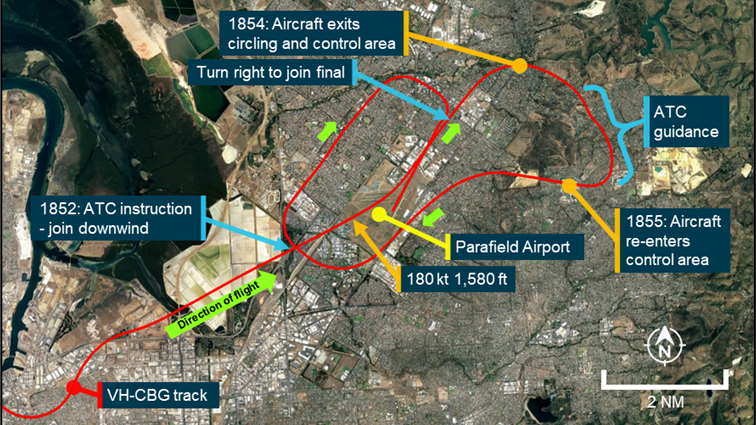
A Beechcraft Baron descended below minimum safe altitude during a night visual approach to Parafield Airport when the pilot lost situational awareness, an Australian Transport Safety Bureau investigation has found.
The Baron was conducting a charter flight under instrument flight rules (IFR) from Ceduna, on the west coast of South Australia’s Eyre Peninsula, to Parafield, in Adelaide’s north, on the evening of 13 May 2021. The pilot and a single passenger were on board.
During the flight, the pilot observed the aircraft’s tracking was ‘snaking left to right’ when the autopilot was engaged. The autopilot also did not turn the aircraft as rapidly as the pilot expected on a left turn towards Parafield.
Shortly after the pilot completed that turn manually and re-engaged the autopilot, Parafield air traffic control cleared the Baron for a night visual approach, and the aircraft descended towards the airport.
“At this time, the pilot’s focus was on the autopilot, resulting in the pilot losing sight of the runway and inadvertedly overflying the airport, towards an area of rising terrain at an altitude well below the minimum safe altitude,” ATSB Director Transport Safety Stuart Macleod explained.
“The pilot maintained this low altitude and continued the approach while looking for the runway.”
Despite being at night, there was enough light for the Parafield tower controller to see the aircraft and the hill-line to the east, so its terrain clearance did not raise concerns.
After losing sight of the runway, the pilot maintained a stable aircraft attitude and altitude as they could see the artificial street lighting on the ground, and had good visibility ahead and below the aircraft. They were also generally familiar with Parafield Airport.
However, the pilot had lost sight of the airport at night when the ability to visually identify obstacles was limited, so the safest option was to initiate a go-around and climb to the minimum safe altitude.
The aircraft was outside the airport’s circling and control area for about a minute, before the pilot was able to re-enter the control area under air traffic control guidance, and join the upwind leg of the circuit. The aircraft subsequently landed safely. No defect with the aircraft’s autopilot system was identified after the flight.
The ATSB’s investigation into the incident found that the pilot lost situational awareness, probably as a result of distraction due to the perceived autopilot issue.
“This incident highlights that unless there is a problem affecting flight safety, pilots should remain focused on monitoring aircraft and approach parameters, which provides assurance that an approach can be safely completed,” Mr Macleod said.
“If a visual approach cannot be completed pilots must inform air traffic control so assistance can be provided.
“If the criteria for the safe continuation of an approach are not met – for example losing sight of the runway – pilots must initiate a go-around and maintain a safe altitude to reduce the risk of colliding with obstacles or terrain.”
Since this incident, the aircraft’s operator, Hartwig Air, has updated its training program to include a threat and error management course.
Additionally, Airservices Australia has advised that it will brief its Parafield Airport tower controllers on the incident, including information on the circling area, descent below the minimum safe altitude during visual approaches, go-arounds, and the ‘safety alert’ procedure.
This procedure is intended to warn pilots that their aircraft is in unsafe proximity to terrain, obstruction, active restricted/prohibited areas, or other aircraft.
A King Air departing Essendon for Albury yawed to the left during take-off roll;
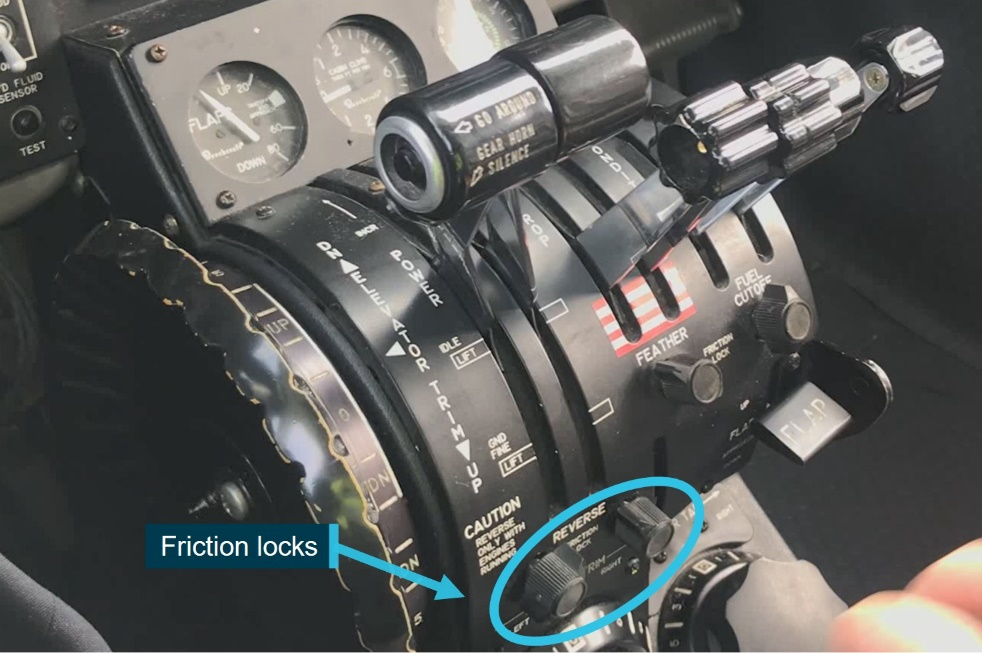
ATSB found that the left engine power lever had migrated rearwards as the friction lock had not been sufficiently adjusted during the pre-flight checks;
King Air power lever friction locks require careful adjustment to prevent power lever migration, particularly during take-off.
The insufficient tightening of a friction lock during pre-flight checks resulted in a Beechcraft King Air’s left power lever migrating to idle during the take-off roll, an ATSB investigation report details.
The King Air B200C aircraft, operated by Pel-Air, was departing Essendon for Albury on the night of 19 August 2021 to conduct a medical retrieval flight with a pilot, paramedic and doctor on-board. During the take-off, the aircraft experienced a reduction in power on the left engine and an uncommanded yaw to the left.
The pilot, who had about 16,000 hours of aeronautical experience, of which 42 hours were on the King Air B200C, initially managed the situation as an engine power loss and focused on maintaining directional control. However, when troubleshooting, they identified that the left engine power lever had migrated rearwards to the idle position. In response, the pilot moved the power lever back to take‑off power and adjusted the friction lock to prevent further movement.
The flight continued to Albury without further incident.
“The King Air’s power lever friction locks require careful adjustment to prevent the power levers moving inadvertently, particularly during take-off,” said ATSB Director Transport Safety Dr Stuart Godley.
“This is a characteristic generally known among King Air operators and pilots.”
When interviewed by the ATSB, the incident pilot reported that they were new to the B200C and unaware that power lever migration could occur during take‑off.
Another pilot from the operator noted that, until a pilot experienced a power lever migration, it could be difficult to know how much to tighten the friction locks.
“The power lever friction locks fitted to the King Air require careful adjustment to prevent power lever migration during take-off,” said Dr Godley.
“Operators should ensure pre-flight checks provide opportunities to confirm friction lock settings before the take-off run, and ensure pilots have adequate knowledge of friction lock sensitivity to help prevent and recover from inadvertent power lever migration.”
Dr Godley said the ATSB has released a safety advisory notice to all operators and pilots of King Air aircraft advising of power lever migration and the need to be aware of the careful adjustment required for the power lever friction lock.
“This incident highlights the importance of having a detailed understanding of the characteristics that may be specific to an aircraft type,” he said.
“In the case of the King Air, the design of the power lever system means that the friction locks required careful adjustment to prevent power lever migration.”
Helicopter operators and flight crew involved in rescue hoist operations should review their operational practices to ensure hoist operation and hook stowage are in accordance with the manufacturers’ published procedures, the Australian Transport Safety Bureau (ATSB) urges.
The advice comes as the ATSB publishes its final report into a rescue hoist cable failure which occurred when a New South Wales National Parks and Wildlife Service-operated AS350 B3 Squirrel helicopter was conducting personnel and equipment winching near Bulga, NSW on 5 February 2020. A crewman operating the helicopter’s Breeze Eastern-manufactured winch detected the outer strands of the load cable toward its termination into the hook assembly had loosened in respect of the inner core.
During a subsequent ‘cable conditioning’ hoist operation intended to tension the cable and realign the wires to restore the cable integrity, the cable fractured at the hook assembly while under load, releasing a 160 kg weighted bag and the hook assembly to the ground. There was no damage to the helicopter or injuries to personnel.
The ATSB’s investigation found that variations in the operator’s hook stowage practices over an extended period of winching operations led to inadequate compression of the hook assembly and subsequent wear of the load cable. The wear damage was due to vibration and movement of the hook assembly during periods of helicopter operation. This led to a significant reduction in the cross-sectional area of the cable, fatigue and fracture of the strands and an associated reduction in cable strength.
It is likely that specific post-flight inspection requirements for the Breeze Eastern rescue hoist required in a Civil Aviation Safety Authority’s Airworthiness Directive were not being adequately completed by the operator, the investigation found. The inspections were targeted at minimising wear damage to the load cable by ensuring correct stowage of the hook assembly at the end of each flight.
The ATSB also found that the operator’s method of cycle counting during operation of the rescue hoist led to an accumulation of cycles that significantly exceeded the helicopter manufacturer’s recommended life-limit. That exceedance probably compounded the level of wear damage sustained by the load cable.
“The ATSB recommends that pre- and post-flight inspection requirements of the hook and cable assembly, along with any recurring scheduled maintenance of the hoist system, are closely reviewed to ensure that they are completed in accordance with the manufacturers’ instructions,” Director Transport Safety Stuart Macleod said. “Improper stowage of the hoist hook assembly can lead to excessive movement and accelerated wear of the cable, which, if undetected, could have a fatal outcome.”
Mr Macleod reiterated that should a load cable exhibit an increased frequency of outer strand loosening requiring a condition operation, operators should be particularly mindful to check for narrowing or ‘necking’ of the cable at the ball end within the swivel hook assembly.
“Narrowing or necking of the cable can signify that the cable has become damaged due to extreme wear and may no longer be safe to use,” he said.
The ATSB first highlighted this critical safety messaging in April 2020, approximately two months after the incident, when it published a Safety Advisory Notice (AO-2020-013-SAN-001) addressed to helicopter operators and flight crew involved in rescue hoist operations.
Engine of Dynaero MCR-01 VLA ran rough just after take-off and pilot commenced a turn to the left before stalling and impacting terrain;
ATSB found multiple tasks in the aircraft’s return to service after a significant period of inactivity were not adequately carried out;
Pilots are cautioned against attempting to turn back to the runway in a partial power loss situation.
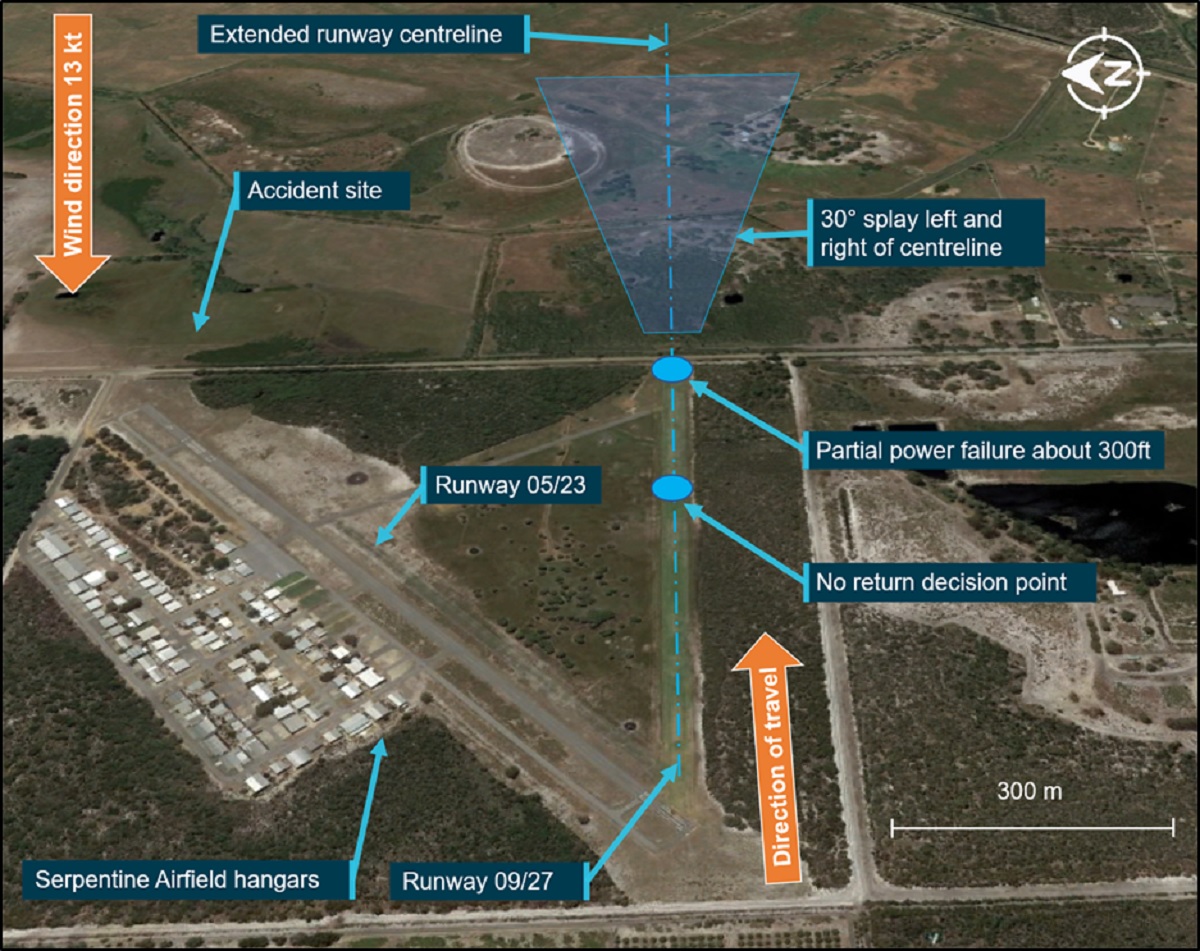
A Dynaero aircraft’s partial power loss soon after take-off from Serpentine Airfield, WA created a demanding, time-critical situation prior to a fatal collision with terrain, an ATSB investigation report outlines.
On the afternoon of 28 December 2020, the single-engine Dynaero MCR-01 light aircraft took off from Serpentine Airfield, south of Perth, to conduct a post-maintenance check flight.
About 300 ft above ground level, the aircraft’s engine began to run rough, but continued to operate. The pilot commenced a turn to the left, and the aircraft appeared to decelerate in a nose-high attitude without gaining height.
Shortly after, the aircraft was observed to aerodynamically stall, pitch nose-down, and impact terrain. The pilot, who was the sole occupant, was fatally injured, and the aircraft was destroyed.
The ATSB investigation’s final report notes this accident is another reminder of the challenges pilots face in the event of a partial power loss after take-off, as detailed in the ATSB’s Avoidable Accidents handbook.
“Partial engine power loss is a more frequent, and a more complex occurrence than complete engine power loss,” ATSB Director Transport Safety Dr Stuart Godley said.
“The ATSB encourages pilots to review the recommended partial power loss procedure in their aircraft’s pilot operating handbook, and cautions against attempting to turn back towards the runway under reduced power unless in controlled situations where sufficient altitude exists."
The ATSB found multiple maintenance tasks in the aircraft’s return to service after a significant period of inactivity were not adequately carried out, and that the left carburettor of the aircraft’s engine was missing a component, and contained a significant amount of contamination.
“This likely resulted in over-fuelling of the carburettor at a low power setting, and likely produced subsequent engine rough running at higher power settings,” Dr Godley explained.
Additionally, the ATSB found the pilot was unfamiliar with the aircraft and engine type, which increased the risk of not being able to adequately manage an inflight emergency.
The ATSB also found the pilot had probably consumed a significant amount of alcohol the night before the accident, which increased the risk of post-alcohol impairment.
“Blood-alcohol can persist the day after significant alcohol consumption, and the residual effects of alcohol may impair performance, especially in demanding and time critical situations,” Dr Godley concluded.
A VLocity passenger train collided with closed level crossing gates beyond Ballarat Station after failing to stop;
The investigation found that the train’s sanding system was ineffective at improving wheel-rail adhesion, and that safety controls were ineffective in mitigating against a train arriving at Ballarat Station travelling at excessive speed;
The occurrence highlights the importance of risk controls to prevent collisions because of slippery rail conditions.
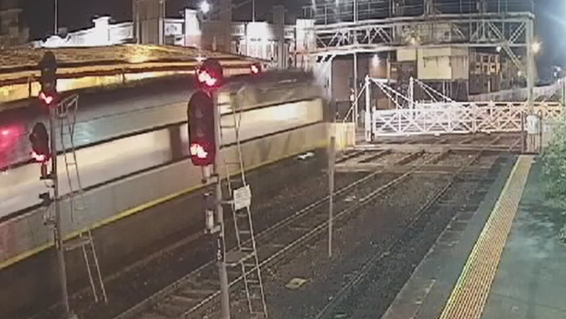
A Vlocity passenger train’s sanding system was ineffective in improving wheel-rail adhesion as the train approached Ballarat Station on the evening of 30 May 2020 after light rain and in windy conditions, a transport safety investigation details.
The three-car V/Line Vlocity train was operating a service from Melbourne to Ballarat and Wendouree when, unable to stop at Ballarat Station, the train collided with the Lydiard Street North level crossing gates, which were closed to rail traffic, according to the investigation by Victoria’s Chief Investigator, Transport Safety (who conducts rail investigation in Victoria on behalf of the Australian Transport Safety Bureau).
“Slippery rail conditions existed for at least the final 2.5 km of the approach to Ballarat Railway Station and probably the final 5 km,” said Chief Investigator, Transport Safety Mark Smallwood.
“Light rain was the primary environmental factor in the development of the slippery conditions, and the very low levels of adhesion at the contact between the train’s wheels and the rail head substantially reduced the train’s braking performance.”
The driver made initial brake applications approximately 5.1 km from Ballarat Station when the train was travelling at just over 160 km/h, and made a full service brake application about 2.6 km from the intended stopping point. However, the train did not decelerate sufficiently and could not be stopped, the report details.
The train passed through the station and collided with the level crossing gates at an estimated speed of between 93 and 97 km/h. After impacting the gates, the driver subsequently brought the train to a stand approximately 640 m beyond the station.
One of the two passengers on board required hospitalisation, and the train driver and conductor sustained minor injuries. The impact destroyed the pair of southern gates, damaged the front and side of the train, and resulted in gate debris being scattered into the surrounding area.
“The investigation found that the train’s sanding system, which is intended to improve adhesion in slippery conditions by applying sand to the rail head, was ineffective at improving braking performance,” said Mr Smallwood.
Reviewing the train’s data logger, investigators established that the train’s wheel slip/side protection (WSP) and sanding systems both automatically activated during the approach to Ballarat Station.
“Several factors potentially adversely influenced the performance of the sanders that evening, including their design configuration, vegetation contamination in one sander box, and the lack of sand in a second,” said Mr Smallwood.
“There were missed opportunities to identify weaknesses in the sander configuration, while maintenance of the sander units did not test for discharge flow rates, and train preparation processes did not ensure a required minimum amount of sand in the sand boxes.”
Mr Smallwood noted that since the incident V/Line has implemented a number of measures to improve sander performance, and has installed sanders on the intermediate cars of three-car VLocity diesel multiple unit sets.
The investigation also found that safety controls were ineffective in mitigating against a train arriving at Ballarat Railway Station travelling at excessive speed and being unable to stop before colliding with the crossing gates.
To enhance management of this risk, V/Line has introduced a number of interim measures including reducing the permitted train speed on the approaches to Ballarat Station from 160 to 80 km/h, and installing overspeed-triggered operation of the Lydiard Street North level crossing protection.
“This occurrence has highlighted the importance of rail operators having risk controls in place to prevent collisions because of slippery rail conditions,” Mr Smallwood said.
“Controls include effective train-borne equipment such as wheel slip/slide protection systems and sanders, and targeted risk controls at locations vulnerable to risks associated with train overrun.”
Robinson R22 had returned to camp at end of day’s mustering operations, before engine was restarted;
Wreckage discovered the next day, with pilot found to be fatally injured and the helicopter destroyed;
Preliminary report outlines known order of events and contains no findings or analysis, which will be included in the investigation’s final report.
The Australian Transport Safety Bureau has released a preliminary report from its on-going investigation into a fatal Robinson R22 helicopter accident in the Northern Territory’s East Arnhem Land, on 14 November 2022.
The preliminary report details factual information established in the investigation’s early evidence collection phase, but presents no analysis or findings, which will be detailed in the investigation’s final report.
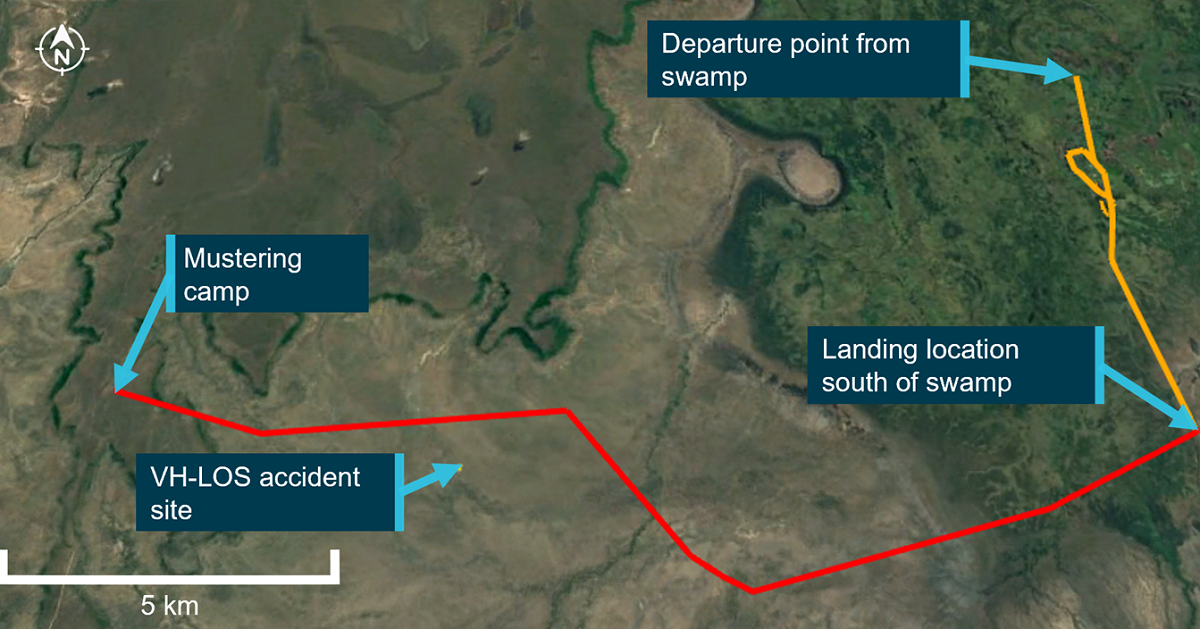
The R22, registered VH-LOS, was being used as part of a multi-vehicle animal mustering operation in the Arafura Swamp, south of Ramingining.
At the end of the day’s work, the land vehicles departed the swamp to return to the mustering camp, about 20 km west.
A witness reported the helicopter remained at the swamp as the others departed, and it was expected the pilot would depart shortly to pick up another member of the group, from the southern edge of the swamp, before continuing to the camp.
Flight tracking information showed the helicopter took off at about 6:00pm, before flying to the south of the swamp and shutting down. It was later reported, however, that they did not pick up the other group member at this time.
“The data then showed the helicopter departing the swamp, tracking to the mustering camp, then landing and shutting down at 6:54pm,” ATSB Director Transport Safety Dr Michael Walker said.
“Later, the data showed the helicopter was started again at 7:21pm, but this tracking ended about one minute later with the helicopter still at the camp.”
There was no data recorded after this time.
The preliminary report notes sunset at Ramingining was at 7:05pm and last light was at 7:27pm, and there was no moon. The pilot was not rated to fly at night, and the helicopter was not equipped for night flight.
The helicopter and pilot were not at the camp when the other members of the mustering party arrived from the swamp. At about 9:00pm they commenced a land-based search, but were unable to find the pilot.
“Some acquaintances attended the area in helicopters the following day to conduct an aerial search, and the accident site was located about 6 km east-south-east of the mustering camp,” Dr Walker said.
The pilot was deceased, and the helicopter destroyed.
To date, the ATSB has examined the accident site and wreckage, interviewed witnesses who were involved in the mustering operations and the search, and collected meteorological data, aircraft maintenance records and pilot records.
“From here, the investigation will further review pilot records, medical information, witness information, and aircraft maintenance and flight records,” Dr Walker said.
“Investigators will also further examine aircraft wreckage, meteorological data, and recorded aircraft tracking data.”
A final report will be released at the conclusion of the investigation.
“However, should a critical safety issue be identified during the course of the investigation, the ATSB will immediately notify relevant parties so appropriate and timely safety action can be taken,” Dr Walker concluded.
This Airport Safety Week the Australian Transport Safety Bureau (ATSB) and Airservices Australia are again reminding pilots and operators to observe and obey stop bar lights at runway intersections where installed at Australian airports, and not cross a lit stop bar at any time.
Stop bar lights are red when illuminated and are embedded across the taxiway at runway holding points and intersections. They are controlled by Airservices Australia air traffic controllers during operational tower hours as an added safety measure to prevent an aircraft or authorised vehicle unintentionally entering or crossing an active runway.
ATSB Chief Commissioner Angus Mitchell said that since 1 September 2015, more than 100 runway incursions involving stop bars at Melbourne, Sydney, Perth, Brisbane and Canberra airports have been reported to the ATSB, involving aircraft and airside vehicles.
“Fortunately, none of these runway incursions have resulted in any accidents, but they have involved a range of aircraft including airliners and general aviation aircraft as well as authorised airport vehicles, and they have occurred at different times of the day and night, and at different airports and holding points,” Mr Mitchell said.
“This year’s theme for Airport Safety Week is ‘Safety is always our destination’ and gives the ATSB and Airservices Australia the opportunity to remind pilots and operators to ensure they operate in line with all safety instructions regardless of what phase of flight they are in or where or how they are operating at an airport, including taxiways.”
Mr Mitchell said the ATSB’s investigation into a runway incursion and subsequent rejected take-off event at Perth Airport on 28 April 2018 highlighted the need for all pilots, no matter their experience or what aircraft they fly, to always observe for, and comply with the stop bar directions.
“In this occurrence, after landing, a Boeing 737-800 crossed a lit stop bar and entered the active crossing runway where another 737 had commenced its take-off roll,” Mr Mitchell said.
“The Airservices Aerodrome Controller in Perth Tower alerted the departing aircraft to the runway incursion and instructed the 737 to stop. Both aircraft stopped safely and there was no collision.”
Airservices Head of Aerodrome Services, Craig Charker, reinforced that all pilots and authorised airside drivers must only proceed when an air traffic controller has given the appropriate verbal instruction and has also switched off the stop bar lights.
“If you have a verbal clearance to enter the runway but the stop bar lights remain lit, please query this with air traffic control before proceeding,” Mr Charker said.
“For your safety and the safety of others, you cannot cross an illuminated stop bar. I encourage all operators and pilots to include checking the stop bar status as a requirement in their line up and crossing runway checks.”
I am pleased to deliver this annual report for the Australian Transport Safety Bureau (ATSB), my first as Chief Commissioner and Chief Executive Officer.
While continuing to navigate the challenges of the COVID-19 pandemic, 2020–21 saw the ATSB commence, progress and complete a series of complex transport safety investigations; continue to deploy to transport accident sites; develop and implement a new core enterprise investigation information management system; and implement key elements of our strategic property plan.
For this sustained performance in a complex operational environment, I would like to acknowledge the leadership and service of my predecessor, Mr Greg Hood, who retired on 30 June on the completion of his five-year term as Chief Commissioner and Chief Executive Officer.
Mr Hood drove an innovation and transformation agenda at the ATSB, which saw the introduction of world-leading practices like a multi-modal teams approach to investigations, new recruitment practices, a tertiary partnership for transport safety investigator training with RMIT University, and new technologies to support investigations such as remotely piloted aircraft and 3D modelling.
The ATSB has a well-deserved reputation of excellence – and for that I acknowledge Mr Hood’s transformational stewardship. It is without doubt that the ATSB has grown in both stature and importance under his watch.
I would also like to acknowledge and thank our Chief Operating Officer, Mr Colin McNamara, who acted as Chief Commissioner and Chief Executive Officer from Mr Hood’s retirement until my appointment took effect on 2 September 2021. Mr McNamara shouldered a substantial load in acting as Chief Commissioner during an incredibly dynamic and demanding operating environment.
May I also acknowledge the contributions of Ms Carolyn Walsh, who finished her more than 10-year term as an ATSB Commissioner in September 2020. The ATSB benefited greatly from her expertise in transport safety, occupational health and safety, risk management, and regulatory frameworks and governance.
In turn during 2020–21, we welcomed Ms Catherine Scott, who has extensive experience in rail safety and road transport, finance and risk management, and board directorships, with her appointment to the ATSB Commission in September 2020.
I look forward to working with Ms Scott and her fellow Commissioners, Chris Manning and Gary Prosser, to continue to ensure all ATSB staff are resourced and empowered to bring their expertise to the forefront. This then will allow me to deliver on my other responsibility to build on the ATSB’s long-term success by continuing to increase the relevance and value that our work brings to all those whom we are entrusted to deliver safety outcomes.
Achievements
The ATSB continues to work towards achieving our new performance measures established in our 2020–21 Corporate Plan. Through revised performance criteria, we are focused on improving our timeliness, demonstrating safety action taken in response to our investigations, ensuring our findings are defendable, and using our resources efficiently and effectively to achieve the greatest safety outcomes across our multiple modes of transport.
With fewer safety occurrence notifications reported to the ATSB during the year, we were not required to commence as many new investigations when compared to previous years. This allowed the ATSB to focus on, and close, several complex older investigations from early 2020. ATSB investigator resources were also allocated to support the design and build of the new purpose-built investigation management software system. The ATSB’s new Investigation Management System (AIMS) comes online in 2021–22 and is set to deliver significant productivity improvements through the removal of time-intensive manual processes. Additionally, the system’s cloud-based functionality will allow investigators to access data and upload evidence in-the-field on any device.
During 2020–21, the ATSB completed 62 occurrence investigations. Among the higher profile investigations published during the year were:
The collision with water of a de Havilland Canada DHC-2 Beaver aircraft at Jerusalem Bay, Hawkesbury River, New South Wales, on 31 December 2017.
Signal ME45 passed at danger involving suburban passenger train TP43 and near collision with another suburban passenger train, Bowen Hills, Queensland, on 10 January 2018.
The loss of control and collision with water of a Eurocopter EC120B helicopter at Hardy Reef, Whitsundays, Queensland, on 21 March 2018.
The fire on board the self-unloading bulk carrier Iron Chieftain at Port Kembla, New South Wales, on 18 June 2018.
The collision with terrain involving an AS350 helicopter during powerline stringing operations 60 km east of Woomera, South Australia, on 20 March 2019.
ATSB investigations place considerable focus on identifying safety issues that can be addressed by the parties that are ultimately responsible and best positioned for managing risk. This includes both operators and regulators. In 2020–21, 59% of our completed systemic, defined and safety study investigations identified new safety issues.
In all, 60 safety issues were identified in the reporting period, of which the ATSB determined 33 had been adequately addressed by 30 June 2021.
The ATSB is steadfast in its commitment that all published investigations are factually accurate, defendable and evidence-based. Accuracy of investigation findings remain integral to ensuring industry and government confidence in ATSB safety information in order to take action to improve transport safety. Consequently, I am pleased to confirm no changes to published investigations findings were required in 2020–21.
In the delivery of rail safety investigation services in New South Wales and Victoria, the ATSB has a collaboration agreement with independent investigation agencies in those states who conduct investigations under the Commonwealth’s Transport Safety Investigation Act 2003 (TSI Act). In 2020–21, the ATSB published and promoted eight rail safety investigations conducted by the New South Wales Office of Transport Safety Investigations (OTSI) and four rail safety investigations conducted by Victoria’s Chief Investigator, Transport Safety (CITS).
In 2020–21, the ATSB also:
Initiated 49 aviation occurrence investigations, three marine occurrence investigations and five rail occurrence investigations.
Published 39 occurrence briefs (38 aviation occurrences and one marine occurrence). Occurrence briefs are short reports that allow us to share safety learnings from a transport safety occurrence notification where the occurrence has not met the threshold of being subject to a transport safety investigation.
Processed 10,634 aviation transport safety occurrence notifications, 716 marine notifications and 882 rail notifications. From those, the ATSB safety reporting team identified 4,073 aviation and 294 marine accidents, serious incidents and incidents for the year. (In rail, the Office of the National Rail Safety Regulator (ONRSR) is responsible for processing all notifications from industry into occurrences in the Australian national rail occurrence database shared with the ATSB.)
Received and processed 198 notifications under the REPCON confidential reporting scheme, of which 75 were assessed and classified as meeting the REPCON criteria. During the year, 47 REPCON reports were completed, of which 18 (38%) resulted in safety action being taken by stakeholders.
Despite the limitations of the pandemic, participated in 27 key industry engagement events, including the International Confidential Aviation Safety Systems, the Rail Industry Safety and Standards Board’s Rail Safety Conference, and the Australian Association for Unmanned Systems' RPAS in Australian Skies Conference. Former Chief Commissioner, Greg Hood also hosted the International Transportation Safety Association’s Annual Conference.
Managed 361 media inquiries, used our in-house media studio to produce and distribute 32 packages of pre-recorded audio, video and video overlay content for distribution to national radio and TV outlets, and logged the publication and airing of 1,997 stories about the ATSB and its investigation activities by mainstream and transport industry media outlets. Of those, 1,261 stories (approximately 63%) carried safety messaging relating to our investigations.
Promoted a number of safety education campaigns, including highlighting the dangers of CO gas exposure in piston-engined aircraft, reminding pilots of the need to be aware of stop bars at major airports across Australia, and supported the TrackSAFE Foundation’s Rail Safety Week in August 2020 to promote safety for road users and rail passengers when interacting with the rail network.
Published a video to promote the safety messaging from the investigation into Beaver aircraft the collision with water accident on the Hawkesbury River, which included a high-fidelity animation of the aircraft’s flight path. This video has been viewed more than 6,700 times across all of our social media channels.
Continued to support our regional partners build transport safety investigation capacity, in particular via the ongoing involvement in the Australian Government Indonesia Transport Safety Assistance Package (ITSAP), and assisting Papua New Guinea consistent with the Memorandum of Understanding on Cooperation in the Transport Sector.
Supported external agencies by assisting Recreational Aviation Australia and the Civil Aviation Authority of the Philippines – Aircraft Accident Investigation and Inquiry Board to recover and analyse data from damaged recording devices.
Progressed the rationalisation of our accommodation footprint with the leasing of new premises for the Canberra central office and the Melbourne regional office. This ensures we have highly capable technical facilities to support our operational requirements and a more dispersed workforce that will enhance our ability to deploy to transport accident sites throughout Australia.
Established a project to transfer our website onto the GovCMS content management system website platform.
Supported the delivery of the third Graduate Certificate in Transport Safety Investigation course in partnership with RMIT University. The course was delivered online to a cohort of 22 consisting of six ATSB investigators, two investigators from the Office of Transport Safety Investigation NSW, and 14 students from a broad range of industry organisations.
Outlook
In a challenging year for the transport industry, the ATSB continued to focus on improving transport safety through our independent transport safety investigations.
The COVID-19 pandemic has been a time of great uncertainty for the transport industry in general, none more so than aviation. Cognisant of these challenges, I am committed to ensuring that the ATSB continues to effectively apply our safety knowledge and expertise in identifying safety risks in industry, and in monitoring the return to safe and reliable air transport operations as the pandemic eases.
And as an operational agency, the ATSB will continue to deploy accident investigation teams where and when necessary during the pandemic, whenever it is safe to do so.
The challenges experienced by workplaces and workforces across the country over the past year are both generic as well as very individual and personal. One of my key responsibilities and my initial focus as Chief Commissioner and Chief Executive Officer will be to ensure we continue to have a well-supported workforce that delivers world-class transport safety investigations that contribute to a safe and efficient Australian transport industry.
A high-performance aerobatic aircraft’s collision with a helicopter on the runway at Caloundra, Queensland highlights the importance of pilots being aware of the circuit procedures for differing kinds of aircraft, an Australian Transport Safety Bureau investigation report notes.
On 18 September 2020, a two-seat Extra EA-300 aircraft with two experienced pilots onboard was conducting circuits at 1,000 ft (above airport elevation) at Caloundra Airport, a non-towered airport where aircraft self-separate from each other using radio calls on the Common Traffic Advisory Frequency (CTAF). The pilot-in-command occupied the Extra’s front seat, and was conducting a check flight of the rear-seat pilot.
A two-seat Guimbal Cabri G2 helicopter, with a solo student pilot on board conducting a navigation exercise flight from Redcliffe, joined the circuit ahead of the Extra and was conducting a stop-and-go on the active runway.
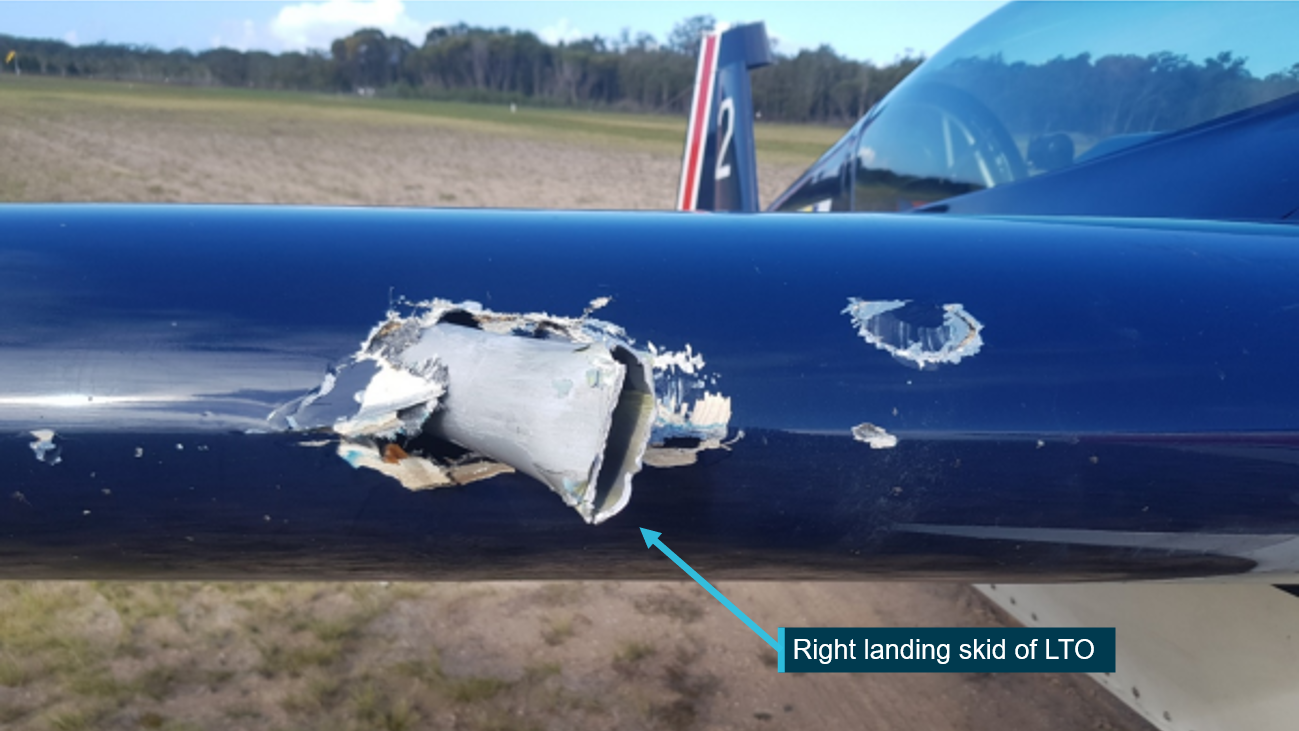
The Extra landed on the runway behind it, and during the landing roll collided with the rear of the hovering helicopter, resulting in substantial damage to both aircraft. The helicopter sustained multiple propeller strikes underneath the cabin and separation of its right landing skid. The Extra’s wooden propeller was destroyed by the impact with the helicopter’s fuselage and landing skid, which punctured the Extra’s right wing fuel tank. Fortunately there were no injuries.
“The ATSB found the pilots of the Extra did not expect the helicopter to join the 1,000 ft circuit pattern, and did not assimilate the helicopter pilot’s radio calls into their mental models of the current operations at the airport. As a result, they were not aware that the helicopter was ahead of them in the circuit,” said ATSB Director Transport Safety Stuart Macleod.
The ATSB also identified that, on the final leg of the circuit, the pilots of the Extra were focused on a third aircraft in the circuit, which was ahead of the helicopter, and which they had been in radio communications with.
“While the pilots visually scanned the runway prior to landing, they were not aware of the helicopter’s presence, and they perceived a different aircraft to be the next ahead of them in the circuit, which resulted in them not sighting the helicopter and continuing the approach to the runway,” Mr Macleod said.
Further, the tail-dragger Extra’s nose-high attitude during landing obscured the hovering helicopter until immediately before the collision.
During interviews with the ATSB, the rear-seat pilot reported an expectation that helicopters would generally remain clear of circuit traffic, and that they have never known helicopters to hover over runways, while the front-seat pilot noted that helicopters regularly approach Caloundra but most remain clear of the circuit.
Mr Macleod said the accident highlights the importance for pilots of having an awareness of the circuit procedures for different types of aircraft at non-towered airports, including helicopters.
“A helicopter performing a stop-and-go will usually require significantly more time to clear the runway, compared to an aeroplane performing a touch-and-go,” he said.
“Around CTAF and uncontrolled airports there is the possibility of aeroplanes and helicopters conducting movements that might not be considered commonplace. This investigation highlights that multiple options are available to helicopters at non-towered airports, including the active 1,000 ft circuit pattern.”
Although not a factor in this occurrence, due to the speed of the Extra it could be classified as a high-performance aircraft, as it is capable of a downwind speed of greater than 150 kt, allowing it to fly a circuit at 1,500 ft.
“All pilots are reminded that the 1,500 ft circuit height is not just limited to regular passenger transport and turbine aircraft,” Mr Macleod said.
Safety around non-towered airports is one of the ATSB’s eight ‘most wanted’ safety priorities, as part of the SafetyWatch initiative.
“The alerting provided by radio broadcasts at non-towered airports such as Caloundra greatly assists the process of sighting traffic that might be a collision risk,” Mr Macleod noted.
“This accident reinforces that, even for experienced pilots, visual identification of unknown traffic is difficult.”
A train derailment near Koolyanobbing, WA illustrates the value of non-destructive testing, an Australian Transport Safety Bureau investigation highlights.
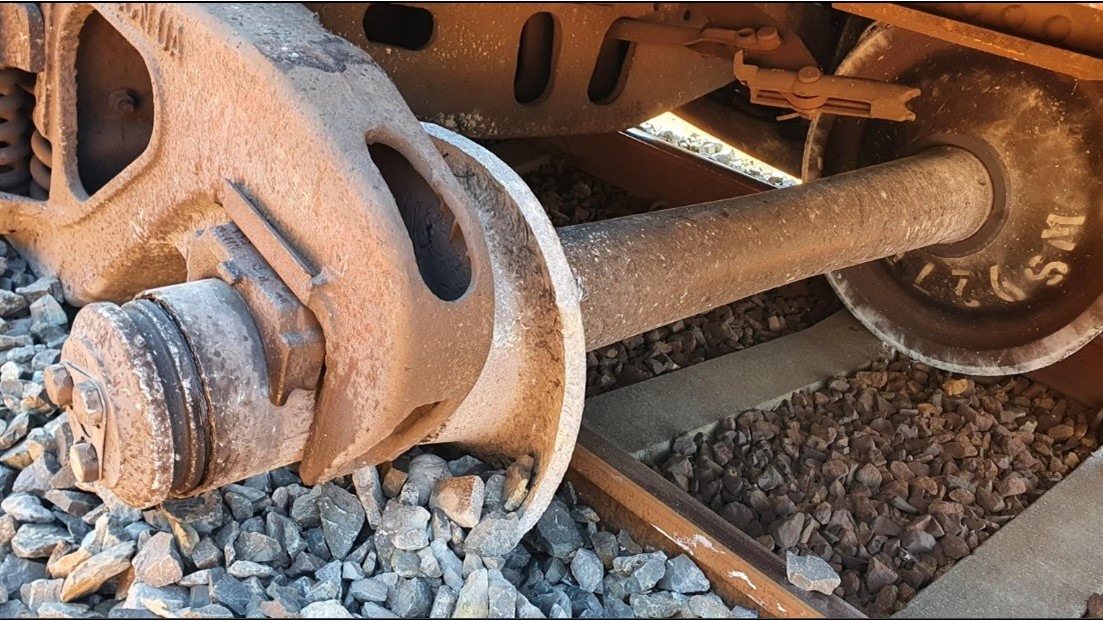
SCT Logistics train 2PM9 was on a service from Perth to Melbourne on 27 October 2020 when a wheel on the 58th wagon in its consist fractured and disintegrated.
This resulted in derailment of the wagon, and separation of the derailed wagon, and the 10 wagons trailing it, from the front of the train. No other wagons derailed, and there were no injuries.
Detailed material examination identified that, prior to the incident journey, a transverse fatigue crack had initiated in the vicinity of a spalling defect in the wheel tread.
“The crack propagated into the rim and flange of the wheel,” ATSB Director Transport Safety Stuart Macleod explained.
“On the day of the incident, a skidding event at the fatigue crack likely induced rapid brittle cracking in the wheel, resulting in fragmentation of the wheel and, subsequently, derailment of the wagon.”
The wagon in question had experienced various issues with brakes and overheated wheels in the 12 months prior to the derailment, but it is not clear whether any of these issues contributed to the derailment.
The failed wheel had recently been reprofiled, but the maintenance provider’s work instruction did not require non-destructive examination beyond a visual inspection to identify any remaining defects.
“Skids and hotspots may be repairable on wheels in otherwise good condition, but they can induce wheel failure if cracks are present, as in this case,” Mr Macleod said.
“Diligent inspections and non-destructive testing can be useful for detecting and monitoring wheel cracks, which is particularly important as these cracks approach the wheel wear condemning limit.”
Since the derailment, the operator and maintenance provider have developed a process for monitoring wagons that experience repeated issues, such as with braking.
Inspection procedures for thermal cracks and overheated wheels have been refined, and non-destructive testing is being investigated for use in certain wheel inspections.