The ATSB has completed its technical analysis report of the flight recorder data from the Boeing Co. 737-329, registration PK-KKE on behalf of the Indonesian National Transportation Safety Committee. The aircraft was operating a flight from Jakarta to Makassar, Indonesia when it was involved in a serious (navigation related) incident while enroute. The crew landed safely at Tambolaka in Sumba.
The National Transportation Safety Committee (NTSC) of Indonesia is responsible for investigating this occurrence. The NTSC requested assistance from the Australian Transport Safety Bureau (ATSB) in the recovery and analysis of information from the flight data recorder and cockpit voice recorder. In accordance with clause 5.23 of Annex 13 to the Convention on International Civil Aviation, the ATSB appointed an Accredited Representative to assist the NTSC and initiated an investigation under the Transport Safety Investigation Act 2003.
The ATSB's Technical Analysis Report has been sent to the NTSC to assist its ongoing investigation. The NTSC is responsible for releasing a final investigation report regarding this occurrence.
National Transportation Safety Committee Ministry Of Transportation Republic Of Indonesia Transportation Building 3rd Floor Jalan Medan Merdeka Timur No. 5 Jakarta Pusat 10110 Indonesia
The ATSB has amended this report to clarify its role in the assistance that was given to RA-AUS regarding the examination of components recovered from the aircraft. It is possible that some information in the Abstract and Executive Summary of the original report may have conveyed a broader meaning than was intended.
___________________
During the investigation of two fatal microlight accidents, Recreational Aviation Australia (RA-AUS) requested the assistance of the Australian Transport Safety Bureau (ATSB) in conducting technical examination and analysis of parts recovered from the accident sites.
The first accident occurred in Atherton, Qld (registration 32-4456) on 20 October 2005 and the second in Cessnock, NSW (registration 32-4388) on 21 January 2006. During the course of the investigation a third fatal accident was identified. The third accident had occurred in Hexham, NSW (registration T2-2625) in 1996, with coronial findings (0063/96) delivered on 25 March, 1997.
In all three accidents, the failure of the main wingspar had occurred near the wingtip. Qualitative analysis of the structural design and loading of the part during this safety investigation and examination of the coronial findings from the Hexham accident, revealed that the main wingspar had failed under negative 'G' loading. Such loading was likely if the aircraft entered or encountered flight conditions outside the manufacturer's specified flight envelope.
A rigid propeller shaft (part number 3102572-2) from an
Allied-Signal (Honeywell) TPE331-12 turboprop engine, was received
and examined by the ATSB in order to characterise and assess the
nature of an unusual and irregularly finished surface at the end of
the forward main bearing/seal journal. The anomalous area had been
originally identified during inspection by the engine maintenance
provider, who subsequently referred the matter to the Civil
Aviation Safety Authority (CASA) through their service difficulty
reporting (SDR) system.
The ATSB laboratory examination identified the features
associated with the ends of the journal surface as being
characteristic of surfaces that had been manually dressed following
the application of a plasma/metal sprayed coating to re-build the
journal surfaces. Subsequent reference to the inspection/repair
manual for the propeller shaft, confirmed that plasma spraying was
an approved process for journal repair, and that hand-finishing and
deburring was specified for post-spray dressing.
Previously published - Interim Factual Information
Soon after the aircraft reached the planned cruise altitude of FL340, the flight crew observed that the speed indicated on the primary flight display for stick shaker activation was converging towards their current airspeed. The stick shaker activated as the speeds merged and the crew commenced an immediate descent. There was a breakdown in the relevant procedural separation standard as the aircraft descended through the cruise level of an opposite direction aircraft.
Descending through FL290 the speed indicated for stick shaker activation returned to normal and the stick shaker warning ceased. The flight continued to its destination without further incident.
FACTUAL INFORMATION
At approximately 0855 Western Standard Time, on 28 February 2006, a Boeing Company 717-200 aircraft, registered VH-NXH, was being operated on a scheduled passenger service from Paraburdoo to Perth, WA. The aircraft was being operated by two flight crew and four flight attendants and carried 66 passengers. The brakes-release weight at Paraburdoo was 44,837 kg.
The weather conditions for the flight were under the influence of a decaying tropical cyclone that had crossed the north-west coast of Western Australia earlier that day. Rain and heavy cloud persisted through most of the region and the aircraft was operating in instrument meteorological conditions. The meteorological forecast indicated a temperature of -39 degrees C at the aircraft's planned cruise altitude.
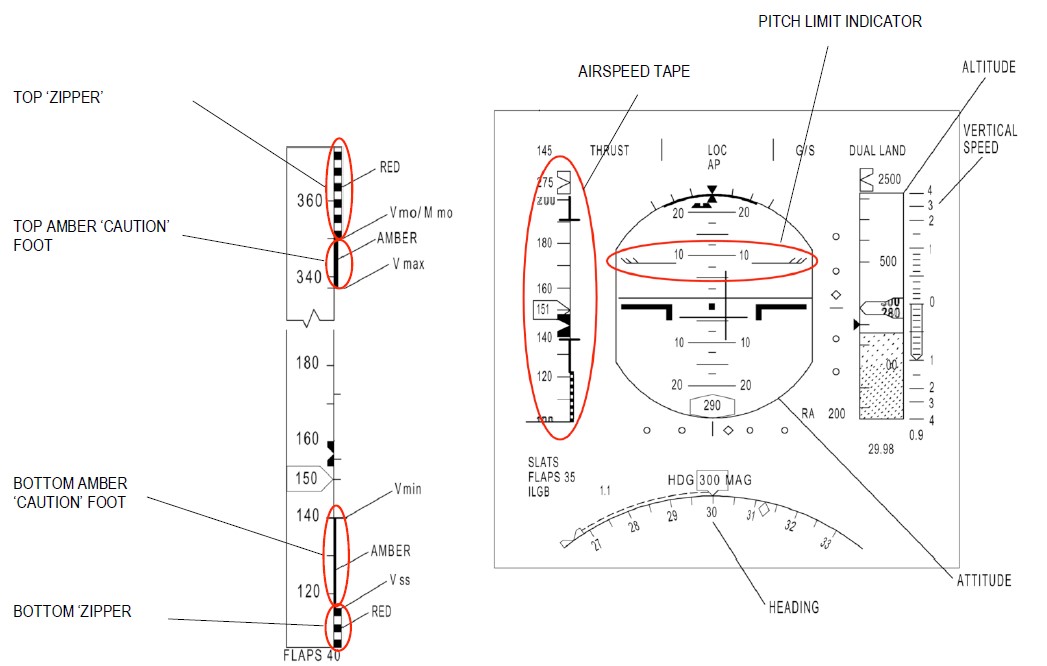
The flight crew had selected engine anti-ice ON during the climb. The autopilot was engaged and had captured the planned cruise altitude of FL340. The airspeed, body angle and engine power settings were normal for that stage of flight and the aircraft was accelerating normally to cruise speed. During that period, the flight crew detected that, over a period of several seconds, the speed displayed on the primary flight display (PFD) for stick shaker activation (Vss) began converging towards the current indicated airspeed. The speed indicated for Vss appeared to overtake the amber caution foot associated with the flight management computer (FMC) calculated minimum operating speed (Vmin), which appeared to be remaining stationary, rather than moving in conjunction with the Vss indication. The relevant indications on the aircraft's PFD are annotated at Figure 1.
Figure 1: Primary flight display and airspeed tape
The stick shaker 1 warning activated as Vss merged with the current airspeed and then continued to increase and merge with the maximum operating speed (V/MoM/Mmo), with the right edge of the airspeed tape giving the appearance of one continuous red chevron 2 'zipper'. Similar indications were observed on both pilots' PFDs. The crew reported that they did not receive any other cautions, alerts or warnings on the aircraft's engine and alert display.
The flight crew recalled that, although the pitch limit indicator 3 had turned red, indicating that the aircraft was at or near a stalled condition, there was no "STALL" annunciation on the PFD, nor any aural "STALL STALL" warning or klaxon alert. The crew initiated an immediate on-track descent and advised air traffic services (ATS) of their requirement to change level. The stick pusher stall recovery system did not activate, and the crew did not identify any secondary indications of an impending stall, such as aerodynamic buffet or an abnormally high pitch attitude. Although the crew did not detect any evidence of airframe ice on the windscreen or windscreen wiper posts, they selected the airframe anti-ice ON. The crew did not otherwise change the configuration of the aircraft.
The stick shaker continued to operate as the aircraft was descended at approximately 2,000 ft per minute. The flight crew recalled that the speed indicated on the PFD for Vss returned to normal as the aircraft descended through FL290 and that the stick shaker warning ceased at that time.
During the descent, there was a breakdown in the relevant ATS procedural separation standards, as a result of the aircraft descending through the level of an opposite direction aircraft.
The flight crew levelled the aircraft out at FL280 with all of the aircraft's controls and system indications 'normal'. Once the in-flight weather conditions improved, the crew climbed the aircraft to FL300, and the flight landed at Perth without further incident.
Company maintenance engineers performed a built-in test equipment check 4 following the aircraft's arrival in Perth. That check confirmed that no faults had been recorded during the occurrence flight and the aircraft was released for service. Subsequent flights were completed without incident.
The aircraft's flight data recorder (FDR) and the electronic recording media for the quick access recorder (QAR) were removed for analysis. Data was also recovered from the non-volatile memory of the aircraft's flight control computers (FCC).
The FDR data indicated that the output from each of the aircraft's angle of attack (AoA) sensors became static (continuously indicating about 4 degrees AoA) passing FL287 on climb, at a total indicated air temperature (TAT) of -4 degrees C. The stick shaker activated approximately 80 seconds after the aircraft had reached FL340, as it was accelerating through a computed airspeed of 258 kts and at a TAT of -10 degrees C. About 14 seconds later the recorded data indicated the commencement of a descent from FL340. The stick shaker indication continued for another 2 minutes 23 seconds, ceasing as the aircraft passed FL288, at a computed airspeed of 308 kts and a TAT of approximately +7 degrees C. Associated with the cessation of the stick shaker warning was the AoA sensors returning to normal operation.
The QAR media was found to contain no recorded data. Examination of that file indicated that the recording media was incorrectly formatted for use in the QAR.
The manufacturer of the aircraft's FCC analysed the contents of each computer's non-volatile memory. That analysis revealed no fault history data for the day of the incident.
On 03 March 2006, an entry was made in the aircraft's maintenance log, reporting the intermittent operation of the air data heat switch 5 annunciator after the system was selected OFF following landing. An indicating globe was replaced and the switch tested serviceable before the aircraft was returned to service.
The aircraft's AoA sensors and air data heat switch were subsequently removed from the aircraft and dispatched for examination by the component manufacturers under the direct supervision of the US National Transportation Safety Board (NTSB).
The investigation is continuing, and will include:
analysis of the FDR data and the movement of the AoA sensor in the periods immediately preceding and immediately after the sensors were returning a static (not moving) indication
analysis of results from component testing
evaluation of input from the NTSB, aircraft and component manufacturers, regarding systems analysis and modes identified for anomalous stick shaker operation.
The stick shaker is a tactile warning to alert the crew that the aircraft is at or near an aerodynamically stalled condition of flight. It is one of several warning systems designed to alert the crew of that flight condition.
The red chevron normally indicates airspeeds above VmoMmo and airspeeds below Vss.
The pitch limit indicator depicts the difference between the aircraft angle of attack (AoA) and stick shaker AoA.
Examination of fault codes that have been stored for maintenance checkout and fault isolation.
This switch provides anti-ice protection to the aircraft's pitot-static, AoA and ram air temperature sensor systems.
Summary
On 28 February 2006, a Boeing Company 717-200 aircraft, registered VH-NXH, was being operated on a scheduled passenger service from Paraburdoo to Perth, WA. The flight was being conducted under the instrument flight rules (IFR). Onboard the aircraft were two flight crew, four cabin crew and 66 passengers. The aircraft departed Paraburdoo at about 0837 Western Standard Time and was in instrument meteorological conditions (IMC) during the climb.
The stick shaker stall warning system activated soon after the aircraft reached top of climb at Flight Level (FL) 340 and while the aircraft was accelerating to cruise speed. The flight crew did not receive any 'STALL' annunciation on their respective primary flight displays, nor any 'STALL STALL' aural warning or klaxon alert.
The flight crew initiated an immediate on-track descent and advised air traffic services of their requirement to change level. There was an infringement of the relevant procedural separation standards as the aircraft descended through the cruise level of an opposite direction aircraft.
An analysis of the flight recorder data indicated that the activation of the stick shaker was as a consequence of the angle-of-attack sensors becoming static during the climb. The investigation concluded that the immobilisation of the angle-of-attack sensors was consistent with ice restricting the movement of the 'slinger' on which the sensor vane is mounted.
The investigation assessed that the aircraft was not near a stalled condition of flight when the stick shaker warning activated. However, because the angle-of-attack sensors provided input to the aircraft's stall warning system, the immobilisation of those sensors adversely affected the reliability of the aircraft's stall warning system and could have render the automatic stall recovery system inoperative.
As a result of this incident, the aircraft and angle-of-attack sensor manufacturers initiated a detailed design review of the angle-of-attack sensor.
On 27 February 2006, at approximately 1427 Western Standard Time, the Cessna Aircraft Company 441 aircraft, registered VH-LBA, was being operated on a charter flight with two pilots and seven passengers from Perth to Mount Weld, WA. During cruise, at Flight Level (FL) 250, the left engine shut down. The crew actioned the 'engine securing phase one checks' from the quick reference handbook and declared a PAN. They then requested and received a clearance to descend to FL200. The crew then actioned the engine restart procedures, successfully restarting the left engine. Air Traffic Control was notified of normal operations and the flight continued to Mount Weld.
Following the occurrence, the flight crew reported that, prior to the engine shutdown, the pilot in command (PIC) had inadvertently depressed the left engine STOP button.
On 18 January 2006, McDonnell Douglas Corporation MD-82, registered PK-LMJ, was operating a flight from Ambon to Makassar, Indonesia. The aircraft was cleared to land on runway 31 and the reported wind direction was 260 degrees at 20 kts. Heavy rain was reported, and the runway was wet. During the landing roll the aircraft veered to the left resulting in a runway excursion.
The National Transportation Safety Committee (NTSC) of Indonesia was responsible for investigating this occurrence. On 27 January 2006, the NTSC requested assistance from the Australian Transport Safety Bureau (ATSB) in the recovery and analysis of information from the flight data recorder (FDR). The Executive Director of the ATSB approved the request.
In accordance with clause 5.23 of Annex 13 to the Convention on International Civil Aviation, the ATSB appointed an Accredited Representative to assist the NTSC and initiated an investigation under the Transport Safety Investigation (TSI) Act 2003.
The NTSC is responsible for publishing a final investigation report regarding this occurrence.
National Transportation Safety Committee Ministry Of Transportation Republic of Indonesia Transportation Building 3rd Floor Jalan Medan Merdeka Timur No. 5 Jakarta Pusat 10110 Indonesia
On 21 February 2006, at approximately 0630 Eastern Standard Time, a Robinson Helicopter Company Model R44 helicopter (R44), registered VH-HBS, departed Mt Isa, Qld, with two people on board. The helicopter was to position to the Gunpowder airstrip (approximately 100 km to the north) to meet a survey party.
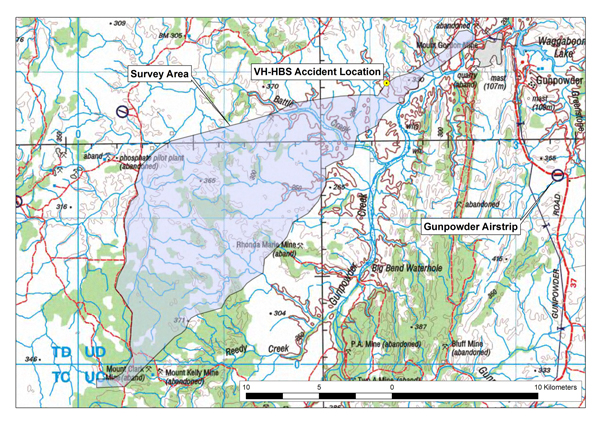
Upon arrival at the airstrip, two other people boarded the helicopter and it departed to begin survey operations in the area between Mt Gordon Mine and Mt Kelly Mine, approximately 30 km to the south-west (Figure 1). During the morning, the helicopter returned to the airstrip at Gunpowder on three occasions to refuel and change personnel on board. It was reported that the helicopter was refuelled to full tanks on each occasion.
Figure 1: Survey area and accident location
It was reported that the helicopter refuelled for the last time at approximately 1300 and departed shortly after with four people on board to continue survey operations in the designated area. The helicopter was expected to rendezvous with the other members of the survey team at approximately 1530. When the helicopter failed to arrive, communication checks with the helicopter pilot and the helicopter operator were conducted and, when no contact with the helicopter was established, search and rescue procedures were initiated. The search continued into the night using a forward looking infrared (FLIR) equipped aircraft. The following morning additional helicopters and aircraft joined the search. At approximately 1100, the burnt wreckage of the helicopter was located on the top of a hill, situated on the edge of the survey area. Rescuers confirmed that all four persons on board had received fatal injuries.
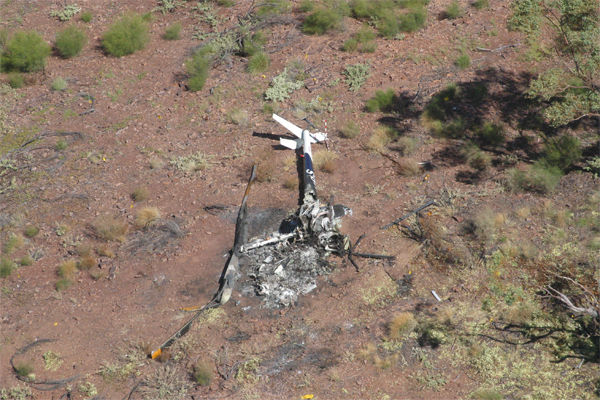
Examination of the wreckage indicated that the helicopter had impacted the terrain heavily, approximately rotor-disc level and in a nose-down attitude. The helicopter came to rest on its right side (Figure 2). The main and tail rotor blades displayed evidence of low rotational energy at the point of impact. Further examination of the main rotor blades revealed compression wrinkling of the upper outer surface of both main rotor blades. All components of the helicopter were accounted for at the accident site.
Figure 2: Aerial view of helicopter wreckage
A severe, fuel-fed, post-impact fire destroyed the cabin and cockpit structure and surrounding flight and engine control systems. The fixed emergency locator transmitter (ELT) and the satellite telephone carried by the pilot were destroyed in the fire. No evidence of the portable ELT, reported to have been carried by the pilot, was found in the wreckage.
The area in which the helicopter was located was not considered to be suitable for a landing area for the R44 helicopter.
Weather conditions in the area were forecast to be fine with light easterly winds. Reported weather conditions in the area were consistent with that forecast.
The pilot held a commercial pilot (helicopter) licence and was appropriately endorsed to fly the R44 helicopter.
The ATSB has recovered the engine and a number of other components for further examination. One of the components recovered is an impact and fire damaged Global Positioning System (GPS) unit. A quantity of data has been successfully recovered from the GPS unit.
The investigation is continuing and will include:
detailed examination of the engine and recovered components
examination of the helicopter maintenance records
further evaluation of the weather conditions
a review of operational factors
detailed examination of recovered GPS data.
Final report
On 21 February 2006, a Robinson Helicopter Company R44 'Astro' helicopter, registered VH-HBS, was being operated on a series of aerial survey flights approximately 100 km to the north of Mt Isa Airport, Qld. The helicopter was operating from Gunpowder airstrip and had completed three flights by 1254 Eastern Standard Time. The pilot refuelled the helicopter and at 1341 departed for a survey flight with three passengers on board. When the helicopter did not arrive at a pre-arranged rendezvous point, a search was initiated. Searchers found the burnt wreckage of the helicopter the next day. The four occupants were fatally injured.
The helicopter had impacted the ground with significant force in a nose-down, fuselage-level attitude. The main rotor displayed evidence of low rotational energy and coning. Other than impact and fire damage, there were no identified mechanical defects or abnormalities. There was evidence that the engine was rotating at impact, but the amount of engine power being developed was not able to be established.
The previous aerial survey flights were reported to have included low speed flight and occasional hovering. At the estimated helicopter weight and the prevailing air density, the helicopter did not have the performance to hover at the survey altitude, which was estimated to be about 1,000 ft above ground level. The investigation considered that the helicopter probably descended contrary to the pilot's intentions, possibly influenced by a partial engine power loss or downdraft, and induced the pilot to apply collective, which developed into overpitching and ultimately main rotor stall.
The investigation found that the helicopter was being operated at gross weights that exceeded the specified maximum take-off weight. The investigation also found that the operator's procedures did not provide a high level of assurance that a relatively low time pilot could conduct aerial survey operations safely.
A turbine-engined PZL-Warszawa-Okecie M-18A Dromader aircraft, registered VH-FVF (callsign Bomber 223), was conducting fire suppression operations on a bushfire in the vicinity of Mount Ulandra, near Bethungra, NSW. At 1921 Eastern Daylight- saving Time, the aircraft was seen by fire fighters to make a low pass over the fire ground area and commence a left turn. Another fireman reported seeing the aircraft in an almost vertical left bank before losing sight of it. None of the other firemen continued to watch the aircraft but, moments later, they reported that they heard a loud noise. When they looked again, the aircraft had hit the ground. The pilot was fatally injured, and the aircraft was destroyed by impact forces. There was no fire.
The crew of a helicopter engaged in fire bucket operations on the same fire ground reported hearing the Dromader pilot broadcast that he was 'lining up for a drop'. A short time later, the helicopter crew reported that they heard the pilot transmit three short expletives. After unsuccessfully attempting to contact the pilot, they commenced searching and located the wreckage of the aircraft a few minutes later, where fire fighters were already in attendance.
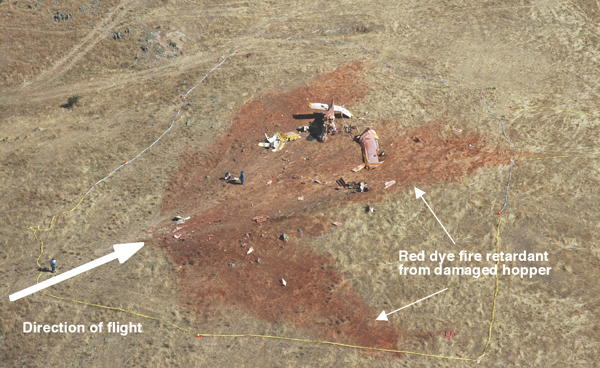
The aircraft had impacted open, rising terrain in a nose-down, slightly right wing-low attitude. Examination of the impact marks and the wreckage indicated that the aircraft had been travelling at low forward speed and with a high rate of descent. The ground around the wreckage was covered with a considerable amount of chemical retardant from the ruptured hopper (Figure 1).
Figure 1: Aerial view of wreckage
The aircraft was manufactured in Poland in 1988 and placed on the Australian register in March 1999. In November 2003, the aircraft was modified from the original design in accordance with an approved Supplemental Type Certificate (STC), number SA09039SC, which permitted the replacement of the original reciprocating (radial) engine and the 4-blade propeller with a Garrett TPE 331-12U gas turbine engine and a Hartzell 5-blade constant speed propeller. The modification also incorporated other changes that included the replacement of the hopper with a larger, 800 US gallon (3,030 L) hopper. Additionally, servo tabs were added to the primary flight control surfaces, flap travel was increased and vortex generators were installed on the wings and tailplane.
The aircraft was operated in the restricted category 1 that permitted flight at weights up to 5,300 kg during agricultural operations, which was 1,100 kg in excess of the certified maximum aircraft weight. Flights at those weights restricted the aircraft's maximum speed and, during fire suppression operations, manoeuvring was limited to a maximum angle of bank of 30 degrees.
The pilot held a commercial pilot licence, endorsed for the aircraft type, and a valid Class 1 medical certificate. The pilot also held a Grade 1 Agricultural Rating and had been issued a Night Visual Flight Rules Agricultural Rating on 19 December 2004. The test for that rating met the requirements of the Aeroplane Flight Review, the biennial proficiency check required of pilots. The pilot had in excess of 4,000 hours in agricultural flying operations, of which 127 hours were flown in fire suppression operations over a period of six seasons. Although the pilot had only 4.7 hours on the aircraft type, he had flown over 400 hours on the unmodified radial-engine Dromader aircraft type, and had over 600 hours on other turbine-powered aircraft. The pilot had commenced fire bombing operations two days before and was reported to have been well rested and in good health.
The investigation is continuing and will include the following aspects:
analysis of data downloaded from the aircraft's Global Positioning System navigation receiver to determine the actual flight path
testing of the switches controlling the hopper gate
examination of other aircraft components
a review of maintenance documentation and records of modification made to the aircraft
an appraisal of flight characteristics of the modified aircraft during operations at higher gross weights.
Restricted category aircraft are certified by the Civil Aviation Safety Authority to conduct certain special purpose operations.
Summary
At about 1922 Eastern Daylight-Saving Time on 16 February 2006, the pilot of a turbine PZL-Warszawa-Ockie M-18A, Dromader, registered VH-FVF, was fatally injured when the aircraft impacted terrain during fire-bombing operations approximately 20 km south-south-west of Cootamundra, NSW.
The pilot was an experienced agricultural pilot with previous fire-bombing experience. Although he had considerable flying experience on radial-engine Dromader aircraft, and in other turbine agricultural aircraft, his total flying experience in the modified turbine Dromader was 4.7 hours. Prior to commencing fire-bombing duties two days before the accident, the pilot had not recorded any fire-bombing flights in the previous 3 years.
The pilot's limited familiarity with the handling characteristics of the modified and heavily loaded aircraft might not have allowed him adequate recognition of an impending stall. The pilot had not jettisoned the load of retardant when the aircraft stalled. The ensuing loss of control occurred at a height that did not permit recovery before the aircraft collided with the ground. The possibility that the pilot was distracted by a problem with the operation of the fire doors, or some other activity could not be determined.
Subsequently, the state fire authority reviewed its minimum pilot experience levels for aerial fire suppression. The minimum aircraft type experience for fire-bombing pilots was made more specific to the type of aircraft. It also introduced a recency requirement for fire-bombing operations.
During a charter flight from Broome, WA to Cone Bay, WA, the pilot of an amphibious (float and landing gear equipped) Viking Air Ltd DHC-3-T 'Turbo-Otter' aircraft (VH-OTV) reported an unusual movement within the control system, followed by a sudden downward pitching motion, leading to a rapid and uncontrolled descent. With the assistance of the front seat passenger, the pilot was able to arrest the descent and regain control of the aircraft, before making a precautionary landing at Lombadina Station, WA.
An engineering assessment of the aircraft found that the right elevator servo tab had broken away from the control rod and horn at the outboard end. Damage to the elevator trailing edge and tearing of the tab through the mid-span was consistent with gross oscillatory movement (flutter) of the tab after it had become disconnected from the rod and horn.
Aerodynamic flutter within the elevator trim and servo tabs of the DHC-3 aircraft type had been known since the 1960s, however the development of turboprop engine conversions for the aircraft had resulted in an increased potential for tab failure as a result of the increased airspeeds and control surface loads associated with the re-engined aircraft. A series of engineering solutions to the flutter problem had been subsequently developed, and in April 2004, a US Federal Aviation Administration airworthiness directive (AD) mandated the modification of the DHC-3 elevator tab assembly for US registered aircraft.
At the time of the occurrence, VH-OTV had not undergone the elevator tab modifications. The maintenance organisation stated that it was unaware of the FAA actions and had not received any information as to the availability of flutter prevention modifications from the aircraft type certificate holder or the certificate of registration holder.
Safety action taken by the maintenance provider after the occurrence included the implementation of systems to more adequately alert the organisation to the existence of important safety bulletins and airworthiness directives affecting the aircraft. An airworthiness directive for the elevator tab modifications issued by Transport Canada the month before the occurrence, became effective on 31 March 2006 and, on 1 March 2006, the Civil Aviation Safety Authority (CASA) introduced an AD to mandate the prospective Transport Canada requirements from 31 May 2006.
Occurrence summary
Investigation number
200600837
Occurrence date
15/02/2006
Location
Lombadina, (ALA)
State
Western Australia
Report release date
25/01/2008
Report status
Final
Investigation type
Occurrence Investigation
Investigation status
Completed
Mode of transport
Aviation
Aviation occurrence category
Loss of control
Occurrence class
Serious Incident
Highest injury level
None
Aircraft details
Manufacturer
De Havilland Canada/De Havilland Aircraft of Canada
On 24 January 2006 at 0644 Western Standard Time, a Boeing Company 737-800 (737) aircraft, registered VH-VXR, was lined up on the threshold of runway 06 at Perth Airport, WA, when the aerodrome controller (ADC) issued the crew a clearance for the aircraft to take off. The crew reported that at about the same time, a British Aerospace Plc 146-300 (146) aircraft, registered VH-NJN, crossed runway 06 in the vicinity of taxiway Charlie. The 737 copilot, the non-flying pilot, advised the ADC that '…we'll just wait for the 146 crossing the runway'. The crew delayed the aircraft's take-off until the 146 had vacated and was taxiing away from the runway.
The ADC and Coordination controller considered that a runway separation standard would exist prior to the 737 commencing take-off. The 737-crew reported that they were concerned at the taxi speed of the 146 and delayed the commencement of their take-off until it had vacated the runway.
The incident highlighted the use of a Manual of Air Traffic Services (MATS) procedure for a situation for which it was not designed. The use of the adapted procedure by controllers has possibly reduced safety when used for runway crossing situations.
As an outcome from the investigation Airservices Australia has advised the Australian Transport Safety Bureau that it intends to:
review the use of take-off/landing clearance procedures during runway crossing situations, by aircraft and vehicles
review runway crossing procedures with a view to assessing the need for a specific runway standard for situations involving aircraft or vehicles crossing a runway during landing/take-off operations
review the use of memory prompts or aids by tower controllers in situations involving aircraft taxiing across a runway during landing/take-off operations.