A preliminary investigation into a category 4 occurrence that
occurred at Sydney Aerodrome on 29 June 2006, which involved a
reduction in the required visual separation standard between a
departing Boeing Aircraft Company 737 (B737) aircraft and an
arriving Robinson Helicopter Company R44 (R44) helicopter,
determined that the pilot of the R44 had sight of the B737 at all
times, and that there was no risk of a collision between the B737
and the R44.
The inadvertent reduction in the required visual separation
standard was as a result of the pilot in command of the R44
misjudging the acceleration of the B737 during its take-off roll.
The likely safety outcomes of continued investigation did not
warrant further allocation of resources.
Status: Downgraded the occurrence to category 5 and
investigation discontinued.
On 29 June 2006, Bombardier DHC-8-402 (Dash 8-400) was being operated on a scheduled passenger service from Brisbane to Mackay, Qld. As the aircraft passed through FL220, the cabin altitude warning light illuminated, accompanied by the associated aural warning.
Initial checks by the crew indicated that the cabin differential pressure and cabin air flow appeared to be normal. The aircraft's bleed air switches also appeared to the crew to be correctly selected to the ON position.
An attempt by the crew to manually confirm the position of the bleed air switches revealed that both switches were in the OFF position. The subsequent selection of the switches to the ON position extinguished the cabin altitude warning light and the associated indications, and the aircraft's pressurisation system commenced normal operation.
In response to this incident, the operator developed an amendment to the Flight Crew Operating Manual for application in the company's turboprop operation, including affecting the Dash 8-400 checklist. The amendments to the aircraft checklist included:
revised responses to the pressurisation-related checklist items
an additional Pressurisation checklist requirement to be conducted at Transition
the addition of the requirement for the tactile confirmation of some checklist responses, including when one pilot has responsibility for both the 'challenge' and 'response' actions.
Between 2001 and 2006, there were a number of fatal single and
multi-engine aeroplane accidents that occurred, where the ATSB
found that engine power loss during or after takeoff preceded loss
of control. Those accidents involved different aircraft types, all
below 5,700 kg MTOW, and a variety of pilot experience. Partial
power loss, sometimes intermittent, featured in most of the single
engine power loss accidents. ATSB research papers were also
indicating an uncontrolled flight into terrain (UFIT)
problem.
While the ATSB investigated each accident individually, a safety
issue investigation was initiated on 3 July 2006, to enable a
broader look into what may assist the aviation industry to manage
the risk of operating aircraft that don't have assured takeoff
performance when an engine loses power (generally aircraft below
5,700 kg MTOW). Of particular interest was how pilots managed a
partial engine power loss during or soon after takeoff in single
engine aircraft.
The investigation found no significant safety issues that had not
been addressed by developments and changes within the aviation
industry since July 2006. As a result, the safety issues
investigation was discontinued, however the ATSB has initiated an
aviation research project to produce educational material for the
aviation industry on this topic.
On 15 June 2006 at approximately 1630 Eastern Standard Time, during a scheduled flight from Hervey Bay, Qld, to Brisbane, Qld, the crew of the Fairchild Industries SA227-AC (Metro III) aircraft, registered VH-SEF, noticed that the cabin temperature was colder than desired. After adjustment to the auto and manual cabin temperature controls, the cabin temperature increased to a higher-than-expected range and could not be reduced. Shortly after, smoke was seen coming from the right-side cockpit air vents. The crew isolated the right bleed air system and diverted the aircraft to Maroochydore, Qld.
After examination of the aircraft's air-conditioning system, the right hot air mixing valve was replaced and the aircraft returned to service without further problem.
During the incident, the crew found that fitment of their emergency oxygen masks was ineffective, requiring them to hold the masks in place with one hand, and that the passenger address system was also ineffective in alerting the passengers to the emergency.
Only one minor injury in the form of sore ears was reported as a result of the incident.
As a result of this incident the Australian Civil Aviation Safety Authority issued an Airworthiness Bulletin to address maintenance aspects of flight crew oxygen masks.
At 1323 Coordinated Universal Time (UTC) (0623 US Pacific Daylight Saving Time), on 9 June 2006, a Piper PA-44-180 Seminole aircraft, registered VH-CZE, departed Santa Barbara, California, USA, for Hilo, Hawaii. The aircraft was one of two Seminoles that were being ferried in-company to Australia under the instrument flight rules. At about 2050 UTC, the pilot in command advised US Air Traffic Services that the left engine had failed, and that the aircraft would have to be ditched as the aircraft was 7 hrs from Hilo but only had 5 hrs of fuel endurance remaining. At about 0145 UTC, the aircraft ditched 980 km north-east of Hilo. The pilot and co-pilot exited the aircraft uninjured and were rescued by a nearby ship. The aircraft sank and was not recovered.
The pilot reported that more fuel was being drawn from the ferry fuel tank than was expected. In addition, a 5 cm x 1 cm scorch mark could be seen just above the landing gear observation mirror on the left inboard engine cowl. Following discussions with the pilot of the accompanying Seminole, the pilot decided to shut down the left engine. Prior to ditching, the pilot restarted the left engine to prevent an asymmetric situation on touchdown.
As a result of this occurrence, the aircraft operator has advised the Australian Transport Safety Bureau that:
In conjunction with their US maintenance provider, they were continuing inquiries with respect to the interaction of the ferry fuel tank system and the fuel selector positions fitted to the aircraft and system management.
They intended to change the ferry flight procedures to use more fuel from the aircraft wing fuel tanks and then periodically top-up those tanks from the ferry fuel tank, using the aircraft fuel contents gauges as a guide.
On 1 June 2006, at about 07011 Central Standard Time2, a Beech Aircraft Corp. A36 (Bonanza) aircraft, registered VH-JDJ, departed Kununurra, WA on a private category visual flight rules (VFR) flight to Bathurst Island, NT. The flight was for the pilot, who was the sole aircraft occupant, to visit clients in regional and remote areas of the country.
At about 0900, an aircraft advised air traffic services (ATS) of a radio distress beacon transmitting on the 121.5 MHz distress frequency. That beacon transmission was confirmed at 0912, when a COSPAS-SARSAT satellite download to an AusSAR3 local user terminal, indicated that a radio distress beacon was transmitting in the vicinity of Bathurst Island.
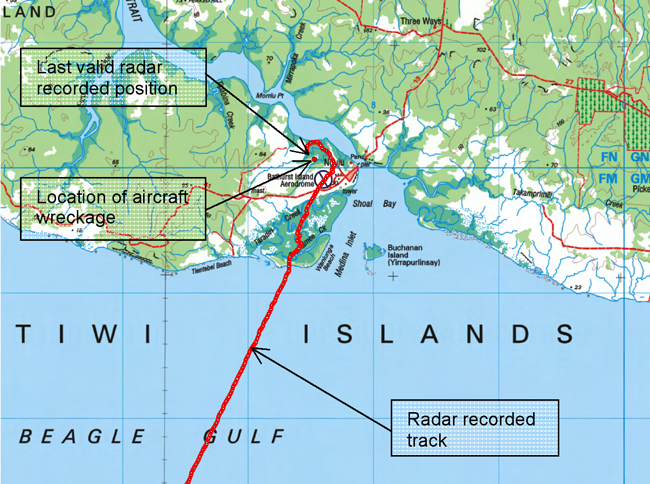
The Rescue Coordination Centre at AusSAR coordinated the search for the source of the distress beacon transmission. A search aircraft subsequently located aircraft wreckage approximately 1.3 NM north-west of the Bathurst Island aerodrome. The ground party that located the wreckage determined that the pilot had sustained fatal injuries. There was no fire.
A review of ATS recorded radar data identified a VFR aircraft on the direct track between Kununurra and Bathurst Island at an altitude of 5,500 ft4 above mean sea level (AMSL). The aircraft commenced descent from cruise altitude about 30 NM from the aerodrome and, at 0846, arrived overhead at an altitude of 1,400 ft. That was, about 1 hour 45 minutes after the Bonanza departed Kununurra. The recorded radar track was consistent with the aircraft joining the circuit mid-downwind for a landing on runway 15.
The aircraft continued downwind and commenced decent from 1,000 ft just prior to turning onto the base leg of the circuit. The aircraft then turned onto a long final approach for runway 15. The last valid radar return was received at 0848 at an altitude of 600 ft.
The aircraft wreckage was located slightly left of the extended runway 15 centreline, approximately 1,200 m north-west of the runway threshold.
Figure 1 depicts the aircraft's recorded radar position during the final stages of the flight.
Figure 1: Bathurst Island aerodrome, recorded radar track and location of aircraft wreckage
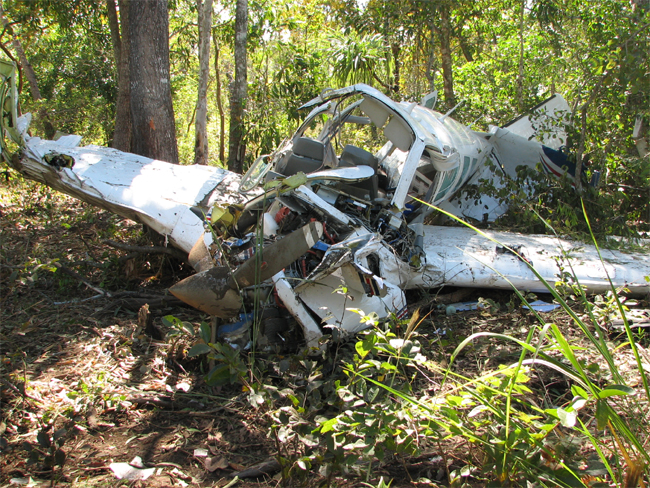
Examination of the wreckage indicated that the aircraft had impacted terrain in a left wing-low, steep nose-down attitude. The accident site was located in scrub-type terrain, moderately populated with trees approximately 10 to 20 m in height (Figure 2).
Figure 2: Accident site and surrounds
The aircraft collided with the upper branches of a tree during the final stages of the decent. Damage to the foliage was consistent with the aircraft descending steeply as it approached the ground. All aircraft components were accounted for at the accident site, and the aircraft was assessed as being intact prior to impact. The landing gear was down, and the wing flaps were retracted (up position) at that time. The propeller sustained relatively minor damage, and the hub of the propeller remained intact.
There was no evidence of bird strike or of a collision with any other object prior to the final impact sequence.
The aircraft's Continental IO-520 engine had accumulated approximately 62 hours time in service since its last overhaul. The engine was recovered from the accident site for further examination. That examination found no evidence of catastrophic failure of any of the engine's components. The engine's ignition system was tested and found to be capable of normal operation. The fuel-injection nozzles for each cylinder were clear of any obstruction and capable of normal operation.
The aircraft was equipped with an EDM 700 engine data monitoring system that monitored a number of parameters of the engine operation. That instrument was recovered for further examination.
The aircraft was equipped with main and auxiliary fuel tanks. The main fuel tanks were located in each wing, and each had a capacity of 140 litres (L) useable fuel. The auxiliary tanks were located on the tip of each wing, and each had a capacity of 75 L. The cockpit fuel selector had 5 positions: 'OFF', 'L. MAIN', 'R. MAIN', 'R. TIP' and 'L. TIP'. The auxiliary tanks were also equipped with a tank cross feed and an 'ON' 'OFF' cross-feed selector.
During the impact sequence, the right auxiliary fuel tank detached from the right-wing tip. Although the tank was intact, it did not contain a significant quantity of fuel. The left auxiliary fuel tank remained attached to the left-wing tip. Although that tank sustained impact damage, it remained substantially intact and did not contain a significant quantity of fuel.
The left main tank was intact. Approximately 65 L of fuel was recovered from that tank and a sample was retained for testing. The right main tank was breached along the leading edge of the wing and the fuel line from that tank sustained impact-related damage and was fractured in the vicinity of the wing root5. All of the fuel tank caps were secure and there was no evidence that any fuel had been lost overboard during flight.
The aircraft fuel selector was found in the R. TIP position and the cross feed for the auxiliary tank was found in the OFF position. A separate fuel gauge was capable of indicating the quantity of fuel in the aircraft's tip tanks. A switch located beside that gauge allowed the pilot to display the quantity of fuel in either of the tip tanks. That switch was found in the L. TIP position. A number of components from the aircraft's fuel system were recovered for further examination/testing. Those components included the cockpit fuel selector and selector valve, cockpit fuel quantity gauges and the fuel tank float and sender units.
The aircraft was last refuelled at Halls Creek on 30 May 2006. Fuel company records indicated that one of the aircraft's swipe cards was used to purchase 268 L of aviation gasoline. Other aircraft had also refuelled from the same fuel source that day. The aircraft's records indicated that, at the time of the accident, the Bonanza had operated approximately 3.6 hours since refuelling at Halls Creek. Flight planning documents recovered at the accident site indicated that, when fully fuelled, the pilot had planned the aircraft's endurance as 7.3 hours.
A number of local residents and other pilots reported that visual meteorological conditions (VMC) prevailed in the vicinity of Bathurst Island at the time of the accident.
The pilot held an unrestricted Private Pilot (Aeroplane) Licence and had accumulated approximately 526 hours total aeronautical experience.
The investigation is continuing and will include the:
examination of the engine data monitoring equipment
testing of recovered components
review of operational factors associated with the flight.
First light at Kununurra on 1 June was 0652 CST (0522 Western Standard Time).
The 24-hour clock is used in this report to describe the local time of day, Central Standard Time (CST), as particular events occurred. Central Standard Time was Coordinated Universal Time (UTC) + 9.5 hours.
Australian Search and Rescue - in general terms, AusSAR coordinates the response to aviation SAR incidents across Australia.
Altitude information is encoded by the aircraft's radar transponder to the nearest 100 ft.
During the subsequent salvage of aircraft components on behalf of the insurance company, a quantity of about 20 L of fuel was reported to have drained from the right main tank.
Summary
On 1 June 2006, at about 0848 Central Standard Time, a Beech Aircraft Corp A36 Bonanza aircraft, registered VH-JDJ, was approaching to land at Bathurst Island aerodrome.
Air traffic services radar data recorded the aircraft overflying the aerodrome and that the pilot joined the circuit on left downwind for a landing on runway 15. The aircraft impacted terrain 2.4 km north-west of the aerodrome. The pilot, who was the sole occupant of the aircraft, sustained fatal injuries.
The aircraft was assessed as being intact prior to the impact with terrain and no anomaly was identified with the aircraft that could have affected its normal operation.
Data recovered from an onboard engine data recording system was consistent with an interruption of the fuel flow and the loss of engine power about 42 seconds before impact. The pilot may have been attempting to perform an emergency landing to a nearby clearing when control of the aircraft was lost.
On 04 May 2006, Boeing 737-281, registered PK-YTQ, was operating a flight from Jakarta to Ujung Pandang, Indonesia. During the take-off roll at Jakarta a main landing gear tyre delaminated and parts of the tread were released damaging hydraulic components. Shortly after takeoff, a malfunction of the hydraulics system was indicated to the flight crew. The crew elected to return to base. During the landing roll, the aircraft brakes and thrust reversers were reportedly not effective and the aircraft overran the end of the runway.
The National Transportation Safety Committee (NTSC) of Indonesia was responsible for investigating this occurrence. On 19 May 2006 the NTSC requested assistance from the Australian Transport Safety Bureau (ATSB) in the recovery and analysis of information from the flight data recorder and cockpit voice recorder.
In accordance with clause 5.23 of Annex 13 to the Convention on International Civil Aviation, the ATSB appointed an Accredited Representative to assist the NTSC and initiated an investigation under the Transport Safety Investigation Act 2003.
The NTSC is responsible for releasing a final investigation report regarding this occurrence.
National Transportation Safety Committee Ministry Of Transportation Republic Of Indonesia Transportation Building 3rd Floor Jalan Medan Merdeka Timur No. 5 Jakarta Pusat 10110 Indonesia
On 29 May 2006 at about 0805 Eastern Standard Time, a Boeing Company 737-7Q8 aircraft (737) passed within 400 ft vertically of an Aero Commander 680-FL (Aero Commander) aircraft. At that time there was less than the minimum 3 NM radar separation standard or the 1,000 ft vertical separation standard between the two aircraft.
The 737 departed Melbourne Airport tracking to the north and then to the north-east of Melbourne on a runway 27 DOSEL 3 standard instrument departure (SID). The Aero Commander became airborne off runway 35 at Essendon. The pilot of the Aero Commander was instructed to track overhead Melbourne Airport and climb to 3,000 ft. From overhead Melbourne Airport, the pilot was instructed to fly a heading of 310 degrees magnetic.
The pilot of the Aero Commander advised the departures controller that he had the 737 in sight. However, there was a breakdown of separation standards because the departures controller did not comply with the requirements of the Manual of Air Traffic Services (MATS) when he assigned separation responsibility to the pilot of the Aero Commander.
On 29 May 2006, an Australian registered and operated Boeing Co. 747-400 was taxiing at New York, John F Kennedy (JFK) Airport. During the aircraft's final turn into its allocated parking bay, the right wingtip contacted a blast fence, resulting in damage to the outboard end of the right wing. An investigation was conducted by the US Federal Aviation Administration in conjunction with the US National Transportation Safety Board and the Australian Transport Safety Bureau.
The ATSB has completed its technical analysis report of the flight recorder data from the Boeing Co. 737-204, registration PK-YTH, on behalf of the Indonesian National Transportation Safety Committee (NTSC). The aircraft was operating a flight from Banjarmarsin to Balikpapan, Indonesia when it was involved in an incident during the landing at Sepinggan Airport at Balikpapan.
The National Transportation Safety Committee (NTSC) of Indonesia is responsible for investigating this occurrence. The NTSC requested assistance from the Australian Transport Safety Bureau (ATSB) in the recovery and analysis of information from the flight data recorder and cockpit voice recorder. In accordance with clause 5.23 of Annex 13 to the Convention on International Civil Aviation, the ATSB appointed an Accredited Representative to assist the NTSC and initiated an investigation under the Transport Safety Investigation Act 2003.
The ATSB's Technical Analysis Report has been sent to the NTSC to assist its ongoing investigation. The NTSC is responsible for releasing a final investigation report regarding this occurrence.
National Transportation Safety Committee Ministry Of Transportation Republic Of Indonesia Transportation Building 3rd Floor Jalan Medan Merdeka Timur No. 5 Jakarta Pusat 10110 Indonesia