On 12 February 2006, the pilot of a Robinson Helicopter Company R44 Raven II Newscopter, registered VH-WYS, was conducting aerial filming of a banner towing helicopter in the vicinity of Williamstown, Vic. On board with the pilot were a photographer in the front left seat and a gyro-stabilised camera operator in the rear left seat.
While in a turn at low airspeed, and with a quartering tailwind, the helicopter began an uncommanded yaw to the right. The pilot attempted to regain control, but the helicopter continued to rotate to the right and descended approximately 1,800 ft before control was regained. The helicopter was flown to a nearby beach and landed.
The reported ambient conditions and nature of the loss of control were consistent with the pilot report that the helicopter had suffered a loss of tail rotor effectiveness (LTE). It was possible that the onset of vortex ring state had contributed to the high rate of descent during the pilot's recovery from the LTE.
On 5 February 2006, at approximately 1725 Eastern Daylight-saving Time, a Cessna Aircraft Company 208 floatplane, registered VH-KLP, departed from Strahan, Tasmania on a chartered tourist flight over Frenchman's Cap with the pilot and ten passengers.
When the aircraft was over Frenchman's Cap at an altitude of 4,500 ft above mean sea level, the pilot observed that a chip detector light on the master caution warning panel had illuminated. The pilot decided to land the plane as soon as possible. During the diversion, five minutes after the chip detector light illuminated, a loud noise was heard and the engine lost power. The pilot immediately feathered the propeller and carried out a forced landing on Lake Burbury.
The pilot reported that the aircraft landed heavily, and its forward speed could not be controlled. The aircraft came to a stop on a mud bank on the edge of Lake Burbury with its floats clear of the water. There were no reported injuries.
The engine was removed, disassembled and inspected, revealing damaged components with characteristics consistent with electrical discharge damage. The source of the electrical discharge damage was a starter-generator that was replaced due to a malfunction 18.7 hours prior to the engine failing. This was the forty-third reported starter-generator electrical discharge damage event reported to have taken place on PT6A series engines world-wide since 1992.
As a result of this investigation several safety recommendations have been issued to the aircraft manufacturer, the engine manufacturer, the Civil Aviation Safety Authority, Transport Canada and the US Federal Aviation Administration.
On 2 February 2006 at approximately 1308 Eastern Daylight-saving Time, a US registered Boeing Company 747-422 (747) aircraft was taxiing for departure at Melbourne Airport, Vic. At the same time, a Boeing Company 767-338ER (767) aircraft was stationary on taxiway Echo and waiting in line to depart from runway 16. The tail section of the 767 was protruding into taxiway Alpha while it was stationary on taxiway Echo awaiting a clearance to enter the runway.
The pilots of the 747 received a clearance to taxi, which included a taxi route from the international apron to the holding point on taxiway Bravo, for a departure from runway 16, via taxiways Uniform then Alpha. The pilot in command of the 747 deviated from the taxi clearance issued by the surface movement controller and turned the 747 right into taxiway Echo, to pass behind the 767. The left wing tip of the 747 collided with the right horizontal stabiliser of the 767 as the 747 crew attempted to manoeuvre behind the 767.
The taxiway dimensions and markings at Melbourne Airport complied with international standards and were suitable for use by the aircraft types involved in the occurrence.
The 747 crew was aware of the 767, and chose to pass behind it rather than wait on taxiway Alpha until the 767 was no longer obstructing the taxiway. The decision by the pilot in command of the 747 to deviate off the centreline of taxiway Alpha and taxi behind the 767 did not comply with the taxi clearance issued by the SMC. It was based on his assessment that it was safe to do so. The pilot in command of the 747 misjudged the distance between the wingtip of the 747 and the right horizontal stabiliser of the 767, which resulted in the collision.
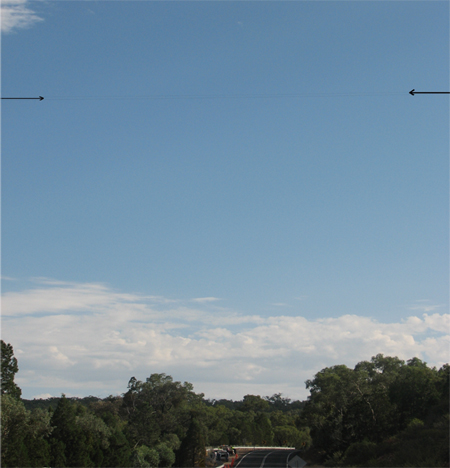
On 2 February 2006, a Bell Helicopter Company 206B (III) aircraft, registered VH-MFI, was being operated in the area east of Parkes, NSW on a noxious weed identification survey at low-level, for a local council. At about 0930 Eastern Daylight-saving Time, the helicopter was observed to strike a powerline about 130 ft above ground level (Figure 1), in a location known as 'The Dungeons', approximately 23 km east of Parkes. All three occupants were fatally injured.
Figure 1: Powerline running between arrow heads
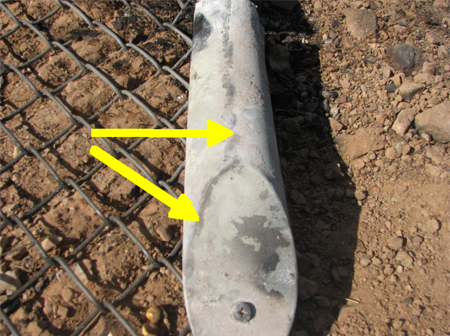
Examination of the wreckage revealed that the helicopter struck the powerline with the left landing gear skid (Figure 2).
Figure 2: Landing skid wire contact marks
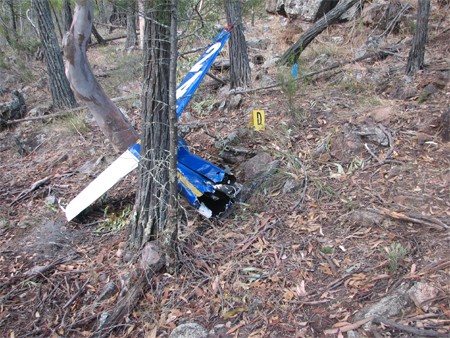
This led to the tail boom and tail rotor assembly being severed from the fuselage by the main rotor (Figure 3), as a result of which the helicopter entered an uncontrolled descent from which recovery was not possible. The helicopter was destroyed by impact forces and post-impact fire.
Figure 3: Severed tail rotor section
A witness reported that the helicopter appeared to be operating normally until it struck the powerline. The pilot was qualified to undertake the flight and the helicopter was being operated within the manufacturer's prescribed weight and centre of gravity limits.
The investigation is continuing and will include examination of:
low-level operational planning by the council and the helicopter operator
low-level obstacle information databases, and the accessibility of database information to low level operators, aircrew, and contractors.
Summary
On 2 February 2006, a Bell Helicopter Co 206B (III), registered VH-MFI arrived at Parkes Aerodrome from Dubbo, NSW in preparation for an aerial noxious weeds survey, including the requirement for a closer inspection of the eastern border area of the Parkes Shire Council. At an estimated 0923 Eastern Daylight-saving time, the pilot took off for the estimated 7 to 8 minutes flight to the survey area. Also onboard the helicopter were two council weeds control officers.
Witness reports indicated that, at about 0930, the helicopter struck a powerline that crossed the Parkes to Orange road.
The occupants of the helicopter were fatally injured, and the helicopter was destroyed by impact forces and a post-impact, fuel-fed fire. There was no damage to the powerline or associated facilities and structures.
As a result of this investigation, the Civil Aviation Safety Authority (CASA) indicated that it was considering the development of a Civil Aviation Order (CAO) with the effect that anyone carrying out low-level operations would have to satisfy relevant low-level flying standards.
The Australian Transport Safety Bureau (ATSB) issued two recommendations as a result of this investigation, including: the possible enhancement of the content of CASA's Approval to conduct Low-flying Instruments and the possible development of a Civil Aviation Advisory Publication or Advisory Circular for application in the conduct of low-level operations. In addition, the ATSB has commenced initial discussions with a number of agencies and associations in order to examine the feasibility of the establishment of a national database of information on the location of known powerlines and tall structures for access by pilots, operators and managers of aerial campaigns.
On 25 January 2006, a Boeing Company 777-200 (777) was en route from Christchurch, NZ, to Singapore at flight level (FL) 360. A Boeing Company 737-838 (737) was en route from Alice Springs, NT, to Sydney, NSW, on a reciprocal track at FL370. At 0422.30 Coordinated Universal Time the two aircraft passed each other in the vicinity of waypoint APOMA, in the Melbourne Flight Information Region.
The pilots of the 777 had requested a clearance to climb to FL380. The separation standard that was applicable between the two aircraft, before the air traffic controller could authorise climb for the 777, was a ten minute longitudinal standard. That standard required the controller to calculate the estimated time the two aircraft would pass, using a method approved in the Manual of Air Traffic Services. Once that estimated time of passing was established, ten minutes either prior to, or after, that time of passing had to be applied. In the circumstances, a vertical separation standard needed to exist from the estimated time of passing plus the ten minutes. The crew of the 777 had been instructed to climb to FL380 at the estimated time of passing plus 8.5 minutes. There was an infringement of separation standards.
The air traffic controller's initial scan of the air situation display was incomplete and did not detect that a procedural separation standard would not exist between the 737 and the 777, or that he needed to calculate the time that the 10 minute longitudinal separation standard was established. A more comprehensive initial scan of the air situation display by the controller may have facilitated timely action to avoid an infringement of separation standards.
On 25 January 2006 a Beech Aircraft Corporation 200 (King Air) aircraft was north bound en route from Essendon, Vic., to Shepparton, Vic. The aircraft was operating under the instrument flight rules (IFR) and was climbing to flight level (FL) 130. At the same time, an Airbus A320-232 (A320) aircraft was south-west bound en route from Sydney, NSW, to Avalon, Vic., and was on descent to FL130. The aircraft were in airspace that was being managed by the Melbourne Departures North controller (north controller). The King Air pilots were communicating with air traffic control on the Melbourne Departures South frequency. The A320 pilots were communicating with air traffic control on the Melbourne Approach East controller's (east controller's) frequency.
When the aircraft were about 10 NM east of Melbourne at FL130, Melbourne air traffic controllers realised that a potential for an infringement of separation existed, and a short-term conflict alert activated on their air situation displays. The controllers issued turn instructions to the crews of each aircraft, which preserved the required 3 NM radar separation minima. The east controller also issued traffic information on the King Air to the crew of the A320. A review of the recorded radar data showed that the two aircraft came within about 4 NM of each other.
Although there was no infringement of separation standards, the controllers concerned were not aware that a potential conflict existed between the two aircraft until avoiding action, initiated by air traffic control, was required in order to preserve the 3 NM radar separation standard. There was a breakdown in coordination between the east controller, the north controller and the south controller.
On 22 January 2006, at approximately 1930 Eastern Daylight-saving Time, the pilot of a Brantly International Inc B-2B helicopter, registered VH-FBE departed Mount Dapper property near Gulgong, NSW on a private flight to gain further experience on the helicopter.
After approximately 15 minutes, the helicopter was observed to commence a slow descent. An observer at the property homestead became concerned that the projected flight path may lead the helicopter to collide with the powerlines crossing the property. The observer reported seeing the helicopter contacting the powerlines, tumbling in the air and crashing to the ground. The helicopter was engulfed by fire and destroyed. The pilot, the sole occupant, was fatally injured.
The investigation did not find evidence of any pre-existing condition that would have contributed to the accident. All of the helicopter and its systems were accounted for at the accident site. All damage and the separation of parts of the helicopter were consistent with the onset of excessive loads experienced during impact with the wire and ground.
The observer reported that the powerlines had been on the property for a long time and their location was known by the pilot. The pilot had other power lines on the property marked with red coloured markers and had purchased two similar markers with the intention of having them fitted to the powerlines involved in the accident.
It is likely that the pilot became preoccupied with the operation of the helicopter and either forgot that there were powerlines in the area or did not see the powerlines.
FACTUAL INFORMATION
On 22 January 2006, at approximately 1930 Eastern Daylight-saving Time, the pilot of a Brantly International Inc B-2B helicopter, registered VH-FBE, departed Mount Dapper property near Gulgong, NSW, on a private flight to gain further experience on the helicopter.
After approximately 15 minutes, the helicopter was observed to commence a slow descent. An observer at the property homestead became concerned that the projected flight path may lead the helicopter to collide with the powerlines crossing the property. The observer reported seeing the helicopter contacting the powerlines, tumbling in the air and crashing to the ground. The helicopter was engulfed by fire and destroyed. The pilot, the sole occupant, was fatally injured.
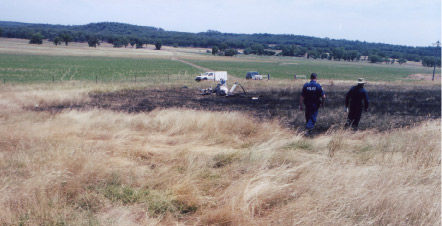
Figure 1: The accident site
Note: The powerlines post is visible at the right corner of the photo. The powerlines extended to the left, almost overhead of the wreckage.
The investigation did not find evidence of any pre-existing condition that would have contributed to the accident. All of the helicopter and its systems were accounted for at the accident site. All damage and the separation of parts of the helicopter were consistent with the onset of excessive loads experienced during impact with the wire and ground.
The helicopter had recorded 170.1 hours in service at the time of the accident. It had flown approximately 65.7 hours since the last periodic inspection completed in November 2005.
The pilot was qualified on the type and approved for low flying. He held a valid medical certificate. At the time of the accident, he had accumulated a total of approximately 184 hours.
It was reported that the sky was clear, temperatures in the high twenties with a light and variable south-easterly breeze.
The observer reported that the powerlines had been on the property for a long time and their location was known by the pilot. The pilot had other power lines on the property marked with red coloured markers and had purchased two similar markers with the intention of having them fitted to the powerlines involved in the accident.
It is likely that the pilot became preoccupied with the operation of the helicopter and either forgot that there were powerlines in the area or did not see the powerlines.
On 21 January 2006, at 1155 Eastern Daylight-saving Time, a Saab AB SF340B aircraft, registered VH-ORX, departed Lismore Aerodrome, NSW, on a scheduled regular public transport flight to Sydney, NSW. On board were 3 crew and 21 passengers. Shortly after passing 8,000 ft on climb, the crew received a master caution warning indicating that there had been numerous system failures. After conducting failure management procedures, the crew elected to return to the departure aerodrome. while en-route to the departure aerodrome they received another master caution indicating a hydraulic failure. The crew then diverted to Coolangatta Aerodrome.
Subsequent investigation revealed that the K9 circuit breaker had been tripped. The investigation by the operator revealed that it was possible to inadvertently trip the circuit breaker when moving a navigation folder for use
As a result of the occurrence the operator issued an Operations Notice to flight crew advising that items are not to be stored on the circuit breaker panel and that all circuit breakers are to be checked correctly during failure management procedures.
At about 0712 Central Standard Time1 on 19 January 2006, a Beech Aircraft Corporation 58 Baron aircraft, registered VH-MNI, departed Darwin, NT, on a charter flight to McArthur River Mine, NT. On board were the pilot and one passenger. The flight planned track of the aircraft was at 9,000 ft above mean sea level direct to McArthur River Mine, located 385 NM south-east of Darwin. The pilot was to pick up an additional passenger at McArthur River Mine, and transport the two passengers on to Merlin Mine. He was to then return to Darwin with two other passengers.
At 0925, a Piper PA-31 Navajo aircraft, registered VH-BTD was in the circuit area at McArthur River Mine in preparation for landing on runway 06. The pilot of the Navajo reported that, at about this time, he heard a transmission on the common traffic advisory frequency (CTAF) from the pilot of the Baron. In his transmission, the Baron pilot advised that he was inbound to McArthur River Mine, with an estimated time of arrival of 0932, and he requested information on the weather conditions at the aerodrome. The pilot of the Navajo replied that there was scattered cloud at 800 ft, good visibility and scattered rain showers in the area. He suggested that runway 24 was the most appropriate runway, given the arrival track of the Baron and the location of the rain showers south-west of the aerodrome. The pilot of the Baron acknowledged the Navajo pilot's transmission.
In addition to the pilot, the navigator on board the Navajo also heard the communications between the two pilots. Both the pilot and the navigator reported that the content and tone of the Baron pilot's transmissions did not indicate that he was experiencing any difficulties or problems.
The pilot of the Navajo subsequently landed that aircraft at about 0928. He reported that, at some time between 0932 and 0935, while walking across the apron to the aerodrome manager's building, he observed the Baron overfly the aerodrome. He estimated that it directly overflew the aerodrome manager's building, located near the threshold of runway 06. He stated that the aircraft appeared to be at a normal circuit height (1,000 ft above ground level) and that it appeared to be tracking to a mid to late downwind position for a landing on runway 24. He also stated that the aircraft appeared to be operating normally with a normal sound from both engines. The navigator of the Navajo also saw and heard the Baron fly overhead, and noted nothing unusual regarding the aircraft's operation.
Transmissions on the McArthur River Mine CTAF were not recorded. However, a person in the terminal building reported that he could hear the aerodrome manager's VHF radio, which was selected to the McArthur River Mine CTAF. That witness heard the Baron fly over the aerodrome and did not recall subsequently hearing any transmissions from the aircraft.
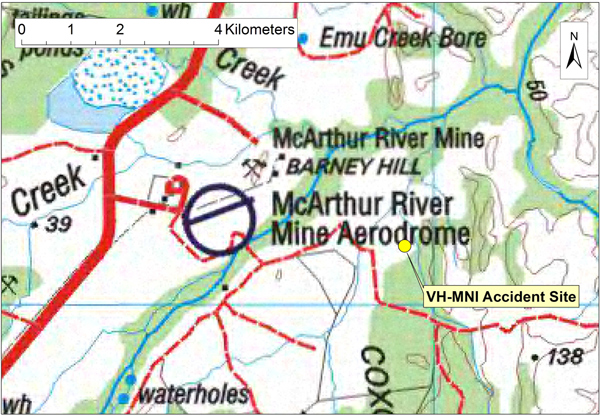
When the aircraft did not land as expected, personnel at the aerodrome attempted to contact the pilot of the Baron, and then initiated a search and rescue response. The pilot of the Navajo reported that he returned to the aerodrome at the request of search and rescue personnel, and then took off at about 1040, with two passengers on board, to search for the missing aircraft. At about 1050, the wreckage was located about 4 km east of the aerodrome (Figure 1). On arrival at the accident site, rescue personnel found that both aircraft occupants had sustained fatal injuries.
Figure 1: Location of Incident
Personnel information
The pilot in command was appropriately qualified and licensed to undertake the flight. He had a total flying experience of 3,559.3 hours, and had flown 555.4 hours on multi-engine aircraft, with 166.8 hours on Barons. He was issued with a commercial pilot (aeroplane) licence in 1997, and he also held a Grade 1 instructor rating and a multi-engine command instrument rating.
In the last 90 days, the pilot had flown 141.9 hours, including 38.7 hours on Barons. His logbook indicated that he had flown into McArthur River Mine on at least two previous occasions, the last being on 29 November 2005.
On 16 January, the pilot's duty time was recorded as starting at 0645 and ending at 2030, with a flight time of 4.8 hours. It was reported that when he returned home, he had a headache and body ache. The next day he telephoned the operator and stated that he was unable to work due to sickness. He continued to feel unwell on the 18 January and again reported in sick. However, after lunch that day, he contacted the operator and reported that he was feeling better and available for any urgent tasking if required. He went into work to conduct a flight, but the job was later cancelled. On the evening of 18 January he conducted some preparatory work for the flights the next day.
It was reported that the pilot went to sleep each night between 2100 and 2130. He normally woke up between 0530 and 0600, though had extra sleep on 17 January. On 19 January, he awoke at about 0400 and did some yoga exercises before going to work.
Aircraft information
The aircraft was manufactured in 1978 and imported into Australia the same year. It had a total time in service of 9,826.4 hours.
The operator purchased the aircraft in November 2004. The aircraft underwent regular maintenance and non-scheduled repairs over the 713.4 hours flying service with the operator. The approved system of maintenance included Check 2 inspections every 200 hours, with a Check 1 inspection conducted at the 100-hour interval between Check 2 inspections. The aircraft had a valid maintenance release, issued on 9 November 2005 following the last Check 2 inspection. The last Check 1 inspection was conducted on 6 January 2006. On 13 January, the Civil Aviation Safety Authority issued a permissible unserviceability to allow the aircraft to be operated with the combustion cabin heater unserviceable until 13 February 2006. There were no other outstanding maintenance items. Pilots who had flown the aircraft in the days prior to the accident reported no problems or concerns regarding the aircraft.
Wreckage examination
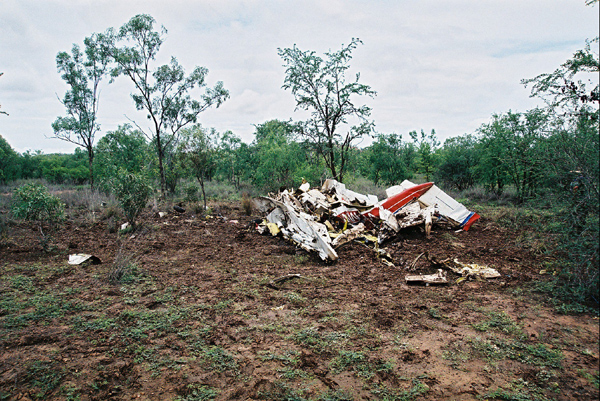
An examination of the wreckage indicated that the aircraft impacted the ground inverted in a steep nose-down attitude (Figure 2). The wreckage was contained in the immediate area of the impact crater, suggesting a mostly vertical component to the direction of flight at impact. The wreckage had been disturbed by rescue personnel prior to examination by Australian Transport Safety Bureau (ATSB) investigators. Further information obtained from the wreckage examination included the following:
The fuselage nose, to just rear of the main cabin utility door, was destroyed by extreme compression forces during the impact sequence. The rear fuselage and tail section also showed evidence of impact damage with the ground.
Both engines, nacelles and propellers had detached and were located in the impact crater.
Both wings were intact, but separated from the fuselage. The forward structure of both wings was crushed back to the rear spars and the wing fuel tanks were breached during the impact sequence. Each of the wing fuel tank bays showed evidence of skin attachment failure on the rivet lines by the hydraulic action of the fuel contents during the impact sequence. The first rescue personnel at the accident site reported a strong smell of aviation gasoline.
The ailerons, rudder and elevator flight control surfaces, with the associated trim tabs, were located within the main wreckage area. The flight controls were all connected at impact. A detailed examination of the wreckage did not identify any manual control system anomalies that would have prevented controlled flight of the aircraft prior to impact.
The landing gear was extended.
The wing flaps were extended in the approach (15 degrees) position.
The fuel selector for each engine was in the ON position.
Due to the extent of impact damage, no reliable evidence of control settings in the cockpit could be obtained.
Figure 2: Aircraft Wreckage
Examination of aircraft components
Several components of the aircraft were removed for more detailed examination. Results of these examinations included the following:
Engines: The aircraft was fitted with two Teledyne Continental Model IO-520C engines. Both engines were extensively damaged by impact forces. Although all components of the engines could not be functionally tested, a detailed examination found no mechanical anomalies within either engine that would have prevented them from operating.
Propellers: The aircraft was fitted with Hartzell three-bladed constant-speed, feathering propellers (Model PHC-J3YF-2UF). The blades of both propellers showed very little chord-wise scoring or distress on either surface, which implied a rapid cessation of rotation upon ground impact. Dominant blade distortion of both propellers was heavy out-of-plane bending to the rear. The absence of any prominent evidence of in-plane reactive bending or torsional distortion indicated that the propellers were rotating, rather than feathered, at impact. The rapid stoppage of the propellers and the pattern of blade bending implied that there was low applied torque or power at impact. Witness marks on the blade preload plates of the left propeller provided some indication that this propeller was operating in the governed speed range at impact. The damage to the right propeller pitch change mechanism prevented similar evidence being observable for that propeller. No evidence of any pre-existing unserviceability or anomalous condition was found within either of the propeller units.
Dual engine tachometer: The speed of both engines was indicated on a single gauge with two needles, one for each engine. The indicator needles were found stuck in a position indicating about 2,100 RPM. Witness marks on the back of the rear needle indicated that the two needles were providing the same reading at impact.
Autopilot system: The aircraft was fitted with a S-Tec System 50 Autopilot (Model ST-224-50) on 9 November 2005. Components of the system were identified and removed from the wreckage for detailed examination. Not all of the components were able to be functionally tested. However, no evidence was found to indicate that there were any problems with the functioning of the system. The filament of the "ready" light globe was examined and exhibited signs of filament stretch. This indicated that the filament was stretched while hot, and therefore the light bulb was illuminated at the time of impact. The "ready" indicator light on the system illuminates when the autopilot has completed a self check and verified that the turn and bank gyro is up to speed, and the system is therefore ready for a mode to be selected. After a mode has been selected, the "ready" globe extinguishes. No evidence of filament stretch was found in any of the light globes which indicated a mode of operation.
Stall warning system: The stall warning switch was substantially damaged during the impact and could not be functionally tested.
Weather information
The Bureau of Meteorology reported that, en-route from Darwin to McArthur River Mine, the aircraft would have encountered scattered showers and possibly isolated storms, embedded in extensive areas of cloud. Upper level winds were favourable for the development of moderate turbulence, as stated in area forecasts. The Terminal Aerodrome Forecast for McArthur River Mine, issued at 0348 on 19 January 2006, forecast broken2 stratus cloud at 1,000 ft, light rain, and light north-east winds. The forecast had a temporary holding (TEMPO)3 for operational requirements due to storms for the whole day. However, a review of satellite and radar pictures by the Bureau of Meteorology concluded that there did not appear to be any storms in the area at the time of the occurrence. The McArthur River Mine automatic weather station recorded the following observations on the day of the occurrence:
0900 local time: wind from 050 degrees at 4 kts, temperature 25.9 degrees, QNH 1007.5 hectopascals (hPa), no rainfall recorded in last 10 minutes, 0.2 mm rain recorded in previous hour.
1000 local time: wind from 360 degrees at 4 kts, temperature 26.4 degrees, QNH 1007.6 hPa, no rain recorded in previous hour.
The automatic weather station did not have the capability to record cloud amount or type. However, the pilot of the Navajo which landed at McArthur River Mine at 0928 reported that, when he was in the circuit, there was scattered cloud at 800 ft, which he described as 'very isolated' and no potential threat to maintaining visual contact with the runway. There was no wind or turbulence, good visibility, and no rain in the circuit area, although there were showers about 5 NM south-west of the aerodrome. These showers eventually moved to the north-west of the aerodrome.
Medical and pathological information
Post-mortem examination and toxicological testing found no evidence to indicate a pre-existing medical or physiological factor that could have influenced the pilot's performance. A review of aviation medical records and interviews with the pilot's work colleagues and family also did not identify any medical conditions likely to have influenced his performance.
The injuries received by both occupants were consistent with a high speed, rapidly decelerating impact. The accident was not survivable.
Other information
The pilot and the navigator of the Navajo reported that they did not see any birds when they were in the circuit, after they landed, or when they undertook the search flight. Another witness at the aerodrome also reported that he did not observe any birds in the vicinity at the time that the Baron overflew the aerodrome. No evidence of a birdstrike was found in the wreckage.
On the morning of 19 January 2006, 462 litres of fuel was added to the aircraft, resulting in the aircraft being fully fuelled with a total of 737 litres for the flight to McArthur River Mine.
The aerodrome chart for McArthur River Mine aerodrome noted that, when using runway 06, pilots were required to use right-hand circuits. There were no notes for circuits to runway 24, which therefore meant that pilots were required to use a left-hand circuit for that runway. The location of the aircraft wreckage was consistent with a late downwind or early base leg position using a left circuit for runway 24.
The operator's pilots reported that their normal practice for operating the Baron was to have an engine speed of 2,300 RPM during the cruise, and then maintain that setting until landing. The manifold pressure would be reduced during the descent until, when the aircraft levelled out at the circuit height of 1,000 ft above ground level, there was typically a manifold pressure of 18 inches. The first stage of flap and the landing gear would be selected during the downwind leg, with the aircraft turning on to the base leg with a speed of about 110 to 120 kts. The second (and last) stage of flap would be selected when the aircraft was turning on to final approach or during final approach.
The 24-hour clock is used in this report to describe the time of day. Central Standard Time was Coordinated Universal Time (UTC)+ 9.5 hours.
Broken refers to 5 to 7 eights of the sky obscured by cloud.
TEMPO is used to indicate a change in prevailing conditions expected to last for a period of less than one hour.
Final report
At about 0712 Central Standard Time on 19 January 2006, a Beech Aircraft Corp 58 Baron aircraft, registered VH-MNI, departed Darwin Airport, NT, on a charter flight to McArthur River Mine Aerodrome, NT. The flight was conducted under the instrument flight rules. On board were the pilot and one passenger. During the flight, the pilot advised air traffic control that his expected arrival time at McArthur River Mine was 0915. At about 0915, the aircraft was observed to fly overhead the aerodrome at a normal circuit height (1,000 ft above ground level) and it appeared to be tracking to a mid to late downwind position for a landing on runway 24. The aircraft did not land at the aerodrome at the expected arrival time and a search was commenced.
The wreckage was located about 4 km east of the aerodrome. An examination of the wreckage indicated that the aircraft impacted the ground inverted in a steep nose-down attitude. The accident was not survivable. The wreckage was consistent with a loss of control situation, but the likely reason for the loss of control could not be determined.
Although not related to the accident, during the course of the investigation it was identified that AusSAR had initially cancelled the uncertainty phase associated with the aircraft. The Australian Maritime Safety Authority within which AusSAR is located, has advised that it is planning to review some aspects of its search and rescue procedures.
On 4 January 2006 at approximately 1753 Western Standard Time, the pilot of a Eurocopter France AS 350D helicopter, registered VH-KVN, experienced a control problem and the helicopter impacted the ground in a right roll attitude. All occupants escaped with minor injuries. The helicopter was chartered to undertake the establishment and the subsequent recovery of electronic survey markers through the Pilbara area of Western Australia.
The Australian Transport Safety Bureau (ATSB) did not attend the accident site. Shortly after the accident, the ATSB was approached by the French Bureau Enquetes - Accident (BEA) for assistance in examining the helicopter control system. The ATSB provided the BEA with information regarding access to the helicopter, its availability for detailed examination and photographs from the accident site obtained from the insurance company and the operator's report.
Following a BEA request, the ATSB arranged for the hydraulic oil to be drained and retained for further analysis and facilitated the removal of the helicopter's hydraulic pump. The removal of the pump revealed that the splines on the hydraulic pump and the belt coupling were worn to the point that the pump would not have been operating.
The BEA authorized the helicopter manufacturer to examine the helicopter on 20 and 21 March 2006 on their behalf. At the time of issue of this report the BEA had no additional information in relation to the examination.