On 23 September 2014, a Pilatus PC-12 aircraft, registered VH-HIG, was arriving at Coober Pedy, South Australia after a flight from Amata, South Australia. The pilot and one passenger were on board the aircraft. Approaching Coober Pedy, the pilot observed a line of storm activity, virga and blowing dust in the vicinity of the aerodrome.
The pilot positioned for a landing on runway 32, but discontinued the first landing attempt after losing visual contact with the runway due to blowing dust. As the aircraft descended through about 100 ft above ground level during the second landing attempt, the pilot encountered strong wind shear and the aircraft sink rate increased significantly. Almost simultaneously, the aircraft was engulfed in blowing dust which denied the pilot external visual reference. The pilot contemplated another go-around, but noting the very high sink rate, the intensity of the turbulence and the proximity of the aircraft to the ground, he assessed that he could not execute a go-around safely.
The aircraft touched down short of the runway threshold and to the right of the runway centreline, on a firm surface that was once part of the runway strip. The aircraft passed through a wire aerodrome perimeter fence, and came to a stop after a ground roll of around 150 m. The pilot was unable to see outside the aircraft until it had almost come to a stop, and apart from buffeting and intense wind noise, he did not feel anything unusual during the ground roll. The pilot taxied to the terminal area to refuel the aircraft, unaware at that point that the aircraft had passed through the perimeter fence during the landing roll.
After refuelling, the flight continued to Adelaide where an engineering inspection revealed damage in the area where the nose landing gear meets the aircraft structure, and scoring damage to the underside of the left wing and flap.
Virga extending from convective cloud, blowing dust and dust devils are visual indications that may provide a warning of hazardous wind shear in the area. Pilots are encouraged to monitor the environment for any signs of hazardous weather, and remain particularly mindful of the significant dangers associated with wind shear.
On 26 September 2014 at about 0450 Eastern Standard Time, the pilot of a Kavanagh Balloon, registered VH-CNX, conducted pre-flight preparations for a charter flight with 22 passengers. Due to the forecast winds, the pilot elected to depart from Beaudesert, with a planned landing site in Cedar Grove, Queensland.
The pilot conducted a safety briefing including demonstration of the landing position. The passengers then assumed their landing positions and the pilot was satisfied they understood the correct position to adopt. After completing the pre-flight checks, the balloon lifted off at about 0550. After about a 20-minute flight, the pilot commenced the descent to the landing site.
During the approach, the pilot observed a light ground fog and was heading directly into the sun, making the landing site difficult to see. The pilot attempted to obtain an accurate rate of descent from the altimeter, but it was reading erratically. The pilot instructed the passengers to adopt the landing position, but not all of them complied. He repeated his instructions to the passengers, the altimeter continued to read erratically and facing directly into the sun made visual assessment of the approach difficult.
The balloon landed hard and bounced once before landing about 3 m further along the ground. Two passengers sustained serious injuries, and seven had minor injuries. The balloon was undamaged.
In this incident, the combination of moderate wind speed, the position of the sun, equipment issues and non-compliance to instructions by passengers, contributed to increase the pilot workload at a critical phase of flight.
On 7 October 2014, the pilot of a Bell 206B3 helicopter registered VH-CLR, departed Cairns, Queensland with one passenger on-board to conduct a charter flight to Mount Cook, about 9 km south-east of Cooktown Airport, Queensland.
To assess the landing area at Mount Cook, the pilot made 3-4 practice approaches and a practice landing prior to continuing to Cooktown to pick up the remaining passengers. The landing area was a rocky ledge jutting out from the south-eastern side near the top of Mount Cook.
The pilot conducted two flights to drop off a total of five passengers. He reported that the wind during these two flights was about 10 knots from the south-east. When he returned to pick up the first load of passengers, the wind had increased to about 14-15 knots.
During the approach to land, the pilot reported that he felt the helicopter was stable and appeared unaffected by the increased wind. As the helicopter prepared to touch down, both the ground co-ordinator and a passenger moved closer to it. Just prior to touching down on the right skid, the pilot felt the helicopter momentarily lift, most likely from a gust of wind, and drift to the right. The helicopter rolled rapidly onto its right side and slid a short distance forward, prior to coming to rest.
The helicopter fell onto the ground controller and nearby passenger. The ground controller sustained serious injuries. The pilot and passenger received minor injuries and the helicopter was substantially damaged.
The roll onto the right side by the helicopter is consistent with the phenomenon known as dynamic rollover. When a helicopter rests on one skid, the aircraft may begin rolling, and under certain circumstances it cannot be controlled.
The operator has advised the ATSB that they have taken several Safety Actions since the occurrence. These are detailed in the report.
On 23 September 2014, at about 1500 Central Standard Time, a Robinson R44 helicopter, registered VH-HLB, departed Bulman camp, Northern Territory, to conduct gravity survey operations. On board were a pilot and a geophysical field technician. The operation involved flying to specified locations 2 km apart and selecting a suitable landing site within 400 m of the location.
At about 1630, after completing landings at about 30 sites, the helicopter arrived overhead a specified location. The pilot identified a potential landing site, overflew it to more closely assess the site and then entered an out-of-ground-effect hover just above treetop height to determine whether the selected site was suitable for landing. The pilot decided the site was unsuitable as trees prevented sufficient clearance for the main and tail rotors.
As the pilot attempted to depart the area, the helicopter started to sink and the pilot observed the rotor revolutions per minute (RRPM) decaying. He lowered the collective and rolled on throttle in an attempt to increase the RRPM. The outside air temperature gauge indicated about 40 °C and the pilot reported that increasing the throttle did not provide any detectable increase in power. The pilot then eased forward on the cyclic. The helicopter continued to descend and the main rotor blade collided with multiple tree branches. When at about 6 ft above ground level, the helicopter rotated about 180° and landed hard with the left skid touching the ground first. The helicopter sustained substantial damage and the pilot and passenger were uninjured.
This incident highlights the effect of air temperature on aircraft performance. Understanding the controllability issues at the limits of the normal operating envelope can assist pilots in recognising the symptoms of reduced aircraft performance.
On 26 June 2014, a Tecnam P96 Golf aircraft, recreational registration 24-4470, collided with terrain near Krondorf, Barossa Valley in South Australia.
Recreational Aviation Australia (RA-Aus) is responsible for investigating this accident. As part of its investigation, RA-Aus requested technical assistance from the Australian Transport Safety Bureau (ATSB) in the examination of physical components and recovery of data from a GPS unit being used by the pilot. To protect the information supplied by RA-Aus to the ATSB and the ATSB's investigative work to assist RA-Aus, the ATSB initiated an investigation under the Transport Safety Investigation Act 2003.
Results of a visual examination of the physical components were provided to RA-Aus on 7 August 2014.
Following examination of the GPS, a download of its data was attempted using the manufacturer's procedures. The GPS unit could not be powered and it was determined that the GPS unit had sustained circuitry damage sufficient to prevent its download by conventional means. Subsequently, the discrete device (chip) containing the track memory was identified, removed, and a raw data file downloaded using specialised techniques. Decoding of the raw information showed that there was no available data relevant to the investigation. A report detailing the download procedure was provided to RA-Aus on 19 September 2014.
On the 16 September 2014, two Robinson R22 helicopters, registered VH HQJ and VH-IAY, were conducting aerial mustering operations about 26 NM east-north-east of Broome, Western Australia. The two R22 pilots were working together, and had planned mutual separation using relevant ground features in the area of operations. The two R22 pilots were also in radio contact on a company radio, and monitoring the multicom frequency. There was lifting fog in the area at the time, with some clear patches emerging.
At about 0745 Western Standard Time, the pilot of one of the R22s observed a light aircraft in close proximity, and advised the pilot of the other R22 that was operating some distance away. That pilot immediately looked in the direction that he thought the light aircraft may have appeared, and observed a single-engine light aircraft travelling at low level in an easterly direction. He witnessed the aircraft bank sharply towards the north, perhaps in response to having sighted the other R22 which was operating almost directly beneath the flight path of the light aircraft. Following what appeared to be an evasive manoeuvre, the light aircraft resumed its easterly track, still at low level. One of the R22 pilots tried to make contact with the pilot of the light aircraft on the multicom frequency, but without response. The light aircraft continued out of sight towards the east, and the two R22s resumed their aerial mustering operation.
Without a report from the pilot of the light aircraft, the full circumstances surrounding the incident are unclear. Nonetheless, this incident demonstrates the importance of effective communications and an effective lookout, even at low level when other aircraft may be unexpected. Furthermore, pilots should avoid operating at low level in areas where other aircraft may be engaged in aerial mustering or similar operations.
On 20 September 2014, the pilot of a Piper PA-25 aircraft, registered VH-CPU, conducted a ferry flight from Camden to Bunyan aeroplane landing area, via Goulburn, New South Wales.
After refuelling at Goulburn aerodrome, the pilot tracked to overhead Michelago and continued south towards Bunyan. About 10 km south of Michelago, the pilot intended to overfly a private airstrip to assess its condition and suitability as a potential out-landing site for gliders operating from Bunyan.
The aircraft was heading south and as the airstrip was oriented approximately north-south, the pilot elected to overfly the runway. When about 300 m beyond the runway threshold, the aircraft struck powerlines that crossed the runway about 15 m above ground level, dislodging the windscreen and canopy. The top of the fin was severed by the powerlines. Immediately after the strike, the aircraft banked to the left before returning to level flight. The pilot assessed that the aircraft was too high to land ahead on the remaining runway and made a right turn, initially planning to land towards the north on the adjacent paddock. However, due to the rough surface of the paddock and tailwind, he conducted a short downwind leg before turning to the right, and the aircraft landed into wind on the runway.
The ability of pilots to detect powerlines depends on the physical characteristics of the powerline and the effect of weather conditions. Powerlines may not be contrasted against the surrounding environment and the wire itself can be beyond the resolving power of the eye. Pilots are advised to use additional cues to identify powerlines, such as the power poles and buildings to which the powerlines may connect.
On 14 September 2014, the pilot of a Bell 206 helicopter, registered VH-FHX, conducted a charter flight from Myra mine camp, Northern Territory with 3 passengers on board. After arriving overhead a specified location, the pilot conducted an orbit at about 500 ft above ground level (AGL) to assess the area for a suitable landing site. The pilot then conducted a second orbit at about 100 ft AGL and noted the hazards including a tree stump to the left of the target landing area and a tall tree to the right.
The pilot then conducted an approach and a vertical descent into the selected landing site. When at about 1 ft AGL, a passenger alerted the pilot to the tree stump on the left. The pilot immediately manoeuvred the helicopter up and to the right, resulting in the helicopter striking a tree.
The pilot conducted a climb away from the site, an orbit and a second approach to land. After landing, the pilot shut down the helicopter and conducted an external inspection. The pilot assessed the damage to be minor and unlikely to affect the safety of the flight. After completing the charter flight and returning to Jabiru, the pilot inspected the helicopter and found the damage to the main rotor blade had worsened significantly. An engineer subsequently determined that the main rotor blade and tail rotor blade had sustained substantial damage and required replacement.
This incident highlights the challenges of operating in confined areas and the risks posed by distractions. It is also a reminder to ensure an aircraft is fully serviceable prior to flight, particularly following an incident.
On 7 September 2014 at about 1303 Australian Eastern Standard Time, a Piper Arrow, registered VH-KGP was completing a private, visual rules flight (VFR) from Orange to Wollongong, New South Wales. On board were a pilot and one passenger.
At about 10 NM north of Wollongong, the pilot broadcast an inbound call on the common traffic advisory frequency (CTAF). At the time, an instructor and student in an Evektor Sportstar registered 24-4467 were one of two aircraft conducting circuit training on runway 34.
The pilots of both KGP and 4467t communicated their respective position and intentions, and at 1306, the pilot of KGP called joining an extended downwind for runway 34.
When 4467 was on the crosswind leg for runway 34, the crew noted KGP on their left, about 100 metres ahead and at about the same level as them.
The instructor in 4467 initiated a climbing turn and shortly after, KGP passed underneath and just behind 4467.
This incident highlights the importance of using standard phraseology, and making extra calls when there is any uncertainty regarding another aircraft’s position when operating at non-controlled airports. As well as a requirement, it is good airmanship given the limitations of the See-and-Avoid Principle.
On the morning of 14 September 2014, the pilot and passenger of an amateur-built Van's Aircraft RV-6, two-seat aeroplane, registered VH-TXF and operated in the ‘Experimental’ category, approached Mudgee Airport. The aircraft had departed Dubbo Airport, New South Wales about 25 minutes earlier.
The pilot approached from the north-west and conducted a non-standard circuit entry including an orbit to the south of the airport. Prior to turning onto the downwind leg of the circuit, the aeroplane descended to about 600 ft above ground level. Witnesses stated that the pilot conducted a tight left turn onto final approach at a slow speed and low height. The witnesses also recalled hearing the aeroplane’s engine ‘splutter’ and then silence during the turn, followed by a ‘rev’ followed again by silence.
The aeroplane continued its high angle of bank left turn and, at about 1053, collided with terrain about 300 m south-west and short of the runway threshold. The pilot and passenger were fatally injured, and the aeroplane was substantially damaged.
What the ATSB found
The ATSB found that during the turn onto final approach to land, the aeroplane’s engine ceased operating. The aeroplane’s airspeed before the engine failure was within about 0.5 kt of the estimated stall speed during the high-bank turn. After the engine failure, it is likely the aeroplane entered an aerodynamic stall. The associated loss of control was not recovered, and the aircraft continued in the turn until it collided with terrain.
The ATSB also found that the engine failure was probably due to carburettor icing. No defects were identified that would have precluded normal engine operation prior to the accident, and uncontaminated fuel was being supplied to the engine at that time. However, the environmental conditions at the time of the accident were conducive to serious carburettor icing at descent power, and the pilot-operated carburettor heat control was found in the OFF position.
Analysis of the aeroplane’s global positioning system data showed that it was common for this pilot to fly approaches at lower than recommended circuit heights and at speeds close to the aircraft’s stall speed. On the turn to final approach on the accident flight, any loss of airspeed would have left a very short time before the aeroplane reached the stall speed.
The ATSB also found that the aeroplane’s weight was higher than the design limits. However, the effect of this weight on aircraft performance was not considered to have contributed to the accident.
The aeroplane was not required to be, and was not fitted with an angle-of-attack indicator or stall warning device.
Safety message
All pilots of aircraft fitted with a carburettor are advised to check the forecast weather conditions and consider the risk of carburettor icing as a result of those conditions prior to each flight.
Although amateur-built aeroplanes operated in the Experimental category are not required to be fitted with a stall warning device, owner-pilots should consider the benefits of such devices as a last line of defence against the inadvertent approach to, or entry into an aerodynamic stall.
Source: ATSB
The occurrence
At about 1024 Eastern Standard Time[1] on Sunday 14 September 2014, the pilot and passenger of an amateur-built Van's Aircraft RV-6 aeroplane, registered VH-TXF, departed Dubbo Airport on a private flight to Mudgee Airport, New South Wales.
At about 1049 the pilot approached Mudgee Airport from the north-west and conducted a nonstandard circuit entry. This included an orbit to the south of the airport. Airport audio recordings of aircraft broadcasts show that throughout the arrival at Mudgee, the pilot made all of the standard radio calls, including traffic advice of joining crosswind, base leg, and final approach for runway 04.[2] The pilot did not make any broadcasts suggesting any problems with the aircraft.
Prior to turning onto the downwind leg of the circuit, the aeroplane descended to about 600 ft above ground level. Witnesses stated that they saw the aeroplane turn left at about 45° angle of bank onto final approach at a slow speed and at a lower height than usual. The witnesses also recalled hearing the aeroplane’s engine ‘splutter’ and then silence during the turn, followed by a ‘rev’ followed again by silence.
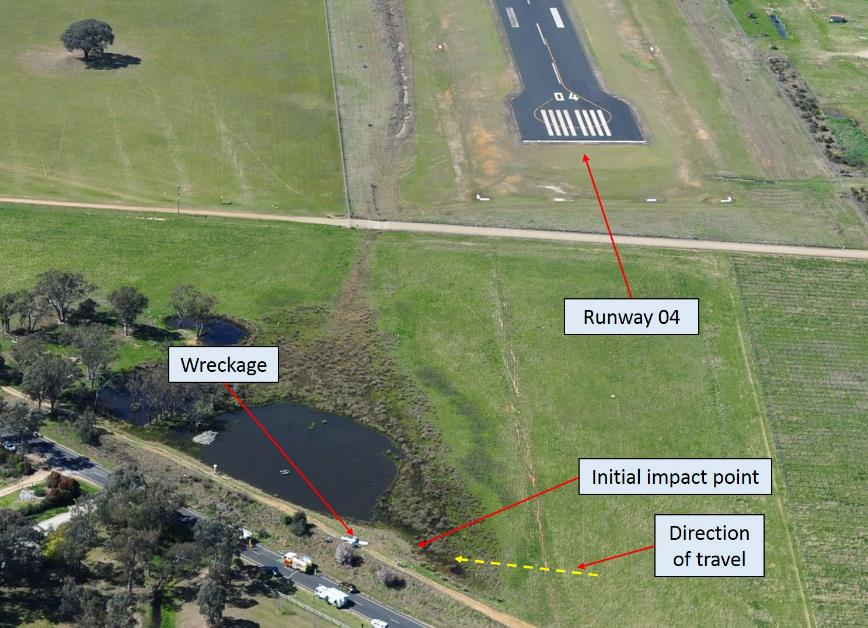
The aeroplane continued its high angle of bank left turn beyond the final approach heading and, at about 1053, collided with terrain about 300 m south-west and short of the threshold of runway 04(Figure 1 and Figure 2). No witnesses reported seeing the aeroplane impact the terrain.
The pilot and passenger were fatally injured, and the aeroplane was substantially damaged.
Figure 1: Aerial view of the accident site on the day, showing the threshold of runway 04 and direction of travel prior to impact
Source: NSW Police Force, modified by the ATSB
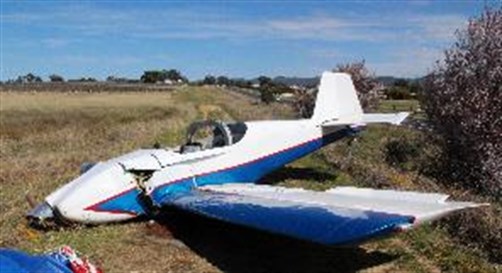
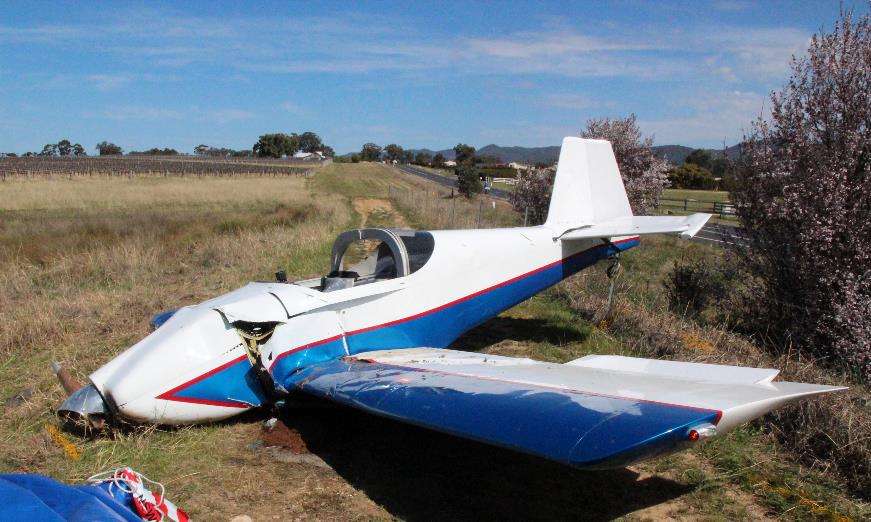
Figure 2: Accident site, looking east-south-east and showing the airport boundary fence
The pilot held a Private Pilot (Aeroplane) Licence and the appropriate ratings and endorsements to operate the Van's Aircraft RV-6 (RV-6). The pilot also held a valid Class 2 Aviation Medical Certificate, which was sufficient for the pilot to exercise the privileges of their licence.
The last recorded entry in the pilot’s logbook was on 14 June 2014. A review of the pilot’s logbook and aircraft maintenance release for VH-TXF (TXF) indicated that the pilot had accrued a total of about 764 hours flight time. The pilot’s most recent biennial aeroplane flight review was on 9 June 2014.
A flying instructor who had flown with the pilot stated that the pilot was very aware of the risk of carburettor icing, and was in the habit of using carburettor heat at lower power settings.
Recent history
The only recorded flying by the pilot in the week prior to the accident was a 2.9-hour flight from Traralgon, Victoria, to Dubbo on 12 September 2014. Friends of the pilot reported that, on the evening before the accident, the pilot retired at about 2200, and was observed outside the hotel room the next morning at about 0800. There was no evidence that fatigue contributed to the accident.
Aircraft information
General information
TXF was a two-seat Van's Aircraft RV-6 aeroplane, and was manufactured by the pilot from a kit. It was first registered in Australia on 10 July 2001 and the kit was completed in 2006 (serial number 24677). TXF had accumulated about 425 hours total time in service at the time of the accident.
The aircraft was operated in the ‘Experimental’[3] category.
Maintenance history
Examination of the aeroplane’s maintenance records indicated that it was maintained to a day visual flight rules[4] standard in the experimental category. The last periodic inspection was completed on 16 December 2013, and a maintenance release was issued at that time. At the time of the accident, all of the required maintenance had been completed and there were no outstanding recorded defects.
Weight and balance
The aircraft kit manufacturer-published recommended gross weight for the RV-6 was 727 kg. This was also detailed on the aircraft’s data plate.[5] The pilot had generated their own weight and balance calculation paperwork, which detailed a maximum allowable gross weight of 748 kg. This paperwork, which the pilot carried in the aeroplane, indicated that the aeroplane’s gross weight on departure from Dubbo was 740 kg and was planned at about 731 kg on arrival at Mudgee.
The ATSB calculated that the aeroplane was about 4 kg over the manufacturer-recommended gross weight on arrival at Mudgee. However, according to the pilot’s paperwork, the aeroplane was within the pilot’s calculated flight envelope. The ATSB could not identify any data to indicate how the pilot determined the new gross weight for the aircraft. A calculation was performed by the ATSB to examine the effects of the weight increase on the aeroplane’s aerodynamic stall speed.[6] This calculation indicated that the aeroplane’s stall speed would have increased by about 0.5 kt.
Meteorological information
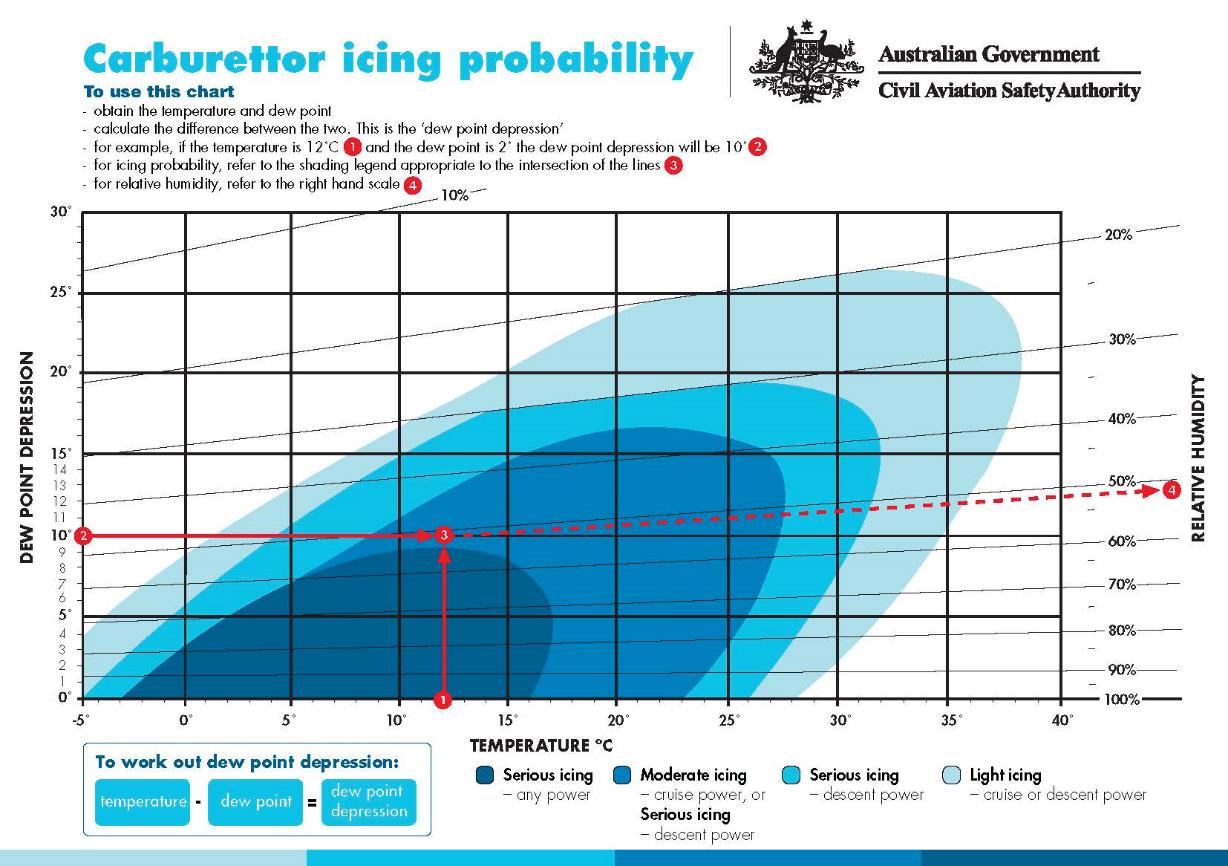
The observed weather at Mudgee Airport at the time was fine with a 6 kt breeze from the north and no cloud in the vicinity. The recorded temperature at about the time of the accident was 17 °C, with a dew point[7] of 11 °C. Given those temperatures, the probability of carburettor icing was calculated to be in the serious icing range for descent power, and moderate icing with cruise power selected (see appendix A – Carburettor icing-probability chart, available from the Civil Aviation Safety Authority (CASA) website).
Wreckage examination
Overview
The aeroplane struck the ground in a north-westerly direction, coming to rest about 18 m beyond the initial impact point. The impact collapsed the aeroplane’s fixed landing gear, damaged the engine, carburettor and air filter and ruptured the left wing fuel tank. The damage to the aeroplane and surrounding area indicated that the aeroplane impacted the ground in an upright, slightly leftwing low and nose-down attitude. All of the aeroplane’s major components were accounted for at the site. No evidence of fire or pre-impact damage was observed and flight control continuity was verified.
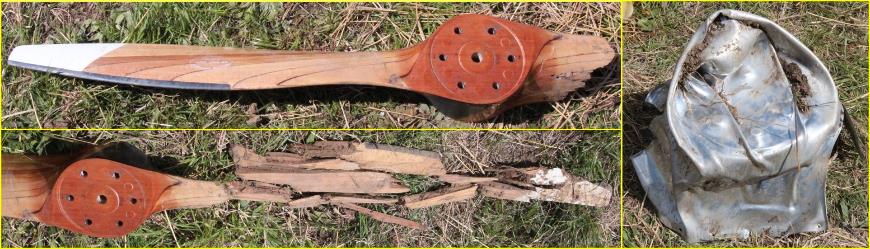
One blade of the aeroplane’s two-bladed wooden propeller was broken off at the root and shattered (Figure 3). The other blade remained attached to the hub. The unbroken blade and metal spinner that covered the propeller hub exhibited no evidence of rotational scratch marks or power at impact.
Figure 3: Broken two-bladed propeller blade and metal spinner, showing the reconstructed detached/shattered blade
Source: ATSB
The engine and a number of other items and components from TXF were recovered for technical examination at an approved engine overhaul facility and at the ATSB’s technical facilities in Canberra, Australian Capital Territory. This included a portable Garmin GPSMAP 296 global positioning system (GPS) receiver.
Fuel
The left fuel tank was breached along a rivet line, consistent with impact forces. Witnesses reported fuel running from the rivet line before being plugged by the attending fire service.
On examination by the ATSB, about 20 L of fuel remained in the left fuel tank and about 65 L in the right fuel tank. The fuel tank selector in the cockpit was selected to the right tank. Fuel was observed:
throughout the fuel system through to the engine-driven fuel pump
to run from the damaged carburettor bowl and its filter screen
to be free of debris and water throughout the aeroplane’s fuel system, and of a colour and odour that was consistent with aviation gasoline.
The ATSB concluded that fuel starvation or contamination did not contribute to the loss of engine power.
Survivability
The aeroplane was fitted with a 5-point harness for each seating position and both occupants were wearing their harness. The lap belts and crotch straps remained anchored to the floor and the shoulder harnesses were appropriately anchored to the fuselage structure behind the occupant’s seats and luggage area. ATSB analysis based on estimates of aircraft speed, impact angle, and energy absorption indicated that the impact forces imparted to the occupants would normally be expected to result in serious to fatal injuries.
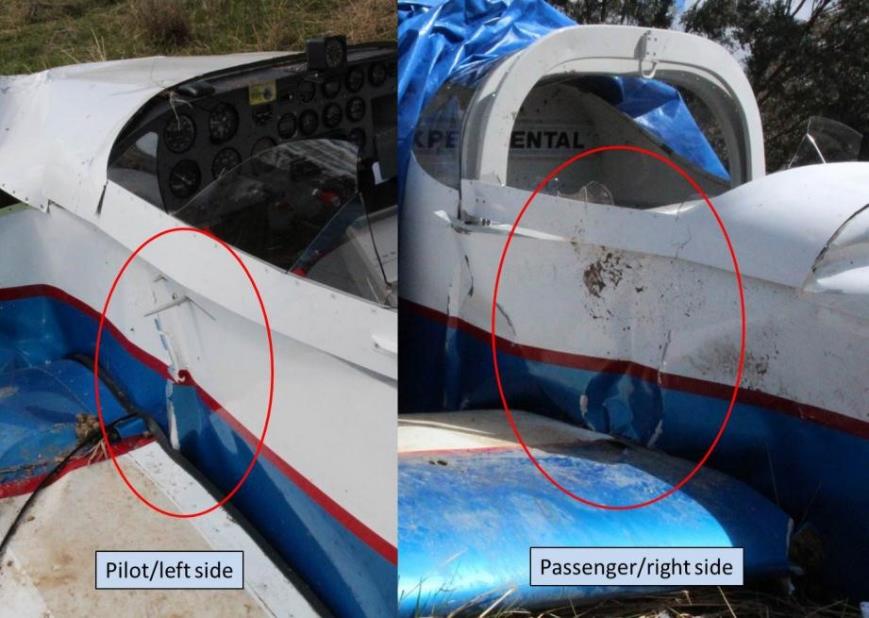
During the impact sequence, the sides of the cockpit buckled, reducing the liveable space and allowing the fuselage behind the pilot and passenger to move forward (Figure 4). As a result, both occupants’ shoulder harnesses slackened and the occupants were no longer adequately restrained. Together with the effect of the estimated impact forces imparted to the occupants, this reduction in liveable space meant that the accident was considered not survivable.
Figure 4: Cockpit region showing buckling alongside the left and right seats
Source: ATSB
Engine and associated components examination
The aeroplane’s engine and associated components were removed and taken to an approved engine overhaul facility for disassembly and detailed examination under the supervision of the ATSB. No evidence was found to suggest abnormal engine operation prior to the impact with terrain. The engine’s two magnetos[8] and associated spark plugs performed correctly when examined and operationally tested on their respective test rigs.
Recorded data
Recorded data from the aircraft’s portable Garmin GPSMAP 296 GPS, including of the accident flight, was successfully downloaded at the ATSB’s technical facilities. This data included a series of points indicating the aeroplane’s latitude and longitude, altitude and the respective dates and times of those records.
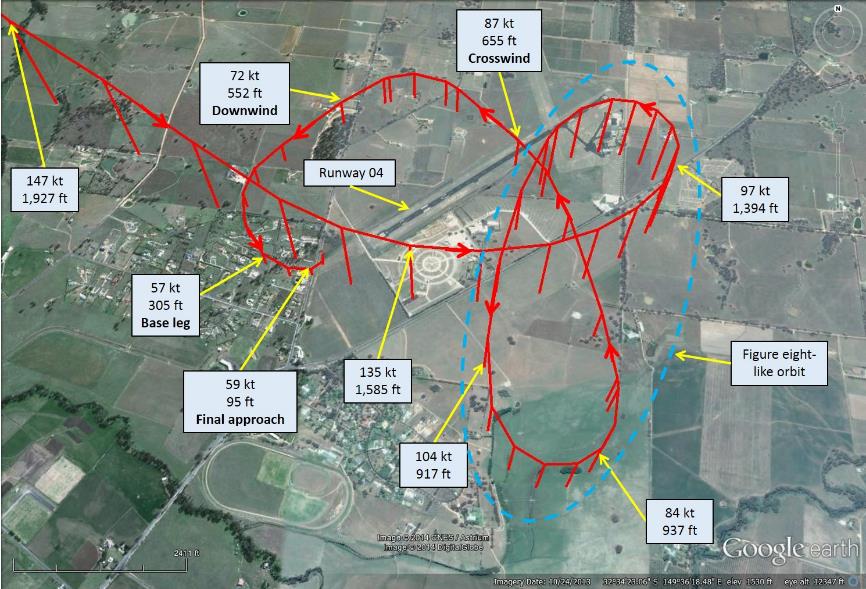
The data for the day of the accident commenced at about 1019 and showed the path taken by the pilot from start-up at Dubbo Airport to the approach at Mudgee Airport. ATSB analysis of this data determined the aircraft’s height above ground, ground speed and heading at the various data points. This included the circuit entry at Mudgee, a southerly, figure eight-like orbit prior to the aeroplane joining the downwind leg of the circuit and the turn onto final approach to land as described by witnesses (Figure 5).
Figure 5: ATSB analysis of the recorded GPS data for the flight showing the aircraft’s heading, height above ground, and ground speed at various data points. The area of the southerly, figure eight-like orbit is indicated by a dashed blue border
Source: Google earth, modified by the ATSB
Data recovered from the aircraft’s Garmin GPSMAP 296 GPS also provided the flight path details for a number of previous flights, up to, and including the accident flight. Circuit entry procedures were compared between flights carried out in 2014 to better understand the pilot’s usual handling of the aeroplane from entering the circuit, through to the landing. None of the approaches analysed displayed a similar figure eight-like orbit prior to joining the crosswind leg as was done on arrival at Mudgee (Figure 5).
A review of the accident and 22 previous final approaches was performed using the recorded GPS data and wind information from the aerodromes visited by the aircraft during those flights. The review found that on 18 occasions, the aeroplane was below 500 ft at the beginning of the final approach and, on 11 of the 22 final approaches, below the target approach speed of 63 kt (see Aeroplane approach speed considerations) on joining the final leg of the circuit. On 10 of the 18 occasions when the aeroplane was below 500 ft at the beginning of the final approach, it was also below the target approach speed of 63 kt.
At the estimated arrival gross weight of 731 kg the aircraft had a stall speed of 48 kt. Turning onto the final leg of the circuit at Mudgee, as derived from the GPS data, the aircraft had:
a bank angle of about 48°
a descent rate of 1,770 ft/min
an airspeed of 59 kt (4 kt below the target approach speed)
an accelerated stall speed of 58 kt.
In combination these findings indicated that the aeroplane’s airspeed was about 1 kt above the calculated accelerated stall speed, or within about 0.5 kt when considering the aeroplane’s increased weight, which was above the kit manufacturer’s recommended gross weight.
Additional information
Carburettor icing
Carburettor icing[9] can occur in temperatures up to about 38 °C, and is less likely in very cold climates. Increased humidity increases the likelihood of icing. If ice continues to accumulate within the carburettor, the flow of air into the engine reduces and eventually, if the process is allowed to continue, the engine will stop.
Carburettor icing is more pronounced if the engine is operating at a low power setting. In this case, the airflow through the carburettor is partially-impeded by the throttle butterfly valve. This valve provides more area on which the ice can accrete and increases the partial vacuum downstream of the valve. This causes further chilling of the air and the water droplets, further increasing the likelihood of ice accretion.
For aircraft with fixed pitch propellers, as ice forms there is typically a small decrease in engine RPM but the engine may continue to run smoothly. As ice continues to accumulate, the reduction in RPM continues and the engine will begin to run rough. If the icing conditions are severe enough, and the pilot takes no remedial action, the engine will eventually fail.[10]
A carburettor heat control was available in TXF. If selected, warm air was directed from a heat muff[11] installed on the exhaust system to the carburettor inlet, melting any ice in the venturi.
During the on-site examination, the carburettor heat control was identified in the OFF position (pushed in). It is possible that the impact sequence may have depressed the carburettor heat control. However, surrounding push/pull controls were undisturbed in their pulled-out positions.
The environmental conditions and time between the accident and the ATSB’s examination of the wreckage meant that any icing in the carburettor throat would have melted and not been detectable during that examination.
On 24 October 2014, the aeroplane kit manufacturer released a notification to RV-6 owners to inspect their heat muff installations for the correct installation of a vent screen. If placed in the wrong position, there was a chance that the screen may obstruct warm airflow to the carburettor, hindering the ability to remove carburettor ice and/or reduce engine performance. Examination of the exhaust system in TXF confirmed that the heat muff installation was a different type to that specified in the notification, which was therefore not applicable.
Aerodrome circuit entry procedures
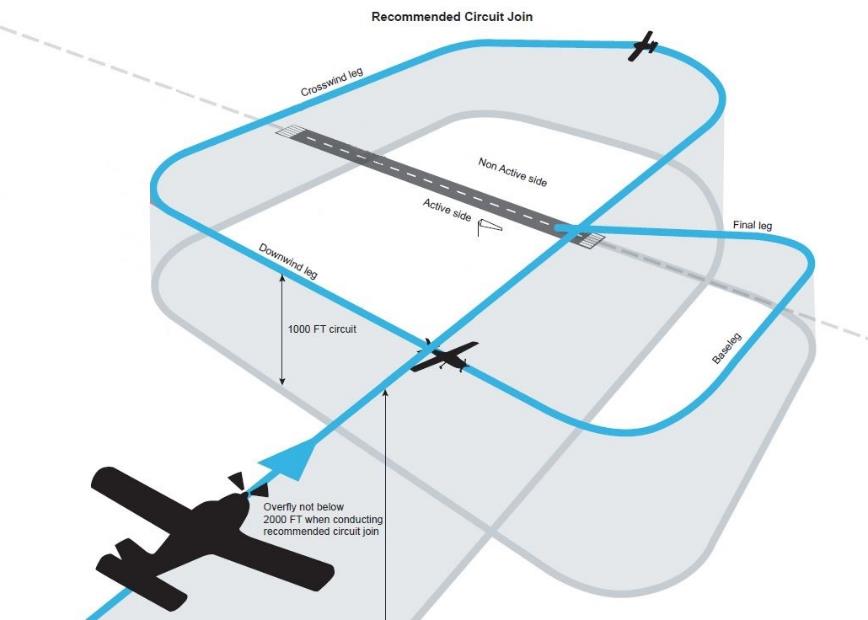
Among other guidance, CASA Civil Aviation Advisory Publication (CAAP) 166-1(3) Operations in the vicinity of non-controlled aerodromes strongly recommended the use of standard circuit procedures at all noncontrolled aerodromes.[12] Standard traffic circuit procedures were designed to facilitate orderly flow of aircraft traffic. Given these standard traffic circuit procedures, other aircraft operating in the vicinity of the aerodrome would have a reasonable expectancy of where to locate other joining and circuit traffic, informing affected pilots’ ‘see and avoid’ procedures (Figure 6). The traffic entry procedure generally consisted of overflying the aerodrome to ascertain the wind direction and which runway was in use by other aircraft, before joining a circuit pattern for landing.
Approach speeds are based on the aeroplane’s aerodynamic stall speed. A safety margin of generally 1.3 times the aeroplane’s aerodynamic stall speed in the landing configuration is applied to determine an aircraft’s approach speed.
The kit manufacturer’s published stall speed for the RV-6 at 1 g[13] and a gross weight of 727 kg was 48 kt. Therefore, in an RV-6 at the recommended gross weight, the calculated approach speed would have been about 63 kt. As the g load is increased, as it generally would in a turn, the stall speed also increases. This is known as an accelerated stall.
Stall warning devices
Certified aeroplanes were required to have a stall warning. This could be satisfied by either the inherent aerodynamic qualities of the aeroplane, or by the installation of a technical device that gives clearly distinguishable indications of an aerodynamic stall under the expected conditions of flight.[14]
The Unites States Federal Aviation Administration issued InFo[15] 14010 on 14 July 2014. This document recommended the installation and use of angle of attack (AoA)-based systems to reduce the risk of inadvertent aerodynamic stall that may result in a loss of control accident. The kit manufacturer did not produce a stall warning kit specific to the RV-6, but did encourage builders and owners to consider installing AoA indicators.
TXF was not fitted with a stall warning device or an AoA indicator, nor was it required to be as it was not a certified design. This meant that the only stall warning available to the pilot was via the aircraft’s aerodynamic qualities.
The stall characteristics for each individual aeroplane of an amateur-built type depend to an extent on the precision of the aeroplane build. This necessitates the completion by the pilot of stall testing for the aeroplane and recording the results in the aircraft’s flight manual. The flight manual for TXF was not able to be located to verify the stall speed characteristics as compared to those of the kit manufacturer.
From witness information and examination of the accident site, it is evident that during the turn onto final approach, the pilot lost control of the aeroplane and was unable to recover before impacting the ground. The observed departure from controlled flight was consistent with an aerodynamic stall.
This analysis will consider the factors with the potential to have contributed to the loss of control.
Interpretation of the flight path
The ATSB did not identify any issues that would have required the pilot to orbit to the south of the aerodrome as shown on the global positioning system (GPS)-derived flight path profile. Although unable to be confirmed, it was possible that the pilot manoeuvred to view their accommodation, which was just to the south of the runway. Whatever the reason for the orbit, the ATSB believes that it was unrelated to the accident.
Engine operation
The witness accounts of the engine being silent during the turn onto final approach, and the lack of rotational signatures on the propeller, indicates that the engine was not operating when the aeroplane collided with terrain. No defects were identified that would have precluded normal engine operation prior to the accident, and uncontaminated fuel was being supplied to the engine at that time.
Conditions around the time of the accident were conducive to serious carburettor icing at descent power, such as during the circuit and approach onto final. In combination, the as-found positions of the carburettor heat control in the depressed OFF position, and of the surrounding push/pull controls in the pulled-outed positions, were consistent with the carburettor heat control being in the OFF position before impact. In this case, it is probable that the air temperature in the carburettor was in the icing range and that carburettor ice would have formed. Although the pilot was reported in the habit of using carburettor heat at lower power settings, it is possible they forgot on this occasion, or were not aware of the suitability of the environmental conditions for carburettor icing.
Witnesses reported only hearing unusual engine sounds during the pilot’s turn from downwind onto final approach. It is considered unlikely that there was a detectable performance issue prior to that turn because, had that been the case, the pilot would probably have modified their circuit to attempt an earlier forced landing on either of the available runways. Recovery from an engine failure at greater height allows for increased landing options. However, the witness reports of the pilot’s apparent attempt to restart the engine on final approach would suggest that any carburettor icing remained undetected throughout the join and initial legs of the circuit.
In the absence of contradicting evidence, and considering the witness observations, ambient conditions that were conducive to carburettor icing and lack of any indication of propeller rotation at impact, the ATSB concluded that it was probable the engine failed during the final turn due to carburettor icing.
Weight and balance
The evidence indicated that the pilot was operating the aeroplane above the kit manufacturer’s recommended gross weight and above the gross weight as stated on the aeroplane’s data plate. The use of extrapolated data outside the recommended flight envelope is not considered accurate, precluding a full understanding of the effect on the aircraft’s performance. However, using the gross weight figure recorded on the pilot’s flight planning documentation to estimate the aircraft’s centre of gravity suggested that the aircraft was within the kit manufacturer’s recommended limits.
Given the aircraft was being operated above its limiting gross weight, wreckage examination found no evidence of an in-flight structural failure. As a result, the most probable effects of the operation outside the kit manufacturer’s recommended maximum gross weight were a slightly increased stall speed and likely increased difficulty during recovery from a loss of control.
Approach speed consideration
Based on the recorded GPS flight data, the pilot commonly flew their approaches at lower than recommended circuit heights and at speeds close to the aircraft’s stall speed. On the accident flight, the stall margin was significantly reduced throughout the last 48° angle of bank turn, being within about 0.5 kt of the aircraft’s stall speed.
Any loss of airspeed in those conditions left a very short time before the aeroplane reached its stall speed. Given that the engine failed during the steep angle of bank and low speed turn onto final approach, it is probable that the aeroplane entered an accelerated aerodynamic stall soon after the engine failure, from which the pilot was unable to recover before colliding with terrain.
Findings
From the evidence available, the following findings are made with respect to the collision with terrain involving a Van's Aircraft RV-6, registered VH-TXF that occurred near Mudgee Airport, New South Wales on 14 September 2014. These findings should not be read as apportioning blame or liability to any particular organisation or individual.
Contributing factors
As the aircraft was turned on to the final approach to land, the engine ceased operating.
The meteorological conditions at the time of the accident were conducive to carburettor icing, which probably led to the engine stopping.
The steep turn onto the final approach at low airspeed probably resulted in an accelerated aerodynamic stall shortly after the loss of engine power from which the pilot was unable to recover before impacting terrain.
Other factors that increased risk
The aeroplane was not fitted with a stall warning device or angle of attack indicator, increasing the risk of inadvertent aerodynamic stall.
The aeroplane was being operated at weights above the kit manufacturer’s recommended gross weight.
Sources and submissions
Sources of information
The sources of information during the investigation included the:
pilot’s previous flying instructors
aircraft kit manufacturer
Civil Aviation Safety Authority
United States Federal Aviation Administration
New South Wales State Coroner
New South Wales Police Force.
References
Australian Transport Safety Bureau, 2001, Melting Moments: Understanding Carburettor Icing, Educational fact sheet.
Under Part 4, Division 2 (Investigation Reports), Section 26 of the Transport Safety Investigation Act 2003 (the Act), the ATSB may provide a draft report, on a confidential basis, to any person whom the ATSB considers appropriate. Section 26 (1) (a) of the Act allows a person receiving a draft report to make submissions to the ATSB about the draft report.
A draft of this report was provided to the Civil Aviation Safety Authority.
No submissions were received.
Appendices
Appendix A – Carburettor icing-probability chart
Source: Civil Aviation Safety Authority
Purpose of safety investigations
The objective of a safety investigation is to enhance transport safety. This is done through:
identifying safety issues and facilitating safety action to address those issues
providing information about occurrences and their associated safety factors to facilitate learning within the transport industry.
It is not a function of the ATSB to apportion blame or provide a means for determining liability. At the same time, an investigation report must include factual material of sufficient weight to support the analysis and findings. At all times the ATSB endeavours to balance the use of material that could imply adverse comment with the need to properly explain what happened, and why, in a fair and unbiased manner. The ATSB does not investigate for the purpose of taking administrative, regulatory or criminal action.
Terminology
An explanation of terminology used in ATSB investigation reports is available here. This includes terms such as occurrence, contributing factor, other factor that increased risk, and safety issue.
Publishing information
Released in accordance with section 25 of the Transport Safety Investigation Act 2003
Ownership of intellectual property rights in this publication
Unless otherwise noted, copyright (and any other intellectual property rights, if any) in this report publication is owned by the Commonwealth of Australia.
Creative Commons licence
With the exception of the Coat of Arms, ATSB logo, and photos and graphics in which a third party holds copyright, this publication is licensed under a Creative Commons Attribution 3.0 Australia licence.
Creative Commons Attribution 3.0 Australia Licence is a standard form licence agreement that allows you to copy, distribute, transmit and adapt this publication provided that you attribute the work.
The ATSB’s preference is that you attribute this publication (and any material sourced from it) using the following wording: Source: Australian Transport Safety Bureau
Copyright in material obtained from other agencies, private individuals or organisations, belongs to those agencies, individuals or organisations. Where you wish to use their material, you will need to contact them directly.