On 22 March 2014, the pilot of a Robinson R22 helicopter, registered VH-YPS, was conducting aerial mustering on a property about 28 km east of Fitzroy Crossing aerodrome, Western Australia. The pilot had refuelled the helicopter from a jerry can and then secured the empty can in the passenger seat using the seatbelt.
At about 1530 Western Standard Time, the pilot manoeuvred the helicopter to the rear of a mob of cattle. From about 300 ft above ground level (AGL), the pilot conducted a balanced descending turn.
When at about 10 ft AGL, he applied right pedal and as he raised collective to climb away, a gust of wind blew through the left door opening and dislodged the jerry can from the seatbelt. The can became wedged between the seat and the cyclic control. The pilot applied forward cyclic, and the nose of the helicopter lowered. As he then attempted to apply aft cyclic to raise the nose, he realised the cyclic was jammed. With the low nose attitude and minimal height above the ground, the pilot used collective in an attempt to flare the helicopter. The front of the landing skids collided with the ground and the helicopter rotated forwards. The main rotor blades chopped through the tail boom and the helicopter continued rotating forwards and bounced back up to about 50 ft AGL before coming to rest inverted.
The pilot reported that the impact dislodged the top of the front dashboard and struck his helmet. He was uninjured and the helicopter sustained substantial damage.
This incident highlights the importance of ensuring all items are securely stowed. It also provides a timely reminder to pilots of the benefits of safety equipment such as a helmet.
On 19 March 2014, at about 0913 Western Standard Time (WST), a De Havilland DHC-8, registered VH-XFX, was on approach to Perth Airport from Kambalda, Western Australia. When about 23 km north-northeast of Perth, at about 3,800 ft above mean sea level (AMSL), the crew sighted a bright strobe light directly in front of the aircraft.
The light appeared to track towards the aircraft and the crew realised that the light was on an unknown object, possibly an unmanned aerial vehicle (UAV). The pilot took evasive action turning towards the west to avoid a collision with the object. The object passed about 20 m horizontally and 100 ft vertically from the aircraft.
The pilot reported that the object was cylindrical in shape and grey in colour. It was at about 3,700 ft AMSL and in controlled airspace. The crew did not receive a traffic collision avoidance system (TCAS) alert. The airspace below 3,500 ft AMSL was military restricted airspace.
The ATSB was advised that the Australian Defence Force was not operating UAVs and was not aware of any UAV operations in the area at the time of the incident. The ATSB was not able to confirm the details of the object or identify any UAV operator in the area at that time.
UAVs are increasingly available to recreational operators and their operation outside of the regulations may pose a significant risk to aviation safety.
On 13 March 2014, at 1715 western standard time (WST) a Piper Seneca aircraft registered VH-COU departed Jandakot on a private VFR flight to Denmark ALA, Western Australia. The pilot was the sole person on board.
At about 1820 the aircraft arrived over the top of Denmark, with the windsock indicating a westerly wind of about 15 knots blowing straight down runway 27. The pilot regularly flies to Denmark and is aware that at this time of day, the setting sun can restrict visibility when landing on 27. However, a landing on runway 09 would have meant accepting a significant tailwind.
The pilot joined for runway 27 and by final approach had the aircraft configured for landing. At about 700 ft the visibility both inside and outside the aircraft degraded to zero. Totally blinded by the sun glare, the pilot initiated a go-around. A few moments later the aircraft struck the canopy of the rainforest which lines the runway.
Still unable to see, an unsure of what aircraft damage had occurred, the pilot conducted some handling checks. He left the aircraft in the landing configuration and joined for runway 09. The pilot was not injured however the aircraft was substantially damaged.
Sunlight and sun glare have been a major contributing factor in many aviation accidents. The US Federal Aviation Administration conducted research into the topic, and found 130 aircraft accidents in a 10 year period were associated with glare from natural sunlight. Further reading is available at www.hf.faa.gov.
It is also possible that having flown this same route regularly without issue, that the pilot experienced some level of complacency. Complacency, is a feeling of satisfaction with what is happening which may occur from a pilot’s overconfidence in performing a task that has been previously conducted numerous times without incident.
On 12 March 2014, at about 0920 Eastern Daylight-savings Time, an Airbus A320 aircraft, registered VH-VQY, departed Melbourne, Victoria on a ferry flight to Darwin, Northern Territory, with a captain and first officer on board.
After about 5 minutes in the cruise at FL 360, the captain temporarily left the cockpit. When abeam Mildura, Victoria, the first officer received a clearance from air traffic control (ATC) to climb to FL 380.
Approaching FL 380, at about FL 373, the first officer observed the airspeed increase and the airspeed trend indicator approaching the maximum operating Mach number (MMO). He attempted to reduce the airspeed by selecting the speed back to M 0.76 however he observed the airspeed and the trend continue to increase. The first officer reduced the thrust to idle, which disconnected the autothrust, in an attempt to reduce the airspeed. He extended the speed brake and disconnected the autopilot to adjust the pitch attitude of the aircraft in an attempt to maintain the selected altitude.
When at about FL 383, the first officer re-engaged the autothrust, and returned the thrust levers to the climb detent. He applied forward pressure on the sidestick to lower the nose attitude of the aircraft in an attempt to recapture FL 380.
The aircraft then descended and the airspeed slowed below the VLS speed. The first officer then applied rearward pressure on the sidestick in an attempt to regain FL 380 and reduced the thrust levers towards idle but short of idle stop position. The application of back pressure increased the aircraft’s angle of attack. At the Alpha Protection speed, the Alpha Floor function activated.
This incident provides a reminder of flight crew of highly automated aircraft, to understand the implication of the intended and actual level of automation applied.
On 19 March 2014, the pilot of a Cessna 150M aircraft, registered VH-EAV, conducted a local flight from Tyabb aeroplane landing area (ALA), Victoria, with one passenger on board.
At about 1545 Eastern Daylight-savings Time (EDT), the aircraft returned to Tyabb. The pilot overflew the aerodrome and observed that the windsock was indicating a south-easterly wind at about 15 kt, and elected to use the grass runway parallel to, and to the left of, runway 17.
The pilot reported that the aircraft was slightly higher than usual on approach and it encountered some minor turbulence. When at about 100 ft above ground level, the aircraft drifted and yawed sharply to the right. The pilot used left rudder to align the aircraft with the runway centreline. The aircraft touched down about 300 m beyond the runway threshold.
The aircraft veered off the runway to the left, rolled down the slope to the eastern side, and collided with a tyre marking the location of a drain. The aircraft continued into the culvert and the nose landing gear subsequently collapsed. The propeller struck the ground, resulting in substantial damage and the aircraft came to rest on the grass.
After the accident, the pilot observed the windsock veering from the south-south-east to south-south-west and reported that windshear may have contributed to the incident.
The pilot reported that there were a number of clues indicating a possible go-around situation: the aircraft was high and long on the approach; the aircraft moved to the right prior to the flare for landing; and the aircraft was not aligned with the runway centreline prior to touchdown.
This incident is a reminder to pilots to be go-around ready.
At 1253 Central Standard Time on 27 February 2014, a Boeing Company 737-8FE, registered VH-VOM (VOM), was radar vectored when outside controlled airspace, near Darwin, Northern Territory. Radar vectoring outside controlled airspace was not permitted, and may have brought VOM into conflict with aircraft that were unknown to air traffic control.
What the ATSB found
The ATSB found that weather in the Darwin area resulted in the majority of inbound aircraft diverting around storm cells. These diversions increased workload for the Approach East controller. The increased workload resulted in the controller using non-standard phraseology and not cancelling radar vectors prior to VOM leaving controlled airspace. Additionally, the flight crew of VOM had not reported ‘clear of weather’ as expected by the controller. This resulted in a lack of shared understanding between the flight crew and the controller.
What's been done as a result
Following this occurrence the Department of Defence introduced theoretical and simulator-based training to assist air traffic controllers to resolve unusual situations using clear communication and direction. The training reinforces positive and assertive control measures, skills that are especially necessary in high workload situations.
Safety message
This occurrence highlights that effective communication is essential for a shared understanding between flight crew and air traffic controllers. On this occasion, the use of non-standard phraseology by both parties resulted in different expectations and delay. Additionally, coordination between controllers is an essential component of their duties; however, this is not transmitted via radio. As a result, silence on an air traffic control frequency should not be interpreted by flight crew as an indicator of low workload for the controller.
The occurrence
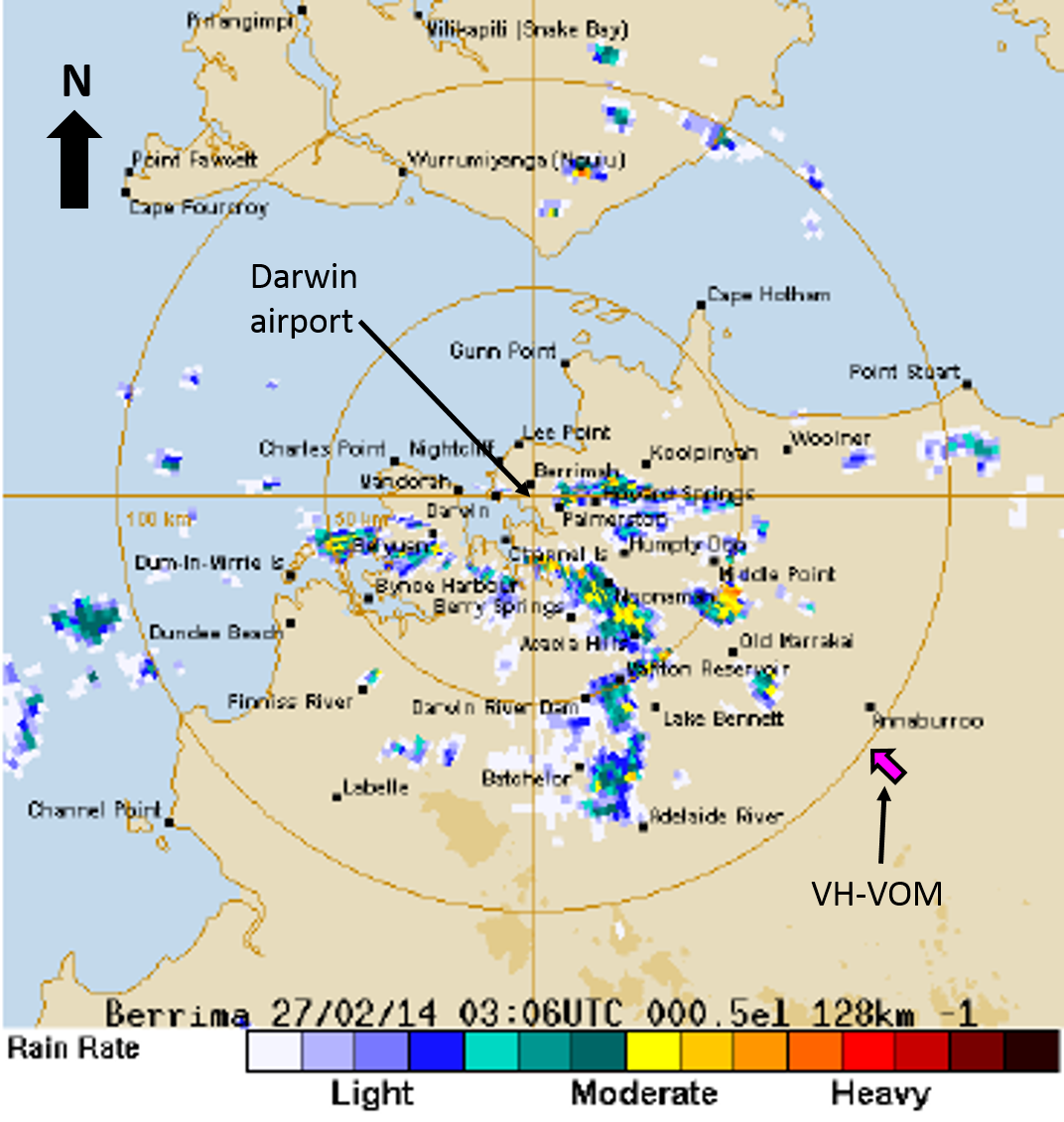
On 27 February 2014, a Boeing Company 737-8FE (737), registered VH-VOM (VOM), was being operated on a regular public transport flight from Sydney, New South Wales, to Darwin, Northern Territory. The arrival of the aircraft at Darwin coincided with the presence of a number of thunderstorms in the area (Figure 1).
In order to reduce the workload of the Approach controller associated with diverting arriving and departing aircraft around the storm cells, the air traffic control (ATC) approach unit responsible for the airspace within 40 NM (74 km) of the airport had split the airspace in to two control sectors. The division of airspace occurred along a line north-south through Darwin Airport, and each area (designated East and West) was under the control of separate Approach controllers operating on different radio frequencies.
Figure 1: Darwin weather radar picture at 1236 Central Standard Time[1] showing rainfall associated with thunderstorm cells. The approximate location of VOM at that time is indicated by an arrow showing direction of travel. The range rings are at 50 km (27 NM) and 100 km (54 NM)
When the Approach East controller commenced their shift at 1230, the handover included details of four arriving aircraft in their airspace, and three arriving aircraft in the airspace under the jurisdiction of the Approach West controller. The majority of aircraft were not on their flightplanned track as they were diverting around storm cells. In addition to the arrivals, a number of aircraft departed Darwin during the development of this occurrence, including:
Two aircraft heading to the south-east, through the airspace under the jurisdiction of the Approach East controller. These aircraft were tracking to air routes that were laterally separated from the tracks of aircraft inbound from that general direction.
One aircraft that tracked to the north then returned to Darwin. This aircraft was instructed by the Approach East controller to hold overhead a visual point to the north of the airport for sequencing.
Two aircraft heading to the north-east. One tracked low level and well clear of arriving traffic. The other tracked through the arrival track of an aircraft under the jurisdiction of the Approach East controller, requiring the controller to maintain a vertical standard between the two.
As a result of the traffic level, the workload for both controllers was relatively high.
At 1246, the Approach East controller advised the Tower controller of the landing sequence for runway 29. The sequence included six aircraft, with VOM fifth in the sequence. One other aircraft was also sequenced for runway 36, which crosses runway 29.
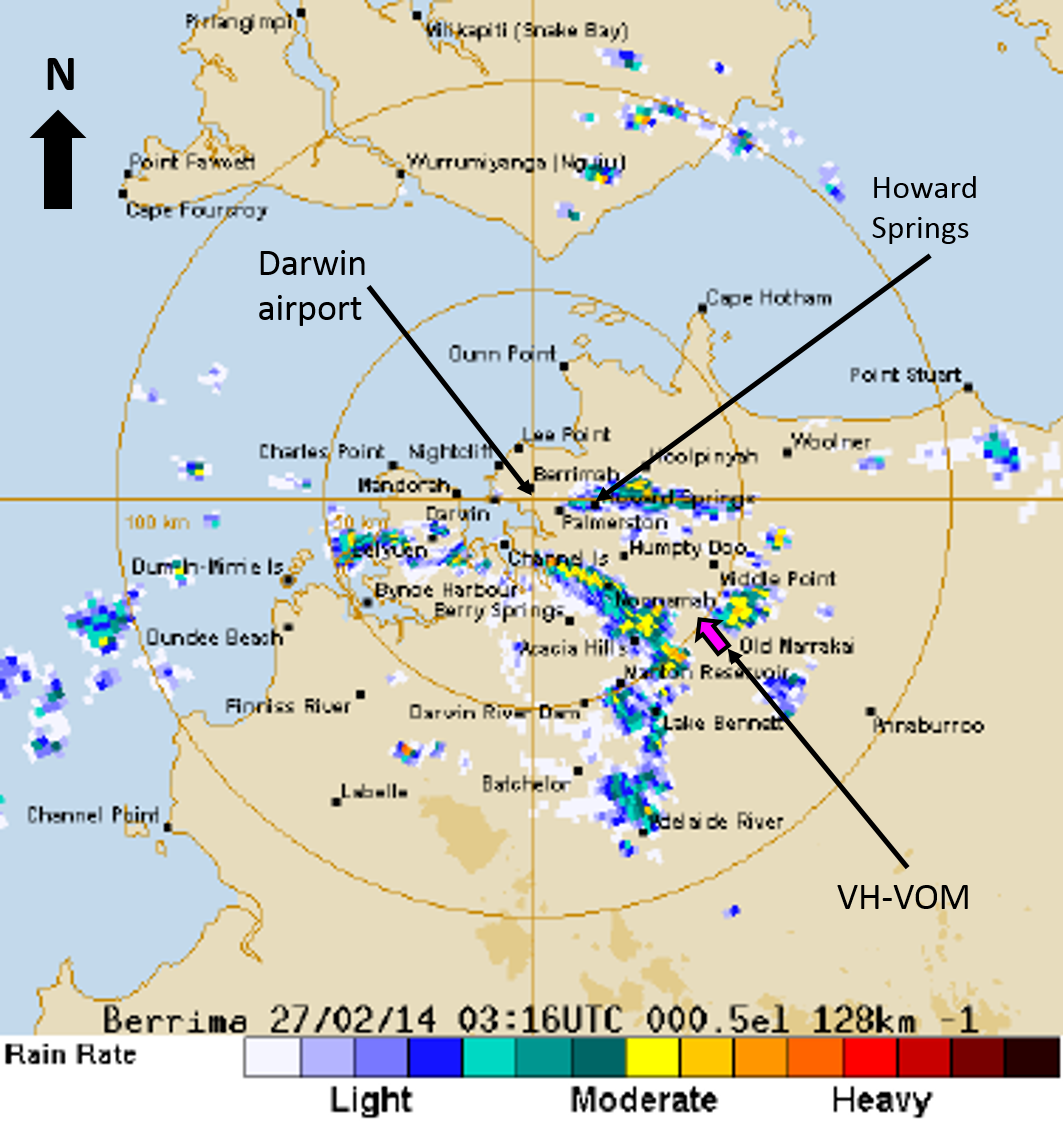
The weather on the day of the incident was typical for the Northern Australian wet season (see the section titled Meteorological information). The flight crews of the majority of aircraft in the Darwin area had been given approval by ATC to track around the storm cells. The crew of VOM intended to track for Howard Springs and then conduct an instrument landing system (ILS)[2] approach for runway 29 (Figure 2). Additionally, the flight crew of VOM had been approved to operate up to 5 NM (9 km) either side of their intended track to avoid the storms.
Figure 2: Darwin weather radar picture at 1246 showing the approximate location of VOM while avoiding storm cells
The aircraft sequenced to land ahead of VOM on the ILS was considerably slower than VOM. To ensure separation between the aircraft on final for runway 29, at 1247 and with the aircraft 16 NM (30 km) south-east of Howard Springs, the Approach East controller cancelled the approach procedure issued to the flight crew of VOM and radar vectored (see the section titled Controller responsibilities) the aircraft right on to a heading of 360°. When the crew of VOM were issued with the radar vector, the preceding slower aircraft was 3 NM (6 km) east of Howard Springs and 14 NM (26 km) north-west of VOM, with a ground speed of 120 kt. At that time, VOM was indicating a ground speed of 260 kt.
The controller later reported that their intention had been for VOM to remain on the vector for only a short period of time. However, prior to cancelling the vector and clearing the aircraft direct to Howard Springs, at 1248 the flight crew of VOM requested a right turn heading 050° to avoid storm cells. The controller approved the diversion, instructing the flight crew to turn right on to a heading of 050° and asked them to report when they were ‘clear of weather’. In response, they advised the controller that ‘…we’re sitting in a big hole at the moment but there is weather out to the north of us and down to the south...’. The flight crew did not specifically advise the controller that the aircraft was clear of the storm cell.
Two minutes later, the flight crew of VOM requested to turn further right onto a heading of 100° to avoid weather. In response, the controller vectored the aircraft onto that heading. As VOM was heading away from Darwin, the controller changed the landing order of the aircraft arriving at Darwin. The aircraft that was to land after VOM was then resequenced ahead. Additionally, as VOM was tracking towards the edge of controlled airspace, 30 NM (56 km) east of Darwin, the Approach East controller advised the flight crew that their current track would shortly take the aircraft outside controlled airspace. When the controller asked the crew to advise their intentions, they stated that ‘… we’d like to come further right to join the ILS…’, but again did not report clear of weather.
Airservices Australia (Airservices) is responsible for providing the flight information service (FIS)[3] and, workload permitting, the surveillance information service (SIS)[4] in the Class G airspace[5] adjacent to Darwin’s controlled airspace. At about this time, the Darwin Approach Supervisor advised the Airservices controller who was responsible for those services that VOM was about to leave controlled airspace to the east. The Airservices controller responded that there was no known traffic outside controlled airspace.
At 1252, VOM left 5,500 ft on descent to 4,000 ft as the aircraft left controlled airspace east of Darwin, heading 100°. At that time, the Approach East controller did not advise the flight crew of the aircraft’s position and any known traffic in the area. Additionally, the crew were not advised that they were required to resume their own navigation (see the section titled Controller responsibilities).
Twenty seconds later, when VOM was about 31 NM (57 km) east of Darwin, the flight crew requested a right turn to head 180°. The controller initially issued the radar vector, but, realising that the aircraft was outside controlled airspace, immediately cancelled the radar heading. Shortly after, the flight crew resumed their own navigation and tracked south.
The flight crew later reported that, due to the extent of the storms, the aircraft would not have been clear of weather and able to manoeuvre unrestricted until about 30 to 35 NM (56 to 65 km) east of Darwin.
The flight crew then requested to climb the aircraft into controlled airspace; however, this was not available due to an aircraft in that area at 7,000 ft tracking towards Darwin. At 1254, and with the aircraft 36 NM (67 km) east of Darwin, the flight crew of VOM were issued a clearance to track direct to Howard Springs. VOM re-entered controlled airspace at 1255 and subsequently landed at Darwin Airport via runway 29 at 1309.
The flight crew on VH-VOM (VOM) were appropriately licenced and held current medical certificates. A review of their recent sleep and work patterns identified no fatiguerelated issues associated with the occurrence flight.
Darwin Approach was staffed by three Department of Defence (Defence) air traffic controllers, the:
Supervisor
Approach West controller
Approach East controller.
Each controller was correctly endorsed and a review of their recent sleep and work patterns did not identify any fatiguerelated issues. The Approach supervisor was also endorsed in both Approach East and West.
The Approach East controller was working part-time, predominately in an administrative role. The controller worked on-console sufficiently frequently to maintain the Defence controller recency requirements.
Airspace information
Defence was the controlling authority for the Class C airspace[6] within 40 NM (74 km) of Darwin Airport and below Flight Level (FL)[7] 180. Airservices Australia (Airservices) had jurisdiction for the adjacent airspace and both agencies liaised extensively to provide an air traffic service in the area. Defence controllers use the same control techniques as Airservices when controlling civil, or a combination of civil and military, aircraft.
Procedures in place at Darwin required the airspace to be split between Approach East and Approach West during periods of higher traffic levels. Splitting the airspace resulted in fewer aircraft on a controller’s frequency, but could increase the need for coordination between those controllers. The procedures also required a supervisor be present when the airspace was split, to assist the controllers with coordination and sequencing.
The lowest levels of the controlled airspace to the east of Darwin that were controlled by the Darwin Approach East controller were:
ground level from the airport to about 5 NM (9 km), then
1,000 ft from 5 NM to 15 NM (28 km)
2,500 ft from 15 NM to 30 NM (56 km)
6,500 ft from 30 NM to 40 NM (74 km).
The next controlled airspace step, with a lowest level of 8,500 ft out to 50 NM (93 km), was under the jurisdiction of Airservices.
The airspace below the steps was classified as Class G. Aircraft are, in certain circumstances, permitted to operate in Class G airspace without radio communication equipment or a transponder. Accordingly, there are limitations in the effectiveness of flight information services and surveillance information services in that airspace.
Meteorological information
The wet season in the far north of the Northern Territory extends from about October to April. This is also when most of the region’s hazardous aviation weather occurs. The wet season is characterised by cloudy conditions, lengthy periods of heavy rain, occasional thunderstorms and fresh to strong squally winds. During that period, aircraft regularly request track changes to avoid storm cells.
Controller responsibilities
Air traffic controllers are responsible for providing an air traffic service within the airspace under their jurisdiction. Such a service includes issuing clearances and information to prevent collision between aircraft and expediting and maintaining an orderly flow of traffic to and from the airport. The specific responsibilities of the Approach East and the Approach West controllers were dependent on the runway configuration in use at Darwin. When runway 29 was in use, the:
Approach East controller was responsible for:
arriving aircraft within the eastern portion of Darwin’s airspace
sequencing aircraft arriving from the western portion of Darwin’s airspace
separating arriving aircraft within the eastern portion of Darwin’s airspace with departing aircraft entering that airspace.
Approach West controller was responsible for:
aircraft in the western portion of Darwin’s airspace
separating departing aircraft within the western portion of Darwin’s airspace with arriving aircraft entering that airspace
issuing departing aircraft that will enter the eastern portion of Darwin’s airspace a separation-assured heading without prior coordination.
Further, procedures in place at Darwin stipulated that aircraft departing Darwin were to remain on the Approach West frequency as much as practicable.
The Approach East controller liaised with the Approach West and the Tower controllers to ensure the landing sequence was understood. Coordination was also required with the Airservices controllers responsible for the adjoining airspace.
The Approach Supervisor was responsible for, among other duties:
supervising and coordinating the work of the Approach controllers
planning traffic flow
maintaining a constant liaison with the Tower supervisor regarding relevant weather information.
The Approach Supervisor who was responsible for monitoring controller workload on the day of the occurrence advised that they were aware that workload was high for the Approach East controller. They further stated that the traffic levels had built up quickly and, in response, they had taken on some of the controller’s tasks, predominately coordination with other agencies and sequencing.
Radar vectoring
The provision of navigational guidance to an aircraft in the form of specific headings, based on the use of an air traffic surveillance system, is known as radar vectoring. However, unless an emergency situation existed, aircraft were not to be radar vectored in Class G airspace.
One reason a controller can vector an arriving aircraft is to establish an orderly landing sequence at the airport. When an aircraft is vectored by a controller, the responsibility for navigation and terrain clearance is transferred to the controller.
When issuing an initial vector, the controller should advise the flight crew of:
the reason for the vector, unless that reason was obvious
the extent of the vector in general terms
a tracking expectation at the completion of the vector.
On completion of vectoring, specific phraseology is to be used by the controller to transfer responsibility for navigation and terrain clearance back to flight crew. This phraseology includes advice to the aircrew of the aircraft’s position.
When aircraft leave controlled airspace, the controller is responsible for providing advice on other aircraft in the area. The other aircraft may either be observed, or known to be, in potential conflict with the aircraft leaving controlled airspace. The controller would be aware of aircraft in Class G airspace that had contacted them, or that were visible on their surveillance radar display. An additional source of information would be to liaise with the controller responsible for the provision of a flight information service (FIS) or a surveillance information service (SIS) in that area.
Flight crew responsibilities
Flight crew hold responsibility for the safe operation of their aircraft. On occasion, air traffic control assume responsibility for some aspects of flight, for example terrain clearance and navigation (see the section titled Controller responsibilities).
When a clearance is been requested by flight crew to deviate around weather, flight crew should advise air traffic control when the weather diversion is no longer required. This is done using the phrase ‘clear of weather’. Where circumstances warrant, and no documented phraseology is deemed appropriate, flight crew should use clear and concise plain language to indicate their intentions.
Similar occurrences
A review of the ATSB database did not identify any similar occurrences.
Thunderstorms in the Darwin area resulted in the majority of inbound aircraft tracking around storm cells, increasing the workload for the flight crews and the air traffic controllers. The flight crew of VH-VOM (VOM) had requested heading changes to avoid the weather that resulted in the aircraft tracking away from Darwin Airport. Ultimately, the aircraft exited controlled airspace without the required cancellation of radar vectoring. The controller subsequently issued a radar vector to the flight crew of VOM while the aircraft was outside controlled airspace. The following analysis will examine the various factors that led to this occurrence.
Controller workload
While the number of aircraft on the Approach East frequency was not high, the majority were diverting around storm cells. These diversions increased the controller’s workload as the arrival sequence became more complex and required increased levels of coordination. The situation was also exacerbated by a number of aircraft holding in the area.
The Approach East controller reported that their workload was higher than normal and that they were approaching their limit. As workload increased, the controller reported that they were spending additional time checking what they were doing, thus introducing a delay in communicating with flight crew. The supervising controller had recognised the controller’s workload and was assisting primarily with coordination and sequencing.
High workload is associated with an increase in error rate, and can also adversely affect an individual’s response to error (Harris, 2011 and Kantowitz & Casper, 1988). Time spent by a controller monitoring, but not communicating with, traffic was higher when dealing with ‘peak levels of air traffic’. This suggests that monitoring the traffic created a higher cognitive load than would be expected (Kantowitz & Casper, 1988).
In this occurrence, it is likely that the high level of workload resulted in increased monitoring. This added to the level of workload for the Approach East controller and reducing their ability to plan. As VOM approached the airspace boundary, standard phraseology was not used to advise the aircrew of their position and to transfer responsibility for navigation and terrain clearance back to the flight crew. This was likely due to the higher cognitive load being experienced by the controller.
The flight crew subsequently requested a heading change ‘due weather’, despite the aircraft being outside of controlled airspace. This was the third such request from that crew and, combined with the already high workload, the controller inadvertently responded by issuing a radar vector.
Additionally, on two separate occasions, the Approach East controller started, but did not complete, transmissions to the flight crew of VOM. These clipped transmissions were, more than likely, unfinished due to workload associated with completing coordination with other controllers. That workload prevented the controller from seeking clarification on possible headings that would have been acceptable to the flight crew.
Flight crew expectation
Due to aircraft in the airspace controlled by the Approach East and Approach West controllers being on different frequencies, the flight crew of VOM were not aware of all of the traffic in the Darwin airspace. Additionally, the flight crew were unaware of the higher than normal level of coordination being undertaken at the time, as this was not transmitted over the radio. As a result, the flight crew had no way on knowing the full extent of the controller’s workload.
When the flight crew of VOM acknowledged the Approach East controller’s advice that the aircraft would be going outside controlled airspace on the crew-requested heading, the crew should have been advised by the controller:
of the aircraft’s position
to resume their own navigation
of any known traffic in the area.
In the absence of this information, the flight crew may not have understood the full implications of continuing on the crew-requested heading into uncontrolled airspace. That the flight crew requested another radar heading while outside controlled airspace supports this possibility.
The flight crew later reported that, following their request for vectors due weather, they expected that the aircraft would be vectored to commence the instrument landing system approach.
Controller expectation
When issuing the radar vectors to the flight crew of VOM to avoid the storms, and in accordance with documented requirements, the controller advised them to report clear of the weather. While the crew did respond to the controller advising of the surrounding weather, the controller was waiting for specific phraseology prior to facilitating the aircraft’s approach to Darwin Airport. Without that report, the controller believed that the flight crew were actively involved in avoiding storm cells.
Further reinforcing the controller’s belief was the flight crew’s acceptance to leave controlled airspace on the heading that the crew had requested in order to avoid weather. If the flight crew had advised an acceptable heading or how much longer the current heading was required, that may have assisted the Approach East controller to vector the aircraft for the instrument landing system approach. That represented a missed opportunity for common understanding.
Controller proficiency
Conditions that exacerbate error rate under high workload include inexperience with a task (Harris, 2011). Though the Approach East controller was correctly endorsed, their primary duty was administrative. To maintain endorsement recency, a controller was required to perform air traffic duties for a minimum number of hours over a stipulated time period.
While the controller met the recency requirements, given they were conducting part-time duties as a controller, their exposure to the Approach environment was ad hoc. This exposure, compounded by the onset of the wet season, may have resulted in a higher error rate compared to colleagues that were more routinely exposed to busy traffic sequences.
At the time of this occurrence, the Department of Defence was developing a number of simulator packages to enable Darwin air traffic controllers to gain experience in unusual operations. These packages, which were introduced in 2015, also help controllers maintain their skills during the dry season in readiness for the increased workload and complexity often seen during the wet season.
Findings
From the evidence available, the following findings are made with respect to the airspace event involving Boeing 737, registered VH-VOM, near Darwin, Northern Territory on 27 February 2014. These findings should not be read as apportioning blame or liability to any particular organisation or individual.
Contributing factors
The non-standard phraseology used by the Approach East controller, just prior to VH-VOM going outside controlled airspace, did not emphasise that responsibility for navigation, terrain clearance and separation from other aircraft was being transferred to the flight crew.
Despite the flight crew of VH-VOM providing an indication of the weather in the area, they did not comply with the requirement to specifically report ‘clear of weather’.
A lack of a shared understanding between the flight crew of VH-VOM and the Approach East controller as to what was required from the other before the aircraft would be re-cleared to Darwin, delayed resolution and resulted in the aircraft exiting controlled airspace under radar vectors.
While the Approach East controller met the Department of Defence recency requirements, working part-time in an administrative position limited their exposure to the tasks associated with controlling busy traffic sequences in adverse weather.
A combination of the controller's recent and overall experience, traffic levels and the significant weather in the Darwin area, significantly increased their workload.
The combination of the high workload and the previously issued vectors while VH-VOM was inside controlled airspace led to the controller inappropriately issuing a radar vector to an aircraft outside controlled airspace. This increased the risk of bringing VH-VOM into conflict with aircraft that were unknown to air traffic control.
Sources and submissions
Sources of information
The sources of information during the investigation included the:
Department of Defence
aircraft operator
air traffic controllers involved in the incident
flight crew of VH-VOM.
References
Harris, D 2011, Human Performance on the Flight Deck, Ashgate, Surrey, England.
Kantowitz, BH and Casper, PA 1988, Human Workload in Aviation. In EL Wiener and DC Nagal (Eds) Human Factors in Aviation (pp. 157–187), Academic Press Limited, London, England.
Submissions
Under Part 4, Division 2 (Investigation Reports), Section 26 of the Transport Safety Investigation Act 2003 (the Act), the ATSB may provide a draft report, on a confidential basis, to any person whom the ATSB considers appropriate. Section 26 (1) (a) of the Act allows a person receiving a draft report to make submissions to the ATSB about the draft report.
A draft of this report was provided to the involved air traffic controllers, the flight crew and operator of VH-VOM, the Department of Defence, Airservices Australia and the Civil Aviation Safety Authority.
Submissions were received from the flight crew and operator of VH-VOM, the Department of Defence and Airservices Australia. The submissions were reviewed and, where considered appropriate, the text of the draft report was amended accordingly.
Purpose of safety investigations
The objective of a safety investigation is to enhance transport safety. This is done through:
identifying safety issues and facilitating safety action to address those issues
providing information about occurrences and their associated safety factors to facilitate learning within the transport industry.
It is not a function of the ATSB to apportion blame or provide a means for determining liability. At the same time, an investigation report must include factual material of sufficient weight to support the analysis and findings. At all times the ATSB endeavours to balance the use of material that could imply adverse comment with the need to properly explain what happened, and why, in a fair and unbiased manner. The ATSB does not investigate for the purpose of taking administrative, regulatory or criminal action.
Terminology
An explanation of terminology used in ATSB investigation reports is available here. This includes terms such as occurrence, contributing factor, other factor that increased risk, and safety issue.
Publishing information
Released in accordance with section 25 of the Transport Safety Investigation Act 2003
Ownership of intellectual property rights in this publication
Unless otherwise noted, copyright (and any other intellectual property rights, if any) in this report publication is owned by the Commonwealth of Australia.
Creative Commons licence
With the exception of the Coat of Arms, ATSB logo, and photos and graphics in which a third party holds copyright, this publication is licensed under a Creative Commons Attribution 3.0 Australia licence.
Creative Commons Attribution 3.0 Australia Licence is a standard form licence agreement that allows you to copy, distribute, transmit and adapt this publication provided that you attribute the work.
The ATSB’s preference is that you attribute this publication (and any material sourced from it) using the following wording: Source: Australian Transport Safety Bureau
Copyright in material obtained from other agencies, private individuals or organisations, belongs to those agencies, individuals or organisations. Where you wish to use their material, you will need to contact them directly.
On 12 March 2014, at about 1211 Central Standard Time, the crew of a United States military Boeing 737 aircraft, call sign ‘Convoy 7186’, requested a clearance from the air traffic control (ATC) planner at Darwin Airport, Northern Territory, for a flight to Kadena Air Base, Japan via the ‘A461’ air route.
The planner cleared Convoy 7186 to track to the destination via the ‘OCTOB’ waypoint at 5,000 ft above mean sea level (AMSL) and for an ‘OCTOB TWO’ standard instrument departure (SID).
At about 1245, the tower controller cleared the pilot of a Cessna 206 aircraft, registered VH-RAP (RAP), for take-off from runway 29 at Darwin, then to turn right onto a heading of 320° and climb to 3,000 ft AMSL.
The crew of Convoy 7186 then contacted the tower approaching the holding point for runway 29 and requested an ‘IFR release’. The tower controller asked the crew to repeat the call. The crew stated that they wanted to verify they were ‘direct OCTOB on the go, up to 5,000’. The tower controller replied ‘Affirm’.
At about 1248, the approach controller identified RAP and requested the pilot to maintain 2,000 ft to guarantee separation assurance with the following aircraft. Shortly after, the crew of Convoy 7186 contacted the approach controller and advised they were passing 2,000 ft on climb to 5,000 ft and tracking direct to OCTOB.
The approach controller immediately issued a safety alert and advised the crew that there was a VFR aircraft at 2,000 ft about 1 NM ahead and that Convoy 7186 was cleared on an OCTOB TWO departure. The crew replied, ‘Negative, it’s direct to OCTOB on the go’ and advised that they had the VFR aircraft in sight.
This incident highlights the importance of using standard phraseology in all radio communications.
On 7 March 2014, at about 1100 Western Standard Time, a Fairchild SA227DC, registered VH-ANW, with a crew of two and 18 passengers departed Truscott-Mungalalu aerodrome and was on climb passing through FL 125 when the cabin altitude annunciator illuminated.
The pressurisation system was checked by the crew and the cabin altitude was observed to be climbing at around a 1,000 feet per minute. While the flight crew were fitting (donning) their oxygen masks the CARGO DOOR warning light also illuminated. They then completed the checklist items which included turning off the engine air bleeds.
As part of the depressurisation drill the first officer made a passenger announcement (PA) requiring all passengers to don oxygen masks. This PA could not be heard by any of the passengers in the cabin. After approximately 5 minutes, a passenger seated in the front of the cabin noted that the crew had donned their masks so went forward to ask if the passengers needed to do the same. This message was then passed throughout the cabin.
As the aircraft was above the maximum landing weight for a return to Truscott, the crew made the decision to continue on to Darwin and, due to the lower cruise altitude required when unpressurised, deviations from the track were necessary in order to avoid any significant weather.
The crew reported that after an uneventful landing in Darwin and engine shutdown, they debriefed the passengers.
They also reported that there were no issues experienced when closing the door at Truscott and that prior to engine start an additional confirmation check was made that the cargo door warning lights were extinguished. It was noted however, that there had been issues with that door in the previous weeks, including being hard to lock and a loss of cabin pressure.
Maintenance examination of the aircraft found that several of the ten locking pins on the cargo door were worn. As a precaution, seven of these pins were replaced. The pilot’s oxygen mask microphone was tested as serviceable and the first officer’s microphone was found to be faulty and was also replaced.
The operator has introduced amendments to the aircraft type PA and safety procedures checklists in order to confirm safety related PA announcements to passengers in these low capacity aircraft are understood and complied with.
The incident highlights the need, in lower capacity passenger aircraft without flight attendants, to assist in the cabin to confirm compliance with safety related announcements for the flight crew to confirm that the passengers have understood and complied with any safety message.
On 21 December 2013, at about 1230 Eastern Standard Time, a Cessna U206G aircraft, registered VH-UFT, departed Weipa for a charter flight to Hicks Island aeroplane landing area (ALA), Queensland. On board were the pilot and five passengers.
There was scattered cloud at different levels, showers of rain and a strong south-easterly wind. The pilot elected to cruise at about 1,500 ft above mean sea level (AMSL) until within 20 to 25 NM of Hicks Island, when the pilot descended the aircraft to remain clear of cloud.
After descending to about 500 ft above ground level (AGL), when about 20 NM from Hicks Island, the pilot was unable to continue the approach and remain in visual meteorological conditions (VMC) and attempted two more approaches. After unsuccessful attempts at reaching Hicks Island, the pilot elected to hold for about 40 minutes. After that time, the weather had not improved and the aircraft diverted to Lockhart River aerodrome.
After about 45 minutes on the ground, the pilot was advised that the weather at Haggerstone Island had improved and there were still showers in the area. At about 1520, the aircraft departed Lockhart River for Hicks Island, and about 30 minutes later, the pilot conducted an approach to runway 09. On final approach, at about 200 ft AGL, the aircraft encountered windshear, resulting in some loss of height.
The pilot continued the approach and after the initial touchdown, the aircraft remained on the ground for about 3-4 m then became airborne and subsequently bounced. The nose landing gear then contacted the ground and detached from the aircraft. The aircraft came to a stop on the runway.
This incident is a reminder to pilots to be go-around ready.
The pilot of a Cessna 404 aircraft registered VH-VEC was conducting an aerial survey flight north-east of Mangalore Aerodrome, Victoria. The flight was under the instrument flight rules (IFR) and flown at about 1500 ft above ground level. It took the aircraft across the extended centreline of runway 36.
The pilot made all required CTAF broadcasts while operating in the area. At the same time VEC was conducting the survey, several aircraft were departing Mangalore for a series of different navigational exercises.
The pilot of VEC continually attempted to call the pilots in the departing aircraft, to establish their position and intentions. However, as per their training, the pilot’s did not respond until their aircraft was at least five hundred feet above the ground. Also, to due to misunderstanding of the pilot of VEC’s intentions did not respond to his radio calls, unless the request was directed at their particular aircraft.
When the solo student pilot of VH-UNW departed runway 36, he focussed on flying the aircraft rather than communicating, until it reached 500 feet above ground level. Then he lowered the aircraft nose to check for traffic and saw VEC in close proximity. He turned UNW to the right at the same time that the pilot of VEC initiated a climbing turn to the right.