On 1 March 2014, the pilot of an amateur built Pitts S1S, registered VH-URP, completed preparations for a world record attempt for the number of continuous rolls, to raise funds for medical research.
Due to low cloud in the area, the pilot elected to delay the initial departure time, and to conduct the aerobatic flight in the local training area about 3 NM from Lethbridge aeroplane landing area (ALA), Victoria.
After successfully completing 987 rolls to the left, at about 2,000 ft above ground level, the pilot elected to return to Lethbridge. About 2 minutes later, when in the cruise, the engine spluttered and lost power. The pilot assumed the aircraft had a partial engine failure, and aimed to return to Lethbridge which was about 1 NM away. He completed the ‘trouble’ checklist, with no success in restoring engine power.
The aircraft was rapidly losing altitude, and the pilot selected a paddock for a forced landing. After turning into wind, the aircraft was sinking quickly and the pilot realised it was unlikely to reach the selected paddock. He revised the aiming point for the landing to a closer field.
During the landing roll, the aircraft collided with a rock and nosed over, coming to rest inverted. The aircraft was substantially damaged. This incident highlights the importance of selecting a suitable landing field as soon as a forced landing appears necessary.
Section 21 (2) of the Transport Safety Investigation Act 2003 (the Act) empowers the Australian Transport Safety Bureau (ATSB) to discontinue an investigation into a transport safety matter at any time. Section 21 (3) of the Act requires the ATSB to publish a statement setting out the reasons for discontinuing an investigation.
On 2 March 2014, the ATSB commenced an investigation into a collision with terrain that day involving a Van’s Aircraft RV-6 amateur-built aircraft, registered VH-ZMH, near Gatton Airpark, Queensland.
Examination of information collected during the investigation identified that the pilot held a Civil Aviation Safety Authority flight crew student pilot licence and a Recreation Aviation Australia Incorporated pilot certificate, but did not hold qualifications that entitled the pilot to fly the aircraft as pilot in command.
Examination of the aircraft wreckage identified no mechanical issues or faults with the aircraft that may have contributed to the accident.
From the available eye witness evidence, and after reviewing security video footage that captured the aircraft movements directly prior to impact, the ATSB determined that it was very likely the pilot was performing a low-level aerobatic manoeuvre at a height from which recovery to normal flight was not completed before the aircraft collided with terrain.
The ATSB did not identify any organisational or systemic issues that contributed to the development of the accident or that might adversely affect the future safety of aviation operations and assessed that no safety issues would be identified through further investigation. On that basis, the ATSB has decided to discontinue its investigation.
On 21 February 2014, a Bell 206B helicopter, registered VH-XJA, took off from Sunshine Coast Airport, Queensland, with an instructor and student pilot on board. The training flight involved conducting a series of simulated emergency procedures in the helicopter training area. A practice autorotation and two simulated engine failures in the hover were completed successfully.
At about 1000 EST, the instructor briefed the student on the next sequence to be flown: a practice autorotation using variations in airspeed to move the aiming point for the touchdown closer or further away, with a power recovery. When at about 1,000 ft above ground level (AGL), in the undershoot for runway 12, the instructor reduced the throttle to idle and directed the student to commence the practice autorotation.
The student lowered the collective and entered the autorotation. The instructor observed the airspeed reduce to about 60 kt, and then talked the student through reducing the airspeed to about 40 kt to move the aiming point for the touchdown closer.
When at about 20-30 ft AGL, the instructor directed the student to commence levelling the helicopter and the low rotor revolutions per minute (RRPM) warning horn sounded. The instructor realised that the throttle was still at idle and took control of the aircraft from the student. He controlled the yaw, levelled the helicopter, allowed the helicopter to sink, and completed the autorotation to the ground, however the helicopter landed heavily, resulting in substantial damage.
This incident highlights the complexity and dynamic nature of autorotation training sequences. Autorotation practice provides pilots with skills to be used in emergency situations, but carries inherent risks.
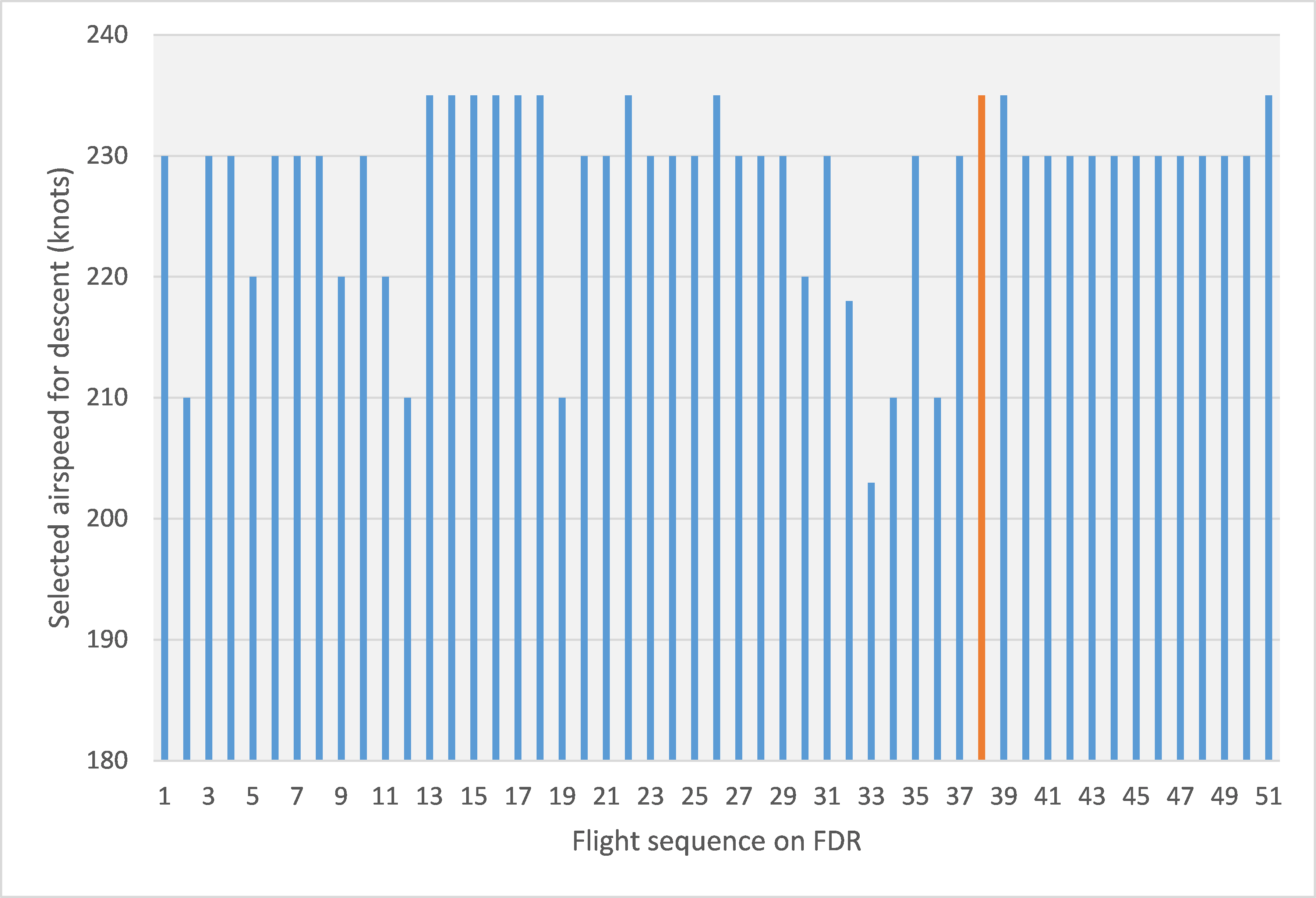
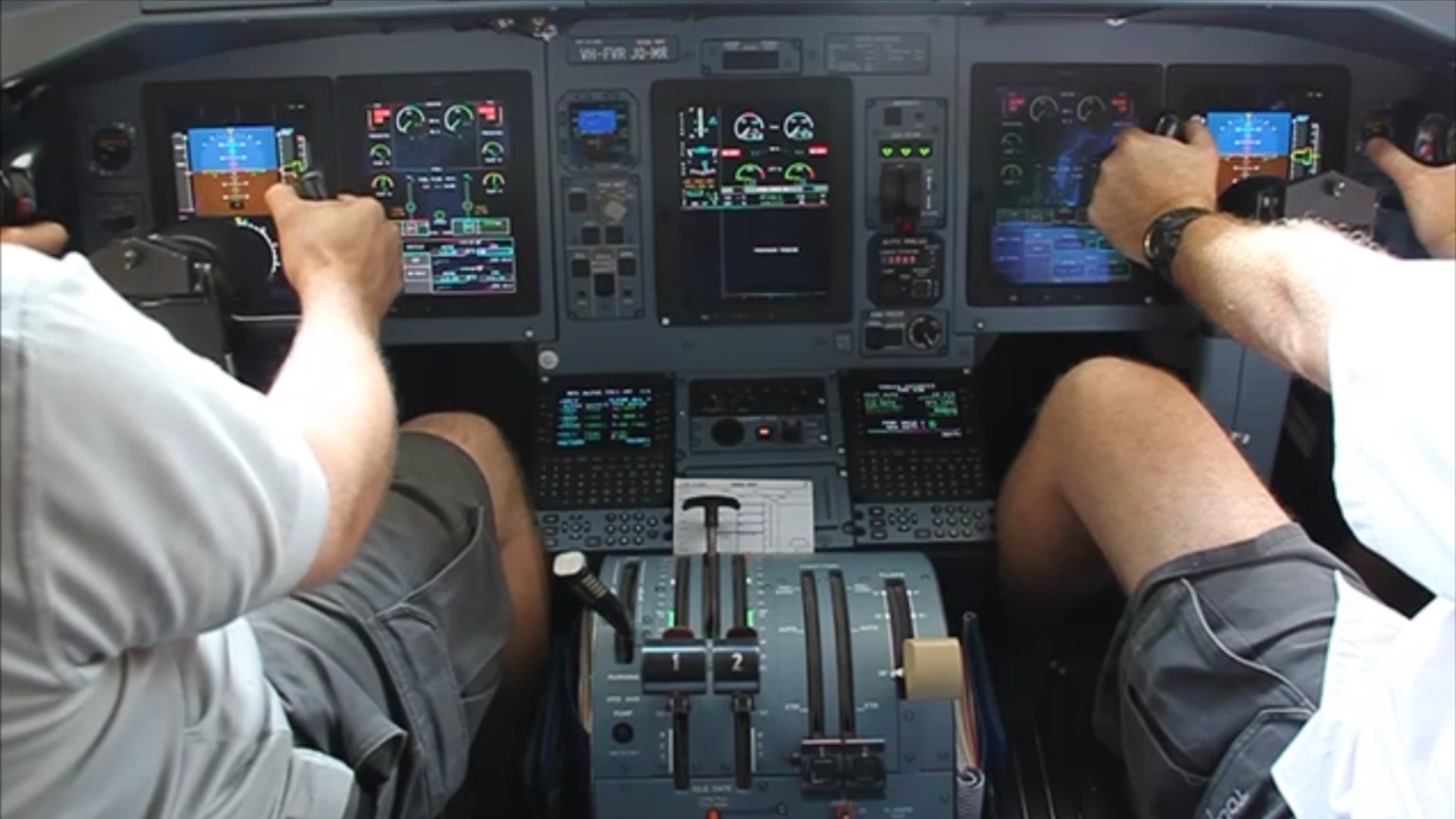
On 20 February 2014, Virgin Australia Regional Airlines (VARA) was operating an ATR 72 aircraft, registered VH-FVR, on a scheduled passenger flight from Canberra to Sydney. During descent with the autopilot in vertical speed mode, the first officer as pilot flying was manually adjusting engine power to maintain the airspeed around the target of 235 kt.
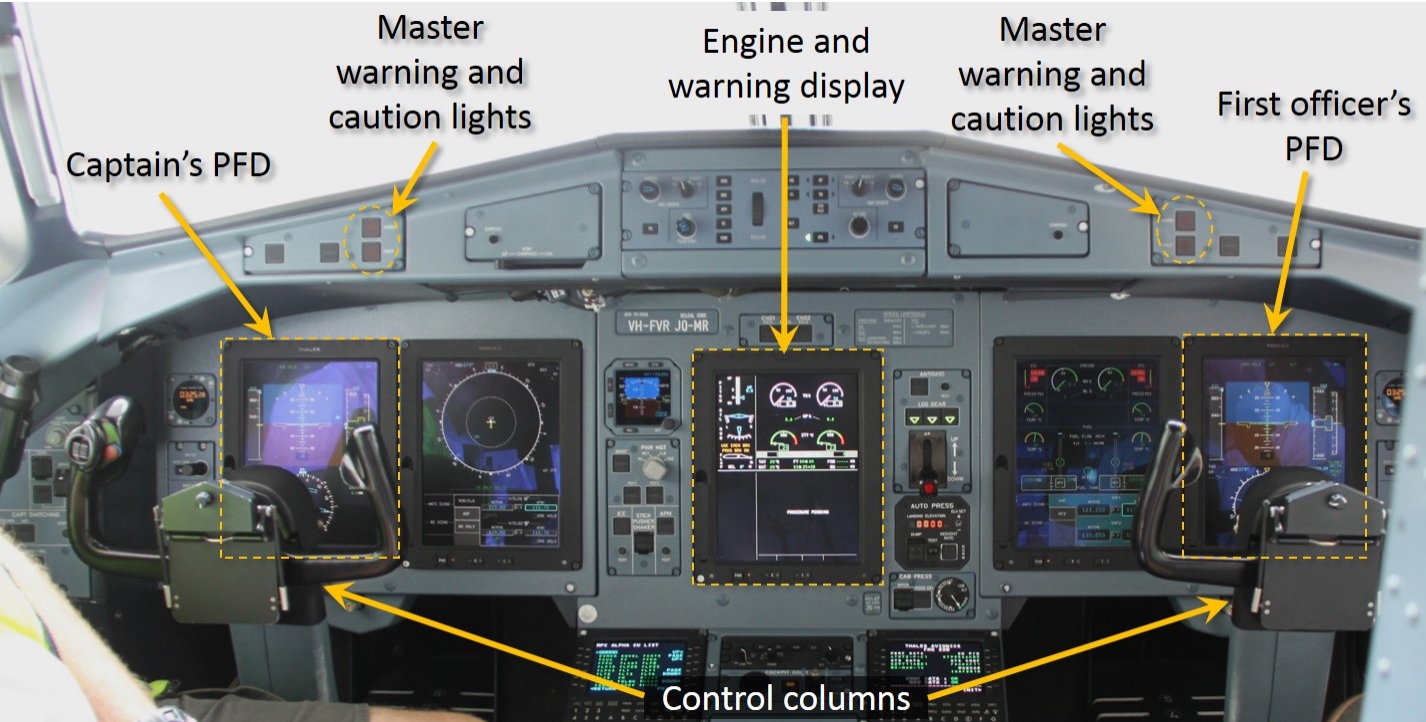
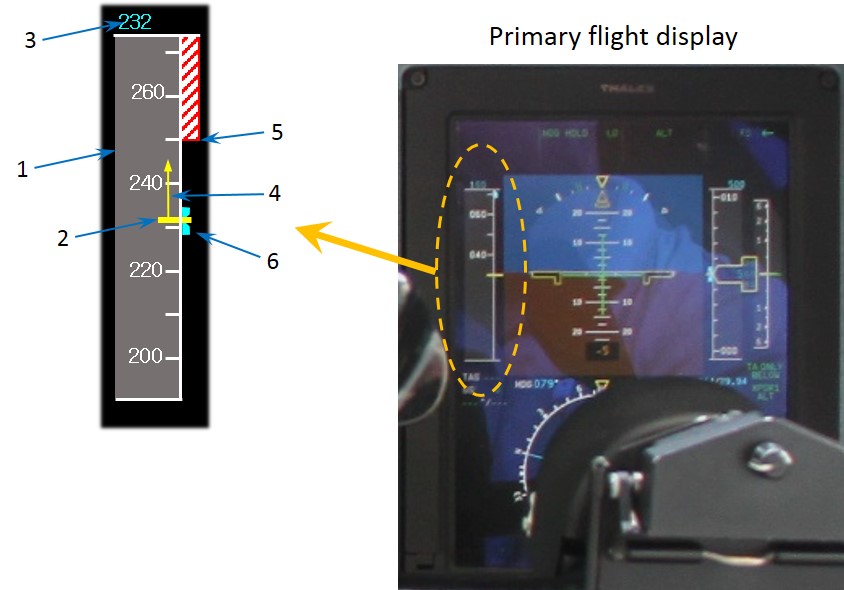
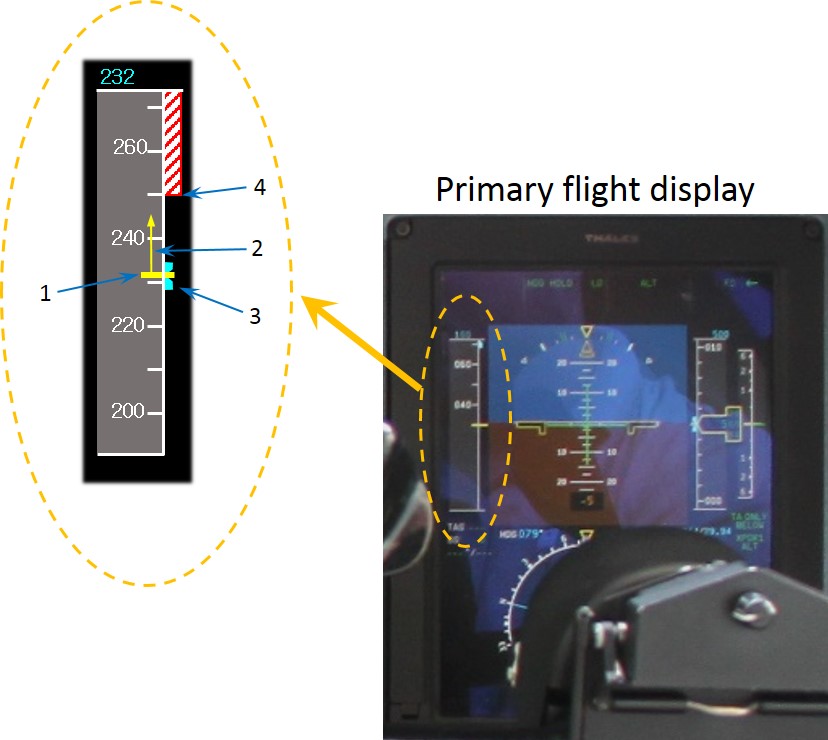
While passing through about 8,500 ft, the aircraft encountered a significant windshear that resulted in a rapidly decreasing tailwind. This led to a rapid increase in airspeed, with the airspeed trend vector (displaying predicted speed on the primary flight display) likely indicating well above the maximum operating speed (VMO) of the aircraft of 250 kt. The first officer reduced engine power and made nose-up control inputs in an attempt to slow the aircraft.
In response to the unexpectedly high airspeed trend indication and their proximity to VMO, the captain (pilot not flying) perceived a need to take over control of the aircraft, with the intention of preventing the airspeed exceeding VMO. The captain took hold of the controls and made nose-up pitch control inputs without immediately following the specified take-over procedure and alerting the first officer of his intent.
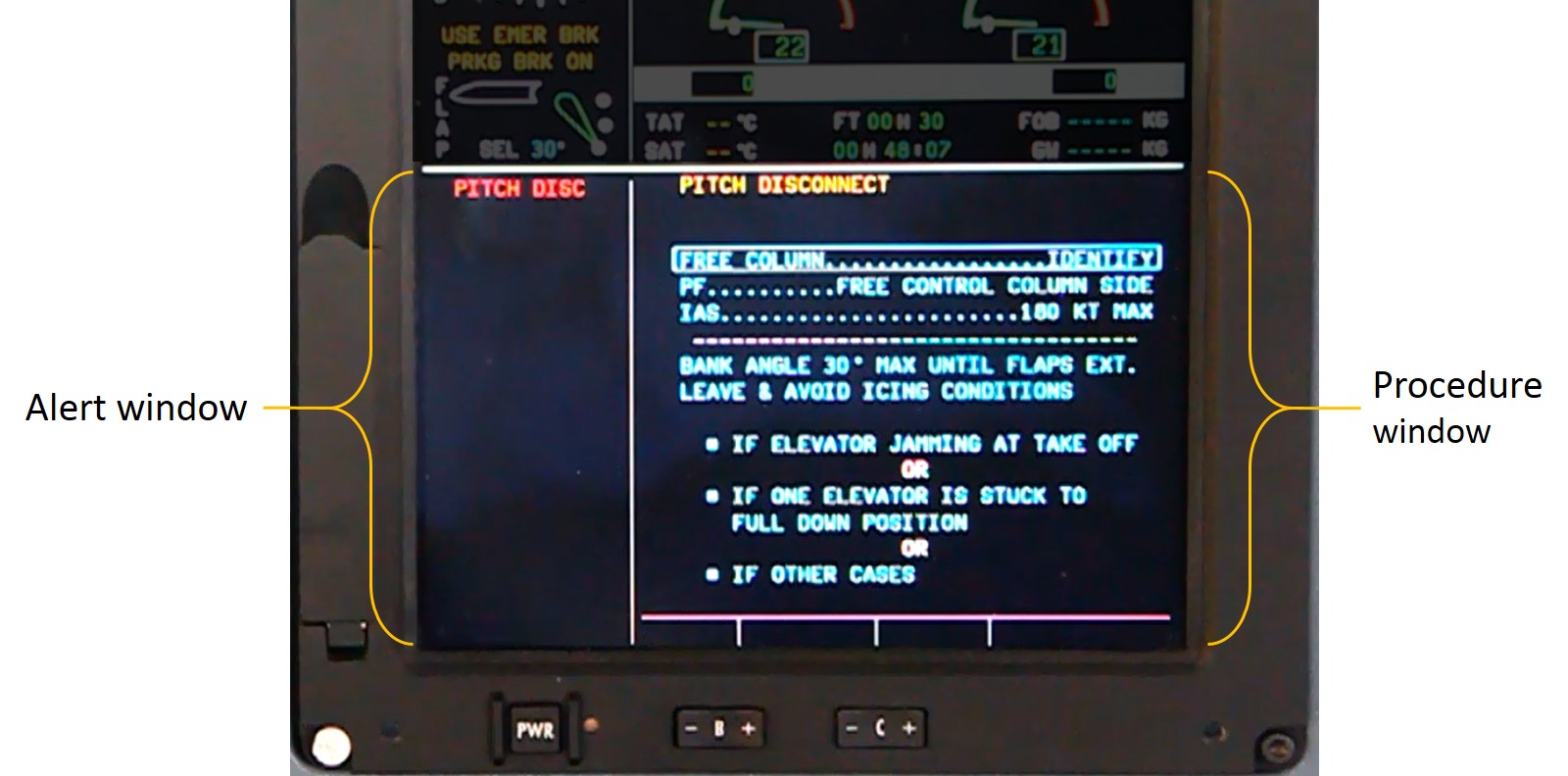
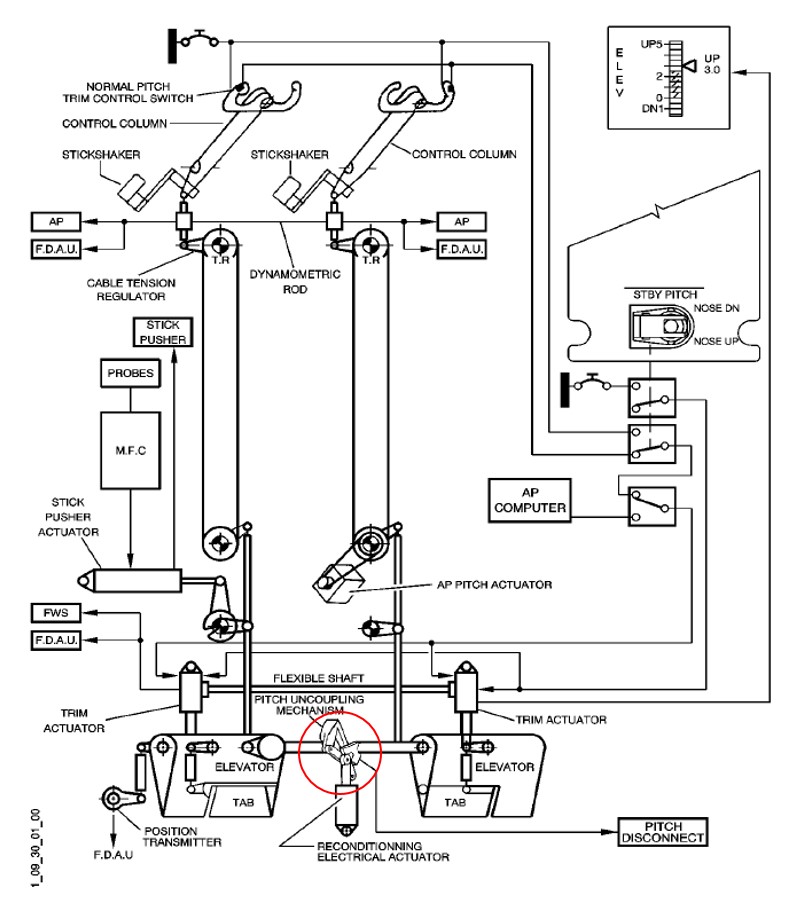
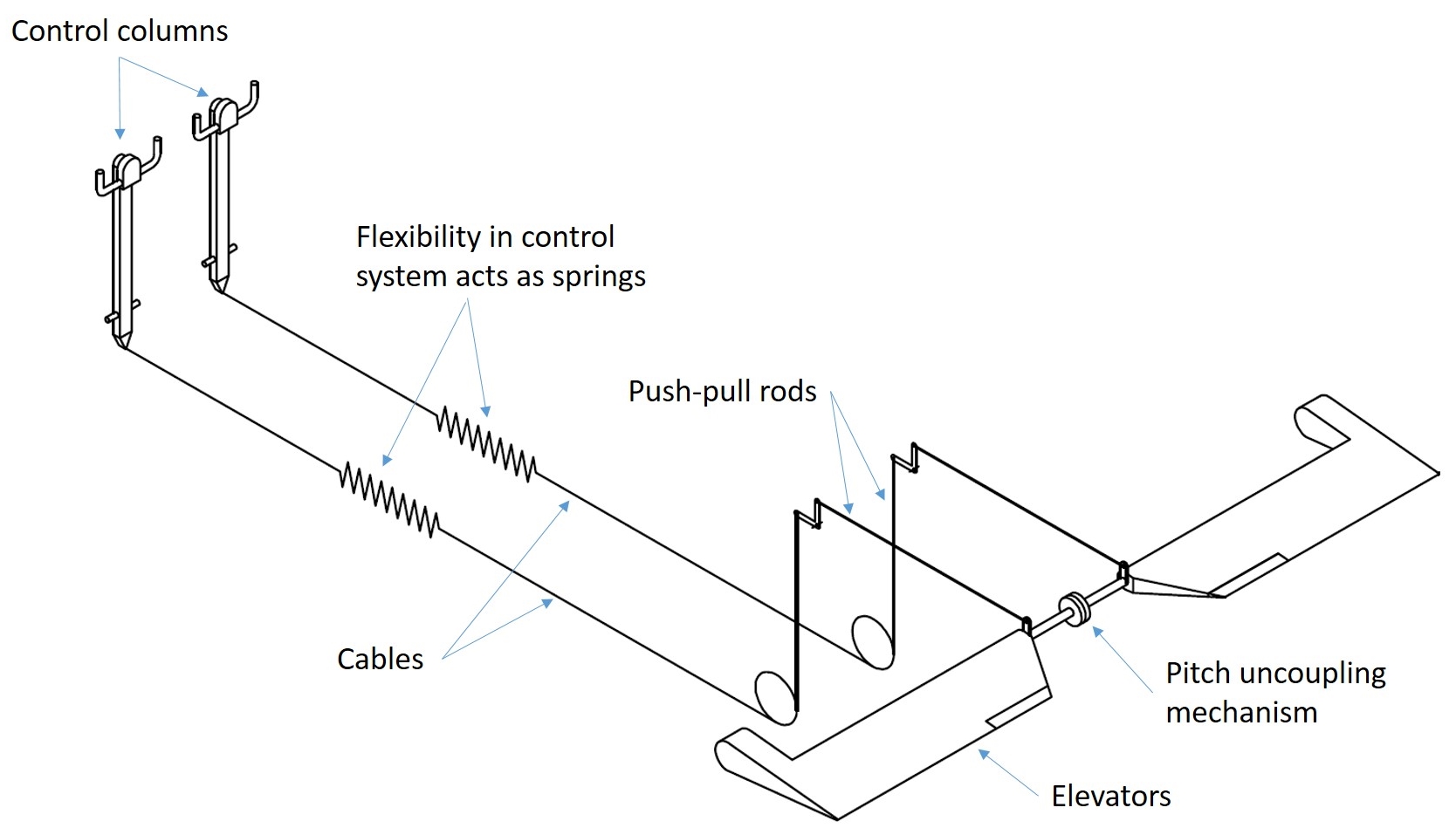
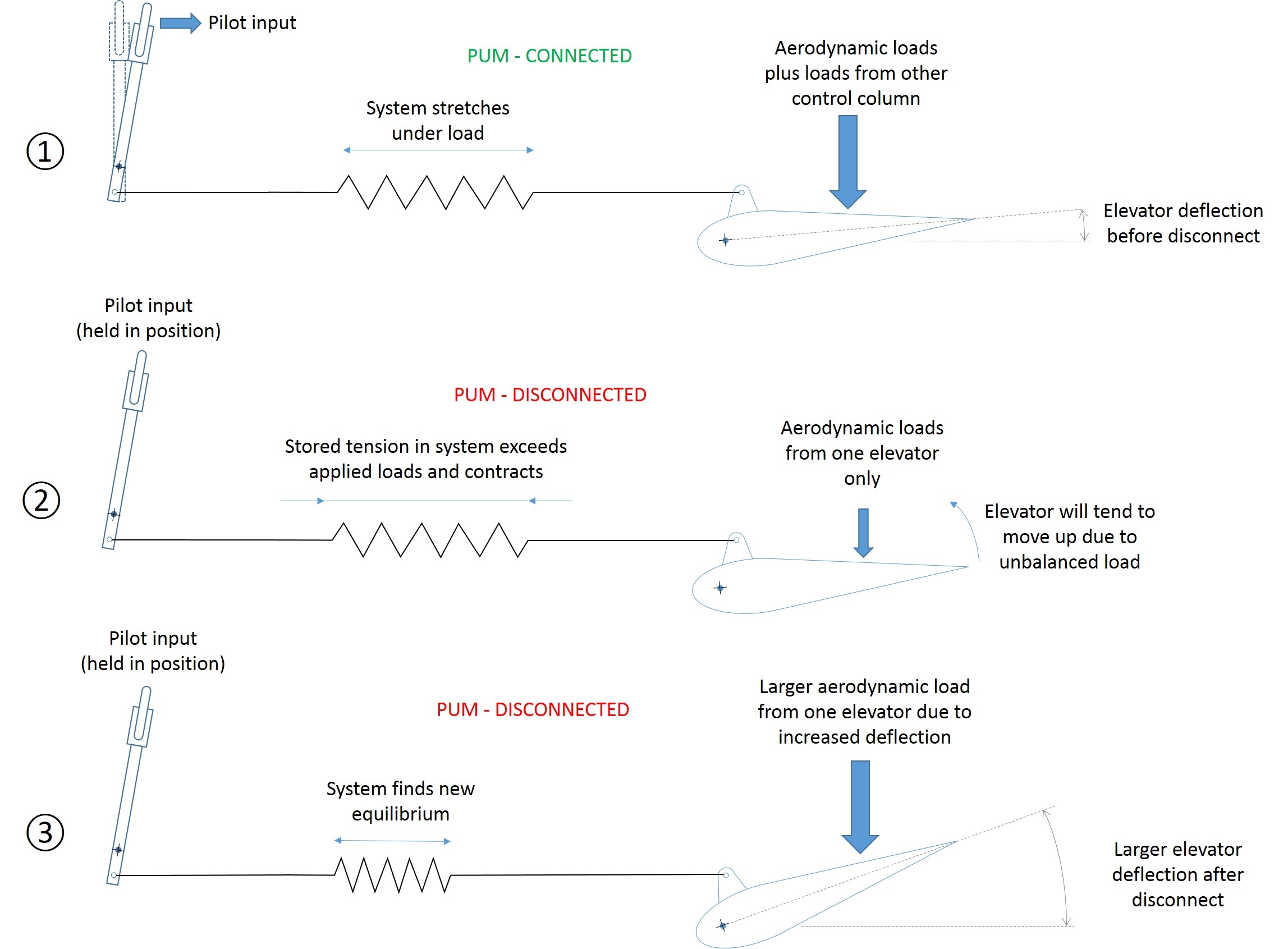
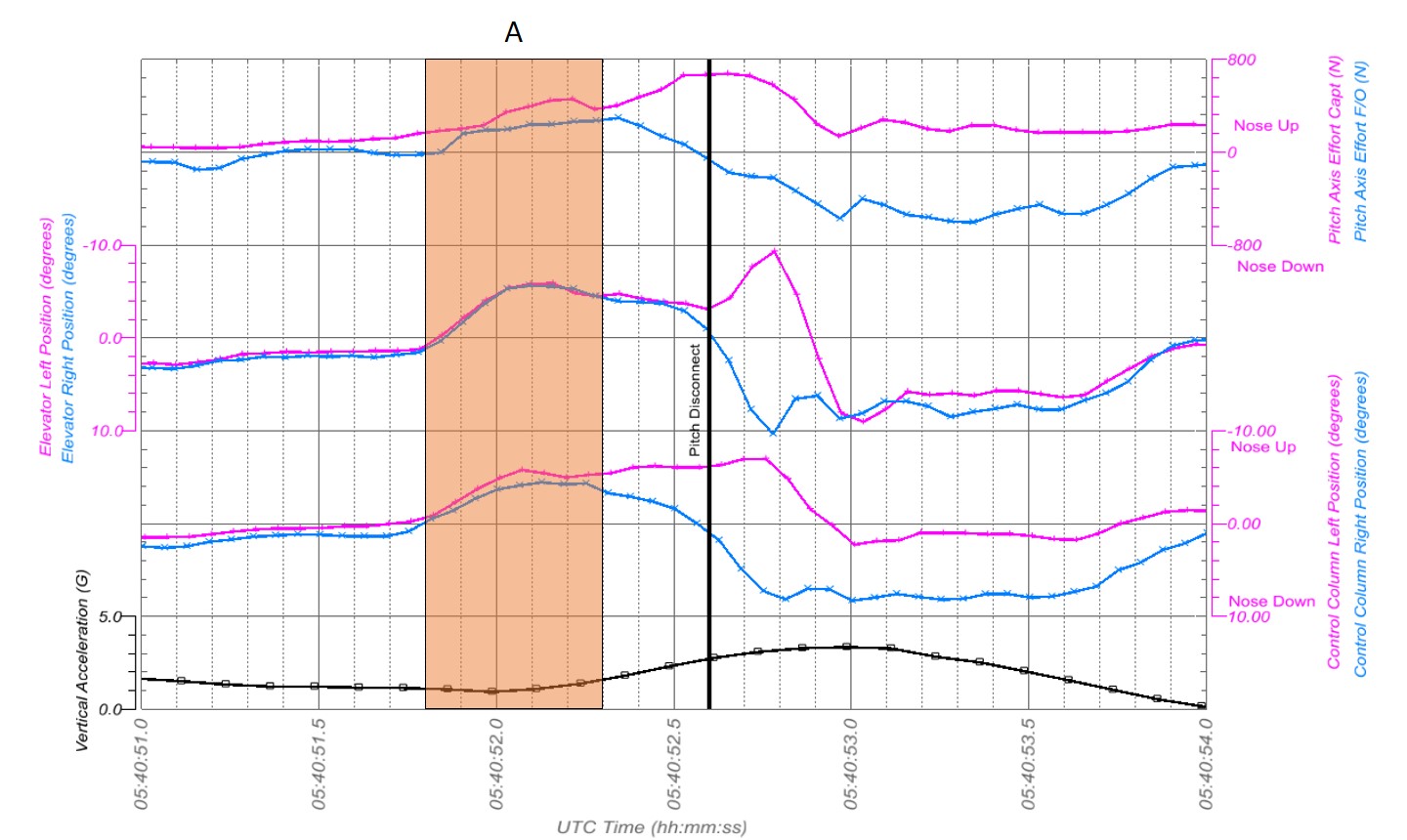
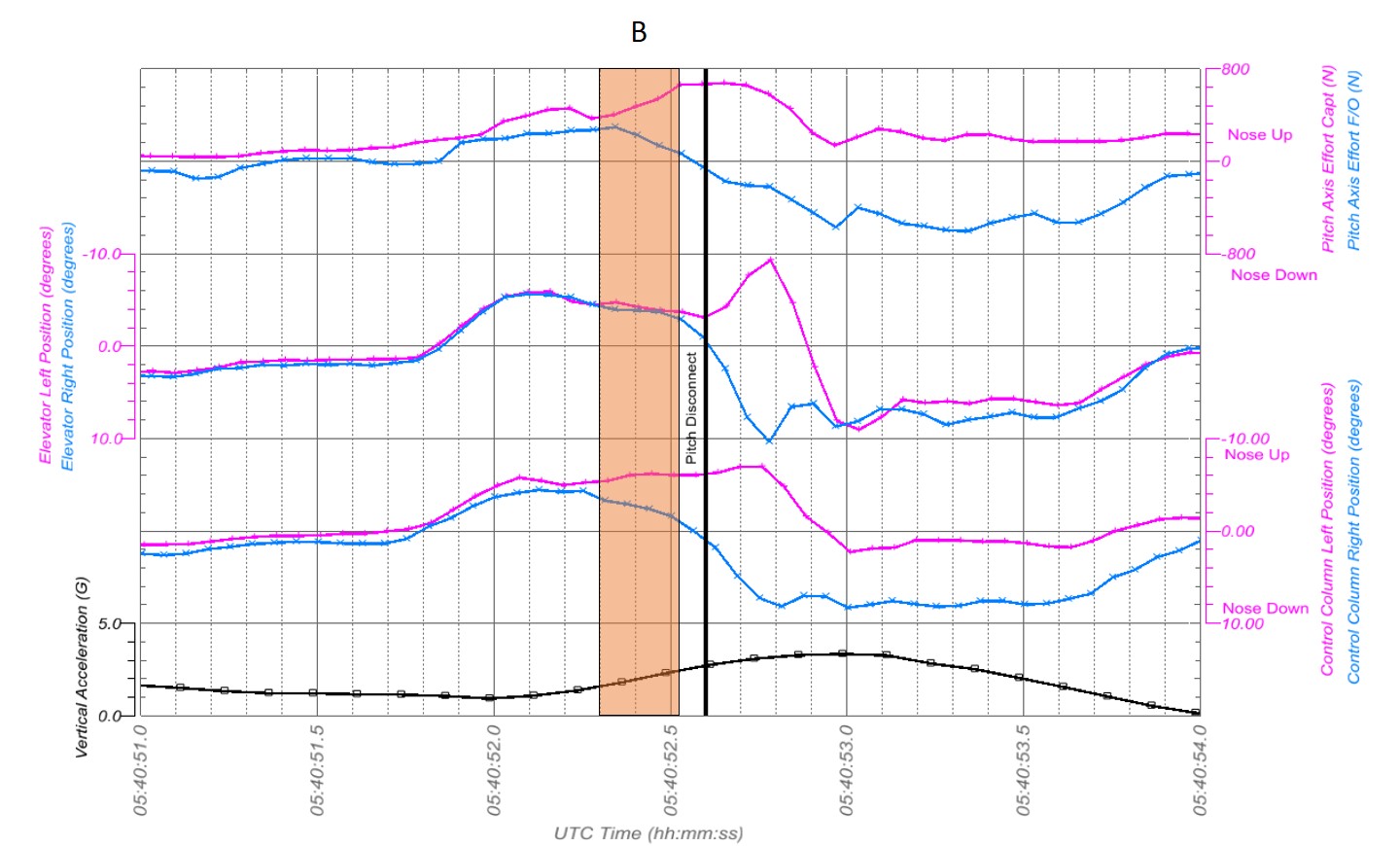
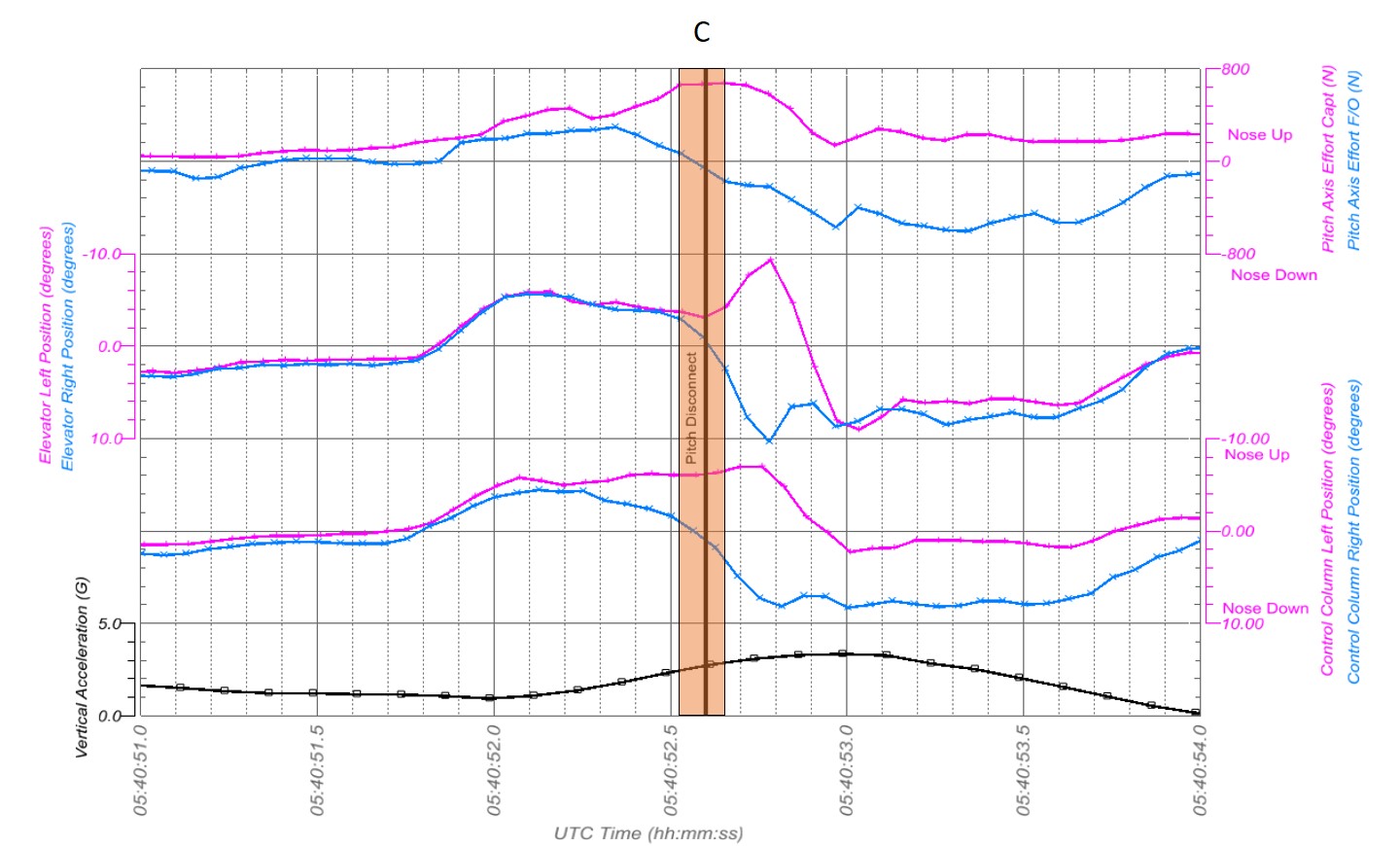
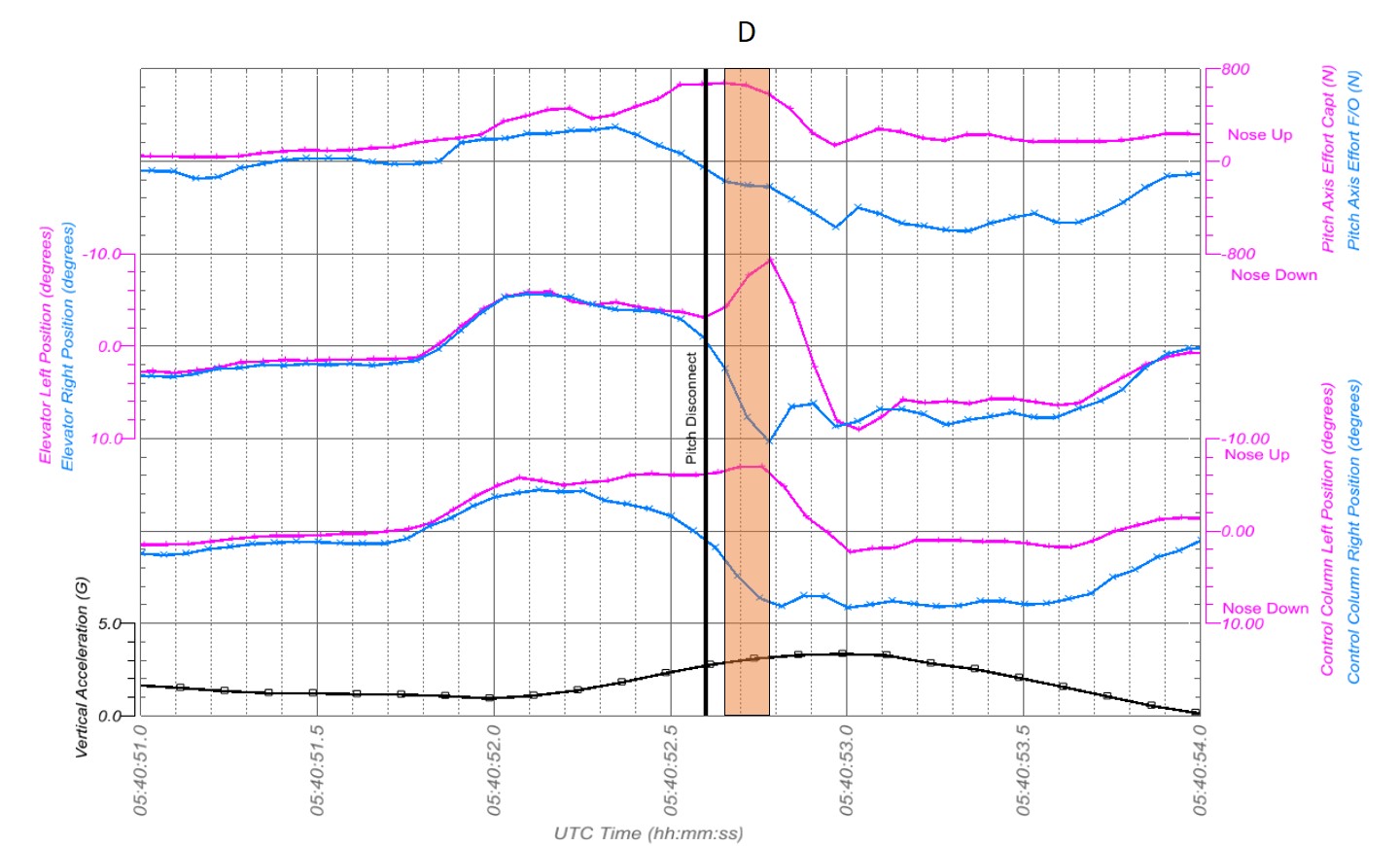
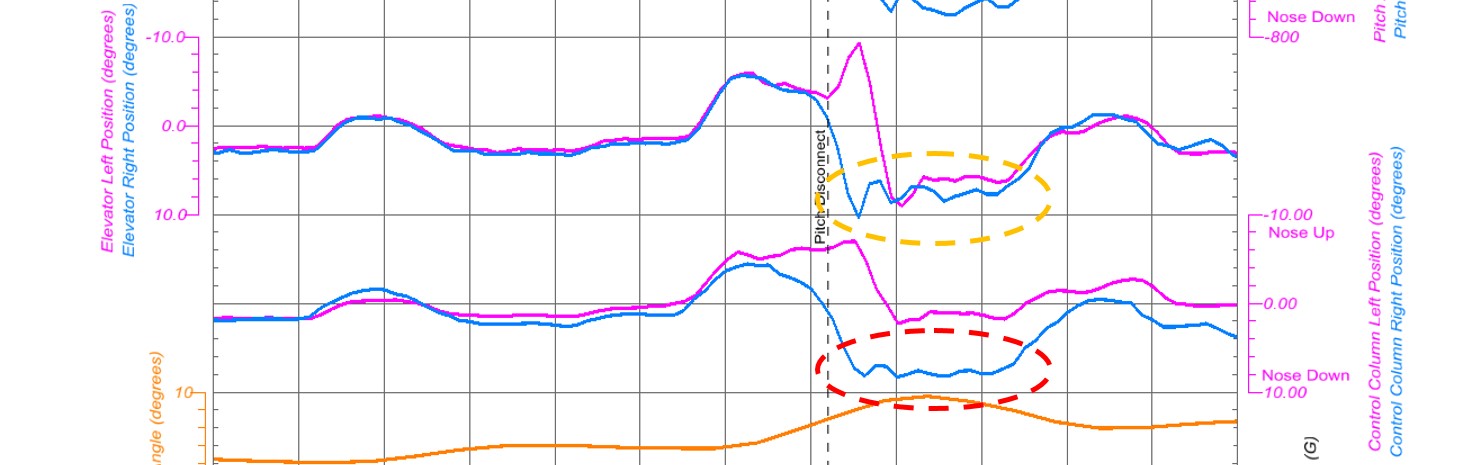
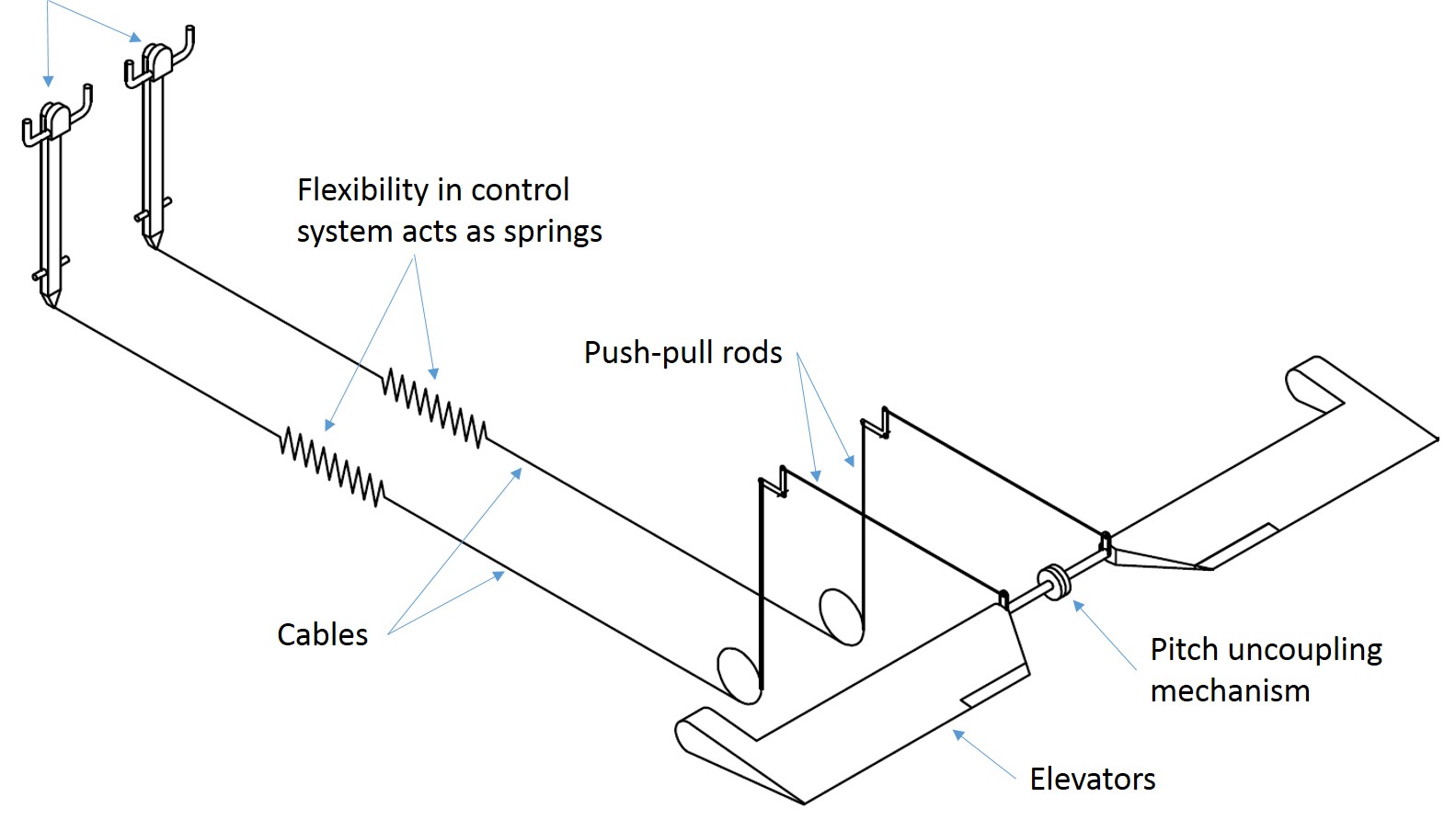
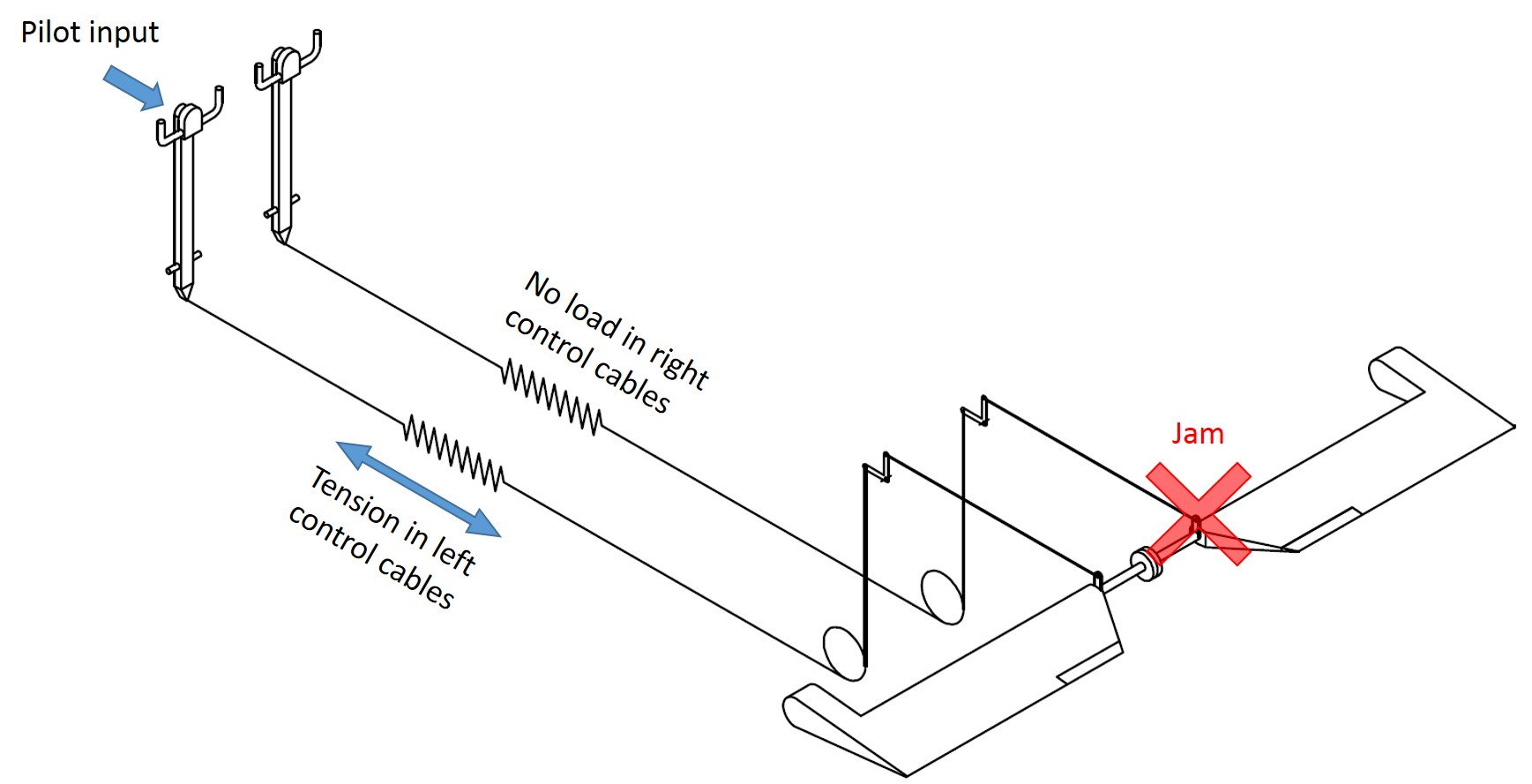
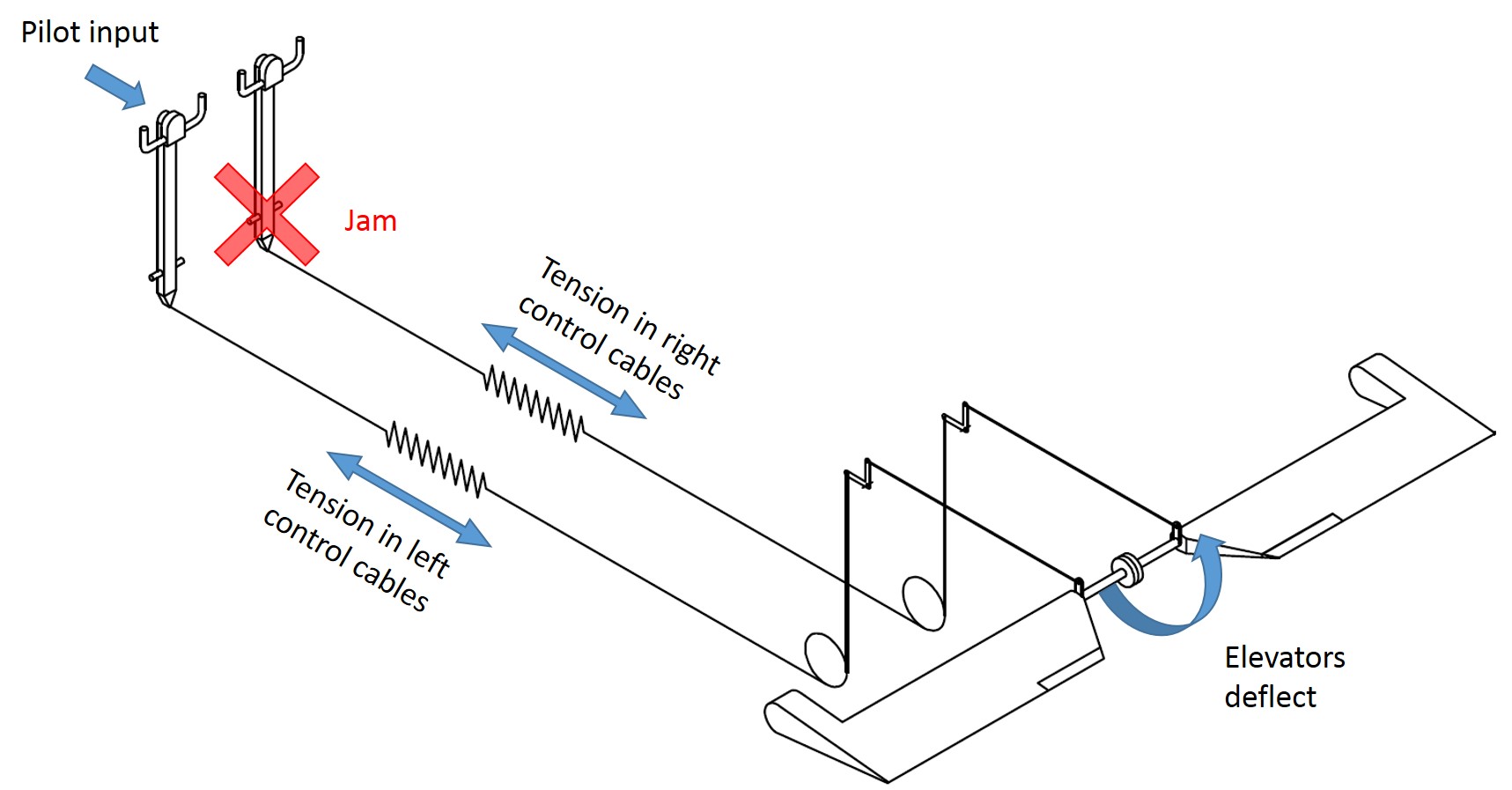
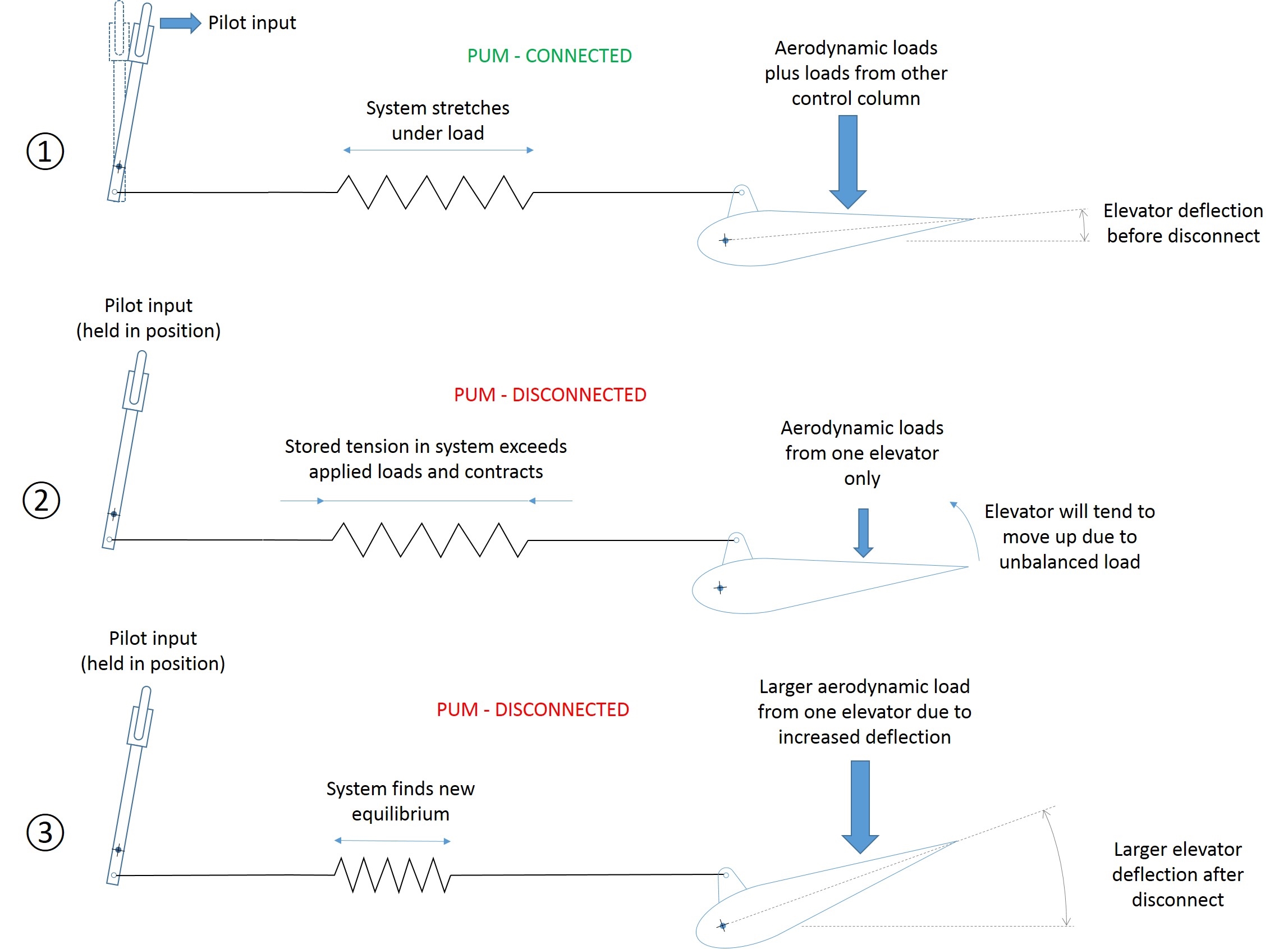
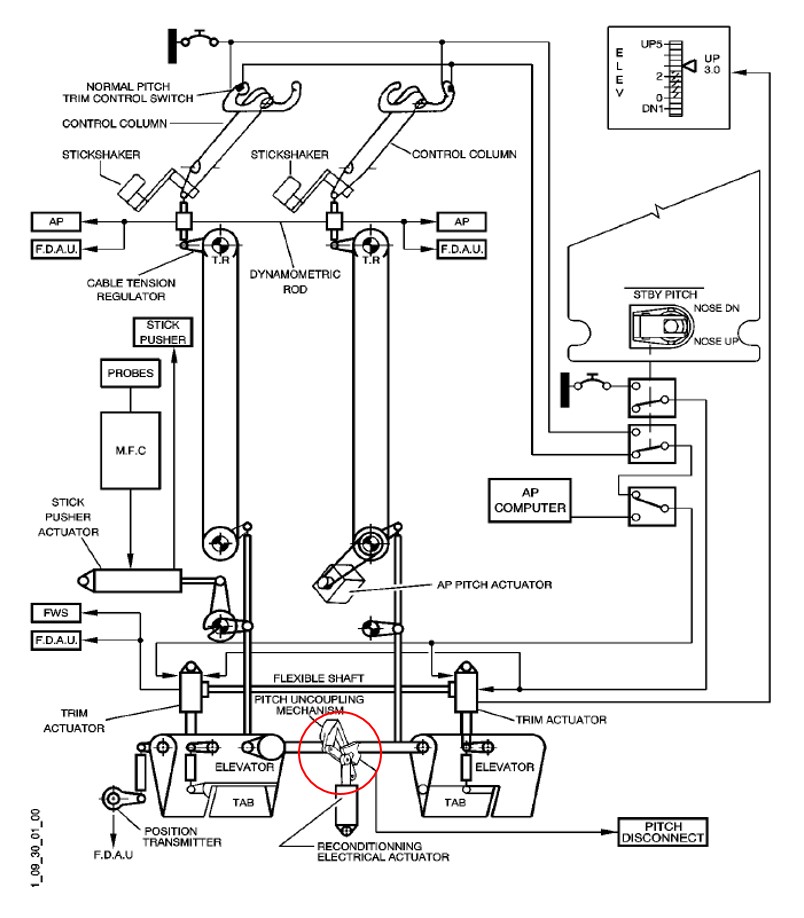
About 1 second after the captain initiated the nose-up control inputs, the first officer (unaware that the captain was also making control inputs) reversed his control input. The differential forces in the left (captain) and right (first officer) pitch control systems reached the threshold to activate the pitch uncoupling mechanism, disconnecting the left and right pitch control systems from each other.
The captain completed the take-over by announcing he had control about 5–6 seconds after taking hold of the controls. However, before the takeover procedure was completed, the addition of the captain’s and first officer’s nose-up control inputs resulted in a pitching manoeuvre that exceeded the limit load factor for the aircraft.
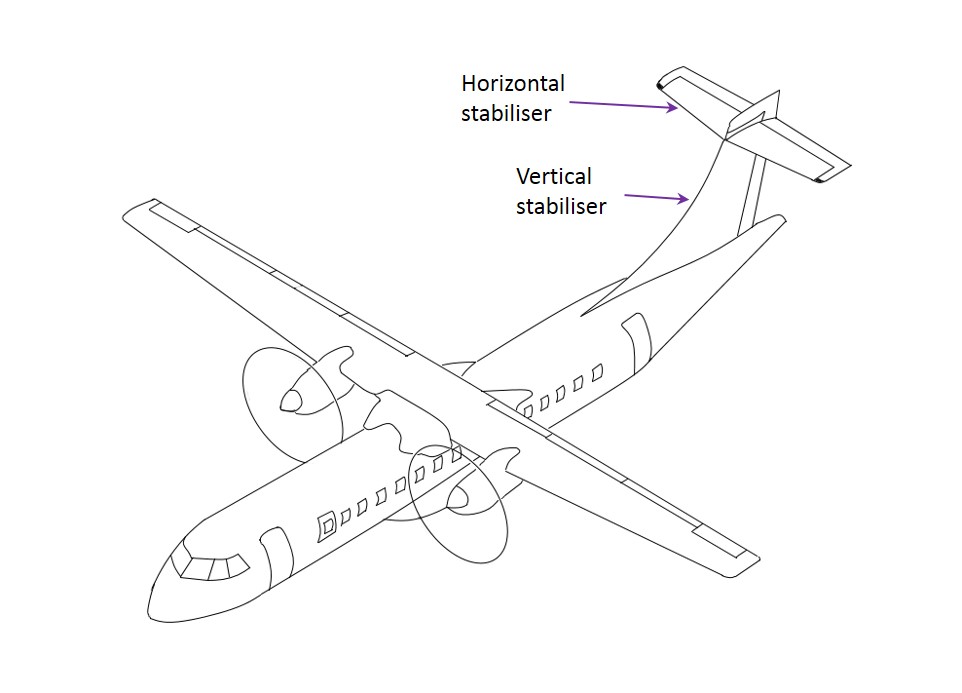
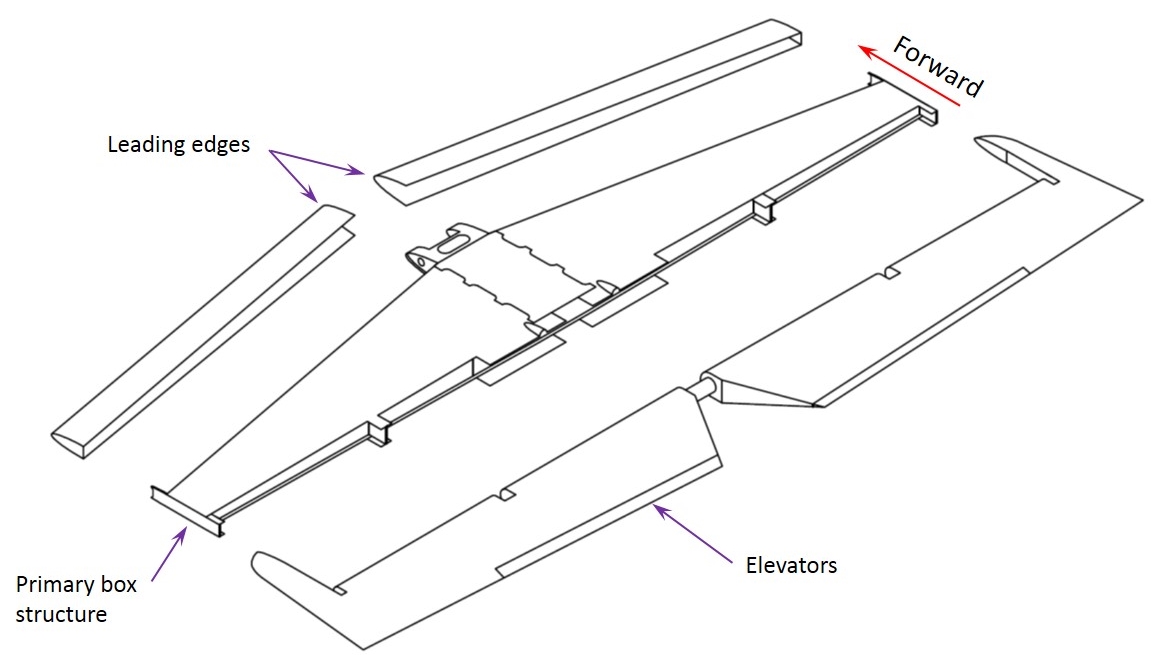
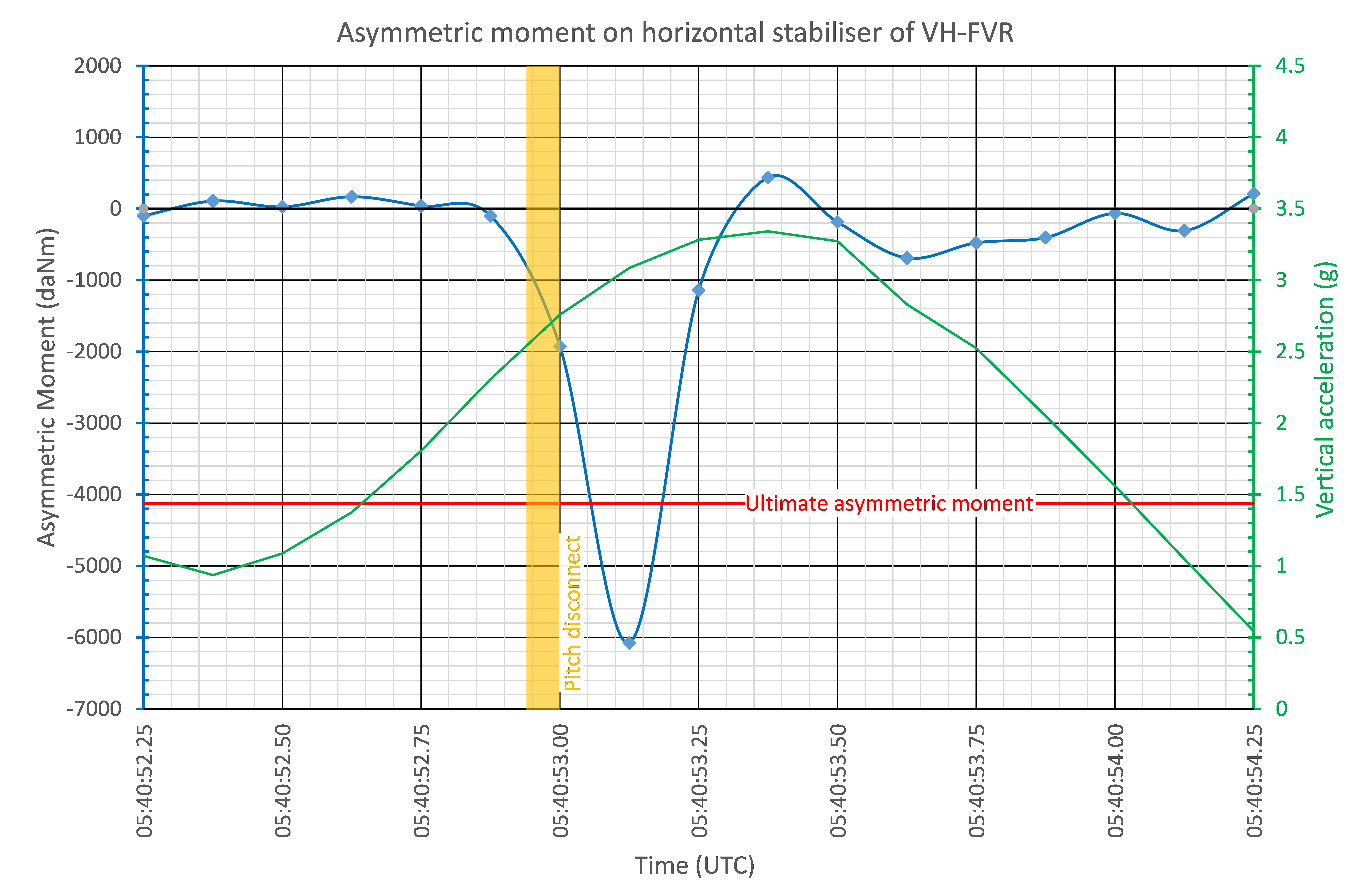
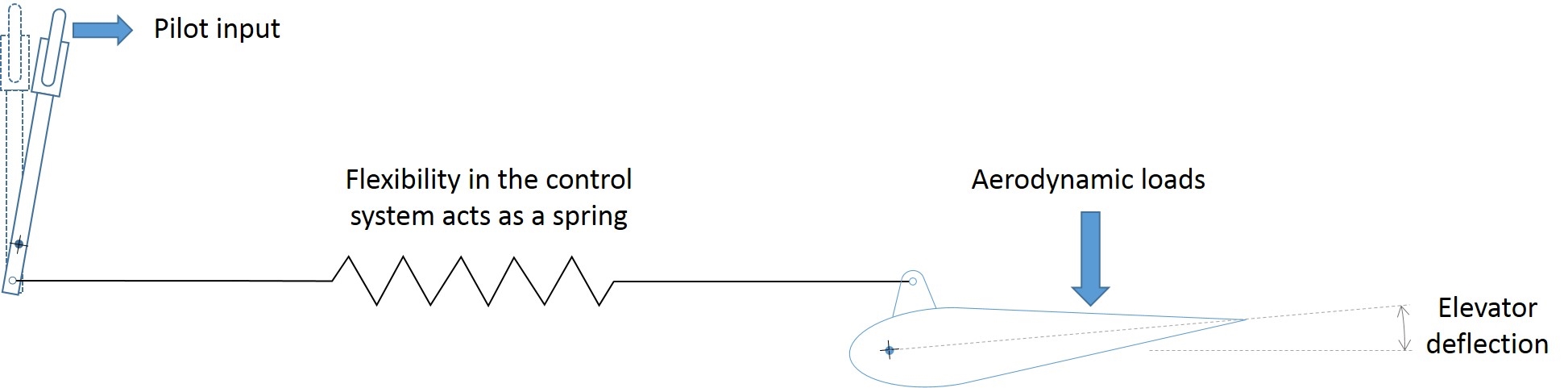
Given the high airspeed, asymmetric elevator deflections that occurred immediately following the pitch disconnect event resulted in aerodynamic loads that exceeded the strength of the horizontal stabiliser and resulted in significant damage to the stabiliser.
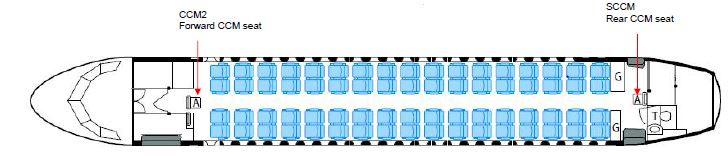
At the start of the pitching manoeuvre, the senior cabin crew member was unrestrained in the rear of the cabin as she waited for a passenger to return to their seat. When the aircraft pitched back down, the cabin crew member was thrown from her seat and suffered a broken leg.
The flight crew continued the flight using one of the pitch control systems and landed without further incident at Sydney.
Based on the crew report of an in-flight pitch disconnect associated with moderate turbulence, and data recorded by the aircraft’s on board maintenance systems, VARA maintenance watch arranged for the contracted approved maintenance organisation, Toll Aviation Engineering, to carry out the applicable maintenance. However, the licenced aircraft maintenance engineers involved in the Inspection after flight in turbulence and/or exceeding VMO did not carry out the specified general visual inspection of the stabilisers probably because of a breakdown in the coordination and certification of the inspection tasks between the engineers. The damaged horizontal stabiliser was not detected and the aircraft was released to service.
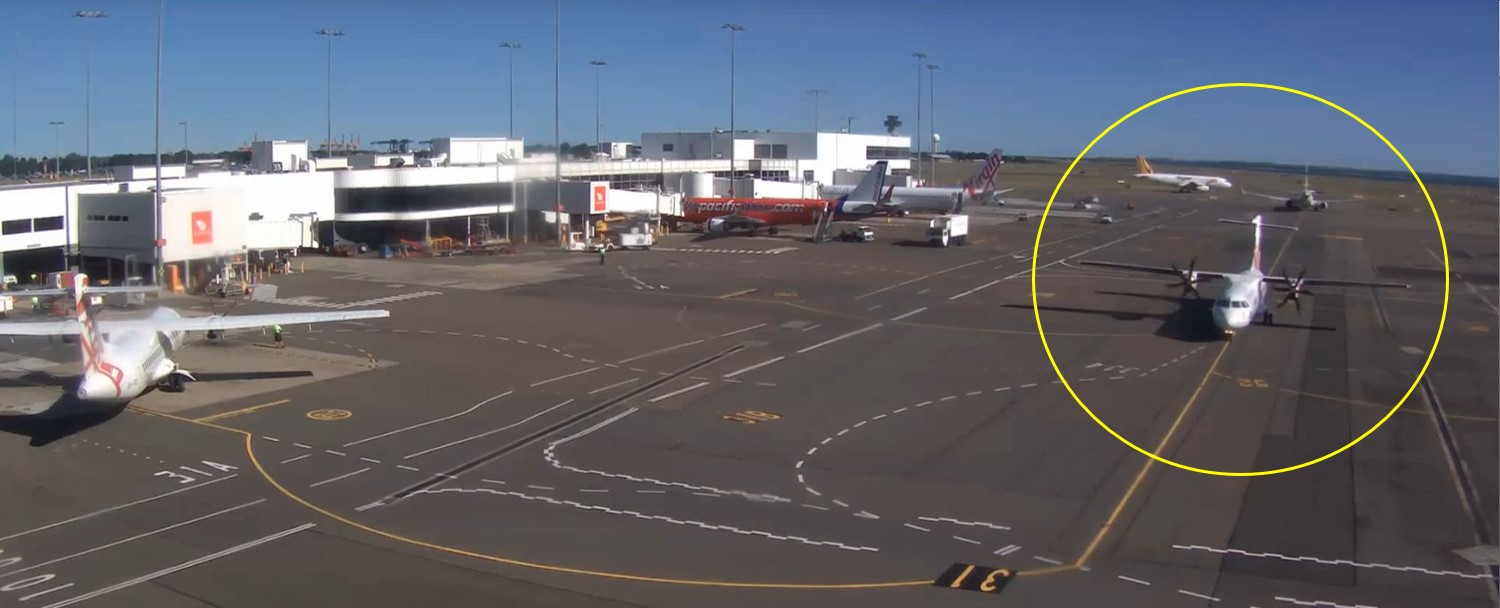
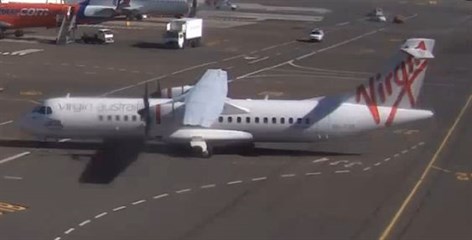
VH-FVR under tow following completion of post-occurrence maintenance. The angle of the horizontal stabiliser relative to the angle of the wings indicates substantial structural deformation.
Source: Sydney Airport
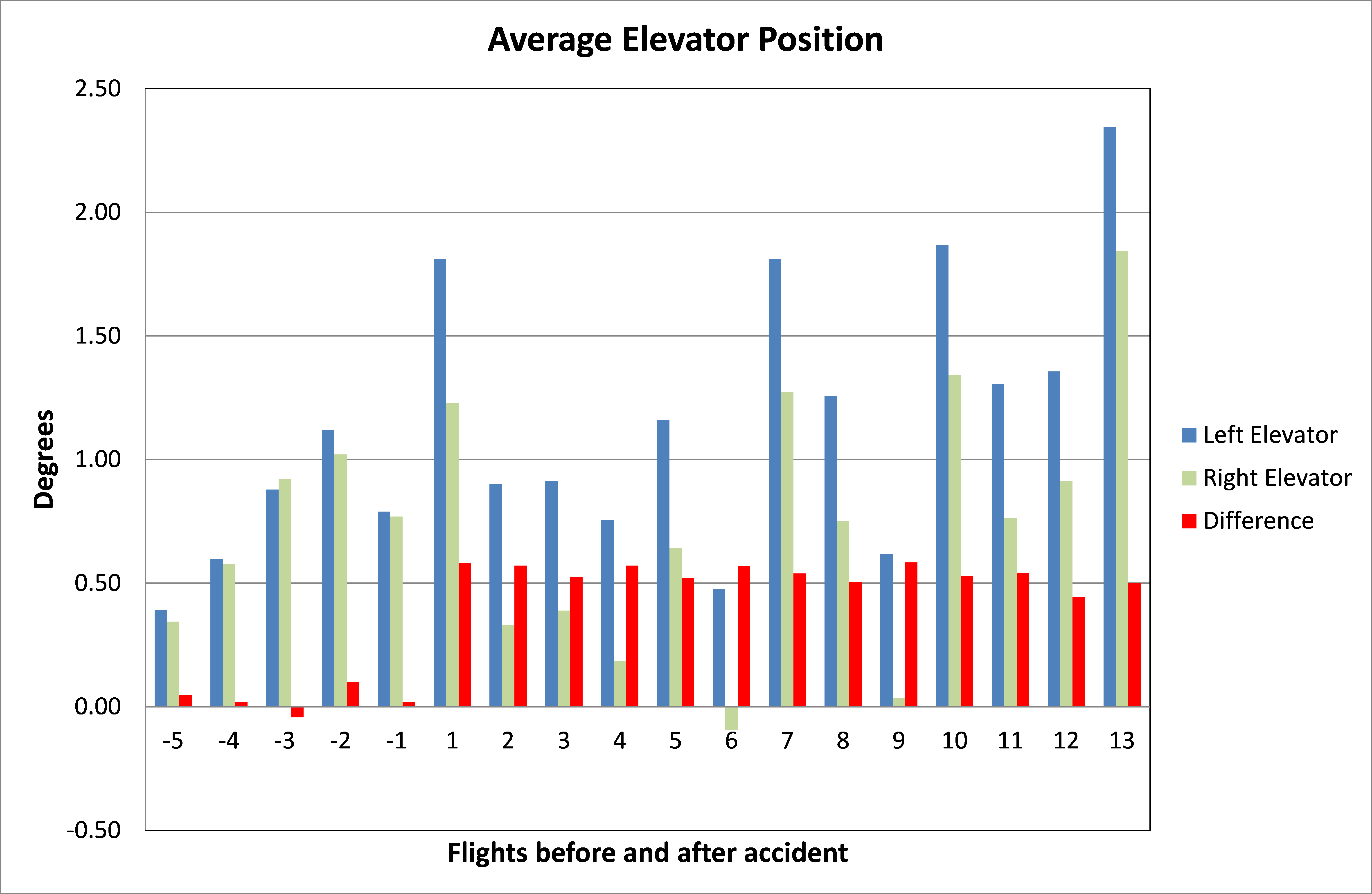
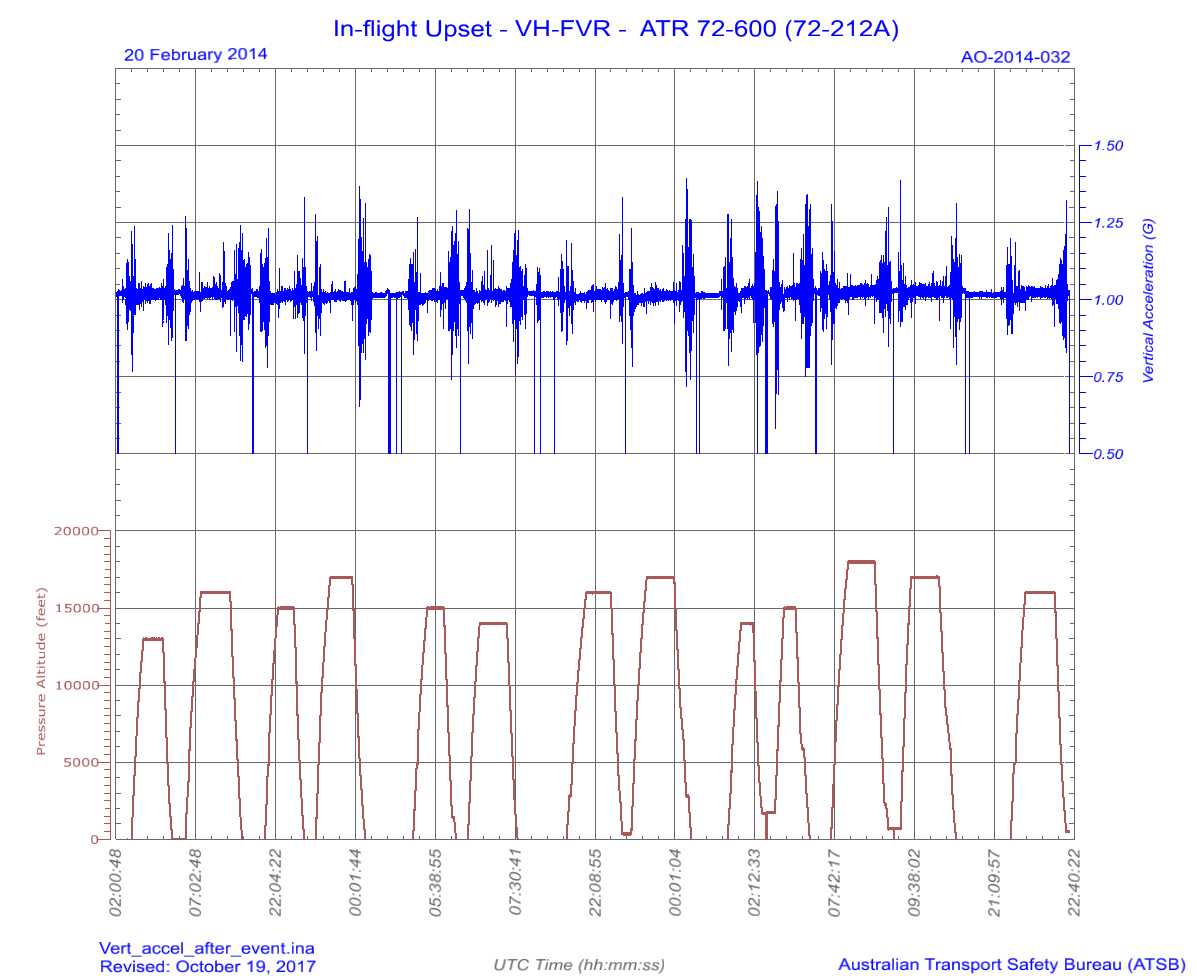
During the next 5 days the aircraft was operated on 13 flights and was subject to routine walk‑around visual inspections by flight crew and engineers. No one identified any anomalies until flight crew observed some damage after a suspected bird strike. The aircraft was grounded and subjected to extensive maintenance that included replacement of the horizontal and vertical stabilisers.
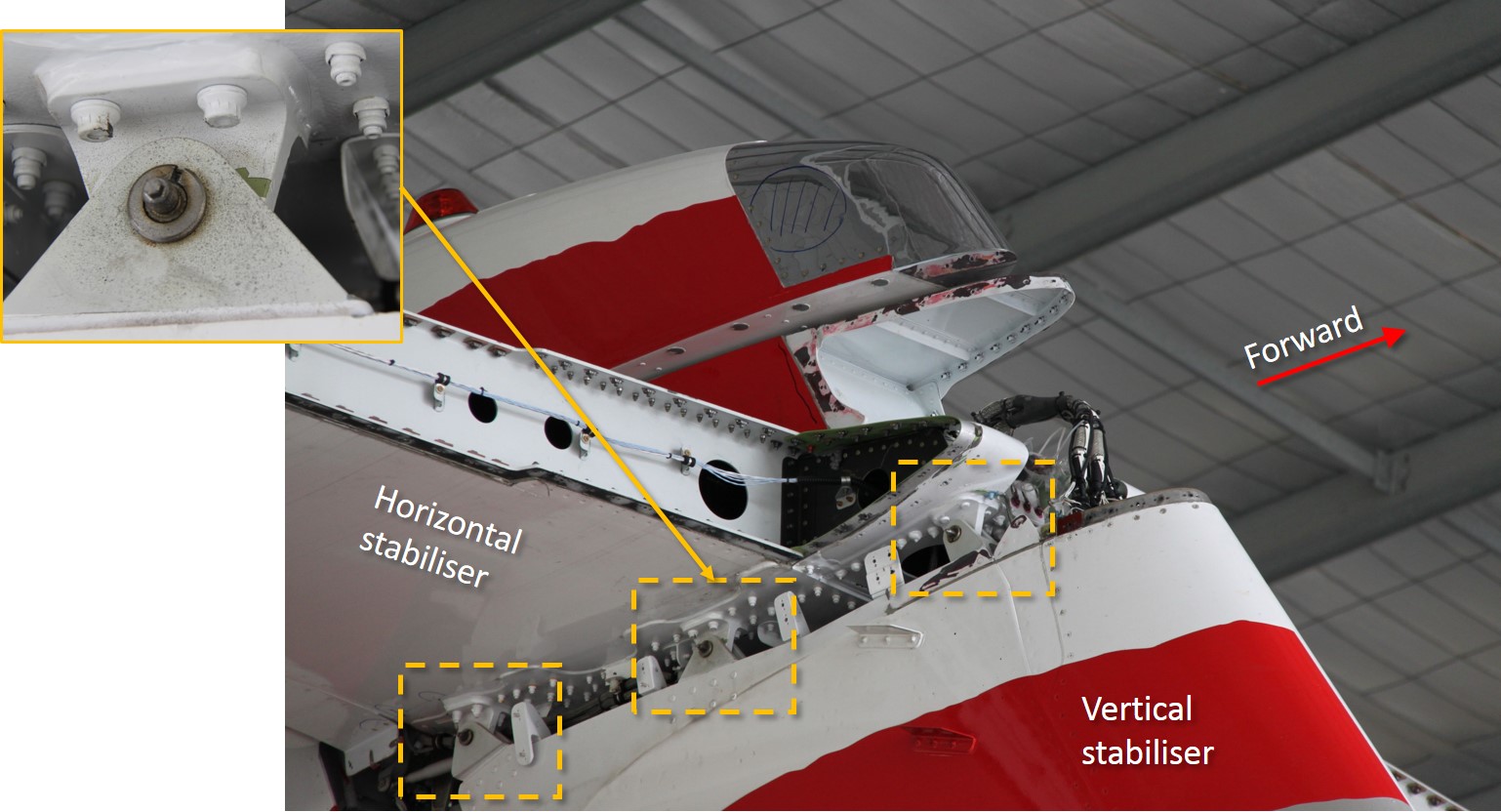
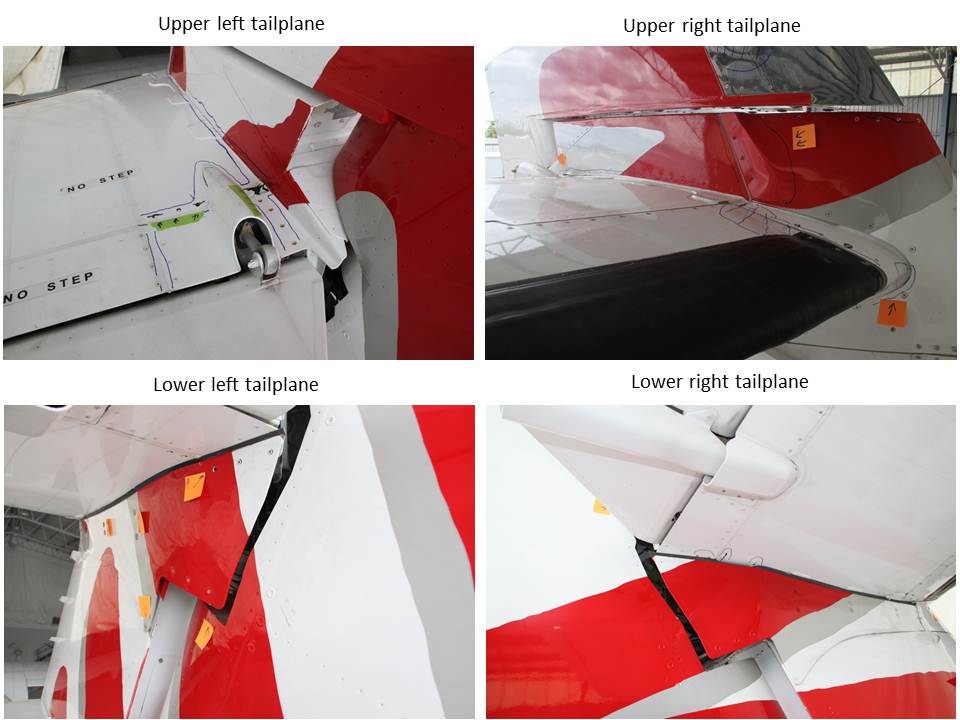
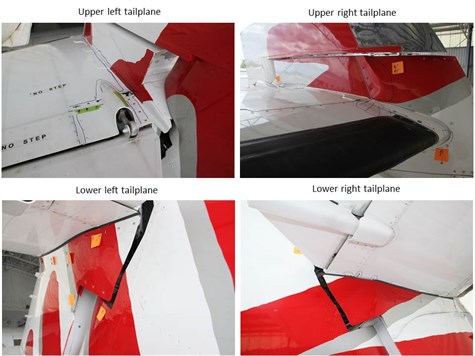
Upper tailplane of VH-FVR showing damage to horizontal and vertical stabilisers that was evident when the damage was identified 5 days and 13 flights after the in-flight upset/pitch disconnect and associated maintenance.
Source: ATSB
What the ATSB found
In-flight upset and pitch disconnect
The ATSB identified a number of operational factors that contributed to the in-flight upset and pitch disconnect.
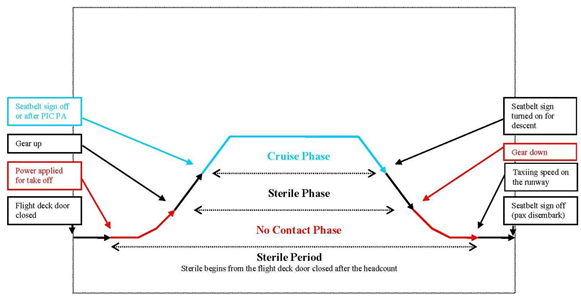
During the descent, when the sterile flight deck policy was applicable, the flight crew engaged in non-pertinent conversation. This distracted the crew and probably reduced their ability to monitor and respond to fluctuations of airspeed.
While passing through about 8,500 ft on descent into Sydney, the aircraft encountered a significant windshear that resulted in a rapidly decreasing tailwind. This led to a rapid increase in the airspeed, with the airspeed trend vector likely indicating well above the maximum operating speed (VMO).
In response to the unexpectedly high airspeed trend indication, and their proximity to VMO, the captain (pilot not flying) perceived a need to immediately intervene, and made pitch control inputs before following the normal take-over procedure and alerting the first officer (pilot flying).
The addition of the captain’s and first officer’s nose-up control inputs resulted in a pitching manoeuvre that exceeded the limit load factor for the aircraft.
The magnitude of the captain's nose-up control input was probably greater than he intended, due to his response to a high stress level, but increased the probability that the aircraft's limit load factor would be exceeded.
Shortly after the captain initiated the nose-up control inputs, the first officer reversed his control input. The differential forces in the left (captain) and right (first officer) pitch control systems were sufficiently large to inadvertently activate the pitch uncoupling mechanism, disconnecting the left and right pitch control systems.
Given the high airspeed, the asymmetric elevator deflections that occurred immediately following the pitch disconnect event resulted in aerodynamic loads on the tailplane that exceeded its strength and damaged the horizontal stabiliser.
During the course of this investigation, the ATSB became aware that other in-flight pitch disconnect occurrences had occurred in ATR 72 aircraft and considered that the related procedural controls were not sufficiently effective. To alert the effected parties, the ATSB published an interim report (15 June 2016) with the following safety issue:
Inadvertent application of opposing pitch control inputs by flight crew can activate the pitch uncoupling mechanism which, in certain high-energy situations, can result in catastrophic damage to the aircraft structure before crews are able to react.
After further investigation, the ATSB published a second interim report (5 May 2017) in support of another safety issue that related to concern about transient elevator deflections in ATR 72 aircraft. The ATSB issued three recommendations to key stakeholders to address the following safety issue:
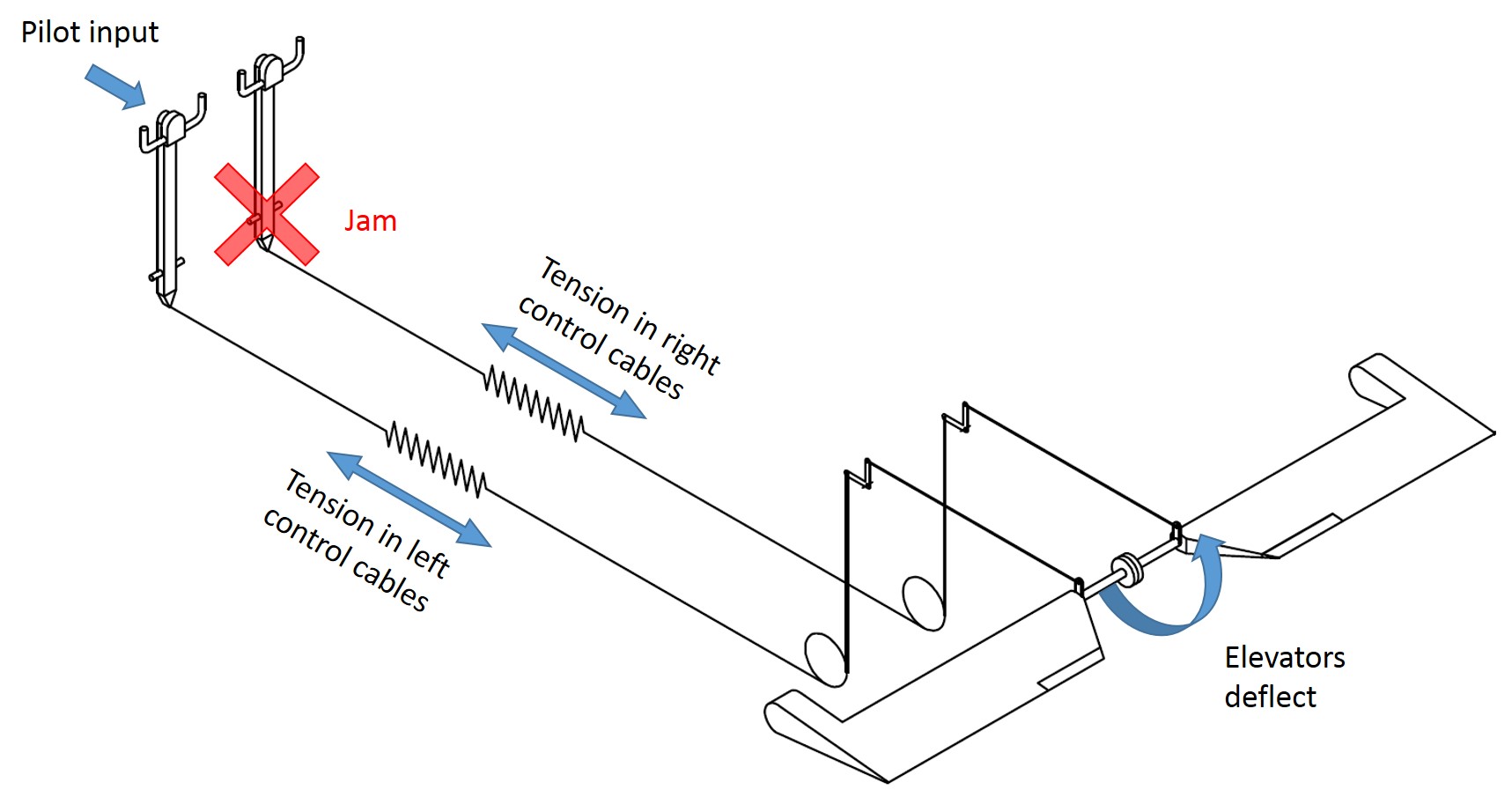
The aircraft manufacturer did not account for the transient elevator deflections that occur as a result of the system flexibility and control column input during a pitch disconnect event at all speeds within the flight envelope. As such, there was no assurance that the aircraft had sufficient strength to withstand the loads resulting from a pitch disconnect.
Further ATSB analysis identified another four safety issues that relate to different aspects of the ATR pitch control system and related design standards.
The design of the ATR 72 pitch control system resulted in limited tactile feedback between the left and right control columns, reducing the ability of one pilot to detect that the other pilot is making control inputs. In addition, there were no visual or auditory systems to indicate dual control inputs.
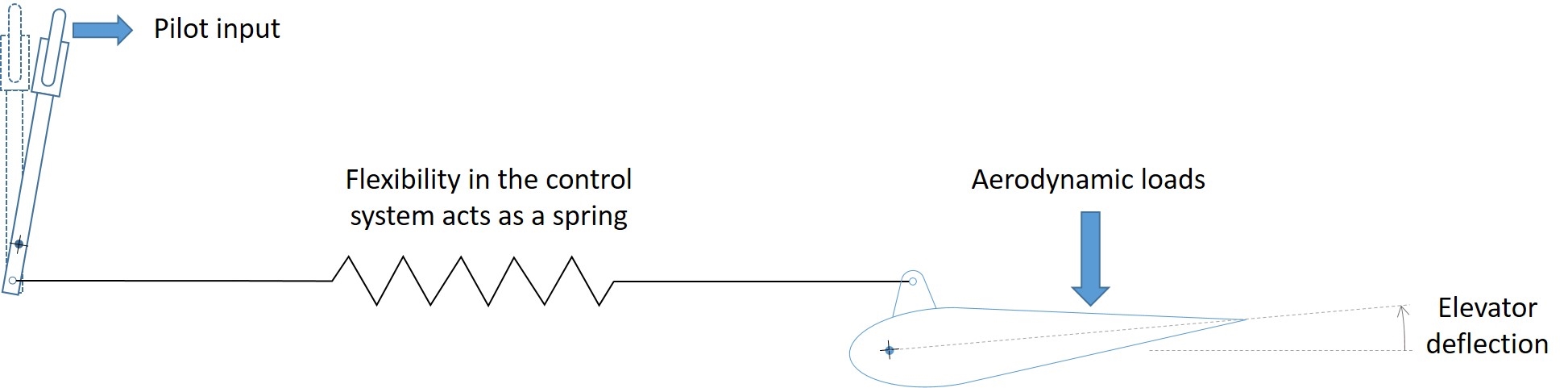
Flexibility in the ATR 72’s pitch control system between the control columns results in a change in the aircraft’s longitudinal handling qualities and control dynamics when dual control inputs are made. This could result in an aircraft-pilot coupling event where flight crew may find it difficult to control the aircraft.
The (European) design standard for large transport aircraft, Joint Aviation Requirements - Part 25 (JAR-25), did not require that the demonstrated potential for flexibility in the control system to develop transient dynamic loads, be considered during certification. Similarly, the current certification standard for Large Aeroplanes (CS-25) does not address this issue.
Although the design standard for the aircraft (JAR-25) required the control system to be of sufficient strength to withstand dual control inputs, it did not require consideration of the effect that dual control inputs may have on control of the aircraft. Similarly, the current design standard (CS-25) does not address this issue.
Inspection and continued operation
Further to establishing that the damage went undetected because the aircraft tail was not inspected in accordance with the turbulence/VMO exceedance job instruction card, the ATSB identified other maintenance-related factors that increased risk:
ATR (aircraft manufacturer) did not provide a maintenance inspection to specifically assess the effect of an in-flight pitch disconnect. As a result, if an in-flight pitch disconnect occurred, the aircraft may not be inspected at a level commensurate with the criticality of the event. And, as a legacy of there being no inspection specific to an in-flight pitch disconnect, there is potential for other ATR aircraft to have sustained an in-flight pitch disconnect in the past and be operating with undetected horizontal stabiliser damage.
In the job instruction card JIC 05-51-11 DVI 10000 Inspection after flight in turbulence and/or exceeding VMO, ATR (aircraft manufacturer) did not specify the ground support equipment required or clearly state that the general visual inspection (GVI) of the stabilisers included a close examination of the upper surface. Given engineers tasked with the inspection may not be aware that ATR referred to the standard definition of a GVI, there was a risk that engineers tasked with the inspection would not interpret the card correctly.
Toll Aviation Engineering (approved maintenance organisation) did not define, document, or otherwise assure the intended arrangements for coordination of maintenance at line maintenance stations, which allowed for the development of local operating practices that were not consistent with the expectations of an approved maintenance organisation management.
Although Toll Aviation Engineering (approved maintenance organisation) specified fatigue management procedures, the licenced aircraft maintenance engineers (LAMEs) who were involved in the inspection after flight in turbulence and/or exceeding VMO operated outside the nominated hours of work. As such, the LAMEs were at risk of fatigue on the day of the inspection and/or the day following.
What's been done as a result
Initial safety action
In March 2014, VARA issued an airworthiness memo about release to service of ATR aircraft following an in-flight pitch disconnect. Then, in June 2014, VARA provided guidance to ATR pilots about descent procedures and potential airspeed limitation exceedances. VARA and the subsequent operator of ATR aircraft, Virgin Australia Airlines (VAA), reviewed and revised operational procedures and guidance relevant to the occurrence, and added elements to their training and checking processes.
In June 2014, Toll Aviation Engineering (TAE) provided guidance to maintenance personnel about safety reporting. Later, in February 2016, Toll Aviation and TAE issued a safety alert to affected personnel to advise that an aircraft was to be grounded for maintenance after an in-flight pitch disconnect. As the operator of ATR 42 aircraft, Toll Aviation informed flight crews of ATR and EASA communications and added applicable elements to their training and checking processes.
ATR released an All Operators Message in February 2016 to inform operators of revised maintenance and operational documentation relating to the pitch control system and pitch disconnect occurrences. The revised documentation included the requirement for a detailed visual inspection after an in-flight pitch disconnect.
The European Aviation Safety Agency (EASA) released Safety Information Bulletin 2016-20R1 in December 2016 to highlight the risks associated with rapid and large alternating control inputs and the addition of ‘Inappropriate Flight Control Inputs’ to its risk portfolio.
Further and ongoing safety action
In response to safety issues identified by the ATSB, ATR advised that they would conduct a short risk assessment of continued operation and conduct a detailed engineering analysis of the transient elevator loads during a pitch disconnect. From the risk assessment completed by December 2016, ATR found that no further action was required in the short term.
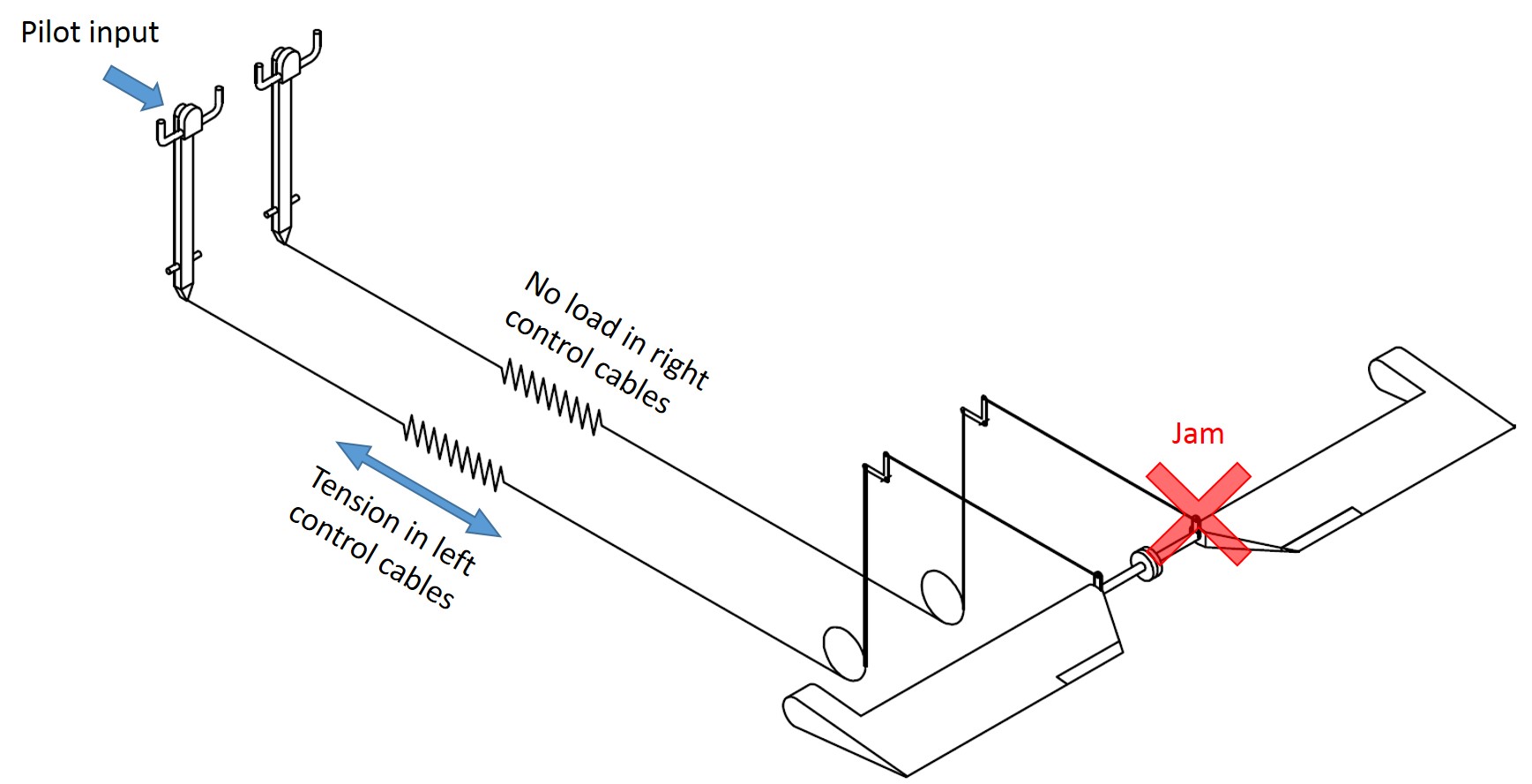
For the engineering analysis, ATR developed an analytical model supported by ground and flight testing. In the worst jammed controls scenario considered, the loads resulting from transient elevator deflections associated to a pitch disconnect at VMO would slightly exceed the certification ultimate loads. ATR considers that the structural assessment performed for the jamming loads envelope demonstrates that the structure is capable to sustain this load increase with positive strength margins.
The ATR engineering analysis also identified that the elasticity of the cables had two notable effects on the jammed control column scenario. First, the pilot effort required to activate the pitch uncoupling was excessively high at VMO. Second, the residual pitch authority allowed flight crew to decelerate the aircraft before uncoupling. In response, ATR revised the pitch channel jamming procedure.
The ATSB notes that ATR has not advised of any engineering analysis concerning the effect of transient elevator deflections resulting from pitch uncoupling activated by dual control inputs (no jamming). In that regard, ATR advise that they issued the all operators message in February 2016 and the following actions have been taken at various industry levels:
EASA released the SIB 2016‐20 to highlight the risks associated to rapid and large alternating control inputs.
EASA added the ‘Inappropriate Flight Control Inputs’ item to its risk portfolio in the frame of their risk management system, recognising this is an industry concern. It will cover the issue of simultaneous inputs, as well as inputs of large amplitude or frequency inadequate for the flight phase at the event.
Paragraph 5.3 of the ICAO Airplane Upset Prevention and Recovery Training Aid revision 3 (AUPRTA https://www.icao.int/safety/LOCI/AUPRTA/index.html) highlights the risk of upset induced by pilot excessive input.
ATR advise that at this point the continued airworthiness of the ATR 42/72 fleet is assured but recognise they must continue to analyse threats such as these. Indeed, ATR is also part of a working group at EASA level re-examining industry wide experience.
The ATSB acknowledges the extensive analysis carried out by ATR under the supervision of EASA. EASA advised that should an unsafe condition be identified then ATR and EASA will take action as per Annex I paragraph 21.A.3 of Commission Regulation (EU)No 748/2012 to ensure the ongoing safe operation of the ATR42/72 aircraft.
CASA advised that they have been involved in a comprehensive dialogue with ATR and EASA regarding the assessment of the transient elevator deflections associated with pitch disconnect to address this safety recommendation. CASA has also engaged with the ATSB throughout the investigation and intends to provide a further response to the ATSB safety recommendation following the release of the final report.
The ATSB is monitoring the ongoing safety action, especially in regard to the recommendations issued, and will update the website accordingly.
Safety messages
This occurrence was a complex event with a number of safety factors and issues identified in different domains. As such, stakeholders should study the parts of the report that are relevant to their domain and consider the applicable safety implications. The ATSB draws attention to the following:
From an operational perspective, the event shows how a flight crew whose intention was to keep the aircraft within the prescribed limitations, can inadvertently expose the aircraft to a higher level of risk. When taking action to address potential aircraft exceedances, flight crew should consider the serious consequence of applying aggressive or large control inputs at high-speed relative to the risk posed by the exceedance. Flight crew should also adhere to sterile cockpit procedures to optimise their performance in the higher risk phases of flight and apply the handover/takeover procedures to ensure dual control inputs are avoided or coordinated to maintain effective control.
In terms of continuing airworthiness, the conduct of an inspection may be the sole opportunity to detect aircraft damage. As such, to avoid a single point failure it is imperative that the form of the inspection be fit-for-purpose and for inspections to be effectively coordinated and certified.
For aircraft manufacturers and airworthiness authorities, there can be unforeseen consequences of aircraft design characteristics. It is important that when identified, these are recognised and addressed during operational service of the aircraft type.
The occurrence
1a. In-flight upset and pitch disconnect
On 20 February 2014, Virgin Australia Regional Airlines (VARA) was operating an ATR 72 aircraft, registered VH-FVR, on scheduled passenger flights from Sydney, New South Wales (NSW), to Canberra, Australian Capital Territory (ACT), and return, as Virgin Australia flights VA652 and VA657, respectively.
The captain was then rostered to operate VH-FVR on a charter flight from Sydney to Narrabri, NSW and return. That flight was scheduled to depart Sydney 25 minutes after the scheduled arrival time of the Canberra to Sydney flight.
Sydney to Canberra flight (VA652)
Having commuted from Brisbane, the first officer arrived for duty before the captain and carried out the flight planning for the Sydney-Canberra-Sydney route. The first officer had obtained the weather data, which indicated possible turbulence at all levels in the area[1] and a crosswind in Canberra gusting to 26 kt. The captain reviewed the planning, and based on the forecast weather, decided to be the pilot flying[2] for the first sector from Sydney to Canberra.
The aircraft pushed back on time, at about 1435 Eastern Daylight-saving Time,[3] but did not take off until 1454, which was later than planned due to a long taxi and holding for traffic. The departure and climb to the cruise at flight level (FL) 140[4] were uneventful.
The Canberra automatic terminal information service (ATIS)[5] current during the climb, indicated that turbulence could be expected on the approach to runway 35. At 1500, the trend type forecast for Canberra airport changed to indicate that there was moderate turbulence below 5,000 ft. This was about 6 minutes after take-off, so the flight crew were likely unaware of this change.
The cruise was uneventful and the conditions were reported as being smooth. When the flight crew commenced the descent, they were engaged in an operationally non-pertinent conversation and did not inform air traffic control (ATC) of their descent until about a minute later.
Initially, the descent target speed was 230 kt, which the captain reduced to 200 kt then to 170 kt because of the anticipated turbulence. The recorded data indicates that there was some turbulence, but nothing significant until the last 1,500–2,000 ft of the final approach into Canberra.
The aircraft landed at 1337, approximately 9 minutes behind schedule.
Canberra to Sydney flight (VA657)
While the aircraft was on the ground in Canberra, the captain reported that he checked the weather for the return flight. The revised forecast available for the area at that time indicated improved conditions. The return flight to Sydney pushed back 1 minute ahead of schedule at 1604 carrying two flight crew, two cabin crew and 48 passengers. The first officer was designated as the pilot flying for the return flight.
While the flight crew were waiting for the cabin to be readied for take-off, the flight crew engaged in some operationally non-pertinent conversation. The aircraft took off from runway 35 at 1612.
In order to minimise their exposure to the turbulence experienced during the approach to Canberra on the previous sector, the crew set the aircraft up for a maximum rate of climb, which was slower and steeper than normal. Other than the expected turbulence during the first 1,500 ft, there was nothing significant during the climb to FL170.
After passing 10,000 ft, the captain obtained Sydney ATIS ‘Yankee’,[6] which did not indicate any turbulence in the area. The captain also contacted the operator over the company frequency to provide an estimated arrival time and request fuel for the next flight. During this exchange, the captain was informed that the planned departure time for the following charter flight to Narrabri had been brought forward by 5 minutes. This reduced the available turnaround time from 25 minutes to 20 minutes.
Following this, the captain made some preparations for the Narrabri flight. These preparations included weight and performance calculations, and weather considerations. Although the captain carried out the preparations primarily by himself, there was occasional interaction with the first officer.
After briefing the captain for the approach and landing, the first officer offered to enter some details for the next flight into the aircraft’s navigation systems. The captain declined the offer, indicating that he wanted to do it himself for the experience, as this was his first flight into Narrabri as pilot in command. After that, the captain notified a cabin crew member and the first officer of the reduced turnaround time. He also expressed his concerns to both about the limited time available to complete the turnaround.
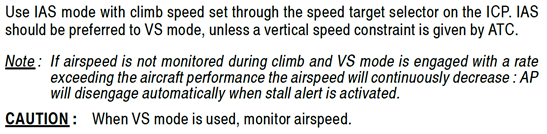
Before commencing the descent, the flight crew conducted a routine brief for the anticipated arrival to runway 16 Right. To account for the effect of the tailwind, the first officer commenced the descent 5 NM earlier than initially planned, and selected a target airspeed bug[7] to 235 kt on the airspeed indicator. The captain accepted these decisions and the descent was commenced, with the autopilot engaged in vertical speed hold mode.
The selected target descent speed was 15 kt less than the maximum operating speed of 250 kt and 35 kt above their cruising speed of 200 kt. In vertical speed hold mode, the autopilot automatically controlled the vertical speed by adjusting the elevator, while the airspeed was controlled by the flight crew using engine power.
Shortly after, the captain commented that he expected the tailwind to decrease as they descended. He indicated that this would effectively add a headwind and the airspeed would ‘pop’. This appeared to confuse the first officer a little, as he had just observed an increase in the tailwind during their last turn. The captain indicated to the first officer that he was thinking aloud and they did not discuss it any further.
On first contact with Sydney Approach, the flight crew were assigned runway 16 Left. This was different to the runway and approach that the crew had anticipated and briefed before the descent. The crew changed instrument approach diagrams, reconfigured the aircraft navigation systems, and discussed the differences from the previously briefed approach procedure.
Descending through about 12,500 ft, the captain switched on the fasten seatbelt sign. The flight crew then completed the transition-down checklist, which was held at the last item, awaiting a report from the cabin that it was secure.
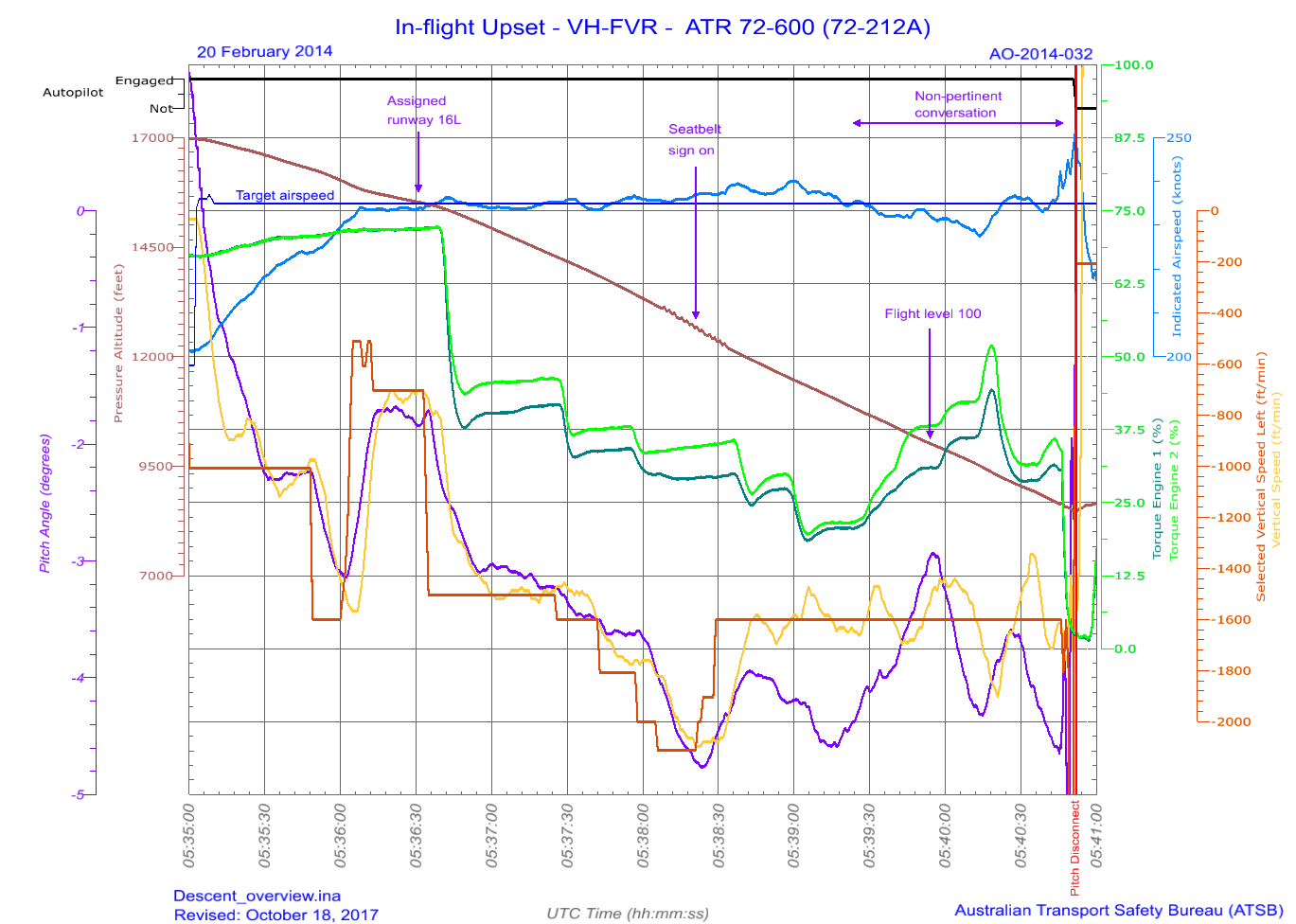
Initially, the selected vertical speed for the descent was set at -1,000 ft/min[8] and the engine power was maintained at about the cruise setting, while the airspeed increased from 200 kt to the target airspeed. After reaching the target airspeed, the engine power was reduced. The selected vertical speed was varied a number of times, ranging from -500 to -2,100 ft/min. A final setting of -1,600 ft/min was selected about 3 minutes into the descent.
About 4 minutes 30 seconds into the descent, at an altitude of about 10,600 ft, the airspeed started to decrease. At about this time, while waiting for the cabin secure report from the cabin crew, the captain began an operationally non-pertinent conversation. He expressed concern about the time available for the next turnaround and annoyance about other organisational issues. Although the conversation was primarily from the captain, there were indications that the first officer had become engaged in the discussion.
While this discussion was occurring, the first officer attempted to return the aircraft to the target airspeed by increasing the engine power. The power was incrementally increased but the airspeed continued to decrease. Without any significant change to power and pitch, this airspeed trend reversed to rise from 228 kt to 237 kt in about 13 seconds. In response, the first officer reduced the power. Ten to 15 seconds after the power reduction, the airspeed again started to decrease. The first officer again increased the engine power, but 10 seconds later reduced it to idle when the speed started to increase again.
When the aircraft was at about 8,500 ft, the captain stopped his operationally non-pertinent conversation. The airspeed continued to increase, and in an attempt to reduce the airspeed, the first officer used the touch control steering function[9] to temporarily regain manual control, and raised the aircraft’s nose by pulling back on the control column for a short period. The airspeed reduced in response to the first officer’s control input; however almost as soon as the first officer returned the nose-up input to neutral, the airspeed started to increase again.
The first officer repeated the nose-up input, but this time with a larger control input. At the same time, the captain urged the first officer to ‘grab it’. The aircraft’s response was similar to the previous input and the airspeed continued to increase after the first officer’s input was eased.
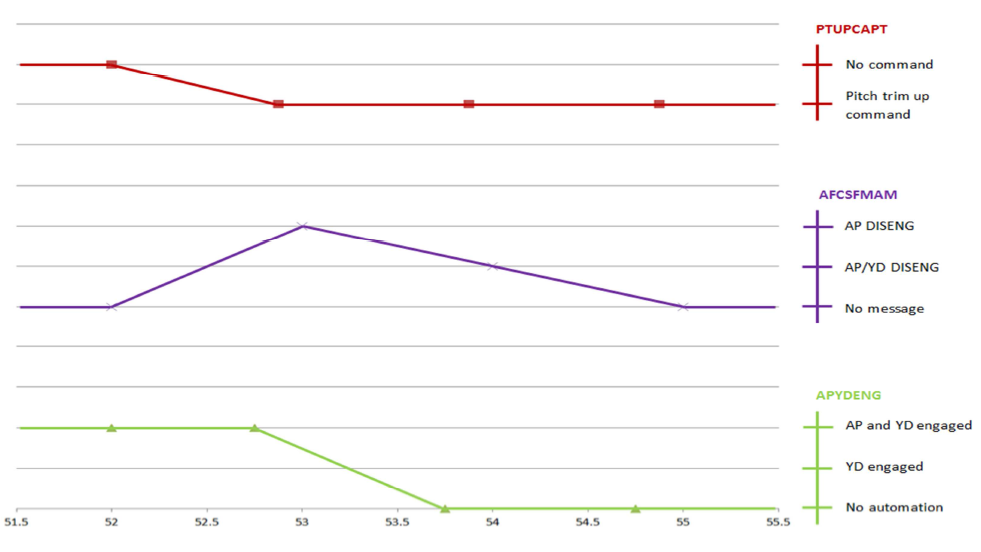
The captain, who reported he was unsure that the first officer’s actions would prevent the aircraft from exceeding the maximum operating speed, decided to take control and placed his hand on the control column. About a second later, the captain disconnected the autopilot and made a nose-up control input. Almost simultaneously, the captain instructed the first officer to ‘pull it up’, and the first officer made another slightly larger nose-up control input. At this point, both pilots were applying nose-up control inputs.
The first officer eased off on his input in a manner and timing consistent with the two previous control inputs, while the captain’s nose-up pitch input was maintained. As the aircraft’s nose-up pitch and vertical acceleration increased, the first officer began to push forward on the controls to become a nose-down input.
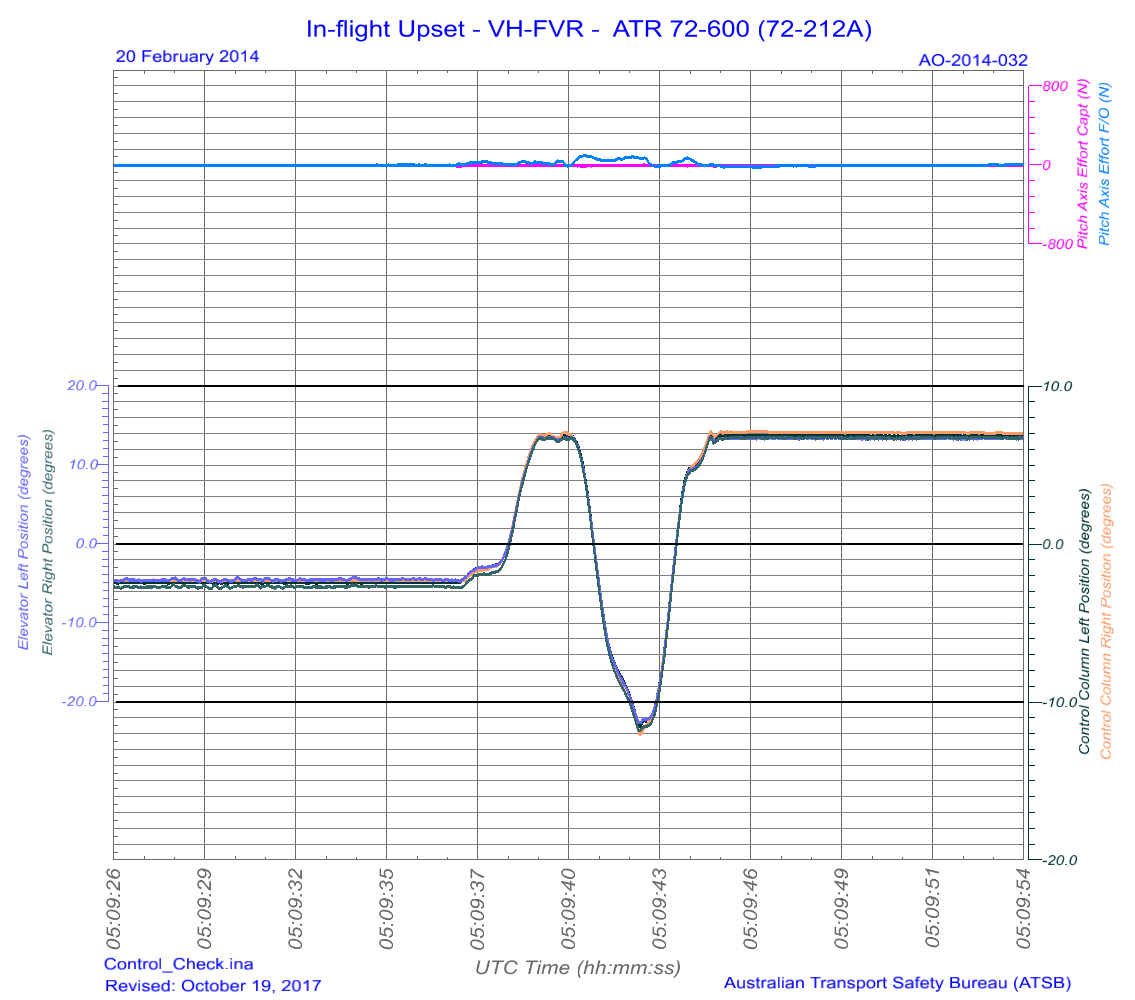
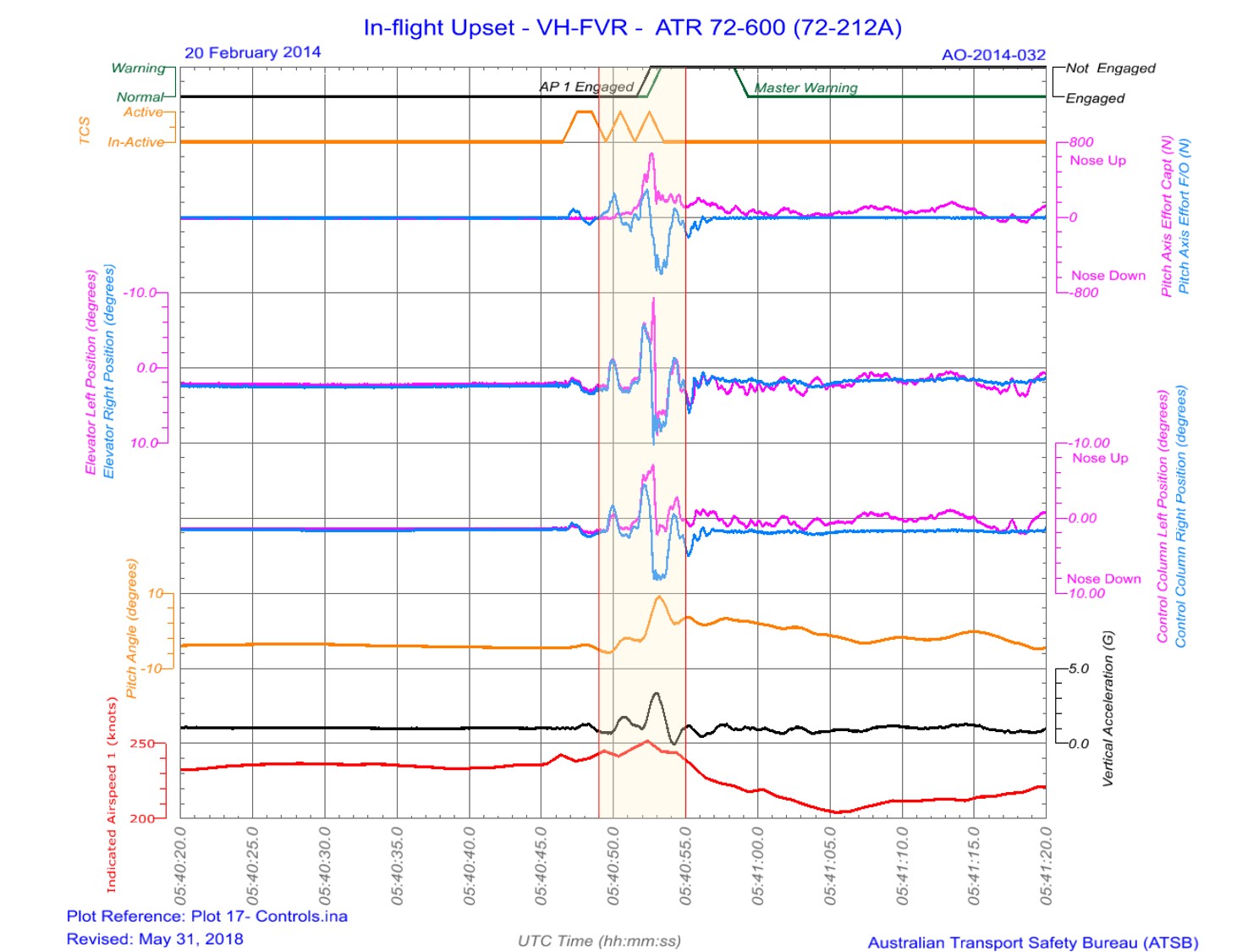
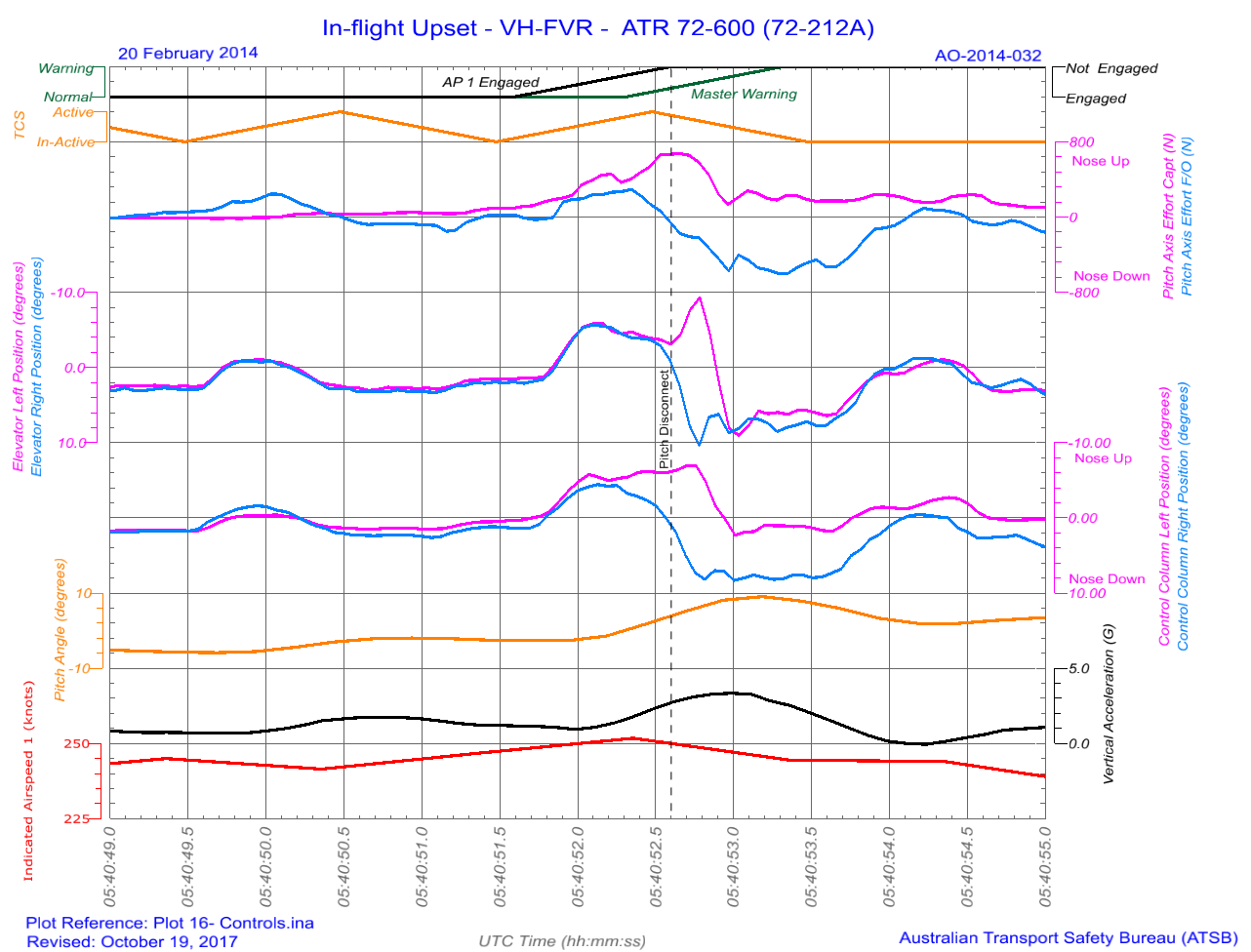
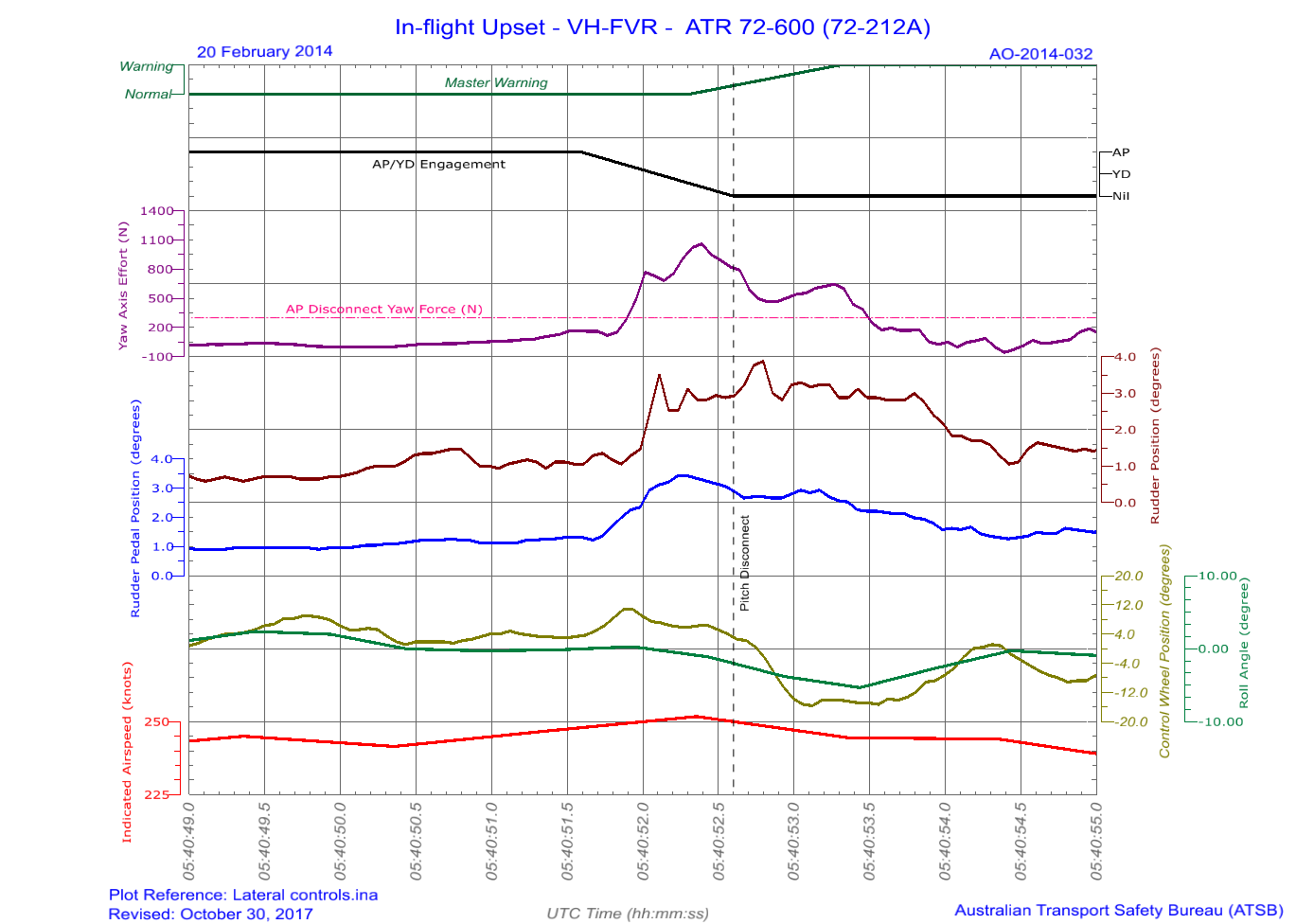
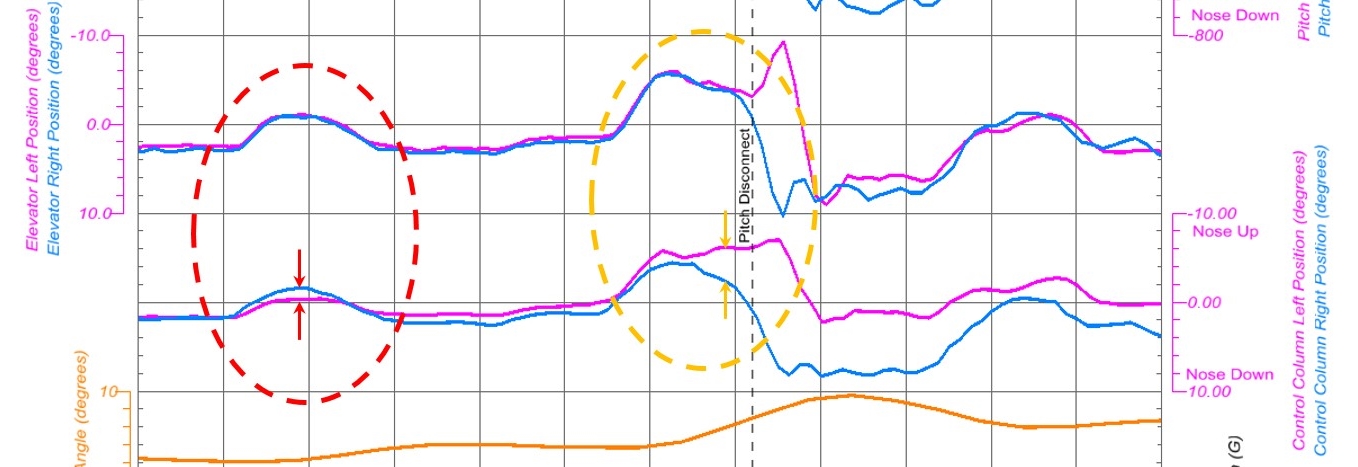
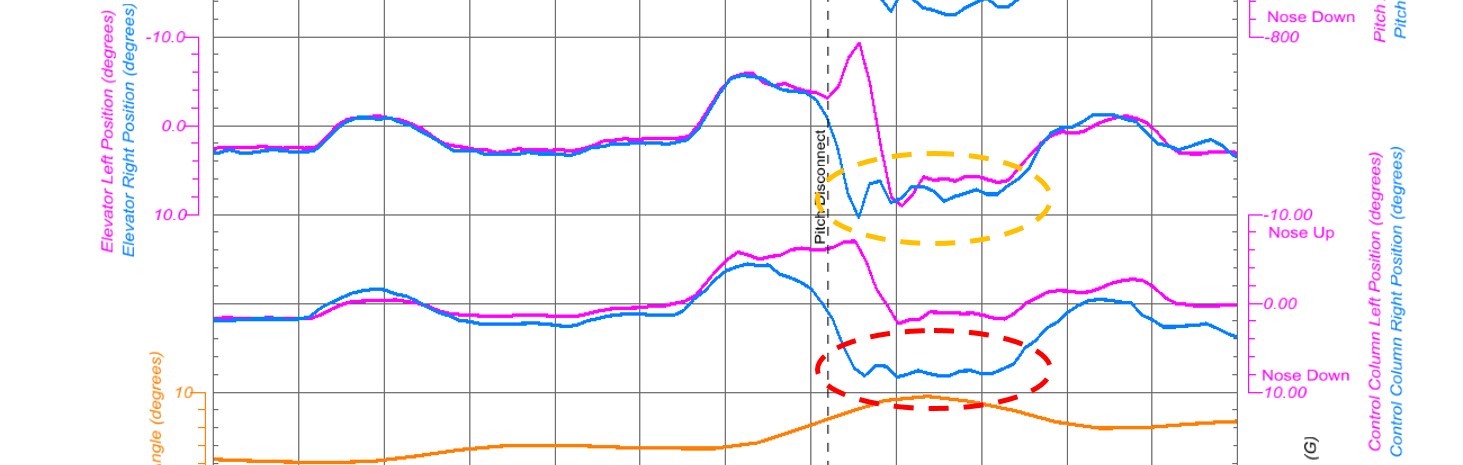
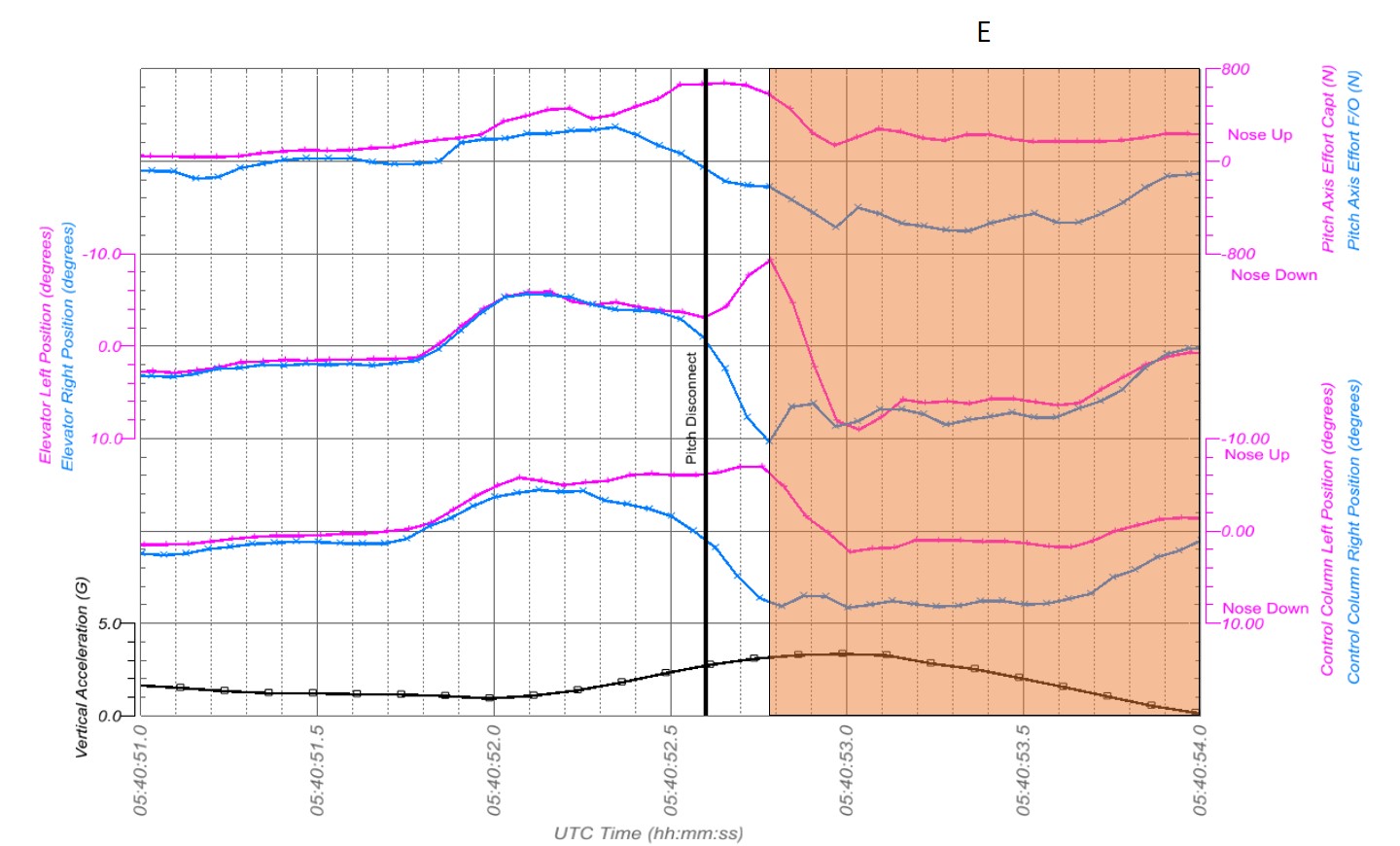
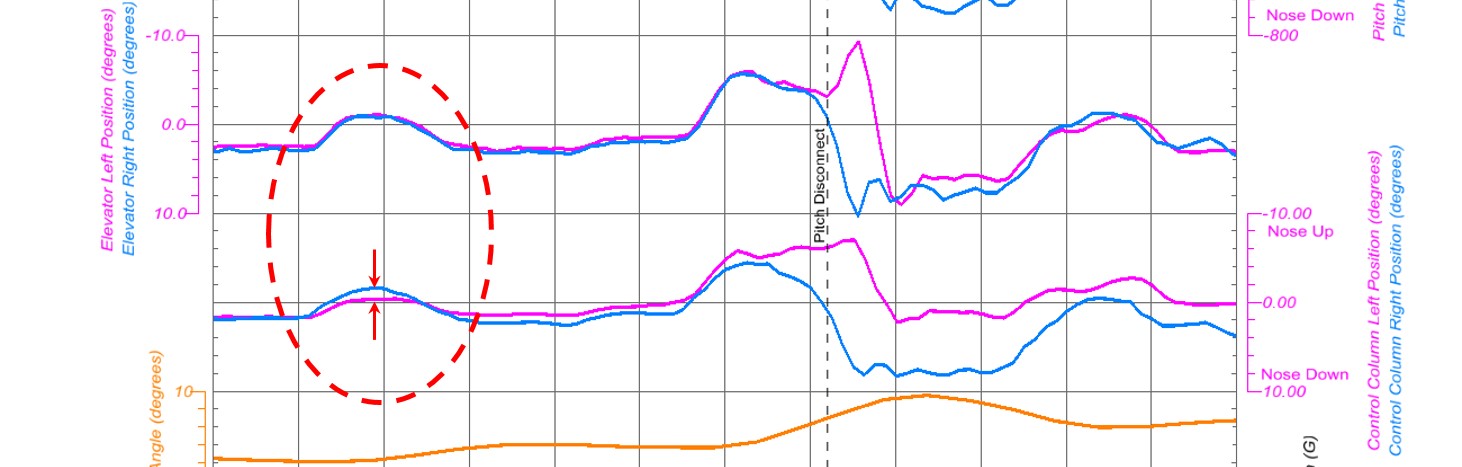
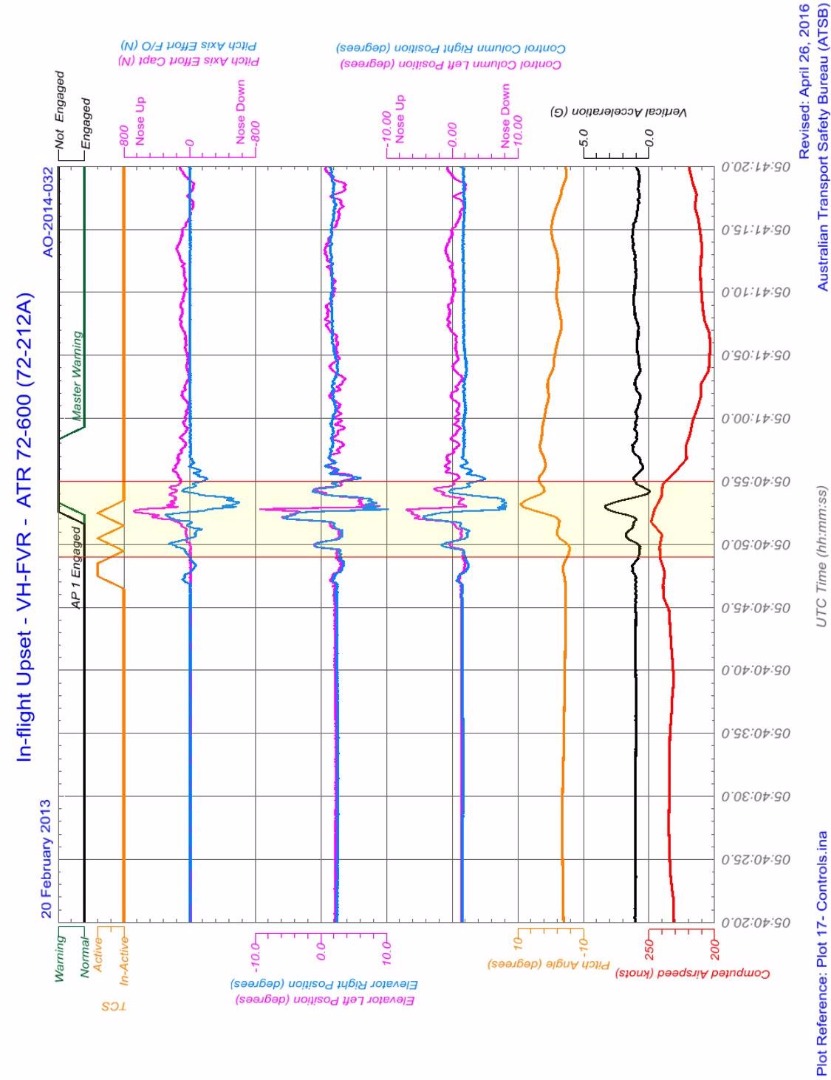
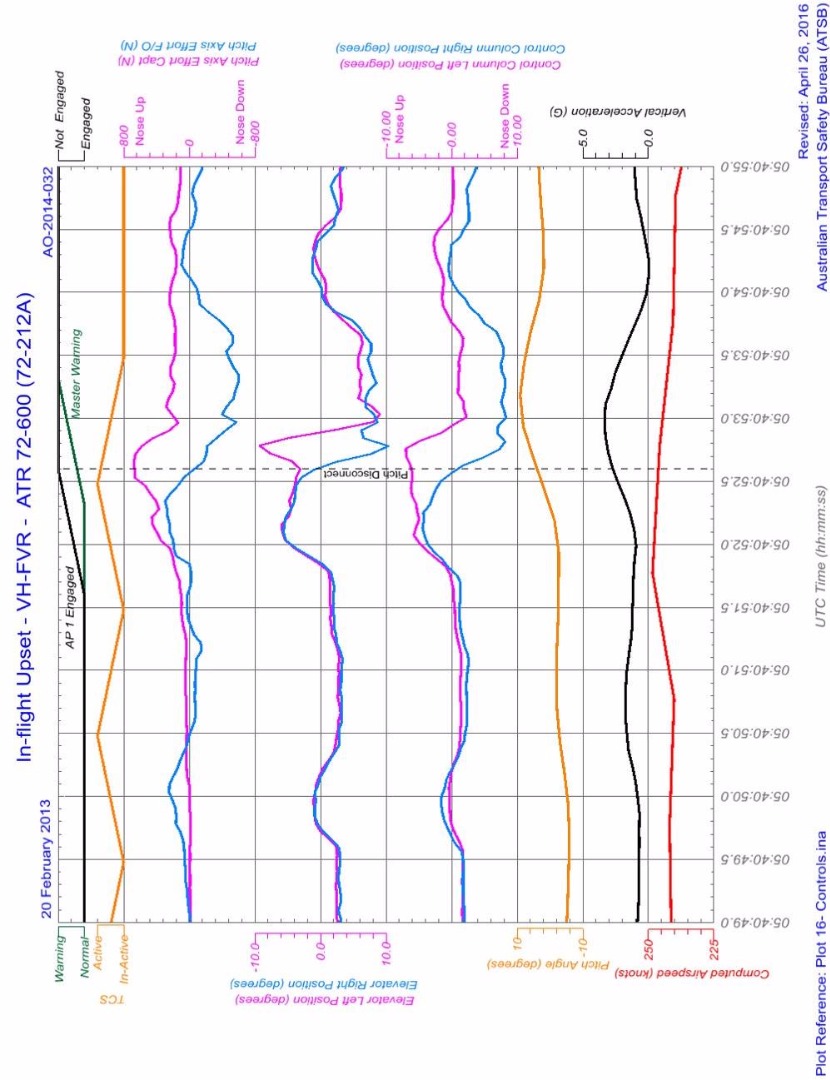
The recorded data showed that while the first officer’s control input was transitioning to a nose‑down input, the left and right elevators stopped moving in unison and rapidly moved in opposite directions. The captain’s control column moved slightly further back (nose-up) before quickly returning to a neutral position. At the same time, the first officer’s control column moved to a full forward (nose-down) position and the master warning activated. The first officer’s control column was held fully forward for about 1 second before, it too, returned to a neutral position.
The first officer reported, that during the event, the airspeed trend indicator was ‘off-the-chart’ and significantly exceeded 250 kt. It was also reported that the aircraft felt ‘heavy’ and required two hands on the controls to raise the nose. Both flight crew also reported that the aircraft did not respond to the control inputs as they expected. There was no indication that either flight crew were aware that the other was making simultaneous control inputs.
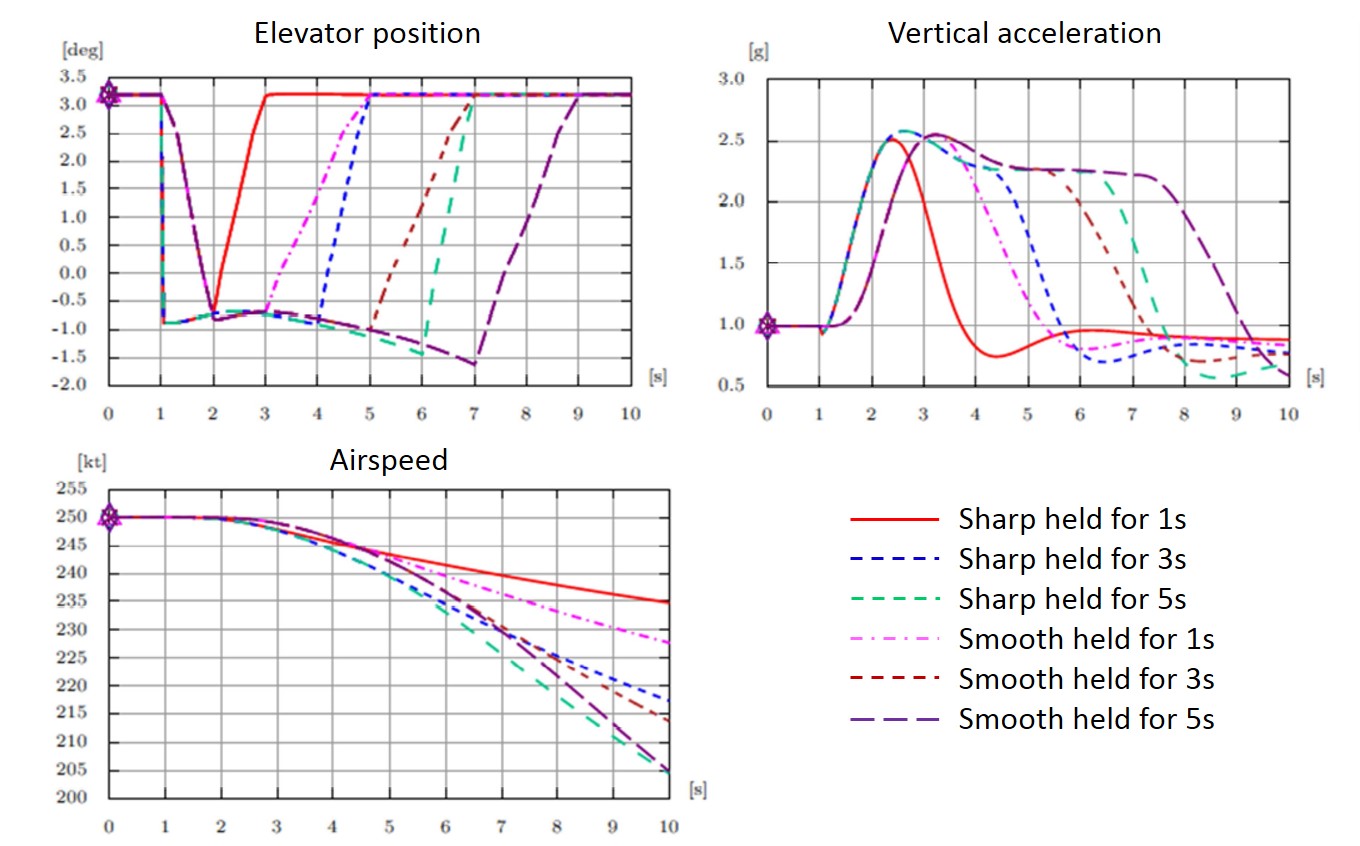
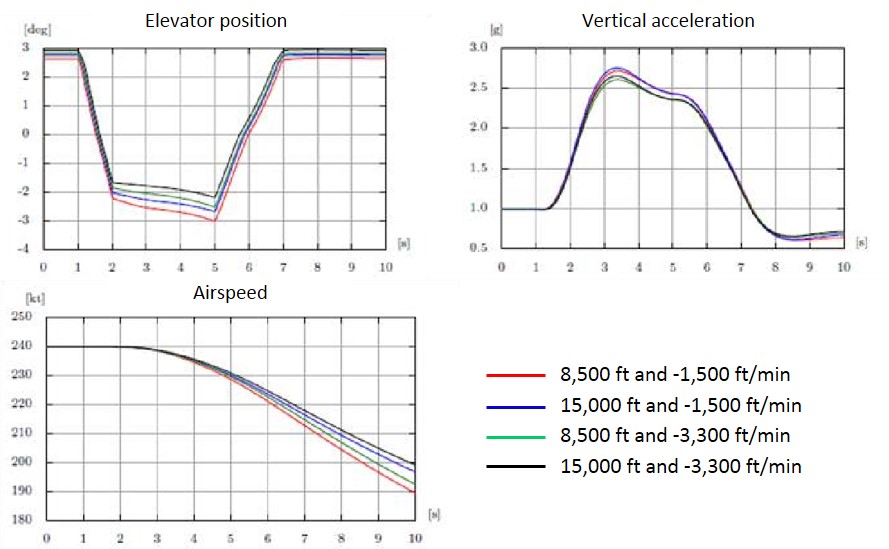
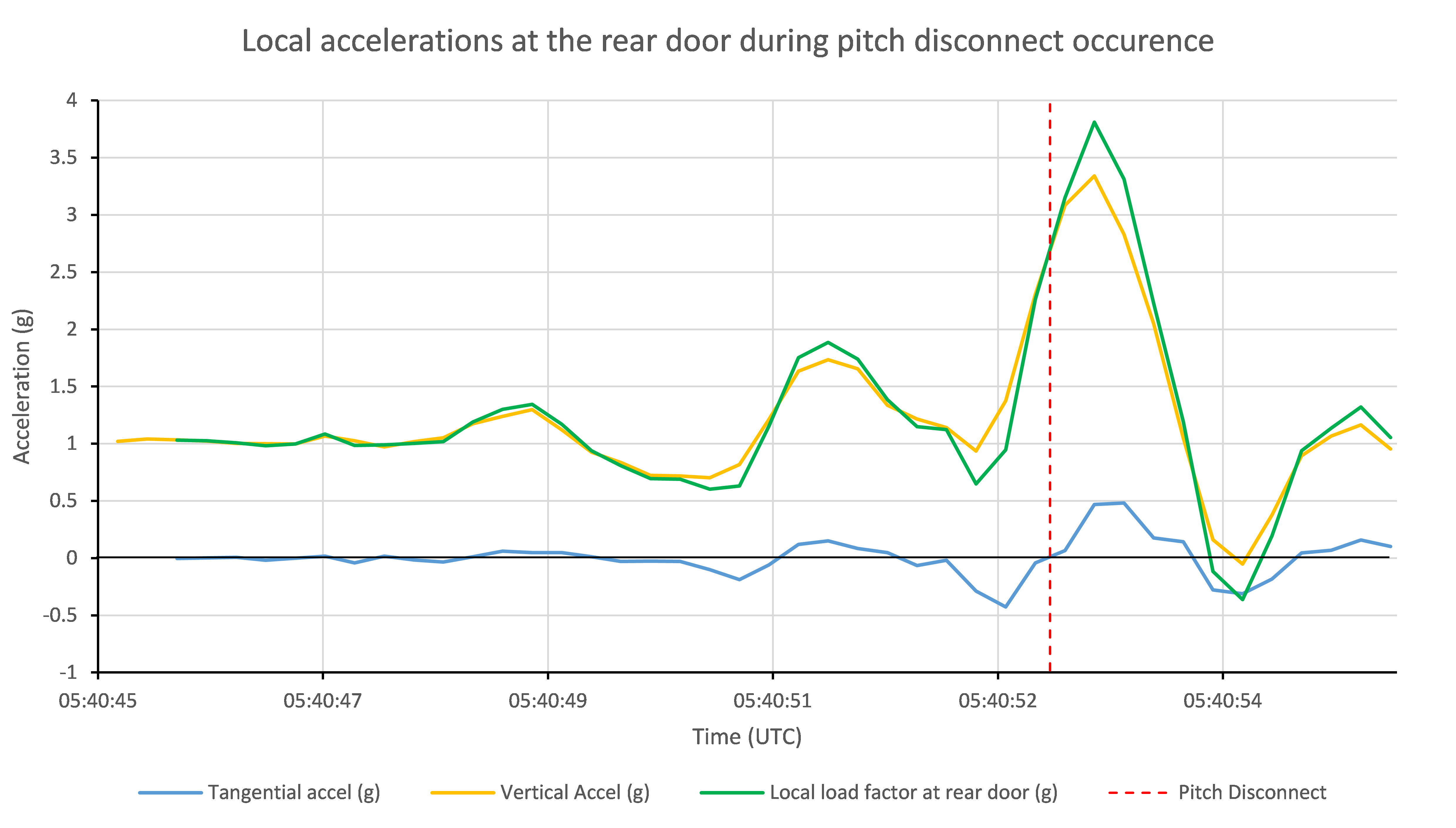
During the event, the aircraft’s pitch attitude changed from about 4.5º nose down to about 9º nose up[10] over the space of about 1 second. The vertical acceleration increased to a maximum of 3.3 g, at about the same time that the master warning activated, and reduced to 0 g about 1 second after reaching its maximum, before returning to 1 g.
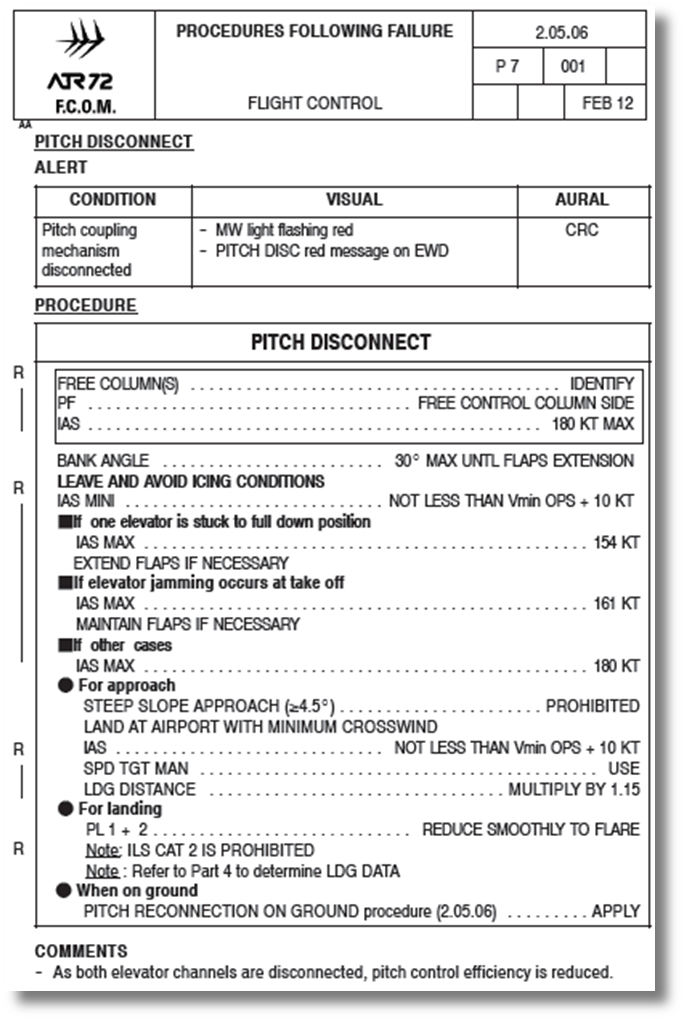
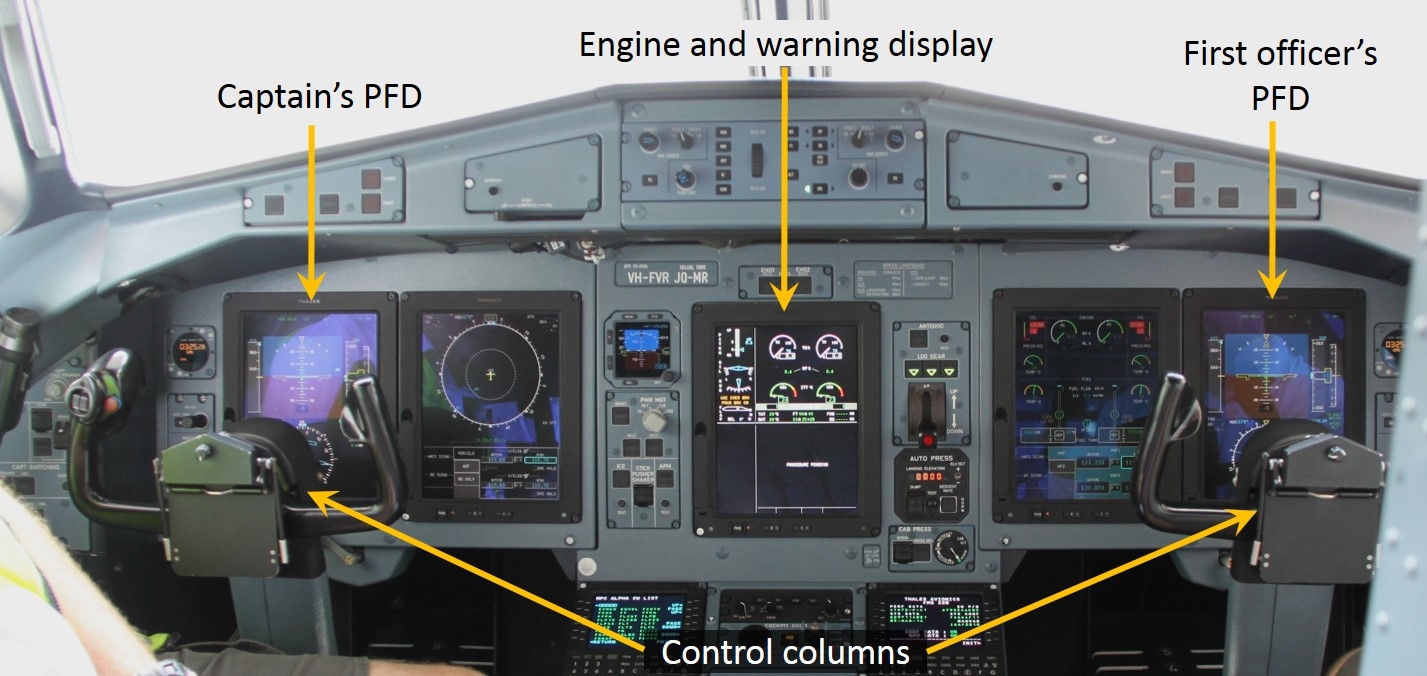
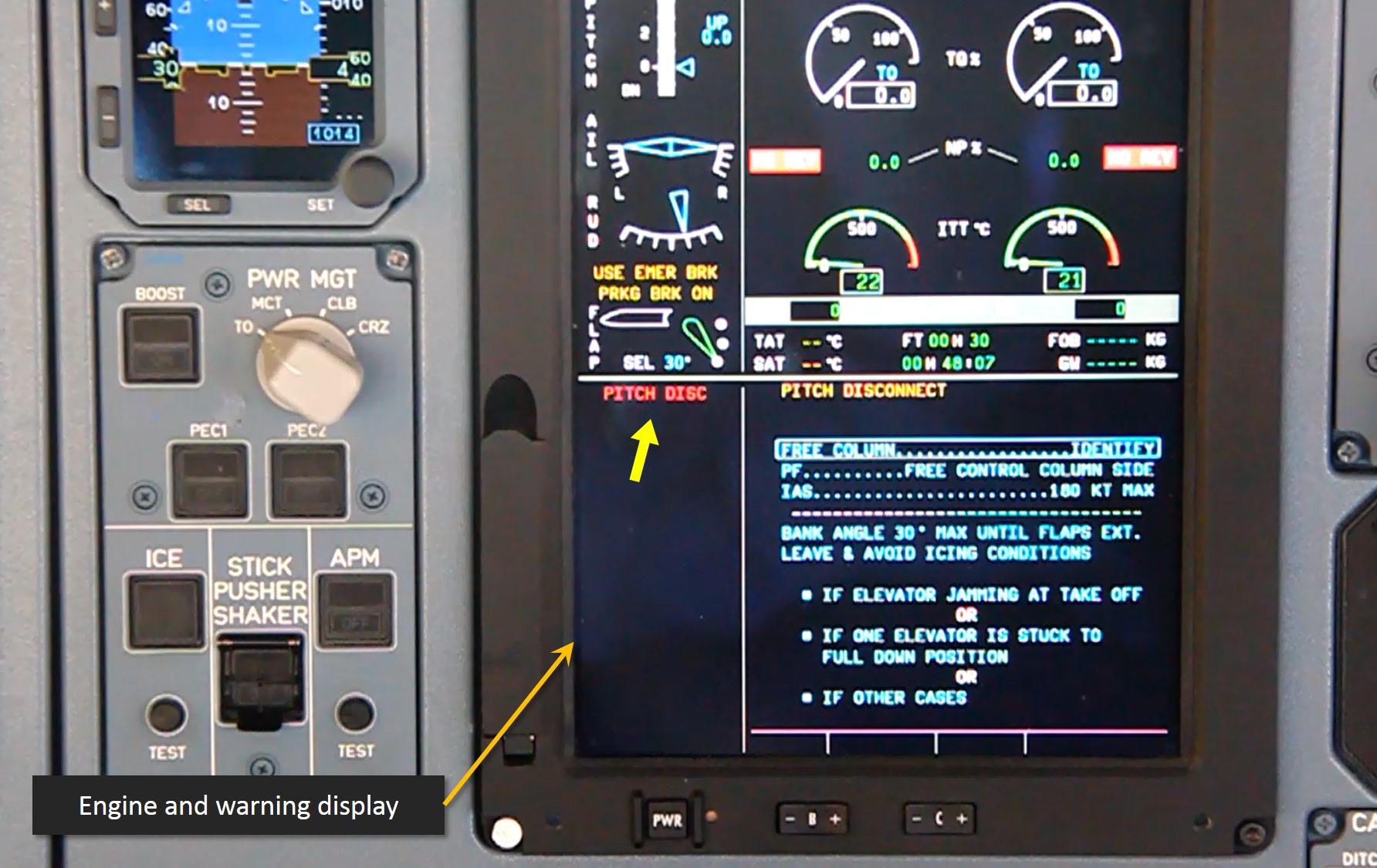
About 2 seconds after the master warning activated, the captain announced to the first officer that he had control. The first officer responded and released the controls. The first officer then advised that the master warning had activated due to a pitch disconnect.[11] The crew verified that the aircraft was under control at a stable attitude and speed, observing that it was level or in a slight descent and with an airspeed of about 230 kt. The captain requested that the speed bug be set to 200 kt and they checked the function of each control column. Running through the pitch disconnect procedure on the engine and warning display, the captain noted a speed limitation of 180 kt and requested the speed bug be set to 170 kt.
About 1 minute 30 seconds after the pitch disconnect, a cabin crew member contacted the flight crew to alert them that the senior cabin crew member (SCCM) had been injured and couldn’t feel her leg. The captain later contacted the cabin and spoke to the SCCM, who informed him that while waiting for a passenger to return to their seat, she was thrown from her seat and believed that her leg was broken. The captain informed the SCCM that they had a technical issue when they hit turbulence. He also informed her that they would have an ambulance available for her when they landed, and would get the passengers to stay on board until she had been treated.
In the next contact with ATC, the crew transmitted a PAN[12] call and asked for an ambulance to be available for an injured crewmember. They also requested radar vectors[13] and a change to land on runway 16 Right, to minimise taxi time. ATC accepted the requests and provided vectors until they were lined up on the runway for the final approach.
The autopilot was re-engaged about 2 minutes after the pitch disconnect and manually disengaged at an altitude of about 2,400 ft during the approach. The remainder of the approach and landing was manually flown by the captain, who had continued as the pilot flying, without further event.
After landing, the captain contacted the operator on the company frequency to request a bay and engineering support. They also found that the ambulance was not on its way because additional information was required before it could attend. That information was then provided.
The flight crew completed the ‘after landing’ procedures, reconnected the two elevator control systems, and the captain checked on the condition of the SCCM. Airport firefighters provided first aid until an ambulance arrived at the bay, about 10 minutes after the aircraft had parked. The SCCM was the only person injured and was transported by ambulance to a hospital where she was treated for a fractured leg. The passengers disembarked the aircraft once the SCCM had been evacuated from the aircraft.
After attending to the evacuation of the injured cabin crew, the captain called the applicable VARA duty pilot to report the incident as turbulence with pitch disconnect and injury to cabin crew member. The duty pilot relieved the crew from further flying to facilitate drug/alcohol testing and VARA safety investigation interviews. Other VARA and Virgin Australia Airlines responses included a threat assessment while the aircraft was inbound to Sydney and initiation of a safety investigation.
The VARA safety assurance manager called the ATSB 24-hour notification number at 1740 and reported that flight 657 en route from Canberra to Sydney had encountered turbulence at 10,000 ft that resulted in a suspected broken leg to one of the cabin crew. The flight crew had declared a PAN and subsequently landed at Sydney. The ATSB noted this information and deferred a decision about investigation pending more information from VARA. Late the next day, VARA emailed to the ATSB a copy of the Air Safety Incident Report that reported autopilot disconnect, moderate turbulence, pitch disconnect, master warning, and checklist action. On this basis, and with confirmation of serious injuries to the cabin crew member, the ATSB classified the occurrence as an accident/serious incident and commenced a short (limited scope) investigation on 24 February 2014.
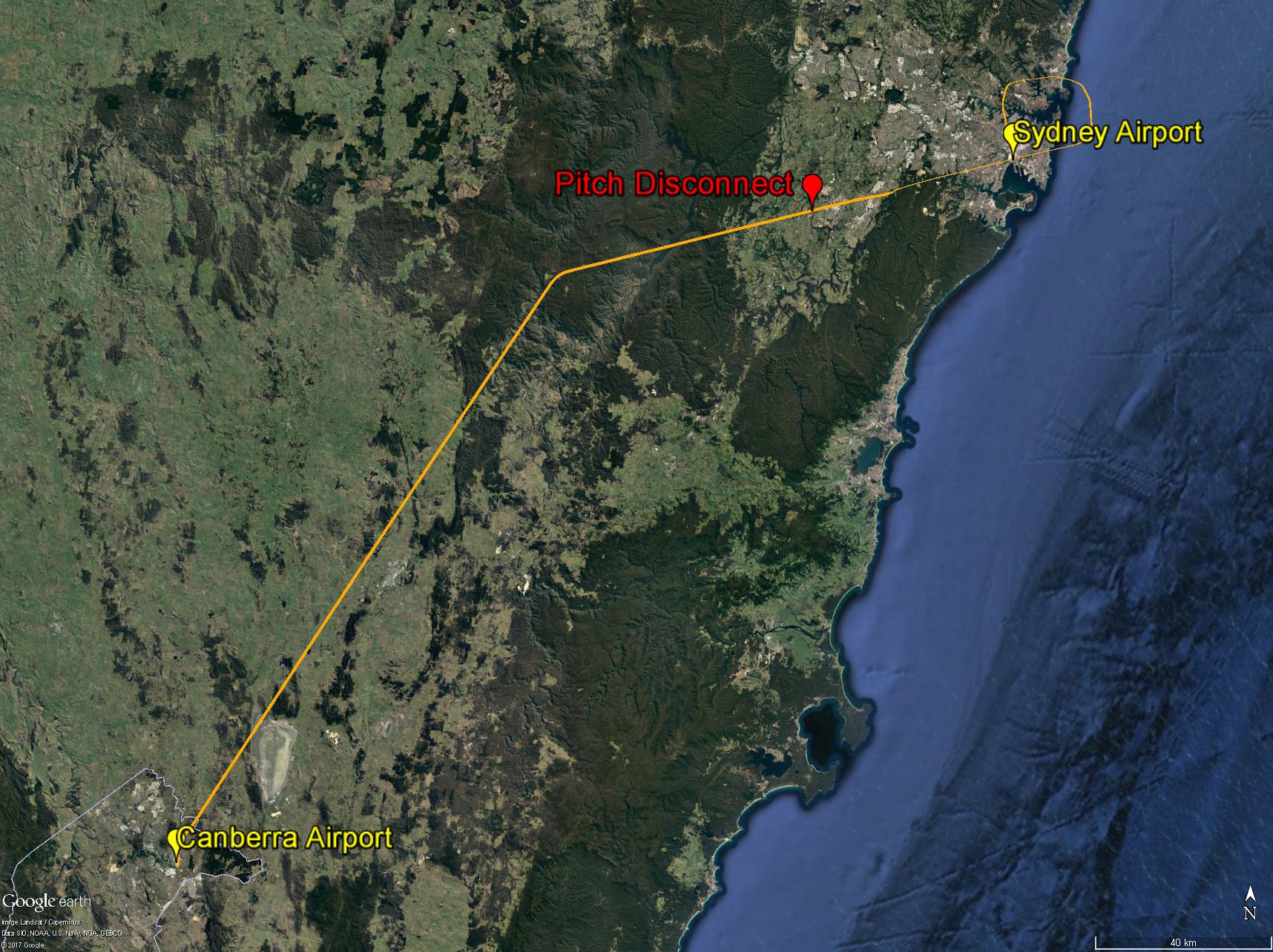
Figure 1: The flight path of VH-FVR (orange line) from Canberra Airport to Sydney Airport. The location of the aircraft when the pitch disconnect occurred is indicated by the red marker.
Source: Google Earth, annotated by the ATSB
1b. Inspection and continued operation
Post-occurrence maintenance
As a regular public transport operator, Virgin Australia Regional Airlines (VARA) was required to manage the continuing airworthiness of its aircraft fleet within an approved organisational and procedural framework. The framework implemented by VARA included a maintenance watch function to ensure that scheduled maintenance was conducted and defects were rectified by an approved maintenance organisation.
Maintenance of the ATR 72 aircraft operated by VARA was contracted to Toll Aviation Engineering (TAE), an approved maintenance organisation based at Brisbane Airport. TAE also provided line maintenance services comprising light scheduled maintenance and defect rectification as required at Sydney and Canberra Airports.
20 February 2014
On the afternoon of the occurrence, two Licenced Aircraft Maintenance Engineers (LAMEs) were on duty for TAE at Sydney. Both LAMEs were authorised to carry out line maintenance of ATR 72 aircraft and certify for all or part of that maintenance. One of the LAMEs was the designated senior base engineer for TAE at Sydney (these two engineers are referred to as senior base engineer and LAME 1 respectively).
After the pitch disconnect, and while the aircraft was inbound to Sydney, ground operations for the airline advised the engineers that the captain requested they attend the aircraft on arrival. No reason was given, but this type of request was common practice if an aircraft had a problem.
When the engineers arrived at the bay and saw the aircraft with emergency services in attendance, they ascertained that something serious had occurred. From a quick conversation with the crew, through a flight deck window, the engineers were aware there had been a pitch disconnect and possible overspeed. Given the likelihood of maintenance action, the engineers retrieved their laptop for access to the aircraft maintenance manual.
After the injured cabin crew member was evacuated and the passengers disembarked, the engineers were able to access the flight deck to consult further with the flight crew. The crew advised that the pitch disconnected during descent but were not sure how it happened. At the time, they had been responding to a rapid increase of airspeed and were unsure if the maximum operating speed (VMO) had been exceeded or if the event was related to the autopilot or turbulence. On that basis, the flight crew made an entry in the aircraft maintenance log of ‘pitch disconnect in-flight’.
LAME 1 requested the flight crew include more information in the maintenance log. From his perspective, a pitch disconnect could be associated with a range of problems and he needed more information to make an engineering assessment. Although pitch disconnects occurred occasionally in ATR aircraft during the landing roll, he was not aware of any pitch disconnect having occurred in-flight.
Given the flight crew’s uncertainty about the circumstances, LAME 1 accessed the maintenance data display of the aircraft systems computer and printed off a post‑flight report and G-meter report. These reports confirmed the pitch disconnect and recorded a number-1 engine oil pressure low warning at the same time of 1640:53.[14] There was no record of a VMO exceedance.
Recorded on the G-meter report was a maximum vertical load factor of 3.34 g at 1641. This load factor was abnormally high and prompted LAME 1 to discuss it with the crew, who were surprised about the high value. The crew added ‘associated with moderate turbulence’ to the maintenance log entry.
LAME 1 established from the aircraft maintenance manual that the maximum ‘g’ was outside of the acceptable limits for the aircraft weight. As a result, he grounded the aircraft. He identified the applicable maintenance as the Inspection after flight in turbulence and/or exceeding VMO. The data from the quick access recorder[15] was downloaded, at around this time, and transferred electronically to VARA maintenance watch. This data was forwarded to the ATR Airlines Technical Response Centre.
Based on the information provided by LAME 1, the maintenance watch engineer on duty in Brisbane confirmed the inspection that would be required and arranged for the Sydney engineers to carry out that task. Consistent with common practice at the time, maintenance watch did not issue any documentation to the engineers.
Maintenance watch requested the engineers download the cockpit voice recorder (CVR) and advised that the necessary tooling for that task had been dispatched to Sydney. Maintenance watch also advised the Sydney engineers that the aircraft was scheduled for a flight at 0800 the next morning. The Sydney engineers accepted the tasking and did not make any requests to maintenance watch for additional time, technical advice or specialist equipment.
While LAME 1 was liaising with the flight crew and accessing the post-flight reports, the senior base engineer took the opportunity to walk around the aircraft and look for damage. The senior base engineer reported that this walk-around was based on his experience that an overspeed often required a visual inspection. During the walk-around the senior base engineer stood below the tail and looked up. No damage was observed.
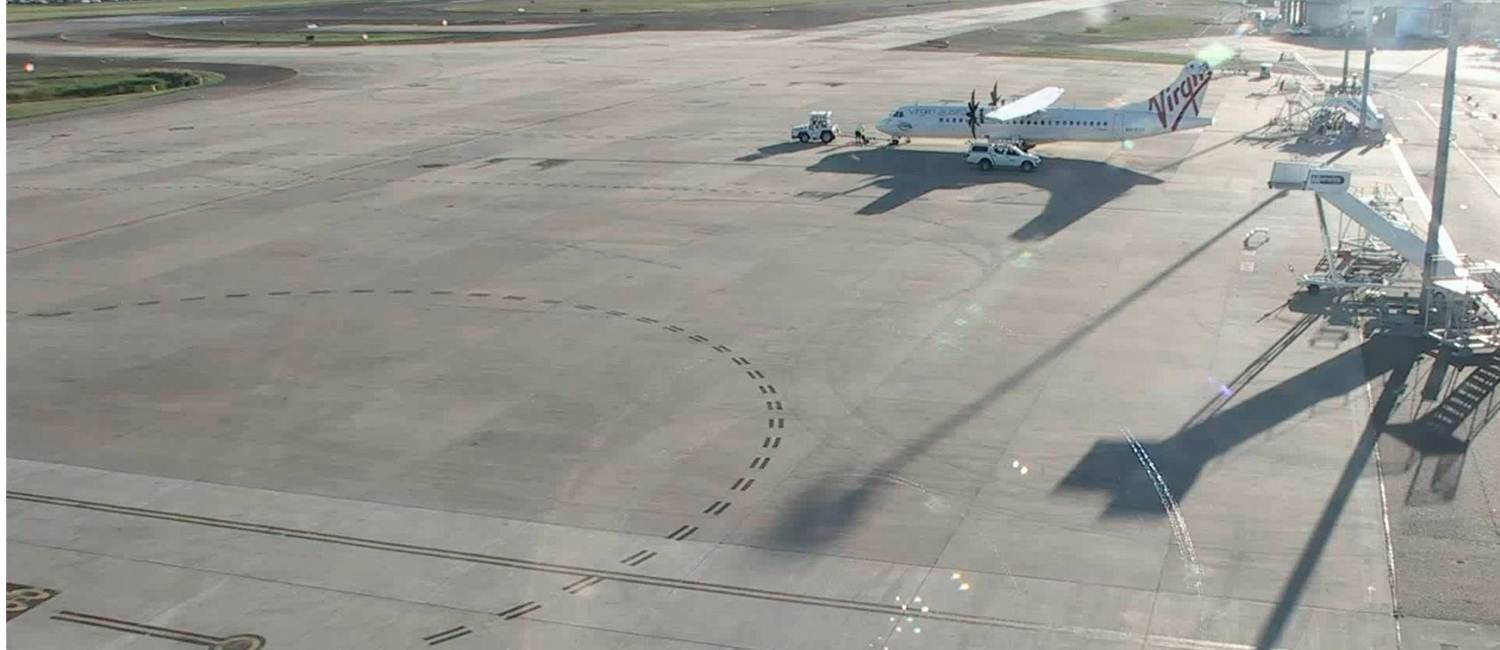
At 1837, the aircraft was towed off the arrival bay to a remote parking area. It was parked and secured. The LAMEs then left the area to prepare for the inspection (Figure 2).
Figure 2: Aircraft being parked on remote bay at 1846 on 20 February 2014 (still image copied from closed circuit TV footage) in preparation for post-occurrence maintenance.
Source: Sydney Airport (image cropped by the ATSB)
LAME 1 and the senior base engineer had started duty at 0530 and 0730, respectively, to work on another grounded aircraft. This was earlier than their rostered afternoon shift. Given this start time and the anticipated amount of work to conduct the turbulence/VMO exceedance inspection, the engineers considered that they needed assistance. The senior base engineer called in one of the other Sydney based engineers who had been on a rostered day off. The incoming engineer (referred to as LAME 2) was also authorised to perform and certify for maintenance of ATR 72 aircraft.
On arrival at the TAE office sometime between 1830 and 1900, LAME 2 participated in a discussion with the senior base engineer and LAME 1 about the occurrence and requirements of the assigned inspection. The ATR job instruction card, JIC 05-51-11 DVI 10000 Inspection after flight in turbulence and/or exceeding VMO required a general visual inspection of the fuselage, stabilisers and wings, with more detailed inspections if any anomalies were found. A detailed inspection of the wing attachment fittings was also required irrespective of the results of the general visual inspection.
The discussion involving the LAMEs was not a formal shift handover and there was no record of the matters discussed nor any directions given. The senior base engineer recalled that he discussed the turbulence inspection with LAME 2. He also recalled he then advised that he and LAME 1 would help with the tasks that required more than one person, such as the removal of overhead lockers in the cabin to gain access to the wing attachment fittings. Although the senior base engineer did not recall handing over the inspection to LAME 2 at that stage, it was his intention to do so. LAME 1 recollections did not include any detail about the initial discussion.
LAME 2 recalled that when he arrived at the office, the other engineers were printing job instruction cards for inspection of the wing attach fittings and discussing the requirements. He was advised that the g loading was outside of the acceptable limits and that maintenance watch had requested a turbulence inspection. LAME 2 was also made aware that a cabin crew member was injured and the only information provided by the crew was that the pitch disconnected in moderate turbulence.
In regard to the initial engineering response, LAME 2 recalled that the senior base engineer advised him he had carried out quite a detailed walk-around of the aircraft in daylight and found no signs of defects. From what the senior base engineer said, LAME 2 understood that the general visual inspection of the aircraft had been done and he was now required to assist with a detailed visual inspection of the wing attachment fittings. LAME 2 recalled that there was no discussion about who was running the inspection or how the inspection would be coordinated.
From about 2000, LAME 2 with the assistance of LAME 1 worked on disassembling some of the aircraft interior to access the wing attachment fittings. The senior base engineer viewed his role during this period as keeping an overview, and providing support, without being completely involved in the inspection. For some of the time, the senior base engineer was attending to another matter.
While the LAMEs were inspecting the aircraft, maintenance watch completed an event notification for ATR with the following event description (with ATSB editing for clarity):
During descent with autopilot engaged both pilots noticed the airspeed rapidly accelerate and have both reached for the controls causing pitch disconnect. During this event, the aircraft sustained 3.34 G in-flight acceleration causing the flight attendant to become injured.
The notification indicated that an in-flight turbulence inspection was being carried out and the pitch disconnect test had been carried out with nil defects reported. Maintenance watch subsequently transferred a copy of the QAR data to the ATR centre.
At about 2200, the detailed visual inspection of the wing attach area was completed with nil defects identified. All of the engineers returned to the office and the two engineers who had been on duty for up to 16 hours 30 minutes, signed off at about 2230. When the senior base engineer left the office, he considered the general visual inspections were still to be completed and this would be done by LAME 2. It should be noted that from the time maintenance watch requested the inspection, no arrangements were made by the senior base engineer or the LAMEs to borrow or hire a high-access platform such as a cherry picker or scissor lift as would be required for close inspection of the horizontal stabilisers.
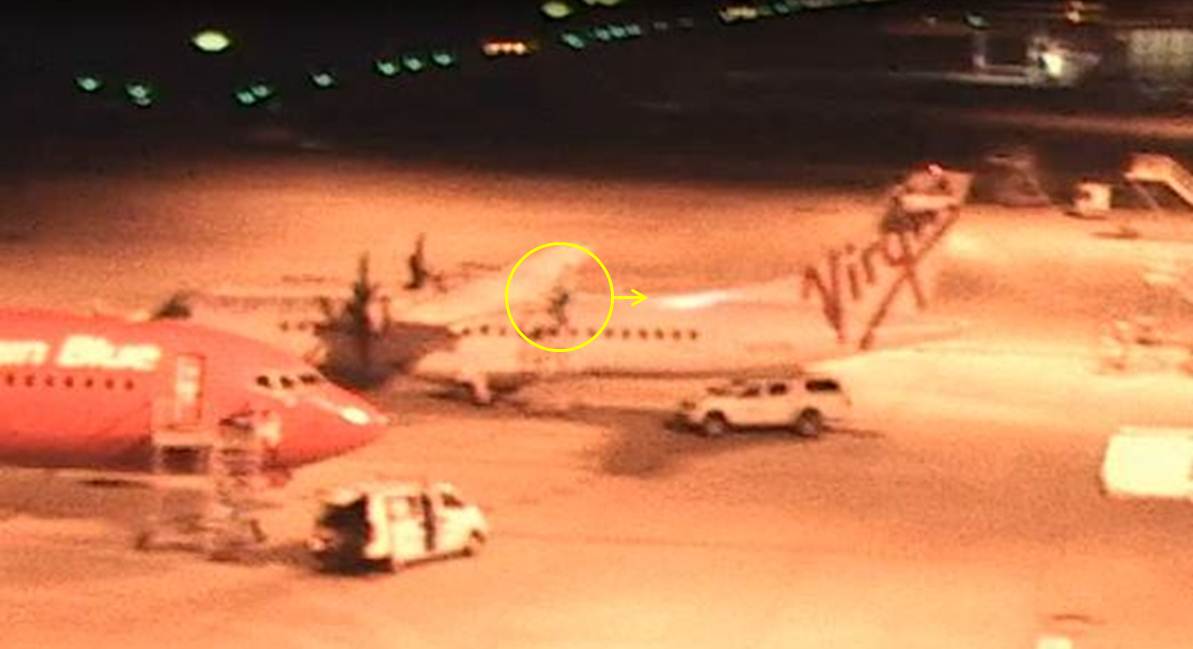
After attending to an arriving aircraft, LAME 2 returned to VH-FVR at about 2300. The engineer borrowed a nearby fixed-height stand to provide an elevated platform and positioned it to the rear of the left wing. That stand was described as the best he could get at that time and was of a height that provided a view of the top of the wing but not the top of the stabilisers. While on the stand, the engineer shone a torch over the upper surface of the wing, rear fuselage and tail (Figure 3). The engineer was on the stand for about a minute and the torchlight was directed to the rear fuselage and tail for a couple of seconds. No damage was identified.
Figure 3: Aircraft visual inspection underway at 2306:44 with LAME 2 on the stand at the rear of the left wing. The circle and arrow indicate the location of the LAME and the direction of torchlight (still image copied from closed circuit TV footage)
Source: Sydney Airport (image cropped and annotated by the ATSB)
LAME 2 described this work as a continuation of the inspection started by the senior base engineer and LAME 1. He considered that, based on the text of the job instruction card and information from the crew, as communicated in the log and from the senior base engineer and LAME 1, the general visual inspection had been carried out satisfactorily. On reflection, LAME 2 described the external inspection he conducted as a final check prior to certification rather than the general visual inspection as specified in the job instruction card.
At 2330, LAME 2 certified in the aircraft maintenance log that the Inspection after flight in turbulence and/or exceeding VMO was carried out in accordance with ATR JIC 05-51-11 DVI 10000, with nil defects evident. The engineer explained to the ATSB that he understood he was signing for the work carried out by himself and the other two LAMEs involved in the post-occurrence maintenance. Advice as to completion of the inspection and nil-defect result was communicated to maintenance watch who forwarded that information to VARA personnel and to the ATR Airlines Technical Response Centre.
Although LAME 2 was rostered to start work at 0600 the next day, he was expecting that would be changed in response to his late finish. However, as LAME 2 was finishing up in the office, the senior base engineer called to request that he start work at 0600, as rostered. LAME 2 agreed to the early start and signed off at about 2345.
21 February 2014
LAME 2 arrived at work the next morning at 0600. He, and another engineer (referred to as LAME 3), also on the morning shift, attempted to download the CVR but were unsuccessful. Consequently, the aircraft was held until a replacement CVR could be freighted from Brisbane. During the work in relation to the recorders, LAME 2 took the opportunity to inspect the interior of the rear fuselage, where the recorders were located, but did not identify any anomalies.
The number-1 engine oil pressure warning that appeared on the post-flight report was entered as a ‘discrepancy’ in the maintenance log. In the closing maintenance action, it was noted there had been no other faults or erratic indications. LAME 2 certified that the oil level was checked and an engine ground run carried out with nil defects evident. In accordance with the engine manufacturer’s data, no further action was required.
Other maintenance carried out was an operational test of the pitch uncoupling mechanism re‑engagement system and a check that the pitch uncoupling mechanism had reconnected. The rear cabin area where the senior cabin crew member was injured was also checked and no damage was identified.
On the basis that all of the maintenance log entries had been certified as closed, LAME 3 issued a certificate of release to service at 1330.
Figure 4: Aircraft being towed away from remote bay at 1215 on 21 February 2018 (still image copied from closed circuit TV footage). Note the angle of the horizontal stabiliser relative to the angle of the wings.
Source: Sydney Airport (image cropped by the ATSB)
Other maintenance, 21–24 February 2014
The following routine maintenance tasks were carried out on VH-FVR by various TAE engineers at Sydney Airport.
Line check 21 February
Line check 22 February
Weekly check 23 February
Line check 24 February
These checks included a visual inspection of the aircraft during a ‘walk-around’ at ground level. No defects were identified. The line check carried out on 24 February was the last recorded maintenance before a flight to Albury on 25 February.
Further operation and suspected birdstrike
Subsequent to the post-occurrence maintenance completed on 21 February 2014, the aircraft was operated on a further 13 flights. The respective flight crews did not record any anomalies or defects during their pre-flight inspections and there were no reports of any abnormal aircraft handling characteristics.
On 25 February, aircraft VH-FVR was operated on a scheduled passenger flight from Sydney to Albury, NSW. On descent into Albury, the aircraft passed in close proximity to birds, which alerted the captain to the possibility of a birdstrike on the left side of the aircraft. There were no in-flight indications that a bird had struck the aircraft but after landing, the captain noticed the aircraft’s pitch trim system fluctuated abnormally.
The captain conducted a walk-around inspection and, although there was no evidence of a birdstrike on the left of the aircraft, he identified a dent in the top leading edge of the vertical stabiliser. The captain advised the operator’s maintenance watch who dispatched a LAME to Albury to inspect the aircraft.
The LAME, who was LAME 1 from 20 February, used scissor lift equipment to gain access to, and inspect the stabiliser. The LAME did not find any evidence of a birdstrike, such as blood or feathers. However, the LAME did find indications of significant structural damage to the horizontal stabiliser, and contacted maintenance watch to cancel the following flights. Upon further examination and discussion with VARA, it became evident that the damage found at Albury was probably a consequence of the occurrence on 20 February.
Late the next day, VARA emailed to the ATSB photos of the damage and advice that the damage found at Albury was probably a consequence of the occurrence on 20 February. On the following day, the ATSB upgraded the investigation and assigned a senior investigator to lead a team of investigators.
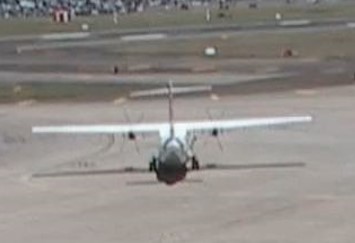
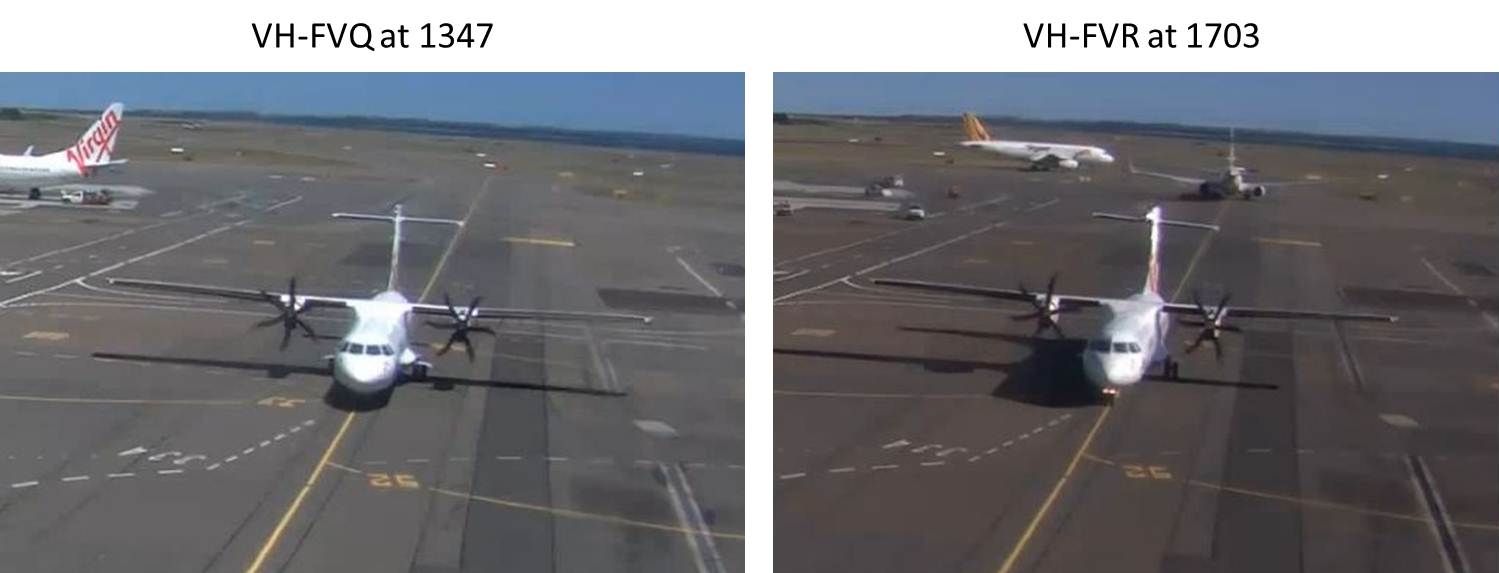
Due to the continued operation of the aircraft for an additional 13 flights, the exact extent of damage at the time of the pitch disconnect event could not be conclusively determined. However, gross distortion of the horizontal stabiliser was visible on the CCTV footage of the aircraft taxiing to the bay after landing following the occurrence flight (Figure 5).
Figure 5: Images from Sydney Airport CCTV footage showing the deformation to the horizontal stabiliser of VH-FVR (right) as compared to an undamaged ATR 72, VH-FVQ (left).
The image was taken as the aircraft taxied to the bay on 20 February 2014. Note that the left tip of the horizontal stabiliser VH-FVR is visibly lower that the right when compared to the angle of the wing. Source: Sydney Airport
The ATSB examined the aircraft in Albury, New South Wales, with the horizontal stabiliser in place on the aircraft and with it removed. The aircraft manufacturer examined the aircraft in Albury before transporting the horizontal stabiliser to their facilities in Italy for detailed examination and testing.[16] These examinations identified substantial structural damage to the horizontal stabiliser.
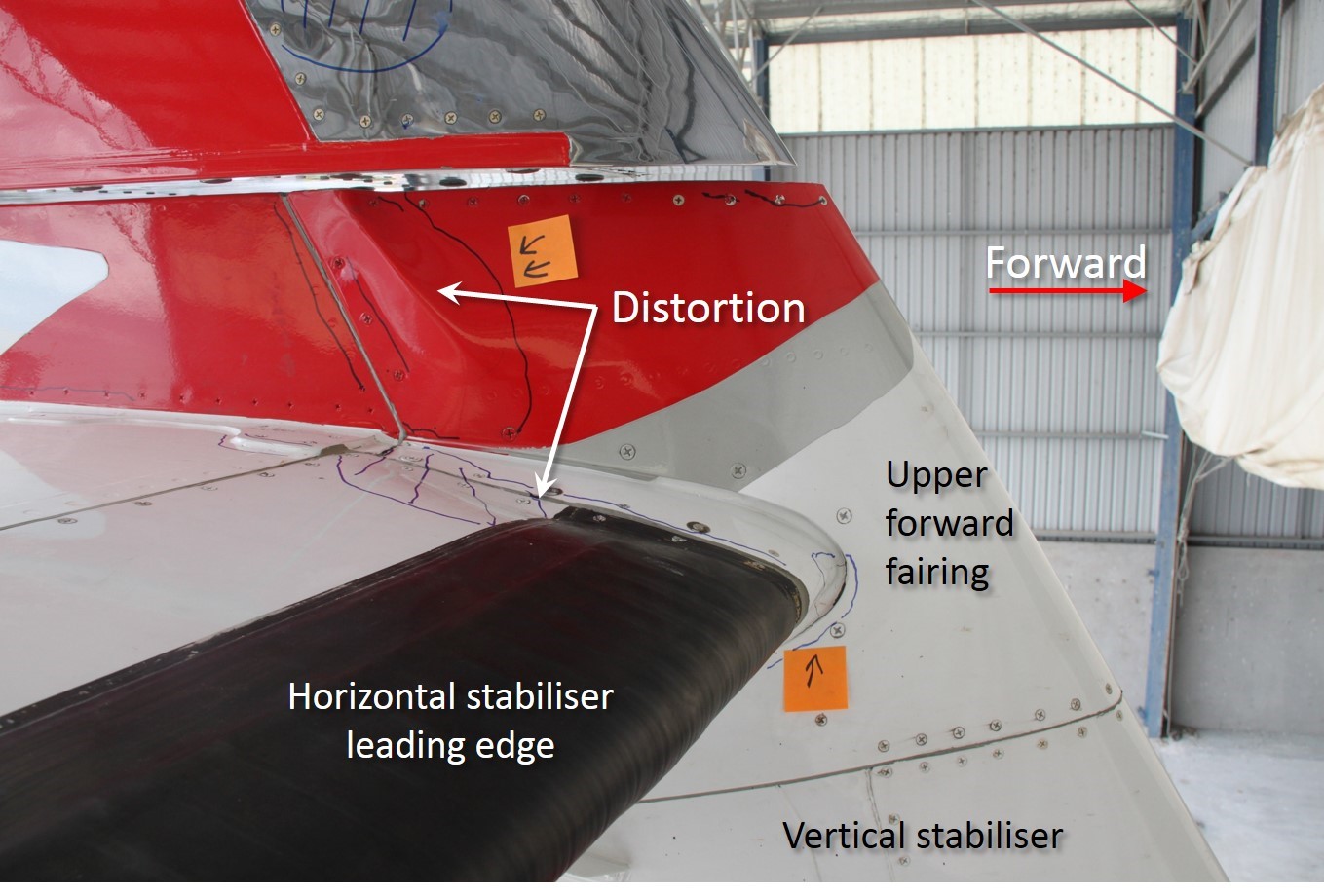
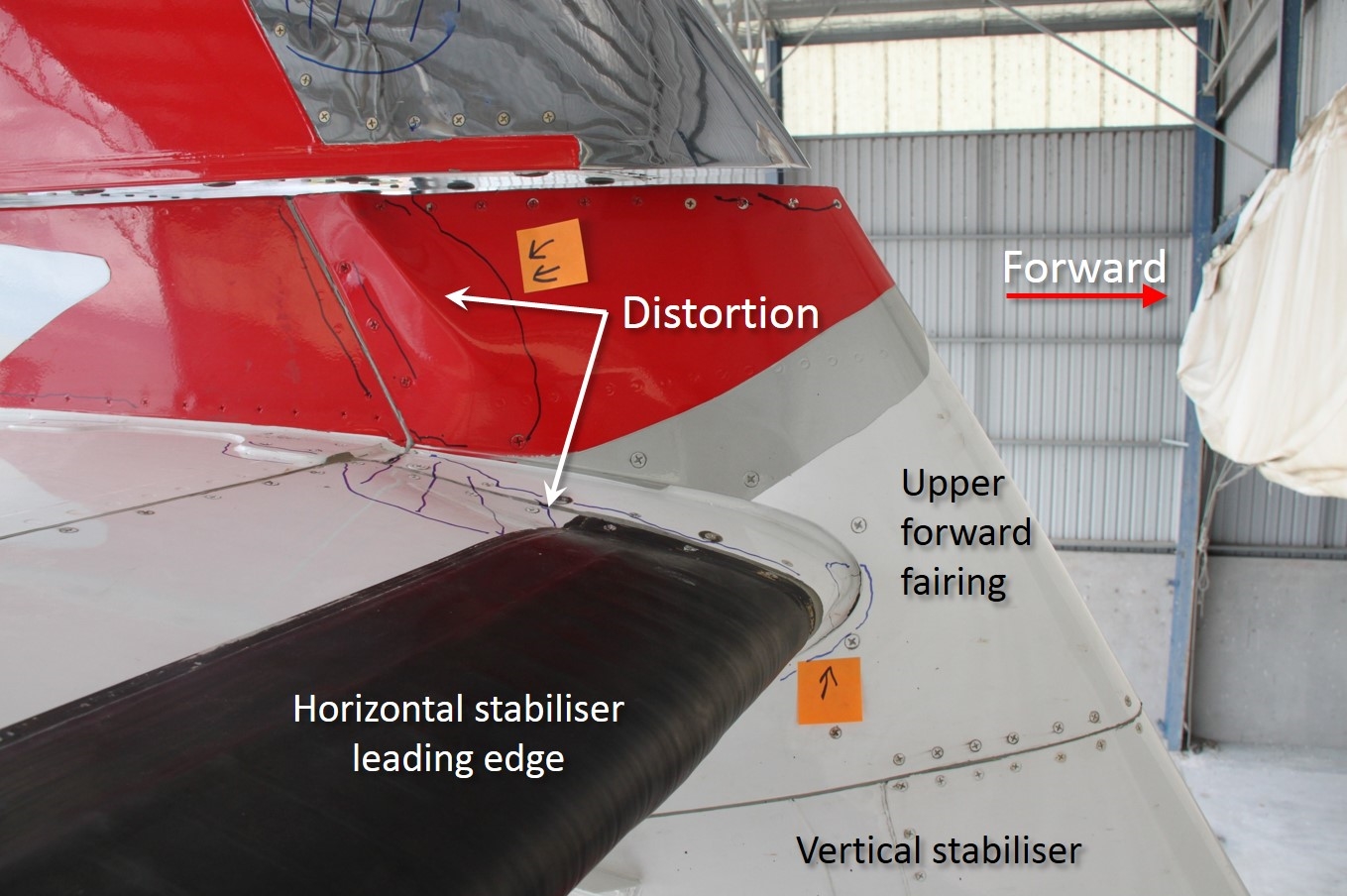
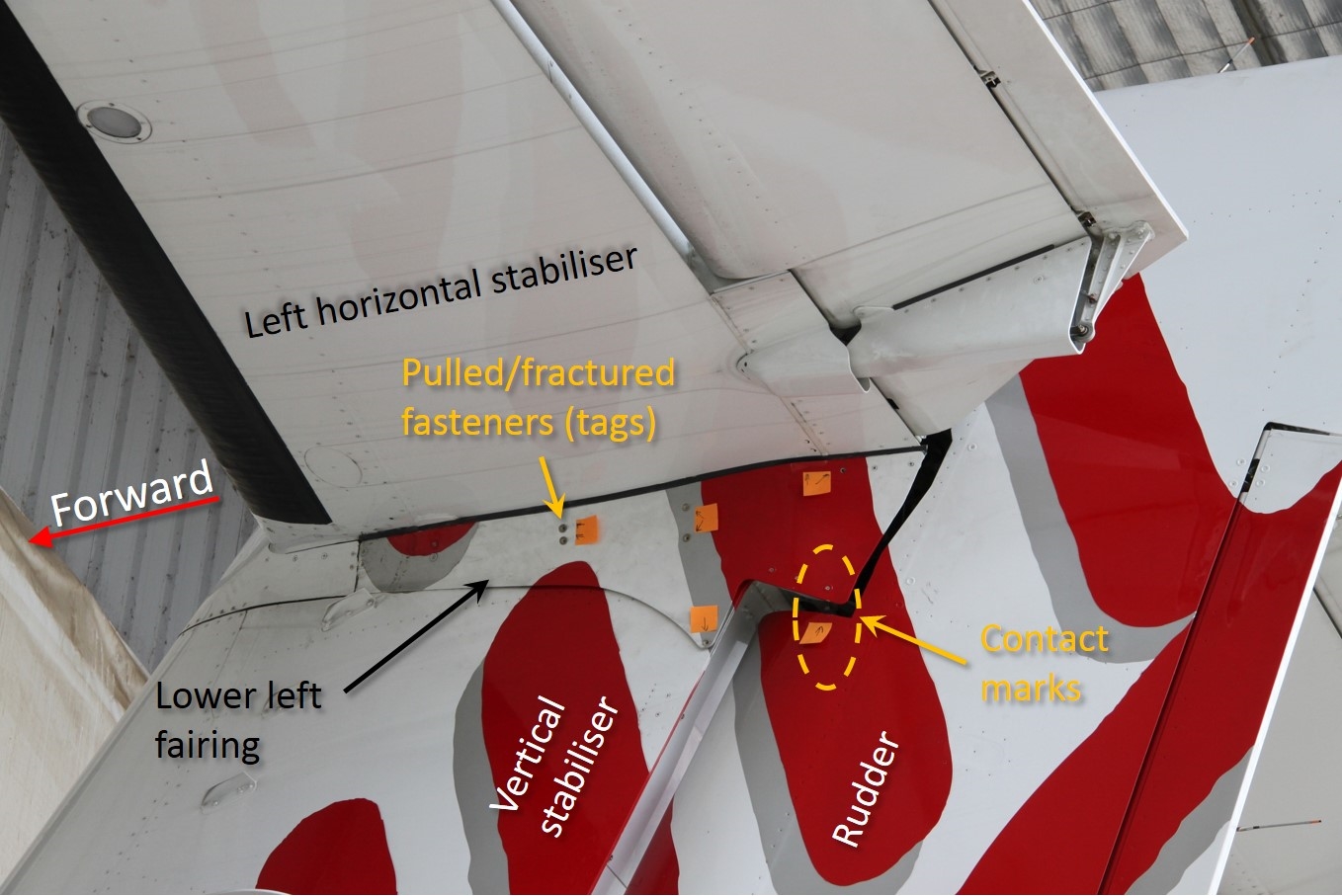
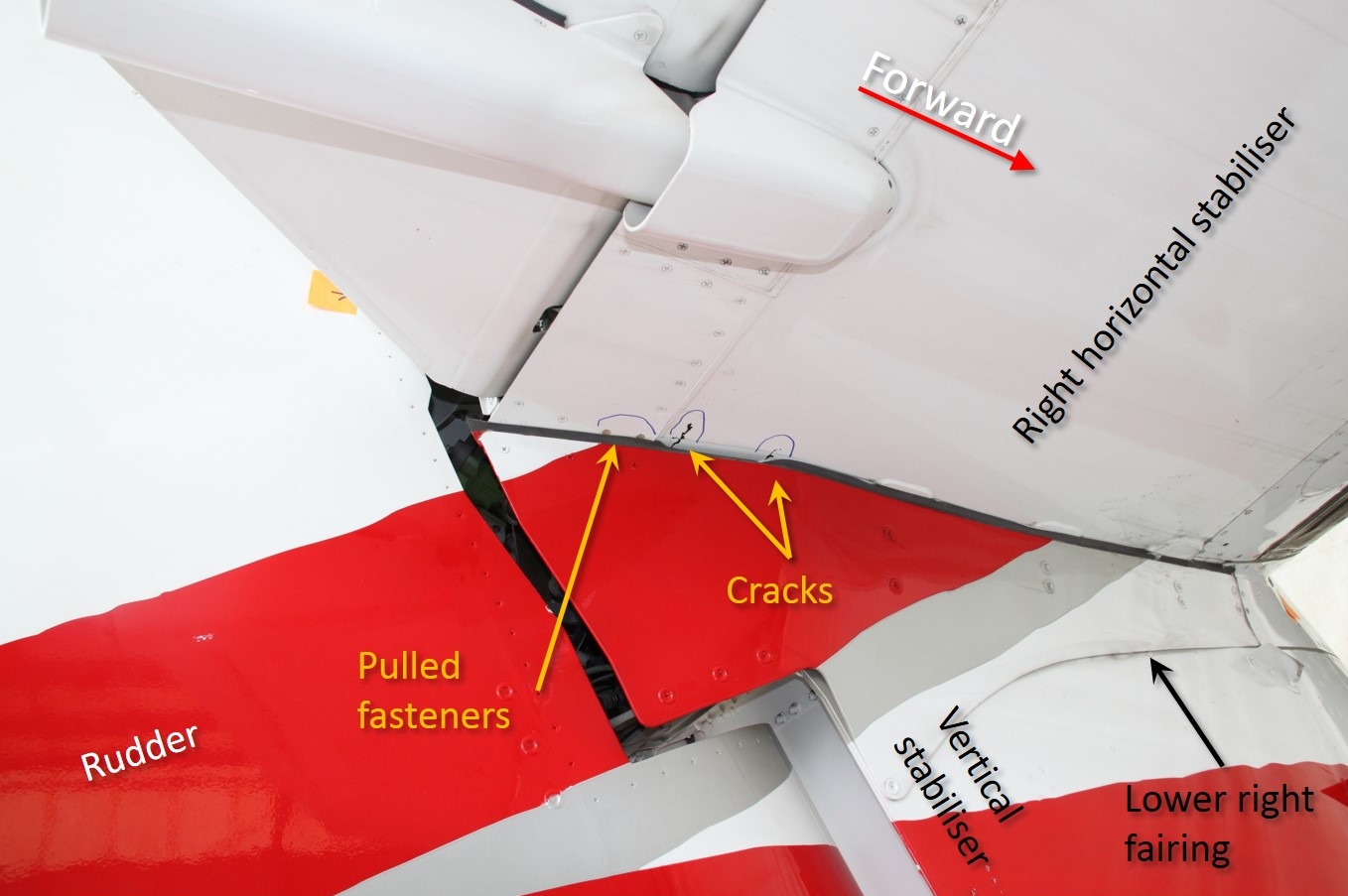
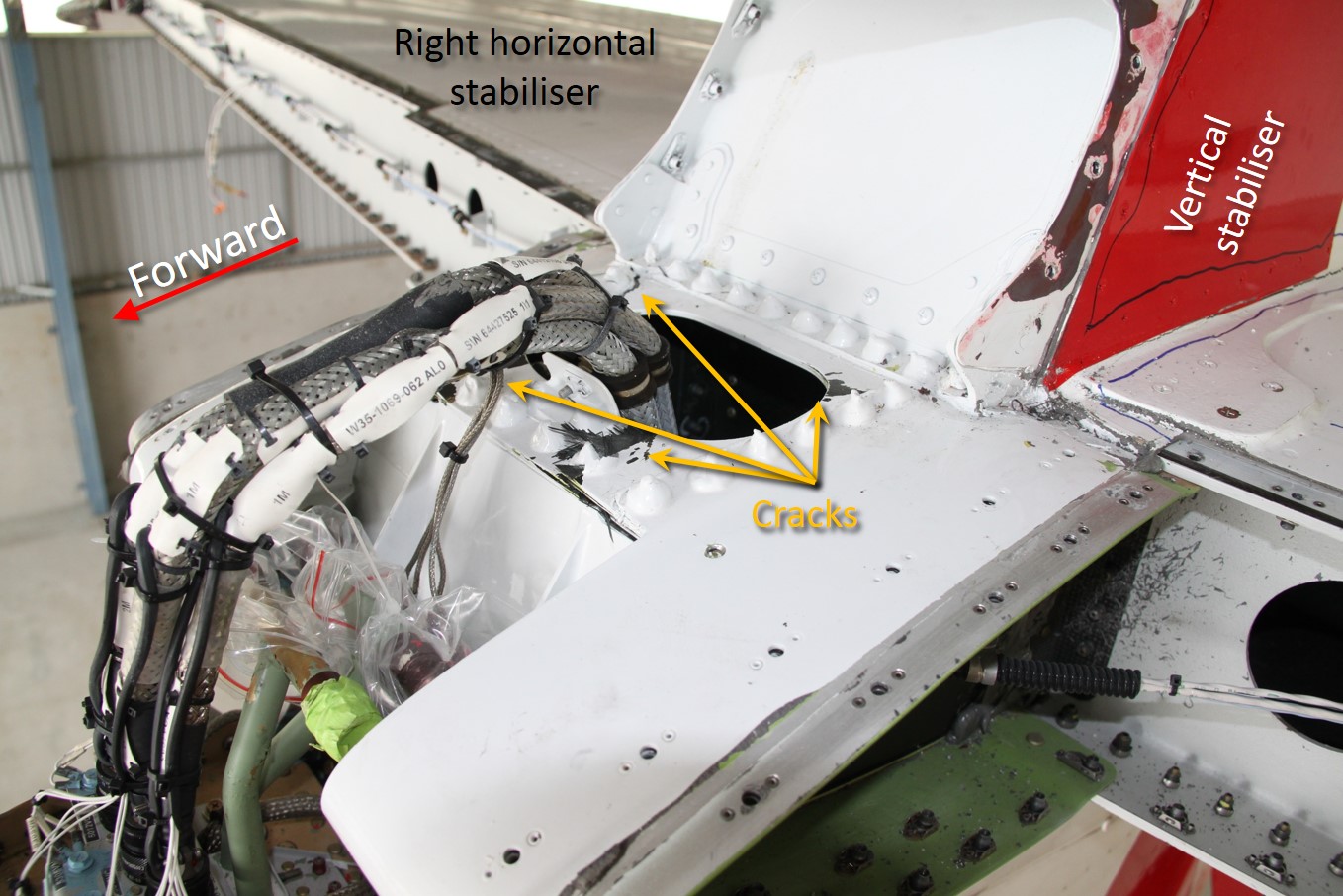
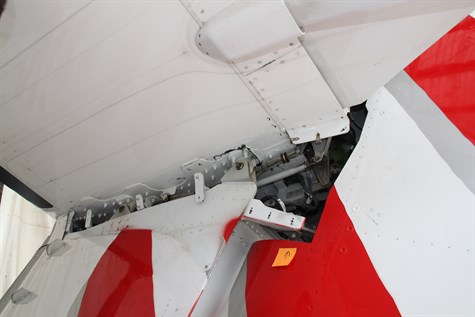
In addition to the gross deformation of the horizontal stabiliser, damage was observed prior to removal of any fairings and access panels. The visible damage included:[17]
distortion of upper forward fairing (Figure 6)
distortion of the upper side of the right hand horizontal stabiliser leading edge (Figure 6)
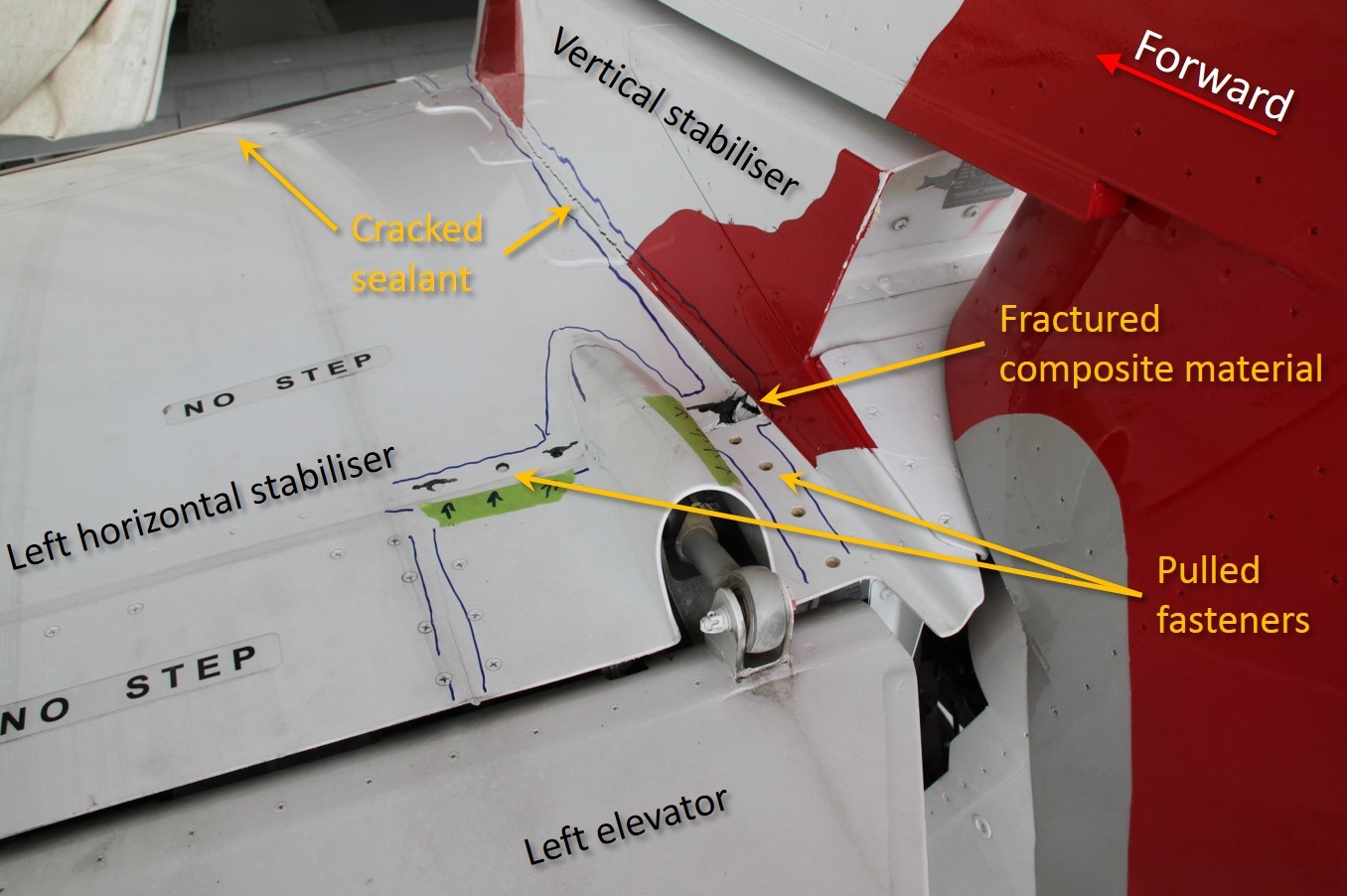
cracked sealant between horizontal and vertical stabilisers, and horizontal stabiliser leading edge (Figure 7)
fractured and exposed composite material in the upper skin panel (Figure 7)
fasteners pulled through the composite material (Figure 7 and Figure 8)
contact marks between the lower left fairing and rudder (Figure 8)
cracking of the horizontal stabiliser right lower skin panel (Figure 9).
Figure 6: Distortion in the upper forward fairing right side horizontal stabiliser leading edge prior to removal of any fairings or access panels.
Source: ATSB
Figure 7: Damage visible on the upper left side of the horizontal stabiliser included cracked sealant, fractured and exposed composite material, and fasteners pulled through the composite material
Source: ATSB
Figure 8: Damage visible on the lower left side of the horizontal stabiliser included fasteners pulled through the lower left fairing, fractured fasteners for securing the fairing and contact marks between the fairing and the rudder.
Source: ATSB
Figure 9: Damage visible on the lower right side of the horizontal stabiliser included fasteners pulled through the lower skin and cracks in the lower skin panel.
Source: ATSB
Further damage was identified when the fairings and leading edges were removed. That damage included:
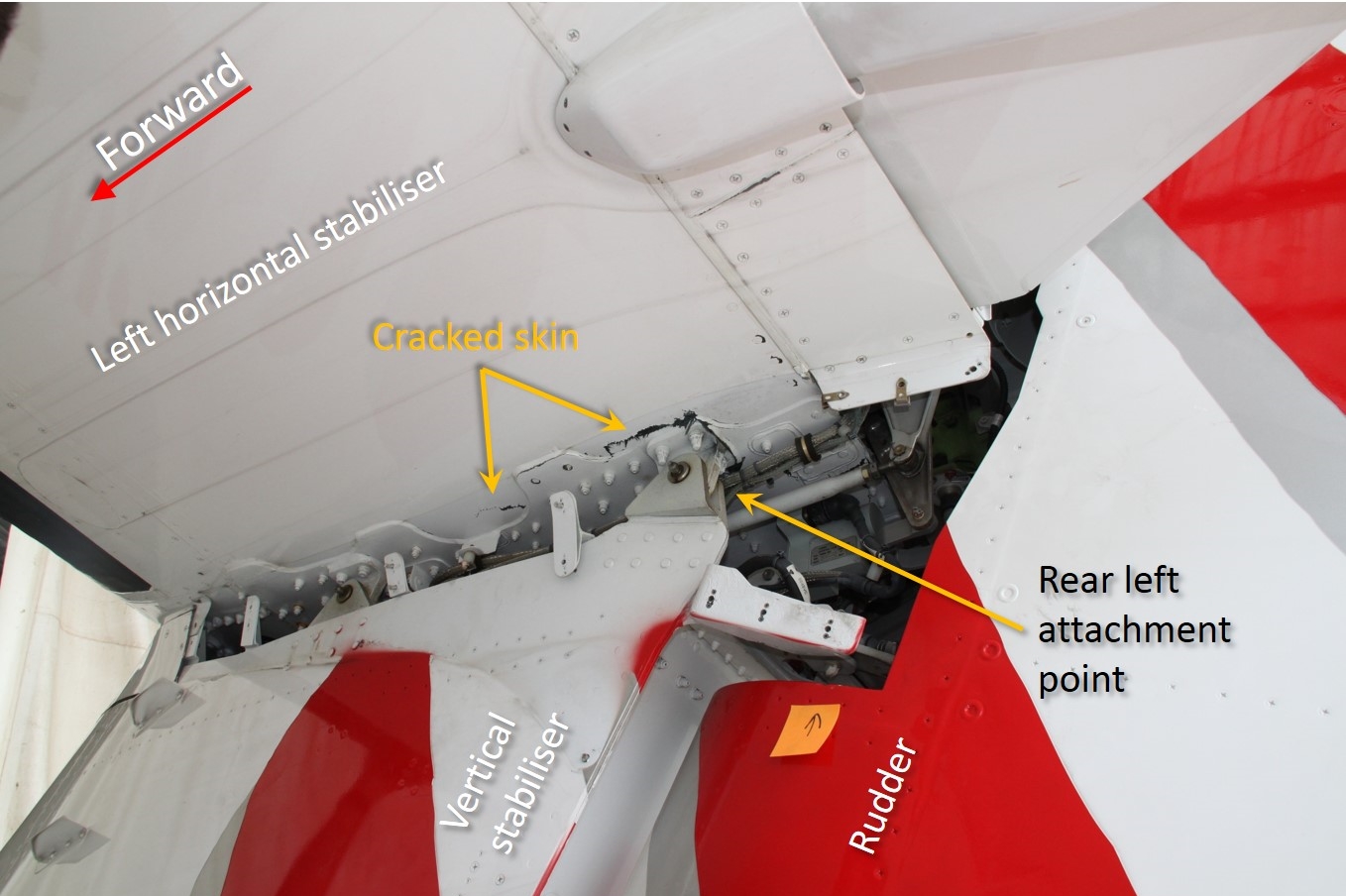
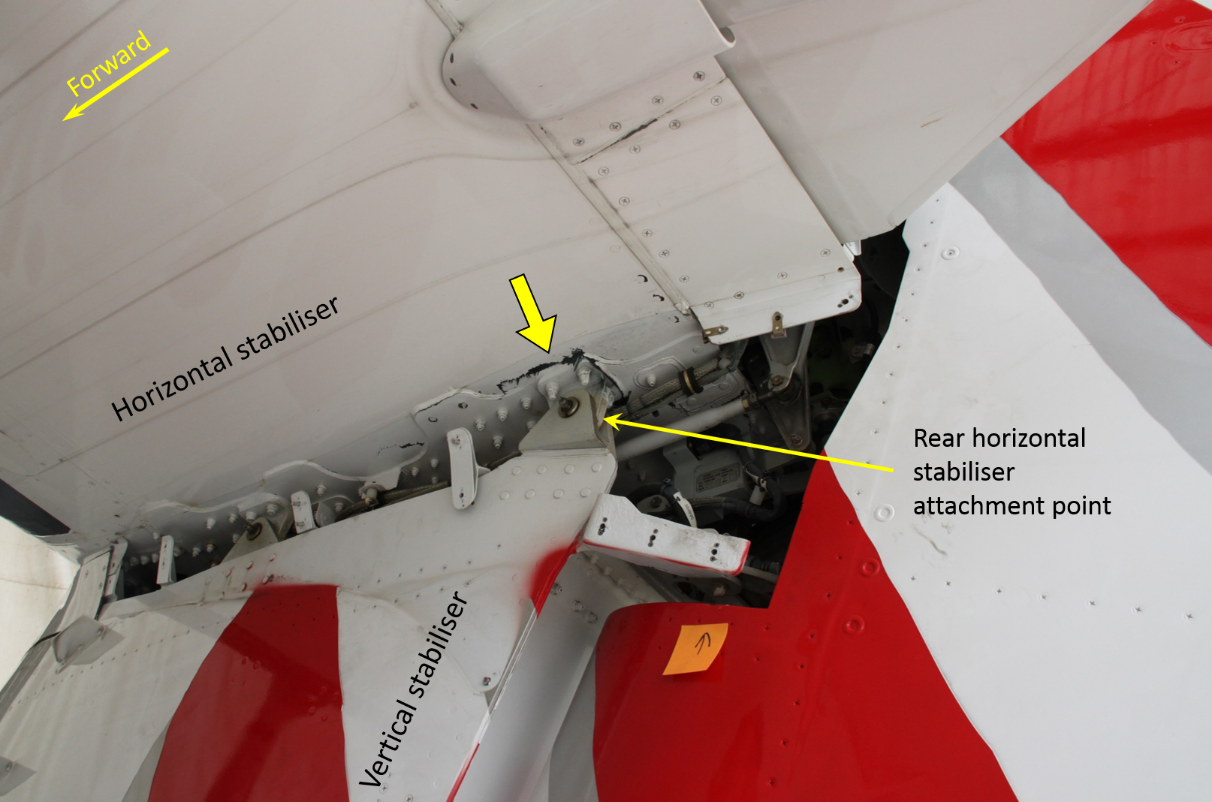
cracking of the lower skin around the rear left horizontal-to-vertical stabiliser attachment point (Figure 10)
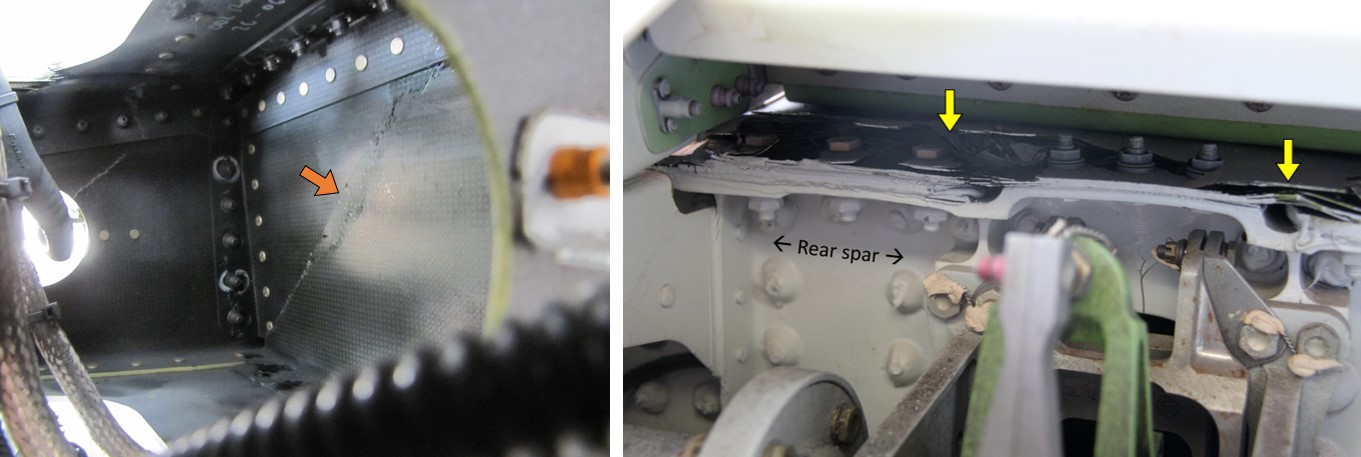
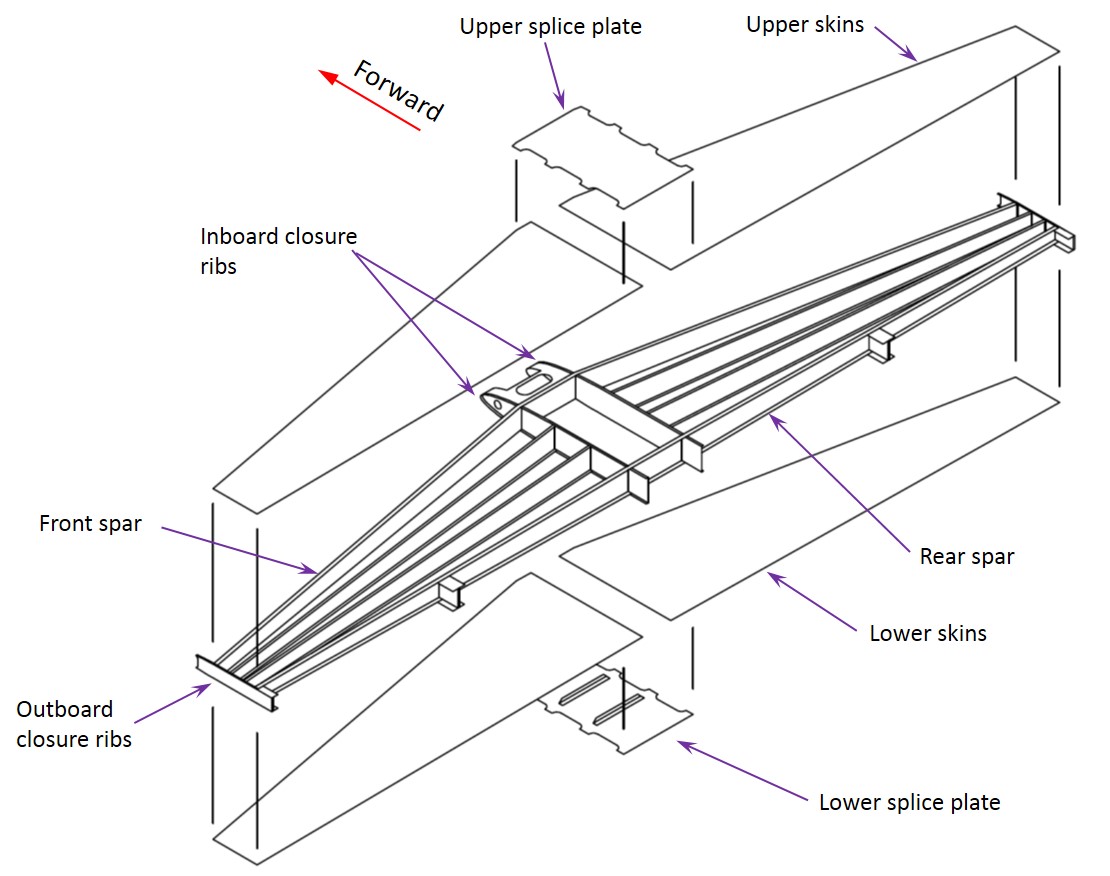
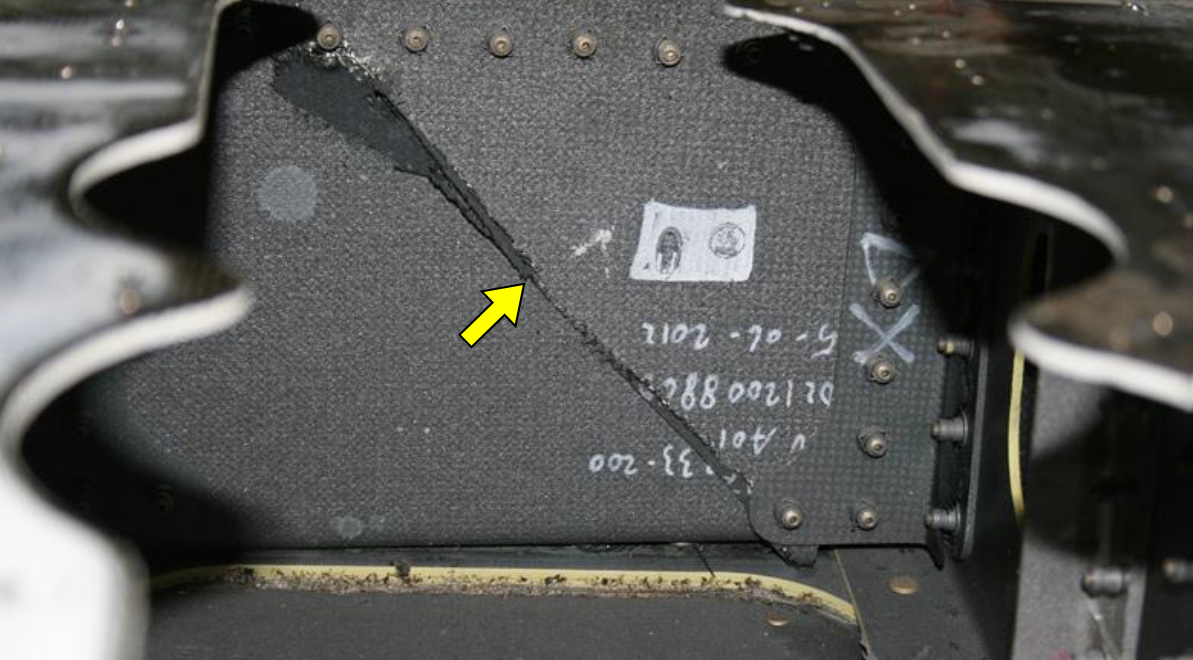
a full thickness, diagonal crack in the front spar extending through the full depth of the spar (top to bottom flange) (Figure 11 - left)
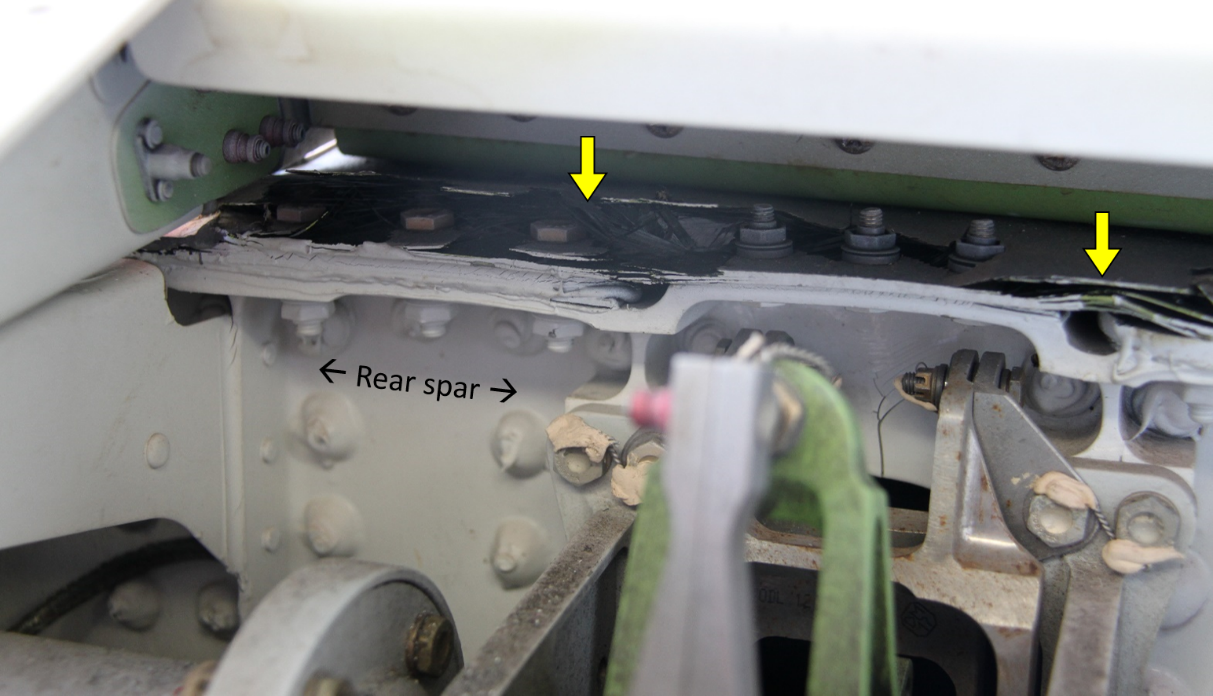
delamination and cracking of the composite material of the upper skin at the rear spar (Figure 11 - right)
cracking of the composite material in the centre leading edge above the forward attachment fittings (Figure 12)
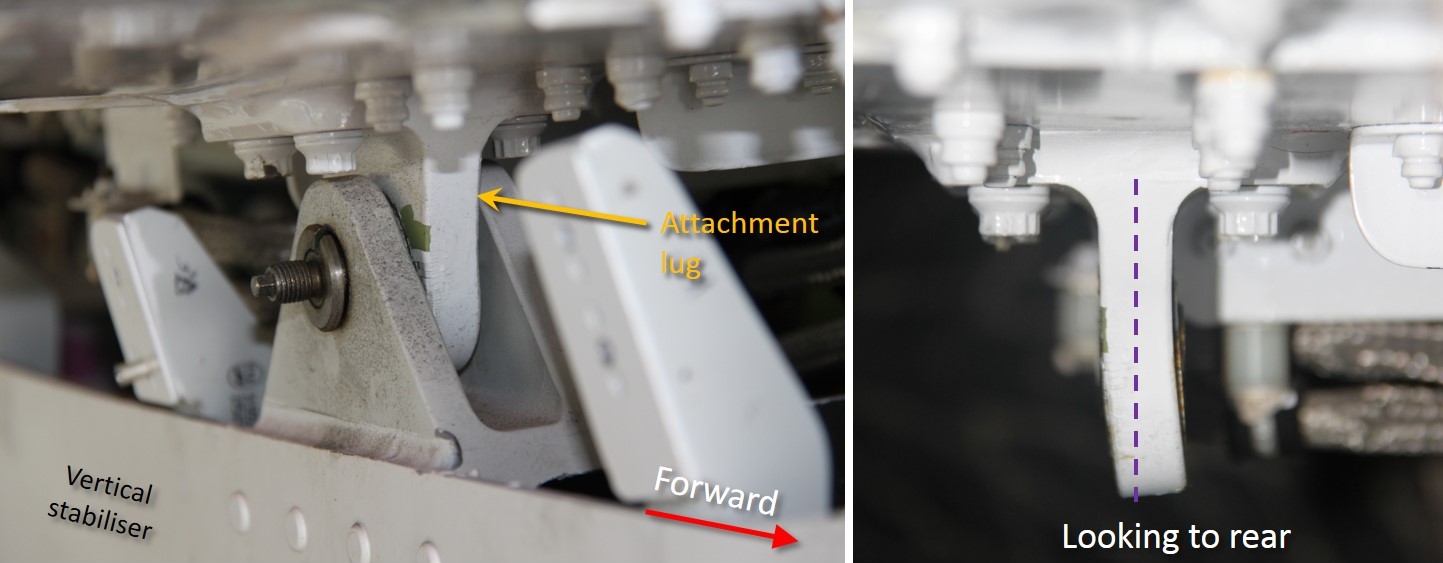
deformation of the mid horizontal-to-vertical stabiliser attachment fittings (Figure 13).
Figure 10: Horizontal-to-vertical stabiliser attachment with the lower left fairing removed showing the cracking in the skin panel adjacent to the attachment fitting.
Source: ATSB
Figure 11: Crack in the horizontal stabiliser front spar (left) identified by orange arrow. Cracking and delamination in the composite skin at the rear spar (right) identified by yellow arrows.
Source: ATSB
Figure 12: Damage in the centre leading edge section above the forward attachment points, included cracking and delamination in all corners of the cut-out and cracks in the ribs (not shown) and deformation of the material around the attachment points (not shown).
Source: ATSB
Figure 13: Mid-right attachment lug. Left image shows the lug while connected to the vertical stabiliser. Cracks and missing white paint (green patch) were indications of distress. Right image shows the lug following removal of the horizontal stabiliser.
The purple dashed line has been added as a visual reference to highlight the bending in the lug. The damage to the mid-left lug was similar. Source: ATSB
The manufacturer’s examinations also identified significant internal damage. This included:
delaminated areas and cracking in the lower splice plate
delaminated areas in the upper splice plate
cracking in the forward back-up fitting (metal support beam between the forward attachment lugs)
buckling and cracking in the internal ribs
buckling in the centre lightening hole in the metallic section of the rear spar
disbonding between the rear spar and skins
delaminated areas in the rear spars
delaminated areas in the upper and lower skins on both the left and right sides.
Samples taken from critical areas in the structure were examined and found to comply with the design drawings for the horizontal stabiliser.
Although there was no damage identified in the vertical stabiliser, due to the magnitude of the loads applied during the event, the manufacturer required replacement of the horizontal and vertical stabilisers before further flight.
Aircraft operator overview
From their main base in Perth, Western Australia, Virgin Australia Regional Airlines (VARA) managed a fleet of Fokker 50, Fokker 100, Airbus A320 and ATR 72 aircraft on regular public transport (RPT) and charter services. The airline operated the ATR 72 aircraft only on the east coast of Australia from bases in Brisbane, Queensland, Sydney, New South Wales, and Canberra, Australian Capital Territory.
The VARA operation was fully instituted on 3 May 2013 after Virgin Australia Airlines completed the acquisition of Skywest Airlines (Skywest) and the Civil Aviation Safety Authority (CASA) approved the change of Air Operator’s Certificate (AOC) entity. In the 18 months before the changeover, Skywest had been operating the ATR 72 aircraft for Virgin Australia Airlines on an aircraft, crew, maintenance and insurance services agreement.
Personnel information
There were a total of four crew on board VH-FVR during the flight — two flight crew and two cabin crew. A summary of the crew’s relevant training and experience is provided in the following sections.
Flight crew
Captain
The captain held an Air Transport Pilot (Aeroplane) Licence (ATPL) issued in Australia in February 2009. He held a Class 1 civil aviation medical certificate issued on the basis of an examination in December 2013. This certificate, valid until December 2014, had nil restrictions. The captain’s aeronautical experience is summarised in Table 1.
The captain started at Skywest in May 2012 as a direct entry captain and remained with the operator when it changed to VARA. Prior to commencing with Skywest, the captain had served as a pilot in the Australian military and had accumulated a total of 2,929.5 hours of flying experience.
In July 2012, the captain completed the ATR 72-500 type-rating course followed by the ATR 72‑600 differences course. Both of these were carried out at the ATR training centre in Toulouse, France. The following training and checking was completed with the operator.
Skywest human factors course – August 2012
Skywest ATR 72-500 conversion course – January 2013
Check-to-line ATR 72-500 – March 2013
Simulator proficiency check – August 2013
VARA ATR 72-600 transition course – August 2013
Check-to-line ATR 72-600 – September 2013
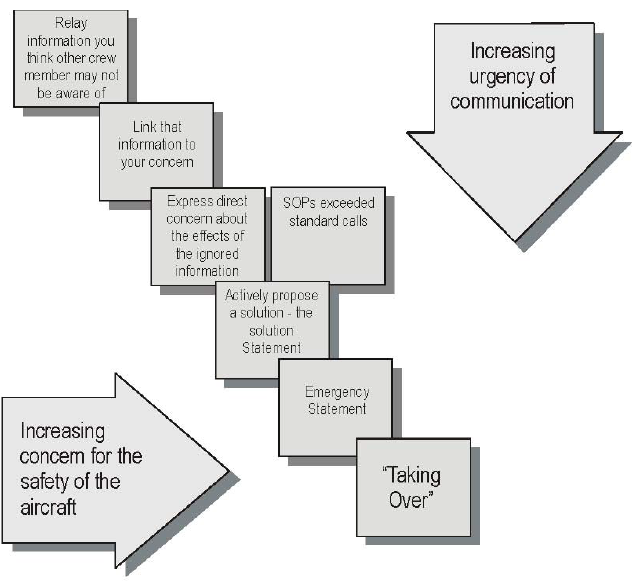
Throughout his training records there were notes indicating that the captain demonstrated good situation awareness and crew resource management (CRM) skills. There was a note early in his training observing that further work was required on standard calls, but there were no further notes indicating that this was an ongoing issue.
First officer
The first officer held an Air Transport Pilot (Aeroplane) Licence (ATPL) issued in October 2013. Prior to this, the first officer held an ATPL issued in the United Kingdom. He held a Class 1 civil aviation medical certificate issued on the basis of an examination in March 2013. This certificate, valid until March 2014, had nil restrictions. The first officer’s aeronautical experience is summarised in Table 2.
Table 2: First officer’s relevant aeronautical experience
Total flying hours
3,816
Total flying time on ATR 72-100/200/210
882
Total flying hours on ATR 72-500
1,607
Total flying hours on ATR 72-600
583
Total flying hours in last 90 days
56.5
Total flying hours in last 30 days
56.5
Total flying hours in last 7 days
2.3
The first officer started with Skywest in April 2012 and remained with the operator when it changed to VARA. Prior to commencing with Skywest, the first officer had accumulated 3,046 hours of flying experience. This experience included 686 hours as captain of ATR 42 and 72[18] type aircraft with a previous employer.
In April 2012, he completed the ATR 72-600 differences course at the ATR training centre in Toulouse, France. The following training and checking was completed with the operator.
Skywest human factors course – May 2012
Skywest ATR 72-500 conversion course – June 2012
Check-to-line ATR 72-500 – September 2012
Simulator proficiency check – October 2012
Skywest ATR 72-600 conversion course – January 2013
Check-to-line ATR 72-600 – March 2013
Simulator proficiency check – April 2013
Simulator proficiency check – September 2013
Skywest promotion to command program – September 2013
Instrument landing system proficiency check – December 2013.
Throughout the first officer’s training records there were notes indicating that the first officer had good aircraft handling/flying skills and situation awareness.
Cabin crew
The crew in the passenger cabin consisted of two members, a senior cabin crew member (SCCM) and a cabin crew member (CCM). These crew members had responsibilities for customer service and passenger safety, particularly in the case of an emergency situation.
The SCCM started with Skywest in June 2013 and completed the initial cabin crew training. In November 2013, she completed the senior cabin crew training program, and after a line check, was promoted to the role of SCCM.
The CCM completed the Skywest cabin crew initial training in August 2013. Her most recent line check was carried out in February 2014.
Meteorological information
Information used by the flight crew
The operator reported that they did not retain the flight documents or briefing packs from each flight at the time of the occurrence. As a result, the ATSB could not determine precisely on what information the flight crew had based their flight planning. However, according to the operator’s flight planning procedures, the flight crew were to access the National Aeronautical Information Processing System (NAIPS)[19] for a briefing on the current and expected meteorological conditions relevant to the route to be flown. The operator’s procedures also required, that where the pre-flight briefing was obtained more than 1 hour prior to the estimated time of departure, pilots should obtain an update before each departure.
The first officer reported that he obtained a specific pre-flight information briefing through NAIPS when conducting the flight planning for the route from Sydney. This would have provided the appropriate weather information for the route between Sydney and Canberra.
During the flight from Sydney to Canberra, the ATIS was available to the flight crew via the aircraft radio communication systems.
The departure time for return flight from Canberra was more than 1 hour from the departure from Sydney, so the flight crew were required to obtain an update before their departure. The captain reportedly checked the weather using a portable electronic device during the turnaround in Canberra.
The following information is based upon the information that was available through NAIPS during the return flight from Sydney to Canberra and the ATIS information at the time it was reviewed by the flight crew.
Area forecasts
The flights from Sydney to Canberra and return were carried out within the Area 21 forecast zone.
The area forecast applicable to the Sydney-Canberra route, and available at the time of flight planning, was an amended Area 21 forecast issued at 0947 and valid from 0950 to 2200. The overview was for some isolated showers and broken low cloud that was expected to clear by 1200 and then for broken low cloud to develop on the south coast after 2000.
The wind in the area was forecast to be from the west to north-west and increase with altitude from 30 kt at 7,000 ft to 60 kt at 14,000 ft. South of Canberra, the winds above 10,000 ft were expected to be up to 20 kt stronger. Turbulence was forecast to be moderate in cumulus cloud and moderate otherwise at all levels throughout the forecast area.
At 1506, while the crew was en route to Canberra, another area forecast was issued. There was little substantive change to the weather outlook; however, winds were forecast to ease by 5-10 kt and turbulence moderate now above 10,000 ft rather than at all levels. It is likely that the captain reviewed this updated forecast when checking the weather during the turnaround in Canberra.
Aerodrome meteorological conditions
The aerodrome forecast (TAF)[20] for Sydney Airport, which was valid from 1100 until 1700, indicated that the winds were 10 kt from the south-east. There was no mention of turbulence in the area.
The TAF for Canberra Airport that was in effect for the flight from Sydney to Canberra and the departure from Canberra, indicated that the forecast winds were from the west at 16 kt. There was no mention of turbulence.
At the time that the aircraft departed Sydney, the Canberra Airport aerodrome meteorological report (METAR), which had a trend type forecast (TTF) current from 1430, indicated that the winds were 15 kts, gusting to 26 kt from the west-north-west with no significant weather. However, at 1500, 6 minutes after take-off, a revised METAR/TTF for Canberra Airport was issued noting that there was moderate turbulence forecast below 5,000 ft.
The Canberra Airport ATIS included a message to expect turbulence over runway 35, south of the runway intersection. Although it was not captured on the cockpit voice recorder, it was normal for flight crew to review the ATIS when inbound to an airport. Canberra ATIS ‘Kilo’ was current during the approach and departure from Canberra. Along with other airport information, ATIS ‘Kilo’ noted that the winds were 15 to 25 kt from 280°, which was all crosswind on runway 35, visibility was 10 km, scattered clouds at 4,500 ft, temperature 20°C, and QNH 1011. It also warned of turbulence over runway 35, south of the runway intersection.
Post-occurrence meteorological analysis
The Bureau of Meteorology advised that the satellite picture did not indicate any turbulence due to cloud and the Sydney and Wollongong weather radar images did not show any significant returns. From other sources such as weather balloon flights, profiler wind data and nearby surface reports, there did not appear to be any turbulence due to wind, including shear and topographical effects.
However, the bureau went on to advise that the balloon flight suggested a relatively strong inversion was developing during the day of the occurrence. The aircraft would have been traversing from a warmer stable atmosphere into a relatively cooler and unstable layer between 7,000 and 10,000 ft. This could account for any reported moderate turbulence.
Atmospheric data recorded by aircraft
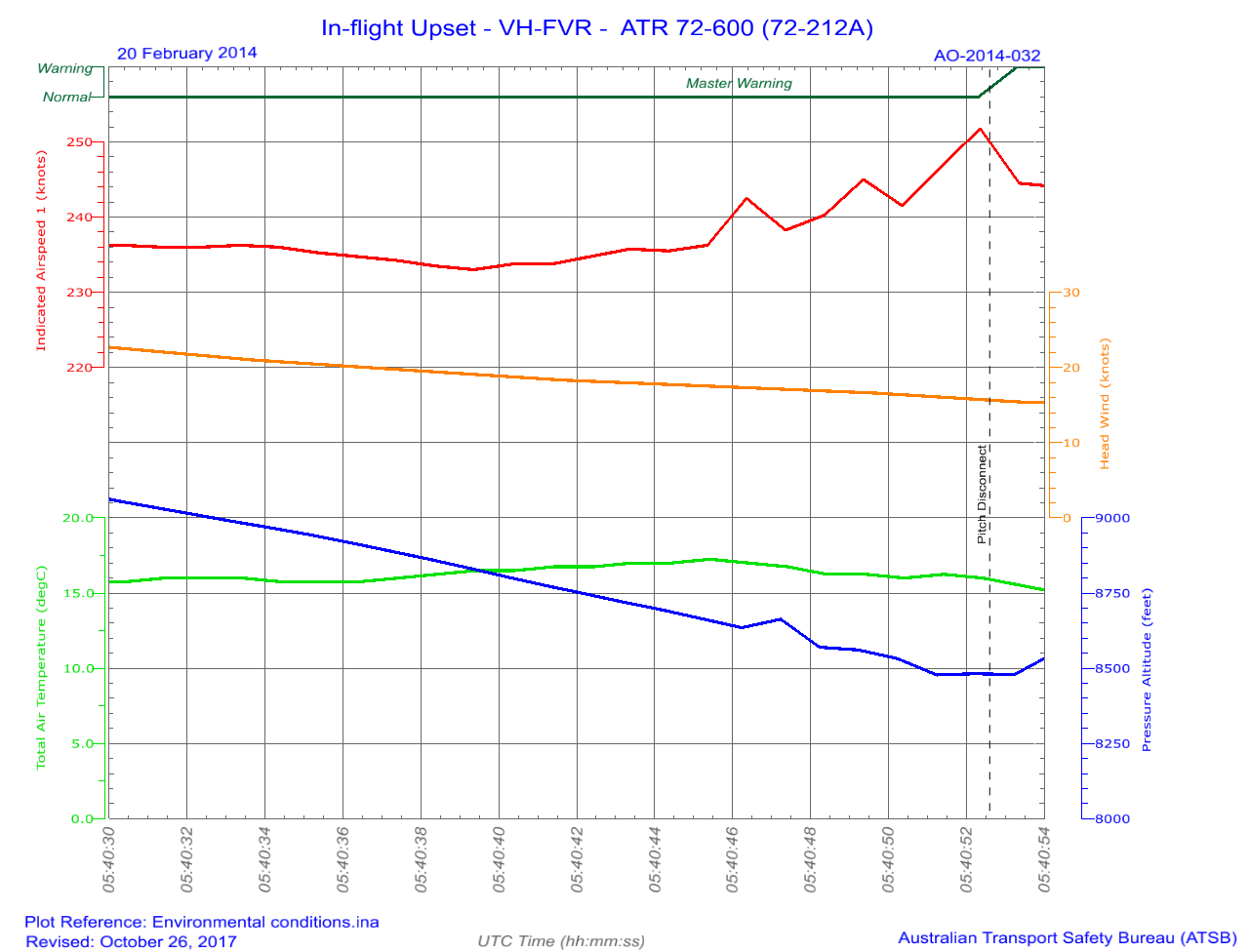
The data on the flight data recorder (FDR)[21] on VH-FVR included a head wind parameter. Review of that parameter from the Canberra-to-Sydney flight, indicated that the head wind component, which was at that time a tail wind, decreased from 19 kt to 16 kt while the indicated airspeed increased from 233 kt to 252 kt in the lead‑up to the pitch disconnect event. However, ATR informed the ATSB that this parameter was filtered and did not necessarily represent the instantaneous longitudinal wind speed component. Given the effect that this could have on the recorded wind, an estimate of the instantaneous local wind speeds during descent was made using the true airspeed, groundspeed, track and heading information from the FDR.
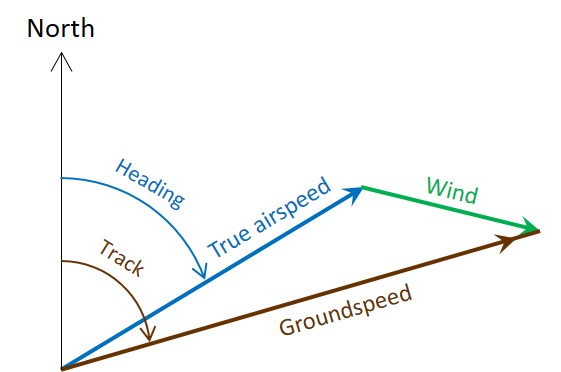
The path that the aircraft travels over the ground is a combination of the speed and direction that the aircraft is travelling through the air and the movement of the air through which it is travelling. As such, the local wind vector (speed and direction) can be back calculated as the vector difference between the true airspeed and the groundspeed vectors as shown in Figure 14.
Figure 14: Calculation of local wind vector (green) using the true airspeed (blue) and groundspeed (brown) vectors. The true airspeed and groundspeed were recorded on the FDR.
Source: ATSB
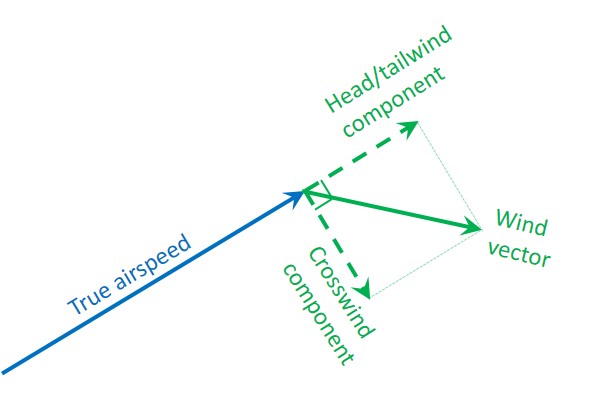
The wind vector may be illustrated as two components when referenced to the true airspeed. The component of the wind vector parallel to the true airspeed is the head/tailwind component, and the perpendicular component is the crosswind. In accordance with the vector representation shown in Figure 15, a positive parallel component is a tailwind.
Figure 15: Wind components. The component of the wind that is parallel to the true airspeed is the head/tailwind and the perpendicular component is the crosswind.
Source: ATSB
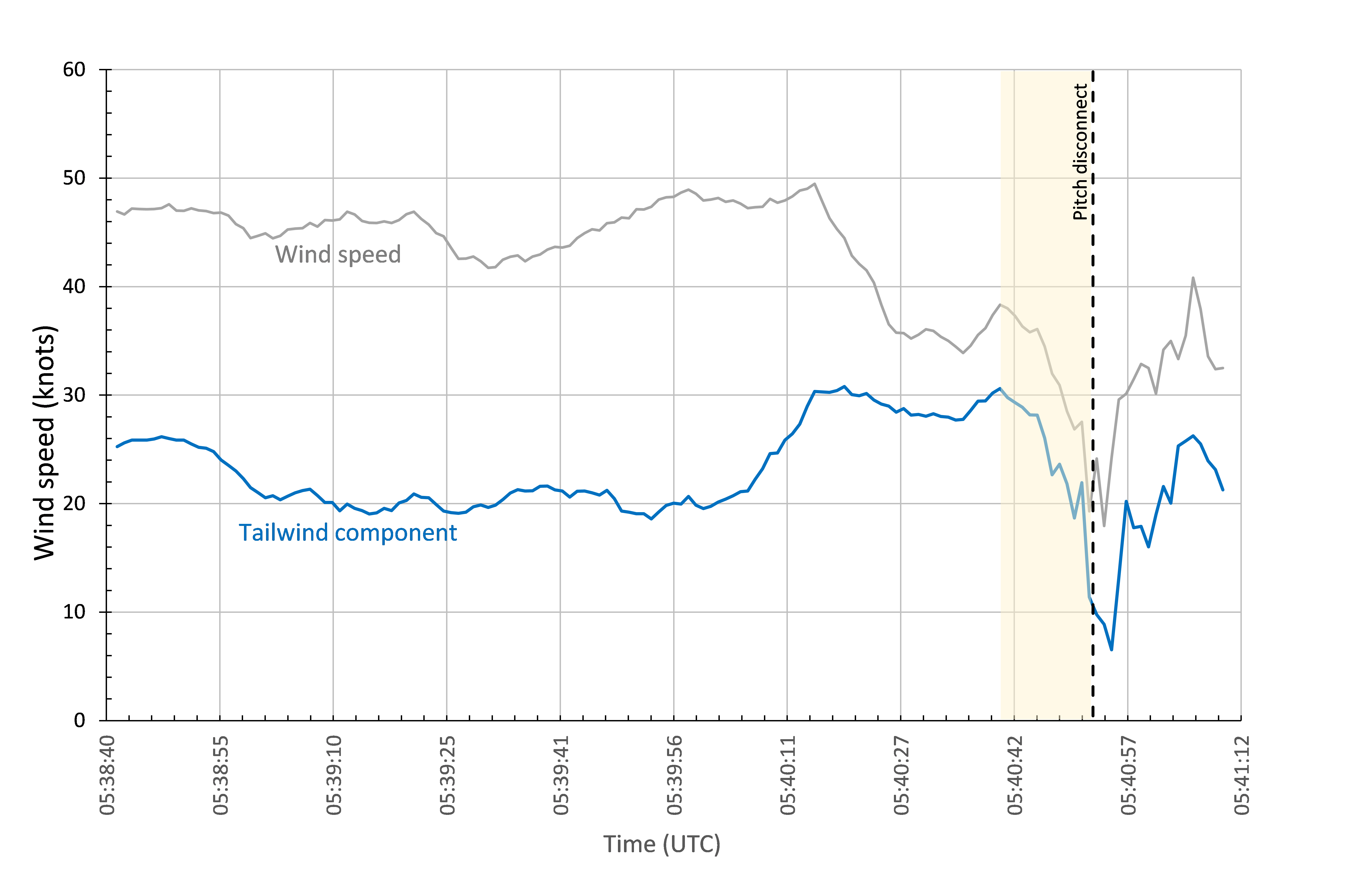
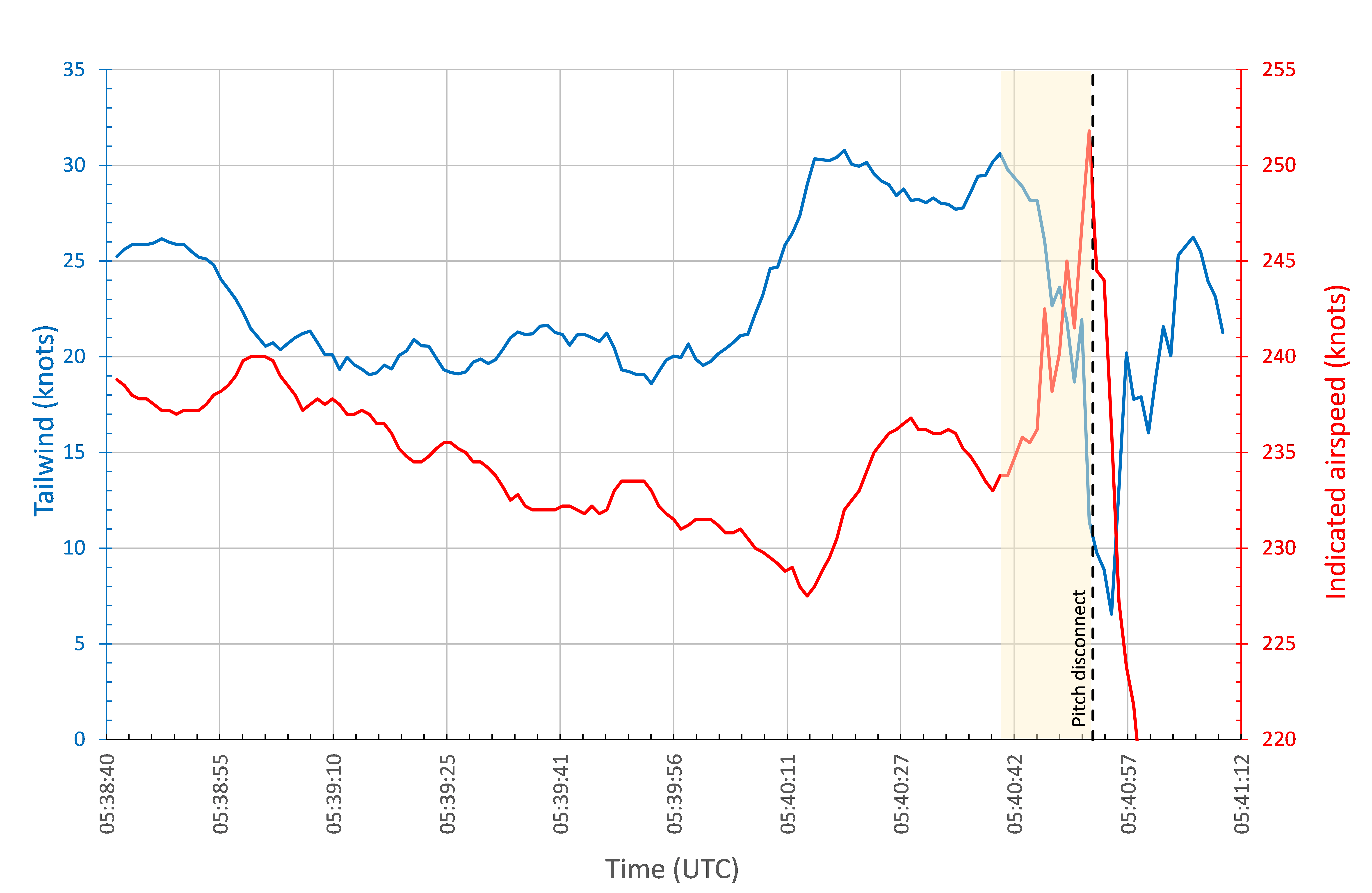
The variation in the calculated wind vector and tailwind components during the 2 minutes leading up to the pitch disconnect are shown in Figure 16. During that period, there are a number of changes in the tailwind, the most significant of these occurred during the 10 seconds leading up to the pitch disconnect, where the tailwind dropped from about 30 kt to about 10 kt. The tailwind component continued drop for a couple of seconds after the pitch disconnect, to a minimum of about 6 knots, before it increased again to greater than 20 kt.
Figure 16: Plot of the calculated tailwind and indicated airspeeds during the 2 minutes leading up to the pitch disconnect. The tailwind was derived from the true airspeed and groundspeeds recorded on the FDR.
Note the rapid decrease in the tailwind associated in the seconds before (shaded area) the pitch disconnect (dashed line). Source: ATSB
Operational risk controls/procedures
Operational risk controls and procedures were contained in a number of documents relating to VARA’s ATR 72 operations. These included the:
VARA Flight Operations Policy and Procedures Manual (FOPPM)
Skywest/VARA Flight Crew Training Manual (FCTM)
ATR 72 Flight Crew Operating Manual (FCOM).
Unless otherwise noted, the following information is drawn from these documents.
Crew coordination
Flight crew roles and responsibilities
The VARA ATR 72 aircraft operated with two flight crew: a captain and a first officer. The captain, as the pilot in command, is the primary responsibility holder for the safe and efficient conduct of the flight. The first officer is responsible to the pilot in command to assist in the safe and efficient conduct of the flight. In the absence of a relief captain, the first officer must assume the role of pilot in command if the captain becomes incapacitated during the flight.
In addition to the distinction of duties between the captain and first officer, there was a further division of responsibilities between the pilot flying and the pilot not flying. The roles of the pilot flying and pilot not flying[22] were not defined in one place, but were distributed across the FOPPM, FCTM and ATR 72 FCOM. The responsibilities for each role were summarised as:
pilot flying
control of the aircraft flight path (position and speed)
setting the engine power
navigation
aircraft configuration (including flaps, landing gear and autopilot modes)
initiation of procedures
pilot not flying
communications
monitor the flight path, the speed, mode changes, systems and engines
read out checklists
operation of systems (such as flaps and landing gear) as directed by the pilot flying.
The detailed tasks assigned to each crewmember was specified throughout all three documents and varied by the phase of flight and the applicable procedure.
Handover and takeover procedures
The aircraft operator’s FOPPM contained the handover and takeover procedures. Those procedures stipulated that handover of control from one flight crew member to another must always be conducted in a positive manner. To minimise confusion or operational risk, the pilot flying was required to retain control until the pilot not flying had advised that he/she had taken control of the aircraft. In abnormal situations, or as otherwise required, the captain was required to initiate the takeover procedure.
The procedure also stipulated that in critical phases of flight, the captain must have their hands positioned to enable rapid takeover of controls.
ATSB observation
By the nature of the procedure, to ensure that somebody is always in control of the aircraft when manually flying, there will be some time during a handover when both flight crew members will have hold of the controls. In normal situations where the aircraft is in steady level flight, this is unlikely to result in any hazards. However, in situations where the pilot flying has initiated a manoeuvre and the pilot not flying has decided that immediate action is required to prevent a hazardous situation, the time to act is limited. In such a situation, there will likely be a short time when both flight crew are making control inputs concurrently.
Standard calls
The aircraft operator stipulated a number of standard crew calls in the FOPPM for the pilot flying and pilot not flying roles. If a crew member did not initiate a call as required, the roles of initiator and responder were to be reversed so that the other crew member initiated the call. The standard calls in relation to changing control of the aircraft are listed in Table 3.
Table 3: Standard calls for transfer of control of the aircraft
Condition
Pilot response
Pilot not flying
Pilot flying
When relinquishing control of the aircraft to another flight crew member
I have control
You have control
When the captain assumes control of the aircraft after landing or when the pilot not flying has cause to take control of the aircraft without delay
I have control
You have control
Although there were no standard calls specific to speed control during the descent phase, there were a number of standard calls that related to speed deviations during other stages of flight. For example, during approach the pilot not flying was required to use the standard call of ‘speed’ and the pilot flying was to respond with ‘checked’ to indicate that they were aware of the speed situation.
Sterile flight deck procedures
The FOPPM stipulated that sterile flight deck procedures[23] would apply on all flights during the high workload periods before and after take-off, and during the latter stages of climb, descent, approach, landing and taxi. Specifically, the FOPPM noted that the phases of flight where these procedures applied were:
Once the flight deck door being closed and locked (and after the correct headcount has been given to the Pilot in Command) until the fasten seat belts sign is turned off; or until the after take-off PA from the Flight Crew, whichever comes first.
When on climb or descent and within 1000 feet of an assigned altitude.
On descent from the time the fasten seat belts sign is turned on until the fasten seat belts sign is turned off (when the aircraft is parked at the aerobridge or is parked in the stand position).
This was also provided in graphical form (Figure 17). The ‘No Contact Phase identified’ was an additional phase where the cabin crew were not to contact the flight crew.
When sterile flight deck procedures were in effect the flight crew were required to limit their conversation to matters directly associated with the operation of the aircraft.
Figure 17: Graphic from the VARA FOPPM showing the phases of flight where the sterile flight deck and no contact procedures applied
Source: Virgin Australia Regional Airlines
ATSB observation
The ATSB identified a number of occasions during both the flight into Canberra and the occurrence flight out of Canberra, where the flight crew engaged in non-operationally pertinent conversation during phases of flight where the sterile flight deck procedures applied; including the minutes immediately before the pitch disconnect event.
Flight planning
The FOPPM included information on the company’s requirements for flight planning. The general requirements noted:
It is important that flight planning be completed early enough to allow a thorough pre-flight inspection and on time departure without the need for haste, which may result in something being overlooked. If a Flight Crew Member anticipates that a particular flight or series of flights will require extra flight planning time then he/she should inform Central Operations as soon as possible so that anticipated duty times may be adjusted.
In terms of obtaining weather information, the FOPPM required that during the flight planning stage, the pilot in command communicates with NAIPS for a briefing on current and expected meteorological conditions. Where that briefing was obtained more than 1 hour prior to the estimated time of departure, flight crew were to obtain an update before each departure. Some variations to this were permitted, but none were applicable to the flight.
For operations on the east coast (that is, ATR operations), the FOPPM stated that updated weather would be provided by the Ground Handling Agent on each turnaround. However, it also noted that telephone communication may be used if this was not available, or if clarification of the briefing material was needed.
ATSB observation
The flight crew were not provided with updated weather information by the Ground Handling Agent during the turnaround in Canberra. However, it appeared that the captain obtained the latest weather using a personal electronic device during the turn around. Hence, the intent of the procedure, that is to obtain the latest weather, was achieved.
Use of fasten seat belts sign on descent
According to the FOPPM, the seat belt sign should be switch on during descent at FL150 following the pilot flying’s command of ‘Seat belt sign on’. If the cruising altitude is below FL150, then the seat belt sign should be selected on prior to the top of descent.
The seat belt sign was also to be selected on before entering areas of known turbulence.
ATSB observation
For the occurrence flight, the captain did not switch the fasten seatbelt sign on until they were descending through about 12,500 ft. The delay in switching on the sign was probably due to the increased workload that resulted from the change in the runway for the arrival in Sydney. The seat belt sign was switched on before the pitch disconnect, so the delay likely had no effect on the safety of the passengers during the event.
Flight in turbulence
According to the FOPPM, the pilot in command was required to:
…carefully consider the possibility of encountering turbulence, having regard to forecasts of turbulence, wind strength and direction, mountain wave activity and proximity of cumulonimbus clouds. Turbulence is the leading cause of in-flight injuries. Cabin crew or passengers may sustain severe injury if they are not warned and adequately secured.
The FOPPM also required the flight crew to turn the fasten seat belt sign on and advise the cabin crew to be seated by making a public address before entering areas of known or anticipated turbulence.
The aircraft operator advised flight crew who entered areas of moderate to severe turbulence to use the autopilot in accordance with the ATR 72 FCOM, alert the senior cabin crew member, and reduce airspeed to turbulence penetration speed, particularly below 15,000 ft.
Other considerations listed in the FOPPM for flight in turbulence included:
maintaining constant attitude with reference to the attitude indicator, avoiding overcorrection and excessive load application to the aircraft structure
avoiding power alterations unless high or low speed limits are exceeded
not chasing airspeed or altitude
both flight crew monitoring the flight instruments.
There were no references regarding flight in turbulence in the ATR 72 FCOM. A note in the operator’s FCTM advised that it was important for crew to use the autopilot as much as they could to ‘increase availability and crew awareness’.
The FCTM also advised that, while ATR did not define a turbulence penetration speed as such, the flight crew should reduce speed to not above the rough air maximum speed of 180 kt during turbulence.
ATSB observation
Based upon the prevailing wind conditions and their previous experience, the flight crew had anticipated turbulence on the descent into Canberra. As such, the captain reduced their descent speed.
There was no indication that the flight crew intended descending into Sydney at a reduced airspeed. This was probably due to them having only experienced turbulence during the later stages of the approach into Canberra, and the forecast improved conditions.
Although the fasten seat belts sign was already on, in preparation for landing, there were no announcements made to the cabin crew that would indicate that the flight crew were anticipating turbulence during the descent.
Windshear
The operator defined windshear in the FCTM as an atmospheric phenomenon where there is a notable change in wind direction and/or speed over a short distance. It was treated as an abnormal situation that could be encountered in the vicinity of thunderstorms, in rain showers, during a frontal passage or at coastal airports. The potential danger of windshear encounters below 500 ft (on take-off or approach/landing) was emphasised and recovery procedures for those situations were provided.
The FCTM also noted that severe windshear above 1,000 ft could be unpleasant, but could generally be negotiated safely. There were no specific recovery procedures provided for windshear encountered above 1,000 ft.
The operator’s FOPPM required that the pilot in command comply with the requirements of the ATR 72 FCOM for windshear; however, the reference provided did not exist in the FCOM. A search of the FCOM identified that the only treatment for windshear was the inclusion of a wind factor to the final approach speed ‘to give extra margin against turbulence, wind shear’, and other factors.
ATSB observation
There was some indication that the captain was anticipating the possibility of windshear when he voiced the effect of a decreasing tailwind, and the potential it had to result in an increase in airspeed. However, the captain had accepted the descent airspeed of 235 kt selected by the first officer, so did not appear to foresee the need to further decrease the descent speed to provide additional margin on the maximum operating speed (VMO).
Descent procedures
Manufacturer’s procedures and guidance
The manufacturer provided some descent procedures in the FCOM. These were distributed between the ‘before descent-descent’ procedures and the automatic flight control system (AFCS) information. The ‘before descent-descent’ procedures in the FCOM focused on preparing for the arrival and approach, and configuration of the flight management system. The only performance related procedures were in relation to configuring the flight management system for the change from pressure to barometric altitudes at the transition altitude, and insertion of wind information for the approach.
The FCOM does not indicate a preference for the AFCS mode to be used for the descent. The before descent checklist refers the pilot flying to indicated airspeed or vertical speed mode as required. There is no reference to the descent speeds, either vertical speed or airspeed, in the before descent-descent procedures.
The AFCS section of the FCOM recommends that indicated airspeed hold mode be used for climb, but does not recommend either indicated airspeed or vertical speed modes for descent. Cautionary information was provided in relation to climb in vertical speed hold mode (Figure 18).
Figure 18: Cautionary note in FCOM relating to use of vertical speed hold (VS) mode during climb
Source: VARA
The FCOM also provided performance information for descent. Descent performance charts were provided for 1 reference weight, 3 speeds (200 kt, 220 kt and 240 kt) and two different descent profiles (at a given rate and at a given gradient).
Operator procedures and guidance
The operator provided descent procedure information in their FOPPM, but this primarily related to airways information and cautionary advice regarding terrain clearance. There was no information with regard to the operator having a policy for selection of the descent speed.
The FCTM did not contain guidance on the selection of a descent airspeed, but did contain information on the automatic airspeed selection capability of the aircraft.[24] However, the FCTM also noted that the operator’s policy was that the speed bug (the selected airspeed indicator) was to be used in manual mode only.
The ‘Before descent’ standard operating procedure in the FCTM noted that an action for the pilot flying was to select VS [vertical speed] mode on the AFCS. There was no other information regarding the AFCS mode selection for descent in the operator’s documentation.
ATSB observation
The selection of the descent airspeed was based upon the judgement of the flight crew, taking into account minimum and maximum airspeed limits and environmental conditions, such as icing conditions and turbulence.
Although there was no particular policy on what AFCS mode to use for descent, the before descent procedure in FCTM would suggest that vertical speed mode was the preferred option. The flight crew’s use of vertical speed mode was consistent with this.
Maximum operating speed procedures
The FCOM listed the VMO for the ATR 72 as 250 kts. It also noted that this limit must not be intentionally exceeded in any flight regime and was indicated as a red and white bar on the side of the airspeed indicator tape.[25]
The aircraft will activate an overspeed warning[26] if the VMO is exceeded; however, unlike other situations such as stall, the FCOM did not provide a recovery procedure.
The operator did not provide any procedures or guidance relating to overspeed situations in the FOPPM or FCTM. The operator reported that they did not provide any training to crews on overspeed recovery, nor was it included in any their simulator programs. However, an overspeed condition was demonstrated during their unusual attitude recovery nose-low scenario as part of their conversion course.
Crew resource management and human factors information provided by the operator
Crew resource management information
The operator provided information in the FOPPM on crew resource management (CRM) techniques. The FOPPM covered a range of factors relating to effective CRM, but only those aspects considered applicable to this occurrence are contained in this report.
VARA used the following definition of CRM:
CRM consists of all the knowledge, skills and roles used to most effectively direct, control and coordinate all available resources towards safe and efficient operations.
The material noted that communication is central to the success of CRM, and that the communication must be clear and effective. It also noted that, historically, aviation accidents contributed to by human error included factors such as distraction, and failure to communicate intent and plans.
The CRM information included the company’s policy on automation. They considered automation to be a useful tool to aid in-flight crew workload management and situation awareness. The automation policy contained a number of significant operational points, which included that one pilot must always be exclusively responsible for flight path management, regardless of the level of automation used. According to the flight crew roles, previously described, the one pilot responsible for flight path management is the pilot flying.
The operator’s CRM was largely based upon the ‘support process’. The support process is a guide to ‘appropriate assertion’ to enhance crew cooperation and situation awareness. The support process is made up of three distinct stages:
guidance
procedural (the solution statement)
emergency (the emergency statement).
The guidance stage is generally achieved through normal flight deck conversation. The use of standard calls provides both crew members with the same perception and understanding of their environment and its implications.
The procedural stage requires either a response or positive action from the other flight crew member. This stage is triggered following the repetition of either a standard operating procedure exceedance call, or an urgent guidance request by a flight crew member without an adequate resolution.
If time permits during the procedural stage, the supporting flight crew member should propose a solution using the solution statement. The solution statement consists of addressing the crew member by their position title, the proposed action and the outcome to be avoided.
The emergency stage is the last attempt to either raise the flight crew member’s situation awareness to that of the rest of the flight crew or for them to explain their actions and intent. The emergency statement stresses that action must be taken immediately and reiterates the action necessary to avoid an incident, accident or major safety breach. The emergency statement is mandatory when the solution statement has not resolved the situation.
The material makes it clear that a failure to respond to the emergency statement should be considered as some form of incapacitation and that a positive take-over of control is mandatory.
The support process was expected to progress from the guidance to emergency stages, as required (Figure 19), but the FOPPM noted that depending on the urgency of the situation, it may be necessary to skip some steps or enter the process at a later stage.
Figure 19: Flowchart of the relative urgency of communication used in the support process
Source: Virgin Australia Regional Airlines
ATSB observation
Although the captain did not use standard terminology, there were indications that he attempted to use the support process during the speed increase. A form of solution statement was made when telling the first officer to ‘pull it up’. However, the captain did not give the first officer the opportunity to respond and did not make an emergency statement, or announce his intention to take over control, before taking hold of the controls. This may have been based upon his perception of the limited time to act.
Human factors information
The FOPPM provided a range of human factors guidance material to highlight some potential ‘pitfalls’ for crews. The guidance material covered, among other aspects, threat and error management, situation awareness and information acquisition and processing.
Under the topic of threat and error management, the operator defined threats as:
events external to the aircraft that increase operational complexity
are outside the control of the flight crew
require immediate crew attention to maintain safety.
Examples of threats identified in the information included distractions, time pressures, system malfunctions and weather.
The guidance material advised that threats should be managed by verbalising the threat as it is recognised. Once identified flight crews should openly discuss management of the threat so that plans may be constructed and modified appropriately. It did, however, also note that discussion of threats that are not relevant to the particular flight may lead to distraction from more important activities.
The sections on error, and error management, focused on the prevalence of human error, and how they can be prevented, or at least minimised, and containment of errors made. A key strategy of error management involved identifying the most likely times errors will occur, such as during periods of high workload, and implementing safety procedures during these times. An example provided was that of the sterile cockpit procedures. The example highlighted take-off and landing represented the time of greatest accident risk and that the sterile cockpit procedure provided a filter that allows communication of safety issues, but blocks communication of non-urgent information.
Situation awareness was described as ‘the accurate perception of the factors and conditions affecting the aircraft, aircrew and passengers during a specific period … This includes knowing what has happened, what is going on in the present and how it may affect what may happen in the future.’
ATSB observation
In the context of awareness of the aircraft state, the captain’s non-pertinent conversation in the minutes before the speed increase probably reduced his situation awareness, making it difficult for him to properly interpret the potential effect the large speed trend vector would have on the safety of flight.
In a section on information acquisition and processing, the FOPPM identified that:
…we are all limited in the amount of information we can absorb at one time. Once that limit is reached, trying to take on board more information results in either the new information being ignored or other data being lost. In either case, situation awareness is compromised. The only way to maintain situation awareness during such periods is to control the workload of the crew.
One of the methods identified to manage workload was to ‘buy some time’ through the use of holding patterns, delaying a departure, requiring radar vectors or deferring non-essential tasks.
ATSB observation
In the period of flight leading up to the pitch disconnect event, the captain did not at all times minimise his workload. Carrying out preparation for the following flight and partaking in non-essential conversation, during periods where sterile cockpit procedures applied, would likely have unnecessarily distracted him from the current situation and increased his workload.
However, following the event, the captain displayed good workload management techniques by requesting radar vectors for the remainder of the flight and deferring non-essential communication with the company until after landing.
Human factors training
The company provided an internal human factors training course to all of their flight crew. This was required initial training for all incoming flight crew and was to be refreshed every 2 years. When the first officer and captain completed the Skywest human factors training, in May and September 2012 respectively, the course content was the same.
The course predominantly followed and expanded upon the information presented in the FOPPM. A Skywest/VARA human factors coordinator conducted classroom-based exercises involving facilitator-led presentations, discussions, and group activities.
Course materials included several presentations that addressed one or more of the topics. In the threat and error management presentation, flight crew were instructed to monitor the flight instruments as if they were hand flying, and if the aircraft or pilot flying were not doing what they were supposed to do, to intervene. The presentation itself did not amplify how the intervention was to occur, but it was likely intended that this would follow the support process, which was also included in the training package.
Cabin crew procedures
In the ATR 72 aircraft, the seat for the senior cabin crew member (SCCM) is at the rear of the cabin adjacent to the toilet, main cabin door (L1), and other rear door (R1). The cabin crew member (CCM2) seat is at the front of the cabin between the row 1 window emergency exits (Figure 20).
Figure 20: ATR 72 cabin configuration
Source: Virgin Australia Regional Airlines
The aircraft was equipped with an interphone and passenger address system that allowed communication between the flight deck and the two cabin crew stations, as well as between the cabin crew stations. Passenger address of the cabin was available from the flight deck and from both crew member stations.
The operator stipulated that ATR cabin crew commence securing the cabin for landing after the flight crew had switched the fasten seat belt sign on during descent. On completion of the cabin secure checks for landing, the senior cabin crew member was to ensure that all cabin crew were seated with full harness fitted prior to advising the flight crew that the cabin was secure.
On passing 5,000 ft above ground level the flight crew would cycle the seat belt sign to produce two chimes. This was a signal for the cabin crew that landing was imminent and if they were not seated, they shall be seated immediately.
In abnormal and emergency situations, the SCCM was the primary contact person for the flight crew. If the situation permitted, the SCCM would be called to the flight deck for a briefing. The SCCM would then brief the other cabin crew, and passengers if required.
Aircraft information
General
VH-FVR was an ATR 72-212A ‘600 Series’ aircraft manufactured in 2012 by the French-Italian aircraft manufacturer ATR (ATR-GIE Avions de Transport Régional). The ATR 72 is a high-wing, twin-engine turboprop short-haul regional airliner seating up to 78 (VH-FVR was configured for 68 passengers and 4 crew). The ATR 72 was derived from the ATR 42 by stretching the fuselage by 4.5 m and increasing the engine power. The ‘600 Series’ primarily differed from the previous ATR versions by the incorporation of a ‘glass cockpit’.[27]
Flight information presentation
ATR 72-212A ‘600-series’ aircraft have a ‘glass cockpit’ consisting of a suite of electronic displays on the instrument panel. The instrument display suite includes two primary flight displays (PFDs); one located directly in front of each pilot (Figure 21). The PFDs display information about the aircraft’s flight mode (such as autopilot status), airspeed, attitude, altitude, vertical speed and some navigation information.
The engine and warning display, located in the middle of the instrument panel (Figure 21), is divided into five areas. The upper half contains the flight control trim and flap setting information on the left, the engine display on the right and miscellaneous information (outside temperature, time and weight information) in the lower window of the upper half. The lower half is dedicated to the display of alerts and procedures from the flight warning system.
Figure 21: View of the ATR 72-212A glass cockpit showing the electronic displays. Highlighted are the captain’s and first officer’s primary flight displays, the engine and warning display and the master warning and caution lights on the captain’s and first officer’s sides.
Source: ATSB
Airspeed indication
Airspeed information is displayed on the left of each PFD in a vertical moving tape–style representation that is centred on the current computed airspeed (Figure 22). The airspeed tape (1) covers a range of 42 kt above and below the current computed speed (2) and has markings at 10 kt increments. The current computed airspeed is also shown in cyan figures immediately above the airspeed tape (3).
The airspeed trend indicator (4) presents a prediction of the airspeed in 10 seconds if the acceleration were to remain constant. The airspeed trend is represented as a yellow arrow that extends from the current airspeed reference line to the predicted airspeed.
The maximum permitted airspeed is presented as a prominent red and white striped bar on the right of the airspeed indicator tape (5). The maximum speed is calculated and presented based upon the current aircraft configuration. The example in Figure 22 represents the maximum operating speed of 250 kt.
The selected airspeed[28] used by the AFCS is presented as a cyan ‘bug’ on the right of the airspeed tape (6).
Figure 22: Representation of the airspeed indicator on the PFD
The example shows a current computed airspeed of 232 kt with an increasing speed trend that is shown in this case as a vertical yellow arrow and is approaching the maximum speed in the current configuration of 250 kt.
Note: the airspeed information shown in the figure is for information only and does not represent actual values from the occurrence flight. Source: ATSB
Altitude and vertical speed indication
The altitude and vertical speed indicators are located on the right side of each PFD (Figure 23). The altitude information is presented on a moving tape-style representation (1) with a numeric readout of the current altitude in feet (2). The selected altitude is shown on the altitude indicator in both bug form (3) and as a numeric readout above the altitude tape (4).
The vertical speed is presented immediately to the right of the altitude indicator. The indicator consists of a vertical scale (5) in thousands of feet per minute (ft/min), the current vertical speed being indicated by a green pointer (6), and a numeric readout in hundreds of feet per minute (7).
The selected vertical speed, used by the AFCS in vertical speed mode, is presented on the vertical speed indicator in both bug form (8) and as a numeric readout in hundreds of ft/min above the indicator scale (9).
Figure 23: Representation of the altitude and vertical speed indicators on the PFD
The example shows a current altitude of 9,540 ft with the bug for the selected altitude set at 9,200 ft. The current vertical speed is shown to be -1,200 ft/min and the selected vertical speed is set at -700 ft/min.
Note: the information shown in the figure is for information only and does not represent actual values from the occurrence flight. Source: ATSB
Flight warning system
The flight warning system provides the crew with information for the management of normal and abnormal configurations of the aircraft systems. The flight warning system interfaces with the flight crew through a visual and aural system. The visual system consists of master warning and master caution lights on the instrument panel combing, directly in front of each flight crew member, and the alert and procedure windows on the lower half of the engine and warning display (Figure 24). Two aural alert chimes, warnings and cautions, are associated with the master warning and master caution alerts.
Figure 24: The bottom half of the engine and warning display is dedicated to the flight warning system. The alert window, on the left, lists all of the active alerts. The procedure window on the right automatically presents any procedures associated with the active alert. The pitch disconnect warning is provided as an example.
Source: ATSB
The flight warning system provides four alert levels:
Warnings – corresponding to an emergency situation requiring the flight crew to take prompt corrective actions. Warnings are identified by the master warning light flashing red, with an associated continuous repetitive alert chime, and a red warning message displayed in the alert window on the engine and warning display.
Cautions – corresponding to an abnormal situation requiring the flight crew to take timely corrective actions. The time taken for action is left to the crew’s discretion. Cautions are identified by the master caution light flashing amber, with an associated single chime, and an amber message in the alert window on the engine and warning display.
Advisories – corresponding to a situation requiring crew monitoring due to a loss of redundancy or degradation of a system. Advisories are identified by an amber caution message displayed in the alerting window in the engine and warning display, but without an aural alert.
Information – corresponding to an information situation action. The information is provided by a cyan, green or white message on the associated control display. There is no associated message on the engine and warning display.
Overspeed alert
The flight warning system included an overspeed alert. This alert is intended to warn the flight crew that they have exceeded a limit airspeed. The limit airspeed, indicated by the red and white striped bar on the airspeed tape, varies depending on the configuration of the aircraft. This limit may be the maximum flap extension speed, the maximum landing gear extension speed, or the maximum operating speed for the clean aircraft.[29]
The overspeed alert activates when the aircraft exceeds the applicable airspeed limit and persists until the airspeed is reduced to below the limit speed. The overspeed alert is an aural ‘clacker’ alert; there was no associated visual warning for an overspeed. The alert cannot be cancelled by the flight crew, except by using the emergency audio cancel switch.[30].
Aircraft structure
The aircraft’s fuselage and wing are primarily constructed from aluminium alloy. The vertical and horizontal stabilisers of earlier ATR 42 and 72 aircraft (Figure 25) were also constructed from aluminium alloy components, but in later models, including the ATR 72-212A, both the vertical and horizontal stabilisers were constructed from carbon fibre reinforced polymer composite materials.
Figure 25: ATR 72 70-seat, twin-engine turboprop, high-wing regional airliner highlighting the location of the vertical and horizontal stabilisers.
Source: ATSB
The horizontal stabiliser is primarily made up of three components; a closed box structure, leading edges and the elevators (Figure 26). The closed box structure provides the primary structure for the horizontal stabiliser and consists of spars,[31] inboard and outboard closure ribs, and upper and lower skin panels (Figure 27). The skins are joined by splice plates bridging the centre section.
Figure 26: General components of the horizontal stabiliser include the primary box structure, leading edges and elevators, hinged off the rear spar.
Source: ATSB
Figure 27: The closed box structure for the horizontal stabiliser consists of a number of spars, including the front and rear spars, skins panels, closure ribs and splice plates.
Source: ATSB
The horizontal stabiliser is mounted on the top of the vertical stabiliser and attached at six points, three on each side, using aluminium alloy lugs (Figure 28). These attachment points are normally covered by an aerodynamic fairing and are not visible without removal of the fairings.
Figure 28: Attachment of the horizontal stabiliser to the vertical stabiliser. Three of the six attachment lugs highlighted within dashed orange boxes. Three similar lugs are on the left side of the attachment.
Source: ATSB
Aircraft systems
The ATR 72 primary flight controls essentially consist of an aileron and spoiler on each wing, two elevators and a rudder. All of the controls, except for the spoilers, are mechanically actuated from controls in the cockpit.
Pitch control system
Pitch control of the aircraft is provided by two elevators, one on the left and one on the right (Figure 29). The elevators are surfaces that form the rear edge of the horizontal stabiliser and can be rotated up or down about a hinge that attaches the elevators to the stabiliser. Rotation of the elevators up or down changes the direction and magnitude of the aerodynamic forces generated by the horizontal stabiliser, thus providing pitch control. Pitch trim is provided by trim tabs located on the inner trailing edge of each elevator. The pitch trim tabs, like the elevators themselves, can be rotated up or down, changing the aerodynamic load on the elevators.
When the elevators are moved, the trim tabs move in the opposite direction to the elevator. This produces an aerodynamic load on the elevator in that direction to reduce the pilot effort required to move the controls.
Figure 29: Location of the elevators on the horizontal stabiliser of the ATR 72 (highlighted in blue)
Source: ATSB
The pitch control system consists of left and right control columns in the cockpit connected to the elevators via a system of cables, pulleys, push‑pull rods and bell cranks (Figure 30). The left (captain’s) and right (first officer’s) control systems are basically a copy of each other, where the left control column is connected to the left elevator and the right system is connect to the right elevator.[32] Each of the left and right systems are referred to as channels.
To permit continued operation in the event of the controls becoming jammed, the pitch control system has been designed to allow the left and right control channels to operate independently.[33] This is achieved by the inclusion of a spring-loaded ‘pitch uncoupling mechanism’ (PUM) located between the left and right elevators, as highlighted in Figure 30.
Figure 30: ATR 72 elevator/pitch control system with the pitch uncoupling mechanism circled in red
Source: ATR, annotated by the ATSB
In normal operation, the PUM is engaged, connecting the left elevator directly to the right elevator. The forces applied on one side of the pitch control system are transmitted from one elevator to the other as a torque (twisting force) through the PUM. In this configuration, moving one control column moves both the left and right elevators and the other control column. When the PUM is activated (disengaged) the left elevator is disconnected from the right elevator and the controls operate independently. Activation of the PUM, separating the left and right channels, is operationally referred to as a pitch disconnect.
The flight crew are not required to action any separate systems in order to activate the PUM. Activation occurs automatically when the torque transmitted through the PUM reaches a preset level. The design intention was that the activation torque would be reached by the flight crew applying a control force against a jam. This could also be achieved by flight crew simultaneously applying opposing forces on the left and right control columns. The prescribed activation torque was equivalent to opposing forces of 50 to 55 daN (about 51 to 56 kg force) being simultaneously applied to each control column.[34]
The status of the PUM is monitored by a sensor in the mechanism. The flight crew are alerted to activation of the PUM by the master warning (which provides both aural and visual alerts) and a flashing red PITCH DISC message in the alerts window on the engine and warning display (Figure 24). The associated pitch disconnect procedure is also presented on the engine and warning display in the procedure window adjacent to the PITCH DISC message.
The ATR 72-212A included a reconditioning electrical actuator in the PUM assembly. This component allowed the flight crew to reconnect the PUM by placing the controls in the neutral position and depressing a button in the cockpit. The reconditioning actuator is deactivated in flight and reconnection of the PUM can only be achieved on the ground. This reconditioning feature was not included in early variants of the ATR 42/72. In those aircraft, reconnecting the PUM was a maintenance action that required access to the mechanism between the elevators.
ATR advised that, because a jammed pitch control can occur in any phase of flight, a spring‑loaded PUM was selected over a directly–controlled mechanism. Their logic for this approach was that this type of mechanism provided an intuitive way to uncouple the two pitch channels and recover control through either channel. ATR also advised that a directly‑controlled uncoupling mechanism increased the time necessary for a pilot to identify the failure, apply the procedure and recover pitch authority during a potentially high-workload phase (such as take-off or the landing flare).
The pitch control system also includes a force measuring system located in the linkage at the base of each control column (identified as ‘dynamometric rod’ in Figure 30). The force measurements are provided to the autopilot system and the FDR system, where it is recorded as the ‘pitch axis effort’. The pitch axis effort values recorded on the FDR can be converted to an equivalent force applied at the grips of the control column. The function for this conversion was supplied by ATR.
System testing
During examination of the aircraft by the ATSB, operation of the pitch disconnect system was tested in accordance with the instructions in the aircraft maintenance manual. The loads applied to the control columns to activate the PUM were found to be at a value marginally greater than the manufacturer’s required value. The reason for this was not determined, but may be related to the damage sustained during the pitch disconnect event.
It was noted during the testing that there was a slight delay between the activation of the PUM and the activation of the aural and visual alerts. Analysis of videos taken of the testing identified a delay of approximately half a second between separation of the pitch channels and activation of the master warning. There was also a delay of approximately 1 second between the pitch channel separation and the presentation of the PITCH DISC message on the engine and warning display. Analysis of the aircraft systems by the aircraft manufacturer found that these delays were consistent with the characteristics of the system. [35]
Automatic flight control system
The aircraft was equipped with an automatic flight control system (AFCS) that included flight director and autopilot functionality. The AFCS provides a number of lateral and vertical control modes that can be selected by the flight crew to manage the aircraft’s flight path. ATR recommended systematic use of the AFCS to increase the accuracy of guidance and tracking, enhance passenger comfort, and reduce pilot workload, while increasing safety.
The flight director provides information to the flight crew through command bars on the primary flight display. If the flight director command bars are active during manual flight, the pilot flying maintains the selected flight path by making control inputs to follow the command bars.
The autopilot includes servo-actuators in the pitch, roll and yaw control systems that move the control surfaces as directed by the autopilot (Figure 30 shows the location of the autopilot servo-actuator in the pitch system). When engaged, the autopilot will automatically make control inputs to satisfy the flight director commands. The autopilot also includes a yaw damper[36] function that can be engaged by itself, or in combination with the autopilot.
Manual control can be temporarily achieved by the flight crew without disengaging the autopilot through the touch control steering (TCS) function. This function is enabled by pressing the TCS button, located on the front of each control wheel, and is only active while the button is depressed.
The AFCS control modes include a basic mode, which holds the pitch and roll attitude that the aircraft was at when the autopilot was engaged, and a range of lateral and vertical control modes. The vertical modes include altitude hold, indicated airspeed hold, and vertical speed hold.
In altitude hold mode the AFCS will maintain the altitude at which the mode was selected.
Indicated airspeed hold mode will maintain the airspeed at the time that it is engaged. The selected airspeed can be manually adjusted by the flight crew, or automatically set by the AFCS and is displayed on the PFD airspeed tape as a ‘bug’ on the side of the tape, as previously described in the section titled Airspeed indication.
When vertical speed hold mode is engaged, the AFCS will hold the aircraft’s vertical speed at the time of selection. The selected vertical speed can be manually changed by the flight crew through a control on the instrument panel, or by using the TCS function to manually attain the desired vertical speed. The vertical speed at the time that the TCS button is released will be set as the target speed for the AFCS. The selected vertical speed is displayed on the vertical speed indicator.
There is also another vertical mode, ‘altitude select mode’, that arms the AFCS during a descent or climb to capture and hold a selected altitude. If a different altitude is selected, the AFCS will guide the aircraft to the selected altitude, using the either the indicated airspeed or vertical speed modes, whichever has been selected. The selected altitude can be manually selected by the flight crew, or be part of a flight plan in the flight management system.
In all cases, the aircraft is controlled in its selected vertical mode by deflection of the elevators. The AFCS does not control the engine power setting, so that in all modes, the engine power must be manually controlled by the flight crew.
When engaged, the autopilot can be manually disengaged by any of the following actions:
Pressing the autopilot or yaw damper push-buttons on the AFCS control panel.
Pressing the autopilot quick disconnect switch push-button on either control wheel.
Actioning any of the manual pitch trim switches.[37]
Applying a force over 30 daN on any rudder pedal, or 10 daN on the pitch axis control column. Applying a force of 30 daN to the rudder pedals will also disengage the yaw damper.
The autopilot will also automatically disengage if:
the autopilot engagement condition is no longer met
the stall warning threshold is reached
there is disagreement between, or failure of, the air data or attitude and heading reference systems
there is a mismatch between the left and right trim positions (trim mismatch).
Speed selection philosophy
The FCOM stated that the 600 series ATR 72 provided two selectable speed modes: AUTO speed and MAN speed.
AUTO speed, presented as a magenta bug on the PFD speed tape, is the managed speed computed by the flight management system and depends on the flap lever position, power management, normal and icing conditions, number of operating engines, and other factors.During the descent phase, the automatic speed target was 240 kts.
MAN speed, displayed as a cyan bug on the PFD speed tape, is the speed manually selected by the pilot.
The FCOM noted that the AUTO speed mode ‘ensures safe speeds to operate the aircraft in all flight phases.’
Operational information and procedures associated with a pitch channel jam and pitch disconnect
The FCOM contained system information and procedures associated with the pitch disconnect system.
The FCOM section describing the pitch control system noted that ‘In the case of jamming, pitch control will be recovered by applying on both control columns a differential force (52 daN) disengaging the pitch coupling system.’
The Procedures and techniques section of the FCOM, noted:
ATR 72 is equipped with classical mechanical primary flight controls on all three axis. The following peculiarities must be highlighted:
PITCH: Both elevators are connected through a pitch uncoupling device in order to leave sufficient controllability in case of mechanical jamming of one control surface.
Activation of this device:
- requires heavy forces (52 daN/114 lbs) to be applied to the control columns, which minimizes the risk of untimely connection.
- indicated to the crew through the red <> on the EWD.
- allows the flight to be safely achieved: refer to procedures following failures.
Note 1: WHEN PITCH DISCONNECT takes place WITHOUT REAL JAMMING, speed has to be limited to 180 kt and bank angle to 30° until flap extension to avoid overstressing the stabiliser.
Note 2: The TWO yokes must be held once the aircraft is landed.
The FCOM section regarding Procedures following failure contained two items relating to the pitch disconnect, one was the elevator jam procedure (Figure 31), the other was specifically for a pitch disconnect (Figure 32).
Figure 31: ATR 72 FCOM procedure for an elevator jam
Source: ATR
Figure 32: ATR 72 FCOM procedure for a pitch disconnect
Source: ATR
Recorded information
VH-FVR was fitted with a flight data recorder (FDR) and cockpit voice recorder (CVR), as it was required to. One FDR and two CVRs were received by the ATSB on 3 March 2014 and downloaded. One CVR contained the flight on 20 February 2014, having been removed by the operator following the pitch disconnect occurrence, and the other contained the flight into Albury, NSW on 25 February 2014, when there was a suspected birdstrike.
Flight data recorder
The FDR contained 68.8 hours of data, capturing 51 flights, which included both the pitch disconnect and suspected birdstrike occurrences.
In-flight upset and pitch disconnect event
The following figures provide selected relevant parameters from the FDR from the flight on 20 February 2014:
Figure 33 presents the control column position and elevator deflections during the control check prior to the flight. This confirms that the no-load control column-to-elevator ratio was about 1:2.
Figure 34 presents the primary flight path control parameters (engine torque, airspeed, and vertical speed) during the descent. This figure also indicates the time of key events during the descent.
Figure 35 presents a period spanning 30 seconds before and after the pitch disconnect.
Figure 36 presents the 6-second period, highlighted in yellow in Figure 35, to provide clarity of the parameter values during the pitch disconnect event.
Figure 37 presents selected lateral-directional (yaw and roll) control parameters over the same 6‑second period as Figure 36.
Figure 38 presents selected environmental data recorded over a 24 second period, from about 22 seconds before the pitch disconnect.
Figure 39 presents the parameters relating to disconnection of the autopilot, including the captain’s trim switch, AFCS message, and autopilot/yaw damper engagement status parameters.
Figure 33: FDR information showing the control column and elevator positions during the pre-flight control checks.
Note: the scale for the control column is twice that of the elevator, indicating that the control column to elevator ratio was effectively 1:2. Source: ATSB
Figure 34: FDR information showing the primary control parameters (engine torque, airspeed, and vertical speed) from the top of descent to shortly after the pitch disconnect. Key events from the descent are also identified on the chart.
Source: ATSB
Figure 35: FDR information showing the relevant pitch parameters for a period spanning about 30 seconds before and after the pitch disconnect. The yellow shaded period is presented in Figure 36.
Source: ATSB
Figure 36: FDR information showing the relevant pitch parameters for the shaded 6‑second period in Figure 35, during which the pitch disconnect took place. The estimated time of the pitch disconnect is shown with a black dashed line at time 05:40:52.6
Source: ATSB
ATSB observations
The following observations were made regarding the recorded data presented above:
Leading up to the in-flight upset and pitch disconnect, there was no indication of turbulence.
Leading up to the pitch disconnect, both elevators moved in unison.
In the seconds leading up to the in-flight upset and pitch disconnect, there were a number of rapid increases in the recorded airspeed.
The first officer made three nose-up control inputs correlating with the use of the touch control steering. Between each of the nose-up inputs were nose-down inputs of 7 to 8 daN and a peak lasting about 0.1 second of about 15 daN.
The peak vertical acceleration was reached approximately 0.8 seconds after the peak elevator deflection on all three occasions.
At about time 05:40:50.1, or about 2.5 seconds before the pitch disconnect, a small load (pitch axis effort) of about 3 daN was registered on the captain’s pitch control.
The captain started to make a nose-up pitch input shortly before the FO made the third nose-up input.
When the FO started moving the control column forward (nose-down) at about 05:40:52.3, the load on the captain’s control increased (nose-up) at about the same rate that the first officer’s decreased.
A 05:40:52.6 the elevators uncoupled. At that time: - the pitch axis effort recorded in the captain’s pitch channel was 67 daN[38] and in the first officer’s was ‑8.5 to ‑19 daN[39] - the aircraft pitch angle was increasing - the vertical acceleration was about +2.8g and increasing.
After this time, the elevators no longer moved in unison.
Peak elevator deflections of +10.4° and -9.3° were recorded about 0.2 seconds after the pitch disconnect.
About 0.25 seconds after the peak deflections, the captain moved the control forward until both elevators were in similar positions.
A maximum vertical acceleration of 3.34g was recorded at about 05:40:53.0.
The master warning activated after the pitch disconnect.[40]
Figure 37: FDR information showing selected lateral-directional (yaw and roll) control parameters over the same 6 seconds as Figure 36. The yaw axis force required to disconnect the autopilot (AP) is identified as a pink dashed horizontal line on the yaw axis effort parameter.
Source: ATSB
Figure 38: FDR information showing selected environmental data over a 24 second period, from 22 seconds before the pitch disconnect. The estimated time of the pitch disconnect is shown with a black dashed line at time 05:40:52.6
Source: ATSB
Figure 39: FDR information showing the captain’s pitch trim up command (PTUPCAPT), AFCS message (AFCSMAM) and autopilot/yaw damper engaged (APYDENG) parameters following the pitch disconnect event.
Source: ATR
ATSB observation
The data indicates that the recorded autopilot/yaw damper engaged parameter changed directly from both engaged to no automation. However, the automatic flight control system message changed from no message, to autopilot disengaged and then to autopilot/yaw damper disengaged, before returning to no message. It was also observed that the captain made a nose-up pitch trim command at about the same time.
Each of these parameters are recorded once per second; however, each is written at a slightly different time. Because of this, we can see that the autopilot was probably disengaged by the captain moving the pitch trim rocker switch on the control yoke, before a rudder force in excess of the threshold disengaged the yaw damper.
The captain reported that he intentionally disengaged the autopilot; however this data indicates that he probably used the trim switches instead of the autopilot disconnect. It was not known if the captain intentionally actioned the trim switches to disconnect the autopilot, or if it was accidental. The autopilot disconnect button is located adjacent to the trim switches on the same handle of the control yoke.
Analysis of the elevator positions after the pitch disconnect
Data recorded on flights before and after the occurrence flight were also examined. The average elevator positions were compared before and after the occurrence flight. Figure 40 shows the average elevator positions, and the difference between the left and right elevator positions, for a range of flights before and after the occurrence flight.
Figure 40: Comparison of the average position for the left and right elevators over a range of flights before and after the pitch disconnect.
Also included on the chart is the difference between the left and right elevator positions. Note: A negative flight number indicates that the flight was taken before the pitch disconnect. Source: ATSB
ATSB observation
After the occurrence flight, there was a persistent difference between the left and right elevator positions of about 0.5º that was not evident prior to the pitch disconnect.
The size and persistent nature of the difference between the elevator positions is an indication that the damage to the horizontal stabiliser was generated during the pitch disconnect event and that any further degradation of the structure was probably minimal.
Vertical accelerations following the pitch disconnect
Examination of the vertical accelerations (flight load factors) during the 13 flights following the pitch disconnect (Figure 41), found that the largest vertical acceleration was 1.4 g.
Figure 41: Vertical acceleration recorded on flights between 20 February 2014 and 25 February 2014. The peak acceleration during the in-flight upset was 3.34 g. The maximum on the subsequent flights was 1.4 g.
Note, the data spikes below 0.5 g are due to the system operation when the aircraft is powered down and do not indicate that the vertical acceleration was less than 0.5 g. Source: ATSB
Selected airspeed used during descent
The airspeed that was initially selected for the descent for the 51 flights contained on the FDR were examined (Figure 42). For a number of the flights, the selected airspeed was lowered during the descent, for reasons that were not determined, but could be for factors such as turbulence and airspace restrictions. The initial selected airspeeds varied from 203 to 235 kt. The data indicates that 230 kt was the most commonly selected initial selected descent airspeed, with 29 of the 51 descents being at this speed. Eleven flights, including the occurrence flight (flight 38), had a selected airspeed of 235 kt, which was the second most commonly selected speed.
Figure 42: History of the initially selected descent airspeed for the descent for each of the 51 flights captured on the FDR. The occurrence flight is highlighted in orange.
Source: ATSB
Cockpit voice recorder
The CVR fitted to VH-FVR recorded to solid state memory on an endless loop principle (that is, the oldest recording is overwritten by the most recent). The CVR from the 20 February flight contained over 2 hours of recorded sounds on four separate channels, consisting of:
captain’s interphone system
first officer’s interphone system
cockpit area microphone
cabin passenger address system.
The CVR was downloaded by the ATSB and the quality of all channels was good. The contents were found to include:
The last 15.5 minutes of flight VA652 from Sydney to Canberra. The recording commenced shortly before the start of the descent and finished when the engines were shut down at terminal.
About 1 hour and 3 minutes of flight VA657 from Canberra to Sydney (the occurrence flight). The recording commenced when the engines were started at Canberra and finished when the engines were shut down in Sydney at the conclusion of the flight.
The remainder consisted of a number of ground events during maintenance, which contained background sounds and conversations by maintenance staff captured on the cockpit area microphone. There was no information relevant to the occurrence flight identified within these sections.
The CVR was reviewed in detail by the ATSB and any information obtained from the CVR that was pertinent to the investigation has been used in the development of this report.
Aircraft design risk controls – Certification of the pitch disconnect system
During the certification of an aircraft type, the applicant (in this case the aircraft manufacturer) and the certifying authority negotiate an agreed design standard and common interpretation of the requirements contained in that standard. To obtain certification of the aircraft type, the applicant must satisfy the certifying authority that compliance has been demonstrated for all applicable sections of the agreed design standard.
At the time that the ATR 72 was certified in 1992, the certifying authority was the Direction Générale de l'Aviation Civile (the French National Aviation Authority). On 28 September 2003, the certifying authority changed to the European Aviation Safety Agency (EASA).
Design standard
The ATR 72 was designed and certified to the (European) Joint Aviation Requirements Part 25 (JAR-25). The applicable change status of JAR-25 used for the certification was change 13. JAR‑25 consisted of 3 sections. Section 1 contained the requirements, Section 2 contained the acceptable means of compliance and interpretations, and Section 3 contained the advisory material. The paragraphs in each of sections 1, 2 and 3 were identified by JAR, ACJ[41] and AMJ[42] prefixes, respectively.
The ATSB identified that the following requirements are of particular relevance to this investigation.
JAR 25.143 Controllability and manoeuvrability
JAR 25.143(a) specified that the aircraft must be safely controllable and manoeuvrable during take-off, climb, level flight, decent, and landing. JAR 25.143(b) also required that it must be possible to make a smooth transition from one flight condition to any other without exceptional piloting skill, alertness, or strength, and without danger of exceeding the limit load factor.
JAR 25.143(c) specified that, where, during testing required by (a) and (b), marginal conditions exist with regard to the required pilot strength, the maximum acceptable pilot forces for the pitch control are:
75 lb (33.4 daN)[43] for a temporary application with both hands available.
50 lb (22.2 daN) for temporary application with one hand available.
10 lb (4.4 daN) for prolonged application.
The associated advisory material, ACJ 25.143(c), noted that ‘In the event of failure conditions which are assessed as improbable, greater forces may be acceptable.’
JAR 25.305 Strength and deformation
This section of the regulations defined the requirements for the proof of strength for the aircraft’s structure. This included the definitions of limit and ultimate loads:
(a) The structure must be able to support limit loads without detrimental permanent deformation. At any load up to limit loads, the deformation may not interfere with safe operation.
(b) The structure must be able to support ultimate loads without failure for at least 3 seconds. However, when proof of strength is shown by dynamic tests simulating actual load conditions, the 3‑second limit does not apply.
It also included a requirement regarding the effects of flexibility of aircraft structure and the rate of load application.
(c) Where structural flexibility is such that any rate of load application likely to occur in the operating conditions might produce transient stresses appreciably higher than those corresponding to static loads, the effects of this rate of application must be considered.
JAR 25.397 Control system loads
The section specifies that the aerodynamic loads on the control surfaces need not exceed those that would be generated by a pilot applying the limit pilot forces specified in JAR 25.397(c) to the controls in the cockpit. For a system with a control wheel, the maximum pilot force for the elevator was specified as 300 lb (133.4 daN) and the minimum was 100 lb (44.5 daN).
ATSB observation
This requirement indicates that the standard recognises the capacity for flight crew to apply control input loads greater than those specified in JAR 25.143(c), for controllability of the aircraft. Thus, the standard requires that the total control system has the strength to withstand such input loads.
JAR 25.399 Dual control system
This section of the regulations required that dual control systems be designed for (a) the pilots to be operating in opposition and (b) in the same direction, with forces not less than the loads specified.
ATSB observation
This requirement implies that when this regulation was written, the authors considered that opposing dual control inputs was a foreseeable situation.[44]
Under the context, which the requirement was presented, the implication is that the control system must have the strength to withstand the dual control inputs. The requirements did not specify that consideration be given to the effects dual control inputs may have on the aircraft handling, or other potential outcomes.
JAR 25.671 Control systems – General
This section details a number of general requirements regarding the detailed design of control systems. Of particular note is subsection (c) which states:
The aeroplane must be shown by analysis, test, or both, to be capable of continued safe flight and landing after any of the following failures or jamming in the flight control system and surfaces (including trim, lift, drag and feel systems) within the normal flight envelope, without requiring exceptional piloting skill or strength. …
The applicable failure case listed was case (3):
Any jam in a control position normally encountered during take-off, climb, cruise, normal turns, descent and landing unless the jam is shown to be extremely improbable, or can be alleviated. A runaway of a flight control to an adverse position and jam must be accounted for if such runaway and subsequent jamming is not extremely improbable.
Additional interpretive material was provided in ACJ 25.671. This included a section on 25.671(c), but only applied to subsection (1), which was not applicable to the jam case.
JAR 25.1309 Equipment, systems and installations
This section applies to the safe functioning of equipment, systems and installations. The parts applicable to this investigation are:
(a) The equipment, systems and installations whose functioning is required by the JAR and normal operating regulations must be designed to ensure that they perform their intended functions under any foreseeable operating conditions. (See ACJ Nos. 1 and 2 to JAR 25.1309.) …
(b) The aeroplane system and associated components, considered separately and in relation to other systems, must be designed so that (see ACJ Nos. 1 and 3 to JAR 25.1309) –
(1) The occurrence of any failure condition which would prevent the continued safe flight and landing of the aeroplane is extremely improbable, and
(2) The occurrence of any other failure condition which would reduce the capability of the aeroplane or the ability of the crew to cope with adverse operating conditions is improbable.
…
(d) Compliance with the requirements of subparagraph (b) of this paragraph must be shown by analysis, and where necessary, by appropriate ground flight or simulator tests. The analysis must consider (See ACJ No. 1 to JAR 25.1309) –
(1) Possible modes of failure, including malfunctions and damage from external sources.
(2) The probability of multiple failures and undetected failures.
(3) The resulting effects on the aeroplane and occupants, considering the stage of flight and operating conditions, and
(4) The crew warning cues, corrective action required, and the capacity of detecting faults.
To assist the designer in meeting the requirements of JAR 25.1309, additional guidance for ‘acceptable means of compliance and interpretations’ was provided in ACJ 25.1309. This information was applicable as it provided the guidance material for assessment of the risks of failures and events on the safety of the aircraft.
The guidance stated that the objectives of JAR 25.1309 (a) to (d) were that:
Systems, considered separately and in relation to other systems, should be designed with the objective that there is an inverse relationship between the maximum acceptable probability of an occurrence and the severity of its Effect, such that a Catastrophe from all system causes is Extremely Remote.
The effects were categorised from minor through to catastrophic, where a:
Minor Effect results in a slight reduction in safety margins such that the airworthiness is not significantly affected and any actions are well within the capability of the crew.
Major Effect results in a significant reduction in safety margins and there is a reduction in the ability of flight crew to cope with adverse operating conditions as a result of an increase in workload or as a result of conditions impairing their efficiency. There may be injuries to occupants.
Hazardous Effect results in a large reduction in safety margins. There may be physical distress to the flight crew and they cannot be relied upon to perform their tasks accurately or completely. Serious injury, or death, of a relatively small proportion of occupants may occur.
Catastrophic Effect is one which results in the loss of the aeroplane and/or fatalities.
The associated probabilities for major, hazardous and catastrophic effects were defined as:
Remote – unlikely to occur to each aeroplane during its total operational life but which may occur several times when considering the total operational life of a number of aeroplanes of the type. (10-5 to 10-7 occurrences per flight hour[45]).
Extremely Remote – unlikely to occur when considering the total operational life of all aeroplanes of the type, but nevertheless, has to be considered as being possible. (10-7 to 10-9 occurrences per flight hour).
Extremely Improbable – So Extremely Remote that it does not have to be considered as possible to occur. (less than 10-9 occurrences per flight hour).
Although JAR 25.1309 and the associated ACJ were concerned primarily with failure conditions, the ACJ contains a section on operation without failure conditions which states:
Systems, considered separately and in relation to other systems, should be designed that, when they are operating within their specifications, it is Extremely Improbable that an Event will occur such as to cause a Catastrophe.
An ‘Event’ was defined as an occurrence which has its origin distinct from the aeroplane.
EASA Certification Specification 25 (CS-25)
Since the certification of the ATR 42/72 series aircraft, the certification design standard JAR-25 has been replaced by EASA Certification Specification 25 (CS-25). Although CS-25 was not applicable to the structure or control system of the ATR 72, it was reviewed to determine if there had been any significant changes that would affect the design and certification.
There were a number of minor changes noted, but the most significant was the inclusion of an additional requirement CS 25.302 Interaction of systems and structures. This required that for aeroplanes equipped with systems that affect structural performance, either directly or as a result of a failure or malfunction, the influence of these systems and their failure conditions must be taken into account. There was also an associated appendix that contained additional information with regard to this requirement.
EASA informed the ATSB that:
From a historical point of view, the requirements of CS 25.302 and Appendix K were developed to mainly address systems that provide a certain load alleviation function. As such, these requirements are currently mostly related to failure cases identified under CS 25.1309. Although some of the considerations mentioned in Appendix K could also be used for the failure conditions identified under CS 25.671 (excluding jamming conditions), such as dynamic effects at the time of failure, CS 25.302 is generally not applied to mechanical flight control systems.
There were some changes and additions to the control system design requirements. The only change potentially applicable to this investigation was in CS 25.415. Subpart (e) required that ‘where control system flexibility is such that the rate of load application in the ground gust conditions might produce transient stresses appreciably higher than those corresponding to static loads’ additional factors be applied to the control system loads. However, as the text suggests, this was only applicable to the ground gust conditions. There were no similar requirements for in-flight conditions.
Similar to JAR-25, CS-25 included additional advisory and interpretive material with the design standard. In CS-25, this was presented as Book 2 – Acceptable Means of Compliance (AMC), with the information corresponding with the particular requirements prefixed with AMC. AMC 25.671 was essentially identical to ACJ 25.671, with only the references differing to the ACJ.
Flight control system safety assessment
In showing compliance with the design standard during certification, in particular JAR 25.671(c) and 25.1309, the manufacturer completed a system safety assessment for the flight control system. The ATSB was supplied with an extract of that system safety assessment for items pertaining to the jamming of the flight control system and untimely operation of the pitch uncoupling mechanism.
The flight control system safety assessment extract showed that the manufacturer’s assessment included structural studies, simulation and flight test. Examination of the assessments made within the system safety assessment extract found that the manufacturer had considered that if the system became jammed the PUM allowed the left and right channels to be separated, permitting continued safe flight on one channel alone. There was also consideration of an untimely disconnect due to inadvertent activation, or mechanical failure of the PUM, that resulted in the separation of the two systems.
To demonstrate continued safe flight and landing, the manufacturer considered conditions that occur after the left and right channels had been separated. This included consideration of both the aircraft’s handling qualities and the loads associated with manoeuvring the aircraft. They considered six jamming scenarios, including a jam during cruise at VMO. For each of those scenarios, flight loads were computed for the expected manoeuvres, including those leading to load factors between -1g and 2.5g, and gust loads.
ATSB observation
Although ATR considered a number of scenarios regarding the structural capability of the aircraft with the PUM activated (that is the systems decoupled), there was no indication that the effects on the aircraft from any transient aerodynamic loads generated immediately following activation of the PUM were considered.
The basic premise for a pitch disconnect at high airspeed, was that the aircraft could be safely slowed[46] to an airspeed below the limits that the manufacturer imposed for flight with a pitch disconnect. Those speed limitations were presented in the FCOM. The maximum of those aircraft limitations was 180 kts (70 knots below VMO) and there was no requirement to slow the aircraft to a speed below that limitation before disconnecting the controls.
Overall, the manufacturer assessed that the effect resulting from a jam or inadvertent operation of the PUM was ‘major’, when the correct procedure was applied. The probability was assessed as ranging from 2.0x10⁻⁷ to 3.9x10⁻⁷ occurrences per flight hour. Thus, the objective that major consequences occur at a rate no greater than ‘remote’ was shown for the cases studied. Associated with the system safety assessment were the results from a flight test that was carried out to show compliance with JAR 25.671(c). The results also noted that the failure case was classified as major, but added that it was due to ‘operational constraints’.
During the investigation, the aircraft manufacturer reassessed the likelihood of an untimely pitch disconnect due to inadvertent opposing dual control inputs. The reassessment was based upon the number of incidents reported to the manufacturer[47] and the number of hours flown by the world‑wide fleet of ATR aircraft. This reassessment determined that the occurrence rate was 4.23x10⁻⁷ occurrences per flight hour, which was only slightly greater than their predicted values and still with the range for a remote probability specified in ACJ No. 1 to JAR 25.1309.
Flight testing
The flight test carried out during certification of the ATR 72 to demonstrate that the aircraft was ‘capable of continued safe flight and landing without requiring exceptional piloting skill and strength following jamming of one pitch control channel’ was based on what the manufacturer considered was the most adverse case with regards to aircraft controllability. The case examined during the flight test involved manually holding the right control column such that the elevator was maintained at 11° nose-up for a go-around and landing.
As a result of the testing, the manufacturer and certifying authority accepted that ‘Approach and landing with one pitch channel jammed do not require exceptional skill or pilot strength when relevant procedure is applied’.
The flight test results provided to the ATSB included an 11 second section of data around the time that the flight crew intentionally activated the PUM and separated the pitch control channels in-flight.
The flight test data showed that when the flight crew initiated the control inputs to separate the left and right pitch channels, the airspeed was at about 154 kt (96 kt below the aircraft’s VMO) and the elevators were at about 4° nose-up. As such, the pitch disconnect was carried out in preparation for the test, rather than being considered as part of the test to show compliance.
The flight test data also indicated that the pitch disconnect was achieved by the right seat occupant holding the control column in a fixed position while the test pilot in the left seat pulled back on the control column with sufficient force to activate the PUM.
An ATSB review of the recorded flight test data identified that the:
maximum recorded pitch axis efforts were 62 daN and 56 daN on the left and right pitch channels, respectively
maximum difference between the elevator positions during the test was 34° (left elevator at ‑23° and right elevator at 11°)[48]
left control column moved a further 5° nose-up following activation of the PUM while the recorded pitch axis effort dropped from 62 to 20 daN
elevator movement following activation of the PUM was initially increased, before presenting a characteristic of a transient underdamped oscillatory behaviour (refer to appendix A).
Design load
The manufacturer advised that, having considered a number of load cases, the maximum ultimate load[49] condition for unsymmetrical elevator deflection was the loads generated by the following conditions, plus an additional 10 per cent margin:
154 kt airspeed
elevator nose-down (as a result of jammed 8° the stick pusher jamming at full extension)
the other elevator at full nose-up position, leading to a difference of 33° between both elevators.[50]
The manufacturer further advised that the ultimate load was also equivalent to the following conditions, without any margin:
the above condition at 161 kt
differential elevator deflections of 36° (full opposing deflections) at 154 kt
differential elevator deflection of 15.6° at 250 kt (VMO).
Manufacturer’s engineering analysis
Preliminary loads analysis
In April 2014, ATR performed a load analysis based on data from the aircraft’s quick access recorder[51] that had been supplied to them by VARA. The analysis was based upon a simplified methodology and was aimed at identifying the main structural components that were either close to, or beyond the design limits. That analysis examined the:
shear (vertical) loads generated at the root of the wing
bending moment generated in the wing
vertical shear loads at the root of the horizontal stabiliser
asymmetric moment (one side up, the other down) in the horizontal stabiliser.
The analysis found that the design loads for a number of major components were exceeded during the event. Specifically, the analysis identified that the:
limit bending moment for the wing was exceeded by about 6 per cent
limit load for the engine mounts was exceeded
limit shear moment on the horizontal stabiliser was exceeded twice during the event,
on both the left and the right by about 10 per cent, when both flight crew were making nose-up control inputs
on the right side by about 12 per cent, immediately after the pitch disconnect, when the elevators were at their peak opposing deflections
ultimate asymmetric moment on the horizontal stabiliser was exceeded by about 47 per cent.
Due to the dynamic nature of the occurrence, the loads were not static, so the loads exceedances were only for short periods of time. For example, the variation in the asymmetric moment of the horizontal stabiliser is presented in Figure 43, clearly illustrating it exceeded the ultimate asymmetric moment for only about 0.125 seconds.
Figure 43: Variation in the calculated asymmetric moment in the horizontal stabiliser during the pitch disconnect event. The data calculated by ATR are represented by blue diamonds. A curve has been fitted to the data to represent the variation of the moment during the event.
The ultimate load (asymmetric moment) is shown by a red line and the time of the pitch disconnect identified by a vertical yellow line. Also included on the chart, in green, is the vertical acceleration recorded on the FDR. Source: ATSB, based upon data supplied by ATR
ATSB observation
As would be expected, the asymmetric moment was approximately zero when the elevators were connected. As the elevators started to move in different directions immediately before the PUM activated, an asymmetric moment was generated.
Although not shown in Figure 43, ATR’s analysis identified that the peak asymmetric moment coincided with the maximum difference in the elevator positions.
The figure also shows that there is no apparent correlation between the vertical acceleration and the asymmetric moment, indicating that the asymmetric loads on the horizontal stabiliser can be examined separately. This is further examined in the Safety Analysis.
Note: a timing difference of about 0.25 seconds was identified between the quick access recorder (QAR) data used in the ATR analysis and the FDR data obtained by the ATSB. This difference was very likely due to the different manner in which the time is treated by different programs used to analyse the data. The times identified in Figure 43 are those used by ATR in their preliminary loads analysis.
Detailed structural analysis of the horizontal stabiliser
In September 2016, ATR provided the ATSB with the results of a detailed structural analysis of the horizontal stabiliser. That analysis was a computer-based analysis[53] using the loads calculated from the preliminary analysis in 2014.
The analysis confirmed that the stresses generated during the pitch disconnect event exceeded the strength of the horizontal stabiliser. The results of the analysis found that the calculated stresses were consistent with much of the damage observed during the detailed examination of the stabiliser. However, there were a number of damaged areas, where the analysis indicated that it should have had sufficient strength to withstand the loads. ATR surmised that the additional damage was probably from the redistribution of loads in the structure when other structure failed. The analysis did not model the loss of strength when the structure exceeded its strength and as such did not account for a redistribution of loads.
The analysis calculated that the strength of some components were exceeded by considerable margins. This included primary structures such as the forward spar, where the calculated applied loads were about 57 per cent greater than the allowable load.[54]
Pitch uncoupling mechanism activation loads
The prescribed activation load for the PUM (when the aircraft is stationary on the ground) was equivalent to opposing forces of 50 to 55 daN being simultaneously applied to each control column, a total differential input of between 100 and 110 daN. However, it was noted that during the pitch disconnect event, the PUM activated when the captain’s pitch axis effort was 67 daN and the first officers was in the range, -8.5 to -19 daN, a difference of 75.5 to 86 daN. At the request of the ATSB, ATR analysed the factors that could result in the PUM activating at loads below 100 to 110 daN — the threshold indicated in the aircraft documentation.
ATR’s analysis identified two aerodynamic effects that could result in variations in the PUM activation threshold. The first of these, was that the elevators are balanced to be nose-heavy when there are no aerodynamic loads. When the pitch uncoupling loads are measured on the ground, there is a gravity effect due to the mass balances that must also be overcome. This effect is reduced in the air because the aerodynamic loads compensate for this mass balance effect. This was reported to reduce the threshold by about 4.5 daN.
The second effect is due to elevator and trim tab rigging tolerances, generating different aerodynamic loads on the left and right elevators. These differences result in a torque being transferred through the PUM that is independent of the control input. ATR reported that, at the maximum tolerances, the torque could change the PUM activation threshold by ±8.5 daN.
The total effect of this was that the in-flight PUM activation threshold could vary between 87 and 114 daN. Additionally, the accuracy of the sensors could result in further variation in the recorded pitch axis effort values of ±6 daN, meaning the recorded pitch axis effort differential could be as low as 81 daN.
Manufacturer’s review of the occurrence from the recorded data
In March 2014, the ATR performed an analysis of the QAR data supplied to them by the operator. The ATSB was supplied with a copy of the technical note that contained their analysis of the event.
The technical note identified that ‘the PUM disconnection and the vertical load factors experienced by the airplane are the consequence of the actions of both pilots at the same time on their respective yoke.’ In addition, ATR raised and discussed the following three areas that were of concern to them.
Dual piloting
As a general rule, simultaneous actions on the flight controls by both pilots is not recommended by ATR. It is reserved to some very specific cases, such as take-off with type II / IV de-icing fluids (AFM [Aircraft Flight Manual][55] 7–01.12) with dedicated crew training. Under a stressful environment and possible attention tunneling, it may be difficult for either of the pilots to see what the other’s actions are. The other’s efforts on the control may be misleading and rather appear as flight control jamming or “stronger than expected” aerodynamic forces. An efficient communication is therefore the best protection against undesired and possibly opposite actions. In particular, the Captain may wish at any time to take the controls over the F/O [first officer] when the latter is PF [pilot flying]. In such case, he shall use an unambiguous phraseology such as “I have controls”, “My control” or “My airplane”.
One of the most adverse consequence of dual piloting is an uncoupling of both pitch channels, indicated by the PITCH DISCONNECT message. In such case, each column controls one elevator. If they are not deflected in the same direction, torsion and bending moments will result on the horizontal tailplane. Particularly at high speed, those can threaten the airplane’s structural integrity by creating loads over the design limit loads.
The pitch disconnect procedure clearly addresses that issue by recommending the IAS to be maintained below 180 kt or even lower in some cases, for instance when one elevator is jammed in a full down position. However given the dynamics of the event, it was not possible for the crew to instantaneously lower the airspeed to this value.
Besides, the AFM provides guidance to perform a ferry flight[56] with elevators uncoupled. It does specifically mention limitations in terms of weight, load factor and airspeed. All those limitations have been exceeded during the event.
Limit speed overshoot
Exceeding a limit speed (be it VFE, VMO or VLE)[[57]] should obviously be avoided. Anticipating the possible speed excursion is of course the best option, and it is made easier by observing the speed trend arrow on the speed tape of the PFD in the -600 version airplanes. However, even after having anticipated by reducing rate of descent or power, external disturbances may lead the IAS to get above one of those speeds by a couple of knots. Such an event requires actions to be taken but will not threaten the safety of flight in a short term. As a consequence, there is no urge whatsoever to get below the limit speed, provided the overshoot is limited and does not increase.
Recovery from a limit speed overshoot should be done smoothly to avoid load factors and therefore loads that can become high on the structure. The recovery actions are conventional and do not require the application of a procedure. The first way of acting is obviously reducing the power of the engines, but when the PLA [power lever angle] already are in flight idle position only a change in the rate of descent can have an effect. This may be done through the autopilot [AP] if engaged by reducing the target IAS [indicated airspeed] or VS [vertical speed], or with the flight controls in manual flight. Using the TCS function to momentarily take over the AP orders and pitch the airplane up is also an option to avoid disconnecting the AP.
It should be underlined that ATR does not recommend using a specific AP mode between vertical speed (V/S) or IAS for the descent. The vertical speed mode makes it easier for the crew to follow a given glide path. The crew controls the descent speed with the power setting. Therefore this mode does not protect against possible speed overshoots, especially if power setting already is at flight idle. In IAS mode, the AP adjusts the pitch to follow the target airspeed and the crew controls the rate of descent with the power setting. The IAS mode therefore provides a better protection in case of airspeed increase due to external conditions because in such case the AP would pitch up the airplane.
ATSB observation
ATR have advised that the speed trend vector is a useful tool for anticipating a possible VMO exceedance and that an exceedance of a couple of knots does not threaten safety of flight in the short term, provided that the overshoot is limited and does not increase.
The ATSB notes that for this occurrence, the magnitude of the speed trend vector reported by the flight crew probably indicated to them that if they did not take immediate action, they were potentially going to exceed VMO by a considerable margin. The full scale deflection of the speed trend vector arrow indicates that in 10 seconds later, at their present acceleration, the airspeed would be 42 knots above their current speed. This could have suggested to the flight crew that if they took no corrective action at the time, they could have exceeded VMO by 30 to 40 kt.
In this event, the AFCS was engaged in vertical speed mode, which ATR advised did not protect against an overspeed. Once the engine power was reduced to flight idle, and with the airspeed continuing to increase, the only option remaining for the flight crew to reduce the speed was to make a manual nose-up pitch input.
Also, the recorded data indicates that VMO was exceeded by a couple of knots, even with the large dual control inputs. Although not suggesting that this was an appropriate action, it indicates that the VMO exceedance may otherwise have not been so limited.
Use of flight controls
During the event, both pilots applied significant forces, up to 70 daN, on their control column. A force over 50 daN on the rudder pedals was also recorded. The level of forces, possibly due to the stress surrounding the situation, was however not required to control the situation the crew was facing, namely a slight VMO overshoot.
More specifically, concerning the use of rudder, operational recommendations have evolved in the last decade. The ATR FCOM clearly cites normal or abnormal situations in which the rudder may be used safely: crosswind situations during take-off or landing, to counteract engine traction asymmetry, or in case of rudder trim runaway, aileron jam or landing gear issues. It also specifies that rudder should not be used to induce roll or counter roll induced by any type of turbulence. It adds that aggressive, full or nearly full, opposite rudder inputs must not be applied. In the case of the MSN 1058[[58]] event, the efforts recorded on the control wheel were low (< 5 daN) and the roll attitude of the airplane remained low as well. This shows that there was apparently no significant lateral disturbance and probably no need to use the rudder.
ATSB observation
Due to the limitations of the data recording system in the aircraft, it was not possible to determine which flight crew member made the large rudder input. Neither of the flight crew made mention of a need to use the rudder during the event, nor did the conditions indicate that it was required.
It is possible that given the speed at which the events occurred, the rudder input was not intentional and was a part of their reaction to the situation.
Simulation of the captain’s input
The recorded data indicated that the first officer’s third nose-up control input, of about 27 daN, which occurred at the same time as the captain’s control input, was only marginally larger than the second, of about 25 daN. As such, the expected aircraft response would have been slightly greater than the second input, and the resulting load factor would have been expected to be well within the flight envelope.
However, the captain’s initial nose-up control input, of about 45 daN, was significantly larger than the first officer’s. Because the two inputs occurred at the same time, the effect of the captain’s input could not be derived directly from the recorded data. At the request of the ATSB, ATR simulated the aircraft’s response to a single control input of 45 daN. To approximate the conditions at the time that the captain made the input, the simulation was initially run with the following parameters:
an airspeed of 250 kt
an altitude of 15,000 ft
a rate of descent of 3,300 ft/min
a weight of 19,500 kg
the centre of gravity at 25 per cent of the mean aerodynamic chord.
The simulation examined the effect of six control input profiles with a maximum pitch axis effort input of 45 daN. The profiles examined were:
A sharp input case, where the control input was increased from 0 to 45 daN in 0.05 seconds, which were then held for 1, 3 and 5 seconds.
A smooth input case, where the control input was increased from 0 to 45 daN over second, also held for 1, 3 and 5 seconds.
The results of the simulation showing the variation in elevator position, vertical acceleration, and airspeed over time are shown in Figure 44.
Figure 44: Results of the simulation of a single 45 daN input at 15,000 ft with a rate of descent of 3,300 ft/min. Note, the control input was made at time = 1s.
Source: ATR
These results showed that:
The greatest load factor of 2.6 g resulted from the sharp input. Also, the peak load factor from the smooth input case, was only marginally lower than the sharp input.
The peak load factor was insensitive to the duration of control input. Except for the sharp input of 1 second duration, where the load factor initially followed the profile of the longer duration inputs, but reached its peak value of 2.5 g, before decreasing.
When the input was held for 1 second, the airspeed decrease was negligible after 1 second.
When the input was held for 3 seconds, the airspeed decreased by 6 to 8 kt after 3 seconds.
When the input was held for 5 seconds, the airspeed decreased by 17 to 20 knots after 5 seconds.
The elevators initially deflected by about 4.1°, before slowly increasing. This was probably as a result of the airspeed decreasing.
At the request of the ATSB, ATR also ran the simulation at 8,500 ft and with a rate of descent of 1,500 ft/min to compare the effect that those parameters would have on the results when these conditions were similar to the occurrence conditions. For comparative purposes, the smooth input held for 3 seconds case was used for all cases. The results of this comparative study are shown in Figure 45.
Figure 45: Results of the simulation of a single 45 daN input, with a comparison of the effects of rate of descent and altitude.
Note, the control input was initiated at time = 1s. Source: ATR
The comparative study found that decreasing the altitude reduced the maximum load factor, but by a negligible amount. However, reducing the rate of descent increased the maximum load factor from 2.6 to 2.7 g. The initial elevator deflection also increased to about 4.7°.
ATSB observations
The FDR data showed that during the occurrence, the captain’s input was increased to 45 daN over about 0.3 seconds, which is much sharper than the smooth input, but not quite as sharp as 0.05 seconds modelled for the sharp input. The resulting aircraft response would be expected to be somewhere between the two input profiles.
Because of the dual control input and reversal of the first officer’s input, we do not know for how long the captain would have held the nose-up input. The captain reported that the intent was to prevent the airspeed exceeding the maximum airspeed. Examining the speed changes estimated by the simulation, it is unlikely that the captain would have held the input for 5 seconds, yet it is unlikely that a 1-second input would have had an appreciable effect within that time. Hence, it is more likely that an input held for between 1 and 3 seconds would have been a reasonable duration input to get the airspeed increase under control. Thus, the resulting aircraft response would likely have been somewhere between the 1 and 3 second duration inputs.
Based upon this, the response of the aircraft to the captain’s control input was probably in the range of 2.6 to 2.7 g.
Also of note was that both the FDR and the simulation show that it takes about 1 second for the aircraft to reach the maximum vertical acceleration after the maximum elevator deflection is attained. This delay would increase the difficulty for a pilot to prevent an overstress, particularly in cases where rapid actions are required.
Note The maximum pitch axis effort load recorded on the captain’s side was 67 daN, which occurred at the point that the PUM activated. However, the ATSB decided to examine the captain’s 45 daN input because the ATSB considered that this was the control input load associated with an intentional control input by the captain. The ATSB’s reasoning for this is discussed in detail in the section of the analysis titled Magnitude of the flight crew inputs and in Appendix B to this report.
Pitch system flexibility
Differences in control column position
It was noted on the FDR data that when control inputs were made, prior to the pitch disconnect, the left and right elevator deflections were the same, but the left and right control column positions differed from each other (Figure 46). Given that the control column positions matched when there was no control input load, the differences in the recorded position was unlikely to have been a result of a recording or sensor error.
Figure 46: Excerpt from the flight data recorder information around the time of the pitch disconnect. The circled areas highlight regions where there was a notable difference in the left and right control column positions before the pitch disconnect. The arrows highlight the difference in the control column position (lower pink and blue lines).
Note, there is no corresponding difference between the position of the left and right elevators (upper pink and blue lines) until just before the pitch disconnect. Source: ATSB
A difference in the control columns was also noted during the on-ground testing of the pitch disconnect system after the occurrence. When applying the control loads in order to intentionally activate the PUM, a significant difference in the control column positions was observed before the PUM activated (Figure 47).
Figure 47: Still image from video of on-ground pitch disconnect testing carried out on VH‑FVR following the occurrence. The right control column was held fully forward while the left control was pulled back. The image is just before the pitch uncoupling mechanism activated. Note the difference between the left and right control column positions. The left control column is about halfway through its full travel, while the right control column is at the forward limit.
Source: ATSB
It was reported by an operating pilot to the ATSB, that when performing a pitch disconnect in the ATR 72 flight simulator, there was very little deflection in the control column (in the order of millimetres of movement) when applying the loads required to disconnect the system.
ATSB observation
Given the amount of control column movement during the ground testing, it appears that the flexibility in the system is not modelled in the ATR 72 flight simulator.
Changes in the control ratio
According to the aircraft documentation, the elevator deflection limits are 23° nose-up to 13° nose-down and the corresponding control column deflections are 11.25° nose-up to 6.75° nose-down.[59] Thus, the control column deflections are amplified by the pitch control system to result in elevator deflections about twice that of the control columns (a control column to elevator deflection ratio of about 1:2). This ratio appeared in the FDR data of the control check carried out by the flight crew, when the aircraft was on the ground at the beginning of the flight (Figure 33). That is, when the flight control column was moved by 1°, the elevators deflect by 2°. However, the ATSB noted that the control deflection ratio varied from this value during the occurrence flight. This was particularly noticeable in the immediate lead-up to the pitch disconnect event, where the ratio dropped below 1:1.
ATR informed the ATSB that this change in the control deflection ratio was due to the inherent flexibility in the control system. This flexibility means that the relationship between the elevator position and the control column position is modified by the force transmitted through the pitch control system (the ‘pitch axis effort’) and the stiffness of the system. The result is, that the higher the force required to move the controls, the less that the elevators will move for a given control column movement.
ATSB observation
The manufacturer reported that the cables in the pitch control system were primarily responsible for the flexibility. The cables extend from each control column to the rear fuselage at the base of the vertical stabiliser. The remainder of the pitch control system running up the vertical stabiliser and back to the elevators is made up of push-pull rods, which are much stiffer.
The design of the pitch control system is such that the entire length of the control system lies between each control column, rather than directly connected to each other. That is, over 60 m of cables, rods and linkages join the left and right control columns (via the PUM in the rear of the aircraft), even though they are physically only about 1 m apart (see Figure 30 on page 43). It was considered that the differences in the control column positions and the changes in the control ratio was due to the flexibility of the control system between the left and right control columns.
Elevator deflections during a pitch disconnect event
Manufacturer’s calculated elevator deflections
In September 2016, in response to questions from the ATSB regarding the control system flexibility, ATR calculated the expected differential (difference between the left and right sides) in control column position and elevator deflection following a pitch disconnect at the maximum operating speed, VMO. Their calculations took into account the effect that flexibility has on the control ratio and were based upon the assumption that the control columns maintained the position they were at when the PUM activated.
The manufacturer’s analysis determined that following a pitch disconnect, the difference between the left and right control column positions would be 6.8° and the resulting elevator deflections would be 8.5°.
ATSB observation
These calculations were carried out by the aircraft manufacturer before the ATSB had gained a full understanding of the transient elevator behaviour and briefed the manufacturer. Consequently, the calculations were based on a ‘static’ balance of the forces between the control column input and the aerodynamic loads on the elevators. In a static analysis, it is assumed that there has been time for the forces to balance and it does not account for the transient inertial or damping effects when components move. As a result, these are more representative of the steady‑state elevator deflections. That is, they are the deflections that, given time, the elevators would attain after the pitch channels disconnected from each other.
The majority of the analysis on aircraft structures and systems is carried out on a static basis. Dynamic analysis is typically only carried out where the design standard requires such analysis, or the designer has identified that a dynamic situation can result in loads greater than the static case.
Dynamic elevator response
The ATSB identified that the occurrence event differed from the model used by the manufacturer to determine the maximum elevator deflections resulting from a pitch disconnect. During the occurrence, the control columns moved after the PUM activated, and the elevators moved in a dynamic manner, with an oscillatory characteristic that was similar to that observed in the data from the flight testing (Figure 48).[60] The captain’s side also exhibited a rapid increase in the elevator position immediately following the pitch disconnect that was not commensurate with the change in the control column position during the same time. The captain’s control column moved back by about 1°, but the elevator deflection increased by about 6°.
Figure 48: Excerpt from the FDR data from VH‑FVR during the pitch disconnect event. The underdamped oscillatory characteristic response of the elevator movement following pitch disconnect is circled in yellow. The region circled in red indicates that there was also some oscillation in the control column, but the amplitude was not commensurate with the elevator deflections.
Source: ATSB
Pitch control systems of comparable aircraft
The ATSB reviewed the pitch control systems of the following similar size aircraft that were designed for regional passenger operations:
Bombardier DHC-8
SAAB 340B
British Aerospace ATP
Embraer EMB-120
Dornier 328
British Aerospace 146.
Bombardier DHC-8
The Bombardier (formerly de Havilland Canada) DHC-8 (Dash 8) is a twin-engine turboprop transport category aircraft seating 39 to 78 passengers, designed and manufactured in Canada. The aircraft has a high-mounted wing and high-mounted stabiliser.
The pitch control system is a conventional mechanical system. The control columns are connected to the elevators through a mechanical system of push-pull rods, cables, bellcranks and pulleys.
The left and right control columns of the DHC-8 are connected together under the cockpit floor through a ‘pitch interconnect torque tube’. Left and right elevator cables run separately aft from this torque tube. The pitch interconnect torque tube contains a pilot-activated pitch disconnect clutch mechanism. The pitch disconnect clutch is normally engaged.
In the event of a jam in the pitch control, the left and right systems can be disconnected from each other by pulling on the pitch disconnect handle, located on the centre console, and rotating it 90° to lock it in the disengaged position. The pitch jam procedure requires the flight crew to release the force on the control columns before disconnecting the pitch channels.
SAAB 340B
The SAAB 340B is a twin-engine turboprop transport category seating 33 to 36 passengers, designed and manufactured in Sweden. The aircraft has a conventional low-mounted wing and low-mounted stabiliser.
The pitch control system is a conventional mechanical system. The control columns are connected to the elevators through a mechanical system of push-pull rods, cables, bellcranks and pulleys.
The system description for the elevators in the Aircraft Operations Manual noted that the left and right control channels are mechanically interconnected. However, in the case of a jam, the systems can be separated by ‘applying excessive force to the control column or disconnected by pulling the pitch disconnect handle’.
The pitch disconnect handle is located on the right side of the centre console. Pulling the pitch disconnect handle activates an electrical actuator which separates the left and right system. The description did not include an indication on where the interconnect or actuator were located within the system. There was no indication of what forces, other than ‘excessive’ would be required to overpower the interconnect unit.
British Aerospace ATP
The BAe ATP is a twin-engine turboprop transport category seating 64 passengers, designed and manufactured in the United Kingdom. The aircraft has a conventional low-mounted wing and low-mounted stabiliser.
The elevators are mechanically operated directly from the control columns through a system of cables, rods and levers that run from the left control column back to the left elevator. Under normal conditions, the control columns are interconnected through a torque tube under the cockpit floor and the elevators are interconnected through an electro-mechanical elevator release unit located between the left and right elevators.
The torque tube between the left and right control column contains a spring-loaded detent mechanism that will allow the left and right control columns to move independently when in excess of 100 lb (about 45 kg) of force is applied. In addition, the controls can be physically separated at the detent by pulling on a ‘force relief’ handle in the cockpit. When either of these is activated, the solenoid in the elevator release unit activates, separating the left and right elevators.
When the elevator systems are split, the left control column operates the left elevator through a mechanical connection. The right control column has partial control over the right elevator through the standby control system, where a sensor on the right control column is used to drive the right elevator through the autopilot servo on the right elevator.
Embraer EMB-120
The Embraer EMB-120 is twin-engine turboprop transport category aircraft seating 24-30, designed and manufactured in Brazil. The aircraft has a conventional low-mounted wing and a high-mounted stabiliser.
The pitch control system is a conventional mechanical system. The control columns are connected to the elevators through a system of push-pull rods, cables, bellcranks and pulleys.
The pitch control system consists of two independent control systems that are interconnected through a ‘disconnectable’ link. The reference material did not show exactly where the disconnectable link is located. However, a schematic indicated that each control column was connected to a bellcrank by a push-pull rod and the disconnectable link was located between those bellcranks. There were no cables indicated in the controls between the control columns and the disconnectable link. Thus the interconnection between the left and right control columns would likely be quite stiff.
Disconnection of the left and right systems is achieved by manually pulling the ‘elevator disconnector handle’ located on the left of the centre console. The jammed elevator procedure in the Flight Manual simply required disengagement of the autopilot and pulling the elevator disconnect.
Dornier 328
The Dornier 328 is a twin-engine turboprop transport category aircraft seating up to 32 passengers and 3 crew, designed and manufactured in Germany. The aircraft has a high-mounted wing and stabiliser. A turbofan powered version was also produced as the 328JET.
The pitch control system is a conventional mechanical system. The control columns are connected to the elevators through a system of push-pull rods, cables, bellcranks and pulleys.
The pitch control system contains two independent channels on the left and right sides of the aircraft, with a ‘pitch disconnect mechanism’ interconnecting the two channels for normal operation. The pitch disconnect mechanism is located in the rear of the aircraft behind the pressure bulkhead. Control cables run the length of the aircraft from the control columns to the rear pressure bulkhead, a distance of about 17 m.
Similar to the ATR, the pitch disconnect mechanism is activated by a force differential between the left and right pitch channels, so that in the case of a jam, the systems are disconnected by applying a load of 50 daN to the control column(s). The elevator control jammed procedure in the FCOM required the flight crew to disengage the autopilot and for both crew to push or pull in the same direction. The procedure also required that activation of the pitch disconnect system required the flight crew to note it in the logbook.
British Aerospace 146
The BAe 146 is a 4-turbofan engine transport category aircraft seating 70 to 112 passengers, designed and manufactured in the United Kingdom. The aircraft has a high-mounted wing and high-mounted stabiliser.
The pitch control system consists of a mechanical system of push-pull rods, cables, pulleys and bellcranks that articulate servo tabs on the trailing edge of the elevators. The aerodynamic loads generated by the servo tabs control the position of the elevators, which in turn generates the control loads.
The systems connecting the two control columns to the servo tabs are independent, but interconnected through a torque tube with a disconnect mechanism. The left and right systems can be manually separated by pulling on the disconnect handle located on the centre console.
ATSB observations
Of the aircraft considered above, it was evident that the requirements of FAR/JAR 25.671 had been achieved in a number of ways. The predominant solution was by providing separate left and right systems which are normally interconnected, but have a means of separating them in the case of a jam.
The review found that the ATR 42/72 is not the only aircraft to include a force breakout mechanism in the pitch disconnect system. Of those studied, the SAAB 340B, BAe ATP and Dornier 328 also included a force breakout system. In the case of the SAAB 340 and BAe ATP, there was though these aircraft had additional capability to manually separate the systems without the application of force to the controls.
The ATR 42/72 and Dornier 328 were the only aircraft identified where the pitch channel disconnect was located at the rear of the aircraft. The control column interconnection between all other aircraft studied was more likely to be stiff as there were no control cables in the system between the control columns.
Human factors information
Monitoring
Monitoring is an extensive set of behavioural skills that all flight crew members are expected to have. This skill set is specified in the aircraft operator’s standard operating procedures and involves the primary roles of monitoring the aircraft’s flight path, communications and the activities of the pilot flying. The United Kingdom Civil Aviation Authority (UK CAA) has defined monitoring as:[61]
The observation and interpretation of the flight path data, configuration status, automation modes, and on-board systems appropriate to the phase of flight. It involves a cognitive comparison against the expected values, modes, and procedures. It also includes observation of the other crew member and timely intervention in the event of deviation.
The difficulties that flight crew members have with maintaining effective monitoring are thought to be due to them not directly controlling the system being monitored. Humans are poor at maintaining vigilance for infrequent events, and equipment failures in modern airline operations are rare. Flight crew members rarely receive direct feedback on the effectiveness or consistency of their monitoring unlike the feedback they would receive when they may fly an aircraft manually.
Dismukes and Berman found that in most instances where flight crew members were failing to monitor the aircraft state or position, there were competing concurrent task demands on the crew’s attention.[62] Humans have a limited ability to divide attention amongst tasks and generally have to switch attention back and forth between tasks. This leaves an individual vulnerable to losing track of the status of one task while being engaged in another. Flight crews are taught and assessed for workload management in CRM classes but this focuses on priorities and distributing the workload amongst crew members and not on how to manage attention when juggling concurrent task demands.
Distraction
The UK CAA identified that distraction has been a major factor affecting flight crew allocation of attention when monitoring breaks down. While humans are capable of attending to more than one task using selective attention techniques, they have limited cognitive capacity. If one of the tasks consumes all the attentional capacity of a crew member, then task shedding will occur.
In 1981, the United States Federal Aviation Administration (FAA) introduced the ‘sterile cockpit rule’ in response to many aircraft accident investigations where it was found that flight crew had diverted attention from operational tasks and had become occupied with items unrelated to flying. The highest proportion of distractions was found to have come from crew members having non-pertinent conversations.
Distraction has been found to have been instrumental in the breakdown of monitoring in two major recent accident investigations.
On 27 August 2006, the flight crew of Comair Flight 5191, a Bombardier Canadair Regional Jet 100ER, attempted to take-off from the wrong runway at Lexington, Kentucky (NTSB, 2007).[63]
On 12 February 2009, the flight crew of Colgan Air Flight 3407, a Bombardier DHC-8-400, lost control of the aircraft while on approach into Buffalo, New York.[64]
In both instances, the flight crew became distracted by non-pertinent, or non-flight related, conversations at important phases of the flight, or at times when the crews should have been observing sterile cockpit procedures. The distractions resulted in a break down in their monitoring, and the flight crews inappropriately managing their workload. This resulted in the flight crews losing their understanding of the state, or position, of the aircraft.
Decision making and attention
Researchers (Klein,[65] Patterson and others,[66] and Kahneman[67]) have proposed a dual system of decision making whereby individuals can use either analytical or intuitive reasoning. For judgments where time is available and competing options can be evaluated, individuals can make conscious decisions using analytical reasoning. For decisions in time-constrained environments, individuals can make decisions using intuitive reasoning where the steps are often unconscious and based on pattern recognition.
For intuitive decision-making, an experienced individual will identify a problem situation as similar or familiar to a situation they have dealt with before and will extract a plan of action from memory. If time permits, they will confirm their expectations prior to initiating action. If time does not permit, actions will need to be initiated with uncertainty that may result in a poor decision. (A ‘person will consider a decision to be poor if the knowledge gained would lead to a different decision if a similar situation arose’, Klein).
Human attention is guided by two factors:
expectancy — an individual will look where they expect to find information
relevance — an individual will look to information sources they consider relevant to the important tasks and goals they need to carry out.
At the same time, an individual’s attention is normally attracted by the salient events in their environment — a flashing light, a highlighted checklist item or an auditory alarm.
Lastly, the allocation of attention is modulated by the effort required to move attention from one location to another and the perceived value to an individual of this effort. The key factor is expectancy. It is well-demonstrated that people are more likely to detect targets when expected and less likely to detect targets that are not expected (Wickens and McCarley).[68]
Cross-cockpit communication
Field and Harris[69] noted that there are multiple physiological communication channels operating within the cockpit. In their basic form, the communication is between the pilots, from the aircraft to the pilot, and from the pilot to the aircraft. The latter were also described as being ‘control inputs’. They also identified that communication takes place via three channels, the:
visual channel (divided into the central visual system, which is under conscious control, and the peripheral visual system, which is largely unconscious)
auditory channel
tactile channel (involving the proprioceptive[70] and kinaesthetic[71] systems).
Field and Harris noted that distributing information across the sensory modes, and avoiding overburdening any particular channel, could optimise the pilot workload and enhance their situation awareness.
Their study into cross-cockpit linkages found that pilots perceived the position and movement of the control column in conventional technology aircraft[72] as beneficial in providing them with state and anticipatory information. It also ‘conveys information from one pilot to the other concerning the status of the aircraft and the handling pilot’s intentions, without the need of either verbal or visual information’ and that ‘the importance of the interconnection of the stick/column was associated with monitoring the actions of the other pilot’. The pilots in the study placed a greater emphasis on the importance of the interconnection between the two pilots’ controls for monitoring the actions of the other pilot, than on feedback from the actions of the autoflight systems. Field and Harris also noted that this was not the case with fly-by-wire aircraft as communication via the tactile channel was no longer available.
It has also been proposed that flight crew situation awareness can be enhanced by conveying information in several sensory modalities rather than overburdening one modality when processing of simultaneous information from several sources is required.[73]
Review of previous occurrences
History of ATR pitch disconnect occurrences
ATR advised that whenever a pitch disconnect occurrence is reported to them, they systematically request the QAR/FDR data to analyse the event, understand the root cause for the disconnection in flight, and, where feasible (depending on recorded parameters), evaluate the loads sustained for comparison with potential reported damage. The following pitch disconnect occurrences were reported to the ATSB by ATR.
On the ground
The ATR42/72 aircraft type had a history of occasional pitch disconnects on the ground. ATR analysed these occurrences and established that certain conditions during landing could lead to excitation of a structural vibration mode close to the elevators’ anti-symmetric vibration mode. This could result in a disconnection between the pitch control channels. These type of on-ground events have not resulted in aircraft damage.
Tests were performed by ATR to determine the conditions in which those events occur. It appeared that the conditions include a combination of several factors: reverse thrust application, wind conditions and crew action on the control column.
In-flight
ATR provided occurrence details and short summaries for 11 in-flight pitch disconnect occurrences based on operator reports. The summaries indicated a number of factors that resulted in the pitch disconnects, including encounters with strong turbulence and mechanical failure within the pitch uncoupling mechanism. There were some occurrences where the origin of the pitch disconnect could not be established. However, for the purposes of this investigation, the ATSB has focussed on those occurrences where opposite pitch inputs (simultaneous nose‑down/nose-up) were identified as primarily contributing to the occurrences.
Opposite efforts applied on both control columns
Three occurrences were identified where a pitch disconnect occurred as a result of the flight crew simultaneously applying opposite pitch control inputs. At the time of this report, two of the three occurrences were under investigation by other international transport safety agencies, so verified details of these occurrences were not available.
In the occurrence that was not being investigated, the operator reported to ATR that during an approach, severe turbulence was encountered and the pitch channels disconnected. Although the recorded flight data did not contain a direct record of the load applied by each pilot, ATR’s analysis determined that the pitch disconnect was most likely due to opposing pitch inputs made by the flight crew, rather than being a direct result of turbulence.
In addition to these three events, there were two occurrences where a pitch disconnect occurred due to opposing crew pitch inputs; however, the primary factor was a loss of control after experiencing in-flight icing. The pitch disconnects occurred while the flight crew were attempting to regain control of the aircraft. In one of these occurrences, the horizontal stabiliser separated from the aircraft before it impacted with the terrain. In the other, the flight crew regained control of the aircraft and landed safely.
Pitch system jam occurrences
ATR reported that they were not aware of any pitch disconnects associated with a jammed pitch control system.
A review of past occurrences identified one ATR 72 with a partially jammed pitch control that occurred in the United States on 25 December 2009. According to the United States National Transportation Safety Board’s (NTSB) investigation into the occurrence: ‘The flight crew twice attempted the Jammed Elevator procedure in an effort to uncouple the elevators. Despite their attempts they did not succeed in uncoupling the elevators.’[74]
The FDR data for the occurrence showed that both the first officer, the pilot flying at the time, and the captain attempted to disconnect the controls by applying both nose-up and nose-down control inputs. The system in the aircraft did not record the value of the pitch axis effort, only if the effort exceeded 22 lb (10 kg). The FDR data also showed that the attempts to disconnect were carried out at speeds greater than 200 kt.
The flight crew reported that they regained increased control of the elevators when the aircraft was slowed to 180 kt. However, on final approach the controls again felt jammed. After conducting a go-around, a successful landing was carried out on the second attempt with both controls partially jammed.
The NTSB identified that a fractured bracket for the left elevator lower stop was restricting movement of the left elevator. The fractured bracket was attributed to improper use of the gust lock when on the ground, resulting in the elevator repeatedly striking the lower stop, generating fatigue cracks in the brackets.
Airworthiness directives were issued by both EASA and the FAA mandating inspection of all ATR 42 and 72 aircraft as a result of this occurrence.
Operator’s history of VMO exceedances
A search of the VARA occurrence database for overspeed events from 2012 to 2014 identified seven occasions where an ATR 72 crew reported a VMO overspeed event on descent. In these events, six of which were before the occurrence, the crew cited turbulence and/or distraction as contributing factors. Where target speed was reported, it was 230 or 235 kt and where details were provided about recovery actions, the reported crew actions were reduction of power, disconnection of autopilot, and manual nose-up input. The ATSB noted that there was no significant geographical pattern to the occurrences and that there were 14 reported flap overspeed events during the same period.
A search of the ATSB database also identified one report of a VMO exceedance in an ATR 72, while they were under the Skywest operation in June 2012. In that occurrence, the aircraft was on descent at about 240 kt, when the airspeed rapidly increased due to an atmospheric disturbance. At the time, the pilot monitoring was distracted by another operational task.
VARA also supplied a copy of all incident reports lodged by the flight crew involved in the VH‑FVR occurrence. Neither of those flight crew had lodged reports to the operator of an overspeed event, including flap, gear and maximum operating speed.
Dual control inputs
A dual control input is an event where both of the flight crew make control inputs on their respective controls at the same time.
The ATSB was not able to find a specific reference (procedure, regulation, or other) that specifically precluded dual control inputs. However, the normal separation of duties between the pilot flying and the pilot not flying, should result in only one pilot, the pilot flying, manipulating the primary flight controls at any one time.
In an article in their Safety First magazine, Airbus stated:[75]
One of the basic task sharing principle for any aircraft operation is that one pilot is Pilot Flying at a time. Therefore, if the Pilot Not Flying disagrees with the Pilot Flying inputs, he/she has to verbally request corrective actions or, if deemed necessary, to take over the controls by clearly announcing “I have controls”.
This will mean that he/she becomes Pilot Flying from that moment and the other Pilot Not Flying. Nevertheless, the feedback gained from line operations monitoring indicates that dual inputs still occur and are also sometimes involved in operational incidents analyzed by Airbus.
Airbus also identified that there were three types of dual stick[76] input:
spurious inputs
comfort inputs
instinctive inputs.
They identified spurious inputs as those that were due to inadvertent movement of the stick, such as from an accidental contact with the control. These are typically time limited and small control inputs and have minimum effect on the aircraft.
Comfort inputs are short interventions by the pilot not flying when they have decided they want to improve the aircraft’s attitude or trajectory, and are generally experienced during approach, capture of the glideslope or localiser, or flare. Airbus noted that these type of inputs have minor effects, but because the pilot flying is not aware of these interventions, they may attempt to counteract the inputs by the pilot not flying.
Instinctive dual inputs are typically due to a reflex action by the pilot not flying. Airbus identified that this may occur as a result of an unexpected event, an overspeed situation, or a dangerous manoeuvre. They also found that such instinctive interventions were more significant in terms of stick deflection and duration. The input is typically in the same direction and may lead to over control of the aircraft.[77]
Recognising the potential ineffectiveness of the procedural defences, Airbus designed and implemented a warning system that provides both flight crew with visual and aural alerts when dual side-stick inputs are made. Control of the aircraft can then be made by one pilot pressing on the ‘priority’ button on their side stick. This action temporarily disables the other side stick.
Sample of occurrences involving dual control inputs
The prevalence of dual control inputs is difficult to ascertain as they are unlikely to be reported, unless they either result in an occurrence, or are identified during an occurrence investigation and considered significant enough to be reported. A search of the internet found a number of occurrence investigations that identified dual control inputs. All of those identified involved Airbus fly-by-wire aircraft.
Crosswind landing event, 26 October 2005, Airbus A340[78]
On 26 October 2005, the outboard bead heel of the number-1 wheel tyre on the left main landing gear (MLG) of an Airbus A340-642 aircraft, registered HS-TNA, separated from the outboard rim of the wheel assembly during a landing on runway 16, at Melbourne Airport, Victoria, Australia.
The aircraft touched down with 15° of yaw as a result of its handling by the flight crew. That yaw angle was greater than recommended by the aircraft manufacturer, and increased the risk of damage to the MLG at touchdown. It also increased the risk that the resultant groundslip angle of the MLG tyres would exceed the ‘saturation’ point at which they entered a fully-skidded state.
The pilot in command made dual side stick inputs during the latter stages of the approach intending to assist the copilot to maintain the attitude and trajectory of the aircraft. Those dual inputs compounded the handling difficulties being experienced by the copilot and increased the associated risks.
ATSB observation
The dual control inputs made by the pilot in command appear to fall into the ‘comfort’ intervention, as identified by Airbus, to correct the aircraft’s attitude or trajectory at that stage of the approach. The copilot was unaware of the pilot in command making the inputs and likely resulted in the over-control of the aircraft during the landing.
Unstable approach, triggering GPWS and MSAW warnings, dual input, missed approach, at night under instruction, 11 April 2012, Airbus A320[79]
On 11 April 2012, an Airbus 320, registered SX-BHV, was operating on a charter flight from Ajaccio to Lyon Saint-Exupéry Airport, France. The pilot in command was under training from an instructor in the right seat.
During the approach into Lyon Saint-Exupéry Airport, the flight crew experienced difficulty in capturing the instrument approach path. As a result of changes in the aircraft’s flight control system, the aircraft descended below the approach path with a vertical speed of 1,200 ft/min. At a height above ground of 950 ft, the aircraft’s ground proximity warning system (GPWS) activated a ‘Terrain Terrain Pull Up Pull Up’ alert. The instructor responded by increasing the engine thrust and pitching the aircraft up without calling out that he was taking over control. When the aircraft was at a nose-up attitude of 9° the instructor applied nose-down inputs.
A few seconds later, air traffic control received a minimum safe altitude warning (MSAW) and alerted the flight crew that they were too low and below the glide path. Approaching the desired altitude, the instructor reduced the engine thrust and maintained the nose-down control inputs. The pilot in command/student, then commenced making nose-up inputs while the instructor continued to apply nose-down inputs.
Air traffic control instructed the flight crew to climb to 5,000 ft. The thrust was increased and as the instructor applied nose-up inputs, the student applied nose-down inputs. The instructor then took over control and the autopilot was connected. The aircraft was stabilised and a second approach conducted for a successful landing.
ATSB observation
The dual control inputs made by the instructor appear to have been an ‘instinctive’ intervention, as identified by Airbus, to prevent the aircraft continuing into a hazardous situation. Because there was no formal take-over of controls, the pilot in command/student was either unaware of the instructor’s inputs, or there was confusion as to who was controlling the aircraft and as a result, opposing dual controls were input.
ATR flight operational analysis
ATR provided data from their Flight Operational Analysis program regarding typical flight control input forces and dual control input occurrences. The Flight Operational Analysis program is a service provided by ATR to its operators, to assist them with identifying underlying safety concerns. Operators in the program supply ATR with recorded flight data, which is aggregated with multiple operators and analysed by ATR. Operators receive individual feedback, and global de-identified results are shared with the operator community.
ATR analysed approximately 30,000 flights to assess the distribution of control column forces during take-off, flight and landing,[80] and approximately 53,000 flights to assess the occurrence rate of dual control inputs.
The results of the analysis of the control column forces are summarised in Table 4.
Table 4: Summary of the results of ATR’s analysis of control column forces from their Flight Operational Analysis data[81]
The analysis of dual control inputs identified 30 dual control input events from 53,271 flights. Of the 30 events, 5 events were in the same direction, and 25 were in opposite directions. The analysis also identified that:
The only dual control input above 200 kt was the VH-FVR occurrence.
By phase of flight
6.7 per cent were during initial climb
6.7 per cent were during cruise
3.3 per cent were during approach
83.3 per cent were during final approach.
Other than the VH-FVR, occurrence, the maximum differential force in 27 events in 600 series aircraft was 48 daN.[83]
ATSB observations
The following observations regarding the Flight Operational Analysis are made:
• In December 2016, ATR also reported that the ATR fleet had accumulated approximately 26.5 million flight hours, in 29.5 million flights. Therefore, the Flight Operational Analysis covered approximately 0.2 per cent of the total number of ATR flights.
• During the pitch disconnect occurrence, the first officer applied a 27 daN nose-up input and 21 daN nose-down input. These control loads were in the top 5 per cent of the flight phase control loads, but below the maximum recorded in the Flight Operational Analysis data set.
• The captain’s control input of 45 daN was greater than any flight phase control loads in the Flight Operational Analysis data set.
• The distribution of the events by phase of flight fits with the expectation that dual control input events would occur most commonly on final approach, when there is little time for action to be taken. In such situations, flight crew actions are more likely to be instinctive.
• The ATSB was informed of at least 3 other inflight pitch disconnect occurrences due to opposing dual control inputs. Therefore, there must be at least 3 other occurrences where the opposing dual control inputs were in the order of 87 to 114 daN (refer to ATR’s analysis of in-flight Pitch uncoupling mechanism activation loads).
Safety analysis
Introduction
On 20 February 2014, Virgin Australia Regional Airlines (VARA) was operating an ATR 72-212A aircraft, registered VH-FVR, on a scheduled passenger flight from Canberra, Australian Capital Territory (ACT), to Sydney, New South Wales (NSW), operating as Virgin Australia flight VA657. During the descent into Sydney, an in-flight upset and pitch disconnect occurred. Following post-occurrence maintenance, the aircraft was returned to service.
Five days later, the captain of VH-FVR (a scheduled passenger flight from Sydney) suspected that they had struck a bird while on descent into Albury, NSW. Inspecting the aircraft after landing, the captain identified possible damage in the vertical stabiliser and requested an engineering inspection. The engineering inspection, which included a close examination of the horizontal stabiliser, confirmed the presence of the observed damage in the vertical stabiliser. However, the inspection also identified significant structural damage in the horizontal stabiliser and the aircraft was grounded.
As a whole, the damage to the vertical and horizontal stabiliser was not consistent with the suspected birdstrike. The asymmetric nature of the damage, was however, consistent with the aircraft manufacturer’s analysis of the loads generated during a pitch disconnect and in-flight upset that occurred on 20 February 2014, some 13 flights prior to the identification of the damage. Thus, the damage is not considered to be as a result of a birdstrike and this report is focused on the 20 February occurrence. This was further reinforced by the immediate and persistent recorded change in the difference between the left and right elevator positions following the pitch disconnect event.
The following analysis examines the factors that led to the in-flight upset and pitch disconnect, and will also look at how the pitch disconnect resulted in damage to the aircraft. This will include examination of the behaviour of the pitch control system during a pitch disconnect and the aviation systems in place to prevent an aircraft from being damaged in normal operation.
During the investigation, other safety factors were identified that, although they may not have contributed to the 20 February occurrence, were considered of sufficient importance to include in this report.
This analysis does not examine the post-occurrence inspections, nor the continued operation with damage in the stabiliser. Those details are examined in detail in Part 3 of this report.
In-flight upset and pitch disconnect
Selection of descent parameters
The descent into Sydney was carried out with the autopilot engaged and the automatic flight control system (AFCS) operating in the vertical speed hold (VS) mode. In this mode, the autopilot controlled the elevator position to maintain the selected vertical speed, and the pilot adjusted the engine power setting to maintain the target airspeed.
Selected airspeed
The first officer, who was the pilot flying at the time, selected a target airspeed of 235 kt for the descent. Why this speed was chosen is not clear. Neither the manufacturer, nor the operator, provided any guidance on the selection of an appropriate airspeed for the descent. There was also no discussion captured on the cockpit voice recorder (CVR) to indicate why 235 kt was chosen.
The captain had selected a lower descent airspeed on the previous flight into Canberra because of expected turbulence, but accepted 235 kt when selected by the first officer for this descent into Sydney. The flight crew had reported that the only turbulence experienced during the Sydney to Canberra flight was during the descent into Canberra, and that the rest of the flight was smooth. Also, according to the area forecast current during the flight, the probability of moderate turbulence below 10,000 ft was no longer applicable. Thus, the captain may have accepted the descent speed, because he did not expect any turbulence during the descent into Sydney and found the airspeed acceptable for smooth air.
There were indications during the flight that the captain felt some time pressure regarding the following scheduled flight to Narrabri, NSW. The possible effects of the stress associated with this pressure are discussed in more detail in the section of this analysis titled Captain’s initial input of 45 daN. However, there was no indication that the captain influenced the first officer to select an airspeed higher than what he would otherwise have selected.
A review of the other 50 flights contained on the flight data recorder (FDR) indicated that there was no standard airspeed used across crews for the descent. Amongst those flights, 235 kt was the highest descent airspeed, but was not unusual, being the second most commonly selected descent airspeed. All of the flights used a descent airspeed below the 240 kt that the aircraft would have provided when using the automatic speed selection function of the AFCS. This was consistent with the operator’s policy to use the selected speed in manual mode only, and indicated that the flight crews were typically conservative in their selection of airspeed. However, beyond this, neither the manufacturer nor the operator provided any guidance on the selection of appropriate descent airspeeds.
Overall, the first officer was very experienced on the ATR 72 and there was no indication, such as forecast turbulence, that the airspeed selected by the flight crew was inappropriate for the conditions.
Selected vertical speed
Although the operator did not specifically state what vertical mode was to be used for descent, the guidance in the Flight Crew Training Manual (FCTM) indicated that the vertical speed hold mode was to be selected on the AFCS during the ‘Before descent’ procedure. Selection of the vertical speed mode was also consistent with automation being used to fly the descent profile generated by the flight management system from the flight plan. During the descent in this case, the selected vertical speed was changed on a number of occasions, indicating that the descent profile was being actively managed by the pilot flying.
In contrast to the manufacturer’s recommendation in the Flight Crew Operating Manual (FCOM) for the climb segment, where they recommended the use of indicated airspeed hold mode, they did not recommend either vertical speed or indicated airspeed modes for descent. When recommending the indicated airspeed mode for the climb segment, the manufacturer highlighted the risks associated with the lack of airspeed protection when the AFCS is in vertical speed mode with the autopilot engaged. During climb in vertical speed mode, the aircraft is at risk of stalling because the AFCS will attempt to maintain the selected vertical speed at the expense of ensuring that a safe airspeed is maintained.
Unlike the cautionary information for climb, there was no information to alert the flight crew of the potential for exceeding the upper speed limits when using vertical speed mode for descent. The provision of such information may assist in reminding flight crew of the importance of actively monitoring and controlling their airspeed during a descent.
Windshear, impending overspeed and dual control input
During the descent, the first officer had been controlling the airspeed through changes to the engine power. Using this method, the first officer had been able to keep the airspeed within 4 to 5 kt of the target airspeed, until the last 2 minutes before the pitch disconnect.
During those 2 minutes, the airspeed decreased despite the first officer increasing the engine power (torque[84]). About 36 seconds before the pitch disconnect, the airspeed began to fluctuate rapidly. The first officer adjusted the engine power in an attempt to correct the fluctuations, ultimately resulting in the power being retarded to flight idle. When the airspeed continued to increase, the first officer used the touch control steering function to temporarily disengage the autopilot and use the elevator to control the airspeed by pulling back on the control column. The FDR information showed that the first officer made two nose-up inputs, which appeared to temporarily prevent the increase in the airspeed; however, upon releasing that control input, the airspeed continued to climb.
Similarly, in the seconds leading up to the pitch disconnect, there is a distinct correlation between the increasing airspeed and a corresponding rapid decrease in the calculated tailwind (shaded region in Figure 49). Thus, it is likely that there was a significant windshear that resulted in the indicated airspeed rapidly increasing toward VMO in 10 seconds before the pitch disconnect.
Figure 49: Comparison of the variation in the calculated tailwind component (blue) with the indicated airspeed (red) for a period of approximately 2 minutes before and 30 seconds after the pitch disconnect.
The shaded region shows a significant decrease in the tailwind component at the same time as the indicated airspeed increases. Source: ATSB
Due to the system operation and how the data is recorded, neither the ATSB nor the manufacturer, were able to determine precisely what the speed trend vector indicated throughout the event. However, the general trend of the airspeed recorded over this time indicates that the speed trend was likely well in excess of the maximum operating speed (VMO). This is verified by the flight crew’s comments that the trend vector was ‘off-the-scale.’[85] This would have indicated to the flight crew that a significant overspeed was imminent and required immediate action.
The ATSB found that: While passing through about 8,500 ft on descent into Sydney, the aircraft encountered a significant windshear that resulted in a rapidly decreasing tailwind. This led to a rapid increase in the airspeed, with the airspeed trend vector likely indicating well above the maximum operating speed (VMO).
Although it is not specifically stated anywhere in the standard operating procedures, it is implied through the definition of roles that only one of the flight crew members is to make control inputs at any one time. The other crew member monitors the pilot flying and assists with other flight management tasks. However, at some stage, it is likely that control may need to be transferred from one pilot to the other. To achieve a coordinated transfer of control, procedures have been developed that provide flight crew with a standard set of calls to use when either taking over control from, or handing control to, the other crew member.
Those procedures were provided by the operator in their Flight Operations Policy and Procedures Manual (FOPPM). To take over control, the captain was required to make the call of ‘I have control’ followed by the pilot flying acknowledging that they understand the transfer with ‘You have control’. The procedure also contained a requirement that the pilot flying was not to relinquish control until the pilot not flying has advised that they have taken control of the aircraft. Thus, it is reasonable to assume that the intention was that at no point should the aircraft not be actively controlled by a flight crew member. So at some point in the transfer, both flight crew members should have their hands on the controls.
The captain reported that he took the controls and disengaged the autopilot when he considered that the first officer’s actions were not going to prevent the aircraft from exceeding VMO. The information recorded on the FDR and CVR indicates that the captain made the ‘I have control’ call about 5 to 6 seconds after the first indications that he had taken hold of the control column, and about 3 seconds after the pitch disconnect. Additionally, the captain made what sounded like an instruction to the first officer to ‘pull it up’, after he had taken hold of the controls and at about the same time that the autopilot was disconnected. Thus, there was no communication to the first officer to alert him to the captain’s intention to take control of the aircraft until after the pitch disconnect. As such, there was no reason for the first officer to have stopped making control inputs to control the aircraft’s speed during that time. Indeed, there was a requirement that he not release the controls until the pilot not flying had advised that he/she had taken control of the aircraft.
The initially low loads in the left control system suggest that the captain had simply taken hold of the controls, possibly in anticipation of taking control, but about 1 second before the pitch disconnect, around the time that the autopilot disengaged, the captain’s side pitch axis effort loads increased. This indicated that the captain started to make a positive nose-up pitch control input. This nose-up input occurred almost simultaneously with the first officer’s third nose‑up input. This was probably coincidental because there was no verbal communication recorded and neither pilot indicated in interview that they were aware of the other pilot making coordinated control inputs.
The ATSB found that: In response to the unexpectedly high airspeed trend indication, and their proximity to VMO, the captain (pilot not flying) perceived aneed to immediately intervene, and made pitch control inputs before following the normal take-over procedure and alerting the first officer (pilot flying).
The ATSB was not able to conclusively determine why the captain took so long to make the standard take-over call. However, as discussed below, there were a couple of aspects that probably occupied the captain’s attentional resources, distracting him from making the appropriate calls at the appropriate time.
There was some concern from the captain regarding a rescheduling of the next flight, resulting in a tight turnaround time. The concern was sufficient enough that the captain spent some time during this flight preparing for the next, rather than actively monitoring the current flight. In addition, the captain was engaged in operationally non‑pertinent conversation in the 2 minutes leading up to the pitch disconnect. The cognitive resources that his concern about the tight turnaround and the non‑pertinent conversation consumed probably degraded the captain’s ability to actively monitor the aircraft’s airspeed. It was not until the aircraft was rapidly approaching VMO that the captain’s attention returned to the task of monitoring the aircraft’s state, at which point his attention was probably captured by the large airspeed trend vector. At this point, there was very little time for the captain to follow the normal support process to escalate the response and instinctively decided that he needed to take immediate action to avoid a VMO exceedance.
The ATSB found that: During the descent, when the sterile flight deck policy was applicable, the crew engaged in non-pertinent conversation. This distracted the crew and probably reduced their ability to monitor and respond to fluctuations of airspeed.
The captain had sufficient experience on the aircraft type to have attained a ‘feel’ for how the aircraft would respond to his control inputs. He reported that he was expecting a ‘slight jolt’ as the autopilot disengaged and a gentle pitch-up. However, when he took the controls and disengaged the autopilot, the aircraft and control column did not feel, or respond, as he expected it to. The rapidly changing situation, and this difference in control feel, possibly distracted the pilot’s attention away from the standard take-over procedure, delaying the standard ‘I have control’ call until after the dual control inputs had resulted in a pitch disconnect. During this time, both flight crew made simultaneous control inputs without any indication of coordination.
The captain reported to the ATSB that he intended taking over control of the aircraft. There was no indication from the captain that his intention was to assist the first officer by adding to his control input. As such, it is unlikely that the captain was expecting the first officer to have been making control inputs after the captain took over. Given he was possibly distracted by the difference in control feel, the captain probably didn’t perceive the changes in the control forces to be related to the first officer’s control inputs.
During the investigation, the ATSB identified that the design of the pitch control system in the ATR 72 results in a degraded tactile feedback between the control columns, diminishing the effectiveness of an important communication channel. This aspect is examined in detail in the section of this analysis titled Control system design effects on pitch control system ‘feel’- Degraded tactile feedback.
The dual control inputs resulted in two distinct safety outcomes; an in-flight upset (limit load exceedance) and the pitch disconnect. These are examined separately, in the following sections.
In-flight upset
The third nose-up control input made by the first officer was only marginally (about 8 per cent) greater than his previous, second, input. The second input resulted in an elevator deflection of about 3.5° and a maximum flight load factor of about 1.7g, about 70 per cent of the limit flight load factor of 2.5g. By comparison, it would be expected that had the third input been purely made by the first officer, the elevator deflection would have been marginally greater than the second, and the subsequent maximum load factor would have been well within the flight load limit.
However, the addition of the captain’s nose-up input to the first officer’s nose-up control input produced a significantly greater elevator deflection, of about 8°. This resulted in a pitching manoeuvre that exceeded the limit load factor by about 34 per cent.
The ATSB found that: The addition of the captain’s and first officer’s nose-up control inputs resulted in a pitching manoeuvre that exceeded the limit load factor for the aircraft.
When assessing the effect of a single 45 daN control input, the manufacturer calculated that the elevator deflection from such an input would be about 4.7°. Noting that neither the first officer’s nor captain’s control column deflections alone should have resulted in the 8° elevator deflection recorded during the event, the ATSB carried out an engineering assessment of the ATR 72’s pitch control system design. The aim of this assessment was to determine why the elevator deflection from dual control inputs was significantly greater than a single control input. Detail of that assessment is contained in the section in this analysis titled Control system design effects on pitch control system ‘feel’-Effects of dual control inputs on elevatorresponse.
Pitch disconnect
Shortly after the captain and first officer made nose-up inputs, the first officer reversed his input, to nose-down. This resulted in a dynamic situation with an interchange of loads between the captain’s (left) and first officer’s (right) control channels over a very short period of time.
Because the FDR only recorded the master warning at 1 second intervals, and latencies within the warning system, it was not possible to determine precisely when the pitch disconnect occurred. As such, the pitch disconnect was deemed to have occurred at the first positive indication that the elevators were no longer moving in unison and were moving in opposite directions. At this time, the pitch control channel loads recorded by the FDR were 67 daN on the captain’s side and ‑8.5 to ‑19 daN on the first officer’s side, a difference of up to 86 daN.
According to the manufacturer, opposing forces of 50 to 55 daN applied simultaneously to each control column is required to activate the pitch uncoupling mechanism (PUM). Thus, the total differential control input loads required to activate the PUM would be 100 to 110 daN (102 to 112 kg force).
In this case, the difference between the pitch axis efforts at the time of the pitch disconnect were below the defined threshold for activation of the PUM, potentially casting some doubt that the pitch disconnect was purely the result of dual control inputs. However, the manufacturer’s analysis of the system found that the actual in-flight PUM activation loads could be less than those indicated by the documentation. Their analysis identified that aerodynamic effects and trim rigging differences could result in activation loads as low as a differential of 87 daN. Additionally, the accuracy of the sensors measuring the control system loads could result in recorded loads lower than the actual loads.
Consequently, the differential forces in the left (captain) and right (first officer) pitch control channels were sufficiently large to activate the PUM, disconnecting the left and right pitch control channels.
The ATSB found that: Shortly after the captain initiated the nose-up control inputs, the first officer reversed his control input. The differential forces in the left (captain) and right (first officer) pitch control systems were sufficiently large to inadvertently activate the pitch uncoupling mechanism, disconnecting the left and right pitch control systems.
Magnitude of the flight crew inputs
Peak control load inputs during the event
During the pitch disconnect event, the FDR recorded the peak pitch axis effort loads as 67 daN nose-up on the captain’s side, and 60 daN nose-down on the first officer’s side. Although these were of similar magnitude, but opposite directions, they occurred at different times.
Both of the flight crew’s pitch axis effort loads were significantly greater than the ‘strength of pilot’ loads specified by the design standard — Joint Airworthiness Requirements Part 25 (JAR-25). These loads were specified as the maximum control input loads that would be considered acceptable to control the aircraft in normal flight. The ATR 72 was certified to those requirements, so there was no indication that loads as high as those observed during the occurrence flight were required to control the aircraft in normal flight.
The maximum of the design standard strength of pilot loads in the pitch axis, 33.4 daN, was for a temporary application using two hands on the control. The pitch axis effort loads recorded during the pitch disconnect event were roughly twice this. Neither of the flight crew reported to the ATSB that they required such large control inputs to control the aircraft. Given such high loads were recorded in the pitch axis systems for both flight crew, albeit in different directions, suggests that there was either some emergency situation to deal with, or the loads do not represent loads that the pilots intentionally applied.
To better understand the origin of the recorded pitch axis effort loads, the ATSB conducted a qualitative engineering assessment of the control inputs, pitch axis efforts and elevator deflections to better understand the pitch disconnect. The assessment, the detail of which can be found in Appendix B, found that the large pitch axis effort loads were the result of a combination of both the intentional crew inputs and aerodynamic forces being transferred back through the system that were not within the flight crew’s control. Therefore, the overall magnitude of these peak loads were not necessarily a reflection of the flight crew’s intended control inputs during the event.
The peak value of 67 daN recorded on the captain’s side occurred before the pitch disconnect and was attributable, in part, to the first officer’s share of the elevator load being transferred to the captain’s side as the first officer moved his control forward. Changes in control column position indicated that the captain was making an input of about 45 daN, prior to the load rapidly increasing to the peak value over a very short period of time. There was no significant movement of the captain’s control column position as the pitch axis effort increased from 45 to 67 daN, indicating that the captain did not intend to increase his nose-up input at this time. This is consistent with report from the captain where he described expecting a ‘little jolt’ through the controls when the autopilot disconnected, but remembered a ‘big jolt’.
At the same time, due to flexibility in the control system, the first officer probably felt the control column returning to the neutral position before a 21 daN nose-down input was made. The peak value of about 60 daN recorded on the first officer’s side occurred after the pitch disconnect and was likely a result of the elevators reaching their maximum deflection as the first officer’s arms straightened. The straightened arms would have resulted in the aerodynamic loads pushing back on the first officer’s arms through the control column. The time taken for the first officer to return his controls to the neutral position, and thereby relieving the load, is consistent with human reaction times to recognise and respond to the situation.
An alternative hypothesis explored by the ATSB, was that the first officer’s 60 daN nose-down control input was a part of his response to lower the nose as the aircraft pitched up. It is reasonable that his nose-down input was part of lowering the nose; however, the magnitude he intended to apply was about 21 daN. No sounds were captured on the CVR that would be associated with exertion to indicate the first officer was pushing with the equivalent of about 61 kg. Nor were there any discussions captured on the CVR regarding control loads, to indicate that he was aware of applying such loads. This would suggest that there was little effort required to sustain 60 daN for about 1 second. Thus, it is more likely that the first officer’s arms were locked straight, preventing the control column from returning under the applied loads than it was that he was intentionally applying 60 daN to hold the control forward.
While acknowledging the pitch disconnect occurred as a result of opposing inputs, the peak loads occurred at different times, and when the captain’s side recorded the peak load, the first officer’s side was relatively low. Additionally, there is no indication that the magnitude of the peak pitch axis effort values recorded during the pitch disconnect were solely the result of intentional flight crew control inputs.
The FDR system did not differentiate between the captain and first officer rudder systems, so it cannot be determined conclusively which pilot made the large rudder input that disconnected the yaw damper. The aircraft attitude and conditions at the time of the occurrence did not indicate that there was any need to apply the rudder, let alone such a large input. The first officer had already made two nose-up inputs without rudder input, and with the third input only marginally larger than the second, indicates that it was not likely to have been the first officer who made the rudder input. Given the size of his control column input, it is more likely that the rudder input was made by the captain. It was not likely to have been a conscious input, probably more related to an instinctive bracing action while pulling back on the controls.
Captain’s initial input of 45 daN
Although it was identified in the previous section that it was unlikely the captain intentionally made the 67 daN control input, the recorded data indicates that before the first officer reversed his control input, the captain did make a 45 daN nose-up input; in response to the increasing airspeed. This control input effort is, in itself, a large input load and well above the strength of pilot values from the design standard. As such, the ATSB examined what factors could have led to such a large input effort and the effect that it may have had on the safety of flight.
The captain reported to the ATSB that he did not remember applying excessive forces during the event. Nor did the CVR capture any discussion between the crew regarding the magnitude of the control loads during or after the event. As such, the captain was probably not aware of the magnitude of the level of his control input effort.
Although the ATSB cannot determine precisely why the captain made such a large input, the lack of recollection of such an input effort could indicate that the captain did not intend to make such a large input. The larger than intended input was probably influenced by his level of stress at the time of the occurrence.
The FDR and CVR showed that the event occurred very quickly, but because the captain had verbalised an expectation of an airspeed increase at the top of descent, and recognised that the speed increase was occurring in the 2 seconds prior to the pitch disconnect (evidenced by his telling the FO to ‘grab it’ and ‘pull it up’), it is not likely that the captain’s response was a ‘startle response’. However, there were indications captured on the CVR that suggest that the captain had an increased level of adrenaline in his system, probably due to stress, in the lead-up to the rapid speed increase.
Although the flight had departed Canberra slightly ahead of schedule, the captain faced a tight turnaround for what was to be the first time he had operated a flight to Narrabri. This would likely have presented a higher than normal level of stress for the captain. During the flight, he was informed that the already short turnaround had been further shortened by another 5 minutes. This would have likely further increased the level of stress. The pre-flight planning undertaken by the captain during the occurrence flight indicates that the captain was sufficiently concerned about the available time to take his attention away from his primary responsibility of monitoring the current flight.
From CVR evidence, it was shown that on a number of occasions during the flight, the flight crew engaged in non-pertinent conversations, some of which included topics that appeared to induce a level of agitation in the captain. This included the non-pertinent conversation that occurred immediately prior to the speed increase and pitch disconnect. In combination with the rapidly changing airspeed, indicated to the flight crew by the size of the speed trend vector movement, the captain’s level of stress may have been sufficiently large enough to result in an elevated level of adrenaline in his system, resulting in a physical control input response that was greater than the captain would otherwise have intended.
The local winds during the event, calculated from the FDR data, indicate that there was a windshear where the tailwind dropped from about 28 kt to about 5 kt over 8 to 9 seconds. Given that there was a small exceedance of VMO with the large response to the dual control inputs, had only one flight crew made a control input, the VMO exceedance would have likely been greater. If left without any input, the VMO exceedance may have been closer to 10 to 20 kt above VMO.
In their assessment of the occurrence, ATR noted that an exceedance of VMO by a couple of knots requires response, but will not threaten safety of flight in the short term, and as a consequence, there is no urge to get below the limit. However, this information had not been conveyed to flight crew of the ATR 72 aircraft.
Even though the aircraft was designed to have a safe speed margin above VMO, there were a number of factors identified that may have influenced the captain in treating a VMO exceedance with more concern than was required. The information provided by the aircraft manufacturer to the flight crew, regarding VMO, is that VMO is the speed that ‘must not be intentionally exceeded in any flight regime’. An aural warning is provided if it is exceeded, and is indicated on the airspeed indicator as a red and white striped region. There is also no procedure provided for the recovery from a VMO exceedance. This could all suggest to a pilot that an overspeed event was an immediate safety of flight issue that needed to be prevented with some urgency. Additionally, if VMO is exceeded, by even a couple of knots, then the aircraft must undergo an inspection, essentially grounding the aircraft until the inspection is completed. This could also add to the perceived seriousness of a VMO exceedance and possibly could have exacerbated the captain’s already elevated stress levels.
The manufacturer’s modelling indicated that if the captain had made the 45 daN alone, that is, without the first officer also making an input, then the aircraft would probably have reached a flight load factor of 2.6 to 2.7g. This is much lower than the flight load factor experienced during the occurrence flight, but is an exceedance of the limit load factor. It would also have required an inspection of the aircraft. Thus, although it may not have been consciously applied at that magnitude, the captain’s input, of itself, would probably have resulted in a limit load exceedance, and was considered to have contributed to the in-flight upset.
The ATSB found that: The magnitude of the captain's nose-up control inputwas probably greater than he intended, due to his response to a high stress level, but increased the probability that the aircraft's limit load factor would be exceeded.
Given that there was no damage identified in the aircraft that was attributable to the 3.34g load factor, it is unlikely that 2.7g would have resulted in any damage to the airframe. However, exceedance of an aircraft’s limitations should be avoided in operation as there are potential ramifications not obvious to the flight crew and operator.
Cabin crew member injury
The Senior Cabin Crew Member (SCCM) reported to the ATSB that during the in-flight upset, she was thrown forward and upward, striking the galley bulkhead before falling back to the floor on her back. During this, she sustained a broken leg.
During the pitching manoeuvre, the FDR recorded a maximum load factor of 3.34g and a minimum of -0.05g. Although this value is negative, it was recorded at, or near, to the aircraft’s centre of gravity, and on its own does not sufficiently explain the reported trajectory of the SCCM. As such, the effect of the SCCM being located in the rear of the aircraft was examined.
When an object is rotated, there is an acceleration as it transitions from no rotation to rotating. This results in a tangential acceleration that is proportional to the rotational acceleration and the distance from the centre of rotation (Figure 50). The further the point is from the centre of rotation, the greater the tangential acceleration.
Figure 50: Diagram showing the relationship between a rotational acceleration and tangential acceleration.
Note: The further a body is from the centre of rotation the greater the tangential acceleration. Source: ATSB
Because the SCCM was located in the rear of the cabin, adjacent to the rear door,[86] and the aircraft rotates about its centre of gravity, there would have been a change to the local load factor (vertical acceleration) that was a combination of the aircraft’s flight load factor and the tangential acceleration from the pitching motion. The ATSB analysed the FDR data to examine the local load factor at the rear door during the pitching manoeuvre that resulted in the limit load exceedance and pitch disconnect. The results of that analysis are shown in Figure 51.
The analysis identified that the local load factor at the rear door reached a maximum of about 3.8g, before reversing direction and reducing to about -0.4g. Within the space of about a second the local load factor returned to 1g. This would be sufficient to explain the SCCM’s reported trajectory during the in-flight upset. It also shows that it was not the pitch up that resulted in the injury, but the pitch down that was part of the recovery from the pitch-up and pitch disconnect.
At the time, the first officer was the pilot flying, and his input alone should have resulted in a pitching manoeuvre that was only marginally greater than the previous two. It was also highly likely that the recovery from that pitch-up would have been similar. It was previously shown that the third, rapid, pitch-up was a result of the dual input. Thus, the recovery that resulted in the significant negative acceleration in the rear cabin was also a result of the dual control input and as such, the dual control input contributed to the SCCM’s injury.
Figure 51: Local vertical acceleration (load factor) at the rear door during the pitch disconnect event.
The figure shows that an unrestrained occupant located at the rear door likely experienced a maximum load factor of about 3.8g followed by a dip to a minimum of about -0.4g, before returning to about 1g. The red dashed line indicates the time of the pitch disconnect. Source: ATSB
Damage to the aircraft from the pitch disconnect
The manufacturer’s preliminary loads analysis identified that the asymmetric ultimate load case for the horizontal stabiliser was exceeded during the pitch disconnect event. That exceedance was in the order of 47 per cent greater than the maximum for which it was designed and was found to be a direct result of the maximum opposing elevator deflections following the pitch disconnect.
By definition, there is no guarantee that the horizontal stabiliser structure will remain undamaged when subjected to loads above its ultimate load. Aircraft structures typically have some strength additional to that required to sustain the ultimate loads. However, the manufacturer’s analysis has shown even that strength was exceeded by a significant amount.
The stress distribution within a structure is rarely uniform, and the material itself is typically not uniform. As such, under load regions of higher stress are formed where cracks initiate if the material strength is exceeded. A crack will then progress through the structure as the stresses are redistributed and locally exceed the material strength. The rate at which cracks progress through the structure depend on many factors including the relative size of the load, the geometry and the material properties (particularly its fracture toughness). This is part of the reason why the certification standard requires that the structure be shown to withstand the ultimate load for 3 seconds without damage. During the event, the ultimate load was exceeded by a significant margin, but was only for about 0.125 seconds.
Neither the ATSB nor the aircraft manufacturer conducted a detailed fracture assessment of the horizontal stabiliser with regard to the post-PUM activation transient loads, but the fact that it did not completely fail may have been due to a combination of the reserve strength, redistribution of stresses and the short time during which the loads exceeded the ultimate load.
The manufacturer’s analysis showed that the asymmetric load was effectively zero while the elevators were connected through the PUM. Also, there was no distinguishable correlation between the flight load factor and the asymmetric loads on the horizontal stabiliser (Figure 43). This indicates that the asymmetric loads on the horizontal stabiliser during the pitch disconnect event were independent of the flight loads from the pitching manoeuvre. As such, the asymmetric loads developed during the pitch disconnect can be examined independently of the loads from the pitching manoeuvre. Similar asymmetric loads could potentially be developed during a pitch disconnect in straight and level flight with no associated pitching manoeuvre.
The ATSB found that: Given the high airspeed, the asymmetric elevator deflections that occurred immediately followingthe pitch disconnect event resulted in aerodynamic loads on the tailplane that exceeded its strength and damaged the horizontal stabiliser.
The design of the pitch control system is such that the flight crew is required to apply a load to the control column in order to separate the left and right pitch control systems in the event of a jam. The ATSB has identified that this has three effects on the controls during a pitch disconnect event:
rebalancing of the loads in the system following activation of the PUM
dynamic transient elevator deflections in the short period after activation of the PUM
unavoidable movement of the control column(s) following activation of the PUM.
The first two of these effects are a consequence of the flexibility within the control system and the PUM being located between the elevators. The third is related to pilot input and the ability to react to sudden changes.
Each of these effects may contribute to elevator deflections greater than the aircraft manufacturer considered during the design and certification of the aircraft.
Effect of the flexibility in the pitch control system
Simplified model of the pitch control system
The flexibility in the pitch control system acts like a spring which stores potential energy within the system. Although the pitch control system consists of a relatively complex arrangement of push-pull rods, bellcranks, pulleys, and cables connecting the control columns to the elevators, the system can be represented as the simplified system shown in Figure 52. The manufacturer advised that the flexibility is primarily within the control cables, so for the purposes of the simplification the flexibility of the entire system is represented as a spring within the control cables.[87]
Figure 52: Simplified model of the pitch control system with the flexibility in each channel being represented as a spring in the control cables
Source: ATSB
In considering the behaviour of this system, this representation can be further simplified to one channel of the pitch control system (Figure 53). In this simplified representation, when the control column is pulled back, an upward deflection of the elevator will result. This elevator deflection generates an aerodynamic load that acts in the direction opposite the deflection. The opposing forces between the control column and the aerodynamic load on the elevator will result in a tension in the system. Because the system acts like a spring, it will stretch under this tension.
Figure 53: Simplified model of one pitch control system channel showing the generalised balance of loads in the system
Source: ATSB
Control deflections from rebalancing of the loads after a pitch disconnect
In normal operation, when there is only one pilot on the controls and there are no jams, the load on the control column is balanced by the resulting aerodynamic load on both elevators. The torque between the elevators required to activate the PUM has been designed to be high enough that the torque generated by one elevator is not sufficient to activate the PUM during standard manoeuvres throughout the flight envelope.
However, if there is a jam in the system or opposing dual control inputs, the load applied to one control column is counteracted by the jam or the input from the other control column. In the case of a jam, the response of the system will differ depending upon where the jam is located.
If the jam is located at, or close to, the elevators, forces applied to the control columns by the flight crew (control inputs) will result in a tension in the system, but there will be effectively no movement of the elevators while the PUM is connected (Figure 54). When the PUM activates, the jammed elevator will remain in the same position, but the elevator of the unjammed side is free to move.
Figure 54: Simplified model of the pitch control system with a jam at, or close to, the right elevator.
Source: ATSB
If the jam is at, or close to, a control column (Figure 55), input to the free control column can result in some elevator deflection because of the flexibility in the system. This deflection will result in an opposing aerodynamic load on the elevators and will also generate a tension in the control system between the elevators and the jammed control column. After the activation of the PUM, the non‑jammed control channel is free to move. However, unlike the case where the jam is at the elevator, the elevator of the jammed channel still has some movement, as a result of the system flexibility, and would also move after the disconnect, but in the opposite direction to the other elevator due to the aerodynamic load and system tension.
Figure 55: Simplified model of the pitch control system with a jam at control column
Source: ATSB
Note also, that the elevator deflection that occurs before activation of the PUM, will result in an aerodynamic load that the pilot will need to overcome in order to activate the PUM. This will effectively increase the input load required to achieve sufficient differential for PUM activation.
In the case of opposing dual control inputs (no jam), the system will act in a manner similar to a jam located at a control column. However, in this case both control channels will retain full movement following PUM activation. The following discussion does not consider the effect of the unavoidable movement of the control columns by the pilots following activation of the PUM. This effect will be examined separately.
When the PUM activates, the position of the elevators will be changed without further movement of the control columns because of the rebalancing of the loads and tensions in the system. This is described in detail below.
Figure 56 represents how one pitch control channel responds to a pitch disconnect. The case examined represents a jam at one control column, or opposing dual control inputs. The behaviour presented assumes that the control column has been moved to the position at which the PUM is activated, but does not move following the pitch disconnect. Only one pitch channel is shown; however, due to the balance in the system, the other channel will behave in a similar manner, but in the opposite direction.
The instant before a pitch disconnect occurs (Figure 56 ①), the PUM has not been activated and the left and right elevators are connected. The control load input through one system is balanced by the aerodynamic load from both the left and right elevators and the tension generated in the other pitch channel (Figure 55). Because of the inherent flexibility, the system between the control column and elevator has been stretched.
At the instant that the PUM activates (Figure 56 ②), the left and right systems separate and each channel is only reacting the aerodynamic load from its corresponding elevator. The loads in the system are no longer balanced, so the tension in the control system will act to reduce the stretch in the system and the elevator will tend to move in a direction consistent with the control input; up for the example illustrated.
The contraction of the system will increase the deflection of the elevator until the aerodynamic load on the elevator balances the load on the control column (Figure 56 ③). The new deflection will be larger than the position just before the pitch disconnect.
Figure 56: Behaviour of the pitch control system during a pitch disconnect shown just before the pitch disconnect ①, the instant of the pitch disconnect ②, and at a time after the pitch disconnect when the loads have balanced ③. Note, this assumes that the control column is held in position following the pitch disconnect.
Source: ATSB
In the case where the jam occurs at, or close to, the elevator, the elevator will not move until the PUM activates, but tension will build up in the control system and it will stretch. When the PUM activates, the control system on the free elevator channel will contract and the elevator will move to a new position where the loads are balanced.
This is the case that the manufacturer assessed during the investigation in response to ATSB questions. The results of the calculations carried out by the manufacturer suggest that the effect of the elevator movement following a pitch disconnect would not be a hazard because the expected difference in elevator deflections at the maximum operating speed is 8.5°, which is less than the ultimate load case of 15.6° at the same speed. However, this is only one effect that results in elevator deflections following a pitch disconnect event. This effect also provides the driving force that results in a dynamic transient behaviour.
Dynamic transient elevator deflections
Because the pitch control system consists of components that contain mass, it is not possible for the elevators to move from one position to another instantaneously. There will a period of time during which the elevator is transitioning from the initial position to the final position. The behaviour of the system during this time period is a complex combination of the system’s mass distribution, stiffness and damping;[88] however, there are certain characteristic responses that can be observed in such transient dynamic systems.
As previously described, the ATR 72 pitch control system has an inherent flexibility that results in it acting like a spring. In addition, the aerodynamic loads on the elevators act in the opposite direction to the deflection and increase in magnitude with an increase in the deflection, thus also acting like a spring.[89]
By design, friction in the flight control system is minimised, hence there may be little damping from system friction. However, the aerodynamics of rapidly deflecting an elevator will provide damping to the system.[90]
Review of the certification flight test data and the data recorded on the occurrence flight indicated that the system had an oscillatory response consistent with an underdamped system.[91] An important characteristic of an underdamped system is that there is an overshooting of the steady‑state, before settling. Thus, when the elevators move to a new position following activation of the PUM, it is likely that they will overshoot the steady-state deflection, generating greater aerodynamic loads on the horizontal stabiliser than the steady-state situation would suggest. The degree of overshoot has not been determined as part of this investigation and would require significant engineering analysis to quantify the effect over the complete operating envelope. In addition, there are likely to be differences between aircraft in the ATR fleet that would require consideration of the worse combination of stiffness, mass and damping characteristics.
Unavoidable control column movement following activation of the pitch uncoupling mechanism
As previously stated, to activate the PUM and separate the left and right pitch control channels, a significant load needs to be applied to the control column(s). The analysis presented in this report has also shown that when the PUM activates, there is a sudden change in the force balance within the system that results in movement of the elevators without any additional control column movement. However, this sudden imbalance will also result in movement of the control column that a pilot would be unable to prevent.
When the PUM activates and the load through the pitch channel decreases to only the aerodynamic load from one elevator, the excess load applied to the control column is no longer balanced and as a result will accelerate in the direction of the greater force. This movement will increase the tendency for the elevator to move from the position it was in before the pitch disconnect, further increasing the aerodynamic loads on the horizontal stabiliser.
The amount of control column movement after activation of the PUM may be affected by a number of factors, including the flight crew’s expectation for a pitch disconnect and the airspeed.
An important factor in the amount of control movement is the expectation that the flight crew has of an impending pitch disconnect. The more that a response to a predictable stimulus is anticipated, the faster the reaction will be to that stimulus.[92] Hence, if the flight crew are not expecting a pitch disconnect, the time to recognise the change in the control column force, and consequently the amount of movement, is likely to be greater than if it is expected.
During the certification flight testing, the aircraft was being operated by professional test personnel with the intention of activating the PUM to separate the left and right pitch control channels. Thus, they were in a situation where they had an expectation of a pitch disconnect, yet the left control column was moved about 5° after the pitch disconnect.
In contrast, during the VH-FVR pitch disconnect occurrence, the flight crew were attempting to prevent an exceedance of the VMO, not separate the left and right control channels. Therefore, the pitch disconnect likely surprised the flight crew. In such a situation, it is reasonable to expect it to take longer to recognise and react to the situation, resulting in greater movement of the control column than had they been anticipating it.
Another factor that may affect the amount of control column movement following a pitch disconnect is the aerodynamic loads on the elevators. At higher airspeeds, the aerodynamic load per degree of elevator deflection is greater. Consequently, the force resisting the control column movement due to the aerodynamic load on the elevators is greater. Therefore, the expected elevator, and corresponding control column movements, would be expected to be less at higher airspeeds. However, at higher airspeeds, the resulting aerodynamic load on the horizontal stabiliser may not be smaller as a result of the reduced elevator deflection. The investigation has not determined the relative effects of these and quantifying this effect would require significant engineering analysis.
Manufacturer’s considerations during certification
Recorded data from the occurrence flight and a certification flight test showed elevator deflections during a pitch disconnect event. As described in the preceding sections, the ATSB’s investigation found that dynamic transient elevator deflections and unavoidable control column movement result in greater elevator deflections than those calculated by the manufacturer. Those deflections increase the aerodynamic loads generated by the horizontal stabiliser, and in turn the potential to overstress the structure.
During the intentional pitch disconnect done in preparation for the certification flight testing, the ultimate load was not exceeded. However, the elevator deflections encountered were only about 2° less than the ultimate load case. According to the manufacturer, a speed increase of only about 7 kt was required to reach the ultimate load with those elevator deflections.
During the VH-FVR occurrence, the resulting elevator deflections were sufficient to exceed the ultimate load by about 47 per cent. This indicates that there is potentially a speed below the VMO at which the ultimate load case can be exceeded during a pitch disconnect event.
The certification documents provided to the ATSB indicated that the aerodynamic loads on the horizontal stabiliser generated by the transient elevator deflections immediately following a pitch disconnect had not been considered during the design and certification of the pitch control system in the ATR 72. Because there has been no detailed engineering to assess the transient elevator deflections and unavoidable control movements, there is no assurance that the aircraft has sufficient strength to sustain the aerodynamic loads generated by a pitch disconnect event at all speeds within the approved operating envelope.
The ATSB found that: The aircraft manufacturer did not account for the transient elevator deflections that occur as a result of the system flexibility and control column input during a pitch disconnect event at all speeds within the flight envelope. As such, there is no assurance that the aircraft has sufficient strength to withstand the loads resulting from a pitch disconnect. (Safety issue)
While it is accepted that dual control inputs are not a normal piloting practice, it is considered by the ATSB to be a foreseeable error. This appears to have been considered by the manufacturer during certification and the resulting effect was categorised as ‘major’. Given the understanding of the effect of a pitch disconnect at that time, this categorisation was considered reasonable. However, an improved understanding of the transient elevator deflections that occur during a pitch disconnect, may conclude that a ‘major’ categorisation may no longer adequately estimate the hazard to the aircraft. For any categorisation more severe than major, neither the predicted nor the reassessed occurrence rate meet the design standard.
Timing of the pitch disconnect warning
The ATSB identified that there is a delay of approximately 0.5 seconds between activation of the PUM and activation of the master warning, and a 1 second delay before the PITCH DISC message is presented on the Engine and Warning Display. However, the manufacturer’s preliminary loads analysis also showed that the maximum asymmetric moment on the horizontal stabiliser occurred about 0.125 seconds after activation of the PUM. Thus, the pitch disconnect warning was not presented to the flight crew until after the maximum asymmetric tailplane loads were encountered and the horizontal stabiliser damaged.
In addition to the timing of any warning system itself, the flight crew will take time to detect, identify and react to any warning. This is normally within the scale of seconds, particularly if such a warning is not expected. However, regardless of the limitations of humans reacting to unexpected warnings, the system itself did not provide a warning until after the damage had occurred. Thus, it was not possible for this, or any, flight crew to take corrective action to prevent the damage based on the pitch disconnect warning.
It was evident that the pitch disconnect warning was not intended as a means for preventing a pitch disconnect, but rather a warning for the flight crew to take extra care when handling the aircraft and abide by the limitations following a pitch disconnect. However, in circumstances where the loads generated by elevator deflections that result from activation of the PUM can damage the aircraft, the pitch disconnect warning system is not an effective means of preventing a hazardous situation. The ATR aircraft does not provide any other alternative means of warning the flight crew of dual control inputs, or an impending pitch disconnect.
Control system design effects on pitch control system ‘feel’
The ATSB has identified two aspects of how the design of the control system affects the feel of the controls when dual control inputs are made. The first is that flexibility in the pitch control system between the left and right control columns results in a degraded tactile feedback between the control columns. The second effect is that the aircraft responds to dual control inputs in a different, and less predictable, way to single control inputs.
Degraded tactile feedback between flight crew
Communication in the cockpit can convey state information (what the aircraft is currently doing) or anticipatory information (what the aircraft will do in the future). Anticipatory information can be further broken down into actions in the immediate or distant future. Communication links on the flight deck can be between the flight crew members and between the aircraft and the flight crew (in either direction). For the flight crew, information can be communicated via the visual, auditory, or tactile channels.
The auditory communication channel was usually provided by the (verbal) pilot flying transfer procedures. However, in this occurrence, the captain was delayed in communicating his intention to take control, so the auditory channel was ineffective for preventing the flight crew making dual control inputs.
In this aircraft, the visual communication channel is provided by the pilots seeing that the other crew member has their hands on the controls. This channel also appeared ineffective in this situation, probably because the flight crew’s visual channel was focused on the airspeed trend vector.
In other situations, the visual channel may not be a particularly strong defence against dual control inputs due to factors preventing pilots from seeing the other’s controls. For example, in dark conditions it may be difficult for the pilots to use their peripheral vision to detect the other pilot’s hands being on the controls. Also, at particular times during flight, such as take-off and landing, the pilot flying’s visual attention would likely be outside the cockpit.
Researchers (Field and Harris, 1998) have reviewed the ergonomic advantages to pilots of the sensory information provided by conventional aircraft control column positioning. Although aimed at examining the differences between conventional and fly-by-wire aircraft, this research is applicable to this occurrence because it shows that the flight crew take important information from the position and movement of the controls.
The researchers claimed that the position and movement of the control column convey aircraft status and pilot handling intention information from one crew member to the other without the need of either verbal or visual guidance. The research also noted that, during certain manoeuvres, a performance advantage was observed as a result of retaining the cross-cockpit linkage between the controls. It was seen to provide an important line of communication between the pilots, providing both state and anticipatory information. Feedback through the control columns was associated with monitoring the actions of the other pilot. Therefore, the last defence against dual control inputs was provided by the feedback between the control columns, via the tactile channel.
As previously discussed in this analysis, there is an inherent flexibility within the ATR 72 pitch control system. In addition to the spring-like effect of this flexibility on the dynamic elevator response during a pitch disconnect, this flexibility has been identified to have an effect on the cross-cockpit linkage between the left and right control columns.
In an aircraft where there is a rigid interconnection between the left and right control columns, there is a one-to-one correspondence between the position of the two control columns. If one control column is moved, the other control column will move by the same amount. That is, neither control column can be moved without the other moving. In the case where both flight crew have hold of the control columns, one will be able to sense the actions of the other by either movement of the control column, or by not being able to move their control if the other is held firmly. This ensures a sensitive tactile cross‑cockpit communication channel.
It was seen in the FDR data that when the first officer made his second nose-up input, at time 05:40:50.0, both elevators moved the same amount, but the first officer’s (right) control column moved more than the captain’s. To deflect the elevators, the first officer applied a load to his control system, which was transmitted through the right pitch control system to move the elevators, and balanced by the aerodynamic load generated by the deflection. Because of the interconnection between the elevators, the elevator deflection then moved the captain’s control column through the left pitch control system. At that point, the captain was yet to take hold of the controls, so his control column was free to move. Thus, there was effectively no load through the left pitch control system.
The flexibility in the control system means that there will be some stretch in the control system when under load. Given that there was load only in the first officer’s control system, there was stretch only in that system and, as such, there was a difference between the left and right control column positions.[93] Thus, because there is flexibility in the system between the control columns, there is not always a one-to-one correspondence between the left and right control column positions in ATR 72 aircraft. As discussed in the next section, the feedback between the control column position and the elevator position is changed by a dual control input.
In the lead-up to the pitch disconnect event, the first officer was able to return his control column to a neutral position while the captain’s was held at about 6° nose-up. The recorded data indicates that a large portion of the first officer’s control column movement during this time was attributable to the first officer relaxing his effort on the controls. This control column movement is similar to normal single control input operation, where the aerodynamic load on the elevators will move the control column back towards the trimmed position as the control input load is relaxed.
In similar circumstances with a rigid interconnection between the control columns, the first officer would need to apply a nose‑down force before his controls would move, providing a clear indication that there was a non‑normal situation and there was either a jam or someone else acting on the controls. In this occurrence there was no jam, so, the control column movement associated with relaxing the first officer’s input did not provide sufficient tactile ques to the first officer that the captain had hold of the controls and was making a nose-up input. Thus, the event demonstrates that the flexibility in the ATR 72 pitch control system does not provide the sensitive tactile feedback between the left and right control columns provided by a rigidly connected system.
Neither of the flight crew reported that they were alerted to the other flight crew member making control inputs. This was likely because all three channels of cross‑cockpit communication were ineffective at alerting the crew members of the other making control inputs.
As discussed above, the auditory and visual cross-cockpit communication channels can be ineffective for a number of foreseeable human-factors related reasons. In the ATR 72 type aircraft, flexibility in the pitch control system degrades the effectiveness of the tactile communication channel, resulting in the potential for all cross-cockpit communication channels to be ineffective, as occurred with this case.
The ATR 72’s pitch control system is not unique in having a degraded tactile feedback. In some fly-by-wire aircraft, such as the Airbus range, there is no tactile feedback between the left and right controls. However, after a number of dual control input occurrences, Airbus recognised the potential ineffectiveness of the procedural defences and implemented a warning system that utilised both the visual and auditory channels to alert flight crew to dual control inputs. The ATR 72 does not have a similar system-implemented backup and, as such, there is no reliable means for a flight crew member to detect the presence of another crew member on the controls when the auditory and visual communication channels are ineffective.
The ATSB found that: The design of the ATR 72 pitch control system resulted in limited tactile feedback between the left and right control columns, reducing the ability of one pilot to detect that the other pilot is making control inputs. In addition, there were no visual or auditory systems to indicate dual control inputs.
Effects of dual control inputs on elevator response
During interview, both crew members remarked that, just prior to the PUM activation, their control columns did not respond as expected and did not correspond to what the aircraft was doing. It was also noted that during the dual control input, the elevator deflected by about 8°, which was significantly more than the expected deflections for either of the individual control inputs.
Noting this, and the amount of differential control column deflection observed during the on-ground testing of the pitch disconnect system, the ATSB analysed the effect that flexibility between the control columns has on the elevator response to dual control inputs. The system analysis, contained in Appendix C, compared two models of a dual control system: one with a rigid interconnection between the control columns and one with a flexible interconnection. The analysis found that the response of the two models differed in the response of the elevator, and hence the aircraft, to single and dual control inputs.
The elevator position in a system with a rigid interconnection between the control columns was directly related to the control column position, which is the same for both pilots by virtue of the rigid interconnection. This means that the elevator will only change position if there is a corresponding change in the control column position. There is no variation in this behaviour between single and dual control inputs. This provides the pilots with a consistent feedback of the elevator position, and consequently provides anticipatory information regarding the expected aircraft response. In the case of a dual input, the pilot will feel the input force from the other pilot, but can anticipate the expected aircraft response through movement of the controls. In a similar manner, the pilot can prevent an aircraft response by preventing the controls from moving.
In systems with a flexible connection between the control columns, such as the ATR 72, the elevator position was found to be more complex and related to both the control column position and control input force on the other pilot’s control column.
For single control inputs, when there is no force on the other pilot’s controls, the system behaves the same as one with a rigid interconnection. That is, there is a direct relationship between the control and elevator positions, providing the normal control feedback and anticipatory information. However, when dual control inputs are made, the relationship no longer applies. The control column no longer provides the pilot with consistent feedback regarding the elevator position, and consequently anticipation of the expected aircraft response is much more difficult and not necessarily intuitive.
For example, one pilot may make a control input, moving the controls to a certain position and the other pilot then makes a control input. The elevators will move as a consequence of the second input, even if the control column of the first pilot is held steady. The magnitude and direction of the subsequent elevator movement will depend upon the magnitude and direction of the second input.
Longitudinal handling qualities
Etkin[94] notes that characteristics of a vehicle’s control system influence the handling qualities of that vehicle. He also notes that ‘an otherwise satisfactory vehicle can be rated as poor due to a control system that does not ‘feel’ right to the pilot.’ The acceptability of the control feel, which is based upon pilot opinion, is influenced by both the stick (control) force and the stick movement required to induce a given flight load factor (g).[95] Shown in Figure 57 is a non-dimensional representation of the information provided by Etkin. It shows that there is only a relatively small region where control feel is considered satisfactory.
Figure 57: Handling quality assessments based upon stick (control column) force and movement
Source: Etkin and ATSB
For a control system with a flexible interconnect between the control columns, dual control inputs change the relationship between the control column movement and the elevator deflection, and hence flight load factor. The effect of this is to shift the location of the aircraft’s handling qualities (‘feel’) within the handling qualities chart (Figure 57) either upward or downward. The direction in which it moves will depend upon the relative control inputs. For example, if the control inputs are in the same direction, the amount of control column movement per g will reduce, moving the location of the ‘feel’ point within the handling qualities chart downwards. Opposing inputs will increase the control column movement per g and move the location in the chart upwards.
Also, given that for each pilot, the control force per g will also change due to the addition of both pilots’ control input forces,[96] the ‘feel’ location on the handling qualities chart will also move horizontally. Again, whether it moves left or right will depend upon the relative directions of the dual inputs.
The combination of these effects will change the aircraft’s feel in a manner not readily predictable by the pilots and could potentially change it to the degree that the handling qualities would be considered to be poor.
By contrast, only the control force effect (left-right movement) applies to control systems with a rigid interconnection. This could also move the handling qualities outside of the acceptable region; however, the flight crew are provided with anticipatory information regarding the aircraft’s response through the feedback from control movement.
During certification, and reinforced by the accepted use of the aircraft by multiple operators, the ATR 72 was likely shown to provide satisfactory handling qualities. However, this was most likely demonstrated using single pilot inputs only as there were no certification requirements to assess the handling qualities associated with dual control inputs, as discussed later. As such, the handling qualities of the ATR 72 with dual control inputs has not likely been assessed and the effects could result in unpredictable handling qualities.
The reports by the flight crew of VH-FVR that their control columns did not respond as expected and did not correspond to what the aircraft was doing, is an indication that the control feel was very different to what they were used to and they could not anticipate the aircraft’s response based upon their control inputs.
Aircraft-pilot coupling
The ratio of the aircraft response to the magnitude of the control input is often described as the system gain and describes how sensitive the aircraft’s response is to control inputs. The system gain, defined here as the ratio of the elevator deflection to control column deflection, is affected by a number of factors, including the aircraft’s speed and altitude. For example, the higher the airspeed the greater is the aircraft’s response for a given input. Although the airspeed changes the system gain, it is a progressive and consistent change and applies to all mechanical control systems. As such, pilots are aware of the airspeed effect and instinctively compensate for it.
For rigidly interconnected systems, the elevator deflection is only a function of the control column deflection, so the system gain is not affected by dual control inputs.[97] However, for systems with a flexible interconnection, the elevator deflection, and hence system gain, is a function of both the control column deflection and the control forces. Thus, when a dual control input is made, there is an unpredictable change in the system gain. Also, this can be quite a sudden and non-linear change when the overall control system, which includes the pilots, changes from single to dual control inputs.
Literature[98] on aircraft-pilot coupling[99] identified that non-linearity in system gain can result in abrupt changes in the aircraft dynamics, referred to as ‘cliff-like’ handling qualities, where ‘sudden, large changes in aircraft motions associated with relatively slight changes in pilot activity.’ These cliff-like qualities can result in a ‘mismatch between the pilot’s control strategy and the effective aircraft dynamics that are being controlled.’
The literature notes that aircraft-pilot coupling events are initiated by triggers that may have origins in the environment, vehicle and/or pilot. Environmental triggers include phenomena such as atmospheric turbulence, but may also include external threats that increase the pilot’s stress level with a resulting increase in the pilot gain (relative magnitude of their control inputs). Vehicle triggers most commonly involve changes in the aircraft’s dynamics and may be due to mismatches between the flight control system and the aircraft configuration, system failures that alter the aircraft dynamics, and flight control system mode changes. Pilot triggers relate to over‑reaction, or an inappropriate reaction, to a situation.
In a pilot-related trigger, task or situation-related stress can result in an increase in the pilot gain. The literature notes that ‘excessive exclusive concentration, called “tunnelling,” can lead to a momentary excessive gain and, subsequently, a pilot-triggered upset.’ It also notes that ‘Experienced pilots may use inappropriate control strategies if they do not fully understand, or appreciate the situation or they are otherwise stressed.’
In the case of this occurrence, it was very unlikely that the captain was intending to induce a load factor that was in excess of the limit value, his intention being to prevent an overspeed. Thus, there was a likely mismatch between the captain’s strategy of slowing the aircraft and the resultant high-load factor, and the incident can be classified as an aircraft-pilot coupling event. In this case, it appears that all three triggers have been involved. The flight crew were reacting to a change in the atmospheric winds that resulted in an increasing airspeed, while the captain was already in a stressed state. The dual control inputs effectively changed the flight control system mode from the single-pilot behaviour to the dual-pilot behaviour, and the captain overreacted to the seriousness of the situation while focussing his attention on the airspeed.
Although better adherence to the standard operating procedures for transfer of control may have reduced the likelihood of dual control from occurring, this analysis has shown that the characteristics of the ATR 72 control system also contributed to the response of the aircraft being considerably different to the intentions of the flight crew. However, because the captain’s input alone was probably sufficient to result in exceedance of the aircraft’s limit load factor, this factor in itself is not sufficient to have been defined as having contributed to the limit load exceedance.
In a more general sense, the changes in system gain due to dual control inputs has potential to result in further aircraft-pilot coupling events, such as pilot-induced oscillations, when flight crew are focused on an accurate flightpath tracking task. Airbus has identified that the pilot may make ‘comfort’ or ‘instinctive’ control inputs without alerting the pilot flying, which previous events have verified. The ATSB also understands that it is not uncommon for flight crew to ‘follow’ the pilot flying on the controls in situations where they assess there may be a need to quickly take-over control, make corrections to the flight path to ensure the aircraft’s safety, or simply to learn from a more experienced pilot. There is potential in such situations to have a period with dual control inputs, which may result in the aircraft responding differently to their experience-based expectation. Even if the pilot monitoring has only a light grip on the controls in order to follow the pilot flying, it may be sufficient to affect the aircraft response. Either or both crew would likely try to correct the response, making larger, or inappropriate control inputs, and triggering an aircraft-pilot coupling event.
A study for the National Aeronautics and Space Administration (NASA) found that human operators were frequently able to adapt to sudden changes in a system’s dynamics and regain control.[100] The study identified that it typically took about 3 seconds for adaptation to the changed system. In relation to the VH-FVR occurrence, the pitch disconnect and inflight upset had all occurred in under 3 seconds, so the pilots had insufficient time to adapt to the change in aircraft dynamics with dual controls. Additionally, in the NASA study, the system dynamics had a sudden change to a different control characteristic, which then remained unchanged. In the case of dual control inputs in an aircraft with a flexible interconnection, it is very unlikely that the change in the system gain will remain stable as both pilots will be actively making control inputs that would likely vary in their coordination. Consequently, it is very unlikely that a pilot would be able to adapt to the change in dynamics brought on by dual control inputs.
The ATSB found that: Flexibility in the ATR 72’s pitch control system between the control columns results in a change in the aircraft’s longitudinal handling qualities and control dynamics when dual control inputs are made. This could result in an aircraft-pilot coupling event where flight crew may find it difficult to control the aircraft.
In addition, it was identified during the course of the investigation, that when training for a jammed control in the flight simulator, the control column moves very little before disconnecting from the opposite channel. Given the size of the difference in control column positions identified when testing the pitch disconnect system on the ground, this description would indicate that the ATR 72 flight simulators do not model the effects of the flexibility between the control columns. This would suggest that the changes in control system gain due to dual control inputs is also not modelled in the simulator. As a consequence, the response to a transfer of controls during a manoeuvre would be different in a simulator to a real aircraft. Thus, the simulator may not be effective for training flight crew to safely transfer control during a manoeuvre.
Certification requirements/design standard
The ATR 72-212A, as with the previous versions of the ATR 72 and 42, was certified to the Joint Aviation Requirements 25 (JAR-25) Large Aeroplanes. JAR-25 contained the minimum requirements that the aircraft design must meet to be accepted for certification as a transport category aircraft.
JAR-25 contained requirements for the handling characteristics, strength of structure, and the design and construction of aircraft systems, including continued safe operation in the case of a control system jam. However, this occurrence highlighted a number of areas where the design standard did not contain requirements or guidance that could have assisted in identifying how the control system design could result in uncontrollable transient dynamic control movements and the effects that dual control inputs could have on control of the aircraft.
Consideration of jammed control system transient conditions
Review of a range of transport category aircraft types of a similar size to the ATR 72 found that the requirement for continued safe flight and landing under JAR 25.671(c) was typically complied with by separating a mechanical control system into two channels that are interconnected (coupled) during normal operation. When the system becomes jammed, the two channels can be separated through some form of mechanical uncoupling mechanism. The ATSB identified that there were two basic methods to activate the uncoupling mechanism to separate the system. One method required the flight crew to operate a separate control, such as a switch or lever. The other required the flight crew to ‘break’ the system out by applying a load on the unjammed control channel of sufficient magnitude to activate the uncoupling mechanism. Several aircraft studied, including the ATR, utilised this ‘forced-breakout’ uncoupling method.
To ensure that the forced-breakout type uncoupling system does not activate during normal operations, the activation threshold load must be designed to a level outside of the control loads encountered in normal operations. Thus, by its nature, when the uncoupling mechanism activates, separating the individual control channels, there is a high load applied through the control system. The analysis of the ATR 72 system identified that these high loads result in uncontrolled elevator movement immediately following activation of the uncoupling mechanism. This was identified as being due to several factors, including rebalancing of the loads in the system, elastic-inertia effects from system flexibility and control column movement due to the time taken for a pilot to react to the sudden change in load on the controls.
By contrast, for systems that require the operation of a separate control to activate the uncoupling mechanism, the control channels can be separated with little or no load applied to them. As such, unless the controls were jammed in an out of trim position, there will be no load on the control system when it is activated. The flight crew have more control over ensuring that the loads are more carefully applied after separation of the control channels.
The requirements for control system jamming were written in an outcome-based, rather than prescriptive, fashion so that it does not matter how it is achieved so long as the aircraft can safely continue the flight and land. It is not practical to specify a particular manner for showing compliance as the most appropriate method will depend upon the design characteristics of the aircraft. For example, a mechanical disconnect system would not be practical for a fly-by-wire type control system. As such, there was no information in the requirement itself to ensure that the designer considered the transient dynamic effects of the means of ensuring continued safe flight and landing.
While the ATSB does not consider there to be an inherent safety issue with this outcome-based approach, for the control system design standard, it does not readily capture the lessons learned from an event such as this.
Material to assist aircraft designers comply with and interpret the requirements was contained in sections 2 and 3 of JAR 25. A review of the advisory circular information in section 2 found that there was no information contained in ACJ 25.671, nor any other part, that would have prompted the designer to consider the transient dynamic effects of activation of the designed means of ensuring continued safe flight and landing. Also, there was no advisory material relating to the flight control systems in section 3 of JAR-25.
JAR-25 has since been replaced as the current design standard for Large Aeroplanes by EASA’s Certification Specification 25 (CS-25). The wording of the requirements in CS 25.671 and the advisory material in AMC 25.671 was found to be essentially identical to JAR 25.671 and ACJ 25.671.
CS-25 now also contains CS 25.302, an additional requirement for consideration of the interaction of systems and structures. However, it was not clear if that requirement covered conventional mechanical control systems that contained design features which can result in transient loads during normal operation and in case of failures. EASA informed the ATSB that CS 25.302 was developed to address modern control systems that provide load alleviation functions and had generally not applied it to mechanical flight control systems. As such, there is no further information in the current design standard to ensure the transient dynamic effects of activation of the designed means of ensuring continued safe flight and landing are considered.
It was noted that both JAR-25 and CS-25 contained requirements for consideration of the effects of flexibility of structure and in the case of CS-25, in the control system as well. However, these requirements were presented in a way that required the effect of the flexibility in terms of transient stresses generated from dynamic loads, rather than consideration of the dynamic loads that could be generated by flexibility in the structure and systems. Also, the requirement for consideration of flexibility in the control systems in CS-25 was applicable to ground gust loads only. There was no consideration of flexibility effects when airborne.
In summary, the ATSB found that: Neither the design standard for large transport aircraft (Joint Aviation Requirements – Part 25), nor the associated advisory material, provided information to prompt the designer or certifying authority to consider the transient dynamic effects of the means used to comply with the control jamming requirements. This increases the risk that the normal operation of the system could result in transient dynamic loads when the system is activated. Similarly, the current certification standard for Large Aeroplanes (CS-25) does not address this issue.
Effects of dual control inputs
Dual control inputs are typically not considered to be acceptable practice in a two-crew cockpit, and should be avoided during normal operations. This occurrence highlighted how dual control inputs can affect the safety of flight. The manufacturer, regulator and operator have advised that civil transport aircraft are designed so that only one pilot makes control inputs, and to prevent dual control inputs from occurring, controls in the form of standard operating procedures and training have been developed and implemented. Although this will reduce the chances of dual control inputs, the occurrence data for the ATR fleet indicates that these procedural controls are not sufficiently effective at preventing them from occurring in normal operations.
ATR’s review of 53,271 operational flights found 5 instances of dual control inputs in the same direction and 25 instances of opposing dual control inputs. This is an occurrence rate of 1 dual control input every 1,776 flights. At an average flight time of 0.93 hours per flight, this is an occurrence rate of about 6.1x10⁻⁴ occurrences per flight hour. Under the guidance provided in ACJ 25.1309, this rate would class a dual control input as a ‘probable’ event. Accordingly, the outcome of such an event should have no worse than a minor effect on flight safety.
Also, investigation of other accidents and incidents has identified that issues from dual control inputs are not specific to ATR aircraft.
In their safety magazine, Airbus identified that the existing operational procedures have not been completely effective in preventing dual control inputs in line operations of Airbus aircraft. They identified that, among other reasons, dual control inputs could be due to an instinctive action from the pilot not flying. They also identified that these type of dual inputs ‘are more significant in terms of stick deflection and duration’ and ‘may lead to over control’ of the aircraft. Recognising the potential ineffectiveness of operational procedures, Airbus introduced an additional defence by providing both aural and visual feedback to the flight crew when dual control inputs are made. This appears to have been implemented at the manufacturer’s discretion, not as a result of a regulatory requirement.
This occurrence also highlights how aspects of the control system design can reduce the feedback between the control columns and change how the aircraft responds to control inputs. Given the demonstrated occurrence rate of dual control inputs, how the existing procedural controls do not appear to be preventing them, and that it is not specific to the one aircraft type, consideration should be made into how the aircraft can be made more tolerant to dual control inputs so that they are less likely to result in an unsafe condition.
At some stage in the development of JAR-25, the writers have identified the possibility of dual control inputs and considered them to be sufficiently likely so as to include a requirement that the control system itself have sufficient strength to safely tolerate their application (JAR 25.399). However, this was the only instance in the design standard where dual control inputs were to be considered. There was no requirement for assessment of the aircraft’s handling qualities when subjected to dual control inputs. Nor was there any consideration of the human factors associated with the non-verbal communication channels between flight crew used for coordination of flight crew activities and the shared understanding of the aircraft’s current and future state. Neither was there any advisory material in sections 2 and 3 of JAR-25 that would prompt the designers and certification authorities to consider these aspects associated with the dual control inputs.
A review of the current design standard, CS 25, found that there have been no changes since JAR-25 that would ensure that the effects of dual control inputs on control of the aircraft are properly considered during certification of a new aircraft type.
Thus, the ATSB found that: Although the design standard for the aircraft (JAR-25) required the control system to be of sufficient strength to withstand dual control inputs, it did not require consideration of the effect that dual control inputs may have on control of the aircraft. Similarly, the current design standard (CS-25) does not address this issue.
Although JAR 25.1309, mentioned above, was aimed at the assessment of aircraft system failures, flight crew form a major part of the overall flight operation system, so there is an argument that flight crew errors should be considered in a similar fashion to aircraft system failures. James Reason defined human error as ‘the failure of planned actions to achieve their desired outcomes – without the intervention of some unforeseeable event’.[101] In terms of controlling the aircraft, the pilot may have a planned outcome to their actions, which is highly unlikely to be an unsafe outcome, but for some reason their actions fail to achieve the planned outcome. This is analogous to a system having a planned operational outcome, but it fails to achieve that outcome due to something going wrong within the system.
In May 2011, Skywest Airlines (Skywest) and Toll Aviation Engineering (TAE) entered into a four‑year agreement by which TAE would provide maintenance services at Brisbane in support of the operation of ATR 72 aircraft by Skywest on behalf of Virgin Blue (predecessor of Virgin Australia Airlines). Later in 2011, this was extended to include line maintenance at other sites including Sydney. The practical arrangements between Skywest and TAE were outlined in a joint Interface Procedures Manual.
As an approved maintenance organisation (AMO), TAE held a Civil Aviation Safety Authority (CASA) approval to conduct aircraft line and base maintenance in accordance with Part 145 of the Civil Aviation Safety Regulations (CASR) (1998). The CASA approval related to the maintenance organisation exposition (MOE) and persons appointed to designated roles. TAE’s head office was at Brisbane Airport, Queensland where a hangar was utilised for base and line maintenance on a variety of aircraft for a number of customers. Line maintenance stations for the maintenance of Skywest ATR 72 aircraft were located at Adelaide, Canberra, and Sydney airports.
As an aircraft operator conducting regular public transport flights, the successor to Skywest—Virgin Australia Regional Airlines (VARA)—was required to manage the continuing airworthiness of their aircraft in accordance with CASR Part 42. Essentially, this involved the formation of a Continuing Airworthiness Management Organisation (CAMO) with designated ‘responsible managers’ reporting to an ‘accountable manager’ and publication of an MOE, all subject to approval by the CASA.
Personnel information
Senior base engineer
The senior base engineer at the Sydney line station, who attended the aircraft (VH-FVR) when it arrived in Sydney, held an aircraft maintenance engineer licence issued by CASA in accordance with CASR Part 66. This licence was endorsed with subcategory B1.1 and ATR 42/72 type ratings, which allowed for certification of maintenance performed on specified structural, powerplant, and mechanical systems of the ATR 72-500/600 series aircraft.
The senior base engineer had held an aircraft maintenance engineer licence since 1987 and had experience in the maintenance of Airbus A319/320/321, Bombardier CRJ100/200, Fairchild Metro, and Saab 340 airframes and powerplants. In January 2012, he was employed by TAE to be senior base engineer of the Sydney line station to maintain Skywest ATR 72 aircraft.
In March 2012, the senior base engineer completed CASA-approved ATR 42/72 type training courses at the ATR Training Center. Other training courses and qualification processes provided by TAE or Skywest included:
TAE Compliance Induction – February 2012
Skywest Engineering Documentation and Procedures – February 2012
PW100 (ATR 72 powerplant) Line and Base Maintenance – April 2012
Skywest Safety Management Systems training – April 2012
Skywest ATR 72-500 Batch1/Batch 2 Differences – April 2012
TAE Maintenance Authorisation – ATR 72 line maintenance – May 2012
TAE Human factors assessment (CAR 30) – August 2012
Skywest ATR 72-500 & 600 Differences – August 2012
TAE CASR Part 145 – June 2013
VARA CASR Part 42 – June 2013
TAE CAR 214 refresher – January 2014
TAE Maintenance Authorisation reissue – January 2014
There was no training course or qualification process for a licenced aircraft maintenance engineer (LAME) appointed as senior base engineer and the role was not subject to regulatory specification or approval.
LAME 1
The other engineer at the Sydney line station, who also attended the aircraft when it arrived in Sydney, held an aircraft maintenance engineer licence issued by CASA in accordance with CASR Part 66. This licence was endorsed with subcategory B1.1 and B2 with ATR 42/72 type ratings, which allowed for certification of maintenance performed on specified structural, powerplant, electrical and mechanical systems of ATR 72‑500/600 series aircraft.
LAME 1 had been involved in aircraft maintenance in Europe since 2000. From 2005, he worked as a licenced aircraft maintenance engineer in line and base maintenance of a fleet of ATR 42/72 aircraft.
In March 2012, LAME 1 was employed by TAE to be a line maintenance engineer at the Sydney line station to maintain Skywest ATR 72 aircraft. As LAME 1 already held a European aircraft maintenance engineer licence and ATR 42/72 type ratings, CASA issued an equivalent Australian licence without further type training or experience. Training courses and qualification processes provided by TAE or Skywest included:
TAE Compliance Induction – March 2012
TAE CAR 214 examination – March 2012
Skywest Engineering Documentation and Procedures – March 2012
Skywest Safety Management Systems training – April 2012
TAE Maintenance Authorisation – ATR 72 line maintenance – May 2012
TAE Human factors assessment (CAR 30) – September 2012
VARA CASR Part 42 – June 2013
Other than a series of briefing sheets issued by TAE in the first half of 2013, there was no record of TAE CASR Part 145 training.
LAME 2
The engineer who was not rostered for duty, but was called in to conduct the post occurrence turbulence inspection, held an aircraft maintenance engineer licence issued by CASA in accordance with CASR Part 66. This licence was endorsed with subcategory B1.1 and ATR 42/72 type ratings, which allowed for certification of maintenance performed on specified structural, powerplant, and mechanical systems of the ATR 72-500/600 series aircraft.
LAME 2 had held an aircraft maintenance engineer licence since 2003 and had experience in the maintenance of Beechcraft/Raytheon turboprops and light jet, and Saab 340 airframes and powerplants. In February 2012, he was employed by TAE to be a line maintenance engineer of the Sydney line station to maintain Skywest ATR 72 aircraft.
In March 2012, LAME 2 completed CASA-approved ATR 42/72 type training courses at the ATR Training Center. Other training courses and qualification processes provided by TAE or Skywest included:
TAE Compliance Induction – February 2012
Skywest Engineering Documentation and Procedures – February 2012
PW100 (ATR 72 powerplant) Line and Base Maintenance – April 2012
Skywest Safety Management Systems training – April 2012
Skywest ATR 72-500 Batch1/Batch 2 Differences – April 2012
TAE Maintenance Authorisation – ATR 72 line maintenance – May 2012
TAE Human factors assessment (CAR 30) – September 2012
Skywest ATR 72-500 & 600 Differences – August 2012
TAE CAR 214 – April 2013
VARA CASR Part 42 – June 2013
Other than a series of briefing sheets issued by TAE in the first half of 2013, there was no record of TAE CASR Part 145 training.
Maintenance watch engineer
The duty engineer, who handled the initial maintenance watch response for the VARA CAMO on 20 February 2014, held an aircraft maintenance engineer licence issued by CASA in accordance with CASR Part 66. This licence was endorsed with subcategory B1.1 with ATR 42/72 type ratings, which allowed for certification of maintenance performed on specified structural, powerplant, and mechanical systems of the ATR 72-500/600 series aircraft.
The maintenance watch engineer had held an Australian aircraft maintenance engineer licence since 2007 and had experience in the maintenance of Airbus A319/320/321, ATR 42/72, Boeing 737, Bombardier Dash-8, and Fokker F50 airframes and powerplants.
In September 2012, the maintenance watch engineer completed a CASA-approved ATR 42/72 differences maintenance course conducted by the ATR Training Center to extend his qualifications to include the ATR 72-600 variant. Other training courses and qualification processes provided by Skywest included:
Skywest Engineering Documentation and Procedures – November 2011
Skywest ATR 72 Procedures and Documentation – August 2012
The line station environment
Sydney line station
The TAE line station at Sydney Airport provided line maintenance services to VARA in support of locally‑based ATR 72 operations. This comprised routine maintenance such as daily inspections and weekly checks as well as defect rectification. TAE provided an office, utility vehicle, tools, and basic ground support equipment along with access to manuals and data. This facility did not include a hangar or a high-access work platform. A senior base engineer and five other licenced aircraft maintenance engineers staffed the line station.
The role of senior base engineer was not defined in the TAE MOE and there was no evidence that the company had formally or explicitly communicated their expectations to the Sydney senior base engineer since he was appointed in 2012. In broad terms, TAE expected that the senior base engineer would be involved in reviewing maintenance instructions, coordinating maintenance and supervising maintenance activity, in addition to any administrative tasks. The senior base engineer, however, described the role as primarily administrative with no responsibility for the coordination of maintenance or the performance of other Sydney-based engineers.
In relation to the authorisation and control of line maintenance, the TAE exposition and the Interface Procedures Manual did not elaborate beyond the generally applicable policy and procedure. The practice around the time of the occurrence was for VARA maintenance watch to contact the Sydney line station to authorise maintenance. If additional personnel, equipment or hangar space was required by the Sydney engineers, they applied to the TAE production and planning section in Brisbane which could provide purchase orders during their normal working hours of that section.
The Sydney-based engineers were nominally rostered for four consecutive days of duty followed by four consecutive days free of duty. This pattern, however, was often modified to accommodate engineer unavailability and unscheduled maintenance. In February 2014, two of the Sydney engineers were unavailable for rostered duty between 12 and 14 February and one of those engineers remained unavailable after 15 February.
When engineers were rostered for duty they were assigned to a morning or afternoon shift of one or two LAMEs each. The rostering created a shift overlap as the morning shift was nominally from 0600 to 1650 and the afternoon shift was from 1300 to 2230.
For the day of the occurrence, the senior base engineer was rostered for an afternoon shift, which was the fourth consecutive afternoon shift of a five-day series. However, the senior base engineer decided to start early to observe a propeller blade change on one of the ATR 72 aircraft then continued into the afternoon shift.
The senior base engineer stated that he started at 0600 having finished 2230-2300 the previous evening. He stated that due to a long commute to work, when finishing work at 2230, he would get to bed at midnight. Therefore, the senior base engineer had a 4 hours 30 minutes to 5-hour sleep opportunity the night prior to the occurrence.
The other engineer (LAME 1) who attended the aircraft after the occurrence was also rostered for an afternoon shift, as the last of a five-day series, but in consultation with the senior base engineer began early at 0530 to perform the propeller blade change. He also continued into the afternoon shift. Given the duty finish at 2200 the night before and relatively short commuting time, the engineer had a sleep opportunity of 5 hours 30 minutes before the early start on the day of the occurrence.
The engineer (LAME 2) called in to conduct the post occurrence turbulence inspection was rostered to be free of duty on the day of the occurrence, which was the fourth consecutive day off. He was due to start another series of shifts with a morning shift the next day.
Maintenance watch
Operating within the VARA CAMO were maintenance watch personnel who were tasked to coordinate the rectification or deferral of defects, provide technical support to line maintenance personnel, and brief management as required. For ATR 72 operations, a duty maintenance watch engineer based in Brisbane performed this function except for an early-morning period when the role was handed over to a Perth-based duty engineer. Maintenance watch engineers reported to a supervisor who in turn reported to the ATR fleet manager.
In consultation with the CAMO manager or fleet manager, the maintenance watch engineer was to decide on the appropriate action to ensure any disrupted aircraft were safely returned to service. Part of the coordination role was liaison with each engineering port (TAE personnel) to ensure adequate resources were available to perform the assigned work.
If an aircraft was involved in an incident or accident, the duty maintenance watch engineer was to collate all known data about the event including technical log entries, written reports, and information from other VARA departments. In some cases, the engineer would be expected to communicate with the ATR AOG[102] response centre to obtain advice or information. The engineer was to brief the CAMO manager or fleet manager about the event and coordinate any flight data download.
For any significant line maintenance events, the Aircraft Line Maintenance Event Consideration Worksheet was to be used. This form was intended as a management and coordination guide for capturing essential data and provided notification protocols to ensure that a standard approach to control and coordination was applied to aircraft recovery.
The primary system and source used to manage aircraft defects was the Computerised Maintenance Management System. The Defect Action List was the mechanism by which maintenance watch could formally request defect clearance action.
Information was communicated to key internal stakeholders by a daily status report and all significant events were to be recorded in a diary/handover book. The maintenance watch supervisor was expected to review the daily diary and daily status report.
Line maintenance procedures and practices
Maintenance procedures
The TAE MOE required that all work be performed in accordance with the applicable CASA‑approved system (or program) of maintenance, the MOE itself, and approved data. Licensed aircraft maintenance engineers were required to ensure the accurate recording of work and certification of maintenance, and to apply human factor principles. In addition to CASA licence requirements, engineers required company approval to certify for maintenance.
According to the MOE, LAMEs were only permitted to certify for maintenance that they themselves had carried out or had directly supervised, and for maintenance that was carried out in accordance with approved data.
In general, maintenance was to be recorded on customer-supplied worksheets or TAE worksheets generated from the intranet. For an extensive job, maintenance planners and aircraft supervisors would break it down to tasks and list them on a maintenance task control list to facilitate progressive sign-off and effective handover.
The MOE provided additional procedures applicable to the line maintenance function. If line stations had to carry out complex work using worksheets, this was to be generated by the aircraft operator and passed to the TAE planners who would assign a job number and direct the package to the applicable line station. All other work was contained in the aircraft operational log.
ATSB observation
The term ‘complex work’ was not defined in the MOE. Given that VARA CAMO and the TAE AMO did not issue any worksheets for the work on the occurrence aircraft, it is apparent that the turbulence/VMO exceedance inspection was not treated as complex work. In that context, each LAME was required to record/certify their maintenance activities in the aircraft log.
Shift/task handover procedures
To manage the risks of shift/task handovers, the AMO specified the use of a shift changeover task list, overlapping shifts where possible, human factors training, and a work pack diary. In addition, each shift was to have a nominated aircraft supervisor/leading hand to coordinate maintenance for the particular aircraft and shift.
According to the MOE, effective task and shift handover depended on four basic elements:
The outgoing person’s ability to understand and communicate the important elements of the job or task being passed over to the incoming person.
The incoming person’s ability to understand and assimilate the information being provided by the outgoing person.
A formalised process for exchanging information between outgoing and incoming persons and a planned shift overlap with a place for such exchanges to take place.
A documented safety management and risk minimisation process whereby maintenance actions progressed during one shift are documented and the next shift is briefed on the progress and any outstanding requirements.
In the MOE, one of the additional procedures for line stations was a requirement to maintain a station diary that was to be passed from one shift to another with accompanying signatures from the outgoing and incoming leading hands. If possible, the outgoing certifying engineers were to physically brief the incoming certifying engineers on any outstanding work to be completed and the stage at which work was to be recommenced.
The ATSB requested a copy of the Sydney line station diary entries for January and February 2014 but TAE advised they were unable to locate them. Instead, TAE was able to provide some shift changeover task lists completed in October 2014. These forms, in use since May 2013, demonstrated a capability for engineers to communicate the status of maintenance where there was no shift overlap.
ATSB observation
None of the engineers at the Sydney line station were nominated as leading hands and these positions were typically associated with team-based and complex maintenance activity in a hangar environment. Given all of the engineers at the Sydney line station were licenced and rostered in one or two person shifts to conduct line maintenance, there was no apparent need for leading hands.
Fatigue management procedures
The TAE MOE contained guidance and procedures to minimise human error during maintenance, including the management of fatigue. Management personnel were responsible for implementation of the procedures and ensuring compliance. Employees were expected to get the appropriate amount of sleep or rest and to self-monitor their overtime and fatigue levels.
A key element of fatigue management was roster design with daily duty time limits and minimum rest periods that included the following:
maximum of 13 hours duty in a 24-hour period, extendable to 16 hours with supervisor/manager approval
minimum rest period of 10 hours.
There were other elements of the fatigue management process to identify and mitigate fatigue risks, including training.
In March 2015, TAE amended the daily hours of work criteria to be:
no scheduled shift to exceed 12 hours
maximum of 13 hours duty in a 24-hour period, extendable with supervisor/manager approval
minimum rest period of 11 hours
In addition, prior to approval of overtime, the shift supervisor/leading hand was to utilise a form developed to assess the risk of fatigue from overtime.
Interface Procedures Manual
The joint Interface Procedures Manual detailed how the Skywest maintenance control manual functions would be performed by TAE when they were providing maintenance support to the Skywest ATR 72 fleet. At the time of the occurrence, the manual was as revised on 27 June 2012.
The manual was managed by TAE and jointly owned with Skywest. It was compiled to ensure that Skywest continued to meet its obligations under the Civil Aviation Act, Regulations (CARs), and Orders (Civil Aviation Orders (CAOs)) and TAE continued to meet its obligations under the CAR 30 certificate of approval.
According to the manual, before TAE engineers could certify for maintenance on Skywest aircraft, they were required to undergo Skywest-specific training coordinated by the TAE training department. This training covered Skywest maintenance control manual requirements, use of Skywest documentation, relevant CAR 214 differences, and use of the Interface Procedures Manual. Following successful completion of any training, the TAE quality and compliance department could issue the company authorisation required for a TAE engineer to certify work on Skywest aircraft.
For maintenance to be conducted, TAE procedures required a Skywest work pack or repair order covering all requested work items. Once a TAE job number was allocated, work was allowed to proceed.
The manual was subject to an annual review process but there was no evidence of a review within the 12 months before the occurrence. It was noted that the manual referred to particular Civil Aviation Regulations (1988) that at the time of the occurrence had been superseded by Civil Aviation Safety Regulations (1998) for regular public transport operations.
ATSB observation
The manual had not been revised to reflect the change of operating entity from Skywest to Virgin Australia Regional Airlines. This was not considered to be a contributing factor in the occurrence.
Maintenance data
Approved maintenance program for VARA ATR 72s
The stated purpose of the VARA approved maintenance program (AMP) for the ATR 72 was to maintain the inherent safety and reliability of the aircraft and its components. It was based on the instructions for continued airworthiness produced by the aircraft manufacturer, and airworthiness directives issued by the relevant national airworthiness authorities.
Scheduled maintenance events, outlined in Table 2, were designed to be consistent with ATR specifications.
Both forms of check – carried out by the captain – include walk-around external inspection with attention given to stabilisers, elevators and trims, among others
Line Check
2 calendar days
Review of aircraft maintenance log and brief visual check during a walk-around for obvious discrepancies such as damage and missing or loose parts
Weekly Check
7 calendar days
Visual check of specific areas during a walk-around for discrepancies, replenishment of fluids, and operational checks
Inspections, operational and functional tests of aircraft systems
Specific component tasks
Specified flight hours, cycles or years
Inspection, restoration or discard of specific components
In the Weekly Check worksheet provided to the maintenance engineers, the visual check requirements included a visual check during a walk-around of the rear fuselage and stabilisers for general condition including for damage to the elevators and fin/rudder. A visual check was defined in the AMP as an observation to determine that an item was fulfilling its intended purpose. As such, it was a failure-finding task that did not require quantitative tolerances. ‘Walk-around’ was not defined.
The weekly check requirements were consistent with the ATR 72 maintenance planning document that specified walk-around inspections of the key parts of the aircraft, including the tail fuselage and empennage. The task reference for each walk-around inspection was an alphanumeric that included the term GVI (general visual inspection). An equivalent term, ‘inspection - general visual’ was defined in the AMP as it was in the ATR 72 maintenance review board report.
The aircraft manufacturer advised the ATSB that a check of structural integrity was only required after a flight crew report of an abnormal condition. If the abnormal condition correlated to one of the listed maintenance checks, the applicable check in the maintenance manual was to be carried out and certified prior to further flight.
The next scheduled maintenance that required an engineer to use a high-access platform to work in the vicinity of the tail was either application of deicer boot conductive solution or a pre-cold-weather inspection. Both inspections were expected to be done in April 2014.
A detailed inspection of the horizontal stabiliser was scheduled for 3,000 hours of total time in service or 8 years from entry to service. At the time of the occurrence, the aircraft had been operated for a total of 2,005 hours over a 2-year period. If the aircraft was operated at the same average rate of 1,000 hours per year, a detailed inspection would be conducted about 12 months after the occurrence.
ATSB observation
The VARA approved maintenance program (AMP) was consistent with ATR instructions for continuing airworthiness. Given this document was primarily for maintenance control and scheduling purposes, it was unlikely to be considered as a necessary reference for line maintenance engineers tasked with an inspection.
Manufacturer’s instructions for continued airworthiness
As the aircraft manufacturer and type certificate holder, ATR produced specifications and instructions for continued airworthiness of the ATR72 aircraft type such as:
maintenance review board report (MRBR)
airworthiness limitations
maintenance planning document (MPD)
aircraft maintenance manual (AMM).
The ATR 72 AMM contained system descriptions, troubleshooting information, and job instruction cards (JICs). These documents were available in electronic form from the VARA maintenance control centre (maintenance watch), TAE intranet, and electronic data discs.
The aircraft manufacturer advised the ATSB that terms used in the AMM and JICs, such as the turbulence/VMO exceedance inspection, were defined in the ATR 72 MRBR and ATR 72 MPD. These definitions were consistent with the international standard for maintenance program development (MSG-3).
According to the MRBR, a general visual inspection (GVI) was a visual examination of an interior or exterior area, installation or assembly, to detect obvious damage, failure, or irregularity. It was stated that this level of inspection was made from within touching distance, unless otherwise specified, and made under normally available lighting conditions such as daylight, hangar lighting, flashlight or drop-light. In addition, it could require removal or opening of access panels or doors and involve stands, ladders or platforms to gain proximity to the area being checked.
A detailed visual inspection (DVI) was defined as an intensive visual examination of a specified detail, assembly or installation for irregularities. Elaborate access procedures and surface cleaning could be required in adequate lighting conditions and, where necessary, with the use of inspection aids such as mirrors and hand lens.
The ATR 72 MPD defined a ‘general visual inspection’ as a visual check of an installation or structure for obvious unsatisfactory conditions/discrepancies. This inspection may require the use of access equipment (such as platforms and workstands), removal of fairings and access panels, and the use of inspections aids such as a flashlight and mirror.
A ‘visual check’ was defined in the MPD as an observation to determine that an item was fulfilling its intended purpose. As such, it was a failure-finding task that did not require quantitative tolerances. Another term defined in the MPD, ‘walkaround inspection’, was defined as a visual inspection conducted from ground level to detect obvious discrepancies.
ATSB observation
The definition of general visual inspection (GVI) in the ATR 72 maintenance planning document (MPD) did not specify proximity from the subject, which was part of the definition in the maintenance review board report (MRBR).
Given these documents were primarily for maintenance specification and planning purposes and as such were unlikely to be considered as a necessary reference for line maintenance engineers tasked with an inspection, this variation was not considered to be significant.
Inspection after exceeding aircraft limitations
The job instruction card ‘Inspection after exceeding aircraft limitations’ was essentially an index of the JIC that addressed various abnormal aircraft operations. This listing included an inspection after flight in turbulence and/or exceeding VMO.
ATSB observation
Before the occurrence, there was no inspection specifically provided for a pitch disconnect in-flight. After the occurrence, in September 2015, ATR issued job instruction card JIC 55-10-00 DVI 10000 ‘Detailed inspection of horizontal to vertical junction’ to be complied with following an in-flight pitch disconnect. This was followed in February 2016, by an All Operators Message (AOM: 42/72/2016/03 issue 1) to advise of the release of new maintenance documentation related to in-flight pitch disconnect occurrences.
Later, in July 2016, ATR issued an All Operators Message (AOM: 42/72/2016/13 issue 1) to advise of stabiliser damage found during a scheduled maintenance check. ATR recommended in the AOM that operators perform a one-time inspection of the horizontal to vertical stabilizer junction as per the instructions in SB ATR42-55-0015 or ATR 72-55-1008 at the next convenient opportunity, no later than 6 months from release of the AOM.
Inspection after flight in turbulence and/or exceeding VMO
The job instruction card ‘Inspection after flight in turbulence and/or exceeding VMO’ was a nine-page document last revised on 1 December 2013. It specified that the aircraft must be inspected to detect any deformation or damage associated with the turbulence or exceedance and referred to 22 other JICs that could be used as supporting technical data. If, after the first inspection level, no anomalies were found the aircraft could be returned to service. Alternatively, if anomalies were found the next level of inspection was to be performed.
For preparation, the job instruction card advised engineers to ‘position access platforms as necessary for the inspection’. There was no guidance as to ground support equipment and no other detail about the type or positioning of platforms.
Embedded in the document was a ‘restricted inspection’ item and a later ‘extended inspection’ item. Between those two items were the specifications for a GVI, and DVI of the wing attach fitting area. The GVI was divided into four zones: wings, fuselage, stabilisers, and control surfaces. In regard to stabilisers, the instruction was:
Check that skin panels are free from wrinkling and loose rivets. Check that fairings (7) are not damaged, especially at horizontal stabilizer-to-vertical stabilizer and vertical stabilizer-to-fuselage.
The DVI for the wing attach fitting area was subject to two job inspection cards, one of which required an access platform and removal of external panels to allow inspection of the skin panels around the wing attachment fittings. The other inspection involved the removal and installation of passenger compartment sidewall panels to allow a detailed visual inspection of the skin and structure.
Listed after the extended inspection item were a series of items that addressed aircraft measurement, DVI (general), detailed inspection of the wing structure, detailed inspection of the stabilisers, and functional checks.
ATSB observation
Although ATR did not provide a maintenance inspection to specifically assess the effect of a pitch disconnect, the turbulence/VMO exceedance inspection was applicable. However, most of the time and effort required to carry out the ‘Inspection after flight in turbulence and/or exceeding VMO’ was associated with detailed visual inspection (DVI) of the wing attachment area. There was no DVI specified for the tail.
Re-connection of pitch uncoupling mechanism
Re-connection of the pitch uncoupling mechanism could be carried out on the ground by flight crew or engineering personnel. In the maintenance instruction, the gust lock was used to lock the elevator controls in place while the elevator clutch/rearm switch in the cockpit was pushed and held until re‑connection was complete. This was confirmed by absence of a warning indication and both elevator controls moving in unison.
Although the flight crew reconnected the pitch disconnect system after shutdown at the arrival bay, an engineer later certified, prior to release of the aircraft, that the reconnection was checked in accordance with the applicable job instruction card.
Operational test of pitch uncoupling mechanism re-engagement system
The job instruction card ‘Operational test of the pitch uncoupling mechanism re-engagement system’ described the process by which the elevator controls were disengaged, the re-connection system inhibitions checked, and the re-connection performed with a check of warning indications.
An engineer certified, prior to release of the aircraft, that this operational test was carried out and found to be satisfactory.
Functional test of pitch uncoupling mechanism and indication system
The job instruction card for functional test of the pitch uncoupling mechanism and indication system described the procedure for verifying the differential control column force required to activate the pitch uncoupling mechanism. A dynamometer was used to measure the rearward force applied to the left control column while the right control column was held, until the two control systems disengaged. If the measured load at the point of disengagement was not between 51 and 56 kg the pitch uncoupling mechanism required adjustment.
The ATSB noted that this job instruction card specified various ground support equipment including an access platform.
In the VARA approved maintenance program this functional test was scheduled to be performed at a 2C check, which occurred every 10,000 hours of operation. There was no requirement for this functional test to be carried out after an inadvertent pitch disconnect and it was not performed as part of the post-occurrence maintenance on 20-21 February 2014.
Local history of maintenance inspections following ATR 72 VMO exceedances
As indicated in Operator’s history of VMO exceedances, there were seven reports of VMO exceedance identified in the search of the VARA reporting database. At the request of the ATSB, VARA was able to provide copies of the maintenance log pages for the associated maintenance, except for one event.
A search was also carried out of the VARA defect tracking system, which identified eight VMO exceedances, three of which were not identified in the occurrence database search. Overall, the ATSB had access to the maintenance log entries associated with nine ATR 72 VMO exceedances – seven of which occurred before the occurrence and two afterwards.
The maintenance log entries showed that five of the inspections for VMO exceedance were carried out by Sydney-based engineers, including four that had been certified by one or other of the two engineers on duty for the occurrence aircraft’s arrival. There was no record of any inspections having been conducted by the engineer (LAME 2) who certified for the post-occurrence maintenance.
At the request of the ATSB, TAE searched for maintenance documentation associated with the nine identified ATR 72 VMO exceedances. This produced copies of the aircraft maintenance log entries for all of the inspections and evidence that an elevated platform such as a scissor lift had been used on some occasions.
In the aircraft maintenance log records the only documented reference to use of an elevated platform prior to the occurrence was in relation to a VMO exceedance inspection at Emerald, Queensland, on 6 February 2014. After the occurrence, TAE engineers carried out two VMO exceedance inspections at Sydney and Canberra respectively. On both occasions, TAE issued a purchase order for hire of a scissor or boom lift.
As further context, on the day before the occurrence one of the TAE engineers at Sydney (who was involved in the post-occurrence certification of VH-FVR) requested a purchase order from TAE stores department for the hire of an elevated platform (cherry picker) from a major airline. This request was forwarded to TAE planning personnel who issued a purchase order.
From the email records, it was apparent that the engineer requested the cherry picker to enable repair of an elevator. After further inspection of the aircraft (without use of the cherry picker), the engineer discovered that more parts would be required and the purchase order would be unused that day. Maintenance planning advised the Sydney engineer that the order could be used until it expired at the end of the month.
In summary, the TAE engineers did not have access to a high-access platform unless TAE maintenance planning issued a purchase order, and there is no evidence of such orders for six of the seven VMO exceedance inspections pre-occurrence.
Training and Assessment
Training provided by the approved maintenance organisation
According to the TAE maintenance organisation exposition, in-house training was not accredited but was consistent with registered training organisation guidelines and in conformance with CASR Part 145. The exposition defined the roles of accountable/responsible managers such as the training manager and detailed the policy and procedures for administration of the training management system. Aircraft-type training was not within the scope of the training capabilities and a policy existed for sourcing and approving external training providers.
TAE specified that an employee could not be authorised to certify for maintenance if they had not carried out human factors training in the previous two years. The stated aims and objectives of TAE human factor training was to make employees aware of the techniques for the control and avoidance of human error through possible countermeasures and interventions. It was intended to reduce the probability of aviation accidents and incidents due to human errors made during maintenance. Fatigue risk management was covered in the human factors training.
In 2012, TAE personnel provided company engineers with human factors training to comply with CAR 30. The nine learning outcomes for this training addressed the need for human factors to be considered in the aircraft maintenance environment, human capabilities and limitations, and the various factors affecting human performance. These factors included:
organisational culture
communication
workload
fatigue
physical environment
task characteristics
human error types.
In preparation for transition of part of their maintenance organisation to a CASR 145 approved maintenance organisation, the head of engineering and maintenance for the AMO issued a series of briefing sheets between February and June 2013 to highlight different aspects of the new regulations. In addition to the briefs, in June 2013, the AMO produced a training presentation that covered the basic requirements of CASR 145 and an overview of the TAE exposition. The presentation identified the part of the exposition that addressed additional line maintenance procedures and defect control with completion of the operator’s technical log.
Training related to the aircraft operator
In 2012, the LAMEs involved in maintenance of ATR 72 aircraft were given an outline of the objectives and elements of the Skywest safety management system. The ATSB noted that since 2012 there had been significant changes to the Skywest-VARA safety management system but no evidence that further training in the design and use of that system was provided to TAE engineers.
The VARA CASR Part 42 self-guided training presentation produced in June 2013 was intended to provide VARA staff (and contractors such as TAE) with an overview of the new requirements that applied to the continuing airworthiness of VARA aircraft and aeronautical products. It described the structure and operation of the CAMO and requirements such as the issue of a certificate of release after maintenance action/deferral to indicate that all maintenance was complete and that the aircraft was airworthy. For scheduled maintenance, the VARA maintenance planner prepared the work package for submission to the Part 145 approved maintenance organisation. In the case of unscheduled maintenance, the fleet type manager was tasked with managing the rectification of defects in accordance with instructions for continued airworthiness.
Training provided by the aircraft manufacturer
The ATR Training Center based at Blagnac, France, provided a number of ATR 72 type-specific maintenance training courses that were approved by CASA in accordance with CASR Part 147. These included courses that addressed the theory and practical experience required for mechanically-related maintenance on ATR aircraft.
The ATSB reviewed the ATR Training Center records for the senior base engineer and LAME 2 and noted that the theoretical training covered a number of topics including flight controls but did not specifically address scheduled/unscheduled inspections or stabiliser structure. The practical training covered a walk-around, standard practice/documentation, flight control system, and human factors and safety rules, among other topics.
Summary
Based on the information provided to the ATSB, there was no evidence that the training provided to the LAMEs maintaining the VARA ATR 72 aircraft was deficient.
Continuing airworthiness management
At the time of the occurrence, VARA operated a CAMO approved by CASA in accordance with CASR Part 42. The main function of the CAMO was to ensure that the operator’s aircraft were maintained by an AMO in accordance with the approved maintenance program for the aircraft type and as directed by the CAMO MOE.
In carrying out that function, the CAMO was required to conduct a formal assessment of the capability of suppliers such as TAE on an annual basis. At the time of the occurrence, in February 2014, the CAMO had been operating for about 8 months but there was no evidence that it had formally assessed TAE as an approved supplier or considered the risk of not conducting a formal assessment. (In the Air Operation Certificate (AOC) audit of VARA in October 2013, CASA found that the approved supplier verification process was not effective.)
While this has possible conformance implications, TAE was a legacy supplier that the aircraft operator had assessed through quality assurance audits conducted in August 2011 and May/December 2013. Then, in January 2014, the CAMO arranged for a quality assurance audit of TAE maintenance activity at Brisbane and Sydney with a follow-up audit after the occurrence.
In general, these audits of TAE did not identify any serious deficiencies or risks that warranted immediate action by the aircraft operator or CAMO. It is noted, however, that the auditors identified under-resourcing of the TAE quality assurance system and out-of-date interface procedures, which were recurring findings.
As a further and more direct means to ensure the operator’s aircraft were being maintained properly, maintenance watch engineers specified maintenance inspections and coordinated defect rectification. While these roles were performed as required in relation to this occurrence, it was not clear if other parts of the maintenance watch role were performed to the intended extent. That is, to provide technical support to line maintenance personnel and liaise with line stations to ensure they had adequate resources.
In the context of a maintenance watch engineer in Brisbane assigning a maintenance inspection to contracted engineers in Sydney, it would seem to be impractical for the maintenance watch engineer to proactively provide technical support and monitor resourcing at the Sydney line station. As was standard practice, maintenance watch expected that the Sydney engineers would be able to conduct the maintenance inspection as per the job instruction card and determine if the aircraft was unairworthy.
As the ATSB later established, there was a lack of assurance that the previous turbulence inspections conducted at Sydney had been carried out as the aircraft manufacturer intended. This was not something that maintenance watch or the CAMO in general could readily identify during routine operation.
Given this was a reportable incident to the ATSB, the maintenance watch engineer passed on information to the ATR AOG response centre and aircraft operator/CAMO personnel, as per maintenance watch procedures.
ATSB observation
The response of the CAMO/maintenance watch to the in-flight pitch disconnect event was consistent with the applicable procedures to collect information, advise affected parties, and specify maintenance. In the immediate aftermath of this occurrence, maintenance watch relied on the results of the turbulence/VMO exceedance inspection to establish the aircraft’s airworthiness. Certification of the inspection with a nil-defect result did not raise any concerns from maintenance watch, or any of the other involved parties, of how critical the occurrence was and the potential for undetected damage.
While the CAMO could have done more to assess the ongoing capability of TAE to conduct ATR 72 line maintenance, it is not clear that this would have altered the outcome of this occurrence.
3b. Safety analysis
Introduction
Following the in-flight upset and pitch disconnect on 20 February 2014, at the request of Virgin Australia Regional Airlines (VARA), Licenced Aircraft Maintenance Engineers (LAMEs) looked at the aircraft and carried out an inspection with reference to the assigned job inspection card (JIC) on behalf of Toll Aviation Engineering. No defects were identified and one of the LAMEs certified the aircraft log accordingly. On that basis, along with certifications for other tasks, the aircraft was issued with a certificate of release to service.
As described in Part 2 of this report, the horizontal stabiliser had sustained substantial structural damage during the in-flight upset and pitch disconnect, which rendered the aircraft unairworthy. However, the aircraft was operated in this condition for 13 flights over a 5-day period until the stabiliser damage was found during an inspection that followed a suspected bird strike. During this period, LAMEs carried out routine line maintenance and pilots conducted pre-flight inspections without noticing the damage.
The ATSB acknowledges that due to the continued operation of the aircraft for an additional 13 flights, the exact extent of damage at the time of the pitch disconnect event could not be conclusively determined. Given the distortion of the horizontal stabiliser that was visible on the CCTV footage of the aircraft before and after the maintenance was conducted, the ATSB considers that external indications of structural deformation would have been visible when the aircraft was inspected after the occurrence.
In the following analysis, the ATSB identifies the critical points in the post-event maintenance activities and their associated systemic elements.
Maintenance events and actions
The LAMEs (senior base engineer and LAME 1) who attended the aircraft on arrival at Sydney after the in-flight upset and pitch disconnect consulted with the flight crew and accessed data from the aircraft system computer. From this process, the LAMEs ascertained the following information:
the pitch disconnected (left and right elevator control systems uncoupled) during descent
the flight crew were uncertain about the circumstances
the flight crew associated the event with moderate turbulence
the maximum airspeed reached was just short of maximum operating speed (VMO)
the maximum vertical loading was 3.34 g
a No-1 engine oil pressure warning was recorded
a cabin crew member was injured
the flight crew successfully re-connected the left and right elevator systems on the ground.
Based on this information, the LAMEs correctly identified that the maximum vertical loading had exceeded the acceptable limits for the aircraft and the applicable maintenance was job instruction card JIC 05-51-11 DVI 10000Inspection after flight in turbulence and/or exceeding VMO (abbreviated in this report as ‘turbulence/VMO exceedance inspection’). The only other maintenance arising from the in-flight events was in response to the engine oil pressure warning and to maintenance watch’s request for a download of the on-board recorders.
The LAMEs consulted with the duty maintenance watch engineer by phone who confirmed the applicable maintenance and arranged for the LAMEs to carry out the turbulence/VMO exceedance inspection before the next scheduled flight at 0800 the next morning. This tasking was accepted by the LAMEs without any request to maintenance watch for technical advice or logistical support. As such, maintenance watch could expect that the LAMEs had the capability to carry out the task in accordance with the applicable job instruction card and within the allocated time.
The ATSB notes that maintenance watch became aware (as recorded in the notification to ATR) that the pitch disconnect was due to dual control inputs but did not pass that information to the LAMEs carrying out the turbulence/VMO exceedance inspection. As a matter of principle, the capability of maintenance personnel to evaluate airworthiness is enhanced by access to all of the contextual information. Although the LAMEs were not aware of all the available information, they had the information relevant to the turbulence/VMO exceedance inspection and it is unlikely that an awareness of dual control inputs would have altered the outcome.
When LAME 2 arrived at the TAE Sydney Airport office (between 1830 and 1900), there was a discussion involving the three LAMEs about the in-flight event, the initial engineering response, and interactions with maintenance watch. From the recollections of the LAMEs, it appears that all of the key information about the event and maintenance-related actions was communicated effectively to LAME 2, except for two maintenance aspects.
The turbulence/VMO exceedance job instruction card stipulated a General Visual Inspection (GVI) of various exterior surfaces including the stabiliser skins and that this term had a specific meaning that was not defined in the card. Essentially, a person tasked with a GVI was required to be in close proximity (touching distance) of the nominated surface when conducting the visual inspection. On that basis, a conforming GVI of the high-mounted horizontal stabilisers required the use of an elevated platform of some type.The first aspect related to the works that would satisfy the GVI requirements (item 009) of the turbulence/VMO exceedance inspection. According to the senior base engineer, he had advised LAME 2 of his walk-around look at the aircraft and its nil-defect result. This walk-around was not intended to be a conforming GVI and the senior base engineer recalled that he did not advise or certify that to be the case.
According to LAME 2, however, his understanding at the time was that the GVIs had effectively been carried out by the senior base engineer and that he was only required to carry out the detailed visual inspections (DVI) (items 010-012) of the JIC. (LAME 1 was not able to recall the specifics of the discussion.)
Based on those recollections, it appears that the GVI of the stabilisers was not carried out because the LAMEs believed that one of the other engineers had conducted the inspection or would be doing so. Assuming that the LAMEs clearly understood the JIC and intended to conform, the ATSB noted some inconsistencies between their recollections and their expected roles.
In relation to the role played by the senior base engineer, while on duty it was common practice for him to make the arrangements for access to equipment such as elevated platforms. Although the senior base engineer had agreed to the maintenance watch request for completion of the inspection that night, he did not make any arrangements for access to an elevated platform or discuss the subject with LAME 2.
The ATSB noted that the senior base engineer finished work that night at about 2230. LAME 2 continued working for another hour before certifying the aircraft maintenance complete, then signing off from work at about 2345. Considering the time available between the senior base engineer finishing work and LAME 2 completing maintenance, it was implausible that LAME 2 would be able to arrange access to an elevated platform within the limited time available, especially considering LAME 2 was rostered for an early start the next day.
According to the senior base engineer, he was not required to provide any technical or logistical support to LAME 2, who was authorised to certify for the turbulence/VMO exceedance inspection and able to arrange purchase orders for equipment hire. This was not consistent with the expectations that TAE management had for their senior base engineers to coordinate and oversight as required. Given the context, LAME 2 could interpret the disengagement of the senior base engineer as tacit confirmation that an elevated platform was not required.
In relation to the role played by LAME 2, his understanding was that the senior base engineer had carried out the GVIs, yet there was no suggestion that the senior base engineer had hired or borrowed an elevated platform to inspect the stabilisers. Assuming a clear understanding of the requirements, it might be expected that LAME 2 would have doubted the suitability of the senior base engineer’s walk‑around look at the aircraft as a means to satisfy the GVI requirement, especially of the upper surfaces of the wings and stabilisers. The ATSB also noted that LAME 2 borrowed a stand to inspect the wing upper surface with a glancing look at the tailplane from a distance, which suggests some doubt about the adequacy of the earlier walk-around inspection by the senior base engineer.
An aspect of the pre-inspection LAME discussion that was problematic was an apparent lack of clarity as to the ongoing roles and responsibilities for the conduct of the inspection. The senior base engineer believed that he called in LAME 2 to take over the inspection with full responsibility for completion of all the tasks and that this was supported by subsequent certification for the whole task by LAME 2. From the perspective of LAME 2, this was not articulated to him at the time.
After the initial discussion involving the three LAMEs, there were further opportunities for the LAMEs to coordinate the inspection and clarify the completion status of tasks. This was not done effectively and LAME 2 certified that the inspection had been completed and no defects were identified.
By certifying for the inspection, LAME 2 was asserting that each applicable element of the JIC had been carried out in accordance with those instructions, either personally or by someone under direct supervision. This was not the case, however, as LAME 2 certified for work carried out by the senior base engineer at the arrival bay and/or for his own quick look at the stabilisers from the stand at the wing root. The senior base engineer advised the ATSB that LAME 2 was not entitled to certify on his behalf and it was not standard practice for that to occur.
Given the regulatory framework in which aircraft maintenance takes place, certification provided a high level of assurance to all parties that the finding of nil defects was valid and confirmed the aircraft to be airworthy, despite the recorded aerodynamic loads. Critically, however, this was not the case. The inspection had not been carried out in full conformance to the JIC and stabiliser damage was not detected. Consequently, the aircraft was released to service with a damaged tailplane.
The ATSB found that: The licenced aircraft maintenance engineers involved in the ‘Inspection after flight in turbulence and/or exceeding VMO’ did not carry out the general visual inspection of the stabilisers as specified probably because of a breakdown in the coordination and certification of the inspection tasks. As a result, the damage was not detected and the aircraft was released to service.
The ATSB notes that while maintenance watch reported to ATR that the pitch disconnect was due to dual control inputs, this information was not passed to the LAMEs.
It was common and accepted practice for VARA maintenance watch to liaise directly with the Sydney engineers for the tasking and confirmation of line maintenance activity. By default, this was consistent with the TAE Maintenance Organisation Exposition (MOE) manual and the Interface Procedures Manual, provided the maintenance was not complex. However, for complex work using worksheets, the TAE exposition required the involvement of TAE maintenance planners to assign a job number and direct the aircraft operator’s worksheets to the applicable line station.
Complex tasks were not defined in the TAE MOE and it was not clear if a turbulence/VMO exceedance inspection would generally be classified as such. In any event, maintenance watch did not provide any worksheets and relied on verbal communication with the Sydney LAMEs as per standard practice. Given the Sydney LAMEs were involved in the information gathering and selection of the inspection, the ATSB considered that the outcome was unlikely to be have been different if the task requirement had been documented.
When maintenance watch arranged with the duty engineers to carry out the turbulence/VMO exceedance inspection, it was communicated that the aircraft’s next flight was at 0800 the following morning. This placed additional strain on the resources of the Sydney line station, prompting a modified roster for that day. Since there was no established process for liaison between Sydney line station and TAE workforce managers in Brisbane, there was a reduced opportunity to address the resource and aircraft availability issues.
Although the Approved Maintenance Organisation (AMO) stipulated the use of a diary at line stations, it was not clear if this form of inter‑shift communication was being used at the Sydney line station at the time of the occurrence. The ATSB noted that the diary was intended for use by leading hands but these positions were not assigned to LAMEs at the Sydney line station. If the diary was not being used at the Sydney line station at the time of the occurrence, it was a missed opportunity to coordinate the maintenance activities being conducted at the station.
There was also an opportunity for the senior base engineer to be more proactive in the preparation for and conduct of the turbulence/VMO exceedance inspection. However, contrary to the expectations of AMO management, the senior base engineer did not consider their role to include the coordination and supervision of maintenance tasks. The senior base engineer operated as a line engineer with some additional administrative duties and was not present for every shift. The reduced level of coordination also reduced the opportunity to address local conditions that might affect the maintenance task. This situation existed in part because the AMO did not clearly define or document the role and responsibilities of the senior base engineer.
The ATSB noted that there was no documentary record of the completion of each item of the turbulence/VMO exceedance inspection. A record of who completed each item of the inspection would assist in the coordination of the inspection as a whole. For example, this could be achieved by printing the JIC with sign-off fields for each item or by listing each item on a separate worksheet.
The ATSB found that: the AMO did not define, document, or otherwise assure the intended arrangements for coordination of maintenance at line maintenance stations, which allowed for the development of local operating practices that were not consistent with the expectations of AMO management.
Certification of maintenance
In the CASR Part 145 framework, there were two types of certification made in the aircraft log to provide assurance that an aircraft was airworthy. The first was certification of specific maintenance tasks carried out and the second was issue of a Certificate of Release to Service to certify that all of the required maintenance had been carried out or approved measures were in place to address any unrectified items.
In addition to certification of the aircraft log, there were additional requirements for formal recording of complex maintenance. The AMO addressed the CASR Part 145 requirements for recording maintenance by tasking the AMO maintenance planners and supervisors with the breaking down of complex jobs and the production of task control lists. For line stations carrying out complex jobs, this process was to be supplemented by the provision of worksheets by the aircraft operator. It appeared from the MOE that for all other (non-complex) work, line stations were only required to record it in the aircraft log.
As already discussed, in the absence of a definition of complex maintenance, it was not clear if the turbulence/VMO exceedance inspection should have been treated as such. Given the inspection could conceivably be completed by a single LAME within a single shift (in this case, LAME 2 undertook much of the task in about 4 hours), there was limited argument that the inspection required division into stages for recording/certification purposes. In the context of this occurrence, even if the inspection had been divided into stages to enable itemised sign-offs, the breakdown in coordination and certification of the inspection may still have occurred.
Equipment availability
The AMO did not provide the Sydney line station with a high-access stand such as a scissor lift but the engineers could arrange to hire one, as required, from a major airline. These hire arrangements depended on purchase orders issued by Brisbane-based stores and planning personnel, so the hiring of equipment was generally limited to their hours-of-work. The ATSB was advised that the Sydney LAMEs would also draw on their local contacts to borrow equipment including high-access stands.
As it happened, this constraint on the availability of equipment was not a factor on the day of the occurrence because a purchase order for a cherry picker issued the day before had not been used. At least one of the engineers involved in the post-occurrence maintenance response was aware that the purchase order was still valid until the end of the month.
If the engineer carrying out the inspection had identified a need for a scissor lift but was unaware of the extant purchase order, the GVI of the horizontal stabiliser could have been deferred until a scissor lift was hired the next day. As it turned out, there was a delay in changing the cockpit voice recorder and flight data recorder so there was an opportunity the next day to hire or borrow a scissor lift if the need had been recognised.
The ATSB noted there was no regulatory requirement for the AMO to equip a line station with all of the equipment that they might require and no one had identified the need for the AMO to provide a high-access stand. As such, and given there were arrangements in place for LAMEs to hire equipment, the ATSB did not consider lack of equipment to be safety factor.
Turbulence/VMO Exceedance Job Instruction Card
Documentation such as JICs and maintenance procedures typically drive maintenance tasks. They not only convey task performance instructions but can provide the means by which engineers will communicate task completion and the extent of system disruption to one another. Given the importance of maintenance instructions, it is not surprising that poorly designed documentation becomes a factor in many incidents (Reason and Hobbs, 2003).[106] Wordy, repetitive procedures can promote errors while unworkable or unrealistic procedures can promote violations.
For the LAMEs involved in the maintenance following the in-flight upset and pitch disconnect, the primary reference document was JIC 05-51-11 DVI 10000Inspection after flight in turbulence and/or exceeding VMO. As such, the ATSB examined the form and content of the JIC.
From the text of the JIC, it is clear that the GVI involved a check of stabiliser skin panels and fairings. However, the JIC did not specifically state or imply a requirement to inspect from an elevated position. For example, it was not detailed to the extent that the inspection specifically included the upper surface of the stabilisers.
Although a GVI was not defined in the JIC, the approved maintenance program for the ATR 72 defined a GVI as a visual examination made from touching distance, unless otherwise specified. When that definition is applied to the JIC, it is apparent that the prescribed method to inspect the horizontal stabiliser was from an elevated position within touching distance of the upper and lower surfaces.
Given the approved maintenance program was not a required reference document for line maintenance engineers, it is possible that engineers might be unfamiliar with the definition of a GVI. Other factors that may adversely influence understanding of a GVI is the connotation of non‑specificity associated with the term and that the term was also used in references for the walk-around inspections included in the weekly check.
On the other hand, the ATR definition of a GVI was an industry standard and familiarity from maintenance in other contexts might be expected. Either way, there was potential for individual variability in comprehension of the specific intent of the stabiliser GVI.
The ATSB reviewed the records associated with previous turbulence/VMO exceedance inspections carried out on ATR 72 aircraft by TAE. There was no evidence of purchase orders being issued for hire of high-access platforms in six out of the seven inspections pre-occurrence. Although platforms could have been borrowed and used for the inspection, the ATSB was unable to verify that the LAMEs who conducted the previous turbulence/VMO exceedance inspections conducted the GVI of the stabilisers as intended by the manufacturer.
The ATSB found that: Inthe JIC 05-51-11 DVI 10000 Inspection after flight in turbulence and/or exceeding VMO, the aircraft manufacturer did not specify the ground support equipment required or clearly state that the GVI of the stabilisers included a close examination of the upper surface. Given engineers tasked with the inspection may not be awarethat ATR referred to the standard definition of a GVI, there was a risk that engineers tasked with the inspection would not interpret the card correctly.
Maintenance following an in-flight pitch disconnect
To facilitate assessment of airworthiness following abnormal conditions, the aircraft manufacturer provided a JIC that listed the available inspections. As described in the previous section, the turbulence/VMO exceedance was the most appropriate inspection available to VARA maintenance watch and the LAMEs.
Although this JIC included a GVI of the stabiliser, the majority of engineer effort was expended on gaining access to the wing attachment areas and conducting a DVI. As such, the JIC was fit for the nominated purpose but not optimised to detect the damage that could result from a pitch disconnect in-flight.
Expectancy and relevance tend to guide human attention while, at the same time, salient events in the environment attract attention. Research has demonstrated that people are more likely to detect targets when expected and less likely to detect targets that are not expected (Wickens and McCarley 2008).[107] This occurs even when the targets are salient, potentially important and in an area to which the person is looking.
The factors that could have led to non-detection errors in terms of conducting the turbulence/VMO exceedance inspection pertinent to this investigation are:
The LAMEs did not expect to find a problem with the stabilisers.
Unsatisfactory access to the inspection area.
The senior base engineer stated that in his experience with overspeeds, a visual inspection can detect signs of damage. He conducted a walk around and visually inspected the aircraft. The senior base engineer stated that he looked at all the areas that his years of experience have taught him are the likely areas for damage from over stress. During his walk-around the senior base engineer looked at the stabiliser structures but did not see any damage.
Later, the certifying engineer (LAME 2) borrowed a stand to inspect the wing upper surface with the glancing look back to the tailplane. The earlier indications from the senior base engineer that he did not identify any issues with the horizontal stabiliser, probably led LAME 2 to not expect to see any issues, and therefore, only perform a rudimentary examination of the horizontal stabiliser.
Similarly, each engineer and flight crew member who conducted inspections and walk-arounds between that night and 25 February, had no expectation of finding any damage as the aircraft had been deemed serviceable. Therefore, they did not inspect the horizontal stabiliser to the level of detail whereby they may have been able to see the damage.
In this occurrence, the pitch disconnect was accompanied by abnormal g-loading that triggered the turbulence/VMO exceedance inspection. However, it is conceivable that a pitch disconnect could occur without exceedance of the parameters that would be identified as an abnormal condition. In such a case having not triggered an inspection, an aircraft might continue in operation with undetected damage sustained during a pitch disconnect.
As already established in Part 2 of this report, the aircraft manufacturer and certification authorities were not aware of the criticality of an in-flight pitch disconnect in the ATR 72 aircraft type. One of the consequences of this was the absence of a maintenance inspection optimised to identify stabiliser damage. As illustrated in this case, the LAMEs involved in the maintenance following the in-flight upset and pitch disconnect (reported as a result of turbulence) did not have any cues as to the potential for stabiliser damage from asymmetric loading at high speed. The absence of a JIC that directed attention to the stabiliser surfaces and attachments with a DVI, reduced the likelihood that the damage could be detected and increased the risk of an unairworthy aircraft being released to service.
The ATSB found that: The aircraft manufacturer, ATR, did not provide a maintenance inspection to specifically assess the effect of an in-flight pitch disconnect on the structural integrity of the horizontal stabilisers. As a result, if an in-flight pitch disconnect occurred, the aircraft may not be inspected at a level commensurate with the criticality of the event.
One of the previous ATR in-flight pitch disconnect occurrences occurred in 2002 as the result of a mechanical failure within the pitch uncoupling mechanism. The defect was rectified and the aircraft was returned to service. In 2014, during a scheduled inspection of the horizontal stabiliser, loose fasteners and wear was found. These defects were found to be associated with the in-flight pitch disconnect in 2002.
In June 2016, the ATSB was advised that during a scheduled inspection of an ATR 72 significant damage to the horizontal stabiliser was detected. This damage was similar to the damage sustained by VH-FVR. A search of the operational and maintenance history of the aircraft did not identify any events that would have resulted in such damage. In the absence of any other plausible causal mechanism, the ATSB considered that the damage was consistent with an in-flight disconnect.
The VH-FVR occurrence and the two other instances of damage just described demonstrate the principle that damage could have been sustained during an in-flight pitch disconnect in the past. In the absence of a specific maintenance inspection, these aircraft may continue to operate until the damage is found during scheduled maintenance or incidental inspections.
The ATSB found that: As a legacy of there being no inspection specific to an in-flight pitch disconnect, there is potential for other ATR aircraft to have sustained an in-flight pitch disconnect in the past and be operating with undetected horizontal stabiliser damage.
Fatigue management
The International Civil Aviation Organization (ICAO 2011)[108] defined fatigue as:
A physiological state of reduced mental or physical performance capability resulting from sleep loss or extended wakefulness, circadian phase, or workload (mental and/or physical activity) that can impair a crew member’s alertness and ability to safely operate an aircraft or perform safety related duties.
Fatigue can have a range of adverse influences on human performance, such as slowed reaction time, decreased work efficiency, reduced motivational drive, increased variability in work performance, and more lapses or errors of omission (Battelle Memorial Institute 1998).[109] In addition, most people generally underestimate their level of fatigue.
Sleep is vital for recovery from fatigue, with both the quantity and quality of sleep being important. It is generally agreed that most people need at least 7–8 hours of sleep each day to achieve maximum levels of alertness and performance. A review of relevant research (Dawson and McCulloch 2005)[110] concluded:
…we can make broad assumptions from existing literature that obtaining less than 5 hours’ sleep in the prior 24 hours, and 12 hours’ sleep in the prior 48 hours would be inconsistent with a safe system of work.
Other research has indicated that less than 6 hours sleep in the previous 24 hours can increase risk. Thomas and Ferguson (2010)[111] examined the effects of different amounts of sleep on the performance of Australian airline flight crews. The average amount of sleep in the previous 24 hours was 7 hours for captains and just over 7 hours for first officers. Crew errors were higher, and performance at managing threats was poorer, during flights when the crew included a captain with less than 6 hours sleep or a first officer with less than 5 hours sleep.
Road safety research has also shown that the risk of a fatigue-related accident increases as the driver’s amount of sleep in the previous 24 hours decreases. Several studies show that less than 6 hours sleep has significantly more risk of an accident than 7-8 hours’ sleep (Williamson and others, 2011).[112]
For aircraft maintenance engineers, ICAO has also stated that excessive hours of work, poor planning, insufficient staff, bad shift scheduling and a working environment with no proper control of temperature, humidity or noise are all known to contribute to fatigue in the aviation maintenance environment (ICAO, 2003;[113] CASA, 2011[114]). CASA’s guidance material for Part 145 AMO cites a UK Civil Aviation Authority paper (Folkard, 2003)[115] when making recommendations of guidelines for ‘good practice’ in fatigue and impairment management. Established trends in risk derived from a review of large-scale studies of accidents and/or injury investigations from a wide variety of industries and countries form the basis of the recommendations in the guidelines.
In terms of guidance on daily limits for maintenance engineers, evidence exists that fatigue risk increases over the course of a shift in an approximately exponential manner. Therefore, risk increases substantially once a shift becomes greater in length than 8 hours. The risk of a roster of 12-hour shifts is some 27.6 per cent higher than a roster of 8-hour shifts. Thus, shifts longer than 12 hours are clearly undesirable and the guidelines recommend that the extent to which an overtime shift should be lengthened is limited to 13 hours.
In addition, the CASA guidelines recommend that the break between two successive shifts is to be sufficient to allow appropriate travel, rest, sleep, and sustenance. The European Union’s Working Time Directive sets this limit to 11 hours and the CASA guidance material adopted this limit.
The two rostered engineers (LAME 1 and the senior base engineer) were on-duty early and thus were at the end of a long duty day by the time of the initial inspection of VH-FVR’s horizontal stabiliser at around 1730 and the commencement of the turbulence/VMO exceedance inspection. Both had exceeded the duty time limit for a day’s work and had less than the minimum 10 hours recommended rest period the night before commencing work. The senior base engineer appeared to have had less than half the recommended rest period.
The senior base engineer had a 4 hours 30 minutes to 5-hour sleep opportunity the night prior to the occurrence then worked a 17-hour day. LAME 1 started work on the day of the incident at 0530 after approximately a 5 hour and 30 minutes to hour sleep opportunity.
The two duty engineers did recognise that they were becoming fatigued and called in LAME 2 so the more complex/critical tasks could be allocated to a maintenance engineer likely to be more alert. The two duty engineers stated in interview that such a long duty day was a very rare occurrence and their day had not been arduous between the time of the propeller change and the arrival of VH-FVR, but did believe that they were becoming fatigued by the time they called in the certifying engineer.
LAME 2 completed inspection tasks, certified for the turbulence/VMO exceedance inspection, then left work at 2330. He was back on duty at 0600 the next day, meaning he had a five-hour sleep opportunity between getting home and the commencement of his shift the following day. He stated in interview that his alertness was lower than the previous night’s (self-rated 7-8/10) but not to a dangerous extent—but he had had less than half the recommended rest period.
All three engineers involved in this occurrence were seen to have had limited rest breaks and sleep opportunities. The certifying engineer was not fatigued at the time the turbulence/VMO exceedance inspections were carried out, therefore fatigue cannot be seen as a contributing safety factor in the maintenance event related to this occurrence.
The two duty engineers were fatigued at the end of a very long duty day and a good decision was taken to bring in a fresh engineer. There was an adverse flow-on effect, however, because LAME 2 was rostered to start early the next day and the senior base engineer did not make further adjustments to the roster. Similarly, the senior base engineer had varied the shift patterns of himself and LAME 1 to start early that morning but did not make further adjustments to provide normal hours of work for himself and LAME 1. This arrangement exposed the senior base engineer and LAME 1 to the risk of fatigue in the latter part of the rostered shift.
The long duty day of the two rostered engineers plus the restricted sleep and rest opportunities for all three engineers indicates that the fatigue management system that TAE had in place at the time was not being followed. TAE management stated that they expected the senior base engineer to have better managed and made better decisions with regards the fatigue of the Sydney-based engineers. However, there was no evidence that the senior base engineer had received any training on managing the fatigue of a team of engineers.
The ATSB found that: Although Toll Aviation Engineering (approved maintenance organisation) specified fatigue management procedures, the licenced aircraft maintenance engineers (LAMEs) who were involved in the inspection after flight in turbulence and/or exceeding VMO operated outside the nominated hours of work. As such, the LAMEs were at risk of fatigue on the day of the inspectionand/or the day following.
From the evidence available, the following findings are made regarding the in-flight upset and inadvertent pitch disconnect involving ATR 72 aircraft, VH-FVR on 20 February 2014 resulting in cabin crew injury and serious aircraft damage. A post-event maintenance inspection was carried out but the aircraft damage was not detected. Consequently, the aircraft was operated for another 13 flights over 5 days before the damage was identified. These findings should not be read as apportioning blame or liability to any particular organisation or individual.
Safety issues, or system problems, are highlighted in bold to emphasise their importance. A safety issue is an event or condition that increases safety risk and (a) can reasonably be regarded as having the potential to adversely affect the safety of future operations, and (b) is a characteristic of an organisation or a system, rather than a characteristic of a specific individual, or characteristic of an operating environment at a specific point in time.
In-flight upset and pitch disconnect
Contributing factors
During the descent, when the sterile flight deck policy was applicable, the flight crew engaged in non-pertinent conversation. This distracted the crew and probably reduced their ability to monitor and respond to fluctuations of airspeed.
While passing through about 8,500 ft on descent into Sydney, the aircraft encountered a significant windshear that resulted in a rapidly decreasing tailwind. This led to a rapid increase in the airspeed, with the airspeed trend vector likely indicating well above the maximum operating speed (VMO).
Although the first officer (pilot flying) was in the process of attempting to control the airspeed, in response to the unexpectedly high airspeed trend indication, and their proximity to VMO, the captain (pilot not flying) perceived a need to immediately intervene, and made pitch control inputs before following the normal take-over procedure and alerting the first officer.
Inflight upset
The addition of the captain’s and first officer’s nose-up control inputs resulted in a pitching manoeuvre that exceeded the limit load factor for the aircraft of 2.5 g.
The magnitude of the captain's nose-up control input was probably greater than he intended, due to his response to a high stress level, but increased the probability that the aircraft's limit load factor would be exceeded.
Pitch disconnect
Shortly after the captain initiated the nose-up control inputs, the first officer reversed his control input. The differential forces in the left (captain) and right (first officer) pitch control systems were sufficiently large to inadvertently activate the pitch uncoupling mechanism, disconnecting the left and right pitch control systems.
Given the high airspeed, the asymmetric elevator deflections that occurred immediately following the pitch disconnect event resulted in aerodynamic loads on the tailplane that exceeded its strength and damaged the horizontal stabiliser.
The design of the ATR 72 pitch control system resulted in limited tactile feedback between the left and right control columns, reducing the ability of one pilot to detect that the other pilot is making control inputs. In addition, there were no visual or auditory systems to indicate dual control inputs. (Safety issue)
Other factors that increased risk
Inadvertent application of opposing pitch control inputs by flight crew on ATR aircraft can activate the pitch uncoupling mechanism which, in certain high-energy situations, can result in catastrophic damage to the aircraft structure before crews are able to react. (Safety issue)
The aircraft manufacturer did not account for the transient elevator deflections that occur as a result of the system flexibility and control column input during a pitch disconnect event at all speeds within the flight envelope. As such, there is no assurance that the aircraft has sufficient strength to withstand the loads resulting from a pitch disconnect. (Safety issue)
Flexibility in the ATR 72’s pitch control system between the control columns results in a change in the aircraft’s longitudinal handling qualities and control dynamics when dual control inputs are made. This could result in an aircraft-pilot coupling event where flight crew may find it difficult to control the aircraft. (Safety issue)
The design standard for large transport aircraft, Joint Aviation Requirements - Part 25 (JAR‑25), did not require that the demonstrated potential for flexibility in the control system to develop transient dynamic loads, be considered during certification. Similarly, the current certification standard for Large Aeroplanes (CS-25) does not address this issue. (Safety issue)
Although the design standard for the aircraft (JAR-25) required the control system to be of sufficient strength to withstand dual control inputs, it did not require consideration of the effect that dual control inputs may have on control of the aircraft. Similarly, the current design standard (CS-25) does not address this issue. (Safety issue)
Other findings
The pitch disconnect warning system in the ATR 72 did not alert the flight crew to the pitch disconnect until after the resulting aerodynamic loads had exceeded the strength of the horizontal stabiliser.
The aircraft manufacturer and aircraft operator provided limited guidance to flight crew regarding the management of airspeed on descent and appropriate handling for recovery from an imminent VMO exceedance.
Senior Cabin Crew Member received serious injuries as a result of the recovery manoeuvre from the in-flight upset.
Inspection and continued operation
Contributing factors
The licenced aircraft maintenance engineers involved in the Inspection after flight in turbulence and/or exceeding VMO did not carry out the specified general visual inspection of the stabilisers probably because of a breakdown in the coordination and certification of the inspection tasks. As a result, the damage was not detected and the aircraft was released to service.
Other factors that increased risk
The aircraft manufacturer, ATR, did not provide a maintenance inspection to specifically assess the effect of an in-flight pitch disconnect on the structural integrity of the horizontal stabilisers. As a result, if an in-flight pitch disconnect occurred, the aircraft may not be inspected at a level commensurate with the criticality of the event. (Safety issue)
As a legacy of there being no inspection specific to an in-flight pitch disconnect, there is potential for other ATR aircraft to have sustained an in-flight pitch disconnect in the past and be operating with undetected horizontal stabiliser damage. (Safety issue)
In the job instruction card JIC 05-51-11 DVI 10000Inspection after flight in turbulence and/or exceeding VMO, the aircraft manufacturer did not specify the ground support equipment required or clearly state that the general visual inspection (GVI) of the stabilisers included a close examination of the upper surface. Given engineers tasked with the inspection may not be aware that ATR referred to the standard definition of a GVI, there was a risk that engineers tasked with the inspection would not interpret the card correctly.
Toll Aviation Engineering did not define, document, or otherwise assure the intended arrangements for coordination of maintenance at line maintenance stations, which allowed for the development of local operating practices that were not consistent with the expectations of AMO management.
Although Toll Aviation Engineering (approved maintenance organisation) specified fatigue management procedures, the licenced aircraft maintenance engineers (LAMEs) who were involved in the inspection after flight in turbulence and/or exceeding VMO operated outside the nominated hours of work. As such, the LAMEs were at risk of fatigue on the day of the inspection and/or the day following.
Other findings
Maintenance engineers carried out line maintenance and flight crew carried out pre-flight inspections in the 5 days after the in-flight upset and inadvertent pitch disconnect without detecting the damage to the tailplane.
The captain of the thirteenth flight of VH-FVR since the flight control event was diligent in the post-flight inspection of the aircraft following a suspected bird strike and having detected some damage to the tailplane prompted an effective engineering examination that identified the serious structural damage.
Safety issues and actions
The safety issues identified during this investigation existed at the time of the occurrence and are listed in the Findings and Safety issues and actions sections of this report. The Australian Transport Safety Bureau (ATSB) expects that all safety issues identified by the investigation should be addressed by the relevant organisation(s). In addressing those issues, the ATSB prefers to encourage relevant organisation(s) to proactively initiate safety action, rather than to issue formal safety recommendations or safety advisory notices.
Depending on the level of risk of the safety issue, the extent of corrective action taken by the relevant organisation, or the desirability of directing a broad safety message to the aviation industry, the ATSB may issue safety recommendations or safety advisory notices as part of the final report.
The initial public version of these safety issues and actions are repeated separately on the ATSB website to facilitate monitoring by interested parties. Where relevant the safety issues and actions will be updated on the ATSB website as information comes to hand.
Inadvertent activation of the elevator control system – pitch uncoupling mechanism
Safety issue description: Inadvertent application of opposing pitch control inputs by flight crew can activate the pitch uncoupling mechanism which, in certain high-energy situations, can result in catastrophic damage to the aircraft structure before crews are able to react.
Consideration of transient elevator deflections from a pitch disconnect
Safety issue description: The aircraft manufacturer did not account for the transient elevator deflections that occur as a result of the system flexibility and control column input during a pitch disconnect event at all speeds within the flight envelope. As such, there is no assurance that the aircraft has sufficient strength to withstand the loads resulting from a pitch disconnect.
Safety issue description: The design of the ATR 72 pitch control system resulted in limited tactile feedback between the left and right control columns, reducing the ability of one pilot to detect that the other pilot is making control inputs. In addition, there were no visual or auditory systems to indicate dual control inputs.
Effect of dual control inputs on elevator response
Safety issue description: Flexibility in the ATR 72’s pitch control system between the control columns results in a change in the aircraft’s longitudinal handling qualities and control dynamics when dual control inputs are made. This could result in an aircraft-pilot coupling event where flight crew may find it difficult to control the aircraft.
No consideration of transient control loads in the design standard
Safety issue description: The design standard for large transport aircraft, Joint Aviation Requirements - Part 25 (JAR-25), did not require that the demonstrated potential for flexibility in the control system to develop transient dynamic loads, be considered during certification. Similarly, the current certification standard for Large Aeroplanes (CS-25) does not address this issue.
No consideration of dual control inputs on aircraft response in the design standard
Safety issue description: Although the design standard for the aircraft (JAR-25) required the control system to be of sufficient strength to withstand dual control inputs, it did not require consideration of the effect that dual control inputs may have on control of the aircraft. Similarly, the current design standard (CS-25) does not address this issue.
Maintenance requirements following an in-flight pitch disconnect
Safety issue description: The aircraft manufacturer, ATR, did not provide a maintenance inspection to specifically assess the effect of an in-flight pitch disconnect on the structural integrity of the horizontal stabilisers. As a result, if an in-flight pitch disconnect occurred, the aircraft may not be inspected at a level commensurate with the criticality of the event.
Undetected horizontal stabiliser damage in world fleet
Safety issue description: As a legacy of there being no inspection specific to an in-flight pitch disconnect, there is potential for other ATR aircraft to have sustained an in-flight pitch disconnect in the past and be operating with undetected horizontal stabiliser damage.
Additional safety action
Whether or not the ATSB identifies safety issues in the course of an investigation, relevant organisations may proactively initiate safety action in order to reduce their safety risk. The ATSB has been advised of the following proactive safety action in response to this occurrence.
ATR
In September 2018, ATR reported to the ATSB that they have:
… improved the aircraft protection against low and high speed. Since New Avionic Standard (NAS) 3, available since Q1 2018, the aircraft is protected from VMO exceedance with Autopilot engaged. Caution is triggered on PFD and Autopilot adjust the pitch to contain speed acceleration and to maintain speed below VMO, even with high-speed trend. With further development of next NAS (Standard 4), the same protection will also be available with Autopilot disengaged (flying FD only).
Sources and submissions
Sources of information
The sources of information during the investigation included:
Airbus, ‘Dual Side Stick Inputs’, Safety First, #03, December 2006, pages 3-6
Australian Transport Safety Bureau, Aviation Occurrence Report 200505311 Crosswind Landing Event, Melbourne Airport, Vic. – 26 October 2005, HS-TNA, Airbus A34-642, June 2007
Bureau d'Enquêtes et d'Analyses pour la sécurité de l'aviation civile report into the Serious Incident Unstabilised approach, triggering of GPWS and MSAW warnings, dual input, missed approach, at night under instruction. Airbus A320 SX-BHV, March 2015
Committee on the Effects of Aircraft-Pilot Coupling on Flight Safety, Aeronautics and Space Engineering Board, Commission on Engineering and Technical Systems, National Research Council 1997, Aviation Safety and Pilot Control – Understanding and Preventing Unfavourable Pilot-Vehicle Interactions, National Academy of Sciences, Washington DC
Dismukes, R. K. and Berman, B. (2010). Checklists and monitoring in the cockpit: Why crucial defences sometimes fail. NASA/TM-2010-216396. NASA Ames Research Centre: Moffett Field, CA.
Endsley, M.R. (1988). Situation awareness global assessment technique (SAGAT). Proceedings of the National Aerospace and Electronics Conference (NAECON), 789–795.
Etkin, B 1972, Dynamics of Atmospheric Flight, John Wiley & Sons, New York.
Field, E. and Harris, D. (1998) A comparative survey of the utility of cross-cockpit linkages and autoflight systems’ backfeed to the control inceptors of commercial aircraft, Ergonomics, 41:10, 1462-1477
Kahneman, D. (2011). Thinking, fast and slow. New York: Farrar, Strauss and Giroux.
Klein, G. (1999). Sources of power: How people make decisions. Cambridge, MA: MIT Press.
NTSB investigation report AAR-07-05, Attempted Takeoff From Wrong Runway Comair Flight 5191 Bombardier CL-600-2B19, N431CA. 26 July 2007. Available on the NTSB website at: www.ntsb.gov
NTSB investigation report AAR-10-01, Loss of Control on Approach, Colgan Air, Inc., Operating as Continental Connection Flight 3407, Bombardier DHC 8 400, N200WQ. 2 February 2010. Available on the NTSB website at: www.ntsb.gov
Patterson, R., Fournier, L., Pierce, B., Winterbottom, M., and Tripp, L. (2009). Modelling the dynamics of recognition-primed decision making. Proceedings of NDM9, the 9th International Conference on Naturalistic Decision Making, London, UK, June 2009.
Reason, J 1997 Managing the Risks of Organisational Accidents. Ashgate Publishing Limited, Aldershot.
Stefanics, G., Hangya, B., Hernadi, I., Winkler, I., Lakatos, P., & Ulbert, I. (2010). Phase entrainment of human delta oscillations can mediate the effects of expectation on reaction speed. Journal of Neuroscience. 2010 October 13; 30(41): 13578-13585. Doi:10.1523/JNEUROSCI.0703-10.2010.
United Kingdom Civil Aviation Authority. (2013). Monitoring matters: Guidance on the development of pilot monitoring skills. Loss of control action group. CAA Paper 2013/02. p.9
United States National Transportation Safety Board investigation into the 25 December 2009 jamming of pitch control in ATR 72-212A, N494AE, operated by Executive Airlines, Inc. as Eagle Flight 4756. Available on www.ntsb.gov, reference CEN10IA084.
Weir, D & Phatak, A 1967, Model of Human Operator Response to Step Transitions in Controlled Element Dynamics, National Aeronautics and Space Administration
Under Part 4, Division 2 (Investigation Reports), Section 26 of the Transport Safety Investigation Act 2003 (the Act), the Australian Transport Safety Bureau (ATSB) may provide a draft report, on a confidential basis, to any person whom the ATSB considers appropriate. Section 26 (1) (a) of the Act allows a person receiving a draft report to make submissions to the ATSB about the draft report.
A draft of this report was provided to Virgin Australia Regional Airlines, Virgin Australia, the captain of VH-FVR, the first officer of VH-FVR, Toll Aviation, the senior base engineer and two LAMEs, ATR Aircraft, the Civil Aviation Safety Authority, the European Aviation Safety Agency, and the French Bureau d’Enquêtes et d’Analyses (BEA).
Submissions were received from Virgin Australia (incorporating Virgin Australia Regional Airlines), Toll Aviation, the senior base engineer, ATR Aircraft, the Civil Aviation Safety Authority, the European Aviation Safety Agency, and the BEA. The ATSB considered these submissions and amended the text of the draft report according to the evidence referenced in the submissions.
Given the complexity and implications of the technical issues discussed in the report, the ATSB provided the Bureau d’Enquêtes et d’Analyses and ATR Aircraft with opportunities for further review and comment of the final report. The ATSB received and considered comments on the final report, including a request by the BEA for comments to be appended to the final report in accordance with section 6.3 of Annex 13 to the Convention on International Civil Aviation. In response, the ATSB made minor amendments to the text of the final report and included BEA comments in Appendix D.
Appendices
Appendix A – Transient response of a simple dynamic system
This appendix provides a brief overview of the characteristic transient responses of a simple dynamic system. Although the pitch control system in the ATR 72 is more complex than the example presented, the characteristic responses of the systems are qualitatively applicable to more complex systems.
A simple mechanical system consisting of the mass supported by a spring is shown below (Figure A1). If no force is applied, the position that the mass is at will be considered the normal resting position. However, if a force is applied to the mass, the position of the mass will change, albeit not instantaneously. There will also be a period of time that the mass will be in motion. The motion of the mass during this time is referred to as the transient response of the system.
Figure A1: Simple mass supported from a spring that is acted upon by a force
The final condition of the mass after the transient movement has ceased is referred to as the ‘steady-state’ condition.
The manner in which the system responds before reaching the steady-state condition depends on the input force, the mass, the spring stiffness and the damping in the system. Damping is a force that resists motion and is typically proportional to the speed. Damping can be either specially designed as part of the system, such as a shock absorber in a car’s suspension, or may be from characteristics inherent in the system, such as friction or aerodynamic drag.
A common way of examining the system response is to determine how the system will respond to specific simple inputs. A typical input used in the study of dynamic systems is the step input.[117] The relative magnitude of the damping in the system results in characteristic transient responses to the step input.
If there is no damping, the mass will endlessly oscillate without ever settling to a steady-state, as shown in Figure A2. The magnitude and frequency of the oscillation are functions of the mass and spring stiffness.
Figure A2: Response of a simple mass-spring system (green trace) to a step input (black trace) with no damping. Note that the system will continue to oscillate without settling to a steady-state.
Source: ATSB
When some damping is added to the system, the oscillation reduces over time and the mass will eventually settle to a new steady-state position as shown in Figure A3. This characteristic response is referred to as an under‑damped system. A key feature of this response is that the system will initially overshoot the steady‑state value.
Figure A3: Characteristic response of an underdamped simple mass-spring system (green trace) to a step input (black trace). Note that the system will oscillate, but the magnitude of the oscillation will decrease over time until the system reaches a steady state value.
Source: ATSB
Increasing the damping will reduce the amount of overshoot and oscillation before reaching the steady-state; however, the initial response will be slower. If the damping is sufficiently large, there will be a point where there is no oscillation within the system. The minimum amount of damping that results in no overshoot is called the critical damping. Further damping will display a similar response, but will slow the response and increase the time that it takes to reach the steady-state position. The characteristic response of a critically, or overdamped system is shown in Figure A4.
Figure A4: Characteristic response of an overdamped simple mass-spring system (green trace) to a step input (black trace). Note that there is no oscillation and the system does not overshoot the steady‑state value.
Source: ATSB
Appendix B – Qualitative assessment of the pitch disconnect event
In order to assess the flight crew’s control inputs, the following qualitative engineering assessment of the pitch control system loads during the short time period around the pitch disconnect is presented.
This assessment is based upon the data retrieved from the flight data recorder on VH-FVR. The parameters examined in detail include the control column position, the elevator position and the pitch axis effort for both the captain’s (left) and first officer’s (right) sides. Of particular importance in this analysis, is the pitch axis effort parameter. This parameter was calculated from the force measured in a dynamometric rod, located between the base of the control column and the control cables in the pitch control system[118] and, as such, the parameter recorded the force being transmitted through the pitch axis control system.
As a result of the location of the pitch axis effort measurement, the parameter does not differentiate between a force intentionally applied by a pilot in order to alter the pitch angle of the aircraft and an external force, such as a gust, being applied to the pilot through the pitch control system. For example, if a pilot pulled back on the control column in order to pitch the aircraft up, a pitch axis effort would be recorded and it would be considered as an intentional pilot input (Figure B1). However, if an external load occurred at the same time as that pilot input, the recorded pitch axis effort measurement would be different due to the addition of the external load (Figure B2). The ATSB does not consider that the additional pitch axis effort measurement to be an intentional ‘pilot input’. Consequently, for this analysis, the ATSB considered ‘pilot input’ to be the intentional application of a force into the control column to change the state of the aircraft. These are forces that are within the control of the pilot.[119]
In addition, in highly dynamic situations, the load measured within the pitch control system may not accurately reflect the load at the control column grips due to the inertia of control system elements such as the control column. When there is a rapid change in the control system loads, this inertia will resist the movement of control elements with significant mass, resulting in a system tension that is higher than in a static, or quasistatic situation. The loads observed during the pitch disconnect event were changing quite rapidly, so there would have been an inertial effect included in the measured pitch axis effort loads. Without detailed knowledge of the system masses, the magnitude of the inertial effect cannot be calculated and are not included in this assessment.
Figure B1: Definition of pilot input. The pilot makes an intentional control input by applying a force to the control column and changing its position in order to move the control surface. This results in a pitch axis effort being measured by the dynamometric rod.
Source: ATSB
Figure B2: An example of a load in the control system from an environmental source such as a gust. This will add to the pitch axis effort reading from the dynamometric rod, which no longer represents the intended pilot input
Source: ATSB
About 2.5 seconds before the pitch disconnect event, a small pitch axis effort was recorded on the captain’s side. The captain’s pitch axis effort remained fairly low until about 1 second before the pitch disconnect when both the captain and first officer made nose-up pitch inputs. The following examines the recorded data over a 2-second timeframe, which contains the pitch disconnect, in order to analyse the crew’s inputs.
Within that 2-seconds, the ATSB identified five distinct periods that help to describe what occurred and how the dual control inputs influenced the occurrence. Those periods, identified as A, B, C, D and E are examined in detail below.
Period A
The highlighted area in Figure B3 shows the recorded pitch axis effort, elevator deflection and control column deflection for both the captain and first officer over this period. The duration of this period is about 0.5 seconds.
Figure B3: Period A – The graph shows that the recorded pitch axis effort on both the captain and the first officer sides was from nose-up control column inputs by both pilots.
Source: ATSB
The maximum effort on the captain’s side during this period was about 45 daN (450 N, or 46 kg of force) and the first officer’s side was about 27 daN. The respective nose-up control column movement indicates that the pitch axis effort was a result of both flight crew making inputs into the pitch system in order to raise the nose and slow the aircraft.
At this stage, the elevators were still coupled together, so the aerodynamic load generated by the elevator deflections was shared between the relative inputs made by the captain and the first officer.
Period B
This period covers the time from when the first officer reversed their control input to the captain’s pitch axis effort reaching a maximum value and had a duration of about 0.2 seconds (Figure B4).
Figure B4: Period B – The captain’s side pitch axis effort increased while the first officer’s decreased. The captain’s control column movement was relatively small during this large increase in pitch axis effort.
Source: ATSB
The first officer reduced the nose-up input on their control column, while the captain control column moved slightly further back. The increased control position was only slightly more than the position that resulted in a peak pitch axis effort of about 45 daN; however, the pitch axis effort continued to rise, even after the control column position remained steady. This was likely because, as the first officer reduced their input, the elevators remained deflected and the first officer’s share of the aerodynamic loads was transferred to the captain’s side.
Thus, although the pitch axis effort recorded on the captain’s side reached a maximum of about 67 daN, the captain did not make an intentional control input that, in itself, should have resulted in such a load. It is difficult to determine exactly what level of control input effort the captain intended to make; however, given that the control column position remained effectively constant during this period,[120] the intended input was probably that which resulted in a pitch axis effort of about 45 daN. The rapid increase in the recorded pitch axis effort up to 67 daN was likely felt as a short duration (less than 0.2 seconds) increase in the resistance on the controls. This corresponds to the ‘jolt’ through the controls reported by the captain, rather than something that the captain had to intentionally restrain.
Period C
This period covers the time from when the captain’s pitch axis effort reached its maximum value until there were the first definite signs that the PUM had activated, separating the left and right pitch channels and has a duration of about 0.15 seconds (Figure B5).
Figure B5: Period C – During activation of the PUM, the elevators start to diverge, while the captain’s input remained constant and the first officer’s input became nose-down.
Source: ATSB
The pitch axis effort recorded on the captain’s side plateaued at about 67 daN and the first officer’s changed from positive to negative, indicating that he had started to apply a nose-down load on the controls.
As the difference between the captain’s and the first officer’s pitch axis effort values increased, the left and right elevators began to diverge.[121] When the pitch uncoupling mechanism (PUM) activated, the left and right elevators deflected in opposite directions at a significant rate.
In the instant following separation of the controls, both elevators were positioned trailing edge upwards, generating an aerodynamic load on the surfaces that acted in a manner to reduce the deflection. At that time, the captain was applying a nose-up input, which was in opposition to the aerodynamic load, whereas the nose-down control input from the first officer added to the aerodynamic force on the left elevator.
Initially, the change in the left elevator load increased the restoring aerodynamic force, whereas on the right, the initial movement reduced the restoring force. As such, there was an increase in the resistance to movement on the left elevator, whereas there was a lessening resistance to movement on the right side. The unbalanced loads on the elevators resulted in them accelerating away from their pre‑separation positions.
Period D
This period covered the time from separation of the controls until the elevator reached their maximum deflections and has a duration of about 0.125 seconds (Figure B6).
Figure B6: Period D – After activation of the PUM, the elevators moved in opposite directions. The captain’s and first officer’s controls also moved in response to the change in the loads resisting the flight crew’s input.
Source: ATSB
When the PUM activated, the aerodynamic load from the elevators acting through the left control channel would have been halved. Consequently, the pitch axis effort on the captain’s side decreased during this period, even though there was a small increase in the control column position.
However, the pitch axis effort on the first officer’s side levelled off at about -21 daN while the control column and right elevator deflections continued to increase. This was likely because while the first officer continued to push on the control column with the same force, the elevator was accelerating away from the pre-disconnect position due to the combined control and aerodynamic loads. The control column was essentially following the elevator as it moved, rather than driving the elevator to a new position.
At some point during the movement of the right elevator, the aerodynamic loads changed direction and opposed the continued movement. As the elevator deflected further, those loads increased until they were of such a magnitude that they overcame the control input and the elevator’s inertia.[122] When the maximum elevator deflection was reached, the right elevator was at about 10° and the first officer’s control column at about 8°.
Given that the normal maximum nose-down control column position is 6.75° and the control column stop is at 8.75°, the first officer’s control column could be considered to be fully forward at this point. During the ground testing carried out by the ATSB following the occurrence, it was noted that the arms of the person actioning the controls in the first officer’s position had their arms fully outstretched when they were holding the controls in the forward position (refer to still image in Figure 47 taken from the video of that testing). Thus it is likely that the first officer’s arms were also fully outstretched when the control column reached its maximum deflection.
Period E
This period covers the time from the elevators reaching their maximum deflection until the captain and first officer returned their controls to a neutral position and has a duration of about 1.2 seconds (Figure B7).
Figure B7: Period E – After the elevators reached their maximum deflections, the captain’s control is returned to neutral and the first officer’s was held at the position reached after the pitch disconnect.
Source: ATSB
Within about 0.2 seconds after the pitch disconnect, the captain’s control column is moved forward, reducing the commanded input. Given how quickly this occurred in the context of human reaction time, it is unlikely to have been a conscious reaction to an unexpected pitch disconnect. It may have been an unconscious response to the change in the control feel, or an action that the captain was already in the process of performing, such as reducing the load factor, when the pitch disconnect occurred.
When the right elevator reached the maximum deflection, there was no inertia remaining, so the only loads were the aerodynamic load and the loads through the control column. The near linear increase in the pitch axis effort after the maximum control column deflection was reached is consistent with the aerodynamic load on the elevators being taken up by the flexibility in the system while the control column was held in position. This is consistent with the first officer’s arms being outstretched, momentarily preventing the control column from returning to a neutral position, that would otherwise have relieved the load in the system.
Once the maximum control column deflection was reached, it was held in that position for approximately 1 second before the first officer allowed the control column to return to a more neutral position. A 1-second delay is not inconsistent with normal human reaction times.
Conclusions
Although large pitch axis effort values were recorded during the pitch disconnect event, those values represented the result from both aerodynamic and crew input forces. Therefore, they were not necessarily a reflection of the flight crew control inputs during the event.
The peak value of 67 daN recorded on the captain’s side occurred before the pitch disconnect and was attributable to the first officer’s share of the elevator load being transferred to the captain’s side as the first officer moved their control forward. Changes in control column position indicated that the captain was making an input of about 45 daN, prior to the load rapidly increasing to the peak value over a very short period of time. This was probably felt as a jolt through the controls, not unlike the effect of a sharp gust load on the elevator.
At the same time, due to flexibility in the control system, the first officer probably felt the control column returning to the neutral position before a 21 daN nose-down input was made. The peak value of about 60 daN recorded on the first officer’s side occurred after the pitch disconnect and was likely a result of the elevators reaching their maximum deflection as the first officer’s arms straightened. The straightened arms would have resulted in the aerodynamic loads pushing back on the first officer’s arms through the control column. The time taken for the first officer to return their controls to the neutral position, and thereby relieving the load, is consistent with him recognising the situation and reacting.
An alternative hypothesis was that the load though the first officer’s controls was an instinctive response to lower the nose as the aircraft pitched up, reaching the peak load factor at about the same time that his nose-down load was applied. However, no sounds were captured on the CVR that would be associated with exertion to indicate the first officer was pushing with the equivalent of about 61 kg. Nor were there any discussions regarding control loads captured on the CVR, to indicate that he was aware of applying such loads. This would suggest that there was little effort required to sustain 60 daN for about 1 second. Thus, it is more likely that the first officer’s arms were locked straight, preventing the control column from returning under the applied loads.
While acknowledging the pitch disconnect occurred as a result of opposing dual inputs, the peak loads occurred at different times, and when the captain’s side recorded the peak load, the first officer’s side was relatively low. Additionally, there is no indication that the magnitude of the peak pitch axis effort values recorded during the pitch disconnect were solely the result of intentional flight crew control inputs.
Appendix C – Assessment of flexibility on the relationship between the control column position and elevator deflection
Appendix D – Comments from French Accredited Representative
The French Accredited Representative, Bureau d'Enquêtes et d'Analyses (BEA) has made the following comments on the investigation conducted by the Australian Transport Safety Bureau. The following document is appended to the report in accordance with section 6.3 of Annex 13 to the Convention on International Civil Aviation.
The objective of a safety investigation is to enhance transport safety. This is done through:
identifying safety issues and facilitating safety action to address those issues
providing information about occurrences and their associated safety factors to facilitate learning within the transport industry.
It is not a function of the ATSB to apportion blame or provide a means for determining liability. At the same time, an investigation report must include factual material of sufficient weight to support the analysis and findings. At all times the ATSB endeavours to balance the use of material that could imply adverse comment with the need to properly explain what happened, and why, in a fair and unbiased manner. The ATSB does not investigate for the purpose of taking administrative, regulatory or criminal action.
Terminology
An explanation of terminology used in ATSB investigation reports is available here. This includes terms such as occurrence, contributing factor, other factor that increased risk, and safety issue.
Publishing information
Released in accordance with section 25 of the Transport Safety Investigation Act 2003
Ownership of intellectual property rights in this publication
Unless otherwise noted, copyright (and any other intellectual property rights, if any) in this report publication is owned by the Commonwealth of Australia.
Creative Commons licence
With the exception of the Coat of Arms, ATSB logo, and photos and graphics in which a third party holds copyright, this publication is licensed under a Creative Commons Attribution 3.0 Australia licence.
Creative Commons Attribution 3.0 Australia Licence is a standard form licence agreement that allows you to copy, distribute, transmit and adapt this publication provided that you attribute the work.
The ATSB’s preference is that you attribute this publication (and any material sourced from it) using the following wording: Source: Australian Transport Safety Bureau
Copyright in material obtained from other agencies, private individuals or organisations, belongs to those agencies, individuals or organisations. Where you wish to use their material, you will need to contact them directly.
Interim report 2
Report release date: 05/05/2017
This interim report details factual information established in the investigation’s evidence collection phase and has been prepared to provide timely information to the industry and public. Interim reports contain no analysis or findings, which will be detailed in the investigation’s final report. The information contained in this interim report is released in accordance with section 25 of the Transport Safety Investigation Act 2003.
Background
On 20 February 2014, a Virgin Australia Regional Airlines (VARA) ATR 72 aircraft, registered VH‑FVR, operating on a scheduled passenger flight from Canberra, Australian Capital Territory to Sydney, New South Wales sustained a pitch disconnect while on descent into Sydney. The pitch disconnect occurred while the crew were attempting to prevent the airspeed from exceeding the maximum permitted airspeed (VMO). The aircraft was significantly damaged during the occurrence.
In accordance with the Transport Safety Investigation Act 2003 (the Act), the ATSB initiated an investigation into the occurrence. On 15 June 2016 the ATSB released its first interim investigation report that contained the following safety issue:
Inadvertent[1] application of opposing pitch control inputs by flight crew can activate the pitch uncoupling mechanism which, in certain high-energy situations, can result in catastrophic damage to the aircraft structure before crews are able to react.
In the interest of transport safety, this safety issue was brought to the attention of the aircraft manufacturer (ATR) and the wider aviation industry prior to completion of the investigation.
During the continued investigation of the occurrence, the ATSB has obtained an increased understanding of the factors behind this previously identified safety issue. This increased understanding has identified that there are transient elevator deflections during a pitch disconnect event that could lead to aerodynamic loads that could exceed the strength of the aircraft structure.
The ATSB also found that these transient elevator deflections were not identified, and therefore not considered in the engineering justification documents completed during the aircraft type’s original certification process. The ATSB considers that the potential consequences are sufficiently important to release a further interim report prior to completion of the final investigation report.
This second interim report expands on information already provided in, and should be read in conjunction with, the interim report released on 15 June 2016 report and an update on the ATSB website on 10 June 2014.[2] It is released in accordance with section 25 of the Act and relates to the ongoing investigation of the occurrence.
Readers are cautioned that the factual information and analysis presented in this interim report pertains only to the safety issue discussed herein. The final report will contain information on many other facets of the investigation, including the operational, maintenance, training and regulatory aspects.
Readers are also cautioned that new evidence may become available as the investigation progresses that will enhance the ATSB’s understanding of the occurrence. However, in order to ensure the veracity of the analysis of the evidence leading to the identified safety issue, the ATSB engaged the UK Air Accidents Investigation Branch (AAIB) to conduct a peer review. The AAIB conducted an analysis of the evidence relating to the safety issue and concluded that their findings were consistent with those provided by the ATSB.
Context
Pitch control system
System flexibility
According to the aircraft documentation, the elevator deflection limits are 23° nose up to 13° nose down and the corresponding control column deflections are 11.25° nose up to 6.75° nose down.[3] Thus, the control column deflections are amplified by the pitch control system to result in elevator deflections about twice that of the control columns (a control column to elevator deflection ratio of about 1 to 2). That is, when the flight control column is deflected by 1°, the elevators deflect by 2°. However, it was noted that this control deflection ratio varied from this value during the flight. This was particularly noticeable in the immediate lead-up to the pitch disconnect event, where the ratio dropped below 1 to 1.
This change in the control deflection ratio was identified as being due to inherent flexibility in the control system. This flexibility means that the relationship between the elevator position and the control column position is modified by the force on the control column (the ‘pitch axis effort’) and the stiffness of the system. The result is, that the higher the force required to move the controls, the less that the elevators will move for a given control column movement.
The manufacturer reported that the cables in the pitch control system were primarily responsible for the flexibility. The cables extend from the control columns to the rear fuselage at the base of the vertical stabiliser. The remainder of the pitch control system running up the vertical stabiliser and back to the elevators is made up of push-pull rods, which are much stiffer.
In addition to the effect on the control column-elevator relationship, the control system flexibility also results in differences between the left and right control columns. This can be observed in the differences in the left and right control column positions before the pitch disconnect in the recorded data from the flight (Figure 1).
Figure 1: Excerpt from the flight data recorder information around the time of the pitch disconnect. The circled area highlights a difference in the left and right control column positions (red arrows) during an input from the first officer on the right control column. Note, there is no corresponding difference between the position of the left and right elevators. For the complete image, refer to the previous interim report.
Source: ATSB
This flexibility was also noted during the on-ground testing of the pitch disconnect system after the occurrence, where there was a noticeable difference between the left and right control column positions just before the pitch uncoupling mechanism activated (Figure 2).
Figure 2: Still image from video of on-ground pitch disconnect testing carried out on VH‑FVR following the occurrence. The right control column was held fully forward while the left control was pulled back. The image is just before the pitch uncoupling mechanism activated. Note the difference between the left and right control column positions. The left control column is about halfway through its full travel, while the right control column is at the forward limit.
Source: ATSB
Although the control columns are physically located about 1 m apart, because the connection between the left and right systems is located between the elevators, the left and right control columns are mechanically separated from each other by approximately 60 m.
Calculation of the expected elevator deflections at the maximum operating speed
As detailed in the analysis of this interim report, flexibility in the system results in a change to the elevator deflection following a pitch disconnect. In response to questions from the ATSB, the manufacturer calculated the expected differential in control column position and elevator deflection following a pitch disconnect at the maximum operating speed, VMO. Their calculations were based upon the variable control column-to-elevator deflection ratio, due to the system flexibility, and the aerodynamic model for the aircraft. It was assumed that the control columns maintained their position following the pitch disconnect. Those calculations determined that the difference between the left and right:
During the certification of an aircraft type, the applicant (in this case the aircraft manufacturer) and the certifying authority[5] negotiate an agreed design standard and common interpretation of those standards. To obtain certification of the aircraft type, the applicant must satisfy the certifying authority that compliance has been demonstrated for all applicable sections of the agreed design standard.
Design standard
The ATR 72 was designed and certified to the Joint Airworthiness Requirements Part 25 (JAR 25). The applicable change status of JAR 25 used for the certification was change 13. The ATSB identified that the following requirements are of particular relevance to this investigation.
JAR 25.671 Control systems – General
This section details a number of general requirements regarding the design of control systems. Of particular note is subsection (c) which states:
The aeroplane must be shown by analysis, test, or both, to be capable of continued safe flight and landing after any of the following failures or jamming in the flight control system and surfaces (including trim, lift, drag and feel systems) within the normal flight envelope, without requiring exceptional piloting skill or strength. …
The applicable failure case listed was case (3):
Any jam in a control position normally encountered during take-off, climb, cruise, normal turns, descent and landing unless the jam is shown to be extremely improbable, or can be alleviated. A runaway of a flight control to an adverse position and jam must be accounted for if such runaway and subsequent jamming is not extremely improbable.
JAR 25.1309 Equipment, systems and installations
This section applies to the safe functioning of equipment, systems and installations. The parts applicable to this investigation are:
a) The equipment, systems and installations whose functioning is required by the JAR and normal operating regulations must be designed to ensure that they perform their intended functions under any foreseeable operating conditions. (See ACJ Nos. 1 and 2 to JAR 25.1309.) …
b) The aeroplane system and associated components, considered separately and in relation to other systems, must be designed so that (see ACJ Nos. 1 and 3 to JAR 25.1309) –
1) The occurrence of any failure condition which would prevent the continued safe flight and landing of the aeroplane is extremely improbable, and
2) The occurrence of any other failure condition which would reduce the capability of the aeroplane or the ability of the crew to cope adverse operating conditions is improbable.
…
d) Compliance with the requirements of subparagraph (b) of this paragraph must be shown by analysis, and where necessary, by appropriate ground flight or simulator tests. The analysis must consider (See ACJ No. 1 to JAR 25.1309) –
1) Possible modes of failure, including malfunctions and damage from external sources.
2) The probability of multiple failures and undetected failures.
3) The resulting effects on the aeroplane and occupants, considering the stage of flight and operating conditions, and
4) The crew warning cues, corrective action required, and the capacity of detecting faults.
To assist the designer in meeting the requirements of JAR 25.1309, additional guidance for ‘acceptable means of compliance and interpretations’ was provided in an associated ACJ (Advisory Circular - Joint). ACJ No. 1 to JAR 25.1309 was applicable as it provided the guidance material for assessment of the risks of failures and events on the safety of the aircraft.
The guidance stated that the objectives of JAR 25.1309 (a) to (d) were that,
Systems, considered separately and in relation to other systems, should be designed with the objective that there is an inverse relationship between the maximum acceptable probability of an occurrence and the severity of its Effect, such that a Catastrophe from all system causes is Extremely Remote.
The effects were categorised from minor through to catastrophic, where a:
Minor Effect results in a slight reduction in safety margins such that the airworthiness is not significantly affected and any actions are well within the capability of the crew
Major Effect results in a significant reduction in safety margins and there is a reduction in the ability of flight crew to cope with adverse operating conditions as a result of an increase in workload or as a result of conditions impairing their efficiency. There may be injuries to occupants.
Hazardous Effect results in a large reduction in safety margins. There may be physical distress to the flight crew and they cannot be relied upon to perform their tasks accurately or completely. Serious injury, or death, of a relatively small proportion of occupants may occur.
Catastrophic Effect is one which results in the loss of the aeroplane and/or fatalities.
The associated probabilities for major, hazardous and catastrophic effects were defined as:
Remote – unlikely to occur to each aeroplane during its total operational life but which may occur several times when considering the total operational life of a number of aeroplanes of the type. (10-5 to 10-7 occurrences per flight hour[6])
Extremely Remote – unlikely to occur when considering the total operational life of all aeroplanes of the type, but nevertheless, has to be considered as being possible. (10-7 to 10-9 occurrences per flight hour)
Extremely Improbable – So Extremely Remote that it does not have to be considered as possible to occur. (less than 10-9 occurrences per flight hour)
Although JAR 25.1309 and the associated ACJ are concerned primarily with failure conditions, the ACJ contains a section on operation without failure conditions which states:
Systems, considered separately and in relation to other systems, should be designed that, when they are operating within their specifications, it is Extremely Improbable that an Event will occur such as to cause a Catastrophe.
Where, an ‘Event’ was defined as an occurrence which has its origin distinct from the aeroplane.
Flight control system safety assessment
In showing compliance with the design standard during certification, in particular JAR 25.1309 and 25.671(c), the manufacturer completed a system safety assessment (SSA) for the flight control system. The ATSB was supplied with an extract of that SSA for items pertaining to the jamming of the flight control system and untimely operation of the pitch uncoupling mechanism.
The flight control SSA extract showed that the manufacturer’s assessment included structural studies, simulation and flight test. Examination of the assessments made within the SSA extract found that the manufacturer had considered that if the system became jammed the pitch uncoupling mechanism (PUM) allowed the left and right channels to be separated, permitting continued safe flight on one channel alone. There was also consideration of an untimely disconnect due to inadvertent activation, or mechanical failure of the PUM, that resulted in the separation of the two systems.
To demonstrate continued safe flight and landing, the manufacturer considered conditions that occur after the left and right channels had been separated. This included consideration of both the aircraft’s handling qualities and the loads associated with manoeuvring the aircraft. They considered 6 jamming scenarios, including a jam during cruise at VMO. For each of those scenarios, flight loads were computed for the expected manoeuvres, including those leading to load factors between -1g and 2.5g, and gust loads. There was no indication that the effects on the aircraft from any loads generated during activation of the PUM were considered.
The basic premise for a pitch disconnect at high airspeed, was that the aircraft could be safely slowed[7] to an airspeed below the limits that the manufacturer imposed for flight with a pitch disconnect. Those speed limitations were presented in the flight crew operating manual. The maximum of those aircraft limitations was 180 kts (70 knots below VMO) and there was no requirement to slow the aircraft to a speed below that limitation before disconnecting the controls.
Overall, the manufacturer assessed that the effect resulting from a jam or inadvertent operation of the PUM was ‘major’, when the correct procedure was applied. The probability was assessed as ranging from 2.0x10⁻⁷ to 3.9x10⁻⁷ occurrences per flight hour. Thus, the objective that major consequences occur at a rate no greater than ‘remote’ was shown for the cases studied. Associated with the SSA were the results from a flight test that was carried out to show compliance with JAR 25.671(c). The results also noted that the failure case was classified as major, but added that it was due to ‘operational constraints’.
During the investigation, the aircraft manufacturer reassessed the likelihood of an untimely pitch disconnect due to inadvertent opposing dual control inputs. The reassessment was based upon the number of incidents reported to the manufacturer and the number of hours flown by the world‑wide fleet of ATR aircraft. This reassessment determined that the occurrence rate was 4.23x10⁻⁷ occurrences per flight hour.
Flight testing
The flight test carried out during certification of the ATR 72 to demonstrate that the aircraft was ‘capable of continued safe flight and landing without requiring exceptional piloting skill and strength following jamming of one pitch control channel’ was done to demonstrate what the manufacturer considered was the most adverse case with regards to aircraft controllability. The case examined during the flight test involved manually holding the right control column such that the elevator was maintained at 11° nose up for a go-around and landing.
As a result of the testing, the manufacturer and certifying authority accepted that ‘Approach and landing with one pitch channel jammed do not require exceptional skill or pilot strength when relevant procedure is applied’.
The flight test results provided to the ATSB included an 11 second section of data around the time that the flight crew intentionally activated the PUM and separated the pitch control channels in flight.
The flight test data showed that when the flight crew initiated the control inputs to separate the left and right pitch channels, the airspeed was at about 154 kt (96 kt below the aircraft’s VMO) and the elevators were at about 4° nose up. As such, the pitch disconnect was carried out in preparation for the test, rather than being considered as part of the test to show compliance.
The flight test data also indicated that the pitch disconnect was achieved by the right seat occupant holding the control column in a fixed position while the test pilot in the left seat pulled back on the control column with sufficient force to activate the PUM.
An ATSB review of the recorded flight test data identified that the:
maximum recorded pitch axis efforts were 62 daN and 56 daN on the left and right pitch channels, respectively
maximum difference between the elevator positions during the test was 34° (left elevator at ‑23° and right elevator at 11°)[8]
left control column moved a further 5° nose up following activation of the PUM while the recorded pitch axis effort dropped from 62 to 20 daN.
elevator movement following activation of the PUM was characteristic of a transient underdamped oscillatory behaviour (refer to appendix A).
A similar transient oscillatory characteristic, was identified in the FDR data during the pitch disconnect occurrence on VH‑FVR (Figure 3).
Figure 3: Excerpt from the FDR data from VH‑FVR during the pitch disconnect event. The underdamped oscillatory characteristic response of the elevator movement following pitch disconnect is circled in yellow.
Source: ATSB
Design load
The manufacturer advised that, having considered a number of load cases, the maximum ultimate load[9] condition for unsymmetrical elevator deflection was the loads generated by the following conditions, plus an additional 10 per cent margin:
154 kt airspeed
elevator nose down (as a result of jammed 8° the stick pusher jamming at full extension)
one the other elevator at full nose up position, leading to a difference of 33° between both elevators[10]
The manufacturer further advised that the ultimate load was also equivalent to the following conditions, without any margin:
the above condition at 161 kt
differential elevator deflections of 36° (full opposing deflections) at 154 kt
differential elevator deflection of 15.6° at 250 kt (VMO).
It has previously been identified that the pitch disconnect event on VH-FVR was a result of simultaneous uncoordinated control inputs that led to opposing loads on the controls. It was also identified that such inputs, although not part of normal procedures, could be hazardous to the operation of the aircraft. In the interim report released on 15 June 2016, the ATSB indicated that the existing procedural risk controls alone may not be sufficient to prevent this type of occurrence and as such, the ATSB were:
…investigating whether the design of the pitch control and associated warning systems increases the likelihood of potentially catastrophic damage occurring when flight crew inadvertently make opposing control inputs.
As a result of that further investigation, the ATSB has obtained an enhanced understanding of the dynamics of the pitch control system during a pitch disconnect event and identified an additional safety factor that relates to the potential loads generated during such an event.
The design of the pitch control system is such that the crew is required to apply a load to the control column in order to separate the left and right pitch control systems in the event of a jam. The ATSB has identified that this has three effects on the controls during a pitch disconnect event,
rebalancing of the loads in the system following activation of the pitch uncoupling mechanism (PUM)
dynamic transient elevator deflections in the short period after activation of the PUM
unavoidable movement of the control column(s) following activation of the PUM.
The first two of these effects are a consequence of the flexibility within the control system and the PUM being located between the elevators.
Each of these effects may contribute to elevator deflections greater than the aircraft manufacturer considered during the design and certification of the aircraft.
Effect of the flexibility in the pitch control system
Simplified model of the pitch control system
The flexibility in the pitch control system acts like a spring which stores potential energy within the system when a tension load is applied. Although the pitch control system consists of a relatively complex arrangement of push-pull rods, bellcranks, pulleys and cables connecting the control columns to the elevators, the system can be represented as the simplified system shown in Figure 4. Although not detailed in the figure, the design of the system is such that a tension is generated within the control cables regardless of whether the controls are pushed or pulled. The manufacturer advised that the flexibility is primarily within the control cables, so for the purposes of the simplification the flexibility of the entire system is represented as a spring within the control cables.
Figure 4: Simplified model of the pitch control system with the flexibility in each channel being represented as a spring in the control cables
Source: ATSB
In considering the behaviour of this system, this representation can be further simplified to one channel of the pitch control system (Figure 5). In this simplified representation, when the control column is pulled back an upward deflection of the elevator will result. This elevator deflection generates an aerodynamic load that acts in the direction opposite the deflection. The opposing forces between the control column and the aerodynamic load on the elevator will result in a tension in the system. Because the system acts like a spring, it will stretch under this tension.
Figure 5: Simplified model of one pitch control system channel showing the generalised balance of loads in the system
Source: ATSB
Control deflections from rebalancing of the loads after a pitch disconnect
In normal operation, when there is only one pilot on the controls and there are no jams, the load on the control column is balanced by the resulting aerodynamic load on both elevators. The torque between the elevators required to activate the PUM has been designed to be high enough that the torque generated by one elevator is not sufficient to activate the PUM during standard manoeuvres throughout the flight envelope. However, if there is a jam in the system, or there are opposing dual control inputs, the load applied to the control column is also counteracted by the jam, or the load from the other control column input. In the case of a jam, the response of the system will differ depending upon where the jam is located.
If the jam is located at, or close to, the elevators, forces applied to the control columns (control input) will result in a tension in the system, but there will be effectively no movement of the elevators while the pitch uncoupling mechanism (PUM) is connected (Figure 6). When the PUM activates, the jammed elevator will remain in the same position, but the elevator of the unjammed side is free to move.
Figure 6: Simplified model of the pitch control system with a jam at, or close to, the right elevator.
Source: ATSB
If the jam is at, or close to, a control column (Figure 7), input to the free control column can result in some elevator deflection because of the flexibility in the system. This deflection will result in an aerodynamic load in a direction opposite to the deflection, but it will also generate a tension in the control system between the elevators and the jammed control column. After the activation of the PUM, the non-jammed control channel is free to move. However, unlike the case where the jam is at the elevator, the elevator of the jammed channel still has some movement as a result of the system flexibility.
Figure 7: Simplified model of the pitch control system with a jam at control column
Source: ATSB
In the case of no jam, but opposing dual control inputs, the system will act in a manner similar to a jam at a control column; however, both control channels have full movement following PUM activation. The following discussion does not consider the effect of the unavoidable movement of the control columns following activation of the PUM. This effect will be examined separately.
When the PUM activates, the position of the elevators will be changed without further movement of the control columns because of the rebalancing of the loads and tensions in the system. This is described in detail below.
Figure 8 represents how one pitch control channel changes in response to a pitch disconnect. The case examined represents the case of a jam at one control column, or opposing dual control inputs. The behaviour presented assumes that the control column has been moved to the position at which the PUM is activated, but does not move following the pitch disconnect. Only one pitch channel is shown; however, due to the balance in the system, the other channel will behave in a similar manner, but in the opposite direction.
The instant before a pitch disconnect occurs ①, the PUM has not been activated and the left and right elevators are connected. The control load input through one system is balanced by the aerodynamic load from both the left and right elevators and the tension generated in the other pitch channel (Figure 7). Because of the inherent flexibility, the system between the control column and elevator has been stretched.
At the instant that the PUM activates ②, the left and right systems separate and each channel is only reacting the aerodynamic load from one elevator. The loads in the system are no longer balanced, so the tension in the control system will act to reduce the stretch in the system and the elevator will tend to move up.
The contraction of the system will increase the deflection of the elevator until the aerodynamic load on the elevator balances the load on the control column ③. The new deflection will be larger than the position just before the pitch disconnect.
Figure 8: Behaviour of the pitch control system during a pitch disconnect shown just before the pitch disconnect ①, the instant of the pitch disconnect ②, and at a time after the pitch disconnect when the loads have balanced ③. Note, this assumes that the control column is held in position following the pitch disconnect.
Source: ATSB
In the case where the jam occurs at, or close to, the elevator, the elevator will not move until the PUM activates, but tension will build up in the control system and it will stretch. When the PUM activates, the control system on the free elevator channel will contract and the elevator will move to a new position where the loads are balanced.
This is the case that the manufacturer assessed during the investigation in response to ATSB questions. The results of the calculations carried out by the manufacturer suggest that the effect of the elevator movement following a pitch disconnect would not be a hazard because the expected difference in elevator deflections at the maximum operating speed is 8.5°, which is less than the ultimate load case of 15.6° at the same speed. However, this is only one effect that results in elevator deflections following a pitch disconnect event. This effect also provides the driving force that results in a dynamic transient behaviour.
Dynamic transient elevator deflections
Because the pitch control system is made up of components that contain mass, it is not possible for the elevators to move from one position to another instantaneously. There will a period of time during which the elevator is transitioning from the initial position to the final position. The behaviour of the system during this time period is a complex combination of the system’s mass distribution, stiffness and damping;[11] however, there are certain characteristic responses that can be observed in such transient dynamic systems.
As previously described, the ATR 72 pitch control system has an inherent flexibility that results in it acting like a spring. In addition, the aerodynamic loads on the elevators act in the opposite direction to the deflection and increase in magnitude with an increase in the deflection, thus also acting like a spring.[12]
By design, friction in the flight control system is minimised, hence there may be little damping from system friction. However, the aerodynamics of rapidly deflecting an elevator will provide damping to the system.[13]
Review of the certification flight test data and the data recorded on the occurrence flight indicated that the system had an oscillatory response consistent with an underdamped system.[14] An important characteristic of an underdamped system is that there is an overshooting of the steady‑state, before settling to the final value. Thus, when the elevators move to a new position following activation of the PUM, it is likely that they will overshoot the steady-state deflection, generating greater aerodynamic loads on the horizontal stabiliser than the steady-state situation would suggest. The degree of overshoot has not been determined as part of this investigation and would require significant engineering analysis to quantify the effect over the complete operating envelope.
Unavoidable control column movement following activation of the pitch uncoupling mechanism
As previously stated, to activate the PUM and separate the left and right pitch control channels, a significant load needs to be applied to the control column(s). The analysis presented in this report has also shown that when the PUM activates, there is a sudden change in the force balance within the system that results in movement of the elevators without any additional control column movement. However, this sudden imbalance will also result in unavoidable movement of the control column.
When the PUM activates and the load through the pitch channel decreases to only the aerodynamic load from one elevator, the excess load applied to the control column is no longer balanced and as a result will accelerate in the direction of the applied force. This movement will increase the tendency for the elevator to move from the position it was in before the pitch disconnect, further increasing the aerodynamic loads on the horizontal stabiliser.
The amount of control column movement after activation of the PUM may be affected by a number of factors, including the flight crew’s expectation for a pitch disconnect and the airspeed.
An important factor in the amount of control movement is the expectation that the flight crew has of an impending pitch disconnect. The more that a response to a predictable stimulus is anticipated, the faster the reaction will be to that stimulus.[15] Hence, if the flight crew are not expecting a pitch disconnect, the time to recognise the change in the control column force and consequently movement may be greater than if it is expected.
During the certification flight testing, the aircraft was being operated by professional test personnel with the intention of activating the PUM to separate the left and right pitch control channels. Thus, they were in a situation where they had an expectation of a pitch disconnect, yet the left control column was moved about 5° after the pitch disconnect.
However, during the VH-FVR pitch disconnect occurrence, the flight crew were attempting to prevent an exceedance of the maximum operating speed. Therefore, it is very unlikely that they were expecting a pitch disconnect and, as such, it is reasonable to expect greater movement of the control column than had they been anticipating it.
Another factor that may affect the amount of control column movement following a pitch disconnect is the aerodynamic loads on the elevators. At higher airspeeds, the aerodynamic load per degree of elevator deflection is greater. Consequently, the force resisting the control column movement due to the aerodynamic load on the elevators is greater. Therefore, the expected elevator and corresponding control column movements, would be expected to be less at higher airspeeds. However, at higher airspeeds, the resulting aerodynamic load on the horizontal stabiliser may not be smaller as a result of the reduced elevator deflection. The investigation has not determined the relative effects of these and quantifying this effect would require significant engineering analysis.
Manufacturer’s considerations during certification
The certification documents provided to the ATSB indicated that the aerodynamic loads on the horizontal stabiliser generated by the elevator deflections from a pitch disconnect had not been considered during the design and certification of the pitch control system in the ATR 72. However, the recorded data from the occurrence flight and a certification flight test show that there are elevator deflections during a pitch disconnect event. The only indication that the aircraft manufacturer had considered the effect of elevator deflections during a pitch disconnect event was in answer to questions posed by the ATSB; however, those calculations did not consider all the factors that affect the elevator deflections. There was no indication in the certification data that the manufacturer had identified the transient effects in the elevator system that result from a pitch disconnect and, as such, they were not considered.
The ATSB’s investigation identified that the dynamic transient elevator deflections and unavoidable control column movement will result in greater elevator deflections than those calculated by the manufacturer. Those deflections increase the aerodynamic loads generated by the horizontal stabiliser, and in turn the potential to overstress the structure.
During the intentional pitch disconnect done in preparation for the certification flight testing, the ultimate load was not exceeded. However, the elevator deflections encountered were only about 2° less than the ultimate load case. According to the manufacturer, a speed increase of only about 7 knots was required to reach the ultimate load with those elevator deflections.
During the VH-FVR occurrence, the resulting elevator deflections were sufficient to exceed the ultimate load by about 47 per cent. This indicates that there is potentially a speed below the maximum operating speed at which the ultimate load case can be exceeded during a pitch disconnect event.
Because there has been no detailed engineering to assess the transient elevator deflections and unavoidable control movements, there is no assurance that the aircraft has sufficient strength to sustain the aerodynamic loads generated by a pitch disconnect event at all speeds within the approved operating envelope.
While it is accepted that dual control inputs are not a normal piloting practice, it is considered by the ATSB to be a foreseeable error. Indeed this appears to have been considered by the manufacturer during certification; however, the resulting effect was categorised as ‘major’. Given the understanding of the effect of a pitch disconnect at that time, this categorisation was considered reasonable. However, an improved understanding of the transient elevator deflections that occur during a pitch disconnect, may conclude that a ‘major’ categorisation may no longer adequately estimate the hazard to the aircraft. For any categorisation more severe than major, neither the predicted nor the reassessed occurrence rate meet the accepted standard.
On 15 June 2016 the ATSB released an interim investigation report that contained the following safety issue:
Inadvertent application of opposing pitch control inputs by flight crew can activate the pitch uncoupling mechanism which, in certain high-energy situations, can result in catastrophic damage to the aircraft structure before crews are able to react. [Safety issue]
While this issue focussed on the potential for catastrophic damage during inadvertent activation of the pitch uncoupling mechanism (PUM) from opposing dual control inputs, additional investigation has identified that the inherent behaviour of the elevator control system design could potentially result in an ultimate load exceedance from the deliberate activation of the PUM to overcome a jam. Based on the results of this additional investigation, the ATSB makes the following finding:
The aircraft manufacturer did not account for the transient elevator deflections that occur as a result of the system flexibility and control column input during a pitch disconnect event at all speeds within the flight envelope. As such, there is no assurance that the aircraft has sufficient strength to withstand the loads resulting from a pitch disconnect. [Safety issue]
Safety issue and actions
The safety issues identified during this investigation are listed in the Findings section of this report. The Australian Transport Safety Bureau (ATSB) expects that all safety issues identified by the investigation should be addressed by the relevant organisation(s). In addressing those issues, the ATSB prefers to encourage relevant organisation(s) to proactively initiate safety action, rather than to issue formal safety recommendations or safety advisory notices.
In this case, the ATSB has assessed that the risk posed by the safety issue is of sufficient magnitude to warrant the release of an additional interim report. This action provides the earliest opportunity for the relevant organisation to initiate proactive safety action, rather than wait for the final investigation report.
The safety actions presented in this section are only those that are directly related to the safety issue identified in this report. A number of other safety actions have been taken in response to the safety issue identified in the interim report released on 15 June 2016. The initial public version of these safety issues and actions are repeated separately on the ATSB website to facilitate monitoring by interested parties. Where relevant the safety issues and actions will be updated on the ATSB website as information comes to hand.
Consideration of transient elevator deflections from a pitch disconnect
Safety issue description:
The aircraft manufacturer did not account for the transient elevator deflections that occur as a result of the system flexibility and control column input during a pitch disconnect event at all speeds within the flight envelope. As such, there is no assurance that the aircraft has sufficient strength to withstand the loads resulting from a pitch disconnect.
Application of the safety issue to both ATR 42 and 72 models
Although the flight control system in the ATR 72 has been assessed in this report, the ATR 72 is a longer version of the ATR 42 and the design of the flight control system is common to both models. The different length of the control runs is likely to have an effect on the flexibility, but the uncertainty that results from the lack of detailed engineering assessment means that the safety issue also applies to the ATR 42 model.
Initial safety action taken by the ATSB
On 11 November 2016, the ATSB notified ATR of the concerns identified in this report. The ATSB also notified the Australian operator of the aircraft, the Civil Aviation Safety Authority and the Federal Department of Infrastructure and Regional Development.
The issue was further discussed with ATR at meetings on 18 November 2016 and 1 December 2016. The European Aviation Safety Agency was also present during those meetings.
Proactive safety action taken by ATR
On 1 December 2016, in response to the identified safety issue, ATR advised the ATSB that they intended to:
perform a risk assessment to determine the short term risks associated with continued operation
conduct a detailed engineering analysis of the transient elevator loads during a pitch disconnect.
Short term risk assessment
On 15 December 2016, ATR provided the ATSB with the results of their assessment of the short term risks of continued operation awaiting the complete engineering work associated with the issue. Their assessment concluded that:
ATR considers that continued safe operation is ensured by considering
• In the jamming situation, the ultimate loads cannot be exceeded through the control column input (excessive effort and mechanical stops). At high speed, the differential elevator deflection has margin to accommodate the transient load.
• The probability of a repeat occurrence of the MSN1058 [VH-FVR] event defeating all the barriers inherent in the design and standard operating procedures.
• The quantitative analysis results showing no immediate action is required.
Detailed engineering analysis of transient elevator deflections
On 11 April 2017, ATR provided the ATSB with an update on the detailed engineering analysis of the transient elevator loads. The briefing included an overview of the analysis methodology and preliminary results.
The analysis being conducted is based upon an analytical model supported by both ground and flight testing. The analytical model represents the ATR pitch control system and has system component masses and stiffness represented as group blocks. This includes a block representing the pitch uncoupling mechanism (PUM), which was modelled to represent the behaviour of the PUM before, during and after activation.
ATR has compared the model to the behaviour of the system recorded during ground test and has identified a favourable correlation. The results of the model showed that, following activation of the PUM on the ground, without aerodynamic loads, the flight control system responded in an underdamped oscillatory manner.
For analysis of the inflight situation, ATR has used the aerodynamic model that was developed during certification. Preliminary results for the jamming scenarios was provided. Those results showed that the inflight system response is also that of an underdamped oscillatory system. It also indicates that the magnitude of the system response is dependent upon the pilot input to the control column, and how quickly the flight crew respond to PUM activation. The system has margin for jams at the elevator. ATR are continuing the analysis of jams at the control column.
ATR are continuing with the detailed analysis. Further work includes:
Flight testing to determine a suitably realistic pilot response to activation of the PUM
Verification of the analytical model with data recorded during the flight tests
Modelling of the dual input case
Modelling of other cases required by the European Aviation Safety Agency.
ATSB comment/action in response
The ATSB acknowledges the efforts of ATR to resolve the safety issue. The ATSB also notes that, while the short‑term risk assessment does not account for the transient elevator deflections associated with a pitch disconnect, until the results of the detailed engineering analysis are available it is not possible to accurately quantify the transient elevator loads. Consequently, it is not possible to fully determine the magnitude of the risk associated with continued operation of ATR42/72 aircraft until the engineering analysis is complete.
Noting the above, the ATSB’s retains a level of ongoing concern as to whether the aircraft has sufficient strength to withstand the loads resulting from a pitch disconnect. Consequently, while the ATSB accepts that the current level of safety action partially addresses the safety issue; the ATSB makes the following safety recommendations.
Appendix A – Transient response of a simple dynamic system
This appendix provides a brief overview of the characteristic transient responses of a simple dynamic system. Although the pitch control system in the ATR 72 is more complex than the example presented, the characteristic responses of the systems are qualitatively applicable to more complex systems.
A simple mechanical system consisting of the mass supported by a spring is shown below (Figure 9). If no force applied, the position that the mass is at will be considered the normal resting position. However, if a force is applied to the mass, the position of the mass will change, albeit not instantaneously. There will also be a period of time that the mass will be in motion. The motion of the mass during this time is referred to as the transient response of the system.
Figure 9: Simple mass supported from a spring that is acted upon by a force
The final condition of the mass after the transient movement has ceased is referred to as the ‘steady-state’ condition.
The manner in which the system responds before reaching the steady-state condition depends on the input force, the mass, the spring stiffness and the damping in the system. Damping is a force that resists motion and is typically proportional to the speed. Damping can be either specially designed as part of the system, such as a shock absorber in a car’s suspension, or may be from characteristics inherent in the system, such as friction or aerodynamic drag.
A common way of examining the system response is to determine how the system will respond to specific simple inputs. A typical input used in the study of dynamic systems is the step input.[16] The relative magnitude of the damping in the system results in characteristic transient responses to the step input.
If there is no damping, the mass will endlessly oscillate without ever settling to a steady-state, as shown in Figure 10. The magnitude and frequency of the oscillation are functions of the mass and spring stiffness.
Figure 10: Response of a simple mass-spring system (green trace) to a step input (black trace) with no damping. Note that the system will continue to oscillate without settling to a steady-state.
Source: ATSB
When some damping is added to the system, the oscillation reduces over time and the mass will eventually settle to a new steady-state position as shown in Figure 11. This characteristic response is referred to as an under‑damped system. A key feature of this response is that the system will initially overshoot the steady‑state value.
Figure 11: Characteristic response of an underdamped simple mass-spring system (green trace) to a step input (black trace). Note that the system will oscillate, but the magnitude of the oscillation will decrease over time until the system reaches a steady state value.
Source: ATSB
Increasing the damping will reduce the amount of overshoot and oscillation before reaching the steady-state; however, the initial response will be slower. If the damping is sufficiently large, there will be a point where there is no oscillation within the system. The minimum amount of damping that results in no overshoot is called the critical damping. Further damping will display a similar response, but will slow the response and increase the time that it takes to reach the steady-state position. The characteristic response of a critically, or overdamped system is shown in Figure 12.
Figure 12: Characteristic response of an overdamped simple mass-spring system (green trace) to a step input (black trace). Note that there is no oscillation and the system does not overshoot the steady‑state value.
The objective of a safety investigation is to enhance transport safety. This is done through:
identifying safety issues and facilitating safety action to address those issues
providing information about occurrences and their associated safety factors to facilitate learning within the transport industry.
It is not a function of the ATSB to apportion blame or provide a means for determining liability. At the same time, an investigation report must include factual material of sufficient weight to support the analysis and findings. At all times the ATSB endeavours to balance the use of material that could imply adverse comment with the need to properly explain what happened, and why, in a fair and unbiased manner. The ATSB does not investigate for the purpose of taking administrative, regulatory or criminal action.
Terminology
An explanation of terminology used in ATSB investigation reports is available here. This includes terms such as occurrence, contributing factor, other factor that increased risk, and safety issue.
Publishing information
Released in accordance with section 25 of the Transport Safety Investigation Act 2003
Ownership of intellectual property rights in this publication
Unless otherwise noted, copyright (and any other intellectual property rights, if any) in this report publication is owned by the Commonwealth of Australia.
Creative Commons licence
With the exception of the Coat of Arms, ATSB logo, and photos and graphics in which a third party holds copyright, this publication is licensed under a Creative Commons Attribution 3.0 Australia licence.
Creative Commons Attribution 3.0 Australia Licence is a standard form licence agreement that allows you to copy, distribute, transmit and adapt this publication provided that you attribute the work.
The ATSB’s preference is that you attribute this publication (and any material sourced from it) using the following wording: Source: Australian Transport Safety Bureau
Copyright in material obtained from other agencies, private individuals or organisations, belongs to those agencies, individuals or organisations. Where you wish to use their material, you will need to contact them directly.
This interim report details factual information established in the investigation’s evidence collection phase and has been prepared to provide timely information to the industry and public. Interim reports contain no analysis or findings, which will be detailed in the investigation’s final report. The information contained in this interim report is released in accordance with section 25 of the Transport Safety Investigation Act 2003.
Background
On 20 February 2014, a Virgin Australia Regional Airlines (VARA) ATR 72 aircraft, registered VH‑FVR, operating on a scheduled passenger flight from Canberra, Australian Capital Territory to Sydney, New South Wales sustained a pitch disconnect while on descent into Sydney. The aircraft was significantly damaged during the occurrence.
In accordance with the Transport Safety Investigation Act 2003, the ATSB initiated an investigation into the occurrence. Although the investigation is not yet complete and covers a range of areas, a safety issue has been identified that, in the interests of safety, needs to be brought to the attention of the industry before the investigation is completed. This interim report provides only the factual information and analysis associated with the identified safety issue.
This interim report complements information already provided on an update on the ATSB website on 10 June 2014.[1] It is released in accordance with section 25 of the Transport Safety Investigation Act 2003 and is derived from the ongoing investigation of the occurrence. Readers are cautioned that new evidence may become available as the investigation progresses that will enhance the ATSB’s understanding of the occurrence.
Occurrence summary
The flight departed Canberra at 1612 Eastern Daylight-saving Time[2] with the first officer (FO) as the pilot flying[3]. A steeper-than-usual climb was carried out to reduce exposure to turbulence. However, other than the expected turbulence during the first 1,500 ft, there was nothing significant during the climb to flight level (FL) 170.[4]
During cruise, the crew conducted a routine brief for the anticipated arrival to runway 16 Right, which was expected to be standard except for commencement of descent 5 NM (9 km) earlier than normal to compensate for a tailwind. The captain noted the need to be cognisant of managing airspeed during the descent as the anticipated decreasing tailwind would result in a temporary increase in the indicated airspeed.
The FO commenced descent into Sydney with the autopilot engaged in vertical speed mode and a target airspeed of 235 kt (15 kt less than the maximum operating speed of 250 kt).[5] The descent was reported to have been initially stable and smooth.
On first contact with Sydney Approach the crew were assigned runway 16 Left. This was different to the expected runway and required the crew to re‑brief the approach and change the instrument approach diagrams and navigational aid frequencies.
Passing 8,500 ft above mean sea level (AMSL), the crew noticed a rapid airspeed increase. The FO reported that the airspeed trend indicator was ‘off the chart’, indicating a very rapid increase in airspeed. The FO reduced engine power and used touch control steering[6] to temporarily disconnect the autopilot before manually raising the aircraft’s nose to control the speed. The FO expected that, in combination, the pitch correction and power reduction would be sufficient to arrest the speed trend.
The FO reported that the aircraft felt ‘heavy’, as was normal for this aircraft at that speed, requiring two hands on the controls to move from the then -4° pitch angle. [7]
The captain reported being unsure if the FO’s control inputs would be sufficient to avoid exceeding the maximum operating speed limitation, so put one of his hands on the controls and disconnected the autopilot to raise the nose further.
Shortly after, with both flight crew making simultaneous nose up pitch inputs on the controls, the aircraft rapidly pitched up with an associated increase in the g load.[8] The FO responded by immediately reversing the control input to nose down. Both flight crew noticed that the controls suddenly felt different and ‘spongy’. At about the same time, aural and visual cockpit warnings activated. The crew verified that the aircraft was under control at a stable attitude and speed, observing that it was level or in a slight descent at an airspeed of about 230 kt.
One of the cockpit warnings was ‘pitch disconnect’, indicating that the left and right elevator control systems had uncoupled from each other. This allowed for independent movement of the left and right elevators via the captain’s and FO’s control columns respectively.
The crew consulted the pitch disconnect checklist and worked to identify which control column was free and working normally. After determining that both controls were free, it was decided that the captain would be pilot flying for the remainder of the approach and landing at Sydney Airport. The aerodynamic loads generated during the pitch disconnect resulted in serious injury to the senior cabin crew member and significant damage to the aircraft’s horizontal stabiliser (Figure 1). Although the aircraft was inspected after the pitch disconnect, the damage was not identified until 25 February 2014.
Figure 1: VH-FVR (circled) taxiing inbound at Sydney Airport on 20 February 2014 following the in-flight pitch disconnect (still image copied from closed-circuit television footage). Note the angle of the horizontal stabiliser relative to the wings
Source: Sydney Airport, modified by the ATSB
Airspeed indication
ATR 72-212A ‘600-series’ aircraft have a ‘glass cockpit’ consisting of a suite of electronic displays on the instrument panel. The instrument display suite includes two primary flight displays (PFDs); one located directly in front of each pilot (Figure 2). The PFDs display information about the aircraft’s flight mode (such as autopilot status), airspeed, attitude, altitude, vertical speed and some navigation information.
Figure 2: View of the ATR 72-212A glass cockpit showing the electronic displays. The PFDs for the captain and FO are indicated on the left and right of the instrument panel in front of the control columns
Source: ATSB
Airspeed information is provided on the left of the PFD in a vertical moving tape–style representation that is centred on the current computed airspeed. The airspeed tape covers a range of 42 kt either side of the current computed speed and has markings at 10 kt increments. The current computed airspeed is also shown in cyan figures immediately above the airspeed tape.
Important references on the airspeed indicator are shown in Figure 3, including:
Current computed airspeed
Airspeed trend Indicates the predicted airspeed in 10 seconds if the acceleration remains constant. The trend indication is represented as a yellow arrow that extends from the current airspeed reference line to the predicted airspeed.
Target speed bug Provides the target airspeed and can be either computed by the aircraft’s systems, or selected by the flight crew.
Maximum airspeed – speed limit band Indicates the maximum speed not to be exceeded in the current configuration. The example shown shows the maximum operating speed of 250 kt.
Figure 3: Representation of the airspeed indicator on the PFD. The example shows a current computed airspeed of 232 kt (represented by a yellow horizontal line) with an increasing speed trend that is shown in this case as a vertical yellow arrow and is approaching the maximum speed in the current configuration of 250 kt. Note: the airspeed information shown in the figure is for information only and does not represent actual values from the occurrence flight
Source: ATSB
Flight control system
The ATR 72 primary flight controls essentially consist of an aileron and spoiler on each wing, two elevators and a rudder. All of the controls except the spoilers are mechanically actuated.
Pitch control system
The pitch control system is used to position the elevators to control the direction and magnitude of the aerodynamic loads generated by the horizontal stabiliser. The system consists of left and right control columns in the cockpit connected to the elevators via a system of cables, pulleys, push‑pull rods and bell cranks (Figure 4). The left (captain’s) and right (FO’s) control systems are basically a copy of each other, where the left system connects directly to the left elevator and the right system connects directly to the right elevator.[9]
In normal operation, the left and right systems are connected such that moving one control column moves the other control column in unison. However, to permit continued control of the aircraft in the event of a jam within the pitch control system, a pitch uncoupling mechanism is incorporated into the aircraft design that allows the left and right control systems to disconnect and operate independently.[10] That mechanism comprises a spring-loaded system located between the left and right elevators.
The forces applied on one side of the pitch control system are transmitted to the opposite side as a torque or twisting force through the pitch uncoupling mechanism. The pitch uncoupling mechanism activates automatically when this torque reaches a preset level, separating the left and right control systems. When set correctly, the activation torque is equivalent to opposing forces of 50 to 55 daN (about 51 to 56 kg force) being simultaneously applied to each control column.
Figure 4: ATR 72 elevator/pitch control system with the pitch uncoupling mechanism circled in red
Source: ATR, annotated by the ATSB
Activation of the pitch uncoupling mechanism is signalled in the cockpit by the master warning light flashing red, a continuous repetitive chime aural alert and a flashing red PITCH DISC message on the engine and warning display (Figure 5).[11] The associated procedure to be followed in response to activation of the pitch uncoupling mechanism is presented to the right of the warning message.
Figure 5: Pitch disconnect warning presentation on the engine and warning display. The red PITCH DISC warning message, indicated by the thick yellow arrow, is located on the lower left of the screen. The pitch disconnect procedure is displayed to the right of the warning message
Source: ATSB
The pitch uncoupling mechanism can be reset by the flight crew, reconnecting the left and right elevator systems. However, this can only be achieved when the aircraft is on the ground.
ATR advised that, because a jammed pitch control channel[12] can occur in any phase of flight, a spring-loaded pitch uncoupling mechanism was selected over a directly controlled mechanism. The logic of this approach was that this type of mechanism provides an intuitive way to uncouple the two pitch channels and recover control through either channel. ATR also advised that a directly‑controlled uncoupling mechanism increased the time necessary for a pilot to identify the failure, apply the procedure and recover pitch authority during a potentially high pilot workload phase (such as take-off or the landing flare).
System testing
During examination of the aircraft by the ATSB, the pitch uncoupling mechanism was tested in accordance with the aircraft’s maintenance instructions. The load applied to the control column to activate the pitch uncoupling mechanism was found to be at a value marginally greater than the manufacturer’s required value. The reason for this greater value was not determined, but may be related to the damage sustained during the pitch disconnect event.
Aircraft damage
Examination of the aircraft by the ATSB and the aircraft manufacturer identified significant structural damage to the horizontal stabiliser. This included:
external damage to the left and right horizontal stabilisers (tailplanes) (Figure 6)
fracture of the composite structure around the rear horizontal-to-vertical stabiliser attachment points (Figure 7)
fracture of the front spar web (Figure 8)
cracking of the horizontal-to-vertical stabiliser attachment support ribs
cracking of the attachment support structure
cracking and delamination of the skin panels at the rear spar (Figure 9).
Following assessment of the damage, the manufacturer required replacement of the horizontal and vertical stabilisers before further flight.
Figure 6: Tailplane external damage (indicated by marks and stickers) with the aerodynamic fairings installed
Source: ATSB
Figure 7: Horizontal-to-vertical stabiliser attachment with the aerodynamic fairings removed. View looking upwards at the underside of the horizontal stabiliser. The thick yellow arrow indicates cracking in the composite structure around the rear attachment point
Source: ATSB
Figure 8: Crack in the horizontal stabiliser front spar. The diagonal crack in the spar web is identified by a yellow arrow
Source: ATR, modified by the ATSB
Figure 9: Cracking and delamination of the upper skin on the horizontal stabiliser at the rear spar. View looking forward at the rear face of the rear spar. Damage identified by yellow arrows
Source: ATSB
Recorded data
The ATSB obtained recorded information from the aircraft’s flight data recorder (FDR) and cockpit voice recorder (CVR). Graphical representations of selected parameters from the FDR are shown in Figures 10 and 11 as follows:
Figure 10 shows selected data for a 60-second time period within which the occurrence took place. This includes a shaded, 6-second period that shows the pitch disconnect itself.
Figure 11 shows an expanded view of the 6-second period in which the pitch disconnect took place.
Figure10: FDR information showing the relevant pitch parameters for a period spanning about 30 seconds before and after the pitch disconnect
Source: ATSB
Figure 11: FDR information showing the relevant pitch parameters for the shaded 6‑second period in Figure 10during which the pitch disconnect took place. The estimated time of the pitch disconnect is shown with a black dashed line at time 05:40:52.6
Source: ATSB
In summary, the recorded data shows that:
leading up to the occurrence, there was no indication of turbulence
the autopilot was engaged and controlling the aircraft
leading up to the uncoupling, both elevators moved in unison
in the seconds leading up to the occurrence, there were a number of rapid increases in the recorded airspeed
the FO made three nose up control inputs correlating with the use of the touch control steering
at about time 05:40:50.1, or about 2.5 seconds before the pitch disconnect, a small load (pitch axis effort) was registered on the captain’s pitch control
the captain started to make a nose up pitch input shortly before the FO made the third nose up input
when the FO started moving the control column forward (nose down) at about 05:40:52.3, the load on the captain’s control increased (nose up) at about the same rate that the first officer’s decreased
at 05:40:52.6 the elevators uncoupled. At that time:
the load on the captain’s control column was 67 daN and on the FO’s -8.5 daN
the aircraft pitch angle was increasing
the vertical acceleration was about +2.8g and increasing
after this time, the elevators no longer moved in unison
peak elevator deflections of +10.4° and -9.3° were recorded about 0.2 seconds after the pitch disconnect
about 0.25 seconds after the peak deflections, the captain moved the control forward until both elevators were in similar positions
a maximum vertical acceleration of 3.34g was recorded at about 05:40:53.0
the master warning activated after the pitch disconnect.[13]
A number of features in the recorded data were used to identify the most likely time the pitch uncoupling mechanism activated, resulting in the pitch disconnect (black dashed line in Figure 11). This included when the elevator positions show separation from each other and reversal of the left elevator position while the left control column position remained relatively constant.
Although not shown in the previous figures, the yaw axis effort (pilot load applied to the rudder pedals), indicated that the applied load exceeded the value that would result in the automatic disconnection of the autopilot.[14] That load exceedance occurred at 05:40:51.9, about the time that the autopilot disconnected. However, due to the data resolution and lack of a parameter that monitored the pilot’s disconnect button, it could not be determined if the autopilot disconnection was due to the load exceedance or the manual disconnection reported by the captain.
The CVR captured auditory tones consistent with the autopilot disconnection and the master warning. The first verbal indication on the CVR of flight crew awareness of the pitch disconnect was about 6 seconds after the master warning activated.
Manufacturer’s load analysis
ATR performed a load analysis based on data from the aircraft’s quick access recorder that was supplied by the operator. That analysis showed that during the pitch disconnect occurrence:
vertical load on the horizontal stabiliser was exceeded
vertical load on the wing was reached
bending moment on the wing was exceeded
engine mounts were exceeded.
the ultimate load,[16] in terms of the asymmetric moment[17] on the horizontal stabiliser, was exceeded.
ATR’s analysis found that the maximum load on the horizontal stabiliser coincided with the maximum elevator deflection that occurred 0.125 seconds after the elevators uncoupled. At that point, the ultimate load was exceeded by about 47 per cent, and the exceedance lasted about 0.125 second.
History of ATR 42/72 pitch disconnect occurrences
On the ground
The ATR42/72 aircraft type had a history of occasional pitch disconnects on the ground. ATR analysed these occurrences and established that in certain conditions, applying reverse thrust on landing could lead to excitation of a structural vibration mode close to the elevators’ anti-symmetric vibration mode. This could result in a disconnection between the pitch control channels. These type of on-ground events have not resulted in aircraft damage.
Tests were performed by ATR to determine the conditions in which those events occur. It appeared that the conditions include a combination of several factors: reverse thrust application, wind conditions and crew action on the control column.
In-flight
The ATSB requested occurrence data on recorded in-flight pitch disconnections from ATR in late 2014 and received that data in late 2015. ATR provided occurrence details and short summaries for 11 in-flight pitch disconnect occurrences based on operator reports. The summaries indicated a number of factors that resulted in the pitch disconnects, including encounters with strong turbulence, mechanical failure and some where the origin of the pitch disconnect could not be established. However, for the purposes of this investigation, the ATSB has focussed on those occurrences where opposite pitch inputs (simultaneous nose down/nose up) were identified as primarily contributing to the occurrences.
Opposite efforts applied on both control columns
Three occurrences were identified where a pitch disconnect occurred as a result of the flight crew simultaneously applying opposite pitch control inputs. At the time of this interim report, two of the three occurrences are under investigation by other international agencies, so verified details of the occurrences are not available.
In the occurrence that is not being investigated, the operator reported to ATR that during an approach, severe turbulence was encountered and the pitch channels disconnected. Although the recorded flight data did not contain a direct record of the load applied by each pilot, ATR’s analysis determined that the pitch disconnect was most likely due to opposing pitch inputs made by the flight crew.
In addition, there were two occurrences where a pitch disconnect occurred due to opposing crew pitch inputs; however, the primary factor was a loss of control after experiencing in-flight icing. The pitch disconnects occurred while the flight crew were attempting to regain control of the aircraft. In one of these occurrences, the horizontal stabiliser separated from the aircraft before it impacted with the terrain. In the other, the flight crew regained control of the aircraft.
Jammed flight controls
ATR reported that they were not aware of any pitch disconnects associated with a jammed pitch control system.
A review of past occurrences by the ATSB identified one partial jammed pitch control that occurred in the United States on 25 December 2009. According to the United States National Transportation Safety Board investigation into the occurrence ‘The flight crew twice attempted the Jammed Elevator procedure in an effort to uncouple the elevators. Despite their attempts they did not succeed in uncoupling the elevators.’ [18]
Investigation activities to date
To date, the ATSB has collected information about, and analysed the following:
the sequence of events before and after the pitch disconnect, including the post-occurrence maintenance and initial investigation by Virgin Australia Regional Airlines (VARA) and ATR
flight and cabin crew training, qualifications, and experience
the meteorological conditions
VARA policy and procedures
VARA training courses
VARA’s safety management system
VARA’s maintenance program
the aircraft’s systems
the relationship between VARA and the maintenance organisation
maintenance engineer training, qualifications, and experience
the maintenance organisation’s policy and procedures
the maintenance organisation’s training courses
the maintenance organisation’s quality and safety management
the Civil Aviation Safety Authority’s (CASA) surveillance of VARA
CASA’s approvals granted to VARA
CASA’s surveillance of the maintenance organisation
CASA’s approvals granted to the maintenance organisation
ATR’s flight crew type training
ATR’s maintenance engineer type training
ATR’s maintenance instructions for continuing airworthiness
known worldwide in-flight pitch disconnect occurrences involving ATR 42/72 aircraft.
Safety analysis and finding
Analysis
The actions taken by the flight crew were consistent with an attempt to prevent an increase in the aircraft’s speed. It was not consistent with a conscious attempt to disconnect the left and right elevator systems due to a control jam.
The force differential between the captain’s and first officer’s pitch control inputs when the pitch uncoupling mechanism activated was about 75 daN. This was less than the expected combined load of about 50 to 55 daN each (that is, a total differential of about 100 to 110 daN), and would initially suggest that the pitch uncoupling mechanism may have activated below the designed force differential. However, post‑occurrence testing conducted for the ATSB identified that the pitch uncoupling force exceeded the requirement. It is therefore unlikely that the pitch disconnect was due to a pitch uncoupling mechanism malfunction or incorrect activation setting. The difference in activation loads will be examined further in the final report.
The recorded data from the flight showed that both flight crew made simultaneous but opposite direction control inputs at the time of the pitch disconnect. Thus, it is most likely that the pitch disconnect was a result of an inadvertent application of opposing control inputs by the flight crew while attempting to prevent an exceedance of the aircraft’s maximum operating speed. The factors that led to both flight crew members making those control inputs will be examined in detail in the final report.
At the time of the pitch disconnect, the aircraft was near its maximum permitted operating speed. Because of this high speed, the resulting asymmetric elevator deflections resulted in a large asymmetric aerodynamic load being generated on the horizontal stabiliser. That load exceeded the design strength requirements for the stabiliser structure, resulting in significant damage. Such a large exceedance has the potential to result in catastrophic damage to the stabiliser and a subsequent loss of control.
Despite pre-existing, well-established and trained procedural risk controls to prevent dual control inputs in normal operation, the risk controls were readily, but inadvertently, bypassed by the crew on this occasion. The factors that led to this situation will be examined in detail in the final report. However, it shows that the aircraft was in a situation where inadvertent control inputs could lead to catastrophic failure of the horizontal stabiliser.
In normal operation, flight crew should not be making uncoordinated simultaneous control inputs. However this, and a number of other in-flight pitch disconnect occurrences, indicate that the pre‑existing procedural risk controls alone may not be sufficient to prevent this type of occurrence. Also, on this occasion, significant structural damage was done to the aircraft before the crew were alerted to, and able to react to the disconnection of the left and right pitch systems. Consequently, the ATSB is investigating whether the design of the pitch control and associated warning systems increases the likelihood of potentially catastrophic damage occurring when flight crew inadvertently make opposing pitch control inputs. The final report will contain a detailed assessment of this aspect of the investigation.
Finding
Based on the circumstances of this and a number of similar occurrences, the ATSB makes the following finding:
Inadvertent application of opposing pitch control inputs by flight crew can activate the pitch uncoupling mechanism which, in certain high-energy situations, can result in catastrophic damage to the aircraft structure before crews are able to react. [Safety issue]
Safety issue and actions
The ATSB expects that all safety issues identified by the investigation should be addressed by the relevant organisation(s). In addressing those issues, the ATSB prefers to encourage relevant organisation(s) to proactively initiate safety action, rather than to issue formal safety recommendations or safety advisory notices.
In this case, the ATSB has assessed that the risk posed by the safety issue is of sufficient magnitude to warrant the release of an interim report. This action provides the earliest opportunity for the relevant organisation to initiate proactive safety action, rather than to wait for the final investigation report to be published.
All of the directly involved parties were provided with a draft report and invited to provide submissions. As part of that process, each organisation was asked to communicate what safety actions, if any, they had carried out or were planning to carry out in relation to each safety issue relevant to their organisation.
The initial public version of this and any other safety issues and actions identified by the ATSB are repeated separately on the ATSB website to facilitate monitoring by interested parties. Where relevant the safety issues and actions will be updated on the ATSB website as information comes to hand.
Inadvertent activation of the elevator control system - pitch uncoupling mechanism
Inadvertent application of opposing pitch control inputs by flight crew can activate the pitch uncoupling mechanism which, in certain high-energy situations, can result in catastrophic damage to the aircraft structure before crews are able to react.
The objective of a safety investigation is to enhance transport safety. This is done through:
identifying safety issues and facilitating safety action to address those issues
providing information about occurrences and their associated safety factors to facilitate learning within the transport industry.
It is not a function of the ATSB to apportion blame or provide a means for determining liability. At the same time, an investigation report must include factual material of sufficient weight to support the analysis and findings. At all times the ATSB endeavours to balance the use of material that could imply adverse comment with the need to properly explain what happened, and why, in a fair and unbiased manner. The ATSB does not investigate for the purpose of taking administrative, regulatory or criminal action.
Terminology
An explanation of terminology used in ATSB investigation reports is available here. This includes terms such as occurrence, contributing factor, other factor that increased risk, and safety issue.
Publishing information
Released in accordance with section 25 of the Transport Safety Investigation Act 2003
Ownership of intellectual property rights in this publication
Unless otherwise noted, copyright (and any other intellectual property rights, if any) in this report publication is owned by the Commonwealth of Australia.
Creative Commons licence
With the exception of the Coat of Arms, ATSB logo, and photos and graphics in which a third party holds copyright, this publication is licensed under a Creative Commons Attribution 3.0 Australia licence.
Creative Commons Attribution 3.0 Australia Licence is a standard form licence agreement that allows you to copy, distribute, transmit and adapt this publication provided that you attribute the work.
The ATSB’s preference is that you attribute this publication (and any material sourced from it) using the following wording: Source: Australian Transport Safety Bureau
Copyright in material obtained from other agencies, private individuals or organisations, belongs to those agencies, individuals or organisations. Where you wish to use their material, you will need to contact them directly.
This preliminary report details factual information established in the investigation’s early evidence collection phase and has been prepared to provide timely information to the industry and public. Preliminary reports contain no analysis or findings, which will be detailed in the investigation’s final report. The information contained in this preliminary report is released in accordance with section 25 of the Transport Safety Investigation Act 2003.
The occurrences
Flight control occurrence
On 20 February 2014, Virgin Australia Regional Airlines was operating an ATR 72 aircraft, registered VH-FVR, on two scheduled passenger flights from Sydney, New South Wales (NSW) to Canberra, Australian Capital Territory and return. This was to be followed by a charter flight to Narrabri, NSW and return.
The applicable forecasts and reports did not anticipate any significant weather with the only concern to the flight crew being an expected crosswind of up to 30 kt for landing at Canberra. This was taken into account when the captain decided to be pilot flying for the first sector.
Pushback at Sydney was on time at about 1435 Eastern Daylight-saving Time[1] but take‑off was later than planned due to a long taxi and holding for traffic. The departure, climb and cruise were normal. For the descent into Canberra the crew selected a slower airspeed due to the possibility of turbulence. No significant turbulence was encountered until the normally-expected amount of mechanical turbulence on late final approach into Canberra.
The turnaround was conducted within the allocated time and the return flight to Sydney departed Canberra at 1612 with the first officer as the pilot flying. A steeper-than-usual climb was carried out to reduce exposure to turbulence. Other than expected turbulence during the first 1,500 ft, there was nothing significant during the climb to flight level (FL) 170[2].
During cruise the captain was in radio contact with the operator’s personnel who requested that departure from Sydney for the next sector be brought forward by 5 minutes. The captain expressed his concerns about the limited time available for the turnaround to the first officer.
The crew conducted a routine brief for the anticipated arrival to runway 16 Right, which was expected to be standard except for commencement of descent 5 NM (9 km) earlier to compensate for a tailwind. The captain noted that they needed to be cognisant of managing airspeed during the descent as a result of the anticipated decreasing tailwind.
The first officer commenced descent with the autopilot engaged in vertical speed mode and a target airspeed of 235 kt (15 kt less than the maximum operating speed of 250 kt). The descent was stable and smooth.
On first contact with Sydney Approach the crew were assigned runway 16 Left. This was different to the briefed runway and required a change of instrument approach diagrams and navigational aid frequencies.
At the appropriate points the seatbelt sign was turned on and the transition-down checklist carried out. The checklist was held at the last item awaiting a report from the cabin that it was secure.
At 1640 and about 8,500 ft, the crew noticed the airspeed going up quickly and the speed trend excessively high. The first officer reduced engine power and used touch control steering to temporarily disconnect the autopilot before manually raising the nose to control the speed. The aircraft felt ‘heavy’, requiring the first officer’s two hands on the controls to move from the then -4° pitch angle (aircraft nose-up/down). The first officer expected that the pitch correction would be sufficient to arrest the speed trend.
The captain was unsure if the first officer’s control inputs were sufficient to avoid an overspeed so put one of his hands on the controls and disconnected the autopilot to raise the nose further. The captain believed he indicated his intention to take over control and while the first officer could not recall it being verbalised he was aware of the captain’s actions. The first officer recalled that he took his hands off the controls, releasing touch control steering in the process. Shortly after, concerned about a high nose-up attitude, the first officer put his hands back on the controls. To both crew members, what happened next was unexpected and unclear.
Suddenly, the crew felt high positive g,[3] the controls felt different and spongy, and cockpit warnings activated. The crew then verified that the aircraft was under control at a stable attitude and speed. It was level or in a slight descent at an airspeed of about 230 kt.
One of the cockpit warnings was ‘pitch disconnect’, indicating the left and right elevator control systems had been decoupled. This allowed for independent movement of the elevators via the captain and first officer control columns.
The crew consulted the pitch disconnect checklist and worked to identify which control column was free and working normally. Although both controls were free, it was decided that the captain would be pilot flying. During this process an intermediate airspeed around 200‑210 kt was selected before reducing the airspeed to below the 180 kt specified in the checklist.
At some point the cabin crew called the cockpit and advised that the senior cabin crew member had injured her leg and that it might be broken. In the next contact with air traffic control the crew asked for an ambulance to be available after landing. The crew also made a PAN[4] call and requested runway 16 Right to minimise taxi time on the ground. Air traffic control agreed to that request.
The captain flew the approach to runway 16 Right manually with airspeeds, power settings and configurations that were typical of any day-visual approach and landing. After landing and a slight delay the crew taxied the aircraft to the assigned bay (Figure 1).
Figure 1: Aircraft taxiing onto the bay (still image copied from closed circuit TV footage)
Source: Sydney Airport (edited by the ATSB)
After shutdown the crew completed cockpit tasks including reconnection of the two elevator control systems and the captain checked on the condition of the cabin crew member. Airport firefighters provided first aid until an ambulance arrived at the bay 10 minutes after the aircraft parked. The cabin crew member was transported by ambulance to a hospital. The Australian Transport Safety Bureau (ATSB) was advised initially of a turbulence-related event and, based on the nature of the injuries sustained by the flight attendant, commenced an investigation.
Post-occurrence maintenance
Two aircraft maintenance engineers working for the company that provided contract maintenance services to the operator were in attendance at the aircraft. The crew advised the engineers that they weren’t sure what had happened but that the pitch controls had disconnected, with a possible overspeed. From the onboard equipment, the engineers were able to establish that there had not been an overspeed but a vertical load factor of 3.34 g was recorded that exceeded the acceptable limit for the aircraft weight. One of the engineers took the opportunity to conduct a preliminary walk-around visual inspection and did not observe any aircraft damage. The flight crew entered the pitch disconnect in the aircraft’s technical log and, after a request from the engineers for more information, added that the aircraft had sustained moderate turbulence.
The aircraft was removed from further service that day and towed to a distant parking area to allow for the resulting maintenance inspection to be carried out. The two engineers on duty, one of whom was the senior base engineer, had come in early at 0600 to work on a grounded aircraft. Given this start time and the resulting already long day, the engineers considered that they needed assistance to complete their remaining tasks, which now included an inspection of VH-FVR. An engineer on his rostered day off agreed to come into work to assist with the inspection.
This engineer arrived at work at about 1900 and, after a discussion with the duty engineers, understood that the aircraft operator (maintenance watch) had received the data from the aircraft’s quick access recorder and requested a turbulence inspection after a pitch disconnect in moderate turbulence. He also understood at the time that one of the duty engineers had done quite a detailed walk-around of the aircraft in daylight and found no signs of defects.
The aircraft manufacturer’s job card for a turbulence inspection specified a general visual inspection of the fuselage, stabilisers and wings with more detailed inspections if any anomalies were found. A detailed inspection of the wing attachment fittings was also required irrespective of the results of the general visual inspection.
Over the course of the evening the non-rostered engineer and one of the duty engineers worked on disassembling some of the aircraft interior to access the wing attachment fittings. The duty engineers left at 2200, leaving the non-rostered engineer to complete the task. At about 2300 the engineer borrowed a nearby stand to provide a platform at about wing height. While on the stand positioned behind the left wing near the fuselage, the engineer inspected the upper surface of the wing, rear fuselage and tail by torchlight. The engineer finished work shortly after and returned to work at 0600 the next morning.
No defects were identified from any of the inspections and the aircraft was returned to service the next day.
Suspected birdstrike
Subsequent to the occurrence on 20 February, the aircraft was operated on 13 sectors, the last of which was a scheduled passenger flight from Sydney to Albury, NSW on 25 February 2014. On descent into Albury the aircraft passed in close proximity to birds, which alerted the captain to the possibility of a birdstrike. There were no indications that a bird had struck the aircraft but on the ground, the aircraft’s pitch trim system fluctuated abnormally.
The captain conducted a walk-around inspection with an expectation of bird damage to the left side of the aircraft. The only abnormality found was a deformity to a fairing at the top leading edge of the vertical stabiliser, which might have been the result of a birdstrike. The captain advised maintenance watch who dispatched an engineer to inspect the aircraft.
The engineer used scissor lift equipment to inspect the tailplane and confirmed that the fairing might have been damaged by a bird but that there was also significant structural damage on top of the tailplane. The aircraft was grounded and the ATSB advised.
Later information from the operator suggested that the damage to the tailplane might have been a result of the occurrence involving VH-FVR on 20 February 2014. On this basis, the ATSB combined its investigation into the aircraft damage identified in Albury with its investigation into the earlier flight control occurrence.
The flight crew of the earlier pitch‑disconnect flight and the engineers involved in the post-flight maintenance were interviewed and the damage to the aircraft was inspected at Albury. The ATSB downloaded data for the pitch-disconnect flight and subsequent flights from the flight data recorder and data for the pitch‑disconnect flight and last flight from the cockpit voice recorders that were installed in the aircraft for those flights.
Initial examination
An initial examination of the recorded data showed that when the airspeed approached 240 kt, at about 8,500 ft during the descent into Sydney on 20 February, the first officer used touch control steering and manually pitched the aircraft up. The airspeed increased again and then both the first officer and captain pulled on the control column. Shortly after, when the vertical load factor was increasing through 1.8 g, the first officer began to push the control column. The differential force on the control column that resulted from the captain and first officer applying an opposing force exceeded the differential force required to generate a pitch disconnect. Each pilot was then controlling the elevator on their side of the aircraft in opposite directions for a brief period before the first officer released his control column.
The aircraft manufacturer inspected the aircraft and found broken carbon plies, cracked joint sealant, and deformation in and around the area where the horizontal stabiliser attaches to the vertical stabiliser (Figures 2 and 3). There was also some minor damage to the rudder. The damage was assessed as being consistent with an overstress condition. Subject to further assessment and non-destructive testing, the aircraft manufacturer recommended replacement of the horizontal stabiliser, elevators, and vertical stabiliser.
Figure 2: Tailplane external damage (indicated by marks and stickers)
Source: ATSB
Figure 3: Left tailplane attachments (fairing removed)
Source: ATSB
____________________
The information contained in this web update is released in accordance with section 25 of the Transport Safety Investigation Act 2003 and is derived from the initial investigation of the occurrence. Readers are cautioned that new evidence will become available as the investigation progresses that will enhance the ATSB's understanding of the accident as outlined in this web update. As such, no analysis or findings are included in this update.
Purpose of safety investigations
The objective of a safety investigation is to enhance transport safety. This is done through:
identifying safety issues and facilitating safety action to address those issues
providing information about occurrences and their associated safety factors to facilitate learning within the transport industry.
It is not a function of the ATSB to apportion blame or provide a means for determining liability. At the same time, an investigation report must include factual material of sufficient weight to support the analysis and findings. At all times the ATSB endeavours to balance the use of material that could imply adverse comment with the need to properly explain what happened, and why, in a fair and unbiased manner. The ATSB does not investigate for the purpose of taking administrative, regulatory or criminal action.
Terminology
An explanation of terminology used in ATSB investigation reports is available here. This includes terms such as occurrence, contributing factor, other factor that increased risk, and safety issue.
Publishing information
Released in accordance with section 25 of the Transport Safety Investigation Act 2003
Ownership of intellectual property rights in this publication
Unless otherwise noted, copyright (and any other intellectual property rights, if any) in this report publication is owned by the Commonwealth of Australia.
Creative Commons licence
With the exception of the Coat of Arms, ATSB logo, and photos and graphics in which a third party holds copyright, this publication is licensed under a Creative Commons Attribution 3.0 Australia licence.
Creative Commons Attribution 3.0 Australia Licence is a standard form licence agreement that allows you to copy, distribute, transmit and adapt this publication provided that you attribute the work.
The ATSB’s preference is that you attribute this publication (and any material sourced from it) using the following wording: Source: Australian Transport Safety Bureau
Copyright in material obtained from other agencies, private individuals or organisations, belongs to those agencies, individuals or organisations. Where you wish to use their material, you will need to contact them directly.
[1] Eastern Daylight-saving Time (EDT) was Coordinated Universal Time (UTC) + 11.0 hours.
[2] At altitudes above 10,000 ft in Australia, an aircraft’s height above mean sea level is referred to as a flight level (FL). FL 170 equates to 17,000 ft.
[3] G Load is the nominal value for acceleration. In flight, g load values represent the combined effects of flight manoeuvring loads and turbulence. This can be a positive or negative value.
[4] An internationally recognised radio call announcing an urgency condition which concerns the safety of an aircraft or its occupants but where the flight crew does not require immediate assistance.
On 28 August 2013, a Fairchild SA227 aircraft, registered VH‑UUO, arrived at Brisbane Airport, Queensland. The pilot checked the fuel quantity after landing and advised engineering staff that the fuel tanks were out of balance and the left fuel quantity gauge was unserviceable. The unserviceability was recorded on the aircraft maintenance log.
The pilot and engineers rebalanced the fuel tanks in accordance with company procedures. They also refuelled the aircraft for the subsequent flight to Bankstown, New South Wales. The pilot then concluded his duty for the day.
The pilot of the next flight was enroute to Brisbane Airport when he contacted operations staff requesting an additional 200 L of fuel be uploaded due to the forecast weather at Bankstown. Unaware that the previous pilot and engineers had corrected the imbalance, a staff member ordered the additional fuel as requested by the pilot. He requested that 150 L be put in the left tank and 50 L in the right to balance the fuel tanks. The extra 100 L of fuel was subsequently loaded into the incorrect tank, resulting in an estimated 200 L imbalance.
When the pilot arrived at Brisbane, he assessed that the previous pilot and engineers had established the fuel quantity, which complied with the minimum equipment list requirements. The pilot opened the cross-flow valve and the serviceable fuel gauge dropped and then stabilised. He believed that he had removed the fuel imbalance and that the aircraft was now in balance.
At about 0130, the aircraft departed Brisbane. During the initial climb, the pilot reported that the right wing dropped markedly but he was able to maintain control of the aircraft. The pilot raised the right wing and opened the fuel cross-flow valve to rebalance the aircraft. After about 2 minutes, the pilot reported that the aircraft was in trim and he closed the cross-flow valve.
During the approach to Bankstown, the aircraft handled normally until at about 400 ft above ground level, when the right wing dropped again when the final stage of flap was selected. The pilot raised the right wing and elected to continue the approach, landing without further incident.
This incident highlights the importance of thorough pre-flight preparation in particular with regard to fuel planning and loading.
On 12 September 2013, a twin-engine Beech Aircraft Corporation, Model 200 Super King Air was conducting a passenger charter flight from Utirik Atoll to Marshall Islands International Airport (Majuro Atoll). About 40 minutes into the flight, while in cruise to the destination, the pilot observed abnormal oil pressure indications for the left engine and approximately 2 minutes later the engine failed. The crew secured the engine and elected to continue with the original flight plan. The aircraft landed at Majuro Atoll without further incident.
What the ATSB found
Failure of the left engine, a Pratt and Whitney Canada PT6A-41, resulted from fatigue cracking and breakdown of the first-stage sun and planet gears in the propeller reduction gearbox. The specific factors contributing to the initiation of the gear breakdown could not be positively identified; however, the ATSB identified certain PT6A-38, -41, -42 and -42A engines that, while in compliance with applicable maintenance requirements, could be operating with first-stage reduction gears in excess of the manufacturer’s recommended maximum 12,000 hour service life. This specifically related to engines that had not been overhauled since September 1999, when it became mandatory to replace the reduction gears during every engine overhaul. The engine manufacturer has indicated that, provided the engine is maintained in accordance with the applicable instructions for continuing airworthiness, the rate of engine failure associated with high‑time gearsets is extremely remote and that immediate action is not warranted in these situations.
It was also reported that the magnetic chip detector cockpit warning light did not illuminate and that the associated circuit breaker had popped. There have been similar reports of Beech 200 aircraft with popped circuit breakers accompanied by momentary or no chip detector light illumination, shortly preceding engine failure. A previous situation of accelerated engine failure, involving a large volume of liberated engine material bridging the chip detector terminals, was reported to have caused the circuit breaker to pop, precluding the illumination of the warning light. A similar scenario was considered likely in this occurrence.
Safety message
Pratt and Whitney Canada PT6A-38, -41, -42 and -42A engines last overhauled prior to September 1999 may be operating with high-time first-stage reduction gears which have an increased susceptibility to deterioration. Current maintenance procedures may be effective in identifying gradual deterioration of reduction gears, but not necessarily impending rapid, catastrophic breakdown per the subject engine failure. The ATSB therefore encourages operators and maintainers of affected engines to review their maintenance records and give consideration to the replacement of high-time gearsets.
Additionally, pilots and operators should also be aware of the potential for reduction gearbox chip detector cockpit annunciator lights to only illuminate momentarily or not at all, due to short circuits caused by the rapid accumulation of liberated gearbox material, in situations of accelerated engine failure. Even a momentary indication could be an indicator of engine deterioration and therefore should be noted for subsequent maintenance attention.
Occurrence summary
Investigation number
AO-2013-154
Occurrence date
12/09/2013
Location
277 km NNW of Marshall Islands International Airport (Majuro Atoll)
On 22 February 2014, the pilot of a Robinson R44 helicopter, registered VH-UGR, was conducting aerial agricultural operations on a property near Yass, New South Wales.
After successfully completing five loads of spraying, the helicopter was refuelled and reloaded with chemical for the next flight. The wind at the time was light and variable but favouring a southerly direction and the pilot manoeuvred the helicopter to take off towards the south. During the take-off, when at about 3 ft above ground level (AGL), the pilot reported that the helicopter was not climbing as expected and he thought that the wind had veered to a more westerly direction.
He commenced a right pedal turn towards the west, and down the slope, in an attempt to gain translational lift. The pilot reported that the wind had actually turned more easterly, and the helicopter therefore had a tailwind.
The low rotor revolutions per minute (RRPM) warning horn sounded and the pilot jettisoned the chemical load. The helicopter was then about 5 ft AGL, and the pilot was attempting to gain lift, and concentrating on keeping the helicopter straight in order to keep the landing skids level. He sighted a dry creek bed ahead and attempted to gain altitude prior to crossing it.
The helicopter was about 40-50 m beyond where the load had been jettisoned, and the pilot was focused on gaining lift, when the left skid contacted the ground, and the helicopter rolled over.
This incident highlights the importance of assessing options in case of reduced aircraft performance on take-off.
On 23 February 2014, a Hughes 269C helicopter, registered VH-HAK, was parked on a property about 55 km north-east of Launceston, Tasmania, beside a dam. The pilot had shut the helicopter down in that position about a week earlier, aware that it was low on fuel.
At about 0700 Eastern Daylight-savings Time (EDT), the pilot prepared for a short 200 m flight to reposition the helicopter to the other side of the dam, for refuelling. He conducted fuel drains, with no contaminants found.
The helicopter took off and climbed to about 20 ft above ground level. When about three quarters of the way across the dam, the engine stopped due to fuel exhaustion. The pilot conducted a forced landing onto the edge of the dam, with part of the helicopter sinking into the water and mud. The main rotor blades collided with the embankment resulting in substantial damage.
While experience and familiarity with operations are invaluable, they can also lead to complacency. It is therefore important that pilots with experience, familiarity and comfort with the aircraft and location, continue to do all checks thoroughly.
On 21 February 2014, the pilot of a Piper PA-28R aircraft, registered VH-TBB, departed Scone, New South Wales on a private flight to Warwick, Queensland. The flight was planned under the visual flight rules (VFR). The planned route took the aircraft overhead Tamworth and Inverell, then on to Warwick.
The flight proceeded normally until the pilot encountered an increasing amount of cloud and light rain showers while en route between Inverell and Warwick. The pilot initially attempted to pass beneath the cloud, but had difficulty maintaining visual meteorological conditions (VMC). Although the cloud appeared to be relatively light with ill-defined edges, the pilot found that forward visibility was restricted.
The pilot advised air traffic control (ATC) that he was occasionally encountering instrument meteorological conditions (IMC), and with the aircraft intermittently identified on radar, ATC was able to assist the pilot with relevant advice. About 30 NM from Warwick, the pilot reported clear of the weather, and the flight continued without further incident.
The pilot later indicated that during the intermittent encounter with marginal conditions, the aircraft was in cloud for a total time of about one minute. The pilot had undertaken some instrument flight training about 2 years prior to the incident, which provided some confidence with respect to aircraft control during his encounter with marginal conditions.
Pilots are encouraged to make conservative decisions when considering how forecast weather may affect their flight. If poor weather is encountered en-route, timely and conservative decision making may be critical to a safe outcome. VFR pilots are also encouraged to familiarise themselves with the definition of VMC criteria, and carefully consider available options where forecast or actual conditions are such that continued flight in VMC cannot be assured.
The ATSB SafetyWatch highlights the broad safety concerns identified in investigation findings and from safety data reported to the ATSB by industry. One safety concern relates to general aviation pilots who fly into conditions of reduced visibility, without the appropriate training, skills and qualifications. The ATSB research report Avoidable Accidents No 4 – Accidents involving Visual Flight Rules pilots in Instrument Meteorological Conditions provides some key messages with respect to weather-related general aviation accidents.
On 8 February 2014, at about 1500 Eastern Daylight-savings Time, the pilot of an AMS-Flight DG-303 glider, registered VH-DGA (DGA), broadcast on the local gliding club radio frequency that he would return to land at Bunyan aeroplane landing area (ALA), New South Wales, following a local flight of about 90 minutes duration. The glider was about 5 NM east of the aerodrome and on descent from 10,000 ft above mean sea level (AMSL).
About 10 minutes later, the pilot of a Piper PA-25, registered VH MLS (MLS), broadcast a lining up and rolling call and took off from runway 33 at Bunyan to launch a glider from overhead the aerodrome. At about 1515, when at about 4,000 ft AMSL, in anticipation of the glider pilot releasing the tow cable, the pilot of MLS turned to look behind the aircraft. He confirmed that the glider had released successfully and in accordance with standard operating procedures he then commenced a descending turn to the left.
The pilot of DGA sighted MLS release the glider and commence the turn. As the two aircraft were at about the same altitude and he then observed MLS with the wings level, he assumed the aircraft would then track straight ahead. He commenced a right turn to increase separation between them, and to track towards the joining point for a right downwind for runway 27. He reported that he assumed the pilot of MLS had sighted DGA at that time, and that he did not see MLS again until it was on downwind.
As the pilot of MLS rolled the aircraft’s wings level from the turn, he saw DGA as a white flash passing about 30 ft below him, and reported that he could see the rivets on the glider’s airbrakes.
This incident highlights the importance of communication and the limitations of unalerted see-and-avoid principles.