On 20 February 2014, at about 0605 Eastern Standard Time (EST), a Bell 206B helicopter, registered VH-BNG, took off from a banana plantation to conduct aerial spraying.
The pilot conducted pre-application checks including assessing the wind strength and direction, the position of the sun, identifying the area to be sprayed and any hazards.
The block was to be sprayed as soon as possible after first light and the pilot planned to conduct the spraying in an east-west direction. After about 5 minutes of spraying, some overspray accumulated on the windscreen, resembling a white paint. The pilot then noted that the on-board smoke generator indicated the wind had changed direction, so he flew the helicopter to the southern end of the block and resumed spraying into wind.
After completing spraying, the pilot commenced a return to the staging area. To comply with local noise abatement procedures, the pilot climbed the helicopter to about 250-300 ft above ground level (AGL) and established a flight path to avoid overflying noise-sensitive areas.
At about 0615, on descent to the staging area, when at about 150-200 ft AGL, the helicopter rotor blades collided with a tree, dislodged a branch, and the helicopter subsequently collided with terrain. The helicopter was substantially damaged, and the pilot sustained serious injuries.
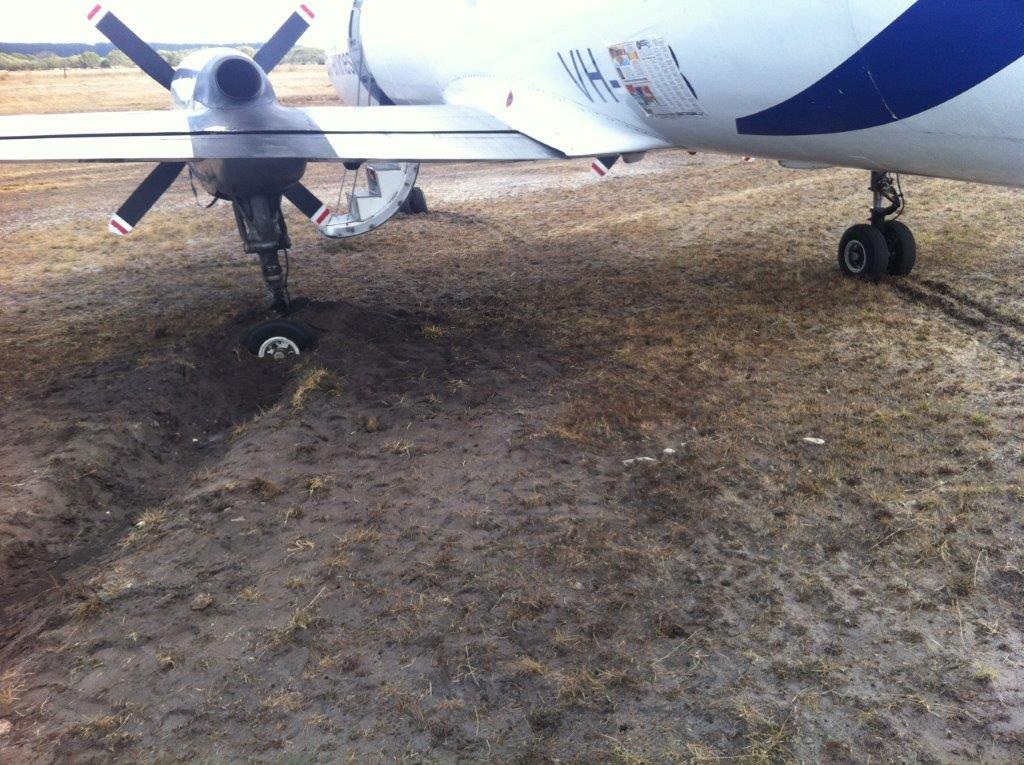
On 20 February 2014 at 1425 EDT, a Fairchild Industries Metro 23 aircraft, registered VH-UUB, was being operated on a charter flight from Avalon to Portland, Victoria with 10 passengers and two crew on board. Shortly after touch-down the torque link on the left, main landing gear (MLG) failed. The aircraft veered left as a result, and came to rest beside the runway. There were no injuries as a result of the occurrence.
What the ATSB found
The runway excursion resulted from failure of the lower torque link attachment lug on the left main landing gear’s yoke. This allowed the wheels to rotate through 90° with respect to the direction of aircraft travel and skid, producing a large braking effect on the left side. The flight crew were unable to counteract this and it resulted in the aircraft veering to the left and off the runway.
The failure of the lug on the yoke resulted from pre-existing cracks that had progressively grown until the part had insufficient strength to support normal landing loads. The cracks initiated principally from areas of pitting corrosion in the lug’s bore and were propagated by cyclic stresses imposed during operation.
The ATSB identified a safety issue whereby the maintenance and inspection program for the aircraft’s landing gear did not adequately provide for the detection of corrosion and cracking in the yoke lug bore.
What has been done as a result
The Civil Aviation Safety Authority (CASA) has released Airworthiness Bulletin AWB 32-023 to alert all Fairchild Swearingen Metro and Merlin operators of the need for detailed inspection of the internal bore of the landing gear torque link lugs for any signs of corrosion or wear outside of the manufacturer’s specified limits and to take appropriate action per the aircraft’s structural repair manual, where necessary.
In addition, the aircraft’s Type Certificate Holder has drafted service bulletins 226-32-083, 227-32-065, CC7-32-030 titled “inspection of Main Landing Yoke for Corrosion and/or Damage” that will significantly increase the effectiveness of maintenance inspections for the affected parts.
Safety message
This occurrence highlights the importance of developing and conducting appropriately detailed maintenance inspections on susceptible parts and assemblies.
UBB after veering off the runway
Source: airline operator
The occurrence
On 20 February 2014, a Fairchild Industries SA227-DC ‘Metro 23’ aircraft, registered VH-UUB, had been flown from Avalon to Portland, Victoria on a charter flight. On board were two flight crew and 10 passengers. A normal approach was conducted and the aircraft touched down at 1425 EDT[1]. During the landing roll, the flight crew noted the aircraft began veering to the left. The flight crew attempted to counteract the movement, using rudder inputs, reverse thrust on the engines and the right brake, but the aircraft subsequently departed the runway at a speed of 75 to 80 knots and began to slide sideways. The left main landing gear (MLG) dug into the ground and the nose of the aircraft swung sharply to the left as it came to a stop. The flight crew shut the aircraft down and disembarked the passengers when it was safe to do so. There were no reported injuries as a result of the occurrence.
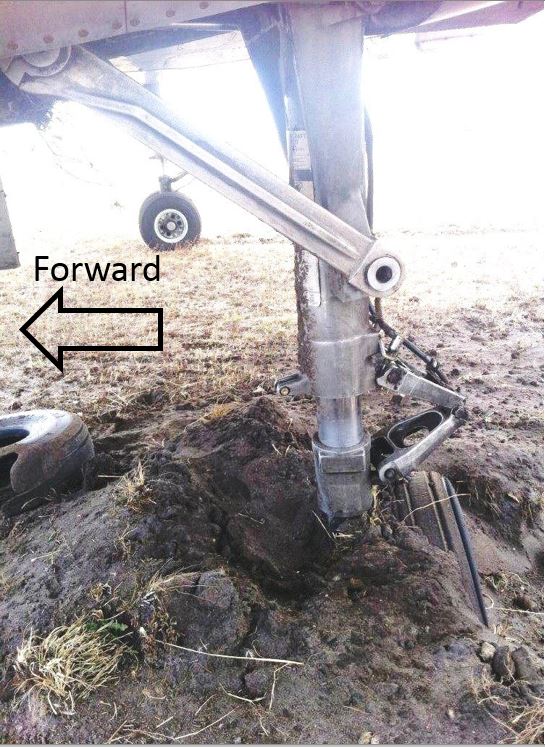
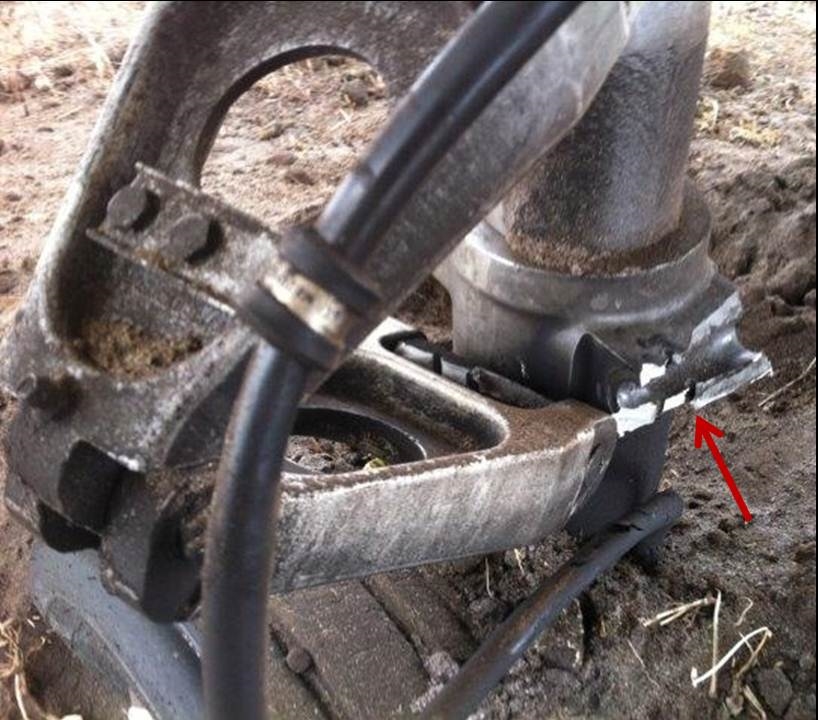
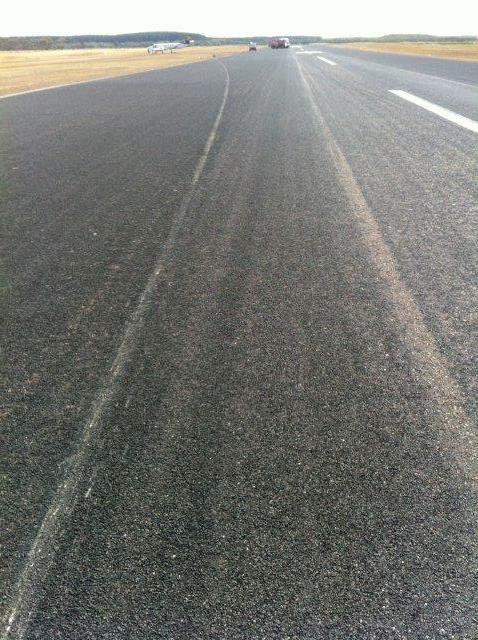
Subsequent inspection of the aircraft found that the torque link[2] had detached from a fractured lug on the lower section of the left MLG (arrowed in Figure 1b), allowing the wheel assembly to rotate through 90° w.r.t. the direction of aircraft travel. This resulted in skidding wheels, producing a significant braking effect on the left main gear and causing the aircraft to veer to left and depart the runway (Figure 2).
Figure 1: Damage to the left MLG
Source: Airline operator
Figure 2: Damage to runway as a result of contact with the left main landing gear following failure
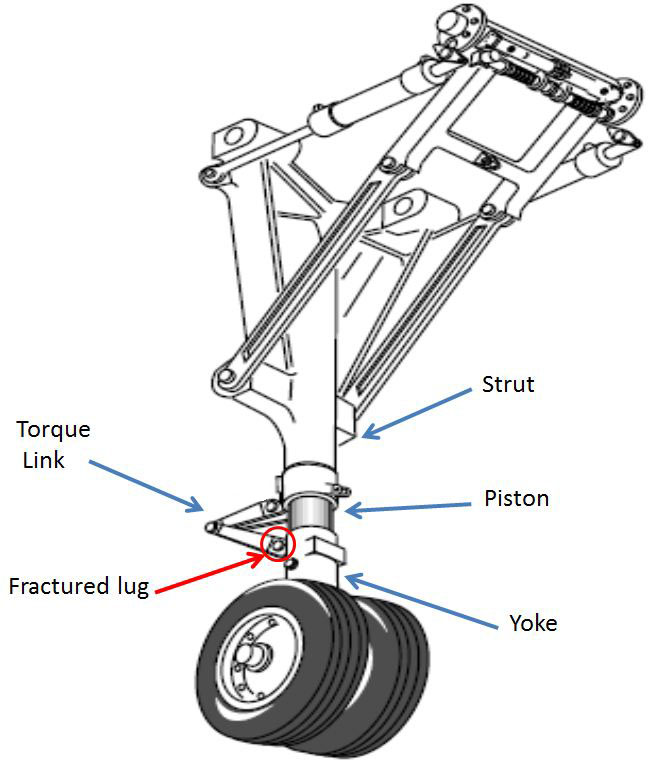
The main landing gear assembly is composed of a telescoping upper cylinder (strut), a piston assembly and, at the lower end, the yoke (Figure 3). A torque link assembly connects at lugs on the strut and the yoke, allowing compression of the assembly while preventing rotation of the yoke. In this occurrence, the lug on the yoke had fractured.
Yokes in the MLGs of earlier SA227 models were manufactured by Ozone Industries as part number (P/N) OAS5453005-5[3]. In later models, manufacture was by another landing gear vendor, Klune Industries, and started with the fabrication of the 27-series part numbers. The fractured yoke from VH-UUB was identified as P/N 2751505005, manufactured by Klune Industries.
Source: M7 Aerospace SA227 Maintenance Manual (Modified by ATSB)
Recorded information
The ATSB downloaded and analysed data from the aircraft’s Flight Data and Cockpit Voice Recorders (FDR & CVR, respectively). The data confirmed that following touchdown, the aircraft began veering to the left. Approximately 8 seconds later, the aircraft departed the runway. In addition, the following points were noted:
The vertical speed prior to landing was that of a normal approach.
Vertical decelerations recorded during the touch-down were not excessive.
The airspeed at touch-down was consistent with prior flights.
The aircraft was correctly configured for landing.
Component Examination
Lug Fracture
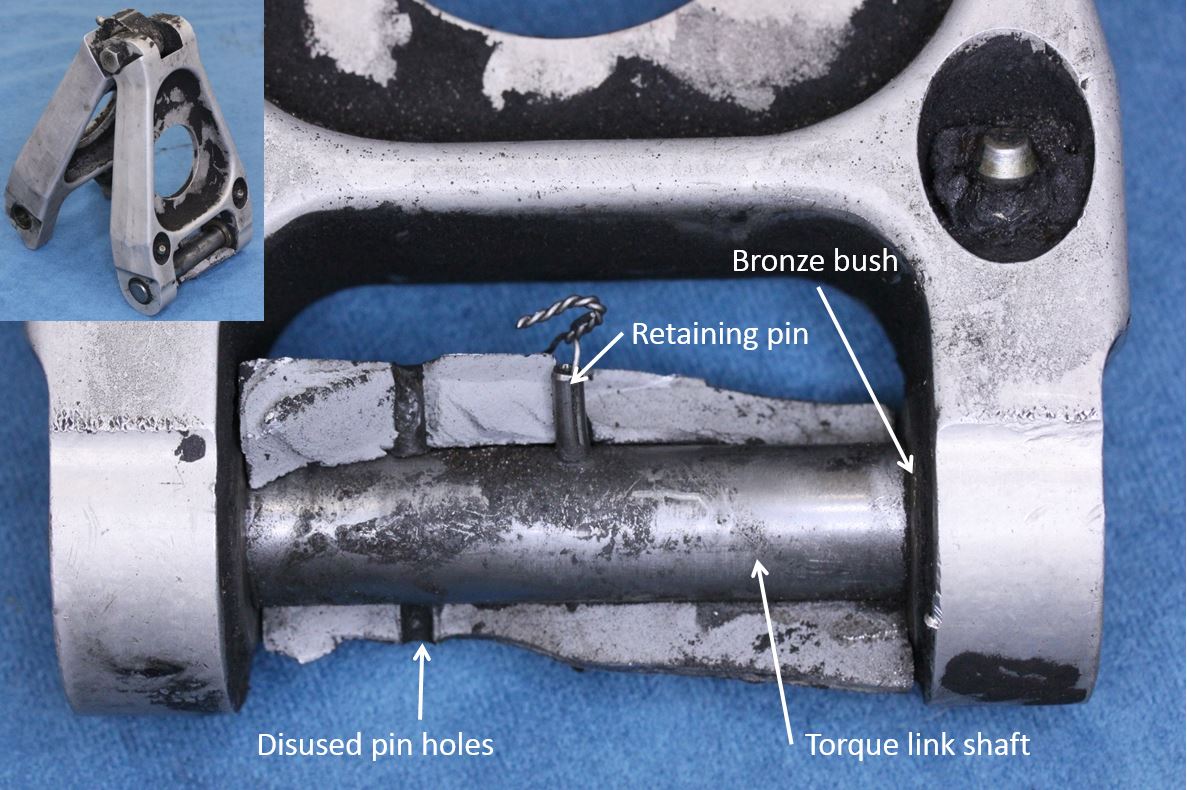
The aluminium torque link and yoke were assembled via a steel torque link shaft (TLS) that mated with bronze bushes in the lower link. It was secured with a single, stainless-steel retaining (spring) pin with stainless steel lockwire in its bore (Figure 4).
The fractured yoke contained four disused retaining pin holes (two each top and bottom) as a result of compliance with a service bulletin (SB) for installing a replacement TLS (CC7-32-012), released in 2002. The SB required drilling of a new pin hole in the lug to secure the replacement TLS and filling of the redundant holes with sealant. As examined, the disused holes in the fractured yoke were not sealed, but instead contained black corrosion/wear product. However, traces of sealant around some of the holes suggested that they had probably been filled at the time of service bulletin compliance.
Figure 4: Lower torque link attachment assembly with fractured lug segment in-situ
Source: ATSB
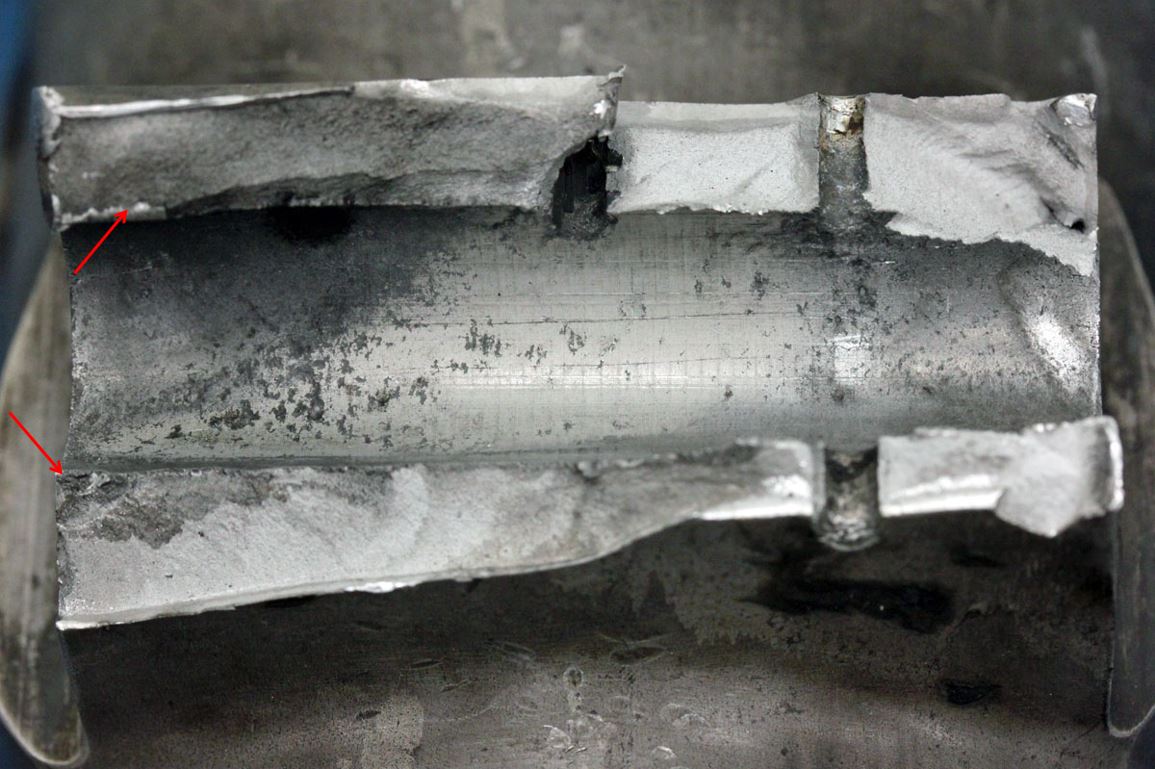
Significant corrosion pitting was evident in the bore of the lug and on the lug flanks, with concentrations around the four disused, spring pin holes (Figure 5). Fatigue crack progression (beach) marks were identified on the lug fracture surfaces with the crack origins located at areas of significant corrosion pitting and wear in the bore. The fatigue cracking progressed across most of the lug cross section before the remaining portion fractured by ductile overstress. The overstress areas were largely defined by a narrow region on the outside radius of the lug (furthest from the bore).
Detailed examination of the corrosion pits adjacent to the fracture surface found evidence of corrosion product as well as a series of crack progression marks radiating outwards from the edge of the corroded areas.
Figure 5: Yoke lug exhibiting corrosion pitting, wear in the bore and fatigue crack progression on the fracture surfaces (main crack origins arrowed)
Source: ATSB
Lug dimensions
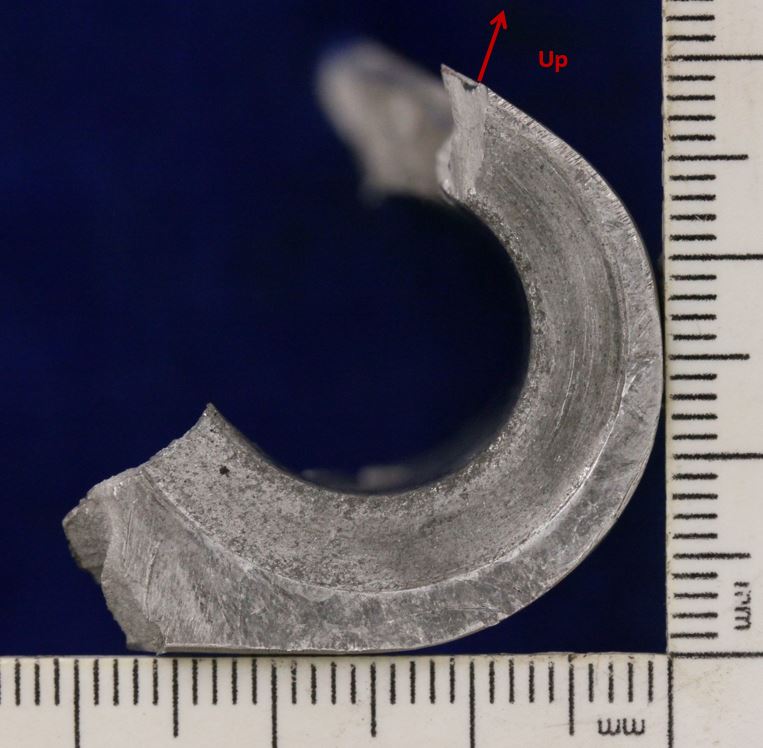
The bronze bushes installed in the lower torque link had worn against the yoke’s lug flanks during normal operation such that, in the areas of greatest wear, the width of the lug was now 66.03mm (2.6”) which was 0.26mm (0.01”), below the minimum dimension of 2.61” (66.294mm) specified in the structural repair manual (Figure 5).
Material properties
The material properties were correct for the specified 7075-T73 aluminium alloy. Electrical resistivity testing showed that a majority of the chromic acid anodised coating, applied to the component during manufacture, had worn away, increasing the component’s susceptibility to corrosion and wear, particularly in an aqueous environment of metals dissimilar to aluminium.
Figure 6: Flank of the fractured yoke lug showing surface wear from mating bush
Source: ATSB
Yoke maintenance requirements
The Fairchild MLG yokes were maintained on condition and were not subject to any maximum service life restrictions. At the time of the occurrence, the SA227 Phase Inspection Manual (SA227 CC/DC Commuter Category, Rev 19, Sept 28, 2012) included requirements for inspection of the aircraft structure and components. The definitions section of the manual stated that;
A routine inspection – Visual inspection not requiring removal of access panels or fairings.
A detailed inspection – Detailed inspection requiring removal of access panels, doors, fairings, covers, upholstery and components for inspection.
The aircraft was maintained using a 6-phase inspection program with an interval of 900 hours; this included a detailed inspection of the main landing gear at a phase 3 inspection (450 hours) and a routine inspection at a phase 6 inspection (900 hours).
The phase inspection manual also included a section which included a list of requirements for the routine and detailed inspections. The detailed inspection included the requirement to inspect struts for damage, evidence of leakage, condition and security, and to inspect scissors and bushings for wear, condition and security. The manufacturer advised that in order to perform these inspections, the shaft attaching the scissor links to the yoke lug should be removed and the condition of the components checked, as well as the wear limits.
The most recent detailed (Phase 3) inspection was 436.5 hours prior to the occurrence, and a routine (Phase 6) inspection 37.3 hours prior to the occurrence. The operator’s inspection procedures followed the guidelines in the inspection manual and there was no record of the components being disassembled at either inspection. The operator advised that they performed a torque link freeplay inspection at the detailed inspection and if excessive freeplay was evident, then the components would be disassembled for further inspection.
In August and September 1995, Fairchild issued two service bulletins to cover six of the earlier SA227 models equipped with Ozone MLG & NLG (Nose Landing Gear) yokes. This was due to failures initiated by stress corrosion cracking and corrosion fatigue. In those occurrences, the failure origin was at the forging die parting (flash) line in the upper yoke area, where the piston was shrink-fitted. Both the Federal Aviation Administration and the Civil Aviation Safety Authority issued airworthiness directives a month later.
Other occurrences
On 10 June 2007, an SA227-DC, registered VH-HPE, sustained a left MLG yoke lug failure during post-landing taxiing at Tennant Creek Aerodrome. The ATSB did not investigate that occurrence, however a report provided to the ATSB indicated that the fracture similarly related to fatigue crack progression precipitated by wear, corrosion pitting and stress corrosion cracking in the yoke lug bore.
The Civil Aviation Safety Authority (CASA) were aware of four Australian-registered, SA227 MLG torque link lug failures, as well as cracking of a yoke lug, found during daily inspection, on a Canadian-registered aircraft.
The manufacturer advised they were aware of two cracked yoke lugs, which were found by the same Canadian operator in 2012. A failure analysis report for one of the failures showed similar cracking to that identified on UUB. The report stated that the failure occurred as a result of cracking that had initiated at multiple corrosion pits on the inner surface of the lug. In this case however, the cracking had propagated to the external surface, which allowed it to be identified during a daily maintenance inspection. The same Canadian operator also experienced a third failure in December 2015, which was identified by the flight crew after landing.
The runway excursion involving Fairchild Industries Metro 23 VH-UUB at Portland, Victoria, on 20 February 2014, was the result of the failure of a lug on yoke of the wheel assembly on the left main landing gear (MLG) during the landing roll. The failure of the lug disconnected the torque link between the upper MLG strut and the lower wheel assembly; this allowed the wheel assembly to rotate through 90° with respect to the direction of travel. This effectively resulted in a large braking force on the left side of the aircraft. The flight crew were unable to counteract that asymmetric braking force and as a result, the aircraft veered off the runway
Failure of the MLG yoke lug
The yoke lug fractured as a result of a fatigue cracking mechanism with crack initiation points located in the bore of the lug at areas of significant wear and corrosion pitting. The fatigue crack progressed through most of the lug cross section before final fracture during the occurrence landing.
Corrosion pits act as stress concentrators and significantly reduce both the fatigue crack initiation life of the component as well as the crack initiation threshold stresses. The corrosion, wear and cracking had likely been present in the lug bore for a significant period of time prior to failure occurring. Early indications of corrosion and cracking on the lug bore would not have been visible during the inspections prescribed in the inspection manual, without first disassembling the affected parts. Neither the detailed nor routine inspections explicitly required an inspection of the lug bore, although the manual contained a general definition of a detailed inspection that required components to be disassembled for examination. The list of required inspection items also implied that some disassembly would be required to adequately inspect various components. The operator indicated that while no disassembly was performed, a torque link freeplay inspection was performed which would have led to further examinations if anomalies, such as excessive movement, were found.
There were several factors that influenced corrosion of the yoke lug bore. Sealing of the disused pin holes in this occurrence was not adequate as the sealant had either broken down over time or otherwise disbonded and come loose during service, providing additional entrance routes for moisture or other corrosives. Another entrance route was associated with wear on the yoke lug flanks where significant pitting was identified. Wear on the flanks and in the bore of the lug was sufficient to remove the protective anodic coating, which increased the susceptibility of the parts to corrosion. With corrosion pitting being a precursor to the fatigue failure of the component, improvement of corrosion protection in the affected areas would further reduce the likelihood of this type of occurrence.
Findings
From the evidence available, the following findings are made with respect to the runway excursion involving a Fairchild Metro 23 aeroplane, registered VH-UUB, which occurred at Portland, Victoria on 20 February 2014. These findings should not be read as apportioning blame or liability to any particular organisation or individual.
Safety issues, or system problems, are highlighted in bold to emphasise their importance. A safety issue is an event or condition that increases safety risk and (a) can reasonably be regarded as having the potential to adversely affect the safety of future operations, and (b) is a characteristic of an organisation or a system, rather than a characteristic of a specific individual, or characteristic of an operating environment at a specific point in time.
Contributing factors
The runway excursion occurred as a result of fracture of the torque-link attachment lug on the aircraft’s left main landing gear yoke, which allowed those wheels to deviate from the normal direction of travel and cause asymmetrical braking forces that could not be countered by the flight crew.
The torque link-to-yoke attachment lug fractured under normal operational loads as a result of the initiation and propagation of fatigue cracks originating at areas of excessive wear and corrosion pitting on the lug bore.
The maintenance program for the aircraft’s landing gear did not adequately provide for the detection of corrosion and cracking in the yoke lug bore. [Safety issue]
Safety issues and actions
The safety issues identified during this investigation are listed in the Findings and Safety issues and actions sections of this report. The Australian Transport Safety Bureau (ATSB) expects that all safety issues identified by the investigation should be addressed by the relevant organisation(s). In addressing those issues, the ATSB prefers to encourage relevant organisation(s) to proactively initiate safety action, rather than to issue formal safety recommendations or safety advisory notices.
Depending on the level of risk of the safety issue, the extent of corrective action taken by the relevant organisation, or the desirability of directing a broad safety message to the aviation industry, the ATSB may issue safety recommendations or safety advisory notices as part of the final report.
Where relevant, safety issues and actions will be updated on the ATSB website as information comes to hand. The initial public version of these safety issues and actions are in PDF on the ATSB website.
Safety issue title – Inadequate inspection procedures
The maintenance program for the aircraft’s landing gear did not adequately provide for the detection of corrosion and cracking in the yoke lug bore.
Sources of information used during the investigation included:
the aircraft’s type certificate holder
the aircraft operator
the Civil Aviation Safety Authority
the operating flight crew
the aircraft’s flight data recorders.
Submissions
Under Part 4, Division 2 (Investigation Reports), Section 26 of the Transport Safety Investigation Act 2003 (the Act), the Australian Transport Safety Bureau (ATSB) may provide a draft report, on a confidential basis, to any person whom the ATSB considers appropriate. Section 26 (1) (a) of the Act allows a person receiving a draft report to make submissions to the ATSB about the draft report.
A draft of this report was provided to the operator, the aircraft maintenance provider, M7 Aerospace and CASA.
Submissions were received from the operator, M7 Aerospace and CASA. The submissions were reviewed and where considered appropriate, the text of the report was amended accordingly.
Purpose of safety investigations
The objective of a safety investigation is to enhance transport safety. This is done through:
identifying safety issues and facilitating safety action to address those issues
providing information about occurrences and their associated safety factors to facilitate learning within the transport industry.
It is not a function of the ATSB to apportion blame or provide a means for determining liability. At the same time, an investigation report must include factual material of sufficient weight to support the analysis and findings. At all times the ATSB endeavours to balance the use of material that could imply adverse comment with the need to properly explain what happened, and why, in a fair and unbiased manner. The ATSB does not investigate for the purpose of taking administrative, regulatory or criminal action.
Terminology
An explanation of terminology used in ATSB investigation reports is available here. This includes terms such as occurrence, contributing factor, other factor that increased risk, and safety issue.
Publishing information
Released in accordance with section 25 of the Transport Safety Investigation Act 2003
Ownership of intellectual property rights in this publication
Unless otherwise noted, copyright (and any other intellectual property rights, if any) in this report publication is owned by the Commonwealth of Australia.
Creative Commons licence
With the exception of the Coat of Arms, ATSB logo, and photos and graphics in which a third party holds copyright, this publication is licensed under a Creative Commons Attribution 3.0 Australia licence.
Creative Commons Attribution 3.0 Australia Licence is a standard form licence agreement that allows you to copy, distribute, transmit and adapt this publication provided that you attribute the work.
The ATSB’s preference is that you attribute this publication (and any material sourced from it) using the following wording: Source: Australian Transport Safety Bureau
Copyright in material obtained from other agencies, private individuals or organisations, belongs to those agencies, individuals or organisations. Where you wish to use their material, you will need to contact them directly.
On 19 February 2014, at about 1030 Eastern Daylight-savings Time, a Beech A36 (Bonanza) aircraft, registered VH-EUB, departed Lilydale aeroplane landing area (ALA), Victoria, for a training flight, with an instructor and pilot-under-instruction on board.
While the crew were completing training exercises in the local area, a storm cell with heavy rain passed over the airport. The pilot then broadcast an inbound call and returned to Lilydale, joining downwind for a landing on runway 18 Left (18 L). The pilot conducted pre-landing checks and confirmed that the brakes had pressure. He observed that the windsock indicated runway 18. The aircraft arrived over the runway threshold about 50 ft above ground level at about 85 kt indicated airspeed. This was slightly higher and faster than an optimal approach.
The aircraft touched down about 250-300 m along the runway and the pilot applied the brakes, however the aircraft did not decelerate. The instructor took over the control of the aircraft and commenced applying the brakes, then releasing and reapplying them. The brakes remained ineffective at gaining traction. At this stage the instructor assessed that it was too late to commence a go-around, and that the aircraft was aquaplaning on the wet runway.
With less than 100 m of runway remaining, the pilot and instructor both applied right rudder in an attempt to steer the aircraft away from an embankment located about 20 m beyond the end of the runway. The aircraft rotated 90° to the right and continued to slide in the direction of the runway. The aircraft came to rest on top of the embankment and the left main landing gear collapsed.
After exiting the aircraft, the instructor observed that the wind had veered and that a tailwind may have contributed to the incident.
This incident highlights the importance of conducting a go-around as soon as landing conditions appear unfavourable.
On 17 February 2014, a Cessna C206 aircraft, registered VH-YOT, departed runway 05 at Newman Airport, Western Australia, at about 0526 Western Standard Time for a charter flight to Cotton Creek in visual meteorological conditions. The pilot was the only occupant.
About 3 minutes after take-off, while in the climb and at about 1,500 feet above ground level the pilot conducted a scan of the aircraft instruments and noticed that the engine oil pressure gauge was indicating zero. All the other engine instrument indications were in the normal range. The pilot turned the aircraft back towards Newman airport. About 1 minute later the pilot observed sparks coming from the engine cowling near the propeller, the engine power decreased and a severe vibration was felt through the airframe. The pilot pulled the mixture control to lean cut off to stop fuel flowing to the engine as he was concerned about an inflight fire and the propeller stopped rotating.
The pilot determined that he would not be able to glide to runway 23 and began a scan to locate a suitable landing area. The pilot located a paddock that was about 4 km from the airport that appeared to be a suitable landing area and was near a dirt road. Prior to landing, the pilot shut down all non-essential aircraft systems.
On landing, the left wing impacted a tree and the aircraft spun around 180 degrees. The pilot shut down all remaining systems and climbed into the rear section of the aircraft. The pilot exited the aircraft through the rear section of the cargo door and was not injured. The aircraft was substantially damaged.
This accident highlights the importance of pre-flight decision making and planning for emergencies and abnormal situations for the particular aerodrome including a thorough pre-flight self-brief covering the different emergency scenarios, conducting a thorough pre-flight and engine ground run to identify any issues that may lead to an engine failure and taking positive action and maintaining aircraft control either when turning back to the aerodrome or conducting a forced landing until on the ground, while being aware of flare energy and aircraft stall speeds.
On 18 February, 2014 an instructor from a local flying school at Moorabbin Airport, Victoria, conducted a trial instructional flight (TIF) in a Cessna 150, registered VH-RXM.
As the aircraft taxied to the runway holding point, ATC advised of a 3-4 knots tailwind on the duty runway, 35 Left (L). Although the wind was now southerly, the instructor was satisfied it was still acceptable to safely depart on this runway.
The flight was intended to give the student a “hands-on” experience at flying an aircraft. During the take-off, the student slowly advanced the throttle to attain full power, and then applied back pressure to the control column during the rotation and initial climb. These actions were monitored by the instructor. To enhance the “flight experience” for the student, the instructor had minimal input. He did however, maintain full control of the rudder pedals, and took control of the throttle lever once the student had applied full power.
During the initial climb, the student continued to apply back pressure to the control column resulting in a reduction in optimal airspeed, and a higher than normal aircraft nose attitude. As the instructor attempted to rectify the aircraft’s profile, the right wing dropped and the aircraft began to descend.
The instructor’s efforts to recover the aircraft to a normal climb attitude were not successful, and the right side of the aircraft struck the ground. The aircraft bounced, then came to a halt on its left side.
The instructor and student egressed through the right door. They both sustained minor injuries. The aircraft was substantially damaged.
As a ‘Safety Action’, the flying school have changed their procedure in regard to trial instructional flights.
Instructors will now complete the take-off and initial climb to a height of 300 ft.
At about 1411 on 12 February 2014, 10 wagons of a loaded grain train en-route from Birchip to North Geelong derailed at Emu in North Central Victoria. The weather was hot with a forecast temperature of 36° C.
As a consequence of the derailment there was damage to about 210 m of track. Five wagons overturned resulting in significant damage and a loss of load. The subsequent rolling stock recovery and track repair activities closed the line for five days. Emu Loop was not reinstated as a crossing location.
What the ATSB found
The ATSB found that rail creep readings within Emu Loop had been identified by V/Line as a Priority 2 defect – requiring prioritisation for rectification – and that this rectification had not been carried out by the time the derailment had occurred. The hot conditions of the day together with a latent rail creep condition contributed to the rails within Emu Loop assuming a state of longitudinal compression.
The track-train dynamics generated by the passage of 9130, even at the relatively low speed, in combination with the compressed state of the rail, produced lateral loads that exceeded the lateral resistance of the ballast, causing misalignment. The lateral misalignment was of a sufficient magnitude to result in derailment.
Due to the high forecast temperature, train speed restrictions and special track heat patrol requirements had come into force. Speed restrictions were met and a heat patrol was planned to be conducted over the length of line where the derailment occurred. However, as the train was in possession of an authority through the section, the patrol was not conducted ahead of the train.
What's been done as a result
V/Line is undertaking a review of the current procedure for managing Priority 2 rail creep defects. This will be completed by November 2015.
Safety message
This derailment highlights the need for rail infrastructure managers to monitor and address rail creep conditions and track lateral stability, particularly prior to the onset of hot weather conditions.
On 10 February 2014, at about 1500 Central Standard Time, the pilot of a Robinson R22 helicopter, registered VH-LZR, commenced take-off for a private local flight from a property about 100 km east of Mataranka, Northern Territory.
As the helicopter became airborne heading to the south-east, the pilot sighted an object moving to his right. At about 10 ft above ground level, the pilot was distracted looking outside the door at the object and the helicopter collided with a tree. The helicopter sustained substantial damage and the pilot was uninjured.
This incident shows that distractions can have a significant impact on flight safety.
On 1 February 2014, a crew member carrying out routine maintenance on the passenger ship Seven Seas Voyager’s waste incinerator was injured when a pneumatically (air) operated valve closed against his body. The ship was berthed in Sydney and the crew member, a fitter, was taken to a local hospital.
The fitter was treated for serious bruising and shock before returning to the ship. While it was expected that the fitter could resume duties after 2 days, his condition did not sufficiently improve and he was later discharged from the ship to recuperate at home.
What the ATSB found
The ATSB found that the incinerator ash dump valve’s control systems had not been properly isolated and residual air pressure remained in the valve’s operating system. The fitter assumed that it was safe to start his assigned task of replacing the incinerator ash grates, and accessed the incinerator through the ash dump valve. He then inadvertently activated the electric sensor that automatically closed the valve – driven by the pressure of the residual air remaining in the valve operating system.
The investigation identified that Seven Seas Voyager’s engineering staff did not have an adequate understanding of the incinerator’s control systems and its maintenance. Furthermore, the task of replacing the ash grates was not adequately planned and shipboard safety management system requirements, including taking necessary risk mitigation measures and completion of a permit to work before the task, were not complied with.
The investigation also found that neither the ship’s planned maintenance system (PMS) nor the incinerator manufacturer’s instruction manual contained any information with respect to the maintenance or replacement of the ash grates. Such information would have been useful to shipboard staff planning the grate replacement task, particularly with identifying all the risks associated with the task.
What's been done as a result
The ATSB has issued a recommendation to Seven Seas Voyager’s manager to take action to address the safety issue with respect to the ship’s PMS. The ATSB has also recommended that the incinerator manufacturer address the safety issue concerning the equipment’s instruction manual.
Safety message
Shipboard equipment and machinery commonly incorporates automated, power-operated systems which must be isolated, stored energy released and locked out before undertaking maintenance or repair tasks. Safely completing a task relies on personnel having a proper understanding of the system involved, coupled with adequate planning, risk assessment and the effective implementation of all safety management system requirements - including permits to work.
The occurrence
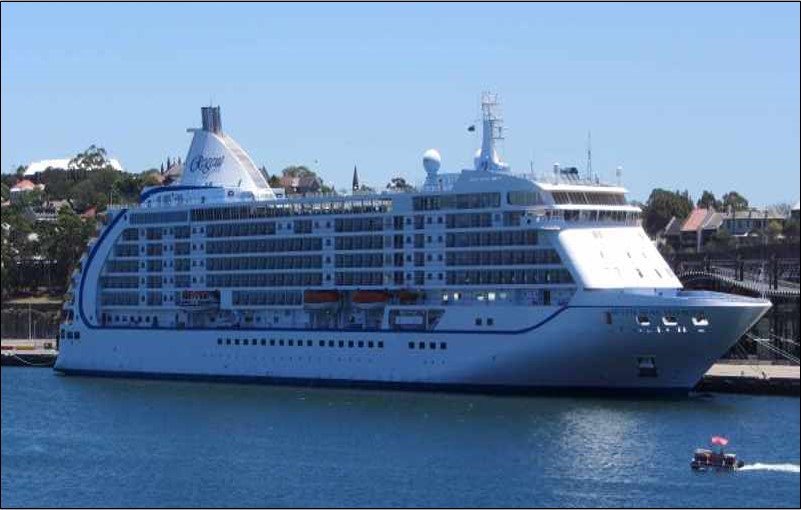
On 31 January 2014, the 206 m long passenger ship Seven Seas Voyager (Figure 1) berthed alongside the wharf at the Overseas Passenger Terminal (OPT) in Sydney. The ship was scheduled to remain in port overnight and sail for Brisbane on the following evening.
Figure 1: Seven Seas Voyager
Source: ATSB
At 0730[1] on 1 February, the staff chief engineer[2] held the daily meeting to discuss the work plan for the day with the first engineer, mechanics, fitters and wipers. The first engineer suggested replacing the waste incinerator ash grates with spare grates on board. The incinerator had been shut down for about 30 hours and had cooled sufficiently. The staff chief engineer agreed with the suggestion and a fitter was assigned to assist the first engineer with the task.
At 0800, the first engineer briefed the assigned fitter about the personal protective equipment (PPE) and the tools that would be required for the ash grate replacement. The fitter began arranging the necessary items for the task in the incinerator room, while the first engineer started to fill out a permit to work.
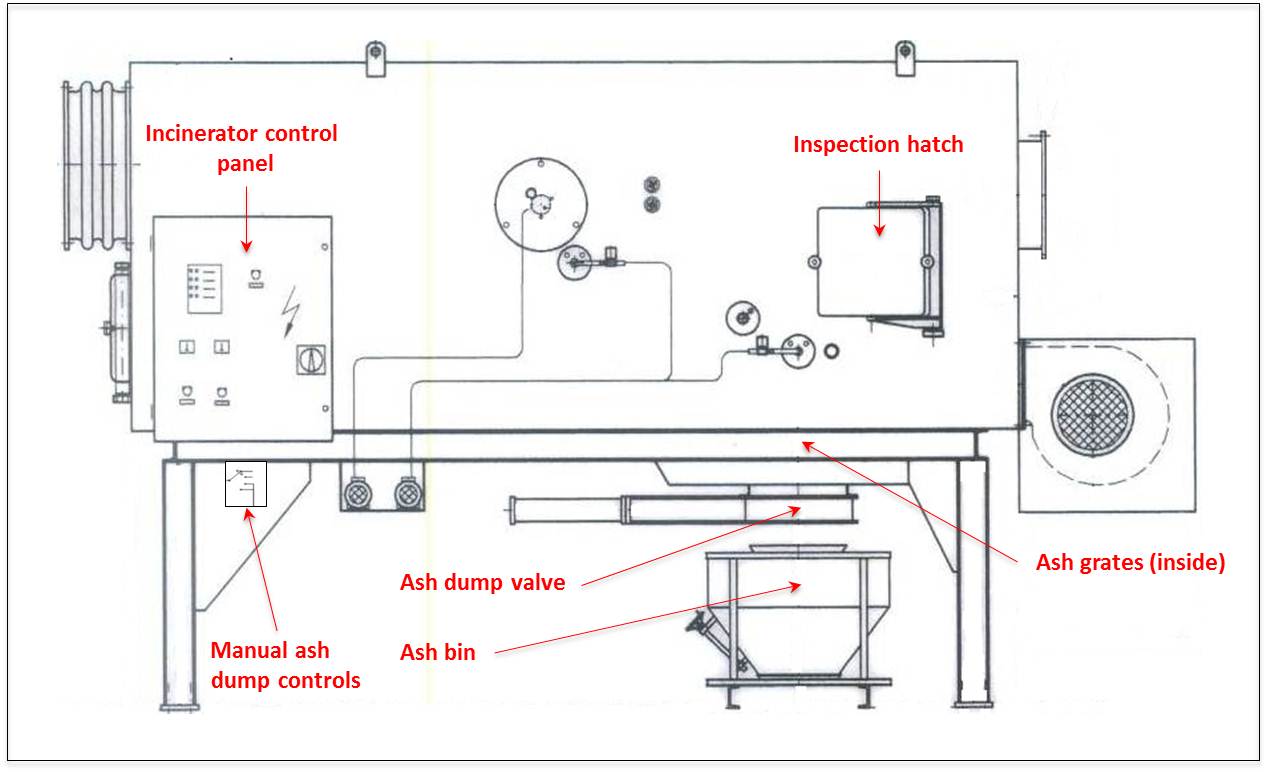
At 0840, the first engineer inspected the incinerator furnace through the inspection hatch (Figure 2) and found that it needed to be cleaned of ash before work could commence. The incinerator operator attended and used the manual controls to open the ash grates and the sliding ash chamber dump valve to release the ash into an ash waste bin. The first engineer then shut off the air to the incinerator’s operating system.
At 0850, after the ash bin had filled, the incinerator operator removed it and returned to his other duties. When the first engineer inspected the internals of the incinerator furnace, he noted that further cleaning was required. He organised a wiper to vacuum the ash out.
At about 0900, the vacuum cleaner stopped after its dust bag filled so the wiper went to get a replacement dust bag. At about the same time, the first engineer went to change into working clothes before starting the task.
By then, the fitter had prepared tools and donned PPE. He moved to a position under the incinerator to inspect the ash grates through the open ash chamber dump valve and determine how to remove the grates. He saw the taper pins holding the grates in place and attempted to hammer the pins free. Unsuccessful, the fitter then stood up through the open ash dump valve and the partially closed, worn out grates. He could now look down on the grates as he moved them back and forth.
Meanwhile, the wiper had returned to the incinerator room and started changing the vacuum cleaner dust bag. He did not notice that the fitter was standing under the incinerator with his upper body inside it.
Figure 2: Diagram showing main components of waste incinerator
Source: ATSB
At about 0908, as the fitter went about moving the grates, the ash dump valve began to close. The fitter did not notice the slowly moving dump valve until it was too late for him to get clear. As the valve closed on his lower body, he began to shout for help.
At about 0910, when the first engineer returned to the incinerator room, he heard the fitter’s shouts. The first engineer was on the deck above the incinerator, where its electro-pneumatic control cabinet was located, and he quickly checked that the air supply was still closed.
At 0912, the first engineer phoned the staff chief engineer and advised him of the incident and the need for immediate assistance. At the same time, the wiper phoned the bridge and advised the officer of the watch, who then broadcast an all ship medical emergency for the incinerator room.
At 0913, the staff chief engineer arrived in the incinerator room. The first engineer was unable to move the dump valve by hand or by the control system, so he and the staff chief engineer began removing the air pipes to the dump valve and ash grate pneumatic cylinders. Shortly afterwards, the ship’s senior officers and the medical response team and arrived on the scene.
When the staff chief engineer and first engineer had removed the air lines, they were able to force the dump valve open and free the fitter. He was stretchered to the ship’s hospital for assessment and treatment. An ambulance soon arrived at the OPT wharf and the fitter was taken to a local hospital for further treatment.
At the hospital, the fitter was treated for serious bruising and shock before returning to the ship later that day. He returned to light duties 2 days later but continued to suffer from the effects of the incident. Consequently, on 11 February, he was discharged from the ship to recuperate at home.
Seven Seas Voyageris a passenger ship with a capacity of 730 guests. At the time of the incident, it was operated by Prestige Cruise Holdings and engaged in round-the-world cruises. It was registered in the Bahamas and classed with Lloyd’s Register (LR).
The ship had a multi-national crew of 451, including the master who joined the ship on the day of the incident. The master had 20 years of seagoing experience, of which the last 12 had been on passenger ships. He held a master mariner’s certificate of competency and had been sailing as master for 3 years. This was his sixth time on board Seven Seas Voyager.
The staff chief engineer had 27 years of seagoing experience, of which the last 21 years had been on passenger ships. He held a certificate of competency as a chief engineer and had been sailing in that rank for 5 years .This was his first time on board Seven Seas Voyager and he had been on board for about 2 weeks.
The first engineer had about 7 years of seagoing experience, of which the last 4 years had been spent on passenger ships. He held a second engineer’s certificate of competency and had been sailing as first engineer for 1 month. This was his fourth time on board Seven Seas Voyager and had been on board for 2 months.
The fitter had 10 years of seagoing experience, of which 4 years had been with Prestige Cruise Holdings. He held a degree in marine engineering from the Philippines. This was his first time on board Seven Seas Voyager and he had been on board for 5 months.
Waste incinerator
Seven Seas Voyager was fitted with a 300 kg/hour ISIR Pyrall 150 ADA type waste incinerator (Figure 3). Shredded solid waste was fed from the deck above into the incinerator furnace through its forward end. The furnace internals were refractory lined and the incinerator was fired via a side-mounted gas oil burner.
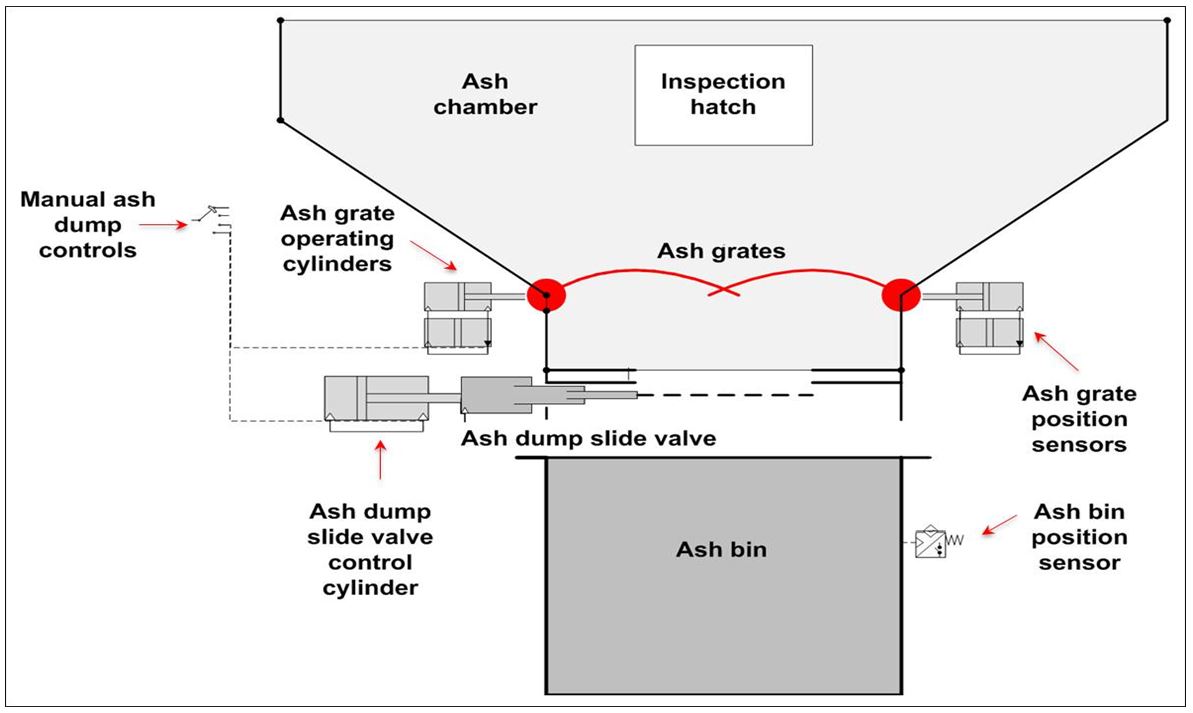
Figure 3: Sketch of incinerator ash dumping system and sensors
Source: ATSB
Figure 4: New ash grates (for replacement)
Source: ATSB
The accumulated ash in the incinerator’s ash chamber was held in check by two cast iron grates (figure 4). A sliding ash dump valve was located below the grates and sealed the incinerator ash chamber. When dumping ash, the sliding ash dump valve was opened and the grates swung down to open. This allowed the ash to fall out of the incinerator into an ash bin.
The ash grates and ash dump valve were operated by pneumatic cylinders which were fitted with sensors to detect their position (open or closed). Another sensor was fitted to detect when an ash bin was in place under the incinerator. A control switch was mounted on the side of the incinerator for manual activation of the ash dumping system.
Ash removal
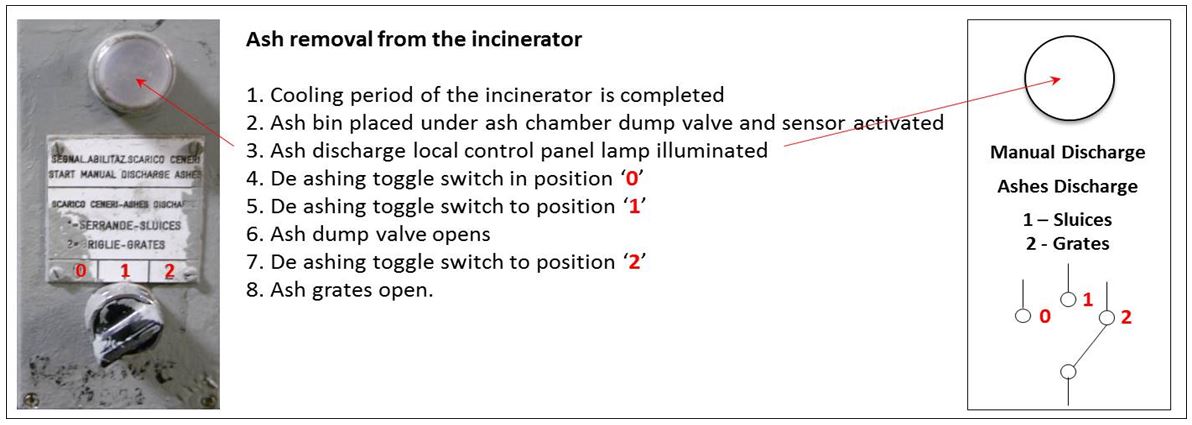
Accumulated ash had to be periodically manually released by the incinerator operators (Figure 5). To do this, the incinerator was shut down, allowed to cool and a waste bin was placed under the ash dump valve, making contact with the bin sensor, energising the control circuit.
Figure 5: Diagram listing ash removal instructions and photograph of control panel
Source: ATSB
When the control switch was moved to position 1, the ash dump valve would open and then in position 2, the grates would open and the ash would fall into the ash bin. When the ash bin was full, the control switch would be moved to position 0. The grates would close and, once in the fully closed position, the dump valve would close. If the ash bin was removed while the manual control switch was not in position 0, the grates and dump valve would automatically close in the same sequence. If either grate did not fully close, the dump valve would not receive the signal to close and, hence, would remain open.
Ash grate replacement
The incinerator ash grates rotated on a steel shaft passing longitudinally through the grate body and were secured to the shaft with tapered pins (Figure 6). The ash grates opened in a downwards direction and released ash below. However, this did not allow access to remove the tapered pins. The grates needed to be swung 90° upwards to expose the bottom of the pin. This would require disconnection of the pneumatic cylinders, which in turn depressurised the system.
Figure 6: Ash grate removal (photograph shows the worn out ash grates)
Source: ATSB
Safety analysis
The incident
At 0850 on 1 February 2014, when the incinerator operator completed dumping ash into the ash bin, the de-ashing toggle switch was left in position 2 (Figure 5). The subsequent removal of the ash bin released the bin sensor switch, initiating the closing sequence for the ash grates and then the ash dump valve. However, as the after ash grate did not fully close, the ash dump valve was not signalled to close and remained open.
Figure 7: Fitter’s position standing in the ash chamber
Source: ATSB
Shortly after 0900, the fitter decided to see what the ash grate replacement task involved. The open ash dump valve allowed him to access the grates (Figure 7). Assuming that it was safe to start removing the grates, he began punching the taper pins holding the grates. Unable to hit the punch squarely on the pin, he then stood up within the opening of the dump valve and the deteriorated ash grates to get a better view.
As he stood with his upper body inside the ash chamber, the fitter began moving the grates to better position them and punch the taper pins out. When he moved the after grate to the fully closed position, the sensor switch signalled the ash dump valve to close. The air to the valve’s operating system had been shut off but residual air in the system allowed the valve to close against the fitter’s body.
At the time, the incinerator electro-pneumatic control systems had not been properly isolated and it was not safe to start the grate replacement task. Isolating the air to the system was only one part of the process. The residual air pressure in the pneumatic system still needed to be released. In addition, it was necessary to isolate the system’s electrical power and prevent sensor switches activating.
Planned maintenance
All maintenance tasks on board Seven Seas Voyager were managed through the ship’s computerised planned maintenance system (PMS). Scheduled (routine) maintenance checks for the incinerator system were detailed on individual work orders. They stated safety precautions were to be observed and the manufacturer’s instruction manual referred to prior to and during maintenance.
The incinerator operator was responsible for reporting all technical problems (and related issues) with the incinerator to the first engineer. It was then the first engineer’s responsibility to maintain the machinery as required. This included updating the PMS, such as entering non-scheduled work orders and job histories.
While such systems provide flexibility and convenience, their effectiveness is directly related to the information used to populate various fields and the ongoing recording of maintenance related information.
In early 2013, the deteriorated condition of the ash grates was reported to the first engineer. The first engineer ordered replacement ash grates, which were received in April. In November that year, the first engineer’s handover notes indicated that the ash grates required replacement.
However, Seven Seas Voyager’s planned maintenance system (PMS) contained no information about waste incinerator ash grate replacement, a task that would have been periodically undertaken by different engineering staff since 2003. Therefore, in this respect, the shipboard procedures that documented requirements for the PMS had not been effectively implemented.
Manufacturer’s instructions
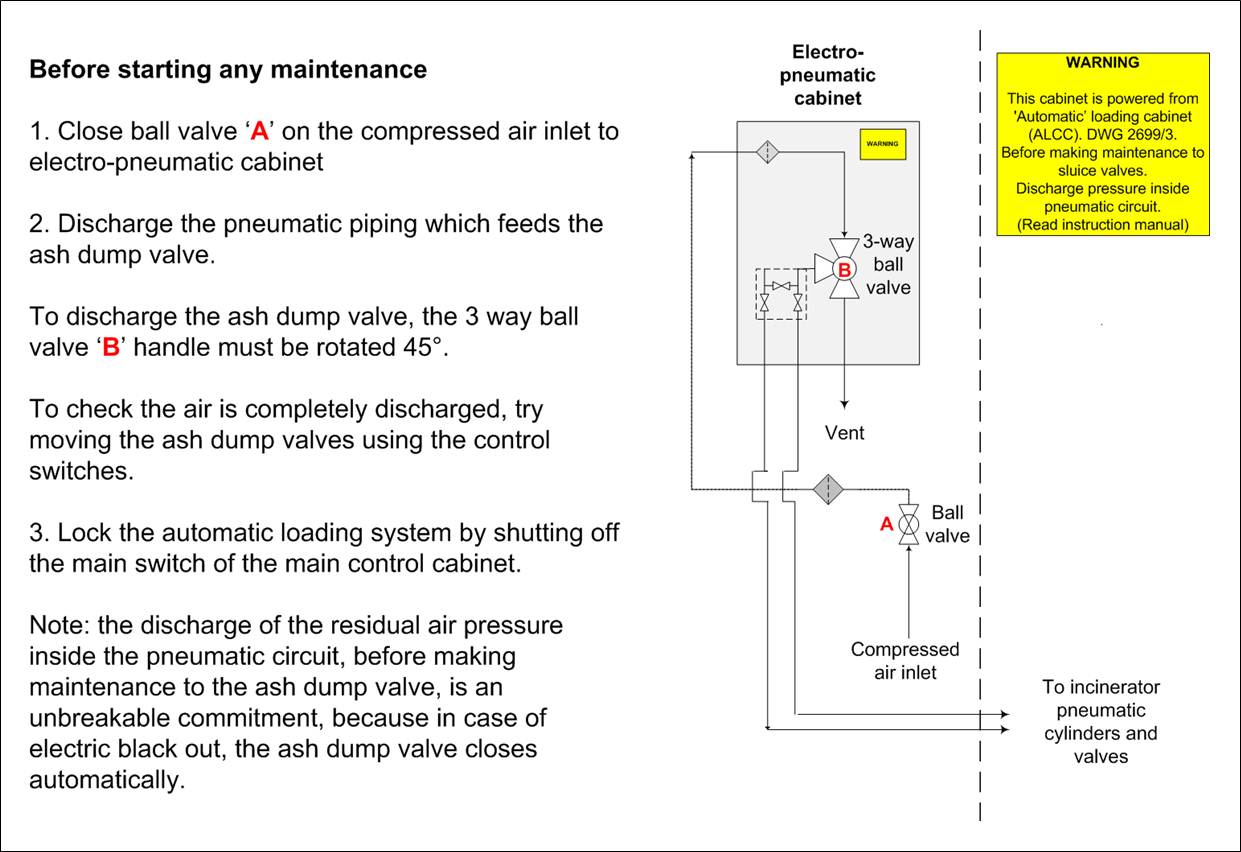
The incinerator manufacturer’s instruction manual contained detailed instructions for isolating its control systems before starting any maintenance (Figure 8). The instructions warned that the loss of electrical power to the control system while there was residual air pressure in the pneumatic circuit would result in the ash dump valve automatically closing. The electro-pneumatic control cabinet door also had a warning notice that stated ‘before maintenance to sluice valves (ash grates) discharge the pressure inside the pneumatic circuit’.
However, the manual contained no instructions or guidance for ash grate replacement. With the incinerator being used regularly, the grates would deteriorate and need periodic replacement. Therefore, it could reasonably be expected that the manual should have provided some instructions or guidance to safely complete the task.
While the instructions for isolating the system and the warnings on the electro-pneumatic cabinet were appropriate, they were not followed on 1 February. It is possible that shutting off the air was considered sufficient isolation for the task at hand. The inclusion of some level of instructions in the manual could have prompted other precautions to be taken. Such instructions could also have been included by the ship’s engineers in the PMS during the ship’s life.
Figure 8: Isolation of pneumatic system
Source: ATSB
Risk management
Replacement of the incinerator ash grates was a non-scheduled and non-routine operation.
Seven Seas Voyager’s safety management system (SMS) contained procedures for non-routine operations, requiring that a risk assessment be undertaken for the task using a defined process.
According to the ship’s SMS, such tasks needed to be planned and broken down into logical steps, with the assumption that the work team did not have any specific knowledge of the activities to be carried out. All identified hazards associated with each step were to be assessed and the associated risks identified and minimised. Subsequently, the general equipment and area were also to be inspected and any other hazards identified and minimised. Regarding the incinerator, this step would have included isolation of the energy supplies (power and air) and locking out of the system. A pre-work briefing was required to explain the essential elements of the completed risk assessment to the work team.
The ATSB investigation found that the Seven Seas Voyager’s engineering staff had had ample time to correctly scope and plan the work. Spare ash grates had been ordered and received on board several months before the incident. Furthermore, the need to replace the grates was identified in the handover notes of the first engineer a couple of months earlier.
However, on 1 February, the ash grate replacement task was not planned or undertaken in the manner described above. On that day, the incinerator had cooled, its operation was not required, spare grates were available and there was sufficient time to complete the task. The discussion at the morning meeting primarily covered these aspects of the task and assigning a team for it.
Permit to work
As part of the broad risk management process, the ship’s SMS also required that a permit to work be completed for the task. The permit to work process formalised and documented the key actions required to ensure that all the necessary safety checks and conditions were in place before work was allowed to start. Accurate completion of the permit to work required a sound knowledge of the systems and equipment being worked on.
In this instance however, neither the first engineer nor the fitter had any previous experience of this particular task. The actual work involved in replacing the ash grates was to be determined as the task progressed. Furthermore, there were no specific manufacturer’s instructions available for the grate replacement task and the ship’s PMS did not contain any information and history to assist the engineering staff.
In preparation for the commencement of work, the first engineer had correctly shut off the operating air to the control system but had not released the residual air pressure or isolated the electrical power because of his limited understanding of the control system. The permit to work that he had started to prepare was not completed when the fitter started work on the incinerator.
At interview, the fitter indicated that he thought the incinerator’s system had been isolated and the permit to work had been completed. He had assumed the system was safe to work on. The work team had not discussed the precautions, the work permit conditions or when it would be safe to start work and who was responsible for giving the go ahead to start work.
Findings
On 1 February 2014, a fitter carrying out routine maintenance on Seven Seas Voyager’s waste incinerator was injured when the pneumatically operated ash chamber dump valve closed against his body. He was freed and taken to a hospital ashore where he received treatment for serious bruising and shock. The fitter returned to the ship that day and was subsequently repatriated 10 days later to recuperate at home.
From the evidence available, the following findings are made. These findings should not be read as apportioning blame or liability to any particular organisation or individual.
Safety issues, or system problems, are highlighted in bold to emphasise their importance. A safety issue is an event or condition that increases safety risk and (a) can reasonably be regarded as having the potential to adversely affect the safety of future operations, and (b) is a characteristic of an organisation or a system, rather than a characteristic of a specific individual, or characteristic of an operating environment at a specific point in time.
Contributing factors
Assuming that it was safe, the fitter accessed the incinerator’s ash chamber to replace its ash grates and inadvertently activated the electric sensor that automatically closed the ash chamber dump valve against his body.
The ash dump valve’s electro-pneumatic control systems were not properly isolated and air pressure in the valve’s operating system was not released, leaving residual pressure that allowed the valve to close.
The ship’s engineering staff did not have an adequate understanding of the incinerator’s control systems and requirements of this specific task.
The ash grate replacement task was undertaken on an opportunistic basis and not in accordance with shipboard safety management system requirements and good work practices. Consequently, the task was not adequately planned and risk assessed, and the necessary permit to work and conditions required by the permit were not in place.
Other factors that increased risk
Seven Seas Voyager’s planned maintenance system (PMS) contained no information about waste incinerator ash grate replacement, a task that would have been periodically undertaken by different engineering staff since 2003. Therefore, in this respect, the shipboard procedures that documented requirements for the PMS had not been effectively implemented. [Safety issue]
The manufacturer’s instruction manual for Seven Seas Voyager’s waste incinerator contained no specific instructions for ash grate maintenance or replacement. Such instructions would have provided useful information for the ship’s crew to plan and safely complete periodic ash grate maintenance. [Safety issue]
Safety issues and actions
The safety issues identified during this investigation are listed in the Findings and Safety issues and actions sections of this report. The Australian Transport Safety Bureau (ATSB) expects that all safety issues identified by the investigation should be addressed by the relevant organisation(s). In addressing those issues, the ATSB prefers to encourage relevant organisation(s) to proactively initiate safety action, rather than to issue formal safety recommendations or safety advisory notices.
All of the directly involved parties were provided with a draft report and invited to provide submissions. As part of that process, each organisation was asked to communicate what safety actions, if any, they had carried out or were planning to carry out in relation to each safety issue relevant to their organisation.
Where relevant, these safety issues and actions will be updated on the ATSB website as information comes to hand. The initial public version of these safety issues and actions are in PDF on the ATSB website.
Planned maintenance system
Seven Seas Voyager’s planned maintenance system (PMS) contained no information about waste incinerator ash grate replacement, a task that would have been periodically undertaken by different engineering staff since 2003. Therefore, in this respect, the shipboard procedures that documented requirements for the PMS had not been effectively implemented.
The manufacturer’s instruction manual for Seven Seas Voyager’s waste incinerator contained no specific instructions for ash grate maintenance or replacement. Such instructions would have provided useful information for the ship’s crew to plan and safely complete periodic ash grate maintenance.
On 3 February 2014, investigators from the ATSB attended Seven Seas Voyager while the ship was berthed in Brisbane, Queensland. The master and directly involved crew members were interviewed and each provided their account of the accident. Photographs of the ship and copies of relevant documents were obtained, including log books, statutory certificates, reports, manuals and procedures.
Submissions
Under Part 4, Division 2 (Investigation Reports), Section 26 of the Transport Safety Investigation Act 2003, the ATSB may provide a draft report, on a confidential basis, to any person whom the ATSB considers appropriate. Section 26 (1) (a) of the Act allows a person receiving a draft report to make submissions to the ATSB about the draft report.
A draft of this report was provided to Seven Seas Voyager’s master, staff chief engineer, first engineer, environmental officer, fitter, wiper and incinerator operator, the Australian Maritime Safety Authority, Prestige Cruise Services, ISIR Impianti Srl and the Bahamas Maritime Authority.
Submissions were received from Seven Seas Voyager’s master, the Australian Maritime Safety Authority, and the Bahamas Maritime Authority. The submissions were reviewed and where considered appropriate, the text of the report was amended accordingly.
Purpose of safety investigations
The objective of a safety investigation is to enhance transport safety. This is done through:
identifying safety issues and facilitating safety action to address those issues
providing information about occurrences and their associated safety factors to facilitate learning within the transport industry.
It is not a function of the ATSB to apportion blame or provide a means for determining liability. At the same time, an investigation report must include factual material of sufficient weight to support the analysis and findings. At all times the ATSB endeavours to balance the use of material that could imply adverse comment with the need to properly explain what happened, and why, in a fair and unbiased manner. The ATSB does not investigate for the purpose of taking administrative, regulatory or criminal action.
Terminology
An explanation of terminology used in ATSB investigation reports is available here. This includes terms such as occurrence, contributing factor, other factor that increased risk, and safety issue.
Publishing information
Released in accordance with section 25 of the Transport Safety Investigation Act 2003
Ownership of intellectual property rights in this publication
Unless otherwise noted, copyright (and any other intellectual property rights, if any) in this report publication is owned by the Commonwealth of Australia.
Creative Commons licence
With the exception of the Coat of Arms, ATSB logo, and photos and graphics in which a third party holds copyright, this publication is licensed under a Creative Commons Attribution 3.0 Australia licence.
Creative Commons Attribution 3.0 Australia Licence is a standard form licence agreement that allows you to copy, distribute, transmit and adapt this publication provided that you attribute the work.
The ATSB’s preference is that you attribute this publication (and any material sourced from it) using the following wording: Source: Australian Transport Safety Bureau
Copyright in material obtained from other agencies, private individuals or organisations, belongs to those agencies, individuals or organisations. Where you wish to use their material, you will need to contact them directly.
The aircraft, with the pilot and three passengers on board, departed Tjuntjunjarra with fuel sufficient for the flight. The auxiliary tanks were selected after the aircraft reached a cruising altitude of 3,500 ft AMSL. The cruising altitude, which was 2,200 ft above ground level, was selected because of potentially adverse wind conditions at higher altitudes. The pilot was unsure of the precise contents of the auxiliary fuel tanks, because of an indicator inaccuracy, but he expected to gain at least a further 30 minutes endurance from them. Twenty five minutes after departure the right engine lost all power.
The pilot assumed that the right auxiliary tank had run dry and he selected the right fuel selector to the main tank. The engine did not re-start and the pilot observed the fuel flow to be zero. To ensure that the left engine continued to run the pilot selected the left fuel selector to the main tank.
The pilot then attempted to select the right auxiliary fuel pump to HIGH (the settings are OFF, LOW and HIGH) but inadvertently selected the left pump to HIGH. Realising his mistake, the pilot reversed the selections. Shortly after, the left engine also lost all power.
In an attempt to rectify the situation, the pilot carried out an engine failure and re-start check on the right engine, selecting HIGH on the auxiliary fuel pump (as directed by the Engine Failure During Flight check list). He also altered the fuel selections for both engines, from main to auxiliary and back to main. At no stage did he feather either propeller. During the attempts to re-start the engines the left auxiliary fuel pump was also selected too HIGH. The only response to the pilot's actions was a momentary surge of power from the right engine.
During the trouble-shooting process the pilot had placed the aircraft in a glide descent and turned towards the nearest clear area. Within approximately 2 minutes of the first loss of power the aircraft was approaching 500 ft above ground level, and the pilot decided to concentrate his efforts on completing a successful forced landing and ceased his trouble-shooting activities. He lined the aircraft up on a clear area and attempted a landing, using full flap, with the landing gear retracted. The aircraft touched down heavily before colliding with several trees and sliding to a stop.
The occupants, all of whom received back injuries, evacuated the aircraft through the forward cabin door and the baggage compartment door.
A check of expected fuel consumption against auxiliary tank contents indicated that the right auxiliary fuel tank ran dry at about the time that it should have. Consequently, the most likely reason for the initial loss of power in the right engine was exhaustion of the fuel in the right auxiliary tank.
The Aircraft Flight Manual contains the following CAUTION.
'If the auxiliary fuel pump switches are placed in the HIGH position with the engine-driven fuel pumps operating normally, total loss of engine power may occur.'
Operation of the auxiliary fuel pump in conjunction with the engine-driven pump can cause an over-supply of fuel to the engine and an excessively rich air/fuel mixture which can lead to a power loss.
As both engine-driven fuel pumps appeared to be operating normally up until the time of the power loss, the most likely reason for the loss of power in the left engine and the failure of both engines to re-start normally was that the pilot had selected both the auxiliary fuel pump switches to HIGH during his troubleshooting.The momentary surge of power from the right engine probably occurred as the fuel pressure passed through the normal range, with HIGH selected, as it built up to a level that caused the engine to lose power again.
The pilot was aware of a cockpit placard which indicated that the auxiliary fuel pump should be selected to HIGH if there was very low or no fuel pressure. He was also aware that the engine failure checklist indicated that he could operate the auxiliary fuel pump on HIGH if the fuel pressure was deficient. His initial selection of HIGH was based on his observation of a zero-fuel pressure reading. The pilot was not aware of the CAUTION in the Aircraft Flight Manual nor of the danger of operating the auxiliary fuel pump switches on HIGH. He could not recall covering this during his endorsement training on the type. However, his instructor believed that it had been.
The aircraft should have been capable of maintaining height on one engine. The immediate priority following the right engine failure should have been to ensure continued operation of the left engine. The pilot's perception of the urgency of the situation caused him to divert his attention to the restoration of power to the right engine. As a result, his actions exacerbated the problem.
The deficiency in the pilot's knowledge concerning the use of the auxiliary fuel pump HIGH setting, and which action should have had priority, was not identified by the operator's check and training system, as the pilot was employed on a casual basis and had not been checked by the operator in the Cessna 310.
The low cruising altitude chosen by the pilot reduced the amount of time available to trouble-shoot the problem before he had to make a commitment to the landing.
Significant Factors
The following factors were considered relevant to the development of this accident:
1. The pilot's preparation for flight in the Cessna 310 was inadequate, in that his knowledge of the aircraft's systems was insufficient to meet the requirements of a basic abnormal situation.
2. The operator's procedures were deficient in that they did not attempt to identify the pilot's level of system knowledge prior to allocating him to a commercial task.
3. The low cruise altitude reduced the amount of time available for the pilot to trouble-shoot the situation.
On 21 January 2014, a pilot and check pilot were conducting a check flight in a Eurocopter EC120B, registered VH-JYV, at Port Hedland aerodrome, Western Australia.
At about 1600 Western Standard Time (WST), when at about 1,500 ft above ground level, and overhead the runway 32 threshold, the check pilot reduced the throttle to idle and stated that they had a simulated engine failure. The pilot lowered the collective and reduced airspeed, and entered the autorotation, simultaneously commencing a 360° turn. After about 3 seconds, the check pilot observed the ‘GEN’ warning light illuminate. He pushed the generator switch and attempted to restart the generator, without success, and the light remained on. The fuel pressure light then illuminated, and the check pilot selected the electric fuel pump on. The engine turbine continued to wind down and, when about 800 ft AGL, the check pilot called ‘engine failure’ and the oil pressure light illuminated. The pilot continued the autorotation to the ground. The helicopter landed smoothly, completing 360° of rotation, in the undershoot of runway 32, and no damage or injuries were sustained.
The check pilot then conducted a walk-around inspection, finding no damage or evidence of oil or other mechanical fault. As the helicopter was in the runway undershoot and two passenger aircraft were inbound to Port Hedland, the pilot attempted to restart the engine. No warnings were illuminated, and all vehicle and engine multifunction display (VEMD) indications were normal.
The pilot relocated the helicopter to the company base helipad, recorded the engine flameout on the maintenance release and advised the senior base engineer of the incident.
The successful completion of the autorotation highlights the benefits of practice autorotations.