On the night of 19 August 2021, the pilot of a Hawker Beechcraft King Air B200C aircraft, registered VH‑VAH and operated by Pel-Air, commenced the take-off from Essendon Fields Airport, Victoria on a medical retrieval flight to Albury, New South Wales. During the take-off, there was a reduction in power on the left engine and an uncommanded left yaw. The pilot initially managed the situation as an engine power loss and focused on maintaining directional control. However, when troubleshooting, the pilot identified that the left engine power lever had migrated rearwards to the idle position. In response, the pilot moved the power lever back to take‑off power and adjusted the friction lock to prevent further movement. The flight continued to Albury without further incident.
What the ATSB found
The ATSB found that the left engine power lever had migrated rearwards as the friction lock had not been sufficiently adjusted during the pre-flight checks. It was also established that power lever friction locks fitted to the Beechcraft King Air series aircraft required careful adjustment to prevent power lever migration, particularly during take-off. This was more prominent on the left engine, which was a characteristic generally known among King Air operators and pilots.
What has been done as a result
The operator provided additional training to all King Air pilots to demonstrate how the power lever system operated, when power lever migration could occur, and how to check that the friction locks were adequately adjusted to ensure the levers remain at take-off power. A component on friction locks was also included in the King Air pilot ground school training. In addition, the operator published a notice to air crew, which stipulated that all take-offs on sealed runways must be conducted using a standing start take-off. Further, the operator amended the take-off checklist for a standing start to include checking the friction locks to prevent a power lever migration during the take-off sequence.
The ATSB has released a safety advisory notice to all operators and pilots of King Air aircraft advising of power lever migration and the need to be aware of the careful adjustment required for the power lever friction lock.
Safety message
This incident highlights the importance of having a detailed understanding of the characteristics that may be specific to an aircraft type. In the case of the King Air series of aircraft, the design of the power lever system meant that the friction locks required careful adjustment to prevent power lever migration particularly during take-off.
Decisions regarding whether to conduct an investigation, and the scope of an investigation, are based on many factors, including the level of safety benefit likely to be obtained from an investigation. For this occurrence, a limited-scope investigation was conducted in order to produce a short investigation report and allow for greater industry awareness of findings that affect safety and potential learning opportunities.
The occurrence
On 19 August 2021, a Hawker[1] Beechcraft B200C King Air aircraft, registered VH-VAH and operated by Pel‑Air, was scheduled to depart Essendon Fields Airport, Victoria on a medical retrieval flight to Albury, New South Wales. On board was a pilot, paramedic, and doctor.
At about 2300 Eastern Standard Time,[2] the pilot began to prepare the aircraft for departure as per the before engine starting checklist. One of the requirements was to set the power lever friction locks. The pilot recalled moving the power levers to the mid-range position to gauge their movement and adjusted the friction locks to establish adequate friction. They also recalled that their usual practice was to check the friction locks were correctly set before take-off.
Soon after, the aircraft was taxied to the runway and the pilot commenced a rolling take-off with their left hand on the control column and right hand on the power levers. When at about 94 kt, the pilot moved their right hand onto the control column and rotated the aircraft. When about 50 ft above ground level, the aircraft suddenly yawed left. Automatic dependent surveillance-broadcast data showed the aircraft tracking immediately left from the runway. The paramedic also recalled being pushed to the right and the aircraft not being aligned with the runway. The pilot looked at the engine instruments and observed that the left engine was showing a power loss, but the right engine appeared to be producing take-off power. Based on these indications, the pilot managed the situation as an engine power loss.
The pilot recalled focusing on maintaining directional control by applying right aileron and rudder. They then assessed the reason for the power loss and whether the propeller was feathered,[3] which they believed it was not. The pilot scanned the cockpit again and observed that the left power lever had migrated rearwards towards the idle position. While moving the left power lever back in-line with the right power lever, the aircraft yawed right as the pilot was still applying right rudder. The power increased on the left engine, the pilot reduced application of right rudder and retracted the landing gear. Immediately after, the left power lever started moving rearwards again. The pilot re‑tightened the friction lock on the left power lever, which resolved the issue. At that time, the aircraft was climbing through 200-300 ft. The paramedic reported that the pilot said the power lever had migrated as the friction lock had not been correctly set.
The flight continued to Albury without further incident. The pilot noted the power lever migration on the aircraft’s maintenance log as that they believed the friction lock was not adequately functioning. The subsequent engineering inspection did not find any technical issues with the power lever assemblies and friction locks.
Context
Pilot information
The pilot held a valid Air Transport Pilot Licence (Aeroplane), multi-engine command instrument rating, and a type rating for the B200C obtained in July 2021. At the time of the incident, the pilot had accrued about 16,000 hours of total aeronautical experience, of which 42 hours were in the B200C.
Engine controls
The aircraft’s engines were controlled using 3 sets of levers located on the centre pedestal.
The 2 power levers controlled engine power from the idle position through to take-off power. When the levers were lifted and pulled aft over a gate, they controlled engine power for taxi operations, and over another gate for propeller reverse thrust to slow the aircraft after landing.
The 2 propeller levers controlled propeller speed (rpm). The propellers could be feathered by moving the relevant lever past detents and back to the aft most position.
Condition levers were used to select high or low idle, and to shut the engines down.
Friction locks
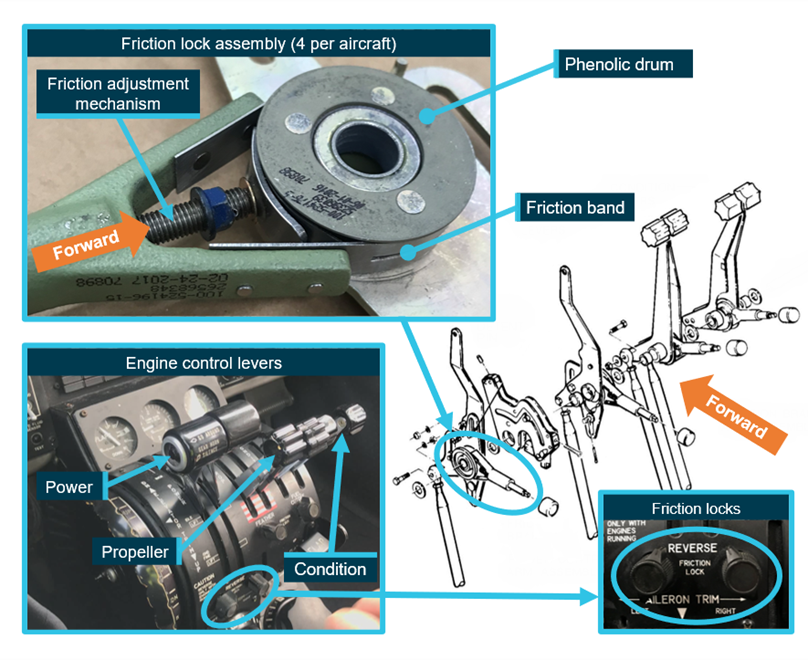
Four friction locks were located on the engine control pedestal. One each for the left and right power levers, one for the propeller levers, and one for the condition levers (Figure 1). The friction lock assemblies consisted of an adjustment mechanism, a phenolic drum, and a friction band. When the friction lock was rotated clockwise, the band around the phenolic drum tightened, which increased the friction between the 2 parts. The respective lever would become progressively resistant to movement, preventing the lever from moving out of position. When rotated counter‑clockwise, the lever moved freely. The design of the friction lock had been used since the 1965 model 88 Queen Air through to current production King Air aircraft.
Figure 1: Engine control levers and friction locks
Source: Pel-Air and Textron Aviation, annotated by the ATSB
A characteristic of the King Air friction locks was that they required careful setting as some aircraft had a narrow range between no friction and too much friction. The operator reported that there was no consistency in setting friction locks for a desired resistance between power levers in the same aircraft and other aircraft, and this changed over time due to wear. Worn friction locks were required to be replaced.
The maintenance log for the aircraft indicated that the left and right power lever assemblies, including both friction locks, were replaced in November 2020 after being observed to be worn, resulting in a reduced range of adjustment. Before the assemblies were replaced, pilots had reported to engineering staff that the friction locks were difficult to adjust.
The operator’s Flight Crew Operating Manual for the B200C aircraft included the following checklists where the friction locks were to be checked by the pilot prior to take-off:
Internal daily inspection: This checklist was completed prior to the first flight of the day[4] and included checking the power levers friction lock settings in the idle position.
Before engine starting: After the first flight of the day, the internal daily inspection was replaced by the ‘before engine starting’ checklist, which included a scan procedure beginning at the left side of the cockpit. This checklist required the power levers to be at idle and the friction lock setting checked. Further detail on how to adjust the friction locks was also included:
Place the power lever to the approximate position for take-off power and let go. If they roll back, set them again but tighten the friction.
The power levers have a spring retention configuration that increases resistance the more the levers are advanced. The result of this is the roll back of power levers if the friction lock is set too loose.
Before take-off: In the before take-off checklist, the pilot would check the friction locks were set. After this, there was no further requirements to check the locks.
These checklists were consistent with the manufacturer’s Pilot Operating Handbook. The ATSB noted that the handbook did not contain further detail on how to adjust the friction lock and the potential for power lever migration.
The operator advised the ATSB that in 2019, there were a number of reported rejected take-offs with serviceable aircraft with no faults found, which were assessed to be related to friction locks not being set correctly prior to take-off. As a result, the operator published an operations note to pilots about friction locks in the before take-off check for the King Air aircraft, with details about their proper adjustment. It was unknown if the incident pilot, who had commenced with the operator in 2021, was aware of this notice.
Power lever migration
Power lever migration on the King Air referred to an uncommanded spring back or migration of the lever towards the idle position. This was typically experienced when the pilot removed their hand from the levers during take-off. If unnoticed, this could result in the aircraft yawing towards the engine experiencing the power lever migration, a significant loss of propeller torque on that engine, and the auto-feather system disarming.[5]
This migration occurred when the friction locks were not appropriately set, and could affect King Air 90, 200 and 300 series aircraft. The propeller and condition levers were not susceptible to migration.
The cockpit to engine nacelle power lever control cables were connected to a cam assembly on the right side of each engine via a lever. This lever was spring loaded towards idle to prevent an uncommanded acceleration in the event of a power lever cable malfunction that could damage the engine when torque and temperature limits were exceeded. The springs also reduced the effect of hysteresis[6] when power was reduced, which could cause the rate one engine’s power reduced relative to the other to be different. An additional spring could be fitted during production or maintenance to further balance the rate of power reduction between both engines. This additional spring was not fitted to the incident aircraft. The effect of the springs migrating the power levers toward idle during normal operations was overcome by setting the friction locks.
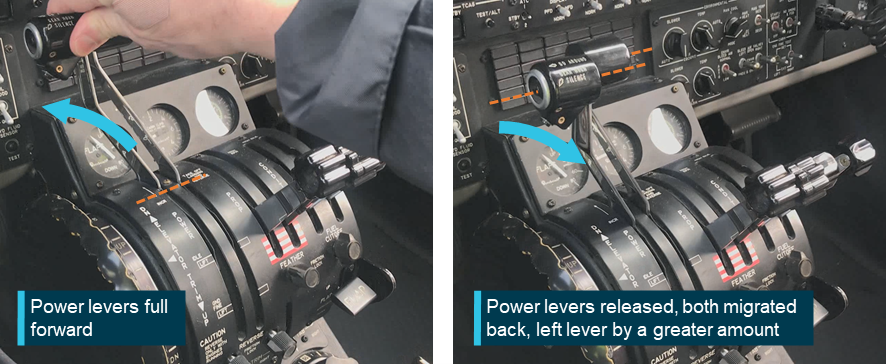
In addition, as the power lever cables were connected to the right side of each engine, the cable for the left engine was shorter than the right, and therefore less affected by hysteresis. Due to this, if the friction locks were not correctly set, the left power lever could migrate further aft than the right, resulting in an uncommanded left yaw. The operator demonstrated this on the ground without the engines running. With both power lever friction locks loosened and the levers full forward, when they were released the left engine power lever migrated further aft than the right (Figure 2).
Figure 2: Power lever migration demonstration
Source: Pel-Air, annotated by the ATSB
Prior to the incident, the operator’s training for pilots converting to the B200C was limited to the operation of the friction locks. At interview, the pilot reported that they were new to the B200C aircraft type and unaware that power lever migration could occur during take‑off. Another pilot from the operator noted that, until a pilot experienced a power lever migration, then it could be difficult to know how much to tighten the friction locks.
In addition, the King Air magazine included articles that emphasised the importance of adjusting the friction locks adequately to avoid power lever migration. The articles also described techniques to check that the friction locks were set sufficiently to prevent migration.
Similar occurrences
A review of the ATSB database did not find any reported occurrences involving power lever migration on the King Air series aircraft relating to the adjustment of the friction locks, but the manufacturer stated that they had received such reports. Likewise, the operator’s pilots interviewed recalled they had experienced or heard of others having a similar event. The operator’s senior base engineer also indicated that power lever migration was a known issue.
A review of the operator’s safety management system database found 10 reports from the previous 5 years, 6 of which involved VH-VAH. For example, on 18 August 2021 (the day prior to the incident), VH-VAH was being operated on a patient transfer flight. During take-off, the aircraft lost partial engine power and yawed left. This occurred due to the left power lever migrating aft when the pilot under check moved their hand to the control column to rotate the aircraft. Both the check captain and the pilot under check immediately identified the reason for the loss of power. The check captain moved the power lever forward to full power while the pilot under check applied right rudder to maintain control, retracted the landing gear, and adjusted the friction lock when the aircraft was at safe height. The flight continued without further incident.
In addition, the operator advised the ATSB of another power lever migration occurrence involving a B200 aircraft after the occurrence that was the subject of this investigation. On 31 September 2022, the aircraft was being operated on a patient retrieval flight. During the take-off roll, the pilot detected a migration of the left power lever, resulting in an uncommanded yaw left. This occurred at about the time when the pilot removed their hand from the control column. The pilot rejected the take-off and the aircraft subsequently impacted the runway edge lights. Engineers replaced the throttle quadrant and the throttle friction assembly. Based on this event, the operator is conducting a review of their take-off procedure including simulator testing and research.
The ATSB also contacted another B200 operator who recorded 4 reports of power lever migration over the previous 5 years.
A review of the United States Aviation Safety Reporting System database found 3 reported power lever migration occurrences due to friction lock adjustment since 1988. In addition, there have been 2 notable international investigations where this was identified as a potential factor that contributed to the accident involving a King Air (detailed below).
On 23 December 2000, a Beechcraft B200 aircraft departed Blackbushe, United Kingdom to Palma, Spain on a private flight. Shortly after take‑off, the aircraft was observed to bank left before colliding into a factory complex 13 seconds later, resulting in a fire. All on board were fatally injured.
An examination of the aircraft did not identify any technical issues that would have contributed to the accident. However, analysis of the cockpit voice recorder showed a reduction in one of the propeller’s rpm as the aircraft rotated, which would have led to thrust asymmetry. The investigation concluded that, it was probable a migration of a power lever due to insufficient friction being set had occurred. It was also noted that the friction control had been slackened during recent maintenance and it was possible that it was not adjusted adequately by the pilot when doing their checks prior to take-off. As a result of the investigation, a safety recommendation was made to Raytheon Aircraft Company:
The Raytheon Aircraft Company should ensure that reference to the correct adjustment of power lever friction is suitably emphasised in the Beech 200 Aircraft Operating Manual (AOM) and the consequences of insufficient adjustment are not only highlighted in the AOM but also included in the recommended Beech 200 type training syllabus.
The ATSB was unable to find any follow-up action on this recommendation recorded in the investigation site.
On 30 June 2019, a Beechcraft King Air 300 departed Addison, Texas, United States, on a private flight. During take-off, the aircraft was observed to roll left before reaching a maximum altitude of 100 ft above ground level. It then descended and collided with a hangar in an inverted attitude about 17 seconds after take-off. All on board were fatally injured.
Analysis of the cockpit voice recorder showed that 7 seconds after take-off, the propeller speeds diverged, with the left propeller speed decreased to 1,688 rpm and the right propeller speed decreased to 1,707 rpm. An engineering examination did not identify any technical issues with the aircraft, but other evidence suggested a loss of thrust in the left engine was most likely experienced shortly after take-off.
While the reason for the reduction in thrust could not be conclusively determined, the investigation considered inadequate friction setting the most likely cause. It was noted that other circumstances, such as a malfunction within the power control system could have also resulted in a loss of engine thrust. However, the extent of damage to the power control system precluded determining the position of the power levers at the time of the loss of thrust or the friction setting during the flight.
Safety analysis
Uncommanded left yaw
Just after take-off at night, the pilot reported that the aircraft suddenly yawed left. This was consistent with the recorded flight path and the paramedic’s observations. When the yaw occurred, the pilot’s immediate response was to manage the situation as a left engine failure by applying right rudder and aileron to maintain directional control. The pilot then noticed the left power lever had migrated to the idle position and responded by pushing the power lever forward. After resetting the power lever friction lock, the flight continued without incident.
Insufficient friction applied
The friction locks were adjusted by the pilot to a level they believed to be sufficient prior to take-off. However, as the post-flight engineering inspection did not find any technical issues with the power lever and friction lock assemblies, and the left power lever had migrated twice during the take-off sequence, it was likely that the friction lock had not been sufficiently set during pre-flight checks. This was consistent with the paramedic’s recollection of the pilot indicating that the friction lock had to be re-set.
King Air friction lock characteristics
Due to the spring loading of the power levers on the King Air series aircraft, there was a tendency for the levers to migrate towards the idle position, particularly during take-off, if the friction locks were not appropriately set. This was more prevalent on the left power lever due to the shorter length of its cable. There was also an awareness of the possibility of a narrow range of adjustment, inconsistency in friction lock settings between the left and right engines, and from aircraft to aircraft, which could change due to wear.
While the incident pilot was not aware of the possibility of power lever migration, the need to carefully adjust the friction locks to prevent migration was more broadly known by B200C pilots and operators. This characteristic had been experienced among different operators and pilots as demonstrated in the reported occurrences and had also been considered as a potential factor in two fatal accidents.
Findings
ATSB investigation report findings focus on safety factors (that is, events and conditions that increase risk). Safety factors include ‘contributing factors’ and ‘other factors that increased risk’ (that is, factors that did not meet the definition of a contributing factor for this occurrence but were still considered important to include in the report for the purpose of increasing awareness and enhancing safety). In addition ‘other findings’ may be included to provide important information about topics other than safety factors.
These findings should not be read as apportioning blame or liability to any particular organisation or individual.
From the evidence available, the following findings are made with respect to the uncommanded power reduction involving Hawker Beechcraft King Air B200C, VH-VAH, Essendon Fields Airport, Victoria, on 19 August 2021.
Contributing factors
During a night take-off from Essendon Fields Airport, the left-engine power lever migrated to idle, which resulted in an uncommanded left yaw.
During the pre-flight checks, it was likely that the pilot applied insufficient friction to prevent the left power lever migrating.
The power lever friction locks fitted to the Beechcraft King Air series aircraft required careful adjustment to prevent power lever migration during take-off, particularly on the left engine. This characteristic was broadly known among operators and pilots.
Safety actions
Whether or not the ATSB identifies safety issues in the course of an investigation, relevant organisations may proactively initiate safety action in order to reduce their safety risk. All of the directly involved parties are invited to provide submissions to this draft report. As part of that process, each organisation is asked to communicate what safety actions, if any, they have carried out to reduce the risk associated with this type of occurrences in the future. The ATSB has so far been advised of the following proactive safety action in response to this occurrence.
Safety action by the Pel-Air
As a result of the incident, Pel-Air undertook the following safety actions.
Training
The engineering department and flight operations manager provided additional training to all King Air pilots demonstrating how the friction lock system worked, how power lever migration could occur, and how to check the friction locks were adequately adjusted. In addition, a course on power lever migration has now been included as part of the ground school pilot training for the King Air aircraft.
Revised take-off procedure
The day after the incident, the operator published a notice to air crew, which stipulated that all take-offs on sealed runways must be conducted using a standing start take-off. Further, the take‑off checklist for a standing start in the Flight Crew Operations Manual was amended to include a requirement for pilots to check that the friction locks were set to prevent power lever migration when take-off power had been set.
Safety advisory notice to King Air series aircraft operators
The Australian Transport Safety Bureau advises pilots and operators of the King Air series aircraft (90, 200, and 300) that the power lever friction locks require careful adjustment to prevent power lever migration towards the idle position, particularly during take-off. Inadvertent migration of one power lever towards idle can result in power reduction and yaw that, when occurring at low height, can result in catastrophic outcomes. Operators should ensure pre-flight checks provide opportunities to confirm friction lock settings before the take-off run, and ensure pilots have adequate knowledge of friction lock sensitivity to help prevent and recover from inadvertent power lever migration.
Sources and submissions
Sources of information
The sources of information during the investigation included:
the pilot
the paramedic
Pel-Air
Textron Aviation (type certificate holder)
United States National Transportation Safety Board.
Submissions
Under section 26 of the Transport Safety Investigation Act 2003, the ATSB may provide a draft report, on a confidential basis, to any person whom the ATSB considers appropriate. That section allows a person receiving a draft report to make submissions to the ATSB about the draft report.
A draft of this report was provided to the following directly involved parties:
the pilot
the paramedic
Pel-Air
Textron Aviation
United States National Transportation Safety Board.
A submission was received from Pel-Air. The submission was reviewed and, where considered appropriate, the text of the report was amended accordingly.
Purpose of safety investigations
The objective of a safety investigation is to enhance transport safety. This is done through:
identifying safety issues and facilitating safety action to address those issues
providing information about occurrences and their associated safety factors to facilitate learning within the transport industry.
It is not a function of the ATSB to apportion blame or provide a means for determining liability. At the same time, an investigation report must include factual material of sufficient weight to support the analysis and findings. At all times the ATSB endeavours to balance the use of material that could imply adverse comment with the need to properly explain what happened, and why, in a fair and unbiased manner. The ATSB does not investigate for the purpose of taking administrative, regulatory or criminal action.
Terminology
An explanation of terminology used in ATSB investigation reports is available here. This includes terms such as occurrence, contributing factor, other factor that increased risk, and safety issue.
Publishing information
Released in accordance with section 25 of the Transport Safety Investigation Act 2003
Ownership of intellectual property rights in this publication
Unless otherwise noted, copyright (and any other intellectual property rights, if any) in this report publication is owned by the Commonwealth of Australia.
Creative Commons licence
With the exception of the Coat of Arms, ATSB logo, and photos and graphics in which a third party holds copyright, this publication is licensed under a Creative Commons Attribution 3.0 Australia licence.
Creative Commons Attribution 3.0 Australia Licence is a standard form licence agreement that allows you to copy, distribute, transmit and adapt this publication provided that you attribute the work.
The ATSB’s preference is that you attribute this publication (and any material sourced from it) using the following wording: Source: Australian Transport Safety Bureau
Copyright in material obtained from other agencies, private individuals or organisations, belongs to those agencies, individuals or organisations. Where you wish to use their material, you will need to contact them directly.
[1] At the time of VH-VAH’s manufacture in 2010, the type certificate holder for the Beechcraft King Air series was Raytheon Aircraft Company, operating under the Hawker Beechcraft brand name. Textron Aviation has been the type certificate holder for the Beechcraft King Air series since 2014.
[2] Eastern Standard Time (EST): Coordinated Universal Time (UTC) + 10 hours.
[3] Feathering reduces drag following an in-flight engine failure or shutdown by increasing the angle of the propeller blades until they are parallel with the aircraft’s line of flight.
[4] The incident flight was the tenth flight of the day.
[5] The auto-feather system automatically feathered the propellers in the event of an engine failure. If the power lever moved back past the 90% engine speed position, the auto-feather system would disarm.
[6] In this context, hysteresis is the lost motion (or backlash) in the cables used in the power control system. For a given input by the pilot, the cable’s movement may be impeded mechanically by friction and/or non-linear movement of the cable within its housing.
On 12 August 2021, at about 0858 Central Standard Time, an Aero Commander 500-S aircraft, registered VH-LTP, departed Port Lincoln on a private flight to Adelaide, South Australia under instrument flight rules. On board were the pilot and one passenger.
During the descent in instrument meteorological conditions, when passing about 6,000 ft, the aircraft began to encounter turbulence. Following clearance to track direct to the GPS waypoint GULLY, the pilot reported having difficulties entering the area navigation (RNAV) instrument approach data into the aircraft’s touchscreen multi-function display due to turbulence. By the time the pilot had correctly entered it, the aircraft had just passed the waypoint. When the pilot then selected the ‘Direct-To’ option on the display, the autopilot commanded a sharp turn to the right, to commence an orbit to attempt to overfly the waypoint to recapture it.
On observing the aircraft’s track, the controller instructed the pilot to maintain 3,800 ft and to turn onto a heading of 360°, intending to vector the aircraft back towards the waypoint. About 90 seconds later, the controller instructed the pilot to turn onto heading 120°, which the pilot read back. When the controller tried to contact the pilot about 1 minute later, the pilot did not respond and communications were lost.
The aircraft continued on the assigned heading but began descending below its assigned altitude, which was also the minimum sector altitude. For 4 minutes, ATC, with the assistance from the pilot of a nearby aircraft, continued to attempt to contact the pilot of VH-LTP. During this time, the approach controller also issued the pilot three terrain safety alerts.
The pilot contacted the Melbourne Centre controller, who instructed the pilot to transfer back to the Adelaide Approach frequency. Upon regaining communication, the approach controller issued the pilot a terrain safety alert and instructed the pilot to climb immediately to 5,000 ft. The lowest altitude the aircraft descended to was 2,480 ft and the highest point within 5 NM of the aircraft’s track was 1,913 ft.
The aircraft then tracked to Adelaide Airport and landed without further incident.
What the ATSB found
The ATSB found that during the approach, the pilot was experiencing data entry difficulties due to turbulent conditions and inadvertently selected the incorrect radio frequency. Further, several factors including the environmental conditions, data entry difficulties and the timing of the clearance for the GULLY waypoint, likely led to the pilot experiencing a high workload. This in turn, likely affected the pilot’s situational awareness where they did not initially notice the frequency change nor the continued descent and descent below the assigned (minimum sector) altitude.
Safety message
The approach and landing phases are known periods of high workload for pilots. Pilots must continuously monitor aircraft and approach parameters, and the external environment, to ensure they maintain a stable approach profile and make appropriate decisions for a safe landing. The Flight Safety Foundation found that between 1984 and 1994, 50 per cent of controlled flight into terrain accidents were due to inadequate monitoring by the pilot. Distractions and unanticipated events can further increase a pilot’s workload leading to undetected errors and a loss of situational awareness. During high workload phases of flight, pilots should remain focused on monitoring the aircraft instruments and avoid fixating on a problem.
The investigation
Decisions regarding whether to conduct an investigation, and the scope of an investigation, are based on many factors, including the level of safety benefit likely to be obtained from an investigation. For this occurrence, a limited-scope investigation was conducted in order to produce a short investigation report, and allow for greater industry awareness of findings that affect safety and potential learning opportunities.
The occurrence
On 12 August 2021, at about 0858 Central Standard Time,[1] an Aero Commander 500-S aircraft, registered VH-LTP, departed Port Lincoln on a private flight to Adelaide, South Australia under instrument flight rules.[2] On board were the pilot and one passenger.
At about 0930, the pilot made first contact with Adelaide Approach air traffic control (ATC) and was cleared to track direct to Adelaide maintaining 7,000 ft. The controller also advised the pilot to expect vectors for the area navigation Z (RNAV-Z)[3] approach for runway 23. The aircraft was in instrument meteorological conditions (IMC).[4]
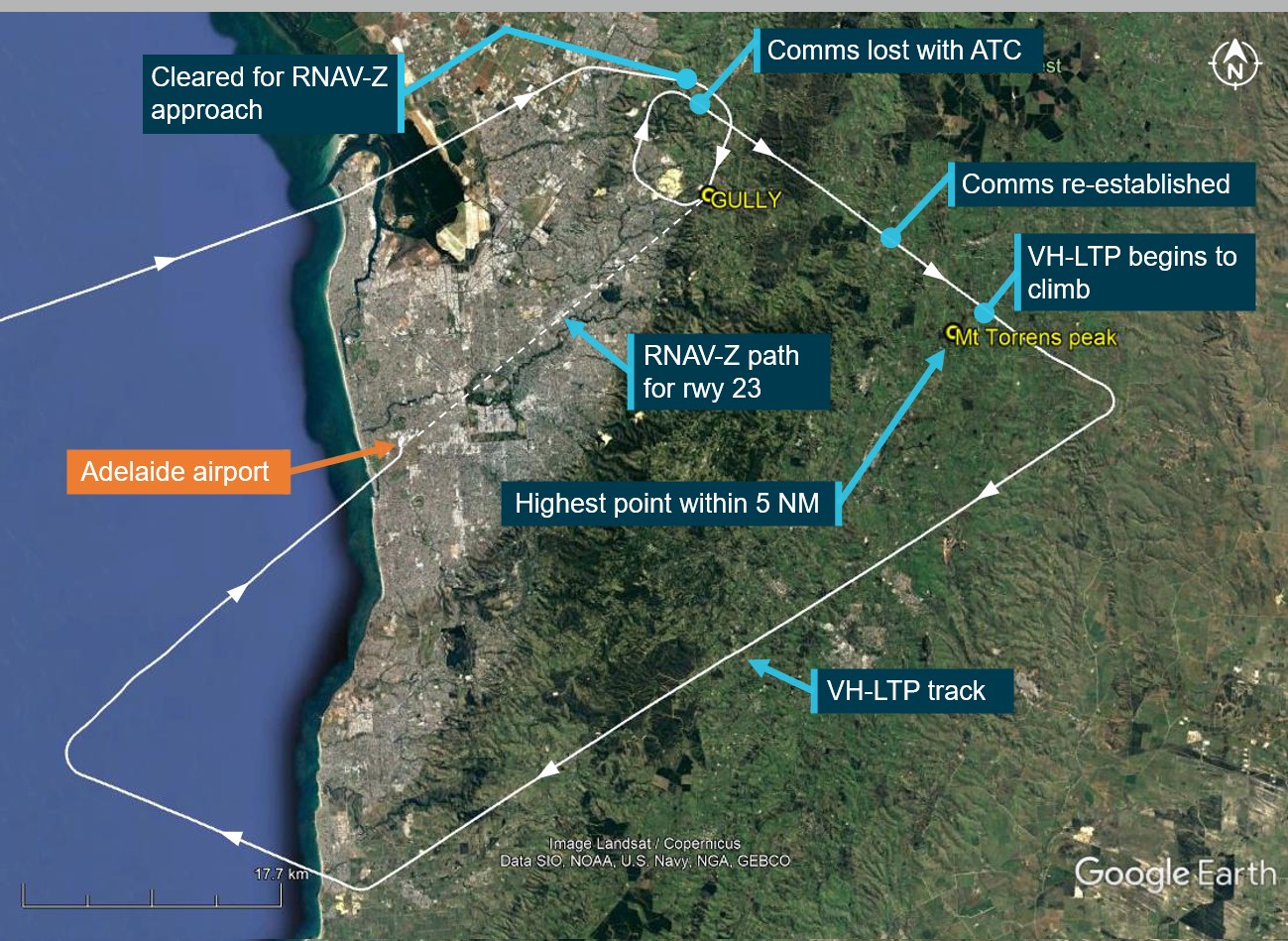
About 14 minutes later, the controller cleared the aircraft to descend to 5,000 ft and turn left on a heading of 050°. The pilot recalled the aircraft encountering turbulence during the descent, which started when passing about 6,000 ft. At 0947, the controller cleared the pilot to descend to 3,800 ft and to turn right on a heading of 090°. The controller advised the pilot to expect a clearance shortly to navigate to GPS waypoint GULLY, which was the initial approach fix for the RNAV approach. Less than 1 minute later, when the aircraft was 6 NM north-west of GULLY, the controller cleared the pilot for the RNAV approach and instructed the pilot to track direct to GULLY (Figure 1).
The pilot began tracking to GULLY and reported having difficulties entering the RNAV approach details into the aircraft’s touchscreen multi‑function display (MFD) due to the turbulence. By the time the pilot had correctly entered it, the aircraft had just passed the GULLY waypoint and when the pilot then selected the ‘Direct-To’ option on the display, the autopilot commanded a sharp turn to the right, to orbit back around to recapture the waypoint (Figure 1).
Observing the aircraft’s track away from the waypoint, the controller, at 0951, advised the pilot they had missed the approach and instructed them to maintain 3,800 ft. They then instructed the pilot to turn right on a heading of 360° and to expect vectors back to GULLY. After turning to the assigned heading, the aircraft started a gentle climb. At 0953, the controller instructed the pilot to turn right onto heading 120° and to expect a clearance to navigate to GULLY shortly. The pilot correctly read back the clearance and later recalled having commenced a descent, realising the aircraft was then above the assigned altitude. This was the last radio call the pilot received from the Adelaide Approach controller before the pilot inadvertently switched the radio frequency back to Melbourne Centre.[5]
About 1 minute later, when the aircraft was 2.5 NM north of GULLY, the controller issued the expected clearance – to resume their own navigation, track direct to GULLY, descend to 3,800 ft and conduct the RNAV approach for runway 23. The controller did not receive a response from the pilot.
The pilot continued on their last assigned heading of 120° and the aircraft began descending below its assigned altitude of 3,800 ft, which was also the minimum sector altitude. For 4 minutes, ATC, with the assistance from the pilot of a nearby aircraft, continued to attempt to contact the pilot of VH-LTP. During this time, the controller also issued the pilot three terrain safety alerts.
At 0957, the pilot of VH-LTP made a radio call to ATC, which was received by the Melbourne Centre, to ask the approach controller whether they should track back to GULLY. When the pilot received no reply, they made another call. The Melbourne Centre controller responded, told the pilot to standby and then instructed them to contact Adelaide Approach on frequency 118.2. The controller then contacted the Adelaide Approach controller to inform them that they had the pilot on the Melbourne Centre frequency, and the pilot was transferring back to the correct frequency. Upon regaining communication with the pilot, the approach controller immediately issued a terrain safety alert and instructed the pilot to climb immediately to 5,000 ft. The aircraft’s altitude at that time was 2,780 ft.
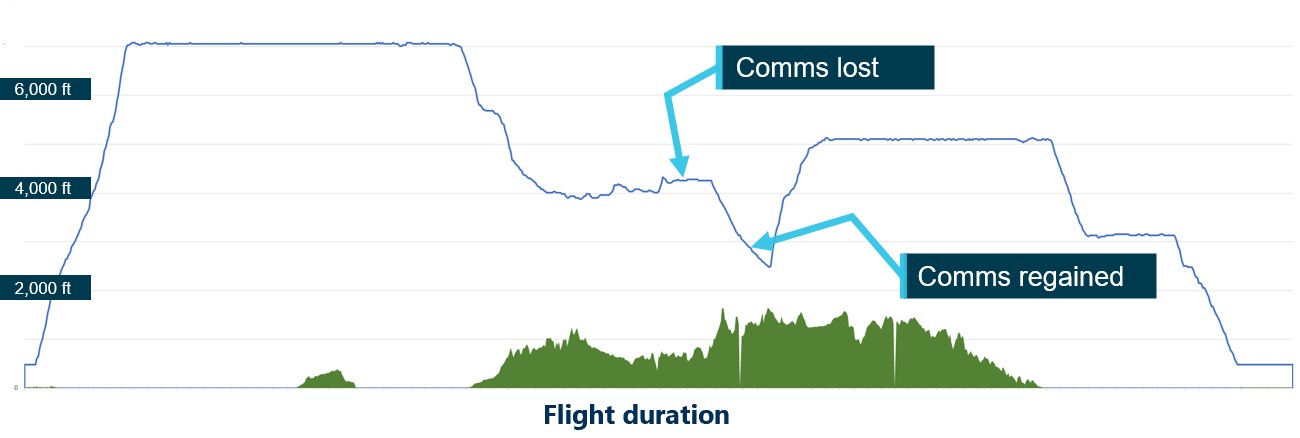
After observing no increase in the aircraft’s altitude for almost 1 minute, the controller contacted the pilot and asked them to confirm climbing to 5,000 ft. The pilot confirmed and the aircraft began to climb. The lowest altitude the aircraft descended to was 2,480 ft, the highest point within 5 NM of the aircraft’s track was 1,913 ft (Figure 2).
Source: Google Earth overlaid with Airservices data, annotated by the ATSB
Figure 2: VH-LTP’s altitude relative to the terrain (in feet)
Source: Geoscience terrain data overlaid with Airservices data, annotated by the ATSB
The controller vectored the aircraft back to Adelaide Airport for a RNAV-Z approach for runway 05. The aircraft landed at Adelaide Airport at 1028.
Context
Pilot information
The pilot previously held a Commercial Pilot Licence (Aeroplane), but at the time of the incident was exercising the privileges of a Private Pilot Licence, with an instrument rating and a valid Class 2 Aviation Medical Certificate. The pilot had a total flying experience of about 16,800 hours, they had accrued about 9,800 hours on the Aero Commander 500-S and about 4,700 hours total instrument time. The pilot completed their instrument proficiency check on 29 June 2021 and last flew an RNAV approach in instrument meteorological conditions (IMC) on 6 August 2021.
Weather observations
The pilot reported being aware of forecast IMC prior to departing Port Lincoln and planned their flight accordingly. They reported operating in cloud until the aircraft had descended to 1,000 ft on approach for runway 05, and turbulence from 6,000 to 3,000 ft, with the intensity increasing between 4,000 ft and 3,000 ft.
The pilot’s observations were consistent with the forecast weather conditions.
Garmin GTN 650 touchscreen
The Garmin GTN 650 is a navigation aid that combines GPS, communication and navigation functions in an MFD, capable of showing high resolution terrain mapping, graphical flight planning, multiple weather options and traffic display. The touchscreen uses capacitive technology to sense the proximity of skin to the display, responding to light touches, without the need of pressure for detection.
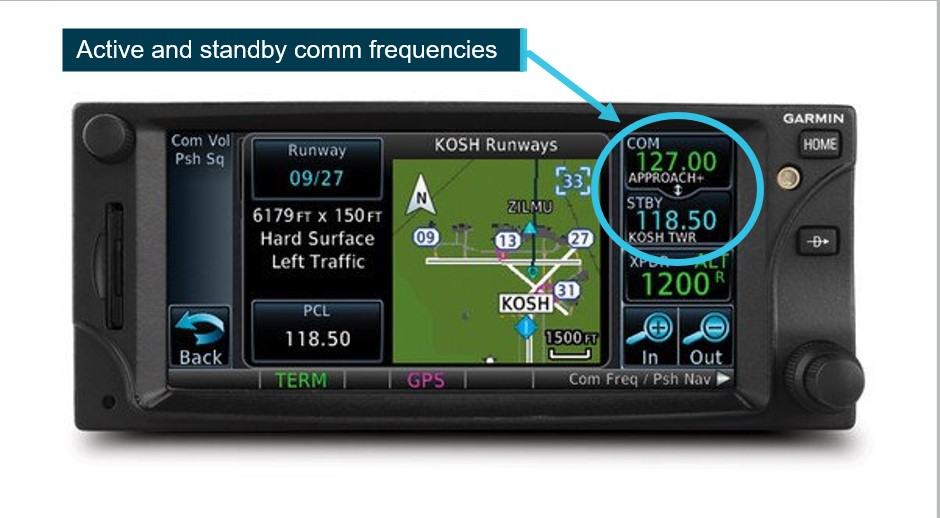
Functions related to this incident include a ‘Direct-To’ key, which when pressed provided a direct course to a selected waypoint. The navigation and communication frequencies could be changed by touching the standby window and the keypad to enter the desired frequency. To flip between active and standby frequencies, the operator needed to touch the active navigation/communication frequency field (Figure 3). Upon touching the frequency field, a text box ‘Hold for Flip-Flop’ is displayed near the knob. If the active navigation/communication frequency field is touched and held it will switch between the navigation and communication frequencies.
Figure 3: Garmin GTN 650 display screen
Source: Garmin, annotated by the ATSB
The pilot reported that when operating in turbulent conditions, they usually put two fingers on the side of the display to stabilise their hand and use their thumb to enter the data. After missing the initial approach fix, and during the second attempt to enter the waypoint into the MFD, the pilot reported that their finger slipped and inadvertently selected the Melbourne Centre frequency, which was the previous frequency selected.
Workload
Speed and timeframe
During the descent, the aircraft’s airspeed was about 170 kt. The pilot reported receiving a late descent to commence the RNAV-Z approach, which resulted in the aircraft being too high and fast to commence the approach. The pilot reported feeling rushed due to the combination of speed and the timing of the descent and approach clearances. The pilot reported their ideal approach speed would be 120-140 kt. However, data from previous flights inbound to Adelaide, that were probably flown by the pilot, show the aircraft conducting approaches at similar speeds.
Handling speeds for instrument approaches are specified in Airservices Australia’s Aeronautical Information Publication, En Route 1.16.1 These included a range of 120–180 kt indicated airspeed for Category B aircraft during the initial and intermediate approach. VH-LTP was within this range when the pilot was cleared to conduct the RNAV approach.
Monitoring
When assigned heading 120°, the pilot realised the aircraft had climbed since the turning onto the 360° heading, and therefore commenced a descent to the assigned altitude. However, the pilot was unaware the aircraft had subsequently continued to descend while they were out of communication with Adelaide Approach.
The pilot recalled becoming aware that something was wrong when they had not received any further instructions from ATC and recognised the voice of the Melbourne Centre controller. This prompted the pilot to contact the controller, who transferred them back to Adelaide Approach.
Self-assessment
The pilot rated their workload during the incident as 7 out of 10. The pilot reported that typically during an approach, their workload is ‘not too bad’, however, in this incident, the turbulence, difficulties entering in the waypoint, the late clearance for descent and then the aircraft turning away from the approach added to their workload. The pilot thought they were coping well with the situation, but advised that they were busy, with the situation moving quickly and little things were adding up.
Safety analysis
Data entry difficulties
The pilot’s data entry difficulties were consistent with the research conducted on touchscreen interfaces. During turbulent conditions, aircraft touchscreen interfaces have been known to increase data input errors and create slow interaction times. This is due to the display moving or vibrating independently of the pilot's body, which is itself also vibrating. A study conducted by Dodd and others (2014) found that while operating in moderate turbulence, it took pilots over 2 minutes longer to complete a given task when compared to operating in no turbulence. Although necessary when operating in turbulent conditions, stabilising the hand on the edge of the screen can also increase the risk of accidental presses on the edge of the screen (Coutts and others. 2019).
Ineffective monitoring
The pilot was experiencing a high workload, likely due to operating in instrument meteorological conditions, turbulence, encountering data entry difficulties and feeling rushed. This high workload likely resulted in the pilot not initially noticing the frequency change nor the continued descent and descent below the assigned altitude, which was the minimum sector altitude.
Workload is defined as the sum of task demands placed on an individual’s cognitive resources that are used for attention, perception, decision making and action (Skybrary, 2010). Humans are limited in the amount of new information their brain can process at once. Once this limit of cognitive resources has been reached their performance starts to decline with increased error rates and delayed responses, thus resulting in cognitive overload.
During high workload periods, monitoring flight instruments can degrade due to other tasks requiring attention, which can potentially lead to undetected errors (Flight Safety Foundation, 2014). A study on controlled flight into terrain (CFIT) conducted by the International Civil Aviation Organization, Flight Safety Foundation and the United States Federal Aviation Administration (Flight Safety Foundation, n.d.), found that two thirds of all CFIT accidents are a result of altitude error or lack of vertical situational awareness.
Though the pilot reported that they were coping well, pilots are often unaware that their monitoring performance has degraded, subsequently affecting their situational awareness.
Findings
ATSB investigation report findings focus on safety factors (that is, events and conditions that increase risk). Safety factors include ‘contributing factors’ and ‘other factors that increased risk’ (that is, factors that did not meet the definition of a contributing factor for this occurrence but were still considered important to include in the report for the purpose of increasing awareness and enhancing safety). In addition ‘other findings’ may be included to provide important information about topics other than safety factors.
These findings should not be read as apportioning blame or liability to any particular organisation or individual.
From the evidence available, the following findings are made with respect to the descent below the minimum sector altitude involving an Aero Commander 500-S, registered VH-LTP that occurred near Adelaide Airport, South Australia, on 12 August 2021.
Contributing factors
Due to turbulence, the pilot had difficulties entering data into the touchscreen multi-function display and the pilot inadvertently selected the incorrect radio frequency.
The pilot was likely experiencing high workload in instrument meteorological conditions resulting in a loss of situational awareness and ineffective monitoring of the instruments. This led to the aircraft descending below the minimum sector altitude before the pilot regained communication with air traffic control.
Other findings
The air traffic controller issued another terrain safety alert to the pilot after communications were restored, which likely prevented a controlled flight into terrain accident.
Sources and submissions
Sources of information
The sources of information during the investigation included:
the pilot
Airservices Australia
Bureau of Meteorology
Geoscience Australia.
References
Coutts, L.V., Plant, K.L., Smith, M., Bolton, L., Parnell, K.J., Arnold, J., & Stanton, N.A. (2019). Future technology on the flight deck: assessing the use of touchscreens in vibration environments. Ergonomics, 62(2), 286-304. https://doi.org/10.1080/00140139.2018.1552013
Dodd, S., Lancaster, J., Miranda, A., Grothe, S., DeMers, B., & Rogers, B. (2014). Touch Screens on the Flight Deck: The Impact of Touch Target Size, Spacing, Touch Technology and Turbulence on Pilot Performance. Proceedings of the Human Factors and Ergonomics Society 58th Annual Meeting, 58(1), 6-10. https://doi.org/10.1177/1541931214581002
Flight Safety Foundation (2014). A Practical Guide for Improving Flight Path Monitoring: Final report of the active pilot monitoring group. Flight Safety Foundation. https://flightsafety.org/files/flightpath/EPMG.pdf
Under section 26 of the Transport Safety Investigation Act 2003, the ATSB may provide a draft report, on a confidential basis, to any person whom the ATSB considers appropriate. That section allows a person receiving a draft report to make submissions to the ATSB about the draft report.
A draft of this report was provided to the following directly involved parties:
the pilot
the aircraft operator
Airservices Australia.
A submission was received from the pilot. The submission was reviewed and, where considered appropriate, the text of the report was amended accordingly.
Purpose of safety investigations
The objective of a safety investigation is to enhance transport safety. This is done through:
identifying safety issues and facilitating safety action to address those issues
providing information about occurrences and their associated safety factors to facilitate learning within the transport industry.
It is not a function of the ATSB to apportion blame or provide a means for determining liability. At the same time, an investigation report must include factual material of sufficient weight to support the analysis and findings. At all times the ATSB endeavours to balance the use of material that could imply adverse comment with the need to properly explain what happened, and why, in a fair and unbiased manner. The ATSB does not investigate for the purpose of taking administrative, regulatory or criminal action.
Terminology
An explanation of terminology used in ATSB investigation reports is available here. This includes terms such as occurrence, contributing factor, other factor that increased risk, and safety issue.
Publishing information
Released in accordance with section 25 of the Transport Safety Investigation Act 2003
Ownership of intellectual property rights in this publication
Unless otherwise noted, copyright (and any other intellectual property rights, if any) in this report publication is owned by the Commonwealth of Australia.
Creative Commons licence
With the exception of the Coat of Arms, ATSB logo, and photos and graphics in which a third party holds copyright, this publication is licensed under a Creative Commons Attribution 3.0 Australia licence.
Creative Commons Attribution 3.0 Australia Licence is a standard form licence agreement that allows you to copy, distribute, transmit and adapt this publication provided that you attribute the work.
The ATSB’s preference is that you attribute this publication (and any material sourced from it) using the following wording: Source: Australian Transport Safety Bureau
Copyright in material obtained from other agencies, private individuals or organisations, belongs to those agencies, individuals or organisations. Where you wish to use their material, you will need to contact them directly.
On 18 August 2021, an amateur-built Stolp Acroduster II SA-750, registered VH-YEL, departed Caboolture Airfield, Queensland for an aerobatic flight, with the pilot being the sole occupant. A short time later, the aircraft sustained an in-flight break-up. The pilot was fatally injured and the aircraft was destroyed.
What the ATSB found
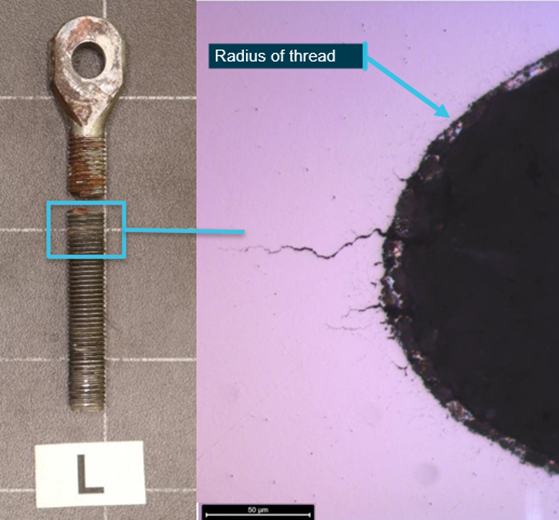
The ATSB found that the centre section of the upper wing was located away from the main aircraft wreckage. Technical examination of the attachment points identified fatigue cracking on the eye bolts located in the upper wing forward position on the left and right cabane struts. The fatigue cracking had initiated in the thread root of each eye bolt at its termination into the cabane strut. The left eye bolt fracture surfaces were corroded, that indicated the left eye bolt had failed some time before the accident flight. Fatigue cracking was also identified in the left roll brace where it secured to the same attachment points. The weakened eye bolts and roll brace subsequently fractured, which led to structural instability of the centre wing section, and an in-flight break-up of the aircraft wing structure.
The fatigue cracks were located in areas that would not be easily identifiable during standard maintenance inspections without disassembly of the relevant wing attachment points. Further, fatigue cracks were identified on the same aircraft type, in the same eye bolt and roll brace positions 2 decades before this accident. Despite this, there was no provision for product improvements to identify emerging design issues and to implement design change or additional maintenance inspections, nor was this required for aircraft in the experimental category.
What has been done as a result
In August 2021, the ATSB notified the Civil Aviation Safety Authority, the United States (US) National Transportation Safety Board, the US Federal Aviation Administration, the US Experimental Aircraft Association (EAA), and the aircraft design owner of the initial finding that fatigue cracking had been identified within the upper wing centre section attachment eye bolts. The ATSB also contacted the owner of the only other Stolp Acroduster II SA-750 on the Australian civil aircraft register and informed them of the issue.
In November 2021, the ATSB issued a preliminary report and safety advisory notice (SAN) AO‑2021-032-001 to inform aircraft type owners of the circumstances of the accident and the fatigue crack issue. The FAA, EAA and the design owner also provided information to aircraft owners with a link to the ATSB’s preliminary report and SAN.
Safety message
Aircraft owners and maintainers of experimental amateur-built aircraft should consider conducting additional detailed inspections that exceed the minimum standards in areas of the aircraft that are critical to the safety of flight. Further, Acroduster service history has shown that elements of the upper centre wing attachment joint have a predisposition to cracking. Care should be taken during pre-flight and scheduled inspections, being particularly attentive for the identification of cracks/corrosion/fretting.
The investigation
Decisions regarding whether to conduct an investigation, and the scope of an investigation, are based on many factors, including the level of safety benefit likely to be obtained from an investigation. For this occurrence, a limited-scope investigation was conducted in order to produce a short investigation report and allow for greater industry awareness of findings that affect safety and potential learning opportunities.
The occurrence
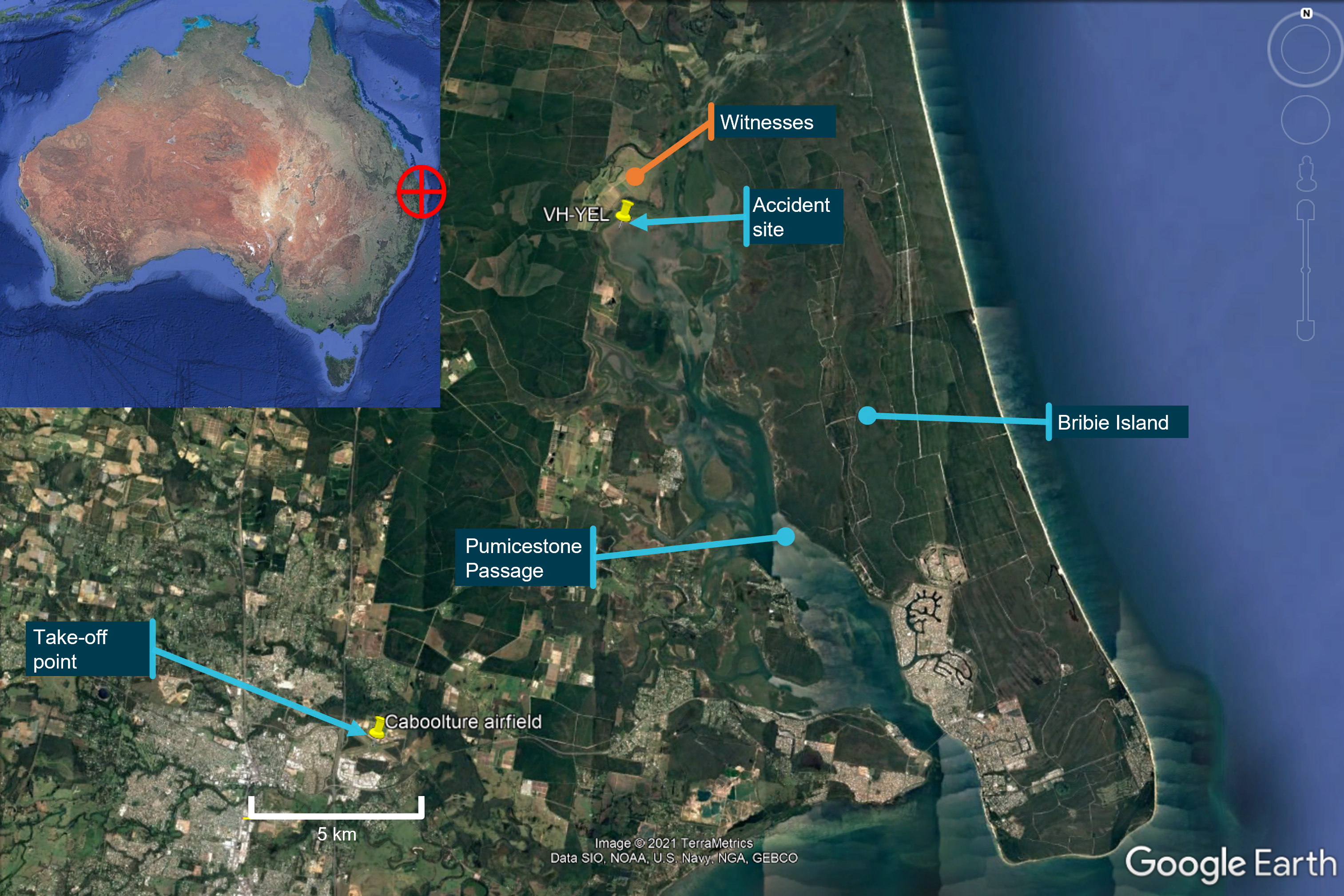
On 18 August 2021, at 0852 local time, an experimental amateur-built Stolp Acroduster II SA-750 aircraft, registered VH-YEL, departed the Caboolture airfield, Queensland, for a local aerobatic flight. The pilot was the sole occupant.
Shortly after, the crew of a helicopter operating in the vicinity, witnessed red and white debris falling from the sky. After searching the immediate area, the helicopter crew identified the main wreckage of VH-YEL.
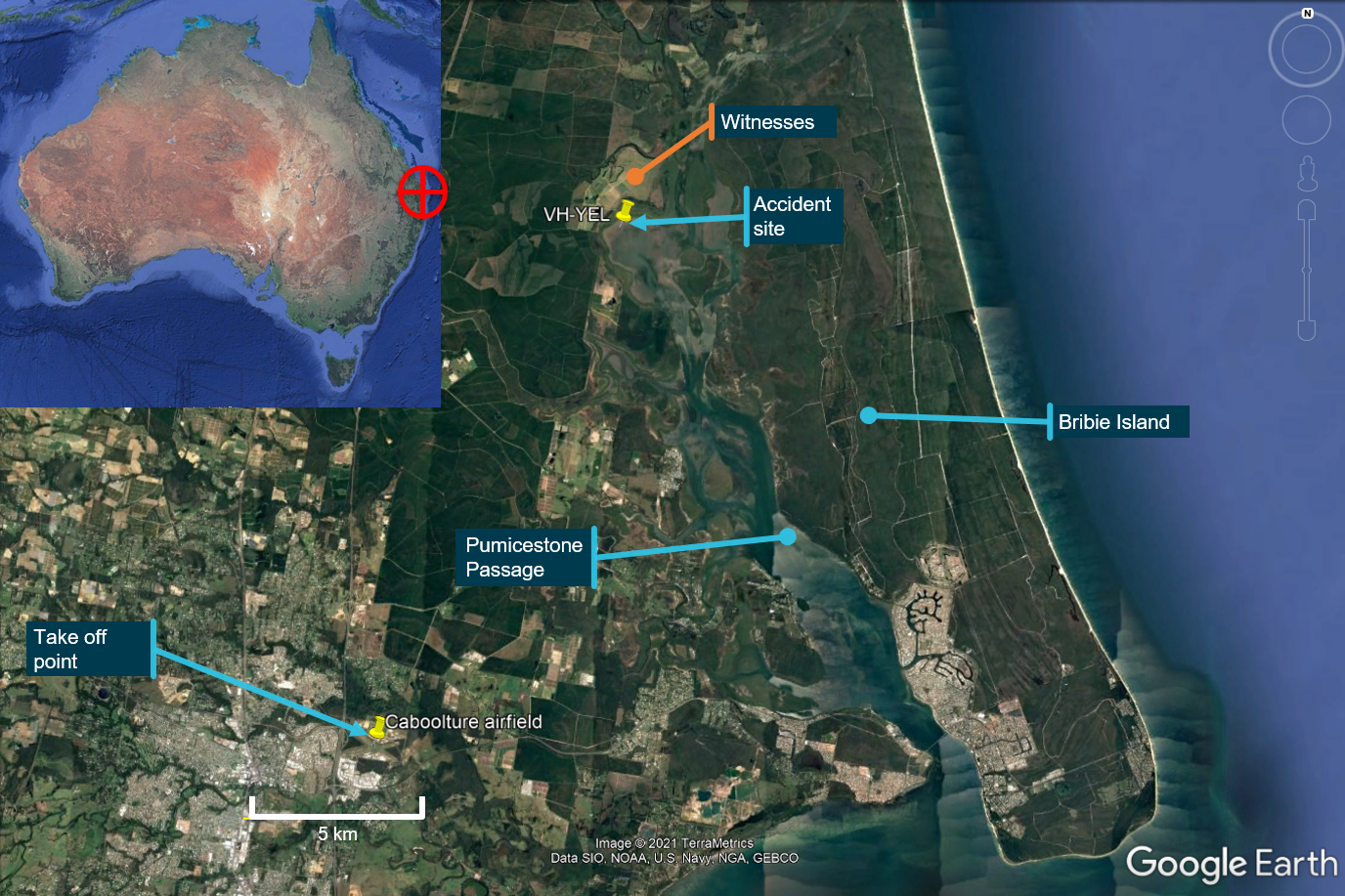
The majority of the wreckage came to rest inverted in tidal wetlands, close to the mainland shoreline of Pumicestone Passage, adjacent to Bribie Island (Figure 1). The aircraft was destroyed, and the pilot was fatally injured.
Initial assessment of the aircraft wreckage distribution by the ATSB at the accident site, indicated that the aircraft had sustained an in-flight break-up. The main aircraft wreckage and other components were recovered from the accident site and taken to a secure facility for detailed examination by the ATSB.
Figure 1: Aircraft departure point and accident location
Source: Google Earth, annotated by the ATSB
Context
Pilot information
The pilot held a valid Private Pilot Licence (Aeroplane) with 674.2 hours total flight time, including 108 flight hours conducted in VH-YEL. They also held a Private Pilot Licence (Helicopters) with an additional 102.9 hours flight experience. The pilot held the following ratings and endorsements:
single-engine aeroplane class rating
aerobatics and spinning flight activity endorsement
manual pitch propeller control and tail wheel undercarriage design feature endorsements.
A review of the pilot’s logbook indicated that they had predominately focussed nearly all their flying since June 2016 on the conduct of aerobatics in a variety of different higher-performing single‑engine aircraft, including the accident aircraft.
The pilot held a valid Class 2 Aviation Medical Certificate with no restrictions.
Aircraft information
Experimental amateur-built aircraft
An amateur-built aircraft is an aircraft, the major portion (more than 50%) of which has been fabricated and assembled by a person who undertook the construction project solely for their own education or recreation (Advisory Circular AC-21.4(2) Amateur-built Experimental Aircraft – Certification). An amateur-built aircraft can be built from scratch based on an original design or established plans, or from a kit. Pilots and passengers of these aircraft operate under the premise of informed participation and accept the risk that these aircraft may not meet the same airworthiness safety standards as certified aircraft.
General information
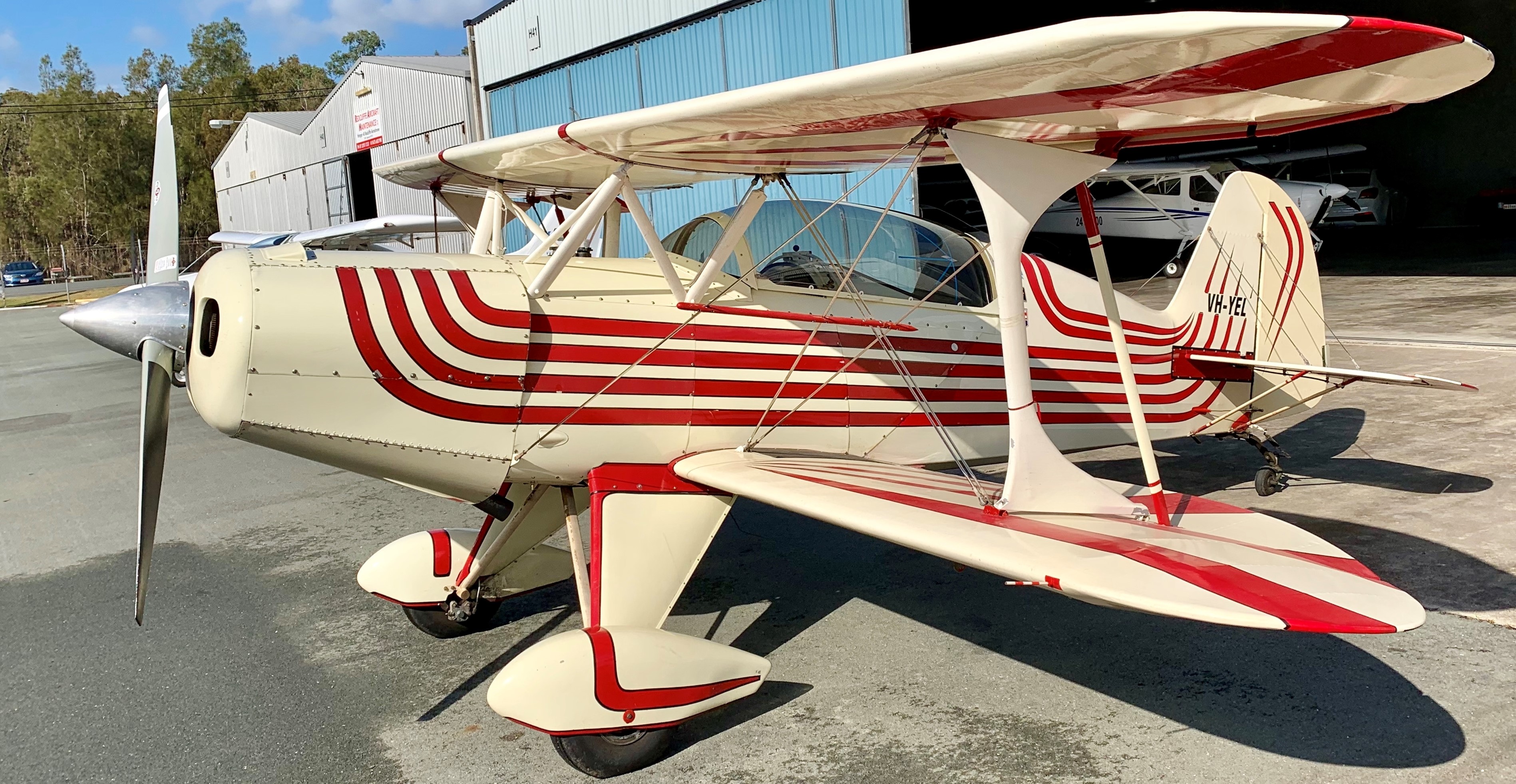
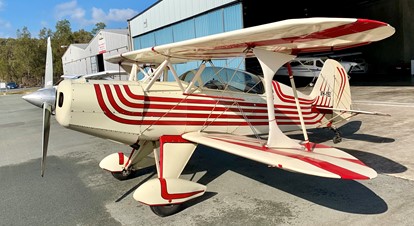
The Stolp Acroduster II SA-750 is a 2-seat amateur-built aerobatic bi-plane rated to +/- 9 g.[1] The aircraft was first introduced in 1971 as a plans-built aircraft, available from the Starduster Corporation in the United States. The current design owner (Aircraft Spruce) advised the ATSB that the plans for all Starduster Corporation aircraft had not been modified since first produced. The aircraft fuselage is constructed of welded steel tube and the wings incorporate wooden structure with steel tube internal supports. The majority of the aircraft is covered in fabric. It is powered by a 4-cylinder piston engine driving a 2-blade fixed pitch propeller (Figure 2).
Figure 2: VH-YEL Stolp Acroduster II SA-750
Source: Supplied
There are several other plans-built Starduster Corporation aircraft variants developed by the same designer that share similar design features, such as the Starduster and single seat Acroduster (SA-700). However, only the Acroduster series aircraft share the same upper wing attachment points. There were about 130 Acroduster SA-700/750 aircraft that were completed with 2 of them being on the Australian register. Some components for the aircraft were able to be purchased as kits or raw materials.
VH-YEL details
The aircraft’s plans were supplied from the Stolp Starduster Corporation in 1976 and the aircraft was constructed in the United States with a serial number of T-02. The aircraft was first registered as N97177 and first flew in 1981. It was disassembled and shipped to Australia in 2003. At that time, the aircraft had accumulated about 430 flight hours.
The aircraft was re-registered in Australia in 2007 as VH-YEL and was operated under the experimental category.[2] The aircraft was purchased by the accident pilot on 9 July 2019. It was maintained in accordance with the Civil Aviation Safety Authority maintenance schedule 5[3] and, at the time of the accident, had accumulated about 717 flight hours. The last periodic maintenance inspection was conducted on 27 August 2020 at 687.3 hours total time‑in‑service, with the next inspection due 9 days after the accident.
Wing attachment and bracing description
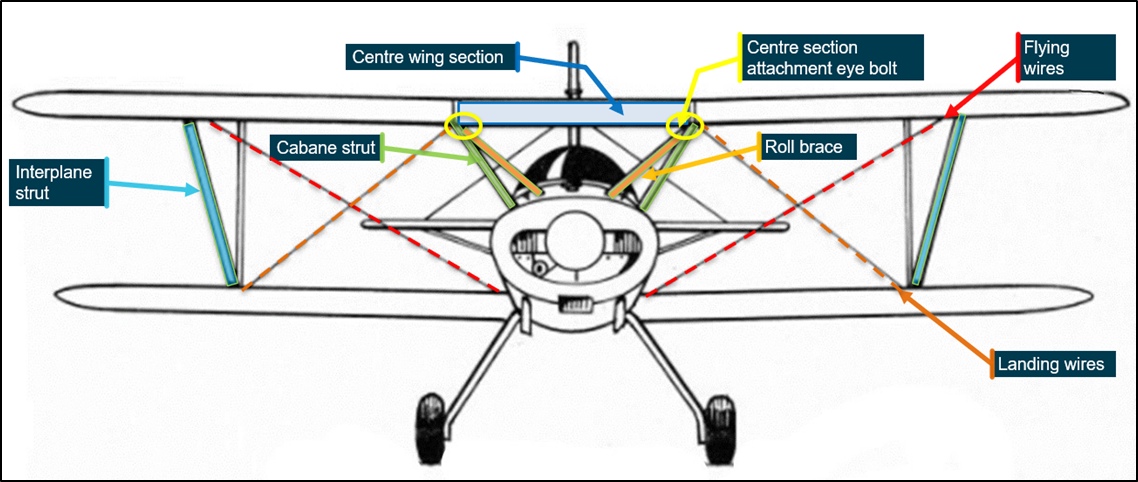
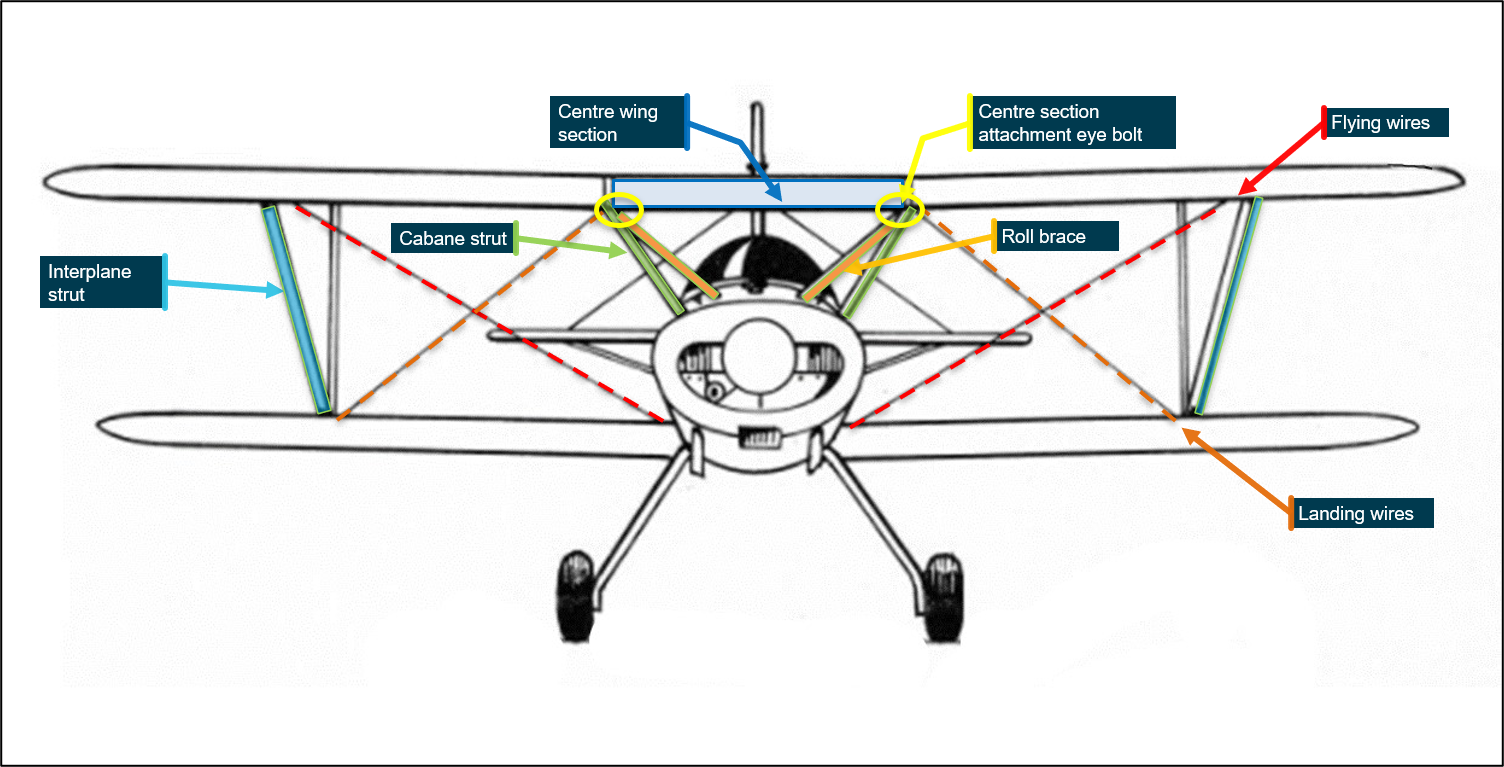
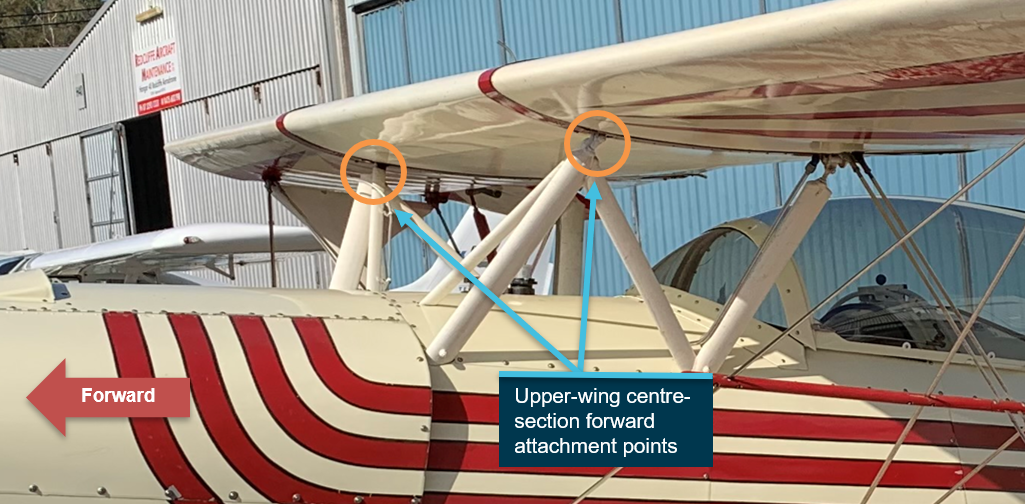
The lower wings of the Acroduster SA-700/750 were directly attached to the lower fuselage at 2 wing root attachment points on each side. The upper wings incorporated the left, right and centre sections (Figure 3). The centre section was attached to the fuselage by eye bolts (yellow) that then connected to the forward cabane struts (green) and roll braces (light orange). The wings were externally braced against each other using flying wires (red), landing wires (dark orange), and interplane struts (blue). In-flight, the lower wing outboard sections were supported by the upper wing outboard sections through the interplane struts and flying wires.
Figure 3: Wing bracing and attachment
Source: Starduster, annotated by the ATSB
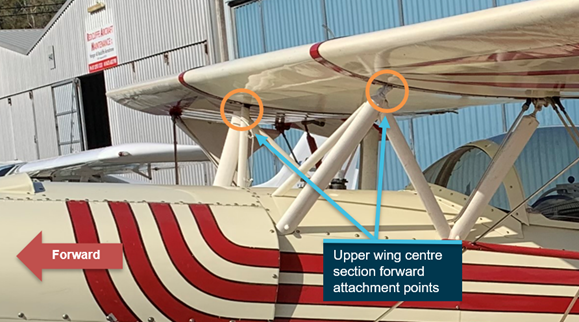
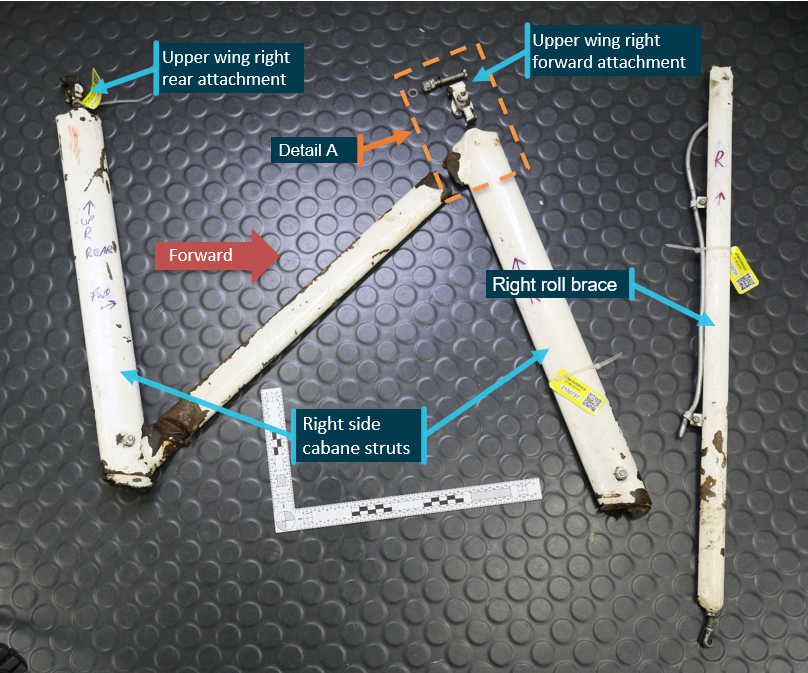
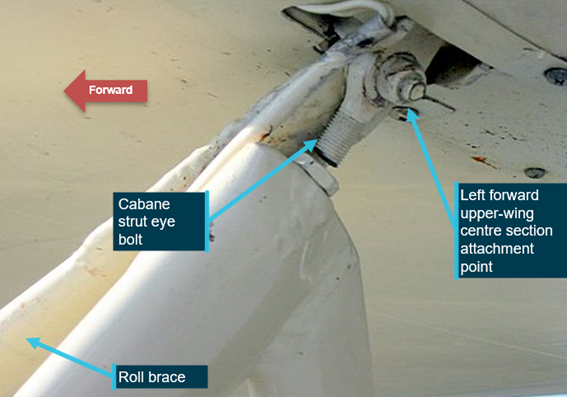
The cabane struts and roll braces were provided to support and attach the centre section of the upper wing to the fuselage. Eye bolts had been manufactured to thread into the upper portion of each cabane strut and completed the attachment between the upper wing centre section and the struts (Figure 4). The eye bolts were adjustable in length through their threaded section.
Figure 4: Upper wing centre section attachment
Source: Supplied, annotated by the ATSB
Technical support and eye bolt inspection requirements
There was no in-service technical support for the aircraft type provided by the design owner (Aircraft Spruce), nor was there required to be by regulations for aircraft in the experimental category. Such support would typically include:
the communication and analysis of service difficulties, defects, design issues and or technical failures of components
detailing specific type maintenance inspection requirements based on known design issues
providing technical assistance for product improvements to identify emerging design issues and to implement design change.
The only method to identify and mitigate design issues with the aircraft was via word of mouth, magazine articles, amateur builder associations, or on-line aircraft forums where owners could discuss safety issues and design problems among themselves.
Apart from the requirement to complete a general inspection of the wing attachment points and wing structure periodically for condition and security, the aircraft type did not have a specific detailed inspection schedule for the eye bolts or roll braces to ensure their ongoing airworthiness.
In addition, the aircraft type did not have a specified life‑limit to replace the eye bolts at set flight hours and/or cycles, rather, they were an on‑condition replacement.
Meteorological information
Closed circuit television footage at Caboolture airfield showed there was little to no wind, good visibility, and broken[4] cloud with no rain at the time the aircraft departed. This was consistent with the Bureau of Meteorology graphical area forecast, which further indicated wind speeds of 17‑20 kt from the south, south‑south-east between 1,000-5,000 ft. Therefore, weather was not considered to be a contributing factor to the accident.
Aircraft radar surveillance information
Recorded surveillance data was obtained from Airservices Australia. As the aircraft was not fitted with a transponder, only primary radar returns[5] were available. The coverage will detect aircraft at, or above heights depending on the aircraft’s proximity to radar coverage and terrain shielding. Due to the limitations of primary radar and terrain shielding, there were gaps in the radar recording and the aircraft’s altitude, speed and timing data was not available.
However, there was limited radar data in respect to an aircraft departing Caboolture and a flight path consistent with VH-YEL. This included termination of the flight in the immediate vicinity of the accident site. The ATSB’s analysis of the recorded flight path data showed that the aircraft was conducting several minutes of aerobatic manoeuvring leading up to and likely during the in-flight break‑up sequence.
Wreckage and impact information
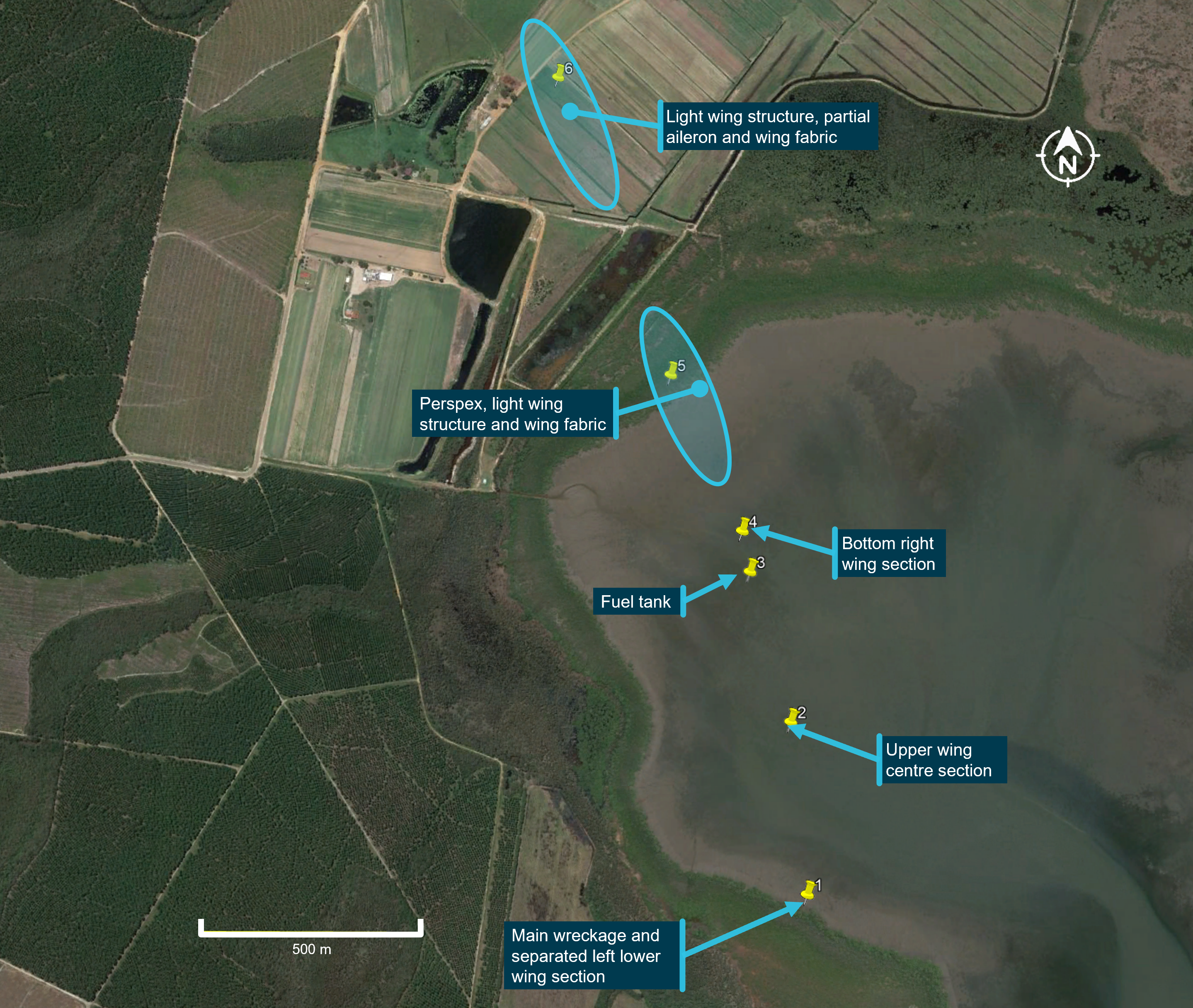
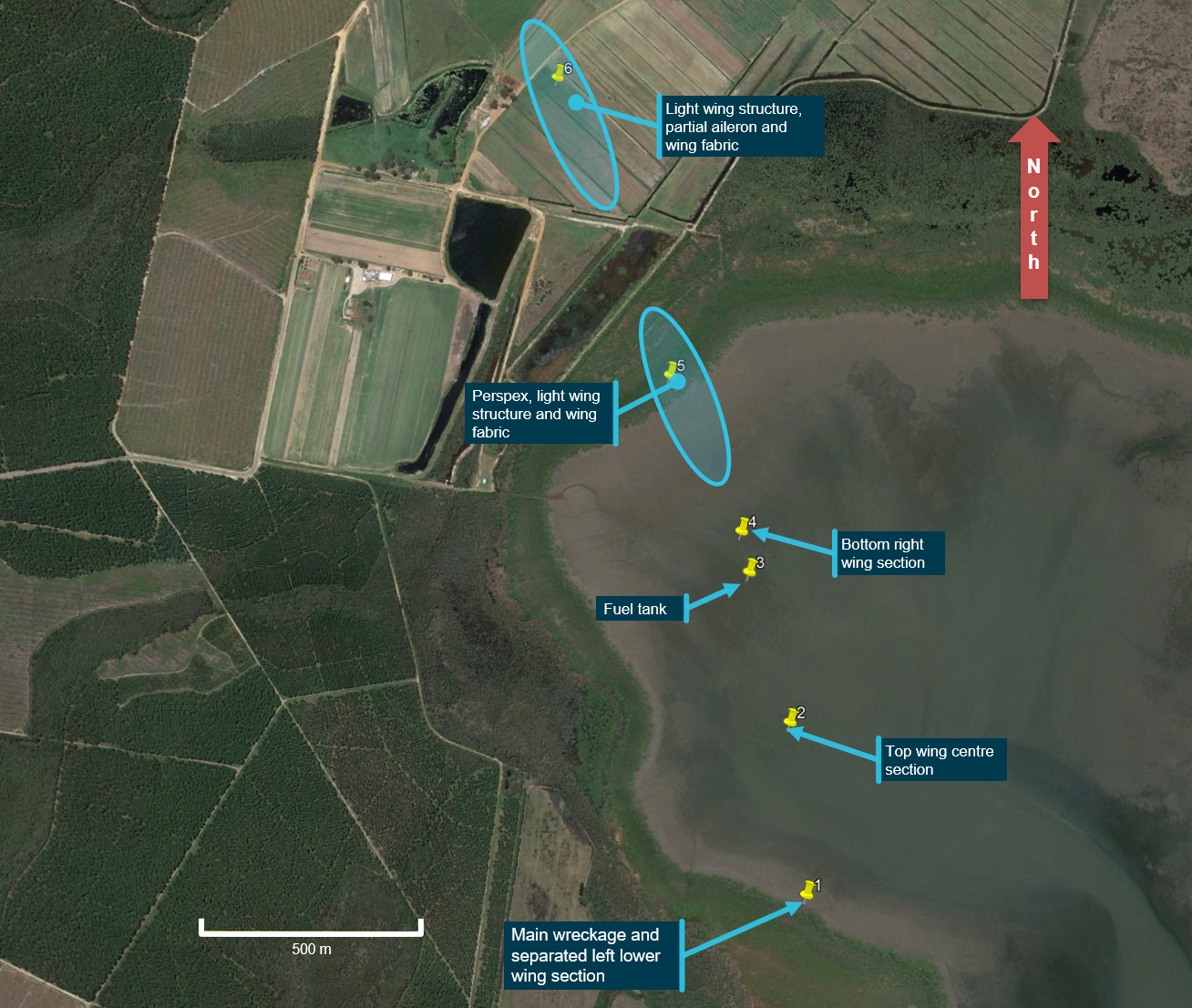
The aircraft wreckage was located on tidal mud flats and farmland, it was spread over a distance of about 2.4 km. The trail was oriented in a south-east to north-west direction consistent with wind direction on the day.
The main wreckage consisted of the fuselage, tail, and outer-wing sections still attached to the fuselage by the flying and landing wires. The left lower inboard wing section had separated from the aircraft but was located adjacent to the main wreckage. The upper wing centre section was located about 500 m away from the main wreckage. The majority of the remaining scattered debris consisted of light wooden sections of wing structure, wing skin fabric, panels and windshield fragments (Figure 5).
Figure 5: Wreckage trail distribution over mud flats and farmland
Source: Google Earth, annotated by the ATSB
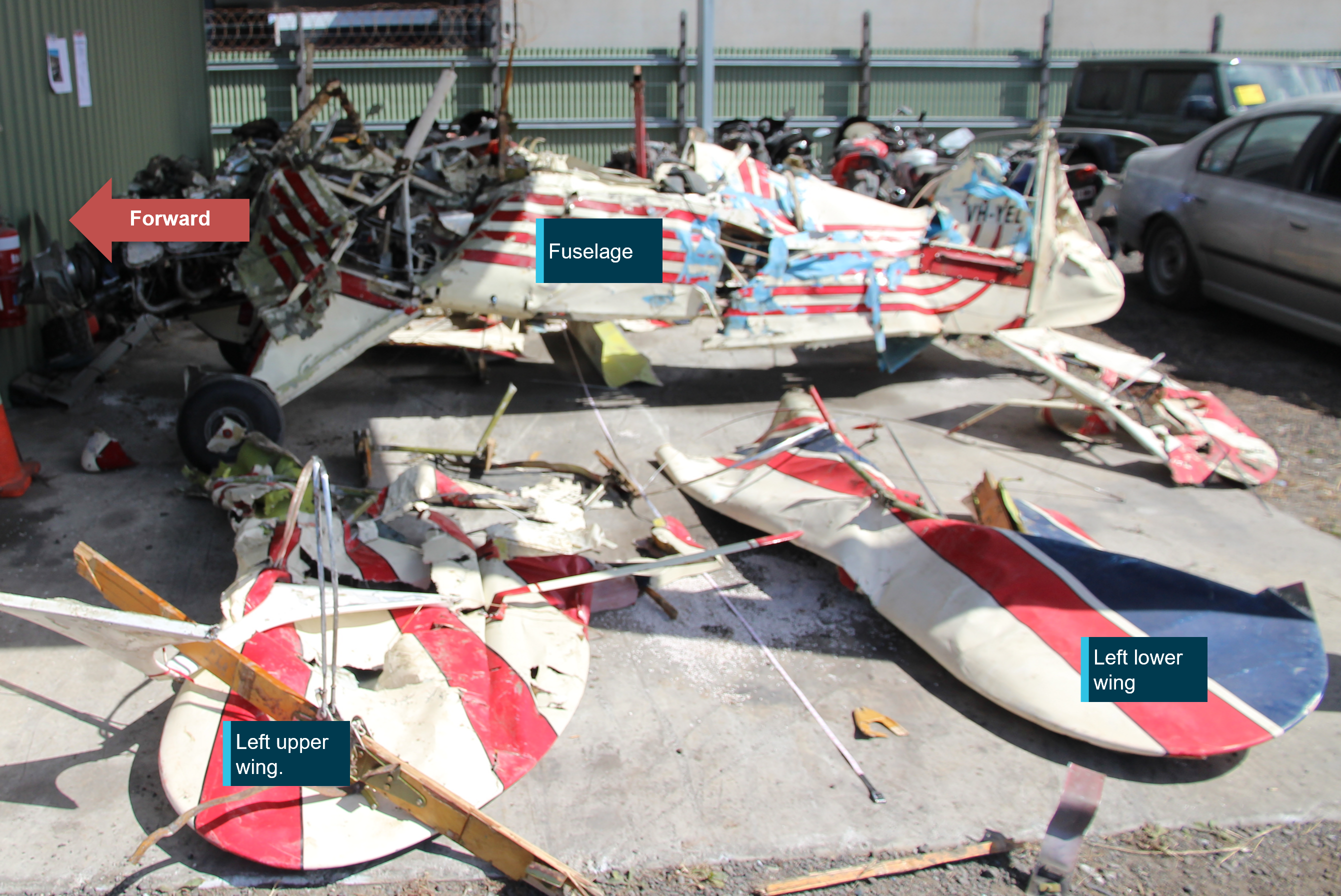
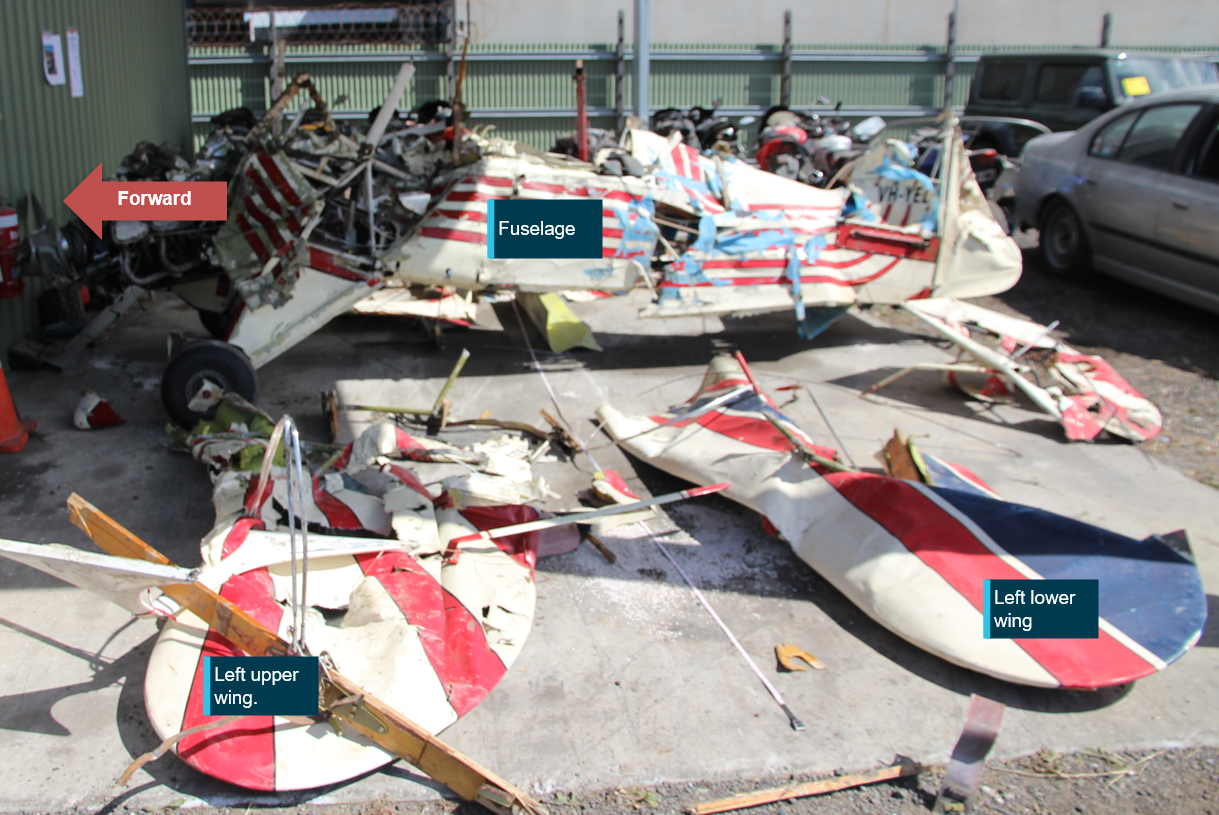
The main wreckage was recovered by barge at the changing of the tide and was transported to a secure storage facility for examination by the ATSB (Figure 6). Reconstruction of the sections of recovered aircraft identified that:
the majority of the parts were accounted for with the exception of the right interplane strut
the aircraft flight controls had no pre-impact defects
the fuselage, wings, flying and landing wires had no pre-impact defects
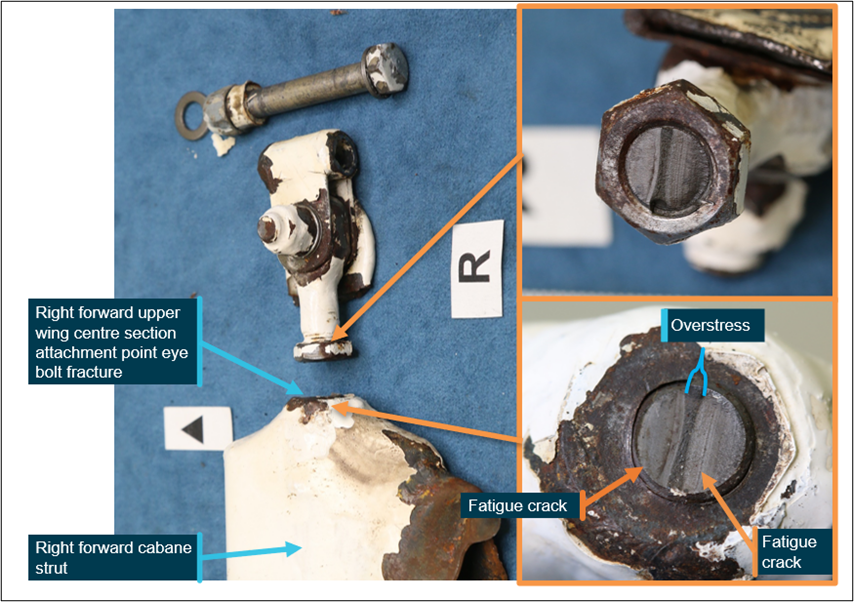
the forward cabane strut upper wing attachment point eye bolts to the centre-wing structure had fractured and displayed evidence of pre-existing fatigue cracking
there was no evidence of propeller rotation at impact, however, the engine most likely stopped from fuel starvation during the in-flight break-up sequence.
Figure 6: VH-YEL as recovered and partially reassembled
Source: ATSB
Upper centre wing attachment points
Technical examination of the upper centre wing attachment – summary
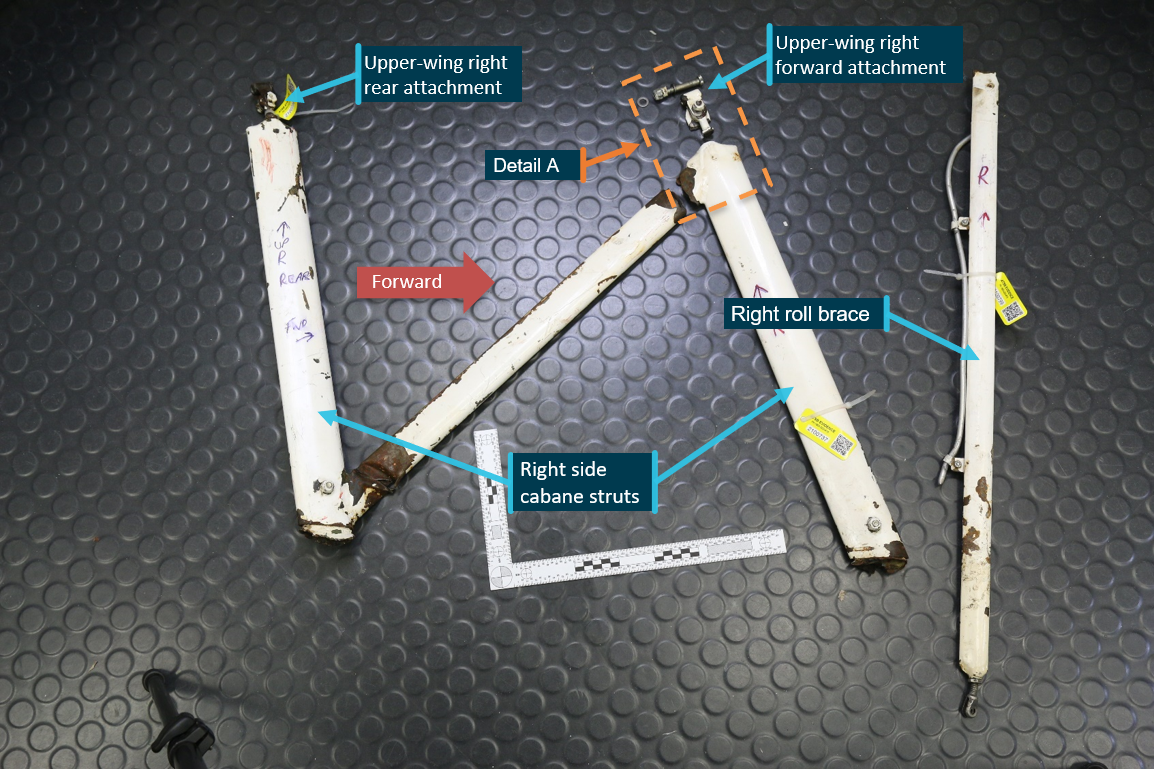
Both forward cabane struts and roll braces, and the attaching hardware were cleaned and treated against corrosion during the wreckage recovery process. They were removed from the aircraft and sent to the ATSB’s technical facilities in Canberra for detailed examination. For further detail refer to the materials analysis report at Appendix A. The examination identified:
The left and right eye bolts were cadmium plated, had rolled threads, and were likely made of 4140 alloy steel.
The eye bolts had no observable manufacturing defects.
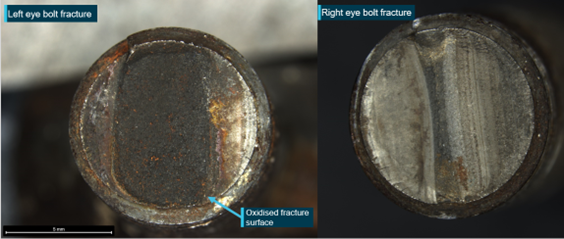
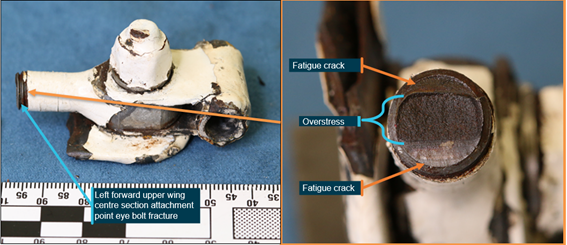
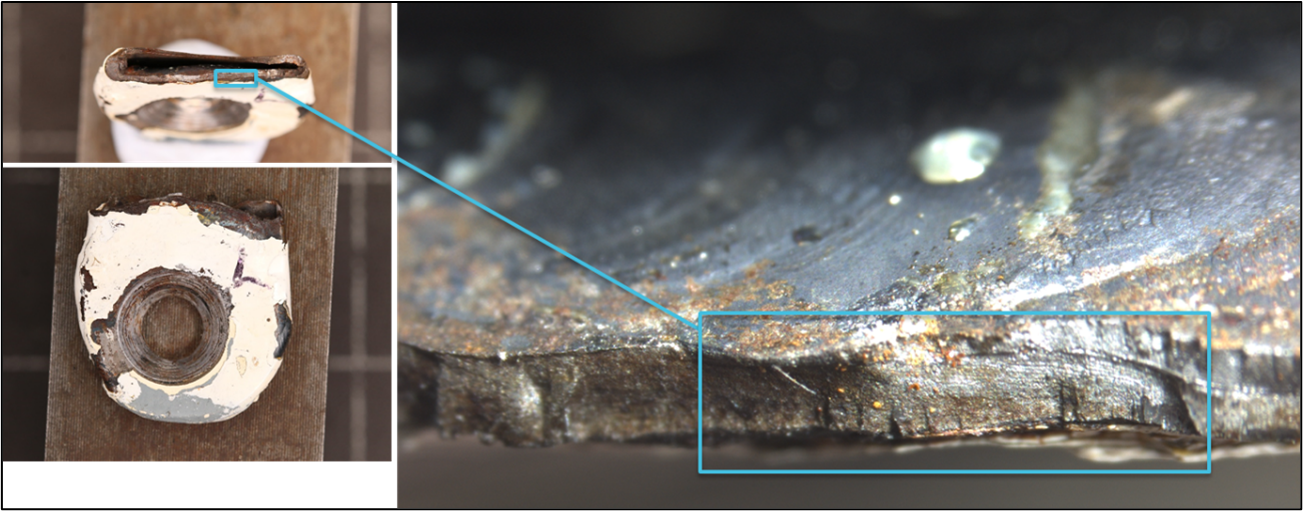
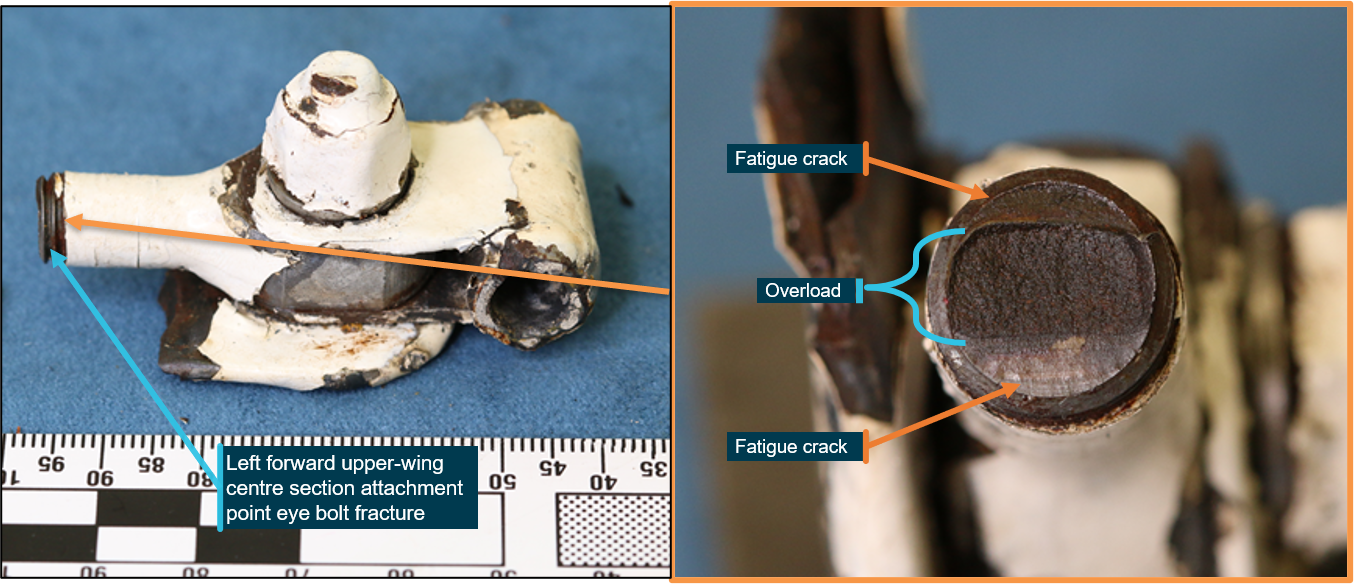
There were fatigue cracks in a fore/aft direction through 35% of the left eye bolt threaded cross section with the remaining material fractured in overload.
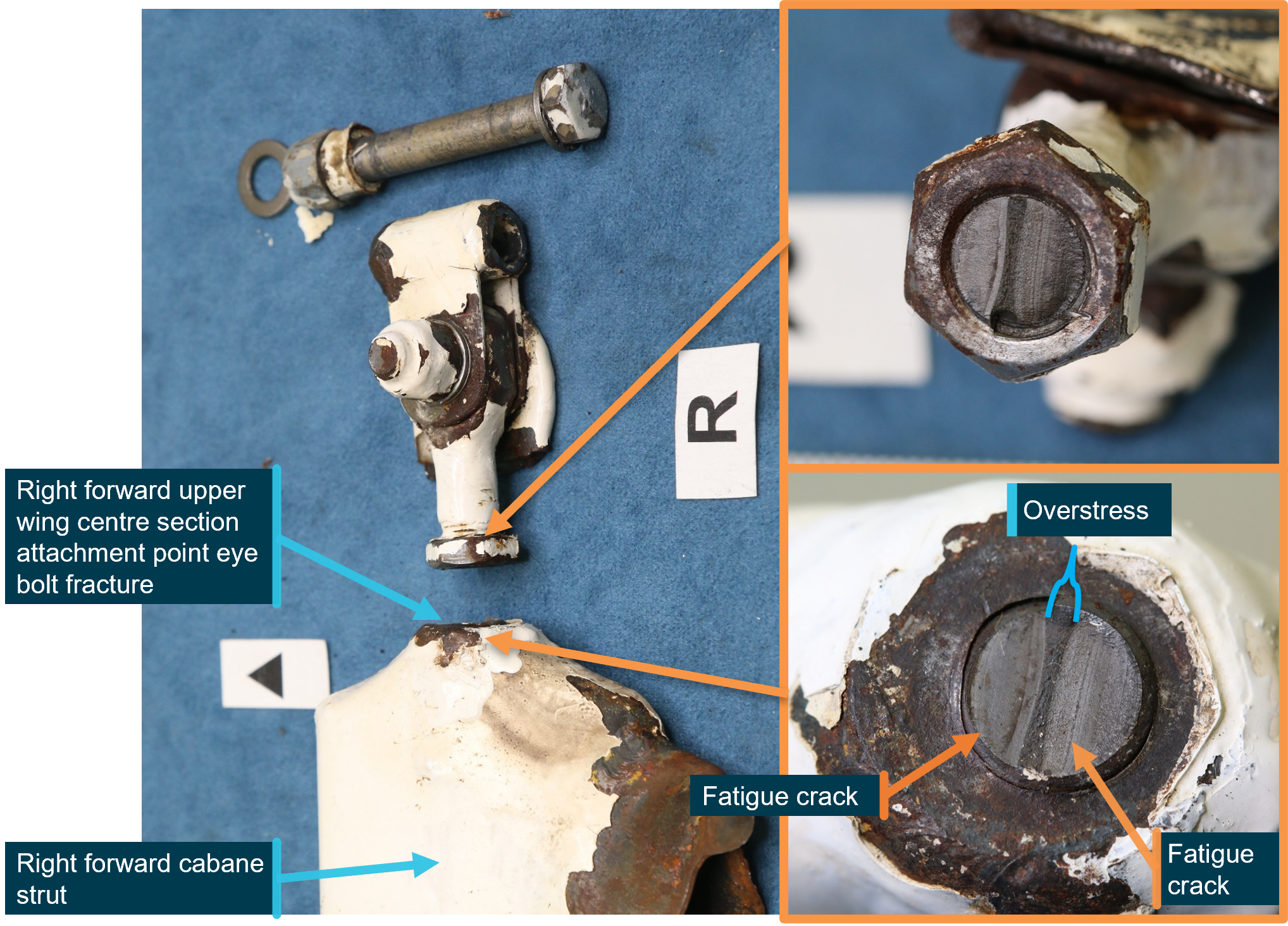
There were uniaxial fatigue cracks in a fore/aft direction through 85% of the right eye bolt threaded cross section with the remaining material fractured in overload (Figure 7).
There were several areas of additional micro-cracking present in the threaded portion of the forward eye bolts.
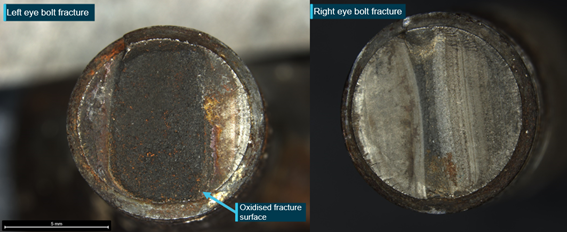
The left eye bolt fracture surfaces had significant corrosion when compared to the right eye bolt fracture surfaces. This indicated that the left eye bolt had completely fractured some time before the accident flight (Figure 8).
Visual examination of both roll braces indicated that they had fractured at their upper connection.
The left roll brace fracture surface that was coincident with the position of the upper cabane strut eye bolts had fatigue cracks through 60% of its cross-section.
Due to the development of corrosion damage to the fracture surfaces, it could not be ascertained if the right roll brace had also developed fatigue cracking.
Figure 7: Right eye bolt, cabane strut and fracture surface
Source: ATSB
Figure 8: Corrosion level differences between left and right eye bolt fracture surfaces
Source: ATSB
The location of the crack on the right forward cabane strut eye bolt was directly under the securing nut, making it imposssible to identify the fatigue crack without dissassembling the attachment point and removal of the eye bolt. The location of the crack on the left forward cabane strut was directly above the securing nut and would have been difficult to identify while it was forming in the threaded section without dissassembly and removal of the eye bolt from the cabane strut.
Eye bolt history
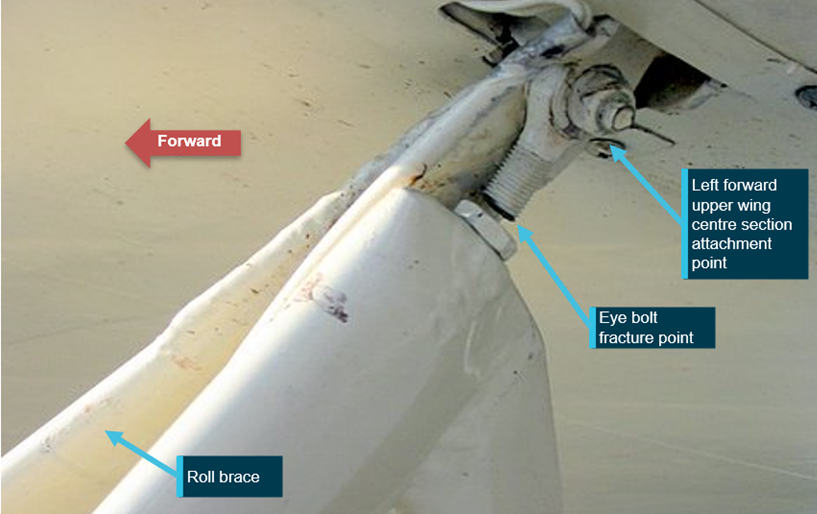
A subject matter expert familiar with the early design and development of the aircraft type indicated that there has been a history of cabane strut eye bolt cracking in the same area of the threaded section as occurred with VH-YEL. They provided the ATSB with an image taken 2 decades before this incident of an Acroduster SA-750 where a left forward upper wing cabane strut eye bolt fractured completely through its threaded section. That fracture was in the same location as VH-YEL. The left roll brace was the only remaining structure providing support to that section of the wing (Figure 9). It could not be determined how long prior, or for how many hours the aircraft had flown with the failed eye bolt.
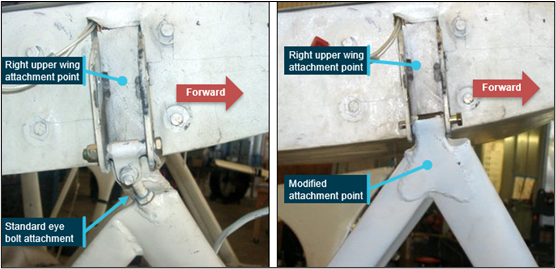
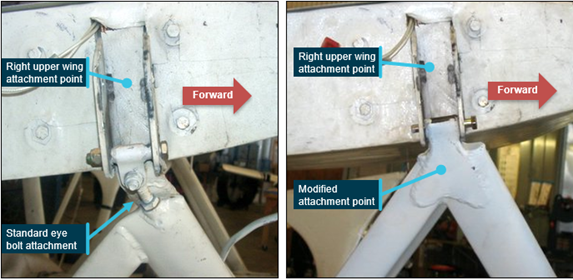
The ATSB was further advised that some owners of Acroduster aircraft made modifications to the upper wing attachment points. The modification removed the eye bolts and replaced them with a welded structure, which attached directly to the upper wing attachment point, effectively strengthening the attachment points (Figure 10). The ATSB notes that the modification shown was not approved by the aircraft design owner and had been added by experimental amateur-built owners. Advice on such modifications should be sought from a suitably qualified aeronautical engineer on any design changes undertaken.
Figure 10: Right-side upper wing centre section attachment point with a standard eye bolt attachment (left) and a modified attachment (right)
Source: Supplied, annotated by the ATSB
Roll brace history
The Starduster Magazine hadbeen produced as a technical document to assist amateur builders of Starduster company aircraft including the Acroduster aircraft. In the April 1980 edition, the author reported that while completing an aircraft inspection, cracks were identified in the roll brace and the cabane strut. Notably:
The most significant repair was on the Cabane struts, sheet 5, items 4 and 5. One of them was cracked, and the brace strut [roll brace] on that side was carrying no load.
As such, the author provided a cautionary note:
If you are already flying your machine, we recommend that you keep a careful eye on these sway [roll] braces, and carefully inspect them both visually and by shaking, before your first flight of the day. You should change them at the next annual inspection.
The article stated that a modification had been made to replace the steel tube roll braces with stainless steel material that was the same type as the flying wires. The last edition of Starduster Magazine was produced in October 1985.
Safety analysis
Introduction
While conducting an aerobatic flight, the aircraft sustained an in-flight break-up and a subsequent collision with the terrain. The pilot was fatally injured and the aircraft was destroyed. Adverse weather was not identified as a factor in the accident flight.
The following analysis examines what contributed to the in-flight break-up sequence and technical support, design, and maintenance inspection considerations.
In-flight break-up sequence
The aircraft wreckage was distributed over 2.4 km, with the centre wing section found about 500 m away from the main wreckage. The ATSB’s metallurgical examination of the forward left and right upper wing centre section attachment eye bolts (eye bolts) from VH-YEL did not identify any manufacturing defects or anomalies outside of the limited design specifications provided. However, the ATSB’s inspection found areas of significant pre-existing fatigue cracking in the threaded portions of the eye bolts. There was also significant corrosion on the fracture surfaces of the left eye bolt, when compared to the right eye bolt. This indicated the left eye bolt had failed some time before the accident flight.
Further, inspection of the left roll brace also identified areas of fatigue cracking. It was likely that, when the left eye bolt failed, the flight loads transferred to the adjacent structure, which was the left roll brace. This increased the fatigue inducing flight loads acting on the roll brace. A previous failure of an eye bolt that occurred on another Acroduster aircraft showed that aircraft flight loads could be supported by the respective roll brace.
Subsequently, it was likely that the right eye bolt and left roll brace fatigue cracks propagated to a critical size and that the remaining material was no longer able to sustain normal flight loads and consequently failed in overstress. They, along with the previously failed left eye bolt initiated the in‑flight break-up sequence.
Detection of the cracks
In this accident, the fatigue cracks on the cabane struts formed in an area of the eye bolts that were obscured by the securing nuts and threads of the eye bolts. Therefore, the cracks would not have likely been readily identifiable during standard maintenance inspections without disassembling the attachment points. However, as the last periodic inspection occurred about 1 year prior to the accident, it could not be determined if the cracks would have been present at that time.
Aircraft design and maintenance
As discussed above, the ATSB’s examination found fatigue cracking in both eye bolts and the left roll brace. An expert familiar with the Acroduster design had stated that there was a history of eye bolt cracking as previously evidenced on another aircraft. Similarly, the Starduster Magazine, which had ceased publishing in 1985, had mentioned incidents of roll brace cracking.
Consequently, some Acroduster owners had modified the attachment points to remove the eye bolts and replaced the roll braces with bracing wires. Those design improvements were made at a local level by individual aircraft owners, rather than through direct and broad reaching technical support provided by the design owner. Without design owner tracking and analysis of historic in‑service component and structural design issues:
broad reaching structural design improvements will not be made
additional maintenance inspections to identify defects in areas with known issues will not be implemented
time/cycle component retirement life assessments will not be conducted.
In this case, the aircraft was provided to the builder in a basic kit form, with a set of design plans that had not changed since they were originally produced about 50 years ago. Further, there was no explicit requirement to inspect the eye bolts or roll braces in detail, despite being a known area for fatigue cracking and on-condition component with no specified replacement interval.
Therefore, without a mechanism for identifying product improvements, Acroduster owners may not be aware of possible design issues and enhancements made by others.
Findings
ATSB investigation report findings focus on safety factors (that is, events and conditions that increase risk). Safety factors include ‘contributing factors’ and ‘other factors that increased risk’ (that is, factors that did not meet the definition of a contributing factor for this occurrence but were still considered important to include in the report for the purpose of increasing awareness and enhancing safety). In addition, ‘other findings’ may be included to provide important information about topics other than safety factors.
These findings should not be read as apportioning blame or liability to any particular organisation or individual.
From the evidence available, the following findings are made with respect to the in-flight break-up accident involving a Stolp Acroduster II SA750, registered VH-YEL, on 18 August 2021.
Contributing factors
The left eye bolt that supported the upper wing centre section failed prior to the accident flight due to fatigue cracking. This, in combination with pre-existing fatigue cracking and subsequent overstress of the right eye bolt and left roll brace during the flight, led to the in‑flight break-up.
Other factors that increased risk
The eye bolt fatigue cracks formed in areas that would not be easily identifiable during the periodic maintenance inspections without the requirement for removal of the eye bolts from the cabane struts. This reduced the opportunity to identify fatigue cracks before they propagated to a critical size.
There was no provision for product improvements to identify emerging design issues and to implement design change or additional maintenance inspections, nor was this required for aircraft in the experimental category.
Safety actions
Whether or not the ATSB identifies safety issues in the course of an investigation, relevant organisations may proactively initiate safety action in order to reduce their safety risk. All of the directly involved parties are invited to provide submissions to this draft report. As part of that process, each organisation is asked to communicate what safety actions, if any, they have carried out to reduce the risk associated with this type of occurrences in the future. The ATSB has so far been advised of the following proactive safety action in response to this occurrence.
Safety action by the ATSB
Shortly after the accident, the ATSB notified the Civil Aviation Safety Authority, the United States National Transportation Safety Board and Federal Aviation Administration, the kit plane design/material provider and the Experimental Aircraft Association that fatigue cracking had been identified within the upper wing centre section attachment eye bolts. The ATSB also contacted the owner of the only other Stolp Acroduster II SA-750 on the Australian civil aircraft register and informed them of the fatigue cracking.
Further, the ATSB released a safety advisory notice (AO-2021-032-SAN-001) with the preliminary report to inform aircraft type owners of the circumstances of the accident and the fatigue crack issue. The notice stated that:
The Australian Transport Safety Bureau advises all owners, operators and maintainers of Stolp Acroduster SA‑700/750 aircraft to consider the safety implications of the initial findings of this investigation regarding the fatigue cracking on forward cabane strut upper-wing centre-section attachment eye bolts, and take action where considered appropriate to ensure that their aircraft remain airworthy.
Safety action by the Experimental Aircraft Association
In November 2021, the United States Experimental Aircraft Association released a notice on its website informing its members of the Acroduster accident and linking the notice to the ATSB preliminary report and safety advisory notice.
Safety action by design owner (Aircraft Spruce)
In November 2021, the design owner issued a safety advisory notice to every purchaser of Starduster and Acroduster design plans since 2003. The notice informed customers about the fatigue cracking and provided a link to the ATSB preliminary report.
Safety action by the United States Federal Aviation Administration
In November 2021, the United States Federal Aviation Administration issued a notice to more than 280,000 web subscribers informing them of the wing attachment point fatigue cracks and providing a link to the ATSB preliminary report and safety advisory notice.
Sources and submissions
Sources of information
The sources of information during the investigation included the:
aircraft design owner (Aircraft Spruce)
aircraft design subject matter expert
Experimental Aircraft Association
United States National Transportation Safety Board
United States Federal Aviation Administration
various experimental aircraft forums
Airservices Australia
Civil Aviation Safety Authority.
Submissions
Under section 26 of the Transport Safety Investigation Act 2003, the ATSB may provide a draft report, on a confidential basis, to any person whom the ATSB considers appropriate. That section allows a person receiving a draft report to make submissions to the ATSB about the draft report.
A draft of this report was provided to the following directly involved parties:
aircraft design owner (Aircraft Spruce)
aircraft design subject matter expert
Experimental Aircraft Association
United States National Transportation Safety Board
United States Federal Aviation Administration
Airservices Australia
Civil Aviation Safety Authority.
There were no submissions received.
Appendix A: Materials examination of the wing structure
Scope
The work scope was limited to examining the cabane struts and associated components for evidence of defects or pre-existing conditions that may have contributed to the structural break-up of the upper wing. The following fragments from the aircraft were examined in further detail:
forward attachment eye bolts from the cabane struts to the upper centre wing
left and right cabane strut
left and right roll brace.
Figure A1 shows the right cabane struts and roll brace. The area notated as Detail A (also see Figure A2) shows the fractured upper wing attachment point.
Figure A1: Right cabane struts, roll brace and upper wing attachment points
Source: ATSB
Technical examination of retained components
Eye bolt examination
The ATSB’s laboratory examination confirmed that fatigue cracks had developed in the forward eye bolts for both the left and right cabane struts. The examination determined that the cracking had initiated in the thread root region along the threaded shank of each bolt. Distinctly opposing features on the fracture surfaces indicated that the stresses leading to crack growth were likely from fore/aft uniaxial bending of each bolt during service.
The fatigue cracking had extended through approximately 85% of the right eye bolt and about 35% of the left eye bolt cross-section prior to ductile overstress fracture. (Figure A2 and A3).
Figure A2: Right cabane strut forward upper wing attachment eye bolt showing evidence of significant fatigue cracking through the threaded portion (Detail A from Figure A1)
Source: ATSB
Figure A3: Left cabane strut forward upper wing attachment eye bolt showing evidence of fatigue cracking through the threaded portion
Source: ATSB
The use of a scanning electron microscope during the fracture surface examination confirmed that fatigue cracking for both eye bolts had initiated in the thread root region at multiple locations. There was no specific damage to the threads in either the left or right eye bolt that might have otherwise provided an initiating defect. Ratchet marks were identified within the thread root. Each ratchet mark was initially a micro-crack that then linked to form a broader crack front. The presence of many ratchet marks on each of the fracture surfaces was an indicator that the bolts were probably quite highly stressed from operation of the aircraft.
The scanning electron microscope examination also identified the presence of additional micro-cracking in the thread root region of each bolt that extended further along the shank. The extent of cracking was later confirmed by metallurgical sectioning of the left eye bolt whereby numerous smaller penetrating cracks had developed along the bolt shank threads (Figure A4).
Figure A4: The fractured left eye bolt and a corresponding metallurgical cross-section that shows additional microcracking had developed within the threads of the bolt shank
Source: ATSB
An optical comparison between the fracture surfaces of the left and right eye bolts identified notable differences between each bolt. The left eye bolt had significantly more corrosion and associated oxidation of the majority of the fracture surface, when compared with right eye bolt (Figure A5). That physical difference provided evidence to identify that the left eye bolt had likely been the first to fracture, followed sometime later by fracture of the right eye bolt.
Figure A5: Eye bolt fracture surfaces showing the difference in the level of corrosion between the left and right eye bolt
Source: ATSB
Eye bolt specifications
There were no engineering drawings or associated material specifications available to support the metallurgical examination of the eye bolts. However, they were consistent in appearance to the 3/8-in ‘special bolts’ reported by the aircraft design owner to have been intended for use in the Acroduster cabane struts. It was further indicated to the ATSB that the eye bolts were manufactured at a United States metal fabrication shop from a 4140 low-alloy steel, heat treated, and then cadmium plated.
ATSB’s metallurgical analysis of the eye bolts from VH-YEL determined that:
they were chemically consistent with a low-alloy steel that was likely to be 4140 (or a close equivalent alloy)
contained a microstructure of tempered martensite that was consistent with the application of a quench hardening and tempering heat-treating process at the time of manufacture
on measurement the bolts had an average Vickers hardness of 356.4 HV0.1, which after conversion showed a tensile strength of 166 ksi (1,144 MPa), and that value was in the correct strength range for a 4140 steel in the quenched and tempered condition
each bolt had been cadmium plated
the bolt threads had probably been rolled (not machine or die cut)
no metallurgical defects or other damage was evident surrounding the fatigue crack origins.
Based on this evidence, it was likely that the fractured eye bolts from VH-YEL were those originally manufactured for use for the aircraft type. In addition, there were no metallurgical defects identified that might have otherwise predisposed the bolts to premature fatigue cracking.
Roll brace examination
Visual examination of both roll braces that had been attached to their respective cabane strut showed that they had fractured at the upper connection to the trunnion joint. Each fracture location was coincident with the position of the upper cabane strut eye bolts. ATSB’s laboratory examination identified that the left roll brace had fractured with about 60% of its cross-section showing features consistent with fatigue (such as crack progression markers and a flat surface profile) (FigureA6). The remainder of the fracture was one of ductile overstress.
The right roll brace contained an almost identical fracture profile, however, due to the extent of corrosion development, no salient features could be identified to conclude whether the strut contained fatigue cracks prior to its final fracture.
Figure A6: Optical examination of the roll brace from the left cabane strut showed indications of pre-existing fatigue in the welded region
Source: ATSB
Purpose of safety investigations
The objective of a safety investigation is to enhance transport safety. This is done through:
identifying safety issues and facilitating safety action to address those issues
providing information about occurrences and their associated safety factors to facilitate learning within the transport industry.
It is not a function of the ATSB to apportion blame or provide a means for determining liability. At the same time, an investigation report must include factual material of sufficient weight to support the analysis and findings. At all times the ATSB endeavours to balance the use of material that could imply adverse comment with the need to properly explain what happened, and why, in a fair and unbiased manner. The ATSB does not investigate for the purpose of taking administrative, regulatory or criminal action.
Terminology
An explanation of terminology used in ATSB investigation reports is available here. This includes terms such as occurrence, contributing factor, other factor that increased risk, and safety issue.
Publishing information
Released in accordance with section 25 of the Transport Safety Investigation Act 2003
Ownership of intellectual property rights in this publication
Unless otherwise noted, copyright (and any other intellectual property rights, if any) in this report publication is owned by the Commonwealth of Australia.
Creative Commons licence
With the exception of the Coat of Arms, ATSB logo, and photos and graphics in which a third party holds copyright, this publication is licensed under a Creative Commons Attribution 3.0 Australia licence.
Creative Commons Attribution 3.0 Australia Licence is a standard form licence agreement that allows you to copy, distribute, transmit and adapt this publication provided that you attribute the work.
The ATSB’s preference is that you attribute this publication (and any material sourced from it) using the following wording: Source: Australian Transport Safety Bureau
Copyright in material obtained from other agencies, private individuals or organisations, belongs to those agencies, individuals or organisations. Where you wish to use their material, you will need to contact them directly.
[1] G load: the nominal value for acceleration. In-flight, g load represents the combined effects of flight manoeuvring loads and turbulence, and can have a positive or negative value.
[2] Experimental category aircraft include all amateur-built aircraft that are not certified designs.
[3] A generic maintenance schedule designed by the Civil Aviation Safety Authority for aircraft that either had no manufacturer’s maintenance schedule or had an inadequate maintenance schedule.
[4] Cloud cover: in aviation, cloud cover is reported using words that denote the extent of the cover – ‘broken’ indicates that more than half to almost all the sky is covered.
[5] Primary radar is a system where a ground-based antenna transmits a radar pulse, then listens for the small amount of return energy that is reflected from an aircraft. The time delay between the transmission of the pulse and the receipt of the reflected return is a measure of the range. This is effective within a short range from the radar head. Regardless of whether an aircraft has a transponder, primary radar will detect an aircraft’s position, height and approximate airspeed.
Preliminary report
Report release date: 03/11/2021
This preliminary report details factual information established in the investigation’s early evidence collection phase and has been prepared to provide timely information to the industry and public. Preliminary reports contain no analysis or findings, which will be detailed in the investigation’s final report. The information contained in this preliminary report is released in accordance with section 25 of the Transport Safety Investigation Act 2003.
The occurrence
On 18 August 2021, at 0852 Eastern Standard Time,[1] an amateur built Stolp Acroduster II SA-750 registered VH-YEL, departed from Caboolture Airfield, Queensland, for a local aerobatic flight. The pilot was the sole occupant.
A short time later, the crew of a helicopter operating in the same local area, at a height of about 900 ft, witnessed red and white debris falling from the sky. After searching the immediate area, the helicopter crew identified the inverted main wreckage of VH-YEL.
The wreckage was in tidal wetlands, about 30 m from the mainland shoreline of Pumicestone Passage, adjacent to Bribie Island (Figure 1). The aircraft was destroyed, and the pilot was fatally injured.
The ATSB’s preliminary assessment of the aircraft, in combination with the distribution of wreckage at the accident site, indicated that the aircraft sustained an in-flight break-up. The aircraft was recovered from the accident site and taken to a secure facility for a detailed examination.
Figure 1: Image of the aircraft departure point and accident location
Source: Google Earth, annotated by the ATSB
Context
Pilot information
The pilot held a valid Private Pilot Licence (Aeroplane) with an aerobatic endorsement. The pilot had accumulated about 670 flight hours, including 108 flight hours on VH-YEL.
Aircraft information
General information
The Stolp Acroduster II SA-750 is a two-place homebuilt aerobatic bi-plane (Figure 2), rated to +/- 9 g.[2] The aircraft was first introduced in 1971 as a plans-built aircraft, available from a company in the United States. The aircraft fuselage is constructed of welded steel tube and the wings incorporate wooden structure with steel tube internal supports. The majority of the aircraft is covered in fabric. It is powered with a four-cylinder piston engine.
There are several other plans-built Starduster Corporation aircraft variants developed by the same designer that share similar design features, such as the Starduster and single seat Acroduster (SA-700). However, only the Acroduster series aircraft share the same upper-wing attachment points. There were about 130 Acroduster SA-700/750 aircraft that were completed. Some components for the aircraft were able to be purchased as kits or raw materials.
Figure 2: VH-YEL Stolp Acroduster II SA-750
Source: Supplied
VH-YEL details
The aircraft’s plans were supplied from the Stolp Starduster Corporation in 1976 and the aircraft was constructed in the United States with a serial number of T-02. The aircraft was first registered as N97177 and first flew in 1981. It was disassembled and shipped to Australia in 2003. At that time the aircraft had accumulated about 430 flight hours. The aircraft was re-registered in Australia in 2007 as VH-YEL and it was operated under the experimental category [3] (Figure 2). It was maintained in accordance with the Civil Aviation Safety Authority (CASA) Maintenance Schedule 5[4] and, at the time of the accident, had accumulated about 717 flight hours.
Wing attachment and bracing description
The lower wings of the Acroduster SA-700/750 were directly attached to the lower fuselage at two wing root attachment points on each side. The upper wings incorporated the left, right and centre sections. The centre section was attached to the fuselage by eye bolts that then connected to the cabane struts and roll braces. The wings were externally braced against each other using flying wires, landing wires, and interplane struts (Figure 3). In flight, the lower wing outboard sections were supported by the upper-wing outboard sections through the interplane struts and flying wires.
Figure 3: Wing bracing and attachment
Source: Starduster, annotated by the ATSB
Upper wing to fuselage attachment
Cabane struts and roll braces were provided to support and attach the centre-section of the upper wing to the fuselage. Eye bolts had been manufactured to thread into the upper portion of each cabane strut and completed the attachment between the upper-wing centre section and the cabane struts. The eye bolts were adjustable in length through their threaded section (Figure 4).
Figure 4: Upper-wing centre-section attachment
Source: Supplied, annotated by the ATSB
Site and wreckage information
The wreckage of VH-YEL was distributed over a distance of about 2.4 km, oriented in a north-west to south-east direction. The main wreckage consisted of the fuselage, tail section, and outer-wing sections, attached to the fuselage by the flying wires. The majority of the scattered debris consisted of wooden sections of wing structures, fabric from the wing skins, panels and perspex from the windshield. The largest sections that had separated from the fuselage were the left lower wing outboard section and the upper-wing centre section (Figure 5).
Figure 5: Wreckage trail spread over mud flats and farmland
Source: Google Earth, annotated by the ATSB
Wreckage examination
The main wreckage was recovered by barge at the changing of the tide and was transported to a secure storage facility for examination. The aircraft parts were reconstructed for the examination (Figure 6). The examination revealed:
The majority of the parts were accounted for with the exception of the right interplane strut.
The aircraft flight controls had no pre-impact defects identified.
The fuselage, wings, flying and landing wires had no pre-impact defects identified.
The forward cabane strut upper-wing attachment point eye bolts to the centre-wing structure were examined and fatigue cracks were identified in the fracture surfaces.
Figure 6: VH-YEL as recovered and partially reassembled
Source: ATSB
All of the cabane struts, roll braces and attaching hardware were retained for more detailed examination. Figure 7 shows the right-side cabane struts and roll brace, and the area notated as Detail A (also see Figure 8) shows the fractured upper-wing attachment point.
Figure 7: Right side cabane struts, roll brace and upper-wing attachment points
Source: ATSB
Preliminary technical examination of retained components
Technical examination of the cabane struts from the centre-wing structure of the aircraft confirmed that there was fatigue cracking on the fracture surfaces of the eye bolts that had been fitted in the upper-wing forward position on the left and right cabane struts. The fatigue cracking had initiated in the thread root of each eye bolt at its termination into the cabane strut.
The right eye bolt had sustained fatigue cracking through about 90 per cent of the cross-section, and the left eye bolt had sustained about 40 per cent fatigue cracking through its cross-section. Final fracture of the eye bolts had occurred instantaneously by overstress due to a reduction in overall tensile strength (Figure 8 and Figure 9).
Figure 8: Right-side cabane strut forward upper-wing attachment eye bolt showing evidence of significant fatigue cracking through the threaded portion (Detail A from Figure 7)
Source: ATSB
Figure 9: Left-side cabane strut forward upper-wing attachment eye bolt showing evidence of fatigue cracking through the threaded portion
Source: ATSB
From the preliminary examination findings, it is indicative that fatigue cracking and then fracture of the eye bolts has led to structural instability of the centre-wing section and a consequential in-flight break-up of the upper-wing structure.
Eye bolt history and maintenance requirements
Information provided by industry experts familiar with the aircraft type indicates that there has been a history of cabane strut eye bolt cracking in the same area of the threaded section as occurred with VH-YEL. The ATSB was provided with a picture of an Acroduster SA-750 that had a left forward upper-wing cabane strut eye bolt fractured completely through its threaded section. The left roll brace was the only remaining structure providing support for that section of the wing (Figure 10).
Figure 10: Previous example of another Acroduster SA-750 with a wing attachment eye bolt that had completely fractured through the threaded section
Source: Supplied, annotated by the ATSB
The ATSB was advised that some aircraft owners of Acroduster aircraft have made modifications to the upper-wing attachment points. The modification removed the eye bolts and replaced them with a welded structure, which attached directly to the upper-wing attachment point (Figure 11). The ATSB notes that the modification shown is not approved by the aircraft design owner and advice should be sort from a suitably qualified aeronautical engineer on any design changes undertaken.
Figure 11: Right-side upper-wing centre-section attachment point with a standard eye-bolt attachment on the left and a modified attachment on the right
Source: Supplied, annotated by the ATSB
The location of fatigue cracking in the forward upper-wing attachment eye bolts makes identifying fatigue crack during visual inspections difficult and in some cases impossible without removing the eye bolts from the cabane strut.
Apart from a general inspection of the wing structure, the aircraft type does not have a specific detailed inspection schedule for the eye bolts to ensure their ongoing airworthiness. In addition, the aircraft type does not have a time life replacement of the eye bolts at set flight hours and/or cycles.
Safety action
ATSB notifications
On 20 August 2021, the ATSB notified the Civil Aviation Safety Authority and the US National Transportation Safety Board (NTSB) of the initial finding that fatigue cracking had been identified within the upper-wing centre-section attachment eye bolts. The ATSB requested the NTSB provide details of this accident to the US Federal Aviation Administration and the kit plane design/material provider for its information. The ATSB also contacted the owner of the only other Stolp Acroduster II SA-750 on the Australian civil aircraft register and informed them of the issue.
With the release of this preliminary report, the ATSB has issued a safety advisory notice SAN in an effort to inform aircraft type owners of the circumstances of the accident and the fatigue crack issue.
The Australian Transport Safety Bureau advises all owners, operators and maintainers of Stolp Acroduster SA‑700/750 aircraft to consider the safety implications of the initial findings of this investigation regarding the fatigue cracking on forward cabane strut upper-wing centre-section attachment eye bolts, and take action were considered appropriate to ensure that their aircraft remain airworthy.
Further investigation
To date, the ATSB has:
recovered and examined the aircraft wreckage
conducted a preliminary examination of the two cabane strut attachment eye bolts
examined the maintenance history of the aircraft.
The investigation is continuing and will include:
further metallurgical examination of the entire upper-wing attachment hardware and structure
review of the operational history of the aircraft
review of aircraft maintenance procedures and inspection requirements
analysis of the available radar data.
Should any further critical safety issues be identified during the course of the investigation, the ATSB will immediately notify relevant parties so appropriate and timely safety action can be taken.
A final report will be released at the conclusion of the investigation.
Acknowledgements
The ATSB would like to acknowledge the assistance provided by the Queensland Police Service, McLarens Aviation, and Clayton’s Towing Service for their assistance in the prompt recovery of the aircraft prior to it being submerged by the incoming tide.
Purpose of safety investigations
The objective of a safety investigation is to enhance transport safety. This is done through:
identifying safety issues and facilitating safety action to address those issues
providing information about occurrences and their associated safety factors to facilitate learning within the transport industry.
It is not a function of the ATSB to apportion blame or provide a means for determining liability. At the same time, an investigation report must include factual material of sufficient weight to support the analysis and findings. At all times the ATSB endeavours to balance the use of material that could imply adverse comment with the need to properly explain what happened, and why, in a fair and unbiased manner. The ATSB does not investigate for the purpose of taking administrative, regulatory or criminal action.
Terminology
An explanation of terminology used in ATSB investigation reports is available here. This includes terms such as occurrence, contributing factor, other factor that increased risk, and safety issue.
Publishing information
Released in accordance with section 25 of the Transport Safety Investigation Act 2003
Ownership of intellectual property rights in this publication
Unless otherwise noted, copyright (and any other intellectual property rights, if any) in this report publication is owned by the Commonwealth of Australia.
Creative Commons licence
With the exception of the Coat of Arms, ATSB logo, and photos and graphics in which a third party holds copyright, this publication is licensed under a Creative Commons Attribution 3.0 Australia licence.
Creative Commons Attribution 3.0 Australia Licence is a standard form licence agreement that allows you to copy, distribute, transmit and adapt this publication provided that you attribute the work.
The ATSB’s preference is that you attribute this publication (and any material sourced from it) using the following wording: Source: Australian Transport Safety Bureau
Copyright in material obtained from other agencies, private individuals or organisations, belongs to those agencies, individuals or organisations. Where you wish to use their material, you will need to contact them directly.
On 6 July 2021, a Boeing Company 737-376SF (B737), registered VH-XMO and operated by Express Freighters Australia, was operating a freight flight from Perth, Western Australia, to Melbourne, Victoria. While passing 8,000 ft on descent the flight crew received pressurisation system cautions and the cabin depressurised. The flight crew performed the non-normal checklist and continued to Melbourne for an uneventful landing.
What the ATSB found
The ATSB found that an aft cargo bay insulation blanket had not been secured correctly during a previous maintenance activity. During the descent, the unsecured blanket became lodged in the main pressurisation outflow valve, inhibiting its ability to control aircraft pressurisation.
What has been done as a result
The operator conducted an inspection of aft cargo compartment pressurisation components and insulation blankets in their B737 fleet resulting in multiple unserviceabilities being discovered and rectified. Following these inspections, Express Freighters Australia implemented a 4,000 hour or 36 month insulation blanket visual inspection task for the B737-300 and a 4,000 hour or 18 month visual inspection task for the B737-400.
Safety message
Aircraft periodic inspection tasks often require equipment or covering removal to access inspection areas. Maintenance crews are reminded of the importance of ensuring that any items removed for access are thoroughly inspected for serviceability and securely reinstalled. Items must be refitted in accordance with the maintenance manual to prevent unsecured items inhibiting flight critical systems such as the aircraft pressurisation system.
The investigation
Decisions regarding whether to conduct an investigation, and the scope of an investigation, are based on many factors, including the level of safety benefit likely to be obtained from an investigation. For this occurrence, a limited-scope investigation was conducted in order to produce a short investigation report and allow for greater industry awareness of findings that affect safety and potential learning opportunities.
The occurrence
On 6 July 2021, a Boeing 737-376 Special Freighter, registered VH-XMO and operated by Express Freighters Australia, was conducting a night freight flight from Perth Airport, Western Australia to Melbourne Airport, Victoria. The operating flight crew comprised of a captain and a first officer. There were no passengers. The aircraft departed Perth at 1206 Coordinated Universal Time (UTC)[1] (2006 local time) and climbed to a cruising altitude of Flight Level (FL) 370.[2]
At about 1453, the flight crew commenced their planned descent to Melbourne Airport. While descending through 8,000 ft, the AUTO FAIL and STANDBY annunciator lights illuminated on the pressurisation panel (see the section titled Pressurisation system and Figure 5). The flight crew reported feeling a rush of cold air and a soreness in their ears. The flight crew also observed the cabin differential pressure[3]gauge reading zero and the main outflow valve position indication gauge reading approximately 50 per cent open.
The flight crew consulted the quick reference handbook (QRH)[4]and conducted the non-normal checklist[5]procedure for an ‘AUTO FAIL or Unscheduled Pressurization Change’ (Figure 1). The flight crew conducted the non-normal checklist up to and including step four and noted that the AUTO FAIL light had extinguished, but the cabin pressure was not controllable.
Figure 1: Non-normal checklist
Source: Express Freighter Australia, annotated by the ATSB
It was at about this time that Melbourne Air Traffic Control cleared the flight crew for approach to Melbourne Airport. The flight crew, noting that they were at 4,000 ft on descent and the aircraft was depressurised, elected to suspend any further troubleshooting on the pressurisation system. The aircraft landed without further incident at 1513 (0113 local time).
After landing, the captain contacted engineering control to discuss the occurrence and completed an entry in the aircraft’s technical log. Engineering personnel conducted internal and external inspections of the aircraft including the cargo compartments and the main outflow valve. The engineering inspections revealed multiple aft cargo bay insulation blankets were either missing (Figure 2), installed incorrectly or unsecured and one had been partially ejected from the main outflow valve (Figure 3).
Figure 2: Missing insulation blanket aft cargo bay
Source: Express Freighter Australia, annotated by the ATSB
Figure 3: Main outflow valve after occurrence
Source: Express Freighter Australia, annotated by the ATSB
A subsequent fleetwide inspection was carried out with unsecured or missing insulation blankets discovered in the aft cargo bays of four of the operator’s five Boeing 737 Special Freighter aircraft.
Context
Aircraft information
VH-XMO was originally manufactured as a passenger aircraft in the United States in 1987, and later converted for air freight operations. At the time of the occurrence the aircraft had accrued a total of 74,408 flight hours. Express Freighters Australia operated four 737-300 Special Freighters and one 737-400 Freighter.
Pressurisation system
The aircraft’s cabin is pressurised to maintain a safe and comfortable environment for the flight crew. This is achieved by the cabin pressure control system during all phases of operation. Engine bleed air is supplied to the cabin and the control system modulates a forward and a main outflow valve to maintain pressurisation within the aircraft’s cabin (Figure 4). The cabin pressurisation panel (Figure 5) allows the flight crew to set and monitor cabin pressurisation.
Figure 4: Main outflow valve fuselage location
Source: Express Freighter Australia, annotated by the ATSB
The main outflow valve is operated electrically and has three modes of control: AUTO, STANDBY, and MANUAL.
AUTO, the flight crew set the planned cruising altitude along with the destination landing altitude. The cabin pressure control system then uses these parameters, along with ambient static pressure, to automatically control cabin pressurisation.
STANDBY, the flight crew select a cabin altitude and the cabin rate of climb required for the flight.
MANUAL, the flight crew directly control the opening and closing of the main outflow valve with a switch to control cabin pressurisation.
The AUTO FAIL annunciator light (Figure 5) illuminates on the panel if there is an AUTO pressurisation control failure. If that occurs, pressurisation control automatically transfers to the STANDBY mode and the green STANDBY annunciator illuminates. This occurs under any of the following conditions:
loss of AUTO AC power
excessive rate of cabin pressure change (greater than 1,890 sea level ft/min)
excessive differential pressure
high cabin altitude (13,875 ft).
Figure 5: Cabin pressurisation panel
Source: Express Freighter Australia, annotated by the ATSB
The main outflow valve incorporates an electrically heated gasket on its mounting surface to the fuselage skin. This gasket provides heat during flight at high altitudes to prevent the main outflow valve freezing in the closed position.
Non-normal checklist
Non-normal checklists are used by the flight crew to manage unexpected events. Illumination of a system annunciator light indicates a non-normal condition and are a cue to carry out the associated checklist.
The flight crew commenced the ‘AUTO FAIL or Unscheduled Pressurization Change’ non-normal checklist (Figure 1) as a response to the illumination of the AUTO FAIL annunciator. The objective of the checklist is to maintain control of the cabin altitude.
The flight crew completed the steps up to and including step four and determined that the cabin altitude was not controllable. The flight crew elected to discontinue the non-normal checklist at this stage due to the aircraft already having depressurised and being at 4,000 ft on the approach to land.
Post occurrence maintenance
After the occurrence, engineers conducted external and internal inspections of XMO. This included inspections of the aft cargo compartment and main outflow valve. A pressurisation control system test, a cabin depressurisation conditional inspection, and an automatic rate check pressurisation run were also carried out. As a result, the following unserviceability’s were recorded in the aircraft’s maintenance log:
insulation blanket found liberated out of the outflow valve and jamming the valve
insulation blankets in the aft cargo equipment area appear not to be secured as viewed via the outflow valve opening
aft equipment bay insulation blankets found to be missing frame cap insulation blankets in several locations
frame blankets installed over the top of frames in several locations
one blanket missing from location, located in upper right aft corner of compartment
one insulation blanket found damaged and partially missing forward of outflow valve
strip cap frame blankets found adrift
the main outflow valve heater gasket found unserviceable
inspections carried out on insulation blankets and attachment stand-offs
Prior to XMO’s return to service, engineers replaced the main outflow valve assembly, the main outflow valve heater gasket, multiple insulation blankets, and multiple insulation blanket stand-offs. Correct orientation of the aft cargo bay insulation blankets was also carried out as required.
Engineering requirements
Over the service life of the Boeing 737 airframe, the Boeing Company have issued two service bulletins directly relating to the insulation blankets in the aft cargo compartment. These service bulletins were applicable to the Express Freighters Australia’s four 737-300 aircraft. They were not applicable to the 737-400 due to the bulletins being incorporated at the time of manufacture.
14 July 1988, Boeing service bulletin 737-25-1227 - Cargo compartments – cabin pressurisation outflow valve area insulation blanket replacement:
This service bulletin stated that six operators reported being unable to maintain cabin pressure due to a detached insulation blanket inhibiting pressurisation outflow valve operation. The incorporation of this service bulletin reduced the likelihood of loose insulation blankets interfering with the operation of the cabin pressurisation outflow valve by installing insulation retaining studs, replacing the insulation blankets with a heavier cover material, and using wider hook and loop (Velcro) fasteners. Express Freighters Australia confirmed that this service bulletin was applicable to the four Express Freighters Australia’s Boeing 737-300’s and was incorporated on all four aircraft between 1989 and 1991.
30 July 2008, Boeing service bulletin 737-25-1572 - Replace fuselage and environmental control system insulation blankets with new insulation blankets:
This service bulletin required the replacement of all of the fuselage insulation blankets and the environmental control system duct insulation blankets in the pressurised areas of the aircraft with new, less flammable blankets. On the 24 November 2008 the Civil Aviation Safety Authority (CASA) issued Airworthiness Directive AD/B737/348 for Australian operators to incorporate this Boeing service bulletin. This included the replacement of the blankets installed during service bulletin 737-25-1227 and was applicable to all four Express Freighters Australia’s Boeing 737-300s. This service bulletin was incorporated on XMO on the 01 August 2014.
Scheduled inspections
Aft cargo bay structural and component inspections are an ongoing requirement on the Boeing 737-300/400 aircraft. These scheduled inspections require the disturbance or removal (partial or complete) of insulation blankets. Instructions are included in these inspections to inspect the blankets for serviceability prior to reinstallation.
The following inspections were carried out on XMO prior to the occurrence:
On 12 November 2016, an Aft Cargo Lower Lobe scheduled inspection was carried out by Singapore Technologies Engineering Aerospace. This inspection is scheduled for every 5 years or 8,000 flying hours.
On 26 April 2020, a heavy maintenance check was carried out by Singapore Technologies Engineering Aerospace. This included multiple tasks in and around the aft cargo bay and rear pressure bulkhead. This also included an inspection of the aft cargo bay pressurisation components which consist of the main outflow valve and surrounds.
During these inspections there were no subsequent faults or non-routine tasks raised in the maintenance documentation for damaged or missing blankets.
The insulation blankets in the aft cargo bay are not readily accessible due to the interior lining and the cargo bay floor, therefore, removal of the lining and floor is required prior to access and inspection of the area. Following the heavy maintenance check in April 2020, and prior to the occurrence, there were no other maintenance activities documented within the aft cargo bay area that would necessitate the disturbance of the insulation blankets.
Safety analysis
The flight crew reported that passing through 8,000 ft on descent into Melbourne, the AUTO FAIL and STANDBY annunciator lights illuminated, and they felt a rush of cold air and a soreness in their ears. The flight crew also observed the cabin differential pressure gauge reading zero and the main outflow valve position indication gauge reading approximately 50 per cent open.
During descent, the main outflow valve modulates increasing cabin pressure as ambient air pressure increases. It is possible that the failure of the main outflow valve heater gasket, identified by engineering personnel after the occurrence, resulted in the valve freezing in the closed position. As the aircraft descended into warmer air, the valve may have thawed resulting in its sudden opening and observed ingestion of the unsecured insulation blanket.
However, with the main outflow valve operation inhibited, it was unable to modulate allowing an unrestricted venting of pressurised cabin air. This resulted in the inability to control the aircraft’s cabin pressure reported by the flight crew.
One of four conditions is required to illuminate the AUTO FAIL annunciator on the pressurisation panel. The pilots reported a rush of air and a soreness in their ears, indicating that an ‘excessive rate of cabin pressure change (1,890 sea level ft/min)’ was probably detected by the cabin pressure control system resulting in the illumination of the AUTO FAIL annunciator. The STANDBY annunciator illuminated due to the pressurisation system unable to automatically operate and switching to the STANDBY mode of operation.
The ATSB assessed that the decision by the flight crew to suspend the non-normal checklist at 4,000 ft was appropriate due to the aircraft being already depressurised and on approach to land.
During post occurrence troubleshooting and inspections, the engineers discovered multiple aft cargo bay insulation blankets either installed incorrectly, damaged, unsecured or missing. This included an insulation blanket protruding from the main outflow valve, inhibiting its operation. As part of the post occurrence rectifications, the engineers correctly orientated and installed new blankets where required.
The incorrect installation of some of the blankets along with an inadequate inspection of their condition occurred at some point prior to the occurrence. A heavy maintenance check was carried out on 26 April 2020, 15 months prior to the occurrence. This inspection and maintenance activity included multiple tasks within the aft cargo bay which necessitated the disturbance and partial or complete removal of the insulation blankets. After this date, and prior to the occurrence on 6 July 2021, there was no documented evidence of maintenance carried out in the aft cargo bay which would require access or disturbance of the insulation blankets.
It is unlikely that undocumented maintenance occurred in this area due to the requirement to remove multiple interior linings and the cargo floor to gain access to the insulation blankets. Therefore, it is probable that during the heavy maintenance check that was completed on the 26 April 2020, the insulation blankets were installed incorrectly, and an inadequate area inspection was carried out.
Findings
ATSB investigation report findings focus on safety factors (that is, events and conditions that increase risk). Safety factors include ‘contributing factors’ and ‘other factors that increased risk’ (that is, factors that did not meet the definition of a contributing factor for this occurrence but were still considered important to include in the report for the purpose of increasing awareness and enhancing safety). In addition, ‘other findings’ may be included to provide important information about topics other than safety factors.
These findings should not be read as apportioning blame or liability to any particular organisation or individual.
From the evidence available, the following findings are made with respect to the unscheduled pressurisation change involving a Boeing 737, VH-XMO that occurred on 6 July 2021.
Contributing factors
An insulation blanket in the aft cargo bay was incorrectly secured leading to it coming adrift and inhibiting the main outflow valve operation. This resulted in uncontrolled pressurisation changes in the aircraft.
Safety actions
Whether or not the ATSB identifies safety issues in the course of an investigation, relevant organisations may proactively initiate safety action in order to reduce their safety risk. The ATSB has been advised of the following proactive safety action in response to this occurrence.
Safety action by Express Freighters Australia
Following this occurrence Express Freighters Australia advised that an inspection of aft cargo compartment equipment and insulation blankets were conducted on the four other Boeing company 737 freighter aircraft within the Express Freighters fleet. Multiple unserviceabilities were discovered during this inspection and subsequently rectified.
As a result of the outcome of these inspections, Express Freighters Australia have implemented a 4,000 hour or 36 month insulation blanket visual inspection task for the B737-300 and a 4,000 hour or 18 month inspection task for the B737-400.
Sources and submissions
Sources of information
The sources of information during the investigation included the:
the operator (Express Freighters Australia)
Submissions
Under section 26 of the Transport Safety Investigation Act 2003, the ATSB may provide a draft report, on a confidential basis, to any person whom the ATSB considers appropriate. That section allows a person receiving a draft report to make submissions to the ATSB about the draft report.
A draft of this report was provided to the following directly involved parties:
the operator (Express Freighters Australia)
Civil Aviation Safety Authority
No draft report submissions were received.
Purpose of safety investigations
The objective of a safety investigation is to enhance transport safety. This is done through:
identifying safety issues and facilitating safety action to address those issues
providing information about occurrences and their associated safety factors to facilitate learning within the transport industry.
It is not a function of the ATSB to apportion blame or provide a means for determining liability. At the same time, an investigation report must include factual material of sufficient weight to support the analysis and findings. At all times the ATSB endeavours to balance the use of material that could imply adverse comment with the need to properly explain what happened, and why, in a fair and unbiased manner. The ATSB does not investigate for the purpose of taking administrative, regulatory or criminal action.
Terminology
An explanation of terminology used in ATSB investigation reports is available here. This includes terms such as occurrence, contributing factor, other factor that increased risk, and safety issue.
Publishing information
Released in accordance with section 25 of the Transport Safety Investigation Act 2003
Ownership of intellectual property rights in this publication
Unless otherwise noted, copyright (and any other intellectual property rights, if any) in this report publication is owned by the Commonwealth of Australia.
Creative Commons licence
With the exception of the Coat of Arms, ATSB logo, and photos and graphics in which a third party holds copyright, this publication is licensed under a Creative Commons Attribution 3.0 Australia licence.
Creative Commons Attribution 3.0 Australia Licence is a standard form licence agreement that allows you to copy, distribute, transmit and adapt this publication provided that you attribute the work.
The ATSB’s preference is that you attribute this publication (and any material sourced from it) using the following wording: Source: Australian Transport Safety Bureau
Copyright in material obtained from other agencies, private individuals or organisations, belongs to those agencies, individuals or organisations. Where you wish to use their material, you will need to contact them directly.
On 12 July 2021, a Bombardier DHC-8-402 (Q400), VH-QOY was being operated by QantasLink from Sydney to Albury, New South Wales and return. After take-off, the flight crew inadvertently omitted to retract the landing gear and did not identify this omission when completing the after-take-off checklist.
The cabin crew alerted the flight crew that the landing gear was still extended, and the flight crew retracted the landing gear when the aircraft was at about 15,900 ft. The aircraft had exceeded the maximum altitude with landing gear extended (15,000 ft).
What the ATSB found
The ATSB found that both pilots were heavily focused on aircraft performance after take-off, so the positive rate and subsequent gear-up calls were not made. Neither pilot identified these omissions.
When completing the after-take-off checklist, the pilot monitoring provided the ‘landing gear’ challenge and the pilot flying incorrectly called ‘up, no lights’ in response. Both pilots observed that the 3 green landing gear lights were illuminated but neither recognised that this was problematic for this stage of flight. It is likely that both pilots had a strong expectancy that the landing gear had been retracted after take-off.
What has been done as a result
QantasLink advised that both flight crew underwent additional training focused on threat and error management techniques. The occurrence was also included in a safety article, which discussed omissions, threat and error management and situational awareness.
QantasLink advised it had also initiated a program of focused risk monitoring for its operational ramp-up out of the COVID-19 pandemic. Metrics included human factors and performance, crewmember wellbeing, flight data and a return-to-work training program.
Safety message
This occurrence demonstrates how diverted attention or focus may result in errors of omission, especially where a task may be reliant on standard verbal cues. Highly-repetitive, routine tasks may result in pilots developing strong expectations that a task has been completed, even if it has not been, and make it difficult for pilots to identify an omitted action. Accordingly, it is essential that when flight crews are completing checklists, they focus on confirming that the relevant conditions have been met.
The investigation
Decisions regarding whether to conduct an investigation, and the scope of an investigation, are based on many factors, including the level of safety benefit likely to be obtained from an investigation. For this occurrence, a limited-scope investigation was conducted in order to produce a short investigation report, and allow for greater industry awareness of findings that affect safety and potential learning opportunities.
The occurrence
On the afternoon of 12 July 2021, a Bombardier DHC-8-402 (Q400), registered VH-QOY, was being operated by QantasLink on a scheduled passenger flight from Sydney to Albury, New South Wales, and return. The aircraft was crewed by 2 pilots and 2 cabin crew with 22 passengers on board.
The flight crew agreed that a take-off from intersection G on runway 34 left would be a more efficient option due to the planned light weight of the aircraft. The operator’s performance software calculations confirmed this assessment, and determined the use of flap 10 would be required if using that intersection. The flight crew stated that, although a flap 10 take-off was a normal operation, a flap 5 departure was the routine departure configuration.
The flight crew agreed that the first officer (FO) would be pilot flying (PF) and the captain would be pilot monitoring (PM) for the first sector.[1] The FO decided that they would hand fly the aircraft up to 5,000 ft in order to refresh and maintain their handling skills.
During the take-off briefing, the flight crew noted that flap 10 had a lower maximum flap extended speed of 181 kt (compared to 200 kt for flap 5). The crew discussed that, as they expected an increase in aircraft performance due to the light weight of the aircraft and normal take-off power, there was an increased potential for exceeding the flap speed limit. When reviewing the maintenance log, the captain also noted that there was a deferred requirement for maintenance action related to propeller balance.
At about 1527 Eastern Standard Time,[2] the aircraft took off. The captain recalled being very focused on the correct pitch attitude for take-off and monitoring the airspeed in relation to the flap speed limit. The captain stated that, although the FO adopted the correct pitch attitude on this occasion, they had previously observed some FOs pitch higher than stated in the operator’s procedures.
The captain explained that, by the time their scan was complete, the aircraft was at approximately 400 ft and fast approaching the first standard instrument departure turn at 600 ft. Their focus then switched towards this turn and anticipation of what the FO may require at that time. Although the captain confirmed that the aircraft had achieved a positive rate of climb, they inadvertently did not make the required ‘positive rate’ call to confirm to the FO that the aircraft was safely climbing.
The FO reported that they were also very focused on airspeed and maintaining runway centreline. As a result, the FO did not identify that the positive rate call had not been made. The FO also did not make the ‘gear up’ call, the next standard call in the flight crew’s after take-off procedural flow.
At this time both of the flight crew were still very focused on the aircraft’s performance, and neither pilot identified that the landing gear had not been retracted.
After passing 600 ft, the FO turned the aircraft onto the assigned heading (230°) and soon after the crew commenced the acceleration drills. At about 1,100 ft, the FO asked for the flaps to be raised, which the captain actioned. The crew selected an airspeed of 210 kt for the climb.
The FO recalled that, while still hand flying the aircraft, they called for the ‘after take-off’ checklist. The first item on the checklist was landing gear. Both pilots were required to look at the item to confirm the correct state (landing gear handle up and no lights illuminated). The captain recalled that they stated ‘landing gear’ and the FO responded ‘up, no lights’. Neither pilot detected that the landing gear was still down.
The captain later reported that, when completing the checklist, they saw the 3 green lights for the landing gear but did not recognise that the green lights indicated an abnormal situation for that stage of flight. At the time they thought it was a safe indication, and they noted that during the landing phase 3 green lights was the correct indication for the equivalent checklist item. The FO later reported that they could not specifically recall what they saw on the landing gear panel at that time.
The FO recalled that they engaged the autopilot when the after-take-off checklist was completed. Recorded flight data showed that the autopilot was engaged at 1530, when the aircraft was approaching 3,400 ft.
Following the after-take-off checklist, both pilots noted that the aircraft was noisier than normal with a vibration also noticeable. They also recalled that there did not seem to be a problem with the aircraft’s performance during the climb. The captain stated that the noise and vibration were uniform and not problematic but were somewhat distracting. The FO recalled thinking the flap and/or gear may still be extended. The FO recalled looking at the landing gear panel at this time and noticing the 3 green lights, but they did not recognise that this was an abnormal indication at that stage of flight. They recalled consciously looking for red lights that may indicate a problem and not seeing any.
The captain advised the FO that the noise and vibration was probably related to the propeller balance maintenance log entry. The captain suggested reducing climb speed, as this would normally reduce such noise and vibration. The FO agreed with this action, although they recalled thinking that the noise was not what they would have expected from a propeller balance issue. At 1531, as the aircraft was climbing through 6,000 ft, the crew selected a speed of 185 kt. This action reduced the noise and vibration, which appeared to reinforce the crew’s assessment of the source of the problem.
Later during the climb, the FO provided the after-take-off public address announcement to the passengers.[3] The cabin crew then contacted the flight crew, asking if it was normal for the landing gear to still be extended at that time. The flight crew immediately looked at the landing gear panel and identified that the handle was down with 3 green lights illuminated, indicating that the landing gear was still extended.
The flight crew confirmed that the aircraft ‘s speed was below the maximum landing gear operating speed (200 kt) and then, at 1536, they retracted the landing gear. They believed no landing gear speed limits had been exceeded, but when they retracted the landing gear the aircraft was at about 15,900 ft. This was above the 15,000 ft altitude limit for flight with gear extended.
Upon raising the landing gear, the flight crew noted that the unusual noise and vibration stopped. The captain later reported that, in hindsight, the unusual but uniform noise and vibration were not consistent with what would normally be expected with a propellor balance problem, but they had not considered other explanations for the noise and vibration at the time it was noticed.
The aircraft continued climbing to the assigned level (FL 240). After reaching their cruise altitude, the flight crew contacted the operator’s maintenance watch department to advice that they had exceeded the maximum landing gear extended altitude. The crew were subsequently directed to conduct a precautionary return to Sydney. The aircraft landed back in Sydney at 1630 without further incident.
Context
Personnel information
Captain
The captain had 15,870 hours flight time, of which 12,280 hours was on DHC-8 aircraft. Their flying career included flying various single and multi-engine aircraft in general aviation prior to joining QantasLink. They had been a captain on the Q400 since 2013. Their last recurrent proficiency (simulator) check was conducted on 2–3 July 2021.
The captain reported having 6 hours sleep the previous night and 13 hours sleep in the previous 48 hours. They indicated that they did not feel tired or fatigued when they signed on for duty. The flight from Sydney to Albury was their first flight that day.
First officer
The first officer (FO) had about 1,470 hours flight time, with about 1,215 hours on the Q400. They had commenced their flying career with QantasLink. Their last recurrent proficiency (simulator) check was conducted on 29–30 June 2021.
FO reported having 8 hours sleep the previous night and 16 hours sleep in the previous 48 hours. However, the FO noted that their sleep the night before the flight was broken and they felt a little tired during the commute to work. This improved after drinking coffee and becoming more engaged with required tasks during the flight planning stage. The FO reported not feeling tired during the flight. The flight from Sydney to Albury was their first flight that day.
Recent flight experience
The operator stated that its recurrent proficiency checks from early 2020 to August 2021 included ‘a focus on the methodical actioning of checks and checklists to capture Flight Crew that may have not flown as regularly due to the impact of COVID19’.
The operator also advised that its flight crew had experienced a reduction in flight hours since March 2020 due to the impact of COVID on the aviation industry. Prior to March 2020, captains averaged 40–50 hours flight hours per month and FOs averaged 50–60 hours per month.
With regard to the crew of VH–QOY, the captain conducted 41 hours per month since March 2020 and the FO conducted 36 hours per month. Prior to the occurrence flight on 12 July 2021, the captain conducted 28 hours line flying (29 sectors) in the previous 30 days and 127 hours in the previous 90 days (excluding the proficiency check). Their last flight was on 7 July (5 days before). The FO conducted 20 hours line flying (22 sectors) in the previous 30 days and 47 hours in the previous 90 days (excluding the proficiency check). Their last flight was on 1 July (11 days before). Both pilots met the minimum regulatory requirements for currency.[4]
The operator noted that it had allocated safety pilots to join a flight crew in situations where a pilot had not flown for a significant period of time. A safety pilot had not been allocated, nor was it required, for the occurrence flight.
Aircraft information
General
The Bombardier DHC-8-402 (Q400) was a was a twin turbo propeller aircraft capable of carrying up to 80 passengers. VH-QOY was manufactured in 2010. The Q400 was normally operated with 2 flight crew and 2 cabin crew.
Landing gear system
The aircraft was equipped with a retractable tricycle landing gear. Operation of the landing gear was via a handle on the main instrument panel on the flight deck, in front of the FO’s seat. The handle illuminated when the landing gear was transiting between positions, and 3 green lights on the landing gear advisory panel indicated the gear was down and locked (Figure 1). When the gear was fully retracted (in the ‘up’ position), there were no lights illuminated.
Figure 1: Landing gear handle and advisory panel
Source: QantasLink, annotated by the ATSB
Relevant aircraft limits included:
maximum landing gear operating speed – 200 kt (the landing gear cannot be raised or extended when operating above this speed)
maximum landing gear extended speed – 215 kt (the aircraft cannot be flown above this speed with the landing gear extended)
maximum altitude with landing gear or flaps extended – 15,000 ft.
A review of the recorded data for the flight confirmed that neither of the landing gear speed limits were exceeded. However, the landing gear remained extended above 15,000 ft and was retracted at about 15,900 ft.
The operator advised that, although the maximum landing gear altitude limit was exceeded, the aircraft maintenance manual did not require an inspection of the landing gear. The manufacturer confirmed that an inspection of the landing gear was not required. It stated that the 15,000 ft altitude limit was a practical value, not a limiting value. It was based on the normal envelope of landing gear operation. It advised that the aircraft had been demonstrated above 15,000 ft with the gear extended and confirmed the gear would operate normally above 15,000 ft. As such, no inspection was required.
Flight crew procedures
Landing gear retraction after take-off
The landing gear is normally retracted shortly after take-off. As per the operator’s procedures, this was normally triggered by the pilot monitoring (PM) who, after take-off, observed the radio altimeter and vertical speed indicator to confirm that the aircraft had a positive rate of climb. They then called ‘positive rate’, which triggered the pilot flying (PF) to confirm this and then call ‘gear up’. The PM then selected the landing gear handle up and confirmed the advisory lights were extinguished (Figure 2).
There was no hardware system to alert the flight crew that the gear has not been retracted after take-off, nor was such a system required to be installed.
Figure 2: Take-off procedure extract
Source: QantasLink, annotated by the ATSB
After-take-off checklist
As per the operator’s procedures, the PF called for the after-take-off checks (part of the normal checklist) at their discretion. This was normally done once the aircraft had been safely established in the climb. The checklist was preceded by checks that were completed from memory by the PM.
The checklist was a challenge and response type, with the first item being the landing gear. The PM ‘challenges’ the PF by calling ‘landing gear’ and both pilots were then required to observe the landing gear advisory panel to ensure that the handle was up and all lights were extinguished. Once verified, the PF ‘responds’ by calling ‘up, no lights’ (Figure 3).
Figure 3: After-take-off checklist extract
Source: QantasLink
The Q400 flight crew operating manual stated that:
The purpose of the [normal] checklist is to confirm critical items have been actioned and/or confirmed appropriate for the phase of flight. Though the response is by one crew member it is the responsibility of both crew members to clearly communicate if an item has not been actioned or is incorrect.
Related occurrences
A review of the ATSB aviation occurrence database identified 7 other occurrences during January 2011 to December 2021 on commercial air transport flights involving Australian domestic airline operators where a flight crew inadvertently did not raise the landing gear after take-off. Details of these occurrences included:
Soon after take-off, a DHC-8 struck a bird, which resulted in the flight crew inadvertently not announcing the ‘gear up’ call and retracting the landing gear at the normal time. The after-take-off checklist was completed but the crew did not identify that the landing gear was still down. The crew subsequently detected the problem and realised the aircraft had exceeded the maximum landing gear extended speed.
Soon after take-off, an auxiliary power unit caution light on a DHC-8 illuminated, which distracted the flight crew’s attention and they did not raise the landing gear at the normal time. The after-take-off checklist was completed but the crew did not identify that the landing gear was still down. On climbing through the transition altitude (10,000 ft), they noted the aircraft had poor climb performance and identified the problem. The landing gear was retracted when the aircraft was above the maximum landing gear operating speed.
Soon after take-off, the flight crew of a DHC-8 were distracted by another aircraft in the circuit, which turned unexpectedly towards them. The crew omitted the ‘gear up’ call and did not raise the landing gear at the normal time. The problem was subsequently identified, and no speed limits were exceeded.
Shortly after take-off, the PF of a Saab 340 made the operator’s standard ‘positive rate, gear up’ call. The PM did not recall hearing this call, which meant that the landing gear was inadvertently not retracted and the PM did not make the standard call in response (‘selected’). The crew detected their error when conducting the climb checklist (after the aircraft passed through 3,800 ft). They instinctively retracted the gear; however, at that time the aircraft was above the maximum landing gear retraction speed. Factors that influenced this omission and its non-detection included both crew focusing on departure procedures and the local weather, and the crew likely expecting that the landing gear was retracted as normal. In addition, the PM was experiencing a level of fatigue (AO-2014-189).
The flight crew of an A320 incorrectly calculated the aircraft’s take-off speeds, which resulted in the airspeed exceeding the flap limit speed soon after take-off and the crew did not retract the landing gear after achieving a positive rate of climb. While troubleshooting a buffeting sound, the PF found that the landing gear was still extended and called ‘gear up’, and the landing gear was retracted when the aircraft was above the maximum landing gear retraction speed (AO-2018-067).
The flight crew of an A320 were following another A320 on departure and the crew elected to conduct a TOGA take-off to avoid wake turbulence. After take-off, the crew omitted the ‘gear up’ call and did not raise the landing gear. The problem was identified after the flaps were retracted, and the landing gear was retracted when the aircraft was above the maximum landing gear retraction speed.
Soon after take-off, the PM of a DHC-8 delayed the ‘positive rate’ due to distractions associated with radio noise. Following the call, the PF made the ‘gear up’ call, but the PM retracted the flaps instead, and the crew did not identify the error at that time. After reaching 7,000 ft, the crew commenced the after-take-off checklist and identified that the landing gear was still down. The landing gear was retracted when the aircraft was above the maximum landing gear operating speed.
In addition to the 8 occurrences where the landing gear was not retracted soon after take-off (including the 12 July 2021 occurrence), there were also 6 other occurrences where a flight crew inadvertently raised the flaps instead of the landing gear after take-off. These occurrences generally did not result in the landing gear remaining extended for a significant period of time.
Overall, for these 2 types of incorrect configuration after take-off, 11 occurrences took place between January 2011 and March 2020 and 3 took place between April 2020 and December 2021. Between April 2020 and December 2021, the number of domestic airline departures in Australia was significantly reduced (by 55%) compared to previous years. Although the rate of the incorrect landing gear configuration after take-off occurrences was 1.9 per million departures from January 2011 to March 2020 and 6.1 per million departures during April 2020 to December 2021, this difference was not statistically significant.[5]
The ATSB also reviewed the Aviation Safety Reporting System (ASRS) database for occurrences in the United States between January 2011 and October 2021 where an airline flight crew did not retract the landing gear after take-off. There were 8 reports. Some key details included:
In most cases, the flight crew reported some form of distraction or additional workload after take-off.
In most cases, the flight crew also reported noise, vibration or buffeting and in some cases decreased climb performance and/or increased fuel burn associated with the landing gear being down.
In 2 cases, the flight crews reported detecting the problem when the after-take-off checklist was completed, whereas in 5 cases the crew reported the after-take-off checklist was completed but they did not detect the problem.
Several crews reported being unable to identify the reason for the problem even after extensive troubleshooting, including 3 cases where the landing gear being down was only detected when the crew went to select the landing gear down for landing. One pilot noted that during troubleshooting everything ‘appeared normal and all symbols were green’. Another pilot noted that this type of occurrence (not raising the landing gear) was so rare that their crew, which was very experienced, did not even consider it when troubleshooting.
Safety analysis
Landing gear not retracted after take-off
After taking off from Sydney, the flight crew did not raise the landing gear. Ultimately the problem was not identified until the aircraft had reached 15,000 ft. No landing gear speed limits were exceeded. Although the 15,000 ft maximum altitude for operating with the landing gear extended was exceeded, this had no subsequent effect on the serviceability of the aircraft. Nevertheless, the occurrence was of some concern as the flight crew did not identify the incorrect configuration for an extended period of time.
Conducting a take-off is a specialised task that is acquired through comprehensive training and significant experience; it involves conducting routine, frequently-practiced tasks in a largely automatic manner with occasional conscious checks on performance. Errors, known as slips and lapses, will occasionally occur when conducting such skill-based tasks (Reason 1990). Omitting a step or an action is one of the most common forms of error (Reason 2002), and they are often associated with interruptions, distractions or attention being diverted to other tasks. Accordingly, occurrences where flight crew forget to raise the landing gear after take-off almost always involve some form of distraction or diverted attention.
In this case, both pilots were heavily focused on the aircraft’s speed soon during the initial climb. Additionally, the captain was focused on the aircraft’s pitch attitude, having previously observed other pilots pitch higher than the operator’s procedures stated in similar situations, and the workload of the first officer (FO) was increased while hand flying the aircraft.
The confirmation of positive rate and subsequent call was a frequently-practiced action for the crew and therefore one normally conducted automatically, with little conscious oversight. Their diverted focus of attention was probably sufficient to result in the omission of the positive-rate call and neither pilot identifying that it had not been made.
Not calling ‘positive rate’ removed the standard verbal cue for the FO to call ‘gear up’, increasing the likelihood that the gear-up call would not be made. At this time, both pilots were still focused on aircraft performance but also shifting their focus to the increasing workload of the standard instrument departure.
Misidentification of landing gear status
Errors of omission are often difficult to detect by the people who make them (Sarter and Harrison 2000), and the absence of something (such as an action) is harder to detect than the presence of something (Wickens and others 2013). Trying to recall from memory whether actions have already been completed is also vulnerable to source memory confusion, such that the current situation is confused with the memory of many previous occasions when the action was successfully done (Dismukes and others 2007). Accordingly checklists, like the challenge and response after-take-off checklist, perform a vital role in ensuring omissions in a flight crew’s procedural flow are captured (Barshi and others 2016).
When actioning the after-take-off checklist on this occasion, the ‘landing gear’ item was called by the captain (as pilot monitoring) but neither pilot identified the problem. The captain observed that the 3 green landing gear lights were illuminated, but did not identify it as being problematic for that stage of flight. Although the FO could not recall what they saw at that stage, they also recalled seeing the 3 green lights later in the flight and not thinking it was problematic.
Expectations strongly influence where a person will search for information and what they will search for (Wickens and McCarley 2008), and they also influence the perception of information (Wickens and others 2013). Pilots frequently conduct the task of raising the landing gear and, in almost all cases, it is done successfully. Consequently, the pilots on this occasion had a strong expectancy that the landing gear had been retracted, and they probably conducted the after-take-off checklist with a high degree of automaticity, rather than consciously looking for what was required (that is, no green lights). Although the 3 green lights provided a clearly visible indication that the landing gear was still down, green lights are often associated with something being in a safe state; therefore this cue can be interpreted incorrectly in this phase of flight if the flight crew’s attention is not focussed on exactly what they are looking for.
This type of occurrence is very rare but, when it occurs, a flight crew’s further troubleshooting of symptoms associated with the landing gear still being down is often not effective. In this case, both pilots reported observing noise and vibration from the aircraft. After some discussion, the crew associated the noise and vibration with the propeller balance maintenance log entry. In an effort to reduce the noise and vibration, the crew reduced the climb speed. This reduced the abnormal indications and seemingly confirmed that the propeller balance was the source of the problem, consistent with the effects of confirmation bias.
Awareness displayed by cabin crew
The cabin crew displayed a high level of vigilance regarding the aircraft state. Their willingness to bring this to the attention of the flight crew allowed the flight crew to identify the problem and retract the landing gear as soon as possible and highlights the strength of timely communications between crew members.
Reduced flying activity
Skill decay or skill degradation refers to the loss of trained or acquired skills or knowledge following periods of non-use (Arthur and others 1998). Skill decay increases as the retention interval (or time since learning) increases, and it also increases depending on the quantity and quality of the initial and recurrent training and the amount of on-the-job exposure (Arthur and others 1998, Sanli and others 2018, Vlasblom and others 2020).
Procedural skills involving the retrieval and application of step-by-step actions are more sensitive to skill decay than many other types of activities (Goodwin 2006, Stothard and Nicholson 2001, Wisher and others 1999). As recently noted by the European Union Aviation Safety Agency (EASA 2021):
Procedural tasks that require specific procedural or declarative knowledge (e.g. checklists that require more items than prescribed on paper) may be more susceptible to skill decay than higher order cognitive tasks (e.g. decision making) or perceptual/psychomotor tasks. Cognitive shortcuts for procedures decay rapidly, requiring a significant increase in cognitive resources, in particular for procedures that are normally routine. By their prescriptive nature, procedures are easily subject to slips and lapses. Procedures must be viewed as highly sensitive to proficiency decay.
In this case, the FO had undertaken less than the operator’s normal amount of flying since March 2020. In particular, the FO had conducted less than one third of their normal amount of flying in the previous 90 days and had not conducted any flights for 11 days. However, the operator was aware of the potential issues associated with reduced flight recency and had introduced measures to mitigate the risk. Both flight crew had recently undertaken a proficiency check. Overall, there was insufficient evidence to conclude that the FO’s reduced flight recency contributed to the procedural errors made by the flight crew on this occasion.
Findings
ATSB investigation report findings focus on safety factors (that is, events and conditions that increase risk). Safety factors include ‘contributing factors’ and ‘other factors that increased risk’ (that is, factors that did not meet the definition of a contributing factor for this occurrence but were still considered important to include in the report for the purpose of increasing awareness and enhancing safety). In addition ‘other findings’ may be included to provide important information about topics other than safety factors.
These findings should not be read as apportioning blame or liability to any particular organisation or individual.
From the evidence available, the following findings are made with respect to the incorrect configuration involving Bombardier DHC-8-402, registered VH-QOY, near Sydney Airport, New South Wales on 12 July 2021.
Contributing factors
After take-off, the flight crew’s attention was heavily focused on maintaining the aircraft's speed and pitch, resulting in the omission of the ‘positive rate’ call. This removed a trigger for the ‘gear up ‘call, which neither pilot identified, and subsequently the landing gear was not retracted after take-off.
Although the landing gear handle was in the down position and 3 green lights were illuminated, the pilot flying incorrectly called 'up, no lights' when conducting the after-take-off checklist. The pilot monitoring did not identify the error. It is likely that both pilots had a strong expectancy that the landing gear had been retracted after take-off when completing the checklist.
Other findings
The cabin crew observed that the landing gear remained extended longer than normal following take-off. They advised the flight crew, resulting in the landing gear being retracted.
Safety actions
Whether or not the ATSB identifies safety issues in the course of an investigation, relevant organisations may proactively initiate safety action in order to reduce their safety risk. The ATSB has been advised of the following proactive safety action in response to this occurrence.
Safety action by QantasLink
QantasLink advised that both flight crew underwent additional simulator and human factors training, which was focused on threat and error management techniques.
QantasLink published an article describing this occurrence, which discussed omissions, threat and error management and situational awareness.
QantasLink advised it had also initiated a program of focused risk monitoring for its operational ramp-up out of the COVID-19 pandemic. Metrics included human factors and performance, crewmember wellbeing, flight data and a return-to-work training program.
Sources and submissions
Sources of information
The sources of information during the investigation included:
the flight crew of VH-QOY
QantasLink
Bombardier
Airservices Australia.
References
Arthur W, Bennett W, Stanush PL and McNelly TL (1998) ‘Factors that influence skill decay and retention: A quantitative review and analysis’, Human Performance, 11:57-101.
Barshi I, Mauro R, Degani A and Loukopoulou L (2016) Designing flightdeck procedures, NASA Technical Memorandum NASA/TM—2016–219421.
Dismukes RK, Berman BA and Loukopoulos LD (2007) The limits of expertise: Rethinking pilot error and the causes of airline accidents, Ashgate Aldershot UK.
European Union Agency Safety Agency (2021), Safety issue report – Skills and knowledge degradation due to lack of recent practice, downloaded from www.easa.europa.eu.
Goodwin GA (2006) The training, retention, and assessment of digital skills: A review and integration of the literature, Research Report 1864, U.S. Army Research Institute for the Behavioral and Social Sciences.
Reason J (2002) ‘Combating omission errors through task analysis and good reminders’, BMJ Quality & Safety, 11:40–44.
Sanli EA and Carnahan H (2018) ‘Long-term retention of skills in multi-day training contexts: A review of the literature’, Industrial Journal of Ergonomics, 66:10–17.
Sarter NB and Alexander HM (2000) 'Error types and related error detection mechanisms in the aviation domain: An analysis of aviation safety reporting system incident reports', The International Journal of Aviation Psychology, 10:189–206.
Stothard C and Nicholson R (2001), Skill acquisition and retention in training: DSTO support to the army ammunition study, Defence Science and Technology Organisation, report DSTO-CR-0218.
Vlasblom JID, Pennings HJM, Van der Pal J and Oprins EAPB (2020) ‘Competence retention in safety-critical professions: A systematic literature review’, Educational Research Review, 30: 10.1016.
Wickens CD, Hollands JG, Banbury S and Parasuraman R (2013), Engineering psychology and human performance, 4th edition, Pearson Boston, MA.
Wickens, CD and McCarley, JS (2008), Applied attention theory, CRC Press, Boca Raton, FL.
Wisher RA, Sabol MA and Ellis JA (1999) Staying sharp: Retention of military knowledge and skills, US Army Research Institute, Special Report 39.
Submissions
Under section 26 of the Transport Safety Investigation Act 2003, the ATSB may provide a draft report, on a confidential basis, to any person whom the ATSB considers appropriate. That section allows a person receiving a draft report to make submissions to the ATSB about the draft report.
A draft of this report was provided to the following directly involved parties:
the flight crew of VH-QOY
QantasLink (operator)
the Civil Aviation Safety Authority
Transportation Safety Board of Canada
Submissions were received from the operator and the captain. The submissions were reviewed and, where considered appropriate, the text of the report was amended accordingly.
Purpose of safety investigations
The objective of a safety investigation is to enhance transport safety. This is done through:
identifying safety issues and facilitating safety action to address those issues
providing information about occurrences and their associated safety factors to facilitate learning within the transport industry.
It is not a function of the ATSB to apportion blame or provide a means for determining liability. At the same time, an investigation report must include factual material of sufficient weight to support the analysis and findings. At all times the ATSB endeavours to balance the use of material that could imply adverse comment with the need to properly explain what happened, and why, in a fair and unbiased manner. The ATSB does not investigate for the purpose of taking administrative, regulatory or criminal action.
Terminology
An explanation of terminology used in ATSB investigation reports is available here. This includes terms such as occurrence, contributing factor, other factor that increased risk, and safety issue.
Publishing information
Released in accordance with section 25 of the Transport Safety Investigation Act 2003
Ownership of intellectual property rights in this publication
Unless otherwise noted, copyright (and any other intellectual property rights, if any) in this report publication is owned by the Commonwealth of Australia.
Creative Commons licence
With the exception of the Coat of Arms, ATSB logo, and photos and graphics in which a third party holds copyright, this publication is licensed under a Creative Commons Attribution 3.0 Australia licence.
Creative Commons Attribution 3.0 Australia Licence is a standard form licence agreement that allows you to copy, distribute, transmit and adapt this publication provided that you attribute the work.
The ATSB’s preference is that you attribute this publication (and any material sourced from it) using the following wording: Source: Australian Transport Safety Bureau
Copyright in material obtained from other agencies, private individuals or organisations, belongs to those agencies, individuals or organisations. Where you wish to use their material, you will need to contact them directly.
During a maintenance inspection of a Pacific Aerospace CT4/B aircraft, registered VH-YCR, a significant crack was identified within the rear spar of the aircraft’s left wing. The Civil Aviation Safety Authority (CASA) requested technical assistance from the ATSB in the metallurgical examination of the spar. To facilitate this assistance, the ATSB initiated an external investigation under the provisions of the Transport Safety Investigation Act 2003.
The ATSB has concluded the metallurgical examination of the rear spar and provided the results of that work to CASA on 4 May 2022.
CASA is responsible for, and will administer, the release of any information from the ATSB’s examination. Any enquires relating to the matter should be directed to CASA at www.casa.gov.au.
Source: CASA
_____________
The information contained in this update is released in accordance with section 25 of the Transport Safety Investigation Act 2003 and is derived from the initial investigation of the occurrence. Readers are cautioned that new evidence will become available as the investigation progresses that will enhance the ATSB's understanding of the accident as outlined in this update. As such, no analysis or findings are included.
On the afternoon of 6 July 2021, a Saab 340B aircraft, registered VH-ZLJ, departed Perth Airport for a scheduled passenger flight to Albany, Western Australia, with two flight crew, one cabin crew, and 16 passengers on board.
At about 1623, while climbing through an altitude of 6,000 ft, and before entering icing conditions, the crew activated the engine anti-ice and wing de-ice systems. Shortly afterwards, caution lights illuminated indicating a fault in the de-ice system. After levelling off at 7,000 ft, the crew actioned the relevant abnormal checklist, but the caution lights remained on. In response, the flight crew requested a descent to 5,000 ft to exit icing conditions and decided to return to Perth.
During the descent, the captain handed over control of the aircraft as pilot flying to the first officer. Over the next 2.5 minutes, air traffic control (ATC) communicated with the flight crew on multiple occasions, issuing a series of vectors and requesting flight information. As the aircraft was levelling off at 5,000 ft under autopilot control, ATC instructed the crew to make a right turn. About 20 seconds after beginning the turn, the aircraft’s aerodynamic stall warning stick shakers activated. The first officer initiated the stall recovery procedure before the captain took control as pilot flying to complete the recovery. The aircraft returned to Perth, landing at 1642.
What the ATSB found
The ATSB found that the aircraft’s right wing inboard de-ice boot probably delaminated shortly before encountering icing conditions, triggering the de-ice system fault that led to the flight crew’s decision to return to Perth.
During the return, the pilot flying became task saturated due to high workload and did not notice the aircraft’s reducing airspeed, which was also missed by the pilot monitoring due to a focus on other tasks until the stick shaker activated. The crew managed the recovery from the potential stall condition effectively and the aircraft returned safely to Perth.
What has been done as a result
The aircraft operator has amended flight crew training simulator sessions and related training material to include flight at minimum manoeuvring speeds – minimum airspeeds that provide a margin above a stall during aircraft manoeuvring.
Safety message
This stick shaker activation incident highlights that during periods of high workload, where there is an increased chance of making mistakes or errors, flight crews should prioritise monitoring critical flight parameters. Effective communication can help flight crew recognise a situation when their workload is becoming overwhelming, and consequently better manage the situation – for instance, giving themselves more time to complete the required tasks by discontinuing an approach, or deferring air traffic control requests appropriately.
The investigation
Decisions regarding whether to conduct an investigation, and the scope of an investigation, are based on many factors, including the level of safety benefit likely to be obtained from an investigation. For this occurrence, a limited-scope investigation was conducted in order to produce a short investigation report, and allow for greater industry awareness of findings that affect safety and potential learning opportunities.
The occurrence
At 1619 Western Standard Time[1] on 6 July 2021, a Saab 340B aircraft, registered VH-ZLJ (Figure 1) and operated by Regional Express, departed Perth Airport for a scheduled passenger flight to Albany, Western Australia, carrying 16 passengers. The crew comprised the captain (pilot flying),[2] the first officer (pilot monitoring) and one cabin crewmember.
Figure 1: VH-ZLJ
Source: Supplied
At about 1623, the aircraft was climbing through 6,000 ft above mean sea level (AMSL) with the autopilot engaged. Consistent with operator procedures, the flight crew activated the engine anti‑ice and wing de-ice systems as the aircraft was entering icing conditions. Shortly afterwards, an ice protection master caution light, and TIMER light illuminated, indicating a fault in the de-ice system (see the section titled Airframe de-ice system). Soon after, the flight crew requested, and received, a clearance from air traffic control (ATC) to level off at 7,000 ft to avoid icing conditions. They then began actioning the TIMER light on abnormal checklist.
At 1629 the flight crew requested, and received, a diversion from ATC to avoid storm cells. Despite the crew actioning the checklist, the TIMER light remained on during the wing inboard de‑ice boot cycle, so at 1630 they commenced a descent to 5,000 ft to exit icing conditions. Shortly afterwards, the crew notified ATC that they would return to Perth.
During the subsequent descent, the captain handed over control of the aircraft as pilot flying to the first officer. Over the next 2.5 minutes, ATC communicated with the flight crew on eight separate occasions, issuing a series of radar vectors and flight information requests. At about 1632, the aircraft was levelling off at 5,000 ft with the autopilot engaged when ATC instructed the crew to make a right turn. About 20 seconds after beginning the turn, the aircraft’s aerodynamic stall warning stick shakers activated (see the section titled Stall warning system). The first officer initiated the stall recovery procedure before the captain took control as pilot flying to complete the recovery.
The aircraft returned to Perth without further incident, landing at 1642.
Context
Flight crew
The captain held an Air Transport Pilot Licence (Aeroplane), and had 4,695 hours of flying experience, of which over 4,474 hours were on the Saab 340B. The captain made the following comments and observations about the incident.
The decision to return to Perth was based on the de‑ice system fault indication, the low freezing level along the route and no engineering support at the destination (Albany).
As pilot monitoring during the descent from 7,000 ft to 5,000 ft, the captain notified the operator and communicated with the cabin crew and passengers regarding preparation for the return to Perth.
During the descent their workload was relatively high, but the captain recalled feeling comfortable handling it at the time. However, in hindsight the captain felt that they did not monitor the first officer appropriately or focus enough attention on the aircraft’s airspeed and engine power levels.
The first officer held a Commercial Pilot Licence (Aeroplane), and had 605 hours of flying experience, of which over 386 hours were on the Saab 340B. The first officer made the following comments and observations about the incident.
After taking over as pilot flying, the first officer became overly focussed on complying with ATC clearances since:
the captain was occupied and not available to perform standard clearance cross-checks
they were aware of previous instances of flight crew’s deviating from clearances because only one pilot had acknowledged them.
The focus on ATC clearances, in combination with managing related communications, caused the first officer to feel ‘task saturated’[3] and that the workload was ‘very high’.
The first officer believed that the task saturation resulted in their instrument scan breaking down and not paying sufficient attention to the airspeed and engine power settings.
The flight crew could have better managed the workload by giving themselves more time to complete tasks.
The ATSB found no evidence to indicate either flight crew were experiencing a level of fatigue known to affect performance.
Meteorological information
The relevant graphical area forecast indicated a freezing level of about 8,000 ft at Perth, reducing to about 6,000 ft at Albany. Moderate showers with broken[4] cloud from 2,500 ft to above 10,000 ft, severe icing above 6,000 ft, and moderate turbulence below 7,000 ft were also forecast.
The flight crew reported rain and storm cells in the Perth Airport area and encountered occasional cloud at 7,000 ft, where the outside air temperature was 4° C (icing conditions).
Airframe de-ice system
The aircraft’s airframe de-icing system consisted of inflatable boots, located on the leading edges of the vertical and horizontal stabiliser, and the inboard and outboard section of the wings. The boots were rapidly inflated, using engine bleed air, to crack any accumulated ice and then deflated. A timer control unit regulated the boot inflation cycles in a sequence – stabiliser, outboard wing, and then inboard wing. Sensors monitored the boot cycles, and a TIMER light would illuminate together with an ice protection master caution light if a fault was detected with the de‑ice system.
Post-flight examination of the de-ice system revealed a delamination in the right wing inboard de‑ice boot on the underside of the wing (Figure 2). The aircraft operator stated that this was probably caused by an internal stitching failure, resulting in the loss of system pressure. The boot was replaced and the de-ice system was subsequently tested serviceable. The ATSB reviewed the aircraft’s maintenance history related to the de-ice system and found it compliant with the required maintenance.
Figure 2: Right wing inboard boot delamination
Source: Operator, annotated by ATSB
Stall warning system
The stall warning and identification system fitted to the Saab 340B included:
two independent stall warning computers
two angle of attack (AOA) sensors – one mounted on each side of the fuselage
stick shaker device on each control column that provided a physical warning of an impending aerodynamic stall in the form of vibrations and aural clacker sound when activated
stick pusher device that applied forward force to the control column to reduce aircraft AOA when a stall condition was identified.
The AOA activation level for the aircraft’s stall warning system was dependent on flap position, engine anti-ice operation, and airframe de-ice operation. Flight in icing conditions required the operation of engine anti-ice and boot de-ice systems. Accumulation of ice and/or operation of the wing boot de-ice system alters the stall characteristics of the wings. This was compensated for by the stall warning system activating the stick shaker at a lower AOA (earlier) when the aircraft was configured for flight in icing conditions. The stick pusher AOA activation was unchanged. There was no indication in the cockpit of the AOA, but if an AOA sensor activation level was exceeded, the stick shaker and aural clackers activated, and the autopilot (if engaged) disengaged. If the AOA sensor values increased further, the stick pusher was activated.
Post-flight testing revealed that the left AOA sensor triggered the stall warning systems about 1 or 2° earlier than the specified parameters. The left AOA sensor was replaced, and the stall warning system was successfully tested. The ATSB identified that the aircraft’s maintenance history related to the stall warning system was compliant with the required maintenance.
Recorded data
Data from the aircraft’s flight data recorder was downloaded, but the aircraft manufacturer identified that some data parameters (AOA and elevator angle) had been corrupted.
Figure 3 shows verified flight data for certain recorded parameters at the time of the incident. The data shows that during level flight at 7,000 ft, engine power was at about 60% torque. During the descent to 5,000 ft, engine power was reduced by the flight crew to about 15% torque. After levelling off at 5,000 ft, engine power remained at that level, however the aircraft’s pitch angle increased, while the airspeed decreased. The pitch increase and airspeed reduction continued after the turn was commenced. About 20 seconds later, the autopilot disconnected, and the flight crew initiated the stall recovery.[5] Altitude lost during recovery was about 450 ft.
The investigation could not determine which AOA sensor triggered the stick shaker, but the flight data was consistent with the aircraft approaching a stalled condition, so the early triggering of the left AOA sensor did not affect the outcome.
Figure 3: VH-ZLJ flight data
Source: ATSB
Similar occurrences
In 2013, an ATSB research report[6] identified that 245 stall warnings in high capacity aircraft had been reported between 2008 and 2012 in Australia. Almost all of those were low risk events of momentary duration and were responded to promptly and effectively by the flight crew to maintain control of the aircraft. However, there were also several higher risk incidents where stick shaker activation occurred on approach to land when aircraft were in a low speed, high AOA configuration. In these cases, the risk of a stall developing was increased by a lack of awareness of decreasing airspeed and increasing AOA prior to the stall warning, probably due to increased flight crew workload during this phase of flight. None of the reported occurrences resulted in an actual stall.
Safety analysis
Shortly after the aircraft departed Perth, the flight crew received cockpit indications of a de-ice system fault. The fault was probably triggered by a delaminated de-ice boot on the underside of the right wing that failed during its inflation cycle shortly before encountering icing conditions. With a low freezing level and forecast icing conditions along the planned route, the de-ice fault indication led to the flight crew’s decision to return to Perth.
While manoeuvring towards Perth, engine power was reduced to descend the aircraft from 7,000 ft to 5,000 ft. However, when the aircraft levelled off at 5,000 ft, engine power was not increased. Consequently, as the airspeed reduced due to the low engine power, the autopilot maintained the selected altitude (5,000 ft) by pitching the nose up, increasing the AOA and reducing the airspeed further. This condition went unnoticed until one of the AOA sensors reached the level required for stick shaker activation.
The first officer, the pilot flying in the time leading up to the stick shaker activation, probably became task saturated while managing flying tasks (changing flight state to descend, level flight and turn) as well as communicating with, and following ATC instructions. This task saturation reduced the attention that the first officer paid to managing the airspeed and engine power. At that time, the captain (pilot monitoring) was also not monitoring these key parameters due to a focus on other communication tasks related to the return to Perth. The crew’s reduced awareness of airspeed resulted in the potential stall going unnoticed until the stick shaker activated.
In addition, during that rapid sequence of events, neither pilot recognised the first officer’s high workload and task saturation. Consequently, no attempt was made to alleviate the situation, for example by discontinuing the approach or deferring ATC requests for information until the aircraft was straight and level. Such actions would have provided additional time and opportunity for the crew to refocus on flight instruments and key parameters.
Findings
ATSB investigation report findings focus on safety factors (that is, events and conditions that increase risk). Safety factors include ‘contributing factors’ and ‘other factors that increased risk’ (that is, factors that did not meet the definition of a contributing factor for this occurrence but were still considered important to include in the report for the purpose of increasing awareness and enhancing safety). In addition ‘other findings’ may be included to provide important information about topics other than safety factors.
These findings should not be read as apportioning blame or liability to any particular organisation or individual.
From the evidence available, the following findings are made with respect to the stick shaker activation involving Saab 340B, VH-ZLJ, 30 km south-west of Perth Airport, Western Australia on 6 July 2021.
Contributing factors
The aircraft’s right wing inboard de-ice boot probably delaminated shortly before encountering icing conditions, triggering the de-ice system fault that led to the flight crew’s decision to return to Perth.
The pilot flying became task saturated due to high workload and did not notice the reducing airspeed, which was also missed by the pilot monitoring due to a focus on other tasks until the stick shaker activated.
Safety actions
Whether or not the ATSB identifies safety issues in the course of an investigation, relevant organisations may proactively initiate safety action in order to reduce their safety risk. The ATSB has been advised of the following proactive safety action in response to this occurrence.
Safety action by Regional Express
Regional Express has amended flight crew training simulator sessions and related training material to include flight at minimum manoeuvring speeds – minimum airspeeds that provide a margin above a stall during aircraft manoeuvring.
Note: Saab advised the ATSB that it intended to follow-up with Regional Express to obtain further details on the out of limits AOA vane and the delaminated de-ice boot.
Sources and submissions
Sources of information
The sources of information during the investigation included:
the flight crew
Regional Express
Saab
Airservices Australia
Bureau of Meteorology.
References
ATSB aviation research investigation report AR-2012-172, Stall warning in high capacity aircraft: The Australian context, Australia.
Submissions
Under section 26 of the Transport Safety Investigation Act 2003, the ATSB may provide a draft report, on a confidential basis, to any person whom the ATSB considers appropriate. That section allows a person receiving a draft report to make submissions to the ATSB about the draft report.
A draft of this report was provided to the following directly involved parties:
Regional Express, including flight crew
Saab
Civil Aviation Safety Authority
Airservices Australia.
Submissions were received from Regional Express, and the flight crew. The submissions were reviewed and, where considered appropriate, the text of the report was amended accordingly.
Purpose of safety investigations
The objective of a safety investigation is to enhance transport safety. This is done through:
identifying safety issues and facilitating safety action to address those issues
providing information about occurrences and their associated safety factors to facilitate learning within the transport industry.
It is not a function of the ATSB to apportion blame or provide a means for determining liability. At the same time, an investigation report must include factual material of sufficient weight to support the analysis and findings. At all times the ATSB endeavours to balance the use of material that could imply adverse comment with the need to properly explain what happened, and why, in a fair and unbiased manner. The ATSB does not investigate for the purpose of taking administrative, regulatory or criminal action.
Terminology
An explanation of terminology used in ATSB investigation reports is available here. This includes terms such as occurrence, contributing factor, other factor that increased risk, and safety issue.
Publishing information
Released in accordance with section 25 of the Transport Safety Investigation Act 2003
Ownership of intellectual property rights in this publication
Unless otherwise noted, copyright (and any other intellectual property rights, if any) in this report publication is owned by the Commonwealth of Australia.
Creative Commons licence
With the exception of the Coat of Arms, ATSB logo, and photos and graphics in which a third party holds copyright, this publication is licensed under a Creative Commons Attribution 3.0 Australia licence.
Creative Commons Attribution 3.0 Australia Licence is a standard form licence agreement that allows you to copy, distribute, transmit and adapt this publication provided that you attribute the work.
The ATSB’s preference is that you attribute this publication (and any material sourced from it) using the following wording: Source: Australian Transport Safety Bureau
Copyright in material obtained from other agencies, private individuals or organisations, belongs to those agencies, individuals or organisations. Where you wish to use their material, you will need to contact them directly.
On 29 June 2021, a NSW Trains XPT was operating passenger service run ST24, between Albury and Sydney in NSW. At around 1325, ST24 passed through a worksite (504.500 km) at approximately 100 km/h. At the time the train passed through the worksite, ongoing repairs required that a speed limit of 40 km/h should have been in place.
No injuries or damage resulted from the incident.
What the ATSB found
During the process of preparing the track to allow ST24 to run through the worksite, the Australian Rail Track Corporation (ARTC) Protection Officer (PO) did not impose the required 40 km/h temporary speed restriction when fulfilling the Track Occupancy Authority (TOA) that had been in place to protect the worksite from trains entering the area. The speed restriction should have been applied using the Condition Affecting the Network (CAN) process.
When it came time to fulfil the TOA, the PO was away from the worksite where the repairs occurred. They were removing protection at the Wagga Wagga end of the TOA while also completing tasks associated with fulfilling the TOA. The PO was likely distracted by performing these competing tasks and did not inform the ARTC Network Controller (NC) of the need to place a temporary speed restriction on the track.
After the TOA was fulfilled and train ST24 was permitted to run at track speed, the PO realised the omission but was unable to successfully make contact with the NC in time to prevent the train passing through the worksite. As the train neared, the PO was still trying to contact the NC and did not use emergency stop handsignals.
The PO was using a new electronic form (eTAP) and system to fulfil the TOA. It was the first time they had used this system to fulfil a TOA when there was a CAN warning required for a temporary speed restriction. During the TOA fulfilment, the PO incorrectly answered one of the assurance questions about whether there was a CAN and consequently, the NC was not advised of the need for a temporary speed restriction to be applied. The NC acted on the electronic message from the PO and fulfilled the TOA and allowed ST24 to run unrestricted. The eTAP system, used at Track Occupancy Authority (TOA) fulfilment, does not include a key safeworking requirement contained in the ARTC Network Rules for confirming and repeating back safety critical information prior to acting on it.
The initial training for this new system was delivered to the PO while they were a PO1 level, meaning they did not possess the technical competency to implement a TOA. The PO may not have absorbed the content of the training because they did not possess the technical competency at the time of delivery. The ARTC training was delivered to a group of POs, irrespective of their competence level. There was no evidence of a competence assessment being applied to the PO after the training to confirm their ability to use the new system.
What has been done as a result
ARTC has separated the training modules for eTAP to ensure the content delivered is specific to the competency levels of the trainees. ARTC will undertake a review of the relevant Rules and Procedures applicable to TOA Fulfilment being ANWT 304 and ANPR 701, including ANGE 204.
Safety message
When introducing new technology, training regimes should include competency assessments, and content tailored for the workers and their required application of the technology. Training should include practical use of the technology under different scenarios, and include managing foreseeable errors, to promote familiarisation and understanding.
The occurrence
An ARTC civil workgroup from Wagga Wagga was assigned a task to straight rail the redundant Shepherds siding on the Main South rail line between Bomen and Harefield (figure 1) in the Riverina region of NSW. This task involved welding the rails to remove the redundant switches that serviced the old siding. The work group, consisting of six civil team members, left Wagga Wagga at approximately 0730 and arrived at the worksite around 0830.
Figure 1: Shepherds Siding
Source: Google images
The work was delayed by the absence of a team of signal electricians who were required to dismantle the disused points. The signal electricians arrived on site at approximately 1000 and the work then proceeded.
At approximately 1149 that day, NSW Trains XPT passenger service ST24, departed Albury for a scheduled service to Sydney. At approximately 1307, ST24 arrived at Wagga Wagga on time and departed at approximately 1309.
Shortly after leaving Wagga Wagga, ST24 stopped for a short period of time waiting for authorisation to continue its journey. The delay was required to allow workers to move off the track ahead, at the worksite in Shepherds Siding (504.500 km). At this point, the work was not yet complete, and the rail had not been welded together. The rail was held together with a device called a Robel clamp, which holds each end of the unwelded rail in place and allows for the passage of rail traffic until the weld is completed.
The worksite was being protected using a Track Occupancy Authority (TOA) which excluded trains for a specified period. At approximately 1320, once the track was clear, the Protection Officer (PO) fulfilled the TOA and handed the track back to the Network Controller (NC), who then authorised ST24 to proceed on its journey towards Sydney.
Just after they fulfilled the TOA, the PO realised they had forgotten to place a Condition Affecting the Network (CAN) 40 km/h speed limit warning on the section of track through the worksite. The PO unsuccessfully attempted to contact the NC on the regular phone line to inform them of the error.
At approximately 1325, ST24 passed through the worksite at Shepherds Siding travelling at 100 km/h. The PO managed to contact the NC on the emergency phone line just as ST24 entered the worksite and requested the verbal CAN warning, reducing speed to 40 km/h, for all subsequent rail traffic. The PO was then stood down and transported to Wagga Wagga ARTC provisioning centre for mandatory drug and alcohol testing, returning negative results.
Context
Location and rail network information
Shepherds Siding was an intermediate siding attached to the single main line between the crossing loops of Bomen and Harefield, located between 504.234 km and 504.940 km (figure 2). The siding was being removed as it was no longer operational. The rail network at this location is a single line, bi-directional system, which allows trains to run in either direction under the authority of the engineered signal control system.
Figure 2: Incident location
Source: Geoscience, annotated by OTSI
Environment
The Bureau of Meteorology showed the weather as recorded at Wagga Wagga (approximately 16 km from Shepherds Siding) was a minimum temperature of 4.7° C, and a maximum of 15.7° C. No rainfall was recorded in the 24-hour reporting period. Weather and environmental conditions were not considered a factor in this incident.
Parties Involved
NSW Trains
ST24 and the rest of the XPT fleet at the time of the incident were operated by NSW Trains, under the operating name of NSW TrainLink. NSW Trains was an agency of Transport for NSW[1].
Australian Rail Track Corporation (ARTC)
ARTC was a statutory corporation fully owned by the Government of Australia. ARTC was the Rail Infrastructure Manager (RIM) that manages the Main South rail line from Macarthur on the outskirts of Sydney to Melbourne. ARTC was an accredited operator and since September 2004 has held a 60-year lease of the interstate and Hunter Valley rail lines of NSW.
Trains were managed and controlled by ARTC Network Controllers at the Junee Control Centre, NSW.
eTAP
eTAP was a mobile device application designed as a tool for use by POs and Network Controllers to communicate safety critical information in the ARTC NSW Network. It was used to establish, monitor, and fulfill TOA, Look Out Working and Working in Corridor requests. The eTAP application replaced, to a large extent, the verbal exchange between the NC and the PO when applying for, authorising, and ending work on track.
The eTAP solution did not replace the need for verbal communication between the PO and NC when reporting or managing emergency conditions or CANs.
ARTC investigated engineering solutions to mitigate some of the error-inducing factors resulting from applying work on track rules and decided to trial the 4Tel / John Holland Rail Electronic Track Work (ETW) System to determine its suitability for roll out across the ARTC network.
The ETW application was originally designed by John Holland Rail (JHR) & 4Tel to assist Rail Safety Workers in their daily roles and ultimately, create safer outcomes on the NSW Country Regional Network (CRN).
The initial ARTC trial was undertaken between May and July 2018 on the section between Wolseley and Mile End in South Australia on the interstate rail corridor. This trial only focused on use for the application of TOAs.
Based on the success of the initial trial, the scope of the trial was extended to include the ARTC Hunter Valley network in August 2018. A risk assessment workshop was conducted in March 2019 to assess and validate the performance of the application.
The workshop had 23 participants, of which one was an active worker from an infrastructure team, a work group leader from Coffs Harbour. Other participants included four network controllers, and staff from various business areas including safety, IT and management.
Network rules and procedures
The relevant ARTC Network Rules and Procedures applicable to this incident are:
ANWT 300 – Planning work in the rail corridor. This rule sets out the requirements for planning work in the rail corridor and assessing it for the necessary safety requirements.
ANWT 304 – Track Occupancy Authority. This rule describes the requirements for authorising, issuing, managing and ending occupation of the track for a specified period to allow work to occur.
ANPR 701 – Using a Track Occupancy Authority. This procedure describes the steps to take to authorise, issue, manage and end occupation of the track for a specified period in order allow work to occur.
ANGE 206 – Condition Affecting the Network. This rule describes the requirements for reporting and responding to unsafe conditions on the rail network.
ANGE 204 – Network Communication. This rule describes the universal requirements for spoken and written communication in the ARTC Network.
Robel clamp
A Robel rail clamp was a device used to link rail ends in a safe and secure manner until permanent connection by welding is complete (figure 3). The clamp was used by the civil workgroup at Shepherds Siding to temporarily secure the rail for the low speed, up to 80 km/hr, passage of rollingstock, prior to completion of permanent joining works.
Figure 3: Robel clamp
Source: Robel.com
Protection Officer
A PO1 is the base level of Protection Officer certification in a group of four certification levels from PO1 to PO4. As a PO moves through the grades, they are able to implement more complex methods of protection.
The PO involved in this incident had approximately two years of experience in that role. They had worked for 12 months as a PO1, followed by completing four months of supervised training before qualifying as a PO2. The PO had carried out a variety of protection work in this time.
The PO attended a briefing on the eTAP system in February 2020 that included the requirements for requesting, managing and fulfilling a TOA, but as a PO1 they were not authorised to implement this method of protection at the time. The PO received no further instruction on the application and learned its use on the job when promoted to a PO2.
The PO was removing protection for the southern end of the TOA at the time of fulfilling the TOA due to the make-up of the work group. The workers in the team were needed at the site for the task being performed, so the PO was absent from the worksite when the TOA was fulfilled.
Network Controller
The NC at the Junee Control Centre had been in the rail industry since November 2020, when they commenced as a trainee NC, progressing through the traineeship in April 2021. The NC had been operating as an authorised NC in the Junee Control Centre for approximately four months.
Safety analysis
The work being undertaken
The workgroup was in the process of installing and welding a closure rail in a section of track after removing a redundant switch to a disused siding. This entailed cutting the track to disconnect the disused infrastructure and joining the main line rails to form a continuous rail. Once the track was cut, it was plated together using bolts and clamps, and the join would then be welded together.
The workgroup encountered some delays in performing this task due to the late arrival of the signal electricians at the worksite, who were delayed by a meeting in the Wagga Wagga depot that ran overtime. The signal electricians arrived approximately 90 minutes late to the worksite. The signal electrician’s role was to disconnect the points to allow the civil team to cut the track and weld it back together.
Just prior to the incident, the work had not yet progressed to the point where welding had commenced. The join was secured using a Robel clamp until the welding could occur. By this time, the worksite protection arrangement being used for this work, a TOA, was due to end because a passenger train, the Sydney bound XPT service ST24, was scheduled to arrive at Bomen and travel through the section.
Fulfilling the Track Occupancy Authority (TOA)
The rules of ending, or fulfilling, the TOA meant the below activities had to be undertaken in the following order:
Removal of people, tools, and equipment from the track
Removal of trackside protection including railway track signals and red flags or lights
Informing the NC of these activities and confirming the track is fit for service, or alternatively, of any conditions or restrictions that need to apply.
The NC then removes blocks on the protecting signals for the TOA and trains are allowed to run, subject to any conditions or restrictions.
As the expiry time for the TOA was approaching, the PO was advised that the work was not complete because the welding had been delayed by the late arrival of the signal electricians. As the rail was held in place by a clamp a temporary speed restriction would be necessary. The track certifier in the work group spoke with the PO and advised that a 40 km/h speed restriction was required.
Removal of Track Occupancy Authority (TOA) protection
Due to the makeup of the team, the PO needed to go to the Wagga Wagga end of the TOA to remove the protection, as there were no other available workers to perform this task. The protection was approximately 500 m away from the worksite. Another team member went to the northern end of the TOA to remove the protection there. The remaining team members were required at the worksite to complete the work activity in order to make the track safe for train running.
Ten minutes prior to leaving the worksite, the PO had a conversation with the track certifier about the need to impose a temporary 40 km/h speed restriction. However, at the time of fulfilling the TOA, the PO was likely focused on removing the protection and associated tasks with fulfilling the TOA so overlooked the application of the speed restriction.
The ARTC Network Rule ANWT 300 Planning work in the rail corridor states:
Protection Officer
A worksite must have a Protection Officer (PO).
A Protection Officer’s primary duty is to keep the worksite and workers safe.
The Protection Officer must be satisfied other work will not interfere with protection duties.
In this case the PO was performing another task, being the Qualified Worker removing the protection for the TOA which is permitted under the ARTC Network Rules. It meant that the PO was absent from the worksite, and their attention was on both removing the protection and fulfilling the TOA in order to allow the passage of a high-priority passenger service.
Temporary speed restriction and fulfilling the TOA via eTAP
A temporary speed restriction is applied through Network Rule ANGE 206 Condition Affecting the Network (CAN), it states:
Warning Rail Traffic
The Network Control Officer must give written warning using a CAN form to rail traffic crews if:
• temporary speed restrictions have been reported and no signs erected.
While at the Wagga Wagga end of the TOA, the PO attempted to gain an extension of time for the TOA but was refused by the NC as the northbound XPT was due to run, then the southbound XPT needed to run after that. These were two high-priority, long-haul passenger trains, and effort is always made to avoid delays to these services.
The unsuccessful attempt to extend the TOA did not result in any discussion between the PO and the NC about the reason for the extension, i.e., that the work was incomplete, and the track was not suitable for normal line speed. This conversation focused on the train running after the XPT trains, and on when another TOA was expected to be taken.
The NC asked the PO if the existing TOA would be handed back at the expected time and the PO answered that it would. There was no mention of any speed restriction or other condition. The reduced speed would have affected the train running time as any trains travelling through the section would have required a written CAN issued to the driver, and the train would have had to slow down over the worksite.
After the unsuccessful attempt to extend the TOA, the PO made arrangements to restore the line for rail traffic and fulfil the TOA.
The PO had arranged the TOA utilising the eTAP application on their mobile phone. They also used eTAP to fulfill the TOA when handing back the track. The PO selected ‘Yes’ in response to the question “Is the track suitable for line speed operations?” in the fulfillment assurance checks, instead of selecting ‘No’.
If No was selected, then the application would have directed the PO to call the NC and advise the details of the temporary speed restriction. The PO stated at interview that they had never used the eTAP application to impose a temporary speed restriction after fulfilling a TOA. This was the first time the PO had fulfilled a TOA that required a CAN warning for a speed restriction.
Operation of XPT train ST24
Shortly after fulfilling the TOA on eTAP, the PO realised their error and unsuccessfully attempted to contact the NC before the XPT arrived at the worksite. At this time, the NC was dealing with a report of children trespassing in the rail corridor and another request for work on track access from a different work group at Harefield using Absolute Signal Blocking. When the PO was unable to contact the NC on the regular phone line, they called the emergency Network Control number notifying the NC of the error. The NC answered the emergency call but by this time the train had already left Bomen.
By the time the NC was aware of the need for the CAN warning, ST24 had passed the PO at the Wagga Wagga end of the TOA and was travelling through the worksite.
ST 24 passed through the worksite at approximately 100 km/h, 60 km/h over the intended speed of 40 km/h. The driver reported seeing the workers beside the track and so sounded the train horn and received acknowledgement from the workers before passing through the site.
It was possible for the PO to stand to the side of the track and use the emergency stop handsignal to alert the driver to stop. The PO did not attempt to use handsignals to stop the train.
ARTC introduction of eTAP app-based solution
ARTC undertook a trial of the eTAP solution prior to full implementation.
Prior to initiating the trial, ARTC established the following criteria to determine the success or failure of the trial. These were:
It had to be a functional electronic system
It had to reduce the time it took to issue a TOA (with an aim of 50%)
The trial had to contain zero safe working errors attributed to the application
It had to be positively taken up by the workforce
At least 200 TOA events needed for validity of trial.
Figure 4: eTAP screen shot for TOA fulfillment on PO device
Source: Australian Rail Track Corporation
Using eTAP, a NC could issue TOA information electronically to a PO. The PO could then review and confirm the information and location on the device before verification and acceptance. This process replaced the previous paper form and verbal read out/read back communication.
At the time of fulfillment of a TOA, a PO checks off assurance questions in the eTAP application (figure 4). If there is no CAN identified (as indicated by the PO’s answers to the assurance questions) then the PO can complete the fulfilment of the TOA electronically. The NC then completes their work to fulfil the TOA by using the fields on their screen (figure 5). However, if any CAN are identified (as indicated by the PO’s answers to the assurance questions) then the application requires the PO to call the NC and verbally complete the fulfilment of the TOA.
Figure 5: eTAP screen shot for TOA fulfillment on Network Controller workstation
Source: Australian Rail Track Corporation
eTAP was designed to improve safety and efficiency outcomes for POs and NCs, by enhancing decision making through the provision of more information and electronic delivery.
Through a review into the establishment of worksite protection on its network, ARTC identified several common factors which had the potential to result in errors during the issue of a TOA. The most common factors identified were;
Inadequate communication
Incorrect planning
Incorrect form compilation
Incorrect graphing
Incorrect location
Lack of area knowledge
Failure to identify the correct location of trains within the limits of a work authority
Incorrect or inadequate use of blocking facilities.
The risks to track workers from one or more of these factors, led ARTC to explore controls to mitigate these errors. ARTC identified the 4Tel/John Holland Rail ETW System (eTAP) as a potential solution to trial. A trial was conducted in South Australia on the ARTC west network control centre between 9 May 2018 and 9 July 2018.
At the conclusion of the trial, ARTC determined that the eTAP electronic system had met the criteria successfully. In August 2018, ARTC recommended to continue utilising the eTAP electronic system in the trial location and to introduce its use throughout the entire ARTC interstate and Hunter Valley NSW networks.
ARTC risk assessment for the introduction of eTAP
ARTC conducted a risk assessment workshop on 28 March 2019 which explored potential risks involved with the introduction of the eTAP system into the NSW ARTC controlled network. The makeup of the risk assessment team included one operational infrastructure worker, a team leader from Coffs Harbour NSW.
The risks identified in the workshop included:
System availability
Confusion for the Network Controller using two systems
Inadequate worksite protection
Lack of interface between the eTAP app and the Phoenix signalling system
IT security of devices
Functionality of the eTAP application
Failure of the device in the field.
The ARTC risk assessment did not contemplate a failure mode whereby the PO would return the track to service without imposing a temporary speed restriction to ensure safe operation of rail traffic. The potential for this human error was not identified by the risk assessment team. The composition of the risk assessment team did not include representation from people who could provide input on using the application from the PO perspective.
An ARTC Human Factors and Safety Risk Assessment was completed in November 2019 (prior to introduction of eTAP into the ARTC network) by an external organisation (RGB Assurance). The risk assessment included the risk of a PO answering the Assurance Questions incorrectly and this was identified including recognition of Current and Planned Controls to reduce the likelihood of that risk.
The current and planned controls included the correct application of rules and procedures and training in the use of the eTAP application. Despite recognising the risk and having these controls in place, the incident still occurred.
When the eTAP application is used to fulfil the TOA, it replaces with an electronic form, the use of a paper form and a conversation with the NC unless the PO ticks a box on the electronic form that indicates a conversation with the NC is required. The use of the eTAP electronic form replicates the conventional fulfilment process but uses a different media. It is arguable that removing the conversation between the PO and the NC at TOA fulfilment may reduce the safety performance of the rule. The conversation with the NC is an opportunity to confirm the situation during the fulfillment process and possibly address any risks during transition back to full operations.
The flow of information using the eTAP system follows the same path as conventional safeworking communication, but in this case, it has eliminated the explicit need to have a conversation and therefore the confirm and repeat back provision for safety critical messages under the ARTC Network Rule ANGE 204 Network Communication. The rule states:
Confirmation of communication
The receiver must confirm the content of a message by repeating the message back to the sender, if the communication is about:
• a Proceed Authority, or
• an instruction not to proceed, or
• a work on track authority, or
• a work on track method, or
• Train Running Information, or
• special working, or
• a Condition Affecting the Network (CAN).
The receiver must not act on the communication until the sender confirms that the message has been repeated correctly.
The requirement to repeat back in the ARTC Network Rule for network communication regarding work on track authority is not obviated or overridden by the use of an electronic device to transmit and receive safety critical information. However, the adoption of this technology has led to a possible reduction in the performance of safeworking because it limits when a conversation with the NC is required. It relies on the correct completion of an e-form to identify when a conversation with the NC should take place.
The human factors aspects of using an electronic form to replace what was a verbal exchange between the NC and PO during the TOA fulfilment were not addressed in the design and implementation of the new eTap. For example, there is no repeat back or prompting involved in the eTAP application during the TOA fulfilment.
If an error is made during the TOA fulfillment process, it remains contained within the information transmitted electronically to the NC and acted upon without question or validation by the NC. That is what happened in this incident where a train was permitted to run in excess of the desired track speed because the e-form was incorrectly completed and there was no required conversation between the PO and the NC which might have detected the error.
Possible enhancements to the eTAP system such as, an additional prompt to confirm that the track is fit for normal speed prior to the completion of the fulfillment message to the NC, were not examined during the risk assessment process to overcome this issue.
ARTC did consider reverting to verbal communications for TOA fulfilment rather than relying on the eTAP system, but this was rejected by the ARTC risk assessment team as counter to the aims of the eTAP implementation.
Rollout of eTAP to the Wagga Wagga district
The PO involved in the incident identified at interview that the eTAP solution was implemented in their district some time before the incident, but they could not be sure when. Evidence provided by ARTC indicated the briefing associated with the roll out of eTAP took place in February 2020.
At this time the PO was a PO1 and was therefore not trained in the rules and procedures for TOA and unable to implement a TOA. The PO indicated that they may not have absorbed this element of the briefing, as it was not relevant to their level of certification at the time.
The PO stated that the briefing was a Power Point presentation only with no opportunity to try out the test device to become familiar with it and the process. According to the PO, the presentation consisted of 93 slides that were rushed through. They said that there was an exercise about TOA fulfilment at the end of the presentation, however that exercise was not applicable to them at the time, being only a PO1.
There was no record of any competence assessment of these exercises for the PO involved in this incident.
No additional training was offered for someone moving between the PO grades to provide assurance that they were competent in the use of the eTAP system. Noother training took place with the PO prior to them becoming a PO2 and therefore able to use the eTAP system for TOA. Their knowledge was gained on the job not from a structured learning program.
The Robel clamp
The track was being held together by a Robel clamp while awaiting permanent joining via a weld. At interview, the ARTC work supervisor advised that a Robel clamp with a safety lock fitted and used, is safe for trains to travel up to 80km/h.
The 40 km/h temporary speed restriction was requested by the track certifier to protect the edge of the unwelded rail joint from wheel damage by passing trains. This speed reduction is consistent with the ARTC engineering standards for this type of join. Irrespective of the engineering performance of the Robel clamp, the speed restriction required for XPT train ST24 was 40km/h and the train travelled at 100km/h over the join, 60km/h above the required speed.
Findings
ATSB investigation report findings focus on safety factors (that is, events and conditions that increase risk). Safety factors include ‘contributing factors’ and ‘other factors that increased risk’ (that is, factors that did not meet the definition of a contributing factor for this occurrence but were still considered important to include in the report for the purpose of increasing awareness and enhancing safety). In addition ‘other findings’ may be included to provide important information about topics other than safety factors.
Safety issues are highlighted in bold to emphasise their importance. A safety issue is a safety factor that (a) can reasonably be regarded as having the potential to adversely affect the safety of future operations, and (b) is a characteristic of an organisation or a system, rather than a characteristic of a specific individual, or characteristic of an operating environment at a specific point in time.
These findings should not be read as apportioning blame or liability to any particular organisation or individual.
From the evidence available, the following findings are made with respect to the overspeed of XPT train ST24 at Harefield on 29 June 2021.
Contributing factors
The Protection Officer answered “no” to the assurance question on eTAP which asked whether there were any Conditions Affecting the Network (CAN). As a result, the Protection Officer fulfilled the Track Occupancy Authority (TOA) without initiating a temporary speed restriction.
The work group task allocation meant the Protection Officer had to leave the worksite, to remove protection while also completing actions to fulfill the Track Occupancy Authority (TOA). It is likely the Protection Officer was distracted while performing these competing tasks.
A further delay in communicating the Condition Affecting the Network (CAN) occurred when the Protection Officer’s call to the Network Controller on the regular phone went unanswered, and a follow up call was required on the emergency phone line to try and stop the train after the Protection Officer realised the error.
The Protection Officer did not attempt to use hand signals to stop the train when it approached the worksite.
The eTAP system, used at Track Occupancy Authority (TOA) fulfilment, did not include a key safeworking requirement contained in the ARTC Network Rule ANGE 204 for confirming and repeating back safety critical information. (Safety issue)
The eTAP roll out did not include an effective training regime, as the briefing was not targeted to the appropriate level of competence of the trainees. The Protection Officer involved was not trained or competent in the rules and procedures for Track Occupancy Authority (TOA) at the time of the eTAP briefing. There was no competence assessment for the use of the application for the Protection Officer involved. (Safety issue)
Glossary
ARTC Australian Rail Track Corporation
CAN Condition Affecting the Network
DIP Directly Interested Party
JHR John Holland Rail
NC Network Controller
PO Protection Officer
RIM Rail Infrastructure Manager
TOA Track Occupancy Authority
XPT Express Passenger Train
Sources and submissions
Sources of information
The sources of information during the investigation included the:
Interview with the ARTC Protection Officer
Interview with the ARTC Civil team leader
Interview with the ARTC Network Controller
Audio recordings from ARTC Junee control centre
eTAP implementation presentation
ARTC Risk assessment report for implementation for eTAP.
Submissions
Under section 26 of the Transport Safety Investigation Act 2003, the ATSB may provide a draft report, on a confidential basis, to any person whom the ATSB considers appropriate. That section allows a person receiving a draft report to make submissions to the ATSB about the draft report.
A draft of this report was provided to the following directly involved parties:
Australian Rail Track Corporation
Office of the National Rail Safety Regulator
NSW Trains
Any submissions from those parties will be reviewed and, where considered appropriate, the text of the draft report will be amended accordingly.
Submissions were received from:
Australian Rail Track Corporation
Office of the National Rail Safety Regulator
The submissions were reviewed and, where considered appropriate, the text of the report was amended accordingly.
Purpose of safety investigations
The objective of a safety investigation is to enhance transport safety. This is done through:
identifying safety issues and facilitating safety action to address those issues
providing information about occurrences and their associated safety factors to facilitate learning within the transport industry.
It is not a function of the ATSB to apportion blame or provide a means for determining liability. At the same time, an investigation report must include factual material of sufficient weight to support the analysis and findings. At all times the ATSB endeavours to balance the use of material that could imply adverse comment with the need to properly explain what happened, and why, in a fair and unbiased manner. The ATSB does not investigate for the purpose of taking administrative, regulatory or criminal action.
Terminology
An explanation of terminology used in ATSB investigation reports is available here. This includes terms such as occurrence, contributing factor, other factor that increased risk, and safety issue.
Publishing information
Released in accordance with section 25 of the Transport Safety Investigation Act 2003
Ownership of intellectual property rights in this publication
Unless otherwise noted, copyright (and any other intellectual property rights, if any) in this report publication is owned by the Commonwealth of Australia.
Creative Commons licence
With the exception of the Coat of Arms, ATSB logo, and photos and graphics in which a third party holds copyright, this publication is licensed under a Creative Commons Attribution 3.0 Australia licence.
Creative Commons Attribution 3.0 Australia Licence is a standard form licence agreement that allows you to copy, distribute, transmit and adapt this publication provided that you attribute the work.
The ATSB’s preference is that you attribute this publication (and any material sourced from it) using the following wording: Source: Australian Transport Safety Bureau
Copyright in material obtained from other agencies, private individuals or organisations, belongs to those agencies, individuals or organisations. Where you wish to use their material, you will need to contact them directly.
[1] A NSW Government agency constituted by the Transport Administration Act 1988 1A Section 3C.
On 21 June 2021, a Boeing Company 787-9, registered VH-ZNH and operated by Qantas Airways, was prepared for a scheduled passenger flight from Sydney, New South Wales, to Perth, Western Australia. During initial climb, the flight crew selected the landing gear lever to UP. Shortly after, they received a warning, indicating that neither main landing gear had retracted to the ‘up and locked’ position. Despite consulting the aircraft’s electronic checklist, the flight crew were unable to resolve the retraction issue. The landing gear lever was then selected to DOWN, with positive gear extension indications, and the aircraft returned to Sydney for an uneventful landing.
What the ATSB found
The ATSB found that two of the five downlock pins, one in each main landing gear, had not been removed following towing of the aircraft to the domestic terminal aircraft bay. In addition, these gear pins were not identified during subsequent external inspections, prior to the departure. When the flight crew selected the landing gear to retract, the nose gear successfully retracted and locked in the up position. However, the two installed pins prevented any movement of the main landing gear. There was no damage to the main landing gear.
What has been done as a result
Following the occurrence, the operator distributed memos to engineering, flight and ramp crew, highlighting the quantity and location of the gear pins on the Boeing 787, and the importance of following the documented ramp, pre-flight and dispatch procedures.
The memo to engineering also emphasised the importance of checking the pin location, rather than relying on streamers for identification. In addition, training packages for engineering, ramp and flight crew were updated with additional detail. Further, the operator advised they were working to relocate the gear pin stowage to the flight deck, in line with other aircraft types, to enable ease of access to visually verify pin removal and stowage.
Safety message
‘Remove before flight’ streamers are a reminder to remove covers, or lockout devices, prior to flight. Failure to remove these devices and covers can prevent the functionality of certain aircraft systems. The streamers are subject to varying environmental conditions that can reduce their visibility.
Expectation can also affect identification of these warning devices. Put simply, the likelihood of detecting ‘remove before flight’ streamers is significantly reduced if they are not expected to be there. The same principle can also prevent the discovery of damaged and/or missing components.
The investigation
Decisions regarding whether to conduct an investigation, and the scope of an investigation, are based on many factors, including the level of safety benefit likely to be obtained from an investigation. For this occurrence, a limited-scope investigation was conducted in order to produce a short investigation report, and allow for greater industry awareness of findings that affect safety and potential learning opportunities.
The occurrence
Pre-flight ground operations
On the morning of 21 June 2021, a Boeing Company 787-9 (787), registered VH-ZNH (ZNH) and operated by Qantas Airways, was being prepared for a scheduled passenger flight from Sydney, New South Wales, to Perth, Western Australia. At about 0745 Eastern Standard Time,[1] ZNH was towed, by Qantas Engineering (engineering), from the aircraft parking location to domestic terminal bay 11. The tow crew on the ground consisted of the person in charge (PIC), two wing walkers and the tow‑motor driver.[2] On board the aircraft was a 787 licenced aircraft maintenance engineer (LAME), in the role of flight deck operator (FDO)[3] and an aircraft maintenance engineer (AME), who was undergoing informal general familiarisation training.
Upon arrival at bay 11, chocks were placed at the aircraft wheels and the tow‑motor was unhitched, to allow it to be used for another tow. The PIC removed the nose gear downlock pin (gear pin), then walked to the rear of the aircraft and removed one gear pin from the right main gear. At the same time, one of the wing walkers removed a gear pin from the left main gear.
The PIC and wing walker had not towed a 787 before and, as such, contacted the LAME via the aircraft intercom system, to enquire where the pins were stowed on this aircraft type. The AME, under instruction from the LAME, advised the PIC that the pins were stored in the electrical equipment centre (EEC) located just aft of the nose gear. The AME then relayed that the PIC could leave the removed pins on the nose gear and the LAME would stow them when the aerobridge[4] arrived and they could exit the aircraft.
Despite the offer to leave the pins on the nose gear, the PIC identified a short ladder nearby and opened the EEC. The ladder was of insufficient height to see into the pin stowage location, so the PIC felt around and physically identified pin stowage holes. After stowing the three gear pins, the PIC closed the EEC, returned the ladder and departed, with the wing walker, to conduct another tow.
Unavailability of an aerobridge operator resulted in the LAME and AME being unable to leave the aircraft for about 20 minutes. When the aerobridge was manoeuvred into place, at about 0810, the LAME and AME exited the aircraft via the associated stairs. The LAME noted that the nose gear pin had been removed. The LAME reported that they then looked down toward the main gear and did not identify any streamers associated with the gear pins (see the section titled Landing gear downlock pins).
As there were no gear pins on the nose gear, the LAME directed the AME to confirm the gear pins had been stowed in the EEC, utilising the same nearby ladder previously used by the PIC. The ladder height was again insufficient to allow the AME to see into the pin stowage area, but they were able to physically feel the presence of the pins. After closing the EEC panel and returning the ladder, the LAME and AME waited at the aircraft until a car arrived at about 0819, to take them to the engineering office. The LAME signed for the removal and stowage of the landing gear pins on the electronic and paper technical logs (tech log). The LAME then returned the paper tech log to the aircraft at about 0842.
The flight crew, who arrived at the aircraft at about 0900, consisted of the captain, the first officer and a second captain, who was filling the role of relief pilot.[5] The flight crew reviewed the tech log and noted the endorsement that the gear pins had been removed and stowed. As the third crew member, the relief pilot conducted the external inspection, between 0938 and 0945.
The relief pilot reported conducting the external inspection as per the flight crew operations manual (FCOM), with no anomalies identified, before returning to the flight deck to assist with the remainder of the pre‑flight preparations. The pre-flight, including landing gear system checks, were completed, with nil anomalies identified.
Aircraft dispatch for the 787 was conducted by two Swissport[6] ground crew, a supervisor and a crew member undergoing training, who arrived at ZNH about 1020. Once all ground services had been completed, the supervisor conducted the final external inspection prior to pushback. The supervisor reported checking all doors and panels were closed and secured, and no streamers were identified. The aircraft was pushed back at about 1025.
Occurrence flight
ZNH was cleared to depart via runway 16R,[7] initially heading to the south of the airport before making a westerly turn onto the planned route. The captain was the pilot flying (PF) and the first officer was the pilot monitoring (PM),[8] with the second captain (relief pilot) seated in the flight deck for take-off.
At about 1032, shortly after take-off and with the aircraft established in a positive climb, the PM positioned the landing gear selector to UP. Ten seconds after selecting the landing gear up, the crew received a GEAR DISAGREE caution on the Engine Indication and Crew Alerting System (EICAS) and an associated aural alert. The flight crew observed indications that the nose landing gear had retracted however, both main landing gear continued to display a grey crosshatch symbol, indicating that they remained ‘in transit’ (see the section titled Landing gear operation).
The flight crew configured the aircraft for safe operation with the landing gear extended in accordance with the operator’s procedures. The PF then requested the PM commence the GEAR DISAGREE EICAS procedure through the aircraft’s electronic checklist. The flight crew advised air traffic control (ATC) of a landing gear problem and then levelled the aircraft at an altitude of about 9,000 ft, away from the airport and over water, to troubleshoot the issue.
The PF, who reported experiencing a degree of startle upon receiving the initial GEAR DISAGREE EICAS message, asked the PM to read out the electronic checklist procedure again, to confirm it was fully understood.
On completion of the GEAR DISAGREE checklist, the main landing gear continued to indicate ‘in transit’. The flight crew discussed cycling the landing gear, selecting DOWN and then UP, to troubleshoot the issue however, due their proximity to the airport, they decided to return to Sydney.
The flight crew reported that guidance for the continued management of the abnormal gear indication from the electronic checklist and Quick Reference Handbook was limited to noting airspeed and fuel duration considerations, and therefore decided to extend the gear via the normal gear selection. They further agreed to select landing gear down earlier in the approach than they normally would, to allow sufficient time to assess and resolve any abnormalities, noting the substantial fuel endurance available, if required. The landing gear lever was then selected to ‘DOWN’ and the crew received a positive ‘green’ indication on the EICAS that confirmed all of the landing gear was ‘down and locked’.
The flight crew reported that ATC asked if they wanted emergency services to be on standby for the landing however, they advised that this was not required. This decision was based on the aircraft’s landing gear now indicating normal extension. At 1106, ZNH touched down on runway 16R, for an uneventful landing. The aircraft was taxied to bay 11, and engineering subsequently identified that two landing gear pins were still installed, one in each main gear.
Context
Landing gear operation
The gear retraction sequence commences when the landing gear lever is placed in the UP position. The EICAS landing gear position indication changes from a green DOWN indication to a white crosshatch in-transit indication. When the landing gear has retracted, and is being held in place by uplocks, the landing gear hydraulic system is automatically depressurised. At this point, no landing gear indications are displayed on the EICAS.
The normal transit time for gear retraction is approximately 10 seconds. If any landing gear is not up and locked after about 40 seconds, the EICAS caution message GEAR DISAGREE is displayed. The EICAS gear position indication then displays an expanded non‑normal format. The flight crew can then see which gear is UP, in‑transit, or DOWN (if the gear never unlocked from the down position). In this instance, the flight crew were presented with an UP indication for the nose gear and in-transit indications for each of the main gear (Figure 1).
Figure 1: EICAS expanded message indication, showing nose gear up and locked, and main gear 'in-transit' (crosshatched)
Source: Supplied, annotated by ATSB
The EICAS checklist ‘objective’ for GEAR DISAGREE included for the flight crew ‘to extend the gear using an alternate gear extension’. The checklist also had a note to not exceed the ‘gear extended speed limit’ and that flight with the gear extended would increase fuel consumption. The flight crew reported that, as the nose gear retracted without issue, they did not suspect normal gear operation was affected. Therefore, they elected to attempt normal gear extension, before considering alternate procedures. The normal gear extension was completed without issue.
Landing gear downlock pins
The landing gear downlock pins (gear pins) were installed to prevent inadvertent gear retraction during maintenance or towing operations. The 787 has five gear pins, one for the nose gear and two for each main landing gear (Figure 2).
Figure 2: Typical left main gear showing pins and streamers installed.
Source: Supplied, annotated by ATSB
The gear pin is a quick release style and has a ‘REMOVE BEFORE FLIGHT’ streamer attached via a split ring. The aircraft maintenance manual (AMM) contained procedures for installation and removal of the gear pins. The main gear pins are located above head height and the AMM procedures recommend a 1.83m (6 ft) ladder, be utilised for installation and removal.
If the aircraft was required to be operated with the landing gear locked in the extended position, for example for maintenance purposes, the gear pins were to be secured as per the AMM. In that instance, a bolt and nut were to be installed on the end of the pin, with a large washer located between the bolt and the pin quick-release, to ensure retention of the pin in the landing gear.
The gear pin stowage box was located in the EEC, just aft of the nose gear, and was attached to the aircraft structure (Figure 3). The hinged door, which had receptacles for the four main gear pins, tilted outwards from the top and included a lanyard to limit swing. The box portion contained two receptacles, one for the nose gear pin and one for the steering bypass pin.[9] Qantas engineering personnel reported that a ‘tall ladder’ was required to be able to see into the stowage box.
Figure 3: Gear pin stowage box showing hinged door with four main gear pin receptacles
Source: Supplied, annotated by ATSB
Airbus A330s and Boeing 737s were the aircraft types that Sydney Qantas engineering were most familiar with. These aircraft types have a total of 3 gear pins, one in the nose and one in each of the main gear. In addition, the gear pins on these aircraft types are stowed in the flight deck, readily accessible to flight and ground crew.
Gear pin streamers
Boeing advised that gear pins are classified as ground support equipment (GSE) and therefore not included in the type design of the aircraft. As a result, there is no minimum specifications, nor do they direct a maintenance or cleaning program.
Ground and flight crew described the streamers, of various aircraft types, as being different lengths and various states of cleanliness, which could reduce visibility in certain environmental and light conditions. Due to their installed location, the landing gear pin streamers were subject to contamination from oil, grease and grime. In addition, the streamers were known to wrap around the gear on occasion, particularly in wet and/or windy conditions.
An image of one of the missed main landing gear pins, upon return to Sydney, showed it to be dull and frayed however, it’s condition prior to the flight could not be determined (Figure 4). Examination of ZNH’s gear pin streamers noted degraded condition, particularly with respect to the normal intensity of the high-visibility colour.
Figure 4: Gear pin identified on landing (left) and VH-ZNH gear pins (right).
Source: Supplied, annotated by ATSB
CCTV footage showed that, when ZNH was towed into bay 11, prior to the flight, one streamer on each main landing gear was visible (Figure 5). It was these streamers that were identified and removed by the tow crew. The footage showed the wing walker and the PIC, climb the rear tyre of each main gear[10] and remove a pin (with attached streamer) from the side braces. Streamers associated with the drag braces were not readily visible in the CCTV footage.
The footage also showed:
evidence of recent rain when the aircraft was being towed to bay 11, but good light conditions
some light rain at about the time the 787 LAME and AME, departed the flight deck, checked the EEC for the presence of pins and waited for a lift to the office
the tow crew and AME used a 0.9 m (3 ft) 3-step ladder to access the EEC
partly cloudy / sunny conditions when the relief pilot and dispatch crew conducted their respective external inspections, and during pushback.
Figure 5: VH-ZNH with visible main gear streamers
Source: Sydney Airport, annotated by ATSB
Procedures
Qantas engineering were responsible for aircraft towing operations, in accordance with the Towing section of the Qantas Engineering Procedures Manual. Section 7 Post aircraft tow, step 4 stated that it was either the tow crew PIC or the FDO’s responsibility to ‘remove and stow aircraft main and nose landing gear downlock pins’.
Swissport had been contracted by Qantas to carry out receipt and dispatch procedures for the 787, since its introduction in 2017. All other Qantas aircraft types had receipt and dispatch activities conducted by Qantas engineering at Sydney Airport. Qantas Ramp Operations Manual procedures were to be followed by Swissport staff, for receipt and dispatch of the 787. The aircraft dispatch procedure stated:
- Ensure the Steering By-pass pin is fitted
- Any landing gear downlock pins are also removed and stowed in the correct place
- Advise Engineering if Pitot covers are still present. Ensure they are removed prior to departure.
The section manage pins and covers identified:
There can be a total of five (5) downlock pins that can be fitted to the aircraft.
- One (1) nose gear downlock pin, and
- Up to Four (4) main gear downlock pins.
The ‘external inspection sequence’ included, ‘observe whether the main gear downlock pins have been removed’.
The flight crew were required to conduct their external inspection in accordance with the Qantas flight crew operations manual (FCOM) 787 Amplified procedures – exterior inspection. The section regarding the left and right main landing gear areas inspection included ‘gear pins – as needed’ (Figure 6)
Figure 6: FCOM external inspection of main gear areas
Source: Supplied
Awareness of five gear pins
Qantas ground crew
As a result of the COVID-19 pandemic travel restrictions, voluntary redundancies were offered to affected personnel. A subsequent restructure of Qantas engineering took place in February 2021, which resulted in certain engineers being transitioned into new roles, on new aircraft types.
Only one of the Qantas ground crew that spoke with the ATSB,[11] the 787 LAME, advised they were aware that the 787 had five gear pins. In addition, it was the first time towing a 787 for all the ground crew except the 787 LAME. One of the wing walkers was a LAME on the 737, 747 and Airbus 330 (A330), while the PIC and the AME being trained by the 787 LAME, held category A licences[12] on the A330.
Fight crew
All flight crew recalled undergoing computer-based training on external inspection procedures during their initial ground school (in 2018 and 2019), and then conducting an external inspection under supervision from a training captain, during initial flight‑line operations. Neither captain could specifically recall the number, nor exact location, of the main gear pins, from their training.
The first officer was aware of the five pins, due to their flying experience on the 767,[13] which had a similar design of landing gear to the 787. The previous flying experience of the two captains was on aircraft types that had three gear pins. In addition, the second captain (relief pilot) and first officer advised they had never seen pins installed, as they were typically removed before the flight crew conduct their external inspection. Further, the flight crew reported their process was to look for the streamers during their external inspection, as opposed to sighting the actual pin locations.
Swissport dispatch crew
The Swissport crew consisted of a trainer and trainee. The trainer had experience dispatching 787 aircraft for several airlines, they advised that they were aware of the five gear pins on the 787 and had occasionally seen gear pins and streamers installed, for example, when aircraft were under tow.
The Swissport trainee, while experienced in dispatching other aircraft types at another Australian airport, was undergoing Sydney familiarisation training. The trainee advised that ZNH was only the second 787 they had dispatched, the first being a few hours earlier that day. The trainee recalled being aware of the five pins, from their training however, had never seen the pins installed. Further, as the trainer had conducted the external inspections that day, the trainee had not specifically looked out for them.
Both Swissport crew reported their dispatch procedures were to check all ground equipment was clear and inspect the aircraft for security of doors and panels, and presence of any streamers. The Swissport crew would install the steering bypass pin when the tow‑motor was connected, and then remove it when the tow‑motor was disconnected, following pushback. The steering bypass pin was located near the nose gear pin. The trainer advised that, had the nose gear pin still been installed, it would have been an alert to check all the other gear pins had been removed. However, as the nose gear pin was not installed, the trainer concluded that all pins had been removed, as they had not encountered a situation where only some of the pins had been removed.
Procedure if gear pin streamers identified
Both the flight crew and Swissport dispatchers reported that, if they identified any streamers during their external inspection, they were to contact Qantas engineering, who would then remove the associated pin or cover. Further, all reported being aware of the possibility that streamers can become caught up in, or stuck to, the landing gear.
Similar occurrences
Boeing advised they had received reports from other operators of inadvertent departures with gear pins installed. As the gear pins are classified as GSE, this type of event was not required to be reported to Boeing and subsequently that were not able to give an accurate estimate of how often situations like this may have occurred. Further, Boeing advised that, from the reports they did have, they were not aware of any outcomes more serious than a ‘return‑to‑base for a safe landing’.
The investigation identified two similar events involving Australian-operated 787s, in 2014 and 2021, noting this type of occurrence was not required to be reported to the ATSB. In 2014, the aircraft had been dispatched, and gear pin streamers were noted by the crew of another taxiing aircraft. The aircraft returned to bay and two gear pins were located, one in each main gear. In this occurrence, the gear pin streamers were noted to be ‘dirty’, short in length and ‘not as visible as new’ streamers.
On 19 June 2021, at about 2205 local time, two gear pin streamers were identified by the second officer during the flight crew external inspection. This was despite the tech log being endorsed that the pins had been removed and stowed. The second officer’s report stated that, when inspecting the right main gear from the front, nothing abnormal was noted. The second officer then moved to the rear of the main gear and used their torch to check the gear pin location holes. At this point they observed a gear pin streamer wrapped up and stuck to the main gear leg.
The second officer reported that, due to the wet and windy conditions, the streamer had been caught up on the main gear and, in combination with low light, it was difficult to see. Before returning to the flight deck to notify engineering, the second officer identified a gear pin streamer on the left main gear. The pins were subsequently removed by engineering and the aircraft departed as scheduled.
Safety analysis
In this occurrence, multiple factors led to an aircraft departing configured such that the flight crew were unable to retract the main landing gear. Specifically:
The tow crew used the visible streamers to identify what they incorrectly believed were the only three gear pins installed the aircraft.
While the LAME was aware the 787 had five gear pins, they did not confirm all of them had been removed and stored before signing the tech log. Instead, the AME physically checked for the presence of pins without knowing the number to expect.
The ladder used to access the gear pin stowage location was not of sufficient height to allow visual confirmation of pin stowage. Sighting of ‘empty’ pin stowage receptacles would have provided a clear indication that not all pins had been removed from the landing gear.
The flight and dispatch crews conducted their external inspection with no expectation of finding streamers indicating gear pins were still installed. This was likely due to the tech log being endorsed and a belief that the gear pins had been removed by engineering personnel.
There was probably reduced visibility of the streamers, due to their degraded condition and the likelihood they were stuck on the gear, from a combination of grime and the recent wet and windy conditions.
Research has demonstrated that people are more likely to detect targets (such as gear pin streamers) when they are expected and less likely to detect targets that are not expected (Wickens and McCarley 2008). In addition, bias can occur when prior knowledge, combined with an expected outcome, influences decision making.
The tow crew were expecting to see the gear pin streamers, as they had just completed moving the aircraft. The tow crew then identified, and removed, three main landing gear pins, which was consistent with the aircraft types they had experience on. In contrast, as the gear pins were typically removed prior to the flight and dispatch crew external inspections, they were not expecting to see any gear pin streamers.
Findings
ATSB investigation report findings focus on safety factors (that is, events and conditions that increase risk). Safety factors include ‘contributing factors’ and ‘other factors that increased risk’ (that is, factors that did not meet the definition of a contributing factor for this occurrence but were still considered important to include in the report for the purpose of increasing awareness and enhancing safety). In addition ‘other findings’ may be included to provide important information about topics other than safety factors.
These findings should not be read as apportioning blame or liability to any particular organisation or individual.
From the evidence available, the following finding is made with respect to the landing gear indication and return involving Boeing 787, VH-ZNH, near Sydney Airport, New South Wales, on 21 July 2021.
Contributing factor
Two of the five landing gear pins were not removed as per the operator’s procedures, nor identified by engineering, flight crew or dispatch during pre-departure checks. This resulted in the aircraft departing without the functionality to retract the main landing gear.
Safety actions
Whether or not the ATSB identifies safety issues in the course of an investigation, relevant organisations may proactively initiate safety action in order to reduce their safety risk. The ATSB has been advised of the following proactive safety action in response to this occurrence.
Safety action by Qantas Airways Ltd
Following the occurrence, Qantas considered the viability of a maintenance program for ‘remove before flight’ streamers. However, it was determined that enhanced training and procedures would have greater benefit in reducing the risk of a similar occurrence. In response to an internal investigation, Qantas has advised the ATSB of the following actions:
Release of memos to engineering, flight and ramp crew, highlighting quantity (five) and location (images) of gear pins on the 787, and the importance of following the documented procedures. The memo to engineering also emphasised the importance of checking the pin location, rather than relying on streamers. The memo to flight crew and ramp emphasised that engineering were to be contacted if any gear pins were identified, before continuing with the external inspection.
Updated training packages for engineering, ramp and flight crew.
Relocation of the pin stowage from the electrical equipment centre (EEC) to the flight deck, in line with other aircraft types, to enable ease of access to verify pin stowage.
Sources and submissions
Sources of information
The sources of information during the investigation included:
Under section 26 of the Transport Safety Investigation Act 2003, the ATSB may provide a draft report, on a confidential basis, to any person whom the ATSB considers appropriate. That section allows a person receiving a draft report to make submissions to the ATSB about the draft report.
A draft of this report was provided to the following directly involved parties:
Qantas, including the involved engineering and flight crew
Swissport, including dispatch crew
Boeing and the United States National Transportation Safety Board.
Submissions were received from:
Boeing
Qantas
The submissions were reviewed and, where considered appropriate, the text of the report was amended accordingly.
Purpose of safety investigations
The objective of a safety investigation is to enhance transport safety. This is done through:
identifying safety issues and facilitating safety action to address those issues
providing information about occurrences and their associated safety factors to facilitate learning within the transport industry.
It is not a function of the ATSB to apportion blame or provide a means for determining liability. At the same time, an investigation report must include factual material of sufficient weight to support the analysis and findings. At all times the ATSB endeavours to balance the use of material that could imply adverse comment with the need to properly explain what happened, and why, in a fair and unbiased manner. The ATSB does not investigate for the purpose of taking administrative, regulatory or criminal action.
Terminology
An explanation of terminology used in ATSB investigation reports is available here. This includes terms such as occurrence, contributing factor, other factor that increased risk, and safety issue.
Publishing information
Released in accordance with section 25 of the Transport Safety Investigation Act 2003
Ownership of intellectual property rights in this publication
Unless otherwise noted, copyright (and any other intellectual property rights, if any) in this report publication is owned by the Commonwealth of Australia.
Creative Commons licence
With the exception of the Coat of Arms, ATSB logo, and photos and graphics in which a third party holds copyright, this publication is licensed under a Creative Commons Attribution 3.0 Australia licence.
Creative Commons Attribution 3.0 Australia Licence is a standard form licence agreement that allows you to copy, distribute, transmit and adapt this publication provided that you attribute the work.
The ATSB’s preference is that you attribute this publication (and any material sourced from it) using the following wording: Source: Australian Transport Safety Bureau
Copyright in material obtained from other agencies, private individuals or organisations, belongs to those agencies, individuals or organisations. Where you wish to use their material, you will need to contact them directly.
On 23 June 2021, a Cessna A150M Aerobat, registered VH-CYO, departed from the Sunshine Coast Airport, Queensland, with an instructor and student pilot on board. The purpose of the aerobatic training flight was to introduce and practice spin entry and recovery techniques.
The aircraft climbed to about 6,000 ft above mean sea level and arrived at the area intended to conduct aerobatics about 20 minutes after departure. Radar data showed that the aircraft then entered into a left spin that continued for about 55 seconds until the aircraft impacted terrain. The instructor and student were fatally injured, and the aircraft was destroyed.
What the ATSB found
Forward movement of the aircraft and the low angle of entry indicated that the aircraft was most likely in the process of recovering from the spin when it impacted with trees.
Examination of the aircraft did not identify any mechanical defect. However, the aircraft was significantly disrupted and therefore functionality of the flight controls was unable to be fully assessed. Pre- and post-accident medical information did not identify any underlying conditions in either pilot that may have contributed to the accident.
The aerobatics instructor was experienced in conducting spins, primarily in the Pitts Special aircraft type. However, it was likely that they had no experience in spinning a Cessna A150 Aerobat or any similar variant. The instructor’s theoretical spin training provided to the aerobatic student pilot (and another student at the same time) did not include instruction on the recovery technique as prescribed in the Aerobat pilot’s operating handbook (POH). Further, the ATSB established that it was likely the instructor intended to practice 2 spin recovery techniques. One of those techniques, broadly known as the Mueller/Beggs recovery method, has been shown to not recover a Cessna A150 Aerobat established in a spin to the left. The other method known as PARE, aligned closely with the aircraft’s POH and, if utilised, it would recover the aircraft from a spin.
The ATSB was unable to ascertain which of the recovery technique(s) was being utilised at the various stages of the spin recovery preceding the accident. For this reason, the ATSB was unable conclude if the use of an inappropriate recovery technique contributed to the accident.
What has been done as a result
The ATSB has issued a Safety Advisory Notice SAN (AO-2021-025-SAN-001) for aerobatic pilots and aerobatic instructors who conduct spins utilising the Mueller/Beggs spin recovery method, to raise awareness of its limitations.
Safety message
Although the reason for the accident could not be fully established, the investigation identified that one of the spin recovery methods that was to be practiced on the day of the accident would most likely not recover the Cessna A150M Aerobat from a spin.
This investigation presents a timely reminder that pilots should review the pilot’s operating handbook of the aircraft type that they intend to operate. Prior to intentionally spinning an aircraft, pilots should obtain instruction and/or advice in spins and recovery techniques from an instructor who is fully qualified and current in spinning that model. Further, aerobatic pilots and instructors should be aware and also teach the Meuller/Beggs method of spin recovery advantages, but most importantly its limitations in that it will not recover all aircraft types from a spin.
The occurrence
Aerobatics instructional flights
Two private pilots (students), who were members of the Sunshine Coast Aero Club, contracted an aerobatics instructor to provide aerobatic flight training in the aero club’s Cessna A150M Aerobat (Aerobat), registered VH-CYO. That training included theoretical and practical training aspects.
As the instructor did not work at the aero club, the aero club’s chief flying instructor (CFI) conducted a check flight with the instructor in the Aerobat to assess the instructor’s ability. The CFI was not rated in aerobatics, and the check flight was limited to an assessment of the instructor’s general handling and area knowledge. The CFI stated that the instructor performed the flight to a high standard and concluded that the instructor had the requisite skill and knowledge to conduct the flight training in the aero club’s Aerobat.
The students hired the aero club’s Aerobat for the practical flight training. The training was split into 2 days, commencing on the 16 June 2021. On that day 4 flights were undertaken, with 2 one-hour flights per student. The students undertook theoretical and practical instruction on:
stall recovery techniques
stall turns
loops
barrel rolls
aileron rolls.
It was reported that, during the practical flight phase on that day, the instructor demonstrated each of the manoeuvres before handing control to the student.
Pre-flight briefing on the day of the accident
On the morning of 23 June 2021, the 2 students and the instructor continued the aerobatics training from Sunshine Coast Airport, Queensland, commencing with pre-flight theoretical instruction on spin training. The briefing contained information about:
One of the students indicated that, during the pre-flight briefing, they were not instructed on what recovery method was recommended in the Aerobat Pilot’s Operating Handbook (POH), or that it closely aligned with the PARE method. Further, they were instructed on the advantages of the Mueller/Beggs method, but not on its limitations; namely, if the Mueller/Beggs method was utilised on an Aerobat, the aircraft would not recover from a spin to the left (see Aerodynamic spins).
Both students were instructed to write down the 2 spin recovery methods on a piece of paper for reference in flight when the practical component of the spin recovery was to be undertaken. One of the students indicated that they believed they were going to utilise both methods of spin recovery during their flight instruction. The first method written down on both students’ spin recovery notes was the Mueller/Beggs method.
Accident flight
At 1103 Eastern Standard Time,[3] VH-CYO took off from the Sunshine Coast Airport, with the instructor and one of the aerobatic student pilots on board. The flight was being conducted under visual flight rules (VFR), and visual meteorological conditions existed during the flight. The accident flight was the first of 4 one-hour flights intended for that day (2 per student).
The aircraft departed to the south-west and climbed to about 6,000 ft above mean sea level (AMSL). Radar data showed that the aircraft arrived at the area intended to conduct aerobatics about 20 minutes after departure (Figure 1).
Figure 1: VH-CYO flight track radar data showing take-off point and accident site
Source: Google Earth, annotated by the ATSB
Figure 2 shows recorded radar data for the last 3 minutes of the flight. It indicated that, within the last 90 seconds, the aircraft conducted a 180° left turn, decelerated while maintaining altitude, and then descended rapidly, with the point of decent beginning at 5,800 ft above ground level (AGL). That manoeuvring was indicative of the planned entry into a spin.
At about 1122, 55 seconds after the initiation of the spin, the aircraft impacted terrain. The aircraft was destroyed, and the 2 occupants were fatally injured.
Figure 2: VH-CYO last 3 minutes of recorded flight data viewed from the left and above
Source: Google Earth, annotated by the ATSB
Figure 2 shows recorded radar data for the last 3 minutes of the flight. It indicated that, within the last 90 seconds, the aircraft conducted a 180° left turn, decelerated while maintaining altitude, and then descended rapidly, with the point of decent beginning at 5,800 ft above ground level (AGL). That manoeuvring was indicative of the planned entry into a spin.
At about 1122, 55 seconds after the initiation of the spin, the aircraft impacted terrain. The aircraft was destroyed, and the 2 occupants were fatally injured.
The instructor held a valid commercial pilot licence (aeroplane) that was issued on 10 August 2017. The licence included the following ratings and endorsements:
aeroplane formation, spinning and aerobatics (low level) flight activity endorsement
flight instructor rating with grade 2, spinning, formation (aeroplane) and aerobatics training endorsements
aeroplane formation, spinning and aerobatics flight activity endorsements.
The instructor had their own aviation company that predominantly conducted aerobatic joy flights and instructional flights in the company’s 2 Pitts Special aircraft. The ATSB had access to the pilot’s logbook information up to 16 February 2020, at which point the instructor had accumulated 1,112.3 flight hours. The information in those logbooks indicated that the instructor had about 100 hours of flight experience in a Cessna 152 (a similar, non-aerobatic variant of the Aerobat), but none of that recorded experience was aerobatic in nature.
In the week prior to the accident, the instructor provided information to the Sunshine Coast Aero Club that they had about 100 hours experience in the Cessna 152. However, there was no mention of experience in the Cessna A150 Aerobat. The provided information was consistent with the information in the instructor’s logbook.
The ATSB was informed that, in recent times, the instructor had been utilising cloud-based pilot logbook software to record flight experience. The ATSB was unable to gain access to the cloud-based system.
The instructor’s initial and ongoing aerobatics training was conducted in the Pitts Special aircraft. Apart from the instruction flights in VH-CYO during the week prior to the accident, the ATSB was unable to identify any previous aerobatic experience in the Cessna A150 Aerobat or any other similar Cessna variants.
The person who conducted the aerobatics training to give the instructor a rating for aerobatics, and a rating to instruct in aerobatics, stated that they informed the instructor of the limitations in the Mueller/Beggs method during their initial aerobatics training. All of the practical flying training aspects were conducted in a Pitts Special.
Medical information and recent history
The instructor held a current class 1 medical certificate with no restrictions, and the accompanying medical records did not indicate any underlying medical issues at the time of the accident.
The instructor was reported to be fit and well on the day of the accident. There were no issues identified in the post-accident medical and toxicological results (including carbon monoxide) that may have affected the instructor’s operation of the aircraft.
Aerobatic student
Experience and qualifications
The aerobatic student pilot held a valid private pilot licence (aeroplane) that was issued on 13 June 2010. They also held a single-engine aeroplane class rating, and manual propeller pitch control and retractable undercarriage design feature endorsements. The student had a total of 248.5 flight hours experience.
The student had conducted an introductory aerobatic flight in an American Champion Aircraft Corp 8KCAB with an instructor in December 2014. That flight did not include spins.
Medical information and recent history
The aerobatic student pilot held a current class 2 medical certificate with no restrictions, and the accompanying medical records did not indicate any underlying medical issues at the time of the accident. The student was reported to be well rested and in good spirits on the morning of the accident. There were no issues identified in the post-accident medical and toxicological results (including carbon monoxide) that may have affected the student’s operation of the aircraft.
Operator information
The Sunshine Coast Aero Club was located at the Sunshine Coast Airport. At the time of the accident, the aero club had about 100 members and 3 aircraft: 2 Recreational Aviation Australia (RAAUS) registered Sling 2 aircraft and a Cessna A150 Aerobat (Aerobat), registered VH-CYO.
The Aerobat was recently purchased with the intent to conduct aerobatic instructional flights for its members. At the time of the accident, the aero club did not have a Civil Aviation Safety Regulation (CASR) Part 141 certificate to conduct flight training in a VH registered aircraft, nor was it required for an instructor to conduct spin or aerobatics flight training. There were no aerobatics-trained instructors at the aero club.
The aero club sought the assistance of a contracted aerobatics instructor to conduct the aerobatic flight training, utilising the instructor’s own flight training approval. The first aerobatic flight training conducted by the aero club utilising VH-CYO was the week prior to the accident with the flight instructor who was on board the accident flight.
Aircraft information
General information
The Cessna 150 is a high-wing, 2-seat, single piston engine aeroplane designed for flight training. The Aerobat was a slightly modified model that was designed to conduct basic aerobatic training. The type of manoeuvres approved in the Aerobat Pilot’s Operating Handbook (POH) included spins.
VH-CYO
VH-CYO (Figure 3) was manufactured in 1976 and first registered in Australia in 1995. It had been owned and operated by the Sunshine Coast Aero Club since March 2021. However, it had not been utilised for aerobatics until the week prior to the accident.
Figure 3: VH-CYO Cessna A150M Aerobat
Source: Simon Coates
Maintenance information
The aircraft had a current certificate of airworthiness, certificate of registration, and maintenance release with no outstanding maintenance, or defects listed.
Subsequent to the accident, it was reported to the ATSB that the right-side radio push-to-talk switch had a defect which prevented radio calls from that position. Therefore, all calls had to be made from the headset and microphone plugged into the left-side jack point. It was also reported that the defect did not affect the intercom between pilots.
Rudder stop modification
The Cessna 150 and 152 series aircraft had a mandatory rudder stop modification identified as Single Engine Bulletin (SEB) 01-1. The Service bulletin was also mandated by Federal Aviation Administration Airworthiness Directive (AD) 2009-10-09 and therefore automatically mandated in Australia. The purpose as stated in the bulletin was as follows:
To provide an enhanced rudder stop, bumper, doubler and attachment hardware designed to assist in preventing the possibility of the rudder overriding the stop bolt during full left and/or right operation of the rudder.
VH-CYO had the rudder stop modification incorporated at the time of the accident.
Weight and balance
The aircraft’s published maximum take-off weight (MTOW) according to the Pilot Operating Handbook was 727.3 kg (1,600 lb). The aircraft’s weight for the accident flight was estimated to be about 14.3 kg over the MTOW on departure and about 7.1 kg overweight at the time of the accident.
Taking into consideration the aircraft’s calculated weights at take-off, and at the time of the accident, a centre of gravity (CG) calculation could not be carried out, as the aircraft’s weight was outside that of the published CG calculation limits (Figure 4). As the aircraft was over the MTOW, the data was extrapolated outside of the chart limits to get an estimate of the CG location at the time of the accident. The extrapolated value placed the CG aft of mid-range, but well forward of the aft limit.
Figure 4: Estimated weight and balance
Source: Cessna, annotated by the ATSB
Recorded information
The aircraft flight path was derived from primary[4] and secondary[5] surveillance radar data recorded by Airservices Australia. The data included the aircraft’s position with a time stamp and altitude above mean sea level (AMSL) at 5-second intervals.
Figure 5 shows the last 90 seconds of flight with the spin entry beginning about 55 seconds before impact with terrain. The decent rate varied between data points, with an average descent rate of about 5,000 ft/min. The radar returns stopped at about 1,200 ft above mean sea level (AMSL), which was 800 ft above ground level (AGL) at the accident site. That was most likely due to the aircraft descending below radar coverage.
The last 2 recorded data points without pins were considered to be predictive and not an accurate representation of the aircraft position.
Figure 5: Radar data with timestamp, airspeed, altitude and vertical decent rate labelled
Source: Google Earth, annotated by the ATSB
Site and wreckage examination
The accident site was located in a dense stand of trees that stood about 15–20 m high and straddled a creek line in a band about 50 m wide, with open areas of farmland on either side (Figure 6).
Figure 6: Area of accident site
Source: Google Earth, annotated by the ATSB
The wreckage trail extended about 50 m from the initial tree impact point, until the final piece of wreckage, oriented in an east-west direction. There were several notable tree impact points, including trees that had been broken in half or completely felled by the impact forces. Calculations of the tree impact damage heights indicated the final flight path angle was a descent of 12.8° (Figure 7).
Figure 7: Final flight path angle of entry
Source: ATSB
The main wreckage came to rest at the base of a tree that was struck at a height of about 10 m. The aircraft structure was significantly disrupted as a result of impacting several trees (Figure 8).
Figure 8: Aircraft main wreckage at the base of a large tree that was struck
Source: ATSB
The ATSB conducted an examination of the aircraft wreckage. The examination identified that:
the disruption to the aircraft and foliage, coupled with the length of the wreckage trail, indicated that the aircraft had significant forward speed at impact
the flaps were in the retracted position
the aircraft had no evident pre-impact defects with the flight controls or aircraft structure
the aircraft was intact prior to impact with terrain
the engine had no obvious defects upon external examination, was free to rotate and had compression on all 4 cylinders
the throttle setting was captured at an idle position (full out and bent to one side) during the accident sequence
the propeller rotational damage signatures were minimal, indicating a low power setting
both seats were in the full aft position.
Survivability aspects
General information
During the accident sequence, the cockpit area was completely disrupted due to significant impacts with trees, leading to the occupants’ liveable space being compromised. For this reason, it was considered unlikely that the accident was a survivable event.
Flight notes and tracking overdue arrivals
The CASR Part 91 Manual of Standards (MOS) stated that for some types of visual flight rules (VFR) flights a pilot was required to submit a flight plan, nominate a SARTIME for arrival, or leave a flight note with a responsible person. These included air transport flights, a flight over water, a flight in a designated remote area, or a flight at night proceeding beyond 120 NM from the departure aerodrome. In other cases, a pilot could elect to submit a flight plan, nominate a SARTIME or leave a flight note.
If a flight note was left with a responsible person, then that person had to be over 18 years old, have access to at least 2 operative telephones, and satisfy the pilot that they know how to contact the Joint Rescue Coordination Centre (JRCC) and will do so immediately in the event that the pilot’s flight was overdue.
In summary, a flight note was not formally required for flights similar to that conducted in VH-CYO on the day of the accident. However, flight notes or another method of identifying if an aircraft is overdue is highly recommended.
The ATSB was informed that the Sunshine Coast Aero Club had a method of tracking estimated arrival times. That method involved instructors informing the aero club administration of estimated arrival times and aircraft movements. The ATSB noted that the instructor of VH-CYO did not inform the aero club administration about the estimated time of the aircraft’s return. It was considered likely that the instructor, being a contractor who had not worked with the aero club before, was not informed or aware that it was the aero club procedure to do so.
The aircraft accident occurred at 1122. It was scheduled to return to refuel at about 1200, and it was reported missing at about 1515 by the aero club chief pilot when the second student raised concerns about the aircraft not returning from its flight.
The post-mortem reports for the pilots indicated that the occupants’ chances of survival would not have improved if the location of the wreckage was identified sooner.
Emergency and personal locator beacons
The aircraft was not fitted with a fixed emergency locator transmitter (ELT), nor was it required to be under the current regulations.
ATSB research into the effectiveness of ELT’s in aviation accidents (AR-2012-128) stated that:
Data from the ATSB database show that ELTs function as intended in about 40 to 60 per cent of accidents in which their activation was expected. Records of the Australian Maritime Safety Authority’s SAR incidents shows that search and rescue personnel were alerted to aviation emergencies in a variety ways including radio calls and phone calls, and that ELT activation accounted for the first notification in only about 15 per cent of incidents. However, these ELT activations have been directly responsible for saving an average of four lives per year.
A personal locator beacon (PLB) was identified on the accident site in an area that was away from and not likely to be located by the occupants of the aircraft (if they had survived the impact). The beacon was in date and passed a self-function test to indicate that it was serviceable.
The ATSB research report also mentioned PLBs with the following suggestion:
…carrying a personal locator beacon (PLB) in place of or as well as a fixed ELT will most likely only be beneficial to safety if it is carried on the person, rather than being fixed or stowed elsewhere in the aircraft.
Aerodynamic spins
General description
An aerodynamic spin is a sustained spiral descent in which an aircraft’s wings are in a stalled condition, with one wing producing more lift than the other. This difference in lift sustains the rotation and keeps the aircraft in the spin. The nose angle can also vary considerably. In a fully developed, upright, left spin, an aircraft will simultaneously roll to the left while yawing to the left, making a vertical corkscrew path through the air. A spinning aircraft will descend more slowly than one in a vertical or spiral dive and it will also have a lower airspeed, which may oscillate.
Intentional spins are normally entered from a stall in straight and level flight, with the reduction in power, the application of full back elevator and full rudder in the intended direction of rotation at the moment of stall.
When entering a spin, an aircraft’s motion through the air is irregular at first. This is known as the incipient phase of the spin. Though the nature of the incipient spin is heavily dependent on the aircraft type and the manner of entry, recovery may be more rapid and require less control input in this stage compared with recovery from a developed spin. After a number of rotations and depending on the aircraft type, loading, and control inputs, an aircraft in an incipient spin may then settle into a regular rotating descent, known as a developed spin. A spin may steepen (nose-down) or flatten (nose more horizontal) as it continues, potentially requiring different recovery techniques. Figure 9 shows the various stages from spin entry until recovery.
Figure 9: Various stages of a spin and recovery
Source: New Zealand Civil Aviation Authority, Spin avoidance and recovery
Recommended practices in preparation for spin
The CASA Flight Instructor Manual: Aeroplane stipulated:
The aeroplane must be clear of inhabited areas and normally in an area designated for the practice of such exercises. In addition, it should be at a height sufficient to ensure recovery by 3,000FT above ground level. The pre-spinning check will vary from aeroplane to aeroplane but will normally be similar to that used as a pre-stalling check in that particular aeroplane. In most aeroplanes flaps and undercarriage must be retracted during both the spin and spiral. … In all cases a 360° turn to ensure that all is clear around and below should be carried out immediately prior to commencing each exercise.
The information stipulated in the flight instructor’s manual was commonly referred to by the acronym HASELL, which is:
Height – sufficient to recover by 3,000 ft AGL
Airframe – wheels up / flaps up / CG ok / trim set
Security – seat belt tight / no loose items in aircraft or pockets
Engine – temperature and pressure / carburettor heat / mixture / fuel quantity and selection
Location – aerobatic area / no built-up area or public gathering within 600 m / forced landing fields available
Lookout – 360° turn or wingover.
Spin recovery techniques
Aircraft manufacturer spin recovery information
There was information provided by the aircraft manufacturer on spin recovery in 2 sections of the Cessna A150M Aerobat POH. This information was the same in each section, and the spin recovery technique stated that:
Should an inadvertent spin occur, the following procedure should be used:
1). Retard throttle to idle position.
2). Place ailerons in neutral position.
3). Apply and hold full rudder opposite to the direction of rotation.
4). Just after the rudder reaches the stop, move the control wheel briskly forward far enough to break the stall. Full down elevator may be required at aft centre of gravity loadings to assure optimum recovery.
5). Hold these control inputs until rotation stops.
6). As the rotation stops, neutralise rudder and make a smooth recovery from the resulting dive.
It also stated that:
Variations in basic airplane rigging or in weight and balance due to installed equipment or cockpit occupancy can cause differences in behaviour, particularly in extended spins. These differences are normal and will result in variations in the spin characteristics and in recovery lengths for spins of more than 3 turns. However, the above recovery procedure should always be used and will result in the most expeditious spin recovery.
Cessna also provided further information in a document tilted Spin Characteristics of Cessna Models150, A150, 152, A152, 172, R172 and 177. Apart from reiterating the recovery procedure provided in the POH, it also stated information including:
Basic Guidelines for Intentional Spins
1). Know your aircraft thoroughly.
2). Prior to doing spins in any model aircraft, obtain thorough instruction in spins from an instructor fully qualified and current in spinning that model.
PARE spin recovery method
The PARE spin recovery method is generic and typical of most light single engine aircraft types. PARE is an acronym that stands for:
Power, idle
Ailerons, neutral (and flaps up)
Rudder, full opposite to the spin direction and held in that position
Elevator, forward
Hold these inputs until rotation stops, then:
Rudder, neutral
Elevator, easy pull to straight and level or climbing attitude.
A comparison between the Cessna A150 Aerobat recovery method and the PARE method indicated there was little difference between the 2 methods, with the exception that the Cessna method emphasised the use of the term ‘briskly’ in regards to the forward movement of the elevators, and that full forward elevator may be required.
Mueller/Beggs (emergency) spin recovery technique
The Mueller/Beggs recovery technique, sometimes referred to as the emergency spin recovery technique, was documented in an aerobatic article written by an aerobatic pilot, Eric Mueller, in the 1980s. The article stated that it was a technique designed to recover a Pitts Special aerobatic aircraft from an upright or inverted spin, even if the pilot was disorientated. The technique is as follows:
1. Power off
2. Remove your hands from the stick
3. Apply full opposite rudder
4. Neutralise the rudder and recover to level flight.
Another aerobatic pilot, Gene Beggs, popularised the recovery technique in a series of articles. Beggs’ reference manual titled Spins in the Pitts Special stated:
With this method you can quickly and easily recover from any spin in the Pitts Special. It is easy to remember and execute even if you are frightened or confused; furthermore, it is not necessary to know whether the spin is upright or inverted, the recovery is the same in either case.
In the Beggs course notes for advance spin recovery, the frequently asked questions section stated:
The question I hear most is “Will the emergency spin recovery work on all aircraft?” No, not exactly! Although I have found it works beautifully in the vast majority of cases, there are rare exceptions. You may occasionally encounter a spin mode in some aircraft in which you must physically apply nose-down elevator. This is extremely rare, and I assure you it will never happen in a Pitts Special.
A newsletter titled Spinoffs written by Beggs in 1985 indicated that the author was informed by another pilot that a Cessna A150 Aerobat would not recover using the emergency recovery method (Meuller/Beggs method). Beggs decided to conduct some spin testing in a standard Cessna 150. The following is a summary of that testing:
The aircraft would recover using the emergency recovery technique (hands off) in fully developed spins to the right.
The aircraft would not recover using the emergency recovery technique in fully-developed spins to the left, no matter how many turns the aircraft was allowed to do.
If the elevator was pushed forward briskly during the emergency recovery technique to the left, the aircraft would always recover promptly in one additional turn with pitch attitude almost perfectly vertically down.
In spins both to the right and left, the use of opposite aileron (out spin aileron) would produce a recovery from the spin. This was opposite to the results obtained in all other aircraft types (that had been previously spun by Beggs).
In the Cessna 150, the use of in-spin aileron always increased the rate of rotation and steepened the pitch attitude. This was also opposite to the results obtained in all other aircraft types.
Beggs stated having conducted thousands of emergency spin recoveries in numerous aircraft types. The Cessna 150 was one of the very few aircraft that required the application of full forward elevator to recover.
Regulatory requirements and guidance
The CASR Part 61 MOS, Volume 2, Section 6, Unit FAE-8 – Spinning, described the skills and knowledge required to execute and recover from an upright spin.
Unit FAE-8, element 4, titled underpinning knowledge, stated that the following items were required to be imparted to students:
…
(o) standard spin entry and recovery techniques for the aircraft being flown;
(p) number of turns normally required for spin recovery in the aeroplane type;
…
(r) Mueller-Beggs spin recovery action and limitations on its application
(s) ‘g’ and any other limitations applicable to spinning for the aeroplane type.
The Civil Aviation Aeronautical Publication (CAAP) 155-1(0) Aerobatics was issued in 2007. In relation to spin recovery, it stated:
Modern aerobatic aircraft designs normally have predictable spin characteristics and respond to the standard spin recovery technique. However, older aircraft and non-certificated or amateur built aircraft may have special characteristics which require particular recovery procedures. Therefore, pilots need to be familiar with, and practised in, the spin recovery procedure specified for the particular aircraft type.
It also stated:
Spin recovery procedures will vary between aircraft types and situations. The aircraft flight manual should be the final authority for spin recovery procedure…
The CAAP also discussed the Mueller/Beggs spin recovery method. The ATSB requested CASA’s interpretation on the Mueller/Beggs spin recovery limitations referenced in the MOS. It stated:
Civil Aviation Advisory Publication (CAAP) 155-1(0) – Aerobatics, published January 2007 provides guidance to pilots on aerobatics operations. Section 7 - Risk management and TEM includes subsection 7.24 Mueller-Beggs Spin Recovery, which describes the Mueller-Beggs recovery technique and associated limitations. There is also reference to the techniques in the underpinning knowledge sections of the Units of competency in Appendix A of the CAAP from which the MOS references were drawn.
As stated in 7.24.1, the main limitation, as is that it is known, is the technique is not effective in a number of aircraft types. 7.24.4 advises pilots to determine the extent to which the technique has been tested and found to be reliable in a particular aircraft type. It also states pilots wishing to test the procedure should also be familiar with the normal spin recovery procedure specified for the type. While 7.24.5 states the technique is not recommended, it may prove to be useful in the event a pilot becomes disoriented.
Based on the above information CASA’s opinion of the limitations of the Mueller-Beggs technique are:
1. Application of the technique may not be effective for the aircraft in which the training is conducted,
2.Use of the technique will likely delay the recovery from the spin and consequently increase the height lost, perhaps to a point recovery cannot be achieved,
3. The technique might be in conflict with the aircraft manufacturer’s recommended technique.
Reference to the technique is included in the CAAP to make pilots aware of its existence as an alternative recovery technique. In the event they become disoriented from high rates of rotation, which can be encountered in an upright or inverted spin, the technique might effect a recovery if other recovery techniques applied are unsuccessful.
Associated with a range of regulatory changes in December 2021, the CAAP was removed from the CASA website in January 2022.[6]
In April 2020, CASA issued Advisory Circular AC 61-16 v1.0 (Spin avoidance and stall recovery training). In addition to a variety of other guidance, it stated:
Before selecting an aircraft for stalling or spinning training, consult with the manufacturer and other users to establish what manoeuvres are safe to conduct, including steep turns, stalls, stalls with a wing drop and spinning.
It also stated that, prior to spinning any aircraft, pilots should:
- Comply with aircraft flight manual weight and balance and manoeuvre limitations, placards and, if provided, procedures and advice for each intended manoeuvre…
- Obtain thorough instruction in spins from an instructor fully qualified and current in spinning that model…
- Enter each spin at a high altitude. Plan recoveries to be completed well above the minimum legal altitude…
- Conduct all spin entries and recoveries in accordance with the procedures recommended by the manufacturer...
In the guidance for instructors, it stated:
- Ensure the aircraft is operated in accordance with the aircraft flight manual limitations and entry and recovery procedures for manoeuvres including stalling and spinning…
- Recognise and avoid the potential for negative training with a clear understanding of what the desired training outcome is for the lesson. The latent effects of negative training can stay with a pilot throughout their career…
The effects of centre of gravity on spins
The CASA Flight Instructor Manual: Aeroplane included a section for spins and how it is affected by the CG. It stated:
The effect of the position of the Centre of Gravity (CG) must be pointed out to the student if movement of this position within the limits laid down has a great effect on the spinning characteristics of the aeroplane. Normally a forward CG results in a steeper spin with a high rate of descent. A forward CG makes recovery much easier and may even prevent a spin altogether, resulting in a spiral dive. An aft CG tends to flatten the attitude resulting in a lower rate of descent. The recovery action to be taken when an aeroplane is spinning in a flat attitude is the same as the normal recovery technique with respect to the actual control movements. However, in the flat spin case it is essential to ensure that full control movement is applied in the recovery action and that this is maintained if necessary, for a much longer period than normal. In some aeroplanes it takes many turns to recover from a flat spin.
Related occurrences
Cessna A150 Aerobat (VH-CYO), Cairns, Australia, December 1995
The ATSB received a report from a previous pilot of VH-CYO about an incident that occurred in the aircraft involving a flat spin. The incident occurred near Cairns Airport in December 1995. A summary of that event was as follows:
On the day of the incident, the aircraft (VH-CYO) was being operated as an aerobatic aircraft with a student and instructor on board. The purpose of the day’s instructional flights was stalls, spins and spin recoveries.
On the day of the training sequence, air traffic control (ATC) clearance was obtained to operate between 5,000 ft and 3,000 ft AMSL.
The spin training exercise commenced at 5,000 ft and consisted of showing recovery, student follow through, and finally student completing the entry and recovery.
As a final exercise, the student was instructed to commence the spin at about 5,000 ft, to allow the ‘spin’ to fully develop and recover from the spin when instructed.
The instruction to recover was given at about 4,300 ft and the student was observed to apply the correct Cessna A150 POH recovery technique. However, the aircraft failed to recover from the spin. The instructor took control of the aircraft and applied the POH spin recovery method, but the aircraft failed to recover from the spin.
As the aircraft descended towards the cleared level of 3,000 ft, the instructor believed the aircraft would not respond to the POH recovery method and may had entered a flat spin. The instructor attempted to force the nose down by commencing a backwards and forwards full deflection of the elevator motion. That action did not assist, so the instructor coordinated full throttle acceleration to elevator deflection with the thought that it might assist in getting a nose-down attitude.
The instructor regained some control of the aircraft as it passed 1,000 ft, with the aircraft exiting the spin and entering a spiral dive. At approximately 700 ft, recovery from the resulting dive was completed, ATC was advised that the aircraft had flown below the minimum specified altitude, and a clearance was obtained to return to Cairns Airport.
A subsequent engineering inspection, which included a check of the aircraft rigging, did not identify any defects.
The instructor of the 1995 flight advised the ATSB that, after some consideration, they believed that the issue was most likely one of a rear centre of gravity in the loading of the aircraft. The instructor stated that they were 182 cm and about 85 kg, with the student being at least 188 cm and about 90–95 kg. Both seat positions were adjusted to the rear stop and the fuel load was from memory sufficient for about 3.0 hours total.
The instructor of the 1995 flight stated that they had spoken to 2 other pilots, who had detailed that, while conducting spinning together in another C150, they had experienced difficulty in exiting a planned spin, and their experience seemed to have been very similar to what the instructor encountered.
Cessna 152 accident, Concord, United States, 29 January 2018
A Cessna 152 aircraft, registered N93316, lost control and impacted terrain, fatally injuring the pilot. A subsequent inspection of the aircraft identified that one of the rudder cables had failed and the other had frayed to a point where about 50% of the strands had fractured.[7]
Radar data indicated that, while being used to conduct spin training, the Cessna A150 Aerobat (VH-CYO) entered a spin at 5,800 ft above ground level and the spin was not fully recovered before the aircraft impacted terrain. Site and wreckage examination indicated that the aircraft had significant forward velocity, a low angle of entry, and the throttle was captured in the idle position. Those items of evidence indicated that the aircraft was most likely in the initial stages of recovery from the spin when the aircraft impacted terrain.
In previous training with the student on board, the instructor had demonstrated each manoeuvre before handing control to the student. The accident occurred during the first manoeuvre of the training session, and the ATSB was unable to ascertain which of the 2 pilots (instructor or student) was controlling the aircraft at various stages of the spin and for the initiation of the recovery.
This analysis discusses several possible reasons for the aircraft not being fully recovered from a spin before impacting terrain. These include:
mechanical failure
flight control obstruction
aft centre of gravity and flat spin
pilot incapacitation
interference with the controls
incorrect recovery technique.
Potential scenarios to explain absence of recovery from spin
Mechanical failure
A failure of the aircraft structure, the flight control system, or a rudder locking past the rudder stops have contributed to aircraft accidents in the past. However, examination of the aircraft structure and flight controls of the aircraft did not reveal any pre-impact defects. The aircraft also had a modification incorporated to prevent the rudder-stop locking issue that had contributed to some previous Cessna 150 accidents.
Further, there was evidence that the aircraft was in the early stages of recovery from the spin, which indicated that whatever had delayed the recovery had been overcome prior to impacting terrain.
Overall, it was considered unlikely that some type of mechanical failure of the flight controls contributed to the accident. However, due to the disruption and displacement of the wreckage, the ATSB was unable to completely rule out the possibility of a mechanical issue.
Flight control obstruction
Aircraft accidents have previously occurred where foreign object obstruction has led to flight controls becoming locked, preventing the pilots from controlling their aircraft. If an object had locked the controls of VH-CYO, the initial stages of the recovery evident before impact with terrain would indicate that the controls became unlocked, or more controllable, during the final stages of the descent.
The examination of the aircraft did not reveal any issues in relation to flight control locking due to foreign object fouling. However, due to the disruption and displacement of the wreckage, the ATSB was unable to rule out the possibility of a flight control obstruction, but it was considered to be unlikely.
Aft centre of gravity and flat spin
The further aft the aircraft’s centre of gravity is, the more difficult it may be to lower the nose in order to recover from a spin. In this case, the aircraft was slightly over the maximum allowable take-off weight (MTOW) for the entire flight. Regarding the aircraft loading and centre of gravity (CG), and after interpolating the data (as the aircraft was outside its weight limit), it was considered to be within the desired CG range, trending towards aft of nominal.
It is possible that the spin entry or recovery actions created a flat spin, where the nose was comparatively high compared to a normal spin (with the nose slightly down). This can be exacerbated by an aft CG and can make the aircraft slower to respond to recovery techniques. Previous incidents in the same aircraft type have shown that flat spins can be very difficult to recover, even when the appropriate recovery technique is applied for an extended period.
In summary, it is possible that the aircraft entered a flat spin that was unable to be fully recovered, and that the aft CG may have exacerbated the difficulty in recovering from the spin. However, there was insufficient evidence to conclude that this occurred.
Pilot incapacitation
Both of the pilots were reported to be well at the time of the accident, and the pre and post-accident medical information did not identify any conditions or issues with either pilot that may have contributed to the accident. Also, as previously noted, the aircraft was most likely in the initial stages of recovery from the spin when the aircraft impacted terrain. Accordingly, the ATSB considered it unlikely that pilot incapacitation contributed to the accident.
Interference with the controls
The Cessna A150 Aerobat is a dual control aircraft. If an inexperienced pilot were to ‘freeze’ at the controls or make other inappropriate flight control inputs, it may be difficult for the instructor to regain control of the aircraft.
As previously noted, it was not possible to ascertain which of the 2 pilots (instructor or student) was controlling the aircraft at various stages of the spin and for the initiation of the recovery. In addition, during the previous week, the student conducted steep turns, stall recovery, loops, and barrel and aileron rolls. The student had also done a small amount of aerobatics several years before the accident and had a reasonable amount of flight experience. Overall, none of the available evidence indicated that the student was susceptible to freezing at the controls or making other inappropriate flight control inputs.
Incorrect recovery technique
The instructor owned, was trained on, and had significant aerobatic experience in the Pitts Special aerobatic aircraft. However, the ATSB could not identify any aerobatic experience for the instructor in the Cessna A150 Aerobat or similar variants, apart from the previous week’s instructional activities with the same students. That training did not include spin entry and recovery techniques.
The aircraft manufacturer’s guidance document on spin characteristics stipulated that, if the instructor was unfamiliar with the aircraft type’s spin characteristics, then they should obtain thorough instruction in spins from an instructor qualified and current in spinning that particular model aircraft. The Civil Aviation Safety Regulation (CASR) Part 61 Manual of Standards (MOS) stated that underpinning knowledge for spin training included the standard spin entry and recovery techniques for the aircraft being flown. Other CASA guidance highlighted the importance of being familiar with the spin recovery method specific to the aircraft type. However, the ATSB could not identify if the instructor had sought additional information about the Aerobat’s spin characteristics. It is possible that, due to the instructor’s general familiarity and experience on a similar, non-aerobatic variant (the Cessna 152), they did not consider that recovery techniques successfully utilised on other aircraft types would not work equally as effectively on the Cessna A150 Aerobat.
The theoretical spin recovery training conducted by the instructor on the morning of the accident included 2 recovery methods; namely the PARE and Mueller/Beggs methods. The PARE method was closely aligned with (but not exactly the same as) the method described in the Cessna A150 Aerobat Pilot’s Operating Handbook (POH) and the Cessna guidance document. The Mueller/Beggs method has proven to be a very effective method of spin recovery in most aircraft types, though there are a few aircraft types that will not recover using this method. The Cessna A150 Aerobat and similar variants are aircraft types that most likely will not recover from a spin to the left, as was the case in this accident.
The Part 61 MOS stated that the instructor should teach the students the method of recovery in the aircraft type that they will be operating in. It also stated that the limitations of the Mueller/ Beggs method should also be discussed. However, according to the second student who received the theoretical instruction, the instructor did not highlight to the student’s what recovery method was recommended in the POH, or that the Aerobat would not recover utilising the Mueller/Beggs technique.
Further, the instructor informed the students to write down both methods of recovery (Mueller/Beggs and PARE) on a piece of paper for reference during the flight. The second student was of the firm belief that they would be conducting both methods of spin recovery in the Aerobat, with the first method written down being the Mueller/Beggs method.
The ATSB considered it likely that the instructor was not aware or did not recall that the Aerobat would not recover utilising the Mueller/Beggs method in a spin to the left. Further, the evidence indicates that the instructor intended to utilise both methods of recovery in 2 separate spin sequences on the accident flight.
If the Mueller/Beggs method was being used for the first exercise, it would provide a viable explanation of the accident sequence. However, based on the available evidence, the ATSB was unable to establish if the Mueller/Beggs method was being utilised at the time of the accident, or if it contributed to the delayed recovery time.
Survival aspects
Management of overdue aircraft
Due to the nature of the impact, the accident was not survivable. However, the investigation noted that there were potential areas for improvement that could be relevant in other situations.
The Sunshine Coast Aero Club had a common practice for flight instructors to log an estimated arrival/return time with the aero club’s administrator prior to departing for a flight. However, that procedure was not utilised on the day of the accident. The ATSB considered it likely that the contracted flight instructor was not informed of the procedure and therefore did not inform the administrator of their estimated time for return. As a consequence, the aero club did not discover that the aircraft was overdue for some time, and subsequently reported the aircraft missing about 3 hours after it was due to return.
Although there is no regulatory requirement to do so for many types of flights under the visual flight rules, a standardised method to identify if an aircraft is missing would decrease the amount of time for the Joint Rescue Coordination Centre to be notified and for a subsequent search for the aircraft to commence.
Emergency locator transmitter and portable locator beacons
The aircraft was not fitted with a fixed emergency locator transmitter (ELT). Although a fixed ELT is not a regulatory requirement, they are an effective safety feature that have been shown to significantly reduce the amount of time between an aircraft accident and identifying the location of the aircraft by search and rescue.
A portable locator beacon (PLB) was identified in an area away from the aircraft occupants that would not likely have been located without an extensive search. Carrying a PLB would be much more beneficial to safety if it is carried on the person, rather than being fixed or stowed elsewhere in the aircraft.
Findings
ATSB investigation report findings focus on safety factors (that is, events and conditions that increase risk). Safety factors include ‘contributing factors’ and ‘other factors that increased risk’ (that is, factors that did not meet the definition of a contributing factor for this occurrence but were still considered important to include in the report for the purpose of increasing awareness and enhancing safety). In addition, ‘other findings’ may be included to provide important information about topics other than safety factors.
These findings should not be read as apportioning blame or liability to any particular organisation or individual.
From the evidence available, the following findings are made with respect to the collision with terrain accident involving Cessna A150 Aerobat registered VH-CYO on 23 June 2021.
Contributing factors
While the student and instructor were conducting aerobatic spin training starting at 5,800 ft above ground level, for reasons that could not be established, the aircraft did not fully recover from a spin before impact with terrain.
Other factors that increased risk
It is likely that the aerobatics instructor had no flight experience conducting spinning and/or spin instruction in the Cessna A150 Aerobat or similar variants. It was also considered probable that they did not seek advice from an experienced aerobatic instructor on the A150 type about the aircraft’s spin characteristics.
The spin training theory provided by the instructor to the 2 aerobatics students was generic in nature and did not highlight the limitations of the Mueller/Beggs spin recovery technique or provide guidance on the method recommended in the Cessna A150 Pilot’s Operation Handbook, as stipulated in the Civil Aviation Safety Authority aerobatic instruction procedures and guidance material.
It was likely that the aerobatics instructor intended to practice the Mueller/Beggs method of spin recovery during the accident flight in the Cessna A150 and was likely unaware that the aircraft type was one of the few types that would not recover from a spin to the left utilising that technique.
On the day of the accident the aircraft operator was not utilising a flight following procedure to identify if an aircraft was overdue, nor were they required to under the current regulations. Therefore, the overdue aircraft was not identified and reported as missing for 3 hours after it was due to return.
Other findings
The aircraft structure and flight controls were examined, and no pre-impact defects were identified.
It could not be determined which pilot was controlling the aircraft during the various stages of the accident flight and spin recovery.
The aircraft was not fitted with a fixed emergency locator transmitter, nor was one required by the regulations. Fixed emergency locator transmitters have been shown to be an effective safety feature to reduce the amount of time taken to identify an aircraft’s location, even if the occupants are incapacitated.
Safety actions
Safety Advisory Notice
Safety advisory notice to aerobatic pilots and instructors
The ATSB strongly encourages all aerobatic pilots and aerobatics flight instructors to be aware:
the Mueller/Beggs method of spin recovery does not recover all aircraft types from a spin
the Mueller/Beggs spin recovery method limitations should be emphasised during spin theory training
the Mueller/Beggs method of spin recovery will not recover a Cessna A150 Aerobat or similar variants from a spin in some circumstances
they should review the pilot’s operating handbook of the aircraft type that they intend to operate for the recommended spin recovery technique
prior to doing spins in any model aircraft, they should obtain instruction and/or advice in spins from an instructor who is fully qualified and current in spinning that model.
Glossary
AC
Advisory circular
AGL
Above ground level
AMSL
Above mean sea level
ATC
Air traffic control
CAAP
Civil aviation advisory publication
CASA
Civil Aviation Safety Authority
CASR
Civil Aviation Safety Regulations
CFI
Chief flying instructor
CG
Centre of gravity
ELT
Emergency locator transmitter
IAS
Indicated airspeed
MOS
Manual of standards
MTOW
Maximum take-off weight
PARE
Spin recovery method that is generic and typical of most light single engine aircraft types
PLB
Personal locator transmitter
POH
Pilot operating handbook
VFR
Visual flight rules
Sources and submissions
Sources of information
The sources of information during the investigation included the:
Sunshine Coast Aero Club
student pilot who underwent theoretical and practical training with the instructor
the instructor’s aerobatics instructor
Civil Aviation Safety Authority
Queensland Police Service
aerobatic subject matter experts
Airservices Australia.
References
ATSB Research Investigation AR-2012-128, The effectiveness of emergency locator transmitters in aviation accidents.
New Zealand Civil Aviation Authority (2014) Spin avoidance and recovery.
Experimental Aircraft Association Inc. (1985) ‘Spinoffs-Gene Beggs’, International Aerobatic Club Sport Aerobatics Magazine.
Beggs G (2001) Aerobatics with Beggs: Spins in the Pitts Special(A guide and reference manual for aerobatic instructors and students).
Submissions
Under section 26 of the Transport Safety Investigation Act 2003, the ATSB may provide a draft report, on a confidential basis, to any person whom the ATSB considers appropriate. That section allows a person receiving a draft report to make submissions to the ATSB about the draft report.
A draft of this report was provided to the following directly involved parties:
the Sunshine Coast Aero Club
the student pilot
the instructor’s aerobatic instructor
the Civil Aviation Safety Authority (CASA)
the aircraft manufacturer.
A submission was received from CASA. The submission was reviewed and, where considered appropriate, the text of the report was amended accordingly.
Purpose of safety investigations
The objective of a safety investigation is to enhance transport safety. This is done through:
identifying safety issues and facilitating safety action to address those issues
providing information about occurrences and their associated safety factors to facilitate learning within the transport industry.
It is not a function of the ATSB to apportion blame or provide a means for determining liability. At the same time, an investigation report must include factual material of sufficient weight to support the analysis and findings. At all times the ATSB endeavours to balance the use of material that could imply adverse comment with the need to properly explain what happened, and why, in a fair and unbiased manner. The ATSB does not investigate for the purpose of taking administrative, regulatory or criminal action.
Terminology
An explanation of terminology used in ATSB investigation reports is available here. This includes terms such as occurrence, contributing factor, other factor that increased risk, and safety issue.
Publishing information
Released in accordance with section 25 of the Transport Safety Investigation Act 2003
Ownership of intellectual property rights in this publication
Unless otherwise noted, copyright (and any other intellectual property rights, if any) in this report publication is owned by the Commonwealth of Australia.
Creative Commons licence
With the exception of the Coat of Arms, ATSB logo, and photos and graphics in which a third party holds copyright, this publication is licensed under a Creative Commons Attribution 3.0 Australia licence.
Creative Commons Attribution 3.0 Australia Licence is a standard form licence agreement that allows you to copy, distribute, transmit and adapt this publication provided that you attribute the work.
The ATSB’s preference is that you attribute this publication (and any material sourced from it) using the following wording: Source: Australian Transport Safety Bureau
Copyright in material obtained from other agencies, private individuals or organisations, belongs to those agencies, individuals or organisations. Where you wish to use their material, you will need to contact them directly.
Preliminary report
Report release date: 02/09/2021
This preliminary report details factual information established in the investigation’s early evidence collection phase and has been prepared to provide timely information to the industry and public. Preliminary reports contain no analysis or findings, which will be detailed in the investigation’s final report. The information contained in this preliminary report is released in accordance with section 25 of the Transport Safety Investigation Act 2003.
The occurrence
Two private pilots contracted an aerobatics instructor to provide aerobatic flight training. On the morning of 23 June 2021, the three pilots gathered at the Sunshine Coast Airport, Queensland, for a pre-flight briefing. The briefing contained theoretical information about spin[1] training and recovery techniques, which were intended for the practical component of the aerobatic flights that day. The pilots had hired a Cessna A150M Aerobat, registered VH-CYO, from the Sunshine Coast Aero Club for the practical flight training.
At 1103 Eastern Standard Time,[2] VH-CYO took off from the Sunshine Coast Airport, with the instructor and one of the student aerobatic pilots on board. The flight was being conducted under visual flight rules (VFR), and visual meteorological conditions existed during the flight.
The aircraft departed to the south-west and climbed to about 6,000 ft above mean sea level (AMSL) (Figure 1). It arrived at the area intended to conduct aerobatics about 20 minutes after departure.
Figure 1: VH-CYO flight track radar data showing take-off point and accident site
Source: Google Earth, annotated by the ATSB
Figure 2 shows recorded radar data for the last 3 minutes of the flight. It indicates that, within the last 90 seconds, the aircraft turned left, decelerated while maintaining altitude, and then descended rapidly. Shortly after, at about 1122, the aircraft impacted terrain. The aircraft was destroyed and the two occupants were fatally injured.
Figure 2: VH-CYO last 3 minutes of recorded flight data viewed from the left and above
Radar positions (depicted by green pins) were recorded every 5 seconds. The last two points depicted without pins were predictive in nature and were not considered to be accurate. Source: Google Earth, annotated by the ATSB
The aircraft was reported missing by a member of the aero club at about 1515 EST. A subsequent search found the wreckage in bushland near Peachester several hours later.
Context
Aircraft information
The Cessna 150 is a high wing, two-seat, single piston engine aeroplane designed for flight training. The Cessna A150M Aerobat model was designed to conduct aerobatic training.
VH-CYO was manufactured in 1976 and first registered in Australia in 1995. It had been owned by the Sunshine Coast Aero Club since March 2021.
Recorded information
The aircraft flight path was derived from primary[3] and secondary[4] surveillance radar data recorded by Airservices Australia. The data included the aircraft’s position with a time stamp and altitude at 5-second intervals. A groundspeed can be derived by calculating the distance travelled over a known time period.
Each of the green pins in Figure 2 depicts a recorded radar position. The recording stopped at about 1,200 ft AMSL, most likely due to the aircraft descending below radar coverage.
Site and wreckage examination
The accident site was located in a dense stand of trees, about 400 ft AMSL. The trees stood about 15–20 m high and straddled a creek line in a band about 50 m wide, with open areas of farmland on either side (Figure 3).
Figure 3: Area of accident site
Source: Google Earth, annotated by the ATSB
The wreckage trail extended about 50 m from the initial tree impact point, until the final piece of wreckage, oriented in an east-west direction. There were several notable tree impact points, including trees that had been broken in half or completely felled by the impact forces.
Calculations of the tree impact damage heights indicated the final flight path angle was a descent of about 13°. The main wreckage came to rest at the base of a tree that was struck at a height of about 10 m.
The aircraft structure was significantly disrupted as a result of impacting several trees (Figure 4).
Figure 4: Aircraft main wreckage at the base of a large tree that was struck
Source: ATSB
The ATSB conducted an examination of the aircraft wreckage. This examination identified that:
the disruption to the aircraft and foliage, coupled with the length of the wreckage trail, indicated that the aircraft had significant forward speed at impact
the flaps were in the retracted position
the aircraft had no evident pre-impact defects with the flight controls or aircraft structure
the aircraft was intact prior to impact with terrain
the engine had no obvious defects upon external examination
the throttle setting was captured at an idle position during the accident sequence
the propeller rotational damage signatures were minimal, indicating a low power setting.
Ongoing investigation
The investigation is continuing and will include:
interviews with parties involved with the operation of the aircraft
further analysis of the radar data
examination of the pilots’ qualifications, experience, and medical/recent history
assessment of the aircraft’s flight performance characteristics
assessment of spin training requirements and practices
examination of aircraft maintenance and operational records
processes surrounding the use of flight notes or a nominated SARTIME to highlight expected arrival/return times so that aircraft are identified as overdue in a timely manner.
Should a critical safety issue be identified during the course of the investigation, the ATSB will immediately notify relevant parties so appropriate and timely safety action can be taken.
A final report will be released at the conclusion of the investigation.
Purpose of safety investigations
The objective of a safety investigation is to enhance transport safety. This is done through:
identifying safety issues and facilitating safety action to address those issues
providing information about occurrences and their associated safety factors to facilitate learning within the transport industry.
It is not a function of the ATSB to apportion blame or provide a means for determining liability. At the same time, an investigation report must include factual material of sufficient weight to support the analysis and findings. At all times the ATSB endeavours to balance the use of material that could imply adverse comment with the need to properly explain what happened, and why, in a fair and unbiased manner. The ATSB does not investigate for the purpose of taking administrative, regulatory or criminal action.
Terminology
An explanation of terminology used in ATSB investigation reports is available here. This includes terms such as occurrence, contributing factor, other factor that increased risk, and safety issue.
Publishing information
Released in accordance with section 25 of the Transport Safety Investigation Act 2003
Ownership of intellectual property rights in this publication
Unless otherwise noted, copyright (and any other intellectual property rights, if any) in this report publication is owned by the Commonwealth of Australia.
Creative Commons licence
With the exception of the Coat of Arms, ATSB logo, and photos and graphics in which a third party holds copyright, this publication is licensed under a Creative Commons Attribution 3.0 Australia licence.
Creative Commons Attribution 3.0 Australia Licence is a standard form licence agreement that allows you to copy, distribute, transmit and adapt this publication provided that you attribute the work.
The ATSB’s preference is that you attribute this publication (and any material sourced from it) using the following wording: Source: Australian Transport Safety Bureau
Copyright in material obtained from other agencies, private individuals or organisations, belongs to those agencies, individuals or organisations. Where you wish to use their material, you will need to contact them directly.