

Final report
Report release date: 04/11/2015
What happened
On 29 May 2015, at about 1145 Eastern Standard Time (EST), a Victa 115 Airtourer aircraft, registered VH-MUV (MUV), departed from Leongatha Airport, Victoria, for crosswind circuit training, with an instructor and student on board.
The student pilot was flying the first circuit. The instructor reported that the circuit was normal and the approach was stable up to about 100 ft above ground level (AGL) when the student put the final stage of flap out. As the aircraft flared to land on runway 22, a strong gust of wind blew the aircraft off the runway centreline to the left and the aircraft bounced hard. The student initiated a go-around, applying full power, with the aircraft still drifting further to the left. As the aircraft was not climbing, the instructor called “taking over” and the student handed over control of the aircraft. The instructor lowered the nose of the aircraft to gain airspeed.
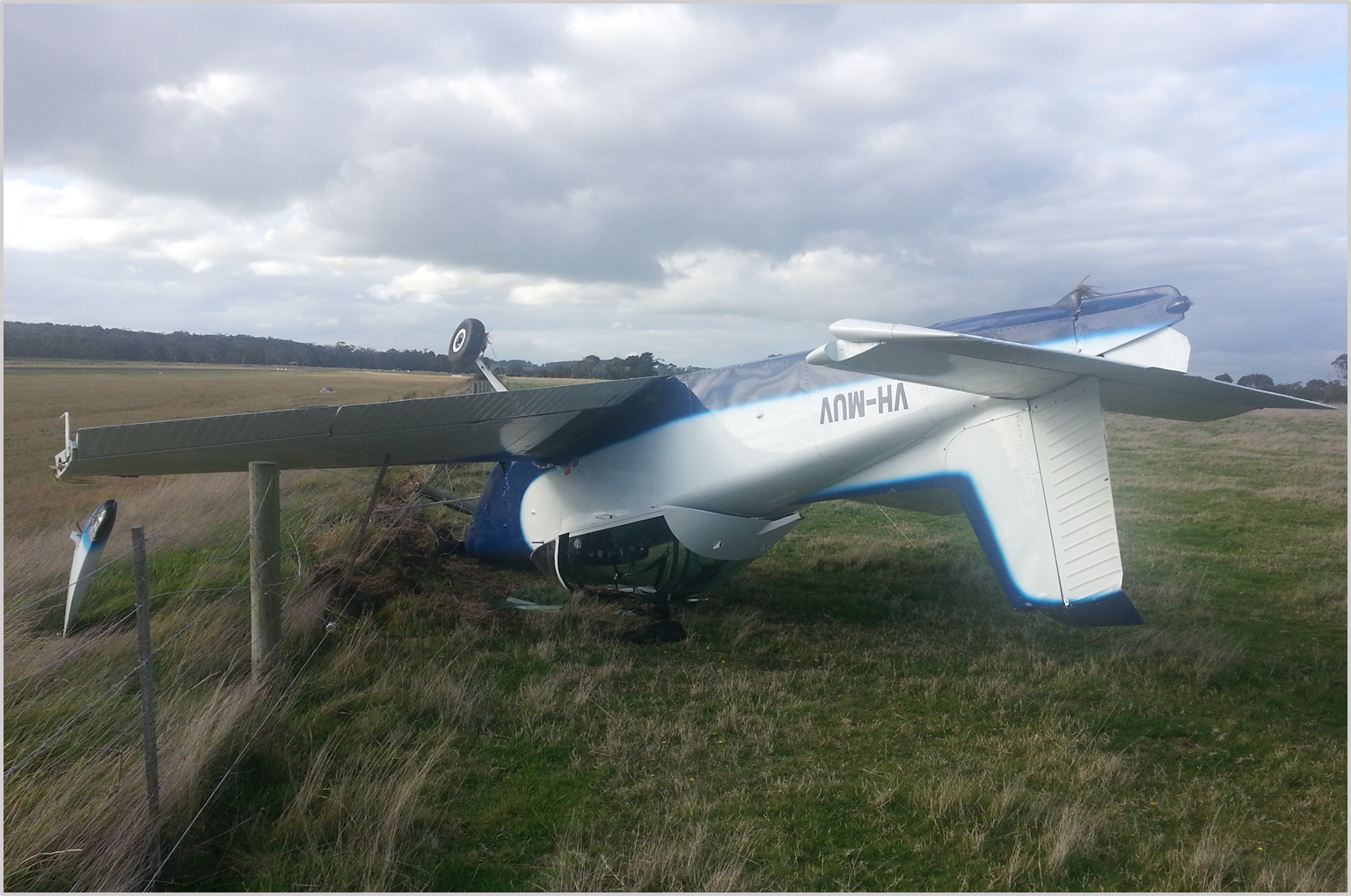
The aircraft continued to drift further away from the runway centreline. The student noticed the flaps were in the down position and, thinking that it would assist and without checking with the instructor, retracted the flaps to the up position. The aircraft descended and about 100 m past the threshold of runway 22, the aircraft collided with the airport perimeter fence. After a further 20 m, the aircraft flipped over the fence and came to rest upside down. The instructor and student exited the aircraft quickly through the broken canopy, as fuel was gushing from the fuel tanks. The instructor and student pilot received minor injuries and the aircraft was substantially damaged (Figure 1).
Figure 1: VH-MUV inverted after flipping over the airport perimeter fence
Source: Aircraft operator
Instructor comment
The instructor reported that the purpose of the flight was to instruct the student in crosswind landing techniques and then to conduct further flight training in the training area. The instructor indicated that, as they were planning to conduct 2 hours of flight training, the aircraft had full fuel on board and was near the aircraft maximum take-off weight.
The instructor described the wind as gusting between 15 to 22 kt at 270 degrees, with a crosswind component of between 10 to 15 kt.
Safety action
Whether or not the ATSB identifies safety issues in the course of an investigation, relevant organisations may proactively initiate safety action in order to reduce their safety risk. The ATSB has been advised of the following safety action in response to this occurrence.
Flight training organisation
As a result of this accident, the flight training organisation advised the ATSB that they are taking the following safety actions:
- The instructor has been briefed on the importance of making sure students understand not to touch any of the aircraft’s controls when the instructor is in control of the aircraft.
- The instructor has been briefed on the handing over and taking over procedures with the emphasis on handing over and taking over controls procedures.
Safety message
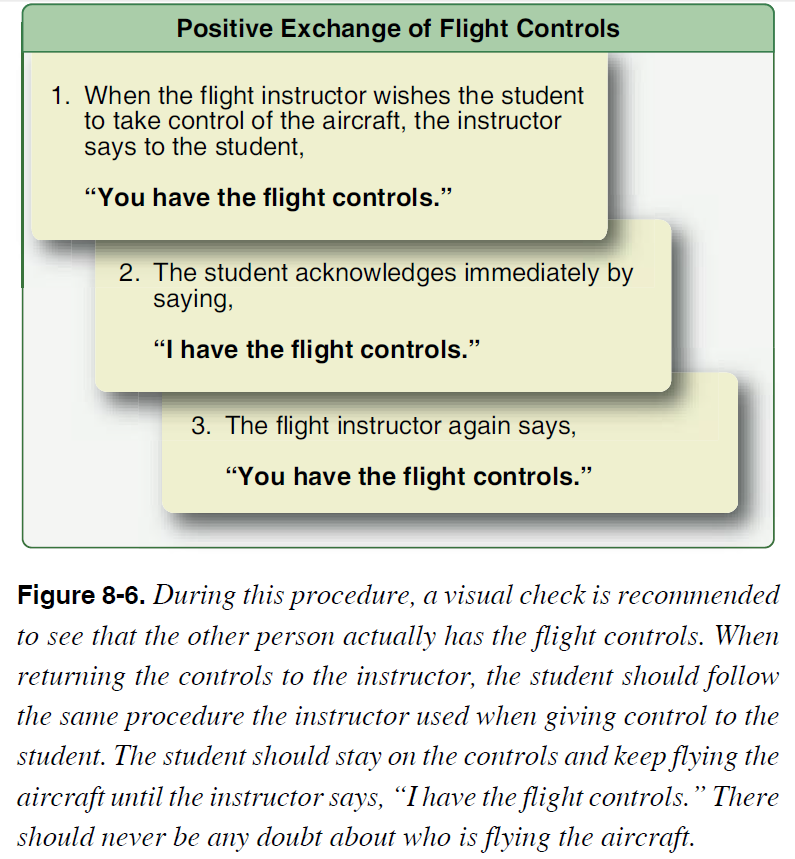
It is important in flight training to have a positive exchange of flight controls. The US Federal Aviation Administration (FAA) has found that numerous accidents have occurred due to a lack of communication or misunderstanding regarding who had actual control of the aircraft, particularly between students and flight instructors. The FAA publication Aviation Instructor’s Handbook, includes a section on the Positive Exchange of Flight Controls. The handbook provides guidance to use for the positive exchange of flight controls (Figure 2).
Figure 2: FAA Positive exchange of Flight Controls
Source: US Federal Aviation Administration
Aviation Short Investigations Bulletin Issue 44
About this reportDecisions regarding whether to conduct an investigation, and the scope of an investigation, are based on many factors, including the level of safety benefit likely to be obtained from an investigation. For this occurrence, a limited-scope, fact-gathering investigation was conducted in order to produce a short summary report, and allow for greater industry awareness of potential safety issues and possible safety actions. Publishing informationReleased in accordance with section 25 of the Transport Safety Investigation Act 2003 Published by: Australian Transport Safety Bureau © Commonwealth of Australia 2015 
Ownership of intellectual property rights in this publication Unless otherwise noted, copyright (and any other intellectual property rights, if any) in this report publication is owned by the Commonwealth of Australia. Creative Commons licence With the exception of the Coat of Arms, ATSB logo, and photos and graphics in which a third party holds copyright, this publication is licensed under a Creative Commons Attribution 3.0 Australia licence. Creative Commons Attribution 3.0 Australia Licence is a standard form licence agreement that allows you to copy, distribute, transmit and adapt this publication provided that you attribute the work. The ATSB’s preference is that you attribute this publication (and any material sourced from it) using the following wording: Source: Australian Transport Safety Bureau Copyright in material obtained from other agencies, private individuals or organisations, belongs to those agencies, individuals or organisations. Where you wish to use their material, you will need to contact them directly. |
Occurrence summary
| Investigation number | AO-2015-057 |
|---|---|
| Occurrence date | 29/05/2015 |
| Location | Leongatha Airport |
| State | Western Australia |
| Report release date | 04/11/2015 |
| Report status | Final |
| Investigation level | Short |
| Investigation type | Occurrence Investigation |
| Investigation status | Completed |
| Mode of transport | Aviation |
| Aviation occurrence category | Collision with terrain |
| Occurrence class | Accident |
| Highest injury level | Minor |
Aircraft details
| Manufacturer | Victa Ltd |
|---|---|
| Model | 115 Airtourer |
| Registration | VH-MUV |
| Serial number | 96 |
| Sector | Piston |
| Operation type | Flying Training |
| Departure point | Leongatha Airport, Victoria |
| Damage | Substantial |