The ATSB is investigating an aircraft preparation event involving an Airbus A320, VH-VFD, at Townsville Airport, Queensland, on 5 September 2026. The aircraft was operating as Jetstar flight JQ905, scheduled from Townsville to Brisbane, Queensland.
At the commencement of take-off, the crew identified a performance calculation error, and the take-off was rejected.
The evidence collection phase of the investigation will involve interviewing the flight crew, retrieving and reviewing recorded data, and the collection of other relevant information.
A final report will be released at the conclusion of the investigation. Should a critical safety issue be identified during the course of the investigation, the ATSB will immediately notify relevant parties, so that appropriate safety action can be taken.
Occurrence summary
Investigation number
AO-2026-096
Occurrence date
05/09/2026
Occurrence time and timezone
0930 Australian Eastern Standard Time
Location
Townsville Airport
State
Queensland
Report status
Pending
Anticipated completion
Q1 2027
Investigation level
Short
Investigation type
Occurrence Investigation
Investigation phase
Evidence collection
Investigation status
Active
Mode of transport
Aviation
Aviation occurrence category
Aircraft preparation, Rejected take-off
Occurrence class
Serious Incident
Highest injury level
None
Aircraft details
Manufacturer
Airbus
Model
A320-232
Registration
VH-VFD
Serial number
4922
Aircraft operator
Jetstar Airways Pty Limited
Sector
Jet
Operation type
Part 121 Air transport operations - larger aeroplanes
The ATSB is investigating a runway incursion and rejected take-off involving 2 Boeing 737s at Sydney Airport, New South Wales, on 9 August 2026.
The aircraft were operating as Virgin Australia flight VA555 from Sydney to Perth, Western Australia, and Qantas flight QF728 from Sydney to Ayers Rock Airport, Northern Territory.
At around 10 am local time, air traffic control (ATC) cleared the Virgin Australia 737 for a full-length take-off on runway 34L. As the crew applied thrust for take-off, they observed the Qantas 737 begin to cross the runway ahead of them from taxiway lima. The Qantas crew reported having received a clearance from ATC to cross the runway.
The Virgin Australia crew reduced thrust and the aircraft came to a stop on the runway. At the same time, ATC broadcast a cancellation of the take-off clearance. Once the Qantas 737 was clear of the runway, the Virgin Australia 737 was re-cleared by ATC to commence take-off.
The initial evidence collection phase of the investigation will involve interviewing involved parties, retrieving and reviewing recorded data, and the collection of other relevant information.
A final report will be released at the conclusion of the investigation.
Should a critical safety issue be identified during the course of the investigation, the ATSB will immediately notify relevant parties, so that appropriate safety action can be taken.
Occurrence summary
Investigation number
AO-2026-090
Occurrence date
09/08/2026
Occurrence time and timezone
10:00 Australian Eastern Standard Time
Location
Sydney Airport
State
New South Wales
Report status
Pending
Investigation level
Short
Investigation type
Occurrence Investigation
Investigation phase
Evidence collection
Investigation status
Active
Mode of transport
Aviation
Aviation occurrence category
Information/procedural error, Loss of separation, Rejected take-off, Runway incursion
Occurrence class
Incident
Highest injury level
None
Aircraft details
Manufacturer
The Boeing Company
Model
737-838
Registration
VH-XZH
Serial number
39372
Aircraft operator
Qantas Airways Limited
Sector
Jet
Operation type
Part 121 Air transport operations - larger aeroplanes
Activity
Commercial air transport-Scheduled-Domestic
Departure point
Sydney Airport, New South Wales
Destination
Ayers Rock Airport, Northern Territory
Injuries
None
Damage
Nil
Aircraft details
Manufacturer
The Boeing Company
Model
737-8SA
Registration
VH-IJQ
Serial number
44222
Aircraft operator
Virgin Australia Airlines Pty Ltd
Sector
Jet
Operation type
Part 121 Air transport operations - larger aeroplanes
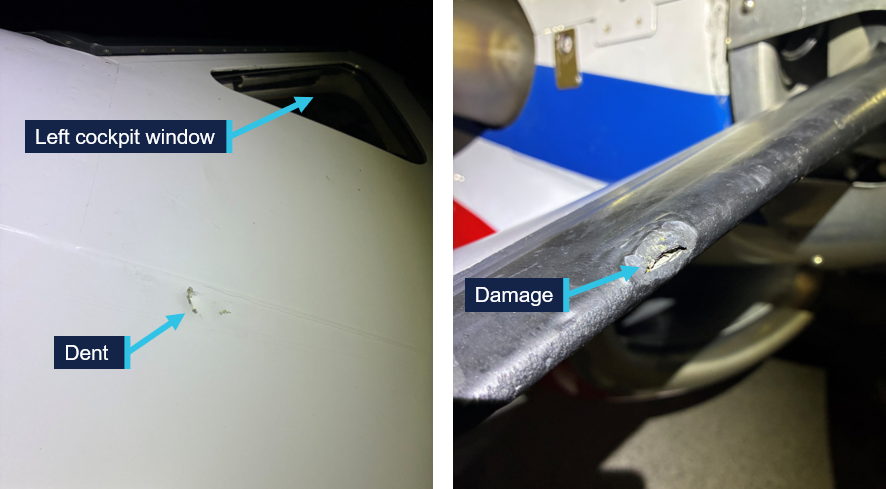
Just after midnight, at 0003 on 24 February 2026, a Royal Flying Doctor Service, Queensland Section, Beechcraft King Air B200, registered VH-FDI, with one pilot, a doctor and a nurse on board, taxied at Wellcamp Airport, Queensland, for a flight to Bundaberg. While taxiing for take-off, the aircraft conducted a 180° turn on the turn pad at the end of runway 12 and shortly after, commenced take-off. The aircraft was incorrectly aligned with the right runway edge lights and struck a turn pad edge light during the take-off roll. Parts of the damaged light impacted both propellers and dented the fuselage.
After recognising a ground strike had occurred, the pilot rejected the take-off, cancelled their flight plan with air traffic control, returned to the parking apron and grounded the aircraft.
What the ATSB found
The ATSB found that the incident took place in dark ambient conditions, limiting the visibility of the taxi guidance line markings which were not followed during the turn to line up. Instead, the aircraft was turned tighter, which aligned it with the right edge of the runway.
The pilot perceived the aircraft to be aligned with the runway centreline after they misidentified the right runway edge lights as centreline lights and did not recognise the misalignment by other contradictory cues available at the time.
What has been done as a result
The Royal Flying Doctor Service, Queensland Section, reviewed internal procedures for checklist management, entering and backtracking runways, conducting 180° turns, and requirements around identifying and lining up on runways.
The next version of the flight operations manual will be amended to:
require the ‘before take-off checklist’ be fully completed prior to entering the runway
include clear guidance on checklist interruption management, requiring that, when resuming a checklist, the pilot returns to the previously completed item before continuing.
Further, a notification will be issued to all pilots highlighting the importance of ensuring positive runway centreline environment is established before applying take-off power.
Safety message
A number of factors known to influence misaligned take-off occurrences were identified in this investigation, including dark ambient conditions and taxiway guidance markings. Dark ambient conditions have been consistently identified in similar occurrences and can reduce available visual cues, limiting the ability of pilots to identify their position during line‑up.
Operators should consider the regular use of turn pad guidance line markings which will orientate aircraft with the centre of the runway if followed completely, particularly where the area of the turn pad extends wider than the runway width.
Pilots should crosscheck all available cues to confirm their position prior to take-off at night.
Summary video
The investigation
The ATSB scopes its investigations based on many factors, including the level of safety benefit likely to be obtained from an investigation and the associated resources required. For this occurrence, the ATSB conducted a limited-scope investigation in order to produce a short investigation report, and allow for greater industry awareness of findings that affect safety and potential learning opportunities.
The occurrence
On 24 February 2026, a Beechcraft B200C King Air aircraft, registered VH-FDI, was being operated from Wellcamp Airport, Queensland, by the Royal Flying Doctor Service (RFDS), Queensland Section, on an aeromedical flight to Bundaberg Airport.
On board were the pilot and 2 medical crew. The conditions during the midnight departure were dark with little moonlight, low cloud, but otherwise good visibility.
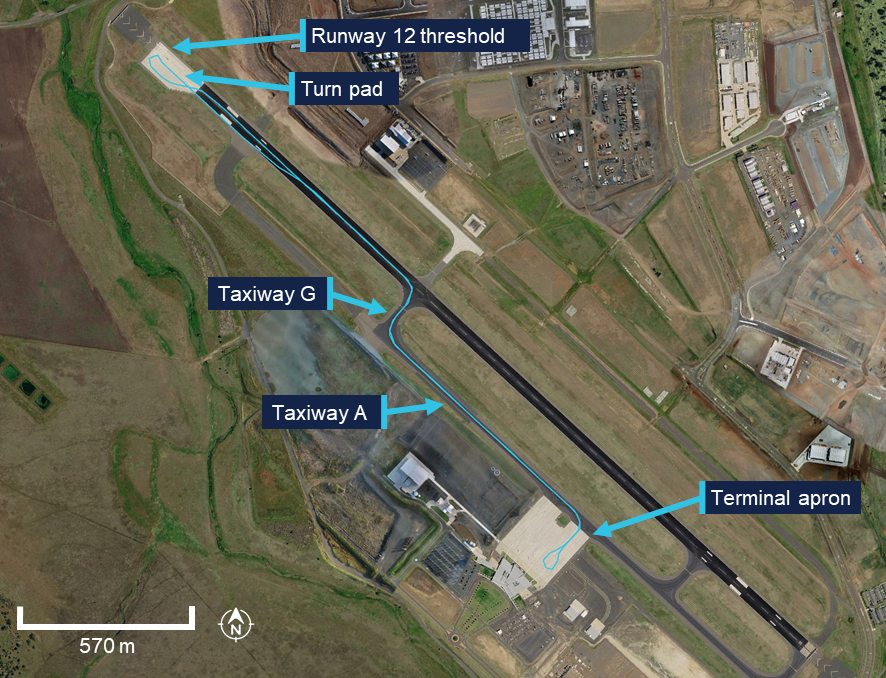
The aircraft taxied from the terminal apron at 2355 (23 February) on taxiway A, before entering and backtracking1 runway 12 at taxiway G. The pilot then taxied along the runway centreline towards the runway 12 threshold (Figure 1).
The flight was planned via instrument flight rules,2 the pilot notified Brisbane Centre of their intended departure from Wellcamp Airport and made appropriate radio broadcasts via the common traffic advisory frequency (CTAF), in preparation for their departure.
Figure 1: Aircraft movement overview
Source: Google Earth, annotated by the ATSB
The pilot recalled completing all the required take-off and line‑up checks while backtracking on the runway.
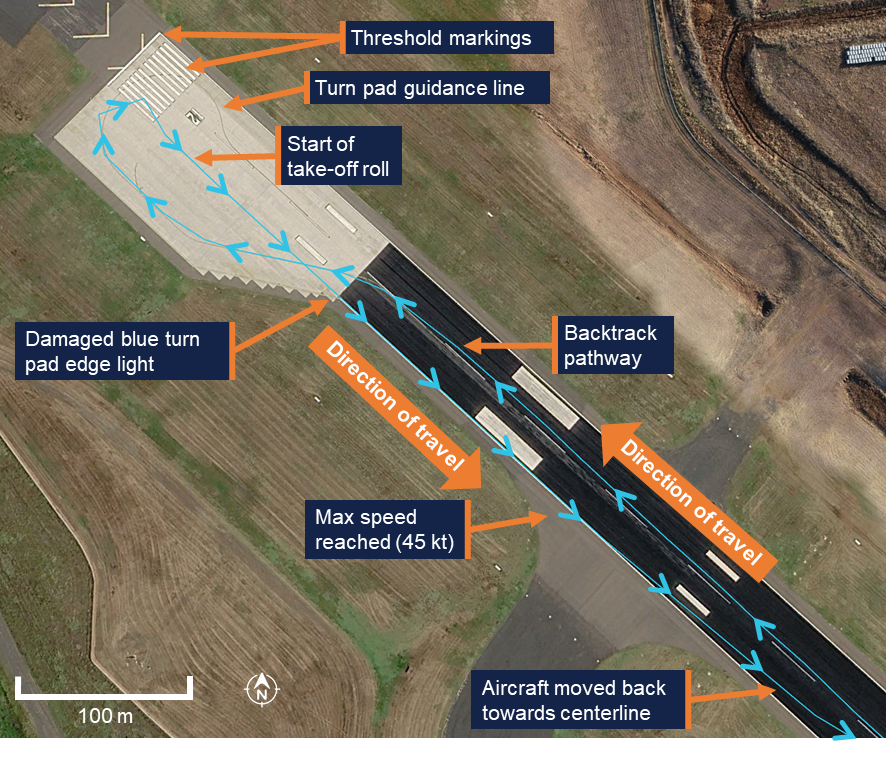
At the end of the runway, the pilot conducted a 180⁰ right turn. When entering the turn pad, the pilot initially turned left to allow room for the right turn, then part-way through the turn identified the right runway edge lights and anchored their alignment with these lights. Although recorded data indicated the aircraft initially followed the turn pad guidance line, the pilot reported that they did not recall seeing the turn pad guidance line or the threshold markings,3 and did not use the markings to orient the aircraft during the turn (Figure 2).
Figure 2: Aircraft movement details
Source: Google Earth, annotated by the ATSB
The aircraft was now in the centre of the concrete turn pad but misaligned with the white lights of the right runway edge for take-off. The pilot reported mistaking the right runway edge lights for centreline lights, however, no centreline lights were present at Wellcamp Airport.
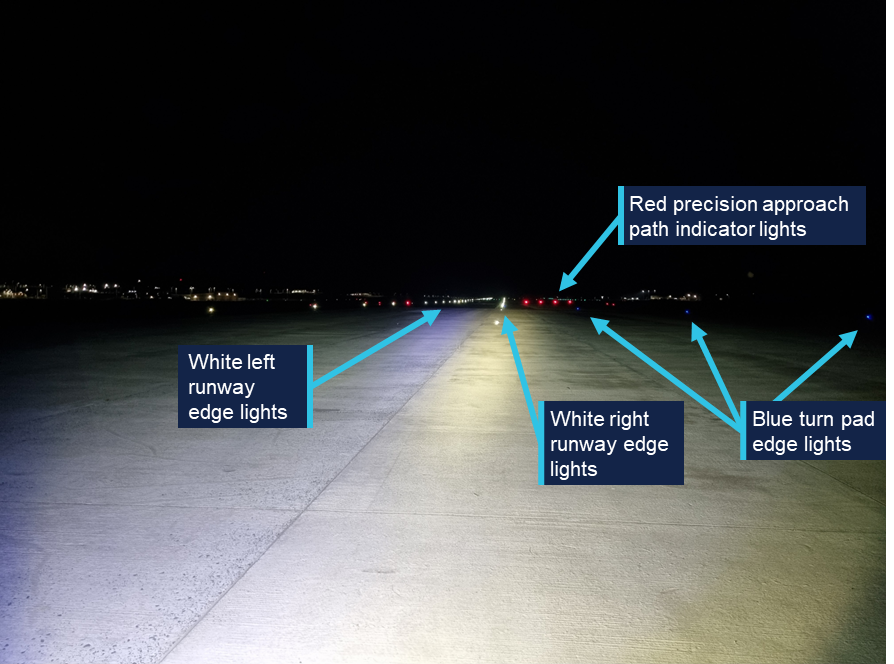
The pilot did not recall seeing the left runway edge lights which were about 45 m to the left of their lined-up position, nor did they recall seeing the blue turn pad node lights spaced in a diagonal direction along the start of the right turn node edge. They also did not identify the red precision approach path indicator (PAPI) lights close to the right runway edge lights (Figure 3).
Figure 3: Reconstructed view of the runway 12 lighting when lined up with the right edge
Source: Wellcamp Airport, annotated by the ATSB
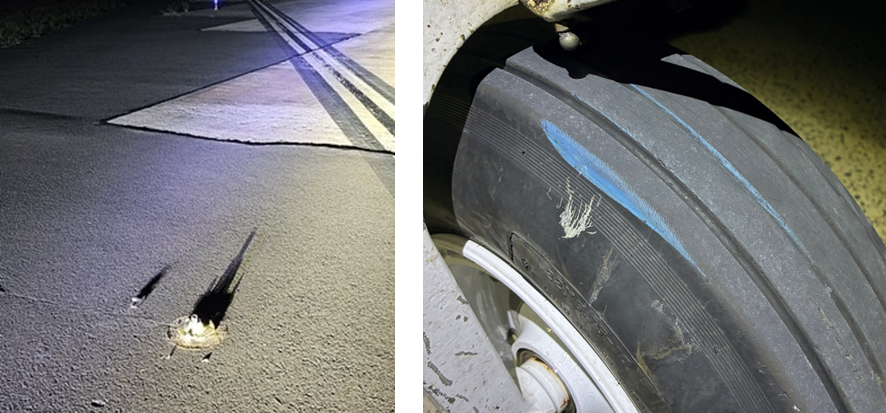
The pilot commenced the take-off roll and at 0003 (24 February), the aircraft’s front wheel struck an elevated blue turn node light, leaving blue marks on the wheel tyre (Figure 4, right).
The pilot heard a bang during the take-off roll, detected the misaligned position, rejected the take-off and steered left towards the runway centreline. They then cancelled their flight plan, returned to the terminal apron and notified the aerodrome reporting officer (ARO), who subsequently conducted a runway inspection and identified the runway light damage (Figure 4, left).
Figure 4: Damaged blue turn node light (left) and blue marks on the aircraft front wheel (right)
Source: Wellcamp Airport (left) and RFDS (right)
On impact with the front wheel, debris from the frangible4 blue turning node light caused minor damage to both aircraft propellers, and a dent to the aircraft fuselage below the left cockpit window (Figure 5).
Figure 5: Dent on aircraft fuselage (left) and damage to one of the left propeller blades (right)
Source: RFDS
The aircraft sustained minor damage which prevented further flight until repaired.
Context
Pilot information
The pilot held a Commercial Pilot (Aeroplane) Licence and a valid class 1 and 2 aviation medical certificate. Having joined the RFDS in 2016, the pilot reported a total flying time of 9,794 hours, with 5,691 of those being on the King Air B200. They reported operating at a range of aerodromes, most without centreline lights or turn pads. In contrast, their home base at Brisbane Airport had centreline lighting. The pilot’s logbook showed that they had conducted at least 1,790 night take-offs previously.
The ATSB assessed the pilot’s rostered sleep opportunity, reported sleep obtained, quality of sleep leading up to the flight, time on duty, as well as the time of the occurrence and concluded it was unlikely that the pilot had experienced a level of fatigue known to have an adverse effect on performance.
Aircraft information
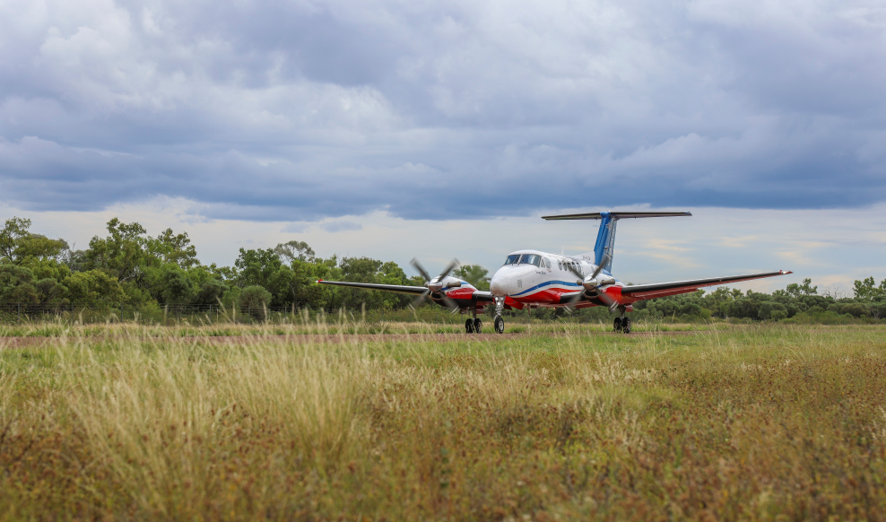
VH-FDI was a Hawker Beechcraft Corporation B200C King Air (Figure 6) manufactured in the United States in 2010 and issued with serial number BL-162. The aircraft was a pressurised, low-wing, twin turbine-engine aircraft with retractable landing gear. The aircraft had a certified maximum take-off weight of 5,670 kg and could be operated by a single pilot.
Figure 6: VH-FDI, a Hawker Beechcraft Corporation B200C King Air
Source: RFDS
Meteorological information
Between 2230 and 0030, the Bureau of Meteorology meteorological reports for Wellcamp Airport identified an easterly wind at 10–11 kt, nil to few5 oktas of cloud with a base of 2,100 ft to 2,300 ft above the aerodrome, and visibility in excess of 10 km.
The pilot recalled that the lighting conditions during the taxi were dark, and there was no ambient airport lighting around the turn pad and runway 12 threshold areas to enhance visibility.
Airport information
Wellcamp Airport was a certified, non-controlled aerodrome, capable of supporting operations for aircraft as large as Boeing 747-800. Runway 12/30 was 2,870 m long and 45 m wide and featured a large runway turn pad6 near the threshold of runway 12. The turn pad included a paved area that was about 90 m wide and was offset on the right side of the runway. The runway threshold markings were situated on the turn pad pavement extending only to the width of the runway (Figure 2).
Line markings and lights on the runway and turn pad assisted pilots in turning and lining up their aircraft for departure. The white runway edge lights on the turn pad were flush with the surface of the runway and did not protrude. In contrast, the blue turn node lights were elevated. The markings and design were consistent with the requirements of the Civil Aviation Safety Authority Part 139 Manual of Standards.
The pilot reported that the painted lines and markings appeared less prominent in the dark ambient conditions at the time, while the right runway edge lights were highly noticeable.
Wellcamp Airport did not have, nor was it required to have, runway centreline lighting.
Operational information
The RFDS Flight Operations manual FCOM2 – B200 section 3.5.2 Line up procedure stated that:
The entry onto a runway is a critical phase of aircraft operation where observation of other aircraft and animals is a safety of flight issue, particularly at night.
Minimise the time spent with head and eyes inside the cockpit by completing as many of the ground checklists as practicable before entering and/or backtracking the runway.
There is no line up allowance promulgated in the AFM [Aircraft Flight Manual]. The aircraft should be lined up as close as practicable to the runway end.
The RFDS B200 Normal Procedures Checklist contained sections for ‘before take-off checks’ and ‘line up checks’.
However, neither of the above documents contained information about 180° turns, turns via turns pads, or specified centreline alignment checks prior to take-off. The pilot reported that specific turning techniques were not used in RFDS aircraft operations.
RFDS operations involving remote area medical emergency transport by their very nature, occur at unprepared, non-certified, and often narrow runways in addition to operations at larger all-weather, major airports.
Previous research
The ATSB research report Factors influencing misaligned take-off occurrences at night (AR-2009-033) was published in 2010 following the review of 24 misaligned take‑offs that occurred at night in Australia and overseas. The report identified 8 common and recurring factors that contributed to misaligned take-offs at night, including:
confusing lights/markings
extra runway pavement, and
no centreline lighting.
Related occurrences
Runway lighting events at Wellcamp
A review of the ATSB occurrence database found 2 runway lighting occurrences were reported on 15 March and 11 August 2024 at Wellcamp Airport whereby routine runway inspections identified tire marks and damaged edge lights on runway 12. The timing of the events and the aircraft involved could not be determined, however no damaged aircraft were reported at the time, and the occurrences were not investigated further by the ATSB.
Misaligned take-off
A review of the ATSB occurrence database found 5 reported incidents of similar misaligned take-offs in the 3 years prior to February 2026.
Between June 2023 and April 2024, 3 misaligned take-offs occurred at Perth Airport, Western Australia. Each occurred before first light and in all 3 incidents, when entering runway 06 from taxiway V, the pilots taxied past the turn onto the centreline and lined the aircraft up along the runway edge lighting on the far side of the runway to where they entered. The investigation found that in each incident, the pilots believed they had correctly aligned the aircraft with the runway centreline, prior to taking off. Several factors known to increase the risk of a misaligned take-off in the dark were identified from the investigation:
• In terms of the runway environment, there was an unlit and unmarked extended pavement area on each side of runway 06, which made the runway appear wider.
• In relation to the available airport lighting, the lead-on lights from the taxiway continued across the taxiway to the other side, meaning there was limited guidance when taxiing to the runway’s centreline.
• Recessed edge lights at the start of runway 06 could be mistaken for centreline lighting.
• There was limited ambient airport lighting around taxiway V and runway 06 to enhance visibility.
• The taxi lighting on one of the aircraft was reported by the pilots as being of limited benefit.
• The required runway markings were reported by 2 of the incident pilots to be difficult to see at night.
On 13 May 2024, at 0537 local time, the pilot of an Aero Commander 500-S aircraft conducted a take-off from Brisbane Airport runway 01 from the intersection of taxiway A7. While turning onto the runway, the pilot inadvertently lined up along the left side runway edge lighting instead of the runway centreline. During the take-off roll, the pilot recognised the aircraft was left of the centreline and took corrective action to reposition the aircraft on the runway. The underside of the aircraft had minor damage and several runway lights were also damaged.
The brief highlighted the complexity of the intersection with multiple lead-off lines into the runway as well the runway touchdown zone markings near the runway centreline markings that were both broken white lines.
At 1807 local time on the evening of 1 July 2025, a Beechcraft King Air B200, with 2 pilots on board was taxiing for take-off at Hobart Airport. During a 180° turn using the runway 30 turn pad, the aircraft struck a taxi light with the right propeller. The aircraft incurred damage to the propeller and a turn pad edge taxi light was also damaged.
The ATSB found that the pilot flying subconsciously mistook the blue taxiway edge lights and double yellow line on the edge of the turning pad as taxi centreline guidance. This resulted in the pilot deviating from the marked taxiway centreline towards the runway edge light, resulting in the propeller strike.
Safety analysis
Turn pad alignment
While taxiing on the turn pad at the end of runway 12, the pilot initiated a tighter right turn than the guidance line to line up for take-off. The pilot reported that this tight turn was an accepted operational practice as no specified operational procedure was provided for turn pads. The pilot also reported that they could not recall seeing the threshold markings, or the guidance line in the dark conditions, and stated that they were not intentionally using these features to guide the turn. As they progressed through the turn, they noticed the right runway edge lights and aligned the aircraft with these.
Following the turn, the aircraft was positioned in the centre of the 90 m wide turn pad with concrete visible to the right of the aircraft within the limits of the aircraft’s forward lights, which likely reinforced the pilot’s perception that they were lined up in the centre of the runway. While turn pads are both useful and necessary, they can increase the risk of misalignment at night where a wider paved area leads onto a narrower runway, as demonstrated via previous occurrences.
Centreline misidentification
When pilots taxi and take off during daylight conditions, they are normally presented with a wide range of visual cues by which they can navigate and verify their location. At night, however, the amount of visual information available is markedly reduced. Pilots rely more on the taxiway and runway lighting patterns presented to them and what can be seen in the field of the aircraft’s taxi and landing lights. For instance, the painted lines and markings were reportedly less prominent to the pilot, while the right edge lights were highly noticeable and the pilot anchored their orientation towards these lights, mistakenly identifying them as the runway centreline.
The pilot then missed several conflicting cues to alert them of the aircraft’s misalignment. Before completing the turn, the threshold markings were not identified by the pilot. Furthermore, the pilot did not identify the left runway edge lights 45 m away from the aircraft position on the turn pad. This would have contradicted their perception that the right edge lights were centreline lights, because only 2, rather than 3, parallel lines of lights were present.
Other available cues included the blue turn pad node lights spaced in a diagonal direction along the start of the right diagonal turn node edge. If perceived, the angle of the lights had the potential to alert the pilot to their alignment with the turn pad edge. Lastly, the pilot was unaware of the red precision approach path indicator (PAPI) lights visible to the right of the runway edge lights which indicated the area to the right of the aircraft was outside the runway surface.
None of the above cues sufficiently alerted the pilot to their misalignment with the right runway edge, and the pilot misperceived the right runway edge lights as the centreline lighting. The pilot then started the take-off roll from the turn pad, resulting in the aircraft accelerating faster than taxi speed by the time the edge of the runway was reached.
Findings
ATSB investigation report findings focus on safety factors (that is, events and conditions that increase risk). Safety factors include ‘contributing factors’ and ‘other factors that increased risk’ (that is, factors that did not meet the definition of a contributing factor for this occurrence but were still considered important to include in the report for the purpose of increasing awareness and enhancing safety). In addition ‘other findings’ may be included to provide important information about topics other than safety factors.
These findings should not be read as apportioning blame or liability to any particular organisation or individual.
From the evidence available, the following findings are made with respect to the misaligned take-off involving Beechcraft B200C King Air, VH-FDI, at Brisbane West Wellcamp Airport, Queensland, on 24 February 2026.
Contributing factors
The pilot diverged from the turn pad taxi centreline guidance which positioned the aircraft in the centre of the large turn pad which aligned with the right runway edge.
While lining up on the runway at night, the pilot misidentified the runway edge lighting as the centreline and collided with an edge light during take-off.
Safety actions
Whether or not the ATSB identifies safety issues in the course of an investigation, relevant organisations may proactively initiate safety action in order to reduce their safety risk. All of the directly involved parties are invited to provide submissions to this draft report. As part of that process, each organisation is asked to communicate what safety actions, if any, they have carried out to reduce the risk associated with this type of occurrences in the future. The ATSB has so far been advised of the following proactive safety action in response to this occurrence.
Safety action by Royal Flying Doctor Service, Queensland Section to review operational procedures
The Royal Flying Doctor Service, Queensland Section, reviewed internal procedures for checklist management, entering and backtracking runways, conducting 180° turns, and requirements around identifying and lining up on runways.
The next version of the flight operations manual will be amended to:
require the ‘before take-off checklist’ be fully completed prior to entering the runway
include clear guidance on checklist interruption management, requiring that, when resuming a checklist, the pilot returns to the previously completed item before continuing.
Further, a notification will be issued to all pilots highlighting the importance of ensuring positive runway centreline environment is established before applying take-off power.
Sources and submissions
Sources of information
The sources of information during the investigation included:
the pilot flying
Royal Flying Doctor Service, Queensland Section
Wellcamp Airport
Civil Aviation Safety Authority
Airservices Australia
Bureau of Meteorology
Flightradar24.
References
Australian Transport Safety Bureau. (2010). Factors influencing misaligned take-off occurrences at night, Australian Transport Safety Bureau, Australian Government.
Civil Aviation Safety Authority. (2019). Part 139 Manual of Standards for Aerodromes, Civil Aviation Safety Authority, Australian Government.
Submissions
Under section 26 of the Transport Safety Investigation Act 2003, the ATSB may provide a draft report, on a confidential basis, to any person whom the ATSB considers appropriate. That section allows a person receiving a draft report to make submissions to the ATSB about the draft report.
A draft of this report was provided to the following directly involved parties:
the pilot flying
Royal Flying Doctor Service, Queensland Section
Wellcamp Airport
Civil Aviation Safety Authority
Bureau of Meteorology
National Transportation Safety Board
Transportation Safety Board of Canada (TSB).
Submissions were received from:
Royal Flying Doctor Service, Queensland Section
Bureau of Meteorology
Transportation Safety Board of Canada (TSB).
The submissions were reviewed and, where considered appropriate, the text of the report was amended accordingly.
Purpose of safety investigations
The objective of a safety investigation is to enhance transport safety. This is done through:
identifying safety issues and facilitating safety action to address those issues
providing information about occurrences and their associated safety factors to facilitate learning within the transport industry.
It is not a function of the ATSB to apportion blame or provide a means for determining liability. At the same time, an investigation report must include factual material of sufficient weight to support the analysis and findings. At all times the ATSB endeavours to balance the use of material that could imply adverse comment with the need to properly explain what happened, and why, in a fair and unbiased manner. The ATSB does not investigate for the purpose of taking administrative, regulatory or criminal action.
About ATSB reports
ATSB investigation reports are organised with regard to international standards or instruments, as applicable, and with ATSB procedures and guidelines.
Reports must include factual material of sufficient weight to support the analysis and findings. At all times the ATSB endeavours to balance the use of material that could imply adverse comment with the need to properly explain what happened, and why, in a fair and unbiased manner.
An explanation of terminology used in ATSB investigation reports is available here. This includes terms such as occurrence, contributing factor, other factor that increased risk, and safety issue.
Publishing information
Released in accordance with section 25 of the Transport Safety Investigation Act 2003
Ownership of intellectual property rights in this publication
Unless otherwise noted, copyright (and any other intellectual property rights, if any) in this report publication is owned by the Commonwealth of Australia.
Creative Commons licence
With the exception of the Commonwealth Coat of Arms, ATSB logo, and photos and graphics in which a third party holds copyright, this report is licensed under a Creative Commons Attribution 4.0 International licence.
The CC BY 4.0 licence enables you to distribute, remix, adapt, and build upon our material in any medium or format, so long as attribution is given to the Australian Transport Safety Bureau.
Copyright in material obtained from other agencies, private individuals or organisations, belongs to those agencies, individuals or organisations. Where you wish to use their material, you will need to contact them directly.
^Backtracking: to taxi on a runway-in-use, in the opposite direction to the aircraft’s take-off or landing direction.
^Instrument flight rules (IFR): a set of regulations that permit the pilot to operate an aircraft in instrument meteorological conditions (IMC), which have much lower weather minimums than visual flight rules (VFR).
^Threshold markings identify the beginning of the runway that is available and suitable for landing and take-off. They consist of a white line across the width of the runway and a series of white longitudinal stripes of uniform dimensions (often referred to as ‘piano keys’).
^Frangible: easily broken, shattered, or fragmented upon impact.
^Few: an amount of cloud covering the sky of between 1–2 oktas (eighths)
^A specially designed paved area at the end of a runway that allows aircraft to safely make a 180° turn, especially when the runway is too narrow for larger aircraft to turn around on their own.
Occurrence summary
Investigation number
AO-2026-062
Occurrence date
24/02/2026
Occurrence time and timezone
0003 Australia Eastern Standard Time
Location
Brisbane West Wellcamp Airport
State
Queensland
Report release date
15/07/2026
Report status
Final
Investigation level
Short
Investigation type
Occurrence Investigation
Investigation phase
Final report: Dissemination
Investigation status
Completed
Mode of transport
Aviation
Aviation occurrence category
Ground strike, Rejected take-off
Occurrence class
Incident
Highest injury level
None
Aircraft details
Manufacturer
Hawker Beechcraft Corporation
Model
B200C
Registration
VH-FDI
Serial number
BL-162
Aircraft operator
Royal Flying Doctor Service of Australia (Queensland Section) Limited
Sector
Turboprop
Operation type
Part 135 Air transport operations - smaller aeroplanes
Activity
Commercial air transport-Non-scheduled-Medical transport
The ATSB is investigating a runway incursion and near collision involving a Boeing 737, registered ZK-TXB, and a ground vehicle at Melbourne Airport, Victoria, on 17 February 2026.
During the take-off on runway 34 at Melbourne Airport, the pilot of a Boeing 737 was alerted by ATC to a vehicle on the runway at the intersection of runway 09/27 and as a result conducted a high-speed rejected take-off.
In the course of the investigation, the ATSB considers there to be a reasonable likelihood of limitations in risk controls and organisational factors relevant to the occurrence. Examination of these factors represent a significant increase in the scope of this investigation, and it has been upgraded from Short to Defined as a result (the ATSB's different levels of investigation are detailed here).
The final report will be released at the conclusion of the investigation. Should a critical safety issue be identified during the course of the investigation, the ATSB will immediately notify relevant parties, so that appropriate safety action can be taken.
Last updated:
Occurrence summary
Investigation number
AO-2026-061
Occurrence date
17/02/2026
Occurrence time and timezone
04:45 Australian Eastern Daylight Time
Location
Melbourne Airport
State
Victoria
Report status
Pending
Anticipated completion
Q1 2027
Investigation level
Defined
Investigation type
Occurrence Investigation
Investigation phase
Final report: Drafting
Investigation status
Active
Mode of transport
Aviation
Aviation occurrence category
Near collision, Rejected take-off, Runway incursion
Occurrence class
Serious Incident
Highest injury level
None
Aircraft details
Manufacturer
The Boeing Company
Model
737-8BK
Registration
ZK-TXB
Serial number
29644 LN:2231
Aircraft operator
Texel Air
Sector
Jet
Operation type
Part 129 Foreign air transport operators
Activity
Commercial air transport-Scheduled-Scheduled freight only
The ATSB has released this interim report to provide a substantive update on investigation progress and to outline areas of continuing focus. It contains a detailed description of the occurrence and contextual information but does not include analysis or findings, which will be detailed in a final report at the conclusion of the investigation. The information in this report is released in accordance with section 25 of the Transport Safety Investigation Act 2003.
The occurrence
On the morning of 8 October 2025, a Saab 340B aircraft, registered VH-ZPN and operated by Regional Express Airlines (Rex), was being prepared for a scheduled passenger air transport flight from Adelaide, South Australia, to Broken Hill, New South Wales. On board were 2 flight crew, 1 flight attendant, and 23 passengers.
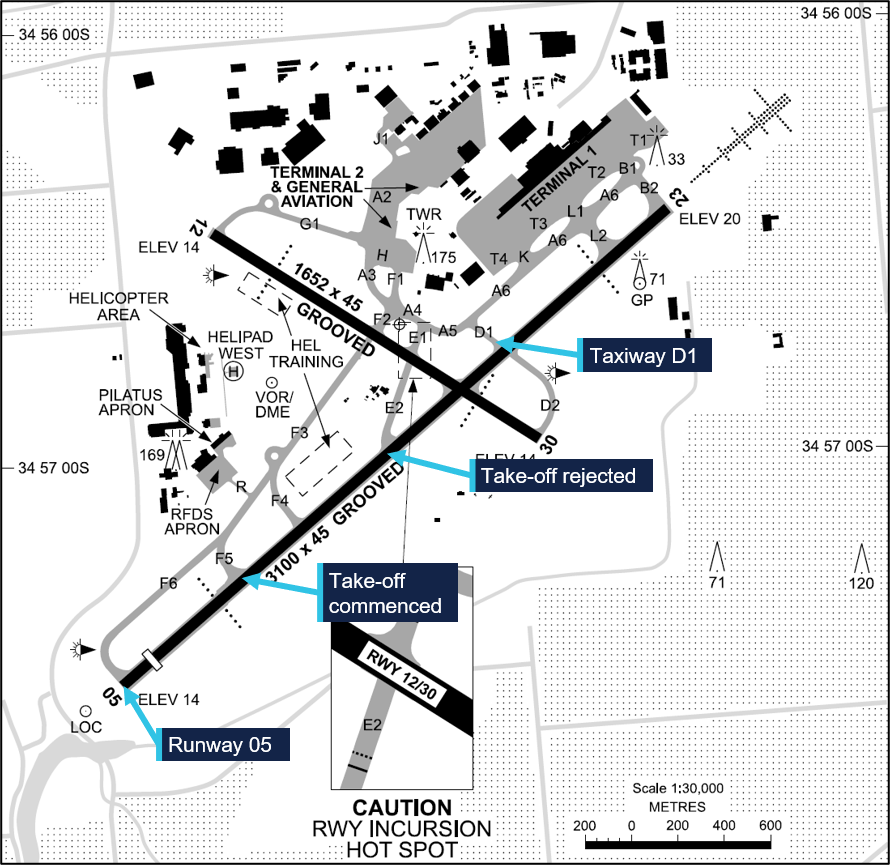
At 0716:49 local time, the flight crew began the take-off roll on runway 05 (Figure 1). At 0717:01, with the aircraft’s indicated airspeed at about 80 kt, the left engine torque began to fluctuate and shortly after, both flight crew noticed the aircraft yaw slightly to the left. At 0717:09, and 113 kt indicated airspeed (8 kt below V1), the left engine oil pressure warning annunciator light illuminated on the central warning panel alongside the master warning. As per operating procedures, the captain immediately called ‘stopping’, retarded both power levers, and applied regular braking, while the first officer (FO) applied forward pressure on the control column.
At 0717:17, with the aircraft decelerating on the runway, the FO notified air traffic control they were stopping, which the tower controller acknowledged, and one second later, the left engine torque gauge indicated zero. At 0717:32, the aircraft stopped on the runway near taxiway D1 with the captain observing what they assessed as steam from the left engine. The flight crew began conducting failure management actions for a left engine failure, which involved shutting down the left engine and instructing the passengers to remain seated.
Figure 1: Adelaide Airport
Source: Airservices Australia, annotated by the ATSB
Meanwhile, a Boeing 777 on a scheduled passenger air transport flight was on approach to runway 05. At 0718:40, the tower controller advised this aircraft’s flight crew that an aircraft was still on the runway and instructed them to continue their approach.
At 0720:04, after completing the engine failure management actions, the FO notified the tower controller of the left engine failure. The controller acknowledged the notification and asked whether the aircraft could move to taxiway D1. The FO advised they would comply, and shortly after, while the flight crew were taxiing to D1, the tower controller asked if they required Aviation Rescue Fire Fighting (ARFF) services, which the flight crew declined.
At 0720:44, the tower controller issued a landing clearance to the flight crew of the Boeing 777 aircraft. At 0721:02, VH-ZPN had stopped on taxiway D1 and the tower controller instructed them to contact the ground controller.
The ground controller observed steam or smoke from the left engine, and at 0722:20 notified the flight crew. During this time, the Boeing 777 aircraft was in the landing roll on runway 05. Shortly after, the ground controller advised the ARFF of smoke from the left engine and requested their attendance.
At 0723:39, the tower controller issued a take-off clearance for runway 05 to the flight crew of an Embraer E190 aircraft operating a scheduled passenger air transport flight. At 0723:58, an airport worker reported oil spilling from the left engine of VH‑ZPN to the ground controller, who requested the airport worker conduct a runway inspection. During this time, the Embraer took-off from the runway. The runway was subsequently closed while a runway inspection was performed.
The captain requested the ARFF check for smoke from the left engine. The ARFF initially reported a small fuel leak, with the captain notifying the flight attendant that an emergency evacuation may be required. However, upon further inspection, the ARFF advised the flight crew that the leaking fluid was oil and the flight crew decided to conduct a normal passenger disembarkation from the forward left exit. Passengers disembarked the aircraft onto the grass area adjacent to the taxiway and were subsequently transported by bus back to the terminal.
During this time, airport personnel conducting the runway inspection notified the tower controller of oil on the runway, which was subsequently cleaned, and the runway declared serviceable at 0749. Aircraft arrivals and departures from runway 05, which had been delayed during the runway inspection and clean-up, were then resumed.
Context
Pilot information
The captain held an Air Transport Pilot Licence (Aeroplane), a current class 1 aviation medical certificate, and had accrued 25,553 hours of aeronautical experience. Of this, about 14,996 hours were on the Saab 340, including 217 hours in the previous 90 days.
The first officer held a Commercial Pilot Licence (Aeroplane), a current class 1 aviation medical certificate, and had accrued 270 hours of aeronautical experience. Of this, about 91 hours were on the Saab 340, all of which were accrued in the previous 90 days.
Aircraft and engine information
VH-ZPN was a Saab 340B, manufactured in Sweden in 1995, and first registered in Australia in 2010. The aircraft was powered by 2 General Electric (GE) CT7-9B turboprop engines, equipped with Hamiton Standard 14RF-19 propellers.
The engine consists of a gas generator powering a free turbine, which is directly coupled to a propeller gearbox. The gas generator has an axial-centrifugal compressor with 5 axial stages and 1 centrifugal stage. The compressors are driven by a 2-stage gas generator turbine. The propeller is driven by a 2-stage free turbine through a reduction gearbox. Each propeller has full feathering and reversing capabilities.
Engine examination
After the incident, Rex maintenance personnel conducted a visual inspection of the engine, including disassembly of the power turbine module where various components were found damaged. The engine was subsequently sent to an authorised CT7 engine overhaul facility in England where a teardown inspection was completed in April 2026.
The inspection confirmed that the damage was primarily associated with the power turbine module. Damaged components were collected and sent to a GE technical facility in the United States for metallurgical examination. The ATSB did not attend any of these examinations. The results of the metallurgical examination are expected by the end of September 2026.
Further investigation
To date, the ATSB has interviewed the flight crew and tower controller, obtained recorded data, air traffic control and airport procedures, and collected other relevant information. Once complete, the ATSB will obtain the engine teardown inspection reports and metallurgical examination reports for review.
The investigation is continuing and will include analysis of:
flight crew operating procedures
air traffic control procedures
airport procedures
engine manufacturer metallurgical examination
engine data.
A final report will be released at the conclusion of the investigation. Should a critical safety issue be identified during the course of the investigation, the ATSB will immediately notify relevant parties, so that appropriate safety action can be taken.
Purpose of safety investigations
The objective of an ATSB safety investigation is to improve transport safety through:
identifying safety issues for action by organisations with the responsibility for managing that safety risk
influencing safety action through engaging with stakeholders, communicating findings, and fostering awareness of safety issues and concerns.
In accordance with the TSI Act, the ATSB does not investigate for the purpose of taking administrative, regulatory or criminal action, and cannot apportion blame, assist in determining liability, or, as a general rule, assist in court proceedings.
About ATSB reports
ATSB safety investigation reports are developed in accordance with ATSB procedures and guidelines, and with regard to applicable international standards and instruments.
Reports must include factual material of sufficient weight to support the investigation’s analysis and findings. At all times the ATSB endeavours to balance the use of material that could imply adverse comment with the need to properly explain what happened, and why, in a fair and unbiased manner.
An explanation of terminology used in ATSB investigation reports is available here.
Publishing information
Released in accordance with section 25 of the Transport Safety Investigation Act 2003
Ownership of intellectual property rights in this publication
Unless otherwise noted, copyright (and any other intellectual property rights, if any) in this report publication is owned by the Commonwealth of Australia.
Creative Commons licence
With the exception of the Commonwealth Coat of Arms, ATSB logo, and photos and graphics in which a third party holds copyright, this report is licensed under a Creative Commons Attribution 4.0 International licence.
The CC BY 4.0 licence enables you to distribute, remix, adapt, and build upon our material in any medium or format, so long as attribution is given to the Australian Transport Safety Bureau.
Copyright in material obtained from other agencies, private individuals or organisations, belongs to those agencies, individuals or organisations. Where you wish to use their material, you will need to contact them directly.
^V1: the critical engine failure speed or decision speed required for take-off. Engine failure below V1 should result in a rejected take off; above this speed the take-off should be continued.
Occurrence summary
Investigation number
AO-2025-060
Occurrence date
08/10/2025
Occurrence time and timezone
0717 Australian Central Daylight saving Time
Location
Adelaide Airport
State
South Australia
Report release date
04/09/2026
Report status
Interim
Anticipated completion
Q4 2026
Investigation level
Short
Investigation type
Occurrence Investigation
Investigation phase
Examination and analysis
Investigation status
Active
Mode of transport
Aviation
Aviation occurrence category
Engine failure or malfunction, Rejected take-off
Occurrence class
Serious Incident
Highest injury level
None
Aircraft details
Manufacturer
Saab Aircraft Co.
Model
340B
Registration
VH-ZPN
Serial number
340B-384
Aircraft operator
Regional Express
Sector
Turboprop
Operation type
Part 121 Air transport operations - larger aeroplanes
On 15 July 2024, a QantasLink De Havilland Aircraft of Canada Limited DHC-8-402, (Dash 8), registered VH-QOD, was taxied to reposition to a different bay at Wagga Wagga Airport, New South Wales. This repositioning required the Dash 8 crew to taxi out onto the runway and then return to a different bay. As the Dash 8 entered runway 05, the crew were unaware that a Piper PA-28, registered VH-XDK, operating on a training flight by the Australian Airline Pilot Academy (AAPA), had already commenced its take-off roll from the opposite end of the runway.
The instructor of the PA-28 was aware of the Dash 8 taxiing and assumed that the Dash 8 had received and understood their previous positional broadcasts. However, the crew of the Dash 8 were not aware of the PA-28 preparing for take-off on runway 23.
Upon entering runway 05, the Dash 8 was notified by a preceding aircraft that had landed, that there was another aircraft taking off from runway 23. The captain of the Dash 8 immediately stopped the aircraft and engaged reverse thrust to clear the runway. Simultaneously, the PA-28 pilot rejected their take-off from runway 05.
What the ATSB found
The ATSB identified that during ground-based repositioning, the Dash 8 was unaware of the PA-28 that was taxiing for take-off on an opposing runway. This led to a situation where the crew of the Dash 8 had an incomplete comprehension of the ground-based traffic.
Without any prior alert or expectation of the presence of the PA-28, the Dash 8 crew did not visually detect the PA-28 on take-off from the reciprocal end of the runway, prior to the Dash 8 entering the runway to taxi to the terminal. The PA-28 presented a difficult visual target due to its size and orientation over the 1,700 m distance, making unalerted detection unlikely.
Once made aware of the potential conflict of collision, the captain of the Dash 8 immediately reversed the aircraft away from the preferred runway without confirming that no other aircraft or obstacle was behind the Dash 8.
While the pilot of the PA-28 gave all the required radio calls, they did not directly communicate with the Dash 8 crew to identify the possible conflict, then positively arrange separation. Additionally, the Dash 8 ground-based reception, on VHF communications panel radio 2, had reduced strength and clarity.
The QantasLink radio procedure required crew to use the number 2 VHF communications panel radio to broadcast and receive on local frequencies during operations at a non-controlled aerodrome. This likely reduced ground-based reception strength and the likelihood of the Dash 8 hearing other traffic in certain circumstances.
Reduced VHF ground-based communication was identified at the eastern end of runway 23 at Wagga Wagga Airport. Local operator reports and procedures indicate that reduced communication strength and clarity can be experienced on the eastern end of taxiway A to other areas of the airport.
During taxi for take-off, the PA-28 was not broadcasting transponder information, which also did not identify them to other traffic in the vicinity of the aerodrome. The AAPA procedure requiring the selection of the transponder to ‘ALT’ before entering the runway, rather than prior to taxi, became a missed opportunity to provide electronic enhancement of situational awareness to other airport operators.
What has been done as a result
ATSB issued a safety advisory notice (AO‑2024‑041‑SAN‑01) to advise pilots and operators to review their procedures to ensure that mode S transponders are on from first movement of the aircraft.
AAPA has advised the ATSB that changes have been made to its PA-28 Flight Crew Operating Manual, and Quick Reference Handbook, which reflects the transponder being selected to ALT mode after start in both the checklist as well as being incorporated as part of the scan action flow.
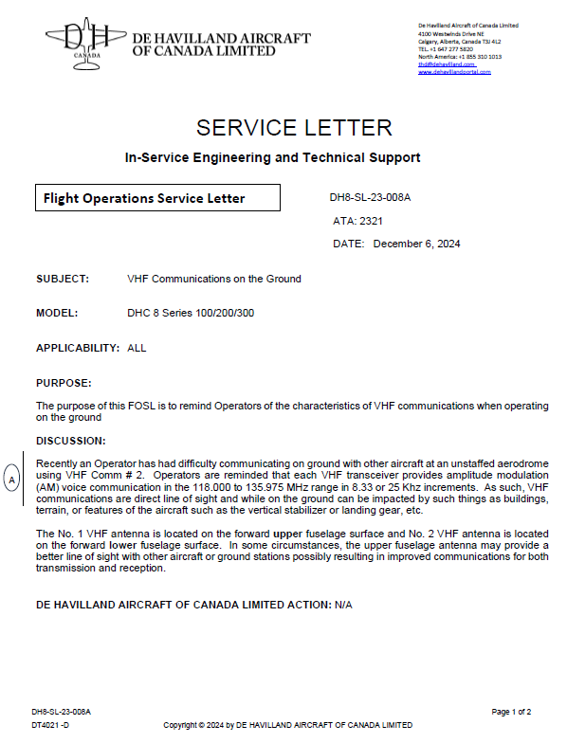
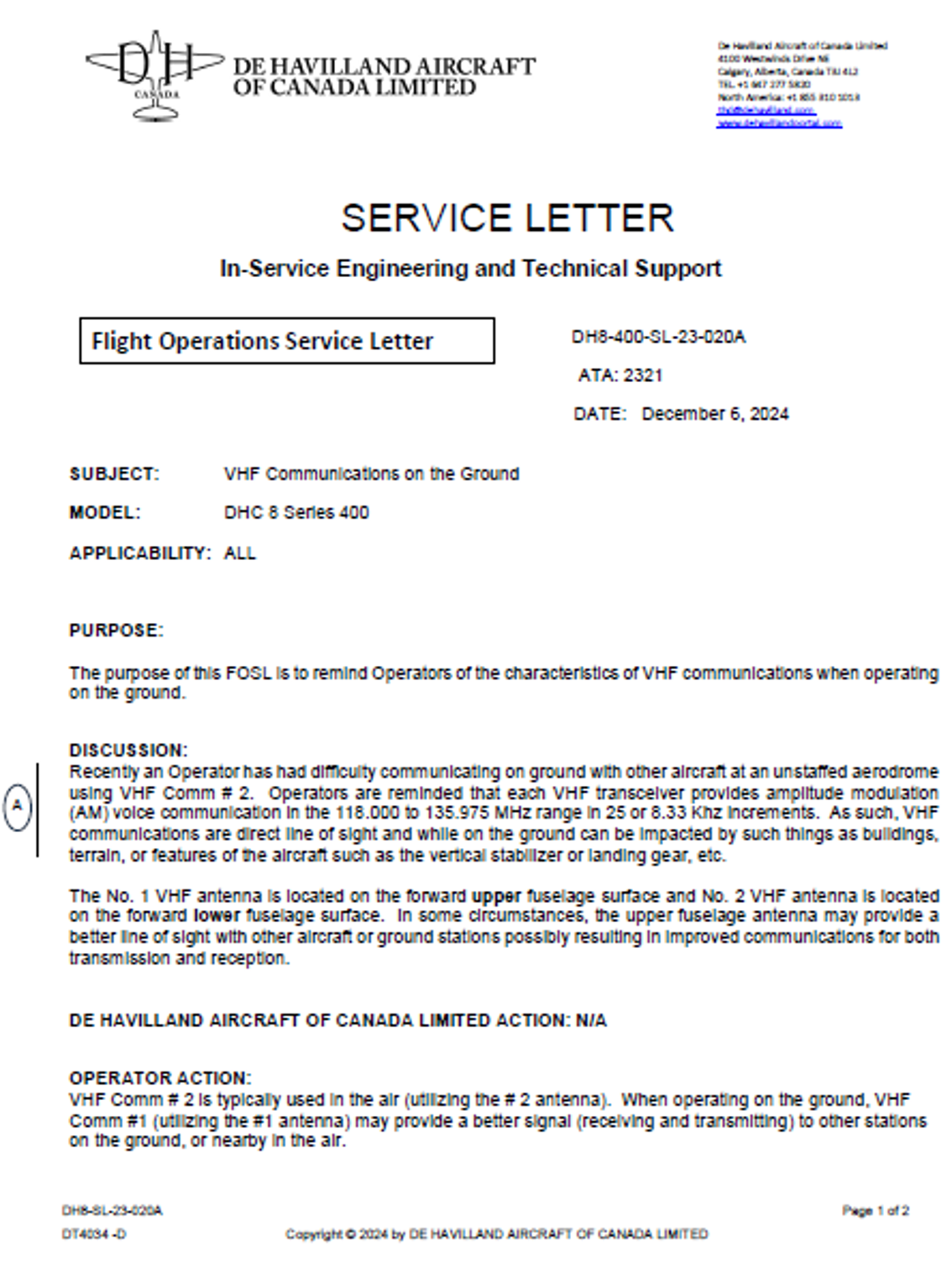
On 6 December 2024, De Havilland Aircraft of Canada Limited issued 2flight operations service letters relating to radio communications, with one covering Dash 8 100-300 series aircraft and the other covering the Dash 8 400 series aircraft. The service letters remind operators that ground‑based VHF communications are affected by line of sight and can be impacted by buildings, terrain or aircraft structures and that use of VHF COM 1 is more effective for ground-based communications with other aircraft on the ground.
The airport operator had issued a notice to airmen (NOTAM) notifying aircraft of a potential radio black spot at Wagga Wagga Airport under some conditions.
QantasLink issued a safety alert notice encouraging crew to consider additional precautions when taxiing for departure or any other manoeuvring on-ground at Wagga Wagga Airport. This advice was issued due to on-ground VHF communications between aircraft possibly being affected by obstacles in the line of sight.
Safety message
Communication and self-separation in non-controlled airspace is one of the ATSB’s SafetyWatchpriorities. Wherever you fly, into either non-controlled or controlled aerodromes, maintaining a vigilant lookout at all times is important. Situational awareness and alerted see-and-avoid is an effective defence against collision and good airmanship dictates that all pilots should be looking out and not be solely reliant on the radio for traffic separation. Being aware of other nearby aircraft and their operational intentions is important.
Effective use of all available sources of information is an effective risk control to achieve enhanced situational awareness and an accurate mental model of other traffic at a non‑controlled aerodrome.
Pilots are reminded that although accurate and timely radio calls play a critical role in ensuring collision avoidance in uncontrolled airspace, they cannot assume from an absence of other radio calls that there is no conflicting traffic. This is particularly important in an environment where there is high expectation of mixing with other aircraft of different sizes, flight rules and performance levels operating at the same time, in the same airspace.
Pilots can enhance their situational awareness and mutual traffic separation by:
making the recommended broadcasts when in the vicinity of a non-controlled aerodrome
actively monitoring the common traffic advisory frequency while maintaining a visual lookout and constructively organising separation through direct contact with other aircraft
ensuring mode S transponders, where fitted, are selected to transmit altitude information before taxiing
not hesitating to contact another aircraft if there is any uncertainty as to their position and/or intentions.
The ATSB SafetyWatch highlights the broad safety concerns that come out of our investigation findings and from the occurrence data reported to us by industry. This investigation report highlights the safety concerns around reducing the collision risk around non-towered airports.
The occurrence
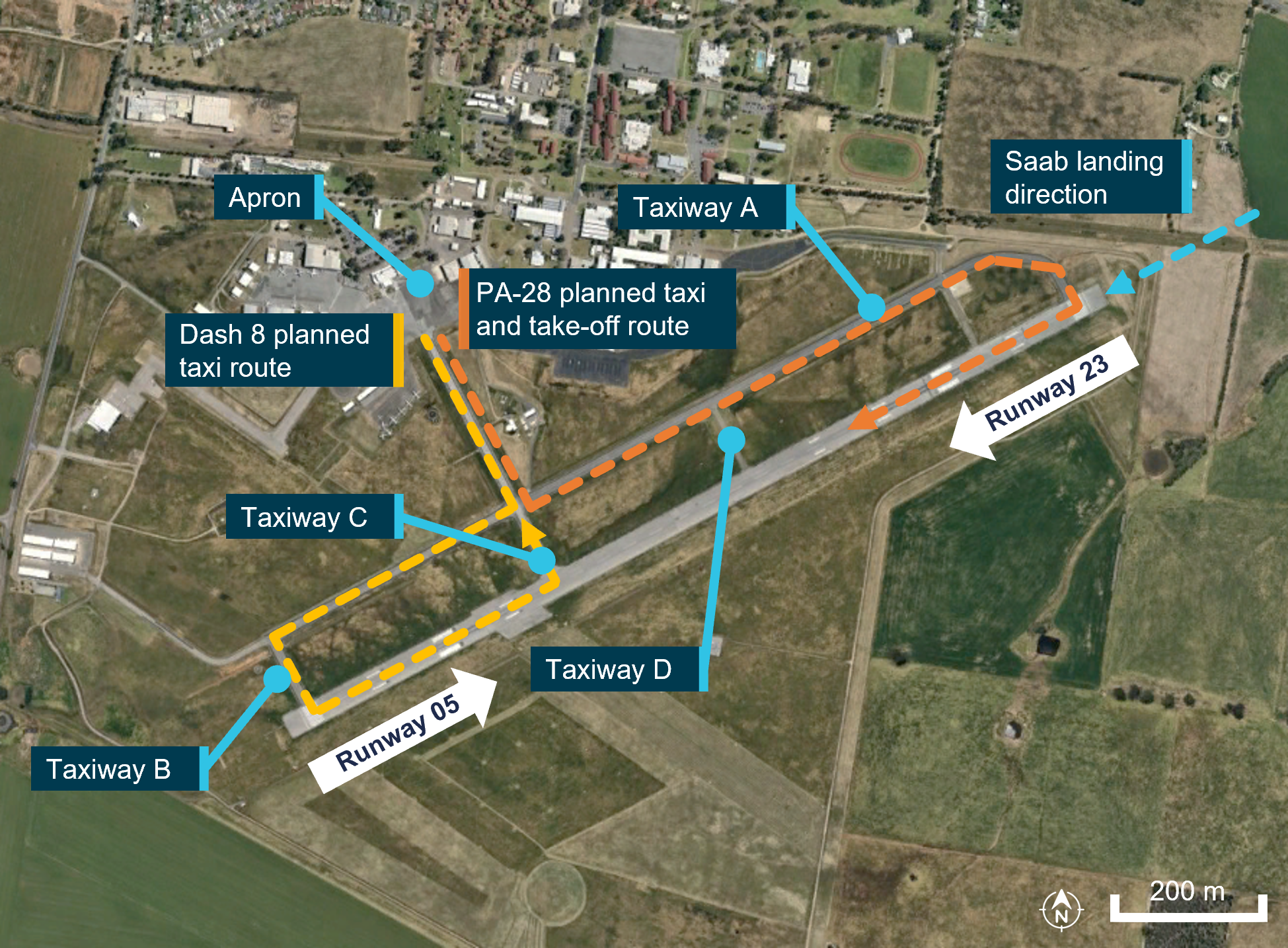
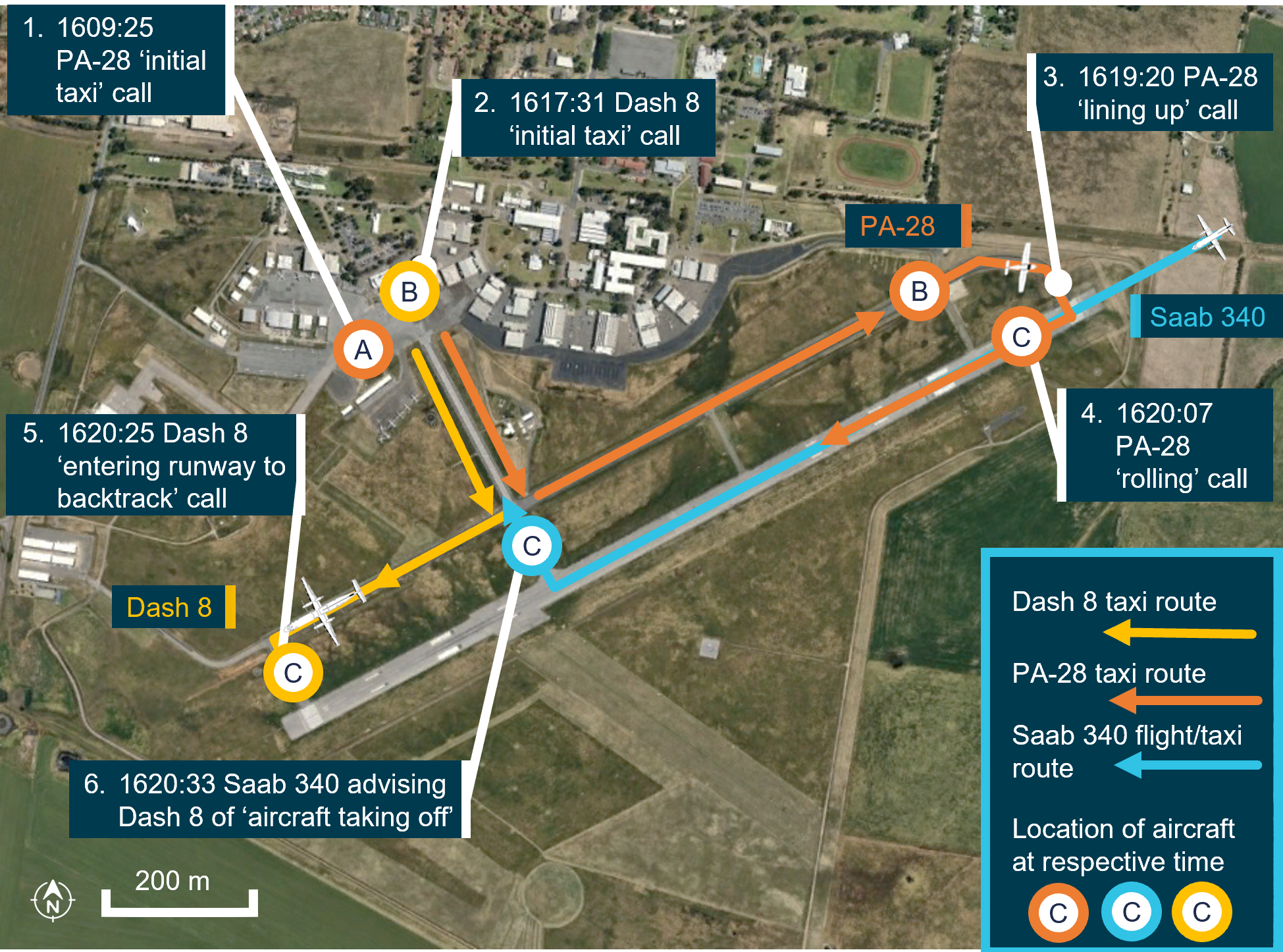
On 15 July 2024, a Piper Aircraft Corporation PA-28, registered VH-XDK, operated by the Australian Airline Pilot Academy (AAPA), with an instructor and student on board, taxied from the apron at Wagga Wagga Airport, New South Wales (Figure 1) for a training flight. At 1609 local time, the crew broadcast they were taxiing for runway 23 (Figure 2, position A). About 20 seconds later, the crew of an inbound Saab 340 responded, asking for the call sign to be repeated. The Saab 340 was 30 NM away at this stage and could not understand the call sign, even when repeated twice more. About 5 minutes later at 1614:12, the crew of the Saab 340 broadcasted that they were now on a 10 NM straight in approach for runway 23 (see Appendix A – CTAF Recordings).
At about the same time,the 2 crew members of a QantasLink De Havilland Aircraft of Canada Limited DHC-8-402 (Dash 8), registered VH-QOD, were on board the aircraft at the Wagga Wagga Airport apron. The crew were making preparations to reposition the aircraft from the apron to another bay (on the apron) by taxiing the aircraft via the runway (Figure 1). The Dash 8 crew reported they spent about 5 minutes[1] preparing the aircraft on the flightdeck prior to taxiing. However, they did not recall hearing the initial taxi call and callsign repeats from the PA-28, but did recall hearing the 10 NM inbound call from the Saab 340.
Figure 1: Intended taxi routes for aircraft
Source: Google Earth, annotated by the ATSB
At 1616:27 the Saab 340 crew broadcast that they had joined a 5 NM final for runway 23.
At 1617:31 (Figure 2, position B, Dash 8) the Dash 8 crew broadcast that they were taxiing for runway 05. At this time, the PA-28 was on taxiway A, approaching runway 23 (Figure 2, position B, PA-28).
Figure 2: Position of respective aircraft at given times
Source: Google Earth, annotated by the ATSB. Note: aircraft not to scale
Being aware only of the inbound Saab 340, the Dash 8 crew communicated directly with them. This was to gain an understanding of the Saab 340 crew’s intentions on landing and exiting the runway. While still taxiing towards the runway at 1618:32, the Dash 8 crew told the Saab 340 crew of their intent to enter and backtrack from the threshold of runway 05, keeping out of the way of the Saab 340’s landing.
The instructor of the PA-28 recalled hearing the radio calls from both aircraft during this time. The PA-28 was aware of the Dash 8 taxiing for runway 05 and assumed that the Dash 8 had also heard their earlier calls, and would hold short of the runway for their departure.
At 1619:20, the PA-28 was positioned on runway 23, with strobe lights on, behind the landed Saab 340 and the instructor made a ‘lining up and holding’ call (Figure 2, position B, PA-28). About 30 seconds later the Saab 340 crew made a broadcast that they were clear of the preferred runway (Figure 2, position C, Saab 340). The PA-28 instructor then broadcast their ‘rolling call’ (Figure 2, position C, PA-28) and commenced take-off at 1620:07.
At 1620:25, the Dash 8 crew gave an entering call for runway 05 with intentions to taxi to taxiway C (Figure 2, position C, Dash 8) and then entered the runway.
On hearing the Dash 8 crew’s broadcast, the Saab 340 crew notified the Dash 8 that ‘there is an aircraft taking off on runway 23’ at 1620:33. Simultaneously, the PA-28 student pilot also rejected their take-off.
The Dash 8 crew immediately stopped at their current position, with the aircraft still perpendicular with the runway and estimated by the captain to be about 5 m inside the runway gable markers.[2] The captain acknowledged the broadcast and then visually identified the PA-28 on the runway.
The captain of the Dash 8 subsequently engaged Beta plus power mode[3] (reverse thrust) to reverse the Dash 8 backwards along taxiway B to ensure clearance of the preferred runway. The PA-28 crew broadcast they would exit runway 23 on taxiway D.
The Dash 8 captain then established direct radio contact with the PA-28 crew, stating ‘nil radio transmission heard and they are still broken’.
The PA-28 vacated the runway and taxied again for a subsequent departure. The Dash 8 then re-entered runway 05 and backtracked runway 23 and vacated to the apron.
Context
Pilot information
Flight crew VH-QOD (Dash 8)
The captain held an Air Transport Pilot Licence (Aeroplane) and a valid class 1 aviation medical certificate. They reported a total flying time of 2,912 hours with 2,389 of those being on the Dash 8 aircraft type. The captain reported being familiar with Wagga Wagga Airport and had operated there regularly.
The first officer (FO) held a Commercial Pilot Licence (Aeroplane) (CPL-A) and a valid class 1 aviation medical certificate. They reported a total flying time of 1,312 hours with about 438 of those hours being on the Dash 8. The FO had been employed with the operator for approximately a year and had flown into Wagga Wagga Airport during their training and subsequent line operations.
Flight crew VH-XDK (Piper PA-28)
The instructor of the PA-28 held a CPL (Aeroplane) with a grade 2 instructor rating. They held a valid class 1 aviation medical certificate and reported a total flying time of 796 hours, with approximately 146 hours being on the PA-28. The instructor regularly operated out of Wagga Wagga Airport, as it was the company base of operation.
The student pilot of the PA-28 held a class 1 aviation medical certificate and reported about 17 hours of flying time.
Aircraft information
VH-QOD (Dash 8)
The De Havilland Aircraft of Canada Limited (DHC) DHC-8-402, was a high-wing, pressurised, commuter aircraft powered by 2 turboprop engines. VH-QOD was manufactured in Canada in 2006 and was first registered in Australia on 22 May 2006.
VHF radio antenna position and condition
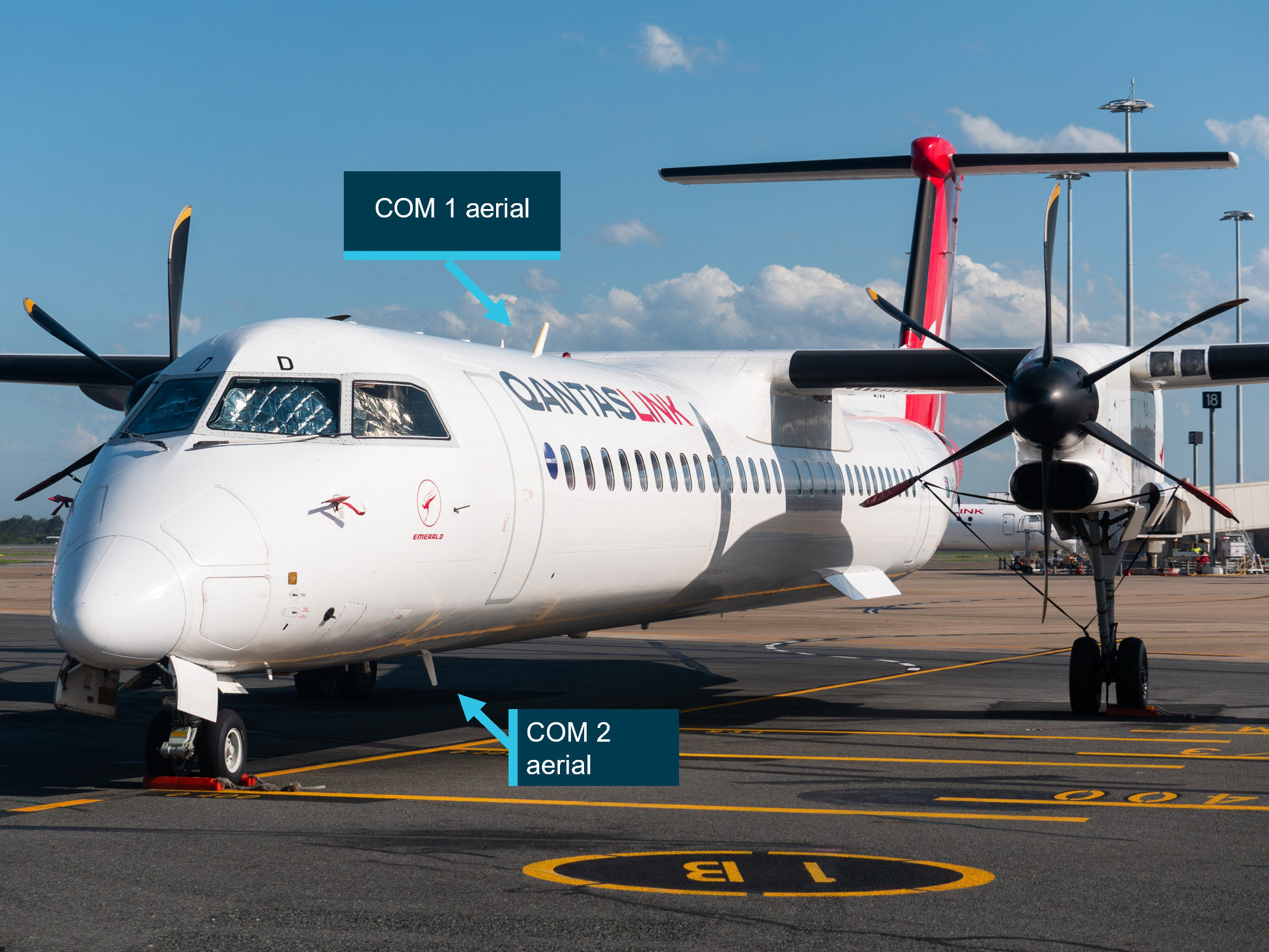
The Dash 8 had 2 VHF radio systems, each using separate antennas installed on the upper and lower fuselage (Figure 3):
Number 1 VHF COM antenna (VHF COM 1) mounted on the roof of the aircraft forward of the wings.
Number 2 VHF COM antenna (VHF COM 2) mounted on the belly of the aircraft.
Figure 3: Dash 8 with annotations of VHF antenna locations on airframe
Source: Gyo Kamata Jetphotos.com, annotated by the ATSB
Transponder and ADS-B system on the Dash 8
The Dash 8 was equipped with an automatic dependent surveillance-broadcast ADS-B mode S transponder. ADS-B uses digital positional data provided by a GPS sensor on board the aircraft. This information is transmitted via the same channels used in conventional aircraft transponder transmissions. The Dash 8, ADS-B transponder units are fully integrated through the Dash 8 audio and radio control and display unit. Positional data for each ADS-B transponder is provided through the aircraft flight management system.
TCAS system on the Dash 8
A traffic collision avoidance system (TCAS) was fitted to the Dash 8. A TCAS interrogates the transponders of nearby aircraft and uses this information to calculate the relative range and direction of this traffic. The system displays this information to the flight crew, providing situational awareness of the location of other aircraft, and is available on the ground and when airborne.
TCAS is designed to be used as an airborne device, which performs surveillance of nearby aircraft and provides information on the relative direction and altitude of these aircraft so that the collision avoidance algorithms can perform their function (Federal Aviation Administration, 2011)
Limitations exist for the use of TCAS in lateral separation. Current generations of TCAS are primarily focused on vertical separation (climb or descent); TCAS I and II generations of TCAS do not provide horizontal separation.
In certain circumstances functions and alerts within the TCAS system are inhibited. An example is documented in FAA AC 90-120 (Federal Aviation Administration, 2024) that noted:
2.11.5 ACAS[4] does not display aircraft on the ground and may not display an aircraft when own-ship ACAS estimates that the other aircraft is below 380 feet Above Ground Level (AGL), unless the other aircraft is operating with a Mode S transponder that reports airborne status.
While the use of TCAS for monitoring other aircraft on the ground was not an operator procedure, the Dash 8 crew identified that they regularly used it as an aid for situational awareness. The captain and FO both recalled reviewing their TCAS with only one aircraft (the Saab 340) being seen.
Flightradar24 application
The crew of the Dash 8 utilised an electronic flight bag (EFB).[5] Additionally during taxi, they reviewed the Flightradar24 application as a tool to enhance their situational awareness of potential traffic in the area.
Flightradar24 is a global flight tracker that shows live air traffic from around the world and combines data from several sources including ADS-B.
QantasLink did not have a formal policy referring to the use of the Flightradar24 application. However, the flight crew advised that this application is often used by pilots as a resource to aid situational awareness. As with TCAS, only the Saab 340 aircraft was visible on the Flightradar24 app during the Dash 8 taxi period.
VH-XDK (Piper PA-28)
VH-XDK was a Piper Aircraft Corporation, PA-28-161 Cherokee Warrior III, manufactured in the US in 2008. VH-XDK was a single‑engine, 4‑seat, low‑wing design aircraft, operated by Australian Airline Pilot Academy Pty Ltd (AAPA).
VHF radio systems on PA-28
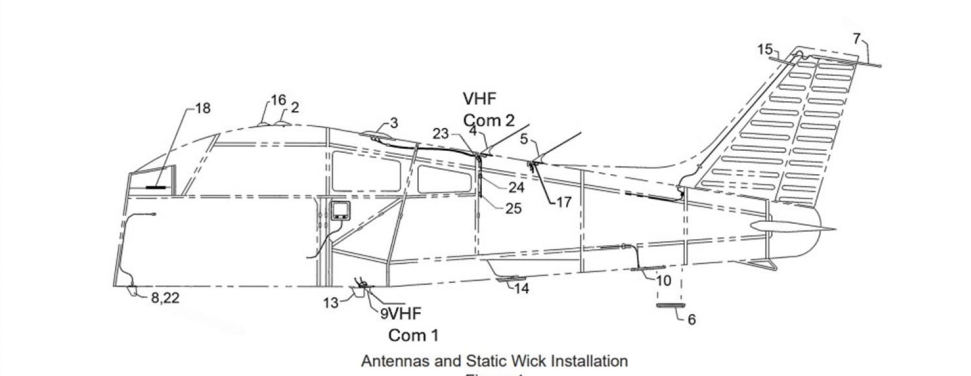
The aircraft was equipped with 2 Garmin G430[6] VHF navigation/communication systems, transmitting at a minimum of 10 watts through 2 independent antennas. The VHF COM 2 antenna is located on the top of the fuselage and the VHF COM 1 antenna is located on the underside of the fuselage.
Figure 4: Antenna location on PA-28
Source: PA-28 operator
Transponder and ADSB system PA-28
The PA-28 was fitted with a Garmin GTX 330ES MODE-S, providing a mode S digital transponder signal. The transponder likely would have made the PA-28 electronically conspicuous to the Dash 8 crew through the flight crew’s Flightradar24 application on their EFBs, when selected to ON/ALT.
Meteorological information
Weather conditions at Wagga Wagga Airport around the time of the occurrence were identified as a moderate north-westerly wind at about 13 kt, with greater than 10 km visibility. The cloud was reported as broken (between 5–7 oktas[7]) between 2,000 ft and 2,600 ft above ground level.
Airport information
Wagga Wagga Airport
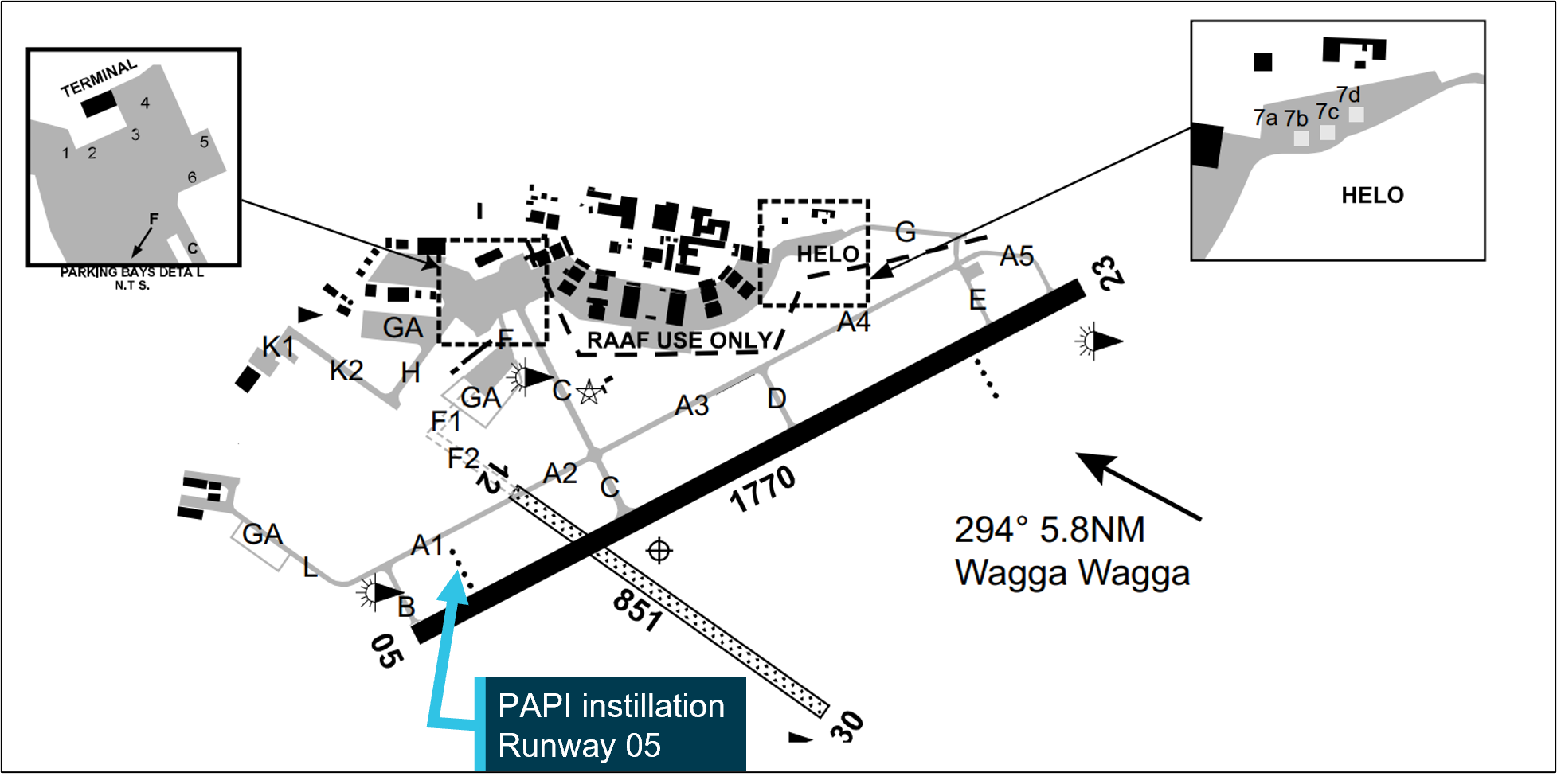
Wagga Wagga Airport is a regional, certified aerodrome, located about 6 NM to the south‑east of Wagga Wagga township in New South Wales, Australia. The aerodrome had an elevation of 724 ft (221 m) above mean sea level (AMSL), and had 2 runways running north‑east, south-west and north-west, south-east. The primary sealed runway at Wagga Wagga is runway 05/23 and is 1,770 m long with the secondary, unsealed runway 12/30 being 851 m long (Figure 5).
Runway 05/23 exhibited a minor elevation differential between each runway threshold. The threshold of runway 05 was recorded at 216 m AMSL while the threshold of runway 23 was slightly lower at 214 m AMSL, resulting in a 2 m downward gradient from runway 05 to runway 23. Approximately 300 m from the runway 05 threshold, the elevation increased to 217.5 m AMSL, a rise of 1.5 m, before gradually declining towards the runway 23 threshold. This subtle elevation change created a minor undulation in the runway profile.
Figure 5: Wagga Wagga Airport layout
Source: En Route Supplement Australia (ERSA). Airservices Australia, annotated by the ATSB
Airspace
Wagga Wagga Airport was located within non-controlled Class G[8] airspace which was available for use by aircraft operating under visual flight rules (VFR) and instrument flight rules (IFR).
No air traffic control separation service was provided between aircraft operating in this airspace. Pilots are responsible for making themselves aware of nearby aircraft and maintaining mutual self‑separation. The primary method of traffic separation at Wagga Wagga Airport was by VHF communications coupled with visual reference, and relied on pilots using ‘alerted see-and-avoid’[9] practices (see See-and-avoid).
The Wagga Wagga CTAF operated on the VHF radio band and required pilots to monitor and make some positional broadcasts when operating within the vicinity of the aerodrome, or within 10 NM.
Reported radio dead spot
The Australian Airline Pilot Academy (AAPA) had issued an internal notice to all crew (NOTAC) on 23 August 2023, advising of a potential radio ‘deadspot’ on Wagga Wagga Airport. The NOTAC detailed:
NOTAC 032/17 CURRENT 23 08 1100 LST - Until Removed To: All Pilots
POTENTIAL RADIO DEADSPOT ON WAGGA AIRPORT
There is an identified radio dead spot on Taxiway Alpha between taxiway Charlie and the runway 23 holding point, prior to entering Runway 23, crew must visually check that no aircraft are entering the runway from taxiway Charlie.
Authority: Chief Pilot.
Prior to the occurrence, the aerodrome operator had identified that ground-based vehicle radio communications were observed to have reduced effectiveness in some circumstances, however no further testing was carried out.
Radio signal transmission reception
The ATSB conducted an analysis to determine whether the radio line of sight (LOS) between the 2 aircraft, positioned at opposite ends of the runway, was obstructed by the terrain elevation at approximately 300 m down runway 05.
Firstly, a geometric LOS analysis was conducted. The analysis utilised a strict geometric LOS model, assuming a direct, unobstructed path between the transmitter and receiver, as described in standard International Telecommunications Union (ITU-R) (2019) radio propagation principles (Parsons, 2000). The results determined that the terrain elevation created a physical obstruction, blocking the direct radio LOS between the aircraft.
To assess the potential for radio communication despite the LOS obstruction, diffraction[10] effects were evaluated. The inclusion of diffraction effects was used as radio waves, particularly in the very high frequency (VHF) band used in aviation, can propagate beyond geometric LOS by bending around obstacles such as terrain features (Rappaport, 2002). This phenomenon enables communication in scenarios where direct LOS is obstructed.
A knife-edge diffraction model was used to estimate the signal loss caused by the terrain. This model, a standard method in radio wave propagation analysis, approximates the terrain feature as a sharp, idealised edge obstructing the radio wave path (International Telecommunications Union (ITU-R), 2019). The knife-edge model was selected due to its applicability for analysing diffraction over a single, well-defined obstacle and its computational simplicity for VHF frequency analysis.
The calculations were completed using the Wagga Wagga CTAF frequency of 118.2 MHz and assumed values derived from generic radio and antenna specifications.
Results indicated that despite the geometric LOS obstruction caused by the terrain, communication between the 2 aircraft was feasible[11] due to diffraction effects.
A similar calculation was conducted between taxiway C and taxiway A5. It indicated that communication between 2 aircraft was also feasible. The calculated signal strength indicated that a radio transmission should have theoretically been received clearly.
All calculations regarding VHF line of sight communication were theoretical and assumed idealised conditions. Noting the advice by AAPA of a potential radio dead spot on the airport, it should be noted that this observed dead spot may result from real-world environmental factors such as localised interference or other unmodeled conditions like vegetation or temporary obstacles, which cannot be fully replicated in theoretical calculations.
Visibility between opposite runway thresholds
A clear line of visual (eye level) sight existed between the taxiway B holding point at the threshold of runway 05 and the threshold of runway 23 (Figure 6). The pilot of the PA-28 reported they could clearly see the Dash 8 at the threshold of runway 05, as the Saab 340 vacated the runway, prior to them commencing take-off. The crew of the Dash 8 reported being able to see the Saab 340 land and vacate the runway, but did not visually detect the PA-28 prior to entering the preferred runway. After they were notified by the Saab 340, the captain and first officer were able to visually identify the PA-28 on runway 23 which was at that stage moving towards the Dash 8 on its take-off roll.
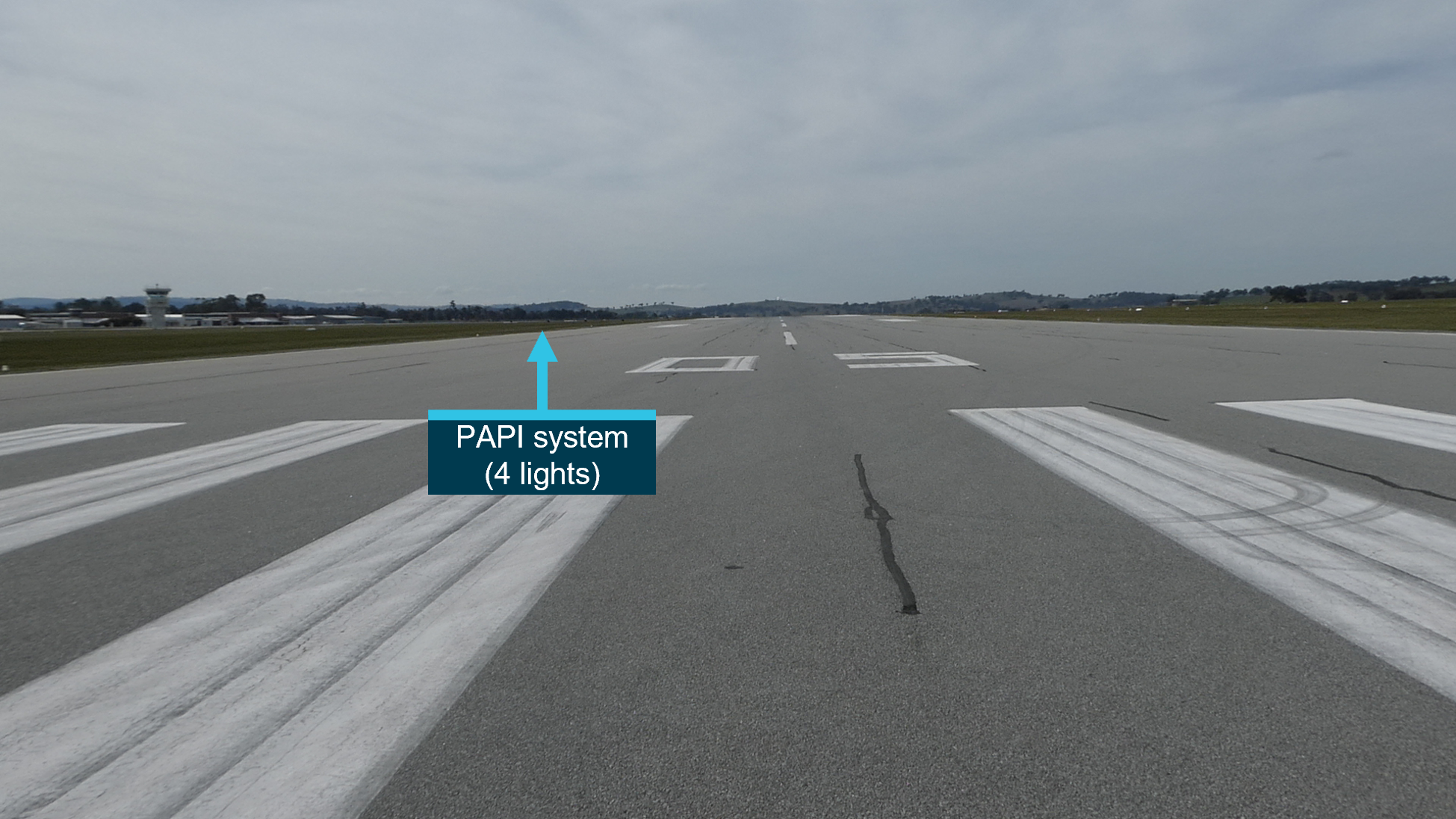
Both the FO and the captain commented during interview of a possible obstruction to their line of sight from the PAPI[12] installation. The PAPI installation is positioned to the left of runway 05. The orientation was to the left of the Dash 8 when the aircraft was holding on taxiway B, prior to entering runway 05. PAPI units must be no more than 0.9 m above ground level.
Figure 6: View from ground level, threshold runway 05
Source: airport operator, annotated by the ATSB
It was noted that the visual range from holding point B to the threshold of runway 23 is greater than 1,700 m over undulating terrain, with the PA-28 presenting a small target for visual identification by the Dash 8 crew.
ATSB calculations indicate there was a clear line of sight between the eye height of the Dash 8 crew and the eye height of the PA-28 crew. The visual line of sight between both aircraft was about 1.7 m above the geographical terrain undulations between the thresholds of runways 05 and 23.
Human performance limitations
Object perception
There are limitations to the size of objects that are perceptible at a distance. The ATSB considered whether the crew of the Dash 8 could have been able to detect there was a small aircraft (PA-28) at the threshold of runway 23 when the Dash 8 was at taxiway B at the runway 05 end, based on the known limitations of distant object perception. It was reported by the PA-28 pilots that the Dash 8 was visible to them when they were lined up for take-off once the Saab 340 cleared the runway. However, the Dash 8 is a larger aircraft and was side-on to the PA-28 pilots at this point, and they were alerted to the Dash 8’s presence through broadcasts, however this does not mean that the Dash 8 crew could identify the PA‑28.
The 3 main factors that would affect the visual image size of the PA-28 aircraft in the Dash 8 pilot’s eye are:
the dimensions of the aircraft
its relative orientation
distance from the viewer.
Past research (Hobbs, 2004) has shown distant objects can be seen when their visual angle is at least 24−36 minutes of arc (0.4−0.6°), and down to a minimum of 12 minutes of arc (0.2°) in ideal viewing conditions (ATSB, 2025).
Once the Saab 340 had cleared the runway and the visual path to the PA-28 was clear for the Dash 8 crew, the PA-28 was lined up for take-off. When lined up on the runway, the most prominent part of the PA-28 was the fuselage, which was 1.65 m high, with a wingspan of 10.79 m (noting that the wings would be edge-on). At the distance of 1,700 m, this would have presented a visual image that was about 3 minutes of arc (0.06°).[13] Additionally, as the PA-28 was moving down the runway, the gradual change in angular size would likely have been virtually imperceptible due to the eye’s limited sensitivity to small angular variations. Therefore, in the absence of confounding factors, it would have been very unlikely that the PA-28 would have been detectable by the Dash 8 pilots at that distance.
Other factors can also exist that can affect whether a pilot will be able to see another aircraft, including the background that an object is seen against. As can be seen in Figure 6, the background behind the runway 23 threshold was dark and would have provided good contrast to the white PA-28 aircraft, making detection easier.
Finally, the use of lights by the PA-28 would have enhanced detection. Strobe lights would have enhanced detection though flash and movement. However, landing lights are angled forward and downwards, and may not have been as detectable by the Dash 8 crew.
See-and-avoid
At and around non-controlled aerodromes, pilots are responsible for making themselves aware of nearby aircraft and maintaining separation. Safe operations at non-controlled aerodromes rely on all pilots maintaining an awareness of their surroundings and other aircraft, the principle of ‘see‑and‑avoid’.
A visual traffic search in the absence of specific traffic information is less likely to be successful than a search where traffic information has been provided. Knowing where to look can greatly increase the chance of sighting the traffic.
An ‘unalerted’ search is one where reliance is entirely on the pilot searching for, and sighting, another aircraft without prior knowledge of its presence. An ‘alerted’ search is one where the pilot is alerted to another aircraft’s presence, typically through radio communications or aircraft-based alerting systems. An alerted search supports a pilot’s situational awareness and enhances their visual lookout for traffic by developing an expectation of visually acquiring the traffic in a particular area.
Issues associated with unalerted see-and-avoid have been detailed in the ATSB research report, Limitations of the See-and-Avoid Principles(Hobbs, 2004). The report highlights that unalerted see-and-avoid relies entirely on the pilot’s ability to sight other aircraft.
Tools to enable ‘alerted see-and-avoid’ include:
VHF radio
transponders, used by traffic collision avoidance system (TCAS)
Hobbs (2004) identified that an alerted search is likely to be 8 times more effective than an unalerted search, this highlighted that knowing where to look greatly increases the chances of sighting other traffic.
Alerted see-and-avoid relies on pilot or crew awareness of all traffic in their vicinity, especially those that may be considered a hazard to their operations. Enhanced situational awareness requires the pilot or crew mental model of the location and intentions of nearby traffic to be updated regularly to form an evolving understanding of the nearby traffic. Without this information, the likelihood of effective situational awareness is degraded, and the mental model and shared understanding of hazards is compromised.
Operational procedures
QantasLink Dash 8 procedures
Non-controlled aerodrome VHF radio procedure
The QantasLink Dash 8 standard operating procedure for departure from a non‑controlled aerodrome (such as Wagga Wagga Airport), at the time of the occurrence, required VHF COM 1 to be set to the area frequency and VHF COM 2 to be set to the CTAF, as passenger boarding commenced.
Prior to releasing the handbrake to taxi, a call was to be made to the relevant air traffic centre on VHF COM 1 and then followed by a taxi call to the CTAF on VHF COM 2. However, due to this being a repositioning flight, the crew only broadcast on VHF COM 2 on the CTAF frequency.
Controlled aerodrome VHF radio procedure
The QantasLink Dash 8 standard operating procedure for departure from a controlled aerodrome, at the time of the occurrence, required VHF COM 1 to be set to the primary air traffic control frequency for ground and air-based communications. The VHF COM 2 was set for other communications (such as ATIS,[14] AWIS,[15] PAL and CTAF).
Reverse thrust on the ground
QantasLink policy for engaging reverse thrust during ground operations required prior approval from the Head of Flight Operations. This approval requirement was due to the risks associated with not being able to confirm clearance from other traffic or obstacles that cannot be visually identified from the flight deck. The captain advised during interview that they were aware of this policy.
Procedures for transponder use
The QantasLink procedure was to set the transponder to ‘ON/ALT’ with the applicable transponder code[16] as part of the pre-flight process. This is achieved either after obtaining airways clearance or (at airports where airways clearance is not obtained until after take-off), as part of the pre‑flight process before engine start.
AAPA PA-28 operator procedures
VHF radio procedure
The AAPA procedures, contained within the ‘Piper Warrior III Crew Operating Manual’, normal procedures, required COM 1 to be selected to the local area frequency, tower, ground, clearance delivery, approach or departure frequency as required. COM 2 was required to be set to the CTAF, ATIS, AWIS, MULTICOM or guard frequency (121.5 MHz) as required.
The instructor confirmed during interview that, at the time of the occurrence, COM 1 was set to Melbourne Centre (area frequency) and COM 2 was set to the Wagga Wagga CTAF.
Procedures for transponder use
The PA-28 operator’s’ procedure for transponder operation was to set the applicable transponder code and select the STBY[17] function during taxi. Prior to entering the runway, ON/ALT mode[18] was to be selected.
The PA-28 operator’s training manual notes:
All pilots must ensure ALT is selected on the transponder during the LINE UP CHECKLIST. Other aircraft equipped with TCAS rely on transponder information for pilot alerting and collision avoidance functions.
PA-28 external light use
The PA-28 operator’s procedure for the selection of external lights is documented in its Piper Warrior III flight crew operating manual, normal procedures.
As required by the ‘pre line up scan action flow’, the pilot selects the landing lights ‘on’ (during daytime operations), immediately prior to commencing a take-off roll at a non‑controlled aerodrome.
The instructor recalled that normal behaviour would involve the pilot selecting the landing lights ‘on’, when the ‘rolling call was issued’.
Regulations regarding transponder use
The use of surveillance equipment such as ADS-B and transponder is outlined in the Civil Aviation Safety Regulations Part 91 Manual of Standards (MOS) and the Airservices Australia Aeronautical Information Publication (AIP).
Chapter 26 of the Part 91 MOS, operation of surveillance equipment – general requirements stated, among other things, that transponder equipment required to be fitted and carried on an aircraft must be continuously operated. It also identified that ‘continuous operation’ for a transponder means that the equipment must be operated in a mode that enables a secondary surveillance radar (SSR)[19] response to be transmitted and, where an altitude reporting capability is available, that this capability is also activated.
AIP Australia ENR 1.6 paragraph 7.1.9 stated:
A pilot operating a Mode S transponder must:
b. On receipt of ATC clearance, or requesting the earlier of Push Back or Taxi, select TA/RA/XPDR/ ON AUTO as applicable.
CASA advised that item ‘b’ only applies at controlled aerodromes. At non-controlled aerodromes, transponders must be turned on prior to becoming airborne.
Radio communication
VHF radio is the primary communication tool commonly used to provide ‘alerted see‑and‑avoid’ from sport and recreational private flying to air transport. Broadcasts on the CTAF to any other traffic in the vicinity of a non-controlled aerodrome are made to provide situational awareness, traffic separation and deconfliction to other traffic in the vicinity.
Positional broadcasts
Civil Aviation Safety Regulation 91.630 made certain radio calls mandatory for aircraft that are fitted with or carry a VHF radio. Chapter 21 of the Part 91 Manual of Standards (MOS) prescribed one type of mandatory broadcast that applies at all non-controlled aerodromes, namely:
When the pilot in command considers it reasonably necessary to broadcast to avoid the risk of a collision with another aircraft.
To aid in increasing situational awareness at non-controlled aerodromes, recommended broadcasts are published by the Civil Aviation Safety Authority (CASA). These broadcasts enable pilots to alert other traffic to their location and intentions before take‑off, inbound to land at, or if intending to overfly a non-controlled aerodrome.
Standardised radio transmissions and phraseology assist with effective and efficient radio communication. To achieve this, the application of recommended positional broadcasts (Table 1) for VFR traffic are published in CASA Advisory Circular (AC) 91-10, Operations in the vicinity of non-controlled aerodromes.
Table 1: Recommended positional broadcasts in the vicinity of a non-controlled aerodrome
Item
Situation
Broadcast
Recommended calls in all circumstances
1
The pilot intends to take off.
Immediately before, or during taxi.
2
The pilot is inbound to the aerodrome.
10 NM from the aerodrome, or earlier, commensurate with aeroplane performance and pilot workload, with an estimated time of arrival (ETA) for aerodrome.
3
The pilot intends to fly through the vicinity of, but not land at, a non-controlled aerodrome.
10 NM from the aerodrome, or earlier, commensurate with aeroplane performance and pilot workload, and an estimated time of arrival.
Recommended calls dependent on traffic
4
The pilot intends to enter the runway.
Immediately before entering a runway.
5
The pilot is ready to join the circuit.
Immediately before joining the circuit.
6
The pilot intends to make a straight in approach.
On final approach at not less than 3 NM from threshold.
7
The pilot intends to join on base leg.
Prior to joining base leg.
8
During an instrument approach when:
a. departing FAF or established on final approach segment inbound
b. terminating the approach, commencing the missed approach.
Include the details of position and intentions that are clear to all pilots (both IFR and VFR).
9
The aircraft is clear of the runway(s).
Once established outside of the runway strip.
Source: CASA AC 91-10 Operations in the vicinity of non-controlled aerodromes
Limitations of positional broadcasts
Positional broadcasts are a one-way communication and do not imply receipt of information by other parties unless direct radio contact is made between stations.
Positional broadcasts rely on the accuracy of the information being broadcast and the ability of other traffic receiving, comprehending and reacting to this information.
CASA AC 91-10 stated:
8.2.1 Pilots are reminded that although correct and informative radio calls play a critical role in ensuring collision avoidance in uncontrolled airspace, to ensure the safety of their aircraft they cannot assume that an absence of other radio calls means there are no nearby or conflicting aircraft.
8.2.2 Pilots must continually look out for other aircraft, even when their broadcasts have generated no response
8.2.3 Accidents and incidents have occurred where pilots incorrectly assessed the threat posed by another aircraft, either due to the pilot incorrectly assessing the relative aircraft flight paths, or inaccurate information being provided by other pilots.
Dash 8 radio reception and transmission
Two Dash 8 ground communication events has been previously identified by ATSB investigations (AO-2023-025 and AO-2023-050) at Mildura Airport (see Related occurrences).
These 2 events resulted in the second investigation testing the Dash 8’s VHF systems. The testing was conducted by the ATSB, the Australian Media and Communications Authority[20] and QantasLink. The testing measured the transmission power pattern of the Dash 8’s 2 communication systems (upper and lower antennae), when the aircraft was on the ground at Mildura Airport.
The testing identified that ground‑based Dash 8 signal strength reception could be adversely affected by the aircraft’s orientation relative to the other aircraft or antenna locations. Additionally, the average signal strength forward of the aircraft was 8.5 dBm[21] stronger than the average signal strength behind and to the side of the aircraft. A significant recorded signal strength and clarity reduction on both VHF COM 1 and VHF COM 2 radios was observed when the tail of the Dash 8 was pointed towards the receiver.
It was further identified that reception and transmission on VHF COM 2 on the ground (via the lower antenna, as used for QantasLink Dash 8 ground communications at non‑controlled aerodromes) had significantly reduced strength and clarity compared to VHF COM 1.
The Dash 8 manufacturer, De Havilland Aircraft of Canada Limited, advised that VHF COM 1 was expected to provide more reliable performance in ground-based communication with other ground stations.
Two flight operations service letters (Appendix B – Flight Operations Service Letters) were released on 6 December 2024 for the Dash 8-100/200/300 (DH8-SL-23-008A) and Dash 8‑400 (DH8-SL-23-020A). Details included a description of the limitations of VHF line of sight communications and the recommendation that VHF COM 1 may provide a better signal (receiving and transmitting) to other stations on the ground, or nearby in the air.
As a result of the first occurrence at Mildura on 6 June 2023 (see ATSB investigation report AO-2023-025), QantasLink issued a technical advisory bulletin, effective from 17 July 2024, which changed the VHF communications procedure for Mildura departures. The aim of the change was to improve ground-to-ground CTAF VHF communication during the taxi phase. However, this has only been adopted at Mildura Airport through a route manual amendment (now company port supplement) and does not provide any effective level of mitigation to this known risk for other non-controlled aerodromes.
On 6 June 2023, a Piper PA-28-161, taxied for runway 36 at Mildura Airport, Victoria. At about the same time, a QantasLink De Havilland Aircraft of Canada Limited DHC-8-315 (Dash 8) began to taxi for runway 09. Both aircraft broadcast their intentions on the local common traffic advisory frequency. The pilot of the PA-28 was aware of the Dash 8, but the crew of the Dash 8 were not aware of the PA-28. Both aircraft commenced their take‑off at about the same time and the Dash 8 crossed ahead of the PA-28 at the runway intersection of 09/36 by about 600 m.
The pilot of the PA-28 was unable to visually sight the location of the Dash 8 due to airport buildings and assumed that the Dash 8 was still backtracking on runway 09. They did not directly contact the Dash 8 to positively organise separation. They also incorrectly referred to the runway direction at Mildura Airport as ‘runway 35’ instead of ‘runway 36’.
The Dash 8 crew was focused on obtaining their pre-departure information from air traffic control and had the volume for the radio tuned to the common traffic advisory frequency turned down. An over transmission from air traffic control meant that the Dash 8 crew only received certain elements of the PA-28 pilot’s radio calls. This likely led to an incomplete comprehension of traffic by the Dash 8 crew who believed that the PA-28 was not at Mildura (due to the incorrect reference to runway 35). However, they did not seek further information of the source of the radio calls to positively identify the traffic location.
The investigation found that, due to the topography and buildings at Mildura Airport, aircraft are not directly visible to each other on the threshold of runways 09, 27 and 36. The Dash 8 crew did not give a rolling call on runway 09, nor were they required to. The lack of a requirement for mandatory rolling calls increased the risk of aircraft not being aware of each other immediately prior to take-off.
On 29 September 2023, De Havilland Aircraft of Canada Limited DHC-8-315 (Dash 8), taxied for runway 09 at Mildura, Victoria. A short time later, an amateur‑built Lancair Super ES aircraft taxied for runway 36 at Mildura, for a private flight to Ballarat.
Both aircraft gave taxi, entering and backtracking calls on the local common traffic advisory frequency. Neither the pilot of the Lancair, nor the crew of the Dash 8, were aware of each other. The crew of the Dash 8 gave a rolling call and had commenced their take-off on runway 09 as the pilot of the Lancair gave a rolling call on runway 36, this was received by the Dash 8 crew with an immediate response given to the Lancair to hold on the runway. Another aircraft, taxiing behind the Lancair for runway 36, advised them to hold position while the Dash 8 departed.
The Dash 8 crossed the runway 09/36 intersection while the Lancair remained on the threshold of runway 36.
The investigation found that, due to the topography and buildings at Mildura Airport, aircraft are not directly visible to each other on the threshold of runways 09, 27 and 36. It was also identified that the crew of the Dash 8 were actively engaged in in organising separation with other airborne traffic and the Lancair’s entering and backtracking call was over transmitted.
It was also identified that the Dash 8 had reduced ground-based radio reception and transmission strength and clarity on VHF COM 2 (which used an antenna on the aircraft underbelly) and was required to be used by company procedures. The investigation also found that the Dash 8 had reduced radio reception and transmission strength to and from other airfield users located behind the Dash 8 which affected radio call readability.
This led to a situation where the crew of the Dash 8 had an incomplete comprehension of the ground-based traffic at Mildura, and had no knowledge of the Lancair until during the take-off. In addition, due to the position and distance of the Dash 8, the pilot of the Lancair had no awareness of the Dash 8 until another aircraft advised that the Dash 8 was rolling on runway 09.
On 19 March 2024, a Fairchild SA226-TC (Metroliner), taxied at Geraldton, Western Australia, for runway 03. About one minute later, a Beechcraft A36 (Bonanza), taxied for runway 14. After reaching their respective runway thresholds, both pilots attempted to contact the other, however, they did not hear each other, nor could they see each other. A third aircraft assisted by relaying information. Based on the information received, the Bonanza and Metroliner pilots commenced their take-off within 3 seconds of each other. The Metroliner crossed runway 14 about 400 m in front of the Bonanza, with a vertical separation of about 250–300 ft.
The investigation found that, when aircraft were positioned at the thresholds of runway 03 and 14 (and 08), they will unlikely be visible to each other due to the position of the airport buildings. Further, they may not be contactable on VHF radio due to potential shielding effects. This resulted in the pilots being unable to verify each other’s position and intentions prior to commencing their take-off.
While the pilot of the third aircraft was attempting to assist, the details provided were inaccurate and incomplete. This inadvertently resulted in misinterpretation by the Bonanza and Metroliner pilots and influenced their decision to take off.
Safety analysis
Introduction
On 15July 2024, a QantasLink De Havilland Aircraft of Canada Limited DHC-8-402, registered VH-QOD, entered runway 05 at Wagga Wagga Airport, unaware that a Piper PA-28, registered VH-XDK, was commencing its take-off roll from runway 23.
While the crew of the Dash 8 was entering the runway, the crew of a third aircraft (Saab 340), notified the Dash 8 crew of the PA-28’s presence.
Once the Dash 8 crew was aware of the PA-28, the captain stopped the aircraft about 5 m past the holding point, then engaged ‘reverse thrust’ to back the Dash 8 clear of the runway. Concurrently, the pilot of the PA-28 rejected their take-off from runway 23.
This analysis will explore operational considerations such as situational awareness, the breakdown of communication, shared mental model and alerted see‑and‑avoid, as well as the limitations identified within operational procedures and specific aircraft system limitations.
Situational awareness and communication
The PA-28 crew was aware of the Dash 8 intentions and location. The PA-28 instructor subsequently held the assumption that the Dash 8 crew had, likewise, received their radio broadcasts and were aware of the PA-28’s location and intentions for take-off.
The Dash 8 crew did not expect any other traffic, in addition to the Saab 340. The Dash 8 crew reported not identifying the PA-28 either visually or via electronic means, nor hearing the PA-28’s radio communications. During taxi to the opposite end of the runway, the Dash 8 was pointing in the opposite direction to the PA-28, and later the line of sight to the PA-28 would have been obscured by the landing Saab 340. As the PA-28 transponder was not turned on prior to entering the runway, it was not identifiable electronically either prior to this time. The remaining opportunity to increase situational awareness was the initial taxiing radio calls. The Dash 8 crew’s broadcast immediately after they were told about the conflicting traffic shows they were surprised to learn there was another aircraft operating from the airport, this suggests that the Dash 8 crew members did not hear these transmissions rather than forgot them.
Contributing factor
During ground-based repositioning, the Dash 8 entered runway 05 while the PA-28 had commenced its take-off roll from runway 23. The Dash 8 crew were not aware of the PA-28 until notified by the crew of a third aircraft of the potential conflict.
Communication
Succinct and timely radio communication is important to ensure high levels of situational awareness and aids in providing alerted see-and-avoid safety outcomes. As such, the accuracy of the information broadcast by pilots is critical in ensuring minimum misunderstanding.
Common traffic advisory frequency (CTAF) recordings indicated that the PA-28 pilot made the recommended positional broadcasts in preparation for their departure – a taxi call when leaving the apron area, entering the runway and then a rolling call on the runway. However, positional broadcasts are ‘one-way’ communications by nature and do not explicitly mean that other traffic in the vicinity interpret and understand the intended information.
The PA-28 instructor reported that they believed that the Dash 8 crew had received and understood their broadcasts. This misunderstanding was based on the presumption that because the PA-28 could hear the radio calls and see the Dash 8, that the Dash 8 crew also could hear the radio calls and see the PA-28.
The PA-28 crew could hear the communications between the Dash 8 and Saab 340, centring on the Dash 8 crew ensuring they did not impede the Saab 340’s landing. However, the PA-28 instructor expected that the Dash 8 would hold short of the runway to allow them to take-off without hearing any broadcasts to that effect. As a result, the PA-28 crew did not initiate any direct radio contact with the Dash 8 crew to clarify their intentions.
Had the PA-28 instructor attempted to make direct contact with the Dash 8, and not been successful, they would have subsequently realised there had been a communication breakdown.
Contributing factor
The pilots of the PA-28 gave the recommended radio calls, however, did not directly communicate or engage with the Dash 8 crew to arrange separation.
Visual identification
The topography at the aerodrome results in a runway height change between the thresholds of runway 05/23 at Wagga Wagga Airport. This change is up to 2 m in elevation between the thresholds, with a slight hump towards the runway 05 end. However, there was a clear visual line of sight from one threshold to the other.
When the Dash 8 was on taxiway B at the holding point of the runway, the crew’s vision of the PA-28 may have been blocked by the landing Saab 340. By the time that aircraft cleared the runway, the PA-28 was lined up on the runway and had started its take-off roll.
Based on the limitations of vision, it is very unlikely that the Dash 8 crew would have been able to detect the presence of the PA-28 about 1,700 m away, simply by looking in that direction, as the image of that aircraft would have been too small for detection. The use of landing and strobe lights would have assisted, but over that distance would have been limited. Consequently, the Dash 8 crew, who reported looking before entering the runway, did not detect its presence.
If the Dash 8 crew had previously been alerted to the presence of another aircraft, this would have increased the chance of detection. Alerted see‑and‑avoid means that the presence and approximate location of another aircraft is known or expected, allowing the crew to narrow their visual search. However, in this case, the absence of the Dash 8 crew detecting radio calls from the PA-28 and no other aircraft identified during taxi either visually or electronically, meant that the Dash 8 crew held an expectation that there were no other ground-based aircraft operating at the airport at that time. Not detecting the PA‑28 was consistent with that expectation.
Contributing factor
Without any prior alert or expectation of the presence of the PA-28, the Dash 8 crew did not visually detect the PA-28 on take-off from the reciprocal end of the runway, prior to the Dash 8 entering the runway to taxi to the terminal.
The ATSB identified that while the PA-28 crew conducted their taxi, engine run-ups and aircraft checks, their transponder was set to standby. Prior to entering the runway for take-off, the pilot of the PA-28 then switched the transponder from standby to ‘ON’.
The Dash 8 crew reported that electronic surveillance equipment was used as an aid to supplement the identification of potential conflicting traffic in the vicinity of a non‑controlled aerodrome prior to take-off. Both the captain and first officer of the Dash 8 recalled conducting a check of their onboard surveillance systems (electronic flight bag, traffic collision avoidance system (TCAS) aircraft display and Flightradar24 application) during taxi and did not identify any traffic other than the third-party landing aircraft.
Non-active mode S transponders do not provide electronic surveillance information to other aircraft. If the transponder is not selected ‘on’, a missed opportunity exists to provide situational awareness to other aircraft.
It is likely, had the PA-28 mode S transponder been activated at the first aircraft movement for taxi, the flight crew of the Dash 8 would have detected the presence of the PA-28 and developed an expectation of its location and potential confliction. This would have prompted the crew to coordinate both verbally and aided alerted see‑and‑avoid.
Contributing factor
During taxi for take-off, the PA-28 was not broadcasting transponder information to identify them to other traffic in the vicinity of the aerodrome.
Australian Airline Pilot Academy procedures for transponder
The AAPA’s manual had a procedure that prescribed the use of the transponder on standby during startup and taxi, with a requirement to only switch it to ‘ALT’ prior to entering the runway.
Widespread use of surveillance equipment, such as transponders with ADS-B installed, offer significant improvement to allow pilots to be more certain of the location of traffic, particularly outside controlled airspace environments.
Had the PA-28 crew been required to select their mode S transponder to ‘ON/ALT’ prior to initial taxi, this would have made them electronically visible to the Dash 8 crew who reported actively seeking this information.
Contributing factor
The Australian Airline Pilot Academy flying school flight crew operating manual only required pilots to activate the transponder prior to entering the runway. The use of a transponder during taxi would normally provide an additional source of positional data to other pilots, aiding visual identification and alerted 'see‑and‑avoid' to other aircraft. (Safety issue)
Topographic shielding
Local operators at Wagga Wagga Airport have observed and reported that a reduction in effectiveness of VHF communications had been experienced at certain locations on the airport. This observation of topographical radio shielding was identified by multiple parties.
Topographic changes exist in and around Wagga Wagga Airport and were suggested by stakeholders to result in varying levels of topographical radio shielding at the eastern end of taxiway A and the end of runway 23.
Prior to the occurrence, the PA-28 operator issued internal notifications of an ‘identified radio dead spot’, to its flight crews.
Operator advice and reported experience regarding topographical shielding at Wagga Wagga Airport was documented procedurally for AAPA, but was not available to Dash 8 crew operating into Wagga Wagga Airport. The ATSB did not independently confirm the existence of radio shielding. Operator experience and local procedure indicates this is likely an ongoing issue at Wagga Wagga Airport.
Contributing factor
Reduced VHF ground-based communication was identified at the eastern end of runway 23 at Wagga Wagga Airport. Local operator reports and procedures indicate likely reduced communications on the eastern end of taxiway A to other areas on the aerodrome.
Dash 8 radio reception and transmission
VHF radio transmissions facilitate exchanges between air traffic control, aircraft, and emergency services. These signals primarily rely on line of sight propagation, requiring an unobstructed path between the transmitting and receiving antennas. When line of sight is obstructed by terrain features, aircraft structure, or by man-made structures like buildings, VHF signals can be significantly attenuated, leading to reduced communication range, signal distortion, or complete loss of contact. However, under certain conditions, VHF signals may propagate beyond line of sight through mechanisms such as reflection and diffraction. While these phenomena can marginally extend communication range, their effectiveness is highly dependent on the environment.
Previous analysis of Dash 8 ground-based communications (AO-2023-050) identified a significant reduction in radio signal strength and readability when using the VHF COM 2 antenna for ground operations. The analysis determined that the aircraft structure and surrounding airport infrastructure at Mildura Airport impeded VHF COM 2 signal transmission and reception, limiting its effectiveness. In contrast, using the VHF COM 1 antenna provided a clearer line of sight to ground-based stations, resulting in more reliable communication.
ATSB analysis of the radio communications between the Dash 8, the Saab 340, and the PA-28 identified that the Dash 8 crew, while using VHF COM 2, could hear and respond to the Saab 340, likely due to its proximity to the aircraft. However, they could not hear the PA-28.
Their inability to hear the PA-28 was likely due to previously identified issues with the VHF COM 2 antenna and the addition of runway undulations which further obstructed the line of sight between the Dash 8’s VHF COM 2 antenna and the PA-28. This likely exacerbated the antenna’s limitations and hindered effective signal propagation.
Contributing factor
Dash 8 ground-based transmissions on VHF COM 2 had reduced strength and clarity. This likely led to situations where other aircraft had difficulty in receiving and understanding radio transmissions, and the Dash 8 not receiving the PA-28 radio transmissions.
Qantas procedures for VHF
QantasLink procedures required the use of VHF COM 2 for ground-based communication at non-controlled aerodromes. However, the use of VHF COM 2 for ground-based communications was not required for controlled airspace, where ground‑based communications were conducted by VHF COM 1.
In previous ground-based signal strength testing at Mildura Airport (see ATSB investigation report AO-2023-050), the ATSB identified a significant reduction in the Dash 8 VHF radio transmission strength and readability particularly when greater transmission and reception distances were involved. It was also found that the use of VHF COM 2 reduced ground-based transmission reception strength and clarity in comparison with VHF COM 1.
Following a near collision occurrence at Mildura on 6 June 2023, QantasLink changed the VHF communications procedure for Mildura Airport departures. The changed procedure required use of the VHF COM 1 system, noting that this was found to have an improvement in both transmission clarity and reception. However, this has only been adopted at Mildura Airport and so does not provide any effective level of mitigation to this known risk for other non-controlled aerodromes.
Given the reported radio dead spot at Wagga Wagga Airport, the use of VHF COM 2 with the bottom‑mounted antenna by QantasLink Dash 8s likely increased the likelihood of Dash 8 crews not receiving strong and readable radio calls from other ground-based aerodrome users.
Contributing factor
QantasLink's radio procedure required crew to use communications panel radio 2 (COM 2) to broadcast and receive on local frequencies during operations at a non-controlled aerodrome. This reduced the likelihood of the Dash 8 receiving the calls from other aircraft at either end of runway 05/23 at Wagga Wagga Airport in certain circumstances. (Safety issue)
Part of the shared mental model for all operations at non-controlled aerodromes is the situational awareness of all crew, in this instance the crew of the Saab 340 identified a potential threat to the safety of the other 2 aircraft and clearly broadcasted their concern.
Crew interviews as well as CTAF recordings clearly showed that the proactive initiative of the Saab 340 crew to alert the Dash 8 crew of the presence of the PA-28 was instrumental in preventing a potential on runway collision.
Other finding
Third party intervention by the Saab 340 crew prevented the Dash 8 from lining up on runway 05 whilst the PA-28 was engaged in the take-off roll.
After entering the preferred runway, the captain became aware of the hazard present due to the vacating third party aircraft report. The captain’s decision to apply brakes and then engage reverse thrust to clear the runway was almost certainly made to avoid the greatest perceived threat, that being, a possible collision on the runway.
Reversing the aircraft under its own power is a non-normal manoeuvre with additional risks. As such QantasLink policy would normally require Head of Flight Operations approval to conduct the manoeuvre.
The captain’s decision to reverse the aircraft could be attributed to the lower (perceived) risk involved with reversing the aircraft, versus the known risk of a possible collision.
The captain exercised their command authority, based on the information available, to make an assessment of the greatest threat, subsequently deciding to reverse the aircraft, without being able to positively confirm traffic and obstacle avoidance.
Risk management focuses on reducing the potential risks associated with a decision. Thus, considering that decision‑making, when elements of uncertainty exist, focuses on making the best decision given the available information.
The pilot in command of an aircraft has the final authority over the safety of the aircraft and its occupants. When operating in dynamic environments, the pilot in command will need to consider possible outcomes and alternative courses of action to ensure clear risk-based decisions are made. In this instance the captain elected to reduce the likelihood of a catastrophic event by reversing clear of the preferred runway after having a reasonable expectation that the taxiway was clear behind the Dash 8.
Other finding
On assessing that a collision risk existed with the rolling PA-28, the captain held a reasonable expectation that it was clear and reversed the aircraft away from the preferred runway without being able to confirm that no other aircraft were behind the Dash 8.
Findings
ATSB investigation report findings focus on safety factors (that is, events and conditions that increase risk). Safety factors include ‘contributing factors’ and ‘other factors that increased risk’ (that is, factors that did not meet the definition of a contributing factor for this occurrence but were still considered important to include in the report for the purpose of increasing awareness and enhancing safety). In addition ‘other findings’ may be included to provide important information about topics other than safety factors.
Safety issues are highlighted in bold to emphasise their importance. A safety issue is a safety factor that (a) can reasonably be regarded as having the potential to adversely affect the safety of future operations, and (b) is a characteristic of an organisation or a system, rather than a characteristic of a specific individual, or characteristic of an operating environment at a specific point in time.
These findings should not be read as apportioning blame or liability to any particular organisation or individual.
From the evidence available, the following findings are made with respect to the runway incursion involving De Havilland Aircraft of Canada Limited DHC-8, VH-QOD, and Piper PA‑28, VH-XDK, at Wagga Wagga Airport, New South Wales, on 15 July 2024.
Contributing factors
During ground-based repositioning, the Dash 8 entered runway 05 while the PA-28 had commenced its take-off roll from runway 23. The Dash 8 crew were not aware of the PA‑28 until notified by the crew of a third aircraft of the potential conflict.
The pilots of the PA-28 gave the recommended radio calls, however, did not directly communicate or engage with Dash 8 crew to arrange separation.
Without any prior alert or expectation of the presence of the PA-28, the Dash 8 crew did not visually detect the PA-28 on take-off from the reciprocal end of the runway, prior to the Dash 8 entering the runway to taxi to the terminal.
During taxi for take-off, the PA-28 was not broadcasting transponder information to identify them to other traffic in the vicinity of the aerodrome.
The Australian Airline Pilot Academy flying school flight crew operating manual only required pilots to activate the transponder prior to entering the runway. The use of a transponder during taxi would normally provide an additional source of positional data to other pilots, aiding visual identification and alerted 'see‑and‑avoid' to other aircraft. (Safety issue)
Reduced VHF ground-based communication was identified at the eastern end of runway 23 at Wagga Wagga Airport. Local operator reports and procedures indicate likely reduced communications on the eastern end of taxiway A to other areas on the aerodrome.
Dash 8 ground-based transmissions on VHF COM 2 had reduced strength and clarity. This likely led to situations where other aircraft had difficulty in receiving and understanding radio transmissions, and the Dash 8 not receiving the PA-28 radio transmissions.
QantasLink's radio procedure required crew to use communications panel radio 2 (COM 2) to broadcast and receive on local frequencies during operations at a non-controlled aerodrome. This reduced the likelihood of the Dash 8 receiving the calls from other aircraft at either end of runway 05/23 at Wagga Wagga Airport in certain circumstances. (Safety issue)
Other (key) findings
Third party intervention by the Saab 340 crew prevented the Dash 8 from lining up on runway 05 whilst the PA-28 was engaged in the take-off roll.
On assessing that a collision risk existed with the rolling PA-28, the captain held a reasonable expectation that it was clear and reversed the aircraft away from the preferred runway without being able to confirm that no other aircraft were behind the Dash 8.
Safety issues and actions
Central to the ATSB’s investigation of transport safety matters is the early identification of safety issues. The ATSB expects relevant organisations will address all safety issues an investigation identifies.
Depending on the level of risk of a safety issue, the extent of corrective action taken by the relevant organisation(s), or the desirability of directing a broad safety message to the aviation industry, the ATSB may issue a formal safety recommendation or safety advisory notice as part of the final report.
All of the directly involved parties are invited to provide submissions to this draft report. As part of that process, each organisation is asked to communicate what safety actions, if any, they have carried out or are planning to carry out in relation to each safety issue relevant to their organisation.
Descriptions of each safety issue, and any associated safety recommendations, are detailed below. Click the link to read the full safety issue description, including the issue status and any safety action/s taken. Safety issues and actions are updated on this website when safety issue owners provide further information concerning the implementation of safety action.
Safety issue description: The Australian Airline Pilot Academy flying school flight crew operation manual only required pilots to select ALT on the transponder, as part of the Pre Line Up Scan Action Flow and associated Checklist prior to entering the runway. The use of a transponder during taxi would normally provide an additional source of positional data to other pilots, aiding visual identification and alerted 'see‑and‑avoid' to other aircraft.
Safety advisory notice to pilots and operators of mode S transponder equipped aircraft
The effective use of the mode S transponder from first movement of the aircraft can serve as an effective tool in adding another layer of collision avoidance between aircraft on the ground. Utilising the mode S transponder with ADS-B OUT enabled is the most effective way of making an aircraft electronically conspicuous and delivering maximum interoperability with other aircraft as well as the ground ATM environment. The ATSB advises pilots and operators to review their procedures to ensure that mode S transponders are on from first movement of the aircraft, particularly at non-controlled aerodromes.
Safety issue description: QantasLink's radio procedure required crew to use communications panel radio 2 (COM 2) to broadcast and receive on local frequencies during operations at a non‑controlled aerodrome. This reduced the likelihood of the Dash 8 receiving the calls from other aircraft at either end of runway 05/23 at Wagga Wagga in certain circumstances.
Safety action not associated with an identified safety issue
Whether or not the ATSB identifies safety issues in the course of an investigation, relevant organisations may proactively initiate safety action in order to reduce their safety risk. All of the directly involved parties are invited to provide submissions to this draft report. As part of that process, each organisation is asked to communicate what safety actions, if any, they have carried out to reduce the risk associated with this type of occurrences in the future. The ATSB has so far been advised of the following proactive safety action in response to this occurrence.
Safety action by Wagga Wagga Airport
After the occurrence, the aerodrome operator identified that it was possible that a radio black spot may be present based on observations of radio reception just beyond the threshold of runway 23.
Wagga Wagga city council has issued a precautionary NOTAM after the occurrence which provides advice to all operators of possible visibility issues with aircraft on the threshold of runway 23 and the possibility of radio black spots existing under some conditions. The NOTAM note reads:
LIGHT ACFT AT THR OF RWY 23 NOT VISIBLE TO OTHER ACFT USING RWY 05.
RADIO BLACK SPOTS MAY RESULT UNDER SOME CONDITIONS.
Safety action by QantasLink
On 2 August 2024 QantasLink safety issued a company safety alert notice advising crew of a suspected VHF radio blackspot on taxiway A4 and A5 towards the threshold of runway 23 and other areas of the Wagga Wagga aerodrome. They issued the following advice to crew:
Whilst we investigate the issue with the aerodrome operator and other aerodrome users, we encourage crew to consider the following precautions when taxiing for departure or any other manoeuvring on the ground:
- ensure any weak, garbled or carrier-wave only CTAF transmissions are clarified to ensure your separation plan remains valid; -
- stop at runway holding points and visually check for traffic prior to runway entry; -
- where possible all aircraft to use the into wind (duty) runway for departure so aircraft are not departing from opposite ends of the runway; and –
- ensure AFRU responses on the CTAF frequency are heard clearly.
Safety action by Civil Aviation Safety Authority
On 9 September 2025, CASA advised that new guidance and recommendations relating to the use of radios where the antenna is mounted on the underside of the aircraft fuselage to both Advisory Circular (AC) 91-10 and AC 91-14 had been updated.
This guidance advised:
Pilots operating aircraft with similar antenna placements are reminded that ground-based transmissions, when made using a radio with a fuselage underside antenna, are likely to have an increased risk of not being reliably received by other traffic. To enhance situational awareness and collision avoidance, especially at non-controlled aerodromes where radio-alerted see‑and‑avoid is critical, pilots are strongly recommended, wherever practicable, to use radios connected to antennas in unobstructed locations, such as an aircraft upper fuselage, for ground communications
Glossary
AAPA
Australian Airline Pilot Academy
ADSB
Automatic Dependent Surveillance–Broadcast
AIP
Aeronautical information publication
AMSL
Above mean sea level
ATC
Air traffic control
CASA
Civil Aviation Safety Authority
CPL
Commercial pilot licence
CTAF
Common traffic advisory frequency
EFB
Electronic Flight Bag
ERSA
En route supplement Australia
FO
First officer
IFR
Instrument flight rules
LOS
Line of sight
MOS
Manual of Standards
NOTAC
Notice to all crew
NOTAM
Notice to airmen
TCAS
Traffic collision avoidance system
VFR
Visual flight rules
Sources and submissions
Sources of information
The sources of information during the investigation included:
the instructor of VH-XDK
the crew of VH-QOD
QantasLink
Australian Airline Pilot Academy
Civil Aviation Safety Authority
Wagga Wagga Airport
Aviation Bureau de la sécurité des transports du Canada
De Havilland Aircraft of Canada.
References
ATSB. (2025). Cockpit Visibility Study. Supporting AO-2023-001 – Midair collision involving Eurocopter EC130 B4, . Canberra: Australian Transport Safety Bureau.
Bailey, L. L., & Thompson , R. C. (2000). The effects of performance feedback on air traffic control team coordination: A simulation study. United States: Department of Tranportation. Federal Aviation Administration. Office of Aviation. Civil Aerospace Medical Institute.
Civil Aviation Safety Authority. (2013, December). PIlot's responsibility for collision avoidance in the vicinity of non-controlled aerodromes using 'see-and-avoid'. Canberra, ACT, Australia.
Civil Aviation Safety Authority. (2014). SMS 3: Safety Risk Management: SMS for Aviation, A Practical Guide. Canberra, ACT, Australia.
Federal Aviation Administration. (2011). Introduction to TCAS II Version 7.1. U.S. Department of Transportation.
Federal Aviation Administration. (2024). AC 91-120. Operational Use of Airborne Collision Avoidance Systems. U.S. Department of Transportation.
Hobbs, A. (2004). Limitations of the see-and-avoid principle. Canberra, Australia: Australian Transport Safety Bureau.
International Telecommunications Union (ITU-R). (2019). Recommendation ITU-R P.526-15: Propagation by diffraction. Geneva: ITU.
Nguyen, T., Lim, C., Nguyen, N., Gorden-Brown, L., & Nahavandi, S. (2019). A review of situation awareness assessment approaches in aviation environments. IEEE Systems Journal, 3590-3603.
Parsons, J. D. (2000). The mobile radio proagation channel (2nd ed.). Wiley.
Rappaport, T. S. (2002). Wireless Communications: Principles and Practice (2nd ed). Cambridge University Press.
Reynolds , R., & Blickensderfer, E. (2009). Crew Resource managment and shared mental models: A proposal. Journal of Aviation/Aerospace Education & Research, 15‑23.
Stanton , N., Salmon, P., Walker, G., Salas, E., & Hancock, P. (2017). State of science: situation awareness in individuals, teams and systems. . Ergonomics, 449-466.
Wickens, C., Hollands , J., Banbury, S., & Parasuraman , R. (2013). Engineering psychology and human performance. Person Bostan, MA
Submissions
Under section 26 of the Transport Safety Investigation Act 2003, the ATSB may provide a draft report, on a confidential basis, to any person whom the ATSB considers appropriate. That section allows a person receiving a draft report to make submissions to the ATSB about the draft report.
A draft of this report was provided to the following directly involved parties:
the Civil Aviation Safety Authority
the Australian Airline Pilot Academy
QantasLink
Wagga Wagga Airport
Aviation Bureau de la sécurité des transports du Canada
De Havilland Aircraft of Canada Limited
the pilot of PA-28
the crew of Dash 8.
Submissions were received from:
the Civil Aviation Safety Authority
the Australian Airline Pilot Academy
QantasLink.
The submissions were reviewed and, where considered appropriate, the text of the report was amended accordingly.
“Wagga traffic, REX 6673, Saab 340, IFR, 29 DME from the north east, through 9200(ft), Turning right for Echo Echo for the RNP runway 23, for that position at 14 (time), short final 17 (time), last aircraft calling on the CTAF, just callsign?
5
1610.05
VH-XDK
"Yea, that was XDK"
5
1610.10
REX 6673
"Ahaa, sorry one more time your readability is one at moment"
5
1610.16
VH-XDK
"ahhh XDK"
5
1610.22
REX 6673
"Still can’t hear you will speak a little bit closer thanks"
5
1614.12
REX 6673
"Wagga Traffic Rex 6673 now 10 NM final straight in runway 23 Wagga"
5
1614.26
Unknown
carrier wave only (3 transmissions of PTT,) followed by, AUTOMATED “Wagga Wagga Airport airfield lighting on”
5
1616.27
REX 6673
"Wagga Traffic Rex 6673 now 5nm final runway 23 Wagga"
5
1617.31
VH-QOD
"Wagga Traffic, QOD, is a Dash 8, taxiing to the runway and then we will be coming back in for amended Bay 18 Wagga….."
5
1617.47
REX 6673
"Wagga Traffic REX 6673 Saab 340 we are now Short final RWY 23 Wagga".
5
1618.02
VH-QOD
"Aaah REX 6673, QOD will you be exiting at Charlie, do you think?….."
5
1618.10
REX 6673
"Ahh Hard to say at the moment but we will let you know in about 30sec…."
5
1618.15
VH-QOD
"Copy that we will just hold until you are sure thanks….."
5
1618.32
VH-QOD
"Rex 6673, QOD we will just start taxi enter and backtrack from the threshold of runway 05 but we will be out of your way…"
5
1618.42
REX.6673
Aahh 6673 yep
5
1619.20
VH-XDK
"Wagga traffic, Warrior XDK lining up and holding RWY 23 wagga"
4
1619.55
REX 6673
"Wagga traffic REX 6673 clear of all RWY'S Wagga"
5
1620.07
VH-XDK
"Wagga traffic, Warrior XDK rolling runway 23 Wagga…"
3
1620.25
VH-QOD
" Wagga traffic QOD is entering and taxiing for an exit on Charlie Wagga…"
5
1620.33
REX 6673
"…. There is an aircraft taking off on runway 23…"
5
1620.35
VH-QOD
"…. Thanks…."
5
1620.47
VH-XDK
"Wagga traffic XDK will exit on delta and taxi for holding point A5 runway 23…."
4
1621.01
VH-QOD
"…. Aircraft on the 23 threshold… QOD….nil radio transmission heard and they are still broken…."
5
1621.11
VH-XDK
"….QOD, XDK Yea we might have been in the radio deadspot"
4
1621.48
VH-QOD
" Aircraft on the RWY at Wagga, QOD, … we can see you guys exiting the RWY now, we are clear here at the 05 threshold, behind the gable markers, but we still can’t hear any of your transmission”
5
1622.03
VH-XDK
"…. QOD this is XDK… how do you read?"
4
1622.03
VH-QOD
"… XDX… yea we read you 5's now but we didn’t hear any transmission from you guys before…."
5
1622.08
VH-XDK
"…Might have been in the radio dead spot down at A5…"
5
1622.18
VH-QOD
"….Righto, no worries, we are not aware of any radio dead spot ummm,…we are clear of the gable markers here, are you taxiing back for RWY 23?"
5
1622.28
VH-XDK
"Affirm you can enter and continue as planned"
4
1622.33
VH-QOD
"Yea no worries, appreciate that guys,…. …and REXS if you are still on frequency …. Thanks for that we did not hear any radio calls"
5
1623.51
Other aircraft Flight Ops 249
"And traffic Wagga,Flight Ops 249, IFR King Airis currently 30 NM north of Wagga inbound via Echo Delta for the RNP 29 estimating Echo Delta at time 28 and Wagga at time 32, Traffic Wagga …."
5
1624.23
VH-QOD
"Wagga Traffic QOD Clear RWY all done"
5
1626.11
VH-XDK
"Wagga trafficXDK Lining up and shortly rolling RWY 23 for a circuit, and will extend upwind and downwind for flight ops 249
4
1626.24
Other aircraft – Flight Ops 249
"Yea Flight Ops Thanks for that"…
5
Appendix B – Flight Operations Service Letters
Purpose of safety investigations
The objective of a safety investigation is to enhance transport safety. This is done through:
identifying safety issues and facilitating safety action to address those issues
providing information about occurrences and their associated safety factors to facilitate learning within the transport industry.
It is not a function of the ATSB to apportion blame or provide a means for determining liability. At the same time, an investigation report must include factual material of sufficient weight to support the analysis and findings. At all times the ATSB endeavours to balance the use of material that could imply adverse comment with the need to properly explain what happened, and why, in a fair and unbiased manner. The ATSB does not investigate for the purpose of taking administrative, regulatory or criminal action.
About ATSB reports
ATSB investigation reports are organised with regard to international standards or instruments, as applicable, and with ATSB procedures and guidelines.
Reports must include factual material of sufficient weight to support the analysis and findings. At all times the ATSB endeavours to balance the use of material that could imply adverse comment with the need to properly explain what happened, and why, in a fair and unbiased manner.
An explanation of terminology used in ATSB investigation reports is available here. This includes terms such as occurrence, contributing factor, other factor that increased risk, and safety issue.
Publishing information
Released in accordance with section 25 of the Transport Safety Investigation Act 2003
Ownership of intellectual property rights in this publication
Unless otherwise noted, copyright (and any other intellectual property rights, if any) in this report publication is owned by the Commonwealth of Australia.
Creative Commons licence
With the exception of the Commonwealth Coat of Arms, ATSB logo, and photos and graphics in which a third party holds copyright, this report is licensed under a Creative Commons Attribution 4.0 International licence.
The CC BY 4.0 licence enables you to distribute, remix, adapt, and build upon our material in any medium or format, so long as attribution is given to the Australian Transport Safety Bureau.
Copyright in material obtained from other agencies, private individuals or organisations, belongs to those agencies, individuals or organisations. Where you wish to use their material, you will need to contact them directly.
[1]The ground manoeuvre required a shorter than normal preparation timeframe than for normal operations (preparing for a revenue flight).
[2]Gable markers are used clearly define the runway strip. The runway strip means a defined area, including the runway and stopway. Aircraft required to hold short of a runway must hold at the appropriate runway holding position or the runway strip edge.
[3]Beta range plus power operations/reverse thrust, can be used for reversing the aircraft on the ground. This is achieved by adjusting the propeller pitch, to generate thrust in the opposite direction to normal operations.
[4]A traffic alert and collision avoidance system (TCAS) fulfills the International Civil Aviation Organization (ICAO) airborne collision avoidance system (ACAS) standard, and the terms are often used interchangeably.
[5]An electronic flight bag (EFB) is an electronic storage and display system. EFBs replace traditional paper products in the flight deck.
[6]The GNS 430 features a digitally‑tuned VHF COM radio. The GNS 430’s COM radio operates in the aviation voice band, from 118.000 to 136.975 MHz, in 25 kHz steps (default).
[7]Total cloud amount measured visually by the fraction (in eighths or oktas) of the sky covered by clouds.
[8]This airspace is uncontrolled. Both IFR and VFR aircraft are permitted and neither require air traffic control clearance.
[9]Improved visual acquisition by pilots alerted to traffic presence (by radio, electronic conspicuity, or other means).
[10]Diffraction, in the context of radio LOS refers to the bending of radio waves around obstacles or edges when they encounter an obstruction in their path, such as a building, hill, or other physical barrier.
[11]Real-world factors such as equipment degradation or interference could lead to deviations, potentially affecting the reliability of the predicted communication outcomes.
[12]A precision approach path indicator (PAPI) is a visual glide slope indicator that consists of 4 lights arranged perpendicular to the edge of the runway.
[13]This assumes the aircraft being observed was directly head on, which underestimates the visual surface, and the actual visible dimension may have been slightly larger.
[14]Automatic Terminal information Services (ATIS) is a continuous broadcast of recorded information, that providing pilots with current and routine data about an airport and its surrounding area, such as weather conditions and runway usage.
[15]Aerodrome Weather Information services (AWIS) broadcasts actual weather conditions using Bureau of Meteorology approved equipment.
[16]Transponder codes are 4-digit numbers transmitted by an aircraft transponder in response to a secondary surveillance radar interrogation signal to assist air traffic controllers with traffic separation.
[17]Selects the standby mode. When in standby mode, the transponder will not reply to any interrogations.
[18]In ALT mode, the transponder replies to identification and altitude interrogations.
[19]A surveillance radar system which uses transmitters/receivers (interrogators) and transponders.
[20]Australian Communications and Media Authority (ACMA) which regulates communications and media services in Australia.
[21]1 mW = 0 dBm. The dBm scale is logarithmic (so a loss of −3 dBm is half of the signal strength (10-0.3) and −10 dBm is 10 times less than 0 dBm at 0.1 mW, similarly 0.01 mW = −20 dBm. The closer the value is to 0, the stronger the signal. e.g. −56 dBm is a better signal strength than −90 dBm.
At about 0650 local time on 7 February 2024 at Timaru Aerodrome, New Zealand, a Q300 passenger aircraft, registration ZK-NEF, aborted an attempted take-off at speed and stopped at the end of the runway. There were no injuries and there was no reported damage to the plane.
The New Zealand Transport Accident Investigation Commission (TAIC) investigated this occurrence. TAIC requested assistance from the ATSB to download the aircraft’s cockpit voice recorder (CVR) and flight data recorder (FDR) to assist its investigation.
To facilitate this support and to provide the appropriate protections for the information, the ATSB appointed an accredited representative in accordance with paragraph 5.23 of the International Civil Aviation Organization Annex 13 and commenced an investigation under the Australian Transport Safety Investigation Act 2003.
The CVR and FDR were successfully downloaded at the ATSB’s technical facilities in Canberra, Australian Capital Territory, on 14 April 2024. The audio files and flight data were provided to TAIC for use in its investigation.
TAIC published an investigation report on this event on 14 May 2026. The final report is available here.
On 4 November 2022, a Saab Aircraft Co 340B, registered VH-ZRC and operated by Pel-Air Aviation Pty Limited, was preparing to take-off from Flinders Island, Tasmania. During the take-off roll, the aircraft veered to the left of the runway centreline and the crew detected a decrease in acceleration before rejecting the take-off. After the aircraft came to a stop, the pilots noted significant tyre marks on the runway, a flat spotted tyre, and all main landing gear tyres were deflated.
What the ATSB found
The ATSB found the parking brake handle had likely not been completely seated in the panel when released by the pilot resulting in residual pressure remaining in the brake system. During the taxi to the runway, the residual pressure in the brake system provided a partial application of the brakes allowing heat to generate within the brake system. This resulted in a continual increase in brake application. During the take-off roll, heat generation increased significantly resulting in further application of the brakes and the crew rejecting the take-off. All main landing gear wheel fusible plugs activated deflating the main landing gear wheels.
What has been done as a result
The operator reported a number of safety actions that have been taken as a result of this occurrence. These include the dissemination of a Notice to Aircrew to all company pilots with detailed information on the operation of the parking brake. A review of the ground school information specific to the function and operation of the parking brake. The inclusion of a parking brake function and operation as a check item in the upcoming flight crew cyclic.
The operator also advised an intention to disseminate an occurrence briefing to all flight crew that will include engineering information related to the design and function of the parking brake system and the importance of completely seating the parking brake handle in the panel.
Safety message
This occurrence demonstrates the importance of completing routine tasks in accordance with manufacturer’s instructions. The outcome of this event, no passenger injuries and minimal aircraft damage, was a result of the flight crew’s effective monitoring of the aircraft’s performance and prompt action to reject the take-off when the expected performance was not achieved.
The investigation
Decisions regarding the scope of an investigation are based on many factors, including the level of safety benefit likely to be obtained from an investigation and the associated resources required. For this occurrence, a limited-scope investigation was conducted in order to produce a short investigation report and allow for greater industry awareness of findings that affect safety and potential learning opportunities.
The occurrence
At 0912 local time on 4 November 2022, a Saab Aircraft Co 340B, registered VH-ZRC and operated by Pel-Air Aviation Pty Limited, departed Melbourne Airport, Victoria for a multi-day, multi-stop charter flight with 25 passengers and 3 crew. The crew consisted of a captain, first officer and a cabin attendant. The first officer was undergoing command training experience and was flying from the left seat, with the captain seated in the right seat. After an uneventful flight the aircraft landed at Flinders Island, Tasmania at approximately 1012 and taxied to the terminal. The passengers disembarked and, along with the cabin attendant, departed the airport for a sightseeing tour of Flinders Island. Both the captain and the first officer remained at the airport to conduct post flight duties and to prepare for the next leg of the charter to Wynyard, Tasmania, scheduled for 1430.
After the cabin attendant and the passengers returned to the aircraft and were boarded, the first officer started the aircraft’s engines and conducted the appropriate checklists. Due to the short taxi required at Flinders Island, the flight crew decided to delay commencement of the taxi until they heard the flight attendant commence the safety briefing.
The first officer released the parking brake and conducted an immediate 180° left turn out of the parking bay (Figure 1). They then proceeded to taxi the aircraft to the threshold of runway 32 via runway 23.[1] The first officer commented that there was no abnormal handling or unusual power settings required to taxi the aircraft. They decided to taxi slowly so the cabin attendant had sufficient time to prepare the cabin for take-off. The first officer also recalled slowing the aircraft with the brakes prior to entering the runways. The aircraft entered runway 32, back tracked and lined up on the runway centreline in preparation for take-off.
The first officer commenced the take-off roll, noting that a crosswind was present from the left. The first officer glanced down after setting power to check the torque gauges. When the first officer looked up again, they noted that they had drifted over to the left of the runway centreline, with the airspeed indicating 46 KIAS.[2] In response, the first officer applied right rudder and brought the aircraft back onto the centreline of the runway. The aircraft continued to accelerate to around 80 knots when the flight crew noted a reduction in the aircraft’s acceleration rate. The first officer called failure, the captain called stop and the take-off was rejected. The aircraft reached a maximum airspeed of 96 knots.
Figure 1: Flinders Island Airport
Source: Google Earth, annotated by the ATSB
When the first officer retarded the power levers the aircraft began to veer to the right of the runway centreline. They then used the nose wheel steering tiller in an attempt to keep the aircraft on the centreline. The first officer also recalled the aircraft felt like it was braking by itself, and that pressure was felt in the brake pedals under their feet.
Just prior to the aircraft coming to a complete stop the Flinders Island Airport Operations Officer (ARO) radioed the flight crew on the Flinders Island Common Traffic Advisory Frequency to advise them of smoke coming from the aircraft’s wheels. The flight crew acknowledged the radio transmission.
The first officer advised the cabin attendant and passengers to remain seated. Melbourne air traffic control was contacted and informed that VH-ZRC was disabled on runway 32 at Flinders Island. The ARO further advised the crew that the smoke had dissipated. The pilots shut down the aircraft and the passengers were disembarked.
The aircraft was inspected by the pilots after the occurrence, with the following observed:
all 4 main landing gear wheels on both the left and right main landing gear had deflated
the outboard wheel on the left main landing gear had a flat spot (Figure 2).
Figure 2: Left main landing gear after occurrence
Source: Supplied, annotated by the ATSB
The runway was also inspected by the pilots and the ARO, with the following observed:
tyre marks were evident commencing 300 m from the runway threshold until the aircraft came to a stop approximately 1,150 m from the runway threshold (Figures 3 and 4)
initial tyre marks showed a veering to the left of centreline
final tyre marks displayed a significant veer to the right with a change in tyre markings from a locked tyre to a deflated tyre prior to the aircraft coming to a stop (Figure 5).
Figure 3: Tyre marks on runway
Source: Supplied, annotated by the ATSB
Figure 4: Initial tyre marks from VH-ZRC on runway 32
Source: Supplied, annotated by the ATSB
Figure 5: Left main landing gear tyre marks
Source: Supplied, annotated by the ATSB
A Rex Airlines engineering crew was flown in to inspect the aircraft. The engineers identified that the main landing gear wheels had deflated due to their fusible plugs activating. All the main landing gear wheels and brakes were replaced. Brake and parking brake testing was carried out with no faults evident, and the aircraft was returned to service.
Context
Pilot information
The captain held an Air Transport Pilot Licence (Aeroplane) and a multi-engine command instrument rating. The captain held a Class 1 aviation medical certificate. The captain had a total flying time of 4,660 flying hours with 4,461 hours on the SAAB-340.
The first officer held a Commercial Pilot Licence (Aeroplane) and a multi-engine command instrument rating. The first officer held a Class 1 aviation medical certificate. The first officer had a total flying time of 2,449.5 flying hours with 2,219 hours on the SAAB-340.
Flinders Island weather
The pilots and ARO reported that the wind during the take‑off roll was from 280° at 16 knots with broken cloud at 3,000 ft above the airport. Visibility was greater than 10 km.
Brake system
The main landing gear wheels are fitted with hydraulic disc brakes. Each landing gear has an inboard and outboard brake assembly which are powered by separate hydraulic circuits, an inboard brake circuit and an outboard brake circuit. Each circuit has its own accumulator that is pressurised, when required, by a demand electrical hydraulic pump. The brake circuits share a common hydraulic return line to the aircraft hydraulic system main reservoir. Independent wheel braking is controlled by toe pedals at the top of the rudder pedals. Each pedal is connected via a cable to its corresponding brake valves.
Figure 6: Brake system schematic
Source: Supplied, annotated by the ATSB
Parking brake
The parking brake is controlled by a handle on the left pilot’s side panel (Figure 6). The handle is attached via a push-pull cable to a parking brake valve located in the brake hydraulic circuit common return line. The parking brake is set by pulling up on the handle whilst depressing the brake pedals. This action closes an internal valve against spring pressure inside the parking brake valve, retaining hydraulic pressure in both brake circuits and maintaining brake application. The handle is then locked in the UP position by rotating the handle 30° clockwise. When the parking brake is set, the pilots reported that it is usual for there to be a firmness felt in the toe brakes on the pedals.
Figure 7: Parking brake valve internal
Source: Supplied, annotated by the ATSB
The parking brake is released by turning the handle 30° anticlockwise and pushing the handle down into the panel. This mechanically opens the return line, relieving pressure from the brake circuit, allowing the brakes to release.
The brake system requires an unrestricted hydraulic fluid flow through a single return line within the parking brake valve for normal operation (Figure 7). Any restriction of this return line will increase the time required for brake pressure to be relieved, resulting in a partially applied or dragging of the brakes. A dragging brake will generate heat within the wheel and brake assemblies. This will cause all brake components, including the hydraulic fluid, to expand, further increasing the pressure in the brake circuits. In the event of a restriction, this increase in pressure will transfer directly to an increase in brake application.
Parking brake annunciator
An amber PARK BRK ON annunciator light on the pilot’s Central Warning Panel, located in the centre of the dashboard, illuminates when parking brake hydraulic pressure exceeds 1700 psi (Figure 6). The light goes off when the parking brake handle is pushed down and/or the pressure reduces below 900 psi. The pilots recalled that there were no warnings or cautions on the Central Warning Panel prior to take-off.
Anti-skid system
The Saab 340B is fitted with an anti-skid brake system that maximises braking efficiency by monitoring wheel speed signals across all 4 main wheels. The system modulates brake pressure in the brake hydraulic circuits to prevent a wheel locking. The anti-skid valves are located within the brake circuits, upstream of the parking brake valve, and have no influence on parking brake application.
Fusible plugs
The main landing gear wheels are fitted with 3 fusible plugs each. Should a critical temperature be reached in the wheel assembly, the core of the fusible plug will melt and provide a relief mechanism allowing the tyre to deflate.
Flight data
The flight data recorder was downloaded by the operator and data from the occurrence event and the 2 previous days of flying was provided to the ATSB. ATSB examination of the recorded flight data did not identify any anomalies in relation to engine operation which could have contributed to a loss of acceleration during the event. There were no brake system parameters recorded on the flight data recorder.
Manufacturers response
The manufacturer, Saab Aircraft Co, were contacted for further information about brake system design and operation. Saab stated that due to the mechanical nature of the brake system, with cables between the pedals and the brake valves, and considering that the brake system was inspected with no faults after the occurrence, they could not identify any other system reason that could contribute to brake application other than the parking brake. They further advised that if the parking brake is released properly and the parking brake valve is serviceable, there is no possibility of both brake systems remaining on.
Saab were also asked if they were aware of any similar examples of occurrences with the Saab 340 aircraft, Saab responded that, after a search of their database, they did not find any comparable occurrences.
Post occurrence rectifications
After the occurrence, the following rectifications were carried out prior to the aircraft returning to service:
all 4 brake assemblies were replaced
all 4 main landing gear wheel assemblies were replaced
all 4 main landing gear wheel axles were visually inspected with no defects identified
the input cables to the brake control valves were visually inspected with no binding or defects evident
a parking brake control system test was carried out with no defects identified
a high-speed taxi and brake test was carried out with no faults.
The brake and wheel assemblies were transported to the REX engineering workshops for further examination. The examinations found:
all 4 brake assemblies were within wear limits and the brake pistons were serviceable. All 4 brake assemblies showed signs of overheating and were removed from service
all 4 main landing gear wheel assemblies displayed signs of overheating evident with all fusible plugs blown. The wheel assemblies were removed from service for disposal.
Safety analysis
On 4 November 2022, a Saab Aircraft Co 340B operated by Pel-Air Aviation Pty Limited, taxied for runway 32 at Flinders Island Airport. During the take-off roll, the aircraft veered to the left and did not accelerate as expected. The crew rejected the take-off and subsequent inspection identified that one tyre was flat spotted and all the main landing gear tyres were deflated.
Subsequent post occurrence rectification and system testing was carried out. No defects or unusual wear was identified on the replaced components other than signs of overheating. The brake system and parking brake system, including handle operation, was tested with no faults identified. The aircraft was released for service with no further brake related faults reported.
Significant tyre marks, from all 4 main landing gear wheels, were observed on the runway after the occurrence. These tyre marks commenced early in the take-off roll and continued to the disabled aircraft. This evidence, as well as a review of the engine parameters from the flight data recorder and reports from the flight crew, identified that the occurrence was brake‑related and not an issue with aircraft propulsion. The brake system, consisting of 2 separate hydraulic circuits, an inboard and an outboard circuit, share a common return line. For all 4 brakes to be applied and overheat the wheel assemblies, a fault would have had to occur in both systems simultaneously or in the single hydraulic return line.
The pilot conducted an immediate 180° left turn from the hardstand as the taxi commenced. This is evidence that the parking brake was released to the extent necessary for pressure to reduce below 900 psi and the PARK BRK ON annunciator to extinguish. The pilots observed that there were no cautions present prior to the take-off roll. The pilot also noted that the aircraft was able to be taxied with no abnormal handling or any extra engine power required however the pilot also reported taxiing slower than usual, to allow cabin crew to prepare the cabin, which may have masked any brake application.
If the parking brake handle is not completely seated by the pilot, the common return line from both brake hydraulic circuits will be partially obstructed within the parking brake valve. This will restrict hydraulic fluid from flowing out of the brake system, slowing down the rate at which pressure is relieved, resulting in a partial application or dragging of the brakes. During the taxi out, the partially applied brakes created heat due to friction resulting in further brake application to the restricted system as the temperature increased.
As the aircraft commenced the take-off roll, heat from the dragging brakes increased rapidly due to the acceleration of the wheel assemblies. At 46 knots the aircraft veered to the left, likely as a result of the left tyre locking and skidding. The pilot corrected towards the runway centreline and continued with the take-off. At approximately 80 knots the pilots observed that the aircraft’s acceleration rate had reduced and the take-off was rejected.
The pilot commented that, when they reduced power, and prior to manually applying the brakes, the aircraft slowed as though the brakes were applied. This was likely a combination of an application of the brakes and the tyres deflating as identified by the change in runway tyre marks. The tyre marks had changed from a solid tyre mark for the left outboard wheel to a set of parallel lines for each individual wheel. These parallel lines are a result of the weight of the aircraft acting only on the edges of the wheel rim through the tyre to the runway, indicative of a deflated tyre. This is evidence that that the core of the fusible plugs had melted due to a build-up of heat in the wheel assemblies, resulting in the tyres deflating during the latter stage of the take-off roll. The pilot commented that when they then applied the brakes, they felt pressure in the pedals and likened it to the parking brake being set.
Consideration of all the available evidence supports a conclusion that the push-pull parking brake handle was likely not completely seated in the console resulting in the parking brake valve partially restricting the hydraulic return line. This residual pressure allowed a partial application of the brakes, or an incomplete release of the brakes, at the commencement of the taxi, resulting in the brakes dragging. This resulted in the generation of heat in the brake system, a continual increase in brake application and the rejected take-off.
Findings
ATSB investigation report findings focus on safety factors (that is, events and conditions that increase risk). Safety factors include ‘contributing factors’ and ‘other factors that increased risk’ (that is, factors that did not meet the definition of a contributing factor for this occurrence but were still considered important to include in the report for the purpose of increasing awareness and enhancing safety). In addition ‘other findings’ may be included to provide important information about topics other than safety factors.
These findings should not be read as apportioning blame or liability to any particular organisation or individual.
From the evidence available, the following findings are made with respect to the rejected take-off involving SAAB 340B, VH-ZRC, at Flinders Island Airport, Tasmania on 4 November 2022
Contributing factors
The parking brake handle was likely not completely reset (seated in the panel) by the pilot, resulting in residual pressure remaining in the brake system.
Residual pressure in the brake system resulted in a partial application of the brakes during taxi. This allowed heat to generate within the brake system resulting in a gradual increase in brake application.
The significant and increasing drag associated with the partially applied brakes resulted in a flat spotted tyre and all of the main landing gear wheel fusible plugs activating during the take‑off roll.
Safety actions
Whether or not the ATSB identifies safety issues in the course of an investigation, relevant organisations may proactively initiate safety action in order to reduce their safety risk. The ATSB has been advised of the following proactive safety action in response to this occurrence.
Safety action by Pel-Air
Pel-Air advised that they have taken the following safety actions:
disseminated a Notice to Aircrew to all company pilots with detailed information on the operation of the parking brake
reviewed the Flight Operations Training and Checking ground school information specific to the function and operation of the parking brake
included parking brake function and operation as a focus item in the upcoming flight crew check cycle
provided ancillary training to the occurrence flight crew.
Pel-Air also advised an intention to disseminate an occurrence briefing to all flight crew that will include engineering information related to the design and function of the parking brake system and the importance of completely seating the parking brake handle in the panel.
Sources and submissions
Sources of information
The sources of information during the investigation included:
the flight crew of VH-ZRC
the Flinders Island Airport Operations Officer
Pel-Air Aviation Pty Limited
Saab Aircraft Company
Airservices Australia
Submissions
Under section 26 of the Transport Safety Investigation Act 2003, the ATSB may provide a draft report, on a confidential basis, to any person whom the ATSB considers appropriate. That section allows a person receiving a draft report to make submissions to the ATSB about the draft report.
A draft of this report was provided to the following directly involved parties:
the flight crew of VH-ZRC
the Flinders Island Airport Operations Officer
Pel-Air Aviation Pty Limited
Saab Aircraft Company
Submissions were received from:
the captain of VH-ZRC
Pel-Air Aviation Pty Limited
The submissions were reviewed and, where considered appropriate, the text of the report was amended accordingly.
Purpose of safety investigations
The objective of a safety investigation is to enhance transport safety. This is done through:
identifying safety issues and facilitating safety action to address those issues
providing information about occurrences and their associated safety factors to facilitate learning within the transport industry.
It is not a function of the ATSB to apportion blame or provide a means for determining liability. At the same time, an investigation report must include factual material of sufficient weight to support the analysis and findings. At all times the ATSB endeavours to balance the use of material that could imply adverse comment with the need to properly explain what happened, and why, in a fair and unbiased manner. The ATSB does not investigate for the purpose of taking administrative, regulatory or criminal action.
Terminology
An explanation of terminology used in ATSB investigation reports is available here. This includes terms such as occurrence, contributing factor, other factor that increased risk, and safety issue.
Publishing information
Released in accordance with section 25 of the Transport Safety Investigation Act 2003
Ownership of intellectual property rights in this publication
Unless otherwise noted, copyright (and any other intellectual property rights, if any) in this report publication is owned by the Commonwealth of Australia.
Creative Commons licence
With the exception of the Coat of Arms, ATSB logo, and photos and graphics in which a third party holds copyright, this publication is licensed under a Creative Commons Attribution 3.0 Australia licence.
Creative Commons Attribution 3.0 Australia Licence is a standard form licence agreement that allows you to copy, distribute, transmit and adapt this publication provided that you attribute the work.
The ATSB’s preference is that you attribute this publication (and any material sourced from it) using the following wording: Source: Australian Transport Safety Bureau
Copyright in material obtained from other agencies, private individuals or organisations, belongs to those agencies, individuals or organisations. Where you wish to use their material, you will need to contact them directly.
[1] Runway number: the number represents the magnetic heading of the runway
[2] KIAS: indicated airspeed expressed in knots, used by pilots as a reference for all aircraft manoeuvres
Occurrence summary
Investigation number
AO-2022-054
Occurrence date
04/11/2022
Location
Flinders Island Airport
State
Tasmania
Report release date
17/05/2023
Report status
Final
Investigation level
Short
Investigation type
Occurrence Investigation
Investigation status
Completed
Mode of transport
Aviation
Aviation occurrence category
Rejected take-off
Occurrence class
Serious Incident
Highest injury level
None
Aircraft details
Manufacturer
Saab Aircraft Co.
Model
340B
Registration
VH-ZRC
Serial number
340B-390
Aircraft operator
REGIONAL EXPRESS PTY LIMITED
Sector
Turboprop
Operation type
Part 121 Air transport operations - larger aeroplanes
A clearance to line up on the runway had previously been given. The crew reported that after they were cleared for take-off and were applying take off power a vehicle was seen approaching the runway on taxiway alpha. They observed the vehicle continue and cross the runway in front of them. The take-off was rejected from a relatively low speed.
A different version of events was presented by control tower staff. A clearance was given for the vehicle to cross the runway. They said that as the aircraft was on the taxiway approaching the runway it was judged that the vehicle would be clear of the runway. The Manual of Air Traffic Services allows a take-off clearance to be given if, in the opinion of the controller, no collision risk exists and there is reasonable assurance that separation will exist when the aircraft commences take-off roll. A take-off clearance was given under this provision when the air traffic controller assessed it was safe to do so. Although the situation may have been tighter than expected the vehicle was seen moving away from the runway when the take-off was rejected.
It has not been possible to resolve the discrepancies between these two versions of the events.
Significant Factors
The following factors were considered relevant to development of the incident:
1 It was not possible to assign factors to this incident.
During the take-off run on runway 34 the first officer, who was flying the aircraft, called "failure" at approximately 120 knots. This was below V1, and the captain rejected the take-off. The Master Caution Air Conditioning lights were illuminated. The auxiliary power unit bleed air was supplying the left pack which was running in high mode. The pack tripped off as a result of high temperatures.
Autobrake was used in the rejected take-off selection and operated until down to a slow speed in the deceleration. The outboard left main wheel tyre deflated due to overheating. Both left main gear wheels and the left outboard brake unit were subsequently changed. Take-off should not be rejected from high speed for a Master Caution. However, when the first officer responded by calling "failure" the captain was obliged to reject the take-off.
Significant Factors
1. Master Caution Air Conditioning lights illuminated during the take-off roll.
2. The first officer incorrectly called "failure" for the caution light illumination.
3. The captain was obliged to reject the take off on the basis of the first officers call.