

Interim report
Report release date: 04/09/2026
| The ATSB has released this interim report to provide a substantive update on investigation progress and to outline areas of continuing focus. It contains a detailed description of the occurrence and contextual information but does not include analysis or findings, which will be detailed in a final report at the conclusion of the investigation. The information in this report is released in accordance with section 25 of the Transport Safety Investigation Act 2003. |
The occurrence
On the morning of 8 October 2025, a Saab 340B aircraft, registered VH-ZPN and operated by Regional Express Airlines (Rex), was being prepared for a scheduled passenger air transport flight from Adelaide, South Australia, to Broken Hill, New South Wales. On board were 2 flight crew, 1 flight attendant, and 23 passengers.
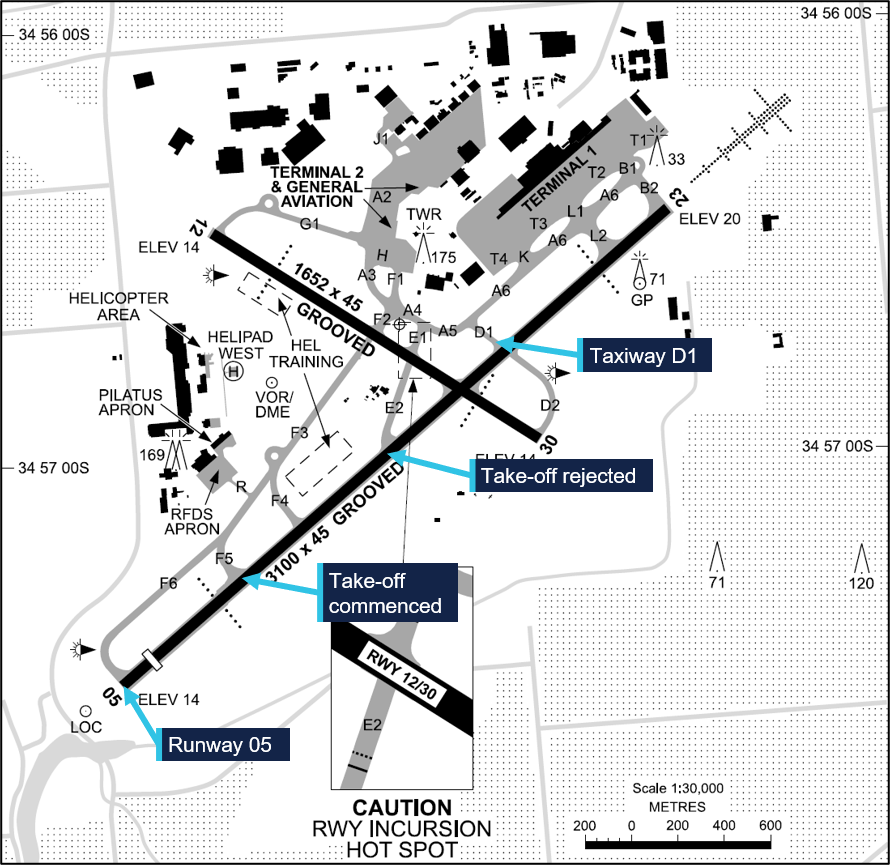
At 0716:49 local time, the flight crew began the take-off roll on runway 05 (Figure 1). At 0717:01, with the aircraft’s indicated airspeed at about 80 kt, the left engine torque began to fluctuate and shortly after, both flight crew noticed the aircraft yaw slightly to the left. At 0717:09, and 113 kt indicated airspeed (8 kt below V1), the left engine oil pressure warning annunciator light illuminated on the central warning panel alongside the master warning. As per operating procedures, the captain immediately called ‘stopping’, retarded both power levers, and applied regular braking, while the first officer (FO) applied forward pressure on the control column.
At 0717:17, with the aircraft decelerating on the runway, the FO notified air traffic control they were stopping, which the tower controller acknowledged, and one second later, the left engine torque gauge indicated zero. At 0717:32, the aircraft stopped on the runway near taxiway D1 with the captain observing what they assessed as steam from the left engine. The flight crew began conducting failure management actions for a left engine failure, which involved shutting down the left engine and instructing the passengers to remain seated.
Figure 1: Adelaide Airport
Meanwhile, a Boeing 777 on a scheduled passenger air transport flight was on approach to runway 05. At 0718:40, the tower controller advised this aircraft’s flight crew that an aircraft was still on the runway and instructed them to continue their approach.
At 0720:04, after completing the engine failure management actions, the FO notified the tower controller of the left engine failure. The controller acknowledged the notification and asked whether the aircraft could move to taxiway D1. The FO advised they would comply, and shortly after, while the flight crew were taxiing to D1, the tower controller asked if they required Aviation Rescue Fire Fighting (ARFF) services, which the flight crew declined.
At 0720:44, the tower controller issued a landing clearance to the flight crew of the Boeing 777 aircraft. At 0721:02, VH-ZPN had stopped on taxiway D1 and the tower controller instructed them to contact the ground controller.
The ground controller observed steam or smoke from the left engine, and at 0722:20 notified the flight crew. During this time, the Boeing 777 aircraft was in the landing roll on runway 05. Shortly after, the ground controller advised the ARFF of smoke from the left engine and requested their attendance.
At 0723:39, the tower controller issued a take-off clearance for runway 05 to the flight crew of an Embraer E190 aircraft operating a scheduled passenger air transport flight. At 0723:58, an airport worker reported oil spilling from the left engine of VH‑ZPN to the ground controller, who requested the airport worker conduct a runway inspection. During this time, the Embraer took-off from the runway. The runway was subsequently closed while a runway inspection was performed.
The captain requested the ARFF check for smoke from the left engine. The ARFF initially reported a small fuel leak, with the captain notifying the flight attendant that an emergency evacuation may be required. However, upon further inspection, the ARFF advised the flight crew that the leaking fluid was oil and the flight crew decided to conduct a normal passenger disembarkation from the forward left exit. Passengers disembarked the aircraft onto the grass area adjacent to the taxiway and were subsequently transported by bus back to the terminal.
During this time, airport personnel conducting the runway inspection notified the tower controller of oil on the runway, which was subsequently cleaned, and the runway declared serviceable at 0749. Aircraft arrivals and departures from runway 05, which had been delayed during the runway inspection and clean-up, were then resumed.
Context
Pilot information
The captain held an Air Transport Pilot Licence (Aeroplane), a current class 1 aviation medical certificate, and had accrued 25,553 hours of aeronautical experience. Of this, about 14,996 hours were on the Saab 340, including 217 hours in the previous 90 days.
The first officer held a Commercial Pilot Licence (Aeroplane), a current class 1 aviation medical certificate, and had accrued 270 hours of aeronautical experience. Of this, about 91 hours were on the Saab 340, all of which were accrued in the previous 90 days.
Aircraft and engine information
VH-ZPN was a Saab 340B, manufactured in Sweden in 1995, and first registered in Australia in 2010. The aircraft was powered by 2 General Electric (GE) CT7-9B turboprop engines, equipped with Hamiton Standard 14RF-19 propellers.
The engine consists of a gas generator powering a free turbine, which is directly coupled to a propeller gearbox. The gas generator has an axial-centrifugal compressor with 5 axial stages and 1 centrifugal stage. The compressors are driven by a 2-stage gas generator turbine. The propeller is driven by a 2-stage free turbine through a reduction gearbox. Each propeller has full feathering and reversing capabilities.
Engine examination
After the incident, Rex maintenance personnel conducted a visual inspection of the engine, including disassembly of the power turbine module where various components were found damaged. The engine was subsequently sent to an authorised CT7 engine overhaul facility in England where a teardown inspection was completed in April 2026.
The inspection confirmed that the damage was primarily associated with the power turbine module. Damaged components were collected and sent to a GE technical facility in the United States for metallurgical examination. The ATSB did not attend any of these examinations. The results of the metallurgical examination are expected by the end of September 2026.
Further investigation
To date, the ATSB has interviewed the flight crew and tower controller, obtained recorded data, air traffic control and airport procedures, and collected other relevant information. Once complete, the ATSB will obtain the engine teardown inspection reports and metallurgical examination reports for review.
The investigation is continuing and will include analysis of:
- flight crew operating procedures
- air traffic control procedures
- airport procedures
- engine manufacturer metallurgical examination
- engine data.
A final report will be released at the conclusion of the investigation. Should a critical safety issue be identified during the course of the investigation, the ATSB will immediately notify relevant parties, so that appropriate safety action can be taken.
Purpose of safety investigationsThe objective of an ATSB safety investigation is to improve transport safety through:
In accordance with the TSI Act, the ATSB does not investigate for the purpose of taking administrative, regulatory or criminal action, and cannot apportion blame, assist in determining liability, or, as a general rule, assist in court proceedings. About ATSB reportsATSB safety investigation reports are developed in accordance with ATSB procedures and guidelines, and with regard to applicable international standards and instruments. Reports must include factual material of sufficient weight to support the investigation’s analysis and findings. At all times the ATSB endeavours to balance the use of material that could imply adverse comment with the need to properly explain what happened, and why, in a fair and unbiased manner. An explanation of terminology used in ATSB investigation reports is available here. Publishing informationReleased in accordance with section 25 of the Transport Safety Investigation Act 2003 Published by: Australian Transport Safety Bureau © Commonwealth of Australia 2026 Ownership of intellectual property rights in this publication Unless otherwise noted, copyright (and any other intellectual property rights, if any) in this report publication is owned by the Commonwealth of Australia. Creative Commons licence 
With the exception of the Commonwealth Coat of Arms, ATSB logo, and photos and graphics in which a third party holds copyright, this report is licensed under a Creative Commons Attribution 4.0 International licence. The CC BY 4.0 licence enables you to distribute, remix, adapt, and build upon our material in any medium or format, so long as attribution is given to the Australian Transport Safety Bureau. Copyright in material obtained from other agencies, private individuals or organisations, belongs to those agencies, individuals or organisations. Where you wish to use their material, you will need to contact them directly. |
- ^ V1: the critical engine failure speed or decision speed required for take-off. Engine failure below V1 should result in a rejected take off; above this speed the take-off should be continued.
Occurrence summary
| Investigation number | AO-2025-060 |
|---|---|
| Occurrence date | 08/10/2025 |
| Occurrence time and timezone | 0717 Australian Central Daylight saving Time |
| Location | Adelaide Airport |
| State | South Australia |
| Report release date | 04/09/2026 |
| Report status | Interim |
| Anticipated completion | Q4 2026 |
| Investigation level | Short |
| Investigation type | Occurrence Investigation |
| Investigation phase | Examination and analysis |
| Investigation status | Active |
| Mode of transport | Aviation |
| Aviation occurrence category | Engine failure or malfunction, Rejected take-off |
| Occurrence class | Serious Incident |
| Highest injury level | None |
Aircraft details
| Manufacturer | Saab Aircraft Co. |
|---|---|
| Model | 340B |
| Registration | VH-ZPN |
| Serial number | 340B-384 |
| Aircraft operator | Regional Express |
| Sector | Turboprop |
| Operation type | Part 121 Air transport operations - larger aeroplanes |
| Activity | Commercial air transport-Scheduled-Domestic |
| Departure point | Adelaide Airport, South Australia |
| Destination | Broken Hill Airport, New South Wales |
| Injuries | None |
| Damage | Minor |