

Preliminary report
Report release date: 30/09/2026
| The ATSB has released this preliminary report to provide a timely update on evidence gathered and investigation activities to date. It outlines areas of further investigation but does not contain analysis or findings, which will be detailed in a final report at the conclusion of the investigation. The information in this report is released in accordance with section 25 of the Transport Safety Investigation Act 2003. |
Summary video
The occurrence
On the morning of 9 August 2026, 2 Boeing 737 aircraft were taxiing to depart from runway 34L1 at Sydney Airport, New South Wales:
- VH-IJQ, a Boeing 737-8SA operated by Virgin Australia Airlines as flight VA555, was conducting a scheduled air transport flight to Perth Airport, Western Australia, with 2 flight crew, 4 cabin crew and 167 passengers on board.
- VH-XZH, a Boeing 737-838 operated by Qantas Airways as flight QF728, was taxiing for a scheduled air transport flight to Ayers Rock Airport, Northern Territory, with 2 flight crew, 4 cabin crew and 162 passengers on board.
Air traffic control (ATC) services were being provided by several controllers inside the Sydney ATC tower (see Table 1 below). VA555 was being provided with ATC by the aerodrome controller west (ADCW), who was receiving familiarisation training from an on-the-job training instructor (OJTI) at the time. QF728 was being provided with ATC by the surface movement controller west (SMCW). The ADCW, OJTI and SMCW were located in the Sydney Tower (see Sydney Airport air traffic control). The ADCW and the SMCW used different radio communication frequencies, and neither flight crew could hear the ATC instructions or responses specific to the other aircraft. The visibility at the time was in excess of 10 km, the wind was 310° at 7 kt (13 km/h), and there was no cloud cover below 5,000 ft.
Both aircraft had departed from Sydney’s domestic terminal and the taxi routing from the terminal to runway 34L required all aircraft to cross the runway to facilitate a full-length departure. VA555 had departed the domestic terminal 7 minutes ahead of QF728 and was next in line to take off from intersection A6 on runway 34L. QF728 had followed the same routing and had been instructed to hold at the intersection of runway 34L and taxiway L (Figure 1). At the same time, QF4, a Boeing 787 that had recently landed on runway 34R was taxiing to the international terminal. QF4 was taxiing on the cross-runway (runway 25) and holding at the intersection with runway 34L awaiting a clearance to cross from the SMCW.
Figure 1: VA555 and QF728 taxi route and positions at 1003:48
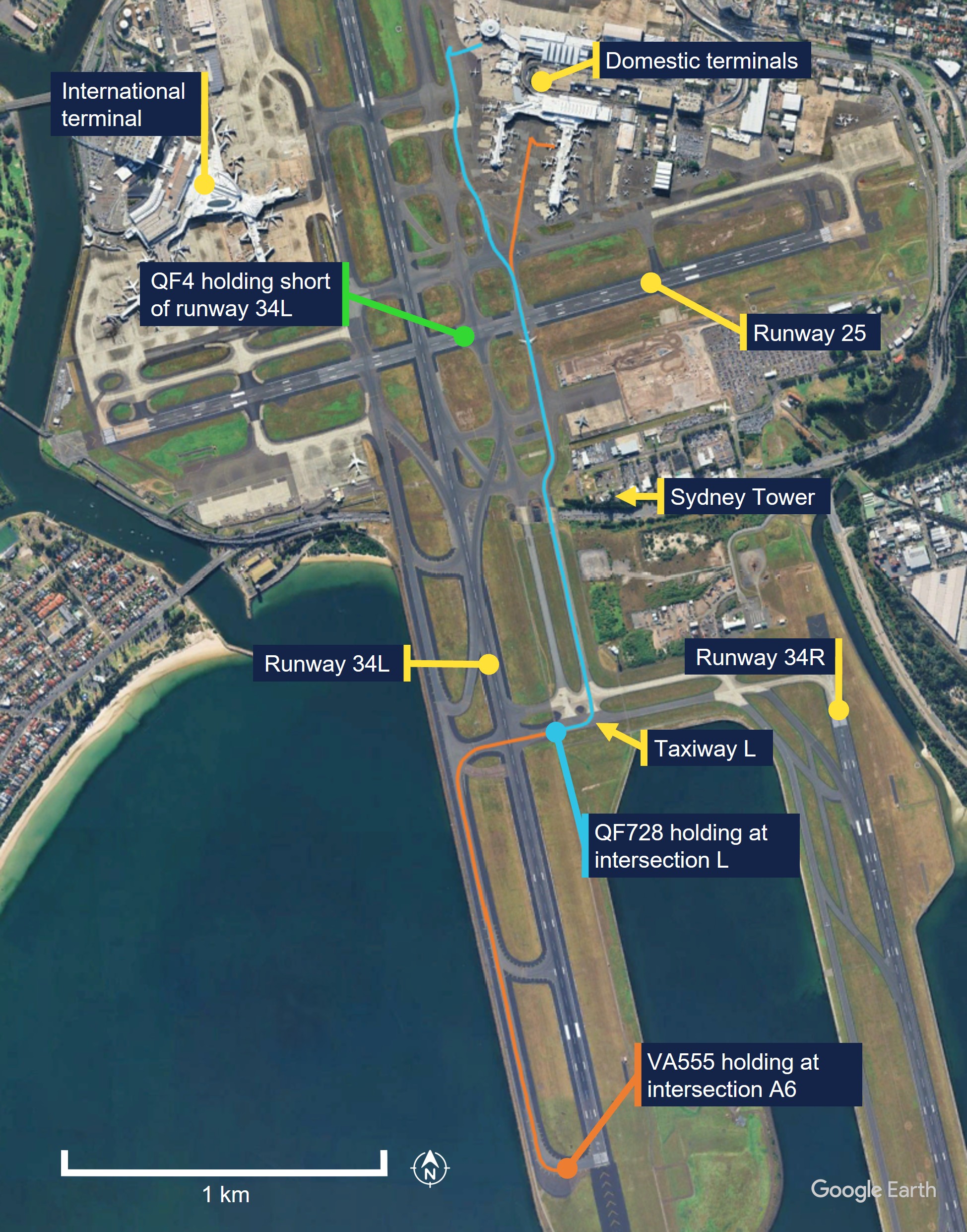
At 1003:45, the ADCW coordinated2 with the SMCW, advising the SMCW to allow QF728 to cross runway 34L on taxiway L behind a landing aircraft. The ADCW later recalled that they also intended to coordinate with the SMCW to allow QF4 to cross runway 34L behind the same landing aircraft.
At 1003:51, the ADCW issued a clearance for VA555 to line up on runway 34L. The first officer (FO) acknowledged the clearance, and the captain taxied the aircraft onto the runway, coming to a stop on the threshold.
At 1004:07, the SMCW issued a clearance for QF728 to cross runway 34L on taxiway L and the ADCW deactivated the stop bars3 at the intersection. The first officer acknowledged the clearance, and the captain taxied the aircraft towards the runway intersection. The flight crew of QF728 recalled observing VA555 at the threshold of runway 34L.
During this time the ADCW placed a runway crossing strip4 in the ‘bay’5 for runway 34L. They recalled that the crossing strip was used to indicate that both QF728 and QF4 would be crossing runway 34L. However, the ADCW decided not to proceed with their plan to allow QF4 to cross the runway, and they removed the runway crossing strip from the ‘bay’. The ADCW later recalled that they had forgotten that the crossing strip also signified that QF728 was crossing 34L on intersection L.
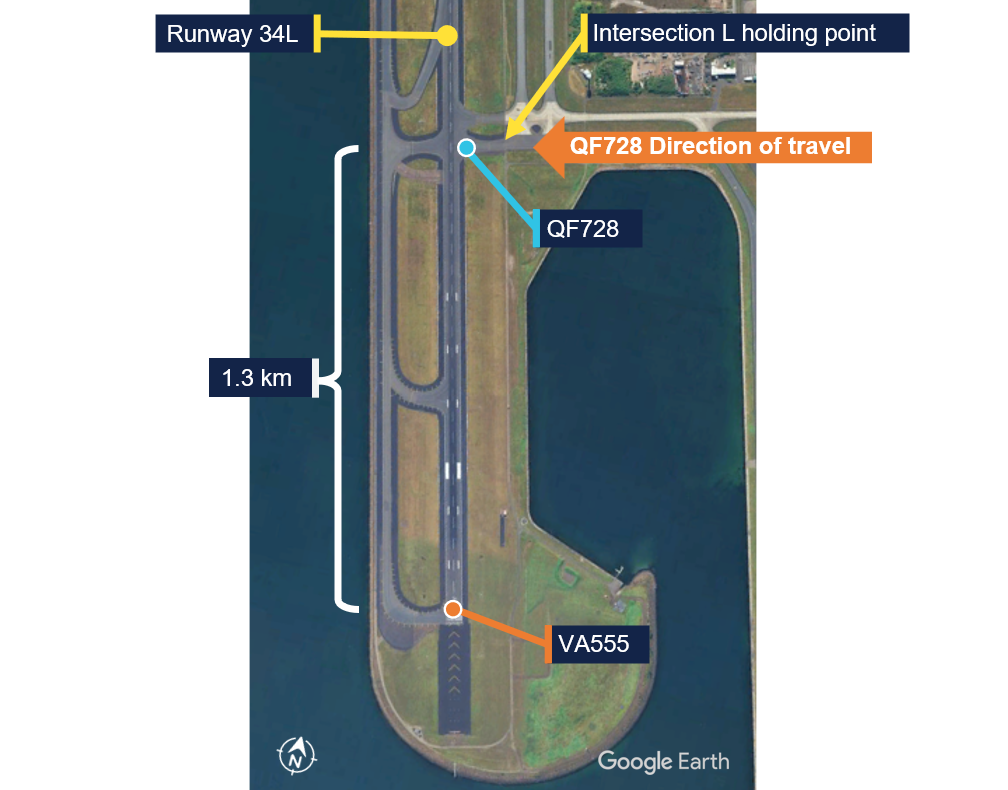
At 1004:48, the ADCW issued a take-off clearance to VA555, which the FO immediately acknowledged. At this time QF728 was occupying the runway protected area6 1.3 km ahead of VA555 (Figure 2).
Figure 2: QF728 and VA555 positions at 1004:48
At 1004:50, the captain of VA555 advanced the thrust levers on both engines in preparation for take-off and the aircraft began to move along the runway at about 2 kt (3 km/h). At about the same time, the OTJI identified the conflict between VA555 and QF728 and advised the ADCW that there was an aircraft crossing on taxiway L. During this time, the OJTI recalled that VA555 appeared to be stationary while the ADCW recalled the aircraft was in the process of lining up on the runway.
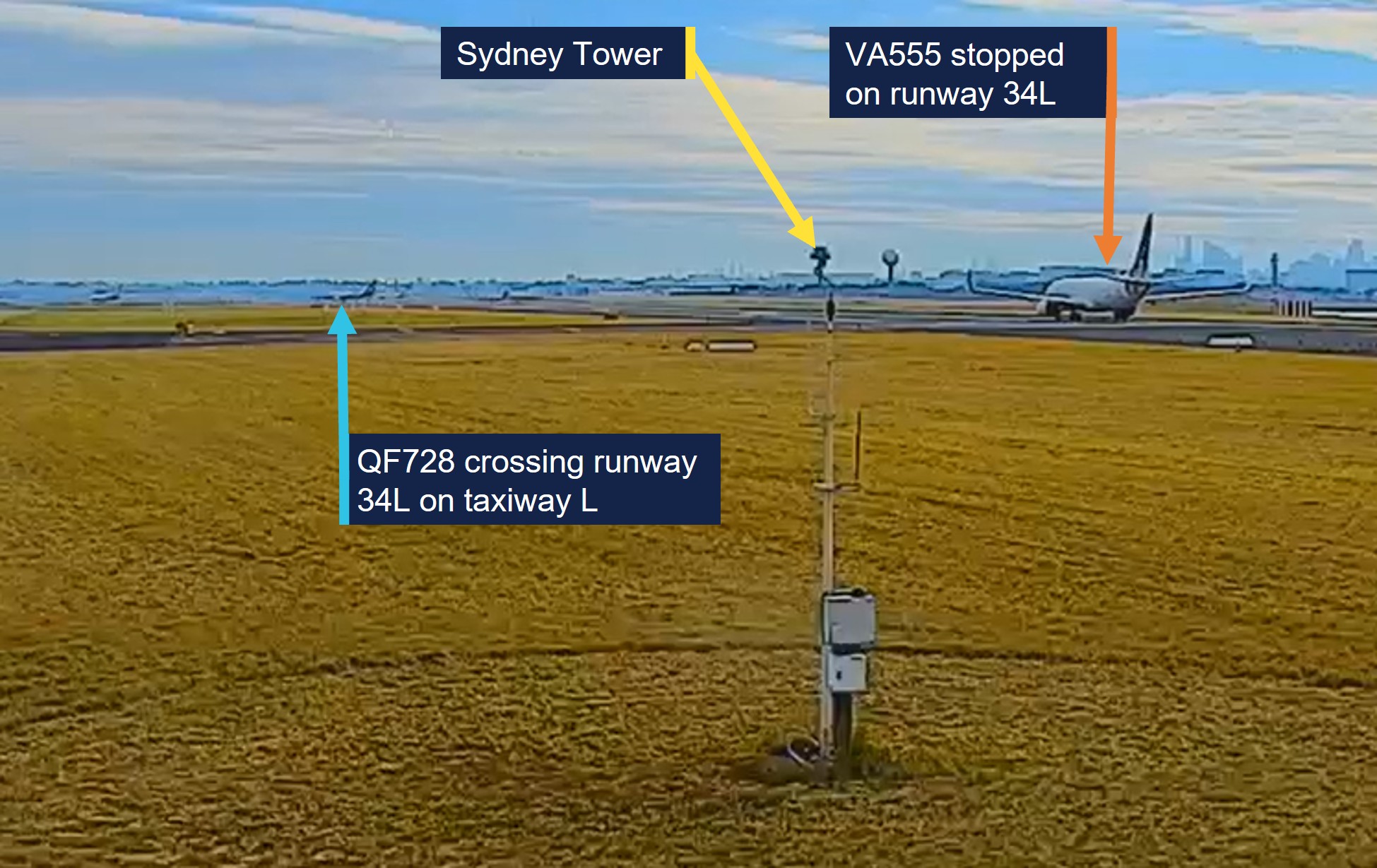
At 1004:56, the ADCW issued VA555 with a take-off clearance cancellation, which was acknowledged by the FO. At about the same time, the captain of VA555, having observed QF728 enter the runway at taxiway L, retarded the thrust levers as both engine N17 indications reached 33% and brought the aircraft to a stop (Figure 3). Meanwhile, QF728 continued to taxi across runway 34L on taxiway L and exited the runway protected area at 1005:11.
Figure 3: VA555 and QF728 at about 1004:56
At 1005:12, the ADCW issued a new take-off clearance to VA555 and the aircraft completed the take-off without further incident. QF728 took off from the same runway shortly after. No injuries or damage were reported.
Shortly after the occurrence, the OJTI discussed the circumstances with the tower shift manager (TSM) (see Sydney Tower staffing). The TSM subsequently discussed the matter with a senior colleague, who also held a TSM endorsement, and was located in the Sydney tower at the time. Together, they assessed that the occurrence was not a reportable matter because:
- the ADCW was under direct supervision of an OJTI at the time
- the conflict had been identified by the OJTI who had intervened to initiate the immediate cancellation of the take-off clearance issued to VA555
- it was believed the take-off clearance was cancelled while VA555 was stationary on the runway.
As a result, the TSM did not submit an Airservices Australia corporate integrated reporting and risk information system (CIRRIS)8 report, and the occurrence was not reported to the ATSB by Airservices Australia (see Occurrence reporting).
Context
Personnel information
VH-IJQ (VA555) flight crew
The captain held an Air Transport Pilot Licence (ATPL) (Aeroplane) and a class 1 aviation medical certificate. They had a total of 21,546 hours total flying time, with 19,199 hours on the Boeing 737. They reported feeling ‘very lively, responsive, but not at peak’ at the time of the occurrence.
The first officer held an ATPL (Aeroplane) and a class 1 aviation medical certificate. They had a total of 20,578 hours total flying time, with 11,778 hours on the Boeing 737. They reported feeling ‘very lively, responsive, but not at peak’ at the time of the occurrence.
VH-XZH (QF728) flight crew
The captain held an ATPL (Aeroplane) and a class 1 aviation medical certificate. They had a total of 22,583 hours total flying time, with 6,036 hours on the Boeing 737. They reported feeling ‘very lively, responsive, but not at peak’ at the time of the occurrence.
The first officer held a Commercial Pilot Licence (Aeroplane) and a class 1 aviation medical certificate. They had a total of 4,391 hours total flying time, with 498 hours on the Boeing 737. They reported feeling ‘very lively, responsive, but not at peak’ at the time of the occurrence.
Aerodrome controller west
The aerodrome controller west (ADCW) held endorsements for all controller positions in the Sydney Airport Tower (see Sydney Airport air traffic control). They had recently completed endorsement training for the surface movement controller east and west positions on 7 August 2026. During the training, the recency for their aerodrome controller east and west endorsements had lapsed, which required familiarisation training on those positions under the supervision of an on-the-job training instructor (OJTI) prior to completing a renewal check. They began their shift at 0600 under the supervision of an OJTI and reported that at the time of the occurrence they felt ‘extremely tired,’ which they attributed to the familiarisation training.
On-the-job training instructor
The OJTI held endorsements and supervisor qualifications for all controller positions in the Sydney tower. They began their shift at 0600 and they reported that at the time of the occurrence they felt ‘fully alert.’
Surface movement controller west
The surface movement controller west (SMCW) held endorsements for clearance delivery, coordinator and surface movement controller positions in the Sydney tower. They began their shift at 0550 and they reported that at the time of the occurrence they felt ‘‘very lively, responsive, but not at peak.’
Tower shift manager
The tower shift manager (TSM) held endorsements for all controller positions in the Sydney tower. They began their shift at 0730 in the SMC position. At 0951, they took over the combined TSM and coordinator positions (see Sydney Airport air traffic control). They reported that at the time of the occurrence they felt ‘a little tired.’
Sydney Airport air traffic control
General information
Syndey Airport has 2 parallel runways oriented 155°/335° magnetic (16L/34R and 34L/16R) and another runway oriented 062°/242° (07/25). At the time of the occurrence, the airport was operating in parallel runway mode with aircraft taking off and landing on runways 34L and 34R. The Sydney tower was located to the east of runway 34L/16R, and south of runway 07/25.
Sydney tower staffing
The Sydney tower had 7 designated operational positions (Table 1). However, as controllers required regular breaks throughout their shift, additional personnel would generally be needed unless the positions were combined.
Table 1: Sydney tower operational positions
| Operational position | Responsibility |
| Tower shift manager | General supervision of operational staff to ensure a safe and efficient air traffic service, the supervision of controllers, and the application of operational command authority. |
| Coordinator | The overall operation of the tower, automatic terminal information service updates, and working with external stakeholders on departure times. |
| Clearance delivery | Obtaining and providing airways clearances to aircraft in preparation for their departure. |
| Surface movement controller west | The provision of surface movement control on all manoeuvring areas and taxiways (including pushback procedures and entry/exit regulation) west of runway 16R/34L. |
| Surface movement controller east | The provision of surface movement control on all manoeuvring areas and taxiways (including pushback procedures and entry/exit regulation) east of runway 16R/34L, excluding taxiways controlled by Aerodrome controller east. |
| Aerodrome controller west | Providing traffic management to aircraft taking off and landing on runway 34L/16R. |
| Aerodrome controller east | Providing traffic management to aircraft taking off and landing on runway 34R/16L and management of operations on all taxiways between runway 34R/16L and taxiway C. |
At the time of the occurrence, there were 7 Airservices Australia9 personnel occupying operational positions within the Sydney tower. This included the OJTI who was supervising the ADCW, meaning 2 of the personnel were doing one role. Six operational positions were individually staffed, and the TSM position had been combined with the coordinator position. It was reported that the tower had been short-staffed by one controller at the beginning of the morning shift while another controller had been stood down due to their involvement in an occurrence that took place at 0720 on the same day (see ATSB investigation AO-2026-087). The controller shortage was managed by combining various controller positions and managing controller’s breaks throughout the day.
The duty times completed for the ADCW, TSM, SMCW, and OJTI during the period 3 to 9 August are depicted in Table 2.
Table 2: Controller (on the day of the occurrence) duty times 3 to 9 August 2026
| Controller | 3 AUG 26 | 4 AUG 26 | 5 AUG 26 | 6 AUG 26 | 7 AUG 26 | 8 AUG 26 | 9 AUG 26 |
| ADCW | 0600-1400
| 0550-1330
| 0550-1300
| 0600-1400
| 0600-1400
| ||
| TSM | 0515-1345
| 0600-1530
| 0730-1530
| 0515-1345
| 0730-1530
| 0730-1530
| |
| SMCW | 0730-1545
| 1200-2200
| 0540-1345
| 0600-1400
| 0550-1330
| ||
| OJTI | 0550-1300
| 0530-1230
| 0600-1400
|
The procedures for rostering controllers were documented in the Airservices Australia Workforce deployment rostering manual and strategic roster planning process, which was contained in the Air Traffic Services (ATS) Fatigue risk management procedure. Should a change to the published roster be required, it was to be assessed for fatigue-related risk using the tactical roster management principles (TRMPs). Any deviation from the TRMPs was rated and categorised into low, medium and high predicted fatigue level bands.
Rostering documentation for the day of the occurrence indicated that the TSM was the only controller occupying an operational position at the time of the occurrence with an assigned TRMP predicted fatigue level, which had been calculated as ‘low’. According to the ATS Fatigue risk management procedure, a controller with a ‘low’ predicted fatigue level could be allocated to a shift without any further risk assessment or action in most circumstances. The fatigue level predictions did not indicate that a controller was fatigued, but that they were at risk of fatigue based on their roster. In addition to the organisational fatigue monitoring, Airservices Australia required all controllers to advise their manager if they felt they were not fit for duty.
The Civil Aviation Safety Regulations Part 172 (Air Traffic Service Providers) Amendment (Fatigue Rules) Manual of Standards 2023 required Airservices Australia to have a fatigue risk management system (FRMS) that was approved by the Civil Aviation Safety Authority (CASA) for implementation by 1 September 2024. Airservices Australia had submitted a draft FRMS to CASA, however the FRMS had not yet been approved. Airservices Australia had been operating under a CASA exemption since 1 September 2024 which permitted operations without an approved FRMS.
CASA reported that, while the exemption was in place, Airservices continued to operate under existing fatigue risk management arrangements and was required to meet a number of additional conditions. This included providing CASA with regular reports on fatigue risk management and progress towards the development of an FRMS.
The current exemption commenced on 1 September 2026 and was due to expire on 28 February 2027. CASA expects Airservices to have an approved FRMS in place by the expiry of the exemption.
Occurrence reporting
ATSB reporting requirements
The Transport Safety Investigation (TSI) Regulations 2021prescribe what occurrences must be reported to the ATSB, the timeframes those reports must be made in, who is required to make a report, and the particulars to be included.
The TSI Regulations defined occurrences that must be reported to the ATSB under the TSI Act 2003 as:
- immediately reportable matters, which were required to be initially reported by telephone as soon as reasonably practical
- routine reportable matters, which could be notified to the ATSB by a written report within 72 hours.
Both aircraft involved in the occurrence were defined under Section 8 of the TSI Regulations as Category A (passenger transport) aircraft operations. Section 11A of the TSI Regulations defined the immediately reportable matters for Category A aircraft operations, which include:
(1) c) a loss of a separation standard between aircraft.
Section 11A also defined routine reportable matters for Category A aircraft operations, which included:
(2) a) an aircraft incident.
Guidance for aviation industry participants on what and how to report occurrences to the ATSB was documented on the ATSB website and published in the Aeronautical Information Package (AIP),10 which was available on the Airservices Australia website. This guidance defined a loss of separation standard between aircraft as a situation where the recognised separation standard (vertical, lateral or longitudinal) between aircraft that are being provided with an Air Navigation Service Provider separation service is infringed. This included a loss of prescribed runway or wake turbulence separation standards.
The guidance also contained definitions for aircraft incidents, including runway incursions which were defined as the incorrect presence of an aircraft, vehicle or person on the protected area of a surface designated for the landing and take-off of aircraft. Incorrect presence was further defined within the guidance as anything within the confines of the runway strip, irrespective of having an appropriate clearance, which hinders the operation of an arriving or departing aircraft.
As a result, the occurrence is considered to be a reportable matter under the TSI Regulations.
Reportable matters known by responsible persons were required to be reported to the ATSB by that person unless they believed, on reasonable grounds, that one or more other responsible persons had already reported the matter, or would report the matter as soon as was reasonably practicable.
The definition of responsible persons included:
- a crew member of the aircraft concerned
- the owner or operator of the aircraft
- a person performing an air traffic control service in relation to the aircraft.
Reporting of the occurrence to the ATSB
On 13 August 2026, Virgin Australia initiated a meeting with Airservices Australia to discuss the occurrence. During this meeting, Virgin Australia reported that it was disclosed that Airservices Australia had not reported the occurrence to the ATSB and did not consider it was reportable as the separation issue was considered a training occurrence rather than a safety occurrence. In response, Virgin Australia reported the occurrence to the ATSB on 13 August 2026.
Airservices Australia reporting requirements
The Airservices Australia Manual of air traffic services (MATS)11 broadly described the requirement to submit an occurrence report, which stated:
If you are aware that an accident, incident or event has occurred, ensure that applicable immediate notification requirements are met and an appropriate report is submitted.
The Airservices Australia National air traffic services administration manual (NAAM) also stated that immediately and routine reportable matters under the TSI Regulations required ‘directed notification’ and the submission of details via the corporate integrated reporting and risk information system (CIRRIS). This section of the NAAM also contained a link to the reporting requirements and occurrence definitions contained within the AIP.
Recorded information
Aircraft data
Data from the quick access recorders fitted to both VH-IJQ and VH-XZH was provided by the aircraft operators, which captured the occurrence. Cockpit voice recorder information was not available due to the time that had elapsed since the occurrence.
Airservices Australia data
Airservices Australia provided advanced surface movement guidance and control system (A‑SMGCS) recordings, which captured the position of aircraft and ground vehicles at the time of the occurrence. Both the ADCW and SMCW had access to an A‑SMGCS display at their controller positions in the tower. Air traffic control radio and coordination recordings were also provided by Airservices Australia.
Sydney Airport CCTV
Closed-circuit television (CCTV) footage was provided by Sydney Airport from a camera located near the threshold of runway 34L. The footage captured the position of both VA555 and QF728 during the occurrence.
Further investigation
To date, the ATSB has:
- interviewed the flight crew of VH-IJQ and VH-XZH
- interviewed Airservices Australia Sydney tower personnel
- collected aircraft traffic surveillance data, air traffic control radio communication recordings, and closed-circuit television (CCTV) footage
- collected flight data from VH-IJQ and VH-XZH
- collected aircraft operator and Airservices Australia documentation.
The investigation is continuing and will include further analysis of:
- flight data and aircraft traffic surveillance data
- air traffic control communications
- CCTV footage
- air traffic controller training records
- Airservices Australia reporting practices
- Airservices Australia processes, procedures and documentation.
Should a critical safety issue be identified during the course of the investigation, the ATSB will immediately notify relevant parties so appropriate and timely safety action can be taken.
A final report will be released at the conclusion of the investigation.
Purpose of safety investigationsThe objective of an ATSB safety investigation is to improve transport safety through:
In accordance with the TSI Act, the ATSB does not investigate for the purpose of taking administrative, regulatory or criminal action, and cannot apportion blame, assist in determining liability, or, as a general rule, assist in court proceedings. About ATSB reportsATSB safety investigation reports are developed in accordance with ATSB procedures and guidelines, and with regard to applicable international standards and instruments. Reports must include factual material of sufficient weight to support the investigation’s analysis and findings. At all times the ATSB endeavours to balance the use of material that could imply adverse comment with the need to properly explain what happened, and why, in a fair and unbiased manner. An explanation of terminology used in ATSB investigation reports is available here. Publishing informationReleased in accordance with section 25 of the Transport Safety Investigation Act 2003 Published by: Australian Transport Safety Bureau © Commonwealth of Australia 2026 Ownership of intellectual property rights in this publication Unless otherwise noted, copyright (and any other intellectual property rights, if any) in this report publication is owned by the Commonwealth of Australia. Creative Commons licence 
With the exception of the Commonwealth Coat of Arms, ATSB logo, and photos and graphics in which a third party holds copyright, this report is licensed under a Creative Commons Attribution 4.0 International licence. The CC BY 4.0 licence enables you to distribute, remix, adapt, and build upon our material in any medium or format, so long as attribution is given to the Australian Transport Safety Bureau. Copyright in material obtained from other agencies, private individuals or organisations, belongs to those agencies, individuals or organisations. Where you wish to use their material, you will need to contact them directly. |
- ^ Runway numbering: the number represents the magnetic heading closest to the runway (runway 34 at Sydney Airport is oriented 335° magnetic) and L indicates the left parallel runway.
- ^ Coordination between ADCW and SMCW was required prior to issuing an aircraft or ground vehicle with clearance to cross a runway.
- ^ Stop bars: comprised of a row of red lights inset into the surface of the taxiway. Aircraft or authorised vehicles must not cross the stop bars without both an air traffic control clearance and the red stop bar lights being extinguished.
- ^ When a clearance was issued to an aircraft to cross a runway, controllers were required to display a ‘runway crossing’ strip in the corresponding runway ‘bay’.
- ^ The aerodrome controller positions were equipped with a flight progress board that contained bays to physically arrange strips that were used to indicate the status of aircraft.
- ^ Protected area: in the context of runway incursions, the protected area of a surface designated for the landing and take-off of aircraft is comprised of the runway, the stopway, the runway end safety area, the area along each side of the runway whose width is the runway-holding position distance, and, if provided, the clearway.
- ^ Engine fan and low-pressure compressor rotational speed, expressed as a percentage of manufacturer defined revolutions per minute.
- ^ A CIRRIS report is an electronically submitted safety occurrence report which forms part of the risk information system maintained by Airservices Australia.
- ^ Airservices Australia is Australia's principal provider of air traffic services for civil airports and airspace.
- ^ Aeronautical information publication (AIP): Published by Airservices Australia, contained aeronautical maps, charts and other aeronautical information and instructions.
- ^ The Manual of Air Traffic Services is a joint document of Defence and Airservices and is based on the rules published in Civil Aviation Safety Regulations Part 172 – Manual of Standards and International Civil Aviation Organization standards and recommended practices, combined with rules specified by Airservices and Defence.
Occurrence summary
| Investigation number | AO-2026-090 |
|---|---|
| Occurrence date | 09/08/2026 |
| Occurrence time and timezone | 1004 Australian Eastern Standard Time |
| Location | Sydney Airport |
| State | New South Wales |
| Report release date | 30/09/2026 |
| Report status | Preliminary |
| Anticipated completion | Q1 2027 |
| Investigation level | Short |
| Investigation type | Occurrence Investigation |
| Investigation phase | Evidence collection |
| Investigation status | Active |
| Mode of transport | Aviation |
| Aviation occurrence category | Information/procedural error, Loss of separation, Rejected take-off, Runway incursion |
| Occurrence class | Incident |
| Highest injury level | None |
Aircraft details
| Manufacturer | The Boeing Company |
|---|---|
| Model | 737-838 |
| Registration | VH-XZH |
| Serial number | 39372 |
| Aircraft operator | Qantas Airways Limited |
| Sector | Jet |
| Operation type | Part 121 Air transport operations - larger aeroplanes |
| Activity | Commercial air transport-Scheduled-Domestic |
| Departure point | Sydney Airport, New South Wales |
| Destination | Ayers Rock Airport, Northern Territory |
| Injuries | None |
| Damage | Nil |
Aircraft details
| Manufacturer | The Boeing Company |
|---|---|
| Model | 737-8SA |
| Registration | VH-IJQ |
| Serial number | 44222 |
| Aircraft operator | Virgin Australia Airlines Pty Ltd |
| Sector | Jet |
| Operation type | Part 121 Air transport operations - larger aeroplanes |
| Activity | Commercial air transport-Scheduled-Domestic |
| Departure point | Sydney Airport, New South Wales |
| Destination | Perth Airport, Western Australia |
| Injuries | None |
| Damage | Nil |