

Final report
Report release date: 20/11/2025
Investigation summary
What happened
Between June 2023 and April 2024, 3 misaligned take-offs at Perth Airport, Western Australia, were reported to the ATSB. Each incident occurred before first light and involved the pilots inadvertently lining the aircraft up with the edge lighting, rather than the centreline, on runway 06 prior to take-off.
On 12 June 2023, a Virgin Australia Airlines Boeing 737-800 aircraft, registered VH-IWQ, was being operated on a regular passenger transport flight from Perth, Western Australia, to Sydney, New South Wales. During the take-off roll, the flight crew identified that the aircraft was aligned with the left edge lights of the runway and manoeuvred to the centreline. The flight continued without further incident. A subsequent aircraft and runway inspection did not find any damage.
On 10 August 2023, a Western Sky Aviation Cessna Conquest 441, registered VH‑NSA, was being operated on a passenger charter flight from Perth to Southern Cross, Western Australia. During the take-off roll, the pilot detected an impact with the aircraft. After take‑off, the pilot returned to Perth and a subsequent inspection found no aircraft damage, but identified several damaged runway edge lights.
On 4 April 2024, VH‑NSA was again operating a passenger charter flight from Perth to Southern Cross. During the take-off roll, the pilot (different to the previous incident) heard an unusual noise but believed it originated from inside the cabin. As all engine indications were normal, they continued the departure. A runway inspection conducted by the aerodrome operator later that morning found several damaged runway edge lights. The pilot identified minor damage to the propeller on the right engine after returning to Perth Airport.
What the ATSB found
The ATSB found that, in all 3 incidents, when entering runway 06 from taxiway V, the pilots taxied past the turn onto the centreline and lined the aircraft up along the runway edge lighting on the far side of the runway to where they entered. In each incident, as the pilots believed they had correctly aligned the aircraft with the runway centreline, they commenced the take-off.
Several factors known to increase the risk of a misaligned take-off in the dark were identified as present in all 3 incidents. In terms of the runway environment, there was an unlit and unmarked extended pavement area on each side of runway 06, which made the runway appear wider. In relation to the available airport lighting, the lead-on lights from taxiway V continued across the taxiway to the other side, meaning there was limited guidance when taxiing to the runway’s centreline; recessed edge lights at the start of runway 06 could be mistaken for centreline lighting, and there was limited ambient airport lighting around taxiway V and runway 06 to enhance visibility. The taxi lighting on one of the aircraft was reported by the pilots as being of limited benefit. Additionally, the required runway markings were reported by 2 of the incident pilots to be difficult to see at night.
One factor specific to the flight crew in incident 1 was their attention was diverted to completing pre-take-off tasks and their take-off clearance while lining up on the runway. This divided their attention between the flight deck and the monitoring of the external environment.
The ATSB also identified differences in how the pilots responded to the misaligned take‑off. In the first incident, the flight crew identified that they had lined up in the incorrect position, manoeuvred the aircraft onto the centreline, and continued the take-off and flight. The pilot of the second incident detected an impact during the take-off roll and decided to conduct a return to Perth for further inspection. The pilot of the third incident was not aware the aircraft was misaligned on the runway edge and damage to the propeller blade was not detected until several flights later.
What has been done as a result
After the incidents in August 2023 and April 2024, Western Sky Aviation distributed notices to its flight crew that included strategies to check runway alignment prior to take‑off, including the use of an electronic flight bag aerodrome chart and integrated landing systems, where available.
Perth Airport requested an update to the Aeronautical Information Publication supplement, effective November 2023, to identify a misaligned take-off hotspot on runway 06, and highlight to pilots that runway 06 did not have centreline lighting and that there was extra pavement on either side of the runway. The En Route Supplement Australia was updated to reflect the misaligned hotspot area in March 2024. Further, in works to repaint the runway markings, completed in April 2024, Perth Airport also painted chevrons on the extra pavement on either side of runway 06 to delineate this area from the useable runway to assist pilots with determining their position prior to commencing take-off.
Following the incident in June 2023, Virgin Australia Airlines completed a number of safety actions, including:
- added caution notes to its Perth Airport supplementary port information about centreline misidentification on runway 06
- revised the before take-off procedure to reallocate tasks earlier in the taxi to reduce flight crew workload during line-up.
- developed case studies involving this event, which were incorporated into non‑technical skills training.
Safety message
The features of airport runways and taxiways can vary, and the combination of these features or lack of guidance to assist pilots to navigate or confirm their aircraft’s position can increase the risk of runway misalignments. Further, this can be exacerbated at night‑time where the amount of visual information available is markedly reduced. These reduced visual cues can affect pilots even when they are familiar with the airport. It is important for all pilots to thoroughly brief themselves with the local conditions to increase their awareness of the environment. Pilots are also encouraged to report any circumstances where they believe they may have conducted a misaligned take-off, to limit the risk to their aircraft and others subsequently using the same runway. This would also allow aerodrome operators to identify any trends or emerging misaligned take-off hotspots to consider mitigations.
Summary video
The investigation
| Decisions regarding the scope of an investigation are based on many factors, including the level of safety benefit likely to be obtained from an investigation and the associated resources required. For this occurrence, a limited-scope investigation was conducted in order to produce a short investigation report, and allow for greater industry awareness of findings that affect safety and potential learning opportunities. |
The occurrences
Between June 2023 and April 2024, 3 misaligned take-off events occurred at Perth Airport, Western Australia. Each incident occurred prior to first light and involved the pilots inadvertently lining the aircraft up with the runway 06 edge lighting, rather than the centreline, prior to take‑off.
Incident 1
On the morning of 12 June 2023, the captain and first officer (FO) of a Virgin Australia Airlines Boeing 737-800, registered VH-IWQ, prepared for a regular passenger transport flight from Perth, Western Australia, to Sydney, New South Wales.
At 0600 local time, the aircraft was pushed back from the bay and the captain switched on the aircraft navigation lights and logo lights. The FO obtained a taxi clearance from air traffic control, and the captain switched on the taxi lights before taxiing the aircraft to runway 06 using taxiway ‘V’ (Figure 1).[1] Around 12 minutes later, as they approached the holding point[2] on taxiway V from the south, the FO reported to the controller that they were ‘ready’ [for take-off]. At this time, the flight crew commenced the ‘before take-off’ procedure (see Incident 1 Virgin Australia procedures). When they arrived at the holding point, the captain turned off the taxi light to avoid stunning the flight crew of another aircraft on the opposite taxiway.
At 0616, after the controller provided a line-up clearance, the flight crew taxied the aircraft onto runway 06 and switched on the taxi lights, landing lights, and strobe lights. Prior to entering the runway, the flight crew recalled crosschecking the runway number to assist with positioning the aircraft, as per the procedure. The captain did not recall whether there were lead-on lights to the runway.[3]
The FO reported that the markings that would lead into the runway centreline were not followed but believed the captain was trying to maximise the take-off distance on the runway. The captain reported in interview that maximising take-off distance was their general practice. The FO also recalled that they were completing the line-up scan inside the flight deck during the turn onto the runway. Recorded flight data showed the aircraft was taxied past the runway centreline and lined up on the left edge lights of runway 06 (Figure 1). Both flight crew believed they were lined up on the runway centreline lights.
At 0616:50, as the aircraft was lined up, the controller issued a take-off clearance to the flight crew, and the FO focused on preselecting the next radio frequency for departure. At this time, the captain handed over control of the aircraft to the FO, who was the designated pilot flying[4] for the sector. At 0617:18, the captain set take-off thrust. In interview later, the FO reported that, during the commencement of the take-off roll they noticed a raised edge light and realised the aircraft was lined up on the runway edge. In response, they manoeuvred the aircraft toward the centreline as evidenced by the right rudder pedal input at 0617:20. Shortly after, at 0617:24 the aircraft was aligned with the runway centreline. The FO recalled asking the captain to confirm whether to continue with the take-off, which the captain confirmed as they believed they were above the take‑off decision speed.[5]
Figure 1: Overhead of Perth Airport and showing the aircraft’s line up on runway 06 with key events during the take-off for incident 1
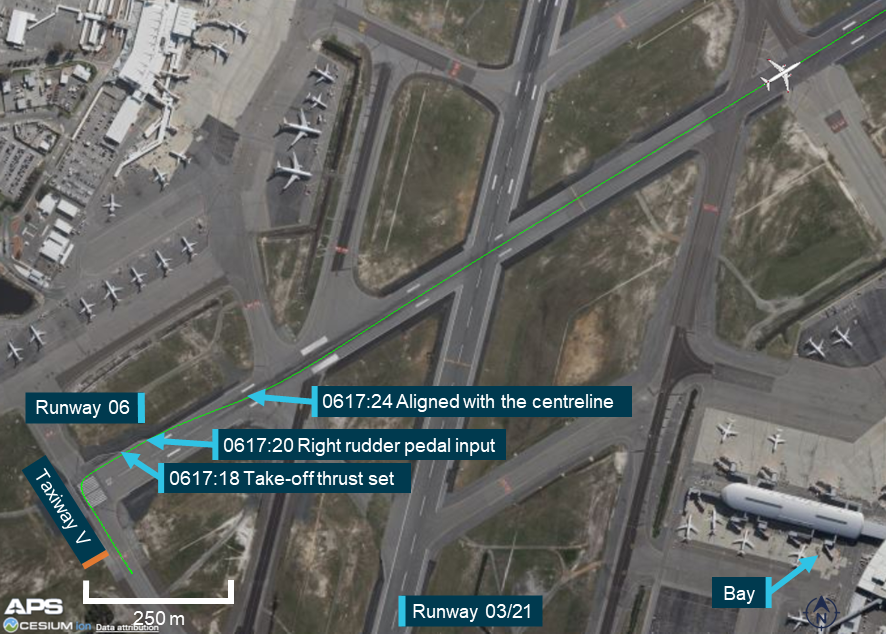
Taxi and take‑off roll during the departure is shown in green. Source: APS Aerospace Flight Animation System based on flight data recorder from the aircraft, annotated by the ATSB
The continuation of the take-off and departure was normal. Once airborne, the flight crew discussed the incident. As they believed they did not strike the runway lights they decided to continue the flight and reported the incident after arriving in Sydney around 4 hours later. After the incident, a runway inspection was conducted, which identified no damage to the runway lights. The operator completed an engineering inspection and found there was no damage to the aircraft.
Incident 2
On the morning of 10 August 2023, the pilot of a Cessna 441 aircraft, registered VH-NSA and operated by Western Sky Aviation, prepared for a passenger charter flight from Perth to Southern Cross, Western Australia.
At around 0500, when at a parking bay at the terminal, the pilot completed the taxi checklist, which included switching on the navigation light, taxi light, and beacon light. In interview later, the pilot commented that the environment appeared dark, even with the aircraft lighting on. At 0508, the pilot received a taxi clearance from air traffic control and taxied to taxiway V towards runway 06.
The pilot recalled that, while at the northern runway holding point, lights from what they assumed to be another aircraft stunned them, affecting their vision. Three minutes later, at the runway holding point, the pilot was cleared to line up and wait on runway 06 until another aircraft had departed. Prior to entering the runway, the pilot completed the line‑up checklist, which included switching on the anti‑collision lights and landing lights.
Air traffic control recorded data showed that the aircraft taxied past the centreline of the runway and lined up along the right edge lighting (Figure 2). During interview, the pilot recalled that the runway markings were ‘scuffed’ and difficult to see, but they believed they were lined up on the runway centreline lighting. They also noticed ‘plenty’ of runway to their right and reported not realising there were no centreline lights on runway 06.
At 0512, the aircraft was cleared for take-off. During the take-off roll, the pilot heard an impact outside the aircraft and suspected a birdstrike had occurred. The pilot decided they were above the rejected (decision) take-off speed so continued with the take-off, but manoeuvred the aircraft to the left, toward the centreline. After the aircraft was airborne, the pilot contacted air traffic control to request a return to Perth. A runway inspection identified damage to several runway edge lights. There was no damage to the aircraft.
Figure 2: Overhead of Perth Airport showing the aircraft’s line up and take-off on runway 06 for incident 2
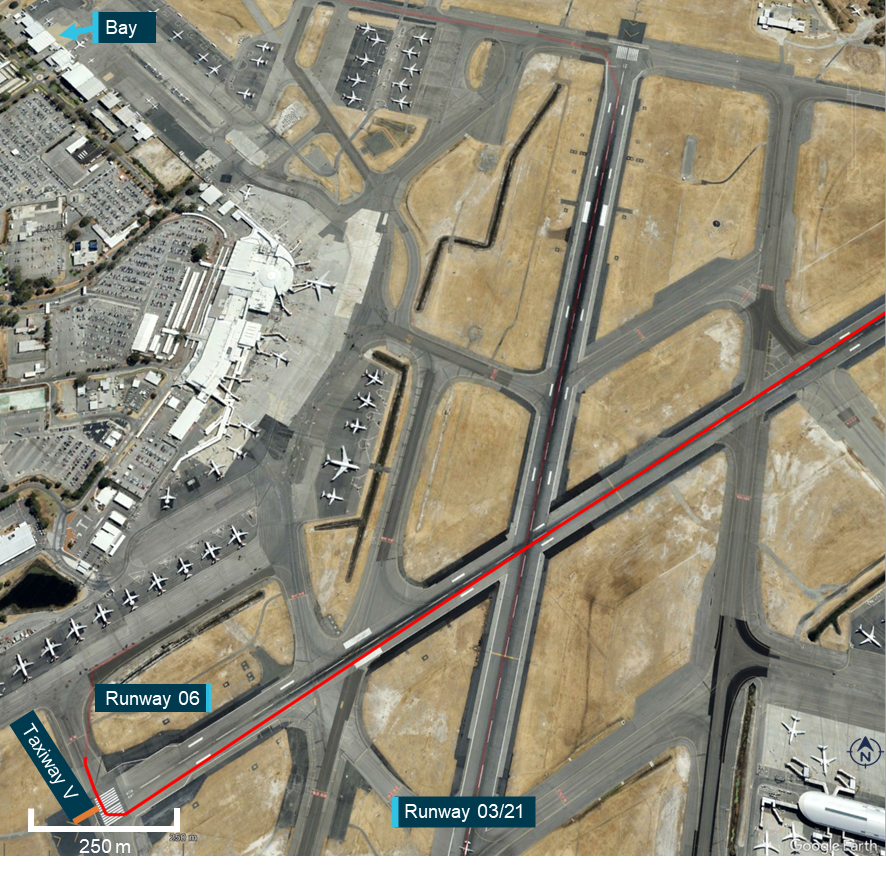
Taxi and take‑off roll during the departure is shown in red. Source: Google Earth, annotated by the ATSB
Incident 3
On the morning of 4 April 2024, VH-NSA was again prepared for a passenger charter flight from Perth to Southern Cross, Western Australia. During preparation, the pilot[6] reviewed the relevant Notices to Airmen[7] that stated, due to runway resealing works the centreline lights on taxiway V, the runway 24 to taxiway V lead-off lights, and taxiway V stop bar[8] were unserviceable. Temporary blue edge lighting was provided on taxiway V while the resealing work was completed.
At around 0500, while at the parking bay at the terminal, the pilot completed their taxi checklist, which included switching on the navigation light, taxi light, and beacon light. In interview, the pilot commented that they felt the aircraft lights did not appear to illuminate the environment well, so they switched the lights off and on again to confirm their operation. At 0509, the pilot taxied to taxiway V, noting that the northern corner between taxiway V and runway 06 appeared darker than usual, and there was little ambient light in the area.
At 0519, the pilot called ‘ready’ [to take off] to air traffic control and 2 minutes later received a clearance to line up on runway 06. Prior to entering the runway, the pilot completed the line‑up checklist, which included switching on the anti-collision lights and landing lights. To assist with runway alignment, the pilot reported that they would normally taxi between the runway number and the gap between the threshold markings (see Markings). The pilot reported they lined up with a white line, which they assumed was the runway centreline marking. They also recalled that the runway markings appeared to be ‘scuffed’ and were difficult to see. They also checked for the runway edge lights on both sides and believed they were aligned with the runway centreline.
Air traffic control recorded data showed that the aircraft taxied past the runway centreline and lined up along the edge lighting on the right side of the runway (Figure 3). At 0523, air traffic control issued the take-off clearance. During the take-off roll, the pilot reported hearing a noise and believed that the sound originated within the cabin, so continued the take-off. They also reported that they checked their engine indications, which were normal. The pilot departed and completed the planned flight.
Figure 3: Overhead of Perth Airport showing the aircraft’s line up and take-off on runway 06 for incident 3
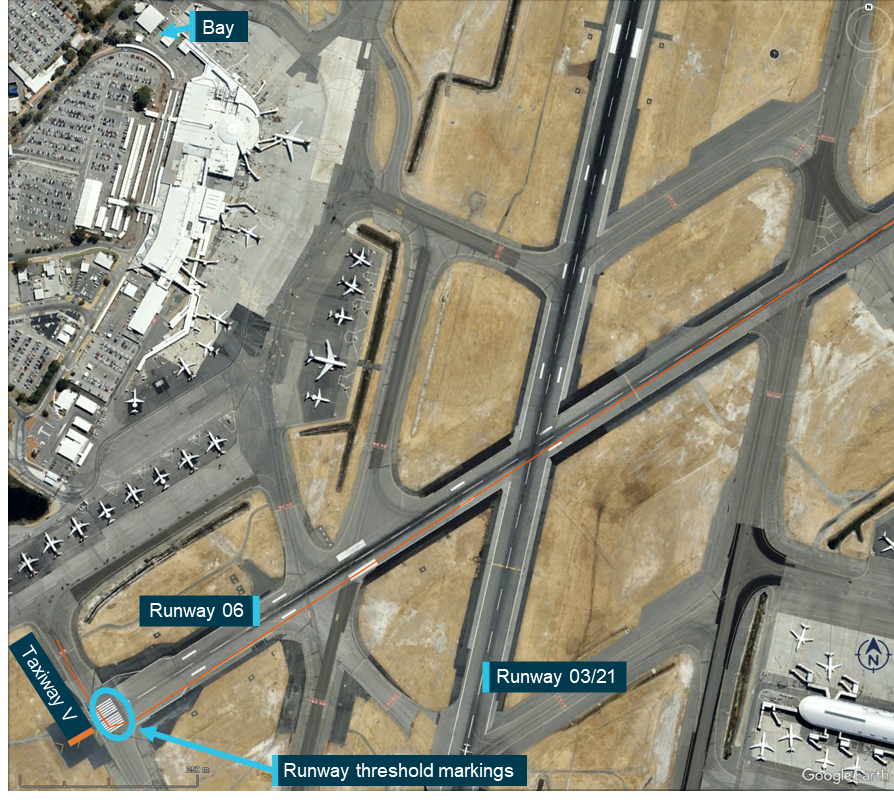
Taxi and take‑off roll during the departure is shown in orange. Source: Google Earth, annotated by the ATSB
The pilot conducted a flight back to Perth from Southern Cross and then flights from Perth to Cue and return. After each of these flights, the pilot conducted a walk around the aircraft. This involved the pilot using the torch from their phone when conducting the aircraft inspection in the dark. The first inspection was conducted in the dark, and the others were during daylight. The inspection involved the pilot walking in a clockwise direction around the aircraft and included an examination of the propellers for damage. A checklist was reviewed afterwards to ensure all the components were checked.
Later in the morning, Perth Airport contacted the operator to advise that several runway edge lights were damaged, which they determined were coincident with the aircraft’s departure based on recorded departures and closed-circuit television footage. At 1208, the aircraft returned to Perth and during the walk around inspection, the pilot noticed damage to one propeller blade on the right engine (Figure 4).
Figure 4: Damage to propeller blade on right engine
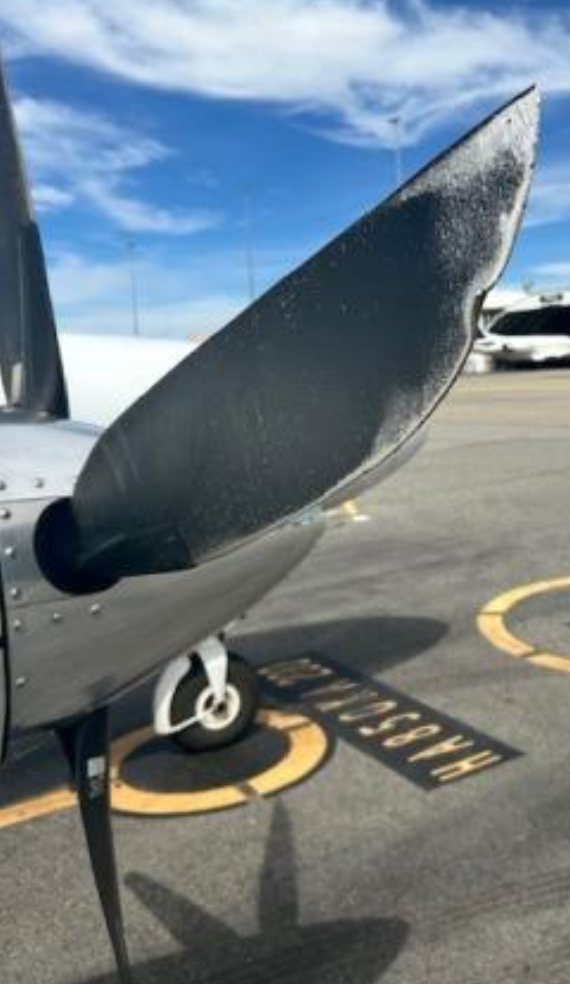
Source: Operator
Context
Pilot information
All the pilots held the appropriate licences and qualifications to conduct their respective flights. ATSB analysis of sleep and roster information obtained from each of the pilots found that, despite the early morning departure time, there was a low likelihood any individual was experiencing a level of fatigue known to adversely affect performance.
The ATSB also considered whether pilot familiarity with the airport played a role in the incidents. Both pilots involved in the first incident were based in Sydney. The captain last operated from Perth one month prior to the incident, while the FO last operated from Perth one week prior. The pilots involved in the second and third incidents were both employed by a Perth-based operator, and therefore familiar with the airport. The operator reported that the third incident pilot was advised of the hazards around runway 06 during their line training.
Environmental conditions
During interview, all the pilots described the lighting conditions during the taxi to the runway as dark. Information from Geoscience Australia found that the first incident occurred around 1 hour prior to sunrise and the second and third incidents occurred around 1.5 hours prior to sunrise. All the incidents occurred before morning civil twilight, also known as first light.[9]
Perth Airport information
Runways
Perth Airport has 2 runways, 03/21 and 06/24 (Figure 5). Both runways are 45 m wide but runway 06/24 is shorter than 03/21. All pilots involved in the incidents reported that runway 03/21 was the runway they would use most frequently on departure.
Prior to the construction of taxiway V in 2012, there was a turning bay at the beginning of runway 06 to allow pilots to backtrack their aircraft and line-up to use runway 06. As a result, extra pavement remained on either side of the runway. The width of this extra pavement was 34 m from either side of the runway edge at the widest part, which is where each of the aircraft were aligned. The extra pavement tapers, where the widest part was closest to the runway end. At the time of each of the incidents, this extra pavement was not lit or marked, and there was no regulatory requirement to do so.
Taxiway V crossed the end of runway 06 and could be used to enter the runway from either the right (south) or left side (north). The flight crew from the first incident entered runway 06 from the right of taxiway V, and lined up on the left edge lights, while the pilots from the second and third incidents entered from the left and lined up on the right edge lights.
Figure 5: Perth Airport runways
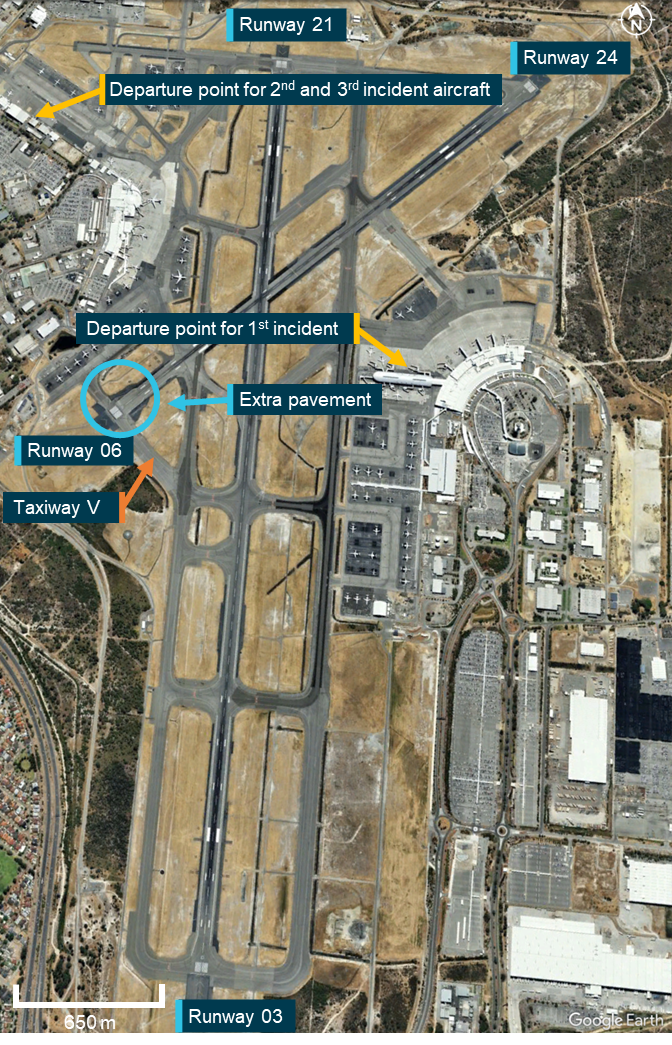
Source: Google Earth, annotated by the ATSB
Lighting
The Civil Aviation Safety Regulations Part 139 Manual of Standards (MOS) for Aerodromes stated the requirements for runway and taxiway lights and markings for Australian airports.
Runway centreline lights
When installed, runway centreline lights were inset in the runway, and would be white and omnidirectional, apart from lights towards the end of the runway, which were required to be red.
Runway 03/21 was fitted with centreline lights (Figure 6). Runway 06/24 did not have centreline lights, and was not required to as per MOS 139.
Runway edge lights
The MOS stipulated that a permanent runway edge lighting system was required to be installed on runways intended for use at night. The edge lighting system should be comprised of 2 parallel rows of lights, equidistant from the runway centreline. The lights may be elevated (raised) or recessed (inset) and would be situated along the declared edge of the runway to delineate the area available to pilots for landing and take-off at night in reduced visibility. Consistent with the MOS requirements, the runway 06/24 edge lights were white (Figure 6 shows these lights for runway 03). The first 2 edge lights on runway 06 were inset into the runway, and the remainder of the lights were elevated (Figure 7).
Figure 6: Runway centreline lights and edge lights on runway 03
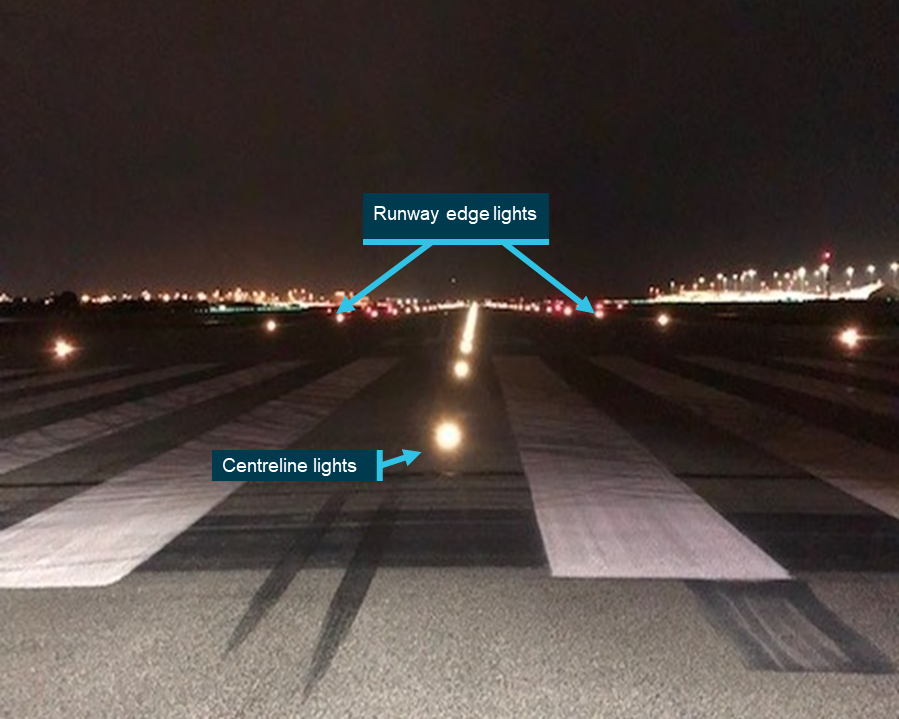
Source: Perth Airport, annotated by the ATSB
Figure 7: Runway 06 edge lighting (left side)
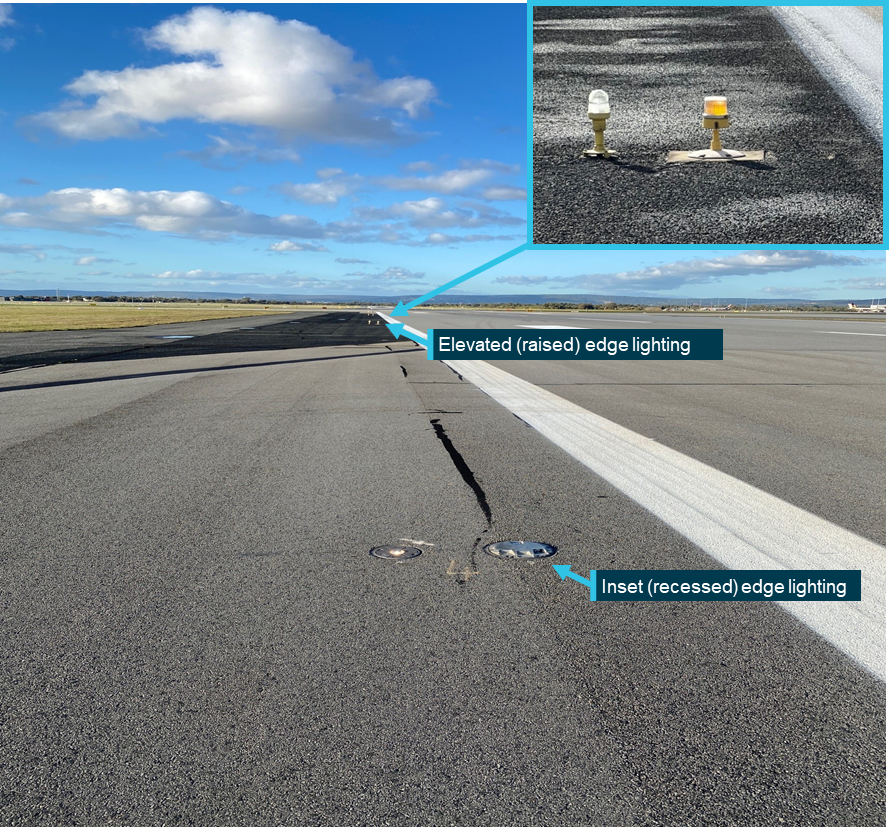
Source: Perth Airport, annotated by the ATSB
Taxiway centreline lights
The MOS also stated that, where taxiway centreline lights were used for both runway exit and runway entry purposes, the colour of the lights viewed by the pilot must be green for entering the runway and alternately green and yellow for exiting the runway. Taxiway V had lights from the centreline of the runway to the centre of the taxiway (Figure 8). These lights were alternating yellow and green unidirectional lights visible only when exiting the runway, known as lead-off lights. Lights visible when entering the runway were known as lead-on lights. Taxiway V did not have lead-on lights that joined from the taxiway to the runway centreline, but there were green bi-directional taxiway centreline lights spanning across the runway threshold in the middle of taxiway V (Figure 8 top and bottom).
Figure 8: Runway centreline lights (top), view from the runway centreline of runway 06 (middle) and view from taxiway V holding point, facing towards the opposite side of the taxiway (bottom)
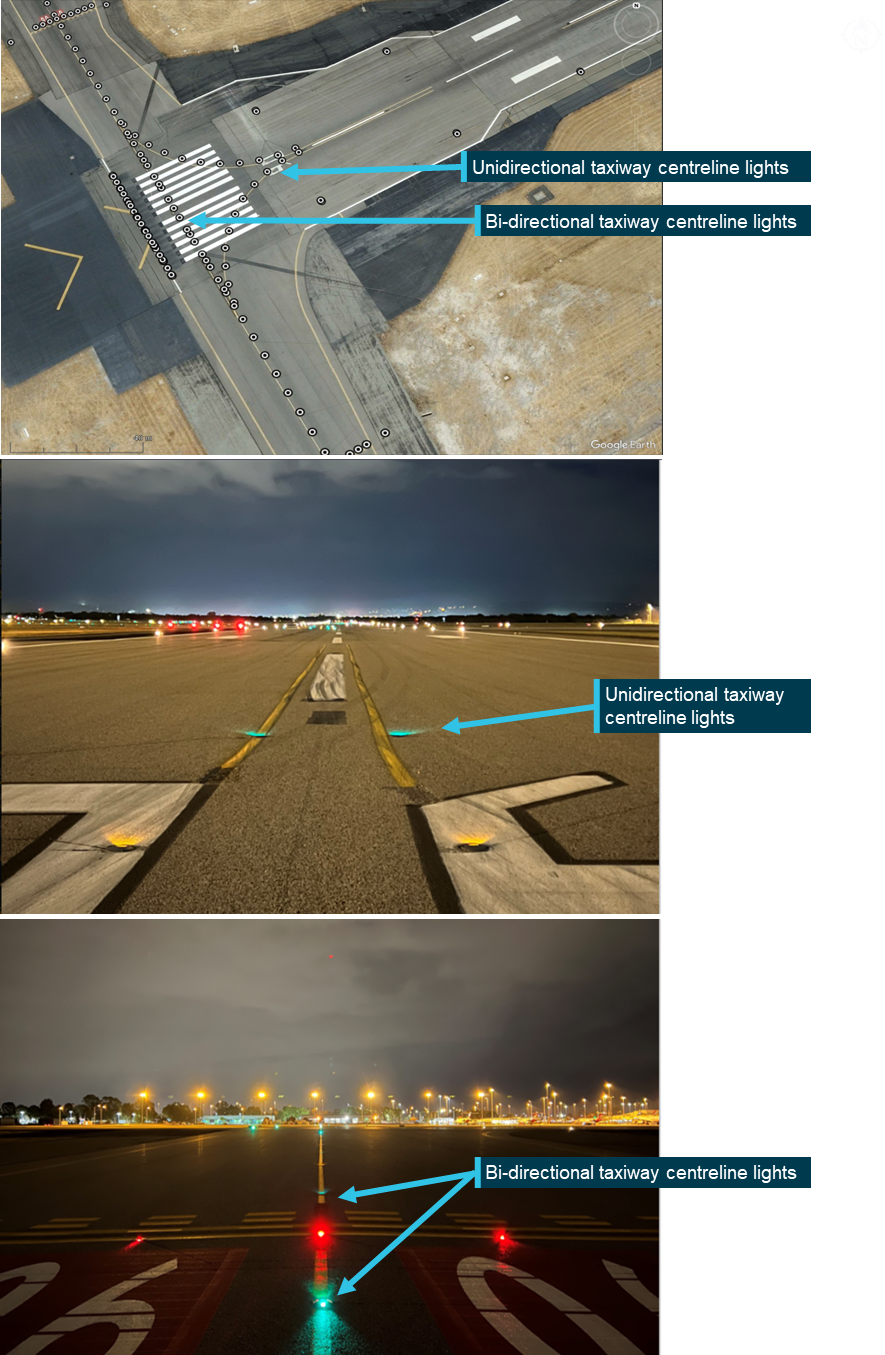
Source: Google Earth (top image) and Perth Airport (middle and bottom images), all images annotated by the ATSB
Markings
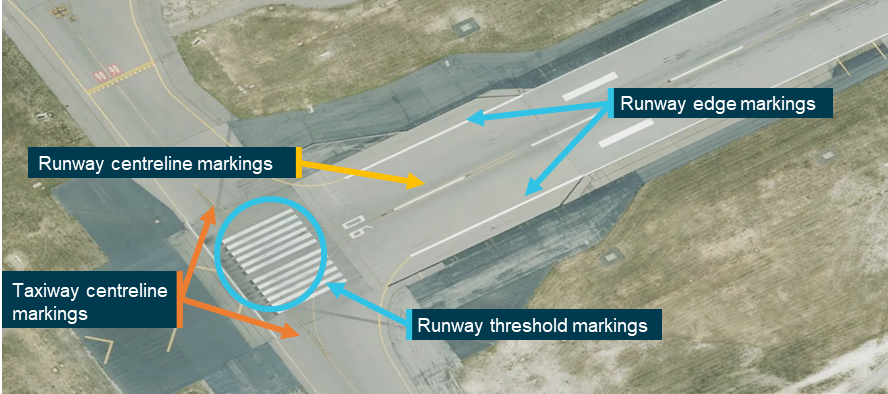
MOS 139 stipulated the characteristics of aerodrome markings, including runway and taxiway markings. Runway markings were required to be white (on paved runways) and included runway designation, runway threshold, centreline markings, and edge markings (also known as side-stripe markings). Runway designation markings were the 2-digit runway number, determined from the approach direction, indicating the magnetic heading of the runway. Runway threshold markings identified the beginning of the runway that was available for landing and take-off using ‘piano key’ markings. They consist of a white line across the width of the runway and a series of white longitudinal stripes of uniform dimensions. Runway centreline markings were a line of uniformly spaced stripes and gaps that identify the centre of the runway and provide the pilot alignment guidance during take-off and landing. Runway edge markings were required to be continuous white lines on both sides of the runway. Taxiway markings were required to be yellow and provided on all sealed, concrete or asphalt taxiways for continuous guidance between the runway and the apron.[10]
Runway 06 had runway markings as per the MOS requirements. The runway edge markings were an unbroken white line and centreline markings were broken white lines. The markings were painted with non-reflective paint. There was no regulatory requirement to use reflective paint for runway markings. All taxiways including taxiway V had continuous yellow taxi centreline markings (Figure 9).
Figure 9: Runway markings on Runway 06 (as of March 2023)
Source: Perth Airport, annotated by the ATSB
Alternate runway markings to assist with visibility
There was no requirement for runway markings to be painted using reflective markings in Australia, but other countries use reflective paint to increase visibility and contrast in the dark. For example, the International Civil Aviation Organization recommended that aerodromes where operations take place at night, pavement markings should be made with reflective materials to enhance the visibility of markings. The United States Federal Aviation Administration (FAA) includes the use of retroreflective airport markings with glass beads in paint to improve conspicuity of markings at night, during low visibility conditions or when the pavement is wet. The Federal Aviation Administration also stated that runway shoulder stripes may be used to supplement runway edge stripes to identify pavement areas contiguous to the runway sides that are not intended for use by aircraft. Runway shoulder stripes were to be painted yellow.
Air traffic control information
Airservices Australia provided the ATSB with the air traffic control data for each of the incidents. The data included a recording of the tower controller’s screen from the Advanced Surface Movement Guidance and Control System, which showed the position of aircraft and ground vehicles. For all 3 of the incidents, the recording showed the respective incident aircraft lining-up and taking off from the edge of runway 06.
When asked whether a tower controller could detect misaligned take-offs, Airservices Australia advised that the scale setting and margin of error on the screens may make it difficult for controllers to detect a misaligned take-off. Further, the tower controller’s role was to look outside, and they may not be using the screen to check the runway alignment of an aircraft.
Operational information
Incident 1
Virgin Australia procedures
The Virgin Australia Policy and Procedures Manual stated that during take-off, flight crew must:
Use all available cues to ensure the aircraft is on the correct runway (including runway numbers, localizer, etc)
Ensure the take-off roll is only commenced when the aircraft is aligned.
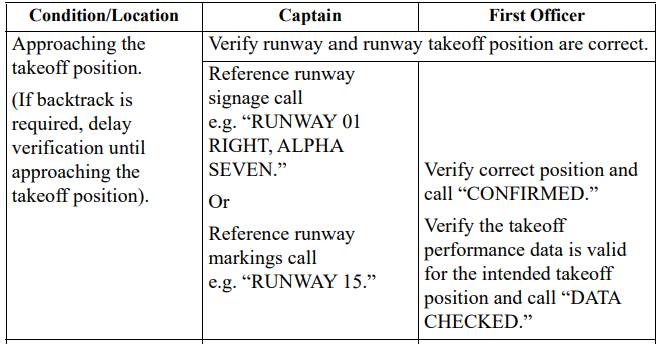
The Flight Crew Operations Manual included as part of the ‘before take-off’ procedure a runway verification check, which included runway take-off position (Figure 10).
Figure 10: Excerpt of the ‘before take-off’ procedure
Source: Virgin Australia
Take-off decision speed
Based on the airspeed calculations for the flight on the take-off and landing card, the decision speed (V1) was 139 kt. The flight data showed that, when the aircraft was manoeuvred from the runway edge to the centreline, the groundspeed was 44 kt. As there were no significant winds in the area at the time affecting the aircraft’s speed, it was likely that a rejected take-off could have occurred.
Incidents 2 and 3
The pilots from the 10 August 2023 and 4 April 2024 incidents recalled that they would use the runway markings, including the centreline and runway threshold markings, to assist with alignment. They would also check that the runway edge lights were on either side of the aircraft when lining up on the runway.
Misaligned take-offs
Previous research
When pilots taxi and take-off during daylight conditions, they normally have a wide range of visual cues by which they can navigate and verify their location. At night, however, the amount of visual information available is markedly reduced. Pilots rely more on the taxiway and runway lighting patterns presented to them and what can be seen in the field of the aircraft’s taxi and landing lights.
In 2010, the ATSB published a research report titled Factors influencing misaligned take‑offs at night (AR-2009-033) which reviewed several Australian and international occurrences. The report identified several factors that increased the risk of a misaligned take-off. The most prevalent factors that contributed included environmental factors such as the physical layout of the runway and/or airport. Examples included a wide runway and/or extra pavement near the runway or confusing taxiway marking and/or lighting, such as recessed lighting at the runway’s edge and/or the absence of centreline lighting.
Areas of additional pavement around the taxiway entry and runway threshold area can provide erroneous visual cues at night and pilots can believe that they are in the centre of the runway when they are actually lined up on the edge. Recessed (inset) lighting, particularly at the taxiway entry to the runway, was often quoted as an influencing factor in reports relating to lining up incorrectly. Centreline lighting, when it was present, was always recessed to allow aircraft to safely travel over the centreline during take-off. However, runways will often have recessed lights at the runway edge where the taxiway meets the runway. Therefore, recessed runway edge lighting can act as confirmation that the flight crew have lined up on the centreline, when this is not actually the case. Similarly, the degradation of airport markings can provide erroneous cues to the pilots of the aircraft’s position on the runway.
The next most common factors were human factors such as flight crew distraction (divided attention). Divided attention results in a focus inside the flight deck at the expense of monitoring the external environment. An example was flight crew performing checklist items or setting power/checking instruments/readings. Completing checklists were a normal and necessary part of the departure, however, can be a distraction during a critical time, such as while lining up. Another factor was a lack of familiarity with the runway at night, as it can present an additional demand during taxi and line-up.
The last group of factors were operational factors, such as air traffic control clearances, which can provide a distraction to flight crew depending on the timing. They can also contribute to, precipitate, and/or exacerbate the presence or impact of other factors such as workload, distraction, or a lack of visual cues to assist the crew in lining up the aircraft on the runway centreline.
Previous safety recommendations
Previous investigations conducted by the United Kingdom Air Accident Investigation Branch (UK AAIB) and Dutch Safety Board, involving misaligned take-off incidents in 2015 and 2018 respectively, have included safety recommendations to the International Civil Aviation Organization (ICAO). These recommendations proposed that ICAO should develop runway design standards that would prevent pilots misidentifying runway edge lighting as centreline lighting. ICAO reviewed these safety recommendations and determined that guidance included in the Procedures for Air Navigation Services (PANS) – Aerodromes (Doc 9981) provided strategies to address misaligned take-offs. The guidance included considerations for aerodrome operators, such as conducting safety assessments as part of the risk management process. An example of an item to be considered in this process was aerodrome/runway layout.
In 2021, the Global Action Plan for the Prevention of Runway Excursions was published and included addressing misaligned take-off incidents. Specifically, the report stated there should be measures for preventing visual confusion during line-up between runway edge and centreline lights leading to misalignment with the runway centreline. The measures should also take into account the effects of low visibility and runway contamination and the effect of using various light colours and patterns to differentiate the runway centreline and edge lighting systems.
Related occurrences
A review of the ATSB occurrence database found 3 reported incidents of misaligned take-offs in the 5 years prior to April 2024. These incidents, along with 2 similar international incidents are as follows.
ATSB occurrence brief AB-2021-014
On 20 April 2021, at 1854 local time, the pilot of a Fairchild SA227 aircraft taxied at Townsville Airport for a freight charter flight to Brisbane, Queensland. While lining up for take-off on runway 01, air traffic control advised that the aerodrome QNH[11] had changed. During this time, the pilot became aware that the aircraft had deviated from the lead-on line and started correcting the turn to realign with the centreline. During the take-off roll, the aircraft struck a runway edge light resulting in minor damage to the propeller.
A number of factors that contributed to the misaligned take-off included the wider paved section at the end of the runway, no centreline lights on the runway, recessed edge lighting, and taxiway lead-on lights not visible when entering the runway. It was also found that there was reduced visibility prior to departure due to the rain and time of day.
ATSB investigation AO-2023-035
On 21 July 2023, at 0109 local time, the pilot of a Piper PA-31 aircraft taxied at Essendon Fields Airport, Victoria for a freight charter flight to Bankstown, New South Wales. After reading back their clearance from air traffic control and accepting the departure from runway 26, the aircraft was taxied and prepared for take-off. The pilot was completing checklists, which required attention to be focused within the aircraft. After commencing the take-off run, the pilot heard multiple loud noises, rejected the take-off and exited the runway. Inspection of the aircraft upon return to the apron identified a damaged main landing gear tyre and brake calliper. An inspection of the runway found damage to multiple runway lights and foreign object debris scattered across the runway.
ATSB occurrence brief AB-2024-026
On 13 May 2024, at 0537 local time, the pilot of an Aero Commander 500-S aircraft taxied for departure at Brisbane Airport on a regular scheduled freight flight. The aircraft was cleared for a departure from runway 01 at the intersection of taxiway A7, the pilot taxied to this holding point. While turning onto the runway, the pilot inadvertently lined up along the left side runway edge lighting instead of the runway centreline. During the take‑off roll, the pilot recognised the aircraft was left of the centreline and took corrective action to reposition the aircraft on the runway. The underside of the aircraft had minor damage and several runway lights were also damaged.
The brief highlighted the complexity of the intersection with multiple lead-off lines into the runway as well the runway touchdown zone markings near the runway centreline markings that were both broken white lines.
German Federal Bureau of Aircraft Accident Investigation BFU20-0251-EX
On 27 April 2020, at 0353 local time, the flight crew of a ATR72-212 aircraft prepared for take-off on a freight flight from Cologne Airport, Germany, to Sofa Airport, Bulgaria, in the dark. After receiving their taxi clearance, the flight crew taxied the aircraft to the centreline of runway 24 towards the turn pad (paved area next to the runway for turning) for runway 06 (the reciprocal runway). The flight crew completed the before take-off checklist during taxi. At this time, the flight crew heard a sound in the cockpit and determined it was from the captain’s bag falling from the chair. When the turn pad was reached the aircraft initially followed the yellow taxiway markings to turn 180°. The captain completed the turn and aligned the aircraft with the row of lights ahead, believing they were the centreline lights. During the take-off roll, the flight crew felt and heard an impact to the aircraft, so the captain aborted the take-off. The aircraft had minor damage to the nose landing gear and propeller blades.
Factors identified that contributed to the misaligned take-off related to the runway environment and distraction. The runway edge marking on the turn pad was a broken white line, which was similar to the centreline markings. Due to the viewing angle from the cockpit to the runway edge and centreline lighting they were difficult to differentiate, especially in the dark without any other visual refences. The width of the turn pad including the runway was also identified as a factor. Another factor was flight crew distraction during the turn due to determining the sound in the cockpit. The report had a safety recommendation (07/2020) to ICAO:
The International Civil Aviation Organization (ICAO) should modify the standard recommendations regarding runway edge lighting in Annex 14 Volume 1 Aerodrome Design and Operations to ensure clear distinction of other airport lightings (sic).
Transportation Safety Board of Canada investigation A23F0062
On 16 February 2023, at 1817 local time, the flight crew of a Boeing 737 aircraft taxied to runway 01R in Nevada, United States, to Edmonton, Canada, on a scheduled passenger flight. The flight crew taxied the aircraft along the taxiway centreline until reaching the right runway edge marking, turned to the right and entered and lined up with what was believed to be the runway centreline. The aircraft took off while aligned with the right edge of runway 01R, and its nosewheel contacted 8 runway edge lights. During the take‑off roll, both the flight crew heard sounds and felt vibrations but believed it was the runway centreline lights. The flight crew were unaware of the misaligned take-off and the flight was continued. The aircraft had minor damage to the right tyre on the nose landing gear and there was damage to several runway lights.
The investigation identified several factors that contributed to the misaligned take-off. The factors included the high workload between the flight crew at the time of departure where the FO was focused on a task within the cockpit and the captain’s perceived time pressure to depart. Other factors included the visual cues in the runway environment. The taxiway centreline lighting on the taxiway used for departure terminated at the runway edge markings and the runway did not have centreline lighting.
Safety analysis
Runway environment resulting in the misaligned take-off
On runway 06, there was extra pavement on either side of the runway where each aircraft lined up for take-off. As there were no markings or lighting to delineate this area, there were no visual cues to assist the pilots to identify the extra pavement was adjacent to the runway. Consequently, this area likely appeared to be an extension of the usable runway. This was consistent with the pilot’s observation in incident 2 where they reported seeing ‘plenty’ of runway to their right when lined up on the right runway edge.
Although the runway had all the required markings in accordance with regulations, they were reported by 2 of the pilots as being difficult to see at night and were ‘scuffed’, thereby reducing the contrast and visibility of the markings. It was also noted that, while not required, reflective paint was not used for the markings to improve conspicuity at night.
While there were taxiway centreline markings, there were no lead-on lights from the taxiway to the runway centreline. Although there were lead-off lights, these were unidirectional and designed to only be visible when exiting the runway. Therefore, at night, the pilots had limited cues to assist them while navigating from the taxiway to ensure they would turn the aircraft into the centre of the runway.
Runway 06 did not have centreline lighting. However, the first 2 edge lights on either side were white and inset within the runway, which were the same characteristics for centreline lighting. Given that all the pilots indicated they would use runway 03/21 more frequently for take‑off, which was fitted with centreline lights, this potentially influenced them misidentifying the edge lights as centreline lights.
The pilots of the 2 incidents operating the Cessna 441 also commented that although the aircraft lighting was switched on, the environment appeared dark. One of these pilots also reported that there was limited ambient lighting at the intersection of taxiway V to runway 06. The combination of the reduced visual cues and runway features that can be misidentified may have also given the impression that the aircraft were aligned with the runway centreline and increased the risk of a misaligned take-off. These characteristics were evident in many previous similar investigations.
Consistent with the ATSB’s research, the extra pavement area, the absence of lead-on lights and runway centreline lights, and some degraded markings, were all factors that influence misaligned take-offs at night, where visual information may be markedly reduced. A combination of these factors in each incident supported the pilots’ belief that the aircraft were correctly aligned with the centreline when they were positioned on the runway edge lighting. Confirmation bias is the tendency for people to seek information and cues that confirm the tentatively held hypothesis or belief (Wickens et al 2022). As they believed they were correctly aligned with the runway centreline, the pilots in each occurrence commenced the take-off roll.
Flight crew focus of attention
In incident 1, the flight crew divided their attention between pre-take off tasks being completed in the flight deck and monitoring the environment. Additionally, the flight crew also received their take-off clearance during the turn onto the runway, requiring the FO to communicate with air traffic control. While these are normal and a required part of the departure, they can divert the flight crew’s attention away from the external environment at a critical time, such as while lining up. Barshi and others (2009) state that during busy periods, it is easy for attention to be absorbed in one task, which can divert attention from other important tasks, such as monitoring.
Pilots’ response to the misaligned take-off
The pilots’ responses to each misaligned take-off incident were different. During the take‑off roll, the flight crew in the June 2023 incident identified that they had lined up on the runway 06 edge lighting and manoeuvred the aircraft toward the centreline and continued the take-off. However, believing they had not struck the runway lights, the misalignment of the take-off was not reported to the operator or to airport personnel until the flight had arrived in Sydney, around 4 hours later. Although the subsequent aircraft and runway inspections did not identify any damage, there was the risk that unrecognised debris could have affected the safety of other aircraft using the same runway or the flight continuing with unknown damage.
The pilot in the August 2023 incident detected an impact during take-off, though did not initially notice the aircraft was aligned with the runway edge lighting. As they had detected a problem, the pilot returned to the airport to ensure there was no damage to the aircraft and provided the opportunity for a runway inspection to occur to check for damage. The pilot’s decision was important as damage to the aircraft (which was carrying passengers) and debris on the runway can affect flight safety.
The pilot in the April 2024 occurrence did not identify they had lined up the aircraft on the runway edge lighting and subsequently completed multiple flights. As a result of the misaligned take-off, the aircraft had sustained damage to the right propeller and several runway lights were damaged, which was not detected until later that day. Damage from a foreign body impact to a propeller blade could lead to gouges, dents and deformation, or cracks and blade failure if left undetected (Federal Aviation Administration 2005), although in this instance there was no reported effect on flight from the sustained damage.
Overall, misaligned take-offs can increase the risk of damage to aircraft and lighting given that raised runway lighting, unlike recessed runway lighting, is more likely to sustain an impact. Given the risk, it is important to promptly communicate the incident, for example to air traffic control or airport personnel, to provide the opportunity for inspections to be conducted. The outcome of these inspections allows pilots to make more informed decisions on whether to continue the flight, return or divert to a closer location.
Findings
ATSB investigation report findings focus on safety factors (that is, events and conditions that increase risk). Safety factors include ‘contributing factors’ and ‘other factors that increased risk’ (that is, factors that did not meet the definition of a contributing factor for this occurrence but were still considered important to include in the report for the purpose of increasing awareness and enhancing safety). In addition ‘other findings’ may be included to provide important information about topics other than safety factors. These findings should not be read as apportioning blame or liability to any particular organisation or individual. |
From the evidence available, the following findings are made with respect to the 3 misaligned take-off occurrences on runway 06 at Perth Airport, Western Australia.
Contributing factors
- On runway 06 at Perth Airport, features of the runway environment included extra pavement, degraded markings, and reduced lighting. As a result, the pilots in 3 separate occurrences misidentified this runway's edge lighting for centreline lighting and commenced take-off from this position.
- During the turn onto the runway in incident 1, the flight crew were focussed on completing pre-take off tasks within the flight deck, and communicating with the air traffic controller about their take-off clearance. These actions diverted their attention away from monitoring their position on the runway.
Other factors that increased risk
- After the misaligned take-offs, the 3 pilots responded differently. This increased the risk of damage, to aircraft or runway lighting, remaining undetected.
Safety actions
| Whether or not the ATSB identifies safety issues in the course of an investigation, relevant organisations may proactively initiate safety action in order to reduce their safety risk. All of the directly involved parties are invited to provide submissions to this draft report. As part of that process, each organisation is asked to communicate what safety actions, if any, they have carried out to reduce the risk associated with this type of occurrences in the future. The ATSB has so far been advised of the following proactive safety action in response to this occurrence. |
Safety action by Perth Airport Pty Ltd
After the first 2 misaligned take-off incidents, Perth Airport submitted a notice to Airservices Australia requesting an update to the Aeronautical Information Publication about the misaligned take-off risk on runway 06. Subsequently, this update was included in an Aeronautical Information Publication supplement H78/23 effective November 2023 containing an update to the ground and movement charts for Perth Airport. The new aerodrome chart highlighted there was a ‘misaligned take-off hot spot’[12] at the intersection of taxiway V and runway 06. The supplement detailed that runway 06 had wider shoulders due to previously being used as a turn pad, had no centreline lights, and that, when lining-up on the runway from taxiway V, pilots should ensure that the aircraft was aligned with the runway centreline. In March 2024, Airservices Australia updated the En Route Supplement Australia to reflect this change.
Perth Airport conducted airport works in late March to early April 2024 to repaint all markings on the runway and taxiway. As part of this work, they also painted chevron markings on the extra pavement next to runway 06 to prevent future misalignment.
Safety action by Western Sky Aviation
As a result of the incident on 10 August 2024, the operator issued a notice to aircrew to highlight the importance of vigilance by confirming the nominated runway position. For runways with an instrument landing system (ILS), the operator encouraged pilots to line up and tune the ILS and dial up the course to check the course deviation indicator is centred. For runways with no ILS (such as runway 06), the operator encouraged pilots to crosscheck the runway heading with the GPS position of the aircraft overlaid on the aerodrome map display in the OzRunways software on tablets in the aircraft.
After the April 2024 incident, a second notice to aircrew was distributed, emphasising the importance of situational awareness with runway identification when preparing for take‑off. The notice specified that pilots must confirm they are on the runway centreline and ensure the runway number is identified, either through the runway markings or association with the heading displayed by an aircraft instrument. For night take-offs specifically, pilots were instructed to self-brief the expected runway to familiarise with the specific characteristics of the runway such as whether it has centreline lighting or not, and to ensure that they have both the sides of the runway lighting visual before commencing the take-off roll.
Safety action by Virgin Australia Airlines
Virgin Australia Airlines added caution notes to its Perth Airport supplementary port information about centreline misidentification on runway 06 due to the environment, such as no centreline lighting during night or in poor visibility conditions. They also revised the before take-off procedure to reduce flight crew workload during line‑up by reallocating items (setting the weather radar) to earlier in the taxi. Finally, case studies involving this event were incorporated into non-technical skills training.
Sources and submissions
Sources of information
The sources of information during the investigation included:
- pilots from the 3 incidents
- Virgin Australia Airlines
- Western Sky Aviation
- Perth Airport
- Airservices Australia.
References
Airservices Australia. (2023). A pilot’s guide to runway safety, Airservices Australia.
Australian Transport Safety Bureau. (2010). Factors influencing misaligned take-off occurrences at night, Australian Transport Safety Bureau, Australian Government.
Barshi, I., Loukopoulos, L.D. and Dismukes, R.K. (2009). The multitasking myth: Handling complexity in real-world operations. Ashgate Publishing.
Civil Aviation Safety Authority. (2019). Part 139 Manual of Standards for Aerodromes, Civil Aviation Safety Authority, Australian Government.
Federal Aviation Administration. (2005). Advisory Circular AC20-37E Aircraft Propeller Maintenance, US Department of Transportation, United States.
The Global Action Plan for the Prevention of Runway Excursions is available through either the EUROCONTROL (https://www.eurocontrol.int/publication/global-action-plan-prevention-runway-excursions-gappre) or Flight Safety Foundation (https://flightsafety.org/toolkits-resources/gappre/) websites.
Wickens, C.D., Helton, W.S., Hollands, J.G., and Banbury, S. (2022). Engineering psychology and human performance, 5th edn, Routledge, doi: 10.4324/9781003177616.
Submissions
Under section 26 of the Transport Safety Investigation Act 2003, the ATSB may provide a draft report, on a confidential basis, to any person whom the ATSB considers appropriate. That section allows a person receiving a draft report to make submissions to the ATSB about the draft report.
A draft of this report was provided to the following directly involved parties:
- pilots from the 3 incidents
- Virgin Australia Airlines
- Western Sky Aviation
- Perth Airport
- Airservices Australia
- Civil Aviation Safety Authority.
Submissions were received from:
- a pilot from one of the incidents
- Virgin Australia Airlines
- Western Sky Aviation
- Perth Airport
- Civil Aviation Safety Authority.
The submissions were reviewed and, where considered appropriate, the text of the report was amended accordingly.
Purpose of safety investigationsThe objective of a safety investigation is to enhance transport safety. This is done through:
It is not a function of the ATSB to apportion blame or provide a means for determining liability. At the same time, an investigation report must include factual material of sufficient weight to support the analysis and findings. At all times the ATSB endeavours to balance the use of material that could imply adverse comment with the need to properly explain what happened, and why, in a fair and unbiased manner. The ATSB does not investigate for the purpose of taking administrative, regulatory or criminal action. About ATSB reportsATSB investigation reports are organised with regard to international standards or instruments, as applicable, and with ATSB procedures and guidelines. Reports must include factual material of sufficient weight to support the analysis and findings. At all times the ATSB endeavours to balance the use of material that could imply adverse comment with the need to properly explain what happened, and why, in a fair and unbiased manner. An explanation of terminology used in ATSB investigation reports is available here. This includes terms such as occurrence, contributing factor, other factor that increased risk, and safety issue. Publishing informationReleased in accordance with section 25 of the Transport Safety Investigation Act 2003 Published by: Australian Transport Safety Bureau © Commonwealth of Australia 2025 
Ownership of intellectual property rights in this publication Unless otherwise noted, copyright (and any other intellectual property rights, if any) in this report publication is owned by the Commonwealth of Australia. Creative Commons licence With the exception of the Commonwealth Coat of Arms, ATSB logo, and photos and graphics in which a third party holds copyright, this report is licensed under a Creative Commons Attribution 4.0 International licence. The CC BY 4.0 licence enables you to distribute, remix, adapt, and build upon our material in any medium or format, so long as attribution is given to the Australian Transport Safety Bureau. Copyright in material obtained from other agencies, private individuals or organisations, belongs to those agencies, individuals or organisations. Where you wish to use their material, you will need to contact them directly. |
[1] Runway number: the number represents the magnetic heading of the runway (for example, runway 06 is orientated 60º magnetic). The runway identification may include L, R or C as required for left, right or centre. Runways 06/24 were reciprocal runways.
[2] Holding point: designated point for holding on airfield, especially before entering active runway.
[3] Lead-on lights: green unidirectional taxiway centreline lighting that extends into the runway.
[4] Pilot flying (PF) and pilot monitoring (PM): procedurally assigned roles with specifically assigned duties at specific stages of a flight. The PF does most of the flying, except in defined circumstances, such as planning for descent, approach and landing. The PM carries out support duties and monitors the PF’s actions and the aircraft’s flight path. On the Boeing 737, the captain taxis the aircraft as the steering is on the left side.
[5] Take-off decision speed (V1): the critical engine failure speed or decision speed required for take-off. Engine failure below V1 should result in a rejected take off; above this speed the take-off should be continued.
[6] The pilot in incident 3 was a different pilot to incident 2.
[7] Notice to Airmen (NOTAM): a notice distributed by means of telecommunication containing information concerning the establishment, condition or change in any aeronautical facility, service, procedure or hazard, the timely knowledge of which is essential to personnel concerned with flight operations.
[8] Stop bars are a series of unidirectional red lights embedded in the pavement, at right angles to the taxiway centreline, at the associated runway holding point. They are intended to provide additional protection of runway/taxiway intersections to reduce runway incursions.
[9] First light: when the centre of the sun is at an angle of 6° below the horizon before sunrise. At this time the horizon is clearly defined but the brightest stars are still visible under clear atmospheric conditions.
[10] Apron: large paved area of airfield for such purposes as: loading and unloading of aircraft; aircraft turnaround operations; aircraft modification, maintenance or repair; any other approved purpose other than flight operations.
[11] QNH: the altimeter barometric pressure subscale setting used to indicate the height above mean sea level.
[12] Hot spot: a location on an aerodrome movement area with a history of potential risk of collision or runway incursion, and where heightened attention by pilots / drivers is necessary.
Occurrence summary
| Investigation number | AO-2023-027 |
|---|---|
| Occurrence date | 12/06/2023 |
| Location | Perth Airport |
| State | Western Australia |
| Report release date | 20/11/2025 |
| Report status | Final |
| Investigation level | Short |
| Investigation type | Occurrence Investigation |
| Investigation status | Completed |
| Mode of transport | Aviation |
| Aviation occurrence category | Collision with terrain, Runway excursion |
| Occurrence class | Incident |
| Highest injury level | None |
Aircraft details
| Manufacturer | The Boeing Company |
|---|---|
| Model | 737-8SA |
| Registration | VH-IWQ |
| Serial number | 44225 |
| Aircraft operator | Virgin Australia Airlines Pty Ltd |
| Sector | Jet |
| Operation type | Part 121 Air transport operations - larger aeroplanes |
| Departure point | Perth Airport, Western Australia |
| Destination | Sydney Airport, New South Wales |
| Damage | Nil |
Aircraft details
| Manufacturer | Cessna Aircraft Company |
|---|---|
| Model | 441 |
| Registration | VH-NSA |
| Serial number | 441-0087 |
| Aircraft operator | Western Sky Australia Pty Ltd |
| Sector | Turboprop |
| Operation type | Part 135 Air transport operations - smaller aeroplanes |
| Departure point | Perth Airport, Western Australia |
| Destination | Southern Cross Aerodrome, Western Australia |
| Damage | Minor |