On 12 July 2014, a pilot was undergoing training for mustering approval by a supervising pilot in a Robinson R22 helicopter, registered VH-ZZM. After completing about 7 hours of mustering, the helicopter was returning to a homestead near Dingo, Queensland, when about 1,000 ft above ground level (AGL) the supervising pilot instructed the pilot to conduct a practice autorotation turning through 180°, which the pilot completed, increasing power when at about 5 ft AGL.
During the subsequent climb, when at about 450 ft AGL, the supervising pilot took control of the helicopter and initiated a second autorotation. The supervising pilot initially observed the airspeed at about 65 kt, the rotor rpm in the green arc and the autorotation ‘looking good’, and assumed at this stage that he had handed control of the helicopter to the other pilot. At about 100 ft AGL, the pilot detected the rotor rpm decaying and a rapid rate of descent, but still assumed that the supervising pilot had control of the helicopter. When at about 20-40 ft AGL, the supervising pilot observed the vertical speed increasing and the rotor rpm decreasing and rapidly lowered the collective and increased the throttle. Just prior to the helicopter contacting the ground, the supervising pilot flared then levelled the helicopter and raised the collective.
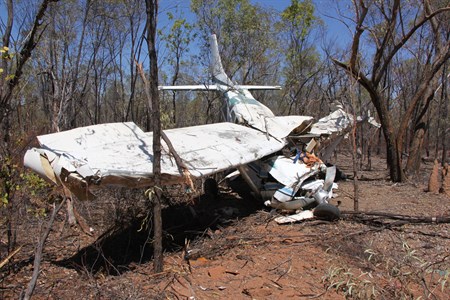
The helicopter landed hard, bounced once and rotated through about 180° before coming to rest. The pilot sustained serious injuries and the supervising pilot minor injuries. The helicopter was substantially damaged.
This incident highlights the importance of good communication between a flight instructor and their student and the use of handover/takeover techniques to clarify who has control of the aircraft at any time.
At about 0419 on 6 July 2014, in clear visibility, the container ship Kota Wajar collided with the yacht Blazing Keel in Moreton Bay. The ship was southbound in the shipping channel while the yacht was crossing the channel in a southwest direction.
The yacht suffered extensive collision damage but its watertight integrity was maintained. The two persons on board were not injured and the yacht safely returned to its marina.
What the ATSB found
The ATSB found that no one on board either Kota Wajar or Blazing Keel saw or otherwise detected the other vessel before the collision. Neither vessel had maintained a proper lookout in accordance with the international regulations for preventing collisions at sea (COLREGS).
The investigation found that Kota Wajar’s safety management system (SMS) procedures requiring a dedicated lookout were not effectively implemented and a lookout was not posted. In addition, radar was not appropriately used. The high workload of the ship’s bridge team and local conditions, such as background lights ashore, were factors in not detecting the yacht.
The investigation identified that the visual lookout kept by Blazing Keel’s crew was ineffective. Furthermore, the yacht’s night passage was undertaken without radar (which had been inoperational for 18 months) and its diving trip was not properly planned or executed.
It was also found that Brisbane Marine Pilots’ standard passage plan and master-pilot exchange does not ensure that the ship’s bridge team is provided adequate information with respect to local traffic and areas where attention should be paid to small craft.
What's been done as a result
Kota Wajar’s managers, Pacific International Lines, Singapore advised the ATSB that action to better implement SMS procedures with regard to posting a lookout was being taken. Monitoring and verification of compliance with the procedures would be enhanced through unannounced audits, including the retrieval and playback of voyage data recordings. In addition, records of bridge activities, including attendance logs, would be reviewed in detail during routine audits.
Brisbane Marine Pilots (BMP) advised the ATSB that its standard passage plan has been amended to clarify responsibility for maintaining a good lookout by sight and radar. Bridge team engagement and communicating small craft interaction will be emphasised through the master-pilot-bridge team exchange and monitored through BMP’s check pilot system. The pilotage company has also decided to review and amend its pre-arrival information for masters, to emphasise the small vessel interaction risk.
In response to the continuing safety issue around maintaining an effective and proper lookout when navigating in Australian waters, the ATSB has issued a safety advisory notice (SAN) to the masters, owners, operators and skippers of all vessels. Consistent with COLREGS requirements, the SAN reinforces the importance of taking all necessary measures to ensure that a proper lookout is kept at all times, and early avoiding action is taken to prevent collision.
Safety message
Across the past 26 years, investigations into 41 collisions between trading ships and small vessels on the Australian coast have identified that maintaining a proper lookout, using all available means in accordance with the COLREGS, is paramount to preventing collisions. In pilotage waters, pilots have a role in highlighting local traffic areas, patterns and conditions to the ship’s bridge team.
Context
Kota Wajar
The fully cellular, 1,550 TEU[6]Kota Wajarwas fitted with navigational equipment required for a ship of its size under SOLAS.[7] The two Kelvin Hughes radars, an x-band MK 5 and an s-band MK 7, had automatic radar plotting aid (ARPA) and other target tracking functions. Both radars also had data input from the ship’s automatic identification system (AIS) transceiver and global positioning system (GPS) receiver unit.
At the time of the collision, Kota Wajar was managed by Pacific International Lines, Singapore (PIL) which operates a large fleet of container ships. The container ship was on a regular service between ports in Asia and Australia and had called in Brisbane about once a month during the last 6 months. Its crew of 22 comprised nationals of China, Ghana, India, Indonesia, Myanmar, Poland and Sri Lanka.
The master was from Poland and held a Polish master’s certificate of competency. He had been at sea for 32 years of which the last 12 had been as master. He had been sailing on PIL container ships for 18 years. He had joined Kota Wajar about 5 months before the incident.
The chief mate was from Myanmar, where his master’s certificate of competency was issued, and had been at sea for 10 years. He had sailed as chief mate for 5 years, the last 1 year of which had been on PIL container ships. He had been on board Kota Wajar for about 2 months.
The Chinese fourth mate held a Class 3 certificate of competency for a watch keeping officer. He started his seagoing career with PIL about 14 months before the incident. He had been on board Kota Wajar for about 2 months and it was his first assignment as fourth mate.
The duty seaman at the time of collision was Indonesian. He had been at sea for 12 years, all of which had been on board PIL container ships. He had been on board Kota Wajar for 9 months.
Blazing Keel
Blazing Keel, a single-masted cutter with a steel hull, was registered in Queensland at the time of the collision. The yacht was equipped with an 85 horsepower diesel engine. Its principal means of navigation was a GME G-Combo G142CFD electronic chart plotter (incorporating a GPS receiver) and a compass. The yacht was fitted with a Koden MD-3000 radar but it had not been operational for about 18 months.[8]
Blazing Keel’s skipper and his wife were residents of Brisbane. Both had held a Queensland recreational marine driver licence (RMDL) for about 10 years. They had also held powerboat licences (to operate a ski boat) for about 25 years. In 2008, the skipper had attended a training course to obtain a skipper’s licence for inshore waters.
The skipper had owned Blazing Keel for about 3 years. His experience of sailing a yacht in Moreton Bay was limited to this period. The experience of his wife, who routinely sailed with him, was similar.
Navigation lights
The International Regulations for the Prevention of Collisions at Sea, 1972, as amended (COLREGS) require all vessels to exhibit specific lights (commonly known as navigation lights) from sunset to sunrise.
The navigation lights of a power-driven vessel underway consist of a masthead light[9] forward, a second masthead light abaft of, and higher than the forward one (mandatory for vessels 50 m or more in length), sidelights[10] and a sternlight.[11]Kota Wajar was required to exhibit all of these lights. At the time of the collision, the working lights along the ship’s cargo hold hatch coamings and flood lights at its stern were also on.
When the collision occurred,Blazing Keel was being powered by its engine and its sails were not set. As a power-driven vessel that was not less than 12 m in length, it was required to exhibit a masthead light, sidelights and a sternlight. The yacht was fitted with a masthead light, sidelights near its bow and a sternlight aft. In addition to these lights, the skipper stated that he had turned on the ‘tricolour’ light on the mast. He was referring to the combined lantern that is permitted for a sailing vessel of less than 20 m in length.[12]
Port of Brisbane
The Port of Brisbane is Queensland’s largest multi-cargo port and one of Australia’s fastest growing container ports. At present, more than 2,600 ships call in Brisbane each year. The port is approached through Moreton Bay and the container terminal is located at Fisherman Islands at the mouth of the Brisbane River.
The shipping channels in Moreton Bay are dredged to maintain depths and are marked by beacons and buoys (fitted with lights). Frequent changes to the shoals, channels and navigation marks (aids) make local knowledge essential for safe navigation. Ships of 50 m or more in length (unless exempted) are required to take a pilot.
Pilotage is provided by Brisbane Marine Pilots (BMP) under the regulatory regime of Maritime Safety Queensland. Ships can transit Moreton Bay at their sea speed (and often do) if the master and pilot agree after considering the prevailing conditions, under-keel clearance, scheduling and traffic. Traffic in the bay regularly includes fishing and recreational craft from a number of marinas and small boat harbours the area. Moreton Island and the waters of its western shores are popular recreational areas.
Kota Wajar’s pilot first went to sea in 1980. His seagoing career as a deck officer included experience as a ship’s master. He began piloting in the late 1990s and, in 2003, joined BMP. At the time of the incident, he had held an unrestricted pilot’s licence for Brisbane for about 9 years.
At about 0419 on 6 July 2014, in clear visibility at night, the container ship Kota Wajarcollided with the yacht Blazing Keel in Moreton Bay. The ship was southbound in the shipping channel while the yacht was crossing it. The yacht suffered damage but its watertight integrity was maintained and the two persons on board were not injured.
From the evidence available, the following findings are made. These findings should not be read as apportioning blame or liability to any particular organisation or individual.
Safety issues, or system problems, are highlighted in bold to emphasise their importance. A safety issue is an event or condition that increases safety risk and (a) can reasonably be regarded as having the potential to adversely affect the safety of future operations, and (b) is a characteristic of an organisation or a system, rather than a characteristic of a specific individual, or characteristic of an operating environment at a specific point in time.
Contributing factors
A proper lookout, in accordance with the international regulations for preventing collisions at sea (COLREGS), was not maintained on board Kota Wajar. A dedicated visual lookout was not posted and radar was not appropriately used.
Kota Wajar’s safety management system procedures with regard to posting a dedicated lookout were not effectively implemented.[Safety issue]
The high workload of Kota Wajar’s bridge team and local conditions, such as background lights ashore, were factors in Blazing Keel not being detected by sight or radar.
A proper lookout, in accordance with the COLREGS, was not maintained on board Blazing Keel. The yacht was navigating at night without radar and the lookout kept by sight was ineffective.
Blazing Keel’s diving trip was not properly planned, contingencies were not considered and the night passage was undertaken without radar since the equipment had been inoperational for more than a year.
Other factors that increased risk
All of Blazing Keel’s available navigation lights, including the combined lantern permitted by the COLREGS for sailing vessels, were turned on. As the 13.4 m yacht was a power-driven vessel at the time, the lights displayed were not in accordance with the rules and confusing.
The inclusion of specific remarks in Kota Wajar’s passage plan with regard to traffic and keeping a proper lookout may have prompted greater vigilance during the pilotage.
Brisbane Marine Pilots’ standard passage plan and master-pilot exchange did not ensure that a ship’s bridge team is provided adequate information with respect to local traffic and areas where attention must be paid to other vessels, including small craft. [Safety issue]
Over the past 26 years, investigations into 41 collisions between trading ships and small vessels on the Australian coast have identified that not maintaining a proper lookout and taking early avoiding action, in accordance with the collision regulations, has been a consistent and continuing contributor to such collisions. [Safety issue]
Other findings
Fitting Blazing Keel with an automatic identification system (AIS) transceiver would have improved its detectability and detection range while allowing those on board the yacht to detect and identify ships at long ranges.
Safety analysis
The collision
At 0419½ on 6 July 2014, in clear visibility, the container ship Kota Wajar collided with the yacht, Blazing Keel in Moreton Bay. The ship was southbound in the shipping channel while the yacht, powered by its engine, was crossing the channel in a southwest direction. The yacht suffered extensive damage but maintained its watertight integrity. The two persons on board were not injured and the yacht safely returned to its marina.
No one on board either vessel saw or otherwise detected the other before the collision.
Keeping a lookout
The COLREGS provide internationally agreed rules and measures to prevent collisions at sea. In general, the regulations apply to all vessels and in all waters. Both Kota Wajar and Blazing Keel had to comply with these regulations while navigating Moreton Bay. As the vessels did not sight each other, the matter of applying rules for taking action to avoid collision did not arise. The key requirement to keep a lookout, however, did apply and was a focus of the ATSB investigation.
With respect to keeping a lookout, COLREGS Rule 5 - Look-out, states:
Every vessel shall at all times maintain a proper look-out by sight and hearing as well as by all available means appropriate in the prevailing circumstances and conditions so as to make a full appraisal of the situation and of the risk of collision.
Rule 5 clearly states the purpose of maintaining a lookout and summarises how a lookout should be kept. Effective compliance with the rule relies on a complete and thorough understanding of the COLREGS to ensure that all relevant matters are taken into account. This understanding should be a core competency for those in charge of a navigational watch on ships – something their seagoing qualifications aim to ensure. Similarly, qualifications to operate small recreational craft, including yachts, aim to ensure a sound understanding of the COLREGS to prevent collisions.
An all-round lookout by sight and hearing (inside and outside the bridge) is necessary at all times. Other available means to maintain and enhance keeping a lookout usually include radar, AIS and traffic information from other sources, such as radio broadcasts and ship to ship calls. An effective lookout can ensure the early detection of targets, making possible a full and timely appraisal of the situation and of the risk of collision.
The prevailing circumstances and conditions include the factors that should be considered to keep an effective lookout. Many of these factors are identifiable within the COLREGS; for example Rule 6 - Safe speed, lists several factors that are also relevant to keeping a lookout. Other matters that should be taken into account rely on the practice of good seamanship and an appropriate level of nautical knowledge. Factors relevant to keeping an effective lookout include the:
state of visibility (and using radar to better assess it when restricted by fog, rain or other cause)
time of day (day, night or twilight)
background lights (shore lights or back scatter from own lights)
expected traffic in the area (open sea, coastal passage, port or harbour)
traffic density, including concentrations of fishing and other vessels, including small craft
manoeuvrability of the vessel (including stopping distance and turning ability) and its draught
state of the wind, sea and current, and the proximity of hazards such as shoals and reefs
characteristics, efficiency and limitations of radar (including its range and any interference)
type, capability and limitations of the AIS unit (and features of other vessels’ AIS units)
available local knowledge and information (sailing directions, pilot and other sources)
traffic information via radio (ship to ship calls, all ship broadcasts and schedules).
It is worth noting here that a number of the factors listed above are interrelated. For example, radar significantly enhances keeping a lookout, particularly when visibility is restricted by fog, rain or other conditions, and during darkness. Equally, the lack of radar as an available means to keep a lookout on some small vessels needs to be taken into account.
The COLREGS are supported by a number of other requirements and guidelines for mariners. The STCW Code[13] provides mandatory watchkeeping standards applicable to ‘seagoing ships’, which includes all commercial vessels in domestic or international trade but not recreational craft. The Code requires that a proper lookout is maintained at all times in compliance with Rule 5 of the COLREGS, and comprehensively covers the subject, including the factors discussed above.[14]
The Code requires that the lookout be able to give full attention to lookout duties and not be assigned or undertake any duties which could interfere with that task. It clarifies that the duties of a lookout and helmsperson on a ship are separate. The Code permits the officer of the watch (OOW) to be the sole lookout in daylight (in good conditions) which implies that another person should be posted as a lookout in darkness. It also states that the master and the OOW, when arranging lookout duty for the hours of darkness, shall have due regard to the bridge equipment and navigation aids available, their limitations, procedures and safeguards implemented.
The Bridge Procedures Guide[15] brings together the good practice of seafarers with the aim of improving navigational safety and protecting the environment. The publication is acknowledged as the principal industry guidance on the subject and is widely used internationally to support shipboard safety management systems (SMS). It refers to both the COLREGS and the STCW Code and covers all the relevant subjects, including keeping a lookout. The guide is consistent with the requirements of both in terms of what constitutes a proper lookout and the factors to be considered, including restrictions with respect to a sole lookout.
In essence, keeping a lookout in accordance with the COLREGS is mandatory, and fundamental to preventing collisions. The STCW Code provides watchkeeping standards for seagoing ships, including keeping a proper lookout. In addition to other available means of keeping watch, posting a dedicated visual lookout (that is, by sight) during the hours of darkness, in restricted visibility and when warranted by other circumstances or conditions, is necessary.
Kota Wajar’s lookout
Kota Wajar’s SMS procedures[16] quoted extensively from the COLREGS and the STCW Code with respect to bridge watchkeeping and maintaining a lookout. The procedures were consistent with the Code with regard to the OOW being the sole lookout in daylight. The standard watchkeeping arrangement included a seaman as the dedicated lookout on each navigational watch. It was clearly stated that ‘the duties of the person on lookout and helmsman were separate and the helmsman should not be considered the person on lookout while steering’.[17]
The shipboard procedures required the OOW to comply with the COLREGS at all times, including ensuring that a good lookout was maintained. Detailed guidance on the proper use of radar was included. The OOW was required to ‘give watchkeeping personnel all appropriate instructions and information necessary for maintaining a safe watch, including a proper lookout’.[18] This instruction, when appropriately applied, should result in the dedicated visual lookout being given relevant information, particularly in relation to checking for targets detected by radar or AIS but not yet sighted.
Events and conditions on 6 July 2014
At the time of the collision, Kota Wajar’s bridge team comprised the pilot, chief mate, helmsman and the fourth mate, whose main task was to assist the chief mate. As the OOW, the chief mate was responsible for ensuring that a proper lookout was kept in the prevailing circumstances and conditions. The ship was navigating the approaches to the Port of Brisbane during the hours of darkness under the conduct of a pilot. Those conditions warranted posting a dedicated visual lookout and using other available means to maintain a lookout, including radar and AIS.
In this instance however, no one was assigned the duties of a dedicated visual lookout. The pilot and the chief mate were stationed just aft of the bridge front windows near the x-band radar. The s-band radar inside the chartroom was mainly used for position fixing by the fourth mate. The helmsman was steering the ship as per the pilot’s helm and course (heading) orders.
The x-band radar’s main display was set to its north-up, relative motion mode on a 6 mile range scale (Figure 4). The display was set up to show the planned tracks and track limits (in red). The ‘trail’ function was set to indicate the true motion of targets over the past 10 minutes (so moving targets left trails on the display). Trails make a target more conspicuous and distinguish it from sea clutter. The electronic bearing line (EBL) and variable range marker (VRM) were not switched on. The cursor had been placed near the edge of the display on a 099° bearing.
Figure 4: Kota Wajar’s x-band radar’s main display at 0400 on 6 July 2014
Source: Kota Wajar’s voyage data recorder (VDR) with ATSB annotations
Over a 5 minute period around 0400 on 6 July, the second mate handed over the watch to the chief mate. The duty helmsman had changed some time earlier. Between 0357 and 0358, Kota Wajar’s course was altered from 109° to 162° and its position at 0358 was plotted on the chart. By 0400, about 20 minutes before the collision, Blazing Keel’s radar echo was consistently appearing on the x-band radar’s display, about 30 degrees on the port bow at a range of 4.5 miles. None of the three mates or the pilot saw the yacht’s echo or, if they did, paid any attention to it.
Between 0404 and 0405, after the second mate had left the bridge, the ship’s course was altered from 162° to 139°. Its position at 0405 was plotted on the chart by the fourth mate. On its 139° heading, the flashing white light of Cowan Cowan Point lighthouse was nearly ahead. The chief mate remained near the x-band radar, from where he could monitor, amongst other things, the pilot’s helm orders and the ship’s progress along the planned track.
By 0410, Blazing Keel was fine on the ship’s port bow and 2.2 miles away (Figure 5). At 0413, the yacht was right ahead of Kota Wajar, crossing to its starboard bow. Shortly before 0415, the pilot began conning the ship to its next course of 162°. As the ship’s heading changed to starboard, the yacht was once again on its port bow. At 0415, the yacht was 1.1 miles away, fine on the port bow (Figure 6). Its radar echo and trail remained readily discernible, distinct from sea clutter.
Figure 5: Section of radar display at 0410
Source: Kota Wajar’s VDR (annotated by ATSB)
Figure 6: Section of radar display at 0415
Source: Kota Wajar’s VDR (annotated by ATSB)
Rule 22 of the COLREGS - Visibility of lights, specifies the minimum visibility ranges for a vessel’s navigation lights, depending on its length. Blazing Keel’s masthead light was required to be visible at least 3 miles off, and its sidelights and sternlight at least 2 miles off. Therefore, by 0410, when the yacht was about 2 miles off, its navigation lights should have been visible from Kota Wajar’s bridge. By 0415, when the yacht was about 1 mile off, its lights should have been readily visible.
However, no one on the ship’s bridge said that they saw the yacht’s lights. By 0416, the pilot had ordered the helmsman to steady the ship on a 162° heading. The fourth mate had plotted the position at 0412 and remained occupied with his position fixing tasks. The chief mate remained near the x-band radar. Information recorded by the ship’s voyage data recorder (VDR) indicates that the radar’s EBL, VRM, cursor and its ARPA function were not used in the time leading up to the collision. This suggests that the radar was not actively used to monitor any detected targets.
As its distance closed, Blazing Keel’s echo continued to appear on the x-band radar. At 0418, it was 0.3 of a mile off, fine on the ship’s port bow with its bearing closing. Shortly afterwards, the pilot began conning the ship to its next course of 185°. At 0419½, just as the ship was steadied on a 185° heading, it collided with the yacht. No one on the bridge saw anything to suggest that a collision had occurred. The bridge wing doors were open but nothing was heard.
Why Blazing Keel went undetected
While the chief mate and the pilot had opportunities to sight the yacht out of the bridge windows or see its echo on the x-band radar, they did not. From the ATSB’s analysis, the main reasons and factors why they did not detect the yacht (some applicable to other bridge team members) were:
a dedicated visual lookout was not posted
background shore lights on Moreton Island
distraction from Charles Darwin’s bright lights
focus on navigation aid lights (beacons and others)
relatively low visual and radar detection range of the yacht
yacht was relatively less conspicuous visually and on radar
yacht’s radar echo was not identified and actively monitored
bridge team workload (four course changes in 22 minutes before collision and watch change)
change in relative bearing of the yacht (and other lights) after each course change
bridge team members’ focus on individual tasks during that period of high workload
inattentive lookout for small craft that could reasonably be expected off Moreton Island.
In the time leading up to the collision, the pilot was busy conning the ship. His attention was probably focused on navigation aids, other visual cues, and the ship’s heading and rudder indicator. The helmsman would have been concentrating on executing the pilot’s helm and course orders. The fourth mate was occupied in fixing the ship’s position. The chief mate was probably focused on monitoring the helm orders, their execution, and the ship’s progress in the channel.
While Blazing Keel was not fitted with an AIS unit or a radar reflector to improve detectability (both optional for the yacht), its radar echo and trail were consistently visible after 0400. Therefore, it is reasonable to expect the chief mate (standing beside the radar) to have identified the approaching target. Its lights would also have been visible until less than a minute before the collision (a blind sector existed within a narrow arc of the horizon up to about 150 m ahead of Kota Wajar’s bow).
While a dedicated visual lookout may not have necessarily seen the yacht in those conditions, posting one would have ensured that that person could give their full and undivided attention to the task, including using binoculars. Furthermore, such a dedicated lookout was a requirement of the applicable international rules and standards, and of the ship’s procedures.
Kota Wajar’s bridge team that night for the 3 hour pilotage essentially comprised the pilot, OOW and helmsman. Another seaman to act as a lookout/relief helmsman was not assigned. The fourth mate left the bridge once the pilot boarded and, about 45 minutes later, the master also left.
The evidence indicates that the lack of a dedicated lookout on 6 July was probably usual for that situation. The ship had regularly called at Brisbane and the master had sailed on PIL-managed ships for many years. It is likely that when the duty seaman was the helmsman (day or night) no other person was necessarily assigned lookout duties. The accounts of the bridge team members did not indicate that anyone thought there was no dedicated lookout that night. It is possible that it was considered that the OOW and pilot would sight and detect any traffic.
Conclusion
Key matters with respect to the lookout kept on board Kota Wajar were:
In the time leading up to the collision, a proper lookout by sight, hearing and all available means, including radar, in accordance with the COLREGS, was not maintained.
The lack of a dedicated visual lookout, high bridge team workload and local conditions, such as background lights ashore, were factors in the yacht not being detected by sight or radar.
The ship’s SMS procedures with regard to posting a dedicated visual lookout, consistent with international regulations and standards, were not effectively implemented.
Blazing Keel’s lookout
Blazing Keel’s skipper and his wife both held a Queensland recreational marine driver licence (RMDL). The competency standards[19] for the RMDL include the application of the COLREGS to ensure safe navigation. The standards pay particular attention to key COLREGS, including Rule 5. Therefore, the skipper and his wife should have been aware of the importance of keeping a proper lookout and how to effectively do so.
On 6 July, the yacht’s radar was not operational and it was not fitted with an AIS unit. The means of keeping a lookout were, therefore, limited to sight and hearing. The skipper and his wife kept a lookout from the yacht’s cabin from where it was not possible to keep an all-round lookout. The cabin’s roof restricted vision in an upward direction and its windows limited visibility. While red lights were being used at the helm position to avoid impacting night vision, the lights in the aft cabin and galley were being clearly reflected by the water.
Blazing Keel’s skipper was navigating using only the electronic chart plotter. The plotter provided a perspective of the yacht’s location with respect to beacons and channels in real time. However, it was of little use in keeping a lookout. With no radar and the self-imposed limitations of keeping a visual lookout from the yacht’s cabin, navigating in darkness inherently involved a higher risk of collision. Further, the skipper was not experienced in navigating the yacht at night. Therefore, in the prevailing circumstances and conditions, a proper lookout was not being kept.
In accordance with COLREGS Rule 22, Kota Wajar’s masthead lights were required to be visible at least 6 miles off, and its sidelights and sternlight at least 3 miles off. Therefore, by about 0355, the ship’s masthead lights should have been visible from Blazing Keel’s location. By 0405, its sidelights should also have been visible. As the yacht’s heading was about 220°, the ship’s relative bearing was nearly abeam to starboard.
By 0410, the ship’s navigation and deck lights should have been clearly visible from the yacht. The ship was 2.2 miles off, just abaft the starboard beam. By 0413, when it was 1.6 miles and abeam, the skipper decided to cross the shipping channel near M7 beacon. At interview, he stated that he and his wife looked but saw no ships in the channel. Therefore, either they could not see Kota Wajar’s lights from their positions in the yacht’s cabin or they did not look in its direction.
By 0415, Blazing Keel was crossing the channel on a south-westerly course. Kota Wajar was about 1 mile off near M5 beacon. Had the skipper or his wife focussed their attention, they would have seen the ship’s lights nearly on the starboard beam. The lights would have become more conspicuous as the ship closed.
By about 0418, the ship’s lights were probably above the line of sight from the yacht’s cabin due to its roof and their considerable height in relation to the yacht. Therefore, it was not unexpected that the skipper and his wife heard the impact of the collision but sighted nothing until the skipper saw ‘the lights of the aft cabin illuminate the hull of a ship’. It was only after the yacht was astern of the ship that the skipper saw the lights at its stern.
The possible reasons why Blazing Keel’s skipper and his wife did not detect Kota Wajar were:
inadequate visual lookout
low height of eye (about 2 m)
backscatter from the yacht’s own lights
sea spray on the yacht’s cabin windows
cabin limitations (windows, structures, roof)
traffic in channel not checked from outside cabin
ship’s bearing close to abeam (likely focus ahead)
lack of experience navigating at night (in darkness)
inexperience identifying a ship’s navigation lights
not equipped with AIS receiver unit to detect ships
navigating in darkness without radar (inoperational)
effects of the time of day (night) and/or reduced sleep
focus on chart plotter for navigation (passive monitoring)
focus on crossing channel and course change before the collision
no active monitoring and visual identification of navigation aids (beacons).
Immediately after the collision, the skipper thought that the yacht had collided with a beacon. Had he been actively monitoring (including visually) the passage, he would have known that his yacht was clear of M7 beacon, the only one in its vicinity. The skipper and his wife’s accounts of the incident indicate that most of the above reasons were relevant that night - it is evident that a proper and effective lookout was not kept.
In summary, a proper lookout by sight, hearing and other means, in accordance with the COLREGS, was not maintained on board Blazing Keel. Undertaking the night passage across Moreton Bay without radar increased collision risk, and was inappropriate. The risk increased further due to the ineffective visual lookout - a significant contributing factor to the incident.
Passage planning
Adequate appraisal and planning for a passage can ensure its safe execution and completion. Planning for a passage, including the proper allocation and use of resources, is a part of bridge resource management (BRM). Effective BRM is the product of a sufficient number of bridge team members with appropriate abilities and skills utilising available navigational aids and tools to carry out planned tasks in accordance with their defined roles and responsibilities. Ideally, this should always be the case but it is particularly important during a pilotage due to the higher risks.
Some important matters applicable to the respective passages of Blazing Keel and Kota Wajar through Moreton Bay on 6 July 2014 appear to have not been properly planned or considered.
Blazing Keel
Blazing Keel’s skipper’s planning focused mainly on arriving off Curtin Artificial Reef in daylight on 5 July, resting overnight and diving on the reef on the following day. He intended to follow the usual tracks to and from the reef, which were saved on the yacht’s chart plotter.
The fact that the yacht’s radar had not been operational for more than a year indicates that the skipper had not planned for contingencies, such as navigating in darkness. Nor had the weather and wind conditions that could be expected been properly considered.
The skipper believed that the easterly winds as the yacht sailed to Moreton Island on 5 July (Saturday) would continue over the weekend. However, by sunset, westerly winds had set in across the bay as could be expected in the evening and night. When Blazing Keel’s anchor chain began paying out as the clutch began slipping under load in the early hours of 6 July, the skipper decided to return to the marina. No other options, such as using more anchor chain to reduce the load, re-anchoring in another position, waiting for daylight or seeking a more sheltered place, were considered.
The long passage across Moreton Bay in darkness without radar involved a high risk to the yacht and its crew. Considering other options would have been prudent, primarily in terms of making an informed decision on whether taking the risks associated with the night passage across Moreton Bay was appropriate. As it happened, the weather conditions remained much the same and, by mid-morning, had moderated.
The skipper turned on Blazing Keel’s combined lantern in addition to other navigation lights. The combined lantern indicated a sailing vessel, whereas the yacht was a power-driven vessel at the time. While the skipper might have intended to make the yacht more readily visible, it was not displaying the lights as required by the COLREGS. Had the yacht been sighted by Kota Wajar’s bridge team, there would have been confusion in correctly identifying it as a power-driven vessel.
It is evident that there was no intention to keep a visual lookout from outside the cabin that night, including when approaching and crossing the shipping channel. Had the skipper and his wife properly checked for ships in the channel, they would have seen Kota Wajar about 1 mile off.
After the collision, the skipper used the handheld VHF radio to make an all-ships broadcast. The limited range of the radio probably contributed to the broadcast not being heard.
The evidence generally indicates that Blazing Keel’s trip was not properly planned nor were contingencies considered. Navigating at night without radar involved a particularly high risk. Proper and complete planning would have reduced risk and might have prevented the collision.
Kota Wajar
A berth-to-berth passage plan had been prepared for Kota Wajar’s voyage to Brisbane, where it had called regularly. The plan was documented using the standard forms in the shipboard SMS. The detailed plan covered many subjects and had been signed by the master and all the mates.
The plan did not include any specific reference to the composition of the bridge team. The standard ‘Pre-voyage passage plan checklist’ included two checks that could be considered to indirectly refer to precautions related to this subject. Check item 05 stated ‘Day/night passing of dangerous points considered’ and item 09 stated ‘Traffic – Area of congested water and narrow channel identified’. The checklist for the passage indicated that these checks were completed.
The remarks included in the plan for each leg of the passage were probably intended to adequately address items 05 and 09. The remarks for the legs of the pilotage where the collision occurred were identical and stated:
Narrow channel-Echo sounder on, when passing each buoy posn mark on chart and note down time in bell book or echo sounder log book. Keep clear reef & rock & Nogo area as marked on the charts. ISM checklist B08, & (B07, B09 as req.) (Vsl. under pilotage, D.off to assist pilot and master)
While the passage plan did not refer to the bridge team’s composition or a dedicated lookout, the ship’s procedures for watchkeeping arrangements (discussed earlier) were clear on this subject. However, a dedicated lookout was not posted. Specific remarks in the passage plan about traffic and keeping a lookout may have prompted greater vigilance during the pilotage. Similarly, taking into account the guidance for masters and mates of ships operating in Australian waters as per Marine Notice 17/2014, titled ‘Sound navigational practices’,[20] may have helped. The notice also lists their responsibilities when a pilot is on board, the first of which is to maintain a good lookout and situational awareness.
Brisbane Marine Pilots
The pilot used the standard BMP passage plan for Kota Wajar. The standard plan listed a number of OOW responsibilities. The first of these stated ‘Keep a good look out visually and on radar. Use ARPA and report targets to pilot including small fishing boats and yachts’. Excluding this general statement, the plan did not refer to traffic or areas where vessels, including small craft, were likely to be encountered. Neither was the subject discussed in the master-pilot information exchange.
While there are a number of reasons why the yacht went undetected, the pilot’s passage plan and local knowledge input may have increased the bridge team’s awareness of traffic in certain areas. The passage off Moreton Island is one such area where a greater number of small craft can be encountered. The island is a popular recreational area and activities include camping, fishing, parasailing, snorkelling and diving. The waters to the north of Cowan Cowan Point include Curtin Artificial Reef and those south of it include the Tangalooma wrecks. A number of suggested routes for small craft lie adjacent to, or cross, the shipping channel off the island. The area is also one where background lights can affect the visibility of targets in the foreground. Furthermore, the course changes required in the shipping channel increase the bridge team workload.
Although the master is responsible for ensuring a proper lookout is kept, the pilot jointly manages risk during pilotage. Given the pilot’s primary role is providing local knowledge, it then follows that information with respect to local traffic to better manage associated risks should be a priority.
In submission to the draft of this investigation report, BMP advised that interaction with other vessels, particularly small craft, was discussed amongst its pilots and reviewed by its risk management team. The team concluded that such interactions occur throughout the pilotage and, therefore, highlighting any particular area in its passage plan would not effectively address the risk. However, BMP stated that it would consider a range of other measures to address the risk.
In this occurrence, BMP’s standard passage plan and the master-pilot information exchange did not draw attention to any areas of higher risk of collision or prompt Kota Wajar’s bridge team to keep a proper lookout. The passage plan and the information exchange did not ensure that the ship’s bridge team was provided with adequate information on local traffic and areas where attention must be paid to other vessels,including small craft.
Collisions between ships and small vessels
In the past 26 years, 63 collisions between trading ships and small vessels have been reported to the ATSB or its predecessor. Of these, 41 have been investigated,[21] and the failure to keep a proper and effective lookout has been identified as one of the recurrent contributing factors.
While there is no substitute for a proper lookout, small vessels can improve their detectability with aids such as AIS transceivers and radar reflectors. An AIS transceiver can also assist small vessel crews in the early detection of ships and provide important dynamic and static ship information.
Collisions can also be prevented if navigators on ships and small vessels exercise greater caution in areas where they are likely to encounter each other. In addition to ports, harbours and coastal waters in general, it is important to be particularly vigilant in specific areas. For example, ships should be expected in charted shipping channels, recommended routes, two-way routes, deep water routes, preferred tracks, traffic separation schemes and other similar fairways. On the other hand, small vessels are more likely to be encountered near the shore and in recreational areas, such as reefs, diving areas and fishing grounds.
Navigators today have comparatively easy access to information. For example, electronic chart plotters are common even on small craft and provide accurate information such as the locations of shipping channels. A small vessel that avoids a shipping channel significantly reduces the risk of collision with a ship.
While measures to prevent collisions might appear straightforward, the recurrent contributing factors in collisions between ships and small vessels indicate that implementing such measures is not. The contributing factors invariably include a failure to keep a proper lookout on board one or both vessels and the absence of early and appropriate action to avoid collision.
The past 26 years of safety investigations into collisions between trading ships and small vessels on the Australian coast have consistently shown that keeping a proper lookout and taking early avoiding action in accordance with the COLREGS could have effectively prevented those collisions in almost every instance.
The safety lessons from those investigations have been published in ATSB investigation reports. A number of ATSB safety bulletins also highlight these risks to educate seafarers and mariners. These documents and other safety information about marine safety issues are available on the ATSB website.
The safety issues identified during this investigation are listed in the Findings and Safety issues and actions sections of this report. The Australian Transport Safety Bureau (ATSB) expects that all safety issues identified by the investigation should be addressed by the relevant organisation(s). In addressing those issues, the ATSB prefers to encourage relevant organisation(s) to proactively initiate safety action, rather than to issue formal safety recommendations or safety advisory notices.
Depending on the level of risk of the safety issue, the extent of corrective action taken by the relevant organisation, or the desirability of directing a broad safety message to the marine industry, the ATSB may issue safety recommendations or safety advisory notices as part of the final report.
Where relevant, these safety issues and actions will be updated on the ATSB website as information comes to hand. The initial public version of these safety issues and actions are in PDF on the ATSB website.
Proper lookout
Kota Wajar’s safety management system procedures with regard to posting a dedicated lookout were not effectively implemented.
Brisbane Marine Pilots’ standard passage plan and master-pilot exchange did not ensure that a ship’s bridge team is provided adequate information with respect to local traffic and areas where attention must be paid to other vessels, including small craft.
Over the past 26 years, investigations into 41 collisions between trading ships and small vessels on the Australian coast have identified that not maintaining a proper lookout and taking early avoiding action, in accordance with the collision regulations, has been a consistent and continuing contributor to such collisions.
On 6 July 2014, ATSB investigators attended Kota Wajar while the ship was berthed in Brisbane. The master and directly involved crew members each provided their accounts of the time of the collision. Photographs of the ship and copies of relevant documents, including log books, reports, records, manuals and procedures were obtained. The voyage data recorder was downloaded.
The pilot provided his account of the time of the incident at the offices of Brisbane Marine Pilots (BMP). The investigators also attended Blazing Keel, where the skipper and his wife provided their accounts of the collision. Photographs and relevant information was obtained. Further evidence was provided by the Queensland Police Service (QPS) and Maritime Safety Queensland (MSQ).
References
Australian Maritime Safety Authority (AMSA), Marine Notice 17/2014, Sound navigational practices, AMSA, Dec 2014.
Under Part 4, Division 2 (Investigation Reports), Section 26 of the Transport Safety Investigation Act 2003, the ATSB may provide a draft report, on a confidential basis, to any person whom the ATSB considers appropriate. Section 26 (1) (a) of the Act allows a person receiving a draft report to make submissions to the ATSB about the draft report.
A draft of this report was provided to Kota Wajar’s master, chief mate, fourth mate, helmsman, its managers, Pacific International Line (PIL), the pilot, BMP, Blazing Keel’s skipper, the Australian Maritime Safety Authority (AMSA), QPS, MSQ and the Maritime and Port Authority of Singapore (MPA).
Submissions were received from Kota Wajar’s master, PIL, the pilot, BMP, Blazing Keel’s skipper, AMSA, MSQ and MPA. The submissions were reviewed and where considered appropriate, the text of the report was amended accordingly.
The occurrence
At 1300[1] on 5 July 2014, the 185 m long container ship, Kota Wajar (cover), anchored off the Port of Brisbane, Queensland, after a sea passage from Tauranga, New Zealand. The ship was scheduled to embark a harbour pilot on the following day to berth in Brisbane.
At that time, the 44 foot (13.4 m) yacht, Blazing Keel (Figure 1) was making its way east across Moreton Bay (Figure 2). The yacht, a single-masted cutter equipped with a diesel engine, had left Newport Marina in the Redcliffe area about 2 hours earlier. The yacht’s skipper (and owner) and his wife were on board. They had planned to dive on Curtin Artificial Reef off Moreton Island on the following day (Sunday) as they had many times in the past.
Figure 1: Blazing Keel
Source: Queensland Police Service
Figure 2: Moreton Bay, Port of Brisbane
Source: Port of Brisbane Corporation (annotated by ATSB)
At about 1700, the yacht arrived near the diving destination north of Cowan Cowan Point, where it was then anchored. Weather conditions were good with a light (5 knots)[2] northerly wind, partly cloudy sky and clear visibility. By 1900, the skipper and his wife had turned in for the night.
At about 0030 on 6 July, the skipper awoke and went out on Blazing Keel’s deck. The wind was now from the west-southwest at about 10 knots. Over the next hour, the skipper felt that the sea was becoming rougher in the strengthening wind. By 0130, the wind was gusting to 14 knots.
Meanwhile Kota Wajar’s crew were weighing anchor in preparation to embark its scheduled pilot. The anchor was aweigh at 0200 and, at 0224, the pilot boarded the ship from a pilot boat.
At 0226, the pilot arrived on the ship’s navigation bridge, exchanged information with the master and took over the conduct (con) of the ship. He also provided the master the standard passage plan for the 48 mile[3] pilotage to the ship’s berth at Fisherman Islands, near the entrance to the Brisbane River. The second mate (the officer of the watch) and the duty seaman, who was hand steering the ship, were the other members of the bridge team. The fourth mate, the junior-most deck officer on board, who had been on the bridge since 0130 in preparation for pilot boarding, then left the bridge to rest.
By 0230, Kota Wajar was on a heading[4] of 200° towards the entrance of the shipping channel. The ship’s speed[5] was 11 knots and increasing. At 0250, it passed the NW Fairway beacon and entered the North West Channel (Figure 2).
At 0315, the ship passed NW6 beacon making good 17 knots (as per its passage plan for the Moreton Bay transit). The pilotage was progressing as planned and there were no other ships in the channel nearby. At about this time, the master left the bridge.
Meanwhile, Blazing Keel’s anchor chain started to pay out in the now westerly, 15 knot wind gusts and increasingly rough seas. The skipper decided to weigh anchor and return to Newport Marina under power using the yacht’s engine rather than setting its sails in the windy conditions.
At about 0330, the yacht’s anchor was aweigh and the skipper started its engine. He turned on the yacht’s navigation lights, checked that they were lit and set a southerly course towards Cowan Cowan Point. The yacht made good about 4.5 knots and the skipper and his wife remained in its cabin from where they could look out through the cabin windows.
At 0400, Kota Wajar was transiting the Main Channel (Figure 3) when the routine change of bridge watch took place. The chief mate took over the watch from the second mate. The fourth mate had returned to the bridge to gain watchkeeping experience and assist the chief mate. The helmsman (duty seaman) had also changed.
The pilot was using visual cues, the ship’s radar and his portable pilotage unit (PPU) to conduct the pilotage. He stood on the starboard side of the bridge near the radar and his PPU, and had a clear view out of the bridge front windows. When a course alteration was needed, he moved to a conning position near the centreline gyro compass repeater. The chief mate stood near the radar and, from to time, checked the ship’s position being plotted on the navigational chart by the fourth mate. The fourth mate was also assisting with the keeping of a visual lookout.
The ship was on a heading of 162° after an uneventful passage through the North West and Spitfire Channels. It was a dark night (the moon had set before midnight) and the visibility remained good. The nearest ship, the dredger Charles Darwin, about 8 miles away, was dredging in the East Channel.
By 0400, Kota Wajar’s radar was consistently displaying Blazing Keel’s radar echo. The yacht was about 30 degrees on the ship’s port bow and 4.5 miles away. No one on the bridge had detected the yacht visually or by radar.
By 0410, the distance between Kota Wajar and Blazing Keel had closed to 2.2 miles. The ship’s heading was now 139° with Cowan Cowan Point lighthouse directly ahead, M6 beacon to port and the yacht fine on its port bow. The bridge team remained unaware of the approaching yacht.
At 0413, Blazing Keel crossed 1.6 miles ahead of the ship (that is, from the ship’s port bow to its starboard bow). The skipper and his wife did not see any ships in the channel and he decided to cross it near M7 beacon. By 0415, the yacht was on a south-westerly course at 4.5 knots.
Meanwhile, Kota Wajar arrived off M5 beacon and, at 0415, its course was altered. By 0416, the ship was on a heading of 162° towards M7 beacon. The brightly lit Charles Darwin was conspicuous about 5 miles away, 22 degrees on the ship’s starboard bow. Blazing Keel was once again on the ship’s port bow (12 degrees) and about 0.8 of a mile away. The ship and yacht were on a collision course. No one on board either vessel was aware of the close-quarters situation.
Figure 3: Section of navigational chart Aus 236 showing the tracks of both vessels
Source: Australian Hydrographic Service (annotated by ATSB using electronically recorded data)
The distance between Kota Wajar and Blazing Keel rapidly closed as they approached M7 beacon. At 0418½, when the ship was near the beacon, the pilot began conning to alter course in order to follow the channel on a 185° heading. By 0419, the ship’s heading was 177° with the undetected yacht less than 100 m away on its port bow and closing.
Blazing Keel’s skipper and his wife had not seen the rapidly approaching ship.
At 0419½, as Kota Wajarwas steadied on a heading of 185° in a position immediately east of M7 beacon, it collided with Blazing Keel. The port side of the ship’s bulbous bow first made contact with the starboard side of the yacht, which was on a heading of about 225°.
Blazing Keel’s skipper only realised what had happened when he saw the ship’s dark hull illuminated by the yacht’s aft cabin and galley lights. He quickly put the rudder over to port and the engine throttle to full in an attempt to get clear of the ship. The yacht remained alongside the ship for about 30 seconds, bumping and scraping against its hull, until the curve of the ship’s stern had passed.
Once the yacht was astern of Kota Wajar, the skipper saw bright lights at its stern but could not read the ship’s name. He reduced the yacht’s speed to about 4 knots, checked that its steering was working and confirmed that he and his wife had not been injured. He then asked his wife to check the yacht for damage and leaks.
No one on board Kota Wajar saw or heard the collision or become aware of the yacht nearby. As the ship was steadied on a heading of 185°, the bright lights of Charles Darwin were now fine on the starboard bow (bearing 189°). The dredger was returning to port with an expected entry time earlier than the ship.
The ship continued its passage along the channel as planned.
By 0421, Blazing Keel’s skipper had set a southerly course along the channel while his wife was checking for damage. The skipper attempted to call Redcliffe coastguard using a handheld VHF radio but got no response. He then broadcast an urgency message to all stations on channel 16 and again received no response.
At about 0425, the skipper’s wife reported damage on Blazing Keel’s starboard side, including its mast and rigging, but no water ingress. The skipper shone a torch out on the rigging and noted significant damage. He then checked the yacht’s bilges and found them dry. Satisfied that the hull was watertight, he decided to resume the passage to the marina. By 0427, he had set a south-westerly course.
Shortly after 0500, Kota Wajar’s master returned to the bridge. At about 0518, the ship’s speed was reduced as it approached the port. By 0612, the ship had been secured alongside its berth and the pilot left shortly afterwards.
At 0630, Blazing Keel’s skipper established radio contact with Redcliffe coastguard and reported the collision. By 0730, the yacht had berthed in Newport Marina and the skipper then completed a thorough inspection of the yacht. There was extensive hull damage on its starboard side, both above and below the waterline, and the ship’s red boot-topping paint marks were clearly visible. The handrails, rigging and a number of mast stays and spreaders were damaged.
Shortly thereafter, the skipper and his wife attended the local water police station to provide their statements to the police. The time, location and other details of the collision were then passed on by the police to the port authority and others to follow up with involved parties.
At about 0800, Kota Wajar’s pilot was advised by the pilot office that the ship had collided with a yacht at about 0430 off Cowan Cowan Point. The ship’s master was also advised of the collision. The yacht’s blue and white paint marks were clearly visible near the waterline on the ship’s bulbous bow and along the port side in a number of places.
Purpose of safety investigations & publishing information
Purpose of safety investigations
The objective of a safety investigation is to enhance transport safety. This is done through:
identifying safety issues and facilitating safety action to address those issues
providing information about occurrences and their associated safety factors to facilitate learning within the transport industry.
It is not a function of the ATSB to apportion blame or provide a means for determining liability. At the same time, an investigation report must include factual material of sufficient weight to support the analysis and findings. At all times the ATSB endeavours to balance the use of material that could imply adverse comment with the need to properly explain what happened, and why, in a fair and unbiased manner. The ATSB does not investigate for the purpose of taking administrative, regulatory or criminal action.
Terminology
An explanation of terminology used in ATSB investigation reports is available here. This includes terms such as occurrence, contributing factor, other factor that increased risk, and safety issue.
Publishing information
Released in accordance with section 25 of the Transport Safety Investigation Act 2003
Ownership of intellectual property rights in this publication
Unless otherwise noted, copyright (and any other intellectual property rights, if any) in this report publication is owned by the Commonwealth of Australia.
Creative Commons licence
With the exception of the Coat of Arms, ATSB logo, and photos and graphics in which a third party holds copyright, this publication is licensed under a Creative Commons Attribution 3.0 Australia licence.
Creative Commons Attribution 3.0 Australia Licence is a standard form licence agreement that allows you to copy, distribute, transmit and adapt this publication provided that you attribute the work.
The ATSB’s preference is that you attribute this publication (and any material sourced from it) using the following wording: Source: Australian Transport Safety Bureau
Copyright in material obtained from other agencies, private individuals or organisations, belongs to those agencies, individuals or organisations. Where you wish to use their material, you will need to contact them directly.
This preliminary report details factual information established in the investigation’s early evidence collection phase and has been prepared to provide timely information to the industry and public. Preliminary reports contain no analysis or findings, which will be detailed in the investigation’s final report. The information contained in this preliminary report is released in accordance with section 25 of the Transport Safety Investigation Act 2003.
The Occurrence
The information contained in this Preliminary report is released in accordance with section 25 of the Transport Safety Investigation Act 2003 and is derived from the initial investigation of the occurrence. Readers are cautioned that new evidence will become available as the investigation progresses that will enhance the ATSB's understanding of the accident as outlined in this Preliminary report.
On 11 July 2014, train ST21, a scheduled XPT passenger service, was travelling from Sydney to Melbourne. At Broadmeadows station (about 18 km north of the Melbourne CBD), a pilot boarded the train for the final part of the journey into Southern Cross station. The pilot was required to provide route familiarisation training for XPT drivers who were operating over the newly commissioned section of dual gauge track leading into and out of the Southern Cross station.
At about 0738, train ST21 entered the dual gauge ‘up’ fly over track and passed over MYD882 (dual gauge ‘up’ turnout), which was part of the newly commissioned track. As the train traversed the turnout, it bounced heavily. The pilot described it as ‘a short sharp dip in the track, similar to a short deep bog hole (mud hole)’ and explained that if the train hadn’t kept rolling, he would have thought they had derailed. The pilot immediately rang Southern Cross number 1 signal box and reported the occurrence. Number 1 signal box advised that they would arrange for a track inspection. The train continued into Southern Cross, where it was fuelled and joined by passengers and new crew, in readiness for the return journey to Sydney as train ST24.
At about 0830, train ST24 departed Southern Cross and travelled along the dual gauge ‘down’ fly over track on its journey towards Sydney. As the train approached signal MYD987, the driver observed a clear medium speed with ‘S’ indication. To the driver, this meant that the route was correctly set and that the train could traverse MYD887 (dual gauge ‘down’ turnout) at up to 25 km/h. As the train traversed the turnout at about 20 km/h, the driver and pilot felt several large jolts, followed by a series of fault indications on the driver’s display screen as the train came to a standstill. The pilot then rang the train controller and advised that train ST24 had derailed on the fly over. When the site was secured, the driver walked back to inspect the extent of the damage. Recovery personnel arrived shortly thereafter and commenced disembarking passengers.
Investigators from the ATSB and the Chief Investigator Transport Safety (CITS) Victoria attended the site and began gathering/protecting perishable evidence, including site data, photographs, measurements, CTC data logs and train data logs.
The investigation is continuing and will include an examination of the following:
Design, quality control, commissioning and acceptance testing processes for dual gauge turnouts.
The process for identification and examination of potential infrastructure or rolling stock defects that may result in derailment, following reports of suspected infrastructure irregularities.
Final report
Safety summary
What happened
On 11 July 2014, train ST24, a scheduled XPT passenger service, returning to Sydney Central Station from Melbourne Southern Cross Station, derailed at turnout MYD887 near North Melbourne station in Victoria. Turnout MYD887 was installed as part of the Regional Rail Link project. While certified for standard gauge revenue operations earlier that week, it had not been used by XPT services until the day of the derailment.
As a result of the derailment, there were minor injuries to some passengers and the train’s crew, as well as damage to track and rolling stock.
What the ATSB found
The ATSB found that the derailment of ST24 occurred at a type 37 mixed gauge turnout (MYD887), as the wheelset of a carriage (probably XAM2176) transitioned from the standard gauge short stock rail onto the broad gauge switch blade through the transfer area. It was determined that there were design deficiencies of the type 37 turnout with respect to transfer area width, guard rail protection, and capacity of the tie bar to resist elongation, that contributed to the derailment.
Earlier that morning the same train, travelling from Sydney as ST21, derailed at a similar type 37 mixed gauge turnout (MYD882) but re-railed a short distance later. The train crew felt the train bounce but were unaware that it had derailed, so continued into Southern Cross Station. The incident was reported to operational staff and the track was being inspected at the time ST24 derailed at turnout MYD887.
Post-derailment, an examination of the type-approved design of the type 37 turnout determined that it was lacking, in that it had been assumed that the type 37 turnouts would perform safely in service based solely on the performance of a similar (type 29) dual gauge turnout, although there were significant differences between the two turnout types.
The ATSB determined that there were no maintenance deficiencies with train ST24 that contributed to the derailment.
What's been done as a result
V/Line has actively managed the redesign, alteration and validation of the type 37 turnout, to support the safe operation of standard gauge rolling stock having wheel rim widths of 127 mm, including a comprehensive review of contractual arrangements, testing and commissioning processes.
Safety message
Proposed infrastructure changes, including those put forward by contractors, need to be thoroughly assessed at the design stage to ensure that they meet all operational and safety requirements.
Once constructed, infrastructure needs to be rigorously tested as part of the commissioning process to ensure that the changes are safe and perform to the original design intent.
On 3 July 2014, at about 1940 Eastern Standard Time an instructor and student pilot of a Bell 206 helicopter, registered VH-XJA (XJA), approached Sunshine Coast Airport, Queensland to conduct night circuits. An Airbus A320 aircraft, registered VH-VGJ (VGJ), was inbound to Sunshine Coast from Melbourne, Victoria via the area navigation (RNAV) required navigation performance approach to runway 18. When about 30 NM from Sunshine Coast, the first officer of VGJ broadcast on the common traffic advisory frequency (CTAF), inbound and did not receive a response.
When about 10 NM from the runway, on a downwind leg and approaching a base turn for runway 18, the first officer broadcast on the CTAF that VGJ had left 3,800 ft and was conducting an instrument approach to runway 18, expecting to land at time 2001, and did not receive a reply.
The instructor of XJA heard the call from VGJ and assumed that the aircraft was then about 15 NM away. He expected the crew of VGJ would subsequently broadcast when 10 and 5 NM from the runway, and he elected to continue the circuit and monitor the CTAF for those calls.
The instructor of XJA broadcast when on a 3 NM final, but the crew of VGJ did not hear this call. About 70 seconds later, the first officer of VGJ broadcast on a 2 NM final. Hearing this call, the instructor of XJA turned and sighted the landing lights of VGJ close behind, diverged to the right and commenced a climb. Radar data indicated that the two aircraft passed at an altitude of about 200-300 ft with a lateral separation of about 370 m.
This incident highlights the importance of using both unalerted and alerted see-and-avoid principles and maintaining a vigilant lookout at all times.
On 9 July 2014, the pilot of a Cessna 210 aircraft, registered VH-SKQ, conducted a scenic charter flight from Broome, Western Australia, to Windjana Gorge, Silent Grove, Mt Hart Station, Cape Leveque and return to Broome, with five passengers on board.
When approaching Broome Airport, the aircraft was cleared by air traffic control (ATC) to turn onto a left base leg for runway 10. Due to another aircraft backtracking on the runway, the pilot was directed by ATC to extend the base leg. The pilot then selected 10° of flap and the landing gear lever to the extended position, and reported that he had observed the green light indicating the landing gear was extended.
When on the final leg of the approach, the pilot reported that he performed the final checks however omitted to look outside and visually confirm by sighting the left main landing gear, whether the gear was in the extended position. As the pilot flared the aircraft for landing, he realised that the aircraft was lower to the ground than normal on touchdown, and heard what he believed were the main tyres contacting the runway, followed by the aircraft belly and propeller. The aircraft sustained substantial damage.
A witness observed the aircraft on the base leg, with the nose landing gear extended and the main landing gear retracted.
An engineering inspection found that a faulty nose gear up lock switch resulted in the nose gear extending during flight. This resulted in the main landing gear failing to extend. The pilot was unaware that the main landing gear had not extended prior to landing as the visual check was omitted.
On 7 July 2014, Genesee & Wyoming Australia train 24KW departed from Iron Duke, a mine site near Whyalla, South Australia. The train was loaded with iron ore destined for the port of Whyalla. Shortly after the train entered the Iron Baron to 21km Junction section, the driver felt a slight ‘bump’ and noticed a loss in brake pipe pressure, before observing a large cloud of dust toward the rear of the train. Once the train had come to a stand the driver walked back along the consist and saw several wagons had derailed, resulting in significant track damage.
What the ATSB found
The ATSB found that two mechanical fishplate joints located at the 108.100 km mark had failed under the passage of the train. The joints failed due to a combination of pre-existing fatigue cracks in the fishplates, and at least one joint being in a condition of weakened structural integrity due to inadequate fastening. As the rollingstock passed over the incomplete and ineffective rail joints, joint instability and movement produced increasing impact forces, lateral pressure and subsequent joint separation. This was followed by the progressive failure and misalignment of the track until the wagons of train 24KW inevitably derailed.
Other fishplated joints within the immediate vicinity of the 108.100 km mark were also examined. While some bolts were missing, examination of the bolt holes suggested that four fasteners had been used to secure the joints. Based on the evidence available, the ATSB concluded that the deficient permanent mechanical rail joint installed at the 108.100 km mark was an isolated anomaly and not indicative of the assembled condition of other plated joints.
What's been done as a result
Shortly after the derailment, Genesse & Wyoming Australia, through a welding program, removed all the mechanical joints within the Whyalla Narrow Gauge mainline network.
In addition to the welding program, GWA and Transfield Services Australia completed an audit of maintenance standards and processes - focussed on improving instructions relating to joint inspection, maintenance and risk reporting. In November 2014, Transfield Services Australia, in cooperation with GWA, disseminated the document Mechanical Joint Rectification to all track maintenance staff.
Following an internal investigation and an incident cause analysis study into the derailment of train 24KW, GWA identified corrective actions associated with installation, inspection and maintenance of mechanical rail joints. GWA have made significant progress implementing those recommendations.
Safety message
To ensure fishplate joints are correctly installed and joints are not compromised during operation, track infrastructure owners and operators should ensure that track maintenance staff are provided with sufficient guidance and instruction for all works requested.
Track managers should ensure the effective application of policy and procedures relating to the assurance of the structural integrity of track joints - before returning the joints to service.
On 3 July 2014, a Piper Aircraft Corp PA-28-161, registered VH-TEK, was returning from the training area via the 2RN reporting point to Bankstown Airport, New South Wales. The student pilot was the only person on board. The flight was conducted in visual meteorological conditions.
The student tracked from the 2RN reporting point and joined downwind for a touch-and-go landing on runway 29L. The student turned onto base and then final and the Bankstown tower gave the student a clearance to conduct a touch-and-go clearance. The student reported that the approach and landing were normal. As soon as the student felt the aircraft wheels were on the ground, he reached down to the flap lever and selected the flaps to the retracted position.
The aircraft veered slightly to the right and then quickly to the left, departing the runway and onto the grass strip. The student regained control of the aircraft and informed the tower of what happened, reporting that he did not require assistance. The student then taxied onto taxiway B, between taxiway B4 and B3, passing about 20 metres in front of a taxiing Cessna 150. TEK taxied to the flying school without further incident. The student pilot was uninjured, and the aircraft was not damaged.
At about noon on 3 July 2014, an instructor and student were conducting training in the circuit at Roma Airport, Queensland, in a Skyfox Aviation CA25N aircraft, registered 24-3265. At the same time, a PA-28R, registered VH-WJO, was inbound to Roma Airport for a landing. The conditions were fine and clear.
As the PA-28R approached the airport, the CA25N instructor and the pilot of the PA-28R exchanged information regarding their respective positions and intentions on the Roma Airport Common Traffic Advisory Frequency (CTAF). During this exchange of information, the pilot of the PA-28R inadvertently miscommunicated his position, which left the CA25N instructor with an inaccurate perception of the position of the PA-28R and a misunderstanding with respect to the intentions of the PA-28R pilot. Similarly, based upon his interpretation of the information exchanged on the CTAF, the PA-28R pilot believed that he would be clear of the CA25N as he joined the circuit.
Despite their efforts, the CA25N crew and the PA-28R pilot were unable to sight the other aircraft until the downwind leg of the circuit when the CA25N instructor saw the PA-28R pass from left to right, about 100 metres ahead and about 200 ft above the CA25N. The CA25N instructor was then able to inform the pilot of the PA-28R of the relative position of the CA25N, allowing the pilot of the PA-28R to then sight the CA25N over his left shoulder. Both aircraft then continued for an uneventful landing, the CA25N landing ahead of the PA-28R which flew a wider circuit.
Although the CA25N instructor and PA-28R pilot were communicating on the CTAF and attempting to establish visual contact, separation seems to have been compromised on this occasion due to the limited effectiveness of the CTAF communications and the limitations of each pilot’s lookout. Lookout effectiveness was probably compromised by a combination of CTAF miscommunication, the geometry of the event and sun glare.
This incident highlights the importance of an effective lookout, and accurate and timely communication. These are fundamental pillars supporting the principles of alerted see-and-avoid.
On 4 July 2014, the pilot/owner of a Cessna Aircraft Company T210N aircraft, registered VH-ZFW, and two passengers were conducting a private flight from Inverell Airport to Bankstown Airport, New South Wales.
Shortly after take-off, oil appeared on the windscreen and the pilot rejected the take-off with the intent of landing back on the runway. As the oil temporarily obscured the pilot’s forward visibility, they looked to the left to assess their position along the runway. The pilot realised that they were a lot further along the runway than expected and that there was insufficient runway distance remaining to land safely. A go-around was commenced but the pilot reported that the engine did not respond. During the subsequent forced landing, the aircraft impacted a shrub beyond the end of the runway overrun and flipped, before coming to rest inverted.
The pilot and a passenger were hospitalised with serious injuries and the second passenger received minor injuries. The seriously-injured passenger later succumbed to their injuries. The aircraft was destroyed by the impact forces and a post-impact fuel-fed fire.
What the ATSB found
Examination of the aircraft found the engine oil filler cap detached from the oil filler tube but hanging by its chain. Further examination of the tube and cap determined that it was most likely the cap was not secure before the flight commenced. The Cessna T210N pilot’s operating handbook advised pilots to check the engine oil level during a pre-flight inspection but not the security of the separate oil filler cap. The ATSB could not establish the extent to which a specific checklist item about oil filler cap security would have assisted in identifying the unsecured cap in this case, although it would probably have increased the likelihood of detection.
Witness observations and the pilot’s assessment of the aircraft’s position along the runway during the rejected take-off indicated that the take-off was longer than normal. The reason for this could not be determined.
Examination of the engine and turbocharger found no mechanical defect or failure that would have precluded normal operation. While it was possible that a temporary issue occurred, resulting in the reported lack of engine response during the go-around, this could not be established.
The ATSB also determined that the engine manufacturer’s oil change interval had been exceeded by 3 months but it was very unlikely that this had any effect on the operation of the engine.
Safety message
This accident highlights that, prior to take-off, pilots should have in mind a go/no-go decision point along the runway by which time the aircraft should become airborne. If at that point the aircraft is not airborne, the pilot should reject the take-off. Having such a point assists pilot decision making during a critical phase of flight. This is particularly important when operating in conditions that may affect aircraft performance, such as tailwind conditions.
In addition, the ATSB highlights the importance of being aware of the daily inspection requirements when operating aircraft under a CASA maintenance schedule. In particular, how this may differ from the aircraft manufacturer’s pre-flight inspection procedure.
Photograph of VH-ZFW
Source: John Newby
The occurrence
On 4 July 2014, at about 1230 Eastern Standard Time,[1] the pilot/owner of Cessna Aircraft Company T210N aircraft, registered VH-ZFW (ZFW), and two passengers arrived at Inverell Airport to conduct a private flight to Bankstown Airport, New South Wales.
In preparation for the flight, the pilot removed the aircraft from the hangar and conducted a pre-flight inspection. The pilot could not initially recall adding engine oil to the engine during the inspection but later believed that was the case. Witnesses reported being aware of the pilot carrying out the pre-flight inspection but none observed the entire pre-flight, including whether the pilot added any engine oil. The two passengers remained some distance from the aircraft until the pilot completed the inspection. The pilot and passengers boarded the aircraft. The pilot started the engine and completed the pre-take-off checks, which were reported as normal.
The pilot recalled that there was a tailwind of less than 5 kt on runway 16.[2] Therefore, to allow for an immediate departure to the south, the take-off was planned from that runway. The pilot was aware that the minimal tailwind might prolong the take-off roll.
Just prior to taxiing, the pilot of ZFW conversed with the pilot of an inbound aircraft who was intending to land on runway 34. The pilot of ZFW then taxied to the threshold of runway 16 and waited for the other aircraft to land. After that aircraft vacated the runway, the pilot of ZFW commenced the take-off at about 1309. Ten degrees of wing flap was reported set for the take-off.
The pilot indicated that initially the take-off proceeded normally. However, shortly after becoming airborne, when at an estimated 200–300 ft above the ground, engine oil appeared on the windscreen, predominantly on the left. The pilot initiated a rejected take-off by reducing engine power to idle and lowering the nose of the aircraft. In response to the temporarily-obscured forward vision, the pilot looked out to the left of the aircraft to assess their position. Shortly after, the pilot realised that they were a lot further along the runway than expected as they[3] could see the threshold of the reciprocal runway 34 ahead (Figure 1). The pilot determined that there was insufficient distance remaining to land safely and commenced a go-around. The intent was to return to the airport for an immediate landing. However, the pilot reported that when full power was applied, the engine did not respond. The pilot initiated a forced landing.
The pilot was aware of the need to clear the boundary fence and ensure that the aircraft’s airspeed remained above the stall[4] speed. The pilot identified a cleared area to the right and turned the aircraft toward that area. The pilot reported having no further recollection of the forced landing until after the impact when the aircraft was on fire.
The pilot exited the aircraft and assisted the passengers. Shortly after, a number of people arrived and found the occupants clear of the burning wreckage. They moved the occupants further away and provided assistance until emergency services personnel arrived.
The pilot and front seat passenger were hospitalised with serious injuries. The second passenger, who was sitting in the middle row of seats, received minor injuries. The front seat passenger later succumbed to their injuries. The combined effects of the impact forces and post-impact fuel-fed fire destroyed the aircraft (Figure 2).
Figure 1: Runways at Inverell Airport, showing the location of the witnesses, approximate position that VHZFW became airborne and wreckage location
Source: Google earth, modified by the ATSB
Passenger observations
The passenger seated in the middle row reported that the engine sounded normal until some way down the runway when they started to notice something was wrong. The passenger reported removing their headset and noting that the engine sounded ‘weak’. At that time, the aircraft’s wheels were slightly above the ground and the aircraft about 10 m from the airport boundary fence. Shortly after, the passenger observed the pilot applying rearward pressure on the control column. The passenger felt the aircraft bounce before going over the fence. The aircraft then went to the right and flipped before coming to rest inverted. A fire commenced shortly thereafter. The passenger exited the aircraft and went to the main road to seek assistance.
The passenger did not observe any oil on the windscreen.
Witness observations
Witness 1
A witness who was familiar with ZFW and had observed the aircraft take-off from Inverell Airport on numerous occasions was positioned near a hangar overlooking runway 16/34 (Figure 1). The witness reported hearing ZFW start up and observed it taxi to the runway end and, soon after, commence the take-off. The witness indicated that during the initial stages of the take-off, the aircraft’s acceleration along the runway and engine sound appeared normal.
When in-line with their position, the witness was expecting the nose of the aircraft to lift but instead the aircraft continued along the runway. The witness indicated that if the nose did in fact lift from the runway, it would have only been centimetres above the ground. The witness became concerned and notified his colleagues.
As the aircraft passed runway 04/22, which is about 1,000 m along runway 16 and just before the depression in this runway (see the section titled Operational information - Airport information), it became airborne to about 10–13 ft (3–4 m). The witness reported that it looked like there was a slight crosswind as the aircraft’s tail moved to the right. The witness believed the pilot then rejected the take-off, as the aircraft appeared to settle back onto the runway. However, due to the depression in the runway, the witness could only see the aircraft’s wings. By this time, a second witness came of out of the hangar.
Witness 2
The second witness, who was also familiar with the aircraft, heard ZFW start up and the engine and other sounds associated with the pre-take-off checks. All were reported as sounding normal. The witness further indicated that, dependent on a number of conditions, ZFW would normally become airborne when about 500–800 m along the runway. By the upwind end of the runway, it would typically be about 200–300 ft above the ground.
Approaching the upwind end of the runway
Shortly after, as the aircraft neared the upwind end of the runway, both witnesses observed the aircraft suddenly climb to about 100–150 ft. Both commented that the aircraft appeared to be ‘labouring’. Neither witness could recall hearing the engine operating at that time, but the second witness believed that they should normally have been able to hear the engine from their position. The aircraft then turned right and descended below the rising terrain. Shortly after, the witnesses observed smoke in the area of the descent and went to assist.
The ATSB could not reconcile the discrepancy between the pilot’s recollection of the height gained after becoming airborne to that observed by the witnesses. However, it was possible that the accident and/or subsequent medical treatment affected the pilot’s recall.
Figure 2: Aerial view of the accident site showing VH-ZFW (looking west-north-west)
Source: New South Wales Police Force, modified by the ATSB
The pilot held a Private Pilot (Aeroplane) Licence that was issued on 10 June 2011 and a valid Class 2 Aviation Medical Certificate. The pilot’s logbook showed a total flying experience of 231.1 hours to the last entry dated 25 May 2014. Of these, about 118 hours were in ZFW. The pilot reported that, in the intervening period, they carried out a return flight to Archerfield Airport, Queensland and a local flight in ZFW in the weeks prior to the occurrence.
The pilot last completed a flight review on 8 November 2012.
Aircraft information
General
The Cessna T210N is a high-wing, single-engine aircraft with a retractable landing gear. The aircraft was manufactured in the United States (US) in 1980 and imported into Australia by the current owner/pilot. The aircraft was registered as VH-ZFW on 26 September 2012.
The aircraft was fitted with a six-cylinder, horizontally-opposed Teledyne Continental Motors TSIO-520-R9B engine. The engine drove a three-bladed McCauley Propeller Systems constant-speed propeller.
A review of the aircraft’s records indicated that ZFW was maintained in accordance with the approved Civil Aviation Safety Authority (CASA) maintenance schedule. The last periodic inspection was on 11 October 2013, at a total time in service of 3,973.6 hours. This included the last recorded engine oil change. Since that time, the aircraft accumulated about 40 hours. The maintenance records did not identify any defects or unserviceability with the aircraft prior to the occurrence.
Engine oil system
Oil for engine lubrication, propeller governor operation and turbocharger system control was supplied from a sump located on the bottom of the engine. The engine sump capacity was 10 quarts (about 10 L). Looking from the rear of the aircraft, the oil dipstick was located at the rear-left of the engine. The oil filler tube and cap was on top of the crankcase, near the front of the engine. Both the oil dipstick and filler tube were accessible through separate doors on the engine cowling.
The engine manufacturer advised that the oil filler cap fitted to the engine had been used on a large range of their engines since 1973. They further advised that the design of the cap was simple but effective and that they did not foresee a need to change the design.
The engine manufacturer’s recommended interval between oil changes was 50 hours or 6 months, whichever occurred first. The Cessna T210N pilot’s operating handbook (POH) also recommended changing the oil at least every 6 months, even though this may be less than the 50 hours accumulated. The POH further advised to reduce the interval when conducting short flights and during operations that involve long periods at idle revolutions per minute to avoid oil ‘sludging’. The term oil sludge refers to viscous deposits or gelling of the oil, which can lower the effectiveness of the lubrication system.
Turbocharger system
The aircraft was fitted with a Kelly Aerospace 400 series turbocharger. The function of the turbocharger was to maintain a desired manifold pressure at a given throttle setting, regardless of the ambient air temperature and pressure. A butterfly-type waste gate regulated the amount of exhaust gas fed to the turbocharger turbine wheel. The waste gate actuator and controller used engine oil pressure to operate. In the event of a turbocharger failure, the waste gate would move to the open position to prevent an overboost situation (excessive manifold pressure). The engine manufacturer stated that:
Rapid throttle movements may cause undershooting or overshooting of the desired manifold pressure, necessitating a subsequent adjustment once the turbocharger has stabilized. Gradual throttle movement will permit the turbocharger to keep pace with the change in power.
Speedbrakes
Precise Flight speedbrakes were installed on the aircraft to reduce shock engine cooling and allow for accelerated descents without decreasing engine power. The speedbrakes were located on the upper surface of each wing and were electrically actuated by an electric clutch. If the aircraft experienced a loss of electrical power, the clutch would automatically retract the speedbrakes. The speedbrakes took between 1.8–2.3 seconds to deploy.
Operational information
Meteorological information
The aerodrome forecast[5] for Inverell Airport indicated the wind would be from 300° (west-north-west) at 10 kt (19 km/h) with a temperature at the time of 15 °C. The pilot reported that, at the time of take-off, there was a tailwind of less than 5 kt on runway 16. This was consistent with witness observations of conditions including light and variable winds, with about a 5 kt tailwind on runway 16.
Airport information
Inverell Airport had two runways aligned 16/34 and 04/22. Runway 16/34 was the main runway and was 2,114 m long, with a 1 per cent upslope on runway 16. Runway 04/22 was to the west of and about 1,000 m along the main runway (Figure 1). Just beyond that point, there was a distinct depression in the main runway. Due to this variation in runway level, aircraft may not be sighted on opposite ends of the runway. The Airservices Australia Aerodrome Chart for the airport included a caution to this effect.
There was a 2 m high airport boundary fence about 160 m beyond the end of runway 16. Outside this fence was a semi-cleared area covered in low-lying shrubs and tall grasses.
Estimation of take-off and landing distances
An estimation of the aircraft’s expected take-off and landing distance (ground roll) that day was undertaken using the Cessna T210N POH. Taking into account the runway characteristics, the calculations were based on information from the aerodrome forecast and the pilot’s and witness recollections (Figure 3).
The POH indicated that a normal take-off was possible using a 0°–10° wing flap setting. However, 10° wing flap was preferred as it resulted in an earlier nose wheel lift-off and a 10 per cent reduction in ground run compared with 0° flaps. Based on the manufacturer’s preferred configuration, the take-off ground roll distance for the occurrence flight with a 10° flap setting and 5 kt tailwind was estimated to have been about 485 m. With a 0° flap setting, the estimated distance was about 535 m. The pilot reported that they would normally select 10° flap for take-off and be airborne well before passing runway 04/22.
The landing distance was also estimated from information in the POH and was based on a flap setting of 30°, engine power at idle and the application of maximum braking. Given these conditions, depending on the aircraft’s actual configuration at the time, the minimum distance required for landing and braking to a complete stop would have been at least 320 m (Figure 3). However, the actual runway distance remaining when the pilot rejected the take-off was unable to be determined.
Figure 3: Estimated take-off distances with 10° (in yellow) and 0° (in orange) of wing flap set, the observed lift-off position along runway 16 and the minimum estimated landing distance (in green)
Source: Google earth, modified by the ATSB
Take-off considerations
The pilot could not recall when the aircraft became airborne but reported that the take-off was normal until the oil appeared on the windscreen. However, after initiating the rejected take-off, the pilot realised that they were a lot further along the runway than expected. The pilot indicated that the aircraft would normally be about 500 ft above the ground by the runway end (runway 34 threshold). The pilot did not know why the aircraft was lower than normal at that time.
The pilot reported that they did not have a specific go/no-go decision point along the runway. In respect of the application of such decision points, the US Federal Aviation Administration (FAA) Airplane Flying Handbook stated that:
Prior to take-off, the pilot should have in mind a point along the runway at which the airplane should be airborne. If that point is reached and the airplane is not airborne, immediate action should be taken to discontinue the take-off.
Pre-flight inspection procedure
The Cessna T210N POH advised pilots to check the engine oil quantity during a pre-flight inspection walk-around but did not require a check of the security of the oil filler cap. In contrast, the Cessna service manual, which provided the recommended procedures and instruction for ground handling, servicing and maintaining the aircraft, included a requirement to check that the filler cap was tight and the oil filler cap was secure. A review of other handbooks for a range of aircraft types found that inclusion of that check in the pre-flight inspection process was inconsistent.
The daily inspection requirements, under the CASA maintenance schedule to which the aircraft was maintained, included a check of the oil level and that the oil dipstick and cap were secure and locked. The CASA Maintenance guide for pilots stressed the importance of the daily inspection in terms of it being:
…the only thorough inspection between periodic inspections and is the last opportunity to inspect the aircraft to ensure that it is airworthy and fit to fly…and must be carried out prior to the first flight of each day the aircraft is flown.
and the purpose of the pre-flight inspection being:
…to inspect the aircraft to ensure that it is safe, that nothing untoward has occurred since the daily inspection, and to determine if flight requirements can be met.
The pilot reported that they used the memorised flow pattern for each pre-flight inspection based on the checklist published in the POH. Consistent with this checklist, they checked the oil quantity on every pre-flight inspection. The pilot indicated that they were not aware of the CASA maintenance schedule daily inspection requirements, and would only check the security of oil filler cap after adding engine oil.
The pilot reported that on one previous occasion they had double-checked the oil filler cap and found it unsecured.
Wreckage and impact information
An examination of the wreckage found that the aircraft approached terrain in a relatively level attitude, with the nose and left wing slightly down. The nose wheel contacted the ground first and detached from the aircraft. The right wing then impacted a shrub, sustaining significant impact damage and the aircraft flipped, before coming to rest inverted. A post-impact, fuel-fed fire destroyed most of the fuselage (Figure 4).
The wreckage examination also found:
That the damage to the propeller blades and strike marks on the ground were consistent with the engine producing some power at impact, but not full power.
That the left side of the engine sustained more fire and heat damage then the right. After placing the engine in an upright position, the oil filler cap was found detached from the oil filler tube but hanging by its chain. There was evidence of oil around the oil filler tube and on the ground. The separate oil dipstick remained secured in position.
Small amounts of oil spotting on the rear of the left empennage and on the underside of the left horizontal stabiliser. There were also oil droplets on several windscreen fragments around the accident site.
A small amount of oil sludge inside the propeller hub shaft.
The propeller governor control was in a low pitch, high revolutions per minute position, consistent with the propeller pitch setting required for take-off.
The wing flaps were in the fully-retracted position (0°).
The speedbrake on the left wing was partially-deployed, while the speedbrake on the right wing was in the retracted position.
The engine was recovered from the wreckage and transported to an approved overhaul facility for technical inspection under the supervision of the ATSB. The speedbrake assembly from each wing was also removed for further examination at the ATSB’s technical facilities in Canberra, Australian Capital Territory.
Figure 4: Aircraft wreckage showing the tail empennage inverted to the right and the propeller visible on the left (looking south-south-west)
Source: ATSB
Test and research
Engine examination
The engine examination found that, while less than 2 L of oil was collected from the engine, there was no damage consistent with oil starvation. Overall, there was no evidence of internal mechanical failure that would have prevented normal operation of the engine prior to the occurrence. Externally, the engine was impact- and fire-damaged.
The turbocharger waste gate was in the open position and the turbine wheel assembly could not be rotated within its housing. The turbocharger assembly and the engine oil filler cap and tube were removed from the engine for further examination.
Engine oil filler cap and tube examination
The engine oil filler cap and gasket, which was located at the underside of the cap rim, showed evidence of significant fire damage. However, the cap did not appear distorted or damaged. The locking tangs used to secure the cap into the oil filler tube showed no contact marks to indicate the forcible removal of the cap from the filler tube during the impact sequence. There was evidence of oil on the outer surface of the oil filler tube. The physical appearance of the interacting cap and filler tube surfaces showed no deformation or mechanical damage. Therefore, it was considered very unlikely that the cap came off during the impact sequence.
Turbocharger examination
The turbocharger assembly sustained extensive heat damage from the post-impact fire. Examination of the waste gate determined that the valve was fixed in the open position, consistent with fire damage and the build-up of debris from exposure to water during the firefighting activities. There was evidence of oil residue on the bearings, which were in good condition and showed no signs of damage or distortion. Examination of the turbocharger assembly found no evidence to suggest that it was not operational prior to the occurrence.
Speedbrake examination
Both speedbrakes showed signs of post-impact fire damage and their spring mechanisms and wiring were compromised. Heat markings on the right speedbrake indicated that it was not in the open position during the fire. Discolouration from heat damage to the left speedbrake showed that it was extended to an angle of 30° during the fire. However, it was determined that the left speedbrake was released by the impact and there was no evidence to suggest that it deployed inflight.
Pilot reaction times
In 1999, the United Kingdom Civil Aviation Authority commissioned a simulator-based study into helicopter pilot reaction times in response to an emergency. The study determined that the mean total reaction time (time taken to detect and respond) generally ranged between 2–4 seconds, with 4–6 seconds typical of a longer but acceptable reaction time. The US FAA Airplane Flying Handbook also stated that the typical time for a pilot to react to an emergency situation was about 4 seconds.
Related occurrences
A review of the ATSB occurrence database identified eight occurrences in the period 2005 to 2014 where pilots reported oil on the windscreen or engine cowl in flight. Specifically, these involved single-engine aircraft and occurred because of an unsecured engine oil filler cap or dipstick. Below is a selection of these occurrences:
During the take-off, at about 30 ft above the runway, the pilot observed oil leaking from the engine cowl. The pilot rejected the take-off. After shutdown, the pilot found that the oil filler cap was not secured correctly (ATSB occurrence 201311271).
During the initial climb, the airspeed indicator failed and a large quantity of oil flowed onto the windscreen. The pilot returned for landing and inadvertently landed with the landing gear retracted. An inspection revealed that the oil filler cap was not secured prior to departure (ATSB occurrence 201106695).
At about 300 ft after take-off, the flight instructor noticed oil splatter on the windscreen. After shutdown, the student pilot realised that they replaced the oil cap but did not lock it in place (ATSB occurrence 201103050).
At about 1,500 ft after take-off the pilot noticed a small amount of oil on the windscreen. The aircraft was returned for an immediate landing. The pilot realised that the oil filler cap was not secured after adding oil during the pre-flight inspection (ATSB occurrence 201102652).
The following is a selection of similar international occurrences:
During the pre-flight inspection, the pilot added engine oil and placed the oil filler cap on top of the battery box. Subsequently, the pilot became distracted by the flight instructor. After departure, the pilot noticed oil on the windscreen and realised that they did not secure the cap. After landing, the filler cap was found still resting on top of the battery box (US Aviation Safety Report System occurrence 581462).
During the climb, the pilot noticed oil droplets that shortly after covered the left side of the windscreen. The pilot had not secured the oil filler cap after adding engine oil during the preflight inspection. The pilot reported that the aircraft manufacturer’s pre-flight inspection procedure as detailed in the POH called for a check of the oil level, but not the fitment of the oil filler cap (US Aviation Safety Report System occurrence 784956).
After take-off, the aircraft was climbed to about 100–200 ft before the pilot turned back toward the runway. The pilot reported obscuration of the windscreen by a layer of oil as the oil filler cap was mistakenly left off. The aircraft descended into terrain about 274 m beyond the runway in a wings level, 20° nose-down attitude. The pilot reported no pre-impact mechanical issues (US National Transportation Safety Board (NTSB) investigation LAX04LA225).
The pilot reported oil on the windscreen shortly after take-off and returned to the airport. Witnesses observed the aircraft level off at 300 ft, slow down and turn toward the airport. During the turn, the right wing dropped and the aircraft subsequently impacted terrain. The oil filler tube was found without the cap. The cap was attached to the neck by a chain and was found between cylinders No. 4 and 6. No preimpact anomalies were found with the aircraft that would have affected its performance (US NTSB investigation SEA04F165).
Shortly after becoming airborne, the pilot observed oil streaming from the engine compartment, severely impairing their visibility. The pilot had inadvertently left the oil filler cap off (United Kingdom Air Accidents Investigation Branch investigation EW/G2012/07/02).
Under Part 4, Division 2 (Investigation Reports), Section 26 of the Transport Safety Investigation Act 2003 (the Act), the ATSB may provide a draft report, on a confidential basis, to any person whom the ATSB considers appropriate. Section 26 (1) (a) of the Act allows a person receiving a draft report to make submissions to the ATSB about the draft report.
A draft of this report was provided to the pilot of VH-ZFW, the Licenced Aircraft Maintenance Engineer for VH-ZFW, witnesses, the aircraft manufacturer, the Civil Aviation Safety Authority and the United States National Transportation Safety Board.
Submissions were received from the aircraft manufacturer and a witness. The submissions were reviewed and where considered appropriate, the text of the report was amended accordingly.
Findings
From the evidence available, the following findings are made with respect to the collision with terrain and subsequent post-impact fuel-fed fire involving a Cessna Aircraft Company T210N, registered VH-ZFW, which occurred near Inverell Airport, New South Wales on 4 July 2014. These findings should not be read as apportioning blame or liability to any particular organisation or individual.
Contributing factors
In response to oil on the windscreen, the pilot initially rejected the take-off, but deemed the remaining available runway insufficient to land safely and commenced a go-around. During the go-around, the engine did not respond as expected, resulting in a forced landing off the airport.
The oil filler cap was not secured, which resulted in oil being expelled onto the windscreen and temporarily obscuring the pilot's visibility during a critical phase of flight.
For reasons undetermined, the take-off was longer than normal, which reduced the distance available for the pilot to reject the take-off after detecting and responding to engine oil on the windscreen.
Other factors that increased risk
The aircraft manufacturer's pilot operating handbook advised pilots to check the engine oil level during a pre-flight inspection, but not the security of the oil filler cap.
The oil change interval exceeded the engine manufacturer's recommended period of 6 months.
Other findings
The reason for the reported lack of engine response during the go-around could not be established.
Safety analysis
Shortly after take-off, oil appeared on the windscreen, temporarily obscuring the pilot’s visibility. The pilot initiated a rejected take-off but then assessed that there was insufficient landing distance remaining to continue the rejected take-off safely. The pilot reported commencing a go-around by applying full power; however, the engine did not respond. The pilot then initiated a forced landing into a semi-cleared area beyond the airport boundary. During the landing, the aircraft impacted a shrub and flipped before coming to rest inverted. A post-impact, fuel-fed fire injured the occupants and destroyed most of the aircraft fuselage.
This analysis will examine the security of the oil filler cap, the longer-than-normal take-off distance and the oil change interval requirements and their potential influence on the development of the occurrence. It will also consider the pre-flight inspection checklist with regard to the security of the oil filler cap and the reported lack of engine response during the go-around.
Oil filler cap security
The pilot could not initially recall adding engine oil during the pre-flight inspection, nor did any of the witnesses observe this action. However, the pilot reported later that they believed they replenished the engine oil. The pilot’s injuries and medical treatment may have affected their memory during the ATSB’s initial interview. Subsequently, increased understanding of the circumstances of the occurrence, including potentially from media or other reports, friends and so on may have enhanced or otherwise affected the pilot’s recollection.
Following the occurrence, the oil filler cap, which was located on the left or pilot’s side of the engine, was found unsecured. This was consistent with the pilot’s recollection of oil appearing on the left side of the windscreen and oil spotting on that side of the aircraft wreckage. The oil temporarily obscured the pilot’s visibility during the take-off and climb.
Technical examination of the oil filler cap and tube determined that it was very unlikely that the cap came off during the impact sequence. Therefore, it was most likely that the cap was not secure before the flight commenced.
Prolonged take-off
A witness who was familiar with the aircraft’s operation at Inverell Airport saw it become airborne about 1,000 m along runway 16. This roughly aligned with being abeam the threshold of runway 22 at lift-off. ATSB estimations of the take-off ground roll distance that day indicated that the aircraft should have become airborne at about 500 m, which was consistent with the witness’s previous observations.
The pilot could not recall where the aircraft became airborne but believed that the take-off was normal until the oil appeared on the windscreen. The pilot further indicated that the aircraft would normally be airborne well before passing runway 04/22. A longer-than-normal take-off roll was consistent with the unexpected position of the aircraft as observed by the pilot after initiating the rejected take-off.
The ATSB considered a number of factors that may have prolonged the take-off roll. This included the aircraft’s configuration, meteorological conditions, runway characteristics, possible effect of any mechanical issues and pilot distraction. However, none of these factors was identified as contributory and the reason for the longer-than-normal take-off was not established. Despite this, pilots should be aware of such factors and how they degrade aircraft performance during a critical phase of flight, including the effect of tailwind conditions.
Discontinuation of the take-off at the position the aircraft was observed getting airborne should have allowed sufficient distance remaining to safely reject the take-off. However, the time taken for the oil to appear and the pilot to react to the loss of forward visibility compounded the already longer-than-normal take-off. In combination with the estimated minimum landing distance needed of 320 m, by the time the oil leak appeared, and the pilot reacted to the associated loss of forward visibility, it was very likely that there was insufficient runway remaining for the pilot to continue the rejected take-off. This was consistent with the pilot and passenger’s assessment of the aircraft’s position at that time.
Emergency or abnormal situations during take-off may require a pilot to reject the take-off. The decision to reject a take-off may appear simple but becomes critical under certain conditions. Further, the decision may be more complex when compared to the conditions under which the procedure was trained (Kaempf and Orasanu 2014). Therefore, prior to take-off, pilots should have in mind a go/no-go decision point along the runway by which time the aircraft should become airborne. The decision point should provide for sufficient runway distance remaining to allow the pilot to safely stop the aircraft by the end of the runway. If the aircraft is not airborne by the decision point, the pilot should reject the take-off.
It could not be determined if having a decision point would have changed the outcome of the flight. However, the occurrence emphasises the benefit of having such a point to assist pilot decision making during a critical phase of flight.
Oil change interval
The engine manufacturer’s oil change interval was 6 months. This was exceeded in ZFW by 3 months. However, there was insufficient evidence to determine if this contributed to the small amount of oil sludge found in the propeller hub. Despite this sludge, given the results of the examination of the engine and associated components, the overdue oil change had no effect on the operation of the engine.
Pre-flight inspection checklist
The pilot’s previous identification of an unsecured oil filler cap was the result of self-checking, not from following a checklist. Therefore, it could not be established if a specific checklist item would have resulted in the pilot identifying the unsecured cap prior to the occurrence flight. However, as documented in the United States Federal Aviation Administration Airplane Flying Handbook:
Checklists have been the foundation of pilot standardization and cockpit safety for years. The checklist is an aid to the memory and helps to ensure that critical items necessary for the safe operation of aircraft are not overlooked or forgotten.
The pilot’s pre-flight inspection, carried out from memory based on the checklist in the pilot’s operating handbook (POH), was a daily inspection as it was the first flight of the day. In this respect, the pilot was not aware of the CASA daily inspection requirements for the aircraft. The POH checklist required pilots to check the engine oil level during their pre-flight inspection. However, unlike the CASA daily inspection requirements for the aircraft, it did not require a check of the security of the separate oil filler cap. In the absence of any other safety mechanisms, the inclusion of this check in the POH pre-flight checklist may have increased the likelihood of the pilot identifying the insecure cap.
This occurrence highlights the importance of being aware of the daily inspection requirements when operating aircraft under a CASA maintenance schedule and how these requirements may differ from the aircraft manufacturer’s pre-flight inspection procedure. Had the pilot carried out the CASA daily inspection they likely would have identified the insecure engine oil cap.
Reported lack of engine response
Examination of the engine and turbocharger found no mechanical defect or failure that would have precluded normal operation prior to the occurrence. However, it was possible that the reported lack of engine response during the go-around was the result of a temporary issue. For example, the turbocharger may not have had sufficient time to stabilise because of a rapid sequence of throttle movements in this case. These included setting full power for the take-off, idle power for the rejected take-off and then full power again for the go-around. However, there was insufficient evidence to establish if a temporary issue occurred and the reason for the reported lack of engine response was not established.
In addition, a search of various aviation occurrence databases found only one occurrence where rapid throttle movement led to a temporary turbocharger issue. In that occurrence, the pilot of a Piper PA-31 aircraft advanced the throttle rapidly during the take-off, which resulted in the turbocharger surging. The pilot successfully rejected the take-off (ATSB occurrence 197504806). Of note, pilots may not report temporary issues if they are resolved without further concern.
Similar occurrences of oil dipstick or filler cap insecurity and oil being expelled onto the aircraft have led to varying outcomes but mostly resulted in a safe landing. However, the longer-than-normal take-off roll, the time taken for the oil to appear and the pilot to react, and the reported lack of engine response limited the options available to the pilot. From a low height, the pilot conducted a forced landing into unfavourable terrain, resulting in a collision with terrain and a post-impact fire.
Purpose of safety investigations & publishing information
Purpose of safety investigations
The objective of a safety investigation is to enhance transport safety. This is done through:
identifying safety issues and facilitating safety action to address those issues
providing information about occurrences and their associated safety factors to facilitate learning within the transport industry.
It is not a function of the ATSB to apportion blame or provide a means for determining liability. At the same time, an investigation report must include factual material of sufficient weight to support the analysis and findings. At all times the ATSB endeavours to balance the use of material that could imply adverse comment with the need to properly explain what happened, and why, in a fair and unbiased manner. The ATSB does not investigate for the purpose of taking administrative, regulatory or criminal action.
Terminology
An explanation of terminology used in ATSB investigation reports is available here. This includes terms such as occurrence, contributing factor, other factor that increased risk, and safety issue.
Publishing information
Released in accordance with section 25 of the Transport Safety Investigation Act 2003
Ownership of intellectual property rights in this publication
Unless otherwise noted, copyright (and any other intellectual property rights, if any) in this report publication is owned by the Commonwealth of Australia.
Creative Commons licence
With the exception of the Coat of Arms, ATSB logo, and photos and graphics in which a third party holds copyright, this publication is licensed under a Creative Commons Attribution 3.0 Australia licence.
Creative Commons Attribution 3.0 Australia Licence is a standard form licence agreement that allows you to copy, distribute, transmit and adapt this publication provided that you attribute the work.
The ATSB’s preference is that you attribute this publication (and any material sourced from it) using the following wording: Source: Australian Transport Safety Bureau
Copyright in material obtained from other agencies, private individuals or organisations, belongs to those agencies, individuals or organisations. Where you wish to use their material, you will need to contact them directly.
On 2 July 2014, a Qantas Airbus A380 aircraft, registered VH-OQD, departed Los Angeles, USA, for Melbourne, Victoria. During the climb, the captain switched off the seatbelt sign. A few minutes later, a cabin attendant entered the business class galley and, as she switched the hot water on, observed water leaking out from under the meal carts. A cabin supervisor then pulled the carts forward to access and switch off the water shut off valve, but that did not stem the flow of water.
A second officer went into the cabin to determine how much water had leaked and confirmed that the valve was switched off. The flight crew contacted maintenance watch ground staff. They advised the crew that there was a main switch to the potable water on the flight attendants’ panel and the cabin crew located the switch and selected it to ‘OFF’, which then stopped the water flow.
As a precaution, the cabin crew switched off the in-flight entertainment system and the power to all controls in the seats. With the potable water supply switched off, there was no water available for the toilets or basins for the duration of the flight. The crew elected to return to Los Angeles.
Initial engineering inspection found that the coupling that joins the water pipe at the floor level where the water supply enters the galley was unlatched. There was evidence that the rope-style mops used by cleaners may have contributed to the coupling coming undone. A fleet wide inspection of the aircraft was carried out and temporary preventative action taken on all similar galley installations.
This incident provides an excellent example of effective crew resource management techniques.